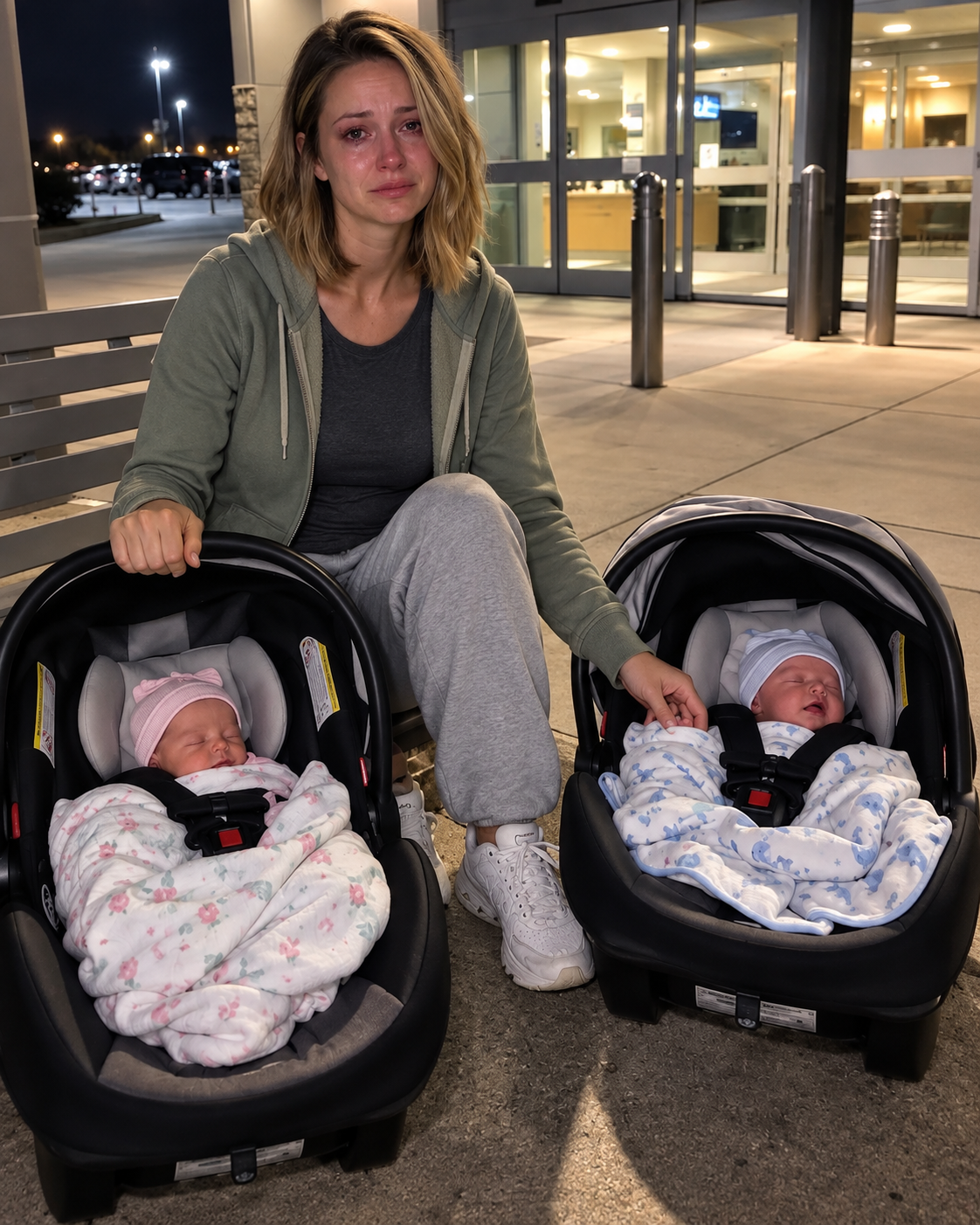
PART 1 TITLE: After a Twelve Hour Hospital Shift, I Found a Young Mother Abandoned With Two Newborns and No Way Home
At 2:07 in the morning, I was crossing the hospital parking lot when I heard a baby crying. The sound came from somewhere beyond the emergency entrance, near a row of benches usually occupied by patients waiting for transportation. I had just finished twelve hours in the emergency department and wanted nothing more than to go home, shower, and sleep. But there was something about that crying that made me stop. It wasn’t the brief, irritated protest of a hungry infant. It was a thin, exhausted wail that kept breaking off and starting again, as though the child had already cried for far too long.
Under the harsh light above the entrance sat a young woman with two infant carriers positioned beside her knees. One baby appeared to be asleep. The other squirmed against a blanket while his mother tried desperately to settle him. Her hair had escaped its loose ponytail, and the front of her sweatshirt was marked with dried milk. A hospital discharge envelope lay open on the bench. She was looking across the nearly empty parking lot, watching every vehicle that passed as though expecting someone to return. When she noticed me approaching, she immediately straightened her shoulders and attempted to quiet the crying baby.
I hesitated a few feet away, careful not to startle her. “Excuse me. Are you waiting for a ride?” She looked at my hospital badge before answering. “Not exactly.” Her voice was hoarse. She adjusted the blanket beneath the baby’s chin, then glanced toward the roadway. “Someone was supposed to take us home.” I waited, sensing there was more she wanted to say. Instead, her eyes filled, and she turned away. I could see she was trying hard to regain control of herself before speaking again.
“My name is Daniel,” I said. “I’m a doctor here. I just finished my shift.” She nodded without meeting my eyes. “Emily.” I looked at the two carriers. “How old are they?” Her expression softened almost imperceptibly. “Six days.” For a moment, I couldn’t find anything useful to say. Six days meant she had barely begun recovering from giving birth. She should have been somewhere warm, with help close at hand, not sitting outside an emergency department in the middle of the night. “Twins?” I asked. “Yes. Oliver and his brother.” She placed a protective hand on the sleeping baby’s blanket.
I crouched beside the bench so she wouldn’t have to look up at me. “Is either baby sick?” Emily shook her head. “Oliver had trouble feeding. He kept refusing milk, and I was afraid something was wrong. They examined him and said he was all right. They gave me instructions about what to watch for.” She touched the discharge papers. “I know I probably panicked over nothing.” I told her that bringing a six-day-old infant for medical attention when she was worried about his feeding was a sensible decision. The reassurance seemed to reach her, but only briefly. Her gaze returned to the roadway.
“Where’s your husband?” I asked. The question changed her face. She pressed her lips together, and I noticed her fingers gripping the handle of Oliver’s carrier. “He left.” I thought she meant he had stepped away. “To get the car?” She shook her head. “No. He drove away.” The crying baby gave another strained little wail. Emily lifted him carefully, supporting his head against her shoulder. “We argued after the doctor said Oliver was fine. Nathan was angry because we had spent hours here. I told him I hadn’t meant to keep him awake. He said I was making everything difficult.”
I glanced around the parking lot. “How long ago did he leave?” She looked uncertain. “Maybe an hour. A little longer.” “Did he say he was coming back?” Emily didn’t answer immediately. Then she whispered, “He told me to find somebody else who wanted to deal with me.” Her voice was so quiet that the words nearly disappeared beneath the humming ventilation units. I asked whether she had called anyone. She gave a small, helpless shake of her head. “My phone was in my purse. Nathan took it when he left. The diaper bag was in the car too.”
I looked down at the two newborns. Their mother had no telephone, no money, and none of the supplies she might need if another feeding or diaper change became necessary. The night air was cool enough that I could see her trying to keep both carriers protected from the wind. “Where were you planning to go?” I asked. “Not home.” That answer came quickly. She swallowed and tried again. “My sister Sophie lives across town. I thought perhaps I could reach her somehow. But I don’t have her number memorized.” She rubbed her forehead. “I can’t even think properly anymore.”
I took my phone from my pocket and unlocked it. “Do you know her number well enough to enter it?” Emily nodded. Her hands shook as she typed. I stepped away to give her privacy while she waited for the call to connect. Sophie answered after the second ring. Emily’s shoulders slumped at the sound of her sister’s voice. “It’s me,” she said. “I’m at the hospital. Nathan left with the car. I have the boys.” I heard a startled response through the receiver. Emily closed her eyes. “No, they’re safe. Oliver’s fine. I just don’t know how to get to you.”
The conversation lasted several minutes. Sophie sounded distressed, but she had a problem of her own: her car was at a repair shop, and she couldn’t collect Emily and the twins. She suggested arranging a taxi. Emily explained that she had no money or bank card because Nathan had taken her purse. Sophie offered to find another way, but it was after two in the morning, and neither sister seemed to have an immediate solution. When Emily ended the call, she held my phone carefully between both hands. “Thank you,” she said. “Sophie is trying to work something out.” Then she stared at the dark screen as though she had run out of strength to do anything else.
“How far away does Sophie live?” I asked. Emily named a neighborhood roughly fifteen minutes from the hospital. It wasn’t far from the route I normally took home. “I can drive you there.” She looked up sharply. “You don’t have to do that.” “I know.” “You’ve probably been working all night.” “I have, but I’m still awake, and your sister isn’t far away.” Emily studied my face. I could see the uncertainty behind her exhaustion. She had just been abandoned by someone she trusted. Accepting a ride from a stranger couldn’t have felt like an easy decision.
“You don’t know me,” I acknowledged. “And you shouldn’t feel obliged to trust me simply because I work here.” I showed her my identification and explained that the hospital security cameras covered the entrance. I offered to let her telephone Sophie again, give her my name and vehicle details, and confirm where we were going. Emily considered this, then asked whether I really had room for both infant carriers. I told her that I would check the installation of both car seats before we went anywhere. For the first time, her expression changed enough to reveal the faintest trace of relief.
We gathered the discharge papers and blankets. Emily rose slowly, bracing one hand against the bench, and I realized how much effort even that movement cost her. She had delivered twins less than a week earlier. Her body was still recovering, and she was trying to perform every small task without asking for assistance. When I reached for one carrier, she hesitated, then allowed me to lift it. The sleeping baby stirred but didn’t wake. Oliver continued protesting from beneath his knitted blanket. “He usually settles when we’re moving,” Emily murmured. “I hope so,” I replied. “My conversations are much less entertaining than his.”
My car was parked near the end of the employee section. As we walked, Emily kept apologizing for the inconvenience. I told her she didn’t need to. She apologized when I opened the rear door, when I moved my work bag from the back seat, and again when I took several minutes to make sure the infant seats were properly secured. I wasn’t irritated with her. I was becoming increasingly troubled by the way she reacted to ordinary kindness. Every offer seemed to make her anxious, as though she expected an invisible bill to arrive afterward.
Once both infants were safely positioned, Emily climbed into the back between them. She immediately checked Oliver’s blanket and touched the sleeping baby’s cheek. I started the engine and let the heater warm the car before pulling away. The hospital receded behind us, its illuminated windows rising above the empty streets. For several minutes, neither of us spoke. Oliver’s crying gradually became a series of little grunts, and then he settled. I could see Emily in the rearview mirror, watching him with the fixed attention of someone afraid that looking away might cause another problem.
“I’m sorry,” she said eventually. I glanced at the mirror. “What for this time?” A small, embarrassed smile crossed her face. “Everything. Taking your time. Making you drive across town. I know you must be exhausted.” I kept my attention on the road. “You haven’t made me do anything. I offered.” She looked down at her hands. “Nathan says I turn every little problem into an emergency.” I remembered the way she had described Oliver’s feeding difficulty. “Taking a newborn to the hospital because he’s struggling to eat isn’t a little problem,” I said. “And needing assistance with twins isn’t a personal failure.”
Emily gave a short laugh without humor. “That’s not how Nathan sees it.” I didn’t push her, but after a while she began telling me about the previous week. Since bringing the boys home, she had been sleeping in fragments. Every feeding seemed to overlap with a diaper change, and whenever one child settled, the other woke. She had asked Nathan to handle one nighttime feeding so she could rest for a couple of hours. He told her that he worked during the day and couldn’t afford to be tired. When she reminded him that she was recovering from childbirth, he accused her of keeping score.
“I know he works hard,” she said. “I know he’s worried about money. But yesterday I started crying because I couldn’t find a clean bottle, and he just stood there looking annoyed.” I asked whether she had family nearby besides Sophie. “His mother lives close,” Emily answered. “Barbara. She’s been very kind whenever we see her, but Nathan doesn’t want me bothering her.” Something about the name caught my attention, though I immediately dismissed it. Barbara was common enough. I had no reason to assume any connection. Emily continued describing the argument at the hospital, her words becoming more deliberate as she reconstructed what had happened.
Outside the emergency department, she had asked Nathan to carry one of the babies because her back was hurting. He told her she was always asking him to do something. She replied that caring for two infants was not a responsibility she could manage completely alone. That was when he became angry. He accused her of embarrassing him by bringing Oliver to the hospital and insisted she was making their lives harder. Emily said she had asked him to listen rather than shout. He opened the car door, climbed into the driver’s seat, and told her to find someone else willing to hear her complaints.
“I thought he’d circle around and come back,” she admitted. “I watched the entrance for a long time.” She paused before adding, “The worst part is that I was wondering what I could say to stop him being angry when he returned.” I kept both hands on the steering wheel. Her words carried me backward into a childhood I rarely discussed. My own mother had spent years trying to predict my father’s moods. Whenever he slammed a door or humiliated someone at dinner, she would explain that he was tired, worried, or under pressure. The explanations changed. The behavior didn’t.
I told Emily a little about that history. Not every detail, and not the parts that still felt difficult to say aloud, but enough for her to understand why her excuses sounded familiar. “Did your father ever change?” she asked. I considered giving her a gentler answer. Instead, I told her the truth. “No. He died without really taking responsibility for the way he treated people.” Emily fell quiet. Through the mirror, I could see her fingers moving across Oliver’s blanket. “I don’t want my boys growing up afraid of making their father angry,” she said. It sounded less like a declaration than a thought she hadn’t intended anyone to hear.
A tightness suddenly spread across my chest. At first, I thought I had taken an unusually shallow breath. Then the familiar wheeze began. I had asthma, normally well controlled, but long shifts and exhaustion sometimes made it worse. I signaled and pulled into a brightly lit parking area outside a closed office building. Emily leaned forward immediately. “What’s wrong?” “My asthma,” I answered, reaching for my inhaler. “It’s manageable. I just need a moment.” I used it and remained parked while my breathing settled. Emily watched me with genuine concern. “We can call someone,” she offered. I reassured her that I knew my symptoms and would not resume driving until I felt well enough.
After a few minutes, my breathing returned to normal. I looked toward the back seat and found Emily studying me. “You stopped to help us when you weren’t feeling well yourself,” she said. “I was fine when we left.” “Still.” She lowered her eyes. “Nathan would’ve been furious if I made him stop like that.” I didn’t know how to respond without sounding as though I was telling her what to do about her marriage. Instead, I said, “You don’t have to earn the right to be concerned about another person. And you don’t have to earn the right to receive concern either.” She considered the words without answering.
A few blocks later, I noticed the green sign of a twenty-four-hour pharmacy. I asked what supplies she had available at Sophie’s house. Emily admitted she had a few diapers tucked into one carrier but not enough for the following day. She would also need wipes and possibly formula for Oliver, consistent with the feeding instructions she had received. We stopped, and I left her with the doors locked and my phone available while I went inside. Under the fluorescent lights, I gathered the essentials she mentioned, checked the package sizes, and added a few practical items she might have forgotten. At the register, I wondered what kind of man drove away with every possession his newborn children might need.
When I returned, Emily looked at the bags and immediately protested. “Daniel, this is too much.” “It’s diapers, wipes, and feeding supplies,” I said. “Nothing extravagant.” “I can’t pay you back tonight.” “I didn’t ask you to.” She stared at the shopping receipt that protruded from one bag. “Nathan will say I took advantage of you.” I placed the bags safely on the floor. “Nathan isn’t here, Emily. You don’t need to explain this purchase to him tonight.” She opened her mouth, then closed it. Something about that simple fact appeared to surprise her more than anything else I had said.
By the time we reached Sophie’s neighborhood, the sky was still dark, though a faint gray haze had begun to gather above the rooftops. Emily guided me toward a small house with a porch light burning. Before I had fully stopped, the front door opened. A woman in slippers and an oversized cardigan hurried down the steps. Emily struggled to undo her seat belt, and Sophie reached the car just as she climbed out. The sisters embraced awkwardly around Emily’s aching body. Sophie held her for a long moment, then stepped back and examined her face. “You’re here,” she whispered. “That’s what matters.”
We carried the babies inside. Sophie’s living room was warm and slightly cluttered, with folded laundry on one chair and a half-finished cup of tea on the coffee table. She had already cleared a place for the infant carriers. When she noticed the pharmacy bags, she looked at Emily. “Where did these come from?” Emily nodded toward me. “Daniel bought them.” Sophie seemed genuinely taken aback. She offered to reimburse me, but I declined. I explained that Emily might need extra assistance over the next few days and suggested they follow the hospital’s discharge advice if Oliver had further feeding trouble. Sophie listened closely and thanked me.
Emily remained beside the carriers while Sophie fetched blankets. She looked utterly exhausted, but she was no longer searching the room for a door someone might walk through angrily. I gave the sisters my telephone number in case a practical problem arose, and I told Emily to contact the hospital directly if either baby developed concerning symptoms. As I prepared to leave, she touched my sleeve. “You probably think this was just a ride,” she said. “But I was sitting outside wondering how I was going to get them somewhere safe. I couldn’t see past the next hour.” Her eyes filled again. “Thank you for helping us.”
I told her I hoped she would get some rest, and I meant it. Outside, the air had grown colder. I sat in my car for a moment, listening to the engine and watching Sophie’s porch light. I thought about the words Emily had used to excuse her husband’s behavior. I thought about my mother, about the home I had grown up in, and about how easily people learned to accept treatment they would never wish upon someone else. Then I drove away. I had no idea that the man who had abandoned Emily was someone from my own past, or that helping her would drag a ten-year family conflict back into my life.
END PART 1
PART 2 TITLE: Two Days After I Helped a Stranded Mother, My Department Chief Showed Me a Complaint With a Familiar Name
Forty-eight hours after taking Emily and her twins to Sophie’s house, I was standing outside my department chief’s office with a patient’s chart in my hand. I had been asked to come upstairs before beginning my next shift. The request was unusual. Richard preferred handling routine matters in the department, often while moving between patients and administrative calls. When he asked someone to meet him privately, it generally meant the subject required careful attention. His assistant had given me no explanation. As I approached the door, I noticed that Richard was already seated behind his desk, looking down at several sheets of paper.
He looked up when I entered. “Daniel. Come in and close the door.” I did. Richard was a practical man who rarely wasted words, but he seemed unusually reluctant to begin. There was a half-finished cup of coffee near his keyboard, and his reading glasses lay beside a document folder. He gestured toward the chair opposite him. “We received a complaint concerning your conduct earlier this week.” I sat down slowly. “A patient complaint?” “Not exactly.” He opened the folder and turned the first page toward me. “It concerns the woman you assisted outside the emergency department two nights ago.”
I felt a sudden chill despite the warm office. My first thought was that something had happened to Emily or one of the babies. “Is she all right?” Richard studied me. “As far as I know, yes.” “Then what’s happened?” He placed his hands together on the desk. “Her husband submitted a formal allegation against you. He claims you involved yourself in a private family dispute, took advantage of his wife’s vulnerable condition, and encouraged her to leave their home.” For several seconds, I simply looked at him. The words sounded so distant from the events I remembered that I struggled to connect them.
“That’s completely inaccurate,” I said. Richard nodded, though his expression remained serious. “I suspected you would have concerns about the account.” I leaned forward. “I found her outside the emergency department with two six-day-old infants. She had no telephone, no money, and no diaper bag because her husband had driven away with everything. She called her sister using my phone. Her sister couldn’t collect her. I offered transportation.” Richard listened without interrupting. I told him about checking the infant seats, stopping for supplies, and taking Emily directly to Sophie’s address. I made sure to distinguish what I had witnessed from what Emily had told me.
When I finished, Richard tapped the complaint with one finger. “The problem is that he’s demanding disciplinary action.” “For driving someone home?” “He’s describing it differently.” Richard slid the document closer. “Read it yourself.” The complaint presented a remarkable version of the night. According to Nathan, his wife had been distressed after an ordinary marital disagreement. I had supposedly approached her, encouraged her to distrust him, and used my hospital position to influence her decisions. He alleged that I had deliberately inserted myself into their marriage and created an unnecessary separation between husband and wife.
I read the accusations twice, partly because I couldn’t believe a person could reconstruct the same event so dishonestly. Nathan described Emily as emotionally unstable and suggested that I had exploited her exhaustion. He omitted the fact that he had taken her belongings and left two newborns without transportation. He mentioned neither the telephone call to Sophie nor the supplies I had purchased. He repeatedly described himself as a concerned husband seeking to protect his family from outside interference. The contrast between those sentences and the woman I had found trembling outside the hospital made my hands tighten around the paper.
“Richard, there’s security footage from the entrance,” I said. “It may show what happened before I arrived and will show me helping her into my car.” “I’ve already requested that the relevant footage be preserved.” I felt a small measure of relief. Richard continued, “There may also be records showing when you finished your shift. We’ll need your written account, and depending on the complaint’s progress, somebody may contact the woman herself. We have to document everything properly.” I understood the procedure. Hospitals couldn’t simply dismiss allegations because an employee denied them. Still, hearing my actions described in the language of misconduct was deeply unsettling.
I asked whether Richard believed I had done something wrong. He removed his glasses and looked at me directly. “I have worked with you long enough to know that you don’t ordinarily involve yourself in patients’ private lives. But I can’t decide an investigation before reviewing the evidence. What I can tell you is that the man’s account raises questions I intend to examine.” His answer was fair, though it gave me little comfort. I had expected that night to end when Emily walked safely into her sister’s house. Instead, a stranger had decided to make my professional reputation part of his quarrel.
“Can I have a copy?” I asked. Richard handed me the document. I began reading the final paragraph, searching for anything that explained why Nathan had chosen to pursue the complaint so aggressively. Most people would have been embarrassed after abandoning their wife and newborns. He seemed determined to portray the person who helped them as the offender. The closing lines demanded that I be warned against further contact with Emily and be investigated for professional misconduct. Beneath those demands was a signature, followed by a printed name. I had barely looked at it during my first reading.
Nathan’s first name was not unusual. But the surname printed below it struck me with almost physical force. I stopped breathing for a moment. The letters were unmistakable. They formed the same family name I had carried all my life, the name I had spent a decade trying not to associate with conflict. I leaned closer, wondering whether I had misunderstood something. Richard noticed the change in my expression. “What is it?” I placed one finger beneath the signature. “Richard, is this the husband’s full name?” He glanced down. “That’s what he provided. Why?”
The room seemed to become very quiet. I asked whether Richard had any reason to doubt the information. He shook his head. “Not at present.” I looked again at the address and other identifying details. They were consistent with what I remembered about my older brother. I hadn’t seen him in ten years, but I knew enough to recognize his handwriting and the distinct way he signed his name. The final flourish beneath the signature was familiar from childhood birthday cards, school forms, and countless arguments over who had received what. I set the paper down carefully.
“Nathan is my brother,” I said. Richard stared at me. “Your brother?” “My older brother. We haven’t spoken in a decade.” Richard leaned back in his chair. “You didn’t recognize his wife?” “I didn’t know he was married.” That answer felt strange even to me. We had become so completely separated that I had known nothing about his adult life beyond occasional fragments from our mother. I knew he had settled somewhere nearby, but I had never met Emily. I hadn’t known about the pregnancy, the wedding, or the birth of the twins. Two nights earlier, I had helped my nephews without knowing they were related to me.
Richard allowed a moment for the information to settle. “Are you certain?” he asked. I nodded. “I recognize the name and signature. And his mother’s name is Barbara. Emily mentioned her during the drive. I thought nothing of it.” Richard drew the complaint back toward him. “That changes the context, but it doesn’t remove the need to investigate.” “I understand.” “You also need to disclose this family relationship in your written statement. It could be relevant to how the complaint is assessed.” I agreed. The distinction mattered. I had acted without knowledge of the relationship, but the complainant clearly knew who I was.
That realization bothered me more than the complaint itself. Nathan knew where I worked. He had known for years. Our mother had mentioned my career often enough that he couldn’t have mistaken my identity once he heard my name. Emily had probably told him about the hospital doctor who drove her to Sophie. He might even have recognized me from the description. Instead of expressing gratitude that his children had reached safety, he had submitted a formal accusation. Ten years of silence had apparently done nothing to weaken his resentment.
Richard asked whether our past relationship might explain the complaint. I gave him a careful account, avoiding speculation. “We disagreed about our mother’s home after our father died. The disagreement became serious enough that we stopped speaking. Nathan has blamed me ever since.” Richard watched me thoughtfully. “Then I suggest you keep your written response strictly factual. Don’t turn it into a family argument.” I knew he was right. Personal history might explain Nathan’s motives, but it wouldn’t establish what had happened outside the hospital. We had evidence for that. I would document the incident and allow the review to follow its course.
Before I left, Richard assured me that the complaint did not automatically mean disciplinary action. No decision had been made. I thanked him, collected the papers, and stepped into the corridor. People passed with coffee cups and patient files, discussing ordinary problems. Nothing in their expressions suggested that the world had shifted. Yet I stood beside the elevator holding evidence that my brother had reentered my life by attempting to damage the career I had spent years building. I thought about calling him. The impulse lasted only a moment. If our history had taught me anything, it was that Nathan could turn an argument into a contest no one could win.
Instead, I went to an empty room and began writing my statement. I recorded the time I had left the emergency department, the location of the bench, Emily’s account of being stranded, and the sequence of events afterward. I included the telephone call to Sophie, the pharmacy stop, the supplies purchased, and the address where I had left them. I attached the receipt from the pharmacy, which I had found tucked into my jacket pocket. I resisted the temptation to add a paragraph about Nathan’s character. Whatever I thought of him, the hospital needed a reliable record rather than my anger.
As I worked, childhood memories surfaced uninvited. Nathan had always been older, louder, and more certain that the world owed him special consideration. When we were boys, our father had favored him openly. If something broke, Nathan usually found a way to make the blame settle elsewhere. If a quarrel began, he could describe himself as the one who had been mistreated. I remembered our mother trying to calm everyone while my father supported whichever version caused him the least inconvenience. Nathan learned early that being first to explain a situation could matter more than telling the truth.
That pattern became more pronounced as we grew older. I had chosen medicine, moved into my own apartment, and spent years working long hours. Nathan pursued various jobs and business opportunities. He was intelligent and persuasive, but his patience rarely lasted when he couldn’t obtain what he wanted. When our father died, I hoped the household might finally become peaceful. Instead, his death opened a new argument over money. Nathan wanted the family home sold. Our mother was still living there, and I couldn’t bear the idea of forcing her out simply because my brother wanted access to his inheritance.
The dispute had taken months to resolve. Lawyers reviewed the property arrangements, conversations grew bitter, and Nathan accused me of manipulating our mother. We eventually reached a solution that allowed Barbara to remain in her house without selling it. Nathan received the arrangements to which he was entitled, but he never accepted that outcome. In his mind, I had deprived him of money that should have been available immediately. At our final meeting, he told me I would regret interfering. I was younger then and more willing to argue. I answered in anger, and the conversation ended with both of us promising not to speak again.
For ten years, we kept that promise. Our mother occasionally mentioned Nathan, usually in carefully neutral terms. I never asked many questions. She seemed relieved whenever a visit passed without either son criticizing the other, and I didn’t want to make her choose sides. I knew Nathan still lived in the area. I knew he occasionally helped Barbara with small repairs and visited on holidays. But I hadn’t known he had married. Looking back, that ignorance seemed less like a coincidence than the result of a family that had learned to conceal anything likely to provoke conflict.
I completed my statement and sent it through the appropriate hospital channel. Then I considered Emily. She might not know about the complaint. Nathan could be acting without telling her, just as he had apparently left out crucial details when explaining their argument. I wanted to call Sophie and warn them, but I hesitated. I didn’t want to frighten Emily while she was recovering or create the impression that I was trying to influence her testimony. My first responsibility was to ensure that any contact remained appropriate and transparent. I decided to speak with my mother before doing anything else.
Barbara lived about twenty minutes away in the same house Nathan had once insisted should be sold. It was a modest two-story property with a narrow front garden and a porch that needed repainting. She had always kept the place neat, though age had gradually made some chores harder. During my childhood, the house had often felt tense despite its comfortable appearance. After my father’s death, Barbara had planted flowers near the walkway and replaced the heavy curtains he preferred with lighter ones. Small changes, but I remembered noticing how much brighter the rooms became.
I called her from the hospital parking lot. “Daniel! Is everything all right?” she asked. Her voice was warm and immediately concerned. I told her I wanted to visit and asked whether she would be home. “Of course. Is something wrong?” I paused. “I’d rather explain in person.” She agreed, though I could hear the worry in her response. I nearly told her over the telephone, but I knew how much Nathan’s name could unsettle her. This was not something I wanted to leave hanging between us through a poor connection or a rushed conversation.
During the drive, I kept returning to one detail. Emily had spoken about Nathan’s mother with warmth, yet she seemed convinced that asking Barbara for help would cause trouble. Had Nathan deliberately kept the two women apart? Or had he simply discouraged Emily from depending on anyone beyond himself? I didn’t know enough to reach a conclusion. The only facts I could establish were that he had abandoned his wife and children, taken their supplies, and then complained about the person who brought them to safety. That was already serious enough.
Barbara opened the front door before I had climbed the porch steps. She wore a pale blue cardigan and looked pleased to see me until she studied my face. “Come inside,” she said. “You look as if you’ve had a difficult day.” The familiar smell of brewed tea filled the hallway. A framed photograph of my father still stood on a narrow table near the stairs, though Barbara had moved it there years earlier from its place above the fireplace. She led me into the kitchen and asked whether I wanted something to eat. I declined. I hadn’t come to discuss my work or let her fuss over me.
“Mom, someone filed a complaint about me at the hospital,” I began. She set the kettle down. “A complaint? What happened?” “I helped a woman and her newborn twins get home after her husband left them outside the emergency department.” Barbara frowned. “Why would anyone complain about that?” I took the folded document from my jacket and placed it on the table. “Because her husband didn’t like what I did.” She glanced at the papers. “Who is he?” I watched her carefully. “Nathan.” Her fingers froze against the edge of the table.
For a long moment, my mother said nothing. Then she looked at me with genuine disbelief. “Your brother?” I nodded. “I didn’t know Emily was his wife. I didn’t know the twins were his children until I saw his signature.” Barbara sat down slowly. Her eyes moved from my face to the complaint. “You met Emily?” she asked, almost in a whisper. “Yes. Completely by accident.” I described the crying baby, the empty parking lot, and Emily’s inability to contact Sophie. I told her Nathan had taken the purse, telephone, and diaper bag. By the time I finished, my mother’s face had lost much of its color.
“But Nathan told me something entirely different,” she said. I waited. Barbara looked at the document again. “He called me the morning after that happened. He said he’d taken Emily and the babies to Sophie because she wanted some time away from home. He told me he bought supplies and gave her money so she would have everything she needed.” I stared at her. “He said he drove them there?” “Yes.” Her voice faltered. “He made it sound as though he’d been trying to help her after a difficult night.” I thought about the pharmacy receipt in my pocket and the child crying under the hospital lights.
“Mom,” I said quietly, “none of that happened.” Barbara pressed her hands together. “Then why would he tell me those things?” I looked at the complaint resting between us. “Because he wanted you to believe he had done the right thing before anyone could tell you otherwise.” My mother lowered her head. I had seen that posture before, countless times during childhood, when she was deciding whether to excuse another person’s behavior or acknowledge what had happened. This time she didn’t immediately defend him. She reached for her glasses and began reading the complaint herself.
As she turned the pages, her expression changed from confusion to a sadness I recognized too well. “He wants your hospital to punish you,” she said. “For making sure his children were safe.” I nodded. She read the signature one more time, then removed her glasses and put them on the table. “I thought becoming a father might help him grow up,” she whispered. “I thought he’d learn what it meant to be responsible for someone besides himself.” She looked toward the window. “Perhaps I was trying to believe something I wanted very badly to be true.”
I moved my chair closer, but she raised a hand before I could reassure her. “There’s something I haven’t told you,” Barbara said. Her voice had acquired a seriousness that made me sit still. “It concerns Nathan and the twins, and it began months before Emily gave birth.” I waited. My mother looked at the closed kitchen door, as though someone might be listening from the hallway. “I didn’t understand what was happening at first,” she continued. “But after what you’ve told me today, I think you need to know exactly what I’ve been doing for Nathan.”
END PART 2
PART 3 TITLE: My Mother Revealed What My Brother Had Been Hiding Since His Wife Became Pregnant, and Everything Began to Make Sense
My mother remained seated at the kitchen table, turning her glasses slowly between her fingers. Outside, a delivery truck passed along the street, its engine fading into the ordinary afternoon sounds of the neighborhood. I had expected her to explain why Nathan had lied about taking Emily home. Instead, she seemed to be gathering the courage to disclose something that had weighed on her for months. The complaint lay between us, and I noticed that she had folded it so the signature was no longer visible. “Daniel,” she said finally, “I’ve been giving Nathan money since Emily became pregnant.”
I didn’t immediately understand why this should be a secret. Barbara had always been generous, sometimes more generous than her circumstances allowed. “Money for the babies?” I asked. She nodded. “At least, that’s what I believed it was for.” She looked down at her hands. “When he told me Emily was expecting twins, he said they were frightened about expenses. Two babies meant more medical appointments, more equipment, more everything. I understood that. I remember how difficult things were when you and Nathan were little.” She paused. “So I offered to contribute what I could.”
I asked how often she had sent money. “Every month.” She named an amount that made me straighten in my chair. It wasn’t enough to endanger her immediately, but it was a substantial portion of what she had left after her ordinary household expenses. She had been careful with money all her life. I knew she kept a separate account for repairs to the house and unexpected medical bills. “How long?” I asked. “Since early in Emily’s pregnancy.” “And Nathan told you the money was reaching her?” Barbara nodded. “He said it was helping with appointments, supplies, and the things they needed before the boys arrived.”
I thought about Emily sitting in the car, apologizing because she needed diapers. She had spoken about Nathan’s financial worries as though every purchase for the babies created a burden he could barely tolerate. “Did Emily know you were helping?” I asked. Barbara hesitated. “I thought she did.” “Did you ever ask her directly?” “Not in so many words.” She rubbed the side of her cup. “Whenever we talked, I mentioned that I hoped they had everything they needed. She always thanked me for being thoughtful. I assumed Nathan had told her about the transfers.”
That assumption troubled me. Nathan had always been skilled at keeping people separated by controlling what each believed the other had said. I asked whether Barbara had given the money directly to Emily. She shook her head. “Nathan said it would be easier for him to manage the expenses. He told me Emily was overwhelmed with the pregnancy and shouldn’t have to deal with bills.” I didn’t answer immediately. There could be legitimate reasons for one spouse to manage household payments. But the fact that Emily had been stranded without basic supplies made the arrangement appear very different.
“Mom, did Nathan ever show you what the money paid for?” I asked. Barbara looked uncomfortable. “No. I didn’t ask for receipts from my own son.” “I’m not saying you should have expected him to deceive you.” “I know.” She stared at the table for a moment. “But I was beginning to wonder. Every few weeks he would mention something else they needed, and whenever I asked whether Emily was feeling better, he became impatient.” She remembered Nathan claiming that the twins’ arrival had created expenses he hadn’t anticipated. Yet he rarely described specific purchases, and he discouraged her from giving anything directly to his wife.
I asked when she had last seen Emily. “At the hospital after the babies were born,” Barbara replied. “Only for a little while. Nathan said she needed rest.” She gave a weary sigh. “She looked exhausted, but I thought that was understandable after delivering twins. I brought some baby clothes. Nathan offered to carry them upstairs, and I don’t even know whether she received everything.” I could see my mother’s mind returning to small moments she had ignored. She mentioned that Emily had once apologized for not having a proper double stroller, although Barbara believed Nathan had already purchased one with her help.
“Are you sure she said that?” I asked. Barbara nodded. “She said they were waiting until they could afford it.” The statement hung between us. I remembered my brother’s expensive tastes. Whenever he received money, he tended to treat it as available for whatever interested him most at the time. He had bought elaborate equipment for hobbies he abandoned after a few months. He enjoyed weekends away with friends and believed strongly that working hard entitled him to spend on himself. None of those preferences was inherently wrong. But taking money intended for newborn children while telling their mother there was nothing available would be something else entirely.
I asked Barbara whether she had evidence of the transfers. “The bank records,” she answered. “Every payment went into his account.” She looked at me anxiously. “Do you think he spent it on himself?” I wasn’t willing to claim something I couldn’t prove. “I don’t know. We need to find out what Emily was told, and Nathan needs to account for the money.” Barbara became quiet. Then she said, “I can already hear him saying we don’t trust him.” Her words brought back a familiar memory: my father declaring that asking questions was an insult, even when he had caused the problem that made those questions necessary.
I leaned against the back of my chair. “Mom, asking where money went isn’t the same as accusing someone without evidence. You gave it for a particular purpose. You’re entitled to know whether it served that purpose.” She nodded reluctantly. I could tell that a part of her still hoped there would be an innocent explanation. Perhaps there had been unexpected expenses. Perhaps Nathan had simply communicated badly. I wanted those possibilities to be true as well, not because I believed my brother deserved endless excuses, but because Emily and the babies had already been placed in a painful position.
Barbara stood and walked to the counter, though there was nothing she needed to retrieve. She rested both palms against it. “I never wanted my sons to hate each other,” she said. “After your father died, I kept telling myself that if I could avoid discussing the house, eventually you and Nathan might find your way back to each other.” I looked at the old wooden cabinets, remembering how often she had tried to make our family dinners peaceful. Her desire was understandable. But years of avoiding unpleasant conversations had not brought us closer. It had simply allowed our resentment to remain untouched.
“We don’t have to solve ten years of family history today,” I told her. “Right now Emily and the boys need support, and Nathan has made a complaint that must be answered.” Barbara turned toward me. “Do you think he knows you helped her?” “He must know by now. He used my name in the complaint.” “Then he knows you didn’t recognize her.” “I suspect he does.” She looked deeply troubled. “He could have telephoned you. He could have asked what happened.” I gave a faint smile. “Nathan has never been fond of questions when he thinks he already knows the answer he wants.”
My mother returned to her chair and took a long breath. “There’s another problem.” I waited. “I’ve invited Nathan and Emily to dinner on Saturday. The babies too.” I looked at her. “When did you arrange that?” “Last week. Before any of this happened.” She explained that she wanted to prepare a proper family meal now that the twins were home. Nathan had accepted, though without much enthusiasm. Barbara had hoped Emily might enjoy some company and that she could spend more time with her grandsons. She hadn’t invited me because she assumed Nathan would refuse to attend if he knew I was coming.
I considered the invitation. My immediate reaction was to stay away. I had avoided confronting Nathan for a decade, and a dinner table seemed like a terrible setting for reopening our dispute. Yet the situation had changed. He had used my workplace to punish me for helping his family. He was telling our mother a version of events that contradicted what Emily had experienced. And there was now a serious question about money that might have been intended for the infants. Avoiding him would not protect Emily or resolve the complaint. It would simply allow Nathan’s account to remain the loudest one.
“Has Emily confirmed she’ll be there?” I asked. Barbara nodded. “Nathan said they would both come.” I thought about the fact that Emily was staying with Sophie. It was entirely possible she had no intention of returning to Nathan’s home soon, and I didn’t want a family dinner used to pressure her. “Mom, don’t assume Emily will arrive with him. And please don’t tell Nathan that I’m coming yet.” Barbara frowned. “Are you planning to surprise him?” “I want to hear what he says before he prepares another story. But Emily should know what’s happening. She deserves a choice.”
Barbara watched me carefully. “I don’t want a scene in my house.” “Neither do I.” I meant it. There had been enough shouting in that kitchen while our father was alive to last several lifetimes. I wasn’t interested in proving that I could argue louder than Nathan. I wanted a truthful conversation in which Emily could speak without being interrupted or pressured. “If we do this,” I said, “we need to remember that Emily isn’t responsible for fixing our family. She can leave whenever she wants, and the babies’ needs come first.”
My mother nodded. She seemed relieved that I wasn’t proposing an angry confrontation. We discussed the practical arrangements. She would prepare dinner as planned, but I would speak to Sophie beforehand to ensure Emily knew what she was walking into. I also asked Barbara to gather the records of the money she had transferred, not to distribute them or confront Nathan immediately, but to make sure she had a clear understanding of the facts. She agreed, though I could see that reviewing those payments would be painful. Each transfer represented a moment when she had believed she was making life easier for her grandchildren.
Before leaving, I asked whether she wanted me to contact Nathan directly. “Not yet,” she said. “I need to think.” She walked me to the door and embraced me. Her hold lasted longer than usual. “I wish things had been different between you boys,” she whispered. I didn’t tell her that I had wished the same thing for most of my life. I simply hugged her back. On the drive home, I imagined what Nathan might say if he found me sitting at our mother’s table. I could practically hear his accusation that I was interfering again, controlling matters that didn’t concern me. The difference was that this time, two infants and their exhausted mother were involved.
That evening, I called Sophie’s number. She answered cautiously, then recognized my voice. “Daniel? Is everything all right?” I reassured her that I wasn’t calling about an emergency. I asked how Emily and the boys were doing. Sophie told me that Oliver was feeding better and that both babies had been checked according to the hospital’s instructions. Emily had managed to sleep for a few uninterrupted hours, which Sophie considered a small triumph. Her sister was still sore and overwhelmed, but being in a familiar place had helped. I felt relieved hearing that the twins were safe and receiving care.
Then Sophie asked whether I had heard from Nathan. I paused. “Not directly. Why?” She told me he had contacted Emily repeatedly, demanding that she return home and accusing Sophie of encouraging her to stay away. Emily had answered some messages, but she was reluctant to engage in another argument. Sophie sounded angry. “He keeps acting as if the whole problem is that she won’t come back. He hasn’t once asked whether Oliver is feeding properly.” I let her finish. Her account matched the pattern I had begun to recognize, but I was careful not to tell her what decisions Emily should make.
I explained that Nathan had filed a complaint with my hospital. Sophie was silent for several seconds. “He did what?” I told her the allegations and assured her that the matter was being reviewed. “Emily doesn’t know,” Sophie said. “I’m certain she doesn’t. She’s been trying not to upset him.” I asked whether she felt comfortable sharing the information with her sister and letting Emily decide whether she wanted to speak about it. Sophie agreed. I emphasized that there was no requirement for Emily to defend me. If she chose to provide an account of the night, it should be entirely her own.
We then discussed Barbara’s dinner invitation. Sophie said Emily had mentioned it earlier but was unsure whether to attend. “She’s worried Nathan will make a scene,” Sophie explained. I told her that I would be present, but that Emily had no obligation to come. I also made clear that Barbara wanted to see the babies and had not been told the truth about what happened outside the hospital. Sophie listened. “Emily likes Barbara,” she said. “She thinks Nathan keeps his mother at a distance because he doesn’t want her interfering.” I wondered whether the same explanation had been used to discourage Barbara from contacting Emily directly.
Sophie agreed to discuss the invitation with her sister. We talked about practical safeguards rather than dramatic plans. Emily could arrive separately with Sophie, keep her own transportation available, and leave at any time. There would be no expectation that she return home with Nathan. If the conversation became hostile, Sophie would take Emily and the babies away. I offered to help coordinate the evening but insisted that Emily make her own decision. Sophie sounded grateful. “You’re doing more for them than most of the people who promised to help,” she said. I told her that arranging a safe evening was a small thing compared with what she was already doing.
After the call, I sat at my kitchen table looking at the hospital complaint. It was strange how quickly the situation had changed. Two days earlier, I had considered Emily a stranger who needed a ride. Now I knew she was my sister-in-law, Oliver and his brother were my nephews, and the man who had abandoned them was the person I had spent years trying to avoid. I felt anger toward Nathan, but beneath it lay something more complicated. I had missed the chance to know his children from the moment they were born. That loss was not entirely his doing. I had helped maintain the silence between us.
The following morning, Sophie called back. Emily had agreed to attend the dinner, but only if her sister came with her. She wanted to speak with Barbara and had questions about what Nathan had been saying. She also wanted me to know that she was willing to explain what happened outside the hospital if the investigators contacted her. I thanked Sophie for telling me and again emphasized that Emily should not feel responsible for protecting my job. Sophie responded firmly. “She wants the truth recorded because Nathan is lying about her too. This isn’t just about you.” I understood. Nathan’s complaint had turned Emily’s distress into a story in which she was supposedly incapable of making her own decisions.
I spent the next day attending to my normal responsibilities, but I found it difficult to keep my mind from returning to Saturday. The hospital review continued, and Richard told me that the relevant records were being gathered. I had no guarantee of the outcome, although he seemed satisfied with the detailed account I had supplied. I resisted contacting Nathan. Our last conversation had ended in bitterness ten years earlier, and I didn’t trust myself to keep a telephone argument productive. If I was going to confront him, I wanted the facts available and the people affected by his decisions present by their own choice.
On Friday evening, Barbara called. She had reviewed her bank statements and confirmed every transfer to Nathan. Her voice sounded subdued. “It adds up to more than I realized,” she admitted. I asked whether the total would cause her financial difficulty. “I can manage,” she answered. “That’s not what hurts.” I knew what she meant. She hadn’t minded helping her son and grandchildren. What troubled her was the possibility that her help had been misrepresented or diverted. She asked whether I thought Nathan would admit what happened. I told her I couldn’t predict his response. “But we should give him a chance to answer directly.”
Saturday arrived beneath a gray, cloud-covered sky. I went to my mother’s house early, carrying bread and a few things she had requested from the grocery store. The kitchen smelled of roast chicken and rosemary. Potatoes were already prepared, vegetables sat in a large serving dish, and Barbara was moving between the stove and table with nervous energy. I helped set out plates while she repeatedly adjusted the position of the silverware. Finally, she stopped and looked at me. “Promise me you won’t let him turn this into another argument about the house.” I met her eyes. “The house isn’t what we’re discussing.”
She nodded, but I could see she remained anxious. I told her that if Nathan began shouting, I would not shout back. If Emily wanted to leave, I would help her do so without argument. If Nathan refused to answer questions, we would not be able to force him. Barbara listened carefully. “You sound very certain,” she said. “I’m not certain about how he’ll behave,” I replied. “I’m only certain about how I intend to behave.” She touched my arm. For a moment, the kitchen felt different from the place I remembered growing up. Nobody was demanding obedience. Nobody was waiting for a door to slam.
At exactly six o’clock, the doorbell rang. Barbara wiped her hands on a dish towel and went into the hallway. I heard Nathan’s voice before I saw him. It had the same easy confidence I remembered, warm and charming whenever he wanted something. “Mom, that smells incredible. You always make far too much food.” He entered carrying a bouquet and a bottle of something wrapped in paper. His jacket looked expensive, and he had the relaxed appearance of a man arriving for an ordinary family dinner. Then he stepped into the kitchen and saw me.
His smile vanished. He stopped so abruptly that Barbara nearly walked into him. For several seconds, neither of us spoke. Nathan looked older than the brother in my memory, with faint lines around his eyes and a little gray at his temples. But his expression was familiar. I had seen it often enough when we were younger: the instant transformation from pleasant conversation to outraged suspicion. “What is he doing here?” he demanded. Barbara took a breath. “Daniel is my son, Nathan. He’s here for dinner.” Nathan looked from her to me. “You knew I was coming.”
“Yes,” I replied. I kept my voice level. “I also know you filed a complaint against me.” Nathan’s gaze sharpened. “So that’s why I’m here? You arranged some kind of meeting behind my back?” “Mom invited you before any of this happened,” I said. “I’m here because what happened at the hospital concerns my family too.” He gave a harsh laugh. “You don’t get to walk back into my life and pretend we’re family.” I looked at him steadily. “I didn’t know Emily was your wife when I helped her. I didn’t know those boys were your sons.”
Nathan opened his mouth, then stopped. For the first time since entering the room, he seemed uncertain which answer would serve him best. Barbara stepped forward. “I invited everyone because I want to see my grandchildren. And I want us to have a conversation without shouting.” Nathan looked toward the hallway. “I’m leaving.” “That is your choice,” she answered. “But this is my house. You don’t get to decide which of my sons I’m allowed to welcome.” Her voice was quiet, yet there was a firmness in it I had rarely heard during our childhood.
Nathan remained by the doorway, holding the flowers awkwardly. Then he placed them on the counter and removed his jacket. “Fine,” he muttered. “But I’m not sitting here being accused of things I didn’t do.” I didn’t respond. There would be time to address the complaint when everyone had arrived. Nathan took a seat at the table and began examining his phone. Barbara returned to the stove, though her hands trembled slightly as she lifted the roasting pan. I stood beside the counter, aware that the next arrival would change the evening far more than my presence already had.
Twenty minutes later, the doorbell rang again. Sophie had brought Emily and the twins. I heard quiet voices in the hallway, followed by the soft rustling of blankets and the small unmistakable noises of newborn infants. Emily entered carrying one infant carrier while Sophie carried the other. She stopped when she saw me. “Daniel?” Her eyes widened with genuine surprise, despite having been told I might attend. I stepped forward. “Hello, Emily.” Then I looked at the two sleeping babies and felt the full weight of what I had learned. “There’s something you should know,” I said gently. “Nathan and I are brothers.”
END PART 3
PART 4 TITLE: At My Mother’s Dinner Table, My Estranged Brother Tried to Rewrite the Night He Abandoned His Wife and Newborn Twins
Emily stared at me for a moment, then turned toward Nathan. The silence in my mother’s dining room seemed to stretch around the two infant carriers that Sophie had carefully placed near the wall. Emily was still wearing the same pale sweatshirt I remembered from the hospital, though her hair was neatly tied back and she looked a little more rested. She glanced between our faces, searching for a resemblance. Nathan sat rigidly at the table, his expression unreadable. “You never told me you had a brother who was a doctor,” she said to him. He lowered his eyes to his phone. “It never came up.”
The answer was so dismissive that Emily looked momentarily speechless. Barbara moved forward to greet her and gently shifted the conversation toward the babies. She embraced Emily, asked how she was recovering, and bent to look at her grandsons. Sophie set the diaper bag beside the carriers and accepted Barbara’s offer of tea. I remained near the doorway, giving Emily space to process the discovery. She looked at me again. “You didn’t know who I was that night?” “No,” I answered. “I learned the connection two days later.” Her expression changed as she understood what that meant. “After Nathan made the complaint?”
I nodded. Nathan put his phone down with a sharp movement. “Are we really going to discuss that already?” Barbara looked toward him. “We are going to eat first. The food is ready, and Emily shouldn’t have to stand here while everyone argues.” She was right. Emily had made the effort to attend despite being only days past childbirth. The boys needed care, and the tension in the room was doing no one any good. I helped bring dishes to the table while Sophie made sure the infants were comfortable. Nathan watched us without offering assistance.
We sat down around the old wooden table where Nathan and I had eaten thousands of meals as children. The familiarity of the setting made everything feel strangely unreal. The same window overlooked the backyard. The same narrow cabinet stood near the kitchen entrance. My mother had replaced the tablecloth, but the small scratch my brother and I had made years earlier was still visible near one corner. Nathan chose the chair our father once preferred. I noticed it immediately and wondered whether he had done so deliberately. Perhaps habit was enough to explain it. Either way, I sat across from him.
Barbara served the roast chicken and asked Emily how Oliver was doing. Emily explained that he had been feeding more comfortably and that the hospital instructions had helped. Her voice was gentle, but she spoke with more confidence than she had during the car ride. Sophie added that both babies were settling into a manageable routine, though nights remained difficult. Nathan gave an exaggerated sigh. “Difficult is putting it mildly. I haven’t had a proper night’s sleep since they were born.” Emily looked down at her plate. For a moment, I wondered whether she would let the remark pass.
“I haven’t slept much either,” she said quietly. Nathan gave her an irritated glance. “Yes, Emily, I know. You’ve mentioned that.” Sophie laid her fork down. “She’s recovering from giving birth to twins, Nathan. It’s reasonable for her to be tired.” He shrugged. “And I’m supposed to be fresh and energetic while working all day?” Barbara tried to redirect the conversation by asking about his job, but he continued discussing how little time he had for himself since becoming a father. His complaints were familiar in tone: he treated each inconvenience as evidence that nobody appreciated him.
I concentrated on eating and refused to respond to every remark. There was little value in challenging his description of sleepless nights. Parents of newborn twins were almost certainly exhausted, and Nathan might genuinely have been tired. The issue wasn’t whether his work mattered or whether he deserved rest. It was whether he understood that Emily and the children had needs just as real as his own. Beside me, Sophie helped Emily adjust a folded blanket beneath one carrier. Neither woman appeared interested in continuing the discussion.
Barbara asked whether Nathan and Emily had decided when they would return home together. Emily’s fingers tightened around her glass. “I’m staying with Sophie for now,” she answered. Nathan looked up. “We’ve discussed this.” “You told me to come back,” Emily replied. “That’s not the same as discussing it.” Her voice remained calm, though her cheeks had reddened. Barbara watched them both. “Is there something I should know?” Nathan immediately answered. “We had a disagreement after the hospital visit. Emily went to her sister’s house to cool off. Everyone’s making it into something much bigger.”
Emily drew a slow breath. I could see the effort it took not to interrupt him. Sophie looked ready to speak, but Emily touched her sister’s wrist beneath the table. That small gesture told me something important: she wanted to tell this part herself. “I didn’t decide to go to Sophie’s because I needed to calm down,” she said. “I went because I was left at the hospital without a way home.” Nathan shifted in his chair. “That’s not what happened.” “Then what happened?” Barbara asked. She didn’t raise her voice. The question was simple, and there was nowhere comfortable for him to place it.
Nathan set down his fork. “We argued. Emily was upset. She wouldn’t listen to me. I thought some time apart would help.” Barbara looked directly at him. “You told me you drove her and the boys to Sophie’s house afterward.” He hesitated. “I did what I could.” “That’s not what I asked,” she replied. He glanced at me, and I recognized the familiar resentment gathering in his expression. “Are we really going to take Daniel’s word over mine?” Barbara shook her head. “I’m asking you about what you told me. You said you took them there.”
“I was going to,” Nathan insisted. “But Emily wouldn’t get into the car.” I looked at Emily. She had gone very still. “Nathan, I was standing beside the car holding Oliver,” she said. “His brother was in the other carrier. You took my purse and the diaper bag, got behind the wheel, and drove away.” He scoffed. “You make it sound as though I planned to abandon you.” “I don’t know what you planned,” she answered. “I know what you did.” Sophie reached for her sister’s hand, but Emily kept speaking before anyone else could interrupt.
“I waited because I thought you’d come back. Every time headlights turned toward the entrance, I looked up. The boys were cold, and Oliver was crying. I couldn’t call Sophie because you had my phone.” Nathan looked uncomfortable but quickly recovered. “I knew you’d figure something out.” “You knew Sophie’s car was being repaired.” “I wasn’t thinking about her car.” “You weren’t thinking about how we’d get home,” Emily said. Her voice trembled, but she didn’t lower it. “That was the problem.” Barbara stared at her son. He looked away.
For a moment, the room was filled only by the quiet sound of one of the babies shifting in his seat. I remembered Emily on the hospital bench, struggling to keep both infants warm while apologizing for needing assistance. Now she was sitting in a family home with people listening to her description of that night. I wasn’t certain whether speaking would help or make things worse. Nathan had always preferred arguing with me to answering difficult questions from others. If I interrupted, he could shift the focus away from Emily. So I stayed silent.
Barbara continued. “Nathan, you also told me you bought diapers and supplies for the boys.” He rubbed his forehead. “I bought things for them before. What difference does it make?” “You told me you purchased what Emily needed after the hospital.” “I don’t remember the exact conversation.” Barbara looked at him steadily. “I do.” Her words carried an unfamiliar firmness. Nathan seemed to notice it too. He leaned back and folded his arms, adopting the expression he used when he wanted people to believe they were being unreasonable.
Emily looked toward me. “Daniel was the one who bought what we needed that night.” I reached into the folder beside my chair. I had brought copies of the documents connected to the hospital complaint, including the pharmacy receipt. I placed the receipt on the table without sliding it toward Nathan. “This shows the purchases I made after leaving the hospital,” I said. “Diapers, wipes, and the feeding supplies Emily requested. I kept the original for the hospital review.” Nathan stared at the paper. “You brought receipts to a family dinner?” “I brought evidence because you filed a formal complaint about what happened.”
He gave a sharp laugh. “There it is. You always have to prove you’re right.” I felt the old urge to answer with equal anger. It was almost automatic, a response built from years of arguments in which neither of us wanted to yield an inch. But I looked at the babies, one beginning to stir, and remembered why we were there. “This isn’t about winning an argument between us,” I said. “It’s about what happened to Emily and the boys.” Nathan shook his head. “You’ve always acted superior because you’re a doctor.” I didn’t respond to that accusation.
Sophie quietly lifted the waking baby and held him against her shoulder. His small grunts gradually settled, and the room returned to stillness. Barbara moved the serving dish away from the center of the table, clearing space between us. It was such an ordinary movement that I almost missed its significance. My mother was no longer trying to fill every silence with food or change the subject before someone became angry. She was giving us room to finish the conversation. I wondered how much courage that required after so many years of protecting family peace by avoiding conflict.
Emily looked at Nathan. “Why did you tell your mother you drove us home?” He shrugged. “I didn’t want her worrying.” “You could have told her the truth.” “She would’ve made a big issue of it.” Barbara looked wounded. “I would have been concerned about my grandchildren. I think that’s understandable.” Nathan turned toward her. “You never hear my side.” “I’ve heard your side,” she said. “What I’m asking is why your account doesn’t match what happened.” He opened his mouth, then closed it. For the first time that evening, he seemed to recognize that the familiar explanations weren’t working.
I took a breath. “There’s another matter we need to address.” Nathan glanced at me with immediate hostility. “Of course there is.” “You filed a complaint with my department chief.” His expression hardened. “I had every right.” “You have the right to raise concerns,” I said. “But the claims you made are inaccurate. You accused me of pressuring Emily and interfering with your marriage. I didn’t know she was your wife. I didn’t even know you had children.” He glanced at Barbara, as if expecting her to defend him. She remained quiet.
Emily looked confused. “Nathan, what exactly did you accuse him of?” He waved one hand. “It was a private matter between me and the hospital.” “You complained about the man who drove me and our babies somewhere safe,” she said. “That concerns me.” Nathan’s jaw tightened. “Daniel got involved in our marriage.” “He gave me a ride after you abandoned me.” “You keep using that word.” “Because you left us there,” Emily replied. Her voice was steady now. “And instead of asking whether we got home safely, you tried to get him in trouble.”
I took the copy of the complaint from the folder and laid it beside the receipt. I had no intention of reading the entire document aloud. Emily deserved to see what had been written about her, but I wanted to avoid turning the evening into a performance. “You can read this if you want,” I told her. “The hospital is reviewing it. You don’t have to respond tonight.” She reached for the papers. Nathan leaned forward. “Emily, give me that.” She pulled the document closer to herself. “No. I want to see what you said.”
She read slowly, occasionally returning to an earlier sentence. I watched her face change as she encountered the description of her supposedly unstable state and the suggestion that I had encouraged her to leave her husband. Sophie remained beside her, holding the sleeping baby. Barbara waited with her hands folded. Nathan shifted in his chair, but for once nobody rushed to reassure him. When Emily reached the final paragraph, she stopped. She looked at the signature, then back at the accusation that I had exploited her vulnerability.
“You described me as incapable of making decisions,” she said. Nathan gave an impatient sigh. “That’s not what I meant.” “It’s what you wrote.” “I was trying to explain how overwhelmed you were.” Emily placed the paper carefully on the table. “I was overwhelmed because I had just given birth and was trying to care for two newborns without enough help. That doesn’t mean I couldn’t decide to go to my sister’s house.” Nathan opened his mouth again, but she continued. “Daniel didn’t tell me to leave you. You had already left me in the parking lot.”
The words struck with a force that no raised voice could have matched. I saw Nathan’s expression change, but Emily did not look away. She told him that she had been frightened that night, not because she couldn’t manage a disagreement, but because she had no way to protect the boys from the consequences of his anger. She explained how ashamed she had felt asking a stranger for help and how relieved she had been when Sophie opened the door. Nathan sat back, his fingers gripping the chair. “So I’m the villain now?” he asked. Emily shook her head. “I’m telling you what happened.”
Barbara looked at the complaint, then at her older son. “Why would you try to harm Daniel’s career?” Nathan’s face tightened. “Because he interfered where he wasn’t wanted.” “I wanted help,” Emily replied. “I accepted it. You don’t get to decide that for me afterward.” Nathan turned toward me. “You’ve been waiting ten years for a chance to make me look bad.” The accusation was so familiar that I almost smiled from exhaustion. “I didn’t recognize your wife,” I repeated. “I didn’t know those babies were my nephews. I helped them because they needed assistance.”
“Convenient,” Nathan muttered. I looked at him across the table. “You knew where I worked. If you wanted to speak to me, you could have called. Instead, you signed a complaint that misrepresented what happened.” He stared at me without answering. The silence was not an admission, but it was the first time he had stopped trying to interrupt. I wasn’t interested in humiliating him. I wanted him to understand that accusations carried consequences, especially when they were directed toward someone’s professional reputation.
One of the babies began to cry softly. Emily reached for him, but Sophie was already standing. “I’ve got him,” she said. “Finish eating something.” The ordinary tenderness of that moment made the rest of the argument feel smaller. A newborn needed feeding, and somebody was there to help without demanding praise. Emily looked at her sister with obvious gratitude. Then she turned back toward Barbara. “I didn’t know Daniel was part of your family,” she said. “But I’m glad he found us that night.” Barbara reached across the table and touched her hand.
“I’m glad too,” my mother replied. Tears gathered in her eyes, though her voice remained clear. She looked at Nathan. “I need you to understand that helping Emily and the children wasn’t an attack against you. They needed a safe place to go. Daniel made sure they reached one.” Nathan looked toward the window. I could see that he disliked the direction of the conversation, but I also sensed that our mother’s disapproval affected him more deeply than he wanted to show. For years, she had been the person who softened his mistakes. Now she was asking him to account for them.
Nathan pushed his plate away. “Fine. I should have handled the hospital differently. Happy?” Barbara shook her head. “That’s not an apology.” “Nothing I say is going to satisfy anybody here.” Emily looked at him wearily. “An apology would have been a beginning. Asking about the boys would have helped too.” He glanced toward the carriers, then back at her. “I know they’re fine.” She didn’t answer. I could tell that she was tired, and I wondered whether it was time to let the conversation end. She had already said everything that mattered about that night.
But Barbara had been holding another matter in silence since I arrived. I could see it in the way she kept touching the edge of the folded bank statements beside her plate. She had gathered them before dinner, then placed them beneath a napkin, uncertain whether she would have the courage to bring them into the open. I understood her hesitation. Once she asked about the money, the conversation could no longer be confined to a terrible argument outside a hospital. It would reach into months of choices Nathan had made while Emily was pregnant.
I glanced at my mother, silently allowing her to decide whether to continue. She looked at Emily, who was slowly eating a few bites of chicken while Sophie settled the baby. Then Barbara looked at the supplies resting beside the infant carriers. Her expression changed. I knew she was remembering each transfer she had made, each assurance Nathan had given her, and each time she had believed she was providing something the children needed. She straightened the napkin and removed the folded papers beneath it.
“Nathan,” she said quietly, “we’re not finished.” He looked up with obvious irritation. “What now?” Barbara unfolded the first bank statement. “I want to talk about the money I’ve been sending you since Emily became pregnant.” Emily stopped eating. Her fork remained suspended above the plate. “What money?” she asked. Nathan’s face changed immediately. He looked at Barbara, then at me, and for the first time all evening, I saw genuine alarm replace his anger. My mother laid the statements in the center of the table. Emily leaned forward to read them. There was no longer any way for Nathan to keep the two women believing different versions of the same story.
END PART 4
PART 5 TITLE: A Familiar Name on a Hospital Complaint Forces Two Estranged Brothers Back Into the Same Family Conflict After Ten Years Apart
Richard had been my department chief for almost six years, and during that time, I had learned to recognize the difference between his ordinary professional seriousness and genuine concern. That afternoon, seated across from him in his office, I saw the latter. A formal complaint lay on the desk between us, and the name at the bottom of the document seemed to belong to a part of my life I had deliberately left behind. Nathan. My older brother. The man who had not spoken to me in ten years had somehow found his way into my workplace, and he was asking the hospital to punish me for helping his wife.
I read the complaint again, hoping I had misunderstood something. It accused me of exploiting a vulnerable patient’s circumstances, inserting myself into a private marital disagreement, and encouraging a young mother to separate from her husband. Every accusation referred to the night I had driven Emily and her six-day-old twins to her sister’s house. Nathan had written as though I had deliberately sought out his family and interfered in their marriage. Yet when I met Emily outside the emergency department, I had not even known she was married to him.
Richard watched me carefully. “You recognize the name,” he said. It wasn’t a question. I placed the document on his desk, aligning its edge with the wooden blotter because my hands needed something ordinary to do. “Nathan is my brother,” I answered. Richard leaned back. For a moment, neither of us spoke. The air conditioner rattled above the filing cabinet, and somewhere beyond the office door, a telephone rang twice before someone answered it.
“Your brother?” Richard repeated. “The woman you drove home is your sister-in-law?” I nodded. “Apparently. I hadn’t seen Nathan in a decade. I didn’t know he had married Emily, and I certainly didn’t know he had children.” Richard removed his glasses and rubbed the bridge of his nose. “That makes this considerably more complicated.” I disagreed. The family connection made the complaint more personal, but it did not alter what had happened. Emily had been stranded outside the hospital without money, a telephone, or supplies for her newborn babies. I had helped her reach somewhere safe. Those facts were not complicated.
Richard explained that the complaint would still have to pass through the hospital’s established review process. Nathan had submitted it formally, and the administration could not simply ignore it because the accusations appeared suspicious. I would be asked for an account of the evening, including when my shift ended, where I encountered Emily, and whether I had represented my actions as part of my medical responsibilities. Security recordings and available hospital records might also be reviewed. I understood the procedure. What troubled me was the possibility that a stranger reading Nathan’s version would see misconduct where there had been only an exhausted doctor helping a mother get home.
“Daniel,” Richard said before I stood, “I know you well enough to believe there is more to this than your brother has written. But I need you to be careful.” He paused. “Don’t confront him about the complaint while the review is underway. And don’t attempt to influence anyone who might provide information.” I promised I wouldn’t. I had no intention of cornering Nathan in a parking lot or sending angry messages. Experience had taught me that arguments with my brother rarely ended where they began. He possessed an extraordinary ability to turn the subject from what he had done to how cruelly he believed he had been treated.
Walking back through the hospital, I found myself remembering the evening ten years earlier when our relationship finally broke apart. Our father had recently died, leaving our mother, Barbara, in the house where she had raised us. Nathan wanted the property sold immediately. He described it as a reasonable financial decision, something that would allow both sons to move forward. I wanted our mother to remain in the only home she had known for most of her adult life. She was grieving, frightened, and in no condition to begin searching for somewhere else to live. We reached a settlement that allowed her to stay, but Nathan never accepted it emotionally. In his version, I had robbed him of money he deserved.
The argument had not begun with the house, of course. The house had merely given it a shape that could be described in dollars. Growing up, Nathan learned early that our father’s anger controlled the household. Our mother learned to anticipate that anger, preparing excuses before anyone asked for them. When our father shouted, she explained that he was tired. When he broke a promise, she reminded us how hard he worked. Nathan eventually began using the same explanations for himself. I had spent years wondering whether I might become like them, especially whenever I felt anger rising in my own chest.
After leaving Richard’s office, I sat in my car without starting the engine. The parking garage smelled faintly of gasoline and damp concrete. My inhaler rested in the center console where I had returned it after that difficult drive with Emily. I remembered pulling into a bright parking lot when my breathing tightened, and how she had leaned forward between the infant seats to ask whether I needed help. Even then, with everything Nathan had done to her, she had been concerned about a stranger. That memory made the accusations on Richard’s desk feel especially calculated.
I took out my phone and found the number I had saved under Mom. Barbara answered on the fourth ring. “Daniel? Are you still working?” Her voice carried its usual warmth, though I heard the television playing behind her. “I’ve finished for the day,” I said. “Can I come over?” She hesitated just long enough for me to notice. “Of course, sweetheart. Is everything all right?” I looked toward the empty space beside my car. “There’s something we need to talk about. I’d rather do it in person.”
Barbara lived twenty minutes from the hospital in a quiet neighborhood where tall trees shaded the sidewalks. The house looked much as it had during my childhood, except that the front steps had been repaired and the garden had grown less orderly with the years. She opened the door before I reached the bell. At first, she smiled. Then she studied my face. “What happened?” she asked. “Did something go wrong at work?” I followed her into the kitchen, where she had been slicing apples beside a half-finished cup of tea.
I told her about the complaint before explaining who Emily was. Barbara listened with a growing crease between her eyebrows. When I finally said Nathan’s name, she put down the knife. “Your brother?” she whispered. “Nathan filed a complaint against you?” I nodded and showed her the document. She read it slowly, holding the paper close to her glasses. I watched her expression change from surprise to disbelief, then to something that looked painfully familiar. It was the expression she wore when she realized she had trusted someone’s explanation without knowing the whole story.
“Wait,” she said, lifting her eyes. “You met Emily?” I explained how I had found her after my shift, sitting outside with two newborn boys. Oliver had recently been examined because of feeding difficulties, and the doctor had reassured Emily that he was healthy. She had argued with Nathan afterward. He had driven away with her phone, purse, and diaper bag. Emily wanted to reach her sister Sophie, whose car was unavailable. I had lent Emily my phone, driven her and the babies to Sophie, and stopped for diapers, wipes, and formula along the way.
Barbara sat down. Her chair made a scraping sound against the kitchen floor. “That isn’t what Nathan told me.” I pulled out the opposite chair. “What did he say?” She folded her hands on the table. “He said they had a disagreement, but that he took Emily to her sister himself. He told me he bought supplies for the babies and gave her some money so she wouldn’t have to worry.” For several seconds, I could only look at her. Nathan had not merely concealed what happened. He had replaced the truth with a story in which he appeared considerate.
“Mom, he left her there,” I said. “It was two in the morning. The twins were six days old. She had no way to get home and no way to pay someone to take her.” Barbara’s eyes filled. “Why would he tell me something so different?” she asked. I knew she was not really asking me for an answer. She was asking whether there might still be an explanation that would allow her to believe him. Once, I would have tried to spare her the disappointment. That afternoon, I could not.
She reached across the table and touched the complaint. “He tried to hurt your career because you helped his wife?” I told her that Richard had not reached any conclusions and that the matter would be reviewed. Barbara shook her head. “He knows how much your work means to you.” I said nothing. She looked down at the document again. “I kept thinking having children would make him understand responsibility differently. I thought he’d remember what it felt like when your father disappeared after an argument and left us wondering when he would come back.”
I had not heard her speak so plainly about our father in years. Usually, she described him with careful qualifications, balancing each painful memory against something favorable. She remembered how he worked long hours, paid the mortgage, or fixed broken things around the house. Those things were true. They did not erase the rest. “Mom,” I said, “you don’t have to explain Nathan’s behavior for him.” She closed her eyes briefly. “I know. I suppose I’ve been explaining men’s behavior for so long that sometimes I don’t notice I’m doing it.”
We remained in the kitchen until the light beyond the window began fading. Barbara asked whether Emily and the babies were safe. I told her they were staying with Sophie and that I had left my number in case they needed anything. She seemed relieved, though her thoughts were clearly elsewhere. Finally, she stood and began clearing the table despite the fact that neither of us had eaten. I recognized the movement. When Barbara was upset, she cleaned. It gave her a task that could be completed when the larger problem could not.
Then she stopped beside the sink. “There’s something I should tell you,” she said. I waited. “I’ve invited Nathan and Emily for dinner on Saturday. The twins, too. I was hoping to have everyone together.” She turned toward me, looking embarrassed. “I didn’t know any of this had happened when I invited them.” The thought of sitting across from Nathan made my stomach tighten, but I did not immediately refuse. If he had already misled our mother about the hospital, there might be other things she had been told incorrectly.
Barbara dried her hands on a dish towel. “Daniel, there’s another matter involving Nathan. I wasn’t sure whether to mention it because I promised him I wouldn’t discuss his finances with other people.” I looked at her. “What finances?” She hesitated, then explained that she had been helping Nathan every month since Emily became pregnant. He had said the pregnancy was placing an unexpected strain on their household. There were appointments, medical bills, equipment for the babies, and other necessities. Barbara had been sending him money because she wanted Emily and the children to have everything they needed.
“How much?” I asked. Barbara told me the monthly amount, then admitted there had also been occasional extra payments. I asked whether she had ever given any of the money directly to Emily. She shook her head. “Nathan said he handled the bills. He told me it was easier that way.” I thought about the woman who had repeatedly asked me not to spend too much in the pharmacy. I remembered her reluctance to admit she needed formula and her discomfort when Sophie offered to repay me. If Nathan had been receiving financial assistance specifically for the babies, why had Emily seemed so completely without resources?
I asked whether Barbara knew how the money had been spent. She looked offended for a moment, not because of the question itself but because of what it implied. Then her expression softened. “I never asked him for receipts,” she admitted. “He’s my son.” I nodded. “I understand.” There was no point in making her feel foolish for helping her grandchildren. The problem was not that Barbara had been generous. The problem was that Nathan had controlled the information she received and the money she provided.
She looked toward the kitchen window. “Emily doesn’t know about the payments, does she?” I considered everything Emily had told me. She had described Nathan refusing to share night feedings, dismissing her exhaustion, and leaving her with nothing after their argument. She had never mentioned receiving assistance from Barbara. “I don’t know,” I said carefully. “But if she knew there was money specifically for the babies, I think she would have mentioned it when she was worried about diapers.”
Barbara sat again, visibly shaken. I did not want her confronting Nathan immediately, partly because the hospital complaint remained under review and partly because Emily deserved a chance to decide how she wanted to handle the information. I asked my mother to give me until Saturday. “I’m not asking you to keep lying for him,” I explained. “I’m asking you to let us make sure Emily has support before he knows we’re asking questions.” Barbara nodded slowly. “And if he doesn’t come?” I looked at Nathan’s signature on the complaint. “Then we’ll still have to deal with what he’s done.”
When I drove away, my mother’s porch light remained on behind me. I had arrived expecting to learn why Nathan was trying to threaten my career. Instead, I had discovered that the complaint was only one piece of a larger deception. Nathan had misrepresented what happened outside the hospital. He had told our mother he cared for the twins when he had abandoned them. And for months, he had accepted money meant for Emily and the babies without any clear evidence that they had benefited from it.
At the next traffic light, I called Sophie using the number Emily had given me. She answered cautiously, then recognized my voice. I asked whether it was a convenient time to talk, and she told me Emily was resting while the babies slept. I explained that I had learned something concerning and wanted to make sure we could discuss it without placing any pressure on her sister. Sophie listened. Then she said something that changed the way I understood the situation. “Daniel, Emily thinks Nathan’s mother wants nothing to do with helping them. That’s what he’s been telling her for months.”
The traffic light turned green, but I remained still until the driver behind me gave a brief tap of the horn. I apologized and pulled forward. Barbara had been sending money because she believed she was protecting Emily and her grandchildren. Emily believed Barbara had refused to help. Nathan stood between them, controlling what each woman knew about the other. Suddenly, the argument outside the hospital seemed less like an isolated act of cruelty and more like part of a pattern. Nathan had kept the people who could support Emily separated from one another.
I asked Sophie not to tell Emily everything over the telephone while she was exhausted. We agreed to speak again after Emily had rested and to make sure she knew any decisions about Nathan would remain hers. After ending the call, I drove home with a growing sense of responsibility. I could not resolve Nathan’s marriage, and I had no right to try. But I could make certain that his lies no longer remained unchallenged. On Saturday, the family would sit at the same table for the first time in years. Before that happened, Emily needed to know she was not nearly as alone as Nathan had made her believe.
END PART 5
PART 6 TITLE: While a Young Mother Finds Safety With Her Sister, an Old Family Secret Exposes How Her Husband Controlled Everyone Around Him
By Thursday morning, I understood that helping Emily would require something different from the instincts I had relied on at the hospital. In the emergency department, I was accustomed to making decisions quickly. I could assess a patient’s breathing, order tests, and respond when minutes mattered. Family problems did not follow that rhythm. Emily had a husband who controlled her access to money and transportation, a mother-in-law who had been given misleading information, and two newborn sons who needed stability regardless of what happened between their parents. There was no medical order that could resolve those circumstances. The first useful thing I could do was listen.
Sophie called shortly after nine. She sounded tired but composed. Emily had slept in intervals while Sophie helped with the twins. Oliver was feeding better, though he still required patience and careful attention. His brother, who had been quieter during the night outside the hospital, had started waking more often. Sophie described bottles warming in the kitchen, laundry piled beside the washing machine, and a living room temporarily crowded with infant supplies. None of it sounded easy. Yet there was a steadiness in her voice when she spoke about having her sister and nephews under her roof.
“She’s embarrassed,” Sophie admitted. “She keeps saying she should have handled things differently.” I asked what Emily believed she should have done. Sophie gave a small, humorless laugh. “Apparently, she thinks she should have stopped being tired, stopped asking Nathan for help, and figured out how to keep everyone happy.” I recognized the list. It sounded remarkably similar to the explanations our mother had once offered on our father’s behalf. I told Sophie that exhaustion after giving birth to twins was not a character flaw and that Emily had done nothing unreasonable by asking her husband to participate in caring for their children.
Sophie went quiet. Then she said, “You really don’t know Nathan anymore, do you?” I leaned against the kitchen counter in my apartment. “Not for ten years.” She hesitated before speaking again. “He can be very convincing when you first meet him. He remembers birthdays. He brings flowers. He knows exactly what to say when somebody’s upset. But when Emily needs something he doesn’t want to give, suddenly she’s asking too much.” I closed my eyes. In a few sentences, Sophie had described a behavior I remembered from childhood, though I had never seen it expressed in my brother’s marriage.
I asked whether Emily wanted to speak with me. Sophie said she would ask and call back. I made coffee, checked the hospital messages on my phone, and tried not to imagine how the conversation might go. I did not want Emily to feel that discovering our family connection had turned my help into a demand for information. At the hospital, she had trusted a stranger to bring her children to safety. Now she would learn that the stranger was connected to the husband who had abandoned her. It was a revelation she deserved to receive without additional pressure.
When the phone rang again, Emily was on the line. Her voice sounded more rested than it had outside the emergency department, though she still spoke carefully. “Sophie told me you wanted to talk.” I asked how the twins were doing. She described Oliver’s appetite and the other baby’s restless night. We spoke about their needs for several minutes before I told her what Richard had shown me. Nathan had filed a complaint against me, and the document had revealed his full name. I explained that Nathan was my older brother and that we had been estranged for a decade.
For several seconds, there was no response. Then Emily said, “You’re Nathan’s brother?” I confirmed it. “He told me he had a younger brother,” she continued slowly. “But he said you were selfish and that you cheated him out of part of an inheritance.” I looked down at the coffee cooling beside me. Nathan had spent ten years repeating his interpretation of the dispute over our mother’s house. I explained briefly that the disagreement arose after our father died and that the family had reached a settlement allowing Barbara to remain in her home. I did not attempt to persuade Emily that I had been right about everything. The details could be discussed another time.
“I’m sorry he filed a complaint,” Emily said. “I never asked him to do that.” I told her I knew. “Are you going to lose your job?” she asked. Her concern startled me. She had two infants to care for and an uncertain marriage, yet she was worried about my employment. I explained that Richard would review the complaint and that I had confidence the facts would support my account. I also told her that the hospital matter was mine to handle. She did not owe me testimony or a defense simply because I had driven her home.
Emily breathed out slowly. “Nathan said you must have had some reason for helping me. He said nobody does something like that for free.” The remark hurt more than I expected. My brother had taken a small act of generosity and attempted to make it suspicious because he could not imagine it being offered without a motive. I told Emily that she had been outside with two newborns at two in the morning. I would have helped anyone in those circumstances. Our family connection had been unknown to both of us when I stopped.
There was something else I needed to raise, but I approached it carefully. I asked whether she and Nathan had received help from Barbara during the pregnancy. Emily answered immediately. “No. Nathan asked his mother once. He said she wouldn’t give us anything.” I asked whether Barbara had ever spoken to her directly about finances. She said they had exchanged occasional messages about the babies but had not discussed money. “Nathan usually handles those conversations,” she explained. “He says his mother gets confused about arrangements.”
I felt anger rising, sharp enough that I had to wait before answering. Barbara was not confused about what she had agreed to provide. She had kept records of her payments and knew precisely why she had made them. I told Emily that Barbara had explained she had been sending Nathan money for months to assist with pregnancy expenses and baby supplies. I did not mention an amount until Emily asked. When I told her, the line fell silent. Then she said, so quietly I nearly missed it, “He told me we couldn’t afford another car seat.”
I moved to the chair beside the kitchen window. “Emily, I’m not telling you this to force a decision about Nathan,” I said. “But you should know what Barbara intended. She believed she was helping you and the children.” Emily asked whether Barbara knew Nathan had left them outside the hospital. I explained that she had initially been told a completely different version. Nathan had claimed he drove them to Sophie’s house himself and bought supplies along the way. Emily let out a short, startled sound. “He bought supplies?” she repeated. “He didn’t even ask whether Oliver had enough formula.”
I heard Sophie speaking softly in the background. Emily replied to her, then returned to the call. “I need a little time,” she said. I told her she could have as much as she needed. Before hanging up, she asked one more question. “Did your mother really want to help us?” The simplicity of it stopped me. Barbara had believed her generosity was reaching Emily. Emily had believed Barbara refused to help. Both women had been hurt by a lie neither had known existed. “Yes,” I answered. “She wanted very much to help.”
After the conversation, I sat in silence for a while. My coffee had gone cold. I kept thinking about Barbara’s hands folded over the complaint and Emily’s uncertainty when she asked whether her mother-in-law cared. Nathan had not needed to invent extraordinary stories to manipulate either woman. He had only needed to become the person through whom information passed. Each of them had trusted him with a different piece of the truth, and he had made sure those pieces never met.
Later that day, I returned to the hospital to complete my written response. Richard had arranged for the relevant administrator to receive my statement. I described the night as precisely as possible, beginning with the end of my emergency shift and continuing through the moment I encountered Emily outside. I explained that she had asked to reach her sister, that I lent her my phone, and that Sophie could not collect her because her car was being repaired. I documented the journey, the stop at the pharmacy, and the time I left Sophie’s house. I included the fact that I had not recognized Emily as Nathan’s wife.
Richard read the account while I waited. “This is clear,” he said. “Do you have the receipt from the pharmacy?” I did. I had kept it in the glove compartment, mostly because I had intended to track the expenses from the week. I retrieved it and brought it back. Richard examined the date and time. He also confirmed that the hospital would review available security footage through the proper process. I appreciated his thoroughness, though part of me resented the necessity. Something as simple as buying diapers had become evidence in a dispute my brother had manufactured.
“You seem calmer than I expected,” Richard remarked. I looked at him. “I’m not calm.” He waited. “I’m angry. But I’ve spent enough of my life arguing with Nathan to know that anger isn’t proof.” Richard nodded. “Then let the records speak.” He pushed the papers into a folder. “You did the right thing by documenting everything. Now allow the review to proceed.” Before I left, he reminded me not to discuss confidential hospital information outside the process. I assured him I would respect that boundary.
That evening, Barbara called. She had been looking through her banking records and wanted to know whether she should send them to me. I told her to keep them safe. There was no need for me to possess her private financial documents simply because Nathan had behaved badly. She said she had been counting the months since Emily’s pregnancy and realizing how much support she had believed she was providing. Her voice cracked when she mentioned the twins. “I could have bought their cribs myself,” she said. “I could have asked Emily what she needed.”
“You didn’t know,” I replied. Barbara gave a tired sigh. “I should have asked more questions.” I understood why she felt that way, but I did not want the entire responsibility shifting from Nathan onto the people he had misled. I reminded her that she had sent the money in good faith. The obligation to use it as promised belonged to the person receiving it. Barbara was quiet for a moment. Then she asked whether Emily knew the truth. I said she did and needed time to absorb it. “Please don’t overwhelm her with apologies,” I added. “She has enough on her hands.”
Barbara told me Nathan had called that afternoon to confirm Saturday’s dinner. He had sounded cheerful and asked whether she was preparing roast chicken. She had nearly confronted him, but she remembered my request. “He was laughing about something that happened at work,” she said. “He sounded as though nothing was wrong.” I knew that tone. Nathan could treat a serious disagreement as an inconvenience that disappeared whenever he chose not to acknowledge it. The difficulty for everyone else was that the consequences remained.
“Are you still planning to come?” Barbara asked. I told her I was. She sounded relieved, then uncertain. “I don’t want the evening to become another argument about the past.” I understood. The last time Nathan and I had argued inside that house, our mother had stood between us, begging us to lower our voices. I had promised myself I would never put her through that again. But preserving a pleasant dinner was not more important than allowing Emily to understand what had happened to her. “I won’t go there to fight,” I said. “But I won’t agree to pretend everything is fine.”
Friday passed in small, practical conversations. Sophie and I discussed whether Emily had enough supplies and whether there was anything Barbara could provide directly. Sophie said she and Emily had begun making a list of what the twins needed. Their greatest immediate problem was not a lack of willingness to care for the babies. It was the exhaustion of trying to manage every task without enough hands. Barbara offered to help with groceries and supplies. Emily accepted the offer, though Sophie told me she cried afterward because she had spent months believing that help was unavailable.
Emily called me late Friday afternoon. She said she had spoken with Barbara herself. The conversation had been difficult, not because either woman was angry with the other, but because they were discovering how much had been concealed. Barbara had asked about Oliver’s feeding problems and listened while Emily explained. Then she had apologized for assuming Nathan was passing along her assistance. Emily told her she had never received the money directly. Neither had tried to excuse Nathan’s actions. They had simply begun correcting the false picture he had given them.
“Your mother wants me to come Saturday,” Emily said. “I know Nathan will be there.” I asked what she wanted. She took a moment before answering. “I want him to explain why he lied. Not just about the hospital. About everything.” I reminded her that she could leave whenever she chose and that Sophie would be with her. Emily said she understood. Then she added, “I don’t want to spend another year wondering whether what I remember actually happened.” The words stayed with me long after we ended the call.
I thought about my father’s arguments, about the way our mother had once begun doubting her own memory after hearing his version of events repeated often enough. Nathan had learned that habit. He did not merely disagree with people. He tried to replace their account with one in which he was always reasonable and everyone else had misunderstood him. Emily’s decision to ask direct questions mattered because it interrupted that process. She was not asking me to fight Nathan for her. She was preparing to speak for herself.
On Saturday morning, I drove to Barbara’s house early. The sky was overcast, and a light wind moved the remaining leaves across the driveway. Through the kitchen window, I could see my mother working at the counter. She had prepared too much food, as she always did when she was nervous. I carried my coat inside and found her arranging vegetables beside a roasting pan. She greeted me with a smile that did not quite conceal her anxiety.
“Please promise me one thing,” she said. “Don’t let your brother drag you into the kind of argument you used to have.” I washed my hands and helped move the serving dishes. “I won’t start one,” I answered. “But if he lies about Emily, I’m not going to agree with him just to keep the peace.” Barbara studied me for a moment, then nodded. “I think I’ve asked for peace at the wrong price before,” she said. The admission was quiet, but it felt more important than any apology she could have offered.
An hour later, the table was set, the chicken was resting beneath foil, and Barbara had checked the front window three times. She told me Emily and Sophie would arrive separately with the twins. Nathan was expected first. I placed the pharmacy receipt in my coat pocket and kept a copy of the complaint folded in an envelope. I hoped neither would be needed. Evidence could establish facts, but it could not make Nathan willing to accept them.
Then the doorbell rang. Barbara looked toward the hallway, and I saw the familiar mixture of hope and apprehension cross her face. I understood that she was about to open her home to both sons for the first time in a decade. I also understood that she could no longer protect that reunion by accepting whatever Nathan said. When the bell rang again, she straightened her shoulders and went to answer it. I remained near the kitchen doorway, knowing that whatever happened over dinner would change more than our relationship with my brother.
END PART 6
PART 7 TITLE: A Family Dinner Begins With Flowers and Polite Conversation Until One Question Reveals the Lie Behind a New Mother’s Abandonment
Nathan entered the house carrying a bouquet wrapped in pale paper. He had always known how to arrive looking considerate. His coat was neatly pressed, his shoes were polished, and his expression suggested a man pleased to be visiting his mother for a pleasant family dinner. Barbara accepted the flowers and thanked him. He kissed her cheek, glanced toward the dining room, and commented on the familiar smell of roasting chicken. Then he saw me standing beside the kitchen doorway.
The change in his face was immediate. His smile disappeared, and his shoulders stiffened. “What is he doing here?” he asked Barbara. I felt the old impulse to answer sharply, but I kept my voice level. “I’m visiting Mom.” Nathan looked at her. “You didn’t tell me Daniel would be here.” Barbara placed the flowers on the hallway table. “I invited both of my sons,” she replied. “It’s my house, Nathan. I don’t need permission to welcome either of you.”
Nathan looked as though he might turn around and leave. For a moment, I hoped he would make the choice himself. It would have spared Barbara the awkwardness of asking him to stay and relieved Emily of facing him unexpectedly. But he glanced toward the dining room again, apparently deciding that leaving would surrender too much control over the occasion. He removed his coat. “Fine,” he muttered. “But I’m not spending the afternoon discussing things that happened ten years ago.”
“Neither am I,” I said. He gave me a skeptical look. Barbara stepped between us and asked him to carry the flowers into the kitchen. I watched him obey, still irritated that he had been surprised by my presence. It was strange to see him moving through the house after so many years. Some gestures were unchanged. He opened drawers without asking where anything belonged. He found a vase in the same cupboard our mother had used when we were children. For a few seconds, we might have been ordinary brothers returning to a familiar home.
That illusion did not last. Nathan began asking Barbara whether she had heard about a complaint involving a hospital employee who had overstepped his responsibilities. He spoke casually, as though discussing a story he had read in the newspaper. I looked up from the water glasses I was arranging. Barbara stopped trimming the flower stems. “I know about the complaint,” she said. Nathan’s expression tightened. “Then you know Daniel had no right interfering in my marriage.” I set down the last glass. “Your complaint will be reviewed through the hospital’s process,” I answered. “I’m not discussing confidential matters with you over dinner.”
Nathan gave a short laugh. “Of course. Everything’s official when it suits you.” Barbara placed the flowers in water with more force than necessary. “That’s enough for now,” she said. “Emily and the babies will be here soon.” Nathan leaned against the counter. “She shouldn’t have brought Sophie into this. Her sister has been filling her head with nonsense.” I thought of Sophie warming bottles and helping Emily sleep. I thought of the broken car that had prevented her from collecting them at the hospital. If Nathan expected everyone to consider Sophie the problem, he had badly misunderstood the evening.
The doorbell rang twenty minutes later. Barbara wiped her hands and hurried into the hallway. I heard Sophie’s voice first, followed by the rustle of bags and the small, uncertain sounds of the twins. Emily entered slowly, carrying one infant seat while Sophie carried the other. She looked tired, but her face was less strained than it had been outside the hospital. Her hair was pulled back, and she wore a comfortable sweater. When she saw me, she paused.
“Daniel,” she said. I stepped forward and took the bag Sophie offered me. “Good to see you again.” Emily glanced between Nathan and me. The resemblance was not striking at first glance, but I knew she was looking for it. Our eyes were similar, and we shared the same shape of jaw. Nathan had always been broader through the shoulders. Standing together in Barbara’s hallway, we must have made the family connection unmistakable.
Nathan did not greet me. Instead, he looked at Emily. “I didn’t know you were bringing your sister.” Sophie met his gaze. “Someone needed to help with the babies.” Nathan’s mouth tightened, but he said nothing. Barbara knelt beside one of the infant seats, smiling down at the tiny face beneath the blanket. “Look at you,” she murmured. “You’ve grown already.” She touched the baby’s foot gently, then looked at Emily. “I’m so glad you’re here.”
Emily’s expression softened. She thanked Barbara for inviting her, and for a few minutes, the room filled with ordinary family sounds. Sophie asked where to put the bottles. Barbara cleared a space on the kitchen counter. One baby fussed until Emily lifted him against her shoulder. Nathan stood near the hallway, watching the activity without offering to carry anything. I noticed, but I said nothing. The scene was too familiar to require commentary.
When everyone settled at the table, Barbara began serving dinner. She had prepared roasted chicken, potatoes, carrots, green beans, and a dish of bread that Nathan immediately recognized from childhood. He complimented her cooking. Sophie asked about the garden. Emily ate slowly, pausing whenever one of the twins moved in his seat. For several minutes, the conversation remained polite enough that I began to wonder whether Barbara might postpone the difficult questions until after the meal.
Nathan ended that possibility himself. He began describing how exhausting life had become since the twins arrived. “Nobody understands what it’s like,” he said, reaching for another helping of potatoes. “I work all day, and then I come home to more demands. There’s never a moment when somebody isn’t expecting something.” Barbara looked at Emily, who was carefully shifting Oliver against her shoulder. “I imagine it’s tiring for both of you,” she said.
Emily nodded. “I haven’t had much sleep.” Nathan set down his fork. “Everybody’s tired, Emily. That’s my point.” Sophie looked at him across the table. “She’s recovering from childbirth and taking care of two newborns.” Nathan sighed. “I knew you’d turn this into a competition.” Sophie opened her mouth, but Emily touched her arm. “I’m not competing,” Emily said. “I’m explaining why I asked you to help with a feeding.” Nathan shrugged. “And I explained that I had work the next morning.”
The table went quiet. I watched Barbara’s expression. She had spent years listening to explanations that began with a man’s exhaustion and ended with everyone else accepting his behavior. This time, she did not look away. She placed her fork beside her plate. “Nathan,” she said, “there’s something I need to ask you about the night Emily went to the hospital.”
Nathan looked up. “What about it?” Barbara folded her hands. “You told me you drove Emily and the boys to Sophie’s afterward.” He nodded without hesitation. “That’s right.” I felt Emily become still beside her sister. Barbara continued, “Then why did Daniel find them waiting outside the hospital?” Nathan’s fork stopped halfway to his mouth. He looked at me, then back at our mother. “Because Emily was being difficult,” he answered. “We argued, and she refused to get back into the car.”
Emily stared at him. “That’s not what happened.” Nathan turned toward her. “You were upset. Maybe you’re not remembering it clearly.” The words were delivered gently enough to sound concerned, but I recognized the purpose behind them. Emily lowered Oliver carefully into his seat. She placed both hands on the table before answering. “I remember you putting my purse in the car. I remember asking for my phone. I remember telling you Oliver’s formula was in the diaper bag.”
Nathan shook his head. “You were shouting. I needed to get away before things got worse.” “You drove away with everything we needed,” Emily replied. “I was standing outside the hospital with both babies.” Barbara looked at Nathan. “Why didn’t you go back?” He spread his hands. “I knew Sophie would help.” Sophie leaned forward. “You knew my car was being repaired. Emily told you that earlier in the week.” Nathan looked annoyed. “You could have called a taxi.”
“With what money?” Sophie asked. “You had her purse.” Nathan glanced at Emily. “She could have figured something out.” Emily’s expression changed at those words. Until then, she had been carefully describing what happened, almost as though she expected Nathan to dispute every detail. Now she appeared to understand that he was not going to deny leaving her stranded. He intended to justify it. She looked at him for a long moment. “I did figure something out,” she said quietly. “Daniel helped us.”
Nathan turned toward me. “And here he is, making sure everyone knows.” I kept my voice measured. “I wasn’t aware of your marriage when I stopped. Emily asked for help getting to Sophie. That’s what I provided.” Nathan leaned back. “You always know how to make yourself look good.” I thought about the years when he had accused me of manipulating our mother over the house. The accusation had survived unchanged even when the circumstances were completely different.
Barbara raised her hand slightly. “Nathan, I asked you a question. Why did you tell me you took them home?” He looked irritated by her persistence. “Because I didn’t want you worrying about a minor disagreement.” “Leaving newborn babies without supplies is not a minor disagreement,” she replied. Her voice remained quiet, but she did not soften the words. Nathan frowned. “Mom, you’re making this bigger than it was.”
“And you told me you bought diapers and gave Emily money,” Barbara continued. Nathan hesitated. “I bought things for the babies.” I took the pharmacy receipt from my coat pocket, unfolded it, and placed it beside my plate. “These are the diapers, wipes, and formula I purchased that night,” I said. “The receipt shows when I bought them.” Nathan looked at it without touching it. “That doesn’t prove I didn’t buy other things.”
Emily answered before I could. “You didn’t bring anything to Sophie’s. You didn’t call to ask whether the babies had enough formula. You sent me a message the next morning telling me to stop embarrassing you.” Nathan’s eyes narrowed. “That was private.” Emily held his gaze. “So was leaving me outside the hospital until you filed a complaint against the person who helped.”
Barbara turned toward me. “Daniel, is this the complaint you showed me?” I nodded. Nathan’s head snapped in my direction. “You told Mom?” I looked at him. “You submitted a formal complaint to my employer. You cannot expect me to treat it as a secret.” He pushed his chair back slightly. “You had no business interfering.” Emily looked confused. “What complaint?” Until that moment, I had assumed Sophie had told her enough of the details that she understood the document’s contents. She knew Nathan had filed something, but she had not seen the accusations themselves.
I removed the folded copy from the envelope and handed it to Emily. She read slowly, pausing at the phrases that described me as exploiting her circumstances. Her face flushed. “You wrote this?” she asked Nathan. “I wrote what happened from my perspective,” he said. Emily looked back at the paper. “You said Daniel pressured me to leave you.” Nathan shrugged. “He drove you to your sister’s house. What else would you call it?”
Emily placed the document on the table. “I asked him to take me there. I told him I didn’t want to return home that night. He didn’t even know who you were.” Nathan looked away, but she continued. “You left me without my phone, and then you tried to get the man who helped our children punished at work.” Her voice remained steady, although her hands trembled against the edge of the table. “Why would you do that?”
Nathan did not answer directly. He accused Sophie of encouraging Emily to stay away, then complained that I had always resented him. He mentioned the dispute over our parents’ house, claiming I had used our mother’s grief to keep him from receiving money. The argument was so familiar that I could have predicted nearly every sentence. What was different was the audience. Emily and Sophie had never heard the details from anyone but Nathan. Barbara had listened to his complaints for ten years without challenging them as directly as she did that afternoon.
“The house was not sold because I wanted to stay here,” Barbara said. Nathan turned toward her. “Daniel convinced you.” She shook her head. “Daniel supported my decision. I made it.” Nathan looked genuinely unsettled. For years, he had described our mother’s choice as something done to him, not something she had made for herself. Hearing her claim it openly left him without the familiar argument. He stared at his plate, then muttered that everyone was suddenly taking my side.
I leaned forward. “Nobody is asking you to take sides in a ten-year-old disagreement,” I said. “We’re asking you to acknowledge what happened at the hospital.” Nathan looked at me with open hostility. “You don’t get to tell me how to handle my marriage.” “I agree,” I replied. “That’s between you and Emily. But filing a false complaint against me is something I’m entitled to address.” I could see Richard’s advice in my mind and resisted the temptation to say anything that might complicate the review.
Emily folded the complaint and placed it beside her plate. “I want you to withdraw this,” she told Nathan. “You know it isn’t true.” He stared at her. “You’re taking his side now?” She shook her head. “I’m telling you what happened to me.” Nathan gave a bitter laugh. “Amazing. I leave for a couple of days, and everyone decides I’m the villain.” Sophie looked at her sister, but Emily did not turn away. “You left us outside a hospital,” she said. “You don’t get to decide how I remember it.”
Barbara lowered her gaze to the table. I could see she was fighting tears, but she did not attempt to end the conversation by asking everyone to be kind to Nathan. Instead, she reached for her water and took a small sip. When she looked up, she seemed to have reached a decision. “There’s something else we need to discuss,” she said. Nathan exhaled impatiently. “What now?” Barbara turned toward Emily. “I need to ask you about the money I’ve been sending for the pregnancy and the babies.”
Emily’s expression went blank. “What money?” she asked. Nathan sat straighter. For the first time since he entered the house, his confidence seemed to leave him entirely. He looked at Barbara, then at me, and I saw him realize that the account he had controlled for months was about to be compared with the truth. Nobody reached for their food. Even the small sounds from the infant seats seemed unusually clear in the silence. Barbara placed both hands flat on the table and began explaining what she had believed she was paying for.
END PART 7
PART 8 TITLE: The Missing Money Meant for Newborn Twins Comes to Light, and a Quiet Mother Makes a Decision Her Husband Cannot Undo
Emily stared at Barbara as though she had spoken in a language she did not understand. The mention of financial help had interrupted the argument more effectively than anyone raising their voice could have done. Nathan sat rigidly beside his untouched dinner, watching his mother with an expression that shifted between irritation and alarm. I remained still. This was not my information to reveal, and I wanted Barbara to explain it in her own words. For months, she had believed her support was helping Emily and the twins. She deserved to speak plainly about what she had intended.
“Ever since you told us you were pregnant,” Barbara began, “I’ve been sending Nathan money every month. He explained that you had appointments, equipment to buy, and expenses that were difficult to manage.” Emily looked toward Nathan, then back at her mother-in-law. “You were sending us money?” she asked. Barbara nodded. “I thought I was helping you prepare for the babies. When we learned there were two, I sent extra because I knew everything would cost more.”
Emily looked at her husband. “You told me your mother wouldn’t help us.” Nathan shifted in his chair. “That’s not exactly what I said.” Emily’s expression tightened. “You said she thought we should manage on our own. You said she didn’t want us asking for money.” Barbara made a small sound of distress. “Emily, I would never have wanted you to struggle alone. I asked Nathan what you needed. He said he had everything under control.”
The words seemed to settle heavily over the table. Emily was silent for several seconds. I could almost see her reviewing the previous months: the purchases she had postponed, the questions Nathan had dismissed, the supplies she had tried to find secondhand. When she spoke again, her voice was measured. “I asked him if we could afford another car seat before the twins were born. He told me we couldn’t. I borrowed one from Sophie until we could buy the right one.” Barbara closed her eyes briefly. “I sent money for the car seats,” she whispered.
Nathan leaned forward. “That money went toward the household.” Emily turned to him. “What part of the household?” He made a frustrated gesture. “Bills, food, things we needed. Do you expect me to remember every purchase?” She held his gaze. “I remember asking you for money to buy maternity clothes because nothing fitted anymore. You told me to stop wasting money.” Nathan looked away. Sophie reached across and rested her hand beside Emily’s, offering support without interrupting.
Barbara asked whether Nathan had used the payments for medical expenses as he had promised. He said some of the money had gone toward appointments. Emily replied that most of her pregnancy-related charges had been covered through their existing arrangements, and she had personally paid for several items Nathan said they could not afford. She was not accusing him of stealing every dollar. She wanted to understand why he had repeatedly denied resources that Barbara had specifically provided for her and the children.
Nathan’s frustration became visible. He pushed his plate away and complained that everyone was treating him like a criminal. “I’m the one who works all day,” he said. “I pay the bills. I deal with the pressure. Nobody seems interested in what I need.” Emily looked at him for a long moment. “What did you need that was more important than diapers for our babies?” He gave no immediate answer. Instead, he reached for his water, took a drink, and stared toward the kitchen window.
Sophie spoke carefully. “Nathan, Emily mentioned that you’ve been buying new golf equipment and going away with your friends. Is that where some of the money went?” He turned toward her sharply. “My personal spending is none of your business.” Sophie did not raise her voice. “Money meant for the babies is Emily’s business.” Nathan laughed bitterly. “Of course you’d say that. You’ve been trying to get her to leave me since the beginning.”
Sophie shook her head. “I wanted my sister to have help. I wanted Oliver and his brother cared for. I didn’t tell you to abandon them outside the hospital.” Nathan looked from one face to another, apparently searching for someone willing to agree that he was being treated unfairly. Barbara did not rescue him. She sat with her hands clasped, her expression deeply disappointed. I knew how difficult that silence was for her. Our family had spent years arranging itself around the discomfort of men who disliked being questioned.
Emily asked Nathan directly whether he had spent the money on himself. He hesitated, then admitted that some of it had covered personal expenses. “I’m allowed to have a life,” he said. “Having children doesn’t mean I stop being a person.” Emily nodded once. “I never asked you to stop being a person. I asked you to help me with our sons.” Her voice broke slightly on the final word, but she continued. “You told me we couldn’t afford what they needed, while your mother was sending money to help us buy those things.”
Nathan leaned back, folding his arms. “You don’t understand the pressure I’m under.” Barbara finally spoke. “I understand that I trusted you with money for your children. I understand that you told Emily I refused to help. And I understand that when she needed you most, you left her outside the hospital.” She paused. “Those are your decisions, Nathan. You cannot put them on anyone else.” Her voice shook, but she did not withdraw the statement.
I watched my brother’s expression. For much of our childhood, our father had been able to end arguments simply by becoming angry enough that everyone else stopped speaking. Nathan seemed to expect a similar result. He had tried irritation, sarcasm, accusations, and offended silence. None had restored his control over the conversation. Emily was listening to him with an attention that no longer resembled the anxious need to avoid upsetting him. She appeared to be deciding what his answers meant for her future.
Barbara took a breath. “From now on, any help I give will go directly to Emily and the boys.” Nathan turned toward her. “You can’t just decide that.” Barbara looked surprised by his response. “It’s my money. Of course I can.” He shook his head. “You don’t understand how we manage our household. You’re making things worse.” Barbara held his gaze. “I understand that Emily did not receive what I believed I was providing. I won’t allow that to continue.”
For a moment, Nathan looked almost as wounded as he did angry. I wondered whether he genuinely believed our mother’s decision was an act of betrayal. Perhaps, in his mind, receiving the money had become an entitlement disconnected from its original purpose. He seemed unable to accept that Barbara had intended to support her grandchildren, not finance his personal choices. Whatever he believed, the distinction mattered. The money belonged to Barbara, and her decision was final.
Emily asked whether she could speak to Barbara privately after dinner about what the babies needed. Barbara’s face softened immediately. “Of course, dear.” Nathan gave a short laugh. “There it is. You’re all planning things behind my back.” Emily looked toward him. “We are discussing diapers, formula, and the things your sons need. Those conversations shouldn’t have to be secret.” She glanced at Sophie, who nodded encouragingly.
One of the twins began to cry. The sound broke the tension for a moment. Emily rose automatically, but Sophie was already beside the infant seat. “Finish what you’re saying,” she whispered. “I’ve got him.” She lifted the baby gently and settled him against her shoulder, moving toward the living room. Barbara watched them go with a troubled expression. I knew what she was thinking. The children were too young to understand the argument, but the adults around them were deciding the conditions in which they would grow up.
Nathan stood suddenly. His chair scraped against the floor. “Fine,” he said. “If everyone thinks I’m so terrible, let’s see how you manage without me.” Emily did not flinch. She looked down at her hands for a moment, then raised her eyes. “Actually, Nathan, I’m not coming home with you.” His expression changed. “What?” She repeated herself, a little more firmly. “I’m staying with Sophie for now. The babies need stability, and I need time to think.”
Nathan stared at her. “You can’t be serious.” Emily nodded. “I am.” He glanced toward Sophie in the living room, then turned back. “This is her doing.” Emily shook her head. “Sophie gave us somewhere to sleep. Daniel drove us there. Your mother offered to help with supplies. None of them made the decision for me.” Nathan pointed toward me. “He put you up to this.” I kept my hands on the table. “Emily has told you what she wants. You should listen to her.”
He looked as though he wanted to argue, but Emily continued before he could. “I didn’t leave our home because Daniel told me to. I asked him to take me to Sophie because I didn’t feel safe depending on you that night. You had driven away with everything we needed. I didn’t know whether you were coming back.” She paused. “I don’t want to live wondering whether the next argument will leave me stranded with the children again.”
Barbara wiped her eyes with a tissue. “You can stay with Sophie as long as you need, and I’ll help with the boys,” she told Emily. Sophie returned from the living room carrying the calmer baby. “I already told her that,” she said. “There’s room for them.” Nathan looked around the table. “So you’ve arranged everything.” Emily answered quietly. “We’ve arranged a safe place for me and the babies to stay. That’s all.”
Nathan walked toward the hallway, then turned back. “You realize you’re tearing this family apart?” he asked me. The accusation might once have provoked me into defending every decision I had ever made. Instead, I looked at him and thought about our father’s voice echoing through the same house. I thought about our mother standing between two angry sons ten years earlier. I had no desire to recreate that scene.
“I didn’t make your choices,” I said. “I didn’t write the complaint. I didn’t tell Emily your mother refused to help. And I didn’t leave her outside the hospital.” Nathan’s face tightened. “You always have to be right.” I shook my head. “This isn’t about winning an argument. It’s about accepting that other people are allowed to respond to what you’ve done.” He looked away, then muttered that I sounded exactly like our father.
The comparison struck an old, sensitive place. For years, I had been afraid of raising my voice because I remembered how our father used his anger. I had mistaken avoiding conflict for avoiding cruelty. But standing across from Nathan, I understood that refusing to argue did not require refusing to act. “Dad wanted everyone to do what he said,” I answered. “I’m not asking Emily to do what I say. I’m supporting her right to decide what she needs.”
Nathan said nothing. He took his coat from the hallway hook, ignoring Barbara when she asked whether he wanted to speak privately before leaving. At the front door, he paused long enough to look back toward the dining room. For one brief moment, I thought he might apologize to Emily. Instead, he shook his head and stepped outside. The door closed behind him. No one followed.
The silence afterward was different from the silence during the argument. Emily remained seated, both hands resting on the edge of the table. Barbara looked toward the hallway, visibly torn between grief for her son and relief that the confrontation had ended. Sophie placed the baby in his seat and returned to Emily. I heard a car engine start outside. Then Nathan drove away, leaving the people he had accused of betraying him to care for the children he had abandoned.
Barbara began gathering plates before Sophie gently stopped her. “Sit with us for a minute,” she said. My mother lowered herself into a chair, and Emily reached across the table to take her hand. “I didn’t know you were trying to help,” Emily said. “I believed what Nathan told me.” Barbara nodded. “And I believed he was giving you what you needed.” Neither woman tried to pretend that the misunderstanding had been harmless. They had both lost months of trust and support because one person had decided what each was allowed to know.
I offered to bring groceries to Sophie’s house the following week. Emily thanked me, but this time she did not apologize for needing help. That small change mattered more to me than she probably realized. She asked Barbara whether she might visit the twins at Sophie’s and help with a few feedings so Emily could sleep. Barbara answered immediately. “I’d love to.” Sophie smiled, and for a moment, the room felt like an ordinary family gathering again.
When I drove home that evening, I expected to feel relieved. Nathan had been confronted with the truth, and Emily had made a clear decision about where she and the boys would stay. But the hospital complaint remained unresolved. Nathan had already shown that he was willing to misrepresent events formally when he felt challenged, and nothing about the dinner suggested he would suddenly become cooperative. I knew Richard would have to finish the review regardless of what happened between our families.
Before going to bed, I checked my phone. Emily had sent a short message thanking me for helping her reach Sophie that first night. She said she was finally beginning to understand how much support she had available. I read the message twice, then placed the phone on my bedside table. There was still work ahead. Emily needed time, the twins needed care, Barbara needed to rebuild trust with her daughter-in-law, and I needed to let the hospital establish the truth about Nathan’s allegations.
I turned off the light, thinking about the moment I had stopped outside the emergency department and asked a young mother whether she was waiting for someone. I had not known she was my sister-in-law. I had not known the babies were my nephews. I had only seen someone who needed a safe journey home. That decision had reopened a family history I thought was settled, but it had also given Emily the chance to speak without Nathan controlling the conversation. Whatever the hospital decided, I knew I would not regret helping her.
END PART 8
The original story is available, but the text of your earlier Part 8 is not available here. The continuation below follows the source story’s established characters and events, although exact continuity with your previous rewrite cannot be verified.
PART 9 TITLE: The Money Nathan Could No Longer Explain
Nathan looked at Emily as though he had never expected her to ask the question aloud. Around the dining table, everyone remained still. My mother sat with her hands folded beside her plate, Sophie watched her sister carefully, and the twins slept in their carriers near the living room doorway. The smell of roast chicken still filled the house, but nobody seemed interested in finishing dinner.
“Where did the money go?” Emily repeated. Her voice was quiet, almost painfully so. She wasn’t demanding an elaborate apology or offering Nathan another opportunity to change the subject. She wanted an answer. After months of worrying about medical expenses, calculating the price of diapers, and apologizing whenever she needed something for the babies, she had discovered that her husband had been receiving financial assistance without telling her. Worse, he had allowed her to believe that his mother refused to help them.
Nathan dragged a hand across his face. “I’ve been paying bills, Emily. You know how expensive everything has become.”
“Which bills?”
“Our bills.”
“Then tell me which ones.”
He pushed his chair back slightly. “Are you seriously going to interrogate me in front of my entire family?”
Emily looked down at the folded napkin in her lap. I recognized that gesture. During the drive from the hospital, she had lowered her eyes whenever she mentioned asking Nathan for help. It was the movement of someone accustomed to examining her own behavior before questioning another person’s. But this time she lifted her head again.
“I’m asking because I was counting coins at the pharmacy before Oliver was born. You knew I was worried about buying everything we needed. You watched me cancel appointments because I thought we couldn’t afford them. And your mother was sending money the whole time.”
My mother flinched. She had believed she was helping a growing family through a difficult period. Nathan had described appointments, supplies, and household costs with enough detail to sound responsible. She had trusted him, partly because she wanted to believe that fatherhood had changed him. Now she was beginning to understand how that trust had been used.
“Barbara,” Sophie asked gently, “did you ever send anything directly to Emily?”
Mom shook her head. “Nathan said he was handling the expenses. He told me Emily was exhausted and that he didn’t want her worrying about money.”
Emily gave a short, disbelieving laugh. “He told me the opposite. He said I needed to stop expecting other people to rescue us.”
Nathan raised his voice. “Because we do need to stand on our own feet!”
“Then why did you keep accepting your mother’s money?” I asked.
He turned toward me immediately. “Stay out of this, Daniel.”
I didn’t respond at once. Ten years earlier, a sentence like that would have been enough to start an argument neither of us knew how to finish. We had grown up in a house where the loudest person often controlled the conversation. Our father had made disagreements feel like contests, and Nathan had learned that language far more thoroughly than I had wanted to admit.
But I was no longer the younger brother trying to win an argument.
“Mom has a right to know what happened to her money,” I said. “Emily has a right to understand what she was told. Neither of those things depends on whether you like me.”
Nathan looked around the table, searching for a more sympathetic face. He found none. Sophie remained beside her sister. Mom watched him with an expression I had rarely seen before, one made up of grief and a kind of exhausted clarity.
Nathan finally shrugged. “Some of it went toward things for me. I work hard. I’m allowed to have something of my own.”
“Something of your own?” Emily asked.
“It wasn’t all wasted.”
She studied his face. “Your new golf equipment?”
He said nothing.
“The weekends with your friends?”
“Emily, don’t make this ridiculous.”
“The trips you said were necessary because you were under so much pressure?”
His silence was more revealing than any explanation. I watched Emily absorb the answer slowly. Her expression did not collapse into tears. Instead, she seemed to grow very still, as if some painful uncertainty she had carried for months had finally taken a definite shape.
She had been at home with a difficult pregnancy, worrying about every purchase, while Nathan treated money intended for their family as a personal reward. The betrayal wasn’t simply financial. He had shaped her understanding of the people around her. He had made her think Barbara was indifferent and that asking for help was unreasonable.
My mother reached for her glass but did not drink. “Nathan, I gave you that money for Emily and the children.”
“And I told you I used it for expenses.”
“You told me it was needed for appointments and supplies.”
“It was.”
“Then you should be able to account for it.”
Nathan stared at her. “Are you taking Daniel’s side now?”
Mom’s expression changed. For a moment I could see how much it hurt her to hear that question from her older son. Then she put down her glass.
“This isn’t about choosing between my sons. It’s about what you’ve done.”
He leaned forward. “You don’t understand how stressful my life has become.”
“Your wife gave birth to twins six days before you abandoned her outside a hospital,” Sophie said. “I think everyone here understands that life has been stressful.”
Nathan glared at her. “You always interfere.”
Sophie did not raise her voice. “My sister called me because she had nowhere else to go. I intend to keep answering when she calls.”
The quiet certainty of her response left Nathan searching for another accusation. He turned toward Emily, perhaps expecting her to soften the atmosphere as she had so many times before.
But Emily was looking at the babies. Oliver stirred, moving one small hand out of his blanket. His brother slept beside him, unaware of the conversation taking place only a few feet away.
When she spoke again, her question was different.
“Did you ever intend to tell me?”
Nathan frowned. “Tell you what?”
“That your mother was helping us. That you were spending part of that money on yourself. That you didn’t have to make me feel ashamed every time I asked for something.”
“You’re exaggerating.”
“No,” she said. “I don’t think I am.”
My mother slowly opened the small handbag she had brought into the dining room. She removed a folded piece of paper and placed it beside her plate.
“I wrote down what I sent, Nathan. I thought it would help me keep track of my own expenses.”
Nathan’s eyes moved to the paper.
I noticed his shoulders stiffen.
Mom did not slide it toward Emily or wave it triumphantly in front of anyone. She simply left it there. The amounts and dates belonged to the truth, and the truth no longer needed to be hidden merely to spare Nathan’s embarrassment.
“I should have spoken directly with you,” Mom told Emily. “I should have asked what you needed instead of assuming everything was being taken care of. I’m sorry.”
Emily immediately shook her head. “You were trying to help.”
“Yes. But I want to do it differently now.”
Nathan looked between them. “What’s that supposed to mean?”
“It means that if I help with the children’s expenses, I will send the money directly to Emily.”
“You can’t do that.”
Mom met his eyes. “I can decide what to do with my own money.”
“You’ll make me look like I can’t support my family.”
“You’ve managed to make Emily believe she was asking for too much while taking help you refused to acknowledge,” Mom replied. “I’m not going to continue that arrangement.”
I could hear the kitchen clock ticking. Outside, a car passed along the street, its headlights moving briefly across the curtains. It was a perfectly ordinary Saturday evening, in the same house where Nathan and I had grown up, but something fundamental had shifted. For years, Mom had tried to protect peace in this home by smoothing over whatever the people she loved did wrong. Now she was speaking with a steadiness I had never heard from her before.
Nathan’s face reddened.
“You’ve all decided I’m the villain.”
“No,” Emily said. “We’re asking you to take responsibility.”
“And what about Daniel?” Nathan demanded. “He had no business getting involved in our marriage.”
The hospital complaint lay beside his plate, its accusations exposed in front of everyone. I wondered whether he had truly believed the document would frighten me into silence. Perhaps he had assumed I would react as I had ten years earlier, retreating from another exhausting argument and leaving the family to negotiate around his anger.
“I didn’t know Emily was your wife when I met her,” I said.
Nathan looked away.
“I didn’t even know you had children. I learned that when I saw your name on the complaint you filed against me.”
“That’s convenient.”
“It was a terrible coincidence for you,” I said. “But it doesn’t change what happened.”
Emily stared at Nathan. “You knew Daniel helped us. You knew he bought supplies for the boys. And your first thought was to report him to the hospital?”
“He encouraged you to leave me.”
“I asked him to take me to Sophie.”
“He should have called me.”
Emily’s eyes filled with tears, but her voice remained composed. “Nathan, you were the one who left us there.”
He opened his mouth, then closed it again.
The truth was not complicated. He had driven away. He had taken her belongings. And he had returned to his family with a story in which he had been the responsible husband who ensured everyone got home safely.
Now the people who had trusted that story were sitting together, listening to Emily describe what actually happened.
“There’s something I need you to understand,” she said. “When you drove away, I wasn’t thinking about our argument anymore. I was thinking about how cold Oliver’s hands felt and whether his brother would wake up hungry before I could find somewhere to go. I didn’t know how I was going to carry both car seats and still keep them safe.”
Nathan stared at the table.
“I was afraid,” Emily continued. “And afterward, when I tried to explain that to you, you made me feel as though I had caused the whole thing.”
One of the babies began to cry. Sophie stood to check on him, but Emily raised a hand.
“I’ll get him.”
She walked to the carriers, lifted the waking child, and settled him against her shoulder. Her movements were slow from exhaustion, but practiced and gentle. I watched Nathan remain seated while she adjusted the blanket and rocked their son.
It was a small detail. Perhaps no one else at the table would have considered it significant. But I remembered how she had told me that Nathan refused to take even one nighttime feeding because he believed his work was more demanding than caring for the babies.
Emily returned to the table without sitting down.
“I need some time away from all this,” she said.
Nathan gave an impatient sigh. “You can’t keep running to your sister every time we disagree.”
“I’m not running away from an argument.”
“Then what are you doing?”
She looked at the child resting against her shoulder.
“I’m trying to give our sons a peaceful place to be.”
Nathan stood abruptly, knocking his chair against the floor.
For a moment I thought he would begin shouting. Instead, he looked toward the front door, then back at Emily.
“Fine,” he said. “Let’s see how you manage without me.”
Emily did not follow him with her eyes. She continued supporting the baby’s head, gently moving her hand across his back.
“That’s what I’ve been trying to explain,” she said. “I’ve been managing almost everything without your help already.”
The sentence hung between them.
Nathan grabbed his jacket. “You’ll regret making this public.”
Mom rose from her chair.
“Whatever happens next, Nathan, you will not threaten Emily in my home.”
He stared at her, seemingly astonished that she had spoken to him that way.
She looked pale, but she did not retreat.
For the first time that evening, I understood that the conversation was not only changing Emily’s future. It was changing my mother’s relationship with the son she had spent years trying to excuse.
Nathan reached for the door.
I wanted to say something that would make him understand the damage he had caused. I wanted, for one moment, to find words strong enough to break through ten years of bitterness.
But I knew that no speech could substitute for his willingness to listen.
I stayed where I was.
Behind me, Emily’s son settled back to sleep.
And when the front door closed, nobody hurried to bring Nathan back.
END PART 9
PART 10 TITLE: The First Night Nobody Had to Apologize
After Nathan left, nobody moved for several seconds. The silence was unfamiliar, not because the house had suddenly become peaceful, but because we were no longer waiting for someone to tell us how to repair the evening. My mother looked toward the front door with an expression that made me want to reach for her hand. She had spent much of her life believing that family disagreements were her responsibility to resolve. Now she stood in her own dining room, realizing that reconciliation could not be accomplished by asking everyone else to tolerate Nathan’s behavior.
Sophie was the first to speak. “Emily, would you like to sit down? I’ll take him for a little while.”
Emily hesitated before handing over the baby. She watched Sophie settle him against her shoulder, then lowered herself into the nearest chair. The effort of remaining composed throughout dinner had left her visibly exhausted. Her shoulders slumped, and she rested both hands on the edge of the table as though she needed something solid beneath them.
“Are you all right?” I asked.
She considered the question. “I don’t know. I thought I’d feel better after telling him what happened. Instead, I keep thinking about what he’s going to do next.”
I pulled out the chair opposite her. “You don’t have to decide everything tonight.”
“That’s what Sophie keeps saying.”
“Then she’s probably worth listening to.”
For the first time since Nathan arrived, Sophie smiled. She was walking slowly through the living room with the sleeping baby, and I could see that she had been watching her sister’s expression even while caring for the twins. It was obvious that Emily’s safety mattered to her far more than winning an argument with Nathan.
Mom came back to the table and sat beside Emily. “I want to apologize properly.”
Emily shook her head. “Barbara, please don’t.”
“Let me finish, dear. I knew Nathan could be difficult. I knew he sometimes spoke carelessly when he was angry. I convinced myself he had grown out of those habits because I wanted to believe he had.”
“You didn’t know what he was doing.”
“Not all of it,” Mom admitted. “But I knew enough about his temper to ask better questions.”
Emily looked at her for a long moment. “I thought you didn’t like me.”
The words surprised Mom so completely that she drew back.
“Why would you think that?”
“Nathan said you thought I wasn’t ready to be a mother. He said you were disappointed that I had stopped working during the pregnancy.”
Mom’s face crumpled. “Emily, I never said that.”
“I know that now.”
“I was worried about you,” Mom said. “Two babies, a difficult pregnancy, and so much happening at once. I wanted you to have support. That’s why I sent the money.”
Emily rubbed one hand across her forehead. “He always told me there was some reason I shouldn’t bother you.”
I watched my mother slowly understand that Nathan had been doing more than hiding financial help. He had placed himself between two women who might otherwise have supported each other. He had controlled what each knew about the other, then used the resulting distance as proof that everyone should depend on him.
“I’m sorry I let him speak for me,” Mom said.
Emily reached for her hand. “We can talk directly from now on.”
It was a simple promise, but I could see how much it mattered to both of them. Mom had been deprived of a relationship with her daughter-in-law and new grandsons, while Emily had been deprived of someone who genuinely wanted to help. Their misunderstanding had served Nathan’s convenience and nobody else’s.
My phone vibrated on the table. I glanced at the screen and saw Nathan’s name. For a moment, I was surprised. He had refused to speak to me for a decade, yet now he was calling as though we had unfinished business that could not wait.
I let it ring.
A message appeared immediately afterward.
You think you’re clever. You have no idea what you’ve started.
I read it once and locked the screen.
Emily had noticed. “Was that Nathan?”
“Yes.”
“What did he say?”
“Nothing that requires an answer.”
She looked worried, so I turned the phone toward her and showed her the message. I didn’t want to become another person making decisions about what she was allowed to know.
Sophie came closer. “He’s been messaging Emily all afternoon. He keeps asking when she’s coming home.”
Emily looked embarrassed. “Some of them are apologies.”
“And some of them aren’t,” Sophie replied gently.
Emily nodded.
“Would it help if we talked about what you need for the next few days?” I asked.
She took a breath. “I need to sleep. I need to feed the boys without feeling like I’m doing something wrong. And I need time to think about my marriage without Nathan telling me what my decision has to be.”
“That sounds reasonable,” I said.
Mom immediately offered to help with the babies. Sophie mentioned that her guest room could accommodate Emily and the twins for as long as necessary. Their voices overlapped for a moment, both eager to make things easier, until Emily raised a hand.
“Please,” she said softly. “One thing at a time.”
They stopped.
She looked almost apologetic, and I understood how easily even well-intentioned help could become overwhelming when someone was already exhausted.
“You’re right,” Mom said. “Tell us what would actually be useful.”
Emily considered the question carefully. “Could someone take one feeding tomorrow morning so I can sleep a little longer?”
Sophie answered before anyone else. “Absolutely.”
“And perhaps,” Emily added, looking toward Mom, “you could come over sometime this week. I’d like you to spend time with the boys.”
Mom’s eyes filled again. “I’d love that.”
We cleared the table together. Sophie carried the babies into the living room, where Mom had spread a clean blanket across the couch. Emily tried to help collect the dishes, but I took the plates from her hands.
“Tonight, you’ve done enough,” I told her.
She gave me a tired smile. “You seem determined to keep rescuing me.”
“Not rescuing. Just doing the dishes.”
“Fair enough.”
The distinction mattered to me. I had spent years thinking about the difference between caring for someone and controlling their choices. Our father had often spoken about everything he sacrificed for his family, only to demand obedience in return. Nathan had learned to use responsibility as an argument for authority. I did not want my own desire to help to become another obligation Emily had to carry.
When the kitchen was clean, Mom brought out a small cardboard box from the cupboard above her refrigerator. She placed it on the table and carefully lifted the lid. Inside were two knitted blankets, folded infant clothes, and a pair of tiny blue hats.
“I was going to give these to Nathan,” she explained. “He said he’d bring them home to you, but he never picked them up.”
Emily touched one of the blankets. The yarn was soft, pale yellow, and slightly uneven along the edges. Mom had never been particularly skilled at knitting, but she made things carefully, undoing entire rows when the stitches didn’t look right.
“You made these?” Emily asked.
“For the boys.”
Emily lifted the blanket against her cheek. “They’re beautiful.”
Mom laughed through her tears. “They’re a little crooked.”
“Then they’ll be able to tell them apart.”
It was such an ordinary exchange that I suddenly felt the extent of what had been lost. My mother should have been able to give those blankets to Emily without depending on Nathan’s permission. Emily should have known that someone was thinking about her sons with affection rather than resentment. Their relationship should not have required a confrontation to begin.
Later, I helped carry the car seats to Sophie’s vehicle. Emily moved slowly down the front steps, holding one baby while her sister carried the other. The air had cooled, and the street smelled faintly of damp leaves. Mom stood on the porch with the box of knitted things in her arms.
Before getting into the car, Emily turned toward me.
“Daniel, can I ask you something?”
“Of course.”
“Did you know who I was that night?”
I shook my head. “Not until two days later, when Richard showed me the complaint.”
She searched my face. “You really didn’t recognize Nathan’s name when I mentioned him?”
“You only called him Nathan. I didn’t ask for his last name.”
She looked down at the infant in her arms. “I keep thinking that if I’d known you were his brother, I might not have accepted your help.”
“I understand.”
“But I’m glad I did.”
“So am I.”
She paused. “You could have driven past us.”
I thought about the hospital entrance, the two tiny carriers, and the exhaustion in her face. Then I remembered how my father had made Mom explain away his behavior and how often Nathan had demanded understanding he refused to give others.
“I saw someone who needed a ride,” I said. “That was enough.”
Emily gave a small nod and got into the car.
I watched until Sophie drove away. Mom remained beside me on the porch, rubbing her hands together against the cold. When I offered to walk her inside, she shook her head.
“I need a minute.”
We stood quietly.
“Do you remember when Nathan was about fifteen?” she asked eventually. “He broke the kitchen window, and your father said it must have been your fault because you were always playing outside.”
I remembered. Nathan had been throwing a ball against the garage wall, and I had been upstairs studying. Our father knew what had happened, but admitting that Nathan was responsible would have meant confronting him.
“You told Dad the truth,” I said.
“Eventually.” She looked toward the empty driveway. “I waited until he’d already blamed you. I’ve been thinking about that lately.”
“Mom, that was a long time ago.”
“I know. But I’ve spent years believing I could keep everyone together if I found the right thing to say. Tonight I realized I’ve sometimes made things worse by being afraid to say anything at all.”
I didn’t try to comfort her by denying it. She deserved a conversation more honest than the ones our family had practiced for decades.
“You spoke tonight,” I said.
She nodded slowly. “I did.”
“And you can keep speaking.”
She slipped her arm through mine. “Do you think Nathan will ever understand?”
“I don’t know.”
That was the answer I had resisted for most of my adult life. I had wanted to believe that enough distance, enough patience, or the right conversation could eventually change my brother. Now I understood that Nathan’s future behavior belonged to him. We could tell him the truth. We could refuse to support his deception. But we could not choose what he did with what he heard.
Inside the house, Mom wrapped two portions of leftover chicken for me to take home. She insisted on adding potatoes, although I told her I had plenty of food. I let her. Sometimes accepting a small kindness was its own way of restoring balance.
By the time I reached my apartment, several more messages from Nathan had arrived. One accused me of deliberately destroying his marriage. Another suggested I would regret interfering. A third demanded that I call him immediately.
I saved the messages without replying.
Then I checked my work email. Richard had sent a brief note confirming that the hospital’s review of Nathan’s complaint was still proceeding through the proper channels. I was relieved that the situation was being handled formally rather than through the family arguments Nathan seemed determined to provoke.
I replied with a factual account of the night outside the hospital, including the time, the transportation I provided, and the supplies I purchased. I attached a copy of the pharmacy receipt and explained that Emily had chosen her sister’s home as her destination.
I avoided discussing the confrontation at Mom’s house. The hospital needed an accurate account of my actions, not an argument about my brother’s character.
When I finally put away my laptop, I noticed that the tension in my shoulders had begun to ease. The complaint might still cause professional inconvenience, but I had nothing to hide about helping Emily.
The following morning, Sophie sent a message.
Emily slept for four hours without interruption. Barbara came over early and is feeding one of the boys. They’re both doing better.
I read it twice.
Four hours of sleep would seem insignificant to most people. To Emily, after a difficult birth and days of almost continuous responsibility, it was a precious beginning.
I made coffee, sat beside the window, and thought about the previous week. Only a few days earlier, Emily had been stranded outside the hospital, uncertain how to get her children home. Now she was surrounded by people who were learning how to help without demanding anything in return.
That didn’t solve her marriage. It didn’t erase Nathan’s behavior, and it certainly didn’t guarantee that the coming weeks would be easy.
But it meant the next decision would not have to be made alone.
I looked at Sophie’s message one more time before replying.
I’m glad. Tell Emily she can call if she needs anything.
Then I set the phone aside and allowed myself to enjoy the quiet.
END PART 10
PART 11 TITLE: A Complaint Dismissed, A Family Finally Heard
Richard called several days after the dinner at my mother’s house. I was finishing a chart at the nurses’ station when I saw his name on my phone. He rarely called during my shift unless something required immediate attention, so I stepped into an empty consultation room before answering.
“Daniel, have you got a moment?”
“Of course.”
“I wanted to tell you the review is complete.”
I leaned against the counter. Although I knew I had acted appropriately, the complaint had followed me through every shift since Richard first showed it to me. It wasn’t pleasant knowing that someone had deliberately tried to turn a simple act of assistance into a professional accusation.
“What did they decide?”
“The allegations weren’t substantiated. The complaint is dismissed, and there will be no disciplinary action.”
I exhaled slowly.
Richard continued, “We reviewed the information available, including your written statement. Nothing supports the allegation that you pressured Emily to leave her husband.”
“I’m glad.”
“From what we could establish, you helped arrange safe transportation for a mother and her infants after your shift. That’s what you reported from the beginning.”
“Exactly.”
There was a brief silence.
“Daniel, I understand there’s a family connection.”
“Yes. Unfortunately, I didn’t know about it until you showed me his name.”
“I don’t need the details of your relationship with your brother,” Richard said. “But I wanted you to hear the decision directly from me.”
I thanked him. Richard had supervised me through difficult shifts, staffing shortages, and more medical emergencies than either of us cared to remember. He knew the difference between professional conduct and a personal grievance. Even so, the hospital had been required to examine the complaint properly, and I respected that.
Before ending the call, I said, “Does this mean I can finally request a coffee machine that doesn’t taste like melted plastic?”
Richard laughed.
“One miracle at a time, Daniel.”
When I returned to the nurses’ station, nothing had changed. A monitor sounded from the neighboring room, someone asked for an updated medication list, and a nurse handed me a chart requiring my signature. The world had not stopped to acknowledge my relief. I appreciated that. The ordinary work of the emergency department helped put the complaint back into perspective.
Nathan had attempted to harm my reputation because I had done something he disliked. That attempt had failed. More importantly, Emily had received the help she needed, and she no longer had to depend on Nathan’s version of events to explain what happened.
I finished my shift shortly after eight that evening. As I walked toward the parking lot, I passed the same entrance where I had first seen Emily sitting with her babies. A woman waited there with an elderly relative, holding the door while he adjusted his coat. A hospital employee came outside carrying a wheelchair. Nothing dramatic occurred. One person simply made room for another.
I stopped for a moment beside my car.
That entrance would always remind me of Emily. I remembered the uneven rhythm of Oliver’s crying, the bright hospital lights, and the way she had apologized for needing help. I remembered wondering how someone could leave a woman with two newborn children without transportation or supplies.
I had not expected the answer to lead back to my own family.
That night, I called Mom.
She answered on the third ring, sounding slightly out of breath. “Daniel? Everything okay?”
“Everything’s fine. Are you busy?”
“I’m trying to put together a little cupboard for the boys’ things at Sophie’s house. Apparently, the instructions were written by someone who has never assembled furniture.”
I laughed. “Do you want help?”
“Perhaps later. I’ve already convinced Sophie that the shelf goes upside down.”
I told her about the hospital’s decision. She fell silent, and for a moment I wondered whether she had heard me.
“Mom?”
“I’m here,” she said. “I’m just relieved.”
“So am I.”
“I hated knowing he might damage your career.”
“He didn’t.”
She took a breath. “I wish things hadn’t reached this point.”
“I know.”
“Have you heard from him?”
“Messages. Nothing productive.”
“He’s called me too.”
I sat down at the kitchen table. “What did he say?”
“He wanted to know why I was sending money directly to Emily. He said I was humiliating him.”
“What did you tell him?”
“That money intended for the babies would go to the person actually buying what they needed.”
I smiled. “Good.”
“He didn’t appreciate it.”
“I can imagine.”
Mom hesitated. “He also said I was choosing you over him.”
I could picture her expression as she spoke. Nathan knew how deeply that accusation would affect her. He had used it before, during the dispute over our parents’ house, when I refused to support selling the property immediately after Dad died. Back then, Mom had been grieving, and Nathan insisted that receiving his share mattered more than ensuring she had a stable home.
We had settled the property question without forcing Mom to move, but Nathan had treated the outcome as a personal betrayal. Ten years passed without meaningful contact between us. I had stopped expecting an apology.
Now he was reaching for the same argument.
“You don’t have to choose between us,” I told her. “You can love both of us and still disagree with what Nathan has done.”
“I told him that.”
“What happened?”
“He hung up.”
I let the silence settle.
Then Mom added, “I didn’t call him back.”
It was a small sentence, delivered without pride or anger, but I understood its significance. For years, whenever Nathan ended a conversation abruptly, Mom would call again, eager to repair the disagreement before it grew. This time she had allowed him to be upset without making that upset her responsibility.
“How did that feel?” I asked.
“Uncomfortable.”
“And?”
“A little peaceful.”
I could hear her smile.
Over the following days, Emily began establishing a routine at Sophie’s house. It wasn’t easy. The boys were still newborns, and their feeding schedules rarely aligned. Oliver sometimes took longer to settle, especially late at night. His brother could sleep through almost anything until the moment Emily finally closed her eyes.
Sophie rearranged her work commitments where she could. Mom offered to come over in the mornings, carrying groceries and whatever supplies the household needed. I stopped by on my days off, usually with something practical rather than elaborate. Sometimes it was food. Sometimes it was a package of diapers or a replacement bottle brush. Once it was simply an hour during which Sophie could shop for groceries while Emily rested.
I was careful not to assume that being a physician made me the person who should direct every decision. Emily knew her children. She was their mother. What she needed from me was not authority but another reliable pair of hands.
One afternoon, I arrived to find her sitting beside the living room window, holding Oliver while his brother slept in a portable bassinet. Sunlight fell across the blanket on her knees. She looked tired, but there was more color in her face than there had been at the hospital.
“Daniel,” she said. “Perfect timing.”
“That sounds suspicious.”
“Would you mind holding Oliver while I make myself something to eat?”
“I think I can manage that.”
She transferred the baby carefully into my arms. Oliver opened his eyes for a moment, considered my face without apparent enthusiasm, and closed them again.
Emily laughed. “He has very strong opinions.”
“Clearly, he finds me fascinating.”
“You should see the expression he makes at three in the morning.”
I sat on the couch while she warmed soup in the kitchen. Sophie had left a stack of clean blankets nearby, and Mom’s knitted hats were resting on a shelf beside the bassinet. Little traces of care had begun accumulating throughout the room.
When Emily returned with her lunch, she sat opposite me.
“Can I ask you something about Nathan?”
“Yes.”
“Were you close when you were younger?”
I considered how much to say. I didn’t want to burden her with old resentments, but I also didn’t want to pretend that the family history was uncomplicated.
“We were brothers who grew up in the same house,” I said. “Sometimes we were close. Sometimes we spent more energy competing for our father’s approval than actually understanding each other.”
She nodded slowly.
“Your mother said you haven’t spoken in ten years.”
“Not properly.”
“Because of the house?”
“That was the last major argument. After Dad died, Nathan wanted to sell immediately. Mom still lived there. I didn’t think she should lose her home because he wanted his share of the money straightaway.”
“Did he need the money?”
“He said he did. I can’t tell you everything that motivated him. I only know he treated my disagreement as something unforgivable.”
Emily looked toward Oliver.
“Nathan told me you cheated him.”
“I’m not surprised.”
“He said you always made him look irresponsible.”
I looked down at the baby’s sleeping face. “Nathan and I remember our childhood differently. But I don’t need you to choose my version of the past. You have enough to think about.”
Emily was quiet for a moment.
“I used to believe that if I explained myself carefully enough, he’d understand.”
“I know that feeling.”
“He’d get angry, and I’d try to find better words. I’d tell myself I shouldn’t have asked at that moment, or perhaps I should have waited until he was rested.”
She paused, tracing the edge of her soup bowl with one finger.
“After the twins were born, I started realizing there was never going to be a perfect moment. If I needed him, I was asking too much. If I stopped asking, he said I was distant.”
I listened without interrupting.
“I don’t know what I’m going to do about our marriage,” she admitted.
“You don’t have to decide that for anyone else’s comfort.”
“I know. Sophie says the same thing.”
“She’s becoming predictable.”
Emily smiled, then grew serious again.
“I’m going to speak with someone about my options. Not because I’ve decided everything, but because I need to understand what happens if we live separately for a while.”
“That sounds sensible.”
“I want the boys to know their father. But I also want them to grow up feeling safe.”
Those two wishes were not necessarily incompatible, but I knew I couldn’t promise how Nathan would behave. Neither could Emily. Whatever decisions followed would require information, boundaries, and, above all, her own judgment.
“One thing at a time,” I said.
She looked at me and laughed softly. “Now you’re starting to sound like Sophie.”
I glanced at Oliver. “There are worse people to sound like.”
Later, after Emily finished eating, she asked me to photograph the twins together. She settled them side by side on a blanket, adjusting their little outfits until both faces were visible. Oliver frowned at the ceiling, while his brother stretched one arm across the blanket.
I took several pictures on her phone.
“Send me the one where they both look peaceful,” she said.
“That narrows it down to about half a second.”
She smiled.
When she reviewed the photographs, her eyes filled with tears.
“What’s wrong?” I asked.
“Nothing.” She shook her head. “I just realized I have hardly any pictures of them where I’m not exhausted or crying.”
“Would you like one with you in it?”
She hesitated, glancing at her hair and the loose sweater she was wearing.
“I look terrible.”
“You look like someone caring for newborn twins.”
She thought for a moment, then nodded.
I took a photograph of Emily sitting between her sons, one tiny hand resting against her wrist and the other baby sleeping against the pillow beside her. She wasn’t perfectly dressed or posed. There were blankets folded behind her and a half-empty cup of tea on the table.
But when she saw the picture, she smiled.
“That’s us,” she said.
And it was.
Not the family image Nathan had tried to present to others, carefully arranged to conceal whatever was happening behind closed doors. It was Emily with her children, surrounded by the evidence of a difficult but ordinary afternoon.
Before leaving, I helped Sophie carry a few boxes from her car. Mom arrived just as I was putting on my jacket, holding a bag of fresh bread and a small container of homemade soup. She leaned over the bassinet to greet her grandsons and asked Emily how she had slept.
“Better,” Emily said. “Not perfectly. But better.”
Mom looked pleased.
As I walked to my car, I heard the three women talking behind me. Sophie was asking where to put the bread. Mom was laughing about her unsuccessful attempt at assembling the cupboard. Emily was telling them she had managed to eat lunch while it was still warm.
Their voices followed me down the front path.
I had spent ten years keeping my distance from Nathan because I thought separation was the only way to avoid repeating our father’s arguments. Yet by helping Emily, I had found a different way to remain connected to the people I loved.
I did not have to surrender my judgment to preserve a relationship. I did not have to answer every accusation. And I did not have to withhold kindness from someone simply because the person hurting her was my brother.
That evening, another message arrived from Nathan.
You’re enjoying this, aren’t you? Playing the hero while everyone thinks I’m terrible.
I read it once.
Then I saved it with the others and put my phone down.
Whatever story Nathan wanted to tell about me was his responsibility.
I had patients to care for, a mother whose confidence was returning, and two nephews whose lives were only beginning.
Those were the things that deserved my attention.
END PART 11
PART 12 TITLE: The Night I Learned What Family Really Means
A few weeks after the complaint was dismissed, I found myself driving along the same road I had taken when I brought Emily and her newborn sons to Sophie’s house. The route had become familiar. I knew where the streetlights thinned near the pharmacy, where the pavement narrowed, and where the traffic signal seemed to remain red longer than any reasonable person could expect. Yet every time I passed that stretch of road, I remembered the night that had changed the way I understood my family.
It had begun with two crying babies and a mother who could not get home.
At the time, I believed I was offering nothing more complicated than a ride. I had finished a twelve-hour emergency department shift, was exhausted, and wanted to reach my apartment before morning. I could not have imagined that the young woman sitting outside the hospital was married to the brother I had not spoken to in a decade.
Nor could I have predicted that Nathan would attempt to punish me for helping her.
Now, as I drove toward Sophie’s house with groceries on the passenger seat, I thought less about the complaint and more about everything that had followed. Mom was seeing her grandsons regularly. Emily had begun speaking openly about what she needed. Sophie had become the dependable center of a household that had suddenly expanded to include two infants.
And Nathan, despite everything that had happened, still seemed convinced that the real injury was the damage to his reputation.
He had continued sending messages. Some were angry. Others sounded almost conciliatory, asking when everyone would stop making such a fuss over a single disagreement. Occasionally he insisted that Emily had misunderstood him, that Mom had overreacted, or that I had deliberately turned the family against him.
I had stopped expecting those messages to contain an acknowledgment of what he had done.
That didn’t mean I wanted him to suffer. He was still my brother. I remembered him teaching me to ride a bicycle on the street outside our childhood home. I remembered the summer we built a crooked wooden shelter in the backyard, convinced it would survive every storm. I remembered moments when he had protected me from children who were older and stronger than I was.
Those memories were real.
So were the years of bitterness, the accusations over our parents’ house, and his willingness to abandon Emily and the babies when he was angry.
Accepting one part of our history did not require denying the other.
When I arrived at Sophie’s house, I heard laughter before I reached the front door. Emily answered carrying one of the twins. Her hair was pulled back, and she wore a pale sweater with a small milk stain near the shoulder.
“Daniel! Come in.”
I held up the grocery bags. “I’ve brought supplies.”
She glanced inside. “You bought fruit, bread, and enough pasta for a restaurant.”
“Your household has increased its population considerably.”
“The smallest residents eat constantly, too.”
I followed her into the kitchen, where Sophie was sorting clean bottles beside the sink. Mom sat at the dining table, folding baby clothes and telling a story about something Nathan and I had done as children.
“Daniel,” she said when she saw me, “I was just explaining how you once tried to make breakfast for everyone and nearly set fire to a towel.”
“That is a wildly exaggerated account.”
Sophie grinned. “So the towel didn’t catch fire?”
“It was only slightly scorched.”
Mom laughed. “It had a hole in it.”
“I was nine.”
“And Nathan was supposed to be supervising you,” she added.
For a brief moment, the sound of his name changed the atmosphere. I noticed Emily’s smile fade slightly, and Mom lowered the little shirt she had been folding.
Then Sophie asked whether I wanted coffee, and the conversation continued.
I was grateful that we didn’t have to pretend Nathan had never existed. Erasing him from every conversation would only give his absence another kind of power. At the same time, nobody needed to organize their lives around his anger.
After we put away the groceries, Emily invited me to sit in the living room. Both babies were awake, making small restless movements under their blankets. Oliver watched the light coming through the curtains with an intensity that made me smile.
“He’s going to be the curious one,” I said.
Emily laughed. “He already is.”
“And his brother?”
“The quieter one, at least until he’s hungry.”
I leaned toward the two carriers. “Well, gentlemen, it’s good to see you’re both conducting yourselves professionally.”
Sophie shook her head. “He talks to them like they’re tiny hospital administrators.”
“Some of our administrators are considerably louder.”
Mom laughed from the doorway.
The easy conversation was something I hadn’t expected to find when the entire situation began. I had imagined that helping Emily might bring Nathan back into my life through another confrontation. Instead, it had brought me into the lives of two children who knew nothing about our family’s long history of resentment.
They simply needed warmth, food, rest, and people who would respond when they cried.
Watching them had made so many of the arguments from my childhood seem unnecessarily complicated.
There was nothing weak about needing help. There was nothing shameful about exhaustion. A person could be frustrated, overworked, and worried without making someone else responsible for those feelings.
I wished Nathan understood that.
But I had learned that wishing and waiting were not the same as changing someone.
Later that afternoon, Emily asked me to join her on the back porch while the boys slept under Sophie’s supervision. We carried mugs of tea outside and sat overlooking the small garden. The weather was mild, and the neighboring houses were quiet.
“Daniel,” she began, “I’ve been thinking about what happens next.”
I turned toward her. “With Nathan?”
She nodded.
“I’ve spoken with someone about the practical side of living separately. I haven’t made every decision, but I feel better knowing what questions I need to ask.”
“How do you feel about it?”
“Sad,” she said. “And relieved. Sometimes both in the same hour.”
“That makes sense.”
She looked at the garden. “I keep remembering how excited I was when we found out we were having twins. Nathan seemed happy at first. He talked about teaching them to play sports and taking them on trips. I thought becoming parents would bring us closer.”
She paused.
“Then the pregnancy became difficult, and everything I needed seemed to annoy him. When the babies arrived, I kept telling myself he was just adjusting.”
I listened.
“I don’t regret wanting our family to work,” she continued. “But I regret how long I ignored what was happening.”
“You were trying to build a life with someone you loved.”
She turned toward me. “Is that what your mother was doing with your father?”
The question made me think carefully.
“I believe so. She wanted us to have a stable family. Sometimes she confused that with keeping everybody quiet.”
Emily nodded.
“I don’t want the boys growing up thinking that love means one person always has to be afraid of upsetting the other.”
“Neither do I.”
She looked surprised by the strength of my answer.
I thought of my father’s temper, Nathan’s resentment, and all the years in which I had avoided speaking to my brother because I feared becoming someone like him.
“Our father could turn a small disagreement into something the whole house felt,” I said. “I used to think the only choices were to fight back or stay away. But helping you showed me there was another possibility.”
“What was that?”
“To be present without trying to control the outcome.”
Emily considered my words.
“You know, when you helped me that night, you didn’t tell me what to do about Nathan.”
“I didn’t know enough about your marriage to tell you.”
“Exactly. You asked where I wanted to go. Then you helped me get there.”
I smiled faintly. “It seemed like the obvious thing.”
“It wasn’t obvious to me anymore.”
She looked down at her tea.
“For months, every choice felt like something I had to explain. Even asking for an hour of sleep became a discussion about whether I appreciated Nathan enough. That night, you didn’t ask me to prove I deserved help.”
I felt an uncomfortable pressure in my throat. I had done very little beyond what I hoped another person would have done in the same circumstances. Yet the difference between assistance and control had become central to everything that followed.
“Emily, you didn’t owe me anything then,” I said. “And you don’t owe me anything now.”
She smiled.
“I know.”
We stayed outside for a while longer, talking about the babies and Sophie’s garden. Emily mentioned that she hoped to return to work eventually, when the children were older and their routine was more settled. She spoke about missing conversations that weren’t about feeding schedules, needing a little independence, and wanting to feel capable of making plans again.
I did not offer to solve any of those things. I listened, answered when she asked a question, and let her imagine a future without insisting it take any particular shape.
When we returned inside, Mom was sitting on the couch with one grandson sleeping against her chest. Sophie held the other, gently patting his back. The television was off. There was no conversation, only the quiet movement of people caring for two small children.
Emily stopped in the doorway.
“Look at them,” she whispered.
Mom looked up. “They’re both finally asleep.”
“I can see that.”
“Would you like to rest?”
Emily hesitated. “I was going to fold the laundry.”
“The laundry can wait,” Sophie said.
“And the dishes?” Emily asked.
“I’ve already done them.”
Emily looked from her sister to Mom, then toward me. I shrugged.
“I can confirm that laundry has never suffered a medical emergency from being left unfolded.”
She laughed, covering her mouth so she wouldn’t wake the babies.
Then she went upstairs to lie down.
I sat beside Mom.
For several minutes, neither of us spoke.
Eventually, she looked at me and said, “Your father would never have understood this.”
“Understood what?”
“That people can help each other without keeping score.”
I looked toward the sleeping child in her arms.
“Maybe he wouldn’t.”
She adjusted the blanket. “I used to think being a good mother meant never giving up on either of my sons, no matter what happened.”
“You haven’t given up on Nathan.”
“Sometimes it feels that way.”
“You’re just not agreeing with everything he does.”
She sighed.
“I love him, Daniel.”
“I know.”
“I want him to be a good father to these boys.”
“So do I.”
“But I can’t make him become one.”
I looked at her. “No. You can’t.”
There was sadness in her expression, but also the same quiet strength I had noticed at dinner. Mom no longer seemed determined to invent an explanation that would make Nathan’s behavior acceptable. She could love him while acknowledging what he had done.
That was a difficult lesson for both of us.
Before I left, Sophie asked whether I could help move a small piece of furniture into the spare room. Mom had finally finished assembling the cupboard for the babies’ supplies, although one shelf remained slightly crooked.
“It works,” she insisted.
Sophie examined it. “Mostly.”
I crouched beside the cupboard, adjusted the fitting, and secured the shelf. When I finished, Mom stepped back and inspected it with satisfaction.
“There,” she said. “A proper family project.”
I smiled. “Nobody shouted, either.”
She looked at me for a moment, then laughed.
“No,” she said. “Nobody did.”
It was nearly evening when Emily came downstairs. She looked more rested than when I arrived and carried herself with a little less tension. One of the twins began stirring, and she crossed the room to pick him up.
“Thank you for coming,” she told me.
“Anytime.”
She looked at the cupboard, the groceries in the kitchen, and the two women who had helped her through another day.
“I think we’re finding our way,” she said.
I nodded. “I think you are.”
As I prepared to leave, Mom followed me to the front door. She gave me a quick hug and asked me to call when I got home. It was something she had said for as long as I could remember, but that evening it sounded different.
Not like an obligation.
Like affection.
Outside, the sky had darkened to a soft blue. I stood beside my car for a moment, looking back at the house. Through the living room window, I could see Sophie carrying one baby while Emily adjusted the other’s blanket. Mom stood nearby, smiling at something one of them had said.
Their lives were not suddenly perfect.
Emily still had difficult decisions ahead. Nathan remained angry, and I had no way of knowing whether he would eventually accept responsibility for his actions. The boys would grow, their needs would change, and the family would have to learn new ways of supporting them.
The hospital complaint was finished, but the deeper consequences of that night would continue unfolding for years.
Yet something important had already changed.
Emily no longer believed she had to carry every burden alone. Mom no longer believed keeping the peace required ignoring the truth. And I no longer measured my relationship with Nathan by whether I could persuade him to agree with me.
I could leave the door open to a more honest relationship without allowing him to dictate the terms of everyone else’s life.
As I drove home, I passed the hospital.
The entrance was brightly lit. A few employees were crossing the parking lot, their jackets pulled close against the evening air. An ambulance arrived near the emergency department, and someone hurried forward to open the doors.
I remembered Emily sitting there at two in the morning, holding a crying newborn while her other son slept beside her.
I remembered her asking whether I was sure I wanted to help.
I remembered how little she had believed she was entitled to ask.
At the time, I had been tired, hungry, and impatient to get home. I could have offered a few sympathetic words and continued walking. I might never have discovered that Nathan had a wife, that I was an uncle, or that my mother had been trying to support her grandchildren through a son who concealed her kindness.
Instead, I had stopped.
The decision had led to an uncomfortable confrontation, a formal complaint, and the reopening of old family wounds. It had forced me to examine memories I thought I had safely put away and to recognize habits that had survived long after my father’s death.
But it had also led to something I had not expected.
A relationship with Emily founded on respect. Two nephews I could watch grow. A more honest connection with my mother. And the possibility that our family might finally learn to care for one another without hiding the things that hurt.
When I reached home, I put my keys on the counter and checked my phone.
There was a photograph from Sophie.
Emily sat on the couch with both babies asleep beside her, their little knitted blankets tucked around them. Mom was in the background, laughing as she held up the crooked shelf she’d finally managed to assemble.
Beneath the picture, Sophie had written:
Everyone’s settled. Thank you for today.
I smiled and replied.
Glad I could help. Give the boys a hug from their uncle.
Then I placed my phone on the table.
For ten years, I had believed that the safest way to deal with family conflict was to avoid it. I had kept my distance from Nathan, buried my disappointment, and tried to build a life in which our childhood arguments no longer mattered.
But sometimes the past returns in a form nobody expects.
Sometimes it arrives as a complaint bearing a familiar surname.
And sometimes it appears outside a hospital, in the middle of the night, as a frightened young mother holding two newborn babies.
I had not repaired my relationship with Nathan. Perhaps one day he would approach us with an honest apology and a willingness to change. Perhaps he wouldn’t.
For the first time, I could accept not knowing.
What mattered was that Emily had somewhere safe to sleep, that her boys were surrounded by people who loved them, and that my mother could finally give her support without asking Nathan’s permission.
The next morning, I would return to the emergency department. There would be more patients, more long hours, and more people arriving in circumstances they had never expected to face.
I would not always be able to solve their problems.
I would not always know how their stories ended.
But I knew one thing with certainty.
If I walked outside after another exhausting shift and found someone stranded, frightened, and in need of help, I would not begin by wondering whether their troubles might become mine.
I would ask what they needed.
I would listen to their answer.
And whenever I reasonably could, I would help.
Because that night had taught me that kindness was not the same as taking control of another person’s life. It was not a debt to be collected or a favor to be used as leverage later.
Sometimes kindness was simply helping someone reach the place where they could make their own decisions again.
And sometimes, without ever intending to, you found your own family waiting at the end of that road.
END PART 12