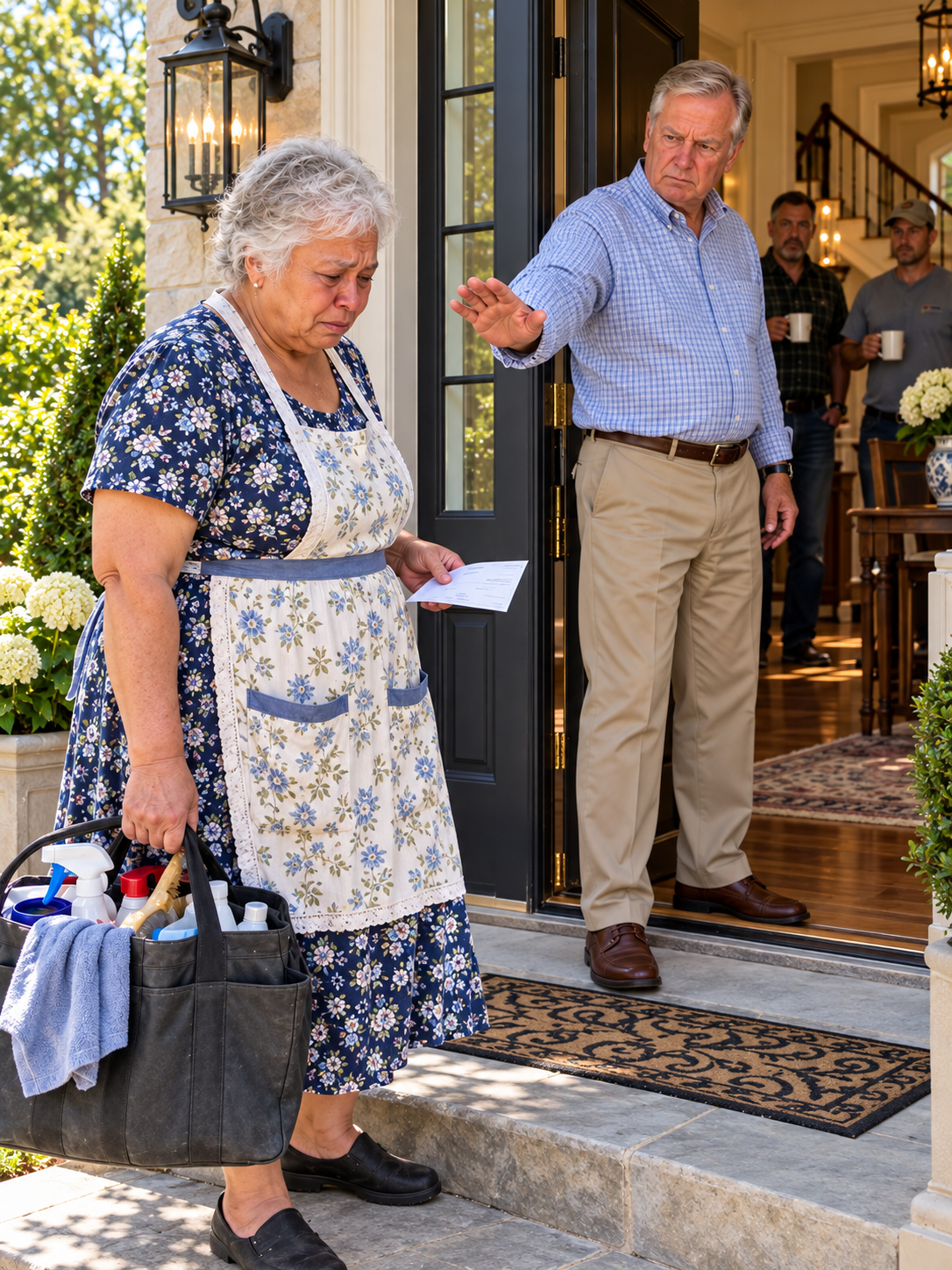
PART 1 TITLE: The Morning After the Funeral, a Three-Hundred-Dollar Check Ended Twenty-Six Years of Service and Left Me Facing an Uncertain Future
The morning after Henrietta Lockridge was buried, her son stood behind the screen door of the farmhouse and told me there was no reason for me to come back. I had been cleaning that house for twenty-six years. I knew which floorboards complained beneath a person’s weight, which kitchen window stuck in damp weather, and exactly how Henrietta liked her coffee. Yet Carlton Lockridge looked at me as though I were a stranger who had arrived at an inconvenient hour.
He was wearing the dark suit he had worn to the funeral, although his tie was gone and the first button of his shirt stood open. Behind him, I could see the familiar kitchen table, the folded newspaper, and Henrietta’s blue ceramic cup sitting beside the sugar bowl. For a moment, I wanted to reach past him and put the cup away. It bothered me that it was still there, waiting for a woman who would never use it again. Instead, I stood on the back step with my handbag tucked beneath my arm and waited for Carlton to explain why he would not let me inside.
“Mother’s affairs are being handled by the family now,” he said. “We won’t be requiring your services.” He extended a small envelope through the opening in the door. “There’s three hundred dollars. That should settle everything.” His voice was businesslike, almost impatient, as though he were discussing a delivery that had arrived after the store had closed.
I looked at the envelope without touching it. “I didn’t come for my wages, Carlton. There are a few personal things of mine in the pantry. And your mother said I could have some photographs.” He shifted his weight and glanced toward the driveway. “We’ll sort through her belongings ourselves. If anything belongs to you, someone will let you know.” There was nothing openly cruel in his words. Perhaps that was why they hurt so much. He spoke as if twenty-six years could be erased by changing the lock and balancing an account.
Henrietta had died at ninety-four, and until the final days of her illness, she had remained remarkably particular about how she wanted things done. She disliked flowers on the dining table because they interrupted conversation. She insisted on real butter for biscuits. She could identify every pecan tree along the driveway by its shape, and she remembered the birthdays of people who had not visited her in years. During the last winter of her life, when walking became difficult, she sometimes sat in the kitchen for hours, listening to the house settle around her. I had often found her staring toward the smaller white house at the far end of the property, the one where my mother and I had lived when I was a girl.
My name is Elnora Ruthanne Whitsett. I was seventy-two years old that morning, with swollen fingers, an unreliable Buick, and a bank balance that required careful attention before every grocery trip. I had worked for Henrietta since I was forty-six, the same year my mother died. Before that, Mama had spent much of her adult life serving the Lockridge household, raising children, washing laundry, cooking enormous Sunday dinners, and doing whatever else the family required. The two generations of our family had been tied to that farm for so long that I seldom thought about where one woman’s obligations ended and another woman’s began.
When I was little, the farmhouse seemed enormous. Its front porch stretched beneath the shade of pecan trees, and its kitchen smelled of coffee, onions, and wood polish. Mama worked there while I attended school. In the afternoons, I would return to the little white house near the northern edge of the property and wait for her to finish. Sometimes Henrietta brought me a biscuit wrapped in a napkin. Sometimes I watched her sons race their bicycles down the driveway, scattering gravel as they went. They belonged to the big house, and I belonged to the small one. That division felt as natural to me then as the fence that separated the vegetable garden from the pasture.
My father, Samuel Whitsett, had died when I was nine. I remembered his hands more clearly than his face: broad palms, short nails, and a habit of carrying a carpenter’s pencil behind one ear. He loved working outdoors and could look at a cloudy sky and tell whether we had enough time to bring in the washing. Mama seldom spoke about him after he was gone. When I asked questions, she told me that he had been an honorable man who believed promises ought to mean something. I accepted that answer for most of my life, never imagining that his name might one day matter to anyone beyond our family.
“Are you taking it or not?” Carlton asked, bringing me back to the doorstep. The envelope was still in his hand. I took it, partly because I needed the money and partly because I could not bear to remain standing there. “Your mother was very good to me,” I said. He nodded without looking directly at my face. “Yes. Well, she appreciated your help.” Then the screen door swung shut. Through its mesh, I watched him turn away, leaving me outside the kitchen where I had prepared thousands of meals.
I remained on the step long enough to hear his shoes crossing the tiled floor. There was a time when I had been trusted with every key in the house. Henrietta had told me where to find her medical papers, how to reset the circuit breaker, and which drawer contained the emergency cash. When she fell or became frightened at night, it was often my telephone that rang. Yet now I could not even retrieve a cardigan from the pantry without permission from a man who had rarely spent an entire afternoon alone with his mother.
I walked slowly toward my Buick. The gravel shifted under my shoes, and the morning air carried the damp, earthy smell that comes after a night of rain. At the end of the drive, I looked toward the little white house. Nobody had lived there for years. The porch sagged slightly, and the roof had darkened with age, but I could still see Mama standing in its doorway, wiping flour from her hands before calling me inside. I remembered evenings when she would sit at the kitchen table counting money into careful stacks, then place the bills inside an old tin box that she kept beneath her bed.
Mama had taught me to be grateful, especially when someone had more than we did and chose to share it. She often reminded me that the Lockridges had allowed us to live on their land. I had never questioned that arrangement. I had simply believed that kindness required repayment, and when Henrietta offered me work after Mama died, accepting seemed like the proper thing to do. Over the next twenty-six years, I cleaned, cooked, washed, carried groceries, tended the garden, and gradually became the person Henrietta called when she needed something more important than a clean floor.
There were Fridays when we did almost no cleaning at all. Henrietta would insist that I sit with her at the kitchen table before touching a broom. She made coffee strong enough to wake the dead and served biscuits from a tin with a faded floral pattern. We spoke about weather, church, her sons, my daughter Alfreda, and people we had both known when we were younger. Sometimes she would ask questions about Mama. She wanted to know whether I still had her old photographs or remembered the stories she told about my father. I assumed she was reminiscing. At her age, memories often seemed more important to her than whatever was happening in the present.
Six years before her death, Henrietta slipped on the wet back steps and injured her hip. I found her sitting on the kitchen floor, furious with herself and trying not to cry. She made me promise not to frighten her sons before she agreed to medical attention. During the weeks that followed, I drove her to appointments, prepared food she could eat comfortably, and stayed long after my scheduled hours whenever she became anxious. She paid me my usual wages. I never requested anything more. It did not occur to me that the accident might have caused her to reconsider arrangements she had kept private for decades.
I returned to my own house that morning and placed Carlton’s envelope on the kitchen table. My home was modest, with a narrow hallway, aging furniture, and a stove that sometimes required three attempts before the burner would light. I lived alone, and although I had my Social Security income, Henrietta’s wages had made the difference between managing and worrying. Without them, the numbers were plain enough. Insurance, electricity, groceries, and car repairs would consume almost everything I had.
I opened the envelope after making myself tea. Inside was a check for three hundred dollars, signed by Carlton. I studied it for a long time. I was not foolish enough to believe that twenty-six years entitled me to his mother’s entire estate. I had been paid for my work. But the manner of my dismissal, the refusal to let me collect my belongings, and the complete absence of any acknowledgment left me feeling that something larger than employment had been abruptly taken away.
That afternoon, my daughter Alfreda telephoned. She had heard from someone at church that Carlton was handling the estate and wanted to know whether I would still be working at the farmhouse. When I explained what had happened, she became quiet. “Mama, you need to start thinking about your expenses,” she said. “I know.” She hesitated before adding that her own household was crowded and that she could not promise me a room if things became difficult. I had not asked to move in, but I understood why she felt compelled to say it.
“I don’t expect you to take me in,” I told her. “I just have to work out what comes next.” She suggested selling some furniture I no longer used and looking for occasional cleaning jobs, although we both knew few people wanted to hire a seventy-two-year-old woman for heavy housework. Her suggestions were practical, and I did not resent them. Still, after we ended the conversation, I sat listening to the refrigerator motor and wondered how a person could spend so many years being indispensable somewhere, only to become unnecessary overnight.
The funeral had been well attended. Henrietta’s three sons had stood near the front of the church, receiving condolences from neighbors and distant relatives. Carlton had spoken briefly about his mother’s devotion to family and the traditions she had preserved. I had sat several rows behind them, wearing the navy dress I reserved for important occasions. Nobody asked me to speak. I did not mind; I had never enjoyed standing before a crowd. But I remembered the way Henrietta had squeezed my hand during her final week and asked whether I had kept the photographs of Mama. At the time, I thought she was confused by illness.
During the days that followed, I tried to establish a routine. I washed the curtains, sorted old receipts, and examined the kitchen stove to see whether I could repair it myself. On Friday, I woke before seven and reached automatically for the clean blouse I usually wore to Henrietta’s house. Only after taking it from the wardrobe did I remember that I had nowhere to go. I stood holding the blouse until the room grew warm with daylight, then put it back.
Several times I considered driving to the farmhouse and asking Carlton once more about my belongings. Each time, I decided against it. I had no wish to argue on a doorstep or be accused of interfering with the estate. Instead, I made a list of everything I could remember leaving there: a cardigan, a pair of work shoes, an old recipe notebook, and photographs Henrietta had promised to give me. The photographs mattered most. Some showed Mama when she was young, and I possessed very few pictures of her.
A week after Henrietta’s burial, the telephone rang shortly after breakfast. The caller introduced herself as Rosella and said she worked with the county property records. Her manner was careful and professional. She asked whether I was Elnora Ruthanne Whitsett and whether I had known Henrietta Lockridge. When I confirmed both things, she explained that certain recorded documents required my attention. She wanted me to visit the courthouse personally.
I asked whether something was wrong. Rosella said she could not properly explain the matter over the telephone and that I should not assume it concerned an unpaid bill. The conversation unsettled me. I had never owned property connected to the Lockridge family, and I knew nothing about the legal affairs of wealthy people. My first thought was that Carlton might believe I had taken something from the farmhouse. My second was that Henrietta had left instructions concerning my belongings. Neither possibility explained why the county records office wanted my complete name.
“Is it necessary for me to bring anything?” I asked. Rosella suggested identification and said she would have the documents ready when I arrived. Before ending the call, she added, “Mrs. Whitsett, I think you should come before making any decisions about the Lockridge property.” I almost told her that there were no decisions for me to make. Carlton had already made that clear.
That night, I slept badly. The house creaked in the wind, and I kept remembering small things Henrietta had said during our last year together. She had asked whether my middle name was spelled with one n or two. She had inquired about the location of my father’s grave. Once, while watching rain trickle down the kitchen window, she had asked whether I ever wished I could return to the little white house. I had answered that memories were not enough to pay for repairs. She had looked away without saying anything more.
On Thursday morning, I dressed in a clean blouse and my church skirt, gathered my identification, and drove to the courthouse. The Buick rattled at every rough patch in the road. I parked beneath a tree and remained behind the steering wheel for several minutes, watching people pass through the entrance. I knew I was being foolishly anxious, but I could not dismiss the feeling that my life had already changed once that week and might be about to change again.
Inside, the courthouse smelled of old paper, floor polish, and coffee from an office somewhere down the hall. Rosella met me near the records counter. She was a woman with a quiet voice and a manner that suggested she preferred facts to speculation. She led me into a room furnished with a wooden table and several metal filing cabinets. On the table lay an oversized record book, a folder of photocopies, and a small envelope.
Rosella checked my identification before opening the record book. The pages were thick and yellowed, covered in dates, parcel descriptions, signatures, and official markings. She turned carefully to a page she had already marked. “I want you to examine this entry,” she said. “Take your time.”
At first, the writing meant nothing to me. I recognized the Lockridge surname and the description of the farmhouse property, but the legal language might as well have been written in another language. Then my eyes moved down the page and stopped. There, among the recorded information, was my full name: Elnora Ruthanne Whitsett.
I leaned closer, certain I had misread it. Rosella waited while I checked the spelling. The middle name was correct, including the unusual letters my father had insisted upon when I was born. I looked at the date beside the entry. It had been recorded six years earlier, during the period when Henrietta was recovering from her fall.
“Why would I be named in a record about her land?” I asked. Rosella placed one finger beside a paragraph and explained that Henrietta had personally completed documents transferring a defined property interest into my name. The entry was official, not a casual note or an unfulfilled verbal promise. I stared at the page, unable to reconcile what she was telling me with the three-hundred-dollar check lying in my kitchen drawer.
Then Rosella opened the folder and placed a second document beside the book. Near the bottom was Henrietta’s familiar signature, unmistakable in its deliberate curves. Rosella watched me recognize it. “There’s more you need to see,” she said, drawing the small envelope toward her. “Mrs. Lockridge left an explanation. She instructed us not to give it to you while she was alive.”
I looked down at the handwriting across the envelope. It was addressed to me, in the same careful script I had seen on grocery lists and birthday cards for twenty-six years. Beneath my name were instructions that it should be delivered after Henrietta’s death. For the first time since Carlton had closed that screen door, I understood that Henrietta had known something about my future that neither her sons nor I had been told.
END PART 1
PART 2 TITLE: A Sealed Letter Revealed Why Henrietta Changed the Property Records and Led Me Toward a Secret About My Parents
I could recognize Henrietta Lockridge’s handwriting from across a room. For twenty-six years, she had left notes beside the kitchen sink, written instructions on grocery lists, and signed checks with a particular flourish that became smaller as her hands grew unsteady. The envelope Rosella placed before me carried that same handwriting. My full name appeared across its face, and the instructions beneath it made clear that Henrietta had intended me to receive it only after she was gone.
I did not open it immediately. A peculiar reluctance stopped me. For days, I had been grieving the loss of a woman who had become part of the rhythm of my life, and now I was being asked to hear her voice again through words she had deliberately withheld. I could see the farmhouse kitchen in my mind, the two coffee cups, and Henrietta sitting with her hands folded around a biscuit. I almost expected her to interrupt whatever was written there with one of her dry observations about my worrying too much.
Rosella allowed me a moment before speaking. She explained that the record showed a transfer made six years earlier and that the supporting papers had been properly registered. She would not tell me that I owned the whole farmhouse or that I had suddenly become wealthy. Property records, she said, could involve separate parcels, partial interests, older agreements, and obligations that required careful legal review. What mattered immediately was that Henrietta had acted deliberately and that my name was included in the official documents.
“But I never paid her for land,” I said. “I never asked her for anything like this.” Rosella nodded. “That’s why she appears to have wanted an explanation preserved.” She slid a photocopy toward me. It described the farmhouse, the gravel drive, and the surrounding property in language I struggled to follow. A paragraph marked with red pencil referred to an ownership interest transferred to Elnora Ruthanne Whitsett. The signature at the bottom belonged unmistakably to Henrietta.
I remembered the year shown on the document. Henrietta had fallen on the back steps after a sudden rainstorm. She had tried to stand without assistance, then settled on the kitchen floor when pain shot through her hip. I found her there with one hand gripping the cupboard door. She looked more angry than frightened, but when I knelt beside her, her fingers closed tightly around my wrist. During her recovery, I drove her to appointments, helped with meals, and remained beside her when the house seemed too quiet.
Carlton and his brothers had telephoned during that period, and one of them had visited briefly. They had arrangements of their own, busy lives that Henrietta defended even when their absence troubled her. I had not complained about them. It was not my place to judge how other families divided their responsibilities. Yet Rosella now told me that Henrietta had come to the records office that same year, accompanied by legal documents, and had insisted that the transfer be properly recorded.
“What did she say when she came here?” I asked. Rosella considered her answer before explaining that Henrietta had spoken about the people who maintained the property through difficult years. She believed, apparently, that the people most responsible for keeping a home together were not always the ones whose names appeared in family inheritance plans. I listened without interrupting. I knew Henrietta could be stubborn. If she believed something was unjust, she could remain troubled by it for years.
Rosella opened another folder and withdrew an old photograph. It showed the farmhouse when the porch boards were new and the pecan trees had not yet spread so widely. Near the end of the driveway stood the little white house where I had spent my childhood. Seeing it unexpectedly brought back a particular summer evening: Mama sitting on the porch steps shelling peas, my father working beside the fence, and the smell of freshly cut grass settling across the yard.
I turned the photograph over. Henrietta had written a short reminder about remembering the people whose work had helped create and preserve the home. My chest tightened. Mama had been dead for thirty-eight years, and the picture showed a place she had loved despite the exhausting labor she performed there. I wondered why Henrietta had saved the image and why she had thought it important enough to place among documents concerning property ownership.
“Your mother worked for the family before you did,” Rosella said. I told her about the years Mama spent cooking, gardening, washing clothes, and helping with the Lockridge children. She had come home tired most evenings, but she rarely spoke badly of the people who employed her. She was proud that she had been trusted with the household and grateful, she said, that we had a roof over our heads. I had grown up thinking those things explained everything about our relationship with the family.
The longer I stared at the photograph, the more I remembered about Mama’s caution with money. She saved small amounts whenever she could and kept them in a tin box under her bed. Sometimes I heard her counting the contents late at night, moving coins and folded bills across the table. If I asked what she was saving for, she told me that every family needed something put aside against trouble. I never saw her spend the money on anything that brought her pleasure.
“Does this mean Henrietta left me the farmhouse?” I finally asked. Rosella shook her head slightly. She said the recorded interest had to be read alongside the older documents before anyone could determine its full effect. There was a separate question involving the northern portion of the property, and Henrietta’s letter might help explain why those records were connected. She encouraged me to read it before drawing conclusions.
I carefully loosened the envelope and removed a folded sheet. The paper was familiar stationery, the kind Henrietta kept in the upper drawer of her writing desk. Her opening addressed me with the affection she had shown during our quiet Friday mornings. She wrote that, by the time I read her words, there would be no more Fridays together at the kitchen table. That simple acknowledgment affected me more than any mention of property. I lowered the letter and waited until I could see clearly again.
The next passages described the years I had spent helping her. Henrietta remembered my presence when she was ill, my patience when she repeated stories, and the way I continued working during difficult periods in my own life. She acknowledged that I had never asked what would happen to me when my wages ended. I was uncomfortable reading such praise. I had always considered the work ordinary, even when the days were long. It was strange to discover that she had been measuring its significance differently.
Then the letter turned toward my mother. Henrietta wrote that Mama had done something for the Lockridge family that went far beyond her duties as an employee. The words seemed to sit apart from everything preceding them. I read them twice. No one had ever told me that my mother had been involved in the family’s financial affairs. Mama worked hard, earned modest wages, and saved what she could. I could not imagine what assistance she might have offered people who owned a large farm.
I glanced at Rosella. “Do you know what she’s referring to?” She looked at the letter and encouraged me to continue. I could see that she knew at least part of the explanation, but she was allowing Henrietta’s words to speak first. I returned to the page, conscious of the silence in the room and the faint ticking of a clock on the wall.
Henrietta explained that the farm had once faced serious financial trouble. After her husband’s death, debts threatened the property, and the bank was pressing for repayment. The sons were still young, and the family faced the possibility of losing land that had been associated with the Lockridge name for generations. During that period, my mother had turned over savings accumulated through years of work to help the family meet its obligations. Henrietta described an understanding that the money would be repaid, an understanding that had never been fully honored.
I stopped reading. I remembered Mama refusing to replace her worn winter coat even when the lining had begun to tear. I remembered her carefully repairing kitchen towels and saving string from paper packages. She had always said that unnecessary spending could leave a family vulnerable. As a child, I thought she was simply cautious. Now I wondered whether she had already given away much of the security she had worked to build.
Henrietta wrote that she had lived with the knowledge of that sacrifice for decades. She could not repair every consequence of what had happened, but she had sought a way to acknowledge the old obligation. Her decision to place my name in the property records had been deliberate. She did not describe it as charity. She regarded it as an attempt to address unfinished business between our families.
I felt both grateful and unsettled. If Mama had helped save the farm, why had she never told me? Why had she continued speaking about the Lockridges as though we owed them a permanent debt of gratitude? The possibility that my mother had protected something valuable without ever receiving recognition left me with an unfamiliar anger. It was not directed entirely at Henrietta. I was angry that so much of Mama’s life remained unknown to me.
There was more. Henrietta indicated that the money was not the only reason for her arrangements. She asked me to examine the historical property map and pay particular attention to a name appearing beside the northern boundary. She connected that instruction to the little white house where I had grown up. Before making any decisions, she wanted me to understand what the older records showed.
I lowered the letter. Rosella had been watching my face. “I suppose you want to see the map,” she said. I nodded, although my thoughts were moving too quickly for me to speak. Everything I believed about the farmhouse had rested on a simple understanding: the Lockridges owned the property, and my family had been allowed to live and work there. Henrietta’s letter had already complicated that story. I was afraid the map might change it completely.
Rosella led me into a records room lined with tall filing cabinets. She selected a rolled map from a drawer and carried it to a larger table. When she spread it out, the paper resisted at the corners, and she placed small weights along its edges. The map was old enough that some of its lines had faded, but I recognized the familiar arrangement of buildings and roads almost immediately.
There was the farmhouse, set back from the main road. There was the long drive, the pecan trees, and the outbuildings that had been repaired or removed over the years. And there, near the northern edge, was the little white house. I traced its position with my eyes. In my memory, it was not merely a structure. It contained Mama’s cooking, Father’s workbench, my schoolbooks, and the small bed where I lay awake listening to rain on the roof.
Rosella directed my attention toward a boundary line that separated the northern parcel from the larger property. Beside that line, written in faded lettering, was a name. I leaned closer. The first name was Samuel. I knew the shape of those letters before I finished reading the surname.
Samuel Whitsett. My father.
For several moments, I could not speak. Father had died when I was nine, and the years since his death had softened nearly everything I remembered about him. Yet here was his full name on an official map, connected to land I had spent my entire life believing belonged to the Lockridges. I looked at Rosella, expecting her to tell me there had been some clerical mistake.
She explained that the historical documents indicated the small house and its surrounding parcel had not originally belonged to the Lockridge family. The map and accompanying records connected the land to my father, and later arrangements involving my mother appeared to have allowed part of the property to be used by the Lockridges without transferring its ownership. Further legal review would be necessary, but the records raised a significant question about who had actually held title to the northern parcel.
I remembered Mama telling me that we were fortunate to have somewhere to live. I remembered how carefully she instructed me to respect the farmhouse and never behave as though anything there belonged to us. It occurred to me that she might have been protecting me from a dispute too complicated or expensive for her to pursue. Or perhaps she had trusted a promise that was never completed. I wanted to ask her, but she had been gone for thirty-eight years.
“Then the little house might have been ours all along?” I asked. Rosella told me the records supported that possibility, but she refused to offer a final conclusion without a title examination. I was relieved by her caution. I did not need someone to promise me a fortune. I needed to know whether the stories I had been told about my own family were true.
We returned to the office carrying the map and Henrietta’s letter. Rosella explained that an independent attorney should examine both the recent transfer and the old ownership records. She also warned me against signing documents presented by anyone with an interest in the estate. Her words troubled me, especially when she mentioned that Carlton had already contacted the office to ask about records registered outside his family’s name.
I thought of the morning at the farmhouse. Carlton had offered me three hundred dollars and refused to let me collect my belongings. At the time, I believed he wanted an inconvenient reminder of his mother’s final years removed. Now I wondered whether he had discovered something in her papers or feared that I might be entitled to more than my final wages. I had no evidence that he knew the details, and I tried not to condemn him without understanding the facts.
Before I could ask another question, the office telephone rang. Rosella answered, listened for several moments, and glanced toward the documents on the table. Her voice became more formal. She confirmed that I was present and said that I had not signed any agreement. Then she set down the receiver and looked at me with an expression I did not care for.
“Carlton Lockridge is coming here,” she said. “And I think you need to decide, before he arrives, whether you’re prepared to let someone else tell you what these papers mean.”
END PART 2
PART 3 TITLE: When Carlton Arrived at the Courthouse With an Offer, I Had to Choose Between Immediate Security and My Family’s Forgotten Rights
Carlton Lockridge was coming to the courthouse, and I had no idea whether he intended to argue, persuade, or threaten me. My father’s name lay on the property map in front of me, and Henrietta’s handwritten letter rested beside it. Until that morning, I had believed my connection to the farmhouse ended with my employment. Now there were official records suggesting something far more complicated. I was seventy-two years old, had very little money, and was about to confront a man whose resources exceeded mine in every imaginable way.
Rosella did not seem alarmed by the news of his arrival. She gathered the papers into orderly stacks and reminded me that recorded documents could be examined without anyone having to surrender a claim. Carlton was entitled to ask questions about his mother’s estate, she said, but he could not determine my rights merely by insisting that the land belonged to his family. She strongly advised me to seek independent legal counsel before signing anything.
I wanted to follow her advice, but I felt overwhelmed. Legal disputes belonged, in my mind, to people who could afford lawyers and months of uncertainty. I had spent the previous week calculating how long my savings would last without Henrietta’s wages. A broken transmission could ruin me. So could an unexpected medical expense or a major household repair. The thought of spending money to investigate land I might not own seemed almost reckless.
Rosella saw my hesitation. “You don’t have to settle anything today,” she said. She spoke gently, but there was firmness beneath her kindness. She reminded me that the documents existed independently of Carlton’s opinions and that the proper way to understand them was through a qualified attorney. I nodded and looked again at my father’s name. He had been dead for more than sixty years. I wondered what he would think of his daughter standing in a courthouse, frightened to ask whether the land associated with his name still belonged to his family.
While we waited, Rosella showed me another historical agreement concerning the northern parcel. The document dated back nearly fifty years and referred to arrangements made after Father’s death. From its descriptions, it appeared that my mother had allowed the Lockridge household to use part of the land during a period of financial hardship. The agreement did not appear to transfer ownership, and it mentioned a debt that had not been settled. There were legal terms I could not interpret, but the names and dates were unmistakable.
“Why would Mama keep all this from me?” I asked. Rosella could not answer. She suggested that my mother might have expected the arrangement to be honored without a dispute or lacked the means to pursue it. I knew both explanations were possible. Mama believed in keeping her word, sometimes to the point of making her own life harder. She also believed that confronting people with money and influence could have consequences for those who depended on them.
The agreement changed how I remembered certain childhood evenings. I thought of Mama sitting by the window after supper, rubbing her sore hands together while staring toward the farmhouse. Occasionally, she would grow quiet after a conversation with Henrietta, and I would hear her crying softly after she believed I was asleep. I had attributed those moments to grief for Father. Now I understood that she might have been carrying worries she refused to share with a child.
Rosella explained that Henrietta had sought legal assistance six years before her death. She wanted the older agreements examined so that she could determine what property interest she was legally able to transfer and whether outstanding obligations remained connected to the land. That information fitted oddly with conversations I remembered from the same period. Henrietta had begun asking about Mama’s belongings, Father’s burial place, and the precise spelling of my name. I had dismissed the questions as the wandering interests of an elderly woman. Now they appeared purposeful.
The sound of footsteps interrupted us. A man’s voice asked someone in the hallway where he could find the property records office. I recognized Carlton before he entered. His voice had the same impatient edge I had heard at the farmhouse. He appeared in the doorway wearing a dark suit and carrying a leather folder. His gaze moved from Rosella to the documents and finally settled on me.
“Elnora,” he said. I returned his greeting. He looked as though he expected me to apologize for being there. Instead, I remained seated. It was a small decision, but one I was conscious of making. For years, whenever Carlton arrived at the farmhouse, I had instinctively stepped aside to give him room. Sitting in that chair, with my father’s name spread across the table, I found I did not want to move.
Carlton turned to Rosella and said he understood there was some uncertainty about his mother’s property. Rosella responded that she was helping me examine documents in the county records. Her tone remained calm and professional. Carlton gave a strained smile and suggested that his mother had become generous in her final years, occasionally making promises without fully considering their consequences.
I remembered Henrietta correcting Carlton during one of his visits when he confused the date of a family event. She had told him exactly which year it occurred and produced an old photograph to prove it. Even when her body grew frail, she retained a remarkable memory for names, dates, and household matters. I could not accept the casual implication that her decision to sign documents automatically meant she had been confused.
“She completed a recorded transfer,” I said. Carlton looked at me sharply. He replied that any such document would need to be evaluated in the broader context of the estate. He was right about that much, and I told him so. “Then I’ll have someone qualified examine it,” I answered. He seemed surprised. I was surprised myself, but the words felt reasonable once I had spoken them.
Carlton placed his folder on the table. He explained that his brothers and he wanted to avoid an unnecessary family dispute. They appreciated the work I had done for their mother, he said, and did not want me burdened by complicated legal proceedings. He offered five thousand dollars in exchange for settling whatever claim I believed the documents might support. It was a carefully presented offer, wrapped in language that suggested he was trying to help me.
Five thousand dollars was more money than I had been able to set aside in a long time. I imagined repairing my stove, paying several months of bills, and perhaps addressing the strange noise the Buick made when I turned left. The sum could have provided immediate relief. For a moment, the thought of accepting it was almost irresistible. I would not have to confront his brothers, search for a lawyer, or worry about an expensive dispute.
But I looked at the map again. If the northern parcel had belonged to Father, how could I place a price on it before knowing what the records meant? If Mama had used her savings to help protect the Lockridge farm, why should I agree to abandon that history without understanding the promise made to her? And if Henrietta had deliberately signed property documents six years before her death, did I have the right to disregard her intentions merely because someone offered me money?
“I need to understand what I have before I can agree to give anything up,” I told Carlton. He leaned back in his chair and studied me. The friendliness left his expression. He warned that property litigation could be expensive and that even a seemingly promising case might produce nothing after fees and delays. I knew he was not inventing those risks. They frightened me precisely because they were real.
“That may be true,” I said. “But I’m not signing an agreement today.” The words came slowly, and I could hear the strain in my voice. Carlton’s mouth tightened. He looked toward Rosella, perhaps expecting her to intervene or explain the situation differently. She simply reminded him that I was entitled to obtain legal advice and that the office could not resolve a disputed property claim on the spot.
He gathered his papers with more force than necessary. Before leaving, he warned that his family would protect its interests. I did not challenge him. I had no desire to humiliate him or start an argument. All I wanted was enough time to examine the truth. When he walked out, the hallway became quiet again, and I realized that my hands were shaking so badly I could hardly lift the glass of water Rosella offered.
I drank slowly. My body seemed to recognize the danger after it had passed, and for several minutes I could barely speak. Rosella waited without pressing me. Eventually, I admitted that I had almost taken the money. She did not criticize me. She understood that financial uncertainty could make an immediate payment seem safer than a legal claim whose outcome remained unknown.
I asked why Henrietta had not told me about her plans while she was alive. Rosella explained that Henrietta had wanted the documents properly recorded and had been concerned about the reaction of her sons. According to what Henrietta had told her, she also feared that I might feel obligated to refuse anything she offered while I was still employed. That possibility troubled me because it sounded true. If Henrietta had placed a deed in front of me over coffee, I might have insisted she keep it for her children.
I thought about the strange balance of our relationship. Henrietta had been my employer, but she had also been a companion, someone who knew my habits and remembered the important people I had lost. I cared for her, yet I was always aware that the farmhouse belonged to her family. When we drank coffee together, I sat in the same kitchen where I worked. Even during our closest conversations, I sometimes glanced toward the clock, wondering whether I ought to return to the laundry.
For years, Henrietta had three grown sons who could have visited whenever they wished. They had their own work and responsibilities, and I knew little about the private pressures of their lives. Still, she spent many Friday mornings with me because I was there. We discussed her husband’s death, the challenges of raising children, and how quickly familiar places changed. Only now did I begin to suspect that some of those conversations had been shaped by an old obligation she had never managed to forget.
The following week, I sought recommendations for a lawyer who handled property and inheritance disputes. I selected someone independent of the Lockridge family and arranged a consultation. It embarrassed me to discuss money at the beginning of our meeting, but the lawyer was straightforward about his fees and the need to examine the records before estimating what might happen. He made no promises of sudden wealth or certain victory.
I brought the copies Rosella had provided: the recorded transfer, the historical map, the old agreement, and Henrietta’s letter. My lawyer examined each document carefully. He asked when my father had died, what Mama had told me about the property, and whether I possessed any family papers that might connect to the original agreement. I answered as well as I could. When he asked about the tin box Mama had once kept beneath her bed, I realized I had not thought about it in years.
He explained that two matters required separate attention. The first concerned the interest Henrietta had transferred into my name six years earlier. The second involved the historical ownership of the northern parcel and whether the old records supported a continuing claim through my father and mother. Both would require verification. A family recollection, even an honest one, was not enough to establish title. Nor could Carlton’s belief that the entire farm belonged to his family settle the question.
I returned home with a list of documents to search for and a growing understanding that the process would take time. I opened boxes I had avoided for years, looking through faded photographs, utility receipts, church programs, and letters Mama had saved. Her belongings smelled faintly of old paper and cedar. As I worked, I found myself thinking less about the value of the land and more about the life she had lived without ever explaining what the Lockridges owed her.
Alfreda telephoned that evening. When I told her I had consulted an attorney, she sounded alarmed. She worried that Carlton’s family could afford a prolonged dispute while I could not. She asked whether it might be wiser to accept the settlement and protect the little money I had. I understood her reasoning. She had responsibilities of her own and did not want to see her mother lose what remained of her savings.
I told her that I was taking the risk seriously. The lawyer would review the evidence before recommending further action, and I would not spend money simply to prove a point. But I also explained what I had learned about her grandmother. Mama had apparently used her own savings to help preserve a property owned by people far wealthier than she was. The northern parcel might have belonged to our family. Henrietta had taken formal steps to address those circumstances. I could not simply pretend the documents did not exist.
There was a long silence before Alfreda spoke. She asked why Grandma had never mentioned any of it. I admitted that I did not know. That uncertainty hurt more than I expected. I had believed I understood Mama’s life because I had watched her work, save, and care for me. Now I was discovering that her decisions had included sacrifices she had never explained.
Over the next several weeks, the lawyer obtained additional records and began examining the chain of ownership. Carlton’s attorney challenged the interpretation of some documents, maintaining that Henrietta had intended her property to remain with her sons. My lawyer replied that family expectations could not override properly executed records and that the exact legal language would determine the rights involved. The dispute became a slow exchange of papers, requests, and meetings.
The delay was exhausting. I continued counting expenses and sold a few pieces of furniture I no longer needed. Some mornings, I regretted turning down the five thousand dollars. But whenever I considered abandoning the matter, I took out the photograph Henrietta had preserved and looked at the little white house. I could almost hear Mama moving around its kitchen. She had lived much of her life believing that promises mattered, even when the people making them possessed more power than she did.
One afternoon, while examining another box of family papers, I found an old photograph of Father standing near the fence at the northern edge of the property. He held a hammer, and Mama stood beside him with one hand resting on the gate. I turned the photograph over, hoping for a date. There was only a brief note in Mama’s handwriting identifying the place as our little house. I sat with the picture for a long time. Whatever the court eventually decided, I knew I could no longer accept the idea that my family had simply occupied the land through someone else’s generosity.
Then my lawyer telephoned with news that changed the shape of the dispute. The historical records contained evidence connecting the northern parcel to my father’s ownership, and the later documents did not appear to establish an outright transfer to the Lockridges. He stressed that the remaining questions still required review, but he believed the evidence justified pursuing the claim. He also confirmed that Henrietta’s recorded transfer had been intentional, not a clerical error.
I asked what would happen next. He explained that the property questions would continue through the appropriate legal process and that Carlton’s family might object at several stages. The matter was no longer a misunderstanding that could be resolved with a casual payment. It involved recorded interests, historical obligations, and ownership rights that had remained unexplained for decades.
When the call ended, I placed the receiver beside the telephone and looked at Mama’s photograph. I was frightened by what lay ahead, but I was no longer ashamed of asking questions. Henrietta had left a trail of documents. My father had left his name on a map. Mama had left evidence of a life built on work and difficult choices. I decided that, however long the process took, I would follow those records until I knew what they meant.
END PART 3
PART 4 TITLE: As the Property Dispute Deepened, My Daughter Questioned My Decision Until New Evidence Revealed the Weight of Henrietta’s Final Promise
The longer the property matter continued, the more I understood why Mama had preferred keeping her worries to herself. Every letter from the lawyer brought another question, another document to locate, or another expense to consider. My name had appeared in an official record for six years without my knowledge, yet discovering it did not immediately give me a home, a settlement, or financial security. Instead, it opened a complicated process in which nearly every important question required more evidence.
Carlton and his brothers maintained that Henrietta had intended the farmhouse and surrounding land to remain within the Lockridge family. Their attorney scrutinized the recorded transfer and disputed aspects of the older agreements. My lawyer, meanwhile, examined the precise wording of each document and traced the history of the northern parcel. He reminded me repeatedly that the law would distinguish between what people remembered, what they believed was fair, and what the records actually established.
I was grateful for that distinction, even when it frustrated me. I did not want a judgment based on sympathy for an elderly housekeeper who had lost her income. Nor did I want anyone to assume that twenty-six years of service automatically made me entitled to Henrietta’s property. I wanted the agreements examined honestly. If Father had owned the northern parcel, if Mama had helped save the farm, and if Henrietta had legally transferred an interest to me, those matters deserved consideration regardless of our family’s financial circumstances.
Money remained a constant worry. I sold a small table, an unused chair, and several household items I no longer needed. I kept the Buick despite its mechanical problems because I could not afford another car. At the grocery store, I compared prices carefully and sometimes returned items to the shelf after adding the figures in my head. My pride did not make bills disappear, and there were evenings when I wondered whether my determination would leave me worse off than before.
Alfreda called more frequently during those weeks. Our conversations often began with ordinary matters—her household, the weather, someone from church—but eventually returned to the property. She asked whether the lawyer had found anything conclusive and whether Carlton had made another offer. I tried to answer without sounding defensive. I knew she feared that I might lose my savings pursuing a case against a wealthy family. I also knew that she had difficulty understanding why the matter had become so important to me.
One afternoon, she arrived at my house while I was sorting papers at the kitchen table. The room was crowded with photographs, envelopes, and old documents. Mama’s picture sat beside a stack of correspondence from the lawyer. Alfreda looked around before pulling out a chair. “You’ve been doing this for weeks,” she said. “Are you getting any closer to knowing what happened?” I told her the title records were still being examined. She sighed and asked whether I ever regretted refusing Carlton’s money.
I considered giving her a simple answer. I could have said no and pretended that my confidence never wavered. Instead, I admitted that I thought about the offer whenever I paid a bill or heard the Buick make a new noise. “Then why keep fighting?” she asked. Her voice was not accusing. She sounded tired and worried, and that made me want to answer carefully.
I pushed the old photograph of Mama and Father across the table. “Because I didn’t know your grandmother had given up her savings to help that family,” I said. “And I didn’t know your grandfather’s name was on the records for the land where we lived. I spent my whole life believing we were there because somebody allowed it. Now I need to know whether that was ever the whole truth.”
Alfreda studied the photograph. She had known Grandma as an older woman with tired hands and a habit of saving everything useful. She remembered the little white house, although by the time Alfreda was old enough to form lasting memories, its best years were already behind it. She asked whether I believed Henrietta had deliberately hidden the truth. I told her I did not know. The documents suggested Henrietta had wanted to correct something, but they did not explain every year of silence.
We spoke about Mama for a long time. Alfreda remembered the way Grandma folded money inside a handkerchief before going to the store and how she always insisted that food should never be wasted. I remembered her working late and saving scraps of fabric to mend clothing. Neither of us had known that she might have used a substantial part of her savings to help the Lockridges keep their farm. It was painful to think that Mama’s generosity had perhaps been remembered privately while her own circumstances remained difficult.
Alfreda eventually asked whether I was pursuing the land because I wanted Carlton to suffer for the way he had treated me. The question startled me. I remembered the back door closing, the envelope in his hand, and the humiliation I felt walking toward my car. I could not deny that the memory still hurt. But revenge was not what kept me searching through documents. I told her that even if Carlton apologized the next morning, I would still need to understand what belonged to my family.
She reached across the table and touched my hand. “I thought you were putting yourself through all this because you were angry,” she said. “I am angry about some things,” I replied. “But being angry doesn’t mean the questions are wrong.” We sat quietly for a while. Then she apologized for telling me to avoid trouble. I understood that her advice had come from concern. She was afraid of seeing me hurt financially, and I could not blame her for that.
After she left, I felt less alone. Alfreda had not promised me money or a place to live, and I had not asked for either. What changed was our understanding of one another. She saw that I was not chasing a fantasy of becoming wealthy, and I saw that her caution was rooted in fear rather than indifference. We had both been trying to protect the little security our family possessed, although we disagreed about how to do it.
The legal review continued. My attorney requested further title records and examined the language of the agreement involving the northern parcel. The older documents indicated that Father had purchased the small house and adjoining land before I was born. After his death, Mama had permitted the Lockridge family to use part of the property during a period of hardship, but the records did not establish that she had permanently conveyed ownership to them. That distinction became increasingly important.
Henrietta’s actions six years earlier also began to make more sense. The lawyer found that she had consulted legal counsel and taken formal steps to transfer a defined interest in the property. The process had not consisted of a hurried signature during her final illness. It had involved documented decisions made years before her death. This did not automatically settle every issue, but it weakened the suggestion that the transfer was merely an elderly woman’s confused act of generosity.
I thought back to the weeks after Henrietta’s fall. She had spent hours sitting at the kitchen table, occasionally asking me questions about my parents. Once, she had wanted to know whether Mama had ever spoken about a particular difficult winter when the farm had nearly been lost. I remembered telling her that Mama rarely discussed the family’s financial affairs. Henrietta had nodded and changed the subject. At the time, I had thought nothing of it.
Now I wondered what it had cost her to carry the knowledge of those old arrangements. She had been wealthy compared with Mama, but her life had not been free of fear or regret. She had lost her husband, raised her sons, and watched the farmhouse change around her. In her later years, she had sometimes spoken about decisions that looked simple to outsiders but remained painful to those who had made them. I had listened without asking for details.
One morning, my lawyer telephoned and asked me to come to his office. He said he had completed a significant stage of the records review and wanted to discuss the results in person. His voice remained cautious, as it always did when legal matters were involved, but I sensed that he had something important to tell me. I set down the telephone and sat still for several minutes before beginning to get ready.
I chose the same clean blouse I had worn to the courthouse. As I fastened its buttons, I remembered the first time I had entered Rosella’s office and seen my name in the record book. I had arrived frightened that someone might accuse me of taking something that was not mine. Now I was going to meet a lawyer who had spent weeks examining whether my family had possessed rights no one had properly acknowledged.
At his office, several documents were arranged across the desk. He invited me to sit and explained that the recent transfer and the historical title records provided substantial support for my position. Henrietta’s decision to place my name in the records was deliberate, and the northern parcel had a separate ownership history connecting it to my family. There were still issues requiring resolution, and he was careful not to predict the final outcome. Nevertheless, the evidence was stronger than we had understood at the beginning.
I asked whether that meant the little white house had belonged to Father. He explained that the available documents supported our family’s original ownership of the northern parcel, subject to the final title determinations. I held the arms of my chair and tried to absorb the meaning. For seventy-two years, I had believed we lived on land provided by the Lockridges. The possibility that Father had purchased the place where I grew up made me feel as though a familiar memory had suddenly acquired an entirely different meaning.
The lawyer showed me how the recorded transfer and the older agreement related to one another. Henrietta had apparently attempted to address a longstanding obligation while also recognizing my years of work and companionship. The two matters were connected by history, but they would have to be evaluated according to their distinct legal terms. I appreciated his patience. He did not treat my questions as foolish simply because I had little knowledge of property law.
Then he placed another letter in front of me. It had been written by Henrietta shortly before her death and preserved with the estate-related documents. He explained that it described her intentions and the concerns she anticipated from her sons. I recognized the handwriting immediately. My throat tightened as I unfolded the page, expecting to find another reminder of our Friday conversations.
Henrietta wrote that Carlton and his brothers might regard her decision as a betrayal. She understood that they expected the family property to pass to them, and she knew that leaving an interest to someone outside their immediate family would cause resentment. But she rejected the idea that I was a stranger to the household. My mother had helped protect the farm during a time of danger, and I had spent twenty-six years caring for Henrietta and maintaining the place she loved.
I read the passages slowly. Henrietta acknowledged that wages could not fully describe the relationship we had developed. She remembered the evenings I stayed when she was frightened, the meals I prepared when she was ill, and the hours we spent speaking about people who had died long before. She also acknowledged my mother’s contribution and the promise that had remained unsettled. Her intention, as she explained it, was not to deprive her sons of something that rightfully belonged to them, but to address obligations that existed before the estate would be distributed.
That distinction struck me deeply. Carlton had spoken as though his mother’s property was already his, simply waiting for paperwork to confirm it. Henrietta’s letter described a different understanding of ownership and responsibility. She believed that the family’s history included people whose names were rarely mentioned when inheritance was discussed. She had wanted those contributions recognized through formal action rather than left as another story told privately over coffee.
I asked whether her letter would determine the outcome of the case. The lawyer shook his head. He explained that the letter could help clarify her intentions, but it did not replace the legal requirements governing deeds, agreements, and title. The recorded documents and historical evidence still had to establish the rights involved. I was glad he said so. I wanted the truth confirmed by more than sentiment, even when the sentiments came from a woman I had loved.
For a while, I could not speak. I thought of Mama counting money in the little white house and Father repairing the fence. I thought of Henrietta drinking coffee with me, sometimes glancing toward that same house in the distance. And I thought of Carlton’s envelope, which I had kept in my drawer because I could not bring myself to cash the check. Each of those memories had once seemed separate. Now I could see how they belonged to the same unfinished history.
The lawyer told me that there would be further correspondence with Carlton’s attorney and that the remaining title issues would have to be resolved through the proper process. He recommended that I continue preserving every relevant document and avoid discussing settlement terms without counsel. I agreed. I had learned enough to understand that a promising legal position was not the same as a final decision.
When I left his office, the afternoon light was beginning to soften. I sat in the Buick with Henrietta’s letter resting inside my handbag. The car still needed repairs, my savings were still small, and I had no guarantee of what the coming months would bring. Yet something fundamental had changed. I no longer viewed myself solely as a former employee who had been dismissed after an old woman’s funeral. I was the daughter of Samuel and the daughter of a woman who had given up her savings to help preserve the farm.
That evening, Alfreda came by after I telephoned her. I showed her the documents the lawyer had explained and told her what he believed they established. She listened without interrupting. When she reached the passages concerning Grandma, her eyes filled with tears. She asked whether there was anything she could do. I told her I would appreciate her help organizing the papers and preserving the family photographs. We spent the evening sorting the records into folders, occasionally stopping to remember something about Mama.
Before leaving, Alfreda asked what I would do if the dispute were eventually settled in my favor. I told her I had not made any decision. The farmhouse needed repairs, the little white house was in poor condition, and property brought responsibilities as well as security. I was not thinking about becoming rich. I wanted the freedom to choose what happened to a place that had shaped our family’s life, without being told that we were fortunate merely to have been allowed there.
After she went home, I returned to the kitchen table and took out Henrietta’s final letter. I read it once more, slowly enough to hear her familiar manner in the careful phrasing. For years, I had believed that honoring her memory meant accepting the end of my employment quietly and remembering the kindness she had shown me. Now I understood that she had left instructions requiring something more difficult from me.
I placed her letter beside the photograph of my parents and looked toward the window. Tomorrow there would be another bill to pay and another day of waiting for the legal process. Carlton’s family had not withdrawn its objections. The documents still had to be fully considered, and no one could promise me an easy outcome. But I had made my decision. I would not abandon the claim merely because pursuing it was uncomfortable, and I would not sell my family’s history for a payment offered before I understood its value.
For the first time, I could imagine entering the little white house not as someone permitted to visit an old memory, but as a woman who might have a lawful right to stand there. I did not know when that day would come, or whether the final decisions would give me everything I hoped for. What I knew was that my parents’ names had survived in records that could still be examined, and Henrietta had spent her final years making certain I would find them.
I folded the letter, returned it to its envelope, and placed it with the other documents. The matter was no longer simply about Carlton’s treatment of me or the money I had lost when Henrietta died. It was about an obligation left unfinished, property whose ownership required an honest accounting, and a history that three families had carried in different ways for decades. Whatever the remaining legal proceedings revealed, I was determined that the Whitsett family’s part in that history would not disappear again.
END PART 4
PART 5 TITLE: The Attorney Found a Missing Piece of My Father’s Land Records, and Suddenly Carlton’s Offer Made Far More Sense
The first thing I learned about standing up for myself was that courage did not pay the electricity bill. Three weeks after I refused Carlton Lockridge’s offer of five thousand dollars, I was sitting at my kitchen table with an overdue utility notice, a nearly empty prescription bottle, and a lawyer’s business card beside Henrietta’s letter. I had spent twenty-six years earning a dependable wage at the Lockridge farmhouse. Now that money was gone, and the little savings I had put aside were disappearing faster than I could replace them.
I kept thinking about Carlton’s face in the courthouse. He had arrived expecting me to accept whatever explanation he gave, just as I had accepted his three-hundred-dollar check at the back door the morning after his mother’s funeral. When I refused to sign away my possible claim, his expression had changed. At the time, I thought he was simply angry that a woman who had cleaned his mother’s floors was questioning him. After several nights of thinking, I began to suspect something else. Carlton might have known more about those records than he admitted.
The attorney Rosella recommended was a man named Thomas Avery. His office occupied the second floor of an aging brick building near the courthouse. The staircase was narrow, the carpet worn, and the waiting room smelled faintly of paper and coffee. I liked those details. They made the place feel less intimidating than the polished offices where wealthy people conducted business. Mr. Avery was in his early sixties, with thinning gray hair and the patient manner of someone accustomed to explaining complicated things without making the listener feel foolish.
He did not begin by asking how much money I wanted. Instead, he spread the copies Rosella had given me across his desk and asked me to describe my family’s history on the Lockridge property. I told him about the little white house near the northern boundary, my father Samuel Whitsett, and the mother who had worked for the Lockridge family long before I began cleaning for Henrietta. I described the old tin box my mother kept beneath her bed and how, after her death thirty-eight years earlier, I had saved some of its contents without ever understanding their importance.
When I finished, Mr. Avery tapped a finger against the original parcel map. “Your father appears to have owned the land beneath your childhood home before the Lockridge family consolidated its surrounding property records. That is one question. The other concerns the interest Henrietta transferred to you six years ago. Those are legally distinct matters, and we need to examine them separately.” He paused, making sure I understood. “One may help explain the other, but we cannot assume they are the same.”
I asked whether Carlton could simply take everything while we investigated. Mr. Avery shook his head. He explained that recorded property interests could not be erased merely because someone disliked them. But he also warned that documents could be challenged, ownership boundaries could be disputed, and old agreements sometimes required considerable investigation. He would need title records, historical surveys, and copies of documents that had not yet been located. Nothing about the process sounded simple. Nothing about it sounded inexpensive, either.
When he explained his fee arrangement, I looked down at my hands. I had brought a small envelope containing money from my savings, but it would not cover a prolonged fight. Mr. Avery noticed my hesitation and told me he could begin with a limited review, then discuss options before any major expense. “I won’t promise you an outcome, Mrs. Whitsett,” he said. “What I can promise is that I won’t ask you to make decisions about property you don’t yet understand.” I had not realized how badly I needed to hear those words.
That afternoon, I returned home and climbed into the hall closet where I had stored my mother’s belongings. I found her old sewing basket, two photograph albums, a faded church program, and finally the dented biscuit tin she used to keep beneath her bed. The lid resisted until I worked a butter knife beneath its edge. Inside were several yellowing envelopes tied together with blue thread, a handful of receipts, and a small photograph of my father standing beside the white house. He looked younger than I remembered, his sleeves rolled above his elbows, one hand resting on a fencepost.
I carried the tin to the kitchen table and began sorting the papers. Most were ordinary things: grocery accounts, insurance notices, and handwritten reminders. Then I found a receipt bearing the name of a local bank. It had been folded into quarters, and my mother’s handwriting covered the back. She had written a date, an amount, and the words “For the farm.” Beneath that was another sentence: “Samuel said a promise should be kept even when the person who made it is gone.” I read those words several times before reaching for my glasses again.
A second envelope contained correspondence between my mother and Henrietta’s late husband. One letter acknowledged money advanced to help prevent a threatened foreclosure. Another referred to the small northern parcel and an agreement that would protect my mother’s right to use it. Neither document settled the ownership question by itself, but together they showed that my mother’s contribution had not been a casual gift. She had expected the arrangement to be honored. I wondered how many evenings she had sat at that same kitchen table, hoping someone would finally keep a promise.
I telephoned Alfreda that evening. My daughter listened while I explained what I had found, then grew quiet. She had been worried about my finances ever since the funeral. Earlier, she had suggested that accepting Carlton’s money might be the safest choice. I understood her reasoning, even though the suggestion hurt. Alfreda had her own obligations, and I knew she could not simply make another home available to me. Still, I had hoped she might recognize that the dispute concerned more than a check.
“Are you certain you want to keep doing this, Mama?” she asked. I looked at the documents spread before me. “No,” I admitted. “I’m not certain about any of it. But I know your grandmother worked for that family, and she helped them when they were in trouble. I know your grandfather’s name is on the old map. And I know Henrietta went to the courthouse herself to put my name on a legal document.” Alfreda sighed. “I just don’t want them to wear you down.” I told her I was afraid of that, too.
The next morning, I took the tin to Mr. Avery. He put on his reading glasses and examined each document without speaking. When he reached the bank receipt, he compared the date with an entry on the old map. Then he opened a file containing property records he had requested from the courthouse. His expression changed. He moved one paper beside another, tracing two different boundary descriptions with the tip of his pencil. Finally, he asked whether I remembered a fence separating our old house from the pecan grove.
I remembered it clearly. My father had repaired that fence shortly before his death, and Mama later planted climbing roses beside it. Mr. Avery nodded. “That may matter more than you think. The newer maps place this section within the larger Lockridge holding. The older description appears to exclude it. If the earlier conveyance was never properly transferred, then later records may have carried forward an inaccurate assumption.” He cautioned me that only a full title examination could establish the legal effect. Even so, the discovery suggested that the northern parcel deserved far closer attention.
On the drive home, I passed the road leading toward the Lockridge farmhouse. I had traveled it so often that my hands almost turned the steering wheel without thinking. For years, I associated that road with work: clean towels, polished floors, grocery lists, and Friday coffee with Henrietta. Now I imagined my father’s fence, my mother’s roses, and a property line that might have been misunderstood for decades. I pulled into a small parking area and sat looking toward the pecan trees until a passing truck stirred dust across my windshield.
Two days later, Carlton telephoned. I nearly let the call go unanswered. His voice was controlled, almost friendly, when I picked up. He said his brothers were anxious to settle the matter and that their attorney believed continued disagreement would waste everyone’s money. Then he increased the proposed payment from five thousand dollars to twelve thousand. He described it as a gesture of goodwill and suggested we meet privately to complete the paperwork. I asked whether the offer required me to give up every claim connected to the property. His answer was that the details could be handled later.
I told him my attorney would review anything he wished to propose. Carlton fell silent. When he spoke again, the friendliness had vanished. “Elnora, you need to understand that my mother was elderly when she signed those papers.” I thought of Henrietta sitting at her kitchen table correcting errors in the newspaper, calculating household expenses without a calculator, and remembering the birthdays of people her own sons sometimes forgot. “Then let the records speak for her,” I said. “You may send the proposal to Mr. Avery.”
That conversation left me trembling, but something about it troubled me more than Carlton’s impatience. He had raised his offer after the courthouse records were examined. He had not asked what my attorney found. He had not even asked whether I intended to pursue the northern parcel. Instead, he wanted a complete release, signed quickly and privately. I could not know his motives, but the timing was difficult to ignore. I wrote down everything he had said and gave the account to Mr. Avery.
By the end of the week, Mr. Avery had obtained a copy of a much older property description from the county archives. It identified the northern boundary with reference to a neighboring tract and a surveyed marker that no longer appeared on recent maps. The document listed Samuel Whitsett as the purchaser of the small parcel. Mr. Avery explained that additional deeds, inheritance records, and boundary evidence would still be required. Nevertheless, the description was consistent with the photograph of my father’s fence and the papers my mother had saved.
I sat across from him while he arranged the documents into two neat stacks. One concerned the land my father had purchased. The other concerned Henrietta’s transfer to me. Mr. Avery pointed out that the second transaction had been executed six years earlier, well before her final illness. That timing could be important if Carlton intended to question her decision-making capacity. Henrietta had also consulted an attorney and recorded the transfer, actions that suggested a deliberate process rather than an informal promise spoken in passing.
“Why didn’t she tell me?” I asked. Mr. Avery considered the question before answering. “She may have had reasons that were personal rather than legal. What matters now is that she took steps to create a record.” I thought about the year she fell on the wet steps and needed help recovering. I remembered how often she had asked about my mother’s old belongings and the spelling of my middle name. What I had mistaken for idle curiosity now seemed connected to a plan she had been quietly preparing.
That evening, Alfreda came to my house carrying groceries and an expression I recognized from her childhood. She had made up her mind about something difficult. Without announcing it, she began putting food away, then sat opposite me and asked to see the papers. I showed her the old photograph, the bank receipt, and the copy of Samuel Whitsett’s property description. She held the photograph for a long time. “I never knew Grandpa owned land there,” she whispered. “Neither did I,” I answered. “And that’s what makes this so hard to understand.”
Before leaving, Alfreda asked whether she could accompany me to the next meeting with Mr. Avery. I said yes. The request meant more to me than the groceries. I was not asking her to fight my battles or agree with every choice. I wanted her to hear the facts and understand why I could no longer treat the matter as a misunderstanding between a former housekeeper and her employer’s children. She hugged me at the door, carefully, as though I were both stronger and more fragile than she had realized.
The following Monday, Mr. Avery called with news that made me sit down before he finished speaking. The older records contained a reference to an agreement settling the Lockridge family’s debt to my mother. The index gave a document number, but the corresponding image had not been included in the copies sent from the archive. He had requested the original volume. If the agreement could be found, it might clarify whether the northern parcel had been retained by my family and whether the Lockridges had acknowledged a continuing obligation.
I asked when we would know. He could not give me a firm answer. Instead, he said something I carried with me for the rest of the day. “Mrs. Whitsett, you should prepare yourself for the possibility that the history everyone accepted was incomplete. Not necessarily maliciously concealed, but incomplete nonetheless.” I thought about my mother teaching me to be grateful for the roof above our heads. I wondered whether gratitude had prevented us from asking questions that belonged to us just as surely as they belonged to anyone else.
That night, I put the papers back into their envelopes, but I left my father’s photograph on the table. In it, he stood beside a fence he believed marked his own land. He was dead before I was old enough to understand deeds, inheritance, or mortgages. Mama had carried whatever knowledge remained. Henrietta had eventually tried to correct something. And now, at seventy-two, I was the person responsible for deciding whether those efforts would mean anything.
Just before supper, a letter arrived from Carlton’s attorney. It proposed a settlement and enclosed a release covering all claims connected to the Lockridge estate and property. The amount was twelve thousand dollars. The language extended far beyond the farmhouse, however, and included interests arising from prior agreements, boundaries, and transactions involving the Whitsett family. I did not understand every clause, but I understood enough not to sign. I placed the letter beside my father’s photograph and telephoned Mr. Avery. Whatever those missing records might reveal, I had made my decision: no one would buy my silence before I knew what my parents had owned.
END PART 5
PART 6 TITLE: A Forgotten Agreement Revealed Why Henrietta Had Acted in Secret, While Her Sons Prepared to Challenge Everything She Left Me
By the time the old agreement surfaced, I had learned that waiting could exhaust a person more thoroughly than work. Every morning, I checked my mailbox. Every afternoon, I worried about money. My days were interrupted by calls from Mr. Avery, requests for records, and the occasional letter whose formal language made my stomach tighten. I missed the dependable routine of cleaning Henrietta’s farmhouse. More than that, I missed Henrietta herself. She had been the one person who might have explained why my father’s name remained on the northern boundary and why my mother had never pressed the issue.
The missing agreement was discovered in an archived deed volume rather than the electronic records. Mr. Avery telephoned on a Thursday afternoon and asked whether Alfreda and I could come to his office the next morning. I recognized the significance of the timing. Fridays had belonged to Henrietta and me for twenty-six years. We had drunk coffee together after I finished the floors, sometimes talking about everything and sometimes sharing the quiet. When I told Alfreda about the appointment, she said she would take time off work.
Mr. Avery had arranged several documents on his conference table when we arrived. Rosella was there, too, having helped locate the archived volume and provide certified copies. I was relieved to see her familiar face. She greeted Alfreda, then touched my shoulder and indicated the chair closest to the window. On the table lay the copy of my father’s deed, the bank receipt from Mama’s tin, and a newly recovered agreement bearing the Lockridge and Whitsett names. I stared at the last document without reaching for it.
Mr. Avery explained that the agreement described financial assistance provided by my mother to the Lockridge household during a period of serious debt. It also acknowledged that the northern parcel associated with Samuel Whitsett was distinct from the main farm property. The language was old-fashioned and not entirely clear about how every obligation would be satisfied. Still, its existence contradicted the assumption that my family had lived there solely because the Lockridges allowed it. The agreement recognized a financial relationship and property interests that deserved independent examination.
I asked whether it meant the farmhouse belonged to me. Mr. Avery was careful. He said the agreement strengthened the historical evidence relating to the northern parcel, but it did not automatically establish ownership of the entire farm. Henrietta’s recorded transfer was a separate matter, and the estate’s interests would have to be determined according to the documents and applicable law. “Your position is substantially better supported than it was when you first came here,” he said. “But we still need to resolve the remaining title questions.”
Alfreda reached across the table and took my hand. Until then, she had heard fragments of the story through worried telephone conversations. Now she was looking at the records for herself. “Grandma really helped save their home?” she asked. Mr. Avery nodded toward the bank receipt. “The evidence is consistent with that account. Mrs. Whitsett’s mother provided funds, and the agreement appears to acknowledge her contribution.” Alfreda studied the faded handwriting. I could see her reconsidering the stories she had heard growing up.
I remembered Mama telling me that the Lockridge family had given us somewhere to live. The statement had never sounded bitter. She repeated it whenever I complained about the long hours she worked or the fact that our house was smaller than the farmhouse. “We have a roof and a garden,” she would say. “Don’t measure your life by someone else’s windows.” I had accepted those words as an instruction to be content. Now I wondered whether she had been trying to protect a child from disagreements adults could not resolve.
Rosella brought out the photograph Henrietta had deposited with the courthouse records. The farmhouse stood behind its younger pecan trees, while our white house appeared near the boundary. On the reverse was Henrietta’s reminder that the people who helped create a home should not be forgotten. Alfreda read the inscription and looked at me. “Did Mrs. Lockridge know all of this?” I answered that she must have known at least enough to seek legal advice six years earlier. How much she understood about the original agreement remained uncertain.
Mr. Avery then showed us a letter Henrietta had written shortly before her death. It was separate from the handwritten message addressed to me. This letter explained her reasons for arranging the property transfer and anticipated the objections of her sons. She acknowledged that they might see her decision as a betrayal. She also made clear that my family’s contributions were not something she had invented in her final years. She had known of my mother’s sacrifice and had been troubled by the imbalance for a long time.
The words were painful in a way I had not expected. Henrietta wrote of the years after her husband died, the fear of losing the farm, and the people who kept the household functioning. She described my mother’s financial help and her work, then turned to the twenty-six years I had spent caring for her. She acknowledged that I had been paid wages and that those wages did not erase the personal sacrifices involved. Most important, she stated that the transfer was intended to address obligations she believed remained unsettled.
I was grateful, but I was also angry. I had cared for Henrietta through illness, loneliness, and the ordinary indignities of growing old. We had shared laughter and grief. Yet she had allowed me to spend most of those years believing that my mother’s place on the farm existed only through another family’s generosity. Even after she made arrangements, she said nothing plainly enough for me to understand. I wondered whether she feared her sons, feared hurting my pride, or simply could not bear a difficult conversation.
Rosella seemed to recognize my distress. She waited until Alfreda stepped out for water before speaking quietly. “You can be grateful for what Henrietta did and still wish she had done it differently.” I looked at the old photograph. “She could have told me,” I said. “Yes,” Rosella answered. “Perhaps she should have.” Those words brought unexpected relief. I did not have to turn Henrietta into a saint to honor her intentions. She had been a complicated woman, capable of affection, hesitation, and mistakes.
When Alfreda returned, Mr. Avery explained that Carlton’s attorney had questioned the scope of Henrietta’s transfer. The brothers maintained that their mother meant for the main property to remain within the family. They were also examining whether the documents could be challenged based on her age and the circumstances surrounding the transaction. I felt a familiar surge of anger at the suggestion that Henrietta had not understood her decisions. She was ninety-four when she died, but the transfer had been recorded six years earlier, while she was still managing her own affairs.
Mr. Avery warned us not to dismiss the challenge simply because we disagreed with it. He explained that the legal record would matter more than our memories of Henrietta’s sharpness. Her attorney’s files, signatures, dates, and the circumstances of execution could all become significant. I told him I remembered the year she arranged the transfer because of her fall on the steps. He asked me to write down what I recalled, including the appointments I drove her to, the questions she asked about my parents, and whether anyone else had witnessed her handling ordinary decisions.
That evening, Alfreda helped me reconstruct the timeline. We sat at my kitchen table with a calendar and a notebook. I recalled Henrietta asking how to spell Ruthanne, my middle name. I remembered her insisting that I bring photographs of Mama and my father. There had been a Friday when she asked whether I would ever want to live near the old farmhouse again. I had laughed and said that at my age, I wanted a place where the roof did not leak and the heating bill stayed reasonable. Henrietta had smiled without explaining why she asked.
Then I remembered something that made me put down my pen. One afternoon, several months after her fall, Henrietta had asked me to drive her into town. She said she needed to sign some papers. I took her to an office near the courthouse and waited in the car because she insisted it was private business. When she came out, she carried a brown envelope and seemed unusually thoughtful. I had assumed she was dealing with taxes or insurance. Now I wondered whether that appointment had been connected to the transfer.
I gave Mr. Avery the approximate date. He said he would compare it with the records. The next afternoon, he confirmed that my recollection was consistent with the period in which the transaction had been prepared. The detail did not prove Henrietta’s capacity by itself, but it supported the conclusion that she had acted through an organized process. I thought about her climbing back into my Buick that afternoon, carefully fastening her seat belt, then asking whether I wanted to stop for ice cream. We had eaten vanilla cones in the parking lot while she complained about the heat.
As the legal dispute moved forward, my finances became an immediate problem. Without wages from the farmhouse, I was living on my Social Security and what remained of my savings. I sold an old dining table I no longer used and several pieces of furniture I had kept mostly out of habit. Alfreda protested when she saw the empty space in the sitting room. I told her I was managing. She looked at me for a long moment before saying that managing alone was not always a virtue.
She began visiting every Saturday. Sometimes she brought groceries. Sometimes she helped organize the papers. She did not pretend to have answers, and she stopped urging me to accept Carlton’s money. One afternoon, while we sorted photographs, she told me she was sorry for treating the dispute as though it were simply a risky attempt to obtain an inheritance. “I thought you were fighting for something that might not exist,” she said. “Now I understand you’re trying to find out what belonged to our family in the first place.”
Her apology meant more than she knew. I had feared that the fight would cost me not only money but also closeness with my daughter. At seventy-two, I was old enough to know how easily pride and fear could keep people apart. I told her I understood why she had been worried. We were both thinking about security, though we approached it differently. She wanted to protect what little I had. I wanted to make sure I did not surrender something important without ever learning its value.
A week later, Carlton’s attorney sent a formal letter challenging the interpretation of the transfer and proposing that the estate and I negotiate a settlement. Mr. Avery explained that negotiations could be worthwhile, but any proposal had to account for the actual recorded interests and unresolved title questions. He also advised that I avoid private conversations with Carlton about the dispute. The instruction felt strange. For years, I had answered Carlton’s questions about his mother’s groceries, appointments, and household expenses. Now even an ordinary telephone call required caution.
Carlton called anyway. I told him politely that questions about the property should go through our attorneys. He accused Mr. Avery of encouraging me to make trouble. “My mother cared for you,” he said. “She treated you like family.” I gripped the telephone. “Your mother cared for me,” I answered. “But she also left documents. I intend to find out what they mean.” He said I was making the situation unpleasant for everyone. I wondered whether he understood how unpleasant it had felt to be dismissed at the back door after burying a woman I had cared for most of my adult life.
After the call, I went outside and watered the flowers along my front steps. The late-afternoon air smelled of cut grass, and a neighbor’s radio played somewhere beyond the fence. I tried to imagine what Henrietta would say if she could see the trouble her arrangements had caused. She would probably scold Carlton for his manners and me for standing in the heat without a hat. Then she would ask whether the coffee was ready. The thought made me laugh, though tears followed almost immediately.
Mr. Avery telephoned the next morning. He had reviewed additional correspondence from Henrietta’s attorney and found indications that she understood the distinction between her estate and the interest already transferred to me. The information would require formal verification, but it gave him a stronger basis for responding to the brothers’ challenge. He said the next stage would involve obtaining a complete title examination, resolving the northern boundary, and establishing precisely what portion of the recorded transfer could be enforced.
I asked whether Carlton could prevent the process simply by refusing to cooperate. Mr. Avery explained that a disputed claim might require court proceedings or a negotiated resolution, depending on the evidence. “His disagreement doesn’t decide the law,” he said. “Neither does your confidence in the documents. We have to follow the proof.” I appreciated his refusal to flatter me. He never promised an easy victory, and that made me trust him more when he said the evidence in my favor was becoming substantial.
That night, I reread Henrietta’s final letter. I stopped at the passage where she acknowledged that her sons might resent her choices. It was the first time I truly considered the loneliness behind her secrecy. She had known her children well enough to anticipate a dispute, yet she had continued with the transfer. Whatever mistakes she had made by remaining silent, the legal arrangements suggested determination. She had chosen to leave evidence that could be examined after she was gone.
Before bed, Alfreda called to tell me she had found an old photograph of Grandma Whitsett in a box of family belongings. In it, my mother stood beside the white house, wearing a work dress and holding a small gardening tool. The roses along the fence were blooming behind her. Alfreda offered to bring it over the following morning. I asked her to do that. I wanted to place it beside my father’s photograph, where I could see both of them while the dispute continued.
The following afternoon, Mr. Avery sent copies of the updated findings. I read the first page slowly, sounding out the legal terms as best I could. The documents supported a deliberate transfer of property interest to me, while the older records provided a substantial basis for pursuing the Whitsett family’s northern parcel claim. No final decision had been made, but the central question was no longer whether Henrietta had merely spoken kind words to an elderly employee. It was whether her sons would accept legally documented decisions and a history that challenged their understanding of what belonged to the family.
I placed the findings beneath the two photographs. My father stood beside the fence he had repaired. My mother stood among her roses. Neither had lived long enough to see the old agreements examined. I could not know what the outcome would be, and I had no intention of pretending otherwise. But I had reached a point from which I could not retreat. I instructed Mr. Avery to continue, even if the dispute required formal proceedings. Whatever the records ultimately established, the Whitsett family’s place in the story would no longer be overlooked.
END PART 6
PART 7 TITLE: As the Property Dispute Reached Its Turning Point, I Discovered What Henrietta Had Feared Her Sons Would Never Understand
The months that followed taught me to measure time differently. I once marked my weeks by the work I did at Henrietta’s house: Monday bathrooms, Thursday floors, Friday coffee. Now I measured them by letters, attorney appointments, and the intervals between bills. A day could pass without anything happening, yet leave me exhausted from imagining what might. I kept the photographs of my parents on my kitchen table. Sometimes I spoke to them while making breakfast, asking questions neither could answer.
Mr. Avery continued to examine the old title records. The northern parcel had passed through an incomplete history of descriptions, family agreements, and later surveys. The documents supported my father’s original purchase, but establishing the legal consequences required more than pointing to his name on a map. There were questions about the boundaries, the estate interests that followed his death, and how later records had treated the land. Mr. Avery explained each issue carefully, often drawing small diagrams on yellow paper because he knew I understood pictures better than legal language.
Carlton’s attorney contested parts of the claim. The Lockridge brothers maintained that their mother’s intention had always been to preserve the farmhouse for her family. They questioned whether she fully appreciated the consequences of her later arrangements and argued that certain historical records should be interpreted differently. Mr. Avery responded with the recorded transfer, correspondence from Henrietta’s attorney, and the original documents concerning my parents. He reminded me repeatedly that disagreement alone did not invalidate a transaction. The words were reassuring, but they did not shorten the process.
One afternoon, Alfreda arrived unexpectedly and found me sitting at the kitchen table with unopened mail. She took off her coat, put a pot of coffee on the stove, and began sorting the envelopes. I told her she did not need to look after me. She answered that she knew that, then continued working. We had begun to understand each other better. She no longer assumed that my independence meant I never needed help. I no longer treated every offer of assistance as evidence that I was becoming a burden.
She found an overdue notice among the letters and looked at me. I admitted that I had been putting off paying it until my next Social Security check arrived. Alfreda asked why I had not told her. “Because you have your own expenses,” I said. She sat down opposite me. “Mama, you spent my whole childhood teaching me that family helps family. Why do you think the rule stops applying when you’re the one who needs something?” I could not answer. She paid the bill that afternoon, and I promised not to hide another notice.
The next week, Mr. Avery arranged a meeting to discuss the progress of the dispute. He said the evidence regarding Henrietta’s recorded transfer was strong, but certain questions about the exact property interest remained open. The northern parcel, meanwhile, had a separate historical title record supporting the Whitsett family’s claim. He believed a resolution was possible, though it might involve negotiation over boundaries and obligations rather than a simple declaration that I owned everything described in the dispute.
I had once imagined that discovering my name on the courthouse papers would instantly change my circumstances. In those early days, I had pictured myself returning to the farmhouse with a key in my hand, no longer entering through a door someone else controlled. The longer the case continued, the more foolish that picture seemed. Land ownership carried taxes, maintenance, insurance, and responsibilities I did not yet understand. The house itself needed repairs. A favorable decision might provide security, but it could also require choices I had never expected to make at my age.
Mr. Avery noticed my concern and asked what I actually wanted. The question startled me. For months, everyone had spoken about claims, property, and settlement amounts. No one had asked what sort of life I hoped to have afterward. I told him I wanted enough security to stop worrying about groceries and unexpected repairs. I wanted the old white house and its land acknowledged as part of my family’s history. And I wanted to know that my mother’s sacrifice had not been forgotten simply because she had worked for people with more money.
“Those are different goals,” he said. “Some may be addressed through the legal resolution. Others may require decisions after the case ends.” He suggested that once the ownership questions were settled, we should review the practical costs of maintaining any property I received or retained. I agreed. I was learning that a right could be deeply meaningful without being easy to exercise. I did not want to win an argument and lose my financial stability because I had failed to plan.
Around that time, Rosella called to say she had located another archived photograph associated with the property records. It showed the farmhouse porch before the boards had begun to sag, with Henrietta standing beside my mother. I recognized Mama immediately, though she looked younger than in most of the pictures I owned. Henrietta was smiling, one hand resting lightly on Mama’s shoulder. Their clothes were different, but neither appeared dressed for a formal occasion. They looked as though someone had interrupted an ordinary afternoon.
I studied that photograph for a long time. I had known the two women through separate roles: my mother as the person who kept our little household running, Henrietta as the woman whose larger household depended on her. Seeing them together as younger women unsettled something in me. They had shared years I knew almost nothing about. They had made decisions, experienced losses, and carried responsibilities before I was old enough to notice. I wondered what conversations had passed between them while I played outside among the pecan trees.
On the back of the photograph, Henrietta had written a date and a short note identifying Mama. The handwriting was unmistakable. I remembered how Henrietta’s hand had begun to shake in her final years, though her letters remained carefully formed. She had always been particular about names and dates. Sometimes I teased her that she trusted a written record more than a person’s memory. She would smile and answer that memories became unreliable when people had something to gain by remembering differently.
That recollection stayed with me. For years, I had understood Henrietta’s habit of keeping records as another sign of her orderly personality. Now I saw how important it had become. Without the deeds, agreements, and letters she preserved, the history of my family’s contribution might have remained nothing more than a story passed from one generation to another. Carlton could have dismissed it as a misunderstanding. I might have accepted his explanation because I had no documents to support my doubts.
A few days later, the attorneys discussed possible terms for resolving the remaining claims. I did not attend every conversation, but Mr. Avery explained the important developments afterward. The estate representatives were beginning to acknowledge that the recorded transfer could not simply be treated as though it never occurred. Questions remained over interpretation and practical arrangements. The northern parcel still required attention to its historical boundaries. There would be further review, and I was warned not to regard preliminary progress as a final outcome.
Carlton remained difficult. Through his attorney, he continued to suggest that Henrietta’s choices were unfair to her sons. I could understand his disappointment without accepting his conclusion. He and his brothers were Henrietta’s children. They had their own memories, expectations, and grievances. But their relationship to her did not erase my mother’s bank receipt, my father’s deed, or the recorded documents bearing my full name. I wished the brothers could see that recognizing our rights did not mean denying their place in their mother’s life.
One Sunday afternoon, I drove past the farmhouse again. The pecan trees cast long shadows over the yard, and the house looked smaller than it had in my childhood. I parked near the road and watched a loose shutter move in the wind. I remembered Henrietta refusing to replace that shutter because she insisted it had survived worse weather than any of us. She could be stubborn about the strangest things. I almost expected to see her appear at the porch door, calling out that I had better not stand there without coming inside.
Instead, the house remained quiet. I felt the grief I had postponed while dealing with lawyers and paperwork. Henrietta had been my employer, but she had also been part of the structure of my days. I knew how she liked her coffee, which floorboard creaked beneath the dining room rug, and the exact sound she made when a story in the newspaper annoyed her. I knew how frightened she had been after falling on the wet steps. I knew how she sometimes waited for Friday mornings because the house felt too empty.
I wondered whether Carlton understood that part of his mother’s life. Perhaps he remembered a woman who seemed strong enough to manage without him. Perhaps he believed that paying for household help meant every need had been met. I did not know. I only remembered Henrietta looking toward the driveway after a family visit ended, then asking whether I would stay for another cup of coffee. In those moments, she had rarely spoken about loneliness directly. She had simply found reasons to delay my departure.
When I returned home, I took out the letter she had left for me. Her words acknowledged that the care I provided could not be measured only by wages. I had struggled with that sentence because I never wanted anyone to think I had worked for her expecting an inheritance. I had been paid, and I had needed the money. But there were also evenings when I stayed because she was frightened, mornings when I came early because she was ill, and Fridays when I listened because neither of us wanted to be alone.
The distinction mattered. I could accept payment for my labor without pretending that labor was all I had given. Henrietta could recognize my devotion without pretending that the land transfer was simply a reward for kindness. My mother’s financial sacrifice and my father’s property rights were separate facts. The more clearly I understood them, the less I needed to defend myself against Carlton’s suggestion that I was trying to take something that did not belong to me.
Several weeks later, Mr. Avery called us into his office again. Alfreda came with me. He explained that the review of the historical records had produced substantial support for the Whitsett family’s claim to the northern parcel. The evidence also supported the validity of Henrietta’s deliberate transfer, though the final documentation and resolution of remaining title issues were still underway. He believed the parties were approaching the point where they would need to settle the outstanding questions through an agreed process or seek a formal determination.
I asked him what would happen if Carlton refused every reasonable proposal. Mr. Avery said the process could continue through the appropriate legal channels. He made clear that neither side could dictate an outcome simply by being more stubborn. I looked at the documents spread across his desk and realized that I no longer feared the word “court” as much as I once had. I still feared expenses, delay, and disappointment. But I had stopped believing that a wealthy person’s anger was itself a reason to surrender.
After the meeting, Alfreda and I ate lunch at a small diner near the courthouse. She ordered soup, while I chose a grilled cheese sandwich. Halfway through the meal, she asked what I would do if the property dispute ended in my favor. I told her I did not know yet. She suggested that we speak with someone about the costs before making commitments. I smiled because it was exactly what Mr. Avery had advised. “You sound like an attorney,” I said. “No,” she replied. “I sound like your daughter.”
We laughed, and the sound surprised me. For months, every conversation about the property had carried worry or resentment. Sitting across from Alfreda, I felt how much had changed between us. She no longer looked at me as an elderly woman making a reckless decision. I no longer assumed that her questions meant she doubted me. We were beginning to work together, and that gave me a different kind of security from anything a deed might provide.
That afternoon, a new letter arrived from Mr. Avery’s office. It enclosed a draft statement setting out the principal facts supporting my position. I read it slowly: Samuel Whitsett’s original parcel, my mother’s financial assistance, the historical agreement, and Henrietta’s later recorded transfer. The documents did not make every question disappear, but they formed a coherent history. For the first time, I could see the whole matter laid out without relying on memory or emotion.
At the end of the statement was a paragraph summarizing Henrietta’s written explanation. She had wanted the outstanding history of the Whitsett family’s contribution recognized and had taken deliberate steps to accomplish that purpose. I thought of the courage it must have required for her to anticipate opposition from her own children. I also thought of the conversations she had avoided while alive. Both truths belonged to her. Neither erased the other.
Before going to bed, I wrote a letter addressed to Henrietta, though I knew she would never read it. I told her I missed her, that I was grateful for what she had done, and that I wished she had trusted me with the truth while we could still talk about it. I told her I was frightened by the responsibilities ahead. Then I folded the letter and placed it beside the photographs of my parents. I did not need to send it. Writing it was enough.
The next morning, Mr. Avery telephoned with the development we had been working toward for months. The attorneys had reached a framework for resolving the principal property questions, subject to final review, documentation, and approval through the appropriate process. It would not turn me into a millionaire, and it would not erase every disagreement with Carlton. But it offered a path toward recognizing the recorded transfer and settling the northern parcel issues. I listened while Mr. Avery explained the next steps, then asked him to send everything in writing. I would make no decision until I understood the terms. This time, I was not merely being careful. I was exercising a right that had been denied too much attention for too many years.
END PART 7
PART 8 TITLE: The Final Records Changed My Future, but One Conversation on Henrietta’s Porch Revealed What the Family Had Lost
When Mr. Avery told me the legal matter had reached its final stages, I expected to feel excitement. Instead, I felt weary. Months of paperwork, uncertainty, and carefully managed expenses had taken something out of me. There were mornings when I still woke expecting to clean Henrietta’s kitchen, only to remember that she was gone and that the house had become the subject of a dispute I never imagined entering. I had begun the process as a frightened seventy-two-year-old woman holding a three-hundred-dollar check. Now I was looking at records that might finally establish a measure of security for the years I had left.
The resolution did not arrive all at once. Mr. Avery reviewed the final documents, discussed their terms with me, and explained the practical consequences. The recorded transfer Henrietta had made was recognized according to its terms, and the outstanding title questions concerning the northern parcel were settled through the proper legal process. There were details involving property descriptions, administration, and future responsibilities that had to be completed carefully. Nothing about it resembled the sudden fortune I had briefly imagined when Rosella first pointed to my name in the deed book.
I remember sitting in Mr. Avery’s office while he explained what the outcome meant. I had a recognized interest in the property Henrietta had deliberately arranged for me, and the historical records concerning my family’s land had finally been addressed. The exact scope of my rights was set out in documents rather than assumptions. I asked him to repeat certain passages because I wanted to understand them without relying on anyone else’s interpretation. He answered patiently, circling the sections that would matter most when I made decisions about the property.
Then he discussed the less pleasant facts. There would be taxes, insurance, maintenance, and repairs to consider. The farmhouse was old, and neglect had accumulated in places I knew intimately from years of cleaning it. A damaged gutter could become an expensive problem. So could the aging roof or the porch boards that Henrietta had repeatedly promised to replace. Property carried obligations alongside rights, and I needed to consider them before choosing how to use what the resolution had secured.
I listened carefully. I was no longer interested in grand declarations. What I wanted was stability. I wanted to know that I could buy groceries without calculating every dollar twice. I wanted a reasonable plan for unexpected medical expenses and a home I could afford to maintain. I wanted the land connected to my parents’ history treated with respect. None of those wishes required pretending that ownership solved every problem. They required making decisions with the same care my mother had given to the money she saved.
Alfreda accompanied me when I met with Mr. Avery to discuss the next steps. She brought a notebook and asked questions about expenses, ongoing responsibilities, and the practical choices available. I watched her from across the table, remembering how frightened she had been when I first refused Carlton’s offer. Her concern had not disappeared, but it had changed. She was helping me protect the outcome rather than encouraging me to abandon the claim. I reached beneath the table and squeezed her hand.
Afterward, we stopped at the diner where we had eaten during the legal proceedings. Alfreda asked whether I felt victorious. I shook my head. “I feel tired,” I told her. “And relieved. But mostly I keep thinking about your grandmother.” She stirred her coffee and waited. I told her I wished Mama could have seen the old agreement recognized. I wished she had lived to know that the money she gave the Lockridge family had not vanished from everyone’s memory. Alfreda looked toward the window and said she wished she had known Grandma better.
The conversation stayed with me as we drove home. My mother’s life had been recorded mostly in the memories of other people. She had cooked meals, washed clothes, tended gardens, and helped a struggling family remain on its land. She had also raised me, kept our little house, and saved what she could. For much of my life, I had reduced her story to a familiar sentence: she worked hard and did the best she could. The discovered documents had given that sentence a fuller meaning.
I began organizing her papers properly. Alfreda bought folders and labels, and together we separated photographs, financial records, letters, and family documents. We made copies of the important items and stored the originals where they would be protected. I told Alfreda that someday she should show them to the younger members of the family. Not because the papers proved we were wealthy, but because they proved we had a history worth knowing. She promised she would.
For several days, I avoided returning to the Lockridge property. I had spent so much time imagining the outcome that I was uncertain how it would feel to stand there once the matter was resolved. The road, the trees, and the house were familiar, yet their meaning had changed. I was no longer arriving merely as the woman hired to scrub the floors. The records now acknowledged an interest Henrietta had intentionally given me, and the old northern parcel dispute had been settled. That knowledge was powerful, but it also felt strange.
Eventually, I drove out on a cool afternoon. The gravel crackled beneath my tires, and the pecan trees stood nearly bare against the pale sky. I parked near the farmhouse and remained in the car for several minutes. The house looked tired. Dust covered the windowsills, and leaves had collected along the porch steps. I could see a loose shutter moving slightly in the breeze. The sight made my chest ache. I knew that house better than most places I had ever lived, and yet it looked unfamiliar without Henrietta inside.
I got out slowly and walked toward the porch. The boards creaked beneath my shoes. I remembered standing there after the funeral while Carlton held the screen door partly closed, refusing to let me inside. He had given me three hundred dollars and made it clear that my work was finished. I had driven away feeling dismissed not only from a job but from twenty-six years of shared life. Now I stood on the same porch with legal documents establishing that my connection to the property could not be erased by his decision.
I did not feel the triumph I might once have expected. Instead, I remembered Henrietta sitting by the kitchen window, watching the driveway for my Buick. I remembered her asking whether I had brought the good biscuits from the bakery. I remembered the Friday she laughed so hard at a story about my neighbor that she spilled coffee onto her napkin. Those moments had belonged to us regardless of what her sons understood. No property record could create them, and no legal argument could take them away.
I heard a car approaching and turned. Carlton stepped out, wearing a dark coat and carrying a leather folder. For a moment, neither of us moved. The distance between us was only a few yards, but it seemed filled with everything that had happened since his mother’s death. He looked older than I remembered. His shoulders were slightly bent, and the confidence he had displayed at the courthouse was gone. He glanced at the house, then at me.
“I didn’t know you’d be here,” he said. I told him I had come to look at the property and think about what needed doing. He nodded without answering. I could see that he was uncomfortable, though I could not tell whether the discomfort came from disappointment, anger, or regret. He had spent months contesting documents his mother had prepared. I had spent those same months trying to understand why she prepared them. Neither of us had escaped unchanged.
Finally, he said, “I suppose you believe you’ve won.” His voice was tired rather than hostile. I looked toward the kitchen window. “I believe your mother wanted certain things to be recognized,” I answered. “The records have helped establish what she arranged.” Carlton shifted his weight. “She should have talked to us before doing any of this.” I considered his words. There had been many evenings when I wished Henrietta had spoken more openly. “Perhaps she should have,” I said.
He seemed surprised by the answer. Maybe he expected me to defend every decision his mother had made. But I had learned that loving someone did not require pretending they had never been wrong. Henrietta’s silence had caused confusion and pain. She might have prevented some of it by explaining her intentions while she was alive. Yet her failure to have that conversation did not erase my mother’s contribution, my father’s ownership records, or the transfer she had deliberately executed.
Carlton walked toward the porch rail and rested one hand on it. “She used to talk about you,” he said after a while. I waited. “Every Sunday, when I called, she’d tell me what you cooked or what you’d repaired. Sometimes she’d describe the flowers you brought from your garden.” He looked at the empty driveway. “I thought she was just filling the conversation.” There was no accusation in his voice now. Only the awkward discovery that ordinary details might have meant more than he had realized.
I remembered Henrietta preparing for those Sunday calls. She would sit near the telephone, sometimes with a list of things she wanted to tell her sons. Afterward, she often became quiet. I never asked her whether the conversations disappointed her. It was not my place, I thought. Instead, I washed the cups or folded the towels and waited until she felt ready to talk. Sometimes she told me the weather forecast. Sometimes she asked me to sit for a few minutes more.
“Your mother was proud of you,” I told Carlton. “She spoke about your work and your family. But she also missed you.” He stared at the porch floor. I had not intended to hurt him. I wanted him to understand that his mother had been more than an estate to administer or a collection of decisions to dispute. She had been a woman who worried about her children, grew frightened when she fell, and treasured small acts of companionship. I had seen those parts of her because I was there.
Carlton cleared his throat. “I didn’t realize how much time you spent with her.” I could have reminded him of my twenty-six years of work, the illnesses, the late evenings, and the countless Fridays. Instead, I said, “She didn’t like being alone after dark. Especially during storms.” He looked at me, startled. “I never knew that.” I nodded. “There were things she didn’t want you worrying about. And things she didn’t know how to ask for.”
For a long moment, we stood without speaking. The wind moved through the pecan branches, and a loose board tapped softly somewhere near the porch roof. Carlton looked toward the kitchen again. “She talked about you almost every week,” he repeated. His voice faltered. “I suppose I should have listened more carefully.” It was not a full apology, and I did not treat it as one. But it was the first acknowledgment he had made that his mother’s life had contained relationships he had never fully understood.
I reached into my handbag and found the small envelope I had brought with me. Inside was a copy of Henrietta’s written explanation of the transfer. I had asked Mr. Avery whether sharing it would create any difficulty, and he had advised me about what could appropriately be provided. I offered the envelope to Carlton. “Your mother wanted her reasons understood,” I said. “I think you should read them in her own words.” He accepted it carefully, looking down at the handwriting on the copy.
He did not open it immediately. Instead, he asked whether I planned to live at the farmhouse. I told him I had not decided everything. There were costs to consider, repairs to assess, and practical arrangements to make. I was not interested in turning the house into a monument to our disagreement. I wanted to make choices that would provide security without creating responsibilities I could not manage. Carlton nodded. For once, he did not tell me what I ought to do.
When he left, I remained on the porch until the afternoon light began to fade. I had expected that seeing Carlton again might leave me angry. Instead, I felt a complicated sadness. He had lost his mother. I had lost someone who had occupied an important place in my life. We had responded to that loss in different ways, and our disagreement had exposed old questions neither of us knew how to answer. I did not excuse his treatment of me. But I no longer needed to carry his contempt as though it defined my worth.
Over the following weeks, Alfreda and I began reviewing the practical responsibilities attached to the property. We obtained estimates for repairs, discussed expenses with the appropriate professionals, and considered which decisions could wait. I refused to rush. At seventy-two, I had spent too many years moving according to someone else’s schedule. The legal resolution had given me choices, and I intended to make them deliberately. Some were financial. Others concerned the history of the place and how it should be remembered.
One afternoon, Alfreda and I walked toward the area where my childhood home had stood. The little white house was no longer what it had been in my memories, but I could still picture the kitchen window and the fence my father repaired. I remembered Mama calling me in before supper, the smell of vegetables cooking, and the scratch of her pencil as she counted money at the table. Alfreda stood beside me while I described those things. She listened without interrupting.
“I wish I’d known more about them,” she said. I told her I wished I had asked more questions while Mama was alive. We stood there in the quiet, looking at land that had carried so many memories and disagreements. Then Alfreda took my hand and said that we could still preserve what we knew. I looked at her and realized that the most important inheritance might not be a building or a parcel of land. It might be the truth we chose to pass on.
That evening, I placed the certified documents in a folder beside my mother’s papers. I no longer needed to search the courthouse records to prove that my family belonged in the history of the property. The legal process had recognized the relevant interests and settled the title questions. I had gained a measure of financial security, though careful planning was still necessary. I had also regained something less easily measured: the freedom to speak about my parents without treating their lives as a footnote to someone else’s.
Before going to bed, I made myself a cup of coffee. It was Friday. For twenty-six years, I had spent part of that day sitting across from Henrietta, listening to her stories and telling her mine. I carried the cup to the kitchen table and opened the letter she had left me. I read the passages about my mother, my work, and her determination not to let the truth disappear. I still wished she had told me sooner. But I understood why the letter mattered, and I was grateful she had written it.
I looked at the two photographs of my parents. Samuel stood proudly beside his fence. Mama stood among her roses. For most of my life, I had believed their greatest legacy was the lesson that honest work and kindness mattered. I still believed that. But now I understood something else: honest people also deserved to have their agreements honored, their property rights respected, and their contributions acknowledged. Gratitude should never require silence about the truth.
Just as I was putting the papers away, Alfreda called. She wanted to come by the following morning so we could begin discussing how to preserve the photographs and family records for future generations. I told her I would make breakfast. After we said goodbye, I sat quietly for a while, thinking about the years ahead. The house still needed repairs. Decisions remained. Carlton and I had not repaired everything between us. Yet the old documents had given me the foundation for a different future.
I turned off the kitchen light and carried the folder to its place in the hall cabinet. Henrietta had spent years arranging for a truth to survive her. My mother had saved papers whose importance I only now understood. My father had trusted that a promise ought to mean something. Their choices had come together at the point in my life when I feared I might lose everything. I could not change the years of silence, but I could decide what happened next. And for the first time in a very long while, the decisions were mine.
END PART 8
PART 9 TITLE: The Promise My Mother Never Asked Me to Collect
The morning after my attorney confirmed that the old property records supported my family’s claim, I woke before daylight and lay staring at the ceiling. For the first time in months, I wasn’t thinking about the money I’d lost when Henrietta Lockridge died. I was thinking about the money my mother had given away long before I understood what sacrifice meant. She had spent years telling me to be grateful for the little white house near the northern edge of the Lockridge farm. Now I knew that the ground beneath that house had belonged to my father, Samuel Whitsett, and that my mother’s savings had helped preserve the very property where she spent so much of her life working.
I got out of bed at five-thirty, made coffee, and placed Henrietta’s letters beside my mother’s old tin box on the kitchen table. The box had followed me through three moves. Its blue paint was chipped, and one corner of the lid no longer closed properly. For years, I’d kept sewing needles, photographs, and a few of Mama’s papers inside without paying them much attention. Now I handled every item differently, examining grocery receipts and handwritten notes as though one of them might tell me something about the woman I had thought I knew completely.
At the bottom lay a folded piece of brown paper. I remembered seeing it when I was younger, but I had never tried to make sense of the faded figures written across it. Some were ordinary household expenses. Others were larger amounts, carefully recorded beside dates. One entry mentioned the Lockridge farm. Another carried my father’s initials. Beneath the last figure, Mama had written two words in the small, deliberate handwriting I remembered from her Christmas cards: Payment received.
I couldn’t tell whether the notation referred to money paid, a promise accepted, or something else entirely. Six months earlier, I might have invented an explanation and convinced myself it was true. Now I understood how dangerous that could be. I put the paper into a clean envelope and telephoned my attorney when his office opened.
“Bring it in,” he said. “And don’t worry if it seems insignificant. Old title questions are sometimes settled by documents nobody thought worth keeping.”
His caution was familiar. He had never promised that I would receive the entire farmhouse, nor had he told me that every disputed acre belonged to me. He had explained, patiently and more than once, that Henrietta’s recorded transfer and my father’s older ownership were related questions, but not identical ones. Each needed to be examined on its own merits.
I drove downtown with the envelope resting on the passenger seat. The Buick rattled whenever I reached thirty-five miles an hour. At a traffic light, I caught myself thinking that I might soon be able to afford the repairs I’d postponed for almost a year. Then I felt embarrassed for imagining such a small luxury while lawyers were still deciding what my family had owned.
My attorney, Mr. Bennett, met me beside a conference table crowded with folders. He had a habit of removing his glasses whenever he wanted to be especially careful with his words. After studying Mama’s paper, he asked permission to make copies. He said the notation might be useful in understanding her records, although its meaning would have to be established through other evidence.
“There’s something I need you to understand, Mrs. Whitsett,” he said. “The strongest part of your position isn’t dependent on what anybody remembers saying. We have recorded instruments, historical title documents, and a clear indication that Mrs. Lockridge made a deliberate transfer six years ago. Your mother’s records may help explain the history, but we mustn’t ask them to prove more than they actually show.”
I appreciated that about him. He didn’t flatter me with certainty or make Carlton Lockridge sound more wicked than the evidence justified. He simply opened another folder and showed me how the documents fitted together. The northern parcel had been described separately in an earlier record. Henrietta’s transfer concerned a defined ownership interest that would need to be honored according to its terms. The Lockridge brothers’ objections could complicate the process, but they could not erase the documents merely because the outcome disappointed them.
For the first time, I began to understand the difference between a family promise and a legal right. My mother had trusted that a promise would be honored. Henrietta had eventually tried to turn that obligation into something that could survive her death. And I, who had spent most of my working life accepting whatever other people decided to give me, was learning that neither gratitude nor affection required me to surrender what belonged to me.
That afternoon Alfreda visited with groceries. My daughter arrived carrying a paper bag against her hip, her keys still hooked around one finger. She looked tired from work. I knew she had responsibilities I couldn’t see merely by looking at her, just as she had never understood every worry I carried home from Henrietta’s house.
“I brought you some chicken,” she said. “And those oranges you like.”
“You’re going to spoil me.”
“I don’t think there’s much danger of that, Mama.”
We laughed, but when she noticed the envelopes arranged across my table, her expression became serious. She sat down without taking off her coat.
“Did the lawyer find anything else?”
I told her about the paper from Mama’s tin box and about the difference between the northern parcel and the recorded transfer. Alfreda listened quietly. She had already apologized for urging me to accept Carlton’s five-thousand-dollar offer, but I could tell that the uncertainty still worried her.
“How long can they keep arguing?” she asked.
“I don’t know.”
“And what if it costs more than you can afford?”
“Then Mr. Bennett will explain my choices, and I’ll decide what to do.”
She studied my face.
“You sound different.”
“I feel different in some ways.”
Alfreda turned the grocery bag between her hands. “I wasn’t trying to make you give up, Mama. I was afraid you’d lose your savings fighting people who could afford to drag everything through court.”
“I know that, baby.”
“I should have trusted you to make your own decision.”
I reached across the table and touched her wrist. “You wanted me to be safe. Your grandmother wanted that for me, too. Sometimes people who love us get so frightened that they forget we need something besides protection.”
She looked toward the window. Rain had started to gather along the glass, leaving thin silver lines across the view of my little yard. For several minutes, we sat without speaking. There was no great speech, no sudden solution to all the years we had misunderstood each other. She helped me put away the groceries, and I made us supper.
Later that week, Rosella telephoned from the courthouse. Her voice was as steady as ever. She wanted to know whether Mr. Bennett had received the additional copies he’d requested and whether I had someone to help me organize the paperwork. She couldn’t advise me about the dispute, but she reminded me that the courthouse could provide certified records.
“Your mother would be proud that you’re taking the time to understand this,” she said.
“I wish I could ask her why she never told me.”
Rosella was quiet before answering. “There are things our parents believe they’re protecting us from. We don’t always agree with their choices when we finally learn about them.”
I knew she was right. My mother had lived through the death of her husband, years of hard work, and the constant uncertainty of having too little money. She may have kept the truth from me because she couldn’t bear another argument over land. Or perhaps she believed Henrietta’s family would honor their obligations without being forced. I would never know.
On Friday morning, I found myself setting out two coffee cups. It was an old habit, one I’d brought home from twenty-six years of Fridays with Henrietta. I stood looking at the extra cup and remembering the sound of her spoon against the saucer.
She had known so much more about my family than she’d ever admitted. I wondered how often she had watched me sweep her kitchen or polish the dining table while thinking about what my mother had given up. I wondered whether that knowledge had troubled her, especially during the years when her sons visited less frequently and her house grew quiet.
I had loved Henrietta, but loving someone didn’t mean pretending she had never made a mistake. She could have told me the truth while she was alive. She could have made certain that Mama’s contribution was acknowledged decades earlier. She had waited, and her silence had cost us something that could never be returned.
Still, she had acted. She had gone to the courthouse, signed her name, and arranged for documents to be preserved. She had trusted Rosella to contact me when the time came. Whatever fear or regret had delayed her, she had refused to let the truth disappear entirely.
The next notice from Mr. Bennett arrived on Monday. Carlton’s attorney had submitted further objections to the interpretation of the property records. There would be another meeting, another round of documents, and more waiting. I read the letter twice, folded it, and placed it beside the others.
I wasn’t surprised anymore. Carlton had spent his life believing that everything connected to his mother would eventually pass to him and his brothers. He had never considered that another family might have a legitimate claim to part of the land. I could understand why he was angry without accepting his belief that anger gave him the right to dismiss me.
That evening, I drove past the farmhouse. The gravel driveway curved between the pecan trees, and fallen leaves covered the grass. I stopped at the public road, where I could see the roof of the little white house through the branches. Time had worn its paint and softened the outline of its porch, but I remembered every room.
I remembered my father carrying me on his shoulders across the yard. I remembered Mama shaking flour from her apron before opening the kitchen door. I remembered learning to read beside the window while rain tapped against the glass.
For most of my life, I’d thought those memories belonged to a place my family had merely been permitted to occupy. Now I knew the story was more complicated, and the complication mattered.
I didn’t pull into the driveway. The legal questions weren’t settled, and I had no intention of creating a confrontation. Instead, I sat behind the wheel until the evening light turned the farmhouse windows gold.
Then I whispered something I had wanted to say since Rosella first showed me the map.
“Mama, I’m going to see this through.”
I drove home before the light disappeared, carrying neither a promise of riches nor certainty about the outcome. What I carried was quieter and more durable: the knowledge that my parents’ lives had left evidence in the world, and that I no longer intended to look away from it.
END PART 9
PART 10 TITLE: The Day Carlton Lockridge Finally Had to Listen
The final meeting began on a gray morning several months after my first visit to the courthouse. By then, I had learned to recognize the sound of official envelopes landing in my mailbox. I’d become familiar with words I had once associated only with wealthy people: title examination, recorded interest, boundary description, settlement agreement. None of them had become easy, but they no longer frightened me simply because I didn’t understand them.
Mr. Bennett had called the previous afternoon to say that the parties had reached a point where a resolution might be possible. He cautioned me against expecting too much. Certain details still required agreement, and the documents would need to be reviewed carefully before I signed anything. I thanked him and spent the evening ironing the navy dress I had worn to Henrietta’s funeral.
I chose that dress because it was the nicest thing in my closet. Only after I’d hung it beside the bedroom door did I realize what it reminded me of: Carlton standing at the back entrance of his mother’s house, pressing a three-hundred-dollar check into my hand as though twenty-six years of work could be dismissed in less than a minute.
That morning, Alfreda offered to drive me downtown. I told her I’d be grateful. She arrived early, carrying two cups of coffee, and waited while I locked the front door. In the car, she asked whether I was nervous.
“Enough to have been awake since four,” I admitted.
“Do you want me to come inside?”
“I’d like that.”
She reached across the console and squeezed my hand. There had been a time when I would have refused because I didn’t want her to see me struggling. Now I understood that accepting companionship didn’t mean giving someone else control over my decisions.
Carlton was already in the conference room when we arrived. He sat beside his attorney, wearing a charcoal suit that looked expensive even to someone who knew little about men’s clothes. His two brothers occupied the chairs farther down the table. I had known all three of them since they were children, yet the sight of them together made me strangely aware of how much time had passed.
Carlton looked up when I entered.
“Good morning, Elnora.”
“Good morning.”
His voice was formal. I couldn’t tell whether he was trying to be polite or merely following his lawyer’s advice. I took my seat beside Mr. Bennett and placed my purse beneath the table. Alfreda sat a little behind me, near the wall.
The meeting began with a review of the documents. Mr. Bennett spoke carefully, pausing whenever he came to a phrase that required explanation. Henrietta’s recorded transfer, executed six years before her death, had survived the challenge to its basic validity. The northern parcel’s earlier ownership records had also provided substantial support for the Whitsett family’s claim. There were still practical matters to settle, including boundaries and obligations connected to the land, but the brothers’ assumption that the entire property was theirs to inherit had not been supported by the record.
Carlton listened without looking at me. Once, he interrupted to ask whether Henrietta’s age at the time of signing had been fully considered. His attorney answered that the issue had been reviewed and that the available evidence did not establish a basis for disregarding the transaction.
“She was ninety-four when she died,” Carlton said.
“And younger when these documents were executed,” his lawyer replied.
I remembered Henrietta correcting me over a misplaced grocery receipt only weeks before her final illness. Age had slowed her steps, but it had not taken away her determination. She’d been particular about the way her linens were folded and could remember the birthday of nearly every relative who bothered to call her.
Mr. Bennett then explained the proposed terms. I would retain the ownership interest established by Henrietta’s recorded transfer, while the dispute concerning the northern parcel would be resolved through the appropriate title and boundary process. The agreement would define the parties’ respective rights without pretending that every part of the farm had always belonged to one family alone.
I asked him to explain one provision again.
“Does that mean nobody can make me give up my interest simply because they don’t like what Mrs. Lockridge decided?”
“It means the parties will be bound by the final instruments and the terms of the settlement,” he answered. “Your rights will be recognized as described there. But you will also have responsibilities that come with ownership.”
“What sort of responsibilities?”
“Taxes, maintenance, and whatever obligations are specifically attached to the property.”
That answer mattered more to me than any promise that I would never worry again. I had spent too long living on the edge of a financial emergency to mistake an asset for money sitting in my bank account. Land could provide security, but only if I understood its costs.
Carlton’s younger brother, who had remained silent until then, leaned forward.
“Are we being asked to accept that Mother gave part of the property away without telling us?”
His lawyer turned toward him. “We’re being asked to resolve a dispute based on the evidence and the applicable documents.”
“But why would she do it?”
The question hung in the room.
I looked down at the copies of Henrietta’s letters. One had been addressed to me. Another, written shortly before her death, explained her reasons more directly. Mr. Bennett had already reviewed it, and its existence was known to the parties.
“She told us why,” I said.
All three brothers looked at me.
I reached for the letter but didn’t unfold it. “Your mother remembered what mine did for your family. She remembered that my mother used her savings when the farm was in trouble. And she remembered the years I spent taking care of her.”
Carlton shifted in his chair.
“Nobody is denying you worked for her.”
“I know. But she wasn’t talking only about wages.”
His face tightened, and for a moment I wondered whether the conversation would turn into another argument. Instead, he looked toward the window. Outside, rain had begun falling against the glass.
I continued, keeping my voice steady. “I never asked Henrietta for land. I didn’t know what she had signed. When she died, I thought the only thing left between us was the memory of our Fridays together.”
Nobody spoke.
“When you handed me that check at the back door, Carlton, I didn’t know about any deed. I only knew that the house where I’d worked for twenty-six years had become a place I wasn’t welcome.”
He lowered his eyes.
“I’m not asking you to like what your mother decided,” I said. “I’m asking you to understand that she made a decision, and that the documents show she meant it.”
The meeting resumed after a short break. The attorneys discussed details that seemed endless to me: legal descriptions, signatures, recording procedures, and the steps needed to make the resolution final. I asked questions whenever something puzzled me. Once, Carlton sighed loudly, but Mr. Bennett waited until I understood before continuing.
Near noon, the remaining matters had been narrowed enough for the parties to proceed. Nobody celebrated. There was no dramatic confession, no sudden embrace between families that had been divided by decades of silence. There were simply papers requiring signatures, people checking each page, and a recognition that the dispute could not be settled by pretending Henrietta’s intentions had never existed.
When it was my turn, Mr. Bennett placed the documents in front of me. He showed me where each signature belonged and reminded me what the agreement did and did not accomplish. I read the final pages slowly. My hand was steady when I signed my name.
Elnora Ruthanne Whitsett.
The same name Henrietta had written across the envelope Rosella opened after the funeral.
Alfreda leaned forward slightly when I put down the pen. I looked back at her and saw tears shining in her eyes. She gave me the smallest smile. I returned it.
Afterward, while the attorneys gathered their papers, Carlton remained seated. His brothers left with their lawyer, but he stayed behind, turning his car keys over in his hands. I had almost reached the doorway when he spoke.
“Elnora.”
I stopped.
“Mother used to talk about your family sometimes.”
I turned toward him.
“Not much,” he added. “Usually when we were driving somewhere. She’d point toward that little house and say your father had known the land better than anybody.”
I waited.
“I thought she was just remembering old times.”
“Maybe she was,” I said.
He looked down at his keys. “I didn’t understand why it mattered to her.”
I could have told him many things. I could have reminded him of the back door, the three-hundred-dollar check, the five-thousand-dollar offer, and the warnings about how expensive legal trouble could become. All those things remained true. But I was tired, and I didn’t want the most important day of my life to end in another argument.
“She had her reasons,” I said. “Some of them were difficult for her to explain.”
Carlton nodded once.
“I suppose that’s true.”
He didn’t apologize. I didn’t demand that he do so. An apology would have mattered, but it wasn’t something I could manufacture by winning a property dispute. The legal matter had given me recognition of rights that existed independently of Carlton’s willingness to acknowledge them.
Outside, Alfreda opened her umbrella and held it between us as we walked toward the car. The rain smelled of wet pavement and fallen leaves. I stopped beside the passenger door and looked back at the building.
“How do you feel?” she asked.
I thought about it.
“Relieved.”
“That’s all?”
“No. A little sad, too.”
She waited while I searched for the right words.
“I wish Mama had lived long enough to see somebody take her name and her work seriously.”
Alfreda touched my shoulder. “You did that today.”
I shook my head gently. “I followed what she left behind. That’s not quite the same thing.”
We drove home without turning on the radio. At a stoplight, Alfreda asked whether I wanted to celebrate with lunch somewhere. I told her I’d rather go home and make soup. She laughed and said that sounded exactly like me.
That evening, I placed the final copies of the documents into a folder. Beside them, I put Mama’s faded paper, Henrietta’s letters, and the old photograph of the farmhouse. The porch in the picture was freshly painted, the pecan trees were young, and the little white house stood plainly against the northern edge of the property.
I traced its outline with one finger.
For years, I had thought the house represented a kindness extended to my parents by people with more money. Now I understood it as part of a much longer history, one involving work, trust, sacrifice, and agreements that had not always been honored.
The outcome did not make me wealthy. I still had to pay bills, repair my car, and think carefully before spending money. But the ground beneath my childhood had finally been recognized for what the evidence showed it to be.
I closed the folder and turned off the kitchen light.
For the first time since Henrietta’s funeral, I went to bed without wondering whether Carlton Lockridge would be allowed to decide my future.
END PART 10
PART 11 TITLE: The House That Held Two Families’ Memories
The first time I returned to the Lockridge farmhouse after the property matter was resolved, I parked the Buick beneath the pecan trees and sat with my hands resting on the steering wheel. The driveway looked narrower than I remembered. Grass had begun pushing through the gravel near the edge, and the white paint on the porch railing had peeled in thin strips. Without Henrietta there to insist that every little thing be repaired, the place seemed to have aged several years in only a few months.
I had come with Mr. Bennett’s advice fresh in my mind. The settlement had clarified the rights attached to the property, but that did not mean I could walk through every building as if nothing had changed. There were practical arrangements to respect, boundaries to understand, and financial decisions that required care. I had arranged my visit properly, and I carried copies of the relevant documents in a folder on the passenger seat.
Still, no amount of paperwork could prepare me for the feeling of stepping onto the grounds where I’d spent so much of my life. I had arrived there for years with cleaning supplies in the trunk and a list of chores already forming in my mind. This time, I carried no mop, no bucket, and no laundry basket.
The air smelled of damp earth and pecan leaves. Somewhere beyond the back fence, a dog barked twice and fell silent. I stood near the farmhouse steps and looked through the kitchen window. I could almost see Henrietta seated at the table, waiting for the coffee I made every Friday morning.
She liked it strong, with a little cream. She would pretend she didn’t want anything to eat, then reach for half of whatever biscuit I’d brought. If I asked whether she wanted another, she would lift one eyebrow and say she didn’t intend to spend the whole day eating.
I smiled at the memory, then felt the familiar ache of missing her.
The last months of her life had not been easy. Some mornings she moved slowly and complained that the house was too cold even when the heating was on. Other days she insisted on walking the garden because she didn’t trust anyone else to notice which roses needed trimming. She could be stubborn, demanding, and occasionally unkind when pain made her impatient. But she also remembered when my daughter was ill, worried about whether I had enough money for a new tire, and noticed when I was quieter than usual.
For twenty-six years, we had known each other through ordinary work. I understood now that ordinary work could be a form of companionship, but that understanding didn’t erase the unequal position we had occupied. She had paid me to clean her house. I had needed the wages. Our friendship had grown inside that arrangement, carrying its affection and its silences.
I walked toward the northern part of the property, following the route I had taken as a girl. The little white house came into view beyond a stand of trees. It had been empty for years, and weather had left its marks on the roof and window frames. I stopped several yards away.
My father had once painted that front door green.
I remembered sitting on the steps while he worked, watching the brush move up and down the wood. He’d let me hold the small tin of nails he kept beside him. When he finished, he lifted me onto his shoulders and told me to look at our house from the road.
I hadn’t thought about that morning in decades. Now the memory returned with such clarity that I could almost smell the paint.
Mama used to grow beans along one side of the yard and herbs near the kitchen window. She kept her shoes beside the back door so she wouldn’t carry garden soil inside. After my father died, she worked longer hours and came home so exhausted that sometimes she’d sit at the kitchen table before she even took off her coat.
I had believed then that she worked because there was no other choice. I still believed it. But now I knew that she had once possessed savings substantial enough to help preserve the Lockridge farm, and that the financial choices she’d made were connected to the property rights my lawyer had spent months examining.
I wondered what she might have done with that money if circumstances had been different. Perhaps she would have repaired our roof, replaced the old stove, or saved more for my education. Perhaps she’d have kept a little aside so that her later years wouldn’t depend on somebody else’s generosity.
Those possibilities hurt because they were ordinary. They weren’t dreams of great wealth. They were the small comforts working people postpone year after year until postponement becomes a way of living.
I sat on the porch step and opened my purse. Inside was a copy of Henrietta’s letter. I had read it so often that the folds had begun to soften. She had written about my mother’s sacrifice, my years of service, and her determination not to let the truth disappear with her.
I still struggled with the fact that she’d waited so long. Some days I felt grateful beyond words. On others, I felt angry that she had known about these matters while I continued worrying over grocery bills and car repairs. Both feelings belonged to me, and I no longer believed I had to choose one in order to be fair to her memory.
A car approached along the gravel road. I stood, wondering whether someone had come to question my presence. Then I recognized Alfreda’s vehicle.
My daughter stepped out carrying two bottles of water and a paper bag.
“I thought you might forget lunch,” she said.
“You’re starting to sound like your grandmother.”
“Somebody has to.”
She walked toward the little house and stopped when she saw its front porch.
“So this is where you grew up.”
“Most of my childhood, yes.”
“I’ve seen pictures, but I don’t remember coming here.”
“You were little when we last spent much time around this part of the property.”
Alfreda studied the windows. “It’s smaller than I imagined.”
“It felt enormous when I was seven.”
She laughed softly. Then she took a photograph from her bag. I recognized it immediately: my mother standing outside the little white house in a plain dress, one hand resting on the porch railing. Alfreda had borrowed the photograph years earlier to make a copy, and I’d forgotten she still had it.
“I thought you might want to bring this back here,” she said.
I held the picture beside the scene in front of me. The porch had changed, the trees had grown, and the roof needed work, but the outline of the place was unmistakable.
“She looks tired,” Alfreda said.
“She was tired most of the time.”
“Was she happy?”
I looked at the picture again. Mama’s expression was serious, but I remembered her laughter, too. She loved gospel music on Sunday mornings, sweet peaches in summer, and the sound of rain when she had nowhere she needed to go. Her life had contained hardship without being only hardship.
“I think she had happy days,” I answered. “And I think she deserved more of them.”
Alfreda nodded. She didn’t try to turn the moment into a lesson. She sat beside me on the step, and we ate sandwiches while the wind moved through the trees.
Over the following weeks, I met with Mr. Bennett and a financial adviser to understand what I could reasonably afford. Ownership did not mean I had unlimited money. There would be taxes, maintenance, and decisions about repairs that couldn’t be postponed forever. I needed to protect the security the settlement had given me rather than exhaust it trying to restore every memory at once.
We reviewed the options. Some portions of the property required immediate attention. Others could wait. I made a list of necessary repairs and separated them from the improvements I merely wanted. The Buick went into the repair shop first, because I needed reliable transportation more urgently than I needed fresh paint on an old porch.
I also began setting aside money for emergencies. For years, any unexpected expense had meant deciding which bill could wait. Knowing that I had some resources and legally recognized interests gave me room to plan, but it did not erase the caution I’d developed over a lifetime.
One afternoon, Carlton telephoned. His voice was stiff, and he asked whether I had time to speak. I told him I did.
He said there were some old household items connected to Henrietta that he thought I might want. A few were things I’d used regularly when I worked for her, including the chipped blue platter she liked for Sunday dinners and the embroidered cloth she put on the kitchen table at Christmas.
“I don’t know why she kept that platter,” he said. “It’s been repaired twice.”
“Your mother liked it because her sister gave it to her.”
He was silent.
“I didn’t know that.”
“She told me one Friday when we were washing dishes.”
Another pause followed. Then he asked whether I could collect the items the next week.
I agreed, but I made it clear that the visit would not be an occasion to reopen the property dispute. He said he understood.
When I arrived, he had placed the things in a cardboard box near the front entrance. I expected him to hand them over and close the door. Instead, he stood on the porch while I checked the contents.
At the bottom lay a small stack of recipe cards. Henrietta had written them in pencil, and several were stained with butter or flour. One card held the instructions for her favorite pecan cake, the one she always complained was too sweet even though she finished every slice.
“She used to make that for birthdays,” Carlton said.
“Yes.”
“I haven’t tasted it in years.”
I looked at him. His face seemed older than it had during the courthouse meetings, and there was something uncertain in the way he held himself.
“She missed those birthdays when everyone came home,” I said.
He nodded, staring toward the yard. “I know.”
I wasn’t sure he did. But for once, I didn’t feel obliged to explain his mother to him. She had been his mother for a lifetime, and he would have to make sense of their relationship in his own way.
Before I left, he looked toward the kitchen.
“She told me about your coffee mornings,” he said. “I thought she was just talking because she didn’t have much else going on.”
I lifted the box into my arms.
“Those mornings mattered to her,” I said. “They mattered to me, too.”
He stood aside while I carried the box to my car. There was still no apology for the back door or the pressure he’d placed on me. Yet he had begun to speak about his mother as someone whose choices and feelings might have existed beyond his expectations.
I didn’t mistake that for a complete change. It was simply one conversation, and I was old enough to know how easily people could return to familiar habits. But it left me less burdened than I had expected.
That evening, Alfreda came over, and we placed Henrietta’s recipe cards on the kitchen table. She chose the pecan cake. I showed her how Henrietta had written little notes beside the ingredients and changed the baking time years after the original recipe had been copied.
While the cake baked, I took Mama’s photograph from its envelope and set it beside the old picture of the farmhouse.
Two houses. Two families. A history neither one had fully understood.
The kitchen filled with the smell of toasted pecans, and Alfreda opened the window to let in some cool air. I stood at the counter washing dishes while she checked the cake with a toothpick.
I thought about the little house at the northern boundary. I didn’t know whether every part of it could be restored or how much I would ultimately choose to spend. But I knew that I could make those decisions carefully, with help I trusted, and without asking Carlton Lockridge to grant me permission.
That difference was worth more than I had expected.
END PART 11
PART 12 TITLE: The Fridays Henrietta Left Behind
The following spring, I returned to the farm on a Friday morning with a thermos of coffee and two cups wrapped in a dish towel. The pecan trees had begun putting out new leaves, and the grass along the driveway was bright after several days of rain. I parked near the northern boundary and stepped out into the cool air.
The legal work was finished. The documents recognizing the respective property interests had been recorded, the remaining title questions settled, and the practical responsibilities explained. Mr. Bennett had given me a final folder containing the papers I needed to keep safe. He’d told me to contact him if any future question arose, but there was nothing else I needed to fight over that morning.
I had not become a millionaire. That was something I found myself repeating whenever people who’d heard about the dispute asked whether I was rich now. Property brought expenses as well as rights, and some decisions required patience. But I had enough security to breathe a little easier. My car had been repaired, my bills were manageable, and I no longer looked at every unexpected expense as a threat to my home.
The greatest change was harder to explain. I could make plans beyond the next payment. I could think about the future without assuming someone else would eventually determine where I belonged. At seventy-two, I had discovered that independence was not always a matter of earning more money. Sometimes it began with knowing what had been yours all along.
I carried the thermos toward the little white house. Its porch had been made safe, and the most urgent repairs had been completed. There was still plenty of work to do. The windows needed attention, and the garden had become a tangle of weeds. I had chosen not to spend beyond my means trying to make everything look exactly as it had in my childhood.
Instead, I wanted the house to remain a place I could visit, remember, and perhaps share with Alfreda and the younger people in our family. I couldn’t bring my parents back, and I didn’t need to pretend that fresh paint would return their lives to me. I only wanted their connection to the land to be treated as something real.
I set the cups on a small table outside. One was mine. The other had belonged to Henrietta. Its handle was a little crooked, and a faint brown stain remained near the rim despite all the years I’d spent trying to scrub it away.
For twenty-six years, every Friday had begun with chores. I’d arrive with my cleaning things, open the windows if the weather allowed, and start in the kitchen. Henrietta would pretend to read the newspaper while watching to see whether I remembered to put the kettle on.
When the work was done, we’d sit together. Sometimes she talked about her sons. Sometimes she complained about the price of groceries or the way the town had changed. On quieter mornings, we said very little. I had never thought those hours would become the part of my working life I missed most.
I poured coffee into both cups and sat down.
“I wish you’d told me sooner,” I said aloud.
The words disappeared into the morning air. For months, I’d carried them inside me, afraid that speaking them would make me seem ungrateful. But gratitude wasn’t the same as silence. Henrietta had been kind to me in many ways, and she had also withheld information that mattered deeply to my family.
“You could’ve saved us all a great deal of worry.”
A breeze moved through the trees. Somewhere near the road, a truck passed, its engine rising and fading in the distance. I looked at the farmhouse beyond the branches, remembering the years when its windows glowed warmly at dusk and Henrietta waited for someone to come home.
She had been wealthy compared with me, but I had seen her loneliness. I remembered Sundays when she sat beside the telephone, pretending she hadn’t expected her sons to call. I remembered birthdays when flowers arrived from a shop but nobody came to share a meal. I remembered the way her face changed when she heard footsteps on the porch, hoping it would be someone she loved.
I had never believed that money protected people from every kind of loss. I knew too much about grief for that. But it had taken me a long time to realize that Henrietta’s loneliness did not cancel the advantages she possessed, just as my affection for her did not cancel the value of my work.
She had known both things. Her letters made that clear.
I reached into my purse and unfolded the copy I carried most often. The handwriting was unmistakable, with its tall capital letters and small, sharp marks at the ends of sentences. She had written that my mother’s contribution and my years of care deserved recognition. She had made arrangements to ensure that the truth could be established after she was gone.
I read the letter slowly, then folded it again.
A car door closed behind me.
Alfreda came up the path carrying a small flowering plant in a clay pot. She had told me she might visit, but I hadn’t expected her so early.
“I thought we could put this near the porch,” she said. “Something Grandma might have liked.”
I looked at the little white flowers and smiled.
“She would’ve told us where to plant it.”
“Then I suppose you’ll have to do that.”
We chose a spot where the plant would receive morning light. Alfreda loosened the soil while I fetched a small watering can. The work was simple, but it felt important. We weren’t trying to recreate the past. We were making one small addition to a place that had already held more than its share of history.
Afterward, we sat with our coffee. Alfreda asked whether I was happy with the decisions I’d made about the property.
“I think I made the best choices I could,” I said.
“Do you ever wish you’d taken Carlton’s offer and avoided all this trouble?”
I thought of the five thousand dollars he had proposed at the courthouse. At the time, it had seemed like enough money to solve several immediate problems. I could understand why Alfreda had wanted me to consider it. We had both been frightened by the possibility of a legal battle we couldn’t afford.
“No,” I answered. “But I don’t blame you for thinking it might have been safer.”
She looked down at her cup.
“I’ve thought about that a lot. I was so focused on protecting you that I forgot you had reasons for refusing.”
“I was frightened, too. I didn’t know whether the claim would succeed.”
“What kept you going?”
I looked toward the farmhouse.
“Your grandmother,” I said. “And the fact that the papers carried your grandfather’s name.”
She nodded.
I wanted her to understand that I hadn’t fought the dispute because I believed I deserved a grand reward for being loyal to Henrietta. I’d worked for wages, and although those wages had never made me wealthy, they had been part of an agreement I accepted. The property question was different. It concerned recorded rights, an older family obligation, and a transfer Henrietta had deliberately made.
What mattered was that the evidence had finally been examined, rather than dismissed because I was poor or because the Lockridge family was influential.
Later that morning, Carlton arrived. He’d telephoned the previous day to ask whether I would be on the property. He needed to discuss a practical matter connected with the boundary arrangements, and we’d agreed to speak briefly. I was grateful that he had called instead of appearing unexpectedly.
He walked up the path slowly, looking toward the small house.
“I remember this place when I was a boy,” he said.
“So do I.”
He examined the repaired porch.
“It looks better.”
“We’re doing what we can afford.”
He nodded. There was no argument in his voice, and I was glad. I’d spent enough months listening to people dispute what the documents said.
We discussed the matter he’d come about and reached an understanding without difficulty. When we finished, he remained standing near the table. His eyes settled on the second coffee cup.
“That’s Mother’s.”
“Yes.”
“She used it every morning.”
“Mostly Fridays, when I was there.”
He picked it up carefully, turning it so the crooked handle faced him. For a moment, he looked like a child examining something he’d forgotten belonged to his family.
“She used to talk about those Friday coffees,” he said.
I waited.
“Every time I called her, she had some little story about you. Something you’d cooked. A broken cabinet you fixed. A conversation you’d had about the garden.”
I smiled faintly.
“She liked to talk.”
“I thought she was just filling the silence.”
He placed the cup back on the table.
“Maybe I should have listened.”
I didn’t answer immediately. The words weren’t an apology, but they were more thoughtful than anything he’d said when the dispute began. I had learned not to demand that every difficult relationship reach a perfect resolution. Sometimes people offered only what they were capable of offering, and I could decide whether that was enough to continue a conversation.
“She loved you, Carlton,” I said. “She talked about all three of you.”
He looked toward the farmhouse.
“I know.”
I hoped he did. I hoped he would remember his mother as more than the person whose estate had become a source of disagreement. She had been difficult, proud, affectionate, lonely, generous, and sometimes afraid. I knew those things because I’d seen her on mornings when nobody else was there.
After Carlton left, Alfreda and I remained on the porch for a while. The clouds had thinned, and sunlight fell across the yard. We talked about the repairs that could wait until next year, about the family photographs I wanted to organize, and about whether the old garden could be cleared without spending more than I intended.
At lunchtime, we drove to my house. Alfreda helped me put away some groceries, and I showed her the folder where I kept the property documents. I wanted her to know where everything was, not because I expected trouble, but because I no longer believed that protecting family meant keeping important matters secret.
“This is the recorded agreement,” I told her. “And these are the papers about the northern parcel. Mr. Bennett has copies, too.”
She examined the labels.
“You’ve got everything organized.”
“I’ve had a great deal of practice.”
We laughed.
Then I took out the photograph of my mother standing beside the little white house. I placed it beside the newer picture Alfreda had taken that morning, showing the repaired porch and the flowering plant near the steps.
The two photographs belonged to different times, but the place connected them. In one, my mother stood with years of hard work still ahead of her. In the other, there was no person in the frame, only the house, the newly turned soil, and the small evidence that somebody still cared for it.
I asked Alfreda to keep copies of both.
“I want you to know the story,” I said. “Not just that we had a disagreement with the Lockridges. I want you to know what your grandparents did, and why the land mattered.”
“I’ll keep them safe, Mama.”
That evening, I sat alone at my kitchen table and thought about the morning after Henrietta’s burial. Carlton had stood behind the back door, holding out a check for three hundred dollars. I’d taken it because I thought it was the last thing I would ever receive from the family whose home I’d cleaned for twenty-six years.
I remembered the embarrassment of standing outside that door. I remembered how quickly he wanted the conversation finished. And I remembered driving away with the terrible feeling that decades of work had left me with nothing more than an envelope and a few memories.
One week later, Rosella had called me to the courthouse.
I hadn’t understood why my full name appeared in the old deed book. I hadn’t known about the documents Henrietta signed six years earlier, or the letter she left to be opened after her death. I hadn’t known that the northern boundary carried my father’s name or that my mother’s savings had played a part in preserving the Lockridge farm.
Learning those things had not been the end of my troubles. It had been the beginning of months of questions, legal expenses, uncertainty, and difficult conversations. But each step had brought me closer to a truth that mattered more than the original check.
I no longer believed that the worth of my life could be measured by what another family chose to give me.
I still lived carefully. I still compared prices at the grocery store and turned off lights in rooms I wasn’t using. I still drove the old Buick, though it no longer complained quite so loudly on the highway. I had not changed into somebody who cared about expensive things, because expensive things had never been what I wanted most.
I wanted a secure home. I wanted the freedom to make decisions without fear. I wanted Alfreda to understand where she came from. And I wanted my mother and father remembered as people whose lives and contributions were worthy of respect.
Before going to bed, I placed Henrietta’s letter back into its envelope. I ran my finger across my full name written on the front.
Elnora Ruthanne Whitsett.
My father had given me that surname. My mother had taught me to carry it with dignity. Henrietta, after too many years of silence, had helped ensure that it was recognized in the records connected to the land where I’d grown up.
I put the envelope into the folder and closed the drawer.
Outside, the evening was quiet. I could hear a few cars passing on the road, and somewhere nearby a dog barked. Ordinary sounds, on an ordinary night.
I thought of Mama’s hands, my father’s green-painted door, and Henrietta waiting at her kitchen table for our Friday coffee.
Their lives had crossed on that piece of land long before I understood the agreements and sacrifices that connected them. None of them had left behind a perfect story. There had been kindness and disappointment, loyalty and silence, promises honored too late.
But the truth had not disappeared.
And when I turned off the light, I knew that I would never again have to stand at the back door of that house wondering whether the years I had given there had meant anything.
The papers couldn’t measure those years. Neither could the money.
I had my answer in the record of what my family had owned, in the letters Henrietta left behind, in Alfreda’s growing understanding, and in the quiet freedom of deciding for myself what came next.
For the first time in a very long while, that was enough.
END PART 12
PART 13 TITLE: The Papers We Leave for Those Who Come After Us
By the beginning of summer, the little white house had begun to look less like an abandoned building and more like a place someone expected to visit again. The porch boards no longer gave beneath my feet, the worst of the broken window frames had been repaired, and Alfreda had persuaded me to put two wooden chairs beneath the front window. Nothing matched. One chair had belonged to my mother, and the other came from my own kitchen. I liked them better together than I would have liked a matching set from a furniture store.
I had spent seventy-two years learning how to make ordinary things last. That habit had served me well, but the last few months had taught me another lesson: preserving something was not always the same as refusing to change it. There were decisions I needed to make about the house, the land, and the documents that now established my ownership interests. I didn’t want Alfreda to inherit a box of confusing papers and a collection of unanswered questions. My mother had left me too many of those already.
On a Tuesday morning, I called Mr. Bennett and asked whether he could help me arrange my affairs. He seemed pleased that I had thought of it.
“Estate planning?” he asked.
“Something like that. I want my daughter to understand exactly what she may have to deal with when I’m gone.”
“That’s a sensible reason to come in.”
I smiled at the telephone. “I wish I’d thought of it twenty years ago.”
“There’s no reason to apologize for starting now, Mrs. Whitsett.”
We arranged an appointment for the following week. Before hanging up, I asked whether Alfreda could attend. He said she could, provided I was comfortable discussing my finances and property arrangements in front of her. I told him there was no one I trusted more.
Afterward, I spent most of the afternoon sorting through papers. The legal documents occupied one folder, my mother’s records another, and Henrietta’s correspondence a third. I placed the photographs into protective sleeves and wrote the names of the people on the backs of copies rather than on the originals. Samuel Whitsett. Ruthanne Whitsett. Henrietta Lockridge. Alfreda. I added approximate dates wherever I could remember them.
Some dates escaped me. I could remember the smell of my father’s pipe tobacco and the sound of his shoes on the porch, but not the exact year he painted the front door green. I remembered my mother sitting beside the stove, mending a coat under a yellow kitchen light, yet I couldn’t say whether that happened before or after my twelfth birthday. Memory had preserved the things that mattered to my heart while allowing other details to slip away.
I decided to write down what I knew anyway.
The first page began with my parents’ names. I wrote about the little house and the northern edge of the Lockridge farm. I explained that my father had possessed an ownership interest in that part of the property, and that old records had helped establish our family’s rights many years after his death. I described my mother’s financial contribution during the farm’s difficulties, taking care to distinguish what the documents proved from what I remembered hearing.
That distinction mattered. I had learned how easily a family story could change when people repeated something they believed without checking whether it was true. Henrietta’s letters had answered questions, but they had also shown me how much damage could come from waiting until the people most affected were no longer there to speak for themselves.
By supper, I had written six pages. My handwriting grew uneven toward the bottom of the last sheet, so I stopped and put the pen away. I made a bowl of vegetable soup and ate beside the kitchen window, watching the shadows move across the yard.
The next morning, Alfreda came by before work. She found the papers spread across my table.
“Are you writing a book, Mama?”
“Not exactly.”
She picked up the first page and read the heading.
The Whitsett Family and the Northern Property.
“That sounds official.”
“It ought to. I’ve spent enough money on official people to learn something from them.”
She laughed, then sat down and began reading. I watched her expression change as she reached the passages about my grandparents’ generation, my father’s death, and Mama’s years of work. When she finished, she held the pages together carefully.
“I never knew Grandma helped save that farm.”
“Neither did I until we found the records.”
“I wish she’d told us.”
“So do I.”
Alfreda turned the first page over. “But I’m glad you’re writing it down.”
I looked toward the small photograph of my mother hanging beside the cupboard.
“There are things I can still explain,” I said. “And things I can’t. I want you to know the difference.”
She reached for the pen and asked whether she could write down a few questions for me. I told her to go ahead. She wanted to know what my father had done for work, whether my mother had brothers or sisters, and how long our family had lived on the property before I was born.
Some answers came easily. Others required me to search through old letters or telephone relatives I hadn’t spoken to in years. But I enjoyed the process more than I expected. Instead of treating the past as a collection of painful memories, I began to see it as something we could examine together.
The following Saturday, Alfreda drove me to the little house. We brought cleaning supplies, drinking water, and sandwiches. I had told her that I intended to tidy the front room, but she arrived carrying a notebook and a measuring tape.
“What do you need those for?” I asked.
“To make a list of what you actually need before you start buying things.”
I gave her a sideways look. “You’ve been listening to Mr. Bennett.”
“I’ve been listening to you. You said you wanted to make careful decisions.”
She was right. We walked through the house slowly, noting loose hinges, cracked plaster, and the places where rainwater had once entered. Some repairs were urgent. Others were merely cosmetic. Alfreda wrote everything down while I opened windows and let the warm air move through rooms that had been closed too long.
The front room still held the outline of its old fireplace. I remembered winter mornings when Mama stood near it warming her hands before leaving for work. The bricks had darkened over the years, but the mantel remained. I ran my fingers along its edge, feeling a shallow notch my father had made while fitting a piece of wood.
“Did Grandpa build this?” Alfreda asked.
“He repaired it. It was already here when we moved in.”
She wrote that in her notebook.
I laughed. “You don’t have to record every little thing.”
“Why not? You remember it now. Somebody ought to know it later.”
Her answer stopped me. I had said almost the same thing about the property documents only days earlier.
We finished our lunch on the porch. A gentle breeze carried the scent of cut grass from a neighboring field. Alfreda leaned back in her chair and studied the roofline.
“What do you want this place to become?” she asked.
I had been wondering the same thing for months. At first, I thought I wanted to restore the house exactly as I remembered it. Then I realized that the house of my childhood existed partly in my mind. No carpenter could bring back my father’s laughter or my mother’s voice calling me in for supper.
“I want it to be safe,” I answered. “And I want us to be able to come here without worrying that it’s falling apart.”
“Would you ever live here?”
“Not permanently. My house suits me, and I’ve spent too many years making it comfortable.”
“So you want to keep this as a family place?”
“Perhaps. But only if we can afford it. I don’t want you left paying bills for a building you can’t use.”
Alfreda nodded thoughtfully. “Then we’ll make a plan.”
It was a simple promise, but it meant something to me. For much of my life, I had dealt with difficult choices alone because I didn’t want to burden anybody. Now my daughter was offering to help without trying to take the decisions out of my hands.
At our appointment the following week, Mr. Bennett explained the importance of keeping property descriptions accurate and making sure future instructions were consistent with the recorded settlement. He reviewed the difference between the interests I owned, the responsibilities attached to them, and the personal possessions I could leave through an estate plan.
I asked several questions about taxes and maintenance. Alfreda asked what would happen if the house needed expensive repairs after my death. Mr. Bennett encouraged us to consider those possibilities now, while we had time to discuss them without pressure.
I was grateful that he didn’t treat my age as an invitation to hurry me. He placed each document on the table, explained what it meant, and waited until I understood.
When we left, Alfreda carried a folder containing notes and drafts. We had not signed everything that day. Some decisions required more thought, and I wanted to review the details at home.
On the drive back, she said, “I think Grandma would have liked him.”
“She would’ve asked how much he charged before she decided.”
Alfreda laughed so hard that she had to wipe her eyes.
I laughed too. My mother had been careful with money, but there was humor in her caution. She could make a single chicken feed us for three days and still insist that the richest man in town ought to learn to mend his own socks.
That evening, I took Mama’s tin box from the cupboard. I spread its contents across the table once more. Among the receipts and photographs was a small envelope containing a dried flower pressed between two pieces of paper. I didn’t know where it had come from. There was no date or explanation.
I turned it carefully in my hands. For a moment, I felt disappointed that I couldn’t identify it. Then I realized that not every object needed to become evidence. Some things were simply keepsakes whose meaning had belonged to the person who saved them.
I put the flower back into its envelope.
Several days later, Rosella called. She had heard through Mr. Bennett that the property matter was settled, and she wanted to know whether I was doing well. I told her about our plans for the little house and about the family history I had begun writing.
“That’s wonderful,” she said. “So many people come looking for answers after the last person who knew them has died.”
“I’ve been thinking about that.”
“Your parents’ story deserved to be preserved.”
I thanked her. Then I asked whether she ever thought about the day she’d shown me the old deed book.
“Quite often,” she replied. “You looked as though you expected somebody to tell you there had been a mistake.”
“I did.”
“But you kept reading.”
I remembered the courthouse clock ticking above us, my glasses slipping down my nose, and the sight of my full name beneath an old property description. It had seemed impossible that a record stored in that building could change the way I understood my life.
“I was afraid to believe it,” I said.
“Believing it wasn’t what established your rights, Elnora. The documents did that. You were brave enough to examine them.”
After we hung up, I thought about her words. I had spent many years assuming that legal records, financial agreements, and property decisions belonged to people more educated and more influential than I was. That belief had made it easier for others to speak on my behalf, even when they did not understand what I needed.
I couldn’t change the years in which I had accepted too little information. But I could make sure Alfreda understood that she had a right to ask questions.
Before bedtime, I added another page to the family history. I described the first courthouse visit, Henrietta’s letter, and the months of work that followed. I wrote about Carlton’s objections without exaggerating them, and I explained that the eventual settlement recognized the relevant interests without giving either family everything it had once assumed belonged to it.
At the bottom of the page, I added a sentence for Alfreda.
If you ever have to make a decision about this property, read the documents, seek good advice, and remember that you do not need anyone’s permission to understand what belongs to you.
I read it twice before putting the papers away.
The little white house would need attention long after I was gone. Its roof would age, its paint would peel, and the garden would continue growing whether anyone tended it or not. I couldn’t guarantee that future generations would keep it. I could only give them the information they needed to make thoughtful choices.
That was more than Mama had been able to give me, and I believed she would have understood why I wanted to do it differently.
On Friday morning, I drove to the house with fresh coffee and sat beneath the porch window. A light breeze stirred the leaves. I could hear traffic along the highway, just as I had when I was a girl.
I took out the notebook and began writing about my father’s green door.
For once, the memories came without the heavy feeling that I needed to defend them. They belonged to our family. They could be recorded, shared, and carried forward.
When I finished, I closed the notebook and looked at the two chairs.
There was room beside me for Alfreda, and one day there might be room for the younger members of our family to sit and listen. They wouldn’t have to rely entirely on stories whispered at the end of a long life.
They would have names, photographs, documents, and the truth as carefully as I could tell it.
I took another sip of coffee and turned to a fresh page.
END PART 13
PART 14 TITLE: What Henrietta Could Never Say at the Kitchen Table
The first anniversary of Henrietta Lockridge’s death arrived with a heat wave that made the afternoons feel longer than they were. By ten each morning, sunlight lay hard and white across the roads, and the air around my kitchen windows barely moved. I had taken to watering the small plants in my yard before breakfast, then spending the hottest part of the day indoors with a fan humming beside my chair.
I knew the anniversary was approaching because I had kept the funeral program in my desk drawer. Henrietta’s photograph appeared on the front, showing her at an age when she still wore her hair pinned neatly above her collar. She looked straight at the camera with that particular expression I knew so well: part pride, part amusement, as though she had already decided what she thought of the person standing behind the lens.
I hadn’t planned to mark the day. There was no ceremony arranged, and I wasn’t certain that visiting her grave would bring me any comfort. But on the evening before the anniversary, I took out the program and read the short description of her life.
It mentioned her marriage, her sons, her years on the farm, and her involvement in the local church. There was nothing about my mother, the old property arrangements, or the decades during which I had cleaned Henrietta’s house. I hadn’t expected those things to appear in a funeral program. Still, the omissions reminded me how incomplete a life could look when reduced to a few paragraphs.
People rarely knew each other in their entirety. Carlton had known Henrietta as his mother. Her neighbors remembered her as a woman who kept a large house and grew good roses. I had known her through twenty-six years of kitchen conversations, clean sheets, illness, stubborn arguments, and quiet afternoons.
My mother had known an even earlier Henrietta, a woman whose family’s fortunes were uncertain and whose circumstances had led to financial arrangements that shaped both households for generations.
None of us possessed the whole story.
The next morning, I drove to the cemetery with a small bunch of flowers wrapped in damp paper. The gravel paths were nearly empty, and sprinklers were working near the far wall. I found Henrietta’s grave beneath a young maple tree. The headstone was simple, polished gray, with her name and the dates of her life carved into the surface.
I stood there for a while before setting down the flowers.
“Well, Mrs. Lockridge,” I said quietly, “it’s been a year.”
My voice sounded strange in the stillness. For most of our friendship, I had called her Mrs. Lockridge when other people were present, and Henrietta when we were alone. At the cemetery, the old formality came naturally.
I told her the little house was being repaired. I told her Alfreda had helped with the garden and that Carlton had begun speaking to me without sounding as though every sentence was a legal argument.
Then I said what I had been unable to say during the funeral.
“I loved you. But there are things you should have told me.”
A groundskeeper walked past in the distance, pushing a cart filled with tools. I waited until the sound faded.
“I know you tried to put matters right. I know you took the trouble to have those papers prepared and recorded. But I wish you’d trusted me enough to explain them while we could still talk.”
The words brought no sudden relief. I hadn’t expected them to. They were simply true, and I was tired of treating the truth as something that had to be softened whenever the person concerned was no longer alive.
I thought about the Friday mornings when Henrietta had watched me pour coffee. There had been countless opportunities for her to speak. She could have called me into the sitting room, opened a folder, and explained what she’d done. Instead, she had waited until her death to let Rosella deliver the news.
Perhaps she had feared my reaction. Perhaps she worried that her sons would interfere while she was alive. Perhaps she simply couldn’t bear the embarrassment of admitting that my mother had been owed recognition for so many years.
I couldn’t choose among those explanations. The letters revealed her intention, but they did not expose every fear behind her silence.
When I returned to my car, I found a message from Alfreda asking whether I wanted company that afternoon. I called her and said I would be home by noon.
“Did you go to the cemetery?” she asked.
“Yes.”
“How was it?”
“Quiet.”
She didn’t press me. “I’ll bring lunch.”
Alfreda arrived carrying bread, sliced tomatoes, and a container of chicken salad. She put everything on the counter and asked whether I had eaten breakfast. I told her I had, although I couldn’t remember much about the meal.
While we prepared sandwiches, she noticed the funeral program beside my purse.
“Are you still angry with Mrs. Lockridge?” she asked.
I considered the question.
“Sometimes.”
“Even after everything she left?”
“Especially because of what she left, in a way.”
Alfreda looked puzzled, so I explained. Henrietta had understood the importance of the property and the history behind it. She had known the truth mattered enough to take legal action. Yet she’d allowed me to spend years believing that our family’s connection to the land was based only on the kindness of the Lockridges.
“She may have been trying to protect you,” Alfreda said.
“She may have been. But protecting someone and keeping them ignorant aren’t the same thing.”
My daughter sat down slowly.
“I suppose I did a little of that myself.”
“What do you mean?”
“When I kept pushing you to accept Carlton’s offer. I wasn’t listening to what you knew. I just wanted the trouble to stop.”
I reached for her hand.
“You were worried about me. And I understood the risk. But I needed to decide for myself whether the risk was worth taking.”
She nodded.
For a moment, neither of us spoke. The fan rattled near the window, and a bird landed on the sill before flying away.
Then Alfreda asked, “Do you think Grandma would’ve told you eventually?”
I looked toward my mother’s photograph.
“I don’t know. She was a private woman. She could keep a worry to herself until it nearly crushed her.”
“She sounds like you.”
I laughed. “I’m afraid she does.”
We ate lunch, then sorted a few more family papers. Alfreda had brought a small portable scanner so we could make copies of the photographs and letters. She showed me how to name each file and explained that keeping digital copies in addition to the originals would make them easier to preserve.
I watched her work, amused by the speed with which she handled a task that would have taken me an entire afternoon.
“You’re going to have to write the instructions down,” I told her.
“I will.”
“In large letters.”
“Yes, Mama.”
“And not in that tiny handwriting you use.”
She smiled. “I’ll print them.”
By the time we finished, we’d copied most of the important records. I put the originals into their proper folders and placed them in a dry cabinet away from the kitchen. The process made me think of Rosella working among the old deed books, preserving documents that could outlive everyone whose names appeared inside them.
Later that week, Carlton called to ask whether I would meet him at the farmhouse. He said there were a few more photographs and letters among his mother’s belongings, and he wondered whether I might recognize the people in them.
I was surprised by the request. Our conversations had become more civil, but they remained limited. He had never asked me to help him understand Henrietta’s personal history before.
I agreed to meet him on Thursday morning.
When I arrived, he was sitting on the front porch with a shoebox beside his chair. The house looked cleaner than it had during my earlier visits, although the garden still needed attention. Carlton stood when he saw me and offered to bring another chair outside.
“There’s a lot of dust in these old things,” he said.
“I’ve dealt with worse dust in this house.”
He gave a small, embarrassed smile.
We sat beneath the shade and began examining the photographs. Many showed the Lockridge family at weddings, church gatherings, and holiday dinners. I recognized a few people who had died long ago. Others were strangers to me.
Near the bottom of the box, Carlton found a photograph of Henrietta standing beside my mother. Both women were younger than I remembered them from my childhood. Henrietta wore a light dress, and Mama stood in a plain skirt with her sleeves rolled to the elbows.
They were standing near the little white house.
I leaned forward.
“Where did you find that?”
“It was in one of Mother’s albums.”
I took the photograph carefully. There was no date on the front. On the back, in Henrietta’s handwriting, were the words Ruthanne and me, north house.
The sight of them together affected me more than I expected. I’d known the women had shared a long history, but their relationship had always existed in my mind as a collection of difficult facts: money, land, work, and promises.
Here they were, side by side in the sunlight, their expressions serious but comfortable.
“Mama never showed me this,” I said.
Carlton studied the picture.
“I don’t remember your mother very well.”
“She worked hard. She didn’t have much patience for people who complained without helping themselves.”
He smiled faintly. “Mother could’ve benefited from that advice.”
“She heard it often enough.”
We both laughed, and the sound surprised us.
I turned the photograph over once more.
“May I have a copy?”
“You can keep it.”
I looked up.
“Are you sure?”
“Yes. I think it belongs with your family papers.”
I thanked him. Then we continued examining the box.
We found no new deed, no hidden fortune, and no secret confession that changed the resolution of the dispute. Most of the contents were ordinary family keepsakes. Yet they mattered because they showed Henrietta in years I had not witnessed, before age and loneliness made her increasingly dependent on familiar routines.
One photograph showed her holding Carlton as an infant. Another captured her laughing beside a picnic table. In a third, she stood outside the farmhouse with a basket of vegetables.
“She looks happy there,” I said.
Carlton picked up the picture.
“That’s the summer we had everyone home. My brothers and I were still in school.”
“She used to talk about that summer.”
“Did she?”
“Often. She remembered how you boys kept eating the peaches before she could make preserves.”
He lowered his eyes and smiled.
“I’d forgotten about that.”
We spent almost two hours together. Sometimes we talked. Sometimes we simply examined the photographs and tried to remember names. The conversation remained cautious, but it no longer felt like a contest over who had suffered more or who had the stronger claim to Henrietta’s affection.
Before I left, Carlton carried the shoebox to my car so I could take the items he had offered. He stood beside the door for a moment, looking uncomfortable.
“Elnora, about that morning after the funeral…”
I waited.
“I handled it badly.”
The words were quiet.
I looked at him. His face had reddened slightly, and he was staring at the gravel instead of meeting my eyes.
“Yes,” I said. “You did.”
He nodded.
“I thought I was closing up Mother’s affairs. I didn’t stop to consider what that house meant to you.”
I didn’t rush to make him feel better. He had spoken the truth, and I believed it deserved to remain between us for a moment.
“Twenty-six years is a long time to work in somebody’s home,” I said. “I wasn’t expecting a celebration. I only wanted to be treated like a person who had mattered to your mother.”
“I understand that now.”
“I hope you do.”
He finally looked at me.
“I’m sorry.”
I could hear the effort it had cost him. I appreciated it without pretending that one sentence erased the past.
“Thank you for saying so, Carlton.”
We said goodbye, and I drove home with the photographs on the passenger seat.
That night, I placed the picture of Mama and Henrietta beside the courthouse documents. I studied their faces, noticing the similarities and differences I had missed before. Henrietta’s expression was composed. Mama’s mouth held the faint suggestion of a smile.
I wondered what they’d been discussing just before the photograph was taken. Perhaps something about the garden or the weather. Perhaps the arrangement that had bound their families together. Or perhaps nothing important at all.
For years, I had wanted a clear explanation for every silence. Now I was beginning to accept that some questions would remain unanswered, even after the legal facts had been established.
That didn’t make the truth less valuable.
The photograph gave me a way to remember both women without reducing either of them to her mistakes. Mama had been generous and proud, cautious and resilient. Henrietta had been affectionate and difficult, grateful and afraid. Their decisions had shaped my life, and I could acknowledge the consequences without demanding that either woman become perfect in my memory.
On Friday morning, I poured a cup of coffee at my kitchen table and opened the notebook containing our family history. I added the date of Carlton’s visit and a description of the photograph.
Then I wrote about his apology.
Not because I believed it changed what happened, but because I wanted Alfreda to know that people sometimes discovered the courage to recognize a wrong long after it had been committed.
I closed the notebook and set Henrietta’s photograph beside Mama’s.
The two women looked back at me from different years of their lives. I had spent so long trying to understand what they owed each other that I had nearly forgotten how much ordinary living had happened between them.
Now I wanted to remember that, too.
END PART 14
PART 15 TITLE: The Choice No One Else Could Make for Me
By autumn, the property had become the subject of conversations I never expected to have. A real estate agent telephoned one afternoon to ask whether I had considered selling my interest. A neighbor mentioned that land near the highway was becoming more valuable. Even a woman from church, who had never shown much interest in my affairs, stopped me after Sunday service to ask whether the settlement had made me wealthy.
I answered politely, but the attention unsettled me. For most of my life, I’d been the woman who cleaned Henrietta Lockridge’s house. People knew me by my work, my age, and the old Buick I drove. Now some spoke to me as though a court document had transformed me into someone else.
The truth was less dramatic. I remained Elnora Whitsett, seventy-two years old, with knees that sometimes ached in damp weather and a habit of folding grocery bags for reuse. I was grateful for the security the property provided, but I had no desire to become careless with something my parents had worked so hard to preserve.
Still, the offers deserved consideration. Mr. Bennett had explained that recognizing a property interest and deciding what to do with it were separate matters. The first had required establishing the legal facts. The second involved my own needs, finances, and wishes for the future.
I asked Alfreda to accompany me to an appointment with the adviser we’d consulted during the estate-planning process. We brought a list of questions. I wanted to understand what selling would mean, what continued ownership might cost, and whether any practical arrangements could reduce maintenance expenses without sacrificing the house’s importance to our family.
The adviser reviewed the available information and discussed possible costs, taxes, and risks. He did not tell me what I should do. I liked that. Too many people had spent the past year assuming that I needed them to choose for me.
When we finished, Alfreda and I went to lunch at a small diner downtown. I ordered vegetable soup and cornbread. She chose a chicken sandwich, then spent several minutes studying the notes we’d taken.
“There’s a lot to think about,” she said.
“There is.”
“Have you made up your mind?”
“Not yet.”
She looked relieved that I hadn’t rushed into a decision.
“I want you to have enough money to enjoy yourself, Mama. You shouldn’t have to spend the rest of your life maintaining an old house just because you’re afraid to let go of it.”
I appreciated the concern. It was different from the fear that had led her to urge me to accept Carlton’s offer. Now she was acknowledging that I had something valuable and asking how it could serve my life rather than consume it.
“I don’t intend to become a servant to that house,” I told her.
She smiled. “Good.”
“But I don’t want to make a decision only because somebody waves a check in front of me, either.”
“Then we’ll look at all the possibilities.”
I nodded. This was the kind of conversation I’d wanted with her all along.
The following Friday, I drove to the little white house and walked through its rooms. The repairs had made it safer, but it was still plainly an old building. The floorboards creaked, the kitchen cupboards needed work, and sunlight entered through windows whose glass had grown slightly uneven with age.
I knew every flaw. I also knew the sound rain made against the roof and the particular warmth of the front room in late afternoon. Those details were not financial assets. They were memories.
I stood beside the kitchen window and imagined a different family living there someday. Children might run across the yard without knowing Samuel Whitsett’s name. Someone might repaint the door red or replace the porch entirely. The thought brought a pang of sadness, but it also made me realize that a house could have a future beyond the people who had loved it first.
My parents had never wanted me to spend my life trapped by their hardships. Mama had worked so that I might have choices she hadn’t enjoyed. If keeping the house became a burden, I owed her memory nothing by allowing it to consume my remaining years.
That realization did not make me want to sell immediately. It made me more determined to choose carefully.
I spent the next few weeks gathering information. I asked about maintenance costs, reviewed the terms of the recorded settlement, and considered what future repairs might require. I also examined my own finances. With the estate arrangements in place and my immediate bills under control, I had room to wait.
Waiting had once been something imposed on me. I’d waited for paychecks, for medical bills to clear, for repairs I couldn’t afford, and for other people to decide whether they would honor a promise. Now waiting could be an active choice.
One afternoon, Rosella came to visit. She had telephoned earlier to ask whether she might see the little house, and I was pleased to invite her. We walked through the rooms while I told her what I remembered about my childhood.
She paused beside the fireplace.
“I can understand why this place matters to you.”
“It does. But I’m learning that I don’t have to keep every board and nail forever to honor my parents.”
Rosella nodded.
“Your mother’s contribution mattered whether the house survives another fifty years or not.”
I looked at her, grateful for the simplicity of the statement.
“I needed to hear that.”
We sat on the porch with lemonade. I told her about the inquiries I’d received and the advice I’d been given. She listened without offering an opinion about whether I should sell.
Finally, she said, “Whatever you decide, make certain it’s your decision.”
I laughed softly. “Everybody keeps telling me that.”
“Perhaps because you’ve spent so many years being told something else.”
She was right.
A few days later, Carlton called. He had heard that an agent was interested in the property and wanted to know whether I intended to proceed. I could hear the caution in his voice, as though he feared another disagreement was beginning.
“I haven’t decided anything,” I told him.
“I understand.”
“If I make a decision that affects our recorded arrangements, I’ll follow the proper process. Mr. Bennett will make sure everything is handled correctly.”
“That would be best.”
There was a pause.
Then he said, “Mother always said the northern house should be looked after.”
I looked toward the photograph of Henrietta on my desk.
“She said a lot of things about that house.”
“I suppose she did.”
His tone softened.
“Whatever you decide, I hope you know I’m not trying to interfere.”
“I appreciate that, Carlton.”
After we hung up, I sat quietly for a while. A year earlier, he had tried to buy his way out of acknowledging my claim. Now he was careful to ask rather than demand. I didn’t know whether the change would last, but I was glad to see it.
That evening, Alfreda came to supper. I made baked chicken, green beans, and potatoes. After we ate, I showed her the latest figures and explained that I had decided not to accept any offer for the time being.
“I want another year to see what the maintenance actually costs,” I said. “And I want us to finish organizing the family records before we make a permanent decision.”
Alfreda nodded.
“That sounds reasonable.”
“You’re not disappointed?”
“Why would I be?”
“Because I know you’d like me to have more money available.”
She set down her glass.
“Mama, I want you to be comfortable. But I don’t want you looking back and wishing you’d taken more time. The important thing is that you’re making an informed choice.”
I reached across the table and touched her hand.
“Then we’re agreed.”
“We are.”
We spent the rest of the evening discussing practical matters. Alfreda offered to help monitor the maintenance expenses, and I promised to tell her if the costs began to worry me. Neither of us pretended that love required us to agree on every detail.
When she left, I stood at the door and watched her car disappear down the street. I thought about the years when she was small, when I worked long days and came home too tired to answer every question she asked. I had wanted to give her security, but often the only security I could offer was the promise that I would be there the next morning.
Now she was grown, and we were learning how to care for each other without confusing care with control.
The next morning, I returned to my family notebook. I added a section titled Decisions About the Property. Beneath it, I explained why I had chosen to wait before considering a sale. I included the advice I’d received and the questions still unanswered.
I wanted Alfreda to understand that the property was neither a sacred object that could never be changed nor a prize that had to be converted into money at the first opportunity. It was an asset, a responsibility, and part of our family’s history.
Those things could exist together.
As the leaves began turning, I spent several afternoons at the little house. Sometimes I worked in the garden. Other days, I brought a book and sat on the porch. Once, Alfreda joined me with a basket of sandwiches, and we stayed until the light faded across the grass.
The house had become a place of peace again, but not because every difficulty had disappeared. There were bills to pay, repairs to consider, and decisions that might become harder as I grew older. Peace came from knowing that I could meet those matters with information, help, and the freedom to choose.
One Friday, I found an old nail protruding from the porch railing. I fetched a hammer and tapped it back into place. The sound carried across the empty yard, sharp and familiar.
I remembered my father making repairs on the same porch. He had believed that looking after a home was a matter of attention more than pride. You fixed what needed fixing, saved for what you couldn’t afford, and asked for help when the job was beyond you.
I put down the hammer and smiled.
There had been a time when I thought inheriting the property meant I had finally received what my parents had been denied. Now I understood that the real gift was not possession alone. It was the ability to decide how the property would serve our family without allowing fear or pressure to make that decision for us.
I locked the door and walked back to the car.
The afternoon sun warmed the gravel beneath my shoes. Beyond the trees, the old farmhouse stood quietly against the sky. I no longer felt drawn toward it by anger or the need to prove that I belonged.
The documents had established my rights. My choices would determine what came next.
I drove home knowing that, for the moment, keeping the little house was what I wanted.
And for once, wanting something was a reason I allowed myself to take seriously.
END PART 15
PART 16 TITLE: The Saturday We Opened the Old House
The idea of gathering the family at the little white house came from Alfreda, although she later insisted that I had been the one who suggested it. We had been looking through photographs one rainy afternoon when she noticed how many people appeared in the older pictures without names written beside them.
“Somebody ought to see these while you can still tell us who they are,” she said.
“I’ve already written most of the names down.”
“Reading a name isn’t the same as hearing you tell a story about the person.”
I thought about that for a while. The notebook contained facts, dates, and explanations, but it couldn’t capture the way my father laughed or the sound of Mama scolding a neighbor’s dog for digging in her garden. Those memories might seem unimportant, yet they were the things that made our relatives more than names on paper.
So we planned a small gathering. Nothing elaborate. Alfreda contacted the family members she knew would enjoy coming, and I asked her not to turn it into a celebration of the property settlement. I wanted people to understand our family history, not spend the afternoon talking about money.
She agreed.
We chose a Saturday in early spring when the weather was expected to be mild. I made a list of what needed to be done. The porch was safe, but the yard required mowing, and the front room needed dusting. I arranged for someone to help with the heavier work because I had finally accepted that seventy-two-year-old knees were not designed for climbing ladders or carrying furniture.
Alfreda brought folding chairs from her house and borrowed a table for the photographs. I supplied dishes, napkins, and the chipped blue platter Henrietta had loved. It seemed right to use it, even though the gathering was intended to honor my parents.
Henrietta’s history and ours had been connected for too long to separate them neatly. She had not created every difficulty, nor had she solved them all. But the documents she left had allowed us to establish rights that might otherwise have remained disputed. I could acknowledge that without pretending our families had always treated each other fairly.
The day before the gathering, I went to the cemetery and placed fresh flowers on my parents’ graves. Their headstones stood side by side beneath an old oak tree. I brushed away a few fallen leaves and sat on the nearby bench.
“We’re having company tomorrow,” I told them.
I smiled at the thought of Mama’s reaction. She would have worried about whether there was enough food and whether the house was clean. My father would have said that people came to visit one another, not inspect the furniture.
I could hear their voices so clearly that, for a moment, it seemed impossible they had been gone so long.
I told them about Alfreda’s help and about the property arrangements we’d made. I explained that I hadn’t sold the house and that I intended to keep it for now, while remaining sensible about the costs.
Then I sat quietly, watching sunlight move through the oak leaves.
I didn’t ask for a sign or imagine they could answer. The comfort came from speaking aloud the things I wished they had lived to hear.
On Saturday morning, I woke before dawn. I made coffee, checked the food, and ironed a pale blue blouse. Alfreda arrived at eight with boxes of sandwiches and fruit. She took one look at my kitchen and laughed.
“Mama, you’ve prepared enough food for twice the people coming.”
“I’d rather have leftovers than hungry guests.”
“Grandma would’ve said the same thing.”
“She taught me well.”
We loaded the car and drove to the little house. The morning air was cool, and the road was nearly empty. As we approached the driveway, I felt a familiar tightening in my chest.
For years, I’d arrived at the Lockridge property as an employee. Later, I’d come carrying legal documents and questions. Now I was bringing my family to a house whose history we could finally explain.
It was a small difference in appearance, but an enormous one to me.
We arranged the photographs on the table in the front room. I placed Mama’s portrait beside a picture of my father standing near the porch. Next to them went the photograph of Mama and Henrietta together, with a note explaining when and where it had likely been taken.
On another table, I laid out copies of the relevant property records and a short written account of the settlement. The original documents remained safely at home. I wanted the family to understand what had happened without exposing anything irreplaceable to spilled coffee or curious hands.
Alfreda helped me put labels beneath the pictures.
“Should we include the one of Mrs. Lockridge holding Carlton as a baby?” she asked.
I looked at the photograph.
“Yes. It belongs to the history of this place.”
She nodded and placed it near the others.
By eleven, the first guests arrived. Alfreda’s children came with their families, followed by a few relatives who remembered my parents. There were hugs, laughter, and the sound of chairs scraping across the porch. Someone brought a tray of homemade rolls, and another arrived carrying a pie.
I stood near the doorway welcoming people. For a little while, I was so busy answering questions that I forgot to feel nervous.
One of the younger family members stopped beside my father’s photograph.
“Was that your dad, Grandma Elnora?”
“Yes, sweetheart.”
“He looks serious.”
“He was trying not to laugh. The photographer told him to stand still.”
“Did he live here?”
“He did. This was our family home when I was little.”
The child looked around the room.
“Was it always this old?”
Everybody laughed.
“No,” I said. “It was young once, just like me.”
The child seemed unconvinced, but he smiled and moved on to inspect the fireplace.
Later, we gathered on the porch while I told the story of the little house. I began with my father, Samuel Whitsett, and the land along the northern boundary. I described Mama’s work and the financial contribution that later became so important in understanding our family’s connection to the property.
I explained that records, not memories alone, had established the rights involved. I told them about Henrietta’s recorded transfer and the courthouse meeting where Rosella first showed me the documents.
I didn’t try to turn the account into a tale of sudden riches. The legal settlement had been complicated, and I wanted the younger people to understand that property could carry responsibilities and disagreements as well as value.
One relative asked whether I had known about the transfer before Henrietta died.
“No,” I answered. “I found out a week after her funeral.”
“That must have been a shock.”
“It was. And it took a long time to understand what the papers actually meant.”
I told them about Mr. Bennett’s advice, the title research, and the need to resolve the brothers’ objections through proper procedures. I explained that I had not received everything once associated with the Lockridge farm, but that the recognized interests and the northern parcel’s history had given our family something real and lasting.
The older relatives listened carefully. Some nodded when I mentioned my mother’s hard work. One remembered seeing her walk home after a long shift, carrying groceries in a paper bag. Another recalled how my father helped repair a neighbor’s fence without accepting payment.
Those stories weren’t written in the deed books. They couldn’t change legal ownership, but they gave the younger generation a fuller picture of the people whose names appeared in the records.
During lunch, Alfreda stood beside the table and raised her glass of lemonade.
“I’d like to say something about my mother,” she began.
I shook my head, embarrassed, but she continued.
“For a long time, I thought being a good daughter meant protecting Mama from every difficult situation. When the property dispute began, I wanted her to accept the first offer that would make the trouble go away.”
She looked at me.
“But she understood that something important was at stake. She listened to advice, asked questions, and made her own choices. I’m proud of her for that.”
I felt my face grow warm.
Alfreda smiled.
“And I’m grateful that she has taken the time to write down this history so we don’t have to discover it through a courthouse record someday.”
People applauded softly. I reached for a napkin, pretending I needed to wipe my hands.
When she sat down, I whispered, “You didn’t have to make a speech.”
“I know.”
“Then why did you?”
“Because I wanted to.”
I couldn’t argue with that.
In the afternoon, some of the younger relatives explored the yard while the adults studied the photographs. I heard laughter near the garden, and someone asked whether the old pecan trees still produced nuts.
“They do,” I said. “Though the squirrels get most of them.”
A little later, I noticed Carlton standing near the edge of the driveway.
I hadn’t invited him, but Alfreda had mentioned the gathering when they spoke about a practical property matter. He remained beside his car, looking uncertain whether he should approach.
I walked toward him.
“Good afternoon, Carlton.”
“Hello, Elnora. I didn’t mean to interrupt.”
“You’re not interrupting. We’re just sharing some family history.”
He looked toward the house.
“Alfreda said you were showing old photographs.”
“Would you like to see them?”
He hesitated, then nodded.
I led him into the front room. A few relatives recognized him and offered polite greetings. He stood before the photograph of Mama and Henrietta, studying it for several moments.
“I remember finding this,” he said.
“You were kind enough to give it to me.”
He looked at the picture of his mother holding him as an infant.
“I didn’t know you’d put that one here.”
“It seemed right. Your family is part of the history of this place, too.”
He said nothing, but his expression softened.
We walked through the display together. I explained the notes beneath the photographs and showed him the pages from the family notebook that described the older property arrangements.
He listened without interrupting.
Near the end, he stopped beside the short account of Henrietta’s recorded transfer.
“Mother was determined about this,” he said.
“Yes.”
“I wish she’d talked to us before she signed everything.”
“So do I.”
For once, the statement did not lead to an argument. We both understood that Henrietta’s silence had affected us differently, but neither of us could change what she’d chosen.
Carlton remained for a cup of coffee. He spoke briefly with Alfreda and answered a few questions about his mother’s younger years. Before leaving, he thanked me for allowing him to see the photographs.
“I think she would have liked this,” he said.
I looked toward the little house.
“I hope so.”
After the guests departed, Alfreda and I began cleaning up. The tables were covered with crumbs, empty cups, and folded napkins. I felt tired in the pleasant way that follows a day spent doing something worthwhile.
We packed the photographs carefully and returned the chairs to their places. The little flowering plant beside the porch had grown since Alfreda first put it there, and new blossoms opened near the leaves.
As the sunlight softened, we sat outside with the last of the coffee.
“Was today what you hoped it would be?” Alfreda asked.
“More than I hoped.”
“Even with Carlton showing up?”
“Even with Carlton.”
She laughed.
I looked through the open doorway at the room where so many people had gathered. For years, I had thought of the little house as a place belonging to the past. It held memories of my parents, their hardships, and the years when I was too young to understand their worries.
Now it had new memories.
Children had laughed in the yard. Relatives had told stories. Alfreda had stood before the family and spoken about the choices we’d made together. And Carlton had looked at his mother’s photograph without asking anyone to pretend the past was simpler than it had been.
I realized that preserving the house didn’t mean freezing it in time. It meant allowing life to continue around the history we had worked to recover.
That evening, we locked the door and carried the boxes to the car. Alfreda took one last look at the porch.
“We should do this again,” she said.
“Not too soon. I’m getting too old to feed this many people.”
She smiled. “Next time I’ll do the cooking.”
“Then we can invite twice as many.”
We drove home beneath a sky turning pink above the highway.
At a traffic light, Alfreda reached over and squeezed my hand.
I thought about the morning Carlton had refused to let me enter Henrietta’s house and the loneliness I’d felt driving away. Now I had spent an entire day welcoming family into the little home where my own childhood began.
The difference wasn’t that I had gained permission.
It was that my place in the story had finally been recognized.
END PART 16
PART 17 TITLE: My Name Was Already There
The following winter arrived quietly. There was no great storm, no sudden change in the weather, only a succession of cold mornings and long evenings when the windows darkened before I finished preparing supper. I kept a blanket folded beside my chair and began making coffee a little stronger, just as Henrietta used to like it.
Nearly two years had passed since the morning Carlton Lockridge dismissed me at the back door with a three-hundred-dollar check. Sometimes the memory seemed distant, like something that had happened to another woman. At other moments, I could still feel the thin paper between my fingers and remember the humiliation of realizing that I wasn’t welcome inside a house where I’d spent twenty-six years working.
I no longer thought about that morning every day. The property settlement had been completed, the documents recorded, and my family’s interests recognized. The little white house was safe enough for visits, and Alfreda helped me review its expenses regularly. We had made practical plans for the future, leaving room for decisions to change if my health, finances, or circumstances required it.
Yet I continued to return to one question. What would have happened if I hadn’t answered Rosella’s telephone call?
I knew the documents would still have existed. Henrietta’s recorded transfer would not have vanished merely because I failed to understand it. My father’s name would still have appeared in the older property records, and my mother’s contribution would still have formed part of the history preserved in her papers.
But a document can remain unread for years. A right can go unrecognized when the person entitled to assert it does not know it exists. I had come close to accepting Carlton’s explanation because it was simpler than questioning a wealthy family whose affairs seemed beyond my understanding.
I thought about that as I placed another bundle of photographs into the cabinet.
Alfreda had helped me finish the family history notebook. We had copied the important records, labeled the photographs, and written down the location of the originals. I had also completed the estate-planning documents with Mr. Bennett’s assistance, so my daughter would not have to guess what I wanted or rely on informal promises.
There were still things I couldn’t explain. I did not know every conversation that passed between Mama and Henrietta. I could not determine exactly when Henrietta first decided to correct the old injustice, or whether she had intended to tell me before her death.
Those questions remained part of the story, but they no longer kept me awake.
One Friday morning, Alfreda arrived with a small wooden box. It was plain, made of dark wood, with a brass clasp and a smooth finish. She placed it on my kitchen table and stepped back.
“What’s this?” I asked.
“Open it.”
Inside were dividers and several empty compartments.
“I thought you could keep copies of the family photographs here,” she said. “The ones you like looking at most often. The originals can stay protected.”
I ran my hand across the polished lid.
“It’s beautiful.”
“There’s something on the bottom.”
I turned the box over. A small brass plate had been fastened beneath it.
Whitsett Family — Our History, Our Home.
I looked at the words for a long time.
Alfreda shifted her weight.
“Do you like it?”
I nodded, afraid that speaking would make me cry.
She sat beside me.
“I wanted you to have something that wasn’t a legal folder,” she said. “Something that belonged to the happy part of all this.”
I smiled.
“There were happy parts, weren’t there?”
“More than you think.”
We spent the morning choosing photographs. I selected the picture of my father beside the green door, Mama standing near the porch, Henrietta with her basket of vegetables, and the photograph showing the two women together at the northern house.
Alfreda added one from our family gathering. It showed me standing outside the little house with several younger relatives gathered around. I was laughing at something somebody had said, and my face looked less tired than I expected.
“That’s a good picture,” I admitted.
“It’s my favorite.”
I examined it more closely.
“What was so funny?”
“One of the children asked whether you were older than the house.”
I began laughing again.
“Well, I suppose that’s a reasonable question.”
The photograph captured something the legal papers couldn’t: the ordinary joy of belonging to people who knew me, argued with me, worried about me, and still came when I invited them.
By noon, we’d filled most of the box. Alfreda closed the lid and placed it on the shelf beneath my mother’s portrait.
“It looks like it belongs there,” she said.
“It does.”
A few weeks later, I received a letter from Carlton. It wasn’t long. He wrote that he had been sorting through the remainder of Henrietta’s belongings and had found several household records he thought might interest me. He had enclosed copies rather than sending the originals, and he explained that they did not appear to have any bearing on the completed property settlement.
Most were ordinary receipts and handwritten lists. One showed expenses for repairs to the farmhouse. Another recorded purchases for the garden. There was nothing that changed the legal history or revealed a new secret.
But at the bottom of one page, Henrietta had written a note about my mother’s flower beds.
Ruthanne says the soil near the northern porch needs more compost. She is probably right.
I smiled at the handwriting.
Mama had always been particular about soil. She believed that most gardening failures came from impatience or poor preparation, and she was quick to correct anyone who ignored her advice.
I set the page aside and wrote Carlton a short thank-you note.
I told him the copies would be useful additions to the family history. I also mentioned that the flowering plant Alfreda had put beside the porch was doing well.
He answered several days later, saying he was glad the house was being cared for.
Our correspondence remained occasional and practical. We did not become close friends. Too much history lay between our families for that to happen simply because the legal dispute had ended. But we had learned to speak without reopening every wound.
I considered that progress enough.
As winter faded, I began thinking about the coming spring. The little house needed another inspection, and I planned to ask a carpenter to examine the remaining window frames. I had set aside money for the work, but I wanted an estimate before making any commitment.
I also wanted to plant a small vegetable garden near the side of the porch. Nothing ambitious. A few rows of beans, perhaps some tomatoes, and the herbs Mama used to grow beneath the kitchen window.
Alfreda thought the idea was wonderful, although she warned me not to take on more work than I could comfortably manage.
“I’ll help you,” she promised.
“I know you will.”
“And if it’s too much, we’ll make the garden smaller.”
“Your grandmother would approve of that. She never believed in wasting effort.”
One Saturday morning, we drove to the little house with a bag of gardening tools and a tray of seedlings. The air was cool, and the ground still held moisture from the previous night’s rain. I wore my oldest shoes and carried a small cushion so I could kneel without putting too much strain on my knees.
Alfreda loosened the soil while I arranged the seedlings. We worked slowly, talking about ordinary things: groceries, family visits, and the repairs we hoped to finish before summer.
When the first row was planted, I stood and looked toward the farmhouse.
For years, that building had represented my employment. I thought of its floors, windows, and staircases in terms of work to be completed. Later, it had become connected to a painful argument about Henrietta’s estate.
Now I could look at it without feeling that I needed to defend myself.
The farmhouse belonged to its own history, and I had my place within that history. I did not need to possess every room or every acre to know that my family had mattered there.
I turned back to the garden.
Alfreda was kneeling beside the second row, gently pressing soil around a young tomato plant.
“Do you think Grandma would have liked this?” she asked.
“She would’ve told us we’re planting too early.”
Alfreda laughed.
“Would she have been right?”
“Probably.”
We continued anyway.
By lunchtime, the work was finished. We washed our hands at the outdoor tap and sat on the porch with sandwiches. The young plants stood in neat rows, their leaves trembling in the breeze.
I felt tired, but it was a pleasant exhaustion. My hands smelled of soil, and there was a faint ache across my shoulders. I remembered coming home from Henrietta’s house after a long day of scrubbing floors, when my back hurt and I still had supper to prepare.
The work had been necessary. I was grateful that it had allowed me to support myself and help Alfreda. But I was also grateful that I no longer had to spend every day measuring my strength against the demands of someone else’s household.
I could work because I chose to.
That afternoon, Alfreda drove home while I stayed behind for another hour. I wanted a little time alone.
I went inside the house and opened the front-room window. Sunlight fell across the floorboards, revealing the grain in the old wood. I stood near the fireplace and listened to the quiet.
I imagined my father coming through the door with his coat over one arm. I remembered Mama standing at the stove, stirring a pot while she listened to the radio. I remembered the way the house smelled of bread on Sundays.
Those memories were not complete. They were fragments, shaped by age and affection. But they were mine, and I no longer needed to question whether I had a right to hold them.
I returned to the porch and took out the photograph of Mama and Henrietta. I’d brought a copy in my purse, intending to compare it with the view of the house.
The two women stood close together, with the northern porch behind them. Henrietta’s hand rested lightly against her skirt. Mama’s sleeves were rolled up, and her expression held that faint, familiar smile.
I wondered whether they could have imagined the trouble their decisions would cause long after they were gone.
Perhaps they thought everything would be settled quietly. Perhaps they believed the next generation would understand what had been agreed. Or perhaps they were simply trying to survive their own difficult circumstances, leaving future questions for another day.
I had spent much of my life judging them by what I knew after the fact. Now I understood that people make decisions without seeing every consequence.
That understanding did not excuse everything. It only helped me remember that neither woman had lived with the complete knowledge I possessed now.
I put the photograph away and poured the last of my coffee.
Across the yard, the pecan trees moved gently in the wind. The road beyond them carried a steady stream of cars, just as it had when I was a girl. The world had changed around the property, but some of its sounds remained familiar.
I thought about the courthouse meeting when Rosella opened the old deed book. I could still see her finger moving down the page until it stopped beneath my full name.
At the time, I had been too astonished to understand what the record meant. I knew only that something important had been preserved without my knowledge.
Later came the questions, the attorneys, the negotiations, and the final recorded agreement. Each step had been necessary, but none had felt as extraordinary as that first moment of recognition.
I had spent years believing that other people’s decisions determined my connection to the land. Then a courthouse employee showed me that the law recognized interests I had never known how to claim.
The discovery changed my finances, but it changed something else more deeply.
I learned that being quiet did not require me to surrender my voice. Being grateful did not require me to accept unfair treatment. And loving Henrietta did not mean I had to ignore the ways she had failed me.
I could remember her kindness and still wish she’d spoken sooner.
I could accept Carlton’s apology without pretending the past had been harmless.
I could honor my mother’s sacrifices without allowing them to dictate every decision about my remaining years.
Those were lessons I had not expected to learn at seventy-two.
As the afternoon light softened, I stood and carried my cup inside. I closed the window, checked the back door, and made sure the stove was off. The habits of a woman who had spent decades caring for other people’s homes were difficult to abandon.
I didn’t mind. Those habits had helped me make a living, raise my daughter, and survive years when money was scarce.
But now, when I locked the front door, I did it because I was responsible for the little house, not because someone had paid me to leave everything in order.
I walked slowly toward the car.
Halfway down the path, I stopped and looked back.
The porch stood beneath the young spring leaves. The flowering plant Alfreda had placed near the steps was beginning to bloom again. Beside it, our new garden waited for sunshine and warm weather.
I thought of my mother working in that same yard. I thought of my father repairing the porch, of Henrietta sitting at her kitchen table, and of Alfreda helping me carry family photographs into the house.
Their lives had touched mine in different ways. Some relationships had brought comfort, others hardship, and most had brought a mixture of both.
I didn’t need the story to end with everyone agreeing about the past.
I needed only to know that the truth had been preserved and that I had done my best to pass it on.
I reached the car and placed my purse on the passenger seat. Before starting the engine, I looked at the folder resting beside it. Inside were copies of the property records, the family history, and the instructions Alfreda would need if she ever had to make decisions about the house.
Everything was labeled. Everything was in its proper place.
I smiled at the thought of Mama approving.
Then I started the Buick and turned toward home.
I still had supper to make and a load of laundry waiting in the basket. Alfreda was coming the next afternoon, and I wanted to bake the pecan cake from Henrietta’s recipe cards.
Life had returned to the ordinary rhythms I understood so well.
But those rhythms no longer carried the same uncertainty.
I knew what my family had left me. I knew what Henrietta had tried, too late but deliberately, to set right. And I knew that I could leave the next generation something more useful than unanswered questions.
I would leave them the documents, the photographs, the history, and the freedom to make their own choices.
As I drove away, I remembered the first day Rosella opened the courthouse book and showed me my full name.
For a moment, I had wondered whether I was looking at a mistake.
Now I understood.
My name had been there all along.
It was the truth I had been waiting to discover.
END PART 17