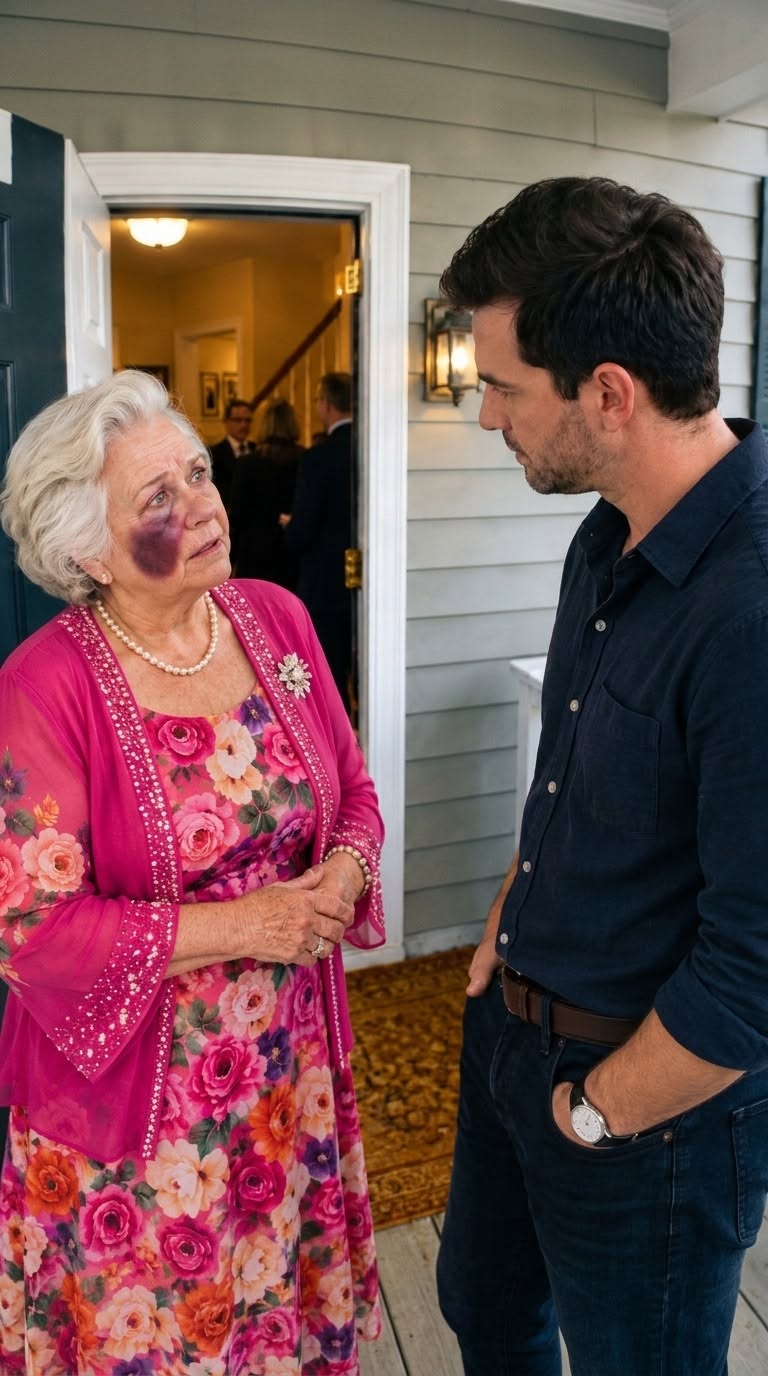
PART 1 TITLE: The Morning My Son Raised His Hand Against Me and Forced Me to Make a Phone Call I Had Avoided for Years
The first thing I noticed was the sound. My son’s palm struck my face with a sharp crack that seemed impossibly loud in the quiet kitchen. The second thing I noticed was that he didn’t look surprised by what he had done. Daniel stood barely two feet away, breathing through his nose, his fingers still spread as though he expected me to argue with him again. Behind him, his wife, Sloan, held a cigarette above a porcelain saucer. A thin ribbon of smoke drifted toward the ceiling. Neither of them reached for me when I stumbled against the counter.
I was seventy-three years old. I had survived factory shifts that left my hands swollen, winters when the heating bill frightened me more than the cold, and the death of a husband whose absence still caught me unprepared at the most ordinary moments. Yet nothing in those years had prepared me for the expression on Daniel’s face. He wasn’t looking at me as a son who had lost control and immediately regretted it. He was looking at me as though I had finally received a punishment he considered overdue.
All I had asked was for Sloan to stop smoking inside the house. The smell had been troubling my breathing for weeks, particularly when it traveled down the hallway and slipped beneath the door of the small guest room where I slept. That morning, after another night of coughing, I had come into the kitchen to make tea. Sloan was standing beside the open refrigerator, smoking while she examined a carton of cream. I asked her to take the cigarette outside. I had made the request gently, because I had learned that even the smallest suggestion could become an accusation in that house.
Sloan turned slowly, her cigarette balanced between two fingers. She wore an expensive silk dressing gown, and the diamond on her left hand flashed when she gestured toward the back door. “You’re welcome to go outside yourself,” she replied. “I’m having my coffee.” I explained that I couldn’t move the smoke out of my lungs simply by leaving the room after breathing it. She gave a little laugh, the kind that had become familiar during my six months under their roof. Daniel entered while I was still speaking. He heard his wife’s complaint before he heard my explanation, and that was enough.
“Why do you always have to start something?” he demanded. I told him I wasn’t starting an argument. I was asking for a little consideration because the smoke made it difficult for me to breathe. Sloan placed her hand against his chest and said she was tired of being criticized in her own home. Daniel stepped toward me. I remember seeing a small stain of coffee on his shirt cuff, something I would have offered to remove a year earlier. Then he told me to apologize to his wife. When I said I had nothing to apologize for, he struck me.
My cheek burned. I tasted something metallic and realized I had bitten the inside of my mouth. The kettle was beginning to whistle behind me, but nobody moved to turn off the burner. Sloan looked at my face and gave a short, uncomfortable laugh. “Maybe now she’ll understand,” she said. Daniel finally lowered his hand. His voice became quieter, which somehow made it worse. “You need to learn when to stop talking, Mom.” I searched his face for the child I had once carried upstairs after he fell asleep on the sofa. I couldn’t find him.
I didn’t scream. My legs felt unsteady, and I was afraid that if I tried to speak, my voice would give them another reason to mock me. Instead, I reached behind myself, turned off the kettle, and walked out of the kitchen. Daniel called something after me about making a scene. I kept moving. The hallway smelled of furniture polish and stale smoke. At the end of it was my room, with its narrow bed, an old chest of drawers, and a window overlooking the neighboring garage. The door’s latch had been broken since shortly after I arrived. Nobody had considered fixing it necessary.
I sat on the edge of the mattress and pressed a cool washcloth to my cheek. My hands trembled so badly that water dripped onto my slippers. The mirror above the dresser showed an elderly woman with silver hair coming loose from its pins and a red mark growing across one side of her face. I had looked into that mirror every morning for half a year. I had watched myself grow more tired without understanding how much of that exhaustion came from having to calculate every word before I spoke.
Six months earlier, I had still been living in the small apartment I rented after Thomas, my husband, died. It wasn’t much to look at. The bathroom tiles were chipped, the radiator rattled whenever the heat came on, and the kitchen window faced a brick wall. But I knew which floorboards creaked, which neighbor would accept a package when I went shopping, and exactly where the afternoon sunlight fell across my table. When the building was sold and the new owner announced changes that would force me to leave, Daniel told me there was no reason to worry.
He and Sloan had a spacious house, he said, and their guest room was rarely used. I could stay while I decided what to do next. He made it sound practical, even affectionate. I would help with groceries and household expenses, and they would enjoy having me nearby. I was reluctant at first. I knew that sharing a home could strain even close families. But Daniel insisted, reminding me that I had spent so many years taking care of everyone else. It was time, he said, to let someone take care of me.
The first month was almost pleasant. Sloan showed me where to put my belongings and bought fresh towels for the bathroom. Daniel sometimes asked me to join him for breakfast before work. I cooked a few of his childhood favorites, and he ate them with an enthusiasm that made me remember how much he had loved coming home from school to find supper waiting. I began to believe that living together might restore something we had lost during the busy years of his marriage. I didn’t realize how quickly kindness could become an itemized expense.
It started with groceries. Sloan said their food bills had increased since I moved in, so I began buying most of the weekly supplies. Then the electricity bill arrived during an unusually hot month, and Daniel asked whether I could cover it. Shortly afterward, he explained that the mortgage had become difficult to manage and wondered if I could contribute a little more. I agreed because I didn’t want them to think I was taking advantage. Gradually, the amount I handed over grew, but my place in the household seemed to shrink in proportion.
Sloan began asking me to keep my personal things out of the common rooms. A framed photograph of Thomas and me disappeared from the mantel because it didn’t suit her decorating scheme. When I used the washing machine, she reminded me how expensive water had become. If I watched television in the afternoon, Daniel sometimes asked whether I had anything more useful to do. I stopped preparing lunch unless they requested it. I ate quietly, washed every dish immediately, and returned to my room before their evening conversations began.
What troubled me most wasn’t the money. I had worked too hard throughout my life to resent a fair contribution to the place where I lived. It was the uncertainty. Some weeks Daniel described my payments as rent. Other weeks he said they were simply help with family expenses. If I asked how much was needed, he became impatient. Sloan seemed to remember each favor she had done for me but forgot the groceries, cleaning, and cooking I provided without being asked. I told myself this was the awkwardness of three adults learning to live together.
Thomas would have seen the situation differently. He was a quiet man, slow to anger and careful with money, but he had a talent for recognizing when someone used guilt as a substitute for a reasonable request. During our marriage, I often said yes before I had considered whether I could afford to. He would sometimes put his hand over mine and ask what I actually wanted. Since his death, nobody had asked me that question very often. I had grown accustomed to answering what others expected instead.
Daniel had not always been impatient with me. As a boy, he was sensitive, easily frightened by storms, and embarrassed by the asthma attacks that sometimes kept him out of school. I sat beside his bed during long nights when his breathing frightened us both. I worked extra shifts so he could go on school trips without knowing how carefully I had counted the money. When college expenses arrived, I sold my wedding ring to help with his first semester. Thomas and I never treated those sacrifices as debts our son would someday have to repay.
Perhaps that was part of the reason I stayed silent for so long. I remembered Daniel at eight, pressing a handmade Mother’s Day card into my hands with an expression of enormous pride. I remembered him at seventeen, coming home devastated after losing a school competition and sitting at the kitchen table until midnight while we talked. I remembered the young man who wept at his father’s funeral and held my hand through the service. Those memories were real. So was the man who had just struck me. I was struggling to hold both truths at once.
A burst of laughter traveled down the hallway from the kitchen. Sloan was telling Daniel something about their plans for the afternoon. The ordinary sound made the room feel smaller. I looked down at the washcloth in my hands and realized I had been waiting for him to knock on my door. I expected an apology, or perhaps an awkward explanation that he had been under too much pressure lately. Anything that would show he understood what had happened. Instead, I heard a cabinet close and then his footsteps moving toward the living room.
I stood and took two photographs of my face with my phone. The first was blurred because my hand was shaking. I steadied my elbow against the dresser and took another. The mark on my cheek was becoming darker, and the corner of my mouth was swollen. I didn’t know whether I would ever need the pictures. I only knew that I had spent years explaining away things that hurt me, and I wanted a record of this morning before anyone persuaded me that I had exaggerated it.
When I opened the little drawer beside my bed, I found an old photograph beneath my medication and a stack of folded receipts. It showed me standing outside a community center beside a young man in a graduation gown. He was tall and thin, with a smile that made him look younger than his years. His arm was around my shoulders. On the back, written in neat blue ink, was a message thanking me for giving him a place to belong when he had nowhere else to turn.
His name was Marcus Bennett. I had met him twenty-five years earlier, when he was nineteen and sleeping in an aging car behind a grocery store. His father had thrown him out, his mother had died years before, and he had been trying to attend college while working whenever he could. He came to the community center one Saturday asking whether any food remained after the morning meal. I remembered how carefully he held the plate I gave him, and the way he kept glancing toward the door.
I invited Marcus to stay in the spare room of our apartment. Thomas helped me make space for his belongings, and we told him he could remain until he found his footing. Six months later, he left with a part-time job, a scholarship, and plans to become a lawyer. He never forgot us. He called when he graduated, sent flowers when he passed the bar examination, and occasionally visited when his work allowed it. Over the years, his calls became less frequent, but the warmth between us never disappeared.
I hadn’t seen Marcus in nearly four years. Our lives had moved in different directions, and I had been too embarrassed to tell him how lonely things had become after Thomas died. I knew he was busy with legal work and had responsibilities of his own. More than once, I had thought of calling simply to hear his voice, then put down the phone. I didn’t want him to feel that every kindness I had offered decades earlier entitled me to ask for something in return.
That morning, I stopped thinking about what I was entitled to ask. I searched through my contacts until I found his number. Fifteen minutes had passed since Daniel struck me. My face was throbbing, and I could still smell cigarette smoke through the gap beneath the door. When Marcus answered, I almost lost my courage. His voice was familiar, a little deeper than I remembered. He greeted me with genuine pleasure and asked whether I was keeping well. I tried to reply, but the words caught in my throat.
“Loretta?” he said, more carefully this time. “What’s happened?” I looked at the photograph lying across my knees. I could have told him that I needed advice about finding an apartment. I could have mentioned my breathing problems or asked whether he knew anyone who could help an older woman understand her finances. Instead, I told him that Daniel had hit me. There was a pause long enough for me to hear someone speaking in the background at his end of the call. Then Marcus asked whether my son was still in the house.
I said he was, and Marcus asked if I could safely stay in my room for the moment. He wanted to know whether I was seriously injured, whether I needed emergency medical attention, and whether there had been threats or other physical violence. I answered as clearly as I could. He advised me not to confront Daniel again and asked me to keep my phone nearby. When I admitted that I didn’t know what to do, his response was calm. He could come to me, he said, and we could decide the next steps together.
I began to object. It was a long drive, and I had already taken up enough of his morning. Marcus interrupted gently, reminding me of the winter his car had broken down and I had driven him to classes before going to my own job. He remembered that I had never once made him feel like a burden. I sat quietly while he spoke. It wasn’t the reference to those old favors that moved me. It was the realization that someone had heard what happened and had not immediately asked what I had done to cause it.
After we ended the call, I placed the graduation photograph on the dresser and opened my handbag. Inside were my identification, a small notebook, a few recent receipts, and an envelope containing bank statements I had meant to examine. I arranged them beside the photographs of my injury. I didn’t have a complete plan. I didn’t even know whether I would be leaving that house. But preparing those papers gave my shaking hands something useful to do, and for the first time that morning, I felt capable of making a decision.
Nearly an hour later, the doorbell rang. From the hallway I heard Daniel complain that he wasn’t expecting anyone. Sloan told him to answer it. I took a final look at my bruised face, straightened my blouse, and walked toward the front door before my son could reach it. Daniel stepped into my path and asked who was coming to see me. I looked at him, remembering all the years I had answered his questions before he had even finished asking them. This time I said only that I had called someone I trusted.
He frowned and reached for the door handle, but I placed my hand on it first. Behind us, Sloan appeared carrying her coffee cup, curious now that something was happening which neither of them had arranged. I could feel Daniel watching me, waiting for the familiar hesitation that usually ended with me giving way. Instead, I opened the door myself. On the porch stood a tall man in a charcoal suit, his dark hair silvering at the temples, a leather briefcase in one hand. When he saw my face, the welcome in his eyes changed.
END PART 1
PART 2 TITLE: The Man I Once Helped Through His Hardest Winter Walked Into My Son’s House and Asked One Question Nobody Wanted to Answer
Marcus did not greet me with the cheerful familiarity I remembered from our last visit. His attention went immediately to the swelling along my cheek and the faint discoloration spreading toward my jaw. For a moment, he remained motionless on the porch. Then he set his briefcase beside the door and embraced me with extraordinary care, as though he were afraid that holding me too tightly might hurt. I had kept myself composed through the argument, the photographs, and the phone call. But the touch of someone who was genuinely glad to see me broke through the composure I had been struggling to maintain.
I pressed my forehead against his shoulder and began to cry. It embarrassed me, at first. I was standing in my son’s doorway, weeping against the jacket of a man I had once known as a hungry college student with worn-out shoes. Marcus didn’t hurry me. He let me hold on until I could breathe steadily again. When I finally stepped away, he handed me a clean handkerchief and waited while I wiped my eyes. He looked older, of course, but I recognized the same patient expression he had worn whenever Thomas tried to teach him how to repair something around the apartment.
“You’re hurt,” he said. I told him it looked worse than it felt, although my cheek was still throbbing. Marcus didn’t argue. He asked whether I was dizzy, whether I had lost consciousness, and whether anything else had happened after our conversation. I answered each question. Then he retrieved his briefcase and asked if I would be comfortable having him enter the house. It seemed a small courtesy, but the question made me hesitate. For six months, I had been treated as someone who needed permission to invite a guest into the place where she lived.
Daniel was standing several feet behind us. He looked Marcus over with the guarded expression he sometimes used when meeting strangers he considered beneath him or inconvenient. Sloan had moved closer, but she remained silent. Marcus straightened and introduced himself. Daniel offered a reluctant handshake. When Marcus explained that he was an old family friend, my son’s expression changed. He seemed to be searching his memory for a name he should have recognized. I remembered Marcus visiting when Daniel was younger, but their meetings had been brief, and my son had never taken much interest in the people I knew through the community center.
Sloan recovered first. She smiled with the chilly politeness she reserved for unexpected visitors. “This really isn’t a convenient morning,” she said. “We’re in the middle of something personal.” Marcus looked at her, then at Daniel, before returning his attention to me. He said he understood that families sometimes preferred privacy. However, I had asked him to come, and he intended to make sure I received the assistance I needed. Sloan crossed her arms. She disliked being contradicted, especially by someone whose arrival she had not been able to control.
Daniel gave an impatient sigh. “Mom gets upset about little things. You don’t need to make a special trip every time she has a disagreement with Sloan.” He spoke as though I were an absent-minded child who had called the wrong person because she couldn’t manage an ordinary argument. I had heard that tone increasingly often. Sometimes he used it when I asked about a household payment or misunderstood one of Sloan’s instructions. I had learned to lower my eyes until he finished. With Marcus beside me, I managed to keep looking at him.
Marcus asked Daniel whether he had struck me that morning. The question was direct, without accusation or raised voice. Daniel shifted his weight. He said we had all become upset and that I had refused to leave Sloan alone. Marcus asked again, more specifically, whether his hand had made contact with my face. Sloan interrupted to explain that I was always interfering. Marcus waited for her to stop, then told Daniel he would like an answer from him. My son looked toward the kitchen, as if some explanation might be waiting there among the abandoned breakfast dishes.
“It wasn’t as bad as she’s making it sound,” Daniel said at last. I felt a coldness settle in my stomach. Until that moment, I had been wondering whether he regretted hitting me. His answer settled at least one part of that question. He was not trying to explain his behavior. He was trying to reduce its importance. Marcus didn’t react theatrically. He simply said that the seriousness of an injury wasn’t something they should decide by arguing in a doorway, and that I needed to be examined by a medical professional.
Sloan made a dismissive sound. “She isn’t in a hospital. She’s standing right here.” I looked at her and remembered the first time Daniel brought her home, when she had been warm and attentive, asking about Thomas and complimenting the old curtains in my apartment. I had believed the two of us might become friends. It was painful to see how easily she could look at my swollen cheek and talk as though I were inconveniencing everyone. Marcus told her that the fact I could stand and speak did not establish whether I was uninjured.
Daniel’s face reddened. He asked if Marcus was a doctor. Marcus answered that he was an attorney, not a physician, and that he was not pretending otherwise. He had come because I requested help, and he wanted to ensure that my immediate safety and medical needs were addressed before discussing anything else. Daniel looked startled when he heard the word attorney. He asked whether I intended to take legal action against him. I hadn’t even considered that question in any organized way. All I had wanted when I called was someone who would listen.
Marcus did not give Daniel a prediction about consequences or make threats. He explained that my decisions belonged to me and that no one in the room should pressure me into making them before I had received appropriate advice. Then he turned toward me and asked whether I wanted to continue the conversation in front of everyone. I looked from my son to Sloan. Daniel was watching my expression carefully. I knew the answer he wanted. I also knew that the moment I disagreed, the room would become uncomfortable again.
“Not here,” I replied. “I’d like somewhere quieter.” Marcus nodded and asked where I would feel most comfortable. I nearly suggested my bedroom, out of habit. That was where I had been expected to go whenever Daniel and Sloan wanted to discuss something without me. Instead, I chose the living room. The decision seemed to surprise Sloan. She said they had planned to use that room later in the morning. I told her I understood, but I wanted to sit there now. The words came out more steadily than I expected.
The living room was the most carefully decorated space in the house. Pale furniture surrounded a low glass table, and enormous photographs of Daniel and Sloan’s wedding occupied the wall above the fireplace. My own belongings had never been welcome there. I sat in an armchair near the window while Marcus placed his briefcase on the floor. He waited until I had settled before sitting across from me. I could see the kitchen through the wide doorway. Daniel remained standing there, his phone in his hand, while Sloan began gathering dishes with movements much louder than necessary.
Marcus took out a notebook but didn’t open it immediately. Instead, he asked what I wanted to happen that day. The question unsettled me more than any of his earlier ones. I had spent so much energy anticipating what Daniel and Sloan might want that I hadn’t considered my own answer. I told him I wanted my breathing to improve and the violence not to happen again. I wanted to know whether I could stay somewhere else without creating a financial disaster. Most of all, I wanted to stop feeling frightened whenever I heard my son’s footsteps approaching.
He listened carefully. Then he asked whether I had somewhere I could stay that evening if I decided not to sleep in the house. I said I wasn’t sure. The few friends I still saw regularly lived in small apartments or had health problems of their own. One cousin lived several hours away, but we hadn’t spoken recently. Marcus said he could help me explore safe temporary arrangements without expecting me to choose one immediately. He also explained that, if I felt threatened, contacting emergency services was an option regardless of what anyone in the household thought.
We discussed the incident in detail. I described Sloan smoking in the kitchen, my request that she take the cigarette outside, and Daniel’s demand that I apologize. I told Marcus exactly what my son had said before and after striking me. It was difficult to repeat the words. They sounded uglier when spoken aloud in a quiet room than they had during the argument. Marcus asked whether Daniel had ever physically hurt me before. I said no. He asked about threats, intimidation, and situations where I felt unable to disagree without fearing the response.
At first, I couldn’t think of anything worth mentioning. Then I remembered the evening Daniel shouted at me for accidentally moving a document from the dining table. I remembered Sloan telling me I should be grateful for my room whenever I questioned an expense. I remembered being warned that I might need to find another place to live if I continued making everyone uncomfortable. Each incident had seemed too small to justify a confrontation. Described together, they began to form a pattern I could no longer explain away as ordinary household tension.
Marcus asked whether I could leave the house freely. I said yes, although Sloan sometimes complained when I went out without explaining where I would be. He asked whether I controlled my own identification and medical information. I told him those things remained in my handbag, but that Daniel had occasionally offered to handle paperwork because he considered it too complicated for me. When Marcus asked about my finances, I hesitated. I had expected to discuss my bruised cheek, not the money I had been giving my son for months.
I told him that I received a pension and had savings of my own. I contributed to household expenses every month and paid for many of the groceries. Sometimes I covered an unexpected bill as well. Marcus asked whether the arrangement had been written down or agreed upon clearly. I admitted that it hadn’t. Daniel had told me what he needed, and I had generally transferred the money without asking for a detailed explanation. Marcus didn’t tell me that I had been foolish. He simply asked if I had kept records.
I looked toward the hallway. My notebook contained the amounts I had paid, and I had kept many receipts because the habit had remained with me from my factory years. Thomas used to tease me about saving even the smallest purchase slip. He would have been pleased to know I still did it. I told Marcus I had statements, messages, and handwritten figures in my room. He asked whether I would be willing to gather them so we could understand the arrangement before drawing conclusions. For the first time, my careful recordkeeping seemed useful rather than something my son considered old-fashioned.
Daniel entered the living room before I could stand. He had apparently been listening from the kitchen. “Why are you asking about her money?” he demanded. “That’s none of your business.” Marcus replied that he was discussing my financial situation because I had agreed to speak about it. Daniel turned toward me and said I was making him look dishonest when he had generously allowed me to stay with his family. I felt the familiar pull to reassure him. My mouth opened, ready to explain that I appreciated everything he had done. Then I remembered the swelling on my face.
I asked Daniel why he was angry that I wanted to understand where my money had gone. He seemed startled by the question. Sloan joined us and said that if I didn’t trust them, perhaps I should find somewhere else to live. The words were delivered casually, but I felt their intended effect. I knew how much trouble moving had caused me six months earlier. They knew I had few nearby relatives. My response had always been to apologize and promise to be more helpful. This time, I didn’t say anything.
Marcus asked Daniel and Sloan to give us a little privacy. Daniel refused, saying that I lived in his home and he had a right to know what was being discussed. Marcus reminded him that adults could seek advice without obtaining permission from relatives. His tone remained measured, but the distinction was clear. He was not trying to seize authority over the household. He was refusing to accept Daniel’s assumption that owning the property entitled him to control every conversation inside it. Daniel looked at me, expecting me to support him.
I said I wanted to continue speaking with Marcus alone. Sloan’s expression hardened. Daniel asked if I had forgotten everything they had done for me. I answered that I remembered it, including the nights I cooked, the shopping I paid for, and the cleaning I handled while they worked. My voice sounded unfamiliar to me. It wasn’t angry. I had simply begun to describe the arrangement as it actually existed, instead of pretending I received everything and gave nothing. Daniel stared for a moment, then told Sloan they should let us finish.
When they withdrew to the kitchen, Marcus waited until I could no longer hear their footsteps. He asked whether I felt able to retrieve the documents myself or preferred that we discuss them another day. I told him I wanted to find them now. We walked down the hallway together. My bedroom looked smaller with another person standing in it. Marcus noticed the broken latch and the towel I had pushed against the door to reduce the cigarette smell. He didn’t comment, but his expression told me he had noticed more than I realized.
I took my folder from beneath a stack of photographs and placed it on the bed. The pages were arranged by month, with receipts attached to sheets of paper and notes about each transfer. Some figures were written in pencil, others in blue ink. Marcus examined the first few pages without speaking. Then he asked whether he could take the folder into the living room where there was more space. I agreed. As I carried it back through the hallway, I realized how much effort I had devoted to proving that I was a responsible guest.
We began arranging the statements on the coffee table. Marcus placed the household purchases together, separated the regular transfers from the occasional ones, and asked me to identify any payment I didn’t recognize. As he worked, I began remembering conversations I had tried to forget. Daniel had asked for additional money several times, always with an urgent reason. Sloan had told me that their bills were rising because of my presence. Yet the amount I contributed had continued increasing even during months when I had spent several days away visiting friends.
At the bottom of the folder was a page I had folded twice and set aside. It contained three bank transfers made over a short period, each larger than the contributions Daniel had originally requested. I remembered feeling uneasy when I authorized them. He had called them temporary help with the mortgage and promised the situation would improve. Marcus studied the amounts, then looked at the dates. He asked whether I knew what had changed in the household during those weeks. I said I didn’t. Daniel had refused to discuss his finances.
Marcus placed the page in front of me and asked one more question. He wanted to know whether I had agreed to pay rent, contribute to shared living expenses, or help my son meet his private financial obligations. I opened my mouth, but no answer came. All three descriptions had been used at different times, depending on what Daniel wanted. I had never been shown a clear arrangement, and I couldn’t tell Marcus what the payments actually covered. For the first time, I understood why my records mattered. The uncertainty had not come from my failing memory.
Then I found a message printed at the back of the folder. Daniel had sent it after one of our disagreements, shortly before asking for another large transfer. He had written that I should remember whose roof sheltered me before questioning how the household was managed. I stared at the page. In the past, I had read those words as a warning to behave better. Now, sitting beside the man who had once needed shelter from me, I recognized how frightened I had been of losing mine.
Marcus waited while I read the message again. He didn’t tell me what to think. He asked whether I wanted to review the remaining documents and preserve copies before making any decision about the money. I said yes. Across the room, the wedding photographs looked down at us from their polished frames. My son and his wife smiled in every picture, surrounded by flowers and expensive decorations. On the coffee table below them lay six months of payments I had made while trying to remain welcome. I turned the next page and asked Marcus to help me account for every one.
END PART 2
PART 3 TITLE: The Financial Records My Son Never Expected Me to Examine Revealed How Little I Understood About the Home I Had Been Paying to Maintain
Marcus spent nearly an hour examining the papers I had gathered. He didn’t rush through the statements or treat my handwritten notes as unreliable simply because some were faded or difficult to read. He organized the records into separate groups and asked me to describe the circumstances of each payment. By the time we reached the final page, the afternoon light had shifted across the living room carpet. What had begun as a conversation about my immediate safety was becoming an examination of the six months I had spent in Daniel’s house. I hadn’t expected the two subjects to be so closely connected.
The regular payments were easy to explain. I had agreed to contribute toward food, utilities, and the additional costs of having another person in the household. The problem was that I had never been given a consistent figure. Some months Daniel asked for one amount, then requested more after an unexpected expense. During other months, Sloan bought household items and expected me to reimburse her without showing me the original cost. I hadn’t objected because I assumed they were telling me the truth. I had also been afraid of appearing ungrateful.
Marcus asked whether I remembered the first time Daniel mentioned the mortgage. I thought carefully. It had been approximately two months after I moved in. Daniel came home looking exhausted and said his work had become uncertain. A client was delaying payment, he explained, and the mortgage would be difficult to cover without a little help. He promised that it was a temporary problem. I transferred the money the next morning. At the time, it seemed no different from the occasions when Thomas and I had helped relatives through a difficult month.
The requests continued. Daniel rarely gave the same explanation twice. One payment was needed because the interest rate had increased. Another covered what he described as an unusually expensive insurance bill. A third was supposed to prevent him from falling behind while he waited for money owed through his work. I remembered asking whether they should review their household budget. He had become irritated and told me that I didn’t understand the financial pressures facing younger families. After that, I stopped offering suggestions and continued making payments.
Marcus asked whether Daniel had ever shown me a mortgage statement or evidence that my contributions had been applied to the expenses he described. I said he hadn’t, although I had no reason at the time to demand such documents. Marcus explained that the absence of records didn’t automatically establish dishonest conduct. Families often exchanged money informally, and every circumstance had to be examined fairly. What mattered was that I understood my own decisions and could distinguish voluntary assistance from payments obtained through pressure or misleading explanations.
We reviewed the messages on my phone next. Most were ordinary reminders about shopping, deliveries, or appointments. Others concerned money. Daniel’s requests often arrived late in the evening, accompanied by assurances that he would repay me when circumstances improved. Sloan’s messages were shorter and more impatient. Sometimes she calculated my contribution according to how many days I had been in the house. On other occasions, she complained that I hadn’t bought enough groceries. Reading the messages together, I could see that the expectations had changed repeatedly, but no one had ever invited me to negotiate them.
I remembered one particularly unpleasant evening when Sloan asked for another payment while I was washing the supper dishes. I told her I had already contributed more than usual that month and needed to check my account before agreeing. She said it must be nice to receive a pension without having to work. The remark stayed with me because I had worked nearly all my adult life. I wanted to remind her of the years I spent in a factory where the air was thick with dust and the machines were loud enough to leave my ears ringing after every shift.
I didn’t say anything that evening. I finished washing the plates, dried my hands, and went to bed feeling ashamed of needing a place to live. Sitting beside Marcus, I finally described the conversation. He asked whether Sloan had known that I had medical expenses and needed to preserve money for my own future. I said she knew about my medication and breathing difficulties, although we rarely discussed them. He wrote something in his notebook, then asked whether anyone had prevented me from reviewing my bank accounts. I told him no. The passwords and statements were still mine.
That distinction mattered. Marcus was careful not to turn every unpleasant incident into proof of a crime. He wanted accurate information, not dramatic assumptions. He explained that we would need to determine which payments were gifts, which were agreed household contributions, and whether any had been made because of threats or misrepresentations. He recommended that I preserve the original messages and statements without altering them. Then he helped me forward copies to a secure address so they wouldn’t disappear if something happened to my phone or the folder.
Sloan entered carrying a fresh cup of coffee. She stopped when she saw the statements spread across the table. Her eyes moved from Marcus’s notebook to the folder in my lap. “Are you investigating us?” she asked. Marcus explained that I was reviewing my own financial information. Sloan replied that it was ridiculous for anyone to question what Daniel and she had spent on me. She mentioned the bedroom, electricity, and the inconvenience of adjusting their routines. I listened until she finished, then asked whether we could have a written accounting of the household expenses I had helped pay.
Her expression changed immediately. She said she wasn’t going to turn her marriage into an accounting office simply because I had invited an attorney into the house. I replied that I wasn’t questioning their right to manage their finances. I was asking about mine. Sloan looked toward the kitchen and called Daniel’s name. The sharpness of her voice reminded me of how quickly a conversation could become a confrontation. I gripped the folder, suddenly conscious of the fact that all my important paperwork was spread across furniture that didn’t belong to me.
Daniel appeared with his phone in his hand. Sloan told him that Marcus was accusing them of taking advantage of me. Marcus corrected her calmly, explaining that he had made no such accusation and was helping me understand my financial arrangements. Daniel looked at the statements and laughed without amusement. He asked whether I had forgotten that I was living in his house. I answered that I remembered it perfectly. I also remembered being told that my contributions would cover ordinary expenses while I saved enough to decide where I wanted to live.
“You’re acting like we forced you to stay,” Daniel said. I looked at him carefully. The statement was not entirely true, but neither was the opposite. Nobody had locked the door or forbidden me from leaving. Yet whenever I discussed finding an apartment, Daniel warned me how expensive living alone had become. Sloan occasionally mentioned elderly people who had been cheated by landlords or suffered emergencies with nobody nearby. They made independence sound reckless and their own household sound like the only sensible place for me, even while reminding me how fortunate I was to be there.
Marcus asked Daniel to allow me time to consider my options without pressure. Daniel folded his arms and said there was nothing to consider because I was his mother and belonged with family. The words might once have comforted me. Now they brought back the feeling of his hand against my face. I asked him a question I had been avoiding since morning. If he believed I belonged with him, why had he chosen to hit me when I asked for something as simple as clean air?
Daniel’s expression tightened. He said I had been provoking his wife and refusing to respect their rules. I looked at Sloan, who had resumed smoking earlier despite knowing how much it troubled my breathing. Then I looked back at my son. I told him that I had not insulted his marriage or challenged his authority. I had explained that cigarette smoke made me cough and asked that it be kept outside. He had responded with violence. I wanted him to acknowledge the difference between being annoyed by a request and believing he had the right to punish the person making it.
He did not answer. Sloan said everyone was exhausted and that continuing the argument would only make things worse. I wondered whether she would have described the situation that way if Daniel had struck someone outside the family. Marcus closed his notebook and asked if I wanted a break. I told him I would rather finish. For months, the easiest way to end an uncomfortable conversation had been for me to withdraw. I was tired of leaving important questions unanswered merely because someone else found them unpleasant.
We returned to the financial records, but Marcus asked another question before opening the folder again. He wanted to know whether I had property, savings, or investments that someone else controlled or managed. I explained that my pension entered an account in my name and that I had other savings accumulated over many years. Thomas had been careful about setting money aside, even when we had very little left at the end of the month. He believed that small amounts mattered if they were saved consistently and left untouched whenever possible.
After his death, I continued the habits we had developed together. I was never a woman who bought expensive things simply because I could afford them. I repaired clothing, used furniture until it became impossible to mend, and compared prices at the grocery store. An aunt had left me a modest inheritance, which I invested rather than spending immediately. I knew the money had grown, though I rarely studied the full figures. I had always thought of those savings as protection against illness or an unexpected expense, not as something that could allow me to make a different life.
I told Marcus that the investments remained in my name and that I could access them without asking Daniel’s permission. He seemed relieved. He asked whether anyone had encouraged me to change my will, transfer ownership of an account, or appoint someone to make financial decisions on my behalf. I said no. Daniel occasionally suggested that I let him simplify my paperwork, but I had never signed anything giving him control. Thomas had insisted that I understand our finances while he was alive. I was beginning to appreciate how important that insistence had been.
Marcus advised me to leave the accounts unchanged until an independent financial professional could review them with me. He said that a safe decision required more than knowing the total in a bank account. I would need to understand my regular income, housing costs, medical expenses, taxes, and the long-term purpose of my investments. He also suggested that I not discuss the full value of those assets with anyone who was pressuring me to provide money. I agreed. For the first time in months, I wasn’t deciding how much I could give Daniel. I was considering what I would need for myself.
I remembered the little blue box I had brought from my old apartment. It contained documents Thomas had considered important enough to keep together: a letter from an attorney, an old bank certificate, insurance papers, and a handwritten note he had left for me before his death. The box had been pushed toward the back of my closet when I moved. I asked Marcus to accompany me to retrieve it. He agreed, and we returned to the guest room while Daniel and Sloan argued quietly in the kitchen.
The box was dusty, its metal clasp stiff from years of disuse. I carried it to the bed and opened it carefully. Thomas’s handwriting appeared on a yellowing envelope near the bottom. For a moment, I forgot that Marcus was standing beside me. I ran a finger across my husband’s name and remembered the evenings we spent reviewing bills at our kitchen table. Thomas had always been patient when I wanted to help someone whose circumstances were worse than ours, even when he worried about how we would manage ourselves.
Among the documents was an old letter from a community foundation. It thanked me for years of volunteer work and invited me to consider advising a program for young people struggling with homelessness. I had received it during a particularly difficult period in Daniel’s life, when he needed help with college expenses and Thomas’s health was beginning to decline. I remembered reading the invitation, feeling honored, and putting it aside because there seemed to be no time for anything that did not involve work or family responsibilities.
Marcus recognized the organization immediately. He asked whether I remembered a teenage girl named Elena Ruiz. I smiled before I could stop myself. Elena had come to the community center when she was sixteen, exhausted from school and evening shifts at a grocery store. Her mother was seriously ill, and she was trying to keep up with her studies while helping pay household bills. I had often brought her home for dinner, helped her prepare scholarship applications, and encouraged her not to abandon her education when the responsibilities became overwhelming.
Elena had been stubborn and intelligent, with a habit of asking questions nobody else thought to ask. She eventually left for college with two battered suitcases and a determination that made me certain she would find her way. We exchanged letters for a while, but as the years passed, contact became irregular. I knew she had entered journalism, though I hadn’t followed her career closely. Marcus told me she was now an investigative reporter whose work often concerned financial exploitation, vulnerable families, and institutions that failed to protect people who depended on them.
I was pleased to hear how well she had done. Then Marcus told me something I hadn’t expected. Elena had been trying to locate me for months because she wanted to interview me for a project about ordinary people who helped young adults through difficult circumstances. She had already spoken to several former students and community center volunteers. Some remembered meals I had prepared. Others recalled rides to school, help finding employment, or the chance to sleep somewhere safe during a frightening period in their lives.
The thought of being interviewed made me uncomfortable. I couldn’t imagine why anyone would want to write about my life. Marcus explained that Elena wasn’t interested in turning me into a celebrity. She wanted to show how practical, often unnoticed assistance could affect someone’s future. As he spoke, I began remembering people I hadn’t thought about for years. There was a young father who came to the center after losing his job, and a boy who waited outside every Thursday because he knew there would be dinner. I had rarely considered what happened to them afterward.
Marcus looked again at the foundation’s letter. He said Elena had also discovered old records suggesting that a donor had established an endowment connected to the community’s work with vulnerable young adults. The foundation had apparently been trying to clarify its history and contact some of the people whose contributions had influenced the original program. My name appeared in those discussions. I asked whether he meant someone had left money to me personally. He explained that the fund was intended for charitable work, not an unexpected personal inheritance, and that the details still required confirmation.
I sat quietly with the letter in my lap. The possibility of money was less astonishing than the idea that people remembered what I had done when I was younger. I had spent the last six months feeling like an inconvenient guest whose presence was measured by the amount she could contribute. Now Marcus was telling me that people I had helped decades earlier had carried those experiences into their adult lives. They had become lawyers, journalists, teachers, and workers in their own communities. Their lives had continued beyond the moments when I knew them.
A door closed sharply in the hallway. Sloan appeared a moment later, her face tight with irritation. She asked how much longer Marcus intended to stay and whether he was trying to persuade me to leave. I told her that I hadn’t decided where I would sleep that night, but I was no longer willing to stay simply because they expected me to. She turned toward Daniel, who was approaching from the kitchen, and complained that this was exactly what she had feared. My son looked from her to Marcus, then at the open blue box and the papers in my hands.
Daniel asked for a private conversation. His voice had lost some of its earlier confidence. I could see that he was frightened, although I didn’t yet know whether he feared losing me, losing the money I contributed, or having to confront what he had done. Marcus told me that the decision was mine and that he would remain nearby if I wanted him. I agreed to speak with Daniel for a few minutes. Before Marcus left the room, I placed the financial statements and the blue box together beside my chair. Whatever my son wanted to say, I was no longer willing to put those things away and pretend they didn’t matter.
END PART 3
PART 4 TITLE: My Son Finally Asked Me to Forgive Him, but His Explanation Made Me Understand Why I Could No Longer Remain Under His Roof
Daniel waited until Marcus had stepped onto the porch before pulling a chair toward the dining table. He sat down heavily, his shoulders rounded, and stared at the papers arranged beside my blue box. For several seconds, he seemed unable to decide whether to speak to me or look away. I remembered the boy who used to sit across from me at our kitchen table when he had done something wrong at school. Back then, he usually waited for me to make the difficult conversation easier. I wondered whether he was waiting for the same thing now.
“Why did you bring him here?” Daniel asked. His voice sounded tired rather than angry, but the accusation was unmistakable. I told him that I had been frightened after he struck me and needed advice from someone I trusted. He rubbed his hands across his face. “You could have talked to me.” I looked at the swelling reflected in the glass cabinet behind him. It seemed impossible that he could say those words without recognizing their absurdity. I asked what he thought I should have said after he hit me and told me to stop talking.
Daniel leaned back in his chair. He said the morning had been difficult, that Sloan was upset, and that financial pressures at work had been making him irritable for weeks. He began describing problems with a client, a delayed payment, and an unexpected expense connected to the house. I listened because I wanted to understand what was happening in his life. But as he continued, I noticed that every explanation led away from the moment when he raised his hand. He seemed to believe that enough difficulties, properly arranged, would make his behavior understandable.
I asked whether he understood that nothing Sloan or I had said justified striking me. Daniel’s jaw tightened. He repeated that I had embarrassed his wife and refused to stop arguing when he asked. I told him I hadn’t been trying to embarrass anyone. I had simply wanted the cigarette smoke kept outside because it made my breathing worse. He looked toward the hallway and muttered that I always remembered things differently from everyone else. I felt an old, familiar doubt rise inside me, but I remembered the photographs I had taken and the exact sequence of events I had described to Marcus.
“I remember what happened,” I said. “And I remember how you looked at me afterward.” Daniel lowered his eyes. For a long moment, neither of us spoke. I could hear Sloan moving around the kitchen, opening and closing cupboards with unnecessary force. My son finally admitted that he shouldn’t have hit me. The words came slowly. He said he hadn’t been thinking clearly. Then, almost immediately, he added that I needed to understand how much pressure he was under. I waited for him to finish, hoping he would recognize the difference between explaining his stress and making me responsible for his actions.
He didn’t. Instead, he asked whether Marcus intended to involve the authorities or take him to court. I told him I hadn’t decided what steps to take, but my immediate concern was my health and safety. Daniel looked relieved for an instant, then asked me to promise that I wouldn’t tell anyone else. He said his reputation could be damaged if people misunderstood the situation. I watched him carefully. My son’s first sustained concern since the incident was not whether I would recover or feel safe. It was whether other people would learn what he had done.
I remembered something Thomas once told me about apologies. He believed that admitting a mistake meant accepting the discomfort of having caused it. Daniel was trying to avoid that discomfort by asking me to protect him. I wanted to tell him that I would always be on his side, because those were words I had spoken to him throughout his childhood. But I had begun to understand that being on someone’s side did not require helping them escape the truth. I could love him and still refuse to conceal the harm he had caused.
Daniel noticed my silence. His expression changed, and for a moment he looked genuinely miserable. He said he was sorry. I wanted the words to mean what I had always hoped they would mean. I remembered his childhood apologies, awkward and sincere, delivered after breaking something or saying something hurtful. This one was harder to accept. I asked whether he regretted hurting me or regretted that Marcus had found out. Daniel looked sharply at me, and his face reddened again. He said I was being unfair when he was trying to make peace.
I told him I wasn’t interested in winning an argument. I wanted him to understand that he had frightened me in a way I had never expected my own son to frighten me. I explained how it felt to sit in the guest room with a swollen face, listening to him and Sloan continue their morning as though nothing important had happened. My voice broke while I spoke, but I did not stop. I wanted him to hear the details, not an easier version he could forget as soon as the conversation ended.
Daniel looked toward the window. He told me he had never intended to make me afraid of him. I believed that he had not planned the morning’s violence. But I also knew that an intention formed afterward could not undo what happened. I said that I no longer felt safe living in the house and needed time somewhere else. He turned toward me immediately. The idea seemed to shock him more than anything we had discussed. He asked where I expected to go and reminded me that living alone at my age could be difficult.
I told him I would find out what my options were. Daniel began listing reasons why leaving would be impractical. Apartments were expensive. Moving was exhausting. Medical emergencies could happen without warning. He said I was making a permanent decision because of one terrible morning. I answered that I wasn’t deciding the entire future of our relationship. I was deciding where I needed to sleep that night. The distinction seemed to frustrate him. He wanted a promise that everything would return to normal, and I could no longer give him one.
He stood abruptly and paced toward the fireplace. For a moment, I thought he might begin shouting again. Instead, he turned and looked at the photograph of himself as a younger man on the mantel. It was one of the pictures Sloan had allowed to remain after I moved in. He asked whether I thought he was a bad son. I considered the question carefully. Daniel had done kind things for me, especially after Thomas died. He had also become impatient, controlling, and cruel during my stay. I didn’t want to reduce him to a single moment, but I refused to let his better memories erase the morning’s violence.
“I think you did something that hurt me,” I said. “And I think you need to decide whether you are willing to face it.” He looked at me for a long time. I could see that he wanted reassurance, something that would restore the familiar arrangement in which I comforted him whenever he became distressed. I had done that instinctively for most of his life. This time, I stayed seated. He whispered that he didn’t know how to fix what had happened. I told him I didn’t know either, but pretending it hadn’t happened would make things worse.
Daniel’s shoulders dropped. For an instant, I saw the frightened child I remembered from nights when his asthma made every breath a struggle. I wanted to reach for him. My hands even moved slightly across the table. Then I remembered the photograph on my phone and the ache along my jaw. Comforting him before he understood what he had done would return us to the same arrangement that had kept me silent for months. I folded my hands together and waited. Daniel looked at them, then away.
He said he needed some time and walked out of the room. I listened to his footsteps move down the hallway. A door closed upstairs. I sat alone for several minutes, feeling neither relieved nor victorious. There was a sadness in recognizing that the person I had raised could no longer be trusted to protect me when I was vulnerable. I had never expected motherhood to make me immune to disappointment, but I had assumed that the bond between Daniel and me would always provide a minimum of safety. That assumption was gone.
Marcus returned when I called him. He didn’t ask me to repeat the conversation immediately. He brought a glass of water, placed it beside me, and waited while I gathered my thoughts. Then he asked whether I still wanted to seek medical attention and consider staying elsewhere. I said yes. The answer came easily, although the thought of leaving was frightening. Marcus explained that we could arrange an examination, document my injuries, and explore temporary accommodation. Longer-term decisions about money, housing, and family relationships could be addressed after I was somewhere secure.
We discussed whether I wanted to report the assault. Marcus explained that I had options and that the specific procedures would depend on local law and the circumstances. He did not promise an outcome or suggest that his presence made the situation simple. I told him I wasn’t ready to make every decision immediately. He respected that, but emphasized that I should preserve the photographs and messages and seek prompt help if Daniel threatened or harmed me again. I appreciated his careful manner. He wasn’t offering revenge. He was helping me recover the ability to choose.
I returned to the guest room and opened my suitcase. Packing felt different from the way I had imagined leaving. There was no dramatic confrontation, no hurried attempt to carry every possession out of the house. I placed my medication in a small travel bag and added my identification, bank information, several changes of clothes, and the photographs I couldn’t bear to leave behind. Thomas’s letter went into the blue box with the financial records. I checked that I had my phone charger, glasses, and appointment information, then looked around at the furniture that had never truly felt like mine.
The room seemed almost peaceful now that I knew I might not have to sleep there again. I noticed the faded patch on the wallpaper beside the window and the dust gathering beneath the narrow dresser. I thought of the nights I had lain awake listening to Daniel and Sloan argue downstairs, wondering whether their disagreements were somehow my responsibility. I had tried to remain useful enough to justify my presence. Now I understood that no amount of housework or money could guarantee respectful treatment from people who considered kindness optional.
Sloan appeared in the doorway while I was closing the suitcase. She looked at the clothes folded on the bed and asked whether I was really leaving. I said I needed some space to consider my future. She gave a short laugh and told me I was making a foolish decision because of an ordinary family dispute. I looked at her cigarette, unlit but tucked between her fingers. I told her that my health mattered and that I would no longer stay anywhere I feared being struck for asking someone not to smoke indoors.
Her face hardened. She said Daniel would be devastated and that I was choosing a stranger over my own son. I replied that Marcus was not a stranger and that his kindness had nothing to do with replacing Daniel. I needed help, and Marcus had offered it without making me feel ashamed. Sloan opened her mouth to argue, then seemed to realize that the familiar accusations were no longer changing my mind. She stepped aside. I carried my suitcase through the hallway, feeling its weight against my hand with each careful step.
Daniel was waiting near the front door. He looked at the suitcase, then at Marcus, who stood a short distance away. My son asked whether I would call him that evening. I told him I would contact him when I felt ready and safe. He wanted to know where I was going. I explained that I would be staying somewhere temporary while I considered my options, but I wasn’t prepared to share the address. He looked hurt. Part of me wanted to reassure him by providing every detail, the way I once did when he worried about my travels. I resisted the impulse.
He asked whether I was planning to come back. I said I didn’t know. I needed medical care, independent advice, and time away from the tension in the house. Daniel looked down at the floor. He didn’t try to carry my suitcase or offer another apology. Perhaps he was ashamed. Perhaps he was angry. I couldn’t tell, and I no longer believed that it was my responsibility to interpret every silence and repair every uncomfortable moment. I opened the front door and stepped outside, where the afternoon air felt cool against my swollen cheek.
Marcus placed my suitcase in his car and helped me into the passenger seat. Through the window, I could see the house in which I had spent the last six months. The windows were spotless, the flowerbeds carefully maintained, and the front steps newly painted. I remembered how proud Daniel had been when he bought it. Thomas would have admired the workmanship and asked questions about the roof. From the street, the house looked like the kind of place where a family could grow old together. I knew now that appearance told very little about what happened behind its doors.
We drove to a medical clinic, where a physician examined my face and asked detailed questions about the injury. I answered honestly, though speaking about my son to a stranger made my stomach tighten. The examination found bruising and tenderness without evidence of a serious facial injury, and the doctor explained what symptoms would require immediate attention. She also listened to my breathing and discussed the coughing that had worsened during my stay with Daniel and Sloan. She recommended follow-up care for my respiratory problems and advised me to avoid cigarette smoke.
When the physician asked how long my breathing had been troublesome, I explained that I had spent years working in a factory where the air was often dusty. I had learned to manage ordinary discomfort and rarely complained unless a symptom became impossible to ignore. She asked about my medication and whether I had been attending regular appointments. I admitted that I had postponed some visits because arranging transportation and explaining my absences at Daniel’s house had become inconvenient. She looked at me carefully and said my health deserved attention whether or not it suited someone else’s schedule.
After the appointment, Marcus helped arrange a temporary guest suite through a colleague who had offered assistance. It was small but comfortable, with a separate sitting area, a clean bathroom, and a window overlooking a garden. The person managing the accommodation greeted me kindly, explained where everything was, and made sure I had the keys. Nobody questioned why I needed the room. Nobody asked me to account for how much electricity I might use. I placed my suitcase beside the bed and stood quietly, listening to the unfamiliar silence.
Marcus brought in my blue box and financial folder. Before leaving, he asked whether I wanted him to check on me the following morning. I said I would appreciate it. He gave me contact information for the accommodation, reminded me how to reach him, and encouraged me to call for help if anything felt unsafe. Then he looked at the photograph of himself in his graduation gown, which I had placed on the little desk. He smiled with a sadness I recognized. We spoke briefly about Thomas, and Marcus told me how often he still thought about the kindness he had received during those difficult college years.
When he left, I sat on the bed and looked around. The sheets smelled freshly laundered, and a glass of water stood on the bedside table. There were no expensive furnishings or grand decorations, but the room belonged to me for the night. I could shut the door without wondering whether someone would demand an explanation. I could make tea without being accused of wasting supplies. I could open the window if I needed fresh air. Those ordinary freedoms felt unfamiliar after months of measuring every movement against someone else’s expectations.
I slept for nine hours. When I woke, sunlight was spilling across the carpet and birds were calling from the garden. For a moment, I didn’t recognize the room. Then I remembered the previous day, and the ache in my cheek returned with the memories. I sat up slowly and reached for my phone. There were messages from Daniel. The first accused me of making him look terrible in front of Marcus. Another asked why I couldn’t have discussed the problem privately. The last was shorter. He wanted me to call him because he missed me.
I read the messages without answering. I missed him too, although the feeling was tangled with anger, grief, and disappointment. I remembered the good years when he was younger, when he used to bring me lemon cake on Mother’s Day because he knew it was my favorite. Those memories hadn’t disappeared. But I wasn’t ready to let them persuade me that the danger had disappeared either. I put the phone facedown, made tea, and sat beside the window. Outside, someone was tending a row of roses, moving slowly from one plant to the next.
Marcus arrived later that morning with a notebook and a paper bag containing breakfast. He asked how I had slept, and I told him it was the best rest I had managed in weeks. We sat at the small table and discussed practical matters. He encouraged me to consult an independent financial adviser rather than relying entirely on his interpretation of my records. He also suggested gathering information about apartments, reviewing my pension and investments, and considering what monthly budget would allow me to live comfortably without using savings unnecessarily.
I listened while he explained the different arrangements I might consider. Some apartments would offer more independence, while others provided convenient access to services. I knew I wanted a place where I could open the windows and prepare my own meals. I also wanted a spare room, not because I expected Daniel to visit immediately, but because I had spent so much of my life making room for people who needed a safe place to stay. Marcus smiled when I mentioned that. He said there was no reason my future home couldn’t reflect the things I valued.
We called an independent financial adviser and arranged an appointment. I explained that I wanted to review my income, investments, and expenses before making any housing commitments. I also wanted to understand the consequences of the payments I had made to Daniel. The adviser asked me to bring recent statements and any relevant correspondence. Afterward, Marcus helped me make a list of the documents I already had and those I might need to obtain. It was reassuring to see my problems reduced to practical questions that could be examined one at a time.
Then Marcus returned to the community foundation letter. He said Elena Ruiz had been looking forward to speaking with me and would be pleased to learn that we had reconnected. I felt a little nervous at the thought. I didn’t know whether I wanted my name associated with a public article, especially while my relationship with Daniel remained unsettled. Marcus said there was no obligation. Elena would need my permission to interview me, and I could decide what parts of my life I wanted to discuss. He added that the foundation’s interest was separate from my immediate family problems.
I looked down at the old letter. For years, I had thought of my volunteer work as something I did when I could spare a few hours. I hadn’t expected anyone to remember it decades later. The people who came to the community center had needed food, transportation, encouragement, or temporary shelter. Thomas and I had offered what we could without believing it made us remarkable. Hearing that some of those young people now wanted to help others gave me a quiet sense of pride, but I didn’t want their gratitude to become another reason to ignore my own needs.
I told Marcus that I would be willing to speak with Elena after I had settled somewhere safe. I also wanted to learn more about the foundation’s program and whether my experience could be useful. Marcus agreed that those conversations could happen in their own time. Then he asked me to make a list of what mattered most in choosing my next home. I wrote that I wanted clean air, manageable expenses, a comfortable bedroom, and a place close enough to shops that I wouldn’t need to depend on someone else’s schedule for every errand.
When I finished, I looked at the list and realized something important was missing. I added that I wanted to feel safe inviting people inside and equally safe asking them to leave. Marcus read the sentence and nodded. He didn’t praise me or turn it into a speech. He simply asked whether I was ready to begin looking at apartments. I said yes. I was frightened by the practical work ahead, but I had survived harder things than filling out applications and choosing furniture. At seventy-three, I still had decisions to make.
Before we left for our first appointment, I picked up my phone and wrote Daniel a brief message. I told him I had received medical attention and was staying somewhere safe. I explained that I would not return to the household while I feared another confrontation, and that any future discussion about our relationship would require honesty about what happened. I said that I loved him, but I needed time and would contact him when I was ready. I read the message carefully before sending it. There was nothing cruel or humiliating in it. It simply stated what I had decided.
I placed the phone in my handbag and picked up my coat. For the first time since moving into my son’s house, I was leaving a room without wondering whether I would be punished for making someone uncomfortable. Marcus held the door while I stepped outside into the morning sunshine. I didn’t know which apartment I would choose, whether Daniel would ever take responsibility for his behavior, or what Elena and the foundation might want from me. Those questions remained unanswered. But I had made one decision I would no longer surrender: I would not return to a home where my safety depended on remaining silent.
END PART 4
PART 5 TITLE: The First Night Away From My Son’s House Forced Me to Face a Truth I Had Avoided for Years
The first thing I noticed was the absence of footsteps. I lay awake beneath a white cotton blanket, listening for Daniel’s shoes in the hallway, Sloan’s irritated voice, or the scrape of a chair that usually meant another complaint was coming. None of those sounds arrived. Somewhere beyond the window, a car passed along the wet street. The refrigerator hummed quietly in the adjoining room. I was seventy-three years old, sleeping in a guest suite arranged by someone who wasn’t related to me, and for the first time in six months, nobody was making me feel guilty for occupying space.
My cheek still hurt where Daniel had struck me. The doctor Marcus had taken me to earlier that afternoon had examined the swelling, recorded the bruising, and asked careful questions about my breathing. She had been particularly concerned when I described the cigarette smoke that regularly drifted from Sloan’s kitchen into my bedroom. Years of factory work had already left my lungs vulnerable. The examination showed no serious facial injury, but the doctor wanted me to arrange further respiratory care. I had promised to make an appointment, then caught myself wondering whether Daniel would complain about driving me. It took several seconds to remember that Daniel would not be driving me anywhere.
On the bedside table stood a glass of water, my medication, and the blue box I had carried out of my son’s house. Its corners were worn, and a pale scratch ran across the lid. Thomas had bought it at a secondhand shop shortly after we married. He used to keep insurance papers and receipts inside, insisting that important things deserved a place where they could be found. After his death, I had added bank certificates, investment statements, letters, and photographs. I opened it that night and found his handwriting on a yellowing envelope. For several minutes, I held the letter without unfolding it. I wasn’t ready to hear his voice in my head.
I tried to remember when I had begun behaving like a visitor in my own life. When Daniel invited me to move into his house after my apartment building was sold, I had been grateful. Finding somewhere affordable at my age seemed exhausting, and he assured me the arrangement would help us both. I could contribute toward groceries and household expenses while deciding where to settle permanently. Sloan had smiled during that first conversation. She even spoke about how pleasant it would be to have family close by. Looking back, I couldn’t say exactly when her welcome had changed into a list of inconveniences.
At first, the complaints had been small enough to dismiss. I left a kitchen light on too long. I occupied the bathroom when Sloan wanted to shower. My cooking smelled too strongly of onions. Then came the money. The grocery bill was unusually high one week, so I paid the difference. Daniel mentioned an unexpected utility charge, and I offered to cover it. Later, he asked for help with the mortgage. I handed over the money because I believed a mother ought to make things easier when she could. Somewhere during those six months, helping had become an obligation, and gratitude had disappeared altogether.
The next morning, Marcus arrived carrying two cups of tea and a plain notebook. His charcoal suit had been replaced by a blue sweater, and he looked more like the young student who had once sat at my kitchen table discussing law school than the composed attorney who had confronted my son. He glanced at the untouched breakfast tray on the counter, moved it closer to me, and pulled out a chair. “Before we talk about anything complicated,” he said, “you should eat.” I told him I wasn’t hungry. He slid a piece of toast onto a plate anyway. “You used to say that to me. It never worked.”
I watched him butter his toast and remembered finding him at the community center twenty-five years earlier. Marcus had been nineteen, sleeping in his car after his father threw him out. He had asked whether any food remained from the Saturday meal. I gave him a plate, then brought him home when I learned he had nowhere safe to sleep. He stayed in our spare room for six months, finished his classes, found work, and eventually became a lawyer. I had never considered those months remarkable. Thomas and I had a room. Marcus needed one. That had seemed reason enough.
“You look tired,” Marcus said. I told him I had slept more deeply than I had in months. He studied me for a moment, then asked whether I wanted him to contact Daniel. My hand tightened around the cup. “Why would I?” I asked. “Because sometimes people want a conversation after a night to think,” he replied. “And sometimes they don’t. I’m asking what you want.” There was that unfamiliar question again. What did I want? The previous day I had wanted to stop hurting, to escape the smell of smoke, to hear my son acknowledge what he had done. Now I wanted something less dramatic and much harder to explain. I wanted to wake up without anticipating somebody else’s anger.
Marcus opened the notebook and wrote three headings: housing, health, and finances. Underneath, he left room for my own notes. He explained that I didn’t have to settle every matter that morning. We could review my choices, obtain independent advice, and make decisions one at a time. He would help me find qualified people, but he didn’t intend to become the person who controlled my money simply because I trusted him. I laughed at that. “After everything you’ve done, you think I’m worried about you stealing from me?” He shook his head. “I’m more concerned that you’ve forgotten how to make decisions without asking permission.”
We began with the bank records. I had brought statements covering several months, along with receipts and messages from Daniel. The amounts embarrassed me more than they should have. I had paid household bills, purchased groceries, and transferred money whenever Daniel said the mortgage was short. Some payments were entirely reasonable contributions for someone sharing a home. Others had been requested without much explanation. Marcus made two separate piles, one for documented household expenses and another for payments whose purpose remained unclear. He refused to speculate about whether my son had deliberately deceived me. “We can ask for records,” he said. “We shouldn’t turn uncertainty into an accusation.”
That distinction mattered. I was furious with Daniel for hitting me, but I didn’t want to invent another wrongdoing simply because I had learned to distrust him. I remembered the boy who carried my shopping bags without being asked, the teenager who sat beside Thomas during his final illness, and the grown man who once drove through a snowstorm to make sure I had enough heating oil. Those memories did not excuse what he had done. They did, however, make the present more difficult to understand. I had not raised a stranger. Somehow, the person I knew had grown accustomed to treating me as someone whose feelings could be ignored.
Marcus arranged a consultation with an independent financial adviser. Before we left for the appointment, he asked me to bring the documents Thomas had kept. I opened the blue box again and removed the certificates, account information, and records of the small inheritance my aunt had left me. Thomas had worked steadily, spent cautiously, and insisted that we save even during difficult years. After his death, I continued the habit. I had never considered myself wealthy. I still compared prices at the grocery store and repaired clothing rather than replacing it. But the papers in that box represented decades of careful decisions that I had nearly forgotten were mine.
The adviser was a woman with silver-framed glasses and a voice that made no effort to sound reassuring until she had checked the figures. She reviewed my pension, savings, investments, expected medical costs, and monthly living expenses. She asked practical questions about taxes and possible changes in housing costs. I answered as accurately as I could. When she finished, she turned her computer screen toward me and walked through several conservative spending estimates. I leaned forward, expecting to hear that living alone would exhaust my savings. Instead, she explained that a modest apartment was within my means if I maintained a sensible budget.
I asked her to repeat the conclusion. She did, without impatience. The relief was so sudden that I almost felt foolish. For months, I had accepted Sloan’s suggestion that their household was rescuing me from homelessness. I had believed I owed them unquestioning gratitude because they were giving me shelter. Yet I had resources of my own. I could rent a place, pay my bills, buy groceries, and afford the medical care I had been postponing. My future would require planning, but it did not depend on Daniel’s willingness to tolerate me. I sat very still while the adviser gathered her papers, trying to absorb what that meant.
Outside the office, Marcus asked whether I wanted lunch. I said I wanted to see an apartment. He smiled but didn’t make a joke of it. Within a few days, we had arranged several viewings. The first place was too far from shops and public transportation. The second smelled faintly of damp carpet and had stairs I didn’t want to manage every day. The third was a quiet apartment near a public park, with two bedrooms, a kitchen that received morning sunlight, and windows that opened wide. It wasn’t grand. The cupboards were ordinary, and the living room needed a fresh coat of paint. I loved it before the viewing was over.
The property manager showed me the heating controls, explained the lease, and pointed out where the building’s maintenance staff could be contacted. I asked about smoke in neighboring apartments, ventilation, and whether the windows could remain open safely during warmer months. She answered each question seriously. No one rolled their eyes. No one suggested that my breathing was an inconvenience. When she handed me a copy of the rental information, I placed it carefully in my handbag. Marcus said nothing while we walked to his car. At the curb, I stopped and looked back at the building. “I could live here,” I said. He nodded. “Yes, you could.”
Daniel called that evening. His name appeared on my phone while Marcus and I were reviewing the documents. I watched it ring until the screen went dark. A minute later, a message arrived asking where I was and why I had involved outsiders in our family affairs. The next message accused me of embarrassing him. I read both without answering. Marcus didn’t lean over to inspect the screen. He waited until I chose to show him. “You don’t have to respond tonight,” he said. I put the phone facedown and returned to the apartment information. It was the first time I had allowed one of Daniel’s angry messages to remain unanswered without spending the evening rehearsing an apology.
Two days later, I returned to his house to collect the remainder of my belongings. Marcus accompanied me, but I had made it clear that I wanted to speak for myself. Daniel opened the door. His expression changed when he saw the empty boxes in Marcus’s hands. Sloan stood behind him wearing an expensive robe, holding a cigarette between two fingers. Smoke drifted toward the hallway. I noticed it immediately. I also noticed the old reflex that told me to ignore it. Instead, I stepped inside only after Sloan moved away. Daniel asked whether the boxes were necessary. I told him they were.
My former bedroom looked smaller than I remembered. The latch was still damaged, and the narrow window barely opened. I folded my clothes, packed my books, and took the framed photographs I had placed on the dresser. Under the bed I found a pair of slippers Thomas had bought me shortly before his death. The fabric had faded, and one sole was beginning to separate. I put them in the box anyway. When I reached for the last photograph, Daniel appeared in the doorway. He watched me for several seconds before asking, “Are you really moving out?” I looked around the room. “Yes,” I said. “I am.”
He frowned. “You’ve made your point. You don’t have to take this so far.” I set the photograph down carefully. “What point do you think I’m making?” He shifted his weight, glanced toward the hallway, and said I had overreacted to a bad morning. There it was again, the suggestion that the problem had been my response rather than his violence. I asked him whether he had told anyone what actually happened. He looked offended. “Why would I discuss that with people?” I answered that he seemed willing to discuss my behavior with everyone, but reluctant to name his own. He had no reply.
Sloan came into the hallway while I was carrying a box. “I hope you understand how expensive it is to maintain a household,” she said. “You won’t find everything waiting for you somewhere else.” I could feel Daniel watching for my reaction. Once, I would have explained that I appreciated everything they had provided. I would have reminded her of the bills I paid and tried to settle the matter without offending anyone. Instead, I said I understood the cost of living very well. I had been paying it since before either of them was born. Sloan’s lips tightened, but she stepped aside.
As Marcus carried the boxes to the car, Daniel followed me onto the porch. He spoke more quietly now. “Mom, Sloan’s upset. She’s not good with change.” I looked at him, waiting for something more. He asked whether I intended to stop helping financially. I asked whether he meant the money for groceries and utilities or the additional transfers he had requested for the mortgage. He didn’t answer directly. He said there had been pressure at work, that expenses had increased, and that I didn’t understand everything he was dealing with. I told him we could discuss the records calmly later, but I would not continue transferring money without clear agreements.
His face hardened. “Marcus put that idea in your head.” I shook mine. “Marcus helped me find information. I’m the one making the decision.” Daniel stared past me toward the street. For a moment he looked exhausted rather than angry. I wondered whether he might finally say he was sorry for hurting me. Instead, he asked whether I intended to tell other people about the slap. I answered that my medical records already documented the injury, and I would not lie about how it happened. He rubbed his forehead. “I can’t believe you’ve turned into this person,” he muttered. “Neither can I,” I said. “I wish I’d found her sooner.”
During the drive back, I watched familiar streets pass through the passenger window. The bakery where Thomas used to buy lemon cake was still on the corner. A new pharmacy had replaced the little hardware store. Near the park, schoolchildren were crossing beneath a row of trees whose leaves had begun to change color. Nothing in the neighborhood appeared dramatically different, yet I felt as though I had been living behind a pane of glass. For six months, every outing had been measured against what Daniel and Sloan needed me to do. Now I could stop somewhere simply because I wanted to.
I signed the apartment lease the following morning. My hand trembled slightly as I wrote my name, and I was surprised by how consequential the ordinary paperwork felt. The property manager handed me two keys and explained which one opened the front entrance. I fastened them to the little metal ring Thomas had once used for our apartment keys. Marcus offered to help with the first day’s unpacking. I thanked him and said I wanted to make the bed myself. He understood. There were things I needed assistance with, and there were things I needed to discover I could still do.
The blue armchair arrived on a Wednesday. I had chosen it because the fabric reminded me of a coat Thomas wore when we first met. It stood beside the living-room window, where I could see part of the park and the narrow footpath leading toward the shops. I placed Daniel’s graduation photograph on a nearby shelf. I could not make myself discard it, and I did not want to. Whatever our relationship became, he remained the boy I had loved before he learned to use anger as a weapon. But the photograph would be one part of my home, not an altar around which every decision revolved.
That evening, I made vegetable soup in my own kitchen. I used as much onion as I liked. I opened the window while the pot simmered, letting the cool air carry the cooking smells outside. Nobody complained about electricity. Nobody asked whether I had paid my share of the ingredients. I ate at a small table overlooking the street, washed the dishes, and sat in the blue chair with a book. Halfway through the first chapter, my phone vibrated. Daniel had left another message. This one was shorter. He asked whether I could call him because there were things he needed to explain.
I read the message twice. I wanted those explanations, particularly about the money and the way our home had become a place where he believed he could strike me. Yet I knew how easily a conversation could turn into another demand that I forgive before I understood. I opened the notebook Marcus had given me and wrote down what I needed to hear before I would consider meeting Daniel again. The first item concerned the money. The second concerned the assault. The third was harder to express: I needed him to recognize that I was a person outside his expectations of motherhood.
Before going to bed, I opened Thomas’s old letter. His handwriting was uneven toward the end of his illness, but the final lines remained clear. He had reminded me to look after my health, to keep our savings carefully organized, and to remember that I had spent enough years working for everyone else. I put the letter back into the blue box and left the lid open. On the table beside it lay the apartment lease, my bank records, and the notebook of unanswered questions. For the first time, those papers did not seem like evidence that my family had fallen apart. They were evidence that I had begun making a life I could govern myself.
The following morning, I called Marcus and told him I was ready to examine every unexplained payment, not to punish my son, but to understand exactly what I had agreed to and what I had not. He said he would arrange the review with the appropriate adviser. Then I called the clinic to schedule the appointment for my lungs. When the receptionist offered me a morning slot, I accepted without checking anyone else’s calendar. Afterward, I sat quietly with the telephone in my hand. It was a small decision, yet it confirmed something I had spent six months being afraid to believe. I could take responsibility for my own future, even if Daniel never accepted why I had left.
END PART 5
PART 6 TITLE: While I Was Learning to Live Without Fear, a Woman From My Past Arrived Carrying Memories I Thought Everyone Had Forgotten
The financial review began with a question so ordinary that it made me uncomfortable. The adviser asked me to explain how Daniel and I had originally agreed to divide household expenses. I described the conversation we had before I moved in: groceries, utilities, and a reasonable contribution toward the costs of sharing a home. There had been no written agreement. At the time, I had considered that unnecessary between a mother and son. The adviser listened, then asked me to separate what I had willingly contributed from what I had given because Daniel suggested that refusing would make me a burden.
I spent the next several evenings arranging statements in chronological order. The work was more difficult than I expected. Every transaction brought back a conversation, an expression, or an evening when I had felt too weary to question another request. I remembered Daniel standing beside the refrigerator, saying the mortgage payment had become difficult. I remembered Sloan describing how much the electricity bill had increased since my arrival. Some of their concerns might have been genuine. What troubled me now was the way financial discussions had always ended with the same conclusion: I needed to give more, while asking fewer questions.
Marcus remained careful about his role. He reviewed the correspondence with my permission and helped me identify which records might be needed if I sought formal advice. He did not declare the payments fraudulent. Nor did he encourage me to sue my son. We agreed that an accounting would be useful before I made any decision about whether money should be returned. He reminded me that I was entitled to ask where my funds had gone, even if every payment eventually proved lawful. I found that distinction reassuring. I wanted the truth, not a convenient accusation to replace my disappointment.
One afternoon, Daniel called while I was sorting receipts. I answered because I felt prepared to keep the conversation brief. He began by asking whether I was comfortable in the new apartment. I told him that I was. Then he asked about Marcus, his tone turning suspicious. He wanted to know whether Marcus intended to manage my accounts or persuade me to change my will. I explained that my finances were being reviewed by an independent professional and that Marcus had advised me not to make changes without understanding them. Daniel seemed dissatisfied. “You barely know what he’s doing,” he said. I reminded him that Marcus had been part of my life for twenty-five years.
“He’s not family,” Daniel replied. I looked at the neatly arranged papers on my table. Family was the word Daniel had used to justify his expectation that I contribute without limits. It was the word he had used after striking me, as though our relationship made the incident less serious. “He has treated me with care,” I said. “That matters to me.” Daniel went quiet. I could hear traffic behind him and the occasional click of a turn signal. He had called from his car. After a moment, he asked whether I intended to take back the money I had given them. I told him I first wanted to understand the payments.
He said he would look through the household accounts when he had time. I asked him to put any explanations in writing so there would be no misunderstanding. His response was immediate. “You’re treating me like a criminal.” I told him I was doing no such thing. I was asking for information about my own finances. The conversation ended without another argument, but he sounded wounded, and I carried that sound with me for the rest of the afternoon. I was still learning that another person’s distress did not automatically mean I had behaved unfairly.
The next day, Sloan sent me a message. She wrote that Daniel was barely sleeping and that my departure had made their marriage miserable. According to her, I had created unnecessary trouble by involving Marcus and refusing to handle everything quietly. She said she hoped I was satisfied. I read the message while sitting beside the open window. A sparrow was hopping across the railing, looking for crumbs. I watched it until my breathing settled. Then I saved the message with the other correspondence. I did not answer. Whatever disagreements existed between Sloan and Daniel, I could not repair them by returning to a house where I had been hurt.
My breathing appointment took place later that week. The specialist reviewed my factory work, the persistent irritation in my chest, and the recent exposure to cigarette smoke. She explained the importance of follow-up care and avoiding environments that aggravated my symptoms. Her questions were practical, and I answered them without minimizing anything. During previous medical visits, I had occasionally described my breathing as better than it was because I didn’t want another appointment to disrupt Daniel’s schedule. This time I gave the doctor the full account. I left with a treatment plan, a follow-up date, and the uncomfortable knowledge that I had neglected myself far longer than I wanted to admit.
On the way home, I stopped at a small grocery store and bought lemons, bread, and a bunch of yellow flowers. Thomas used to bring me flowers when he wanted to celebrate something but couldn’t afford a restaurant meal. Once, when Daniel was about eight, he asked why his father wasted money on flowers that would eventually die. Thomas told him that not everything worthwhile had to last forever. I remembered that conversation as I carried the flowers upstairs. It saddened me to think about what Daniel had forgotten, but I also remembered his childhood curiosity and the tenderness he sometimes showed. I couldn’t know which parts of him would survive the choices he was making now.
I was putting the flowers into a glass jar when Marcus called. His voice had an unusual note of anticipation. He asked whether I remembered Elena Ruiz, the girl who used to come to our apartment after school. I gripped the telephone more tightly. Elena had been sixteen when I met her at the community center. Her mother was seriously ill, and Elena was trying to finish school while working evenings. She frequently arrived hungry, carrying schoolbooks with frayed covers. I began feeding her dinner and helping her with college applications. When she received her scholarship, Thomas drove her to the bus station with two suitcases and a bag of sandwiches.
“Of course I remember Elena,” I said. “How is she?” Marcus told me she had become an investigative journalist and had spent years reporting on vulnerable people whose difficulties were often ignored. She had been researching a series about informal networks of support, especially the ordinary people who helped young adults survive homelessness, family illness, and poverty. During the research, my name had appeared repeatedly. Elena had been trying to contact me through the community foundation and old acquaintances. Marcus had known about her project for some time, but the upheaval in my life had interrupted his plans to arrange a reunion.
I sat down slowly. The idea that Elena had been searching for me seemed almost impossible. For years, I had assumed the young people who passed through my kitchen eventually forgot the woman who made sandwiches and insisted they finish their homework. I didn’t mind that possibility. They had their own lives to build. Still, I remembered Elena’s determined expression when she received her first college acceptance letter. I remembered watching her leave, wondering whether she would have enough money for warm clothes. “Would she like to visit?” I asked. Marcus laughed softly. “Loretta, I think she’s been wanting to visit for a very long time.”
Elena arrived three days later. She was forty-one, with short dark hair and a notebook tucked into the bag hanging from her shoulder. For a moment we stood facing each other, each searching for the younger person we remembered. Then she stepped forward and held me. Her embrace was fierce, and when she began crying, I found myself crying too. She smelled faintly of rain and the coffee she had carried upstairs. I touched her hair and told her how proud I was. She drew back, studied my face, and asked whether I was well. The concern in her eyes made it impossible to offer a cheerful answer I didn’t mean.
We sat at the kitchen table with tea and slices of lemon cake. Elena told me about her mother, who had lived long enough to see her graduate before her illness finally took her. She described the difficult early years of journalism, the crowded newsroom where she learned her profession, and the people whose stories she now considered important to tell. I listened, occasionally asking questions. She had become confident without losing the curiosity I remembered. When I mentioned that she used to hide library books beneath her school assignments so she could read during dinner, she laughed. “You noticed that?” she asked. I told her Thomas and I had noticed nearly everything.
Eventually she opened her notebook. She explained that her current project had begun with a question about how young people survive when conventional support systems fail. She had expected to find organizations and established programs. Instead, interviews kept leading her toward individuals who provided meals, temporary shelter, rides to appointments, and encouragement. Several people mentioned my kitchen. A former student remembered the bus fare I gave her during a difficult semester. Another recalled sleeping in our spare room while searching for work. Elena had followed those accounts until she realized that many seemingly separate stories were connected by the same household.
She showed me a photograph taken outside the old community center. In it, a group of teenagers stood beside volunteers holding trays of food. I recognized the building immediately. Its paint had been peeling even then, and the entrance steps were uneven. I found myself in the photograph near the back, wearing an apron and looking directly at the camera with an expression of mild irritation. I remembered why. Thomas had taken the picture before I was ready, while I was trying to find enough clean plates for everyone. Elena smiled when I told her. “That sounds exactly like you,” she said.
As we talked, memories returned with unexpected clarity. There was a boy whose father had lost work and who sometimes arrived at the center after sleeping on public transportation. There was a girl who considered leaving school because she couldn’t afford reliable transport. A young father came to us embarrassed and hungry after losing his job. None of those situations had easy solutions. We had offered what we could, sometimes only a meal or a telephone call to someone better equipped to help. I had always believed that the important work belonged to the people who eventually found stable housing, employment, or education. Elena told me they remembered the beginning of that work differently.
Then she asked about the bruising on my cheek. Most of the swelling had faded, but a discolored patch remained beneath one eye. I had been hoping she wouldn’t notice. I told her that Daniel and I had argued and that he had struck me after I asked Sloan to stop smoking in the kitchen. Elena closed her notebook. She didn’t ask whether I might have misunderstood what happened or whether Daniel had been having a difficult day. She simply wanted to know whether I was safe now. I told her I had my own apartment, independent access to my money, and people helping me understand my options. She nodded, but I saw the distress in her face.
I described the six months in Daniel’s home, including the damaged latch on my bedroom door, the growing requests for money, and the constant sense that I was inconveniencing everyone. I expected Elena to become angry on my behalf. Instead, she listened carefully and asked what I needed. I told her I wasn’t entirely sure. I knew I didn’t want to return, but I was still grieving the relationship I had believed I shared with my son. Elena rested her hand near mine. “You helped me when you had almost nothing to spare,” she said. “I wish someone had reminded you earlier that you deserved care as well.”
Her words remained with me after she left. They were not a solution to the problem with Daniel. Nothing she said could make his actions disappear. But she understood something I had struggled to name: I had spent decades making sure other people had what they needed, and gradually I had begun treating my own needs as negotiable. That habit had once helped me survive poverty and difficult work. In Daniel’s house, it had become a way of enduring treatment I should never have accepted. I wanted to change it, although I knew a lifetime of habits could not be undone by moving into a new apartment.
Elena returned the following week with additional material from her research. She had interviewed several people who remembered the community center and had gathered permission to use some of their stories. I enjoyed hearing what had become of them. One had entered teaching. Another worked in social services. Marcus, of course, had become a lawyer. Elena said others were interested in contributing to an initiative that would help young adults who faced the same problems they once endured. The project was still taking shape, and she was careful not to promise results. What mattered was that a group of people who had once received help were beginning to consider what they could offer.
During that visit, she mentioned the community foundation. It had been reviewing records connected to an older endowment intended to support young people without secure housing. The fund had been established partly in recognition of the volunteer work I had done over the years. A letter inviting me to participate in an advisory role had been sent long ago, but I had never answered. I remembered finding that letter among Thomas’s papers. At the time, I had been too busy, and later I assumed the opportunity had passed. Elena explained that the foundation wanted to contact me again as it considered a new housing-support program.
“An endowment in my name?” I asked. She clarified that the money was designated for charitable work, not a personal inheritance or a payment owed to me. The foundation was still reviewing its records and determining how the fund could support the proposed program. I was relieved to hear her explain the distinction. The thought of suddenly receiving a fortune for helping people would have made the entire situation feel strange. I had never expected compensation. Yet the possibility that my name remained connected to useful work after so many years moved me in a way I could barely articulate.
Elena asked whether I would consider speaking to the foundation’s representatives. I hesitated. Public attention had never appealed to me, and the idea of strangers knowing my private circumstances made me uneasy. I also worried that Daniel would interpret my involvement as another attempt to embarrass him. Elena watched me think. Then she told me the foundation’s interest was in the work itself, not in the argument with my son. There was no reason for my private experience to become public unless I chose to discuss it. That reassurance mattered. I wanted to help young people, but I did not want my pain turned into something other people could consume.
That evening, Daniel left a voicemail. He sounded less angry than before. He said he had been thinking about our last conversation and that he was confused about why I continued to keep my distance. I listened to the recording while seated in my blue armchair. For a moment, I wanted to call immediately and explain everything again. Then I remembered that I had already explained the essential fact: he had hit me, and I no longer felt safe living with him. Repeating it would not necessarily make him understand. I saved the message and returned to the foundation letter Elena had brought me.
I opened Thomas’s blue box and found an older photograph of the two of us standing outside the community center. He had one hand on my shoulder and was smiling at something beyond the camera. Thomas had always believed that people should offer practical help before making speeches about kindness. He could spend an entire afternoon repairing a broken door for someone who couldn’t afford a carpenter, then complain that nobody had brought him a proper screwdriver. I missed his ordinary confidence. He would have wanted me to examine the opportunity carefully, ask sensible questions, and decide for myself.
The next morning, I telephoned the foundation. A woman answered, confirmed my name, and said the organization would be pleased to arrange a meeting. She explained that the program was still at an early stage. There would be questions about funding, eligibility, housing partnerships, and the responsibilities of any advisory members. I told her I wasn’t an expert in administration. She replied that the organization already had people with that experience. What it needed from me was an understanding of what it meant to help someone who had no reliable place to turn.
After ending the call, I stood beside the kitchen window for a long time. Across the street, a young woman was helping an elderly neighbor carry shopping bags into the building. The sight made me smile, then brought a sudden ache beneath my ribs. All those years, I had believed my life was becoming smaller as the people I raised moved away and Thomas’s absence became part of every ordinary day. Yet the people I had helped were still living, working, and remembering. Their lives had continued beyond my knowledge, and now some of those paths were returning to mine.
I called Elena and told her I had agreed to meet the foundation. Then I added a condition. I wanted to participate because the program might help young people, not because anyone intended to make a public spectacle of my circumstances. Elena understood immediately. She told me I would retain control over whether I participated in her article and what personal information I shared. When I put down the phone, I opened Marcus’s notebook and wrote a new heading beneath housing, health, and finances. I wrote the word “Purpose,” then underlined it once. I had begun to think about a future that involved more than recovering from what Daniel had done.
END PART 6
PART 7 TITLE: At a Meeting I Almost Refused to Attend, I Discovered What the People I Once Helped Had Been Building
The foundation’s invitation arrived on a Monday, printed on thick cream paper with my name carefully typed beneath the organization’s address. I placed it beside my breakfast plate and read it several times. The meeting was scheduled for the following week. Representatives would explain the endowment, discuss the proposed housing-support program, and ask whether I would consider an advisory position. Nothing in the letter demanded an immediate commitment. Nevertheless, I felt a familiar urge to prepare an excuse. For most of my life, I had attended meetings only when someone needed me to cook, clean, organize, or provide transportation. Being invited to share my judgment felt entirely different.
Elena came over two days before the meeting to help me understand the material. She had collected information about the foundation’s previous work and explained that it supported young adults experiencing unstable housing. Some needed temporary accommodation after leaving difficult family situations. Others were trying to complete their education while working enough hours to survive. The proposed initiative would combine housing assistance with practical support from experienced volunteers. I listened carefully. These were problems I recognized, although the language used to describe them had changed since my years at the community center.
I asked Elena why the foundation wanted my involvement when its staff already understood the administrative side. She considered the question before answering. “Because there’s a difference between designing a program and knowing what it feels like to be the person who has to ask for help.” She reminded me that I had never required Marcus to explain every detail of his family difficulties before offering him a bed. I had asked whether he was safe, whether he had eaten, and what he needed to finish school. That approach, she said, was precisely what many people hoped the new program would preserve.
The conversation made me think about a mistake I had nearly repeated with Daniel. When he was young, I believed that helping meant removing obstacles whenever I could. I worked extra shifts to pay for school expenses. Thomas and I made sacrifices without discussing them in front of him. After Thomas died, I continued giving Daniel more than I could comfortably spare because I wanted him to have an easier life. I hadn’t recognized how gradually he came to expect that assistance. Sitting across from Elena, I began to understand that genuine help must sometimes involve allowing another person to carry responsibilities that belong to them.
Elena noticed my expression and asked what I was thinking. I told her about Daniel’s messages and his insistence that my decision to leave had caused unnecessary problems. She listened, then asked whether he had provided the financial information I requested. He had not. I had received another message about the pressure he faced at work, along with a suggestion that Marcus was influencing my decisions. Elena didn’t criticize him. She simply observed that his explanations still seemed to revolve around how my actions affected him. I knew she was right, although admitting it made my chest ache.
The following morning, I received a letter from the financial adviser. Her review confirmed that my pension, savings, and investments could support a careful independent budget. She had identified several transfers that required clarification, but nothing in the records alone proved that Daniel had misused my money. I appreciated her precision. It would have been easier, emotionally, to receive a report declaring that every unanswered question had an obvious explanation. Instead, I faced the less satisfying reality that some matters remained unresolved. I forwarded the relevant information to Daniel and asked again for an accounting of the payments he had requested.
He replied that evening. The message was longer than his earlier ones and surprisingly restrained. He acknowledged that the household arrangements had become confusing and agreed to gather the records. Then he asked whether I would come to dinner with him and Sloan. I pictured the kitchen where the cigarette smoke had made me cough and the place where he had struck me for asking his wife to stop. The image was so vivid that I set down my phone. I wrote back that I was willing to communicate about the financial records, but I would not return to the house. I did not explain further.
Daniel called almost immediately. I let the phone ring, then answered after deciding I could end the conversation if it became unpleasant. He said he was disappointed and had hoped dinner might help everyone move forward. I asked whether Sloan intended to stop smoking indoors. He told me that wasn’t the point. I replied that my health and safety had always been part of the point. He grew quiet, then said, “You make it sound as if we never did anything good for you.” I reminded him that I appreciated their original offer of accommodation. Gratitude for that offer, however, did not erase what had happened afterward.
For a moment, I heard only his breathing. Then he asked how long I intended to hold the incident against him. The question hurt because it suggested that time alone might make the violence irrelevant. I told him I wasn’t counting days or keeping a punishment in reserve. I was waiting to see whether he could acknowledge his behavior without treating my reaction as the real problem. He said nothing. I ended the call gently and sat beside the window until the streetlights came on. I had spoken without shouting, yet my hands shook afterward. Establishing boundaries was becoming easier, but it was not painless.
On the morning of the foundation meeting, I dressed in a navy skirt and a pale blouse that Thomas had always liked. I had worn the blouse to special occasions for years, keeping it carefully pressed because replacing good clothing seemed wasteful. Marcus offered to drive me, and I accepted. On the way, he asked whether I was nervous. I admitted that I was. He reminded me of the first time he had stood outside a courtroom after passing his bar examination. He had been terrified of making a mistake. I told him that I remembered, and that I had given him the same advice Thomas used to give Daniel: preparation mattered more than pretending not to be afraid.
The foundation occupied a modest building near the center of town. Through the entrance windows I could see a reception desk, several noticeboards, and a hallway leading toward offices. A woman welcomed us and led us to a conference room where a long wooden table stood beneath bright windows. Elena was already there, speaking with two staff members. When she saw me, she smiled and came over. Her presence made the room less intimidating. I took the chair she indicated and placed my handbag on the floor beside me. Marcus sat nearby, but I knew he intended to let me do my own talking.
The meeting began with an explanation of the endowment. A donor familiar with the community center’s work had established the fund years earlier to support young adults facing housing insecurity. My name appeared in the foundation’s historical records because of the volunteer service that helped inspire the gift. The money belonged to the charitable fund and was subject to the organization’s oversight. The representatives described the records they had reviewed and the remaining administrative steps. I listened with care, relieved that nobody presented the endowment as a mysterious personal fortune or suggested that my involvement entitled me to its funds.
Then the conversation turned toward the people the proposed program might serve. One staff member spoke about young adults who moved from temporary accommodation to temporary accommodation because they had no stable family support. Another described the difficulty of finding housing while studying or working irregular hours. A former student who had volunteered at the community center years earlier explained how unreliable transport could make even a promising job impossible to maintain. I recognized the problems immediately. They were the same difficulties I had seen around my kitchen table, although the cost of housing had risen and the systems people needed to navigate had become more complicated.
The foundation asked what I believed made a difference when someone was frightened or ashamed to seek help. I thought about Marcus at nineteen, holding his plate with both hands because he hadn’t eaten properly in days. I remembered Elena struggling to stay awake over her school assignments. Neither had needed a speech about responsibility. Both needed practical assistance and the assurance that asking for it would not be used against them. I explained that help worked best when it respected the person receiving it. A young adult should not have to surrender dignity in exchange for a safe place to sleep.
One of the representatives asked how a program could balance compassion with accountability. I appreciated the question. I described how Thomas and I had helped Marcus find part-time work, keep up with his classes, and make plans for independent housing. We did not pretend that living in our spare room solved every difficulty. We made sure he had room to recover from the immediate crisis, then encouraged him to build the future he wanted. I said the proposed program should follow a similar principle. Offer reliable assistance, establish clear expectations, and never make someone feel that the price of receiving help was surrendering control of their life.
As I spoke, I became aware of the connection between that principle and my own recent experience. Daniel had originally offered me a place to stay, and I had accepted with genuine gratitude. But over time, the arrangement had become uncertain. I never knew what expense I would be expected to cover next or whether another disagreement would make me unwelcome. I had confused dependence with having no alternatives. The foundation’s proposed program, I realized, needed to avoid exactly that uncertainty. I suggested that participants receive clear information about their rights, responsibilities, available support, and the steps toward living independently.
The staff members made notes. Nobody dismissed my observations because I lacked a professional title. Instead, they asked questions about what arrangements had worked at the community center and what had caused difficulty. I told them that the most important promises were often small ones: a meal would be available when someone was told it would be, a volunteer would arrive at the agreed time, or a safe room would remain available until an arrangement changed through a fair process. Reliability mattered when a person’s life had already become unpredictable. I noticed Elena watching me with a quiet expression of satisfaction.
During a short break, a man approached and introduced himself as someone who had eaten dinner at my table years earlier. I recognized his eyes before I remembered his name. He had been a withdrawn young man who rarely spoke while eating but always offered to wash the dishes afterward. Now he worked helping people find affordable housing. He told me that the community center had given him time to finish his training and secure steady employment. We spoke about Thomas and the old neighborhood. When he thanked me, I told him I was glad he had built the life he wanted. He answered that he hoped to help others do the same.
By the end of the meeting, the foundation had outlined several possible responsibilities for its advisory group. Members would review practical aspects of the program, help identify problems, and connect staff with community experience. I would not be expected to manage finances or make decisions outside my knowledge. The staff emphasized that participation could begin gradually and that my health and personal circumstances mattered. I asked for written information about the role before agreeing to anything formal. The director smiled and said that was exactly the sort of careful question they wanted their advisers to ask.
As the meeting concluded, Elena requested a photograph of the group. I agreed, but asked that any public use be discussed with me beforehand. Everyone accepted the condition. We stood near the windows, and I found myself between Marcus and Elena. It felt strange to be photographed with two people I had once worried over when they were young and vulnerable. They had grown into adults with responsibilities and accomplishments of their own. I had contributed small things to their journeys, but the lives they built belonged to them. When Elena showed me the picture, I barely recognized the woman standing in the center. She looked tired, certainly, but she was smiling without forcing herself.
Marcus took me home in the late afternoon. During the drive, I told him how much I had enjoyed speaking with the foundation’s staff. He asked whether I intended to accept the advisory position. I said I wanted to read the written information first, but I believed I would. He glanced at me with a smile. “You’ve been advising people for decades, Loretta. The difference is that someone finally thought to give you a chair at the table.” I laughed and told him not to become sentimental. Yet the observation stayed with me long after he dropped me off.
I spent the evening reading through the meeting notes and writing down questions. I wanted to understand how participants would be selected, how emergencies would be handled, and what safeguards would protect young people from unsafe accommodation. I also wanted to know how the program would define progress without treating those who needed more time as failures. The questions filled several pages of Marcus’s notebook. My hands began to ache, so I stopped and made tea. Looking over the notes, I realized that I had spent an entire afternoon thinking intensely about other people’s futures without once feeling that I was neglecting my son.
The next day, Marcus called with an update on the financial correspondence. Daniel had begun providing some of the requested household records. The information required further review, but at least he had responded. I thanked Marcus and asked that the adviser continue handling the accounting. I did not want financial uncertainty to become an excuse for unnecessary personal confrontation. Later, Sloan sent another message suggesting that Daniel’s work had suffered because of family stress. I saved it but did not reply. There was nothing I could add that would make her responsible for her own words or make Daniel responsible for his actions.
Several days later, the foundation sent a formal invitation to join the advisory group. I read the responsibilities carefully, discussed them with Marcus, and accepted. I made it clear that my participation would remain limited to work I could manage alongside my health needs. I also requested that the program provide genuine independence rather than another arrangement that could leave vulnerable people dependent on someone’s changing goodwill. The director welcomed the suggestion and invited me to help refine the initial plans. For the first time since leaving Daniel’s house, I had committed myself to something that was not simply a response to the harm I had experienced.
That night, as I prepared for bed, my phone rang. Daniel’s name appeared on the screen. I almost let it go unanswered, but something about the hour made me pick up. His voice sounded tired. He asked whether I would be home the following Thursday afternoon. I hesitated, then asked why. He said he wanted to bring something and hoped we might talk face to face. He added, after a long silence, that he would come alone. I told him he could visit briefly if he respected my boundaries. Before ending the call, I reminded him that the invitation did not mean I was ready to return to how things had been. He said he understood. I could not yet know whether he did, but for the first time he had asked to see me without demanding that I come back to his house.
END PART 7
PART 8 TITLE: My Son Arrived With a Familiar Gift, but What He Finally Admitted Changed the Meaning of Everything Between Us
Rain began falling shortly after lunch on Thursday. At first it was light enough to leave tiny dark marks on the pavement, but by three o’clock the street outside my apartment had become a blur of umbrellas and passing cars. I had spent the morning reviewing notes from the foundation meeting and answering a few questions about the proposed housing program. Now I was sitting in my blue armchair with a cup of tea when the doorbell rang. I looked at the clock, then walked to the entrance. Through the peephole, I saw Daniel standing in the hallway, holding a white paper bag against his chest.
He looked older than he had the last time I saw him. His hair was damp, his jacket wrinkled, and the tiredness around his eyes was difficult to ignore. I opened the door but remained standing in the entrance. For a few seconds, neither of us spoke. Then he said, “Hello, Mom,” in a voice that reminded me of the way he used to greet me after coming home late from school. I stepped aside and allowed him to enter. I did not embrace him. I wanted to, which made the restraint more painful, but I had learned that wanting to comfort someone did not mean I had to ignore what remained unresolved.
Daniel wiped his shoes on the mat and looked around. His gaze moved from the kitchen to the living room, then stopped on the blue armchair beside the window. He seemed surprised by the apartment’s warmth. I had placed a few framed photographs on the shelf, bought curtains in a pale cream color, and arranged the yellow flowers Elena brought me in a glass vase. The rooms were modest but comfortable. Daniel noticed the photograph from his graduation and looked at it for longer than I expected. He didn’t comment, but I saw his expression change. Perhaps he had imagined that leaving his house meant I intended to erase him from my life.
He placed the paper bag on my kitchen counter. “I brought something,” he said. I opened it and found a small lemon cake from the bakery near our old neighborhood. The icing had shifted slightly during the drive, and a little had stuck to the inside of the box. I recognized the bakery’s blue lettering immediately. Thomas used to buy my birthday cakes there, and Daniel had continued the tradition after his father’s death. When he was a teenager, he occasionally saved his allowance to bring home a slice on Mother’s Day. I remembered those afternoons with a sharp tenderness that I had not expected to feel.
“Thank you,” I said. Daniel shrugged, looking embarrassed. “I remembered it was your favorite.” I told him he had remembered correctly. For a moment I thought we might spend the visit discussing ordinary things, as though neither of us knew how to approach the reason he had come. I offered him tea. He accepted and followed me into the kitchen. I filled the kettle, took down two cups, and cut the cake into modest slices. I noticed his hands resting awkwardly on the table. He seemed uncertain whether to help himself or wait for permission. In my old kitchen, he would have opened cupboards and taken whatever he wanted without asking.
We sat across from each other while the rain tapped against the window. Daniel looked at the walls and asked whether I had decorated the apartment myself. I told him I had chosen everything, with a little practical help from Marcus. His expression tightened at the name, but he said nothing. Then he asked about my breathing. I explained that I had seen the specialist and was following the treatment recommendations. He nodded and said he was glad. The concern sounded genuine, yet I couldn’t help remembering the day I asked Sloan to stop smoking because my lungs hurt. It had been such a reasonable request, and somehow it had ended with my son’s hand striking my face.
After a few minutes, Daniel set down his cup. “I didn’t think you would actually move out,” he admitted. I looked at him carefully. “You watched me carry my belongings to Marcus’s car.” He shook his head. “I know. I thought you would calm down and come back after a few days.” I asked why he believed that. His answer came slowly. He said he had never imagined I would want to live apart from him. He had assumed that whatever disagreements we had, being his mother would eventually bring me home. He spoke without raising his voice, but I heard the entitlement beneath the explanation. He had mistaken my devotion for a guarantee that I would endure anything.
I asked whether he had considered why I might not want to return. He stared at his hands. “I know what happened,” he said. I waited. He added that the situation had become complicated and that everyone had been under pressure. I felt the familiar frustration rise, but I did not interrupt. He mentioned his workload, the mortgage, and Sloan’s difficulties adjusting to another person in the house. He said he had never intended for things to become so unpleasant. I listened until he finished. Then I asked him a question that had remained with me since the morning of the assault. “Daniel, what did any of those things have to do with you hitting me?”
His eyes lifted toward mine. He opened his mouth, then closed it. I could see him searching for an explanation that would make the incident seem less deliberate. He had spent weeks describing the argument as a misunderstanding, a bad morning, or something I had made worse by involving Marcus. Now those descriptions seemed inadequate even to him. Eventually he said he had lost his temper. I acknowledged that he had been angry. But anger, I explained, was not the same as being forced to act. He had chosen to strike me. I needed him to recognize that distinction before we could discuss rebuilding any part of our relationship.
Daniel pushed his chair back slightly. “Do you think I’m a terrible person?” he asked. The question troubled me because I understood what he wanted. He hoped I would reassure him, tell him that he was a good son who had made one mistake, and allow the conversation to move somewhere less uncomfortable. I considered my answer carefully. I told him I remembered many things about him that were kind and generous. I also remembered the violence, the insults, and the months during which he allowed me to feel unwelcome in his home. “I don’t need to decide what kind of person you are,” I said. “You need to decide what kind of person you intend to become.”
He looked away toward the window. A bus moved through the rain outside, its headlights reflecting across the wet pavement. I waited without trying to fill the silence. In the past, I would have reached for his hand or changed the subject because I couldn’t bear seeing him ashamed. I had spent so many years protecting him from discomfort that I sometimes failed to recognize when discomfort was necessary. He was no longer a child who needed me to explain every difficult feeling. He was an adult whose decisions had harmed someone. I could love him while allowing him to face that reality.
Eventually Daniel spoke again. He said Sloan believed I had involved Marcus because I wanted to take money from them. According to Sloan, my sudden independence was suspicious, and Marcus must have encouraged me to punish the family. I heard the accusation without surprise. Sloan had often interpreted any decision that inconvenienced her as an attack. I explained that Marcus had encouraged me to obtain independent financial advice and had helped me understand my options. He had not asked for control of my accounts, and he had not pressured me to change my will. My decision to leave belonged to me.
Daniel frowned. “Sloan says you never liked her.” I folded my hands on the table. “I tried to welcome her into our family,” I said. “We didn’t always agree, but I did not ask her to become a different person. I asked her to stop smoking in a shared space because it was making me ill.” Daniel stared at the cake. I reminded him that I had paid household expenses, cleaned when I was able, and tried to respect their home. None of those efforts had prevented the growing resentment. I couldn’t resolve the difficulties in his marriage, and I was no longer willing to pretend my health was less important than Sloan’s preferences.
He told me that things at home had become tense since I left. Sloan resented the attention Marcus had given the situation and believed people were judging her. Daniel was struggling with work and household costs. I listened, but I did not offer to return or contribute more money. Instead, I asked whether they had reviewed their budget and whether he had finished gathering the records requested by my adviser. He said he had provided some documents and would send the rest. I thanked him. It was not the dramatic confrontation I might once have imagined. It was simply a necessary conversation between two adults about agreements that had become unclear.
Then Daniel asked whether I would continue helping with the mortgage until things settled down. The request came quietly, almost as an afterthought. Yet it clarified something important. Even while trying to repair our relationship, he still expected me to carry part of his financial responsibility. I told him that I would not resume the informal payments. If the review identified an outstanding legitimate obligation, I would consider it with independent advice. Otherwise, I needed to preserve my resources for housing, healthcare, and my own future. Daniel looked disappointed. For a moment I feared he would become angry again. Instead, he lowered his gaze and said he understood.
I wasn’t certain he did. Understanding something intellectually is different from accepting the consequences. He had spent years depending on my willingness to solve problems without asking what they cost me. Now he faced the possibility of managing those problems without that familiar assistance. I knew how frightening financial pressure could be. Thomas and I had lived through years when every unexpected expense required careful decisions. But I also knew that helping Daniel indefinitely would not teach him to manage the responsibilities he had chosen. I would not use my savings to make him comfortable at the expense of my own security.
He was quiet for several minutes. Then he asked whether I had been happy living with them at any point. The question surprised me. I told him that the first few weeks had been pleasant. I enjoyed sharing meals and hearing about their days. I liked being close enough to help when they needed something. But gradually I began to feel that my presence was tolerated only when I remained useful. The requests for money increased, the complaints became more personal, and I stopped feeling comfortable in the kitchen. I explained that the broken latch on my bedroom door had become a daily reminder that I had little privacy.
Daniel looked genuinely startled by the mention of the latch. He said he had forgotten about it. I believed him, and that was part of the problem. The damaged latch had been important to me because it affected my sense of safety. To him, it was one more small household repair he had postponed. I told him about the nights I lay awake listening to arguments through the walls, wondering whether another disagreement would mean I had to leave. He rubbed his forehead and said he hadn’t realized I felt that way. I answered that I had tried to tell him, but he had stopped listening long before the morning he struck me.
His expression changed. “I thought you were always criticizing us,” he said. “Whenever you mentioned something, I heard it as another complaint.” I asked whether he had ever considered that I might be describing an actual problem. He looked at the table. “Not really,” he admitted. It was a small answer, but more useful than another lengthy explanation about stress. I remembered how he had dismissed my concern about the smoke, how Sloan had laughed when I tried to explain that my chest hurt. Daniel had become so accustomed to defending their household arrangements that he no longer distinguished between an attack and a reasonable request.
I asked him what he remembered about the moment he struck me. He swallowed and told me he remembered Sloan being irritated, my voice sounding strained, and himself wanting the argument to end. He said he felt embarrassed that we were disagreeing in front of his wife. Then, without thinking carefully, he reacted with violence. I told him that explanation helped me understand what he remembered, but it did not reduce his responsibility. He nodded. This time he did not say I had provoked him. He did not accuse me of exaggerating. He looked at the fading bruise beneath my eye and began to cry.
Seeing him cry nearly undid my resolve. My first instinct was to move around the table and put my arms around him. I remembered comforting him during thunderstorms when he was young, holding him close while the windows rattled and the room filled with lightning. I remembered the frightened little boy who believed his mother could make the world safe. But the man sitting opposite me had made my own world unsafe. I remained in my chair, allowing him the dignity of experiencing his emotions without demanding that I rescue him from them. I was discovering that restraint could be an expression of love, too.
“I’m sorry, Mom,” he said. His voice was barely audible. I waited, uncertain whether he would continue. He wiped his face with his sleeve and looked embarrassed. Then he said he knew he had hurt me, and that he had spent too much time worrying about what other people would think rather than about how I was feeling. He admitted that he had been angry when Marcus arrived because he could no longer control how the incident was described. I listened without interruption. It was the first apology that did not ask me to share responsibility for what happened.
I thanked him for acknowledging the truth. He looked relieved, but I wasn’t finished. I explained that accepting an apology was not the same as immediately restoring trust. We had years of shared memories, but those memories could not erase the violence or the months of disregard. He would need to demonstrate change through his actions. I would not return to the house, and I would not resume the old financial arrangements. If we continued seeing each other, our meetings would take place somewhere I felt safe. I wanted him to understand that these boundaries were not a temporary performance intended to make him feel guilty.
Daniel asked what he could do. I told him he needed help understanding why he believed anger justified intimidation, why he treated reasonable disagreement as disrespect, and why he expected me to accept behavior he would never tolerate from someone else. I suggested that he speak with a qualified counselor and examine the patterns that had developed in his marriage and his relationship with me. He listened closely. For once, he did not dismiss the suggestion as unnecessary. He asked whether I believed counseling could really change anything. I said I didn’t know what would happen, but taking responsibility required more than wishing the past could be undone.
He remained seated after I finished speaking. The rain had begun to ease, and daylight filtered through the clouds. Daniel looked around my apartment again, this time with a different expression. He noticed the books beside my chair, the flowers on the table, and the notebook containing my plans for the foundation. He asked what I was working on. I explained the housing-support initiative and the advisory role I had accepted. He seemed surprised that I was involved in something so substantial. I reminded him that I had volunteered for years before moving into his house. He nodded slowly, as though remembering a part of my life that had become invisible to him.
I told him about the foundation’s meeting, Marcus’s involvement, and Elena’s journalism project. Daniel remembered Elena vaguely from his childhood. He recalled her sitting at our kitchen table and asking Thomas questions about old tools while he repaired appliances. I smiled at the memory. Daniel asked whether the foundation was paying me. I explained that the endowment supported charitable work and that my involvement was not a sudden financial windfall. He seemed embarrassed by the question. I didn’t scold him. Money had occupied so much of our recent relationship that I understood why it was among the first things he considered.
As we spoke, I began to see how differently we had experienced the same family history. Daniel remembered Thomas and me working constantly, managing expenses, and helping people whenever possible. He had grown up surrounded by generosity, but he hadn’t always understood the sacrifice behind it. I told him that I had made mistakes, too. I had sometimes offered help when I should have encouraged him to solve a problem independently. I had avoided disagreements because I feared damaging our relationship. Those mistakes were mine to examine. They did not excuse his violence, and I made sure he understood that I was not offering them as an explanation for what he had done.
Daniel admitted that he had assumed I would always be available. He said he had never imagined the day might come when I would refuse a request or choose a life that did not revolve around his family. Hearing him say it made me sad, but I appreciated his willingness to recognize the assumption. I explained that I would remain his mother regardless of where I lived. My love had not disappeared. What had changed was my willingness to abandon my own well-being in order to prove that love. He listened, then asked whether I would ever trust him again. I told him I couldn’t promise an answer before seeing how he behaved over time.
We finished our tea as the clouds began to break apart. Daniel asked whether he could help me with anything before leaving. I almost said no automatically, then remembered that accepting ordinary assistance did not require surrendering control. I asked him to move a heavy box of books from the hallway into the spare room. He carried it carefully and returned without making a remark about the effort. It was a small thing, but the exchange felt different from the old arrangement. I had made a request. He had chosen to help. Neither of us treated the act as proof that the other person owed something in return.
At the door, Daniel put on his jacket and looked at me with an uncertainty I remembered from his childhood. “Can I call you again?” he asked. I told him he could, but that I might not always answer immediately. He nodded. Then he said he would look into counseling and finish sending the financial information to my adviser. I thanked him for taking those steps. He hesitated, perhaps waiting for an embrace. I wanted to give him one, but I wasn’t ready. Instead, I touched his arm briefly. “Take care of yourself, Daniel,” I said. He answered, “You too, Mom,” and walked down the hallway.
I closed the door and stood with my hand resting on the lock. The apartment seemed unusually quiet after his departure. I returned to the kitchen, washed our cups, and placed the remaining lemon cake in the refrigerator. For years, I had imagined that a serious disagreement with my son would end only when one of us surrendered. Now I had experienced something different. We had spoken about painful matters without pretending they were harmless. He had acknowledged some responsibility, and I had maintained the boundaries necessary for my safety. It wasn’t reconciliation, not yet. It was the beginning of a possibility that neither of us could force into existence.
That evening, I sat in my blue armchair with Thomas’s letter resting in my lap. The photograph of Daniel’s graduation stood on the shelf beside a newer picture Elena had taken at the foundation meeting. In one image, I was a proud mother standing beside the son I had helped raise. In the other, I was a seventy-three-year-old woman surrounded by people whose lives had intersected with mine through decades of quiet volunteer work. I looked at both photographs for a long time. They belonged to the same life, but neither needed to define the whole of it.
Before going to bed, I opened Marcus’s notebook. Under the list of things I had hoped Daniel would acknowledge, I wrote down what he had said during our visit. I recorded his apology, his agreement to seek counseling, and his promise to complete the financial accounting. I also wrote down the boundaries I had explained to him. Then I closed the notebook and put it beside the blue box. I would not mistake one difficult conversation for permanent change. If Daniel wanted a renewed relationship, his next decisions would matter more than anything he had said while sitting at my kitchen table.
The next morning, a message arrived from him. He had found a counseling service and intended to arrange an appointment. He also confirmed that he had sent the remaining household records to the financial adviser. I read the message carefully, then replied with a simple thank-you. I made no promises about forgiveness or future visits. Instead, I opened my calendar and turned to the tasks awaiting me at the foundation. Young people needed safe housing, the program required careful planning, and I had work I genuinely wanted to do. For the first time, Daniel’s willingness to change was something I could hope for without making the rest of my life depend on it.
END PART 8
PART 9 TITLE: The Things My Son Never Thought I Would Leave Behind
The meeting had ended nearly forty minutes earlier, but I remained at the long conference table, watching a maintenance worker collect the empty water glasses. Beyond the windows, the afternoon traffic moved slowly through the rain. Someone had left a yellow legal pad beside my chair, its first page covered with suggestions for the housing-support program. Three months earlier, I would have been frightened to sit in a room full of professionals discussing money, responsibility, and other people’s futures. Now I found myself reluctant to leave. For once, the people around me had been interested in my opinion rather than my usefulness.
Elena Ruiz returned from the hallway carrying my coat. She laid it over the back of my chair and sat opposite me. Her notebook was open, but she didn’t reach for her pen. “You were quiet when everyone started discussing the endowment,” she said. I ran my thumb along the edge of the table. “I kept thinking about all the times I counted coins before buying groceries. It feels strange hearing people discuss a fund connected to my name.” Elena leaned forward. “Does it make you uncomfortable?” I considered that. “Not the money. The thought that people remember what I did with so little of it.”
Marcus Bennett had warned me against confusing the foundation’s resources with my own finances. The endowment belonged to the organization and existed to support young people without stable housing. I had been invited to advise the program, not handed a fortune or appointed its owner. That distinction mattered. My savings, pension, and investments were enough to support the apartment I had rented, provided I kept to the budget my independent adviser had prepared. I had spent too many years living with financial uncertainty to mistake an honorable invitation for personal wealth.
Elena closed her notebook. “There’s something else I want to ask before I finish the article.” I looked at her. “Your son,” she said carefully. “I know what happened, but I don’t want to decide for you how much of that belongs in the story.” Across the room, the maintenance worker switched off another row of lights. I thought about Daniel’s hand striking my cheek, Sloan’s laughter, and the six months I had spent trying not to cause trouble in their house. Then I thought about the young people who had once trusted me with things they were ashamed to tell anyone else. “Write about what we built,” I answered. “What happened in Daniel’s kitchen is mine to speak about when I’m ready.”
Elena accepted my answer without arguing. That was something I had come to appreciate about her. At sixteen, she had been determined and sometimes impatient, always asking questions before adults had finished explaining themselves. At forty-one, she still asked difficult questions, but she had learned that an answer was not something she could demand. She promised to send me the passages concerning my life before publication so I could check their accuracy. I didn’t ask to change anyone else’s recollections. I wanted the story to belong to the people who had lived it, not to an elderly woman’s desire to be remembered kindly.
Marcus drove me home afterward. When we stopped outside my apartment building, he turned off the engine but kept his hands on the steering wheel. “You handled yourself well today,” he said. “I told them what I thought.” “Exactly.” I glanced at him and smiled. There were times when the boy I had known seemed to appear beneath the careful lawyer he had become. He still wore expensive suits, still carried that battered leather briefcase, and still looked at me as though he expected me to insist I needed nothing. “You know,” I said, “you don’t have to keep checking whether I’ve eaten.” He looked genuinely offended. “Then stop forgetting lunch.”
Upstairs, I removed my shoes and opened the living-room window a few inches. The air smelled of wet pavement and cut grass. My blue armchair stood beside the bookcase, and the little bowl of lemons on the kitchen counter had begun to lose its brightness. I made tea, sat down, and unfolded the list of expenses my adviser had given me. Rent, groceries, insurance, medication, transportation, and a modest allowance for things I enjoyed were all accounted for. The numbers were not extravagant, but they were manageable. Nobody had added an unexplained mortgage shortfall to the bottom of the page.
The financial review had also raised questions that Marcus refused to answer before examining the records properly. During my six months with Daniel and Sloan, I had contributed toward food, utilities, household purchases, and payments described to me as temporary help with the mortgage. Some of that money had been freely offered. Other requests had come wrapped in reminders that I lived under their roof and ought to be grateful. My adviser had helped me organize the statements by date, while Marcus recommended keeping the messages and receipts intact. Whether any payment could be challenged was still uncertain. I wanted an honest accounting, not a punishment invented from suspicion.
I opened the blue box I had brought from my old apartment. Thomas’s letter lay beneath the bank certificate and the old correspondence from the community foundation. The paper had softened along its folds. I read a few lines, hearing my husband’s patient voice in the spaces between them. Thomas had been an unremarkable man to people who met him only at work. He repaired what he could, saved what he earned, and never left a room without making sure the windows were closed. At home, he had understood how easily I gave away my time. He used to tell me that an empty cupboard helped nobody.
I wondered what he would have made of Daniel’s behavior. Thomas had loved our son fiercely, but he had not confused love with agreement. When Daniel was fourteen and damaged a neighbor’s bicycle, Thomas made him explain what happened and help pay for the repairs. Daniel was furious for a week. Years later, he laughed about it. I could still picture them working together at the kitchen table, counting the money Daniel had earned washing cars. Those memories did not erase what my son had done to me. They made it harder to accept that the man who struck me had once understood the difference between an excuse and an explanation.
My telephone vibrated against the arm of the chair. Daniel’s name appeared on the screen. I watched it until the ringing stopped. A few seconds later, a message arrived. I heard you had some kind of meeting today. Was Marcus there? I set the telephone facedown. Another message followed. Sloan thinks people are talking about us. There was no question about my health, no mention of the doctor who had examined my bruised cheek, and nothing about whether my breathing had improved. Even from a distance, my son was preoccupied with what other people might think of him.
I waited until evening before responding. The foundation meeting was private. I am safe, and I am taking care of myself. Please respect the space I asked for. It was a short message, but I wrote it three times before sending it. In the first version, I apologized for causing him concern. In the second, I offered to explain every person who had attended the meeting. By the third, I could see how old habits had crept into sentences that were supposed to express my own decision. I deleted the unnecessary words. He had asked a question; I had answered what I chose to answer.
Two days later, Sloan telephoned. Her name flashed across my screen while I was rinsing a cup. I considered letting it ring, then answered because there were still belongings in the guest room that I needed to arrange to collect. She began without a greeting. “Daniel’s hardly sleeping. Are you pleased with yourself?” I dried my hands on a towel. “Good afternoon, Sloan.” She made an impatient sound. “Please don’t start acting innocent. He’s miserable, and you’re letting that lawyer fill your head with nonsense.” I pulled out a kitchen chair before replying. “Marcus has encouraged me to obtain independent advice. The decisions are mine.”
Sloan said she had never wanted me to leave. She reminded me that she and Daniel had given me a room when my previous building was sold, and that there were expenses I did not understand. I listened until she began complaining about the trouble caused by my photographs of the bruise. “You know what happened,” I said. “You were standing there.” She insisted the argument had been exaggerated, that Daniel had simply lost his temper, and that I was treating one difficult morning as though it defined their whole household. I could hear a television playing behind her. The ordinary sound made the conversation feel even colder.
“I asked you not to smoke near me,” I said. “My breathing was getting worse. That was all I asked.” Sloan fell silent for a moment. Then she said that she was entitled to do as she pleased in her own kitchen. I looked toward my open window. “Yes,” I answered. “And I am entitled to choose where I live.” She accused me of being stubborn, just as Daniel had done before her. I told her I would contact her about collecting the remaining boxes through a mutually agreed arrangement. She hung up before I finished speaking. My hands trembled afterward, although there was no one in the apartment to frighten me.
At my next medical appointment, I told the doctor about the smoke exposure and the difficulty I had sometimes had climbing stairs. She listened to my breathing, reviewed the symptoms I had described, and discussed a plan for further assessment and treatment. My lungs had suffered from years of factory dust, and I had not helped matters by delaying appointments while living with Daniel. When she asked whether I was still exposed to cigarette smoke at home, I answered no. It was such a small word. Yet I felt a satisfaction I had not expected when I said it.
On the walk home, I stopped at the park across from my building. A little boy in a yellow raincoat was trying to pull a branch away from a puddle while his grandfather waited nearby. They argued affectionately about whether the branch was a boat or a fishing pole. The grandfather let the boy decide. I sat on a bench and watched them for several minutes. I missed Daniel as he had been at that age: muddy shoes, endless questions, pockets filled with objects he was certain would be useful someday. I missed the adult son I had believed he would become. Those were two different kinds of grief.
That evening, Marcus called with an update on the household financial records. He had spoken with the independent adviser, and they agreed that the statements should be kept separate from any decisions about the foundation. “You’re not obligated to support Daniel’s mortgage simply because he’s your son,” he said. “But we also need to distinguish gifts from money you paid under pressure. It’s important not to assume the evidence proves more than it does.” I appreciated his restraint. He knew I was angry, although I seldom raised my voice. He also knew I did not want my anger turned into a story about stolen fortunes or hidden crimes that nobody could demonstrate.
I asked him about arranging the collection of my remaining belongings. He suggested agreeing on a date in writing, making a list, and having another person present. I could hardly believe such preparation was necessary for retrieving quilts, books, winter clothes, and the ceramic serving dish Thomas had given me on our twentieth anniversary. Yet I knew why he recommended it. Daniel had already used violence when he disliked something I said. I could not pretend that my safety depended upon his being in a good mood. We agreed to wait until the arrangements could be made without requiring me to face him alone.
The next week, Elena took me to lunch at a small café near the foundation office. She had brought several photographs from her research, including one of Marcus at twenty, standing in front of the community center with a crooked tie and an expression of enormous determination. I laughed so loudly that the waitress looked over. Marcus had once insisted on wearing that tie to an interview, although its narrow end hung longer than the wide one. Elena showed me another picture of herself holding a scholarship letter. In both photographs, I stood at the edge of the frame, smiling at someone else’s achievement.
“That’s what I’m trying to explain in the article,” Elena said. “You never seemed to think you belonged in the middle.” I stirred my soup. “I was happy they were doing well.” “I know. But you belonged there, too.” I looked at the photographs again. At the time, I had been working long shifts, worrying about bills, and trying to raise Daniel without making him feel how little money we had. I had not considered myself anybody’s benefactor. I simply recognized hunger, loneliness, and fear when I saw them. It startled me that those small decisions had traveled so far beyond my own life.
During lunch, Elena mentioned that the foundation had received applications from young adults who were sleeping in cars, moving between relatives’ houses, or waiting for permanent housing. The first phase would be modest. It would connect practical assistance with trusted mentors and established housing services. Nobody was promising a miracle. The committee understood that a safe bed for one week could not fix a lifetime of instability. I told her I wanted the program to be careful about privacy. “Some of those young people have already had too many people deciding their futures,” I said. “We should ask what they need before telling them.”
Elena smiled. “That’s exactly why they want you involved.” The remark brought me no grand feeling of importance. Instead, I thought about the young Marcus who had been sleeping in his car, coming into the community center so hungry that he could scarcely finish a sentence. I remembered that I had asked whether he wanted another serving before asking him to tell me what had happened. I wondered whether, after all those years, I still knew how to offer help without demanding gratitude. I hoped I did. I was beginning to understand that even kindness could become burdensome when it made another person feel indebted forever.
On Thursday afternoon, the rain returned. I spent the morning sorting photographs and placing clean sheets on the spare bed, then went to the market for milk and fresh lemons. By the time I reached home, the sleeves of my coat were damp and my knees ached. I put the groceries away and changed into a soft cardigan. A little after four, the intercom sounded. I was expecting a delivery from the pharmacy, so I crossed the room without much thought. The voice on the other end stopped me before I touched the button. “Mom? It’s me.”
Daniel had not told me he was coming. I stood beside the intercom with my hand against the wall. Through its tiny speaker, I heard traffic, the rain, and my son’s uneven breathing. “I know I should have called,” he said. “I was nearby. Could we talk for a minute?” I did not answer immediately. He added, “If you don’t want to, I’ll go.” That last sentence was new. For several seconds, I considered asking him to leave. Then I told him to remain downstairs while I decided. I called Marcus briefly, not to seek permission, but to tell someone Daniel had arrived unexpectedly. Afterward, I opened the building entrance.
When Daniel knocked on my apartment door, I checked through the peephole. He stood in the corridor holding a small paper bag against his chest. His hair was wet, and the expensive jacket he always kept carefully pressed had darkened across the shoulders. I opened the door but remained in the doorway. He looked at my face before anything else, and his eyes settled briefly on the place where the bruise had been. “Hi, Mom,” he said. “Hello, Daniel.” He lifted the paper bag. “I brought you something.” A familiar scent escaped from the folded top. Lemon cake from the bakery he had visited with Thomas when he was a boy.
For a moment I remembered another doorway, years earlier, and a smaller Daniel standing proudly with a bakery box he had carried all the way home without tipping it. The memory made my chest ache. I stepped aside and allowed him into the apartment. He wiped his shoes carefully on the mat, something he had stopped doing in my presence at his own house. He looked around at the blue armchair, the photographs, the clean kitchen, and the sunlight beginning to return between the clouds. “You’ve made it nice,” he said. I took the bag from him and set it on the counter. “It’s comfortable.”
He stood beside the table without sitting, as though he were waiting to be told where he belonged. I offered him water, which he declined, then tea, which he accepted. While the kettle heated, I noticed him studying the graduation photograph on the bookcase. I had kept it because it was part of my life, not because I had forgotten what followed. When I brought the cups over, Daniel finally sat down. His hands were clasped so tightly that his knuckles had turned white. “I thought you’d come back,” he said. I placed my cup on its saucer. “I know you did.”
Daniel stared at the steam rising between us. “I didn’t think you’d actually build another life somewhere else.” I looked toward the window, where the wet branches moved in the wind. There were many things I might have said: that I had paid enough toward his household, that I had given him enough opportunities to listen, that my age did not make my future less important than his. Instead, I asked him a question. “What made you so certain I would stay?” He opened his mouth, then closed it again. For once, I did not hurry to rescue him from the silence.
END PART 9
PART 10 TITLE: An Apology Is Not the Same as Change
Daniel kept his eyes on the table. The apartment was quiet except for the refrigerator humming behind me and rain dripping from the balcony above my window. He had always disliked silence when he believed someone was displeased with him. As a child, he filled it with explanations. As a teenager, he filled it with arguments. As a grown man, he had learned to fill it with impatience, as though the other person owed him an immediate resolution. Watching him now, I wondered whether he understood that I was not testing him. I simply wanted an honest answer.
“Because you’re my mother,” he said eventually. “I thought we’d have an argument, you’d be upset for a while, and then things would go back to normal.” I rested both hands around my cup. “What did normal mean to you, Daniel?” He glanced up, confused by the question. “You know. Us being a family.” I waited. He rubbed his forehead. “You’d come back, we’d work out the money, and Sloan would stop being angry.” It was revealing how carefully he described everyone else’s discomfort. Mine had disappeared somewhere inside the word normal.
“Do you remember what happened just before I left?” I asked. He frowned. “Of course.” “Tell me.” His shoulders rose. “We had an argument.” I shook my head. “That is what happened before you struck me. I’m asking what happened afterward.” He looked away toward the window. For a moment I thought he would refuse. Then he answered, “Marcus came. You showed him your papers. You said you didn’t feel safe.” The words were technically accurate, but they avoided the thing I needed him to face. “And what did you say when I asked why you hit me?”
Daniel closed his eyes. “I said you were provoking me.” I nodded. He swallowed. “I said you were being disrespectful.” We sat with those words between us. I remembered the sting in my cheek, the metallic taste in my mouth, and the strange quiet that followed the blow. What had frightened me most was not the pain. It was the expression on his face afterward, the expectation that I would accept what had happened and continue clearing the breakfast dishes. “Did you believe that?” I asked. “That I deserved to be struck because I asked Sloan not to smoke?”
“No,” he answered, almost too quickly. I raised my eyebrows. He looked down. “Maybe I did at the time. I was angry. Sloan was upset, the mortgage payment was due, and you kept asking questions about the money.” His voice grew tighter as he spoke. I recognized the beginning of an explanation that would turn every circumstance into a reason for what he had done. Daniel recognized it, too. He stopped and pressed his palm against his forehead. “Listen to me. I’m doing it again.” I said nothing. He continued more quietly, “The bills were real. The stress was real. But you weren’t responsible for any of that.”
I had imagined this conversation many times while sitting alone in my blue armchair. In some versions, he was cold and defiant. In others, he fell to his knees and begged me to come home. The real Daniel looked tired, embarrassed, and much older than I remembered. I wanted to place my hand over his, but I knew what would happen if I did it too soon. He would take comfort from the gesture, perhaps believe that the difficult part was finished, and leave without examining what he had allowed himself to become. So I let him speak.
“I was ashamed when Marcus showed up,” he said. “I couldn’t stand the way he looked at me. Like I was someone who needed to be watched around his own mother.” I considered that. “He was looking at a man who had hurt his mother.” Daniel winced. “I know.” “Then why were you angry with him?” My son rubbed his hands together. “Because he saw it. Because you told him. Because I couldn’t explain it away.” He stared at the cup in front of him. “I suppose I was more worried about people finding out than about what I’d done to you.”
That admission cost him something. I could see it in the way his shoulders sank and in the flush that traveled up his neck. I remembered the time he had broken a neighbor’s bicycle and tried to convince Thomas that the chain had simply fallen off. Thomas listened, examined the bent wheel, and told him that honesty would not repair the bicycle, but dishonesty would make the repair harder. Daniel had been furious with his father for refusing to accept the story. Now, decades later, I could almost hear Thomas asking the same quiet question: What are you going to do about it?
Daniel looked toward the kitchen. “Sloan says you’ve turned everyone against us.” I kept my expression still. “Which people?” He hesitated. “Marcus. That journalist. The foundation people. She thinks they’re going to use what happened to make us look terrible.” I set down my cup. “Elena is writing about the community work I did years ago. The foundation is developing a housing program. Neither of those things exists to punish you.” He nodded, but his eyes remained uneasy. “She thinks Marcus wants control of your savings.” I felt an old irritation rise. “Marcus has encouraged me to get advice from people who don’t work for him. Does that sound like someone trying to control my money?”
“No,” Daniel admitted. “Not when you put it that way.” I leaned back. “I have an accountant, an independent financial adviser, and access to my accounts. Your wife does not get to invent motives for people because they helped me make decisions she dislikes.” He rubbed his jaw. “She’s frightened.” I looked at him steadily. “She may be. But fear doesn’t make every accusation reasonable.” He had no answer. Outside, a vehicle passed through a puddle, and we listened to the spray of water against the curb. I found it strange that we could finally have a difficult conversation without either of us raising our voice.
After a while, Daniel asked about the payments I had made while living with them. He knew Marcus had copies of the records and wanted to know whether I intended to demand all the money back. I told him that an adviser was reviewing the statements, and I would make decisions based on what the records showed. “I don’t want money you freely gave us treated like something we stole,” he said. “Neither do I,” I answered. “But I also won’t pretend every request was freely made. You reminded me that I was a guest whenever I hesitated. You made me feel that keeping a roof over my head depended on saying yes.”
He stared at me. “I didn’t know you felt that way.” The sentence came out softly, but it hurt more than I expected. “Daniel, I told you I was worried about money. I told you I couldn’t keep covering unexpected bills. I told you that the latch on my bedroom door was broken, that the smoke made me cough, and that I needed a little privacy. You heard me. You just didn’t think those things were important enough to change.” He opened his mouth to disagree, then stopped. “You’re right,” he said. “I heard you.” That was the first time I had heard him acknowledge the distinction.
We spoke about my remaining belongings. Daniel offered to bring everything himself, but I explained that I would prefer a scheduled collection with another person present. His expression tightened. “You think I might hit you again?” I could hear the injury in his voice. I answered carefully. “I don’t know what you might do when you’re angry. I didn’t know before, either.” He turned away, and for several seconds I could see him struggling against the impulse to defend himself. Finally, he said, “All right. Tell me what day works. I’ll make sure the boxes are ready.” I thanked him without softening the arrangement.
Then he looked at the paper bag on the kitchen counter. “I thought bringing the cake might help.” I smiled faintly. “It’s a lovely cake, Daniel.” He seemed relieved until I added, “But remembering what I like to eat isn’t the same as understanding how you’ve treated me.” He lowered his eyes. “I know.” “Do you?” He thought for a while. “I’m beginning to.” I appreciated the modesty of that answer. He had always been quick to promise dramatic changes whenever he wanted to escape an uncomfortable conversation. This time, at least, he was not claiming to be a different man simply because he had managed to say he was sorry.
I asked whether he had spoken to anyone outside the family about what happened. He said he had considered counseling but was uncertain where to begin. A colleague had given him the name of someone who worked with anger and family conflict. He had kept the number in his telephone for a week. “Call,” I said. “Don’t do it to convince me you’re a good son. Do it because you need to understand why you believed striking another person was acceptable.” He looked at me, his eyes wet. “What if you never trust me again?” I felt the familiar urge to assure him that everything would be fine. Instead, I told him trust was something neither of us could settle that afternoon.
“Mom, I am sorry,” he said. “I hurt you. I know I did.” The words were plain. He did not mention Sloan’s smoking, the household bills, or the pressure he felt at work. I believed he meant them. That did not mean I felt ready to embrace him. My cheek had healed, but the memory of his hand had not. I told him that I could accept the apology as an acknowledgment without promising him immediate forgiveness or a return to the way things had been. He nodded slowly. “I don’t know how to fix it,” he said. “Neither do I,” I replied. “But you can begin by not making me responsible for fixing it for you.”
Before leaving, Daniel asked whether I was happy. The question surprised me because happiness had never been part of our conversations during the last six months I lived with him. We discussed shopping, bills, medical appointments, and whatever Sloan wanted done around the house. Nobody asked whether I enjoyed my days. I looked around the room. The apartment was small, the furniture ordinary, and the evening light had begun to fade. “I’m comfortable,” I told him. “I have enough to live on. My breathing is improving, and I can make my own plans. Some days I’m lonely. But yes, Daniel, I think I’m becoming happy.”
He stared at the bookshelf again. There was a new photograph beside his graduation picture, one Elena had taken of me with several former volunteers at the foundation. “You look different,” he said. “Older?” I asked, attempting to lighten the moment. He shook his head. “Not exactly. You look like you have somewhere to go.” I thought about that long after he left. For so many years, I had been the person waiting at home for other people to arrive. Now I had appointments, friends, work I had chosen, and quiet mornings that belonged entirely to me. My son’s observation was clumsy but unexpectedly accurate.
At the doorway, he asked whether he could telephone again. I said yes, provided he respected the times when I did not want to talk. He looked uncertain. “Will you answer?” “When I can,” I told him. “If I don’t, I’ll return the call when I’m ready.” He nodded, then paused. “I miss you, Mom.” I felt the ache of missing him, too, but I was careful with my answer. “I miss the times when we were good to each other.” He glanced down at his shoes. “I’d like us to have those again.” “Then you’ll have to help make something different from what we had before.” He left without asking me to reconsider.
I washed the cups and put the lemon cake in the refrigerator. There was enough for several days. I sat in the blue armchair with my feet resting on a small cushion and watched the room darken. I did not feel victorious. There was no satisfaction in knowing my son had finally understood how deeply he had injured me. I would have preferred a hundred ordinary family disagreements to the morning that brought Marcus to my door. Yet there was relief in the fact that Daniel had listened without shouting. It was a beginning, though I did not yet know whether he would have the courage to continue.
The following morning, Elena called about the article. She had spoken with another former student who remembered receiving grocery money from me when his father lost his job. I had forgotten the incident completely, but he remembered the exact amount and the envelope I had used. “You don’t have to tell me every person you helped,” Elena said. “They’re finding me.” I laughed. The sound seemed to surprise me as much as it surprised her. Before we ended the call, I told her about Daniel’s visit. She listened carefully and asked whether I was comfortable with the way things had gone. I said I was, although I would be more comfortable when his actions began matching his words.
We met again at the foundation later that week. The committee was preparing the first practical steps for its housing-support program, including how applicants would be referred and how volunteers would be trained. I asked whether young people could choose not to share their experiences publicly. One member assured me that participation would not depend on agreeing to interviews or photographs. That mattered more to me than the size of the publicity campaign. I had once been the woman who needed help paying a bill and feared what the neighbors would think. I knew that gratitude could coexist with embarrassment, and that a person deserved privacy even after receiving kindness.
Marcus joined me for lunch after the meeting. He brought updated information from my financial adviser and a date for retrieving my possessions from Daniel’s house. The plan involved a short visit with another trusted adult present. Daniel had agreed to prepare the boxes. Marcus studied my face when he told me. “Are you comfortable going back?” I considered it. The house was still a place where I remembered warm birthdays, Thomas’s Sunday breakfasts, and evenings when Daniel was small enough to fall asleep against my shoulder. It was also the place where I had learned to be frightened of my own son’s temper. “I want my things,” I said. “I don’t want to live there again.”
We collected the belongings the following Tuesday. Daniel had placed the boxes neatly in the hallway, each labeled in his handwriting. He did not attempt to draw me into the kitchen or ask me to stay for coffee. Sloan was out, and I was grateful for the absence of another confrontation. I walked into the guest room one last time to make sure nothing had been overlooked. The repaired latch gleamed on the door. I noticed it immediately. Daniel stood behind me and followed my gaze. “I fixed that,” he said. I touched the metal lightly. “I asked you to fix it months ago.” He looked at the floor. “I know.”
The room seemed smaller without my photographs, books, and folded blankets. A faint smell of old cigarette smoke still lingered in the curtains. Daniel shifted his weight from one foot to the other while I checked the closet. I took the last cardigan from the shelf and turned toward him. “It isn’t the latch that matters most,” I said. “It’s that I told you something was wrong, and you let me live with it until I left.” He nodded. There was no argument. I found that almost harder to bear than his anger had been. It revealed how little effort would have been required to prevent so much unhappiness.
On the drive home, I held Thomas’s ceramic serving dish on my lap. It had survived moves, holiday dinners, careless grandchildren visiting the community center, and one disastrous attempt by Daniel to bake a birthday cake. There was a tiny chip near the handle that I had never repaired. I ran my finger across it and thought about the things a family can preserve without pretending they are flawless. Marcus asked whether I wanted to stop for coffee. I shook my head. “I’d like to put everything away.” He understood. By evening, the last box was empty, and the dish stood on my kitchen shelf where I could reach it.
A week passed without another visit from Daniel. He telephoned twice, both times leaving messages when I was busy. His tone was different. He asked about my medical appointment and whether my boxes had arrived safely. He did not demand a return call. When I answered, we spoke briefly. He told me he had scheduled his first counseling session. I said I hoped he would take it seriously. He assured me he would. I wanted to believe him, but I had learned the danger of confusing my wishes with evidence. His decision to seek help was important. Whether he continued after the uncomfortable first sessions would matter more.
At the end of the month, an envelope arrived in the post. My name and address were written in Daniel’s uneven handwriting, the same handwriting that had covered my refrigerator with school notices and birthday cards years earlier. There was no return address beyond his name. I carried it to the kitchen table and placed it beside my tea. I could have opened it immediately, but I wanted a few minutes to settle myself. Outside, children were returning from school, their voices drifting across the courtyard. I turned the envelope over, slipped a finger beneath the flap, and unfolded the letter inside.
END PART 10
PART 11 TITLE: The Letter I Was Finally Free to Leave Unanswered
Daniel’s letter was three pages long. He had used ordinary lined paper torn from a notebook, and the first page contained several words crossed out so heavily that I could not read what had been written beneath them. I recognized the signs of hesitation. Daniel had always been more comfortable speaking than writing, especially when he wanted to persuade someone. A letter required him to sit with his thoughts long enough to decide what he actually meant. I unfolded the pages carefully and read them at the kitchen table, with my tea cooling beside my hand.
He began by telling me he had attended counseling. The first session had been difficult, he admitted, because he spent most of it describing how stressed he felt and how much Sloan and I had argued. The counselor had asked what he expected those explanations to accomplish. Daniel wrote that he became angry at the question. He had wanted someone to understand his circumstances, perhaps even assure him that anyone under the same pressure might have behaved badly. Instead, he had been asked to describe the moment he struck me without using the words but, because, or provoked.
I paused at that sentence. In his letter, Daniel admitted that he could not do it the first time. He kept beginning with the mortgage, the difficult morning, Sloan’s complaints, or the months of tension in the house. Eventually, he wrote one plain sentence acknowledging that he had hit his mother after she asked his wife not to smoke. He said seeing the words on paper made him ashamed. They looked different from the explanations he had rehearsed in his head. I read the sentence twice. It did not undo what happened. It was, however, the first account he had given me that did not quietly make me responsible for his actions.
The second page concerned money. Daniel admitted that he had gradually stopped thinking of my contributions as help and begun treating them as money he was entitled to receive. The household was expensive, he wrote, and he and Sloan had allowed their expectations to grow beyond what they could comfortably afford. Instead of adjusting their spending, he had found it easier to ask me for more. He acknowledged that I might have felt unable to refuse because I depended on them for a place to live. Reading those words, I remembered standing in their kitchen with a grocery receipt in my hand, wondering how to tell my son that my pension could not stretch any further.
He did not promise to repay every dollar immediately. That would have been a dramatic gesture unsupported by his circumstances, and I would not have trusted it. Instead, he wrote that he was gathering his financial records and would cooperate with an accurate review of the contributions I had made. He said he wanted to distinguish genuine household expenses from payments he had pressured me to provide. I appreciated the difference. For months, he had expected me to accept his numbers without explanation. Now he was willing to put them in front of someone who could examine them independently.
The final page was the hardest. Daniel wrote about the assumption that had governed his behavior for years: he believed that being my only son guaranteed him a kind of forgiveness he did not have to earn. He had mistaken my willingness to help for an inability to say no. When I questioned him, he felt betrayed, as though I were withdrawing something that belonged to him. He did not use those words to excuse himself. He said he was beginning to see how unfair they were. Near the bottom of the page, he wrote that he hoped we might eventually have a relationship in which I did not have to be afraid of disappointing him.
I put the letter down and looked across the room at his graduation photograph. He was twenty-two in that picture, with Thomas standing behind him and me beside him, one hand resting against his sleeve. We had driven three hours to attend the ceremony. Thomas had been recovering from an illness and insisted on wearing his good shoes despite the discomfort. I remembered how proud we were. Daniel had worked hard, and his future seemed wide open. I had never imagined that one day I would be sitting alone, reading a letter in which he apologized for using his strength against me.
There was a sentence near the end that made me return to the pages. Daniel said he was not asking me to move back, forgive him immediately, or protect him from the consequences of his behavior. He wanted me to know he was trying to change, whether or not I ever trusted him the same way again. I folded the sheets slowly. He could have written those words simply because he knew they were what I needed to hear. I could not determine sincerity from handwriting. But the letter did not contain the demands that had filled his earlier messages, and that absence meant something.
For several minutes, I considered telephoning him. My fingers moved toward the telephone before I consciously decided against it. There was no emergency. Nobody was waiting outside in the cold, and no child needed me to intervene. Daniel was a grown man who had written a difficult letter and could live with the uncertainty of whether I would respond. I placed the pages back in their envelope. Then I took the blue box from the bookcase and laid the letter beside Thomas’s papers. The two men had loved me differently, and the comparison hurt. I closed the lid without reaching for my telephone again.
The following morning, I walked to the park before breakfast. A light mist hung over the grass, and the benches were still damp. I followed the paved path slowly, taking care not to hurry when my breathing became uncomfortable. My doctor had encouraged me to remain active within the limits we had discussed, and I was beginning to recognize the difference between ordinary fatigue and symptoms that needed attention. For years, I had ignored discomfort until it became impossible to dismiss. I used to think that endurance was proof of strength. Now I was learning that stopping when necessary could require more judgment than continuing.
When I returned home, I found a message from Marcus asking whether the letter had arrived. Daniel had told him only that he had written. I replied that it had and invited Marcus for coffee later in the day. He arrived carrying a bag of groceries, despite my repeated instructions that I was perfectly capable of shopping for myself. I made him put the bag on the counter and inspected it. Bread, eggs, tea, and a packet of the crackers I liked were tucked inside. “I suppose you’ve decided to become my personal grocery service,” I said. He grinned. “You fed me for six months. I’m still behind.”
We sat at the kitchen table while I described Daniel’s letter. Marcus listened without asking to read it. When I finished, he rested his hands around his coffee cup. “How did it make you feel?” he asked. I considered that. “Sad,” I said. “And relieved. I don’t think those feelings cancel each other out.” He nodded. “They don’t have to.” I told him I had not responded. “Then don’t,” he said. “Not until you want to.” I studied him for a moment. Twenty-five years earlier, he had been a frightened student who believed he was a burden. Now he was the man reminding me that I did not owe anyone an immediate answer.
Marcus updated me on the financial review. My adviser had helped sort the contributions I made during my stay with Daniel into categories, including ordinary living expenses and additional payments made when I was told the household could not manage without them. The purpose was to understand what had happened, not to manufacture accusations. Daniel’s willingness to provide records was useful, but it did not resolve every question. Marcus suggested waiting for the completed review before deciding whether any reimbursement was appropriate. I agreed. I had no desire to spend the rest of my life arguing over receipts, but I wanted the facts to be understood.
I also asked about Sloan. Marcus said he had no reason to involve her beyond matters that directly concerned my records or arrangements. I had heard nothing from her since the telephone call in which she accused me of ruining her household. Part of me wondered whether she was still angry, whether she blamed Daniel for allowing me to leave, or whether she regretted laughing when he struck me. I could imagine many possibilities. None of them was the same as knowing. For once, I chose not to devote an afternoon to guessing what someone thought of me. Sloan had the right to her opinions. I had the right to live without arranging my life around them.
Later that week, Elena and I visited the community center where we had first met. The building had been renovated, but the front steps were the same, worn smooth along the edges by years of footsteps. Inside, the kitchen had newer cabinets and brighter lights. I stood in the doorway for a long moment, remembering how often I had hurried through that room with an apron tied around my waist. There had been Saturdays when we ran out of bread and I went to the market with my own money, and others when the pantry was unexpectedly full because someone had left groceries without giving a name.
Elena walked beside me through the hallway. She pointed to a noticeboard covered with announcements about tutoring, employment assistance, and local food programs. “I used to come here because I was hungry,” she said. “And because I couldn’t concentrate at home.” I looked at her. “You never told me the second part.” She smiled sadly. “I was sixteen. I didn’t know how.” I remembered her sitting at the end of the kitchen table with textbooks spread around her plate, insisting she could study while everyone else washed dishes. I had thought she enjoyed the noise. Now I understood that the busy room had offered her something her own home could not.
We found a quiet place to sit. Elena asked whether she could include a photograph of us from her school years in the article. I agreed, provided she did not publish details that would identify young people who had not given permission. She showed me her draft on a tablet. There were accounts from people I remembered well and others whose faces had faded from my memory. Some described meals, rides to interviews, or help with school applications. Others remembered being listened to without having to explain why their circumstances were difficult. I read slowly, sometimes stopping because a small detail brought back an entire afternoon I had forgotten.
Near the middle of the draft, Elena had written about the connection between the community center and the proposed housing program. She explained that former volunteers and people who had received help were returning as mentors, donors, and advisers. The article did not describe me as a wealthy benefactor. It showed a woman working long hours, raising a son, and finding small ways to help others when she could. I was grateful for that. I had no interest in becoming a public symbol of generosity. There were years when I had been impatient, tired, and occasionally unkind. I did not want those ordinary human weaknesses erased to make the story more appealing.
Elena closed the tablet and looked at me. “There’s a question I’ve been meaning to ask. Why did you keep helping people when you had so little yourself?” I considered giving her an answer about compassion or responsibility. Those words were respectable, but they did not explain what I remembered. “When I was young,” I told her, “there were times when Thomas and I needed help, and people treated us as though needing it made us less respectable. I remember how that felt. When someone came to me hungry, I didn’t want them to carry that feeling away with their groceries.” Elena wrote for a moment, then stopped and looked at me. “That’s the heart of it,” she said.
The conversation stayed with me afterward. At Daniel’s house, I had allowed gratitude to become a debt I believed I must repay every day. He had offered me shelter when my apartment building was sold, and I was grateful for that help. But gratitude should not have required me to surrender my health, money, or ability to object when I was treated badly. I saw now how easily a kindness can be distorted when the person offering it begins to expect unquestioning obedience in return. I had tried to avoid that with the young people I helped. Somewhere along the way, I had failed to apply the same standard to my own life.
The foundation invited me to another planning meeting. This time, the discussion concerned the people who would be responsible for carrying out the program, rather than its public announcement. I asked what training volunteers would receive, how concerns about safety would be handled, and whether participants could change mentors if a relationship did not feel comfortable. One committee member seemed surprised by the last question. I explained that a young person who has depended on adults for shelter may find it difficult to say no to someone offering assistance. A safe program should make that refusal possible without threatening the help they receive.
Marcus was present as an adviser and supported the need for clear written boundaries. Elena spoke about privacy and the danger of turning vulnerable people’s lives into publicity. We did not agree on every detail. Some members wanted to move quickly, while others worried about accepting more participants than the organization could responsibly support. I listened, thinking about the difference between offering a spare room to one frightened student and establishing a program that would be responsible for many people. Good intentions would not be enough. The committee needed proper procedures, reliable partners, and a realistic understanding of what it could provide.
When the meeting ended, I stayed behind to help gather the papers. One of the younger volunteers offered to do it for me, apparently concerned that I might tire myself. I thanked her but continued stacking the folders. Then, noticing the look on her face, I laughed. “You can carry the heavy box,” I told her. “I’ll do the paper.” It pleased me that I could accept assistance without feeling diminished. There had been a time when I would have insisted on doing everything, partly from pride and partly because I feared becoming unnecessary. Now I could contribute what I knew and let someone else handle the things that required stronger arms.
That evening, I returned to the apartment with a folder of notes and a small headache. I made a simple supper, changed into comfortable clothes, and sat by the window. Daniel’s letter remained in the blue box. I had read it again earlier in the week but still had not answered. My silence was not intended to punish him. I was giving myself the time I would once have given everyone else without a second thought. If we were going to build a different relationship, it could not begin with me abandoning my own judgment simply because he was uncomfortable.
There was another letter in the box, written by Thomas before he died. I took it out and read a passage about the savings we had accumulated and the hope that I would use them without unnecessary fear. He had worried that I would keep working long after I needed to, believing rest was something other people deserved. I smiled at that. Thomas had known me well enough to predict the problem. He could not have known what would happen with Daniel, but his insistence that I remain financially independent had given me choices at a moment when I believed I had none. I folded his letter and laid it beside our son’s.
The two envelopes looked ordinary against the bottom of the box. One held the words of a husband who had spent years trying to make sure I would be secure. The other held the apology of a son who had taken that security for granted. I did not need to decide that night whether Daniel’s letter marked a permanent change. I did need to honor the life Thomas and I had worked to build. I returned both envelopes to their places, closed the lid, and put the box on the shelf. Then I opened my calendar and wrote down the next foundation meeting in my own handwriting.
The following afternoon, Marcus telephoned with news. The foundation’s board had approved the first phase of the housing-support program, subject to the final operating arrangements the committee had been preparing. It would begin on a manageable scale, with established services handling housing placements and trained volunteers providing additional support. Elena was putting the finishing touches on her article, and several former participants from the community center had offered their time. I listened as Marcus explained the next steps. When he finished, he asked whether I was pleased. I looked around my quiet kitchen, at the blue chair and the photographs, and told him that I was.
END PART 11
PART 12 TITLE: The Door That Belonged to Me
After Marcus ended the call, I remained beside the kitchen window with the telephone in my hand. Sunlight had begun to reach across the floor, making the worn wooden boards look almost golden. Outside, a woman was walking a small dog along the pavement, stopping every few steps while it inspected the grass. Nothing about the afternoon suggested that something important had happened. The buses still passed, neighbors still returned from their errands, and somewhere upstairs a child was practicing the same few notes on a piano. Yet the news about the foundation had filled the apartment with a quiet excitement I had not felt in years.
I made another cup of tea and opened the folder containing my notes from the planning meetings. There were questions written in the margins, several crossed-out suggestions, and a list of practical needs that the committee still had to address. Some details required legal review. Others depended on agreements with housing providers and volunteers. I liked that the work was not finished. It reminded me that the foundation was not merely honoring something I had done long ago. It was asking me to participate in something that had yet to be built, and my opinions could help determine how it would work.
The next morning, I visited the foundation office to review the final arrangements for the first phase. Marcus was already there, talking with a staff member near the reception desk. He smiled when he saw me and handed me a visitor’s badge. “You’re early,” he said. “I wanted to read the paperwork before everyone started talking,” I replied. He laughed. “You sound like an attorney.” I looked at his expensive briefcase and the careful knot in his tie. “Don’t insult me, sweetheart. I’ve worked much harder than that.” He laughed loudly enough that two people turned to look at us.
Inside the conference room, the committee had arranged the papers in neat stacks. The housing-support program would operate with a limited number of participants during its initial stage. Referrals would come through established community services, and assistance would be matched to actual needs rather than a fixed idea of what every young person required. The foundation had approved the funding available for this stage, but the committee still needed to monitor how the arrangements worked. I was pleased by that caution. A promise of help could become another disappointment if the people making it had not considered whether they could keep it.
When the discussion turned to mentoring, I asked how the organization planned to prepare volunteers for situations they could not solve themselves. One committee member explained that mentors would have clear responsibilities and access to experienced staff. Another described the procedures for referring concerns that required professional assistance. I listened closely. I knew from experience how tempting it could be to believe that enough affection would overcome every hardship. But I also knew the limits of a warm meal and a spare bed. Some problems required medical care, stable employment, legal assistance, or safe long-term housing. A volunteer’s good intentions should never be mistaken for those services.
Elena joined us after lunch with a draft of the material explaining the program to the public. She had deliberately kept the language simple. It described the practical support available, the role of mentors, and the importance of treating participants with dignity. She asked me to read the final paragraph. I adjusted my glasses and took my time. “This is good,” I told her, “but I would change one sentence.” She leaned over my shoulder. “Which one?” I pointed to a line suggesting that participants would be given a chance to rebuild their lives. “They are already trying to build their lives,” I said. “We’re offering assistance, not creating their courage for them.”
Elena considered the wording, then nodded. She made the change without defending the original sentence. I thought about how often I had been described as a burden when I lived with Daniel. It had not mattered that I paid for groceries, helped with household expenses, or tried to keep the place tidy. Once Sloan and Daniel began seeing me as dependent, everything I did became smaller in their eyes. I did not want the foundation to repeat that mistake with the young people it hoped to serve. They had their own judgment, preferences, and ambitions. The program’s responsibility was to support those qualities, not replace them.
Later, while the others discussed schedules, Marcus sat beside me and asked whether I had heard from Daniel. I told him about the letter and my decision not to answer yet. He accepted that without further questions. Then he mentioned that the review of my household contributions was nearing completion. The adviser had found enough information to clarify the payments I made and the way some requests had been presented, although not every contribution could be treated as improper. Daniel had supplied records as promised. Marcus said the next step would be deciding, with independent advice, whether any reimbursement or other resolution was appropriate.
I felt surprisingly calm as he spoke. There had been a time when the uncertainty surrounding my money made me lie awake, calculating how many months my pension would cover a room of my own. Now the accounts had been organized, the questions were being examined, and my monthly budget was under my control. I still cared about the money. I had earned it through years of work, and I did not intend to dismiss payments I had felt pressured to make. But I no longer needed a particular financial outcome to determine whether I could remain safely housed. That independence made it easier to be patient with the review.
I left the foundation office in the late afternoon and walked toward the bus stop. A cold breeze had begun to move through the trees, and I pulled my coat more tightly around my shoulders. I passed a bakery window filled with cakes and pastries. For a moment, I considered going inside, then smiled at the memory of Daniel standing in my doorway with a damp paper bag. There was still a piece of lemon cake in my freezer. I had saved it without thinking much about why. Perhaps I wanted to keep something from that conversation that was pleasant as well as painful. Families were rarely simple enough to remember in only one way.
At home, I found a message from Daniel. He wrote that he had attended another counseling session and was continuing to examine the way he responded when he felt criticized. He had also started discussing household finances more openly with Sloan. The message contained no request for money, no complaint about Marcus, and no suggestion that I should return to their house. At the end, he asked whether my next medical appointment had gone well. I read the message twice before placing the telephone on the table. It was a reasonable question from a son to his mother. I was glad he had asked it.
I did not answer immediately. I was preparing supper, and the vegetables needed washing. That small fact would once have made me uncomfortable. I had spent most of Daniel’s life treating his calls as interruptions that must be answered at once, whether I was cooking, working, sleeping, or attending to something important. When he was a child, there were good reasons for that instinct. He needed me. But somewhere along the way, I had continued behaving as though every request from my adult son carried the same urgency as a frightened little boy calling for help in the night.
After supper, I sent him a short reply. I told him the appointment had gone as planned, that I was following the doctor’s advice, and that I hoped he would continue with counseling. I did not mention the letter. I did not invite him to visit. I did not explain why I had taken several hours to respond. He answered with a simple thank-you and wished me a pleasant evening. That was all. I sat looking at the screen for a moment, then put the telephone away. A conversation had ended without an argument, a demand, or a promise neither of us was ready to make. I considered that progress.
The days settled into a rhythm that belonged to me. I went to medical appointments, visited the library, bought groceries, and attended the foundation’s planning sessions. On some mornings, I stayed home and read until noon. On others, I met Elena for coffee or walked through the park when the weather allowed. There were moments of loneliness, particularly on Sundays, when I remembered the family dinners Thomas used to insist we share. But loneliness was not the same as helplessness. I could make plans with people who enjoyed my company, and I could return home without wondering whether someone would complain about the cost of my presence.
One afternoon, Elena brought me photographs from the foundation meetings. In one, I was leaning across the table, pointing at a document while several people listened. In another, Marcus stood beside a former student who had volunteered to help with the mentoring arrangements. The photographs were ordinary, slightly awkward, and full of people caught in the middle of speaking. I liked them better than formal portraits. Elena placed one in a simple frame and handed it to me. “For your apartment,” she said. I examined the picture. “I look as though I’m arguing.” She smiled. “You were. You were also right.”
I put the frame on the bookcase beside Daniel’s graduation photograph. The two pictures had been taken decades apart. In one, I stood close to my husband and son, proud of the life we had built together. In the other, I was seventy-three, my hair silver, my face lined, and my attention fixed on a future I had not expected to have. I did not want to choose between those versions of myself. Motherhood had been a significant part of my life, and I would not pretend it had brought me nothing but pain. Yet it had never been the whole of me. I could see that more clearly now.
A few days later, Marcus invited me to visit the community center again. The kitchen was busy preparing meals, and a group of volunteers was sorting donated clothing into labeled boxes. I offered to help with the paperwork while the younger volunteers carried supplies. The familiar sounds surrounded me: plates being stacked, drawers opening, conversations overlapping in the hallway. For a moment, I remembered Marcus at nineteen, sitting at the end of a table with a plate of food he seemed afraid to finish. I had never known what his life would become. I only knew that he needed a meal and a safe place to sleep.
Marcus noticed me watching him as he helped move a box. “What?” he asked. I shook my head. “Nothing. I was remembering how you used to complain about washing dishes.” He smiled. “I still complain.” “And you still do them badly.” He set the box down and came over to sit beside me. For several minutes, we talked about his work, the foundation, and the people who had offered to volunteer. Then he grew quiet. “You know you don’t owe any of us this work,” he said. I looked at him. “I know.” He studied my face. “Do you?” I smiled. “Yes, Marcus. That’s why I enjoy coming. I’m here because I want to be.”
He seemed satisfied with that answer. I realized how much our relationship had changed. Years earlier, I had been the adult offering him practical assistance and reassurance. When I telephoned him after Daniel struck me, I was the one who needed help. Marcus had responded without hesitation, but he had never used that help to make decisions for me. He encouraged me to seek independent advice, listened when I disagreed with him, and accepted my choices even when he worried about them. I wanted the foundation to offer that kind of support. It was possible to protect someone without treating them as incapable of directing their own life.
That evening, I took Thomas’s old letter out of the blue box again. I read it while sitting in my armchair, the lamp beside me casting a pool of light across the paper. He had written it when his health was beginning to fail, and some of the sentences were uneven, as though he had stopped often to rest his hand. He spoke about the practical things we had arranged and his hope that I would continue enjoying life after he was gone. I smiled sadly at a line reminding me not to spend every penny worrying about other people. Thomas had understood how easily I could persuade myself that my own needs should come last.
I thought about telling him everything that had happened. In my imagination, he sat at the other end of the table, listening with the patience that had sometimes irritated me when we were young. I wanted to tell him about Daniel, the bruised cheek, the months of smoke and discomfort, and the day I finally called Marcus. I wanted him to know that our savings had given me a place to live and that the small kindnesses we offered years earlier had returned in ways neither of us could have predicted. Most of all, I wanted to tell him that I was no longer afraid of growing old without someone else directing my days.
A week later, Elena telephoned to say she was preparing the final version of her article. She had verified the details she intended to include, obtained permission from the people whose experiences were described, and decided to keep the focus on the community’s history of mutual support. She wanted to know whether I had changed my mind about speaking publicly about Daniel. I had not. “That story is still something I’m living through,” I told her. “I don’t want it turned into an ending before I know what it means.” Elena understood. She said she would let me read the finished piece before publication.
The foundation’s first phase was ready to begin its practical work. The committee had approved the operating arrangements, identified the services that would handle referrals and housing assistance, and prepared the volunteer orientation. There would be no elaborate ceremony for the opening stage. The staff had more important things to do than organize speeches. I appreciated that. When Marcus offered to arrange a formal photograph of the committee, I told him it could wait. The people who needed housing support would not care whether we looked impressive standing behind a lectern. They would care whether we kept our promises.
One morning, I received confirmation of my next planning session and wrote it on the calendar hanging beside the refrigerator. Then I checked my household budget. The figures still balanced. My rent was paid, the refrigerator was stocked, and I had enough set aside for the expenses I knew were coming. I thought about the six months I had lived in Daniel’s guest room, when I sometimes felt ashamed for buying something small for myself. Now I could purchase a book, invite a friend for lunch, or spend an entire afternoon doing nothing without explaining the decision to anyone. I had not become wealthy. I had recovered the right to use what I had earned.
Daniel’s letter remained in the blue box. I had read it several times, and each reading brought something different to the surface. Sometimes I felt tenderness toward the frightened little boy he had once been. Sometimes I remembered the man who had looked at my bruised face and called me disrespectful. I could hold both memories without forcing one to erase the other. He was attending counseling, and his recent messages suggested he was beginning to understand what he had done. Whether that understanding would last was something only his future behavior could show. I no longer believed I had to decide the outcome of our relationship for both of us.
As for Sloan, I had heard little from her. Daniel mentioned that they were having difficult conversations about money and responsibility, but I did not ask him to report on their marriage. I had spent enough time inside their disagreements. I hoped they would find a healthier way to live together, though I was no longer willing to sacrifice my security to make that happen. Sloan had never acknowledged the cruelty of laughing when her husband struck me, and I would not pretend otherwise. If we ever spoke again, the conversation would have to begin from an understanding that my presence in their family was not something they could demand on their own terms.
On a clear afternoon, I sat beside the open window with a book resting on my lap. A breeze moved the curtain, and the apartment smelled faintly of tea and the lemon I had sliced earlier. I could hear voices from the courtyard below, but there was no smoke drifting through the rooms and no angry footsteps outside my door. My cheek had healed, and I was continuing to care for my lungs. There were still difficult memories, unanswered questions, and days when I missed the family life I once believed would last forever. But I was not living in fear of the next argument.
I looked at the photographs on the shelf and thought about the many people who had passed through my life. Some had stayed only long enough for a meal. Others had become lifelong friends. Thomas had shared decades with me, and Daniel would always be my son, whatever shape our relationship took in the future. Marcus and Elena were proof that the care I had offered others had not vanished when they left my kitchen. Their lives had continued, carrying pieces of those ordinary afternoons into places I would never have imagined. Now we were beginning to create opportunities for another generation of young people.
I did not know whether Daniel and I would ever be as close as we had been before. I could not promise to forgive him on a timetable, and I would not return to his house to prove that I still loved him. I could acknowledge his efforts without declaring the damage repaired. The future might hold more difficult conversations, moments of disappointment, or a relationship quieter and more respectful than the one we had lost. Whatever happened, I would not abandon my independence to make reconciliation easier. If my son wished to know me again, he would have to learn to know the woman I was now.
That evening, I placed Daniel’s letter back in the blue box and closed the lid. I did not write an answer. There was nothing urgent that required one, and I wanted my next words to come from a place of certainty rather than guilt. I switched off the lamp, carried my empty cup to the kitchen, and checked that the window was secure for the night. The spare bedroom was ready for guests, the front door was locked, and tomorrow’s appointments were marked on my calendar. Everything was where I had chosen to put it.
Before going to bed, I stood for a moment in the hallway with my hand resting on the front-door key. It was an ordinary key, scratched around the edges from daily use. I had bought the little brass key ring myself when I moved into the apartment. There was no special inscription and nothing expensive about it. Yet I liked the familiar weight of it in my palm. The key opened a home where I could refuse a visitor, invite a friend, change my plans, or rest when I was tired. At seventy-three, I had finally made a place for myself that did not depend on being useful, obedient, or endlessly forgiving.
The next morning, I opened the kitchen window and let the fresh air move through the room. I made tea, cut a slice of toast, and looked at the calendar beside the refrigerator. Later, I would meet Marcus and Elena to discuss the foundation’s next steps. Another day, perhaps, I would telephone Daniel and ask how his counseling was going. Neither decision needed to be made in fear. The morning was quiet, my home was safe, and there were things ahead I genuinely wanted to do. I set my cup on the table, breathed in comfortably, and began my day.
END PART 12