PART 1 TITLE: I Took Our Seven-Year-Old Son Aboard His Father’s Flight, Never Imagining One Announcement Would Change Everything We Believed About Our Family
My husband’s voice came through the airplane speakers just as I was preparing to record the happiest moment of our son’s young life. Seven-year-old Mason sat beside me, his knees bouncing with excitement, a carefully folded drawing tucked inside his backpack. He had spent three days planning how he would surprise his father. I had spent those same three days imagining Tyler’s face when he discovered that his wife and son were passengers on the aircraft he was about to fly. But when the announcement began, I noticed something strange in Tyler’s voice. There was a warmth in it that had nothing to do with the weather, our destination, or the passengers. Then he spoke a woman’s name I had never heard before.
“Claire,” he said, his voice carrying clearly through the cabin, “I know you don’t like being the center of attention, but there’s something I’ve wanted to say for a long time.”
Mason immediately turned toward me, his eyes shining. He thought his father had somehow discovered our surprise. I could practically see the story forming in his head: Dad had recognized us before takeoff, Dad was about to welcome us aboard, and everyone on the airplane would turn around to see the little boy who had managed to surprise a real pilot. I wanted that story to be true. I wanted it so badly that, for several seconds, I ignored the unfamiliar name and kept my phone raised. On the screen, the recording timer continued counting upward. Beside me, Mason grinned at the ceiling speaker, waiting for his father’s next words.
Three hours earlier, our kitchen had been full of the ordinary noises that made our life feel dependable. The toaster clicked. Mason dragged a chair across the floor so he could reach the cupboard. A small mountain of colored pencils lay beside his breakfast plate, where he had been finishing a picture he refused to let me examine too closely. Tyler was away on another work assignment, something that had become increasingly common during the past year. His schedule changed often, and we had learned to organize birthdays, school events, and weekends around the unpredictable rhythm of departures and arrivals. I used to joke that our household calendar required the same attention as an airport departure board. Lately, I had stopped finding the comparison funny.
Mason, however, still saw his father’s profession as the most extraordinary job in the world. He could recognize different aircraft by their shapes, knew which window seats offered the best view of the wings, and asked endless questions about what happened inside a cockpit. Tyler had encouraged that fascination from the beginning. Sometimes, during rare evenings at home, he would explain how pilots communicated with air traffic controllers or why aircraft approached runways at particular angles. Mason listened as though every sentence contained a secret meant only for him. When Tyler returned from a flight, Mason usually wanted to hear about clouds and thunderstorms before he asked whether his father had brought him anything.
That morning, Mason insisted on packing his own backpack. He placed his headphones inside first, then a small packet of gummy bears, a pencil case, and the drawing he had spent much of the previous evening making. When I asked whether he wanted me to carry it, he shook his head with unusual seriousness. “It’s important,” he told me. “I have to give it to Dad myself.” I had seen enough of the picture to recognize a large blue airplane and three people standing beneath it. Across the top, Mason had written BEST PILOT EVER in enormous, crooked capital letters. He had erased and rewritten the final word twice because he wanted every letter to be perfect.
The trip was meant to be simple. Tyler was scheduled to operate a flight to Chicago, and I had arranged for Mason and me to travel as passengers without telling him. We would remain quietly in our seats, enjoy the flight, and surprise him once the passengers began leaving the aircraft. Mason imagined racing toward his father with his drawing held high. I imagined Tyler bending down, wrapping his arms around our son, and laughing at our carefully arranged secret. There had been so few moments like that recently. I thought creating one might remind us how easily happiness could still happen when we made room for it.
During the drive to the airport, Mason asked the same question at least six times. “You really didn’t tell him?” Each time, I assured him that Tyler knew nothing. Mason pressed his lips together to keep from laughing, then immediately started whispering another plan. Perhaps he should wait until Dad emerged from the cockpit. Perhaps he should stand behind me and jump out. Perhaps he should tell the flight attendant that he had a special delivery for the captain. By the time we reached the terminal, I had promised him that we would decide what to do after landing. The important thing, I reminded him, was that we would finally be together.
I remember thinking that Tyler would appreciate the effort. I remember that because the thought embarrassed me later. I had been trying, in my quiet way, to repair a distance I hadn’t known how to name. Over the preceding months, our conversations had become shorter. We still discussed school pickups, bills, grocery lists, and Tyler’s changing work schedule, but the easy conversations that once filled our evenings had nearly disappeared. Sometimes he came home exhausted and went straight to bed. Sometimes he seemed distracted even while sitting beside us at dinner. When I asked whether something was troubling him, he usually blamed work. I believed him because I knew his job demanded concentration and irregular hours, and because believing him was easier than imagining something worse.
Our marriage had not been a continuous argument. There were no broken dishes, no dramatic departures, no declarations that we had stopped loving one another. That was partly why I had been slow to recognize the change. Tyler still remembered to replace the batteries in Mason’s toys. He still asked me to message him when we arrived somewhere safely. He still kissed my cheek before leaving for work, although sometimes the gesture felt more habitual than affectionate. I had interpreted his distance as fatigue, and perhaps a little of the ordinary strain that accumulates when two people spend years balancing jobs, parenthood, and responsibilities. I did not know that another woman had already become part of the life he described so sparingly.
At the airport, Mason moved through the terminal with an excitement that made strangers smile. He stopped near the windows to watch a ground crew guide an aircraft away from its gate. He asked why the baggage carts were connected like little trains. When we reached security, he carefully placed his backpack in a tray and watched it disappear through the scanner as though a precious object were being entrusted to a complicated machine. I checked our boarding information twice, more out of anticipation than necessity. Everything was going according to plan. That phrase would return to me later, stripped of every pleasant meaning it had possessed that morning.
At our gate, Mason noticed the aircraft through the tall windows and pressed both palms against the glass. “Is that Dad’s plane?” he asked. When I confirmed that it was, he stared at the cockpit windows for so long that I wondered whether Tyler might somehow see him. “He could be right there,” Mason whispered. I told him that his father would be busy preparing for the flight and probably wouldn’t have time to look into the terminal. Mason nodded and stepped away from the glass, apparently satisfied that our secret remained secure. I took a photograph of him standing beside the window, his backpack hanging from one shoulder. In the picture, he looks entirely certain that the day ahead will be wonderful.
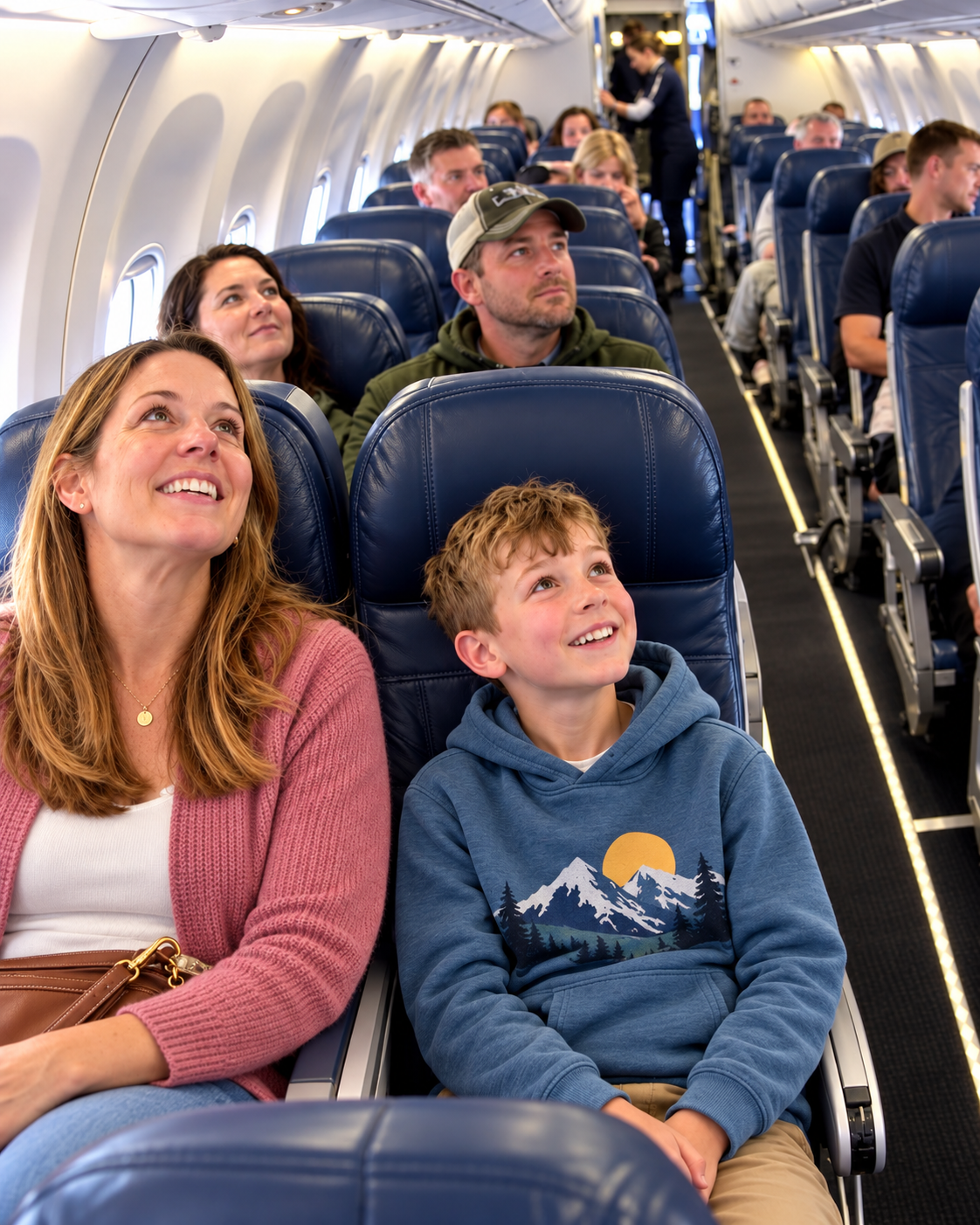
We boarded without difficulty. I had chosen seats toward the rear of the cabin, partly to reduce the chance that Tyler might spot us during boarding and partly because Mason liked watching the wings. A flight attendant greeted us near the entrance and directed us down the aisle. The cabin smelled faintly of coffee, cleaned upholstery, and the warm fabric of coats that passengers had carried through the terminal. People lifted bags into overhead compartments, exchanged seats, and searched for misplaced boarding passes. Mason examined every detail with intense concentration. By the time we reached our row, he was already whispering questions about whether his father knew exactly where we were sitting.
I helped him fasten his seat belt and watched him smooth the strap across his lap. He asked whether he could take out the drawing immediately. I suggested leaving it in his backpack until we landed so the paper would not become wrinkled. He considered this reasonable, although he insisted on checking the front pocket once more to make certain the picture was still there. Then he leaned toward the window and watched airport workers move beneath the aircraft. His happiness was completely unguarded. Looking at him, I felt the kind of gratitude that can arrive during an ordinary afternoon without warning. Whatever difficulties Tyler and I had been experiencing, we had built something precious together. That much, I thought, remained beyond question.
As the final passengers settled into their seats, I took out my phone. I wanted to record Mason’s reaction when he heard his father’s voice over the speakers. Tyler sometimes practiced cabin announcements at home, pretending our kitchen was an aircraft and Mason was the only passenger. He would announce that dinner service was beginning or that the captain had encountered severe turbulence near the dishwasher. Mason always laughed. The idea of hearing the real version while sitting on a plane Tyler was flying seemed like the perfect beginning to our surprise. I turned the camera toward my son, keeping the phone low enough that he wouldn’t feel self-conscious.
When the overhead speaker clicked, Mason immediately straightened in his seat. Tyler began with the usual information, greeting passengers and identifying himself as the captain. His delivery was calm and familiar. I watched Mason’s lips move silently as he tried to repeat the words. My husband spoke about the journey ahead, but before returning to the ordinary instructions passengers expected, he paused. It was a brief hesitation, hardly noticeable unless you knew him well. I knew it well. Tyler had the habit of taking a small breath before saying something he considered important. I had heard that pause before difficult conversations, family announcements, and moments when he was carefully choosing what he wanted another person to understand.
Then he said Claire’s name.
At first, I assumed he was referring to someone connected with the flight. Perhaps Claire was a member of the crew, a colleague celebrating a milestone, or a passenger receiving a special acknowledgment. Pilots occasionally made personal announcements, and the affectionate tone in Tyler’s voice didn’t immediately strike me as proof of anything. But his next words did. He spoke about Claire disliking public gestures. He mentioned that she had grown tired of feeling hidden. Then he thanked her for standing beside him through a year that had changed his life. I felt my fingers tighten around the phone, although I continued recording. The words were still forming into meaning, and some stubborn part of me refused to let them settle.
Mason looked at me with a puzzled smile. “Who’s Claire?” he whispered. I kept my gaze fixed on the seatback ahead of us. “I’m not sure,” I answered. He thought about that, then asked whether Claire worked with Dad. I told him I didn’t know. He frowned slightly, surprised that I could not answer such a simple question about his father. I understood his confusion. Children build their understanding of the world from what adults tell them and what they observe. Mason assumed that I knew the important people in Tyler’s life because, until that moment, I had believed exactly the same thing.
A few rows ahead, passengers began looking around. I saw a woman raise her eyebrows and turn toward the person sitting beside her. Someone laughed softly. Another passenger leaned toward the aisle, apparently searching for whoever had inspired the announcement. It was the kind of attention people give a marriage proposal or an unexpected romantic declaration. Their reactions made the meaning of Tyler’s words increasingly difficult to deny. I scanned the cabin without really knowing what I expected to find. I was suddenly aware of how many strangers surrounded us and how little privacy an airplane offered when everyone was facing the same direction, listening to the same voice.
Near the front, a woman in a soft sweater lowered her head and smiled. She was sitting beside another passenger who appeared delighted by the announcement. The woman pressed her fingertips briefly against her mouth, then looked toward the cockpit. She seemed embarrassed, but there was no confusion in her expression. She had been expecting something. Perhaps not the exact words, perhaps not such an unmistakably public declaration, but she understood why Tyler was speaking. I studied her for a few seconds, noticing the small carry-on placed beneath the seat in front of her and the way she kept glancing toward the forward section of the aircraft. I had no reason yet to know she was Claire. Still, something about her quiet recognition made my stomach tighten.
Tyler’s voice returned, lower and more intimate than before. He said that when they returned from Chicago, he intended to stop pretending his life was somewhere it wasn’t. The sentence passed through the cabin, and people responded with soft murmurs of approval. I could almost feel the excitement moving among them. To everyone else, it sounded like a man finally making an overdue commitment. To me, it sounded like a door closing. I searched Tyler’s words for any possible interpretation that did not involve my marriage. Maybe he was talking about a friendship. Maybe there was some circumstance I didn’t understand. Perhaps I had misheard the phrase about hiding. I looked at my phone screen and saw that the recording was still running. Whatever he said next would remain there.
Beside me, Mason stopped smiling. He had noticed the change in my expression, even though I was trying to keep my face still. “Mom,” he whispered, “is Dad talking about you?” It would have been easy to give him a reassuring answer, at least for the moment. I could have nodded, told him to keep listening, and postponed the truth until we landed. But Tyler was speaking about a woman named Claire, and Mason knew my name wasn’t Claire. He was seven, not foolish. I looked into his face and saw that he was waiting for an explanation I didn’t possess. “No, sweetheart,” I said quietly. “I don’t think he is.”
He glanced at the ceiling speaker, then back at me. “But why is he saying all that?” I took a breath and looked toward the front of the cabin again. The woman in the sweater had lifted her head. The passenger beside her was smiling broadly, and the woman appeared almost overwhelmed by the attention. I suddenly understood that she wasn’t merely listening to Tyler’s message. She was receiving it. The realization was so clear that I felt physically unsteady, as though the airplane had begun moving before I was ready. I gripped the edge of my seat and forced myself to remain calm. Mason was watching me more closely than he had watched anything else that morning.
I thought about our kitchen. I thought about Tyler’s suitcase standing near the front door during his departures, and the way he sometimes checked his phone while I was speaking. I remembered evenings when he seemed present only because his body occupied the chair beside mine. None of those details proved that he had been unfaithful. Each could have belonged to an exhausted husband working a difficult schedule. But now, as his voice filled the cabin with gratitude for another woman, those memories began arranging themselves into a different pattern. I hated how quickly the familiar could become suspicious. I hated even more that I had no way to stop it.
Mason reached for my hand. His fingers were warm and slightly sticky from the sweet he had eaten while boarding. I held them carefully, conscious that he needed something steady. The camera was still recording the seatback and the edge of his shoulder. I had meant to preserve his happiness. Instead, without planning to, I was preserving the moment when that happiness began to change into bewilderment. Tyler had no idea that we were aboard. Whatever he believed about his future, he was announcing it to a cabin that contained his wife and child. I wondered whether he had considered what would happen if someone who knew us heard him. Perhaps he had convinced himself that his separate worlds could remain separate indefinitely.
There was another pause from the cockpit. A flight attendant near the front stopped moving and glanced toward the speaker. The woman I had been watching sat very still. Tyler sounded almost relieved when he spoke again, as though he had finally reached the part of the announcement that mattered most. “You asked me to decide what I truly wanted, Claire,” he said. “I want you to know that I’ve made that decision.”
Mason’s hand loosened around mine. I stared at the phone screen and watched the recording timer advance by another second. The woman near the front covered her mouth, and someone beside her gave a quiet, delighted laugh. I understood then that my husband had not simply thanked another woman. He had made a choice in front of an entire cabin, believing that the people whose lives would be changed by it were somewhere far away.
I stopped recording. For several seconds, I couldn’t bring myself to put the phone down. The screen went dark, leaving a faint reflection of my face. Mason looked toward the cockpit again. His father was still speaking, returning to the calm professional manner he always used when addressing passengers. I heard something about the flight and the weather, but the words no longer formed complete sentences in my mind. I was thinking about the woman near the front, the promise Tyler had just made, and the little boy beside me who had spent days drawing his father a picture.
Then Mason asked a question that made the situation even worse.
“Mom, did Dad know we were going to be on his plane?”
“No,” I whispered. “He didn’t.”
Mason looked toward the cockpit door, then down at his backpack.
“Then why did he say he was choosing somebody else?”
I opened my mouth, but nothing came. The aircraft had begun moving away from the gate. The surprise we had planned could no longer happen as we imagined it, and I was trapped in a cabin with our son while the man who had just publicly betrayed our marriage prepared to carry us into the sky.
END PART 1
PART 2 TITLE: Trapped Above the Clouds With Our Son, I Had to Decide How Much Truth a Seven-Year-Old Could Bear
The airplane continued moving while Mason waited for an answer. Outside our window, the terminal buildings slipped slowly backward, and the ground crew became smaller as we rolled toward the runway. Inside the cabin, people resumed their ordinary conversations. A man across the aisle searched his bag for a magazine. Someone behind us complained about the temperature. The flight attendant checked seat belts with the practiced efficiency of a person who had witnessed hundreds of departures. I had never been so aware of the difference between what was happening inside me and what the rest of the world could see. My marriage had just been publicly dismantled, yet nothing around us had stopped. Even the aircraft was following its scheduled route.
Mason looked up at me again. “Is Dad going somewhere without us?” he asked. I understood what he meant. He wasn’t asking about the flight to Chicago. He was asking whether the family he knew was about to disappear. I felt an immediate urge to promise him that everything would remain exactly as it had always been. But I had just learned that my husband had been making plans I knew nothing about. A promise like that would have protected Mason for a few minutes and perhaps damaged his trust in me for much longer. I turned toward him and lowered my voice. “I don’t know what Dad is planning,” I said. “I know you’re frightened, and I know we need to talk to him. But you haven’t done anything wrong.”
He studied my face carefully. “Are you mad at him?” There was no accusation in the question, only the frightened curiosity of a child trying to understand why two people who had always belonged together suddenly seemed to be standing on opposite sides of something invisible. I told him I was upset. He asked whether it was because of Claire. I said yes. Then he looked down at his hands, rubbing the tip of one thumb across the other. For a moment, I thought he had finished asking questions. Instead, he spoke so softly that I almost missed it. “Does Dad like her better than he likes us?”
I have forgotten many things people said to me during difficult moments. I remember that sentence with terrible clarity. It was not dramatic. Mason didn’t cry or raise his voice. He simply asked whether he and I had become less important to the person he admired most. I could feel the answer he feared taking shape in his mind. I moved closer and placed one hand gently against his cheek. “Listen to me,” I told him. “Whatever is happening between your father and me is an adult problem. You are not responsible for it, and you could never cause it by doing something wrong. Both of us love you. Nothing about that changes because we’re having trouble.”
He nodded, though I could see he was still working through the words. Children sometimes accept explanations because they trust the person offering them, not because those explanations have answered what they are truly afraid to ask. Mason reached into his backpack and pulled out his headphones. He settled them over his ears but did not connect them to his tablet. The small action hurt in a way I hadn’t expected. Usually, he wanted me to know everything he was thinking. Now he was trying to create a little distance between himself and a conversation he couldn’t understand. I let him keep the headphones on. He had already been given more to carry than any seven-year-old should have been asked to manage during an ordinary flight.
I checked my seat belt, though I knew it was fastened correctly, then placed my phone in my bag. The recording was there, saved automatically. I had made it without suspicion, intending to preserve Mason’s reaction to hearing his father speak. That accident mattered. I hadn’t spent the morning looking for evidence of an affair. I hadn’t followed Tyler, searched through his belongings, or attempted to catch him in a lie. I had bought two tickets because I missed my husband and wanted our son to have a happy memory. What I had discovered was not the result of mistrust. It had arrived through the very gesture I had hoped would bring us closer.
As we approached the runway, I considered whether I should ask a flight attendant to contact the cockpit. The thought lasted only a moment. Tyler was responsible for the aircraft, its crew, and everyone aboard. Whatever personal decisions he had made, confronting him while he was operating a flight would have created an unnecessary distraction. I wanted answers desperately, but I would not put passengers at risk to obtain them. Nor would I allow Mason’s first experience aboard his father’s aircraft to become a scene involving the crew and an angry parent. I fastened my bag beneath the seat, folded my hands in my lap, and decided that I would wait until we landed.
The engines grew louder. Mason pulled one side of his headphones away from his ear as the plane began accelerating. The pressure pushed us gently into our seats. Under normal circumstances, he would have been thrilled. He always counted the seconds between the first strong surge of acceleration and the moment the wheels left the runway. Today, he watched the window without counting. I looked at the buildings rushing past and felt an absurd flash of anger at the sight of the runway lights. How could this be the same flight we had been so excited about? How could the morning change so completely without anyone giving us a chance to prepare?
When the wheels lifted, Mason glanced at me. I managed a small smile, hoping he would recognize it as reassurance rather than happiness. He didn’t smile back. Instead, he rested his head against the seat and watched the ground fall away beneath us. I remembered the first time Tyler had explained to him how aircraft managed to stay in the air. Mason had been four and had asked whether the wings were holding invisible strings. Tyler had laughed and spent nearly an hour demonstrating lift with paper airplanes. For days afterward, Mason had launched folded sheets across our living room, adjusting the wings and insisting that each failed flight was an experiment. His father’s patience during those afternoons had been real. Whatever else was true, that part of their relationship had existed.
I kept returning to this distinction because it was one of the few things that prevented me from falling apart. Tyler had lied about something fundamental, but Mason’s memories of him were not inventions. The father who read bedtime stories, repaired broken toys, and taught his son about airplanes was the same man whose announcement had exposed an entirely different life. I wanted to reject everything about Tyler at once. I wanted to believe the person I had known no longer existed. Yet Mason was sitting beside me, and he would need a more careful understanding than that. I could be furious with my husband without telling our son that every good thing he remembered had been false.
Once the seat belt sign was switched off, the flight attendants began moving through the aisle. A woman sitting across from us smiled at Mason and asked whether he was enjoying his first flight. Mason shook his head slightly, then looked toward the window. I answered politely that he was tired. The woman returned to her book. I felt relieved and ashamed of the relief. Nothing about the woman’s question had been intrusive. She simply saw a child on an airplane and attempted to be kind. But I could not bear the possibility of explaining our situation to someone who had heard the announcement and might connect us with the captain. Privacy had suddenly become something I needed to protect with every ordinary sentence.
Mason eventually removed his headphones and asked whether he could have his gummy bears. I took the packet from his backpack and tried to open it, but the sealed edge resisted my fingers. It was such a small inconvenience, yet my frustration rose so quickly that I nearly tore the entire packet apart. I stopped and carefully worked the corner loose. Mason watched without speaking. I handed him the sweets and he offered me one. I declined, then changed my mind and accepted it because the gesture seemed important to him. He pressed a red gummy bear into my palm and looked relieved when I ate it. For a moment, we were simply a mother and son sharing a packet of candy.
The plane climbed above a layer of clouds. Bright sunlight flooded the cabin, making the window frame almost painful to look at. Mason leaned closer to see the cloud tops. Usually, he would have described them as mountains or islands or enormous piles of whipped cream. This time he remained silent. I could see his reflection in the window, his face serious beneath the headphones resting around his neck. I wondered how much of Tyler’s announcement he had understood. The words about being hidden, choosing someone, and no longer pretending were adult words, weighted with meanings Mason had never needed to consider. But he had understood enough to know that his father was speaking tenderly to someone who was not his mother.
My mind kept returning to the woman near the front of the aircraft. She had not seemed cruel or calculating. She had looked nervous, perhaps even overwhelmed. That unsettled me because anger would have been easier if I could imagine a stranger knowingly participating in the destruction of our marriage. I knew almost nothing about her. Her name was Claire. She had shared some part of the previous year with Tyler. She believed he had made a decision about their future. Beyond those facts, everything else remained uncertain. I tried not to fill the gaps with invented details. But uncertainty creates its own kind of suffering, and my thoughts continually returned to questions I could not answer.
How had they met? Had Tyler told her about Mason? Did she know he was married? Had she visited places he described to me as layovers? Had he spent evenings with her while I was helping our son with homework or waiting for his messages? I remembered a particular night when Tyler called later than expected and sounded distracted. I had asked whether everything was all right, and he had assured me that he was simply tired. At the time, I accepted his explanation without a second thought. Now I could not remember the date, the route, or whether anything else about that conversation had been unusual. I hated myself for trying to reconstruct ordinary memories as though they were evidence in a case I had never known I needed to investigate.
A flight attendant arrived with the drinks trolley and asked what we would like. Mason requested apple juice. I ordered water because I was afraid anything stronger might make me nauseated. The attendant handed Mason his drink with a smile, and he thanked her automatically. I noticed how carefully he placed the plastic cup on his tray table. His hands had begun to relax, but he still avoided looking directly at me for long. When the attendant moved on, he whispered, “Do you think Dad knows we’re upset?” I looked at the cockpit door far ahead. “Not yet,” I said. Mason considered this, then asked whether I was going to tell him. “Yes,” I answered. “When it’s safe and when we can speak properly.”
He took a small sip of juice. “Will he be angry because we surprised him?” The question revealed another fear I hadn’t anticipated. Mason was beginning to wonder whether our presence had caused the problem. I turned toward him immediately. “No. We didn’t do anything wrong by coming here. We were trying to do something kind.” He looked at his backpack. “But maybe Dad didn’t want us on his plane.” I wanted to tell him that was impossible. I wanted to insist that Tyler would be delighted to see him despite everything else. But I had already learned how dangerous certainty could be when it rested on assumptions. “Your father loves you,” I said. “He may be surprised. Whatever he feels, we’ll handle it together.”
Mason opened the front pocket of his backpack and checked his drawing. The paper had begun to bend slightly at one corner. He smoothed it against his tray table and looked at the picture without removing it completely. I saw the blue airplane and the three figures standing beneath it. Tyler was drawn taller than either of us, with long arms extending toward our hands. Mason had given himself a bright green shirt and had colored my hair with a pencil that was slightly too dark. The drawing was charming because it was imperfect, but its meaning was painfully clear. Mason had placed his father between us, connecting the family. I wondered what he would think of that picture after we landed.
“Maybe I shouldn’t give it to him,” Mason murmured. I asked why. He shrugged, still looking at the paper. “What if he doesn’t want it?” I felt the question settle somewhere deep inside me. My husband had made a public promise to another woman, but my son was already interpreting that betrayal as a judgment on his own love. I leaned closer so he could see my face. “You made that because you love your dad,” I told him. “There is nothing embarrassing about loving somebody. What happens between adults doesn’t make your feelings wrong.” Mason nodded slowly, then returned the drawing to his backpack. He didn’t say whether he still intended to give it to Tyler.
For the next several minutes, we watched the clouds. Mason pointed out a formation that looked like a dog, and I agreed, though I could barely make out the shape. He found another that resembled a mountain. I offered a few observations of my own, careful not to force cheerfulness. Our conversation was ordinary and fragile. I understood that he was testing whether our relationship still worked the way it always had. Could he ask me something small and receive a normal answer? Could we speak about clouds when the larger questions remained unanswered? I answered him because those small exchanges mattered. We still belonged to each other, even if everything else was uncertain.
Eventually, Mason fell asleep against my arm. His face relaxed, and one hand remained loosely curled around the strap of his backpack. I sat very still so I wouldn’t wake him. Without his questions to concentrate on, the full weight of Tyler’s announcement began pressing against me. I thought about the effort it had taken to organize the surprise and the pleasure I had expected from seeing my husband’s reaction. I thought about how confidently I had assured Mason that his father would be delighted. The distance between my expectations and what had happened felt impossible to measure. I rested my head against the seat and closed my eyes, but Tyler’s voice continued replaying in my memory.
What troubled me most was not the simple fact that another woman existed. That was terrible enough. It was the confidence with which Tyler had spoken about her future. His announcement suggested that they had shared conversations, arguments, hopes, and promises over a substantial period of time. He had referred to a year that changed everything. He had thanked her for being patient. He had spoken about making a decision. All of that implied a relationship that existed far beyond a momentary lapse. While I had been trying to understand why my husband seemed distant, he had apparently been deciding when and how to leave the life we shared.
I tried to remember the last time Tyler had spoken to me with the same tenderness I had heard in his announcement. That was an unfair question in some ways, because intimacy in a marriage does not always resemble a grand romantic declaration. Sometimes it is quieter: a cup of tea left beside a tired spouse, a hand on a shoulder, someone remembering to buy the medicine you mentioned that morning. Tyler had offered gestures like that throughout our marriage. Yet lately even those had become less frequent. We had gradually settled into a life where affection required less effort because we assumed it would always be available. I had believed we were going through a difficult period. Tyler, it seemed, had been preparing to leave it behind.
I considered what I would say when I finally confronted him. The first words that came to mind were angry. How could you embarrass us like that? How could you say those things in front of strangers? How long have you been lying? But anger wasn’t the only thing I felt. I was frightened of hearing the answers. I was frightened of discovering that Tyler had already made decisions about our marriage, our home, and our son’s future without speaking to me. I knew that one conversation could not resolve everything. Still, I needed him to acknowledge what had happened. I needed to see whether he could tell the truth when the two versions of his life finally collided.
As we began descending, Mason stirred and lifted his head from my arm. He blinked at the bright window, then sat upright. “Are we almost there?” he asked. I told him we were. He reached for his backpack, checking that the drawing was still inside. His movements became more animated as the ground appeared beneath us. For a brief moment, he seemed to remember only the original purpose of our journey. “Dad flew us,” he said, smiling as the wheels touched the runway. Then his smile faded. He looked toward me and asked, “Are we still going to surprise him?”
I hesitated. I could have told him that the surprise was canceled, taken his hand, and left the airport without speaking to Tyler. The temptation was considerable. I did not want Mason to witness an argument, and I was not certain I could remain composed when I saw my husband’s face. But leaving without speaking would mean allowing Tyler to continue believing his announcement had reached only the audience he intended. He needed to know that his family had been sitting in the cabin. More importantly, Mason had come all this way to see his father. I couldn’t simply erase the encounter because it had become painful for me. “We’re going to see him,” I said. “We’ll take it slowly.”
After the aircraft reached the gate, passengers began preparing to leave. Overhead compartments opened, bags came down, and the aisle filled with people impatient to retrieve their belongings. Mason carefully pulled his backpack over both shoulders. He checked the front pocket once more. I watched the movement of passengers ahead, searching for the woman who had smiled during the announcement. She remained near the front of the cabin. Unlike the other passengers, she didn’t appear eager to leave. She stood beside her seat with one hand resting on the handle of a small carry-on, looking repeatedly toward the cockpit.
Her behavior told me that she was waiting for someone. I tried to examine her without staring. She wore jeans and a soft sweater, and her hair fell loosely around her shoulders. There was nothing theatrical or threatening about her appearance. She looked like an ordinary traveler, slightly nervous and perhaps excited about meeting someone after the flight. That ordinariness made the situation more disturbing. I had imagined, during the journey, that the woman Tyler had chosen might somehow reveal her intentions through her appearance. Instead, I saw someone who seemed to have arrived with expectations of her own. I wondered what Tyler had told her about the woman and child who shared his home.
Mason reached into his backpack and removed his drawing. “I still want to give this to Dad,” he said. His voice was quiet, but the decision sounded firm. I looked at the picture and felt my throat tighten. The blue airplane was larger than the three people standing beneath it, and the words across the top filled almost the entire page. Tyler was smiling in the middle. Mason had drawn my hand inside his father’s. The picture represented everything he believed about us when he made it. I couldn’t bear to tell him that the image was wrong simply because Tyler had behaved dishonestly. “All right,” I answered. “You can give it to him if you want to.”
We joined the aisle as the passengers ahead moved toward the exit. With every step, I felt the approaching conversation becoming more real. I had rehearsed questions during the flight, but none of them seemed appropriate with Mason walking beside me. I decided that I would not raise my voice or make a public accusation. I would give Tyler the chance to acknowledge us, allow Mason to speak, and then find a private place to address what I had heard. Whether Tyler accepted that opportunity was beyond my control. I tightened my grip on the handle of our carry-on and continued forward.
The woman in the sweater glanced toward us as we approached. Her eyes rested briefly on Mason’s drawing, then returned to the cockpit. She did not recognize us. I understood that from the absent, polite expression she gave us before stepping aside to let another passenger pass. For one strange second, I considered introducing myself. The words formed in my mind: I’m Tyler’s wife. This is his son. I imagined her expression changing, imagined the conversation beginning before Tyler appeared. But Mason was standing at my side, and I had already promised myself that he would not be caught in a public confrontation. I kept walking.
We were only a few rows from the front when the cockpit door opened. Tyler stepped into view, still wearing his uniform, his expression relaxed. He looked toward the woman in the sweater and smiled with a tenderness I recognized immediately. It was the expression he used to give me when we met after being apart. She shifted toward him, her fingers tightening around the handle of her bag. For a fraction of a second, they seemed to exist in a private moment that the rest of us had accidentally entered.
Then Mason saw his father.
“Dad!” he shouted.
Tyler turned.
The smile remained on his face for an instant before his eyes found our son, moved to me, and widened with unmistakable alarm.
END PART 2
PART 3 TITLE: My Husband Recognized Our Son Before He Recognized the Damage, and the Woman Waiting for Him Began Demanding Answers
Tyler’s expression changed so quickly that I almost doubted what I had seen. One moment, he was smiling at the woman near the front of the cabin. The next, he stood completely still, staring at our seven-year-old son as though Mason had appeared somewhere he could not possibly belong. His eyes moved to me, then to the drawing Mason held against his chest. I saw the effort it took for him to compose his face. He was accustomed to unexpected situations at work, trained to remain calm when circumstances changed. But whatever professional discipline he possessed seemed to abandon him as he looked at the two people he had apparently believed were safely outside the life he had just announced.
Mason rushed toward him with his drawing held high. I followed close enough to intervene if necessary, although I had no idea what I might need to prevent. For half a second, I expected Tyler’s paternal instincts to overcome his shock. I expected him to crouch, embrace our son, and ask about our trip. Instead, he remained upright, looking from Mason to me with an expression of growing disbelief. “What are you doing here?” he asked. The words were not shouted, but their sharpness stopped Mason before he reached him. I watched our son’s excitement falter. He lowered the drawing slightly and glanced back at me, as though checking whether we had misunderstood the rules of our own surprise.
“We came to see you, Dad,” Mason explained. “Mom said we could surprise you.” He tried to smile again. “I made you something.” Tyler looked down at the paper, but his attention did not stay there. His gaze returned to me. “You were on this flight?” he asked. His voice sounded different now, stripped of the warmth that had filled the cabin a short time earlier. I recognized the question beneath the question. He was not merely asking whether we had traveled with him. He was trying to discover how much of his announcement we had heard. I could have spared him the uncertainty. I could have pretended that we had been asleep or wearing headphones. But I had already made too many accommodations for things I didn’t understand. “We heard everything,” I answered.
For several seconds, he said nothing. I noticed a slight movement in his jaw, the familiar sign that he was searching for words. Behind him, a flight attendant was helping the last passengers collect their belongings. The ordinary work of emptying the aircraft continued, although the atmosphere around us had changed. Tyler glanced briefly toward the cockpit, then toward the woman waiting beside the forward seats. I followed his gaze. She was watching us now, her earlier smile gone. She looked at Mason, then at me, then back at Tyler with increasing uncertainty. I could almost see her trying to reconcile our presence with whatever explanation my husband had given her.
“Can we please not discuss this here?” Tyler asked. He kept his voice low, but there was urgency beneath it. I looked at our son, still holding the drawing he had worked so hard to make. “I didn’t come here to discuss anything,” I replied. “I brought Mason because he wanted to surprise his father. I expected you to be happy to see him.” The words came out more calmly than I felt. Tyler’s eyes moved toward Mason, and I saw the moment he understood how his first reaction had sounded. He reached out a hand. “Hey, buddy,” he said, attempting a smile. “I didn’t mean to sound surprised like that.”
Mason stepped backward. It was only a small movement, no more than the length of his shoe, but Tyler saw it. His hand remained suspended for an awkward moment before he lowered it. Mason had spent the entire morning imagining his father’s excitement. He had practiced what he wanted to say and protected his drawing from wrinkles. Now he stood in front of Tyler, uncertain whether he was welcome. I wanted to kneel beside him and explain that his father’s reaction reflected his own choices, not anything Mason had done. But the forward cabin offered little room, and the conversation was moving more quickly than I could control. I placed a hand gently on Mason’s shoulder and kept him close.
The woman in the sweater spoke for the first time. “Tyler?” Her voice was soft, almost cautious. He turned toward her, and I noticed how carefully he avoided looking directly into her eyes. “Claire,” he said, “just give me a minute.” The name confirmed what I already suspected. She was the woman from the announcement, the person for whom my husband had declared his intentions before an entire cabin. Hearing her name spoken in conversation made her suddenly real in a way the announcement had not. She was no longer a mysterious figure I could imagine at a distance. She stood only a few feet away, looking as uncomfortable as I felt.
Claire did not move. Her gaze returned to Mason, then settled on me. There was a long, searching pause before she asked, “Who are they?” Tyler opened his mouth, but I answered before he could invent another explanation. “I’m his wife,” I said. “This is our son.” Claire’s face changed immediately. The color seemed to drain from her cheeks, and she looked toward Tyler with an expression I recognized from the mirror I had avoided during the flight. It was the look of someone discovering that the situation she had trusted was not the situation in which she had actually been living. I had expected anger from her, perhaps defensiveness or a cruel attempt to claim my husband’s attention. Instead, she appeared genuinely shocked.
Tyler raised one hand as though he might physically slow the conversation. “Please,” he said, looking between us, “this isn’t something we should talk about with Mason standing here.” His concern was reasonable, but the timing made it difficult to accept. Mason had already heard the announcement. He had already watched his father welcome another woman’s attention and react with alarm to the arrival of his own family. Tyler wanted privacy only after the consequences of his secrecy had become unavoidable. I looked at him steadily. “Then you should have considered that before making a personal announcement to a plane full of passengers,” I said. “You didn’t know who might be listening.”
Claire took a small step backward. “You told me they knew,” she said. Tyler turned toward her immediately. “Claire, listen—” She interrupted him. “You told me your wife knew about us.” Her words seemed to hang between us, heavier than anything I had expected. I had imagined countless possible conversations during the flight, but I had not prepared for the possibility that Tyler had been lying to Claire as well. I looked at her more closely. She was watching him, not me, and there was no triumph in her face. Whatever future she had believed they were beginning, she was watching its foundation crack in real time.
“Knew what?” I asked. The question was quiet, but Tyler reacted as though I had raised my voice. He pressed his lips together and glanced toward the remaining passengers. A man near the exit slowed, apparently aware that something unusual was happening. The flight attendant gently directed him onward. Claire tightened her grip on the handle of her carry-on. “He said you were separated,” she told me. “He said you had been living separate lives for months.” I felt a strange moment of stillness. The phrase living separate lives was technically true only in the sense that my husband had secretly created another one. We had not separated. We shared a home, a kitchen, a child, and every ordinary responsibility of a marriage. Tyler had returned to that home between assignments and behaved as though nothing fundamental had changed.
I turned toward him. “You told her that?” Tyler rubbed a hand against the back of his neck. “It’s complicated,” he said. The familiar phrase irritated me more than a direct admission would have. Complicated was what people called a flight delay or a difficult family schedule. It was not an adequate description of a husband telling another woman that his marriage had effectively ended without informing his wife. “No,” I replied. “It may be uncomfortable, but the question is simple. Did you tell Claire we were separated?” Tyler looked down at the floor. He did not answer immediately. His silence was enough to tell me that Claire had spoken the truth.
Mason looked between us. “Separated?” he repeated. “What does that mean?” I felt the words strike me with an almost physical force. Tyler’s deception was no longer confined to adult conversations. It had entered our son’s vocabulary, and he was trying to understand whether the strange term described something that had already happened to his family. I crouched beside him, bringing my face level with his. “It means that two people who are married aren’t living together as a couple anymore,” I explained carefully. “But your dad and I haven’t talked about anything like that with you because we haven’t made those decisions.” Mason’s eyes widened slightly. “So Dad told her something that isn’t true?” I glanced toward Tyler, then returned my attention to our son. “Yes,” I said. “He did.”
I could see the effort Mason was making to absorb that answer. He had always believed that his father knew how to explain difficult things. Tyler could describe complicated instruments, unfamiliar cities, and the mechanics of flight in ways that made Mason feel capable of understanding the world. Now Mason was discovering that his father could also say something untrue about the people closest to him. The realization seemed to confuse him more than the announcement itself. He looked at Tyler, waiting for a correction. Tyler opened his mouth, then closed it again. I had never seen him so uncertain about what to say to our child.
“Can you put your drawing back in your bag for a moment?” I asked Mason. I wanted to give him something ordinary to do while the conversation continued. He looked down at the paper, then began folding it. I reached toward him instinctively, thinking he might crease the picture he had spent so long making, but stopped myself. The fold ran directly across the blue airplane, dividing the body of the aircraft into two uneven halves. Mason pressed the paper flat between his palms and pushed it into the front pocket of his backpack. He didn’t cry. That frightened me more than tears would have. He was becoming very quiet, withdrawing into himself while the adults around him dismantled things he had believed were secure.
Claire watched the movement. Her expression tightened, and when she looked at Tyler again, the uncertainty had given way to anger. “You told me your wife knew about me,” she repeated. “You said the marriage was over except for the practical arrangements.” Tyler lowered his voice. “I was trying to explain where things stood.” Claire gave a small, disbelieving shake of her head. “No. You told me where you wanted me to think things stood.” I remained silent. I had spent the flight imagining the kind of woman who might knowingly participate in an affair with a married man. The woman standing before me was not behaving like someone whose expectations had been fulfilled. She looked as though she had been handed a truth she could no longer ignore.
I did not feel sympathy immediately. I was too hurt, too angry, and too aware of Mason’s presence. But I recognized that Claire’s understanding of the situation might have been built entirely on what Tyler had told her. She had believed she was waiting for a man who had already ended his marriage. Instead, she was meeting a wife and child who had arrived expecting a family celebration. Neither of us had been prepared for the encounter. I wondered whether she had noticed any inconsistencies in Tyler’s stories, whether she had asked questions he avoided, whether the grand announcement had been intended to silence doubts she had begun expressing. I did not ask. I wasn’t ready to hear the details of their relationship.
Tyler looked at me with a desperation that might once have moved me. “Can we talk privately?” he asked. “Just you and me. I’ll explain everything.” I almost agreed. A private conversation would have spared Mason further distress, and I wanted answers. But Claire was still standing there, and Tyler had not responded honestly to either of us. Every sentence he offered seemed designed to postpone the next unavoidable truth. I looked at his uniform, at the captain’s insignia on his shoulders, and wondered how a man so accustomed to taking responsibility for other people’s safety had become so unwilling to take responsibility for his own choices. “You can start by answering her,” I said.
Claire’s eyes remained fixed on Tyler. “Were you ever actually separated?” she asked. Her voice was steady now, almost cold. It was the most important question anyone had asked since the announcement, because the answer would determine whether the relationship she believed she had entered had ever existed on honest terms. Tyler did not speak. He looked toward me, then at Mason, then back at Claire. I watched him struggle with the impossibility of providing one more explanation that might satisfy us both. I knew that silence. I had heard it during conversations at home when Tyler didn’t want to discuss why he seemed distant or why his work had become so consuming. This time, however, the silence could not be mistaken for exhaustion.
“You can answer her,” I said. My voice sounded unfamiliar to me, controlled almost to the point of detachment. Tyler stared at the floor. Claire drew a sharp breath, as though the absence of an answer had finally told her everything she needed to know. She looked toward me and spoke quietly. “He told me you had agreed to live separately. He said there was no possibility of the marriage continuing.” I felt my hands grow cold. Tyler had apparently described the end of our marriage as an established fact while continuing to share a home with me. He had been telling Claire the future he wanted while allowing me to believe our present was merely difficult.
I wanted to ask how long the relationship had lasted. I wanted to know where they met, what he had promised, and whether he had ever intended to tell me the truth himself. But Mason was standing beside me, his fingers curled around the strap of his backpack. There would be time for those questions later. What mattered at that moment was preventing our son from hearing more details he was too young to process. I turned toward Claire. “I learned your name today,” I told her. “I had no idea you existed until Tyler spoke about you over the aircraft speakers.” Claire pressed her lips together. She looked at Mason again, and the expression on her face changed from anger to something closer to grief.
For the first time, I wondered what Tyler had told her about our son. Perhaps she knew he existed but believed his parents had already separated. Perhaps Tyler had described a carefully managed arrangement in which everyone understood the situation and no one was being deceived. I could see how such a story might have allowed Claire to imagine a future without considering herself responsible for destroying a marriage. That possibility did not erase the hurt I felt when I looked at her, but it shifted the direction of my anger. Tyler had not merely hidden a relationship from me. He appeared to have constructed separate accounts of his life and maintained them by controlling what each woman knew.
Claire set her bag upright and looked at Tyler with an expression of complete disbelief. “I asked you more than once whether she knew,” she said. “You looked me in the eye and told me she did.” Tyler took a step toward her. “I was going to explain everything when we got back,” he answered. She moved away before he could reach her. “When we got back?” she repeated. “You made that announcement today. You told an entire airplane that you were ready to stop hiding. What exactly were you planning to explain afterward?” Tyler looked around nervously, aware of the crew nearby. “Claire, please,” he said. “Not here.” She shook her head. “You don’t get to choose when the truth becomes inconvenient.”
I stood quietly beside Mason. There was something profoundly disorienting about watching the woman my husband had chosen confront him with almost the same questions I wanted to ask. I had expected a rivalry, an argument over which of us he loved, or some desperate attempt to persuade him to choose. Instead, the central issue was honesty. Claire had believed she was entering a relationship with a man whose marriage had ended. I had believed I was married to a man who was struggling with work and distance but still committed to our family. Both stories depended on Tyler’s assurances. Both were collapsing because those assurances could not survive contact with the truth.
Tyler turned toward me again. “I never wanted you to find out like this,” he said. The sentence revealed more than he seemed to realize. It suggested that discovery had been inevitable, perhaps even planned, but that he had expected to control the timing and circumstances. I felt anger rise through the exhaustion. “How did you want me to find out?” I asked. “When would you have told Mason? After you had finished making promises to someone else?” Tyler’s mouth tightened. He looked toward our son and lowered his voice. “Please don’t do this in front of him.” I glanced at Mason, who was staring at his shoes. “I’m trying not to,” I answered. “But you started this in front of him without even knowing he was here.”
Claire picked up her carry-on. The movement drew Tyler’s attention immediately. “Where are you going?” he asked. She looked at him for a long moment. “Away from this,” she said. “I don’t know who you’ve been pretending to be, but I know you haven’t told me the truth.” Tyler reached toward the handle of her bag, not quite touching it. “Don’t leave before we talk,” he said. Claire pulled the suitcase back. “You made me part of something I never agreed to be part of,” she answered. “You don’t get to ask me to stay and help you explain it.”
She looked toward me once more. There was no elaborate apology, no attempt to justify herself, and no request that I understand. Her expression seemed to acknowledge that nothing she could say would repair what had happened. I appreciated the silence more than I would have appreciated a rehearsed expression of regret. She turned toward the aircraft exit and walked away, her suitcase rolling behind her. I watched until she disappeared through the doorway. For the first time since hearing the announcement, I understood that Tyler had not simply been caught between two women. He had been caught between two versions of reality, neither of which he could continue maintaining.
Tyler remained where he was. He didn’t immediately turn toward Mason or reach for me. He watched Claire leave, his body angled toward the doorway as though part of him wanted to follow her. I stared at him, noticing the small details I had loved for years: the shape of his shoulders beneath his uniform, the familiar way he pressed his lips together when worried, the slight crease between his eyebrows. Those details belonged to my husband. Yet the man standing before me had become difficult to recognize. His first concern after the announcement was no longer whether our son had been hurt. He was watching another woman walk away.
Mason slipped his hand into mine. I looked down and found him studying his father with an expression I had never seen before. He seemed smaller than he had that morning, although nothing about him had changed except what he now knew. His drawing was folded in his backpack. His surprise had become a question no one could answer. He tugged gently at my hand, and when I leaned toward him, he whispered, “Mom, can we go home?”
I looked at Tyler one last time. He was still staring toward the aircraft exit.
At that moment, I understood that the decision I needed to make was no longer whether I could save our carefully planned surprise. It was whether I would allow my son to remain standing there, waiting for his father to remember that he was not an inconvenience.
END PART 3
PART 4 TITLE: After the Airport Confrontation, My Son Asked If We Were Still a Family, and Tyler Finally Had to Answer
“Yes,” I told Mason. “We’re going home.” My answer was immediate, even though I had no idea what home would mean after that day. Tyler turned toward us, apparently recognizing that the conversation was ending. He took a step forward and reached for Mason’s shoulder, but our son moved closer to me. The movement was small and instinctive, yet it stopped Tyler more effectively than anything I could have said. Mason wasn’t trying to punish his father. He was simply seeking the one person who still felt predictable. I understood that because I was doing something similar, holding his hand and concentrating on the practical task of getting us away from the aircraft.
“Please don’t leave like this,” Tyler said. His voice had lost the controlled authority he used when addressing passengers. I looked at him, wondering what alternative he imagined. Did he expect us to remain in the cabin while he explained his affair? Did he think Mason could stand there listening while his parents discussed the collapse of their marriage? “How would you prefer us to leave?” I asked. Tyler rubbed his forehead and glanced toward the exit. “Just give me ten minutes. We need to talk.” I shook my head. “Your son is asking to go home. That’s what we’re doing.” For a moment, he looked as though he intended to argue. Then he glanced at Mason and stopped.
Tyler crouched slightly, bringing himself closer to our son’s eye level. “Buddy, I’m sorry,” he said. Mason looked at him but did not answer. I could see that Tyler wanted to add something. Perhaps he wanted to explain why he had reacted so badly or reassure Mason that their relationship remained unchanged. But no explanation could have restored the morning we had imagined. Mason’s face was serious, his lips pressed together. Tyler reached out a hand, then let it fall when our son didn’t move. I felt a painful mixture of anger and grief. This was the father Mason adored, the man whose return from a trip could brighten our entire household. Now his own child seemed uncertain whether approaching him was safe.
I led Mason toward the exit. Tyler remained behind us. I didn’t look back until we reached the passage connecting the aircraft to the terminal, and even then I saw only the empty doorway. He had not followed. Part of me was relieved because I didn’t want another conversation in front of our son. Another part wondered whether he was still thinking about Claire, whether he was trying to contact her, or whether he was simply too ashamed to face us. I hated that my thoughts kept returning to another woman’s importance in my husband’s life. Before that day, I had never imagined needing to compare the attention he gave his family with the attention he gave someone else.
Inside the terminal, Mason walked close enough that our shoulders occasionally touched. The airport was busy with travelers moving toward connecting flights, baggage claim, and the exits. Announcements echoed from overhead speakers, each one making me think of Tyler’s voice. I wanted to get outside, away from the enclosed space and the smell of coffee and travel-worn clothing. Mason didn’t ask to stop for a snack or look through the airport shops, as he normally would have done. He kept one hand wrapped around mine and the other against his backpack. Every few minutes, he touched the front pocket where his drawing was folded. I noticed but said nothing.
At the car, I helped Mason settle into his seat. He fastened his belt without asking for assistance, then stared through the window while I loaded our bags. I stood outside for a moment after closing the trunk, breathing in the cool air and trying to gather myself. I wanted to cry, but I was afraid that once I started I wouldn’t be able to stop. The recording on my phone seemed to possess a weight out of proportion to its size. I had proof of what Tyler had said, yet I still felt uncertain about what I was supposed to do next. Evidence could establish what had happened. It could not tell me whether a marriage could survive it.
We drove in silence for several minutes. The roads around the airport were crowded, and I concentrated on traffic while Mason watched the buildings pass. Eventually, he spoke. “Mom, is Dad leaving us?” I tightened my hands around the steering wheel. The question had been waiting between us since the announcement, and I had known it would return. I considered how much to explain. “I don’t know what your father is going to do,” I said. “But whatever happens, he is still your dad. He has responsibilities to you that don’t disappear because things between us are difficult.” Mason looked down. “Does that mean he won’t live with us?” I swallowed. “We haven’t decided anything yet.”
He remained quiet for a while before asking another question. “Are you getting divorced?” Hearing the word in his small voice made me glance toward the rearview mirror. Mason was looking straight ahead, his expression solemn. I wondered where he had learned enough about divorce to ask. Perhaps a classmate’s parents had separated, or perhaps he had heard adults discussing it without realizing that one day the word might apply to his own family. “I don’t know,” I answered. “Your father and I need to have some serious conversations first.” Mason nodded, but I could see that the uncertainty troubled him. “I don’t like not knowing,” he said. “Neither do I,” I replied.
That answer was one of the few things I could offer him without reservation. I didn’t know whether Tyler would try to repair our marriage. I didn’t know whether he had already decided that Claire was the person he wanted to be with. I didn’t know what he had told her about our future or how much of his ordinary life had been built around deception. Most painfully, I didn’t know whether I would ever be able to look at him with the trust I had felt before boarding the aircraft. But I knew that Mason needed honesty, even when honesty meant admitting uncertainty. I would not invent reassuring promises that the coming days might force me to break.
As we continued home, I thought about the drawing. Mason had spent hours arranging the three figures beneath the airplane, carefully deciding how tall each person should be and what colors to use. He had wanted to express admiration for his father, and Tyler’s response had left him wondering whether that admiration was foolish. I wanted to protect him from the belief that loving someone could become embarrassing simply because that person had disappointed him. I wanted him to understand that affection and trust were related but not identical. Those were complicated lessons for a seven-year-old, and I resented that Tyler’s choices had forced us to begin discussing them before Mason was ready.
When we reached home, Mason carried his backpack upstairs without stopping in the kitchen. I offered to make him something to eat, but he said he wasn’t hungry. I followed him to his bedroom and found him sitting on the edge of his bed, looking at the floor. His room was exactly as we had left it that morning. Model airplanes rested on the shelves, books were stacked beside the bed, and a small collection of toy aircraft covered part of his desk. The familiar objects seemed almost cruel in their innocence. Mason looked around as though he expected the room to feel different. I sat beside him and waited.
“Can I still like airplanes?” he asked eventually. The question startled me. “Of course you can,” I answered. He touched a toy aircraft lying near his pillow. “But Dad flies airplanes.” I understood what he was trying to separate. His admiration for flying had become tangled with his admiration for Tyler, and he wasn’t sure whether he was allowed to keep one without accepting everything about the other. “You can still love airplanes,” I told him. “And you can still love your dad. Being upset with someone doesn’t mean you have to stop loving everything connected to them.” Mason considered this, then placed the toy back on his pillow.
I stayed with him until he seemed calmer. We didn’t discuss Claire or the announcement again that afternoon. Instead, I helped him unpack his backpack, put away his headphones, and choose something comfortable to wear. I noticed that he kept the folded drawing in the front pocket rather than placing it with his other pictures. I didn’t ask him to take it out. The paper belonged to him, and he needed to decide what to do with it. Later, when he settled down with a book, I went downstairs and stood alone in the kitchen. The house was quiet. Tyler’s coffee mug sat in its usual place beside the sink. His jacket still hung near the door. Everywhere I looked, there were reminders of a marriage that had apparently existed differently in his mind.
I checked my phone. There were no messages that could make the situation clearer. I opened the recording and watched a few seconds, then stopped it before Tyler’s announcement reached Claire’s name. Hearing his voice in our kitchen was unexpectedly unbearable. It belonged there, yet the words he had spoken did not. I saved the video carefully and put the phone away. I wasn’t planning to send it to anyone or use it to humiliate him. I simply knew that I might need to hear the exact words again when the shock began to fade and I found myself wondering whether I had misunderstood. I had spent years trusting Tyler’s explanations. This time, I wanted to preserve what I had heard with my own ears.
The hours passed slowly. I prepared dinner, though neither Mason nor I ate much. He asked whether his father was coming home, and I told him I expected Tyler to return but couldn’t promise when. Mason went upstairs after eating. I helped him get ready for bed and read part of a familiar story, but he asked me to stop before the chapter ended. He said he was tired. I kissed his forehead and left the door slightly open, as he preferred. When I reached the hallway, I heard him moving beneath the blankets. I suspected he would remain awake for a long time. I stood outside his room, uncertain whether to go back in, then decided to let him have the quiet he had asked for.
Tyler came home later that night. I heard his key turn in the front door and felt my stomach tighten before I saw him. He entered quietly, carrying the same bag he had taken for his assignment. His uniform jacket was folded over one arm. For a moment, we looked at each other across the kitchen without speaking. He seemed older than he had that morning, although perhaps I was simply seeing him without the comfort of my former assumptions. He placed his bag near the doorway but did not remove his jacket. I remained beside the counter, my hands resting on its cool surface. The silence stretched until Tyler finally said, “I’m sorry.”
I waited. He looked toward the stairs, then back at me. “I never wanted any of this to happen,” he continued. The sentence irritated me immediately. “What part didn’t you want to happen?” I asked. “The affair, the announcement, or the fact that Mason and I heard it?” Tyler flinched. “That’s not fair,” he said. I looked at him steadily. “You made a declaration to another woman while flying a plane. Our son was sitting in the cabin. You told her we were separated when we weren’t. Tell me which part of that question is unfair.” He lowered his gaze. For a moment, I wondered whether he would begin defending himself again. Then he pulled out a chair and sat down.
He started explaining. He talked about how difficult the previous year had been, how exhausting his schedule had become, and how disconnected he had felt from our life together. He said we had stopped communicating. He said that sometimes he returned home feeling as though he didn’t know where he belonged. I listened without interrupting at first. Some of what he said reflected problems I recognized. We had grown distant. We had allowed practical responsibilities to replace conversations that once came naturally. But I had been living in that same marriage. I had been tired too. I had spent evenings missing him and wondering how to reach the person who seemed to be withdrawing from us. None of those difficulties had required him to begin another relationship.
“Did you tell Claire we were separated?” I interrupted. Tyler rubbed both hands over his face. He looked at the counter, then at me. “Yes,” he admitted. The word was quiet, but it changed the conversation. I had heard Claire’s accusation at the airport, yet I needed to hear him acknowledge it himself. “Did you tell her I knew about your relationship?” I continued. He nodded. “Yes.” I waited a moment, allowing the answers to settle. “And did you tell her you intended to leave me?” Tyler leaned back in his chair and stared toward the window. He seemed to be searching for a way to describe his promises without committing himself to their meaning.
“I told her I was trying to figure things out,” he said eventually. I felt a familiar frustration rise. “That isn’t what I asked.” Tyler exhaled sharply. “I told her I thought our marriage was over,” he answered. I held his gaze. “Did you say you were going to leave?” He hesitated for several seconds before finally answering. “Yes.” There was no dramatic revelation in the word. I had already heard the substance of his decision during the flight. But something about hearing him admit it in our kitchen, surrounded by the familiar objects of our home, made the betrayal feel painfully concrete. He had told another woman that he intended to end our marriage while continuing to let me believe we were working through a difficult period.
I looked toward the staircase. Mason’s bedroom door was closed now, and the house was quiet. I wondered how many times Tyler had returned from work carrying similar secrets. How many ordinary evenings had we shared while he privately imagined a future without me? I had no way to answer those questions, and I was beginning to understand that asking every one of them might not help. The central truth was already clear. My husband had created two versions of his life, telling each woman whatever allowed him to maintain the arrangement. He had not merely failed to communicate. He had actively prevented me from making informed choices about my own marriage.
“You could have talked to me,” I said. My voice was quieter than I expected. “You could have told me you were unhappy. You could have said you wanted counseling, or space, or even a divorce. I might have been devastated, but at least I would have known what was happening.” Tyler looked down at his hands. “I didn’t know how to tell you,” he answered. I shook my head. “You knew how to tell Claire. You knew how to make promises about leaving. You knew how to stand in front of a microphone and announce that you were choosing her. The problem wasn’t that you couldn’t find the words. The problem was that you didn’t want to face what those words would do to us.”
Tyler leaned forward and rested his elbows on his knees. He looked exhausted, but I no longer felt compelled to protect him from the consequences of that exhaustion. “I know I handled it badly,” he said. “I know I hurt you.” I stared at him for a moment. “Handled it badly?” I repeated. “Tyler, you didn’t miss an appointment or forget an anniversary. You lied to me about the basic condition of our marriage. You lied to another woman about being separated. And then you involved an entire cabin in a romantic declaration while our son was sitting there.” He looked up sharply. “I didn’t know Mason was there.” I felt anger flare. “That doesn’t make the situation better. It only means you never imagined your two lives would meet.”
I took my phone from the counter and opened the recording. Tyler watched without speaking. “I recorded your announcement,” I told him. His eyes settled on the screen, and something in his expression changed. “Why?” he asked. The question was almost whispered. “Because Mason was excited to hear his father,” I answered. “I wasn’t looking for proof of anything. I wanted to keep a memory of him listening to you from the passenger cabin.” I played the beginning of the video. Mason’s face appeared on the screen, bright with anticipation. Then Tyler’s voice came through the speakers, and I watched our son’s smile as he recognized it. Tyler leaned closer. I saw his eyes follow the recording until the moment he heard Claire’s name.
I stopped the video before it reached the end. The kitchen remained silent. Tyler stared at the phone for several seconds, then slowly lowered his head. I could see that he was finally imagining the announcement from Mason’s perspective. Until then, he had been preoccupied with the damage to his relationships with me and Claire. He had spoken about his unhappiness, his confusion, and the difficulties of his schedule. Now he had seen our son’s excitement and the beginning of his bewilderment. “Oh, God,” he whispered. I said nothing. There was no need to explain what the recording showed. He had heard his own voice, and he had seen the child who believed every word his father said was worth listening to.
“I never wanted Mason involved,” Tyler said after a long silence. I looked at him. “Then you shouldn’t have built another life close enough to ours that he could walk into it without warning.” Tyler covered his face with his hands. I wanted to believe his remorse was genuine, and perhaps it was. But remorse did not undo the announcement or restore Mason’s confidence. It did not erase the lies he had told Claire or the choices he had made while I was trying to preserve our marriage. I understood that apologies could be sincere and still arrive too late to prevent harm. For the first time that evening, I stopped searching for the sentence that might make Tyler understand. He was beginning to understand, but that would not be enough by itself.
I told him I needed him to stay somewhere else for a while. Tyler looked up immediately. “You’re asking me to leave my own home?” he asked. His reaction was defensive, and for a moment I wondered whether the conversation would become another argument about fairness. “I’m asking for space,” I replied. “I can’t begin to think clearly while you’re here acting as though we can settle this with one conversation. Mason needs calm, and I need time to decide what I want.” Tyler shook his head. “I don’t want him thinking I’ve abandoned him.” I understood the concern, but I also understood that remaining in the house without addressing what had happened would create its own confusion. “Then we’ll explain that you’re staying elsewhere temporarily,” I said. “We’ll make sure he knows it’s an adult decision and not his fault.”
Tyler sat silently for a long time. I could hear the hum of the refrigerator and the faint movement of air through the vents. Eventually, he nodded. “All right,” he said. “For a little while.” I didn’t respond to the qualification. Neither of us knew how long we would need. He stood and went upstairs to collect some clothes. I remained in the kitchen, listening to his footsteps move down the hallway. The sound was painfully familiar. I had heard those footsteps countless times when he packed for work, usually followed by the cheerful announcement that he would be back in a few days. Tonight, the same ordinary noises carried a different meaning. He was packing because I had asked him to leave the home we shared.
When Tyler came downstairs, he stopped outside Mason’s bedroom. I watched from the end of the hallway as he stood there with a small bag in his hand. For nearly a minute, he didn’t move. I wondered whether he intended to wake our son and attempt an explanation. Part of me wanted him to go inside, to tell Mason he loved him and was sorry. Another part feared that a conversation at that hour would place our child in the position of comforting his father. Tyler seemed to reach the same conclusion. He rested one hand briefly against the doorframe, then stepped away without entering. I thought it might have been the first decision he made that day in which he placed Mason’s needs above his own immediate desire for reassurance.
At the front door, Tyler turned toward me. “I really am sorry,” he said again. I believed that he regretted what had happened. I even believed that he was beginning to understand how badly he had hurt us. But I could not offer forgiveness simply because he was ready to ask for it. “I know,” I answered. “We still have a lot to discuss.” He nodded, picked up his bag, and walked outside. I watched him reach his car and place the bag inside. For a moment, he stood beside the open door, looking back toward the house. Then he got in and drove away. I remained at the window until the taillights disappeared.
The house felt strange after he left. Nothing had changed physically. His coffee mug was still beside the sink, his jacket still hung in the hallway, and Mason’s toy airplanes remained scattered across his desk upstairs. Yet the familiar rooms seemed to be waiting for something I could no longer promise would return. I walked through the kitchen, switched off the lights, and climbed the stairs. When I reached Mason’s room, I paused outside the door and listened. I heard him turn over in bed. Then his voice came through the darkness. “Mom?” I opened the door and found him sitting upright, his blanket gathered around his waist. He looked at me for a long moment before asking, “Did Dad go away?”
I sat beside him and took his hand. “He’s staying somewhere else for a little while,” I explained. “Your dad and I need some time to talk about what happened.” Mason looked down at our joined hands. “Is he coming back?” I wanted desperately to give him a simple answer. But the truth had already become complicated, and I would not begin repairing his trust by offering another promise I couldn’t guarantee. “He’ll still be part of your life,” I said. “We’ll make sure you can see him. But I don’t know exactly what will happen with our marriage.” Mason’s eyes filled with tears, and he leaned against me. I held him without asking him to speak.
We remained that way for a long time. Eventually, Mason’s breathing slowed, and he rested his head against my shoulder. I reached for the blanket and pulled it around him. Before lying down, he asked one final question. “Was it because of our surprise?” I felt my chest tighten. “No, sweetheart,” I answered firmly. “None of this happened because we surprised Dad. We wanted to do something loving. What happened afterward was the result of choices your father made before we ever boarded that plane.” Mason nodded, though his face remained troubled. I kissed his forehead and stayed until he finally fell asleep.
I returned downstairs and sat alone at the kitchen table. My phone lay beside me, containing the recording that had changed the direction of our lives. I didn’t play it again. I no longer needed to hear Tyler’s announcement to believe what had happened. The truth was sitting all around me, in the empty chair across the table, the quiet hallway, and the bedroom where our son had gone to sleep wondering whether his family would survive. I had spent the morning planning a surprise intended to bring us closer. By nightfall, I had asked my husband to leave. I did not know whether our marriage could be repaired, and I was no longer certain that repair was what I wanted.
What I knew was that the coming days would require decisions more difficult than anything I had faced at the airport. Tyler would need to explain his choices without hiding behind exhaustion or confusion. Mason would need reassurance that neither parent was abandoning him. And I would need to decide whether the life I had believed in could exist again after discovering how much of it had been concealed from me. I looked toward the staircase, where our son was finally sleeping, and understood that my next choices could not be made simply to preserve the appearance of a happy family.
For the first time, I was going to insist on knowing the truth before deciding what our future should become.
END PART 4
PART 5 TITLE: The Plane Had Barely Left the Ground When My Son Asked a Question That Made My Husband’s Betrayal Impossible to Ignore
The airplane was still moving toward the runway when Mason reached across the narrow space between our seats and took my hand. His fingers were colder than usual, despite the warmth inside the cabin. Only minutes earlier, he had been bouncing with excitement, watching every movement of the flight attendants and imagining his father’s reaction when he discovered we were aboard. Now he sat almost perfectly still. The little bag of gummy bears rested unopened on his knees. Above us, the same speakers that had carried Tyler’s voice were silent, but I could still hear every word he had spoken to Claire.
I tightened my fingers around Mason’s, careful not to grip too hard. Across the aisle, a passenger was arguing quietly with a seat belt that had twisted beneath her coat. Somewhere behind us, someone laughed at something on a phone. The world had not changed for any of them. They were still beginning an ordinary journey, thinking about luggage, appointments, and the people waiting at their destination. I wondered how many times I had sat beside a stranger whose life was falling apart without noticing anything unusual.
“Mom,” Mason whispered, “did Dad know we bought tickets?”
I turned toward him. His blue backpack was pressed against his shoes beneath the seat in front of him. Inside it was the drawing he had spent almost an hour making at our kitchen table. He had insisted on writing BEST PILOT EVER across the top, even though the letters barely fit between the edges of the paper. He had chosen a blue airplane because Tyler once told him that blue was the easiest color to see against the clouds in his imagination. That morning, Mason had packed the picture himself, handling it with the seriousness of someone carrying an important document.
“No, sweetheart,” I said. “He didn’t know.”
Mason looked toward the cockpit. “Then why was he talking to that lady?”
The question was so direct that I felt the familiar adult temptation to soften everything until it no longer resembled the truth. I could tell him Claire was someone Tyler worked with. I could suggest he had misunderstood the announcement. I could manufacture a harmless explanation, give my son back the excitement he had carried onto the airplane, and postpone the inevitable. But he had heard his father describe a hidden relationship. He had heard Tyler promise another woman that he was finished pretending his life belonged somewhere else. Even at seven, Mason understood enough to recognize that something was wrong.
“I don’t know everything that’s happening,” I told him. “But I know Dad has been keeping something important from us.”
He studied my expression, searching for a certainty I could not provide. “Is it something bad?”
I glanced toward the front of the cabin. “It’s something that has hurt me. And I’m sorry you had to hear it like that.”
Mason pulled his hand away, not angrily, but because he needed both hands to hold the packet of candy. He stared at the colorful bears through the clear plastic, then placed the bag in the pocket of the seat ahead. I had seen that small withdrawal before when he was disappointed by something he couldn’t understand. When he was younger, he would press his face into my shoulder. Lately, he had begun holding his feelings inside, as though being older meant he should know how to manage them without help.
The flight attendant demonstrated the safety procedures at the front of the cabin. I watched because I needed somewhere to put my eyes. Tyler had always been meticulous about safety, the kind of man who checked the weather before family outings and reminded Mason to hold the railing on steep stairs. He could explain the purpose of every aircraft control with extraordinary patience. The thought that this careful, disciplined man had allowed his own son to hear an intimate declaration meant for another woman made my chest tighten. His professional composure had survived the announcement. Mine was taking everything I possessed.
When the engines grew louder, Mason leaned against the window. Usually, he loved takeoff more than any other part of flying. He would count the seconds between the acceleration and the moment the wheels left the runway, then ask whether Tyler had felt the same movement from the cockpit. This time, he did not count. He watched the terminal slide away, the service vehicles become smaller, and the painted markings disappear beneath the wing. When the airplane finally lifted, he pressed his palm against the glass without smiling.
I looked down at my phone. The recording was still there. I had started filming because I wanted to preserve Mason’s delighted reaction when he heard his father’s voice. The video began with my son’s face, bright and expectant, his eyes turning upward when the announcement started. Then came Tyler’s familiar greeting, followed by the words that had changed the meaning of everything. I didn’t replay it. I could not bear to hear Mason asking who Claire was a second time. But I checked that the file had saved before locking the screen.
For years, I had trusted Tyler’s voice almost instinctively. When he called during bad weather, he never exaggerated the danger. When Mason was frightened by turbulence on another flight, Tyler explained the movement calmly until our son stopped gripping the armrest. At home, his voice could make the day’s small troubles seem manageable. It was one of the reasons I had loved him. Now I understood how easily the same reassuring tone could conceal something devastating. He had sounded sincere while telling Claire he was ready to stop hiding her.
I tried to remember when our marriage had begun to feel different. There had been evenings when Tyler came home exhausted and went straight to the shower instead of sitting with us. There had been conversations interrupted by his phone, apologies for forgotten plans, and mornings when his attention seemed to remain somewhere else even while he was standing beside me. I had attributed most of it to his demanding schedule. Pilots lived by timetables that rarely respected the ordinary rhythms of family life. I had never wanted Mason to resent his father’s work, so I had explained each absence with patience I sometimes struggled to feel myself.
That patience now embarrassed me, though I knew it should not have. Believing my husband was not a foolish act. I had married someone I loved, shared a home with him, raised a child beside him, and built years of memories around the assumption that the promises between us were real. I had not spent those years investigating his every movement because marriage was not supposed to require constant investigation. Still, as the airplane climbed through thin layers of cloud, I found myself revisiting harmless moments and wondering which of them had concealed a lie.
Mason reached for his headphones. I helped untangle the cord from his backpack strap, then handed them over. He placed them carefully over his ears but did not turn on his tablet. I noticed after several minutes that the screen remained dark. His eyes were fixed on the seatback, and his jaw had the same stubborn set I recognized whenever he was trying not to cry. I wanted to pull the headphones away and tell him everything would be all right. The problem was that I no longer knew what all right would look like.
When the flight attendant came through with drinks, I asked for water. Mason requested apple juice, then barely touched it. The attendant smiled at his backpack and asked whether he liked airplanes. He nodded automatically. She mentioned that the flight crew had been pleased with the weather conditions that morning, and for a moment I wondered whether she had heard Tyler’s entire announcement. Her expression gave nothing away. I thanked her, folded my tray table down, and watched a thin line of condensation travel around the bottom of my plastic cup.
“Mom, can somebody stop being your family?” Mason asked after she had moved on.
I set the water aside. “What makes you ask that?”
He lowered his voice, as if the other passengers might hear. “Dad said his life was somewhere else. But our house is where he lives. That’s where his clothes are and his coffee mug and everything.” He hesitated before adding, “And we’re there.”
The careful way he assembled his evidence nearly undid me. He was trying to solve the problem as though it were a mistake in a school assignment. If he could prove Tyler belonged at home, perhaps the announcement would stop making sense. I moved closer so he wouldn’t have to raise his voice. “You are Dad’s son. Nothing he says to anyone can change that. Whatever happens between the adults, you are still his family.”
“Even if he likes Claire?”
“Yes.”
“Does he like her more than me?”
I had spent years helping Mason understand the difference between facts and guesses, but I had never imagined needing that lesson in this situation. I could not promise that Tyler’s feelings would lead him to behave responsibly. I could not tell Mason his father would remain in our home. What I could say was that a parent’s choices were the parent’s responsibility. “This is not a competition you have to win,” I told him. “You didn’t do anything to cause this, and you don’t have to do anything to fix it.”
He nodded slowly. Then he reached across the armrest and leaned against me. I put my arm around his shoulders and felt his breathing gradually settle. A few minutes later, he closed his eyes. I kept my hand against his upper arm long after he fell asleep, partly because I wanted him to feel secure and partly because I needed to hold on to something familiar.
With Mason sleeping, I had nothing left to distract me from the announcement. I remembered the woman several rows ahead, the way she had lifted a hand toward her mouth when Tyler spoke. I remembered the passenger beside her smiling, apparently delighted by the unexpected romantic declaration. Claire had looked embarrassed, but not surprised. That difference mattered. She had known enough to expect something from Tyler, even if she had not known exactly when he would say it. He had not merely confessed an affair. He had made a promise to someone who was already waiting for him to act.
I wondered what Claire believed about me. Perhaps Tyler had described an unhappy marriage that had already ended emotionally. Perhaps he had told her we were discussing separation. He might have portrayed himself as a lonely man trapped by obligation, waiting for the right moment to leave. I had no evidence for any particular story, and the uncertainty was maddening. I understood that I was angry with Claire, but I also understood that Tyler was the person who had stood beside me at our wedding and promised to remain faithful. I would not let speculation about a stranger distract me from that fact.
Outside the window, sunlight spread over the upper surface of the wing. Mason shifted in his sleep, and I adjusted the small travel pillow beneath his cheek. The ordinary movement brought back a memory of Tyler carrying him through our hallway when he was three, one hand supporting his back and the other holding his feet. Mason had been asleep then, too, his mouth slightly open, trusting his father to take him wherever he needed to go. I had watched from the kitchen and thought there was nothing I wanted more than the life we already had.
My phone vibrated once inside my bag. It was an unrelated notification, but I stared at the screen before dismissing it. I had almost expected Tyler to send something, perhaps a casual message about the flight or a reminder that he would be busy after landing. Of course he would not know to contact me. As far as he was concerned, his wife and son were still somewhere far from the aircraft. He believed his announcement had reached Claire and a cabin of strangers, not the two people whose lives it most directly affected.
That thought changed something inside me. Until then, I had been overwhelmed by the humiliation of hearing another woman’s name spoken with such tenderness. Now I considered the decision Tyler had made before opening the microphone. He had chosen to speak publicly. He had chosen words that suggested his marriage was already a fiction. He had chosen to make Claire feel acknowledged while keeping Mason and me ignorant. None of those decisions had been accidental. The fact that he hadn’t expected us to hear them did not make them less deliberate.
When the captain’s voice returned with routine information about the descent, I felt Mason stir. He lifted one headphone and looked toward the ceiling. The message was brief and professional. Tyler’s tone was entirely ordinary. My son listened until it ended, then returned the headphone to its place without asking another question. I realized he was learning something painful about his father: the person who could make him feel safest could also be the person who had frightened him.
As the airplane began descending, Mason opened his backpack to check the drawing. He had protected it between two thin books so the corners wouldn’t bend. He slid it out halfway, looked at the blue airplane, and then pushed it back. “I still made it for him,” he said. I nodded. “I know.” He turned toward me. “Do I still give it to him?” I could see how much he wanted me to decide. But the drawing belonged to Mason, and so did the choice. “You can,” I said. “You don’t have to decide until we see him.”
The landing jolted us gently against our seat belts. Under different circumstances, Mason would have clapped or announced that his father had made the smoothest landing in history. Instead, he watched the terminal buildings approach and began gathering his things before the airplane had stopped. I reminded him to wait until the seat belt sign went off. He obeyed without complaint, clutching the backpack against his chest. When the other passengers began standing, he looked at me with a mixture of determination and fear. “Are we still going to surprise Dad?”
“We’re going to see him,” I answered. It was the only promise I could make.
We waited while the aisle filled with people retrieving coats and bags. I could see the front of the cabin in fragments between moving shoulders. Claire was still there, standing near her seat with a small carry-on. While most passengers were eager to leave, she seemed in no hurry. Her attention kept returning to the cockpit door. Then the last people ahead of her began moving, and she stepped into the aisle without joining them. Mason took my hand. The cockpit door opened, and Tyler appeared, already smiling toward the woman who was waiting for him.
END PART 5
PART 6 TITLE: My Husband Expected to Find Another Woman Waiting Outside the Cockpit, but Our Son Was the First Person to Call His Name
Tyler’s smile was the first thing I noticed. It was an open, unguarded smile, the kind I had once believed belonged to the private moments of our marriage. He came through the cockpit doorway with one hand resting briefly against the frame, his uniform still neat after the flight. Claire was watching him from a few feet away. She shifted the handle of her carry-on and took a small step forward. For a moment, the two of them occupied a world in which Mason and I apparently did not exist.
“Dad!” Mason shouted.
The sound stopped Tyler more effectively than anything I could have said. His head turned, and the smile remained fixed on his face for an instant before his expression changed. He looked directly at Mason, then past him toward me. His eyes widened slightly. The hand he had lifted toward Claire dropped to his side. I had imagined several possible reactions during the flight: surprise, confusion, perhaps even an attempt to behave as though nothing unusual had happened. I had not imagined watching my husband struggle to recognize his own family in a place where he did not expect us.
Mason hurried down the aisle, one backpack strap slipping off his shoulder. I followed closely, resisting the instinct to stop him. He had been looking forward to this meeting since we bought the tickets, and I couldn’t bring myself to turn it into another disappointment by pulling him backward. Tyler bent slightly, but he did not open his arms. His gaze kept moving between Mason and me, as though he hoped one of us would explain how we had appeared there.
“What are you doing on this airplane?” he asked.
Mason stopped. The question sounded nothing like the greeting he had expected. “We wanted to surprise you,” he said. “Mom got the tickets. I made you something.” He reached into his backpack, then hesitated when Tyler looked over his shoulder toward Claire. I saw Mason notice that glance. I saw him understand that his father was preoccupied with something more important than the drawing. His hands slowed, and he left the picture where it was.
Tyler straightened. “You were here during the announcement?”
“From the beginning,” I answered. My voice was quiet, but there was no mistaking what I meant. “Mason heard you.”
A flight attendant standing near the exit looked toward us. Several passengers were still waiting to pass, and the aisle was becoming congested. Tyler noticed the attention and immediately lowered his voice. He asked whether we could discuss everything somewhere private. I almost agreed out of habit. For years, I had tried to protect Mason from arguments and respected Tyler’s desire to keep family matters away from public view. But he had already used an airplane full of strangers to announce a decision about our marriage. Privacy had become important to him only after the wrong people heard it.
Claire stepped closer. She looked from Mason to me, her expression losing the brightness it had held moments earlier. “Tyler, who is this?” she asked, although the answer seemed obvious. He didn’t respond immediately. I introduced myself simply as Tyler’s wife and identified Mason as our son. Claire’s fingers tightened around her suitcase handle. She looked at Tyler again, waiting for him to explain something he had apparently described very differently.
“I thought you said they understood,” she whispered.
Tyler glanced toward the passengers leaving the aircraft. “Claire, this is not the place.”
“Then tell me where the right place is,” she replied. Her voice was still low, but its warmth had disappeared. “Because I seem to have misunderstood something very important.”
Mason looked from one adult to another. I could sense his confusion growing, and I wanted the conversation to end before he heard anything more. But Claire had already turned toward me. She asked whether Tyler and I had been living apart. I answered that we had not. Our home was still our home. He had left for work that morning as my husband, and Mason had packed his drawing because he expected to see his father.
Claire shook her head slowly. “He told me the marriage had been over for months,” she said. “He said you both knew it.”
Tyler closed his eyes for a moment. When he opened them, he began speaking about how complicated everything had become. Claire interrupted before he could finish. She wanted to know whether he had ever told me about her. He said her name with a warning in his voice. I recognized that tone immediately. It was the one he used when he wanted to bring a conversation under control without addressing the question being asked.
“I heard about you for the first time today,” I told Claire. “It was when my husband spoke your name over the speakers.”
The words seemed to strip away whatever explanation she had been expecting. She turned back to Tyler and asked whether he had lied about our separation. He looked at me instead of answering her. Claire’s expression changed again, this time with a kind of exhausted disbelief. She had been waiting outside the cockpit for a man who had promised her a future. She was now standing beside his wife and son, discovering that the life he claimed to have left behind was still very much intact.
Beside me, Mason pulled the drawing from his bag. He stared at it for several seconds, then folded the paper down the middle. The crease passed through the blue airplane and through the little figures beneath it. I heard the dry sound of the fold, surprisingly distinct against the movement of passengers. He put the drawing away without showing it to Tyler. I wanted to reach for him, but I was afraid that touching him would make him cry.
Claire asked Tyler one final question. She wanted to know whether he had genuinely been preparing to separate or whether he had simply been saying that to keep her waiting. Tyler started to answer, stopped, and glanced toward me again. Whatever he hoped I might say, I refused to help him. Claire watched his hesitation and understood. She turned her suitcase toward the exit.
“Claire, don’t leave like this,” Tyler said.
She stopped long enough to face him. “You gave me a story I thought was true. You let me make decisions based on that story. I can’t even tell which parts of it were real.” She looked briefly toward Mason, then away. “I’m not staying here to help you explain yourself.”
Tyler reached toward her arm but stopped before touching her. Claire walked down the short passage toward the terminal without looking back. I watched Tyler follow her with his eyes. His distress was unmistakable. What hurt was not simply that he had feelings for another woman. It was that even now, with his wife standing before him and his child visibly shaken, some part of his attention remained fixed on the person walking away.
“Dad?” Mason said.
Tyler turned. “Yes, buddy?”
“Can we go home?”
There was nothing dramatic in Mason’s voice. He sounded tired, almost embarrassed to be standing there. I took his hand and told him we would leave. Tyler stepped forward, asking for a few minutes to talk. He said there had been misunderstandings and promised that he could explain everything. I looked at Mason, whose eyes were on the floor, and then back at my husband. “Your son has been trying to understand you for the entire flight,” I said. “He needs to get away from this conversation.”
Tyler’s shoulders dropped. He tried to apologize to Mason, but the boy moved closer to me. Tyler looked at the backpack, perhaps finally remembering the drawing Mason had mentioned. He asked whether he could see it. Mason shook his head. I could tell Tyler wanted to argue, to find a small gesture that would reassure his son. Instead, he stood motionless as we turned toward the exit. I was grateful that he did not force another interaction, although I resented having to feel grateful for something so basic.
The airport seemed unusually bright after we left the aircraft. We walked through a corridor lined with windows overlooking the gates. Ground vehicles moved slowly beneath the wings of parked airplanes, and travelers passed us with coffee cups and rolling luggage. Mason held my hand but said nothing. I could feel him looking back occasionally. He had expected Tyler to accompany us, or at least follow for a while. The fact that his father remained behind seemed to settle over him more heavily with every step.
At the next set of doors, Mason asked whether Claire was coming to our house. I told him no. He asked whether Tyler would. I said I expected his father to come home after work, but I could not promise exactly when. He considered that answer before asking whether Tyler was angry because we had surprised him. I stopped walking and crouched beside him. “Dad’s reaction was about something he did, Mason. You didn’t make a mistake by coming here.”
“But he looked upset.”
“He was surprised by something he hadn’t prepared for.”
Mason looked at the floor. “I thought he would be happy to see me.”
I rested one hand against his shoulder. There was no useful explanation for that particular hurt. Tyler could have embraced his son before doing anything else. He could have accepted the drawing. He could have made Mason feel welcome even while facing the consequences of his own dishonesty. Those possibilities were gone. “You had every reason to expect that,” I said. “You deserved a much better greeting.”
We continued through the terminal. Mason became unusually attentive to practical details, reminding me where I had put my boarding pass and asking whether we had forgotten anything under our seats. I recognized the behavior. He was trying to create order around something that felt uncontrollable. I answered each question patiently, even when he repeated himself. I did not tell him to stop worrying because the worry had a reason, and pretending otherwise would only leave him more alone with it.
By the time we reached the car, he was exhausted. I helped him buckle in and placed his backpack beside him. For several minutes after we started driving, he watched the passing buildings through the window. I kept my attention on the road. My phone remained silent. I wondered whether Tyler was still speaking with someone at the airport or whether he was sitting alone, realizing the consequences of what he had said. I forced myself to stop imagining his reaction. For the moment, the person beside me mattered more.
“Mom,” Mason said when we were getting closer to home, “does Dad want to live with Claire?”
My hands tightened around the steering wheel. “I don’t know what he intends to do.”
“But he said his life wasn’t with us.”
“He said something very hurtful. We need to talk about what it means before I can give you an answer.”
Mason was silent for a while. Then he asked whether Tyler and I were going to divorce. The word sounded unfamiliar in his voice, as if he had heard it used about other families but never expected it to belong to ours. I told him I didn’t know. He looked disappointed, not because I had refused to answer, but because I was unable to give him certainty. “I hate when nobody knows anything,” he murmured. I agreed. It was the simplest honest response I could offer.
At home, Mason went upstairs with his backpack. He returned a few minutes later and asked for something to eat, but he barely touched his dinner. I kept the evening routine as ordinary as possible. He washed his hands, changed his clothes, and selected a book for bedtime. I read to him, turning the pages slowly, though I doubt he followed the story. When I reached the final chapter, he interrupted to ask whether he would still be allowed to love his father if Tyler and I stopped living together.
“Of course,” I said. “You never have to choose between loving Dad and loving me.”
He searched my face. “Even if you’re mad at him?”
“Even then.”
After I tucked him in, I stood outside his room listening to the small movements of someone who was not yet asleep. I considered calling Tyler, then decided against it. I had spent the entire day absorbing the consequences of choices I hadn’t made. I was not going to organize his apology for him as well. Downstairs, I placed my phone on the kitchen counter and opened the recording. I watched only the first few seconds, enough to see Mason’s excited expression before the announcement began, then stopped it. I saved the file carefully. Whatever came next, I wanted to remember what had actually happened rather than allow the story to change each time Tyler explained it.
The house was quiet when headlights finally moved across the kitchen window. Tyler’s car came into the driveway. A moment later, I heard his key turn in the front door. I remained where I was, standing beside the counter with the phone in front of me. I had spent years greeting my husband with questions about his flights, his meals, and how tired he was. Tonight, the only thing I wanted to hear was whether he could tell the truth without making me drag it out of him.
END PART 6
PART 7 TITLE: When Tyler Finally Came Home, I Asked Three Questions That Left Him Nowhere to Hide Behind His Excuses
Tyler entered the kitchen without taking off his jacket. He closed the door behind him carefully, as though an ordinary amount of noise might disturb something fragile. For several seconds, he stood beside the refrigerator, looking at me and then at the phone resting on the counter. His uniform was gone, replaced by the clothes he had worn that morning before leaving for work. The familiar sight should have made the evening feel normal. Instead, I found myself noticing details I had rarely questioned before: the way he avoided my eyes, the nervous movement of his fingers against his sleeve, and the hesitation before he finally spoke.
“I’m sorry,” he said.
I remained beside the counter. There had been a time when those two words would have opened the door to forgiveness. Tyler and I had argued about ordinary things during our marriage: forgotten errands, schedules, the division of responsibilities when he was away. We had learned to apologize, accept each other’s limitations, and move on. This was different. I needed to know whether he understood what he was apologizing for. I waited, giving him the opportunity to continue without prompting.
He approached the kitchen table and pulled out a chair but did not sit. “I know what happened today was awful,” he began. “I know you were blindsided. I never intended for you or Mason to find out that way.”
The wording made me look up. “Were you planning to tell us another way?”
Tyler rubbed his forehead. “Yes. Eventually. I was trying to figure out the right time.”
“Was there a date?”
He hesitated. “It wasn’t that simple.”
I had expected anger to arrive first, but what I felt was a peculiar exhaustion. Tyler had spent years navigating complicated flight schedules, changing weather conditions, and procedures that required absolute precision. When he wanted something organized, he could manage dozens of details without losing track of any of them. Yet he was describing the decision to tell his wife that he intended to leave her as a problem too complicated to address. I wondered whether he could hear how convenient that explanation sounded.
“Please sit down,” I said. “I’m not going to shout. Mason is upstairs. But I need you to stop talking around what happened.”
Tyler sat. His shoulders were tense, and he kept his hands together on the table. He began explaining that our marriage had been difficult for some time. He said he had felt disconnected from our life at home, that the constant travel left him exhausted, and that he sometimes came back feeling as though everyone had learned to manage without him. I listened. Some of what he said was recognizable. We had been tired. We had missed opportunities to spend time together. There had been evenings when neither of us knew how to begin a conversation that mattered.
What I could not accept was the way those difficulties were being presented. Tyler spoke as though loneliness had gradually pushed him toward another woman and he had simply been unable to stop the movement. He described the relationship as something that had developed while he was confused, hurting, and uncertain about the future. His sentences were full of explanations for his state of mind but remarkably few acknowledgments of his decisions. I waited until he stopped speaking and then asked whether he believed any of that excused lying to me.
“No,” he answered.
“Then why are you starting there?”
He looked at me, genuinely unsettled. “Because I want you to understand how things got to this point.”
“I understand we weren’t perfectly happy,” I said. “I understand your work has been exhausting. I’ve been living in the same marriage you have, Tyler. What I don’t understand is why you decided I didn’t deserve to know what was happening in it.”
He leaned back, his expression tightening. For a moment, I thought he might become defensive. Instead, he stared at the table and said he had been afraid of hurting me. I asked whether keeping me ignorant had prevented the hurt or merely postponed it until he could no longer control the circumstances. He didn’t answer. I could see that he wanted credit for having struggled with the decision, as though the difficulty of choosing honesty somehow diminished the dishonesty itself.
I pulled out the chair opposite him and sat down. “I have three questions,” I said. “I want three straightforward answers. You can explain your feelings afterward, but first I need the truth.”
Tyler nodded.
“Did you tell Claire that we were already separated?”
“Yes.”
“Did you tell her I knew about the relationship?”
He took a breath. “Yes.”
“Did you promise her that you were going to leave our marriage?”
For several seconds, he said nothing. His gaze moved toward the window, where the reflection of our kitchen hung against the darkness outside. I noticed the little drawing Mason had made weeks earlier taped to the refrigerator, a picture of our house with flowers almost as tall as the roof. Tyler was looking in that direction but seemed not to see it. Finally, he admitted that he had told Claire he was preparing to begin a future with her.
I felt the answer settle inside me. It wasn’t a sudden revelation. The announcement had already made his intentions painfully clear. But hearing him admit those three lies removed the last possibility that I had misunderstood something. There had been no mutual separation, no difficult agreement I had forgotten, no innocent explanation for Claire’s certainty. Tyler had created one reality for the woman he was seeing and another for the family waiting at home.
“Did you expect me to keep living here with Mason while you decided when to tell us?” I asked.
“I didn’t expect today,” he said.
“That isn’t what I asked.”
He pressed his palms together. “I don’t know what I expected.”
I looked at him for a long moment. “I think you expected to keep making decisions until there was nothing left for me to decide.”
He turned away. I did not raise my voice. The conversation already felt difficult enough without adding volume. I reminded him that Claire had stood outside the cockpit believing he was free to make a public commitment to her. That Mason had boarded the flight expecting a joyful reunion. That I had recorded the announcement because I wanted our son to remember a wonderful surprise. Tyler listened without interrupting, but his face changed when I mentioned the recording.
“You recorded it?” he asked.
I placed the phone between us. “I started recording before you spoke. Mason was smiling. He was so proud of you that he wanted to be sure we had a picture of your reaction when he surprised you.”
Tyler stared at the screen. He did not ask to play the file. I told him exactly what Mason had said when the announcement ended, including the question about whether his father preferred Claire to us. For the first time that evening, Tyler seemed unable to assemble a sentence. His expression changed from anxious defensiveness to something quieter and more painful. He bent forward and covered his face with both hands.
“I didn’t know he was there,” he whispered.
“I know.”
“I never wanted him to hear any of that.”
“Then you should have considered how close your secret life had come to the people you were hiding it from.”
He lowered his hands and looked at me. There were tears in his eyes, and I knew him well enough to understand that his distress was real. It did not make me feel better. I had once believed that seeing Tyler genuinely remorseful would be the beginning of fixing whatever had gone wrong. Now I understood that remorse could exist alongside consequences that could not be undone. Mason had heard the announcement. Claire had discovered she had been deceived. I had learned that my husband had been planning a life without me while continuing to share our home.
Tyler asked whether he could speak with Mason immediately. I told him our son was in bed and needed rest more than another confusing conversation. He insisted that he wanted to apologize and reassure him. I asked what he intended to say. His answer began with the same explanations about confusion and unhappiness he had offered me. I stopped him. “He’s seven. He doesn’t need an explanation for the affair. He needs to know his father loves him, that none of this is his fault, and that the adults are going to take responsibility for what happens next.”
Tyler nodded, but he looked overwhelmed. I had rarely seen him struggle so completely to find the right words. On an airplane, he trusted procedures to guide him through difficult situations. At home, we had often worked through problems together. Tonight, there was no checklist that could remove the damage. I told him I would not allow Mason to become the person who reassured Tyler that everything would eventually be fine. Our son was entitled to his own confusion and anger without carrying his father’s guilt.
After a long silence, I said Tyler needed to stay somewhere else for a while.
He looked up sharply. “You want me to leave tonight?”
“Yes.”
“This is our home.”
“I know it is. I also know Mason spent the drive home wondering whether his family was disappearing. He needs a quiet night, and I cannot spend it pretending nothing happened.”
Tyler asked whether we could wait until morning. He said he was exhausted, that we were both emotional, and that making a major decision immediately might make things worse. I considered his words because I knew exhaustion could distort a conversation. But the request to leave was not an impulsive punishment. It was a boundary. I needed space to think without managing Tyler’s guilt, and Mason needed a little distance from the confusion that had followed us home.
“I’m not deciding the rest of our lives tonight,” I said. “I’m deciding where you sleep tonight. Those are different things.”
He sat quietly for another minute. Then he stood, walked upstairs, and began packing a small bag. I heard the wardrobe doors open and close. I remained in the kitchen, looking at the two water glasses on the table. One was mine, half empty. The other belonged to Tyler, who had barely touched it. Ordinary objects seemed suddenly unfamiliar because they still belonged to a household whose future had become uncertain.
When he came downstairs, he paused outside Mason’s bedroom. I could see him from the bottom of the staircase, one hand resting against the wall and his bag hanging from the other. He stood there for nearly a minute. I knew he wanted to open the door, perhaps sit on the bed, perhaps hear Mason call him Dad in the uncomplicated voice he had used before the flight. But he did not enter. He finally lowered his hand and came down the remaining stairs.
“Will you tell him I love him?” Tyler asked.
“I will tell him you love him,” I replied. “But when he’s ready, you need to tell him yourself. And you need to show him in ways he can trust.”
Tyler nodded. At the door, he turned once more, looking as though he wanted to say something that might change the outcome of the evening. Nothing came. He stepped outside and closed the door softly behind him. I heard his car start, then watched the headlights move across the driveway and disappear. For a while, I stood without moving. There was no satisfaction in the silence he left behind. I went upstairs, checked that Mason was safe in his bed, and understood that tomorrow I would have to begin answering questions neither of us had ever expected to ask.
END PART 7
PART 8 TITLE: In the Weeks After Tyler Left, I Discovered That Protecting My Son Required More Than Deciding Whether to Save Our Marriage
The first morning without Tyler began with the familiar sound of Mason moving around upstairs. I was standing at the kitchen counter when he appeared, barefoot and still wearing his pajamas. He looked toward the chair where his father usually sat before asking what we were having for breakfast. I told him there were eggs and toast. Mason pulled out his chair, sat down, and watched me crack an egg into the pan. Only after I placed his plate in front of him did he ask why Tyler’s car wasn’t outside.
“Dad stayed somewhere else last night,” I said.
Mason stopped reaching for his fork. “Because of what happened on the airplane?”
“Yes. Dad and I need some time to work through things.”
He looked at the empty chair again. “Is he coming back?”
I put down the dish towel and sat beside him. “He will still be part of your life. But I don’t know yet whether he’ll be living here again.” I watched him absorb the distinction. Children understand absence long before they understand the complicated reasons behind it. Mason wanted to know whether he would see Tyler that day, whether his father still owned the clothes in his closet, and whether we would have to move. I answered what I could and admitted when I didn’t know. His questions weren’t unreasonable. They were the first practical consequences of a decision he had not made.
By the time I drove him to school, Mason had become quiet. He climbed out of the car and adjusted his backpack, then leaned back through the open door to ask whether I would still be there after classes. I assured him I would. He asked twice more, almost identically, before finally walking toward the building. I stayed parked until he disappeared through the entrance. That repeated question troubled me more than his tears would have. He had always trusted that the people who loved him would return. Now he seemed to need proof of even the simplest promises.
Tyler called that afternoon. His voice sounded strained. He asked about Mason before mentioning anything concerning our marriage, and I was relieved that he understood where the conversation needed to begin. I told him our son was confused and anxious. Tyler wanted to see him immediately. I agreed that they should speak, but I asked him to let Mason decide how much he wanted to discuss. Tyler said he would apologize. I reminded him not to explain the relationship with Claire or ask Mason to understand why he had been unhappy.
“I don’t want him to hate me,” Tyler said.
“Then don’t make this conversation about whether he forgives you,” I answered. “Make it about helping him feel secure.”
He was silent for several seconds before agreeing. I could hear how much he wanted reassurance, and I felt the old instinct to provide it. For years, when Tyler returned exhausted from difficult flights, I had listened to his frustrations and helped him separate a bad day from the rest of his life. But I could no longer serve as the person who soothed him through the consequences of betraying me. There was a difference between treating him fairly and taking responsibility for his emotions.
The days that followed were filled with tasks that had once seemed automatic. I prepared school lunches, checked homework, washed clothes, answered routine messages, and remembered the small things Mason needed for the next morning. Those responsibilities continued regardless of what was happening between Tyler and me. At times, I was grateful for them. Folding a shirt or cutting fruit into slices required no interpretation, no speculation, and no difficult decision. But the ordinary routines also revealed Tyler’s absence. His coffee mug remained in the cupboard. His shoes were still beside the door. The chair at the table stayed empty.
Mason began asking questions at unpredictable moments. Sometimes he waited until bedtime, when the room was dark and he thought I might be more willing to answer. Other times, he interrupted a perfectly ordinary conversation. He wanted to know how long Tyler had known Claire, whether she had been on other airplanes with him, and whether he had loved her while telling us he loved us. I knew some of the answers were beyond what a seven-year-old needed to hear. I also knew that dismissing his questions would make the uncertainty worse.
I explained that adults sometimes make decisions that hurt people they love. I told him Tyler had been dishonest about something important, and that the dishonesty was Tyler’s responsibility. I did not describe the affair in detail or ask Mason to judge his father. When he asked whether Claire had done something wrong, I said that I was still learning what she had known. I wanted him to understand that the situation was serious without making him responsible for assigning blame.
One evening, Mason asked whether he should stop telling people his father was a pilot. I was surprised because he had always enjoyed talking about Tyler’s work. He used to mention airplanes whenever a teacher asked students to describe their families. His bedroom shelves were filled with model aircraft, and he could identify several types by their shape alone. I asked why he wanted to stop. He shrugged and said he didn’t know what to say if someone asked whether he was still proud of his dad.
“You don’t have to decide that right now,” I told him. “You can feel different things about Dad at the same time.”
He looked relieved, but he didn’t return to the subject. Later, when I went into his room to collect laundry, I noticed that the model airplane he usually kept on his bedside table had been moved to a shelf behind several books. I didn’t put it back. The change seemed small, but I understood what it represented. Mason was trying to create distance from reminders of a father whose actions he could not reconcile with the person he had admired.
My conversations with Tyler were difficult in another way. He wanted to discuss why our marriage had deteriorated, and I was willing to acknowledge that we had become less connected. Our routines had been demanding. There were frustrations we had failed to address and conversations we should have had sooner. But I refused to allow those problems to become an explanation that transferred responsibility for his affair onto both of us. We had shared the difficulties of the marriage. We had not shared the decision to deceive.
At first, Tyler struggled with that distinction. He returned repeatedly to the things he had felt: loneliness, disappointment, and the sense that he was becoming a visitor in his own home. I listened, but I asked what he had done to address those feelings before beginning a relationship with Claire. Had he told me he was considering leaving? Had he asked for a serious conversation about our future? Had he given me an opportunity to respond to the situation as it actually existed? The answers were uncomfortable, and eventually he stopped trying to replace them with descriptions of his unhappiness.
A few weeks after the flight, Claire contacted me. Her message appeared on my phone late in the afternoon while Mason was doing homework at the kitchen table. I recognized her name immediately. For a moment, I felt the same physical reaction I had experienced on the airplane: a tightening in my stomach and a sudden awareness of my heartbeat. I waited until Mason was occupied before opening the message. It was brief, without elaborate explanations or requests for sympathy.
Claire told me she had ended her relationship with Tyler after the confrontation at the airport. She said he had led her to believe our marriage was already over and that I knew about her. She apologized for becoming involved in something she had not understood accurately. She did not ask me to forgive her. She did not attempt to describe her own suffering or compare it with mine. The message ended with an acknowledgment that she should have been more careful about accepting Tyler’s version of events.
I read it several times. Part of me wanted to ask questions. I wanted to know when they had met, what he had promised, and how often he had spoken about me. I wondered whether she knew details about my husband that I had never heard. I even considered asking what he had said about Mason. But I recognized that gathering those details might satisfy my curiosity without changing anything essential. Tyler had admitted the deception. Claire had ended the relationship. I did not need to turn another woman’s memories into a second version of my marriage.
I answered with a short message thanking her for telling me. Then I put the phone away.
I did not feel affection for Claire, and I had no desire to become her friend. Her presence in my marriage was associated with one of the most painful experiences of my life. But I believed she had also been deceived. The conversation at the airport had made that clear. Tyler had given her a false understanding of our separation and encouraged her to make plans around it. I could acknowledge her part in the situation without treating her as the person primarily responsible for breaking promises she had never made to me.
When Tyler next called, I told him Claire had contacted me. He grew quiet. I asked whether he intended to dispute what she had written. He said no. For once, he did not try to qualify the answer. He admitted that he had told Claire what he wanted her to believe because he was afraid she would leave if she understood the truth. Hearing him explain that fear was painful, but it was also clarifying. He had not been unable to make decisions. He had been making them repeatedly, always in favor of preserving what he wanted at the expense of being honest.
Something began to change after that conversation. Tyler stopped describing the affair as a relationship that had become complicated. He called it what it was. He stopped saying that the announcement had caused our problems and acknowledged that the announcement had merely exposed decisions he had already made. He also stopped asking me when I would be ready to forgive him. Instead, he began asking what Mason needed and whether there were practical ways to make his son’s life more predictable.
Those changes mattered, though not in the way Tyler initially hoped. I could see that he was beginning to accept responsibility. I appreciated his efforts to communicate without defending himself. He became more consistent about following through on arrangements involving Mason and stopped expecting me to smooth over every uncomfortable moment. But each improvement also made me aware of how much had been missing before. He was learning to behave with the honesty and consideration that our marriage should have contained all along.
There were evenings when I thought about the possibility of rebuilding our relationship. I remembered Tyler teaching Mason to ride a bicycle, patiently jogging beside him until our son could balance on his own. I remembered the quiet dinners we had shared before parenthood made our schedules more complicated. I remembered waking beside him on ordinary mornings and feeling comfortable with the person I had chosen. Those memories remained real. The betrayal did not erase them, and I resisted the temptation to rewrite our entire marriage as a long series of warnings I should have recognized.
Yet remembering the good years did not restore the trust I had lost. When Tyler told me he was going somewhere, I found myself wondering whether the explanation was complete. When he apologized, I wondered whether he understood what had been broken or simply wanted his life to become comfortable again. I disliked those thoughts. I didn’t want a marriage in which I felt compelled to inspect every sentence for omissions. I wanted to trust my partner without investigating him. I began to understand that wanting that kind of marriage did not mean Tyler was still the person with whom I could have it.
The most difficult realization came one evening after Mason had gone to bed. Tyler and I were speaking by phone, trying to discuss our future without becoming trapped in arguments about the past. He said he knew he had hurt me and was willing to do whatever was necessary to rebuild my trust. I believed he meant it. But as I listened, I realized I was considering reconciliation primarily because I wanted Mason to have the home he remembered. I was not imagining a future with Tyler that felt peaceful or safe. I was imagining how much easier it would be to avoid telling our son that things were changing.
I asked Tyler whether he understood that remorse did not automatically entitle him to another chance. He said he did. I told him I was no longer willing to make decisions about our marriage solely to preserve its appearance. We had already spent too long maintaining a version of our life that concealed the truth. I could not continue doing that simply because the honest alternative frightened me.
“We need to separate,” I said.
There was a long silence on the other end of the line. Tyler asked whether I was certain. I answered that I had thought about it carefully and could not continue as his wife while pretending the trust between us had returned. I did not claim to know every detail of our future. I knew only that we needed to establish separate lives and learn how to care for Mason without making him responsible for our relationship. Tyler sounded devastated, but he did not argue that evening. He asked what arrangements would be best for our son.
In the following days, we began making those arrangements. We discussed practical schedules, how to communicate about school matters, and what to do when Mason wanted to speak with one of us while staying with the other. I insisted that our disagreements remain between adults. Neither of us would ask Mason to deliver messages, explain our decisions, or choose which parent deserved his loyalty. Tyler agreed. There were still difficult conversations, but at least we were finally addressing the life we had rather than pretending it was something else.
Mason did not receive the news easily. I had tried to prepare myself for anger, tears, and questions, but his response was quieter. He wanted to know whether Tyler would still attend important events, whether he could keep his bedroom the same, and whether he would have to stop calling our house home. I reassured him that he would continue to have parents who loved him. I did not promise that everything would remain unchanged, because he could already see that it had changed. Instead, I promised we would tell him what we knew and help him through what we could not predict.
For a while, Mason refused to ask Tyler anything about flying. The change was so complete that it startled me. He no longer wanted to know what kind of aircraft his father had flown or whether there had been turbulence. If Tyler mentioned an interesting flight, Mason listened politely and changed the subject. The boy who had once begged for stories about clouds and runways now seemed determined to keep airplanes separate from the person he was trying to understand.
One afternoon, while we were sitting together after school, Mason asked whether being angry with his father meant he was being a bad son. I told him anger was a feeling, not an act of betrayal. He was allowed to be upset about what Tyler had done. He was allowed to love him at the same time. Mason considered that carefully. Then he asked whether Tyler could still be a good pilot even though he had made such terrible choices at home.
“Yes,” I said. “Being skilled at a job doesn’t mean someone always makes the right decisions in other parts of life.”
Mason lowered his eyes. “So he can be good at flying and still hurt us?”
I nodded. “Yes. People can be good at some things and make serious mistakes in others. That’s why what they do afterward matters.”
He was quiet for a long time. I thought the conversation was over and reached for the book beside me. Then Mason looked up with an expression I had not seen since the airport. He asked whether I remembered the drawing he had carried onto the airplane. I told him I did. He rubbed his thumb along the edge of his sleeve and said he still had it. The paper had been folded, but he hadn’t thrown it away. I waited, sensing that he was trying to say something more difficult than anything he had asked so far.
“Mom,” he whispered, “was I stupid to make that picture?”
The question struck me with a force I hadn’t expected. Until that moment, I had been thinking about the drawing as a symbol of what Tyler had lost. Mason saw it differently. He was beginning to question whether his own love and admiration had been foolish. I moved closer to him, knowing that my answer would matter far beyond the picture itself. For the first time since the flight, I understood that helping my son recover would mean teaching him something I was still struggling to believe: trusting someone who disappoints you does not make the trust you offered shameful.
END PART 8
PART 9 TITLE: The Questions He Stopped Asking
The first thing I noticed was the silence at breakfast. Not the comfortable quiet that sometimes settled over our kitchen on school mornings, when Mason was too busy spreading peanut butter on toast to talk, but a different kind of silence. He no longer asked where Tyler was flying that day. He didn’t wonder whether the clouds would be thick above Chicago or whether his father had ever seen lightning from a cockpit. The questions that used to tumble out of him before he’d finished his cereal had simply disappeared. I would hear the refrigerator humming, the scrape of his spoon against the bowl, and nothing else. Sometimes I caught myself waiting for a question that never came.
That Tuesday, Mason sat opposite me in his striped pajamas, carefully pushing blueberries into a circle around his oatmeal. Outside, rain moved across the kitchen window in thin, uneven lines. His backpack rested against the chair, one zipper partly open. I could see his headphones inside. They were the same headphones he had carried onto Tyler’s flight, the ones he had put on that day without playing anything. I had offered to replace them, thinking perhaps a new pair would be easier for him to use. He had shaken his head and told me the old ones still worked. He hadn’t worn them since Chicago.
“Your dad called last night,” I said, keeping my voice casual. “He wanted to know whether you might like to see him on Saturday.”
Mason continued arranging the blueberries. “Where?”
“I think he’d like to take you somewhere for lunch. You could choose the place.”
He considered that for a moment. “Would you come?”
“I can help you get there, sweetheart. But I think your dad was hoping to spend some time with you.”
His spoon stopped moving. “Do I have to go?”
The question made me set down my coffee. Before everything happened, Mason would have counted the days until Saturday. He would have asked whether Tyler could take him near the airport so they could watch planes landing. Now he was asking for permission to stay away. I wanted to tell him that his father loved him, that things might feel easier after they spent time together, that perhaps he only needed one good afternoon. But I had already learned what happened when adults tried to hurry a child toward feelings he wasn’t ready to have.
“No,” I told him. “You don’t have to pretend you’re excited. And you can tell me if something is bothering you.”
“Will Dad be sad?”
“He might be disappointed.”
Mason looked at the blueberries again. “I don’t want him to be sad.”
There it was, the responsibility he had started carrying without anyone handing it to him. Somewhere between the airplane and our kitchen, he had decided that managing Tyler’s feelings might be part of being a good son. I moved my chair closer and sat beside him rather than across the table. “Your dad’s feelings belong to him,” I said. “You can be kind to him without trying to make everything better. If you want to see him, that’s okay. If you’re nervous, that’s okay too.” Mason leaned against my shoulder. He stayed there until the school bus appeared at the end of the street.
After he left, I stood at the sink with the breakfast dishes and looked at the two coffee mugs drying beside the faucet. For years, Tyler and I had divided the mornings without discussing it. He usually handled Mason’s lunch when he was home, while I checked school notices and found whatever had gone missing overnight. His schedule had never been predictable, but our habits had made the irregular hours feel manageable. Now the house still contained traces of those habits. There was an extra hook beside the door, a favorite mug, and a narrow space in the bathroom cabinet where his things had been. None of those objects knew our marriage had changed.
I had been trying not to measure the separation by what was missing. Some mornings I succeeded. I packed lunches, answered messages, worked through the laundry, and made sure Mason had clean clothes for school. Other mornings, I reached for my phone before remembering that the person I would once have called was the person I could no longer trust. Tyler had left our home when I asked him to. He hadn’t challenged my right to make that decision, although he had struggled to accept what it meant. At first, almost every conversation seemed to circle back to the possibility that I might change my mind if he explained himself more carefully.
He had stopped doing that as often. I noticed the difference, but I wasn’t ready to decide what it meant. During our last conversation, he had asked how Mason was sleeping and whether he was still having trouble concentrating on his homework. He hadn’t mentioned Claire, his loneliness, or the difficulties of his work schedule. He hadn’t suggested that the announcement was a terrible misunderstanding. I appreciated the restraint. Still, the absence of excuses did not erase the months in which he had lied to two women and returned home to a child who believed his parents were living the same life.
That afternoon, Tyler called while I was folding towels. I answered in the laundry room, where Mason couldn’t overhear us. He sounded tired, but he didn’t immediately begin apologizing. Instead, he asked whether Mason had responded to the invitation. I told him our son was uncertain and worried about upsetting him. There was a long pause. I could hear a door closing somewhere on Tyler’s end, followed by the faint sound of traffic. “I didn’t realize he was worrying about me,” he said. “I thought he just didn’t want to talk.” I pressed a towel flat across my knees. “Those aren’t necessarily different things.”
“I want to see him,” Tyler said. “But I don’t want to make him feel cornered.”
“Then let him know he can say what he feels.”
“What if he says he doesn’t want me around?”
“Then you’ll have to listen.”
He was quiet for several seconds. Before Chicago, that silence might have irritated me. Tyler had always been comfortable solving practical problems, whether he was handling a delayed flight or a broken appliance. He was less comfortable when somebody needed him to remain present without fixing anything. This time, though, he didn’t argue. “Okay,” he said. “I’ll listen.” I wanted to believe him. I also knew believing him was no longer something I could do simply because he sounded sincere.
On Thursday evening, Mason asked to speak to Tyler. I handed him the phone and went into the kitchen, leaving enough distance for privacy without making him feel abandoned. Their conversation lasted less than four minutes. Mason answered several questions about school, mentioned a science assignment, and said very little else. Then I heard him ask, “Are you going to be mad if I don’t come Saturday?” I stopped wiping the counter. Tyler’s response was too quiet for me to hear, but Mason nodded even though his father couldn’t see him. “Okay,” he said. “Maybe another day.”
When Mason returned the phone, I noticed that his shoulders had relaxed. Tyler was still on the line, so I stepped into the hallway. “He said I can decide next week,” Mason whispered before disappearing upstairs. I listened as Tyler explained that he had promised not to pressure him. “I told him I’d be here whenever he wants to talk,” he said. His voice caught slightly on the last few words. I waited, expecting him to ask whether that had been the right thing to say. Instead, he added, “I know I’ve already asked too much of him.” It was a small sentence, without an excuse attached. I remembered it after we hung up.
The weekend passed without Tyler coming to the house. On Saturday morning, Mason built a complicated structure from blocks on the living-room floor. He made two towers connected by a bridge, then took the bridge apart and tried a different design. I sat nearby with a book I wasn’t really reading. Every so often he looked toward the front window, although he knew his father wasn’t expected. I couldn’t tell whether he hoped Tyler might appear anyway or feared that he would. When I asked whether he wanted company, he moved aside so I could sit on the rug. We worked together until lunchtime.
By Sunday, the weather had improved. I suggested we go to the park, and Mason agreed on the condition that we bring his soccer ball. We stayed for almost two hours. He kicked the ball across the grass, chased it into a shallow ditch, and laughed when I missed an easy pass. The sound startled me. I hadn’t realized how carefully I had been listening for it. For a few minutes he looked like himself again, flushed and untidy, his hair sticking to his forehead. Then an airplane crossed the sky above the trees. Its engine made a distant, steady sound. Mason stopped running.
I followed his gaze. It was a commercial jet, too high for us to distinguish anything beyond its shape and the bright line of its wings. Once, Mason would have wanted to guess the airline or ask whether Tyler had flown that model. He would have shaded his eyes with both hands and watched until the aircraft disappeared. This time he bent down, picked up the soccer ball, and began walking toward the car. I didn’t call him back or ask why he wanted to leave. I collected our jackets and followed. Halfway across the parking lot, he reached for my hand.
That night, after Mason went to bed, I took the recording of Tyler’s announcement out of the folder where I had saved it. I didn’t play it. I had already listened enough times to know the exact point where my son stopped smiling. The file was still there because I couldn’t bring myself to erase the evidence of what had happened. I had recorded that morning expecting to capture Mason’s excitement, perhaps Tyler’s surprise when he saw us at the gate. Instead, I had preserved the moment our ordinary life became something neither of us recognized. I turned the phone facedown and left it on the table.
For several days, I had been thinking about the message Claire had sent after the airport. She had told me that she ended her relationship with Tyler when she learned how thoroughly he had misrepresented our marriage. Her apology had been brief. I believed she had been deceived too, although our experiences were not identical. I had answered politely and let the conversation end there. I didn’t need Claire to become my confidante, and I didn’t need to turn her into an enemy to understand what Tyler had done. The problem had been my husband’s willingness to maintain two incompatible lives while allowing each of us to believe the version he preferred.
I began writing down practical questions about the months ahead. I needed to know how we would manage Mason’s school schedule, how Tyler’s changing flights would affect visits, and what we would do when our son became ill or needed both parents unexpectedly. I wrote slowly, crossing out anything that sounded like an accusation. The paper was not a list of conditions for saving our marriage. It was an attempt to make sure Mason’s days contained fewer surprises. We had already given him one surprise he would remember for the wrong reasons. I wanted the rest of his childhood to be governed by steadier things.
When Tyler came by the following Wednesday to collect some clothing, Mason was at school. I had arranged it that way because I didn’t want him returning home to another unexpected sight of his father’s suitcase. Tyler stood inside the doorway while I gathered the things I had set aside. He looked thinner than he had on the flight, and there were shadows under his eyes. For a moment, I almost asked whether he had been eating properly. The old reflex was so familiar that it frightened me. Caring about someone, I was learning, didn’t automatically mean returning to the role I had occupied before he hurt me.
He saw the paper on the counter. “Is that about Mason?”
“Yes. I think we need to discuss some arrangements before we keep improvising.”
Tyler read the first few lines. He didn’t object when he saw that I wanted school nights to remain predictable and visits to be planned around his confirmed availability rather than his hopes about getting home early. He asked whether he could take a copy and think through his schedule. I agreed. Then he looked toward the hallway where Mason usually left his shoes. One sneaker was lying on its side beneath the bench. Tyler stared at it for a moment before bending down and putting it beside its match.
“I miss him,” he said.
“I know.”
“I miss you too.”
I looked at him, unable to find a response that wouldn’t sound like a promise. He must have understood, because he lowered his eyes and picked up his bag. At the door, he hesitated. “I keep thinking about how excited he must have been when you bought those tickets.” I nodded. “He planned that surprise for days,” I said. “He wanted to give you something he’d never had the chance to give you before.” Tyler looked away. “I know.” I didn’t tell him about the folded drawing. I wasn’t sure whether Mason wanted his father to know he still had it.
After Tyler left, I sat at the kitchen table and let myself feel the exhaustion I had been holding back. It was easier to be angry when he defended himself. Anger gave every conversation an obvious direction. His quieter acceptance made things harder, because it reminded me that the man who had betrayed us was also the man who knew how Mason liked his sandwiches cut and which blanket he reached for when he had a fever. Both things were true. I didn’t have to choose one truth to make the other disappear. But I did have to decide what I was willing to live with.
That evening, Mason found me sorting school papers. He climbed onto the chair beside mine and watched as I separated notices from worksheets. After a while he asked whether Tyler would ever come home again. I told him his father would always be part of his life, but that the two of us would not be living together for now. Mason thought about this, turning a pencil between his fingers. “Are you still married?” he asked. “Yes,” I said carefully, “but we’re separated.” He considered the word. “Like when I sit at a different table from my friends?” I wished it could be explained so easily.
“It’s different from that,” I said. “But it means we’re giving each other space while we work out what happens next.”
“Because he lied?”
“That’s part of it.”
“Did he lie to me too?”
I had been expecting this question since Chicago, though I still wasn’t prepared for how directly he asked it. I put down the stack of papers. “Dad didn’t tell you what was happening,” I said. “And he made choices that affected you without thinking carefully enough about what they would mean. He has to take responsibility for those choices.” Mason studied the pencil in his hands. “He told me he’d always tell me the truth.” I swallowed. “Then he needs to work very hard to become someone you can trust to do that.”
Mason was quiet for a while. Then he asked whether he was allowed to be angry and still miss his dad. I told him he was allowed to feel both, even at the same time. He leaned against me, his cheek resting on my upper arm. “I miss when things weren’t weird,” he said. I kissed the top of his head. I missed that too. But I couldn’t offer him the old life back, and I wouldn’t pretend that forgetting what happened would make us safe from it. We stayed at the table together until the light outside faded and the kitchen windows reflected our faces.
Before bed, Mason went into his room and closed the door. When I checked on him later, I found him asleep with a book open across his chest. On his desk, beneath a stack of worksheets, I noticed the corner of the original airplane drawing. He had unfolded it again. The crease from the airport ran through the center, and the words across the top were still visible. He hadn’t thrown it away or tried to repair it. He had simply kept it close enough to find whenever he wanted. I left it where it was and turned off the lamp beside his bed.
Downstairs, Tyler had sent a message confirming that he could keep the following Saturday free if Mason wanted to see him. There was no request for an immediate answer and no mention of how much he was suffering. I read it once, then replied that I would ask Mason when he felt ready. For the first time in weeks, I didn’t feel compelled to explain everything my son had said or done. Tyler would have to learn to listen directly, and Mason would have to discover that he could speak without being responsible for the response. I placed my phone on the counter and looked toward the staircase. Whatever happened next would have to begin with that.
END PART 9
PART 10 TITLE: What an Apology Could Not Repair
On Friday afternoon, Mason announced that he wanted to see Tyler after all. He made the decision while standing in the kitchen with his schoolbag still on his shoulders. I had been preparing dinner, and he waited until I turned away from the stove before speaking. “I think I can go tomorrow,” he said. His expression was serious, almost formal, as though he were agreeing to something important at school. I asked whether he had thought about where he wanted to go. He shrugged. “Somewhere we can leave if I don’t feel good.” I promised him we could arrange that.
Tyler agreed immediately when I called, but I stopped him before he could begin suggesting activities. Mason didn’t want an airport visit, an elaborate outing, or a day planned around proving how much fun he could have with his father. He wanted lunch at a familiar café and perhaps a walk afterward. The whole visit would last about an hour unless Mason asked to stay longer. “And if he wants to come home early,” I added, “you bring him home without asking him to explain.” Tyler took a breath. “I understand.” I hoped he did. A child asking for an escape route was not something to dismiss as nervousness.
Saturday arrived with cold sunshine and a wind that scattered dry leaves across the driveway. Mason changed his shirt twice before settling on a dark blue sweatshirt. He packed his backpack, then unpacked it. He put his headphones inside, removed them, and finally carried only a small notebook and a pencil. I watched without interfering. At ten minutes before the arranged time, he appeared in the kitchen and asked whether his father would definitely come. “He said he would,” I answered. “And if something changes, he’ll let us know.” Mason nodded, but he remained near the window until Tyler’s car appeared.
Tyler arrived exactly when he had promised. He didn’t honk or send a message asking Mason to hurry. He parked, walked to the door, and knocked. When I opened it, he was wearing ordinary clothes rather than his uniform, and his hands were empty. I was grateful he hadn’t brought a present. Mason stood halfway down the hallway, looking at his father as though they hadn’t seen each other for much longer than they had. Tyler smiled carefully. “Hey, buddy.” Mason returned the greeting but didn’t move forward. Tyler stayed where he was. After a moment, he asked whether Mason was still interested in getting lunch.
I saw Mason glance at me before answering. That small movement reminded me how much he was relying on my reactions. I smiled and told him I would be home when he returned. Tyler promised to bring him back at the agreed time. Then Mason walked past me and followed his father outside. I stood in the doorway while they crossed the driveway. At the car, Tyler opened the passenger door and waited while Mason climbed into the back seat. He checked the seat belt before shutting the door. The gesture was ordinary, almost painfully familiar. I watched until the car turned the corner.
The house seemed enormous after they left. I had spent the morning wishing Mason would feel comfortable enough to go, yet once he was gone I couldn’t settle. I cleaned the counter, rearranged the shoes beside the door, and started a load of laundry that could have waited until Sunday. Every sound from outside made me look toward the window. I worried that Mason would have questions Tyler couldn’t answer, or that Tyler might mistake his son’s quietness for forgiveness. I also worried that I was asking too much of a seven-year-old who simply wanted his father to behave like the man he had believed him to be.
Forty minutes later, my phone vibrated. Tyler had sent a short message: Mason was doing okay, they had eaten, and he wanted to spend a little time looking at books in the shop next door. I replied that it was fine if Mason had asked to go. Tyler answered that he had. Nothing more. I set the phone down and forced myself to return to the laundry. The ordinary nature of the exchange surprised me. There had been a time when I trusted Tyler to care for our son without needing reassurance. Now even a simple afternoon required boundaries we had never imagined discussing.
They returned a little after noon. Mason climbed out of the car carrying a paperback about the ocean. He had chosen it because the cover showed a giant squid beneath a ship. Tyler remained beside the car until Mason reached the porch. There was no dramatic embrace, no sudden declaration that everything was better. “We had grilled cheese,” Mason told me. “And Dad let me get the book.” I asked whether he had enjoyed himself. He looked back toward Tyler, who was close enough to hear. “Some of it,” he answered. Tyler nodded as though that were a perfectly acceptable thing to say.
Before leaving, Tyler crouched beside Mason. “Thank you for spending time with me,” he said. “I liked hearing about your science project.” Mason shifted the book from one hand to the other. “Are you coming next week?” Tyler looked toward me but didn’t ask me to answer. “We’ll work out a day that fits your schedule and mine,” he said. “And I’ll tell you as soon as we know.” Mason considered that. Then he gave his father a quick hug. Tyler held him gently, without trying to prolong it. When they separated, Mason came inside and headed for his room.
I stayed on the porch while Tyler walked back to his car. He turned before opening the door. “He asked me something,” he said quietly. I waited. “He wanted to know whether I said what I said on the plane because I didn’t want to be his dad anymore.” A sharp ache moved through my chest. Tyler looked down at the keys in his hand. “I told him no. I said I was wrong to make him feel that way, and that being his father wasn’t something I wanted to stop.” He paused. “I didn’t tell him he had to believe me.” I nodded. “That’s important.”
When I went inside, Mason was sitting on his bed reading. He looked up and asked whether Tyler had told me about the café. I said he had mentioned lunch, but not much else. Mason turned a page and then closed the book. “I asked him why he said that thing about Claire,” he told me. I sat on the edge of his bed. “What did he say?” Mason considered his answer carefully. “He said he told lies because he was scared to tell the truth, and then he kept telling more lies. He said it wasn’t my job to make him feel better.” Mason picked at the corner of the book cover. “I think he was crying a little.”
I wondered whether Tyler had cried because he finally understood the injury he had caused or because he had to face it without being comforted. The distinction mattered to me, though it probably didn’t matter to Mason yet. “How did you feel when he told you that?” I asked. Mason shrugged. “Bad. But also kind of good.” I told him both feelings made sense. He looked relieved, as though he had been waiting for permission to have an answer that wasn’t simple. Then he opened his book again. I stayed beside him until he began reading aloud about creatures that live so deep in the ocean they never see sunlight.
Later that evening, Mason found me in the living room and asked whether being angry at Tyler made him a bad son. I put down the folded blanket in my hands. “No,” I answered. “Not even a little.” He sat on the carpet beside the sofa. “But Dad looked sad when I told him I didn’t want to talk about airplanes.” I asked whether Tyler had gotten upset with him. “No. He said we could talk about something else.” I reached down and smoothed Mason’s hair. “Then your dad did the right thing. You’re allowed to decide what you want to talk about.”
Mason leaned back against the sofa and thought for a while. Then he asked whether he could love Tyler and still feel angry about what happened. I told him that love didn’t require him to approve of everything another person did. He seemed to find the explanation difficult, so I gave him time. When he spoke again, his question surprised me. “Can Dad still be really good at flying planes?” I nodded. “Of course.” Mason drew one knee toward his chest. “Even when he was bad at being married?” I chose my words carefully. “People can do one thing well and make serious mistakes in another part of their lives.”
He looked toward the window. “So when he lands a plane, that part is still real?”
“Yes, sweetheart.”
“And when he told me he loved me, was that real too?”
I moved from the sofa to the floor so I could sit beside him. “I believe your dad loves you very much,” I said. “What he did doesn’t mean that love was fake. But loving someone also means treating them with care, and your dad has to work on that.” Mason rested his chin on his knees. He didn’t answer right away. Then he asked whether people could learn to be better at telling the truth. “They can,” I told him. “But we have to see it in what they do, not only hear it in what they say.”
The following weeks required patience from all three of us. Tyler’s work schedule changed twice, and I watched closely to see how he handled the disruptions. He gave us notice as soon as he knew his availability would be different. When a planned afternoon had to be moved, he called Mason himself rather than asking me to deliver the disappointing news. He explained the change simply and offered another day without insisting that Mason accept it. Sometimes Mason was frustrated. Once, he said he didn’t want to make another plan because plans always changed. Tyler didn’t argue. He told Mason he understood why it felt that way.
I noticed other changes as well. Tyler no longer sent long messages late at night explaining how our marriage had become strained. He stopped describing his behavior as something that had happened because he felt lonely or misunderstood. When we discussed Mason, he asked questions and listened to the answers. If I disagreed with him, he didn’t immediately defend himself. These were things I had once expected as ordinary parts of being married. Now they felt significant because their absence had caused so much damage. I tried not to mistake improvement for transformation. A person could make better choices and still have a long way to go.
One evening, Tyler asked whether we could talk about our marriage rather than Mason’s schedule. We met at the kitchen table while our son was away from home for a few hours. Tyler looked around the room before speaking. I could tell that he remembered the night he had stood there with his jacket still on, admitting that he had lied about being separated and about my knowledge of Claire. He began by saying he had spent a great deal of time thinking about how he could repair what he had done. Then he stopped himself. “I don’t think repair is the right word,” he said. “I can’t undo it.”
I listened as he admitted that he had enjoyed being seen differently by Claire. He had liked telling her a version of his life in which he was already free to begin something new. He had convinced himself that the lies were temporary, that he would eventually make a decision and explain everything. But each time an opportunity came to tell the truth, he had chosen the easier story. He said he understood now that he hadn’t been protecting anyone by delaying the truth. He had been protecting himself from consequences. I appreciated the honesty, but hearing the explanation didn’t make the memories easier to carry.
“I was unhappy sometimes too,” I told him. “There were evenings when I felt like we barely knew each other anymore. I worried about your schedule and about how little time we spent together. But I thought we were dealing with the same problems.” Tyler looked at his hands. “I know.” I shook my head. “You don’t understand what it feels like to realize the person beside you has been making plans for a different life while you’re still trying to make the one you share work.” He didn’t interrupt. When I finished, he remained silent long enough for me to know he had heard the words.
“Do you think there’s any chance for us?” he finally asked.
I had asked myself that question more times than I wanted to admit. I had imagined him returning to the house, setting his bag beside the stairs, and greeting Mason as though he had come home from an ordinary trip. I had also imagined how I would feel the next time he left for work, knowing that his reassuring voice could conceal an entirely different truth. I couldn’t build a marriage around monitoring whether my husband was lying. I didn’t want to become someone who searched through messages, studied every delayed flight, or wondered which passengers knew more about my life than I did.
“I don’t think I can come back to what we had,” I said. Tyler’s expression changed, but he didn’t ask me to reconsider. “I understand,” he answered after a while. I wasn’t sure he did, not completely. I wasn’t sure I did either. But the sentence felt different from the many uncertain things I had said since the flight. For once, I wasn’t simply describing what had happened. I was naming a decision about my own future. Tyler looked at the table between us and nodded slowly. The room remained quiet. Neither of us tried to fill it with promises.
After he left, I opened Mason’s bedroom door. He was sitting at his desk with a pencil in his hand and a sheet of paper turned facedown. He looked up when I entered. “Mom, was my airplane picture stupid?” I stopped beside him. “Why would you think that?” He pulled the old drawing from beneath his schoolbooks. The crease was still there, dividing the blue airplane almost perfectly in half. “Because I wrote that Dad was the best pilot ever,” he said. “And then everything happened. Maybe I shouldn’t have written it.”
I sat beside him and looked at the drawing we had once hidden in his backpack for the surprise. The airplane was crooked, the people beneath it were too tall for the wheels, and the letters across the top leaned in different directions. But I remembered the afternoon he had made it, tongue pressed against his lower lip as he concentrated on each line. “You drew what you believed and felt that day,” I told him. “There was nothing stupid about that. You were proud of your father. You had every reason to want him to see it.” Mason rubbed his thumb over the fold.
“Do I have to throw it away now?” he asked.
“No. And you don’t have to keep it either. It’s yours.”
He looked at the picture for another minute, then laid it flat on the desk. He didn’t erase the words or try to straighten the crease. Instead, he carefully placed a clean sheet of paper over it and pushed both beneath his notebook. I stood to leave, but he caught my sleeve. “Mom?” I turned back. “Can I still like airplanes?” My throat tightened. “Of course you can.” He nodded and released my sleeve. After I switched off his light, I stood in the hallway for a moment, thinking about how much of his world had become tangled up with something he had never chosen.
Downstairs, I found a message from Tyler thanking me for hearing him out. He didn’t ask for another chance or promise that everything would change. I answered that we needed to keep concentrating on Mason and on establishing a life that worked for him. Then I put my phone away and turned off the kitchen light. For the first time, I could imagine the coming months without treating the end of our marriage as a question waiting to be answered. There would still be grief, difficult conversations, and decisions neither of us knew how to make. But there was also a child upstairs who deserved to love his father without being asked to ignore what had happened.
END PART 10
PART 11 TITLE: The Slow Return of Trust
By the time autumn began to turn toward winter, the rhythm of our household had changed in ways I was only beginning to understand. Tyler no longer lived with us, and Mason had stopped asking when he might move back. We had established a routine that wasn’t perfect but was predictable enough for our son to recognize. On the days Tyler was available, he came when we had agreed. When his work took him away, he called at a time Mason knew in advance. There were still difficult evenings, but fewer of them began with a child waiting at the window and wondering whether an adult would keep his word.
I kept a small calendar on the refrigerator, where Mason could see the days without needing to ask me repeatedly. School events were marked in blue, ordinary family plans in green, and time with Tyler in yellow. At first, Mason checked the calendar every morning. He would stand in front of it with his breakfast in one hand, studying the squares as though he expected them to change overnight. Sometimes he pointed to a yellow mark and asked me to confirm what it meant. I answered each time. Eventually, he began looking at the calendar only when he wanted to know what was happening next.
One Friday, he came home from school carrying a paper bag filled with supplies for a science project. His class had been asked to build a small bridge capable of holding a particular amount of weight. Mason emptied the bag across the kitchen table and explained the rules with great seriousness. He had cardboard, wooden sticks, string, and a sheet of instructions covered with measurements. I asked whether he wanted help, but he shook his head. “I want to try first,” he said. He worked for nearly an hour, making careful cuts and joining pieces together before placing a small stack of books on his construction.
The bridge collapsed immediately. Mason stared at the scattered pieces, then pressed both hands against the table. I expected tears or frustration. Instead, he examined the broken section and began adjusting the supports. After a few minutes, he asked whether Tyler might know something about making strong structures. The question surprised me because it was the first time in weeks he had volunteered his father’s name in connection with anything he was excited about. I told him Tyler might have ideas, but that he could also solve the problem himself. Mason nodded. “Maybe I’ll ask him after I try one more.”
The next day, Tyler arrived for their scheduled afternoon together. Mason met him at the door carrying the unfinished bridge. He didn’t run into his father’s arms, but he began talking before Tyler had finished saying hello. He explained the assignment, showed him the weak point, and described what happened when he added too much weight. Tyler listened without interrupting. Then he asked Mason to show him what he had already tried. I watched from the kitchen as they settled on the living-room floor. There was no performance of perfect fatherhood. There was only a man paying attention to his son’s project.
I had forgotten how patient Tyler could be when he wasn’t trying to control the outcome of a conversation. He had always enjoyed helping Mason understand how things worked. Once, when Mason was younger, they spent an entire afternoon taking apart a broken flashlight and examining the pieces. Tyler had explained the function of each component before they put it back together. Sitting on the floor that Saturday, he approached the bridge with the same curiosity. He asked Mason questions rather than telling him what to build. When the next version failed, he didn’t take over. He handed the broken section back and suggested they examine it together.
After an hour, Mason had produced a structure that looked much stronger. He tested it with a few books, adding one at a time. When it held, he jumped up and shouted for me to come see. Tyler was still on the floor, smiling, but he made no attempt to claim credit. “He figured out where the support needed to go,” he told me. Mason’s face brightened. “Dad helped me think about it,” he said. They exchanged a glance, and for the first time in months I saw something familiar pass between them without being immediately followed by discomfort. It lasted only a moment. That was enough.
Tyler left that afternoon at the agreed time. Before he went, Mason asked whether he could call the following evening to tell him how the final test went. Tyler checked that he would be available, then promised to answer. At six the next day, Mason carried the bridge into the living room and waited beside the phone. Tyler called on time. Mason talked for nearly fifteen minutes, describing each stage of his experiment. I heard Tyler asking questions and laughing quietly when Mason explained that his first design had been a disaster. Afterward, Mason set the phone down and returned to his homework without looking anxious or disappointed.
These ordinary moments affected me more than I expected. I had spent so much energy dealing with the consequences of Tyler’s betrayal that I sometimes forgot what successful parenting looked like when nobody was trying to win forgiveness. It looked like showing up, listening, and remembering the details that mattered to a child. It looked like answering a call about a cardboard bridge even when there was nothing exciting to report. Tyler’s consistency did not make our marriage whole again, but it was beginning to give Mason something he desperately needed: the experience of trusting a promise and having it kept.
There were setbacks. One evening, Mason became upset when Tyler mentioned a work trip during their phone call. I heard my son’s voice rise from the living room. “I don’t want to know about your flights,” he said sharply. Then the room went quiet. When I entered, Mason was standing beside the sofa, holding the phone away from his ear. His face was red, and tears had collected along his lower eyelids. He handed me the phone and ran upstairs. Tyler was still on the line. “I shouldn’t have brought it up,” he said immediately. I could hear the regret in his voice.
I told Tyler that Mason needed space and that I would speak with him once he calmed down. Tyler didn’t ask me to explain that he hadn’t intended to upset him. He didn’t insist that our son needed to learn to separate his father’s work from his personal mistakes. He simply said he understood and asked me to tell Mason he was sorry for bringing up something painful. After we ended the call, I waited a few minutes before going upstairs. Mason was lying on his bed with his face turned toward the wall. I sat beside him. “You don’t have to talk,” I said. “I just wanted you to know I’m here.”
For a while, he said nothing. Then he rolled onto his back and stared at the ceiling. “I used to love it when he talked about flying,” he whispered. I nodded. “I know.” He wiped his eyes with the heel of his hand. “Now I think about that day.” There was no need to ask which day he meant. I remembered the cabin, the sound of Tyler’s voice, and Mason’s small face turning toward me as he tried to understand the announcement. I remembered how he had folded his drawing at the airport, pressing the crease directly through the blue airplane.
“You didn’t do anything wrong by loving those things,” I told him. “And you haven’t done anything wrong by feeling differently now.”
Mason looked at me. “What if I never like planes again?”
“Then you won’t have to.”
“But Dad really likes them.”
“Your dad can love his work, and you can have your own interests. You don’t have to enjoy the same things to love each other.” Mason seemed to consider that possibility for the first time. For years, being a pilot’s son had been part of how he understood himself. He had been proud of the uniform, the stories, and the idea that his father could take hundreds of people safely through the sky. Now he was discovering that his relationship with Tyler needed to exist even when those things no longer made him happy.
The next morning, Mason asked whether Tyler was angry about the phone call. I told him his father had sounded sorry rather than angry. Mason picked at the edge of his toast. “I yelled at him.” I nodded. “You did.” He waited. I continued, “It’s okay to be upset. We can still think about how we speak when we’re angry, but you don’t need to apologize for having the feeling.” After school, Mason decided to call Tyler and tell him he hadn’t meant to shout. Tyler thanked him for calling but didn’t let him carry the whole responsibility. He apologized again for introducing the subject without thinking about how it would affect him.
That conversation was brief. Mason didn’t suddenly ask about airplanes or return to the easy enthusiasm he had once shown. But he ended the call without looking frightened, and that mattered. Over the following days, he began talking about other things with Tyler: a new book, a classmate’s birthday party, a game he was learning, and the weather outside our house. His interests had always extended beyond aviation, of course, but for a long time his father had connected nearly every conversation to the sky. Now Tyler was learning to meet Mason wherever the boy happened to be.
Around that time, Mason caught a cold and missed two days of school. The illness wasn’t serious, but he was miserable, flushed, and irritable. Tyler called during the afternoon to ask how he was doing. When Mason said he didn’t feel like talking, Tyler didn’t take it personally. He asked whether there was anything he could bring over and accepted my answer when I said we had everything we needed. The next morning, he sent a message asking whether Mason’s fever had improved. He didn’t ask to come inside or use the illness as an opportunity to spend time in the house. His attention remained where it belonged.
I noticed myself becoming less defensive during these exchanges. At first, every message from Tyler had made my stomach tighten. I expected a request, an explanation, or an attempt to persuade me to revisit our marriage. Now we could discuss Mason’s schoolwork, appointments, and activities without turning the conversation into a judgment of what had happened between us. We were not friends in the old, effortless sense. There were still memories I couldn’t examine without feeling angry. But we were beginning to function as parents who understood that our son needed cooperation more than he needed us to resolve every wound.
One afternoon, Tyler asked whether he could attend Mason’s school project presentation. He had checked his schedule and confirmed that he would be available. I told him I had no objection, but that Mason should know he was coming. Tyler asked our son directly. Mason considered the invitation before saying yes. He wanted both of us there, though he made it clear that we didn’t need to sit together. I almost smiled at the practical way he delivered the instruction. He was beginning to recognize that the adults in his life could manage their own feelings without requiring him to decide where everyone belonged.
On the day of the presentation, I arrived early and found a place near the back of the classroom. The room smelled of construction paper, glue, and the faint sharpness of freshly cleaned desks. Children’s projects covered the tables. Mason’s bridge stood beside a handwritten explanation of how he had strengthened its supports. Tyler arrived a few minutes later, wearing a dark jacket and carrying nothing but his phone and keys. He greeted me quietly and took a seat nearby. We exchanged a few words about Mason’s project, then turned our attention toward the children preparing to speak.
Mason spotted us almost immediately. His face changed when he saw Tyler, and he lifted one hand in a quick wave. Tyler waved back. I watched our son return to his place beside the bridge, visibly reassured. When his turn came, he spoke clearly, explaining how his first design had failed and why the second had worked better. He stumbled over one sentence, paused, and began again. Tyler sat still, listening with the same concentration he had shown on our living-room floor. When Mason finished, we both applauded. He looked pleased, but not surprised that we were there.
Afterward, Mason brought us to his table and demonstrated the bridge one more time. He seemed proudest of the fact that he had corrected his own mistakes. Tyler told him that the redesign was the most interesting part of the project. Mason grinned. I felt an unexpected ache watching them, not because I wanted our old marriage back, but because I could see how much had been possible between us before dishonesty had changed the shape of our lives. We had been capable of building good memories together. That fact didn’t make Tyler’s choices less damaging. It simply made the loss more complicated.
Outside the school, Mason asked whether we could take a picture with his bridge. I agreed, and Tyler held the project while Mason stood beside him. Then Mason asked me to join them. For a moment, I hesitated. I didn’t want him to misunderstand the photograph as a sign that his parents were getting back together. But I also didn’t want to turn an innocent request into a lesson about separation. I stood beside Mason, and Tyler held the phone at arm’s length. We smiled for the picture. Afterward, Mason inspected the image and declared that the bridge looked better in person.
That evening, he asked whether I was happy Tyler had come to school. I told him I was glad his father had been able to see the project. Mason nodded. “He said he would be there, and he was.” The simplicity of the statement made me pause. Before the flight, Mason would never have considered his father’s attendance remarkable. He had taken Tyler’s promises for granted, as children should be able to do. Now every kept promise was becoming part of a new pattern. I hoped there would eventually be enough of them that he wouldn’t have to notice each one so carefully.
A few nights later, I found Mason sitting at his desk with several sheets of drawing paper scattered around him. He was sketching shapes, rubbing them out, and beginning again. The old airplane drawing was tucked beneath a notebook, its folded edge visible near the corner. I asked what he was working on. “Just a picture,” he said. He moved his arm over the page before I could see it clearly. I pretended not to notice. At seven, he was entitled to a little privacy, especially after so much of his life had been shaped by adult decisions he couldn’t control.
The following weekend, Tyler came to pick him up for another afternoon together. Mason was ready before the car arrived. He had chosen a board game he wanted to take and packed snacks into his backpack. When Tyler knocked, Mason opened the door himself. They exchanged greetings, then began discussing where they might play the game if the weather stayed cold. I stood back and listened. Neither of them mentioned the Chicago flight. Neither needed to. The absence of that subject was no longer always a sign of avoidance. Sometimes it meant there were other things worth talking about.
After they left, I noticed a small piece of blue paper lying beside Mason’s desk. I picked it up, thinking it was scrap from a school assignment. On one side, he had drawn the outline of a wing. The shape was simple, unfinished, and carefully measured. I didn’t know whether it belonged to a new airplane picture or something entirely different. I placed it back exactly where I had found it. Mason would tell me what he was making when he was ready. For the first time since Chicago, I felt no urge to hurry him toward an answer.
That night, Mason returned home tired but cheerful. Tyler had brought him back on time, and they had spent the afternoon playing games and walking through a nearby park. Mason told me about a dog they had seen and a hot chocolate that had been too hot to drink. He mentioned that Tyler had lost the board game twice, then corrected himself and admitted that his father had won the third round. I listened as he talked, relieved by the ordinary details. There was no grand declaration of forgiveness, no promise that everything was fixed. There was simply a child describing a pleasant afternoon with his dad.
Later, after Mason was asleep, I sat beside his backpack while checking that his school papers were ready for Monday. The familiar little bag still had the same front pocket, the same worn zipper, and the same faint mark where a spilled drink had stained the fabric months earlier. Inside, I could see the edge of the old drawing. Mason was carrying it again. I didn’t unfold it. I closed the pocket gently and set the backpack beside the door. Our son was not returning to the child he had been before the flight. He was growing into someone who understood more than he once had, and who was slowly learning that trust could be rebuilt without pretending the hurt had never existed.
END PART 11
PART 12 TITLE: The Drawing He Chose to Give
By early spring, Mason had become accustomed to the life we were building. He no longer stood beside the refrigerator each morning to check whether Tyler was coming. He still looked at the calendar occasionally, especially when an exciting school activity was approaching, but he didn’t need me to explain every yellow square. His father’s visits had become familiar events rather than occasions for worry. Some afternoons were better than others. Sometimes Mason returned full of stories; sometimes he was tired and wanted to be alone. I was learning not to examine every mood for evidence of how much progress they had made.
Tyler and I had become more comfortable discussing our son without reopening our marriage. We exchanged practical messages, attended school events when our schedules allowed, and made decisions about Mason’s needs with less tension than before. There were still moments when an old resentment surfaced unexpectedly. A delayed response to a message could remind me of the evenings when I had trusted Tyler’s explanations without knowing what he was hiding. But I was no longer building my days around those memories. I had responsibilities, interests, and relationships that existed separately from the marriage I had lost.
Sometimes I wondered whether Tyler expected me to reconsider our separation now that he had become more dependable with Mason. He had stopped asking directly, but there were occasions when I caught him watching me with an expression I remembered from better years. I didn’t encourage those moments. I had reached a place where I could acknowledge his efforts without allowing gratitude to become an obligation. He was doing what a father should do, and Mason deserved the benefit of that change. It didn’t mean I owed Tyler another attempt at being his wife.
One afternoon, while I was putting away groceries, Mason asked whether people could forgive someone without becoming exactly the same as before. He was sitting on the kitchen stool, peeling the label from an empty water bottle. I asked what had made him think about it. “Nothing,” he said, which usually meant he had been considering the question for some time. I set the groceries aside and sat opposite him. “Yes,” I answered. “Sometimes forgiving someone means you don’t want to keep carrying all the anger. It doesn’t mean everything has to go back to the way it was.”
“Do you forgive Dad?” he asked.
I looked at him carefully. I didn’t want to turn his question into a discussion of feelings he wasn’t responsible for. “I’m still working through some things,” I said. “But I want your dad to be well, and I want you to have a good relationship with him.” Mason considered that. “So you’re not going to live together again?” I shook my head. “No, sweetheart. That’s not what we’re planning.” He lowered his eyes to the bottle in his hands. “Okay.” I waited to see whether he wanted to ask anything else. Instead, he slid off the stool and asked whether we had bought strawberries.
I found myself thinking about that conversation later. Mason had asked the question without the desperate hope I used to hear in his voice. He wasn’t testing whether one answer would make me cry or whether another would upset Tyler. He simply wanted to know what our lives would look like. That change meant more to me than any reassuring speech. We had given him a situation he couldn’t control, but we were finally helping him understand that he didn’t have to manage it. The decisions belonged to the adults, and he was free to remain a child.
Tyler continued to keep his promises in ways that rarely attracted attention. He remembered a school performance, helped Mason prepare for a spelling test, and called when he said he would. If work prevented him from attending something, he explained the conflict early rather than allowing Mason to wait for a last-minute disappointment. I noticed that he had also become better at listening when our son didn’t want to talk. Sometimes Mason called simply to say goodnight. Other times he wanted to describe a game or ask about something he had seen at school. Tyler allowed those conversations to be whatever Mason needed them to be.
One Saturday, Mason returned from spending the afternoon with his father carrying a small packet of colored pencils. He placed them on the kitchen table and carefully arranged them by shade. Tyler had bought them after noticing that several of Mason’s old pencils were worn down almost to the wood. Mason explained that he wanted to try drawing with more colors. I asked what he planned to make, and he shrugged. “I haven’t decided.” He took the pencils upstairs and closed his bedroom door. A little later, I heard the familiar scratch of a sharpener and the soft sound of paper moving across his desk.
Over the following days, Mason spent more time drawing. He sketched animals, houses, and imaginary machines with wheels that seemed too large for their bodies. He began using a ruler for some of his lines and experimenting with different ways of showing distance. Occasionally, he asked me to look at something he had finished. Other times, he turned his papers facedown when I entered the room. I respected the boundary. For months, adults had been discussing his feelings, his routines, and his relationship with his father. It seemed only fair that he should have a few things that belonged entirely to him.
One evening, I found the original airplane drawing lying on his desk beside a clean sheet of paper. He had unfolded it and smoothed it flat. The letters across the top still announced his father’s greatness in the confident handwriting of a younger version of himself. The crease from the airport had softened but remained clearly visible. Mason was sitting on the floor reading, so I asked whether he wanted me to put the drawing away. He shook his head. “I’m keeping it.” I nodded. “That’s fine.” He watched me for a moment, then added, “I don’t feel the same about it anymore.”
“What do you feel when you look at it?” I asked.
He considered the question. “I remember being happy when I made it. And then I remember the plane.” He glanced toward the paper. “But I still like the picture.” I sat on the edge of his bed. “You can have all those feelings together,” I told him. Mason nodded as though the answer confirmed something he had already begun to understand. Then he returned to his book. I looked once more at the drawing before leaving. It hadn’t changed, but the way my son understood it had. He was no longer trying to make the past fit a single emotion.
As the weeks passed, Tyler began to look more comfortable around Mason. He no longer approached every conversation as though it might be his last opportunity to earn forgiveness. He laughed more easily when Mason told jokes, listened when he described small frustrations, and allowed their time together to be imperfect. Once, after a disagreement about the rules of a board game, Mason returned home annoyed. He told me Tyler had misunderstood something and refused to admit it until they checked the instructions. I asked how they had resolved the problem. “He said I was right,” Mason answered. “Then we played again.”
The answer made me smile. It was such an ordinary argument, the kind parents and children have without attaching enormous meaning to it. I realized how much I had wanted Mason to regain that freedom. He should be able to disagree with his father about a game without worrying that their relationship might fall apart. He should be able to feel disappointed or frustrated without believing he was responsible for Tyler’s sadness. The work of rebuilding trust was happening in these small exchanges, not in declarations about forgiveness. Tyler was learning to remain present when the moment wasn’t flattering or comfortable.
There were still conversations that reminded me of the distance between our old life and the new one. Tyler occasionally mentioned a trip he was preparing for, then stopped himself when Mason changed the subject. He had learned not to treat the boy’s reluctance as a personal insult. I suspected Tyler missed their old conversations about aircraft more than he admitted. For years, those exchanges had been one of the easiest ways for him to connect with our son. Now he was discovering that closeness couldn’t depend on a shared enthusiasm for his profession. He had to know Mason as a person, not merely as a boy who admired his uniform.
One evening, Tyler called me after speaking with Mason. He had been looking through some photographs and found one taken before our Chicago trip, when Mason had visited the airport to watch aircraft from the public viewing area. He asked whether he should give the picture to our son. I thought about it for a moment. “You can ask him whether he’d like to see it,” I said. “But don’t make it into something he has to enjoy.” Tyler agreed. A few days later, he showed Mason the photograph. Mason looked at it, smiled briefly, and said he remembered the day. Then he asked what they were having for lunch.
Tyler told me about the exchange without sounding disappointed. I noticed that, too. He was no longer treating every sign of Mason’s affection as proof that the past had been erased. He was learning to accept what was offered. Sometimes it was a hug, sometimes a story about school, and sometimes nothing more than an ordinary afternoon. I hoped that understanding would stay with him long after the immediate guilt became less painful. Mason deserved a father who could be relied upon even when there was no special occasion, no audience, and no opportunity to make a beautiful speech.
For my part, I was beginning to appreciate the quieter shape of our days. The house no longer felt like a place waiting for someone to return. It was our home, filled with schoolbooks, muddy shoes, drawings, and the familiar disorder of raising a child. I still remembered the version of our marriage I had believed in, and sometimes the memory brought grief. But I wasn’t trying to recover it. The woman who had boarded that flight expecting to surprise her husband had trusted a story that wasn’t true. I couldn’t change what she had heard over the speakers, but I could decide how to live afterward.
On a Friday evening, Mason asked whether Tyler was coming the next morning. I checked the calendar and confirmed that he was. “He said he’d be here at ten,” I told him. Mason nodded, then asked whether he could stay up a few extra minutes to finish a drawing. I agreed, provided he brushed his teeth first. He hurried upstairs and returned to his desk. A little later, I heard the sound of his pencil sharpener. When I checked on him, he had several sheets of paper spread across the surface, but he quickly moved one beneath his notebook.
“Is it a surprise?” I asked.
“Maybe.”
I smiled and wished him goodnight. He watched me until I reached the door. “Mom?” I turned. “Do you think Dad likes pictures even when they aren’t perfect?” I thought of the drawing he had carried onto the flight, its crooked airplane and enormous letters. “I think your dad likes the pictures you make because they’re yours,” I said. Mason looked relieved. He reached for the paper beneath his notebook and examined it again. I left him to finish his work, closing the door most of the way behind me.
The next morning, sunlight reached through the kitchen windows and spread across the floor. Mason appeared dressed and ready before I had finished making breakfast. He ate quickly, then disappeared upstairs with his backpack. When he returned, the bag looked slightly fuller than usual. He placed it beside the door and asked how many minutes remained until Tyler arrived. I checked the clock. “Seven.” Mason nodded and went to the living room. I could hear him moving something on the coffee table. For a moment, I wondered whether he was preparing another surprise, but I didn’t ask.
Tyler arrived at ten, just as he had promised. I opened the door and found him standing on the porch in a light jacket, holding his keys. He greeted me, then looked past my shoulder toward Mason. Our son appeared from the living room carrying a sheet of paper behind his back. Tyler smiled. “Ready to go?” Mason nodded but didn’t move toward the door. “I made something,” he said. Tyler’s expression softened. “For school?” Mason shook his head. “No. For you.” He looked briefly at me, then stepped forward and held out the paper.
It was an airplane, drawn in blue with careful lines and wings that were almost the same length. Mason had added windows, wheels, and a narrow red stripe along the side. Beneath the aircraft stood two figures. One was taller, with dark hair and a pilot’s uniform. The other was smaller, wearing a blue sweatshirt. There was no third figure beneath the airplane, no attempt to recreate the family arrangement he had drawn before Chicago. The picture wasn’t a promise that our marriage would be restored. It was something different: a drawing of a father and son who were learning how to belong to each other again.
Tyler took the paper gently. His eyes moved across the airplane, then settled on the small words Mason had written in one corner. There was no giant declaration about the world’s greatest pilot this time. No title announcing that his father was perfect or that nothing bad could ever happen while he was in charge. Just two words, written neatly in dark blue pencil: For Dad. Tyler looked at the drawing for a long moment. Then he crouched until his face was level with Mason’s. “Thank you,” he said quietly. “I really love it.”
Mason watched him. “The wings are better than the old one,” he explained. “I used a ruler this time.” Tyler smiled, though his eyes were wet. “They look great.” He held the picture carefully by its edges, as if it were something fragile and important. Then he opened his arms. Mason stepped into the hug without hesitation. Tyler held him for a moment, one hand resting lightly against the back of his head. I stood beside the doorway and watched. The sight hurt in a way I couldn’t entirely explain, but it also brought relief. My son was choosing the closeness for himself.
When they separated, Tyler looked down at the paper again. He asked whether Mason minded if he folded it so it would fit safely in his bag. Mason nodded. Tyler placed it against the flat surface of the hallway bench and made a careful fold along the blank margin, leaving the airplane untouched. I noticed the care he took, remembering the crease that had cut through Mason’s first drawing at the airport. Tyler slipped the paper into a protective pocket inside his bag. Then he stood and thanked Mason once more. Our son looked pleased but slightly embarrassed by all the attention.
I reached for Mason’s backpack and handed it to him. He pulled the straps over his shoulders, then turned to give me a hug. I kissed his hair and reminded him that I would see him later. He nodded and hurried onto the porch. Tyler paused beside the doorway. For a moment, we looked at each other without speaking. I could see that he wanted to say something, but he seemed to recognize that the moment wasn’t about us. “I’ll bring him home at the usual time,” he said. I nodded. “Have a good afternoon.” He smiled faintly and followed our son down the steps.
I remained at the door as they approached the car. Mason was talking animatedly about something I couldn’t hear. Tyler listened while checking that he had his keys. Then Mason reached up and took his father’s hand. It was such a small gesture that I might once have overlooked it. But I remembered the airport, when he had moved away from Tyler’s outstretched hand, unsure whether the man in front of him was still the father he knew. This time, he reached without hesitation. Tyler looked down at him and tightened his fingers gently around Mason’s smaller hand.
They were halfway across the driveway when Mason tilted his head toward the clear morning sky. A distant airplane was passing above the neighborhood, its wings catching the sunlight. He watched it for a few seconds, then tugged at Tyler’s hand. “Dad, how do pilots know which way to go when they can’t see the ground?” Tyler stopped walking. I couldn’t hear his entire answer, but I saw his expression change as he began explaining instruments, directions, and the way a pilot learns to navigate through clouds. Mason listened, asked another question, and pointed toward the airplane again.
I watched from the doorway while they talked. The old drawing was still tucked inside Mason’s backpack, with its crease and its confident declaration. The new one was safely in Tyler’s bag, bearing only the simplest of dedications. Neither picture could tell the whole story of what our family had become. But they belonged to different moments in my son’s life, and he had chosen to keep them both. When Tyler finally opened the car door, Mason was still talking, his curiosity spilling into one question after another. Before climbing inside, he reached for his father’s hand again and asked him another question about flying.
END PART 12