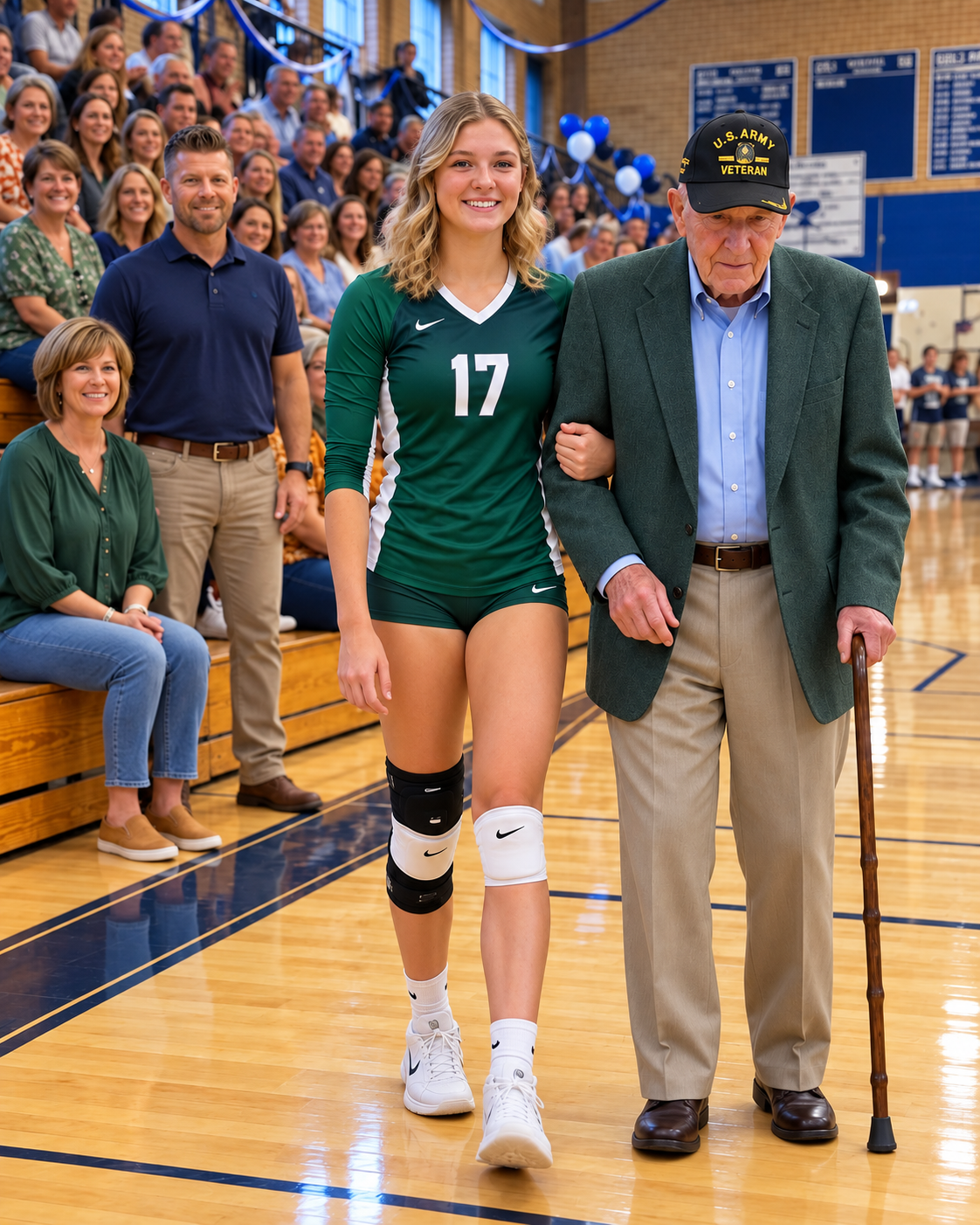
PART 1 TITLE: Two Days Before Her Final Home Game, My Daughter Asked a Simple Question That Exposed a Painful Divide in Our Family
My daughter had spent nine years believing that the man who drove her to volleyball practice, checked her homework, and waited through every difficult game would stand beside her when it mattered most. On a Tuesday evening in October, she discovered that he wasn’t nearly as certain of his place in her life. The realization came at our dinner table, with a half-eaten casserole between us and her little brother reaching for the ketchup. It took less than a minute for something we had spent years building to begin coming apart.
My name is Jodi Brandt. I was forty-one that fall, working as a dental hygienist in a small Minnesota community roughly forty minutes from Mankato. Our town was the sort of place where farmers discussed rainfall in the grocery store and high school sports filled the local newspaper. I had always considered our family comfortably ordinary. My husband, Travis, worked in agricultural seed sales. Our eight-year-old son, Mason, possessed enough energy for three children. And my seventeen-year-old daughter, Kaylee, was approaching the end of a high school volleyball career that had shaped much of our family’s schedule.
That Thursday was supposed to be special. Kaylee was one of six graduating volleyball players whose accomplishments would be recognized before the final home match. The school had arranged a ceremony in which each senior would cross the gymnasium floor with members of their family. There would be introductions, photographs, flowers, and probably more tears than any of the girls cared to admit. Kaylee had been talking about the evening for weeks. Her uniform was ready, her teammates were excited, and the school had already collected the names of the adults who would accompany each player.
I had put down two names on Kaylee’s participation form: Jodi Brandt and Travis Brandt. I hadn’t thought twice about it. Travis had been raising Kaylee since she was eight, and our household had functioned as a family for so long that I rarely stopped to consider the technical distinctions between us. But that Tuesday, when I set a steaming dish of tater tot hotdish on the table, Kaylee seemed more restless than usual. She kept folding the corner of her napkin and glancing toward Travis, waiting for a pause in the conversation.
He was telling me about a delivery schedule that had changed at the warehouse. A farmer needed seed earlier than expected, and Travis was trying to work out how to accommodate him. Mason interrupted twice to explain something that had happened at school. Kaylee waited through both interruptions. Finally, when Travis reached for his water glass, she put her fork down and asked whether he would be the one to escort her onto the volleyball court for senior night. Her voice was casual, but she was watching his face closely.
Travis stopped moving. I remember noticing his fingers resting against the glass, his expression changing from mild surprise to something I couldn’t quite identify. He looked at Kaylee, then at his plate. After a moment, he told her he didn’t believe he should do it. There was nothing angry about his tone. That almost made the answer more unsettling. He spoke as though he were declining an invitation for perfectly sensible reasons, unaware that the person across from him had been counting on his acceptance.
Kaylee asked him why. Travis explained that a ceremony like this was meant for an actual father, someone with a biological claim to the role. He said he would happily attend the game, cheer from the bleachers, and celebrate her accomplishments, but he didn’t want to assume a position that properly belonged to Ryan. He even suggested that her biological father might decide to appear someday. Listening to him, I felt my stomach tighten. Ryan had been absent from Kaylee’s life for years. Travis knew that as well as I did.
For several seconds, my daughter said nothing. Her eyes stayed fixed on Travis, and I could almost see her reconsidering the meaning of every word he had spoken. She reminded him quietly that he had attended her games for years. He agreed. He didn’t deny caring about her or being proud of her. Instead, he repeated that certain moments belonged to fathers, and he was uncomfortable claiming that title. He seemed convinced he was behaving honorably. Kaylee heard something very different: after everything they had shared, he still considered himself an outsider.
She didn’t raise her voice. She didn’t accuse him of abandoning her or ask how he could possibly believe Ryan deserved that place. She simply accepted his answer, stood, and carried her dishes to the dishwasher. Her movements were careful, almost excessively polite. She pushed the rack inside, dried her hands on a towel, and headed upstairs. I listened to her footsteps until they disappeared. Her bedroom door closed without a sound. I would have preferred an argument. Anger might have given us somewhere to begin. That quiet retreat left a silence none of us knew how to fill.
Mason was the first to break it. He looked from Travis to me, a smudge of ketchup near the corner of his mouth, and asked whether Kaylee was upset. I told him to finish eating. Travis returned to his plate, although he barely touched the food. He didn’t look pleased with himself. He looked uncomfortable, as if an ordinary conversation had taken an unexpected turn. I wanted to ask him how a man could spend nearly a decade acting like a father and then insist that fatherhood was someone else’s responsibility whenever it became publicly visible.
But I kept quiet. Not because I agreed with him, and certainly not because I believed Kaylee would recover from his words by Thursday. I knew Travis well enough to understand what would happen if I demanded that he reconsider. He would apologize, promise to escort her, and appear at the ceremony because I had insisted. He was reliable in that particular way. He could be stubborn about a principle until someone he loved persuaded him otherwise. Yet I couldn’t bear the thought of Kaylee standing beside him while wondering whether he truly wanted to be there.
I had never expected a single family ceremony to reveal such a deep uncertainty in my husband. For years, I had interpreted his caution as respect for boundaries. He wasn’t Kaylee’s biological father, and he had never pressured her to call him Dad. She used his first name, just as she had when they met. Neither of them seemed bothered by it. Looking back, I realized I had mistaken the absence of conflict for the absence of fear. Travis had accepted nearly every responsibility of parenthood while carefully avoiding the one word that described what he had become.
Kaylee’s biological father was named Ryan. I married him when I was twenty-two, still young enough to imagine that good intentions could hold a marriage together through almost anything. We were happy at first, or at least I believed we were. When Kaylee arrived, I pictured a future full of ordinary milestones: school photographs, birthday cakes, scraped knees, camping trips, and the two of us sitting together in folding chairs at whatever sport she chose. I never imagined that one day I would struggle to explain why her father had stopped asking about her.
When Kaylee was four, Ryan accepted a position in the oil fields of North Dakota. The wages were better than anything he could earn near home, and at the beginning we treated the arrangement as temporary. He promised to visit regularly. For a while he managed it, driving back after difficult stretches of work and arriving exhausted but cheerful. Kaylee would run toward him when his vehicle pulled into the driveway. She kept drawings ready to show him. We measured the weeks between visits on the kitchen calendar, convincing ourselves that sacrifice was simply part of providing for our family.
Then the intervals grew longer. A visit postponed because of work became another postponed because of weather. Phone calls that had once been expected turned into unexpected surprises. Ryan’s excuses were sometimes believable, sometimes careless, and eventually so repetitive that I stopped asking questions. Our marriage ended, but the disappointment did not end with it. Kaylee remained a little girl waiting for a father who had learned how to make promises without keeping them. I tried to protect her from the worst of that hurt, though I knew I couldn’t protect her from all of it.
His last conversation with Kaylee took place on her eleventh birthday. He had promised that he would attend her confirmation ceremony. She believed him enough to look for him when the day arrived. I watched her eyes move toward the entrance whenever someone entered. He never came. Six years later, the number Ryan had once used was still stored in her phone. She had stopped calling it during middle school. More tellingly, she had stopped identifying him with the name most children use for a parent. To Kaylee, he had gradually become a person named Ryan.
Travis entered our lives when Kaylee was seven. At the time, I was working long days at the dental clinic and had very little interest in another relationship. One afternoon, a man appeared at the office with a damaged molar and an expression of embarrassed discomfort. He was broad-shouldered, reserved, and apologetic about needing treatment. That man was Travis. He worked with farmers supplying corn and soybean seed, and his hands carried the marks of someone accustomed to physical work. I remember that he thanked every member of the clinic staff before leaving.
Over the next couple of years, he returned for routine appointments, eventually working up the nerve to invite me to dinner. I accepted partly because he was kind and partly because he never seemed to be performing kindness to impress anyone. He listened more than he spoke. He asked questions and remembered the answers. On our second date, he wanted to know about Kaylee, not merely as a detail of my life but as a person who would have a say in whether he belonged there. He told me he didn’t want to become involved with a mother while ignoring the child who depended on her.
When he finally came to our house, Kaylee conducted what could only be described as an interview. She wanted to know whether he owned a dog, understood baseball, and could braid hair. Travis confessed that he couldn’t manage a braid, though he offered to learn. She laughed at his answer, and for the first time since Ryan’s departure I saw her relax around an adult man without first trying to impress him. Travis didn’t bring elaborate presents or promise exciting outings. He sat at our kitchen table and let her ask whatever she wanted, answering each question with the same seriousness.
That summer, I discovered him practicing braids with orange baler twine tied to a handle at the agricultural warehouse. He had watched instructions, tried several times, and become frustrated by how the strands slipped between his fingers. When I caught him, he looked embarrassed. He explained that Kaylee had mentioned wanting someone to help with her hair before school, and he thought he ought to know how. I remember standing there, watching his large hands work awkwardly through the twine, and understanding that he was already making decisions based on my daughter’s needs.
We married the following year, when Kaylee was eight. There was no dramatic announcement that Travis would replace Ryan. We didn’t ask her to change what she called him or suggest she owed him affection. Instead, life developed around small, consistent habits. Travis made sure there was enough gas in the car before early practices. He learned the names of her friends. He fixed things she broke, listened when she was upset, and never treated the time he spent helping her as a favor. As Mason joined our family and grew older, those habits became the structure of our home.
Volleyball brought Travis and Kaylee particularly close. Some practices required lengthy drives, but he rarely complained about the distance. When she became serious about improving, he built a practice net using old fence posts and strong cargo netting. He kept statistics on a clipboard at games, recording details that even I sometimes struggled to understand. He could tell when her timing was slightly off or when she had played through fatigue. After a disappointing match, he didn’t tell her she was perfect. He asked what she thought had gone wrong and listened carefully to her answer.
There were other moments that rarely attracted attention. When Kaylee was ill, Travis checked her temperature and brought her food. When school assignments became complicated, he stayed awake to help her work through them. Before her first school dance, he waited outside until she was ready to leave because she worried she might want to come home early. He never made a public display of these things. That was simply how he loved people. Yet for all his devotion, he avoided introducing Kaylee as his daughter. I had assumed he was being considerate. Now I wasn’t sure what he believed.
On that Tuesday evening, after the dishes had been cleared, Travis said he needed to check something at the warehouse. I watched him leave, his truck lights moving across the darkening driveway. The explanation was plausible; inventory issues were common during the agricultural season. Still, I wondered whether he wanted to escape the atmosphere he had created. I considered calling him back. Instead, I went upstairs. From beneath Kaylee’s bedroom door came the faint sound of music, quiet enough that I couldn’t recognize the song. I knocked and waited until she invited me inside.
She was lying on her back, watching the ceiling fan turn. Her volleyball bag sat near the closet, with a pair of worn knee pads hanging over one strap. A photograph of her team was tucked beside the mirror. Everything in the room reminded me that she was nearly grown, yet the expression on her face belonged to the little girl who had once waited for Ryan to arrive. I sat beside her and told her she didn’t have to discuss dinner immediately. She answered that she preferred not to. I stayed anyway, hoping my presence would be enough for the moment.
After a long silence, Kaylee said Travis had been technically correct. He wasn’t the man who had given her life. I told her that biology was not the only reason people belonged to one another. She already understood that, she replied. The problem was that she had believed Travis understood it too. Her voice remained steady, but she twisted the edge of her blanket between her fingers. She said she had never imagined he would consider standing beside her inappropriate. She hadn’t asked him to pretend to be somebody else. She had asked him to be the person he had always been.
I wanted to assure her he hadn’t intended to hurt her. I knew that was probably true. But I also knew intention would not erase what she had heard. Instead, I asked whom she would most like beside her on Thursday, now that Travis had declined. She considered the question longer than I expected. Then she turned toward me and mentioned her grandfather. At first, I thought she was asking whether he could attend the game. When I realized she meant the walk itself, I hesitated. My father was seventy-nine, and crossing a gymnasium was no small undertaking for him.
Kaylee knew about his hip surgery. She knew he needed a cane, that he climbed steps carefully, and that sometimes he had to pause before continuing across a room. I reminded her of the distance between the entrance and center court. She said the distance didn’t concern her. She wanted Grandpa Duane, and she wanted him to accompany her without anyone else walking at her side. Not me, not Travis, and certainly not Ryan. I studied her face, looking for hesitation. There was none. My daughter had reached a decision, and I understood that respecting it would change Thursday evening for all of us.
I told her I would ask him. She closed her eyes briefly, then reached over and squeezed my hand. I stayed until she was ready to sleep, listening to the familiar creak of the house settling in the October cold. Downstairs, the school form with Travis’s name still lay among the papers on our counter. By morning, I would have to change it. I had no idea whether my aging father could manage the walk, or what my husband would do when he discovered the arrangement. But one thing was already clear: Kaylee would not spend her final home-game ceremony begging anyone to stand beside her.
END PART 1
PART 2 TITLE: My Seventy-Nine-Year-Old Father Had One Question About the Ceremony, and His Quiet Answer Made My Decision Impossible to Undo
I woke Wednesday morning before the alarm sounded. For several minutes, I lay beside Travis and listened to the faint ticking of the bedroom clock. He was asleep on his side, one hand resting near the pillow, looking as peaceful as he had on countless mornings throughout our marriage. It seemed strange that the man I trusted with every practical difficulty in our lives could have caused so much pain with a single conversation. I considered waking him and explaining what Kaylee had told me, but something stopped me. Her disappointment deserved more than an apology negotiated between adults.
By the time I reached the kitchen, Kaylee had already poured herself a bowl of cereal. She wore a sweatshirt over her school clothes, and her blonde hair was gathered loosely at the back of her head. Mason sat across from her, examining a spelling worksheet with the seriousness of someone preparing for an important examination. I made coffee and watched my daughter take small, distracted bites of breakfast. She wasn’t avoiding me. When I asked whether she had slept, she nodded. When I reminded her that I would contact the school about Thursday, she looked up immediately, waiting.
I asked whether she still wanted Grandpa to escort her. Kaylee put down her spoon and gave me a look that suggested she couldn’t understand why the question needed repeating. She had made up her mind. I told her I wasn’t trying to change it, only making certain that I understood. She explained that she didn’t want Grandpa invited out of pity or because somebody had made her feel rejected. He had been part of nearly every important year of her life. If she couldn’t walk with the person she originally chose, she wanted to be accompanied by someone whose presence had never been uncertain.
That distinction mattered. My father, Duane Ostrem, had never been the sort of grandfather who expressed affection through expensive presents or elaborate outings. He owned a dairy farm outside town and had spent more than fifty years following a schedule dictated by animals, weather, and machinery. Before my mother died, they had built their lives around that property. His days started long before daylight and ended only when everything necessary had been done. Even after he sold the dairy herd, he continued getting out of bed before sunrise. He said sleeping late made the morning feel wasted.
At seventy-nine, Dad no longer moved with the strength I remembered from childhood. Two winters earlier, he had undergone hip replacement surgery, and his recovery had been harder than he expected. He disliked discussing discomfort, partly from habit and partly because he was convinced that too much attention made pain worse. A sturdy wooden cane had become part of his daily routine. He used it to cross the yard, navigate the farmhouse steps, and move between the buildings that remained on the property. He could still manage many things independently, but distance required patience.
Kaylee had never treated his cane as something embarrassing. When she visited, she automatically slowed her steps to match his. She knew which chair he preferred near the kitchen window and where he kept the extra cushions that made sitting easier. As a younger child, she had followed him everywhere, sometimes carrying a small bucket as though her contribution were essential to the farm’s operation. Dad had allowed her to participate in whatever was safe, explaining his work without talking down to her. Their relationship had developed through chores, shared meals, and long stretches of comfortable silence.
One summer, when she was eleven, Dad taught her to steer his old Ford pickup across an empty field. She could barely see over the dashboard without sitting very straight, and he stayed beside her, correcting her hands on the wheel. I remembered the pride in her expression when she came home and described the experience. That same year, Ryan stopped contacting her. The two events had nothing to do with each other, but in my memory they had become inseparable. One man repeatedly disappeared from her life while another made room for her in the ordinary business of his days.
Dad also encouraged her interest in 4-H. For eight years, Kaylee had participated in showing dairy heifers, learning to care for animals and handle the responsibility of preparing for agricultural exhibitions. He taught her that animals responded to patience more reliably than force. When something went badly, he didn’t become dramatic. He asked her to inspect what had happened and try again. Some of the lessons she later applied to volleyball had first been learned beside him in a barn. She understood the difference between a person who offered encouragement and one who stayed to help when encouragement wasn’t enough.
As I watched her finish breakfast, I realized she had selected Grandpa for reasons that went much deeper than Travis’s refusal. Dad represented a kind of reliability she could describe without searching for the right words. He wasn’t necessarily the first person she called when she needed advice about friends or school. He couldn’t help much with modern technology, and he sometimes confused the names of her teammates. But she trusted him. If he said he would be somewhere, he arrived. If he promised to help, he did what his age and strength allowed.
Travis entered the kitchen carrying his work jacket. He greeted Mason, poured coffee, and asked Kaylee whether she had everything she needed for practice. She answered politely. I noticed his brief hesitation when she didn’t add anything else. Under normal circumstances, they might have discussed the opposing team or the drills her coach had scheduled. Instead, he checked the time and said he needed to leave. Before walking out, he reminded her that he would attend Thursday’s game. Kaylee said she knew. He stood near the doorway for a moment, then left without trying to continue the conversation.
I wondered whether he had expected her disappointment to disappear overnight. Travis was not insensitive in the ordinary sense. He noticed when someone needed help and frequently acted before being asked. Yet emotional conversations could leave him uncertain. He preferred problems with visible solutions: damaged machinery, missing deliveries, a schedule that needed rearranging. This problem required him to reconsider something he had quietly believed for years. I knew forcing the issue might produce an immediate agreement, but it would not necessarily change the fear that had made him refuse in the first place.
After Mason and Kaylee left for school, I called the school’s activities office. Mrs. Larson, who had been coordinating the senior-night ceremony, answered with the cheerful efficiency of someone handling several dozen responsibilities at once. I introduced myself and explained that Kaylee wanted to change her escort information. The original form had listed my husband and me. Mrs. Larson asked for the replacement name, and I gave her my father’s full name. I heard the faint tapping of a keyboard while she made the alteration.
Mrs. Larson recognized him immediately. She knew Dad from years of community events, and her response carried genuine warmth. Then she asked whether everything was all right with our family. I understood why. A last-minute change involving parents was unusual, particularly when the school had already prepared the ceremony materials. For a moment, I considered telling her what Travis had said. But Kaylee’s hurt wasn’t something I wanted repeated among the school staff. I told her that Kaylee had chosen her grandfather because they were close. It was an accurate answer, though an incomplete one.
Mrs. Larson confirmed that she would update the announcement card. She asked whether Dad would need assistance reaching the court. I admitted that he used a cane, but said I would discuss the distance with him before Thursday. We talked briefly about where the seniors would assemble and when escorts should arrive. After hanging up, I wrote the details on a small piece of paper and placed it beside my phone. Seeing Duane Ostrem’s name replacing Travis’s gave the arrangement an unexpected permanence. It was no longer a conversation between my daughter and me. The school was preparing to call my father onto the floor.
At the dental clinic, I tried to concentrate on work. The familiar routine usually steadied me. There were trays to prepare, patients to reassure, instruments to clean, and appointments moving steadily across the schedule. Yet between patients, my mind returned to the dinner table. I kept seeing the moment Kaylee had looked at Travis for an explanation. I wondered whether he understood how much courage it had taken for her to ask him. My daughter was confident on the volleyball court, but outside it she could be careful about requesting anything that might expose her to rejection.
At lunchtime, I found myself thinking about what Dad would say. My father had never been quick to condemn people, even when their behavior troubled him. He valued responsibility, but he also understood that good people sometimes made foolish decisions. When my marriage to Ryan had begun falling apart, Dad hadn’t spent hours criticizing him. He helped me manage what needed to be done and made certain Kaylee had a place to go on difficult afternoons. I suspected he would respond to Travis’s words with the same practical restraint, although I couldn’t predict whether his physical condition would allow him to accept the invitation.
When I returned home that evening, Kaylee was finishing homework at the kitchen counter. She asked whether I had spoken to Mrs. Larson. I told her the name had been changed. The relief on her face was immediate, but she asked another question almost at once: had Grandpa said yes? I explained that I hadn’t called him yet because I wanted enough time to describe the event properly. She nodded and returned to her assignment, though I caught her glancing toward the telephone. I could tell she wanted to be nearby when I made the call without openly asking to listen.
Dinner passed more quietly than usual. Travis discussed work with Mason, who was fascinated by the idea that different varieties of corn could have different purposes. Kaylee contributed when someone spoke directly to her. She wasn’t rude, and I doubted Mason understood anything was wrong. Travis occasionally looked toward her, seeming ready to say something before choosing another subject. No one mentioned senior night. Watching them, I realized that silence could serve two purposes at once: protecting someone from an argument and preventing an important conversation from happening.
Later, after the kitchen was clean, I went into the living room and called Dad. He answered on the fourth ring, as he almost always did. I could hear a television in the background and the faint creak of his old chair. He asked whether something was wrong, not in alarm but because I usually called earlier. I told him everyone was safe. Then I explained that Kaylee’s senior-night ceremony was scheduled for Thursday and that she wanted him to accompany her onto the volleyball court.
Dad asked about the arrangements first. He wanted to know what time the event began, how far he would need to walk, and whether the floor might be slippery. Those were sensible questions, and I answered them as carefully as I could. Then I told him why Kaylee had chosen him. I described the dinner conversation without embellishing it. I repeated Travis’s belief that the escort position belonged to biological fathers, and I explained how quietly Kaylee had withdrawn afterward. My father listened without interrupting or making the disapproving noises he sometimes used when a piece of farm equipment refused to cooperate.
When I finished, there was a silence long enough that I checked whether the call had disconnected. Finally, Dad asked whether Travis knew I was making these arrangements. I told him he didn’t. Dad didn’t immediately respond. I knew he would be thinking about that answer, weighing the consequences of becoming involved in a disagreement between his daughter, granddaughter, and son-in-law. He had always made a point of staying out of our household decisions unless we requested his help. I expected him to ask whether I had spoken directly with Travis or suggest that I give him another opportunity.
Instead, Dad wanted to know exactly when he should arrive. I gripped the phone more tightly. I explained that the recognition ceremony was expected to begin around six forty-five and asked whether he could reach the school by six. He said he would make the arrangements. His answer was simple and definite. I reminded him about the distance across the gym, concerned that he might be agreeing out of affection without considering the physical effort. Dad gave a dry chuckle and said that after a lifetime of crossing icy barnyards in winter, he wasn’t particularly intimidated by a school floor.
I asked whether he was certain. He told me that Kaylee had asked him to do something important, and he would rather attempt it than give her another refusal to remember. The words were spoken without accusation. Dad did not mention Travis or Ryan. He didn’t need to. For a moment I was unable to answer. My father had spent decades caring for our family without expecting recognition, and now, at an age when walking required thought and effort, he was willing to take on something difficult because his granddaughter had asked him.
Before ending the call, I asked him to wear comfortable shoes and bring his cane. He said he had already planned to bring it and suggested that I stop worrying about things he knew perfectly well. I could imagine him in his farmhouse, sitting beneath the old lamp with the telephone held to his ear, one ankle resting carefully ahead of the other. His humor remained dry, but I heard determination underneath it. He said he would check the weather, allow himself plenty of driving time, and meet Kaylee at the gym. I promised to make sure she knew.
After hanging up, I stood for a while with the phone in my hand. Relief was followed almost immediately by concern. Dad had agreed, but he was not the man who used to carry heavy feed sacks without pausing. His hip could become stiff after sitting, and he sometimes needed extra time to regain his balance. I pictured the polished gym floor, the bright lights, and the spectators watching while the seniors crossed the court. Kaylee would not mind moving slowly. I wasn’t worried about embarrassment. I was worried about asking too much of someone who loved us enough to attempt almost anything.
Kaylee appeared in the doorway before I could call for her. She had clearly been listening for the end of the conversation. I told her Grandpa was coming. Her face changed in a way I hadn’t seen since Tuesday’s dinner. The guarded expression disappeared, replaced by a smile that reached her eyes. She asked whether he had been worried about his hip. I said he had asked practical questions but seemed confident. She immediately began considering how she could support him without pulling on his injured side. She knew him well enough to understand that help had to be offered without making him feel helpless.
I reminded her that the ceremony would take time and that Dad might need to pause. Kaylee said she would wait as long as necessary. She wasn’t concerned about how the walk would appear to other people. She wanted a photograph with Grandpa, and she wanted him to hear his name announced beside hers. Then she asked again whether I would be upset about not escorting her. I told her I would be watching with pride. It was her evening, and she deserved to decide who would stand beside her. That was the first moment I felt entirely comfortable with my own absence from the walk.
Travis returned from checking work messages while Kaylee was still in the kitchen. He asked what we were discussing. She said only that she was making plans for Thursday. He nodded and offered to drive her to school if she needed to arrive early. His offer was sincere, and that made the situation more difficult. He was still willing to handle every practical part of the evening. He simply didn’t understand that the one thing she had asked from him was the part he had refused. Kaylee thanked him, collected her books, and went upstairs.
I considered telling him everything. The school had already changed the form, Dad had agreed to come, and Kaylee was looking forward to their walk. Keeping the arrangement secret felt unfair, even though I hadn’t begun with the intention of deceiving my husband. I wanted Travis to understand why his refusal had hurt her, but I also feared that if I disclosed the change, he would volunteer to escort her simply because he was embarrassed by the alternative. Kaylee deserved a willing companion. Dad had already given her that assurance, and I didn’t want to turn the ceremony into a contest.
Later that night, I found Travis sitting alone at the kitchen table with an open work notebook. His pen rested in his hand, but he wasn’t writing. I asked whether something was bothering him. He said he thought Kaylee was still upset about Tuesday. I waited, hoping he might tell me he had reconsidered. Instead, he said he wished she understood that he was only trying to respect Ryan’s place. There was genuine concern in his voice. I told him she had not asked Ryan to escort her. She had asked him. Travis looked down at his notebook and said he knew.
I wanted to ask what he was so afraid of losing. Ryan had not occupied an active place in Kaylee’s life for years. She had not asked Travis to replace her biological father, erase her history, or make promises about the future. She had asked him to walk beside her for a few minutes. But my husband seemed trapped by a distinction that existed far more strongly in his mind than in hers. I told him that sometimes respect meant listening to what a person actually wanted rather than deciding on their behalf. He didn’t argue, but neither did he answer.
When we went to bed, I knew the next evening would reveal the consequences of our choices. Dad would arrive at the gym. Kaylee would take his arm. Travis would discover that someone else had accepted the invitation he had refused. I could not predict whether that discovery would help him understand his mistake or make him retreat further into his convictions. I had no intention of embarrassing him before our neighbors, but I also wouldn’t ask Kaylee to conceal her grandfather’s presence merely to protect his feelings. The arrangement was settled. For the first time in our marriage, I was allowing my husband to confront the full consequences of something he had said without preparing a way for him to escape them.
END PART 2
PART 3 TITLE: As Senior Night Approached, My Husband Took His Usual Seat in the Bleachers Without Knowing Who Was Coming Through the Gym Doors
Thursday arrived with the sort of cold, clear weather that makes an October morning in Minnesota feel almost brittle. I stepped outside before leaving for work and found a thin layer of moisture on the windshield. Across the neighboring yards, trees had begun dropping their leaves, and the sky was still pale above the rooftops. I had slept poorly. Every time I woke, I imagined some difficulty preventing Dad from reaching the school. His hip might be bothering him. The weather could turn. He might decide that the walk was too ambitious. I knew he would call if his plans changed, but knowing that did little to quiet my concern.
Inside, the house was already moving through its morning routine. Mason had misplaced one of his shoes. Kaylee was checking that her uniform, warmup jacket, and knee pads were packed correctly. Travis stood at the counter reviewing his delivery schedule while drinking coffee. He had agreed to leave work in time for the ceremony and expected to come straight from the warehouse. No one asked him again about escorting Kaylee. The subject seemed to have acquired a fragile boundary that each of us was careful not to cross.
Kaylee looked unusually composed. Her movements were deliberate, and she had arranged everything she needed near the back door the night before. She asked whether Grandpa had called. I told her it was still early and reminded her that he had promised to arrive. She nodded. Then she asked whether I thought he would wear his good jacket. The question made me smile. Dad owned a tan jacket he reserved for church, family gatherings, and occasions he considered important. I said I couldn’t imagine him wearing anything else. Kaylee seemed pleased with the answer.
Before she left for school, I checked whether she had any doubts about the ceremony. She shook her head. Then she told me something I hadn’t considered: she was worried people might stand too close to Grandpa and make him rush. I assured her that she could set the pace. The other seniors would have their own introductions, and the announcer could wait for her to reach the proper place. She said she hoped everyone understood that he wasn’t slow because he didn’t want to be there. I told her anyone watching carefully would know the difference.
That exchange stayed with me throughout the morning. Kaylee was not thinking about the ceremony in terms of who deserved recognition or how her family might appear in photographs. She was thinking about Dad’s dignity. She knew how much effort walking required now, and she wanted him to feel proud rather than exposed. I recognized that instinct from the way he had treated her as a child. He had never hurried her through tasks simply because she needed more time. He would wait beside a gate while she worked out how a latch operated, allowing her the satisfaction of opening it herself.
At the clinic, the day moved steadily until four. I worked through the scheduled patients, responded to familiar questions, and concentrated on keeping my hands precise. Between appointments, I checked my phone for messages from Dad. None arrived. I reminded myself that he rarely sent messages when a telephone call would do. He had accepted the invitation, written down the time, and probably considered the subject settled. For him, an undertaking did not become more reliable because people discussed it repeatedly. He trusted plans that were simple and promises that could be kept.
When my shift ended, I changed into the clothes I had brought for the game and collected Mason. He came toward me carrying a large homemade sign for Kaylee. He had worked on it with extraordinary concentration, using bold letters and an enormous orange circle that occupied most of the paper. The shape was decorated with curved lines, though it resembled a pumpkin more than a volleyball. Before I could comment, Mason explained that he had run out of white paper and had used the supplies available. He spoke with such confidence that I complimented the effort without discussing the resemblance.
On the drive toward the school, he asked whether Kaylee would get a trophy. I explained that the seniors would receive recognition and flowers, and there would be photographs before the varsity match. He seemed disappointed by the absence of a trophy but recovered when I told him he could hold up his sign. Then he wanted to know whether Grandpa would be there. I said yes. Mason asked if Grandpa would sit with us. I explained that he had a special job: he was going to walk with Kaylee when her name was announced.
Mason looked pleased, although I could tell he was working through the arrangement. He asked whether Travis would walk too. I said Kaylee had chosen Grandpa for the ceremony. Mason accepted the explanation more easily than I expected. To him, adults had different responsibilities depending on what needed doing. Travis repaired his bicycle, Grandpa told stories about farm machinery, and I remembered the things everyone else misplaced. He had never been interested in whether affection came from a particular biological connection. His world was organized around the people who took care of him.
We reached the school shortly after five. The parking lot was already filling with cars, and people carrying coats and programs were heading toward the gym entrance. A few girls in warmup jackets moved quickly through the corridor, calling greetings to one another. Inside, the smell of popcorn mingled with the sharp scent of newly cleaned flooring. The usual basketball markings shone beneath the overhead lights, and the volleyball net divided the court. Maroon and gold decorations had been fastened to the railings, adding a festive brightness to the familiar gymnasium.
Large photographs of the six graduating players stood near the scorer’s table. Each showed a senior in action, frozen in a moment that represented years of practices, long bus rides, and difficult games. Kaylee’s picture captured her rising toward the ball, her blonde braid swinging behind her. I stood in front of it longer than I intended. I could still remember her first attempts to serve, when the ball sometimes traveled barely halfway across the net. Now she was a four-year varsity letter winner, an accomplished middle hitter, and a young woman preparing to leave high school behind.
Beside the photographs stood a container filled with red roses. The flowers were intended for the graduating players to present to their escorts. I had known about that tradition, but seeing the roses arranged together gave the ceremony a weight that the printed schedule had not conveyed. Each flower would mark a relationship. Each photograph would become a record of who had stood beside a young athlete at the end of an important chapter. I thought of the form I had changed on Wednesday and felt a brief ache of uncertainty.
The gym was not yet crowded, so Mason and I chose seats near the front of the bleachers. From there, I could watch the side entrance and see the area where the seniors would assemble. Mason spread his sign across his knees and spent several minutes trying to decide when he should raise it. He wanted Kaylee to notice him, but he also wanted to save the surprise until the right moment. I helped him fold his jacket beneath the seat, then checked the time. There was still plenty of room in the evening for everything to unfold as planned.
Travis arrived directly from work, wearing his familiar fleece vest and sturdy boots. He had not stopped home to change. His hair was slightly flattened from his cap, and his hands showed traces of the dust that seemed to follow him out of the warehouse. He greeted Mason, admired the sign, and sat beside me. At first, his manner was ordinary. He asked whether Kaylee had warmed up and whether the team seemed ready. I answered both questions, grateful for the familiar rhythm of our conversation. Then his eyes moved toward the roses near the scorer’s table.
I watched him study the flowers. His expression changed only slightly, but I noticed because I had been paying attention to every hesitation since Tuesday. He leaned forward, resting his elbows on his knees, and rubbed one thumb across the knuckles of his other hand. That was something he did when calculating figures or trying to solve a difficult problem. I asked whether everything was all right. He said it was. The answer came quickly, without his usual effort to reassure me. I wondered whether he was beginning to realize how the ceremony would feel from the bleachers.
The junior varsity game was underway, and the gym echoed with whistles, shouted instructions, and the sudden slap of the ball against players’ arms. Parents applauded good rallies. Students moved between the concession stand and their seats. Teachers greeted families they had known for years. I tried to take comfort in the ordinary activity around me. Most of the people in that gym had no idea what had happened at our dinner table. They were there to celebrate the seniors, watch volleyball, and enjoy an evening that marked the approaching end of the season.
That anonymity was something I wanted to preserve. I did not intend for Kaylee’s ceremony to become an explanation of our private difficulties. Dad was coming because she had asked him, not because I wanted to expose Travis. Yet I couldn’t ignore that my husband’s surprise might be painful. He had assumed, I suspected, that Kaylee would either accept my company or make some other arrangement without involving him. He had not considered that the person she chose might be someone he respected deeply, someone who would make the difference between willingness and hesitation unmistakable.
I checked the time again. Six o’clock had passed. Dad was supposed to arrive by then so that he could find Kaylee before the recognition ceremony. I looked toward the side entrance. Students passed through it, followed by a teacher carrying a box and two parents searching for seats. No elderly farmer in a tan jacket appeared. I told myself that Dad always allowed extra time when he traveled, particularly in the evening. Still, he might have been delayed by a slow drive or the difficulty of finding parking close enough to the building.
At five minutes past six, I felt the first genuine flicker of worry. I knew the distance from Dad’s farmhouse to the school, and I could picture him negotiating the route. He was a careful driver, sometimes maddeningly so, and he would rather arrive late than make a hurried turn. I considered calling him, but he might still be driving. Distracting him with a telephone conversation seemed worse than waiting. I glanced toward the seniors gathering near the court. Kaylee was talking with her teammates, though she occasionally looked toward the entrance herself.
Travis noticed my attention wandering. He asked whether I was expecting someone. I told him I was watching for family. It was an evasive answer, and I disliked myself for giving it. But I wasn’t prepared to explain the arrangements while Kaylee was standing only a short distance away, waiting for the person she had chosen. Travis nodded and returned his attention to the court. His silence wasn’t suspicious. He trusted me, and I understood that I was using that trust to preserve a surprise he might not welcome.
I thought again about Wednesday evening, when he had admitted that Kaylee seemed upset. There had been an opportunity then to say everything plainly. I had chosen not to use it. I could defend the decision by saying it protected Kaylee’s independence, and that was partly true. But another part of me had wanted Travis to see the consequence rather than hear me describe it. Watching him sit beside me, I wondered whether that expectation had been too severe. Our marriage had always worked best when we talked honestly. This time I was relying on an experience to teach what I hadn’t managed to explain.
At twelve minutes past six, the side door opened once more. I recognized Dad before his face was fully visible. The tan jacket was there, just as Kaylee had predicted. Beneath it he wore a clean white shirt, and his shoes had been polished. On his head sat the green cap from his preferred seed company, a piece of clothing he regarded as suitable for nearly every occasion. His familiar hickory cane was in his right hand. He paused just beyond the doorway, letting a group of students pass, then began moving toward the court.
Relief washed over me so suddenly that I had to place a hand against the bleacher seat. Dad was walking carefully, setting the cane down before transferring his weight. He did not hurry, but neither did he appear uncertain about where he was going. Several people recognized him and greeted him as he passed. He acknowledged them with brief nods. He could have come directly to sit with us, rested his hip, and waited for someone to summon him. Instead, he headed toward the area where the seniors were gathering, determined to find his granddaughter before the ceremony began.
Kaylee saw him almost immediately. Her posture changed, and she excused herself from the teammates standing around her. She moved toward him quickly, then slowed before reaching him, remembering to give him room to steady himself. From our seats I saw her speak, and Dad answered with a small smile. She slipped her arm through his left arm while he kept the cane in his right hand. For a moment they stood together, facing the court, looking perfectly comfortable in one another’s company. Kaylee was smiling more openly than she had at any point since Tuesday.
I turned toward Travis. He was no longer watching the volleyball game. His gaze was fixed on Kaylee and Dad, and his expression had become intensely still. I could see him working out why the two of them were standing near the senior-night assembly area. He looked at the roses, then back toward my father. Finally, he turned to me. He said my name quietly, almost as a question. I explained that Kaylee had asked Grandpa to accompany her after their conversation at dinner, and that he had accepted.
For several seconds, Travis said nothing. He looked back toward the court, where Kaylee was laughing at something Dad had said. There was no visible anger in my husband’s face. Instead, he seemed caught between surprise and a realization he had not prepared himself to face. His hands rested motionless between his knees. I waited for him to ask why I hadn’t told him. He didn’t. He simply watched the girl he had raised for nine years stand beside an elderly man who had agreed to do what he believed he had no right to do.
Around us, the junior varsity match was ending. The players began clearing the floor, and the noise of the gym shifted as spectators prepared for the senior introductions. Mason lifted his poster, then lowered it when I reminded him that Kaylee hadn’t been announced yet. Across the polished court, Dad adjusted his cap while Kaylee positioned herself carefully beside him. Travis remained seated, his eyes following them. I had imagined he might become defensive or embarrassed. What I saw instead was the beginning of something much harder for him: he was confronting the possibility that his idea of doing the right thing had hurt someone he loved.
END PART 3
PART 4 TITLE: When My Father Began the Long Walk Across the Volleyball Court, the Entire Gym Watched My Husband Make an Unexpected Choice
The announcement system crackled as Mr. Halvorson approached the microphone. He had been the familiar voice of school sporting events for as long as I could remember, and his introductions usually carried an easy confidence. That evening, he stood near the scorer’s table with a stack of cards containing the seniors’ names and accomplishments. The overhead lights reflected from the polished floor. Around us, the conversation in the bleachers gradually faded as people turned their attention toward the players waiting along the sideline. I glanced at Travis. He was sitting forward, elbows on his knees, watching Kaylee and my father without speaking.
Mr. Halvorson welcomed the families and explained that the school would recognize its six graduating volleyball players before the varsity match. He spoke about commitment, teamwork, and the years of effort represented by the girls standing beside the court. The audience applauded. I joined in automatically, but my attention remained fixed on Dad. He was positioned slightly behind Kaylee, his cane planted firmly beside his right foot. She leaned toward him occasionally, speaking close enough that he could hear her over the crowd. Whatever she was saying appeared to amuse him, though he didn’t take his eyes from the floor for long.
The first senior stepped forward with both her parents. They walked together beneath the maroon and gold decorations, stopping where the photographer had been positioned. The girl presented her flower and embraced her family while Mr. Halvorson read her accomplishments. The audience applauded warmly. It was exactly the sort of uncomplicated recognition everyone had expected. I watched the three figures return toward the sideline and felt the tension in my shoulders increase. Every completed introduction brought us closer to Kaylee’s turn, and I still didn’t know how my husband would react.
The second player appeared with her mother and stepfather. They crossed the court side by side, smiling at familiar faces in the crowd. I noticed Travis watching them. He remained very still, but his gaze followed the stepfather until the family stopped for its photograph. I wondered whether he was seeing something he had refused to imagine when Kaylee made her request. No one in the audience seemed confused by the man’s presence. There was no question about whether he was biologically related to the young woman beside him. He had been invited, and he was standing where she wanted him.
The third senior arrived with several relatives, including a grandmother seated in a wheelchair. They moved across the court together, and the announcer waited without impatience while the group positioned itself for the photograph. Watching them, I thought about the concerns Kaylee had expressed that morning. She had worried that Grandpa might need too much time, that the ceremony might continue around him before he was ready. But the families around us were accustomed to celebrating people with different needs and abilities. The evening wasn’t a race. That simple fact had somehow escaped my thoughts while I was worrying about Dad’s hip.
Mason leaned closer and whispered that Grandpa was almost next. I told him to keep his sign ready. He held it carefully in both hands, determined not to miss his sister’s introduction. His feet swung above the space beneath the bleacher seat, and his excitement was so uncomplicated that I envied him. He saw a special evening, a beloved grandfather, and his older sister receiving applause. He had no reason to understand the uncertainty sitting beside me. He had not heard the word father used as a boundary between people who belonged to the same family.
Another senior completed her introduction, and Mr. Halvorson adjusted the card in his hand. I saw Kaylee straighten near the sideline. She transferred her red rose into her left hand, then checked the position of Dad’s cane. He gave a small nod. She took his left arm, not gripping it tightly but placing her hand where he could feel her support. Their movements had the familiarity of people who understood each other without needing many instructions. I recognized the same patience Dad had shown her years earlier when he taught her to handle animals on the farm.
Then Mr. Halvorson announced Kaylee’s name. He identified her as number seventeen, a four-year varsity letter winner and middle hitter, and introduced Duane Ostrem as the grandfather accompanying her. The sound of Dad’s name traveled through the loudspeakers and seemed to stir the crowd. People in our town knew him through decades of farming, church gatherings, and ordinary neighborly encounters. Some had bought milk from his dairy operation. Others had worked alongside him or known my mother before she died. I heard a few voices express surprise and recognition as people realized who was stepping onto the court.
Dad adjusted his grip on the cane. Kaylee looked toward him, waiting until he was ready. He placed the cane ahead of his right foot, shifted his weight carefully, and took the first step. She moved with him. It was a slow beginning, slower than the families before them, but there was nothing hesitant about their purpose. My father knew where he needed to go. Kaylee knew she would remain beside him until they reached the center. Together, they began crossing the open space that had seemed so intimidating when we discussed it on Wednesday evening.
The rhythm of their movement was unmistakable. The cane touched the floor, followed by the measured placement of Dad’s feet. Kaylee shortened her stride to match his, resisting the natural speed of a seventeen-year-old athlete accustomed to moving quickly. Her red rose rested against her uniform. She kept her eyes on him when he needed balance and lifted her head when he seemed comfortable. I found myself watching their feet, silently measuring the distance remaining. There were many yards to cover, and Dad would have to conserve his strength.
Mr. Halvorson continued reading Kaylee’s achievements. He mentioned her academic record, her participation in the National Honor Society, and the years she had spent showing dairy heifers through 4-H. Hearing those details while Dad walked beside her gave them a meaning I had rarely considered. He had played a part in her agricultural work from the beginning, just as Travis had played a part in her development as a volleyball player. Different portions of Kaylee’s life had been shaped by different people, all of whom had given her time they would never get back.
The gym became noticeably quieter. At first, I thought the silence reflected concern that Dad might stumble. But as I looked around, I saw people leaning forward with expressions that suggested something more attentive. They were watching an elderly man undertake an uncomfortable journey because his granddaughter wanted him there. The usual noise of a school sporting event had receded. Even the students who had been talking near the concession stand had turned toward the court. Dad appeared unaware of the attention. He was concentrating on placing his cane correctly and maintaining a steady pace.
A man near the highest row of bleachers rose to his feet. I didn’t recognize him immediately, but I could see that he was watching Dad with a broad, affectionate smile. Someone beside him stood too. Then several people in another section followed. There was no announcement asking the crowd to stand, and no one appeared to be directing the response. The movement spread gradually, passing from one group of spectators to another. People who had known my father for years began applauding while he continued his slow crossing.
Within moments, the applause had become a standing ovation. Parents on the home side rose first, followed by spectators across the court. Members of the visiting volleyball team joined in, clapping from their place near the opposite sideline. I looked toward the upper rows and saw nearly everyone standing. Some faces were smiling. Others carried the kind of expression people have when they recognize an effort that costs more than it appears. The applause grew louder, but it didn’t hurry Dad. He kept moving at the pace his body permitted.
Kaylee heard the reaction and looked around. Her expression changed from concentration to surprise. She smiled toward the spectators, then turned back to her grandfather. I could see her say something to him, though the applause swallowed her words. Dad gave a slight shake of his head, perhaps acknowledging the attention or perhaps telling her that he was managing perfectly well. His green cap remained firmly on his head. The hickory cane continued its measured journey across the floor, and my daughter stayed at his side with unmistakable pride.
I had expected to be emotional that evening, but nothing had prepared me for the sight of an entire gym standing for my father. This was a man who had spent most of his life working before sunrise, performing difficult tasks that few people witnessed. He had never asked for applause when he took care of our family. Now hundreds of people were recognizing an act he probably considered no more complicated than keeping a promise. I covered my mouth and felt tears gather in my eyes. Beside me, Mason rose with his sign and tried to hold it high enough for Kaylee to see.
That was when I noticed Travis moving. He had stood, but unlike the people around us, he wasn’t clapping. His hands hung beside his legs, and he was staring toward Kaylee with an intensity that made me turn fully toward him. His face had changed. The guarded expression I had seen since Tuesday was gone, replaced by something rawer and less controlled. He looked at Dad, then at Kaylee, and finally toward the remaining distance between them and center court. His jaw tightened. I had no idea what he was thinking, but I could see that remaining in his seat had suddenly become impossible.
For a moment, I assumed he was simply overcome by emotion. Travis was not a man who enjoyed public displays of feeling, and I knew he would struggle to conceal his reaction if he believed he had hurt Kaylee. Then he placed a hand on the railing and moved toward the steps. There were four steps between our seats and the gym floor. He descended the first one carefully, then continued without looking back. I watched him pass the second and third, my pulse quickening with each movement. By the time he reached the bottom, I understood that he intended to approach the court.
My first instinct was to call after him. Kaylee had specifically asked to walk with Grandpa alone. I had promised to respect that request, and now Travis was heading toward them in front of hundreds of spectators. He had already caused her pain once by deciding what position he should occupy without asking how she felt. I feared he might be about to make another mistake, this time under far more public circumstances. But there was no anger in his movements, no attempt to rush ahead or demand attention. He simply crossed the sideline, looking toward my daughter as though he needed to ask her something important.
The applause continued as Travis stepped onto the polished court in his work boots. He hadn’t changed into formal clothes, and his fleece vest looked plain against the uniforms and carefully chosen outfits surrounding him. I recognized the man who came home tired from the warehouse, who kept a clipboard of volleyball statistics, and who had spent years making sure Kaylee never lacked someone willing to drive her to practice. He was not suddenly transformed into a different person. He was the same man, walking toward a responsibility he had been too frightened to claim two evenings earlier.
Dad and Kaylee were about ten feet from center court when Travis reached them. He approached from Kaylee’s free side, leaving enough room that she could continue holding her grandfather’s arm. My father noticed him first. I couldn’t read Dad’s expression clearly from the bleachers, but I saw him pause without withdrawing his support. Travis looked toward Kaylee. Whatever he said was too quiet for me to hear. Then he lifted his arm slightly, offering it to her without moving any closer. He waited, allowing her to decide whether she wanted him beside her.
Kaylee stopped walking. Her hand remained against Grandpa’s arm, and for several seconds she looked directly at Travis. The rest of the gym seemed to disappear from my awareness. I could see only the three of them standing on the court: my seventy-nine-year-old father with his cane, my seventeen-year-old daughter holding her rose, and my husband waiting for an answer he had already been given the opportunity to receive on Tuesday. There was no way for him to control what she did next. If she refused, he would have to accept that refusal in front of everyone.
I watched my daughter’s shoulders rise as she drew a breath. She glanced briefly toward Grandpa, then looked back at Travis. I knew enough about Kaylee to recognize that she was making a real decision rather than yielding to pressure. She had been hurt, and she had every reason to protect herself. Yet she also knew the man standing before her. She knew his patience, his awkward humor, the practical ways he showed concern, and the countless evenings he had spent watching her play. His refusal had wounded her precisely because those years mattered so much.
Finally, Kaylee lifted her free hand and slipped it through Travis’s offered arm. He seemed to release a breath he had been holding. He didn’t pull her away from Grandpa or attempt to lead. Instead, he shifted his position until he was walking comfortably beside her. Dad planted his cane again, and the three of them continued toward center court. Their movement was slow and carefully coordinated. Travis matched the older man’s pace without appearing impatient. Kaylee stood between them, holding one arm on either side, and I watched her smile return through the tears gathering in her eyes.
The crowd responded with another surge of applause. I couldn’t tell whether everyone understood the significance of what they were seeing. Most spectators probably assumed that a stepfather had simply decided to join a family photograph. They didn’t know about the conversation at our table, Ryan’s absence, or the years Travis had spent avoiding the word father. But I knew. I knew why Kaylee had chosen Grandpa, and I knew how much courage it had required for Travis to leave the bleachers. I also knew that taking her arm was only the beginning. He still owed her an explanation.
Mason began jumping beside me, his homemade sign wobbling in his hands. He pointed toward the court and shouted proudly that his dad was walking with Kaylee. I glanced down at him, struck by the certainty in his voice. To Mason, Travis was simply Dad, and Kaylee was simply his sister. He had never needed to untangle the difference between their biological relationships. I thought about how confusing the last two days had been for the adults in our family, while an eight-year-old child could identify the essential relationship without hesitation.
When they reached the designated spot, Dad steadied himself and adjusted his cane. Kaylee presented him with her red rose, which he accepted carefully while keeping his balance. The photographer prepared to take the customary picture, but Mr. Halvorson had stepped away from the scorer’s table. I saw him exchange a brief look with Travis. Then, to my astonishment, he held out the microphone. My husband hesitated. Speaking before a crowd was almost the last thing Travis would voluntarily choose, and he had never enjoyed drawing attention to himself. Yet the announcer remained beside him, waiting.
Travis accepted the microphone with a hand that was visibly unsteady. The applause began to fade. Kaylee stood beside him, one hand still resting lightly against his arm, while Dad watched from her other side. I could see that my husband was struggling to compose himself. He looked down at the microphone, then toward the spectators. His lips moved once without producing a sound. For nine years, he had found a thousand practical ways to care for my daughter. Now he was being asked to explain, in words, something he had never managed to say.
The gym grew quiet enough that I could hear a faint movement from the bleacher seats nearby. Travis lifted the microphone. He introduced himself by his full name and said he had been Kaylee’s stepfather for nine years. He stopped briefly, looking toward her as if gathering the courage to continue. Then he admitted that two evenings earlier, she had invited him to accompany her onto the court and he had declined. No one in the audience moved. My father stood silently beside Kaylee, holding her rose and supporting his weight on the cane.
Travis swallowed and looked directly at my daughter. His voice was rough when he began to explain the reason he had refused. I felt my hands tighten against the railing, because I knew what was coming next could not be taken back. The man who had spent nearly a decade refusing to claim the title of father was about to tell our entire community why he had believed he didn’t deserve it. And for the first time since Tuesday’s dinner, my daughter was standing close enough to hear the answer she had needed from him all along.
END PART 4
PART 5 TITLE: As the Gymnasium Clock Moved Past Six, My Father’s Empty Place Threatened to Break the Promise My Daughter Had Trusted
At six minutes past six, I looked toward the gymnasium entrance for what must have been the twentieth time. The junior varsity game was still underway, sneakers shrieking against the polished floor while the referee’s whistle cut through the noise. Beside me, Mason was folding and unfolding the corner of his homemade poster. Travis sat on my other side, his work boots planted firmly against the bleacher beneath us. Nobody knew why I kept watching that door. My father had promised to arrive by six, and he was never late without a reason.
I checked my phone again. There was no message, no missed call. Dad rarely carried his phone when he drove, preferring to leave it in the kitchen beside the coffee maker, so calling would probably accomplish nothing. Still, my imagination began supplying possibilities. Perhaps his hip had been bothering him more than he admitted. Perhaps the old pickup had refused to start. He had driven that same stretch of country road for decades, but darkness came earlier in October, and I knew how stubbornly he resisted acknowledging that he was no longer as steady as he once had been.
“Are you expecting somebody?” Travis asked. His voice was casual, but his eyes followed mine toward the side entrance. I turned back too quickly. “Just making sure everyone gets here before the ceremony.” He studied my face for another second, then nodded. My husband was ordinarily attentive to every practical detail. He remembered vehicle inspections, school deadlines, and the exact date the furnace filters needed replacing. Yet the daughter whose volleyball schedule he knew almost by heart was waiting to be honored, and he had somehow convinced himself that his place belonged in the stands.
Mason leaned across my lap, nearly knocking my phone from my hand. “Mom, is Kaylee going to see my sign?” He held up the poster, its oversized orange volleyball surrounded by uneven letters spelling his sister’s name. I assured him she would. He examined his work critically, then asked whether orange was close enough to white. “She’ll know what it is,” I said. He seemed satisfied and returned to waving it whenever Kaylee appeared near the court. Watching him, I wondered how children could understand belonging so easily while adults invented complicated reasons to doubt it.
Travis had helped Mason find the poster board the evening before. He had even cut the cardboard backing so it wouldn’t bend when our son held it over his head. I remembered hearing them at the kitchen counter while I washed dishes, Mason asking whether Kaylee would like the drawing and Travis telling him that she would love anything her little brother made for her. The memory troubled me now. There was no shortage of affection in my husband. He knew precisely how to give it when nobody was asking him to define what it meant.
The gym had been decorated with maroon and gold streamers, and six large photographs stood along the wall near the scorer’s table. Kaylee’s showed her in midair, arm extended toward a volleyball, blonde braid swinging behind her shoulder. The photographer had caught the concentration in her face just before she struck the ball. I had studied that photograph earlier, remembering the small girl who once begged me to buy her a ball she could barely hold. Now she was seventeen, finishing high school, and preparing to leave behind a team that had occupied much of her childhood.
Near the photographs stood a container of red roses. Each graduating player would present one to an escort during the ceremony. I had explained the tradition to Dad over the phone. He had asked whether Kaylee needed to carry the flower the entire way and whether he should keep his cane in the opposite hand. I could still hear his matter-of-fact questions. He hadn’t asked how the audience might react to an elderly man walking slowly across the court. He was more concerned about making sure his granddaughter wouldn’t have to balance a rose and support his weight simultaneously.
At six-ten, I felt the first unmistakable tightening of panic. I had promised Kaylee that Grandpa would be there. I had changed the form with Mrs. Larson, assured my daughter that the arrangements were settled, and told myself Dad’s determination would carry him through. But determination could not erase the limitations of a seventy-nine-year-old body. His hip had never fully recovered the freedom of movement he’d enjoyed before surgery. Some mornings he needed several minutes just to straighten after getting out of his chair. What if I had asked too much of him?
I had almost decided to step into the hallway and call the farm when the side entrance opened. A gust of cold October air stirred the papers taped beside the door. Then I saw a familiar green cap, followed by the broad shoulders of a man who had spent most of his life rising before daylight. Dad stopped just inside, allowing the door to close behind him. He adjusted the cuff of his tan jacket, shifted the hickory cane into his right hand, and surveyed the gym with the slightly impatient expression he wore whenever he entered an unfamiliar building.
The clock showed 6:12. He was twelve minutes later than planned, but the sight of him made my throat tighten. He wore a freshly pressed white shirt beneath the jacket he normally reserved for church and family occasions. His shoes had been polished. Even from the bleachers, I could see that he had taken care with his appearance. The green cap, however, remained firmly in place. It advertised a seed company he had dealt with for years, and nothing—not a wedding, a funeral luncheon, or a school ceremony—could persuade him that it was unsuitable.
Dad did not search the bleachers for me. Instead, he looked toward the volleyball players assembling along the far sideline. He spotted Kaylee almost immediately. She stood among her teammates with her hands loosely clasped, smiling when somebody spoke to her but repeatedly glancing toward the entrance. I recognized that particular expression. It was the same one she had worn years earlier while waiting for a father who had promised to attend an important family occasion. This time, when the doors finally opened, the person she was waiting for had come.
Kaylee saw him before he reached the end of the wall. Her face changed so completely that I forgot my worry for a moment. She left the group of seniors and hurried across the floor, stopping just short of throwing herself against him. Dad opened one arm, and she leaned into his embrace with the careful instinct she had developed since his surgery. He said something near her ear. She laughed, pressed her cheek briefly against his shoulder, and then moved to his left side. Without being asked, she positioned herself where he could take her arm.
There was nothing theatrical about their reunion. No announcement, no audience gathering around them. A granddaughter had found her grandfather, and he had arrived to do what she’d asked. Yet I could see how deeply that simple moment mattered. Kaylee’s shoulders, tense throughout the previous two days, finally relaxed. She had not wanted an impressive escort or somebody who could stride confidently through the ceremony. She had wanted a person whose presence was certain, somebody who would not turn a question about love into a discussion of biological rights.
I felt Travis shift beside me. His gaze had moved from the court to the familiar old man wearing the seed-company cap. At first, he looked puzzled, probably wondering why Dad had joined the graduating players instead of finding us. Then Kaylee tucked her arm around her grandfather’s, and understanding reached him. His hands stopped moving. He turned his head toward me with a seriousness that made my stomach tighten. “Jodi,” he said, quietly enough that Mason couldn’t hear, “is your father walking with her?” I nodded. There was no useful way to soften the answer.
“She asked him Tuesday night,” I told him. “After she went upstairs.” Travis looked back toward the court. I could almost see him arranging those facts in his mind: his refusal at dinner, Kaylee’s quiet departure, my visit to her bedroom, and now the arrival of an elderly man who could barely cross a parking lot without his cane. “You changed the form?” he asked. “Yes.” I had considered several explanations while waiting for this moment, but none seemed right. Kaylee had made a choice. I wasn’t going to describe it as an administrative misunderstanding.
For several seconds, he said nothing. I expected anger, perhaps a complaint that I should have consulted him. Travis disliked surprises, particularly those involving the family. Yet he didn’t accuse me of embarrassing him or interfering with the ceremony. He watched Kaylee laugh at something Grandpa was saying, and the color slowly drained from his face. He had spent years helping her prepare for important days. I wondered whether he was beginning to understand what his refusal had cost her, or whether he still believed he’d been generous by stepping aside.
“You could have told me,” he said at last. His voice held no accusation, only a tired bewilderment. “I know,” I answered. “Maybe I should have.” He rested his elbows on his knees, staring at the floor. I thought about explaining that I hadn’t wanted him to reverse his decision merely because he was afraid of looking inconsiderate. But the explanation would have sounded as though I had arranged a test. In a way, I had. I was ashamed of that, even as I remained certain that Kaylee deserved an escort who wanted to be there.
The junior varsity match ended, and the movement around the court became more organized. Players gathered water bottles and warmup jackets. Coaches exchanged brief handshakes. A school employee began repositioning folding chairs near the scorer’s table. Mrs. Larson crossed the floor with her clipboard, pausing to greet Dad. I saw him remove his cap while she spoke to him, an old-fashioned courtesy he never abandoned. She pointed toward the place where the seniors would assemble. Dad listened attentively, then looked down at the polished floor, testing the grip of his cane’s rubber tip.
Travis noticed the movement too. “His hip,” he murmured. It was not quite a question. “He’s doing better than he was last winter,” I said, though I wasn’t certain that was true. My father’s recovery had been uneven, marked by good afternoons and difficult mornings. Travis knew that. He had once spent a Saturday repairing a loose board on Dad’s porch because the uneven step worried him. He knew which side Dad favored when walking and how carefully the old man maneuvered through narrow spaces. For the first time, the practical demands of this ceremony seemed to trouble him personally.
Mason had spotted Grandpa by then and was waving so vigorously that the poster bent in the middle. Dad raised his free hand in acknowledgment. He didn’t come over. Kaylee had begun guiding him to the end of the line, where the graduating players were waiting with their escorts. The sight produced an ache in me that was difficult to name. My father had walked me through so many ordinary moments when I was young, often without knowing their importance. Now he was preparing to do the same for my daughter, using a cane worn smooth by years of handling.
Mr. Halvorson, who had announced school sporting events for as long as I could remember, approached the microphone. His voice crackled briefly through the gym speakers as he welcomed the crowd to senior night. Conversations faded. Parents leaned forward with cameras ready. A few people adjusted their positions along the railing to get a better view. The first graduating player entered with her parents, smiling nervously as Mr. Halvorson read her accomplishments. The applause was warm and familiar. Nothing seemed unusual, and for a moment I hoped Kaylee’s ceremony might remain equally uncomplicated.
The second senior came forward with her mother and stepfather. Travis watched them cross the floor together. I wondered whether he noticed the distinction that struck me immediately: nobody questioned whether the man beside that girl belonged there. He simply walked at her mother’s side while the girl held both their arms. The third senior appeared with several relatives, including an elderly grandmother in a wheelchair. The crowd applauded as generously for that family as for the others. I watched Travis’s expression, but he gave no indication of what he was thinking.
A realization settled over me as the ceremony continued. Senior night had never been reserved for a narrow definition of parenthood. It was a school tradition honoring the people who had helped these students reach the end of their high school years. Some families were large, some small, some complicated. Nobody at the scorer’s table was checking birth certificates. The rules Travis had followed so carefully were not written anywhere. He had invented them out of a fear he refused to name. Worse, he had handed those rules to Kaylee as though they were an unavoidable truth.
Kaylee stood near the sideline with Grandpa, listening to the names being announced. From where I sat, I could see her checking his balance discreetly whenever he shifted his feet. Dad would never have admitted needing the attention, and she had learned not to make a fuss. She simply stayed close. I remembered her at eleven, climbing into his old Ford pickup on the farm, determined to learn how to steer across an empty field. He had let her hold the wheel while he worked the pedals, patient through every crooked turn. Their understanding had been built through such small acts.
Then Mr. Halvorson lifted the next card. He announced Kaylee Brandt, number seventeen, a senior middle hitter who had earned four varsity letters. He spoke of her academic honors, her National Honor Society membership, and the years she had spent raising and showing dairy heifers through 4-H. Finally, he introduced her escort, Duane Ostrem. A murmur moved across the audience. Many spectators knew Dad from the dairy farm, church, or the countless ordinary encounters that had accumulated during his lifetime in the same community.
Kaylee accepted her rose and transferred it carefully to her left hand. She linked her right arm through Grandpa’s, leaving his cane hand free. He studied the distance to the center of the court, lifted the cane, and placed it down with deliberation. Their first steps were slow. I could see the effort in the way he straightened his back and held his shoulders square beneath the tan jacket. Kaylee made no attempt to hurry him. She matched his pace naturally, her long athletic stride reduced to a movement so small that she scarcely appeared to be walking.
Mr. Halvorson continued reading her achievements, but the audience’s attention had shifted to the pair making their way across the floor. A few spectators recognized Dad and leaned toward their neighbors. People began to stand, first in the upper rows, then along the lower sections. Soon the sound of applause spread across the gym. Even the visiting team joined in. Dad kept his attention on the floor immediately ahead of his feet. Kaylee looked briefly toward the crowd, then back at him. She was smiling, but I could see tears collecting beneath her eyes.
I rose with the people around me, pressing one hand against my mouth. Dad had walked through barns in winter storms, carried newborn calves through freezing rain, and spent decades working until his joints protested. None of those efforts had been performed for applause. Tonight, people were standing because they understood that he was giving what he could, without bargaining over whether the task properly belonged to him. I looked down at Travis. He was already standing, but he wasn’t clapping. His eyes remained fixed on the two people slowly approaching center court.
Something changed in my husband’s face. He looked from Dad’s uneven steps to Kaylee’s hand resting securely on the old man’s arm. Then he glanced toward the other families gathered along the sideline. His mouth tightened, and he reached for the railing. I moved aside instinctively as he stepped toward the aisle. For one frightened second, I thought he might leave the gym rather than face what he had done. Instead, he turned toward the four steps leading down to the floor. He took the first one, then the second, without looking back at me.
END PART 5
PART 6 TITLE: When My Husband Left the Bleachers and Approached Our Daughter, One Small Gesture Forced Him to Face Nine Years of Silence
Travis reached the gym floor while the applause was still spreading through the crowd. I watched him cross the sideline in the same boots he wore while unloading seed bags at the warehouse. His fleece vest was slightly dusty at the shoulders, and his hair had been flattened by the cap he usually wore at work. Nothing about him suggested that he had prepared for a ceremony. He looked like a man who had suddenly remembered something essential and feared he might already be too late to do anything about it.
My first instinct was to follow him. I wanted to stop him long enough to ask what he intended, perhaps remind him that Kaylee had specifically requested Grandpa as her escort. But I remained beside Mason. I had already interfered once by deciding not to tell Travis about Dad’s invitation. Whatever happened next could not be arranged by me. I understood that with uncomfortable clarity as I watched my husband approach the daughter who had spent nine years accepting his devotion without ever asking him to explain his place in her life.
Dad and Kaylee were perhaps ten feet from the center of the court when Travis reached them. He came up on Kaylee’s free side, careful not to crowd her or disturb her grandfather’s balance. Dad noticed him first. His eyes moved from Travis’s face to Kaylee’s, but he said nothing. Kaylee turned slightly, surprised by the movement beside her. For a moment, all three stood still while the sound of clapping continued around them. Travis held out his arm, palm relaxed, making an invitation that Kaylee could refuse.
I had known my husband long enough to recognize how difficult that simple movement was for him. Travis was comfortable solving problems with his hands. Give him a damaged hinge, a stalled tractor, or a stack of delivery schedules, and he knew what to do. Emotions were harder. He usually demonstrated affection by repairing something before anyone asked or remembering an obligation everybody else had forgotten. Standing before Kaylee without a task to hide behind, he had nothing to offer except himself.
Kaylee looked at his arm. She did not immediately take it. Her hesitation lasted only a few seconds, but I felt every one. Two nights earlier, she had asked him for something equally simple. He had responded with a careful explanation of why he believed he shouldn’t give it. Now he stood before her, asking silently whether she would let him join a moment she had already entrusted to someone else. She glanced toward Grandpa. Dad inclined his head almost imperceptibly, but he didn’t speak on her behalf.
Then Kaylee reached out. She slipped her left hand through Travis’s arm, keeping the rose secure between her fingers. Her shoulders loosened, and she gave him a small, uncertain smile. He answered with a look that made my chest ache. Relief was there, but also something more painful: the recognition that she had offered him a place he could have occupied all along. He lowered his free hand to cover hers for a brief instant. Neither said anything, and the ceremony continued around them as though this moment had always belonged in it.
They began walking again, Kaylee between the two men. Dad set the pace with the measured movements of his cane. Travis adjusted immediately, shortening his stride until it matched Grandpa’s. I had watched him do the same when Dad came to our house for dinner, slowing beside the porch steps without calling attention to the effort. Tonight, that instinctive consideration took on a different meaning. Travis had spent years knowing how to care for this family physically. What he had struggled to accept was that caring for people also meant allowing them to claim him.
Mason began bouncing beside me. His poster bent backward as he waved it toward the court. “That’s Dad!” he shouted, his voice rising above the applause. A woman standing in front of us glanced back and smiled. Mason shouted it again, delighted that his father had unexpectedly joined Kaylee. He couldn’t understand why I was crying. To him, Travis belonged beside his sister because Travis belonged to both of them. No distinction between biological and stepfather existed in the way he celebrated the sight before him.
I looked toward the scoreboard, trying unsuccessfully to steady myself. For years, I had believed that Kaylee’s continued use of Travis’s first name meant they had settled comfortably into their relationship. She called him when she needed a ride, sought his advice about volleyball, and complained to him about difficult homework. He responded as naturally as any parent. I had not imagined that they might both be waiting for the other to say something neither knew how to begin. The distance between them had been invisible because they were so close in every practical way.
When the three reached center court, Kaylee turned toward the bleachers. Dad straightened as much as his hip allowed. Travis stood beside her, suddenly conscious of the hundreds of faces watching. Mr. Halvorson finished describing Kaylee’s accomplishments, including the honors she had earned outside athletics. Normally, Travis would have been the first person to correct a missed statistic or quietly tell me that her hitting percentage had improved since the previous season. This time, he appeared barely able to hear the announcement.
I expected Mr. Halvorson to direct them toward the photographer. Instead, the announcer stepped away from the scorer’s table and approached Travis. They exchanged a few words that I couldn’t hear. Then Mr. Halvorson extended the microphone. Travis stared at it. He gave a small shake of his head, but the announcer spoke to him again, and after a moment Travis accepted it. I had seen my husband speak comfortably to farmers twice his age and bargain over orders worth thousands of dollars. Yet the microphone in his hand seemed more intimidating than any business negotiation.
The applause diminished. A few people remained standing, but most settled back onto the bleachers, sensing that something unexpected was happening. I gripped the railing. My husband wasn’t a man who sought an audience for his feelings. He could spend an entire evening with friends discussing weather, crop yields, and baseball without mentioning anything personal. I couldn’t imagine what he intended to say. More troubling was the possibility that he would explain his appearance in a way that hurt Kaylee again, even though I knew he hadn’t meant to wound her the first time.
He brought the microphone toward his mouth, lowered it, and drew a breath. The speakers made a faint humming sound. Kaylee stood very still beside him. Dad shifted his cane slightly, moving his weight away from the operated hip. Finally, Travis began. “I’m Travis Brandt,” he said. He looked uncomfortable hearing his own voice amplified through the room. “I’ve been part of Kaylee’s family for nine years.” His eyes moved toward my daughter, then returned to the audience. “And I need to admit something about tonight.”
I saw Kaylee’s fingers tighten around the rose. Travis swallowed and continued. “She asked me on Tuesday if I’d walk with her during this ceremony. I refused.” The gym became remarkably quiet. A basketball rolled somewhere beyond the open doors, and somebody near the upper bleachers coughed. Travis looked down at the floor before raising his eyes again. “I told her that this was something her real father should do.” His voice sounded strained, but he did not attempt to soften the words or pretend that she had misunderstood him.
I could feel people around me turning toward one another, trying to understand the confession. Most of them knew Travis had helped raise Kaylee. They had seen him at games, school functions, and community events. Some knew that Ryan, her biological father, had disappeared from her everyday life years earlier. Travis had always been courteous about that history. He never criticized Ryan publicly or tried to make Kaylee’s loyalty a contest. Until Tuesday, I had considered his restraint one of his strengths. Now I wondered how much fear had been hiding inside it.
“I thought there was a boundary I shouldn’t cross,” Travis said, speaking more slowly. “I figured a father had certain rights, and I wasn’t supposed to claim them just because I married her mother.” His fingers moved against the microphone. “But Kaylee wasn’t asking about rights. She was asking me to stand next to her.” He looked directly at my daughter. “I should have listened to what she wanted instead of deciding for her what I was allowed to be.”
Kaylee’s expression changed. I knew that look from difficult conversations when she was younger, when she wanted to believe an apology but was still measuring whether it reached the part that hurt. Travis had always encouraged her to speak plainly, especially when something bothered her. He would tell her that a problem couldn’t be fixed until somebody was willing to name it. Now he seemed to be following the advice he had given her. His voice shook, but he stayed where he was, allowing her to see the uncertainty instead of hiding it behind a practical explanation.
“For nine years, I’ve driven you places, helped you when I could, and watched you grow into someone I’m proud of,” he continued. “I didn’t do those things because anybody made me. I did them because I love you.” He paused, and the microphone caught the sound of his breath. “I kept worrying that I wasn’t supposed to call myself your dad. I was so busy being careful that I missed what you were telling me.” The words seemed to surprise him as he spoke them. “I’m sorry, Kay. You deserved a better answer.”
There was no dramatic announcement that he had suddenly become her father. He didn’t insist that she change what she called him or pretend that the complicated history of her biological family could disappear because he had spoken honestly. He simply stood beside her, admitting that he had been frightened and had let that fear make an important decision for both of them. I found that more moving than any declaration he could have made. It left room for Kaylee’s feelings, including the hurt he had caused.
Travis lowered the microphone and handed it back to Mr. Halvorson. His shoulders sagged slightly, as if the effort of speaking had taken more out of him than he expected. For a heartbeat, Kaylee didn’t move. I watched her look at Grandpa, then at Travis. She was seventeen, nearly as tall as my husband, with the strength of an athlete who had spent years learning to trust her body under pressure. Yet when she stepped toward him, she looked briefly like the little girl who had once needed help climbing into his pickup.
She wrapped both arms around his waist, the rose pressed awkwardly against his vest. Travis bent his head and held her close. I could see his hand trembling where it rested between her shoulder blades. He said something to her, too softly for the microphone to catch. Whatever it was, Kaylee nodded without lifting her face. The crowd began applauding again, but I barely heard it. I was watching my daughter receive the reassurance she had needed since Tuesday: he had wanted to walk beside her, even though fear had kept him from saying so.
Dad stood a step away, giving them time. He had accepted the rose from Kaylee when the three reached center court, and he now held it carefully in his left hand while leaning on the cane with his right. He wasn’t smiling broadly or wiping away tears. His expression was thoughtful, almost solemn. I knew that look. It was the one he wore when he had finished repairing something difficult and was checking whether the work would hold. He watched Kaylee and Travis without interrupting them, allowing their embrace to end naturally.
When Kaylee finally stepped back, Travis brushed a hand across his face. He looked embarrassed by the attention, although nobody seemed inclined to mock him for it. Dad moved closer and held out the rose. Travis stared at the flower, then shook his head. “That belongs to you, Duane,” he said, speaking without the microphone. Dad continued holding it toward him. His posture was steady despite the effort of standing on the court for so long. “Take it,” he said. Travis hesitated, glancing toward Kaylee as though asking whether she agreed.
My father had never been a man who enjoyed explaining what should already be obvious. He had raised me with firm expectations and an affection expressed through work, patience, and the occasional dry remark. After Mom died, his words became even more economical. But there was nothing uncertain about the way he offered that flower. He had come because Kaylee asked, and he had completed the walk she entrusted to him. Now he was acknowledging the man who had spent nine years sharing responsibility for her everyday life.
“I had my turn raising a daughter,” Dad told Travis. “You’ve been looking after this girl. Don’t stand around acting like that doesn’t count.” His voice was low, intended for the three of them rather than the audience. Travis looked down at the rose, his expression changing once more. He had always treated Dad with respect, but their conversations were usually about farm repairs, weather, or work. I couldn’t remember my father speaking to him so directly about Kaylee. There was no accusation in his words, only a simple recognition Travis seemed unable to give himself.
Kaylee watched them, her eyes still wet. Travis reached out slowly and accepted the stem. Dad released it, adjusted his grip on the cane, and gave a satisfied nod. The gesture was small enough that anyone across the gym might have missed its meaning. To me, it was the most important thing my father did that evening. He had not surrendered his place beside his granddaughter. He had shown Travis that affection was not a limited privilege to be guarded against other people. There was room for both of them, because Kaylee had made room.
For a moment, Travis stood holding the flower as though he didn’t know what to do with it. Then he turned toward Kaylee, and she smiled through her tears. Dad stepped aside, preparing for the slow return journey to the bleachers. My husband looked after him, still clutching the rose, and I understood that the old man had given him something more consequential than a flower. He had made it impossible for Travis to keep pretending that the place he feared occupying was somebody else’s to withhold.
END PART 6
PART 7 TITLE: After the Applause Faded and the Red Rose Came Home, My Husband Finally Explained the Fear He Had Carried Since Childhood
Dad turned away from center court with the careful dignity he brought to everything that required more effort than he wanted people to notice. He shifted the hickory cane forward, tested its position, and began making his way toward the bleachers. The crowd was still applauding, but he appeared more interested in reaching his seat than receiving anyone’s admiration. A younger volleyball player approached and offered to accompany him. He thanked her with a smile, then continued at his own measured pace. I recognized the stubborn set of his shoulders and knew better than to rush down to help.
I kept watching until he reached the four steps leading up to our section. He paused at the bottom, tightened his grip on the railing, and lifted one foot. The effort showed in his face despite his attempt to conceal it. A parent standing near the aisle moved aside to give him more room. Dad climbed carefully, one step at a time, before reaching the bench beside me. I placed a hand against his arm as he sat. His breathing was heavier than usual, and he rested the cane against his knee with a long, satisfied exhale.
“Are you all right?” I asked. He looked at me with the faint irritation reserved for questions he considered unnecessary. “I’m sitting down, aren’t I?” he replied. His cheeks were flushed, and a few strands of gray hair had escaped beneath the green cap. I offered him my water bottle, which he accepted after a moment. He took one drink, replaced the cap, and surveyed the court. There was no mention of the applause or Travis’s speech. He watched his granddaughter standing beneath the lights as if everything had happened exactly as it should.
I leaned my head against his shoulder. Beneath the wool of his jacket, I could feel the familiar solidity of the man who had been the fixed point of my childhood. His body had changed with age, and I had learned to worry about things that once seemed impossible: whether he would fall on an icy path, whether he ate properly when alone, whether another operation might take away the independence he guarded so fiercely. But sitting beside him, I also remembered that his willingness to help had never depended on an assurance that the task would be easy.
Dad glanced at me. “She’s happy,” he said. I followed his gaze. Kaylee and Travis were speaking quietly near the photographer, their heads inclined toward one another. My daughter’s expression held a softness I had not seen since Tuesday. “She is,” I answered. Dad settled back against the bleacher. “Then we did what we came for.” I turned toward him, surprised by the plural. He must have noticed, because he gave a small shrug. “You called. She asked. I walked. That’s how families work, Jodi.” He said it as if discussing an ordinary farm chore.
Down on the court, the photographer began arranging Kaylee and Travis for a picture. My husband held the red rose awkwardly in one hand. Kaylee slipped her arm through his, then smiled toward the camera. I watched Travis try to compose himself. His eyes were still damp, and he kept blinking before looking toward the lens. I knew the resulting photograph would not resemble the polished portraits displayed beside the scorer’s table. But it would show a moment that had cost both of them something: Kaylee the courage to accept his late gesture, Travis the courage to admit he had been wrong.
I thought the ceremony might continue without further attention to us. Then Kaylee turned from the photographer and spotted our section of the bleachers. She began waving both arms. “Mom! Grandpa! Mason!” she called. “Come down here!” I shook my head instinctively, aware that Dad had only just settled into his seat. Kaylee waved more insistently. Mr. Halvorson, still standing near the microphone, laughed and encouraged us to join them. Several people in the audience began clapping again. Dad looked at the court, then at me. “Well,” he said, reaching for his cane, “apparently we’re not finished.”
I protested that he needed to rest. He stood anyway, using the railing to steady himself. Mason was already halfway toward the aisle, holding his poster against his chest. I followed, staying close enough to Dad that I could help if necessary without making him feel supervised. Each step down required concentration. He didn’t complain once. I wondered whether Kaylee understood what she was asking of him physically. Then I looked at her face and realized that, for tonight, my father had decided the discomfort was worthwhile. There would be time afterward for rest, coffee, and the familiar aches he rarely discussed.
When we reached the court, Kaylee met us with an expression so bright that I momentarily forgot the difficult dinner that had begun everything. She embraced Dad carefully and thanked him again. He gave her shoulder a squeeze. “Wouldn’t have missed it,” he said. She turned toward Mason, laughing at the poster he presented with enormous pride. Travis stepped aside to give us room, but Kaylee caught his sleeve before he could retreat very far. “You’re in this picture too,” she told him. He looked at her, then moved back without argument.
The photographer arranged us beneath the maroon and gold decorations. Dad stood near Kaylee, leaning comfortably on his cane. Travis took his place on her other side, the rose still in his hand. I stood beside them, with Mason in front holding his poster. The photographer asked us to move closer together. Mason tilted the sign so high that it partly covered his face. We adjusted it, everybody laughed, and the camera flashed. I did not know then that the poster was upside down in the final image. None of us noticed because we were looking at one another.
I have often thought about the difference between the family photograph I expected that evening and the one we actually received. I had assumed Travis and I would stand beside Kaylee, smiling for the camera while the announcer described her achievements. Then his refusal changed the arrangement, and Dad became the person she chose. I entered the gym believing the photograph would document an absence. Instead, the picture contained all five of us, with the complicated history of our family present but no longer controlling where everyone stood.
The rest of the ceremony continued, and the gym gradually returned to its familiar rhythm. Players gathered near the benches, coaches called instructions, and spectators began discussing the upcoming match. Kaylee remained with her teammates, although she looked toward us several times. Each time, Travis raised a hand or nodded. Their communication was ordinary again, but something had shifted beneath it. Before tonight, he had sometimes looked uncertain when she sought him out in public. Now he responded without that brief hesitation. I wondered whether he recognized the difference as clearly as I did.
Dad stayed for a while, enjoying the game and accepting greetings from people he hadn’t seen in months. Former neighbors stopped beside our section to shake his hand. One older farmer joked that he had never received applause like that while crossing a barnyard. Dad responded that a gymnasium floor was considerably more slippery. He accepted the attention politely, though I could tell he would have preferred fewer people commenting on his effort. When he finally prepared to leave, he told me not to make a production of accompanying him outside. Travis went with him anyway, carrying the cane only while Dad adjusted his jacket.
I watched them near the exit. They spoke briefly before Dad reached for the cane again. Travis held the door while the older man stepped into the cold evening air. From where I sat, I couldn’t hear their words. Later, Dad said they had discussed nothing important, only the temperature and whether the road toward the farm had become slippery. That was entirely believable. Neither man would have considered the doorway of a school gym an appropriate place for an emotional conversation. Yet Travis waited until my father’s pickup had started before returning to his seat beside me.
He seemed exhausted. His usual alertness had disappeared, replaced by the distracted expression he wore after a difficult day at the warehouse. He held the rose across his knees, occasionally turning the stem between his fingers. I wanted to ask him about the speech, about the moment when he decided to leave the bleachers, about what Dad’s gesture had meant. But people were sitting close around us, and Mason was leaning against my shoulder, still watching for Kaylee. I decided that whatever Travis needed to explain could wait until we had privacy.
At the end of the evening, Kaylee left with her teammates for their planned pizza celebration. She found us before going, gave Mason a quick hug, and kissed my cheek. Then she hesitated in front of Travis. He opened his arms without speaking. She stepped into them, smiling against his vest. It was a brief embrace, less dramatic than the one at center court, but I noticed that he didn’t look around to see who was watching. He simply held her until she pulled away. Afterward, he reminded her to call if she needed a ride, and she promised she would.
Mason fell asleep almost as soon as we left the school parking lot. His head tipped against the window, and the poster slid from his hands onto the seat. The road home passed through familiar streets before turning toward the quieter edge of town. Streetlights reflected faintly on the windshield. Travis drove with both hands on the steering wheel, looking straight ahead. The red rose lay on the dashboard where he had placed it before starting the engine. It shifted slightly whenever we turned a corner, and I found myself watching it instead of the road.
For several miles, neither of us spoke. I was still carrying the embarrassment of having concealed Dad’s involvement. I knew why I had done it, but the explanation did not excuse my decision to manage a difficult family conversation through silence. Travis had hurt Kaylee, and I had responded by withholding information from him. The outcome had been better than I dared hope, yet that didn’t make every choice along the way wise. I wanted to acknowledge my part without turning the evening into an argument about who had behaved worse.
When we reached home, Travis carried Mason upstairs. I followed with the poster, folding it carefully so the painted letters would not rub against his schoolbag. Our son barely stirred when his father took off his shoes and pulled the blanket over him. Travis stood beside the bed for a moment, studying the sleeping boy. I wondered whether he was thinking about Kaylee at eight years old, when he first became her stepfather, or about his own childhood. He said nothing. He adjusted the blanket once more and turned off the light.
Downstairs, I found him at the kitchen table. The rose rested in front of him, its petals slightly bruised from being carried and handled throughout the evening. He had removed his fleece vest and rolled up the sleeves of his shirt. The house smelled faintly of the dinner I had prepared before we left, and the dishwasher hummed beneath the counter. Two nights earlier, we had sat at this same table when Kaylee asked him to escort her. Now the chair she had occupied was empty, and the silence seemed to demand that we speak more honestly.
I filled the coffee maker and waited while it brewed. Travis watched me move around the kitchen, but neither of us attempted a conversation until I placed two mugs on the table. I sat opposite him and wrapped both hands around mine. “I should have told you Dad was coming,” I said. “I knew you didn’t know, and I let you find out in front of everybody.” Travis lowered his eyes. He considered my words before answering. “You were trying to give her what she wanted.” I shook my head. “That doesn’t mean I handled it fairly.”
He touched the edge of the rose with one finger. “If you’d told me on Wednesday, I’d probably have changed my mind.” I looked up. “Wouldn’t that have been good?” He thought for a moment. “Not necessarily. I might have agreed because I didn’t want your father walking out there while I stayed in the stands. Or because I didn’t want people asking questions.” His voice became quieter. “I needed to choose to go down there for Kaylee. Not because I was worried about how I looked.”
I studied him across the table. Travis had always been uncomfortable with public attention, yet he had confessed his mistake before an entire gymnasium. That part I could understand. What I could not understand was why a man who had been so devoted to my daughter believed he lacked the right to stand beside her. “When she asked you on Tuesday,” I said, “did you honestly think she’d rather have Ryan?” Travis shook his head immediately. “No.” He looked toward the dark window above the sink. “That’s the problem, Jodi. I knew he wasn’t going to be there.”
He rubbed his forehead, leaving a faint red mark above one eyebrow. “I wasn’t trying to send her to him. I thought I was respecting something.” He struggled with the next sentence. “Somebody once told me that doing the work doesn’t make you a father. I guess I’ve been carrying that around longer than I realized.” I waited. His voice had changed, losing the careful certainty he used whenever we discussed Kaylee’s relationship with Ryan. For the first time, I sensed that his reluctance belonged to a part of his life he had never shared with me.
“When I was twelve,” he began, “my mother married Dale.” I knew his stepfather’s name, of course. Travis had mentioned him during family conversations, usually in connection with work or childhood memories. He had described Dale as dependable, practical, and sometimes distant. I had never heard him speak with bitterness. “Dale was decent to us,” Travis continued. “He kept food on the table, worked hard, and never treated me like I was a nuisance. But there was one thing he made very clear. He wasn’t my father.”
Travis stared into his coffee. His biological father had already become an unreliable presence by then, appearing occasionally but offering little that could be counted on. Dale filled many of the practical gaps. He repaired Travis’s bicycle, helped with schoolwork when he had time, and made sure the household ran properly. But whenever the subject of fatherhood came up, Dale stepped back. Travis had accepted that arrangement because there seemed no reason to question it. A child can become accustomed to almost anything when the adults around him describe it as normal.
“That spring, our Little League team had an awards dinner,” he said. “They called the players up with their dads.” He paused and rotated his mug slowly. “I asked Dale if he’d come up with me. I didn’t think it was a big question. He’d been to some of my games, and my own father wasn’t around much.” Travis’s face tightened. “He said it wasn’t his job. That the honor belonged to my actual father, and he wasn’t going to pretend otherwise.” I felt the room grow painfully quiet as I recognized the shape of those words.
Travis had attended the banquet anyway. His biological father failed to appear, leaving him to walk forward alone. He accepted his trophy, smiled because adults expected children to smile during such occasions, and returned to his seat. Nobody had been deliberately cruel to him that evening. The banquet continued, photographs were taken, and the other boys went home with their families. But a twelve-year-old child had learned that the man who raised him could be present for everyday responsibilities while refusing to stand publicly beside him when it mattered.
“I never asked Dale to do anything like that again,” Travis said. He was quiet for so long that I thought he had finished. Then he shook his head. “All these years, I told myself I’d never make a child feel that way.” I looked at him, struggling with the contradiction. “Travis,” I said carefully, “you used almost the same explanation when Kaylee asked you.” He closed his eyes. The words had evidently reached him before I spoke them, but hearing the comparison aloud made him wince. “I know,” he answered. “I heard myself tonight. That’s when I finally understood.”
I reached across the table, resting my hand near his without forcing him to take it. There was no way to remove what had happened to him at twelve, and I wasn’t going to pretend that understanding his fear erased the hurt he had caused Kaylee. But I could see how the two experiences had become tangled. The child who once felt rejected had grown into a man terrified of claiming a relationship he might someday lose. By trying to protect himself from that possibility, he had repeated the very rejection he remembered so clearly.
Travis turned his hand beneath mine. His palm was rough from years of work, and his fingers closed around mine with unusual hesitation. “Every time I wanted to say she was my daughter,” he said, “I wondered what would happen if Ryan came back. What if she decided I’d taken a place that wasn’t mine? What if one day she told me I wasn’t her dad?” He glanced toward the staircase, where Mason slept. “I figured if I never claimed the title, nobody could take it away from me.” His voice broke. “I didn’t realize I was making her pay for that.”
Before I could answer, the sound of a vehicle reached us from the driveway. Headlights moved across the kitchen curtains, and a car door closed. Travis looked at the clock. It was nearly eleven. Kaylee was home from the team celebration. We heard her footsteps on the back porch, followed by the familiar scrape of her key in the lock. Travis’s eyes moved toward the rose lying between us. For a second, he looked as uncertain as he had while holding the microphone. Then the back door opened, and our daughter stepped inside.
END PART 7
PART 8 TITLE: My Daughter’s Question at the Kitchen Table Revealed What Nine Years of Fatherhood Had Meant to the Man Who Feared Claiming Her
Kaylee entered through the back door carrying the unmistakable smell of pizza and the cold October night. Her team warmup jacket hung loosely from her shoulders, and the braid she had worn so neatly during the ceremony had begun to unravel. She looked tired in the satisfied way she often did after an evening with her teammates. Then she noticed Travis and me sitting opposite each other at the kitchen table. Her smile faded slightly. She had seen enough difficult family conversations to recognize when the adults were discussing something important.
“Am I interrupting?” she asked. I shook my head and reached for the empty chair beside me, but she remained near the doorway. Her attention had settled on the red rose lying in front of Travis. The flower was beginning to open, its outer petals darker than those near the center. Kaylee slipped off her jacket and hung it over the back of a chair. “You kept it,” she said. Travis looked down, almost as though he had forgotten the rose was there. “Your grandpa made sure I took it,” he answered.
Something in his voice must have reassured her. Instead of sitting in the empty chair, Kaylee walked around the table and lowered herself onto Travis’s knee. The movement was so unexpected that he caught her around the waist to keep them both from falling sideways. She was five feet ten inches tall, all long legs and athletic shoulders, and the chair creaked under their combined weight. Travis laughed in surprise. I hadn’t seen her sit on his lap since she was a little girl, when she would climb onto him while he read the newspaper.
“Kay,” he protested gently, “you’re not exactly eight years old anymore.” She adjusted her position with deliberate stubbornness. “Then get a stronger chair.” He shook his head, smiling despite the tears still lingering in his eyes. I watched her rest one arm across his shoulders. There was nothing calculated about the gesture. She had come home, found him waiting, and settled into a place she remembered from childhood. Whatever uncertainty had surrounded the word father, her body still remembered where she had once felt safe.
For a minute, she talked about the celebration. Her teammates had ordered more pizza than they could finish, somebody had spilled soda across the table, and nearly everyone had been watching videos of the ceremony. Kaylee pulled out her phone and showed Travis a recording taken from the upper bleachers. The image shook whenever the person filming applauded, but Dad was clearly visible beneath his green cap, moving steadily across the court with Kaylee beside him. Travis watched without speaking, his arm still resting around her waist.
“Grandpa’s famous now,” Kaylee said. “People have been sharing this all evening.” Travis gave a quiet laugh. “Your grandfather still asks me why his phone needs updating. He isn’t going to know what anybody’s talking about.” Kaylee grinned. “That’s what makes it funny.” She replayed the section where Dad and Travis walked together, then lowered the phone. Her expression grew more thoughtful. I could see her deciding whether to say something, and I forced myself not to interrupt. The evening had already contained enough adult explanations.
“Can I tell you something?” she asked Travis. His smile disappeared. “Of course.” Kaylee studied his face. “When you said you wouldn’t walk with me, it wasn’t just that you said no.” She paused and glanced toward me. “I could have asked Mom or Grandpa from the beginning. I knew somebody would come.” Travis nodded slowly. She continued, choosing her words with the careful honesty she used when discussing something that mattered deeply. “I thought you didn’t want people to think you were my dad.”
Travis looked at her without answering. Kaylee’s fingers moved along the seam of his sleeve. “You never seemed embarrassed about coming to games,” she said. “You yelled louder than anybody when I made a good play. You stayed after matches and helped me carry my things. You knew every coach I’ve ever had.” Her voice tightened. “Then I asked you to walk beside me, and suddenly you were worried about who my real father was. I couldn’t understand why that mattered so much to you.”
I saw Travis absorb her words. Earlier, when he spoke to me about Dale, he had described his fear from the perspective of the child he had once been. Kaylee was showing him what that same fear looked like from the other side. She had never doubted his affection during ordinary moments. The refusal had hurt precisely because those moments had taught her to expect him. His attempt to avoid claiming a place had seemed, to her, like evidence that he didn’t want it.
“I was afraid,” Travis said finally. His voice was quiet enough that I could hear the dishwasher running beneath the counter. Kaylee frowned. “Of walking in front of people?” He shook his head. “Not that, although I wasn’t exactly comfortable with the microphone.” She smiled faintly. He took a breath and continued. “I was afraid that one day you’d tell me I wasn’t your father. I thought if I stayed careful about what I called myself, maybe I wouldn’t make you feel like I was trying to replace Ryan.”
Kaylee stared at him. For a moment, she seemed genuinely confused. “Why would I say that?” Travis opened his mouth, then closed it. She waited. “Because he’s your biological father,” he answered eventually. “That was something I couldn’t change.” She tilted her head. “I know who Ryan is,” she said. “I remember him. But I also know who came when I needed somebody.” Her voice remained steady, without the anger I might have expected. “I didn’t ask you to walk with me because I forgot who my father was. I asked because I knew who you were.”
Travis lowered his eyes. Kaylee gave him a moment before continuing. “Remember when I wanted to learn how to braid my own hair?” A reluctant smile touched his mouth. “You mean after I spent half a summer learning how?” She laughed. “You were terrible at first.” He raised an eyebrow. “I got better.” She nodded. “You did. And you kept trying until you could do it without pulling my hair.” I remembered discovering him at the warehouse, practicing with orange baler twine tied to a cabinet handle, embarrassed when he realized I was watching.
“Remember the practice net?” Kaylee asked. Travis nodded. He had built it from old fence posts and cargo netting when she needed somewhere to practice outside regular training sessions. The posts were still standing behind our house, weathered now, but sturdy enough for her to use. “You spent that whole weekend making sure it was the right height,” she said. “And when I kept hitting the ball into the garden, you moved it.” Travis smiled. “Your mother wasn’t particularly happy about the tomatoes.” I laughed despite myself, remembering that summer.
Kaylee continued naming the ordinary things he had done. The long drives to volleyball practice when I worked late. The afternoons spent helping her with difficult school projects. The soup he brought when she was sick. The evening he waited outside her first school dance because she was nervous about staying. She wasn’t reciting a list of debts he had created. She was reminding him of the history they already shared, a history that had accumulated without formal declarations or promises.
“Those things weren’t little to me,” she said. “You might have thought they were just what you were supposed to do, but they mattered.” Travis swallowed. He had spent the evening trying to explain why he didn’t believe he was entitled to be called her father. Now Kaylee was patiently telling him that she had never measured the relationship by entitlement. She measured it through experience, through the people who answered when she called and remembered what mattered to her.
“So when you say you were scared I might tell you that you weren’t my dad,” she continued, “I don’t understand what you thought I’d be denying.” She rested her head against his shoulder. “You were there.” Travis wrapped his arms more securely around her. He tried to answer, but his voice failed him. He cleared his throat and pressed his cheek briefly against the top of her head. No one hurried him. I looked toward the kitchen window because the sight had brought tears to my eyes again.
After a while, Travis managed to speak. “I should have asked what you wanted instead of deciding what you were allowed to want.” Kaylee lifted her head. “Yes,” she said simply. There was no need for an argument. He nodded. “I’m sorry I hurt you.” She looked at him for a long moment before leaning forward and hugging him. I watched his shoulders relax. The apology had not erased Tuesday evening, but it had been heard, understood, and accepted. The difference mattered.
Kaylee eventually stood and fetched herself a glass of water. She asked whether Grandpa had reached home safely, and I told her he had. She wanted to know whether his hip was bothering him. I admitted that he had looked tired after climbing the bleachers. She frowned and promised to call him the next morning. I offered to drive over during the weekend, but she shook her head. “He’ll tell us if he needs something,” she said. Then she paused. “Well, probably not. But he’ll answer if I ask him directly.”
Travis smiled at that. Dad’s reluctance to request help was familiar to all of us. He would struggle with a broken gate for an entire afternoon rather than telephone somebody, then admit over supper that the problem had been irritating him for weeks. Kaylee knew those habits because she had spent years beside him on the farm. I realized how easily she understood the different men in her life when they allowed her to see them clearly. What hurt her was not their imperfections. It was being shut out of decisions that concerned her.
Before going upstairs, she returned to Travis and kissed his cheek. “Good night,” she said. “Good night, Kay.” He hesitated, then added, “I’m proud of you.” She smiled. “I know.” Her answer came so naturally that he laughed. After she disappeared upstairs, he remained seated for several minutes. I didn’t disturb him. The house was quiet except for the dishwasher and the occasional creak of the heating system. At last he reached for the rose, lifting it carefully by the stem as though considering where it ought to go.
The next morning, my father telephoned. He answered none of my questions about his hip until he had asked whether Travis had put the flower in water. I looked toward the kitchen, where the rose still lay on the table. “Not yet,” I admitted. Dad made a disapproving sound. “Flowers don’t do much good lying around dry,” he said. I repeated the message to Travis, who was making coffee. Without argument, he found a clean glass jar, filled it, and trimmed the end of the stem with a sharp knife.
He placed the rose on the windowsill above the sink. Morning light passed through the glass, illuminating the dark red petals. Mason noticed it while eating breakfast and asked why we had brought home only one flower. Travis explained that it had been Kaylee’s gift to Grandpa and that Grandpa had wanted him to have it. Mason considered this explanation. “So it’s a family flower,” he decided. Travis looked at the jar, then at our son. “I suppose it is.” Mason accepted the answer and returned to his cereal.
The rose lasted nine days. Every morning, Travis checked the water while waiting for the coffee maker to finish. Sometimes he moved the jar away from the cold window at night. When the outer petals began to darken, he removed the fading leaves and adjusted the stem. He never made a ceremony of caring for it, and I never mentioned how closely I watched. The flower was a small thing, but it represented a moment my husband had almost allowed to pass because he was afraid of being seen as someone he already was.
My father considered nine days a respectable lifespan for an October rose. When Kaylee told him how long it had survived, he seemed genuinely pleased. He also insisted that the flower had been a perfectly good one when she handed it to him. Kaylee laughed and told him nobody was questioning his judgment. Their easy conversation reminded me that he had not gone to the gym intending to teach Travis a lesson. He had accepted an invitation from his granddaughter. Everything else had followed because the people involved finally stopped trying to control what the moment was supposed to mean.
Travis didn’t become a different person after senior night. He still preferred early mornings, practical work, and quiet evenings. He didn’t begin making speeches at family gatherings or telling strangers about the ceremony. He continued bringing home the wrong brand of crackers occasionally, leaving his boots too close to the door, and worrying over weather forecasts before a busy delivery day. But there were changes, and because they were small, I trusted them. They were not designed to impress anybody. They appeared in the ordinary places where our family actually lived.
One afternoon, Kaylee mentioned an upcoming meeting at school. In the past, Travis might have offered to drive us and waited in the truck while I spoke to her teachers. This time, he asked what time we needed to leave. When I told him, he checked his delivery schedule and arranged to finish early. He came inside the school with us, sat beside Kaylee, and asked thoughtful questions about her courses and college plans. Nobody invited him to speak on behalf of the family. Nobody needed to. He was already part of the conversation.
A teacher referred to Kaylee as his daughter while discussing her academic progress. I noticed the moment because I knew how Travis had reacted to similar references before. He used to offer an awkward correction or glance toward me, uncertain whether he should accept the word. This time, he simply nodded and asked about the classes that would prepare her for the programs she was considering. Kaylee noticed too. She said nothing until we reached the parking lot, when she slipped her arm through his and began discussing the drive home as though nothing unusual had happened.
The following Saturday, Travis loaded his toolbox into the pickup and drove to Dad’s farm. My father had a stubborn latch on the equipment shed that had been difficult to close for months. He had mentioned it in passing, then insisted that the problem could wait. Travis had apparently decided otherwise. He spent the morning adjusting the hardware, replacing a worn screw, and checking the alignment until the door closed properly. Dad stayed nearby, offering suggestions that Travis accepted with more patience than I would have managed.
Later, Dad told me they had sat on the tailgate of the pickup drinking coffee from an old thermos. Neither man had discussed the microphone, the applause, or the rose. They had talked briefly about the weather and the coming winter. Eventually, Dad had remarked that Kaylee was growing into a good young woman. Travis agreed. That was almost the extent of their conversation. I asked whether Dad had thanked him for repairing the latch. He sounded puzzled by the question. “He could see I was glad it worked,” he said. “Didn’t need much more than that.”
By November, Kaylee’s volleyball season had reached its final difficult stretch. She continued practicing with the same determination that had carried her through four varsity years, but the sectional semifinals ended in a loss. She came home devastated, her eyes swollen and her uniform still packed in her bag. For two days, she struggled with the fact that she would never again play a high school match with those teammates. I knew better than to tell her the loss didn’t matter. It mattered because she had given so much of herself to the season.
Travis understood that too. He didn’t attempt to transform the defeat into an inspirational lesson or tell her to stop crying. He stayed available, asked whether she wanted anything to eat, and let her talk when she was ready. The clipboard he had used to record her statistics remained on the shelf near the kitchen. Eventually, Kaylee picked it up and turned through the pages. Travis sat beside her, looking at the numbers she had worked so hard to improve. Neither pretended that the season had ended the way she wanted.
Over the following weeks, her disappointment softened. She began talking more about graduation, college, and the life waiting beyond the gymnasium where she had spent so much of her adolescence. Travis listened differently now. When she described her plans, he no longer seemed to be waiting for permission to offer advice. He asked questions, helped her consider practical details, and trusted her to decide what mattered. One evening, as she spread school papers across the kitchen table, she asked him to sit beside her while she worked through the next stage of planning.
He pulled out the chair without hesitation. I watched them from the sink, remembering the same table on that painful Tuesday evening in October. My daughter had once asked him to stand beside her, and he had answered by explaining why he thought he didn’t belong. Now she was asking him to help her prepare for what came next, and he had already taken his seat. There would be more decisions ahead, including the approaching graduation and all the changes it would bring. But this time, Travis was no longer waiting for someone else to decide whether he counted.
END PART 8
PART 9 TITLE: When Kaylee Began Planning Life Beyond High School, an Ordinary Question About Family Made Travis Confront His Oldest Fear Again
The evening Kaylee spread her college papers across our kitchen table, Travis had just come home from a long day at the seed warehouse. There was dirt along the edges of his work boots, and his reading glasses kept sliding down his nose as he examined the delivery schedule he had brought home. Kaylee sat opposite him with her laptop open, three college brochures beside her elbow, and a pencil tucked behind one ear. When she asked him to help compare the programs, he moved his paperwork aside without a moment’s hesitation. I noticed because there had once been a time when he would have looked toward me first, silently asking whether he was entitled to join such a conversation.
Outside, the first serious cold of November had settled over our Minnesota town. The windows had begun collecting moisture around their edges, and the bare maple branches scraped lightly against the siding whenever the wind changed direction. Mason was on the living room floor building a complicated structure from plastic blocks. I stood at the stove, stirring soup and listening to the low murmur of Kaylee and Travis discussing tuition, housing, and the practical differences between the schools she was considering. Their conversation sounded ordinary, which made it more important to me than either of them could have guessed.
Kaylee was excited about leaving for college, although she rarely admitted how much the prospect frightened her. Her volleyball season had ended only weeks earlier, and she was still adjusting to the absence of evening practices and weekend tournaments. For years, the sport had divided her calendar into recognizable pieces. Now there were empty afternoons, school assignments, graduation requirements, and decisions about a future that no longer revolved around the next match. She had begun organizing everything into folders, perhaps hoping that careful preparation could make the coming changes feel less overwhelming.
Travis listened as she described a program that interested her, occasionally asking questions about the courses and whether she could arrange a campus visit. He did not tell her which school to choose. He had learned that Kaylee responded better to thoughtful questions than firm instructions, especially when the decision concerned something she wanted to accomplish herself. When she asked his opinion about living away from home, he removed his glasses and considered the matter seriously. “I think you’ll manage,” he said. “But I also think you’ll discover that buying your own groceries is less entertaining than you expect.” Kaylee laughed and reminded him that she already knew how much cereal cost.
Then she opened a page listing information schools sometimes requested about students’ families. The questions seemed straightforward: household members, parental contacts, mailing addresses, and the adults who should receive important information. Kaylee read through them while tapping her pencil against the table. When she reached a section asking for a parent or guardian, she stopped. Her eyes moved briefly toward Travis, then back to the screen. The pause was small, but I recognized it. A few weeks earlier, she would have moved through the questions without thinking. Now the word parent carried a history none of us could entirely ignore.
“Who do I put here?” she asked. Travis leaned forward to read the instructions. He could have answered immediately. He was married to her mother, lived in the same house, and had helped raise her for nine years. Yet the wording of a school form could mean something more specific than the relationship they shared. He studied the screen carefully before replying. “Let’s see what they’re actually asking,” he said. Kaylee enlarged the instructions. I watched him distinguish the section for legal information from the separate place where she could identify people the school should contact. He did not assume that affection changed official paperwork, but neither did he withdraw from the conversation.
Kaylee seemed relieved by his practical approach. She entered the necessary information, then added Travis where the form allowed her to name an additional family contact. He waited while she typed, offering no correction and making no comment about the way she described him. I was standing near the stove when she glanced at him and said, “I want them to call you too if something happens.” Travis looked at her. “All right,” he answered. He wrote down the office number she would need and reminded her to keep a copy of the completed form. It was a small exchange, almost lost among the other preparations, but I could hear how different it was from his response on that Tuesday in October.
Later, while Kaylee printed a page of requirements, Travis came to stand beside me at the sink. He rinsed his coffee mug and placed it on the draining board. “I nearly did it again,” he said quietly. I turned toward him, uncertain what he meant. “When she asked about the parent section, I almost told her to put somebody else.” His expression was thoughtful rather than distressed. “Then I remembered that it wasn’t really a question about what I felt comfortable calling myself. It was a question about what the school needed and who she wanted involved.” I dried my hands on a towel and told him I had noticed the difference.
He leaned against the counter for a moment. “I used to think being careful meant staying out of the way.” I glanced toward the table, where Kaylee was trying to persuade Mason not to draw on one of her brochures. “Sometimes being careful means paying attention,” I said. Travis smiled faintly. We did not discuss senior night directly. We no longer needed to invoke the gymnasium whenever we wanted to understand what had changed. The memory remained between us, but it was beginning to serve as a reference rather than a wound. He could recognize an old habit now without letting it decide his response.
That weekend, Kaylee asked whether we could drive to Grandpa’s farm. She had not visited since the weather turned cold, and she wanted to check on him before Thanksgiving. Travis offered to come along, saying that he needed to return a wrench Dad had lent him during the equipment-shed repair. Mason insisted on bringing his toy tractor, apparently believing it would be useful to show Grandpa how the small trailer attached. We left after breakfast, following the familiar road past harvested fields where the remaining corn stalks stood stiff and pale under a gray sky. Kaylee sat in the front passenger seat, discussing college programs with Travis while Mason slept behind us.
Dad was waiting inside the farmhouse when we arrived. He had already made coffee and set out a plate of oatmeal cookies, although he claimed they were too dry because he had left them in the oven too long. The house smelled of coffee, furniture polish, and the faint woodsy scent that seemed permanently attached to his old jackets. His cane rested against the side of his chair. Kaylee hugged him carefully, then placed her college brochures on the kitchen table. Dad adjusted his glasses and examined the photographs, asking sensible questions about travel distances and whether the buildings were close enough together to walk between classes during a Minnesota winter.
He did not understand every academic detail, and he made no attempt to pretend otherwise. What interested him most was whether Kaylee would be safe, whether she liked the people she had met, and whether she understood how much responsibility came with living away from home. She answered patiently. When he asked about the cost of housing, she opened a spreadsheet on her laptop. Travis joined them, helping compare the figures without taking over. I watched my father glance from Kaylee to Travis, his expression unreadable behind his glasses. He had witnessed the ceremony, but he was now seeing something quieter: the three of them discussing a future none of us could arrange for her.
After lunch, Dad asked Travis to look at a loose board near the back steps. The repair was minor, the sort of thing my father would ordinarily attempt himself despite my objections. Travis fetched his toolbox from the pickup and went outside. Kaylee followed them, pulling on her jacket against the cold. Through the kitchen window, I watched Dad point toward the damaged board while Travis crouched to examine it. Kaylee stood beside them with her hands in her pockets, occasionally offering a comment that made both men smile. The scene reminded me of the photograph from senior night, though there were no streamers, no audience, and no reason for anyone to applaud.
When they returned, Kaylee was carrying Grandpa’s cane because he had needed both hands to manage the back door. She placed it beside his chair before taking off her jacket. Dad lowered himself into the seat with a tired exhale, then asked whether anyone wanted more coffee. Travis offered to pour it. Kaylee resumed showing her grandfather a photograph of a campus she liked. I realized that she was seeking something from him beyond approval of a particular school. She wanted him to be part of the decision, just as she wanted Travis and me. Leaving home did not mean she was preparing to discard the relationships that had shaped her.
Before we left, Dad asked whether Travis had kept the photograph from senior night. My husband looked slightly embarrassed. “Jodi put one on the refrigerator,” he said. “I’ve got a copy in the warehouse too.” I turned toward him in surprise. He had not mentioned taking a photograph to work. Dad raised his eyebrows, evidently pleased. “Good,” he said. “Maybe it’ll remind you to stand where you’re supposed to.” Travis laughed, but I noticed that he did not dismiss the remark. Dad had a way of saying important things without asking anyone to acknowledge their importance aloud.
On the drive home, Kaylee asked about the photograph at the warehouse. Travis admitted that he had placed it near his desk, beside the calendar where he recorded delivery appointments. A coworker had recognized Dad and asked whether the picture was from the senior-night ceremony people had been talking about. Travis had explained that Kaylee was his daughter and that her grandfather had escorted her across the court. He described the exchange matter-of-factly, but Kaylee grew quiet. She looked out the window for a moment before asking whether he had really used the word daughter. He glanced toward her, surprised by the question. “Of course,” he said.
Kaylee turned back toward the windshield. A small smile appeared at the corner of her mouth. She did not ask him to repeat the story or explain why the word mattered. Instead, she began discussing a campus visit she hoped to arrange in December. Travis asked what date she had in mind, and the conversation continued. I watched them from the back seat, where Mason had fallen asleep against his toy tractor. The old discomfort had not vanished from our family overnight. It was being replaced through ordinary acts of recognition, one conversation at a time.
Thanksgiving brought another opportunity to see how the relationships among us had changed. Dad came to our house shortly before noon, carrying a covered dish he insisted on preparing himself. He refused to let Travis take it from him until he had safely crossed the threshold. Mason rushed forward with a handmade place card, proud that he had written Grandpa’s name without assistance. Kaylee helped remove Dad’s coat and guided him toward the dining room. I was busy with the meal, but I kept noticing how naturally everyone made room for one another. Nobody was performing a role. They were simply responding to the people in front of them.
During dinner, Mason began asking questions about the senior-night photograph, which had become one of his favorite objects in the house. He wanted to know why the gym had stood up for Grandpa and why Travis had gone down to the court after the ceremony started. The questions were innocent, but they made the adults glance toward one another. Travis could have offered a vague answer or changed the subject. Instead, he set down his fork and looked at his son. “Because Kaylee needed someone to walk with her, and I didn’t understand that I was supposed to help,” he said. “Grandpa understood first.”
Mason frowned, considering this explanation. “But you always help Kaylee,” he said. Travis nodded. “Usually. That time I made a mistake.” Our son looked astonished that an adult would describe his own behavior so plainly. “Then you fixed it,” he concluded. Travis smiled. “I tried.” Dad reached for another helping of potatoes, apparently satisfied that the subject required no further discussion. Kaylee watched her stepfather with an expression I could not immediately interpret. Later, while helping me clear the dishes, she said she liked hearing him explain what happened without making excuses. It made her feel that the apology had meant something beyond the ceremony.
The afternoon passed with football on television and Mason attempting to teach Grandpa the rules of a board game he had received earlier that year. Kaylee sat at the kitchen counter answering messages from friends who were home for the holiday. Travis cleaned up the roasting pan because he claimed it was easier to wash before the grease hardened. Nothing about the day would have interested a stranger. There were no dramatic speeches or family revelations. Yet I found myself listening to the sounds of the house with unusual attention, grateful for the ordinary companionship that had once seemed too dependable to question.
After Dad left, Kaylee brought her college folder back to the table. She had received information about another campus visit and wanted to discuss whether it was worth attending. Travis dried his hands, sat beside her, and opened the schedule. They compared the dates with his work obligations and my hours at the dental clinic. When it became clear that the visit would involve an early departure, Travis offered to drive. Kaylee hesitated, asking whether he could spare the time. He looked at her over his glasses. “It’s important to you,” he said. “We’ll figure it out.”
She stared at him for a moment, then nodded. The answer was precisely what she had hoped to hear on senior night, though this time it concerned an ordinary trip instead of a public ceremony. She did not need him to prove anything grand or irreversible. She needed him to understand that her invitation was meaningful because it came from her. I recognized the same understanding in his face as he marked the date on the calendar. He was no longer treating her requests as territory he might accidentally invade. He was responding to them as opportunities to participate in her life.
That evening, after Kaylee went upstairs, I found Travis studying the calendar. He had written her campus visit in blue ink, beside several seed delivery appointments. The month ahead was crowded, and the warehouse would be busy before the holiday break. He seemed to be calculating how to make the trip possible. I reminded him that I could drive if necessary. “I know,” he answered. “But she asked me.” His voice was calm, without defensiveness or urgency. He was simply stating a fact that had become important enough to guide a decision.
I stood beside him for a while, looking at the neat writing on the calendar. Months earlier, before the ceremony, I might have regarded his attention to schedules as another example of the practical devotion I already knew so well. Now I understood that the significance lay in what he was willing to claim. He could arrange his work to support Kaylee because he believed he belonged among the people responsible for helping her. He no longer needed to wait for permission from an absent man or an imagined rule about what stepfathers were supposed to do.
The next afternoon, Kaylee came home carrying a thick envelope from school. It contained preliminary graduation information, including dates for rehearsals, photographs, announcements, and the ceremony itself. She placed it on the table and began sorting through the papers. Most were routine instructions, but one page asked families to review who should receive notices as graduation approached. Kaylee examined the sheet for a long moment. Then she folded it carefully and slipped it back into the envelope. When I asked what she was doing, she said she wanted to think about something before filling it out.
I did not press her. She had spent too much of her life adjusting to decisions made by adults who believed they understood what was best for her. If she needed time to decide how she wanted her family represented during graduation, that was her choice. Later, I saw her standing beside the refrigerator, studying the photograph from senior night. Mason’s upside-down poster occupied the foreground, while Grandpa, Travis, Kaylee, and I stood beneath the maroon and gold decorations. She touched the corner of the photograph, then returned it carefully to its place beneath the magnet.
That night, Travis asked whether she had finished the paperwork. Kaylee shook her head. “Not yet,” she said. “There’s something I want to get right.” He nodded without asking for details, and she seemed grateful for the freedom to decide. I watched her carry the envelope upstairs, remembering how she had once walked away from this same kitchen table after hearing that an honor belonged to someone who had not earned it. This time, she was not leaving because she felt rejected. She was taking time to choose how she wanted the people who loved her to stand beside her when another important day arrived.
END PART 9
PART 10 TITLE: During a Winter of College Visits and Quiet Family Decisions, Kaylee Discovered That Her Future Did Not Require Leaving Anyone Behind
The morning of Kaylee’s first winter campus visit arrived with a thin layer of snow covering the driveway. I woke before five to the sound of Travis moving around downstairs. Through the bedroom door, I could hear him opening cupboards and setting mugs on the kitchen counter. When I joined him, he was packing sandwiches into a small cooler and checking the weather forecast on his phone. He had already brushed the snow from the pickup and started the engine to warm the cab. Kaylee was still asleep upstairs, unaware of how carefully he had prepared for the trip she had asked him to make.
I stood in the kitchen doorway watching him arrange the food. He had included apples, bottles of water, and the crackers Kaylee liked, though he had once again bought the wrong brand. “You know she’ll complain about those,” I said. Travis glanced at the package and smiled. “She’ll eat them anyway.” He closed the cooler and checked his watch. The visit required several hours of driving, and he had moved work appointments to make the day possible. I could see the effort in the pages of notes tucked into his coat pocket, but he seemed entirely comfortable with the inconvenience.
Kaylee appeared a few minutes later, wearing jeans, a sweatshirt, and a winter coat she had owned since the previous year. Her hair was pulled into a loose braid, and she carried a folder containing questions she wanted to ask during the visit. She looked surprised by the cooler and the travel mugs waiting beside the door. “You packed food?” she asked. Travis nodded. “I don’t know what they’ll charge us for lunch.” Kaylee laughed and told him that visiting families would probably be offered something to eat. He shrugged. “Then we’ll have sandwiches for the drive home.”
Their departure was unremarkable. Travis reminded her to bring gloves, Kaylee insisted she had already packed them, and Mason appeared on the stairs long enough to ask whether they were going somewhere exciting. His sister told him they were visiting a college. He considered this information, then returned to bed, evidently deciding that an educational trip before sunrise was not worth investigating. I watched Travis and Kaylee carry their bags outside. She climbed into the passenger seat, and he handed her the folder she had almost left on the kitchen counter. Then the pickup disappeared down our snow-covered street.
During the drive, they talked about the campus, her volleyball years, and the courses that interested her. Kaylee later told me that Travis had asked very few questions about whether she would miss home. He seemed to understand that she needed encouragement to imagine a life beyond our town, not reminders of how difficult leaving might be. When they arrived, he followed her through the admissions building, listening while student guides explained the programs and facilities. He took notes only when she asked him to, and he let her decide which questions mattered.
At one point, an admissions employee asked whether Travis was her father. Kaylee answered before he could speak. “Yes,” she said, then continued explaining which program she hoped to study. Travis did not correct her. He did not look toward the floor or offer a qualifying explanation. He simply listened while the employee described the next steps. Later, when they stopped for lunch, he asked whether she felt comfortable with the campus. Kaylee told him she liked it but wanted to compare it with another school before deciding. He agreed that taking time was sensible.
She told me about the exchange when they returned that evening. Travis was unloading the cooler from the pickup, and Kaylee stood beside the kitchen counter while I prepared dinner. She described the classrooms, the library, and the students she had met. Then she mentioned the admissions employee’s question almost as an afterthought. “I called him my dad,” she said, watching my expression. “He didn’t make it weird.” I asked how she felt about that. She thought for a moment. “Normal,” she answered. “That’s what I wanted.”
I looked toward the back door, where Travis was brushing snow from his boots before entering. The conversation in the kitchen during senior-night week had left Kaylee wondering whether the word father belonged to Ryan in some exclusive way. Now she was choosing how to describe Travis without waiting for his approval. I was careful not to celebrate the exchange too loudly. She had not asked for applause. She had asked to be understood, and the most respectful response seemed to be accepting her words as naturally as she had spoken them.
December passed with school concerts, work obligations, and the usual preparations for Christmas. Dad visited when the roads were clear, bringing jars of homemade preserves and insisting that the store-bought versions were never quite right. Kaylee helped him carry packages inside while Travis brought in the heavier boxes. Mason grew increasingly excited about the holiday, adding decorations to the living room until even the television stand was covered with paper snowflakes. The house felt crowded and warm, and I found myself increasingly aware that it would not always be filled with the same daily noise.
One evening, Kaylee helped me wrap gifts at the dining room table. We worked beneath a bright lamp while Mason slept upstairs and Travis cleaned the kitchen. Kaylee was unusually quiet. After a while, she asked whether I had been frightened when I left home after high school. I told her that I had been excited and uncertain at the same time. She smoothed a piece of wrapping paper with her palm. “I’m worried I’ll feel guilty for leaving,” she admitted. “Grandpa’s getting older. Mason’s still little. And you and Travis have everything organized around school and my games.”
I set down the tape dispenser. “Our lives were never meant to stay exactly the same,” I told her. “We raised you knowing you’d eventually have your own decisions to make.” She considered that, but her expression remained troubled. “I know. I just don’t want everybody thinking I’m trying to get away.” I understood then that she had connected leaving for college with an older fear: the possibility that physical distance might be mistaken for emotional withdrawal. Ryan had left for work in North Dakota and gradually stopped returning. His absence had taught her that people could disappear from family life without ever formally announcing their departure.
I was careful not to compare her ambitions with his choices. “Going away to learn and build a life is not the same as abandoning people,” I said. “You can live somewhere else and still care about us. We’ll still be here.” Kaylee nodded, though she did not look entirely convinced. I knew reassurance alone might not be enough. She had spent six years watching the phone remain silent after Ryan stopped calling, and such experiences do not vanish because someone offers a sensible explanation. I reached across the table and pressed her hand, allowing her to sit with the thought.
Travis entered carrying a dish towel and overheard the end of our conversation. He asked whether everything was all right, and Kaylee told him what she had been worrying about. He pulled out a chair. “You don’t have to stay close to make us comfortable,” he said. She looked at him, startled by the firmness of his answer. “You’ll have plenty of chances to come home. And we’ll have chances to visit you. That’s how it works.” He paused, then added, “Your job isn’t to keep our routine unchanged. Your job is to figure out what kind of life you want.”
Kaylee smiled faintly. “What if I move somewhere really far away?” Travis considered the question. “Then I’ll complain about the price of fuel,” he said. “And I’ll probably drive there anyway.” She laughed, and he reached across the table to straighten a crooked ribbon on one of the packages. His answer contained no dramatic promise, but I knew how seriously he took practical commitments. He was telling her that distance would require planning rather than silence. For a girl whose biological father had gradually vanished after moving for work, that distinction carried enormous weight.
Christmas morning brought the familiar chaos of torn wrapping paper, Mason’s excitement, and Dad’s insistence that he did not need presents. Kaylee gave Grandpa a framed copy of the senior-night photograph. She had selected a simple wooden frame that matched the furniture in his living room. Dad studied the picture for a long time, adjusting his glasses to examine each face. He laughed when he noticed Mason’s upside-down poster. Then he ran one finger along the edge of the frame and asked where she thought he should put it. Kaylee suggested the shelf beside his favorite chair.
Travis gave Dad a small wooden stand to hold the photograph securely. He had made it during several evenings in the garage, sanding the edges until they were smooth. Dad examined the workmanship with the seriousness he usually reserved for machinery. He tested the stand on our dining room table and announced that it would do the job. Travis looked pleased. Neither man mentioned the ceremony directly, but both understood why the photograph deserved more than a place inside a drawer. It represented an evening that had altered how they saw one another.
Later, while Dad rested in the living room, Kaylee asked Travis whether he remembered the first Christmas they had spent together. She had been eight, newly adjusting to having him in the house. He remembered buying her a small tool set because she had been following him around whenever he repaired something. She laughed and told him that she had wanted it because she liked being included. Travis admitted that he had worried the gift was too practical. “It was perfect,” she said. “I still have the little screwdriver.” He looked genuinely surprised.
Their conversation reminded me of how many details from Kaylee’s childhood had become part of Travis’s life. He remembered the first time she rode a bicycle without training wheels, the tooth she lost during a volleyball practice, and the afternoon she insisted on helping paint the garage despite getting more paint on herself than on the wall. He had never stored those memories as evidence in an argument about fatherhood. They were simply his memories too. The senior-night ceremony had not created their relationship. It had made visible what both had been living for years.
January arrived with colder weather and the return of school routines. Kaylee resumed classes, began preparing for final examinations, and continued completing college applications. Travis’s warehouse work slowed briefly after the holiday rush, giving him more time at home in the evenings. He helped her organize deadlines on the calendar, occasionally teasing her about the elaborate system of colored markers she used. She reminded him that his seed delivery schedules were no less complicated. They debated which method was more efficient, each privately convinced of being correct.
One evening, Kaylee received an email asking her to confirm information for a scholarship application. The instructions included a section about her family background. She read it carefully, then called me over. I helped her understand what the application requested, but she insisted on writing the responses herself. Travis remained nearby, repairing a loose handle on one of Mason’s school projects. When Kaylee asked whether she should mention the support she had received at home, he looked up and told her to write whatever was truthful and relevant. He did not suggest that his role needed recognition.
She thought about that answer for a while. Then she began typing. I caught only a glimpse of the screen, enough to see that she was describing the people who had supported her education and activities. She did not ask Travis for approval before writing about him. Later, when she printed the application, she placed it in her folder and returned to her homework. The moment passed without discussion, but I noticed the quiet confidence with which she handled it. She was learning that her family’s story belonged to her as much as to the adults who had lived through it.
As winter continued, the senior-night photograph remained attached to our refrigerator. Its corners had begun curling slightly from the moisture and movement of everyday kitchen life. Mason sometimes used it to explain his poster to visitors, turning the picture sideways and insisting that the orange shape was clearly a volleyball. Travis occasionally straightened it when it slipped beneath the magnet. I often looked at the image while preparing breakfast, noticing something different each time: Dad’s steady grip on his cane, Kaylee’s smile, Travis’s hand holding the rose, or the way all five of us leaned slightly toward one another.
I had originally believed the photograph would serve as a reminder of one extraordinary evening. Instead, it became a record of something unfinished. The apology at center court had opened a conversation, but the weeks afterward were giving that apology substance. Travis was learning to recognize his place without demanding reassurance from Kaylee, and Kaylee was learning that she could name the relationship without protecting his feelings. Their progress was not perfect or dramatic. It appeared in the way he attended meetings, asked about her plans, and responded when she included him.
Near the end of January, Kaylee brought home another packet of graduation information. Mrs. Larson had included reminders about senior photographs, announcements, and the final schedule for spring activities. Kaylee read the packet at the kitchen table while Travis worked through a stack of delivery forms. I was putting away dishes when she asked whether Grandpa would be able to attend graduation. I told her that he intended to, provided he felt well enough and the weather cooperated. She frowned at the uncertainty, then asked whether the school had seating that would be comfortable for him.
Travis offered to check. He knew Dad would never request special treatment unless there was no alternative, and Kaylee did not want him struggling through another long walk simply because he was determined not to disappoint her. We discussed the practical arrangements without making the question larger than it needed to be. Kaylee wanted Grandpa present, but she did not need him to prove his love through physical effort again. That realization seemed important. Senior night had mattered because Dad chose to walk. Graduation would matter because he was there, even if he remained seated.
After supper, Kaylee carried the graduation packet upstairs. Travis watched her go, then asked whether I thought she was nervous about the ceremony. I said she probably was, though perhaps not for the reasons he imagined. Graduation would make the coming separation real. It would also bring relatives, teachers, and friends together to mark the end of a chapter she had spent most of her life preparing to finish. Travis nodded and returned to his paperwork. A few minutes later, he asked whether we should invite Dad over to discuss the arrangements once the school confirmed the schedule.
I looked at him across the table. Months earlier, he had treated senior night as an occasion where his presence might be inappropriate. Now he was thinking about how to help Kaylee include the people she wanted beside her, without making their relationships compete. I agreed that we should speak to Dad. Travis wrote a reminder on the calendar, then returned to his delivery schedules. The decision was ordinary and practical, exactly the sort of thing our family had always done. Yet I recognized the difference in what motivated him.
Before going to bed, I found Kaylee sitting on the edge of her mattress with the graduation packet open beside her. She was looking at the photograph from senior night on her phone. When I asked whether she needed anything, she shook her head. “I think I’m finally getting used to the idea,” she said. “Graduating?” I asked. She nodded, then looked toward the hallway where Travis was helping Mason get ready for bed. “That,” she answered, “and knowing I don’t have to worry about which people count as my family.” She closed the photograph and placed the phone beside her.
I kissed her forehead and left her to finish reading the packet. Downstairs, Travis was checking the calendar one last time before turning off the kitchen light. I watched him mark the date of Kaylee’s graduation rehearsal, then add a note to speak with Mrs. Larson about seating for Dad. He did not ask whether he should attend, and I did not offer reassurance that his place was secure. We had both learned that the question no longer needed to be answered by anyone except Kaylee. She had already begun making her choices, and this time we were prepared to listen.
END PART 10
PART 11 TITLE: As Graduation Drew Closer, Kaylee Faced One Final Choice About the Names That Would Represent Her Family to Everyone
By February, the calendar on our kitchen wall had become crowded with reminders. Kaylee’s school deadlines appeared in blue, Travis’s seed deliveries in black, and Mason’s activities in bright green because he insisted that his obligations deserved a separate color. My dental clinic schedule occupied the remaining spaces. At the bottom of the page, Kaylee had written the date of graduation in careful capital letters. Every time I passed the calendar, I found myself counting the weeks. The number kept shrinking, and the girl who had once needed help fastening her shoes was preparing to leave the routines that had defined our home for nearly eighteen years.
The winter had been long, with stretches of bitter cold that made even short trips outside uncomfortable. Dad remained mostly at the farm, keeping his usual early hours and finding small jobs he could manage without placing too much strain on his hip. I called him regularly, though he often seemed more interested in asking about Kaylee than discussing his own well-being. He wanted updates on her college applications, her schoolwork, and whether she was still helping Mason with his homework. Whenever I mentioned graduation, he reminded me that he intended to attend. His voice carried the quiet certainty I remembered from the phone call before senior night.
One Saturday afternoon, we drove out to see him. The fields were blanketed in snow, and the old farmhouse stood beneath a pale sky. Dad had cleared a narrow path between the porch and the driveway, leaving neat ridges of snow along the edges. Travis examined the path while helping Mason from the truck. He said nothing, but I knew he was checking whether it would be safe when the temperature dropped again. Kaylee carried a bag of groceries inside, refusing to let Grandpa insist that he had everything he needed. Their familiar argument ended when he admitted that he had run out of the tea she liked to drink when she visited.
The framed senior-night photograph stood on the shelf beside Dad’s chair, exactly where Kaylee had suggested placing it at Christmas. The wooden stand Travis had made held it upright, and a small patch of sunlight fell across the glass. I noticed that Dad had moved several other photographs to make room. He had not removed the older family pictures, including one of my mother taken before she became ill. Instead, he had rearranged the shelf so that the generations of our family stood beside one another. Kaylee saw the arrangement and smiled without saying anything.
While Travis and Mason went outside to check the equipment shed, I helped Dad prepare lunch. He moved slowly between the counter and the stove, occasionally resting one hand against the back of a chair. I offered to take over, but he insisted he could manage. After a while, he asked whether Kaylee had decided which school she wanted to attend. I told him she was narrowing her choices. He nodded and began cutting bread. “She’s got a good head on her shoulders,” he said. “She’ll figure it out.” I wondered whether he realized how much she valued his confidence.
Kaylee joined us and heard the end of the conversation. She told Grandpa she was worried about making the wrong choice. Dad set down the knife and looked at her. “You’ll make plenty of decisions you wish you’d handled differently,” he said. “That doesn’t mean you shouldn’t make them.” She considered this, then asked whether he had ever regretted staying on the farm. He gave the question more thought than I expected. “Sometimes I wondered what other places were like,” he admitted. “But I knew what mattered to me here. You’ve got to find out what matters to you.”
His answer stayed with her. On the drive home, she asked Travis whether he had ever imagined living somewhere else. He told her about opportunities he had considered when he was younger, before he began working in seed sales. Some had seemed exciting, others impractical. He had chosen the life he knew, but he didn’t believe his decision should determine hers. “You don’t owe this town your whole life because you grew up here,” he said. “If you decide to come back someday, let it be because you want to.” Kaylee looked out at the snow-covered fields and nodded.
The conversation brought me back to Ryan, though no one mentioned him. When Kaylee was four, I had believed his job in North Dakota would be a temporary arrangement. The salary was good, and we convinced ourselves that the distance would be manageable. For a while, his visits followed a pattern. Then the weeks between them lengthened. Eventually, the promises became less reliable than the weather. I had spent years trying to explain his disappearance without teaching Kaylee that leaving home was the same as leaving people behind. Travis’s words in the pickup seemed to accomplish something my explanations had never quite managed.
By March, the days had begun lengthening, and school activities filled the remaining weeks before graduation. Kaylee brought home information about photographs, announcements, and the final senior events. She discussed most of it openly, showing Travis the schedules and asking Mason which picture he liked best. Yet whenever the subject of graduation announcements arose, she became unusually deliberate. She checked the instructions, compared printing options, and set the papers aside. I recognized the thoughtful silence that had accompanied her decision to ask Grandpa to escort her on senior night. She was not avoiding the task. She was deciding something privately.
One evening, I found her at the kitchen table with several sample announcements spread before her. She had chosen a simple design with the school’s maroon and gold colors, but she was still examining the wording. I asked whether she needed help. She shook her head, then hesitated. “Do people usually put all their parents’ names on these?” she asked. I explained that families handled announcements differently and that the form allowed some flexibility. She studied the sample again. “I don’t want anybody left out because the wording is weird,” she said.
I sat beside her. “Then don’t let the wording decide for you,” I answered. “Choose the people you want to recognize, and we’ll make sure the information fits the form.” She looked relieved but not entirely satisfied. “What if somebody thinks it’s strange?” she asked. I thought of the audience standing in the gym, of Dad’s cane moving across the polished floor, and of Travis offering his arm. “People may think whatever they like,” I said. “The announcement belongs to you.” She folded her hands around the edge of the paper, taking in the answer.
Travis came into the room carrying a stack of invoices. He asked whether we had settled on the announcement design. Kaylee showed him the sample, and he studied it with the practical attention he gave every printed document. He noticed that the photograph might be too dark against the background and suggested choosing a lighter border. Kaylee agreed. He did not ask which names she intended to include or offer his opinion about the family section. I could see that he was deliberately allowing her the space to decide. Months earlier, such restraint might have been rooted in fear. Now it seemed to come from trust.
After he left for the warehouse the following morning, Kaylee asked whether I thought he would be hurt if she included Grandpa alongside us. The question surprised me because Dad’s place in her life had never seemed uncertain. “Why would that hurt him?” I asked. She shrugged. “I don’t know. I don’t want him thinking I’m still making a point about senior night.” I considered her words. The ceremony had resolved an important misunderstanding, but she was still learning how to express affection without wondering whether one person might interpret it as a rejection of another.
I told her that Travis had accepted Grandpa’s place in the photograph without resentment. More importantly, the two men had shown each other respect long before the ceremony. Travis repaired things around the farm because Dad needed help, and Dad welcomed him because he trusted the work and the man doing it. “You aren’t dividing something between them,” I said. “You’re recognizing what each of them has given you.” Kaylee nodded slowly. I could see the idea settling into place, though I did not ask whether she had made her decision.
That weekend, Kaylee went with Travis to the warehouse for a few hours. He needed to check an inventory shipment, and she offered to help organize some paperwork while he worked. She had been visiting the warehouse since childhood, first as a curious little girl who wanted to see the forklifts and later as a teenager willing to help with ordinary tasks. The place smelled of dust, seed bags, and machine oil. Travis had always insisted she stay clear of the equipment, but he enjoyed having her nearby. This time, they worked quietly together before stopping for lunch.
Kaylee later told me that she had noticed the photograph from senior night beside his desk. It was smaller than the one on our refrigerator, but the image was the same. Mason’s poster was upside down, Dad stood with his cane, and Travis held the rose. She asked whether people at work ever commented on it. Travis said some did, mostly because they recognized Dad or remembered the video from the ceremony. He did not seem embarrassed. When she asked whether he ever explained why he had joined the walk, he said he told people that he’d been foolish enough to refuse at first.
“Doesn’t that bother you?” she asked him. Travis leaned against the desk and considered the question. “It bothered me more when I was pretending I hadn’t made a mistake,” he answered. “Now it’s just something I did wrong and tried to put right.” Kaylee studied the photograph again. She told him she liked that he kept it where people could see. Travis smiled and said that it reminded him of a good evening. She laughed at the simplicity of his answer, then helped him carry a box of paperwork to the office.
When she described the conversation to me, I understood why it had mattered. Travis was no longer treating the ceremony as a public humiliation he needed to forget. He was allowing the memory to include his mistake, his apology, and the people who had helped him recognize the difference between caution and love. Kaylee could see that he had not accepted the role of father for one evening and then retreated from it. He had carried the photograph into his working life, where ordinary people saw it and heard him speak of her as his daughter.
Spring arrived slowly. The snow melted in uneven patches, leaving the yard muddy and the roads crowded with farm equipment preparing for the planting season. Travis’s work became busier, and he often came home tired after long days arranging seed deliveries. Kaylee was equally occupied with school, final projects, and the growing list of graduation obligations. Mason complained that nobody had time to help him finish a model airplane until Travis promised to work on it during the weekend. The household moved through its routines with the hurried energy of people approaching several deadlines at once.
One evening, Kaylee asked Travis whether he remembered the first time he had watched her play volleyball. He laughed and said he remembered spending most of the match trying to understand the rotation rules. She teased him about keeping statistics before he knew what the numbers meant. He admitted that he had wanted to be useful, even if he didn’t entirely understand the game. Kaylee smiled and told him that she had liked knowing he was watching. Their exchange lasted only a few minutes, but it revealed something I had missed when she was younger. She had been measuring his presence long before she could explain why it mattered.
A few days later, Mrs. Larson sent another reminder about graduation arrangements. The message included information about seating, arrival times, and the final deadline for submitting announcements. Travis read it aloud while I prepared dinner. He asked whether we should telephone Dad to confirm that he was comfortable with the plan for the ceremony. Kaylee said she had already spoken with Grandpa and that he was looking forward to attending. Travis nodded, satisfied. He did not make another speech about family, and nobody asked him to. His willingness to handle the practical details was enough.
Dad visited us the following Sunday. The weather was finally mild enough for him to sit outside on the porch while Mason played in the yard. Kaylee brought him a glass of water and sat beside him, asking about the years when he had first started farming. He told her stories of early mornings, difficult winters, and the time my mother persuaded him to take a rare afternoon away from work. Kaylee listened closely, occasionally asking questions that made him pause and search his memory. I watched them through the kitchen window, aware of how much history she was carrying forward simply by wanting to hear it.
Later, when Dad came inside, he asked whether Kaylee had chosen her graduation announcements. She said she was nearly finished. He nodded, then reminded her to make sure his surname was spelled correctly. “Ostrem,” he said, emphasizing the letters as though she had never seen them before. Kaylee rolled her eyes affectionately. “Grandpa, I know how to spell your name.” Dad grinned. “Just checking.” Travis overheard the exchange and smiled into his coffee. I had no reason to suspect that the joke would return at the exact moment when he found himself unable to say what he felt.
By early April, Kaylee had made most of her decisions. She knew which college she hoped to attend, had organized her remaining schoolwork, and had selected the photograph and design for her graduation announcement. Only the final details remained. She spent one afternoon checking addresses and reviewing the instructions for submitting the order. I offered to help proofread the form, but she declined. “I want to do this part myself,” she said. I accepted her answer. She had earned the right to decide how she wanted this milestone presented.
That evening, Travis came home carrying a folder of seed delivery schedules. He set it beside his usual chair and asked whether Kaylee had finished the announcements. She told him she was working on them. He nodded and went to wash his hands. I was preparing tater tot hotdish, the same meal we had eaten on the Tuesday when the senior-night disagreement began. The familiar smell of onions, browned meat, and potatoes filled the kitchen. I noticed the coincidence but did not mention it. Some memories are more useful when they remain unspoken.
Kaylee sat at the table with her laptop open, reviewing the final form. Travis returned, put on his reading glasses, and began checking delivery appointments for the next morning. Mason sat nearby drawing a picture of the equipment shed at Grandpa’s farm. I stirred the casserole filling and listened to the ordinary sounds of our house. The dishwasher clicked through a cycle, Travis turned a page, and Kaylee tapped quietly on her keyboard. Nothing suggested that we were approaching a moment I would remember long after the graduation announcements had been mailed.
Then Kaylee stopped typing. She studied the screen for several seconds, moved the cursor, and made one final adjustment. Her expression changed in a way I recognized from senior night: the mixture of certainty and nervousness that appeared whenever she was about to do something meaningful. She glanced toward Travis, who was still absorbed in his delivery schedules, then toward me at the stove. I raised my eyebrows, asking silently whether she needed help. Instead of answering, she turned the laptop slightly away from herself and rested her fingers on its edge.
I could see that the form had reached a section headed Parents. Beneath it were the spaces where the family names would appear. Kaylee looked down at what she had entered, then drew a slow breath. She was no longer the little girl who had waited for Ryan to remember a promise, and she was not the hurt teenager who had quietly carried her plate to the sink after Travis refused to escort her. She was preparing to choose how her family would be named on a day that belonged to her. When she finally turned the laptop toward us, Travis put down his pen.
END PART 11
PART 12 TITLE: Three Names on a Graduation Announcement Finally Answered the Question My Husband Had Been Afraid to Ask for Nine Years
Travis removed his reading glasses and set them beside the delivery schedules. For a moment, he seemed uncertain why Kaylee had turned her laptop toward him. He leaned forward, expecting perhaps another question about the photograph or the printing options. Then his gaze reached the section marked Parents. I watched his eyes move slowly across the screen, reading each name in the order Kaylee had entered it. His expression changed so subtly that someone who did not know him might have missed it. His shoulders became still, and the hand resting beside the laptop stopped moving.
There were three names beneath the heading. Jodi Brandt. Travis Brandt. Duane Ostrem. No explanations followed them, and none were needed. Kaylee had entered each one deliberately, checking the spelling and making certain that the names appeared together. She had not used a separate category to distinguish her grandfather from the adults who raised her. She had chosen a form that allowed her to recognize the people she wanted included in her announcement. Looking at those three lines, I understood that she had been considering this decision for much longer than she had let us see.
Travis read the names again. I knew he was capable of reviewing complicated orders and identifying mistakes in long spreadsheets within seconds, yet these few words seemed to require more concentration than anything he had examined that day. His fingers moved toward his glasses, then stopped. He looked at Kaylee, who sat quietly on the other side of the table. She did not smile broadly or announce what she had done. Her expression held the same nervous hope I had seen when she asked him to escort her onto the volleyball court months earlier.
The silence stretched. I wanted to tell him to say something, but I resisted. I had made that mistake before, believing that a family moment needed my guidance to reach the proper conclusion. Kaylee had chosen the names herself. Travis needed the chance to receive that choice without my explanation. I turned down the burner beneath the casserole filling and remained near the stove, allowing the quiet to settle around them. The kitchen smelled of browned beef and onions, and the overhead light reflected faintly on the laptop screen.
Finally, Travis reached forward and touched the edge of the computer. He did not touch Kaylee’s hand or attempt to rearrange anything. His fingertips rested against the plastic casing while he looked at the third name. “You spelled Ostrem correctly,” he said. His voice was rough, and he cleared his throat before continuing. “Your grandpa will appreciate that.” I looked at him, startled by the ordinary observation. Of all the things he might have said, he had chosen a comment about spelling. Then I saw the shine in his eyes and understood why he could not yet manage anything more direct.
Kaylee rolled her eyes with exaggerated patience. “Travis, I’ve been spelling Grandpa’s name since I learned how to write.” She smiled, and the familiar teasing rescued him from the intensity of the moment. He gave a small laugh. “I know, Kay.” He looked at the screen once more, then at her. His mouth opened as though he intended to say something else, but he stopped. Kaylee seemed to understand. She reached across the table and rested her hand briefly over his. Neither tried to transform the moment into a speech.
I watched them from the stove, remembering the Tuesday evening in October when everything had begun. We had been eating this same meal, sitting around this same table, when Kaylee asked Travis to accompany her during senior night. He had answered with a distinction that sounded reasonable to him and devastating to her. He believed an honor should belong to her biological father, even though that man had not been present for years. Kaylee had carried her plate to the sink and gone upstairs without an argument. I could still remember the careful way she had set the plate into the dishwasher.
Now she sat across from Travis with a completed graduation form, offering him something far more lasting than a place in one ceremony. She was naming him publicly as one of the people responsible for helping her reach this milestone. The decision did not erase Ryan’s biological connection to her, nor did it require Kaylee to deny the complicated feelings surrounding his absence. She was simply recognizing the relationships that had shaped her life. I had spent years trying to explain the distinction to myself. My daughter had expressed it through three names on a screen.
Travis leaned back in his chair and looked toward the window. The early April evening was still light enough to reveal the muddy yard and the bare branches beginning to show signs of spring. He rubbed one hand across his face, then returned his attention to Kaylee. “You didn’t have to put me there,” he said quietly. She frowned. For a moment, I feared he might be slipping back into the old habit of questioning his place. But he continued before she could answer. “I mean, you didn’t owe me that. I want you to know I understand the difference.”
Kaylee considered his words. “I know I didn’t have to,” she replied. “I wanted to.” The answer came without hesitation. Travis nodded, but she wasn’t finished. “I’ve been thinking about it since we started getting graduation information. I didn’t want to fill the form out just because that’s what people usually do. I wanted it to say who helped me get here.” Her eyes moved toward the photograph on the refrigerator. “You were there. Mom was there. Grandpa was there. That’s what I wanted the announcement to show.”
The simplicity of her explanation left no room for argument. Travis had spent years afraid that claiming the role of father would impose something on Kaylee that she had not chosen. Yet she was now telling him that the choice had always belonged to her, and she had made it. He could accept the name without pretending that Ryan had never existed. He could be grateful without turning gratitude into another reason to retreat. I watched him absorb the meaning of her words, his face showing the effort of someone learning to trust an unfamiliar kind of certainty.
Mason appeared at the kitchen doorway carrying a drawing covered with green and blue pencil marks. He wanted to know whether anyone had seen his ruler. Before I could answer, he noticed the laptop and hurried over to investigate. “What are you doing?” he asked Kaylee. She explained that she was finishing her graduation announcement. He looked at the screen, unimpressed by the carefully arranged text. “Where’s my name?” he demanded. Kaylee laughed and told him that graduation announcements usually listed parents rather than little brothers. Mason considered that an obvious design flaw.
Travis pulled out the chair beside him and invited Mason to sit. Our son climbed onto the seat, examining the form with exaggerated seriousness. He recognized my name and Travis’s, then asked why Grandpa was included. Kaylee told him that Grandpa had helped her through many important years. Mason nodded, evidently satisfied. “He helped me make a birdhouse,” he announced. Travis smiled. “He did.” Mason pointed toward the laptop. “Then when I graduate, I’m putting him on mine too.” Kaylee promised that he could choose whoever he wanted when the time came.
The exchange made Travis laugh, and I felt the last of the tension leave the room. Mason had no interest in the emotional history attached to the names on Kaylee’s announcement. He understood family through shared experiences: Grandpa helping with a birdhouse, Travis fixing a bicycle, Kaylee reading to him when he was younger, and me reminding everyone where they had left their belongings. Those experiences were enough to establish belonging in his mind. He did not require the adults around him to explain why one relationship should count more than another.
Kaylee gently moved Mason’s hand away from the keyboard before he accidentally changed the form. She reviewed the names once more, checked the address information, and examined the photograph she had selected. Travis put his reading glasses back on and leaned forward to help proofread. This time, he treated the parent section like every other part of the document. He checked the spelling, confirmed that the layout looked balanced, and asked whether Kaylee was satisfied. His voice had returned to its usual steadiness, though the corners of his eyes remained damp.
“Does it look right to you?” he asked. Kaylee studied the announcement. The maroon and gold border framed her senior photograph, and the three names appeared clearly beneath the family heading. She moved the cursor across the screen, checking the final details. Then she nodded. “Yes,” she said. “That’s exactly how I want it.” Travis sat back and removed his glasses again. He did not offer another qualification. He had learned that accepting her answer was sometimes the most important thing he could do.
Kaylee clicked the submission button. For a moment, the screen displayed a small symbol indicating that the order was being processed. Then a confirmation appeared. She read it carefully, making sure the information had been received. I found myself watching Travis instead of the laptop. He kept his gaze on the screen until Kaylee announced that the order had gone through. Only then did he release a long breath. There was no audience to witness his reaction, no microphone, and no applause. The meaning of the moment belonged entirely to the people around our kitchen table.
I thought about my father, sitting in his farmhouse with the photograph of senior night beside his chair. He would be pleased to see his name included, though I suspected he would spend more time checking the spelling than discussing its emotional significance. Dad had never needed a formal title to know what Kaylee meant to him. He had driven across town on an October evening, entered a crowded gym with his cane, and accepted the walk she offered him. His certainty had helped Travis recognize something he had been too frightened to claim.
I also thought about the rose. Its petals had fallen months earlier, and the glass jar had returned to the cupboard beneath the sink. For nine days, Travis had kept the flower alive with almost comical care, checking the water and protecting it from the cold window. The rose itself had been temporary, but the gesture that placed it in his hand had endured. Dad had not given him permission to love Kaylee; that love had existed for years. He had simply recognized the relationship and refused to let Travis continue pretending it did not count.
Kaylee closed the confirmation page and turned toward me. “Mom, how much longer until dinner?” she asked. The question was so ordinary that I began laughing before I could answer. She looked puzzled, then glanced toward Travis as though wondering whether she had missed a joke. I shook my head and wiped my hands on a towel. “About five minutes,” I told her. “You can set the table if you’re starving.” Kaylee groaned theatrically, then stood and opened the cupboard where we kept the plates.
Travis returned to his delivery schedules, though I noticed that he read the same line several times without turning the page. Mason carried his drawing to the refrigerator and began searching for a magnet. He moved the senior-night photograph aside, then put it back when he realized he needed more space. The picture slipped slightly beneath the magnet. I went over and straightened it, smiling at the familiar sight of his upside-down poster. We had promised to keep the photograph exactly as it was, and I was glad we had.
The image had become part of our kitchen without losing its meaning. Visitors noticed it, Mason explained his poster whenever anyone asked, and Kaylee occasionally pointed out details we had forgotten. Grandpa’s cane stood at an angle beside his polished shoes. Travis held the rose in one hand, while his other arm rested near Kaylee’s shoulder. I stood beside them, smiling with the exhausted happiness of someone who had spent an evening moving between worry and relief. The photograph did not show the conversation at dinner two nights earlier or the difficult childhood memory Travis would eventually reveal. It showed the moment after those hidden things had begun to change.
I had often wondered whether I handled senior night correctly. I had kept the arrangement with Dad from my husband, partly because I wanted Travis to recognize his mistake without being instructed. The decision had troubled me afterward, and I had apologized for withholding the information. Travis had accepted that apology, but I continued to think about it. The experience taught me that even loving families can make mistakes when they try to manage one another’s feelings. Sometimes the better choice is to speak honestly and allow the people involved to decide what to do with the truth.
Travis had learned something similar. His fear of taking Ryan’s place had not protected Kaylee from disappointment. It had created a different kind of absence, one that existed even while he was physically present. For years, he drove her to practice, helped with homework, and attended games while quietly wondering whether he belonged. Senior night forced him to see how much his hesitation hurt her. But the months afterward mattered just as much. He had to continue choosing the relationship when nobody was watching, accepting both its responsibilities and its ordinary joys.
Kaylee carried the plates to the table while Mason arranged the silverware with more enthusiasm than accuracy. I lifted the casserole from the oven, its top browned and crisp around the edges. Steam rose when I set it on the counter. Travis closed his folder and moved the delivery schedules out of the way. He helped Mason straighten the forks, then reached for the water pitcher. Kaylee brought the glasses from the cupboard. We moved around one another in the familiar rhythm of a household preparing to eat, each person doing a small part without needing to be asked twice.
When we sat down, Mason immediately began describing the drawing he had made of Grandpa’s equipment shed. Travis listened carefully, occasionally asking questions about the placement of the doors and the size of the tractor. Kaylee teased her brother about drawing wheels that were larger than the entire vehicle. Mason defended his design with the solemn confidence of an eight-year-old who believed his artistic choices required no justification. I served the hotdish and reminded everyone that it needed a moment to cool. Travis passed Kaylee the bread before taking any for himself.
The conversation turned toward graduation plans. Kaylee wanted to know whether Grandpa would sit with us during the ceremony. I told her that we had discussed the arrangements and that Mrs. Larson had explained the seating options. Travis said we would make sure Dad had a comfortable place where he could see her. Kaylee nodded, relieved. She did not ask Grandpa to make another difficult walk across a gymnasium. She knew he had already given her something important, and she wanted his presence more than another demonstration of what he could endure.
Mason asked whether he could make a new poster for graduation. Kaylee told him he could, provided he remembered which direction the letters were supposed to face. He looked offended and insisted that the senior-night poster had been perfectly clear. Travis reminded him that the orange volleyball had looked like a pumpkin. Mason argued that everyone knew pumpkins were not used in volleyball, which proved the drawing could not have been mistaken for one. Their debate continued until Kaylee began laughing so hard that she nearly dropped her fork. Dad would have enjoyed hearing it, and I made a mental note to tell him.
During a quiet moment, Travis looked toward Kaylee. “I’m glad you included your grandpa,” he said. She met his eyes. “Me too.” He nodded, then returned to his meal. That was all. No explanation of what the names meant, no renewed apology, and no need to revisit the evening when he had refused her request. The understanding between them had become strong enough to exist without constant reassurance. I realized that this was what I had hoped for when I first watched them together years earlier: not a perfect family, but one where affection could be trusted without being repeatedly defended.
Kaylee asked about the next steps for her college plans, and Travis began explaining how he could help her organize the remaining paperwork. She listened, occasionally correcting his assumptions about dates or requirements. I watched them exchange ideas with the ease of people who expected to keep working together. Their relationship would change as she became an adult and eventually lived elsewhere, but it would not disappear when she left home. Travis understood that now. He could help her prepare to go without interpreting her independence as a rejection of him.
When dinner ended, Kaylee helped clear the table. She carried the empty plates to the sink, rinsed them, and placed them in the dishwasher. I watched her perform the same small task she had completed on that Tuesday evening in October. The difference lay in everything surrounding it. Then, she had moved quietly because she was trying not to reveal how much Travis’s refusal had hurt. Tonight, she was chatting with him about the announcements while he dried a serving spoon. Her voice was relaxed, and she laughed when he reminded her once more to check that Grandpa’s name had been spelled correctly.
The laptop remained closed on the table, its work finished. The graduation announcement had been submitted with the names Kaylee chose. I imagined the printed cards arriving, the photograph carefully reproduced, and the three names appearing beneath it. For years, I had worried about what our complicated family history might mean to my daughter. I could not give her back the birthdays Ryan missed or the promises he failed to keep. I could not erase the night when Travis hurt her through his own uncertainty. But I could see that she had grown into someone capable of recognizing love where it had actually been offered.
Before going upstairs, Kaylee stopped beside Travis and rested her hand on his shoulder. “Thanks for helping me,” she said. He looked up from the table. “Anytime.” She smiled, leaned down to kiss his cheek, and went to find Mason, who had forgotten his drawing in the living room. Travis watched her leave, then turned back toward the kitchen. His eyes met mine, and he gave a small, almost embarrassed smile. I knew better than to ask him to explain it. He had spent nine years struggling with words that were now unnecessary.
I turned off the stove and looked once more at the photograph on the refrigerator. There we were beneath the maroon and gold streamers: my daughter, my husband, my father, my son, and me. Grandpa stood with his cane, Travis held the rose, and Mason’s poster remained upside down. The picture was imperfect, crowded, and entirely ours. Behind me, Travis began stacking the remaining dishes while Kaylee called something to him from the hallway. He answered without hesitation. I left the photograph where it was and went to help finish cleaning up after another ordinary family dinner.
END PART 12