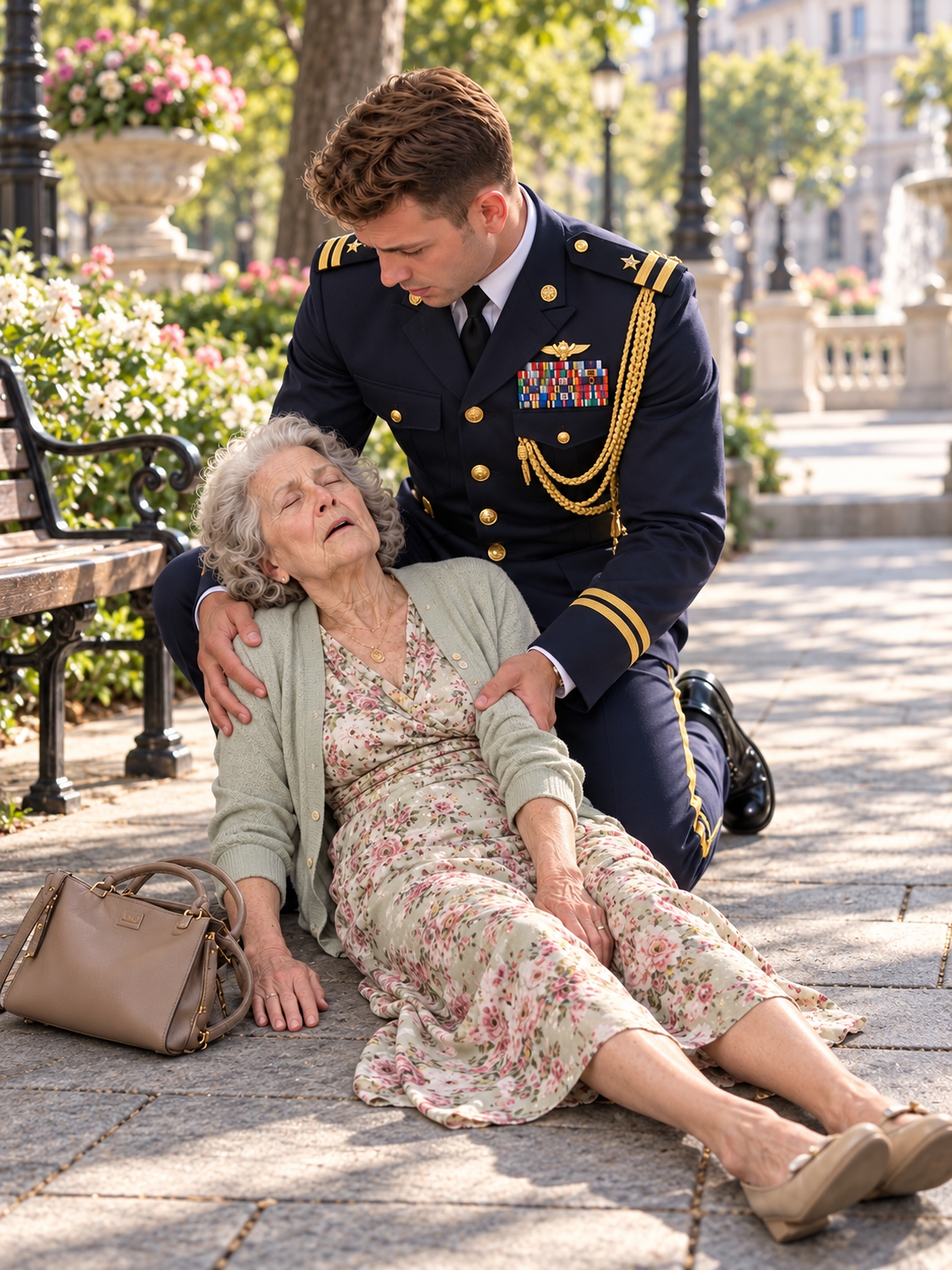
PART 1 TITLE: On the Morning of My Most Important Presentation, a Woman Collapsed Beside the Highway and One Decision Cost Me Everything I Had Worked For
The woman was holding her chest when I first noticed her. Her dark sedan stood on the shoulder of Route 18, its driver’s door hanging open toward the passing traffic. She was leaning against the frame, one hand gripping the metal so tightly that her knuckles looked white. I was already running late for the most important meeting of my career. I remember checking the dashboard clock, looking back at the woman, and realizing that whatever I did next would have consequences I couldn’t predict.
A delivery van passed her without stopping. The SUV directly ahead of me slowed enough for its driver to look, then accelerated again. For several seconds, I considered doing the same. My boss had spent the previous week warning us that nobody could afford a mistake during the Whitcombe presentation. The client represented a major opportunity for our advertising agency. I had prepared nearly every slide myself, and at eight-thirty that morning, I was supposed to stand in front of its executives and explain why they should trust us with their business.
Then the woman slipped. Her knees gave way, and she disappeared below the level of the car window. I heard myself swear before pulling onto the shoulder. Gravel cracked beneath my tires. I grabbed my phone, pushed open the door, and ran toward her while trucks rushed past in the nearest lane. She was lying awkwardly beside the sedan, her silver hair scattered across the damp stones. Her breathing was shallow, and her eyes were open but unfocused. When I knelt beside her, she made a frightened sound and reached for my sleeve.
I called emergency services and gave the dispatcher our location. She asked whether the woman was breathing, whether she could respond, and whether there were any immediate dangers around us. I answered as carefully as I could, although my own voice sounded unfamiliar. The woman tried to speak several times before managing to tell me that her chest hurt. I followed the dispatcher’s instructions, making sure she was supported comfortably and could breathe without further strain. I didn’t know whether she was having a heart attack or something else equally serious.
At one point, she grasped my wrist with surprising force. “Please don’t go,” she murmured. I told her I wouldn’t. Her fingers were cold, and there was a faint smear of dust on the cuff of her expensive-looking coat. I asked her name, but she seemed unable to answer. Instead, she wanted to know whether help was coming. I assured her that an ambulance had been dispatched. When her eyelids began lowering, I called to her again, trying to keep her engaged while we waited.
I talked about whatever came into my head. My daughters, Sophie and Lucy, had argued the night before about whether a person could survive on Mars. Sophie, fourteen, insisted that Lucy was overlooking several important scientific problems. Lucy, nine, had replied that scientists probably hadn’t thought hard enough. The woman managed a faint movement of her lips when I repeated that answer. Encouraged, I told her about the painted coffee mug Lucy had made for my office and how I still used it even though the handle was crooked. The woman whispered something that sounded like a question, so I kept talking.
The ambulance arrived with a siren that rose above the traffic. Two paramedics hurried toward us carrying equipment, and I moved aside while explaining everything I had seen. One of them asked how long she had been down. I gave my best estimate. They checked her vital signs, asked questions, and carefully transferred her onto a stretcher. Before they loaded her into the ambulance, the woman turned her head toward me. She seemed to be searching for something to say. I told her she didn’t have to speak and hoped she could hear me.
As the ambulance pulled away, I stood beside my car and looked at my phone. The screen showed several missed calls. All of them were from Gavin Mercer, the man who ran Mercer & Field, the agency where I had worked for almost four years. I called him immediately, but he didn’t answer. I sent a message explaining that I’d encountered a medical emergency and was on my way. Then I climbed into the driver’s seat, started the engine, and drove toward the office with my shirt damp beneath my jacket.
By the time I reached the agency, the parking lot was nearly full. I hurried across the pavement, trying to straighten my tie while carrying my laptop bag. Through the glass entrance, I could see Nina, our receptionist, standing behind her desk. She looked up when I came through the door. Normally, she would have greeted me with some complaint about the copier or the coffee machine. This time, her expression stopped me. “Chris,” she said quietly, “he’s waiting for you.”
The conference room was empty. That was the first thing I noticed as I approached it. The presentation remained on the large display, frozen on a slide showing the projected growth of the Whitcombe account. Someone had left two untouched glasses of water beside the screen. A chair stood several inches away from the table, as though its occupant had risen abruptly. I looked through the glass and felt my stomach drop. The executives had already left, and the meeting I’d spent most of the night preparing had ended without me.
Gavin emerged from his office before I could ask anyone what had happened. He was a broad-shouldered man who liked expensive watches and considered speaking quietly a sign of weakness. His face was flushed, and he was holding his phone so tightly that I could see the tension in his hand. “Where were you?” he demanded. People at nearby desks stopped typing. I began explaining about the woman on Route 18, the ambulance, and the calls I had tried to make. He interrupted before I finished.
“Was this woman related to you?” he asked. I shook my head. “A friend, then?” Again, I said no. Gavin stared at me, clearly expecting an answer that would justify my decision in terms he understood. When I told him she was a complete stranger, he gave a short, disbelieving laugh. “You abandoned the biggest presentation we’ve had in months because you saw somebody having a bad morning on the highway?” His voice carried across the entire floor. I felt every person within hearing distance turn toward us.
I explained that she had collapsed and needed immediate assistance. I told him I had remained until the paramedics arrived because I couldn’t be certain she would survive alone. Gavin responded by asking why I hadn’t continued driving and called someone later. For a moment, I thought he was exaggerating out of frustration. Then I saw that he meant it. “You had a responsibility here,” he said, pointing toward the conference room. “There were people waiting for you. Other people’s jobs depend on us securing accounts.”
I wanted to tell him that I understood responsibility better than he realized. For four years, I’d accepted late-night calls when campaigns were falling apart. I’d missed family dinners, worked through illnesses, and spent Sundays repairing presentations that should have been finished on Friday. More than once, Gavin had promised that the agency would eventually reward my loyalty. I had believed him because I wanted to believe there was a connection between working hard and building a secure future. Now he was treating those years as though they meant nothing.
“I didn’t decide to miss the meeting,” I said, trying to keep my voice steady. “I encountered someone who might have died before help arrived.” Gavin stepped closer. He asked whether I expected the company to operate according to whatever emergency happened to catch my attention. I looked toward the conference room again, imagining the clients sitting there, checking their watches. I understood why he was angry. I even understood the business consequences. What I couldn’t accept was his insistence that saving time should have mattered more than a person’s life.
When I asked whether he genuinely believed I should have left her there, he answered without hesitation. “You should have come to work.” Nobody spoke. One of the junior designers lowered his eyes toward his keyboard. An account manager who’d asked for my help almost every day that month suddenly became absorbed in a document on her screen. Their silence hurt more than I expected. I wasn’t asking anyone to defend my performance or excuse a mistake. I wanted just one person to acknowledge that there had been no decent alternative.
Gavin made the decision while we were still standing in the open office. He told me that my employment was terminated and that I should collect my belongings. There was no discussion about the hours I’d worked, the accounts I’d rescued, or the fact that I had never been disciplined before. I asked whether he was serious. He said there was nothing further to discuss. The dismissal was so abrupt that I couldn’t immediately process it. My mind kept returning to ordinary things: the mortgage payment, the girls’ tuition, and the groceries I had promised to buy that evening.
I didn’t deliver a clever response. I simply stood there with my face burning, aware that my eyes were filling with tears. Gavin looked impatient rather than uncomfortable. He pointed toward my desk, then told me to leave the building. I couldn’t bear the thought of gathering four years’ worth of personal belongings while everyone watched. I said I’d return for them later. He shrugged, already turning toward his office, and called Nina to arrange the necessary paperwork. My entire career had been reduced to an administrative inconvenience.
Outside, the sunlight struck my face so sharply that I stopped beside the entrance. A coworker hurried past carrying coffee and pretended not to notice me. I crossed the parking lot, climbed into my car, and locked the doors. For several minutes, I sat without moving. Then I struck the steering wheel with both palms and shouted until my throat hurt. It was an ugly, helpless sound. I had been frightened beside the highway that morning, but fear had given me something useful to do. This time, there was nothing to fix.
I was thirty-eight years old, divorced, and responsible for two daughters who depended on me. My former wife, Sarah, and I had worked hard to establish a manageable relationship after our marriage ended. We shared school responsibilities, medical appointments, and the endless small expenses that came with raising children. Neither of us had enough money to treat a sudden loss of income casually. I earned a good salary, but our obligations consumed most of it. The thought of explaining that I’d been dismissed for helping a stranger seemed almost impossible.
Sarah called while I was still in the parking lot. She was supposed to collect the girls after school, and I assumed she wanted to discuss their schedule. The moment I answered, she asked what was wrong. She had always been able to detect a problem from the first few words I spoke. I tried to dismiss her concern, but she wouldn’t let it go. Finally, I told her I no longer had a job. There was a long silence, followed by a quiet question about what had happened.
I described the roadside emergency and Gavin’s reaction. Sarah listened without interrupting. When I finished, she sounded genuinely stunned. She knew how much time I had invested in Mercer & Field. She also knew Gavin’s temper, although she’d never imagined he would dismiss me under circumstances like these. She asked whether I had received anything in writing. I said I hadn’t. Then she reminded me that tuition was due the following week. She wasn’t accusing me of anything. She was thinking ahead because someone had to.
I reacted badly. “I know what we owe,” I said, sharper than I intended. Sarah went quiet. I could almost see her standing in the kitchen, deciding whether to argue or let me recover. After a moment, I apologized. She accepted it without making me explain myself. Then she asked whether I would be all right. I told her I’d find another position. She said she’d always known me to find a way through difficult situations. It was meant to comfort me. Instead, I felt the weight of being someone everyone expected to remain capable.
After we hung up, I left the parking lot and drove without a destination. I passed the supermarket where Lucy liked choosing pastries, a gas station I’d used for years, and the turn toward the neighborhood where Sarah lived. Every familiar place seemed connected to an expense I might soon struggle to cover. Eventually, I found myself outside a diner Sarah and I had frequented when we were married. Its faded sign and cracked red booths hadn’t changed much. I parked, went inside, and chose a table near the window.
Marlene, the waitress, recognized me immediately. She brought coffee without asking and remarked that I looked as though I’d received particularly bad news. I told her I’d lost my job. She rested the coffee pot against her hip and asked whether the agency had closed. When I explained the real reason, she listened with an expression that grew steadily less amused. She wanted to know whether the woman had survived. I said the paramedics had taken her to the hospital, but I didn’t know anything beyond that.
Marlene glanced toward the busy street outside. “You made the choice most people hope somebody would make for them,” she said. She wasn’t trying to offer professional advice. She was stating something she regarded as obvious. I appreciated it, but appreciation wouldn’t pay my bills. I opened my laptop and started reviewing available marketing positions. There were listings for account directors, campaign strategists, and senior creative managers. Some paid less than I’d been earning. Others required experience I didn’t have. Every application seemed likely to take weeks.
I began rewriting my résumé while Marlene refilled my cup. Four years at Mercer & Field occupied more space than I’d expected. There were campaigns I had built from almost nothing, difficult clients I’d retained, and younger employees I’d helped train. Seeing those accomplishments together was strange. At the agency, Gavin had usually treated them as the minimum he expected. Written plainly on a page, they looked like a considerable amount of work. I wondered how much of it had ever been recognized beyond the office.
My phone rang just as I was reviewing the second page. The screen showed the agency’s main number. I let it ring. Gavin had made his position clear, and I had nothing useful to say to him. The phone stopped, then started again a minute later. I ignored it a second time. When a text appeared from Nina asking me to answer urgently, I considered deleting it. Then I remembered the personal photographs, notebook, and Father’s Day headphones still sitting beside my old computer.
I called back. Nina answered immediately, asking where I was. I told her I was not interested in another confrontation and would collect my belongings when the office was quieter. She interrupted, something she almost never did. “Chris, this isn’t about your things,” she said. “There’s somebody here asking for you.” I assumed she meant a client, perhaps someone who hadn’t heard about my dismissal. But Nina corrected me. A woman had arrived at reception claiming that I had helped her earlier that morning.
I stood so suddenly that my knee struck the underside of the table. My first question was whether the woman was all right. Nina assured me she was standing, speaking normally, and apparently recovering. Relief washed over me with such force that I had to sit down again. Whatever else had happened, she was alive. I told Nina to pass along my best wishes and explain that I no longer worked there. But Nina refused to end the conversation. She said the woman specifically wanted to see me.
“Why?” I asked. Nina lowered her voice. She told me the visitor had arrived with three other people. One was a lawyer, and the other two were discussing a company called Halston Capital. I recognized the name immediately. Halston was a powerful investment organization with interests in numerous industries, the sort of business regularly mentioned in financial newspapers. I couldn’t imagine what its representatives wanted with an unemployed advertising executive. Yet Nina seemed more concerned about something else. Gavin had taken the visitors into the main conference room.
I asked whether he was angry. Nina paused before answering. “He’s not angry anymore,” she said. “I’ve never seen him like this.” Through the phone, I could hear voices moving across the reception area, followed by a door closing. Nina whispered that Gavin appeared frightened and had been asking repeatedly whether she had reached me. I looked at my unfinished résumé, the cold coffee, and the phone in my hand. Then I asked her to tell the visitors that I was coming.
I paid Marlene, closed my laptop, and returned to my car. I wasn’t going back to beg Gavin for my position. I wanted to retrieve the few things that belonged to me and make certain the woman I’d helped was recovering. Those reasons seemed straightforward enough. Yet as I drove toward Mercer & Field, one question kept returning. Why would an elderly woman who had barely been able to breathe beside a highway arrive at my former workplace accompanied by an attorney and representatives of one of the country’s most influential investment firms?
END PART 1
PART 2 TITLE: The Stranger Returned With Powerful People, and My Boss Discovered That the Employee He Had Dismissed Was Not the Only Person He Had Misjudged
When I returned to Mercer & Field, the first thing I noticed was that nobody appeared to be working. People sat at their desks with documents open in front of them, but their attention kept drifting toward Conference One. Two junior employees were whispering near the printer, and the account manager who had avoided looking at me earlier abruptly straightened when I entered. Nina stood behind reception with her hands clasped together. She looked relieved to see me, although there was something else in her expression that I couldn’t identify.
I told her I only wanted to collect my belongings and speak briefly with the woman. Nina glanced toward the conference room. Through its glass walls, I could see Gavin standing beside the table with several visitors. His posture was remarkably different from the one he’d adopted while dismissing me. Instead of occupying the center of the room and gesturing impatiently, he stood with his shoulders slightly drawn inward, allowing the others to speak. I had spent almost four years watching Gavin dominate meetings. Seeing him listen without interrupting was unsettling.
The elderly woman stood near the far end of the table. She wore a tailored gray jacket, and her silver hair had been neatly arranged. The person I’d seen struggling to breathe on wet gravel seemed almost impossible to reconcile with this composed figure. There was still some weariness around her eyes, but she stood straight and spoke with assurance. Two men in dark suits were reviewing documents while a woman carrying a leather portfolio listened. When the older woman noticed me through the glass, she stopped speaking.
She walked out of the room before anyone could follow. “Christopher?” she asked. I nodded, and she reached for my hands. Her fingers were warmer now. I could see a small mark near her wrist where the paramedics had worked earlier. She asked whether I remembered her, and I couldn’t help smiling. I told her it would be difficult to forget a morning like ours. She looked at me for a long moment, then thanked me with a seriousness that made me uncomfortable.
I asked about her health. She explained that the doctors had examined her and that she was under instructions to rest and undergo further testing. She had insisted on coming here first, despite objections from her medical team. That worried me, and I told her she should probably have stayed at the hospital. She gave a brief, dry laugh. “I’ve spent most of my life listening to advice,” she said. “It doesn’t mean I always follow it.” Her voice was stronger than it had been beside the road, but the fatigue beneath it was unmistakable.
She asked whether I remembered what we’d talked about while waiting for the ambulance. I mentioned my daughters. Her face softened immediately. She remembered their names, the argument about Mars, and Lucy’s crooked mug. Apparently, she had been much more aware of our conversation than I’d realized. She explained that concentrating on my voice had helped her stay calm while she waited for medical assistance. “You kept asking me questions,” I said. “I was trying to make sure you could answer.” She smiled and told me that those questions had mattered.
Then she asked what had happened after the ambulance departed. I hesitated. Gavin had moved into the hallway and was watching us carefully. I didn’t want to turn the woman’s gratitude into a complaint about my employment. I told her that the morning had been difficult but that she shouldn’t worry about it. She studied my face, then looked past me toward the desks and the empty cardboard box Nina had placed near my workstation. Her expression changed. “Christopher,” she said, “why are your things being packed?”
Before I could answer, Gavin approached. He greeted the woman with exaggerated warmth and suggested that they continue their conversation in private. He was smiling, but his eyes kept shifting toward me. The woman didn’t move. Instead, she asked him to explain why I appeared to be leaving the company. Gavin began describing an unfortunate scheduling problem, choosing his words with a care I’d never seen him exercise. He referred to operational responsibilities, client expectations, and the difficulty of managing a competitive agency.
The woman listened until he finished. Then she asked one simple question. “Did you dismiss him because he stopped to help me?” Gavin’s smile weakened. He replied that my termination involved a serious professional failure, not a personal judgment about the incident. She asked whether I had explained the emergency. He acknowledged that I had. She asked whether the company knew why I was late. Again, he said yes. The woman looked toward me as though making certain she had understood correctly.
I watched Gavin attempt to defend himself. He explained that I had missed a scheduled presentation to a potential account and that the client had departed without awarding us the business. He emphasized the size of the lost opportunity and the employees whose livelihoods depended on successful contracts. His argument was familiar because he’d repeated it to me earlier, only louder and with fewer qualifications. But the woman seemed unimpressed. She asked him how long I had worked there and whether I had a record of poor performance.
Gavin admitted that I’d been with the agency for almost four years. He couldn’t recall a significant disciplinary issue. When she asked whether I had contributed to important client relationships, he hesitated before saying that everyone on the team had responsibilities. One of her associates glanced at a tablet, apparently checking information. I was increasingly confused by the exchange. These strangers weren’t behaving like people who had simply accompanied a recovering patient to thank the man who had helped her.
Gavin addressed the woman by her surname, and something in his tone caught my attention. I looked again at the portfolio carried by the attorney. Embossed across the leather was the name HALSTON CAPITAL. I examined the elderly woman’s face, trying to match it with photographs I had seen in business publications. The realization came slowly, then all at once. I asked whether she was Eleanor Halston. She inclined her head, almost as if she had been expecting the question.
Eleanor Halston was not merely associated with the investment firm. She was the woman who had helped create its foundations. Nearly forty years earlier, she and her husband had established Halston Industrial, building it into a successful enterprise before expanding into other investments. Following her husband’s death, Eleanor had transformed the family business into an organization with holdings across numerous sectors. The firm’s name appeared in stories about acquisitions, major development projects, and investments involving enormous sums of money. I had seen her photograph before, but never imagined meeting her under circumstances like these.
I apologized for failing to recognize her beside the road. Eleanor seemed pleased rather than offended. She said it meant I had acted without any expectation of receiving something in return. I told her that knowing her identity would not have changed what I’d done. She considered that for a moment before answering that the important thing was how I’d behaved when I didn’t know. Gavin was standing close enough to hear every word. His expression had become increasingly strained, and I could tell that he wanted the conversation to end.
Eleanor turned toward him and asked how long he had been in discussions with Halston Capital. Gavin looked startled. He reminded her that their negotiations were confidential. She replied that confidentiality no longer served a purpose if the negotiations themselves were ending. I looked from one to the other, unable to understand what she meant. One of her associates opened a document, and Eleanor explained that Halston Capital had been studying Mercer & Field for a possible acquisition over the preceding six months.
I felt a flush of disbelief. Nobody on the creative team had been told that the agency might be sold. Gavin had discussed financial pressure repeatedly, often using it to justify delayed raises and heavier workloads, yet he’d never mentioned an interested buyer. Eleanor explained that her company had completed substantial preliminary work and that the proposed transaction valued Mercer & Field at approximately eighteen million dollars. The number seemed absurdly large compared with the office supplies Gavin complained about purchasing.
Gavin began speaking quickly. He insisted that a private disagreement involving one employee shouldn’t influence a corporate acquisition. Eleanor asked him to describe the qualities he believed made his company worth buying. He mentioned client loyalty, creative talent, consistent performance, and the agency’s ability to retain valuable business. She allowed him to finish before pointing out that employees were responsible for much of what he’d just described. If management could discard a productive member of that team without considering the circumstances, she said, her company needed to reconsider the risk of investing in that leadership.
The attorney beside her stated that Halston Capital would discontinue the proposed acquisition. There were documents to be prepared and formal notices to issue, but the decision itself had been made. Gavin stared at Eleanor in disbelief. He asked whether she understood how much damage the cancellation could cause. She replied that she understood the financial consequences and had not reached the decision casually. He tried to argue that she was allowing a personal experience to determine a business transaction. Eleanor answered that management judgment was precisely what an investor had to evaluate.
Then she asked her associate for information about my work. He reviewed the due-diligence records and explained that campaigns I had led or substantially developed were associated with roughly thirty-one percent of retained client revenue during the previous three years. I had never seen that calculation. I knew which accounts I’d worked on, which deadlines I’d rescued, and which clients had called me when Gavin stopped returning their messages. But hearing those responsibilities translated into a measurable portion of the agency’s income left me speechless.
Gavin disputed the significance of the figure. He argued that no single employee could claim credit for a campaign’s success. Eleanor agreed that business results came from teams, then asked why those teams were not being treated as important assets. She inquired about my work history, weekend assignments, and performance evaluations. Gavin offered general answers but few details. I could see his frustration growing. For the first time, someone was asking him to account for the difference between the loyalty he expected and the loyalty he gave.
Eleanor turned toward me and asked what Gavin had said when I explained the roadside emergency. I wanted to be careful. Being angry at someone didn’t give me permission to misrepresent his words, and I had no desire to make the situation more dramatic than it already was. So I described the conversation as accurately as I could. I explained that Gavin had asked whether the woman was a relative, then whether she was someone I knew. When I answered that she was a stranger, he’d said I should have continued driving.
A quiet settled over the reception area. Eleanor didn’t respond immediately. She looked at Gavin with an expression that contained more disappointment than anger. Then she asked whether my account was accurate. He attempted to explain the statement as something said under extreme pressure. She asked whether he would make a different decision now. He insisted the company had standards to maintain. Eleanor listened, then turned away. His answer had apparently told her everything she needed to know.
I expected her to offer compensation for the trouble I’d experienced. Instead, she reached into her handbag and handed me a business card. Her name and the address of Halston Capital’s executive offices were printed beneath the firm’s logo. She asked whether I could visit on Monday. I looked at the card, uncertain what to say. She explained that she wanted to discuss a professional possibility. I reminded her that my experience was in advertising, not investment management.
Eleanor said she was aware of my background. She didn’t pretend that helping her qualified me to manage financial investments, but she’d seen enough of my employment record to believe a conversation was worthwhile. She wanted to understand how I approached difficult decisions, managed teams, and maintained client relationships. I told her that she was giving me an extraordinary amount of attention for doing something I considered ordinary. She replied that she’d rather examine my qualifications herself than accept Gavin’s assessment of my value.
Gavin suddenly changed his approach. He called me an important member of the agency and suggested that my dismissal had been made too hastily. He offered to meet privately and discuss reinstatement. The change was so abrupt that I almost laughed. Earlier, he’d refused to consider a single explanation. Now, with a canceled acquisition and influential visitors watching, he wanted us to talk like colleagues resolving a misunderstanding. He promised that my employment record could be corrected and the entire incident forgotten.
For a moment, I was tempted. I knew the agency. I knew the clients, the software, the people, and the projects that would need attention the following week. Returning would mean keeping my salary and avoiding the uncertainty I’d been staring at in Marlene’s diner. But I also remembered the silence after Gavin dismissed me, the way he’d reduced a medical emergency to a scheduling inconvenience, and the ease with which he’d told me to leave. I realized I no longer trusted him to decide my future.
I thanked him for the offer and declined. Gavin looked genuinely surprised. He reminded me that I’d spent almost four years building a career there and shouldn’t discard that investment because of one difficult morning. I told him those years still belonged to me, regardless of where I worked next. What I couldn’t recover was confidence in his judgment. I didn’t raise my voice. The words came more easily than I expected, perhaps because I finally understood that I didn’t need him to approve of them.
I returned to my desk with the cardboard box Nina had prepared. The first thing I packed was the framed photograph of Sophie and Lucy taken during our previous summer holiday. Then came my notebook, headphones, the painted mug, and a small plastic astronaut Lucy had once hidden in my drawer. She’d told me every serious office needed something ridiculous in it. I found the astronaut behind a stack of old campaign notes and stood holding it for a moment longer than necessary.
Coworkers approached individually. Some apologized for remaining silent during the dismissal. Others said they hadn’t known what to do. I didn’t want to make anyone feel worse. They still had jobs to protect, and Gavin still held authority over the agency. Nina hugged me, then stepped away wiping her eyes. A junior designer thanked me for the guidance I’d given him during his first campaign. These conversations were brief, sometimes awkward, but they reminded me that my time at Mercer & Field had meant something beyond revenue reports.
Eleanor remained near the conference room while I packed. When I asked why she hadn’t left, she said she wanted to make sure I was treated properly. I reminded her that she needed medical rest. She admitted that her doctors would probably be furious when they learned where she’d gone. I found myself smiling for the first time since the morning. She seemed pleased by that. Then she looked toward the agency’s employees and asked how often people thanked them for work that never appeared in a presentation.
Before I could answer, one of the men accompanying her emerged from the conference room. He was Daniel, a senior Halston associate whose calm manner had remained unchanged throughout the confrontation. Now he looked distinctly troubled. He asked Eleanor to join him immediately. She wanted to know what had happened. Daniel glanced toward my desk before explaining that Halston’s team had discovered unauthorized access to confidential documents associated with the proposed Mercer & Field acquisition.
Eleanor asked where the documents had been accessed. Daniel said the activity appeared to originate inside the agency during the previous night. Gavin stepped closer, looking alarmed. I assumed the incident concerned one of the agency’s executives or perhaps the finance department. The acquisition had been confidential, after all, and I had known nothing about it until an hour earlier. Then Daniel showed us the computer identifier connected to the suspicious activity. My name appeared beside the device information.
I stared at the screen. CHRISTOPHER BENNETT. For several seconds, I couldn’t understand what I was seeing. The documents had apparently been accessed through my computer, the same laptop I’d used until nearly midnight preparing the Whitcombe presentation. I told Daniel there had to be an error. Gavin moved beside me, his face suddenly pale. I turned toward him, expecting him to confirm that I had never been part of the acquisition negotiations. Instead, he looked at my laptop and told me, in a low and urgent voice, not to open it.
END PART 2
PART 3 TITLE: Someone Had Planted Confidential Files on My Laptop, and the Evidence Pointed Toward a Person Who Had Been Standing Beside Me All Along
Gavin’s warning made the room feel suddenly smaller. I stood beside my desk with the cardboard box in my arms, staring at the laptop I’d used almost every working day for four years. Its lid was closed, the charging light glowing near the corner. Nothing about it looked unusual. Yet Daniel’s report suggested that someone had used my computer to access confidential corporate material I wasn’t supposed to know existed. I asked Gavin what he meant. He looked away and said he’d only been advising caution.
Daniel requested that nobody touch the equipment until the activity could be examined properly. Eleanor instructed Gavin to cooperate with the investigation. He objected at first, saying Halston Capital no longer had any reason to examine the agency’s systems after canceling the acquisition. Daniel reminded him that the existing due-diligence agreement still contained confidentiality and investigative provisions. The agency’s IT manager was called, and a cybersecurity specialist joined the discussion remotely. Meanwhile, I stood watching the people around my desk as though I had become a visitor to my own working life.
My daughter’s photograph was still propped beside the laptop. Sophie and Lucy were laughing on a beach, each holding a melting ice cream. I remembered taking the picture just before Lucy dropped hers into the sand. It seemed absurd that the same desk could contain that harmless memory and evidence of a possible corporate crime. Daniel asked whether I had ever received documents concerning the Halston acquisition. I told him that I hadn’t even known negotiations were underway until Eleanor announced them.
He asked whether anyone else could access my computer. I explained that IT maintained administrative accounts and that Gavin could request access to any company device. Like most employees, I was expected to keep my workstation secure, but the laptop itself belonged to Mercer & Field. Daniel wanted to know whether I ever allowed colleagues to borrow it. Occasionally, someone needed to review a campaign or retrieve a design file while I was elsewhere, but I’d never deliberately shared my credentials. He wrote down my answers without commenting.
When the technical specialist was ready, Daniel asked me to open the computer under supervision. The familiar desktop appeared. My email program was still open to a message concerning the Whitcombe presentation, and a draft design file occupied part of the screen. Then the specialist directed our attention to a folder that didn’t belong there. It had an unmistakable name: HALSTON_DUE_DILIGENCE_FINAL. I stared at it, trying to remember whether I’d ever seen those words. I hadn’t. I said so immediately.
Gavin stepped forward and remarked that perhaps someone had sent me the files accidentally. Daniel asked him to stop speculating. The specialist explained that the folder’s presence alone didn’t identify who had placed it there. They needed to examine activity records, file creation information, and the company’s access logs. I appreciated his care with the evidence. Everyone else seemed eager to reach a conclusion, and the only conclusion I was certain of was that I had never intentionally accessed confidential Halston documents.
The examination began with the previous night’s activity. According to the available records, the files had been placed on my computer at approximately 11:42 p.m. I remembered the time because I had been working until midnight, making last-minute revisions to the Whitcombe presentation. It had been a particularly unpleasant evening. Gavin had rejected two versions of the financial projections before approving the third, and I had stayed behind to make sure the final deck would display correctly on the conference-room monitor.
Daniel asked me to reconstruct the evening from memory. Nina had left around six. Most of the creative staff went home before eight, and the cleaning crew finished at approximately ten. I had eaten a vending-machine sandwich because leaving the building to find proper food would have taken too long. Later, I revised several charts and sent myself reminders about questions the Whitcombe executives might ask. The office was quiet enough that I could hear the air-conditioning system cycling above the ceiling tiles.
Then I remembered Gavin. He had come into my office after eleven-thirty, wearing the gray overcoat he usually kept for client meetings. He’d asked whether the presentation would be ready and complained that his wife was unhappy because he’d missed dinner again. I had assured him the remaining changes were minor. He’d glanced at my screen before returning toward his office. When Daniel asked whether Gavin had actually left the building, I realized I couldn’t say. I had assumed he’d gone home, but I hadn’t seen him depart.
Gavin interrupted to insist that my recollection was wrong. He said he’d left around eleven and had not returned. I described his coat and repeated our conversation about his wife. He told me I was confusing one evening with another. That was possible in theory. We had worked late many times, and Gavin had often complained about his marriage. But something about the previous night remained particularly clear. I’d been exhausted, my coffee was cold, and I’d been annoyed that he kept checking whether I was finished without offering to help.
The specialist asked whether I’d stepped away from the laptop during the evening. I said I’d gone downstairs for coffee shortly before midnight. The machine on our floor had stopped working, so I’d used the one near the building’s ground-floor entrance. I estimated that the trip had taken about five minutes. Daniel asked whether I’d locked the screen. I hesitated. Usually, I did, but I couldn’t honestly remember doing it that time. I’d been focused on getting back to the presentation.
The transfer time fell inside that absence. The discovery made me feel physically ill. I understood how it would look to someone examining the evidence without knowing me. Confidential files had appeared on a computer assigned to my name, late at night, while I was responsible for the device. If the matter became public, it could damage my reputation even if no charges were ever filed. Future employers might see a dismissed advertising executive connected to an investigation involving stolen corporate information. I thought about Sarah’s confidence that I’d find another job and wondered what I would tell her.
Gavin folded his arms and suggested that the evidence was becoming straightforward. His tone bothered me. He had defended me moments earlier, insisting I couldn’t possibly be involved. Now he appeared almost relieved that the activity had occurred under my account. I asked whether he was accusing me of stealing the material. He replied that he wasn’t accusing anybody, only acknowledging the facts. Then he said I should have secured my workstation properly. The observation was reasonable enough, but the satisfaction beneath it wasn’t.
I remembered another part of our conversation the previous night. Gavin had seen me preparing to go downstairs and asked me to bring him coffee as well. I hadn’t mentioned that detail because it had seemed unimportant. Now I looked directly at him and asked whether he remembered. His expression tightened. He said he’d probably requested coffee hundreds of times over the years. I agreed. But the point wasn’t that he liked coffee. The point was that he’d known exactly when my workstation would be unattended.
Daniel asked Gavin to remain quiet while the specialist continued. Additional records showed that the documents had been transferred using a removable storage device. The specialist couldn’t identify its owner from the initial information, but the system had recorded a hardware identifier. Daniel asked whether the same device could be recognized if it were located. The specialist said it could. Gavin shifted his weight and moved closer to the doorway. Eleanor noticed and asked whether he needed to leave. He answered that he merely wanted to return to his work.
Eleanor refused. The IT manager was already reviewing the agency’s available equipment records. Daniel asked whether other workstations could be examined with the company’s authorization. Gavin began protesting that the investigation was interfering with operations. Eleanor replied that unauthorized disclosure of confidential acquisition material could have serious legal consequences. The disagreement ended when the IT manager confirmed that Gavin’s own computer was available for inspection. Daniel requested that the device be checked and the findings properly documented.
I watched Gavin’s reaction. It wasn’t the explosive anger I’d seen during my dismissal. Instead, he became unnaturally still. His mouth opened slightly before he pressed his lips together. When the IT manager stepped into his office, Gavin started explaining why his computer contained numerous sensitive business records. Nobody had asked him about those records. Daniel was interested in one particular device, and Gavin seemed unable to stop talking long enough to hear that distinction.
The IT manager returned carrying a small black flash drive. He explained that it had been connected to Gavin’s desktop computer. Gavin immediately denied owning it. He suggested that somebody must have left it there during a meeting. Daniel placed it in a protective container and asked the specialist to compare its identifier against the transfer records. The waiting felt interminable. My stomach had been tightening for hours, and I realized I’d barely eaten since Marlene brought me coffee that morning.
The identifiers matched. The same removable drive recorded in the transfer involving my laptop had been found connected to Gavin’s workstation. It didn’t automatically explain who had copied the files or why, but it changed the direction of the investigation. Gavin began speaking over everyone. He blamed the IT department, questioned the reliability of the software, and suggested that the device might have been planted. He even wondered aloud whether a member of the cleaning staff had accessed his office.
Daniel asked him to identify anyone who had permission to use the flash drive. Gavin refused to provide a direct answer. He said the agency handled confidential information constantly and couldn’t be expected to investigate every electronic device. Eleanor listened until his explanations became repetitive. Then she asked the IT manager and the other employees to leave the room. Daniel remained, and I was asked to stay because the files had been placed on my computer. I would have preferred to walk out, but by then I needed to know what had happened.
Behind the closed conference-room door, Eleanor asked Gavin why confidential Halston documents had been transferred through the agency’s systems. He stared at the flash drive for a long time. When he finally answered, he mentioned Richard Field. I recognized the surname, naturally, because it was part of the company’s name. Yet I knew almost nothing about the man himself. Gavin had occasionally described him as a former partner who had retired and retained only a limited financial interest.
According to Gavin, Richard believed Halston Capital’s proposed acquisition undervalued the agency. He claimed that Richard had asked for additional financial information so he could evaluate the offer. When Daniel asked whether Gavin had provided unauthorized access to the confidential acquisition records, Gavin insisted that he had only been protecting the company’s interests. Eleanor reminded him that there were proper procedures for reviewing an offer and that secretly moving protected documents onto an employee’s computer was not one of them.
I asked why any of those documents needed to be placed on my laptop. Gavin said he hadn’t intended for me to become involved. He spoke as though my computer had been merely a convenient location rather than an account assigned to a real person. I pointed out that his actions could make it appear that I’d taken the files myself. He became defensive and insisted that nobody would have looked at my device if the morning’s events hadn’t created so much confusion. That answer frightened me more than his earlier anger.
Daniel wanted to know whether Richard had actually instructed Gavin to obtain confidential materials. Before Gavin could offer another explanation, someone spoke from the doorway. The voice was unfamiliar to me, but Gavin reacted immediately. A tall man with silver hair stood there wearing a camel-colored coat. He appeared to be in his early sixties, and his expression suggested he’d heard more than enough. He introduced himself as Richard Field and looked at Gavin with a mixture of anger and disappointment.
Richard explained that Halston’s legal representatives had contacted him after discovering the unauthorized transfer. He had come to establish what had happened and protect the business from further damage. Gavin demanded to know why he hadn’t called first. Richard replied that a warning would only have given him more time to alter his explanation. He then made it clear that he had not instructed Gavin to conceal acquisition files on an employee’s computer. Whatever disagreements they’d had about the valuation, Gavin had acted without his approval.
The exchange revealed how little I understood about the agency’s ownership. Richard still held forty-nine percent of Mercer & Field. He hadn’t retired because his interest in the business had disappeared. He’d withdrawn from daily management after repeated disagreements with Gavin about how employees and clients were treated. Gavin held the controlling interest, but their shareholder arrangements included protections against serious misconduct. Richard had returned because the possible misuse of confidential material triggered provisions Gavin seemed to have forgotten.
Richard turned toward me and asked whether I was Christopher Bennett. I confirmed it. He said he’d heard my name in conversations with clients, particularly when they discussed campaigns Gavin claimed to have developed. I felt embarrassed by the attention, but Richard was not trying to flatter me. He explained that he had remained informed about important client relationships despite being absent from daily operations. My work had apparently reached him through those reports. Gavin ordered him to stop discussing internal matters in front of me.
Richard ignored the demand. He placed a document on the conference table and explained that Gavin was being suspended from executive responsibilities pending a formal investigation. Gavin read the notice, then immediately began arguing that Richard lacked the authority to act. Richard referred him to the relevant provisions of their agreement. Daniel confirmed that the suspected breach of confidentiality was a serious matter. Gavin’s expression changed as he realized the discussion had moved beyond threats and into an enforceable corporate process.
Gavin looked toward me as though expecting support. He reminded me of the opportunities he’d given me and claimed that the agency had helped build my career. I thought about the nights I’d spent there, the missed weekends with my daughters, and the morning he’d told me to leave a collapsed stranger beside the road. Those experiences were part of my career, but they didn’t make his actions acceptable. I told him I would cooperate with an honest investigation and that I had nothing more to say about my dismissal.
Richard completed the formal notification. Gavin was instructed to surrender his executive access while the matter was reviewed. For the first time since I’d known him, he seemed uncertain how to respond when raising his voice failed to change the outcome. He sat down and stared at the document. I expected to feel victorious. Instead, I was exhausted. My name was still connected to confidential files, and the investigation had only begun to explain why. I wanted to collect my photographs and go home.
Then Daniel’s phone rang. He listened for several seconds, asked the caller to repeat something, and stepped away from the table. His expression became increasingly serious. When the conversation ended, Eleanor asked whether the news concerned the agency. Daniel shook his head. The call had come from the people reviewing records related to her medical emergency. They had discovered that another emergency-services call had been placed before I contacted the dispatcher on Route 18.
I remembered making that call beside the woman’s car. I had reported her condition and stayed with her until the paramedics arrived. Daniel explained that an earlier caller had already provided the location of an elderly woman in distress near mile marker twenty-two. The detail was strange because no one else had been standing beside her when I stopped. I asked whether the caller had witnessed her collapse from another vehicle. Daniel said investigators were examining that possibility, but there was a problem with the timing.
The first call had been placed before Eleanor fell to the ground. It hadn’t simply preceded my arrival. The caller had described her location and apparent medical emergency before the collapse I had witnessed. Eleanor gripped the edge of the conference table, trying to understand what that meant. Gavin’s investigation suddenly seemed connected to something far larger, although I couldn’t imagine how. Daniel looked at her and said that somebody might have been following her that morning, watching closely enough to know what was about to happen.
END PART 3
PART 4 TITLE: The Emergency Call Exposed a Disturbing Timeline, and a Family Connection Began to Explain Why Someone Had Been Watching the Woman I Saved
Eleanor refused to leave the building after Daniel explained what investigators had discovered. Her attorney urged her to return to the hospital, and a member of her security team suggested arranging a protected location where she could recover. She listened to both recommendations before saying she wanted to understand the sequence of events first. There was no anger in her voice. She looked tired, as though the morning had finally caught up with her, but the possibility that somebody had anticipated her medical emergency disturbed her too much to ignore.
We moved into a larger conference room on the upper floor, away from the employees who were still trying to understand why their boss had been suspended. Richard joined us briefly to arrange the agency’s cooperation with the investigation. Gavin remained downstairs, where his executive access was being reviewed. I had no official role in any of these discussions. I was an unemployed advertising executive who had stopped to help someone on the road. Yet Daniel asked me to stay because I had been present during the incident and might remember details nobody else had noticed.
The security team began reconstructing Eleanor’s morning. She had left her estate at approximately 6:40, earlier than most people expected a woman of her position to be traveling alone. She sometimes preferred driving herself rather than using a chauffeur, especially on familiar routes. At 7:10, she’d stopped at a bakery she’d visited on Saturdays for fourteen years. The staff recognized her, and there were records confirming her purchase. At 7:35, she’d resumed her journey toward the city, intending to visit her office before attending to several personal appointments.
Eleanor remembered feeling unwell shortly before reaching mile marker twenty-two on Route 18. She had experienced dizziness and an uncomfortable pressure in her chest. At approximately 7:51, she pulled onto the shoulder and opened the driver’s door, hoping a little fresh air would help. She remembered holding the doorframe because her legs felt unreliable. Then her recollection became confused. Based on her account and my observations, the investigators estimated that she collapsed at approximately 7:53. I had stopped beside her about a minute later.
Daniel displayed the emergency-services timeline. The record showed that an unidentified caller had contacted dispatch at 7:51 and reported an elderly woman experiencing distress near mile marker twenty-two. The call had ended quickly, without the caller remaining on the line to provide further assistance. My own call appeared afterward, consistent with my account of discovering Eleanor on the ground. The first report troubled Daniel because it identified the location with unusual precision and appeared to anticipate the most serious part of the incident.
I asked whether the caller might simply have seen Eleanor struggling against the car before she fell. That seemed possible to me. I’d noticed her condition from several vehicles behind, and someone traveling in the opposite direction could have done the same. Daniel agreed that investigators needed to consider ordinary explanations. But he pointed out that the report had been made at almost the exact moment Eleanor pulled onto the shoulder. Whoever called seemed to know where to direct emergency services without remaining to help her.
The attorney reviewed the medical information available from Eleanor’s hospital visit. Her episode was consistent with an underlying cardiac condition requiring continued evaluation. The physicians had found no clear indication of poisoning or another deliberate external cause. That distinction mattered. Nobody had evidence that someone physically caused her to become ill, and Daniel was careful not to suggest otherwise. The suspicious fact was that a person might have known her location and condition before the situation had fully developed.
Eleanor rubbed her forehead. She said her routine had been predictable for years, especially the Saturday bakery visits. A person familiar with her habits would have had little difficulty anticipating her route. She also acknowledged that her private schedule wasn’t as private as her security advisers might have preferred. Relatives sometimes knew where she intended to go, and she occasionally shared plans with business associates when meetings overlapped with family commitments. Daniel asked her to identify anyone who had known her movements that morning.
She mentioned Claire, her granddaughter. Eleanor explained that she’d spoken to Claire the previous evening and described her plan to visit the bakery before heading into the city. Claire was in her early thirties and had been close to her grandmother since childhood. Eleanor’s expression softened when she spoke about her. She seemed uncomfortable seeing a family member’s name introduced into an investigation. Daniel reassured her that knowing someone’s movements was not evidence of wrongdoing. They were simply establishing who might have possessed useful information.
Then Eleanor mentioned Claire’s husband. His name was Marcus Vale. I recognized it almost immediately. Marcus operated a development business with interests in luxury hotels, commercial buildings, and exclusive private properties. He appeared regularly in articles about ambitious real-estate projects. I’d never met him, but I remembered seeing his name alongside Halston Capital’s in discussions of development financing. Daniel exchanged a brief look with one of Eleanor’s attorneys, and I understood that Marcus’s name meant more to them than it did to me.
Eleanor noticed the exchange. She asked Daniel whether there was something he hadn’t told her. He hesitated, then said Halston Capital’s internal audit team had recently identified irregularities involving several businesses associated with Marcus. Eleanor stared at him. She wanted to know why the matter was being raised now, in a conference room at Mercer & Field, rather than through the firm’s ordinary reporting process. Daniel explained that the auditors had been preparing a formal briefing for her later that afternoon.
He connected his laptop to the conference-room display. A collection of financial summaries, transaction records, and organizational charts appeared. I understood the broad structure but not every technical detail. The documents concerned companies with names including Vale Meridian, Vale Infrastructure East, and North Crescent Holdings. Daniel explained that Marcus’s development interests had received financing approaching two hundred million dollars from Halston-backed funds. Those investments were tied to projects whose reported values and progress were now being questioned.
Richard leaned forward to examine the figures. Eleanor remained motionless. Daniel showed how money had moved between companies associated with the development projects. Some valuations appeared significantly inflated, while other transactions lacked adequate supporting documentation. There were also questions about whether certain projects existed in the form described to investors. The auditors believed that at least forty-six million dollars might have been diverted from its intended purpose, although the full amount and responsibility had not yet been established.
I had spent the morning worrying about a lost salary. Now I was looking at a possible financial scandal involving sums I could barely imagine. What unsettled me wasn’t simply the amount of money. It was Eleanor’s reaction. She had built a reputation for understanding complex investments, yet the possibility that someone in her granddaughter’s household might have misused her firm’s resources seemed to wound her personally. She asked Daniel whether Claire had been involved. He answered that the audit had not established what Claire knew.
Eleanor looked at the screen again. “Marcus has always taken risks,” she said, “but I believed he understood where the limits were.” Daniel responded that the investigation was still developing and that nobody should reach conclusions prematurely. Nevertheless, the combination of the financial concerns and the mysterious roadside call was difficult to ignore. Marcus had a close connection to Eleanor’s family, access to information about her movements, and potentially strong reasons to fear scrutiny from Halston Capital.
I asked a question that had been bothering me. If Marcus was involved in financial misconduct, why would he want anyone watching Eleanor’s medical emergency? Daniel said they didn’t yet know whether Marcus had anything to do with the call. They needed to determine who placed it, what the caller had observed, and whether there was any connection to the financial investigation. The possibilities were troubling, but he refused to treat speculation as evidence. I appreciated that discipline. My own experience with Gavin had shown how quickly an accusation could become damaging.
Eleanor requested additional information about the projects, but Daniel suggested that the audit team preserve its findings for a proper investigation. He was concerned that discussing unverified details with too many people could compromise the process. Richard agreed. I listened to them negotiate responsibility for documents, access logs, and confidential information while realizing how little control any of us had over what might happen next. Outside the conference-room windows, the city continued its ordinary routine, indifferent to the extraordinary events unfolding inside.
My phone vibrated against the table. A message from Sophie appeared, asking whether I’d really lost my job and whether our family would be all right. I stared at the words. I’d been absorbed in Gavin’s suspension, confidential files, and Eleanor’s situation, but none of those developments had erased my responsibilities at home. My daughters still needed school supplies, meals, and assurances that tomorrow would resemble yesterday. I excused myself and stepped into the hallway, where I called Sophie immediately.
She answered with the directness she’d inherited from both her parents. She wanted to know whether Gavin had fired me because I’d helped someone. I said that was essentially what had happened. Sophie was silent for a moment before declaring that the decision didn’t make sense. I agreed. Then she asked whether I’d be able to find another job. I told her I was already considering possibilities, although I didn’t mention Eleanor’s invitation. I didn’t want to offer her hope based on a conversation that might never become employment.
Sophie reminded me about the family trip to Washington we’d been planning for the following month. I’d saved for nearly a year because she wanted to visit the Smithsonian museums, and Lucy was determined to see the Lincoln Memorial. Sarah had apparently suggested postponing the trip until we knew more about my finances. Sophie said she understood but sounded disappointed. I looked through the hallway window and promised that I would do everything possible to keep our plans. I was careful not to promise what I couldn’t control.
Then Sophie asked whether the woman I’d helped was going to be all right. I told her she seemed much better and had personally come to thank me. Sophie sounded relieved. She wanted to know whether I’d tell Lucy the news, since her younger sister had been worrying about the stranger. I assured her I would. We talked for another minute about school before ending the call. I stood there with the phone in my hand, aware that the girls were measuring the day differently from everyone inside the conference room.
Eleanor joined me a few moments later. She had overheard enough to understand that I’d been speaking with one of my daughters. When I told her Sophie was fourteen and Lucy was nine, she smiled. She asked whether they knew why I’d lost my job. I said they did. Eleanor seemed troubled by that. She asked whether the girls blamed her. I shook my head and explained that Lucy’s first concern had been whether the woman on the road had recovered. Eleanor looked away for a moment before answering.
We stood near the windows while people moved through the lobby below. Eleanor told me that raising a family while building a large business had been one of the hardest parts of her life. She’d worked constantly, convincing herself that financial security would compensate for the time she spent away. Her children and grandchildren had grown up surrounded by opportunities, but she wasn’t certain she’d always understood their needs. She looked exhausted when she admitted that immense wealth could make it difficult to recognize the problems developing inside a family.
I didn’t know how to respond. Eleanor had lost her husband years earlier and carried responsibilities I could barely understand. But I recognized the regret beneath her words. I’d spent countless evenings working for Gavin because I believed overtime was helping provide a better future for Sophie and Lucy. Sometimes the girls had asked why I couldn’t come home earlier, and I’d answered that I was doing it for them. Standing beside Eleanor, I wondered how often I’d treated that explanation as the end of the conversation.
She asked whether I had been frightened when I found her beside the road. I admitted that I had. I wasn’t trained for complicated medical emergencies, and for several minutes I’d been terrified of doing something wrong. Eleanor asked why I’d stayed. I told her that the paramedics were coming and that she needed someone beside her until they arrived. She considered my answer without speaking. I could see her thinking about something more personal, but before she could respond, the elevator doors opened at the end of the hallway.
A blonde woman in her early thirties hurried toward us. She was visibly distressed, her face flushed from moving quickly. When she saw Eleanor, she called out to her and rushed forward. Eleanor embraced her immediately. “Claire,” she said, sounding relieved and surprised at once. The younger woman held her grandmother tightly, then stepped back to examine her face. She asked about the hospital, the doctors, and whether Eleanor had been told to rest. Their concern for each other was unmistakable.
Daniel emerged from the conference room and stopped when he saw Claire. He asked how she’d learned Eleanor was at Mercer & Field. Claire explained that Marcus had told her about the medical emergency and said she should come immediately. Daniel wanted to know when her husband had contacted her. She estimated that he’d spoken to her around eight or eight-fifteen that morning. Eleanor looked confused. Claire, noticing the change in the room, asked why everybody seemed concerned about such an ordinary detail.
Daniel explained that Eleanor had suffered the emergency shortly before eight and asked how Marcus had known about it. Claire said he had told her the security team had contacted him. Daniel replied that Halston’s security personnel had not made that call. She suggested the information must have come from the hospital. He explained that the medical staff had not been given Marcus’s contact information at that stage. Claire looked from Daniel to Eleanor, searching their faces for an explanation they seemed unwilling to provide.
Eleanor took her granddaughter’s hand and asked whether Marcus had known her travel plans. Claire admitted that she had told him about the bakery visit the previous evening. She’d mentioned it casually while discussing family arrangements. There had been no reason to keep it secret. Daniel asked whether Marcus had said anything unusual about Eleanor’s schedule. Claire shook her head, then paused. Her expression changed as she seemed to remember something she had previously dismissed.
Marcus had left their house before sunrise. Claire hadn’t thought much of it at the time because his work occasionally required early meetings. But she couldn’t remember him mentioning an appointment. When he returned, his shoes were dirty, and there had been mud around the soles. Claire said she’d asked where he’d been. He had given a vague explanation about checking a property. At the time, she had accepted it. Now, standing in a room full of concerned faces, she sounded less certain.
Then Claire revealed something else. Marcus had burned a coat in their fireplace after returning home. She’d asked why he was destroying an expensive piece of clothing, and he’d told her that coffee had spilled on it. The explanation had seemed strange, but they had argued about other matters recently, and she hadn’t wanted another confrontation. Eleanor’s fingers tightened around her granddaughter’s hand. Daniel asked whether the coat had been completely destroyed. Claire said she didn’t know.
I felt increasingly uncomfortable listening to the conversation. Claire looked frightened, and it was clear she hadn’t come to accuse her husband of anything. She had hurried to see her grandmother after hearing about a medical emergency. Instead, she was being asked to reconsider details from her own home. Daniel seemed aware of her distress. He spoke carefully and reminded her that unusual behavior didn’t automatically prove criminal intent. Nevertheless, he asked whether there was anything else she thought investigators should know.
Claire looked toward the conference room, then lowered her voice. She said she’d found something in Marcus’s safe the previous week. She hadn’t mentioned it to anyone because she hadn’t understood what it meant and hadn’t wanted to start an argument over documents that might concern his business. But after hearing the questions about Eleanor’s movements, she had begun to worry that the material might be important. She opened her handbag and removed a small envelope.
We returned to the conference table. Claire placed the envelope beside Daniel’s laptop and carefully emptied its contents. Several printed photographs slid across the polished surface. The first showed Eleanor leaving a restaurant. Another captured her entering an office building. A third showed the exterior of her estate from across the street. There were images of parking areas, entrances, and ordinary places she’d visited. None was particularly alarming by itself, but together they suggested that somebody had been watching her movements over time.
Daniel began arranging the photographs without altering their order unnecessarily. Claire explained that she had discovered them hidden among papers in Marcus’s safe and had taken them because the collection seemed unusual. Eleanor studied an image showing her leaving the familiar bakery. Her expression became tense. She asked whether Claire knew who had taken the pictures. Claire shook her head. Marcus had never mentioned hiring anyone to follow her grandmother, and she couldn’t imagine why he would want such a record.
One photograph had slipped partly beneath another near the edge of the table. I reached toward it, then stopped when Daniel asked me not to touch anything until the contents had been documented. He moved the upper picture aside using the edge of a folder. Beneath it was an image taken from across a stretch of highway. A dark sedan stood on the shoulder. An elderly woman lay beside it, and a man wearing a charcoal coat appeared to be kneeling at her side.
I recognized the location immediately. The road, the gravel shoulder, the open car door, and the position of the figures matched what I remembered from that morning. Even the angle of the sedan seemed familiar. I moved closer, trying to understand why somebody would photograph a roadside medical emergency rather than help. Claire watched my face, clearly waiting for an explanation. Daniel examined the picture in silence. Eleanor leaned forward and pressed one hand against the table.
The man in the photograph resembled me. His hair was dark, his build was similar to mine, and his coat looked almost identical to the one I’d worn when I stopped on Route 18. The scene appeared to capture the moment I’d been kneeling beside Eleanor, trying to keep her conscious while the ambulance was coming. I looked at Claire and asked where she had obtained the picture. She answered that it had been inside the envelope taken from Marcus’s safe. Then she added that she’d found the envelope the previous week.
I stared at her. The woman I’d helped had collapsed only hours earlier. The photograph seemed to show the same roadside emergency, with someone who looked like me kneeling beside her. Yet Claire insisted the picture had been in her possession long before that morning. Daniel raised the image closer to the light, studying its details. Nobody spoke. If Claire was telling the truth, the photograph couldn’t be a record of what had happened on Route 18. Someone had prepared that scene before I ever stopped my car.
END PART 4
PART 5 TITLE: The Photograph Claire Found in Her Husband’s Safe Was Taken Before the Roadside Emergency, and Its Smallest Detail Exposed a Dangerous Plan
Claire kept staring at the photograph spread across the conference table. Her fingers rested against the edge of her chair, and she seemed afraid to touch anything. The image showed Eleanor Halston lying beside her car on Route 18, with a dark-haired man crouching at her side. From where I stood, that man looked disturbingly like me. The road, the parked sedan, even the angle of his shoulders matched what I remembered from that morning. There was only one problem. Claire had found the photograph in her husband’s safe nearly a week before Eleanor collapsed.
Daniel, Eleanor’s attorney, moved the photograph beneath the conference room’s brightest lamp. He didn’t speak immediately. He examined the paper, the shadows, and the figure kneeling beside the car. Then he asked Claire to repeat exactly when she had discovered it. She answered that it had been six days earlier, while looking for an insurance document Marcus had promised to retrieve. The envelope had been tucked beneath several property records. She had taken it because the photographs of her grandmother frightened her. Until today, she hadn’t understood why anyone would want them.
I leaned closer. The man in the photograph wore a dark coat, much like mine, and had his head turned away from the camera. His shoulders were approximately my width. His hair was cut short. At first glance, I could easily imagine someone identifying him as me. But when Daniel enlarged the image on his tablet, I noticed something close to the man’s wrist. My coat had a small tear beside the right cuff, caught months earlier on the metal edge of a filing cabinet. The coat in the photograph was undamaged.
“That’s not me,” I said. Daniel looked from the image to my sleeve. I held out my arm, showing him the frayed seam and the uneven stitching I’d used to keep it from spreading. Claire bent forward. She studied the screen, then my coat, and finally shook her head. “Marcus has a coat just like that,” she whispered. “Not the same size, but the same color.” Eleanor’s expression tightened. Daniel told everyone to leave the photographs untouched until investigators could document them properly. Someone had staged a scene resembling an event that had not yet happened.
Claire sat down abruptly. For the first time since arriving, she seemed less concerned with explaining her husband’s behavior than with accepting what his actions might mean. She described his departure before sunrise, the mud on his shoes when he returned, and the coat he’d burned in their fireplace. Marcus had claimed someone spilled coffee on it. She’d questioned why he hadn’t simply sent it to the cleaner. He’d accused her of making an argument out of nothing. Now, with that familiar photograph lying before us, his impatience looked different.
Daniel arranged the remaining pictures in chronological order. Some showed Eleanor leaving restaurants. Others captured the gates of her estate, the entrance to Halston Tower, and the bakery she visited regularly. One was taken from behind a hedge near an underground parking entrance. Another showed a service alley beside a building owned by Halston Capital. I had spent nearly four years working in marketing, long enough to understand how separate images could be arranged to communicate an intended conclusion. These photographs weren’t family keepsakes. They looked like planning materials.
A security specialist arrived and examined the collection. He pointed out repeated camera angles, locations with limited public surveillance, and pictures taken at different times of day to record the changing traffic. The bakery appeared in four photographs. Route 18 appeared in three. A particular stretch near mile marker twenty-two had been photographed from both shoulders. One picture included a white delivery truck approaching the bend. The specialist tapped that detail. “Whoever took these was studying not only where Mrs. Halston traveled,” he said, “but how other vehicles moved around her.”
Eleanor listened without interrupting. Her hands were folded over her handbag, and the skin around her knuckles had grown pale. Earlier that morning, I had seen her struggling for breath beside her sedan. She hadn’t looked like a wealthy investor or the woman whose decisions affected entire companies. She had looked elderly, frightened, and terribly alone. Now strangers in expensive suits were discussing her movements as though she were a figure on a security map. I wondered how much courage it took for her to remain in that room instead of accepting the protection being offered.
The attorney reminded us of the emergency call placed shortly before Eleanor’s collapse. Dispatch records showed that someone had reported an elderly woman in distress near mile marker twenty-two before I reached the scene. More troubling, the call had preceded the moment Eleanor lost consciousness. The medical team had found no clear evidence that anyone had deliberately caused her cardiac episode. That distinction mattered. Daniel refused to allow suspicion to become an accusation unsupported by evidence. But the photographs established that somebody had studied her movements, and the early telephone call demanded an explanation.
Claire looked at her grandmother. “I told Marcus about the bakery,” she admitted. Eleanor reached across the table and placed a hand over hers. “You told your husband where your grandmother was going. That is not a crime.” Claire’s mouth trembled. “He asked which road you’d take. I thought he wanted to surprise you with flowers.” Daniel asked whether Marcus had spoken about the morning’s events before receiving any official notification. Claire nodded. She remembered him saying that Eleanor had been taken to a hospital and that everything was being handled. He’d offered that reassurance before anyone had told Claire there was an emergency.
The specialist asked to examine the envelope itself. Claire explained how she’d removed it from the safe, carried it in her handbag, and kept it hidden until she could decide what to do. She hadn’t told Marcus. When asked why, she took a long time to answer. “Because lately,” she said, “every time I ask him a question, he wants to know who put the question in my head.” Eleanor closed her eyes. I recognized that particular form of control. Gavin had used it whenever I challenged his decisions at Mercer & Field, making the act of noticing something seem disloyal.
An investigator arrived with a colleague and began taking statements. They asked me to describe the morning in detail, including the vehicles that passed before I stopped, the position of Eleanor’s car, and the assistance I had provided. I answered as carefully as I could. I remembered the dirty gravel beneath my knees, the cold metal of the open driver’s door, and Eleanor’s hand searching for mine. I remembered telling her that help was coming. Most of all, I remembered the moment I’d considered continuing toward work before turning the steering wheel toward the shoulder.
When the investigator asked my name, I gave it as I always did. “Christopher James Bennett.” He entered the details into his tablet, checked something, and then asked whether I had ever used another surname. The question caught me off guard. Daniel raised his eyes. Claire stopped moving. I asked why it mattered, but the investigator explained that an older corporate record carried a similar first and middle name with a different surname. He wanted to eliminate the possibility of mistaken identity. I told him that my stepfather had adopted me when I was young.
I hadn’t spoken about my biological father in years. My mother, Laura, had raised me through most of my early childhood. She remarried, and the man she married became the father I remembered: attending school plays, teaching me to drive, and staying up with me when I had a fever. Taking his surname hadn’t felt like losing anything. At eight years old, I had little understanding of family history. When I occasionally asked about the man whose name had once appeared on my birth certificate, my mother became quiet and changed the subject.
“My original surname was Vale,” I told the investigator. Claire made a small sound beside me. When I turned, she was gripping the back of her chair. Eleanor looked from her granddaughter to me, plainly confused by her reaction. “Vale?” Claire repeated. I nodded. She asked my mother’s name. “Laura Bennett, after she remarried. Laura before that.” Claire shook her head. “No, I mean her maiden name.” I told her. She placed both hands over her mouth. For a moment she seemed unable to speak, and I could hear the faint hum of the conference room’s ventilation.
Claire explained that Marcus’s family had once concealed the existence of an older son. The story had surfaced during an argument about inherited property, when Marcus was angry about restrictions placed on certain family holdings. His father had another child before his marriage to Marcus’s mother, Claire said, and that son had later become estranged from the family. Marcus had described him as irresponsible and had insisted that he no longer mattered. The man’s name was Thomas Vale. I stared at Claire, unable to connect her words with anything I knew about my childhood.
She asked whether my mother had ever mentioned Thomas. I shook my head, then remembered things I had dismissed for years. There had been birthday cards without return addresses, arriving until shortly before my ninth birthday. My mother sometimes kept them in a kitchen drawer for days before giving them to me. Once, I found an old photograph of her beside a dark-haired man near a lake. When I asked who he was, she took it away. I remembered her expression more clearly than the man’s face. She had looked frightened.
Daniel requested permission to examine the relevant family records. Eleanor told him to proceed. The next several hours passed in a strange mixture of waiting and activity. People came and went carrying documents. Investigators worked through financial files while Halston’s legal staff contacted the custodians of older partnership agreements. Claire sat close to her grandmother, occasionally answering questions about Marcus’s business. I remained at the table with the untouched cup of coffee someone had placed before me. I had arrived that morning worried about a presentation. Now I was waiting for strangers to tell me who my father had been.
The first confirmation came through records showing that Thomas Vale, an older half-brother of Marcus, had been involved in an early family property partnership. Another document established his relationship with Laura. Finally, the records confirmed that he had died in a car accident when I was eight. The investigator explained that formal verification of some legal questions would still require additional documentation. But the basic identity was no longer uncertain. Thomas Vale had been my biological father. My mother’s silence had left me believing he’d disappeared without looking back. The documents suggested a more complicated history.
Eleanor was the first to speak. “Christopher, I’m sorry you’ve learned this way.” I wanted to answer, but nothing sensible came. I was thirty-eight years old, responsible for two daughters, and old enough to know that families kept painful secrets. Still, I felt suddenly young. I thought of my mother, who had died six years earlier, and of all the conversations we could no longer have. Had she protected me from the Vale family? Had she feared Thomas himself? Or had she simply believed that the past would hurt less if she never allowed it into our home?
Daniel opened another folder. This one contained an inheritance schedule recovered among Marcus’s papers. Thomas had retained shares in the original Vale real-estate partnership. According to the documents, those interests were intended to pass to his descendants. Marcus had spent years consolidating the family’s assets, but his ownership position depended on the assumption that Thomas had left no surviving legal heir. My adoption by my stepfather had obscured the connection without necessarily extinguishing my rights. Daniel emphasized that the legal consequences would need careful review. Even so, the possible value of the disputed interests was enormous.
“How enormous?” I asked. Daniel hesitated before explaining that the underlying holdings might be worth tens of millions of dollars. I looked down at my hands. That morning, I’d worried about making the next mortgage payment and covering the girls’ school expenses. I had calculated how many weeks our savings might last if I failed to find another job quickly. Suddenly people were suggesting I might have an ownership claim against a major property company. It didn’t make me feel wealthy. It made me feel as though the floor beneath my ordinary life had become unreliable.
Claire drew the photograph toward her again. “Marcus knew about the older son,” she said. “And he knew there was a child.” Daniel asked whether Marcus had ever mentioned me by name. She couldn’t remember him doing so, but he had once complained that finding the missing heir would ruin years of work. We studied the picture of the man dressed like me. I began to understand why someone might need an image of Eleanor appearing to meet me secretly, why confidential Halston documents had appeared on my office computer, and why Gavin had reacted with fear when the files were discovered.
If Eleanor experienced a public medical emergency while stolen corporate documents were connected to my name, suspicion could turn toward me. The fabricated photograph might suggest that our roadside encounter had been arranged. My newly discovered inheritance could provide a supposed motive. Marcus could present himself as a businessman defending his interests against a relative who had concealed his identity. The possibility was so calculated that I found it difficult to believe. Yet the pieces were in front of us. Someone had attempted to create evidence of wrongdoing before I had even learned what I stood to inherit.
I told Daniel everything I remembered about Gavin’s behavior, including the strange folder that had appeared on my laptop and Gavin’s warning not to open it. Richard Field, who had already confronted his former business partner over the unauthorized access to Halston’s confidential documents, listened carefully. Gavin’s financial problems had been widely discussed at the agency. His divorce had been expensive, and a restaurant investment had failed. Lately he had become increasingly frantic about money. Richard asked whether Marcus Vale had ever met Gavin. Daniel replied that investigators were examining precisely that possibility.
An investigator returned with news that Marcus could not be reached. His office had received no instructions about his whereabouts, his personal phone was switched off, and someone had reported seeing his car near the airport. Claire tried calling him herself. The unanswered ringing seemed to drain what little color remained in her face. Eleanor asked her to stay at Halston Tower until protective arrangements could be made. Claire looked across the table at me. We were connected through a family history neither of us had understood, and the man she had married might have been trying to destroy me.
By late afternoon, investigators had located a payment connected to a consulting company associated with Vale Development. The recipient was Gavin. The amount was three hundred thousand dollars. Richard stared at the preliminary transaction details, then asked for a copy to be preserved. Daniel warned that the payment did not, by itself, explain every event, but it established a connection that Gavin had not disclosed. I remembered Gavin ordering me out of the office, his face twisted with anger, and wondered how much of that scene had been genuine frustration and how much had been preparation for something worse.
An investigator asked me to remain available while they worked to verify the payments and locate Marcus. I stepped toward the windows to call Sarah and explain that I might be delayed. Before I could dial, my phone vibrated with a message from an unfamiliar number. There were no introductions, only a short sentence telling me that driving past the woman would have been the wiser choice. Beneath it was a photograph of my house, taken from the opposite sidewalk. Through the brightly lit living-room window, I could see Sophie and Lucy. They were alone, and whoever had taken the picture was close enough to watch them move.
END PART 5
PART 6 TITLE: The Threat Against My Daughters Changed Everything, and the Search for Marcus Led Investigators to a Place His Family Had Forgotten
I enlarged the photograph until the living-room window filled my phone screen. Sophie was standing beside the sofa, holding what looked like a school notebook. Lucy sat cross-legged on the carpet, surrounded by the colored pencils she always left scattered after drawing. Both girls appeared unaware of the person watching from outside. I tried Sophie’s number first. The call rang until voicemail answered. I tried again, then a third time. My hands were shaking so badly that Daniel had to take the phone long enough to read the threatening message.
He immediately contacted the police. Two officers were dispatched to my house while Halston’s security team prepared a vehicle. Eleanor insisted on coming with us, despite Daniel’s objections. She had only recently been discharged after her cardiac emergency, and the strain was beginning to show in her face. “Those children are involved because Christopher helped me,” she said. “I’m not going to sit safely in an office while somebody threatens them.” Daniel gave her a long look, then instructed her security officers to remain close. Within minutes, we were heading toward my neighborhood.
I called Sarah. She answered on the second ring, irritated because she was in the middle of a grocery store. Her tone changed when I told her someone had photographed our daughters through my window. I heard a shopping cart strike something as she stopped moving. “Are they hurt?” she asked. I told her I didn’t know. She wanted to drive straight to the house, but I asked her to remain on the telephone until police confirmed the situation was safe. Sarah and I had argued about plenty since our divorce. Nothing mattered less to us now than those disagreements.
Lucy finally answered my fourth call. Her voice was cheerful at first, which almost made the fear unbearable. She had been watching a cartoon with the volume turned up and hadn’t heard the telephone. Sophie was upstairs looking for a charger. I told Lucy to lock the front door and go to my bedroom with her sister. “Is somebody coming?” she asked. I could hear the television in the background and the faint clicking of her shoes against the hallway floor. “Possibly,” I said. “That’s why I need you to do exactly what I’m asking.”
She wanted to know whether she was in trouble. I told her she wasn’t. I heard her call for Sophie, followed by the unmistakable sound of my older daughter’s footsteps. Sophie took the phone and asked why I sounded frightened. I instructed both girls to remain upstairs, lock the bedroom door, and avoid the windows. “Dad, what’s happening?” Sophie demanded. I told her police were on their way and that I needed her to trust me. She was fourteen, old enough to recognize when an adult was withholding something serious. “You have to tell me afterward,” she said.
The drive took less time than it should have, though every traffic light felt interminable. I kept picturing our front lawn, the little maple tree beside the driveway, and the narrow walkway Lucy liked to decorate with chalk. Those details had always made our house feel safe. Seeing them in a stranger’s photograph turned them into landmarks someone could use against us. I wondered how long Marcus had known my address. With the resources available to his company, finding it would have been easy. The thought that he might have studied my daughters before today made me feel sick.
Two patrol cars stood outside when we arrived. Their emergency lights were off, but one officer was examining the side gate while another spoke into a radio. The front door had been secured. An officer explained that the girls were unharmed and that nobody appeared to have entered the house. I heard his words, yet I couldn’t relax until he let me inside. The familiar smell of laundry detergent met me in the hallway. Sophie’s shoes lay beside the stairs, and Lucy’s jacket hung crookedly from the banister. Everything looked ordinary, which somehow made the intrusion feel worse.
Lucy came down first. She ran into me with such force that I nearly lost my balance. Her cheeks were wet, and she kept asking whether something bad had happened. Sophie followed more slowly, trying to preserve the composure she often adopted around her younger sister. But when I opened my arm for her, she pressed her face into my shoulder and began crying. I held both girls in the hallway while an officer waited respectfully near the front door. I had spent the day discovering things about my life that I never knew. None of those revelations mattered as much as having my daughters safe.
Once they were calmer, a detective asked whether either girl had noticed an unfamiliar person or vehicle outside. Sophie remembered a dark car moving slowly past the house earlier that evening. She hadn’t thought much of it because several neighbors had similar vehicles. Lucy said she’d heard a car door close while she was drawing, but she hadn’t looked outside. The detective thanked them and made careful notes without pressing for details they couldn’t reasonably remember. I appreciated that restraint. I had already seen how easily people could manufacture a story from fragments of unrelated information.
The photograph’s angle suggested it had been taken from the public sidewalk or across the street. An officer checked the nearby properties for security cameras while another examined the timestamp and message information preserved on my phone. Daniel made sure the original file remained available for forensic review. I wanted to demand that someone tell me exactly where Marcus was and whether he had been standing outside my house. The detective explained that the investigation had not yet established who took the picture. I could hate Marcus for what I suspected. The police still needed evidence.
Sarah arrived with her face pale and her hair escaping its usual neat ponytail. She hugged the girls, then looked at me. For several seconds neither of us spoke. I could see the argument forming in her expression: why hadn’t I told her sooner, how had our children become involved, what else was I keeping from her? Instead, she asked whether the girls had eaten dinner. Lucy shook her head. Sarah went into the kitchen and found bread, cheese, and fruit. Her practical response steadied the room more effectively than anything I could have said.
While the girls ate, I told Sarah what I could about Eleanor, the photographs, the stolen corporate files, and Marcus’s possible connection to my family. I avoided details investigators had asked me not to disclose. Sarah listened with increasing disbelief. She knew my mother’s history well enough to recognize how unusual the discovery was. “You never even knew his name,” she said when I mentioned Thomas Vale. I shook my head. She glanced toward the living room, where Sophie was helping Lucy with her sandwich. “Whatever money or family this involves, Chris, the girls come first.” I told her they already did.
Eleanor remained quietly near the kitchen doorway. When Sarah realized who she was, her expression briefly hardened. It wasn’t fair, and she knew it, but Eleanor represented the event that had brought danger to our home. Eleanor seemed to understand. She introduced herself without mentioning her position or her company and apologized for the fear the girls had experienced. Sarah studied her for a moment. “You didn’t ask him to stop,” she said. Eleanor shook her head. “No.” Sarah turned toward me. “And he wouldn’t have kept driving anyway.” Her voice carried a tired familiarity that reached back through years of marriage.
The detective recommended additional protection while officers continued tracing the message and locating Marcus. Sarah decided the girls would stay with her until the immediate danger passed. I helped Lucy gather clothes, her favorite stuffed rabbit, and the school project she had been working on. Sophie packed more efficiently, though she kept checking her phone. As she reached the front door, she stopped. “Dad, can I ask you something?” I took her bag from her shoulder. “Of course.” She looked toward Eleanor, then back at me. “Do you wish you hadn’t stopped for that woman?”
I answered carefully because I knew Sophie would remember whatever I said. I told her I wished she and Lucy hadn’t been frightened, and that I wished somebody had come to Eleanor’s aid before the situation became dangerous. But I couldn’t wish I’d left an unconscious person beside a busy road. “What if it had been you?” I asked. Sophie looked down at the floor. “I’d want someone to help.” I nodded. “So would I.” She hugged me once more, tightly enough to remind me that she was still a child, then followed her mother to the car.
Watching Sarah drive away was harder than I expected. I remained beneath the porch light until her taillights disappeared around the corner. The detective asked whether I wanted an officer stationed nearby. I agreed. Eleanor stood beside me, wrapping her coat more closely around herself. “Your daughters are remarkable,” she said. I told her they had a remarkable mother. She looked at me with an expression I couldn’t quite interpret. “They have someone else willing to do what is difficult for them,” she replied. I didn’t answer. Praise felt uncomfortable while the person responsible for our fear remained missing.
Inside, investigators continued examining the message. One suggested that the wording had been chosen specifically to connect my roadside decision with the threat. It wasn’t simply intimidation. Whoever sent it wanted me to regret intervening. That detail strengthened the link to the larger scheme. If Marcus had expected me to pass Eleanor without stopping, my actual involvement would have complicated his plan. The paramedics, emergency recordings, and independent witnesses had documented an encounter that could not easily be presented as a secret meeting. The photograph prepared in advance now looked less like proof and more like evidence of fabrication.
Shortly before midnight, Daniel received an update. Investigators had identified a disposable phone connected to the threatening message. Recent activity placed it north of the city, rather than near the airport where Marcus’s abandoned car had been found. Claire, who was staying under Halston’s protection, recognized a location mentioned during the tracing process. Vale Development owned an unfinished resort property in that area. The project had stalled during a financial downturn and remained largely unused. Marcus still retained access, Claire said, because he occasionally visited to review plans for reviving the development.
The detective working with Daniel asked Claire to identify all entrances she knew. She described a service road behind the property and a basement parking entrance concealed from the main highway. Officers used the information to plan a search. Nobody suggested that I accompany them, and I didn’t ask. I had no wish to confront Marcus personally. Whatever he had done to my family, I understood that the police were better equipped to handle him. My responsibility was to remain available, preserve what I knew, and make certain Sarah and the girls were safe.
Eleanor sat at my kitchen table while we waited for news. She turned her mug between her hands without drinking. Eventually, she asked whether my mother had ever spoken about the Vale family. I told her she hadn’t, except for occasional warnings about wealthy people who expected rules to bend around them. Eleanor looked toward the dark window. “Your mother may have had reasons,” she said. I asked whether she knew Thomas. She hesitated. “I knew people in that family many years ago.” Before I could ask more, her phone rang, and Daniel’s name appeared on the screen.
The police had reached the abandoned resort. They found Marcus inside the unfinished lobby, surrounded by boxes of documents and a laptop. There had been no chase. According to the initial report, he seemed exhausted rather than surprised when officers entered. Some papers had been torn apart, while others remained stacked beside a portable shredder. Investigators secured the room and began documenting everything before moving it. Marcus was taken into custody for questioning. The detective cautioned that an arrest did not mean every allegation had been proven, but the immediate search for him was over.
I expected relief to come quickly. Instead, I sat motionless while Daniel explained what officers had discovered. The laptop contained surveillance photographs, correspondence with a consulting company connected to Gavin, and corporate documents involving the Vale properties. There were also working drafts of allegations against an unnamed heir. Investigators believed the files might explain the attempted framing of Eleanor’s roadside emergency. They were arranging forensic examinations to establish authorship and timing. For the first time since the morning, evidence existed beyond the testimony of frightened people trying to understand what had happened.
Richard Field called soon afterward. He had spoken with investigators about Gavin and had begun reviewing the agency’s records. Gavin’s access to company systems had been suspended while the misconduct investigation continued. Richard sounded weary. “I should have intervened years ago,” he said. I told him there had been little reason for him to suspect a conspiracy of this scale. “I’m not talking about the conspiracy,” he answered. “I’m talking about the ordinary things everyone tolerated before it.” We both knew what he meant. Gavin’s willingness to humiliate an employee had not begun that morning.
Near dawn, an investigator asked to speak with me again. The examination of Marcus’s documents was still preliminary, but one file had caught their attention. It appeared to be an outline of the scheme linking Eleanor’s movements, the confidential acquisition records, and the missing Vale heir. The document referred to me by my adopted name and contained details about my employment that Marcus could not have learned from the family inheritance records alone. The investigator wanted to know whether I had ever spoken directly with Marcus. I told him I had not.
Then Daniel showed me the part that troubled him most. The file included an old photograph of my mother holding me as a small child. Beneath it was a notation identifying me as Thomas Vale’s surviving son. The photograph had apparently been obtained long before that morning’s events. I stared at my mother’s face, younger than I remembered her, and felt a familiar ache rise beneath the anger. Marcus hadn’t merely discovered an inconvenient relative when the investigation began. He had known who I was and where to find me. My ordinary life had been part of his calculations for years.
END PART 6
PART 7 TITLE: After Marcus Was Found, I Expected My Old Life Back, but Two Unexpected Offers Forced Me to Decide What Kind of Future I Wanted
The first news arrived while I was sitting in my kitchen, staring at the coffee I’d made hours earlier. Marcus had been questioned, his electronic devices secured, and the documents found at the unfinished resort placed under forensic examination. The investigators hadn’t announced the full extent of the case, but they had found enough to pursue the connections among Vale Development, the suspicious Halston files, and the surveillance of Eleanor. I felt a cautious sense of relief. The man whose actions had endangered my daughters was no longer moving freely through the city. That was more important to me than any possible inheritance.
Daniel warned me not to confuse an arrest with a finished investigation. Prosecutors still needed to establish which acts Marcus had directed, who had carried them out, and how the different pieces of evidence fit together. The roadside photographs were especially troubling because they indicated preparation before Eleanor’s medical emergency. The doctors had identified an underlying cardiac condition, not a confirmed deliberate attack. Whether Marcus had anticipated her collapse, exploited warning signs, or attempted to shape what people believed afterward remained unresolved. I appreciated Daniel’s precision, even when I wished for a simpler answer.
The investigators had also begun untangling the connection to Gavin. Financial records showed that a consulting company associated with Vale Development had transferred three hundred thousand dollars to him. The payment had not appeared in the agency’s ordinary accounts. When confronted, Gavin admitted that he had been instructed to place confidential acquisition materials on my computer. He maintained that he believed the files would provide leverage in negotiations and insisted that he knew nothing about Eleanor’s emergency. Investigators would have to determine whether that explanation was credible. Whatever his knowledge, his decision had put me at considerable risk.
I spent part of the morning answering questions about the night before my dismissal. I remembered staying late to finish the Whitcombe presentation, the dry hum of the air conditioner, and the sound of Gavin moving between his office and the conference room. I had been focused on slides and financial projections. My laptop remained on my desk while I went to the printer and collected revised material. Those ordinary details now mattered. A forensic examiner had established that the suspicious files were copied to the machine at 11:42 p.m. Gavin had been in the building.
There was something particularly unpleasant about remembering how hard I’d worked that night. I had checked every figure because Gavin wanted the presentation to be flawless. The Whitcombe account could have helped the agency grow, and I’d believed that success would secure my position. Meanwhile, according to the emerging evidence, Gavin was making a decision that might destroy the reputation I’d spent years building. I tried to understand why he would choose money over someone who had worked beside him for so long. Eventually, I stopped trying. Understanding the decision would not excuse it.
Richard Field called before lunch and asked whether we could meet. He wanted to discuss the future of Mercer & Field, but he made it clear that I was under no obligation to speak with him. I agreed to see him at a quiet restaurant near the agency. When he arrived, he looked older than he had in the conference room. His camel-colored coat was folded over one arm, and he carried a battered leather folder rather than the polished briefcase I expected. He ordered coffee and waited until the server left before speaking.
“I owe you an apology,” he said. I asked what for. He looked down at his cup. Richard had retained forty-nine percent of the agency after withdrawing from daily management, trusting Gavin to run the business. Their partnership agreement allowed intervention for serious misconduct, but Richard had rarely exercised his oversight rights. He now realized how much had happened without his knowledge. Employees had complained about excessive hours, public reprimands, and inconsistent promises about advancement. Some concerns had reached him indirectly. He hadn’t pursued them. “I let distance become an excuse,” he admitted.
I told him Gavin’s conduct was ultimately Gavin’s responsibility. Richard accepted that but didn’t allow the conversation to end there. He had begun meeting staff and reviewing personnel decisions. Nina, our receptionist, had given him a detailed account of the morning I was fired. Other employees had described projects I’d managed and clients whose accounts I’d rescued. Richard wanted to examine whether the agency had relied too heavily on my unpaid overtime. He was also reviewing the circumstances of my dismissal, including potential remedies. “I can’t undo what happened,” he said, “but I can stop pretending it was acceptable.”
Then he offered me the opportunity to return. Gavin was no longer running the agency, and Richard wanted experienced employees involved in rebuilding it. He described a senior position with meaningful authority over client strategy, recruitment, and the working practices that had caused so much resentment. The proposed salary was substantially better than what I’d earned before. He also offered to discuss compensation for the way my employment had ended, once the legal review was complete. A week earlier, such an offer would have seemed like the answer to everything I’d wanted.
I asked Richard for time to consider it. He didn’t press me. Instead, he said something I hadn’t expected. “Don’t come back because you’re frightened of leaving.” We sat quietly for a moment. Outside, pedestrians crossed the pavement carrying bags and takeaway cups. They looked like people moving through ordinary days, unaware of the decisions taking place behind restaurant windows. I had spent years wanting Gavin to acknowledge my work. The acknowledgment had finally arrived through someone else, and I discovered it no longer held the same power over me.
That afternoon, I visited Sarah to see the girls. They were staying with her until the investigators advised that the immediate threat had diminished. Lucy greeted me with questions about whether the police had caught the bad man. I told her that someone had been found and that people were working to understand what happened. Sophie wanted more detail. She had read enough news and watched enough television to know that an arrest didn’t automatically mean the danger was over. I appreciated her intelligence, though I wished she hadn’t needed to think about such things.
Sarah invited me into the kitchen while the girls worked on homework. She had already heard that Richard wanted me back. “Are you going to take it?” she asked. I admitted I wasn’t sure. She seemed surprised. During our marriage, financial uncertainty had often been the source of our worst arguments. I reminded her that I had bills to pay and two daughters to support. “Exactly,” she replied. “Which is why I want you to choose a job you can still stand in five years from now.” She wasn’t telling me to reject Richard. She was asking me to consider more than immediate relief.
I told her about Eleanor’s earlier suggestion that I speak with people at Halston Capital. Sarah raised an eyebrow. She knew enough about the company to understand the difference in scale between Halston and a small marketing agency. I explained that nothing had been promised. Eleanor had offered an opportunity to interview, not guaranteed employment, and I didn’t intend to accept charity. Sarah leaned against the counter. “You think anyone who helps you is doing charity,” she said. “Sometimes people notice that you’re good at something.” I wanted to argue, but she was already returning to the girls.
Later, Eleanor called to confirm that the invitation remained open. She sounded stronger than she had the previous day, though I could hear fatigue beneath her brisk manner. I thanked her but asked whether interviewing with Halston would create a conflict while the investigation continued. Daniel had already discussed that concern with the company’s legal department, she said. Any position would require an ordinary approval process, appropriate disclosures, and oversight independent of the disputed Vale interests. She understood why I needed those safeguards. In fact, she seemed pleased that I’d asked.
I went home that evening and opened the folder containing my résumé. The document looked remarkably inadequate after everything that had happened. Four years at Mercer & Field. Earlier work in smaller agencies. Campaign management, client relations, employee training, and crisis planning. There were no investment qualifications, no graduate degrees in finance, and no impressive corporate appointments. I had become good at solving problems because people kept putting them in front of me. I wasn’t sure that skill would mean anything to a board accustomed to hiring executives with very different backgrounds.
I thought about Gavin’s office, the presentation I’d prepared, and the stunned expressions of my coworkers when he fired me. Then I remembered Nina crying while I packed my desk. Several employees had apologized afterward for saying nothing. I didn’t resent them. Gavin’s temper had made everyone careful, and I understood how easily people could convince themselves that silence was the safest option. Still, I wanted my next workplace to be somewhere employees could disagree without risking humiliation. That mattered to me now in a way it hadn’t before.
On Monday morning, I arrived at Halston Tower wearing my best navy suit. I had pressed it myself the night before, although the sleeves still carried faint creases from hanging in the wardrobe too long. At reception, I was given a visitor badge and directed upstairs. I passed through a bright atrium filled with people walking quickly between elevators, carrying tablets and speaking into discreet headsets. The building was impressive without being ostentatious. Every polished surface reminded me that I was entering a world in which the consequences of a single decision could reach far beyond one office.
The first interview was with a senior operations executive who wanted to know how I would improve retention in a company losing experienced staff. I described the work I’d done at Mercer & Field, including the mistakes that had kept employees exhausted. I explained how inexperienced managers sometimes mistook willingness to work late for long-term commitment. We discussed turnover costs, recruitment, morale, and client continuity. The executive asked for measurable outcomes. I provided what I could support and acknowledged the figures I didn’t have. He seemed more interested in the limitations I recognized than in the achievements I described.
The next conversation was less comfortable. Two board members questioned whether someone from a marketing agency could contribute meaningfully to decisions involving troubled businesses. One described a manufacturing company whose investors wanted a rapid reduction in payroll. I asked whether the board had evaluated how many experienced workers would leave voluntarily once layoffs began. The man replied that labor costs were the obvious place to start. I asked whether the company’s delivery problems might be caused by outdated equipment instead. He leaned back and asked where I’d obtained that assumption. “I haven’t,” I said. “That’s why I’d want to visit the factory.”
We spent twenty minutes discussing the difference between cutting expenses and solving the problem that created them. I admitted that restructuring sometimes required difficult decisions, including layoffs. But I argued that a plan built without understanding the work itself could damage the very business it was intended to save. The board member challenged every point. I answered where I could and asked questions where I couldn’t. At the end, he thanked me without indicating whether he agreed. As I left, I realized I had spent the entire conversation arguing with a powerful stranger and hadn’t once worried that he would fire me for disagreeing.
Another interviewer asked why I’d left Mercer & Field. I gave a straightforward explanation. A woman collapsed beside a highway. I stopped, called emergency services, and remained until professional help arrived. The delay caused me to miss a scheduled presentation. My employer dismissed me. I avoided mentioning the later investigation until the interviewer asked how it had affected me. I explained that the experience had exposed weaknesses in the way my former agency handled both employees and confidential information. I didn’t turn Gavin into a caricature. His actual decisions were damaging enough.
By the fourth interview, I was tired. A senior manager invited me to lunch in a small dining room overlooking the river. She asked about my daughters and seemed genuinely interested when I described Sophie’s fascination with museums and Lucy’s endless drawings. Then she wanted to know what I considered my greatest professional weakness. I thought about giving the familiar answer concerning perfectionism. Instead, I admitted that I sometimes assumed responsibility for problems other people should help solve. She nodded. “That’s a common weakness among people who become indispensable,” she said. “The challenge is learning to build something that doesn’t depend entirely on you.”
That observation stayed with me through the afternoon. At Mercer & Field, I had often treated exhaustion as proof of usefulness. If the client needed something, I stayed. If the junior staff made a mistake, I corrected it. If Gavin promised impossible deadlines, I found a way to meet them. I had called that dedication. Now I could see how easily it had become a system in which my willingness to absorb pressure allowed others to avoid making better decisions. I wanted to work differently, whether I returned to Richard’s agency or accepted a position elsewhere.
The final interview ended after six hours of questions. Eleanor met me in a small office overlooking the city. She asked how it had gone. I told her that several people had probably decided I was unqualified. She smiled and said that disagreement didn’t bother her as much as people pretending to understand things they didn’t. Then she asked whether I had enjoyed the conversations. I considered the question. “Some of them,” I admitted. “I especially enjoyed the ones where people disagreed with me.” She laughed quietly and closed the folder resting on her desk.
I asked when I might hear about the position. Eleanor’s expression changed. She looked toward the window, then back at me. “There’s something I need to explain,” she said. The seriousness in her voice made me straighten. I wondered whether the board had rejected my application because of the unresolved Vale dispute. Then she told me that the position I’d interviewed for, Director of Human Capital Strategy, had never been an actual vacancy. I stared at her. After six hours of questioning, I had learned that the job I thought I was being considered for did not exist.
For the first time since meeting Eleanor, I felt genuinely angry with her. I asked why she’d allowed me to prepare for a position that wasn’t available. She didn’t dismiss my objection. “You’re right to be upset,” she said. “I should have explained the process more clearly.” Then she placed a thick folder between us. Its cover carried a name I had never seen before: Halston Community Ventures. Eleanor rested her hand on the document and looked at me with a seriousness that made it clear the explanation was far from finished. “The board wasn’t interviewing you for an existing job, Christopher,” she said. “They were deciding whether to trust you with something we haven’t built yet.”
END PART 7
PART 8 TITLE: Eleanor Offered Me a Future I Could Barely Imagine, but an Unopened Letter From My Father Made the Decision Far More Personal
I looked at the folder without touching it. During the previous week, I had watched seemingly ordinary details acquire meanings I never could have anticipated. A roadside emergency had cost me my employment. A photograph had exposed a scheme against a woman I barely knew. An old family name had connected me to a fortune I hadn’t known existed. Now Eleanor Halston was telling me that six hours of interviews had been arranged for a company that hadn’t yet been created. I wanted to trust her. I also wanted to understand exactly what she expected from me.
Eleanor opened the folder and turned it toward me. The first page described a proposed investment organization called Halston Community Ventures. Its purpose was to support smaller businesses that conventional investment firms routinely overlooked. Rather than concentrating on established corporations or enormous acquisitions, the organization would provide funding and management support to companies that had viable operations but limited access to capital. Local manufacturers, family-owned restaurants, rural medical services, and small technology firms were among the businesses being considered. I read through the proposal slowly, trying to understand why my interviews had centered so heavily on employees.
“Because that’s where you would begin,” Eleanor said when I asked. She explained that many investment decisions relied almost entirely on financial statements, executive presentations, and projected returns. Those things mattered, but they rarely revealed what happened on a factory floor or in a struggling restaurant kitchen. She wanted the new organization to examine the human realities behind the numbers. Its investments would still need to make financial sense. The goal wasn’t to rescue every failing business. It was to identify companies whose problems could be addressed without treating the people working there as disposable expenses.
I thought of the agency employees who had remained silent when Gavin fired me. I remembered their expressions, the careful way they avoided his attention, and the apologies that came afterward. Before that morning, I’d considered their fear an unfortunate part of working under a difficult manager. I hadn’t thought deeply about the systems that allowed such behavior to continue. Eleanor seemed to be suggesting an organization that would examine those systems before investing. I found the idea compelling. That didn’t mean I understood what role she thought I could play.
She turned to the next section. It outlined a leadership structure, a board of directors, independent financial oversight, and a recruitment plan. I recognized several responsibilities that resembled work I’d done in marketing, although the scale was vastly different. There would be teams to evaluate prospective investments, specialists to review financial risks, and managers responsible for helping businesses improve their operations. I assumed Eleanor wanted me involved in communication or employee strategy. Perhaps I could help the investment teams understand how customers and workers experienced the companies they were considering.
Then she pointed to the position at the top of the organizational chart. “That’s yours, if you accept it.” I read the title twice. She was offering me the opportunity to lead Halston Community Ventures. I looked up, expecting her to explain that she meant temporarily or in some advisory capacity. Instead, she waited. “Eleanor, I have never managed an investment fund,” I said. “I know,” she replied. I reminded her that I had spent most of my professional life developing marketing strategies and managing agency accounts. She acknowledged that as though it were information she’d already considered.
I asked whether the board understood my background. Eleanor said they understood it thoroughly. The interviews had been designed to examine how I approached difficult decisions, how I handled disagreement, and whether I could recognize the limits of my knowledge. Technical financial expertise would come from qualified professionals working alongside me. The chief investment officer would oversee financial evaluation, and the board would retain appropriate oversight. Eleanor wasn’t suggesting that I suddenly become an expert in corporate finance. She wanted someone capable of recognizing when expertise needed to be questioned, supplemented, or applied with greater care.
I remained skeptical. “There must be hundreds of people better qualified for this.” Eleanor didn’t dispute it. “For some parts of the work, certainly,” she said. Her willingness to acknowledge that surprised me. She explained that the board could hire experienced investment professionals without difficulty. What she wanted was a leader prepared to examine the consequences of decisions beyond the figures used to justify them. I asked why she believed I could do that. She looked down at the papers before answering. “Because you’ve already demonstrated what happens when you refuse to ignore a person simply because helping them is inconvenient.”
I was uncomfortable with that explanation. Stopping for Eleanor had been a spontaneous decision, not proof that I could run a company. I told her so. She listened, then reminded me that my interviews had covered far more than the roadside incident. The board had evaluated my experience, challenged my judgment, and questioned whether I could handle responsibilities larger than those I’d previously held. Some members remained uncertain. Others had been impressed by my willingness to explain what I didn’t know. The appointment, she said, would require formal approval and reasonable performance expectations. She wasn’t offering me a ceremonial title.
I asked whether my possible inheritance from Thomas Vale created a conflict. Eleanor had anticipated the concern. The organization’s legal team had proposed independent review procedures, disclosure requirements, and restrictions where my personal interests overlapped with Halston’s business. Any claim involving Vale family property would be addressed separately through legal counsel. My employment would not depend on surrendering, pursuing, or settling those claims. I read the provisions carefully. After discovering what Marcus had attempted, I had no intention of allowing anyone to mix family money with professional obligations without clear boundaries.
The compensation section made me stop. The proposed salary was far greater than anything I’d earned at Mercer & Field. There was also a potential equity arrangement, subject to the organization’s approval and performance terms. I looked at the figures again, then closed the folder. Eleanor watched me without speaking. “I don’t want to be rewarded for helping you,” I said. She nodded. “Neither do I.” Her answer puzzled me until she explained that she would have covered reasonable losses arising from the emergency and subsequent events without requiring me to work for her. The employment proposal was a separate decision.
I told her that distinction mattered. I had spent much of the previous week feeling as though other people controlled the terms of my life. Gavin had decided I was expendable. Marcus had attempted to turn my identity into a weapon. Investigators had told me things about my own family that I hadn’t known. If I accepted Eleanor’s offer, I wanted it to be because the work was meaningful and because the board genuinely believed I could do it. I didn’t want gratitude to become another obligation I could never fully repay.
Eleanor leaned back and asked what I would change about the proposal. I opened the folder again. There were financial models, reporting schedules, and plans for identifying potential investments. I spent several minutes reading before answering. Then I asked how often the people making investment decisions would meet ordinary employees. She showed me a section describing operational visits. I suggested that those meetings should be mandatory rather than optional. A senior executive could describe company culture in whatever terms made the business attractive. The person working the night shift might tell a very different story.
We discussed how such meetings could be conducted without intimidating workers or interfering with operations. I suggested that investment teams speak with employees in different departments, not merely the managers selected to represent them. Their observations should inform financial analysis rather than replace it. Eleanor began writing notes in the margin of the proposal. I noticed that she’d stopped trying to persuade me to accept the job. Instead, we were talking about how the organization might actually function. Somewhere in that conversation, my nervousness gave way to genuine interest.
I told her about a small manufacturing company I’d once worked with through the agency. Its advertising had been excellent, and its sales projections looked promising, but deliveries were routinely late. Management wanted to spend more on marketing. During a site visit, I discovered that several experienced employees had been warning about a failing machine for months. They had been ignored because replacement parts were expensive. The company’s problem wasn’t demand. It was production. The managers had nearly spent more money attracting customers they couldn’t serve. Eleanor listened carefully. “That’s exactly the kind of mistake I want us to notice,” she said.
For nearly an hour, we examined practical problems. How should the organization judge whether struggling companies could recover? What obligations would it have to employees when an investment failed? How could managers prevent admirable intentions from becoming excuses for poor financial discipline? Eleanor challenged several of my suggestions, and I challenged hers. The conversation was demanding but strangely enjoyable. I had forgotten what it felt like to disagree with someone who treated disagreement as useful. At Mercer & Field, my objections had usually been seen as obstacles. Here, they became part of the work.
Eventually, Eleanor returned to the employment agreement. She offered to have the legal team provide a full copy for independent review. I said I would need time to discuss it with Sarah and consider the effect on our daughters. Eleanor accepted that immediately. She understood that I had already put Sophie and Lucy through a frightening week. Any new position would involve long hours and considerable responsibility, especially during the organization’s formation. I wasn’t willing to trade Gavin’s demands for a more prestigious version of the same arrangement. She agreed that the job needed to be sustainable.
I asked how much influence she intended to retain over daily operations. Eleanor smiled. “More than you’ll like at first, probably.” Then she became serious. She wanted the organization to function independently enough that it wouldn’t collapse when she eventually retired. The board would oversee its performance, and professional managers would make day-to-day decisions. Her role would be to establish the mission, provide support, and intervene when necessary through proper governance. I respected the answer. At the same time, I wondered whether she understood how difficult it might be to give up control of something she’d created.
The conversation might have ended there, but Eleanor remained seated after I gathered the documents. She seemed to be considering something. Then she opened her handbag and removed a small envelope. It was yellowed around the edges, with a faint crease running across one corner. She placed it on the desk between us, separate from the employment agreement. “There’s something else,” she said. I recognized a change in her voice. She wasn’t speaking as the head of Halston Capital anymore. She sounded like someone carrying a responsibility that had become difficult to bear.
My attention moved to the handwriting on the front. The envelope was addressed to Christopher Vale. Not Christopher Bennett, the name I’d used since childhood. My original surname appeared in firm, slightly slanted letters that I didn’t recognize. I picked it up carefully. The paper felt dry and brittle. “Where did you get this?” I asked. Eleanor looked at the envelope for a long moment before answering. “Your father gave it to me.” I stared at her. I had only recently learned Thomas Vale’s name. I hadn’t imagined that Eleanor possessed something he had written specifically for me.
She explained that Thomas had once worked closely with her and her husband during the early years of their business. Halston Capital had been far smaller then, and there had been periods when funding was uncertain. Thomas possessed an unusual combination of commercial instinct and generosity. He could recognize opportunities that other people dismissed, but he was also careless about his own affairs. Eleanor remembered him arriving late to meetings, forgetting appointments, and returning borrowed books months after promising to bring them back. She spoke about him with a mixture of affection and regret.
One memory made her smile. Thomas had once missed an important financing discussion because he stopped to help a motorist whose truck had broken down. The man was stranded outside town with equipment he needed for his work. Thomas spent much of the afternoon helping him arrange repairs and transport. By the time he reached the meeting, the other participants were furious. Eleanor’s husband had demanded an explanation. Thomas hadn’t understood why everyone was so upset. He’d believed the man on the road had needed help more urgently than the people sitting comfortably around a table.
I looked down at the envelope. Something tightened in my chest. All my life, I’d believed that my willingness to stop for people came from my mother and stepfather. They had taught me to look after neighbors and to treat strangers with ordinary decency. Now Eleanor was describing a man I’d never known behaving in a way that sounded painfully familiar. I didn’t know whether kindness could be inherited any more than someone’s posture or voice. But the resemblance unsettled me. I wanted to hear more about Thomas, while another part of me was afraid of what I might learn.
Eleanor explained that Thomas had given her the letter shortly after I was born. He’d asked her to keep it safe and deliver it when I turned eighteen. At that point, he was still hoping to build a life with my mother, Laura. His family opposed the relationship, and the disagreements grew increasingly bitter. Thomas wanted to marry her, but the Vale family’s influence and threats made Laura fear that she could lose control over her own future and, perhaps, over mine. Eventually, she left. Thomas searched for us, but the separation became permanent before he could repair what had happened.
When I asked why Eleanor had never delivered the letter, she lowered her eyes. After Thomas died, she had contacted my mother. Laura had begged her not to reveal anything that might draw the Vale family back into our lives. She was building a new household with the man who eventually adopted me. She wanted stability, not another battle over my identity. Eleanor had agreed to respect her wishes. At the time, she believed keeping quiet was an act of protection. Years passed, and she continued postponing the decision until it became easier to tell herself that silence was best.
I stared at her. “You promised him you’d give this to me at eighteen.” She nodded. I reminded her that I was thirty-eight. Twenty years had passed since the date Thomas had chosen. Eleanor didn’t defend herself. She said she had failed to keep her promise and understood if I was angry. I was. The feeling surprised me with its intensity. My mother had been dead for six years. I couldn’t ask her what she had feared, whether Thomas had truly been dangerous to our peace, or why she believed I shouldn’t know his name. Once again, someone else had decided which parts of my life I was allowed to understand.
Eleanor remained silent while I walked toward the window. Below us, traffic moved through the city in long, patient lines. People crossed streets, hurried toward appointments, and waited for buses. Somewhere among them were fathers collecting children from school, mothers thinking about dinner, employees wondering whether their jobs were secure. I had spent the previous week surrounded by enormous wealth and complicated financial secrets. Yet what hurt most was painfully simple. There had been a man who might have wanted to know me, and I’d grown up believing he had chosen not to.
When I returned to the desk, Eleanor asked whether I wanted her to leave me alone. I told her she could stay. I wasn’t ready to forgive her decision, but I also understood that the choices made by my parents had been shaped by fears I hadn’t experienced. Thomas’s letter might not provide every answer. It certainly couldn’t restore the years we’d lost. Still, I had something in my hands that had survived those years: words chosen by my father for the child he hoped would someday understand him. I placed the employment papers aside. They suddenly seemed less urgent.
I examined the envelope before opening it. The seal had never been broken. Eleanor confirmed that she had not read what Thomas wrote. She had kept the letter through office moves, changes in leadership, and the deaths of people who had known him. I asked whether she’d recognized me on Route 18. She shook her head. Bennett meant nothing to her when we first met. Only after the investigation uncovered my original surname had the pieces come together. Our meeting, she insisted, had not been arranged. Whatever Marcus had planned, neither Eleanor nor I had known the other’s place in that history.
I carefully slipped a finger beneath the flap. The old adhesive resisted, and I stopped rather than risk tearing the paper. Eleanor offered a letter opener from her desk. I used it to separate the seal, then drew out a folded sheet covered in dark handwriting. There were several paragraphs, followed by a signature at the bottom. I recognized nothing about the writing, yet I found myself studying the shape of each letter as though it might reveal something about the man who had held the pen. Eleanor turned slightly away to give me privacy.
I began reading. Thomas had addressed me as his son. He explained that he was writing because there were things he feared he might never have the courage or opportunity to say in person. He knew that by the time I received the letter, I might have heard different accounts of why he was absent. He didn’t ask me to reject those accounts or to blame my mother. Instead, he wanted me to understand one essential fact before judging the rest of his life. I stopped reading, pressed my thumb against the paper to steady it, and returned to the sentence.
My father had written that his absence must never be mistaken for a lack of love. Whatever I had been told, however many birthdays he had missed, and however much anger I carried toward him, I had never been a child he wished away. I read those lines twice. Then I lowered the letter and looked at Eleanor through eyes that had begun to blur. For thirty years, I had lived without knowing whether Thomas Vale had wanted me. Now the answer lay in my hands, and the remaining pages promised to explain the terrible choices that had kept us apart.
END PART 8
PART 9 TITLE: THE WORK THAT FOLLOWED THE LETTER
The pen remained between my fingers long after I had signed the agreement. Across Eleanor Halston’s desk lay the documents establishing my new position at Halston Community Ventures, a company that had existed only as an idea until that afternoon. Beside them rested a yellowed letter written by a man I had spent most of my life believing had abandoned me. I should have been celebrating. Instead, I found myself studying the handwriting on the envelope, wondering how so many years of silence could suddenly become impossible to ignore.
Eleanor allowed the quiet to continue. She had learned, over decades of difficult negotiations, that not every silence needed to be filled. Finally, she gathered the employment documents and pushed my father’s letter toward me. “That belongs with you,” she said. I picked it up carefully. “You should have given it to me twenty years ago.” Her expression tightened, but she did not defend herself. “I know.” I had expected explanations. Somehow, her willingness to accept the accusation made it harder to remain angry.
I slipped the letter into my jacket and walked toward the windows overlooking the city. Thomas Vale had been a real person, not merely an absence my mother refused to discuss. He had worked alongside Eleanor before Halston became an international investment organization. He had apparently loved me enough to surrender the possibility of raising me, although I still could not decide whether that choice had been generous, cowardly, or both. The man who adopted me had given me a childhood. The man who had disappeared had left me an instruction about kindness. Neither truth canceled the other.
Before I left, Eleanor asked whether I wanted the legal department to examine the circumstances surrounding my biological father’s estate. The suggestion caught me off guard. I had spent the previous week discovering that Marcus Vale, my half-brother, had used family money and influence to manipulate people around him. I knew how quickly inheritance questions could become another trap. “Not now,” I answered. “I need to understand the family I already have before I start investigating what someone else might have left me.” Eleanor nodded. “Then we begin with the work.”
Outside Halston Tower, the evening air carried the damp chill of approaching rain. I sat in my car with both hands resting on the steering wheel, remembering another moment in a parking lot when I had believed my professional life was over. That morning, Gavin had dismissed me without hesitation. I had worried about the mortgage, my daughters’ school expenses, and how I would explain losing a job I had spent four years trying to keep. Now I had an opportunity larger than anything I had ever pursued, yet the responsibilities attached to it felt considerably heavier.
Sophie was sitting at the kitchen table when I arrived home. Her schoolbooks occupied one end, while Lucy had spread colored pencils across the other. They had both been frightened by the photograph Marcus sent from outside our house, and although the immediate danger had passed, their behavior still showed traces of that evening. Sophie watched the windows whenever a car slowed outside. Lucy checked the front-door lock twice before bedtime. I understood those habits because I had developed similar ones myself. Safety returned faster on paper than it did inside a person.
“You look strange,” Lucy announced as I hung up my coat. Sophie glanced toward the envelope in my hand. “Did something happen at Halston?” I pulled out a chair and sat between them. “A few things.” For the next half hour, I explained as much as I could about the new company, the work Eleanor wanted me to lead, and the letter from my biological father. I avoided making promises about money or the future. I wanted them to understand that something important had changed without imagining that every uncertainty had disappeared.
Sophie listened carefully, then asked the question I had been avoiding. “Does finding out about your real dad change how you feel about Grandpa Bennett?” My throat tightened. My stepfather had never treated me as anything except his son. He had attended school concerts, taught me how to change a tire, and stayed beside me through disappointments that Thomas Vale never witnessed. “No,” I told her. “He raised me. Nothing changes that.” Lucy considered this before saying, “So you had two dads who cared about you?” I looked down at the letter. “I think that’s what I’m learning.”
Sarah arrived later to collect the girls. My former wife had always been better than I was at detecting when an ordinary conversation concealed something important. After Sophie and Lucy went upstairs for their overnight bags, she stood beside the kitchen counter and studied me. “You got the job?” she asked. I nodded. “Something like that.” I explained the unusual position Eleanor had created, the financial package, and the responsibility of investing in struggling businesses. Sarah listened without interrupting. When I finished, she smiled faintly. “That sounds more like you than the agency ever did.”
I appreciated the encouragement, but the anxiety remained. “I know marketing,” I admitted. “I know how to build teams and keep clients from leaving. I don’t know how to run an investment company.” Sarah reached for the girls’ jackets. “Then hire people who understand what you don’t. That’s what you used to tell me about managing projects.” I laughed despite myself. We had not been able to preserve our marriage, but years of parenting together had taught us a different kind of trust. She knew when to challenge me without making me feel small.
On my first official morning at Halston Community Ventures, I arrived before the building’s reception staff had finished arranging the newspapers. The new division occupied an unfinished section of Halston Tower. Several offices contained desks without chairs. Boxes of equipment stood beside a wall waiting for additional electrical outlets. A conference table had been delivered to the wrong floor, and the temporary phone system transferred nearly every incoming call to security. Looking around, I experienced an unexpected relief. Eleanor had given me a serious opportunity, but she had not handed me a finished organization.
Daniel, the senior Halston associate who had helped uncover Marcus’s scheme, joined me shortly after eight. He carried a folder filled with proposed governance procedures. “Eleanor says you have authority to assemble the operating team,” he explained. “That doesn’t mean you can ignore investment approval requirements.” “I wouldn’t know how,” I replied. He studied my expression before giving a small smile. “Good. People who understand their limitations are generally easier to protect than people convinced they don’t have any.” We spent the morning examining the distinction between my authority and the safeguards the company required.
By lunchtime, I understood that Eleanor’s promise to provide a chief investment officer had not been a casual reassurance. The person responsible for evaluating investments needed expertise I could not acquire through enthusiasm. We also required legal oversight, financial controls, and people capable of investigating businesses beyond their polished presentations. I began writing a list of necessary positions, then crossed out several impressive job titles that sounded useful but lacked clear responsibilities. The exercise reminded me of my years at Mercer & Field, where expensive language sometimes concealed work nobody had actually agreed to perform.
Our first serious disagreement emerged during a meeting with Halston’s investment committee. One director questioned why the new division should devote resources to small companies when larger transactions offered greater returns with less administrative effort. His argument was reasonable in financial terms. I recognized that, and I refused to pretend otherwise. “If we’re going to invest in smaller businesses,” I said, “we need a process that recognizes the cost of working closely with them. Otherwise we’ll make generous promises and quietly abandon the companies when they become inconvenient.”
Eleanor remained silent while I spoke. I had begun to recognize that expression: she was deliberately allowing me to answer without rescuing me. Another director asked whether I would protect unprofitable companies simply because their employees had compelling personal stories. “No,” I replied. “That would be irresponsible to the investors and eventually to the employees themselves. We should look for businesses with a credible path forward. But a balance sheet alone won’t tell us what disappears when a company closes.” The director leaned back, considering the distinction. Eleanor made a small note on her legal pad.
Three days later, our first serious investment opportunity arrived. It concerned a family-owned manufacturing company in Ohio that had supplied specialized components to regional industrial customers for decades. The company had suffered after losing a major contract and had been unable to secure affordable financing. Its owners were considering closure. The financial reports showed declining revenue, strained cash flow, and equipment that required maintenance. Under ordinary investment criteria, the business looked unattractive. Yet several customers continued ordering from it because other suppliers could not meet their specifications.
I traveled to Ohio with our newly appointed investment specialists and a financial analyst who had already identified problems in the company’s inventory records. The factory stood beside a railroad line, its brick walls darkened by years of rain and industrial smoke. Inside, the machines produced a continuous metallic vibration that traveled through the concrete floor. The production supervisor greeted us with obvious suspicion. He had welcomed several potential investors during the previous year, and none had returned after examining the financial statements. I could hardly blame him for assuming our visit would end the same way.
Before meeting the owners, I asked to speak with the people who worked on the production floor. The supervisor hesitated. “They’re busy,” he said. “So are we,” I answered. “But we’d like to understand what happens here before discussing whether the company can survive.” He eventually introduced us to a machine operator who had spent twenty-three years at the plant. Her work required adjustments so precise that she could identify certain equipment problems simply by listening to the vibration. She demonstrated the process without exaggerating its difficulty or pretending the factory was in better condition than it was.
“What happens if this place closes?” I asked. She removed her protective glasses and looked toward the older machines. “Some of us will find something else,” she replied. “Some won’t. Most of the younger workers already left because nobody knew if their paychecks would continue.” Then she pointed toward a partially completed order. “The strange part is that people still need what we make. We just can’t afford to keep making it the way things are.” That sentence stayed with me longer than any figure in the company’s financial report.
During our afternoon meeting, the owners acknowledged that years of deferred maintenance and reluctant management decisions had made their position worse. They were not asking us to reward good intentions. They needed capital, operational changes, and enough time to rebuild confidence among customers. Our analysts identified contracts that could support a recovery, provided the factory improved its equipment and reduced waste. There were no guarantees. I understood the danger of confusing a convincing story with a viable investment, especially when employees’ livelihoods were involved. A sentimental mistake could destroy the very business we hoped to protect.
On the flight home, our lead analyst argued that the proposal carried too much risk. I asked him to identify the precise assumptions he considered unrealistic. For nearly an hour, we examined production costs, customer commitments, equipment needs, and the owners’ proposed repayment schedule. Several assumptions failed under scrutiny. Others were more defensible than they had initially appeared. By the time we landed, we had agreed on one thing: the company would require a substantially different plan before Halston Community Ventures could responsibly invest. I considered that progress rather than defeat.
That evening, Eleanor called to ask what I had learned. I told her about the financial problems and the machine operator who could hear a defect before an expensive instrument detected it. “Did you fall in love with the company?” she asked. “Almost,” I admitted. “And?” “Then the analyst reminded me that affection doesn’t cover payroll.” Eleanor laughed. “Keep that analyst.” Her voice became serious again. “You are allowed to care deeply, Christopher. Just make sure caring gives you better questions instead of easier answers.”
Over the following weeks, our team worked with the Ohio company’s owners to revise the proposal. We required independent financial reporting, an equipment-maintenance budget, and a realistic schedule for rebuilding customer relationships. The owners resisted some conditions because accepting them meant admitting mistakes they had concealed even from themselves. I recognized that defensiveness. At Mercer & Field, I had watched Gavin treat questions as personal attacks instead of opportunities to correct problems. I was determined not to reproduce that atmosphere, whether I was speaking to employees or business owners.
Meanwhile, Richard Field contacted me about the agency. Since Gavin’s removal, Richard had been rebuilding Mercer & Field and examining the damage caused by its former leadership. He offered me an opportunity to return with substantially greater authority. His proposal was thoughtful, and under different circumstances I might have accepted immediately. We met for coffee in a quiet restaurant near the office district. “You earned a better ending there,” he told me. I appreciated the words more than the position. “Maybe the better ending is knowing I can choose somewhere else.”
Richard understood. He told me Nina had become indispensable while he reorganized the agency, and that several employees had begun speaking more openly about problems they had previously feared mentioning. Gavin’s involvement in Marcus’s activities remained under investigation, but Richard was no longer allowing uncertainty surrounding the former manager to define the company’s future. We discussed what the agency had done well, what it had done badly, and why decent employees sometimes remained silent when leaders behaved cruelly. I left without accepting his offer. This time, the decision felt like freedom rather than rejection.
Our investment committee reconvened after receiving the revised manufacturing proposal. The discussion lasted almost four hours. Several members remained skeptical, and I respected their caution. We did not ask them to believe that every worker would be protected indefinitely or that years of losses could disappear through optimism. Instead, our team presented a limited investment tied to measurable operating improvements, outside financial oversight, and safeguards against reckless expansion. I explained what the workers understood about production and what our analysts had learned about demand. For once, those perspectives occupied the same discussion.
The committee approved the investment subject to final legal and financial conditions. I expected to feel triumphant. Instead, I felt the weight of the decision settle across my shoulders. We had not bought a success story. We had accepted responsibility for helping a vulnerable company attempt a difficult recovery. When Eleanor congratulated me afterward, I reminded her how many things could still go wrong. “Of course,” she replied. “That is why this is work rather than charity.” She reached for her coat. “Now make sure everyone involved remembers what they promised.”
The agreement was finalized several weeks later. I returned to Ohio to meet the factory’s managers and employees before the announcement. There were no elaborate speeches or promises of permanent security. I explained that Halston Community Ventures would provide capital under conditions designed to strengthen the business, and that the owners would remain accountable for the changes they had agreed to make. Some employees seemed relieved. Others remained cautious. A man near the back asked whether the company would still exist the following year. “I can’t promise that,” I answered. “But we’re investing because there’s a credible chance it will.”
Afterward, the machine operator I had met during my first visit approached me beside the loading dock. She thanked me for listening. I told her that listening had been the easiest part. “Most visitors don’t bother,” she replied. She looked toward the open factory doors, where the afternoon shift was preparing to begin. “Just don’t forget what you saw after everybody starts talking about the numbers.” I promised I would return, although I avoided promising an outcome neither of us could control. Her warning traveled home with me.
By the time I reached my house that night, Sophie and Lucy were already asleep. Their schoolbags sat near the stairs, and someone had left a half-finished drawing on the kitchen table. I checked the doors, turned down the thermostat, and placed my briefcase beside the chair. The ordinary details comforted me. A few weeks earlier, I had nearly lost my sense of what an ordinary evening could feel like. I understood now that a good future was not measured only by dramatic opportunities. It also depended on the quiet routines people could safely return to.
I took my father’s letter from the drawer where I had placed it and read it again. There were still questions I could never ask Thomas Vale. I wanted to know what he had felt when he learned my mother had remarried, whether he had ever watched me from a distance, and how often he had regretted his decision not to intervene. His letter could not answer everything. Yet its final instruction had become unexpectedly practical. I had stopped for Eleanor without knowing her name. Now I was learning that helping people sometimes required staying long after the dramatic moment had passed.
The next morning, our team began reviewing another opportunity involving medical transportation in a rural community. I arrived early, made coffee, and spread the documents across the conference table. Outside the windows, the city moved into another working day. I no longer wondered whether Gavin would approve of my decisions or whether losing his confidence had somehow diminished my value. I had people depending on me, risks to evaluate, and promises that needed careful attention. For the first time in years, I felt that my professional life belonged to the work itself.
END PART 9
PART 10 TITLE: THE PEOPLE BEHIND THE NUMBERS
Our second investment opportunity involved a business that most of Halston Capital’s traditional partners would never have considered important enough to investigate. It operated medical transportation services across several rural counties, carrying patients to hospitals, dialysis centers, rehabilitation appointments, and specialist consultations. Its vehicles were ordinary vans, many with wheelchair lifts and years of use behind them. The company had no fashionable technology or ambitious international expansion plan. What it had was a growing list of passengers who depended on its drivers to reach medical care they could not otherwise access.
The financial reports initially suggested a company moving steadily toward failure. Fuel prices had risen, vehicle maintenance was increasingly expensive, and delayed reimbursements were putting pressure on payroll. Several vans needed replacement. The owner had already borrowed against personal assets to keep the operation functioning. Our investment team questioned whether the business could generate enough cash to justify additional funding. I listened carefully, remembering the lesson from Ohio. A business could be essential to its community and still be financially unsustainable. Pretending otherwise would not help the people depending on it.
We traveled to the company’s headquarters, a modest building beside a repair garage. The waiting area smelled of coffee, disinfectant, and damp coats. Drivers moved between the dispatch desk and the parking lot carrying route sheets and vehicle keys. The owner showed us spreadsheets documenting appointments, insurance payments, mileage, and staffing costs. He spoke plainly about the company’s difficulties. There was no attempt to conceal broken equipment or unpaid invoices. I appreciated his honesty, although it made the problems appear no less serious.
Before discussing the investment, I asked to accompany one of the drivers on a scheduled route, with the passengers’ permission. Our financial analyst initially objected that we had already received detailed operating records. “I know,” I answered. “I want to understand what those records describe.” The driver was a quiet man who had worked for the company for eleven years. As we traveled along narrow roads bordered by harvested fields, he explained how missed appointments could cause problems that extended far beyond a single day.
One passenger lived nearly forty miles from the nearest medical center. She had no reliable family transportation and needed recurring treatments. The driver knew where her driveway became icy in winter and which entrance to use when she was having difficulty walking. Another passenger depended on a wheelchair-accessible van that only two drivers were trained to operate. The route was not particularly profitable, but abandoning it would create serious difficulties for the people involved. By the end of the morning, I understood why the company mattered. I still needed to determine whether it could survive.
Back at headquarters, I reviewed the route data with our analyst. Several vans regularly traveled long distances with too few passengers, while dispatching practices produced unnecessary mileage. Some scheduling problems had understandable explanations; others resulted from outdated procedures nobody had been given time to reconsider. The company’s financial weakness was not simply a consequence of serving rural communities. There were operational failures we could address without eliminating essential services. Our team began developing a proposal based on improved scheduling, maintenance planning, reimbursement oversight, and carefully controlled equipment replacement.
Eleanor examined our findings during a meeting the following week. She asked what would happen if fuel expenses rose again or if major reimbursement arrangements changed. Our chief investment officer presented several scenarios, including one in which the business would fail to meet its targets. Eleanor listened, then turned toward me. “What have the employees told you?” I explained how the drivers managed routes, handled accessibility requirements, and compensated for scheduling inefficiencies. “And what did you learn from them that you wouldn’t have learned from the accounts?” she asked. I answered without needing to consult my notes.
The committee ultimately supported a structured investment that would allow the company to replace its most unreliable vehicles and strengthen its operations. It was not a rescue without conditions. The owner accepted independent reporting requirements and agreed to review the least efficient practices. Our team worked with management to protect the core transportation services while identifying expenses the business could reasonably reduce. I learned that care and discipline were not competing ideas. They became most useful when each prevented the other from turning into something careless.
Several months after the investment, the transportation company reported improved vehicle availability and more consistent scheduling. The progress was modest but measurable. Drivers who had previously spent part of their mornings worrying about whether a van would start could concentrate on their routes. Dispatchers began receiving better information about maintenance and appointment changes. The owner still worked long hours, and his financial position remained fragile. Yet the immediate threat of closure had eased. I found that kind of progress more satisfying than any enthusiastic headline.
Our third investment concerned a bakery owned by two sisters. They had operated it successfully for fifteen years, building a loyal customer base while producing bread, pastries, and specialty orders for nearby restaurants. Their business had remained profitable, but they needed financing to expand production and replace aging equipment. Six banks had rejected their applications. Some considered the requested loan too small to justify the work. Others were uncomfortable with the bakery’s limited collateral. The sisters had begun to wonder whether remaining successful on a small scale was the only future available to them.
I visited the bakery on a cold morning while the ovens were already running. Flour dusted the preparation tables, and trays of dough stood in neat rows beneath linen covers. One sister managed production, moving between the ovens and the mixing equipment with practiced efficiency. The other handled customers, suppliers, and the financial records. Their different temperaments were obvious within minutes. One answered questions directly and occasionally impatiently. The other considered every detail before responding. They disagreed constantly about small things, but neither doubted the other’s commitment.
While our analysts examined the bakery’s accounts, I helped carry several empty trays into the preparation area. The production manager looked at my suit and laughed. “You’re going to ruin those sleeves.” I rolled them up. “I’ve ruined worse.” She explained why the existing equipment limited daily output and how a replacement could reduce wasted labor without requiring the employees to work longer hours. Her argument was practical rather than emotional. She knew the cost of flour, electricity, deliveries, and missed production opportunities more precisely than most executives knew the expenses of their departments.
The financial review confirmed that the bakery had maintained a credible record of profitability. Its expansion plan required adjustments, particularly around equipment costs and the pace of hiring, but the underlying business was sound. I could see why larger lenders had overlooked it. The opportunity offered neither prestige nor an enormous transaction fee. The owners wanted enough capital to grow without surrendering everything they had built. For Halston Community Ventures, that meant designing an investment appropriate to the business rather than forcing it into a structure intended for companies ten times its size.
During the investment committee meeting, one director remarked that the bakery would never become a major corporation. “Probably not,” I answered. “The owners aren’t asking it to become one.” He challenged me to explain why Halston should invest in a business with limited expansion potential. I showed him the actual return projections, the stability of the customer relationships, and the safeguards in the proposal. Then I reminded the committee that our stated mission was to support viable businesses overlooked by conventional investors. We could not abandon that mission whenever a company lacked an impressive growth story.
The bakery investment was approved. The sisters celebrated by sending several boxes of pastries to our office, which Eleanor promptly confiscated from the conference room and distributed among the reception staff. “Executives already receive enough gifts,” she announced. When I objected that I had barely tasted anything, she handed me a small paper bag containing two croissants. “Consider this a reminder that your compensation is already generous.” I laughed. It was one of the first moments when our new workplace felt like a functioning community instead of a collection of people hired to satisfy a business plan.
Successes were encouraging, but I began to understand how easily they could distort judgment. Every positive report tempted us to believe we had discovered a formula that would work everywhere. Our next several reviews reminded us otherwise. One company lacked reliable customer demand. Another had owners unwilling to acknowledge years of poor management. A third appeared promising until deeper financial examination revealed obligations that made recovery unlikely. We declined those investments. The decisions disappointed employees and business owners who had hoped Halston could help, and I struggled with the limits of what we could responsibly do.
The hardest meeting involved an owner who insisted that rejecting his proposal would make us responsible for the loss of his employees’ jobs. His frustration was understandable, but the accusation was unfair. We had examined the business carefully, and its proposed recovery depended on revenue that nobody could demonstrate was likely to appear. I explained the reasons for our decision and the conditions that might justify reconsideration. He left angry. For the rest of the afternoon, I thought about the workers who would receive difficult news. Eleanor eventually found me sitting alone in the conference room.
“You cannot purchase a good outcome simply because you dislike a bad one,” she said. I knew she was right, but I admitted that the distinction did not make the decision easier. She sat opposite me and folded her hands. “It shouldn’t be easy. But our capital isn’t unlimited, and our judgment has to remain credible. If we pretend otherwise, we’ll eventually betray everyone who trusted us.” Her words reminded me that kindness could become a form of dishonesty when it encouraged promises a person had no ability to keep.
The strain of the new position followed me home. I had begun checking messages during dinner and reviewing proposals late into the night. One Friday, I nearly missed Lucy’s school performance because a committee discussion ran longer than expected. Sarah called while I was driving and asked whether I remembered what time the event began. I looked at the dashboard clock and realized I had twenty minutes to cross the city. The familiar panic of disappointing people returned immediately. I reached the school just before the curtains opened, breathless and irritated with myself.
Afterward, Lucy climbed into the passenger seat carrying a paper program. “You were almost late,” she said. I admitted it. She turned toward the window. “You always have important things.” The sentence was quiet, without any attempt to punish me, which made it worse. I remembered how often I had justified missed evenings while working for Gavin. Back then, I had convinced myself that sacrificing family time was necessary because I needed to remain employed. Now I had a different job, greater security, and the freedom to make decisions. Yet the habit had followed me.
That night, I sat beside Lucy on the couch and apologized. I did not explain how many people depended on our investments or describe the difficult decisions waiting at work. She already knew adults had responsibilities. What she needed was evidence that I understood mine. “I want to be there for the things that matter to you,” I said. “Then put them on your calendar,” she answered. The simplicity of her solution made me laugh. The following morning, I blocked time for school events, family dinners, and the ordinary afternoons I had too often treated as expendable.
Sophie noticed the changes before Lucy did. She had become more independent, spending increasing amounts of time with friends and schoolwork, but she still appreciated the evenings when we ate together without phones on the table. One Sunday, she asked whether I was happier than I had been at Mercer & Field. I considered the question carefully. My new work was more demanding in some ways, and the consequences of mistakes could be considerably larger. “Yes,” I finally answered. “Not because everything is easier. Because I don’t spend every day afraid of making the wrong person angry.”
Meanwhile, the investigation surrounding Marcus continued through legal channels. The records found at the abandoned construction site had created substantial problems for his defense, and the financial transactions associated with his development companies were being examined. Gavin’s cooperation and the evidence surrounding the unauthorized documents helped establish how Christopher Bennett’s computer had been used. Daniel kept me informed about matters relevant to my safety and reputation, but I stopped reading every report as though it might contain another revelation capable of overturning my life. The authorities could pursue accountability without requiring me to live permanently inside the investigation.
Claire had a more difficult time separating herself from the consequences. Marcus was her husband, and Eleanor was her grandmother. The scheme had damaged both relationships and left Claire questioning how much of her marriage had rested on deception. During occasional family gatherings at Eleanor’s home, she remained quiet and guarded. I understood that she was not responsible for her husband’s actions, but reassurance alone could not dissolve the shame she carried. We rarely discussed the case directly. Sometimes we talked about Sophie and Lucy, the weather, or the absurdities of corporate life. Those ordinary conversations seemed to help.
One evening, Claire approached me while Eleanor was speaking with Daniel in another room. “Do you ever think about what Marcus tried to do to you?” she asked. I admitted that I did, especially when I saw an unfamiliar car parked near my house. She looked down at her hands. “I keep wondering whether I should have noticed something.” I considered my response before speaking. “He made a deliberate effort to deceive people, Claire. The responsibility belongs to him.” She nodded, although I could see that accepting the answer would take time.
Our connection developed slowly after that conversation. Claire occasionally asked about Halston Community Ventures, particularly the businesses we were supporting. Her interest was sincere. She had begun questioning the assumptions about wealth and influence that had shaped much of her adult life. I never tried to recruit her into the company or suggest that helping us would repair what Marcus had damaged. She needed room to decide who she wanted to become without another powerful person offering to direct her future. Eleanor appeared to understand this, even when her granddaughter’s uncertainty frightened her.
Eighteen months after we began operating, Halston Community Ventures had become a recognizable part of the larger organization. We employed specialists who understood manufacturing, regional services, accounting, operations, and responsible business development. The Ohio factory had stabilized enough to retain its core workforce and restore customer confidence. The transportation company continued improving its scheduling and equipment reliability. The bakery had installed its new machinery and begun supplying additional customers. None of those businesses had become a spectacular financial success overnight. That was never what we had promised.
At our eighteen-month review, the board examined financial performance, operating risks, and the practical consequences of our decisions. Some investments were progressing better than expected. Others required additional work, and a few had already demonstrated why careful analysis could never eliminate uncertainty. I refused to present optimistic projections as established results. Our chief investment officer supported that approach, reminding the committee that transparency was essential if we wanted the platform to remain credible. Eleanor listened with visible satisfaction but offered no dramatic praise.
After the meeting, she asked me to accompany her downstairs. We stopped near the lobby windows, where employees were returning from lunch. She pointed toward the people passing through the revolving doors. “When I was younger, I thought building a successful company meant never needing to admit uncertainty,” she said. “What changed?” I asked. “Age. Experience. Several expensive mistakes.” She smiled slightly. “And a few people brave enough to tell me when I was wrong.” I wondered whether Thomas Vale had been one of them, but I did not ask.
Instead, I thanked her for the opportunity she had given me. Eleanor studied my face. “I didn’t give you a purpose, Christopher. I gave you the resources to pursue one.” I understood the distinction, although I was not entirely comfortable accepting the compliment. She touched my sleeve and added, “Just remember that the people closest to you matter as much as the people you’re trying to help.” I thought of Lucy in her school auditorium, scanning the seats for me. “I’m working on that,” I admitted.
That evening, I left the office before sunset. I stopped at the grocery store, bought ingredients for dinner, and arrived home while Sophie was still doing homework. Lucy appeared from the living room and asked what I was cooking. When I told her, she made a face and offered several suggestions that were not particularly helpful. We spent the next hour arguing cheerfully over vegetables, music, and who had used the last clean cutting board. For once, I did not check my messages until after the girls had gone to bed. The world continued functioning without my constant supervision.
Later, I placed the annual review documents beside my father’s letter. The two objects looked as though they belonged to entirely different lives. One represented budgets, investments, responsibility, and difficult calculations. The other contained the imperfect love of someone I had never known. Yet I could no longer separate them completely. My father had hoped I would become a man who did not measure human worth by money or status. I was still learning what that meant. The work had not made me heroic. It had simply given me more opportunities to practice the values I claimed to believe.
END PART 10
PART 11 TITLE: THE FAMILY I NEVER EXPECTED TO FIND
By the third anniversary of Halston Community Ventures, the figures in our reports had grown beyond anything I had imagined when Eleanor first placed the formation documents in front of me. We had invested in eighty-seven businesses and helped protect more than twelve thousand jobs. Those numbers appeared in board presentations, financial publications, and internal reports. People began describing our platform as an innovative approach to investing in overlooked companies. I appreciated the recognition, but I remained uncomfortable whenever someone reduced three years of complicated work to a single impressive statistic.
Twelve thousand jobs did not mean twelve thousand people whose futures were permanently secure. Some companies continued struggling after receiving our support. Others expanded, hired additional employees, and developed stronger relationships with their customers. A few failed despite substantial effort. Every closure forced us to examine whether our assumptions had been unrealistic, whether management had ignored warnings, or whether market conditions had changed beyond anyone’s control. I insisted that our reporting include failures alongside successes. We could not claim to respect the people affected by our decisions while concealing the outcomes that disappointed us.
The Ohio manufacturing company remained one of our most meaningful early investments. Its owners had finally accepted the need to replace outdated procedures and maintain better financial records. The equipment upgrades reduced costly interruptions, and renewed customer commitments provided steadier work. During a visit, I recognized the machine operator who had spoken to me on my first day there. She was showing a younger employee how to identify an adjustment problem before it damaged a finished component. When she noticed me watching, she removed her safety glasses and smiled. “You came back,” she said.
I reminded her that I had promised to. She looked toward the production line. “People make promises when they’re standing in front of workers,” she replied. “Most of them forget once they’re back in their offices.” I asked how things had changed. She described improvements that had little to do with the language in our investment reports: equipment that broke down less often, managers who explained production decisions, and employees who no longer expected rumors of closure every Friday afternoon. Her satisfaction was cautious, shaped by years of uncertainty. I trusted it more than extravagant praise.
The medical transportation company had also become more stable. Better dispatching allowed its vehicles to serve patients with less wasted mileage, and the replacement program reduced interruptions caused by breakdowns. During another visit, the driver I had accompanied years earlier showed me a revised schedule. He pointed out routes that had once required unnecessary journeys and explained how the changes allowed more predictable appointment times. He was pleased with the improvements, although he still worried about rising costs. “At least now we’re solving problems before the vans stop running,” he said.
The bakery’s progress was easier to see. New equipment had increased production capacity without forcing the sisters to abandon the recipes and quality standards their customers valued. They had hired additional workers and expanded their commercial orders. When I visited, the sister responsible for production insisted that I wear an apron before entering the kitchen. She remembered the suit sleeves I had nearly ruined during my first visit. Her sister offered me coffee and began explaining how the expansion had affected their schedules. Within minutes, the two were disagreeing over delivery times. Nothing essential about them had changed.
Those visits reminded me why Eleanor’s original condition mattered. Before approving an investment, we still required our team to meet ordinary employees. Over time, the rule had become more than a symbolic gesture. Workers identified maintenance problems that managers overlooked, customer-service failures that executives underestimated, and practical improvements absent from the financial projections. Their observations did not replace professional analysis. They made it more complete. I often thought about how much damage Marcus and Gavin had caused by treating other people as objects to be moved around for their own advantage.
Richard Field’s agency experienced its own transformation during those years. He rebuilt Mercer & Field under a new identity, Field & Company, determined to separate its future from the leadership failures that had nearly destroyed it. Nina, who had once called me from reception and urged me to return when Eleanor appeared, became chief operating officer. Three former interns advanced into director positions. Richard occasionally sent me updates about their progress, sometimes with photographs from company events. I was pleased to see familiar faces succeeding in an environment where their work was finally taken seriously.
Nina invited me to visit the renovated offices after the company’s second year under Richard’s leadership. I hesitated. Although I no longer felt frightened by the memory of Gavin, I wasn’t certain I wanted to walk through the place where I had been publicly humiliated. Eventually, curiosity overcame reluctance. The reception area had been rearranged, and several walls had been removed to create better meeting spaces. There were new employees whose names I did not recognize. The agency looked familiar enough to stir memories but different enough to remind me that nothing had remained frozen after my departure.
Richard greeted me near the conference room where the Whitcombe presentation had been scheduled on the morning everything changed. He did not apologize on Gavin’s behalf or suggest the company had somehow compensated for what happened. Instead, he showed me how responsibilities had been redistributed and how employees could raise concerns without passing through a single intimidating manager. “It’s not perfect,” he admitted. “But people speak up now.” I told him that mattered more than most executives understood. Silence had protected Gavin long before anyone discovered his involvement with Marcus.
Nina joined us during the visit. She was carrying several folders and appeared to be managing three conversations at once. When she finally stopped, she gave me a hug that nearly knocked the breath from my lungs. “You still owe me for calling you back here that day,” she said. I laughed. “I thought I was coming to collect my belongings.” “So did I.” Her expression softened. “I’m glad you answered.” We stood for a moment beside the reception desk, remembering how close I had come to ignoring her calls and never discovering what Eleanor wanted to tell me.
Gavin never returned to the agency. The evidence concerning the unauthorized transfer of documents and his financial arrangements with Marcus remained part of the legal record, and I allowed the appropriate authorities to handle matters beyond my control. For a long time, I had imagined that closure would require a confrontation in which Gavin admitted how badly he had treated me. Eventually, I realized I no longer needed it. His opinion had once influenced nearly every decision I made at work. Now he had no meaningful place in my future.
Marcus’s actions left deeper consequences. The financial investigation surrounding his development companies continued to affect the people and institutions connected to him. Claire faced decisions that were both legally complicated and emotionally exhausting. She eventually divorced him, a process that required careful separation of her own affairs from his financial arrangements. Eleanor supported her without attempting to control every step. I watched how difficult that restraint was for her. She had spent decades solving problems through determination, resources, and authority. Her granddaughter needed something different: the freedom to make decisions without another person’s power overshadowing her.
Claire withdrew from the corporate world for almost a year. She declined invitations to business events and spent more time with people who knew her independently of the Halston name. Occasionally, she visited Eleanor for dinner, and our paths crossed. At first, our conversations remained cautious. I knew she was still learning how to speak about Marcus without feeling responsible for him. She knew that her former husband had threatened my daughters and attempted to involve me in his scheme. Neither of us pretended those facts were easy to forget.
One afternoon, Claire asked whether she could visit one of the businesses supported by Halston Community Ventures. She was curious about the kind of work we did but had no intention of entering another corporate position. I arranged a visit to a community manufacturing program associated with one of our investments, making sure the managers understood that she was there to learn rather than inspect. She spent most of the afternoon speaking with employees about training, wages, and the financial decisions involved in maintaining steady work. On the drive back, she remained unusually quiet.
Finally, she told me that she had spent much of her adult life thinking about wealth as something people possessed, protected, and transferred. “I never spent much time asking whether anyone understood how to manage it,” she admitted. She described conversations with younger workers who had never been taught how interest rates, credit agreements, or basic budgeting affected their lives. The experience seemed to have unsettled her assumptions. I listened, recognizing the expression of someone discovering a subject that mattered to them for reasons no one else had assigned.
Several months later, Claire joined a nonprofit organization that provided financial-literacy education to young adults. She began with administrative responsibilities and gradually became involved in developing educational materials and organizing workshops. Eleanor offered financial support to the organization, but Claire insisted that any contribution follow its normal procedures. She did not want her new work to become another extension of the Halston family name. I respected her determination. Having spent years trying to earn Gavin’s approval, I understood the importance of building an identity that did not depend on another person’s influence.
Our families began spending more time together after that. Claire occasionally joined Eleanor when she visited my daughters, and Sophie discovered that Claire knew a surprising amount about university applications, scholarships, and managing student expenses. Lucy preferred discussing ordinary subjects, especially food and the strange habits of adults. Their easy conversations changed the atmosphere around us. Claire gradually stopped appearing as though she expected every gathering to contain an accusation. Eleanor seemed lighter when she watched her granddaughter laugh without checking herself afterward.
Sarah also became comfortable with the unusual arrangement. At first, she had understandably been cautious about people connected to Marcus spending time with our daughters. We discussed the matter openly, including the distinction between Claire’s actions and the crimes her husband had attempted. I never asked Sarah to dismiss what had happened or to surrender her judgment. Over time, Claire earned trust through consistency rather than grand gestures. The girls continued dividing their time between Sarah’s home and mine, supported by routines that had become increasingly cooperative.
One Sunday afternoon, Sophie asked me whether Claire was technically our relative. I considered the complicated connections between Thomas Vale, Marcus, Eleanor, and Claire before attempting an explanation. Within two minutes, Lucy declared the family tree impossible to understand. “Can we just call her Claire?” she asked. “That seems sensible,” I replied. Sophie laughed and pointed out that family relationships were not always determined by the easiest labels. She was right. I had once believed my childhood could be summarized by the disappearance of one father and the arrival of another. Life had become far more complicated, and somehow more generous.
The girls were growing older, and I became increasingly aware of how quickly ordinary family routines could change. Sophie began researching universities and preparing applications. She was excited about leaving home, although occasionally she spoke about the future with a nervousness she tried to conceal. Lucy had developed a habit of teasing her older sister about becoming an important college student. Their arguments usually ended in laughter, but sometimes I caught myself listening from the hallway, struck by the knowledge that I would soon miss even the noise.
I encouraged Sophie to explore opportunities without worrying excessively about what I wanted. She asked whether I would be disappointed if she chose a profession unrelated to business. The question surprised me. I had never intended to direct her career, but my work had become so visible in our lives that perhaps she assumed it carried an expectation. “I want you to do something you believe is worth your time,” I told her. “And I want you to learn enough to know when someone is treating you badly.” She smiled. “That sounds suspiciously like advice from experience.”
During those years, Eleanor began speaking more frequently about retirement. She had spent most of her adult life expanding and protecting the businesses connected to Halston Capital. Even after her medical emergency, she had remained deeply involved in major decisions. Her doctors encouraged her to reduce unnecessary strain, and her family supported that recommendation. Eleanor disliked being reminded that she had limitations. “I’m not made of glass,” she told me one afternoon. “No,” I answered. “But you aren’t required to prove that by attending every meeting in the building.”
She considered my comment before smiling. “Thomas used to talk to me like that.” Hearing my father’s name no longer caused the same sharp pain it once had, although it still drew my attention immediately. Eleanor told me that he had been unusually willing to challenge people with more authority than he possessed. Sometimes that courage had been useful. Other times, it had made him difficult to manage. “He was never very interested in making powerful people comfortable,” she said. I laughed quietly. “Then I wish he’d met Gavin.”
Eleanor laughed too, then grew serious. She admitted that she sometimes wondered whether keeping the letter from me had damaged something that could never be repaired. I did not offer easy forgiveness. The truth was that I had lost the chance to read my father’s words when I turned eighteen, as he had intended. That loss mattered. But I had also begun to understand the fear surrounding my childhood, the pressure my mother faced, and the decisions people made without knowing how those decisions would feel decades later.
“I wish you’d trusted me,” I told Eleanor. She accepted the statement. “I wish I had too.” We sat quietly afterward. I had learned that reconciliation did not always require every hurt to disappear. Sometimes it meant allowing another person to acknowledge the damage without demanding that the past become simpler than it was. Eleanor could not return the missing years. My mother could not explain her choices. Thomas could not answer my questions. What remained was the possibility of building honest relationships with the people still present.
That Thanksgiving, Claire joined us at my house along with Eleanor and several people who had gradually become part of our extended family. Sarah had the girls for part of the holiday and came by to share the meal before taking them to another gathering. The kitchen was crowded, the timing of the food was increasingly uncertain, and I discovered that owning an investment company had not improved my ability to prepare a large dinner. Eleanor sat at the table offering instructions nobody had requested. Claire helped Sophie review university applications between trips to the oven.
Lucy volunteered to watch the dinner rolls. She became distracted by a conversation and forgot about them until the kitchen filled with the unmistakable smell of burning bread. When she opened the oven, a wave of hot air escaped, revealing a tray of blackened rolls. She stared at the damage in disbelief. Sophie began laughing. Claire attempted to reassure Lucy that the remaining food would be sufficient, while Eleanor insisted she had seen worse baking disasters. Lucy looked directly at me. “Don’t say anything.” I raised both hands. “I wasn’t going to.”
We eventually sat down to dinner with more food than anyone needed and fewer successful rolls than originally planned. Conversation moved easily between university plans, the bakery, Eleanor’s continuing arguments with her retirement advisers, and Lucy’s insistence that the oven had somehow malfunctioned. I looked around the table and felt an emotion I had difficulty naming. There was no perfect family history connecting us. Some relationships had survived divorce, others had emerged from betrayal, and one had begun beside a road where a frightened woman struggled to remain conscious.
Eleanor leaned toward me while Sophie and Claire discussed application deadlines. “Your father would have enjoyed this,” she said quietly. I watched Lucy defend her cooking against another round of teasing. “He might have questioned the rolls,” I replied. Eleanor smiled. “He would have eaten one just to make her feel better.” For a moment, I imagined Thomas Vale sitting somewhere at the table, not as a mysterious figure from a sealed letter but as an ordinary man with his own flaws, habits, and opinions. The thought no longer felt impossible.
Later, after the dishes were washed and the guests had left, I found my father’s letter in its usual drawer. The paper had become increasingly delicate, so I had arranged for a careful archival copy to be made while keeping the original protected. I read the closing lines and thought about the strange inheritance he had given me. There was no property attached, no financial arrangement I needed to claim, and no promise that someone powerful would solve my problems. He had left an example of the person he hoped I might become.
I placed the letter back in its protective sleeve and looked through the kitchen doorway. Sophie and Lucy were sitting together on the couch, arguing quietly over which film to watch. Their laughter drifted through the house. I knew that one day they would make decisions I could not control and interpret my choices in ways I could not predict. I would undoubtedly make mistakes as they grew older. What I hoped they would remember was not my professional success or the money I earned, but whether I had been present when they needed me.
END PART 11
PART 12 TITLE: THE ROAD THAT BROUGHT EVERYTHING FULL CIRCLE
Several more years passed before Eleanor finally agreed to step away from the daily leadership of Halston Capital. The decision came gradually, after months of discussions with the board and repeated conversations with people who cared about her. She had built an organization larger than the young woman she once was could have imagined, but age had begun changing the way she measured its importance. She still cared about investments, employees, and the companies she had helped establish. She simply no longer wanted every decision to depend on her presence.
When she announced her retirement, the news spread quickly through the business community. Financial publications examined her career, commentators discussed her influence, and former colleagues began contacting her with stories she had apparently forgotten. Eleanor responded to most of the attention with impatience. She had never been particularly comfortable receiving praise for decisions she considered part of her responsibilities. When someone suggested a lavish farewell celebration, she dismissed the idea immediately. “I’d prefer a quiet dinner,” she declared. Unfortunately for her, nearly everyone who loved and respected her disagreed.
The board organized a formal retirement dinner at a downtown hotel, inviting employees, business partners, former colleagues, and representatives from organizations Halston had supported. Eleanor protested the guest list, the speeches, and the amount of money being spent. She eventually stopped complaining when Claire pointed out that the event mattered to people who had worked alongside her for decades. “They’re not all coming because you enjoy attention,” Claire told her. “They’re coming because they want to thank you.” Eleanor considered that argument before reluctantly agreeing to attend.
I helped prepare part of the program, although I knew Eleanor would object if it concentrated too heavily on financial achievements. Her career included acquisitions, expansions, difficult negotiations, and decisions that affected thousands of employees. Those accomplishments deserved recognition. Yet I also wanted the evening to acknowledge the less visible choices that had shaped her organization. I contacted several people whose businesses had received early investments through Halston Community Ventures. They responded with stories about workers, families, equipment repairs, and communities that had been given room to recover.
One message came from the Ohio manufacturing company. The production supervisor had retired, but the experienced machine operator I met during my first visit remained involved in training younger workers. She wrote about the employees who had stayed, the skills they had passed along, and the pride of watching the factory regain stability. Another message arrived from the medical transportation company, describing improvements that allowed patients to continue reaching essential appointments. The bakery sisters sent photographs of their expanded kitchen, along with a warning that I still owed them another visit.
Reading those messages reminded me how far Halston Community Ventures had traveled from the unfinished offices where I first struggled to understand the responsibilities Eleanor had given me. The company had grown, and its investments had become more varied. Some decisions continued producing excellent results. Others remained difficult, and we had learned to acknowledge failures without allowing them to erase the value of careful work. My responsibilities had changed as more capable people joined the organization. I was no longer trying to prove that I deserved the opportunity. I was trying to ensure that the work could continue without depending entirely on me.
Richard Field contacted me shortly before the retirement dinner. His agency had continued developing under Nina’s leadership, and he wanted to express his appreciation for the way Eleanor’s intervention had forced him to confront problems at Mercer & Field. I reminded him that the agency’s recovery belonged to the people who had rebuilt it. Richard agreed. “That’s something I understand now,” he said. We spoke briefly about the employees who had advanced into leadership and the changes that had made the workplace more stable. Gavin’s name barely entered the conversation.
After the call, I thought about how much power my former boss had once possessed over my emotions. His anger had frightened me. His approval had reassured me. His dismissal had convinced me, for several terrible hours, that I had failed as a professional and as a father. Yet the experience had become only one chapter of a much larger life. I no longer needed Gavin to understand why his decision had been cruel. I had learned that the consequences of his behavior were not mine to carry forever.
My daughters had changed even more dramatically than my professional life. Sophie had grown into a thoughtful young woman capable of making decisions that occasionally surprised me. Lucy retained her quick humor and her talent for finding the absurdity in almost any serious conversation. Both knew the story of Route 18, although they remembered different parts of it. Sophie often returned to the question she had asked after Marcus threatened our family: whether helping Eleanor had been worth the danger. Lucy preferred recalling how frightened I looked when I tried to explain my sudden career change.
Sarah remained an important part of our family life. Our marriage had ended years earlier, but the work of raising Sophie and Lucy had given us reasons to remain generous with each other. We had attended school events, managed disagreements, and supported the girls through changes neither of us could completely anticipate. Watching our daughters become independent brought a shared pride that had nothing to do with whether our original plans for marriage had succeeded. When I invited Sarah to Eleanor’s retirement dinner, she accepted without hesitation.
Claire continued her work with the financial-literacy nonprofit. She had developed a quieter, more independent life since divorcing Marcus, and her relationship with Eleanor had grown stronger because it no longer depended on obedience or appearances. Claire still visited Halston gatherings occasionally, but she no longer seemed intimidated by the expectations attached to her family name. When I saw her before the retirement dinner, she was reviewing a speech she had written for her grandmother. “She’ll hate it if I make her sound important,” Claire said. I smiled. “Then make her sound like herself.”
The evening of the celebration arrived with cold weather and a sky threatening rain. The hotel ballroom was filled with people in formal clothes, moving between tables decorated with flowers and small photographs from different periods of Halston’s history. A screen near the stage displayed images of factories, offices, construction sites, and community organizations. Music played quietly while guests found their seats. I recognized familiar faces from investment meetings and company visits, including people whose ordinary work had rarely brought them into a room like this.
Eleanor arrived wearing a dark evening suit and an expression that made it clear she considered the ceremony unnecessarily elaborate. Claire accompanied her, looking amused. “You’re smiling,” I observed when Eleanor approached. “I’m practicing,” she replied. She glanced at the ballroom. “How many people did you invite?” I admitted that I had not personally controlled the entire list. She narrowed her eyes. “That’s exactly the sort of answer I expect from someone hiding something.” I laughed and offered her my arm as we walked toward the table.
The program began with short remarks from board members who had worked with Eleanor during different periods of her career. They described her determination, financial judgment, willingness to challenge conventional assumptions, and occasional refusal to accept advice she considered foolish. The audience laughed when one former colleague recalled a negotiation in which Eleanor had rejected an impressive proposal because its authors could not explain how their employees would be affected. She seemed embarrassed by the attention but did not deny the story.
Several employees spoke about their experiences during difficult periods. One described how Eleanor had personally contacted managers after a troubled acquisition to ensure that promised improvements were being implemented. Another remembered a moment when she had admitted making a mistake and insisted that the board correct it rather than conceal the consequences. Their stories interested me more than the descriptions of profits and expansion. They demonstrated a quality that had become central to my understanding of good leadership: authority mattered most when a person remained accountable for how it was used.
A video presentation followed. Photographs from Eleanor’s early career appeared alongside images of her late husband, the original industrial business they had built, and the companies that later joined Halston Capital. For a brief moment, a group photograph showed several young employees standing in front of an old factory building. I recognized Thomas Vale before anyone identified him. His dark hair, crooked smile, and relaxed posture were familiar from the photographs Eleanor had eventually shared with me. Seeing him among people who had known him made my chest tighten.
Sophie noticed my reaction and placed her hand over mine. “That’s him, isn’t it?” she whispered. I nodded. Thomas looked young enough to have been one of my colleagues, his future still invisible beyond the moment captured in the photograph. I wondered whether he had imagined having a son, whether he had already met my mother, and whether he knew how complicated his choices would eventually become. Those questions no longer consumed me as they once had. I had accepted that some parts of his life would remain beyond my reach.
After the video, Claire stepped onto the stage. Her speech was affectionate, occasionally funny, and remarkably free of exaggerated praise. She described Eleanor’s habit of asking uncomfortable questions, her impatience with elaborate explanations, and her inability to ignore a problem simply because someone assured her it would resolve itself. Then Claire spoke about the difference between being supported and being controlled. She thanked her grandmother for learning that distinction alongside her. Eleanor lowered her head for a moment, visibly moved.
When Claire finished, the room applauded warmly. I watched Eleanor reach for her granddaughter’s hand as Claire returned to the table. Neither said anything. Their relationship had survived a betrayal neither had created, and the trust between them had been rebuilt through years of difficult honesty. I remembered Claire standing beside the windows at the agency, trembling after learning how Marcus had used the people closest to her. The woman sitting across from me now appeared more certain of herself. Her future no longer depended on explaining her former husband’s choices.
Eventually, Eleanor’s name was announced, and the audience rose as she approached the stage. She carried several pages of prepared remarks, which she placed on the lectern with visible reluctance. She looked out over the ballroom, waited for the applause to fade, and adjusted the microphone. “I’ve been told I’m supposed to thank everyone, explain what I’ve learned, and say something inspirational,” she began. The audience laughed. Eleanor glanced at the papers, then set them aside. “Unfortunately, I have never been particularly good at following instructions.”
She spoke first about the people who had helped build the company, including her late husband and the employees whose names rarely appeared in financial reports. She acknowledged difficult decisions and mistakes she still wished she had handled differently. Then she stopped, looked toward our table, and said she wanted to tell a story that had changed the way she understood her own work. I recognized what was coming before she mentioned the road. Sophie sat straighter. Lucy looked toward me with an expression of delighted anticipation.
Eleanor described the morning she had experienced a medical emergency on Route 18. She remembered pulling her car onto the shoulder, struggling to breathe, and realizing that she might collapse before anyone understood she needed help. Several vehicles passed. She could remember the movement of traffic and the frightening sense that people could see her without recognizing what was happening. She did not describe the incident dramatically. Her calm account made the fear more apparent than any elaborate language could have done.
“Then someone stopped,” she said. “He had somewhere important to be. People were waiting for him, and he had every reason to keep driving. But he pulled over.” The ballroom became completely quiet. Eleanor explained how I had called emergency services, stayed beside her, and continued speaking because she was afraid of losing consciousness. She mentioned my daughters and the ordinary stories I had told to keep her responding. Then she described what happened when I reached the office late and tried to explain myself.
I looked down as she recounted my dismissal. There had been a time when remembering that moment made me feel small and humiliated. Now the memory was painful in a different way. I thought of the younger man standing before Gavin, exhausted and frightened, trying to explain why he could not have abandoned a stranger. He had not known Eleanor’s name, her fortune, or the extraordinary consequences that would follow. He had simply believed that someone’s life mattered more than arriving at a meeting on time.
Eleanor did not concentrate on Marcus’s scheme or the dramatic investigation that followed. She did not describe my new career as a reward she had bestowed on me. Instead, she spoke about the responsibility shared by people who possessed influence and resources. “We are very good at calculating the cost of decisions,” she told the audience. “We are less consistent about recognizing the cost of indifference.” She paused, looking slowly around the ballroom. “Sometimes a person makes the most important decision of their life without knowing anyone will ever notice.”
The audience remained quiet for several seconds after Eleanor finished. Then people began standing, and the applause spread through the room. I felt embarrassed by the attention, although I knew the evening was not truly about me. Sophie squeezed my hand. Lucy leaned closer and whispered, “You’re doing that emotional dad thing again.” I wiped at my eyes and told her I was entitled to be moved occasionally. She smiled. “Occasionally is doing a lot of work in that sentence.” Sophie laughed, and the familiar sound eased the tightness in my chest.
After the ceremony, guests gathered around Eleanor to offer congratulations. I stayed near the edge of the room with my daughters, allowing her time to speak with former colleagues. Eventually, she approached us carrying a folded copy of her speech. “For you,” she said, handing it to me. I accepted the pages, noticing several handwritten changes she had made before speaking. “You weren’t supposed to make me cry in public,” I told her. She smiled. “At my age, Christopher, I consider it an achievement when I can still surprise someone.”
I thanked her for the speech and, more importantly, for the years of trust that had followed our meeting. She shook her head. “We helped each other,” she said. I understood what she meant, although I still considered her generosity extraordinary. She had offered me a place where my abilities mattered, supported a company built around values we shared, and connected me to the truth about my father. I had helped her survive one terrible morning. Neither of us could have predicted the rest.
As the evening ended, we gathered our coats and began walking toward the parking garage. Sarah had already left for another commitment, and Claire remained behind to accompany Eleanor. Sophie and Lucy walked beside me through the hotel lobby, discussing their grandmother’s speech and arguing about which photographs from the presentation had been the most embarrassing. Outside, cold autumn rain had begun falling steadily. The sidewalks shone beneath the streetlights, and people hurried toward taxis, parking entrances, and nearby buildings.
We stopped at an intersection while the pedestrian signal remained red. Across the street, an elderly man stood beside an old sedan with its hood raised. Rain soaked the shoulders of his jacket as he bent toward the engine compartment, apparently trying to identify the problem. Cars passed around his vehicle. Pedestrians glanced at him before continuing toward shelter. The man straightened slowly, looked down at something in his hand, and appeared uncertain about what to do next.
I noticed Sophie watching him. She looked at me, and for a moment neither of us spoke. I thought of Route 18, Eleanor struggling beside her car, and the brief hesitation before I decided to pull over. I remembered Gavin’s anger, the fear of losing my income, the investigation, my father’s letter, and everything that followed. But I also remembered the lesson that mattered before any of those consequences became visible. A stranger needed help, and we were in a position to offer it.
The pedestrian signal changed. Sophie smiled and stepped into the crosswalk toward the stranded driver. Lucy groaned beside me. “We’re going to miss the warm car, aren’t we?” she asked. I glanced at her. “Probably.” She adjusted her coat and hurried after her sister. I followed, listening to the rain against the pavement. When we reached the man, Sophie asked whether he was all right. He explained that his engine had stopped and that he was having trouble reaching roadside assistance.
We helped him move safely away from passing traffic while I contacted a roadside service. Lucy held an umbrella over his head, although the wind kept pushing the rain beneath it. Sophie helped him explain the vehicle’s location and waited until he understood when assistance would arrive. The man apologized repeatedly for inconveniencing us. I assured him that we were not in a hurry. In truth, we had intended to drive home immediately, but nothing waiting for us required abandoning someone who needed a little help.
While we stood beneath the rain, I thought about Thomas Vale. I would never know whether he had imagined his words reaching me so many years after he wrote them. Perhaps he expected me to read the letter at eighteen and put it away. Perhaps he hoped I would understand him better than he had understood himself. He could not have known that his instruction about helping stranded people would become part of the story my daughters carried into adulthood. Yet there we were, three generations connected by a choice that required no inheritance or recognition.
When roadside assistance finally arrived, the elderly man thanked us again. Sophie told him to stay warm, and Lucy offered him the umbrella until the service vehicle was ready to take him somewhere safe. We crossed back toward the garage with wet shoes and chilled hands. Lucy complained that her hair looked terrible. Sophie laughed and reminded her that nobody had asked her to become a roadside mechanic. Their teasing continued as we reached the car, where the windows had begun collecting fine droplets of rain.
Before starting the engine, I looked at my daughters. They were still laughing, passing the warmth of the car’s heater between their hands. The extraordinary events that had changed my life were now part of our family’s history, but I knew they would eventually become memories rather than daily concerns. The businesses would continue operating, Eleanor would enjoy her retirement, and my daughters would build lives filled with choices I could not foresee. I hoped they would remember that decency did not need an audience or a guaranteed reward.
I placed Eleanor’s speech carefully beside my father’s letter in the compartment of my bag. One had been written by a man I never truly knew. The other came from a woman who entered my life because I refused to drive past her. Both reminded me that the value of a person’s choices often extends beyond anything they can measure. I started the car and pulled slowly into the evening traffic, listening as Sophie and Lucy resumed their conversation.
Years earlier, I had believed that losing my job meant losing the future I had worked so hard to build. I had been wrong about the future, although not about the pain of that day. I had lost a position that demanded loyalty without offering respect. What followed had given me work worth doing, relationships worth protecting, and a clearer understanding of the kind of father I wanted to be. Most importantly, I had learned that compassion was not a transaction. It did not become valuable because it eventually changed my life.
As we drove home through the rain, I realized that the most meaningful thing Thomas Vale had left me was not the name I had once carried or any connection to powerful people. It was an example that had survived through an imperfect family history, reached me decades later, and found its way into the choices my daughters were beginning to make for themselves.
Some inheritances can be counted, divided, or transferred.
Others live in the moments when someone decides that another person’s life matters enough to stop.
And those are the ones that can continue long after we are gone.
END PART 12