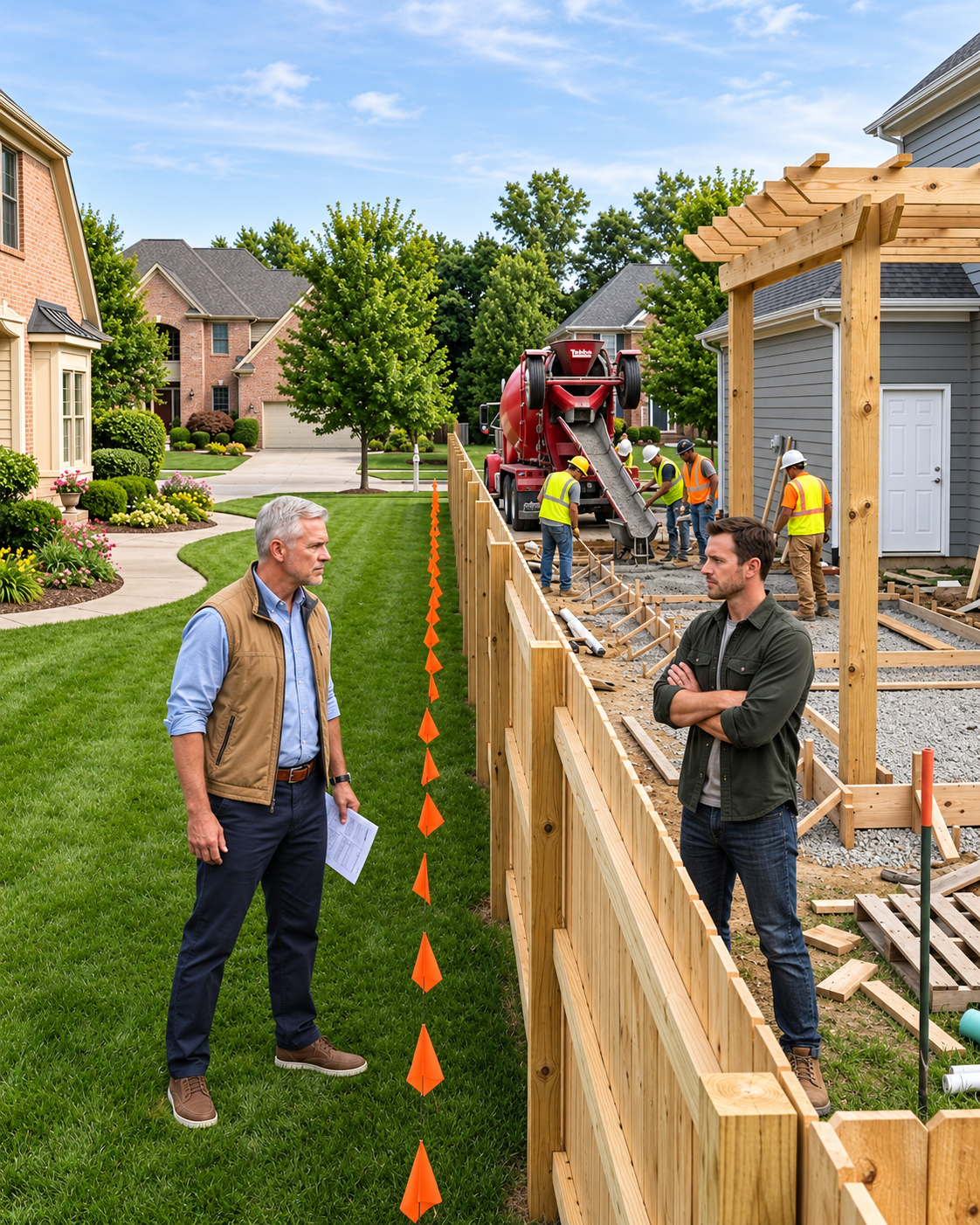
PART 1 TITLE: The Morning Three Strangers Began Digging Through My Lawn, I Discovered My New Neighbor Had Already Made a Decision About My Property
The first hole appeared just beyond my lilac bushes, in a stretch of grass I had maintained for eleven years. A man wearing a faded work shirt drove his shovel into the ground while another unloaded cedar posts from a truck. Neither had knocked on my door. Neither appeared concerned that they were standing in my yard. From my kitchen window, I watched the first post being lowered into the earth, and a cold certainty settled over me. Whatever they were building, it wasn’t where it belonged.
My daughter Emma noticed the workers before I said anything. She was packing her college textbooks into a blue duffel bag, trying to make room for a thick volume that refused to lie flat. When she heard the metallic scrape of a shovel against stones, she stopped struggling with the zipper and walked to the window. “Mom, why are they putting fence posts over there?” she asked. Her voice had the careful sharpness she used when something was wrong and she wanted to know whether I had noticed.
I turned down the heat beneath my frying pan and joined her. The men had already opened three holes. A pile of dark Ohio soil lay beside the lilacs, and fresh cedar boards were stacked along the edge of the driveway next door. My neighbor, Tyler Bennett, had mentioned wanting a privacy fence. He was a commercial real estate agent who had recently purchased the house beside ours. Until that morning, I had assumed he intended to build entirely within his own property.
Emma pressed a hand against the glass. “That’s our side of the bushes.” I agreed that the placement seemed strange, but I wasn’t ready to accuse anyone of stealing land. Tyler had spoken confidently about property improvements when we first met. He knew contractors, building permits, and local real estate prices. I had spent most of my working life behind a library desk. Perhaps there was some technical detail I didn’t understand. Emma looked at me, unconvinced. “Knowing the rules doesn’t mean he follows them, Mom.”
That sentence stayed with me after she returned to her bag. I had always considered myself a reasonably careful homeowner. When I purchased our house eleven years earlier, I examined the deed, reviewed the paperwork, and walked the property with the person handling the sale. The backyard had seemed straightforward: a rectangular patch of grass, a garden shed, an old oak tree, and a line of lilac bushes separating our lawn from the neighboring property. There had never been a dispute about where our yard ended.
I knew the ground in ways a document couldn’t express. I knew which corner remained wet longest after spring rain and where the mower wheels tended to sink into softer soil. I knew the narrow strip beside the shed required a second pass because the grass grew unevenly beneath the shade. Every week during the growing season, I followed almost the same route, turning near an old telephone pole and returning along the outer edge of the lawn. I had never needed a fence to tell me where to stop.
The workers, however, followed a different line. Their holes continued toward the garden shed, cutting off a strip that looked roughly eight feet wide. I estimated the distance by comparing it with the length of a wooden bench near the patio. Eight feet was more than the width of most hallways. It was not the kind of measurement someone could reasonably mistake for an inch or two. Still, I had only my own observations, and the workers had equipment, drawings, and a truck full of materials.
Emma left her bag beside the kitchen table and watched me put the eggs onto two plates. “You should ask them to stop,” she said. “Before the concrete goes in.” I told her I would speak to Tyler first. She set her fork down. “And if he’s not home?” I glanced outside again. One worker was holding a post upright while another adjusted it with a level. I said I would find out who was supervising the project. My answer sounded practical, but it bought me more time to avoid an unpleasant confrontation.
I went onto the patio, where the air smelled of damp earth and freshly cut lumber. The nearest worker looked up when I approached. I asked whether Tyler had given them a property survey. He explained that they were following the layout supplied for the job, and he directed my questions toward the homeowner. He wasn’t unkind. He simply had work to complete, and I was an interruption. Behind him, another man reached for a bag of concrete while the post stood perfectly upright in its hole.
For a moment I considered asking them to stop anyway. Then I imagined the argument that might follow, with three strangers waiting while I tried to prove something I had not yet verified. I returned inside without making a demand. Emma was standing beside the kitchen table with her arms folded. She didn’t need to ask what had happened. “They’re still working,” she observed. I told her I would handle it. She picked up her bag, but she didn’t look reassured.
The hours that followed were unpleasantly ordinary. I washed dishes, put away groceries, and checked the weather through the same kitchen window that overlooked the construction. Every time I looked up, another section had been completed. The fence rose in a straight, pale line, each board hiding more of the grass behind it. There was no dramatic argument or obvious act of destruction. The workers measured, cut, lifted, and fastened. Their efficiency made the intrusion feel even more deliberate.
By early afternoon, the new barrier stretched from the rear portion of Tyler’s property toward my garden shed. It stood six feet high, with closely fitted cedar boards that left almost no gaps. From my patio, it looked imposing. From the kitchen, it seemed to have moved our entire yard inward. I waited until the construction truck departed before going outside again. The absence of the workers should have made the place feel peaceful. Instead, the backyard seemed unfamiliar.
I brought out my green lawn mower because the grass had dried enough for its usual cutting. It was a familiar task, something I could perform without thinking about every turn. I filled the tank, checked the oil, and pulled the starter cord. The engine came alive with its uneven rattle. I followed the first several rows exactly as I always had, keeping the wheels aligned with the previous pass. Then I approached the far edge of the yard and had to stop.
The mower had nowhere to go. In front of me stood a wall of new cedar, its lower edge resting above freshly disturbed soil. I released the throttle and stood with both hands on the handle until the engine stopped trembling. For eleven years, that turn had been automatic. Now the fence interrupted it eight feet before the place where I usually changed direction. I could smell sawdust and sap. Beneath the nearest post, clumps of my old grass had been pressed into the mud.
I moved along the boards, measuring the lost space with my footsteps. The missing strip ran beside the lilacs and continued toward the shed. What Tyler had taken was not an unused corner of a large estate. It was part of a modest backyard that I had maintained without hired help. I had planted flowers there, pulled weeds there, and watched Emma play there when she was younger. The fence did not change those memories, but it suddenly placed them on the other side of someone else’s wall.
I had heard the likely cost of a fence like this from friends who had recently renovated their homes. Cedar boards, professional installation, and heavy posts could easily amount to $8,200. A survey, according to a friend at the library, might cost around $950. That was a serious expense for me. My household budget allowed for maintenance and necessities, not an unexpected property dispute. Yet the alternative was to accept the fence without knowing whether I had surrendered land that legally belonged to me.
A car door closed next door. Tyler had returned in his silver SUV and was removing grocery bags from the back. I stood beside the mower for several seconds, wondering whether I should wait until another day. He was new to the neighborhood. We would probably be living beside each other for years, and I didn’t want a quarrel over property boundaries to poison every ordinary encounter. But then I looked at the new fence again and understood that postponing the conversation would not change its location.
I approached the edge of Tyler’s driveway and called his name. He turned with a bright, practiced smile, the kind that could make almost any greeting sound like an invitation. He asked how I liked the improvement. Before I could answer, he began describing the quality of the cedar, the height of the boards, and the privacy the fence would provide. He mentioned neighborhood property values as if he were explaining a good investment. The grocery bags rustled against his legs while loose coins jingled in his pocket.
I told him the workmanship looked excellent, then asked about the placement. “It seems to cross onto my property,” I said. “By quite a distance.” Tyler shifted one bag to his other hand. He explained that the contractors had worked from county records and a digital layout. They were professionals, he insisted, and they understood how to position a structure accurately. He spoke quickly and without hesitation. Whenever I tried to clarify the location of the old boundary, he returned to the reliability of the equipment.
I mentioned the telephone pole, the lilacs, and the path I had mowed since purchasing the house. Tyler gave a small, dismissive movement of his head. Physical landmarks could be misleading, he explained. Old neighborhood boundaries didn’t always correspond to what modern mapping systems showed. He described the fence as a sensible improvement that made efficient use of the property. I listened to him and felt an uncomfortable change in the conversation. He was not trying to establish where the boundary lay. He was trying to persuade me that my experience didn’t matter.
“Tyler, I’m not talking about a few inches,” I said. “I believe the fence is about eight feet inside my lot.” For the first time, he looked directly at me without smiling. Then his expression returned to its usual pleasant arrangement. He said minor discrepancies were common in residential construction. Nobody could expect every fence to match an old survey perfectly. I asked whether he had commissioned a new boundary survey before beginning the work. He answered by praising the contractors again.
I could have allowed that answer to end the matter. It would have been easier to thank him for his time, return home, and persuade myself that there was no point making trouble. Instead, I told him I was considering hiring an independent surveyor. His reaction was brief but unmistakable. His fingers tightened around the plastic handles of the grocery bags, stretching them against their contents. He glanced toward the fence before looking back at me. “You can do that if you want,” he said, although his tone had lost some of its easy friendliness.
He added that fences were not always positioned perfectly and that neighbors generally accepted small differences without turning them into disputes. Then he moved toward his side entrance, explaining that he needed to get his groceries inside. The conversation was finished because he had decided it was finished. I remained on the driveway for a moment, hearing the coins in his pocket as he walked away. He had not offered to review a map, inspect the line with me, or contact his contractors.
When I returned home, the mower stood where I had abandoned it. I pushed it into the shed and closed the door. The grass along the fence remained uncut because I couldn’t bring myself to work beside the boards again. From the patio, the cedar looked less like a temporary construction project than a permanent declaration. Tyler had spent thousands of dollars establishing a line I did not recognize, and he expected me to treat it as settled. I was beginning to understand that friendliness and fairness were not the same thing.
That evening, Emma noticed I had barely touched my dinner. She asked what Tyler had said, and I repeated the conversation as accurately as I could. When I described his refusal to show me a survey, she set her glass down carefully. “So he doesn’t have proof,” she said. I replied that I didn’t know what documents he possessed. She watched me for a moment. “Mom, you keep giving him reasons he might be right. Have you thought about what happens if he knows he’s wrong?”
I had no answer. After we cleared the dishes, Emma disappeared into the living room and began opening the old photograph albums stored beneath the bookcase. I heard the heavy covers settling against the carpet and the faint rustle of protective pages. When she called me, her voice had changed. She wasn’t angry now. She sounded like someone who had found something she hadn’t expected. “Come look at this,” she said. “There’s something behind the fence I don’t think either of us noticed.”
END PART 1
PART 2 TITLE: An Old Birthday Photograph Revealed What the Cedar Fence Had Taken, and a Buried Iron Pin Was About to Settle the Argument
Emma sat cross-legged on the living room carpet, surrounded by photographs that covered nearly a decade of our lives. One album lay open across her knees. She held a picture between two fingers, careful not to bend its corners. In it, she was seven years old, wearing a yellow sundress and smiling at something just beyond the camera. The sunlight had washed one side of her face almost white. Behind her stood our garden shed, part of the old oak tree, and a wooden swing hanging from a thick branch.
“Look at where the swing is,” she said. I lowered myself beside her and adjusted my glasses. The photograph had been taken during her seventh birthday celebration. I remembered the weather that afternoon, the stubborn heat, and how she had refused to take off the yellow dress even after getting cake frosting on its hem. But Emma wasn’t interested in remembering the party. She placed her finger near the edge of the photograph, where the old tree and the far side of the backyard were clearly visible.
The swing had been there since she was six. Its wooden seat was weathered, and the heavy ropes had turned gray after years of rain and sunlight. When Emma was little, she would insist that I push her higher, then change her mind as soon as her feet left the ground. Eventually, she learned to pump her legs without help. I had watched her from the patio through countless afternoons, occasionally warning her not to twist the ropes until the seat spun around.
In the photograph, the swing hung several feet beyond the place where Tyler’s new fence now stood. I looked toward the sliding glass door, where darkness had gathered beyond the patio. The fence was visible in the fading light, a broad, pale wall dividing the yard. I stood and moved closer to the glass. Through a narrow angle near the shed, I could make out the lower portion of the old oak branch. Beneath it, almost completely hidden, hung the familiar wooden seat.
Emma came to stand beside me. “It’s still there,” she said. “But we can’t even reach it.” She sounded more upset than I expected. The swing had not been used regularly for years. She was preparing for another term of college, packing books and clothing, building a life that would take her beyond our neighborhood. Yet the sight of it trapped behind the fence seemed to disturb her more than the missing grass. I understood why when I looked again. Tyler had enclosed something that belonged to our family history.
I remembered checking the swing each spring before Emma was allowed to use it. I would inspect the knots, examine the seat for splinters, and make certain the branch showed no sign of weakness. Some years I replaced the rope. Other years I tightened the fastenings and gave the wooden seat another coat of protective finish. It was never an expensive structure. A carpenter might have dismissed it as ordinary. But it occupied a particular place in our home, and its sudden disappearance behind the fence made the dispute painfully specific.
Emma returned to the album and began turning the pages. She found photographs taken at different times of year: summer grass, fallen leaves, and the yard under a thin layer of winter snow. The telephone pole appeared in some pictures. The shed appeared in nearly all of them. They weren’t professional property records, and I knew they couldn’t establish a legal boundary by themselves. Nevertheless, they demonstrated something important. Long before Tyler purchased the neighboring house, we had used and maintained the ground his fence now separated from us.
I sat at the kitchen table with the photographs arranged around an old county tax map. The map showed the two houses as rectangles surrounded by straight lines, but its scale was too small for me to determine the precise placement of a fence. I tried measuring the distance between the buildings with a ruler, then realized how unreliable the exercise was. Every time I studied the drawing, I found myself wanting it to confirm what I believed. I needed someone who could examine the actual ground.
Emma stood behind my chair. “Call a surveyor,” she said. I told her I had already considered it, but the cost worried me. Nine hundred and fifty dollars was not money I could spend casually. There were household expenses to manage, and Emma’s college costs never seemed to grow smaller. She pulled out the chair opposite mine. “If you don’t find out, he’s going to keep the fence there,” she replied. She didn’t speak dramatically. She stated it as a fact, which made the truth harder to avoid.
We talked through the possibilities. Perhaps Tyler’s contractors had relied on an inaccurate drawing. Perhaps the boundary was different from what I remembered. A survey could confirm that I was mistaken, leaving me with a large bill and no reason to complain. Emma acknowledged every possibility. Then she pointed toward the window. “But if you’re right, that fence could stay there for years unless you do something now.” I looked at the photographs again. She was asking me to decide whether uncertainty was more expensive than knowing.
Later that night, after Emma had gone upstairs, I returned to the sliding glass door. The yard was dark except for a little light spilling from the kitchen. The fresh cedar reflected it faintly. I could still see the uneven strip of grass that remained on my side of the fence, and I remembered how easily my mower had passed across the disputed area the previous week. Nothing about the ground itself had changed. Only someone’s decision about who was entitled to stand on it.
I slept badly. Each time I woke, I found myself rehearsing what I would say if the survey proved I was right. I imagined Tyler apologizing and arranging for his contractors to move the fence. Then I remembered the way he had dismissed my questions. By morning, I was no longer certain that evidence alone would settle the disagreement. Nevertheless, I made the call. When the survey appointment was arranged, I accepted the $950 expense and reminded myself that uncertainty had already begun to affect the way I lived in my own house.
Carl Henderson arrived with equipment that looked more familiar to a construction site than a suburban backyard. He carried a yellow metal detector, measuring tools, a canvas bag, and a folder of property information. He was an older man with a weathered face and an economical manner of speaking. His work boots had seen considerable use. I showed him the fence, the garden shed, and the lilac bushes. He listened without offering an opinion, then asked for my deed and the information I had about the lot.
I handed him the documents I had prepared. The original parcel, according to the county information, had been divided in 1974. Carl examined the measurements and studied the relationship between the road and the back corners of the neighboring properties. He didn’t begin by measuring the fence. Instead, he explained that he needed to establish the legal corners of my land independently of whatever Tyler’s contractors had constructed. A fence, he reminded me, was merely a structure. Its presence did not prove that the property line ran beneath it.
That distinction mattered more than I expected. For days, I had been looking at the cedar boards as though they possessed some authority of their own. Their straightness, height, and fresh construction had made the new boundary seem official. Carl treated them as irrelevant until the measurements showed otherwise. He moved across the lawn carrying his locator, pausing whenever the machine responded to something buried beneath the surface. I followed several feet behind, trying not to interrupt his concentration.
Near the garden bed, the detector produced a series of low, uneven sounds. Carl adjusted the sensitivity and swept the instrument over the grass again. The ground was still damp in shaded places, and his boots left shallow impressions in the soft soil. I watched him work around a patch of clover and dandelions. Every few seconds, he stopped to check the display. I asked whether the digital county map should identify the corner precisely. He gave a quiet, skeptical grunt before answering.
“Those maps can help you get close,” he said. “But close isn’t always good enough when you’re deciding where somebody’s property ends.” He explained that the older physical monuments mattered because the recorded boundaries had been established through actual measurements on the ground. Satellite-based images could be useful, but their appearance of precision sometimes misled people who didn’t understand the underlying records. His explanation wasn’t intended as a criticism of Tyler’s contractors. It was a reminder that reliable surveying required more than looking at a screen.
The locator suddenly emitted a sharp, sustained tone. Carl stopped moving. He lowered the instrument, swept the same patch again, and nodded slightly to himself. Then he set the equipment aside and knelt in the grass. From his bag he removed a hand trowel with a scratched metal blade. He began cutting through the turf, lifting small pieces of sod and laying them carefully beside the opening. I stood close enough to see dark Ohio clay beneath the roots.
His trowel struck something solid. The sound was faint but distinct. Carl scraped away more soil, exposing the rusted top of a narrow iron pipe. It was much smaller than I had expected, hardly wider than a coin. Dirt had settled over it for years, and grass had grown across the surface without anyone noticing. Carl cleared the opening until he could identify the marker properly. Then he looked up at me. “This is what we’ve been looking for.”
I stared at the piece of iron. It seemed extraordinary that such an ordinary object could determine the ownership of a substantial strip of land. There was no sign beside it, no concrete monument rising above the grass, nothing to announce its importance. For years I had walked nearby without knowing it existed. Carl explained that the pipe marked the southeast corner of my parcel. Its position corresponded with the older records he had examined, making it an essential reference for the measurements that followed.
He took a steel tape measure from his belt and secured one end near the exposed marker. The tape extended across the grass with a thin metallic hiss. I watched him follow the recorded distance, keeping his line straight and checking the numbers carefully. The measurement he needed was eighty-two feet. I understood the figures well enough, but I didn’t yet understand what they meant for the fence. Carl moved toward the cedar boards and stopped before reaching them.
For several seconds he studied the tape. Then he looked at the fence, adjusted his position, and checked again. I could hear a lawn mower running somewhere farther down the street. The ordinary neighborhood sound seemed strangely distant. I asked him whether the measurement matched the line established by Tyler’s contractors. He didn’t answer immediately. Instead, he made a note, checked the scale once more, and looked along the length of the fence toward the shed.
“How far off is it?” I asked. Carl drew the tape taut and gave me the result. The cedar structure stood eight feet and four inches inside my property. Not a few inches. Not a difference that could be dismissed as a minor irregularity. Eight feet and four inches of ground that belonged to me had been enclosed on Tyler’s side. I repeated the number because I needed to hear it again. Carl confirmed it without hesitation.
I looked from the rusted pipe to the fence. The missing distance suddenly became more than an estimate made with footsteps or the width of a garden bench. It had a measurable beginning and a measurable end. I thought about Tyler telling me that digital layouts were accurate to the inch. I thought about his casual assurance that residential fences frequently stood a little off their intended lines. Carl’s tape lay between us, demonstrating how far his explanation fell short of the actual discrepancy.
I wanted to ask Carl to walk next door and show Tyler immediately. Instead, I asked whether the measurement was sufficient to require the fence to be moved. He shook his head. The work was not finished. He needed to locate and verify the front marker near the road and account for the recorded easement before issuing a certified survey. His preliminary result was strong evidence, but a final legal drawing required the remaining checks. He expected to have the completed documents ready by Thursday afternoon.
I understood the distinction, even though waiting was difficult. Carl marked his findings in a yellow notebook and explained the next steps. He did not promise that Tyler would cooperate. Resolving an encroachment was a different matter from measuring one. His responsibility was to determine where the boundary lay and document it accurately. What happened after that would depend on how the people involved responded. I thanked him for his careful work, though I wished he could tell me that the problem would be over soon.
After Carl loaded his equipment, I remained beside the exposed corner marker. The grass around it had been disturbed, leaving a small patch of dark earth in the green lawn. From that spot, I could see the line the fence should not have crossed. I imagined the original measurements being taken decades earlier, when the land was divided in 1974. The person who placed the marker could never have known that, years later, a dispute between neighbors would depend on whether it could still be found.
Emma was waiting when I entered the kitchen. She had cleared a space on the table beside a cardboard box of college textbooks and placed the county map where we could examine it together. Her silver ring turned slowly around her finger as she watched me remove Carl’s notes from my purse. “Well?” she asked. I set the paper down and pointed to the measurement. “Eight feet, four inches,” I said. “That’s how far the fence is inside our line.”
She read the numbers twice. Then she looked toward the backyard window. I expected her to say she had been right from the beginning. Instead, she asked whether Tyler knew the surveyor had found the original corner marker. I said I hadn’t spoken to him yet. Her expression tightened. “Then we need to tell him,” she replied. “Because if he keeps insisting that the fence is correct after this, we aren’t dealing with a mistake anymore.”
For the first time since the construction began, I could not find an easy reason to disagree with her. The buried iron pipe had answered the question I had been afraid to ask. My memory of the yard was not wrong. The photographs were not misleading me. The strip beyond the cedar boards was not Tyler’s land simply because he had built an expensive fence around it. But one question remained, and it troubled me more than the measurement itself: what would my neighbor do when presented with evidence he could no longer reasonably dismiss?
END PART 2
PART 3 TITLE: The Surveyor Found My Missing Land, but the Attorney’s Warning Made Me Realize That Proving Ownership Was Only the Beginning
Emma spread the county map across the kitchen table and held down one curling corner with a textbook. She studied the dotted boundary line while I explained how Carl had located the old iron pipe and measured the distance to Tyler’s fence. The number was written clearly on the paper between us: eight feet, four inches. It was a simple measurement, yet I had been thinking about it ever since Carl left. I had wanted a professional opinion because I was uncertain. Now that I had one, I was afraid of what certainty might require.
Emma moved her finger along the boundary shown on the map. “If the corner is where he found it, the fence can’t belong there,” she said. I agreed. She asked whether Carl had spoken with Tyler or any of the contractors. I told her he had not, and that the survey would not become official until Thursday. She leaned back in her chair, studying me. “You sound like you’re still looking for a reason to excuse him.” Her observation stung because it was close to the truth.
I reminded her that Tyler had hired people to perform the installation. Perhaps the contractors had misunderstood a drawing or placed their reference point incorrectly. Emma listened, but the movement of her silver ring grew faster. “Then he should want to know,” she said. “If somebody built an expensive fence in the wrong place, wouldn’t you ask how it happened?” I considered Tyler’s reaction when I had mentioned an independent survey. He hadn’t expressed curiosity. He had tried to end the conversation as quickly as possible.
Emma rose from the table and walked toward the kitchen window. From where she stood, the cedar boards appeared almost golden in the afternoon light. Their straight upper edge formed a hard line against the neighboring house. “Every day it stays there, it starts looking more permanent,” she said. “People get used to things. That’s what worries me.” I understood what she meant. An intrusion didn’t need to happen all at once to become accepted. Sometimes it was enough for everyone to continue living as though nothing had changed.
I told her I wanted to consult an attorney before approaching Tyler again. She turned from the window, startled. The survey alone had been expensive. Legal advice could cost considerably more, and our household finances were not arranged around unexpected disputes. I didn’t have a private reserve of money for difficult neighbors. The money I spent on documents or consultations would come from the same funds used to keep the house running and help Emma with her education. She knew that as well as I did.
“A lawyer could be expensive, Mom,” she said, her expression softening. “I know.” I folded Carl’s notes and placed them beside the map. “The survey cost nine hundred and fifty dollars. I don’t want to spend more than I have to.” I paused, thinking about what would happen if I abandoned the matter because of the cost. “But I also don’t want to make a mistake that leaves us with that fence forever.” Emma sat down again. For once, she didn’t have an immediate response.
We examined the documents together. The county assessor’s map showed the overall shape of the property, but it did not settle all the questions I had. I wanted someone to explain the deed in plain language, identify what evidence mattered, and tell me whether there was anything I should avoid saying to Tyler. I had worked with records long enough to know that documents could be misleading when taken out of context. A page that seemed perfectly clear to one person might contain a technical distinction someone else would immediately recognize.
Emma asked why I was so worried about saying the wrong thing. I told her I didn’t want to accuse Tyler of intentional wrongdoing without proof. There was a difference between demonstrating that a fence crossed a boundary and proving that the person who ordered it had knowingly done so. The first issue concerned measurements. The second concerned someone’s intentions. Emma nodded reluctantly, but she reminded me that we did not have to establish his motives before insisting he respect the property line.
Her words followed me as I prepared my folder. I collected the deed, the assessor’s map, Carl’s preliminary measurements, and the photographs showing the backyard before construction. One image showed Emma at seven, standing near the oak tree in her yellow dress. Another showed the garden shed with the lawn extending past the spot where the new fence stood. I placed them between sheets of paper so the edges wouldn’t curl. Looking at them, I was struck by how little I had expected these ordinary family pictures to matter.
Before leaving, I walked outside to examine the fence again. I wanted to be certain I could describe its position clearly. The first post stood well inside the grass I had always maintained. Its base was surrounded by pale dust from the installation, already beginning to mix with the soil. The boards continued toward the shed in a perfectly straight line. I pressed my palm lightly against one of them. It was solid and carefully built. There was nothing temporary about it.
I thought about the $8,200 Tyler had probably spent. Moving such a structure would be inconvenient and costly. The contractors would have to remove sections, deal with the posts, and rebuild the fence at the proper location. Even if the error were innocent, I could understand why Tyler would dislike the prospect. Understanding that reluctance, however, did not make the structure lawful. I reminded myself that I was not asking him to surrender land. I was asking him to stop occupying mine.
The law office was located in a brick shopping center along State Route Three, between a pediatric dentist’s practice and a dry cleaner. The building was ordinary enough that I nearly passed it. Inside, the waiting area smelled faintly of cleaning solution and old paper. A few chairs stood against the wall beside a small table holding magazines. I checked the time and smoothed the front of my blouse. I had imagined legal offices as intimidating places filled with dark wood and expensive furniture. This one appeared practical and busy.
Rachel Monroe greeted me with a firm handshake and invited me into her office. She was forty-eight, with gray eyes that moved quickly over details and a navy blazer pressed sharply at the shoulders. A silver pen rested near her notebook. I liked that she didn’t begin by assuring me I was right. She asked what had happened, when the fence had been installed, and what documents I possessed. I explained the construction, my first conversation with Tyler, and Carl’s discovery of the original boundary marker.
Rachel listened without interrupting, occasionally writing a note. When I described Tyler’s reliance on a digital map, she asked whether I had seen that map myself. I told her I hadn’t. She asked whether I had given anyone permission to build on my property. I said no. Had Tyler offered to purchase any land from me? No. Had we discussed moving the boundary or granting him use of the strip? Again, no. Her questions were precise, and I began to understand how many assumptions I had allowed to pass unexamined.
She arranged my deed and the assessor’s map beside Carl’s notes. For several minutes, the room was quiet except for the movement of paper and an occasional click of her pen. I sat across from her, watching her trace the property description. She compared the recorded measurements with the location Carl had identified. Finally, she looked up. “The deed describes a straight boundary from the front corner marker near the road to the rear marker your surveyor found,” she explained. “Nothing you’ve shown me suggests the fence changes that boundary.”
I asked whether that meant the matter was legally settled. Rachel shook her head slightly. Carl’s preliminary measurement was encouraging, but it was not yet a certified survey. He still needed to verify the front corner and account for the road easement. Until that work was complete, she did not want to send a formal demand based solely on unfinished findings. I had expected the lawyer to give me an immediate solution. Instead, she showed me why patience could be necessary even when the evidence appeared strong.
“Once the certified drawing is ready, what can I do?” I asked. Rachel set down her pen and explained the process. The first formal step would ordinarily be a letter stating the encroachment and demanding that the fence be removed or relocated. The letter would identify the property, refer to the professional survey, and provide an opportunity for Tyler to respond. If he refused to correct the problem, there were legal remedies available through the county court, including seeking an injunction.
The word injunction made the dispute sound much larger than I wanted it to become. I had never imagined standing before a judge to explain why my neighbor’s fence should not cut across my backyard. I told Rachel I hoped that wouldn’t be necessary. Tyler was young, successful, and professionally involved in real estate. Surely someone with his experience would recognize a verified mistake and correct it. Rachel studied me for a moment before answering. “I hope he does,” she said. “But his profession doesn’t guarantee he’ll make the right decision.”
I felt embarrassed by the assumption I had been making. Since meeting Tyler, I had repeatedly treated his professional confidence as proof of competence and his friendliness as evidence of good intentions. I had assumed that because he understood commercial property, he must also understand residential boundaries. More importantly, I had assumed that if he understood the boundary, he would respect it. Rachel did not criticize me for trusting him. She simply returned to the documents and asked what response he had given when I first questioned the construction.
I repeated his explanation about professional contractors and computerized mapping. She listened carefully. “Did he offer to review the drawings with you?” she asked. I shook my head. “Did he suggest having the line checked?” Again, no. Rachel wrote something on her pad. She wasn’t declaring Tyler dishonest, and she wasn’t encouraging me to interpret every unpleasant conversation as evidence of malicious intent. Nevertheless, her questions exposed the difference between a person seeking an answer and one trying to make a question disappear.
I asked whether contacting the local zoning office might resolve the matter without further legal expense. Rachel explained that municipal and county officials could address some construction and permit issues, but their response might be slow. A dispute over the exact location of private property boundaries could also require action beyond ordinary code enforcement. She did not want me waiting indefinitely for an administrative response while the fence remained in place. “You need to protect your position,” she told me. “That doesn’t mean you have to begin with a lawsuit.”
I looked down at the photographs on her desk. Emma’s childhood swing was clearly visible in the background of one picture. Rachel followed my gaze and asked whether the fence prevented us from reaching part of the yard. I explained that the swing now hung on Tyler’s side, although it had always been accessible from ours. She considered the photograph, then returned it to the folder. The image helped demonstrate our past use of the area, but she emphasized that the legal boundary would ultimately be established by the deed and the certified survey.
Something in her careful explanation reassured me. She wasn’t promising a dramatic victory or treating my distress as proof of ownership. She was separating facts from feelings, making room for both without confusing them. The swing mattered to me because of what it represented. The old iron pin mattered because it could establish where my property legally ended. The distinction didn’t make the loss less painful. It gave me a clearer way to address it.
Rachel asked whether I intended to speak with Tyler before Thursday. I said I wanted him to know what Carl had found. She considered that for a moment. There was nothing necessarily wrong with a civil conversation, she explained, provided I understood that the preliminary measurement still needed formal confirmation. I should be factual, avoid making promises, and refrain from agreeing to a compromise before the final survey could be reviewed. Then her tone became noticeably firmer. “If he puts any document in front of you, don’t sign it.”
I asked what sort of document she meant. Rachel said she couldn’t predict what Tyler might propose. It could be a written agreement acknowledging the existing fence, a request for permission to use the land, or some other arrangement intended to settle the disagreement. Not every offer would necessarily be improper, but I should not evaluate such terms standing in someone’s driveway. Property rights were too important to alter through an informal conversation. She wanted an opportunity to examine anything Tyler asked me to accept.
The warning unsettled me because it presented a possibility I had not seriously considered. I had imagined the problem ending with an apology or an argument. I hadn’t considered that Tyler might ask me to approve the very boundary I was questioning. The fence was already built. If he could persuade me to accept its position, he might avoid moving it altogether. Rachel wasn’t saying he would attempt this. She was making certain I understood why a seemingly harmless signature could have consequences.
Before I left, she returned the deed to my folder and asked me to contact her as soon as Carl delivered the certified survey. She repeated that I should not let the matter drift without action. Waiting for the necessary evidence was sensible; allowing the fence to remain indefinitely without asserting my rights was not. I thanked her and stood, feeling both more informed and more apprehensive than when I arrived. She had not given me a shortcut. She had given me a way to proceed carefully.
Outside, the afternoon traffic moved steadily along State Route Three. I sat in my car for several minutes without starting the engine. The folder rested on the passenger seat, its corners slightly bent from being handled. I thought about Emma, who would soon leave for college, and about the quiet house I would return to. I didn’t want the coming weeks to be consumed by legal correspondence and strained exchanges with my neighbor. But avoiding an uncomfortable situation had already allowed the fence to be completed.
When I reached home, I set Rachel’s card beside the telephone and opened the folder one more time. Emma looked up from her textbooks. She asked what the lawyer had said. I told her the deed supported the boundary Carl had found, but that the certified survey was essential. I explained the possibility of a formal demand and, if necessary, a court order. Emma listened closely. When I finished, she asked the question I had been expecting. “Are you going to talk to Tyler again?”
“Yes,” I said. “Tonight.” I explained that I intended to show him the preliminary measurements and ask him to reconsider the fence before the dispute grew more serious. Emma asked whether I wanted her to accompany me. I appreciated the offer, but I told her I would speak with him myself. It wasn’t because I thought she was wrong. I needed to establish that I was prepared to defend my own property, even without someone standing beside me.
As evening approached, I reviewed what I wanted to say. I wouldn’t accuse Tyler of theft. I wouldn’t speculate about his contractors. I would explain where Carl had found the iron marker, provide the eight-foot-four-inch measurement, and tell him the certified survey would be ready Thursday. If Tyler agreed to review the evidence, we could discuss the next step. If he refused, I would return to Rachel with the completed documents. The plan was simple enough to write on a small piece of paper.
I placed the note beside Carl’s yellow page of measurements and looked through the kitchen window. Tyler’s silver SUV turned into the neighboring driveway. Its headlights swept across the new cedar boards before settling against the garage. A moment later, the driver’s door opened. I watched him step out and move toward the rear passenger door. My hands felt cold despite the warmth of the house. Rachel’s warning remained clear in my mind: I could discuss the problem, but I was not to give away a single right simply to keep the peace.
I took my folder, went outside, and crossed the familiar path toward the driveway. Tyler was unloading a blue cooler from the SUV. The evening air carried the smell of cut grass, and the new fence stood between our backyards in the fading light. He hadn’t seen me yet. I stopped at the edge of the asphalt, looked once toward the place where Carl had uncovered the iron pin, and called his name. This time, I had more than eleven years of memories to support my position.
END PART 3
PART 4 TITLE: When I Carried the Surveyor’s Measurements Across the Driveway, My Neighbor Treated Eight Missing Feet as Though They Were Nothing
Tyler Bennett looked up when I called his name. He was standing beside his silver SUV with a blue plastic cooler balanced against his hip, the rear passenger door still open. His golf shirt bore a small embroidered logo, and the fading sunlight made the fabric look almost white. For a moment his expression was unreadable. Then the familiar smile appeared, quick and confident, as if he were greeting a client outside an office rather than a neighbor who had come to question his new fence.
“Joan,” he said, shifting the cooler into a more comfortable position. “Beautiful evening, isn’t it?” He glanced toward the driveway, where his headlights cast pale beams across the gravel. He explained that he was getting a few things ready for the weekend and asked how I was doing. His manner was friendly enough, but I noticed that he didn’t ask whether I had resolved my concerns about the fence. Our previous conversation hadn’t been particularly pleasant. I found it difficult to believe he had forgotten it.
I told him I wanted to discuss the property boundary again. He nodded, although he continued arranging his belongings as though the matter required no special attention. I waited until he had set the cooler beside the vehicle. Then I took Carl’s yellow page from my folder. “I hired a surveyor,” I said. “He came this morning and located one of the original property markers.” Tyler looked at the paper briefly, but he made no move to take it.
Instead, he launched into an explanation about the limitations of older mapping systems. He spoke rapidly, moving from county records to digital plotting and the improvements that technology had made possible for modern real estate. According to him, the original maps were outdated and often produced misleading impressions of property lines. He described contemporary parcel planning as more efficient and accurate. I listened, but the words didn’t answer the question I had asked. Carl had found a physical marker and measured the distance from it. Tyler was discussing general principles.
“I understand that newer technology can be useful,” I said when he finally paused. “But Carl wasn’t guessing from an old drawing. He located the iron marker that identifies my property’s southeast corner.” Tyler shifted his weight against the SUV. His smile remained in place, although it seemed increasingly deliberate. He told me that surveyors often disagreed about minor details and that older neighborhood records could be difficult to interpret. Then he began explaining how professional developers approached boundary calculations.
I had heard enough professional language in the past few days to recognize when it was obscuring something simple. I wasn’t asking him to explain modern real estate development. I wanted him to acknowledge that his fence stood inside my property according to a surveyor’s measurements. I repeated Carl’s findings, taking care not to exaggerate them. The original lot had been divided in 1974. The rear corner marker had been found beneath the turf. From that marker, Carl had checked the recorded distance toward the line established in the deed.
Tyler glanced at the yellow paper again. “Those old pins aren’t always where people expect them to be,” he said. I told him that was precisely why I had hired a professional to locate and identify it. Carl hadn’t simply accepted my memory of the yard. He had examined the records, searched the ground, and confirmed the position of a physical monument. The certified survey would still require verification of the front corner near the road, but the preliminary measurement was unmistakable. I offered Tyler the paper.
He didn’t take it. Instead, he leaned against the SUV and spoke about the quality of the installation. The contractors were experienced, he said, and they had followed the information provided for the job. Their reputation mattered to them. I didn’t dispute that they knew how to build a fence. The posts were straight, the boards were evenly spaced, and the structure appeared solid. But workmanship had never been my complaint. A beautifully constructed fence could still occupy the wrong ground.
“That’s what I need you to understand,” I said. “The issue isn’t whether the fence was built properly. It’s where you had it built.” Tyler laughed briefly, not quite in amusement. He said residential fences frequently deviated from a boundary by small amounts and that most homeowners accepted these differences without escalating them. His voice remained light, but the repeated explanations were beginning to irritate me. I had spent $950 because he insisted the original installation was accurate. Now he was suggesting that accuracy wasn’t especially important.
I remembered Rachel’s office and the silver pen tapping against her notebook. She had warned me not to treat an unfinished survey as a completed legal document, so I made that distinction clear. Carl would finish verifying the line near the road and deliver his certified drawing Thursday afternoon. I wasn’t asking Tyler to accept a formal conclusion before the work was complete. I was asking him to take a professional measurement seriously enough to discuss it. That seemed a reasonable request between neighbors.
Tyler reached into his pocket and moved a handful of coins between his fingers. The small metallic sounds accompanied his explanation about acceptable construction tolerances. He spoke as though he were teaching me something that every property owner should know. I wondered whether he used the same tone with clients who questioned a contract. It was pleasant on the surface and strangely resistant underneath. He didn’t raise his voice. He didn’t threaten me. He simply continued talking as if his confidence should be enough to settle the matter.
I looked at the fence visible behind his house. The boards formed a neat, uninterrupted line, and I could see why he liked them. The structure gave his backyard greater privacy and made the space appear larger. From his perspective, perhaps it looked like an improvement worth protecting. But the additional space he appeared to have gained had come from my lawn. It wasn’t an abstract discrepancy on a map. It was ground where I had walked, gardened, and worked for more than a decade.
I told him that the distance Carl measured was not a normal construction tolerance. Tyler tilted his head, waiting. “Eight feet and four inches,” I said. “That’s how far inside my boundary the fence sits.” I spoke slowly enough to make certain every word was clear. He responded with another small laugh. Then he described it as the sort of variation that could occur when older properties were measured using different methods. He returned to his earlier point about how frequently fences ended up slightly misplaced.
I looked at him for a long moment. Eight feet and four inches was not slight. It was wider than the space between the kitchen table and the opposite wall in my house. It was enough ground to plant a substantial garden bed or walk comfortably beside a shed. I wanted to explain those comparisons, but I stopped myself. He was a real estate professional. He didn’t need a retired library worker to teach him how much land eight feet represented. I suspected the problem was not his ability to understand the measurement.
“Tyler,” I said, “we aren’t talking about a couple of inches.” He lifted one shoulder and reminded me that surveyors could reach different conclusions. I asked whether he would be willing to compare his contractor’s plans with Carl’s findings when the final drawing arrived. He didn’t answer the question directly. He said the contractors had used a county plat and digital tools, and he trusted their work. The certainty in his voice was almost impressive, especially considering that he still hadn’t examined the measurements I was holding.
I thought about the photographs Emma and I had studied. The old oak tree appeared in them year after year, along with the shed and the stretch of grass now hidden from our side of the fence. They couldn’t replace a certified survey, but they showed a history of use that I couldn’t simply erase. I considered bringing them over to Tyler and pointing out the landmarks. Then I remembered Rachel’s advice. This was no longer a discussion about what looked familiar. It was a matter of establishing and respecting a legal boundary.
The photographs nevertheless mattered to me in a way the survey couldn’t fully describe. One showed Emma as a little girl, her yellow dress bright against the summer grass. I remembered her running toward the swing and insisting I push her while she finished the last bite of birthday cake. Another picture showed the same part of the yard in autumn, the grass scattered with leaves from the oak. Those scenes belonged to ordinary family life. I had never imagined needing to explain them to someone who wanted to claim the ground.
I noticed that Tyler was still standing with one hand near his pocket. He seemed impatient to return to his evening plans. Perhaps he assumed that if he made the conversation sufficiently uncomfortable, I would eventually retreat. I had done something similar during our first encounter. I had allowed his confidence to end the discussion because I didn’t want a disagreement. This time, however, I had already paid for professional evidence and consulted a lawyer. Walking away without making my position clear would accomplish nothing.
I asked him whether he understood what would happen if the completed survey confirmed the preliminary measurements. He looked toward the fence, then back at me. He said he expected the final work to support the layout used by his contractors. There was no acknowledgment that another result might require him to reconsider. I felt a brief surge of frustration and forced myself not to answer sharply. An argument over predictions would accomplish very little. Thursday’s certified drawing would provide the answer neither of us could honestly claim to possess yet.
“What I want is simple,” I told him. “I want the fence on the correct side of the property line.” He nodded as though the statement were obvious, then said he believed it already was. His response left us in the same position as before, except that I now had independent evidence challenging his conclusion. I was disappointed, but not surprised. Rachel had warned me that people could behave unexpectedly when expensive construction was involved. Tyler had apparently spent roughly $8,200 on this project. Correcting it would not be cheap.
I tried to imagine how I would respond if the situation were reversed. Suppose I had hired a contractor to build something along our shared boundary, and Tyler arrived with a survey showing that it extended eight feet into his yard. I would be embarrassed. I might question the findings and request time to examine them. I might ask my contractor how the mistake occurred. But I couldn’t imagine refusing even to look at the measurements. The possibility that I had taken someone else’s property would be too serious to dismiss.
Tyler spoke again, explaining that residential property lines were rarely as simple as homeowners believed. He mentioned digital mapping, old records, and the need to make practical decisions when improving land. I listened, noticing how each explanation shifted the subject away from the location of the iron pin. The language sounded informed, but it was becoming circular. Every time I presented something specific, he answered with something general. Every time I returned to the measurements, he described how complicated the matter could be.
I considered telling him that I had spoken with Rachel Monroe. The information might make him take me more seriously. But I decided against using the attorney’s name as a threat. I had sought her advice because I wanted to understand my position, not because I wanted to intimidate him. A legal dispute would affect both households, and I still hoped we could avoid one. I wasn’t interested in humiliating Tyler or proving that I could create problems for him. I wanted a fence moved to its proper location.
The evening had grown darker while we talked. The headlights remained on, throwing sharp shadows across the driveway and catching the edges of the cedar boards. I could hear insects in the grass and the faint sound of traffic beyond the houses. My folder had begun to bend where I held it against my side. I loosened my grip and looked toward the garden shed. Beyond the fence, the old oak tree stood in the dim light, part of its lower trunk hidden from view.
I thought about Emma’s question that afternoon. What if Tyler simply refused to move the fence? I had been reluctant to consider that possibility because it seemed so unreasonable. Yet he had now heard that a professional surveyor found a substantial encroachment, and his response had been to minimize the measurement. He wasn’t asking for time to inspect the records or offering to arrange a joint review. He was insisting that the existing structure should be accepted because the people who built it were professionals.
I drew a slow breath. “Carl found the original rear marker,” I said again. “He measured from it. The fence is eight feet and four inches inside my line. He’ll finish checking the front boundary and the road easement before Thursday afternoon.” I paused, then added, “I’m not making this up because I dislike your fence.” Tyler looked at me with a faint expression of impatience. I couldn’t tell whether he was irritated by the measurement itself or by my refusal to stop discussing it.
He repeated that small differences were inevitable with property improvements. I had heard the argument enough times to recognize what it was becoming: a way to make a substantial loss sound insignificant. I could not force him to accept Carl’s unfinished survey, and I would not pretend it was already certified. But neither could I accept his description of the discrepancy as harmless. Those eight feet represented a meaningful part of my yard, and the fence prevented us from using it.
I glanced toward the oak tree again. That was when I remembered the photograph in Emma’s hands and the quiet way she had spoken while we stood at the sliding glass door. She hadn’t complained about an unattractive structure or a change in the view. She had pointed out that something from her childhood remained visible but inaccessible. The thought steadied me. My objection wasn’t merely about asserting ownership in a contest with a difficult neighbor. It was about what had been enclosed without permission.
“There’s something else,” I said. Tyler waited, his hand still resting against the SUV. “The fence cuts across the part of the yard where we’ve always had our old wooden swing.” He glanced briefly toward the back of the properties. I explained that it hung from the oak tree and had been there since Emma was six years old. Its location appeared in family photographs taken long before he purchased the house. The new boards now separated us from the swing we had used and maintained for years.
I hadn’t intended to speak about Emma. I had promised myself I would remain focused on the survey, the deed, and the official measurements. But the photograph had made the loss impossible to describe solely in terms of square footage. Tyler could discuss digital mapping for as long as he wanted. None of those explanations changed the fact that a six-foot-high wall now stood between my home and something that had been part of our lives for more than a decade.
I looked directly at him. “This isn’t a few inches of grass, Tyler. The fence is more than eight feet onto my property, and you’ve put our wooden swing on the other side of it.” I held out Carl’s measurements one final time. “When the certified survey arrives, we’ll have the exact boundary in writing. I want you to look at it.”
For the first time that evening, I had nothing more to explain. I had given him the measurements, identified the original marker, and told him what the fence had taken from us. Whatever he chose to say next, the disagreement could no longer be dismissed as a neighbor misunderstanding where she had mowed her lawn. He had been told precisely what was at stake, and I was no longer prepared to surrender it simply because challenging him made me uncomfortable.
END PART 4
PART 5 TITLE: The Neighbor Who Called Eight Feet a Harmless Mistake Had Already Prepared a Document He Expected Me to Sign
Tyler Bennett stopped smiling when I mentioned the wooden swing. Until then, he had treated our conversation as though I were complaining about a crooked flowerbed or a few inches of uneven pavement. But when I told him the cedar fence had cut off the oak tree where my daughter had played for years, his expression changed. He set his blue cooler on the driveway, folded his arms, and looked toward the backyard without turning his head. “Joan,” he said, “you’re making an emotional argument about a property issue. Those are two different things.” I looked at him for a moment before answering. “Then let’s discuss the property.”
The headlights of his silver SUV were still burning, throwing pale light across the gravel. Tyler glanced at my yellow notepad, which held Carl Henderson’s measurements, but made no attempt to take it. He told me the fence had been installed by licensed contractors using modern equipment. He insisted that old iron markers were unreliable and that years of mowing the same patch of grass did not establish ownership. His voice remained pleasant, almost professionally patient. I recognized the tone from real estate advertisements in which agents explained why a disappointing offer was actually an excellent opportunity. He sounded as though he were selling me the loss of my own backyard.
I asked him whether he had looked at the original deed before ordering the fence. For the first time that evening, he hesitated. Then he said the contractor had handled the measurements and that he was not required to personally inspect every document. I pointed out that Carl had located the southeast corner marker and measured an encroachment of eight feet and four inches. Tyler shrugged. “Once your surveyor finishes his work, we can compare paperwork,” he said. “Until then, there’s nothing to discuss.” He picked up his cooler and started toward his house. I called after him that I expected the fence to remain untouched while the survey was completed. He raised one hand without looking back.
Inside, Emma was standing at the kitchen sink, washing two plates that were already clean. She turned when she heard the back door close. “Well?” she asked. I set my notepad beside the telephone. “He says the contractor is responsible for the measurements.” Emma dried her hands slowly. “And did he say he’d move the fence?” I shook my head. She placed the towel on the counter, then walked to the window overlooking the yard. From there, the new cedar boards formed an uninterrupted wall between our garden and the oak tree. The swing was invisible from that angle. “He isn’t confused, Mom,” she said. “He’s waiting to see whether you’ll give up.”
I wanted to contradict her, but my conversation with Tyler kept replaying in my mind. Eleven years earlier, when I bought the house, the backyard had been one of the reasons I chose it. The kitchen needed new cabinets, the basement smelled faintly of damp concrete, and the roof would eventually require expensive repairs. But the yard had an old oak tree, a garden shed, and enough open grass for a child to run without worrying about traffic. Emma had been young enough to believe that moving into a new house meant everything inside it would be new as well. Instead, she found an overgrown garden and a patch of uneven ground that became ours through years of ordinary work.
I remembered clearing branches after storms, pulling dandelions from the flowerbeds, and mowing around the oak’s thick roots because I worried a careless mower blade might damage them. Emma had helped me plant lilac bushes along the property line. We had chosen them because they grew quickly and because she liked the scent that drifted through her bedroom window in spring. The lilacs were still there, but the fence now stood on our side of them. I had spent years maintaining a strip of land that Tyler had claimed in a single afternoon. That was what disturbed me most. Nothing about the yard had changed except another man’s willingness to ignore where it ended.
The following morning, I called Rachel Monroe before leaving for the library. Her receptionist transferred me immediately. Rachel listened without interruption as I described Tyler’s refusal to consider Carl’s preliminary findings. When I finished, she asked whether he had offered anything in writing. I told her he had not. “Good,” she said. “For now, communicate as little as possible. If he hands you a document, don’t sign it. If he threatens to do more work, call me. And photograph the fence from several angles before anything changes.” She paused before adding, “You don’t have to convince him to respect the boundary. We need to establish the boundary properly, then require him to deal with it.”
I took photographs that morning, starting at the road and walking slowly toward the backyard. I included the old telephone pole, the garden shed, the lilac bushes, and the rusted iron marker Carl had uncovered. The grass was still damp, and my shoes collected dark clumps of soil around the soles. I photographed the distance between the marker and the fence, then stood beside the cedar boards to show their height. The new wood smelled strongly of sap. Behind it, I could hear a squirrel moving through the oak branches. For the first time in eleven years, I needed a photograph to prove that I belonged in my own garden.
At the library, I found myself checking my telephone between every task. I worked at the circulation desk three mornings a week, shelving returned books and helping visitors locate materials. Normally, the quiet routine steadied me. That day, each notification made me think of the backyard. Shortly before noon, Emma sent a photograph showing a white envelope wedged into our front door. She had written beneath it: Tyler came by while you were gone. I called her immediately. She said he had knocked twice, then left the envelope without speaking. I told her not to open it until I returned. “I already know what he’s going to ask,” she said. “He’s going to make you agree that the fence stays.”
The envelope contained three pages clipped together. At the top of the first was a heading describing a proposed boundary acknowledgment and maintenance arrangement between neighboring property owners. Tyler’s name appeared in one section, mine in another. The document described the disputed strip as an area of uncertain historical use and proposed that both owners recognize the existing fence as a practical boundary for future maintenance. In smaller print, it stated that neither party would seek reimbursement, removal costs, or additional remedies arising from the fence’s location. At the bottom was a line for my signature. Tyler had marked it with a yellow adhesive arrow.
Emma read the pages over my shoulder. “He wants you to give him the land,” she said. “He wants me to accept the fence,” I replied, although I knew the effect could be much the same. I placed the document on the kitchen table beside my deed. The paper smelled faintly of fresh printer toner. Tyler had prepared a formal agreement before Carl had completed the certified survey. He had also avoided mentioning it during our conversation in the driveway. I wondered how long the document had been sitting on his computer and whether he had expected me to sign it simply because it looked official.
At the bottom of the third page, Tyler had added a handwritten note. He hoped we could resolve everything as reasonable neighbors, he wrote, without unnecessary legal expense or damage to the atmosphere of the street. He had underlined the word reasonable. I read the note twice. Nothing in it acknowledged the eight feet of property I would lose. Nothing mentioned Emma’s swing. The disagreement had been reduced to a problem with my willingness to cooperate. I had spent much of my adult life smoothing over disagreements because confrontation exhausted me. Tyler seemed to understand that instinct well enough to use it.
Rachel asked me to bring the document to her office that afternoon. She read it carefully, marking several passages with her silver pen. When she finished, she placed the pages face down. “This is not a harmless neighborly arrangement,” she said. “It attempts to make the present fence location acceptable while waiving your right to demand removal.” She explained that the precise legal effect would depend on how such an agreement was executed and recorded, but the intention was plain enough. “He is asking you to surrender your strongest position before the survey is final.” I admitted that I had almost called Tyler to negotiate. Rachel nodded. “That’s why he brought the paper to your house rather than mine.”
I asked Rachel what would happen if the certified survey confirmed Carl’s measurement and Tyler still refused to move the fence. She described the process without promising a quick resolution. First would come a formal written demand, supported by the survey and deed. If Tyler ignored it, we could seek an order requiring him to remove the encroachment. The court might also consider related expenses and damage to the lawn, depending on the evidence. She warned me that lawsuits involved money, documents, and patience. “The survey is nine hundred and fifty dollars,” I said. “I know,” she answered. “But the question now is whether you can afford to leave this unresolved when you eventually sell your house.”
That was something I had been trying not to consider. Emma would soon leave for college, and I had imagined that once she finished her studies, I might eventually move into a smaller place. My house represented nearly everything I had saved. I had no second property, no investment account large enough to absorb a serious loss, and no desire to spend my remaining working years fighting a neighbor. Rachel seemed to read those calculations on my face. “You don’t have to decide about court today,” she said. “But you do need to understand what giving away a strip of land could mean later. A fence doesn’t change your deed by itself. An agreement you sign may create much harder questions.”
When I returned home, Tyler was standing beside his mailbox. He saw the envelope in my hand and smiled as though we were about to complete a pleasant business transaction. “Did you get a chance to review my proposal?” he asked. I told him my attorney had it. His smile remained, but he put both hands into his pockets. The loose coins made a faint clicking noise. “An attorney?” he repeated. “Joan, I was hoping we could avoid making this ugly.” I kept my voice even. “So was I. You can still move the fence.” He glanced toward the street, where a woman was walking her dog, and lowered his voice. “You’re going to spend thousands over grass you weren’t using.”
I thought of the mower stopping short of its familiar path and of Emma standing at the kitchen window. “I was using it,” I said. “I maintained it for eleven years.” Tyler made a small gesture of impatience. “That doesn’t establish a legal right.” I answered that the deed and survey would address the legal question. He looked at me more closely then, as though he had discovered something inconvenient about a person he thought he understood. Finally, he said, “You should think about what kind of relationship you want with the people living beside you.” I did not answer immediately. Then I told him that I wanted the kind in which nobody helped himself to the other person’s property.
Thursday arrived with a low ceiling of clouds and a steady breeze that bent the lilac branches against the fence. Carl Henderson returned shortly after lunch. He had a rolled drawing case, a measuring instrument mounted on a tripod, and a folder containing the county parcel records. He verified the corner pin near the road, checked the rear marker again, and measured the line several times. I followed at a distance, careful not to interrupt. He worked without hurry, calling out numbers to his assistant and checking them against the records. The routine precision of his movements was reassuring. Unlike Tyler, he did not ask me to trust his confidence. He showed me how he reached his conclusion.
By late afternoon, Carl had completed the certified survey. He spread the drawing across my kitchen table and weighted its corners with two coffee mugs. The measurements confirmed the earlier finding: the fence stood eight feet and four inches inside my property at the rear, with the encroachment continuing along the disputed side. Carl pointed out the boundary between the original parcels, the location of the recovered iron markers, and the path of the cedar fence. Orange markings on the drawing identified the line he had established in the yard. “There is no question about the direction of this boundary,” he told me. “The new fence is not on it.”
Emma leaned over the table, following the line with her finger. “So the oak tree is ours?” she asked. Carl looked at the drawing before answering. “The tree’s trunk lies within your mother’s parcel, according to these measurements.” Emma sat back. For a moment, neither of us said anything. The oak had been there long before we bought the house, and I had never needed anyone to tell me it belonged within our yard. Yet hearing a professional confirm it felt like recovering something that had almost been taken without a fight. Carl noticed our silence and quietly rolled up the spare copy. He told me the original certified document should go directly to Rachel.
That evening, Rachel telephoned after reviewing the survey. She was satisfied that we had sufficient documentation to send a formal demand. She would give Tyler a reasonable deadline to arrange removal of the fence from my land and request written confirmation of his intentions. If he refused, we would discuss court proceedings. I asked whether there was still a chance he would cooperate. “Certainly,” she said. “Sometimes the first professional survey changes a person’s mind.” I looked through the window at the cedar wall. “I don’t think he believes he has to change his mind,” I said. Rachel was quiet for a second. “Then we will make sure he understands what the documents establish.”
Emma wanted to celebrate by ordering pizza, but I was not ready to treat the survey as a victory. We ate leftovers at the kitchen table while she sorted supplies for college. She would be leaving soon, and the thought of the empty bedroom upstairs troubled me more than I wanted to admit. She held up a photograph of herself on the oak swing and asked whether she should take it for her dorm room. I told her to choose whichever pictures she liked. She studied my face and put the photograph beside her suitcase instead. “I’m not worried about the tree,” she said. “I’m worried about you being here with him after I leave.”
I told her I had lived alone before and knew how to manage a difficult situation. Emma listened without looking convinced. She was old enough to recognize when reassurance was partly intended for the person giving it. “You don’t have to be nice to him,” she said. “You can be civil without letting him make every decision.” I considered that while she folded her clothes. She had spent much of her childhood watching me avoid arguments with repairmen, insurance representatives, and people who raised their voices until others surrendered. I had always believed I was teaching her patience. Perhaps I had also taught her how often patience could be mistaken for permission.
On Friday morning, Rachel sent the demand letter by tracked mail and email. Tyler received it that afternoon. I knew because he called my home telephone at 4:17, leaving a message when I did not answer. His voice was no longer cheerful. He accused me of creating an unnecessary legal dispute, questioned Carl’s qualifications, and said his contractor had relied on reliable property information. He added that if I pursued the matter, I should be prepared for the financial consequences. I listened to the recording twice before forwarding it to Rachel. The message did not frighten me as much as I expected. It gave me something useful: a precise account of what Tyler was saying after receiving the certified survey.
Two hours later, a dark pickup truck stopped beside the fence. A man wearing work boots and a faded company shirt climbed out carrying a measuring wheel. Tyler joined him from his driveway. I watched through the kitchen window as they walked along the cedar boards, stopping near the oak. The man pointed toward the orange survey flags. Tyler shook his head and made a sweeping gesture toward the road. Neither of them came to my door. I took several photographs from inside the house, then stepped onto the patio and called out that no additional work was authorized on my property. The man turned immediately. Tyler stared at me, his jaw tight.
The worker approached the edge of the yard and introduced himself as a supervisor from the fencing company. He said Tyler had asked him to inspect a boundary concern. I showed him the certified survey without handing over the original. He studied the drawing, then looked toward the nearest cedar post. His expression changed in a way I could not interpret. He asked when Carl had placed the orange flags. I told him that afternoon. The supervisor walked back to Tyler and spoke quietly. I could hear only fragments: original layout, offset, instructions. Tyler answered sharply enough that the man stopped talking. A moment later, the supervisor returned to his truck.
Before leaving, the worker came back to where I stood. He looked toward Tyler’s house, then lowered his voice. “Mrs. Miller,” he said, “you should ask your attorney to request the installation records.” I asked why. He hesitated and adjusted the brim of his cap. “Our crew doesn’t choose where the property line is,” he said. “We’re given placement instructions. Sometimes those instructions change.” He would not say anything more while Tyler was watching, but he agreed to give his name and business telephone number to Rachel. I wrote them down immediately. By the time I looked up, Tyler had disappeared into his garage.
That evening, Rachel called after speaking with the fencing company. She would not tell me to assume deliberate wrongdoing without seeing the records, but she agreed that the supervisor’s comment was significant. The company’s original layout documents could establish whether the fence had been built where the installers first intended or whether somebody had ordered a different position. I sat at the kitchen table with my deed, the certified survey, and Tyler’s proposed agreement arranged in three neat piles. Until then, I had been asking whether a neighbor had made an expensive mistake. For the first time, I had reason to ask a different question: who had directed the mistake, and why?
I was turning off the kitchen light when another email arrived from Rachel. The fencing company had agreed to preserve its project file, including photographs taken before the posts were installed. She wanted me to look at one image immediately. I opened the attachment and enlarged it on my telephone. It showed my backyard before the cedar boards went up. The lilac bushes were visible, as were several small wooden stakes marking a proposed construction line. Beyond them stood the oak tree and the old swing. I stared at the stakes, then enlarged the photograph again. They were not where the finished fence stood. They were several feet farther toward Tyler’s own property.
I forwarded the image to Emma, who came downstairs carrying a half-packed suitcase. She examined it at the kitchen table and pointed to the same detail. “They knew where to put it,” she said. I did not answer. The evidence still needed careful examination, and I knew better than to draw a final conclusion from one photograph. But the difference between the original stakes and the completed fence was visible. Someone had changed the plan after the initial layout. I picked up the certified survey and placed it beside the image. Outside, Tyler’s porch light came on. For the first time since the fence appeared, I stopped wondering whether he would agree with my measurements. I wanted to know who had ordered the posts moved.
END PART 5
PART 6 TITLE: A Surveyor’s Mark in the Grass Exposed the Difference Between a Careless Fence and a Deliberate Claim to My Yard
The photograph stayed on my kitchen table through the weekend, printed on ordinary paper and enlarged until the cedar stakes looked slightly blurred. I had circled the position of the original construction line in pencil. The stakes stood beyond the lilacs, on Tyler’s side of the boundary, leaving the oak tree and swing accessible from my yard. The finished fence stood several feet closer to my house. I had looked at the photograph so often that I could have drawn it from memory. Yet every time I studied it, I found myself returning to the same unsettling detail: the workers had apparently begun in the right place.
Rachel asked me not to confront Tyler about the image. She was obtaining the complete installation file, and she wanted to understand its dates, annotations, and instructions before drawing conclusions. Her caution frustrated me. I wanted to walk next door, put the picture in front of him, and ask why he had made me question something that now seemed obvious. Instead, I followed her advice. On Monday morning, I went to work, returned three mystery novels to their shelves, and helped an elderly man renew his library card. I answered questions about overdue books while thinking about eight feet of grass.
After lunch, Rachel called with news from the fencing company. The original site sketch showed a proposed installation line that appeared consistent with the boundary Carl had established. A later sketch contained a revised line, drawn in a different color, positioned farther inside my property. The revised drawing was dated two days before construction began. Rachel had asked who authorized the change. The company was reviewing its records before responding. “Does that mean Tyler directed them?” I asked. “Not yet,” she said. “It means the location changed. We need to know who requested it and what the company understood.”
I asked whether the fencing contractor might have made the decision independently. Rachel said that was possible, although it would be unusual for a contractor to move a substantial fence without discussing the change with the paying customer. She reminded me that I needed documents rather than assumptions. I understood, but I could not help remembering Tyler’s certainty when he insisted that professional contractors never made such mistakes. He had repeated that claim even after I showed him Carl’s measurements. Now the installation paperwork suggested that the contractors had first marked a different route entirely.
That evening, Emma found me checking the survey again. She had been trying to assemble a desk lamp for her dorm room, and a small collection of screws lay beside her textbook box. “You keep looking at it as though the numbers will change,” she said. I folded the drawing. “I keep hoping there’s an explanation that doesn’t involve somebody doing this on purpose.” She fitted a screw into the lamp’s base and tightened it with unnecessary force. “Why?” she asked. I considered the question. “Because I’d rather live beside someone careless than someone who thinks he can take what belongs to us.”
Emma looked toward the backyard. “I understand that,” she said. “But if he did it deliberately, pretending otherwise won’t make him safer to live beside.” She returned to the lamp, giving me time to think. My daughter had developed a steadiness I was only beginning to recognize. She was impatient sometimes and could draw conclusions too quickly, but she did not confuse politeness with trust. I had spent years trying to protect her from unreasonable people. Now she was asking me to see one clearly.
On Tuesday, Rachel requested a copy of the building and zoning records associated with the fence. I accompanied her to the county office because I wanted to see how the process worked. The building smelled of floor wax and warm paper. Behind the counter, a clerk retrieved the application and supporting materials. Tyler had described the project as a residential privacy fence within his property boundaries. A small site drawing accompanied the application. On that drawing, the fence ran close to the line separating our parcels. It did not match the position of the completed structure.
Rachel placed the permit drawing beside Carl’s certified survey. The clerk studied them without offering an opinion about ownership. She explained that the office did not independently establish property lines merely by accepting a fence application. The applicant remained responsible for providing accurate information and complying with the requirements. I listened carefully. Tyler had repeatedly told me that government records and professional procedures proved he was correct. Yet the documents in front of us showed that a permit could be issued without anyone physically checking the buried iron markers in my yard.
Outside the building, I asked Rachel whether the permit was invalid. She said that question would depend on the applicable rules and the nature of the discrepancy. The more immediate issue was the encroachment demonstrated by the certified survey. “Don’t let the permit become a distraction,” she told me. “A permit for a fence doesn’t give someone ownership of neighboring land.” I looked at the rolled drawings under her arm. The distinction was simple once she said it aloud. Tyler had relied on the appearance of authority, expecting me to believe that because his fence had been built, it must have been allowed.
When we returned to my house, another letter was waiting. Tyler had written that he disputed Carl’s conclusions and would commission an independent survey if necessary. He also claimed that his fence had been constructed in good faith based on the information available to him. He urged me to reconsider his proposed agreement before incurring further legal expenses. There was no apology and no offer to move anything. Rachel read the letter twice, then placed it in her folder. “He’s entitled to obtain another survey,” she said. “But until he produces one, ours is the only certified measurement we’ve seen.”
I noticed that Tyler’s letter no longer said the fence was correctly placed. Instead, it emphasized his intentions and the expense of construction. He had shifted from certainty about the boundary to an argument about whether he should suffer the cost of correcting it. That change mattered to me. When we first spoke, he made me feel foolish for questioning his contractors. Now I had a professional drawing, a recovered iron marker, and a lawyer who took the discrepancy seriously. I was still frightened by the possibility of court, but I no longer doubted my right to ask for the fence’s removal.
The next morning, Carl returned to place more visible markers along the established boundary. He used orange survey flags and wooden stakes, checking each position against his measurements. The bright flags stood out against the lawn. A few neighborhood children stopped on the sidewalk to watch him work. Carl answered their questions kindly but kept his attention on the instruments. When he reached the rear corner, he planted a flag near the iron marker and stepped back to check the line. The difference between that straight row of orange markers and Tyler’s cedar fence was unmistakable.
Tyler appeared while Carl was packing his equipment. He walked directly toward the nearest flag, hands deep in his trouser pockets. “What’s all this supposed to accomplish?” he asked. Carl explained that the markers identified the surveyed boundary and referred him to the certified drawing. Tyler asked whether the flags were permanent. “They’re temporary visual markers,” Carl said. “The underlying survey is what matters.” Tyler looked from one orange flag to the next. For a moment he seemed about to pull one out. Then he noticed me standing on the patio and stepped away.
I had never seen Tyler uncomfortable before. He was accustomed to speaking quickly, filling pauses with technical phrases and smiling through objections. But Carl did not argue with him. He simply answered each question and returned to his truck. Tyler could not dismiss the orange line as a personal opinion without dismissing a measurement that was now documented. After Carl drove away, Tyler stood beside the fence for several minutes. Then he took out his telephone, photographed the flags, and went inside. I took photographs too, preserving their position in case anything changed.
That afternoon, a neighbor from across the street stopped while I was collecting the mail. She asked whether the flags meant I was selling the house. I told her they marked a boundary dispute involving the new fence. She glanced toward Tyler’s property and lowered her voice. She had assumed the fence belonged entirely to him because he had talked about the project with such confidence. “He told my husband it was going to make his yard look twice as big,” she said. She did not mean the comment as an accusation. Still, I wrote it down after she left. Tyler had described the fence not merely as privacy but as an enlargement of usable space.
I mentioned the conversation to Rachel, who reminded me that a neighbor’s recollection was not proof of fraudulent intent. Nevertheless, it might explain the practical benefit Tyler expected from the altered fence line. She asked me to preserve the note with the date and the neighbor’s name, then told me she had received a response from the fencing company. Their office manager had located a revised installation instruction, along with an email transmitting it to the crew supervisor. Rachel had requested permission to review the complete correspondence and identify the sender.
For the first time, I allowed myself to calculate the amount of land involved. Eight feet and four inches did not sound enormous when spoken aloud. But the strip extended along much of the side yard, enough space to change the way the property appeared and functioned. It contained part of the lilac border and separated me from the oak tree. It also affected access around my garden shed. The loss could not be measured by grass alone. It changed what I could reach, maintain, and eventually sell as part of my house.
Emma had begun carrying her belongings to the car, preparing for the move to college. Her suitcase stood beside the front door, and the house had acquired the untidy appearance of a place between chapters. She asked whether the legal dispute would interfere with my savings. I admitted that I had already paid for the survey and an initial consultation, and that further proceedings would cost more. She looked distressed. “I don’t want you using money you saved for my education.” I told her that the fees were my responsibility. She answered, “It’s our home, Mom. I know you want to handle everything, but you don’t have to hide the cost from me.”
We sat at the table and reviewed my household budget. It was not an easy conversation. I showed her what I had set aside for ordinary expenses and what I might have to use if Tyler refused to cooperate. I made clear that her tuition arrangements would remain intact. She listened, occasionally asking questions, and did not interrupt when I explained why I could not simply abandon the matter. At the end, she reached across the table and touched my hand. “I understand,” she said. “I just wish it didn’t have to be this hard.” So did I.
On Friday, Rachel called with the first definite answer from the installation records. The fencing company had supplied a signed change order. The document instructed the crew to shift the fence toward the neighboring garden shed to increase the enclosed lawn area. It referred to the revised layout and contained Tyler Bennett’s signature. Rachel had also received an email sent from his business account confirming that he wanted the revised alignment used. The company had assumed the customer had verified his property rights. Rachel’s voice remained careful, but I heard a firmness in it that had been absent before.
I sat down at the kitchen table while she explained what the records established. Tyler had personally authorized the changed location. That did not, by itself, prove he knew the final fence crossed the legal boundary. However, it contradicted his repeated suggestion that the installers alone had determined the position. The original stakes, the revised drawing, and the signed change order formed a sequence that needed explaining. Rachel said she intended to send Tyler’s attorney copies and request a substantive response. If he continued refusing removal, we would prepare to ask the court to intervene.
I asked whether Tyler had hired an attorney. Rachel said a lawyer had recently contacted her on his behalf. The man had requested the certified survey and disputed the suggestion that his client intentionally encroached on my property. I felt an unexpected tightening in my throat. Until that moment, part of me had believed Tyler would eventually admit the obvious and arrange for the fence to be moved. Knowing he had retained counsel made the situation feel more permanent. Rachel seemed to sense my unease. “Hiring a lawyer isn’t an escalation by itself,” she said. “Sometimes it is how people finally hear the facts.”
That evening, Tyler approached me while I was watering the flowerbeds. He stood on the opposite side of the fence, his face visible above the cedar boards near the garden shed. “I hear you’ve been talking to the installers,” he said. I turned off the hose. “My attorney requested the records.” He shook his head. “You’re trying to make me look dishonest.” I answered that I was trying to recover my property. He leaned closer to the fence. “Do you have any idea what it would cost to take this down and rebuild it?” I said I understood it would be expensive. “Then why are you doing this?” he demanded.
The question startled me because he sounded genuinely offended. I looked at the orange flags Carl had planted and at the narrow strip of grass between them and the cedar boards. “I didn’t choose where you built it,” I said. “I didn’t authorize the change. I’m asking you to correct it.” Tyler stared at me. Then he said the survey was flawed and his attorney would prove it. He turned away before I could answer. I stood holding the hose, listening to water drip from the nozzle. He had not denied signing the change order. He had only complained about what correcting it would cost.
A few minutes later, Emma came outside and found me beside the garden shed. I explained what had happened. She listened, then walked to the orange flags. She stood beside one and looked toward the fence. “When I was little, you told me not to move the goalposts when I was losing a game,” she said. I smiled despite myself. She pointed toward the cedar boards. “He literally moved the posts.” Her remark was simple, but it clarified something that had bothered me for days. Tyler wanted the cost of removing the fence to matter more than the fact that he had put it in the wrong place.
Before bed, Rachel forwarded me the signed change order. I printed it and placed it beside the earlier photograph. The signatures, dates, and revised measurements matched. At the bottom of the page, beneath Tyler’s authorization, was a short notation from the installer acknowledging the customer’s requested relocation. I read it several times. There was no mention of my consent, no reference to a shared boundary agreement, and no indication that anyone had informed me of the change before construction. A decision affecting my property had been recorded as though I had no place in it.
The following Monday, Rachel telephoned with another development. Tyler’s attorney had offered to discuss a monetary settlement rather than move the fence. Rachel said she would listen, but she would not recommend accepting anything without examining the terms. I asked what amount Tyler had proposed. She gave me the figure, then explained that the offer would require me to permit the fence to remain permanently. I looked toward the oak tree, still hidden behind the cedar boards. The money might cover my immediate legal expenses, but the land would remain inaccessible. Rachel asked whether I wanted her to consider the proposal. I told her I would read it, but I did not intend to sell my backyard merely to spare Tyler the cost of correcting his decision.
END PART 6
PART 7 TITLE: When the Fence Builder Explained Who Changed the Layout, My Neighbor’s Claims of an Innocent Mistake Became Impossible to Believe
Tyler’s settlement offer arrived on cream-colored stationery bearing his attorney’s letterhead. It proposed a payment of three thousand five hundred dollars in exchange for an agreement allowing the cedar fence to remain where it stood. The document would also release Tyler from future claims relating to its construction. I read the amount twice. It was more than I had expected him to offer voluntarily, but it came with a condition I could not accept: the loss of the strip would become permanent. I placed the letter beside the certified survey and telephoned Rachel.
She asked me to consider the proposal carefully rather than reject it out of anger. A negotiated resolution could avoid substantial litigation expenses, she explained, but it had to address what I actually wanted. I told her I wanted the fence on Tyler’s land, not mine. “Then that’s the position we’ll communicate,” she said. She asked whether I would consider a settlement requiring removal and proper restoration without additional compensation beyond documented costs. I said I would. There was no pleasure in making Tyler spend money. I wanted to mow my yard, reach my shed, and see Emma’s swing again.
Rachel prepared a response declining the proposed permanent arrangement and offering a practical alternative. Tyler could remove the encroaching fence, reinstall it within his own boundary, restore the affected lawn, and resolve the survey expenses. We would consider a reasonable schedule for the work. I thought the offer fair. When Rachel sent it, I felt a brief sense of relief. There was a straightforward solution available if Tyler chose it. Unfortunately, he did not. His attorney replied that Tyler remained convinced the boundary was incorrectly interpreted and would not agree to dismantle a completed structure.
A week had passed since Carl placed the orange flags, and I had begun checking them every morning. One Tuesday, I found the flag nearest the road bent almost flat against the ground. I could not tell whether someone had stepped on it or whether wind had loosened the stake. I photographed it before straightening it. Rachel told me not to assume interference without evidence. She was right, but the uncertainty had begun to affect my ordinary habits. I no longer left gardening tools outside, and I found myself listening whenever a vehicle stopped next door.
The dispute was also changing how I moved through my neighborhood. I had always enjoyed walking to the corner mailbox or chatting with people watering their gardens. Now I worried that every conversation might turn into a discussion about the fence. Some neighbors were sympathetic. Others avoided the subject, perhaps afraid of being asked to take sides. Tyler continued greeting people with his usual confidence, discussing property values and neighborhood improvements. From the sidewalk, his fence looked expensive and attractive. Only the orange flags showed that the appearance concealed a serious disagreement.
Rachel filed the necessary papers seeking a court order to protect the disputed area and resolve the encroachment. She explained each document before I signed it. The complaint described the properties, identified the recorded deeds, incorporated Carl’s certified survey, and outlined the attempts to settle the matter. We also submitted the installation records and correspondence. I had never imagined my lawn appearing in a court filing. Seeing my address beside formal legal language felt strange, as though a place where Emma once made mud pies had become evidence in a dispute between strangers.
The filing did not produce an immediate resolution. Tyler’s attorney challenged the survey and questioned whether the original markers reflected the controlling boundary. Rachel anticipated those arguments. She asked Carl to prepare a detailed explanation of his methods and the records he had relied upon. Carl agreed, though he made clear that a proper survey was not simply a matter of measuring from one convenient point. He had considered the recorded parcel descriptions, recovered monuments, adjoining boundaries, and road reference. His confidence rested on the consistency of the evidence rather than any single measurement.
I met Carl again at the backyard on a cool morning. He showed me the straight line connecting the established corners and explained how the distances corresponded with the recorded property descriptions. He did not speak contemptuously of Tyler or his attorney. He simply distinguished what he had measured from what they were claiming. When I asked whether he was worried about defending his work in court, he shook his head. “I can explain what I found,” he said. “That’s what I’m paid to do.” His calm assurance made me feel steadier than any promise of victory could have done.
Meanwhile, Emma was preparing to leave for college. Her departure had been planned long before the fence appeared, and I refused to let the dispute overshadow it completely. We spent an afternoon buying notebooks, bed sheets, and a small electric kettle. At the checkout, she asked whether I had heard from Rachel. I told her there was nothing new. She nodded, but I could see her checking my expression. That evening, I asked her to stop worrying about the lawsuit every day. “I can be worried and still go to school,” she said. “You taught me how to do more than one hard thing at a time.”
Two days before Emma’s departure, the fencing supervisor called Rachel with additional information. He had located photographs taken on the morning the crew began installing the posts. The images showed the original stakes and the revised alignment. He also remembered discussing the change directly with Tyler because moving the fence closer to my garden shed would require adjusting the position of several posts. Rachel arranged to take a formal statement from him. She told me the evidence was important, although it still needed to be presented carefully.
The supervisor’s account clarified the sequence. The workers had initially marked a line consistent with the first site sketch. Tyler inspected it and requested more enclosed lawn space. He indicated a new position toward my garden shed, and the crew prepared a revised drawing. The supervisor said he warned Tyler that the company was relying on him to confirm the property’s limits. Tyler responded that he understood and wanted the revised installation completed. The supervisor did not claim to know whether Tyler was aware of the true legal boundary. He confirmed something narrower and more significant: the relocation was not an accidental decision by the workers.
When Rachel sent me the statement, I felt no satisfaction. Instead, I remembered Tyler standing in his driveway, assuring me that licensed professionals knew exactly where to build. He had presented their expertise as proof that my concerns were foolish while withholding his own role in choosing the final position. I read the statement again, trying to understand why he had not simply admitted what happened. Perhaps he believed the cost of removal justified every subsequent denial. Perhaps he had expected me to accept his explanation and never pay for a survey. Either way, his decision had become my financial burden.
Emma read the statement that evening. She remained quiet for several minutes before speaking. “He thought you wouldn’t challenge him,” she said. I asked what made her so certain. She pointed to the original stakes. “He saw where the fence was supposed to go. Then he asked for more land inside it. When you complained, he told you the workers knew better.” She handed the papers back to me. “Whatever he believed about the boundary, he wasn’t being honest about who moved the line.” I could not disagree.
I drove Emma to college the following morning. Her belongings filled the trunk and much of the back seat. During the drive, we talked about her classes, her roommate, and the campus library. I deliberately avoided discussing Tyler. When we arrived, she carried the smaller boxes while I struggled with the bedding. Her dormitory smelled of new paint and floor polish. By late afternoon, the room looked almost comfortable. She placed the childhood photograph of the oak swing on her desk. I noticed but said nothing. Before I left, she hugged me so tightly that I had to put my keys down.
Driving home without her was harder than I expected. The house seemed unusually still when I opened the front door. Her textbooks were gone from the kitchen table, and the small scratches left by her childhood art projects were suddenly more noticeable. I made tea and carried it to the patio. The cedar fence remained in place. Across the top, I could see the upper branches of the oak tree moving in the evening wind. I had imagined that Emma’s departure would mark the beginning of a quieter period in my life. Instead, I was preparing for a court hearing over land I had never expected to defend.
Rachel called the next day to discuss our request for interim protection. Tyler had recently contacted another landscaping company about work near the fence. We did not know what he intended, but the possibility of additional construction concerned her. She wanted the disputed strip preserved until the court considered the evidence. I agreed. The prospect of Tyler changing the area again troubled me more than the fence itself. If more soil were disturbed or additional structures installed, restoration could become more complicated, and Tyler might argue that removing everything was unreasonably expensive.
The court scheduled a preliminary hearing. Rachel told me that the judge would consider whether temporary relief was justified while the broader boundary dispute proceeded. She did not promise an order requiring immediate removal. We might obtain restrictions on further construction instead. I listened as she explained the practical distinction. A temporary order could prevent the problem from becoming worse, but it would not necessarily settle ownership or resolve the fence permanently. “Then we keep going,” I said. Rachel answered, “If that’s your decision, yes.” I told her it was.
The night before the hearing, I laid out a navy dress and a pair of comfortable shoes. I had attended weddings, funerals, school performances, and parent-teacher conferences in that dress. Wearing it to court seemed both absurd and appropriate. I checked my folder twice: deed, survey, photographs, correspondence, installation records, and the rejected settlement. Rachel had copies of everything, but organizing the papers helped steady my hands. Before bed, I looked through the kitchen window. The orange flags were faintly visible in the porch light, standing where Carl had placed them.
At the courthouse, Tyler sat beside his attorney, wearing a charcoal suit and a carefully neutral expression. He nodded when he saw me. I returned the acknowledgment without approaching. Rachel guided me to our seats and quietly reviewed the procedure. When the hearing began, the judge asked questions about the recorded boundaries, the survey, and the risk of additional construction. Carl explained his findings. Tyler’s attorney challenged the location of the markers and suggested that the parties might need further professional review. The judge listened carefully, occasionally asking for clarification.
The fencing supervisor’s statement became particularly important when the attorneys discussed the installation. Rachel presented the original layout and the signed revision. She explained that the fence had been moved at Tyler’s request and that the company had not independently verified ownership of the disputed strip. Tyler’s attorney argued that the change order did not establish his client’s knowledge of an encroachment. The judge agreed that intent and boundary ownership were separate questions. Nevertheless, the records showed that the fence’s final location had been chosen deliberately rather than accidentally set by a crew.
When the judge asked whether either side had a contrary certified survey, Tyler’s attorney admitted that one had been commissioned but was not yet complete. Rachel requested that further construction be prohibited until the boundary question could be addressed. The judge granted limited interim protection, ordering the disputed area preserved and restricting additional work that might alter it while the case proceeded. The order did not require the fence’s immediate removal. I was disappointed, but Rachel reminded me that the court had prevented further changes and established a schedule for reviewing the competing evidence.
Outside the courtroom, Tyler approached before Rachel and I reached the stairs. His attorney followed a few steps behind. “You could have avoided all of this,” Tyler said quietly. I looked at him, remembering how often he had told me the same thing. “I tried,” I answered. “I asked you to check the boundary before this became a lawsuit.” He tightened his lips. “You know I’m going to have to protect my investment.” Rachel stepped beside me and suggested that any further discussions take place through counsel. Tyler turned away without another word.
Rachel and I stopped at a small café near the courthouse. She ordered coffee and reviewed what would happen next. Tyler’s surveyor would complete his work, the attorneys would exchange relevant documents, and the court would determine whether the evidence supported a permanent remedy. The preliminary order protected the disputed ground but left the central question unresolved. I asked whether Tyler might reconsider now that the judge had seen the installation records. Rachel said settlement remained possible. “But you should prepare as though we may need a full hearing,” she added.
When I returned home, a thin strip of sunlight fell across the orange flags. I parked in the driveway and stood for a moment looking at the fence. It was still there, as solid and expensive as ever. Yet something had changed. Tyler could no longer treat the dispute as a private disagreement in which his confidence counted for more than my documents. A court had heard the evidence and restricted further work. I had made a decision I could not easily reverse: I would continue until the boundary was resolved, even if the process lasted longer than I wanted.
That evening, Rachel forwarded the written interim order. I printed it and added it to my folder. Beneath it lay the signed change order, the photograph of the original stakes, and Carl’s certified survey. Each document answered a different question. The land records established the boundary; the measurements showed where the fence stood; the installation file explained how its position had changed. What remained uncertain was whether Tyler would accept the consequences of those facts. I closed the folder and turned off the kitchen light, knowing the next hearing would require more than a neighbor’s assurance that everything had been done correctly.
END PART 7
PART 8 TITLE: A Real Estate Listing Revealed Why My Neighbor Needed Eight Feet of Land He Did Not Own
The first indication that Tyler intended to sell his house came from an ordinary advertisement on my telephone. I was eating breakfast when a property listing appeared among the local news updates I sometimes read before work. The photograph showed Tyler’s house in bright afternoon sunlight, its windows polished and the front lawn freshly cut. I recognized the silver SUV parked along the driveway. Beneath the picture was a description emphasizing privacy, generous outdoor space, and recent improvements. I set down my coffee and opened the listing.
There were twelve photographs. Three showed the backyard, including the new cedar fence. The photographer had positioned the camera so that the enclosed lawn appeared broad and uninterrupted. The garden shed was visible beyond one corner, but none of the pictures showed the orange survey flags or the disputed boundary. The description highlighted the professionally installed privacy fence as a valuable improvement. Tyler was marketing the enclosed space as part of the property. I looked from the photographs to my kitchen window, where the actual fence still cut across my lawn.
I called Rachel before leaving for work. She asked me to save the listing, including its photographs, description, publication date, and identifying information. I forwarded the material while we spoke. Rachel said Tyler was generally free to market his property, but any representations about the disputed land would need careful examination. The pending lawsuit and interim order complicated the situation. “The listing doesn’t change ownership,” she told me. “But we need to make sure the dispute isn’t concealed from people who may rely on those photographs.”
I asked whether Tyler had planned to sell from the beginning. Rachel said the listing alone could not establish that. Nevertheless, it explained why the fence’s position might matter to him financially. A larger enclosed yard could make a property more attractive to buyers, even where the actual legal lot dimensions remained unchanged. Tyler worked in commercial real estate and understood how presentation influenced value. I remembered him telling me the fence would improve the neighborhood’s appearance. At the time, I thought he was justifying an expensive home improvement. Now I wondered whether he had been preparing the house for the market all along.
Emma telephoned after her morning class. She had received the listing from a friend who knew about our dispute. When I told her what Rachel had said, she became quiet. “He wants somebody to buy the house thinking all that land goes with it,” she said. I cautioned her that we did not know what Tyler had disclosed to prospective buyers. “Then somebody needs to find out,” she answered. I promised Rachel was handling it. Emma asked whether I was eating properly and getting enough sleep. I laughed because she sounded exactly like me when she first moved into her dormitory.
Later that day, Rachel contacted Tyler’s attorney. She requested confirmation that the pending boundary dispute had been disclosed appropriately in connection with the sale. She also asked whether Tyler intended to continue marketing the disputed strip as usable land belonging to his parcel. The letter enclosed Carl’s certified survey and the court’s interim order. I read Rachel’s copy carefully. It contained no accusations about his motives. Instead, it identified the facts that could no longer reasonably be ignored. That restraint reassured me. We were not trying to embarrass Tyler. We were protecting the property records from another layer of confusion.
Two days passed without a response. During that time, people began visiting Tyler’s house. Cars slowed along the street, and strangers stood near the driveway consulting their telephones. One afternoon, a couple walked around the side of the house with a real estate agent. They stopped near the cedar fence while the agent gestured toward the enclosed lawn. I watched from my kitchen, uncertain whether they knew the boundary was disputed. I wanted to go outside and explain, but Rachel had advised against approaching prospective purchasers directly. Any communication needed to be accurate, documented, and unlikely to create another argument.
That evening, I walked through my yard with Carl’s survey. The orange flags had survived rain, wind, and several weeks of uncertainty. Their bright plastic strips looked almost cheerful against the fading grass. I stopped at the flag nearest the garden shed and measured the distance to the fence again, using an ordinary tape measure. My numbers were not as precise as Carl’s, but the separation was unmistakable. The fence had transformed a substantial piece of my yard into something Tyler could photograph, advertise, and potentially profit from. Nothing about that transformation had required my consent.
Rachel received a response from Tyler’s attorney the next morning. The letter stated that the property was being marketed subject to existing legal matters and that appropriate disclosures would be made. It also said Tyler continued to dispute the survey, although his independent surveyor had nearly completed the review. Rachel asked for the promised report immediately upon completion. She told me we should not assume the attorney was concealing anything, but the unresolved measurements created an obvious risk. Any buyer needed to understand that the cedar fence did not necessarily mark the ownership boundary.
I spent the following Saturday cleaning the house. I washed the kitchen curtains, sorted old receipts, and cleared a cabinet I had ignored for years. The work gave my hands something useful to do. While organizing a drawer, I found the receipt for the wooden swing Emma had loved. It was faded and creased, with the purchase date still visible beneath the store’s name. I remembered assembling the swing on the patio while Emma watched impatiently, offering me screws and asking when she could try it. The receipt was practically worthless, but I placed it beside her childhood photograph.
My daughter had outgrown the swing long before Tyler built the fence. That was not the point. I wanted her to return from college and recognize the place where she had grown up. I wanted to walk around the oak tree without asking permission or squeezing through somebody else’s gate. I wanted the garden shed accessible from the side where I had always opened it. These were modest things. Yet the dispute had taught me how easily ordinary uses of a home could become difficult when someone else decided that his convenience mattered more.
On Monday, Rachel called with the result of Tyler’s independent survey. She sounded unusually measured. His surveyor had located the same controlling monuments Carl identified and established a boundary substantially consistent with Carl’s certified drawing. There were minor differences in the recorded measurements, but nothing that supported the fence’s existing position. According to the report Rachel had reviewed, the encroachment remained approximately eight feet. I asked her to repeat the finding. She did, then added, “This is important, Joan. His own professional evidence does not support keeping the fence where it is.”
I stood beside the kitchen counter, holding the telephone tightly. For weeks, Tyler had questioned Carl’s competence and insisted that the old markers could not be trusted. He had paid another surveyor to challenge those findings. Now that surveyor had reached essentially the same conclusion. I felt relieved, but the relief was accompanied by exhaustion. I had never wanted to prove Tyler dishonest or make him suffer a public defeat. I had wanted him to acknowledge the property line. It had taken two professionals, a legal filing, and considerable expense to establish what the original deed already described.
Rachel explained that she would request renewed settlement discussions based on the competing surveys. She expected Tyler’s attorney to review the implications carefully. The parties could still avoid a full hearing if Tyler agreed to relocate the fence and address the resulting expenses. I asked whether he might offer more money instead. “Possibly,” she said. “But you have consistently said your priority is restoring the boundary. We won’t change that position without your instruction.” I thanked her. Her question reminded me that despite the documents, lawyers, and court orders, the final decision about my property remained mine.
The following afternoon, Tyler knocked on my front door. I saw him through the glass before opening it. He wore a pale blue shirt with the sleeves rolled up, and for once, his hands were empty. There was no envelope, no proposal, and no confident smile. I opened the door without inviting him inside. He looked tired. “Joan,” he said, “this has gone far enough.” I asked whether he was ready to move the fence. He exhaled slowly. “I think we can reach an arrangement that saves both of us a lot of trouble.”
I told him Rachel was available to discuss any reasonable proposal through his attorney. Tyler glanced toward the street. “I don’t need lawyers to tell me how to speak to my own neighbor.” I answered that the lawyers had become necessary because our earlier conversations had not resolved anything. His face tightened, but he did not raise his voice. “I’ve got people interested in the house,” he said. “This dispute is creating problems.” I asked whether he had told them about the boundary. He looked away for a moment before saying that his agent was handling the disclosures.
For the first time, Tyler admitted that moving the fence might be necessary. He did not apologize, and he continued insisting that he had acted on information he believed was reliable. But his tone had changed. He asked whether I would agree to let the work occur after the sale, rather than requiring it before closing. He said a buyer might prefer a different fence style and could make the adjustment more cheaply. I considered the suggestion. It sounded practical until I understood what it meant: he wanted to sell the property with the problem unresolved and leave someone else responsible for correcting his decision.
I told him I could not agree without reviewing a formal proposal with Rachel. He rubbed his forehead. “You’re making this harder than it needs to be.” I held the door open a little wider. “I asked you to move the fence before I hired an attorney. I asked again after the first survey. You’ve had several chances.” He started to answer, then stopped. For a moment, the polished real estate agent disappeared, and I saw an ordinary man facing the consequences of an expensive decision. I did not enjoy his discomfort. I simply would not accept responsibility for it.
After Tyler left, I wrote down the conversation and sent it to Rachel. She was concerned about the suggestion that relocation could be postponed until after the sale. Any settlement would require clear obligations, deadlines, and enforceable protections. She also wanted assurance that no buyer would be misled about the land included in the transaction. I agreed. The dispute had begun between two neighbors, but it could easily involve another household if Tyler sold the property without resolving the fence. I did not want strangers arriving with their moving boxes only to discover that part of their new backyard belonged to me.
Rachel prepared another settlement proposal. It required Tyler to arrange removal of the encroaching fence, restore the affected ground, and cooperate with verification of the corrected installation. The parties could negotiate documented expenses and a practical completion schedule. Once the work was finished and the boundary respected, we would consider appropriate terms to conclude the lawsuit. The proposal left room for compromise without surrendering my property. I approved it. When Rachel sent the letter, I felt I had given Tyler a fair opportunity to finish the matter without a final court order.
Three days later, his attorney responded with a narrower offer. Tyler would agree to relocate the fence, but he wanted me to bear my own legal expenses and accept the lawn in whatever condition remained after the posts were removed. There was no firm completion date. Rachel advised against accepting those terms as written. Removing a fence could leave deep holes, broken sod, and damaged landscaping. The contractor’s work would need to be specified, and the schedule could not depend indefinitely on Tyler’s convenience. I agreed that restoration mattered. I had maintained the yard for eleven years and did not want it returned as a line of abandoned concrete footings.
We made a counterproposal with a defined timeline, reasonable restoration requirements, and a process for verifying completion. Rachel sent it with the two surveys and reminded Tyler’s attorney of the court’s interim order. I went to bed that night expecting another round of correspondence. Instead, the next morning brought a different development. Rachel had received notice that Tyler’s attorney intended to seek additional time before the final hearing because of the pending sale. The request did not promise that the fence would be moved. It asked the court to delay resolution while Tyler explored his options.
I sat at the kitchen table reading the notice. Tyler had finally obtained a survey confirming the central problem, yet he still wanted more time. I thought of Emma’s photograph, Carl’s orange flags, and the first day the workers had dug into our lawn. The dispute had lasted far longer than the fence’s construction. I called Rachel and told her I opposed an open-ended delay. I would consider a brief, enforceable schedule for removal, but I would not agree to postponements that left the property boundary unresolved while Tyler pursued a sale. Rachel said she would communicate that position to the court.
That afternoon, Emma called between classes. I told her about Tyler’s independent survey and the proposed delay. She was quiet for a moment. Then she asked whether I regretted paying for Carl’s work. I looked through the window toward the orange flags. “No,” I said. “If I hadn’t called him, I might still be wondering whether I remembered the yard correctly.” Emma asked whether I thought the fence would finally come down. I answered that the evidence now supported what we had been saying from the beginning, but the work had not yet been done. She accepted the distinction without trying to reassure me.
Before sunset, I walked to the garden shed and stood beside the surveyed boundary. The oak branches moved above the cedar fence, and a few yellow leaves drifted into the narrow strip between the boards and the orange flags. From the other side came the faint sound of Tyler speaking on his telephone. I could not make out the words. I had spent months listening for signs of what he intended, trying to anticipate his next decision. This time, I turned away. Rachel had the documents, the court had the evidence, and Tyler’s own survey supported the boundary. What remained was enforcement, negotiation, or judgment.
The following morning, Rachel confirmed that the court would keep the matter moving toward a final hearing unless the parties reached an enforceable agreement. Tyler would have an opportunity to respond to the proposed removal terms, but the dispute could not remain suspended simply because selling the house had become inconvenient. I placed the telephone down and opened the folder holding eleven years of homeownership records, photographs, surveys, and letters. For the first time, the papers no longer looked like proof I had to assemble to make someone believe me. They were the foundation of a decision I was prepared to see through.
END PART 8
PART 9 TITLE: THE EIGHT FEET HE REFUSED TO GIVE BACK
The envelope from Tyler Bennett’s attorney arrived on a Tuesday morning, folded into my mailbox between an electric bill and a grocery advertisement. I recognized the return address before I opened it. For several seconds, I stood at the kitchen counter, rubbing my thumb along the sealed edge while the coffee maker finished dripping behind me. Eleven years in that house had taught me the ordinary sounds of a morning. The refrigerator clicking on. A delivery truck slowing near the corner. Emma moving upstairs. Lately, even those harmless noises seemed to arrive with a warning.
Inside were three pages and a proposed agreement. Tyler was willing to move the fence two feet toward his property, provided I accepted the remaining encroachment and signed a permanent boundary-use arrangement. He would pay the contractor. I would agree not to bring any further claim concerning the fence. The language was polite, but its purpose was unmistakable. He wanted me to surrender six feet of my backyard and thank him for returning the other two.
I spread the papers beside Carl Henderson’s certified survey. The orange markings were impossible to misunderstand. Carl had verified both original iron pins, checked the recorded dimensions against the county documents, and established the boundary from the road to the rear corner. The cedar fence was eight feet and four inches inside my property at its widest point. His drawing included the old oak tree, the garden shed, and the narrow strip of land Tyler had enclosed. None of those things was open to interpretation.
Emma came downstairs carrying a laundry basket against her hip. She had been sorting the clothes she planned to take to college, though she kept finding reasons to postpone packing the last box. She stopped when she saw the letter. I watched her eyes move across the first page, then return to the paragraph describing the proposed compromise. She set the basket on the floor. “He wants you to give him most of it anyway?” she asked. I nodded. “And he wants me to promise I won’t complain later.”
Emma read the document again, more slowly. Her silver ring clicked against the paper as she turned the page. “Mom, that isn’t a compromise. He’s just changing the amount he takes.” There was no anger in her voice this time, only a tired certainty. I remembered how often I had told her that most disagreements could be settled by reasonable people sitting together. She had listened to me for years. Now she was watching me discover how little that principle meant when only one person was willing to be reasonable.
I called Rachel Monroe before breakfast. She answered from her office, and I could hear drawers opening and closing while she searched for my file. When I described the proposal, she asked me to read the exact wording of the permanent-use clause. I heard her pen stop moving. “Do not sign it, Joan,” she said. “Not even as a gesture of goodwill. He is asking you to make the loss of your property permanent.” I looked through the sliding glass door at the cedar boards. “Then what do we do?” I asked. Rachel answered without hesitation. “We tell him no.”
By eleven, I was sitting across from her in the small office between the pediatric dentist and the dry cleaner on State Route Three. Rachel placed the proposed agreement next to the survey and adjusted her reading glasses. She had already prepared a response. It demanded removal of the encroaching fence, restoration of the damaged ground, and confirmation that Tyler would make no future claim to the disputed strip. The letter also gave him a deadline to respond before we pursued further relief through the county court.
I asked whether we were being unnecessarily harsh. Rachel leaned back in her chair and studied me for a moment. “Joan, you paid nine hundred and fifty dollars to establish where your own property begins. You have provided him with the measurements and given him opportunities to correct the problem. He has responded by asking for a legal right to keep most of what he took.” She tapped the agreement with one finger. “Being fair does not mean accepting whatever someone offers after they have put you in a difficult position.”
There was something embarrassing about hearing the situation described so plainly. I had spent weeks measuring my words around Tyler, worrying that one accusation might make a neighborly disagreement worse. He had not shown the same concern. He had supervised the construction, dismissed my questions, and let me spend money proving something he had every opportunity to check before the first hole was dug. Yet I was still the one wondering whether I had been impolite.
Rachel handed me a copy of the response before sending it. I read every sentence. There were no insults, no threats, and no claims we could not support. It was simply a demand that Tyler respect the recorded boundary. I signed the authorization. When Rachel slipped the document into her outgoing folder, I felt an unexpected heaviness in my stomach. Nothing dramatic had happened. A letter would be delivered. Another lawyer would answer. But for the first time, I had refused to make myself smaller to keep the peace.
That afternoon, Tyler stood beside his garage speaking into his phone. He stopped talking when I came outside with a watering can. His eyes followed me toward the lilac bushes, and I could hear loose coins moving in his pocket. He had always used that casual, cheerful manner when discussing the fence, as though we were two friends debating paint colors. Now his expression was different. He looked at me, then at the orange survey markers, before turning away without a greeting.
I watered the flowers along the patio, careful not to let the hose drag across the freshly disturbed soil. The lawn beyond the cedar wall had begun to grow unevenly. Before Tyler built his fence, I had made the same familiar turn with my green mower for eleven summers. I knew which patch stayed damp after rain and where the ground dipped near the old telephone pole. Those details had never seemed important enough to write down. I simply knew them because they belonged to the daily work of living there.
That evening Emma brought out one of our photograph albums. She opened it to a picture of herself at seven years old, wearing a yellow sundress beneath the oak tree. The wooden swing hung behind her, a little crooked, its ropes casting narrow shadows over the grass. Her father had helped install it years before, when the branch was still low enough for him to reach with a stepladder. After he was gone, I had checked the ropes each spring and replaced them whenever they began to fray.
Emma rested her finger beside the photograph. “I used to think that tree was the biggest thing in the world,” she said. I smiled despite myself. “You were little. Everything looked enormous.” She shook her head. “No, I mean it felt like the whole yard belonged to us. I never thought somebody could just put up a wall and make it disappear.” Her voice grew quieter. “I think that’s why this bothers me so much. It isn’t only the grass.”
I wanted to tell her the property would be restored before she left for college. Instead, I closed the album and told her what I could promise. I would keep following the evidence. I would not sign away the yard. And whatever happened in court, she would not have to spend her first semester worrying that I had given up because fighting made me uncomfortable. Emma looked at me for a long moment, then reached across the table and squeezed my hand.
Two days later, Rachel called with news that changed the shape of the dispute. Tyler’s attorney had sent copies of the installation documents in support of his position. Among them was a drawing used by the fence contractor. Rachel had noticed something unusual. The diagram showed the property boundary in one color and the actual fence alignment in another. The two lines did not overlap. The proposed fence ran several feet inside my parcel, exactly where Carl had located the finished structure.
“Could it be a drafting mistake?” I asked. Rachel did not answer immediately. I heard paper shifting across her desk. “It could be,” she said. “But there is a handwritten instruction beside the line. I want the contractor to explain what it means before we draw conclusions.” I pressed the telephone against my ear. “What does it say?” Rachel read the note carefully. The installer was to follow the revised fence position rather than the existing boundary stakes.
The room seemed strangely quiet after she finished. Tyler had repeatedly assured me that licensed professionals had established the fence line. He had spoken about digital measurements and parcel layouts with such confidence that I had nearly allowed myself to believe the mistake must be mine. Now there was a document suggesting the installers had been told to disregard the markers they originally used. I asked Rachel whether that proved he knew. “It raises a serious question,” she said. “We need to know who gave that instruction.”
Rachel contacted the contractor through the proper legal channels. In the meantime, she asked me to locate every photograph taken during construction, including pictures that seemed unimportant. Emma and I spent most of Saturday reviewing the images on our phones. We enlarged pictures of cedar posts, muddy holes, parked trucks, and the old lilac hedge. One photograph showed a worker holding a string line while Tyler stood nearby with a rolled drawing in his hand.
The photograph had been taken from our kitchen window on the first morning of construction. I remembered snapping it because I wanted to show Emma where the fence began. At the time, I had not noticed Tyler’s position. He stood beside the workers, one arm extended toward the oak tree. His expression was hidden by the angle of the photograph, but his gesture was clear. He was indicating a point several feet beyond the original row of bushes.
Emma examined the screen over my shoulder. “That isn’t proof of what he said,” she cautioned. I looked at her in surprise. A month earlier, she would have insisted it proved everything. Now she was learning the same lesson Rachel had been teaching me: suspicion was not the same as evidence. “You’re right,” I said. “But Rachel should see it.” We forwarded the original image without altering it and saved a separate copy with the date and time.
On Monday morning, the contractor’s office provided a written explanation through Rachel. The original work order had placed the fence near Tyler’s recorded boundary. A revised placement had been requested after the initial layout. The supervisor’s notes identified Tyler as the person who authorized the change. The contractor did not claim to have performed a certified property survey, and its paperwork did not establish any legal right to build on my land. The adjustment had been made at the customer’s direction.
I read the statement twice before calling Emma. She was at the library, and I could hear voices in the background when she answered. “They changed the line because Tyler told them to,” I said. For a moment she said nothing. Then she asked a question I had not expected. “Does that mean he lied to you?” I looked at the old wooden clock above the stove. “It means his explanation doesn’t match the contractor’s records,” I replied. “And now he has to answer for that.”
The significance of the evidence took time to settle. I had imagined a boundary dispute as a disagreement between two people who remembered a property line differently. That was why I had offered explanations, asked polite questions, and paid for a professional survey. But the contractor’s records suggested Tyler had actively directed the fence’s placement. He had known there was another line available to follow. Even after Carl located the old iron pin, Tyler had tried to persuade me that eight feet was a negligible measurement.
When Rachel called again, her tone was businesslike. The documents strengthened our position, but they did not eliminate the need for a lawful resolution. Tyler could still dispute the interpretation, seek further measurements, or refuse voluntary removal. If that happened, the court would decide what relief was appropriate. She advised me not to confront him personally or discuss the contractor’s statement with neighbors. “Keep everything documented,” she said. “Let the records do the talking.”
I followed her advice until Thursday evening, when Tyler appeared at my front door. He wore the same pale golf shirt I had seen him wear during the installation. Without the fence contractors and his polished SUV behind him, he seemed younger and less certain. He did not offer his usual enthusiastic greeting. Instead, he asked whether he could come inside. I remained in the doorway. “I’d prefer to speak here,” I said. “And anything about the property really should go through our attorneys.”
Tyler glanced toward the street, then lowered his voice. He said the dispute was becoming unnecessarily expensive. He had paid approximately eighty-two hundred dollars for the cedar fence, and moving it would mean demolishing much of the finished work. There would be additional costs for labor, disposal, and rebuilding. “I’m trying to find a practical solution,” he said. “There’s no reason for either of us to lose money over a strip of lawn you barely use.”
I felt the familiar impulse to apologize before it reached my mouth. Instead, I looked directly at him. “I use that lawn, Tyler. I have maintained it for eleven years. My daughter’s swing is behind your fence.” He shifted his weight onto one foot. “The swing can be moved.” I shook my head. “The tree is on my property. I should not have to move a childhood memory because you placed a fence where it didn’t belong.”
His expression tightened. “You’re making this personal.” The words surprised me enough that I almost laughed. He had enclosed part of my yard, ignored the original markers, and asked me to surrender a permanent interest in the land. Yet now, because I wanted it returned, he considered me unreasonable. “It became personal when you refused to listen,” I said. “I gave you several chances to look at the measurements. You chose not to.”
For a moment, neither of us spoke. Somewhere across the street, a sprinkler clicked against a metal garden ornament. Tyler looked past my shoulder into the hallway as though hoping Emma might appear and soften the conversation. Then he asked whether I understood what court proceedings could cost. His tone was not openly threatening, but the implication was clear. I thought of the money I had already spent and the bills still to come. My hands were cold, but I kept them still.
“I understand enough to know the fence cannot stay where it is,” I said. “Rachel has the documents. Please speak to her.” Tyler’s jaw moved once before he answered. “You’ll regret turning a neighbor into an enemy, Joan.” I did not raise my voice. “I never wanted an enemy. I wanted my property respected.” He looked at me another second, then turned and walked down the path, the coins in his pocket making their familiar metallic sound.
I closed the door and remained with my hand on the lock. The conversation had left me trembling, though not in the way I expected. I was frightened of the expense and of what Tyler might do next. But I no longer felt confused about what I was asking for. The property line was not a punishment. It was a fact, established long before either of us owned our houses. His disappointment did not change where it ran.
Emma came home after dark. I told her about Tyler’s visit, leaving out none of the uncomfortable details. She listened without interrupting, then asked whether I wished I had been kinder. I thought carefully before answering. “I was kind,” I said. “I didn’t insult him. I didn’t threaten him. I simply refused.” She leaned against the kitchen counter, considering that distinction. Then she smiled faintly. “I think that’s the part he wasn’t prepared for.”
The following morning, Rachel received Tyler’s formal rejection of our demand. He would not remove the fence voluntarily. His attorney maintained that the installed line was reasonable and that further litigation would be disproportionate to the property involved. Rachel read the letter to me without commentary. After a pause, she asked whether I wanted to authorize the next step. Outside my window, the cedar boards stood between our patio and the oak tree, as straight and solid as the day they were installed.
I pictured the orange survey markers running through the grass, small and unimpressive beside the six-foot fence. They had no weight or strength of their own. Yet they identified a boundary that existed whether Tyler acknowledged it or not. I drew the certified survey closer and placed my hand over Carl Henderson’s signature. “Yes,” I said. “File what you need to file.” Then I put the telephone down, opened my notebook, and wrote the date beneath the others.
END PART 9
PART 10 TITLE: THE DAY THE DOCUMENTS SPOKE
The courthouse smelled of floor polish and old heating vents. I arrived twenty minutes before the hearing, carrying a navy folder that Emma had bought for me at the stationery store. The edges were already soft from being handled. Inside were Carl Henderson’s certified survey, photographs of the fence, the original property deed, the contractor’s installation records, and a calendar on which I had documented every significant conversation. I had arranged the papers in the order Rachel requested, then checked them three times before leaving home.
Rachel met me outside the hearing room. She wore her familiar navy blazer and carried a leather case that looked heavier than mine. “You don’t have to prove anything by sounding angry,” she said after noticing how tightly I was holding the folder. “If you’re asked a question, answer it. If you don’t remember something, say so. We have documents for the measurements.” I nodded. I had spent so long defending myself in conversations with Tyler that the idea of simply answering questions seemed almost unfamiliar.
Through the narrow glass panel in the door, I could see Tyler sitting beside his attorney. His hair was neatly combed, and he had selected a dark jacket rather than his usual golf shirt. He was studying a stack of papers, his fingers moving rapidly across the edges. When he looked up and noticed me, he gave a brief nod. I returned it. Neither of us smiled. Our homes stood only a few yards apart, yet in that hallway we might as well have lived in different counties.
Emma had offered to miss a morning class and accompany me. I had refused, partly because I wanted her to keep her commitments and partly because I knew I had to manage this day without leaning on her courage. She had left a note beside my coffee mug before going out: You know where the line is. Don’t let anyone make you forget. I folded it into my purse. It was not evidence, of course, but I was grateful to have something that belonged entirely to us.
When the hearing began, I was surprised by how ordinary everything looked. There were no dramatic declarations, no crowded audience waiting for a scandal, and no sudden revelation from a witness. The judge reviewed the filings, confirmed the parties’ positions, and asked Rachel to identify the immediate relief we were requesting. Rachel explained that the fence remained on my property despite a certified survey and repeated requests for correction. We sought protection against further work on the disputed strip while the claim was resolved.
Tyler’s attorney argued that the matter was a minor residential disagreement. He emphasized the expense of the cedar fence and suggested that the requested remedy was disproportionate to the encroachment. He referred to the narrow strip as underused yard space. I felt myself sit straighter. Eight feet and four inches could sound small when spoken in a courtroom, especially by someone who had never seen the oak tree or watched Emma run across that grass. But a measurement did not become less accurate because someone considered it inconvenient.
Rachel introduced Carl’s certified survey and explained the process used to establish the line. The original iron corner pins had been located and checked against the recorded parcel dimensions. Carl had also accounted for the road easement before preparing his final drawing. His findings were consistent with the deed. The fence’s position was not a matter of a few uncertain inches. A substantial portion of the structure occupied my property.
The judge studied the drawing for several moments. Then he asked about the different line shown on the contractor’s installation diagram. Rachel presented the work order, the revision, and the explanation provided by the contractor. Tyler’s lawyer objected to treating the documents as proof of his client’s intentions without proper examination. The judge acknowledged the distinction. The records could establish what the contractor had documented, but any disputed questions about the reason for the change would require appropriate evidence.
I was grateful for that careful approach, though part of me wanted someone to announce immediately that Tyler had known everything from the beginning. Rachel had warned me that courts were not designed to satisfy emotional expectations. They dealt in records, testimony, procedures, and remedies. The patience required was considerable. I watched the judge turn another page and reminded myself that I was not there to obtain an apology. I was there because the fence was standing on land I owned.
When Tyler was asked about the revised installation, he said he had relied on the contractor’s expertise. He acknowledged discussing the placement but maintained that he believed the adjustment remained within the acceptable boundary. Rachel referred to the documents showing the original line and the later revision. Tyler said he had not understood the technical implications. His voice sounded less certain than it had when he stood in his driveway explaining modern parcel technology to me.
Rachel then asked about his response after I informed him of Carl’s preliminary measurements. Tyler admitted that I had raised the issue before the certified survey was completed. He said he considered the measurements questionable until an official document became available. Rachel asked whether he had commissioned his own survey after receiving that document. He had not. She asked whether he had instructed the contractor to stop using the enclosed strip while the disagreement was reviewed. Again, he had not.
The answers were quiet, almost dull. Yet each one mattered. I remembered the way Tyler had laughed about small margins of error, the ease with which he had dismissed the iron pins, and the confidence with which he had described the placement as professional. Now the same sequence was being examined one question at a time. Without his practiced explanations filling the spaces between them, the decisions appeared considerably less complicated.
When it was my turn, I stood and answered the questions as Rachel had advised. I confirmed that I had owned the property for eleven years, that I had routinely maintained the disputed section, and that the fence prevented me from reaching part of the yard. I described the oak tree, the garden shed, and the swing. I explained that I first approached Tyler because I believed the fence might have been placed incorrectly. I had not expected to hire an attorney.
Tyler’s lawyer asked whether I had been physically prevented from entering my backyard. I answered that I could still use the portion on my side of the fence. He asked whether the dispute concerned land I needed for the operation of my home. I paused before replying. “I don’t need to park a vehicle there or build a structure,” I said. “But it is part of my property. I have used and cared for it since I moved in. The fence takes that use away from me.”
He asked whether I had ever permitted Tyler to maintain that strip. “No,” I answered. He asked whether I would accept payment for a permanent easement or boundary arrangement. “Not under the proposal I received,” I said. He suggested that my refusal showed an unwillingness to reach a reasonable solution. I looked toward the judge, then answered carefully. “I am willing to resolve the problem. I am not willing to sell or surrender the land simply because my neighbor has already built on it.”
There was a short silence after that answer. Rachel did not look at me, but I noticed her pen come to rest on the table. I had spent days rehearsing elaborate explanations for why the lawn mattered. When the question finally came, the simplest answer had been enough. Ownership was not dependent on proving that every square foot served some necessary purpose. I did not have to justify keeping a thing that was already mine.
The judge asked several additional questions about the status of construction and whether any changes were planned. Tyler stated that the fence was complete and that no further work had been scheduled. Rachel requested an order preventing additional alteration to the disputed area while the case proceeded. The judge indicated that the documentary evidence warranted maintaining the existing conditions and directed both parties to preserve the markers and relevant records. He also encouraged prompt settlement discussions.
After the hearing, Rachel explained the result in practical terms. We had not yet received a final judgment requiring the fence’s removal. The court had, however, established a process that Tyler could not ignore merely by disputing my measurements in conversation. Further proceedings would address the permanent remedy unless an enforceable agreement was reached. “This is progress,” Rachel said as we stepped outside. “Not the end, but real progress.”
I wanted to feel triumphant. Instead, I felt exhausted. The afternoon sun reflected off the windshields in the parking lot, making me squint as we walked toward my car. I thought about the legal invoices waiting at home and the weeks of correspondence that might still follow. I had won nothing tangible that morning. The cedar fence remained exactly where Tyler had placed it. But the dispute was no longer confined to his confident assertions and my unanswered objections.
Tyler approached us near the courthouse steps. His attorney remained several yards behind him, speaking into a phone. Tyler looked at Rachel before turning toward me. “Joan, can we talk?” Rachel answered before I could. “Any settlement terms should be discussed through counsel.” Tyler exhaled sharply. “I just want to understand whether there’s any point trying to work this out.” I considered his question. “There has always been a point,” I said. “The fence needs to be moved.”
He glanced toward his lawyer, then asked if I would consider paying a portion of the relocation expense. The request startled me. I had already paid for the survey and legal assistance because of his construction. I looked at Rachel, who remained silent, allowing me to decide whether to respond. “No,” I said. Tyler’s mouth tightened. “It was an honest mistake.” I held his gaze. “Then correcting it is still your responsibility.”
He began to speak again, but his attorney joined us and guided the conversation back toward formal negotiations. Rachel agreed to review a written proposal. No one shook hands. There was no public humiliation, no apology delivered before an audience, and no moment when Tyler visibly accepted everything he had done. The encounter ended with both attorneys exchanging a few practical words while I stood beside the courthouse rail, holding the folder that had accompanied me through the morning.
Emma called while I was driving home. I pulled into a quiet parking lot before answering. She wanted to know whether the judge had made Tyler tear down the fence. When I explained that the case was still moving forward, she sounded disappointed. I could hear the restless scrape of a chair beneath her. “So after all that, he still gets to keep it?” she asked. “For now,” I replied. “But he can’t make the survey disappear by refusing to agree with it.”
I told her about the questions and the documents, about the way Tyler’s account had sounded when he was required to answer without changing the subject. Emma listened. Then she asked whether I had been nervous. I admitted that I had been frightened enough to feel sick during the first few minutes. “But I answered everything,” I said. “Even when I wanted to explain more than they asked.” She laughed softly. “That might have been the hardest part for you.”
At home, I changed into my old gardening shoes and went outside. The orange flags still stood beside the cedar boards. Rain had softened the ground around them, and the thin wire stems leaned at different angles. I straightened the one nearest the lilac bushes, taking care not to change its location. The flag was small enough to disappear behind a blade of tall grass. Yet it marked the boundary more reliably than the imposing wall beside it.
I walked the length of the fence and studied the grass beneath it. The construction had left patches of exposed clay, deep footprints, and several places where the ground had been compressed. Returning the boundary would not immediately return the lawn to its former condition. The boards could be removed in days. Repairing the soil and replacing the damaged growth might take an entire season. I began to understand why Rachel had insisted on restoration rather than simple demolition.
Near the garden shed, I heard the wooden swing tapping lightly against the oak trunk. Wind had begun to move through the branches. From my side of the fence, I could see only a portion of the ropes and the dark shape of the seat beyond the boards. I remembered afternoons when Emma refused to come inside until the porch light came on. Back then, the swing had been an ordinary part of the yard. Losing access to it had revealed how much memory could attach itself to a particular place.
Four days later, Rachel called while I was preparing dinner. Tyler’s attorney had delivered a revised proposal. The fence would be removed from my property, a new structure would be placed entirely within Tyler’s surveyed boundary, and the damaged section of my lawn would be restored. Tyler would bear the contractor’s relocation costs. The agreement also addressed my documented survey expense and a portion of the legal fees. It was not yet a completed settlement, but it was the first proposal that recognized the boundary shown on Carl’s drawing.
I turned off the stove and sat down before Rachel finished explaining the conditions. “Why now?” I asked. She answered cautiously. The hearing had clarified the evidence, and further litigation carried costs and uncertainties for both sides. Tyler’s lawyer appeared willing to recommend an agreement rather than continue arguing for permanent use of the strip. Rachel emphasized that no settlement should be considered final until the written terms were reviewed and signed.
I asked whether the proposal included an acknowledgment that Tyler had directed the wrong placement. Rachel said it did not. It treated the resolution as a property-boundary settlement without requiring either side to make a broader statement about intent. My first reaction was disappointment. I wanted him to admit that he had dismissed me when I was right. I wanted him to acknowledge the days I had spent doubting myself and the money I had spent proving what he could have checked before building.
Rachel listened as I described that frustration. Then she asked a question that made me reconsider the purpose of the entire case. “Joan, if the fence is moved to the proper line, your property is restored, and the agreement protects you from future claims, does that resolve the problem you came here to solve?” I looked toward the backyard window. Beyond the glass stood the cedar fence, still hiding the swing. “Yes,” I said at last. “The apology would matter. But the property matters more.”
We spent the next week revising the settlement. Rachel required a definite schedule, proof that the new fence alignment would be checked before construction, and written responsibility for restoring damaged soil and vegetation. She also insisted that the existing survey markers remain undisturbed. Tyler’s attorney proposed minor changes to the payment provisions and the inspection process. The negotiations were painstaking, with each adjustment passing between two offices before returning to my kitchen table for review.
At one point, I wondered whether the lawyers were making a small dispute needlessly complicated. Then I read the provision concerning future boundary claims. Without it, Tyler might have tried to treat my temporary acceptance of the fence’s presence as permission. Without the restoration clause, I might have been left with a row of holes and a ruined patch of grass. What had seemed excessive in the beginning now looked like careful attention to details that could otherwise become the next disagreement.
By Friday afternoon, the attorneys had agreed on language that Rachel considered sufficient. I read the final pages slowly, noticing every obligation and deadline. There was no requirement for friendship, no forced reconciliation, and no suggestion that either homeowner had to approve of the other’s feelings. The agreement addressed the fence, the land, the costs, and the work necessary to put things right. I signed it at Rachel’s desk, using the same silver pen she had tapped against her notepad during our first meeting.
When Rachel returned the completed papers to her file, she smiled for the first time that afternoon. “The removal work can now be scheduled,” she said. I felt relief settle slowly, without the sudden excitement I had imagined. There was still a fence outside my house. There would still be workers, noise, damaged ground, and the awkward reality of living beside Tyler after the dispute. But the direction had changed. We were no longer debating whether the boundary existed. We were arranging to respect it.
I drove home with the signed copy beside me on the passenger seat. At a red light, I noticed a tiny crescent of dirt beneath one of my fingernails. I had been gardening before the hearing, and I had forgotten to clean my hands properly. For some reason, that small detail made me smile. Tyler had spent thousands of dollars constructing a wall to make his yard look larger. I had spent eleven years caring for the ground itself. Now the documents were finally bringing those two realities into agreement.
END PART 10
PART 11 TITLE: WHEN THE CEDAR WALL CAME DOWN
The workers returned on a Wednesday morning, three weeks after the settlement was signed. Their truck arrived at seven thirty, its tires crunching over the gravel at the edge of Tyler’s driveway. I recognized the company name painted on the door. It was the same contractor that had installed the fence, though only one of the men looked familiar. This time, before anyone unloaded a shovel, the crew supervisor walked the boundary with Carl Henderson’s certified survey in his hand.
I watched from the patio with a cup of tea cooling between my palms. The supervisor stopped beside each orange marker and compared its position with the drawing. He took measurements from the iron pins and made notes on a clipboard. A second worker stretched a string between temporary stakes, keeping it entirely on Tyler’s side of the legal boundary. I appreciated the care they were taking. The first time, I had trusted that someone else had checked the measurements. Now I understood the value of seeing the process completed.
Tyler stood near his garage with his arms folded. He spoke briefly to the supervisor, then went back inside. There was no greeting between us. I did not expect one. Rachel had arranged for the work to proceed without requiring either homeowner to supervise the other, and I intended to respect that arrangement. Still, I could not help remembering the morning the cedar posts first appeared in my lawn. The same sound of tools striking the ground had once made me feel that something familiar was being taken away.
The men began by removing sections of the wooden panels rather than pulling out the posts immediately. The electric driver made a sharp mechanical whine each time it loosened a screw. As the first panel came free, a narrow opening appeared between the houses. Sunlight reached a patch of grass that had been shaded for weeks. A worker carried the panel toward the truck, leaving behind two exposed posts and a view of the lower branches of my oak tree.
I moved closer to the patio railing. The air smelled of damp soil and freshly disturbed cedar. Through the opening, I could see the wooden swing hanging beneath the branch, its seat tilted slightly to one side. The ropes had survived the construction, though one had rubbed against the fence long enough to become rough and pale. The swing looked smaller than I remembered. Perhaps it had always been that size, and the months of worrying had made it grow larger in my imagination.
Emma came downstairs still wearing her sleep shirt, her hair gathered loosely at the back of her head. She followed the sound of the tools to the kitchen window. For several seconds she watched the workers in silence. Then she hurried upstairs, returned with a cardigan, and stepped onto the patio beside me. “They’re actually doing it,” she said. There was wonder in her voice, but also a faint disbelief. I handed her the second mug of tea I had prepared. “Yes,” I answered. “They’re moving it.”
The next panel came down, then another. By midmorning, half the cedar wall had been dismantled. The yard began to look strange, caught between its old shape and the damaged version we had grown used to seeing. There were pale rectangles in the grass where the boards had blocked sunlight, and the old mowing path was interrupted by piles of earth. Emma walked slowly along the patio, trying to see the entire line from the back door.
She stopped when the oak tree came fully into view. Its broad trunk stood just beyond the last section of fence, exactly where it had always been. The swing swayed gently in the breeze. “I can’t believe I stopped being able to see it from my room,” she murmured. I followed her gaze to the upstairs window. From there, she had once watched squirrels run along the branches and winter snow settle in the fork of the trunk. The fence had interrupted that ordinary view as completely as it had interrupted our use of the yard.
The crew supervisor approached after the last panel near the tree had been removed. He introduced himself as Martin and explained that they wanted to take extra care around the roots before extracting the concrete footings. The settlement required restoration, but he did not want to damage the oak while removing the structures. I appreciated that he asked rather than assuming permission. We walked the area together, and I pointed out the oldest surface roots and the places where the ground had always remained uneven.
Martin studied the soil near the trunk. “Some of these holes are closer to the tree than I would have chosen,” he said. He recommended removing the concrete carefully instead of using heavy machinery near the largest roots. It would take longer. I told him I was willing to give the crew the necessary time, provided the work was done properly. He wrote the concern on his clipboard and said he would document the condition before proceeding. His practicality was a relief after so many conversations in which simple facts had become arguments.
The workers continued through the afternoon. Each exposed footing revealed another patch of compacted earth. They used small tools around the oak and heavier equipment farther from the trunk. I stayed out of their way, occasionally looking through the kitchen window while preparing lunch. By three o’clock, the old fence line was open. For the first time since Tyler’s construction began, I could walk from my patio toward the oak tree without meeting a barrier of cedar boards.
I waited until the crew took a break before crossing the yard. The ground felt different beneath my shoes, softer in some places and hard as packed clay in others. I stepped around the open holes and reached the swing. One rope was frayed, and the wooden seat had developed a narrow split near the edge. I placed my hand on it, feeling the rough grain beneath my fingers. It was not ruined, but it would need attention before anyone could safely use it again.
Emma joined me, ducking beneath the branch where she had once run at full speed. She touched the seat and smiled. “I remember Dad telling me not to drag my feet,” she said. “I used to do it anyway.” I laughed. “You wore out three pairs of shoes that summer.” She looked toward the branch and then down at the worn ropes. “Do you think we can fix it?” I examined the split again. “I think we can make it safe. The wood may need replacing.”
Emma was quiet for a moment. Then she said she would rather keep the old seat if it could be repaired. I understood. Objects could become important because of the hands that had used them, not because the materials were valuable. I had already replaced the ropes more than once, but the original wooden seat still carried faint scratches from years of shoes, rain, and impatient children. We agreed to ask someone experienced with woodworking whether it could be reinforced without compromising safety.
By late afternoon, the crew had removed the remaining posts from the disputed strip. Martin marked the places requiring soil replacement and explained how the ground would be leveled before reseeding. The new fence would be installed farther back, entirely within Tyler’s parcel, after the survey line was verified again. He showed me the planned alignment and invited me to compare it with Carl’s drawing. This time the measurements agreed. The discrepancy that had started the dispute was no longer present.
Tyler came outside while Martin was explaining the restoration schedule. He stood several feet away and waited for the supervisor to finish. Then he asked whether the crew could continue using his driveway for equipment access. Martin confirmed that they could. Tyler looked at the exposed strip of lawn and seemed to be calculating how much of his yard had disappeared. I recognized the expression. It was the same one I had worn while staring at the original cedar fence. The difference was that the land had never belonged to him.
After the workers left, Tyler approached the boundary. He stopped on his side of the string line and called my name. Emma glanced at me, but I told her I would speak with him. She went inside, leaving the sliding door partly open. Tyler looked tired. His golf shirt was wrinkled, and a faint red mark crossed the bridge of his nose where his sunglasses had rested. He stared at the damaged grass for a long time before saying anything.
“I didn’t think it would end like this,” he said. I asked what he had expected. He gave a small shrug. “I thought we’d work something out. Maybe move a section, maybe agree on the rest.” I looked toward the oak tree. “You were offering to return part of my land and keep the remainder,” I said. He did not dispute it. Instead, he picked up a loose piece of cedar from the ground, turned it in his hand, and set it down again.
He told me the additional work had cost him more than he had anticipated. The original fence had been expensive, and rebuilding it meant paying for labor a second time. His attorney’s fees had added another burden. I listened without interrupting. Those costs were real, and I did not take pleasure in them. But they had not been caused by my decision to hire Carl. They resulted from a fence installed in the wrong place and the refusal to correct it when the mistake was identified.
“I never wanted this to become a neighborhood feud,” Tyler said. He glanced toward the houses across the street, where a woman was carrying groceries from her car. “Neither did I,” I answered. “I wanted to mow my lawn and leave the rest of the day alone.” He looked back at me, perhaps expecting a warmer response. I had none to offer. I was no longer interested in making the conversation comfortable at the expense of its meaning.
After another pause, he acknowledged that he should have checked the placement more carefully before construction. He did not call it deliberate, and he did not explain the revised work order. I noticed those omissions, but I also noticed that he was no longer claiming the boundary could be dismissed as a few inches of error. “You should have listened when I first asked,” I said. Tyler nodded once. “Probably.” It was an inadequate word for the weeks that had followed, but at least he had stopped arguing.
I told him I hoped we could both respect the new fence line and leave the dispute behind us. He said that was his intention. There was no handshake. We exchanged a brief goodbye, and he walked back toward his garage. I watched him go, wondering whether his partial acknowledgment was sincere or simply the easiest way to end an uncomfortable conversation. In the end, I decided I did not need to settle that question. His future conduct would matter more than his explanation.
The following day, Martin’s crew returned with fresh soil and equipment for grading. They filled the holes left by the old posts, removed broken pieces of concrete, and loosened the compressed earth where the original construction had damaged the lawn. The work was less dramatic than removing the fence, but I found it more reassuring. A barrier can be taken away in hours. Restoring what lay beneath it requires patience and careful attention to the smallest details.
I walked the yard with Martin before he left and checked the completed work against the restoration plan. He pointed out where seed had been applied and explained the watering schedule. He also showed me photographs taken before and after the repairs, which would be kept with the settlement records. I asked about the oak tree. He said the visible roots had been protected during removal, though he recommended watching the area for signs of stress over the coming months.
The new cedar fence began taking shape on Tyler’s property the following week. The sound of hammers and drivers returned, but it no longer made me uneasy in the same way. The workers followed the verified string line, and the boards rose in a straight row beyond the original boundary. From my patio, I could see the full trunk of the oak tree and the space around the shed. The yard seemed wider, though it had regained nothing beyond what the deed already described.
Emma was packing her belongings while the final panels were installed. Her room was full of open boxes, folded clothes, books, and the small things that accumulate throughout a childhood. She had selected a few photographs for her dormitory desk, including the picture of herself beneath the oak tree in the yellow sundress. I found her studying it one afternoon. “Do you think I’ll miss home more because of everything that happened?” she asked. I sat beside her on the edge of the bed.
“I think you’ll miss the things you’ve always loved,” I said. “The fence didn’t create those feelings. It just reminded us how much they matter.” She ran her thumb along the photograph’s edge. “I was scared you’d let him keep it,” she admitted. The words stung, though I knew she wasn’t trying to hurt me. “I nearly convinced myself it would be easier,” I said. “For a while, I thought being reasonable meant avoiding the fight.” Emma looked at me. “You were reasonable. He just didn’t like your answer.”
Her words stayed with me as we finished packing. I had often taught Emma to be accommodating, to consider other people’s feelings, and to avoid unnecessary conflict. Those lessons were important, but incomplete. I wanted her to know that understanding someone else’s difficulty did not require accepting an unfair demand. I wanted her to carry that knowledge into the classrooms, friendships, and decisions waiting beyond our home. Most of all, I wanted her to know she could change her mind after being too trusting without feeling ashamed.
Two days before her departure, we took the swing seat to a local woodworker for an inspection. He confirmed that the damaged edge could be reinforced, but the ropes needed complete replacement and the hardware required careful checking. He explained the limitations of repairing old outdoor wood and asked us not to use the swing until the work was finished and properly installed. Emma agreed immediately. She wanted the seat preserved, but not at the expense of safety.
When we returned home, the yard was quiet. The new fence had been completed, and the construction truck was gone. Orange survey flags still marked the boundary, though several had been replaced with more permanent reference stakes. I walked toward the oak tree with Emma beside me. Without the swing seat, the ropes hung loose from the branch. It looked oddly bare, as though the tree were waiting for something. Emma reached up and touched one of the old knots.
“Do you remember when I thought I could swing high enough to touch the clouds?” she asked. I smiled. “I remember you asking me to push harder every time.” She looked across the restored strip toward Tyler’s new fence. “I’m glad we didn’t give this up.” I followed her gaze. The grass was still thin, and the repaired ground was darker than the rest of the lawn. But the space was open. We could walk there, work there, and decide what belonged there without asking anyone’s permission.
That evening, I sat at the kitchen table and paid the final survey-related expenses not covered by the settlement. I filed the receipts with Rachel’s closing documents and Carl’s certified drawing. For the first time in months, the paperwork no longer felt like a growing threat. The obligations had been defined, the work documented, and the remaining practical issues identified. There was nothing left to accomplish through angry conversations or repeated explanations. The boundary had been established, and the fence had been moved.
Before bed, I stepped outside once more. The lawn smelled of fresh soil, and the air had begun to cool. Beyond the lilac bushes, Tyler’s new fence stood on his side of the property line. It was still tall, still made of cedar, and still meant to give him privacy. I no longer minded it. He was entitled to build a fence where the law permitted. What he had never been entitled to do was decide that my land should become his simply because he wanted more room.
I walked back toward the house, leaving the porch light on for Emma. Upstairs, I could hear her moving another box across the floor. The sound reminded me that the yard was not the only part of our life changing. The fence dispute was ending just as my daughter was preparing to leave home. Soon the rooms would be quieter, the breakfast table would hold only my cup, and the old routines would belong mostly to memory. But this time, the change was one we had chosen.
END PART 11
PART 12 TITLE: THE LAND THAT WAS ALWAYS OURS
The first morning after Emma left for college, I woke before the alarm. For a moment, I lay still, listening for the familiar sounds of her preparing breakfast or looking for something she had misplaced. The hallway remained quiet. No footsteps crossed the floor above me, and no cupboard doors opened downstairs. I had expected the house to feel different, but I had not anticipated how quickly the absence of one person could change the sound of every room.
Her bedroom door stood partly open. I passed it on my way downstairs and saw the bare shelves, the neatly made bed, and the small photograph she had left beside the window. In it, she was sitting on the wooden swing, her feet extended toward the camera and her hair flying behind her. I stopped to straighten the frame, though it was already level. Then I went downstairs and made coffee for one.
Outside, the restored section of lawn was beginning to show a faint green covering. The new grass had not yet reached the height of the older growth, and the difference was visible from the patio. It reminded me of a carefully mended piece of fabric, recognizable not because the repair had failed but because the material had once been damaged. I watered the area according to Martin’s instructions, moving the hose slowly to avoid washing away the fresh seed.
The morning was cool enough that I wore a cardigan over my gardening clothes. As I worked near the lilac bushes, I noticed Tyler’s garage door opening. His silver SUV backed into the driveway, paused, and pulled onto the street. He did not wave. I did not expect him to. Our relationship had settled into a distant courtesy, the kind shared by people who had learned that living beside one another did not require friendship. The new fence stood between us, but this time it stood where it belonged.
I thought about how much energy I had spent anticipating Tyler’s reactions. Before the survey, I had worried he would be offended if I questioned the fence. After the contractor’s records emerged, I worried that he would retaliate if I insisted on removal. Even after the settlement, I found myself listening for his car, wondering whether another argument might begin. It was an exhausting habit, and I was beginning to recognize how thoroughly it had occupied my thoughts.
That afternoon, Rachel called to confirm that the final restoration documentation had been received. The contractor’s photographs showed the completed work, and the financial obligations identified in the settlement had been addressed. Rachel was preparing to close the file. She asked whether I had noticed any remaining problems with the fence alignment or the ground restoration. I told her about the new grass, the repaired soil, and the additional care required near the oak tree.
“That sounds consistent with the restoration plan,” she said. “Keep monitoring it, and save the photographs in case you need to refer to them later.” I thanked her for her work, then hesitated. There was something I had wanted to say since the hearing. “When I first came to your office, I thought I was being foolish,” I admitted. “I thought perhaps I was making a big problem out of something that wasn’t important.” Rachel was quiet for a moment. “You asked someone to respect a documented boundary,” she replied. “That was never foolish.”
After we ended the call, I placed the completed settlement papers in a labeled folder with the deed and certified survey. The folder went into the cabinet where I kept my insurance records and other important household documents. For weeks, those papers had covered the kitchen table, surrounded by notes, photographs, and unanswered questions. Now they occupied a few inches of shelf space. The practical change was small, but the sight of the clear table gave me more satisfaction than I expected.
I began returning to ordinary routines. On Tuesdays I visited the library, where the friend who had first told me the likely cost of a survey asked about the outcome. I explained that the fence had been moved and the property restored. She seemed relieved, then asked whether I would ever trust Tyler again. I considered the question. “I don’t need to trust him with my boundary,” I said. “We have a certified survey for that.” She laughed, but I meant it seriously.
The lawn needed regular attention as summer moved toward autumn. I trimmed around the shed, cleared fallen twigs, and watched the grass fill in along the old fence line. Some sections grew quickly, while others remained patchy despite careful watering. I resisted the temptation to overwork them. The soil had been disturbed, and it needed time to settle. There was something reassuring about a problem that could be addressed with patience rather than arguments.
I also kept an eye on the oak tree. The leaves remained full and green, and the branches showed no obvious signs of stress. I checked the ground around the roots after heavy rain, watching for erosion or changes in the soil. Carl’s original survey had marked the tree clearly, but the drawing could not capture its character: the rough bark, the uneven spread of its branches, or the way sunlight moved across the trunk during the afternoon.
The woodworker called in late September to tell me the swing seat was ready. He had reinforced the damaged portion, replaced compromised hardware, and prepared a safer mounting arrangement. He explained what remained original and what had been changed. The wood was darker where the repair had been made, and the surface had been carefully smoothed. When I ran my fingers across it, I could still feel a shallow mark near one corner where Emma had once scratched a crooked star.
I arranged for the swing to be reinstalled with the appropriate equipment and checked before use. I wanted no uncertainty about the old branch, the hardware, or the repaired seat. When the work was complete, I stood beneath the oak and watched the swing move gently in the breeze. Its ropes were new, and the seat sat level for the first time in years. It looked familiar without pretending that nothing had happened to it.
I sent Emma a photograph. She replied almost immediately, though she was supposed to be in a study session. Her message contained three exclamation points and a request that I not sit on it before she came home. I smiled at the screen. A moment later, she sent another message asking whether the installation had been checked properly. I assured her it had. She responded with a simple heart, followed by a reminder to water the grass near the shed.
College was changing her in small ways I could hear during our telephone conversations. She had begun questioning her professors more confidently, finding her way through unfamiliar buildings, and making decisions without asking me to approve each one. Sometimes she sounded overwhelmed. Other times she spoke so quickly about her classes that I could barely follow. I listened, asked questions, and tried not to offer solutions before she requested them.
One Sunday evening, she told me about a disagreement with another student over a shared responsibility. The other girl had repeatedly expected Emma to complete work that should have been divided between them. Emma had hesitated to speak up because she did not want to seem difficult. Then she remembered our arguments about the fence. “I finally told her I would do my part, but not hers,” she said. “She wasn’t happy.” I waited. “And what happened?” I asked.
Emma laughed softly. “We divided the work properly.” I sat back in my chair and looked toward the kitchen window. The darkness outside reflected the light above the table. “I’m glad,” I said. She was quiet for a moment before adding, “I used to think standing up for yourself meant having a big confrontation. But most of the time, it just means saying something clearly and not changing your answer because someone doesn’t like it.”
I thought of the courthouse, the documents, and the conversations I had replayed so often. “That’s something I had to learn too,” I admitted. Emma asked whether I still thought about Tyler. I told her I sometimes did, especially when I walked past the new fence. But the thoughts were becoming less frequent. I no longer rehearsed arguments while washing dishes or wondered whether I should have accepted his first offer. The settlement had brought the matter to a close, and I was learning to let it remain closed.
By October, the restored grass had thickened enough that the damaged strip was becoming harder to distinguish from the older lawn. There were still slight differences in color and density, but nothing like the exposed clay and deep holes left after the fence removal. I took photographs from the same angles I had used during construction. In the earlier pictures, cedar boards cut across the familiar yard. In the new ones, the oak tree stood unobstructed.
I placed the photographs beside the old images in a digital folder. The contrast was striking, though not for the reason I had expected. I had imagined that seeing the restored property would make me furious all over again about what Tyler had done. Instead, I noticed ordinary things. The shape of the garden shed. The shadow beneath the oak. The curve of the mowing path. The restored yard looked like the place I had known for eleven years.
One afternoon, while I was collecting leaves near the boundary, Tyler came outside carrying a small ladder. He positioned it beside his new fence and began adjusting a loose board. He noticed me when I moved closer to the lilac bushes. For a moment, we simply acknowledged each other’s presence with a nod. Then he said the weather was turning colder. I agreed. It was the first conversation we had shared since the day the old fence came down.
He asked how the new grass was growing. I told him most of it had established well, though I was still monitoring a few patches. He glanced toward the oak tree and said he hoped the roots had not been damaged. I replied that I was watching the tree carefully and had seen no obvious problems. There was a pause. Then Tyler said, “I’m glad the work is finished.” I looked at the fence behind him. “So am I.”
That was all. He returned to the ladder, and I continued collecting leaves. The conversation lasted less than a minute. Yet it was more comfortable than the forced friendliness we had exchanged before the dispute became serious. Neither of us tried to rewrite what had happened. Neither demanded forgiveness or agreement. We simply occupied our separate properties and allowed the other person to do the same.
As the weeks passed, I found that I no longer looked toward Tyler’s house every time I went outside. The boundary had become ordinary again. It was visible in the fence alignment and documented by the survey, but I no longer needed to reassure myself that it existed. The ground did not require constant defense. It required mowing, watering, raking, and the attention I had always given it.
Emma came home for a long weekend in late October. I heard her car before I saw it, then watched from the doorway as she struggled to lift two bags from the back seat. She looked tired from the drive, but her face brightened when she saw me. I met her halfway down the path. She dropped one bag and wrapped both arms around me. For a few seconds, neither of us said anything. Then she stepped back and asked whether I had made her favorite dinner.
We carried her belongings inside, but she barely reached the kitchen before looking through the sliding glass door. The oak tree stood against a pale afternoon sky, its upper branches almost bare. The swing hung beneath it, moving slowly in the wind. Emma put down her bag and crossed the yard without waiting for me. I followed at an easier pace, watching her step carefully over the newly established grass.
She stopped beneath the branch and examined the repaired seat. She ran her fingertips over the wood, found the little scratched star, and smiled. “You kept it,” she said. “As much of it as could safely be kept,” I replied. She sat down carefully, testing the new ropes before allowing her feet to leave the ground. The swing moved a few inches. Then she pushed gently against the grass, just as she had when she was small.
I stood beside the tree while she swung back and forth. She was much taller now, and the old childhood movements looked slightly awkward on her adult frame. Every few seconds she laughed at herself and adjusted her balance. I remembered the yellow sundress, the worn shoes, and the afternoons when I had stood behind her, pushing until my arms grew tired. The years between those afternoons and this one seemed to collapse into the simple creak of the swing.
“Do you think Dad would have laughed at me?” she asked. I looked at the repaired wooden seat. “He probably would have told you that you were too tall for it,” I said. “And then he’d have checked the ropes twice before letting you try again.” Emma smiled, but her eyes remained on the ground. We spoke about him for a little while, remembering the small, ordinary habits that had made him familiar to us. There was no need to turn the conversation into a ceremony.
After a few minutes, Emma slowed the swing and placed her feet on the grass. She looked toward the new cedar fence. “It seems different now,” she said. I asked whether she meant the yard. She nodded, then considered her answer. “Not exactly. The yard looks like it used to. I think I see it differently.” She stood and brushed a few leaves from her jeans. “I never realized how much it mattered that we could just walk out here whenever we wanted.”
We followed the old mowing path toward the garden shed. I showed her where the soil had been replaced and how the new grass was growing. She listened with the attention she once reserved for complicated school assignments. Near the lilac bushes, she stopped beside one of the permanent boundary reference points. The small marker was unobtrusive, almost hidden in the lawn. She looked from it to the new fence and shook her head.
“All of that because he wouldn’t accept where the line was,” she said. I considered the months of work, the legal fees, and the difficult conversations. “Yes,” I replied. “And because I spent too long hoping he would correct it without being asked firmly.” Emma looked at me. “But you did ask.” I nodded. “Eventually, I asked in a way that left no room for misunderstanding.” She smiled, then slipped her arm through mine as we walked back toward the house.
That evening, we ate at the kitchen table with the sliding glass door uncovered. The dining room light reflected faintly against the dark windows, but I could still make out the outline of the oak tree. Emma told me about her classes, her friends, and the small problems of sharing a dormitory with people who had different habits. I told her about the library, the garden, and the satisfaction of having the paperwork finally put away. We did not spend the evening discussing Tyler.
After dinner, Emma helped me wash the dishes. She dried the plates while I rinsed them, and we fell into the old rhythm without thinking. At one point, she looked toward the backyard and said, “I think the best thing about all this is that we didn’t have to become like him to make it right.” I turned off the tap and considered her words. We had argued, documented, negotiated, and stood before a judge. We had also refused to insult him publicly or make his embarrassment the purpose of our efforts.
“You don’t have to punish someone to protect yourself,” I said. Emma placed the last plate in the cupboard. “I think that’s what I mean.” She dried her hands, then asked whether she could take another photograph of the swing before leaving. I told her she could take as many as she wanted. She went outside with her phone while I finished cleaning the counter. Through the window, I watched her photograph the tree, the seat, and the stretch of grass beyond it.
On Sunday afternoon, after Emma drove back to college, I took the green mower from the shed for the final cut of the season. The air was cool, and the grass had begun to slow its growth. I checked the fuel, adjusted the cutting height, and pulled the starter cord. The engine caught on the second attempt. I guided the mower across the familiar lawn, following the same pattern I had used through eleven years of spring mornings and autumn afternoons.
When I reached the place where the old cedar fence had interrupted my path, I did not need to stop. The grass extended ahead of me toward the oak tree. Beyond it, Tyler’s new fence stood securely on his own property. I turned the mower at the proper boundary, careful around the restored ground, and began the next row. The movement was so ordinary that it might have seemed unimportant to anyone watching from the street.
But I remembered the first day I had been forced to stop eight feet short of my usual turning point. I remembered the sound of the engine dying, the smell of freshly cut cedar, and the uncertainty that followed. I had questioned my memory, my judgment, and whether the expense of defending my property was worth it. The certified survey had answered the question of ownership. The months afterward had taught me something about the cost of doubting myself simply because another person sounded confident.
When the mowing was finished, I put the machine away and stood beneath the oak tree. A few leaves drifted down around the repaired swing. I brushed one from the seat and looked toward the back of the property. The grass was not flawless. There were patches where the new growth remained lighter, and the soil would need another season to settle completely. But the land was open, the tree was healthy, and the swing was back where it belonged.
I did not need another confrontation with Tyler. I did not need him to praise my determination or admit that I had been right from the beginning. The documents had established the facts, and the agreement had returned the property to its proper condition. What mattered now was simpler. Emma could come home, cross the yard, and sit beneath the tree again. I could care for the land without seeking permission from someone who had tried to claim it.
The light was fading when I turned toward the house. For eleven years, I had walked that lawn, trimmed its edges, cleared its leaves, and watched my daughter grow beneath the oak. A cedar fence had interrupted those ordinary days, but it had not erased them. I looked once more at the narrow strip that had caused so much trouble. It was no longer marked by a wall or a dispute. It was simply part of the backyard.
And as I stepped onto the patio, I understood that the happiest moment had not come when Tyler lost his argument, or when the lawyers signed the settlement, or even when the last cedar panel was carried away. It came when I could walk across my own grass again without thinking about the fence at all.
END PART 12