PART 1 TITLE: Fourteen Places Were Set for a Birthday Celebration When One Unexpected Message Exposed How Little My Son Valued My Sacrifices
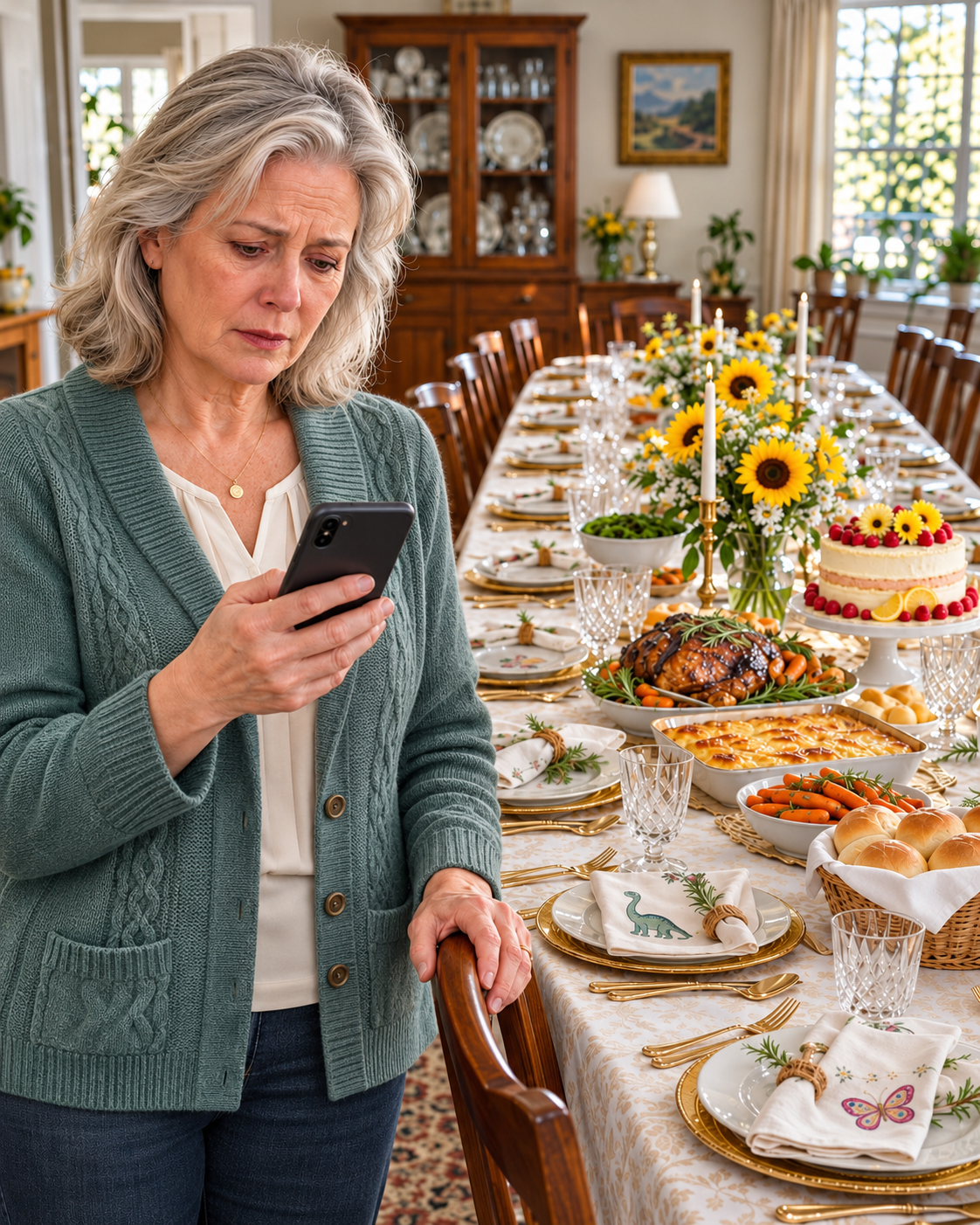
At 4:19 on a Saturday afternoon, I stood in my dining room straightening a napkin that didn’t need straightening. Fourteen plates rested on my mother’s cream-colored tablecloth. The roast was nearly ready, the potatoes had developed their golden crust, and a three-layer birthday cake waited beneath its glass cover. I had been working since before sunrise. My feet hurt so badly that I could feel my heartbeat in my heels. In forty-one minutes, the guests were supposed to arrive. I remember looking at the empty chairs and feeling pleased with myself. One minute later, my phone lit up, and everything I believed about that evening began to unravel.
My name is Judith Bennett. I’m sixty-four years old, and I’ve lived in Knoxville, Tennessee, for most of my adult life. My husband, Walter, and I bought our house when our children were small, back when every unexpected expense meant another week of careful grocery shopping. We raised our son, Derek, and our daughter, Abby, within those walls. We measured their heights against the kitchen doorway, repaired bicycles in the driveway, and celebrated birthdays with homemade cakes because bakery prices always seemed ridiculous. I never imagined that, after all those years, I would find myself wondering whether my own son saw me as a mother or simply someone he could depend on whenever he needed something.
Walter died several years ago. I still find it difficult to describe the change his absence made without making it sound smaller than it was. His work boots disappeared from beside the back door. The newspaper stopped appearing on his favorite chair. Nobody called from the garage asking whether I’d seen a particular screwdriver. In the evenings, I sometimes set two mugs on the kitchen counter before remembering there was no longer anyone to drink the second cup. Grief didn’t arrive as one enormous event. It settled into the ordinary moments, quietly changing the meaning of things I had once taken for granted.
Our daughter, Abby, understood that better than most people. She called several times a week, sometimes while folding laundry or waiting for her husband, Ben, to finish work. We talked about small things: a recipe she’d tried, a neighbor’s new puppy, the weather in her part of Tennessee. She never made me feel that a conversation had to accomplish something. Derek was different. He had a demanding job, a wife named Gina, and two children, Jake and Lily. I knew a busy family couldn’t organize itself around a lonely grandmother. Still, I missed them, particularly when weeks passed without a visit.
Jake was nine, serious about dinosaurs and convinced he would someday discover a species nobody had ever found. Lily, six, loved butterflies and insisted that every flower in my garden belonged to a different imaginary kingdom. I kept their drawings on the refrigerator, replacing them only when the paper became too curled to stay beneath the magnets. On difficult afternoons, I sometimes opened the drawer containing their old birthday cards just to hear their voices in my memory. I would have welcomed them for an hour, even half an hour. They didn’t need to bring anything. I only wanted to know how they were growing and what made them laugh.
So when Derek called on Wednesday afternoon, I was genuinely delighted. I’d been sorting a stack of medical bills at the kitchen table, and the sight of his name made me put them aside immediately. He asked how I was doing, listened for perhaps a minute, and then mentioned that Gina’s thirty-sixth birthday was coming up. They wanted to celebrate with family and a few friends, he explained, but finding somewhere suitable had become difficult. I could hear traffic behind his voice. He was clearly calling between other obligations, and I was already trying to think of ways to make things easier for him.
“Would you mind hosting dinner at your place?” he asked. “Everyone talks about how good your cooking is, Mom. Gina would love something homemade.” I could almost picture him standing beside his car, looking at the time. I asked when they were thinking of coming, and he said Saturday at five. Then I asked how many people. He answered without hesitation. “Fourteen, counting everybody.” I looked toward my dining room, where the table normally held little more than a bowl of fruit and Walter’s old wooden clock. Fourteen was considerably more than I had prepared for in years.
For a moment, common sense tried to intervene. Cooking for fourteen people would mean a major grocery trip, hours at the stove, and additional chairs brought in from the garage. My back had been troubling me recently, especially after standing too long. There was also the matter of money. But Derek sounded hopeful, and somewhere in the background I heard Lily asking whether she could speak to Grandma. That was enough to silence the objections forming in my mind. “Of course,” I told him. “We’ll make it a lovely evening.” He thanked me warmly, promised to send the details, and ended the call.
I spent the next hour thinking about the arrangements. I counted the dining chairs, checked the good serving dishes, and found the tablecloth my mother had embroidered decades earlier. It had a faint yellow mark near one corner that never quite washed out, but the fabric still looked beautiful when properly ironed. I imagined Jake helping me carry the rolls to the table and Lily asking for an extra piece of cake. For the first time in several weeks, the house seemed less like a place where I waited for phone calls and more like a place where something wonderful was about to happen.
Thursday morning, Gina sent the menu. It wasn’t a casual suggestion or a collection of favorite dishes. It was a detailed set of instructions accompanied by photographs. She wanted a roast with a seasoned herb crust, a rich potato gratin, carrots glazed until they shone, bread rolls made from scratch, and a tall lemon-raspberry cake with three carefully balanced layers. Each dish had a reference picture. The vegetables were arranged in matching rows. The cake had perfectly smooth frosting and decorations positioned with almost mathematical precision. Beneath the final photograph, she’d written that the presentation should look as close to the pictures as possible.
I read the message twice. Gina had always cared about appearances. She enjoyed arranging flowers, planning coordinated outfits for family photographs, and choosing restaurant tables with flattering lighting. None of those interests had bothered me before. People enjoy different things, and I had always respected that. But there was something uncomfortable about receiving a professional-looking menu for a dinner I had volunteered to host in my own home. No one asked whether I had the equipment to make everything. No one offered to arrive early, pick up ingredients, or contribute toward the groceries.
I started typing a question about the cost, then erased it. Gina had never been particularly comfortable discussing money, and Derek disliked what he called unnecessary financial conversations. I told myself the expense would be manageable if I bought carefully. I already had flour, sugar, butter, and several seasonings. Perhaps I could use the flowers growing in my garden rather than purchasing an arrangement. I replied that I would do my best with the menu. Gina responded with a smiling face and one last reminder that the carrots needed to have a proper shine.
That afternoon, I opened my bank account and worked through the figures. My retirement income covered the ordinary expenses if I stayed disciplined. The house was paid for, but property taxes, insurance, utilities, medication, and groceries consumed more than people seemed to realize. After the payments already scheduled for that month, I had three hundred forty dollars available until the next deposit. I stared at the balance longer than I wanted to admit. Then I wrote a shopping list on the back of an envelope, separating what was absolutely necessary from the decorations and other extras.
The grocery store was crowded when I arrived Friday morning. A young employee was arranging pumpkins near the entrance, and the bakery smelled of cinnamon. I walked slowly through the aisles, comparing prices and checking my list. The raspberries were more expensive than I expected, but Gina had specifically requested them. The roast needed to be large enough that everyone could have a proper serving. I chose good potatoes, fresh carrots, cream, lemons, and herbs. By the time I reached the flowers, my cart was full, and the practical part of me was insisting that the celebration had already become too expensive.
I almost put the flowers back. I stood beside the display holding a bunch of sunflowers, remembering how Walter used to bring me a few whenever he passed a roadside stand. They were cheerful flowers, bright enough to improve even the grayest kitchen. Gina’s photographs showed elaborate centerpieces, but I thought a simple arrangement would look prettier in my dining room. I placed them in the cart. Then I added the extra raspberries I needed to decorate the cake. It seemed foolish to compromise the result when I’d already committed myself to making the evening special.
The cashier announced the total: two hundred eighty dollars. I remember the exact amount because I looked at the screen and felt an unpleasant pressure beneath my ribs. After paying, sixty dollars would remain available to me. Sixty dollars for anything unexpected before my next retirement payment. I considered asking the cashier to remove several items, but there was a line behind me, and I didn’t want to explain why an elderly woman was buying groceries she could barely afford. I handed over my card, listened to the machine approve the transaction, and carried the bags to my car.
Driving home, I told myself the expense was worthwhile. It wasn’t as though I entertained often. My grandchildren would be there, and the dining room would be full of conversation. I could send everyone home with leftovers, perhaps even enough for Derek and Gina to avoid cooking the following evening. I remembered the times Walter and I had stretched our budget for the children’s birthdays, confident that celebrations were worth occasional sacrifices. The difference, which I did not allow myself to examine, was that those earlier sacrifices had been decisions we made together, with a clear understanding of what we could afford.
Abby called while I was putting away the groceries. When I mentioned the total, she went quiet. “Mom, didn’t you tell me you had about three hundred forty left this month?” I admitted that she had remembered correctly. I could hear her setting something down at the other end of the line. She asked whether Derek and Gina were contributing, and I said they hadn’t mentioned it. “Then why are you paying for fourteen people’s dinner?” she wanted to know. I explained that it was Gina’s birthday and that I was happy to have everyone together.
“Being happy to see them doesn’t mean you should have to cover everything,” Abby said. Her voice wasn’t harsh. That somehow made the observation more difficult to dismiss. I reminded her that I had managed difficult budgets before and that she didn’t need to worry. She asked if I wanted her and Ben to bring anything, and I said they could bring themselves. Then she told me something that stayed with me through the rest of the day. “You shouldn’t have to keep proving how much you love your family by exhausting yourself for them.” I laughed lightly and changed the subject, but after we hung up, I remained beside the kitchen counter for a long time.
I began preparing ingredients that evening. I measured flour, checked the cake tins, washed the vegetables, and set the roasting pan on the stove. Walter had always loved watching me get ready for family gatherings. He would sit at the counter with a cup of coffee, stealing a carrot whenever I turned away. Once, after I’d complained about the amount of work involved in Thanksgiving dinner, he told me that the children would remember the people around the table long after they forgot what had been served. I thought of that while arranging my utensils. I wished he were there to help me keep things in perspective.
Saturday began at 5:30 in the morning. I drank coffee standing at the sink and watched the first pale light spread across the backyard. The house was cold enough that I kept my cardigan on while I peeled potatoes. Soon the kitchen filled with the smell of onions, garlic, and fresh rosemary. I seasoned the roast carefully, kneading herbs into the surface and trimming away excess fat. The cake layers had to be baked separately because my oven couldn’t accommodate all three tins at once. By eight o’clock, the counter was crowded with mixing bowls, measuring cups, and cooling racks.
The morning moved faster than I expected. There were potatoes to slice thinly, cream to season, and carrots to trim. The bread dough rose beside the stove beneath a clean towel. I washed pans between tasks because I didn’t have enough equipment to leave everything until later. Every so often, I checked the clock and calculated how long the next stage would take. Once, I caught myself humming an old song Walter used to play on the radio. For a few seconds, the familiar melody brought him so close that I turned toward the doorway, half expecting to see him standing there.
Around noon, my wrists began to ache. I had spent hours lifting heavy bowls, spreading frosting, and pressing dough into shape. The floor beneath my feet seemed much harder than it had that morning. I sat down for five minutes with a glass of water, but my phone immediately vibrated. Gina wanted to remind me that the carrots needed to look glossy rather than dull. She wrote that people noticed details like that. I looked at the sink full of dishes, then at the small burn on my forearm where I’d brushed the oven rack. I answered with a thumbs-up because I couldn’t think of anything polite to say.
By early afternoon, the kitchen had become almost unbearably warm. I opened a window despite the cool weather and continued working. The roast smelled wonderful, the potatoes were coming together, and the cake layers were finally cool enough to assemble. I spread lemon filling between them, then added the raspberry mixture with a spoon. The top layer shifted slightly, and I spent several minutes correcting it. When I stepped back, the cake looked remarkably close to Gina’s photograph. I felt a small rush of satisfaction that surprised me. I had wanted to make something beautiful, and I had.
I carried the flowers into the dining room and arranged them in my mother’s old glass vase. Fourteen place settings required extending the table and bringing additional chairs from storage. The extra chairs didn’t match, but I polished them anyway. I folded the napkins, checked the silverware, and set out glasses for water and cider. For Jake, I found paper napkins printed with dinosaurs from a previous visit. Lily’s place received the butterfly ones I had tucked away for her. I knew they would notice those little details, and the thought made the work feel less tiring.
At three o’clock, I called Derek to confirm the time. He answered after several rings, sounding distracted. There were voices behind him and a brief burst of laughter. He said everything was fine and that everyone would arrive around five. I asked whether the children were excited, and he told me Lily had been talking about the cake. I mentioned that nearly everything was ready. “Great, Mom,” he said. “We appreciate it.” Then someone spoke to him in the background, and he ended the call. I stood with the phone in my hand, satisfied that all my worries about timing had been unnecessary.
Once the cooking was under control, I went upstairs to change. I chose a soft green sweater Walter had bought me several Christmases earlier. He used to say the color made my eyes look brighter. I brushed my hair, put on a little lipstick, and fastened the small pearl earrings Abby had given me. In the bedroom mirror, I looked tired, but there was something hopeful in my expression. I had missed being surrounded by family. I had missed the ordinary sound of people moving through the house. I told myself that by evening, the exhaustion would disappear beneath the pleasure of having everyone together.
Back downstairs, I made one final inspection. The dining room looked warm and welcoming. Sunflowers stood in the center, the glasses caught the afternoon light, and the cake waited on the sideboard. I checked the oven, lowered the heat slightly, and straightened the tablecloth. My hands smelled of lemon zest and rosemary. I was thinking about whether Jake would want extra potatoes when my phone vibrated against the counter. The clock above the stove read 4:20. Gina’s name appeared on the screen, and I smiled automatically, expecting a question about parking or directions.
Instead, her message announced that the plans had changed. Harlo’s, a restaurant she particularly liked, had made a table available for that evening. They were going there instead. She ended by wishing me enjoyment of all the delicious food I’d prepared, as though she were informing me of a minor adjustment to an afternoon picnic rather than canceling a dinner for fourteen people forty minutes before it began. I read the words once, then again. There was no apology. No question about whether the ingredients could be saved. No acknowledgment that I had spent nearly the entire day cooking.
The house remained perfectly quiet. Somewhere outside, a car passed along the street. I could hear the oven fan running and the faint tick of Walter’s clock. My first impulse was to assume I’d misunderstood. Surely Derek would call. Surely someone would explain that the restaurant had offered an additional reservation and that the family wanted me to join them. I walked into the dining room and looked at the carefully arranged settings. Fourteen empty chairs stared back at me. The dinosaur napkin at Jake’s place had slipped slightly beneath his fork, and I reached to straighten it before realizing what I was doing.
Then I noticed something in Gina’s message that made the entire situation feel different. She hadn’t said that they had suddenly decided to look for a restaurant. She had said that a table had become available. That suggested someone had been waiting for one. I thought about Derek calling on Wednesday, the elaborate menu arriving Thursday, and Gina’s repeated instructions about presentation. My fingers tightened around the phone. If the restaurant had been their preferred choice all along, when had they first tried to book it? And why had nobody mentioned that I might be cooking an entire birthday dinner they never intended to eat?
I opened Derek’s contact information and pressed call. He answered quickly, with the same distracted impatience I’d heard earlier. This time, however, I didn’t ask when he would arrive or whether the children were excited. I asked a single question. “Derek, when did you put your names down for that restaurant?” There was a pause, not long enough to seem dramatic but long enough for me to hear him take a breath. Then he answered, “Tuesday, Mom.” I looked at the dinner table. He had asked me to cook on Wednesday. The meaning of that order of events settled over me, and I realized I had been preparing a celebration that was never their first choice.
END PART 1
PART 2 TITLE: My Son Called My Carefully Prepared Dinner a Backup Plan, Then Left Me Alone With Fourteen Plates and an Uncomfortable Truth
“Tuesday?” I repeated. I knew he’d heard me the first time, but I needed him to acknowledge what he’d just admitted. Derek made an impatient sound, the kind he used when a conversation interrupted something he considered more important. He explained that Harlo’s had been difficult to book and that Gina had wanted to celebrate there for weeks. They’d submitted a request for a reservation, he said, but nobody could promise a table. I leaned against the kitchen counter and waited for him to finish. He seemed genuinely puzzled that I wasn’t immediately relieved by his explanation. To him, the restaurant accepting their request was good news. He hadn’t considered what the news meant to me.
“So when you called on Wednesday,” I said carefully, “you already knew you might eat somewhere else.” Derek told me they had hoped for the restaurant but couldn’t count on it. I asked why he hadn’t mentioned that possibility before I agreed to host fourteen people. His answer came quickly. “Because we needed another option, Mom. Your dinner was our backup.” I looked through the doorway at the table I’d spent the afternoon arranging. Backup. The word seemed strangely precise. It explained the timing, Gina’s elaborate requests, and the complete absence of concern about canceling. They hadn’t changed their minds about a family celebration. They had simply received the arrangement they preferred.
I asked whether Gina had known about the restaurant request when she sent me those photographs. Derek hesitated before saying she probably had. I remembered standing in the supermarket comparing prices, worrying about whether I could afford enough raspberries to make her cake look right. All that time, Gina had apparently been waiting for a call that would make my work unnecessary. “Why ask me to prepare the entire menu?” I wanted to know. Derek sighed. “Because if the restaurant didn’t work out, we still wanted her to have a nice birthday. You’re making it sound worse than it was.”
There was a particular kind of hurt in hearing someone dismiss a sacrifice they hadn’t bothered to measure. Derek hadn’t seen me lifting the roasting pan or massaging my aching wrists. He hadn’t watched me return a cheaper package of meat because it might not serve enough people. He knew I loved cooking, and from that simple fact he had constructed an assumption that cooking was effortless for me. “I spent ten hours preparing this dinner,” I told him. “The ingredients cost two hundred eighty dollars.” He responded that nobody had forced me to go to so much trouble. I stared at the sunflowers, wondering how a favor requested by my own son had become an extravagance for which I was apparently responsible.
I asked whether I could at least join them at Harlo’s. It seemed a reasonable question. After all, this was supposed to be a family celebration, and I had been expecting to spend the evening with my grandchildren. Derek was silent for a few seconds. Then he told me the reservation was for twelve people. He said it in the casual tone someone might use when explaining that a parking lot was full. I counted the places at my table again. Fourteen guests had been expected at my house. Harlo’s had room for twelve. “So there isn’t a place for me?” I asked. His answer was an uncomfortable request not to make things difficult.
For a moment, I thought of asking him to put Gina on the phone. Perhaps she would realize the situation was unfair. Perhaps she would suggest adding another chair or postponing the restaurant celebration. But the thought passed almost immediately. A woman who had asked me to make shiny carrots while I struggled through a crowded kitchen already knew I’d been cooking. She had sent the cancellation herself. I wasn’t sure which hurt more: the fact that they had abandoned my dinner or the fact that they hadn’t considered including me in the alternative. It was my work they had wanted, not necessarily my company.
I told Derek that after purchasing the groceries, I had only sixty dollars left until my next retirement payment. His tone changed slightly, becoming defensive. He asked why I hadn’t said anything earlier. I nearly laughed, though there was nothing funny about the moment. I reminded him that he’d asked me to feed fourteen people and that Gina had chosen the menu. He said he hadn’t realized things were so tight. “Would knowing have changed your plans?” I asked. He didn’t answer directly. Instead, he suggested that I could freeze the food and use it over the next several weeks. At least, he said, I wouldn’t have to worry about cooking.
I pictured fourteen servings of potatoes, an enormous roast, enough bread for a crowded table, and a cake meant to celebrate someone who wouldn’t be there to taste it. Some of the food could certainly be stored. That wasn’t the point, and I knew Derek was intelligent enough to understand it if he wanted to. I tried once more to explain that I had been looking forward to seeing everyone. He interrupted, saying they were already late getting ready and that Gina would be upset if they missed the reservation. Then he asked me not to turn the matter into a family argument. Before I could respond, he ended the call.
I remained with the phone against my ear until the silence made me lower it. The oven timer rang behind me, sharp and persistent. I switched it off, turned down the heat beneath the remaining dishes, and stood in the middle of the kitchen without deciding what to do next. I had cooked through exhaustion, worrying over tiny details that nobody would now see. The roast had reached the perfect temperature. The potatoes were soft beneath their golden surface. The rolls had browned evenly. Everything had worked exactly as planned, except the people. I couldn’t remember ever feeling so foolish in my own home.
My first thought was to clear the table before anyone saw it. I imagined carrying the plates back to the cupboard, folding the tablecloth, and putting the flowers somewhere out of sight. Perhaps if I made the dining room look ordinary again, the disappointment would become easier to bear. I lifted the first plate, then put it down. I was tired of pretending that painful things hadn’t happened. I had been doing some version of that since Walter died, smiling when Derek canceled visits, excusing the forgotten telephone calls, and finding reasons why I shouldn’t ask for more attention from my own family.
Instead of clearing the table, I went to the kitchen and cut myself a slice of Gina’s birthday cake. The knife moved through the frosting smoothly, revealing neat layers of lemon sponge and raspberry filling. I set the slice on one of my everyday plates, poured a cup of tea, and carried both into the dining room. The first bite was wonderfully light. The lemon balanced the sweetness, and the raspberries added just enough sharpness. It was probably one of the best cakes I’d made in years. I swallowed, set down my fork, and began to cry. Somehow, discovering that my work had turned out beautifully made the rejection harder to bear.
I didn’t know how long I sat there. The light shifted across the tablecloth, and the tea cooled beside my plate. I thought about Walter, who would have been furious on my behalf but would probably have waited until I had finished crying before saying so. I could almost hear him asking why our son had become so careless. Then I remembered that I had agreed to all of it. Nobody had physically forced me to spend the money or follow Gina’s instructions. I’d been so frightened of disappointing my family that I had stopped asking whether their expectations were reasonable. Recognizing that didn’t excuse Derek’s behavior. It simply made the situation more complicated.
At 4:47, my phone rang again. I looked at the screen and saw Abby’s name. For one terrible second, I thought she might be calling to cancel too. Instead, she sounded cheerful and slightly breathless. She explained that Ben had been delayed and asked whether they could arrive a little after five. I must have sounded strange because she stopped mid-sentence and asked whether I was all right. “You’re still coming?” I asked. There was silence at the other end. “Of course we’re coming, Mom. What’s happened?” I told her about Gina’s message, Derek’s explanation, and the restaurant reservation that didn’t include me.
Abby listened without interrupting. When I finished, I heard her speak quietly to Ben. Then she came back on the line. “We’re on our way,” she said. I told her there was no need to rush and that she shouldn’t feel obligated to come just because I was upset. She answered with an unusual firmness. “We were invited to dinner. You cooked dinner. We’re coming.” I tried to say that there was enough food for a small wedding and that the table looked ridiculous with so many empty chairs. Abby said she didn’t care how many plates were set. She wanted to sit down with me and eat the meal I’d prepared.
Twenty minutes later, I heard a car door close outside. Abby came through the front entrance carrying flowers, while Ben followed with a bottle of sparkling cider. I must have looked worse than I realized because my daughter put everything down and wrapped her arms around me before she said a word. I tried to apologize for crying, but she only held me tighter. Ben stood nearby, looking uncomfortable in the kindest possible way. Finally, he asked whether I would like a fresh cup of tea while they helped get dinner ready. It was such an ordinary offer that I nearly began crying again.
Neither of them asked whether the roast looked like Gina’s photograph. Abby admired the sunflowers and laughed when she discovered the dinosaur and butterfly napkins. Ben said the dining room smelled like the holidays. When I started explaining that the rolls might be slightly overbaked, he took one from the serving basket, broke it open, and ate half while standing beside the table. “These are excellent,” he told me. “Please don’t apologize for feeding us.” I watched him reach for the butter and realized how tense I had been all day, waiting for someone to find fault with the work I’d done.
We sat together at the long table. Three people facing fourteen place settings should have looked absurd, but for the first few minutes, I didn’t care. Abby helped herself to the potato gratin and immediately asked how I’d made the sauce. Ben took a generous serving of roast and said he wished he could cook meat that tender. They asked about my week, told me about a minor problem with their car, and listened when I mentioned a book I’d been reading. It was a conversation without instructions or requests. Nobody looked at a clock. Nobody warned me that we were holding them up. Gradually, my appetite returned.
After our first plates were empty, Abby looked toward the kitchen, where several large dishes still held enough food for many more people. “We can’t possibly eat all this,” she said. I nodded, already imagining the process of dividing everything into containers. Then she suggested inviting some neighbors. At first, I resisted. I didn’t want anyone to think I was gathering an audience for my humiliation. Abby understood what I meant. She assured me that we didn’t need to explain why there was so much food. We could simply say that I’d cooked a generous dinner and would enjoy having company. Ben offered to carry plates to anyone who preferred not to come out.
The first person we called was Ruth, a friend from down the street. Her sister had died recently, and she’d been spending more evenings alone than she admitted. When I asked whether she would like to join us, she sounded surprised. She said she hadn’t made supper yet and could be there shortly. Next, we called the Patels, who lived beside me. Nisha Patel immediately asked what she could bring. I told her that I had more food than the dining room could hold and that bringing herself would be contribution enough. She laughed and said she would come with her family. For the first time that afternoon, the laughter I heard felt connected to something genuinely pleasant.
Ben prepared several generous plates for Mrs. Alvarez, who was recovering from an operation and had difficulty standing long enough to cook. He carried them across the street with a note explaining what each container held. When he returned, he said she had thanked us twice and promised to return the dishes when she was feeling stronger. I went back into the dining room, where Abby was moving some of the unused settings aside to make space for people who would actually sit down. The table looked less formal, but it felt more welcoming. The napkins were no longer perfectly aligned, and I found I didn’t mind.
By early evening, seven of us had gathered around the table. Ruth arrived in a blue cardigan with a small tin of homemade biscuits. The Patels brought the easy familiarity of neighbors who knew where I kept the extra glasses. Ben opened the sparkling cider, and Abby insisted that everyone try the cake before leaving. The conversation wandered from gardening to school memories to the road repairs that had been causing traffic problems nearby. Nobody asked whether the carrots were shiny enough. Someone complimented the seasoning on the roast, and someone else asked for more potatoes. I had spent all day trying to create a perfect celebration. What we had instead was an imperfect, wonderfully comfortable dinner.
At one point, Ruth mentioned Walter. She remembered how he used to repair loose porch railings for people who couldn’t manage the work themselves. Ben laughed and told us about the time Walter had tried to teach him to replace a faucet and discovered that he was better at following instructions than holding tools. I could see the scene in my mind: Walter kneeling beneath the sink, Ben looking apologetic, and both of them eventually laughing at the amount of water on the floor. The memory didn’t make me feel abandoned. It made me feel grateful that other people still carried pieces of my husband’s life with them.
After dinner, Nisha began washing the dishes while Ben dried them. I protested out of habit, telling everyone that guests shouldn’t have to work in my kitchen. Nisha handed me a clean towel and said that after cooking such a meal, I should consider myself officially excused. Abby took charge of putting leftovers into containers. For once, I allowed people to help without arguing. I sat with Ruth in the living room while the sounds of running water and friendly conversation drifted from the kitchen. There was something deeply reassuring about hearing my home occupied by people who weren’t waiting for me to serve them.
Ruth noticed that I kept glancing toward my phone. I had placed it facedown on the arm of my chair, but I couldn’t stop wondering whether Derek might call. She asked quietly whether the evening had been difficult. I explained what had happened, leaving out some of the harsher words because repeating them felt unpleasant. Ruth listened with her hands folded in her lap. Then she said that people could care about someone and still become careless about the things that person gave up for them. I asked how I was supposed to make Derek understand the cost of his behavior. She considered the question before answering that perhaps I needed to stop protecting him from that cost.
Her words unsettled me. I’d spent years believing that a mother’s job was to make life easier for her children whenever possible. Walter and I had helped them with school expenses, repairs, unexpected bills, and childcare. When the children were young, those sacrifices had been part of raising them. But Derek was no longer a boy who needed help tying his shoes or paying for a school trip. He was a grown man with a household of his own. I had been treating every problem he brought me as if it were an emergency I was personally responsible for solving. That habit had become so familiar that I barely noticed it anymore.
The neighbors left gradually. Ruth squeezed my shoulder and promised to return the following week for tea. Nisha thanked me for the meal and said the cake was too good to be reserved for birthdays. Ben carried the final containers to the refrigerator while Abby wiped the table. By the time the dishes were put away, the house looked ordinary again, except for the sunflowers still standing in their vase. I felt tired in every part of my body, but the sharp humiliation of the afternoon had softened. The dinner hadn’t been wasted. People had enjoyed the food, and for a few hours the house had been full of warmth.
Abby and Ben were preparing to leave when I asked my daughter to stay a little longer. She glanced at Ben, who understood without needing an explanation. He kissed me on the cheek, told me to keep the extra cider, and went home, promising to check in the next morning. After the front door closed, Abby returned to the kitchen. I made tea, although neither of us really wanted any. She sat at the table while I searched the drawer for a notebook. I had been carrying a secret for so long that the thought of saying it aloud made me feel almost physically ill.
“There’s something else you don’t know,” I told her. Abby looked up immediately. I explained that the groceries weren’t the only reason my bank balance had been so low. There was another expense, a regular payment I hadn’t told her about because I was embarrassed and because I didn’t want anyone questioning my decisions. She waited patiently while I tried to find the right words. Finally, I said that I’d been helping Derek with his house. Abby frowned. She remembered that he’d experienced financial trouble several years earlier, but she’d believed the problem had been resolved.
“It was supposed to be temporary,” I said. I could feel my hands beginning to tremble around the mug. Abby leaned forward and asked exactly what I meant. I told her Derek had needed help with his home loan when his working hours were reduced. I’d arranged to send money directly to his lender, and at first it had seemed like the obvious thing to do. He’d promised that he would take over again once his income recovered. The arrangement had started with good intentions, I insisted. Abby said she understood that part. Then she asked whether I was still sending him money.
I looked at my daughter, who had come to dinner simply because she’d promised to be there, and realized I was afraid of what she would think of me. She had spent the evening defending my dignity while I had quietly been financing the very household that had treated me as disposable. I took a breath. “Yes,” I admitted. “I pay four hundred eighty-six dollars every month toward Derek’s mortgage.” Abby didn’t move. Her expression became very still. Then, in a voice so quiet I could barely hear it, she asked how long I’d been making those payments. I lowered my eyes and told her the truth. Almost four years.
END PART 2
PART 3 TITLE: My Daughter Discovered the Secret Mortgage Payments I Had Hidden for Four Years, and One Decision Changed Everything Before Sunday Morning
Abby stared at me across the kitchen table. The refrigerator hummed behind her, and somewhere outside a dog barked twice before the street became quiet again. She hadn’t raised her voice, but I could see the shock in her face. “Almost four years?” she repeated. I nodded. She looked toward the notebook beside my tea, then back at me. “Mom, that’s hundreds of dollars every month.” I told her I knew. She shook her head slowly, as though the numbers might make sense if she gave them enough time. Then she asked something I had spent years avoiding. “How have you been managing your own expenses?”
I began with the explanation I’d rehearsed whenever I worried that someone might discover the arrangement. Derek had been in genuine difficulty when it started. His company had reduced his hours, and the mortgage was becoming impossible to manage alongside groceries, insurance, and the children’s needs. Jake was still small, and Lily was younger. Derek sounded frightened when he called. He said he had received a warning from the lender and didn’t know how he would keep the family in their home if his hours weren’t restored. I remembered sitting in this same kitchen, listening to his voice break as he explained the situation.
At the time, Walter’s health had already begun to worry us, though we were still hoping his condition would improve. I didn’t tell Derek about every concern we were facing. I believed a mother should spare her children unnecessary anxiety, especially when they were struggling themselves. So I went through our finances and found what I thought would be a temporary solution. Four hundred eighty-six dollars a month would ease the pressure on Derek’s mortgage. It wasn’t a small amount, but I convinced myself we could manage it for a short period. I arranged the transfer directly to his lender because I wanted to know the money was going toward the house.
Derek had been grateful. I remembered that clearly. He’d called me several times during those first weeks, saying he couldn’t believe how much the help meant to him. He promised to resume the full payments within three months. I believed him because he was my son and because the problem seemed temporary. The first three months passed, and he said his hours still hadn’t fully recovered. I agreed to continue a little longer. By the end of six months, he was making more money, but new expenses had appeared. There was always a reason why the timing wasn’t right for him to take over again.
Eventually, Derek received a promotion. He mentioned it during a family phone call, and I remember feeling proud of him. He was earning more, taking on greater responsibility, and making plans for the future. I waited for him to bring up the mortgage arrangement. He didn’t. At first, I told myself he needed time to settle into his new position. Later, when he talked about renovating the kitchen or replacing their vehicle, I assumed other financial obligations must still be weighing on him. I never asked to see his household budget. I accepted his explanations because questioning them felt uncomfortably close to accusing my own child of dishonesty.
Abby listened with her arms folded loosely on the table. She asked whether Derek had ever offered to reduce the amount. I shook my head. She asked whether he’d sent any money back when he received bonuses or raises. Again, I shook my head. I began explaining that Gina and the children had needs I couldn’t fully understand from the outside. Abby interrupted gently. “Mom, you don’t need to defend every purchase they make.” I looked away. It was an unfamiliar sensation to have someone refuse an excuse I’d offered on another person’s behalf. For years, those excuses had been the foundation of my decision to continue paying.
Then Abby asked what I’d gone without. “Nothing serious,” I answered automatically. The words sounded unconvincing even to me. She looked at my face, waiting. I glanced toward the kitchen window, where the reflection of the overhead light made the glass almost opaque. Finally, I admitted that I had postponed having a damaged tooth repaired. My dentist had recommended a crown months earlier, but the estimate was more than I could comfortably cover. I had told myself the tooth wasn’t hurting enough to justify the expense. Abby’s expression changed. She knew I’d been avoiding certain foods, but she’d assumed it was simply a preference.
She asked about my car next. I had mentioned the tires needing replacement during one of our conversations, then never brought it up again. I explained that I was driving carefully and avoiding unnecessary trips until I could save enough money. In winter, I kept the thermostat lower than I liked and wore additional layers around the house. I chose generic groceries whenever possible and delayed replacing clothes that had become worn. None of those decisions seemed particularly dramatic when considered separately. Together, however, they formed a pattern I had been unwilling to acknowledge. I was reducing the quality of my own life so Derek wouldn’t have to reduce the comfort of his.
The most difficult admission concerned Abby herself. Months earlier, she’d invited me to spend a weekend with her and Ben. We’d planned to visit a botanical garden, cook together, and spend an afternoon browsing a small bookshop she liked. I canceled because I said I wasn’t feeling well. The truth was that I couldn’t comfortably afford the journey and the little expenses that would come with it. I hadn’t wanted Abby to pay for everything, particularly when I was still sending money to Derek. When I told her, she pressed her lips together and looked down at her hands. I realized that my secrecy had hurt her as well.
“Why didn’t you tell me?” she asked. I said I didn’t want her worrying or feeling responsible for helping me. Abby took a breath before answering. “You were worried I’d feel responsible for you while you were taking responsibility for Derek.” There was no accusation in her voice, only sadness. I tried to explain that Derek had children and that his situation seemed more urgent. She reminded me that both of us were grown adults now. She didn’t want me neglecting myself for either of us. “Jake and Lily need their grandmother healthy,” she added. “They also need parents who know how to manage their own household.”
I looked at the photographs on the refrigerator. Jake was grinning beside a school project, and Lily stood in the garden holding a butterfly she’d found resting on her sleeve. I loved those children more than I could explain. The possibility of Derek losing their home had frightened me enough to make the first payment without hesitation. But the situation that justified helping him four years earlier wasn’t necessarily the situation we faced now. I had been acting as though the original emergency never ended. Abby asked whether I truly believed Derek would lose the house if I stopped paying. I realized I didn’t know. I hadn’t asked.
There was another question she wanted answered. Why had I never told Derek that the payments were becoming difficult for me? I thought about our conversations over the years. When he called, he usually had a problem to discuss, a favor to request, or a scheduling change to announce. I rarely volunteered information about my own expenses unless he asked directly. Sometimes I began to mention a concern, only to hear him say he had another call waiting. I had interpreted his busyness as a reason to keep quiet. Abby pointed out that Derek’s limited availability didn’t make my needs disappear. I knew she was right, but accepting it felt strangely disloyal.
“I can stop, can’t I?” I asked. The question escaped before I’d decided to say it. Abby reached across the table and covered my hand with hers. “Yes, Mom. You can.” I told her I was frightened of what might happen. Derek had grown accustomed to the arrangement, and Gina might be furious. More than anything, I worried they would stop bringing the children to see me. Even speaking that fear made my throat tighten. Abby didn’t promise it would be easy. She said we couldn’t control Derek’s reaction, but we could make sure my decision was reasonable and clearly communicated. Then she asked whether I wanted to look at the numbers together.
I went to the drawer beside the telephone and took out Walter’s old yellow legal pad. He had used it for household projects, writing measurements in the margins and crossing out figures when he changed his mind. Several sheets still carried his handwriting. I placed the pad between us and wrote my monthly retirement income at the top. Beneath it, we listed the expenses I couldn’t avoid: utilities, insurance, taxes, groceries, medication, and ordinary household maintenance. Abby asked precise questions, but she didn’t make me feel foolish when I had to check a statement. For the first time in years, someone was looking at my finances without expecting me to make room for another person’s needs.
When we added the mortgage contribution, the figures became painfully clear. It wasn’t simply that four hundred eighty-six dollars was a substantial monthly expense. It was that the payment consumed money I needed for my own security. I thought about the dental crown, the tires, and every winter evening I’d spent worrying about the heating bill. Abby turned the pad to a fresh page and suggested writing two headings. Under the first, I wrote what I could afford. Under the second, what I could no longer afford. The second column filled quickly. I stared at the growing list, surprised by how many things I’d accepted as normal.
We calculated the amount of support I’d provided over nearly four years. The total was large enough that I asked Abby to check the multiplication. She did, then passed the calculator back without commenting. I knew the money had helped keep Derek’s family stable during a difficult period, and I didn’t regret helping when the need was genuine. What troubled me was how completely the arrangement had continued after the original circumstances changed. I’d never been invited to reassess it. I’d simply remained part of the household budget, invisible whenever decisions were made and essential whenever a payment came due.
Abby suggested that I contact my bank before the next transfer. I hesitated. The payment was scheduled for Monday, and it was already late Saturday evening. Derek might not have enough money set aside to cover the difference. What if the lender charged him a fee? What if he became furious and told Gina I was trying to punish them over the canceled dinner? Abby reminded me that the loan was in Derek’s name and that he had been responsible for managing it from the beginning. She also said I should give him clear notice so he could contact the lender. We sat quietly while I considered the difference between giving reasonable notice and asking permission to stop.
Before making the decision, I walked into the dining room. Most of the plates had been put away, and the tablecloth was folded over the back of a chair. The sunflowers remained on the table. In the kitchen, containers of leftovers were stacked neatly in the refrigerator. The dinner had cost me nearly everything I had available for the month, and Derek had dismissed that fact with a suggestion that I freeze the food. I thought about how easily he’d accepted my unpaid labor, my grocery money, and my disappointment. Then I thought about the mortgage payments, which he had continued accepting without ever asking whether I could afford them.
When I returned, I told Abby I wanted to cancel the recurring transfer. She asked once whether I was certain. I said I was. We opened the banking website together, and I found the scheduled payment to Derek’s lender. My hand shook as I moved the cursor toward the cancellation option. I had a sudden impulse to postpone the decision until I’d spoken to him. But I knew what that conversation would become. He would explain his difficulties, remind me of the children, and ask for just one more month. I’d heard variations of that request for years. This time, I needed to act on the facts already in front of me.
I selected the recurring payment and followed the instructions to cancel future transfers. A confirmation appeared on the screen. I read it twice, then saved a copy for my records. Abby didn’t cheer or congratulate me. She simply sat beside me while I absorbed what I’d done. The amount would remain in my account when the next payment date arrived. That money could go toward necessary repairs, medical care, or an emergency. It belonged to my retirement budget, not to a permanent arrangement I had never intended to create. Yet I felt more frightened than relieved. I had changed something Derek believed he could always rely on.
Near midnight, I wrote him a message. I explained that I had canceled the recurring contribution toward his mortgage and that the upcoming payment was now his responsibility. I asked him to contact his lender directly and made clear that I wouldn’t restart the arrangement. I also requested reimbursement for the two hundred eighty dollars I’d spent preparing the dinner that had been canceled after the food was ready. I read the message several times. My first version contained three apologies. I deleted them. The final message was calm, factual, and less than a paragraph long. Abby read it and said it explained everything Derek needed to know.
I kept my thumb above the screen for several seconds. Sending the message meant giving up the comforting illusion that Derek would eventually notice my sacrifices and offer to relieve me of them. It meant acknowledging that I had the right to set a limit even if he disliked it. I remembered the way he’d spoken to me that afternoon, treating my disappointment as an inconvenience. Then I pressed send. The little confirmation appeared beneath the message. I put the phone facedown on the table and felt an unexpected wave of exhaustion. Abby stayed until she was satisfied I would be all right, then left after making me promise to eat a proper breakfast.
I went upstairs shortly after midnight but slept badly. Every creak of the house made me think my phone was ringing. I dreamed that the dining room table was full of people who wouldn’t look at me, and woke before dawn with my heart pounding. When I reached for the phone, I forced myself to leave it alone. I made coffee, opened the curtains, and fed the birds outside the kitchen window. Ordinary tasks helped me remember that the world hadn’t ended because I’d made a difficult financial decision. For a little while, I managed not to wonder what Derek would say.
At nine o’clock Sunday morning, I finally checked my phone. There were twenty-six missed calls from Derek. The number was so extraordinary that I counted the notifications twice. His messages began with confusion about the canceled payment, then became increasingly demanding. He wanted to know why I hadn’t discussed it with him. He reminded me the mortgage payment was due Monday. Several messages insisted that I call immediately. Others accused me of making a reckless decision out of anger. I read them standing beside the kitchen sink, noticing how quickly he had found time to contact me once his own finances were involved.
Gina had sent a message too. She accused me of using money to hurt my family and described my decision as cruel. There was no acknowledgment of Saturday’s dinner, no offer to reimburse the groceries, and no question about whether I could afford the payments I’d been making. I placed the phone on the counter and tried to steady my breathing. I hadn’t expected Derek to be pleased, but the intensity of his reaction frightened me. I wondered whether he’d told Gina what I’d written or merely that I had stopped helping. I remembered Abby saying that I couldn’t control his response. Understanding that in theory was easier than living through it.
At 9:18, someone knocked hard on my front door. The sound carried through the quiet house, followed by another impatient series of knocks. I looked through the small window beside the entrance and saw Derek standing on the porch, his face tight with anger. His car was parked crookedly along the curb, as though he’d arrived too quickly to care about the details. He called my name and demanded that I open the door. I rested one hand against the frame, remembering all the times I’d rushed to welcome him inside. This time, I left the security chain attached. I opened the door only a few inches and saw the expression on my son’s face.
END PART 3
PART 4 TITLE: Twenty-Six Missed Calls Brought My Furious Son to My Door, but His Wife’s Next Confession Revealed a Deeper Problem
Derek looked at the security chain as though it were an insult. I had never opened the door to him that way before. He was my son, and for most of his life he’d walked through our entrance without knocking. Now he stood on the porch, breathing hard, his hair disheveled and his jacket hanging unevenly from one shoulder. “Take the chain off, Mom,” he demanded. I told him good morning and asked him to lower his voice. He glanced toward the neighboring houses, then returned his attention to me. “Are you seriously going to stand there acting like nothing happened?”
I could feel my heart beating against my ribs. Part of me wanted to apologize immediately, invite him inside, and promise to reconsider everything. I’d spent years smoothing over disagreements before they could become uncomfortable. But the image of my bank statement remained clear in my mind. So did the dental bill and the sixty dollars left after Saturday’s groceries. I told him that I would talk when he was ready to speak respectfully. He raised his voice again, demanding to know whether I understood how much trouble I’d caused. I closed the door. My hands trembled as I turned away, but I didn’t remove the chain.
For several seconds, I heard him moving on the porch. Then he knocked again, more gently. “Mom, I’m sorry I shouted,” he called. “Please. We need to talk.” I waited long enough to calm myself before reopening the door. His expression had changed, although the anger hadn’t disappeared entirely. I removed the chain and stepped aside. Derek walked into the hallway without taking off his jacket. He glanced toward the dining room, where the table had been cleared, and then turned to face me. He didn’t ask whether I’d slept or how I felt after the previous evening. His first question concerned the mortgage payment.
“The money is due tomorrow,” he said. “You can’t cancel something like that without warning.” I led him into the kitchen and asked him to sit down. He remained standing until I pulled out a chair for myself. Then he sat opposite me, his fingers moving restlessly against the tabletop. He explained that he and Gina had organized their expenses around the money I contributed. They had other bills scheduled, he said, and changing the arrangement suddenly could create problems. I listened without interrupting. When he finished, I told him I had also been organizing my expenses around those payments. The difference was that I could no longer afford to continue.
Derek leaned back and stared at me. “You’re doing this because of yesterday,” he said. I admitted that the abandoned dinner had forced me to examine things I’d been avoiding, but I told him the mortgage arrangement was a separate financial problem. He insisted that I was overreacting to a change of plans. I asked whether he genuinely believed it was reasonable to request an expensive dinner, let me spend ten hours preparing it, and then leave me out of the restaurant celebration. His expression tightened. He said they hadn’t known Harlo’s would call. I reminded him that he’d known they were waiting for a table before he asked me to cook.
He rubbed his forehead and told me he was sorry the evening had been disappointing. The apology was so carefully limited that I almost let it pass. Then I asked whether he understood what the groceries had cost me. He said he’d heard me mention the amount, but he hadn’t realized my finances were difficult. I repeated that I’d told him I had only sixty dollars remaining. He looked uncomfortable. “I thought you had savings,” he said. “Dad always handled money carefully.” I explained that Walter had left me enough to live modestly if I made responsible decisions. He hadn’t left an unlimited reserve from which I could support another household indefinitely.
I stood, retrieved the yellow legal pad from the drawer, and placed it in front of Derek. The pages contained the figures Abby and I had organized the previous evening. I showed him my monthly retirement income, the cost of maintaining the house, insurance, utilities, groceries, and medical expenses. Then I pointed to the four hundred eighty-six dollars I’d been transferring to his lender. Derek studied the numbers without speaking. He turned a page and looked at the list of expenses I’d postponed. For the first time since arriving, he seemed more interested in what was written than in arguing with me. I let him read.
“Why didn’t you tell me it was this bad?” he asked eventually. I reminded him again that I had told him what remained in my account after buying the birthday groceries. He looked down. “I didn’t understand what you meant,” he said. I asked how I could have made it clearer. He didn’t answer. Then I explained about the dental crown and the car tires. I told him I had kept the heat low during cold weather and canceled a visit to Abby because I couldn’t comfortably afford the journey. He shifted in his chair, clearly disturbed. I didn’t try to make the facts sound less serious to protect him from feeling guilty.
Derek said he’d always intended to take over the mortgage payments again. I asked when. He looked at the ceiling for a moment before answering that things had become complicated. I reminded him that the original agreement was for three months and that almost four years had passed. His income had recovered. He’d been promoted. Their home had received improvements, and they’d purchased a newer vehicle. I wasn’t accusing him of being extravagant merely because he wanted a comfortable life. But I needed to understand why his family’s increased financial stability hadn’t led him to reconsider the help he was still accepting from me. He said there had always been other expenses.
“Everybody has other expenses,” I answered. “The question is whose money pays for them.” Derek looked as though he wanted to argue, then stopped himself. I explained that I had never promised to become a permanent part of his household income. The arrangement began because he was frightened of losing his home, and I’d wanted to give him time to recover. I hadn’t agreed to support his lifestyle indefinitely. He said that if he and Gina suddenly had to cover the entire payment themselves, they’d need to cancel something else. I told him that was what adults sometimes had to do when their budgets changed.
He became quiet for a moment, then mentioned Jake’s upcoming school trip. The children had been excited, he said, and the trip might be one of the first expenses they would have to reconsider. His words hit exactly where he intended. I pictured my grandson waiting for permission to join his classmates, unable to understand why the adults were arguing over money. My immediate instinct was to offer one more payment so he wouldn’t be disappointed. Derek watched me closely. I realized he knew how difficult it was for me to refuse anything that might affect the children. That realization hurt more than the suggestion itself.
I told him that Jake’s school trip mattered to me, but so did the roof over my head, my medical care, and the money I needed for emergencies. Derek asked whether I was really prepared to let his children lose opportunities because I was angry with him. I took a breath before answering. “I’m afraid you’ll stop bringing them to see me,” I admitted. “I’ve been afraid of that for a long time.” His face changed immediately. He said he would never do such a thing. I wanted to believe him, but I reminded him that he’d just used Jake’s disappointment to make me reconsider a financial decision. He looked away.
For a while, neither of us spoke. The morning light had reached the far side of the kitchen table, illuminating the worn edges of Walter’s notebook. Derek picked at a loose corner of paper. Finally, he said that I had always helped him whenever he needed something. I told him that was true and that I had wanted to be generous. But helping someone recover from a difficult period wasn’t the same as protecting them forever from the consequences of their financial choices. I could love him, Gina, and the children without paying part of their mortgage. He didn’t seem ready to accept that distinction, but he was listening.
He asked whether I would at least make Monday’s payment and give him another month to rearrange his finances. The request was predictable, and for that reason especially difficult. One more month sounded reasonable when separated from the years that had already passed. Yet I remembered how often I’d said exactly that to myself. I asked him to contact the lender and work through the payment with Gina. If necessary, they would have to adjust their spending. I wasn’t willing to restart the transfer. Derek looked down at the notebook again, then slowly pushed it toward me. His expression was no longer openly furious, but disappointment remained.
When he stood to leave, he didn’t offer the apology I’d hoped to hear. He said he needed to go home and work out what to do. I walked him to the entrance. At the door, he turned and looked at me with an expression I couldn’t read. For a moment, I thought he might hug me. Instead, he said, “I never expected this from you, Mom.” I answered that I hadn’t expected to find myself in this situation either. He left without another word. I watched him drive away, then closed and locked the door. The house was silent, and I realized that holding my boundary hadn’t made me feel powerful. It had made me terribly sad.
I went into the living room and cried. There was no satisfaction in knowing I’d refused him. I remembered Derek at seven years old, standing beside Walter in the garage with a toy wrench, insisting he was old enough to repair the lawn mower. I remembered his graduation, his wedding, and the day he first brought Jake to meet us. I loved every version of my son, including the difficult man who had just left my house. What frightened me was the possibility that he could interpret my refusal as a withdrawal of that love. I wanted to call him and explain again, but I knew there was nothing new I could say.
Abby telephoned late that morning. I told her Derek had come over and described the conversation as accurately as I could. She listened carefully, asking whether he’d threatened me or behaved aggressively after I let him inside. I told her he hadn’t, although he’d been angry. She asked whether I’d agreed to restart the payments. When I said no, she sounded relieved. Then she asked how I was feeling. I told her the truth: miserable, frightened, and worried about the children. Abby said those feelings didn’t mean the decision was wrong. She reminded me that changing a long-established family arrangement was unlikely to feel comfortable immediately.
On Monday morning, I contacted my bank to confirm that the recurring payment had been canceled. The employee checked the account and assured me that no further transfers were scheduled. I wrote down the confirmation number beside the figures on Walter’s legal pad. Then I called my dentist and arranged an appointment to discuss the crown I’d postponed. The receptionist offered several dates, and I chose one without first calculating whether Derek might need help that month. It was such a small decision that I almost felt embarrassed by how significant it seemed. For the first time in years, I was making an appointment based on my own needs.
That afternoon, Gina called. I considered letting the call go to voicemail, particularly after reading her angry message on Sunday. But I wanted to understand whether she and Derek had made arrangements with their lender. I answered and asked how she was doing. She replied stiffly that she’d been better. Then she began explaining Saturday’s restaurant situation. According to her, Harlo’s hadn’t confirmed anything when she sent me the menu. She said she’d assumed that if the restaurant became available, we could simply change plans. I told her that the problem wasn’t the existence of another option. It was that she’d treated my time, money, and effort as though they required no consideration.
Gina defended herself by saying I could have refused to prepare the dinner. I looked toward the kitchen, remembering the hours I’d spent trying to make her cake look exactly right. “You’re correct,” I said. “I could have refused. I’m learning that now.” She became quiet. I explained that I didn’t want to argue about whether I had technically been allowed to say no. I wanted her to understand that asking someone to cook for fourteen people created a responsibility to communicate honestly about the arrangements. She had known another celebration might replace mine. I hadn’t been given the same information, and that difference had cost me almost everything available in my grocery budget.
After an uncomfortable pause, Gina asked whether I had really stopped helping with the mortgage. I confirmed that the transfers were finished. The silence that followed felt different from her earlier irritation. “What mortgage payments?” she asked. I frowned and explained that I’d been sending four hundred eighty-six dollars directly to their lender every month since Derek’s work hours had been reduced. She interrupted to ask whether I meant the old arrangement from several years earlier. I said yes. She sounded genuinely confused. “Judith, I thought that stopped a long time ago.” I sat down because I suddenly felt unsteady.
I asked whether Derek hadn’t told her the payments were continuing. Gina said he handled that account and that she’d believed the temporary help had ended once his income recovered. She knew I’d assisted them during a difficult period, but she hadn’t realized I was still contributing every month. I thought about all the times I’d silently resented the comfortable things their family could afford while I postponed necessary expenses. I’d assumed Gina knew exactly where the money came from. Now I was hearing that she might have been making financial decisions without understanding the arrangement that helped support them. The possibility changed how I understood the situation, although it didn’t excuse her treatment of me.
I told Gina to ask Derek to show her the mortgage statements and explain where the payments had been coming from. She said she would. I could hear her breathing on the other end of the line, and for the first time since the birthday dinner, she sounded uncertain rather than defensive. Before ending the conversation, I reminded her that not knowing about the financial arrangement didn’t erase what had happened Saturday. She acknowledged that quietly. We said goodbye without any further argument. I placed the phone on the table and sat for several minutes, thinking about the information Derek had apparently withheld from his own wife.
The next three days passed without a call from him. I kept myself busy with small tasks, though I found it difficult to concentrate. At the supermarket, I walked past a display of children’s biscuits and unexpectedly began crying. They were the kind Lily liked, shaped like little animals. I stood beside my shopping cart until I could compose myself. I missed my grandchildren so badly that the silence felt physical. Still, I didn’t call Derek to offer another payment. Abby checked on me regularly, and Ruth came over for tea. Neither tried to make the situation sound simple. They listened while I admitted how badly I wanted things to return to normal.
During those quiet days, I thought about the difference between reconciliation and pretending nothing had happened. I wanted Derek and Gina back in my life. I wanted to hear Jake talk about his latest dinosaur book and watch Lily race through the garden. But I no longer wanted every visit to come with an unspoken expectation that I would cook, babysit, or provide money whenever asked. I also needed to know whether Derek understood what he’d done. His anger over the canceled payment had been immediate, but I had not yet heard him acknowledge the years of sacrifice behind it. Without that acknowledgment, I feared we would simply repeat the same pattern.
On Friday afternoon, Derek finally sent a message. He asked whether he and Gina could come over on Sunday to talk. There were no demands and no accusations, only a request for a conversation. I read it several times before answering. Part of me wanted to invite the children too, hoping their presence would soften the meeting. But I knew serious financial matters shouldn’t be discussed in front of them. I wrote back that Sunday afternoon would be fine, provided Jake and Lily stayed with someone else while we spoke. Derek agreed. His brief reply gave me no clue what he intended to say.
That evening, I took out Walter’s yellow pad again. The financial figures remained where Abby and I had written them, with the canceled payment marked beside the bank confirmation number. I added a few things I wanted to discuss: reimbursement for the groceries, the future of the mortgage arrangement, and my need for honest communication. I didn’t want to turn the meeting into a trial, but I also didn’t want to be distracted by promises that might never become actions. When I finally put the notebook away, I noticed that my hands were steady. I was still nervous about Sunday, but I knew what I needed to say.
On Saturday, I heard children laughing outside and went to the window before I could stop myself. Two neighborhood youngsters were riding bicycles along the pavement. For a moment, I imagined Jake and Lily arriving with Derek, running toward the front door as they’d done when they were younger. I wondered what their parents had told them about the canceled birthday dinner. Had they been disappointed not to come? Did they even know I’d been expecting them? I hoped Derek had spared them the details of our financial disagreement. They were children, and they deserved to love their family without feeling responsible for adult decisions.
Sunday afternoon approached, and I arranged three chairs around the kitchen table. I put out water rather than preparing a meal. It felt strange not to cook something for visitors, particularly my own family, but I wanted the conversation to remain the reason for their visit. At the appointed time, a car pulled into the driveway. Through the window, I saw Derek and Gina step out together. Gina held a plain envelope in both hands. Derek walked beside her with his eyes lowered, and neither of them looked particularly comfortable. I stood near the kitchen doorway, watching as they approached the house, uncertain whether the envelope contained an apology, another request, or something I had not yet considered.
Then the doorbell rang. I glanced once at Walter’s legal pad on the table, straightened my sweater, and walked toward the entrance. I had spent the previous week wondering whether refusing to pay Derek’s bills would cost me my family. Now my son and his wife were standing outside, apparently ready to talk about the truth. I opened the door without the security chain. Whatever they had come to say, I intended to listen. But I had already made one decision that would not change: I could welcome my family into my home without surrendering the financial independence Walter and I had worked so hard to build.
END PART 4
PART 5 TITLE: The Morning After My Son’s Twenty-Six Calls, a Conversation With His Wife Exposed a Secret Neither of Us Had Expected
By Monday morning, the house had settled into a silence that felt different from the one I had known since Walter died. There were no messages flashing across my phone, no furious knocking at the front door, and no son sitting at my kitchen table insisting that I had ruined his finances. Still, I found myself listening for trouble. Every time a car slowed outside, I looked toward the window. Every unfamiliar sound made me wonder whether Derek had returned. I had spent almost four years arranging my life around keeping his household comfortable. Now that I had stopped, my own home seemed unfamiliar.
The yellow legal pad remained on the kitchen table where Derek had left it. One corner was bent beneath the sugar bowl, and a faint coffee ring marked the page where I had written my monthly expenses. I smoothed the paper with my palm. The figures had not changed overnight. My retirement income was still modest. My car still needed tires. The dentist’s estimate was still folded inside the drawer. What had changed was that I could look at those expenses without automatically calculating how much money I needed to reserve for my son’s mortgage.
At eight-thirty, I called my bank. The woman who answered asked me to verify my information, then reviewed the account activity. The recurring payment of $486 to Derek’s mortgage lender had been canceled successfully. Nothing further was scheduled. I made her repeat that last sentence, not because she had spoken unclearly, but because I had spent so long treating that withdrawal as inevitable. When I thanked her, she said it was no trouble. She had no idea how much trouble those ordinary words had relieved.
I remained at the table after hanging up, thinking about the Sunday visit. Derek had arrived furious, demanding that I restore the payment before Monday. He had described the canceled transfer as a punishment for Gina’s birthday dinner, although I had tried to explain that the dinner merely exposed a much older problem. When I showed him the numbers, his anger had briefly given way to embarrassment. Then he had mentioned Jake’s school trip, as though his nine-year-old son might be forced to surrender something because Grandma Judith refused to cooperate. I loved Jake fiercely. Derek knew that.
The memory of my own answer troubled me. I had admitted being afraid that Derek might prevent me from seeing the children. There had been no dignity in hiding that fear, so I had said it aloud. He had looked genuinely offended, insisting he would never do such a thing. Perhaps he believed himself. But he had reached for the one subject most likely to make me reverse my decision, and I could not forget that. Loving my grandchildren did not make me incapable of recognizing when their happiness was being used to influence me.
I called the dentist before I could talk myself out of it. The receptionist found an appointment later that week to examine the tooth I had been protecting for months. I had postponed the crown so often that the office had stopped sending reminders. While she checked the schedule, I ran my tongue carefully along the damaged edge. It had become normal to chew on the opposite side of my mouth. I had told myself it was only an inconvenience. Somehow an inconvenience had turned into part of my daily life, while Derek drove a newer car and took his family on vacations.
After arranging the appointment, I went into the garage. The light above Walter’s workbench flickered before coming on. His old measuring tape still hung from a nail, and several jars of screws stood in neat rows along the shelf. I found the tire estimate in the glove compartment of my car. The mechanic had written a warning beside the quoted price. I had ignored it because another mortgage withdrawal was approaching. Standing there with the paper in my hand, I realized that I had begun treating ordinary maintenance of my own life as something extravagant.
Abby called shortly after lunch. She wanted to know whether Derek had returned and whether I had eaten breakfast. I told her about the bank and the dentist. She sounded pleased, but I could hear the caution underneath it. My daughter understood that I was capable of canceling a transfer one evening and restoring it the next if guilt became unbearable. I admitted that I had nearly called Derek that morning. Abby didn’t scold me. She asked what I had wanted to say. I told her I wasn’t sure. Perhaps I simply wanted him to stop being angry.
“His anger isn’t something you can pay to make disappear,” she said. I sat quietly with that. For years, whenever Derek sounded overwhelmed, I had offered help before he finished describing the problem. A missed bill, an unexpected repair, a difficult month at work—there was always some expense I could absorb. Gradually, helping had become the way I kept our conversations pleasant. Abby asked whether I had told him about the dental work. I said he had seen it written on the pad. “Good,” she replied. “He needs to know you have a life between his emergencies.”
Around three o’clock, Gina’s name appeared on my phone. I watched it ring twice before answering. Her greeting was stiff, almost formal. She said she wanted to clear up what had happened Saturday. I sat at the kitchen table and pulled the yellow pad toward me, although I had not yet decided whether to mention the mortgage. Gina began by explaining that the table at Harlo’s had not been confirmed when she sent me her detailed menu. She sounded as though the uncertainty of the restaurant booking should settle the entire matter.
I asked whether she had known, while I was shopping and cooking, that there was a possibility they would eat somewhere else. She admitted that she had. The restaurant had been contacted before Derek asked me to host the birthday dinner. Gina said there had been no guarantee a large party could be accommodated, and she hadn’t wanted everyone left without a celebration. I looked through the doorway at the dining room, where my mother’s cream-colored tablecloth was freshly washed and folded across a chair. “Then you should have told me what you were arranging,” I said. “I could have decided whether I wanted to cook under those circumstances.”
Gina gave a frustrated sigh. She pointed out that I had agreed to the menu and that nobody had forced me to buy expensive ingredients. Technically, she was right. I remembered standing at the checkout with $280 worth of groceries and only $340 available until my next payment. I remembered choosing the raspberries instead of putting them back because she had specified exactly how the cake should look. “I should have said no,” I told her. The acknowledgment seemed to surprise her. I continued, “But that doesn’t excuse allowing me to spend ten hours preparing a dinner you knew you might abandon.”
For several seconds, she said nothing. Then she spoke more softly, explaining that she hadn’t considered how difficult it would be for me. She knew I enjoyed cooking and had assumed I would be pleased to keep the leftovers. I could picture the fourteen plates I had set out, the dinosaur napkins for Jake, and the butterfly napkins for Lily. It had never been about having enough roast for another meal. I had been expecting people I loved to sit around the table. Gina had been expecting an attractive dinner to exist in case the restaurant did not call.
I told her that I wanted reimbursement for the groceries. She agreed, although not immediately. Then she said Derek had been upset all Sunday because I had canceled a financial arrangement without warning. The phrase caught my attention. She knew there was an argument over money, but her tone suggested she thought it involved some recent favor. I asked what Derek had told her. Gina said he had mentioned a disagreement about helping with their house. “I don’t see why your feelings about my party should affect our mortgage,” she added.
I told her I had been sending $486 to their lender every month for nearly four years. The telephone went so quiet that I thought the connection had failed. Gina finally asked me to repeat the amount. I did. She wanted to know when the payments had begun. I explained about Derek’s reduced working hours, the worry that they could lose their home, and his promise that he would resume responsibility within three months. I described how the arrangement had continued after his promotion. Gina interrupted. She had believed the assistance ended years earlier, when their immediate financial difficulties passed.
She asked whether I was certain the money had continued leaving my account. I glanced at the bank confirmation I had printed. “I wouldn’t have needed to cancel the payment if it had stopped,” I answered. Gina said Derek managed their mortgage account, including its statements and payments. She had trusted him when he told her the situation was under control. I could hear movement on her end of the telephone, followed by the sound of a drawer opening. She was apparently searching for something. When she spoke again, there was none of the earlier irritation in her voice.
Gina wanted to know why I hadn’t told her. It was a question I had already asked myself. At first, I had considered the payments a private arrangement between Derek and me. His pride had suffered when his hours were reduced, and I didn’t want to embarrass him further. Later, when his income improved, I began assuming that every new month would be the one when he finally said he could manage alone. I told Gina that I had never asked Derek to conceal the payments from her. I had merely believed he was keeping his promise to discuss the situation when his finances improved.
She said she needed to examine their records. Before she could end the call, I told her there were two separate matters. Derek’s failure to be honest about the mortgage was something she needed to address with him. Saturday’s birthday dinner was something she had done to me herself. She couldn’t dismiss that simply because another problem had appeared. Gina accepted the distinction with an uncomfortable pause. She did not offer a complete apology, but she stopped arguing. When we said goodbye, she sounded distracted, as though she had already begun reviewing years of household decisions in her mind.
For a long time, I sat with the telephone on the table. I had expected Gina to know about the assistance and perhaps even encourage Derek to keep accepting it. Instead, I had discovered that my son had maintained two different versions of his finances: one for the mother who paid part of his mortgage and another for the wife who believed that expense was already covered by their own income. I did not know how much Gina had suspected. I did know that Derek had been able to preserve the arrangement because neither woman had compared what he was telling us.
That evening, I called Abby again. She listened without interrupting while I explained Gina’s reaction. When I finished, Abby asked whether I believed her. I said I did, at least about not knowing the payments continued. Genuine surprise is difficult to mistake when a person asks the same question three different ways. Abby said the new information did not change my responsibility. I was not required to restore the payment while Derek and Gina sorted out their marriage. They were adults with two incomes, a home, and children. Their financial arrangements belonged to them.
On Tuesday, I went to the dental appointment. I was embarrassed by how long I had waited, though the dentist treated the delay as a practical problem rather than a moral failing. He examined the damaged tooth, explained the treatment, and gave me an updated estimate. I scheduled the work. As I stood at the reception desk, I noticed how naturally I had begun to reach for an excuse to postpone it again. The receptionist asked whether the appointment worked for me. I looked at my calendar. For once, my decision depended on my availability and my health, not on whether Derek might need money.
The days afterward were harder than I expected. I had imagined that once I drew a firm boundary, relief would follow. Instead, I found myself missing Jake and Lily at odd moments. In the supermarket, I saw a little boy examining a shelf of dinosaur-shaped crackers and remembered Jake carefully arranging his napkin collection at my house. In the produce aisle, a girl with a butterfly clip in her hair reminded me of Lily. I stood beside the apples with tears gathering and pretended to study the prices until I could trust my voice again.
Derek did not call. I checked my messages more often than I wanted to admit. His silence hurt in a way his shouting had not. At least during the argument, he had been standing in front of me. Now I had no idea whether he was thinking about what I said or simply waiting for me to apologize. I considered sending him a photograph of the yellow pad, then decided I had already shown him the figures. I considered asking about the children. Abby reminded me that I could love them, miss them, and still allow Derek time to confront what had happened without rushing to make him comfortable.
By Thursday, I had begun doing small things differently. I purchased the groceries I needed rather than planning meals around the cheapest ingredients in my pantry. I called the tire shop and arranged an inspection. I opened the curtains in Walter’s workroom, which had remained closed so long that dust outlined the objects on the windowsill. The room smelled faintly of wood polish and old paper. I wasn’t ready to change anything there, but I stood in the doorway and thought about how much of my life I had deferred. Walter and I had once made plans beyond keeping the bills paid.
Ruth came by that afternoon with a loaf of bread. She had been among the neighbors who shared the abandoned birthday meal with Abby, Ben, and me. We sat outside with cups of tea while the autumn light moved across the porch. Ruth asked whether I regretted the decision. I told her I regretted how the family had reached this point, but not the decision itself. She considered that and said she hoped Derek would eventually understand the difference. I wanted to believe he would. He had not always been a man who measured his mother’s love by the assistance she provided.
On Friday afternoon, my telephone finally sounded. The message was from Derek. It was carefully worded, without the capital letters or accusations that had filled his messages on Sunday. He asked whether he and Gina could come to the house two days later. They wanted to speak to me together. I read it more than once. I could not tell whether they had come to an agreement or whether the discussion would become another attempt to persuade me to restore the payments. I replied that Sunday afternoon would be possible, but that Jake and Lily should stay elsewhere.
Derek agreed almost immediately. There was no argument about my request and no reference to the missed transfer. That should have reassured me. Instead, I spent Saturday wondering what he planned to say. I washed the tablecloth, prepared a pot of soup I could reheat after they left, and put the yellow pad in the kitchen drawer. I did not intend to produce my accounts again simply to prove I deserved to retain enough money for my own needs. Those facts had not changed. This time, I wanted to hear what my son understood without presenting another calculation.
When Sunday arrived, I made tea and set out three ordinary mugs. I did not prepare a meal. At the appointed time, Derek’s car stopped outside. Gina stepped out first, holding an envelope. Derek followed with his hands in his coat pockets. Through the front window, I watched them exchange a few quiet words before walking toward the door. Neither looked angry. Neither looked particularly comfortable. I opened the door before they knocked, stepped aside, and waited while they entered the home where I had raised my son. Gina placed the envelope on the kitchen table, but Derek kept his eyes lowered.
END PART 5
PART 6 TITLE: When My Daughter-in-Law Returned the Grocery Money, My Son Finally Admitted What Our Family Had Been Financing for Years
Gina did not sit down immediately. She stood beside the kitchen table with the envelope beneath her fingertips, as though she were deciding whether to hand it to me or explain its contents first. Derek took the chair nearest the window. He looked tired, and there was a shallow crease between his eyebrows that I remembered from his school years. Whenever he had something difficult to confess as a boy, he would stare at a fixed point until someone spoke. I had once found that habit endearing. That Sunday, it reminded me how often I had made uncomfortable conversations easier for him.
I offered tea. Gina accepted, while Derek declined. I poured three cups anyway and placed one before him. Then I sat opposite them. The house seemed especially quiet without Jake and Lily running through the hallway. Derek looked toward the dining room, where the fourteen place settings had disappeared a week earlier. I followed his gaze but said nothing. I had promised myself that I would not open the conversation by reminding him of the dinner. I wanted to discover what he and Gina had discussed without telling them what answers would satisfy me.
Gina pushed the envelope across the table. Inside were fourteen twenty-dollar bills. I counted them automatically, then looked up. She told me the money covered the groceries I had purchased for her birthday celebration. She had wanted to bring the exact amount rather than send it electronically because she felt she should deliver it herself. I thanked her and placed the envelope beside my mug. The money mattered. It would cover groceries and help with the dental expenses I had postponed. But I could not pretend that receiving it returned the hours I had spent preparing a dinner everyone abandoned.
Gina folded her hands in her lap. She said she had spent the week thinking about the photographs she sent me, the menu instructions, and the message announcing the restaurant. She admitted that she had been so occupied with arranging the birthday she wanted that she had failed to consider what I was being asked to provide. She had treated my willingness to cook as though it meant I had unlimited time and energy. I noticed she did not blame the restaurant or describe the cancellation as unavoidable. She spoke about her own choices, which was more than she had managed during our telephone conversation.
I asked whether she understood why the message hurt. Gina nodded. She said she had known my preparations were already underway and still expected me to be pleased for her when the reservation became available. She had not offered to pay for ingredients, help with the cooking, or even include me among the twelve people going to Harlo’s. Her cheeks reddened when she mentioned the seating. She explained that she had been thinking about accommodating her friends and their families, not about how it would feel for me to be excluded. She looked directly at me. “I treated your invitation like something I could cancel without consequences,” she said. “I was wrong, Judith.”
I believed she regretted it. I wasn’t ready to say the matter was settled. I told her that the saddest part had not been the money, although I desperately needed that money. It had been changing into the green sweater Walter loved and sitting in a house prepared for company that never arrived. I had set out special napkins for the children because I expected to hear them laughing at my table. Instead, Derek had told me the dinner was merely a fallback arrangement. Gina lowered her eyes. “I didn’t hear him say that,” she replied. “I heard about it later. He shouldn’t have said it.”
Derek finally lifted his head. He admitted that he had called the dinner their backup because that was how he had regarded it. Harlo’s was where Gina wanted to celebrate, and my house was the convenient alternative if the restaurant couldn’t accommodate them. He said the arrangement had seemed harmless because I always enjoyed family occasions. I asked whether he had considered inviting me to Harlo’s. He shifted in his chair and admitted that he hadn’t. The reservation was for twelve, and he had accepted that limitation without questioning whom it excluded. There was no explanation that made the decision kinder.
For several moments, the only sound was the refrigerator motor. Derek wrapped both hands around the mug he had refused earlier. He said he had behaved badly and wanted to apologize. The words came slowly. He was sorry for the wasted dinner, for his dismissive response when I explained how little money I had left, and for arriving on Sunday as though the mortgage payment belonged to him. I looked at his hands, remembering how small they had once been when he carried a school lunchbox through this very kitchen. I had taught that child to say thank you. Somewhere along the way, my adult son had stopped noticing what he was being given.
Then Gina took a folded document from her handbag. It was a copy of their household budget. She explained that after our telephone conversation, she had asked Derek to show her the mortgage records. At first, he had tried to discuss their general expenses instead. She had insisted on seeing the account history. The payments were there, month after month, just as I had described. She had recognized the lender information but not the source of every deposit. Derek had managed that account, and she had accepted his statements that their obligations were covered.
I looked toward Derek. He did not attempt to contradict her. When I asked why he had allowed his wife to believe the assistance ended years earlier, he said the first few months had been straightforward. His working hours were reduced, and he was worried about keeping their home. Walter was already gone, and Derek had been ashamed to admit he couldn’t meet his obligations. I had offered to help temporarily. He told Gina the situation was being handled, expecting that he would soon resume the full payment. When his hours returned and he received a promotion, the extra $486 should have allowed him to release me from the arrangement.
He paused there, twisting the handle of his mug. I asked what had prevented him from doing so. There had been no medical emergency or new loss of employment. Their income had improved. Derek admitted that keeping my contribution had made their expenses easier to manage. When they started considering a newer car, the monthly figures looked reasonable because part of the mortgage was already being paid from elsewhere. When Gina wanted improvements to the house, they found room in the budget. The same was true of vacations. They spent money on comforts they would have reconsidered if they had been paying the full mortgage themselves.
Gina interrupted to clarify that she had not known the source of the extra money. She had believed Derek’s promotion had made those purchases possible. When I asked whether the newer car and home improvements were necessities, she shook her head. She said they had wanted those things and thought they could afford them. I did not resent my grandchildren having a pleasant home. Walter and I had worked hard to provide one for Derek and Abby. What troubled me was discovering that my willingness to sacrifice had quietly become part of the calculation that allowed my son to spend more freely.
“Did you ever intend to stop taking the money?” I asked Derek. He looked toward the window. He said yes, but he couldn’t tell me when. He had told himself he would end the arrangement after another raise, after the car was paid down, or after an expensive season passed. There was always another reason to wait. I asked whether he remembered the promise he made when we first discussed the mortgage. Three months, I reminded him. Derek nodded. Almost four years had passed. Neither of us needed to say how many opportunities he had allowed to go by.
He then admitted something more difficult. He had told Gina that I was content to keep helping. He had assured her that I had enough savings and was pleased to contribute to their security. He had never shown her my accounts or asked me whether that was true. Instead, he had repeated it until the arrangement sounded perfectly ordinary. I felt a sharp ache behind my ribs. Derek had known that I lived carefully. He knew I compared grocery prices and repaired things rather than replacing them. He had visited during winters when I kept the thermostat low. Somehow he had convinced himself those choices reflected personal preference rather than financial pressure.
I asked if he remembered my telling him that I couldn’t afford to visit Abby. He frowned, then said he remembered something about transportation being expensive. I reminded him that I had canceled the journey because the mortgage transfer was approaching. Gina looked at him sharply. He had never mentioned that to her. I did not want a trial over every sacrifice I had made, but I needed him to recognize that the money had come from somewhere. It hadn’t appeared without cost. Every month I paid part of his mortgage, I made smaller decisions about my own life.
Derek asked whether I had been angry with him all that time. The question startled me. I said I had been worried about him, then hopeful, then embarrassed to bring up the subject again. There had been moments of resentment, but I usually swallowed them before they could become words. I had feared that asking him to resume his responsibility might sound as though I cared more about money than about his family. Looking back, I could see how that fear had made it easy for him to continue. He had not needed to demand anything. He had only needed to let the existing arrangement remain in place.
Gina studied the budget in front of her. She said they had contacted their lender and confirmed the amount they needed to cover themselves. They had begun reviewing subscriptions, discretionary purchases, and the payments on their newer car. There was no immediate threat that Jake and Lily would lose their home. They would have to change how they spent money, but the household could function without my contribution. Hearing that mattered more to me than an apology. The children were not facing the disaster Derek’s Sunday visit had led me to imagine. Their parents were facing decisions they should have made long before.
I asked whether Derek had discussed Jake’s school trip with Gina. She looked puzzled. He explained that he had mentioned the expense during our argument. Gina’s expression hardened. She said they could reconsider some of their spending without making Jake’s trip the first thing to sacrifice. Derek started to defend himself, then stopped. He admitted that he had brought up the trip because he knew how much I loved the children. The confession was quiet, but it changed something between us. He had not merely failed to understand my fear. He had used that fear to pressure me.
“I can’t promise you’ll never be disappointed in me again,” he said. “But I can tell you I was angry because you stopped doing something I’d counted on. I didn’t want to admit that I had made it necessary.” He took a breath and looked at me. “I knew you would keep paying if I avoided the conversation. I let that happen.” There was no dramatic declaration, and he did not ask me to tell him everything was forgiven. I appreciated that. I needed honesty more than an emotional performance. It was the first time since Saturday that I felt he was describing his own conduct rather than defending it.
I told them both that the payments would not resume. Derek nodded without argument. I also explained that I did not intend to turn every dollar I had given him into a debt. When he lost working hours, I had genuinely wanted to help. I was not going to rewrite that act of love as though it had been a business transaction. But the years of unnecessary continuation needed to be acknowledged, and I could not discuss further assistance until I had repaired my own finances. Gina said she understood. Derek asked whether we could talk about repayment after they had worked through their budget. I said we could.
The conversation had lasted nearly two hours when Gina asked whether I was ready for the family to return to normal. I looked at her carefully. Normal had meant cooking whatever they requested, accepting last-minute arrangements, and pretending I did not mind when plans changed without consulting me. I did not want that version of normal restored. I told her I wanted a relationship in which she could ask for help and I could decline without either of us treating the answer as a personal insult. Gina considered that, then agreed. Derek looked relieved, but I wasn’t offering him a simple return to the way things had been.
Before they left, I raised the matter of Jake and Lily. I said I wanted to continue seeing them and did not want our disagreement to become something the children felt responsible for resolving. Gina assured me they would not be kept away. Derek said the same. I reminded him of what he had said about Jake’s school trip. He did not protest. He said he would never again use the children to pressure me about money. I hoped he meant it. At the same time, I understood that promises spoken during a difficult conversation would matter only if they survived the ordinary frustrations of family life.
Gina stood and gathered the papers. Derek remained seated a moment longer. He asked whether I was still angry. I thought about Saturday’s meal, the canceled mortgage transfer, and the years of missed visits. Anger was part of what I felt, but it wasn’t the whole of it. I told him I was hurt and tired, and that I needed some time without being asked to fix anything for him. He nodded. I saw his eyes fill, though he looked down before the tears could fall. I wanted to comfort him. Instead, I waited until he was ready to stand.
At the door, Gina asked whether Jake and Lily might stay overnight the following Saturday. They had been asking to see me, she said. I missed them so badly that my first instinct was to agree before hearing the details. I caught myself and checked my calendar. There was nothing that prevented the visit, and I genuinely wanted it. I said yes. Gina promised to bring their overnight bags and collect them the next day. Derek thanked me, and for once there was no additional request attached to the arrangement.
After their car disappeared, I returned to the kitchen and found the envelope of grocery money beside my tea. I put it in the drawer with the bank confirmation, then opened the window to let in the cool air. The conversation had brought answers I hadn’t known I needed. Derek had concealed the payments, Gina had believed him, and their family had been living with comforts partly funded by my sacrifices. Yet the most important matter remained unsettled. They had admitted what happened, but I still needed to discover whether they could respect me when I was no longer paying.
END PART 6
PART 7 TITLE: The Children Brought Me a Crooked Cake, but One Quiet Question Revealed the Damage Their Father Had Left Behind
The following Saturday, I heard Lily’s voice before the car door closed. She was explaining something to her brother in the serious tone she used whenever she believed he had misunderstood an important rule. I opened the front door and found both children standing beside Gina, who held their overnight bags. Jake carried a square cardboard box with both hands, looking unusually careful. Lily ordered me not to peek. There was a smear of yellow icing on her sleeve, and Jake had a similar mark near his elbow. Whatever was inside the box had plainly involved considerable effort.
They hurried into the kitchen and placed their creation in the center of the table. When Lily lifted the lid, I found a homemade cake covered in uneven yellow frosting. One side had risen higher than the other, and several decorations leaned toward the edge. Jake explained that they had made it with their mother because they wanted to celebrate me. There was no birthday, no anniversary, and no formal occasion. Lily said a grandmother shouldn’t need a special reason to receive cake. I looked at those two earnest faces and felt something inside me loosen.
I asked whether they had done the decorating themselves. Jake proudly identified the portion he had covered, while Lily claimed responsibility for the flowers, some of which looked more like yellow stars. Gina said they had made nearly as much mess as cake. She was smiling, but she did not attempt to correct the decorations or apologize for the appearance. That small restraint meant more than she probably realized. A week earlier, she had instructed me to make carrots shine and reproduce a professional cake photograph. Now she was allowing her children to offer something imperfect and sincere.
After Gina left, we cut three generous slices. Lily insisted that I have the biggest one because it was my celebration. The frosting was almost unbearably sweet, and the cake had a dense section near the bottom where the batter had not mixed completely. I ate my piece with pleasure. Jake watched carefully for my reaction. I told him that the people who made a cake mattered more to me than whether the layers stood evenly. He smiled and reached for another bite. The words were not meant as a lesson about the birthday dinner, but I found myself thinking about the comparison.
We spent the afternoon doing ordinary things. Jake helped me collect fallen leaves from the front path. Lily organized her dolls along the living room sofa and insisted that each one needed a blanket. At the grocery store, they argued cheerfully about what vegetables should accompany supper. I let each choose one item, then made a simple meal rather than attempting anything impressive. The kitchen was warm, the table was small, and the children ate happily without noticing that I had used mismatched plates. I kept looking at them, grateful that the adult conversation the previous Sunday had not prevented this visit.
After supper, Jake offered to clear the dishes. He had begun taking that task seriously at home, he explained, because his father said he was old enough to contribute. Lily carried napkins to the trash and declared herself an assistant. I washed the plates while they dried plastic containers, and we talked about school. Jake described an upcoming trip that involved a bus ride and a packed lunch. He seemed excited, and there was no indication that his parents had canceled it. I felt a passing relief. The trip had been presented to me as a possible casualty of the mortgage dispute. Now it was simply an event he was looking forward to.
Later, while Lily watched a cartoon in the living room, Jake followed me into the kitchen. He stood near the refrigerator, turning a small magnet between his fingers. I asked whether he wanted a drink. He shook his head. His expression was unfamiliar, and I could tell he was trying to decide how to begin. He finally asked whether I was still upset with his father. The question was so carefully phrased that I suspected he had been thinking about it for several days. I dried my hands and pulled out a chair so that we could speak at the same level.
I told him that his father and I had disagreed about some adult matters, but that we were trying to work through them. Jake nodded without looking satisfied. He asked whether the disagreement had started because I didn’t want to celebrate Gina’s birthday at the restaurant. For a moment, I did not understand. Then he explained that Derek had told the children I had chosen not to go. Jake had thought I was tired or preferred staying home. Later, after seeing how unhappy everyone was, he began wondering whether my decision had caused the argument.
I felt the blood rise into my face. The explanation was another version of the same omission that had allowed Derek to treat my dinner as disposable. He had not told Jake that I was excluded from the reservation. He had allowed the children to believe I was absent by choice. I remembered the dinosaur napkins lying unused beside the plates and the way I had imagined Jake laughing with Lily around my table. The thought that he believed I hadn’t wanted to celebrate with him hurt more than I expected. Still, I kept my voice steady.
I told him I had looked forward to the birthday dinner at my house and that I had prepared food with the children in mind. When the restaurant arrangement became available, the adults changed the plan without including me. I explained that I had not been given a place at the restaurant. Jake stared at me, the magnet forgotten in his hand. He wanted to know why there wasn’t a seat for me. I could have offered a simple answer that made his father look cruel, but I didn’t want Jake carrying that judgment. I said the adults had made a thoughtless decision and needed to correct it.
He then asked whether he and Lily had done something wrong. I moved my chair closer. “No, sweetheart,” I told him. “You didn’t make those arrangements, and you weren’t responsible for changing them.” He looked relieved, though he still seemed troubled. I said that his parents and I loved him, and that disagreements about plans or money were not problems children had to solve. He asked whether I would still invite him over. I said I hoped he would visit for many years, provided he didn’t become too old to help me collect leaves.
Jake smiled faintly. Then he asked whether I was poor. I hadn’t anticipated the question. He explained that he had overheard his parents discussing expenses and the mortgage. I considered how much a nine-year-old needed to understand. I told him that grown-ups have to plan carefully, and sometimes they decide they cannot pay for things they once paid for. I had decided to spend more of my money on my own household. That did not mean his family was in danger, and it certainly did not mean I loved him less. He listened, then asked whether I could still afford the cake ingredients we used when he visited. I laughed and promised that occasional baking was safely within my plans.
That evening, after the children were asleep, I called Derek. I did not begin with an accusation. I told him what Jake had asked and repeated the explanation he had been given about the restaurant. Derek went quiet. Finally, he acknowledged that he had told the children I stayed home because I didn’t want to come. He said he hadn’t intended to make me look unkind. He had wanted to avoid explaining why the adults had changed their plans. I told him that protecting himself from an awkward conversation had left his son believing his grandmother might not want to spend time with him.
Derek said he would correct the story. I asked him to do it while I was present so Jake could hear the truth without feeling he needed to choose between us. Derek hesitated, then agreed. I also asked him not to discuss the mortgage in front of the children as though I had created a problem for their family. Whatever changes he and Gina needed to make belonged to the adults. He said he understood. I wanted to believe him. But I had learned that understanding expressed over the telephone was not the same as behaving differently when the next uncomfortable moment arrived.
The next morning, Jake and Lily helped me put away their sleeping bags. We finished the remaining cake at breakfast, much to Lily’s delight. When Derek arrived, he seemed nervous but greeted the children warmly. I invited him to sit with us on the porch. The air was cool enough that Lily wrapped herself in my spare cardigan, which hung almost to her knees. Derek looked at Jake and said he needed to correct something he had told him about Gina’s birthday. He explained that I had planned a dinner for the family, wanted everyone to come, and had not been included when the restaurant arrangement replaced those plans.
Jake asked why Derek hadn’t told him that before. My son admitted that he was embarrassed about the mistake and hadn’t wanted to explain it. He said he was sorry for allowing Jake to think I chose not to celebrate with them. Lily listened with a solemn expression, then asked whether Derek had apologized to me. He said he had. She considered this for a moment before telling him that he should make better decisions next time. Derek gave a short, rueful laugh. I did too. It was the first time our family had laughed together about anything connected to that difficult Saturday.
After they left, I found one of Lily’s yellow cake decorations stuck to the underside of a plate. I carried it to the sink and thought about how uncomplicated the children’s affection had been. They had wanted to make me happy, so they had mixed batter, spilled frosting, and carried the results to my house. They had not requested a favor in return. Their gift had required no elaborate planning and no expensive performance. For years, I had believed I needed to provide extraordinary things to keep my family close. A crooked cake had offered evidence that my grandchildren were capable of loving me without any of that.
Over the following weeks, I began practicing boundaries in smaller situations. Derek asked whether I could watch the children overnight on a date when I already had plans. I said I couldn’t manage that evening but offered another date. He was disappointed, and I felt the familiar urge to rearrange my schedule. I resisted it. He found another solution. Nothing terrible happened. When Gina asked me to prepare an elaborate cake for a school fundraiser, I explained that I could make a dozen cookies instead. She accepted the offer after a brief pause. For the first time, my help had a shape and a limit that I chose myself.
Those exchanges weren’t always comfortable. Sometimes Derek sounded impatient when I declined something. Gina occasionally began a request as if agreement were certain, then caught herself and asked whether it suited me. I had to resist interpreting every disappointed tone as a threat to our relationship. I also had to learn that saying yes was still acceptable when I genuinely wanted to help. I had no desire to become distant or ungenerous. I wanted my generosity to come from affection rather than fear. That distinction seemed simple until I had to make it during a conversation with someone I loved.
As the months passed, the absence of the mortgage payment changed what I could manage financially. I replaced the worn tires on my car and completed the dental treatment I had delayed. I stopped turning the heat down so far that my hands were cold while reading. I kept a small amount of money available for unexpected expenses instead of checking whether an automatic transfer would leave enough in the account. These were modest improvements, but each one represented a decision I no longer had to postpone. I found myself sleeping more comfortably, even when Derek called with a complaint about something in his schedule.
With my immediate expenses under control, I finally purchased a ticket to visit Abby. She and Ben had invited me several times since Walter died, but I had repeatedly postponed the trip. Abby sounded delighted when I told her the dates. She asked whether I wanted to visit any particular places. I almost answered that I didn’t mind, whatever was easiest for her. Then I remembered the conversation at my kitchen table. I told her I would enjoy a botanical garden and perhaps an afternoon browsing bookstores. She said both were possible. After hanging up, I noticed how pleased I felt simply having named something I wanted.
When I arrived, Ben carried my suitcase inside and insisted that I sit down before he put the kettle on. Abby showed me the guest room, where she had placed a small vase of flowers near the window. They had made arrangements, but nothing about their welcome suggested that I was expected to perform a task. Over supper, they asked about the dental appointment, the tires, and the neighbors back in Knoxville. Ben wanted to hear whether Ruth was still taking walks with me. I realized how unusual it felt to spend an evening speaking about my own ordinary life without eventually being asked to solve somebody else’s financial problem.
The following afternoon, Abby took me to the botanical garden. We walked beneath trees whose leaves were beginning to change color, pausing to read labels beside plants neither of us could pronounce. At a small pond, we sat on a bench and watched the water move around the reeds. I told her I was considering joining a reading group when I returned home. I also wanted to sort Walter’s workroom and perhaps make it a place I could use. Abby listened with an expression I couldn’t quite interpret. When I asked what she was thinking, she smiled sadly.
She said she had missed hearing me talk about my own hopes. At first, I thought she meant only the months after Walter’s death, when grief had made it difficult to imagine new experiences. Then she explained that her concern went back further. So many of our conversations had revolved around Derek’s mortgage, his children’s needs, or something else happening in his household. She had learned to keep her own problems small because I already seemed overwhelmed. She had wanted me to visit, not because she needed anything, but because she missed me. Yet I kept explaining that I couldn’t afford the trip.
I turned toward her. Abby looked across the pond rather than at me. She told me there had been birthdays when she would have liked me there, ordinary weekends when she wished I could come for dinner, and times when she needed her mother simply to listen. She understood why I worried about Derek, but she had sometimes felt that being responsible and asking for little meant receiving less of my attention. The realization was painful. I had thought I was preventing my daughter from carrying my burdens. Instead, I had allowed my anxiety about her brother to take up so much space that Abby had begun hiding her own needs.
For a while, neither of us spoke. I could hear gravel shifting under the shoes of people walking behind our bench. I had spent weeks examining how Derek had taken my help for granted. Now my daughter was showing me a consequence I had not considered. In trying to protect one child from financial difficulty, I had allowed the other to feel overlooked. Abby had not come to my house demanding money. She had come with flowers, kindness, and patience. She had asked for the simplest thing I could give her: time. I reached for her hand and realized that the apology I owed her could not be repaired with a check or a promise made in passing.
END PART 7
PART 8 TITLE: A Forgotten Envelope in Walter’s Workroom Led Me Toward an Old Dream, Until Derek Arrived Carrying a Painful Accounting
I sat beside Abby for several minutes before finding the words I wanted. The garden around us was quiet except for footsteps on the gravel and the occasional splash of water from the pond. My daughter kept her eyes on the reeds. I had spent most of her life assuming that because she managed her affairs carefully, she required very little from me. Derek had always brought his problems directly to my attention. Abby usually waited until I asked how she was doing, then told me everything was fine. I had mistaken the difference between their personalities for a difference in their needs.
I told her I was sorry. I did not attempt to explain away the missed visits or the conversations that had become occupied by her brother. Abby finally looked at me. She said she knew I loved her and had never questioned that. What she had missed was the freedom to need me without worrying that she was adding to my troubles. I thought about the times she called while I was calculating Derek’s mortgage payment or deciding which expense I could postpone. I had listened, but often with part of my attention elsewhere. Abby deserved more than whatever remained after I had finished worrying about her brother.
She rested her head briefly against my shoulder. We remained on the bench until the afternoon light began to soften. Eventually, she asked whether I still wanted to visit the bookstore. I said I did. We walked there without rushing, and I bought a novel because the description interested me, not because it was discounted or because I could justify the purchase as a gift. Abby chose a cookbook and made me promise I would try one of the recipes with her during her next visit. It was such a small arrangement, yet I felt the importance of it. We were making plans that belonged to the two of us.
That evening, Ben prepared dinner while Abby and I sat at the kitchen counter. She told me about an ordinary frustration at work, something she might previously have dismissed before I could become concerned. I listened and asked questions rather than immediately offering advice. When she finished, she laughed and said she had mostly needed someone to hear her complain. I knew that feeling. Since Walter died, there had been evenings when I wanted to tell someone about a difficult day without asking them to solve anything. I wondered how often Abby and I had both wanted companionship while assuming the other had too much on her mind.
Before I returned to Knoxville, we discussed how to keep our relationship from slipping back into old habits. I would visit when I could, and Abby would come to see me without waiting for a holiday. We agreed that our telephone calls should include the ordinary things happening in both our lives, not merely updates about Derek and his family. I told her I wanted to hear about her plans even when nothing was wrong. She smiled and reminded me that I was allowed to have plans of my own. For once, I didn’t dismiss the suggestion as something I could consider later.
Back home, I found the house exactly as I had left it. A folded dish towel rested beside the sink, Walter’s coat still hung inside the hall closet, and the grandfather clock ticked through the afternoon. I unpacked, watered the plants, and put my new novel beside the chair in the living room. Then I stood outside Walter’s workroom. I had told Abby I wanted to sort it, and the promise felt different now that I had said it aloud. I was not planning to discard his belongings or erase the evidence of our marriage. I wanted to make room for my own life without treating that wish as a betrayal.
Walter had used the room for small repairs, correspondence, and the household records he liked to keep in careful order. Since his death, I had entered mainly to retrieve tools or look for documents. The workbench was covered with manuals, envelopes, and boxes of fittings he had collected over the years. A narrow strip of daylight lay across the floor. I opened the window, carried a chair to the desk, and began separating papers into piles. Some could be discarded. Others belonged with our family photographs. Every few minutes, I stopped to examine something that brought back a memory.
I found a postcard from a holiday we had taken before Derek and Abby were born, a receipt for the lawn mower Walter insisted would last another twenty years, and several pages of notes about repairing the porch railing. One envelope contained old birthday cards the children had made. Derek’s handwriting slanted across a card from his school years, while Abby had drawn flowers around a message to her father. I smiled at the awkward spelling and carefully returned the cards to the envelope. The young people represented in those drawings had become adults with complicated lives, but I could still recognize the children I had raised.
Near the back of the workbench, beneath a stack of instruction manuals, I discovered a larger envelope. My first name was written across the front in Walter’s handwriting. Not Judith, which he used when teasing me for being too serious, but Jude, the name he had called me throughout our marriage. I sat down before opening it. Inside was a folded travel itinerary and a note written on a separate sheet of paper. The itinerary showed the coastal holiday we had once planned, including a hotel reservation and several places we hoped to visit.
I remembered that trip immediately. Walter and I had discussed it for months. He wanted to walk along the shore early in the morning, before the beaches became crowded. I wanted to sit somewhere overlooking the water with a good book and no reason to hurry. We had chosen a modest hotel and planned three nights away. Then Derek’s working hours were reduced. He called, frightened about the mortgage, and I offered to help until things improved. Walter agreed that we should protect our son’s family while they were struggling. We canceled the holiday and told ourselves we could arrange another one when the situation settled.
I unfolded the handwritten note. Walter had written that he understood my concern for Derek and believed we would find a way to help him. He also wanted me to remember that our own wishes mattered. Even if we could manage only a small journey or a simple pleasure, he hoped we would keep something for ourselves. We had worked for years to build a life together, he wrote, and he didn’t want our plans to disappear beneath everyone else’s needs. He ended with his usual affectionate signature. The message was brief, practical, and entirely like him.
I read it several times. My first response was regret. Walter had understood the danger of letting temporary assistance consume our future, yet we had done exactly that. The canceled holiday became a postponed holiday, then a forgotten one. After his health declined, traveling became more difficult. When he died, the possibility disappeared altogether. I had not thought of our coastal plans in years. Now, sitting in the room where he had written that note, I could almost hear him reminding me that a person was allowed to enjoy what she had worked for.
There were things I could never change. I could not return the years Walter and I had spent worrying about money. I could not arrange the holiday we should have taken while he was healthy. But I could decide whether the remaining years of my life would be governed by the same fear. I looked around the workroom, at the tools he had maintained and the papers he had labeled with his careful handwriting. Walter had never been careless with money. He had also never believed that saving was the only worthwhile purpose for it. He wanted us to have experiences together, and the note reminded me that he had wanted happiness for me as well.
I called Abby while the envelope was still open on my lap. She answered cheerfully, asking whether I had finished unpacking. Instead of discussing the journey home, I told her about the itinerary and read Walter’s message aloud. When I finished, she was quiet for a moment. Then she asked whether I had ever considered taking the trip without him. I admitted that I hadn’t. The idea felt both tempting and disloyal, though I knew Walter would have rejected the second description. Abby asked whether I still wanted to see the coast. I looked at the faded hotel reservation and answered before I could begin listing reasons to wait.
“Then go,” she said. I laughed a little and told her it wasn’t quite that simple. She asked what prevented it. I began mentioning the house, possible expenses, and the fact that I had nobody to travel with. Abby listened until I reached the last point. Then she suggested Ruth. I could picture my neighbor sitting on the porch with her cup of tea, speaking plainly about life in a way I had always appreciated. Since losing her sister, Ruth had been trying to fill some of her days with new activities. Perhaps a few nights away would appeal to her.
I called Ruth the next morning. She listened while I explained that Walter and I had once planned a coastal vacation and that I was considering finally making the journey. I asked whether she might enjoy accompanying me. Ruth said she would need to check a few commitments, then asked when I was thinking of leaving. Her interest was unmistakable. Later that afternoon, she called back and said she could manage three nights. We spent the next hour comparing possible dates and accommodations. I noticed that I was enjoying the planning itself. I had forgotten what it felt like to arrange something without first measuring its usefulness to someone else.
I selected a modest place near the ocean and booked the stay. The reservation confirmation arrived almost immediately. I printed it and placed it beside Walter’s itinerary. The two documents represented different periods of my life, yet the wish behind them was the same. I wanted to hear waves at night, walk somewhere unfamiliar, and sit over breakfast without watching the clock. I was not purchasing an extravagant holiday. I was allowing myself a small experience that had remained unfinished for years. I told Ruth we could buy inexpensive sun hats and eat whatever local food looked appealing. She said that sounded excellent.
When I mentioned the trip to Derek during our next telephone conversation, he hesitated. He had apparently hoped I could watch Jake and Lily during part of that weekend. I knew the feeling that was about to follow: the familiar instinct to reconsider my own arrangement so his plans would be easier. Instead, I told him I would be away and suggested discussing another weekend. Derek was silent for a moment. Then he asked where I was going. I explained the trip and told him Ruth would be joining me. His response surprised me. He asked whether I was looking forward to it.
I said I was. Derek told me he hoped I had a wonderful time. The words were simple, but I could hear the effort behind them. A few months earlier, he might have explained how inconvenient my absence would be or asked whether I could change the dates. This time, he had accepted that I had plans of my own. After we hung up, I stood beside the kitchen counter smiling. I did not mistake one courteous response for a complete transformation. Still, I appreciated the change. Our relationship would improve through ordinary moments like that, if it improved at all.
During the week that followed, I continued sorting the workroom. I moved several boxes to storage, cleaned the desktop, and arranged the family photographs where I could see them. I kept Walter’s favorite tools but gave myself permission to set aside things neither of us had used for years. By the window, I placed a small reading chair. The room was not finished, but for the first time since his death, it looked like a space that could belong to both our memories and my future. I put the coastal itinerary in a folder with his letter, intending to take a copy of the note with me.
On the Monday before our departure, Derek called and asked whether he could stop by alone. He said he had finished reviewing the mortgage payments and wanted to discuss what he and Gina had decided. I asked whether there was a problem with their lender. He assured me there wasn’t. They were meeting their obligations and had made adjustments to their household spending. He wanted to show me something, but he preferred to do it in person. I agreed to an afternoon visit. After the call, I returned to the kitchen and thought about how differently he had spoken. He had asked for my time rather than assuming it was available.
He arrived carrying a thin folder. I noticed immediately that his car was not the newer one he and Gina had bought during the years I helped with the mortgage. He explained that they had sold it and replaced it with something less expensive. They had also reduced several discretionary expenses and changed the way they managed their monthly budget. Gina was now reviewing the accounts with him rather than relying entirely on his assurances. He described those decisions without asking for praise. I told him I was glad they had taken responsibility. I did not ask whether selling the car had been difficult. That was a consequence they had chosen to accept.
We sat at the kitchen table, where so many uncomfortable conversations had taken place since the abandoned birthday dinner. Derek opened the folder and removed several pages. He had obtained the mortgage payment history and matched the contributions against the dates recorded in my bank statements. His figures included forty-six monthly payments of $486. He had checked the total more than once. Then he placed a sheet of paper in front of me and turned it around so I could read it. At the bottom, beneath the list of transactions, was a figure I had never allowed myself to calculate.
$22,356.
I stared at the number. I had known what I sent each month. I had known that the payments continued far longer than Derek originally promised. Yet seeing their combined value written in black ink unsettled me. That amount represented postponed dental care, neglected car repairs, canceled visits, and the quiet compromises that had accumulated over nearly four years. It was also money I had originally given because my son feared losing his home. I could not separate the genuine love behind the first payments from the disappointment I now felt about the ones that followed. Derek watched me carefully and did not interrupt.
He said he and Gina had prepared a repayment schedule. They could not return the entire amount immediately, but they wanted to make regular contributions within a budget they could maintain. He showed me the figures. The payments were modest, and they had avoided proposing anything that would place the children or mortgage at risk. I looked at the schedule, then at my son. I told him that I did not intend to demand repayment for every month in which I willingly helped him through genuine financial difficulty. A gift did not become a debt simply because the relationship had suffered. Nevertheless, I appreciated his attempt to make amends.
Derek nodded and explained that he did not expect the schedule to erase what had happened. He wanted to acknowledge the cost of his decisions and accept responsibility for part of it. We discussed an amount that seemed realistic and agreed to put the arrangement in writing. I did not want another indefinite promise built on good intentions. He understood. When the discussion ended, I felt tired, but not defeated. The money was finally being addressed as something real, rather than an invisible contribution I was expected to provide indefinitely. Derek closed the folder and looked around the kitchen.
His attention settled on Walter’s old itinerary, which I had left beside the books I planned to take to the coast. He picked it up and recognized his father’s handwriting on the attached note. I allowed him to read it. As his eyes moved across the page, his expression changed. He read the last lines twice, then set the paper down very carefully. I asked whether something was wrong. He shook his head. For a moment, I thought he might be remembering his father and the holidays we had taken when the children were young. Then he said that Walter had once tried to tell him something similar.
I asked what he meant. Derek rubbed his thumb along the edge of the folder. He said his father had spoken to him about how much I did for the family, and how easily Derek had begun accepting it. The conversation had taken place before Walter became seriously ill. I had never heard about it. I asked why Derek hadn’t mentioned the warning, especially when the mortgage assistance continued. He looked toward the window, where the late-afternoon light fell across Walter’s workbench in the next room. His eyes had filled with tears. Finally, he admitted that he had understood exactly what his father was trying to tell him, but had chosen not to listen.
END PART 8
PART 9 TITLE: THE THINGS MY HUSBAND KNEW BUT NEVER SAID
Derek kept his eyes on the handwritten note long after he had finished reading it. Walter’s familiar handwriting seemed to hold him in place. I watched my son turn the paper over, then return to the few lines his father had written years earlier. The afternoon light fell across the kitchen table, illuminating the folder containing our repayment agreement and the yellow legal pad where I had once calculated how much of my retirement income I could spare. Derek touched the corner of the letter with one finger. When he finally looked at me, his expression was different from the one I had seen during our arguments. He seemed almost afraid of what he might say next.
“Dad knew,” he said quietly. “He knew I was asking too much of you.” I waited. There was something in his voice that made interrupting him feel wrong. Derek leaned back and pressed both hands against his face. “He talked to me about it before he got sick. I remember being annoyed because I thought he was exaggerating. He said helping your children when they’re struggling is one thing, but allowing them to build their lives around your sacrifices is something entirely different.” His voice became unsteady. “I told him he didn’t understand what Gina and I were dealing with.”
I remembered that period with uncomfortable clarity. Derek’s hours had been reduced, Gina was worried about the house, and both children were young enough to require constant attention. Walter and I had discussed helping them temporarily. Neither of us had imagined the arrangement would continue for almost four years. We expected Derek’s situation to improve, as it eventually did. But when his income recovered, I kept sending $486 every month, and nobody suggested that I should stop. By then, Walter was no longer there to sit beside me with a cup of coffee and question decisions I was too frightened to examine.
“Dad asked me something I couldn’t answer,” Derek continued. “He wanted to know when I planned to start giving something back.” I looked at him across the table. “And what did you say?” Derek gave a small, humorless laugh. “I told him I would when things got easier. He said they would never get easier if I kept finding new things to spend the money on.” Derek swallowed. “I knew he was right. I just didn’t want him to be.” Outside the kitchen window, a sparrow landed briefly on the fence before disappearing into the hedge.
For several moments, I found myself remembering Walter in his workroom, surrounded by small containers of screws, old electrical manuals, and tools he insisted were still useful. He had never been a man who delivered grand speeches. When he disagreed with someone, he usually asked a question and allowed the silence afterward to do the work. I wondered how many conversations he and Derek had shared without my knowing. I wondered whether Walter had tried to warn me, too, and whether I had mistaken his concern for unnecessary worry because helping our son felt inseparable from loving him.
“He wasn’t trying to turn you against me,” Derek said, as if he had followed my thoughts. “He was worried about you. He said you were going without things and pretending it didn’t matter.” I looked down at my hands. My wedding ring had grown slightly loose over the years, but I still turned it whenever I was nervous. “Your father understood me better than I understood myself sometimes,” I admitted. “But understanding something doesn’t always mean knowing how to change it.” Derek nodded slowly. “I think he was waiting for me to grow up enough to make the decision myself.”
The words brought an unexpected sadness. Walter had been gone long enough for me to learn the sound of a house without him, yet there were still moments when I reached instinctively toward the other side of the bed or expected to hear his footsteps in the hallway. Derek had avoided the house after his father’s death, and until recently, I had assumed his absence meant he no longer wanted to spend time with me. Now he admitted that seeing Walter’s chair, photographs, and unfinished projects had been more painful than he could explain. I listened without excusing the harm that absence had caused.
“I didn’t know how to come here without Dad,” he said. “Every room reminded me of something. I’d walk through the front door and expect him to call out from the workroom. When he didn’t, I felt like I couldn’t breathe.” Derek rubbed his forehead. “So I kept myself busy. Work, the kids, errands, anything. And when I did come over, I made sure there was a reason.” I remembered the visits that lasted barely twenty minutes, the requests for babysitting, the forgotten holidays, and the occasions when he arrived to collect something without ever sitting down.
“I needed you,” I said. Derek looked at me immediately. “Not to fix the roof or carry groceries or help me with a bill. I needed to hear about your days. I needed someone who remembered your father’s terrible jokes and the way he always put too much pepper in his soup.” My voice faltered, but I continued. “When you stayed away because you missed him, you left me alone with the same memories. And when you finally visited, you usually needed something from me.” Derek stared at the table. “I know,” he whispered. “I see that now.”
There was a time when I would have reached for him immediately and assured him that everything was forgiven. I had spent years trying to smooth difficult moments before anyone could feel uncomfortable. If Derek became upset, I softened my words. If Gina was disappointed, I offered more than I could afford. If the children wanted something, I found a way to provide it even when the expense frightened me. But this conversation needed to remain difficult for a little longer. Derek had to sit with the consequences of his choices, just as I had lived with them.
“I love you,” I told him. “That hasn’t changed. But I cannot go back to being the person who makes everything easier for you while making everything harder for herself.” He nodded without looking up. “I understand.” I shook my head gently. “I hope you do. Because this is not only about the money. It’s about the assumption that my time, my savings, and my energy would always be available whenever somebody asked.” He rested his elbows on his knees. “I don’t want you to feel that way again.” I believed he meant it, although meaning something was only the beginning.
Derek glanced toward the folder between us. The calculation inside showed forty-six payments of $486, totaling $22,356. The number had unsettled both of us when he first placed it on the table. Some of that money had been given freely during a genuine emergency, and I refused to rewrite those early months as though I had never wanted to help. But the payments that continued after his promotion represented something different. They reflected a habit of dependence neither of us had been willing to question. Our written agreement was deliberately modest, with repayments he and Gina could realistically manage.
“I’ll make the payments we agreed on,” he said. “I don’t want you worrying that I’ll forget or decide it’s too inconvenient.” I folded Walter’s letter and returned it to its envelope. “I don’t want you making promises you can’t keep, either. You have a family to support.” Derek looked surprised. “After everything, you’re still worried about that?” “Of course I am. They’re my grandchildren. But worrying about them doesn’t mean I have to pay your mortgage.” He gave a brief smile. “You’re getting pretty good at saying that.” “I’ve had more practice than I expected.”
He asked whether I needed help preparing for the coastal trip Ruth and I had planned. My first instinct was to decline, partly because I had grown accustomed to solving small problems alone and partly because I did not want another favor to become the beginning of an obligation. Then I remembered something Abby had said: accepting kindness was not the same as surrendering independence. I told Derek my suitcase was difficult to lift from the top shelf of the bedroom closet. He went upstairs, brought it down, and placed it beside the stairs without asking what else I could do for him.
When he returned to the kitchen, he noticed the travel itinerary spread beside Walter’s note. The original reservation was years old, from the vacation Walter and I had canceled when Derek first needed help. I had kept the paper because throwing it away felt like giving up on something we might still do together. Derek studied the destination and the dates. “You never rebooked it?” he asked. “There was always another expense,” I answered. “And after your father died, I couldn’t imagine going without him.” Derek traced the faded fold in the paper. “He would have wanted you to go.”
“I think so,” I said. “Ruth and I are only staying three nights, but we’re going to walk on the beach and eat whatever looks good. We don’t have an elaborate schedule.” Derek smiled more naturally this time. “Dad would hate not having a schedule.” I laughed. Walter had been the sort of traveler who checked driving directions three times, packed a flashlight for every imaginable emergency, and arrived at hotel check-in before the room was ready. The memory belonged to both of us, and for once, sharing it did not make either of us withdraw.
Before leaving, Derek stood in the hallway looking at a photograph taken during a family picnic several summers earlier. Walter was holding Jake, then a toddler, while Lily sat on Gina’s lap. Abby and Ben were laughing at something outside the frame, and I was reaching for a plate on the picnic table. Derek examined the photograph for a long moment. “I miss being like that,” he said. I looked at the picture beside him. “We can still have good days. They just won’t look exactly the same.” He nodded. “Maybe that’s all right.”
At the front door, he hesitated and asked whether he could visit the following week simply to have coffee. I almost answered yes automatically. Then I checked the calendar hanging beside the light switch. I had a dental follow-up on Tuesday and a meeting with Ruth on Thursday. Wednesday afternoon was free. “Wednesday would work,” I said. Derek smiled faintly. “You checked your schedule before agreeing.” “I did.” “Good,” he said, and I could hear how much effort he was making not to turn the observation into a joke.
After he drove away, I returned to the table and examined the repayment agreement one final time. My signature looked steady. That surprised me because the decision itself had been anything but easy. For years, I had confused financial assistance with proof that I was still important to my children. Yet Abby had never required monthly payments to remain close to me, and Jake and Lily had never cared whether I could afford an expensive cake. My fear of becoming unnecessary had allowed Derek to believe my generosity came without a cost.
I placed the agreement in a folder with my bank records and put Walter’s letter in the small drawer beside my reading chair. Then I called Abby. She answered while Ben was preparing dinner, and I could hear him asking whether she wanted more vegetables. I told her about Derek’s visit, the note, and the conversation he had finally been willing to have about his father. Abby listened without interrupting. When I finished, she said, “That sounds like the first time you’ve both spoken to each other without trying to protect the other one from something.”
“I think you’re right,” I answered. “Although I’m still angry about some things.” Abby’s response came immediately. “You’re allowed to be.” I sat back in my chair. “I don’t want to keep punishing him.” “Then don’t,” she said. “But you don’t have to pretend the last four years didn’t happen. You can love him and still expect him to repair what he can.” Ben called something from the kitchen, and Abby laughed before turning her attention back to me. Hearing the easy sounds of their evening made me realize how much of their ordinary life I had missed.
Abby admitted that she was glad I had started speaking about Walter more openly. She had missed him too, but she had often avoided mentioning him because she worried the memories would upset me. “I thought keeping things cheerful was helping,” she said. “Sometimes it did,” I replied. “But sometimes I wanted to talk about him and couldn’t find the courage to bring him up.” We agreed that our next visit would include looking through some of the photographs stored in the workroom, particularly the ones Walter had taken during our family holidays.
The following morning, I woke before sunrise and went downstairs to make coffee. The house was still, and the air carried the faint scent of furniture polish from my recent work in Walter’s old room. I stood beside the kitchen window while the kettle warmed, looking toward the garden where he had once planted tomatoes that produced more fruit than two people could possibly eat. For years, such memories had arrived with a sharp sense of absence. That morning, the sadness remained, but something gentler accompanied it. I was beginning to make plans without feeling that I was leaving him behind.
Ruth called shortly after breakfast to confirm our departure arrangements. She had already packed two pairs of walking shoes and insisted that one of them was suitable for a beach, although I doubted it. When I asked whether she was nervous about traveling, she admitted that she had not taken a proper vacation since her sister died. “I keep thinking of things I ought to do at home,” she said. I recognized the feeling immediately. “The house will survive three days without us,” I told her. “So will everyone else.” Ruth laughed. “Then we’re going.”
That afternoon, Gina sent me a short message asking whether I would mind if she brought the children over before my trip. She explained that Jake wanted to show me a school project and Lily had made something for my suitcase. The message did not assume I was available, and she offered two possible times. I stared at it longer than necessary, surprised by how much difference a simple question could make. I chose Friday afternoon and told her I would be delighted to see them. She replied that she would bring snacks so I would not need to prepare anything.
When Friday came, Jake arrived carrying a cardboard model of a solar system. Lily held a folded sheet of paper decorated with blue crayon waves. She had drawn Ruth and me standing beside an enormous ocean, with Walter represented by a small yellow star above the water. “It’s so Grandpa can see your vacation,” she explained. I knelt beside her and studied the drawing. My throat tightened, but I smiled. “That’s a beautiful idea.” Jake pointed out that the sun was much too close to the earth in Lily’s picture, and she informed him that drawings were allowed to be different from science.
Gina watched us from the doorway with an expression I could not quite read. When the children became occupied with their snacks, she approached me and asked whether the trip had been expensive. The question made me cautious. She seemed to notice and added quickly, “I’m not judging. I was just thinking about how long you’ve wanted to do it.” I told her I had saved carefully and chosen somewhere modest. Gina looked toward the children’s drawings. “Derek told me about Walter’s letter,” she said. “I didn’t know you’d put so many things aside because of us.”
There was no easy answer. “I made those decisions,” I said. “Some were generous, and some were foolish. But I don’t want anyone forgetting that they cost me something.” Gina nodded. “I don’t think I will.” She paused before adding, “We should have invited you to the restaurant. Or better, we should never have asked you to prepare that dinner when we were waiting for a reservation.” I looked at her. “Yes. You should have told me the truth.” She accepted the correction without arguing. It was a small moment, but I understood how much our relationship needed moments like it.
After they left, I placed Lily’s drawing inside my suitcase, between two folded shirts where it would not crease. I found Walter’s old travel compass in the workroom and decided to bring it, though I had no practical use for it. Ruth arrived the next morning carrying a bag of sandwiches and a road map she claimed was more trustworthy than her phone. We loaded the car, checked the doors, and stood in the driveway for a moment, both smiling at the unfamiliar freedom of leaving home for no reason except pleasure.
As we drove away from Knoxville, the familiar streets gave way to long stretches of highway and open countryside. Ruth adjusted the radio, opened a packet of peppermint candies, and began telling me about a seaside restaurant she hoped to find. I listened, watching the morning light move across the fields. My phone rested inside my handbag, silent. No one was waiting for me to approve a payment, prepare a meal, or solve a problem that belonged to someone else. For the first time in years, I was traveling toward something I had chosen simply because I wanted it.
END PART 9
PART 10 TITLE: THE OCEAN I HAD ALMOST FORGOTTEN
The first thing I noticed about the ocean was its sound. Before Ruth and I reached the beach, before we saw the water beyond the low dunes, I could hear waves breaking against the shore. We parked near a narrow wooden walkway and climbed out into the salt-heavy air. Ruth lifted her face toward the breeze and closed her eyes. I stood beside the car with my handbag still over one shoulder, listening to the steady rush of water. For years, I had imagined returning to the coast with Walter. I had never considered that the journey might still hold something for me after he was gone.
Our accommodation was a modest place overlooking a quiet stretch of beach. The furniture was slightly worn, the balcony door needed a firm push to open, and the kitchen contained a collection of mismatched mugs. Ruth inspected the rooms and announced that they were perfect. I laughed because Walter would have immediately checked the locks, the water pressure, and the condition of the windows. Instead, we opened the balcony door and stood together watching seabirds circle above the sand. Neither of us spoke for several minutes. We had both spent too much time inside houses filled with memories of people who could no longer walk through the door.
That first evening, we ate seafood from paper baskets at a small restaurant near the beach. Ruth ordered something she could barely pronounce and then complained affectionately about how difficult it was to eat without making a mess. I chose grilled fish and vegetables, though I ended up sharing her fries. The restaurant was noisy with conversations and the scrape of chairs across wooden floors. Nobody asked me to prepare the meal or arrange the plates. Nobody expected me to pay for fourteen people. When the bill arrived, Ruth paid her share, and I paid mine. It was an ordinary exchange that felt unexpectedly reassuring.
We walked along the shore afterward, carrying our shoes in our hands. The sand was cool beneath my feet, and the tide had left small pools reflecting the darkening sky. Ruth talked about her sister, who had loved collecting shells and had once persuaded her to travel six hours for a beach festival that turned out to be canceled. I told her about Walter’s habit of saving brochures from places he wanted to visit. We laughed at our memories, then grew quiet again. Neither of us apologized for becoming emotional. The waves continued moving around our ankles, indifferent to how long we needed to stand there.
The following morning, I woke before Ruth and made tea in one of the mismatched mugs. The horizon was pale pink, and the water looked almost silver in the early light. I carried Walter’s letter onto the balcony and unfolded it carefully. The paper had softened along the creases. His words were familiar now, but I read them slowly anyway. He had wanted us to keep something for ourselves, even during the years when our children needed help. I wondered how differently our lives might have unfolded if I had listened sooner. Then I reminded myself that regret could not return the years, but it did not have to consume the ones I still had.
I placed the letter inside my book and watched the sun rise. Somewhere below, a man was walking a dog along the beach, stopping every few yards while the animal investigated the sand. A woman in a red sweatshirt carried two cups of coffee toward a nearby bench. These strangers knew nothing about my family, my son’s mortgage, or the dinner that had finally forced me to examine my life. Their ordinary movements made the world feel spacious again. There were other stories unfolding beyond my worries. There were mornings that belonged to nobody’s emergency.
Ruth joined me carrying two slices of toast. Her hair was untidy, and she was wearing the ridiculous sun hat she had purchased the previous afternoon. “You look peaceful,” she said, handing me a plate. I considered the observation. Peace was not quite the word I would have chosen. I still missed Walter. I still thought about Derek and Gina, and I wondered whether their new financial arrangement would last. But I no longer felt responsible for preventing every possible difficulty in their lives. “I’m learning,” I told her. Ruth pulled up a chair. “That’s probably the best any of us can do.”
Later, we wandered through a row of small shops and bought postcards for our families. Ruth chose one covered with painted seashells. I found a card showing the coastline at sunrise and addressed it to Jake and Lily. I wrote that I had seen a crab hiding beneath a rock and that the ocean was louder than I remembered. For Abby, I selected a photograph of the beach beneath a cloudy sky. On the back, I thanked her for helping me make the trip possible, not by paying for it, but by reminding me that I was allowed to want it.
I considered sending Derek a postcard, too. The decision carried more weight than it should have. I did not want every gesture between us to become a measurement of forgiveness. I also did not want to pretend he had ceased being my son. I chose a simple picture of a lighthouse and wrote that Ruth and I were having a wonderful time. I added that I hoped he, Gina, Jake, and Lily were well. Nothing more. When I dropped the card into the mailbox, I felt relieved that I could reach out to him without offering money, labor, or another promise.
On our second evening, Ruth asked whether I had thought about what I would do when we returned home. We were sitting on the balcony with our feet resting on the railing, watching distant lights appear along the shore. “I suppose I’ll catch up on laundry,” I answered. She turned toward me. “Judith, that’s not what I meant.” I smiled. “I know.” She waited patiently while I considered the question. “I want to keep doing things that are mine,” I said. “Not every day needs to be exciting. But I don’t want to spend the rest of my life waiting for someone to need me.”
Ruth suggested that I join the reading group at the local library. She had attended several meetings and enjoyed them, although she admitted that one member regularly criticized books she had not finished. I had been considering the group for months. There was always a reason not to attend: a school pickup, a family meal, a household repair, or a payment that left too little money for anything unnecessary. The library meetings were free, which made my years of hesitation seem almost absurd. I told Ruth I would go with her the following month. She raised her glass of lemonade in approval.
I also mentioned Walter’s workroom. I had begun sorting it, but the room still felt suspended in another time. The shelves held manuals for appliances we no longer owned, boxes of screws he had collected over decades, and a small wooden stool with a loose leg he had intended to repair. I did not want to erase his presence, but I wanted to use the space rather than preserve it untouched. Ruth suggested keeping his favorite tools and photographs while creating a place where I could read, write letters, and work on small projects. I could picture it almost immediately.
The third morning brought rain. Instead of feeling disappointed, Ruth and I stayed inside, made breakfast, and spent several hours talking. She told me how difficult the first year after her sister’s death had been, especially the ordinary moments when she instinctively reached for the telephone. I understood that experience so well that I could finish some of her sentences. We spoke about grief without treating it as a competition. Ruth had lost a sister who knew her childhood secrets. I had lost a husband who understood my silences. Both absences remained, but neither prevented us from enjoying the company we had found.
When the rain eased, we walked beneath the cloudy sky and purchased two foolishly oversized sun hats from a shop near the pier. Ruth insisted they were practical. I told her they made us look like women attempting to hide from a photographer. She laughed so hard that she had to stop walking. I could not remember the last time I had laughed with such freedom. My shoulders no longer felt permanently raised toward my ears, and I had stopped checking my phone every few minutes. The device remained in my handbag, where it belonged during a holiday.
Our final morning came sooner than I wanted. I stood on the balcony once more while Ruth finished packing. The sea was calmer, and sunlight broke through a thin layer of clouds. I thought about the woman who had sat alone at a table surrounded by fourteen untouched plates. At that moment, I had believed the worst part was being forgotten by people I loved. I understood now that I had also forgotten myself. I had allowed other people’s expectations to determine how I spent my money, my time, and even my attention. The realization saddened me, but it no longer felt like an accusation. It felt like information I could use.
We drove home through scattered afternoon showers, stopping for sandwiches and coffee along the way. Ruth described a place she hoped to visit the following year, and I surprised myself by asking when we should begin saving. She glanced toward me and smiled. “You mean you’re willing to travel with me again?” I pretended to consider the question. “Provided you don’t insist on buying any more hats.” She laughed, and we continued toward Knoxville with the radio playing softly. I had brought home postcards, a few shells, and a photograph of Ruth standing beside the water. More importantly, I had brought home the desire to leave again.
The house was quiet when I returned. I carried my suitcase upstairs, opened the windows, and placed Lily’s drawing on the dresser. The familiar rooms felt welcoming rather than empty. I made a simple dinner and sat down with my book. At seven, Derek called. He asked whether we had arrived safely and listened while I described the weather, the seafood, and Ruth’s questionable taste in headwear. He did not mention the mortgage. He did not ask whether I could babysit. When the conversation ended, I realized we had spoken for almost twenty minutes about nothing that required me to solve a problem.
During the following weeks, small changes began accumulating. The money I no longer sent toward Derek’s mortgage remained available for my own expenses. My new tires had already made driving less worrying, and the dental treatment I had postponed was no longer something I dreaded scheduling. I stopped treating ordinary necessities as indulgences. When the refrigerator developed an unfamiliar noise, I arranged for it to be checked instead of hoping it would survive another month. When the weather cooled, I adjusted the heating without first calculating whether I could afford to be comfortable.
The reading group met on a Wednesday afternoon. Ruth accompanied me, though she refused to sit beside me because she wanted me to meet the others. We discussed a novel about a family returning to an old house after many years apart. I initially listened while others spoke. Then someone asked whether the main character’s generosity was truly kindness or simply fear of disappointing people. I had an opinion before I realized I was preparing to speak. My answer led to a lively discussion, and afterward two women invited me to join them for coffee. I went home carrying another book and the unfamiliar pleasure of having been heard by people who expected nothing from me.
I began working more seriously on the upstairs room. Abby helped me choose paint, sending photographs of soft colors that would brighten the space without making it feel unfamiliar. Ben offered to help move the heavier shelves. We sorted Walter’s belongings carefully, keeping the tools I recognized and setting aside the items neither of us knew how to use. I found photographs of our children tucked inside an old drawer, along with receipts, instructions, and a postcard Walter had purchased but never sent. Abby and I spent an entire afternoon examining them, laughing at hairstyles and remembering family trips.
We painted the room a gentle shade that looked almost white in the morning and pale blue when the afternoon light reached the walls. I kept Walter’s wooden stool after tightening the loose leg. His favorite photograph remained beside the window, and I placed a comfortable chair beneath a small reading lamp. The room no longer looked exactly as he had left it. For a while, that made me uneasy. Then I remembered how often Walter had rearranged furniture whenever he began a new project. He had never believed a room should remain unchanged simply because someone had grown accustomed to it.
By autumn, Ruth and I had developed a habit of walking together several mornings each week. Sometimes we went to a nearby park; other times we wandered through our neighborhood, commenting on gardens and the changing leaves. I had more energy than I expected. Not because my life had suddenly become easy, but because I was no longer spending every available hour recovering from something I had agreed to do out of guilt. There were still household chores, bills, and difficult evenings. Yet those things occupied their proper places instead of swallowing everything around them.
Derek made his first payment according to our agreement without reminding me or asking for praise. I noticed the deposit when reviewing my account and sent him a brief acknowledgment. He replied that he and Gina had adjusted their budget again and were managing. I was glad, but I resisted the urge to ask for every detail. Their household finances belonged to them. They had sold the expensive car and reduced other unnecessary expenses, decisions they should have considered before depending on my retirement income. I hoped they would continue managing responsibly, but I could not supervise their lives without recreating the old arrangement.
Gina began bringing groceries whenever Jake and Lily visited. At first, she seemed almost excessively careful, asking whether I needed bread, fruit, milk, or anything from the store. I appreciated the intention but eventually told her that she did not need to compensate for every past mistake with another purchase. “Just ask what would be useful,” I said. She nodded. The next time she came, she brought ingredients for a simple lunch, and we prepared it together. Jake helped tear lettuce while Lily arranged tomato slices into a crooked flower. The meal was ordinary, inexpensive, and more enjoyable than the birthday dinner that had started everything.
One afternoon, after the children had gone outside to play, Gina remained at the kitchen table with a cup of tea. She looked at the framed photograph of the original birthday cake, which Abby had taken before our neighbors arrived. “I didn’t understand how much work that represented,” she said. “I know you like cooking. I assumed making a beautiful dinner was something you enjoyed, no matter how much effort it required.” I considered her words. “I did enjoy cooking,” I replied. “But I also needed someone to notice the work. And I needed to be allowed to say it was too much.”
Gina turned her cup slowly between her hands. “I think I wanted everything to look perfect because I was worried about what people thought of me.” I remembered the photographs she had sent, the instructions about shiny carrots, and the elaborate presentation she had expected me to reproduce. “You were so concerned about impressing your guests that you stopped considering the person preparing the food,” I said. Her eyes lowered. “Yes.” I appreciated that she did not immediately explain why she had behaved that way. There were moments when a simple acknowledgment mattered more than another apology.
We talked for nearly an hour. Gina admitted that she had believed Derek’s assurances about my finances because questioning them would have required her to examine their own spending. She had enjoyed the vacations and home improvements. She had liked the newer car. Even after discovering that I had been making the mortgage payments, part of her had wanted to blame Derek entirely. “But I benefited from it,” she said. “And I should have asked more questions.” I told her that honesty did not require her to carry all the blame, only her proper share of it.
When she prepared to leave, Gina mentioned Thanksgiving. She and Derek wanted to host dinner at their house, and they hoped Abby and Ben could come as well. “We aren’t asking you to cook everything,” she said quickly. “Actually, we’re not asking you to cook anything unless you want to.” I thought of the crowded table I had prepared months earlier and the careful arrangements that had gone to waste. Then I considered the quieter meals we had shared since. “I’d like to bring a pie,” I said. “And perhaps some roasted vegetables.” Gina smiled. “That would be lovely.”
After she left, I stood in the doorway of the newly painted room and looked at Walter’s photograph. The evening light touched the frame, and I could almost hear him asking whether I had finally learned to take a day off without inventing another task. I smiled at the thought. Downstairs, my calendar held a reading-group meeting, two walks with Ruth, a visit from Jake and Lily, and the upcoming Thanksgiving dinner. They were ordinary plans. Yet every one of them represented a choice I had made without fear that saying no to something else would cost me the people I loved.
END PART 10
PART 11 TITLE: THE THANKSGIVING WHEN NOBODY HAD TO BE PERFECT
The week before Thanksgiving, Derek called to ask what time I planned to arrive. His question was so ordinary that I answered without thinking. Then he added, “And Mom, don’t come early to help. Gina and I have everything organized.” I could hear children’s voices in the background and the sound of cupboard doors opening. Apparently, they were already checking the serving dishes. I smiled. “Are you certain?” I asked. He laughed. “No. But we’re going to figure it out ourselves.” There was a time when I would have interpreted that uncertainty as a reason to arrive three hours early with an apron and a list.
I promised to bring one pie and roasted vegetables, exactly as we had discussed. After ending the call, I opened my recipe notebook and chose the pie Walter had always requested for holidays. Its pages were stained with butter and marked by years of handwritten adjustments. For a moment, I considered making two desserts in case the first was not enough. Then I closed the notebook. Gina was responsible for the rest of the meal, and Derek had agreed to help her. If they needed more dessert, they could purchase something or make it themselves. My contribution did not have to guarantee the success of the entire celebration.
Abby called that evening to confirm that she and Ben would be attending. She sounded amused when I told her I had resisted making an additional cake. “Mom, I’m proud of you,” she said. I rolled my eyes, although she could not see me. “It was only a cake.” “It was never only a cake,” she replied. I knew what she meant. The cake represented all the extra work I had once offered because I was afraid someone might be disappointed. Now I could choose to contribute without silently taking responsibility for everybody else’s enjoyment.
Two days later, Gina sent a message asking whether I would mind keeping Jake and Lily overnight while she and Derek prepared for the holiday. I looked at my calendar. Ruth and I had planned a library event that evening, and I wanted to attend. My fingers hovered over the screen for a moment. I could have canceled. The children would have enjoyed staying with me, and it would have been easy to explain to Ruth that family came first. But the request was not an emergency. I told Gina I was unavailable that night and suggested another afternoon when I would be happy to see them.
Her response arrived a few minutes later. “No problem. We’ll manage. Enjoy your evening.” I read the message twice, surprised by how ordinary it seemed. Nobody accused me of selfishness. Nobody suggested that a grandmother who loved her grandchildren would naturally cancel her plans. Gina had asked, I had answered, and the world had continued. I went to the library event with Ruth, listened to a local author discuss her work, and returned home carrying a signed book. The following morning, Gina sent a photograph of Jake helping Derek arrange chairs around their dining table. They had managed perfectly well.
On Thanksgiving morning, the kitchen smelled of apples, cinnamon, and pastry. I worked slowly, enjoying the familiar process without watching the clock. The pie came out of the oven with a slightly uneven crust, and I left it that way. In previous years, I might have tried to disguise the imperfection with powdered sugar or whipped cream. This time, I set the dish on a cooling rack and began preparing the vegetables. Outside, the trees were nearly bare, and a cold breeze moved through the garden. Walter had always loved this season, especially the first mornings when he could justify wearing his favorite heavy sweater.
I wore that sweater over a simple blouse while I arranged the food for transport. Before leaving, I paused beside Walter’s photograph in the upstairs room. I had placed a small vase of autumn flowers beneath it. “I’m taking your pie,” I told him, feeling faintly foolish and comforted at the same time. The room was bright and orderly now, with my books on one shelf and his favorite tools carefully displayed on another. It had become a place where memory and ordinary life could exist together. I touched the photograph’s frame and went downstairs.
Derek opened his front door with a kitchen towel over one shoulder and a worried expression that made me laugh before I could stop myself. “Don’t say anything,” he warned. “The turkey is taking longer than expected.” I lifted the covered pie. “I wasn’t going to say anything.” From the kitchen, Gina called that she had lost the serving spoon. Jake appeared behind his father, holding a folded paper turkey he had made at school. Lily hurried toward me and wrapped her arms around my waist. The house was noisy, warm, and unmistakably occupied by people who were trying to prepare a holiday meal.
I placed my dishes on the counter and looked around. Potato peelings filled a bowl beside the sink. A saucepan had been left soaking, and a bag of rolls waited unopened near the stove. Gina was wearing an apron with flour across the front. She glanced at me as if expecting an assessment. “It’s a little chaotic,” she admitted. “It smells wonderful,” I answered. She smiled with visible relief. Then she returned to checking the turkey. I did not offer to take over. Instead, I asked where I could put my coat and went into the living room to see what the children were making.
Jake showed me a collection of paper decorations he had attached to the windows. Lily had written everyone’s name on a place card, using several different colors and occasionally reversing a letter. Mine read “GRANDMA JUDITH” in large purple handwriting. I held the card for a moment. There had been a time when seeing my name at a family table felt like something I had to earn through effort. Now Lily was explaining that she had chosen purple because it was the nicest color in her box. I thanked her and placed the card beside my plate.
Abby and Ben arrived carrying drinks and a loaf of bread from a bakery near their home. Ben took one look at Derek’s expression and asked whether the turkey was causing trouble. Derek admitted that he had underestimated how long it would need to cook. Ben offered to help check the temperature while Abby went to find Gina. Nobody called for me to rescue the meal. I remained with the children, helping Lily straighten a paper decoration that kept falling from the window. The afternoon felt pleasantly unfamiliar. I was part of the gathering without being responsible for holding every piece of it together.
Dinner was delayed, but nobody complained. When we finally sat down, the turkey was a little dry, the potatoes had lumps, and the vegetables were warmer than the rolls. The missing serving spoon turned up beneath a folded dish towel. Gina apologized twice before anyone had finished filling their plates. On the third apology, I caught her eye. “Sit down and eat while your food is hot,” I said. She stared at me for a moment, then laughed. Derek handed her the potatoes, and she finally took a seat. We began eating without waiting for someone to announce that everything was perfect.
Conversation moved easily around the table. Jake described a school project, Lily explained why her paper turkey had blue feathers, and Ben told a story about a cooking mistake that made Derek laugh until he coughed. Abby asked whether I was still enjoying the reading group. I told her about our latest discussion and the coffee afterward. For once, my children seemed interested in my activities without immediately connecting them to what I could do for them. The difference was subtle, but I noticed it throughout the meal. They asked questions and listened to the answers.
At one point, Derek looked toward my plate and asked whether I wanted more turkey. I declined, explaining that I was saving room for dessert. He nodded and returned to his conversation with Ben. Such a small exchange would once have gone unnoticed. Yet I had spent years feeling obligated to accept whatever the family expected of me, even when it meant ignoring my own preferences. Now a simple refusal did not require a justification or an apology. I could say that I had eaten enough, just as I could say that I had spent enough or worked enough.
After dinner, Gina brought out my pie. The crust had cracked slightly during the drive, and one side had settled lower than the other. Lily announced that it looked beautiful because the apples were showing. Derek laughed and said his father would have approved of any dessert containing that much cinnamon. The memory brought a brief quiet to the table. Then Abby began describing how Walter used to sneak extra slices after everyone had gone to bed. Derek remembered finding crumbs on his father’s shirt the following morning. We laughed together, and the sadness of his absence became something we could share.
I noticed Gina listening to those stories with particular care. She had known Walter for years, but her memories were different from those of his children. When she asked whether he had really eaten pie for breakfast, Derek assured her that he had considered it a perfectly reasonable meal. Jake looked delighted. “Can we have pie for breakfast tomorrow?” Gina shook her head, laughing. “Not every tradition needs to continue.” I watched them teasing one another and felt grateful that Walter remained present in the stories we told. His absence no longer had to make every celebration feel incomplete.
When the meal ended, I began gathering my plate out of habit. Derek stopped me gently. “Leave it, Mom. Ben and I are handling the kitchen.” I glanced toward the sink, already imagining how quickly the dishes could be washed if I helped. Then I looked at my son’s face. He was not performing generosity for an audience. He had simply noticed that his mother had brought food, shared dinner, and deserved to remain seated while someone else cleaned. I placed the plate back on the table. “Thank you,” I said. Derek nodded and carried it away.
Abby joined me in the living room while the children went outside to play. Through the window, I could see Jake chasing Lily across the yard, both wearing coats that were slightly too large. Gina brought us tea and sat down. For a while, we spoke about the changing weather and the books Abby hoped to read during the winter. Then Gina mentioned that Derek had been helping with household chores more regularly. She said it lightly, without turning the conversation into a complaint. I understood that their adjustment to a more realistic budget had required changes in how they shared responsibilities as well as how they spent money.
Abby asked whether they were managing the mortgage payments. Gina nodded. “It’s been an adjustment, but we’re managing.” I appreciated that she did not offer a detailed accounting or ask whether I might contribute again. Derek had made another repayment according to our agreement, and nothing suggested he intended to stop. Their finances were still tighter than they preferred, but that was not the same as being unable to support their family. They had begun distinguishing between necessities and conveniences. I knew from experience that the distinction could be uncomfortable, especially when someone had grown accustomed to another person absorbing the difference.
Later, Derek and Ben emerged from the kitchen carrying the last clean dishes. Derek announced that he had finally discovered where Gina kept the larger serving bowls. Gina raised an eyebrow. “We’ve lived here for years.” “I know,” he said. “Apparently I’ve been very unobservant.” The remark made everyone laugh, but I heard a seriousness beneath it. For a long time, Derek had allowed other people to manage important parts of his life while assuming their efforts required little acknowledgment. Now he was noticing things he had previously taken for granted, including the work involved in preparing a meal.
Before we left, Lily asked whether I had enjoyed Thanksgiving. I told her I had enjoyed it very much. She pointed toward the empty pie dish. “Your pie was the best part.” Gina pretended to be offended, and Lily quickly assured her that the turkey had also been excellent. Jake, who was less concerned about diplomacy, said he thought the rolls were better than everything. Derek lifted his hands in surrender. “Next year we’ll just serve rolls and pie.” The children cheered. I laughed with them, grateful that nobody believed the success of the afternoon depended on an elaborate menu.
Derek walked me to the car carrying the empty dishes I had brought. The air was cold enough to make us both pull our coats closer. He placed the dishes carefully on the passenger seat, then stood beside the open door. “Thanks for coming,” he said. “Thank you for inviting me.” He looked toward the house, where Gina was helping Lily collect the paper decorations. “I think I understand something about that birthday dinner now,” he said. “Not just that we wasted your work. We treated your being there as optional while treating everything you did for us as guaranteed.”
I was quiet for a moment. “That was what hurt most,” I answered. Derek nodded. “I know. I didn’t understand it when you first told me.” He looked embarrassed. “I thought paying you back for the groceries would solve everything.” I remembered the envelope containing $280, placed carefully on my kitchen table. It had mattered, but it had never been enough by itself. “The money was part of it,” I said. “What I needed was for you to understand why I was hurt.” He met my eyes. “I’m trying to show you that I do.”
We stood there a little longer, neither rushing to end the conversation. Derek told me he would call during the week to arrange another coffee visit. He also mentioned that Jake had been asking whether I could help him with a school reading assignment. “Would you like that?” he asked. I smiled. “I would. Ask me when you know the date.” He nodded. There was no assumption that my calendar would automatically make room for his plans. It was a simple courtesy, but one I had waited years to receive. Before I got into the car, he hugged me without saying anything else.
On the drive home, I thought about the difference between that Thanksgiving and the abandoned birthday dinner. The food had been less impressive, the decorations uneven, and the timing imperfect. Yet the afternoon had given me something the elaborate celebration never could have provided: a place at the table that was not dependent on what I contributed. I had brought two dishes and left with empty containers. Nobody had handed me a list of tasks or asked why I had not prepared more. My son had thanked me for coming, not for solving his problems.
The winter that followed was not entirely free of difficulties. Derek occasionally forgot to call when he promised, and Gina sometimes made plans before checking whether everyone was available. I still had moments when I wanted to volunteer help before anyone asked, especially when the children were involved. But we began correcting those habits without turning each mistake into another crisis. When Derek forgot a visit, he called to apologize and proposed another date. When Gina asked for more than I could reasonably do, I explained my limits. Disappointment no longer meant rejection, and an apology did not require me to pretend nothing had happened.
During one particularly cold evening, I sat in my upstairs room with a book open on my lap and heard rain tapping against the windows. Walter’s photograph stood beside the reading lamp. I had received a message from Abby about a future visit and another from Derek confirming his next repayment. Ruth had invited me to join her for a walk when the weather improved. None of those messages demanded an immediate response. I put the phone aside and returned to my book. The quiet around me felt different now. It was no longer a space I needed to fill with service to other people.
By the time the first signs of spring appeared in the garden, I had begun thinking about hosting another family dinner. The idea came while I was sorting recipes, but it was not driven by the old fear of being forgotten. I wanted to gather everyone because I enjoyed their company. I wanted laughter around the table and stories about Walter, not evidence that I remained useful. I decided to invite Abby, Ben, Derek, Gina, Jake, Lily, and Ruth. There would be eight of us. I would prepare a simple main dish, and everyone else could bring something. The thought made me smile rather than worry.
END PART 11
PART 12 TITLE: THE PLACE I NEVER HAD TO EARN
The morning of our spring dinner arrived with sunlight spreading across the kitchen floor and the faint smell of flowers drifting through the open window. I had set the table the previous evening, using my mother’s cream-colored tablecloth and the good plates that had spent too many years waiting for special occasions. There were eight places, each with a folded napkin and a simple drinking glass. I had not spent ten hours preparing an elaborate meal. I had not exhausted my grocery budget or followed anyone else’s instructions about presentation. I had purchased what I could comfortably afford, and the rest of the food would arrive with the people I had invited.
Abby had offered to make the salad, Ben was bringing fresh bread, Derek had volunteered to prepare a casserole, and Gina had promised dessert. I had prepared a modest roast and a few vegetables, leaving plenty of space in the kitchen for everyone else’s contributions. When I looked at the table, I remembered the fourteen carefully arranged places from Gina’s birthday. The memory still carried a sting, though it no longer had the power to ruin an afternoon. That dinner had cost me $280 and ten hours of work. More painfully, it had revealed how much I had been willing to sacrifice to feel included in my own family.
I straightened one of the napkins and stepped back. There was no need for decorative flowers arranged to match a photograph or a cake with perfectly even layers. The table was attractive because it was ready for people I wanted to see. I had placed a small vase of flowers in the center, using stems from the garden rather than buying an expensive arrangement. Above the sideboard hung a photograph of Walter smiling during a family gathering. I had considered moving it into the dining room permanently. Then I decided it already belonged exactly where it was.
Ruth arrived first, carrying a small bunch of yellow flowers and a container of homemade dressing she insisted would improve any salad. She examined the table and smiled. “This looks lovely.” I thanked her and took the flowers into the kitchen. Ruth followed me, glancing at the oven before asking whether I needed anything done. “Only if you’d like to,” I said. She laughed. “I was hoping you’d say that.” We arranged the flowers together, then sat at the kitchen table with cups of tea while the roast finished cooking. There was no urgency. Everything could wait until the guests arrived.
Abby and Ben came next. Ben carried the bread in a brown paper bag, and Abby had packed the salad in a large bowl with a lid. She looked around the dining room, then smiled at me. “You didn’t overdo it.” I pretended to be offended. “Is that the first thing you’re going to say after I invite you to dinner?” She kissed my cheek. “It’s a compliment.” I knew it was. She set the salad on the counter and asked about the latest book I had finished. We talked for several minutes before I realized how different the conversation was from those we had shared during the years when Derek’s financial troubles occupied nearly all my attention.
The sound of a car door closing announced Derek’s arrival. He came through the front door carrying a covered casserole dish, with Gina behind him balancing a dessert container. Jake and Lily hurried past them, calling my name before they reached the hallway. Lily wrapped her arms around me, while Jake held out a school drawing he wanted me to see. Derek paused in the doorway and waited while the children greeted me. He did not immediately ask where to place his dish or what needed to be done. For a moment, he simply watched us with a smile.
Gina approached carrying a dessert she had decorated herself. It was not elaborate, but she looked pleased with it. “I tried something different,” she said. “I hope everyone likes it.” I examined the container. “I’m sure they will.” Then I added, “And if they don’t, we have plenty of other food.” She laughed. A year earlier, such a remark might have sounded dismissive to her. Now she understood what I meant. The evening would not be judged by the appearance of a dessert or the number of dishes placed on the table.
Derek carried his casserole into the kitchen and asked where I wanted it. I showed him a space on the counter. He lifted the lid slightly, releasing the smell of baked cheese and vegetables. “I made this myself,” he announced. Ben leaned over to inspect it. “Should we be worried?” Derek laughed and told him that the recipe had survived several trials at home. Gina confirmed that he had practiced twice, once with excellent results and once with considerably less success. Jake volunteered that the unsuccessful version had been too salty. Derek accepted the criticism with exaggerated dignity.
While everyone settled in, I watched the children move through the house with the easy confidence of belonging there. Jake went upstairs to see whether I had finished arranging Walter’s old photographs. Lily followed him, carrying her newest drawing. Months earlier, I had worried that my refusal to continue the mortgage payments might cost me these visits. Derek had once mentioned the children when explaining why he needed my financial help, and the possibility of losing them had frightened me more than the loss of money itself. Now they were running upstairs because they knew their grandmother wanted them there.
I followed the children into the renovated room a few minutes later. Jake stood beside the shelves studying a small wooden box Walter had made years earlier. I opened it and showed him the brass hinge his grandfather had repaired twice because he refused to replace it. Lily examined the photographs on the wall, stopping at one showing Walter holding her as a baby. “I don’t remember this,” she said. I knelt beside her. “You were very little.” She touched the frame gently. “He looks happy.” I looked at Walter’s face. “He was.”
Jake asked whether his grandfather had ever made mistakes while building things. I laughed and told him about the time Walter assembled a shelf upside down and insisted for ten minutes that the instructions were wrong. The children wanted to hear more, so I described another afternoon when he tried to repair a garden chair and somehow made it wobble more than before. Their laughter filled the small room. I realized that these stories were becoming part of their understanding of a grandfather they would never know as well as I had. Keeping Walter present did not require preserving the house exactly as he left it. It required sharing the life he had lived.
When we returned downstairs, Abby was arranging the salad while Gina set out dessert plates. Derek and Ben were carrying chairs from the hallway, and Ruth had begun pouring drinks. Nobody asked me to coordinate every movement. They had simply noticed what needed to be done. I stood in the kitchen doorway for a moment, taking in the ordinary activity. My daughter was laughing with her sister-in-law. My son was checking whether everyone had enough room. The children were setting their drawings beside their plates. The house was busy, but I did not feel overwhelmed by it.
We sat down shortly afterward. The roast was tender, Derek’s casserole was surprisingly good, and Gina’s dessert waited on the sideboard until everyone finished eating. Ben’s bread disappeared quickly, especially after Jake discovered he could use it to collect the sauce from his plate. Ruth complimented Abby’s salad dressing, and Abby immediately explained that Ruth had brought it. Everyone laughed at the confusion. Nothing about the meal was remarkable enough to impress a stranger. Yet I could not remember enjoying a family dinner more.
Conversation moved from school assignments to gardening, from work to books, and finally to memories of Walter. Derek recalled a fishing trip during which his father forgot the bait but remembered to bring three sandwiches for each person. Abby remembered how Walter used to make hot chocolate when the weather turned cold, measuring nothing and somehow producing a different taste every time. I contributed stories they had never heard, and both children listened with wide eyes. There were moments of sadness, especially when Derek paused over a memory, but nobody rushed to change the subject.
At one point, Gina asked whether I had considered taking another coastal trip. Ruth immediately looked interested. I told them we had discussed returning sometime in the future, perhaps visiting a different stretch of beach. Abby suggested a few places she thought we would enjoy. Derek smiled. “You should go,” he said. “You seemed happier after the last one.” I considered his expression. He was not calculating whether my absence would interfere with babysitting or wondering what the trip might cost him. He was simply glad that I had found something enjoyable. “I think we will,” I answered.
After dessert, Jake and Lily went into the garden, where Ben promised to supervise their game. Ruth joined them to admire the flowers beginning to bloom along the fence. Gina and Abby collected plates while Derek carried the heavier dishes into the kitchen. I stood to help, but Derek shook his head. “You’ve done plenty, Mom.” I looked at the table, where a few crumbs remained beside the empty serving dishes. I could have insisted. There was always something else to wash, wipe, or put away. Instead, I returned to my chair and watched the activity around me.
Gina approached with a damp cloth and began cleaning the table. She glanced at me and smiled. “I think we finally figured out how to do this.” I knew she was not speaking only about dinner. The past months had required uncomfortable conversations, changes in spending, and the slow adjustment of habits that had once seemed normal. Derek had begun managing the mortgage without my assistance. Gina had learned to ask instead of assuming. Abby and I had spent more time together. None of those changes had happened instantly, and some had required more than one attempt. But they were becoming part of how we treated one another.
When the dishes were finished, Derek returned to the dining room carrying two cups of tea. He handed one to me and sat in the chair beside mine. For several minutes, we watched the children through the window. Jake was trying to explain the rules of a game to Lily, who appeared determined to change them. Derek smiled at their argument. Then he looked toward the yellow flowers Ruth had brought. “I remember when you used to make every holiday look like something from a magazine,” he said. I laughed softly. “I remember being exhausted before anyone arrived.”
He became serious. “I didn’t notice that part.” I looked at him. “I know.” Derek set his cup on the table. “I used to think that because you offered to help, it meant helping didn’t cost you anything. And when you kept saying yes, I stopped asking whether you really could.” He paused. “I don’t know how I convinced myself that was reasonable.” I thought about the years of missed opportunities, postponed appointments, and money transferred from my account to his lender. “People can get used to things that were never meant to be permanent,” I said.
He nodded. “I want you to know I’m going to keep making the repayments we agreed on.” I appreciated the promise, but I did not want the afternoon to become another discussion about money. “I expect you to honor what we wrote down,” I said. “But I also want us to have conversations where neither of us is thinking about a bill.” Derek looked at me, then smiled. “Like this one?” “Exactly.” We sat quietly for a moment before he began telling me about Jake’s latest school project. I listened, grateful for the simplicity of the subject.
When everyone returned from the garden, Derek stood beside the table and cleared his throat. The room grew quiet. He looked uncomfortable, as though he had not planned to speak but had decided something needed to be said. “Mom, can I tell everyone something?” he asked. I nodded. Gina came to stand beside him, while Abby and Ben took their seats. Jake climbed onto his chair, and Lily leaned against the table with both hands. Ruth remained near the doorway, smiling gently. Derek looked around at us, then returned his gaze to me.
“I spent a long time thinking that being part of this family meant you would always take care of whatever I couldn’t handle,” he said. “I never asked what you needed because I convinced myself you were fine.” His voice grew quieter. “When you stopped helping us financially, I was angry. I thought you were taking something away from me. It took me too long to understand that I had been taking things away from you for years.” He looked down briefly. “I can’t change that. But I can stop behaving like your love means you owe me everything.”
Nobody interrupted him. He took a breath and continued. “Dad tried to tell me that before he died. I didn’t listen. I wish I had.” His eyes met mine. “Thank you for helping us when we really needed it. And thank you for refusing to keep helping when we should have been standing on our own.” He glanced toward Gina and the children. “I want them to learn that family means showing up for one another, not just asking someone else to make life easier.” He stopped speaking, looking embarrassed by the attention.
I reached across the table and took his hand. There was no applause, and nobody attempted to turn the moment into a dramatic celebration. Gina rested a hand on Derek’s shoulder. Abby wiped the corner of one eye before smiling at him. Lily, who had been listening with an expression of intense concentration, asked whether everyone could have another piece of dessert. Her question broke the silence, and laughter moved around the room. Derek laughed too, then went to help Gina cut the remaining portions. I watched him walk away, understanding that his words mattered most because his behavior had begun to support them.
The afternoon continued without ceremony. Ruth helped the children collect their drawings, Ben gathered the empty glasses, and Abby checked whether I wanted any leftovers. Derek carried the last casserole dish to the kitchen. When everyone finally began putting on their coats, the house filled with the familiar confusion of farewells, misplaced belongings, and children who remembered one more thing they wanted to say. I hugged each of them at the door. Nobody made promises about becoming a perfect family. We simply arranged to see one another again.
After the cars disappeared down the street, I closed the front door and returned to the dining room. The table was nearly clear, except for a small dish of leftover potatoes and a folded napkin. I carried both into the kitchen, then noticed Walter’s yellow legal pad beside the counter. I had brought it downstairs earlier to check an old household measurement written near the back. I opened it now and found the page I had filled on the painful Saturday when Gina’s birthday dinner was abandoned. At the top, in my own handwriting, were the two lists that had changed my life.
What I can afford.
What I can no longer afford.
The words looked simple, almost disappointingly ordinary, considering everything that had followed. Beneath them were calculations, expenses, and the amount I had once believed I needed to keep sending Derek each month. I remembered sitting at that same table with Abby, my hands trembling as I canceled the recurring transfer. I remembered the twenty-six missed calls, Derek’s furious arrival, and the terror that refusing him might cost me my grandchildren. I had circled that fear on the page. It was still there, surrounded by the hurried marks of a woman who believed love could disappear if she stopped paying for it.
I looked toward the refrigerator. Lily had left a drawing there during her previous visit. Eight people stood beneath an enormous yellow sun, their hands joined in a crooked line. She had included Ruth, explaining that anyone who came to Grandma’s house often enough belonged in the picture. Jake had helped write the names beside the figures. Mine stood near the center, beneath two carefully printed words: Grandma Judith. I touched the edge of the paper and smiled. There was no description of what I cooked, what I paid, or what I did for anyone. I was simply their grandmother.
I closed the legal pad and returned it to the drawer. The house was quiet again, but the quiet no longer frightened me. I still missed Walter, and some evenings the absence of his voice felt as sharp as it had in the first months after his death. Derek and Gina still had responsibilities to fulfill, and our family would undoubtedly face more disagreements. Yet I no longer believed that keeping everyone close required sacrificing my own well-being. I could offer help when I genuinely had something to give. I could refuse when I did not. Neither choice determined whether I deserved affection.
I made myself a cup of tea and carried it upstairs to the room I had transformed from Walter’s old workspace. The late sunlight rested on the bookshelves, the wooden stool, and the photograph of my husband beside the window. My calendar lay open on the desk. I had a reading-group meeting next week, a walk with Ruth planned for Tuesday, and a visit to Abby and Ben coming later in the month. There were empty spaces, too, and I liked seeing them. They were not evidence that nobody needed me. They were hours I was free to spend however I wished.
I settled into my chair and looked at Walter’s photograph. I thought about the coastal vacation we had never taken together and the handwritten note that had helped me find my way toward a different life. He had wanted us to keep something for ourselves, even when our children needed support. I wished I could tell him that I finally understood. Then I considered the life we had built, the family we had raised, and the ordinary happiness that had begun returning to our home. Perhaps understanding did not have to arrive at the right time to matter. Perhaps it only had to arrive while there was still life left to enjoy.
Downstairs, the refrigerator hummed softly, and the last of the afternoon light moved across the kitchen floor. I opened my book, took a sip of tea, and listened to the peaceful silence around me. At sixty-four, I was no longer measuring my worth by how much money I could give away or how many problems I could solve. I had enough for my own needs, people who were learning to respect my boundaries, and plans that belonged entirely to me. Most importantly, I had stopped believing that I needed to make myself indispensable to remain loved. My family could come to my table because they wanted to be with me. And when they went home, I could enjoy the life Walter and I had worked so hard to build.
END PART 12