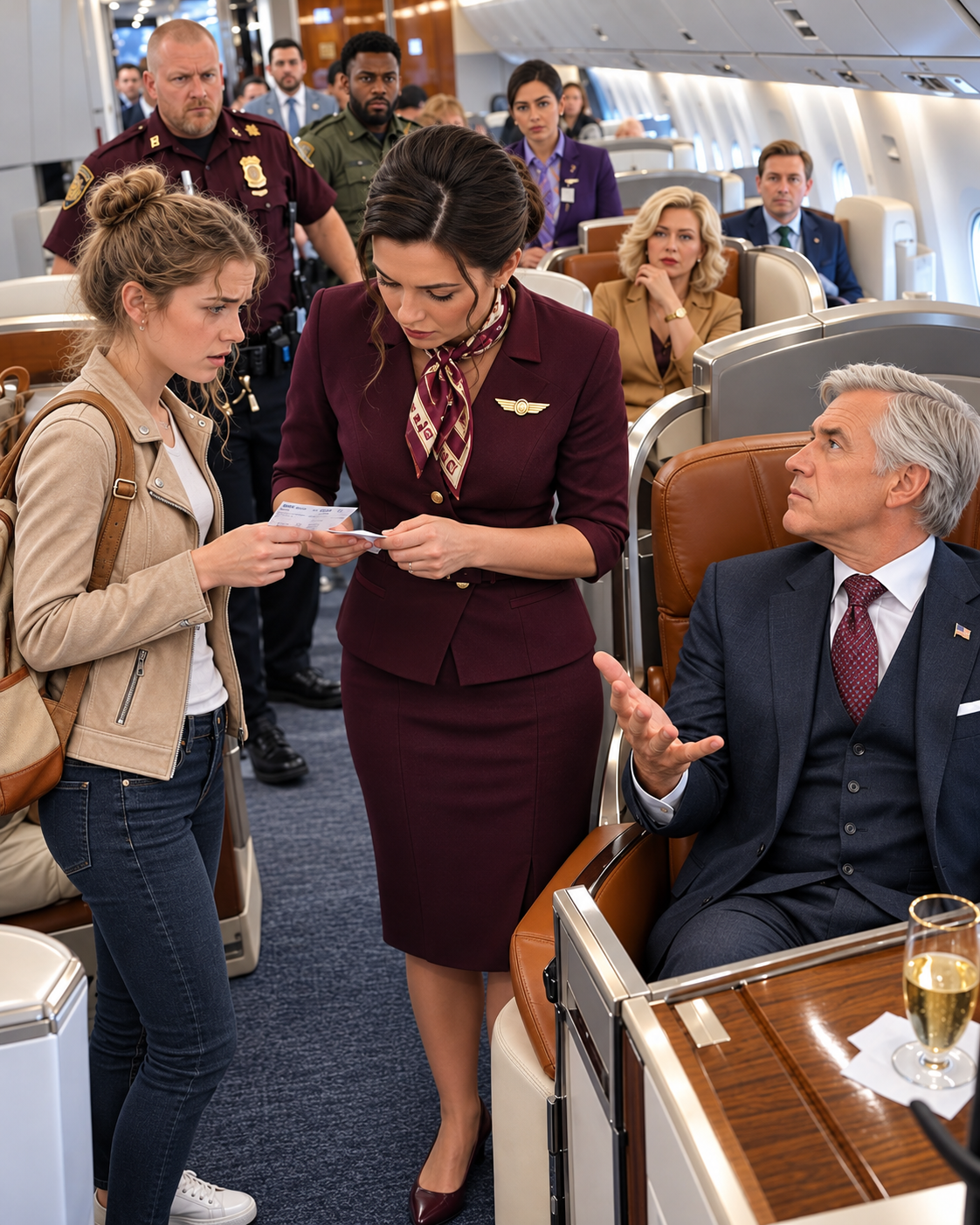
PART 1 TITLE: The Powerful Businessman Who Refused to Leave Seat 2A Had No Idea Why a Fourteen-Year-Old Girl Was Calling Her Father
The first sign that something was wrong came when fourteen-year-old Zara Coleman reached the second row of Flight 212 and discovered a stranger sitting beside the window. She stopped in the narrow aisle, her burgundy travel bag hanging from one shoulder, and checked the boarding pass in her hand. The number was unmistakable: 2A. Above the window, the small illuminated seat marker confirmed it. Yet the man occupying the seat had already settled himself comfortably, with a folded newspaper resting across his knees and a glass of water on the table beside him. He looked perfectly prepared to spend the next several hours exactly where he was.
Zara hesitated long enough to make certain she hadn’t misread the row. Behind her, passengers were still boarding the overnight flight from New York to London. Wheels rattled over the joints in the cabin floor, overhead compartments snapped shut, and somewhere behind the curtain separating First Class from the next cabin, a child was asking when the airplane would take off. Zara shifted her bag closer to her body so another passenger could pass. Then she addressed the stranger. “Excuse me. I think there’s been a mix-up. My boarding pass has me sitting here.”
The man raised his eyes without moving his head. He was perhaps fifty-eight, with carefully combed silver hair and a dark navy suit that looked expensive even to someone who knew little about men’s clothing. A heavy watch showed beneath his shirt cuff. He glanced at Zara’s plain sweater, faded sneakers, and travel bag before allowing his attention to return to the newspaper. “You should be looking farther down the aircraft,” he told her. His voice was measured, but there was nothing helpful about it. “This section isn’t where you want to be.”
For a moment, Zara wondered whether he genuinely believed she was lost. She had flown internationally before, though this was one of her first journeys without a parent sitting nearby. Her father had made her practice checking gate numbers, reading departure boards, and handling unexpected situations. He had also taught her that an expensive-looking person was no more likely to be correct than anyone else. She looked again at her ticket. “I’m in the right section,” she replied. “This is seat 2A. Would you mind checking the number on yours?”
He lowered the newspaper completely. “Young lady, I know where I’m sitting.” The sentence came out loudly enough for a woman across the aisle to turn her head. Zara felt heat rising beneath her collar. She disliked being watched, especially by strangers who appeared to be waiting for her to make a mistake. But the numbers were simple, and she was unwilling to pretend otherwise. She held the boarding pass where he could see it, careful not to push it toward his face. “It might be 2B,” she suggested. “That’s the seat next to mine.”
The man’s expression changed at the suggestion that he might be mistaken. “Do you know who I am?” he asked. Zara shook her head. He gave his name as Richard Bennett, then added Bennett Strategic Holdings with the confidence of someone expecting recognition to settle the entire conversation. Zara had heard adults mention investment firms at her father’s office, but the name meant nothing to her. She waited for him to explain its relevance. When he did not, she said, “I’m sorry, Mr. Bennett. I still need the window seat assigned to me.”
Richard gave a short, disbelieving laugh. He looked beyond her toward the other passengers, as though inviting them to appreciate the absurdity of being questioned by a teenager. Nobody volunteered an opinion. A man in the opposite row returned his attention to his phone, while an older woman watched Zara with a faintly concerned expression. Richard pointed toward the aisle behind her. “I suggest you find someone who can explain how reservations work. I’ve paid a considerable amount for this flight, and I don’t intend to be inconvenienced.”
Zara stepped aside as a flight attendant approached from the forward galley. The woman’s uniform was immaculate despite the long evening, and a small name badge identified her as Elizabeth Hart. She was the senior attendant responsible for the cabin. Elizabeth took in the awkward arrangement at once: the girl waiting in the aisle, the businessman refusing to stand, and the growing number of curious passengers. “Can I help you get settled?” she asked Zara. There was no accusation in her voice, only a practical invitation to explain.
Zara gave Elizabeth her boarding pass and described the problem without adding anything about Richard’s remarks. Elizabeth checked the seat assignment, then requested Richard’s boarding pass. He produced it with an exaggerated sigh, muttering that the matter was becoming ridiculous. Elizabeth examined both documents beneath the overhead light. There was no ambiguity. Zara Coleman was assigned 2A. Richard Bennett was assigned 2B. Elizabeth returned the passes and explained that Richard needed to move into the neighboring seat so Zara could sit down.
Richard looked at the two wide leather seats, then at Elizabeth. “You’re going to disturb me over the distance between those cushions?” he asked. The question might have sounded reasonable if he hadn’t already spent several minutes making the situation unpleasant. Elizabeth kept her hands loosely clasped in front of her. “They are separate reservations, Mr. Bennett. Miss Coleman’s seat is beside the window.” He responded by asking whether the girl had received some kind of complimentary upgrade. Elizabeth informed him that the circumstances of Zara’s booking were private and irrelevant.
The exchange had become impossible for the surrounding passengers to ignore. Zara could feel their attention moving between her and Richard whenever someone spoke. She wanted to sit down, take out her engineering puzzle book, and watch the rain slide across the airport windows until departure. Instead, she was standing in the center of a dispute that seemed to grow more embarrassing with every passing minute. Richard folded his arms and announced that he would not move. Elizabeth drew a slow breath, clearly considering whether to involve the purser or the captain.
Zara made a decision before the disagreement could become a shouting match. “You can stay there for now,” she told Richard. Elizabeth turned toward her, surprised, and gently reminded her that she was entitled to the seat on her ticket. Zara nodded. She understood that perfectly. She wasn’t agreeing that Richard belonged in 2A, and she had no intention of accepting the insult hidden inside his refusal. She simply no longer wanted to argue with a stranger in front of an audience. There was another way to address the problem.
Richard interpreted her words as surrender. His shoulders relaxed, and he picked up the newspaper again. “Good. We can finally get on with things.” Zara noticed that he hadn’t thanked her. She also noticed something else: he appeared more interested in defeating her than in reaching the window. Before leaving the aisle, she asked whether he was certain nobody had arranged a different seat for him. Richard replied that his travel arrangements were handled professionally and that she should stop asking foolish questions. Zara gave no answer. She walked toward the galley, where Elizabeth followed her.
The forward galley was quieter, though Zara could still hear the muted conversations in the cabin. An attendant was arranging bottled water beside a stack of folded napkins. Zara set her travel bag against the wall and removed her phone from her pocket. Before her first solo international trip, her father had helped her prepare a secure folder containing contact numbers, itinerary details, and instructions for different emergencies. It included three prominent entries: Home, Security, and Dad—Operations. Her father had told her not to hesitate if she encountered a situation she couldn’t resolve appropriately.
She selected the third contact. Marcus Coleman answered quickly, his familiar voice almost lost beneath background conversations on his end. “Zara? Everything all right at the airport?” She told him she had boarded but was having trouble with her seat. He didn’t interrupt or immediately demand to know who had offended her. Instead, he asked where she was standing and whether anyone had threatened or touched her. She assured him that she was with a flight attendant and felt safe. Then she explained that another passenger had refused to leave her assigned window seat.
Marcus asked for the flight number and both seat assignments. Zara gave him the information exactly as Elizabeth had confirmed it. “His ticket says 2B,” she explained, “but he insists someone arranged for him to sit in 2A. He says his company handles all his travel.” Marcus went quiet. Zara could hear a door closing at his end of the call. When he spoke again, his manner had changed. “Did he tell you who made that arrangement?” She repeated Richard Bennett’s name and the company he had mentioned, then admitted she didn’t know anything more.
There was another silence, longer this time. Marcus asked Zara to hand the phone to Elizabeth. The attendant accepted it and identified herself. At first, she listened with the polite concentration of someone receiving instructions from a passenger’s parent. Then she straightened and moved away from the counter. “Yes, Mr. Coleman. I can confirm those details,” she said. She listened again. “The boarding passes were checked in my presence. No, the passenger has not agreed to change seats.” Her eyes moved briefly toward Zara. “I’ll remain with her.”
Elizabeth returned the phone, and Zara heard her father speaking more quietly. He wanted her to remain beside the crew and avoid confronting Richard again. Zara agreed. Then she asked a question that made Elizabeth look up sharply. “Dad, should we stop the departure until someone checks the reservation record?” Marcus did not dismiss the suggestion. He said that he would contact the relevant operations team and that she should follow the crew’s instructions. Zara ended the call, aware that the situation now involved something more serious than her choice of seat.
Elizabeth studied the boarding pass still resting on the galley counter. Coleman. She had seen that surname in internal communications, though the connection hadn’t occurred to her when Zara first entered the aircraft. Marcus Coleman was an influential figure in the airline’s international operational partnerships, someone involved in decisions well beyond ordinary passenger service. His position did not give Zara greater rights to the seat, but it explained why he understood the procedures for investigating irregular booking activity. Elizabeth realized that he had been asking questions directed at the reservation system, not merely seeking an apology for his daughter.
At the gate outside, a routine departure sequence had already begun. The ground crew were finishing their tasks, baggage documentation was being reconciled, and the captain was preparing to request the final clearance needed before the aircraft could leave the stand. Then an operational instruction reached the gate desk. Flight 212 was to remain at the gate pending a security-related systems review. The agent acknowledged the message, checked its authorization, and informed the cabin crew that departure preparations were temporarily suspended. No one in the passenger cabin yet understood what had changed.
Richard noticed the delay only when another traveler mentioned the aircraft door remaining open. He looked toward the galley and saw Zara standing beside Elizabeth, her phone now tucked away. He assumed she had complained to someone with enough influence to inconvenience the rest of the aircraft. His irritation returned immediately. He called across the cabin that he hoped the airline wasn’t allowing a child to dictate when an international flight departed. Elizabeth did not respond from a distance. She simply asked him to remain seated while an operational matter was addressed.
A few minutes later, footsteps sounded on the jet bridge. An airport security officer entered first, followed by an operations supervisor carrying a thick red folder. Behind them came a gate representative with a tablet displaying the flight details. The supervisor asked for the senior cabin attendant and then for Zara Coleman. Elizabeth introduced herself and indicated that Zara was with her. The supervisor checked the girl’s identity against the document in his hand. He was courteous, but his expression made it clear that this was not a customer-service visit.
The supervisor announced that Flight 212 was under an immediate operational hold. The captain would receive a separate explanation through established channels, and no changes were to be made to the relevant reservations until the review was completed. Richard got to his feet despite the instruction to remain seated. “You’re delaying an entire aircraft because two passengers were assigned neighboring seats?” he demanded. The supervisor looked at him without sharing his indignation. “We’re verifying a discrepancy involving this particular reservation, Mr. Bennett. I’d appreciate your cooperation.”
Richard insisted that there was no discrepancy. He had a confirmed First Class booking, a paid ticket, and an assistant who had arranged the journey through his corporate contacts. The supervisor asked whether Richard’s boarding pass actually displayed 2A. After a pause, Richard admitted that it did not. The answer altered the mood around him. Until that moment, he had been able to describe the matter as an irritating misunderstanding. Now the security officer and the operations supervisor were asking why he had occupied a seat that the system had not assigned to him.
Zara watched the exchange from beside Elizabeth. She was no longer embarrassed in the same way, but she had begun to feel unsettled. Her father would not have requested an operational hold merely because someone had spoken rudely to her. He had always been careful about using his authority, and she had heard him criticize executives who treated company procedures as tools for settling personal grievances. When her phone vibrated, she looked down immediately. The message was from Marcus. It was brief: Stay with Elizabeth. I’m on my way to the aircraft.
Marcus arrived while the supervisor was discussing the reservation with the gate agent. He entered through the open aircraft door, wearing the same charcoal coat Zara had seen him in earlier that evening. His attention went straight to his daughter. He checked that she was unharmed, asked whether she needed anything, and rested a hand briefly on her shoulder. Only then did he approach Richard. The businessman recognized him at once. His expression shifted from annoyance to startled familiarity. “Marcus Coleman,” he said, smoothing the front of his jacket. “I had no idea the young lady was related to you.”
Marcus did not accept the explanation. He asked whether Richard would have behaved differently had Zara been someone else’s daughter. Richard looked toward the surrounding passengers, apparently searching for a response that would preserve his dignity. Marcus gave him no time to turn the question into a joke. “She showed you a valid ticket,” he said. “The crew confirmed it. Her family has nothing to do with whether you should have respected that.” Richard lowered his eyes. For the first time since Zara boarded, the businessman seemed to understand how badly he had misjudged the situation.
Before Richard could offer a reply, the operations supervisor approached Marcus with his tablet. A new entry had appeared in the reservation history. The boarding passes were valid, but the system had recorded an attempted change to Zara’s assignment several hours earlier. The request had not originated from a routine gate transaction or from a passenger using the airline’s website. It had been submitted through a restricted internal function requiring elevated access. Marcus studied the screen, then asked the supervisor to show him the original authorization.
The supervisor opened the details. Zara’s name appeared beside a priority code that should never have been used for an ordinary seating adjustment. A second field referred to Bennett’s reservation. Neither change had been properly completed, which explained why the official boarding passes still identified Zara as the occupant of 2A. Yet somebody had tried to make the system treat that seat differently. Marcus asked who possessed the authority to submit such a request. The supervisor looked at the terminal identifier, frowned, and said they were still tracing the credentials.
Zara stepped closer to her father. She could see enough of the tablet to recognize her surname and the seat number. Until then, she had assumed Richard was simply an entitled man who disliked being corrected. Now she wondered whether someone had anticipated that he would take the window seat, perhaps even encouraged him to do so. Marcus rested his hand on the edge of the tablet. “Whoever entered this request knew exactly whose reservation they were changing,” he said. The supervisor looked up, his expression grave. “Yes, Mr. Coleman. And it appears they used authority that should have had nothing to do with passenger seating.”
END PART 1
PART 2 TITLE: A Secret Change to Zara Coleman’s Reservation Led Investigators From an Airport Computer to a Device Hidden Inside the Aircraft
The operations supervisor enlarged the record on his tablet while Marcus Coleman studied the authorization fields. Flight 212 remained at the gate, its engines silent, the passengers increasingly aware that the delay was not an ordinary scheduling problem. Zara stood close enough to see her name beneath a string of internal codes, although she understood little of their meaning. Her father, however, appeared troubled by a detail near the bottom of the screen. He asked the supervisor whether the attempted reassignment had passed through customer service. The man shook his head. It had bypassed the normal channels entirely.
Richard Bennett remained standing beside Row 2, watching Marcus with the wary attention of someone who had begun to suspect that his own conduct was no longer the most serious matter being discussed. He insisted that he hadn’t accessed the airline’s reservation system and had no reason to interfere with another passenger’s booking. Marcus accepted that the claim could be true, but reminded him that occupying Zara’s seat had made the unauthorized change harder to identify. “Somebody expected you to sit there,” Marcus observed. “We need to understand why.”
The supervisor explained that the attempted override had been entered early that morning through an internal corporate terminal. The request had carried a priority designation normally reserved for exceptional operational circumstances, not passenger preferences. A separate entry had attempted to associate Bennett’s booking with Zara’s window seat. Neither alteration had been authorized through the procedures used by the gate or cabin crew. The supervisor had already asked the technical team to identify the account responsible. Until that investigation was complete, the suspicious records would remain preserved and further changes would be blocked.
Zara looked from the screen to Richard. “Did someone tell you that seat was yours?” she asked. The question carried no accusation, only a desire to understand what had happened. Richard seemed uncomfortable answering her directly after the way he had treated her. Eventually, he explained that his assistant had received travel arrangements from a business associate and had assured him that the window seat would be available. Richard hadn’t checked the distinction between the assigned seat on his boarding pass and the arrangement described by his assistant. He had assumed the latter took precedence.
Marcus asked for the name of the associate who had arranged the trip. Richard hesitated, apparently considering whether the answer would damage a valuable business relationship. Then he said, “Julian Croft.” Marcus’s eyes narrowed. Elizabeth, who had been listening beside Zara, noticed the reaction immediately. Croft was not an unfamiliar external consultant. He held a senior corporate position involving acquisitions, investment arrangements, and international aviation logistics. His division was participating in discussions with Bennett Strategic Holdings about a substantial transport infrastructure partnership.
The connection disturbed Marcus for reasons Richard did not yet understand. Croft’s professional responsibilities involved corporate decisions and operational partnerships, but they did not normally require access to individual passenger reservations. Nor would a company executive have any legitimate reason to move the daughter of a senior aviation official from her assigned seat merely to accommodate a business visitor. Marcus asked the supervisor to examine Croft’s authorization history and determine whether the attempted override had originated within his department. The supervisor moved toward the jet bridge to make a secure call.
For several minutes, the cabin existed in an uncomfortable suspension. Passengers spoke quietly, unable to hear every detail but aware that security personnel were investigating something beyond a dispute between travelers. Elizabeth arranged water for Zara and offered to find her somewhere more private to wait. Zara preferred to remain where she could see her father. She placed her burgundy bag on the floor and took a sip from the paper cup. Through the forward window she could see rain shining beneath the airport lights and ground staff waiting beside their equipment.
Richard attempted to explain the importance of his London meeting. Bennett Strategic Holdings had been competing for investment opportunities connected to a major transport infrastructure arrangement, and Croft had encouraged him to travel on this particular flight. Richard believed the meeting would help finalize discussions that had occupied both companies for months. Marcus asked whether that required Richard to occupy a specific seat. Richard admitted that it did not. He had simply been told that special arrangements had been made and had interpreted the information as a courtesy appropriate to his position.
The supervisor returned with an update. The transaction had originated at Heathrow, through a corporate terminal associated with Fleet Logistics. More importantly, it had used executive-level credentials rather than the permissions normally available to passenger-service staff. Elizabeth frowned at the information. Fleet Logistics dealt with operational assets, maintenance scheduling, and the movement of equipment. Its personnel had no ordinary reason to alter a child’s seat assignment on a flight departing New York. Marcus asked whether the credentials were connected to Croft’s division. The supervisor confirmed that investigators were examining precisely that possibility.
Zara tried to make sense of what she was hearing. Someone in London had attempted to move her reservation before she even reached the airport. That person had apparently known her name, flight number, and exact seat. She wondered whether the change had been intended specifically to inconvenience her or whether her reservation had simply stood in the way of another plan. She asked her father whether they had reason to believe she was being watched. Marcus considered his answer carefully. He said that they knew somebody had improperly accessed her booking, but not yet why. He would not pretend to know more.
As they were speaking, an alert reached the supervisor’s tablet. He read the message, then requested a private word with Marcus. Zara couldn’t hear the entire conversation, but she caught the phrase “unidentified electronic signal” and saw her father turn immediately toward the forward cabin. The supervisor explained that a routine security review had detected activity associated with equipment that did not appear on the aircraft’s authorized inventory. Its approximate location was near the first rows of passenger seating, close to a service panel used by maintenance personnel.
Marcus asked Elizabeth to ensure that no one disturbed the overhead storage or the surrounding fixtures. Zara glanced at the compartment where her burgundy bag had been placed earlier. For the first time, she wondered whether somebody might have tampered with her belongings. The thought made her stomach tighten. She had packed the bag herself: a sweater, toiletries, her puzzle book, and a small notebook. Nothing about it should have interested a stranger. She asked whether the signal could be coming from inside her luggage. Marcus said the security specialists would examine the relevant area without making assumptions.
The captain received a detailed briefing through the appropriate operations channels, and the preliminary inspection began with the aircraft secured at the gate. The crew asked passengers to remain in their seats and avoid opening overhead compartments. A specialist entered carrying equipment for identifying unauthorized electronics. He examined the forward cabin carefully, checking the locations indicated by the initial report. Zara watched from a safe distance beside Elizabeth. The specialist moved past Row 2, crouched near a service panel, and spent several minutes studying an area almost invisible beneath the normal cabin fittings.
When he finally looked up, he asked another officer to bring a camera and an evidence container. Elizabeth’s expression tightened. She had worked in aviation long enough to know that unusual objects discovered inside an aircraft were not treated casually. The specialist documented what he had found before securing a small electronic component that did not belong to the approved equipment installation. It was positioned close to the service panel and appeared capable of transmitting information. He made no immediate claim about what data it might have captured or how it had been used.
Richard stared at the inspection team. “Are you suggesting somebody put that there because of my seat?” Marcus answered that the investigators were still establishing the facts. What concerned him was the combination of events: an unauthorized reservation request, a corporate traveler directed toward that same location, and an unexplained electronic component concealed nearby. Any one of those discoveries might have required an investigation. Taken together, they were difficult to dismiss as coincidence. The specialist added that the device would need a technical examination before its purpose could be established reliably.
Zara was looking at the space around Row 2 when an idea occurred to her. “What if the seat wasn’t what they wanted?” she asked. Her father turned toward her. She explained that whoever altered her booking might have needed someone sitting near the panel rather than caring about the window itself. A passenger who believed he was entitled to special treatment might discourage questions, she reasoned. If the cabin crew assumed the change was legitimate, they might be less likely to notice anything unusual near that row before departure.
Marcus listened without interrupting. Zara had always enjoyed solving mechanical puzzles, especially those requiring her to distinguish a visible problem from its underlying cause. He didn’t want her to believe that a clever observation could replace a technical investigation, but her suggestion deserved consideration. The specialist explained that the panel was close to equipment involved in authorized aircraft systems. An unauthorized device in that area could potentially be connected to improper monitoring or communications activity. Until testing was complete, no one could say exactly what its operator had intended.
Richard sat down heavily in 2B. The meaning of his earlier behavior had changed. He had spent so much time proving that nobody could challenge him that he had barely questioned why his business contact insisted on a window seat. He asked whether Croft might have arranged the location without telling him about the device. Marcus replied that investigators would need to determine what each participant knew. Richard’s ignorance, if genuine, would be important. So would the messages exchanged between his assistant and Croft’s office. The businessman agreed to preserve the correspondence.
Another update arrived from the ground investigation team. Maintenance records identified an employee who had accessed the relevant service area during the aircraft’s turnaround. The entry had been made under a legitimate maintenance work order, but the timing and scope required closer examination. Security personnel were already interviewing the employee and reviewing access records. Marcus instructed the operations supervisor to ensure that the aircraft’s technical documentation, maintenance history, and related communications were preserved for the authorities. An improperly installed component could not be treated as an isolated inconvenience.
While the interview continued, Zara sat with Elizabeth in the forward galley. The attendant gave her a fresh bottle of water and asked whether she wished to contact her aunt in London. Zara said she would message Catherine once the aircraft had a confirmed departure time. Elizabeth apologized for how long the situation had taken to resolve. Zara shook her head. She was less concerned about the delay now than about the possibility that someone had accessed the aircraft for dishonest purposes. “You checked both boarding passes,” she told Elizabeth. “That’s how we knew the first thing was wrong.”
Elizabeth was quiet for a moment. She had spent much of her career resolving disputes without allowing them to disturb other passengers. It was usually the right approach. Yet that evening, the most inconvenient passenger had not been the girl asking a reasonable question. It had been the businessman who believed the rules could be negotiated away if he was important enough. Elizabeth looked through the galley opening toward Row 2, where Richard sat without speaking. She wondered how many other minor irregularities were dismissed every day because someone powerful assured employees that everything had already been approved.
The next report was more troubling. Investigators had identified an unexplained financial payment to the maintenance employee. The payment appeared connected to a business associated with Julian Croft’s family. The evidence did not yet establish every person’s role, but it gave the authorities reason to examine whether the equipment installation and reservation override had been coordinated. Marcus requested that the information be documented and referred through the proper investigative channels. He also required a clear security assessment before Flight 212 could resume its journey. There would be no compromise over the aircraft’s safety.
Richard asked to speak to Marcus privately, but Marcus declined to remove the matter from the official review. The businessman seemed shaken. He admitted that he had trusted Croft’s arrangements because the proposed investment was important to his company. He had not expected his travel plans to draw attention, and he certainly had not expected a child’s seat assignment to expose an internal investigation. Marcus pointed out that the investigators were examining evidence, not delivering final judgments. Nevertheless, Richard’s refusal to cooperate with Elizabeth had made a difficult situation harder and helped expose the arrangement.
After the required security assessment and preliminary inspection, the aircraft was cleared to continue its scheduled operation. The unexplained component had been secured for examination, and the relevant maintenance and reservation records were under review. But Richard would not be allowed to continue on Flight 212 that evening. The airline withdrew his permission to travel because of his refusal to comply with the crew’s instructions and the unresolved circumstances surrounding his booking. He listened to the decision without the outrage he had displayed earlier. His confidence appeared exhausted.
As he collected his coat and briefcase, Richard approached Zara. Elizabeth remained nearby, allowing the exchange without leaving the girl alone with him. Richard held his belongings awkwardly, as though uncertain how to begin. He acknowledged that he had been disrespectful and had dismissed Zara because she was young and plainly dressed. He said he should have checked his ticket and listened when the attendant confirmed the assignment. Zara looked at him steadily. She accepted the apology, but she did not pretend his behavior had been harmless. “You had the chance to be fair before you knew who my dad was,” she told him.
Richard nodded. He glanced once toward the empty window seat, then turned and followed the security officer toward the open aircraft door. The passengers who had witnessed his earlier performance watched him leave in silence. His expensive suit and influential position had not prevented the investigation, and his insistence on receiving special treatment had accomplished exactly the opposite of what he intended. Elizabeth waited until he disappeared into the jet bridge before inviting Zara back to Row 2. The window seat was now empty, its reading light shining softly on the dark leather.
Zara settled into 2A and placed her travel bag within reach. Marcus leaned into the row to say goodbye. He checked that she had her passport, phone, and contact information, then reminded her to call Catherine upon arrival. Zara asked whether he believed the investigation would end with the device. Marcus told her he hoped the authorities would establish the truth quickly, but the records suggested that the matter might involve people beyond the aircraft. He promised to keep her informed without burdening her with details she did not need to carry.
They hugged before Marcus returned to the terminal. Outside, rain continued to move across the illuminated airport pavement. Eventually, the aircraft door closed, and Flight 212 began its delayed departure for London. Zara watched the terminal lights slide away, then opened her engineering puzzle book to a problem involving weight distribution across a bridge. She tried to concentrate on the diagrams. But her thoughts kept returning to the concealed device and the unfamiliar names that had surfaced during the investigation. Somewhere inside the airline, people with access to important systems had apparently been using that authority for purposes no passenger would have approved.
The aircraft climbed into the night, leaving New York beneath a broken pattern of lights and cloud. Zara rested her forehead briefly against the cool window. She had recovered her seat, and the immediate danger had been addressed, but nothing about the evening felt truly finished. The evidence recovered near Row 2 was now in the hands of investigators, and the company records were being examined far beyond the passenger cabin. As Flight 212 headed across the Atlantic, the first connections were beginning to emerge between the unauthorized device, Julian Croft’s business network, and transactions that had never appeared in the airline’s ordinary financial reports.
END PART 2
PART 3 TITLE: When Flight 212 Reached London, a Disturbing Discovery in the Airline’s Records Revealed That the Seating Incident Was Only the Beginning
By the time Flight 212 descended toward London, the first investigators had already begun reconstructing the events that had taken place before its departure. Zara Coleman knew little about the work continuing behind the scenes. She had spent much of the flight reading, sleeping briefly, and watching the occasional reflection of the cabin lights against the dark window. Yet even as the aircraft crossed the Atlantic, security specialists were comparing reservation changes, maintenance records, and unusual financial transactions. The evidence suggested that somebody had exploited several departments of the airline to arrange something far more serious than an unauthorized seat change.
Zara woke when the cabin lights brightened for the morning service. Elizabeth Hart was moving through First Class, checking on passengers and preparing for their arrival. When she reached 2A, she asked whether Zara had managed to rest. Zara admitted that she had slept only a few hours. Elizabeth gave her a sympathetic smile and assured her that the remainder of the flight had been uneventful. Zara was relieved, but she still felt a lingering uneasiness whenever she thought about the hidden electronic component discovered so close to her seat.
Outside the window, the first pale daylight revealed layers of cloud above the English countryside. Zara watched the aircraft descend and wondered whether her father had learned anything new during the night. She had received a short message before the aircraft lost its ground connection in New York, assuring her that the security team was handling the investigation. Marcus had deliberately avoided giving her more information until the facts were clearer. Zara understood his reasoning, although she disliked the feeling that something important was happening just beyond her reach.
Catherine, Zara’s aunt, was waiting in the arrivals area at Heathrow. She recognized her niece immediately and crossed the crowded hall with an expression that mixed relief and concern. Catherine had been told about the incident before leaving home, but she had not understood its full seriousness. She hugged Zara tightly, then stepped back to examine her face. “Your father said you were safe,” she told her, “but he didn’t explain why an airport security team had to come onto your airplane.” Zara gave a tired smile. “It’s a rather long story.”
They collected Zara’s belongings and left the terminal together. Catherine had planned a quiet morning before taking her niece home, but the atmosphere between them was different from their usual visits. Zara described Richard Bennett’s refusal to move, Elizabeth’s careful examination of the boarding passes, and the unexpected discovery near the service panel. She tried to recount everything in the correct order. Catherine listened without interrupting, although her expression changed when Zara mentioned the unauthorized reservation request. “Someone inside the company tried to change your booking?” she asked. Zara nodded. “That’s what Dad said.”
While Catherine drove toward central London, Zara checked her messages. Several friends had already sent links to recordings taken inside Flight 212. She opened one reluctantly. The video showed Richard sitting in 2A while she stood in the aisle, holding her ticket. His remarks were clearly audible, including his suggestion that a girl dressed like Zara could not possibly belong in First Class. Watching herself from a stranger’s perspective made Zara uncomfortable. She remembered the humiliation of the moment more vividly than the satisfaction of eventually getting her seat.
Catherine glanced at the screen when they stopped at a traffic light. “People are sharing that everywhere,” she observed. Zara closed the video. “I wish they wouldn’t.” She knew Richard had behaved badly, and she didn’t feel responsible for protecting his reputation. But the attention surrounding the incident felt strange. Online comments were praising her composure, criticizing Richard’s arrogance, and speculating about the identity of her father. Few people seemed aware that the more serious discovery had concerned unauthorized access to an aircraft and its internal systems.
At the airline’s operations offices, investigators were following a different trail. The electronic component recovered from Flight 212 had been secured for technical analysis, while the reservation transaction was being traced through the corporate network. Records connected the attempted seat change to credentials used within Fleet Logistics. That division had legitimate reasons to handle aircraft movements and equipment information, but it had no ordinary business altering a passenger’s assigned seat. The timing of the request, together with the maintenance employee’s unexplained payment, had drawn attention to Julian Croft’s professional and financial relationships.
Croft had spent years building a reputation as an executive capable of arranging complex international agreements. His work crossed several organizational boundaries, giving him contact with departments that rarely dealt directly with one another. Acquisition discussions, logistics contracts, fleet arrangements, and outside investment proposals could all pass through his office. Investigators were now examining whether those overlapping responsibilities had allowed him and his associates to conceal transactions that would have been questioned under more independent supervision.
The first financial review uncovered suspicious transfers involving companies connected to Croft’s business circle. Some payments appeared difficult to reconcile with the work described in the associated contracts. Other records suggested that corporate information had been accessed through channels unrelated to the employees’ assigned duties. Investigators could not yet determine the full extent of the misconduct, and no responsible official was prepared to announce conclusions based on incomplete evidence. Nevertheless, the separate irregularities were beginning to form a recognizable pattern.
Bennett Strategic Holdings was drawn into public scrutiny almost immediately. The videos from Flight 212 had made Richard Bennett’s behavior difficult to defend, and reporters began asking why an influential investment executive had insisted on occupying another passenger’s seat. Richard’s company issued statements acknowledging the incident while promising cooperation with inquiries into its corporate dealings. Richard himself faced questions from business partners who had seen the recordings. His public embarrassment was considerable, but the investigators remained focused on determining what he actually knew about Croft’s arrangements.
Marcus Coleman arrived in London after arranging for the relevant internal teams to continue their work without his constant presence. He had maintained contact with airport security and company investigators throughout the journey. By the time he met Zara and Catherine, he was tired enough for the strain to show around his eyes. They settled into a quiet café near Hyde Park, where Catherine ordered coffee and Zara chose hot chocolate. Outside, people walked beneath the trees carrying umbrellas against a light morning drizzle.
For several minutes, they talked about ordinary things. Catherine asked Zara whether she had finished the engineering puzzles she brought from New York. Marcus wanted to know whether she had eaten enough during the flight. The familiar questions helped restore some of the ease that had been missing since the previous evening. But Zara knew her father had not come to London merely to discuss her journey. She waited until the cups were on the table before asking whether the investigators had identified the people responsible for changing her reservation.
Marcus set down his coffee. “They’re examining Julian Croft’s department,” he told her. “There are serious concerns about the use of company systems and financial arrangements connected to people around him.” He explained that investigators had found evidence suggesting unauthorized access to passenger information and possible interference with corporate communications. The financial review had raised separate questions about payments and investment-related transactions. Zara listened carefully. What troubled her was the possibility that people entrusted with important responsibilities had been using those responsibilities to hide their own activities.
Catherine had been reading the reports available to senior personnel. She placed her tablet on the table and pointed out that Croft’s division had participated in multiple agreements involving outside companies. The suspicious activity might therefore extend beyond one aircraft or one business negotiation. Marcus agreed that the possibility was being investigated. He cautioned against assuming that every employee connected to Croft had acted improperly. Some may have been unaware of the misconduct. Others might have approved unusual requests without understanding the wider purpose.
Zara asked whether Richard Bennett had been part of the arrangement. Marcus answered that they did not yet know. Richard had certainly contributed to the confusion by occupying her seat and refusing to cooperate with the crew, but investigators still needed to examine the information he had received from Croft’s office. There was a difference between allowing oneself to be used and knowingly participating in a conspiracy. “What he did to you was wrong,” Marcus said. “That doesn’t automatically establish what he knew about everything else.”
The distinction mattered to Zara. She remembered Richard’s face when the hidden electronic component was discovered. His surprise had looked genuine, though she knew appearances could be misleading. She also remembered how confidently he had insisted that his business relationships entitled him to special treatment. “He made it easier for whoever planned this,” she said. Catherine nodded. “He may have done exactly that.” Marcus added that investigators would have to determine the significance of his conduct rather than assuming his arrogance proved criminal involvement.
Catherine observed that the unauthorized reservation change might never have received immediate attention if Zara had quietly accepted another seat. Zara looked uncomfortable with the suggestion that she had uncovered the entire scheme. She reminded her aunt that Elizabeth had checked the boarding passes and that the operations team had found the suspicious records. Many people had contributed to the discovery. Marcus agreed. What mattered was not that his daughter possessed extraordinary knowledge, but that she had insisted on verifying an ordinary fact instead of accepting an influential stranger’s unsupported claim.
Their conversation was interrupted by Marcus’s phone. The caller was Vance Campbell, a security supervisor coordinating the continuing investigation. Marcus answered, listened briefly, and pushed his coffee aside. His expression became serious enough that Zara stopped stirring her drink. Vance reported that investigators had uncovered discrepancies involving earlier cargo movements and maintenance documentation associated with Flight 212’s aircraft. Certain entries did not correspond cleanly with the supporting records, raising concerns that the aircraft had previously been involved in unauthorized cargo activity.
Marcus asked how far the investigators had progressed. Vance explained that the records under review included digital information linked to systems associated with the aircraft now at Heathrow. The maintenance logs, cargo documentation, and related operational entries might help establish whether the suspicious transactions formed part of a repeated arrangement. Some information had already been preserved, but additional evidence remained vulnerable. Investigators were working to secure it before anyone with improper access could interfere with the aircraft or its records.
Then Vance mentioned a name Marcus had not expected to hear so soon: Arthur Pendelton. Pendelton was an operations contractor with responsibilities connected to international logistics and aircraft movements. His professional relationships placed him within the wider network investigators were examining around Julian Croft. According to Vance, Pendelton had begun arranging an unscheduled repositioning flight for the aircraft involved in the incident. The movement was being presented as an urgent operational requirement, but the necessary authorizations had not been established.
Marcus’s posture changed. “Where is the aircraft now?” he asked. Vance said it was at Heathrow, where personnel connected to Pendelton were preparing work in a maintenance area. Investigators had found inconsistencies in the associated instructions and were concerned that the proposed movement might prevent them from securing additional records. The request had come at a particularly suspicious time, immediately after the discovery of irregularities involving the aircraft’s earlier operations.
Zara could hear only her father’s side of the conversation, but she understood enough to become alarmed. When Marcus paused, she asked whether somebody was trying to move the aircraft before investigators could finish checking it. Marcus looked at her, then returned his attention to the call. Vance confirmed that this was one possibility the authorities were considering. The investigators had not established Pendelton’s intentions, but the unauthorized nature of the proposed movement justified immediate action.
Marcus instructed the senior operations team to maintain the aircraft’s grounded status until an authorized inspection had been completed. He also asked Vance to coordinate with airport security and the relevant authorities so that evidence could be protected without compromising operational safety. The request was transmitted through official channels, with the reasons documented. Marcus understood that an investigation into the misuse of corporate authority could not be conducted by ignoring proper procedures whenever those procedures became inconvenient.
At Heathrow, Pendelton was already inside the maintenance hangar with several technicians. The aircraft stood beneath the bright overhead lights, its exterior reflecting the dull gray daylight visible through the hangar doors. Equipment carts had been positioned nearby, and technical personnel were examining work instructions that Pendelton claimed were urgent. He had emphasized the need to prepare the aircraft for movement, presenting the work as a routine response to changing operational requirements. Yet the documentation was incomplete, and several details contradicted the instructions received from senior operations.
One technician asked whether the revised flight authorization had arrived. Pendelton replied that the matter was being handled at a higher level and instructed the team to continue preparing the aircraft. His answer did little to settle the concern. Another employee pointed out that the aircraft had recently been the subject of a security review in New York. Pendelton dismissed the relevance of the earlier incident and insisted that the current maintenance work had separate approval. The technicians exchanged uncertain glances, but the pressure to complete the task remained.
Vance Campbell was informed that personnel had begun working near equipment connected to the records investigators wanted to preserve. He immediately coordinated the security response. The team had authorization to secure relevant evidence and prevent unauthorized interference with the aircraft. They were also instructed to document the condition of the equipment before making any changes. The objective was not to assume guilt, but to ensure that potentially important records could be examined without being moved, altered, or destroyed.
Back at the café, Marcus ended his call and told Catherine that the investigators were going to the hangar. Zara watched him slip the phone into his pocket. The expression on his face reminded her of the moment when the unexplained reservation change had first appeared on the supervisor’s tablet. She asked whether the aircraft could simply be taken somewhere else. Marcus explained that an aircraft could not lawfully depart without the required clearances, but someone with access to operational systems might still attempt to manipulate the process or interfere with its records.
At Heathrow, the security team approached the maintenance area and encountered personnel who believed they were working under Pendelton’s instructions. Vance requested the relevant authorizations and received documents that failed to explain the proposed movement adequately. Pendelton emerged from the aircraft, visibly displeased by the interruption. He insisted that the work was urgent and that delaying it could create unnecessary operational difficulties. Vance told him that the aircraft was subject to an active evidence-preservation requirement and that further work affecting the relevant systems could not continue without proper approval.
Pendelton’s response was immediate. He challenged the team’s authority, demanded to speak with senior management, and maintained that the aircraft had to be repositioned. Vance refused to allow the argument to replace the documented requirements. He informed Pendelton that investigators would examine the work orders and secure the equipment associated with the inquiry. As the officers moved farther into the hangar, a technical specialist reported that records linked to the aircraft had already been accessed during the disputed maintenance operation. The team could not yet tell whether any information had been changed. Vance ordered the inspection to proceed under evidence-preservation procedures. Whatever Pendelton had intended, the investigators had reached the aircraft at the moment when its records were most vulnerable.
END PART 3
PART 4 TITLE: Inside the Heathrow Maintenance Hangar, Investigators Found the Records That Threatened to Bring Down a Network of Powerful Executives
Arthur Pendelton stood near the aircraft’s forward service area while Vance Campbell examined the work orders presented by the maintenance team. The atmosphere inside the hangar had become tense and unusually quiet. Technicians who had been moving equipment only minutes earlier now waited beside their carts, uncertain whether they should remain at their stations or leave the area. Pendelton repeatedly insisted that the proposed repositioning flight had been arranged through appropriate corporate channels. Vance requested the actual authorization. Each time, Pendelton referred to an approval that could not be produced.
The security team had been instructed to preserve evidence, not to conduct an improvised confrontation. Vance therefore kept his questions specific. Who had requested the aircraft movement? Which department had approved it? Why had the proposed departure been arranged so soon after investigators identified irregularities involving the same aircraft? Pendelton offered explanations about scheduling changes and business requirements, but the documents did not support the urgency he described. Vance informed him that the aircraft would remain grounded while the authorities reviewed the inconsistencies.
A technical specialist entered the aircraft with the necessary authorization and began examining the systems associated with the disputed maintenance work. The investigator carefully recorded the condition of the equipment before reviewing the available information. The first results confirmed that relevant digital records had recently been accessed. Additional checks indicated that attempts had been made to alter or remove some stored information. The specialist could not immediately determine the full extent of the interference, but the timing placed it close to the unauthorized maintenance activity.
Pendelton’s demeanor changed when he was told that the records were being secured. His earlier irritation gave way to a rigid silence. He asked whether he was being accused of destroying evidence. Vance explained that the investigators were documenting actions taken on the aircraft and that any conclusions would depend on the technical findings. Pendelton was instructed not to interfere with the examination. The technicians associated with the disputed work were separated for questioning so their accounts could be obtained without confusion about who had performed each task.
The specialist continued examining the stored information. Some records were incomplete, and others showed signs of recent modification. Yet enough remained to establish that the attempted interference had not removed everything investigators needed. Available documentation included information relevant to earlier cargo movements, maintenance activity, and operational entries. Preserving those records would allow investigators to compare them with corporate correspondence and financial transactions already under review. Vance requested that the evidence be secured using the established forensic procedures.
When the specialist finally confirmed that important records remained recoverable, Vance contacted Marcus Coleman. Marcus answered while sitting beside Zara and Catherine in London. He had been expecting another update, but he did not realize how heavily the uncertainty had been weighing on him until he heard Vance’s voice. The supervisor reported that the aircraft was secure, the unauthorized work had been stopped, and investigators had preserved evidence despite indications of attempted alteration. Pendelton and several employees connected to the disputed activity were being held for questioning by the appropriate authorities.
Marcus asked whether the investigators could establish what had happened to the records. Vance explained that a full forensic examination was still necessary, but the initial findings were encouraging. The available information could be compared against records held elsewhere in the airline’s systems. Those comparisons would help establish which entries were genuine, which had been changed, and whether the discrepancies related to the suspected unauthorized cargo movements. Marcus thanked him and requested that the investigative findings be handled independently of the executives whose departments were under scrutiny.
Zara had listened without speaking. When her father ended the call, she asked whether the information had survived. Marcus nodded and explained that investigators had recovered important records before they could be completely removed. She released a breath she hadn’t realized she was holding. Catherine reached across the table and briefly covered her hand. The gesture was small, but Zara appreciated it. The investigation had begun with something she could understand—a seat number printed on a boarding pass. It had now reached aircraft maintenance systems, cargo records, financial transactions, and executives whose decisions affected thousands of people.
The evidence collected at Heathrow gave investigators a clearer basis for examining Julian Croft’s business network. They reviewed the information alongside company emails, maintenance documentation, financial records, and contracts involving related businesses. Certain transactions that had previously appeared ordinary became difficult to explain when viewed together. Payments corresponded with questionable services, while operational records suggested that some cargo movements had not been documented through the expected procedures. The investigators worked to distinguish legitimate company activity from transactions that may have concealed improper arrangements.
The unauthorized device recovered near Zara’s seat remained an important part of the inquiry. Its discovery had drawn attention to the maintenance employee who accessed the area, and that employee’s unexplained payment had led investigators toward a business associated with Croft’s family. The attempted reservation override connected a different part of the company’s systems to the same flight. The records from Heathrow provided further evidence that the aircraft’s operational history warranted examination. Each discovery had opened another route of inquiry, but no single employee’s suspicious conduct was treated as proof against everyone connected to the division.
For Marcus, one of the most troubling aspects was the breadth of the access that had apparently been misused. Passenger reservations, maintenance work orders, logistics arrangements, and business transactions were controlled through different processes for good reasons. Yet the emerging evidence suggested that individuals with influential positions had been able to cross those boundaries without sufficient independent scrutiny. The failure was not limited to a single dishonest decision. It involved weaknesses in how the organization approved requests, monitored unusual activity, and challenged instructions issued by powerful personnel.
Catherine understood why that realization unsettled her brother. Marcus had spent years working on international partnerships and had often argued that operational procedures needed to be dependable under pressure. He knew that airline employees routinely made decisions affecting safety, finances, and passenger welfare. Most did so conscientiously. But an organization that relied too heavily on personal influence could make it difficult for those employees to question questionable instructions. Catherine asked whether the company had a reliable system for reporting misconduct without exposing employees to retaliation.
Marcus admitted that the existing protections would need review. There were reporting channels, but the investigation had raised concerns about whether employees trusted them and whether complaints involving senior personnel received adequate independent attention. He described plans to strengthen oversight of sensitive operational systems and examine how exceptional authorizations were granted. The measures would require more than revised documents. They would involve changes to authority, accountability, and the ability of employees to challenge instructions that did not make sense.
Zara thought about Elizabeth Hart. On Flight 212, Elizabeth had been courteous to Richard while refusing to pretend that his boarding pass said something different. She had also listened to Zara rather than assuming that a teenager was confused. The more Zara considered the incident, the more she understood how easily the situation might have ended differently. A less confident attendant could have persuaded her to accept another seat. Someone concerned about offending a wealthy passenger might have avoided checking the records closely. The discrepancy could then have remained unnoticed until much later.
“Will Elizabeth get into trouble because the flight was delayed?” Zara asked. Marcus looked surprised by the question. He assured her that Elizabeth had followed the proper procedures and that her actions had helped establish the facts. The airline needed employees who could make fair decisions even when passengers were difficult. Zara nodded, relieved. She remembered how firmly Elizabeth had stood beside her without becoming rude in return. The attendant had not known Zara’s family connection when she first confirmed the seat assignment. That mattered to Zara more than any special treatment she might have received afterward.
Over the following days, the investigation continued to widen. Authorities examined evidence suggesting misconduct involving Croft and individuals associated with his professional network. The company removed senior personnel from responsibilities where their continued access could compromise the inquiry. As the evidence accumulated, Croft’s position was terminated, and criminal proceedings followed. Other executives connected to questionable transactions were also removed from their duties. The process required careful examination of individual responsibility, since involvement in the same department did not establish that everyone had participated in the suspected wrongdoing.
The financial consequences were substantial. Investigators were examining improper transfers and arrangements involving considerable sums of money, and the company faced the difficult task of identifying losses and determining which funds could be recovered. Investors demanded explanations about the controls that had failed. Employees wanted reassurance that the misconduct would not be quietly concealed to protect the company’s reputation. Regulatory representatives sought evidence that the airline could identify and correct vulnerabilities in its operational systems. Marcus understood that restoring confidence would depend on demonstrable changes rather than polished statements.
Richard Bennett’s own circumstances were deteriorating. The video of his confrontation with Zara had circulated widely, and the public reaction had damaged his standing at Bennett Strategic Holdings. Reporters questioned his judgment, business associates reconsidered his leadership, and the company’s relationship with Croft’s division received additional scrutiny. Richard eventually resigned from his leadership position. Investigators continued examining the business correspondence relevant to his travel arrangements, but the public consequences of his behavior had already become impossible for him to avoid.
Zara learned of Richard’s resignation while reading a report on Catherine’s tablet. She did not feel the satisfaction she had expected. She remembered his humiliation when the security team discovered the concealed device, and she wondered whether he had begun reconsidering how he treated people outside his professional circle. She did not excuse his behavior, but she also recognized that the loss of his position would not undo the underlying failures. Richard had been one part of a much larger incident. The most important question now was whether the organization would prevent similar abuses.
Catherine noticed Zara staring at the screen and asked what she was thinking. Zara said she couldn’t understand why Richard had been so certain that his title mattered more than the number on his ticket. Catherine considered the question. She suggested that people sometimes grew accustomed to having their preferences accommodated, until they stopped noticing the difference between a courtesy and a right. Zara looked down at her hands. “Then somebody should have told him no sooner,” she said. Catherine smiled faintly. “Somebody finally did.”
Marcus was preparing for a difficult meeting at the company’s Manhattan headquarters. Senior executives, investors, operational employees, and regulatory representatives would be invited to review the investigation’s implications and the proposed restructuring measures. Marcus wanted independent oversight strengthened, sensitive system access monitored more closely, and employees protected when they raised legitimate concerns. He also intended to address financial recovery and the need to ensure that operational personnel had a meaningful voice in identifying problems before those problems grew into major failures.
The planned meeting carried considerable risk for the company. A public acknowledgment of serious internal weaknesses could deepen the damage already done to its reputation. Some executives preferred a narrower response focused on the individuals identified by investigators. Others argued that broader reform was necessary precisely because the misconduct had crossed so many organizational boundaries. Marcus believed the company could not credibly restore trust by presenting the scandal as the work of a few isolated employees while leaving the underlying vulnerabilities unchanged.
During a conversation with Catherine, Marcus acknowledged that he had also been examining his own decisions. He had trusted certain reporting structures because they had functioned adequately during routine operations. The investigation revealed that normal performance did not necessarily prove those structures were resistant to deliberate misuse. Catherine reminded him that the purpose of oversight was not to assume every employee was dishonest, but to make dishonesty harder to conceal. Marcus agreed. He wanted the company to emerge with systems capable of protecting conscientious employees as well as passengers and investors.
Zara listened from a nearby chair while working in her notebook. She had begun sketching a simple structural design, trying to make the connections between separate supports stronger without increasing the weight unnecessarily. The drawing reminded her of something her father had explained years earlier about engineering. A structure could look impressive from the outside while concealing a weakness that only became visible under pressure. She wondered whether a large organization could fail in much the same way, with one overlooked flaw affecting everything connected to it.
Marcus saw the sketch when he came to sit beside her. Zara showed him the places where she had reinforced the design and explained why the original arrangement could carry weight unevenly. He listened, then asked how she would test whether the changes actually worked. Zara replied that she would need calculations and a model rather than assuming the drawing was correct. Marcus nodded. The answer reflected the same careful approach that had guided her on the aircraft. She had not needed to prove she was more important than Richard Bennett. She had needed to verify what the evidence showed.
That evening, Marcus told Zara he wanted her to attend the meeting in Manhattan. Elizabeth Hart would also be invited because her conduct aboard Flight 212 had demonstrated the importance of employees following established procedures without surrendering their judgment to pressure. Marcus explained that the meeting would involve difficult questions and that some people might still be uncomfortable discussing how the scandal began. Zara would not be expected to speak unless she wished to. Her presence, however, would remind the company that its failures had affected real passengers.
Zara was uncertain. She had never enjoyed speaking before large groups, and the attention surrounding the flight had already been exhausting. She asked whether the people attending would want to hear from a fourteen-year-old. Marcus assured her that she did not need to impress anyone or offer opinions beyond what she understood. He wanted the organization to acknowledge the people whose ordinary decisions had helped expose the problem. Elizabeth had verified the tickets. Security personnel had preserved evidence. Maintenance investigators had followed the records. Zara had refused to accept an explanation that contradicted the facts.
Catherine suggested that Zara think about the invitation rather than agreeing immediately. The girl spent much of the evening reviewing her engineering notes, but her thoughts kept returning to the aircraft. She remembered standing in the aisle with her boarding pass, feeling every nearby passenger’s attention. She remembered Richard’s refusal to consider that he might be wrong, Elizabeth’s steady voice, and her father’s concern when the security investigation began. The details no longer felt like separate memories. They formed a sequence in which one decision had made the next possible.
Before going to bed, Zara found Marcus reviewing the proposed meeting agenda at the kitchen table. She told him she had decided to attend. She still didn’t know whether she would speak, and she wanted him to understand that she had no desire to become the center of attention again. Marcus closed his laptop and assured her that no one would require her to perform for the audience. Zara looked at the papers spread across the table. “I just want them to understand what actually happened,” she said. “Not only who was sitting in the wrong seat, but why nobody should have been allowed to change the records behind everyone’s back.”
Marcus regarded his daughter for a long moment. The company was facing consequences that would not disappear after a single meeting. Investigations would continue, financial questions would remain, and restoring trust would require decisions that many influential people might resist. Yet Zara’s words had captured the principle that needed to guide those decisions. She had begun the journey expecting nothing more than a quiet flight to London. Now, as preparations for the Manhattan meeting moved forward, she was ready to stand beside the employees who had helped uncover the truth and remind the company’s leaders that accountability had to apply to everyone.
END PART 4
PART 5 TITLE: The Unscheduled Flight at Heathrow Revealed Why Someone Was Desperate to Remove the Aircraft Before Investigators Could Examine Its Hidden Records
The message reached Marcus Coleman while his daughter was still stirring sugar into a cup of tea. Outside the café near Hyde Park, London traffic moved through a thin afternoon rain, and pedestrians hurried beneath umbrellas. Marcus had been listening to his sister Catherine discuss the growing investigation when his phone vibrated against the table. He glanced at the screen, recognized Vance Campbell’s number, and answered immediately. Within seconds, his expression changed. Zara noticed because her father stopped doing something he almost never stopped doing during difficult conversations: looking directly at the person speaking to him.
Vance did not waste time with greetings. Investigators reviewing Flight 212’s operational history had discovered discrepancies involving previous cargo manifests, maintenance authorizations, and unexplained changes to aircraft movement records. Some of the information remained stored in systems associated with the aircraft itself. Before specialists could secure those records, an operations contractor named Arthur Pendelton had submitted an urgent request to move the jet from Heathrow. The proposed flight was not part of the published operating schedule, and the paperwork lacked the approvals normally required for an international repositioning movement.
Marcus moved his untouched coffee away from the edge of the table. “Where is the aircraft now?” he asked. Vance explained that it had been taken to a maintenance area and that Pendelton was already directing technicians around it. “Has anyone confirmed the reason for the movement?” Marcus continued. “Not independently,” Vance replied. “The documents describe a technical requirement, but the maintenance department has no matching defect report.” Marcus glanced at Catherine, who had begun listening carefully. “Then the aircraft stays where it is until the proper authorities examine those records.”
Zara set down her spoon. She had heard enough to understand that the problem had followed them across the Atlantic. Less than a day earlier, she had wanted nothing more complicated than the window seat printed on her boarding pass. Now people she had never met were trying to move an aircraft connected to unauthorized electronic equipment and a deliberately altered reservation. “Dad,” she asked, “if the plane needs repairs, why wouldn’t the maintenance department know?” Marcus covered the phone briefly. “That is exactly what the investigators intend to establish.”
Catherine, who had worked with complex corporate matters long enough to distrust explanations that arrived too conveniently, opened her tablet and pulled up the airline’s latest internal security notice. The document was brief, but one paragraph concerned her. It required the preservation of operating records associated with Flight 212 and restricted access to certain aircraft systems. “If that notice has already circulated,” she said, “anyone arranging an unscheduled departure should know there is a restriction.” Marcus nodded. The proposed movement was no longer merely unusual. Someone might be attempting to remove evidence after being explicitly told to preserve it.
At Heathrow, Vance entered the maintenance complex with airport security officers and representatives of the airline’s technical compliance department. The hangar smelled of hydraulic fluid, damp concrete, and machinery recently switched off. Flight 212 stood beneath powerful overhead lights, its enormous wings extending toward the far walls. A maintenance vehicle was parked beside the forward fuselage. Several technicians had opened equipment access areas, and one was holding a diagnostic computer. Arthur Pendelton stood near a rolling workbench, examining a clipboard with the strained concentration of someone who had already noticed the approaching officers.
Pendelton was a senior logistics contractor accustomed to crossing departmental boundaries. His position had brought him into regular contact with ground operations, maintenance scheduling, and international transport coordination. He recognized Vance immediately. “There is a serious scheduling issue here,” he said before anyone introduced themselves. “We have a repositioning window that cannot be missed.” Vance showed him the preservation authorization. “Your movement request has been suspended,” he replied. “The aircraft and associated equipment are subject to an investigation.” Pendelton glanced at the officers behind him. “You are interfering with an operational decision made above your level.”
Vance had heard variations of that argument throughout his career. People invoking superior authority rarely bothered to identify exactly who possessed it. He asked Pendelton for the approving officer’s name, the maintenance justification, and the documented destination for the proposed movement. Pendelton produced the work order, but several fields had been completed using departmental authorization codes instead of individual signatures. The stated destination was a European maintenance facility that had not requested the aircraft. When Vance contacted the facility, its duty manager confirmed that no appointment had been arranged and no maintenance team was expecting Flight 212.
The inconsistency changed the atmosphere inside the hangar. Two technicians stepped away from the workbench, suddenly uncomfortable with the instructions they had been following. One explained that Pendelton had presented the work as urgent and routine. Another said he had been told to prepare aircraft records for transfer before the jet departed. Vance asked what that preparation involved. The technician hesitated, looked toward Pendelton, and answered carefully. “We were instructed to remove temporary data and reconcile the maintenance history.” A compliance specialist immediately asked whether any deletion process had started.
Pendelton interrupted before the technician could respond. “This is standard housekeeping. You cannot operate aircraft by treating every data adjustment as a criminal matter.” Vance did not raise his voice. “Then you should have no objection to having the records examined before further changes are made.” He instructed the technicians to stop their work and leave the equipment untouched. Authorized investigators began documenting the condition of the aircraft, photographing open panels, recording connected devices, and preserving the relevant maintenance computers. The operation proceeded slowly because evidence that was handled carelessly could become impossible to authenticate later.
Back at the café, Marcus remained on the telephone while Catherine quietly asked a waiter to bring Zara something to eat. The girl shook her head. She was watching her father’s hands. When Marcus felt confident, his movements were economical and deliberate. Now his thumb kept moving along the rim of his cup, a small repetitive motion he probably did not realize he was making. “You think they are going to find something,” Zara said after he ended the call. Marcus looked at her for a moment. “I think someone has worked very hard to prevent them from looking.”
Catherine leaned toward her niece. “You understand that none of this is your responsibility, don’t you?” Zara considered the question instead of answering automatically. “I know I didn’t put the device on the plane.” “That is not what I mean,” Catherine replied. “You were a passenger. You had every right to expect a safe journey without becoming involved in somebody else’s business.” Zara stared through the rain-streaked window. “But if I had changed seats without asking anyone to check the tickets, would they have found it?” Catherine did not give her a comforting answer she could not prove.
At Heathrow, investigators concentrated on the aircraft systems identified during the earlier security inspection. They were not certain whether the unauthorized component discovered near Seat 2A had been intended to intercept communications, transmit information, or support another activity. The device itself had already been secured for examination. Its presence, however, had prompted a review of the maintenance access records, and those records contained gaps. Certain entries appeared under credentials associated with Fleet Logistics, a department that had no ordinary reason to authorize work on passenger-cabin equipment.
An investigator compared the electronic access history with the list of employees assigned to the aircraft during its previous turnaround in New York. A maintenance worker who had handled the forward service area was already being questioned after records revealed an unexplained payment associated with a business linked to Julian Croft’s family. The Heathrow inspection now showed another irregularity: someone had attempted to change the status of older maintenance entries without creating the normal supporting documentation. The individual entries seemed insignificant when examined separately. Together, they suggested that operational records had been manipulated over an extended period.
Vance studied the information on a secure workstation while a forensic technician explained what had been recovered. Some files had been marked for deletion, but the process had not removed every underlying record. Other copies existed within protected audit systems and aircraft-related storage. “We should be able to establish when the changes were requested and which credentials were used,” the technician said. Vance asked whether the information could establish why the aircraft had been scheduled for movement. The answer was less certain. The records contained evidence of unusual activity, but investigators still needed to connect that activity to identifiable people and business transactions.
Pendelton was informed that he would be questioned by the appropriate authorities. He objected, first with indignation and then with a nervous insistence that he had merely followed instructions. Vance asked whose instructions. Pendelton’s gaze moved toward his unattended phone. “I have contractual obligations,” he answered. “Then identify the people who issued them,” Vance said. “You will have an opportunity to explain your actions, but the investigation is not ending because you consider these questions inconvenient.” The officers escorted Pendelton away while specialists continued working around the stationary aircraft.
The news reached Marcus shortly afterward. Vance confirmed that the aircraft remained secured, the attempted movement had been stopped, and relevant records were being preserved. Marcus closed his eyes briefly. It was the first visible sign of relief Zara had seen from him all afternoon. “Did they save the information?” she asked when he finished speaking. “They have preserved important records,” he said. “The specialists still need to determine exactly what those records show.” Zara frowned. “So stopping the plane doesn’t mean we know everything.” “No,” Marcus replied. “It means we have prevented someone from making the answers harder to find.”
Catherine suggested returning to her apartment. Zara had crossed an ocean overnight, barely slept, and spent much of the day listening to conversations about security investigations. Marcus agreed, but his phone rang again before they reached the café entrance. This time the caller was a legal adviser working with the airline’s independent compliance team. Investigators had identified suspicious transactions connected to businesses associated with Croft’s division. The transactions involved consulting arrangements, logistics services, and activities that did not correspond neatly with the work the airline had actually received.
Marcus stopped beneath the awning, listening as rain struck the pavement in front of him. The adviser cautioned against drawing conclusions before the financial records had been properly reconciled. Nevertheless, the irregularities were serious enough to require a broader investigation. Certain payments appeared to have moved through companies with overlapping business relationships, while related records showed unusual access to corporate operational information. There were also discrepancies in the documentation accompanying selected international cargo movements. What had begun as a cabin security investigation was increasingly becoming an examination of the airline’s internal governance.
Zara waited beside Catherine while Marcus spoke. She watched a delivery cyclist struggle with a stubborn chain beside the curb. The rider turned the pedals slowly, testing each movement until he located the point where the chain caught. For some reason, the small scene reminded her of the engineering problems she liked solving. An entire mechanism could malfunction because a single component was in the wrong position. But the component was not always the cause of the problem. Sometimes the mistake had occurred much earlier, in the design or in the instructions someone had followed.
When Marcus returned, Zara asked whether Richard Bennett had known about the equipment hidden near her seat. Marcus told her the investigation had not established that. Richard had admitted that Julian Croft arranged his journey and that his assistant expected special seating arrangements. He had behaved disgracefully toward Zara and refused a clear instruction from the crew. Those facts were not in dispute. His knowledge of Croft’s activities was a different question. “We have to be careful,” Marcus said. “Being unpleasant does not automatically make somebody responsible for every wrongdoing happening around him.”
Zara nodded, appreciating the distinction even though Richard’s behavior still made her uncomfortable. She remembered the way he had examined her sweater and sneakers before deciding she did not belong in the cabin. She remembered the embarrassment of having strangers watch while a grown man treated her boarding pass as if it were a child’s imaginary possession. Yet she also remembered how his expression had changed when the investigation began. For the first time, she wondered whether Croft had relied on Richard’s arrogance precisely because it was predictable.
That evening, Catherine prepared a simple dinner at her apartment. Zara ate quietly, then took her engineering notebook to a chair beside the window. Marcus remained in the next room, speaking with investigators and corporate advisers. Occasionally she heard words that had become disturbingly familiar: authorization, transaction, preservation, audit. She tried concentrating on a drawing of an aircraft wing, but every few minutes she found herself looking toward the doorway. Catherine sat beside her and asked what was bothering her. “I keep thinking about the person who knew where I would be sitting,” Zara admitted.
Catherine listened without interrupting. Zara explained that somebody had accessed her reservation, attempted to alter it, and arranged for Richard to occupy Seat 2A. She understood that the device might have been the real objective, but she could not forget that her name had been used in the process. “They knew my flight and my seat,” she said. “They made decisions about where I was supposed to go without ever speaking to me.” Catherine’s expression softened. “That is a frightening thing to discover. You don’t have to pretend otherwise because you handled yourself calmly.”
Marcus appeared in the doorway before Zara could answer. He had ended another call, and the strain around his eyes was more pronounced. He sat opposite his daughter and told her that investigators were reviewing who had accessed her passenger information and why. Steps were being taken to protect her privacy and prevent additional unauthorized access. Zara asked whether the people responsible had been identified. “Some individuals have been questioned,” Marcus said. “Others are still being investigated.” She looked down at the unfinished diagram on her lap. “Then this isn’t over.”
“No,” Marcus answered. He considered softening the statement, then decided against it. Zara had listened to enough guarded conversations to recognize an evasive answer. “But the people conducting the investigation now have records they might otherwise have lost.” He explained that the attempt to move Flight 212 had exposed another failure in the company’s controls. A person with access to operational procedures had tried to use those procedures for a purpose that could not be justified. The company could not repair that problem merely by removing one individual from a position of authority.
Near midnight, Vance called again. Investigators examining the preserved records had identified a pattern linking several earlier aircraft movements to questionable cargo documentation and financial transactions. The precise significance of the entries remained under review, but the evidence suggested that Flight 212 was not an isolated incident. Croft’s network appeared to have reached into multiple departments, with different employees performing separate tasks that concealed the larger arrangement. The information was being referred to investigators with the authority to examine the suspected financial and operational misconduct.
Marcus stood alone in Catherine’s kitchen after the call, staring at the reflection of the ceiling light in the dark window. He had spent years building partnerships that depended on people trusting one another to carry out difficult work responsibly. Now he was confronting the possibility that some of those people had deliberately converted that trust into a means of hiding wrongdoing. He thought about the maintenance worker in New York, Pendelton at Heathrow, the altered reservation, and a fourteen-year-old girl who had insisted that two boarding passes be checked.
Before going to bed, Marcus returned to the living room and found Zara still awake. She had closed her notebook and was waiting with her knees drawn beneath a blanket. “They found more, didn’t they?” she asked. He sat beside her. “Yes. Enough to show that we need to look beyond Flight 212.” Zara studied his face. “And Julian Croft?” Marcus answered carefully. “His decisions and business relationships are now central to the investigation.” She looked toward the dark window. “Then whoever tried to take that plane away wasn’t just protecting one mistake.” Marcus reached for her hand. “That is what we’re beginning to understand.”
END PART 5
PART 6 TITLE: The Businessman Who Demanded Special Treatment Discovered That His Reputation Could Not Protect Him from the Evidence Investigators Were Gathering
By the following morning, Richard Bennett’s name was circulating through financial news offices on both sides of the Atlantic. A passenger seated near the front of Flight 212 had recorded part of his confrontation with Zara Coleman, and the video had spread rapidly after the aircraft landed. It showed Richard refusing to surrender a seat that was not his, questioning whether a young passenger belonged in First Class, and continuing to argue after a senior flight attendant checked both boarding passes. The recording did not contain everything that investigators were examining, but it revealed enough to provoke widespread criticism.
Richard watched the footage in a London hotel room while his telephone rang repeatedly on the bedside table. His original journey had been interrupted when the airline withdrew permission for him to travel on Flight 212. He had reached London later, separately, only to discover that the meeting Julian Croft had arranged was no longer proceeding as expected. Members of Bennett Strategic Holdings’ board wanted immediate explanations, corporate clients were requesting statements, and his communications director had warned him that the video was becoming the dominant story associated with his company.
He replayed the recording once, then stopped it before reaching the moment when he refused the crew’s instruction. The camera angle showed his expensive suit, the folded newspaper, and Zara standing patiently beside the seat. What disturbed him most was not the anger appearing beneath the video. It was how clearly the footage contradicted his recollection of the incident. In his mind, he had been dealing with an inconvenient misunderstanding. On the screen, he appeared to be a powerful adult deliberately humiliating a child because he could not bear being corrected.
His communications director arrived with a prepared statement describing the incident as an unfortunate disagreement caused by confusion over seating arrangements. Richard read the first paragraph and pushed it across the table. “The airline’s own records show I was assigned to the adjacent seat,” he said. “They will publish that if we suggest otherwise.” The director studied him. “Then we should acknowledge what happened.” Richard looked toward the rain-covered window. He had spent decades negotiating from positions of strength. Admitting a mistake publicly felt unfamiliar, almost physically uncomfortable.
Across London, Marcus received an update from the investigation team. The inquiry into Croft’s activities was advancing on several fronts. Financial specialists were reviewing contracts associated with his division, security investigators were tracing access to passenger and operational records, and aviation authorities were examining discrepancies in aircraft movement documentation. The recovered material did not yet establish the responsibility of every person involved. It did, however, give investigators a clearer picture of how apparently ordinary transactions might have concealed unauthorized activity.
Catherine read through a summary supplied to Marcus and placed it face down on the kitchen table. “There is a difference between one dishonest executive and a structure that allows dishonest decisions to remain invisible,” she observed. Marcus agreed. Croft’s senior position had given him influence over people who rarely examined one another’s work. A logistics employee might see a movement request, a finance administrator might process a payment, and a maintenance worker might receive an instruction through an approved-looking channel. None of them necessarily possessed the complete picture.
The distinction was important because the airline employed thousands of people whose work depended on reliable procedures. Marcus did not want suspicion spreading indiscriminately across the organization. Most employees followed their responsibilities carefully, often under difficult conditions and without much recognition. The investigation needed to distinguish those individuals from people who had knowingly misused their access. He instructed the independent compliance team to preserve relevant records while minimizing unnecessary disruption to ordinary operations. The work could not become another exercise in powerful executives making sweeping decisions without accountability.
Zara woke late that morning to the smell of toast and the sound of Catherine moving dishes in the kitchen. Her father had already gone to a meeting. Catherine had left a note explaining where she would be and reminding Zara that breakfast was waiting. For a few minutes, the apartment felt normal. Then Zara opened her phone and saw a message from a school friend asking whether she was the girl in the airplane video. Another message contained a link to an article about Richard Bennett. She read the headline twice before putting the phone aside.
When Catherine returned, she found Zara sitting at the breakfast table with a cooling cup of tea. “People from school have seen the video,” Zara said. Catherine pulled out a chair. “You can decide whether to respond.” Zara looked unconvinced. “They’re asking what it was like. Some people think it’s funny.” Catherine waited. “It wasn’t funny when it happened,” Zara continued. “I was standing there with everyone watching, and I kept thinking somebody would tell me to stop making trouble.” Her voice remained steady, but Catherine could hear the discomfort beneath it.
Catherine asked whether Zara wanted the video removed from her own social media accounts and whether she needed help handling unwanted attention. Zara said she had not posted it anywhere. “I don’t want everyone to think I did this to become famous,” she explained. Catherine assured her that she did not owe strangers a performance or an explanation. The investigation was being handled by adults with professional responsibilities. Zara was entitled to return to her schoolwork, speak with her friends, and decide how much of the experience she wished to discuss.
Meanwhile, Richard’s scheduled meeting with corporate representatives went ahead without Julian Croft. Two directors from Bennett Strategic Holdings joined him by secure video connection, accompanied by the company’s legal adviser. Their questions were precise. Had Richard requested special treatment on Flight 212? Had he received information suggesting Zara Coleman’s reservation would be changed? What arrangements had Croft offered in connection with the proposed investment partnership? Richard explained that his assistant had received travel instructions from Croft’s office, including the assurance that a preferred seat had been arranged.
One director asked whether Richard had noticed that his boarding pass still displayed 2B. Richard admitted that he had. “Then why did you remain in 2A after the crew verified the assignment?” the director asked. Richard looked down at his hands. “I believed an arrangement had been made, and I assumed the paperwork hadn’t been corrected.” The director did not respond immediately. “Mr. Bennett, that explains your assumption before boarding. It does not explain refusing an instruction from the flight attendant once the records were checked.” Richard had no convincing answer.
The board was also concerned about the financial partnership Croft had been promoting. Bennett Strategic Holdings had been evaluating a substantial investment connected to international transport infrastructure, and Croft’s division had supplied information relevant to those discussions. With Croft now under investigation, the reliability of that information was uncertain. Richard was instructed to provide all related correspondence, meeting records, and contractual documents. The directors made clear that the company’s review would not be limited to his conduct on the aircraft.
For the first time, Richard considered that Croft might have regarded him as a useful instrument rather than a valued partner. Croft had known Richard liked preferential treatment. He had offered an attractive business opportunity, arranged his travel, and promised that a desirable seat would be waiting. Richard had accepted each courtesy without asking whether proper procedures had been followed. Now the same arrangement placed him close to an investigation involving manipulated reservations and concealed equipment. He wondered how much Croft had expected him to know—and whether knowing very little had been part of the plan.
An independent investigator later interviewed Richard about his dealings with Croft. Richard provided copies of messages exchanged with the executive’s office and described the proposed meeting in London. He maintained that he knew nothing about the unauthorized device, the suspicious maintenance work, or the attempt to move the aircraft after its arrival. The investigator made no promises about the outcome of the inquiry. Richard was advised that the information would be compared with other evidence and that further questions might follow. Cooperation did not automatically establish innocence, but neither did public embarrassment establish criminal involvement.
When Marcus learned that Richard had supplied his records, he regarded it as useful progress. He remained deeply dissatisfied with the man’s treatment of Zara, yet he understood that the investigation required more than personal judgment. The relevant questions concerned authorization, intent, financial interests, and the actions of identifiable individuals. “We cannot afford to let the public argument distract us,” he told Catherine during a brief telephone conversation. “What happened to Zara matters. So does what happened to the company’s systems. We have to examine both without pretending they’re the same issue.”
That afternoon, forensic accountants identified further irregularities among payments associated with Croft’s business relationships. Some contracts appeared to describe legitimate services, but supporting records were incomplete or inconsistent. Other transactions involved companies whose connections to Croft’s family and associates required additional scrutiny. Investigators were careful to separate confirmed facts from possible explanations. They had evidence of payments and access irregularities; the precise purpose of individual transactions still needed to be established. The growing collection of records nevertheless suggested misconduct extending beyond one office and one aircraft.
Vance Campbell coordinated the security findings with the financial review. He had spent much of the previous night examining reports from Heathrow and New York, comparing technical timestamps with records supplied by maintenance and operations personnel. His team had confirmed that an employee accessed the relevant service area during Flight 212’s turnaround. Investigators also had evidence of a payment connected to an entity associated with Croft’s family. The relationship between that payment and the unauthorized component was now being examined alongside the attempted reservation change.
The more Vance studied the sequence, the more deliberate the timing appeared. Zara’s reservation had been accessed before departure, an attempt had been made to associate Richard with her seat, and a device had been discovered near the forward cabin. Croft had arranged Richard’s travel, and an employee connected to his broader business network had entered the aircraft’s maintenance area. After the jet reached Heathrow, Pendelton had tried to arrange an unexplained movement while relevant records remained vulnerable. None of those facts could responsibly be ignored. Together, they justified a coordinated investigation into possible misuse of operational authority.
At Catherine’s apartment, Zara spent the afternoon working on a school engineering assignment. She was trying to improve a model wing design by changing the shape of its outer section. Normally she enjoyed the careful process of testing an idea, discovering why it failed, and trying again. Today, she kept turning to her phone whenever it vibrated. Eventually, she switched off the notifications and placed it in another room. Catherine noticed but said nothing. Zara was beginning to understand that she could not control what strangers said about her, only how much of their attention she allowed into her day.
Marcus returned before dinner carrying a stack of documents he did not intend to open until Zara had gone to bed. She greeted him at the door and asked whether the people investigating Croft had found anything new. Marcus answered that they were making progress, then asked about her engineering project. Zara described a problem with airflow around her model wing. He listened carefully and asked two questions that made her reconsider her approach. For twenty minutes, they talked about nothing connected to Flight 212. Marcus was grateful for the ordinary conversation, though he suspected his daughter needed it even more.
After dinner, Zara asked whether Richard Bennett would ever apologize publicly. Marcus considered the question. “He apologized to you before leaving the plane,” he reminded her. Zara nodded. “I know. But he only seemed sorry after he found out who you were.” Marcus sat back. It was an observation he had been trying not to make himself. “I can’t tell you what he was thinking,” he said. “What I can tell you is that a sincere apology should recognize the wrong itself, not just the consequences of getting caught.”
Zara stared at the table for a moment. “If another girl had been in my seat, and her father couldn’t call the operations department, what would have happened?” Marcus did not answer immediately. It was the most difficult question she had asked him since the incident. Elizabeth Hart had acted correctly, but Richard’s refusal had placed the crew in a difficult position. The airline’s procedures needed to protect passengers whether or not their families possessed influence. “That,” Marcus said finally, “is one of the things I intend to discuss when we return to New York.”
The conversation stayed with him during his next meeting with corporate advisers. Some participants wanted to treat the incident as a public relations crisis that could be contained through disciplinary measures and a carefully worded statement. Marcus disagreed. The security failures had been exposed through a passenger dispute, but the underlying weakness involved access controls, departmental oversight, and accountability. Those weaknesses could not be repaired through publicity alone. He recommended an independent review with authority to examine management decisions, operational procedures, financial controls, and the treatment of employees who reported misconduct.
One adviser warned that such a review could uncover additional embarrassing information. Marcus looked at him across the conference table. “Then we need to know it,” he replied. “We have already learned what happens when inconvenient information is hidden.” He was careful to distinguish his own role from the authority of the airline’s board and regulators. He could recommend, organize, and insist upon transparency within the partnerships he managed. Formal disciplinary and corporate decisions belonged to the responsible bodies. The distinction mattered because the investigation itself had demonstrated the danger of allowing individuals to substitute personal influence for proper authority.
That evening, Bennett Strategic Holdings released a statement acknowledging Richard’s conduct and announcing that the board was reviewing his leadership position. The company also confirmed that it was cooperating with inquiries involving its proposed transport investment. Richard read the statement from his hotel room, his untouched dinner cooling beside the window. He had spent years measuring success through transactions, relationships, and the appearance of control. Now he found himself unable to control the interpretation of a few minutes captured on a passenger’s telephone.
The following morning, Richard resigned from his leadership position. The decision followed intense public criticism and discussions with his board about the effect of his conduct on the company’s reputation. The resignation did not resolve the questions surrounding Croft’s business arrangements, and investigators continued examining the relevant records. Richard’s departure, however, removed him from the immediate center of Bennett Strategic Holdings’ decision-making. He issued a further apology acknowledging that he had treated a young passenger unfairly and failed to comply promptly with legitimate crew instructions.
Zara learned of the resignation from Catherine, who deliberately avoided showing her the more sensational coverage. The girl listened, then asked whether Richard would still be investigated. Catherine explained that stepping down from a company did not erase anyone’s responsibility to answer questions about business dealings. Zara thought about that before speaking. “I didn’t want him to lose his job,” she said. “I wanted him to move one seat.” Catherine understood. “You asked for something reasonable. Other people are responsible for the choices they made afterward.” Zara nodded, although the knowledge did not make the attention surrounding her feel any less strange.
Later that day, Vance called Marcus with a report that shifted the investigation’s focus again. The financial and operational reviews had identified enough overlapping evidence to require formal action against Croft’s position within the airline’s business structure. Authorities were examining his suspected role in improper information access, questionable transactions, and the use of employees across multiple departments. Marcus knew the company would soon have to make difficult decisions in public. The question was no longer whether serious failures had occurred. It was whether the organization had the courage to expose their full extent.
Marcus ended the call and stood looking at the city through the office window. Below him, people crossed the street carrying shopping bags and umbrellas, unaware of the decisions being considered in the rooms above. He thought of Zara sitting quietly in Catherine’s apartment with her engineering notebook. She had insisted on one small, verifiable fact while a powerful man told her to ignore it. Now a multinational business operation was confronting facts that some of its own leaders had spent considerable effort concealing. Marcus reached for the report on his desk and requested an emergency meeting with the independent oversight representatives.
END PART 6
PART 7 TITLE: Inside the Airline’s Executive Offices, a Difficult Investigation Forced Marcus Coleman to Confront the Cost of Years of Unquestioned Corporate Authority
Marcus Coleman entered the emergency oversight meeting carrying a report that was considerably thinner than the investigation files supporting it. He had deliberately reduced the document to the findings executives could discuss responsibly: confirmed access irregularities, questioned financial transactions, unexplained maintenance activity, and evidence connecting several departments to Julian Croft’s network. The meeting took place in a secure conference room, away from the ordinary flow of employees. Around the table sat compliance representatives, legal advisers, financial specialists, and senior corporate officials. Several had worked with Croft for years. None appeared comfortable seeing his name repeated throughout the report.
The chair of the independent oversight group asked Marcus to explain why the matter required immediate intervention rather than the usual internal review. Marcus placed a copy of the Flight 212 timeline on the table. “Because several opportunities to prevent this were missed,” he said. “An employee used restricted credentials to interfere with a passenger reservation. Another person gained access to aircraft equipment. A contractor later attempted to move the same aircraft while relevant records were being preserved. Different departments handled different pieces of the problem, and no effective safeguard stopped the sequence.”
A financial specialist then described the transactions under examination. Contracts arranged through Croft’s business network had generated payments that could not all be matched to properly documented services. Some of the entities receiving funds were connected through overlapping commercial relationships. Other records suggested discrepancies between approved transport activities and the documentation used to support payments. The specialist was careful not to characterize every transaction as fraudulent. “The discrepancies are sufficiently serious,” she said, “that the company needs independent forensic accounting and appropriate regulatory cooperation before drawing final conclusions.”
One executive objected that public acknowledgment of the investigation could damage the airline’s commercial partnerships. Another worried that employees might interpret the inquiry as an accusation against entire departments. Marcus accepted that those were legitimate concerns, but he rejected the suggestion that uncertainty justified keeping the matter concealed. “We must protect innocent employees,” he replied. “We also have to stop allowing uncertainty to become an excuse for leaving suspicious transactions unexamined.” He reminded the group that an attempted deletion of relevant records had already been discovered. Delaying preservation and independent review would introduce risks the company could no longer reasonably ignore.
Vance Campbell joined the meeting remotely from London. His report focused on the security evidence recovered at Heathrow and the earlier activity in New York. Specialists had preserved technical records associated with the aircraft, documented the equipment found near the forward cabin, and secured information relevant to Pendelton’s attempted repositioning. The evidence had been transferred through the appropriate investigative channels. Vance emphasized that the technical examination was still ongoing. The presence of the device and suspicious access history were established; its exact capabilities and every intended use remained matters for expert analysis.
A legal adviser asked whether the evidence directly connected Croft to each action. Vance answered without hesitation. “Not every action, and we should not pretend otherwise.” He explained that investigators were establishing links through authorization records, financial relationships, communications, and witness interviews. The evidence supported an expanding inquiry into possible coordinated misconduct. It did not permit the company to attribute every suspicious act to Croft without the necessary supporting proof. Marcus appreciated the answer. The investigation would lose its credibility if the organization repeated the same disregard for rules it was trying to correct.
The discussion turned to Croft’s continued authority. His position involved access to sensitive business information and relationships with departments now under scrutiny. Allowing him to retain ordinary operational privileges could compromise the review. The oversight representatives recommended immediate restrictions while the responsible corporate bodies considered further action. This time there was little disagreement. Formal instructions were issued to preserve documents, suspend relevant access rights, and prevent unauthorized changes to records associated with the investigation.
Croft’s response arrived through his legal representatives. He disputed the allegations against him and maintained that the business arrangements under examination had legitimate explanations. The company’s lawyers acknowledged his right to respond and requested supporting documentation. Meanwhile, investigators continued their work. His personal denial did not make the access records disappear, just as the questionable transactions did not become proven crimes merely because people suspected them. The organization was finally being forced to separate evidence from assumption, an obligation that should have governed its decisions long before Flight 212.
In London, Zara sat beside Catherine while reviewing a presentation for school. She had been working on her aircraft wing design and had reached the part where she needed to explain why she rejected an earlier version. Catherine read the notes and suggested including the failed measurements. Zara looked surprised. “Won’t that make it look like I didn’t know what I was doing?” Catherine shook her head. “It shows that you tested the idea instead of pretending your first attempt was perfect.” Zara examined the page again. She had been so concerned with presenting the final result that she had nearly omitted the process that made it credible.
Their conversation drifted toward the investigation. Zara asked whether everyone who had worked with Croft would now be treated as suspicious. Catherine explained that people could be involved in the same organization without sharing responsibility for every decision made there. Some employees might have followed instructions without knowing their purpose. Others might have raised concerns that were ignored. Those who knowingly participated in misconduct would need to answer for their own actions. “The important part,” Catherine said, “is finding out what each person actually did.” Zara thought about Elizabeth Hart and how quickly the attendant had checked both boarding passes rather than simply accepting Richard’s explanation.
Elizabeth herself had returned to ordinary flight duties, although her involvement in the incident had attracted attention within the airline. She submitted a formal account describing how she had verified Zara’s reservation, instructed Richard to move, and protected the passenger while the operational issue was examined. Investigators also asked whether she had encountered difficulty reporting concerns through existing channels. Elizabeth answered plainly. She was proud that the crew had supported the security response, but she believed employees needed clearer protection when challenging influential passengers or questioning irregular instructions from senior personnel.
Her observations reached Marcus through the independent review. He read them carefully because they addressed a weakness that financial records could not reveal. An airline’s safety and service procedures depended on employees being able to act on reliable information. If a flight attendant feared consequences for correcting a wealthy passenger, or a maintenance technician worried about questioning a senior contractor, written policies became less effective. The problem was not simply whether rules existed. It was whether the organization had created conditions in which people could follow them without intimidation.
The oversight team consequently expanded its recommendations. Sensitive system permissions would require more careful review. Changes affecting passenger records, aircraft access, and operational authorizations would be subject to strengthened monitoring. Unusual transactions and departmental overrides would receive independent examination rather than relying solely on the approval of the officials who initiated them. The company also began developing clearer channels for employees to report concerns confidentially, with protections against retaliation. These were practical changes, and implementing them would require money, training, time, and sustained oversight.
A senior executive asked whether the reforms were becoming excessive in response to an isolated incident. Marcus opened the financial review and placed it beside the maintenance report. “This is not an isolated seating dispute,” he answered. “The disputed seat exposed a security concern. That concern led investigators to unauthorized access and questionable transactions. Then someone attempted to move the aircraft before its records could be secured.” He paused to make certain the distinction was understood. “We are not changing procedures because a passenger became angry. We are changing them because the evidence shows existing safeguards failed.”
The revised recommendations were circulated for legal and operational review. Several department heads raised practical questions, including how enhanced controls would affect flight schedules and maintenance turnaround times. Marcus insisted that those concerns be addressed rather than dismissed. A reform that existed only on paper would create an illusion of improvement without preventing misconduct. The airline needed procedures employees could actually follow during busy operations. Specialists were therefore asked to test the proposed changes against realistic working conditions and identify where additional staffing or clearer responsibilities were required.
Over the next several days, the inquiry into Croft’s network continued. Investigators examined the preserved financial documents, company communications, maintenance records, and contracts obtained through authorized processes. Information from the questioned employees helped clarify how certain transactions and operational changes had been arranged. Some explanations were consistent with ordinary business activity. Others remained difficult to reconcile with the available records. The evidence increasingly pointed toward misuse of corporate authority that had extended beyond a single aircraft and involved more than one area of the organization.
The responsible corporate authorities terminated Croft’s position, and the matter proceeded through the relevant investigative and legal channels. Several other executives connected to the questionable arrangements were removed from duties or subjected to further review, according to the evidence available in their individual cases. The company did not present those actions as a substitute for criminal investigation or judicial proceedings. Instead, it acknowledged the need to cooperate with the authorities while examining how misconduct had escaped detection for so long.
When Marcus informed Catherine of the decision, he sounded tired rather than triumphant. “People keep asking whether this means the problem has been solved,” he told her. “It means we have begun dealing with it.” Catherine agreed. Removing Croft could prevent him from exercising his former authority, but it did not recover questioned funds, explain every transaction, or guarantee that other weaknesses would not emerge. She reminded Marcus that employees would judge the company by what happened after the headlines faded. He had spent much of his career persuading people to trust complicated partnerships. Now that trust would have to be rebuilt through visible actions.
Zara heard about Croft’s removal that evening. She asked whether he would go to prison. Marcus explained that criminal proceedings involved evidence, legal standards, and decisions made by courts. It was not something either of them could predict or control. Zara accepted that answer more readily than he expected. She had spent enough time working on engineering problems to understand the difference between having a strong suspicion and proving a result. “So people still have to check everything,” she said. “Yes,” Marcus replied. “Especially when the consequences are serious.”
Later, Zara asked to see Elizabeth’s written account of the cabin incident. Marcus told her it was part of the formal investigation and could not simply be shared, but he described what Elizabeth had emphasized: the boarding passes, the crew’s responsibilities, and the importance of treating a passenger’s valid reservation with respect. Zara remembered the attendant standing beside her near the galley, speaking quietly while the aircraft remained under hold. Elizabeth had never promised that the situation would end pleasantly. She had simply done her job, checked the information, and refused to let an influential passenger decide which rules mattered.
That memory influenced Zara more than the videos circulating online. In public discussion, she had become the young girl who stood up to a powerful businessman. The description was not entirely wrong, but it left out the people whose actions had made a difference. Elizabeth had checked the tickets. Security officers had preserved evidence. Investigators had questioned employees and examined financial records. Her father had insisted that the unusual reservation change be investigated rather than treating the matter solely as an insult to his daughter. None of those decisions could be reduced to one dramatic moment.
Marcus began preparing for a formal meeting at the company’s Manhattan headquarters. Senior executives, investors, employees, and regulatory representatives would be invited to examine the failures identified by the investigation and hear the proposed restructuring measures. The gathering would not replace the legal proceedings, but it would establish whether the organization intended to confront the weaknesses openly. Marcus reviewed the presentation repeatedly, removing language that sounded reassuring without providing measurable commitments. He wanted every major proposal to identify the problem it addressed and the people responsible for carrying it out.
He also asked that Elizabeth Hart be invited. Her firsthand account represented the operational judgment the company needed to protect. The review had made it painfully clear that frontline employees often recognized problems before senior executives did. Giving Elizabeth a place at the meeting was not intended as an honorary gesture. Marcus wanted leaders to hear directly from someone who had been required to enforce the rules under pressure. He also asked the meeting organizers to arrange a discussion with employee representatives about practical safeguards and the reporting process.
Finally, Marcus approached Zara about attending. He explained that the meeting would concern the investigation, the airline’s response, and the changes being proposed. Her presence was not required, and she would not be expected to speak unless she wished to. Zara studied him suspiciously. “You aren’t planning to surprise me in front of a room full of people, are you?” Marcus smiled faintly. “No. I should probably know better than anyone how you feel about unexpected attention.” She considered the invitation while turning her silver pen between her fingers.
“Could I see what you’re going to say?” she asked. Marcus agreed and gave her a copy of the nonconfidential presentation. She spent the next hour reading it, occasionally asking Catherine to explain a business term. One proposed initiative caught her attention: an educational foundation supporting young people interested in engineering, aviation, and ethical leadership. Zara liked the idea but wanted to know whether it would involve practical opportunities or merely public speeches. Marcus promised that the proposal would include meaningful participation and independent administration if approved.
On their final evening in London, Zara told her father she wanted to attend the Manhattan meeting. She was still uncomfortable about being recognized by strangers, but she wanted to hear what the company planned to do. “I don’t need everyone clapping for me,” she said. “I want to know whether another passenger will be treated differently because of what happened.” Marcus took her question seriously. “Then the meeting should be able to answer that.” Zara closed the presentation and handed it back. “I’ll come,” she said, “but I want to hear the actual changes, not just the promises.”
Before leaving for New York, Marcus received the completed recommendations from the independent oversight group. They called for stronger operational monitoring, more effective protection for employees reporting concerns, and financial recovery measures concerning improperly diverted funds where the evidence supported such action. They also recommended continuing independent supervision while the legal investigations proceeded. Several proposals would require formal approval, and some senior officials remained concerned about the cost. Marcus understood that the meeting would demand more than a persuasive speech. It would require the company to accept obligations that could be examined and enforced.
He looked once more at the image of Flight 212 displayed in the report. There had been nothing remarkable about the aircraft when Zara boarded it: a long-distance passenger jet preparing for an ordinary overnight journey. The first warning had not come from an executive office or a sophisticated financial system. It had come from a child holding a valid boarding pass. Three days after the Heathrow investigation, Marcus would ask the people responsible for the airline’s future to decide whether they were prepared to follow the same principle Zara had followed: accept the facts even when those facts made powerful people uncomfortable.
END PART 7
PART 8 TITLE: Before a Divided Executive Assembly, Zara Coleman Was Asked to Speak About the One Principle the Airline Had Almost Forgotten
The auditorium at the company’s Manhattan headquarters was already crowded when Marcus Coleman arrived that morning. Senior executives occupied the front rows, while employees, investors, legal advisers, and representatives from relevant regulatory bodies filled the remaining seats. A large display behind the podium showed the proposed organizational reforms. The presentation contained none of the dramatic language circulating through news coverage of Flight 212. Instead, its opening pages described failures in access controls, operational supervision, financial oversight, and the handling of information that should never have been changed without proper authorization.
Marcus stood near the stage entrance, reviewing his notes for the last time. He had addressed complicated business meetings before, including negotiations involving international partnerships and substantial financial commitments. This one felt different. The audience was not being asked to approve an ambitious expansion or celebrate a successful transaction. It was being asked to examine how people inside a respected organization had misused their positions and how existing systems had allowed them to do so. Some of the people in the room had approved procedures now being questioned. Others had tried to raise concerns and received little attention.
Zara entered with Catherine shortly before the meeting began. She wore a simple navy blazer over a pale shirt, the sort of clothing she preferred because it did not require much thought once she had put it on. Marcus had arranged for her to sit near the front, beside Elizabeth Hart. The flight attendant greeted her with a warm smile and asked how she was feeling. “A little nervous,” Zara admitted. Elizabeth looked around the auditorium. “So am I,” she replied. “I would rather be preparing a cabin for departure.” Zara smiled for the first time that morning.
Elizabeth had brought no elaborate speech. She had prepared several pages describing the responsibilities of cabin crews and the decisions made during the incident. She knew the public had focused on Richard Bennett’s refusal to move, but she wanted senior management to understand what happened when a passenger challenged a crew member’s authority. A flight attendant needed clear procedures, reliable records, and confidence that management would support a legitimate decision. Without those protections, even a straightforward seating dispute could become difficult to resolve safely and fairly.
The meeting opened with a report from the independent oversight representatives. A financial specialist described the investigation’s progress without speculating about matters still before the authorities. Croft’s position had been terminated, and criminal proceedings connected to the suspected misconduct were moving forward. Several other executives had been removed from their responsibilities or subjected to additional review. Investigators had preserved documents involving questioned transactions, company communications, maintenance activities, and operational decisions. The complete financial impact was still being established, and recovery efforts would require continued legal and accounting work.
A security representative then addressed the irregularities associated with Flight 212. The attempted reservation reassignment had involved restricted internal access. The component discovered near the forward cabin had prompted a wider technical examination. Records preserved at Heathrow supported inquiries into suspicious operational activity, including discrepancies involving earlier cargo movements and maintenance documentation. The representative emphasized that the evidence had been secured through established procedures and transferred to the appropriate investigators. The company’s responsibility was to cooperate fully while correcting the weaknesses the incident had exposed.
Marcus watched the audience as the findings were presented. Several employees listened with the stillness of people hearing familiar concerns finally acknowledged aloud. Others looked troubled. A senior manager in the second row took notes throughout the financial presentation, then stopped writing when the discussion turned to departmental authorization practices. Marcus could not know what each person was thinking. He resisted the temptation to interpret every reaction as guilt or agreement. The purpose of the meeting was to establish accountability through evidence and responsible decisions, not to conduct another public trial by appearance.
When his turn came, Marcus approached the podium without a rehearsed flourish. He placed his notes beside the microphone and looked across the room. “An airline asks people to trust it with their lives, their belongings, their work, and their information,” he began. “That trust is not created by the size of our offices or the importance of the people sitting in them. It depends on whether the organization does what it has promised to do, especially when following its own rules is inconvenient.”
He described the events that had started the investigation without turning Zara’s experience into an entertainment story. A passenger had found another person occupying her assigned seat. A crew member had checked the records and confirmed the error. The passenger occupying the seat had refused to comply. Then an examination of the reservation system had revealed an unauthorized attempted change that led investigators toward more serious concerns. “Those are separate acts,” Marcus said. “Each requires its own examination. But together they exposed how easily people can begin treating proper procedures as obstacles rather than protections.”
The first major recommendation concerned sensitive operational systems. Marcus explained that access permissions would be reviewed more frequently and that significant overrides would require stronger authorization and independent monitoring. Departments handling passenger records, fleet operations, and aircraft maintenance would be subject to procedures designed to detect unusual changes. The objective was not to prevent employees from doing their jobs. It was to ensure that legitimate work could be distinguished from attempts to exploit access for an unauthorized purpose.
He moved to the second recommendation. Employees who identified suspicious instructions or questionable activity needed reliable ways to report concerns without jeopardizing their careers. The oversight proposal included confidential reporting arrangements, protection against retaliation, and independent review of serious complaints. Marcus acknowledged that implementing those measures would require cooperation from managers who might not always welcome having their decisions questioned. “A reporting procedure means very little,” he said, “if the person using it believes the complaint will be sent straight back to the individual they are reporting.”
The third recommendation addressed financial accountability. Questioned transactions would remain subject to forensic review, and the company would pursue the recovery of improperly diverted funds where justified by the evidence and applicable law. Significant payments and unusual contractual arrangements would receive additional independent scrutiny. Marcus did not promise that every dollar could be recovered. He explained that recovery depended on tracing assets, establishing legal responsibility, and completing the necessary proceedings. Several investors appeared disappointed by the uncertainty, but he refused to offer a precise figure that the investigators could not yet support.
When the formal presentation ended, the chair invited questions. A senior executive asked how the airline intended to manage the additional costs of monitoring and compliance. Another questioned whether the proposed procedures would slow routine operating decisions. Marcus allowed the relevant specialists to answer the technical questions rather than pretending to possess expertise in every department. He also acknowledged that the changes would require testing and adjustment. “The answer cannot be to abandon oversight because implementing it takes effort,” he said. “Nor should we build a system so cumbersome that employees cannot operate it responsibly.”
An employee representative then stood near the middle aisle. She explained that operational staff sometimes encountered situations in which informal requests from senior officials appeared to conflict with documented procedures. Employees needed more than general assurances that management supported them. They needed clear written guidance, prompt escalation channels, and evidence that appropriate reports would lead to action. Marcus thanked her and asked that her comments be incorporated into the implementation review. Several people applauded, but the representative remained standing until the chair confirmed that her recommendations would be formally recorded.
Elizabeth Hart spoke next. She described her responsibility to verify a passenger’s reservation and ensure that legitimate crew instructions were followed. She did not embellish Richard Bennett’s conduct or claim that she had understood the wider security implications at the time. “I checked two boarding passes,” she said. “That was my responsibility. I could see which passenger was assigned to which seat, and I knew what instruction I needed to give.” She paused before continuing. “The fact that one passenger was influential should not have changed the answer.”
Her statement was brief, but it drew careful attention. Elizabeth explained that the crew’s ability to act correctly depended on management supporting decisions grounded in established records and safety procedures. She also acknowledged the cooperation of colleagues who had helped protect Zara and maintain order during the aircraft hold. Marcus watched Zara listening intently. The girl had spoken often about Elizabeth since the incident, usually with greater admiration than she expressed for the executives whose names appeared in newspaper articles.
During a short recess, Catherine took Zara into a quieter hallway where bottled water and coffee had been placed on a side table. Zara leaned against the wall and exhaled. “I thought the meeting would be mostly people congratulating themselves,” she admitted. Catherine gave her a sidelong look. “And?” “They’re arguing about how things should actually work.” Catherine smiled. “That is often what happens when a proposal reaches the point where somebody has to pay for it or take responsibility.” Zara looked back toward the auditorium doors. “I think that’s better than everyone just agreeing.”
Marcus joined them a few minutes later. He asked whether Zara was comfortable remaining for the rest of the program. She said she was. He reminded her that the meeting organizers wanted to introduce the proposed educational foundation and that her participation in its youth advisory work would be entirely voluntary. Zara asked whether young people would have a genuine opportunity to contribute ideas. Marcus explained that the foundation was intended to support engineering education, aviation interests, and the development of responsible leadership, with its own administration and oversight.
“I don’t want to be invited because of the video,” Zara said. Marcus looked at her carefully. “Then tell them what you think the foundation ought to do.” She considered that suggestion. “It should let students make things,” she replied. “Not just listen to speeches about how important engineering is. They should be able to test designs and find out why something doesn’t work.” Marcus nodded. “That is a useful recommendation.” Zara added that students without influential families should have the same chance to participate. Her father smiled, recognizing the connection she had made without needing to explain it.
The meeting resumed with the oversight chair presenting the proposed governance measures for formal consideration by the responsible bodies. There was disagreement over implementation schedules and the extent of independent review, but the central measures received support. The company committed itself to strengthening operational controls, improving the handling of sensitive information, protecting employees who raised legitimate concerns, and cooperating with ongoing financial recovery efforts. Detailed progress would be reviewed through the appropriate oversight process rather than left entirely to the discretion of the executives responsible for implementing the changes.
Marcus felt the importance of that commitment more strongly than he had expected. Public speeches could be forgotten, and impressive announcements could dissolve into ordinary business once attention moved elsewhere. Written obligations, independent monitoring, and defined responsibilities offered something more durable, though they would still require persistence. He knew the organization’s credibility would be tested over months and years, not by the applause in the auditorium. The meeting had established a direction. Whether the company followed it would become clear through its actions.
Near the end of the program, Marcus returned to the podium. He thanked the employees, investigators, and oversight representatives whose work had made the review possible. Then he introduced the educational foundation, explaining that its purpose was to support young people with interests in engineering, aviation, and ethical responsibility. The proposal included opportunities for practical learning and meaningful youth participation. It was not intended to celebrate one incident or one family. Its success would depend on whether it created opportunities that endured after the attention surrounding Flight 212 had faded.
Marcus turned toward the front row. “There is someone here who has helped us understand why these principles matter,” he said. “She boarded an airplane with a valid ticket and expected to be treated according to the same rules as every other passenger. When that expectation was challenged, she asked the crew to verify the information.” He looked directly at Zara. “My daughter has agreed to offer her perspective on the foundation and the responsibilities that come with leadership. Zara, would you like to join me?”
Zara felt the uncomfortable heat of attention before she even stood. She glanced at Catherine, who gave her an encouraging nod, then at Elizabeth, who smiled without urging her forward. Zara rose and walked toward the stage. Her footsteps sounded louder than they should have against the auditorium floor. She had spoken in front of classmates before, but this room contained people who made decisions affecting thousands of employees and passengers. At the microphone, she adjusted the height slightly and looked down at the brief notes she had prepared.
“When I was younger, my dad showed me how engineers test whether a design can support what it’s supposed to carry,” she began. “I remember asking why they spent so much time looking for weaknesses instead of just making the design look better. He explained that a structure doesn’t become safe because it looks impressive. You have to understand how it works, including what might cause it to fail.” She paused and looked toward Marcus. “I’ve been thinking about that a lot during the past few days.”
Zara continued in her own measured voice. “I think organizations have the same problem sometimes. People see the buildings, the money, the important titles, and they assume everything underneath must be working properly. But if someone can change records they shouldn’t be changing, or make employees afraid to question a decision, something important is already wrong.” She looked across the room, no longer concentrating entirely on her notes. “You can’t fix that just by making the outside look better.”
Several people leaned forward. Zara spoke about the boarding pass she had held when she approached Seat 2A. She had not expected special treatment and had not known that an unusual change had been attempted in the reservation system. She had only wanted the place assigned to her. “I wasn’t trying to prove I was more important than Mr. Bennett,” she said. “I didn’t even know who he was. I just didn’t think the answer should change because he was older, wealthier, or more confident than I was.”
She glanced toward Elizabeth. “When I asked for help, Elizabeth checked the tickets. She didn’t ask whether my father knew anyone important. She looked at the information and did what her job required.” Zara turned back toward the audience. “That matters to me because not every passenger has a parent who can call someone in operations. The rules should still protect them. And employees who follow those rules should know their company will support them.”
The auditorium was quiet when Zara reached the last part of her notes. She explained that she wanted the new foundation to give young people opportunities to build, test, learn, and ask difficult questions. She hoped students would be encouraged to examine mistakes instead of concealing them and to respect evidence even when the evidence contradicted their first assumptions. “I don’t think being a leader means always being right,” she said. “I think it means being willing to find out when you’re wrong and then doing something about it.”
She stepped away from the microphone before the applause began. Elizabeth stood first, followed by Catherine and several people in the surrounding rows. More of the audience rose, and the sound gradually filled the room. Zara accepted the recognition awkwardly, then moved toward her father. Marcus embraced her briefly. He was proud of how she had spoken, but what stayed with him was her insistence that the same protections must apply to people who possessed no special connections. It was a challenge directed as much toward him as toward anyone else in the organization.
After the meeting, employees and executives approached to thank Zara. She spoke politely, but she was relieved when Catherine finally guided her toward a quieter reception area. Elizabeth joined them with two glasses of water. “You did well,” she told Zara. The girl smiled. “I almost forgot the last paragraph.” Elizabeth laughed softly. “Nobody could tell.” Zara looked at her for a moment. “Thank you for what you did on the plane.” Elizabeth shook her head. “You don’t need to keep thanking me for checking a boarding pass.” Zara answered, “I know. I still wanted to.”
Marcus remained with the oversight representatives for another hour, reviewing the next stages of implementation. The company would continue cooperating with investigators examining Croft’s network, and the financial specialists would pursue the appropriate recovery processes. New operational safeguards would be developed, tested, and reviewed. Employee representatives would be involved in evaluating whether the reporting arrangements worked in practice. The foundation proposal would move forward through its governance process, including the creation of genuine educational opportunities rather than merely ceremonial appointments.
By the time Marcus left the headquarters, late afternoon light had settled over Manhattan. Zara and Catherine were waiting near the entrance. The girl had removed her blazer and was carrying it over one arm, her engineering notebook tucked beneath the other. Marcus asked whether she wanted to celebrate with dinner somewhere special. Zara considered the offer before requesting a small restaurant where they could eat without being recognized. He agreed immediately. After several days of difficult conversations, formal meetings, and unwanted attention, the simplicity of her request pleased him.
Over dinner, Zara asked whether the company’s changes would be permanent. Marcus explained that some had already received formal approval, while others required continued implementation and oversight. “So you have to keep checking whether they’re working,” she said. “Exactly.” She turned a fork between her fingers. “Like testing a design again after you change something.” Marcus smiled. “You are determined to turn every conversation into an engineering lesson.” Zara looked at him with mild amusement. “You’re the one who taught me to think that way.”
In the weeks that followed, the organization began putting its commitments into practice. Independent reviewers continued examining the records associated with Croft’s activities, and the company worked with the proper authorities on the ongoing proceedings. Financial recovery efforts advanced where supported by documented evidence. Employees received updated guidance on reporting concerns, and sensitive operational access was subjected to closer scrutiny. Progress was not immediate or effortless. Some changes required revision, and others encountered resistance. Nevertheless, responsibility for carrying them out had been assigned and would remain subject to review.
Zara gradually returned to her ordinary routines. She attended classes, worked on engineering assignments, and resumed the activities that had occupied her before Flight 212. Occasionally someone still recognized her from the video, but the attention became less frequent. She did not miss it. She preferred discussions about aircraft designs to questions about Richard Bennett’s expensive suit or the expression on his face when security arrived. She had learned something important during the incident, but she did not want the incident to become the only thing people knew about her.
As the educational foundation took shape, Zara contributed ideas about practical workshops, student design projects, and access for young people who might otherwise lack opportunities to explore aviation engineering. She was careful not to treat the advisory work as a reward for being Marcus Coleman’s daughter. When she disagreed with a proposal, she explained why. When another student suggested something better, she supported it. Marcus observed those decisions with quiet satisfaction. The foundation would only deserve its stated purpose if the young people involved were allowed to contribute meaningfully.
Months later, Zara received an invitation to present her developing aircraft wing design at a youth aviation summit in London. The project was not finished, and she still wanted to refine several aspects before demonstrating it. She accepted anyway, understanding that a presentation could show honest progress rather than pretend every problem had been solved. When the travel arrangements arrived, she opened the itinerary and examined the flight details. The journey would take her across the Atlantic again, following a route she now knew far better than she had ever expected.
The reservation showed Flight 212.
And beneath the flight number was the seat assignment: 2A.
Zara looked at the screen for a long moment. The number no longer belonged only to the memory of an embarrassing confrontation. It reminded her of Elizabeth’s professional courage, her father’s difficult responsibilities, and the investigators who had followed evidence wherever it led. The company had begun changing because people had been willing to examine uncomfortable facts. Zara closed the itinerary, opened her engineering notebook, and returned to the wing design she intended to present in London. Six months after the original journey, she would board the same route again—not to prove she belonged there, but because she had somewhere worthwhile to go.
END PART 8
PART 9 TITLE: THE EVIDENCE THEY COULD NOT ERASE
The second call from Vance Campbell came just after midnight. Marcus Coleman was standing beside the window of Catherine’s London apartment, watching headlights slide across the wet pavement below. Behind him, Zara sat at the dining table with her engineering notebook open, although she had not written anything for nearly twenty minutes. The television was muted. Catherine had made tea that nobody seemed interested in drinking. When Marcus answered, Vance did not bother with an introduction. “We secured the aircraft. But there’s something you need to understand.”
Marcus turned away from the window. Vance explained that the technical team at Heathrow had recovered the records associated with Flight 212 before Arthur Pendelton could complete the unauthorized maintenance operation. Several files had been marked for deletion, and one storage module had already been disconnected. The investigators had documented every affected component before attempting recovery. “Pendelton was counting on the aircraft being moved,” Vance said. “Once it left Heathrow, he could have argued that the missing information was caused by routine maintenance.” Marcus asked whether the evidence remained usable. “Enough of it does,” Vance replied. “And what remains is significant.”
Catherine lifted her head when she heard Pendelton’s name. She had spent much of the evening reviewing the investment arrangements linking Julian Croft’s division to Bennett Strategic Holdings. The documents on her tablet contained ordinary corporate language: international partnerships, infrastructure financing, logistical efficiency. Yet several transactions appeared to move through companies that provided no identifiable services. Catherine had circled the same payment authorization three times. When Marcus ended the call, she asked whether the aircraft records supported the financial findings. He placed his phone on the table. “They may explain what those payments were buying.”
Zara looked from her aunt to her father. “Was the equipment they found near Seat 2A connected to the cargo records?” Marcus pulled out a chair and sat opposite her. He answered carefully, distinguishing between what investigators had established and what they still suspected. The device had been installed without authorization and appeared capable of sending information. The damaged records involved aircraft movements and maintenance access. The two discoveries might belong to the same operation, but the forensic examination was not finished. Zara listened without interrupting. “So we know someone tried to hide things,” she said, “but we don’t know everything they were hiding.”
“That’s right,” Marcus answered. He had always tried to make that distinction clear to his daughter. A suspicion could justify an investigation, but it could not replace evidence. He knew how easily an organization could become unjust when senior people treated their assumptions as established facts. The company had already suffered from exactly that habit. Across the table, Catherine closed a financial spreadsheet and studied him. “There’s another distinction we need to keep,” she said. “Protecting the airline doesn’t mean protecting everyone who works for it.”
Marcus knew she was referring to the employees who had reported irregularities but had been dismissed or ignored. Some were afraid of losing their jobs. Others had learned that questioning an executive could lead to an unfavorable assignment or a suddenly stalled promotion. Catherine had spoken to two employees that afternoon who wanted independent assurance that their statements would not be handed directly to Croft’s former department. Marcus rubbed his eyes. “Then the investigators receive their information through an independent channel,” he said. “Nobody in Fleet Logistics gets to decide which complaints matter.”
A faint smile crossed Zara’s face, but it disappeared when she saw how tired her father looked. He had been working almost continuously since the boarding incident in New York. She remembered him arriving on Flight 212, asking first whether she was safe and only afterward addressing Richard Bennett. Until that night, she had rarely considered what his responsibilities required when something serious went wrong. She understood that he was influential, but influence had always seemed abstract. Now it involved sleepless nights, difficult decisions, and the possibility of discovering that trusted colleagues had deliberately concealed misconduct.
“Dad, did you know Julian Croft well?” she asked. Marcus considered the question longer than she expected. He had known Croft professionally for several years and had attended meetings where the executive spoke confidently about expanding international operations. Croft knew the language of contracts, the concerns of investors, and the names of senior officials in several departments. He had been persuasive without appearing impatient. “I thought I knew enough to trust his reports,” Marcus admitted. “I was wrong about that.” Zara watched him fold his hands together. “Does that mean you should have noticed?” she asked.
“Somebody should have,” Marcus replied. “And because I had responsibilities in the organization, I have to examine what I overlooked.” Catherine gently reminded him that Croft had deliberately concealed his activities. Marcus did not dispute it. But he also refused to use deception as an excuse for weaknesses in the company’s oversight. Zara understood the difference. Being deceived was not the same as participating in a conspiracy. Still, a leader could be responsible for fixing a system that had allowed the deception to continue. She made a brief note in the margin of her engineering book.
The following morning, Catherine accompanied Marcus to a meeting with independent investigators. Zara remained at the apartment, where a security representative had arranged for her to give a formal account of the seating dispute. She was asked to explain what Richard Bennett had said, when Elizabeth Hart checked the boarding passes, and why she telephoned her father. The interviewer avoided suggesting answers. Zara appreciated that. She described the newspaper in Richard’s hands, the expensive navy jacket, and the way he repeatedly looked at her clothing instead of examining his own ticket.
When the interviewer asked whether Richard had threatened her, Zara shook her head. He had not touched her or suggested physical harm. His behavior had been humiliating and dismissive, but she did not want to exaggerate it. She also explained that Elizabeth had confirmed the correct seating assignment before the aircraft was placed on hold. “She was doing her job,” Zara said. “He was the one refusing to follow her instructions.” The interviewer asked whether Zara believed Richard knew about the unauthorized equipment. “I don’t know,” she replied. “He acted like he owned the seat. That doesn’t mean he knew what somebody else had put near it.”
The distinction interested the interviewer. Several passenger videos had already circulated online, and the public discussion had become increasingly hostile toward Richard. Zara had seen enough comments to recognize how quickly people could turn one person’s misconduct into a spectacle. She was not interested in defending him, but she did not want the investigation distorted by anger either. Richard had treated her unfairly. His actions were documented. Whether he had knowingly participated in Croft’s operation was a different question. Zara wanted both questions answered on their own evidence.
Elizabeth Hart provided a separate statement from the airline’s crew records. She described the boarding process, the reservation verification, and the instructions she had given Richard to move to his assigned seat. Investigators also reviewed the aircraft security response, the original passenger manifest, and the restricted priority code used in the attempted reassignment. The evidence established that the proposed change had not originated with ordinary cabin staff. Elizabeth was relieved by that finding, although it did not erase her uneasiness about how easily an executive department had interfered with a routine passenger reservation.
Later that afternoon, Elizabeth called Marcus to ask whether she could speak privately about a concern unrelated to Zara’s treatment. He agreed and arranged a secure conversation with the oversight team. Elizabeth explained that crew members occasionally received unusual requests from corporate offices, sometimes framed as urgent accommodations for important clients. Most were harmless. Others seemed designed to bypass established procedures. A supervisor had once told her that questioning a corporate instruction could damage her career. She had not forgotten the warning. “We need to make it possible to say no,” she told Marcus, “without wondering who will punish us afterward.”
Marcus asked her to provide examples through the independent reporting process. Elizabeth agreed, but she insisted on one condition: the company must not treat the crew as heroes for following the rules while leaving the same pressure in place for the next flight. Marcus wrote the request down exactly as she expressed it. He had already planned tighter authorization requirements. Elizabeth was asking for something less visible and perhaps more difficult. She wanted employees to have confidence that proper decisions would be supported even when those decisions inconvenienced an influential passenger or a senior executive.
At Heathrow, Vance continued coordinating the preservation of electronic records with the appropriate authorities. The recovered files showed irregular maintenance entries associated with several aircraft movements. Some entries had apparently been created after the work they described was supposedly completed. Others referred to equipment checks that could not be matched to independent inspection records. The investigators were careful not to assume that every discrepancy involved criminal conduct. Large operations produced mistakes. But repeated inconsistencies connected to the same small group of accounts demanded closer examination.
Arthur Pendelton’s explanation changed during questioning. At first, he maintained that he had been carrying out a routine repositioning assignment. When shown the incomplete approvals, he said the paperwork had been delayed. When investigators asked why the aircraft’s storage equipment had been disconnected, he blamed a technical misunderstanding. Vance reported these answers without interpreting them. “His account is being checked against the work orders and access logs,” he told Marcus. “The important thing is that the aircraft remained where it was, and the evidence was secured before another movement could occur.”
The financial inquiry was advancing at the same time. Catherine discovered that several payments described as logistical consulting fees had been routed through companies connected to Croft’s associates. The amounts varied, but the descriptions were strikingly similar. None of the available files contained the operational reports that such expensive consulting work would normally produce. Catherine did not claim that every payment represented theft. She assembled the contracts, dates, and authorization records so independent auditors could determine what had actually been delivered. “A transaction isn’t legitimate simply because the paperwork looks professional,” she told Marcus.
That afternoon brought another development. Richard Bennett had agreed to provide investigators with communications from his office concerning the flight and the proposed investment partnership. His assistant’s correspondence showed that Croft’s representatives had specifically arranged Richard’s travel on Flight 212 and had described the window seat as an accommodation already approved. The boarding pass nevertheless placed him in 2B. Marcus read the summary twice. Whatever Richard knew about the larger operation, the mismatch had been obvious to him at the gate. He had chosen to disregard it when Zara asked him to move.
Richard also requested an opportunity to speak with Marcus. The invitation arrived through legal representatives, and Marcus declined any private meeting that might interfere with the investigation. He was willing to communicate about the airline’s obligations through proper channels, but not to negotiate the consequences of what had happened. He asked that Richard’s relevant information go directly to investigators. Catherine approved of the decision. “An apology is personal,” she said. “Evidence is not.” Marcus looked at the correspondence once more before putting it aside. The distinction would guide much of what followed.
Zara learned about Richard’s request during dinner. Her father had ordered food from a nearby restaurant because Catherine’s kitchen was crowded with documents and nobody had planned a meal. Zara pushed a roasted potato around her plate while Marcus explained that Richard was cooperating with the investigation. “He already apologized to me on the plane,” she said. “I don’t need another apology because people are angry with him online.” Catherine asked what she thought he should do. Zara considered the question. “Tell the truth about whatever he knows. And maybe stop assuming everyone should make room for him.”
The answer stayed with Marcus long after dinner. There had been a time when he might have regarded Richard’s public embarrassment as a satisfying consequence of the incident. Now the matter seemed more complicated. Richard’s arrogance had enabled someone else to exploit a seating dispute, yet he might also possess information investigators needed. Marcus could not allow personal resentment to interfere with that work. Nor could he permit Richard’s possible usefulness to erase the way he had treated Zara. The two responsibilities had to remain separate.
By the second evening, journalists had begun gathering outside corporate offices in both London and New York. The airline’s communications team proposed emphasizing Zara’s composure in a public statement. Marcus rejected the draft. He would not make his daughter the reassuring face of an institution that still had serious questions to answer. Instead, he authorized a statement acknowledging the investigation, confirming cooperation with relevant authorities, and outlining temporary safeguards for sensitive operational systems. The statement did not promise conclusions before the evidence had been examined.
Zara read the published announcement on Catherine’s tablet. It was brief and restrained. She preferred it to the dramatic headlines that had begun appearing beside photographs taken aboard Flight 212. One article described her as a fearless child who had brought down powerful men. Another suggested she had deliberately arranged the confrontation. Both made her uncomfortable. She had known neither Richard nor Julian Croft before boarding. She had simply arrived with a valid ticket and expected to sit in the place assigned to her. The rest had unfolded because other people had ignored rules they were supposed to respect.
Catherine noticed her expression and took the tablet away. “You don’t have to read what strangers think about you,” she said. Zara leaned against the sofa and admitted that she worried about being treated differently at school. Some classmates already knew that her father held an influential position. She had worked hard to be recognized for her own interests, especially engineering, rather than for his business connections. Now her photograph appeared beside corporate scandal reports. Catherine sat beside her. “Then keep doing the work that matters to you,” she said. “You cannot control every story people tell.”
That advice helped, but Zara still found herself returning to the same question: why had a person with so much money and professional authority been unwilling to move one seat to the right? The answer seemed embarrassingly small compared with the financial misconduct under investigation. Richard had wanted something that belonged to somebody else, and he had assumed he could take it without consequences. Croft had apparently made a similar assumption on a much larger scale. Zara did not believe their conduct was identical. Yet both had treated established boundaries as inconveniences to overcome.
Marcus returned late from another meeting, carrying a thin folder instead of the stack of documents Zara had grown accustomed to seeing. He told Catherine that the independent auditors had identified enough concerning material to justify an expanded investigation of Croft’s division and its related contractors. The airline was suspending additional access privileges while authorities determined who had participated in the improper activities. “And the aircraft?” Catherine asked. “Still secured,” he answered. “Any return to service will depend on the necessary inspections and clearances. Nobody is moving it to make this problem disappear.”
For the first time in two days, Marcus allowed himself to sit without reaching for his telephone. Zara brought him a glass of water and placed it beside the folder. He thanked her, then asked whether she had managed to work on her engineering project. She showed him a page of calculations concerning airflow over a curved surface. Several lines were crossed out. “My first design had a problem,” she admitted. Marcus examined the diagram with interest. “What did you do?” She pointed to the revised measurements. “I checked where the numbers stopped making sense.”
“Good,” he said. “That’s what you’re supposed to do.” Zara noticed how naturally the answer came to him, despite everything that had happened. She wondered why such an ordinary principle could seem so difficult inside a large organization. A calculation was not improved by ignoring the wrong result. A maintenance record did not become accurate because a senior executive approved it. A boarding pass did not change because an influential passenger disliked the person holding it. The rules could be complicated, but their purpose was not.
The following morning, Marcus received confirmation that the company’s board would convene an extraordinary meeting in Manhattan. The purpose was not to celebrate the investigation or declare victory. Independent oversight, damaged internal controls, employee protections, and the recovery of diverted funds all required decisions that could not be postponed. Catherine agreed to assist with the preparation, particularly the presentation of financial controls and accountability measures. Zara was not expected to participate in the business discussions. She was, however, invited to attend the formal assembly where the company would address its employees and representatives.
Before leaving London, Zara asked to speak with Elizabeth Hart. The flight attendant answered during a break between duties. Zara thanked her again for checking the boarding passes and refusing to treat Richard’s demands as more important than the reservation records. Elizabeth sounded surprised. “You don’t owe me thanks for that,” she said. “It was my responsibility.” Zara smiled. “I know. But sometimes people make doing the right thing harder than it should be.” Elizabeth was quiet for a moment, then said she hoped the coming changes would make that responsibility easier for everyone.
As their flight home approached, Zara packed the burgundy travel bag she had carried aboard Flight 212. She examined the zipper, checked the small pocket containing her passport, and slid her engineering notebook between two sweaters. The bag looked exactly as it had before the incident. Its worn fabric and ordinary shape seemed almost comforting after days of cameras, security briefings, and corporate documents. She had no wish to replace it with something more expensive. It carried everything she needed. That had always been enough.
At the airport, Marcus walked beside her instead of several steps ahead, as he sometimes did when business calls demanded his attention. Catherine was returning separately after completing additional meetings with the auditors. Before entering the boarding area, Marcus asked Zara whether she regretted speaking up. She stopped beside a window overlooking the taxiways. Ground vehicles moved around the parked aircraft, each following marked routes. “I regret that it happened,” she answered. “I don’t regret asking him to move.” Marcus nodded, understanding that she had separated the unpleasant experience from the decision she had made.
During the flight back to New York, Zara watched the clouds gather beneath the wing. Her father worked quietly beside her, reviewing the documents for the coming assembly. She knew the investigation would not end simply because they were leaving London. Croft’s activities had affected people she had never met, and the consequences would require more than one meeting. But the aircraft records had survived, the investigators had begun following the financial evidence, and employees who had once been afraid to speak were finally being heard.
When Marcus closed his folder, Zara passed him a page from her notebook. It showed an aircraft wing with several revised measurements and a short observation written at the bottom: A design cannot be trusted until its weaknesses have been examined. Marcus read the sentence without commenting immediately. Then he folded the page carefully and placed it inside his own folder. “May I keep this?” he asked. Zara nodded. Outside the window, the Atlantic lay beneath a wide stretch of pale cloud, and New York was still hours away.
END PART 9
PART 10 TITLE: THE ROOM WHERE POWER WAS QUESTIONED
The conference room at the airline’s Manhattan headquarters had been rearranged twice before Marcus Coleman arrived. The original seating plan placed senior executives at the front, followed by investors, departmental managers, and employee representatives. Marcus examined the arrangement and asked for it to be changed. He wanted operational staff seated among the people who normally made decisions without hearing from them. The event coordinator hesitated, then began moving the name cards. By the time the doors opened, the room no longer resembled the private executive gatherings Marcus had attended for years.
Three days after the events at Heathrow, the company was facing the most serious internal examination in its recent history. The immediate financial questions were substantial, but Marcus understood that the damage reached beyond accounting records. Employees wanted to know why complaints had been ignored. Investors wanted to understand which contracts could be trusted. Regulatory representatives needed evidence that operational safeguards were being strengthened. Passengers, meanwhile, were asking whether a company unable to protect its own records could reliably protect the people who traveled on its aircraft.
Catherine arrived carrying the final version of the independent oversight proposal. She wore a charcoal jacket and had tied her hair back in the practical style Zara recognized from particularly demanding workdays. She placed the papers before Marcus and pointed to a paragraph concerning the authority to review executive transactions. “This is the section Croft would have hated,” she said. Marcus read it carefully. The proposed oversight body would have access to relevant records without requiring permission from the very executives whose decisions were being examined. “Then we need to keep it,” he replied.
The financial recovery plan occupied another section. Auditors would examine payments made through questionable arrangements, determine which could be challenged, and pursue appropriate recovery procedures. Catherine had insisted that the document avoid promising a specific amount before the investigation established what had been lost. “We can tell people what we intend to do,” she explained. “We cannot pretend the money is already back.” Marcus agreed. He had heard enough executives speak confidently about results they had not achieved. He refused to repeat that mistake.
Across the building, Zara stood before a mirror in a quiet waiting room, adjusting the sleeves of her navy blazer. Catherine had helped her choose it because the invitation requested formal clothing. Zara would have preferred her usual sweater. The blazer felt unfamiliar around her shoulders, and she kept checking whether the collar lay flat. Her small burgundy bag rested beside a chair. She had brought her engineering notebook, partly because she wanted to work during the journey and partly because holding something familiar made the occasion less intimidating.
Elizabeth Hart entered after a gentle knock. She wore her airline uniform, with her hair secured neatly away from her face. Zara brightened when she recognized her. Elizabeth crossed the room and gave her a warm greeting, then noticed the notebook on the table. “Still working on your wing design?” she asked. Zara opened it to a page of measurements. “I thought I had solved the drag problem. Then I changed the shape and created another one.” Elizabeth laughed. “That sounds familiar. We fix one issue in a cabin, and three more appear before takeoff.”
Their conversation gradually moved toward Flight 212. Elizabeth admitted that several members of the crew had found the publicity unsettling. Some had been congratulated by strangers for their professionalism. Others had received intrusive questions about the security investigation. Zara apologized for the attention, although she knew she had not caused it deliberately. Elizabeth shook her head. “Don’t apologize for the fact that people noticed something wrong,” she said. “What matters is how we respond now.” She looked toward the auditorium doors. “I intend to listen very carefully to what your father says.”
Zara asked whether Elizabeth trusted the proposed changes. The attendant considered the question before answering. She had spent years learning how to handle difficult passengers without escalating conflicts. She knew the difference between a demanding traveler and a genuine safety concern. Yet she had also seen employees become hesitant when instructions appeared to come from influential departments. “Policies are important,” she explained. “But I want to know what happens the next time an employee questions someone powerful. That will tell me whether this company has really changed.”
A few minutes later, Marcus joined them. He noticed Zara smoothing her sleeves and offered to have her remain backstage instead of sitting in the front row. She refused. “You invited me to attend, Dad. I’ll attend.” He smiled, then asked whether she wanted to speak. Zara looked startled. She had agreed to answer a few questions if necessary, but she had not prepared a formal address. Marcus reassured her that she was under no obligation. “I want you here because your experience matters,” he said, “not because I need you to make my presentation more convincing.”
The exchange stayed with Zara as she entered the auditorium. She understood that her father was proud of her, but she also knew how easily public recognition could become uncomfortable. Hundreds of people were gathered beneath the recessed lights. Several screens displayed the meeting’s agenda. On one side sat employees in uniforms and ordinary business clothes. Across the aisle were investors, executives, and legal advisers. Zara recognized none of the faces except Catherine’s and Elizabeth’s. She took her seat and placed her notebook on her lap.
Marcus stepped to the podium without music or an elaborate introduction. He waited until the conversations faded, then thanked the attendees for coming. His first statement was an acknowledgment rather than a defense. The company had experienced a significant failure of internal oversight. Serious misconduct was under investigation. The evidence pointed toward improper access to information, questionable financial arrangements, and misuse of operational authority. Marcus did not describe these matters as unfortunate misunderstandings. He said they required independent examination and lasting correction.
A representative from the investment group raised a hand when Marcus paused. He wanted to know whether the organization had already determined the full extent of the diverted funds. Marcus answered that the investigation remained underway and that the company would publish verified findings when legally and operationally appropriate. The representative pressed for a more reassuring figure. Marcus declined to invent one. “Our credibility will not improve because I give you a convenient number,” he said. “It will improve when the records support what we say.”
The response drew little applause, but several people nodded. Catherine watched the investor return to his seat. She had spent the previous evening warning Marcus against making promises the auditors could not substantiate. He had listened. The presentation continued with an explanation of the temporary controls already placed on sensitive access systems. Elevated permissions were being reviewed, exceptional authorization codes were receiving additional scrutiny, and departments would no longer be allowed to approve and verify certain high-risk transactions entirely within their own management structure.
A maintenance representative spoke next. He said workers were concerned that the public might assume all technical employees had been involved in the unauthorized activity. Many had served the airline responsibly for decades. They wanted misconduct investigated, but they did not want ordinary technicians blamed for decisions made by executives or contractors. Marcus agreed that responsibility had to be established individually. “The company cannot rebuild trust by replacing one form of unfair treatment with another,” he replied. “People who followed their responsibilities should not become convenient targets.”
Elizabeth listened as Marcus introduced the proposed employee reporting safeguards. Reports involving potential misconduct would be reviewed through an independent process, with protections against retaliation. The organization would also strengthen procedures allowing frontline staff to refuse instructions that conflicted with safety or regulatory requirements. Marcus emphasized that operational decisions would be documented and reviewable, regardless of the status of the person requesting them. Elizabeth sat straighter. Those provisions addressed the concerns she had raised, although she knew the real test would come after the audience went home.
The discussion moved to Julian Croft. An executive asked whether he would be invited to respond publicly to the allegations. Marcus explained that the company had already terminated Croft’s position and was cooperating with the appropriate authorities in the resulting proceedings. He would not use the assembly to conduct a trial or speculate about criminal outcomes. Relevant allegations belonged in the investigative and legal processes. “Our responsibility here,” Marcus said, “is to identify the weaknesses that allowed his division to operate without sufficient scrutiny and make those weaknesses impossible to ignore again.”
Another question concerned Arthur Pendelton and the attempted movement of the aircraft at Heathrow. Marcus confirmed that investigators had secured the relevant equipment and records before the proposed repositioning could proceed. The aircraft would not be returned to normal service until all required checks were complete. He declined to discuss restricted forensic details but made one principle unmistakable: the company would not interfere with the preservation of evidence, even if the resulting disruption was expensive or embarrassing. A few department heads exchanged uneasy glances.
Catherine then presented the financial accountability framework. Her slides were deliberately plain, showing authorization pathways, oversight responsibilities, and proposed changes to contract approval. She explained how an arrangement could appear legitimate when each individual document was examined separately, yet reveal significant irregularities when payments, access records, and corporate relationships were considered together. Rather than discussing speculation about hidden fortunes, she focused on practical controls. The airline needed better ways to identify conflicts of interest and ensure that expensive services had actually been provided.
A senior manager asked whether the additional oversight would slow important commercial decisions. Catherine answered that it probably would slow some of them, particularly those involving unusual payments or elevated access. She did not apologize. “A process that moves quickly because nobody checks it is not necessarily efficient,” she said. “Sometimes it is simply vulnerable.” The remark drew quiet laughter from several employees. Catherine allowed the sound to fade before explaining that sensible controls should help legitimate decisions proceed confidently, not bury ordinary work beneath unnecessary paperwork.
Zara found herself thinking about the wing calculations in her notebook. She knew that engineering design required tradeoffs. Making a component lighter could affect strength. Reducing resistance in one place could change airflow somewhere else. A successful design was not the result of pretending such compromises did not exist. It required understanding them. The discussion in the auditorium felt similar. Executives wanted speed. Employees needed reliable procedures. Passengers expected safety. Investors demanded transparency. None of those interests would be protected by a system that depended on everyone accepting a powerful person’s word.
During a short break, Marcus came to Zara’s seat and asked how she was doing. She told him the meeting was more interesting than she had expected. He seemed amused. “That may be the nicest thing anyone has said about a corporate assembly.” Zara pointed toward the screen where the new oversight structure remained displayed. “It looks a little like a design diagram,” she said. “If one part fails, the others are supposed to notice.” Marcus studied the slide. “That’s the idea.” She frowned. “Then why wasn’t it built that way before?”
He did not offer a quick answer. Companies changed over time, he explained, and procedures that had once been adequate sometimes became outdated. Responsibilities could expand faster than oversight. Powerful individuals might also exploit gaps that others had not recognized. None of that excused the failures. It explained why reform required more than dismissing a dishonest executive. Zara considered the diagram again. “You have to make sure the next Julian Croft can’t do the same thing,” she said. Marcus nodded. “Exactly.”
When the assembly resumed, Marcus turned toward the employees seated throughout the auditorium. He thanked those who had reported concerns, assisted investigators, and continued serving passengers during a period of uncertainty. Then he acknowledged Elizabeth Hart by name. He described how she had verified a passenger’s boarding pass, calmly instructed another passenger to comply, and maintained her responsibilities despite the confrontation. Elizabeth looked uncomfortable beneath the attention, but she did not turn away. Marcus made clear that her conduct reflected the professional judgment the organization should consistently support.
He then spoke about the passenger whose seat had become the center of the incident. Zara felt the familiar tightening in her stomach when she heard her name. Marcus described the original confrontation without embellishing it. A fourteen-year-old girl had arrived for an international flight. Her ticket assigned her to a window seat. Another passenger, an influential businessman, had refused to move even after the crew verified the reservation. The girl had sought assistance rather than escalating the argument. That process had revealed an unauthorized attempt to alter the seating record.
Marcus stopped and looked toward Zara. He told the audience that the subsequent investigation belonged to the security specialists, auditors, employees, and authorities who had examined the evidence. His daughter had not uncovered the financial transactions herself or carried out the forensic work. She had, however, insisted that an ordinary rule be respected when someone powerful treated it as optional. “We should not have needed her father’s position to make that rule matter,” Marcus said. The auditorium became very quiet.
Zara felt those words more deeply than the praise that followed. Her father was acknowledging the part of the incident that had troubled her most. If she had been an ordinary teenager without access to his telephone number, Richard Bennett should still have moved. Elizabeth should still have received support from the airline. The suspicious reservation change should still have been investigated. She did not want her surname to become the explanation for why justice had been done. She wanted the organization to behave properly when no influential parent was involved.
Marcus announced the creation of an educational foundation intended to support young people interested in aviation, engineering, and responsible leadership. Its programs would emphasize technical learning, ethical decision-making, and access for students whose families could not easily afford specialized opportunities. The foundation would also seek advice from young participants rather than assuming adults understood every challenge they faced. Zara had been invited to contribute to its youth advisory work, but Marcus stressed that participation would be voluntary and that the foundation’s governance would not rest on her alone.
The announcement surprised Zara despite earlier conversations with Catherine. She had known the company was considering educational work, but she had not understood how seriously the proposal was being developed. Her father looked toward her again. “Would you like to say a few words?” he asked. This time he did not gesture for her to rise immediately. He waited. Zara looked at Elizabeth, who gave her a small encouraging nod. Then she glanced at the engineering notebook on her lap, closed it, and stood.
Walking to the podium felt longer than boarding Flight 212 had felt. Zara could hear the soft movement of fabric as people turned toward her. Someone adjusted a camera near the side aisle. The auditorium lights were warmer than she expected, and the microphone stood slightly too high. Marcus lowered it without making a show of helping. Zara placed her notebook on the podium and looked out over the audience. For a moment, she wished she had remained in her sweater, sitting by an airplane window with no one watching.
She began by talking about engineering. Her father had taught her that a structure could look strong and still contain a serious design weakness. A problem did not disappear because the materials were expensive or the finished result was attractive. The weakness had to be identified and corrected. Zara paused to steady her voice. She said that organizations seemed to face a similar challenge. Impressive offices, respected titles, and successful investments could not compensate for rules that were ignored or responsibilities that were neglected.
Then she told the audience what she had actually wanted on the evening of Flight 212. She had wanted to sit down, open her book, and look through the window. She had not expected an argument, public attention, or a corporate investigation. When Richard Bennett refused to move, she had felt embarrassed and angry. But the boarding passes had already established who belonged in each seat. She saw no reason to abandon a fact simply because another person disliked it. “I didn’t need to be more important than him,” she said. “I only needed the information to matter.”
Zara looked toward Elizabeth before continuing. She said she had received help from someone who treated her fairly without first asking about her family. That mattered more to her than the attention that came afterward. She hoped the company would support employees who showed the same professionalism in less public circumstances. Her voice became steadier. “People shouldn’t have to prove that they’re wealthy or connected before somebody listens to them,” she said. “A fair rule should protect everyone it applies to.”
When she finished, Elizabeth was among the first to applaud. Catherine stood beside her, followed by employees across the auditorium. Marcus remained at the edge of the podium, watching his daughter with an expression she would remember long after the event. The applause grew until Zara had to look down at her notebook to hide her embarrassment. She was proud that she had spoken clearly. But she was also relieved that nothing more was required of her. She stepped away from the microphone and returned to her seat.
The assembly concluded with practical commitments rather than a ceremonial declaration of success. The oversight proposals would proceed through formal approval, the investigation would continue, and employees would receive information about the new reporting procedures. Outside the auditorium, people gathered in small groups to discuss the changes. Some were cautiously optimistic. Others remained skeptical. Marcus did not expect immediate trust from everyone. He knew that trust could not be restored through a single speech, however sincere it sounded.
As the hall emptied, Zara retrieved the notebook she had left beside her chair. Elizabeth approached and thanked her for speaking about the crew. Zara looked surprised. “You were the one who helped me,” she said. Elizabeth smiled. “That’s what makes it worth hearing.” Marcus joined them, looking tired but relieved. Catherine suggested that they leave before another reporter attempted to corner Zara. They walked toward the quieter service corridor, where the noise of the assembly faded behind closed doors.
At the elevator, Zara asked her father whether the meeting had changed anything. Marcus considered the signed proposals in Catherine’s folder, the questions he had been unable to answer, and the employees who had finally spoken openly. “It has given us responsibilities we can no longer pretend not to see,” he answered. Zara thought about that as the elevator descended. She understood that the applause upstairs was not the ending. If the people who had attended the meeting truly meant what they said, their decisions in the coming months would have to prove it.
END PART 10
PART 11 TITLE: THE PRICE OF DOING WHAT WAS RIGHT
The first difficult test of the new policies arrived less than two weeks after the Manhattan assembly. An operations employee submitted a report questioning an unusual authorization attached to a maintenance-related contract. Under the old system, the complaint might have returned to the department responsible for approving the transaction. This time, it went directly to the independent review team. Marcus learned about the report through a procedural update rather than a personal telephone call. He considered that a small but meaningful improvement. The process was beginning to function without relying on his intervention.
The independent reviewers did not immediately determine that misconduct had occurred. They requested supporting documents, interviewed the relevant employees, and examined the authorization history. The concern was eventually resolved without evidence of deliberate wrongdoing, but the employee who had raised it received a documented response. No supervisor was permitted to punish the employee for submitting the report. Marcus thought about that outcome longer than anyone expected. A trustworthy reporting system was not valuable only when it uncovered a crime. It also had to handle uncertainty fairly.
Catherine continued overseeing the financial work through an independent professional team. The questionable payments linked to Croft’s network required careful examination because some companies had provided legitimate services alongside transactions that could not be properly explained. The auditors compared contracts with invoices, payment histories, personnel assignments, and available operational records. Catherine insisted that the recovery process be supported by evidence strong enough to withstand legal scrutiny. She had little patience for executives who demanded dramatic figures before the work was finished.
Julian Croft’s removal from his position did not end the investigation. Authorities continued examining the financial records, unauthorized information access, and possible misconduct involving associated businesses. Criminal proceedings followed the developing evidence, and several executives connected to questionable activities lost their responsibilities. Arthur Pendelton’s attempted aircraft movement remained part of the wider inquiry. Marcus made a point of receiving regular factual updates without directing investigators toward conclusions. It was important that the examination remain independent, even when its findings were uncomfortable for the airline.
The recovered aircraft records proved especially valuable because they could be compared against information stored elsewhere. Investigators examined discrepancies in maintenance entries and previous cargo documentation, including records that appeared to have been modified after the relevant flights. The evidence suggested a coordinated effort to conceal unauthorized activity rather than a single administrative error. Yet determining exactly who had approved, executed, or merely encountered each irregular transaction required time. Marcus learned to accept the slower pace. A careful investigation could not be conducted according to a public relations schedule.
Richard Bennett’s situation developed differently. His representatives supplied investigators with correspondence concerning Croft’s business arrangements and the travel booking for Flight 212. His conduct aboard the aircraft remained indefensible, but investigators had to determine separately whether he knowingly participated in the broader operation. Meanwhile, passenger recordings continued circulating, and the controversy placed severe pressure on Bennett Strategic Holdings. Eventually, Richard resigned from his leadership position. The announcement was concise and offered little explanation beyond the need for new leadership during a period of significant scrutiny.
Zara heard about the resignation while sitting at Catherine’s kitchen table during a weekend visit. Her aunt was reading the business news when the announcement appeared. Zara looked at the photograph accompanying it and recognized the silver-haired man who had sat in her window seat. Without the navy jacket and dismissive expression she remembered, he looked surprisingly ordinary. “Did he resign because of what he said to me?” she asked. Catherine answered that his public behavior had contributed to the pressure, but the investigation and its consequences were more complicated than a single confrontation.
Zara considered that answer. She did not feel triumphant. Richard had been rude, arrogant, and unwilling to follow an elementary instruction. She was glad his behavior had not simply been excused. But she also understood that losing an important position would affect more than his pride. Employees at his company had their own jobs and responsibilities. Some had probably never met him. She hoped the investigation would distinguish between those who had participated in wrongdoing and those who had merely worked under his leadership.
A letter arrived for Zara several days later. It had been forwarded through a legal representative, and Marcus reviewed its origin before giving it to her. Richard Bennett had written it himself. The handwriting was controlled and careful, quite different from the impatient voice she remembered. He acknowledged that he had treated her unfairly because of assumptions about her age and appearance. He said that his conduct had embarrassed both of them and that he understood why she had refused to accept it. He did not ask her to excuse anything.
Zara read the letter twice. Richard also admitted that he had been accustomed to receiving special treatment and had stopped noticing how often others accommodated him. He wrote that he had confused convenience with entitlement. The apology did not discuss the confidential investigation, and he made no attempt to blame Croft for his own behavior. Zara appreciated that distinction. On the plane, his apology had been brief and delivered while security personnel waited for him to leave. This letter suggested that he had spent more time considering what he had done.
Marcus asked whether she intended to answer. Zara said she was not sure. He explained that she owed Richard neither forgiveness nor correspondence. An apology was an acknowledgment of responsibility, not a demand for a response. For several days, the letter remained inside her notebook. Eventually, she wrote a short reply thanking Richard for acknowledging his behavior and expressing the hope that he would treat other people more fairly in the future. She did not tell him everything was forgotten. She did not need to.
At school, the attention surrounding Flight 212 gradually faded, although not as quickly as Zara would have liked. Some classmates asked whether her father could arrange free First-Class tickets. Others wanted details about the hidden electronic equipment. A few treated her as though she had personally uncovered every financial transaction associated with Croft’s division. Zara corrected them when necessary. She explained that investigators, auditors, and airline employees had performed the actual work. She had challenged an incorrect seating arrangement and reported what happened. That was the extent of her direct involvement.
One afternoon, her engineering teacher asked whether she would give a brief classroom presentation about an ethical problem involving technology. Zara agreed on the condition that she could discuss design principles rather than the details of the investigation. She prepared a simple example involving a bridge whose construction records did not match its approved specifications. The class considered what an engineer should do after discovering the discrepancy. Several students suggested checking the measurements. Others thought the engineer should notify a supervisor. One said the engineer ought to remain silent if correcting the mistake would cost the company too much money.
Zara asked that student whether the bridge would become safer if nobody mentioned the problem. He laughed and said of course it would not. She nodded. That was the point she wanted the class to understand. A mistake could be corrected only after somebody acknowledged its existence. The discussion eventually turned to the importance of documenting concerns and allowing qualified people to examine them. Zara left the classroom feeling more comfortable than she had at the Manhattan assembly. She had not needed a microphone, a formal jacket, or an important surname.
Meanwhile, Elizabeth Hart helped the airline test its revised procedures from the perspective of cabin crews. She attended several working sessions where employees described practical situations that complicated the written rules. A crew member might receive conflicting instructions from a gate supervisor and an executive travel office. Another might be pressured to allow an unauthorized passenger change just before departure. Elizabeth argued that the procedures had to be understandable during a busy boarding process, not merely impressive when displayed on a conference screen.
One of the most important changes involved the confirmation of unusual passenger record modifications. Requests using restricted priority codes would require appropriate verification and leave a reviewable record of their origin. Cabin staff would have clear instructions for escalating disputes involving questionable reservation changes. Elizabeth was particularly pleased by the requirement that employees report inconsistencies without first seeking approval from the department that had requested the modification. She remembered the confusion over Seat 2A and knew how easily an unexplained exception could become an opportunity for abuse.
During a conversation with Marcus, Elizabeth raised a concern about the new procedures becoming unnecessarily burdensome. Ordinary passengers sometimes needed legitimate last-minute changes, and crew members could not spend an hour investigating every seating adjustment. Marcus agreed. The objective was not to treat every employee or traveler as suspicious. It was to make unusual actions traceable and give qualified staff clear authority to intervene when necessary. Elizabeth offered to help refine the training materials. She wanted the safeguards to work aboard real aircraft, under real time pressure.
Three months after the incident, an internal review found that employees were using the independent reporting channels more readily than before. The number of reports had increased, which initially concerned several executives. Catherine cautioned them against interpreting the rise as evidence that misconduct had suddenly become more common. Workers who previously believed reporting was pointless might now feel safer raising legitimate concerns. The quality of the responses mattered more than the raw number. Marcus requested that future reviews include information about how reports were handled, not simply how many had been submitted.
For Zara, the most welcome change was the gradual return of ordinary life. She spent her afternoons working on mathematical exercises, reading about aircraft design, and revising the model wing she hoped to present at a youth aviation summit. She used inexpensive materials to build small prototypes and compared their behavior under controlled conditions. Some failed almost immediately. Others performed well until she changed an angle or adjusted the airflow. She recorded the results, crossed out mistakes, and began again without treating every unsuccessful experiment as a personal defeat.
Her father joined her one Saturday morning while she was examining a particularly disappointing prototype. The wing had looked promising on paper but produced more resistance than she expected. Marcus studied the measurements and asked what she believed had caused the difference. Zara showed him the altered curvature and explained that one improvement had produced an unwanted effect elsewhere. He asked whether she could reverse the change. She shook her head. “I could, but then I’d lose the improvement I was trying to make.” Marcus pulled up a chair. “So what’s your next option?”
She explained the alternatives, sketching two possible adjustments. Marcus listened without pretending to know more than she did. They spent nearly an hour discussing the balance between efficiency and structural requirements. At the end, Zara decided to build another prototype and compare the results. Marcus helped clear the table. Their conversation had felt wonderfully ordinary, and Zara realized how much she had missed mornings when he was simply her father rather than a man managing a corporate crisis.
The educational foundation announced at the Manhattan assembly began organizing its first programs. Students from different backgrounds were invited to participate in introductory aviation workshops, technical projects, and discussions about responsible decision-making. Zara joined the youth advisory group but made clear that she wanted the other participants to have equal opportunities to contribute. She resisted suggestions that every program should begin with her story. “The foundation isn’t supposed to be about my airplane seat,” she told the organizers. “It’s supposed to help people who want to learn.”
Catherine supported that position. She encouraged the administrators to create a selection process based on clear criteria rather than personal connections. Financial assistance would be available for students who otherwise could not attend. Technical mentors would guide participants without requiring them to produce impressive results immediately. Zara particularly liked the emphasis on unfinished projects. She believed students learned as much from failed designs as from successful ones, provided they understood what had gone wrong. The foundation’s first activities reflected that philosophy.
One afternoon, Zara attended a small workshop where younger students were testing model aircraft. A boy became frustrated when his model repeatedly turned sideways instead of traveling straight. He complained that the materials were defective and wanted to discard the entire project. Zara helped him examine the wings and noticed a difference in their alignment. She suggested measuring both sides before making another change. The boy adjusted the model and tested it again. It flew farther, though not perfectly. His delighted expression reminded Zara why she had loved engineering long before Flight 212.
As autumn approached, the airline published another progress update on the internal review. The organization had implemented stronger access controls, revised reporting procedures, and expanded independent scrutiny of sensitive operations. Work on recovering improperly diverted funds continued through the appropriate channels. The investigation had produced painful findings and significant personnel changes, but Marcus refused to present the situation as completely resolved. He believed the company would need to keep examining its systems even after public attention faded.
Vance Campbell called Marcus shortly after that update. The security team had completed an important stage of its review of Flight 212’s equipment and records. The unauthorized component found near the forward cabin had been preserved, documented, and examined. The associated findings had been provided through the proper investigative channels. Vance emphasized that the technical work had required cooperation among specialists from different departments. “No single person solved this,” he said. Marcus agreed. The case had begun with a disputed seat, but establishing the larger truth had demanded many kinds of expertise.
The aircraft itself had returned to service only after the necessary examinations and approvals. For Marcus, that decision carried considerable significance. He had resisted pressure to restore its schedule prematurely, even when doing so would have been commercially convenient. The aircraft could not be treated as a symbol of recovery until it met the operational standards required of any other plane. When the final clearance arrived, Marcus read the accompanying documentation carefully. He did not feel victorious. He felt relieved that the procedures had been allowed to work.
Zara learned that Flight 212 was operating normally again during a conversation with Elizabeth. The attendant described a recent journey in which the boarding process had been uneventful, the passengers had settled without difficulty, and the aircraft had departed according to schedule. Zara laughed. “That sounds much better than my last flight.” Elizabeth agreed. Then she told Zara something she had been thinking about for months. “An ordinary flight is a good thing,” she said. “When we do our jobs properly, most passengers never need to notice everything happening behind the scenes.”
The thought appealed to Zara. She did not want every journey to become a test of courage or an occasion for exposing wrongdoing. She wanted systems that functioned well enough to let ordinary people go about their lives without unnecessary conflict. That was the purpose of good engineering, too. A bridge should carry people safely. An aircraft should complete its journey reliably. A reservation system should assign seats accurately and protect the information entrusted to it. Good design often went unnoticed because it allowed life to proceed.
When the invitation to the youth aviation summit arrived, Zara opened it at the kitchen table with Marcus beside her. Her wing project had been accepted for presentation, and the event would take place in London. She was excited, but the location reminded her immediately of Flight 212. Marcus offered to help arrange a different route if she preferred. Zara studied the invitation, then shook her head. She had wanted to attend the summit before knowing where it would be held. Avoiding a particular flight would not improve her design or change what had happened.
That evening, Marcus found her examining the available travel arrangements. She had selected Flight 212 for the journey to London. He asked whether she was certain. Zara turned the screen toward him. The reservation showed a familiar assignment: First Class, Seat 2A. She was quiet for a moment before explaining her decision. “I want to go to the summit, Dad. And I want to be able to take an ordinary flight again.” Marcus studied her expression. There was no defiance in it, only determination. He nodded and told her they would make the arrangements.
Later, Zara placed the printed reservation inside her engineering notebook. She did not regard it as a trophy or proof that she had defeated Richard Bennett. It was simply confirmation of a journey she had chosen for herself. She had spent months learning that confidence did not require pretending the past had been easy. She could remember the embarrassment, acknowledge the fear, and still board another aircraft. Six months after the confrontation that had changed so much, she was ready to return to the same window seat.
END PART 11
PART 12 TITLE: THE SEAT THAT HAD ALWAYS BEEN HERS
The airport looked much the same as it had six months earlier. Travelers hurried through the departure terminal, pulling suitcases over polished floors while announcements echoed from the ceiling. At the security checkpoint, Zara Coleman removed her jacket, placed her belongings in the designated tray, and followed the instructions without hesitation. Her burgundy travel bag was still the one she had carried on her previous journey. A little more worn at the corners, perhaps, but perfectly serviceable. Inside were her passport, her engineering notebook, a silver pen, and the presentation materials she had prepared for the youth aviation summit.
Marcus accompanied her as far as the permitted departure area. He had offered to travel with her, but Zara had reminded him that she had successfully made international journeys before the incident. Appropriate travel arrangements and contacts were in place, and her aunt Catherine would be meeting her in London. Marcus respected her decision. Still, he checked the details more carefully than usual. Zara noticed and smiled. “You know I’ve already read everything twice,” she said. He looked at the boarding pass in her hand. “I know. Checking things is a difficult habit to abandon.”
They found a quiet place near the windows overlooking the airfield. Beyond the glass, an aircraft moved slowly toward a departure runway while another arrived at a nearby gate. Zara watched the ground crews working around the parked planes. She had always been fascinated by the coordination required to move people and equipment safely through a busy airport. Every task depended on somebody doing a particular job at the right moment. The familiar movements comforted her. After months of listening to discussions about the airline’s failures, she could still appreciate the remarkable amount of ordinary work it performed correctly.
Marcus asked whether she was nervous about the summit. Zara admitted that she was more concerned about answering technical questions than standing before an audience. The presentation would include her latest wing design, its measured performance, and the limitations she had not yet solved. She expected the judges to ask why she had chosen particular dimensions and what improvements she planned next. Marcus reminded her that acknowledging uncertainty was part of serious technical work. “I know,” Zara replied. “I just hope I remember that when someone asks a question I can’t answer.”
He smiled and told her she did not need to know everything. She needed to understand her work well enough to explain it accurately. Zara had heard versions of that advice from him since childhood, but it sounded different now. She had watched him admit uncertainty in rooms filled with investors and senior executives. She had seen how uncomfortable such admissions could be. Yet she had also learned that pretending to know an answer did not make the answer true. She slipped the presentation notes back into her bag and looked toward the departure display.
When Flight 212 appeared on the boarding screen, Zara felt a brief tightening in her chest. The number brought back the sound of Richard Bennett’s irritated voice, the newspaper in his hands, and the uncomfortable attention of nearby passengers. For a moment she remembered standing in the narrow aisle, waiting for somebody to acknowledge the seat number printed on her ticket. She could picture Elizabeth Hart approaching from the galley and carefully examining the two boarding passes. The memory remained clear, but it no longer seemed to occupy the entire airport.
Marcus noticed her expression. “Are you alright?” he asked. Zara nodded. She took a moment before answering because she wanted to be certain. “I’m remembering things,” she said. “But remembering isn’t the same as being afraid to go.” He accepted that without trying to reassure her too quickly. He understood that she had thought carefully about returning to this flight. Neither of them believed she had anything to prove by choosing it. She simply wanted to attend the summit and take the journey that made sense for her plans.
They said goodbye near the gate. Marcus hugged her longer than usual, then stepped back and straightened the shoulder strap of her bag. “Enjoy the conference,” he said. “And call Catherine when you land.” Zara promised she would. Before leaving, she asked whether the company was still making progress with its reforms. Marcus told her that independent reviews were continuing and that several improvements had become part of normal operations. There was still work ahead. Zara nodded. “Then keep checking the weak spots,” she said. He smiled at the familiar engineering expression.
Boarding began without incident. Zara presented her ticket, received a polite greeting, and walked through the jet bridge toward the aircraft. The familiar smell of the cabin reached her as she stepped through the doorway. Soft blue lighting illuminated the First-Class section, and the overhead compartments stood open while passengers arranged their belongings. The seats looked comfortable, the carpeting was clean, and the windows reflected the movement of the crew. Nothing in the scene suggested the extraordinary confrontation that had occurred there months earlier.
Elizabeth Hart stood near the forward galley. She recognized Zara immediately, and her professional greeting gave way to a genuine smile. “Welcome back,” she said. Zara smiled in return. “It’s good to see you.” Elizabeth glanced at the boarding pass and then toward the window side of Row 2. “Everything is prepared for you.” Zara followed her gaze. Seat 2A was empty, exactly as it should have been. For a moment, neither spoke. They both remembered why that simple fact carried more meaning than it ordinarily would.
Zara approached the seat and checked the number above it. She placed her bag in the appropriate compartment, arranged her notebook within reach, and sat beside the window. The passenger assigned to 2B arrived a moment later, greeted her courteously, and settled into the neighboring seat without difficulty. No one questioned her reservation. No one suggested she belonged in another cabin. The entire exchange took less than a minute. Zara found herself smiling at the sheer ordinariness of it.
Elizabeth returned to make certain she was comfortable. “Everything satisfactory?” she asked. Zara glanced at the window, the armrest, and the boarding pass tucked inside her notebook. “Everything is exactly where it should be.” Elizabeth understood the significance of the answer but did not draw attention to it. She checked that Zara knew where to find the safety information and continued her work. As she moved along the aisle, Zara watched her speak with the same calm professionalism she remembered from the earlier flight.
Across the cabin, passengers were settling into their seats. A woman adjusted a reading lamp. A businessman opened a laptop and began reviewing a document. A couple quietly discussed their plans for London. Zara noticed the man’s expensive watch and tailored jacket, but she no longer associated such details with Richard Bennett’s behavior. Clothing and wealth had never been the real problem. The problem had been the assumption that possession of those things entitled someone to disregard another person’s rights.
When boarding finished, the crew completed its normal checks, and the aircraft prepared for departure. Zara fastened her seat belt and watched the activity outside. She remembered the previous evening when security personnel had appeared at the aircraft door and boarding had stopped. That interruption had eventually uncovered unauthorized equipment, manipulated reservation records, and evidence of a much larger operation. The details of the investigation remained serious, but the memory no longer felt like a warning that every journey would end in trouble. It reminded her why proper procedures mattered.
The aircraft began moving away from the gate. Zara felt the gentle vibration through the seat and watched the terminal slide past her window. She thought about the many employees whose work had contributed to this ordinary departure: the ground staff, technicians, flight crew, security personnel, and operations teams. Most passengers would never know their names. That anonymity seemed appropriate. People boarded aircraft because they expected these professionals to carry out their responsibilities without demanding personal recognition for every correct decision.
As Flight 212 climbed above New York, the city gradually changed into a pattern of lights and dark spaces beneath the wing. Zara watched until the buildings disappeared behind a layer of cloud. Then she opened her engineering textbook and reviewed the presentation she would give the following day. Her project investigated possible improvements in wing efficiency, using a series of small-scale designs and measurements. She had not discovered a revolutionary solution. She had identified a promising direction, tested it, encountered limitations, and continued refining her work.
Several pages contained crossed-out calculations. In the past, Zara might have been tempted to replace them with a cleaner version before showing her project to anyone. Now she preferred to leave them visible. They explained how her understanding had developed and why she had rejected certain assumptions. A successful design was not a collection of perfect-looking pages. It was the product of careful examination, repeated testing, and decisions supported by evidence. She hoped the summit judges would appreciate that approach, even if her final model remained unfinished.
Later in the flight, Elizabeth approached with a cup of hot chocolate and a plate of shortbread cookies. She set them carefully on Zara’s table and said that Captain Miller had asked her to pass along a greeting. The captain also wanted her to know that the journey was progressing well toward London. Zara thanked her and smiled at the small kindness. Elizabeth noticed the diagrams spread across the notebook. She asked whether the summit project was going well. Zara explained the most recent design changes and admitted that one question remained unresolved.
Elizabeth listened with interest. She had worked aboard aircraft for years, but she enjoyed hearing young people discuss the engineering behind them. Zara described how changing a wing’s shape could improve one aspect of performance while introducing a different limitation. She showed Elizabeth two sketches and explained why the second appeared more promising. “So you’re still working on it,” Elizabeth said. Zara laughed. “Probably for quite a long time.” Elizabeth looked at the pages before answering. “The projects worth caring about rarely finish exactly when we expect them to.”
After Elizabeth returned to the galley, Zara drank her hot chocolate and thought about how much her life had changed without becoming entirely different. She was still fourteen, still interested in engineering, still inclined to choose a comfortable sweater over an expensive outfit. She still preferred quiet afternoons with a notebook to crowded rooms filled with strangers. The incident had brought public attention she had never sought, but it had not transformed her into somebody who enjoyed confrontation. She remained the girl who would rather check a calculation than win an argument.
Her father had changed in subtler ways. He was more willing to discuss mistakes openly and less inclined to assume that a reassuring executive report meant a problem had been resolved. He spent more time listening to employees outside the senior management structure. Catherine had noticed the difference, and so had Elizabeth. Marcus had always believed himself responsible for protecting the organization. Now he understood more clearly that protecting it sometimes required exposing its failures rather than concealing them.
The airline had changed as well, although Zara knew that meaningful reform could never be measured only by announcements. The independent reporting procedures were operating, access controls had been strengthened, and employees had clearer authority to question irregular instructions. Financial recovery efforts and the relevant legal proceedings continued according to their own requirements. Those developments were more important than any photograph of Zara standing beside her father at a podium. The organization was learning to rely on accountable processes rather than the influence of a few prominent individuals.
Zara thought briefly about Julian Croft and Arthur Pendelton. Their decisions had affected far more people than they probably expected. Their positions had given them access to systems and information that ordinary employees were required to handle carefully. Instead of respecting that responsibility, they had become associated with a scheme that investigators were still working to understand fully. Zara hoped the legal process would establish individual responsibility accurately. She did not need to imagine dramatic punishments. She wanted the evidence examined and the consequences determined fairly.
Richard Bennett came to mind next. She remembered his resignation announcement and the apology letter he had sent afterward. She did not know how much his outlook had genuinely changed. A written apology could acknowledge a mistake, but a person’s later conduct was what gave that acknowledgment meaning. She hoped he would remember the embarrassment of being corrected by a teenager and use it to reconsider the way he treated other people. She had no wish to meet him again. Their encounter had already taken enough of her time.
The cabin lights dimmed as the aircraft continued across the Atlantic. Several passengers reclined their seats, and the steady sound of the engines settled into the background. Zara turned off her reading lamp for a while and looked through the window. Moonlight touched the upper edges of the clouds, leaving the spaces between them dark. The view was beautiful in the quiet, understated way she had always loved. This was why she enjoyed window seats. She liked watching the world become unfamiliar and then recognizing it again from a different height.
She remembered the first time her father had explained how an aircraft wing generated lift. She had been much younger, and he had used a sheet of paper and a few simple drawings to begin the explanation. The details had become more complicated as she grew older, but the curiosity had never faded. Every answer seemed to lead toward another question. Now she was traveling to a summit where she would meet students who shared that curiosity. For the first time since the incident, the excitement of the journey felt entirely her own.
Before returning to her notes, Zara took out the small page her father had kept after their return from London. He had given it back to her earlier in the week, telling her that she might find it useful when preparing the final remarks of her presentation. The page contained her old sketch of a wing and the observation she had written about examining weaknesses. She traced the edge of the paper with her thumb. The sentence still seemed accurate, although she understood it more deeply now than when she had first written it.
She added a second thought beneath the original note. A good system did not depend on the person using it being famous, wealthy, or connected. It worked because the people responsible for it had made fairness, safety, and accountability part of its design. That principle applied to the aircraft carrying her across the ocean and to the company that operated it. It applied just as clearly to the simple reservation record that had assigned her a particular seat. She considered keeping the note for her summit presentation.
A little later, Elizabeth passed through the cabin and saw that Zara was still awake. She asked whether everything was comfortable. Zara assured her that it was. Elizabeth glanced at the notebook and smiled. “You’ve been busy.” Zara looked at the pages covering her table. “I wanted to make sure my explanation was clear.” Elizabeth nodded approvingly, then wished her luck at the summit. Zara thanked her. As the attendant walked away, Zara realized she no longer needed their conversations to return to the confrontation. They had other things to talk about now.
The aircraft continued smoothly toward London. Captain Miller’s announcements were brief and reassuring, and the cabin remained peaceful. Zara reviewed her diagrams one final time before closing the textbook. She placed the silver pen in its usual position and carefully arranged the pages inside her bag. She would probably revise the design again after the summit. Other students would ask questions she had not considered. Someone might notice a weakness in her reasoning. Instead of dreading that possibility, she looked forward to it. Every useful question could help make the next version better.
As dawn approached the eastern horizon, a pale line of light appeared above the clouds. Zara watched the changing colors from her window. Soon Catherine would be meeting her at Heathrow, and they would travel into London for the summit. There would be preparations, technical presentations, and unfamiliar people to meet. She expected some nervous moments and perhaps a few disappointing results. None of that troubled her. She had learned that confidence was not the belief that everything would proceed exactly as planned. It was the ability to respond thoughtfully when it did not.
Zara thought once more about the girl who had stood in this cabin six months earlier, holding a boarding pass while an older man insisted she was in the wrong place. That girl had been embarrassed, but she had not been mistaken. She had asked for help, trusted the verified information, and refused to confuse another person’s confidence with authority. What followed had been far larger than she could have imagined. Yet she did not believe that the importance of her decision depended on the scandal it had uncovered.
Even if no hidden equipment had been discovered, even if Julian Croft’s activities had never come to light, Richard Bennett would still have been wrong to deny her the seat that belonged to her. Elizabeth would still have been right to check the reservation and enforce the assignment. Fair treatment did not become important only when its absence exposed a financial conspiracy. It mattered in ordinary situations, when no cameras were recording and no influential person was available to intervene.
The sky brightened, revealing a broad expanse of clouds beneath the aircraft. Zara rested her head against the seat and smiled faintly. The window beside her was cool to the touch. Her notebook lay closed, her belongings were safely arranged, and the flight continued toward its destination. Nothing about the moment was extraordinary, and that was what made it satisfying. She was simply a young passenger traveling to an event that mattered to her, occupying the seat printed on her ticket.
She knew she would meet other people who tried to intimidate her with titles, money, or confident voices. She would face decisions in which the easiest response was not necessarily the correct one. There would be complicated problems, incomplete information, and moments when asking a question made someone uncomfortable. She could not prevent those situations from arising. But she could choose how carefully she listened, how honestly she examined the evidence, and how respectfully she defended what she knew to be right.
Outside the window, the first sunlight reached the wing of Flight 212. Zara opened her notebook again, uncapped her silver pen, and drew a small adjustment to her latest design. She studied the line, considered its effect, and made another measurement. The aircraft carried her steadily toward London, and beyond the clouds waited a future filled with questions she was eager to explore.
She no longer needed anybody’s approval to believe she belonged where her own efforts and legitimate rights had placed her.
Seat 2A had been hers from the beginning.
And this time, she could simply enjoy the view.
END PART 12