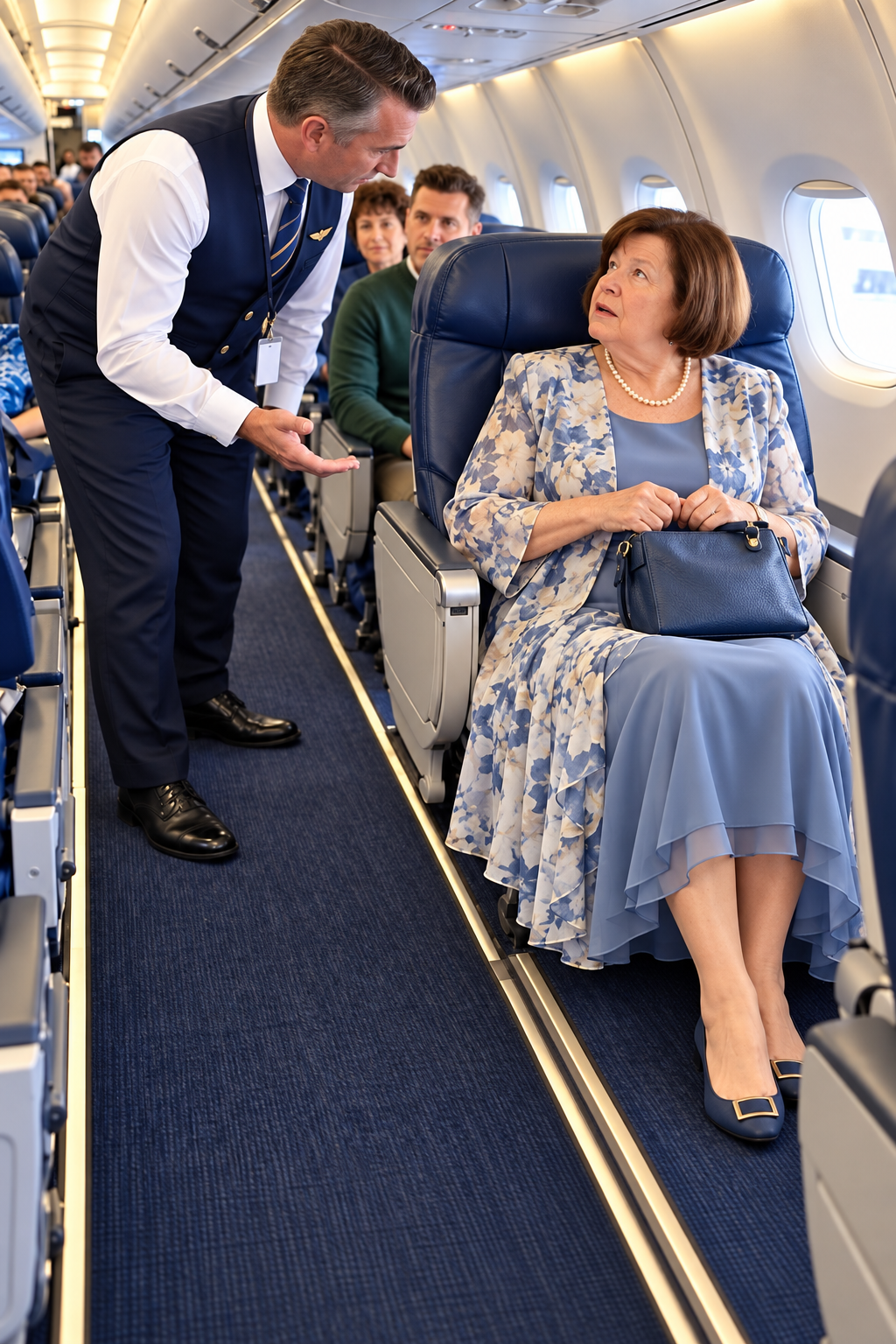
PART 1 TITLE: The Seat My Grandmother Chose Behind My Back Became the First Clue to a Promise Nobody in Our Family Mentioned
My grandmother had been missing from the boarding line for less than five minutes when I noticed the new boarding pass in her hand. She was standing beside the gate counter, speaking quietly with an airline employee, and something about the way she folded the paper made my stomach tighten. I had spent months arranging this trip, determined to give her a comfortable journey for once. Now, judging by the anxious expression she was trying to conceal, she had changed something without telling me.
“Grandma, what happened?” I asked as she approached. Eleanor Walsh looked at me over the rim of her glasses, then slipped the boarding pass into her familiar brown handbag. She offered the small, reassuring smile she had used throughout my childhood whenever I worried about something she considered unimportant. “Nothing to trouble yourself about, sweetheart. Everything is settled.” I glanced toward the boarding counter. The employee who had helped her was already assisting another passenger.
“What did you settle?” I pressed. Grandma adjusted the strap of her handbag and looked toward the windows overlooking the runway. A baggage vehicle moved slowly beneath the wing of our aircraft, its amber light blinking through the gray morning. “I asked them to change my seat,” she admitted. At first, I thought she meant she had moved from the aisle to the window. Grandma had always preferred watching the scenery rather than sitting beside passing strangers.
“Which seat did they give you?” I asked. She hesitated just long enough for me to understand that the answer would not please me. “Thirty-four A,” she said. I stared at her. The first-class cabin ended long before row thirty-four. “Grandma, that’s economy.” She nodded, not the least bit surprised. “Yes, I know.” For several seconds, I could only look at her. Then I asked the question that seemed so obvious I could barely believe it needed asking. “Why would you do that?”
She straightened the collar of her pale blue cardigan. “Because I would rather sit there.” Her answer was delivered with the quiet finality I remembered from childhood, when she would decide a conversation had reached its natural conclusion even if everyone else disagreed. I glanced at the boarding pass she had hidden. “I bought you a first-class ticket. You knew how excited I was about it. You were supposed to have room for your legs, a comfortable seat, and somebody bringing you tea without making you climb over three people.”
I had saved for that ticket longer than Grandma realized. She was eighty years old, and arthritis sometimes made her knees stiff after an hour in a car. On family outings, she insisted she could walk as far as everyone else, although I had seen her pause beside walls and storefronts to hide the discomfort. She had worked hard for decades, raised my mother after losing her husband, and developed the habit of treating every unnecessary expense as something other people deserved more.
Our trip to California had been planned around my birthday. Grandma had insisted on coming, despite the distance, and I had decided that flying together in first class would be my way of making the occasion special for both of us. I wanted her to experience something she had never allowed herself to purchase. I imagined her reclining comfortably, accepting a warm drink, perhaps laughing at the extravagance of it all. What I had not imagined was her voluntarily moving to the back of the aircraft before we even boarded.
“Did the airline offer you a refund?” I asked. Grandma shook her head. “That wasn’t important.” I stared at her in disbelief. “It might not be important to you, but that ticket cost real money.” Her expression changed slightly, and I regretted my tone before she answered. “I know it did. I know how much thought you put into buying it.” She touched my arm. “It was a generous gift, and I am grateful. But I would like you to let me choose where I sit.”
There was no irritation in her voice. That somehow made my own frustration feel worse. If she had been arguing about the price, I might have understood. If she had wanted to sit beside someone, or if first class frightened her for some inexplicable reason, she could have explained. Instead, she kept glancing toward the aircraft as though something beyond the windows was demanding her attention. When I asked whether she was feeling unwell, she said no too quickly and tightened her grip on the handbag.
I had known that handbag for nearly my entire life. Its brown leather was worn smooth around the corners, and one of the handles had been repaired with stitching darker than the original thread. Grandma carried it to church, grocery stores, birthday dinners, and even weddings where everyone else brought something elegant. Hanging from the zipper was a small pair of silver aviation wings, polished by years of contact with her fingers. I had never thought much about them. They were simply another part of Grandma.
That morning, however, I noticed that she kept touching those wings whenever she thought I wasn’t watching. Her thumb moved along their edges, pausing over the tiny raised details before returning to the handle. I wondered whether the flight was making her nervous. She had traveled occasionally since my grandfather’s death, but she rarely discussed those journeys and never seemed particularly fond of airports. Still, she had agreed to this trip without hesitation. In fact, she had been unusually interested in our airline and departure information.
Two weeks earlier, she had asked me which route we were taking. When I told her, she requested the flight number and wrote it on the back of an old grocery receipt. Later she asked whether the aircraft had a row thirty-four, a question I dismissed because I assumed she was curious about the size of the plane. Now, standing at the gate, I remembered those conversations with uncomfortable clarity. She had not selected a random available seat. She had been thinking about that row long before arriving at the airport.
“Grandma,” I said, lowering my voice, “did you specifically ask for thirty-four A?” She looked at me, and for an instant I saw something I could not identify. It resembled apprehension, but there was also a peculiar determination beneath it. “Yes,” she answered. I waited for an explanation. None came. “Why that one?” I asked. She looked down at her handbag. “Because sometimes a place matters to a person, even when nobody else understands why.” I was still considering that answer when the boarding announcement interrupted us.
Passengers began collecting their belongings and forming a line. Grandma moved toward the gate with a quickness that surprised me. I caught up and touched her shoulder. “You can still change it back,” I told her. “The agent might be able to restore your original seat.” She shook her head. “Please don’t ask her to.” Then she looked directly at me. “I have been looking forward to this journey for a very long time. I don’t want to begin it with us arguing.” There was something fragile beneath those carefully chosen words.
I stopped trying to persuade her, although I remained upset. When our boarding group was called, the agent scanned my ticket first, then Grandma’s. I watched the screen, half hoping some error would require her to return to the counter. Instead, a green confirmation appeared, and the agent wished her a pleasant flight. Grandma thanked her with unusual warmth. As we passed into the jet bridge, she took my hand briefly and gave it a squeeze. “We’ll see each other when we land,” she said.
“You’re making it sound like we’re traveling to different countries,” I replied. She laughed, but the sound faded before we reached the aircraft door. Inside, a flight attendant greeted us and directed me toward the first-class section. Grandma remained beside me for one more moment. Her eyes moved over the cabin, lingering on the wide seats and neatly folded blankets. I thought she might finally reconsider. Instead, she patted my wrist. “Enjoy your birthday present,” she said, then disappeared through the curtain toward economy.
I settled into my seat feeling strangely embarrassed. Everything around me was exactly as I had hoped it would be: broad armrests, soft lighting, plenty of room, and a flight attendant offering drinks before departure. Yet the empty seat beside me made the entire arrangement feel pointless. I had wanted Grandma to enjoy the comfort with me. Without her, the expensive ticket seemed less like an accomplishment and more like evidence of how little I understood what she actually wanted.
During the safety demonstration, I kept glancing toward the aisle. I considered walking back to check whether she had enough room, but passengers were still putting away luggage, and the crew needed everyone seated. I fastened my belt and watched rain begin to gather along the window. Our plane pulled away from the gate. Through the glass, airport vehicles moved past in blurred streaks of yellow and white. I wondered what Grandma was doing in row thirty-four, whether her knees were already bothering her, and whether she regretted her decision.
The aircraft lifted through a low layer of clouds. When the seat-belt sign finally went off, I tried to distract myself with the book I had brought, but I couldn’t concentrate. My mind kept returning to Grandma’s words about a particular place mattering to someone. The remark sounded almost ceremonial, unlike her ordinary practical advice. This was the woman who once drove fifteen miles to return a purchase because she had been overcharged by three dollars. She didn’t usually indulge in mysteries.
About two hours into the flight, I asked the attendant whether I could visit my grandmother. She checked that the aisle was clear and nodded. I walked through the curtain separating first class from economy, immediately noticing the narrower seats and the crowded overhead compartments. A child slept against his mother’s shoulder. Someone’s headphones leaked a faint, tinny rhythm. A man near the rear was balancing a paperback against his tray table. Ordinary things, all of them, yet I felt increasingly uneasy as I approached row thirty-four.
Grandma sat beside the window in 34A. Her handbag was pressed against her chest rather than placed beneath the seat, and both hands were wrapped around it. She wasn’t reading or watching the entertainment screen. She was staring through the window with an expression so distant that I hesitated to interrupt her. The sunlight caught the silver wings hanging from the zipper. They trembled slightly, and only then did I realize that her hands were shaking.
“Grandma?” I said. She turned with a startled movement, then relaxed when she recognized me. “Sweetheart, you’re supposed to be enjoying your nice seat.” I crouched beside the aisle, careful not to disturb the passenger across from her. “I’m checking on you. Are your knees hurting?” She shook her head. “Not terribly.” I glanced at the narrow space between her seat and the one in front. “That doesn’t sound very convincing.” She gave me a faint smile. “I’ve managed worse than a crowded airplane.”
Her voice sounded steady, but her eyes were red around the edges. I asked whether she had been crying. She looked away before answering. “Sometimes being above the clouds makes old memories seem closer.” I didn’t know what to say. Grandma had always spoken about the past in small, manageable pieces. She would describe my mother’s childhood, the neighborhood where she had lived, or a favorite recipe. But if conversation drifted toward Grandpa Thomas, she usually grew quiet and found some excuse to leave the room.
Thomas Walsh had died twenty-seven years earlier, long before I had the chance to know him. His photograph stood beside Grandma’s bed, showing a handsome man with neatly combed hair and a slightly crooked smile. As a child, I understood that he had worked for an airline and had died unexpectedly. The adults rarely supplied further details. My mother spoke about him with affection but also with a peculiar caution, as though certain questions might hurt Grandma more than the answers could help anyone.
“Is this about Grandpa?” I asked. Her fingers closed tightly around the purse. She stared at the silver wings for several seconds before answering. “I suppose it has always been about him.” The words were so quiet that I nearly missed them beneath the engines. I pulled myself onto the edge of the empty aisle seat beside her. “What does he have to do with this flight?” She turned toward the window again. “Your grandfather asked me to remember something. I wasn’t ready to do it then.”
I felt a chill despite the warm cabin. “Remember what?” Grandma took a long breath. “A place. A promise. Something I was supposed to understand.” She looked at the seat number printed above the window. “Thirty-four A,” she murmured, almost to herself. “I thought I would never come back.” Her words struck me more forcefully than any explanation about money could have. I realized she had been frightened at the gate, not because she was surrendering comfort, but because she was approaching something she had avoided for years.
I asked her whether she had traveled on this route before. She nodded. “A very long time ago.” Then she reached into the handbag and touched something inside, although she did not remove it. I caught a glimpse of yellowed paper folded into a narrow rectangle. When she noticed me looking, she closed the purse. “There are things I should have told your mother,” she said. “And things I should have told you.” Her mouth tightened. “I kept thinking there would be a better time.”
Before I could respond, a flight attendant appeared beside our row. She glanced at Grandma, then at the small silver wings attached to her handbag. There was nothing rude about her expression, but she seemed unusually attentive. “Mrs. Walsh?” she asked. Grandma straightened in her seat. “Yes?” The attendant smiled gently. “One of our pilots would like a word with you. Is that all right?” I looked up at her, confused. “Is something wrong?” The attendant shook her head. “Not that I’m aware of.”
A uniformed pilot appeared farther down the aisle. He spoke briefly with the attendant, who gestured toward Grandma. The man approached slowly, studying the rows as though checking a detail he didn’t entirely trust. He looked at the number above Grandma’s seat, then at the wings on her handbag. His expression became serious. He was not a young man, and there was something deliberate about the way he moved. When he reached us, he stopped and asked Grandma whether he could see the silver pin.
Grandma’s face went pale. She lowered her eyes to the wings but did not immediately touch them. “They are very old,” she said. The pilot nodded. “I can see that.” He looked more closely. “Do you mind telling me where you got them?” Grandma swallowed. “They belonged to someone I knew.” The pilot studied her for another moment, then glanced again at the seat number. “And did you choose thirty-four A yourself?” She nodded without speaking. I could hear my own heartbeat.
The pilot pulled a small document from his pocket, consulted it, and looked toward the cockpit. “Mrs. Walsh, I need to ask our captain to come back here.” Grandma closed her eyes. Her fingers trembled as she opened the handbag. From an inner compartment she withdrew a faded boarding pass protected by an old plastic sleeve. The paper had been folded so many times that pale creases divided it into small sections. She held it toward him, but he hesitated before accepting it.
When the pilot unfolded the pass, his face changed. He examined the printed seat number, the faded date, and a line of handwriting on the reverse. His gaze returned to the silver wings, and for a moment he seemed unable to speak. Then he turned to the attendant. “Please ask Captain Mercer to come here,” he said. The attendant glanced at the document and immediately left. Grandma lowered her hands into her lap. I had never seen her look so frightened, and I was suddenly afraid that the secret she had carried was about to overwhelm her.
“Grandma, what is happening?” I whispered. She looked at me with tears gathering in her eyes. “Something I should have faced a long time ago.” Before I could ask another question, the captain appeared at the far end of the aisle. The first officer had remained at the controls while he stepped away. He approached with an expression of professional concern, but when the other pilot handed him the boarding pass, that concern gave way to something entirely different. He read the name, studied the handwritten message, and looked directly at my grandmother.
For several seconds, neither of them spoke. The captain’s eyes moved from the old ticket to the wings hanging from Grandma’s handbag. Then he asked whether her name was Eleanor Walsh. She nodded. He repeated the name softly, as though it had been preserved somewhere in his memory for decades. Finally, he bent closer and asked a question that made Grandma’s hand fly to her mouth. “Eleanor,” he said, “were you married to a man named Thomas Walsh?” Grandma answered yes, and the captain’s face drained of color.
END PART 1
PART 2 TITLE: A Captain Recognized the Wings on Her Purse and Asked About the Night My Grandfather Failed to Come Home
The captain continued staring at my grandmother long after she confirmed her husband’s name. His reaction was unlike anything I had ever seen from someone in uniform. He seemed to have forgotten the watching passengers, the narrow aisle, and even the document in his hands. His gaze settled on the silver wings attached to Grandma’s handbag. Then he looked at her again, his face marked by disbelief and something more personal. “I never expected to meet you,” he said quietly. “After all these years, I assumed there was no chance.”
Grandma’s lips moved before she managed to speak. “I didn’t know you were still looking.” The captain lowered himself into the empty aisle seat beside her, keeping his voice low enough that only those nearest could hear. He introduced himself as David Mercer. When he said his surname, Grandma drew in a sharp breath. I looked between them, trying to understand what connection existed between a commercial airline captain and my grandfather, whose death had been discussed so rarely that I knew little more than his name and occupation.
“Your father was James Mercer?” Grandma asked. David nodded. “He was.” She lifted a trembling hand to her cheek. “Oh, David. I remember photographs of you when you were little.” The captain’s expression changed again. Until then, he had seemed almost uncertain whether the woman before him was the person he sought. Now he looked deeply moved. He glanced at the old boarding pass, then carefully returned it to her. “My mother kept telling me that Thomas Walsh knew something important,” he said. “I never stopped wondering what she meant.”
I tried to follow their conversation, but the names and fragments refused to form a recognizable story. “Could somebody please explain what this has to do with Grandma?” I asked. My voice sounded louder than I intended. Several passengers turned toward us, and I lowered it. David looked at me with an apologetic expression. “Your grandfather worked with my father,” he said. “They knew each other well. And twenty-seven years ago, they became involved in events that changed both our families.”
Grandma looked toward the window. Outside, the bright clouds appeared motionless beneath the wing, a peaceful view that felt cruelly disconnected from the conversation unfolding around us. “James was a kind man,” she said. “Thomas trusted him. There weren’t many people he trusted toward the end.” David leaned forward. “That’s what my mother always believed. She said my father had been worried before his final flight. He made calls, asked questions, and mentioned Thomas more than once. But nobody would explain exactly what frightened him.”
“His final flight?” I repeated. David’s face tightened. “Flight 217.” A cold sensation passed through me. I knew those numbers. They belonged to a memory from my childhood, a newspaper clipping I had found in one of Grandma’s photograph boxes. It had shown an airplane and a headline about a tragedy. When I asked what happened, she had taken the clipping from me and told me it was not something I needed to concern myself with. Later that afternoon, I found her crying over the kitchen sink.
I had not thought about that clipping in years. Now it returned with startling force. “Was Flight 217 an accident?” I asked. David nodded. “There was a serious aviation accident twenty-seven years ago. My father was serving as first officer. He was supposed to work with a different captain, but a late crew change altered the assignment.” He paused. “My father didn’t come home.” I looked at Grandma. Her face had lost nearly all its color. “And Grandpa?” I asked. She folded her hands over the old boarding pass.
“Thomas died that same day,” she answered. I felt my throat tighten. I had always assumed his death was a separate family tragedy, something sudden and painful that the adults preferred not to revisit. I had never imagined it might be connected to an aviation accident that claimed another man’s life. “Was he on the plane?” I asked. Grandma shook her head. “No. Your grandfather wasn’t part of the flight crew.” She hesitated. “His work placed him close to the people responsible for sending that aircraft into service.”
David explained that Thomas had worked as a flight operations engineer. His responsibilities brought him into regular contact with pilots, maintenance personnel, dispatch staff, and the complicated procedures that governed aircraft readiness. He was not the person who made every final decision, but he understood how technical concerns were documented and passed between departments. “My father respected him,” David said. “He once told me that Thomas was the kind of man who would check a figure twice even when everybody around him was ready to go home.”
That description struck me unexpectedly. Grandpa’s photograph showed a cheerful man with laughing eyes. I had never considered what he might have been like at work, what questions he asked, or how he behaved when he disagreed with someone. Grandma’s expression softened at David’s words. “He was like that at home, too,” she murmured. “If a shelf was crooked, he couldn’t rest until he fixed it. If the car made a strange noise, he wanted to know why. He thought small things mattered because they could become large things when people ignored them.”
David looked at the faded ticket again. “Mrs. Walsh, my father called Thomas before Flight 217. My mother remembered that much. He was concerned about something connected to the aircraft’s maintenance history. The official explanation afterward described a mechanical problem and a combination of circumstances. But she never believed she had been given the whole account.” He paused, watching Grandma carefully. “Did Thomas ever tell you what the concern was?” Grandma looked down, and I noticed how firmly she had pressed her thumb against the paper.
For a moment, I thought she would refuse to answer. Then she began speaking slowly, choosing each word as though retrieving it from a place she had kept sealed. “He called me from the airport,” she said. “It was the day everything happened. He told me a maintenance record contained something he couldn’t reconcile with what he had been told. A warning had been raised, but he was concerned that the matter had not been properly examined.” She looked at David. “He wanted someone with the authority to review it before anyone relied on the aircraft being safe.”
The captain’s expression grew more intent, but he did not interrupt. Grandma continued. “Thomas sounded tired. He had been working late and arguing with people who believed he was making too much of a problem. I asked him to come home and let someone else deal with it.” She stopped and rubbed her fingers together. “I still remember how he answered. He told me that other people were depending on the judgment of those who understood the aircraft. He said walking away wouldn’t make him feel any safer.”
I watched her carefully. For most of my life, Grandma’s voice had been a steady presence, the sort of sound that could calm me after a difficult school day or an argument with my mother. Now it sounded strained and unfamiliar. “Did he say he was in danger?” I asked. She considered the question. “Not in those words. He didn’t tell me someone meant to hurt him. He said there were consequences for challenging people who had already made decisions.” Her eyes filled. “I didn’t understand how serious he was.”
She remembered his final promise with painful clarity. He had said he would speak with the appropriate people, make certain his concerns were recorded, and come home once he had finished. She had prepared dinner that evening and left a plate covered on the stove. When the hour grew late, she assumed he had been delayed by another meeting. Then came the news about Flight 217, followed by information about Thomas’s own death. The separate details were so confusing and devastating that she could scarcely remember who had called first.
“Afterward, people came to the house,” she said. “Some were kind. Others were very formal. They wanted to know what Thomas had told me, whether he had brought documents home, and whether he had spoken about disagreements at work.” She looked directly at David. “When I said he was worried about a maintenance record, they told me those concerns had already been considered. They said the investigation would establish what happened.” She swallowed. “I wanted to believe them. I needed to believe somebody knew what they were doing.”
David asked whether she had ever received a complete explanation. Grandma shook her head. “I was told the accident resulted from mechanical circumstances and failures that had been examined. Whenever I asked whether Thomas’s warning was related, the answers became vague. Eventually, someone suggested that grief was making me search for connections that weren’t there.” Her mouth tightened. “Another person told me to think about my daughter. He said reopening questions would only prolong her suffering.” She paused. “I took that advice, though I never became comfortable with it.”
Anger rose inside me, but Grandma saw it before I could speak. “Don’t look at me that way,” she said gently. “I had just lost the person who helped me make every important decision. I was frightened of saying the wrong thing, frightened of what another investigation might uncover, and frightened of what it would do to your mother.” I shook my head. “You shouldn’t have had to decide all of that alone.” She gave a tired smile. “Perhaps. But life doesn’t always wait for the right people to arrive and help.”
David listened without interrupting. Then he reached into his uniform pocket and took out a small photograph, protected inside a thin plastic cover. It showed a pilot standing beside an aircraft with a young boy at his side. The boy’s hand was tucked into the man’s larger one, and both were smiling toward the camera. “This is my father,” David said, showing it to Grandma. “And that’s me when I was six.” She leaned closer, tracing the edge of the photograph without touching the faces.
“James always looked so pleased when he talked about you,” she said. “Thomas used to tell me about his son, the little boy who wanted to learn everything about airplanes.” David smiled briefly. “I suppose I never grew out of that.” He turned the photograph toward me. I could see the resemblance between the man pictured and the captain sitting beside us. The same eyes, the same shape of the mouth. For the first time, David seemed less like a stranger and more like another family member standing at the edge of an old grief.
“Why did you think Grandma had disappeared?” I asked him. David looked toward the front of the cabin before answering. “My mother tried to contact Mrs. Walsh years ago. The address she had was no longer current, and the people she reached couldn’t tell her how to find Eleanor. Eventually, she stopped trying. She believed everyone had moved on.” He looked at Grandma. “I never believed the questions had been answered, but I had no reason to think you were still searching for them.” Grandma replied quietly, “I wasn’t sure I had the strength.”
The exchange made me realize that the old tragedy had left more than one household living with unanswered questions. David’s mother had lost her husband. Grandma had lost Thomas. My mother had grown up with stories that ended whenever they approached the circumstances of her father’s death. And now I was sitting between two people whose lives had been shaped by the same night without either knowing how much the other remembered. The connection had been there all along, hidden behind old addresses, incomplete explanations, and years of silence.
David returned his attention to the boarding pass. “May I ask why you brought this today?” Grandma lifted it from her lap and unfolded it. The paper had been handled so often that the printed letters were barely visible along one crease. She turned it over and showed us a message written in blue ink. I leaned closer. The handwriting was thin and slightly uneven, but I could make out the instruction Thomas had left for his wife. He had asked her to remember where they had said goodbye and to seek out people who still remembered what happened.
Below the message was a date matching the day of Flight 217. I stared at it for a long moment. “He wrote this for you before he died?” Grandma nodded. “He gave it to me at the airport. I was meant to travel with him later that evening, after he finished his work. We had arranged for your mother to stay with someone we trusted. But I became uneasy about leaving her overnight, so I decided to return home.” She pressed the paper flat against her knees. “Thomas told me he understood. Then he gave me the ticket to keep.”
Her eyes settled on the seat number. Thirty-four A. “He said that if I ever needed to return to the place where we said goodbye, I should remember that seat. I thought he was being sentimental.” She let out a breath that trembled. “I didn’t realize he was worried about what might happen next.” I looked at the passenger information, then at Grandma. “So you came here because he asked you to?” She nodded. “I came because I wanted to stop being afraid of the last thing he gave me.”
There was another reason, she admitted. She had spent decades wondering whether taking that planned trip might have changed what happened. Perhaps she would have persuaded Thomas to leave work earlier. Perhaps she would have heard a conversation or noticed a detail that later investigators had overlooked. She understood, intellectually, that a passenger could not control the decisions surrounding aircraft maintenance. But grief had made that knowledge difficult to accept. “I know it sounds foolish,” she said. “I was not responsible for his decisions or the accident. Still, I kept asking myself what I might have done.”
David shook his head gently. “You couldn’t have known what would happen. Neither could my mother. People kept saying she should be proud of my father, and she was. But pride didn’t answer her questions.” Grandma looked at him with an expression of sudden recognition. “Your mother was always stronger than she believed,” she whispered. He smiled sadly. “She still is.” They sat for a moment with the photograph and the boarding pass between them, each holding evidence of a life that had continued beyond the tragedy.
I asked Grandma why she had never shown the ticket to my mother. She took her time answering. “At first, your mother was too young to understand why I was frightened. When she grew older, she had already learned not to ask. I kept telling myself that opening those old questions would only hurt her.” She rubbed the corner of the paper with her thumb. “Eventually, I became ashamed of how long I had remained silent. Every birthday and holiday passed, and the right moment seemed farther away.”
David glanced at his watch, aware that he could not remain away from his cockpit duties indefinitely. Before standing, however, he asked one final question. “Mrs. Walsh, did Thomas ever mention keeping a second envelope?” Grandma’s hand stopped moving. The change was immediate enough that I noticed before she spoke. David leaned forward. “My father told my mother that Thomas had preserved material from the operations office. He believed it showed that someone had raised a warning before the flight, and that the warning had not received the attention it required.”
Grandma looked down at the boarding pass. David continued carefully. “My father believed Thomas intended to deliver the material to people who could review it independently. But after the accident, no such envelope appeared among the papers investigators were able to examine. My mother wondered whether it had been lost or destroyed.” I could barely follow the implications. A warning record, a missing document, and two men who died before their concerns could be fully understood. The silence surrounding my grandfather’s death suddenly felt less like grief and more like an unfinished obligation.
“Did you ever find evidence that the envelope existed?” I asked. David hesitated. “Only references to it in my father’s personal correspondence. That’s why I can’t say what it contained or what it would establish.” He turned back to Grandma. “But if Thomas kept it, I believe he had a reason. My father trusted him with important things.” Grandma’s breathing had become shallow. She closed the handbag slowly, then placed both hands over it. I thought she might ask the captain to leave.
Instead, she looked at me. “Your grandfather gave me something on the morning he died,” she said. “I kept it because he told me not to lose it. For years, I was afraid of what it might lead me to.” My mouth went dry. “What did he give you?” She didn’t answer immediately. David watched her with an expression I could not read. At last, Grandma looked directly at him. “I believe I know where the envelope is,” she said.
David remained silent for several seconds. Then he asked whether she would be willing to help examine it. Grandma glanced toward the aircraft window, where sunlight stretched across the clouds. When she turned back, her eyes were wet but steady. “Yes,” she answered. “But not before I tell my granddaughter the part of this story I’ve kept from her mother as well.” She reached for my hand and held it firmly. I had boarded that plane angry about an expensive seat. Now I understood that Grandma had brought us into a history neither of us could leave behind simply by landing.
END PART 2
PART 3 TITLE: Beneath the Faded Ink of an Old Boarding Pass, My Grandmother Found the Courage to Explain Her Long Silence
Grandma did not begin with the envelope. She began with the morning Thomas left for the airport, twenty-seven years earlier, when the kitchen windows were still dark and rain tapped against the glass. He had eaten hardly any breakfast. Instead, he sat at the table turning a small brass key between his fingers. Grandma remembered asking why he looked so tired. Thomas told her he had several difficult conversations ahead and would feel better once everything was properly documented. Before leaving, he placed the key in her palm and asked her to keep it somewhere safe.
“He didn’t explain what it opened?” I asked. Grandma shook her head. “He said I would understand if I ever needed to.” She looked at David, then back at me. “I asked whether something was wrong at work. He told me there were people who preferred convenient answers to difficult questions.” She paused. “Then he said that if he couldn’t explain everything himself, I should open the box when I found someone I could trust.” The words hung between us while the aircraft moved steadily through the afternoon sky.
I leaned closer. “And you never opened it?” Grandma looked ashamed. “Not once.” She lifted her hand from mine and turned the old boarding pass over again. “He also told me that whatever I found might change the way I understood some of his decisions. He said I might be angry with him, and that I would have a right to be.” Her voice weakened. “After he died, I couldn’t bear the thought of discovering something that would make me question the man I loved.”
I had always thought of Grandma as someone who faced unpleasant tasks immediately. When my mother lost her job, Grandma helped her sort through bills without becoming overwhelmed. When a neighbor became ill, she appeared with groceries before anyone requested assistance. Yet here was a decision she had postponed for nearly three decades. I wanted to tell her that Thomas would surely have wanted her to open the box. But I knew nothing about what he had placed inside it, or why he had warned her about the possibility of anger.
“Where is it now?” David asked. Grandma opened her handbag and reached into a narrow pocket behind the lining. She drew out a little brass key with a faded red thread tied through the loop. The metal had darkened with age, except where repeated handling had polished its edges. She laid it against the boarding pass. I recognized neither the key nor the thread. “The box is at my house,” she said. “I kept it in a place where nobody would accidentally move it. Every few years, I would take it out and think about opening it.”
She described those occasions without trying to excuse herself. Once, after my mother had married, she had carried the box to the kitchen table and sat beside it for an entire afternoon. Another time, after finding an old newspaper article about Flight 217, she had put the key into the lock before losing her nerve. She told herself that whatever Thomas had wanted investigated belonged to people with technical knowledge, not to a widow raising a family. Besides, so much time had passed that the records might no longer matter.
David listened carefully. “Time can make evidence harder to assess,” he said, “but that doesn’t automatically make it worthless.” He glanced toward the folded pass. “If Thomas kept copies of the records, they might help establish what he knew and when he knew it. They might also explain why my father trusted him.” Grandma looked up with a flicker of hope. David continued, “I need to be careful about what I promise. I’m a pilot, not an accident investigator. I can’t tell you what those papers prove without seeing them.”
His caution surprised me. After everything we had heard, I wanted him to say that the missing envelope would finally expose whoever had ignored Thomas. I wanted a clear explanation for the accident and an equally clear reason for the silence that followed it. But David refused to offer either. “Documents can be incomplete,” he said. “People can remember things differently after so many years. Even if there was a warning, we would still need to understand whether it related to the accident.” He looked at Grandma. “That doesn’t mean we shouldn’t find out.”
For the first time since entering the economy cabin, I felt an unexpected respect for the captain’s restraint. He had lost his father. If anyone had reason to grasp at an accusation, it was David. Instead, he seemed determined not to replace one uncertain account with another. Grandma noticed it too. She nodded slowly and returned the key to her handbag. “Thomas would have appreciated that,” she said. “He didn’t like people deciding what a fact meant before they had looked at the rest.”
I asked her why she had kept the key hidden from my mother. Grandma lowered her gaze. “I thought I was protecting her. When she was young, I couldn’t bring myself to tell her about the arguments Thomas had been having at work. She knew he had died, and she knew I was grieving. I didn’t want her growing up afraid that every person she loved might disappear because somebody else made a bad decision.” She rubbed a thumb along the handbag’s worn leather. “I wanted her childhood to contain something ordinary.”
“But you could have told her when she was older,” I said. Grandma nodded. “I could have. By then, the silence had become part of how we lived. Every time she asked about her father, I told her something kind and true. I described the way he laughed or how he insisted on fixing everything himself. I left out the arguments, the telephone calls, and the questions that frightened me.” She looked directly at me. “I never lied about loving him. But I allowed her to grow up with an incomplete picture.”
I thought about my mother’s unusual reluctance to discuss Grandpa’s work. Perhaps she had always known there was more to the story. Perhaps she had simply learned to protect Grandma from a subject that brought her pain. Either way, the secret had spread through our family without anyone formally agreeing to keep it. I remembered school assignments about grandparents, family history projects, and conversations that ended whenever I asked too many questions. The absence had been so consistent that I stopped noticing it.
“Were you afraid Grandpa had done something wrong?” I asked. Grandma considered her answer. “I was afraid he had become involved in something I didn’t understand. I knew he cared about doing his work properly. But I also knew how frightened he sounded before he died.” She looked toward David. “When he mentioned that I might be angry, I wondered whether he had concealed something from me. I didn’t want the last things he left behind to change all the good memories.”
David leaned forward, resting his elbows on his knees. “My mother felt something similar,” he said. “She knew my father had been concerned, but she didn’t want every conversation about him to become an argument over the accident. She wanted to remember him teaching me to ride a bicycle and making pancakes on Sundays.” His eyes softened. “Eventually, she realized that avoiding the investigation hadn’t protected those memories. It had simply left her wondering whether she understood the final days of his life.”
A flight attendant approached and spoke quietly to the captain. He glanced at his watch. “I need to return to the front,” he said. Before standing, he took a small card from his pocket and wrote a telephone number on it. “After we land, I’d like to talk again. I can also put you in contact with people who understand how to preserve and assess historical aviation records.” He handed the card to Grandma. “Only if you’re comfortable proceeding. I don’t want you to feel pressured into reopening something you’ve spent years trying to survive.”
Grandma accepted the card, studying the number as though it represented a decision she had never expected to make. “I want to know,” she said. The certainty in her voice surprised me. David nodded. “Then we’ll take it one step at a time.” He started toward the cockpit, but Grandma called him back. “David?” He turned. She held the old boarding pass in both hands. “Your father was a good man. Whatever those papers say, I don’t want anyone to forget that.” David’s face softened. “I won’t,” he answered.
After he left, I remained beside Grandma until a flight attendant reminded me that passengers should keep the aisle clear. I moved into the empty seat and asked whether she wanted me to return to first class. She looked almost offended. “After making such a fuss about sitting together?” she asked. I smiled despite everything. She reached across the armrest and took my hand. For several minutes, we sat without speaking, watching the landscape appear through gaps in the clouds. It was the first peaceful silence we had shared that day.
Eventually, she told me more about Thomas. Not about the accident or the missing records, but about the man who had walked through their kitchen every morning. He had been terrible at remembering where he put his glasses and excellent at remembering other people’s birthdays. When something upset him, he became unusually quiet before deciding what to say. He loved old music, overcooked toast, and the kind of apple pie that had a thick crust and very little sugar. Grandma described these things with an affection that seemed to surprise even her.
“He used to leave notes for me,” she said. “Little ones. Sometimes just a reminder to buy milk, sometimes a joke he knew would make me laugh.” She smiled at the memory. “When he started working longer hours, I could always tell he had been home because there would be a piece of paper beside the kettle.” I watched her face change as she spoke. For years, my grandfather had existed in my imagination as a solemn figure whose life ended in tragedy. Now he began to resemble someone who had occupied a real house and made a thousand ordinary choices.
Grandma told me that James Mercer had once given Thomas the silver wings after they worked through a difficult situation involving an aircraft. She did not explain every detail because she had never understood the technical side of it. What she remembered was James arriving at their house afterward, laughing with Thomas about how stubborn he had been. James had brought the wings as a gift, saying they belonged to someone who had helped him when his own confidence faltered. Thomas kept them beside his work papers until Grandma placed them in her handbag after his death.
“I kept them because I could touch them,” she said. “Photographs are wonderful, but sometimes you want something that has weight.” I looked at the small pin with new attention. Its silver surface was scratched, and the fastening had been repaired more than once. I wondered how many times she had reached for it during difficult moments. She noticed me studying it and smiled. “Your grandfather didn’t wear them very often. He said they reminded him of a compliment he hadn’t entirely earned. James disagreed.”
As the aircraft began descending toward California, the captain made a routine announcement from the cockpit. His voice sounded composed and professional. I wondered what it felt like for him to return to his duties after unexpectedly meeting someone connected to his father’s death. Grandma listened with her eyes closed. When the plane emerged from the clouds, the coastline appeared below us in pale strips of land and water. She leaned toward the window, following the view with the careful attention of someone trying to remember every detail.
We landed under a soft orange sky. Passengers began collecting their belongings as the aircraft slowed toward the terminal. I offered to carry Grandma’s handbag, but she held it close and shook her head. “This one stays with me.” I understood. The old boarding pass and brass key were still inside. Once the aisle cleared, we stood together beside row thirty-four. Grandma rested her hand briefly on the top of seat 34A. She did not speak. Then she turned toward the exit, and I followed.
David met us near the arrivals area after he had finished his responsibilities. Without the urgency of the cabin around us, he seemed quieter and more thoughtful. He gave Grandma another card containing his contact information and explained that his mother was still alive. She was elderly now, he said, but she had preserved many of James Mercer’s letters and personal papers. “I think she would want to speak with you,” he said. Grandma’s expression shifted between relief and regret. “I should have found her years ago,” she answered.
Before we parted, Grandma removed the silver wings from her handbag. The metal caught the terminal lights as she held them toward him. “Your father gave these to Thomas,” she explained. “I’ve kept them all these years, but perhaps they should be returned to your family.” David accepted them carefully and studied the small scratches along their edges. “My father kept one set for himself,” he said. “He gave the other to your husband because he wanted Thomas to know how much he valued him.” He looked at Grandma. “I think they should remain with you for now.”
She hesitated. “Are you sure?” David nodded and placed the wings back in her hand. “They’ve helped you remember him. We can decide where they belong when we understand the rest.” Grandma closed her fingers around the pin. For a moment, the two of them stood together without speaking. Then David told us something his father had often said about flying: the job was never just about handling machinery or following a route. It was about remembering that every person aboard was trying to reach someone who mattered to them.
We spent the next few days in California as planned. Grandma insisted on celebrating my birthday, although neither of us could pretend our journey was still an ordinary holiday. We visited the places I had wanted to see, ate dinner beside a window overlooking the city, and walked slowly through a small garden one afternoon. She became tired sooner than usual and sometimes fell silent in the middle of a conversation. But when I asked whether she regretted coming, she shook her head. “I think I needed to make this trip more than I understood.”
On the flight home, she accepted the seat I had booked for her without argument. I watched her settle into first class and realized that I no longer cared whether the gift had been used exactly as I intended. A comfortable seat could help her knees. It could not answer the questions she carried. During the journey, she kept David’s card tucked inside her handbag beside the brass key. Once, I noticed her studying it, and when our eyes met, she said, “I don’t want to postpone this again.”
Three days after we returned home, Grandma called me early in the morning. Her voice sounded tired, but there was no hesitation in it. “Could you come over today?” she asked. “There’s something I want us to do together.” I knew immediately what she meant. When I arrived, the curtains were open and sunlight lay across her kitchen table. Two cups of tea had been prepared. Beside them stood a dark wooden box, small enough to fit inside a drawer, with a plain brass lock and corners worn smooth from years of handling.
Grandma sat opposite me, the little key resting in her open palm. “I took this box out last night,” she said. “I thought about putting it away again.” She looked down at the lock. “Then I remembered what Thomas said about finding someone I trusted.” I reached across the table and placed my hand beside hers. “Whatever is in there, we’ll look at it together.” She nodded, inserted the key, and turned it slowly. The lock opened with a faint metallic click.
Inside were three objects arranged with remarkable care: a thick envelope sealed with aging tape, a black-covered notebook, and a photograph of two men standing beside an airplane. I recognized Thomas immediately from the pictures in Grandma’s bedroom. The other man was James Mercer, much younger than in the photograph David had shown us. Both men were smiling, and James had one hand on Thomas’s shoulder. On the reverse, someone had written a brief dedication honoring two men who had refused to overlook what they believed was wrong.
Grandma lifted the photograph with trembling fingers. I reached for the notebook and opened it to the first page. The writing was precise, divided into dates, aircraft identification numbers, and short observations. Several pages later, the entries became longer. Names appeared beside references to disputed maintenance information, unanswered requests, and conversations that had clearly troubled Thomas. I turned another page and found a sentence underlined twice. It referred to an original report that must be preserved if the official version was changed. I looked up at Grandma, suddenly understanding why Thomas had hidden the notebook. “He was keeping his own record,” I whispered.
END PART 3
PART 4 TITLE: The Locked Wooden Box Held My Grandfather’s Warnings, but One Familiar Signature Made Their Meaning Harder to Face
The notebook smelled of old paper and the faint, dry scent of the wooden box. I turned the pages carefully, afraid that a sudden movement might tear them along the binding. Thomas had written most entries in dark blue ink, using the same compact handwriting visible on the backs of family photographs. Some pages contained nothing more than dates and technical references. Others recorded conversations with people whose names meant nothing to me. But as I read further, the pattern became difficult to ignore. He had been trying to document a problem that other people considered settled.
Grandma moved her chair closer. Her hands rested on the table, but I could see that she was struggling not to reach for the notebook. “What does it say?” she asked. I turned it toward her. One entry described a warning that had been reported but remained unresolved. Another referred to a disagreement over whether the aircraft should undergo additional inspection. Thomas had written down who attended the discussions, when particular conversations occurred, and what explanations were offered. He had also marked several items that required confirmation. Whatever the disagreement involved, he had not considered it finished.
I asked Grandma whether Thomas had ever described the technical concern in detail. She shook her head. “He tried once, at dinner, but I didn’t understand most of it. He spoke about something that had appeared in a maintenance record and then seemed to disappear from later paperwork.” She looked at the dates. “I remember asking why he couldn’t simply let the maintenance department handle it.” Her expression tightened. “He said the department couldn’t investigate a concern properly if the records no longer showed what had originally been reported.”
I studied the notebook again. A few entries contained abbreviations I couldn’t decipher, and several numbers appeared beside aircraft identification details. I was tempted to search for explanations on my phone, but I knew how easily an unfamiliar technical term could be misunderstood. Instead, I photographed the pages so we could preserve a readable copy without handling the notebook repeatedly. Grandma watched me work, then took a clean folder from a kitchen drawer. “Your grandfather would have liked that,” she said. “He always believed important things should have more than one copy.”
Near the middle of the notebook, I found a description of a meeting involving several operations personnel. Thomas had recorded that a concern was acknowledged but that responsibility for reviewing it remained unclear. A later entry suggested another discussion had taken place without producing a satisfactory answer. There were question marks beside two names, and one sentence had been crossed out so heavily that I couldn’t read it. I ran my finger just beneath the line, careful not to touch the ink. The crossed-out words bothered me more than the details I could understand.
“Did he ever seem afraid of losing his job?” I asked. Grandma considered the question for a long time. “He was worried about making enemies. He loved his work, and he knew people would remember him as difficult if he kept challenging decisions.” She looked toward the kitchen window. “But I don’t think he was afraid of unemployment as much as he was afraid of being told to ignore something he believed mattered.” She turned back to me. “He could be stubborn. Sometimes I loved that about him. Sometimes it exhausted me.”
I continued through the notebook until I reached the entries from the final days before Flight 217. Thomas’s handwriting had become less tidy. Several lines were squeezed into narrow margins, and he had circled a reference to an earlier report. Beside it he had written a reminder that the first version must be retained if later copies differed. The wording was careful, almost legalistic. It did not say that somebody had intentionally falsified anything. It showed that Thomas was concerned about the possibility that an original warning might be lost.
I read the passage aloud. Grandma closed her eyes. “He used to say that a mistake could be corrected only if someone admitted it existed,” she murmured. I looked at her. “Do you think he believed someone was changing the reports?” She opened her eyes. “I think he suspected that important information wasn’t being treated properly. But suspicion isn’t the same as proof.” She touched the page. “Thomas spent his working life checking things because he knew assumptions could be dangerous. We shouldn’t make one now.”
Her answer frustrated me, even though I knew she was right. I had spent the flight imagining the missing envelope as the final piece of a puzzle. Now it lay within reach, and everything inside it seemed to create more questions. Who had received Thomas’s warnings? Why were some entries marked for follow-up? Had anyone investigated the differences he suspected? And if Thomas had preserved documents because he feared they might disappear, why had he left them in a box his wife was too frightened to open?
Grandma reached for the thick envelope. Its tape had yellowed and begun to lift at one corner. She held it in her hands, turning it over to examine the address written across the front. Her name appeared in Thomas’s familiar handwriting. Beneath it was a short instruction asking that the contents be kept together. I offered to open it for her, but she shook her head. “I think I need to do this part myself.” She carefully loosened the tape and drew out a bundle of folded papers.
The first sheets were copies of maintenance correspondence. Others appeared to be internal memoranda, including one bearing the same reference number Thomas had circled in his notebook. Several pages contained dates, signatures, and brief annotations. We laid them on the table in the order they had been folded, creating a row of documents stretching between our untouched cups of tea. Grandma studied them with a mixture of bewilderment and concentration. “He really did keep everything,” she said. Then she found a letter folded beneath the records.
The letter was addressed to Eleanor. Its paper was thinner than the other documents, and Thomas had written on both sides. Grandma unfolded it slowly, holding the corners between her fingertips. I recognized the general shape of his handwriting from labels and notes she had saved with the family photographs. The first lines were affectionate, but there was a seriousness beneath them that made my chest tighten. Thomas had written that he hoped never to place the letter in her hands under such circumstances.
Grandma asked me to read it aloud because the words blurred whenever she tried. I began carefully. Thomas explained that he had been attempting to draw attention to a maintenance concern that he believed required further examination. He had encountered resistance from people who regarded the matter as an inconvenience or a problem already resolved. He did not name everyone involved, but he described the frustration of watching an important question become buried beneath arguments about schedules, responsibilities, and the reputation of the airline.
The letter said that James Mercer understood his concern and had encouraged him not to abandon the effort. The two men believed that remaining silent could have consequences far beyond their own careers. Thomas acknowledged that he had become increasingly frightened, particularly because he could no longer tell which people would examine the records fairly and which simply wanted the disagreement to end. He wrote that he did not expect Eleanor to understand every technical point. What mattered to him was that she knew he had not willingly accepted an unanswered safety concern.
I paused when I reached the paragraph in which Thomas addressed his family. He apologized for the hours he had spent away from home and for how distracted he had become. He admitted that his determination to resolve the matter had placed strain on his marriage. He had told Eleanor less than he should have, partly because he wanted to spare her worry and partly because he did not know how to explain the situation without sounding uncertain himself. He asked her not to mistake his secrecy for a lack of trust.
Grandma pressed her fingers against her lips. “I was angry with him,” she whispered. “That last week, we hardly had a proper conversation. He would come home late, eat whatever I’d left for him, and sit at the table with his papers. I thought he cared more about the airline than he did about us.” She stopped, staring at the letter. “I never told your mother that. I didn’t want her imagining that our last days together had been unhappy.” I reached for her hand, but she continued speaking.
“The morning he left, I told him I was tired of hearing about work. He said he understood. He didn’t argue.” She gave a painful little smile. “That was unusual for Thomas. Normally, he could argue about the weather if he believed somebody had described it incorrectly.” She looked down at the letter. “I remember feeling relieved that he was finally going to stop discussing it. And then he never came home.” For the first time, I understood why she had feared discovering what the box contained.
I told her that a difficult conversation did not erase the marriage they had shared. She nodded, but I could tell the reassurance was not enough. “I know that,” she said. “I’ve told myself the same thing for years. But understanding something is different from believing it when you’re alone.” She looked at Thomas’s handwriting again. “I spent so long wishing I could ask him what he meant, and now he’s telling me more than I ever expected.” She took a breath. “Please finish the letter.”
The final paragraphs were written more closely together. Thomas warned that the obvious person to blame for a missing report might not be the person best placed to explain what happened. He referred instead to someone whose reputation rested on having protected the airline through difficult years. He did not offer a clear accusation, and he acknowledged that he might have misunderstood some of the decisions being made around him. But he wanted the underlying documents preserved so that an independent reader could examine what had actually occurred.
He also wrote about fear. He understood that people sometimes defended bad decisions because admitting a mistake threatened their careers, their standing, or their sense of themselves. He did not excuse that behavior, but he warned Eleanor against accepting a simple story merely because it identified someone to blame. If the truth eventually emerged, he wanted it supported by evidence rather than anger. His final request was personal: he hoped that one day she would remember his love without feeling obliged to resolve every unanswered question.
I lowered the letter. Grandma was crying quietly, her shoulders moving beneath the blue cardigan. I left the paper on the table and moved my chair beside hers. For several minutes, we said nothing. The kitchen clock ticked above the doorway, and a delivery truck passed outside. I remembered how ordinary this room had always seemed during childhood visits. I had eaten biscuits at this table, played cards with Grandma, and watched her make tea countless times. All the while, the box had been hidden somewhere in the same house.
“Do you hate him for keeping this from you?” I finally asked. Grandma wiped her cheeks with a handkerchief. “No,” she said. “I’m angry that he felt he had to carry so much alone. I’m angry that I didn’t understand how frightened he was.” She folded the letter carefully. “But he wasn’t asking me to forgive something terrible. He was asking me to know the whole person he had been, including the parts that worried me.” She looked at the notebook. “I think I’ve been afraid of loving a more complicated man than the one I remembered.”
As we began sorting the remaining papers, I noticed one sheet tucked beneath the photograph. It was a photocopy of an internal memorandum, older and more faded than the others. The heading referred to a review of maintenance concerns. Several paragraphs were difficult to read, but the signature at the bottom was still visible. Beneath the name appeared a senior management title. I did not immediately recognize it. Then I remembered the newspaper articles I had seen about Flight 217 and the official who had been praised for overseeing the response.
I took out my phone and searched the name. Several historical articles appeared. The man had held a senior airline position when Flight 217 occurred and had been associated with the review of the accident. His career had continued afterward, and he had become widely recognized for promoting improvements in aviation safety. There were photographs of him receiving awards, speaking at conferences, and standing beside other industry executives. He had died years earlier, leaving behind a public reputation built in part on his work following aviation tragedies.
Grandma read the name and frowned. “Thomas mentioned him once or twice,” she said. “He never explained exactly what he thought the man had done.” I showed her the memorandum. Its wording was formal, referring to reports, responsibilities, and decisions made during a particular period. Nothing on the page established that its signer had deliberately concealed a warning. Nevertheless, the document’s presence inside Thomas’s private collection made me uneasy. “Do you think this is the person Grandpa was talking about?” I asked.
Grandma looked at me firmly. “I don’t know.” She took the memorandum and laid it beside the notebook. “We have to be careful. Your grandfather was trying to preserve information so that somebody could examine it. It would be wrong to use his papers to make accusations we cannot support.” I felt my face grow warm. She was right, and I knew it. Still, seeing the signature of a celebrated official among the disputed documents changed the way I understood Thomas’s final letter. The questions extended beyond an ordinary disagreement between coworkers.
I thought about the families of the people who had been aboard Flight 217, including the Mercers. An accident investigation could never undo their losses, but an incomplete account might leave them carrying uncertainty for the rest of their lives. I asked Grandma whether she was prepared for the possibility that the documents would not answer everything. She considered the question before replying. “I have lived without complete answers for twenty-seven years,” she said. “What I cannot accept anymore is leaving these papers untouched when somebody qualified might be able to understand them.”
We arranged the documents into folders, keeping the original order wherever possible. I made photographs of the pages and wrote down which items had been inside the envelope and which had been separate in the box. We did not try to repair damaged sheets or remove marks from the paper. Grandma found an old file containing newspaper clippings about Flight 217 and added it to the materials we would provide for context. By the time we finished, the afternoon sunlight had shifted across the kitchen floor.
The next morning, we called David Mercer. He answered after several rings, and Grandma explained that she had opened Thomas’s box. I watched her hands as she spoke. They were steady for the first time since our flight. David listened while she described the notebook, the correspondence, the personal letter, and the old memorandum. When she mentioned the documented warnings, he asked several careful questions about dates and identifying information. Then he said he could help arrange for qualified people to assess the papers, provided we were prepared for a review that might take considerable time.
Grandma agreed. David told us that his mother had kept James’s personal correspondence and was willing to examine it for anything relevant. He suggested that the surviving material from both families might help clarify what the two men had discussed before Flight 217. But he repeated that memories and personal documents would need to be compared with whatever official records remained available. “I want answers as much as you do,” he said. “I just don’t want us to build them out of assumptions.” Grandma looked at the photograph of Thomas and James. “Neither would they,” she replied.
Later that afternoon, David arranged a telephone conversation with his mother. Her voice was frail but clear. When Grandma introduced herself, the woman fell silent for so long that I thought the connection had failed. Then she began asking about Thomas, about the years since the accident, and about the photograph in the box. Grandma answered gently. I listened as two women who had lost their husbands during the same terrible period spoke for the first time in decades, each discovering how much the other had been carrying without knowing it.
David’s mother remembered James worrying about a maintenance issue before the flight. He had been meticulous about recording concerns, she said, and had never been comfortable accepting assurances without understanding the supporting information. She could not say whether the issue Thomas documented caused or contributed to the accident. But she remembered James speaking about the importance of preserving original records. When Grandma described the notebook, the older woman began to cry. “I wish we had spoken to each other years ago,” she said. Grandma answered, “So do I.”
After the call, we sat quietly beside the folders. Grandma had not received a dramatic revelation or the certainty she had once imagined the box might provide. Instead, she had found something more difficult: documents that needed examination, memories that required careful comparison, and people whose losses were intertwined with hers. I expected her to appear exhausted by the responsibility. She was tired, certainly, but there was a new steadiness in her manner. She picked up the photograph and looked at Thomas’s face for a long time.
That evening, she asked me to help her prepare the materials for review. We placed the notebook, envelope, memorandum, and related papers inside protective folders, preserving the originals and creating a separate set of copies. Grandma checked the contents twice before closing the case. Then she took out Thomas’s letter and read its final paragraphs again. When she finished, she looked at me and said that she intended to tell my mother everything before the review went further. “She deserves to know her father was more than the silence we left around him.”
I looked at the case on the kitchen table and remembered how the journey had begun. I had been furious over a seat assignment, certain that Grandma had rejected the gift I had worked so hard to give her. Now we were preparing to place twenty-seven years of unanswered questions before people who might be able to examine them properly. The old brass key lay beside the photograph, no longer guarding anything. Grandma picked it up, closed her fingers around it, and made a decision that would change our family. “Call your mother,” she said. “It’s time we stop keeping Thomas’s story from the people who loved him.”
END PART 4
PART 5 TITLE: The Captain Wanted the Missing Evidence, but My Grandmother Insisted on Telling Me the Secret She Had Protected for Twenty-Seven Years
David Mercer did not immediately repeat his question. He stood beside my grandmother’s seat, one hand resting against the overhead compartment, watching her hold the old brown purse against her knees. A few minutes earlier, he had been speaking with the calm authority of an airline captain. Now his expression belonged to a man who had unexpectedly encountered the last living witness to something that had shaped his entire childhood. Grandma Eleanor looked up at him, then toward me. She had already admitted knowing where the missing envelope was. But she had made something equally clear: she would not surrender another piece of her husband’s story without first explaining it to her own family.
“I need you to understand something,” she told David. “Thomas didn’t leave those papers with me because he wanted revenge. He was trying to prevent something terrible from happening again.” Her voice was steady, although her fingers kept moving over the worn leather of her purse. David nodded and pulled the empty seat closer. He did not interrupt her or demand the envelope’s location. Instead, he asked whether she had ever read its contents. Grandma studied him for several seconds before admitting that she had not. The answer surprised me almost as much as the existence of the documents.
For twenty-seven years, she explained, she had kept a locked wooden box in her house. Thomas had given her the key shortly before his death, along with instructions she could never bring herself to follow. He had asked her to preserve the box until she found someone who would examine its contents fairly. He had also warned that opening it might change the way she remembered him. That warning had frightened her more than anything else. She could survive being angry with the airline. She could even survive learning that someone had made a terrible mistake. But she had been afraid that the papers might reveal a side of Thomas she had never known.
“Did you believe he had done something wrong?” I asked. Grandma pressed her lips together. “I didn’t know what to believe, sweetheart. That was the problem.” She looked toward the small airplane window. “When your grandfather died, I needed one thing in my life to remain certain. I needed to know that the man who kissed me goodbye was still the man I had loved.” Hearing her say that made me realize how little I understood about the years following his death. I knew the photographs, the carefully repeated family stories, and the anniversaries she marked in silence. I had never considered what it meant to continue loving someone while fearing the answers to questions about his final hours.
David leaned forward. He explained that his mother had also spent years wondering whether the official investigation had overlooked something important. His father, James Mercer, had been the first officer assigned to Flight 217. Shortly before the flight, James had mentioned a disagreement concerning an aircraft maintenance report. He believed Thomas understood the technical problem and could help ensure it received proper attention. After the accident, the families were told that mechanical circumstances had combined in a way no one could reasonably have predicted. Yet the warning James had mentioned before leaving home was never fully explained in the records his family received.
Grandma reached into her purse and removed the small brass key. A strand of faded red thread hung through the opening in its head. She placed it on the tray table between them, then withdrew her hand. “He gave me this because he trusted me,” she said. “For years, I thought I had disappointed him by never using it.” David looked at the key without touching it. “Keeping it safe may have been exactly what he needed you to do,” he replied. Grandma’s eyes filled, but she gave no answer. I could tell she wanted to believe him. I also knew that twenty-seven years of regret would not disappear because a stranger offered her a kind interpretation.
A flight attendant approached quietly and explained that the captain needed to return to the cockpit. David glanced at his watch, then stood. Whatever memories had overtaken him, he still had responsibilities to the people aboard the aircraft. He wrote his contact information on a card and handed it to me, asking that we keep it somewhere secure. Once we landed, he said, he could speak with us away from the other passengers. He also wanted to contact his mother, who had kept a collection of James’s papers throughout her widowhood. Grandma promised nothing beyond another conversation. David seemed to understand that pushing her would only make the decision harder.
After he walked away, the cabin slowly returned to its ordinary rhythm. Someone across the aisle resumed reading. A child complained about the cold air. A flight attendant collected a forgotten cup. Yet nothing felt ordinary to me. I looked at Grandma sitting beside the window in row 34A, the economy seat she had chosen after refusing the first-class accommodation I had purchased for her. Earlier, I had been embarrassed and irritated by her decision. I had assumed she was being stubborn about money or trying to prove she needed very little. Now I understood that the seat was attached to a memory she had never managed to leave behind.
“Was this where Grandpa said goodbye to you?” I asked. She nodded. Many years earlier, Thomas had arranged for her to travel with him, although she had ultimately decided to remain home with their daughter. During their last hours together at the airport, he had shown her a boarding pass and spoken about a particular seat on the journey they would not take together. After his death, she had kept that paper in her purse. It became one of the few physical reminders of their final conversation. She could never explain why she continued carrying it. Perhaps she feared losing even the smallest detail of a day she had replayed thousands of times.
I asked whether she had deliberately chosen the same seat on our flight. Grandma rubbed the edge of the old boarding pass with her thumb. “I knew the number,” she admitted. “I wasn’t certain the aircraft would be arranged the same way. I only wanted to sit somewhere that reminded me of the last plans we made together.” She gave an apologetic smile. “I should have explained before you spent so much money.” I shook my head. The price of the ticket suddenly seemed like the least important thing in the world. What troubled me was that she had been carrying this sorrow so close to us, year after year, without feeling able to speak about it.
For the remainder of the flight, she told me small things about Thomas. He had been a flight operations engineer who believed that technical procedures were only useful when people followed them carefully. He disliked hurried decisions, especially when someone dismissed a concern because investigating it would cause inconvenience. At home, he had been almost comically patient. He repaired kitchen drawers instead of replacing them, kept old pencils until they were too short to hold comfortably, and insisted that every household appliance came with instructions worth reading. Grandma smiled while describing his habits, but her smile faded when she recalled how tense he had become during the weeks before Flight 217.
“He started coming home later,” she said. “Not every evening, but often enough for me to notice. Sometimes he would sit at the kitchen table without taking off his coat.” She remembered asking whether he was ill. Thomas had told her he was worried about work and did not want to burden her with details he could not yet explain. Once, she had found him examining copies of a technical document after midnight. When she entered the room, he had turned the papers over. She had mistaken his behavior for ordinary professional anxiety. Only after his death did she begin to wonder whether he had been trying to protect her from something he considered dangerous.
“Did he ever say he was afraid someone would hurt him?” I asked. Grandma thought carefully before answering. “No. He never told me that.” She was unwilling to make his final weeks sound more sinister than she remembered them. What she did recall was his frustration with people who seemed more concerned about reputations than unresolved safety questions. He had spoken repeatedly about the importance of documenting disagreements. Sometimes he mentioned James Mercer, describing him as a conscientious pilot who understood why concerns should not be brushed aside. Looking back, she believed the two men had been trying to ensure that a warning received proper scrutiny. Whether they had succeeded remained uncertain.
As the plane began its descent toward California, Grandma reached for my hand. She asked me not to telephone my mother immediately. She was not trying to hide the discovery, she insisted, but wanted to understand the documents before reopening memories that had already caused her daughter considerable pain. My mother had been a little girl when Thomas died. She remembered his laughter and the way he carried her on his shoulders, but she also remembered the aftermath: the visitors who came with solemn faces, the whispered conversations, and her mother’s sleepless nights. Grandma did not want to hand her another reason to suffer without first knowing what the evidence actually showed.
I promised we would discuss everything together before deciding how to tell her. The aircraft touched down beneath a pale evening sky, and passengers began gathering their belongings. Grandma moved slowly, making certain that the boarding pass and brass key were returned to their usual places. I offered to carry her purse. She declined with a gentle firmness that made me smile despite everything. When we entered the terminal, I noticed her studying the signs and crowds as though she were still searching for something familiar. Airports had changed enormously in twenty-seven years. Yet certain sounds remained the same: rolling suitcases, boarding announcements, and the distant hum of people leaving or returning home.
David met us after completing his duties. Away from the aircraft, he appeared less imposing. He had removed his uniform jacket and carried a narrow folder containing his personal notes. We found an unoccupied table near the arrivals area, where he asked Grandma whether she was comfortable discussing what had happened. She told him about the key and the locked box, explaining that she needed a few days before opening it. David accepted the delay. His mother was elderly, he said, and he wanted to prepare her for the possibility that long-buried questions might finally receive attention. Hearing him speak about her reminded me that another woman had spent those same twenty-seven years without her husband.
Before leaving, Grandma detached the small silver wings from her purse. I had seen them hundreds of times without asking about their origin. The metal had darkened around the edges, and one pin was slightly bent. She held them out to David. “Your father gave these to Thomas,” she explained. “They worked through a difficult situation together years before the accident. James said my husband deserved to carry them.” David stared at the wings. He remembered seeing a similar set among his father’s possessions when he was young. For a moment, he reached toward them. Then he folded Grandma’s fingers gently around the little object.
“Please keep them for now,” he said. “My mother would want to know you’ve looked after them all these years.” Grandma held his gaze, then returned the wings to her purse. David explained that he would arrange for qualified people to examine the papers if they proved relevant. He was careful with his language. He did not promise a reopened investigation, an accusation against anyone, or a discovery that would change the official findings. He merely offered to help put the documents before people capable of understanding them. I appreciated his restraint. So did Grandma. She had heard too many confident assurances from people who ultimately gave her nothing.
We spent the next two days in California, though our original plans seemed strangely distant. The trip had been intended as a birthday celebration for me. I had booked a comfortable hotel, chosen a restaurant, and imagined taking Grandma to places she had never visited. Instead, we moved quietly through those plans while speaking about Thomas whenever she felt ready. During dinner one evening, she surprised me by ordering the dessert he used to enjoy. She took one bite, laughed at how sweet it was, and told me he would have eaten the entire serving while claiming it was too rich. It was the first time I had heard her remember him without immediately lowering her voice.
On our final morning, she stood beside the hotel window, watching traffic move along the street below. “Do you think I’ve been foolish?” she asked. I knew she meant the box, not the seat. I told her that I thought she had survived something no one should have to face alone. She accepted the kindness but did not let it excuse her entirely. “Your grandfather asked me to trust someone,” she said. “I waited because I was frightened. There is a difference between understanding why a person hesitates and pretending the hesitation has no consequences.” I admired her willingness to examine her own choices even while confronting a mystery that had caused her so much pain.
We returned home the following afternoon. Grandma insisted on carrying her own small suitcase from the car to the front door. Inside, her house smelled faintly of lemon polish and the lavender sachets she kept in the hallway cupboard. Everything was exactly where we had left it. Thomas’s framed photograph stood on her bedside table. His watch remained wrapped in a handkerchief inside the dresser. In the kitchen, a familiar blue teapot waited near the stove. I had visited that house throughout my life, but now I saw it differently. Every carefully preserved object seemed to occupy a place in a larger story, one I was only beginning to understand.
Grandma asked me to come back the next morning. She wanted a night to herself before retrieving the box. I offered to stay, but she shook her head. “There are things I need to remember without someone watching me,” she said. Her honesty made me reluctant to argue. I hugged her, told her I would keep my phone nearby, and watched her close the door. Driving home, I thought about the key hidden in her purse and the envelope that might contain the last words Thomas had intended for the people investigating Flight 217. David had already sent a brief message confirming that he had spoken to his mother. She remembered Thomas, he wrote, and wanted to hear what Eleanor had found.
That night, I called my mother. I did not tell her every detail, respecting Grandma’s request, but I explained that the flight had brought us into contact with someone connected to her father’s old work. There was a long silence. Then she asked whether her mother was all right. The concern in her voice reminded me how protective she had always been of Grandma. I assured her that Eleanor was safe and that we would speak together once we had examined some family papers. My mother sighed. “Your grandmother never talks about those years unless she has a reason,” she said. “Whatever you’ve found, please don’t let her face it by herself.”
The following morning, Grandma opened the door before I reached the bell. Her hair was neatly pinned, but the tired shadows beneath her eyes suggested she had barely slept. On the kitchen table sat two cups of tea, a folded cloth, and a dark wooden box about the size of a shoebox. Its brass lock had dulled with age. A shallow crescent-shaped scratch marked one corner of the lid. Grandma told me she had kept it in a cupboard beneath a stack of table linens, moving it only when absolutely necessary. I asked whether anyone else knew it existed. She shook her head. Not even my mother had been told.
She sat opposite me and placed the brass key beside the box. For several minutes, she said nothing. I did not rush her. The kitchen clock ticked above the refrigerator, and somewhere outside a neighbor started a lawn mower. Finally, Grandma touched the lock. “The last time Thomas put his hands on this,” she murmured, “he was still alive.” Her words made the distance between the present and that morning suddenly feel very small. She took the key and turned it slowly. At first the mechanism resisted. Then the lock opened with a faint metallic sound. Grandma lifted the lid only halfway before stopping to steady herself.
I reached across the table and helped raise it. Inside lay a thick envelope secured with old yellowing tape, a black-covered notebook, and a photograph whose edges had curled slightly. The picture showed Thomas standing beside James Mercer in front of an aircraft. Both men were smiling, although Thomas looked unusually tired. Grandma picked up the photograph and ran her thumb across his face. “He used to hate having his picture taken,” she said. She turned it over. On the back was a short dedication honoring two men who had refused to ignore what they believed was wrong. Neither of us spoke for several moments.
Grandma opened the notebook first. The earliest pages contained dates, aircraft identification numbers, and compact technical observations. Later entries were marked with underlines, question marks, and references to meetings. There were repeated mentions of an inspection that had not been completed to Thomas’s satisfaction. Some notes recorded conversations with James. Others referred to disagreements involving the operations department. The writing became more crowded near the end, as though Thomas had been trying to capture information faster than he could organize it. I could not interpret every abbreviation, but I recognized the growing urgency. These were not casual notes made by a man complaining about his workplace.
Near the final pages, we found an entry dated the day before Flight 217. Thomas had recorded his concern that the original version of a maintenance report might be replaced or altered. He had made a point of preserving the earlier record in case someone later denied its existence. Grandma held the notebook close to the window, examining the handwriting. “He was always so careful with details,” she said. Her voice carried a mixture of pride and dread. I asked whether we should stop and call David. She considered it, then shook her head. “Not yet. I want to see what my husband was trying to tell me.”
I removed the thick envelope from the box. It was heavier than I expected. Several copied documents were folded inside, along with a handwritten letter addressed to Eleanor. The paper had yellowed, but Thomas’s handwriting remained clear. Grandma recognized it immediately. She touched the first line without reading aloud. I watched her expression change as she saw the familiar shape of his letters. This was not a photograph, a story repeated by someone else, or an object he had once used. These were words he had deliberately left for her, knowing there might come a time when he would be unable to explain himself.
“Please read it,” she whispered. I asked whether she was certain. She nodded and reached for my hand. I unfolded the letter carefully, afraid the old creases might tear. The first sentences explained that Thomas had been trying to resolve a serious safety concern and had not wanted his silence to be mistaken for agreement if anything happened to him. He wrote about James, about their shared worries, and about the consequences they both understood might follow. Then I reached a paragraph in which Thomas admitted that there was something important he had deliberately kept from his wife. Grandma tightened her grip on my fingers. I looked at her, and she quietly asked me to continue.
END PART 5
PART 6 TITLE: The Letter Explained Why Thomas Had Been Afraid, but One Familiar Signature Made His Final Warning Harder to Understand
I continued reading, though my voice had become unsteady. Thomas admitted that he had concealed the seriousness of the dispute at work because he did not want Eleanor spending every evening worrying about something she could not control. He had believed that the disagreement could be settled through the normal reporting procedures. When the responses became evasive, however, he began making copies of important documents. James Mercer had encouraged him to preserve everything. Neither man wanted the airline to suffer unnecessary damage. They wanted an unresolved concern examined before someone was hurt. Thomas acknowledged that his decision to keep his family uninformed had been unfair, even if he had convinced himself it was necessary.
Grandma lowered her head. I could hear the kitchen clock and the soft rustle of paper beneath my fingers. In the letter, Thomas described several difficult conversations with colleagues. He had been told that the matter was already under consideration and that further objections would create confusion. Yet the information he received never fully satisfied him. Different versions of the maintenance paperwork appeared to describe the same problem in slightly different ways. He could not determine whether the changes represented ordinary corrections or an attempt to minimize a warning. Rather than accuse anyone without evidence, he had decided to preserve the records and seek a more independent assessment.
“He never told me it had reached that point,” Grandma said. She was staring at the table instead of the letter. I reminded her that Thomas had deliberately tried to shield her from the details. She shook her head. “And I was so certain I knew when something was troubling him.” Her voice softened. “We were married long enough that I could usually tell what kind of day he’d had from the sound of his footsteps. But I didn’t know this.” She looked toward the photograph beside the box. “I thought he was exhausted. I made him tea and told him to get some sleep.”
The next section of the letter was more personal. Thomas wrote that he had considered resigning, although leaving the company would not solve the underlying problem. He feared that his departure might make it easier for others to dismiss the warnings. He also understood that continuing to press the issue could damage his professional reputation. He had spent years building relationships with pilots, engineers, and maintenance crews, and he knew how easily a disagreement could become a question of loyalty. Still, he could not accept an assurance that everything was safe unless the evidence supported it. He asked Eleanor to remember that distinction if anyone later portrayed his concerns as personal resentment.
I paused when I reached a sentence in which he confessed his fear. The admission was simple, without any attempt to make himself sound brave. He was frightened of losing his livelihood, of making enemies, and of bringing worry into the home he loved. But he was also frightened that ignoring the warning might leave him responsible for a tragedy he could have helped prevent. Grandma took off her glasses and pressed a handkerchief against her eyes. “He never wanted anyone to think he was courageous,” she murmured. “He used to say that doing your work properly shouldn’t require courage in the first place.”
I remembered the silver wings James had given Thomas, and the dedication on the photograph. Until that morning, I had thought of my grandfather primarily as a kind husband and father who had died too young. Now I was encountering someone more complicated: a man with doubts, professional disagreements, imperfect decisions, and a conscience that would not let him ignore an unanswered question. I wished I could ask him why he had hidden so much from Eleanor. I also wondered whether I would have behaved differently in his position. It was easy to admire courage after the danger had passed. It was harder to imagine paying its price while the outcome remained uncertain.
Near the end of the letter, Thomas referred to a person who might be able to explain what had happened to an earlier version of the report. He did not give a complete account of that person’s involvement. Instead, he warned Eleanor against assuming that the obvious individual was necessarily responsible. Someone trusted by the airline’s leadership, he suggested, knew more than the surviving paperwork might reveal. He also wrote that fear could lead otherwise decent people into damaging decisions. I stopped and read the paragraph again, trying to understand whether he was protecting someone or attempting to leave a clue.
“Does he name anyone?” Grandma asked. I told her he did not identify a person clearly enough for us to make an accusation. She considered that before asking me to read the passage once more. This time, she listened without interrupting. When I finished, she said that Thomas had often disagreed with the idea that every serious mistake required a malicious person. Sometimes, he believed, people made decisions they knew were questionable because they feared losing their positions or disappointing someone powerful. She had admired that fairness in him. Now she wondered whether it had made him too willing to give others the benefit of the doubt.
The letter ended with an apology for leaving her unanswered questions and an assurance of his love. There was no dramatic final instruction, no promise that the truth would emerge quickly, and no certainty that the documents would prove what he feared. Thomas seemed aware that he might be mistaken about parts of the dispute. What mattered to him was that the concern should be evaluated rather than quietly forgotten. When I lowered the paper, Grandma reached for it. She read the final page herself, moving her lips soundlessly over the words. Then she folded it with extraordinary care and held it against her chest.
We stayed at the kitchen table for a long time. I did not ask what she was thinking. She seemed to be listening to something beyond the room, perhaps remembering conversations that had once appeared insignificant. Eventually, she told me about the night Thomas came home after a particularly difficult meeting. He had placed his briefcase near the door and stood watching their daughter sleep. When Eleanor asked what he was doing, he said that sometimes the responsibilities people carried at work followed them home. She had assumed he was speaking about providing for the family. Only now did she consider that he might have meant something else.
“I was angry with him for leaving me out,” she said quietly. The admission surprised me. “Not because he worried about me. Because he decided what I could bear without asking.” She unfolded the letter again and looked at his handwriting. “But I can be angry with him for that and still love him. I wish I’d understood that years ago.” She placed the pages beside the photograph. I had expected the discovery to leave her either relieved or devastated. Instead, she seemed to be doing the difficult work of allowing her memories to become less perfect without becoming less precious.
We began examining the copied documents. Some were maintenance observations, others internal correspondence, and several appeared to be portions of a report. The technical language was beyond my expertise. I could identify dates, names, and the recurring aircraft reference, but not the significance of every code. Thomas had marked particular sections with pencil. One copy contained a handwritten question beside an item that appeared differently on another version. We laid the pages in chronological order across the table, careful not to confuse the originals in the notebook with the photocopies from the envelope.
The papers suggested that Thomas had repeatedly requested clarification about a maintenance issue before Flight 217. They did not tell us whether the issue had contributed to the accident, whether the aircraft had been cleared appropriately, or who was responsible for any disputed changes. I wanted answers badly enough that I could feel myself searching for patterns before understanding what I was looking at. Grandma noticed. “Careful,” she said. “Your grandfather kept those records because he wanted someone to examine them properly. We shouldn’t turn his questions into conclusions just because we’re upset.” I sat back and looked at the spread of papers again.
Beneath the black notebook, she discovered a folded photocopy that we had initially overlooked. It was an internal memorandum bearing a signature at the bottom. The name seemed familiar. I searched my phone for old articles about Flight 217 and found it within minutes. The official had occupied a senior position at the airline during the period surrounding the accident. He had participated in the review of the tragedy and later became widely respected for his public work on aviation safety. Newspapers had praised his leadership, and professional organizations had recognized his contributions. He had died years earlier, long before I had ever become interested in the history of the flight.
Grandma examined the signature without speaking. I turned the paper toward her and pointed to the date. It appeared to fall within the period Thomas had documented in his notebook. The memorandum referred to the handling of maintenance concerns, but its wording was too general for us to determine what action had been taken. I asked whether the official could have been the person Thomas meant in his letter. Grandma took her time answering. “He may have known something,” she said. “Or Thomas may have been referring to someone else. A signature tells us who signed a paper. It doesn’t tell us everything that person knew.”
Her caution frustrated me at first. I had expected the envelope to contain a decisive revelation. Instead, it offered a collection of unsettling details that raised more questions than they answered. The public record described an unavoidable accident. Thomas’s notes suggested that at least one safety concern had remained unresolved before the flight. His letter implied that the handling of the report had been disputed. The signed memorandum connected a respected official to the period in question, but not conclusively to any wrongdoing. I could see why Eleanor had been afraid of opening the box. She had preserved uncertainty for twenty-seven years, and now that uncertainty had acquired names and dates.
I asked whether she remembered meeting the official. She said she had seen him once after Thomas’s death. He had expressed sympathy and assured her that her husband’s service was appreciated. At the time, she had been too exhausted to question him. She remembered a crowded room, the smell of flowers, and someone placing a reassuring hand on her shoulder. She could not reliably recall his exact words. “For years, I remembered him as a kind man,” she said. “Perhaps he was. I won’t change that memory into something else simply because his signature appears here.” Then she looked at the letter. “But kindness doesn’t make a person’s decisions above examination.”
I suggested photographing each page so we could preserve a record of what we had found. Grandma agreed, and we spent the next hour arranging the documents on a clean sheet of paper. I recorded the order in which they had been removed from the box, noting which items were handwritten and which were copies. We kept Thomas’s letter separate from the technical records and avoided making marks on anything. It felt unnecessarily formal until I remembered how often she had been told that her concerns were merely the imagination of a grieving widow. This time, if someone questioned what she possessed, we wanted to be able to explain exactly where it had come from.
When we finished, I called David. He answered after several rings, and I could hear voices in the background before he moved somewhere quieter. I told him we had opened the box and found a notebook, maintenance documents, an internal memorandum, and a letter from Thomas. For a moment, he said nothing. Then he asked whether the papers appeared to relate directly to Flight 217. I explained what we could identify, emphasizing how much remained uncertain. He listened carefully, asking about dates and whether Thomas had signed or annotated the records. When I mentioned James’s name in the letter, his voice changed. He asked to speak with Grandma.
Eleanor took the phone. I watched her expression as David explained that he had spoken with his mother the previous evening. She remembered Thomas as a trusted colleague of her husband’s. James had mentioned him shortly before his final assignment and had expressed frustration about the way a safety concern was being handled. David’s mother had preserved letters, photographs, and some of James’s personal notes. None had been examined alongside Thomas’s papers. For the first time, there was a possibility that the two collections might provide context that had been missing from each family separately.
David offered to arrange an independent review of the documents. He knew people familiar with historical aviation records, though he stressed that no one could promise what the papers would establish. We would also need to determine which authority, if any, should receive them. Grandma asked whether sharing the documents would mean losing possession of the originals. He assured her that they could begin with carefully prepared copies and seek advice before transferring anything. She seemed relieved. After so many years, the box had become one of her last private connections to Thomas. She was willing to share its contents, but she was not ready to have them disappear into another office without knowing what would happen next.
When the call ended, I found Grandma standing beside the window. She watched the branches of the old tree outside sway in the afternoon breeze. “I used to think the worst thing would be discovering that Thomas was wrong,” she said. I waited. “Now I think the worst thing would be refusing to find out because I’m afraid of the answer.” She returned to the table and selected the letter. “Your mother needs to know.” There was no hesitation in her voice. She wanted to tell her daughter herself, without allowing me or David to soften the difficult parts. She asked me to stay beside her while she made the call.
My mother arrived before evening. She entered the kitchen looking worried and stopped when she saw the box. Grandma explained that Thomas had left documents concerning a disagreement at the airline and that we had begun reviewing them with the help of James Mercer’s son. My mother listened with her arms folded tightly across her chest. Then she asked why the box had been hidden all these years. Grandma did not evade the question. She admitted that she had been frightened of what it contained and had allowed that fear to harden into silence. My mother’s face tightened. “You could have told me,” she said. Grandma nodded. “I should have.”
They spoke for nearly an hour, sometimes gently and sometimes with an honesty neither seemed accustomed to using. My mother remembered being discouraged from asking about her father’s death. She had grown up believing that her questions caused pain and that loving him meant accepting the official explanation without argument. Grandma listened without defending herself. She apologized for making silence seem like a family obligation. When my mother finally reached for Thomas’s letter, her hands trembled. She read it slowly, stopping several times to look at his photograph. By the end, tears had marked the edge of the paper.
“He was worried about people he didn’t even know,” my mother said. Grandma touched her arm. “That sounds like your father.” My mother laughed through her tears and remembered how Thomas used to stop for stranded motorists, even when the family was late. They spoke about him for several minutes without mentioning Flight 217. I realized how unusual that was. The accident had gradually swallowed so many memories of his life that nearly every conversation about him ended at his death. Now his letter was bringing back the person who had existed before the tragedy, even as it forced us to examine the circumstances surrounding it.
That evening, after my mother left, Grandma asked me to help prepare the documents for David. She wanted the technical material reviewed independently and any official inquiry based on evidence rather than family assumptions. We agreed to keep copies of everything and to document how the materials had been stored. Before I left, she placed Thomas’s letter in a protective folder and returned the notebook to the box. The old brass key lay beside her teacup. She no longer looked at it with the same dread. The box had remained closed for almost three decades, but opening it had not destroyed her memories. It had given her a reason to begin asking questions again.
The next morning, David called earlier than expected. His mother had searched through James’s possessions and found correspondence she believed was connected to Thomas’s concerns. One item referred to a conversation between the two men shortly before Flight 217. Another mentioned the importance of preserving an earlier maintenance record. David had not yet established whether those papers added anything conclusive, but they were consistent with the questions raised in Thomas’s notebook. He asked whether we would agree to have both collections examined together. Grandma was standing close enough to hear his voice through the phone. She looked at the documents on the kitchen table, then nodded. I told David we were ready.
END PART 6
PART 7 TITLE: Two Families Finally Compared Their Records, and the Truth Began to Look More Complicated Than Either Had Expected
The first copies went to David through a secure arrangement several days after our conversation. I had expected to feel relieved once the documents were outside our family, but sending them brought a different kind of anxiety. For twenty-seven years, the notebook and envelope had existed in Grandma’s house, untouched by anyone who might question their contents. Now strangers would examine Thomas’s handwriting, compare dates, and decide which details deserved attention. I knew that was what he had wanted. Still, I understood Eleanor’s reluctance as I watched her check the folder one final time. She was allowing people to examine a part of her husband that she had never fully understood herself.
David arranged an initial conversation with someone experienced in reviewing historical aviation records. The person explained that old documents could be useful, but their value depended on context. A dated notebook might establish what Thomas had written at a particular time. A photocopy could suggest the existence of another report. Neither automatically proved why an aircraft had failed or whether a particular decision had caused an accident. Some records could be compared with surviving archives, while others might no longer be available. Grandma listened closely and asked whether uncertainty meant the documents were useless. She was told that an incomplete record could still answer important questions, provided its limitations were acknowledged.
That distinction became the foundation of everything that followed. The review would not begin with an accusation. It would begin by establishing what could be verified. David provided the papers from his father’s collection, while we supplied Thomas’s notebook, copies of the internal correspondence, and the memorandum bearing the senior official’s signature. I made an inventory of every item before sending it. Grandma insisted that Thomas’s personal letter remain clearly identified as family correspondence rather than technical evidence. She wanted his concerns examined, but she did not want private expressions of love or fear treated as though they were formal findings.
A week later, David arranged a telephone conversation between Grandma and his mother. Eleanor had been nervous all morning. She changed her blouse twice, although no one would see her, and refused the biscuits I placed beside her tea. When the call finally connected, neither woman spoke immediately. They had known of one another for decades without building a relationship. Each had lost a husband connected to Flight 217, and each had spent years believing that the other family might know something she did not. The distance between them was not caused by resentment. It had simply grown from grief, exhaustion, and the difficulty of asking questions no one seemed willing to answer.
David’s mother was the first to speak. She remembered Thomas attending a gathering at their home years before the accident. James had described him as a careful engineer who listened before forming an opinion. Eleanor laughed softly and said that sounded familiar. They exchanged small memories at first: the way both men arrived home carrying paperwork, their insistence on checking details, and the pride they took in doing difficult jobs properly. Then David’s mother mentioned the final telephone conversation she had with James. He had been worried that a maintenance concern was being handled too quickly, though he had not given her enough information to understand the technical issue.
“He said Thomas was trying to make sure someone reviewed it properly,” she told us. Grandma closed her eyes. The words matched what she had read in her husband’s letter, but hearing them from another person made the memory feel less isolated. David’s mother explained that James had been frustrated by the difficulty of getting a clear answer. He was not accusing a colleague of deliberately endangering passengers. He believed an important question remained open, and he wanted it addressed before everyone moved on. She regretted that she had not pressed him for more details. Grandma told her she had spent years feeling exactly the same way.
For a moment, the two women seemed ready to apologize to each other for things neither had caused. Grandma said she wished she had made contact after the accident. David’s mother admitted she had once considered writing but could never decide what to say. They had both been overwhelmed by the demands of raising families without their husbands. There were bills to pay, children to comfort, and ordinary mornings to endure. Eventually, the unanswered questions became something each woman carried privately. Hearing them speak, I understood that tragedy did not automatically bring surviving families together. Sometimes it left them too wounded to reach across the distance.
The conversation changed when David’s mother described a photograph James had kept. It showed him standing beside Thomas near an aircraft, both men laughing at something outside the picture. Grandma said she had found a similar photograph in the wooden box. David compared the images while we were on the call and confirmed that they appeared to have been taken during the same period. The discovery itself was modest, but it gave both families a shared memory that had survived independently. Neither man had been defined entirely by the final disagreement at work. They had been friends, colleagues, and people who could laugh together before anyone knew what would happen.
David promised to send us a copy of the photograph. His mother then asked whether Eleanor still had the silver wings James had given Thomas. Grandma reached for her purse and said she did. The older woman made a small sound of recognition. She remembered James speaking about the gift with affection. Thomas had helped during a difficult operational situation, and James wanted him to know that his judgment was valued. It was one of those gestures men sometimes made when ordinary thanks seemed insufficient. Grandma held the wings while they spoke. I could see that the object had become more than a keepsake. It connected two households that had been living with related questions for almost three decades.
After the call, Grandma seemed exhausted. She asked me to put the cups in the sink while she sat near the window. I found her there several minutes later, looking at the framed picture of Thomas on the sideboard. “She sounded just as tired as I used to feel,” she said. I asked whether the conversation had helped. “Yes,” she replied, after considering it. “But not because she gave me an answer. Because I finally know I wasn’t the only person who noticed something was wrong.” She looked down at the silver wings. “I wish Thomas and James could have known we eventually spoke.”
The review continued over the following weeks. David sent occasional updates, always careful to distinguish progress from conclusions. Some of the surviving records could be matched to dates in Thomas’s notebook. Other materials were missing, incomplete, or stored under systems that had long since been replaced. A few names belonged to people who had retired or died. Former employees remembered aspects of the old procedures differently, and there were conversations no one could independently reconstruct. At times, the process seemed painfully slow. Grandma accepted that more easily than I did. She had waited twenty-seven years. She could endure a few more weeks if it meant the evidence would be handled carefully.
I began reading whatever historical information I could find about Flight 217. The published accounts focused on the aircraft, the sequence of events, and the technical circumstances described in the original investigation. Some articles praised the response of the airline after the tragedy. Others mentioned questions raised by relatives and people connected with the crew. None provided the complete picture Thomas had been trying to preserve. I printed several articles and showed Grandma where the dates appeared to overlap with his notebook. She asked me to underline only the established facts. It became our quiet rule: we could ask any question, but we would not treat suspicion as evidence.
One afternoon, my mother joined us while we examined the older newspaper reports. She brought a photograph album she had found in her cupboard. Inside were pictures of Thomas repairing a bicycle, holding her on a beach, and standing in the garden with his sleeves rolled up. I had seen some of them before, but others were new to me. My mother placed a picture on the table in which Thomas was laughing so hard that his eyes were nearly closed. “I remember this day,” she said. “He was supposed to be helping with the washing, but he turned the garden hose on himself.” Grandma smiled, and for a few minutes the technical papers were forgotten.
My mother eventually asked whether we had considered what would happen if the documents confirmed nothing beyond Thomas’s concerns. The question settled over the table. I had been imagining a report that would explain the accident, identify every neglected warning, and finally provide a clear account of the decisions made before Flight 217. Yet no one had promised that. Grandma answered before I could. “Then we’ll know he was concerned, and we’ll know we tried to understand why.” My mother looked at her for a long moment. “Would that be enough?” Grandma folded her hands. “It wouldn’t give me everything I wanted. But perhaps enough isn’t the right measure.”
The first substantial findings arrived several weeks later. The reviewers had confirmed that some of Thomas’s notes corresponded with surviving operational material from the period before Flight 217. His concerns were not merely memories reconstructed after the accident. The available evidence indicated that he had documented questions about a maintenance matter and had tried to obtain further examination. Several dated references supported the general sequence of his efforts. The findings did not establish the precise technical significance of every concern, but they showed that the issue had been raised before the tragedy. I read the preliminary summary twice before calling Grandma.
She listened without interrupting as I explained what had been verified. When I finished, she asked me to repeat the sentence concerning the dates. I did. Then she sat down at the kitchen table and covered her face. I thought she was going to cry, but she remained still for almost a minute. Finally, she lowered her hands. “So he did try,” she said. I told her that the records supported that conclusion. She looked toward Thomas’s photograph. “I knew he wouldn’t simply ignore something that worried him.” Her voice was very quiet. The finding had not explained his death, but it had confirmed a part of his final weeks that she had struggled to defend without evidence.
There were important qualifications. The reviewers could not establish that every note referred to the same technical issue. Some abbreviations were unclear, and several documents survived only as copies. The differences between versions of the maintenance report required further examination. It was possible that some changes were routine, while others might reflect decisions that deserved scrutiny. The signed internal memorandum had historical relevance, but the signature alone did not prove that the senior official knowingly concealed information. I relayed these limitations to Grandma. She listened just as carefully as she had listened to the favorable findings.
“Thomas would have wanted us to be precise,” she said. Then she asked whether the reviewers knew who had received his final requests. I told her that they were still trying to establish the complete chain of communication. It was one of the most difficult questions, because surviving paperwork did not always show what someone had read or understood. Grandma nodded. “Then we mustn’t say they ignored him unless we can show that.” Her insistence surprised me less than it once would have. She was not protecting the airline. She was protecting the integrity of the questions her husband had tried to raise.
David called that evening. He had received the same preliminary findings and wanted to know how Eleanor was coping. I told him she was relieved but still cautious. He admitted that he had hoped to discover a clearer explanation for his father’s death. Since childhood, he had imagined that a missing document might one day reveal exactly what happened. Now, as a professional pilot, he understood how complex accident investigations could be. Even when a concern was documented, determining whether it contributed to a particular event required more than identifying an unresolved question. He was disappointed, but he did not want disappointment to make him careless.
I asked whether he regretted approaching Grandma on the flight. “Not for a moment,” he replied. He explained that meeting Eleanor had given his mother an opportunity to speak with someone who remembered James as a living person rather than a name in an old report. He had also learned more about Thomas and the friendship between the two men. Whatever the review eventually concluded, the encounter had changed how he understood his family’s history. I told him Grandma felt the same way. Then he mentioned that his mother wanted to meet Eleanor in person if both women felt comfortable. I promised to ask.
The following Sunday, I brought the invitation to Grandma. She was watering a plant near the kitchen window and did not answer immediately. “Do you think she’d be disappointed in me?” she asked. I was puzzled until she explained. She feared that David’s mother might wonder why she had kept Thomas’s papers hidden for so long. I reminded her that the other woman had also been unable to pursue every question during those difficult years. Grandma set down the watering can. “I suppose we’ve both been judging ourselves for things we couldn’t change,” she said. She agreed to meet, though she asked that the arrangement remain simple and private.
We chose a quiet afternoon for the conversation. David accompanied his mother, and I stayed with Grandma. The two women greeted each other with an awkward warmth that gradually became natural. They sat near the window, exchanging photographs and memories while David and I listened. James’s widow had brought a small collection of letters and a picture of him standing beside their young son. Grandma recognized his smile immediately. She studied the photograph, then told David that he had inherited his father’s eyes. He laughed softly and said his mother had always told him the same thing.
As the afternoon passed, the conversation turned toward the years after the accident. Neither woman had experienced grief in the same way. David’s mother had kept James’s letters close and spoken about him often. Grandma had protected Thomas’s memory by limiting the questions she allowed into the house. Yet both approaches had left things unspoken. They acknowledged their regrets without trying to compare them. When David’s mother said she sometimes felt she had failed James by accepting the original explanation, Grandma reached across the table. “You were raising a child and trying to live,” she said. “That was not a failure.”
David watched them quietly. Later, while they examined the photographs, he told me that he had spent years hoping for a simple account of his father’s last flight. He wanted to know whether someone had made a decision that could have prevented the accident. He still wanted that answer, but he was beginning to accept that the surviving evidence might never provide it completely. I admitted that I had been hoping for something similar. He looked toward Eleanor and his mother. “They’ve been living with unanswered questions longer than either of us,” he said. “We should make sure we don’t give them another explanation that turns out to be wrong.”
Before leaving, David’s mother asked Grandma whether she would consider sharing copies of Thomas’s letter with the family. Grandma agreed to provide the passages concerning James and the safety concerns, while keeping the most intimate portions private. The decision mattered to her. She wanted the other family to understand how highly Thomas had regarded James, but she did not believe that grief required surrendering every personal memory. David accepted the boundary without question. As they prepared to leave, his mother held Eleanor’s hand for a long moment. She thanked her for preserving the documents and for finally allowing them to be examined.
The next month brought additional interviews and questions. A former employee remembered that safety concerns could sometimes pass through several departments before receiving a final response. Another recalled that documentation practices had changed in the years following the accident. Neither could confirm exactly what happened to Thomas’s report. The reviewers compared these recollections with surviving records, noting where accounts were consistent and where memories had become uncertain. I learned that careful investigation often consisted of resisting the temptation to simplify. There were days when a promising detail led nowhere and others when a minor date helped establish an important sequence.
Grandma continued her ordinary routines during the review. She went shopping, visited friends, cared for her garden, and telephoned my mother about family matters that had nothing to do with Flight 217. But she no longer avoided Thomas’s name. Sometimes she mentioned him while we cooked. Other times she corrected an old family story or remembered a detail she had never shared. She told me that he used to leave the final piece of dessert on his plate for her, even when he insisted he was still hungry. She laughed while describing how obvious the gesture had been. Such memories seemed to return more readily now that she no longer feared where talking about him might lead.
Late one afternoon, David called with a new update. The reviewers had completed an important comparison between Thomas’s notes and the available historical records. The evidence supported the conclusion that an unresolved maintenance concern had been raised before Flight 217. It also showed that the issue had been discussed, though the surviving papers did not fully establish what decisions followed. There was still no basis for concluding that a single person’s actions had caused the accident. David’s voice carried disappointment, but also relief that the findings were being stated carefully. He told me a fuller report would follow once the remaining checks were complete.
I went straight to Grandma’s house. She listened as I repeated David’s explanation, then asked to see the written summary when it arrived. I expected her to be upset that the investigation had not produced a definitive answer. Instead, she stood beside Thomas’s photograph and remained silent for a long time. “For years, people told me he had nothing to worry about,” she said. “They made me feel foolish for believing he had been trying to raise a concern.” She turned toward me. “Now we know there really was something he wanted examined. We still don’t know everything that happened, but at least his questions haven’t disappeared.”
That evening, she called my mother and invited her to dinner. She also asked me to bring the copies of the preliminary findings. When I asked whether she wanted to wait for the final report, she shook her head. She had waited long enough to speak openly with her own family. We gathered around the same kitchen table where the box had been opened. Grandma placed Thomas’s photograph in the center and explained what the reviewers had established, what they could not establish, and why both mattered. My mother listened carefully, then reached for the notebook and asked whether she might read the pages her father had written. Grandma handed it to her without hesitation.
After dinner, my mother stayed behind to help wash the dishes. I heard them talking softly in the kitchen while I gathered the papers. They were discussing Thomas’s last Christmas at home, a day neither had mentioned in years. My mother remembered a game he had invented to make her laugh. Grandma recalled that he had spent an absurd amount of time hiding a small gift because he wanted her to be surprised. Their voices rose and fell comfortably. When I joined them, my mother was smiling through tears. She told Grandma that she wished they had talked about him like this when she was growing up. Grandma answered that she wished the same thing.
Before I left, Grandma asked me to remain a few minutes longer. She had been thinking about the report and the possibility that some questions would never be settled. She said she wanted the final findings treated with the same care Thomas had shown in his notes. If they confirmed that he had raised concerns, she wanted that acknowledged. If they could not establish responsibility for the accident, she wanted that stated just as clearly. “I don’t want another family carrying a story that isn’t supported by the evidence,” she said. “We’ve lived too long with uncertainty to turn it into something false.”
I promised her we would honor that wish. As I walked toward the door, she called me back. She was holding the photograph of Thomas and James in its protective sleeve. “When David brings the final report,” she said, “ask him to bring his mother if she feels able. I’d like us to read it together.” I looked at her face and saw no trace of the hesitation that had once kept the wooden box locked. She was still frightened of what the findings might contain, but the fear no longer determined her choices. For the first time in twenty-seven years, she was preparing to hear an answer without hiding from the questions that came before it.
END PART 7
PART 8 TITLE: The Review Could Not Name a Villain, but It Gave My Grandmother Something She Had Stopped Expecting to Receive
The completed report arrived on a gray Thursday morning. David had called the evening before to explain that the reviewers were ready to share their findings with both families. Grandma asked me to arrive early, although the meeting was not scheduled until the afternoon. When I entered her kitchen, I found her arranging cups on a tray. She had polished the table, opened the curtains, and placed Thomas’s photograph beside the wooden box. The room looked prepared for visitors, but I recognized the familiar signs of her nervousness. She had folded and refolded the same dish towel three times.
“Would you rather I read it first?” I asked. Grandma shook her head. “No. We’ve come this far together.” She paused beside the photograph and adjusted its position by a fraction of an inch. “I used to think that if someone finally explained what happened, everything would be different. Now I’m not sure what I expect.” I told her that she did not need to know in advance how she would feel. She gave me a small smile. “That’s probably the most sensible thing you’ve said throughout this business.” I laughed, relieved to hear the familiar teasing in her voice.
David arrived with his mother shortly after lunch. He carried a folder containing the completed assessment and supporting material. His mother brought a photograph of James that she wanted Eleanor to keep. The two women greeted each other warmly before taking their places at the table. David explained that the review had considered Thomas’s notebook, the copied correspondence, James’s surviving papers, relevant historical records, and recollections from people familiar with the airline’s procedures. He had also sought advice about what the findings could reasonably support. Then he opened the folder and began explaining the conclusions.
The reviewers had established that Thomas raised concerns about a maintenance matter before Flight 217. Several entries in his notebook were consistent with surviving operational records, and the timing supported his account of repeated requests for further examination. The material indicated that the concern had been discussed within the organization, although the surviving documents did not fully explain how every decision was made. Thomas had not invented the dispute. He had not simply misunderstood an ordinary conversation and turned it into an allegation after the fact. He had documented his questions while the events were unfolding.
Grandma listened with her hands folded in her lap. When David finished explaining that portion of the findings, she asked whether it meant Thomas had been trying to follow the proper reporting process. David answered that the available evidence supported that interpretation. Her fingers tightened around the edge of her handkerchief. For years, she had defended her husband’s character with nothing more than memory. She had known him as a careful man who took his responsibilities seriously, but she had been told repeatedly that grief might be distorting her judgment. Now independent reviewers had confirmed that he had raised a genuine concern. The significance of that finding was visible in her face.
The report also described serious limitations. Some original records were missing. Other documents survived only as copies, making it difficult to establish precisely when particular changes had been made or who had authorized them. The available material did not prove that the disputed maintenance issue caused the accident. Nor could it establish that a specific person knowingly concealed a warning that would otherwise have prevented Flight 217. David explained these distinctions slowly, allowing Grandma and his mother to ask questions. Neither woman seemed surprised by the uncertainty, but hearing it stated formally still carried a particular weight.
I asked about the memorandum bearing the signature of the senior airline official. David turned to the relevant section. The reviewers had considered its date, wording, and relationship to other surviving documents. It supported the conclusion that discussions about maintenance concerns had reached senior levels, but it did not establish everything the official knew or intended. His later reputation for improving airline safety could not answer those questions. Neither could his participation in the earlier review be treated as proof of deliberate concealment. Grandma nodded. She had insisted from the beginning that we distinguish evidence from suspicion, and she did not abandon that principle now that the findings were before us.
David’s mother asked whether the missing original report might have provided a clearer answer. He said it was possible. A complete record could have helped reconstruct the sequence of decisions, but no one could say what conclusions it would have supported without examining it. Thomas had apparently understood that the earlier version mattered, which was why he had made efforts to preserve related material. Yet the documents in the wooden box were not a substitute for every record that had been lost. I heard disappointment in David’s voice, though he delivered the explanation carefully. He had hoped the papers would resolve questions he had carried since childhood.
For several minutes, Grandma remained silent. Then she asked David to return to the section describing Thomas’s documented efforts. He read it again. She listened with her eyes closed, as though she wanted to hear the words without distraction. When he finished, she reached for the photograph of her husband. “He did what he could,” she said. It was not a declaration that everything had been resolved. She knew the review could not tell her exactly why Thomas never came home. But it had established that his final concerns were real and that his attempts to raise them deserved recognition. After twenty-seven years, that acknowledgment mattered more than I had understood.
David’s mother reached across the table and covered Eleanor’s hand with her own. She said that James had also believed questions about safety should be taken seriously, even when the answers were inconvenient. The report could not restore their husbands or explain every circumstance surrounding the flight, but it confirmed that the concerns they remembered were not imaginary. Grandma looked at her for a long moment. “I spent so many years wondering whether I had been unfair to the people who told me to move on,” she admitted. “I thought perhaps I was making trouble because I couldn’t accept losing him.” David’s mother squeezed her hand. “You were asking for something you never received. That doesn’t make you unreasonable.”
We continued through the findings until late afternoon. David explained which conclusions were supported, which issues remained unresolved, and what additional records might have been useful. He did not suggest pursuing accusations that the evidence could not sustain. Instead, he discussed ways to preserve the verified material and make it available through appropriate historical or investigative channels. Grandma wanted Thomas’s notes handled respectfully. She also wanted the surviving records to be available for examination if further information ever emerged. David promised to help arrange that without surrendering the family’s personal correspondence unnecessarily. It was a practical discussion, quieter than I had once imagined such a meeting would be.
Afterward, I helped clear the table while Grandma and David’s mother sat with the photographs. They spoke about their husbands without the urgency that had surrounded earlier conversations. James’s widow described how he practiced simple magic tricks for their son, always revealing the secret too quickly because he enjoyed the boy’s laughter more than the illusion. Grandma remembered Thomas pretending he could not dance, then becoming the most enthusiastic person in the room whenever their favorite song played. Both women laughed. The sound surprised me. We had spent months examining documents connected with tragedy, yet the conversation had finally returned to ordinary memories.
Before leaving, David asked whether he could speak privately with me for a moment. We stepped into the hallway, where the afternoon light fell across the family photographs. He told me that he had worried about disappointing Eleanor. He had approached her on the flight because he recognized the name and the silver wings, hoping that she might possess information his family had never seen. For a time, he had imagined the documents might reveal a clear explanation for Flight 217. The review had provided something important, but not the complete answer he wanted. I told him Grandma had never expected him to solve everything. What mattered was that he had taken her seriously.
He looked toward the kitchen, where the two older women were still talking. “My mother hasn’t spoken this openly about Dad in years,” he said. I told him the same was true of Eleanor. He nodded, considering that. Then he admitted that meeting Grandma had changed something for him as well. His father had always existed in two forms in his memory: the man in the photographs and the pilot who had died in the accident. Hearing Eleanor’s stories about James and Thomas had brought back the ordinary person behind the tragedy. David had begun asking his mother questions about his father’s habits, friendships, and small kindnesses. He wished he had done so sooner.
When we returned to the kitchen, Grandma was holding the silver wings. David’s mother had asked to see them again. The metal caught the light as Eleanor turned the little object between her fingers. She explained how carefully Thomas had kept them and how she had attached them to her purse after his death because she did not want to leave them hidden in a drawer. David’s mother smiled sadly. “James was proud of giving him those,” she said. “He thought Thomas had helped him when it mattered.” Grandma looked at David and offered him the wings once more, saying they belonged with the family of the man who had given them.
David hesitated. He understood their importance to Eleanor, and he knew his mother did not want to take away an object she had carried for so long. They discussed it without any sense of ownership becoming a contest. Eventually, David suggested keeping the wings with the photograph of Thomas and James and copies of the letters that connected their families. Both women could share the memory without needing to divide it. Grandma considered the idea before smiling. She said Thomas would probably have approved. He had never cared much about possessions, but he valued the stories attached to them. They agreed to preserve the items together as reminders of the two men’s friendship.
In the weeks that followed, we arranged the photographs, wings, and selected correspondence in a small display at Grandma’s house. She chose a simple wooden frame rather than anything elaborate. The silver wings rested beneath the photograph of Thomas and James, with a brief description identifying them and the friendship they represented. She did not want the display to make claims the evidence could not support. It was not a monument accusing someone of wrongdoing. It was a family remembrance of two men who had taken their professional responsibilities seriously and whose surviving records had helped establish that important safety questions were raised before Flight 217.
My mother came over when the frame was finished. She stood in front of it for a long time, examining the photograph of her father. Then she asked Grandma whether she could have a copy for her own home. Eleanor agreed immediately. They spent the afternoon choosing other pictures from the old albums. My mother told stories about Thomas that she had never shared with me, and Grandma corrected small details with affectionate amusement. At one point, they disagreed about the color of a car he had owned. Both insisted they were right. I watched them argue and laugh, grateful that their memories no longer had to remain solemn merely because the ending had been painful.
The months after the review were quieter than I expected. We did not receive a dramatic admission from the airline or a single new document that resolved every question. Some historical details remained uncertain, and we accepted that further evidence might never emerge. Yet the investigation had accomplished something lasting. Thomas’s efforts were recorded, his concerns had been examined, and the surviving information was organized for future reference. David’s family had gained context for James’s final conversations. Grandma had learned that she could open the past without losing the husband she remembered. Most importantly, she no longer felt obliged to defend her questions in private.
One evening, she invited me to stay for supper. We ate at the kitchen table while rain tapped softly against the windows. Afterward, she brought out the old boarding pass she had carried on the flight to California. Its corners were nearly transparent from years of handling. She placed it beside Thomas’s letter and looked at both objects. “I thought I needed to go back to that seat to understand him,” she said. “But I think what I really needed was to stop being afraid of what he left behind.” I asked whether she regretted giving up the first-class ticket I had purchased. She smiled. “I regret worrying you. I don’t regret where I sat.”
I admitted that I had been angry at the airport because I believed she was rejecting something I had worked hard to give her. She listened without interrupting. Then she apologized for leaving me to guess at her reasons. “I was so used to keeping that part of my life private,” she explained. “It didn’t occur to me how strange my behavior must have seemed.” I told her that I wished I had asked more questions instead of assuming I understood. She reached across the table and touched my hand. Neither of us needed to defend our earlier misunderstanding. We could recognize it and behave differently the next time.
Grandma began speaking about Thomas more freely after that evening. Sometimes she called to tell me a memory that had surfaced while she was doing something ordinary. Once, she remembered how he had driven a considerable distance in heavy rain because she mentioned wanting a particular apple pie. Another time, she described his habit of checking every door before bed, even when he was exhausted. She laughed about his terrible singing and the way he insisted on performing lullabies for their daughter. These stories did not erase Flight 217. They reminded us that his life had contained far more than the circumstances surrounding his death.
David kept in touch. He sent occasional photographs from his travels and asked after Eleanor. His mother exchanged letters with Grandma, sometimes including pictures of James or stories she thought Thomas would have enjoyed. The two women did not turn their friendship into an endless discussion of the accident. They wrote about their gardens, their families, and the small frustrations of growing older. Sometimes they spoke on the telephone for an hour without mentioning their husbands at all. I found that strangely comforting. Their connection had begun in loss, but it did not have to remain confined to it.
As Grandma’s eighty-first birthday approached, I began thinking about how to celebrate. The previous year’s trip had changed our family in ways I could never have anticipated. I wanted to give her something she would enjoy without making every birthday another occasion to revisit the tragedy. When I asked what she wanted, she gave her usual answer: nothing expensive, perhaps lunch together and a quiet afternoon. But a few days later, she mentioned that she would like to travel again. She did not specify a destination. She only said that she had enjoyed looking out of the airplane window and that there were still places she hoped to see.
I suggested another trip, this time chosen entirely around what she wanted to experience. Grandma seemed pleased, though she asked that we avoid an exhausting schedule. We discussed possible destinations over tea, weighing comfortable hotels against places she had always wanted to visit. I noticed that she spoke about flying without the uneasiness that had once accompanied it. She asked practical questions about the length of the journey, the weather, and how much walking she could manage. She did not mention Flight 217 or the old boarding pass. The absence of those references felt significant. For the first time, she was planning a journey for the pleasure of going somewhere.
I booked our tickets several weeks before her birthday. After comparing the available options, I selected first class for Grandma again. I wanted her to have a comfortable seat, enough room to rest, and a journey that did not leave her tired before we arrived. Yet I hesitated before completing the purchase. I remembered how certain I had been the previous year that I understood what would make her happy. I had mistaken her decision to move to economy for ingratitude. This time, I promised myself that the ticket would be an offer rather than an obligation. If she preferred something else, I would listen.
When I told Grandma about the arrangements, she raised an eyebrow. “You’re spoiling me again,” she said. I replied that an eighty-first birthday deserved a little celebration. She laughed and asked whether I had chosen a seat for her. I admitted that I had booked first class, but added that we could change the arrangement if she wished. She studied me with an expression I could not immediately interpret. Then she reached for her tea. “We’ll see when we get to the airport,” she said. I smiled, recognizing the familiar stubbornness beneath her gentle tone. This time, however, it did not irritate me.
The evening before our departure, I visited her to help with the luggage. She had packed carefully, placing her medications, reading glasses, and travel documents in the worn brown purse she still preferred to carry. The silver wings were no longer attached to it. They remained in the frame beside Thomas and James’s photograph. Grandma stood before the display for a moment, then adjusted the frame so it faced the room properly. I asked whether she wanted to bring a photograph of Grandpa. She shook her head. “I don’t need to carry everything with me anymore,” she said. Then she smiled. “Besides, I remember his face perfectly well.”
On the morning of her birthday, we arrived at the airport earlier than necessary. Grandma walked beside me with her small suitcase, commenting on the crowds and the unfamiliar shops. I had expected the place to stir difficult memories, but she seemed relaxed. We stopped for coffee, and she insisted on choosing something sweet despite claiming she was not hungry. While we waited near the gate, she asked to see her boarding pass. I handed it over without thinking. She examined the seat assignment, then looked toward the aircraft waiting outside the window. For a moment, the expression on her face reminded me of the previous year’s journey.
I felt the old impulse to explain why first class would be more comfortable. The words were ready before I caught myself. Grandma folded the boarding pass and returned it to me. “You know,” she said, “I’ve been thinking about something.” I waited. She looked at the passengers gathering around us, then back at the aircraft. “Last year, I made a decision you couldn’t understand because I hadn’t told you what mattered to me. I don’t want us to make the same mistake again.” Her voice was gentle, but there was purpose behind it. I told her she could sit wherever she preferred and that I would be happy beside her.
She smiled and took my hand. The boarding announcement had not yet begun, and we had time to decide. I looked at the expensive ticket I had purchased, then at my grandmother, who had spent so many years allowing grief to govern what she could remember and say. The seat assignment was no longer the important part of the journey. I slipped the boarding pass into my pocket and asked her one simple question: “Where would you like us to sit?” Grandma turned toward the window, considering the aircraft in the morning light. Whatever answer she gave, I knew I would not mistake it for rejection again. This time, the choice would belong to her.
END PART 8
PART 9 TITLE: The Evidence Thomas Left Behind
The photocopied memorandum remained between us on the kitchen table. Grandma had folded it once, carefully, along an old crease, but she had not put it back into the envelope. Her tea had gone cold. Beyond the window, the neighbor’s sprinkler made its familiar clicking sound, crossing the grass and starting over. Everything outside continued as usual. Inside, we were trying to understand why a document that had been hidden for twenty-seven years carried the signature of a man publicly celebrated for making air travel safer.
Grandma Eleanor Walsh studied the name at the bottom of the page without speaking. I could see that she wanted an answer, perhaps more than she wanted anything else, but she had spent enough years living with suspicion to recognize its dangers. She placed her fingertips against the paper and said, “Your grandfather trusted facts. He wouldn’t want us accusing a man simply because his signature appears here.” I looked at the black notebook beside her. Thomas Walsh had filled it with dates, maintenance observations, and conversations he feared might otherwise be forgotten.
I asked whether she had ever shown the notebook to anyone. She shook her head. The wooden box had remained locked through moves, family celebrations, the death of old friends, and the ordinary accumulation of years. She had carried its key in her brown purse, sometimes taking it out at night and turning it over in her hand. Once, she admitted, she had almost opened the box after receiving a letter about the accident’s anniversary. Instead, she put the key away and spent the evening washing dishes that were already clean.
“Why that night?” I asked. Grandma watched the water moving across the neighbor’s lawn before she answered. She said an anniversary made everything harder because people expected grief to become orderly with age. They expected the bereaved to remember fondly, speak politely, and stop asking questions. On that particular evening, she had felt angry enough to open the box. Then she thought of my mother asleep upstairs and became frightened of what the contents might change.
I couldn’t tell her that she should have opened it sooner. I hadn’t lived through the weeks after Thomas died, when strangers came to her door with official explanations and sympathetic faces. I hadn’t raised a daughter while trying to decide whether to challenge an airline, an investigation, and people who seemed certain that further questions would accomplish nothing. I had been a child who occasionally wondered why her grandfather’s photographs made adults uncomfortable. Eleanor had been the person carrying that discomfort every day.
The next morning, I called David Mercer using the number he had given us in California. He answered after several rings, his voice slightly rough with fatigue. I could hear a door closing in the background. When I told him we had opened the box, he stopped moving. I explained that Thomas had preserved maintenance records, a notebook, correspondence, and an internal memorandum. David asked whether we had photographed everything. We hadn’t. He advised us to keep the originals together, avoid unnecessary handling, and arrange for qualified people to examine them.
He didn’t ask me to read the entire letter aloud. Instead, he asked about the dates and whether Thomas had identified the aircraft connected with Flight 217. I told him there were registration numbers in the notebook, although I couldn’t interpret all of them. David was quiet long enough that I wondered whether the call had dropped. Then he said his father, Captain James Mercer, had been deeply troubled about a maintenance matter shortly before the accident. His mother had remembered the concern but had never possessed the records that might explain it.
David asked to speak with Grandma. I carried the telephone into the living room, where she was sitting with the photograph of Thomas and James. She took the receiver in both hands. For several minutes, she listened while David described his mother’s recollections. Then she said, “James told Thomas that a warning was only useful if somebody had the courage to record it.” David’s answer came through the telephone clearly enough for me to hear. “My father used to say something very much like that.”
They arranged another conversation, this time with David’s mother. We didn’t invite journalists or tell distant relatives that a long-hidden mystery was about to be solved. There wasn’t a solution yet. There was a collection of papers whose meaning had to be established. David helped us identify people experienced in reviewing historical aviation records, and Grandma agreed that the documents could be examined. I was surprised by how quickly she made that decision after so many years of hesitation.
That afternoon, we prepared an inventory. I spread clean paper across the dining table and wrote down every item before placing it in a separate protective sleeve. The black notebook came first, followed by the sealed envelope, Thomas’s letter, the maintenance copies, and the internal memorandum. Grandma insisted that the photograph of Thomas and James remain with her. She also kept the faded boarding pass, whose handwritten message had brought us this far. We photographed those two objects for the record, but I didn’t argue about the originals.
The notebook took longer to examine than I expected. Its early pages contained ordinary entries that sounded almost domestic in their attention to detail: an appointment moved from Thursday to Friday, a requested inspection, a telephone conversation, an aircraft registration. Later entries became more compressed. Thomas had underlined certain dates and placed small marks beside references to documents he had requested. A few passages were written so quickly that the letters ran together. I found myself imagining him standing at a counter or desk, writing before somebody could interrupt.
Grandma watched me reading and explained that Thomas had always kept notebooks. He wrote down grocery prices when money was tight, measurements before fixing shelves, and names of people who helped him. He had once filled half a page describing the exact reason their kitchen window wouldn’t close properly. “He didn’t do it because he thought everyone was lying,” she said. “He did it because memory changes. He liked being able to check.” That detail made the notebook feel less like a mysterious artifact and more like something unmistakably his.
My mother came over that evening. Grandma had asked me to telephone her, but insisted that I let her decide how much she wanted to hear. When Mom arrived, she stood in the doorway with her coat still on and looked at the papers covering the table. She had grown up with the official account of her father’s death. She knew he worked in flight operations and that an accident had taken him from her, but she had never understood the extent of his concerns before Flight 217.
We told her what we had found without turning the information into a dramatic accusation. She sat down, removed her coat, and listened while Grandma explained the key, the boarding pass, and her encounter with David. When we reached Thomas’s letter, Mom asked to read it herself. I handed it to her. Her eyes moved slowly across the first page. She paused at several sentences, pressing her lips together. Finally, she put the letter down and asked Grandma why she had believed that knowing the truth might make her angry with Thomas.
“I didn’t know what he was going to confess,” Grandma replied. “He told me he had made decisions that could change everything. I was afraid he’d taken a risk he couldn’t undo.” Mom studied her for a moment before asking whether she was still angry. Grandma shook her head. She said there were things she wished Thomas had explained, and there would probably always be questions between them that death had prevented either of them from answering. But she was beginning to understand what he had been trying to do.
Mom touched the edge of the photograph. “I remember him coming home late,” she said. “I remember you being upset with him.” Grandma nodded. During the weeks before Flight 217, Thomas had missed dinners and forgotten arrangements he normally kept. Once, he had promised to take their daughter to the park and arrived home after sunset. He had apologized and tried to explain that something important was happening at work. Eleanor had been too tired and worried to listen patiently. Neither could have known how little time remained.
For a while, the three of us sat together without speaking. Then Mom said she didn’t want her father’s memory reduced to an accident investigation. She wanted to know whether he had laughed easily, whether he was strict, whether he remembered birthdays. Grandma looked almost startled by the request. I realized that for years, even our ordinary questions had circled the subject of Thomas’s death. We rarely asked about the life that had come before it. The silence had hidden more than the circumstances of an accident.
Grandma began with a story about a broken kitchen chair. Thomas had promised to repair it on a Saturday morning, but he was called into work before breakfast. He returned carrying a replacement chair from a secondhand store, painted an unfortunate shade of green. Grandma had laughed at it. Thomas told her the color was cheerful, and she asked whether he had bought it in the dark. They kept the chair for seventeen years. Mom smiled at the memory, suddenly recalling that she had used it to reach the biscuit tin.
That small conversation changed the evening. We still had unanswered questions and a table crowded with evidence, but Mom was no longer looking at the papers as though they contained every important fact about her father. She asked Grandma about his favorite meals, the music he played when washing the car, and the way he used to stand beside the front window during thunderstorms. I listened, making occasional notes. These were details I wanted to preserve just as carefully as the information in his black notebook.
Two days later, David called to say that arrangements for an initial examination were underway. He explained that the people reviewing the documents would need to distinguish original records from copies, establish dates where possible, and compare Thomas’s notes with surviving official materials. Some questions could be answered through ordinary document examination. Others might remain unresolved because records had been destroyed, misplaced, or never preserved. He was deliberately cautious, and I appreciated that, although I could hear his disappointment beneath the professional language.
Grandma asked whether the review could determine who had changed the maintenance report. David said it might identify differences between surviving versions, but that did not necessarily mean anyone could establish when a particular change occurred or who ordered it. He reminded her that his father’s death was part of a complicated accident, not a problem that could be explained from one suspicious page. Grandma listened closely. When the conversation ended, she wrote those limitations on a small notepad and placed it beside the telephone.
I asked why she had written down the disappointing parts. She said she had already spent twenty-seven years wondering about something she couldn’t prove. She didn’t want to exchange one uncertainty for another simply because the new version made her feel better. Thomas would have wanted the records examined properly, she believed, even if the findings were less satisfying than the conclusions we might have imagined. I looked at her handwriting, still neat despite the slight tremor in her fingers, and understood that she was protecting his work.
The first examination took place the following week. We brought the materials to a quiet office where a specialist explained how they would be documented and compared with available historical records. Grandma remained beside the box until every item had been accounted for. I had expected her to hesitate before handing over the envelope, but she signed the necessary paperwork with a steady hand. She asked practical questions about storage, access, and returning the documents. Her years of fear had not erased her instinct to be careful.
Before we left, the specialist pointed to several entries concerning an unresolved maintenance issue. He said the notes appeared consistent with someone recording ongoing concerns rather than reconstructing them after the accident, although their authenticity and significance still required verification. He did not promise a particular finding. Grandma thanked him, and we walked outside into a cold, bright afternoon. She stopped near the building entrance and took a long breath. “That was harder than I thought,” she admitted.
On the drive home, she kept her purse on her lap. The silver wings attached to it caught the light whenever we passed beneath an opening in the clouds. I asked whether she regretted handing over the papers. She said no, then corrected herself. She regretted that Thomas hadn’t been able to deliver them himself. She regretted that James Mercer hadn’t lived to explain what worried him. Most of all, she regretted that two families had spent so long believing there was nothing more they could do.
When we reached her house, she went directly to the kitchen and put on the kettle. She didn’t ask me to search for more articles or call David for an update. Instead, she found Thomas’s old recipe card for apple pie and placed it beside a mixing bowl. He had once driven forty miles because she mentioned wanting a particular pie from a bakery they visited when they were young. She had laughed at the extravagance, though the dessert couldn’t have cost more than a few dollars.
We made the pie together, following his notes even when his measurements seemed imprecise. Grandma corrected the way I held the rolling pin and accused me of treating pastry like a piece of stubborn luggage. I laughed so hard that flour scattered across the counter. For a moment, she looked younger, not because the lines in her face disappeared, but because she wasn’t measuring every word against the weight of what had happened. She was simply telling me how Thomas liked his crust.
After dinner, David called again. His mother had agreed to speak with us, and he hoped the two women could share what they remembered before the formal review was finished. Grandma turned toward the photograph of Thomas and James on the sideboard. “I’d like that,” she said. Her voice was nervous but certain. When she hung up, she asked me to bring the photograph closer. She examined the younger faces, the aircraft behind them, and the handwriting on the reverse.
“Those two thought somebody would listen,” she said. I sat beside her and looked at the picture. The men were smiling, unaware of how often their faces would eventually be studied by people searching for answers. I told Grandma that someone was listening now. She didn’t answer immediately. Then she placed the photograph on the table, turned it so we could both see it, and said that listening was only the beginning. Whatever the review found, she wanted us to have the courage to accept it.
That night, before leaving, I helped her return the empty wooden box to its shelf. The crescent-shaped scratch on its lid was still visible beneath the kitchen light. For nearly three decades, the box had held words Thomas wanted preserved. Now the papers were in other hands, being examined with the care he had hoped they would receive. Grandma touched the lid one last time, then closed the cupboard without locking it. She didn’t ask me to stay because she was frightened.
At the front door, she surprised me by asking whether I would come back on Sunday and bring my mother. She wanted to show us the albums Thomas had assembled before his death. There were photographs of picnics, awkward birthdays, holidays, and ordinary afternoons. Some had handwritten dates. Others had comments that only Eleanor understood. “I’ve spent too much time talking about the day we lost him,” she said. “I’d like you both to know the days when he was here.”
I hugged her for a long moment. Over her shoulder, I could see the photograph of Thomas and James resting on the sideboard. David was still waiting for answers about his father. Grandma was still waiting to learn what the documents might establish. Nothing had been resolved, and there was no guarantee the review would produce the certainty either family wanted. But Eleanor had made a decision that did not depend on the findings: she would no longer allow fear to decide which memories she could share.
END PART 9
PART 10 TITLE: The Questions That Survived
Sunday arrived with a gray sky and the smell of rain. By the time Mom and I reached Grandma’s house, she had already cleared the dining table and arranged four photograph albums in a neat stack. The wooden box stood on the sideboard, empty except for the photograph we had decided to keep at home. Beside it, she had placed Thomas’s old watch, its leather strap cracked from years of careful storage. She greeted us with tea and asked us not to be surprised if some of her stories contradicted the dates she had written beneath the pictures.
We started with photographs taken long before Flight 217. Thomas stood beside Eleanor outside a small house, his shirt sleeves rolled up and his hair blown sideways by the wind. In another picture, he was kneeling beside a bicycle, apparently explaining something to a little girl who looked profoundly unimpressed. Mom recognized the bicycle immediately. She remembered that its bell had been louder than the one on her friends’ bikes, and that Thomas had spent an entire afternoon adjusting the brakes because he worried about her riding downhill.
Grandma smiled at the memory, then turned another page. There was Thomas holding a birthday cake with uneven icing, Thomas carrying grocery bags through the rain, and Thomas asleep in an armchair with a newspaper folded across his chest. I had known him mainly through a formal portrait in the hallway. Here he was caught blinking, laughing, and making the ordinary mistakes photographs preserve. Mom leaned closer to one picture and said she could almost hear him explaining why the crooked garden fence didn’t need replacing.
When we reached the final album, Grandma hesitated. The pictures were arranged around the years when Thomas worked closely with James Mercer. There were gatherings with airline colleagues, family picnics, and a photograph of several men standing beside an aircraft on a clear autumn afternoon. Grandma pointed to James near the edge of the group. He was smiling toward someone outside the frame. Thomas stood three places away, holding a paper cup. Neither knew that decades later their children and grandchildren would study those images for clues.
Mom asked whether James had been a close friend. Eleanor said he and Thomas had respected each other long before they became friends. Their jobs were different, but they shared a belief that careful work mattered most when nobody noticed it. James trusted Thomas’s judgment about operations. Thomas admired the way James treated younger crew members. They sometimes disagreed, especially about whether management would respond to concerns, but Grandma remembered their arguments ending with laughter rather than resentment.
She had just begun telling us about one such disagreement when the telephone rang. David was calling from his mother’s home. He explained that she was comfortable speaking to Eleanor and that he would remain nearby in case either woman needed a break. Grandma moved to her favorite chair and placed the receiver against her ear. Her first words were almost inaudible. She introduced herself as Thomas Walsh’s wife, then immediately corrected the formality by saying they had waited too many years to be strangers.
Mrs. Mercer answered in a thin, steady voice. She remembered Eleanor’s name. James had mentioned Thomas so often that she felt she knew his family without ever having spent much time with them. She asked after Grandma’s daughter, remembering that Thomas always carried a photograph of her. Mom covered her mouth when she heard that. Grandma looked toward us, eyes shining, and told Mrs. Mercer that the little girl was now grown, sitting beside her own daughter, and listening to their conversation.
They spoke about the men before discussing the accident. Mrs. Mercer remembered James’s habit of checking his uniform pockets before leaving the house, then checking them again in the car. Grandma said Thomas did something similar with his notebooks. Both women laughed, softly and with surprise, at the thought that they had spent so much of their married lives watching men who couldn’t trust themselves to remember where they had put a pen. It was the first laughter they had shared, and it made the conversation easier.
Eventually, Mrs. Mercer described the weeks before Flight 217. James had become increasingly distracted after conversations with Thomas. He still prepared carefully for his flights, but he sometimes stood in the kitchen with his coffee untouched. He spoke about a maintenance concern that he believed deserved more attention. He wasn’t certain what had been documented, and he disliked the pressure to accept assurances without asking further questions. Mrs. Mercer could not remember every technical detail. What she remembered clearly was her husband’s uneasiness.
“He told me Thomas was trying to make sure the paperwork reflected what people actually knew,” she said. Grandma closed her eyes. That matched the concerns in the black notebook, although neither woman could tell us precisely what James had seen. Mrs. Mercer remembered asking whether he could refuse the assignment. James had replied that safety concerns had procedures for a reason, and he believed the proper people would examine them. She had trusted him, as she had always trusted his attention to the responsibilities of his job.
David took the telephone briefly and explained that his mother had preserved letters, personal notes, and several pages from James’s calendar. Some might help establish dates. He was arranging for the relevant documents to be examined alongside Thomas’s materials. He warned us again that recollections from twenty-seven years earlier were valuable but could not replace contemporary records. Grandma agreed. She asked whether his mother wanted to see the photograph of James and Thomas together. David said she would treasure a copy.
After the call, Mom went into the kitchen to make fresh tea. I remained beside Grandma as she looked toward the photograph albums. “I spent years thinking I was the only person who remembered how worried Thomas had been,” she said. She hadn’t imagined that another woman was living with almost identical questions. Mrs. Mercer had feared disturbing her husband’s memory by challenging the official explanation. Eleanor had feared discovering that Thomas made a decision she might struggle to understand. Their silences had developed separately, but they had grown from similar wounds.
During the following weeks, David helped coordinate the exchange of relevant records through the reviewers. The materials were cataloged before being compared, with their origin and condition recorded. Some items were originals, others photocopies, and a few existed only as references in Thomas’s notes. Dates from James’s calendar appeared to correspond with meetings mentioned in the notebook. The correspondence did not prove what had been said at those meetings, but it suggested that the concerns had been discussed more widely than the official summary had made clear.
One reviewer explained the difference during a conference call. A notebook entry could establish that Thomas recorded a concern on a particular date if the entry was authentic. It could not, by itself, prove that every detail he had been told was accurate. Similarly, a memorandum bearing a senior official’s signature might show that an issue was brought to a particular office, but it did not automatically prove that the signer personally altered another document. The distinction was frustrating. It was also essential.
Grandma listened with her notebook open, recording points she wanted to remember. When the reviewer asked whether she had questions, she looked at the old memorandum and asked why the official review had given so little attention to the unresolved maintenance concern. The specialist said the surviving materials might help clarify that omission, but the historical record was incomplete. There could have been procedural reasons, missing information, or decisions that were poorly documented. No responsible examiner could select an explanation simply because it seemed plausible.
After the call, Grandma sat very still. I thought she was disappointed because the reviewer hadn’t confirmed what she suspected. Instead, she said she had spent years imagining that the truth would arrive in one clear sentence. She had pictured a person admitting wrongdoing or a forgotten report explaining everything. Now she understood that the truth might consist of smaller findings, each limited by the evidence available. It was less comforting than certainty, but she seemed determined not to confuse comfort with understanding.
Spring passed into early summer. Our family routines continued around the investigation. Mom went to work, I handled my own responsibilities, and Grandma tended her garden, complaining whenever the weather spoiled her plans. Every few weeks, David sent an update. Some records had been located. Others were missing. Several former airline employees had agreed to interviews, although their memories differed in ways that made direct conclusions difficult. There were promising leads and disappointing dead ends, often in the same conversation.
One former employee remembered Thomas as a careful, persistent man who would ask the same question repeatedly if the answer failed to address the problem. Another recalled tension between operations staff and management during the period before Flight 217. Neither could identify a specific individual who had knowingly concealed information. A third person remembered James discussing a concern but could not say whether it related to the issue described in Thomas’s notebook. Those recollections added context, yet none provided the decisive explanation David had once hoped to find.
Grandma found the uncertainty particularly difficult on quiet afternoons. Sometimes she would telephone me to ask whether David had called, even though he normally contacted her directly. Other days she wanted to discuss something entirely different, such as a neighbor’s new dog or a recipe she had misplaced. I learned not to treat every conversation as an opportunity to analyze the investigation. She was allowed to have ordinary days. She was also allowed to return to the subject whenever she needed to.
One afternoon, while helping her organize a cupboard, I found a folded newspaper from the year of the accident. Its edges were brittle, and the photograph on the front had faded. Grandma recognized it immediately. It contained an article describing a ceremony honoring the senior official whose name appeared on the internal memorandum. I expected her to become upset, but she read the article carefully. Then she pointed to a paragraph about improvements the airline had introduced after Flight 217.
“Those improvements may have helped people,” she said. I looked at her, uncertain what she meant. She explained that someone could contribute to later safety work and still have made questionable decisions earlier in a career. Equally, a document might raise concerns without proving deliberate misconduct. Thomas’s letter suggested that fear and institutional loyalty had influenced decisions, but it hadn’t supplied enough evidence for us to judge every person involved. Grandma wanted accountability where it was supported, not a story made simpler by choosing a convenient villain.
The thought stayed with me. I had wanted the investigation to end with someone being exposed, partly because it seemed unfair that Thomas and James had died while other people received praise. But David’s father had not been restored to him by suspicion, and my grandmother would not get her husband back through an accusation. If the missing records could explain what happened, they deserved attention. If they couldn’t, the absence of certainty was something we would have to acknowledge rather than conceal.
In late summer, the reviewers provided a preliminary written assessment. David asked whether he could visit before discussing it in detail, and Grandma agreed. Mom arranged to be there as well. On the morning of his arrival, Grandma cleaned the dining table twice and made a cake she normally reserved for birthdays. I asked whether she was nervous. She said she was trying to keep her hands occupied. Then she laughed at herself and admitted that she had no idea whether she wanted the results quickly or preferred another week of not knowing.
David arrived carrying a folder and a small bag containing several photographs his mother wanted us to see. He greeted Grandma warmly, then waited until we were all seated. His first words were measured. The reviewers had found enough consistency among the surviving records to support the conclusion that Thomas raised concerns about an unresolved maintenance issue before Flight 217. Correspondence and entries in James’s personal materials reinforced the likelihood that the concern had been discussed by people involved in operations.
Grandma pressed her hand against the table. David continued, explaining that the records did not establish everything that happened after the concern was reported. Investigators could not determine from the surviving documents alone whether a particular individual altered a report, knowingly disregarded a warning, or caused the accident. The technical relationship between the documented concern and the accident sequence remained uncertain. Some information simply no longer existed, and the available evidence did not permit conclusions beyond its limits.
For a long moment, nobody spoke. I had imagined Grandma crying or asking David to repeat the findings. Instead, she asked whether the written assessment would become part of the historical record. David explained that the materials could be submitted to the appropriate authorities for consideration and preserved with clear descriptions of what had been verified and what remained uncertain. He was careful not to promise that the official conclusions would be changed. Grandma nodded and asked to see the section concerning Thomas’s early warnings.
David opened the folder and showed her. The language was technical and restrained, but it recognized the existence of documented safety concerns before the flight. Grandma read the passage slowly. When she finished, she asked whether James’s records had helped support it. David said yes. His father’s calendar and personal papers supplied useful context, even though they could not answer every question. Grandma reached across the table and placed her hand over his. “They were both trying,” she said.
David looked down. He had spent much of his life believing that his father’s final flight was a tragedy whose circumstances were settled as far as they could ever be. The review hadn’t replaced that tragedy with a complete explanation. It had, however, shown him that James had been worried, that Thomas had shared those worries, and that both men had tried to ensure the concern received attention. The knowledge didn’t make his father’s death easier. It gave him a more complete picture of the man he had lost.
Mom asked whether the missing maintenance report could still turn up. David said historical investigations sometimes uncovered records in unexpected places, but there was no reason to assume that another document would appear. He didn’t want us organizing our lives around the expectation of a discovery that might never come. Grandma agreed. She said she would cooperate with any legitimate further examination, but she couldn’t spend the rest of her life waiting beside the telephone for someone to announce that every unanswered question had been resolved.
David placed the written assessment in front of Eleanor and invited her to read as much as she wanted. She took her time, turning each page carefully and asking about terms she didn’t recognize. When she reached the section describing the limitations, she read that as closely as the findings. I watched her trace a line of text with one finger, then sit back in her chair. Her expression held sadness, fatigue, and something I had not seen when we first opened the box.
“I thought I needed someone to tell me Thomas was right about everything,” she said. David waited. Grandma looked at the folder again. “But he didn’t have to be right about everything to deserve a fair hearing. He was worried about something, and he made a record of it. Now we know that much wasn’t lost.” She turned toward Mom. “I wish your father could have heard somebody say that while he was still alive.”
Mom moved her chair closer and put an arm around her. I expected Grandma to cry, but she rested her head briefly against Mom’s shoulder and remained quiet. David looked away, giving them privacy. Through the open kitchen window, I could hear a car passing on the street and a bird calling from the fence. The house was the same place where Grandma had hidden the box, refused questions, and endured anniversary after anniversary without knowing what to believe.
Later, David brought out the photographs. Among them was another image of Thomas and James standing together outside an airport building. They were laughing at something beyond the camera. Grandma stared at the picture for so long that David asked whether she recognized the occasion. She said she didn’t, but she recognized Thomas’s expression. He had the same look when he was about to make a joke and knew she would pretend not to find it funny.
We spent the rest of the afternoon talking. David described his father’s patience with frightened passengers and his habit of bringing small souvenirs home from trips. Grandma told him how Thomas repaired broken things, often refusing to replace an object until every possible solution had failed. Mom remembered the bicycle bell. David laughed and said his father had been similarly stubborn about an old radio. The conversation wandered away from Flight 217 without anyone deliberately steering it, and for once that felt like progress.
When David prepared to leave, Grandma accompanied him to the doorway. She thanked him for taking the documents seriously and for including both families in the review. David told her that his mother was grateful they had finally spoken. They agreed to stay in contact and to preserve the papers responsibly. Neither made promises about discoveries still to come. Both understood that the investigation had reached a point where patience and honesty mattered more than the hope of a dramatic ending.
After his car disappeared, Grandma returned to the dining room. The assessment remained on the table beside Thomas’s photograph. She touched the picture, then turned it toward Mom and me. “Your grandfather did something that frightened him,” she said. “And James stood beside him.” Her voice was steady. She didn’t pretend they had solved every mystery, and she didn’t ask us to forget the unanswered questions. She simply wanted us to recognize the courage that the surviving records allowed us to see.
That evening, as I prepared to leave, Grandma asked me to help her choose a frame for the photograph David had brought. We laid several old frames across the table, rejecting one with a cracked corner and another that was too small. Finally, she chose a plain wooden frame that had once held a picture of her garden. She placed Thomas and James inside it, straightened the backing, and set it on the sideboard. For the first time, both men stood together in her home without their photograph being hidden beneath a stack of papers.
END PART 10
PART 11 TITLE: The Two Families He Left Behind
The photograph stayed on Grandma’s sideboard, where morning sunlight reached it before the rest of the room. Whenever I visited, I noticed that she had moved some small object nearby: a birthday card, an old postcard, a little dish that Thomas had bought during a trip. She never described the arrangement as a memorial. It was more like giving him back a place among the ordinary things she enjoyed. She had spent years keeping his belongings carefully hidden, worried that seeing them would make grief unbearable.
Mom began visiting more often. Sometimes she brought lunch, sometimes she came without calling and stayed only long enough for tea. Their conversations weren’t always easy. Mom had questions about the years after the accident, and Grandma couldn’t answer all of them without acknowledging decisions she regretted. She admitted that she had discouraged discussions of Thomas because she believed that keeping his death from dominating their home would help her daughter grow up. Mom said the silence had made her afraid to mention him at all.
“I thought talking about Dad would upset you,” Mom told her one afternoon. Grandma set down the towel she had been using to dry the dishes. She said she had suspected that, but had never understood how thoroughly the habit had settled into their lives. Mom remembered wanting to ask whether Thomas had been proud of her when she started school. Instead, she had looked at his photograph and wondered whether asking aloud would make Grandma cry. Neither woman had intended to hurt the other.
Grandma reached for Mom’s hand. “I thought I was making things easier for you,” she said. Mom nodded, but she didn’t pretend the explanation erased everything. She told Grandma that there had been birthdays when she missed her father so much she could hardly enjoy the cake, and she had never known whether she was allowed to say so. Eleanor listened without defending herself. Later she apologized, not for grieving, but for allowing her fear to become a rule that nobody remembered agreeing to.
I saw how difficult that apology was for her. Grandma had raised a daughter, maintained a household, and carried responsibilities that became invisible because she handled them so reliably. She was accustomed to being the person others leaned on. Admitting that one of her attempts to protect her child had caused a different kind of pain required more courage than accepting the gratitude our family regularly offered her. Mom seemed to understand that. She held Grandma’s hand and said they could learn to speak differently now.
A few weeks later, David telephoned with news from his mother. Mrs. Mercer had received copies of the photographs and the relevant findings from the review. She wanted Eleanor to know how grateful she was that Thomas’s records had survived. James had died without knowing whether his concerns would be taken seriously. For years, his widow had believed his final uneasiness would remain something only she remembered. Reading the assessment had not answered every question, but it confirmed that his worries had a place in the documented history.
Mrs. Mercer had also written a letter. David asked if he could send it, and Grandma agreed. It arrived in a cream envelope three days later, addressed in large, slightly uneven handwriting. Eleanor opened it at her kitchen table while I sat beside her. The letter was personal rather than technical. Mrs. Mercer described James as a husband who worried about leaving his family during bad weather, called home whenever he could, and remembered small promises even after exhausting trips.
She wrote about the morning he left for his final assignment. He had kissed her goodbye, checked the time, and asked her to make sure David finished a school project. There had been nothing in his manner to suggest that she was watching the last ordinary moments they would share. That, she explained, was one of the cruelest parts of sudden loss. A person left through the front door expecting to return. The family remained behind, unaware that the small farewell would become a memory repeated for decades.
Mrs. Mercer thanked Eleanor for allowing David to see Thomas’s records. She also said something that made Grandma stop reading. She hoped Eleanor would not punish herself for the years of silence. Mrs. Mercer understood that kind of fear because she had lived with it too. She had kept James’s papers in a cupboard, taken them out on certain anniversaries, and then put them away because the unanswered questions felt heavier than the possibility of discovering something new.
Grandma handed me the letter. I read the final paragraph while she looked toward the garden. Mrs. Mercer wanted their families to remain in contact, whether the investigation developed further or not. Thomas and James had trusted one another. Their families could now honor that trust without making their friendship depend on an official conclusion. Grandma asked me to bring her writing paper. She wanted to answer immediately, before she found a reason to postpone expressing what she felt.
She wrote slowly, crossing out several sentences before finding the words she wanted. She told Mrs. Mercer that she remembered James’s kindness and the respect he showed Thomas. She described how the two men could argue over a technical problem and then laugh together afterward. She also acknowledged her regret that they hadn’t spoken years earlier. Finally, she wrote that she hoped they could share happier memories, because both men deserved to be remembered for more than the accident that ended their lives.
When she finished, she asked whether the letter sounded too sentimental. I told her it sounded like her. She smiled and folded it neatly. We walked together to the mailbox, and she watched me put the envelope inside. On our way back, she stopped beside a rosebush Thomas had planted many years earlier. It still bloomed every spring, although one side had become woody and difficult to prune. She touched a branch and told me Thomas had planted it in the wrong place, despite her warning that it needed more sunlight.
“He was good with machines,” she said, “but he thought every plant would behave if he gave it enough encouragement.” I asked whether the roses had always bloomed so well. Grandma laughed. “Not for the first three years. He blamed the soil. I blamed the man who chose the spot.” She took out her pruning shears and showed me which dead branches needed removing. The story was so ordinary that it felt precious. It was exactly the sort of memory our family had nearly lost.
As autumn approached, David visited again. This time, he came without a thick folder of documents. His mother had asked him to return the silver wings that Grandma had allowed him to show her after the review. He carried them in a small padded case, together with a photograph of James and Thomas from his mother’s collection. Grandma welcomed him with tea and the cake he had enjoyed on his previous visit. He appeared more relaxed than before, although he still grew quiet whenever the conversation turned toward his father.
David placed the case on the table and opened it. The silver wings were polished but still showed faint scratches from years of handling. Grandma touched them gently. They had once belonged to James, who had given them to Thomas in recognition of his help during a difficult flight. Thomas had later entrusted them to Eleanor, and she had carried them as a reminder of both men’s friendship. She told David that perhaps they should stay with his family. They were connected to his father’s profession, after all.
David shook his head. His mother remembered the wings and why James had given them away. To her, they represented a friendship that had mattered during an anxious period of her husband’s career. She believed Thomas had earned them, and she wanted Eleanor to keep them. Grandma looked uncertain. “But you have so little of your father’s things,” she said. David smiled faintly and explained that his mother had preserved more than enough. What he had lacked was understanding, not belongings.
They decided that the wings would remain with Grandma, displayed beside the photograph of both men. David would keep the photographs and copies of the letters his family wanted to preserve. Important documents from the review would be stored with clear records of their origin, available for legitimate historical examination. The arrangement satisfied both families. Nobody had to surrender an object simply to prove generosity, and nobody had to claim exclusive ownership of a history that the two men had shared.
We spent the afternoon at the dining table. David told us how his father had encouraged him to become a pilot, but had never insisted that he follow the same profession. James believed his son should choose a life that suited him. David had considered studying architecture before discovering that he loved flying. His mother had been frightened when he announced his decision, especially after the accident. She had supported him anyway, though she admitted years later that every departure had required an effort she seldom discussed.
Grandma understood. She asked whether David was ever afraid in the cockpit. He answered without embarrassment. Yes, he had experienced fear, especially when weather changed unexpectedly or an aircraft required his full attention in an unfamiliar situation. But good training, careful procedures, and the willingness to ask questions helped him manage it. He said the work was never about pretending danger couldn’t exist. It was about taking responsibility for the people who trusted the crew.
Grandma studied him for a moment. Then she told him that Thomas had once admitted being frightened during a thunderstorm while traveling for work. He had laughed at himself afterward, saying the noise made him think of every loose shelf in their house. David smiled. He remembered his father speaking with respect about engineers who noticed details others overlooked. They were different men with different jobs, but their professional lives depended on the same willingness to recognize uncertainty and respond to it carefully.
After tea, Grandma brought out Thomas’s last letter. She had read it many times since opening the box, and each reading had changed something about the way she understood it. David asked whether she was comfortable discussing the final paragraph, the one in which Thomas warned that fear could lead even well-intentioned people to preserve a false explanation. Grandma nodded. She said she had initially interpreted the words as an accusation against a particular official. Now she believed Thomas had been describing a broader danger.
“He knew people could persuade themselves that avoiding trouble was the responsible choice,” she said. “Maybe he worried about that in himself, too.” David considered her answer. Thomas had admitted being frightened, and his records showed him questioning decisions made by others. That didn’t mean he had been reckless or certain of everything. He had understood that institutional pressure could influence people in complicated ways. The problem was not merely whether one person acted badly, but whether concerns could be raised and examined without being suppressed.
David said that was part of what he had taken from the review. He had spent years hoping to discover precisely who had failed his father. The evidence did not allow him to make the accusations he had once imagined. But it had shown the importance of preserving records, listening to concerns, and refusing to treat an unresolved issue as an inconvenience. He could carry those lessons into his work without pretending the historical investigation had provided answers it did not possess.
Grandma listened and then asked him a question I hadn’t expected. “Do you think your father was happy?” David looked surprised. She explained that James always seemed serious when he and Thomas discussed work, but she remembered how easily he laughed at family gatherings. David considered the question. He said his father loved flying, loved his family, and had a habit of turning even unpromising afternoons into adventures. He didn’t know whether James had been happy every day, but he knew there had been a great deal of happiness in his life.
“Thomas, too,” Grandma said. For several minutes, they exchanged memories that had nothing to do with documents. David told us about James teaching him to ride a bicycle and running beside him long after he no longer needed help. Grandma remembered Thomas pretending to lose at board games so their daughter could celebrate a victory. Mom interrupted to say she had known perfectly well when he cheated. Everyone laughed. It felt strange to hear such ordinary stories in the same room where we had once feared opening the wooden box.
Later, while Mom and David carried dishes into the kitchen, Grandma asked me to help her assemble the frame. We arranged the silver wings beneath the photograph of Thomas and James, leaving enough space for a small handwritten label identifying both men. We did not include an accusation or an interpretation of the accident. The frame wasn’t intended to settle a historical argument. It was simply a place where two families could remember two people who had tried to do their work responsibly.
I asked whether she wanted to display Thomas’s last letter as well. She thought about it before shaking her head. The letter was too personal, she said, and some of its meaning belonged to the family rather than a public display. She wanted it preserved carefully, but not turned into an object strangers could study without knowing the person who wrote it. That decision surprised me. After spending so long trying to bring the papers into the open, she was choosing to keep something private.
She noticed my expression and explained the difference. Keeping a document hidden because she was afraid of what it might reveal had trapped her for years. Choosing to protect a personal letter after its relevant evidence had been examined was something else. She was no longer refusing to face the truth. She was deciding how to care for a memory. I understood that she wanted Thomas to remain her husband as well as the man whose notebook had helped reopen questions about Flight 217.
David stayed until late afternoon. Before leaving, he stood beside the framed photograph and looked at the silver wings. Grandma asked whether his mother would be comfortable with the arrangement. He said she would. He had already sent her pictures of the frame, and she had told him that James would probably have approved. Then David turned to Eleanor and thanked her for speaking to him on the airplane. He admitted that when he first recognized the boarding pass, he had been afraid she would refuse to answer his questions.
Grandma smiled sadly. “I almost did.” David nodded. He understood that now. She explained that for a few seconds, as he stood beside row 34A, she felt the old panic return. She had spent years avoiding the memories, and suddenly the son of James Mercer was standing directly in front of her. She could have asked him to leave her alone. Instead, she remembered the handwriting on Thomas’s ticket and the promise she had carried without knowing how to fulfill it.
“I was tired of hiding from a question,” she said. David reached for her hand. He told her that he had been searching for answers since he was old enough to understand what happened to his father. Their meeting had been extraordinary, but he didn’t want her to believe that she alone was responsible for making the investigation possible. Thomas had preserved records. James had left recollections and papers. Both families had kept small pieces of their lives. Eventually, those pieces could be considered together.
After David left, Grandma stood for a while at the front window. She watched his car turn the corner, then returned to the sideboard. The photograph looked natural there, between a small lamp and a ceramic bowl Thomas had brought home from a trip. She adjusted the frame by less than an inch. I asked whether she was satisfied. “For today,” she said, smiling. Then she asked me whether I thought the roses would survive another winter without being cut back more severely.
The question made me laugh, partly because she was so serious about it. We put on our coats and went into the garden. The air smelled of damp leaves, and the soil was dark from recent rain. Grandma showed me where new shoots might appear in spring and where the older branches had stopped growing. She had plans for replacing some plants, repairing the fence, and making the garden easier to maintain. I realized she was thinking about the future with the same practical attention Thomas had once given to his notebooks.
When Mom came outside, Grandma handed her the pruning shears and asked for help with a stubborn branch. They disagreed briefly about where to cut it, then compromised. I stood beside them holding a bag for the clippings. For years, I had thought of our family as missing a man whose absence explained so much of the quiet between us. Now, as I watched the two women work together, I saw that his absence had not been the whole story. There had been love, misunderstanding, endurance, and choices that could still be changed.
Before I left, Grandma invited us to spend the holidays with her. She wanted a crowded kitchen, familiar dishes, and a celebration that didn’t require anyone to avoid mentioning Thomas. Mom agreed immediately. I promised to bring dessert. Grandma insisted that I choose something I actually knew how to make, which ruled out the ambitious pastry I had been considering. We laughed as she walked me to the door. Behind her, the silver wings reflected the warm light from the living room.
I looked at the framed photograph one last time. Thomas and James were still standing beside the airplane, laughing at something the camera hadn’t captured. We would never know precisely what had amused them that afternoon. There were other things we might never know, too, including the complete sequence of decisions surrounding Flight 217. But the photograph no longer seemed to demand an explanation. It showed two friends in a moment of ordinary happiness, and that was something the investigation had finally made room for us to remember.
END PART 11
PART 12 TITLE: The Seat She Finally Chose
By the time Grandma’s eighty-first birthday approached, the photograph of Thomas and James had become as familiar to me as the clock above her kitchen doorway. The silver wings rested beneath it, their polished edges catching the afternoon light. The black notebook and the other original documents had been properly preserved, with copies available for legitimate review. We still heard from David, and his mother occasionally exchanged letters with Eleanor. The investigation had not produced a complete explanation of Flight 217, but the families no longer had to wonder whether Thomas’s concerns had existed only in their memories.
Grandma had changed in ways that weren’t always obvious. She still complained about grocery prices and refused to replace a perfectly serviceable sweater because the cuffs were worn. She still folded wrapping paper carefully enough to reuse it and preferred tea in the same chipped cup she had owned for years. But she talked about Thomas freely now. Sometimes his name appeared in conversation without warning, followed by a memory that made us laugh. At other times, she spoke of him with sadness and didn’t rush to apologize for it.
Mom had changed as well. She no longer waited for special occasions to ask questions about her father. During ordinary visits, she brought old pictures or mentioned things she remembered from childhood. Grandma sometimes corrected her recollections, and Mom occasionally disagreed. They could now discuss those differences without either feeling that Thomas’s memory was being threatened. I loved watching them argue about whether he had painted the kitchen yellow or cream, then search through photographs to settle the matter.
When I asked Grandma what she wanted for her birthday, she surprised me by saying she wanted to travel again. She didn’t have a particular destination in mind. She simply wanted to go somewhere with good weather, spend time away from familiar responsibilities, and enjoy a few days without appointments or telephone calls. I suggested California, partly because she had laughed more during our previous trip than I had expected. She considered the idea and agreed, provided we didn’t schedule every hour of the visit.
I bought two first-class tickets. I remembered how carefully I had chosen the seats the previous year, imagining that extra space and attentive service would make Grandma feel treasured. Back then, I had been hurt when she gave up the seat I paid for and moved to economy. I thought she was rejecting a gift I had worked hard to arrange. I hadn’t known about row 34A, the old boarding pass, or the promise Thomas had left behind. This time, I was more interested in sharing the trip than controlling how she experienced it.
I kept the tickets a surprise until the morning of her birthday. Mom came over with flowers and a cake, and we gathered around the kitchen table while Grandma opened her gifts. She admired a new scarf, laughed at the photograph album Mom had assembled, and carefully unwrapped the envelope containing our travel details. When she saw the destination, she smiled. Then she noticed the seating information and lifted one eyebrow. “First class again?” she asked. I told her that I hoped she wouldn’t mind having a little extra room.
She examined the ticket with exaggerated suspicion. “You’re persistent,” she said. Mom laughed from across the table. I told Grandma that I had considered booking economy from the beginning but remembered how much she appreciated being able to stretch her legs. She looked at me for a moment, then folded the paper and placed it beside her plate. “The gift is lovely,” she said. “And I’m delighted we’re going together.” She didn’t promise to stay in the seat, and I didn’t ask her to.
On the morning of our departure, I arrived at her house while the sun was still low. She had packed one suitcase and the familiar brown purse she carried everywhere. Its zipper no longer held the silver wings. They remained in the frame beside Thomas and James, and she had grown accustomed to seeing them there. As she checked that the windows were closed, I noticed her glance toward the photograph. She didn’t stop to say goodbye aloud. She simply touched the wooden frame before turning off the lamp.
The drive to the airport was quiet. Grandma watched familiar streets pass and occasionally commented on buildings that had changed since she was young. She pointed out an old bakery that had become a pharmacy and remembered the woman who once sold bread there. I listened without hurrying her. A year earlier, I might have been checking the time repeatedly, worrying about traffic and the expensive tickets. Now I had left enough room in our schedule for her stories. We reached the terminal with plenty of time.
At the check-in counter, Grandma handed over her identification and asked the employee whether the flight was expected to depart on schedule. The employee confirmed the current departure information and returned her boarding pass. Grandma thanked her, then held the paper for a few seconds longer than necessary. I watched her expression, wondering whether the old memories had returned. She caught me looking and smiled. “I’m all right,” she said. “I was just remembering how nervous I was the last time we came through an airport.”
I asked whether she wanted to talk about it. She said perhaps later. We moved through security, found a quiet place to sit, and shared a coffee while waiting for boarding. Grandma watched a family nearby struggling to organize their bags and entertain a restless little boy. She remembered traveling with Mom when she was young, before luggage had wheels and before airports looked the way they did now. She told me Thomas used to carry everyone’s bags and then complain that his own coat was the only thing he had forgotten.
When our boarding group was called, Grandma stood slowly, adjusted the scarf Mom had given her, and followed me toward the gate. She looked at the first-class boarding pass again before handing it to the attendant. For a moment, I saw the same uncertainty I remembered from our earlier journey. Then she turned toward me. “Would you be terribly disappointed if I sat in economy?” she asked. Her voice was gentle, as though she still feared hurting my feelings.
I thought about the irritation I had felt the first time she made that request. I remembered believing that her choice meant she didn’t appreciate what I had done. Now the question sounded entirely different. I asked whether there was a particular seat she wanted. Grandma shook her head. “Not today,” she said. “I think I’d simply like to sit beside you, somewhere I can see out the window.” I told her that was exactly where I wanted to be, too.
We spoke with the gate attendant and asked whether an authorized seating change was possible. After checking the arrangements, the employee helped us find two economy seats together, one beside a window. I didn’t make a speech about the cost difference or try to persuade Grandma that first class would be more comfortable. I thanked the attendant and followed Grandma down the boarding bridge. She walked carefully, one hand resting on the rail, but there was an unmistakable lightness in the way she carried herself.
Once aboard, Grandma settled into the window seat and placed her brown purse on her lap. I sat beside her, stowed our belongings, and checked that she had everything she needed. She looked at the wing outside the window, its metal surface bright beneath the morning sun. For a few minutes, she said nothing. Then she smiled and told me Thomas would have approved of the view. He loved looking at aircraft, she explained, even after spending long days surrounded by them.
I asked whether he had ever grown tired of his work. “Certainly,” she said. “He complained about paperwork, telephone calls, and people who wanted problems solved without explaining them properly.” She laughed. “But he never stopped being curious.” She remembered him pausing during walks to look at machinery or asking questions about a bridge being repaired. He could make the simplest object interesting by explaining how it worked. His enthusiasm sometimes exhausted her, but she missed it more than she could express.
As passengers finished boarding, Grandma told me about the evenings when Thomas came home and played music in the kitchen. He would take her hand while she was trying to prepare dinner and insist on dancing for the length of one song. Sometimes she refused because the vegetables were boiling or because their daughter needed help with homework. He would dance alone until she laughed and joined him. She said those evenings had seemed so ordinary that she never thought to write them down.
She remembered another afternoon when he drove forty miles through heavy rain because she mentioned wanting apple pie from a bakery they had visited years earlier. He returned soaked, carrying a box that had nearly collapsed from the damp. She told him he was foolish to make such a journey. He agreed, then asked whether she wanted a slice before dinner. She had eaten two. “He was pleased with himself for a week,” Grandma said, smiling toward the window.
I asked about his singing. Mom had once told me he couldn’t carry a tune. Grandma laughed so suddenly that the passenger across the aisle looked over. She said Thomas had a pleasant speaking voice but apparently believed songs improved when performed louder than necessary. He sang to their daughter when she was small, changing the words whenever he forgot them. Mom would correct him from her bed. He would apologize, then make the same mistake the following evening.
The aircraft began moving away from the gate. Grandma paused while an announcement came through the cabin, then returned to the story. She told me that Thomas was frightened of thunderstorms, although he rarely admitted it. He understood the engineering and procedures involved in aviation, but understanding something didn’t always prevent him from feeling uneasy. On stormy nights at home, he checked the windows twice and pretended he was only concerned about the rain getting inside.
I thought about the letter he had left in the wooden box. Thomas had admitted his fear there, too. He had been frightened of the consequences of challenging decisions made by people with greater authority. Yet the records showed that he continued documenting his concerns. I had once imagined courage as a feeling that drove fear away. Thomas’s words suggested something less dramatic and more difficult: a person recognizing danger, admitting uncertainty, and deciding that responsibility still required an answer.
Grandma followed my gaze as I looked toward the wing. “You’re thinking about the investigation,” she said. I nodded. I asked whether she was disappointed that the reviewers could not determine exactly what had happened to Flight 217. She considered the question carefully. Then she said disappointment wasn’t quite the right word. She still wished she knew more. She still wondered about the missing report and the decisions that followed Thomas’s warnings. Those questions had not disappeared merely because we had learned to live beside them.
“But I no longer have to imagine that he said nothing,” she continued. She knew that Thomas had raised concerns, written them down, and tried to ensure they reached people who could examine them. The surviving evidence did not establish that he could have prevented the accident. It did not identify one person as responsible for every failure. Still, it showed that Thomas had acted with purpose and care. That knowledge mattered to her, even though it couldn’t return the years they had lost.
I asked whether she wished she had opened the box sooner. Grandma looked down at her hands. She said she would always wonder what might have happened if she had taken the papers to an investigator immediately after Thomas died. Perhaps some records would have been easier to locate. Perhaps people would have remembered more. But she couldn’t know what the outcome would have been, and she was tired of punishing the younger woman she had been for not having the strength she possessed now.
“I was frightened,” she said. “I had a little girl who needed me, and I didn’t know who would believe what I found.” She turned toward me. “I made choices I wish I’d made differently. But I loved your mother, and I loved Thomas. Both things were true, even when I didn’t know how to do what was right.” I held her hand. It was one of the few times she had spoken about her regret without trying to soften it or turn it into a lesson.
The aircraft reached the runway and paused. Grandma leaned back against her seat, watching another plane rise in the distance. She told me she had once believed returning to row 34A would bring her closer to Thomas. The old boarding pass had become a connection to the last day she saw him, and she had carried it for twenty-seven years because she feared losing even that. When she finally sat there, the memory was painful, but it also led her to someone who remembered Thomas as a colleague and friend.
She looked at me and smiled. “I didn’t need a particular seat to keep him close,” she said. “I needed to stop being afraid of remembering everything else.” The engines grew louder, and I felt the gentle pressure of acceleration against my back. Grandma kept her eyes on the window as the runway moved past. When the aircraft lifted, she reached for my hand. I held it until the ground had fallen away beneath us and the city became a pattern of roads and rooftops.
Once we were above the clouds, Grandma opened her purse and removed a small folded paper. I recognized her careful handwriting on the outside. She handed it to me without explaining. Inside was a short note she had written the previous evening. It spoke about places connected to people we loved, memories that could bring comfort and pain together, and the courage required to return to something we had spent years avoiding. I read it twice before looking at her.
“Did you write this for me?” I asked. She nodded. She said she wanted me to have something in her own handwriting, just as she had kept Thomas’s messages. Not because she expected anything terrible to happen, but because words mattered differently when they came from someone we knew. She wanted me to remember that a person’s choices might carry histories we couldn’t see, and that asking a gentle question could reveal more than insisting we already understood.
I folded the note and placed it safely inside my bag. Then I asked her something I had been wondering for months. Did she feel that Thomas’s story was finished now? Grandma shook her head. A person’s story, she said, didn’t belong entirely to the circumstances of their death. Thomas was still present in the memories she shared with Mom, in the photographs David had helped recover, and in the little habits that had survived him. The investigation was one part of his life, not its whole meaning.
She told me that she had begun writing down stories about him. Not long accounts or careful arguments about Flight 217, but memories she didn’t want to lose: the first time they danced, the green chair he bought instead of repairing the broken one, the rosebush he planted in the wrong place, and the way he always left the last bite of dessert for her. She had already filled several pages. Mom was adding her own recollections, including things Grandma had forgotten.
I asked whether I could help collect the stories. She looked pleased. There were old photographs still waiting to be sorted, she said, and letters that needed dates added while she could remember them. David had offered to contribute some stories about James and Thomas from his mother’s recollections. They weren’t trying to create a perfect history. They simply wanted the next generation to know the people behind the names, including their jokes, their faults, their kindness, and the ordinary lives that had surrounded their work.
The cabin settled into the quiet rhythm of a long flight. A child several rows ahead asked for water. Someone across the aisle opened a book. A flight attendant moved carefully past us, checking that passengers were comfortable. Grandma watched these small movements with interest. She said she had spent years thinking about airplanes mainly in connection with the accident. Now she could look around and remember that most journeys were made of ordinary people trying to reach places where somebody was waiting for them.
I thought about David and the responsibility he carried whenever he entered a cockpit. I thought about James and Thomas, whose concerns had survived in scattered pages and memories. I thought about the families who had learned to live with uncertainty because no complete explanation could return what had been lost. The review had given us a more accurate record, but it had also taught us to respect the limits of what the evidence could establish. I no longer needed to invent certainty in order to honor either man.
Grandma rested her head against my shoulder. For a while, we watched the sunlight spread across the clouds. Then she began telling me another story about Thomas, this one involving a birthday cake, a misplaced pair of glasses, and a disastrous attempt to keep a surprise secret. I laughed, and she laughed with me. I knew there would be other questions someday, perhaps questions we couldn’t answer. But I also knew that these stories would no longer be locked away because we were afraid of where they might lead.
When she finished, she closed her eyes. Her hand remained loosely wrapped around mine. The brown purse lay beside her, carrying the ordinary things she needed for the journey rather than the old burden of a secret she could not bear to examine. At home, the silver wings rested beneath the photograph of two friends, and Thomas’s records were preserved for anyone properly entrusted with studying them. Here, thousands of feet above the ground, Eleanor Walsh was simply a grandmother traveling with her granddaughter.
I looked at the seat in front of us and remembered how differently I had understood her choice the previous year. I had mistaken the price of a ticket for the value of a gift. I thought giving her the best meant deciding what would make her happy. Grandma had shown me something more complicated. Sometimes generosity meant accepting that another person carried memories we did not share. Sometimes it meant surrendering our expectations and sitting quietly beside someone while they found the courage to explain.
Outside, the clouds stretched beyond the window, bright beneath the afternoon sun. Grandma stirred and asked whether we were nearly there. I told her we still had a way to go. She smiled, adjusted the scarf Mom had given her, and settled comfortably against my shoulder again. I didn’t feel impatient for the destination. I didn’t wonder whether the money I had spent on first class had been wasted. We were together, and she was telling me stories I might otherwise never have heard.
I had once wanted to give Grandma a journey she would never forget. Instead, she had given me something I would carry for the rest of my life: a fuller understanding of the man she loved, the fear she had endured, and the courage it took to face questions without demanding easy answers. Thomas Walsh could not come home. James Mercer could not speak for himself. But their families had found a way to listen to what remained, and to preserve it without claiming more than the truth allowed.
Grandma opened her eyes once more and looked toward the window. “Thomas would have liked this view,” she murmured. I turned toward the sunlight falling across the wing and imagined the stories she had yet to tell. There would be time to hear them over tea, during Sunday visits, and on whatever journeys we took together. I squeezed her hand. She squeezed mine in return, then closed her eyes again with a faint smile.
For twenty-seven years, she had believed she needed to return to one particular place to understand why her husband never came home. Now she was flying somewhere new, remembering him without hiding from the questions he had left behind. The seat itself had never been the answer. What mattered was that she could finally choose where to sit, whom to sit beside, and which memories to share. And as the plane carried us across the sky, I understood that this was the journey she had been trying to make all along.
END PART 12
PART 13 TITLE: The Shore Beyond the Clouds
The airplane crossed the California coastline shortly before sunset. Through the window, the ocean appeared as a broad sheet of dark blue glass, broken by narrow lines of white surf. Grandma Eleanor leaned forward until her shoulder nearly touched mine. She watched the shoreline grow clearer beneath us, pointing out the curves of the beaches and the tiny roads winding between neighborhoods. Her expression carried the same curiosity I had seen when she examined Thomas’s old photographs, but this time there was no hidden anxiety behind it. She was simply looking at a place she wanted to explore.
As we descended, Grandma asked whether the ocean always looked that calm from above. I told her that appearances could be misleading, particularly when waves were viewed from thousands of feet in the air. She smiled and said Thomas would have given a much longer explanation, complete with diagrams drawn on the back of a boarding pass. Then she laughed softly, remembering that he used to turn every family outing into an opportunity to explain how something worked. I wished I could have heard one of those explanations myself.
The wheels touched the runway with a firm jolt. Grandma tightened her fingers around the armrest, then relaxed when the aircraft slowed. She didn’t speak until we had turned away from the runway and begun taxiing toward the terminal. “I used to dread this part,” she admitted. “Every landing reminded me that Thomas never made it home.” She glanced at me, almost apologetically. “Today I was thinking about what we’ll have for dinner.” I smiled because I understood how much that ordinary thought meant to her.
We waited while the other passengers gathered their bags. An elderly couple across the aisle were struggling with a suitcase lodged in the overhead compartment, and I helped them bring it down. Grandma chatted with the woman about the weather while I retrieved our belongings. When we finally stepped into the terminal, she paused near a window overlooking the parked aircraft. The noise of rolling suitcases and distant announcements filled the corridor, but she seemed interested only in the movement of ground crews around the planes.
She asked whether David might be flying that evening. I didn’t know his schedule, although he had mentioned that he would be in California during part of our visit. Grandma considered the possibility of calling him, then decided against it. She said he had already given us more of his time than we could reasonably have expected. I reminded her that he considered our families friends now. She acknowledged that, but insisted that friendship should never become an obligation to revisit painful memories whenever someone arrived in town.
Outside the terminal, warm air replaced the cool, conditioned atmosphere of the building. Grandma loosened her scarf and looked around as though the unfamiliar sounds and smells deserved careful attention. A shuttle bus hissed to a stop nearby. Cars moved slowly through the pickup lanes. Somewhere beyond the airport, the evening traffic had begun to thicken. I found our driver and helped Grandma into the back seat. She settled beside the window, determined not to miss any part of the journey to our hotel.
During the drive, she noticed flowering trees along the roadside and asked whether they grew naturally in California. The driver told her about the climate and recommended a quiet seaside town where we could walk without dealing with heavy tourist crowds. Grandma asked questions about the beaches, restaurants, and whether the area had old-fashioned bookshops. When he mentioned a small public garden overlooking the water, she made me write down its name. “That sounds like somewhere your grandfather would have liked,” she said.
Our hotel stood on a quiet street several blocks from the ocean. The building had pale walls, wide windows, and a small courtyard planted with rosemary. Grandma liked it immediately because it reminded her of a house rather than a large resort. The receptionist offered to have someone carry our bags, but Grandma insisted that she could manage her purse and scarf. I took the suitcase before she could argue about that as well. Once inside our room, she opened the curtains and stood looking toward the distant strip of water.
We had agreed not to fill the trip with a rigid schedule. There would be time for the beach, the public garden, and perhaps a drive along the coast. We planned to eat wherever something looked inviting rather than making elaborate reservations. Grandma had spent much of her life organizing everyone else’s needs, and I wanted these days to belong to her. When I suggested ordering dinner and resting, however, she shook her head. She wanted to walk outside before the light disappeared.
We followed a narrow street toward the waterfront. The sidewalks were still warm from the afternoon sun, and the air carried a faint smell of salt. Restaurants were beginning to fill, their windows glowing against the deepening blue of the evening. Grandma walked slowly, occasionally stopping to examine a storefront or admire flowers growing over a low fence. She seemed especially pleased by the absence of anything she needed to accomplish. No documents required sorting, no telephone call was expected, and no difficult decision waited at the end of the street.
At the waterfront, we found a wooden bench overlooking the beach. The tide was moving in, leaving dark bands of wet sand beneath the breaking waves. A few people walked along the water with shoes in their hands. Grandma sat beside me, folded her scarf across her knees, and watched a small dog chase a gull across the beach. After several minutes, she said she wished Thomas could have seen the place. There was no bitterness in her voice. It was the simple regret of someone noticing beauty and wanting to share it.
I asked whether he had ever taken her to the California coast. She shook her head. They had talked about making the trip after their daughter finished school, but work and ordinary expenses kept postponing it. Thomas had once brought home a travel brochure showing a road winding above the Pacific Ocean. For several weeks, he left it on the kitchen counter, opening it whenever they discussed future holidays. Then a household repair consumed the money they had saved, and the brochure disappeared into a drawer.
Grandma remembered teasing him about his ambitious plans. Thomas had replied that planning a trip was enjoyable even if they couldn’t take it immediately. He enjoyed studying maps, estimating travel times, and circling places he wanted to visit. Eleanor had been more practical, concerned about costs and whether they could afford to be away. Looking back, she wished she had sometimes stopped calculating long enough to imagine the pleasure of going. “But we had good holidays closer to home,” she added. “I don’t want you thinking our life was filled with disappointments.”
That distinction mattered to her. Since opening the wooden box, Grandma had become increasingly careful about how she described her marriage. She didn’t want Thomas’s death to turn every earlier memory into a tragedy. They had argued about money, forgotten appointments, and occasionally annoyed one another so thoroughly that they spent an evening barely speaking. They had also laughed, raised their daughter, celebrated small achievements, and built a home from ordinary routines. She wanted the whole life remembered, not a perfect version invented afterward.
As the sun lowered, I noticed Grandma rubbing her thumb against the seam of her purse. It was a familiar gesture, one I had seen countless times without understanding it. She caught me looking and smiled. “I used to keep the key there,” she explained. The small key to Thomas’s wooden box had lived in the same compartment for decades. Even after the documents were examined, her hand sometimes moved automatically toward it. Habits, she observed, could survive long after their purpose disappeared.
I asked whether she missed carrying the key. She considered the question with unusual seriousness. “Not the way I expected,” she said. For years, the key had made her feel responsible for something she was afraid to face. She worried about losing it, yet she dreaded using it. When the box was finally opened, the feeling of responsibility didn’t vanish, but it changed. Preserving Thomas’s records became something the family could do together. She no longer had to guard them alone.
We remained on the bench until the streetlights came on. Then Grandma announced that she was hungry enough to forgive almost any restaurant for an imperfect meal. We chose a small place with tables near the window and ordered grilled fish, vegetables, and a shared dessert. Grandma examined the menu carefully, asked the server about the local seafood, and then surprised me by ordering something she had never tried before. She took one bite, considered it, and declared that Thomas would have demanded the recipe before leaving.
During dinner, my phone rang. It was Mom, calling to make sure we had arrived safely. I passed the phone to Grandma, who immediately began describing the coastline, the hotel courtyard, and the flowering trees along the road. She talked for several minutes without mentioning the investigation. When Mom asked whether the flight had been comfortable, Grandma answered that it had been wonderful, especially because we sat together by the window. She said nothing about changing seats, although I could hear the amusement in her voice.
After speaking with Mom, Grandma asked whether I had contacted David to tell him we were in California. I said I hadn’t. She looked thoughtfully at the darkening street beyond the restaurant window. Then she told me she would like to see him and his mother if they were comfortable with a visit. She didn’t want another discussion dominated by Flight 217. She wanted to thank Mrs. Mercer in person for the letters and photographs, and perhaps share an afternoon that belonged to the living rather than the dead.
I sent David a short message explaining that we had arrived and would be delighted to meet if his family had time. I made it clear that there was no pressure and that we understood if his mother preferred not to have visitors. Before we finished dessert, he replied. He was pleased we had come and said his mother had been asking about Grandma ever since receiving her last letter. He suggested lunch in two days, leaving us the following day to enjoy the coast.
Grandma read his message twice. Then she looked at me with an expression I couldn’t immediately identify. “I used to think meeting that family would be unbearable,” she said. She had imagined conversations filled with blame, grief, and questions neither side could answer. Instead, David had treated her with patience, and his mother had written with warmth rather than accusation. She felt nervous about meeting Mrs. Mercer, but it was a different kind of nervousness now, more like the uncertainty that accompanied any important new friendship.
When we returned to the hotel, Grandma went straight to the small writing desk near the window. She took out the notebook she had brought from home, opened it to a blank page, and wrote the date. I unpacked our clothes while she worked. Every so often, she paused to look outside or ask me how to spell a place name. She was recording the journey, she explained, not because she feared forgetting something terrible, but because she wanted to remember the good moments precisely.
I watched her write for several minutes. Thomas’s notebooks had been filled with careful observations about problems he believed required attention. Grandma’s pages contained observations of a different kind: the color of the ocean at sunset, a stranger’s kindness at the airport, the taste of an unfamiliar dinner, and the sound of waves beneath the waterfront lights. Both kinds of records seemed important to me. They preserved moments that might otherwise be altered by time, although their purposes were very different.
Before going to bed, Grandma asked me to open the curtains again. The room was dark except for distant lights along the coast. We stood side by side and watched a faint line of white surf appear and disappear beyond the buildings. She said she was glad we had returned to California. Not because she expected another astonishing encounter or a new discovery about Thomas, but because she wanted to experience the place without feeling that every moment had to justify the journey.
The following morning, sunlight filled the courtyard. Grandma was already dressed when I woke. She had arranged her scarf over the back of a chair and was studying the handwritten list of places the driver had recommended. At the top, she had written the public garden near the coast. Beneath it, in smaller letters, she added a reminder to buy postcards for Mom and Mrs. Mercer. When I asked how long she had been awake, she said she hadn’t wanted to waste the beautiful morning.
We walked to the garden after breakfast. The path curved between flowering shrubs and low stone walls, eventually opening onto a wide view of the ocean. Grandma stopped beneath a tree and looked toward the horizon. She told me that Thomas would have tried to identify every ship in the distance. Then she took my hand and led me toward a bench overlooking the water. There was no need to hurry. We had the morning, the afternoon, and several more days ahead of us.
I thought about the first journey, when I had measured its success by whether Grandma enjoyed the comforts I had purchased. Now she was sitting on a public bench, delighted by flowers, sea air, and the promise of lunch with a woman she had once been too frightened to contact. None of those things could be bought with a first-class ticket. I had given her the opportunity to travel, but the meaning of the trip belonged to her.
Grandma opened her notebook and wrote a few lines. When I asked what she was recording, she turned the page toward me. She had written about a clear morning, the sound of distant waves, and the strange happiness of discovering that life could still offer experiences she hadn’t expected. Beneath those observations, she added a sentence about Thomas. She hoped he would have been pleased to know that she had finally taken the coastal holiday they once imagined.
Then she closed the notebook and slipped it into her purse. “We’ve looked at the view long enough,” she announced. “Let’s find somewhere that sells proper coffee.” I laughed and followed her down the garden path. She walked with deliberate steps, pausing now and then to admire a plant or examine a plaque beside the trail. The investigation, the letters, and the unanswered questions remained part of our family’s history. But that morning, Grandma Eleanor Walsh was interested in the world unfolding directly in front of her.
END PART 13
PART 14 TITLE: The Woman Who Had Waited Too
David arrived at our hotel shortly before noon two days later. He was wearing a pale blue shirt with the sleeves rolled to his elbows, and without his pilot’s uniform he looked less formal than I remembered. Grandma noticed immediately. She greeted him with both hands extended and said she nearly hadn’t recognized him without the jacket and silver insignia. David laughed and told her his mother had made a similar observation when he came home from work the previous evening. Then he asked whether she was still comfortable with the visit.
Grandma assured him that she was, although she had spent most of breakfast worrying about what she should say. David told her his mother had been doing exactly the same thing. She had prepared lunch, changed the tablecloth twice, and insisted on baking something even though he offered to bring food. That made Grandma smile. She said she recognized the behavior and promised not to mention it when they arrived. David opened the car door for her, and we set off through quiet residential streets toward his mother’s house.
Mrs. Mercer’s home stood on a tree-lined street not far from the coast. A narrow path led through a garden planted with roses and lavender, and a ceramic birdbath stood beneath a small flowering tree. Grandma examined the garden as we approached. She stopped near the gate to admire a rosebush, and David told her his mother had planted it years earlier. Eleanor smiled and said she already suspected the two women would have something to discuss besides their husbands.
The front door opened before we reached it. Mrs. Mercer stood in the doorway, one hand resting against the frame. She was slightly shorter than Grandma, with neatly arranged white hair and a blue cardigan buttoned over a cream blouse. For a few seconds, neither woman moved. They looked at each other with the startled recognition of people who had shared an important part of life without ever truly knowing one another. Then Mrs. Mercer stepped forward and took Grandma’s hands.
“I’m so glad you came,” she said. Her voice was quiet but firm. Grandma answered that she had wanted to meet her for a long time, although she hadn’t always known how to begin. Mrs. Mercer nodded. Neither tried to pretend that the years between them were unimportant. They stood together for a moment, still holding hands, before David gently reminded his mother that she was letting her guests remain outside in the sun.
Inside, the house smelled of baked bread and rosemary. A grandfather clock ticked in the hallway, and framed family photographs covered a narrow shelf beside the stairs. Grandma noticed a picture of James Mercer almost immediately. He stood with one hand resting on David’s shoulder, both of them smiling toward the camera. David was a boy in the photograph, perhaps ten or eleven years old. Grandma approached it slowly and asked whether she might look more closely.
Mrs. Mercer took the picture from the shelf. She explained that it had been taken during a family holiday shortly before James’s final flight. They had spent an afternoon walking beside a lake, and David had insisted on bringing home stones he found along the shore. His father had helped carry them, pretending not to notice how heavy the pockets of his jacket had become. David laughed and admitted that he still had several of those stones in a small box.
Grandma studied the photograph and said she remembered James as someone who always seemed completely attentive when children spoke to him. Mrs. Mercer agreed. He had been patient with questions, even when the answers were complicated. If David asked how an engine worked, James would find a way to explain it without making him feel foolish. Thomas, Grandma said, had behaved much the same way. Both men apparently believed that children deserved serious answers to serious questions.
We moved into the sitting room, where Mrs. Mercer had prepared tea. Grandma sat in an armchair near the window while David and I settled on the sofa. For several minutes, the women exchanged ordinary news. They discussed the journey, the weather, their gardens, and the difficulty of keeping certain plants alive during unusually warm summers. I had expected the conversation to turn immediately toward Flight 217. Instead, they seemed grateful for the chance to become acquainted without beginning with the worst event they had experienced.
Mrs. Mercer asked Grandma how she had enjoyed the flight. Eleanor told her about changing seats so we could sit together near the window. She explained that the first journey had been different because she wanted to return to row 34A, the seat connected to Thomas’s old boarding pass. Mrs. Mercer listened without interrupting. When Grandma finished, she said she could understand why a small place inside an aircraft might hold such enormous meaning. Families sometimes attached whole histories to objects that strangers would barely notice.
She told us about James’s old wristwatch, which she had kept in a drawer for many years. It had stopped working before his death, and he had intended to have it repaired. After the accident, she couldn’t bring herself to throw it away or send it to a repair shop. Eventually, she placed it in a box with several photographs and letters. It wasn’t especially valuable, she explained, but the watch reminded her of the way James checked the time before leaving home and always promised to call when he could.
Grandma mentioned Thomas’s watch, still preserved at home with its cracked leather strap. The two women smiled at the coincidence. They agreed that the objects people left behind were often unremarkable to anyone else. A watch, a favorite cup, or a worn coat could carry memories that no official document could describe. Mrs. Mercer said she had once been embarrassed by how much comfort she drew from such things. Grandma answered that she had spent years feeling the same way.
Lunch was served at a round wooden table overlooking the garden. Mrs. Mercer had prepared roasted vegetables, fresh bread, chicken, and a simple salad. Grandma complimented the meal before taking her first bite, which made their hostess laugh. David poured water while I helped carry the dishes. The conversation moved easily from food to old family holidays, and soon both women were exchanging stories about husbands who had confidently attempted household repairs with results that were not always successful.
Mrs. Mercer recalled James deciding to build a bookshelf without consulting the instructions. He insisted that the pieces were obvious, but after two hours the finished shelf leaned noticeably to one side. Rather than admit defeat, he said the floor must be uneven. David remembered the incident and added that his father had spent the following afternoon trying to correct a problem he created himself. Grandma laughed so hard that she had to put down her glass.
She responded with a story about Thomas fixing the kitchen window. He measured the frame three times, made careful notes, and declared that the problem had finally been solved. The next morning, Grandma opened the window and discovered that it wouldn’t close at all. Thomas insisted that the repair needed a minor adjustment. She replied that he had transformed a difficult window into a permanently open one. The argument continued until a neighbor came over and helped him correct the mistake.
For a while, we were simply four people enjoying lunch and the pleasure of familiar stories. I realized how much our families had needed this kind of gathering. The investigation had brought us together, but it had also required everyone to revisit painful details with extraordinary care. Here, there were no documents to authenticate, no technical explanations to untangle, and no pressure to reach conclusions. The stories could be imperfect because their purpose was remembrance rather than proof.
After lunch, Mrs. Mercer invited Grandma to look through several photograph albums. They sat together on the sofa while David and I cleared the table. From the kitchen, I could hear occasional laughter and the soft rustle of pages turning. When we returned, Mrs. Mercer was showing Eleanor pictures from a holiday James had taken before becoming a captain. Grandma recognized one of his colleagues and recalled meeting him briefly at a gathering many years earlier. The memory led to another story, then another.
One album contained a photograph of Thomas and James standing outside an airport building. We recognized it immediately because David had already shared a copy. Mrs. Mercer explained that James had kept the picture in his desk for years. She had never known exactly when it was taken or what had made the men laugh. Grandma studied the image, then admitted she didn’t know either. They agreed not to invent an explanation simply because the photograph seemed to invite one.
That small decision reminded me of the care required during the document review. We had learned that a person’s recollection could be meaningful without being precise, and that an appealing interpretation was not necessarily an accurate one. Mrs. Mercer had preserved the photograph because it showed her husband happy. Grandma valued it because Thomas was there beside him. Neither needed to identify every detail of the occasion to understand why it mattered.
Eventually, Mrs. Mercer asked whether Grandma still struggled with the findings concerning the maintenance reports. Eleanor folded her hands in her lap before answering. She said there were nights when she wondered what might have happened if the concerns had received greater attention. She knew the reviewers had not established a direct connection between every warning and the accident, and she accepted that limitation. But accepting uncertainty intellectually did not always prevent her from imagining how differently events might have unfolded.
Mrs. Mercer nodded slowly. She had asked herself similar questions for decades. Sometimes she wondered whether James could have changed his assignment or insisted on further clarification. Other times she felt angry that he had been placed in a situation that left so many questions afterward. She had eventually learned that imagining alternatives could become a way of trying to recover control over something that could no longer be changed. The habit was understandable, but it offered little comfort when repeated endlessly.
Grandma listened carefully. Then she said she had spent years believing that discovering exactly who was responsible would give her peace. The preliminary review had shown the documented concerns were real, but it had not justified naming one person as the cause of everything that followed. She still believed the surviving evidence deserved responsible preservation and examination. Yet she no longer wanted her remaining years to be organized around an answer that might never become available.
David joined the conversation, explaining that the historical records were now better organized than they had been when the families first met. The reviewers had identified which materials could be verified, which statements remained recollections, and which questions could not be resolved. He said that careful distinctions were important, especially if the papers were ever examined by future researchers. He did not expect a dramatic announcement or an immediate change to the official findings, and he had made peace with continuing to preserve the evidence without making unsupported accusations.
Mrs. Mercer reached for Eleanor’s hand. “Then perhaps we can spend some time remembering how they lived,” she said. Grandma looked at her for a long moment before nodding. The words were simple, but I knew how difficult it had been for both women to arrive there. For much of their lives, they had approached memories of Thomas and James through the circumstances of their deaths. Now they were beginning to make space for the marriages, friendships, jokes, and ordinary afternoons that had come before.
Before we left, Mrs. Mercer brought out a small envelope containing photographs she wanted Eleanor to have. They were duplicates from family albums, carefully labeled with dates where she knew them. Grandma accepted them gratefully and promised to send copies of photographs from her own collection. The women also agreed to continue exchanging letters. They didn’t need an investigator or a new discovery to justify staying in contact. Their friendship had become valuable in its own right.
We spent a final half hour in the garden. Grandma admired the lavender beside the path and asked Mrs. Mercer how often she pruned it. David stood with me near the gate, watching the two women discuss plants with an intensity that made us smile. He said he had worried the meeting would be overwhelming for his mother. Instead, she appeared more animated than he had seen her in weeks. I told him Grandma had been similarly nervous, but I suspected she would remember the afternoon with affection.
When it was time to leave, Mrs. Mercer walked us to the door. She embraced Grandma, holding her for several seconds. Neither woman cried. They simply remained close, as though acknowledging the long distance they had traveled to stand in the same room. Mrs. Mercer thanked Eleanor for coming. Grandma answered that she wished they had met years earlier, but she was grateful they had found each other now.
During the drive back to the hotel, Grandma held the envelope of photographs in her lap. She looked tired, but there was a softness in her expression that hadn’t been there when David picked us up. I asked whether she was glad we had gone. She said she was more than glad. For years, James Mercer had existed in her memory mainly as Thomas’s colleague who died in the same accident. Now he had become a husband who built crooked bookshelves, a father who helped his son collect stones, and a man whose wife remembered him with the same mixture of affection and frustration Eleanor felt for Thomas.
At the hotel, Grandma carefully arranged the photographs on the writing desk. She examined each one before returning it to the envelope. Then she opened her notebook and began recording details of our visit: the rosebush beside the gate, the smell of fresh bread, the photograph of David as a boy, and the stories exchanged over lunch. She asked me to remind her of the name of the flowering tree outside Mrs. Mercer’s house. I couldn’t remember, so she left a blank space rather than guessing.
That evening, we returned to the waterfront for dinner. Grandma was quieter than usual, but she seemed content. As we watched the sunset, she told me that meeting Mrs. Mercer had changed something important. She had expected the woman to remind her of everything she had lost. Instead, their conversation had helped her remember how much she and Thomas had enjoyed before the accident. The grief remained, but it no longer occupied every available space in the memory.
I asked whether she believed the two women would become close friends. Grandma smiled and said friendship didn’t require a prediction. It required people to make time for one another, speak sincerely, and remain interested in the small details of each other’s lives. She intended to write to Mrs. Mercer when we returned home. Perhaps they would visit again. Perhaps their letters would continue for years. She didn’t need to know how the relationship would develop to appreciate what it already meant.
We sat beside the water until the evening air became cool. Grandma pulled her scarf around her shoulders and watched the waves rise and disappear against the shore. She told me that Thomas used to say a good conversation could make a long journey worthwhile. Then she stood, took my arm, and suggested we walk back before the restaurants closed their outdoor terraces. As we made our way through the quiet streets, she began describing the lunch again, not because she had forgotten telling me about it, but because the memories were already becoming ones she wanted to keep.
END PART 14
PART 15 TITLE: The Stories We Nearly Lost
When we returned home from California, Mom was waiting at Grandma’s house with a pot of soup and a loaf of fresh bread. She had opened the windows to let in the afternoon air and placed flowers on the kitchen table. Grandma greeted her with an embrace that lasted longer than usual. Then she insisted on carrying her own purse inside, although I took the suitcase before she could reach for it. The familiar house smelled of rosemary and warm bread, and for a moment it felt as though we had returned from a journey much longer than a week.
Mom wanted to hear everything. She asked about the flight, the coast, the garden we visited, and our lunch with Mrs. Mercer. Grandma answered patiently, describing the flowering trees and the view from the hotel window. When she reached the visit with David’s family, her voice became especially warm. She told Mom about James’s crooked bookshelf, the old wristwatch, and the photograph of David collecting stones by a lake. Mom listened closely, recognizing how much these small stories meant to her mother.
After dinner, Grandma brought out the photographs Mrs. Mercer had given her. She spread them across the table, taking care not to touch the surfaces unnecessarily. Mom examined each one, asking questions about the people she recognized. In one picture, Thomas stood near a picnic table with his jacket over one arm. Mom remembered the jacket immediately. She said he used to wear it on cool afternoons, even after Grandma complained that the lining had become worn and the pockets were full of unnecessary things.
Grandma laughed and told us what he kept in those pockets. There was usually a pencil, a folded shopping list, a small measuring tape, and a packet of sweets for Mom. He sometimes carried screws or washers he had forgotten to return to his toolbox. Once, Grandma found a broken button, two coins, and a tiny plastic toy she hadn’t seen since their daughter was much younger. Thomas had apparently kept the toy because he intended to repair it, though nobody could remember what had been wrong with it.
Mom asked whether Grandma still had the jacket. Eleanor thought for a moment, then said it might be in the cedar chest upstairs. We climbed the stairs together and opened the chest at the foot of the spare bed. Inside were blankets, several folded tablecloths, and a few garments carefully wrapped in tissue paper. The jacket lay near the bottom, its dark fabric faded but intact. Mom lifted it gently, holding it against herself as though trying to remember how her father had looked wearing it.
She found a small pencil in one pocket. The wood was worn near the tip, and the eraser had hardened with age. Grandma shook her head in disbelief. “He never went anywhere without one,” she said. Mom turned the pencil over between her fingers. It was an ordinary object, perhaps forgotten in the jacket decades earlier. Yet it brought back a memory she hadn’t considered in years: Thomas sitting at the kitchen table, helping her with arithmetic and showing her how to check her answers.
We carried the jacket downstairs, where Mom asked whether she could keep it. Grandma agreed without hesitation. A year earlier, she might have worried that giving away Thomas’s belongings meant losing another connection to him. Now she seemed pleased that something he once used could become part of his daughter’s daily life. Mom said she wouldn’t wear it. She wanted to preserve it and perhaps show it to younger members of the family someday. Grandma suggested that they make a note about the pencil before putting it away.
That suggestion became the beginning of a larger project. Over the following weeks, we gathered the photograph albums, personal letters, and family keepsakes that had been stored in different rooms. We did not move the original investigation records from their protected storage. Instead, we created a separate collection devoted to Thomas’s life outside work. Grandma insisted on keeping the distinction clear. The technical documents had to remain identifiable and properly attributed, while family memories could be preserved with notes about who remembered them and when.
We started at the dining table on a rainy Saturday. Mom brought a notebook and several pencils, while I prepared a simple system for recording the dates and subjects of photographs. Grandma sat at the head of the table with a cup of tea, ready to explain what she remembered. We thought we would finish a small album in an afternoon. By lunchtime, we had examined only twelve photographs, and our notes already filled several pages. Almost every picture had led to a story that none of us wanted to shorten.
One photograph showed Thomas and Grandma standing beside a car with a flat tire. Mom assumed they had been stranded during a holiday. Grandma corrected her. The picture was taken in their driveway after Thomas insisted he could change the tire more quickly than a mechanic. He had forgotten to loosen the wheel nuts before lifting the car, then spent half an hour arguing with a stubborn tool. A neighbor finally helped him. The photograph was taken afterward because Grandma found his wounded pride amusing.
Another picture showed Mom in a bright yellow dress, holding a paper crown. She remembered wearing it to a school celebration, but Grandma said it had been a birthday party at home. They compared details until Mom noticed the familiar kitchen curtains in the background. She laughed and admitted her memory had borrowed a different occasion. We wrote down what could be established from the photograph and added Mom’s recollection separately. Grandma approved. She had learned from the investigation how easily confidence could outgrow evidence.
Sometimes the photographs led to more difficult conversations. One showed Thomas standing beside Mom outside the house only months before Flight 217. He looked tired, and his smile seemed less relaxed than in earlier pictures. Mom remembered being angry that he had missed a school event the previous week. Grandma admitted that the demands of work had strained their family life during that period. She did not try to excuse every disappointment. Thomas had loved his family deeply, but he had also made promises he couldn’t always keep.
Mom studied the picture for a long time. She said she had spent years wondering whether her last conversations with him had been kind. She remembered complaining about something small, perhaps a broken toy or a missed outing, and afterward feeling guilty that she hadn’t known she would never see him again. Grandma reached across the table and took her hand. She reminded Mom that children were allowed to be disappointed with their parents, and that Thomas would never have wanted his daughter to spend her life apologizing for an ordinary childhood argument.
That conversation stayed with us. We realized that preserving family history meant making room for imperfect memories and complicated feelings. If every story presented Thomas as patient, cheerful, and faultless, the result would be a portrait of someone who had never existed. He could be stubborn, forgetful, and occasionally unreasonable. He could also be generous, curious, and deeply devoted to the people he loved. Grandma wanted the written collection to hold all those qualities together.
During our next session, she brought out the notebook she had started using during the California trip. Its pages were filled with descriptions of the ocean, the garden, Mrs. Mercer’s home, and the conversations we shared. She read several passages aloud. I was struck by how closely she observed people. She had recorded the way David looked toward his mother before answering a difficult question, and how Mrs. Mercer touched a photograph before putting it back into an album. Those details made the visit feel present again.
Mom asked whether Grandma would be willing to record some of her memories aloud. Eleanor hesitated. She disliked hearing her voice on recordings and worried that she would sound foolish if she forgot a name or lost her place. I explained that we didn’t need a polished performance. We could talk naturally and record the conversations with her permission, keeping the original audio alongside any written notes. She agreed on the condition that she could stop whenever she wanted and that we wouldn’t share anything publicly without discussing it first.
The first recording began awkwardly. Grandma sat upright in her chair, hands folded, while Mom asked how she had met Thomas. Eleanor answered in a formal voice that made us all laugh. She stopped, took a sip of tea, and started again. This time, she described a crowded community dance where Thomas had approached her with an expression of exaggerated confidence. He asked her to dance, stepped on her foot before the song ended, and apologized so sincerely that she agreed to another dance.
She remembered his shirt, the music playing in the hall, and the way he looked embarrassed when she teased him about his dancing. Some details were uncertain, and she said so without difficulty. She couldn’t remember whether the dance happened in early spring or late winter. She couldn’t recall the name of the friend who introduced them. But she remembered laughing with Thomas as they walked outside afterward, and she remembered going home feeling that she had met someone she wanted to see again.
Over several afternoons, we recorded stories about their early marriage, their first home, and the years when Mom was small. Grandma described learning to manage a household budget, arguing about the color of the kitchen walls, and watching Thomas attempt to build furniture with more enthusiasm than skill. She spoke about their disagreements, the apologies that followed, and the small rituals that became part of their marriage. Sometimes she stopped because a memory was painful. We waited until she was ready to continue or move to something else.
One afternoon, Mom asked Grandma what she remembered most clearly about Thomas’s voice. Eleanor closed her eyes. She said he had a particular way of saying her name when he wanted to persuade her to do something. He would begin softly, drawing out the first syllable until she knew he was about to propose an inconvenient idea. Sometimes it meant a spontaneous trip. Other times it meant helping him move a heavy piece of furniture or agreeing to invite extra guests for dinner.
She tried to imitate him, and Mom burst into laughter. “That’s exactly how he sounded,” she said. For a moment, both women were laughing so hard that the recording became almost impossible to understand. I kept it anyway. The sound of their laughter belonged to the memory as much as the words. Years later, I thought, it might be one of the most valuable parts of the collection, not because it established a historical fact, but because it captured the warmth between them.
The project gradually spread beyond our family. David sent several written recollections from his mother, along with copies of photographs she was comfortable sharing. He carefully identified which details came from James’s own papers and which depended on family memory. Grandma appreciated the distinction. She wrote back with stories about Thomas and James that might interest Mrs. Mercer, taking care not to present uncertain recollections as established facts. Their correspondence became a gentle exchange rather than another attempt to solve the investigation.
We also asked a few relatives whether they had pictures or letters they wanted included. Some responded with photographs taken at birthdays and holidays. Others remembered small incidents involving Thomas that Grandma had forgotten. One cousin described how he once repaired a bicycle for a child who lived nearby. Another remembered him bringing extra sandwiches to a family picnic because he worried someone might arrive hungry. None of the stories was dramatic, but together they began to restore the shape of his everyday character.
As the collection grew, Grandma became more involved in choosing how it should be organized. She wanted photographs arranged roughly by period, with handwritten captions where dates were known. She asked that uncertain information be marked clearly rather than guessed. She also wanted a section for memories that didn’t have photographs, because some of the moments she treasured most had never been recorded by a camera. I helped her design a simple layout that left plenty of space for future additions.
One evening, while we were sorting the final pages of an album, Grandma asked whether I thought anyone would read the collection after she was gone. I told her that Mom and I certainly would, and that younger relatives might be grateful for the chance to know Thomas through stories rather than a formal portrait. She nodded, but she seemed more interested in something else. She said she hoped people would understand that she had not been unhappy for every year after losing him.
I looked at her. She explained that grief had become such a visible part of her story that people sometimes overlooked the life she continued to live. She had raised Mom, made friends, traveled when she could, learned new things, and enjoyed countless ordinary days. She had also experienced loneliness and regret. Both were true. She wanted our family record to acknowledge Thomas’s importance without suggesting that her own life had stopped when his ended.
That night, I added a new section to our notes. It would contain Grandma’s memories of the years after the accident, including the people who supported her and the milestones she reached with Mom. Eleanor approved, although she insisted that we not make her sound heroic. She said she had managed some days well and others badly, just like everyone else. There were mornings when she felt capable of anything and evenings when the simplest task seemed impossible. She wanted the younger generations to know that ordinary endurance rarely looked impressive from the inside.
By the beginning of winter, we had assembled the first complete family album. It wasn’t a finished history. Several dates remained uncertain, and there were blank spaces for photographs we hoped to find. The recorded conversations needed careful labeling, and some stories would benefit from further clarification. Still, the collection had become something we could hold and share. Mom placed it on the dining table and turned the pages slowly while Grandma watched with an expression of quiet anticipation.
When Mom reached the photograph of Thomas and James, she paused. Beneath it, we had written their names and identified the approximate period in which the picture was taken. We included no speculation about what they were discussing or why they were laughing. Instead, Grandma had contributed a short memory of the friendship they shared. She described their respect for one another, their different temperaments, and the ease with which a serious conversation could turn into laughter.
Mom closed the album and reached for Grandma’s hand. She said she wished they had begun collecting these stories years earlier. Eleanor agreed, then looked at the pages between them. “But we began,” she said. There was no attempt to turn the regret into an easy consolation. They both understood that some memories had faded beyond recovery. Others had survived because somebody kept a photograph, a letter, or a small object. What mattered now was that they were no longer leaving the remaining stories unspoken.
Before going home, I helped Grandma return the albums to the sideboard. She chose a shelf near the framed photograph of Thomas and James, where visitors could reach them easily. The old wooden box remained nearby, its lid closed but no longer locked. Grandma ran her hand across the crescent-shaped scratch and smiled faintly. For years, that box had been a place where difficult memories disappeared. Now the room around it was filling with stories that no longer needed to be hidden.
END PART 15
PART 16 TITLE: The Anniversary Without Silence
The anniversary of Flight 217 approached during the first weeks of spring. In previous years, Grandma had marked the date privately. She would visit the cemetery, return home before lunch, and spend the afternoon doing whatever household tasks kept her hands occupied. Mom understood that the day was difficult, but neither of them had ever established a way to remember Thomas together. When I asked Grandma what she wanted to do this year, she looked surprised that I had raised the subject so openly.
She was standing at the kitchen counter, preparing vegetables for dinner. The knife rested motionless in her hand while she considered my question. Finally, she said she wasn’t sure. Part of her wanted to follow the familiar routine because it was predictable. Another part felt that the day no longer had to be something everyone quietly endured alone. She placed the knife on the cutting board and asked whether Mom might want to come with us to the cemetery.
I telephoned Mom that evening. She listened carefully when I explained Grandma’s suggestion. For several seconds, she said nothing. Then she admitted that she had always wanted to accompany her mother but hadn’t known whether the invitation would be welcome. When she was younger, Grandma usually arranged for someone to look after her on the anniversary. As an adult, Mom had assumed the private visit was important and tried not to interfere. She sounded relieved when I told her Eleanor had asked about going together.
We decided to keep the day simple. There would be no formal ceremony and no attempt to turn it into an event that required speeches. We would visit Thomas’s grave, bring flowers, and spend the afternoon at Grandma’s house. David said he and his mother would remember James privately in California, but they welcomed the idea of a telephone call later in the day. The arrangements were modest, and that seemed to comfort Grandma. She wanted company, not an audience.
On the morning of the anniversary, the sky was clear and the air carried the cool smell of damp earth. Mom arrived with flowers wrapped in brown paper. Grandma had already prepared her coat and was waiting near the front door. She held Thomas’s old photograph in a small envelope, although she explained that she didn’t intend to leave it at the cemetery. She simply wanted to show Mom which picture she had chosen for the family album’s opening page.
We drove through quiet streets toward the cemetery. Grandma sat in the front passenger seat, watching the houses and gardens pass. She pointed out a familiar corner where Thomas used to buy flowers when he had forgotten an anniversary or wanted to apologize after an argument. Mom laughed softly. She remembered accompanying him once and being instructed not to tell Eleanor that he had chosen the flowers at the last possible moment. Grandma said she had known immediately because the price tag was still attached.
The cemetery was peaceful when we arrived. A groundskeeper worked near a row of trees, and a few visitors moved slowly between the headstones. Grandma walked beside Mom while I carried the flowers. She knew the path without needing directions. I wondered how many times she had followed it alone, carrying thoughts she believed were too difficult to share. This morning, she moved at her usual deliberate pace, pausing once to admire early blossoms on a tree beside the walkway.
Thomas’s grave was marked by a simple stone. Grandma brushed away a few dry leaves and adjusted the flowers Mom placed beside it. For several minutes, we stood quietly. I wasn’t sure whether anyone intended to speak. Then Mom knelt beside the stone and told her father about the family album. She explained that they had found photographs he probably would have considered embarrassing, including the one with the flat tire and another showing him asleep in his chair.
Grandma laughed softly. Mom continued, describing the recordings, the stories relatives had contributed, and the pencil discovered in his jacket pocket. She told him that she still remembered the way he helped with her arithmetic lessons and that she wished she had asked him more questions when she was young. Her voice trembled, but she didn’t stop. Grandma stood beside her, one hand resting gently on her shoulder.
When Mom finished, Grandma spoke. She told Thomas that his records had been examined and that his concerns were no longer known only to her. She did not claim that the investigation had solved the accident or proved every suspicion. She said the reviewers had acknowledged what the surviving documents supported, and that his papers were being preserved responsibly. Then she told him about David, Mrs. Mercer, and the friendship that had grown between the families.
I watched her face as she spoke. She wasn’t performing for us or trying to make the moment impressive. She sounded like someone reporting ordinary family news to a person who would have wanted to hear it. She described the California coast, the garden beside the ocean, and the lunch where Mrs. Mercer told stories about James. She mentioned the crooked bookshelf and paused to smile. “You would have enjoyed that,” she said. “You always insisted you understood furniture better than you did.”
We remained there until the morning warmed. Before leaving, Grandma touched the top of the stone. She didn’t make a promise or ask for an answer. She simply stood quietly, then turned toward Mom and me. On the way back to the car, she seemed thoughtful but not overwhelmed. I asked whether the visit had been too difficult. She shook her head. “It was difficult,” she said, “but I was glad you were there.”
At home, we made lunch together. Grandma prepared a dish Thomas had particularly enjoyed, while Mom set the table and I arranged the photographs we planned to show David and his mother during our call. The kitchen filled with the sound of ordinary conversation. We disagreed about how much seasoning to use and whether the bread needed warming. Grandma complained that we were both interfering with a recipe she had made successfully for decades, then asked me to taste the sauce.
After lunch, David called from California. His mother joined him, and we placed the telephone on the table so everyone could hear. Mrs. Mercer asked how the cemetery visit had gone. Grandma said it had been peaceful and that she was grateful Mom had come. David told us his family had spent the morning looking through James’s photographs. He had found a picture of his father teaching him to ride a bicycle and remembered how patiently James ran beside him.
Mom said Thomas had done the same for her, although he was less patient when she refused to let go of the handlebars. Grandma corrected her immediately. Thomas had not been impatient, she insisted; he had been terrified she would fall because he had forgotten to check the brakes after making an adjustment. The disagreement made everyone laugh. David remarked that the two men probably would have enjoyed comparing their children’s cycling adventures.
Eventually, the conversation turned toward the preserved records. David explained that the reviewers had finished preparing a carefully organized set of copies with clear descriptions of their origins and limitations. The family could consider placing the historical materials in an appropriate archive, where future researchers would be able to understand what had been verified and what remained uncertain. He emphasized that archival preservation would not automatically change the official conclusions about Flight 217.
Grandma listened closely. She asked whether the collection would include the full context of Thomas’s work rather than presenting isolated passages that might be misunderstood. David said the reviewers recommended preserving the documents together, with explanatory notes about their dates, sources, and relationship to the surviving official record. Personal recollections would be identified separately. The arrangement was designed to avoid turning uncertainty into certainty merely because a particular interpretation seemed compelling.
Mrs. Mercer supported the proposal, although she wanted to retain copies of James’s personal papers for the family. Grandma felt the same way about Thomas’s letter. She was willing for relevant materials to be preserved responsibly, but she didn’t want private expressions of love and fear treated as public evidence without careful consideration. David agreed that the distinction mattered. They decided to review the proposed arrangement before making any final decisions about access or long-term custody.
After the call, Mom asked whether Grandma felt satisfied with the way the investigation had developed. Eleanor considered the question. She said satisfaction wasn’t a word she would use for the circumstances surrounding Thomas’s death. Too much remained unknown, and too much had been lost. But she was grateful that the records had received serious attention and that the families had chosen not to make accusations the evidence couldn’t support. She was also grateful that the process had led her back to memories she once avoided.
During the afternoon, Grandma brought the family album into the living room. She turned to the section containing Thomas’s work photographs and read aloud a caption we had written together. It explained that Thomas had recorded concerns before Flight 217 and that a later review found support for the existence of those warnings. It also stated that the surviving materials did not establish the complete cause of the accident or justify conclusions about individual responsibility. Grandma approved of the careful wording.
Mom asked whether the paragraph sounded too formal for a family album. Grandma thought about it, then said she preferred a little formality where the facts were uncertain. The rest of the book was full of stories, laughter, and imperfect recollections. That section needed to make clear what we knew and what we didn’t. She didn’t want future generations inheriting a simplified accusation in place of a complicated history. Thomas had spent his working life trying to preserve accurate information, and she believed he would appreciate the distinction.
Later, while Mom washed the lunch dishes, I helped Grandma prune the rosebush Thomas had planted many years earlier. The winter had left several branches dry and brittle, but new growth was beginning near the base. Grandma showed me where to cut and warned me not to remove too much. She explained that the bush had survived difficult seasons before, sometimes producing fewer flowers than expected. With patience and proper care, it usually recovered.
As we worked, she told me about the first year after Thomas died. She had neglected the garden because every task seemed unimportant compared with the responsibilities of raising Mom alone. One afternoon, a neighbor came over and quietly helped repair the fence and clear the overgrown beds. Grandma had been embarrassed to accept assistance. The neighbor told her that gardens didn’t need pride; they needed somebody willing to work. Grandma remembered the kindness long after the woman’s name had disappeared from the neighborhood.
She said the family had survived in much the same way. People brought meals, offered rides, watched Mom during appointments, and helped with repairs. Some friendships faded, while others lasted. Grandma had often concentrated so intensely on what she lost that she overlooked how many people helped her continue. She wanted those acts of kindness included in the family history. Thomas had mattered enormously, but the years after his death were also shaped by people who remained.
By late afternoon, the garden looked tidier. We gathered the cut branches into a bag and washed the mud from our hands. Mom joined us outside with tea, and the three of us sat near the rosebush. The sun had begun to lower behind the houses, warming the brick wall beside the patio. Grandma watched a small bird land on the fence and told us Thomas used to complain that the birds enjoyed the garden more than he did.
Mom asked whether Grandma wanted to make the shared cemetery visit an annual tradition. Eleanor looked at her with affection. She said she would welcome the company, but she didn’t want anyone to feel obligated to spend the anniversary in a particular way. Some years they might visit the grave. Other years they might gather at home or simply speak on the telephone. She wanted remembrance to remain something they could choose rather than another duty imposed by grief.
As evening approached, Mom prepared to leave. Grandma walked her to the door, and I watched them embrace. There was an ease between them that had taken many difficult conversations to establish. They still carried different memories of Thomas, and they would probably always disagree about certain details. But neither had to protect the other through silence anymore. Their shared history had become something they could discuss without treating every question as a threat.
After Mom left, Grandma returned to the sitting room and looked at the framed photograph of Thomas and James. She adjusted a small vase beside it, then stepped back. I asked whether she wanted me to stay for dinner. She thanked me but said she was content to spend the evening quietly. She had letters to answer and a few pages of her notebook to finish. I offered to help, but she smiled and reminded me that she had been writing letters long before I was born.
At the door, she stopped me with a question. She wanted to know whether I thought Thomas would have approved of the way we marked the anniversary. I told her that from everything I had learned about him, I believed he would have appreciated the care we took with the records and the affection with which we remembered him. Grandma nodded, though she didn’t ask me to be certain. Then she said perhaps he would have been most pleased to hear us laughing about the bicycle.
I drove home beneath a pale evening sky. The anniversary had not become a cheerful day, and nobody had pretended that grief could be erased by a gathering. Yet something had changed. We had visited the cemetery together, shared memories, considered the surviving evidence responsibly, and spent an afternoon caring for a garden Thomas once tended. The day no longer belonged entirely to the moment of loss. It also held the years of love and ordinary life that had surrounded it.
END PART 16
PART 17 TITLE: The Door That Stayed Open
By early summer, Grandma’s rosebush was covered in pale pink flowers. The branches we had pruned after the anniversary had produced new growth, and the garden looked fuller than it had the previous year. I stopped by one morning to find Eleanor kneeling beside a flowerbed, wearing old gardening gloves and a wide-brimmed hat. She looked up when she heard me approach and announced that the weeds had become particularly ambitious. Then she asked whether I had come to help or merely inspect her work.
I took the spare gloves from the garden shed and knelt beside her. The soil was warm and slightly damp beneath my fingers. Grandma showed me which shoots to remove and which young plants to leave undisturbed. We worked without much conversation at first, listening to the birds in the neighboring trees and the occasional sound of a car passing on the street. The quiet felt comfortable. There had been a time when silence in Grandma’s company seemed filled with questions nobody dared to ask.
After a while, she asked whether I remembered the first time we opened Thomas’s wooden box. I told her I could remember almost every detail: the smell of old paper, the faded ink on the envelope, and the way she held the key before placing it in the lock. She nodded. For years, she had imagined that opening the box would cause something terrible to happen, as though the papers inside carried a danger that had waited patiently for her. Now the memory seemed different.
“I still wish I’d opened it earlier,” she admitted. “But I’m glad I wasn’t alone when I finally did.” She pulled a stubborn weed from the soil and placed it in the bucket between us. Then she added that she had been thinking about how much fear could change a person’s choices without ever announcing itself. She had called her silence caution, responsibility, and sometimes even loyalty to Thomas. Only later had she understood how much of it came from being afraid.
I asked whether she thought fear had stopped influencing her decisions. Grandma laughed at the question. She said she was eighty-one years old, not suddenly fearless. She still worried about unfamiliar places, difficult conversations, and whether she would be able to manage tasks she once completed without a second thought. But she had become better at recognizing when worry was making decisions on her behalf. That didn’t mean she always chose correctly. It meant she was more willing to examine her reasons.
We finished weeding the flowerbed and carried the tools back to the shed. Inside, Grandma showed me a small wooden shelf she had asked a neighbor to repair. It held seed packets, gardening twine, and a few hand tools that once belonged to Thomas. She had labeled the drawers in her careful handwriting. I noticed that one contained several old pencils, sharpened and ready for use. She smiled when she saw me looking. “Your grandfather would have approved,” she said. “Although he would have complained about my labels.”
Inside the house, the sideboard had become a quiet record of our family’s renewed conversations. The framed photograph of Thomas and James stood beside the silver wings. Nearby were the albums we assembled, Grandma’s California notebook, and a small stack of letters from Mrs. Mercer. The wooden box remained on the lower shelf. Its crescent-shaped scratch was still visible, but the lid was no longer secured. Grandma had decided that the box itself should remain part of the story, even though its papers had been preserved elsewhere.
She made tea while I looked through the newest photographs. Mom had added several images from our California trip, including one of Grandma standing in the public garden with the Pacific Ocean behind her. Her scarf was blowing sideways, and she was laughing at something I had said immediately before taking the picture. Another photograph showed the two women sitting together in Mrs. Mercer’s garden. David had taken it just before we left, when neither woman was paying attention to the camera.
I placed that photograph beside the older picture of Thomas and James. The resemblance between the two images was subtle but striking. In the first, two men stood together during a time when their friendship helped them navigate difficult responsibilities. In the second, their widows sat side by side decades later, surrounded by flowers and afternoon sunlight. The women had not shared the same history in the same way, but they understood something about each other’s lives that required little explanation.
Grandma joined me and looked at the pictures. She said Mrs. Mercer had written again the previous week. The letter contained ordinary news about her garden, David’s latest visit, and a family dinner that had gone wrong when the dessert collapsed in the oven. Grandma laughed while describing it. Mrs. Mercer had written that James would have tried to repair the dessert with whipped cream and then insisted that the final result looked intentional. Eleanor said Thomas would probably have offered the same solution.
Their letters had become a regular part of both women’s lives. Sometimes they wrote about their husbands, but often they discussed books, family celebrations, or the weather. They exchanged recipes and photographs of their gardens. Neither expected every letter to contain a profound discovery. Grandma said the simplicity of the friendship was one of its greatest gifts. They could speak about difficult memories when they wanted to, but they were also free to enjoy being ordinary friends.
The historical records, meanwhile, had been organized for long-term preservation. David kept us informed about the arrangements, making sure the family knew which documents were available for qualified examination and which personal materials remained private. Copies carried clear information about their sources, dates, and limitations. There was no announcement overturning the official account of Flight 217, and nobody claimed that the review had established more than the available evidence allowed. Grandma was satisfied that the papers were no longer at risk of disappearing unnoticed.
She occasionally received questions about Thomas’s notebook, usually through David or the people involved in the review. When that happened, she answered what she knew and said plainly when she didn’t remember. She had become especially careful about separating what Thomas wrote from what she understood at the time. Sometimes those accounts overlapped. Sometimes they differed. She no longer regarded uncertainty as a personal failure. It was part of treating the history with the honesty Thomas had valued.
Mom had also continued adding to the family album. She recorded memories from relatives and collected photographs that had been scattered among old boxes and drawers. Every new contribution brought some small surprise. A picture of Thomas standing beside a picnic table reminded Grandma of a summer thunderstorm that sent everyone running for shelter. A holiday card revealed that he had once written a short poem for Mom, using humor to apologize for being away on business. The collection continued growing without any need for a formal ending.
One afternoon, Mom arrived carrying a folder of drawings she had made as a child. Grandma recognized several immediately. They showed their old house, a family car, and a tall figure with exaggeratedly long arms. Mom explained that the figure was supposed to be Thomas. He had laughed when she gave him the drawing because she had made his hands larger than his head. He kept it pinned beside his desk for months. Grandma had forgotten the picture existed, but seeing it brought the entire afternoon back to her.
We added the drawing to the family collection, along with Mom’s recollection of giving it to him. Then Grandma asked whether we could leave a few pages blank. She didn’t want the album to appear finished simply because we had reached the end of the photographs currently available. There might be other memories to record, other relatives who remembered stories, or ordinary moments in the years ahead that deserved their own space. Mom agreed and placed several blank pages at the back.
That decision pleased me more than I expected. For years, our family had treated Thomas’s life as something fixed and distant, bounded by the day he died. The album acknowledged that his direct experience had ended, but the consequences of his love and choices continued to appear in the people who remembered him. New conversations could still change how we understood old events. We couldn’t create memories he had never lived, but we could continue discovering what those memories meant to us.
Later that week, Grandma invited Mom and me to dinner. She prepared Thomas’s favorite meal, although she modified the recipe slightly because she said his taste in seasoning had sometimes been questionable. Mom brought dessert, and I arrived with fresh flowers for the table. We ate slowly, talking about work, the garden, and the possibility of taking another short trip before the year ended. Grandma suggested a place near the mountains, where she hoped to see autumn leaves and visit a small village she remembered reading about.
I reminded her that she had once been reluctant to board an airplane at all. She smiled and said reluctance could change when a person discovered that travel brought pleasure as well as memories. She didn’t intend to spend every month flying around the country, but she no longer wanted fear to decide where she could go. Mom suggested that we take the train for the next journey. Grandma considered the idea and said it sounded wonderful, provided nobody insisted on waking her before sunrise.
After dinner, we moved into the sitting room. Grandma opened her notebook and showed us several pages she had written about our California trip. She had described the coastline at sunset, the public garden, and the meeting with Mrs. Mercer. She also recorded the change of seats on our flight. I laughed when I read her account. She had written that her granddaughter purchased two comfortable first-class seats, only to discover that her grandmother still preferred sitting near a familiar companion with a good view.
I protested that we had both enjoyed the window seat. Grandma agreed, then added that the important part was not the seat itself. She wanted the story preserved because it reminded her how easily people could misunderstand one another when they didn’t know the memories behind a decision. My irritation during the first journey had been genuine. So had her fear of explaining why row 34A mattered. Neither of us had intended to hurt the other, but we had needed an honest conversation to see the situation clearly.
Mom asked whether Grandma would have changed anything about that first flight. Eleanor thought for a long moment. She said she wished she had explained her decision sooner, before I had time to feel rejected. She also wished she had asked for help with the old boarding pass instead of carrying the burden alone. But she did not regret sitting in row 34A. The encounter with David had given her an opportunity she never expected to receive, and she was grateful she had recognized it.
I asked whether she thought Thomas somehow arranged the meeting. Grandma smiled gently. She said she understood why people liked to imagine that kind of connection, especially when coincidences carried emotional meaning. But she didn’t claim to know that Thomas had guided anything. The meeting happened because she chose a particular seat, David happened to be working on the flight, and an old boarding pass caught his attention. What mattered was what they decided to do after recognizing the connection.
That answer sounded exactly like the woman I had come to know through the investigation. Grandma could appreciate the extraordinary nature of an event without inventing an explanation for it. She had learned to hold wonder and uncertainty together. The coincidence had changed our lives, not because it proved an unseen plan, but because it led two families to examine surviving records, share memories, and build relationships that would otherwise never have existed.
As the evening grew late, Grandma brought out a small envelope. She handed it to me and said she had written something she wanted me to keep. I recognized the same careful handwriting that filled her travel notebook. Inside was a letter, several pages long, addressed to me. She explained that she had begun writing it after our California trip, then revised it whenever she thought of something else she wanted to say.
The letter was not a farewell. Grandma made that clear before I opened it. She intended to remain involved in our lives for as long as she could, and she had plenty of plans for the months ahead. She simply wanted to put certain thoughts into words while she had the opportunity. She wrote about the importance of listening carefully, admitting when we didn’t know something, and resisting the temptation to make other people’s experiences fit our expectations.
She also wrote about love. Not the dramatic kind that transformed every difficulty into a perfect ending, but the quieter kind that required patience, compromise, and the willingness to keep learning about people we thought we already understood. She described her marriage to Thomas without pretending it had been free of mistakes. She spoke about raising Mom, the decisions she regretted, and the happiness she had experienced even during difficult years. She wanted me to understand that a life could contain sorrow without being defined entirely by it.
Near the end, she thanked me for buying the first-class ticket that began our unexpected journey. She said she knew how much thought I had put into giving her a comfortable experience, and she hoped I understood that her decision to move to economy had never been a rejection of my kindness. She had been trying to reach a place connected to Thomas, though she hadn’t yet found the courage to explain why. She was grateful that I had eventually listened, even when the explanation was difficult.
I looked up from the letter. Grandma was watching me with a slightly anxious expression, as though she worried she had written too much. I told her that I would keep it carefully. Then I asked whether she wanted me to read the final paragraph aloud. She nodded. My voice trembled as I read her words about the future, about making room for new memories, and about the importance of allowing people to choose their own paths even when those choices seemed strange at first.
When I finished, Mom wiped her eyes and reached for Grandma’s hand. Eleanor laughed softly and told us she hadn’t intended to make everyone emotional before dessert. Then she asked whether anybody wanted another cup of tea. The ordinary question eased the moment without diminishing it. We returned to the kitchen, where the dishes still waited and the last slice of cake stood beneath a glass cover. Grandma divided it into three pieces, although she insisted hers should be the smallest.
The following weekend, we went to the public garden near her home. The weather was warm, and the paths were busy with families enjoying the afternoon. Grandma walked between Mom and me, occasionally stopping to read a plant label or admire a flower. She carried her familiar brown purse, but there was no hidden key weighing down a secret compartment. The silver wings remained at home beneath the photograph of Thomas and James, where they belonged among the memories both families had chosen to preserve.
We found a bench overlooking a small pond. Grandma sat beside me while Mom walked to a nearby stand to buy drinks. A breeze moved across the water, making the reflections of the trees shimmer. Eleanor watched a group of children feeding ducks under their parents’ supervision. Then she began telling me another story about Thomas, one that involved a picnic basket, a sudden rainstorm, and his stubborn refusal to admit that he had forgotten the weather forecast.
I listened, asking questions whenever she paused. She remembered some details precisely and admitted uncertainty about others. Occasionally, she laughed at herself for confusing dates or exaggerating how wet everyone had become. I didn’t try to turn the memory into a larger lesson. I simply wanted to hear her speak. There would be time to record the story later, if she wished. For now, it belonged to the afternoon, the moving water, and the easy company of someone I loved.
When Mom returned with the drinks, Grandma repeated the funniest part of the story. Mom remembered the picnic differently, insisting that Thomas hadn’t forgotten the forecast at all. He had simply believed the rain would pass before they reached the park. Grandma raised an eyebrow and demanded to know how a little girl could remember the details of an argument between adults. Mom laughed and replied that she had been sitting in the back seat, listening to every word.
Their disagreement continued for several minutes, affectionate and animated. I watched them with a happiness that felt unexpectedly quiet. Once, both women would have avoided mentioning Thomas rather than risk reopening grief. Now they could tease each other about a half-forgotten picnic, confident that affection would survive their differences. Neither needed to win the argument. The memory had brought them together, and that was enough.
As we prepared to leave, Grandma asked whether we could remain a little longer. The afternoon light was falling across the pond, and she wanted to watch the reflections before going home. Mom sat on her other side. We remained there without speaking for several minutes, listening to water moving against the bank and the distant laughter of children. I thought about the airplane window, the old boarding pass, the locked wooden box, and the many conversations that followed.
The investigation had not restored Thomas or James, and it had not answered every question surrounding Flight 217. Its limits remained part of the truth. Yet it had established the existence of documented concerns, brought neglected records into careful examination, and allowed two families to recognize one another’s grief. More unexpectedly, it had given Grandma a way back to the ordinary memories she had spent years protecting through silence. She could speak about Thomas now without feeling that every conversation had to end at the accident.
Grandma turned toward me and asked what I was thinking. I told her I was remembering how angry I had been when she gave away her first-class seat. She smiled. “You hid it badly,” she said. I admitted that I had thought the expensive ticket was the important part of the gift. She squeezed my hand and told me the gift had always mattered. It was my willingness to travel with her, make room for her memories, and remain beside her when she needed help that made it special.
We rose from the bench and started toward the garden entrance. Grandma walked between us, holding Mom’s arm on one side and mine on the other. The sun was beginning to sink behind the trees, and a warm breeze carried the smell of flowers across the path. She was talking about where we might travel next, making suggestions and changing her mind as new possibilities occurred to her. I listened, smiling at her enthusiasm.
The first-class ticket had been intended to give my grandmother one beautiful journey. Instead, it opened a door to stories our family had almost lost. Through that door came difficult truths, unfinished questions, unexpected friendships, and the ordinary happiness of learning to know one another more fully. The door no longer needed a lock. Grandma had stopped guarding her memories against the world, and we had learned to receive them with the care they deserved.
At the entrance, she paused to look back at the garden one last time. Then she turned toward us and asked whether we could stop for ice cream on the way home. Mom laughed and reminded her that we had cake waiting in the kitchen. Grandma considered that objection for less than a second. “Then we’ll have ice cream today and cake tomorrow,” she declared, already walking toward the car.
I followed her, grateful that there were still journeys to take, stories to hear, and ordinary afternoons to share. We had not found a perfect ending to everything that happened before. We had found something more enduring: a way to remember the past without surrendering the present. And as Grandma reached for my hand, laughing at something Mom had said, I knew that the most precious part of her story was not the seat she had given away, but the life she was still choosing to live.
END PART 17