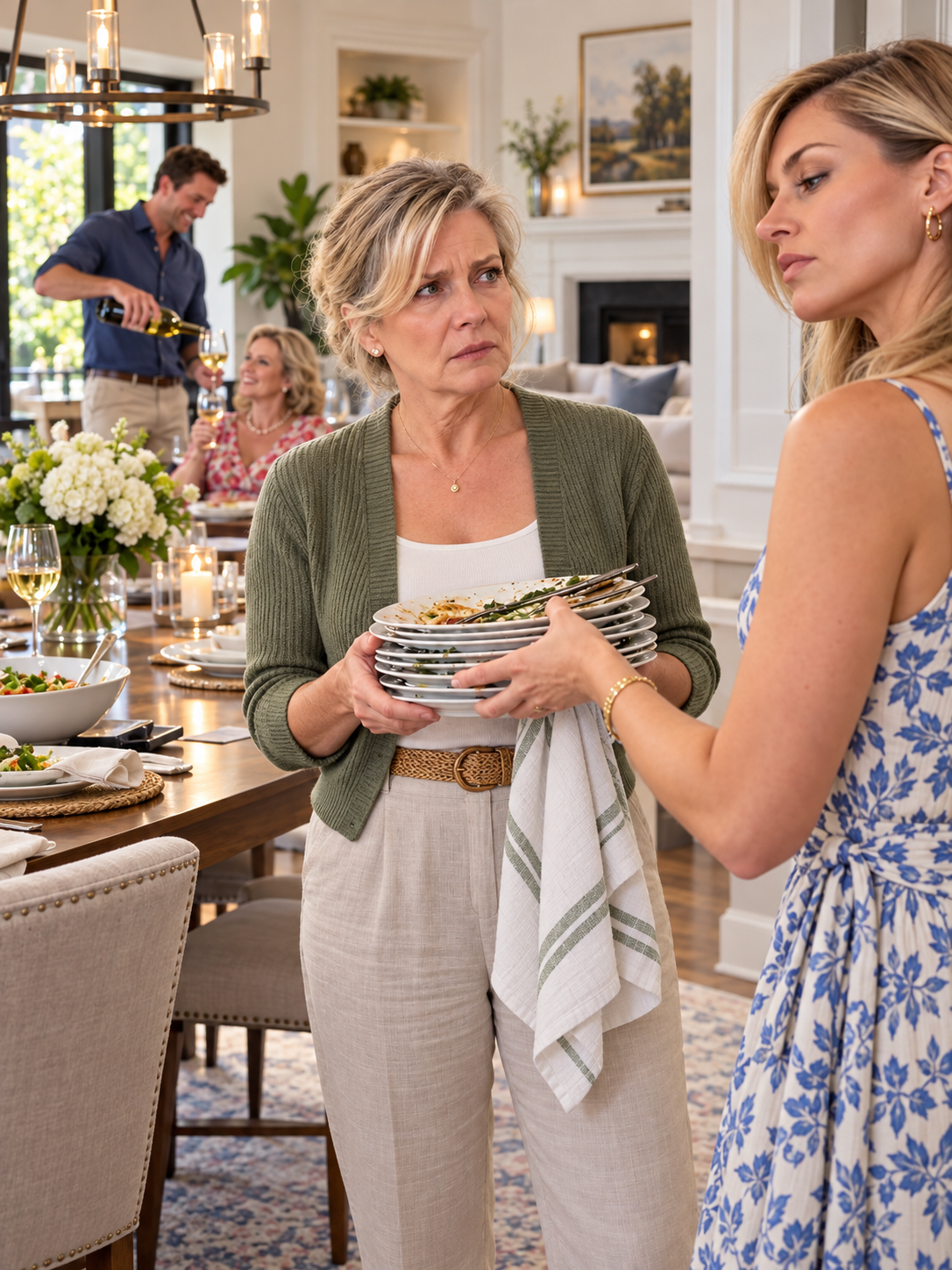
PART 1 TITLE: The Sunday Evening When a Stack of Dirty Dinner Plates Revealed What My Family Had Come to Expect From Me
The plates were still hot when Rachel pushed them into my hands. A streak of gravy slid across the top one, and I tightened my fingers beneath the stack before it could slip. From the living room came the delicate sound of glasses touching and my son David laughing at something I hadn’t heard. Rachel barely looked at me. She was already turning away, explaining that I could take care of the remaining dishes because she needed to spend time with her mother, whose white wine apparently required special attention. I stood in the kitchen, holding the remnants of a dinner I had helped prepare, and realized nobody had considered asking whether I wanted to join them.
My name is Patricia. I had spent most of my adult life believing that a family survived because someone paid attention to the things other people overlooked. Someone remembered birthdays, noticed when the refrigerator was empty, listened when children were frightened, and washed the pans after everyone else had gone to bed. For years, that person had been me. I hadn’t resented it when my husband was alive, and I hadn’t expected gratitude every time I made a meal. What troubled me that evening was the ease with which Rachel assumed I would continue working while everyone else enjoyed being together.
I could see them through the wide doorway between the kitchen and living room. David was standing near the leather sofa, carefully pouring chilled Pinot Grigio into a glass for Brenda, Rachel’s mother. Brenda had arranged herself among the cushions with the relaxed confidence of someone who expected to be comfortable wherever she went. Her silver-blond hair had been freshly styled, and the sleeves of her pale cashmere sweater were folded neatly above her wrists. Rachel approached her with an affectionate smile. My son handed Brenda the wine, and the three of them resumed their conversation as though nothing unusual had happened.
I recognized that sofa because I had helped pay for it. Six months earlier, Rachel had called me from the furniture store sounding both embarrassed and excited. She and David had found something they loved, she explained, but the price was higher than they had anticipated. She hadn’t directly requested money. She simply described the situation, mentioned how disappointed David was, and allowed a silence to develop. I understood what she hoped I would say. I offered to cover the difference, and by the following weekend the sofa occupied the most prominent wall in their living room.
David had thanked me then. I remembered his arms around my shoulders, the familiar smell of his aftershave, and the way he had spoken about being fortunate to have a mother who could always be counted on. I had carried that compliment home like a small gift. Now I was looking at the same furniture while balancing dirty dishes in my arms. My son was seated comfortably beside a woman who had contributed nothing to the afternoon’s work, while I stood beside a sink already crowded with pots. I wondered when being dependable had become indistinguishable from being available for whatever nobody else wanted to do.
I had not always felt this way about Sunday dinners. In the beginning, they were something I looked forward to. David was my only child, and after my husband died, the quiet in my house sometimes seemed to occupy more space than the furniture. Sundays gave the week a shape. I could hear my grandchildren’s footsteps, listen to David talk about his job, and watch the ordinary confusion of a young family unfolding around a crowded table. Those evenings reminded me that although my marriage had ended with a funeral, the life we built together had continued in another generation.
My grandson Leo was seven, curious about almost everything, and inclined to ask difficult questions when adults were least prepared to answer them. Mia, his five-year-old sister, had a stubborn streak that reminded me of her father at the same age. I loved them both fiercely. When Mia first learned to write my name, she gave me a drawing with the letters marching crookedly across the paper. I still kept it on my refrigerator. There was nothing I enjoyed more than hearing either child run toward me shouting that Grandma had arrived. That affection made it easy to ignore other things.
When David married Rachel, I had made a private decision not to interfere in their marriage. I had known too many families in which mothers and daughters-in-law measured every visit as though affection were a competition. I wanted Rachel to feel that she had gained another person willing to support her, not someone determined to challenge her place in David’s life. Whenever she chose a different holiday tradition or preferred her mother’s advice about the children, I reminded myself that these decisions belonged to her and David. I believed kindness and patience would keep our relationship comfortable.
Rachel was capable of being charming. She remembered small details about people when it suited her, had an easy way with strangers, and could make an ordinary dinner table look ready for a magazine photograph. During the first years of her marriage, I thought her occasional sharpness came from being overworked. She had a demanding schedule, two young children, and a husband who wasn’t always observant about household responsibilities. When she asked me to help, I generally understood why. The problem was that each favor quietly altered what she expected from me the next time.
At first, she wanted me to arrive a little early on Sundays so I could keep the children occupied while she finished cooking. I was happy to do it. Then she began leaving vegetables for me to prepare. After that came the table settings, sauces, forgotten ingredients, and side dishes that needed attention. If I reached their house at the usual dinner hour, Rachel would greet me with an anxious expression and explain how much she still had to accomplish. Gradually, I learned to appear by four, sometimes earlier, because arriving as an actual guest had begun to feel inconsiderate.
Brenda, meanwhile, followed an entirely different schedule. She lived farther away, which Rachel often cited as a reason she couldn’t be expected to arrive early. She usually appeared shortly before dinner, occasionally carrying a bottle of wine in a decorative bag. Sometimes she brought nothing but her handbag. Rachel would hurry to greet her, offer a comfortable seat, and ask whether she needed something to drink. If Brenda complained about a long day, everyone seemed to agree she deserved to relax. I would be standing nearby with a dish towel over my shoulder, wondering why exhaustion belonged to one grandmother and responsibility to the other.
There had always been explanations available. Brenda had mentioned trouble with her back. Perhaps that made it difficult for her to stand for extended periods. Her drive was longer than mine. Perhaps she had less energy. But over time I noticed that none of these concerns prevented her from shopping, traveling, or attending social gatherings. She simply was not expected to contribute to the kitchen work at David’s house. I understood this without admitting it to myself. Recognizing unequal treatment would have required deciding whether to confront it, and I was not yet willing to disturb the family peace.
My financial help had developed in much the same way. Years earlier, when David was between jobs, I began giving him five hundred dollars every month to help cover groceries. I remembered how worried he had been then, and how carefully Rachel had stretched their household money while he looked for steady employment. Sending that envelope had been a relief to all of us. I could afford it, and I wanted the children to have everything they needed. When David started working again, he thanked me for seeing them through a difficult period. Neither of us discussed when the payments would end.
Eventually, the emergency passed, but the envelopes continued. On the first Monday of each month, I placed five hundred dollars in a white envelope and left it on the little table near my front hallway. David knew where to find it. He and Rachel both worked full-time now, and their financial circumstances were no longer what they had been during his unemployment. Still, I continued contributing because stopping seemed like it might create an uncomfortable conversation. A gift that had originally represented temporary assistance slowly became part of their normal household routine.
The money wasn’t limited to groceries. I helped with school shoes when Leo outgrew his unexpectedly, contributed to summer camp deposits, paid for birthday celebrations, and occasionally covered restaurant bills when David or Rachel claimed they had forgotten a wallet. None of these expenses threatened my immediate security. That made them easier to overlook. But looking back, I could see how rarely anyone asked whether I was comfortable paying. Rachel had begun to mention expenses almost conversationally, with the confidence of a person who expected someone else to volunteer the solution.
That particular Sunday had begun with a message from Rachel before breakfast. She said she was overwhelmed and wondered whether I could bring my spinach casserole. It was one of David’s favorites, and I knew the children would eat it without complaint, so I agreed. By midafternoon, I had washed the spinach, prepared the filling, packed the dish for transport, and driven across town. I arrived at three-thirty, carrying the casserole carefully against my hip while balancing my handbag on one shoulder. Rachel opened the door with her phone in her hand and immediately asked whether I could check the gravy.
The kitchen smelled of roasting meat, warm butter, and onions that had been cooking a little too long. Two saucepans were waiting in the sink. Mia had misplaced a shoe belonging to one of her dolls and was close to tears, so I helped her search beneath the dining room chairs. Leo wanted to show me something he had built before dinner. I promised to look as soon as I finished. Over the next two hours, I folded napkins, arranged cutlery, stirred the gravy, moved vegetables into serving dishes, and cleaned the mixing bowls Rachel had left near the stove.
Brenda arrived around five-thirty, just as I was lifting a heavy roasting pan from the oven. I heard Rachel’s delighted greeting in the hallway, followed by the rustle of coats and the exchange of kisses. Rachel immediately encouraged her mother to sit down because she looked tired from the drive. I was standing a few feet away with the roasting pan, the heat pressing through my oven mitts. Neither woman acknowledged what I was carrying. When I set the pan down, Rachel called into the kitchen to ask whether everything would be ready soon. I told her it would.
At dinner, I sat beside Mia, who wanted help cutting her food into small pieces. David sat across from us, Brenda occupied the comfortable chair at the end of the table, and Rachel moved easily between conversations. Brenda talked about an upcoming cruise and described the restaurants she hoped to visit. Rachel complained about a colleague who had apparently caused problems at work. David responded occasionally while making sure Leo ate something besides bread. I listened, answered when someone spoke to me, and passed dishes around the table as needed. There was nothing openly cruel about the evening, which made the growing discomfort difficult to explain.
When I mentioned an exhibition at the local art museum, Rachel turned the subject toward a gallery she and Brenda had visited in Boston. Brenda took over the conversation, describing paintings and the difficulty of finding parking in the city. My unfinished thought disappeared beneath their discussion. I didn’t insist on finishing it. I had developed the habit of allowing my words to fall away whenever someone else wanted the attention. Afterward, I found myself wondering whether anybody at that table could have repeated what I had tried to tell them.
Mia rested her head against my arm while we waited for dessert. I stroked her hair and watched David reach for another serving. He looked tired from his week, and I felt the familiar impulse to protect him from anything that might make his evening less pleasant. I understood that impulse well. For years, I had done whatever was necessary to keep my family comfortable after his father’s death. I had mistaken his lack of objection for approval of the arrangement. It never occurred to me that he might have stopped seeing the amount of work I was doing because I did it so consistently.
After dessert, Brenda rose from the table with her wineglass and moved toward the living room. David followed, carrying his own glass. Rachel began gathering plates, and I watched her with a brief, foolish sense of relief. Perhaps she had noticed how long I had been working. Perhaps she intended to clear the table herself. She stacked the dishes carefully, however, and walked straight toward me. Her expression was pleasant but preoccupied. Without waiting for my agreement, she transferred the weight into my arms and explained that she needed to attend to her mother and the drinks.
The plates were slick beneath my fingers. I could feel the uneven edges pressing against my palms, and a small smear of sauce landed near my wrist. Rachel was already halfway across the room. Her footsteps sounded sharply against the hardwood before fading beneath the voices from the living room. I looked toward the sink. The water had turned cloudy from the earlier washing, and a piece of dinner roll was floating near a serving spoon. I had been cleaning that kitchen since midafternoon, yet the evening’s final responsibility had been delivered to me as naturally as another place setting.
Through the doorway, I watched David offer Brenda more wine. She accepted with a smile, and Rachel settled beside her mother. Nobody glanced in my direction. Nobody suggested that the dishes could wait until later, or that we might all finish together. I remembered the expensive sofa, the monthly envelopes, the school expenses, and the Sundays I had spent standing in this exact kitchen. Each memory was ordinary on its own. Together they described an arrangement I had helped create, one in which my contribution was so dependable that it no longer required acknowledgment.
I thought of my husband then. He had never been especially skilled in the kitchen, and he could leave a remarkable mess behind when making something as simple as breakfast. But on evenings when I was exhausted, he had usually noticed. He might take the dishes from me awkwardly or insist that we leave them until morning. Sometimes we worked side by side, talking about David or discussing what needed repairing around the house. Our marriage had not been perfect. Still, I knew the difference between choosing to care for someone and discovering that your efforts had become invisible.
For a moment, I considered walking into the living room and explaining everything. I imagined telling Rachel that I was tired, reminding David about the years of help, and asking Brenda whether she ever thought about who prepared the meals she enjoyed. The imagined conversation exhausted me before it began. Rachel would probably insist she hadn’t meant anything disrespectful. David might say that everyone was simply tired. Brenda would look uncomfortable and perhaps pretend she hadn’t heard. By the end, I could easily imagine myself apologizing for making an ordinary Sunday dinner unpleasant.
Instead, I lowered the plates onto the countertop. I arranged them carefully enough that nothing slipped or broke. Then I stood still for a moment, looking at the dishes while the conversation continued in the next room. It was not anger that finally moved me. I felt disappointed, certainly, but beneath the disappointment was something quieter and more decisive. I did not have to finish the dishes merely because someone had placed them in my hands. Nothing terrible would happen if I left the kitchen exactly as it was.
I found a paper towel and wiped the grease from my fingers. My hands smelled of dish soap, roasted onions, and the spinach casserole I had carried over that afternoon. I folded the used towel and dropped it into the trash. Then I walked to the hallway, where my wool coat hung beside Rachel’s expensive winter parka. I put it on slowly, checking that my car keys were still inside my handbag. I could hear Mia laughing somewhere beyond the doorway. For a moment, the sound caught at me. Leaving the children was harder than leaving the adults.
I remained in the hallway long enough to decide whether I should announce my departure. The polite thing would have been to call out that I was heading home. I had announced myself and explained my movements all my life. That evening, however, I wanted to see what would happen if I simply stopped making myself available. I was not hiding. The front door stood only a few feet from the living room, and anyone who happened to look could have seen me putting on my coat. Nobody looked. Their conversation continued without interruption.
Outside, the evening air was cold enough to sting my cheeks. I pulled the door shut gently and heard the latch settle into place. Brenda had parked near the house, so I had left my car farther along the street. I walked toward it at an unhurried pace, listening to the faint sound of traffic in the distance. The neighborhood looked exactly as it always did on a Sunday evening. Porch lights glowed behind trimmed hedges. A few fallen leaves scraped across the pavement. Nothing in the street suggested that anything important had changed.
But something had changed. As I reached my car, I realized I was not worried about the dishes. Rachel knew how to wash them. David did too. Their dishwasher worked, their cupboards were stocked, and no one in that house required my assistance to complete an ordinary evening’s cleanup. The thought was almost embarrassingly simple. I had spent so long preventing other people from experiencing small inconveniences that I had forgotten those inconveniences belonged to them. I opened my car door, settled behind the wheel, and started the engine.
My phone began vibrating after I had driven several blocks. David’s name appeared first, followed by another call I allowed to pass unanswered. I knew they had finally discovered the empty kitchen and realized I was gone. I kept driving. At a red light, I glanced at the glowing screen and felt something unfamiliar: I was interested in what the evening would reveal, but I no longer felt responsible for repairing it. Whatever conversation was taking place in that living room could happen without me. For once, the dirty dishes were not coming home in my thoughts.
I pulled into my driveway later that evening and sat for a moment before turning off the car. My little house was dark except for the porch light I had left burning. Tomorrow was the first Monday of the month, which meant David would ordinarily stop by to collect the white envelope waiting on my hallway table. For years, I had prepared it almost without thinking. I pictured those five hundred dollars, then remembered the plates Rachel had placed in my hands. I went inside, opened the drawer where I kept the envelope, and made a decision I had postponed for far too long. Tomorrow, there would be no money waiting.
END PART 1
PART 2 TITLE: My Son Came Looking for the Monthly Envelope, but the Conversation That Followed Exposed a Much Larger Family Problem
By the time I reached my bedroom that Sunday night, there were five missed calls on my phone. Two were from David and three from Rachel. Neither had left a message. I placed the phone facedown on the nightstand and changed into comfortable clothes, feeling strangely alert despite the late hour. Ordinarily, I would still have been helping Rachel tidy her kitchen. I might have been packing leftover casserole into containers or searching for a missing lid while the others talked. Instead, I was standing in my own quiet bedroom, free to do precisely what I wished.
I went downstairs and made chamomile tea. The kettle filled the kitchen with a gentle hiss, and I lit the lavender candle I kept beside the window. I had bought it months earlier but rarely used it, mostly because I was so tired by the time I returned from visiting David’s family. The fragrance settled into the room as I carried my cup to the small table near the window. There was no shouting, no pile of dishes waiting for me, and nobody asking what time I could arrive the following afternoon. For the first time in months, Sunday evening belonged entirely to me.
That should have felt normal. Instead, I had the uneasy sensation of having broken a rule nobody had ever stated aloud. I kept imagining Rachel’s expression when she discovered the dirty dishes, then David’s reaction when he realized I had left without saying goodbye. Part of me wanted to send a careful message explaining that I was tired and needed to go home. I could have written something friendly, perhaps apologizing for the confusion. My fingers hovered over the phone for several seconds before I put it aside. There had been no confusion about the work Rachel assigned me.
I understood that walking out would not solve everything. David would still be my son, Rachel would still be his wife, and I would still love their children. We would see one another at birthdays, holidays, and ordinary family gatherings. The question was whether I could change the arrangement without destroying the relationships that mattered to me. I didn’t know. I only knew that if I spent the next morning pretending nothing had happened, I would eventually find myself standing beside that same sink again, waiting for permission to sit down.
Before going to bed, I opened the drawer where I kept my household papers. My monthly bills were organized in plain folders, a habit I had developed during my marriage. David’s five hundred dollars was usually prepared on Sunday evening and placed in a white envelope. The money had originally come from a small portion of my retirement income that I set aside for emergencies. When his unemployment ended, I never redirected it toward my own needs. I simply continued giving it away because the routine was familiar and because David had never suggested that he no longer required it.
I took out a notepad and began reviewing what I had spent helping his household over the previous several months. The grocery contribution was easy to calculate. There were also receipts for children’s clothing, summer activities, groceries I bought when Rachel said she hadn’t had time to shop, and small expenses attached to family celebrations. I wasn’t preparing an accusation. I didn’t need to produce an exact total to prove that I had been generous. But seeing the expenses gathered together helped me understand how much assistance I had provided without ever discussing what I could reasonably continue.
Some of those purchases were things I genuinely enjoyed giving. I liked choosing books for Leo and bringing Mia the colored pencils she preferred. I wanted to keep doing those things. What troubled me were the expenses that seemed to arrive as instructions rather than requests. I remembered a restaurant dinner when Rachel ordered freely and then looked at me with a small smile as the bill appeared. Nobody asked whether I wanted to pay. David had simply thanked me afterward, and the matter had been forgotten. I wondered how many times I had accepted similar assumptions because challenging them would have been awkward.
The difference between generosity and obligation had become difficult to see. I thought about the first months after David lost his job, when he had looked genuinely frightened about supporting his family. Those were memories I could revisit without regret. He had been working hard to find employment, and I had wanted to help him through a difficult period. But the circumstances were different now. He and Rachel each had steady incomes. They could make decisions about their own spending, adjust their budgets, and accept the consequences. My continued payment had protected them from making changes they might otherwise have made.
I put the five hundred dollars back where I kept my savings rather than into the usual envelope. Then I turned out the lights and went upstairs. Sleep did not come immediately. I imagined David arriving in the morning and finding the hallway table empty. His first response would probably be confusion. Perhaps he would assume I had forgotten the date. I knew I would have to explain myself plainly, without turning the discussion into a list of grievances. I did not want him to feel that I was withdrawing my affection. I wanted him to understand that affection was not the same as a permanent financial arrangement.
Just before nine the following morning, I heard a car pull into the driveway. I was finishing breakfast when I glanced through the front window and saw David coming up the path. He walked quickly, his shoulders slightly hunched beneath his jacket. I knew that expression. He wore it when he was irritated but wanted to appear reasonable. I opened the door before he could knock, and he stopped with one hand raised. For a second, we simply looked at each other. His gaze moved past me toward the hallway, then returned to my face.
He asked what had happened the previous evening. I told him I had decided to go home. He seemed dissatisfied with that explanation and said Rachel had been upset when they discovered I had disappeared. I asked whether something was wrong with the children. He assured me they were fine. Then he hesitated and explained that Rachel had been left to clean the kitchen herself. There it was, presented as the central problem. Not that I had gone home unexpectedly, or that I might have been feeling unwell, but that someone else had needed to wash the dinner dishes.
I led him into the kitchen and began preparing coffee. David followed, standing near the counter with his hands in his pockets. He said Rachel had interpreted my departure as an insult. I told him I hadn’t intended to create a scene. In fact, I had left quietly because I was not interested in arguing. He wanted to know why I couldn’t have said something first. I asked him what he believed would have happened if I had refused to wash the plates while everyone was sitting in the living room. He didn’t answer immediately.
That hesitation told me he understood more than he wanted to admit. I handed him his travel mug, and he accepted it without taking a sip. He had an early meeting, he reminded me, and couldn’t stay long. I nodded. While he spoke, his eyes drifted toward the narrow table beside the hallway. It was the same table where I had left his envelope month after month. He looked back at me, said something about needing to get going, then glanced toward the table again. His attention had divided between yesterday’s argument and the money he expected to collect.
Finally, he asked whether I knew what day it was. I told him I did. He shifted his weight and looked toward the hallway again, perhaps hoping I would remember an errand I had overlooked. When I made no move to retrieve anything, he asked whether I had prepared the usual envelope. I told him there wasn’t one. He stared at me for a moment, then gave a short, uncertain laugh. He seemed to think I was joking or perhaps trying to prove a point about Sunday dinner. I remained where I was, watching him understand that I meant it.
He asked whether I was having financial difficulties. The question might have sounded considerate if it hadn’t come after several attempts to locate the money. I told him I was reviewing my spending and had decided to discontinue the monthly grocery contribution. David set his mug on the counter. He wanted to know whether this decision had been made because Rachel had asked me to wash dishes. I told him the two events had made me consider the same problem, but that the grocery money deserved to be discussed on its own terms.
I reminded him why the payments had started. He remembered losing his job and the uncertainty that had followed. He even admitted that my help had made a difficult time easier for the whole family. I asked how long he had been steadily employed now. He looked uncomfortable and acknowledged that it had been years. Rachel was also working, I pointed out, so their household had two incomes. David rubbed his forehead and explained that although they were earning money, they had built their regular expenses around receiving the additional five hundred dollars from me.
I listened to him carefully because that was the first time he had openly described my gift as part of their financial plan. He told me that losing it without warning would force them to make adjustments. Certain purchases might need to wait. Their grocery budget would change. They might need to reconsider some of their discretionary spending. I didn’t doubt that the changes would be inconvenient, but inconvenience did not make the arrangement permanent. I asked whether he believed I should continue contributing simply because they had grown accustomed to including my money in their calculations.
He looked genuinely surprised. He said he had assumed I was happy to help. I told him I had been happy to help when assistance was necessary and appreciated. I had also enjoyed providing extra things for Leo and Mia. But I was retired, and there were projects and experiences I had postponed because I always seemed to be paying toward something his household wanted. David looked down at his mug. I hadn’t mentioned the sofa, the holiday expenses, or the constant small purchases yet. I wanted him to hear the larger point without feeling he was being presented with an invoice.
He asked whether I intended to stop helping altogether. I shook my head. If there were a genuine emergency, I would consider it as I always had. I would still buy the children gifts and spend time with them because I loved them. But I would decide when and how to help, rather than allowing every previous favor to become an obligation. David seemed to struggle with that distinction. To him, the change felt sudden, even though the circumstances that had originally justified my assistance had disappeared long ago. I could see him searching for a way to return the conversation to familiar ground.
Then he said that he and Rachel had already included the monthly payment in their budget. His tone wasn’t threatening. He sounded as though he were explaining a practical obstacle that I hadn’t considered. Yet the statement revealed precisely what concerned me. My five hundred dollars no longer arrived as help from a mother to her adult son. It arrived as expected income. David was asking me to treat their financial dependence on my generosity as a reason I could not withdraw it. I realized that unless I was firm now, there would never be a convenient time to stop.
I told him that he and Rachel would need to make a different plan. David stared at me, surprised by how quietly I spoke. There was no anger in my voice, and I wasn’t trying to embarrass him. I understood that budgets could be adjusted only by making choices, some of them unpleasant. His household might have to spend less on entertainment or postpone an expensive purchase. Mine had its own limits and priorities. I reminded him that I had never promised to provide that money indefinitely, and the fact that I had given it for years did not turn it into a debt I owed.
For several seconds, David said nothing. Then he asked whether I had discussed the decision with Rachel. I told him that my retirement money was not something I needed his wife’s permission to manage. He flushed and quickly said that wasn’t what he meant. He simply knew Rachel would be upset. I believed him. I also believed that he had become accustomed to measuring his mother’s decisions by the degree of inconvenience they might cause his wife. I didn’t say that aloud. There would be time to discuss it if he was willing to listen.
He finished his coffee quickly and checked the time. At the door, he turned back and asked whether I might reconsider after things settled down. I told him he was welcome to talk with me again, but that the monthly payments were finished. I did not add conditions or suggest a trial period. The uncertainty seemed to bother him almost as much as the loss of money. He gave me a brief hug, shorter than usual, and left. I watched him walk to his car, feeling sad that our first serious disagreement in years had centered on something I had once offered so gladly.
After his car disappeared, I carried the empty mug to the sink and washed it. The movement reminded me of the previous evening, but in my own kitchen it felt entirely different. I was cleaning up after a visitor I loved, in a house where I chose what work needed doing. The distinction seemed small, yet it mattered. I dried the mug and placed it in the cupboard. Then I sat at the kitchen table and wrote out a revised household budget. I included money for home improvements I had delayed, a little more for savings, and a separate amount for gifts I genuinely wanted to give.
The rest of the day passed quietly. I watered the plants, did some reading, and answered a call from an old acquaintance I had been meaning to speak with. In the afternoon, I noticed a message from David saying he had told Rachel about the money. He didn’t describe her reaction. I could imagine it, though I resisted the temptation to construct an argument in my head. I replied that I loved them and hoped they had a good evening. He sent no further message. For once, I allowed the conversation to end without trying to make everyone feel better.
That night, I considered calling Rachel directly. She might appreciate hearing that I wasn’t acting out of personal dislike. On the other hand, I had already explained my decision to David, and there was nothing to negotiate. If Rachel wanted to discuss it respectfully, she had my number. I didn’t need to seek out a confrontation merely to prove that I wasn’t afraid of one. I put my phone aside and went to bed. The following morning, I had plans to visit the garden center and had set out my coat and handbag before breakfast.
At nine-fifteen, a car pulled into my driveway. I glanced through the window, expecting a delivery, and saw Rachel stepping out with Leo and Mia. She was dressed for an outing, with a quilted vest over her workout clothes, and she moved with the brisk certainty of someone following a schedule. The children hurried toward the porch. Rachel opened the gate and called for them to stay close. There had been no message asking whether I was free, no telephone call, and no warning that she intended to visit. I looked at my coat, then at the two small faces approaching the door, and understood that Rachel had chosen her next way of testing me.
END PART 2
PART 3 TITLE: When Rachel Tried to Take Control of My Time Again, I Discovered She Had Also Been Entering My Home Without Permission
Rachel didn’t wait for an invitation before stepping into the hallway. Leo came in first, carrying a small backpack, and Mia followed with a stuffed rabbit tucked beneath her arm. Both children looked pleased to see me. Rachel offered a bright morning greeting, the kind that made an unexpected visit appear perfectly ordinary, then announced that she needed me to keep the children until three that afternoon. She said it while removing Mia’s jacket, already behaving as though I had agreed. I watched her place the jacket over the nearest chair and realized that the decision had been made before she arrived.
I told her I wasn’t available. Rachel looked up sharply, one hand still holding the zipper of Mia’s coat. She asked whether I was expecting company. I said I had plans outside the house. Her expression changed from surprise to mild irritation, though she maintained the friendly tone she used when attempting to persuade someone. She explained that David had a demanding day at work and that she had arranged to meet Brenda for brunch. The children needed somewhere to stay, and my house was the obvious solution. I asked why she hadn’t checked with me first.
Rachel seemed genuinely confused by the question. She reminded me that I was retired and usually home during the week. I told her that retirement meant I no longer had a job, not that my days were permanently reserved for her convenience. She gave a short laugh and asked what plans could possibly be so important that I couldn’t spend a few hours with my grandchildren. Her wording bothered me. She was treating my affection for Leo and Mia as proof that I had no right to refuse, and any activity of my own would have to justify itself against her wishes.
I looked toward the children. Leo had already taken off his shoes, and Mia was arranging her rabbit on the chair. Neither knew that their mother had brought them into an argument. I crouched beside Mia, straightened her sleeve, and told her I was sorry we couldn’t spend the afternoon together. I promised we would arrange another visit. Leo asked whether I was going somewhere interesting. I told him I wanted to look at some plants. He immediately asked whether I might bring home another fern. I laughed and said that was entirely possible.
Rachel crossed her arms. She pointed out that she was already running late and that changing her plans would be inconvenient. I told her I understood, but that she would have to take the children with her or make another arrangement. Her pleasant expression disappeared. She asked whether I was doing this because of the disagreement about the grocery money. I said my decision had nothing to do with punishing anyone. I simply had not agreed to babysit. She looked at my coat hanging beside the door and seemed offended that an ordinary outing could take priority over her carefully arranged morning.
For several seconds, neither of us spoke. Then Rachel told the children to put their jackets back on. Mia looked disappointed, which hurt more than Rachel’s irritation. I helped the little girl into her coat and kissed the top of her head. I told Leo I would call about another visit when we could plan something together. Rachel didn’t respond. She gathered their bags and moved toward the door, keeping her eyes away from mine. As they stepped onto the porch, I asked her to contact me in advance the next time she needed childcare. She gave a curt acknowledgment without turning around.
I locked the house and walked to my car. Rachel was still fastening Mia into her seat when I drove away. I could see her watching me through the windshield, perhaps expecting me to reconsider before reaching the street. I didn’t. The garden center was only a short drive away, and I arrived with an odd combination of relief and sadness. I had never refused to care for my grandchildren merely because I had something else planned. Yet I knew that allowing Rachel to abandon them at my house would teach her that my preferences could always be overridden if she arrived without warning.
The garden center smelled of damp soil and freshly cut wood. Rows of green plants stood beneath the glass roof, their leaves glossy in the morning light. I moved slowly through the aisles, looking at pots and reading the labels attached to different ferns. For months, I had wanted to brighten the small sitting area near my back window, but I had never made time to choose anything. There was always another family errand, another afternoon of babysitting, another meal to prepare. I found three healthy ferns and a blue ceramic planter with a slightly uneven glaze that appealed to me.
An employee helped me carry the planter to the register. As I paid, I found myself smiling at the simplicity of the purchase. Nobody had asked me to buy those plants. They weren’t intended for a school project, a birthday gift, or a room in David’s house. I wanted them because I liked the color and because I had an empty corner that would look better with something growing in it. I spent the afternoon arranging them near the window, adjusting their positions until the light fell across the leaves. It was a small pleasure, but it remained mine.
Rachel didn’t call that day. David sent a brief message that evening asking whether everything was all right. I told him I was fine and had enjoyed my trip to the garden center. He replied that Rachel had been upset about the babysitting situation. I explained that she had arrived without checking whether I was available. He said he understood both sides and hoped we could avoid further arguments. I studied that message for a while. David had begun using the phrase both sides whenever his wife’s expectations conflicted with my decisions. It allowed him to remain comfortable without examining what had actually happened.
I didn’t challenge him immediately. I had spent enough time that week explaining ordinary boundaries, and I wanted to give him an opportunity to consider them. Instead, I replied that I would happily arrange visits with Leo and Mia when we agreed on the details beforehand. He sent back a short acknowledgment. I put my phone down and returned to the book I had left beside my chair. I was beginning to appreciate how much quieter life became when I stopped treating every expression of disappointment as a problem I needed to solve.
Later that week, I decided to make oatmeal cookies. It was a cool afternoon, and I had been thinking about the recipe my husband used to request whenever the weather turned cold. I took the butter from the refrigerator, measured the oats, and set the flour on the counter. Then I opened the lower cabinet where I kept my heavy stand mixer. The space was empty. For a moment, I simply stared into it. The mixer had been there the last time I used it, and I couldn’t remember moving it. I checked the surrounding cabinets, although I knew it wouldn’t fit on those shelves.
I searched the pantry and the utility cupboard. Nothing. The mixer’s bowl was gone as well, along with the attachment I normally left inside it. I stood in the kitchen trying to reconstruct the previous few days. I hadn’t lent it to a neighbor, and I certainly hadn’t taken it anywhere. Then I remembered that David still had a spare key to my house. I had given it to him years earlier, shortly after my husband died, because I thought someone should be able to get inside if I became ill or needed help.
The key was intended for emergencies. David had occasionally used it when I was expecting him and couldn’t reach the door quickly, but I had never considered it an invitation for other people to enter freely. Rachel knew he had it. She had mentioned borrowing things from my house before, although I usually brought those items over myself. Standing beside the empty cabinet, I remembered that Leo’s school had an upcoming bake sale. Rachel had spoken about it at dinner, mentioning that she needed to prepare several batches of baked goods. My missing mixer would certainly make that task easier.
I couldn’t prove where the appliance had gone simply by remembering the bake sale, but the explanation seemed likely. I walked into the hallway and examined the door. A faint mark on the floor near the entrance looked as though something heavy had been moved across it. I couldn’t establish when the scuff had appeared, and it wasn’t evidence of anything by itself. Still, it strengthened my uneasiness. Someone with access to my key could enter the house while I was away, move through my rooms, and take whatever seemed useful without asking. I had been so accustomed to sharing that I had stopped considering whether I was comfortable with the arrangement.
My first impulse was to telephone Rachel and demand the mixer back. I imagined the conversation before reaching for the phone. She would probably insist that she had only borrowed it and meant to return it promptly. She might remind me that I rarely used it or that the bake sale was important to the children. If I questioned why she hadn’t asked permission, she could accuse me of making a family favor into an unnecessary argument. I recognized the pattern because I had participated in it for years. The discussion would center on whether I was being reasonable rather than on whether someone had respected my home.
I decided not to begin there. The mixer could be returned. The more serious problem was the key. I called a locksmith and explained that I wanted the exterior locks replaced. The woman who answered asked whether I had lost my keys. I told her no, but that I needed to control who could enter the house. She scheduled an appointment for later that day. After hanging up, I stood near the window and considered whether I should warn David. Then I realized I did not need to request his permission to change a lock on a house that belonged to me.
Tom, the locksmith, arrived that afternoon with a canvas tool bag and a practical manner. He examined the front and rear locks, explained the replacement options, and began working. I watched from the hallway as he removed the old hardware. The exposed opening in the door seemed strangely revealing. That small space had allowed people into my house for years, and I had rarely thought about the trust represented by an extra key. Tom fitted the new lock, tested the mechanism several times, and handed me the keys. The deadbolt moved smoothly, with a reassuring weight that the old one had lacked.
I asked him to replace the rear lock as well. When he finished, I paid the bill and thanked him. I kept one key on my usual ring, placed another in a secure outdoor lockbox, and put a third in my jewelry case. David received none. That decision troubled me briefly, not because I believed it was wrong, but because I knew he might interpret it as a personal rejection. I reminded myself that access to a building and access to a relationship were different things. He could visit whenever we made arrangements. If there were an emergency, there was still a way to gain entry.
The house felt different after Tom left. Nothing visible had changed except the small pieces of metal in the doors, yet I was more comfortable moving through the rooms. I had always believed my home was private. Now I had taken a practical step to make certain it remained that way. I returned to the kitchen and looked once more at the empty mixer cabinet. The appliance had been useful for many years, and I wanted it returned. But I was less concerned about the cookies now than about the assumption that had allowed someone to borrow it without a conversation.
I made the oatmeal cookies by hand. Mixing the dough required more effort than usual, and my wrist began to ache before I had finished folding in the oats. My husband would have laughed at me for insisting on completing the batch rather than choosing something simpler. I could almost hear him asking whether the cookies were worth all that trouble. They were, although not for the reason he would have expected. I wanted to finish something in my kitchen without turning to David’s household for help. The first tray came out slightly uneven, but the smell of cinnamon filled the room.
Over the next two days, I went about my usual routine. I read, watered the new plants, and made plans for the weekend. Rachel didn’t contact me about the mixer, and David said nothing about the locks. I considered informing him before he discovered the change, but I decided the subject deserved a conversation rather than a hurried text. I also wanted to know whether Rachel would admit taking the appliance. If she had entered my home without permission, I needed her to understand that it was unacceptable, regardless of how ordinary the borrowed item seemed.
Late one morning, I was sitting in the living room with a book when I heard a metallic scraping at the front door. At first, I thought someone might be having trouble with the handle. Then I recognized the sound of a key turning against a lock it no longer matched. The person outside tried again. The metal rattled, stopped, and resumed with greater force. I remained in my chair for several seconds, listening. Whoever had arrived had not knocked or rung the bell. They had gone directly to the door with the expectation of letting themselves inside.
Eventually, the key stopped moving. A moment later, someone began pounding on the door. I set my book on the table and walked into the hallway. Through the narrow window beside the entrance, I could see Rachel standing on the porch. She had a large basket of dirty blankets resting against her hip, and she looked irritated. I could also see the old key in her hand. She had evidently expected to enter the house without asking, just as she had done before. The basket made her purpose obvious even before she spoke.
I rested my hand on the new lock and watched her knock again. My missing mixer had shown me that Rachel considered the emergency key available for her own convenience. Now she had arrived carrying laundry, intending to use my washing machine without even checking whether I was home. I thought of the plates, the monthly grocery money, and the babysitting request she had presented as a settled arrangement. Each incident had revealed another way my family’s needs were allowed to occupy my time, money, and space without my agreement. I unlocked the door, prepared at last to address the problem directly.
END PART 3
PART 4 TITLE: After I Refused to Let Rachel Use My House as Her Own, David Finally Had to Hear What His Silence Had Cost Us
Rachel was still holding the laundry basket when I opened the front door. Her face showed immediate relief, followed by irritation. She informed me that the lock must be defective because her key no longer worked. I told her it had been replaced. For a moment, she seemed unable to understand what I meant. She looked at the key in her hand, then at the new hardware, as though one of us had made an obvious mistake. I stood in the doorway without stepping aside. Rachel adjusted the basket against her hip and demanded to know why I had changed the locks without telling David.
I explained that the house belonged to me and that I had decided to limit access. Rachel’s eyes widened. She reminded me that David was my son and had always possessed a spare key. I agreed. Then I asked whether he had given it to her or whether she had taken it without discussing the matter with him. She avoided answering directly. Instead, she said families were supposed to help one another and that it was unreasonable to make ordinary visits difficult. I asked whether she considered unlocking someone’s house while that person was away an ordinary visit.
Rachel shifted the laundry basket again. Its weight was obviously becoming uncomfortable, but she refused to put it down. She said she had needed my stand mixer for the school bake sale and hadn’t wanted to disturb me with a telephone call. The admission came so casually that I nearly missed its importance. She had entered my home, taken an expensive appliance, and expected me to regard the entire matter as a harmless convenience. I asked why she hadn’t simply waited until she could speak with me. She replied that I hadn’t been answering her messages promptly and that the bake sale had a deadline.
I reminded her that a delayed answer wasn’t permission to use someone else’s key. Her cheeks flushed, and she glanced toward the street as though concerned a neighbor might overhear. She insisted that she had always intended to return the mixer. I told her I was glad to hear it and asked her to bring it back when we arranged a suitable time. Rachel seemed surprised that I wasn’t inviting her inside to continue the discussion. She looked over my shoulder toward the hallway, then changed the subject. Since she was already there, she wanted to know whether she could wash the blankets in my larger washing machine.
I looked at the overflowing basket. Several towels had been pushed between thick blankets, and the top one was dragging close to the porch floor. Rachel explained that her machine was smaller and that she had several other errands to complete. She had apparently planned to leave the laundry running while she went out. I asked whether she had intended to enter my house, start the wash, and leave without informing me. She frowned and said she didn’t understand why I was making everything sound so serious. It was only laundry, she insisted, and I had never objected before.
I told her she couldn’t use the machine that day. The refusal came without anger, and that seemed to unsettle her more than an argument would have. Rachel asked me to repeat myself. I said that I wasn’t available to provide laundry services and that she would need another solution. Her face tightened. She accused me of becoming difficult since the Sunday dinner disagreement. I told her we were discussing my home, not the dishes at her house. She stared at me for several seconds, then asked whether I had any idea how much trouble I was causing David.
That question almost drew me into another familiar conversation. Whenever Rachel found herself inconvenienced, David somehow became the person I was supposed to protect. I had spent years trying to spare my son ordinary difficulties. Now his wife’s disappointment was being presented as another problem for me to solve. I told Rachel that David was welcome to discuss any concerns with me himself. I was not going to debate the use of my household appliances on the doorstep. She opened her mouth as though preparing another objection, then closed it and tightened her grip on the basket.
Before she left, Rachel told me that families shouldn’t have to ask permission for every little thing. I replied that being related did not mean people could ignore one another’s privacy. She shook her head and walked toward her car, carrying the blankets with visible effort. I watched until she had placed the basket in the trunk. Part of me wanted to call after her and offer to help carry it. The impulse was so automatic that I almost moved forward. Instead, I stayed where I was and allowed her to complete the task herself. Then I closed the door and returned to my living room.
An hour later, David called. His voice was controlled, but I could hear the strain beneath it. He said Rachel had told him about the locks and that we needed to discuss what was happening. I agreed. I wasn’t interested in avoiding him, and I knew he had questions that deserved answers. We arranged for him to come over that evening after work. When the call ended, I sat for a while thinking about the conversation ahead. David had always been a kindhearted man in many ways, but he had become skilled at keeping himself outside disagreements by expecting someone else to compromise.
I spent the afternoon preparing my thoughts rather than rehearsing an angry speech. I didn’t want to humiliate my son or produce a detailed record of every favor I had done for his household. That would turn the discussion into an argument about who remembered each incident correctly. I needed him to understand the pattern. The plates had been one example. The money, the unannounced childcare, and the unauthorized use of my house were others. Together they revealed something he had stopped noticing: his mother’s resources were being treated as though they belonged to everyone except her.
David arrived shortly after dinner. He looked tired, with the strained expression of someone who had spent the day thinking about an uncomfortable conversation. I let him in, took his coat, and offered coffee. He accepted, although he seemed too distracted to enjoy it. We sat in the living room, and for a moment neither of us spoke. He leaned forward, resting his elbows on his knees, and rubbed the back of his neck. Finally, he said Rachel was furious and believed I was deliberately excluding her from the family. I asked whether changing the locks on my own house could reasonably be described as excluding someone.
He explained that Rachel had been embarrassed when her key failed. She felt I was punishing her for borrowing the mixer and that refusing to let her wash the blankets had been unnecessarily harsh. I listened without interrupting. When he finished, I asked whether he knew she had entered my house without speaking to me first. David admitted that he knew about the mixer. He said Rachel had needed it for the school bake sale and hadn’t thought borrowing it would upset me. I asked whether he would be comfortable with another person entering his house and taking things without asking.
David looked down at his hands. After a moment, he acknowledged that Rachel should have checked with me. I asked why the problem had been presented to him as my decision to change the locks rather than her decision to enter my house. He didn’t answer immediately. He said she had meant no harm. I told him I wasn’t claiming otherwise. But good intentions didn’t erase the need to respect another person’s property. He nodded slowly. I could tell he was beginning to see why I had acted, although he still seemed troubled by the inconvenience the new arrangement would create.
Then he mentioned the grocery money. He said that losing the monthly contribution had complicated their budget and that Rachel was upset by the sudden change. I reminded him that he and Rachel were both employed and had been for years. He agreed, but said they had expenses I might not fully understand. I told him every household had expenses, including mine. I wasn’t asking him to explain how they spent their income. I was asking him to recognize that my retirement funds were not a permanent source of support for two working adults. He sat back, considering that distinction.
David said I had always been generous and that he couldn’t understand why everything seemed to be changing at once. I told him the changes only appeared sudden because I had allowed the arrangement to continue for so long. Then I described the Sunday dinners. I reminded him how early I arrived, how much cooking and cleaning I completed, and how often Brenda was encouraged to relax while I remained busy. I explained that I didn’t object to helping prepare a family meal. I objected to being the only guest whose assistance had quietly become compulsory.
He tried to minimize the significance of the plates. I could see him searching for a harmless explanation, perhaps something Rachel had said without considering how it sounded. I stopped him gently and asked whether he remembered what he had been doing when Rachel handed me the dishes. He thought for a moment and said he had been talking with Brenda. I reminded him that he had been pouring her wine while I stood in the kitchen holding the stack of plates. I asked whether he had noticed that I had already spent most of the afternoon helping prepare the meal.
David looked uncomfortable. He admitted that he hadn’t paid attention to how much work I was doing. He had assumed I enjoyed helping Rachel, because I had always been willing. I told him I had enjoyed being involved with his family, particularly when the children were younger and there was genuine need. But willingness did not mean endless energy, and a person could offer assistance without agreeing to have every hour and dollar claimed in advance. I asked him to imagine arriving at someone’s house for dinner, helping cook for several hours, and then being left alone with the cleanup while everyone else socialized.
He didn’t try to answer immediately. Instead, he looked toward the kitchen, where two coffee mugs sat beside the sink. I waited, allowing him to think. When he finally spoke, he said he hadn’t realized I felt that way. I believed him. That was part of what hurt. My son hadn’t deliberately set out to take advantage of me, but he had allowed the situation to continue because my effort made his life easier. Every time I stepped forward to solve a problem, he had one less thing to consider. Over time, the arrangement had become so familiar that he no longer examined it.
I reminded David of the grocery payments during his unemployment. He remembered those months clearly, and I could hear genuine gratitude in his voice when he spoke about them. I told him I didn’t regret helping. I had wanted him and Rachel to have the stability they needed while he found work. But the arrangement had continued long after the original problem disappeared. He admitted that neither he nor Rachel had ever suggested ending the payments. I asked whether they had discussed what I might want to do with that money instead. He looked surprised by the question, then slowly shook his head.
Next, we discussed the children. I told him I loved spending time with Leo and Mia and intended to continue seeing them regularly. But Rachel could not bring them over without warning and assume I would cancel my plans. David said childcare was difficult to arrange, particularly when schedules changed unexpectedly. I agreed that raising children required constant adjustments. I remembered the challenges of managing work and family when he was small. But those challenges belonged to the parents first. I would help when I could, provided they asked respectfully and allowed me to decline without making me feel guilty.
David rested his hands against his knees and said he felt as though I were withdrawing from the family. I studied him carefully before answering. I told him that I was not leaving his life. I still wanted to hear about his work, celebrate the children’s achievements, and share holidays when everyone could enjoy them. What I would no longer do was measure my value by how much inconvenience I could absorb. The distinction seemed difficult for him because so much of our relationship had developed around my readiness to help. He had come to associate my generosity with the security of knowing I would always agree.
He asked whether I understood how the changes felt from his side. I said I did. Losing a familiar source of money, childcare, and household assistance would require him and Rachel to make adjustments. Those changes might seem unpleasant, especially when neither had anticipated them. But I asked him to consider what it meant that our relationship became difficult only when I stopped doing things they could reasonably do themselves. David opened his mouth, then remained silent. I didn’t press him. I wanted him to reach his own conclusion rather than merely agree because I had cornered him.
The room became quiet. The clock above the bookcase marked the passing seconds, and David studied the pattern in the rug. I remembered the little boy who had once run to me whenever he scraped a knee, frightened himself during a storm, or needed someone to help with homework. I still wanted to protect him. That feeling would never entirely disappear. But he was now a husband and father with responsibilities of his own. Protecting him from every inconvenience would not help him become better at carrying them. I loved him too much to keep confusing assistance with responsibility.
Eventually, David looked up and said he supposed some changes had been overdue. He didn’t apologize for everything, and I didn’t expect him to settle years of assumptions in a single evening. He admitted that Rachel shouldn’t have entered my house and said he would speak with her about respecting my decisions. I thanked him. I also made it clear that I wasn’t asking him to choose between his wife and his mother. I wanted him to treat both relationships honestly. Supporting his marriage did not require agreeing with every demand Rachel made, just as loving me did not require taking my side automatically.
As he prepared to leave, David hesitated near the hallway. He mentioned that Thanksgiving was approaching and that Rachel’s parents would be coming. Our family had traditionally gathered at my house, where I prepared the main meal and most of the accompanying dishes. David asked whether I still wanted to host. I told him I did. His shoulders visibly relaxed, and for a moment he looked like the son I remembered, relieved that at least one familiar tradition would continue. Then I explained that I intended to organize the meal differently this year. He paused with his hand on his coat.
He asked what I meant. I told him I would be happy to prepare the turkey and a large garden salad, but the other dishes would need to be provided by Rachel and Brenda. If they wanted mashed potatoes, stuffing, cranberry sauce, rolls, or desserts, they could organize those things between themselves. David looked uncertain. He reminded me that I had always made most of the food. I agreed. That was precisely why I wanted the arrangement to change. Hosting a gathering didn’t have to mean preparing everything alone, especially when several capable adults were attending.
He asked whether I was worried that Rachel might refuse. I told him that she was free to express her opinion, but that I wouldn’t accept responsibility for every part of the meal merely because she preferred not to help. David seemed inclined to argue, then stopped himself. He understood by now that repeating how we had always done things was unlikely to persuade me. He said he would speak with Rachel before Thanksgiving. I told him I would send a group message so everyone could see the arrangement clearly. No one would need to guess what I was preparing or what they were expected to bring.
After David left, I stood at the front window and watched him walk toward his car. Our conversation had not been easy, but I felt better for having it. He had listened to things I doubted he had ever considered before. I knew that listening was only the beginning. Rachel might be angry, and Brenda might feel inconvenienced by an invitation that included actual work. Their reactions were not mine to control. I wanted to spend Thanksgiving with my family, but I was no longer willing to purchase a peaceful gathering through several days of exhaustion.
The following week, I sent a message to David, Rachel, and Brenda explaining the Thanksgiving arrangements. I wrote that I was looking forward to welcoming everyone. I would roast the turkey, prepare a generous salad, set the table, and provide the house. Rachel and Brenda could divide the remaining dishes between themselves and let me know what they planned to bring. I kept the message warm and practical. There were no accusations about previous years, no references to Sunday dinners, and no attempt to embarrass anyone. I simply described what I was willing to provide.
David replied with a thumbs-up almost immediately. Brenda didn’t respond. Rachel’s name appeared beneath the message, indicating that she had read it, but nothing followed. An hour passed, then the rest of the evening. In previous years, that silence would have made me anxious. I would have sent another message, offered to make an extra side dish, or assured everyone that I could handle more work if they were busy. This time, I closed the conversation without adding anything. I had been clear. If Rachel wanted to discuss the arrangements, she could contact me.
I took out my Thanksgiving recipe folder and spread the familiar cards across the kitchen table. There were recipes for mashed potatoes, stuffing, cranberry sauce, vegetables, several kinds of pie, and the turkey I had prepared for decades. Normally, I would already be making shopping lists and calculating how much could be cooked in advance. I selected the turkey instructions and my favorite salad recipe. The others went back into the folder. I closed it, returned it to the drawer, and opened my novel. Thanksgiving would come whether Rachel answered the message or not, and this year I would prepare exactly what I had promised.
END PART 4
PART 5 TITLE: I Agreed to Host Thanksgiving, but One Simple Message Made My Son Realize Our Family Traditions Were About to Change
The message sat on my phone for nearly twenty minutes before I pressed send. It wasn’t complicated. I had written that Thanksgiving dinner would take place at my house, as it had for years. I would prepare the turkey and a large garden salad. Rachel and Brenda could divide the remaining dishes between them. Everyone was welcome at two o’clock, and I looked forward to seeing the children. That was all. No accusations, no lengthy explanation, not even a reminder of what had happened at Rachel’s house. Yet I knew those few sentences would disturb an arrangement our family had maintained for longer than any of us cared to examine.
For most of my married life, Thanksgiving had meant several days of cooking, a crowded refrigerator, and a kitchen that smelled of cinnamon before dawn. My husband used to help peel potatoes while I prepared the stuffing. He was a patient man, not especially talented with a knife, but willing to stand beside me until the work was finished. After he died, I kept making the same quantities, even though the family gathered around the table had become smaller. Cooking gave the holiday a shape I recognized. If I kept the familiar dishes coming, I could almost convince myself that the empty chair wasn’t quite so noticeable.
When David married Rachel, I was pleased to have another person around the table. Eventually, Brenda joined us regularly, and the gatherings grew into something that looked cheerful from a distance. I cooked. Rachel decorated. Brenda complimented the china and commented on whether the turkey was sufficiently moist. David carried serving dishes when reminded, and the children scattered toys across the living room. At the end of the evening, everyone departed with containers of leftovers. I was left with an exhausted dishwasher, stained tablecloths, and the lingering satisfaction of having made everybody comfortable. I had called that satisfaction love, without asking what it cost.
David answered my message within five minutes. His reply consisted of a single thumbs-up. I stared at the tiny symbol, wondering whether he had read the entire message or merely recognized the word Thanksgiving and assumed everything would proceed normally. Rachel didn’t respond. Neither did Brenda. Their silence was familiar enough to make me uneasy, but this time I resisted the temptation to send a second message asking whether my arrangement suited them. They were adults. They knew how to reach me, and they had several weeks to decide what they wanted to bring.
The following Sunday, I woke shortly after seven. For a moment, the day felt strangely unfinished. Normally, I would already have been thinking about groceries for Rachel’s dinner, whether she needed another dessert, and how long I should allow for preparing vegetables in somebody else’s kitchen. Instead, I made coffee, opened the curtains, and watched a squirrel attempt to bury an acorn beneath my rosebush. The house was quiet. Nobody had asked me to arrive early, babysit unexpectedly, or rescue a meal that hadn’t been planned properly. I sat at my own table until the coffee cooled, discovering how unfamiliar an unclaimed Sunday could feel.
David called that afternoon. He asked about the weather, mentioned a difficult week at work, and finally arrived at the subject I knew was troubling him. Rachel thought my Thanksgiving message was unnecessarily formal. She felt that dividing responsibilities in writing made the holiday sound like an office assignment. I listened without interrupting. Then I asked whether Rachel objected to making food or simply disliked being told in advance what she was responsible for. David gave a small, uncomfortable laugh. He said he wasn’t sure there was much difference. I told him there was an enormous difference, especially for the person who usually performed all the work.
He reminded me that Rachel had a demanding job. I reminded him that I had raised a child, worked for decades, cared for a household, and still managed to prepare holiday meals without expecting somebody else to do the difficult parts. I didn’t say it to claim that my life had been harder than hers. I wanted him to understand that being retired didn’t erase the value of my time. He listened while I explained that I intended to enjoy the holiday with my family instead of spending most of it in the kitchen. Finally, he said he understood. His voice suggested that understanding and welcoming the arrangement were still two separate things.
After the call, I took a notebook from the kitchen drawer and opened it to a clean page. On one side, I listed the ingredients for the turkey. On the other, I wrote lettuce, cucumbers, tomatoes, and dressing. Usually, that page would have been crowded with potatoes, bread cubes, cranberries, pastry ingredients, butter, cream, and the little extra items I bought because somebody might decide at the last minute that Thanksgiving wouldn’t be complete without them. This year, the list occupied less than half the paper. I read it twice to make certain I hadn’t forgotten anything. Then I closed the notebook.
There was an old habit inside me that still tried to bargain. Perhaps I could make a small pie without telling Rachel. Maybe I could prepare potatoes the night before, just in case. No one needed to know I had done extra work. The idea seemed harmless until I recognized what it meant. I would be telling my family that an agreement with me was optional because I could always be counted on to repair the consequences. I had spent years doing precisely that. I wasn’t angry about a few potatoes. I was tired of living as though every adult’s unfinished responsibility belonged to me.
A week later, I went to the garden center to check on the ferns I had purchased after refusing Rachel’s unexpected babysitting request. They were thriving near the window, their bright green leaves spreading beyond the rims of their pots. I moved them away from the draft and watered them carefully. My blue ceramic planter stood beside them, holding a small arrangement of flowers. Those purchases had seemed almost extravagant at first. Now I found myself looking forward to the quiet pleasure of caring for something I had chosen simply because I liked it. Nobody had asked me to buy those plants. Nobody expected me to give them away.
I also noticed how differently my house felt since the locks had been changed. Before, whenever I heard a noise near the front door, I sometimes wondered whether David or Rachel had let themselves in. It wasn’t that I feared them. I resented the assumption that my private space could be entered whenever their convenience required it. Tom, the locksmith, had installed a sturdy deadbolt, and the replacement keys were exactly where I had decided they should be. My stand mixer had been returned, though Rachel had never acknowledged taking it without permission. I placed it back in its cabinet and shut the door gently.
The hardest part of changing our arrangement wasn’t saying no. It was hearing the small accusations that followed afterward in my own imagination. Rachel would call me selfish. Brenda would say I had become peculiar with age. David would describe the whole situation as unfortunate and wish everyone could return to normal. I knew their opinions before they voiced them because I had spent years adjusting my behavior to avoid disappointing them. Now, whenever I felt that familiar pressure, I asked myself whether I was actually doing something unkind or merely refusing something nobody was entitled to demand.
One evening, I opened an old photograph album while searching for a picture of David as a little boy. He was sitting at our former kitchen table, both hands covered in flour, proudly holding a crooked biscuit he had made with his father. My husband was laughing behind him. I remembered that afternoon clearly. The kitchen had been a mess, and the biscuits were too hard, but nobody had expected perfection. We had worked together and eaten what we made. I studied the photograph longer than I intended, remembering how pleasant a family meal could be when everyone understood that the work belonged to everyone.
It occurred to me that David hadn’t always been careless about other people’s efforts. As a child, he set the table without complaint and helped carry groceries. His father had taught him to clean up after himself. Somewhere between those years and adulthood, my willingness to assist had gradually replaced his willingness to manage. I had contributed to the problem, though not because I had intended to make him dependent. After his father’s death, saying yes had become my easiest way of staying close. I had feared that if I stopped providing everything, my son might stop coming around.
That thought unsettled me more than Rachel’s irritation. I loved Leo and Mia fiercely. Leo was seven, old enough to ask complicated questions and remember promises. Mia, five, still trusted that a kiss could cure nearly any injury. I wanted them to know my home as a place where they were welcome. I wanted birthdays, stories, afternoons making cookies, and the sort of small family memories children carry into adulthood. But I didn’t want their visits to arrive attached to obligations I had never agreed to. Being their grandmother should be a relationship, not an unpaid position with unlimited hours.
A few days before Thanksgiving, David brought the children by for a brief visit. This time, he had called first. That mattered to me, though I didn’t make a ceremony of thanking him for ordinary courtesy. Leo showed me a school drawing, explaining every detail with the earnest seriousness children reserve for their masterpieces. Mia wanted to see the new planter and announced that its blue color looked like the sky after rain. I gave them apple slices and listened to their stories. David remained in the kitchen, watching us with a thoughtful expression I couldn’t quite interpret.
When it was time to leave, Mia asked whether there would be pie at Thanksgiving. I told her she should ask her mother, because I was making the turkey and salad this year. She accepted the answer immediately and returned to putting on her boots. David, however, looked toward me with something resembling alarm. He asked quietly whether I really wasn’t making dessert. I pointed out that Rachel and Brenda had both received the message. He glanced toward the children, then back at me. For a moment, I saw exactly what he expected: that I would give him a reassuring smile and promise to handle everything after all.
I didn’t. Instead, I helped Mia fasten her coat and reminded Leo to bring his drawing next time. David lingered beside the doorway after the children stepped onto the porch. He said Rachel hadn’t decided what she was making. I answered that she still had time. When he suggested the holiday might become awkward, I asked whether it was awkward for one person to spend two days cooking while everyone else arrived hungry. He didn’t respond. I touched his arm and told him I wanted a pleasant Thanksgiving, not an argument, but I wouldn’t prepare emergency dishes because two capable adults had chosen not to plan.
That evening, I inspected the roasting pan and sharpened the carving knife. Everything about the preparations felt almost comically manageable. I had enough chairs, clean linens, and plenty of glasses. The china was stored in the same cupboard where it had been for years. I could set an attractive table without exhausting myself. I could welcome my family without preparing enough food for three separate dinners. Most importantly, I could allow the meal to be imperfect. That last possibility required more courage than I expected. For so long, I had measured a successful holiday by whether anybody found a reason to complain.
The day before Thanksgiving, I rose early out of habit. The windows were pale with morning frost, and the kitchen floor felt cold beneath my slippers. I seasoned the turkey, prepared the vegetables for the salad, and checked that the roasting pan would fit comfortably in the oven. By eleven, the essential work was finished. I stood at the counter looking for another task, then realized there was nothing urgent to do. The refrigerator held the food I had promised. Its shelves weren’t crowded with backup casseroles. There wasn’t a row of pies cooling beneath towels. The absence felt almost irresponsible.
I spent part of the afternoon reading a novel beside the living-room window. Every so often, my attention drifted toward the kitchen, where decades of experience seemed to insist that I should be doing something. I considered sending Rachel another message. What if she had misunderstood the arrangement? What if Brenda believed her daughter was handling everything? Then I remembered the clear instructions I had already sent and the conversation with David. Nobody lacked information. The only unanswered question was whether they intended to honor what they had agreed to, and that was not a question I could settle by doing their work.
Later, I ironed the tablecloth and brought out the good china. I had bought those plates with my husband during the early years of our marriage. Their thin blue borders had survived decades of holidays, birthdays, and hurried family dinners. I remembered him telling me that beautiful things weren’t meant to stay hidden until some imaginary perfect occasion. As I arranged the plates, I felt unexpectedly grateful for that ordinary piece of advice. I wanted the table to be lovely, even if the meal was smaller. I wanted to sit down and enjoy it rather than spend the afternoon apologizing for what wasn’t there.
Thanksgiving morning arrived with clear skies and sharp cold. The turkey went into the oven on schedule. I prepared the salad, chilled the dressing, and set candles along the center of the dining table. By midday, the house smelled wonderful, and sunlight lay across the polished wood floor. I changed into a dark green blouse and comfortable trousers, then took several minutes to arrange my hair. Usually, by this hour, I would have been flushed from cooking, with flour on my sleeve and a headache beginning behind my eyes. Instead, I was ready to receive company.
At half past one, I checked my phone. No messages. I resisted calling David. They knew the time and the address. Both had been the same for years. I poured myself a little sparkling water, sat near the window, and watched a pair of birds hop beneath the bare shrubs. It was a peaceful afternoon, and I wanted to preserve some of that peace regardless of what happened when the doorbell rang. I reminded myself that I wasn’t responsible for making every person comfortable with the consequences of their own decisions.
At exactly two o’clock, David’s sedan turned into the driveway. Brenda’s larger vehicle followed a moment later. I watched through the window as doors opened and everyone climbed out. Mia wore a knitted hat with two little pom-poms. Leo was carrying a small toy. Rachel adjusted her scarf and looked toward the house. Brenda stepped carefully onto the pavement in her fur-trimmed coat. David opened the trunk of his car, reached inside, and withdrew a bottle of wine. I waited for somebody else to collect the casseroles or bags of ingredients.
Nobody returned to either vehicle. There were no covered baking dishes, no pie boxes, and no shopping bags containing the potatoes, stuffing, or other food they had promised to provide. Rachel took Mia’s hand and walked toward the front door. Brenda followed, carrying only her handbag. David came last with the wine tucked beneath his arm. From the deliberate confidence in Rachel’s expression, I understood that the missing dishes weren’t merely the result of a difficult week. She expected to find everything ready because she had never encountered a Thanksgiving where I allowed other people’s obligations to remain unfinished.
I opened the door and welcomed them warmly. Leo hugged me around the waist before I could finish speaking. Mia demanded to know whether the turkey was ready, and I assured her that it was. David kissed my cheek. Brenda commented on the cold weather and handed me her coat. Rachel glanced past my shoulder toward the dining room, smiling with the composed satisfaction of someone about to see a familiar arrangement restored. I took their coats, offered the children water, and told everyone that the meal was ready whenever they wanted to sit down.
Rachel stepped into the dining room first. The table was beautifully arranged, with candles, polished silverware, and the blue-bordered plates she had admired for years. At its center stood the carved turkey, browned perfectly, beside a generous bowl of fresh salad. There were no other serving dishes. Rachel stopped so suddenly that Brenda nearly collided with her. David came through the doorway behind them and looked from the table to my face. For a moment, none of the adults spoke.
Rachel finally turned toward me. The confident smile had disappeared, and the expression replacing it was one I had seen on her face whenever an expectation went unmet. She asked where the rest of the food was. I gestured toward the turkey and the salad and explained that I had prepared exactly what I said I would. She looked at Brenda, then David, as if one of them might explain why I had failed to understand the real arrangement. I recognized that look. For years, it had been enough to send me hurrying back into the kitchen.
This time, I remained beside my chair. The children had already noticed the turkey and were asking where they should sit. David set the wine on the sideboard without opening it. Brenda examined the table in offended silence. Rachel glanced once more toward the kitchen, perhaps expecting to discover hidden casseroles waiting on the counter. There were none. I had made a decision weeks earlier, and I had carried it through. Whatever happened next, nobody could pretend they hadn’t been told.
END PART 5
PART 6 TITLE: When Rachel Arrived Without the Food She Promised, My Thanksgiving Table Exposed the Truth About What My Family Expected From Me
Rachel stood with one hand resting on the back of a dining chair, staring at the turkey as though the bird itself had offended her. Brenda moved closer to the table, surveyed the salad, and lifted her eyebrows. David remained beside the sideboard, holding the bottle of wine he had brought. I could see the calculations taking place behind their expressions. They had arrived expecting the familiar abundance of potatoes, stuffing, cranberry sauce, rolls, and desserts. They had expected me to complain briefly about all the work before assuring everyone that I didn’t mind. Instead, everything I had promised was on the table, and everything they had promised was missing.
“You haven’t made mashed potatoes?” Rachel asked. Her voice was remarkably controlled, considering how quickly her face had begun to redden. I told her I hadn’t, because potatoes were among the dishes she and Brenda had agreed to provide. She looked toward her mother for support. Brenda shook her head and explained that her oven had been giving her trouble. Rachel immediately added that work had been overwhelming, there had been errands to run, and the children had needed attention. Neither woman mentioned the fact that most of those difficulties could have been addressed with a simple telephone call before arriving empty-handed.
I listened while Rachel described the previous week, watching the way she used inconvenience as though it were proof that responsibility had disappeared. Brenda folded her arms and observed that Thanksgiving was hardly the occasion for being rigid. I agreed that a holiday shouldn’t revolve around arguments. That was exactly why I had organized the cooking in advance. I pointed out that I had prepared the turkey and salad without expecting anybody to take over my responsibilities. Rachel looked displeased by the comparison. Apparently, my keeping a promise was less relevant to her than my willingness to compensate for promises other people had broken.
David finally cleared his throat. He asked whether I might have something else in the refrigerator. He knew I usually prepared more food than necessary. I told him there was milk, cheese, fruit, and the ordinary groceries I kept for myself. There were no secret casseroles waiting in the oven and no emergency batch of potatoes hidden beneath foil. He gave a small, uncomfortable laugh and said that he had assumed I would make extra dishes anyway. I looked at my son and realized he hadn’t misunderstood the message. He had understood it perfectly. He simply hadn’t expected me to mean it.
That distinction mattered. A misunderstanding could be corrected with better communication. What stood before me was an expectation that my decisions weren’t permanent unless everyone else found them convenient. I had spent the previous month learning to say what I meant without offering ten different explanations. Now I was discovering that speaking clearly was only the beginning. I also had to endure the moment when someone realized they couldn’t change my answer by displaying disappointment. Rachel’s expression invited me to apologize. Brenda’s silence demanded it. David looked as though he hoped I would rescue him from having to choose a position.
I pulled out my chair and invited everyone to sit. The turkey was tender, the salad fresh, and there was enough food for the people gathered around the table. It wasn’t the feast they had anticipated, but it was certainly a meal. Leo had already taken his place and was unfolding his napkin with solemn concentration. Mia stood beside him, examining the candles. Their presence steadied me. Whatever disagreement existed among the adults, I didn’t want the children to feel that they had wandered into a battlefield. I asked David to carve smaller pieces of turkey for them and reached for the water pitcher.
Rachel didn’t sit down. She asked whether I expected the children to eat nothing but turkey and vegetables on Thanksgiving. I said they could eat the food available, and if they were hungry later, their parents could prepare something else at home. Leo announced that he liked turkey. Mia wanted to know whether the salad contained cucumbers. I told her it did and offered to put some on her plate. Neither child appeared distressed. Their mother’s expression, however, grew more severe. I suspected she was less concerned about their nutritional needs than about losing the argument in front of them.
Brenda set her handbag on a chair with a decisive movement. She said she had never attended such a strange Thanksgiving dinner. I considered reminding her of the many holidays when she had arrived with wine, sat comfortably while I cooked, and left without asking whether I needed help cleaning. But I didn’t want to turn a single afternoon into a public accounting of every slight I had endured. I told her the turkey was good, the table was set, and I hoped she would join us. She looked at Rachel instead. I could almost see the unspoken conversation passing between them.
The old version of me would have been embarrassed by their disapproval. I would have searched the pantry, cooked something quickly, or telephoned a nearby restaurant and offered to pay for extra food. I could picture myself standing at the stove while they settled into the dining room, explaining that it was no trouble at all. That familiar image was so strong that for several seconds I actually felt my feet turn toward the kitchen. Then I remembered the greasy plates Rachel had placed in my hands weeks earlier. The room, the occasion, and the food were different, but the expectation was precisely the same.
Rachel gave a tight smile and suggested that perhaps I had forgotten how much people enjoyed the traditional dishes. I assured her I remembered. I had been the person making them for years. She asked whether I didn’t think the holiday deserved more effort. I looked toward the turkey I had prepared, the clean tablecloth, and the carefully arranged place settings. I had made an effort. What she meant was that I hadn’t made everybody else’s effort too. Rather than argue over the word, I asked whether she wanted to sit down before the food grew cold.
David moved a chair away from the table, apparently hoping that physical movement would encourage everyone to settle. Brenda remained standing. Rachel inspected the empty spaces between the serving dishes and asked whether I was seriously planning to leave them empty. I answered that nothing was missing from the food I had agreed to prepare. She pressed her lips together. The silence that followed wasn’t loud, but it had weight. I could hear the small ticking sound of the dining-room clock and the rustle of Leo’s sleeve against the tablecloth. For once, I didn’t feel obliged to fill the silence with an apology.
Then Rachel reached into her handbag and took out her phone. She announced that she would order Chinese food. I wasn’t opposed to Chinese food, and I said as much. If she and David preferred it, they were welcome to arrange another meal. She began scrolling through a delivery menu with quick, irritated movements. Brenda relaxed slightly, apparently relieved that a solution had been found. David glanced toward me, waiting to see whether I would object to the cost. I had no intention of paying for takeout. I also had no intention of turning my carefully prepared Thanksgiving table into another reminder that other people’s last-minute choices belonged to me.
I told Rachel that she could order whatever she liked, but she would need to enjoy it at her own house. Her fingers stopped moving across the screen. She looked up slowly, genuinely astonished. I explained that I had planned a meal, set my table, and welcomed everyone to share it. I wasn’t going to clear away the food I had prepared so that delivery containers could replace it. If they wanted a different dinner, they were free to have one. I said this as evenly as I could, because I knew any trace of anger would become the center of the conversation rather than the decision itself.
Rachel asked whether I was actually telling my family to leave on Thanksgiving. I said I was inviting them to stay for the meal in front of them. She was the one proposing an alternative. Brenda made a disapproving noise and said families were supposed to be flexible. I agreed. Flexibility, however, couldn’t always mean that the same person changed her plans while everyone else preserved theirs. David rubbed his forehead with one hand. He had been doing that more frequently since our conversation about the grocery money, the changed locks, and the way Rachel had used his emergency key.
I could tell he was struggling. He loved his wife and wanted to keep her happy. He also knew that I had given everyone clear instructions weeks earlier. He had even questioned me about dessert when he brought the children over. There was no honest way for him to claim surprise. Yet admitting that Rachel and Brenda had deliberately relied on my usual preparations would mean acknowledging something uncomfortable about the family arrangement he had allowed to develop. I wasn’t asking him to choose between people he loved. I was asking him to stop pretending that keeping everyone comfortable required me to surrender my decisions.
Leo looked from his father to me and asked whether we were still eating. His question was so ordinary that I felt a sudden ache of affection for him. I smiled and said I certainly intended to eat. The turkey was getting cold, and I was hungry. He nodded, satisfied. Mia climbed onto her chair and reached toward her water glass. Rachel put a hand lightly on her shoulder and told her to wait. The children followed their mother’s instructions without complaint. Watching them, I hoped they would eventually learn that adults could disagree without making affection disappear, even if we weren’t managing to demonstrate it gracefully that afternoon.
Brenda observed that she had expected a proper holiday dinner. Her tone suggested the quality of a family gathering could be measured by the number of serving dishes. I thought of the photograph of David and his father making terrible biscuits together. We had eaten those biscuits laughing, with butter that wouldn’t quite melt because they were so hard. That afternoon had been more enjoyable than many elaborate dinners I had prepared since. I wanted to tell Brenda that food could contribute to a celebration without being the thing that made it meaningful. But she wasn’t looking for an explanation. She was waiting for me to retreat.
Rachel finally lowered her phone and said that if I insisted on making everyone uncomfortable, perhaps they should eat somewhere else. I felt disappointment, but not surprise. I had known the afternoon might unfold this way from the moment I saw them arrive without food. I asked her not to describe the situation as though I had prevented anyone from eating. She had a chair, a plate, and a meal available. She simply preferred something different. Her expression hardened. I realized that hearing the choices stated plainly disturbed her more than any criticism I could have offered.
David looked at Rachel, then Brenda, then the children. He stood without another word and reached for his coat. Rachel turned sharply toward him and demanded to know what he was doing. He said they could go to the diner. It was a practical answer, offered by a man who seemed too weary to keep negotiating. The place was open on Thanksgiving, and the children would find something familiar on the menu. I could see that he wasn’t pleased with the situation. But for once, he wasn’t asking me to solve it either.
Rachel appeared momentarily thrown by his decision. She had expected him to persuade me to provide the missing food, not accept that the afternoon would proceed differently. Brenda collected her handbag and announced that she couldn’t believe how the holiday had turned out. I helped Mia put on her coat while David found Leo’s hat beneath a chair. Nobody raised a voice. That made the departure both easier and sadder. There was no dramatic confrontation to disguise the small truth at its center: they preferred leaving together to sitting down at a meal where I had not performed everybody else’s responsibilities.
Before they went outside, David paused beside me. He looked toward the dining room, where the candles were still burning and the turkey sat beneath the soft light. He seemed about to say something, then reconsidered. I touched his sleeve and told him to drive carefully. He nodded. Leo hugged me and asked whether he could come back another day to see the plants. I promised that we would arrange a visit. Mia kissed my cheek and hurried after her mother. I watched them cross the porch and climb into the cars, feeling the familiar reluctance to let my family leave under a cloud.
The front door closed with a small click. For several minutes, I stood in the hallway listening to the engines fade. I had imagined this Thanksgiving might be quieter than usual, but I hadn’t expected to spend most of it alone. I felt the absence of the children’s voices immediately. There was a brief temptation to telephone David and tell him to come back, that I would make something else, that perhaps we could forget the whole disagreement. I even reached for my phone. Then I placed it on the console table and returned to the dining room.
The table looked exactly as it had before they arrived. The turkey was still warm enough to eat, and the salad had remained crisp. I blew out two of the candles, moved my place setting closer to the window, and served myself a modest portion. There was something slightly ridiculous about eating Thanksgiving dinner alone at a table arranged for company, but I refused to turn the moment into a tragedy. I had prepared good food. I was hungry. The clock on the wall continued to tick, indifferent to the expectations of my relatives.
As I ate, I thought about my husband. He would have been saddened by the disagreement, especially by David’s discomfort. He disliked quarrels and often tried to soften tension with a joke. But he had also believed that grown people should take responsibility for the promises they made. I imagined him looking at the table, recognizing that I had cooked the dishes assigned to me, and asking why anybody expected more without having the courtesy to request it. The memory made me smile. I couldn’t know exactly what he would have said, but remembering his steadiness helped me recover my own.
After dinner, I wrapped the leftover turkey and placed the salad in the refrigerator. I rinsed my plate, washed the carving knife, and wiped down the counter. The cleaning took less than fifteen minutes. I looked around the kitchen, remembering the holidays when I had still been washing roasting pans long after everyone else had gone to bed. There was no mountain of dirty cookware, no sticky serving spoons, and no collection of containers waiting to be filled for people who had contributed nothing. The quiet wasn’t the same as happiness, but it contained a kind of relief I hadn’t expected.
I changed into comfortable clothes, made a cup of tea, and settled beneath a blanket to watch an old film. During the first few minutes, my attention wandered toward my phone. I wondered whether Rachel was complaining about me at the diner, whether Brenda was telling David how disappointed she felt, and whether the children were eating pancakes instead of turkey. I had no control over those conversations. Eventually, I turned the phone facedown and concentrated on the movie. I didn’t need to defend myself in a discussion I wasn’t part of, particularly when I had already explained my position.
Later that evening, I walked into the kitchen for another cup of water. The house smelled faintly of roasted turkey, and the clean counters reflected the light above the sink. I thought about the first Sunday when Rachel had pushed those greasy plates into my hands. Leaving that kitchen had seemed like one isolated decision. Now I understood that walking away was only the beginning. The difficult part was allowing other people to discover that I meant what I said, even when the result disappointed me too.
I went to bed knowing Thanksgiving hadn’t unfolded as I had hoped. I missed the laughter, the children, and the ordinary comfort of sharing a meal. But I also knew that welcoming my family didn’t require me to pretend their choices were mine to repair. If David and Rachel wanted things to improve, they would have to participate in that improvement. I could keep my door open without handing over the keys. I could prepare a meal without accepting responsibility for every dish. And I could love my family without turning every holiday into another occasion to prove how much I was willing to sacrifice.
END PART 6
PART 7 TITLE: Two Months After Thanksgiving, I Discovered What My Generosity Had Cost Me, and David Arrived With Another Expensive Request
Two months after Thanksgiving, I sat at my kitchen table with my checkbook, several bank statements, and a calculator. Outside, pale winter sunlight stretched across the backyard, illuminating the empty branches of the maple tree. I had intended to spend only a few minutes checking my accounts. Instead, I found myself studying several years of ordinary expenses with an attention I hadn’t given them before. The figures weren’t alarming. I had managed my money carefully for decades and wasn’t facing financial trouble. What surprised me was how much of my spending had been directed toward a household that wasn’t mine.
The five hundred dollars I had given David on the first Monday of every month was easy to calculate. Six thousand dollars a year had been leaving my account automatically, although the money had originally been intended to help him through a period of unemployment. He had found steady work years earlier, and Rachel also had a full-time income. Yet I had continued providing the money without reviewing whether they still needed it. I remembered the empty console table on the Monday after I left Rachel’s kitchen, and the expression on David’s face when he discovered the envelope was missing. He had been more startled by that absence than by my leaving dinner.
Other expenses were less obvious. There were school supplies, new shoes, restaurant bills, summer activities, and groceries I had purchased because Rachel mentioned running short of something. I had sometimes paid for birthday celebrations without considering whether the arrangements were beyond their budget. Six months before the argument, I had contributed to their leather sofa because the furniture Rachel wanted cost more than she and David planned to spend. Every individual purchase had seemed manageable. Together, they represented a considerable amount of money I could have used differently.
I didn’t regret helping when David was unemployed. I remembered his embarrassment during that period, and the relief in his voice when I offered to contribute toward food until things improved. A parent who can help a struggling adult child may choose to do so without expecting repayment. My mistake hadn’t been generosity itself. It had been continuing the arrangement long after its purpose disappeared, allowing both David and me to behave as though the payments were permanent. Eventually, his household had incorporated my money into its ordinary budget. When I stopped, they experienced the change as a loss of something they owned.
The holidays had made that distinction impossible to ignore. Rachel and Brenda hadn’t arrived without food because they were unable to cook a few dishes. They had arrived expecting my concern about appearances to overcome the agreement I had made. For years, I had encouraged that expectation whenever I rushed to rescue a situation. The Thanksgiving disagreement had been painful, but it had also demonstrated something useful. My family could be disappointed without my rushing to make the disappointment disappear. They had gone to a diner. They had eaten. Their evening had continued.
I began putting the money I no longer gave away into a separate portion of my savings. There was no dramatic increase in wealth, no mysterious windfall. The balance grew through ordinary decisions. I bought only the groceries I needed. I stopped automatically paying for every restaurant meal when we occasionally ate together. If the children required something their parents could reasonably provide, I allowed David and Rachel to handle it. I still purchased birthday presents, and I continued treating Leo and Mia occasionally because I enjoyed doing so. But those purchases were decisions I made, not responses to demands.
The change also altered how I thought about retirement. When my husband was alive, we had talked about traveling more, improving the house, and perhaps taking classes simply because we were curious. After his death, many of those plans remained untouched. I had told myself that some projects were too expensive and others seemed unnecessary for a woman living alone. Yet I rarely applied the same caution when Rachel asked for help. A few hundred dollars toward somebody else’s convenience seemed reasonable, while spending the same amount on something I wanted felt indulgent. Looking at the bank statements, I could no longer defend that distinction.
One afternoon, while preparing a simple lunch, I noticed the lower kitchen cabinet hanging slightly crooked. It had been doing that for years. I pushed the door closed, and it sprang open again. The old laminate countertop beside the sink was worn and discolored where water had repeatedly collected. A drawer stuck whenever the weather was damp. My husband and I had intended to remodel the kitchen long before he died, but other expenses had always seemed more important. Later, I convinced myself that replacing functioning cabinets was unnecessary, even when they no longer functioned particularly well.
I stood in the center of the room and looked around carefully. The kitchen had served my family through school mornings, birthday cakes, hurried suppers, and countless holidays. I loved the memories attached to it. I didn’t love the broken drawer, the shallow sink, or the cabinets that seemed determined to trap every baking tray I owned. For the first time, I considered improving the room without waiting for a special occasion or somebody else’s approval. I wanted a deep farmhouse sink, durable quartz countertops, and cabinets that closed properly. Those wishes had been modest enough to survive years of postponement.
That evening, I measured the counters and wrote down what needed replacing. I took photographs of the cabinets and searched through the folder where I kept notes about household repairs. I wasn’t interested in creating a showpiece kitchen. I wanted a room that was comfortable to use and pleasant to look at. I also wanted to pay for it responsibly. After speaking with a contractor and reviewing the estimate, I compared the cost with my savings, regular expenses, and the money I had stopped contributing to David’s household. The project was affordable without compromising my financial security.
When I agreed to the work, I felt an unexpected rush of nervousness. Not because the contractor seemed unreliable or the cost unreasonable. I was simply unused to making a substantial purchase for myself without first considering what my family might need. I almost called David to discuss the estimate, then realized I didn’t require his permission. I was capable of reviewing the numbers, asking sensible questions, and making a decision about my own home. I signed the agreement and put it in the household folder. The ordinary act of committing money to something I wanted felt more significant than I expected.
The contractor scheduled the work for a Tuesday. I spent the previous weekend emptying cupboards, sorting utensils, and deciding which things deserved a place in the new kitchen. Some old baking pans were worn beyond usefulness. Several mismatched containers had lost their lids years earlier. I found serving dishes I had purchased for large family gatherings and rarely used. I kept the pieces that mattered and donated the rest. The work took most of two afternoons, but I enjoyed it. Each shelf I cleared made the room feel less like a museum of obligations and more like a place I intended to live.
My stand mixer required special attention. After Rachel had entered my house using David’s emergency key and borrowed it without asking, I had become protective of the appliance in a way that might have seemed excessive to somebody unfamiliar with the situation. It wasn’t an irreplaceable object. What bothered me was the assumption behind taking it. Rachel had treated my possessions as available whenever she needed them, and David had allowed that arrangement to continue. I cleaned the mixer carefully, wrapped its attachments, and placed everything in a box marked for the new kitchen.
The morning demolition began, the contractor covered the floor and carried tools through the back entrance. Soon, the kitchen filled with the sounds of drilling, scraping, and cabinet doors being removed from their hinges. I made coffee in another room and watched the familiar space gradually change. Behind the old cabinets, the paint was a different shade, protected for years from light and cooking fumes. I thought about how often a house contains evidence of earlier versions of itself. Perhaps people did too. I had spent years hiding my preferences behind the needs of others. Now the covering was coming away.
David came by that afternoon. He had called before arriving, and I told him he was welcome as long as he didn’t mind the noise. When I opened the door, he stepped inside carrying the travel mug I had given him several Christmases earlier. We exchanged a few ordinary remarks about the weather and the children. Then he walked toward the kitchen and stopped abruptly. Half the cabinets were gone, sections of the wall were exposed, and tile samples covered the dining table. The contractor was measuring the space beside the sink.
For a moment, David looked genuinely alarmed. He asked what had happened. I told him I was remodeling. His gaze traveled from the empty cabinet spaces to the samples on the table, then returned to me. He wanted to know whether I was replacing everything. I explained that the old cabinets had become troublesome and that I had wanted quartz countertops and a farmhouse sink for years. He listened, visibly recalculating what the project might cost. I recognized his expression because I had worn a similar one whenever I considered spending money on myself.
He said it sounded expensive. I agreed that home improvements required careful planning. Then I told him I had reviewed my finances and decided the work was within my budget, especially now that I was no longer subsidizing another household. He looked down at his coffee. The subject of money still embarrassed him, though he no longer argued that I was obliged to contribute five hundred dollars each month. I didn’t intend to humiliate him. I simply wanted him to understand that stopping the payments hadn’t been an act of spite. It had allowed me to use my own resources for my own needs.
We sat at the dining table while the contractor continued working. David asked about the new cabinets, and I showed him the samples I had selected. He examined the countertop finish and said it would brighten the room. For several minutes, the conversation was pleasant. We talked about materials, the schedule, and whether the temporary kitchen arrangements were manageable. I noticed how much easier it was to enjoy his company when neither of us was negotiating a favor. I had missed that ease, although I hadn’t fully recognized its absence until it returned.
Eventually, David set down his mug and rubbed the back of his neck. I knew the gesture. He had done it as a teenager when he wanted to borrow the car after missing a household chore. He had done it when he asked for help during his unemployment. More recently, he had done it while trying to explain Rachel’s anger over my new boundaries. I waited, giving him room to say whatever had brought him there. He glanced toward the contractor, who was occupied at the far end of the kitchen, then lowered his voice.
He said Rachel had been thinking about replacing her vehicle. Her current one still ran, but she wanted something larger and newer. She had been looking at sport utility vehicles and had found one she particularly liked. I nodded, uncertain why this information required a private conversation. Then David explained that financing might be easier if somebody with strong credit agreed to sign alongside her. I looked at him. He didn’t meet my eyes immediately. The request was familiar before he finished speaking, though the amount involved was potentially far larger than the groceries or household purchases I had previously covered.
Rachel wanted me to co-sign the loan. David delivered the sentence quietly, as though a lower volume might make it less imposing. I placed my hands on the table and considered my response. Co-signing would mean accepting legal responsibility for the debt if the payments weren’t made. I had spent weeks sorting out the ways my generosity had become entangled with their household finances. I wasn’t about to attach my credit and retirement security to the purchase of a vehicle Rachel wanted but couldn’t finance on her own terms.
I told him no. The answer was immediate, but not angry. David nodded once, almost before I finished. He said he had expected that response. There was a tired honesty in his voice that surprised me. Unlike the morning when he discovered the missing grocery envelope, he didn’t insist that I reconsider. He didn’t describe my decision as unfair or remind me how much easier the loan would be with my help. He seemed to understand that the answer belonged to me, even though he would have to carry it home to someone who wouldn’t welcome it.
I asked whether he wanted to discuss their options. He shook his head and said they would manage. I reminded him that I wasn’t refusing because I wanted Rachel to struggle. I simply wouldn’t assume financial responsibility for a purchase outside my own household. If they needed a vehicle, they could decide what they could reasonably afford. He looked toward the unfinished kitchen and acknowledged that he understood. I couldn’t tell whether he fully agreed, but he had stopped treating my disagreement as evidence that I didn’t love him.
The contractor called me over to confirm a measurement near the sink. When I returned, David was studying the tile samples again. He asked which one I preferred. I showed him the pale finish that would work best with the quartz countertops. He held it beneath the light and agreed that it was a good choice. The conversation moved on without another attempt to change my answer. It was a small development, but I felt it keenly. For years, financial requests had hovered over our visits until I agreed to help. This time, the request had been answered, and we were still able to talk.
Before leaving, David asked whether I needed assistance moving anything heavy while the kitchen was being repaired. I told him the contractor had everything arranged, though I appreciated the offer. He looked relieved that I hadn’t turned his question into another argument. At the door, he glanced back toward the kitchen and said he hoped the work turned out exactly as I wanted. I thanked him. He gave me a brief hug and walked down the path to his car. I watched him go, wondering whether the difference I had noticed would last beyond the next conversation with Rachel.
After he left, I returned to the dining table and looked over the remaining samples. I was pleased that I had refused the loan without attacking Rachel or placing David in the middle of another prolonged dispute. He had asked a question. I had answered. Neither of us needed to turn that exchange into a referendum on our relationship. I hoped he would remember that when he spoke to his wife. I couldn’t prevent Rachel from feeling rejected, but I could stop acting as though her disappointment established an obligation for me.
The renovation continued around me, gradually replacing worn cupboards and uneven surfaces with the outlines of the room I had wanted for years. Each evening, I washed my cup in the temporary sink and imagined the finished kitchen. I thought about how many times I had postponed improving my own home because somebody else needed money. The farmhouse sink would be deep enough for my largest pans. The counters would be bright and easy to clean. The cabinets would hold everything I chose to keep. Those details were ordinary, but they belonged entirely to my decisions.
That night, I checked my phone before going to bed. There was no angry message from Rachel, no demand to reconsider the vehicle loan, and no new request from David. I didn’t mistake silence for agreement. I knew Rachel might still resent the financial changes, the Thanksgiving dinner, and the loss of unrestricted access to my house. But her opinion could no longer determine whether I followed through on decisions made carefully and responsibly. I switched off the light, leaving the contractor’s drawings on the dining table. By morning, work would resume, and the kitchen would move another step toward becoming the room I had chosen for myself.
END PART 7
PART 8 TITLE: When David Came Back With Flowers Instead of Another Request, I Began to See What Our Relationship Could Become
The kitchen took four weeks to finish. During that time, I learned to live with dust sheets, temporary cooking arrangements, and the sound of tools arriving early in the morning. I ate simple meals, washed cups wherever the contractor had left a usable connection, and grew accustomed to finding my favorite room temporarily inaccessible. Yet the inconvenience rarely irritated me. Each day brought a visible improvement, and every decision had been made with my own comfort in mind. I wasn’t preparing the house for guests or improving it so someone else would approve. I was creating a space I expected to enjoy for years.
On the final morning, the contractor removed the protective coverings and wiped the last traces of dust from the countertops. Sunlight entered through the window above the sink, falling across the pale quartz and freshly installed cabinets. The farmhouse sink was deeper than the old one, with enough room for large baking pans without stacking them awkwardly. The drawers moved smoothly. Cabinet doors closed with quiet precision. I stood in the doorway for a long moment, remembering how different the room had looked when I first considered replacing the crooked cupboards. It was still unmistakably my kitchen, but it no longer carried the feeling of something I had indefinitely postponed.
The contractor showed me how to care for the new surfaces and checked the final details before leaving. When the door closed behind him, the house became wonderfully quiet. I walked slowly around the room, opening cabinets and drawers for no particular reason. I ran my fingertips across the cool counter and looked at the sink from different angles. The room wasn’t extravagantly decorated. I had chosen simple finishes that would remain useful as I grew older. What pleased me most was the absence of anything that required an apology. I had planned carefully, paid for the work, and received exactly what I wanted.
I brought out my stand mixer and placed it on the counter where sunlight reached the polished metal. It was the same appliance Rachel had taken from my house without asking, using the key David had been trusted to keep for emergencies. After that incident, I had changed the locks and stopped treating my home as a convenient extension of their household. The mixer itself hadn’t changed. Neither had the affection I felt for my son and grandchildren. But I no longer needed to leave my possessions available to prove that affection. I plugged in the appliance, checked that it worked, and smiled at the quiet domestic satisfaction of having it exactly where I wanted it.
For the first meal in the completed kitchen, I made soup and a sandwich. The choice amused me. I had spent a considerable amount of money improving a room where I once cooked elaborate meals for other people, only to discover that I enjoyed preparing something simple for myself. I ate at the small table near the window, watching the afternoon light move across the new cabinets. There were no extra serving dishes to wash, no complicated menu to manage, and nobody waiting to tell me what I should have included. The pleasure came not from doing less, but from being free to decide how much I wanted to do.
Over the following days, I settled into the new arrangement. The old kitchen had encouraged a constant feeling of unfinished work. Its crowded cupboards reminded me of holiday preparations, broken utensils, and equipment I kept because someone might need it. The new room was organized around my actual life. I stored the things I used frequently within easy reach and left enough space for the occasional special meal. I no longer planned my cupboards around what Rachel might want to borrow. Nor did I preserve every oversized serving dish because a future family gathering might require it. I kept what mattered and let the rest go.
David hadn’t visited during the final week of construction. Our conversations had remained pleasant but brief since his request about co-signing Rachel’s vehicle loan. I knew he had probably reported my refusal to his wife, but he hadn’t tried to reopen the discussion. There were no late-night calls about financing and no elaborate explanations about why Rachel deserved a new SUV. I took his silence on the subject as a small sign of progress. Perhaps he was beginning to understand that asking for help didn’t guarantee receiving it, and that a refusal didn’t have to become a family crisis.
One Tuesday afternoon, the doorbell rang while I was putting away clean towels. I looked through the window before opening it. David stood on the porch holding a modest bouquet wrapped in clear plastic. The flowers had the little printed label of a grocery store attached to their stems. He wasn’t carrying a folder, a bill, or anything that suggested an urgent problem. I opened the door, curious. He smiled and greeted me, then held out the bouquet with a slightly awkward expression. He said he had been passing the store and thought I might like them.
I accepted the flowers, unexpectedly touched by the gesture. They weren’t expensive, and that was part of what made them meaningful. In the past, David often arrived with a particular need in mind. There was something to repair, a child to watch, a payment to discuss, or a complication Rachel wanted resolved. Even his affectionate greetings sometimes led toward a request. This time, he simply wanted to bring me flowers. I invited him inside and asked whether he had time for coffee. He said he did, and followed me toward the kitchen.
He stopped at the entrance. The renovation was complete, and the sunlight made the quartz countertops appear almost luminous. David looked around slowly, taking in the new cabinets, the large sink, and the rearranged appliances. He crossed the room and rested his hand against the counter. He said it looked beautiful. There was no hesitation in his voice, no question about whether I had spent too much. I told him how pleased I was with the result and showed him the details that made the room easier to use. He listened with genuine interest.
We sat at the new island with two cups of coffee. David asked about the contractor and whether the work had gone smoothly. I told him it had, apart from the usual inconvenience of living without a proper kitchen. He laughed when I described how tired I had become of washing cups in the temporary setup. Then he told me about a project at work. He explained the difficulties carefully, mentioning a colleague whose schedule had complicated matters, and asked what I thought. I was surprised by how much I enjoyed hearing about something that had nothing to do with my ability to solve a financial problem.
The conversation moved naturally from his work to the children. Leo had become interested in taking pictures, David told me, and Mia had recently decided that every flower she saw required a name. I laughed and said she could help me identify the flowers in the bouquet. David smiled. I noticed that he seemed less defensive than he had during the weeks immediately following the dinner at Rachel’s house. He wasn’t searching my expression for signs that I might offer money. I wasn’t preparing to explain why I couldn’t provide it. For the first time in months, we were simply enjoying each other’s company.
I asked how Rachel was doing. David hesitated only briefly before saying she was busy with work and the children. I understood that there was more beneath the answer, but I didn’t insist on uncovering it. Rachel had kept her distance since Thanksgiving. She hadn’t apologized for the dishes, the unauthorized visit to my home, or the way she and Brenda arrived without food at the holiday meal. She also hadn’t tried to resume the old arrangements. I could live with that. I wasn’t interested in forcing an apology that would mean little if the behavior remained unchanged.
David said that Rachel still found my decisions difficult to understand. I told him I wasn’t surprised. For years, I had behaved in ways that made my time, money, and home unusually accessible. People become accustomed to arrangements that benefit them, especially when those arrangements continue without question. I didn’t expect Rachel to welcome every change immediately. But I did expect my decisions to be respected, whether or not she liked them. David stirred his coffee and listened. Then he said he was beginning to recognize how often he had relied on me without considering what I might want for myself.
I let his words settle before answering. I didn’t need him to list every occasion when he had accepted my help or apologize for being young, busy, or occasionally careless. I wanted him to see that my generosity had always involved a person with a life beyond his household. I told him I enjoyed being his mother and Leo and Mia’s grandmother. I also enjoyed quiet mornings, reading, gardening, and the possibility of traveling now that I had more freedom. He looked around the kitchen again, then nodded. This time, the movement seemed less like an attempt to end an uncomfortable subject and more like genuine agreement.
That afternoon, I mentioned my friend Susan. We had known each other for years and shared an interest in photography, although neither of us claimed to be particularly skilled. Susan had recently suggested taking a trip to Arizona during the summer. She wanted to photograph the desert landscape, especially the red rock formations near Sedona. I had been considering the idea for several weeks. The expense was manageable, and I liked the thought of visiting somewhere without organizing the trip around another person’s needs. David’s face brightened when I described the places we hoped to see.
He asked whether I had ever photographed the desert before. I told him I hadn’t, which was one of the reasons the trip appealed to me. I wanted to see how the landscape changed in the early morning light and spend time wandering with my camera. Susan and I were still discussing dates, but we hoped to travel when the weather and our schedules permitted. David asked several practical questions about accommodations and transportation. He sounded interested rather than doubtful. When I finished describing the plan, he said he thought it would be wonderful for me.
His response affected me more than I expected. There had been a time when mentioning an extended trip would have made me anxious about what might happen while I was away. Would Rachel need childcare? Would somebody have an unexpected expense? Would David complain that I was unavailable? I had often treated those imagined possibilities as reasons to postpone my own plans. Now my son was sitting beside me, encouraging me to go. The change didn’t erase our previous difficulties, but it suggested that we might be learning to relate to each other without placing my availability at the center of everything.
Before leaving, David stood beside the kitchen island and looked around once more. He said he was glad I had finally done something I had wanted for so long. The words were simple, but I believed him. I had heard enough of his old habits to recognize the difference. He wasn’t praising the kitchen because he hoped to receive something. He was pleased because I was pleased. I walked him to the door, thanked him again for the flowers, and gave him a hug. After he drove away, I placed the bouquet in a vase and set it where I could see it from the sink.
Over the next several weeks, our visits settled into a different rhythm. David called before bringing Leo and Mia. We agreed on suitable times, and he arrived when he said he would. When the children came over, I enjoyed their company without worrying that Rachel might extend the visit indefinitely or assume I had nothing else planned. Sometimes we baked cookies. Other afternoons, Leo showed me his drawings while Mia examined the plants near the window. The house still felt welcoming, but it no longer felt like a place where my schedule could be changed without consulting me.
I noticed that the children adapted more easily than the adults. They had questions, certainly. Leo occasionally wanted to know why his mother wasn’t joining us, and Mia sometimes asked whether we would all have another big dinner together. I answered gently, without criticizing Rachel or involving them in the disagreement. Their parents were busy, I explained, and we could arrange family visits when everyone had time. The children accepted that explanation and returned to whatever interested them. They didn’t need to understand the history of the five-hundred-dollar envelope or the changed locks. Those were adult matters.
I also stopped expecting every visit with David to carry some hidden demand. At first, whenever he asked whether I was free, I prepared myself for another favor. Sometimes he did need practical assistance, but he had begun presenting requests as genuine questions instead of arrangements already made. On one occasion, he started to ask whether I could do something, then paused and said he would check whether it fit my schedule. The difference was slight enough that he might not have noticed it. I noticed. I appreciated that he was making room for an answer other than yes.
Rachel remained distant, and Brenda made no attempt to discuss the Thanksgiving meal. I didn’t pursue either woman. I knew that asking repeatedly for reconciliation could easily return me to the old arrangement, where I took responsibility for everybody’s discomfort. If Rachel wanted to talk honestly, I was willing to listen. If she preferred to keep her distance, I could accept that too. I didn’t need her approval to maintain reasonable limits around my house or finances. Her absence sometimes saddened me, especially when I considered how pleasant our family gatherings might have been if we had shared the work more fairly.
There were moments when I wondered whether I had become too cautious. I remembered the years when my front door was always open to David and Rachel, when I could be called at any hour, and when a request for help rarely required more than a few words. Those arrangements had created a feeling of closeness, even if they were unequal. Now there were more telephone calls before visits and more explicit discussions about plans. The relationship occasionally felt less spontaneous. But I was beginning to understand that spontaneity meant little when only one person enjoyed the freedom it provided.
One quiet evening, I opened my calendar and realized that several upcoming weekends were still empty. Not empty in the sense that nobody needed me, but open for plans I could choose. I had been considering joining Susan for the photography trip, and the available time made the possibility feel more immediate. I called her after dinner. She was delighted to hear that I was seriously interested. We discussed accommodations, flights, and the places we most wanted to photograph. She laughed when I admitted I was slightly nervous about traveling simply for pleasure after spending so many years organizing my time around family obligations.
Susan told me that we were allowed to be curious about the world at any age. I agreed, though the idea still felt unfamiliar in practice. We talked about the red rocks, the wide skies, and the pleasure of spending an afternoon taking photographs without needing to hurry toward some other responsibility. By the end of the conversation, we had settled on a summer itinerary. I wrote the dates in my calendar and looked at them for a long time after hanging up. I wasn’t arranging a family vacation or paying for somebody else’s celebration. I was planning something for myself.
The next morning, I reviewed the expenses carefully. The kitchen renovation had been paid for, my regular bills were covered, and my savings remained secure. I could afford the trip without making reckless decisions. I thought again about the old grocery payments, the unplanned purchases, and the ways I had once treated my own wishes as less important than everybody else’s comfort. Money had never been the only issue. My time and attention had followed the same pattern. Now I was learning to consider those resources together. The trip required both, and I was willing to give them to an experience I wanted.
I called Susan and confirmed that I was ready to proceed. We completed the bookings and exchanged the details. When the confirmations arrived, I printed them and placed them in a folder beside my camera. The dates were fixed. For a moment, I looked at the papers with the strange satisfaction of someone holding evidence that a decision had become real. Then I sent David a short message telling him that Susan and I had finalized our Arizona trip. I included the dates so he would know when I was unavailable. I didn’t ask whether the timing suited Rachel’s plans.
David replied later that afternoon. He hoped we would have a wonderful time and asked me to send photographs. Nothing followed the message. No request to change the dates. No question about whether I could watch the children before leaving. I read it again, surprised by how much peace such an ordinary response could contain. I had spent years expecting affection to arrive with obligations attached. Perhaps David was beginning to discover, as I was, that love could remain present even when nobody needed anything.
I placed my phone on the new quartz counter and looked toward the window. The ferns near the glass were growing steadily, the blue planter bright against the pale wall. My stand mixer remained where I had left it. The new lock on the front door had become such an ordinary feature of the house that I rarely thought about it anymore. The flowers David had brought were still fresh enough to brighten the room. None of these things represented a dramatic victory. Together, they showed how much could change when I stopped surrendering small decisions simply to avoid disappointing someone.
That evening, I opened the photography folder and checked my camera. I examined the battery, cleaned the lens, and placed a memory card beside the travel documents. Susan had sent me several photographs of the desert landscapes we hoped to visit, and I studied the colors with growing excitement. I imagined watching the first light appear over the rocks, holding my camera while the landscape slowly changed around me. It was a simple pleasure, one I had postponed for no better reason than the belief that there was always something more useful I should be doing.
Before turning out the kitchen light, I glanced once more at the calendar. The Arizona dates stood clearly marked among the ordinary appointments of my life. I thought of David’s flowers, the children’s laughter, Rachel’s continuing distance, and the unfinished work of rebuilding trust in our family. Those matters hadn’t vanished, and I didn’t expect them to resolve themselves while I was away. But I no longer believed that every family difficulty required me to remain constantly available. My son had his household, his responsibilities, and his choices. I had mine. For the first time in years, I was preparing to leave home without feeling that I needed anyone’s permission.
END PART 8
PART 9 TITLE: The Distance Between Being Needed and Being Loved
The flowers David had brought remained on my kitchen island for nearly a week. They weren’t particularly impressive—a modest bunch of yellow chrysanthemums and white daisies wrapped in supermarket cellophane—but I found myself changing their water every morning with unusual care. My son had come to see me without asking for money, requesting childcare, or bringing along some problem he expected me to solve. After months of awkward conversations and strained visits, that ordinary gesture meant more than any expensive arrangement could have.
On the Friday after his visit, David called shortly before six. I was sitting beside the kitchen window, sorting photographs I had taken at the botanical gardens, when his name appeared on my phone. For a moment, I felt the familiar impulse to anticipate an emergency. Perhaps Rachel needed someone to collect the children. Perhaps their washing machine had broken again. I answered, reminding myself that a ringing telephone did not create an obligation.
“Hi, Mom,” he said. There was traffic noise behind him, followed by the dull click of his car door. “I was thinking about Sunday. Would you like Leo and Mia to come over for a couple of hours? I can bring them around two and pick them up at four. But only if you’re free.” He paused, then added something I hadn’t heard from him in a very long time. “And if you’ve already made plans, that’s completely fine.”
I turned the photograph in my hand facedown. It showed a small stone bridge reflected in a pond, the water so still that the image looked almost symmetrical. “Two until four sounds lovely,” I told him. “I have something planned in the morning, but I’ll be home by then.” David said he would pack the children’s snacks and make sure they brought their jackets. It was a tiny adjustment, perhaps invisible to anyone outside our family. To me, it represented an entire change in the way he understood my time.
When the children arrived, Mia raced through the hallway carrying a picture she had made at school. Leo followed with a cardboard box containing a half-finished model airplane. David stood at the door, holding their jackets, and asked whether I needed anything before he left. I told him everything was fine. He glanced into the kitchen, where sunlight spread across the new quartz countertops, and gave a small, almost shy smile. “It still looks incredible in here,” he said. “I never realized how much the old kitchen bothered you.”
“It bothered me for years,” I answered. “I just kept finding other things to spend the money on.” He understood what I meant without asking me to explain it. His eyes lowered for a moment, and then he crouched to remind Mia not to leave her shoes in the doorway. I watched him perform that simple act of parenting rather than assuming I would handle every small detail. When he finally left, the children and I went into the garden, where the ferns I had bought after refusing Rachel’s surprise babysitting request were thriving.
Leo wanted to know why I had moved the large planter closer to the back steps. Mia wanted to know whether worms slept. We spent half an hour examining the damp soil beneath a flat stone, and another twenty minutes constructing a landing strip for Leo’s airplane with pieces of cardboard. Nobody hurried me. Nobody called from another room asking where the serving spoons were kept. I could give my grandchildren my attention without wondering how many hours of unpaid work would follow. I had always loved being their grandmother. I was beginning to understand that enjoying them and being responsible for every inconvenience in their parents’ lives were two very different things.
At four, David arrived exactly when he had promised. Mia protested that she wasn’t ready to leave, but her father knelt beside her and explained that Grandma had other things to do. He didn’t make me the villain by saying I was tired or unwilling to entertain them. He simply reminded her that visits had beginnings and endings. Leo packed his airplane carefully, and Mia hugged me hard enough to press her cheek against my collarbone. After they left, the house felt quiet, but not abandoned. The difference surprised me.
Rachel remained noticeably absent from these arrangements. David never explained whether that was her decision or his, and I didn’t ask. I knew she was still angry about the monthly grocery contribution, the changed locks, and the Thanksgiving dinner when she and Brenda had arrived without the dishes they had agreed to prepare. Her displeasure no longer required my attention. She was entitled to have feelings about the boundaries I had established. What she was not entitled to do was make those feelings the governing principle of my life.
A week later, however, she telephoned. I recognized her number and considered letting the call go unanswered. Instead, I picked up, curious about what she might say now that several months had passed. “Patricia,” she began, her voice brisk, “David told me the children had a wonderful time at your house.” I thanked her. Then came a silence long enough for me to hear a cupboard closing in the background. “I suppose,” she continued, “we should work out some kind of regular schedule.”
I sat down at the kitchen island. “What did you have in mind?” She suggested that I take both children every Saturday from ten until five, which would give her time for errands and other commitments. It was presented as a practical arrangement, almost as if she were offering me a privilege. I thought about my Saturday mornings at the farmers’ market, the photography classes I had begun attending, and the lunches with friends I had neglected for too many years. “I don’t want a standing weekly commitment,” I said. “I’m happy to arrange visits individually, when they work for everyone.”
Rachel exhaled sharply. “It’s difficult to organize anything when we don’t know whether you’re available.” There was no accusation in the sentence itself, yet I could hear the old expectation behind it. I rested my hand on the cool countertop and kept my voice even. “Then you’ll need to organize your plans without assuming I’m available. If I can help, I’ll tell you.” She said David had always been able to count on me. “He can still count on me,” I answered. “Just not for every Saturday.” We ended the conversation without an agreement.
I expected another angry message. None arrived. That evening David called and asked whether Rachel had spoken to me. I said she had. He hesitated, and I waited while he decided what he wanted to say. “I told her we can’t put you on the calendar like a babysitting service,” he finally admitted. “She thinks I’m taking your side.” His voice was weary rather than defensive. I recognized the sound of a man learning that disagreeing with someone he loved did not automatically mean betraying them.
“David, this isn’t about choosing between your wife and your mother,” I told him. “It’s about the two of you taking responsibility for your household.” He rubbed the telephone against his cheek, making a faint scratching noise. “I know,” he said. “I didn’t before. Or maybe I didn’t want to.” It was the closest he had come to an admission, and I accepted it without pressing for something grander. People sometimes change in small increments, and I had no desire to turn his progress into another demanding conversation.
The following Tuesday, Susan came for coffee. She had been my friend for more than twenty years and possessed the rare ability to listen without interrupting a story in order to improve it. She arrived carrying a bakery bag and a stack of travel brochures. We sat at the island while the afternoon light moved across the floor. After admiring the new cabinets, she unfolded a photograph of red sandstone cliffs beneath an enormous blue sky. “I’ve been thinking about Arizona again,” she said. “There’s a photography tour near Sedona this summer. Small group. Early mornings. Plenty of time to explore on our own.”
I studied the picture. Years earlier, Susan and I had talked about taking a trip together, but there had always been reasons to postpone it. David needed help with something. One of the children had a school event. Rachel had mentioned a particularly busy week. Even when nobody explicitly asked me to stay, I made myself available in advance, as though traveling somewhere beautiful required permission from everyone who benefited from my remaining home. Susan watched me look at the brochure and lifted one eyebrow. “Don’t tell me you’re going to say you can’t get away.”
“I was about to,” I confessed. She laughed. “Then don’t.” I turned to the page listing the dates, accommodations, and photography sessions. Six days in Arizona, including visits to the red-rock country around Sedona and time to photograph desert landscapes at sunrise. The price was reasonable, especially when I considered the money that had remained in my account since I stopped sending David five hundred dollars every month. I reached for my reading glasses and examined the details more carefully. “I think,” I said, “I would really like to do this.”
Susan grinned and pushed a pen toward me. We spent the next hour comparing rooms, discussing camera equipment, and arguing over whether we should rent a car for an additional day. Her enthusiasm was practical and infectious. She asked about comfortable shoes rather than whether my family would object. She wanted to know if I preferred an early flight and whether I could tolerate the desert heat. For the first time in years, I found myself planning an entire week around what interested me, not around someone else’s schedule.
After she left, I opened my banking app. I had always been careful with money. My husband and I had spent much of our marriage saving, avoiding unnecessary debt, and ensuring I would be comfortable after retirement. When he died, I continued the habits we had established together. Yet somewhere along the way, financial caution had become an excuse for denying myself things while repeatedly paying for things other people wanted. I looked at the balance, calculated the cost of the trip, and realized I could afford it comfortably.
That evening, I booked my place. The confirmation appeared on my screen almost immediately, followed by a detailed itinerary. I printed it and placed it beneath a small magnet on the refrigerator. Then I stood looking at it for several minutes. I had made plenty of bookings for other people over the years—summer camps, birthday venues, school activities, family dinners. This one carried only my name. Nobody needed to approve it. Nobody was depending on me to make it happen for them. The satisfaction was quiet but unmistakable.
When David visited later that week, I told him about the trip while we were drinking coffee. His expression brightened. “Arizona? With Susan?” I nodded and handed him the itinerary. He scanned the dates, smiling when he reached the photography excursion. “You used to take pictures all the time when I was little,” he said. “Remember that old camera Dad gave you?” I remembered. Its leather strap had been too long for me, and my husband had shortened it with a needle and heavy thread one rainy Sunday afternoon.
For a moment, David and I sat in the gentle ache of remembering him. My husband had encouraged my photography, even when the results were crooked pictures of ducks or blurry family picnics. He had never treated my interests as silly. After his death, I gradually stopped making room for them. I had told myself I was busy helping David and Rachel, but I wondered now whether constant usefulness had also protected me from confronting the empty places in my own life.
“Dad would’ve loved those mountains,” David said. I smiled. “He would have complained about getting up before sunrise and then been the first person ready.” My son laughed softly. We talked about the camping trips we had taken when he was small, the terrible instant coffee his father used to make, and the time a sudden rainstorm had soaked our tent. It was the longest conversation we’d had in months that did not include Rachel’s grievances or financial arrangements.
Before leaving, David asked whether I wanted him to collect my mail while I was away. The offer startled me because it was simple, sensible, and made without expectation. I thanked him but explained that Susan’s neighbor had already agreed to check both our houses. He nodded without appearing offended. “Okay. Just thought I’d offer.” As he reached the door, he turned back. “I’m glad you’re going, Mom.” This time there was no hesitation. I believed he meant it.
Two days later, Brenda sent me a message. She had heard about the trip and wanted to know whether my savings were doing better than she had expected. The question was dressed as concern, but the implication was unmistakable. I read it twice and placed the telephone on the table. I knew Brenda enjoyed luxurious things and had never been embarrassed about discussing what other people could afford. In the past, I might have written an explanation of my retirement planning, complete with reassurances that the children would never go without.
Instead, I replied that everything was fine and that I hoped she was enjoying the warmer weather. She sent back a brief response and changed the subject. I had offered her no financial information to examine and no justification to challenge. Later, while watering the garden, I realized how much energy I once spent defending decisions that belonged entirely to me. Brenda had her own life, her own expenses, and her own relationship with Rachel. None of those things made her the authority over mine.
On Sunday afternoon, I found a message from Rachel waiting on my telephone. She asked whether the children could visit the following Wednesday after school. The request included a proposed pickup time and, to my surprise, the words “if that works for you.” I checked my calendar before answering. Wednesday was free, and I wanted to see them. I agreed to have them from four until six. Rachel responded with a simple thank-you. It was not an apology. It did not erase the way she had treated me. But it was a request instead of a demand.
When the children came over, Mia noticed the Arizona itinerary on the refrigerator. She sounded out the destination slowly and wanted to know whether I would see actual cactuses. Leo asked about snakes. I showed them photographs from Susan’s brochure and explained that we hoped to take pictures of the desert when the morning light was soft. Mia studied the image of the towering red rocks and asked whether I would bring her a stone. I promised to find something small and suitable, provided it was legal to collect and bring home.
As I prepared a modest supper for the three of us, I looked around my kitchen. The new sink gleamed beneath the window. My stand mixer occupied its own corner of the counter, safely returned and entirely under my control. The children sat nearby discussing which desert animal was fastest. Nothing about the room was extravagant, yet I felt a contentment I hadn’t experienced in the old kitchen for years. I was cooking because I wanted to feed two children I loved, not because someone had silently assigned me a job.
David arrived at six, thanked me for having them, and helped Mia gather her belongings. Rachel waited in the car. Through the front window, I could see her looking toward the house, her expression unreadable. I did not go outside to invite her in or attempt to smooth over the distance. Whatever relationship we might eventually have would need to develop through mutual respect, not through my willingness to make every uncomfortable moment disappear.
That night, I took the Arizona itinerary from the refrigerator and placed it beside my camera. My suitcase still stood in the closet, and the trip was several weeks away, but the anticipation felt wonderfully unfamiliar. For once, the things waiting for me were not obligations I had inherited through silence. They were things I had chosen. I turned off the kitchen light, leaving the counters clear and the house peaceful, and went upstairs already thinking about the photographs I hoped to take.
END PART 9.
PART 10 TITLE: The Things I No Longer Needed to Explain
The weeks before the Arizona trip passed more quickly than I expected. Susan and I met twice to discuss our equipment, and I spent several pleasant afternoons learning how to use features on my camera that I had ignored for years. I bought a lightweight sun hat, replaced the worn strap on my camera bag, and found a pair of walking shoes comfortable enough for rocky trails. Each purchase was small, but together they made the trip feel increasingly real.
One Thursday morning, while I was examining a camera battery charger at the dining table, Rachel called. Her voice was unusually pleasant. She asked about my preparations, whether Susan and I had settled on our accommodations, and if I was looking forward to the desert. I answered politely, surprised by her sudden interest. We had barely spoken beyond arrangements involving the children, and I had not expected her to telephone simply to discuss my vacation.
After several minutes, she mentioned that David’s workload had become difficult again. His company had been dealing with an unusually demanding project, and she had rearranged some of her own hours to accommodate school pickups. Then she added that their usual childcare arrangements would be inconvenient during the week I planned to travel. “I suppose we’ll have to figure something out,” she said, leaving the sentence unfinished.
I understood what she was inviting me to offer. For years, such a remark would have been enough. I would have asked which days she needed help, moved appointments, and possibly postponed the trip altogether. This time, I simply said that I hoped they could find a suitable arrangement. Rachel was silent long enough for me to hear someone speaking in the background. “You really have changed,” she said eventually. There was disappointment in her voice, but also something resembling reluctant recognition.
“I have,” I replied. “And I think that’s been good for me.” She didn’t argue immediately. Instead, she asked whether I had already paid for the flights. I told her everything had been booked. “Well,” she said, “I suppose there’s nothing to discuss.” I wished her a good afternoon and ended the call. My heart was beating a little faster than it should have been after such a mild exchange, but I did not feel guilty. I had not refused an emergency. I had declined to volunteer for a problem that two capable parents could solve.
Later that day, David stopped by with an envelope containing printed pictures of the children from a recent school event. He had begun bringing photographs instead of sending me only the occasional blurred image by telephone. I appreciated the effort. We sat together at the kitchen island, and I admired Leo’s determined expression in a school play and Mia’s enormous smile beside a painting she had made.
“Rachel mentioned that she called you,” he said after a while. I placed the photographs carefully beside my coffee. “Yes, she did.” He nodded. “She was hoping you might offer to help that week.” I waited to see whether he would ask me to reconsider. Instead, he said, “I told her we’d manage.” The words came without drama, and that made them more convincing. He seemed less like a son trying to settle an argument between two women and more like a husband accepting the responsibilities of his own household.
I asked him whether the arrangements would be difficult. “A bit,” he admitted. “I’ll have to move a meeting, and Rachel might need to leave work early one day. But we can do it.” He picked up his cup and stared into the coffee for a moment. “The thing is, Mom, I think I forgot that making arrangements is part of being a parent. You took care of so much that I stopped thinking about what it cost you.”
I had imagined hearing those words many times, particularly during the weeks after the Sunday dinner when I had left the dirty dishes behind. In my imagination, I usually delivered an eloquent speech that made him understand everything at once. Now that he was sitting opposite me, speaking with awkward sincerity, I found I had no desire to give that speech. I reached across the counter and touched his hand. “I wanted to help you,” I said. “I just didn’t know when helping had turned into something else.”
David looked toward the window. “I didn’t know either. Or I didn’t ask.” He spoke about the monthly grocery contribution, explaining that he had built it into their household expenses without considering that it had originally been temporary assistance during his unemployment. When the money stopped coming, he and Rachel had been forced to examine subscriptions, restaurant spending, and purchases they no longer questioned. They were not struggling to feed their children. They had simply become accustomed to a larger margin of comfort.
I listened without trying to rescue him from the embarrassment. It was an unusual experience, allowing my son to acknowledge a mistake without immediately assuring him that it didn’t matter. He told me they had canceled several unnecessary expenses and started setting aside money for irregular costs such as school activities. “We should have done that years ago,” he said. I agreed. Then we talked about the children’s summer plans, and the conversation moved forward without returning to the money.
Before he left, he asked whether I had everything I needed for Arizona. I told him I was nearly ready. He offered to drive Susan and me to the airport, provided our departure time worked with his schedule. I considered the offer carefully. This was different from asking him to reorganize his life around me; he was offering a practical kindness and acknowledging that it depended on his availability. I accepted, and we agreed to confirm the details closer to departure.
That evening, I went upstairs to sort through an old drawer containing photographs and camera equipment. Beneath several envelopes, I found a faded picture of my husband standing beside our car on a family camping trip. David couldn’t have been more than eight. He was holding a paper bag filled with sandwiches, and his father was looking at him with an expression of patient amusement. I remembered the afternoon vividly, including the sudden rain and the smell of wet pine needles. My husband had taken the photograph with a timer, racing back to stand beside us before the shutter clicked.
I sat on the edge of the bed with the picture in my hands. Grief had changed shape over the years. At first, it had occupied every room, every familiar sound, every ordinary hour. Later, it became something quieter, appearing unexpectedly when I opened a drawer or heard a song he used to whistle. After he died, I had poured much of my attention into David’s growing family. I did not regret loving them. But I could see how easily I had mistaken constant activity for a way to avoid loneliness.
My husband had known me before I became someone’s mother and long before anyone called me Grandma. He knew I loved photography, that I preferred quiet museums to crowded restaurants, and that I could spend an entire afternoon wandering through a garden without getting bored. He had never been particularly interested in cameras himself, but he enjoyed accompanying me. Sometimes he would carry the extra lens while I searched for the right angle, teasing me about photographing every interesting door we passed.
I placed his picture beside the Arizona itinerary. I wished I could tell him where I was going. I suspected he would have asked for photographs of the mountains, the unusual plants, and perhaps a roadside diner where the coffee was terrible. The thought made me smile. I did not need to imagine his approval to justify the trip, but remembering his encouragement helped me recognize how far I had drifted from the parts of myself that existed outside family responsibilities.
The following Saturday, Susan came over to test our cameras. We sat in the garden photographing the ferns, the ceramic planter, and a robin that repeatedly landed on the fence. Susan had the patience to adjust her settings until she captured the bird against the pale sky. I was less successful and produced several photographs of an empty fence. We laughed so hard that I had to set the camera down. It had been a long time since I had spent an afternoon doing something badly and enjoying it anyway.
When we went inside, Susan noticed the photograph of my husband on the counter. She picked it up carefully. “I remember that trip,” she said. “You came back complaining that the rain ruined everything.” I told her about the wet sandwiches and David’s muddy shoes. Susan smiled. “You also said it was one of the best weekends you’d ever had.” She returned the picture to its place. For a few moments, neither of us spoke. Then she opened her camera bag and asked whether I wanted to try a different lens. I was grateful for the ordinary change of subject.
A few days before our departure, Brenda called again. This time, she wanted to discuss the children’s summer activities. Rachel had apparently been considering an additional camp program, and Brenda thought it would be wonderful if the grandparents contributed. She mentioned the price as though it were an unavoidable family expense rather than an optional activity. I listened until she finished, then explained that David and Rachel were responsible for deciding what they could afford.
“But you’ve always helped with those things,” Brenda said. Her tone was puzzled, as if I had forgotten a longstanding agreement. “I have helped,” I answered. “That doesn’t mean every future expense is mine to share.” She began to say something about the children missing opportunities, but I gently interrupted. “Leo and Mia are loved, Brenda. Their parents can decide which activities fit their budget.” It was enough. She ended the call without obtaining a promise.
I wondered afterward whether Brenda truly believed my financial assistance was essential or simply preferred a family arrangement in which someone else absorbed inconvenient expenses. Her own comfort had rarely been disrupted by the expectations placed on me. At Sunday dinners, she was invited to relax with wine while I worked. At Thanksgiving, she had arrived without her promised contribution and seemed offended when I did not repair the situation. It was possible she had never examined that contrast. I was no longer responsible for making her examine it.
The next morning, Rachel sent a short message about Wednesday’s visit with Leo and Mia. She included the pickup time and asked whether the children should bring their own snacks. I replied that they could eat with me, and she thanked me. There was nothing warm or affectionate about our exchange, but it was respectful. I appreciated the absence of assumptions more than I would once have appreciated an elaborate compliment.
That Wednesday, Leo and Mia helped me water the plants. Leo had become fascinated by the camera and wanted to know whether he could take a picture of his sister. I showed him how to hold it carefully and helped him frame the photograph. Mia stood beside the blue planter, making faces until he finally managed to capture her laughing. When we viewed the picture together, both children were delighted. Leo asked whether I would teach him more after Arizona. I promised we could arrange another visit.
As the afternoon went on, Mia became concerned that I might not come home from my trip. She asked whether airplanes sometimes forgot where to land. I explained that pilots knew their routes and that Susan and I would return after six days. She considered this, then asked who would water my ferns. I showed her the watering can and told her that a neighbor had agreed to look after them. Her shoulders relaxed. Children had a way of locating the practical worry beneath a much larger fear.
When David arrived, Leo showed him the photograph he had taken. My son looked at the image and laughed. “You actually got her to stand still?” Leo proudly explained that his sister had moved at least twenty times. David turned toward me. “You should take him out with his own camera sometime.” I told him we could discuss it when I returned. He nodded, apparently satisfied that an idea could remain an idea until everyone involved had time to consider it.
Two evenings later, I received a message from Rachel. She thanked me for the afternoon with the children and said Leo had been talking about photography nonstop. I read the message with a mixture of pleasure and caution. Part of me wanted to believe that our difficulties had ended, that Rachel had finally understood what the months of tension had meant. Another part knew relationships did not change permanently because of one polite message. I decided not to assign it more importance than it deserved.
I replied that I had enjoyed the afternoon and hoped Leo would continue taking pictures. Then I put my telephone away. There was no need to turn a pleasant exchange into an examination of our entire relationship. If Rachel continued asking rather than demanding, if David continued accepting responsibility, and if I continued protecting the space I had reclaimed, things might gradually improve. That was enough to hope for.
On the final evening before departure, I packed my suitcase. I folded lightweight shirts, checked the batteries for my camera, and slipped the photograph of my husband into the inside pocket of my bag. The bedroom window was open, and the breeze carried the smell of freshly cut grass. From somewhere down the street came the distant sound of children playing. I moved slowly, enjoying the preparations instead of rushing through them between other people’s requests.
David called shortly after eight to confirm that he would collect us the next morning. He had checked the traffic and planned enough time for the drive to the airport. “I’ll be there at six-thirty,” he said. “And don’t worry about breakfast. I’ll bring coffee.” I thanked him, amused by the reversal. For so many years, I had been the one making coffee, preparing food, and anticipating everyone’s needs. Now my son was offering to do something thoughtful without making me feel indebted.
Before ending the call, he said something that stayed with me. “Mom, I hope you take a thousand pictures.” I laughed and told him he might regret that wish when I showed him the photographs afterward. “I won’t,” he said. “I want to see what you see.” It was a simple sentence, spoken casually, but I understood what had changed. David was beginning to be interested in my life rather than merely in the ways my life could assist his.
After hanging up, I stood beside the open suitcase for a moment. My house was secure. My money was accounted for. The children would be cared for by their parents. The flowers David had brought were gone, but I had saved one small photograph of them before throwing them away. I had no unfinished household obligation waiting for my attention. The only thing left was to close the suitcase and go.
I turned off the bedroom light and looked once more at the photograph of my husband resting inside the bag. For years, I had wondered whether making choices for myself would distance me from the people I loved. What I was discovering was more complicated. Some people might step back when they could no longer rely on my automatic agreement. Others might learn to come closer without expecting anything. I could not control which choice they made.
I could, however, choose where I went next. The next morning, I would leave for Arizona with my oldest friend, a camera, and six days that belonged entirely to us. I fell asleep thinking not about the things I was leaving undone but about the mountains waiting beneath the morning sun.
END PART 10.
PART 11 TITLE: Six Days Beneath an Arizona Sky
David arrived at six twenty-five the following morning, five minutes earlier than promised. Through the front window, I watched him step out of his car carrying three paper cups in a cardboard holder. He had remembered that Susan took her coffee with a little milk and no sugar. When I opened the door, he greeted me with a smile and asked where I wanted him to put the suitcase. For once, I was the person being helped, and I discovered that accepting a kindness could feel pleasant when it came without an unspoken expectation.
Susan arrived a few minutes later with an enormous camera bag and a sun hat hanging from one strap. David loaded our luggage while she checked that we had our boarding passes. The three of us laughed when she admitted she had packed enough batteries to photograph an entire wedding. On the drive to the airport, David asked about our itinerary and listened carefully while Susan explained the locations we hoped to visit. He seemed genuinely interested. I did not have to interrupt our plans to ask whether Rachel needed anything.
At the terminal, David lifted our suitcases onto the curb and hugged me. “Have a wonderful time, Mom,” he said. “And don’t spend the whole trip worrying about us.” I looked at him in surprise. He smiled with a trace of embarrassment. “I know you used to do that. I just wanted you to know we’ll be fine.” I touched his cheek and told him I knew. Then Susan called that we needed to get inside, and I walked away without looking back every few steps.
The airport was crowded with families, business travelers, and people moving through the terminal with the determined expressions of those afraid of missing their flights. Susan and I found our gate, settled beside the windows, and shared a breakfast sandwich. She had brought a small notebook filled with possible photography locations, restaurant suggestions, and reminders about the light at different times of day. I teased her about planning a holiday with the precision of a military exercise. She replied that careful preparation left more room for pleasant surprises.
During the flight, I looked down at the changing landscape through the window. Fields and towns gradually gave way to broad stretches of earth marked by roads and dry riverbeds. The country seemed to unfold in layers, each one different from the last. Susan slept for part of the journey, her notebook resting on her knees. I tried reading a magazine but kept returning to the window. It had been years since I traveled somewhere simply because I wanted to see it.
We collected our luggage, picked up the rental car, and began the drive toward Sedona. The afternoon sun was bright, and the air felt drier than anything I was accustomed to at home. As the landscape changed, enormous formations of red and orange rock rose beyond the road. Their shapes were so unexpected that I kept asking Susan to slow down, even though there was nowhere safe to stop. She laughed and reminded me that we would have several days to photograph them properly.
Our accommodations were modest but comfortable, with pale walls, wooden furniture, and a small patio overlooking the surrounding hills. I unpacked my camera equipment before putting away my clothes. Susan claimed the bed nearest the window and immediately began studying the next morning’s weather forecast. We had arranged to meet a small photography group before sunrise. The alarm would sound at an hour I usually considered unreasonable, but I felt excited rather than annoyed.
That evening, we found a quiet restaurant and ate outdoors beneath a sky turning gradually from blue to violet. Susan ordered grilled vegetables and a chicken dish, while I chose soup and a warm sandwich. Neither of us felt obliged to cook, clean, or organize a meal for anyone else. We discussed the photographs we wanted to take, recalled trips we had postponed over the years, and eventually fell into the sort of comfortable silence that exists only between people who know one another well.
Back at the hotel, I checked my telephone. David had sent a message asking whether we’d arrived safely. I replied with a photograph of the rocks visible from our patio. His response came almost immediately, expressing amazement at the view and wishing us a wonderful first day. There was no second message asking whether I could handle some task from a distance. I placed the telephone on the bedside table and opened the curtains so I could see the dark outline of the mountains.
The alarm sounded while the sky was still black. Susan was already awake, sitting on the edge of her bed pulling on her shoes. We made coffee in the small machine by the window, packed water bottles, and drove to the meeting point. The air was cool enough that I needed a light jacket. Our guide, a quiet man who knew the surrounding trails well, explained where we would position ourselves to photograph the sunrise. He spoke about changing light, shadow, and the importance of waiting for the right moment.
We reached the viewpoint as a pale line appeared along the horizon. At first, the mountains seemed almost colorless, their outlines soft against the fading darkness. Then the first sunlight touched the highest ridges. Within minutes, deep rust and copper tones appeared across the rock faces. Long shadows stretched into the valleys, and the landscape seemed to acquire depth before my eyes. I lifted my camera, adjusted the settings, and took several photographs before lowering it again simply to look.
Susan stood a few yards away, concentrating on a formation shaped like a massive tilted tower. She glanced toward me and smiled without speaking. We had discussed this moment for months, but words would only have interrupted it. I thought briefly about my husband, imagining how he might have stood beside us with a thermos of coffee, pretending impatience while secretly enjoying the view. The memory was tender rather than overwhelming. I turned back toward the light and took another photograph.
Our guide encouraged us to move along the trail as the sun rose higher. I became absorbed in small details: the rough surface of a weathered stone, a narrow shadow beneath a twisting tree, and the surprising green of a desert plant against the reddish earth. I had spent years taking photographs at family gatherings, usually while also supervising children, carrying food, or keeping track of everyone’s belongings. Here, I could concentrate entirely on what I saw.
By midmorning, the air had warmed considerably. We returned to town, tired and hungry, and found a café serving breakfast. Susan ordered pancakes, while I chose eggs and toast. We reviewed our photographs on the small screens of our cameras, alternately praising each other’s work and laughing at our mistakes. One of my images was almost entirely out of focus. Another captured the edge of Susan’s hat instead of the mountain behind her. She insisted that the second photograph deserved to be framed.
The following day, we drove along a scenic road bordered by steep rock formations and patches of desert vegetation. We stopped at designated viewpoints and spent long stretches walking slowly, examining the landscape from different angles. Susan was interested in wide views, while I found myself drawn to smaller compositions. I photographed a twisted branch against the sky, the delicate shadow of a cactus, and a cluster of stones arranged naturally beside a dry wash.
At one roadside stop, Susan pointed to a tall cactus and declared that it looked like a disapproving school principal. I disagreed, saying it resembled a rather dignified gentleman waiting for a bus. We spent several minutes assigning personalities to the surrounding plants until another traveler passed and gave us a puzzled smile. Susan lowered her voice and announced that we were conducting serious artistic research. I laughed so hard that I nearly dropped my lens cap.
Later, we stopped at a roadside café advertising homemade pie. The building was small, with faded signs and an outdoor table overlooking a dusty stretch of road. Susan ordered apple pie, and I chose a slice of cherry. Both arrived on chipped plates beneath heavy portions of whipped cream. The crust was tough, the filling overly sweet, and the coffee tasted as though it had been reheated several times. We ate nearly every bite anyway, enjoying the absurd contrast between the spectacular scenery and the thoroughly disappointing dessert.
“I think this might be the worst pie I’ve ever paid for,” Susan said, examining her plate. “Possibly,” I agreed. “But the view is excellent.” She lifted her camera and photographed the remaining crumbs against the mountains in the distance. We decided the picture would make a wonderful reminder that not every memorable experience needed to be perfect. I thought of how often I had exhausted myself trying to create flawless family dinners, terrified that one missing side dish or forgotten dessert might ruin the occasion for someone else.
That afternoon, we visited several small galleries where local photographers displayed landscapes taken in different seasons. I was fascinated by images of the desert after rainfall and by nighttime photographs in which the stars seemed astonishingly close. Susan spent a long time discussing camera lenses with one of the artists. I wandered quietly through the rooms, studying how a photograph could transform an ordinary patch of earth into something almost mysterious.
At one gallery, I found a small print of a desert road disappearing between distant hills. There was nothing dramatic about the scene. The road was empty, the sky pale, and the surrounding land almost still. Yet the composition drew me back several times. I eventually purchased the print, carefully rolled and packed for the journey home. I knew exactly where I wanted to hang it: on the wall beside my new kitchen, where the morning light would catch the frame.
That evening, I sent David several photographs. One showed the mountains at sunrise, another captured Susan laughing beside the roadside café, and the third was a close-up of a cactus against a bright sky. He replied that the pictures were beautiful and told me to enjoy every minute. I read his message twice, smiling at the absence of any request. I had once grown accustomed to messages beginning pleasantly and ending with some favor I was expected to provide. This one was simply an expression of affection.
Rachel also sent a brief message, asking whether everything was going well. I replied that we were having a wonderful time and attached a photograph of the mountains. She wrote that the scenery looked beautiful and that Leo was excited to see the pictures. I thanked her and put my telephone away. I did not examine her words for hidden meaning or wonder whether she was preparing to ask for something. If she had a request, she could make it directly. Until then, there was no reason for me to invent one.
During the next two days, Susan and I continued exploring the area. We photographed rock formations in changing light, visited a garden featuring plants adapted to the dry climate, and spent an afternoon walking through town. Our days were full without feeling rushed. Sometimes we disagreed about where to stop or how long to remain at a viewpoint, but those disagreements were settled easily. Neither of us needed the other to surrender every preference in order to maintain peace.
On our final full day, Susan suggested returning to the viewpoint where we had photographed our first sunrise. She wanted to try again with a different lens. I agreed, curious to see how the landscape might appear after several days of studying it. We arrived early, climbed the familiar path, and waited while the sky slowly brightened. This time, I took fewer photographs. I understood the changing light better and knew which details interested me most.
When the sun reached the ridges, I lowered my camera and stood quietly for several minutes. The landscape was immense, filled with distances I could scarcely judge. I thought about the narrow routines that had occupied so much of my recent life: arriving early at David’s house, preparing meals, washing dishes, answering requests, and arranging my calendar around everyone else’s needs. None of those activities was shameful. Caring for family could be a wonderful thing. What had diminished me was the assumption that caring required the disappearance of my own wishes.
Susan came to stand beside me. “You look thoughtful,” she said. I told her I was thinking about how long we had talked about making this trip. She nodded. “We should have come years ago.” I considered that for a moment. “Perhaps,” I said. “But I’m glad we came now.” She slipped her camera strap over her shoulder and looked toward the mountains. “So am I.” We stood together until the sunlight grew stronger and other visitors began arriving along the trail.
On our last evening, we returned to the outdoor restaurant where we had eaten on our first night. The waiter remembered us and asked whether we had enjoyed our visit. Susan enthusiastically described the photography excursions while I ordered the same soup I had liked before. After dinner, we walked slowly back toward the hotel, passing small shops whose windows reflected the fading light. The air was warm, and the mountains beyond the town had turned a deep, muted red.
Before going to bed, I packed my purchases and checked the photographs stored on my camera. There were hundreds of them. Some were beautiful, others ordinary, and many would probably never be printed. Their value to me had little to do with technical perfection. Each one represented a moment when I had been fully present, looking at the world through my own eyes rather than measuring myself by how useful I could be to someone else.
The next morning, while we waited at the airport, Susan asked whether I would take another trip with her someday. I said yes before she finished the question. We discussed possible destinations, from coastal villages to mountain towns, with the cheerful understanding that we were not making a binding plan. I liked knowing that another journey was possible without feeling compelled to arrange it immediately. The future seemed open in a way it hadn’t for years.
When the plane lifted away from Arizona, I watched the reddish landscape slowly disappear beneath the clouds. I felt grateful for the trip, for Susan’s friendship, and for the quiet life waiting at home. I was not returning to a different family, and I knew there would still be moments of disagreement. Rachel might remain distant. Brenda might never understand my decisions. David might occasionally fall into old habits. None of those possibilities frightened me as they once had.
I had learned something valuable during six days spent photographing mountains, eating imperfect food, and laughing with an old friend. My life did not have to be organized around preventing other people’s disappointment. I could love my family, accept their affection, and allow them to manage their own responsibilities. Beyond those relationships, there was still an entire world worth seeing, and I had no intention of closing my eyes to it again.
END PART 11.
PART 12 TITLE: The Life Waiting on the Other Side of No
David was waiting near the airport pickup area when Susan and I emerged with our luggage. He stood beside his car, squinting into the afternoon sunlight, and raised his hand when he spotted us. Susan immediately began telling him about the mountains, the early mornings, and the roadside café where we had eaten terrible pie. He listened with amusement as he loaded our bags. When he turned toward me, his smile was relaxed. “Welcome home, Mom. You look happy.”
“I am,” I told him. It was a simple answer, but I noticed how easily it came. We drove Susan home first, promising to exchange our photographs once we had sorted them. She hugged me before getting out of the car and whispered that we needed to plan another adventure before we became sensible again. I laughed and promised we would. David watched our farewell with an affectionate expression that reminded me of the boy who used to smile whenever his father and I shared a private joke.
During the drive to my house, he told me about the children’s activities while I had been away. Leo had spent several afternoons building his model airplane, and Mia had become interested in drawing pictures of desert animals after seeing the photographs I sent. Rachel had managed the schedule changes at work, and David had rearranged two meetings to handle school pickups. Nothing terrible had happened. Their household had continued functioning without my supervision.
I asked whether the arrangements had been difficult. David considered the question before answering. “A little inconvenient,” he admitted. “But it worked out.” He glanced toward me briefly. “I think that’s something I needed to learn.” I didn’t ask him to elaborate. He knew, and I knew. Sometimes understanding settles between people more comfortably when neither insists on discussing it until every possible feeling has been named.
At home, he carried my suitcase upstairs and checked that everything was in order. The house smelled faintly of the lemon polish I had used before leaving. The ferns were healthy, the kitchen counters were clear, and a small pile of mail waited neatly on the hallway table. My neighbor had kept her promise to water the plants and collect the post. Everything was exactly where I had left it. I stood in the doorway for a moment, enjoying the familiar surroundings.
David followed me into the kitchen and asked whether I wanted help unpacking the groceries he had brought. I hadn’t asked him to purchase anything, but he had thought I might appreciate fresh milk, bread, and a few other essentials after traveling. He placed the bag on the island and began putting things away, checking before opening cupboards. It was such a small courtesy that I almost laughed. Months earlier, his wife had entered my home with an emergency key and taken my stand mixer without permission. Now my own son was asking where I wanted the bread.
I thanked him and offered coffee. We sat together while I showed him a selection of photographs on my camera. He admired the red-rock landscapes and laughed when he saw Susan standing beside the roadside café with an expression of theatrical disappointment. When I reached the photograph of the small desert road, he grew quiet. “Dad would’ve liked that one,” he said. I told him I thought so too. Then I showed him the print I had purchased and explained where I intended to hang it.
Before leaving, David said he would bring the children over the following weekend if the timing suited me. I checked my calendar and suggested Sunday afternoon. He agreed immediately. There was no complaint about having to make arrangements and no expectation that I would reorganize everything around their convenience. As he reached the front door, he turned and hugged me again. “I’m proud of you, Mom,” he said quietly. I held him for a moment longer than usual.
After he left, I unpacked slowly. I placed my camera equipment in the cabinet I had cleared for it and laid the small souvenirs for Leo and Mia on the kitchen island. Then I found the photograph of my husband, which had traveled safely in the inside pocket of my suitcase. I carried it upstairs and returned it to the drawer, but after a moment I changed my mind. I brought it back downstairs and placed it on the shelf beside the window.
That evening, I prepared soup and ate at the kitchen island while looking through the photographs on my laptop. Outside, the trees moved gently in the breeze. The house was quiet, but the silence no longer seemed like evidence that something was missing. I had come to appreciate the difference between loneliness and solitude. There were still evenings when I missed my husband with an ache that surprised me. There were also evenings when I was perfectly content with a good book, a simple meal, and nobody asking me to do anything.
On Sunday, the children arrived carrying a burst of excitement that filled the hallway before they had removed their shoes. Leo immediately asked about the pictures, and Mia wanted to know whether I had found her something from Arizona. I gave them each a small souvenir purchased from a shop near Sedona, then brought out the camera. We spent nearly an hour looking through photographs while the children asked questions about mountains, plants, airplanes, and the colors of the desert.
Leo was particularly interested in the photographs taken at sunrise. He wanted to know why the rocks looked redder in some pictures than in others. I explained how the angle and strength of sunlight could change the appearance of a landscape. We went into the garden so he could experiment with taking pictures of the same planter from different directions. Mia grew bored after several minutes and began arranging leaves on the patio, but Leo remained absorbed in the camera.
When David arrived to collect them, he found us examining two photographs on the laptop. He listened while Leo explained how shadows changed depending on where the sun was positioned. Then he looked at me with a smile. “I think you’ve created a photographer,” he said. I told him his son had a good eye and plenty of patience. David seemed pleased. Before leaving, he asked whether we might arrange another photography afternoon sometime. I said that sounded lovely and suggested we choose a date later.
Rachel came to the door with him. I had not expected to see her, and for a moment the old discomfort returned. She stood beside David, holding Mia’s jacket, and looked around the kitchen. Her eyes settled briefly on the new countertops and the photograph of the desert road leaning against the wall. “David showed me some of your pictures,” she said. “It looks as though you had a wonderful trip.”
“I did,” I answered. She stepped a little farther inside but didn’t move toward the cupboards or the refrigerator. There was a pause while David helped Leo with his shoes. Rachel glanced toward the sink and then back at me. “The kitchen really does look beautiful,” she said. I thanked her. Neither of us mentioned the old stand mixer, the borrowed key, or the Thanksgiving dinner. Those events remained part of our history, but I no longer needed to summon them into every conversation.
Rachel shifted Mia’s jacket from one arm to the other. “I wanted to say something,” she began. Her voice was quieter than usual. I waited. “I know things were difficult for a while. I don’t think I understood how much you were doing for us.” She stopped, looking toward the children. “David and I have talked about it.” I could see that the conversation was uncomfortable for her, perhaps because she was accustomed to appearing entirely certain of herself.
I did not rush to reassure her that everything had been fine. It hadn’t. I also didn’t demand a perfect apology. “I was glad to help,” I said. “But I needed you both to understand that helping was a choice.” Rachel nodded slowly. “I understand that better now.” Her words were simple, and I had no way of knowing whether they would translate into lasting change. Still, she had spoken without blaming me, and that mattered.
David looked relieved, but I hoped he understood that one peaceful exchange did not make me responsible for keeping everything peaceful forever. Relationships required more than a single conversation. They required the daily practice of respecting what another person had said. If Rachel continued treating my time and home as mine, we could build something better. If she returned to the old demands, I would respond as I had learned to respond. I no longer feared that possibility.
Before leaving, Rachel asked whether I would like to join them for dinner the following Sunday. She added that they were planning something simple and that I wouldn’t need to bring anything. I considered the invitation. Once, I might have accepted immediately, afraid that hesitation would be interpreted as rejection. This time, I told her I would check my schedule and let David know. Rachel nodded without protesting. The children waved goodbye, and the house settled into quiet again.
I stood beside the kitchen window after their car disappeared. I thought about the Sunday months earlier when Rachel had handed me greasy dishes while Brenda relaxed with her chilled wine. At the time, I had been too surprised by my own reaction to understand what it would mean. I simply put the plates down and left. The decision had seemed small, almost embarrassingly ordinary, yet it had exposed a pattern I could no longer ignore.
I remembered David’s bewilderment when the monthly envelope disappeared from my hallway table. Five hundred dollars had begun as temporary help during his unemployment and continued long after he returned to steady work. I remembered Rachel appearing at my door with the children because she expected me to abandon my plans, and the sound of her key scraping against the lock after I had changed it. Every incident had forced us to confront assumptions that years of generosity had allowed to grow unnoticed.
Thanksgiving had been the most uncomfortable test. Rachel and Brenda had arrived empty-handed despite agreeing to prepare the side dishes, confident that I would provide everything as usual. I had placed the turkey and salad on the table and refused to invent a feast to compensate for their decision. They had left for the diner, angry and disappointed. I had eaten alone that evening, surprised by the strange satisfaction of knowing I had not abandoned my own decision merely to prevent an argument.
For a long time afterward, I wondered whether I had been too harsh. There were moments when I missed the easy familiarity of Sunday dinners, even though I knew how much work those gatherings had demanded from me. I missed the illusion that everyone was happy and that my family functioned smoothly because we loved one another. It took time to recognize that I had often maintained that appearance by swallowing resentment and treating exhaustion as part of my responsibilities.
The changes did not make my family perfect. David still occasionally began a request before remembering to ask whether it suited me. Rachel could still sound irritated when my plans conflicted with hers. Brenda continued to view financial generosity as something families ought to discuss freely, particularly when someone else was expected to provide it. But their reactions no longer determined what I did. I could hear disappointment without treating it as an instruction.
Over the following weeks, the new arrangements became ordinary. David called before visiting. Rachel asked about childcare rather than announcing it. Leo and Mia spent afternoons with me when we had agreed on a time, and their parents collected them when promised. Occasionally I offered to help with something because I genuinely wanted to. Other times, I declined. The important difference was that my answer had become part of the arrangement instead of an obstacle everyone expected me to overcome.
I continued spending time with Susan, and we began sorting our Arizona photographs into albums. Some evenings she came over with her laptop, and we compared pictures over coffee. We selected a few to print and laughed about the ones that had gone wrong. I framed the photograph of the desert road and hung it on the wall near the kitchen. Each morning, its pale sky and distant hills reminded me of the quiet pleasure of choosing where to go.
My finances were healthier too. The monthly grocery contribution remained in my savings, along with money I no longer spent automatically on expensive family extras. The kitchen renovation had cost a substantial amount, but it was a deliberate purchase, paid for with money I had set aside and could afford to spend. I enjoyed the smooth countertops, the bright cabinets, and the farmhouse sink every day. They were not symbols of victory over anyone. They were simply things I had wanted for years and finally allowed myself to have.
One afternoon, David stopped by alone. He brought a small bag of pastries from a bakery I liked and asked whether I had time for coffee. We sat at the island, talking about work, the children, and a photography exhibition I wanted to see. He mentioned that Leo had been practicing with a simple camera and hoped I might take him to the gardens someday. I said I would enjoy that. David smiled and asked which afternoon would suit me. We looked at our calendars and chose a date together.
After he left, I realized that the conversation had contained no tension at all. Nobody had asked me to spend money, cancel plans, or solve a problem. My son had visited because he wanted to see me, and I had been glad to see him. The realization was so ordinary that I might once have overlooked it. Now I recognized how precious such moments could be when they were not surrounded by demands.
As autumn approached, I began spending more evenings in the garden before the air grew cold. The ferns had become lush, and the blue ceramic planter looked particularly beautiful against the brick steps. Sometimes I carried my camera outside and photographed the late-afternoon light falling across the leaves. Other evenings, I sat with a book and watched the shadows lengthen. I had stopped thinking of quiet hours as empty spaces waiting to be filled with other people’s needs.
One evening, I received a message from David containing a photograph of Leo and Mia standing beside a drawing they had made together. Beneath it, he had written a short note telling me they loved me and hoped I was having a good week. I smiled, sent back my love, and returned to my book. I did not remain beside the telephone waiting for another message. There was nothing else I needed to do. Affection had arrived without an attached obligation, and I could simply enjoy it.
Later, I washed my coffee cup and placed it on the drying rack beside the sink. The kitchen window reflected the warm lights above the island, and beyond the glass I could see the dark outlines of the trees. My camera rested on the counter near the framed photograph of the desert road. The stand mixer stood exactly where I had placed it that morning. Everything was familiar and peaceful.
I thought about the woman I had been when Rachel placed those greasy plates in my hands. She had been tired, but more than that, she had become accustomed to believing her own comfort mattered less than everyone else’s. She had spent years proving her love through work, money, and availability. She had been so afraid of disappointing her family that she had gradually stopped asking what she wanted from her own life.
I still loved David. I still adored Leo and Mia. I could even imagine a future in which Rachel and I found a warmer, more comfortable relationship. None of that required me to return to the old arrangement. I could be generous without surrendering control of my time, supportive without financing every family expense, and present without being permanently available. The people I loved could remain important without becoming the sole purpose of my existence.
I dried the cup, put it in the cupboard, and switched off the light above the sink. For years, the end of a family dinner had meant standing alone in someone else’s kitchen while dishes waited and laughter drifted from another room. Now I stood in my own home, surrounded by the things I had chosen, with plans of my own waiting for tomorrow. The change had begun without a confrontation, a demand, or a speech.
I had simply recognized that the work being handed to me was not mine to carry.
And for the first time in a very long while, I had allowed myself to put it down.
END PART 12.