PART 1 TITLE: I Opened My Home to My Son’s Struggling Family, Never Imagining His Wife Would Claim Everything Before Their First Dinner Ended
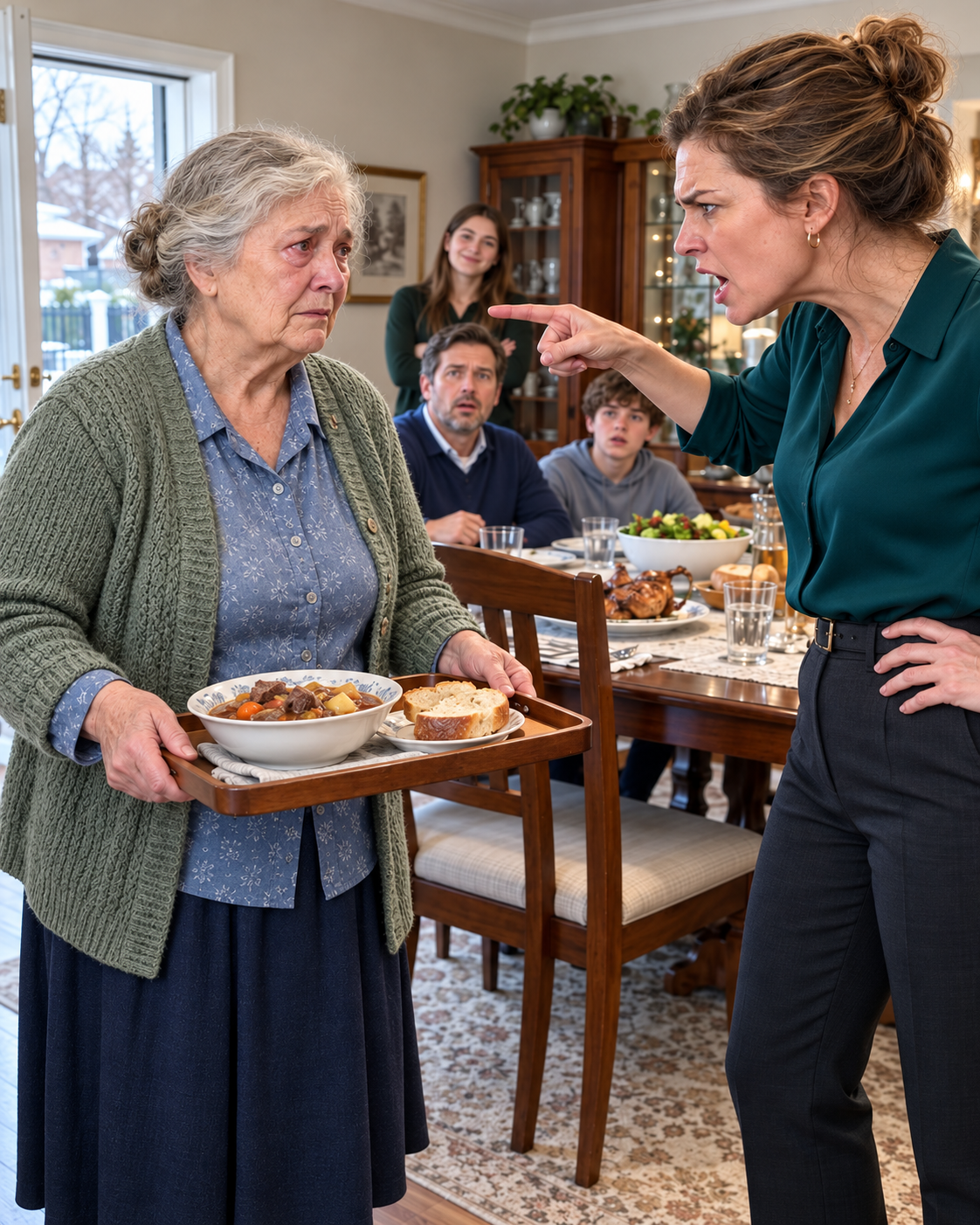
The first time my daughter-in-law ordered me to leave my own dining room, she was sitting in the chair where my husband had eaten dinner for thirty-eight years. Her suitcase was still upstairs, half unpacked. The bread I had baked that afternoon was warm beneath its linen cloth, and my grandchildren were watching their mother with the frightened attention children develop when they recognize an argument before the adults admit one is happening. Linda pointed toward the back door and told me to take my plate outside. My son, Edward, stared at his food. I was sixty-eight years old, and that was the moment I understood how easily a person could become a stranger in the home she had spent her life building.
My name is Margaret Bennett. Until that evening, I had believed that the house on our quiet Chicago street would remain the one place where I never needed to explain my right to be comfortable. It was a modest two-story brick home with a narrow driveway, a patch of lawn Anthony insisted on maintaining himself, and a maple tree whose roots had gradually lifted one corner of the front walkway. The kitchen window faced west, catching the last light of the afternoon. In winter, the old radiators clicked before warming the rooms. Nothing about the place was especially grand, but every inch of it carried something I remembered.
Anthony and I bought the property thirty-eight years earlier, when we were both teachers and still believed that a household budget could be managed through determination alone. Our down payment had consumed nearly everything we possessed. For the first few years, I took additional tutoring appointments after school, while Anthony spent his summers teaching remedial classes. We brought lunches from home, repaired appliances rather than replacing them, and postponed our first proper vacation until Edward was old enough to remember it. We never regretted those sacrifices. The house represented independence, and Anthony considered every mortgage payment another small promise kept.
I remember the afternoon we made the final payment. Anthony came home with the confirmation letter folded inside his jacket, although the weather was warm enough that he hardly needed one. He placed it on the kitchen table and asked me to read it aloud. When I finished, he laughed, a deep, astonished laugh that I can still hear when the house grows quiet. Later, he put the letter in a simple wooden frame and hung it in his workshop beside the tools he had accumulated over the years. He said it was the finest decoration he would ever own. I thought he was joking until I saw the expression on his face.
After Anthony died, I discovered how much of our marriage remained inside the ordinary things he had touched. His old gardening gloves rested on a shelf in the garage. His books occupied the lower rows of the living-room shelves because he disliked reaching over his head. He had built a bench beneath the dining-room window and planted the maple beside the porch when Edward was small. For months, I couldn’t bring myself to move the blue coffee mug he always used. Eventually, I began placing it beside mine every morning, not because I expected him to return, but because its familiar shape made breakfast less lonely.
The property had been placed solely in my name, and every household expense was my responsibility. Gabriella Moreno, the attorney who had assisted us with our estate documents, had reviewed the paperwork again after Anthony’s death. She explained everything patiently, including the importance of keeping ownership and financial authority clear. I listened, signed where necessary, and stored the completed documents in a labeled folder in my study. At the time, I considered the appointment another piece of paperwork that accompanied widowhood. I never imagined that the distinction between owning a house and permitting someone to stay there would become important within my own family.
Edward was our only child, and I had always tried to give him the sort of support that helped rather than controlled him. As a boy, he was gentle, easily embarrassed, and reluctant to disappoint anyone. When he was twelve, he broke one of Anthony’s fishing rods and spent an entire afternoon pretending he hadn’t touched it. His father knew almost immediately, but waited until Edward found the courage to confess. I remember Anthony telling him that an uncomfortable truth usually became worse the longer a person avoided it. I thought that lesson had stayed with him. Years later, I would wonder whether he’d ever really understood it.
His marriage to Linda had not been easy for me, although I rarely admitted that aloud. She was organized, ambitious, and quick to point out anything she believed could be improved. At family dinners, she corrected Edward’s stories while he was still telling them. She complained that my kitchen was outdated and that I kept too many books in the living room. If I bought the children presents, she sometimes questioned why I hadn’t asked her approval first. I tried to accommodate her because she was my son’s wife and the mother of my grandchildren. Whenever something hurt me, Edward quietly suggested that I shouldn’t take it personally.
Dylan and Sarah made those difficult moments easier to overlook. Dylan, twelve, had inherited Anthony’s habit of examining how things worked before asking questions about them. He could sit for an hour beside the old workshop bench, sorting loose screws into containers. Nine-year-old Sarah preferred the kitchen, where she liked measuring flour and announcing that she was the official inspector of anything containing strawberries. They were affectionate children, comfortable enough in my presence to leave their shoes by the back door and ask for second helpings without hesitation. I loved hearing their footsteps in the hallway. I never wanted them to associate my house with tension.
Everything changed on a Tuesday morning when Edward called at precisely 10:42. I remember the time because I had just poured a cup of tea and was about to leave for the grocery store. He spoke carefully at first, asking whether I’d eaten breakfast and how my knees were feeling after the colder weather. Then his voice faltered. His employer had eliminated an entire department, and he was among those who had lost their positions. The decision had been announced with little warning. He had already begun applying elsewhere, but his severance would not cover their expenses for long.
He explained that their apartment rent was more than the family could manage without his salary. Linda had been trying to calculate their options, and every solution seemed to involve money they didn’t have. As I listened, I could hear a door closing somewhere behind him and the unmistakable strain of someone attempting to sound composed. He finally admitted that he was frightened. He didn’t know how to tell the children they might have to leave their home. At that, I stopped considering the problem as something he needed to solve alone. There were two unused bedrooms upstairs, a large kitchen, and space for four more people to sleep safely.
I offered them a place to stay before he could ask. There was no grand discussion or complicated negotiation. I told Edward he could bring the family over while he searched for work and that we would figure out the practical details afterward. He became silent for so long that I thought the call had disconnected. Then he thanked me, twice, his voice rough with relief. I told him not to worry about paying rent while he was unemployed. I wanted him to concentrate on finding a suitable position and helping the children adjust. We had always been a family that helped one another when circumstances became difficult.
I spent the remainder of that Tuesday preparing for their arrival. The guest-room sheets went into the washing machine, and I brought out the thicker blankets from the linen cupboard. I opened the windows upstairs to clear away the faint smell of rooms that hadn’t been occupied for several weeks. From a storage box, I found the small reading lamp Sarah preferred and placed it beside the bed across the hallway. I checked the bathroom towels, cleared drawers for clothing, and moved a few books from the guest-room dresser. By evening, my back ached, but I felt useful in a way I hadn’t for some time.
At the grocery store, I bought Dylan’s favorite crackers, Sarah’s strawberry yogurt, fresh vegetables, and a large piece of beef for a stew. Edward had loved my rosemary stew since childhood, particularly when it was served with bread still warm from the oven. I decided it would be a welcoming first dinner. My family was arriving under difficult circumstances, and I wanted the evening to feel familiar. I even took out the wedding china that Anthony and I had used for birthdays and holidays. Perhaps that was sentimental of me, but I remembered how frightened Edward had sounded, and I wanted him to recognize that coming home did not need to mean admitting defeat.
The following day, just before noon, Edward’s car turned into the driveway. Dylan climbed out first, carrying an overstuffed backpack, and Sarah hurried toward the front steps before anyone could remind her to wait. I hugged them both. Edward followed with two heavy suitcases, his face drawn from lack of sleep. Linda stepped out last. She looked up at the house without smiling, then walked toward the porch while speaking into her phone. I heard her say that they had arrived and that she would explain the arrangements later. Her tone reminded me of someone inspecting accommodations after a reservation had gone wrong.
Inside, Linda moved through the rooms with an attention that initially seemed practical. She opened the kitchen cupboards and examined the shelves. She stood beneath the upstairs bathroom light, flicked the switch twice, and commented that the room would need improving. In the guest bedroom, she looked at the bed, the freshly washed curtains, and the dresser I had cleared. Then she asked whether the room was the largest one available. I explained that my bedroom was down the hall and the children would have a separate room opposite theirs. She glanced at Edward, who was carrying another suitcase upstairs.
Linda said that the guest room was smaller than she’d expected. I told her it had always been comfortable for visitors and that I could move another chair out if they needed additional space. She didn’t respond to the suggestion. Instead, she went into my bedroom without asking permission. I followed her and found her standing beside Anthony’s old dresser, looking at the windows and then at the adjoining closet. She opened one of the closet doors. My late husband’s winter coat still hung inside, neatly brushed and protected beneath its cover. I asked whether she needed something.
She said that she and Edward should use my bedroom because it was larger. The request was delivered with such certainty that I almost thought she had mistaken it for a room I’d offered. I told her that I intended to remain there. Linda looked toward the bed and pointed out that there were four people in her family and only one of me. I said I understood that they needed space, which was why I had prepared two rooms upstairs. The arrangements were not going to change. Her expression tightened, but she gave a brief smile and walked out, leaving the closet door open behind her.
I stood there for several seconds before closing it. Something about the incident disturbed me more than I wanted to admit. There had been no question about whether moving into my bedroom would inconvenience me, no acknowledgment that the room contained a lifetime of private memories. Linda had evaluated it simply as a larger space that someone else could use. Downstairs, I heard her telling Edward that the living-room furniture should be rearranged and that the old cabinets would eventually need replacing. He gave a distracted answer. I reminded myself that people behaved differently when frightened about money. I had invited them here to help, not to judge every remark.
During the afternoon, I tried to create an atmosphere of ordinary family life. Dylan carried bags into the house and asked whether he could visit Anthony’s workshop later. Sarah helped me wash carrots for dinner, standing on the little wooden step I’d kept since she was a toddler. Edward unpacked the children’s school supplies and arranged their chargers beside the desks. Linda spent much of the time walking between rooms, making comments about storage and the number of things I had accumulated. When she suggested that the dining-room bench should be removed to create more space, I quietly explained that Anthony had made it himself. She said she supposed that made it difficult to throw away.
By early evening, the kitchen smelled of browned beef, onions, and rosemary. I had left the dough to rise beneath a cloth and put the bread into the oven while Edward helped carry plates to the table. Sarah insisted on arranging two candles in the center, checking repeatedly that they stood at the same height. Dylan filled the water glasses. When we finally sat down, I felt something inside me relax. The children were talking about their new school arrangements, and Edward took a spoonful of stew before announcing that he hadn’t realized how much he’d missed it. I laughed and told him he could have asked me to make it any weekend.
For a little while, dinner seemed to offer exactly what I had hoped for. Sarah described a teacher she was nervous about meeting. Dylan wanted to know whether he could keep his bicycle in the garage beside Anthony’s tools. I told him we would find room. Edward thanked me again for allowing them to stay. Linda ate in silence, occasionally glancing toward the kitchen door. I noticed that she had chosen the chair Anthony used to occupy, but I said nothing. A chair was only a chair, I told myself. I had already decided not to make their first evening more difficult over something so small.
Then Linda put down her spoon. She straightened her napkin, rested both hands beside her plate, and said that the household needed rules. Edward’s expression changed immediately. It was slight but unmistakable: the way his shoulders drew inward and his eyes moved from her to the children. Linda continued before anyone could reply. She explained that five people sharing the house would require firm arrangements and that she had already thought about how everything should operate. I agreed that schedules for the bathroom and kitchen could be useful. She shook her head as though I had misunderstood something obvious. She wasn’t talking about schedules.
Linda looked directly at me and announced that she would be taking charge of the household. I placed my spoon on the edge of my bowl. I asked her to explain what she meant. She replied that Edward and the children needed a properly managed home and that I should allow her to make the important decisions. I reminded her that I had invited them to stay temporarily while Edward found work. Linda said that was precisely why someone had to establish authority before disagreements developed. The confidence in her voice unsettled me. She spoke as though an arrangement had already been made without my knowledge.
I turned toward Edward. He had lowered his eyes to his plate and was pressing a piece of bread against the remaining gravy. I asked whether he had discussed these supposed arrangements with Linda. He muttered that everyone was tired and that we should try to enjoy dinner. Linda took his reluctance to answer as permission to continue. She indicated the kitchen, the living room, and the upstairs hallway, explaining that things would be organized differently from now on. When I told her politely that I was still responsible for my home, she pushed her chair backward. The legs scraped loudly against the hardwood floor.
“This is my house now!” she shouted, pointing toward the back door. “If you can’t accept that, take your dinner outside. Go on. Eat out there with your friend.” For a moment, nobody moved. Sarah’s hand froze above her water glass, and Dylan stared at his mother with an expression I had never seen on his face before. Edward remained seated. Behind Linda, Anthony’s photograph stood on the mantelpiece, and the maple leaves tapped softly against the window. I looked at my son, waiting for him to tell his wife that she’d gone too far. He opened his mouth, then shut it again. His silence answered a question I had been avoiding for years.
END PART 1
PART 2 TITLE: When My Son Chose Silence Over Defending Me, I Made a Telephone Call That Revealed How Much He Had Concealed
The silence after Linda’s outburst was worse than the shouting. I could hear the low hum of the refrigerator and the ticking of the clock Anthony had repaired years earlier. Sarah slowly lowered her hand from the water glass, watching the adults as though one of us might explain that the whole thing was an unpleasant joke. Dylan’s face had reddened. He glanced at me, then at his father, plainly embarrassed. Linda remained standing beside the dining table with her arms folded, waiting for me to obey. I looked at Edward and asked him whether he had heard what his wife had just said to me.
Edward lifted his eyes only long enough to tell me that everyone was exhausted and that he didn’t want dinner to become an argument. He spoke in the same careful tone he’d used during countless family disagreements, as if keeping his voice low could make an insult disappear. I asked whether he thought it reasonable for me to be ordered out of my own dining room. He rubbed his forehead and requested that we discuss everything the following morning. Linda gave a small, satisfied nod. It was not the reaction of someone who believed she had made a mistake. She had expected his silence, and she was counting on mine.
I thought of the many times I had accepted small humiliations to avoid upsetting Edward’s marriage. There had been the Christmas dinner when Linda complained that my gifts were too inexpensive. The birthday when she interrupted a story about Anthony because she found it depressing. The afternoon she criticized the way I folded Sarah’s clothes, even though she’d asked me to look after the children while she attended an appointment. Each incident had seemed too minor to justify a serious confrontation. Edward invariably asked me to understand that Linda was under pressure. I had tried so hard to keep the peace that I’d forgotten to ask who was paying for it.
I looked down at the china in front of me. Anthony and I had received the set as a wedding present from his parents, and one plate bore a tiny chip near the rim from the time Edward had dropped it at fourteen. I had never thrown it away. Thirty-eight years of family dinners, celebrations, illnesses, and ordinary evenings had passed over that table. Now a woman who had been living in the house for only a few hours was telling me that I no longer belonged at it. I realized I didn’t need to match Linda’s anger. I needed to decide whether I was willing to let her words become reality.
I folded my napkin, placed it beside my bowl, and stood. Linda watched me with the unmistakable satisfaction of someone who believed she’d won. I pushed my chair beneath the table and walked toward the kitchen. Behind me, she asked whether I was finally going to eat somewhere else. I didn’t answer. The old telephone was mounted beside the pantry door, its receiver attached by a curling cord that had stretched with years of use. Most people had abandoned landlines, but I had kept ours because Anthony liked knowing there would always be a telephone in the kitchen. Beneath it was a narrow drawer containing emergency contacts and several important numbers.
I opened the drawer and removed a small white card. Gabriella Moreno’s handwriting appeared across it, along with her office and mobile numbers. She had given me the card after helping settle Anthony’s estate, telling me that I could contact her if any concerns arose about the house or my financial arrangements. The card had stayed in that drawer for years, disturbed only when I cleaned. I had expected to need Gabriella for routine updates to my will, perhaps another review of my paperwork when the law changed. It had never occurred to me that I might call her because of something my son’s wife said over dinner.
The kitchen clock showed 6:48 p.m. when I dialed. Gabriella answered after the second ring, sounding surprised but pleased to hear from me. I asked whether I was interrupting her evening. She said she was at home reviewing notes and wanted to know if everything was all right. I glanced through the doorway. Linda had sat down again and was speaking softly to Edward. He appeared distracted until he heard me say Gabriella’s name. His head rose. I could see him listening closely, trying to understand what I was doing. Gabriella recognized the strain in my voice before I described what had happened.
I told her that Edward’s family had moved in that afternoon and that the situation we’d discussed in a previous conversation had developed much sooner than I’d anticipated. For a moment, she said nothing. Then she asked whether I was somewhere I could speak without being intimidated. I told her I was standing in my own kitchen and intended to remain there. She asked what had changed. I explained Linda’s demand to control the house, her attempt to claim my bedroom, and the order to take my dinner outside. Gabriella listened without interrupting, then asked whether Edward had supported any of those demands. I said he hadn’t challenged them.
There had been an earlier conversation between Gabriella and me, several months after Anthony died, about what I should do if relatives ever pressured me over the property. She had explained that offering someone temporary financial assistance did not require giving them decision-making authority over my assets. She’d also warned that allowing family members to occupy a house could raise complicated questions if the arrangement became disputed. At the time, I had found the warning rather severe. Edward was my son. I trusted him. Now, with his wife announcing ownership of my home while he watched, Gabriella’s caution seemed less theoretical than it once had.
I told Gabriella that I wanted to withdraw my offer of indefinite accommodation and establish a formal, lawful process for the family to find somewhere else to live. She repeated the request to make certain I understood its consequences. She explained that their arrival, their circumstances, and any rights connected with occupying the property would need proper review. I could not simply force them out that evening, and she would not advise any action that endangered the children or violated their legal protections. I said I understood. My intention was not to punish anyone or create a scene. I wanted to protect my home before a temporary act of kindness turned into something I could no longer control.
Edward appeared in the kitchen doorway before I finished speaking. He looked startled, as though he’d expected me to complain to a friend rather than consult an attorney. Linda followed a few steps behind him. I held up my free hand to signal that I wasn’t finished. Gabriella said she would prepare written documentation, review the family’s occupancy status, and arrange to meet with me the following morning. She asked me to keep any relevant messages and avoid signing documents that anyone placed in front of me. I thanked her and confirmed our appointment. When I replaced the receiver, the kitchen felt unusually quiet. I had made one call, but the expressions on Edward’s and Linda’s faces told me it had changed the evening.
Edward asked why I had involved Gabriella. Linda demanded to know who she was and why her husband suddenly looked so worried. Edward answered before I could. He explained that Gabriella was the attorney who had worked with Anthony and me on our estate planning and had handled the legal arrangements following his father’s death. Linda’s eyes narrowed. She asked whether I had called a lawyer to threaten my own family. I replied that I had called someone who could explain my rights and responsibilities because our informal understanding had clearly broken down. She pointed out that they’d brought their belongings into the house. I told her that unpacking suitcases did not give them authority over my property.
Linda accused me of trying to leave the children without a roof over their heads. The accusation hurt because she knew exactly how much I loved Dylan and Sarah. I looked past her into the dining room, where the children were still seated. Sarah was turning her napkin between her fingers, and Dylan had stopped eating. I lowered my voice. I told Linda that the children would be safe that night and that any future move would be handled through proper arrangements. I would not change the locks, discard their possessions, or frighten my grandchildren. But I would not surrender my bedroom, my finances, or decisions about my house to people I’d invited inside as guests.
Edward asked whether we could speak privately. Linda objected at once, declaring that anything involving their living arrangements concerned her. I told them both that there was nothing complicated about the immediate question. They could remain while Gabriella reviewed the situation and a reasonable plan was established, but I was withdrawing the open-ended invitation I’d made the previous morning. Edward began to say that Linda hadn’t meant what she’d said. She interrupted him and insisted that she had meant every word about running the household properly. I watched the disappointment settle across his face. For once, even he couldn’t pretend that the problem was a misunderstanding.
Linda turned away, walked upstairs, and closed the bedroom door hard enough to make the dishes tremble faintly in the kitchen cupboard. Edward hesitated, then followed her. I remained by the telephone for a moment, listening to the house settle. I had expected to feel triumphant or frightened. Instead, I felt tired. The stew was cooling in its serving dish, and the bread had lost the crispness I had been so pleased with an hour earlier. I took a fresh cloth from the drawer and returned to the dining room, where my grandchildren were sitting in the uncomfortable silence left by their parents.
I sat beside Sarah and asked whether she wanted another piece of bread. She shook her head and asked if we were all angry with one another. I told her that the adults had disagreed about some important matters and needed to sort them out. Dylan asked whether they would have to leave immediately. I assured him that nobody was going to be sent into the street and that I would tell them whenever there were practical arrangements they needed to know. Sarah looked toward the stairs and asked whether she had done something wrong by putting the candles on the table. I took her hand and said the candles were lovely. None of this had anything to do with her.
The three of us finished dinner quietly. Afterward, Dylan helped carry the dishes into the kitchen while Sarah extinguished the candles. I washed the plates in warm water rather than putting them in the dishwasher, grateful for the simple work. The children went upstairs, and I heard their bedroom door close. I dried the china carefully, examining the familiar pattern along each rim. Anthony had loved family dinners, even the noisy ones when everyone disagreed about politics or argued over whose turn it was to wash dishes. He believed a dining table should be a place where people could disagree without making anyone feel unwelcome. I wondered what he would have said to Edward.
It was nearly nine when my son returned to the kitchen. He had changed into an old sweatshirt, and his hair was disordered from running his fingers through it. He stood beside the table for a moment before asking whether he could sit down. I nodded toward the chair opposite me. He lowered himself slowly and looked at the photograph of Anthony near the window. I waited. In childhood, Edward often needed time to work his way toward difficult admissions. I had learned not to fill every silence for him. This time, I wanted him to speak because he had something true to say, not because I had supplied the words.
He finally asked why I had called a lawyer instead of talking to him first. I looked at him for a long moment. Then I reminded him that I had tried to speak to him at dinner. I had asked him directly whether he agreed with Linda’s behavior, and he had told me not to cause an argument. Edward winced. He said he hadn’t wanted the children upset and thought everyone might be calmer in the morning. I asked whether he believed I should spend the night wondering if I was allowed to sleep in my own bedroom. He didn’t answer immediately. Then he admitted that he should have spoken up. It was a small admission, but at least it was his.
We talked about the years in which Linda’s comments had been dismissed as stress, exhaustion, or simple differences in personality. Edward said he often felt caught between the two of us. I told him that protecting his marriage was his responsibility, but making me accept disrespect was not a fair solution. He listened with his hands clasped. Then I asked whether Linda’s announcement at dinner had genuinely surprised him. He looked toward the hallway. The movement was so quick that another person might not have noticed it. I had been his mother for more than four decades. I knew when there was something he wanted to avoid telling me.
Edward admitted that Linda had discussed reorganizing the house before they moved in. At first, he described the conversations as ordinary planning. They’d talked about where the children’s things would go, how they might share the kitchen, and whether the living room could accommodate additional furniture. I said those questions would have been reasonable if they’d asked me. He nodded but continued staring at his hands. When I asked what else Linda had suggested, he told me about the bedrooms. She thought I should move into the smaller upstairs room so she and Edward could use the larger bedroom I had shared with Anthony.
I asked whether he had agreed. He said he hadn’t objected strongly because Linda was worried about the children’s comfort and their financial situation. I reminded him that my bedroom was not vacant space waiting for a new purpose. It was my room. He acknowledged that, then hesitated again. I asked what Linda intended to do after rearranging the bedrooms. His voice grew quieter. She had talked about modernizing the first floor, improving the kitchen, and making better use of the house. She had also remarked that maintaining such a large property might become difficult for me as I grew older. I looked at him and waited for the rest.
Edward said Linda had been thinking about what would happen to the property eventually. She believed we should discuss long-term arrangements before making renovations. I asked what he meant by eventually. He shifted in his chair. He said that someday I might prefer a smaller place with fewer maintenance responsibilities. I reminded him that I was sixty-eight, healthy enough to manage my own household, and perfectly capable of deciding when a different living arrangement might suit me. He said he knew that. Yet he had apparently listened to plans involving my future without thinking it necessary to include me in the conversation.
I asked whether Linda knew that the property was in my name alone. Edward said she did. I asked whether he had made any promises about inheriting it. He insisted that he hadn’t promised her anything formally, but admitted that they had occasionally spoken about the house as something he would probably receive after my death. The words settled heavily between us. I had always assumed Edward understood that inheritance was a possibility, not an entitlement. Anthony and I had worked for decades to own that property. Our son had enjoyed growing up in it, but that did not make him an owner. I wondered how often Linda had discussed my house as part of their future finances.
I thought back to a conversation several weeks earlier, when Edward had visited and asked to look through some documents concerning the house. He said he wanted to understand how property taxes were calculated because he and Linda hoped to buy a home eventually. I had taken the folder from my study, spread the papers on the desk, and explained what I knew. He’d photographed several pages with his phone, saying he might use them as examples when he researched mortgages. At the time, I’d thought nothing of it. He was my son, and teaching him about practical matters was something I’d done throughout his life. Now I remembered how carefully he’d photographed the deed.
I asked him one more question. Had he or Linda already discussed selling my home? Edward shook his head so quickly that I recognized the frightened boy who had once broken Anthony’s fishing rod. He said nobody had decided to sell anything. I repeated that I wasn’t asking whether they’d made a decision. I wanted to know whether they’d spoken about selling the property without consulting me. Edward swallowed, looked toward the study door, and said Linda had only been considering possibilities. In that moment, I realized she had not arrived expecting a temporary refuge. She had arrived believing my house was an asset her family could use, and my son had allowed that belief to grow.
END PART 2
PART 3 TITLE: The Morning After My Daughter-in-Law Claimed My House, My Attorney Asked One Question That Made Me Remember a Forgotten Conversation
I slept badly that night. Not because I feared Linda would come into my bedroom, although I did check that the door was properly closed, but because I kept returning to Edward’s expression when I asked about selling the house. He had denied making a decision, yet he had carefully avoided saying that the subject had never been discussed. After forty years of knowing him, I recognized the difference. Shortly after midnight, I went downstairs for water. The dining table had been cleared, but one of Sarah’s candles remained near the window. Beyond the glass, the maple branches moved slowly against the dark sky. I stood there wondering how long the family had been making plans that involved me without ever asking what I wanted.
In the morning, I woke to the sound of cupboards opening. Linda was in the kitchen, moving plates between shelves. She had placed several of my everyday mugs on the counter and was examining the cabinet beside the sink. I asked what she was doing. She replied that the arrangement made no sense and that she was looking for somewhere more convenient to keep the children’s breakfast things. I told her she could use the dishes, but I wanted everything returned to its usual place afterward. She gave me a cool look and said that a shared household would require flexibility. I reminded her that we had not agreed to the changes she had proposed.
Edward appeared a few minutes later. His face was tired, and he avoided looking directly at either of us. Dylan and Sarah came downstairs carrying their school materials, speaking quietly to one another. I made oatmeal and cut fruit while Linda prepared toast for the children. The breakfast was almost painfully ordinary. No one referred to the previous evening, yet its effects could be seen in every small movement. Edward sat near the end of the table instead of beside his wife. Linda kept her phone within reach. Sarah asked me whether I would still help her with her reading assignment. I said that I would, provided she was ready after lunch. Her smile was brief but genuine.
Gabriella arrived shortly after the children had gone upstairs to organize their belongings. She carried a leather folder and wore the calm, practical expression I remembered from our meetings following Anthony’s death. She hugged me in the hallway, then glanced toward the staircase before asking whether we could speak privately. I led her into the kitchen and made coffee. Linda appeared in the doorway almost immediately, asking whether she needed to participate. Gabriella introduced herself politely and explained that she had come to advise me regarding my property and the family’s living arrangements. Linda said she hoped we weren’t planning to make everything unnecessarily complicated. Gabriella answered that clarity was usually less complicated than uncertainty.
When Linda had gone, Gabriella opened her folder and placed a copy of the deed on the table. She asked me to confirm that I had not transferred any interest in the property or authorized someone else to make decisions concerning it. I told her that I hadn’t. The deed remained solely in my name, and I continued to pay the property taxes, insurance, utility bills, and maintenance expenses. Gabriella checked the records we had previously prepared and asked whether anyone had encouraged me to sign a new document recently. I said no. She nodded, but didn’t close the folder. She wanted to understand exactly what had happened before the family moved in.
I explained Edward’s telephone call about losing his position and my immediate offer to let the family stay. Gabriella asked whether we’d discussed a fixed departure date, contributions toward expenses, or written conditions. We had not. I felt foolish admitting that, although she showed no impatience. She said it was common for parents to help adult children informally, particularly when young grandchildren were involved. The difficulty arose when the people involved developed different expectations. Depending on the circumstances and applicable rules, occupancy could carry legal rights and obligations even when no formal lease had been signed. She wanted any change in the arrangement handled carefully.
Gabriella emphasized that the proper process mattered as much as the outcome. Whatever Linda believed about the house, I could not take shortcuts merely because I owned it. Any required notice would need to be delivered correctly, and the family’s status would have to be evaluated before setting a final timeline. I appreciated her approach. I had no desire to become the subject of a family story in which I had cruelly forced my grandchildren from their grandmother’s home. I wanted the house back under my control, but I also wanted Dylan and Sarah to know they were loved. Gabriella assured me that both concerns could guide our decisions.
We discussed what Linda had said at dinner and her earlier insistence on taking my bedroom. Gabriella listened, making a few notes. She asked whether Linda had ever claimed that Edward already owned an interest in the property. I said she’d spoken as though she were in charge, but hadn’t produced any documents or given any explanation beyond the number of people in her family. Gabriella asked whether Edward had suggested that the house would eventually belong to him. I told her about our conversation the previous evening. When I repeated his remarks about what might happen as I grew older, she set down her pen and studied me carefully.
She reminded me that being sixty-eight did not diminish my authority over my financial affairs. I could seek assistance with maintenance, legal matters, or any other concern without surrendering the power to decide what happened to my property. She also explained that a potential inheritance did not grant someone present ownership. I knew those things intellectually, but hearing them stated so plainly helped me separate the law from the expectations my family had created. Anthony and I had always intended to make thoughtful decisions about our estate. We had never promised that Edward could begin planning around the house while I was still living in it.
Then Gabriella asked whether Edward or Linda had recently requested copies of my property records. The question caught me off guard. I told her Edward had asked about taxes several weeks earlier. He had been interested in how homeowners calculated their annual expenses, or so I’d understood. I described taking the folder from the study and showing him the deed, mortgage discharge confirmation, and property tax statements. Gabriella asked whether he had removed any originals. I said I didn’t believe so. I remembered watching him photograph several pages with his phone, and I had been pleased that he wanted to learn more about the responsibilities of owning a home.
Gabriella asked what Edward had said he needed those photographs for. I told her he wanted examples to consult while researching the possibility of buying a property of his own. She asked whether I had explicitly authorized him to share those documents with anyone or use them to make inquiries concerning my home. I shook my head. It had never occurred to me that I needed to make such a distinction with my son. Gabriella didn’t suggest he had necessarily misused anything. She simply wanted to determine what information had left my possession and what someone might have done with it. The question left me unexpectedly uneasy.
I tried to reconstruct the visit. Edward had arrived alone and seemed preoccupied. He asked whether the property taxes had risen since the previous year. I showed him the statements and explained how I budgeted for them. Then he asked to see the original deed because he wanted to understand how ownership was recorded. We sat in the study for perhaps twenty minutes. He took photographs, asked a few questions, and changed the subject to the children’s school schedule. Nothing about his manner had alarmed me. I even remembered teasing him that he had become more interested in paperwork since turning forty. He’d laughed, though not as freely as usual.
Gabriella suggested that we check whether anyone had made inquiries concerning the property in my name or represented themselves as acting on my behalf. She was careful not to accuse Edward or Linda of doing something improper without evidence. Still, she believed it would be wise to confirm the situation before further discussions about the family’s departure. I agreed. She asked for permission to contact the relevant offices and review publicly available information and any communications connected to the property. I signed the authorization she prepared after reading it carefully. For once, I was grateful that Anthony had taught me to keep household records organized.
While Gabriella worked, I went into the study to find the original folder. The room still smelled faintly of cedar from the little cabinet Anthony had repaired years earlier. I opened the drawer where I kept our documents and found everything in its usual order. The deed lay beneath the mortgage discharge confirmation, followed by insurance papers and tax statements. Nothing appeared missing. I checked the dates and addresses, then brought the folder to Gabriella. She examined the contents and confirmed that the ownership documents matched the records we already had. Her reassurance helped, but the question about Edward’s photographs continued to trouble me.
From the kitchen, I could hear Linda speaking on the telephone upstairs. She was keeping her voice low, and I made no effort to listen. The fact that she had already attempted to rearrange my kitchen that morning seemed less important than it had a few hours earlier. I was beginning to understand that the argument over cupboards and bedrooms might be only the visible part of a much larger disagreement. Linda appeared convinced that my property should serve her family’s needs, and Edward had not been willing to challenge that belief. I wondered whether they had talked about those needs in financial terms, and what conclusions they might have reached.
Gabriella stayed through late morning, reviewing the preliminary details and explaining what information she hoped to obtain. She said we would need to distinguish between an uncomfortable family disagreement and any concrete attempt to act without my permission. A rude comment, however hurtful, was not the same as an unauthorized property transaction. I appreciated her insistence on separating feelings from facts. It kept me from imagining possibilities we hadn’t verified. Before leaving, she advised me not to confront Edward about the photographs until we knew whether they had been used. She promised to contact me when the inquiries produced something reliable.
The rest of the day moved slowly. Edward spent several hours on his laptop searching for job openings, occasionally stepping outside to answer calls. Linda kept to the upstairs rooms for most of the afternoon. Dylan asked if we could look at Anthony’s workshop, and I took him into the garage after lunch. He examined the old tools with the same solemn interest his grandfather used to show when deciding how to repair something. He asked whether Anthony really had built the dining-room bench without buying a ready-made kit. I showed him the penciled measurements still marked beneath the seat. Dylan ran his fingers over the wood, smiling.
Sarah joined us with a book tucked beneath her arm. She wanted to know whether I had photographs of Grandpa Anthony working in the garden. We went inside and found an album filled with pictures of the early years in the house. There was Anthony carrying a young Edward on his shoulders, me painting the front door, and the three of us sitting beneath the maple when it was no taller than the porch roof. The children laughed at their father’s childhood haircut. I laughed with them, but the pictures reminded me that the house had been built into our lives through ordinary work and shared experiences. It was not merely a sum on a property report.
That evening, Edward asked whether Gabriella had finished reviewing the situation. I told him she was still gathering information. He looked uncomfortable and said he hoped we could resolve things without letting outsiders interfere in the family. I reminded him that Gabriella had known us for years and had helped his father protect the property legally. Edward said he didn’t think Linda intended to take anything from me. I asked how he could be certain when he hadn’t known she was going to claim authority over the household at dinner. He looked away. I didn’t mention the photographs. I wanted to hear what Gabriella discovered before deciding what to ask next.
The following morning, I found myself waiting for the telephone to ring. It was a strange feeling. During the years after Anthony’s death, the house had been a refuge from the uncertainties of the outside world. Now I was examining every unfamiliar sound and wondering whether someone had begun making decisions about it without my knowledge. I made breakfast, watered the plants, and read several pages of a novel without remembering much of the plot. Linda passed through the kitchen twice, speaking briskly to the children. Edward left for an interview and returned before lunch. I didn’t tell either of them how unsettled I felt.
Gabriella called in the early afternoon. Her voice was measured, but I could tell she had found something important. She said that an inquiry involving my address had been made to a real estate agency. A preliminary valuation had been requested, and the agency had received enough information about the property to begin assessing its likely market value. I sat down at the kitchen table. Gabriella explained that the inquiry did not amount to a sale or transfer of ownership. Nevertheless, it was something I needed to examine. The agency had supplied a copy of the request and its accompanying description after the situation was clarified.
I asked who had requested the valuation. Gabriella said the principal contact was Linda Bennett. I repeated the name because, for a moment, I couldn’t connect it with the person upstairs. Linda had been in my home for little more than a day. She had spent the previous evening announcing that she was in charge, and now Gabriella was telling me she had already contacted a real estate agency about the property. I asked whether the inquiry had been made after they arrived. Gabriella told me the initial contact appeared to have taken place earlier. The significance of that answer made my stomach tighten.
Gabriella sent me the available paperwork and arranged to bring the documents over so we could examine them together. When she arrived, she laid the valuation request on the table and pointed out the information supplied about my home. There were exterior photographs and a description of several interior rooms. The details were accurate enough to make it clear that the person submitting them knew the house well or had received information from someone who did. I recognized the view of the front porch and the wording used to describe the bedrooms. The request included observations about renovations that had never been proposed to me.
Then I reached the paragraph concerning the current owner. It described me as an elderly homeowner considering a move to smaller accommodation. According to the request, I preferred not to manage complicated property matters personally, so my son would help coordinate discussions and appointments. I read the paragraph again, slowly. I had never contacted the agency. I had never told Linda I wanted to sell, never asked Edward to represent me, and never discussed moving into a retirement community. Yet someone had presented those intentions as though they were mine. The words were precise enough to sound credible and misleading enough to change the way a stranger would treat me.
I looked at Gabriella and asked whether Linda had been trying to arrange the sale of my home before she even moved into it. She answered carefully. A valuation request alone did not establish that a sale was imminent, and it certainly gave Linda no authority to transfer the property. But it demonstrated that someone had started exploring possibilities and had supplied a false account of my intentions. Gabriella pointed to the contact details and the dates. I recognized how the timing aligned with Edward’s visit to photograph my documents. While I had been preparing bedrooms and buying my grandchildren’s favorite foods, Linda had been preparing a version of my future in which I no longer made the decisions.
END PART 3
PART 4 TITLE: When the Real Estate Papers Reached My Study, My Daughter-in-Law Finally Had to Explain the Future She Had Already Planned for Me
I stared at the valuation request until the words began to blur. The document lay on the kitchen table between Gabriella and me, its pages held flat beneath her hand. There was nothing dramatic about its appearance. No official seal announced that my life was about to change, and no threatening language appeared in the margins. It was simply a property inquiry prepared by people who believed the owner was considering selling. That ordinary presentation made it more disturbing. Linda had apparently managed to turn my home into a subject of financial discussion without involving me at all. Somewhere, strangers had been evaluating rooms where I had raised my son and spent nearly four decades with my husband.
Gabriella allowed me a few moments before speaking. She explained again that the valuation itself had no power to transfer ownership. A real estate agency could discuss market values with an interested person, but it couldn’t sell my property without the proper authority and documentation. The immediate concern was the information supplied to the agency. Someone had described my wishes inaccurately and had indicated that Edward might coordinate matters because I supposedly preferred not to handle them myself. Gabriella wanted to establish who had provided those details, what had been communicated, and whether there had been any attempt to arrange further appointments or secure additional documents.
I looked toward the staircase. Linda was upstairs, and Edward had returned from his interview less than an hour earlier. For a moment, I considered waiting until the children were occupied elsewhere so we could discuss the matter without an audience. Gabriella agreed that the conversation should take place privately. We moved into my study, closed the door, and arranged the documents across the desk. The room held Anthony’s filing cabinet, my household records, and a narrow bookshelf filled with the novels he had collected. On the wall hung a photograph of us standing outside the house shortly after purchasing it. I found myself looking at that picture while Gabriella prepared her notes.
I called Edward and asked him to join us. He appeared within a few minutes, wearing the shirt he’d chosen for his interview. When he saw Gabriella sitting beside the desk, his expression changed. He asked whether something had happened. I told him that we had received information about an inquiry concerning my home and that I wanted to understand it. Before he could sit, Linda appeared behind him. She said that if the conversation involved their housing situation, she intended to participate. Gabriella calmly explained that I had requested the meeting and was entitled to decide who attended. I told Linda she could stay because her name appeared on the documents.
Edward sat in the chair nearest the door. Linda remained standing with her arms folded. Gabriella placed the valuation request on the desk and turned it toward them. She asked whether either had contacted a real estate agency to inquire about the property. Edward looked at the papers, then at his wife. His surprise seemed genuine. Linda glanced at the first page and said there was nothing unusual about wanting to know how much a house might be worth. Gabriella asked her to answer the question directly. Linda admitted that she had requested the preliminary valuation. She spoke as though she were acknowledging an entirely harmless errand.
I asked why she’d done it without telling me. Linda replied that the family needed to consider its financial options and that information about property values might help everyone make sensible decisions. I reminded her that I had invited them to stay temporarily because Edward had lost his job. We hadn’t discussed selling the house, and I had not asked anyone to research its value. She said that refusing to consider possibilities was shortsighted, especially when there was a property large enough to meet several different needs. I looked at Edward. He was still examining the document, turning the pages as though searching for something that might make the situation less serious.
I asked Linda whether she understood the difference between gathering information for herself and telling an agency that I was considering moving. She shifted her weight and said that, from a practical standpoint, downsizing would make sense for someone my age. The house required maintenance, the stairs would eventually become inconvenient, and I was occupying more space than I needed. She spoke of these things with the certainty of a person reciting calculations she’d repeated many times. I listened until she finished. Then I told her that none of those considerations gave her permission to announce intentions I had never expressed.
Linda said she had only been thinking ahead. She mentioned smaller homes, lower maintenance costs, and a retirement community she’d seen advertised online. The community, she explained, offered activities and services that might make life easier for older residents. I asked whether she had visited the place or spoken to anyone there. She admitted she’d looked through its website. Then she suggested that if I sold my house, the proceeds could provide an attractive smaller property for me while freeing resources to help Edward and the children establish a more comfortable living arrangement. Her tone remained practical, almost cheerful, as if she were presenting a carefully researched family proposal.
I asked her to explain where Edward’s family would live under that arrangement. Linda said that depended on the financial details. She talked about purchasing a property that suited the children’s needs, perhaps one with a modern kitchen and enough bedrooms for everyone. I asked whether she meant a home purchased partly with the proceeds from selling mine. She said the money could be used in ways that benefited the family as a whole. Gabriella asked Linda to clarify whether I had agreed to contribute any sale proceeds toward their future housing. Linda hesitated, then said that no final decisions had been made. The distinction was important. There were no decisions because I had never been consulted.
I asked where I was supposed to live while they occupied the house bought with money from mine. Linda looked away, then returned to her suggestion of a smaller property or retirement community. I reminded her that I already had a place to live, one I liked and could afford. I didn’t need a new address, a simplified floor plan, or a committee of relatives deciding how best to spend my savings. I wanted to continue living in the house Anthony and I had paid for. Linda drew a sharp breath and said I was refusing to consider what might be good for everyone. I replied that everyone included me.
Gabriella directed our attention to the wording of the agency request. She read the passage describing the elderly owner who preferred assistance with complex matters. Linda interrupted and insisted she’d never told anyone I was incapable of managing my affairs. Gabriella explained that the language still created a misleading impression about my intentions and Edward’s authority. The distinction between being willing to receive assistance and authorizing someone to represent an owner was not trivial. Linda argued that she had merely simplified the situation for the agent. I asked whether she thought the truth was too inconvenient to explain. She didn’t answer.
Edward finally spoke. He asked Linda when she’d contacted the agency. She said she’d made an initial inquiry before the move because she’d been worried about their financial future. He looked at her for a long moment. Then he asked why she hadn’t mentioned it to him. Linda replied that he’d been overwhelmed by losing his job and that she was trying to take some responsibility for their circumstances. Edward said that contacting an agent about his mother’s house was different from researching apartments or comparing grocery prices. Linda’s face reddened. She accused him of turning against her simply because Gabriella was present. I watched my son struggle with the unfamiliar task of challenging his wife openly.
I asked Edward whether he had provided the property photographs. His expression told me he knew exactly which photographs I meant. He admitted that he had sent Linda several images, including ones he’d taken while visiting me a few weeks earlier. He said she had asked about the house because she wanted to understand property values in our neighborhood. He believed she was comparing prices and exploring possibilities for their own future home. I asked why he’d forwarded photographs of my documents and rooms without speaking to me first. He said he hadn’t imagined that Linda would use them to request a valuation of my property.
I remembered him sitting in my study, carefully photographing the papers while I explained how we had managed the mortgage and taxes. I had believed I was helping him learn from our experience as homeowners. Now I understood that the information had traveled further than I’d expected. I asked whether he realized how much trust I’d placed in him. He looked down and acknowledged that he should have asked before sharing anything. Linda said we were exaggerating an innocent misunderstanding. I turned toward her and said that mistakes were possible, but the agency hadn’t invented the description of my supposed plans. Someone had chosen those words.
Linda began to cry. At first, the tears seemed to anger her more than they upset her. She wiped her face quickly, then accused Gabriella and me of treating her like a criminal. She said she’d been trying to solve a problem nobody else seemed willing to face. Edward was unemployed, their apartment was gone, the children needed stability, and she was terrified of failing them. I listened. Those fears were real, and I didn’t dismiss them. Losing financial security could make even ordinary decisions feel dangerous. But the fear of losing one’s own home did not give anyone the right to start making plans for someone else’s.
I told Linda that I understood how frightened she must have been when Edward lost his job. I had heard the same fear in his voice when he called me. That was why I’d opened my door without hesitation. She had been offered two bedrooms, meals, and time to arrange another place to live. There had been no demand for rent or repayment. Yet within hours of arriving, she’d attempted to take my bedroom and claim authority over the entire household. I asked her whether she could recognize how those actions looked from my side of the table. She remained silent for several seconds before saying she’d believed the arrangement would make sense once everyone had adjusted.
Gabriella returned to the documents. She explained that I could formally notify the agency that neither Linda nor Edward was authorized to act on my behalf concerning the property. Any future communication would have to come directly from me or through my attorney. She recommended preserving the request and related communications in case further clarification became necessary. I agreed. I had no wish to turn a family disagreement into something larger, but I also refused to leave a false account of my intentions circulating among people involved in property transactions. Linda protested that she hadn’t planned to sell anything without permission. Gabriella said that was exactly why correcting the record should not be controversial.
I told Edward and Linda that the living arrangement would need to end. The decision had been difficult when I made the call the previous evening, but the valuation request confirmed that we couldn’t continue as though nothing had happened. I wasn’t willing to live in a home where people discussed my departure while I cooked their dinner. They would have a reasonable opportunity to find suitable accommodation, and Gabriella would ensure that any notices, agreements, and deadlines complied with the applicable legal requirements. I wanted the children protected from unnecessary disruption. But there would be no return to the indefinite arrangement I’d originally offered.
Linda said she refused to be treated like a tenant in her own family’s home. Gabriella explained that the legal classification of their occupancy depended on the circumstances and the applicable rules, not on what anyone preferred to call it. They would have the opportunity to obtain advice and understand their rights. I told Linda I expected her to do so if she felt it necessary. I wasn’t trying to deny anyone lawful protections. I simply wanted the same respect for mine. For the first time since she’d moved in, Linda seemed uncertain what to say. The property had become an argument she could no longer settle by speaking more loudly than everyone else.
Edward asked whether the children could remain until the end of their school term. His voice was strained, and I could see how worried he was about moving them again. I told him that their needs mattered and that we would discuss a practical timeline with Gabriella. I couldn’t promise a particular date before understanding the legal requirements and their housing options. I also couldn’t agree to let Linda continue treating me as though I had no authority over my home. Edward nodded slowly. He said he’d begin searching for apartments and temporary work immediately. It was the first concrete responsibility I’d heard him accept since making that frightened telephone call.
Linda looked from him to me, apparently expecting him to withdraw his words. When he didn’t, she pushed her chair away and stood. She said she needed some air. A moment later, the front door slammed hard enough to make Anthony’s old wall clock rattle on the shelf. Edward flinched. I watched him for a moment before returning the documents to Gabriella. The room felt different now. We had spoken plainly, and the situation could no longer be disguised as a disagreement about household rules. Edward seemed to understand that his wife had crossed a line, but I wasn’t yet certain he understood his own part in allowing her to approach it.
After Gabriella left, I remained in the study for a while. I put the deed back into its folder and locked the filing cabinet, something I’d rarely bothered to do before. The action was small, but it made me sad. Anthony and I had raised Edward in a household where trust was ordinary. He knew where we kept our papers, how we budgeted, and why we tried to avoid unnecessary debt. I had never thought of those things as secrets. Locking the cabinet did not mean I had stopped loving my son. It meant I had finally accepted that affection alone was not enough to protect my interests.
That evening, I went into the backyard. The air was cool, and the maple leaves had begun to gather along the edge of the path. Anthony’s bench stood beneath the tree, its wooden slats weathered but solid. He’d made it one summer when Edward was a teenager, insisting that the garden needed somewhere a person could sit without feeling obliged to pull weeds. I lowered myself onto the bench and looked back toward the kitchen window. From outside, the house appeared exactly as it always had. The curtains, the familiar brickwork, the soft light above the sink. It was difficult to reconcile that peaceful appearance with the conversations that had taken place inside.
Edward came out carrying two cups of tea. He handed one to me and sat at the other end of the bench. For several minutes, we listened to the wind moving through the leaves. Then he said he’d spent years telling himself that Linda was simply more outspoken than the rest of us. Whenever she criticized something, he assumed she was tired or anxious. If she upset me, he tried to smooth things over without challenging her directly. He said he hadn’t realized how much resentment had accumulated until the previous evening. I told him that he hadn’t failed to notice the resentment. He’d chosen to overlook it because confronting it would have made his life uncomfortable.
Edward accepted the criticism without defending himself. He said Linda had been interested in the house for a long time. She admired its size and location, and she often talked about how fortunate he was to be an only child. Over the years, she had begun speaking about the property as part of their future. Edward admitted that he had sometimes encouraged those conversations because it seemed easier than explaining that I might have entirely different plans. He hadn’t thought of those remarks as promises. Linda, however, had apparently heard them as confirmation that the house would eventually be theirs.
I asked whether he understood why that troubled me. He said he did, but I wanted him to put it into words. Finally, he admitted that he’d allowed his wife to treat an inheritance that might never occur as though it were already an asset belonging to their household. He had spoken about the house as something that would someday become his, without considering what that meant for the woman still living in it. His admission was painful to hear, but it was more useful than another apology offered simply to end the discussion. I asked whether he had ever considered that I might sell the property myself, leave it to someone else, or decide to spend my savings differently.
Edward said he hadn’t. He looked ashamed of the answer. I told him that his father and I had worked for decades to give our family a stable home. We had paid the mortgage ourselves, managed every repair we could afford, and made difficult choices because we wanted security. That security belonged to us during our lifetimes, not to whoever expected to inherit what remained afterward. I loved Edward, and I hoped always to have a close relationship with him. But I would not spend my later years living as though I were merely keeping a future inheritance warm for somebody else. He nodded, staring into his tea.
We sat together until the porch light came on. Edward told me he would speak to Linda and begin looking seriously for somewhere his family could live. I told him I hoped he would find work soon and that I would continue helping the children in ways that did not place me under someone else’s control. He thanked me quietly. I wanted to reach for his hand as I had when he was small, but I remained where I was. Some truths needed room after they had finally been spoken. When we went inside, I knew the coming weeks would be uncomfortable. Yet I also knew something had changed: my son could no longer claim ignorance, and I would no longer let his silence determine what happened in my own home.
END PART 4
PART 5 TITLE: The Papers on My Desk Exposed a Plan My Son Had Never Questioned and His Wife Could No Longer Explain Away
The document lay between us on the polished surface of Anthony’s old writing desk. At sixty-eight, I had learned that some of the most painful discoveries arrived without shouting or broken glass. Sometimes they came printed on ordinary white paper, with a company letterhead and a date in the upper corner. Linda stood near the window, her arms folded tightly across her chest. Edward remained beside the door. Neither seemed particularly eager to explain why a real estate agency had been told that I wanted to leave my own home.
Gabriella Moreno adjusted her glasses and drew the paper toward her. She had handled Anthony’s estate after his death, and I trusted the way she approached difficult matters. She never filled a silence merely because it made someone uncomfortable. That morning, she allowed several seconds to pass before asking Linda whether she recognized the agency’s name. Linda glanced at the page, then at her husband. Her expression changed almost imperceptibly, but I had spent enough family dinners watching her conceal irritation to recognize the moment she began choosing her words.
“I contacted them for information,” she finally said. “People ask about property values all the time. There isn’t anything illegal about knowing what a house might be worth.”
“That depends on what you told them,” Gabriella replied.
Linda shifted her weight. “I wasn’t trying to sell anything.”
I touched the corner of the document. “Then why does this say the owner is considering moving into a smaller property? Why does it suggest that I’m too old to manage the arrangements myself?”
For the first time, Linda looked directly at me. “Margaret, you’re taking ordinary language and making it sound sinister.”
Edward moved closer to the desk. His face had gone pale.
“Linda,” he said, “did you actually ask someone to value Mom’s house before we moved in?”
She turned sharply toward him. “You knew I was looking at our options.”
“I knew you were looking at apartments.”
“And I was. But apartments cost money, Edward. We have two children, no dependable income right now, and debts that haven’t disappeared just because your mother offered us bedrooms.”
I watched my son absorb the distinction. He had spent the previous day assuring me that Linda was simply overwhelmed. Now the possibility that his wife had arrived with plans for my property was becoming impossible for him to ignore. He picked up the valuation request and read the paragraph about my supposed wish to downsize. His fingers tightened around the paper. He read it again, more slowly, and I remembered how carefully Anthony had taught him to read contracts before signing anything.
Gabriella asked Linda whether I had ever authorized her to speak with an agent. Linda answered that formal permission had never been the point. She described a possible arrangement in which I could move somewhere smaller and easier to maintain. She spoke of a retirement community she’d found online, a place with organized activities and staff available if residents needed assistance. Her voice became more confident as she listed its advantages. She seemed genuinely surprised when I asked whether she had ever considered that I might prefer the home where I had lived for thirty-eight years.
“This house is too much for one person,” she said. “You don’t use half the rooms.”
“I use what I need,” I answered. “And I pay for every room, whether I sleep in it or not.”
Linda made a small, exasperated sound. “You’re acting like we wanted to take something away from you. I was thinking about everyone.”
“Everyone except the person who owns it.”
The room fell quiet. Outside, a delivery truck stopped at the curb, its engine humming beneath the window. I could hear footsteps on the sidewalk and the distant barking of a neighbor’s dog. Ordinary life continued just beyond the glass while my daughter-in-law tried to persuade me that arranging the sale of my home without my knowledge had been an act of generosity. Gabriella waited until Linda stopped speaking, then asked another question, this one directed at Edward.
“Margaret mentioned that you photographed documents from her property folder several weeks ago. What did you do with those photographs?”
Edward looked at me first. I recognized the embarrassed expression he had worn as a boy whenever he needed to confess something he hoped I would forgive. He explained that Linda had asked whether he knew what houses in my neighborhood were selling for. She had complained that the family was trapped by high rents and that homeowners like me were sitting on property worth far more than they realized. He thought she was comparing prices out of frustration. When she requested photographs of the house, he sent some without giving the matter much thought.
“Did you send copies of my deed?” I asked.
“Not directly to anyone outside the family,” he answered. “I showed Linda the pictures I took when I was asking about property taxes. I never told her she could use them.”
Linda gave him a wounded look. “You’re making it sound like I stole something.”
“No,” Edward said quietly. “I’m telling Mom what happened.”
The difference mattered. He had spent years avoiding disagreement with Linda in front of other people. At holidays, when she criticized my cooking or complained about the children’s gifts, he usually changed the subject. When she suggested that I was too sensitive, he asked me not to take everything personally. I had accepted those evasions because I wanted peace between us. Sitting in my study, I began to understand how much permission silence could appear to give someone determined to take more than was offered.
Gabriella explained that an estimate of a property’s value did not give Linda any ownership interest. Nor could Edward sell a house simply because he was my son. The recorded deed identified me as the owner. Any legitimate transaction would require appropriate authorization and my participation. Still, Gabriella wanted to make certain that the agency understood there had been no approval to market the property, arrange viewings, or represent me. She placed a separate sheet before me, outlining the immediate steps she recommended to correct the record.
Linda stared at it as though Gabriella had produced an accusation rather than a precaution. “This is ridiculous. We haven’t sold anything.”
“And that’s fortunate,” Gabriella replied. “Margaret has the opportunity to establish her wishes clearly before anyone takes further steps.”
Edward lowered himself into the chair beside the desk. He rubbed his face with both hands, then looked at Linda. “You should have asked her. Even if you thought it was a good idea, you should have asked.”
“Would she have agreed?” Linda demanded.
“No,” I said, before Edward could answer. “And that should have settled it.”
Linda turned toward the window. For a moment, I saw the frightened woman beneath her anger. She had lost the apartment she had decorated carefully, the neighborhood where the children knew their friends, and the financial security she thought Edward’s job would provide. I could understand why she wanted a solution. But understanding her fear did not make it reasonable for her to treat my home as a resource she was entitled to control. It simply helped me recognize how easily desperation had become justification.
I told Gabriella I wanted every property-related inquiry documented and corrected. I also wanted written confirmation that Linda and Edward were staying in my house temporarily and that the arrangement was not an invitation to decide where I would live. Gabriella had already advised me that the family’s actual occupancy status must be reviewed under the applicable rules. I would not attempt to remove anyone unlawfully, interfere with their belongings, or frighten my grandchildren into believing they might wake up without a roof over their heads.
Edward looked relieved when I mentioned the children. “Mom, Dylan and Sarah haven’t done anything wrong.”
“I know that,” I told him. “They are welcome to eat at my table, and they are welcome to love me. But you and Linda need to find another place to live.”
He seemed to shrink slightly in his chair. He had come to me only days earlier asking for a temporary refuge, and now he was hearing that the refuge had limits. I remembered the relief in his voice when I had invited them, the way he had thanked me repeatedly. At the time, I had thought our only problem was his unemployment. I had not imagined that accepting my help would come with an expectation that I surrender authority over the house.
Linda interrupted before Edward could respond. “So that’s it? You’re throwing us out because I said something rude at dinner?”
I held her gaze. “The remark at dinner was the beginning. You ordered me to take my plate outside. You tried to move me out of my bedroom. You contacted someone about selling my home without asking me. Those are choices, Linda. They didn’t happen accidentally.”
Her cheeks reddened. She opened her mouth, closed it, and looked toward her husband as though expecting him to defend her. Edward stared at the floor. I could see how much he wanted the moment to end. There was a time when I would have offered him an escape, perhaps by saying we could discuss it another day. This time I remained seated and allowed him to decide whether he would speak.
Gabriella explained that the next steps would be put in writing. She would help us determine an appropriate period for the family to secure other accommodation, taking account of the relevant legal requirements. We could discuss practical arrangements for the children and how shared spaces would be used while they remained. Whatever happened, no one would obtain authority over the property merely by moving furniture into it. Linda listened with the stiff expression of someone forced to accept a conversation she had expected to control.
“I refuse to be treated like some stranger renting a room,” she declared.
“You’re not a stranger,” I answered. “You’re my daughter-in-law. That’s why I opened the door. But being family doesn’t mean you can treat me as though I no longer exist.”
Edward finally raised his head. “We’ll start looking for somewhere else. I just need a little time.”
“You’ll have a reasonable opportunity,” I said. “Gabriella will help us agree on what that means.”
Linda let out a bitter laugh. “You two sound like you’re negotiating a business deal.”
“In some ways,” Gabriella replied, “clear agreements are what prevent family relationships from becoming more damaged.”
That observation struck me more deeply than I expected. Anthony and I had always tried to keep our dealings with Edward informal. If he needed money for a school trip, we paid. If a household repair threatened to strain his budget, Anthony found a way to help. We rarely asked for anything in writing because we believed family members understood one another. Yet generosity without clarity had helped create the very situation sitting before us. Linda saw an asset she might eventually control. Edward saw a conflict he hoped would disappear. I saw the home I had spent most of my adult life earning.
We discussed what would happen while they remained in the house. My bedroom would stay mine. No furniture would be moved without my agreement. Neither Edward nor Linda would communicate with agents, lenders, or anyone else about my property. The children would continue using their assigned room, and their school routines would be disturbed as little as possible. These were not punishments. They were ordinary boundaries that should have been understood from the first moment their suitcases crossed my threshold.
Linda insisted that the conditions made her feel unwelcome. I told her that I regretted the discomfort but could not pretend that trust had survived untouched. The conversation went in circles for several minutes until Gabriella gently brought us back to the written arrangements. Edward agreed to cooperate. Linda did not, though she stopped arguing when she realized that none of us intended to negotiate my ownership. Her silence was not acceptance, but it was the first time since her arrival that she had ceased giving orders.
When Gabriella gathered her documents, she asked Edward to remain available for any necessary discussions about the family’s housing plans. She reminded him that his mother was entitled to make decisions about her own property and that protecting those decisions did not require hostility. Edward nodded. Linda stayed by the window, her face turned away. I walked Gabriella to the front door, where the familiar smell of damp leaves drifted from the porch. She touched my arm lightly and asked whether I felt comfortable remaining in the house with them.
“I do,” I told her. “But I don’t know how to make them understand why this has hurt me.”
“That part may take longer than the paperwork,” she said.
After she left, I returned to the study. The valuation request remained on the desk beside a photograph of Anthony holding Edward on his first day of school. My husband had been proud of the little house we bought as young teachers, proud that each repaired window and every mortgage payment made it more secure for our family. He had never imagined that our son would one day stand in the same room unable to explain why someone else had begun planning its sale. I turned the photograph facedown for a moment, unable to bear the contrast.
Upstairs, I heard drawers opening and closing. Linda was moving about their room with the deliberate noise she made when angry. Edward stood in the hallway without speaking. When I passed him, he reached for my hand, then seemed uncertain whether he had the right. I let him hold it briefly. I was still his mother, and he was still my son. But something between us had shifted. For the first time in his life, I was asking him to repair a problem without expecting me to absorb the consequences.
By late afternoon, the house had settled into a strained quiet. The children were occupied upstairs, and Linda had gone out without saying where she was headed. I put the documents back into their folder and locked it in my study cabinet. Through the window, I could see the maple tree Anthony had planted, its branches moving gently above the wooden bench. Edward stood beside it with his hands in his pockets. A few minutes later, he came inside, filled the kettle, and took two mugs from the cupboard. He asked whether I would join him in the yard.
I followed him outside, though I did not expect an apology to solve what had happened. The air had cooled, and the bench was still damp in places from the previous night’s rain. Edward wiped the wood with his sleeve before I sat down. Then he handed me a cup of tea and settled beside me, leaving a careful distance between us. He studied the house for a long time. When he finally spoke, his voice sounded less defensive than it had all day.
“Mom,” he said, “there’s something about Linda’s plans I haven’t told you.”
END PART 5
PART 6 TITLE: Beneath the Maple Tree My Son Finally Admitted What His Wife Believed She Would Inherit and Why He Had Stayed Silent
Edward held his tea between both hands, although the cup was no longer hot enough to require such care. Above us, the maple leaves stirred in the evening breeze. I waited while he searched for a way to begin. He had always found difficult conversations easier when he could speak without looking directly at the person he might disappoint. As a boy, he had confessed to breaking a school window while studying the pattern of the kitchen tiles. Now, at forty, he watched the grass beneath his shoes. “Linda has been talking about this house for years,” he said.
I did not answer immediately. Somewhere behind the fence, our neighbor was putting away garden tools. The metallic sound of a spade striking concrete drifted across the yard. Edward took a cautious sip before explaining that Linda had always regarded my house as something that would eventually become theirs. He had mentioned once, years earlier, that he expected to inherit it as my only child. Over time, she had begun including its possible future value whenever they discussed retirement, savings, or the children’s education.
“Did you know she was thinking about selling it while I’m still living here?” I asked. Edward shook his head. “Not at first. She used to say it was unfair that we were struggling with rent when there was a paid-off house in the family. I told her it was yours. But I also said we’d probably inherit it one day.” He stopped, his lips pressed together. “I never thought she’d start making plans before anything had changed.”
The answer hurt because it revealed a familiar weakness. Edward believed that his intentions should count more heavily than the consequences of his words. He had not meant to encourage Linda to take over my property, and therefore he wanted to separate himself from what she had done. I watched him turn the cup in his hands and wondered whether he understood how often his reluctance to challenge her had given her the impression that he agreed.
“Your father and I didn’t buy this place for you to wait for it,” I said. “We bought it because we needed somewhere to live. There were years when we couldn’t afford a proper holiday, when the furnace broke and we had to decide which repairs could wait. Do you remember any of that?” Edward looked toward the kitchen window. “I remember Dad fixing the cabinets. I remember you both working late.” I nodded. “Then you remember who paid for this house.”
He apologized for the photographs and for failing to question Linda about the property documents. He said he had honestly believed she wanted information, not permission to arrange a sale. I believed that part. The bewilderment on his face when Gabriella showed him the agency’s request had looked genuine. Yet believing him did not remove his responsibility. He had given Linda information about a property that did not belong to either of them, and he had never considered asking why she wanted it.
We sat for several minutes while the yard darkened around us. Anthony had built the bench during Edward’s last year of high school, after I complained that there was nowhere comfortable to sit beneath the tree. Its legs were uneven because Anthony insisted on using wood left over from another project. He spent an entire Saturday adjusting them until the bench stood firmly on the ground. Edward had helped him carry it outside. I wondered whether my son remembered that afternoon or whether the details had faded beneath the calculations he and Linda had made about the house.
“Linda’s scared,” Edward said eventually. “When I lost my job, she started thinking about everything we could lose. The apartment, the kids’ school, our savings. She kept saying we needed to make a plan.” I told him I understood fear better than he imagined. Anthony and I had worried about money for much of our early marriage. We had lain awake discussing bills and medical expenses and what might happen if either of us couldn’t work. But we never solved our problems by deciding that someone else’s possessions should become ours.
Edward admitted that Linda had suggested renovations before the move. She wanted a more open first floor, a larger dining area, and a room that could eventually serve as a private sitting room for me. He had assumed she was imagining changes we might all enjoy years later. When she began measuring rooms on moving day, he realized she was thinking much sooner. Even then, he told himself she was only trying to regain a sense of control after losing their apartment.
“That’s what you’ve been doing for a long time,” I said. “Explaining her behavior so you don’t have to disagree with her.” He looked wounded, though he did not argue. I reminded him of the Christmas dinner when Linda criticized the old china I had used, and the birthday when she complained that my gifts were too modest in front of the children. Each incident had seemed small by itself. Together, they had taught her that I would endure almost anything rather than make Edward uncomfortable.
“I thought I was keeping the peace,” he murmured. I asked him whose peace he meant. He stared at the maple tree for so long that I wondered whether he would answer. Finally, he said he supposed it had mostly been his own. That admission was harder for him than any explanation about the real estate agent. He had wanted his mother and wife to get along, but he had treated their disagreements as equally unreasonable even when only one of us was trying to control the other.
I told him that loving Linda did not require agreeing with everything she said. Nor did loving me require abandoning his marriage. He had a family of his own, obligations to his children, and the right to make decisions I might not always understand. But when he brought that family into my home, he also had a responsibility to respect the person who had welcomed them. He could disagree with me privately or openly, provided he did it respectfully. What he could not do was remain silent while Linda treated my presence as an inconvenience.
Edward set his cup on the bench. “What happens now? Are you going to change your will?” The question came so unexpectedly that I turned toward him. He looked embarrassed as soon as he said it. “I didn’t mean it like that,” he added. “I just want to know whether you’ve stopped trusting me.” I considered the words carefully. There was no kindness in pretending that nothing had changed, but I did not want my son to believe our relationship had become a transaction.
“I don’t know what I’ll eventually do with my estate,” I answered. “And I don’t have to decide tonight. Gabriella has made sure my documents are in order. What I need from you now has nothing to do with inheriting anything. I need you to respect my choices while I’m alive.” Edward nodded, though his eyes had filled. I felt the familiar urge to comfort him by offering assurances about the future. Instead, I let my answer stand. He was old enough to hear uncertainty without treating it as rejection.
After a while, he asked whether I would reconsider the move-out decision if Linda apologized. I told him an apology would matter, particularly if it was sincere, but it would not solve the problem that had brought us to this point. We needed separate households. That was the only practical way to restore the distinction between helping one another and claiming authority over one another. Edward leaned back against the bench and breathed out slowly. He had apparently hoped that one conversation might undo the damage.
“I’ll find somewhere,” he said. “It may not be easy.” I told him I knew that. Rent in Chicago was expensive, and he was still unemployed. He would need to look for work and housing at the same time, while keeping Dylan and Sarah’s school routines as stable as possible. Gabriella would help us establish a reasonable arrangement, and I would cooperate with him on practical details. I wanted them to have a safe place to go. What I would not do was offer an unlimited stay in exchange for another promise that Linda would behave differently.
The back door opened. Sarah stepped onto the patio in her socks, carrying a paperback book against her chest. She asked whether we were coming inside because Dylan wanted to know if he could finish the stew from the previous evening. Edward immediately stood, grateful for a task he could perform without discussing his failures. I told Sarah the leftovers were in the refrigerator and that I would warm them. She studied our faces, then quietly asked whether we had been arguing.
“No, sweetheart,” I answered. “Your father and I needed to talk.” Sarah nodded without looking entirely reassured. I went inside with her and warmed the stew while Edward washed the cups. The kitchen smelled of rosemary again, and for a few minutes we moved around one another in the familiar rhythm of ordinary family life. I noticed that Edward asked before opening a cupboard to put the mugs away. The small courtesy saddened me because it should never have been remarkable.
Linda returned after the children had finished eating. She carried a shopping bag but did not explain where she had been. Her eyes moved from Edward to me, searching for evidence of what we had discussed. Edward told her quietly that he had started looking at apartments and would contact several property managers the next morning. She responded that they could not possibly afford the places he was likely to find. He said he knew, but they had to begin somewhere.
I expected a dispute. Linda had argued whenever someone questioned her plans since arriving. This time she glanced toward the children, who were doing homework at the dining table, and lowered her voice. “We need to talk upstairs,” she told him. Edward followed. I heard their bedroom door close, then the muffled sound of a conversation too quiet to understand. I was relieved that the children could not hear the words. Their lives had already been unsettled enough by the adults around them.
During the following days, Edward searched for work before breakfast and apartments afterward. He sent applications to companies across the city, made calls from the porch, and kept a notebook containing names, addresses, and dates. The man who had arrived looking defeated slowly began taking responsibility for the practical consequences of his circumstances. I did not mistake activity for change, but I was glad to see him doing something other than asking me to make the problem disappear.
Linda remained distant. She used the kitchen when I was elsewhere and spoke to me only when necessary. Once, I found her standing in the dining room studying Anthony’s photograph. When she noticed me, she walked away without saying anything. I could not tell whether she was ashamed, angry, or simply calculating her next move. I stopped trying to interpret every expression. I had spent too many years adjusting my behavior around her moods, and the effort had seldom improved anything.
Gabriella contacted me to confirm that the real estate agency had been informed in writing that no one except me, or someone I specifically authorized, could represent my intentions concerning the property. The agency’s preliminary inquiry had not resulted in a listing or any transfer. The recorded ownership remained unchanged. Hearing that did not erase the betrayal, but it allowed me to sleep more comfortably. I placed the correspondence in the same locked cabinet as the deed and the documents from Anthony’s estate.
One afternoon, I walked through the upstairs hallway and noticed that the spare room Linda had wanted for herself remained untouched. She had stopped moving furniture and measuring walls. Dylan’s schoolbag lay outside the children’s room, and Sarah’s shoes were lined up neatly beside the door. I stood there remembering the day they arrived, how eagerly I had prepared the rooms and bought their favorite foods. My intention had been simple. I wanted to help my family during a difficult period. It was painful to realize how quickly that kindness had become something I needed to defend.
At dinner that evening, Edward mentioned a company that had invited him to discuss temporary work. The position was not what he had held before losing his job, but it might provide regular income while he continued searching. I encouraged him to pursue it. Linda observed that temporary work offered no real security. Edward answered that some income was better than none. She pressed her lips together, then changed the subject to the children’s school schedules.
The children had grown unusually quiet during meals. Sarah watched the adults carefully before speaking, while Dylan spent more time in his room. I made an effort to talk with them about ordinary things: homework, books, their friends, and the little ceramic bird Anthony had given Sarah years earlier. I wanted them to know that their grandmother’s affection remained intact. Their parents’ difficulties were not debts the children had to repay through good behavior.
On the fifth evening after the confrontation in my study, I found Dylan sitting alone at the dining table with his mathematics homework untouched. He was twelve, tall enough that his legs no longer fit comfortably beneath the old chairs, but his expression reminded me of the little boy who used to ask me to check beneath his bed for imaginary creatures. I asked whether a problem was troubling him. He shook his head, then closed his notebook.
“Grandma,” he said, “are you angry with all of us?” I pulled out the chair beside him. “No, Dylan. Not with you or Sarah. Never because of something your parents have done.” He considered that answer with the careful seriousness children sometimes display when they already know more than adults think. Then he asked whether they would have to stop coming to my house once they found somewhere else to live.
I felt my throat tighten. I had spent so much energy protecting my ownership and explaining boundaries that I had not imagined the children might interpret the coming move as losing their grandmother. Dylan waited for my answer with both hands flat on his closed notebook. I reached across the table and covered one of them with mine. Whatever happened between Edward, Linda, and me, there was one thing my grandson needed to hear without uncertainty.
END PART 6
PART 7 TITLE: My Grandson Feared He Was Losing His Grandmother While His Mother Finally Began to Understand the Cost of Her Plans
“You can always visit me,” I told Dylan. “Moving to another home won’t change that.” He studied my face, looking for the qualification children so often hear behind an adult’s reassurance. I asked him whether he remembered coming over on Saturdays before his family had moved in. He nodded. I reminded him of the afternoons we spent baking, the chess games he usually won, and the mornings when Anthony was still alive and took him into the yard. None of those memories depended on sharing the same address.
Dylan looked down at our hands. “Mom says everybody’s upset because we don’t have enough money.” I told him money troubles could make adults worried and short-tempered, but they did not excuse treating people unkindly. I avoided telling him what Linda had done with the real estate agency. He was twelve, not a mediator or a judge, and he had enough to manage with his schoolwork and his family’s uncertain future. What he needed was a dependable relationship with the adults who loved him.
“Are you going to forgive Mom?” he asked. The question was harder than I expected. I did not want to speak badly of Linda to her son, but neither could I offer him a promise that everything would soon be forgotten. I told him that people sometimes needed time to repair relationships after hurting one another. His mother and I had things to discuss, and those conversations belonged to us. Dylan listened, then asked if he could still help me repaint the backyard bench someday. I said I would like that very much.
He returned to his mathematics with a little more concentration. I stayed beside him until he solved the problem that had been waiting on the page. Later, while I washed the dinner dishes, I considered what his questions revealed about the household. Edward and Linda had been trying to conceal their disagreements from the children, but children often noticed changes adults believed they had hidden. Dylan knew we were separating our homes. He did not yet understand that separation could be a way to preserve affection rather than destroy it.
The following morning, I found Sarah standing beneath the kitchen window examining a small ceramic bird with chipped blue paint. Anthony had given it to her when she was younger after they spotted a similar bird in a shop window. She had kept it on her bedroom shelf ever since. Now she held it carefully between her palms and asked whether she would need to leave it behind when they moved. I told her the bird was hers. Her grandfather had chosen it for her, and its place was wherever she wanted to keep it.
Sarah smiled, then asked whether the house would be lonely after everyone left. I glanced around the kitchen. There were crumbs on the counter, four different pairs of shoes by the back door, and a row of school notices attached to the refrigerator. The house had not held so much activity since Edward was young. I admitted that it might feel quiet at first. Then I told her I had lived here happily for many years and would find ways to enjoy the silence again. She accepted the answer more readily than I had.
During the next week, I made a deliberate effort to keep the children’s routines familiar. We ate together when circumstances allowed, and I helped with homework if their parents were busy. Dylan and Sarah did not have to request permission to sit beside me or explain why they wanted an extra slice of bread. I wanted the distinction to remain clear. I was changing an arrangement with their parents, not withdrawing my affection from them. That boundary required more patience than simply becoming distant from everyone.
Edward’s job search began producing possibilities. He attended an interview with a logistics company, then another with a business farther from our neighborhood. The positions were less senior than the one he had lost, but he seemed more willing to consider them than he would have been several weeks earlier. Each evening, he told me what he had accomplished without asking whether I might extend their stay indefinitely. I appreciated the difference. For once, he was presenting plans rather than waiting for me to rescue him.
Linda heard those conversations and occasionally corrected him about details. If he mentioned an affordable apartment, she pointed out its distance from the children’s school. If he reported a promising interview, she questioned the salary. Some concerns were reasonable. Others sounded like the familiar habit of dismissing any solution she had not designed herself. Edward began responding calmly, asking her to help compare options rather than reject them. He did not always succeed in keeping his temper, but he no longer fell silent at the first sign of disagreement.
I continued speaking with Gabriella as necessary. She had reviewed the circumstances of the family’s occupancy and was preparing a proposed arrangement that could be discussed by everyone involved. She emphasized that a mutually agreed plan would be preferable if we could reach one fairly, but we would still respect the applicable legal procedures. I asked her to avoid language that might sound needlessly hostile. I wanted the documents to protect my home and establish an ending to the arrangement, not punish my son for losing his job.
Gabriella agreed. She also suggested that any practical decisions about shared household responsibilities be written clearly, since uncertainty could create fresh arguments. We discussed access to common rooms, care of the property, and the importance of not making changes without my approval. I found it strange to need such careful language with my own family. But then I remembered Linda measuring my bedroom before her suitcases were unpacked. What had once seemed unnecessary now felt like ordinary prudence.
I spent an afternoon reviewing old photographs while Gabriella worked on the paperwork. In one, Anthony stood on a ladder painting the dining room ceiling, his shirt speckled white. In another, Edward sat at the kitchen table blowing out candles on a birthday cake I had made. The house looked different in those pictures: faded curtains, inexpensive furniture, and the wallpaper we eventually removed. Yet I recognized the same windows and the same old wooden floor. It had sheltered us through difficult years without ever becoming a substitute for the people we loved.
I remembered the financial worries after Anthony became ill and how carefully we managed expenses. There were months when I feared we might have to sell the house, not because anyone pressured us, but because the numbers on the bank statements seemed impossible. We had worked through those decisions together, weighing what we could afford and what mattered most. That memory made Linda’s assumption particularly painful. She had looked at the property’s value without seeing the sacrifices behind it or considering my right to make choices for myself.
Nearly two weeks after the dinner that began everything, Linda approached me while I folded clean towels in the upstairs hallway. She stopped several feet away and waited until I looked up. Her face was composed, but she held the edge of her sleeve between her fingers. “Margaret,” she said, “could we talk for a moment?” I placed the towels on the linen cupboard shelf and asked what she wanted to discuss. She glanced toward the staircase, apparently checking that Edward was not nearby.
“I owe you an apology,” she began. Her voice was quieter than I had heard it in days. “What I said at dinner was wrong. I shouldn’t have told you to take your food outside.” I studied her expression. She seemed uncomfortable, but she was not shouting or attempting to change the subject. I thanked her for acknowledging it. She continued by describing the stress of losing their apartment and Edward’s job, the sleepless nights calculating expenses, and the fear that their children would have to change schools.
I understood those concerns, yet I could not let them become a complete explanation. “Linda, being frightened doesn’t make the house yours,” I said. She looked down. “I know.” I waited. After a few moments, I asked about the real estate agent. That was the part of her behavior I still could not reconcile with the claim that she had merely spoken carelessly during a difficult dinner. Contacting an agency had required time, planning, and an intention she had not shared with me.
Linda leaned against the wall, then straightened as if she had decided she should not appear too comfortable. She admitted that she had been thinking about selling the house well before they moved in. Not necessarily immediately, she insisted, but as a solution that could address several problems at once. She imagined I might prefer a smaller home and that the proceeds could help Edward purchase a property. The more she considered the idea, the more sensible it seemed to her. She had eventually begun treating it as a likely plan.
“Did you ever intend to ask me whether I wanted that?” I said. Linda hesitated. “I thought Edward could talk to you once we had the information. You’re more likely to listen to him.” I felt a fresh sting of disappointment. She had not simply forgotten to include me. She had deliberately planned to approach me through the person least willing to challenge her. I asked whether she understood how insulting that was. Linda’s cheeks colored, and for a moment I expected her to become defensive again.
Instead, she said, “I thought because Edward was your only child, the house would be part of our future anyway.” Her voice sounded almost embarrassed. She explained that Edward had spoken casually over the years about eventually inheriting the property. She had taken those conversations as an assurance rather than an assumption. When financial trouble arrived, the distinction became inconvenient, and she gradually stopped considering it. Now she was being forced to recognize that an inheritance she had imagined did not give her any rights in the present.
“But I’m still alive, Linda,” I said. “I have plans and responsibilities and years I hope to enjoy. You can’t make decisions about my future as though it’s already finished.” She pressed her lips together and nodded. I reminded her that I might choose to remain here for the rest of my life. I might someday move, but that would be my decision. I could change my estate plans, maintain them, or make entirely different arrangements. None of those possibilities entitled anyone to treat me as a temporary occupant.
Linda wiped at the corner of one eye. “I convinced myself it would help everybody. I thought you were holding on to something too big because of memories.” I told her the memories mattered, but they were not the only reason I wanted to stay. I liked my neighborhood. I knew my neighbors. I could manage the property, pay its bills, and make repairs when necessary. The house suited my life. I did not need another person to decide that my happiness would improve if I surrendered it.
For several minutes, Linda said nothing. Then she admitted that she had been resentful of the house long before losing their apartment. She had watched Edward struggle with rising expenses while I lived in a mortgage-free home, and she had begun seeing that difference as unfair. I told her fairness could not be measured simply by comparing what two households possessed. Anthony and I had spent decades earning our financial security. Edward and Linda had made their own choices and encountered difficulties we regretted but could not erase.
The conversation was painful, though it remained calm. I appreciated that Linda had finally stopped denying what she had done. There was something almost weary in her expression, as though maintaining her earlier justifications had required more effort than she could sustain. But I also understood that the apology had arrived after Gabriella became involved and after Linda learned that we would not abandon the plan for separate housing. Those circumstances did not automatically make her words insincere. They simply meant I needed time to see whether they would be followed by different behavior.
“I am sorry,” she said again. “Not just for dinner. For making plans about your house without asking.” I told her I accepted that she had apologized, but trust could not be restored through one conversation. We would still proceed with the move-out arrangement. She looked disappointed, though she did not argue. I explained that living separately would give us a better chance of rebuilding a relationship without daily disputes over authority. She listened, then asked whether I would still want to see the children. I assured her that I would.
Before returning downstairs, Linda glanced into my bedroom. The door was open, and the afternoon light fell across the old quilt Anthony and I had bought years before his death. She looked at the room for several seconds, then turned away. I wondered whether she finally understood why her first demand to exchange bedrooms had disturbed me. The room was not simply the largest one in the house. It held the familiar shape of a life I was not ready to surrender. I did not explain that to her. Some things were better understood through restraint than through another argument.
That evening, Edward asked why Linda had been unusually quiet. I told him we had spoken, and that she had apologized. Relief crossed his face immediately. “That’s good, Mom. Maybe things can get back to normal.” I told him I hoped we could establish a better relationship, but the plan to move remained unchanged. His expression grew serious. He asked whether Linda understood. I said she appeared to, though her future actions would matter more than her words. Edward nodded slowly and said he would continue looking for a home.
Later, I found Sarah and Dylan sitting together at the dining table, drawing pictures. Dylan had sketched the maple tree, including the crooked bench beneath it. Sarah had drawn the house with yellow light shining through the windows. I sat beside them and listened as they argued cheerfully about which color the front door should be. Their small disagreement ended in laughter. I wished the adults had managed their differences with half as much willingness to listen.
Before bed, I returned to the study and opened the cabinet containing the property folder. Gabriella’s correspondence was neatly arranged behind the deed, the mortgage records, and Anthony’s estate documents. Nothing had changed about my ownership. I was still the person responsible for the house, and I could continue making choices without permission from my son or his wife. Yet the documents also reminded me that the conflict was not finished. We still needed a practical arrangement everyone could follow, and Edward needed work before the family could safely move.
I closed the cabinet and stood in the darkened study for a moment. Linda’s apology had been more thoughtful than I expected, but I could not build my future on the hope that she would remain agreeable. Edward’s willingness to search for another home mattered more. If he continued making responsible choices, perhaps we could begin repairing what had been damaged. The next important step, however, would not be another conversation about feelings. It would be an agreement with dates, obligations, and a clear conclusion to their stay.
END PART 7
PART 8 TITLE: A Written Agreement Finally Gave My Family a Way Forward but Signing It Meant Accepting That Our Old Life Was Over
The first real change came on a rainy Monday morning when Edward received a call from the logistics company he had interviewed with the previous week. I was making coffee when I heard him answer from the hallway. His voice was cautious at first, then steadier as the conversation continued. When he came into the kitchen, he was smiling for the first time in days. The company had offered him contract work, with regular hours and the possibility of further opportunities if the arrangement went well.
It was not the position he had lost, and the pay was lower than he had hoped. But it was work he could begin almost immediately, and he seemed relieved to have something definite after weeks of unanswered applications. I congratulated him and poured a second cup of coffee. He sat at the table, reading through the information the company had sent. For several minutes, we discussed the commute, the hours, and whether the schedule would allow him to continue interviewing for permanent positions. It felt good to speak without every sentence carrying the weight of our disagreement.
Linda came downstairs while Edward was explaining the contract. He looked up eagerly and told her the news. She read the details, asked several questions about benefits and the length of the assignment, then said she was glad he had found something. The response was restrained, but it was not dismissive. Edward showed her the figures he had calculated and suggested that the income could help them qualify for an apartment within their budget. Linda listened without interrupting. I noticed that he no longer looked toward me for approval before discussing their finances with his wife.
Over the following days, Edward settled into the routine of his temporary position. He left early, carrying a packed lunch, and returned tired but less discouraged than before. In the evenings, he continued searching for more permanent employment. Sometimes I heard him practicing interview answers behind the guest room door. Other times, he and Linda sat together reviewing apartment listings and school travel arrangements. They disagreed about prices and locations, but the conversations gradually became more practical than emotional.
I kept my distance from their decisions unless they asked for information I could reasonably provide. It was tempting to intervene whenever I heard them struggling with a choice. For most of Edward’s life, I had been the person who found another possibility, offered a little money, or rearranged my plans so his would work. I knew that habit came from love, but I was beginning to see how often it had prevented him from bearing the ordinary consequences of adulthood. He needed to learn that a difficult decision was not necessarily a crisis his mother had to solve.
Gabriella continued working on the household agreement. She had reviewed the circumstances carefully and explained that our arrangements needed to respect the legal requirements applicable to the family’s stay. Rather than relying on assumptions about what a parent could demand from an adult child, she wanted a document that both sides understood and could accept voluntarily. It would establish a clear plan for their departure, identify practical responsibilities while they remained, and confirm that my ownership and authority over the property were not in question.
I met her at my kitchen table one afternoon, spreading the proposed terms beside Anthony’s old blue coffee mug. She reviewed each section patiently. The family would have a defined opportunity to secure housing, and we would follow the proper process if any issues arose. No one could authorize renovations, property listings, or financial arrangements involving my home without my explicit consent. We would also record how the shared spaces would be used and how everyone would handle the final move. I asked her to make the language as plain as possible.
“I don’t want this to read like a declaration of war,” I told her. Gabriella looked up from the papers. “It doesn’t need to. Clear boundaries aren’t hostile simply because they’re written down.” She reminded me that uncertainty had contributed to the entire dispute. I had offered help without defining what temporary meant. Edward had accepted without asking questions. Linda had treated that absence of detail as permission to reorganize my life. Putting our understanding into writing would not erase the hurt, but it would prevent the next argument from beginning with different recollections of what had been promised.
I told Gabriella I was particularly concerned about Dylan and Sarah. I did not want them living under constant tension or hearing threats about where they might sleep. The agreement needed enough flexibility for Edward and Linda to arrange suitable accommodation while making clear that the stay could not continue indefinitely. Gabriella agreed that the children’s circumstances deserved careful attention. She also reminded me that caring about them did not require leaving my household without boundaries. We could be both compassionate and definite.
That distinction became important when Edward found an apartment he thought might work. It was smaller than their previous home, but it had enough bedrooms for the family and was within a manageable distance of the children’s school. The rent was still a challenge. Edward had to examine the security deposit, utility costs, and transportation expenses before deciding whether they could afford it. He brought the figures to Linda rather than asking me to cover the difference. I listened from the kitchen as they worked through the numbers themselves.
Linda initially disliked the layout. She complained about the size of the living room and the lack of storage. Edward pointed out that their previous apartment had been beyond their means and that they needed something sustainable, not something designed to impress visitors. The conversation grew tense, but it did not become the sort of confrontation that had once ended with his surrender. He continued calmly until Linda began discussing what furniture they could fit. Hearing that small change in her language gave me more hope than another dramatic apology would have done.
A few days later, Edward asked whether I could watch the children while he and Linda visited the apartment together. I agreed. Dylan and Sarah spent the afternoon in the dining room with their schoolbooks while I made soup. When they finished their assignments, Sarah helped me knead bread dough and Dylan went into the backyard to examine the bench. He said the paint was peeling and offered to repair it during a future visit. I told him we would choose a dry weekend and work on it together. He seemed pleased that I was still making plans involving him.
The children were curious about the apartment their parents were considering. Dylan wanted to know whether he would have space for his books, while Sarah worried about leaving the room she had recently settled into. I explained that moving could feel unsettling even when everyone was trying to make good choices. Their parents were looking for a place where the family could begin again. I told them their grandmother’s house would remain here, with its familiar kitchen and maple tree, and that they could continue visiting as they always had.
Edward and Linda returned before dinner. Edward seemed cautiously optimistic. Linda said the rooms were smaller than she preferred, but the building was well maintained and the arrangement could work. I asked whether the children would be able to continue attending their school. Edward said that was one reason they liked the location. He explained the next steps without asking me to decide for them. I congratulated them on finding a realistic possibility and went back to preparing the evening meal.
The apartment did not solve every problem immediately. Edward still had paperwork to complete, and the family needed to make sure the deposit and moving expenses fitted their budget. There were also questions about which pieces of furniture they could take and how to arrange transportation. For a few evenings, our dining table was covered with lists and calculations. I occasionally contributed practical information, such as where spare packing boxes were stored, but I avoided turning those conversations into negotiations over my property or their future.
Meanwhile, Gabriella sent the proposed move-out arrangement for Edward and Linda to review. Edward read it carefully, then asked questions about the timeline and the responsibilities it described. Linda was more suspicious. She wanted to know why such a formal document was necessary when everyone had supposedly agreed that they would find somewhere else. Gabriella explained that a written agreement protected all parties by recording the terms they accepted. It was not intended to deprive anyone of lawful rights or create obligations they had not agreed to undertake.
Linda said she wanted independent advice before signing. I agreed immediately. In fact, I was relieved. If she spoke with someone of her choosing, she might feel less inclined to regard Gabriella as an opponent whose only purpose was to support me. I wanted the arrangement to be fair and understood, not something Linda later claimed she had accepted under pressure. Gabriella encouraged her to have the document reviewed and made clear that any appropriate questions could be addressed before we finalized it.
For several days, the papers remained unsigned while Linda considered the terms. During that period, daily life continued in an uneasy but manageable fashion. Edward went to work, the children attended school, and Linda made calls about the apartment. I cooked for myself and shared meals with the others when it was comfortable to do so. We did not pretend the first dinner had never happened. There were still moments when a remark landed awkwardly or someone left a room too quickly. But the house no longer felt as though every object might become the subject of a struggle.
One evening, I found Linda looking at the framed photograph of Anthony beside the dining room window. She had her arms loosely folded rather than held tightly against her chest. When she heard me approach, she did not immediately walk away. Instead, she asked how long Anthony and I had been married when we purchased the house. I told her we had been young teachers with little money and more confidence than experience. We bought the place because it was affordable, not because it was impressive, and spent years repairing things ourselves.
She looked toward the wooden bench outside the window. I explained how Anthony had built it from leftover lumber and how Edward had helped carry it into the yard. Linda listened. Then she asked whether I had ever seriously considered moving after Anthony died. I told her that I had thought about it briefly during the hardest months, when the quiet seemed almost unbearable. But I knew the neighborhood, liked my home, and found comfort in maintaining the place we had built together. Remaining had been a deliberate decision, not evidence that I was unable to imagine another life.
“I didn’t understand that,” Linda said. Her voice was subdued. I answered that she might have understood more if she had asked. She accepted the correction without argument. We stood together for a little while, looking at the photograph. I did not mistake the moment for complete reconciliation. She had caused real hurt, and a quiet conversation could not restore all that had been damaged. Still, it was the first time I felt she was genuinely interested in the person who owned the house rather than simply the value of the property.
Linda eventually received advice about the agreement and told Edward she was prepared to accept its terms. When he informed me, his relief was obvious. Gabriella arranged for us to review the final document together. We met at the dining table on an afternoon when the children were occupied upstairs. The same table had held Anthony’s wedding china on the night Linda told me to eat outside. Now it held neatly arranged papers, pens, and cups of coffee. I noticed the contrast but said nothing.
Gabriella explained each part of the agreement, allowing everyone to ask questions. It recorded an agreed departure date based on the family’s housing plans, set out expectations for the remainder of their stay, and confirmed that no one would act on my behalf concerning the property without authorization. She was careful to distinguish our practical agreement from any legal procedures that might otherwise be required. Edward asked a few questions about the final inspection of the rooms. Linda wanted clarification about collecting belongings and arranging the moving vehicle. Every issue was discussed without raised voices.
When the questions were answered, Gabriella placed the signature pages before us. Edward signed first. I watched the pen move across the paper, remembering the frightened call he had made when his family could no longer afford its apartment. He had come to me seeking shelter, and I had offered it without hesitation. Now he was accepting that my generosity had limits. I was sad that the lesson had required a lawyer and a written agreement, but I could see that he understood something he had not understood when he arrived.
Linda studied her signature line for several seconds. I could not know what she was thinking. Perhaps she was remembering her plans for the first floor, the larger bedroom she had wanted, or the money she imagined might someday come from selling the property. Perhaps she was simply anxious about the expenses ahead. At last, she signed. There was no dramatic announcement. She set the pen down and slid the document toward Gabriella, who reviewed it carefully before completing the remaining formalities.
I signed my portion after reading it once more. The motion felt heavier than I expected. I had not changed my mind about the need for separate homes, but I was still disappointed that a family visit meant to provide comfort had ended in legal documentation. Gabriella gathered the completed pages and explained how copies would be distributed. We now had a practical path forward, one that respected my ownership while giving Edward and Linda a defined opportunity to move their family safely.
After Gabriella left, Edward remained at the table with me. He looked at the empty space where the documents had been and said, “I wish we’d handled all this differently.” I told him I did too. He asked whether I regretted inviting them to stay. The question surprised me. I considered it before answering. I did not regret helping my son when he was frightened. I regretted the assumptions that followed, the silence at dinner, and the way my kindness had been mistaken for surrender. Those were different things.
Edward reached across the table and took my hand. “I should have defended you that first night,” he said. I looked at him, remembering his eyes lowered toward his plate while Linda ordered me out of the dining room. “Yes,” I answered. “You should have.” He nodded without trying to explain himself. That was new. I had heard him apologize before, but usually he surrounded the apology with reasons why the situation had been difficult for him. This time, he seemed willing to leave responsibility where it belonged.
We spoke briefly about the apartment and the children’s school arrangements. Edward had received confirmation that their housing plans could proceed, and he expected to manage the move within the agreed period. He still hoped to find a permanent position, but the contract work gave him a starting point. I told him I was glad. I wanted him to succeed, not because success would prove me right, but because Dylan and Sarah needed a father who believed he could solve problems without depending on someone else to surrender what they owned.
Over the next several evenings, packing materials began appearing in the upstairs hallway. Linda sorted clothing and household items, asking before moving anything that belonged to me. Edward arranged for transportation and checked what furniture would fit in their new apartment. Sarah carefully wrapped the small ceramic bird Anthony had given her. Dylan placed his books in labeled boxes and reminded me that our plan to repaint the bench still stood. Their excitement about the new home gradually began to outweigh their uncertainty.
The house changed as the departure approached. The spare rooms became crowded with boxes, while the kitchen grew quieter as the family used up their groceries. I sometimes found myself standing in the hallway remembering how eagerly I had prepared those rooms before their arrival. I had imagined several weeks of shared meals, children laughing in the yard, and Edward gradually rebuilding his confidence. Some of those things had happened, but they had been overshadowed by a conflict I could never have predicted.
On the evening before the planned move, I walked through the dining room after everyone had gone upstairs. The chairs were neatly arranged, Anthony’s photograph stood on the mantel, and the windows reflected the familiar shape of the maple tree. I touched the back of the chair where Linda had sat during that first dinner. I remembered her certainty that the house had become hers, the silence that followed, and the sound of Edward’s chair scraping the floor when he realized whom I had called.
I went into the kitchen and looked at the old wall telephone. Gabriella’s number remained on the card beside it, exactly where I had kept it since Anthony’s estate was settled. I had never wanted to use that number against a member of my family. Yet the call had prevented an argument from becoming a continuing struggle over ownership, and it had shown Edward that I would no longer accept humiliation simply to avoid conflict. The arrangement was now signed, the departure planned, and the house legally and practically remained my responsibility.
The following morning, I woke before the others. Light crept beneath the curtains, and I could hear the first vehicles passing along our street. From upstairs came the soft thud of a suitcase being set on the floor. I dressed, went to the kitchen, and put on a pot of coffee. In a little while, Edward would carry the boxes outside, Linda would make one final check of the rooms, and the children would prepare to leave the house they had briefly called home.
I set out five cups, then stopped and looked at them. For weeks, I had wondered whether protecting my home would cost me my family. The answer would not come from the papers we had signed or the arrangements Gabriella had helped us make. It would come from what happened after Edward and Linda no longer lived under my roof, when respect would have to be demonstrated without anyone standing nearby to insist upon it.
I left the cups on the counter and opened the back door to let in the cool morning air. Beyond the threshold, Anthony’s maple tree stood where it had for decades, and the old bench waited beneath its branches. I heard Edward beginning to carry the first boxes downstairs. This time, I would not ask him to reconsider leaving. I would help him carry what belonged to his family, watch them begin the next chapter of their lives, and keep the home that was still mine.
END PART 8
PART 9 TITLE: The Terms We Could Finally Live With
The documents were signed, but the atmosphere inside my house did not change overnight. There was still a hesitation whenever Linda and I entered the kitchen at the same time, still a careful silence whenever Edward mentioned the apartment search. Every morning, I heard the children getting ready for school, the bathroom tap running upstairs, and the familiar creak of the third step. Those ordinary sounds reassured me that our lives were continuing. Yet the house felt different now. Everyone understood that being welcomed through my front door did not give them the right to decide what happened behind it.
Gabriella Moreno had prepared the agreement with the same patience she had shown when settling Anthony’s estate. Nothing in it was designed to punish my son or humiliate his wife. It established how the temporary living arrangement would end, clarified responsibilities during the remaining weeks, and made certain that the children would have enough stability while their parents found another place. Linda had consulted someone independently before signing. I was glad she had. Whatever she thought of my decision, I wanted her to understand it rather than spend the next twenty years claiming she had been forced into something she could not comprehend.
The morning after the signatures were completed, I sat at the dining table with a cup of coffee and looked at the folder Gabriella had left behind. Anthony’s photograph stood on the cabinet across from me. I remembered the evenings we had spent calculating whether we could afford another mortgage payment and still replace Edward’s worn-out winter coat. We had never considered ourselves remarkable people. We had simply worked, saved, and made sacrifices in the hope that one day the house would be entirely ours. It troubled me that something we had built so carefully had nearly become an opportunity for someone else’s convenience.
Gabriella called shortly before ten. She confirmed that the real estate agency Linda had contacted had been informed, in writing, that I had never authorized a valuation for the purpose of selling. The agency had acknowledged the correction and recorded that no one else had permission to represent my interests. Nothing had been transferred, no sale was proceeding, and Gabriella would keep copies of the correspondence. The confirmation should have felt routine, but I found myself holding the receiver more tightly than necessary. I had trusted my son with photographs of the deed because he was my son. Until this happened, I had never imagined needing a written record of what he was not allowed to do.
When I put down the telephone, Linda was standing in the kitchen doorway. She had heard enough to understand the subject. Her expression tightened, but she made no accusation. Instead, she asked whether I had finished with the washing machine because Sarah needed her school clothes cleaned. I told her she could use it. She thanked me and walked away. Such an unremarkable exchange would once have passed without notice. Now I recognized it for what it was: a small conversation in which neither of us tried to claim authority over the other.
Edward had started taking contract assignments with a logistics company on the other side of Chicago. His hours varied, and he often returned home tired, with red marks across his palms from moving cartons and handling equipment. He was still applying for permanent positions, but having work again seemed to restore something in him. One evening he came home carrying a paper bag of groceries and placed it on the counter. There were eggs, milk, apples, and the crackers Dylan liked. He told me he wanted to contribute while they were staying. I accepted the groceries without turning the gesture into a ceremony.
Later that night, after the children had gone upstairs, Edward joined me on the back porch. The maple tree had begun dropping a few leaves, and the wooden bench Anthony had built stood beneath it, its paint worn thin in places. Edward told me he had looked at three apartments during his lunch break. One was too small, another was farther from the children’s school than he wanted, and the third required a deposit he was not yet certain they could manage. He spoke carefully, as though expecting me to offer money before he finished. I listened without interrupting. Then I asked which apartment he believed was actually affordable.
He looked at me for a moment. “I know you could help,” he said. “But I’m not asking.” His voice held no resentment, only a weariness I recognized from difficult years of his childhood. I told him that I wanted him to find somewhere secure, and that I would gladly discuss practical arrangements for the children. But I would not promise open-ended financial support, and I would not allow another conversation about my property to become a substitute for solving his family’s problems. He nodded. For once, there was no argument about what I owed him. He asked whether I thought the apartment near the school was worth a second visit.
I told him to inspect the windows, ask about heating, and find out which utilities were included. Anthony had always said that an apartment could look attractive on a sunny afternoon and become quite another place when the first winter bill arrived. Edward smiled faintly at the memory. We talked for another twenty minutes about deposits, travel times, and the kind of neighborhood where Dylan and Sarah could walk safely. It was the first conversation about housing we had managed since Linda moved in that did not revolve around who would eventually inherit my home.
Sarah came into my bedroom the following Saturday carrying a cardboard box. She had been sorting through her belongings and had found a small ceramic bird Anthony had given her before he died. It was painted a soft blue, with a tiny chip along one wing. She held it against her chest and asked whether she could take it when the family moved. I told her that her grandfather had chosen it for her, and that it had always belonged to her. She looked relieved but did not leave immediately. Instead, she sat on the edge of my bed and ran her thumb over the chipped paint.
“Will you still want us here sometimes?” she asked. The question hurt more than anything Linda had said because Sarah had done nothing wrong. I sat beside her and explained that her parents needed a home of their own, but that this house would always be a place where she and Dylan could visit. She asked whether we would still make bread together on weekends. I told her I had already bought flour for the next time. Only then did she smile. She wrapped the ceramic bird in one of her sweaters and carried the box carefully back upstairs.
Dylan handled the situation differently. At twelve, he was old enough to notice tension and young enough to believe he might somehow be responsible for it. He became unusually helpful, clearing plates before anyone asked and offering to carry heavy shopping bags. One afternoon, I found him in the dining room wiping a table that was already clean. When I asked what he was doing, he shrugged and said he wanted to make sure I wasn’t sorry they had come. I set the dishcloth aside and asked him to sit with me. I wanted him to hear something I feared the adults had failed to make clear.
I told him that inviting his family into my home had not been a mistake. His parents had faced a difficult situation, and helping people we loved was something his grandfather and I had always believed in. But adults could disagree about how they treated one another without changing how they felt about the children. Dylan listened with his elbows on the table, studying a scratch in the wood. Then he asked whether his mother had been wrong. I said yes, she had made decisions that were not hers to make. He waited for me to say something worse about her. I didn’t.
“She’s still your mother,” I told him. “You can love her and understand that she made a mistake.” He seemed to consider that for a long time. Finally, he asked if he could help repaint the bench outside before they moved. I told him we would save that project for a visit when we had more time. He gave me a brief smile and went to find his homework. I watched him climb the stairs and thought about how easily children could become witnesses to arguments they were never meant to carry.
Linda had begun packing the things they did not use daily. I could hear tape tearing from its roll in the guest room and the sound of drawers opening and closing. She kept the boxes neatly labeled, just as I would have expected. One afternoon she approached me with a list of household items they needed for the new apartment. She asked whether she might take an old lamp from the attic if I wasn’t using it. I told her she could have it, provided she checked with me before removing anything else. There was a pause, then she agreed. I appreciated that she had asked.
It would have been easy to give them more than they requested. I had spare dishes, extra linens, and a small table I rarely used. Some things I offered freely. Others I chose to keep. The difference was important, and not merely because the objects belonged to me. For years I had treated the act of refusing a family request as a kind of failure. Anthony had sometimes warned that I gave things away before asking whether I wanted to part with them. I had laughed at him. Now, as Linda carried the old lamp downstairs with both hands, I understood why he had wanted me to be more deliberate.
A few days later, Linda found me cutting rosemary in the backyard. She stood by the steps holding a folded sheet of paper, then put it into her pocket without showing it to me. She said she had wanted to ask about the move, but she was afraid every conversation would turn into another argument. I told her we could discuss practical matters, as long as we did not pretend the original problem had disappeared. She looked past me toward the maple tree. For once she seemed less interested in defending herself than in finding the right words.
“I thought if we could get settled here, everything else would work itself out,” she said. I asked what she meant by settled. She hesitated before answering that she had imagined a permanent arrangement in which Edward handled repairs, she organized the household, the children had more space, and I no longer needed to worry about maintaining the property. I could hear how reasonable she wanted that plan to sound. What disturbed me was that she still described it as though her intentions were more important than my consent.
“You made decisions about my life before you knew whether I wanted them,” I told her. “That is what you have to understand.” Linda’s face reddened. She began to explain that she had been frightened about money and tired of feeling powerless. I believed her fear was real. I also knew fear did not make her entitled to my bedroom, my savings, or the house Anthony and I had paid for. She stood quietly for several moments, then admitted that she had mistaken the possibility of inheriting the house someday for permission to treat it as a resource available now.
I asked whether Edward had ever promised her the property. She said he had spoken about it often when they were younger, usually in casual conversations about the future. He had grown up there, she reminded me, and he assumed it would remain in the family. I said there was a difference between imagining a future and arranging someone else’s present. Linda did not challenge that. She took the folded paper from her pocket and showed me a list of apartments she had researched. This time, every address belonged to a place they could rent themselves.
When she went inside, I remained beneath the tree. Anthony had planted it during our second autumn in the house, when Edward was still a baby and we were unsure whether the young sapling would survive the winter. I remembered Anthony kneeling in the cold soil, pressing the earth around the roots while I stood nearby holding Edward beneath my coat. He had told me that a tree grew better when its roots were secure and its branches had room to reach. I had not thought about that afternoon for years. Standing there now, I realized I had spent too much time trying to keep my son close without asking whether the arrangement was healthy for either of us.
That evening Edward came home with news. The apartment near the children’s school was still available, and the landlord had agreed to review his current employment records along with his previous rental history. Linda had spoken with the property manager and arranged a second viewing. They wanted to know whether I would watch the children for an hour while they went together. I said I would be happy to. Edward looked relieved, but this time he did not make the mistake of treating my willingness as something automatic. He thanked me before going upstairs to change his clothes.
While the children and I waited for their parents to return, Sarah helped prepare dinner. She washed carrots at the sink, standing on the same wooden step Anthony had made for Edward when he was small. Dylan sliced bread with exaggerated care, keeping his fingers well away from the knife. I made a simple soup, and we ate at the kitchen table while the daylight faded through the windows. No one announced new household rules. No one suggested that I should move to another room. The children argued briefly about whose turn it was to dry the dishes, and the disagreement passed without becoming anything larger.
Edward and Linda returned after eight, both looking tired but cautiously hopeful. The apartment was modest, with two bedrooms, a narrow living room, and a kitchen whose cabinets needed cleaning. It was not the kind of place Linda would once have praised. Yet she spoke about where Sarah’s books might go and how Dylan could put his desk near the window. Edward said the heating worked properly and the landlord had recently repaired the roof. I listened as they described the rooms. They were making plans for a home that belonged to their own future, not one built on the assumption that mine was waiting to be handed over.
The application was approved several days later. Edward told me before the children knew, holding the message on his phone as though he wanted to make certain he had read it correctly. Their moving date fell within the period established in the agreement. Gabriella reviewed the practical details, and Linda confirmed that they would leave the property in good order. We made arrangements for the keys, the final inspection of their rooms, and the few items I had agreed to give them. Everything was ordinary. After the turmoil of the first night, ordinary arrangements felt like a considerable achievement.
Linda began speaking to the children about their new apartment with more confidence. Sarah wanted curtains with yellow flowers. Dylan wanted enough space for his schoolbooks and a small shelf for the model airplanes he had collected. I watched their excitement grow as the uncertainty faded. The children still asked whether they could visit me, and I continued giving the same answer. I would remain their grandmother whether they lived across the hallway or several streets away. They could not know how much it mattered to me that they understood that distinction.
On the final weekend before moving day, I found Edward alone in the dining room, carefully wrapping the extra glasses I had offered them. He looked around at the cabinets Anthony had repaired, the old wall clock, and the framed family photographs. Then he said he had been thinking about how he had behaved at our first dinner. I waited. He did not excuse himself by saying Linda had been upset or that he had lost his job. He simply admitted that he had heard his wife speak cruelly to me and had chosen the easier path of silence.
“I thought staying out of it would keep things from getting worse,” he said. I reminded him that remaining quiet had made things worse for me. He nodded, and his eyes filled, although he did not cry. I told him that I loved him, but that I needed more than a promise he would never do it again. I needed him to understand that respect had to be present even when his wife disagreed with me, even when he was frightened, and even when I had something he wanted. He listened without looking away.
Before going upstairs, Edward touched the back of the dining chair where he had sat that first evening. It was a small gesture, almost absentminded, but I noticed it. I remembered him as a boy sitting in the same place, asking Anthony for help with fractions and leaving crumbs beneath the table. Somewhere between those years and this one, he had begun seeing the house as a certainty rather than something his parents had struggled to build. I did not know how long it would take him to change that habit. I only knew he had finally begun to recognize it.
By Sunday evening, cardboard boxes lined the upstairs landing. Linda had placed the moving supplies beside the front door, and Sarah had tied a ribbon around the box containing her ceramic bird. I walked through the ground floor, turning off lamps and checking the kitchen windows, as I had done every night for decades. When I reached the dining room, I stopped beside Anthony’s photograph. The next day, my son’s family would leave. I had imagined that moment many times during the past weeks, sometimes with relief and sometimes with dread. Now, with the house quiet around me, I realized the hardest part would not be watching them go. It would be learning how to welcome them back without surrendering the peace I had fought to protect.
END PART 9.
PART 10 TITLE: The Day the House Became Quiet Again
Moving day began with the sound of a zipper. I heard it before sunrise, followed by footsteps crossing the upstairs hallway and the soft thud of a suitcase being set down. For a moment I lay in bed listening, unsure whether I was relieved or simply exhausted. The window beside my dresser was open a few inches, and cold morning air carried the smell of damp leaves from the backyard. I reached for my dressing gown and stood looking at the room Anthony and I had shared for so many years. Nothing had been moved from its place. Linda had once intended to take this room for herself, yet here I was, preparing to begin another ordinary day in it.
Downstairs, I found Edward standing beside the kitchen counter with a mug of coffee. He had dressed in old jeans and a gray sweatshirt, the clothes he usually wore when helping someone move furniture. His eyes were tired, and he had a small list of tasks folded inside his pocket. He told me the rented moving vehicle would arrive shortly after eight and that a friend from work had offered to help with the heavier boxes. I asked whether he had eaten breakfast. He shook his head, so I put bread in the toaster and set a plate in front of him. The habit of feeding my son came naturally. I was learning that I could continue doing it without accepting every demand he made.
Edward thanked me and sat at the table. For several minutes, we talked about practical things: the weather, the parking space, the best way to carry the larger pieces of furniture through the front doorway. Then his gaze moved toward the photograph of Anthony standing beside the mantel. He said his father would have known how to organize the move without needing a written list. I smiled. Anthony certainly would have tried, though I remembered enough of our own moves to know that his confidence sometimes exceeded his ability to judge whether a cabinet would fit through a door.
When Linda came downstairs, she was carrying Sarah’s schoolbag and a roll of packing tape. She looked at the two of us, then asked whether there was any coffee left. I pointed toward the pot. She poured herself a cup, replaced it on the warmer, and cleared a space for her belongings without moving anything that belonged to me. These gestures might have seemed insignificant to anyone unfamiliar with the past weeks. To me, they showed that our circumstances had changed. Linda still appeared uncomfortable, and I still felt cautious around her. But neither of us needed to win a contest over who controlled the kitchen.
The children arrived a few minutes later. Dylan had stuffed several books into his backpack because he did not trust them to survive the moving truck. Sarah carried her ceramic bird inside a small box padded with a yellow scarf. She asked whether it would be safer to keep it in the car. I told her that seemed sensible. Dylan looked at the staircase and announced that he could carry all the remaining bedroom boxes by himself. Edward instructed him to take the lighter ones. I watched father and son argue cheerfully over the size of a cardboard carton and felt an unexpected ache. The scene reminded me of Anthony teaching Edward how to carry a ladder without hitting the doorway.
By eight-thirty, the front hall was crowded with boxes. Edward’s coworker arrived, shook my hand, and offered to help move anything I needed. I thanked him but explained that the household furniture was staying where it belonged. Linda had packed only the things the family owned and the few items I had chosen to give them. Gabriella had suggested that we keep matters clear, especially after the earlier misunderstanding about the property. No one complained. It was a relief to discover that a simple agreement, written down and respected, could prevent the kind of argument that once seemed unavoidable.
I spent much of the morning in the kitchen, preparing sandwiches and filling a pitcher with water. The moving vehicle stood in the driveway, and I could hear its doors opening and closing through the window. Edward and his friend carried mattresses and boxes down the front steps while Linda checked the labels. She was efficient, as always. She gave directions, counted containers, and made sure the children’s things were loaded separately. The difference was that she was organizing her own departure, not rearranging my life. I wished she could have understood from the beginning how much easier everything might have been.
At one point, Dylan entered the kitchen with dust on his cheek and asked whether our plan to repaint the backyard bench still stood. I told him I had already checked the weather for the coming weekend and that we could begin when he visited again. He looked pleased, then asked whether his father would need to come too. I said he was welcome to help, provided we chose a time that suited everyone. Dylan grinned and ran back outside. That conversation reassured me more than any written agreement. The children were beginning to imagine a future in which leaving the house did not mean losing their place in my life.
Sarah was less cheerful. She moved from room to room, checking whether she had forgotten anything, and occasionally stood watching the adults without speaking. I found her upstairs in the bedroom she and Dylan had used, sitting cross-legged on the bare mattress before it was carried away. She said the room looked strange without her posters. I sat beside her and agreed. Then she asked whether she could leave a drawing she had made for me. It showed the maple tree, the house, and five people standing in the yard. I noticed she had drawn me beside the children, with Edward and Linda slightly farther away.
I asked whether she wanted me to hang it somewhere. She considered the question carefully before suggesting the refrigerator, where I could see it every morning. I told her that was exactly where I would put it. She slipped her hand into mine and asked whether moving meant she could no longer call me whenever she felt lonely. I said she could telephone me whether she lived around the corner or on the other side of Chicago. Her grip tightened. Then she stood up, picked up her yellow scarf, and told me she was ready to help carry the last small box.
Near noon, Linda came downstairs with an armful of folded blankets. She stopped beside the dining room door and looked at the table. It was the same table where she had announced, on her first evening in my house, that she intended to take charge. The chairs were pushed neatly underneath it, and the good china had been returned to the cabinet. Linda stood there long enough for me to notice. When I asked whether she needed something, she shook her head. Then she put the blankets on a nearby chair and told me she wanted to say something before the day became too busy.
I waited. Linda said she had been thinking about the first night and the things she had assumed would happen once they moved in. She admitted that she had imagined the house as a solution to problems Edward’s family had been struggling with for months. The space, the lack of rent, and the possibility of inheritance had become tangled together in her mind. She had begun making plans before anyone had asked whether I wanted to participate. She spoke quietly, looking down at the blanket in her hands. For once, she did not describe my refusal as unreasonable.
“I was afraid of losing everything,” she said. “And somehow I convinced myself that made it acceptable to take control of something that wasn’t mine.” I appreciated the directness of the admission. I asked her whether she understood why the situation had frightened me too. She looked surprised. I explained that I had opened my home because my son was in trouble, only to discover that decisions about my bedroom, my future, and even the sale of my property were being discussed without my consent. Those were not merely unpleasant suggestions. They had made me question whether the people closest to me still saw me as someone capable of directing her own life.
Linda’s eyes filled with tears. She said she had never intended to make me feel helpless. I told her that intentions mattered, but they could not erase what someone actually did. If we wanted to have a better relationship, we would need to be honest about both. She took a tissue from her pocket and nodded. I did not move forward to embrace her. It would have felt false, and I suspected she knew it. Instead, I helped her fold the blanket she had been holding and placed it inside the appropriate box. We had said enough for the moment.
Edward returned to the dining room while we were closing the carton. He looked from Linda to me, evidently wondering whether an argument had begun. Linda told him we had been talking. He did not ask for details. Instead, he checked the time and said the final load would soon be ready. I watched them carry the box toward the doorway together. They had many things to work through as husband and wife, matters that belonged to their marriage rather than to me. I could care about their difficulties without taking responsibility for solving them.
Just before the last furniture was loaded, Edward came to me with the keys Gabriella had asked him to return. He placed them in my palm: the front-door key, the spare for the back entrance, and the small key for the garage. I counted them without making a display of it. We walked through the upstairs rooms together to confirm that nothing important had been left behind. The guest room was empty except for the bedframe I had provided, and the children’s room still held the curtains I had hung years before. Edward checked the closets while I opened the windows to let fresh air into the spaces.
At the top of the stairs, he stopped and looked toward my bedroom. He said he finally understood how insulting it had been for Linda to suggest that I move into a smaller room because I lived alone. I told him that the bedroom was not important because it was large. It was important because it was mine, and because it held memories of a marriage that had shaped nearly every part of my adult life. Anthony had spent his final years there. I had cared for him through difficult nights and sat beside the window after he died, trying to understand how a familiar room could suddenly feel so empty.
Edward listened quietly. Then he said he had spent so much of his childhood believing the house would always be there that he had stopped thinking about the people who maintained it. He remembered Anthony repairing the kitchen cabinets, but not the weekends his father had given up to do it. He remembered family vacations we had taken, but not the ones we had canceled to afford the mortgage. I told him children weren’t expected to understand every sacrifice their parents made. Adults, however, were responsible for recognizing that those sacrifices did not create an unlimited debt owed to them.
He looked ashamed, but I did not want him to remain trapped in shame. I wanted him to learn something useful from what had happened. I asked whether he had everything he needed for the move. He said he believed so. Then he apologized again for remaining silent when Linda told me to take my dinner outside. He said he had replayed that moment many times, wondering why he had not spoken. I told him I could not answer that question for him. What mattered now was whether he would make a different choice if something similar happened again.
Downstairs, the children were waiting by the front door. Dylan hugged me first, awkwardly and quickly, his arms barely reaching around my shoulders before he stepped away. Sarah followed and held on much longer. I kissed the top of her head, smelling the familiar strawberry shampoo she liked. She asked whether I would come to see their new apartment after they finished unpacking. I told her I would, if her parents invited me. I deliberately added those last words. I wanted her to grow up understanding that people could love one another deeply and still respect the fact that every home had its own boundaries.
Linda stood near the car, holding the last small bag. Before getting in, she approached me. She thanked me for allowing them to stay when they had nowhere suitable to go and said she regretted making me feel unwelcome beneath my own roof. It was a better apology than the one she had offered two weeks earlier. She did not mention stress, money, or the difficulties of moving. She spoke about what she had done. I thanked her for acknowledging it and told her I hoped their apartment would give the family the stability they needed.
Edward stayed behind while Linda settled the children into the car. He looked at the house, then back at me. His eyes were wet. “I don’t think I realized what I was asking of you,” he said. I answered that I had offered them shelter because I loved them, and I would make the same offer to my grandchildren if they were ever in genuine need. But I could not allow love to become an excuse for disrespect. He nodded and reached for my hand. We stood together on the porch for several moments, surrounded by the sounds of a neighborhood continuing its ordinary day.
Before leaving, he promised that things would be different. I told him that I hoped so, but that promises were only the beginning. I needed time, and he would have to show me through his actions that he understood what had happened. He accepted that without protesting. Then he stepped down from the porch, closed the car door, and drove toward the end of the street. Sarah waved through the rear window until the car turned the corner. I stood outside a little longer, watching the empty road, before going back into the house.
The silence was startling. For weeks, someone had always been walking upstairs, searching for a misplaced shoe, asking for a snack, or closing a door too loudly. Now I heard only the ticking of Anthony’s clock and the distant rumble of traffic. I walked through the living room and opened the curtains wide. The afternoon sun fell across the rug, illuminating the slight indentations left by the furniture the family had used. Upstairs, I folded the spare blankets and returned the guest room to its usual arrangement. I was not trying to erase their presence. I simply wanted the house to feel familiar again.
In the children’s room, I found one of Dylan’s pencils beneath the radiator. Its eraser had been worn almost flat. I placed it in the drawer of the small desk, knowing he would probably ask for it during his next visit. Sarah’s drawing was waiting on the kitchen counter. I fastened it to the refrigerator with a magnet Anthony had brought home from a school trip many years earlier. The picture made me smile. The house she had drawn was not especially accurate, and the maple tree was far too large, but the people were unmistakable. Even after everything, she had included us all.
I spent the late afternoon cleaning the kitchen, though it hardly needed cleaning. I wiped the counters, washed a few forgotten cups, and returned the serving dishes to their shelves. At first I caught myself listening for footsteps upstairs. Then I remembered there would be none. The realization brought an ache I had not expected. I missed the children already, and I even missed the small domestic noise of a larger household. Relief and sadness occupied the same rooms. I did not try to choose between them.
When evening arrived, I decided to cook beef stew. I took carrots from the refrigerator, chopped an onion, and added rosemary from the garden. The familiar scent filled the kitchen as the pot simmered. Anthony had always preferred bread fresh from the oven, so I warmed a small loaf and wrapped the remainder in a clean towel. I had prepared the same meal when Edward’s family first moved in, believing it would make everyone feel welcome. That evening had ended with Linda ordering me away from the table. Tonight, there would be no argument about where I belonged.
I laid one place using the wedding china Anthony and I had received decades earlier. For an instant, the setting looked too formal for a solitary dinner. Then I decided that being alone was no reason to treat myself carelessly. I poured water into a glass, brought the stew to the table, and sat in the chair I had always used. The clock sounded from the hallway. Outside, the branches of the maple tree moved in the wind. Nothing extraordinary happened. I ate slowly, tasting the rosemary and warm bread, and allowed the quiet to become something other than a reminder of what I had lost.
After washing the dishes, I carried my cup into the living room. Anthony’s photograph was still on the mantel. I stood looking at it, remembering his habit of leaving his blue coffee mug beside the sink even after I had reminded him to put it away. I had kept that mug all these years, unable to part with something so ordinary. For a long time after his death, I had worried that every decision about the house would be another way of saying goodbye to him. Now I understood that caring for the place we had built did not mean keeping everything unchanged. It meant protecting the freedom we had worked so hard to have.
Before going to bed, I checked the front door and turned off the kitchen light. I did not need to change the locks in anger, threaten anyone, or demand that my family acknowledge a victory. The move had been handled through an agreement everyone understood. The children had a place to live, Edward had work, and Linda had another opportunity to learn that she could not control the people around her simply because she was frightened. I had my home back. None of those facts required anyone to be publicly disgraced.
Upstairs, I opened my bedroom window and listened to the wind moving through the branches outside. I was sixty-eight years old, a widow, a mother, and a grandmother. I had been all those things before Linda entered my dining room, and I would remain them after she left. But I was also someone who had the right to make decisions about her own life. I went to bed knowing that the difficult part of protecting my home had ended. The quieter work of rebuilding my family relationships was only beginning.
END PART 10.
PART 11 TITLE: What Respect Looked Like After the Apologies
The first Sunday after Edward’s family moved out, I woke expecting the familiar noise of Dylan searching for his shoes. Instead, the hallway remained still. I made coffee, opened the curtains, and went into the garden to inspect the rosemary. Several branches had become woody, and I spent nearly half an hour trimming them back. The work steadied me. By the time I returned to the kitchen, the house felt less like a place that had recently survived an argument and more like the home I had known for thirty-eight years. I placed fresh flowers on the table, straightened Sarah’s drawing on the refrigerator, and began making plans for the week.
Edward telephoned that afternoon. They had finished unpacking the essentials, he said, although half their belongings were still in boxes. The kitchen was smaller than Linda liked, but the children had already chosen where to put their books. He asked whether I wanted to visit the following weekend. I thanked him and said I would. Then he hesitated, evidently waiting for me to ask whether they needed anything. I asked instead how he was adjusting to the commute. He sounded almost surprised. We spent several minutes discussing traffic, his work schedule, and the children’s new routine. When we ended the call, I realized how unusual it had become for us to talk without money or property occupying the center of the conversation.
I visited their apartment the following Saturday, carrying a loaf of bread and a jar of homemade jam. Edward met me at the entrance and led me upstairs. The building was modest, with a narrow stairwell and a faint smell of fresh paint. Linda opened the apartment door and welcomed me inside. She seemed nervous, and I suspected she was remembering her first inspection of my house. This time, I made a point of looking at the place as a guest rather than as someone entitled to offer judgments. The rooms were small but bright, and Sarah’s yellow curtains softened the afternoon light.
Dylan proudly showed me the shelf he had assembled for his model airplanes. Two of them leaned slightly because he had not yet found a way to secure them. Sarah pulled me toward her bedroom, where the little ceramic bird stood on a bedside table beside her schoolbooks. She told me she liked seeing it when she woke up because it reminded her of Grandpa Anthony. I touched the chipped wing and remembered the afternoon Anthony had chosen it at a small gift shop. He had insisted that Sarah would love it even though she was still very young. He had been right.
Linda offered coffee, and we sat in the living room while the children went to fetch a board game. She apologized for the clutter, pointing toward the unopened boxes along one wall. I told her that moving always took longer than expected and that the apartment already felt comfortable. She seemed relieved. A few minutes later, she asked whether I thought the furniture should be rearranged. I smiled and said that was a decision for the people who lived there. She looked at me carefully, then laughed once, quietly. It was the first time we had acknowledged our earlier conflict without either of us becoming defensive.
During the visit, Edward mentioned that his contract work was going well. His supervisor had encouraged him to apply for a permanent opening and had offered to provide a recommendation. I could hear pride beneath his cautious tone. Losing his previous job had shaken him badly, and for months he had measured himself against responsibilities he feared he could no longer meet. I congratulated him and asked what the permanent position would involve. He explained the duties, the schedule, and the possibility of better benefits. For once, he spoke about his career as something he was rebuilding through his own effort rather than something the family needed me to rescue.
When it was time to leave, Sarah followed me to the door and asked whether she could come over the next weekend to bake bread. I told her she could, provided her parents were happy with the arrangement. Linda said they would bring both children on Saturday morning. Edward offered to stay and help with a few chores, but I reminded him about the bench Dylan and I had promised to repaint. He said that sounded like a good project. Walking down the stairs afterward, I felt something I had not expected to feel so soon: the possibility of visiting my son’s family without preparing myself for an argument.
The following Saturday was warm enough for us to work outside. Dylan arrived carrying an old shirt to protect his clothes, while Sarah brought a notebook containing the bread recipe she had copied in her careful handwriting. Edward unloaded a small tin of exterior paint and several sheets of sandpaper. He had chosen a shade close to the bench’s original color, after looking at an old photograph of Anthony standing beside it. I appreciated that he had asked before buying anything. The bench had belonged to Anthony’s garden, and I wanted the repair to preserve rather than replace what remained of his handiwork.
While Edward and Dylan worked outdoors, Sarah joined me in the kitchen. She measured flour, added yeast, and stirred the dough with an expression of fierce concentration. I showed her how to judge whether the mixture needed a little more water, then let her knead it herself. Flour scattered across the counter and onto the floor. She apologized immediately, expecting me to be annoyed. I told her that baking without making a mess was almost impossible and handed her a cloth. She grinned and returned to the dough. Watching her work reminded me of Anthony teaching Edward how to make pancakes when he was nine, using far more batter than any of us could eat.
We left the dough to rise and went into the yard. Dylan had removed much of the bench’s peeling paint, and Edward was brushing dust from the wooden slats. They had been talking about Anthony, and Dylan asked whether his grandfather had really built the bench without buying a kit. I explained that Anthony had found the design in an old woodworking book and spent several weekends measuring and cutting the pieces. His first attempt had been uneven, and he had taken it apart rather than leave one leg shorter than the others. Dylan looked impressed. Edward smiled, remembering how often his father had refused to accept a careless repair.
Later, while Dylan applied the first coat of paint, Edward asked whether we could talk privately. I suggested the porch, where we could see the children without being overheard. He told me that the past weeks had forced him to think about how often he had asked me to accommodate Linda’s wishes to avoid disagreements at home. He had treated my patience as an easy solution. If Linda became upset, he expected me to understand. If I objected, he asked me to be reasonable. He said he was beginning to see how unfair that pattern had been.
I listened, remembering years of family dinners when Linda criticized the food, holiday visits when she complained about gifts, and small moments when Edward looked at me with the silent request that I ignore whatever had been said. Those incidents had seemed harmless when considered separately. Together, they had taught Linda that she could behave badly and that I would be the person expected to prevent a scene. I told Edward that I did not need him to choose between his wife and his mother. I needed him to recognize when someone was being treated unfairly and respond like an adult.
He admitted that he had confused loyalty with agreement. Whenever Linda became anxious, he believed supporting her meant accepting her version of events, even when he knew she was wrong. The conversation was difficult for him, and he frequently looked toward the yard, where Dylan was carefully painting the bench. I said that marriage required loyalty, but loyalty did not demand dishonesty. Anthony and I had disagreed many times during our marriage. We had even gone to bed angry occasionally. Yet neither of us had believed the other was entitled to make decisions about someone else’s property or dignity simply because we shared a household.
Edward told me that he and Linda had begun talking more openly about how their financial problems had affected their marriage. He had admitted that he sometimes made reassuring promises he could not keep, including careless remarks about inheriting the house. Those remarks had encouraged Linda to imagine a solution that was never hers to control. I appreciated that he was accepting responsibility for his part. I told him I hoped they would continue having those conversations, but I would not be drawn into arguments about which of them deserved more blame. Their marriage was their responsibility.
When the bread came out of the oven, Sarah insisted that everyone come inside immediately. The loaf was uneven and slightly darker on one side, but it smelled wonderful. She placed it on the table with both hands and asked me to cut the first slice. I gave that slice to her, saying the baker should taste her own work. Dylan wanted butter, Edward asked for jam, and the children began competing to see whose piece was largest. For a few minutes, the kitchen sounded the way it had when Edward was a boy. I enjoyed the noise without forgetting how hard we had worked to make such an ordinary afternoon possible again.
As the weeks passed, our visits developed a rhythm. Sometimes the children came for an afternoon while their parents worked or attended appointments. Other times I went to their apartment for lunch. We kept our arrangements specific, and I did not agree to things simply because someone assumed I would. If I had plans, I said so. Edward learned to ask whether I was available rather than announce when the children would arrive. Linda began doing the same. These changes were small enough that an outsider might not have noticed them. To me, they were the substance of rebuilding trust.
One afternoon, I declined a last-minute request to collect Sarah from an activity because I had already arranged to meet a friend. Edward said he understood and found another solution. The conversation ended pleasantly. I put down the telephone and stood in the kitchen for a moment, almost amused by my own surprise. Months earlier, I would have rearranged my day before he even finished asking. I might then have felt resentful and told myself that good mothers did not complain. Now I had said no, and nothing terrible had happened. My son had managed his responsibilities, and our relationship had survived.
A few months after the move, Edward arrived alone on a Sunday afternoon. He had been offered a permanent position at the logistics company, with steadier hours and benefits that would make life easier for the children. I could tell he was pleased before he spoke. He stood on the porch holding a paper bag from a bakery and smiling in a way I had not seen since before he lost his job. I embraced him, then invited him inside for coffee. We sat near the front window, where the autumn light made the old wooden floor glow. He talked about the new position, his coworkers, and the relief of having a predictable schedule.
After a while, he told me Linda had started seeing a counselor. She wanted to understand why financial uncertainty made her feel compelled to control every detail of the people around her. Edward said she had begun recognizing how often she interpreted disagreement as a threat. I was glad she was seeking help, but I did not ask him to describe her sessions. Whatever Linda discovered about herself belonged to her. I told Edward I hoped the process would be useful and that I appreciated the effort she was making. I also reminded him that I would need time before I felt entirely comfortable trusting her again.
He accepted that without asking me to hurry. That mattered. During earlier disagreements, Edward had often demanded that everyone forgive one another immediately because he disliked uncomfortable family gatherings. Now he seemed willing to tolerate the fact that relationships could remain imperfect while people worked to improve them. We drank our coffee and watched a pair of squirrels run along the fence outside. He asked whether I had considered traveling anywhere now that the house was quiet. I told him I might visit an old friend in the spring. He smiled and said it sounded like something I should do.
I found myself thinking about that conversation long after he left. For years, my plans had been shaped by what my son might need or what would make family gatherings easier. I had postponed small trips, accepted invitations I did not enjoy, and made the house available whenever someone asked. Some of those choices had brought me genuine happiness. Others had been made because I feared disappointing people. At sixty-eight, I did not want the remainder of my life to be governed by that fear. I began making arrangements for the visit I had mentioned, choosing dates that suited me rather than asking whether everyone else approved.
The children continued coming regularly. Dylan had grown taller, and the sleeves of his jacket were beginning to look too short. He had become interested in repairing things, which delighted me because it reminded me so strongly of Anthony. Sometimes he asked to borrow tools from the workshop, and I showed him how his grandfather had organized them. Sarah still loved baking, although she had begun inventing her own variations on the family recipes. She once added too much cinnamon to a loaf, and we laughed so hard while tasting it that she nearly dropped her plate. Those afternoons helped replace the memory of the dreadful first dinner with quieter, better ones.
One weekend, Edward arrived early while I was sorting photographs at the dining table. I had taken several boxes from the study, hoping to organize pictures that had been stored away since Anthony died. Edward sat beside me and began looking through them. We found photographs of birthday parties, school concerts, holidays spent at home, and Anthony standing beside repairs he was particularly proud of completing. Edward laughed at a picture of himself wearing an enormous winter hat. Then he picked up a photograph of Anthony and me standing on the front steps, smiling beside a small sign announcing that we had finally paid off the mortgage.
He studied the picture for a long time. Anthony was holding the final mortgage statement in one hand, and I was standing beside him with my arm around his waist. Our faces were younger, but I recognized the exhaustion beneath our smiles. Paying off that house had meant years of working extra hours and making choices no one else had witnessed. Edward traced the edge of the photograph with his thumb. He said he remembered the day because his father had bought a cake on the way home, but he had not understood why his parents were so excited.
I told him that Anthony had spent months checking the balance because he wanted to be certain we could make the final payment without leaving ourselves short. We had celebrated in the kitchen with inexpensive sparkling cider and a cake that was far too sweet. Edward smiled at the memory, then looked at me seriously. He said he had always considered the house the center of his childhood and assumed it would remain connected to him forever. What he had failed to understand was that it represented an entire adult life that began before he was born and continued after he moved away.
“I kept thinking about what it would mean for us someday,” he said. “I never thought enough about what it still means for you.” I felt tears gathering, but I did not look away. I told him that hearing him say that mattered more than another apology. The property might eventually pass to someone else, or I might decide to make different arrangements. That was a question for another time. What I needed him to understand now was that I remained the person responsible for deciding how to live in it. He nodded, and this time I believed he understood the distinction.
We placed the photograph in a new frame and set it beside Anthony’s portrait. Then Edward helped me return the other pictures to their boxes. Before leaving, he asked whether I wanted him to carry the heavier cartons back into the study. I accepted his help. We worked together without resentment, and when he finished, he stood by the doorway and asked if I needed anything else. I told him I was fine. He smiled, kissed my cheek, and said he would telephone during the week. After he left, I sat alone at the dining table for a while, looking at the framed photograph. I felt that something between us had finally begun to heal—not because the past had vanished, but because my son had stopped asking me to pretend it had never happened.
END PART 11.
PART 12 TITLE: The House That Was Always Mine
The photograph of Anthony and me remained on the dining room cabinet after Edward left. Sometimes I stopped to look at it while passing through the room, not because I wanted to revisit the difficult weeks, but because I was beginning to see our life together more clearly. When Anthony and I bought the house, we were young teachers with modest salaries and a determination that often exceeded our resources. We had not imagined the property becoming a source of conflict after his death. We had wanted somewhere safe to raise our child, entertain our friends, and grow old together. I was still living that life, even though Anthony was no longer there to share it.
Winter approached gradually. The maple tree shed its remaining leaves, and the backyard grew quiet beneath the pale Chicago sky. I spent mornings reading by the living room window and afternoons attending to the small tasks that had always kept the house comfortable. Some days I met friends for lunch. Other days I stayed home and enjoyed having nowhere urgent to be. I began to understand how much energy I had once spent anticipating other people’s needs. Without constantly wondering whether Edward or Linda would be displeased, I had room to consider my own preferences again.
Gabriella invited me to her office for a routine review of my property and estate records. We had already dealt with the real estate inquiry, but she wanted to ensure everything remained consistent with my wishes. I went on a clear Thursday morning, carrying the familiar folder Anthony and I had kept for important documents. Gabriella greeted me warmly and offered coffee before we began. She examined the records, confirmed that the title remained in my name, and reviewed the arrangements I had previously established. There was no dramatic discovery, no secret document that overturned everything. The value of the meeting lay in its ordinary clarity.
She asked whether I wanted to change any of my estate arrangements because of what had happened with Edward and Linda. I thought carefully before answering. I had been hurt, but I did not want to make permanent decisions simply to express temporary anger. I told her that I wanted my existing wishes respected and that I would reconsider them only if my circumstances or convictions genuinely changed. Gabriella nodded. She reminded me that I could review those decisions whenever I chose, provided I understood their consequences. I left her office feeling reassured, not because I had threatened anyone’s inheritance, but because the decisions remained mine to make.
On the way home, I stopped at a small market and bought flowers. Anthony had always preferred practical purchases, but he never objected when I brought home something beautiful for no particular reason. I chose pale yellow chrysanthemums and placed them in a glass vase beside the dining room window. Their color brightened the room during the shorter days. While arranging them, I thought about how strange it was that a family dispute had forced me to reconsider something I should never have doubted: I did not need a crisis, an explanation, or another person’s permission to decide what would bring comfort to my own home.
Edward telephoned that evening. He wanted to invite me to dinner at their apartment the following Sunday. Linda was planning to cook, and the children were eager to show me how they had decorated their rooms for the season. I accepted, though I felt a moment of apprehension. Our visits had been pleasant, but a family dinner still carried memories I had not entirely put behind me. Edward seemed to sense my hesitation. He said there would be no expectations beyond spending an ordinary evening together. I thanked him for saying so. The fact that he understood why I might need reassurance told me something important about the changes he was making.
When I arrived, Dylan opened the door before I finished knocking. He had grown tall enough that I could no longer pretend he was the little boy who once needed help fastening his coat. Sarah appeared behind him, holding a handmade place card with my name written in purple ink. They led me to the table, where Linda had arranged a simple meal. Nothing was extravagant. The dishes were ordinary, the apartment was warm, and one of the kitchen drawers would not close properly. I found all of it comforting. This was their home, imperfect and entirely their responsibility.
Linda came from the kitchen carrying a bowl of vegetables. She greeted me politely and asked whether I would prefer water or tea. I chose water. She did not comment on what I was wearing, whether I had arrived too early, or how she would have arranged my kitchen differently. I noticed these absences because they would once have been unusual. Throughout dinner, she listened when the children spoke and allowed Edward to answer questions without correcting him. I could not know how much effort that required. I only knew that the evening felt easier than our family gatherings had felt for a very long time.
After the meal, Sarah persuaded us to play a board game. Edward was hopeless at remembering the rules, and Dylan took great pleasure in reminding him whenever he made a mistake. Linda laughed, then apologized for laughing, which made the children laugh harder. I watched them from my chair, recognizing the family I had wanted to help when Edward first telephoned about losing his job. Their financial difficulties had not disappeared magically, but they had begun building a life that did not depend on controlling mine. The difference mattered more than the size of their apartment or the quality of the furniture.
Before I left, Linda accompanied me into the hallway. She thanked me for coming, then said she knew one pleasant dinner did not repair everything. I agreed. She told me that counseling had helped her recognize how quickly she tried to take charge whenever she feared losing security. She was learning to ask questions instead of assuming she knew what everyone needed. I listened, appreciating her willingness to speak plainly. Then she said she had spent months thinking about what she had done in my house and how easily she had dismissed my right to live there as I pleased.
“I can’t undo that evening,” she said. “But I don’t want to be the person who behaves that way again.” I believed she meant it. I also understood that sincere intentions would need to be supported by ordinary behavior over time. I told her I hoped we could continue finding a better way to be family. She thanked me without asking for forgiveness on a schedule of her choosing. As I walked downstairs, I realized that our conversation had not ended with either of us promising more than we could honestly give. That, in itself, was progress.
Over the following weeks, our relationship settled into something less strained. Linda occasionally telephoned to ask whether I wanted to join them for an outing, and she accepted my answer whether it was yes or no. Edward continued visiting independently, sometimes bringing coffee, sometimes stopping to help with a repair. He no longer treated assistance as a reason to make decisions for me. If he noticed a loose hinge or a cracked window seal, he asked whether I wanted it fixed. Sometimes I accepted. Other times I preferred to arrange the work myself. He did not argue.
The children remained the happiest part of our renewed routine. Dylan continued helping with the bench, applying a second coat of paint once the weather allowed. He became fascinated by Anthony’s workshop and asked questions about tools whose names he could barely pronounce. Sarah developed a habit of bringing her recipe notebook whenever she visited. She wanted to learn every dish I remembered making for her grandfather, including the bread he loved and the simple stew Edward had eaten since childhood. I enjoyed teaching her, particularly because she approached cooking as an experiment rather than an obligation.
One afternoon, Sarah asked why I still kept Anthony’s blue coffee mug beside my own. I told her that her grandfather had used it nearly every morning for years. It was not expensive, and there was a faint crack in the glaze near the handle. Yet seeing it reminded me of him standing at the kitchen counter, reading the newspaper while waiting for the kettle to boil. She picked up the mug carefully and examined it. Then she asked whether I missed him. I told her I did, every day, although missing someone changed as the years passed. Sometimes it hurt sharply. Other times a memory brought laughter before sadness had time to arrive.
Sarah thought about that for a moment. Then she said the little ceramic bird made her feel the same way. I smiled and told her that was a good reason to keep it somewhere safe. We returned the mug to its place and continued making bread. As she pressed the dough beneath her small hands, I watched the late sunlight move across the countertop. I was grateful that these memories could belong to the children without becoming obligations. Anthony’s belongings were not promises of future property. They were reminders of someone who had loved them.
As the months passed, I found myself less inclined to rehearse the argument from the first evening. I still remembered every important detail: Linda’s expression, Edward’s silence, the chair scraping across the floor when he realized whom I was calling. But those moments no longer occupied every quiet hour. The house had filled with other experiences. Dylan had repainted the bench. Sarah had baked her first successful loaf without my help. Edward had sat beside me looking through old photographs and finally understood why the house meant so much. The painful memory had not vanished, but it was no longer the only story those rooms could tell.
One Sunday, I decided to invite the family for dinner. I considered the idea for several days before making the call. Part of me wondered whether returning to the same dining table might make everyone uncomfortable. Another part believed that I should not allow one terrible evening to determine how my family gathered for the rest of my life. I telephoned Edward and asked whether they were free the following weekend. He said they would be delighted to come. I told him I would make stew and fresh bread. He laughed and said he had been hoping to taste that meal again.
On the morning of the dinner, I brought out the wedding china. I washed each plate carefully, dried the glasses, and arranged the chairs around the table. I considered using ordinary dishes instead, then decided there was no reason to hide the things Anthony and I had enjoyed. The china had survived decades of birthdays, anniversaries, and family gatherings. It could survive an uncomfortable memory too. I placed fresh flowers near the window and set Anthony’s photograph where I could see it. In the kitchen, the stew simmered gently, filling the house with the scent of rosemary and onions.
Edward arrived first, carrying a bag of fruit. Dylan followed with a book he wanted to show me, and Sarah came in holding a small drawing of the newly painted bench. Linda was last through the doorway. She paused to remove her coat and asked where I would like her to put it. I pointed toward the hall closet. She thanked me, hung it neatly, and returned to the kitchen. Then she asked whether I wanted help setting out the glasses. I said yes, and we worked together without either of us attempting to take charge of the other.
Sarah arranged the candles at the center of the table, just as she had done on their first night in the house. I noticed the similarity but said nothing. Dylan asked whether he could sit near the window so he could see the maple tree. I agreed. Edward carried the bread basket to the table, and Linda brought the vegetables from the kitchen. Everyone took a seat. For a few seconds, there was an awkward quiet, as though we all remembered the evening that had brought us to this point. Then Dylan began describing something that had happened at school, and the conversation moved forward.
We ate slowly. Edward complimented the stew, Sarah proudly announced that she had helped knead the bread, and Dylan asked whether Anthony had really eaten the same meal when he came home from work. I told him that his grandfather had liked simple food and never complained when I made the same dish twice in one week. Linda smiled. She asked whether I might teach her the recipe someday, and I said I would be happy to show her. It was an invitation freely offered, not a responsibility someone had placed upon me.
At one point, Edward looked toward me and said he was grateful we could all sit together again. His voice was quiet, and he did not attempt to turn the remark into a speech. I told him I was glad too. Linda nodded and returned to her dinner. There was no need for another apology in front of the children. We had already spoken about what happened, and we were learning how to behave differently. The evidence was in the ordinary details: the questions asked politely, the decisions respected, and the ease with which everyone allowed me to remain the hostess in my own home.
After dessert, the children went outside to inspect the bench. Edward followed them, promising to help Dylan check whether any of the paint had begun peeling. Linda remained in the kitchen to help clear the plates. We stood beside the sink, washing and drying dishes together. She asked whether I had enjoyed the evening. I told her I had. Then she said she hoped she had not made things uncomfortable by accepting the invitation. I looked at her for a moment before answering that I had invited her because I wanted her there, not because I felt required to include her.
She seemed moved by the distinction. I told her that I still expected our relationship to have difficult moments. Families did not become perfect simply because people apologized. But we could disagree without being cruel, and we could offer help without treating it as permission to control one another. Linda agreed. She placed the final glass in the cabinet and thanked me for speaking to her so directly. I thought of how often I had once avoided difficult conversations to keep the peace. Now I was discovering that a more lasting peace sometimes required saying exactly what I meant.
When the family prepared to leave, Sarah hugged me and asked when she could come back to bake again. Dylan wanted to know whether I would let him help repair a shelf in the workshop. Edward suggested that they visit the following weekend, if I had no other plans. I checked my calendar and told them Saturday afternoon would suit me. Linda thanked me for dinner, and I walked everyone to the front door. The children waved from the car as Edward drove away, and I watched until their headlights disappeared around the corner.
The house became quiet once more, but the silence felt different from the day they moved out. I did not experience the same sharp mixture of relief and grief. Instead, I felt the pleasant tiredness that followed a good evening with people I loved. I returned to the dining room, collected the remaining napkins, and straightened the chairs. The china was back in its cabinet. The flowers stood beside the window. Anthony’s photograph remained on the mantel, and I found myself smiling at him as though he had been present for the entire meal.
Before turning out the lights, I walked into the kitchen and opened the drawer beneath the wall telephone. Gabriella’s number was still written on a small card, its corners softened by years of handling. I remembered the evening I had dialed it at 6:48, trembling less from fear than from the realization that my son had allowed someone to treat me as an inconvenience in the home I owned. I had not made that call because I wanted to destroy my family. I had made it because I could no longer protect our relationships by pretending that my own dignity did not matter.
I put the card back in the drawer and closed it gently. Gabriella had helped me understand the practical steps needed to protect my property, but she could not make Edward respectful or Linda considerate. Those were choices they had to make themselves. Nor could she tell me how much forgiveness was appropriate or when I should feel ready to welcome everyone to dinner again. Those decisions belonged to me. Knowing that I had the right to make them had changed far more than the legal arrangements surrounding my house.
I thought about the inheritance Edward had once assumed would be his. Perhaps the house would remain in the family after I died. Perhaps my wishes would change, and I would make another decision entirely. I did not need to settle that question tonight. What mattered was that I was still here, still capable of caring for myself, and still entitled to enjoy the years ahead. I had spent most of my adult life working, raising a child, loving my husband, and maintaining a home. I was not an obstacle standing between someone else and a future possession.
I walked upstairs to the bedroom Anthony and I had shared, the room Linda had once suggested I surrender because there were more people in her family than in mine. I opened the door and switched on the small lamp beside the bed. The furniture stood where I wanted it. Anthony’s books remained on the shelf, and the quilt I had chosen years earlier was folded across the foot of the bed. I had not needed to prove that my room was the largest or that my preferences were more important than anyone else’s. I had needed only to establish that another person’s needs did not automatically cancel my rights.
Before sleeping, I looked through the window at the branches of the maple tree. Anthony had planted it when we were young, and it had grown strong enough to shelter the bench where our grandchildren now liked to sit. The house had weathered snowstorms, repairs, difficult years, and the loss of the man who had helped build our life within it. It had also survived a family conflict that might have divided us permanently. The walls were the same, but the relationships inside them were beginning to rest on something healthier than expectation and obligation.
I was grateful that Edward had found steady work and that his family had established a home of their own. I was glad Linda had begun examining the behavior that had caused so much pain. Most of all, I was relieved that Dylan and Sarah could come through my door without wondering whether their grandmother would welcome them. I loved them all, though I no longer confused love with agreeing to everything they wanted. My family could ask for help, and I could offer it. They could make their own plans, and I could make mine. We could remain connected without becoming responsible for one another’s every decision.
The greatest thing Anthony and I had built was not simply a mortgage-free house. It was a life in which hard work, affection, and personal dignity could exist together. I hoped my grandchildren would remember the bread we baked, the stories we told, and the afternoons spent beneath the maple tree. But I also hoped they would remember that their grandmother had never been required to surrender her place in the world in order to deserve their love.
I turned off the bedside lamp and settled beneath the quilt. Tomorrow would bring ordinary things: coffee in Anthony’s old kitchen, perhaps a telephone call from Edward, and a few household tasks that could be completed whenever I pleased. The future no longer felt like something other people were arranging around me. It was mine to consider, one decision at a time. And as the house grew still around me, I knew that whatever happened next, I would never again need anyone else’s permission to sit at my own table.
END PART 12.