PART 1 TITLE: Three Days After My Husband Was Buried, My Son Arrived With a Moving Truck and Began Claiming the Home We Had Built
The first indication that my son intended to take control of my life was a moving truck parked outside my house three days after my husband’s funeral. I remember standing at the living room window, still wearing the black cardigan from the service, watching two men unload cardboard boxes onto the driveway. Nobody had asked whether I wanted company. Nobody had discussed moving arrangements with me. Yet there was Ethan, my only son, directing the movers toward the front entrance as confidently as if the property already belonged to him.
I was seventy-nine that afternoon, recently widowed, and so exhausted by grief that I could barely remember whether I’d eaten breakfast. The house was unusually quiet without Henry. For nearly fifty years, I’d known the sound of his footsteps before I saw him, the scrape of his chair across the kitchen floor, the gentle whistle he made while searching for his glasses. Now those sounds existed only in my memory. When Ethan opened the door and announced that he and Vanessa were moving in, I mistook his decision for an act of love.
My name is Margaret Wilson. I’m eighty-one now, and I’ve learned that losing your independence rarely happens in one dramatic moment. Sometimes it begins with a person moving your favorite chair without permission. Sometimes it’s a photograph quietly removed from a shelf. And sometimes it begins with someone telling you that they’re making decisions for your own good, then becoming irritated whenever you ask what those decisions are. I didn’t recognize the pattern when it started. I was too occupied with missing my husband.
Henry Wilson had built our house on Willow Creek Road in 1974, shortly after we married. He was a carpenter whose hands were permanently marked by years of measuring, sanding, lifting, and shaping wood. He wasn’t a wealthy man, and he never pretended otherwise. But he possessed a kind of patience that made difficult work look almost effortless. On weekends, while other young couples went to restaurants or took trips, Henry worked on our walls, floors, windows, and cabinets. I brought him sandwiches and helped wherever I could.
I still remember the morning he showed me the first finished kitchen cabinet. Its doors weren’t perfectly aligned, and there was a small mark near one of the hinges where his chisel had slipped. He pointed out the flaw before I noticed it. I told him that after everything we’d sacrificed to build the house, I was going to admire the cabinet rather than criticize it. He laughed, kissed my forehead, and promised that one day we’d have a proper dining table where our children could gather.
When Ethan was born, Henry added another bedroom at the back of the house. The window overlooked a maple tree he’d planted for our first wedding anniversary. I spent countless nights rocking our baby beneath that window while Henry worked late, trying to finish an important job. We weren’t financially comfortable in those early years. There were months when we repaired things other families might have replaced. But we managed, and eventually our mortgage payments became smaller than our savings.
Ethan grew up surrounded by evidence of his father’s work. The bookshelves in the living room had been built to fit the uneven walls. The porch railings had been shaped by hand. Even the kitchen table carried tiny scratches from Ethan’s school projects. Henry never regarded those imperfections as damage. He thought a home should show signs of being lived in. Whenever I complained about another dent in the furniture, he’d remind me that children were more important than polished wood.
I believed we had given Ethan a loving childhood. We attended his school performances, helped him through difficult examinations, and celebrated every achievement we could afford to celebrate. Henry taught him basic carpentry, although Ethan showed little interest in following his father’s profession. Our son was ambitious. He preferred business, cars, and plans involving money he hadn’t yet earned. Henry admired his confidence but occasionally worried that Ethan expected success to arrive faster than it usually did.
After Ethan became an adult, married Vanessa, and started his own family, the house grew quieter. Their daughter, Charlotte, visited often when she was young. She inherited Henry’s curiosity and a certain stubborn independence that Ethan didn’t always appreciate. I adored her. When she stayed overnight, she liked to sit beside me while I sewed, asking questions about fabrics and family photographs. Her grandfather taught her how to repair a loose drawer and insisted that understanding something was more useful than simply owning it.
As Ethan became busier with his business, his visits grew less frequent. Vanessa preferred newer houses and modern furnishings, and she sometimes made little jokes about our old-fashioned rooms. I didn’t take offense. People have different tastes. Henry and I were happy with our home, and I saw no reason to replace solid furniture simply because it wasn’t fashionable. Once Ethan suggested selling the property and buying something smaller, but Henry wasn’t interested. We were healthy enough to manage the maintenance, and we loved our neighborhood.
Everything changed when Henry became ill. His condition gradually stole the strength from a man who had once carried heavy wooden beams without asking for help. During his final months, he spent more time resting in the living room than working in his shed. I learned to recognize when he needed medication, when his back was aching, and when he simply wanted someone beside him. We spoke less about the future than we probably should have. Perhaps neither of us wanted to imagine it without the other.
One afternoon, Henry asked me to bring him the leather folder from our bedroom dresser. Inside were the deed, insurance papers, estate documents, and records we’d carefully maintained throughout our marriage. He had already consulted an attorney to make sure our affairs were properly arranged. The house, which we’d paid off years earlier, would legally be mine. He explained everything slowly, stopping occasionally to catch his breath, while I sat beside him wishing we were discussing something entirely different.
I told him that Ethan would help me with anything I couldn’t manage. Henry studied me for a moment before responding. He loved our son, but he understood him in ways I sometimes chose not to. He asked me to promise that I would continue making my own decisions, even if other people considered themselves better qualified. When I protested that he was worrying unnecessarily, he placed his hand over mine. His concern wasn’t about whether I could look after myself. It was about whether I would allow myself to.
We spent one of our last pleasant evenings together on the porch. The maple leaves were beginning to change, and the air carried that faint smell of damp earth that comes before autumn rain. Henry asked whether I remembered how uneven the porch steps had been when he first installed them. I did. We laughed about how many times he’d taken them apart before he was satisfied. Later, he told me that whatever happened to him, he wanted the house to remain a place where I could feel comfortable and secure.
Henry died two years before the events that would finally change my life. After the funeral, I returned to rooms filled with his belongings and realized that silence could be physically exhausting. His shoes remained beneath the bed. His favorite mug stood beside the sink. A half-finished woodworking project waited in the shed. People told me I was fortunate to have savings, my pension, and a house without a mortgage. They were right, financially. But none of those things could answer me when I spoke into an empty room.
When Ethan arrived with the moving truck, I was still struggling with that silence. He embraced me briefly, then explained that he and Vanessa had been discussing my situation. They didn’t think it was sensible for me to remain alone. I told him that I was managing, although I appreciated his concern. He responded by pointing toward the boxes already stacked on the porch. They had decided to stay, he said, so that I wouldn’t have to worry about maintaining the property or handling everyday responsibilities.
Vanessa entered carrying a bag of groceries and kissed my cheek. She spoke brightly about cooking meals together and making the house feel lively again. I noticed that she had brought several large suitcases as well. When I asked how long they intended to remain, Ethan replied that we could work out the details later. He sounded impatient, but I attributed it to the strain of moving. I didn’t want an argument so soon after the funeral. I wanted someone to sit beside me at dinner.
During the first week, having them there seemed comforting. Vanessa cooked a proper meal when I’d been surviving on toast and soup. Ethan tightened a loose handle on a cabinet and helped clear leaves from the front steps. Their conversation filled the evenings. I could hear the television in the living room again. I told friends that my son was being thoughtful. When they asked whether I’d invited him to move in permanently, I said that families didn’t always need formal arrangements.
The changes began gradually. Vanessa reorganized the pantry because she disliked the way I stored things. She moved the dinner plates to a higher cabinet, even though reaching them made my shoulder ache. She replaced the curtains Henry and I had chosen with pale gray ones that matched her furniture. Each alteration was presented as an improvement, and whenever I hesitated, she assured me that I’d become accustomed to it. I tried to remain agreeable. They were living with me, after all, and I wanted them to feel welcome.
Then Henry’s photographs began disappearing. The framed picture from our wedding was removed from the hallway. The photograph of him holding baby Ethan vanished from the living room. When I asked Vanessa where they had gone, she said she’d packed them carefully because the rooms looked crowded. I found the frames wrapped in newspaper inside a storage box. Nothing was broken, and perhaps that was why I struggled to explain why it hurt. She had protected the objects while removing everything they meant to me.
Ethan noticed that I was unhappy, but he treated my objections as signs that I was having difficulty adjusting. He reminded me that Vanessa was doing her best to make the household comfortable. He suggested that I should appreciate the improvements instead of concentrating on what had changed. I wanted to tell him that my marriage was not a collection of outdated decorations. Instead, I apologized for being sentimental. I can remember doing that clearly, because it was the first time I apologized for missing my husband inside the house we’d shared.
About two weeks after their arrival, I went shopping and stopped at the pharmacy on my way home. When I returned, the hallway smelled of furniture polish, and an unfamiliar folding bed stood against the wall outside my former sewing room. My bedroom door was open. Two large suitcases rested on the carpet, and Vanessa was placing her dresses inside the wardrobe. Henry’s reading lamp had disappeared from the bedside table. Even the quilt I had made for our fortieth wedding anniversary was gone.
I stood in the doorway trying to understand what I was seeing. Vanessa noticed me and explained that she and Ethan needed the larger bedroom because they had more clothes and furniture. The smaller room, she said, would be easier for someone my age to manage. I asked why nobody had discussed the arrangement with me. She seemed surprised by the question. She told me that moving the furniture had already taken most of the afternoon and that changing everything back would be unreasonable.
I followed her into the sewing room. My clothes hung from a narrow rail beside shelves crowded with fabric. The folding bed occupied the space where I’d once spread quilts across a cutting table. A dresser blocked part of the window overlooking Henry’s maple tree. My husband’s photograph sat on a pile of folded blankets. I picked it up, brushed a little dust from the glass, and asked where his reading lamp had been taken. Vanessa said it was probably in the garage with the other furniture they no longer needed.
Ethan appeared when he heard our voices. I explained that I hadn’t agreed to exchange bedrooms. He looked tired rather than concerned. He said that Vanessa and he needed more space and that I rarely used the larger room for anything besides sleeping. I reminded him that Henry and I had occupied that bedroom for almost half a century. He looked at the hallway, then back at me, and suggested that I was making an ordinary furniture arrangement into a serious family disagreement.
For several seconds, I considered telling them to move everything back. I could have pointed toward the deed in Henry’s leather folder. I could have reminded Ethan that his father had left the property to me, not to him. Yet the words would not come. I was frightened of another loss, this time of my living family. Instead, I carried Henry’s photograph into the sewing room and sat on the edge of the narrow bed while Ethan and Vanessa continued unpacking in the room I had occupied for nearly fifty years.
That evening, through the wall, I heard Vanessa laughing at something Ethan had said. Their footsteps moved across the bedroom floor, and I recognized the familiar squeak near the wardrobe that Henry had always intended to repair. I lay awake beneath a thin blanket, surrounded by boxes of fabric and clothes I couldn’t easily reach. Only then did I understand the significance of the moving truck. My son hadn’t come to share my home. Without ever asking me, he had begun deciding which parts of it I was still allowed to occupy.
END PART 1
PART 2 TITLE: As My Daughter-in-Law Changed Every Room, I Discovered Why My Son Had Started Treating His Inheritance Like Money Already in His Pocket
The sewing room had never been intended as a bedroom. Henry designed it years earlier after Ethan moved away, when I began spending more time making quilts for friends and relatives. He installed shelves for my fabric, built a broad worktable, and positioned a comfortable chair beside the window. In the mornings, sunlight passed through the maple leaves and made shifting patterns across the floor. I had loved that little room. Once Vanessa placed a folding bed among the furniture, however, even my favorite hobby became difficult to enjoy.
The first problem was space. To reach my dresser, I had to turn sideways between the bed and a storage cabinet. When I wanted to spread fabric across the cutting table, I needed to fold the bed and push it against the wall. My sewing machine became difficult to use because its power cord ran behind several boxes of clothing. None of these inconveniences was impossible to manage, but together they made me feel as though my belongings were constantly in the way.
I tried to discuss the arrangement with Ethan privately. One Saturday morning, while Vanessa was visiting a friend, I found him drinking coffee at the kitchen counter. I asked whether we could reconsider the bedrooms. He didn’t put down his telephone. Instead, he reminded me that Vanessa was making sacrifices to live in an older house. He suggested that I should think about how much easier my life had become since they arrived. When I asked what would happen if I wanted my bedroom back, he said we could talk about it another time.
There was always another time. When I mentioned the photographs, he was busy. When I asked about Henry’s reading lamp, he promised to look for it. When I complained that the kitchen shelves had been rearranged beyond my reach, he suggested buying a small step stool. Nothing was significant enough to justify an argument, at least according to him. Yet each small disagreement ended in the same manner: my wishes were acknowledged briefly, then set aside in favor of decisions that had already been made.
Vanessa, meanwhile, began inviting guests without telling me. Her friends sat around the dining table discussing renovations and decorating ideas while I prepared tea in the kitchen. One afternoon, I heard her explaining that they were considering replacing the original cabinets. A woman admired Henry’s wooden bookshelves, but Vanessa dismissed them as outdated. She wanted something lighter, with clean lines and concealed storage. I stood behind the kitchen doorway holding a tray and wondered how an entire lifetime of craftsmanship had become an obstacle to somebody else’s preferred appearance.
When I entered the room, Vanessa introduced me as Ethan’s mother, then continued discussing plans for the property. Her guests assumed that my son and his wife owned the house. I realized this when one woman congratulated Vanessa on having such a spacious home. Vanessa smiled and thanked her without correcting the misunderstanding. I could have spoken then. A simple explanation would have been enough. Instead, I put the tea on the table and withdrew, embarrassed by the thought of contradicting my daughter-in-law in front of strangers.
I began spending more afternoons outside the house. Sometimes I walked to the grocery store even when I needed only milk. Other days, I sat on the porch with a book until Vanessa asked me to move because she wanted to arrange the outdoor furniture. The neighborhood remained familiar, but the front door no longer provided the comfort it once had. I started listening for voices before entering a room, trying to determine whether my presence would interrupt something. That habit troubled me more than I admitted.
The financial arrangements changed a few months after Ethan moved in. He approached me one evening with a notebook containing figures for electricity, water, groceries, and general household expenses. He explained that costs were increasing and that everyone should contribute. I agreed immediately. Henry and I had always believed in paying our share, and I didn’t expect Ethan to support me financially. But when my son suggested taking three hundred dollars from my pension every month, I asked why the amount needed to be so high.
Ethan told me that groceries, repairs, and utilities were expensive. He pointed out that Vanessa spent considerable time maintaining the household and that their presence saved me from paying people to do certain jobs. I looked around the kitchen, where the cabinets Henry had made remained solid and functional, and wondered what maintenance he meant. Still, I didn’t want to sound ungrateful. I agreed to the monthly payment, telling myself that it was reasonable to contribute to shared expenses.
What bothered me wasn’t entirely the money. I had a pension, savings, and a mortgage-free property. Three hundred dollars wouldn’t leave me destitute. What hurt was the implication that Ethan and Vanessa were supporting me in a house they occupied without paying rent. Whenever I wanted to discuss that contradiction, I remembered how quickly an ordinary question could become an accusation that I didn’t appreciate their help. Eventually, I stopped bringing it up.
By Thanksgiving, the relationship between us had settled into an uncomfortable routine. Vanessa decided what groceries to buy, when visitors could come, and how the dining room should be arranged. Ethan handled most conversations about money. I was permitted to offer an opinion as long as it didn’t interfere with their plans. If I suggested something different, Vanessa would exchange a glance with Ethan, and he would explain why her arrangement was more practical.
Thanksgiving had always been important to Henry. He loved gathering everyone around the old dining table, and he insisted on carving the turkey even when Ethan became old enough to do it himself. That year, I wanted to prepare the dishes Henry had particularly enjoyed. Vanessa had already planned the meal. She said the kitchen would become too crowded if we both cooked, so she suggested that I rest. I offered to make the cranberry sauce. She told me she’d bought some from the store.
On Thanksgiving morning, I found that Henry’s rocking chair had disappeared from the living room. It was a heavy wooden chair with one arm slightly smoother than the other from decades of use. Ethan said he’d moved it into the garage because Vanessa needed the space for additional seating. I asked whether he could bring it back after dinner. He promised he would. Weeks passed before I saw the chair again, and by then it was covered with dust.
That evening, I ate at the table Henry had built and listened as Vanessa described the house to relatives as though she and Ethan were responsible for its existence. Nobody challenged her. Some of the guests had never known Henry, and others assumed our living arrangement had been carefully agreed upon. I found myself smiling at conversations I couldn’t join. When everyone left, I offered to help wash the dishes, but Vanessa said she’d take care of them. I went to my sewing room and heard the kitchen laughter fade behind me.
I remember thinking about how much energy I was spending trying not to cause trouble. Each morning, I considered whether some ordinary action might irritate somebody. Could I move the fruit bowl? Was I allowed to invite an old friend for lunch? Would Vanessa complain if I used the washing machine at the wrong time? I had never needed permission for those things during my marriage. Henry and I sometimes disagreed, naturally, but neither of us treated the other’s preferences as an inconvenience to be managed.
The hardest part was that Ethan wasn’t cruel every day. Occasionally, he arrived home with my favorite biscuits or asked whether my knee had been bothering me. Sometimes he remembered a story from childhood, and we would laugh together for several minutes. Those moments made everything more confusing. They reminded me of the young boy who used to bring me wildflowers from the backyard. I wanted to believe that the considerate person I had raised was still present beneath his impatience.
One evening, while sorting fabric for a quilt, I found an old photograph of Ethan standing beside Henry’s workbench. He couldn’t have been more than nine. His hair was untidy, and his small hands were covered in sawdust. Henry had taught him how to smooth the edge of a wooden board that afternoon. In the photograph, Ethan was looking at his father with complete confidence, certain that whatever Henry explained would be worth remembering. I held that picture for a long time.
I wondered whether Henry would have handled things differently. He had always been more comfortable with difficult conversations than I was. When Ethan was young and refused to take responsibility for something he’d broken, Henry could be firm without raising his voice. I imagined him walking into the kitchen, putting the deed on the table, and telling Ethan that being a son did not entitle him to ignore his mother’s wishes. The thought made me smile briefly, then filled me with grief.
Winter passed. I continued paying three hundred dollars each month, sewing when I could, and avoiding disagreements. The house smelled increasingly unfamiliar. Vanessa preferred strong cleaning products and scented candles, while Henry had always disliked artificial fragrances. His tools remained in the shed, but she wanted the building cleared for storage. Ethan mentioned that converting it into a workshop for his business might be useful. I asked him to leave it alone for the time being. He agreed, although I noticed his disappointment.
By March, I had become accustomed to eating dinner whenever the kitchen was available. Sometimes Vanessa cooked enough for all of us. Other evenings, she and Ethan ordered food and left the containers on the counter without asking whether I wanted anything. I kept soup, bread, and fruit in a small part of the pantry. It wasn’t a terrible hardship. I had survived more difficult periods in my life. What disturbed me was how completely my presence had disappeared from their consideration.
The conversation that changed everything happened on an ordinary evening. I had gone to bed early with a headache, then realized I’d forgotten to take a glass of water into my room. The hallway was dim, and the house was quiet except for Ethan’s voice coming from the kitchen. He was speaking on the telephone. I recognized the relaxed, confident tone he used when discussing business. I was about to enter when I heard him mention the value of the property on Willow Creek Road.
At first, I thought he was talking about insurance. Then I heard him say that the house was probably worth at least four hundred thousand dollars. He spoke about selling it once I was no longer living there. Vanessa, he explained, already had ideas about how they could use the money. I stopped walking. My hand tightened around the empty glass, and I remained near the hallway wall, listening to my son’s voice carry through the doorway.
Ethan paused while the person on the telephone spoke. Then he laughed and mentioned that the money would allow him to settle the outstanding debt on his truck. He sounded relieved at the prospect. There was no uncertainty in his words, no suggestion that selling the house depended upon my wishes. He spoke as someone discussing an asset that would eventually become available after a temporary inconvenience had been removed. The inconvenience, I suddenly understood, was me.
I returned to the sewing room without getting my water. For several minutes, I sat motionless on the bed. I thought about the three hundred dollars he collected from my pension, the bedroom I’d surrendered, and the furniture Vanessa had wanted to replace. Until that moment, I’d interpreted their behavior as selfishness mixed with misguided concern. Now I could see another possibility. They had begun arranging their lives around an inheritance they assumed would soon be theirs.
I didn’t sleep much that night. The maple tree moved gently outside the window, throwing shadows across the crowded shelves. I remembered how Henry had worked overtime to pay for the property and how carefully we’d saved for retirement. None of that had been intended to fund Ethan’s debts while I surrendered the right to choose where I lived. I knew that our son might eventually inherit something from us. But Henry had never suggested that becoming a widow meant I had already given away everything we’d earned.
At breakfast, Ethan behaved as though nothing had happened. He asked whether I needed anything from the store and complained about the price of gasoline. Vanessa was checking her telephone, making plans for the weekend. I studied them quietly, wondering what else they had discussed without me. I considered confronting Ethan about the conversation, but I knew how it would unfold. He would deny that he’d made any definite plans, accuse me of misunderstanding, and insist that he was only thinking ahead.
Instead, after they left, I went into the sewing room and opened the bottom drawer of my dresser. Beneath a stack of old pillowcases lay Henry’s leather folder. Its edges were worn, and the brass fastener had become difficult to close. I carried it to the cutting table and removed the documents one by one. There were old mortgage records, estate papers, insurance statements, and the deed. The paperwork confirmed what Henry had explained before he died: I was the property’s sole legal owner.
For a long time, I sat with those papers spread before me. I wasn’t trying to punish Ethan or Vanessa. I didn’t even know yet whether I wanted them to leave. I only knew that I had allowed other people to decide too much about my life, and continuing that arrangement would make it increasingly difficult to change anything. I needed advice from someone who would listen without assuming the answer before I finished speaking.
That was when I thought about Charlotte. My granddaughter was twenty-nine, intelligent, independent, and experienced in financial administration. She had also pursued studies connected with property law. Seven years earlier, she and Ethan had stopped speaking after she refused to become involved in his business. Henry and I had never allowed that disagreement to interfere with our relationship with her. She still visited when possible, telephoned regularly, and remembered important family occasions even when her father did not.
I had hesitated to confide in Charlotte because I feared drawing her into another dispute with Ethan. But as I sat beside Henry’s folder, I realized that protecting my son’s feelings had become more important to me than protecting my own choices. I found Charlotte’s number in my address book and placed the telephone beside the documents. When she answered, her voice was warm and surprised. She asked how I’d been, whether I was taking care of myself, and whether anything had happened.
I looked at the narrow folding bed, the boxes of fabric piled near the window, and the photograph of Henry balanced against my sewing machine. For once, I didn’t say everything was fine. I told Charlotte that I needed to discuss something important and that I couldn’t explain it properly over the telephone. She grew quiet, then asked whether she should come. I said yes. We agreed that she would visit in two days. After ending the call, I placed Henry’s deed back in its folder and began preparing to tell someone the truth I’d kept hidden for almost two years.
END PART 2
PART 3 TITLE: My Estranged Granddaughter Asked One Question Nobody Else Had Considered, and the Answer Forced Me to Reconsider Everything I Thought I Owed My Family
Charlotte arrived on a Friday morning carrying a paper bag from my favorite bakery. Through the window, I watched her park beside the curb, smooth the front of her coat, and look toward the house where she’d spent so many afternoons with Henry and me. She had inherited her grandfather’s habit of observing a place before entering it. When I opened the door, she smiled and embraced me, holding on a little longer than usual. I could feel how carefully she was trying not to appear worried.
She had brought two pastries filled with almond cream, remembering that I’d always preferred them to chocolate. We made tea in the kitchen. Ethan and Vanessa were both away, and for the first time in months I didn’t feel compelled to lower my voice. Charlotte told me briefly about work, mentioning a new responsibility at her office. I was pleased for her, but she noticed that I wasn’t following the conversation very well. Eventually, she set down her cup and asked what had prompted my telephone call.
I suggested that we sit somewhere more private. As we walked along the hallway, Charlotte glanced toward the master bedroom. Its door was open, and she could see Vanessa’s clothes hanging inside. She didn’t comment. Then I opened the sewing room. Charlotte stopped just past the threshold. Her eyes moved from the folding bed to the crowded shelves, then to the dresser blocking part of the window. She stepped aside to let me enter, but there was scarcely enough room for both of us.
She asked why I had moved into that room. I told her that Ethan and Vanessa wanted the larger bedroom and that the arrangement had seemed easier than arguing. Charlotte looked at the bed, then back at me. Rather than immediately criticizing her father, she asked whether moving had been my choice. I tried to explain that everyone had needed to make adjustments. She listened, but her expression remained serious. Finally, I admitted that nobody had asked me before moving my belongings.
Charlotte sat on the edge of the folding bed, which creaked under her weight. She picked up Henry’s photograph and studied it for several seconds. It was a picture of him on the porch, smiling beneath the brim of an old work hat. She remembered the day it had been taken. She had been a teenager then, and her grandfather had spent most of the afternoon explaining how he intended to repair a section of railing. She set the photograph carefully beside me and asked how long I’d been sleeping there.
I told her everything, though not in an orderly manner. I began with the moving truck and Henry’s funeral, then moved to the rearranged kitchen, the disappearing photographs, and the three hundred dollars Ethan requested every month. I described how Vanessa introduced the property as though it belonged to her and how my son dismissed questions about changes in the house. Once I started speaking, details I’d considered too small to mention came back with surprising clarity.
Charlotte rarely interrupted. Occasionally, she asked for a date or a particular explanation. She wanted to know whether I had agreed to the monthly payments, whether Ethan had ever asked permission to renovate, and whether I’d been told how long their living arrangement would continue. I answered as carefully as I could. At one point, I apologized for complaining about my own family. She shook her head and said that telling her what had happened wasn’t the same as asking her to take sides.
Then I described the telephone conversation I’d overheard in March. Charlotte leaned forward slightly, her hands clasped together. I repeated Ethan’s comments about the property’s value, his plans to sell, and the truck debt he expected to clear. I admitted that I’d felt ashamed to listen, but I hadn’t intended to overhear anything. Charlotte told me that the important issue wasn’t how I’d learned about his plans. It was that he appeared to be making financial decisions based on property he did not own.
I expected Charlotte to become angry. She and her father had argued badly years earlier, and I knew that hearing about his behavior could reopen those wounds. Instead, she asked whether I still had the property documents. I showed her Henry’s leather folder. She read the relevant pages without pretending to offer professional legal advice. When she finished, she returned everything to its proper place and suggested that I arrange an appointment with an independent attorney.
I asked whether she knew someone who could help. She said she could assist me in finding a qualified person, but she didn’t want to manage my decisions or take responsibility for my money. She reminded me that working in financial administration and studying property-related law didn’t make her the right person to represent me. More importantly, she wanted me to hear my options from someone who wasn’t part of the family. I appreciated the distinction, although I hadn’t yet understood how much it mattered.
After a moment, Charlotte asked what I wanted to happen. The question seemed so simple that I almost answered automatically. I said that I wanted Ethan and Vanessa to be happy. She waited, then asked about my own happiness. I looked toward the window. For nearly two years, I’d organized every response around avoiding arguments. I had become practiced at describing what other people needed and surprisingly uncertain about what I preferred.
I told her that I wanted to sleep in a proper bedroom. I wanted Henry’s photographs displayed where I could see them, and enough space to finish a quilt without rearranging my furniture every morning. I wanted to prepare dinner when I felt hungry, invite friends without requesting permission, and sit in my living room without wondering whether I was interrupting someone. These weren’t extravagant wishes. Saying them aloud made me realize how much I’d surrendered while convincing myself that I was keeping the peace.
Charlotte listened until I finished. Then she asked whether I believed I could have those things with Ethan and Vanessa still living in the house. I considered the question. Part of me wanted to say yes, because admitting otherwise would mean acknowledging how far our relationship had deteriorated. But I remembered every unsuccessful conversation about the bedroom and every promise to restore something that remained missing. I told her I wasn’t certain they would listen even if I spoke more firmly.
We spent the rest of the afternoon discussing possibilities rather than arguments. Charlotte said I might be able to establish clearer household arrangements or ask Ethan and Vanessa to find another place. She also mentioned that selling the property could be an option, though she understood why I might not want to. I looked at Henry’s photograph. The idea of leaving the home he’d built made my chest tighten. I had always imagined growing old there, surrounded by familiar rooms and the trees we’d planted together.
Charlotte didn’t push me toward a decision. Before leaving, she helped me organize the documents and wrote down several practical questions for an attorney. She also asked whether she could call the following evening to make sure I was all right. At the door, she hugged me and said that whatever I decided, I shouldn’t do it merely to avoid someone’s disappointment. I watched her drive away, feeling strangely unsettled. Nothing in the house had changed, yet I could no longer pretend the arrangement was acceptable.
A few days later, I met Daniel Brooks, a local attorney who had no personal connection to Ethan, Vanessa, or Charlotte. His office was in a modest brick building with narrow windows and bookshelves filled with legal reference volumes. Daniel was courteous without being excessively reassuring. He asked me to explain the circumstances in my own words, then examined the records Henry had prepared. I appreciated that he directed his questions to me, even when Charlotte accompanied me to the initial appointment.
Daniel confirmed that the house belonged entirely to me. Henry’s estate arrangements had been properly completed, and the deed established my ownership. Ethan had no independent legal right to transfer the property into his name or sell it merely because he was my son. Daniel explained that family expectations, however deeply held, did not substitute for ownership. He also warned that any decision involving the people currently living in the property would need to account for applicable housing rules and whatever occupancy arrangements existed.
I asked whether Ethan could somehow challenge my decisions by claiming that I was too old to manage my affairs. Daniel didn’t dismiss the concern, but he explained that age alone did not remove a person’s ability to make financial choices. He asked about my understanding of the property, its expenses, and my plans for the future. We reviewed my pension, savings, insurance, and ordinary monthly costs. By the end of the meeting, I felt less frightened of the paperwork than I had of the conversations waiting at home.
Daniel outlined several realistic possibilities. I could remain in the property and insist upon clear arrangements regarding rooms, expenses, and household decisions. I could require Ethan and Vanessa to establish their own residence, following any necessary legal procedures. Or I could sell the property and purchase something better suited to the way I wanted to live. None of these options, he emphasized, was automatically the correct choice. He encouraged me to consider my comfort, long-term security, and relationships without confusing them with legal obligations.
I returned home carrying a folder of notes. Vanessa was discussing flooring samples at the kitchen table, and Ethan was examining measurements on his telephone. They were considering changes to the rooms at the back of the house. When Vanessa asked where I’d been, I said I’d attended an appointment. She wanted to know whether everything was all right. I told her that it was. For once, I didn’t volunteer information merely because she expected me to explain my movements.
That night, I sat awake thinking about the house. Henry had built it when we were young and willing to spend entire weekends working. Maintaining it had become more demanding over the years. The garden needed regular attention, the exterior required occasional repairs, and several rooms were larger than I needed. Even before Ethan moved in, I’d sometimes wondered whether a smaller place might be easier to manage. I had dismissed the thought because leaving felt too much like abandoning the life Henry and I had created.
But what exactly was I trying to preserve? The walls were still standing, and the furniture remained familiar. Yet the experience of living there had changed almost beyond recognition. I no longer ate my meals at the times I preferred. I didn’t sleep in my bedroom. I hesitated before touching objects Henry had made. The house was still ours in memory and mine in law, but the daily life within it belonged increasingly to Ethan and Vanessa.
The following Saturday, Charlotte invited me to spend the afternoon in a neighborhood near her apartment. She had found a modest two-bedroom house that might interest me. I initially resisted the idea of viewing it. Looking at another property felt like making a commitment, and I wasn’t ready to say goodbye to Willow Creek Road. Charlotte assured me that visiting didn’t require buying anything. We could simply see what was available and have lunch afterward.
The neighborhood was quiet, with mature trees and small front gardens. A grocery store was nearby, and Charlotte pointed out the public library within walking distance. Medical offices were only a short drive away. I noticed that the pavements were level and that most of the houses had manageable yards. These details mattered more to me than expensive finishes or grand entrances. I had no desire to impress anyone with my address. I wanted somewhere I could live comfortably without depending on another person’s permission.
The house itself was smaller than the one Henry had built, but its rooms felt open and practical. The doorways were wide, the kitchen received plenty of daylight, and the porch overlooked a tidy garden. There was a proper bedroom with enough room for a comfortable bed and my dresser. The second bedroom could become a sewing room, with space for fabric shelves and a worktable. As Charlotte and I walked through it, I found myself imagining where I would place my belongings.
I stood for a long time beside the living room window. Outside, a few leaves moved across the grass in a light breeze. There was nothing extraordinary about the scene, and perhaps that was why it affected me. I imagined making breakfast without listening for someone else’s footsteps. I imagined opening the curtains in my own bedroom and choosing where Henry’s photographs would hang. For the first time in months, the future seemed to contain possibilities other than enduring the present.
Charlotte asked what I thought. I told her the house was lovely, then admitted that I was afraid to consider it seriously. Henry had worked for years to give us a home. Selling it felt disloyal, even though I knew he would never have wanted me to be unhappy. Charlotte reminded me that her grandfather had cared about people more than property. She didn’t insist that I should move. She simply asked whether staying was truly the best way to honor him.
On the drive home, I watched the familiar streets pass and thought about Henry’s final concerns. He hadn’t asked me to guard the house as though it were a museum. He’d wanted me to remain independent and comfortable. I remembered how carefully he’d arranged our affairs so I would never have to depend entirely upon Ethan. Yet I had allowed the fear of upsetting our son to determine how I lived. I began to wonder whether selling the property might be an act of responsibility rather than betrayal.
Over the next several days, I reviewed my finances and discussed the practical implications with Daniel. I asked questions about the value of the old house, the cost of purchasing another property, moving expenses, taxes, and the need to preserve adequate savings. Daniel encouraged me to gather reliable information before making a commitment. Charlotte helped with research but refused to decide on my behalf. Their patience gave me something I hadn’t experienced at home for a long time: room to think.
One evening, I returned to Henry’s leather folder and spread the documents across my sewing table. I examined the deed, the old mortgage records, and the final papers confirming that the house belonged to me. I thought about the evenings Henry had worked beneath a single lamp because we couldn’t afford to hire additional help. Those sacrifices had given us decades of security. They had also given me a choice that I was now entitled to make.
The next morning, I telephoned Daniel and told him that I wanted to proceed with exploring a sale. I asked him to help ensure that the arrangements were handled independently and correctly, and that I would retain control of every financial decision. He explained the next steps, including obtaining a valuation and examining potential offers. When I ended the call, my hands trembled slightly. I wasn’t certain how Ethan would react when he eventually learned what I intended to do. But for the first time since Henry’s death, I had made an important decision based on what I wanted rather than what my son expected.
END PART 3
PART 4 TITLE: The Retired School Administrator Who Admired My Husband’s Work Offered Me a Way Out, but My Son Was Still Planning to Take Everything
Deciding to sell the house was easier than accepting what the decision meant. For nearly fifty years, Willow Creek Road had been the center of my life. I knew which floorboards creaked in winter, where the afternoon sunlight reached the kitchen table, and how the garden smelled after rain. Every room contained something Henry had touched, repaired, or built. I couldn’t imagine handing the keys to a stranger without feeling that I was surrendering a part of our marriage. Yet staying had begun to require a sacrifice I could no longer justify.
Daniel Brooks encouraged me not to rush. We began with an independent property valuation, examining the house’s condition, location, and recent sales in the neighborhood. The figure was higher than I had expected. Over the years, Henry and I had watched property values rise, but we had rarely considered the house in financial terms. To us, it was simply where we lived. Seeing its value written on paper made me understand why Ethan had begun treating it as an opportunity for his own future.
Charlotte helped me contact real estate professionals, but I insisted on reviewing their recommendations personally. I listened to their explanations, asked about commissions and expenses, and compared their assessments. I wanted no uncertainty about who had made the final decision. Daniel supported that approach. He reminded me that selling a home was a significant transaction and that careful documentation would protect everyone involved, including the eventual buyer.
Keeping the preparations private was difficult. Ethan and Vanessa occupied most of the house and paid close attention whenever I received telephone calls or went out for appointments. I arranged meetings outside their usual hours and kept the documents in Henry’s leather folder. I disliked feeling secretive beneath my own roof. But whenever I considered discussing the sale with Ethan, I remembered how he had spoken about using the proceeds to pay his truck debt. I knew that once he discovered my intentions, every conversation might become an argument.
Vanessa continued making plans for renovations. She had collected pictures of new kitchen cabinets and flooring samples that she spread across the dining table. One evening, she asked whether I preferred a light or dark finish for the living room. I told her I wasn’t interested in replacing Henry’s bookshelves. She replied that keeping every old object prevented a house from becoming comfortable. I nearly told her that she was discussing changes to property she didn’t own. Instead, I folded my sewing and returned to my room.
I understood that my silence carried risks. Ethan and Vanessa were living there, and any sale would affect them. Daniel was clear that the arrangement would have to address their occupancy and that I couldn’t simply assume they would leave without notice. I asked him to explain every responsibility involved. My decision wasn’t intended to create confusion about the property or deceive a buyer. I wanted a legitimate transaction, adequate time to prepare, and a peaceful departure if that remained possible.
The interested buyer who eventually changed my plans was Thomas Reed, a retired school administrator who had recently returned to the area. Thomas was a quiet, gray-haired man with an attentive manner and a habit of examining details before offering an opinion. He had been looking for an older property with sound construction rather than a newly renovated house. When he visited Willow Creek Road, I expected him to notice the things that needed repairing. Instead, he spent several minutes studying the workmanship in the entrance hall.
Thomas’s father had been a carpenter. As he examined the wooden trim, he recognized the careful fitting around the doorframes and asked whether the work had been done by the same person who built the cabinets. I told him about Henry. Thomas listened with genuine interest, occasionally running his fingertips over the finished wood. When we entered the living room, he stopped in front of the bookshelves and admired the way they fitted a wall that was slightly uneven.
I explained that Henry had constructed those shelves himself. Thomas said that his father used to take the same care with built-in furniture. He understood how much labor went into making something appear simple and sturdy. We talked for a while about craftsmen who worked with hand tools and took pride in details most people never noticed. It was the longest conversation I’d had about Henry’s work since his death. When Thomas left, I felt surprisingly comforted by the idea that someone else might appreciate the house.
Thomas eventually offered four hundred and twelve thousand dollars for the property. Daniel reviewed the terms with me, and I considered them carefully. The amount was substantial enough to purchase the smaller house near Charlotte and preserve savings for my future. I wasn’t interested in obtaining the highest possible price at the expense of every other consideration. I wanted a fair sale to someone who understood what he was buying.
Before accepting, I explained that I needed time to prepare for the move. Henry’s furniture, our family possessions, and nearly five decades of memories couldn’t be sorted in a weekend. More importantly, Ethan and Vanessa were still occupying the property, and I would need to arrange their departure properly. Thomas wasn’t planning to move in immediately. After discussing the situation with Daniel, we agreed upon a six-month occupancy period following the closing.
The arrangement was put in writing. Thomas would become the legal owner when the sale closed in April, while I would be permitted to remain temporarily until the agreed handover in October. The documents specified the relevant dates, responsibilities, and condition in which the property needed to be delivered. They also addressed the fact that Ethan and Vanessa were living there and that the house was to be vacant when Thomas took possession.
I read those provisions repeatedly. Daniel made sure I understood that the deadline was real and that delaying difficult conversations with my son wouldn’t change my obligations. He encouraged me to plan the move carefully and allow sufficient time to make the necessary arrangements. I knew he was right. But I also knew that telling Ethan too early could turn my remaining months into a continuous struggle over a decision he had no authority to reverse.
There was one condition about the house itself that mattered enormously to me. Thomas wanted Henry’s handmade bookshelves to remain. They were built into the living room, and removing them would damage both the furniture and the wall. I was relieved by his request. Vanessa had spoken for months about replacing them with modern units. Thomas saw the craftsmanship instead of an inconvenience. We also discussed preserving the original kitchen cabinets, which he admired for their strength and careful construction.
The sale closed in April, after the required paperwork and reviews were completed. I remember sitting at Daniel’s office with a pen in my hand, studying the final documents. I had signed important papers before, including mortgages, insurance arrangements, and Henry’s estate records. But this felt different. I was transferring ownership of the place where I’d spent most of my adult life. My hand hesitated for a moment before I signed. Then I completed the transaction, fully aware of what it meant.
The proceeds were deposited into an account held solely in my name. I didn’t give Ethan access to the account, nor did I transfer any of the money to Charlotte. Daniel had advised me to preserve my financial independence, and I intended to follow that advice. I used part of the proceeds to purchase the modest two-bedroom house we had visited near Charlotte’s apartment. The remainder would be reserved for my living expenses, emergencies, and future care if I eventually needed assistance.
Buying the new property brought an unexpected mixture of excitement and sadness. I walked through its rooms with Charlotte, making notes about curtains, furniture, and shelves. The kitchen was smaller than the one Henry had built, but there was enough space for me to prepare meals comfortably. The bedroom received morning sunlight and had a window overlooking the garden. The second room offered everything I needed for sewing without requiring me to fold a bed or move boxes before beginning a project.
We chose pale blue curtains for the living room. I had always liked that color, but Vanessa considered it old-fashioned and preferred neutral shades. Standing in the shop with Charlotte, I found myself hesitating over two nearly identical fabrics. Charlotte watched me compare them, then asked which one I preferred. I selected the slightly softer blue. Nobody argued. Nobody explained why another choice would be more fashionable. The simplicity of that experience stayed with me long after we left the store.
I purchased a comfortable bed and arranged for shelves to hold my sewing supplies. We found a small dining table large enough for family meals without occupying most of the room. Charlotte suggested placing it near the window, where the afternoon light would make the space inviting. I imagined cooking Sunday lunch and asking her to stay for tea afterward. For years, I’d associated family visits with complicated arrangements and unwelcome changes. Now I was beginning to remember that they could also be pleasant.
The porch needed a chair, of course. Henry had always insisted that a home wasn’t properly furnished until there was somewhere comfortable to sit outside. I considered bringing his old rocking chair, but after years of use it had become heavy and awkward to move. Instead, I bought a smaller wooden rocker that suited the new porch. It wasn’t a replacement for Henry’s chair or the memories attached to it. It was simply something I wanted, chosen for a home I intended to enjoy.
Preparing the move required careful organization. Charlotte helped me identify which belongings should go directly to the new house and which could be placed temporarily in storage. I kept Henry’s photographs, my quilts, important documents, and several pieces of furniture he’d made. Other belongings were packed for later sorting. I was surprised by how much we’d accumulated over the years. Every cupboard seemed to contain something that reminded me of a particular season of our marriage.
Some objects were difficult to part with. I found a box of old birthday cards, the measuring tape Henry had carried for years, and a set of handwritten instructions he’d prepared for repairing a kitchen drawer. I spent an entire afternoon reading those instructions, tracing his neat handwriting with one finger. Eventually, I placed them in a small keepsake box. I didn’t need to carry every piece of the old house into my new one. But I wanted the things that would help me remember the man who had made it a home.
Throughout the summer, Ethan and Vanessa continued living as though the property belonged to our family and would remain available indefinitely. Vanessa discussed turning the sewing room into an office. Ethan talked about replacing parts of the driveway and improving the house before eventually selling it. Neither asked whether I intended to remain there. Their conversations increasingly treated my future as a problem to be solved so that their plans could proceed.
Then the nursing home brochures appeared. At first, there was only one on the kitchen table, advertising comfortable rooms and assistance with everyday activities. Ethan pointed out the advantages of having meals prepared and household chores handled by staff. I told him that I was still capable of cooking, cleaning, and managing my affairs. He responded that there was no shame in accepting help. I agreed with that principle, but I couldn’t understand why he was so eager to arrange assistance I hadn’t requested.
More brochures followed. Vanessa mentioned facilities with attractive gardens and social activities for older residents. She spoke as though she had already decided that moving into such a place would be good for me. I asked whether they had considered that I might prefer to live independently. Vanessa said that people sometimes resisted changes that would eventually make them happier. I looked at her across the kitchen table and wondered why she considered herself better qualified to determine what would make me happy.
One evening, Ethan joined me while I was working on a quilt. He sat near the doorway because there wasn’t enough space for another chair. He explained that he and Vanessa had been discussing my future and had found a retirement community they considered suitable. Once I was settled, he said, they would manage the house and handle any eventual sale. I stopped sewing and asked whether he had considered what I wanted. He sighed and told me they were only trying to make sensible arrangements.
I asked what he meant by managing the property. He explained that I wouldn’t need to deal with the paperwork or worry about buyers. He and Vanessa could handle those responsibilities. I watched him carefully as he spoke. His confidence might once have persuaded me to surrender the matter entirely. Now I knew that the title had already passed to Thomas Reed. Ethan was discussing authority he didn’t possess over property that had ceased to belong to me months earlier.
I didn’t reveal the sale that evening. The arrangement was legally complete, but my new home wasn’t fully prepared, and I wanted Charlotte present when I spoke to Ethan. She understood his temper and had encouraged me to make the conversation clear rather than confrontational. I also wanted Daniel available if questions arose about the transaction or the occupancy agreement. I wasn’t planning a dramatic announcement. I wanted to explain what I’d decided, allow Ethan and Vanessa to arrange their departure, and leave without further humiliation.
By September, most of my personal belongings had been prepared for moving. The new house was nearly ready. Pale blue curtains hung in the living room, the bed had been delivered, and my sewing shelves stood against the wall of the second bedroom. Whenever Charlotte sent photographs of the progress, I examined them carefully. Seeing my own furniture in those peaceful rooms made the future feel tangible. I began counting the days until I could move without asking anyone’s permission.
Daniel contacted me as the end of the occupancy period approached. Thomas intended to take possession in October, as agreed, and the final inspection would need to be completed. The property had to be empty by the specified handover date. Daniel reminded me that the arrangements involving Ethan and Vanessa could not be postponed indefinitely. I assured him that I understood. Charlotte and I discussed the timing, and I decided to tell Ethan as soon as she returned from a short business trip.
During her absence, I spent my evenings finishing a quilt that I intended to place on the sofa in my new living room. Sometimes I paused and listened to Ethan and Vanessa discussing what they would do with the old house. They still believed it would eventually belong to them. Their plans had become more detailed, and the nursing home brochures remained on the kitchen table. I knew that explaining the truth would disappoint them, perhaps deeply. Yet I also knew that their expectations had never been promises I made.
One Thursday morning, I checked the calendar and saw how little time remained before the handover. Charlotte was returning that day. I placed Henry’s photograph beside the small suitcase I intended to take to the new house and sent my granddaughter a message confirming that I wanted her nearby for the conversation. I then returned to the kitchen, where the familiar old table stood beneath the window. For a few minutes, I sat quietly with my tea, gathering the words I needed.
I heard Ethan’s footsteps in the hallway before I saw him. Vanessa was speaking to him in a low voice, and something heavy moved across the wooden floor. I assumed they were rearranging furniture again. Then I heard the wheels of a suitcase bump against the threshold near the front entrance. Ethan appeared carrying a folder, while Vanessa followed with one of the nursing home brochures I had already refused to discuss. Neither looked surprised to find me sitting at the table.
I set down my teacup and waited for my son to speak. He glanced toward the front door, where my suitcase stood beside the wall, then pulled out a chair opposite me. Vanessa placed the folder between us and began searching for a pen. I recognized the expression on Ethan’s face. It was the same one he’d worn when he announced that he was moving into my house two years earlier: confident, impatient, and entirely certain that the matter had already been settled.
This time, however, he had no idea that the decision he’d come to impose was about to collide with one I’d made six months before.
END PART 4
PART 5 TITLE: The Afternoon My Son Placed My Suitcase Beside the Door and Expected Me to Surrender the Home He Had Already Lost
The suitcase struck the hallway floor with a dull, unmistakable thud. I recognized it immediately: the brown traveling case Henry had bought for our anniversary trip many years earlier. Its leather handle had cracked near one end, and one wheel always caught against the floorboards. Ethan had apparently found it at the back of my sewing room. Now he stood beside the front door, holding the handle as though he had completed a necessary household chore. Behind him, Vanessa carried a thin folder and a glossy brochure. Neither of them looked particularly troubled by what they were about to tell me.
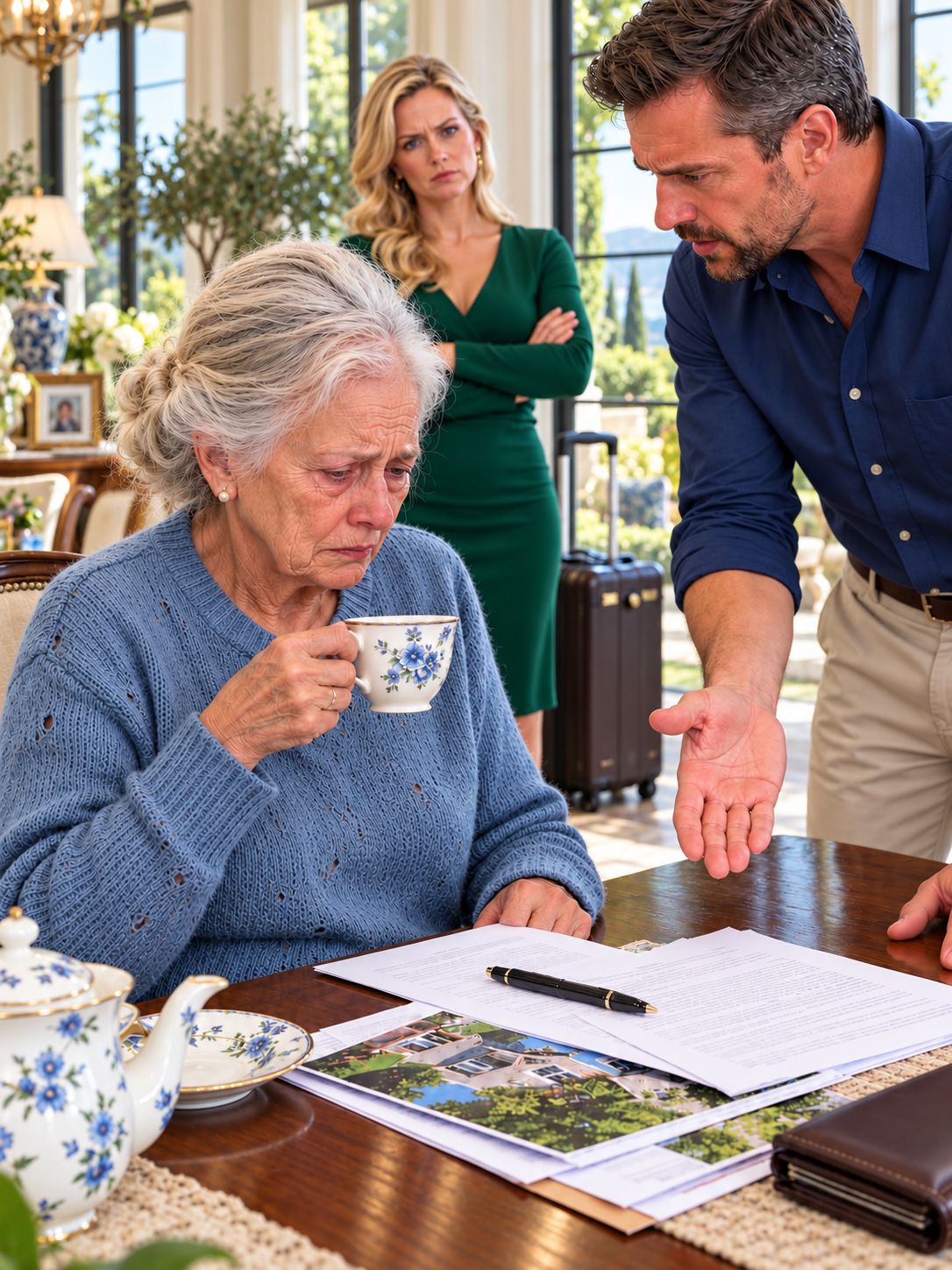
“Mom, we’ve arranged somewhere for you to live,” Ethan announced. He did not sit down. He remained standing between me and the hallway, wearing the expression he used when explaining financial decisions to people he thought would not understand them. “It’s a nursing home with meals, supervision, and people your age. You can move in tomorrow.” Vanessa placed the brochure on the kitchen table and turned it toward me. Across the cover, beneath a photograph of two smiling elderly women, someone had written my name in blue ink. I had never visited the place. Nobody had asked whether I wanted to.
I looked at the brochure, then at my son. “And what happens to the house?” Ethan exchanged a brief glance with his wife. It was so quick that someone who did not know him might have missed it. I had watched that face since he was a newborn. I knew when he was withholding something. Vanessa opened the folder, removed several pages, and arranged them beside my teacup. A pen followed. “We’ll handle the property,” she said. “There’s no reason for you to worry about maintenance or paperwork anymore. You just need to sign the transfer agreement.”
Outside the kitchen window, the maple tree Henry had planted stood nearly motionless in the pale October sunlight. Its lower branches carried a scattering of yellow leaves. I remembered Henry crouching beside that tree in his work trousers, pressing soil around its thin trunk while Ethan, only a little boy then, attempted to help with a plastic shovel. My son had once been so proud of that tree that he insisted on measuring its height every spring. Now he was standing in the same kitchen, asking me to surrender a house he assumed would soon belong to him.
“What would I be signing?” I asked. Vanessa tapped the uppermost page. “It transfers ownership to us. We’ve already spoken about what needs to be done around here. The house is old, Margaret. It requires someone who can make sensible decisions.” Her voice was controlled, almost pleasant, but she kept one finger pressed against the document as though she feared I might push it away. Ethan added that this arrangement would spare me complicated decisions later. I noticed that neither of them mentioned Henry, my wishes, or the fact that I had never authorized their plans.
For the past several months, I had suspected that Ethan and Vanessa were preparing something. The brochures had started appearing in August. At first there was only one, tucked beneath the newspaper on the kitchen counter. Later came printed comparisons of residential care facilities, handwritten estimates of monthly expenses, and conversations that stopped whenever I entered the room. Once, Vanessa asked whether my handwriting had become shaky. Another evening, Ethan wanted to know where Henry had kept our original property records. I answered his questions carefully without revealing the arrangements already made through Daniel Brooks.
I had not spent those months doing nothing. In April, after receiving independent legal advice, I had sold the house on Willow Creek Road for $412,000. Thomas Reed, a retired school administrator who appreciated Henry’s carpentry, had purchased it under an agreement allowing me six months to prepare for my departure. During that time, I had bought a smaller home near Charlotte and quietly arranged my possessions. The transaction was complete. The sale proceeds were secured in an account controlled only by me. Yet Ethan still believed the house was his future inheritance, waiting for my departure.
The secrecy had weighed on me more than I cared to admit. I had never enjoyed withholding information from my family. Henry and I had spent our marriage discussing purchases at the kitchen table, even when the purchase was something as modest as a new lawn mower. But Ethan had stopped treating me as someone entitled to participate in decisions. Every attempt to discuss our living arrangement ended with him telling me not to complicate matters. Eventually, I had recognized that announcing my intentions before the legal arrangements were secure would expose me to months of pressure I no longer had the strength to endure.
Daniel had been careful with every document. He had reviewed the deed, explained the obligations attached to the temporary occupancy agreement, and made certain that I understood the closing papers before I signed them. Charlotte attended meetings when I wanted company, but she never answered questions on my behalf. I remembered Daniel asking whether I was making the decision freely. I had looked through his office window at people crossing the street, carrying shopping bags and umbrellas, and realized how long it had been since anyone had asked me that question seriously. “Yes,” I told him. “I am.”
Now Ethan pulled out the chair opposite mine. “We need an answer today, Mom.” I studied his hands resting on the table. They were Henry’s hands, broad across the knuckles, with a pale scar near the thumb from an accident repairing a bicycle years earlier. Seeing that resemblance almost defeated me. It reminded me of the days when Ethan came home from school with scraped knees and terrible worries that seemed enormous to him. Back then he had trusted me to make things right. Somewhere along the years, that trust had turned into a belief that I would always make things convenient for him.
“Why Friday?” I asked. Vanessa opened her mouth, but Ethan answered first. “Because we’ve arranged the room, and we need to get started here.” He glanced toward the living room. “There are contractors we’ve been talking to. If we’re going to improve the place, we can’t keep putting it off.” I asked what improvements he meant. He began describing the kitchen, the flooring, and the possibility of replacing the built-in cabinets. Vanessa mentioned opening the wall between the dining room and hallway. They spoke with the ease of people discussing a project that had already been approved.
I pictured Henry measuring those cabinets, running his fingers along the grain before choosing each board. He had worked slowly, refusing to hide mistakes beneath paint when he could make a proper joint instead. Thomas Reed had understood that craftsmanship from the moment he entered the house. He had stood in front of the bookshelves longer than some people spend inspecting an entire property. Hearing Vanessa talk about tearing out those same features strengthened my certainty that I had selected the right buyer. I had sold the building, but I had not surrendered its history to people who considered that history an inconvenience.
Vanessa slid the pen closer. “Margaret, we’re not trying to be unkind. You’re eighty-one. At some point, you need to accept that other people can manage things better.” I picked up the pen and examined the scratched plastic barrel. Then I placed it beside the brochure. “I have been managing my own affairs for a very long time,” I replied. “Your father-in-law and I managed to pay off this mortgage before either of you moved here.” Ethan sighed. “Nobody’s questioning what you did in the past. We’re talking about what makes sense now.”
It was a familiar dismissal. When I protested about losing my bedroom, Ethan had reminded me that it was only furniture and space. When Vanessa removed Henry’s photographs, he said she was trying to make the house cheerful. When he began collecting three hundred dollars from my pension each month, he called it a reasonable contribution to household costs. I had accepted those explanations for too long because challenging them meant admitting that the people who claimed to be caring for me had become the people I feared upsetting most.
I pushed my chair back, not because I intended to leave but because I needed a little distance from the papers. Ethan immediately leaned forward. “Where are you going?” His question irritated me more than his previous remarks. I was still in the kitchen where I had prepared thousands of family meals, but he sounded like a supervisor questioning an employee. “Nowhere,” I said. “I am sitting in my chair differently.” Vanessa looked toward the clock. “We have things to do this afternoon.” I returned my attention to the documents and asked whether they had consulted an attorney.
Vanessa hesitated. “We found a standard property transfer form.” I asked who had prepared it, whether anyone had examined the deed, and whether they understood the legal consequences of asking me to give away my house. Ethan rubbed the back of his neck. “Mom, you’re making this more complicated than necessary.” I did not argue. Their confidence depended on my willingness to accept their explanations without examining them. For the first time in almost two years, I could see how fragile that confidence really was.
My telephone lay beside the sugar bowl. Charlotte had returned from her business trip that morning and was waiting nearby. Thomas had agreed to accompany her because the final transfer of possession was approaching. I had intended to bring them into the conversation after telling Ethan about the sale myself. But I had not anticipated my son’s decision to place my luggage beside the door and demand my signature before allowing me another day under the roof. His impatience had moved the confrontation forward.
I glanced at the suitcase. The zipper was partly open. Through the gap I could see the sleeve of my blue cardigan, the one Charlotte had given me for Christmas. I wondered what else Vanessa had packed and whether my medicines, reading glasses, and photographs were included. There was something particularly cruel about the careless way my belongings had been gathered. They had managed to plan the renovations and discuss the house’s value, yet they had not considered that an elderly woman might want to choose what she carried into the next chapter of her life.
“Did you speak to anyone at this nursing home about what I want?” I asked. Ethan frowned. “They said they could accommodate you.” “That isn’t what I asked.” Vanessa folded her arms. “You keep acting as though we’re abandoning you. It’s a respectable place.” I believed it might well be respectable. That wasn’t the issue. A comfortable room selected without my consent would still be a place someone else had chosen for me. I was capable of making decisions, and they had deliberately excluded me from the most important one.
Ethan’s patience finally slipped. “You can’t stay here forever, Mom. We have our own future to think about.” The words hung between us. He looked away almost immediately, but he did not withdraw them. I remembered the March evening when I overheard him speaking about selling the property and paying off his truck. At the time I had hoped he was merely speaking carelessly, perhaps exaggerating to whoever was on the telephone. Hearing him now, I understood that the future he imagined had never included asking whether I would be comfortable, secure, or happy.
I reached for the folder and lifted the first page. The names of the proposed recipients appeared where I expected them: Ethan Wilson and Vanessa Wilson. My name occupied the space marked for the current owner. They had left the date blank, apparently expecting me to complete it. I thought of Henry’s last months, the leather folder of deeds and estate papers, and his insistence that everything be placed properly in my name. His careful work had protected me long after he was gone. I lowered the paper and looked at my son.
“Before I sign anything,” I said, “there is someone you should speak to.” Ethan’s expression softened slightly, as though he thought I was finally ready to cooperate. “All right. Who?” “The person who owns this house.” He gave a short laugh. “Mom, Dad died two years ago. You’re the owner. That’s exactly why we’re asking for the signature.” I held his gaze. I had imagined this conversation many times, sometimes with anger and sometimes with dread. When the moment arrived, my voice was remarkably steady. “I was the owner, Ethan. I am not anymore.”
Vanessa stopped turning the pages. Ethan stared at me with a look I remembered from his childhood, when he encountered an answer he had not prepared for. “What does that mean?” he asked. I told him that ownership of property did not remain unchanged merely because someone expected it to. He leaned back, studying my face. “Are you saying you gave it away?” There was genuine alarm in his voice now. I shook my head. “No. I made a lawful decision about something that belonged to me.”
He stood so abruptly that his chair scraped the floor. “You would never make a decision like that without telling me.” It was not a question. I could have reminded him of the day he arrived with a moving truck without consulting me. I could have described waking to find my bedroom emptied or discovering that the sewing room had become my entire living space. Instead, I said, “You have made several important decisions about my life without telling me. Perhaps you can understand why I needed an opportunity to consider this one without interference.”
Ethan began pacing beside the table. Vanessa reached for the folder and stacked its contents into a neat pile. Her careful movements did not disguise her agitation. “We need to know exactly what you’ve done,” she said. I understood her concern. Their plans for the kitchen, their imagined ownership, and whatever financial calculations they had made depended on the assumption that the property was still mine. If I had changed that fact, the foundation of everything they expected would disappear.
I picked up my telephone and opened Charlotte’s message. She had written earlier that she and Thomas were nearby and ready whenever I wanted them to come. I typed a short reply telling her that Ethan and Vanessa needed to meet the owner. My thumb hesitated above the screen for a second. Sending that message would end the secrecy. There would be no quiet way to return to our former arrangement afterward, but that arrangement had already cost me too much. I pressed send.
Ethan watched me. “Who are you contacting?” “Someone who can answer your questions.” Vanessa crossed the kitchen and looked through the front window. “Is this about Charlotte?” she demanded. Ethan’s jaw tightened at his daughter’s name. He had not spoken to her in seven years, ever since their disagreement over the business he wanted her to join. I knew he resented her independence. I also knew that Charlotte had shown me more respect during one afternoon of conversation than he had shown me through countless lectures about my age.
“I spoke to Charlotte because I wanted advice,” I said. “She encouraged me to find an independent attorney. The decisions were mine.” Ethan shook his head. “She has been trying to prove something ever since she walked away from the business.” I heard the accusation beneath his words: Charlotte could not possibly have helped me without an ulterior motive. It had become difficult for him to understand kindness that did not involve a financial expectation. I felt a small, sharp sadness at that realization.
A car pulled into the driveway. Vanessa remained at the window. The sound of its tires over the loose gravel was followed by two doors closing. I glanced toward Henry’s bookshelves, then toward the suitcase waiting to be carried away. Everything I had endured in that house seemed contained within those few yards of hallway. I had loved this place when it was full of ordinary family noise. I had grieved in it after Henry died. And I had gradually learned to make myself smaller inside it to avoid disturbing the people who claimed they had come to help.
The doorbell rang. Ethan moved toward the hallway, but Vanessa reached the door first. From my chair, I heard her draw a startled breath. A familiar young woman’s voice greeted her politely. Then another voice, older and measured, introduced himself. Ethan stopped halfway down the hall. His posture changed before anyone said another word. I knew he recognized his daughter’s voice, though seven years had passed since he had last welcomed her into a room.
Charlotte stepped into view wearing a dark coat and carrying her work bag. Beside her stood Thomas Reed, his silver hair neatly combed and a leather document folder tucked beneath one arm. Charlotte looked toward me first, and I gave her a small nod. Then she faced her father. “Hello, Dad,” she said. Ethan did not reply. She moved slightly aside so that he could see the man beside her. “This is Mr. Thomas Reed,” she continued. “He purchased Grandma’s house six months ago.”
END PART 5
PART 6 TITLE: The Stranger Holding Henry’s House Deed Revealed the Price of My Freedom and Exposed What My Son Had Been Counting On
For several seconds, nobody spoke. Ethan remained near the hallway, staring at Thomas Reed as though the man had entered the wrong address. Vanessa was still holding the front door open. The October air drifted into the house, carrying the smell of damp leaves from the garden. Charlotte stepped inside, removed her coat, and glanced toward the kitchen table. She saw the transfer agreement almost immediately. Her expression tightened, but she said nothing. I was grateful for that restraint. This was a conversation Ethan needed to have with me, even if he had spent years avoiding conversations in which my wishes mattered.
“Purchased?” Ethan repeated at last. His eyes moved between Charlotte and Thomas. “What do you mean, purchased?” Thomas did not react to his tone. He introduced himself as a retired school administrator and explained that he had completed the purchase through the usual legal process in April. Ethan looked over his shoulder at me. “Mom, what is he talking about?” I rose carefully from my chair, placing one hand on its wooden back. “He is telling you that I sold the house,” I said. “The sale was completed six months ago.”
Ethan gave a disbelieving laugh, but it sounded different from the one he had offered when I first mentioned the owner. “That’s impossible. We’ve been living here.” Thomas nodded. “Mrs. Wilson retained the right to occupy the property temporarily after closing. We agreed that possession would transfer later in October.” His explanation was measured, without accusation. He had spent decades dealing with parents, staff, and difficult school board meetings. I suspected he recognized the value of allowing people a few moments to absorb unwelcome information before saying more.
Vanessa closed the front door and stepped toward him. “We’ve been planning renovations. Ethan was told this house would eventually belong to him.” She turned to me. “You never said anything about selling.” I did not deny it. I had kept the transaction private while preparing my departure, and there was no point pretending otherwise. “I chose to sell after speaking with my attorney,” I replied. “The property belonged to me. I considered my options and made the decision that seemed best for my future.” Vanessa stared as though my use of the word future were itself unreasonable.
Thomas set his folder on the corner of the kitchen table, well away from the papers Vanessa had brought. He removed copies of the recorded deed and the agreement permitting my temporary occupancy. Ethan leaned over them, following the lines with his finger. He found the dates, the signatures, the names of the parties, and the description of the property on Willow Creek Road. There was no ambiguity. The transaction had been concluded, the ownership recorded, and the period during which I could remain was approaching its end.
I watched his face as he read. It reminded me of Henry studying a faulty measurement on a piece of furniture. Henry would narrow his eyes, check the figures twice, and then decide how to correct the error. Ethan had inherited the expression but not, in that moment, his father’s willingness to accept what the measurements showed. He flipped to another page, then returned to the first. Finally, he looked at Thomas and asked whether the documents were genuine. Thomas answered that the deed had been properly recorded and could be independently verified.
“Who represented you?” Ethan demanded, turning toward me. “Daniel Brooks,” I replied. “He’s an independent attorney. He reviewed the transaction and made certain I understood the terms.” Ethan repeated the name under his breath. “And you never once thought to involve your own son?” I felt Charlotte shift beside me, but I answered before she could speak. “I involved the people whose participation was necessary. You weren’t an owner, Ethan. I did not require your permission.” He looked offended, as though I had broken a promise by stating a fact.
His attention returned to the sale documents. Then he stopped at the price. “Four hundred and twelve thousand dollars?” The question came so quickly that I knew what he had seen. Thomas confirmed the figure. Ethan stared at it, his mouth slightly open. I could almost follow the calculations taking place behind his eyes: the truck payments, the renovations, the money he had imagined receiving when the property passed into his hands. He looked at me again, and the next question emerged before he had considered what it might reveal. “Where is all that money now?”
Charlotte lowered her eyes. Vanessa became perfectly still. Even Thomas seemed to hesitate before closing his folder. I studied my son, hoping he might realize what he had just asked. He did not. “Mom, that’s a lot of money. Where did you put it?” I remembered the nights I had spent alone in the sewing room, examining my bank statements and wondering whether I could afford a peaceful place to live. I remembered calculating property taxes, insurance, moving costs, and the funds I would need if my health changed. Those had been difficult decisions, made without his help.
“I used some of the proceeds to buy another house,” I said. “The remainder is reserved for my expenses and future care.” Ethan looked genuinely startled. “Another house?” “Yes.” “You bought property without telling us?” Vanessa asked. Her voice rose on the last word. I told them that the home was smaller, more practical for one person, and located in a neighborhood that suited me. I had chosen it after considering several alternatives. No one had persuaded me to make a reckless purchase, and no one was holding the money on my behalf.
“Where is this house?” Ethan demanded. “Near Charlotte,” I answered. That was enough to redirect his anger. He turned toward his daughter so sharply that she moved back half a step. “Of course. Now I understand.” Charlotte faced him without raising her voice. “What do you understand, Dad?” He gestured toward Thomas’s folder. “You convinced Grandma to sell the family home, and now she’s moved near you. What did you promise her? What are you getting out of this?” I saw Charlotte’s cheeks color, although her voice remained controlled.
“I haven’t asked Grandma for anything,” she said. “She called me because she needed help understanding her choices. I suggested an attorney who wasn’t connected to our family. She made her decisions herself.” Ethan shook his head. “You’ve been angry with me for years.” “Yes,” Charlotte replied. “We have things we never resolved. That doesn’t mean every choice Grandma makes is part of our disagreement.” I could see that she had rehearsed some version of this conversation, perhaps during the drive over. Seven years was a long time to carry silence between a father and daughter.
Vanessa stepped closer to Charlotte. “You knew we were living here. You must have understood what selling the property would mean for us.” Charlotte met her gaze. “I knew Grandma was sleeping on a folding bed in the room where she used to sew. I knew her belongings had been moved without her agreement. I knew she wanted somewhere peaceful.” Vanessa’s mouth tightened. “That isn’t the whole story.” Charlotte did not pretend it was. She simply said that she had encouraged me to obtain professional advice and make my own decisions. Nothing in that answer satisfied Vanessa.
I understood that Ethan and Charlotte’s estrangement made him suspicious of her involvement. When Charlotte refused to join his business seven years earlier, he had interpreted her choice as a rejection of him. She wanted to develop her own career in financial administration and continue studying matters related to property law. He had wanted her abilities beside him. Neither had been willing to retreat from the disagreement, and over time their pride had settled into silence. Henry had been saddened by it. I had been saddened too. But I would not allow their history to erase Charlotte’s generosity toward me.
“Charlotte didn’t sign the deed,” I said. “She didn’t negotiate the price, and she didn’t receive any part of the proceeds. I did those things after reviewing the information with Daniel. If you’re angry about the sale, speak to me.” Ethan looked at me as though I had stepped between him and an argument he knew how to win. I could not repair his relationship with his daughter, but I could prevent him from making her responsible for a decision that belonged entirely to me.
Thomas waited until the voices settled before speaking again. He reminded us that the agreement established a date for the property to be delivered vacant. He had allowed me additional time because I needed to prepare for a careful move, not because the closing had been uncertain. He now intended to take possession as planned. “My concern today,” he explained, “is making sure everyone understands the arrangement and that the handover proceeds without unnecessary difficulties.” He spoke politely to Ethan and Vanessa, but he did not suggest that their plans could change the legal status of the property.
Ethan tapped the temporary occupancy agreement. “Nobody told us there was a deadline.” I felt the truth of that statement and the difficulty surrounding it. I had delayed revealing the sale because I expected pressure and hoped to have Charlotte beside me when the conversation finally happened. I had also underestimated how far Ethan’s plans might advance while he remained unaware. “I had arranged to speak to you after Charlotte returned,” I said. “That was today. You came to me first with a different plan.” He stared at the nursing home brochure, now lying uselessly beneath Vanessa’s papers.
“But we’ve put time into this,” Vanessa insisted. “We’ve talked to people about the kitchen and made arrangements for furniture.” Thomas explained that the house was no longer available for her proposed changes. Nothing about their conversations with contractors gave them ownership. Vanessa asked whether she could at least speak to someone about the cost of cancelling the proposed work. I told her that any commitments she had made without my authorization were matters she would need to address herself. Her eyes flashed with anger. She had expected me to feel responsible for solving the inconvenience.
Ethan moved toward the living room. His footsteps sounded heavy on Henry’s old floorboards. We followed slowly. He stopped in front of the bookshelves his father had built, examining the smooth edges and the carved trim. I wondered whether he was remembering the weekends Henry spent making them. Thomas joined us and spoke with unexpected warmth about the workmanship. He mentioned that his own father had been a carpenter and that preserving the original features was one of the reasons he wanted the property. “These shelves belong with the house,” he said. “I don’t intend to remove them.”
For the first time that afternoon, Ethan appeared uncertain rather than angry. “Vanessa wanted to replace them,” he admitted. Vanessa looked offended. “They aren’t practical for the design we discussed.” Thomas glanced toward her, then back at the wood. “They are practical enough for me.” His answer was gentle, but final. I felt a peculiar mixture of relief and grief. A stranger who had known Henry only through the things he built understood something my own family had stopped noticing. The house had not merely been a collection of rooms waiting to acquire a higher market value.
We returned to the kitchen, where the property transfer agreement remained on the table. Ethan picked it up and turned the pages once more. He looked toward Thomas. “So if Mom signed this, it wouldn’t give us anything?” Thomas explained that I no longer owned the property and therefore could not convey it to them through such a document. A valid transfer would have required action by the actual owner. Ethan lowered the papers. Vanessa reached for them, but he did not let go immediately. He seemed to be examining the evidence of a plan whose central assumption had disappeared.
“Why didn’t you tell me in April?” he asked quietly. That question was different from his earlier accusations. I considered several answers and chose the one nearest the truth. “Because every time I tried to discuss how I wanted to live, you told me I was being difficult. I needed to know I could make a decision without being persuaded that my own judgment no longer mattered.” His shoulders lowered slightly. He looked at Vanessa, then toward the corridor that led to my sewing room. I could not tell what he was thinking, but for once he did not immediately argue.
Charlotte checked her telephone. Daniel had sent a brief message confirming that he remained available if clarification was needed about the final handover. She showed it to me without placing the screen in front of Ethan. I appreciated that small act of discretion. We were not trying to humiliate him through a succession of unexpected people or documents. We were trying to make a difficult transition occur properly. Yet I knew that, from his perspective, the afternoon must have felt like a series of doors closing: the property, the anticipated money, and the ability to direct my future.
Ethan asked whether the temporary occupancy agreement could be extended. Thomas explained that he had made arrangements based on the agreed date and intended to proceed. Any change would require a new agreement, and none had been offered. I knew the answer disappointed my son, but I also knew that another postponement would place me back inside the familiar pattern of waiting for Ethan and Vanessa to become ready for a decision I had already made. There would always be another expense, another inconvenience, another reason why I should delay my own plans.
Vanessa returned to the kitchen table and began gathering her documents. “This leaves us in a terrible position,” she said. Her voice had softened, though I could not tell whether the change came from fear or calculation. “We don’t have anywhere prepared.” I felt the old instinct rise immediately. I wanted to ask what they needed, whether I could call someone, whether there was money I might contribute toward a deposit. For years, I had smoothed over the consequences of Ethan’s decisions. He had come to expect that I would find a way to protect him from discomfort.
My gaze fell on the brown suitcase. I had been given less than a day to abandon my home for a nursing facility I had never chosen, and neither Ethan nor Vanessa had regarded that as an unreasonable demand. Now they faced the inconvenience of arranging accommodation for themselves, and suddenly there was time to discuss fairness. I rested my hand on the kitchen counter, feeling the cool edge beneath my fingers. I was not pleased by their predicament. I simply could no longer accept responsibility for preventing every difficulty they encountered.
“I understand that you need somewhere to live,” I said. “But I have already made my arrangements. You will need to make yours.” Vanessa stared at me. Ethan looked toward the window. I continued before either could interrupt. “You have time to speak with landlords and organize your belongings. Daniel can explain the agreed handover requirements. Charlotte can help me with the remainder of my move. What I cannot do is give you a house I no longer own or sacrifice the home I’ve purchased because you expected something different.”
Thomas quietly closed his folder. The legal facts were now clear, and he had no interest in turning a private family argument into a spectacle. He reminded Ethan that all occupants would need to depart by the agreed possession date and that any concerns about the process should be raised through Daniel. Then he stepped toward the porch, offering us some privacy. I watched him leave, struck by how little he had demanded. He wanted the property he had purchased, delivered under the terms both of us had accepted. That was all.
Ethan sat down where he had begun the afternoon, opposite my untouched cup of tea. Vanessa remained standing. Charlotte leaned against the doorframe, close enough to support me without entering the conversation. My son stared at the transfer agreement as though he might discover something that changed its meaning. At last he lifted his eyes. “Mom, I thought this house would stay in the family.” I remembered making the same assumption for decades. It was difficult to hear him speak with genuine sadness when he had shown so little concern for mine.
“So did I,” I answered. “But your father left the house to me because he wanted me to be secure. He didn’t leave instructions that I should surrender my life so the building could remain in the family.” Ethan looked toward Henry’s photograph, visible through the open doorway of my sewing room. His expression shifted. I could see the beginning of a question forming, one he had avoided through all our arguments over bedrooms, money, furniture, and renovations.
“Mom,” he said, his voice lower now, “did we really make you feel that unwelcome?” The room became very still. For nearly two years, I had wanted him to ask something like that. Now that he had, I knew an easy answer would spare him discomfort but leave us exactly where we had been before. I pulled out the chair beside him and sat down. “Yes, Ethan,” I said. “And since you’ve finally asked, I think it’s time you heard the things I stopped trying to tell you.”
END PART 6
PART 7 TITLE: When My Son Finally Asked Why I Was Leaving, I Told Him About the Small Cruelties He Had Refused to Notice
For a moment, Ethan appeared to regret asking. He folded his hands on the table and stared at the pale lines between the floorboards. Vanessa stood beside the counter, watching me with the wary expression of someone expecting an accusation. Charlotte remained near the doorway. I could hear Thomas moving along the front porch, his shoes making soft sounds against the boards Henry had repaired shortly before he became ill. Nobody interrupted me. After nearly two years of being told that my concerns were unimportant, the silence felt unfamiliar.
“Do you remember the day you moved me out of my bedroom?” I asked. Ethan glanced toward the hallway. “Vanessa thought the smaller room would be easier for you.” I nodded. “I remember what Vanessa thought. I’m asking what you remember.” His forehead creased. “We needed more room for our things.” “And you assumed that gave you the right to take mine.” He opened his mouth, then closed it. I could see him beginning to examine an event he had dismissed almost as soon as it happened.
I described returning from the grocery store and discovering my dresses hanging in the sewing room, my belongings crowded onto shelves between spools of thread and folded fabric. The bed where I had slept beside Henry for almost fifty years had become Ethan and Vanessa’s bed before anyone had asked whether I wished to move. I remembered placing my groceries on the hallway floor because I could not understand what had happened. Vanessa had explained the arrangement as though she had reorganized a cupboard. Ethan had told me there was no reason to become upset.
“I didn’t realize it affected you that badly,” he said. I looked at him for a long moment. “I told you it upset me. You said I was making things complicated.” His face tightened, not with anger this time, but with recognition. I continued carefully. “The sewing room was never meant to be a bedroom. Henry built those shelves so I could keep my fabrics there. After you moved me, I had to fold the bed whenever I wanted enough space to cut material. Some days I simply stopped sewing because moving everything was too exhausting.”
Charlotte looked down at her hands. She had seen that room during her first visit, and I knew how much the sight had disturbed her. Ethan, however, seemed to be seeing it properly for the first time. He turned toward the hallway, and his gaze followed the narrow passage to the small door. “I thought you liked being near your sewing things,” he said. I almost smiled at the absurdity of it, but his confusion was genuine enough to make laughter feel cruel. “I liked having a sewing room,” I replied. “That doesn’t mean I wanted to live inside it.”
Vanessa shifted her weight. “We weren’t trying to make you uncomfortable. We were trying to organize the space sensibly.” I acknowledged that she had reasons for wanting a larger bedroom, but reasons were not the same as permission. She had never asked whether I would agree. She had simply acted, confident that Ethan would support her if I objected. I remembered watching him stand behind her in the hallway, impatient with my distress. The memory had remained so sharp because it was the first time I understood that being the owner of the house no longer made me the person whose preferences mattered most.
“Then there were your father’s things,” I said. Ethan looked toward the mantel, where Henry’s photograph had once stood. Vanessa had removed it during one of her efforts to modernize the living room. When I asked where it had gone, she said the old photographs made the house gloomy. I eventually found it wrapped in a towel inside a box in the garage. Henry was smiling in that picture, wearing the brown sweater Charlotte had given him. It had been taken during an ordinary Sunday lunch. I could still remember the smell of roast chicken and the sound of him teasing Charlotte about her college plans.
Ethan rubbed his forehead. “I didn’t know she’d put it in the garage.” Vanessa immediately objected. “It was packed with the other things we weren’t using.” I looked at her. “I was using it. I looked at that photograph every day.” Her lips tightened. I did not raise my voice. There was nothing to gain by turning the moment into a contest of volume. I explained that after Henry died, certain familiar objects helped me endure the silence he left behind. His reading lamp, the photograph, the rocking chair, and the little wooden box he kept beside his chair were not merely decorations awaiting replacement.
My husband had been a quiet man, more comfortable repairing a broken table than speaking at length about his feelings. During his last illness, he sometimes sat on the porch with a blanket across his knees, watching the birds gather beneath the maple tree. One evening he held my hand and reminded me that he had placed the house entirely in my name. He wanted me to remain secure whatever happened after his death. “He made me promise never to let anyone treat me like a visitor in my own home,” I said. “I kept the legal part of that promise. The harder part took me longer.”
Ethan’s eyes filled, though he blinked quickly and turned away. I had not intended to make him cry. I wanted him to understand that Henry’s wishes were not represented by preserving a deed in the family name. Henry had cared about the people living inside the house. He had built the extra bedroom when Ethan was born because he wanted his son to have space to grow. He had built bookshelves because he loved reading in the evenings. He had never measured the value of those improvements only in dollars.
I turned to the kitchen table and continued. “Do you remember when you began taking three hundred dollars from my pension every month?” Ethan nodded. “It was for household expenses.” “I know what you said it was for.” I explained that I had never objected to contributing fairly toward food or utilities. Henry and I had always believed in paying our share. What hurt was the way Ethan had presented it: a fee I was expected to pay while being reminded how fortunate I was that he and Vanessa had moved in to look after me.
“At first, Vanessa cooked dinner most nights,” Ethan said. “I repaired things around here.” I agreed. He had fixed a cabinet handle during the first week, and Vanessa had prepared meals while I was still exhausted from grief. Those gestures had been helpful. I had thanked them sincerely. But over time, meals were prepared without asking whether I wanted any, and repairs became part of a larger argument that they were doing me a favor by occupying my house. Their occasional assistance did not erase the fact that I had lost control over nearly every room.
Vanessa looked at the table. “We did plenty of work here.” I did not deny it. I remembered her cleaning the kitchen after a family gathering and taking me to an appointment when my knee was troubling me. I remembered Ethan carrying heavy groceries and replacing a loose step at the back door. “You did help with certain things,” I said. “I appreciated them. But helping someone does not entitle you to rearrange that person’s life without asking. Gratitude isn’t an agreement to surrender ownership, dignity, or independence.”
Ethan drew a slow breath. “I really thought we were making things easier.” I could hear how badly he wanted that explanation to be enough. I had wanted to believe it myself when the changes first began. It was easier to imagine that my son was clumsy with kindness than to consider that he might be placing his convenience above my well-being. But the telephone conversation I overheard in March had removed much of that comforting uncertainty. I told him what I had heard, choosing the facts rather than the harshest interpretation.
“You were discussing what the house might sell for after I was gone,” I said. His face went pale. Vanessa looked sharply toward him. I continued. “You mentioned paying off your truck. You spoke as though the money had already become yours.” Ethan began to protest, then stopped. He remembered. I could tell from the way his shoulders dropped. After a long silence, he said that he had been talking about the future, not planning to hurt me. I believed he had not wanted to think of himself as cruel. That did not change what I had heard.
“Perhaps you didn’t intend me to hear it,” I said. “But you were making plans around property you didn’t own. You spoke about my leaving as something that would benefit you financially.” He stared at the table. Vanessa reached for the transfer agreement and slid it into her folder. The papers made a dry scraping sound against the wood. I wondered whether she understood that the conversation had never been solely about money. The sale was the visible consequence of a much longer failure to recognize me as a person capable of choosing how to live.
Ethan looked up. “You could have told me how bad things were.” The words stung, because I had tried. I reminded him of the times I asked to have my bedroom restored, when I requested that Henry’s photographs be returned, and when I questioned why the house was being discussed as though I no longer owned it. Each time, he had treated the conversation as an inconvenience. “You didn’t refuse to listen just once,” I told him. “You practiced refusing until I stopped asking.”
Charlotte turned her head toward the window. I suspected she was trying to give us some privacy. Her father had dismissed her wishes seven years earlier too, though the circumstances had been different. She had wanted to study and build a career outside his business. He had interpreted that decision as disloyalty. I wondered whether he recognized the similarity now: two women in his family had made choices he disliked, and he had responded by treating their independence as a personal injury.
“I should have paid attention,” Ethan said at last. Vanessa did not speak. For a moment I saw the boy who used to sit beside Henry watching him work, fascinated by the patience required to fit two pieces of wood together. He had not been born incapable of listening. Somewhere between youthful ambition and adult disappointment, he had learned to value his plans so highly that other people’s preferences became obstacles. I could not undo those years for him. I could only refuse to let the habit continue at my expense.
Vanessa crossed her arms and asked whether I intended to blame them for everything. I told her I did not. Henry’s death, my loneliness, and my reluctance to confront uncomfortable truths had all shaped the situation. I had allowed too many small decisions to pass without insisting that my voice be heard. But accepting responsibility for my silence did not absolve them of taking advantage of it. Vanessa seemed dissatisfied with that distinction. She looked toward Ethan, apparently expecting him to defend her. This time he remained quiet.
I told them that my move was not an attempt to punish them. The smaller house had wide doorways, an easier layout, and a room for sewing that did not have to serve as a bedroom. I could walk to the library, visit Charlotte without a lengthy journey, and manage the property without worrying about a large yard. Those advantages would remain even if Ethan apologized. “I am not selling the house to teach you a lesson,” I said. “I sold it because I needed a home where I could live comfortably and make decisions without asking permission.”
Ethan glanced toward the suitcase by the front door. I watched him recognize the contrast between his intentions and mine. He had planned to send me somewhere he had chosen; I had chosen somewhere myself. He had prepared a document to transfer property into his name; I had already completed a lawful transaction for my own security. He had treated the following Friday as a deadline I must obey; the actual ownership arrangements had established a separate obligation neither he nor Vanessa could ignore. The balance had shifted not because I had gained power over him, but because I had finally exercised authority over my own life.
“Where are we supposed to go?” Vanessa asked. There was worry beneath her irritation now. I told her that she and Ethan would need to look for accommodation and organize their belongings before the handover. If they needed clarification about the timetable, Daniel could explain it. I would not pretend that finding a suitable rental property was effortless. But they were adults, with the ability to make decisions, inspect houses, and manage their affairs. I was eighty-one, and they had expected me to accept an unfamiliar nursing home with less preparation than they now wanted for themselves.
The familiar urge to soften my answer was almost painful. I could have offered money for moving expenses. I could have suggested delaying my departure so they would feel less abandoned. But I remembered the months I had spent selecting curtains for a house I was afraid to mention aloud. I remembered packing my photographs quietly, hoping Vanessa would not notice. That was not how I wanted to spend the years remaining to me. “I can love you,” I told Ethan, “without solving every problem for you. Those are two different things.”
Thomas returned briefly to ask whether we needed any further information about the occupancy agreement. Ethan shook his head. The older man confirmed that the final inspection would proceed through the established arrangements and that Daniel could answer procedural questions. Then he offered to give us a little more time before we completed the afternoon’s practical matters. I thanked him. His patience made the situation less humiliating than it might have been. He did not treat my family with contempt, and he did not pretend that our conflict changed his responsibilities as the purchaser.
Charlotte approached me after Thomas stepped outside. “Grandma, would you like me to put your suitcase in the car?” I looked toward the hallway. The case had stood beside the door throughout the conversation, an object chosen by Ethan to make my departure unavoidable. Its meaning had changed while we spoke. I was still leaving, but I was not going to the destination he had selected. I would take the suitcase to a house I owned and had chosen freely. “Yes, sweetheart,” I said. “Please take it out.”
She bent to lift the handle and paused. “Is everything you need inside?” I admitted that I wasn’t certain. Vanessa looked uncomfortable. Charlotte opened the case just enough for me to check. My cardigan was there, along with several dresses and a pair of slippers, but Henry’s photograph remained in the sewing room. So did my favorite sewing scissors, his old handwritten recipe for pancakes, and a little wooden box containing mementos from our marriage. Those were the things I wanted beside me during my first evening away. I asked Charlotte to give me a few minutes.
I walked down the hallway alone. The sewing room looked smaller than ever with the folding bed pressed against one wall and the emptied shelves exposing pale rectangles where fabric had protected the wood from sunlight. I gathered Henry’s photograph, the wooden box, and the few remaining possessions that mattered. At the doorway, I stopped and looked back. For nearly two years, I had considered this room my refuge because it was the only space Vanessa rarely entered. Now I could see how little I had accepted, mistaking a corner left undisturbed for genuine peace.
When I returned to the hallway, Ethan was standing beside the door. Vanessa had gone upstairs to begin considering their own packing, and Charlotte was already outside with the suitcase. My son glanced at the photograph in my hands. He seemed older than he had that morning. I could not know whether the conversation had truly changed him or merely shaken his confidence. His eyes traveled toward the empty space where my suitcase had stood, then back to my face. “Mom,” he said, almost too softly to hear.
I waited. His hand rested on the doorknob, but he did not open it. “I’m sorry,” he said. There was no explanation attached, no request for money, no suggestion that I should reconsider. I had wanted those words for a long time. Hearing them now hurt in a way I had not expected, because I understood how much might have been different if he had spoken them when the first small cruelties began. I looked at my son and allowed myself to believe that, for this moment at least, he recognized what he had done.
END PART 7
PART 8 TITLE: I Walked Away From Henry’s House Without Losing Our Memories, but My Son’s Next Decision Would Determine Whether We Still Had a Family
I held Henry’s photograph against my chest and looked at Ethan standing beside the door. His apology had been quiet, almost hesitant, and I could see how much effort it had taken him to speak without defending himself. For a moment I wanted to reach out and embrace him, the way I had when he was a frightened little boy. But the feeling was complicated by everything that had happened since Henry died. I did not want to reject an apology that might be sincere. Neither did I want to offer forgiveness so quickly that Ethan would mistake it for permission to forget what he had done.
“Thank you for saying that,” I replied. “I hope you mean it.” He nodded, looking directly at me. “I do, Mom.” I wanted to ask why he had waited until I was leaving, why a stranger’s deed had accomplished what nearly two years of my unhappiness had not. Instead, I studied his face. He seemed exhausted by the afternoon. So was I. There would be opportunities to speak again if he truly wanted to understand. For now, I needed to leave before the familiar instinct to protect him from discomfort persuaded me to surrender another part of myself.
Ethan opened the door. The porch was cool beneath my shoes, and the scent of autumn leaves drifted across the yard. Thomas stood near the railing, examining the craftsmanship Henry had left behind. He turned when he heard us. “Mrs. Wilson, I hope everything is all right.” I told him that we had finished our conversation and that Charlotte would help me complete my move. He nodded, then glanced toward the house. “I want you to know that I’ll take good care of the place,” he said. “Your husband put an extraordinary amount of work into it.”
I looked past him at the porch posts Henry had shaped by hand. Their paint had been renewed several times, but the original lines remained. Thomas’s promise touched me because it asked nothing in return. He had bought the property fairly, and he appreciated it for what it was. I had no right to control his future decisions about the building, but I believed he would treat its original features thoughtfully. “Henry would have been pleased to hear that,” I told him. Thomas smiled. “I think my father would have liked him.” Two men who had never met had found common ground through the work they left behind.
Charlotte stood beside her car with my suitcase already secured in the trunk. She came toward me when she saw that I was carrying Henry’s photograph and the wooden box. “Do you want me to take those?” she asked. I shook my head. “I’ll keep them with me.” She opened the passenger door and waited while I settled into the seat. From the porch, Ethan watched us without speaking. Vanessa had not come downstairs. I was unsure whether that meant she remained angry or simply could not bear to participate in my departure. I decided not to guess at an explanation I could not know.
Before Charlotte started the engine, I took one final look at the house on Willow Creek Road. Henry had begun building it in 1974, when we were newly married and believed that determination could compensate for a shortage of money. In many ways, it had. He worked long days as a carpenter, then returned home to work on our own place until the light faded. I managed our savings carefully, helped wherever I could, and learned more about paint, plumbing, and timber than I had ever expected. We built a marriage there before the building was finished.
I could still picture Ethan racing across the lawn on his first bicycle, Henry jogging behind with one hand hovering near the seat. I remembered the Christmas when a storm interrupted the electricity and we ate dinner by candlelight, laughing because Henry’s carefully timed roast had to finish in a neighbor’s oven. I remembered the afternoon Charlotte came home from school carrying a prize for an essay she had written. Henry had placed it on the mantel and told everyone who visited about it. Those memories did not belong to a deed, a bank account, or a particular arrangement of rooms.
As Charlotte backed out of the driveway, the maple tree moved slowly across my view. Its branches were larger than Henry could ever have imagined when he planted it. I felt grief at the thought that I would no longer watch its leaves change with the seasons. Yet the grief was not the crushing feeling I had expected. Beneath it was relief, unfamiliar and almost difficult to trust. I was leaving a home filled with memories, but I was also leaving the daily strain of waiting for criticism, requests, and decisions made without my participation.
For the first few minutes of the drive, Charlotte allowed me to remain quiet. The streets were familiar. We passed the corner store where Henry bought newspapers, the intersection where Ethan learned to wait for the pedestrian signal, and the small park where Charlotte had once insisted on feeding ducks despite the cold. I watched the houses passing outside the window. Families were arriving home with groceries. A man was sweeping leaves from his driveway. Somewhere behind those ordinary scenes, I imagined other people struggling to protect their relationships without losing themselves.
Charlotte finally asked whether I needed anything before we reached the new house. I thought about the question. For months, every journey away from Willow Creek Road had involved a small private calculation: how soon I needed to return, what Vanessa might have changed, whether Ethan would be irritated that I had been out too long. This afternoon, no one was waiting to question my whereabouts. “I think I’d like a proper cup of tea,” I said. Charlotte smiled. “We can manage that.” It was such a simple exchange that I almost laughed at how much comfort it brought.
The drive took about twenty minutes. We turned into a quiet residential street lined with modest houses, tidy front gardens, and trees already losing their leaves. My new home stood a little back from the pavement, with a small porch and wide windows facing the garden. I had visited it often during the summer, sometimes bringing measurements for furniture or samples of fabric. Yet arriving there with my suitcase, knowing I would not be returning to the old house to sleep, made the place look different. It was no longer a project I was preparing. It was home.
Charlotte parked beside the front walkway and came around to help me. I climbed the steps slowly, carrying Henry’s photograph while she brought the suitcase. The front door opened easily. Inside, late afternoon sunlight fell across the pale blue curtains we had chosen after spending an unreasonable amount of time comparing nearly identical shades. A vase of fresh flowers stood on the small dining table. My favorite quilt lay neatly folded across the sofa, and a few familiar books occupied the shelves beside the window. The rooms smelled faintly of clean wood and the lavender soap I preferred.
I placed Henry’s photograph on the mantel and stepped back to examine it. His smile seemed perfectly at home above the fireplace. There was no need to ask whether someone found the photograph depressing or whether its frame matched the furniture. I could place it wherever I wished. Charlotte stood beside the sofa, giving me time to look around. “Well?” she asked. I considered my answer carefully. The house was smaller, and I knew there would be practical adjustments. But it was bright, comfortable, and arranged according to choices I had made myself. “I love it,” I said.
My bedroom was at the end of a short hallway. The bed was wide and comfortable, with enough space on either side for a bedside table and a lamp. I touched the quilt, smoothing a small crease near the pillow. For almost two years I had slept on a folding bed squeezed between sewing supplies. I had convinced myself that I could manage because I did not want to burden anyone. Standing in my new bedroom, I recognized how much energy I had spent accommodating circumstances that should never have been imposed on me.
The sewing room was across the hallway. Charlotte had helped install shelves for fabric, thread, and patterns, and a sturdy table stood beneath the window. I could spread material across its surface without moving bedding or clearing a place to sit. On one shelf, I found the unfinished quilt I had begun before Henry became ill. I had packed it months earlier, uncertain whether I would ever want to complete it. Now I ran my fingers along the stitched edge and imagined working on it during quiet mornings. The thought pleased me without demanding that I immediately become productive.
We inspected the kitchen next. It was smaller than the old one, but everything important was within easy reach. The cupboards opened smoothly, and I no longer needed a chair to reach everyday dishes. Charlotte had placed tea, sugar, and a tin of biscuits on the counter. I filled the kettle myself. She offered to carry the cups to the dining table, and I accepted because I wanted her company, not because anyone had decided I was incapable of doing it. That distinction mattered more to me than I could easily explain.
We sat together while the sun shifted across the floor. Charlotte told me about a project at work that had kept her busy during her recent trip. She described an awkward meeting, a colleague who had forgotten an important document, and the scramble to correct the mistake before a deadline. I listened with pleasure. Her professional life had once been the source of so much conflict with Ethan, but she had built something meaningful through persistence and careful judgment. I wanted to hear about it without turning every conversation into another discussion of our family’s difficulties.
After tea, we ordered dinner from a nearby restaurant. The food arrived in paper containers, and we ate at the little dining table while deciding where I might put a few remaining pictures. Charlotte suggested one wall in the hallway. I preferred the space beside the kitchen. We discussed it briefly, then agreed that I could try both arrangements before making up my mind. The ease of that small disagreement amused us. Nobody sighed impatiently. Nobody told me my choice was impractical. We simply had different opinions about where a photograph might look best.
Later, Charlotte asked whether I would like her to stay overnight. I knew the offer came from affection rather than obligation. She had been worried about me for months and perhaps wanted reassurance that I would be comfortable in unfamiliar surroundings. I looked around the living room. The lights cast a warm glow across the curtains, and the house was quiet except for the soft ticking of the clock above the doorway. I realized I wanted to experience that quiet alone. “I think I’d like my first night here to myself,” I said. Charlotte understood immediately.
She checked that my telephone was charged and that I knew where the spare key was kept. Then she hugged me, picked up her bag, and promised to call the following morning. After her car disappeared down the street, I locked the door and remained in the hallway for a moment. I could hear the refrigerator running and the distant sound of a vehicle passing outside. There were no raised voices from another bedroom, no television turned up too loudly, and no footsteps approaching to question what I was doing. The silence was not the terrible emptiness that followed Henry’s death. It was restful.
I made another cup of tea and carried it to the rocking chair near the front window. The chair was new, bought after Charlotte and I discovered that the old one would not fit comfortably on the porch. Its wood was smooth beneath my hands, and it moved with a gentle rhythm. I imagined Henry examining its construction, checking the joints and making some amused observation about modern furniture. “Yes, Henry,” I murmured into the quiet room. “I remembered to choose a comfortable one.” I smiled at the thought of his approving expression.
That first night, I slept longer than I had in months. I woke once when rain began tapping against the window, but I did not lie awake worrying about what the following morning might bring. I knew where my clothes were. I knew that my photographs would remain where I had placed them. Most importantly, I knew that decisions about the house would be mine. When daylight entered the bedroom, I stayed beneath the quilt for a few minutes and listened to the rain. There was nowhere I had to go and nobody I needed to appease.
The following morning brought practical work. A few remaining possessions needed to be collected from Willow Creek Road, and Daniel wanted to confirm the final arrangements with Thomas before possession changed hands. Charlotte accompanied me, though I chose not to spend unnecessary time inside the old house. Movers carried the last boxes, and I checked the contents against the list I had prepared. Henry’s handmade bookshelves remained as agreed. Several other pieces of furniture had already been moved or placed in storage. Each item had required a decision, and making those decisions myself had helped me understand what I truly wanted to keep.
Ethan and Vanessa were occupied with their own plans. They had begun searching for somewhere to rent, and the uncertainty made Ethan tense. During one brief conversation, he asked whether I knew of any houses available nearby. I suggested that he consult local rental listings and speak with property managers. My answer was practical, but I did not offer to conduct the search for him. I understood that he was capable of arranging accommodation. For years, I had rushed to solve problems before he had to face them. I was learning that allowing him to manage his responsibilities was not the same as withdrawing my love.
Vanessa remained distant during those early days. When we encountered each other, she was civil but guarded. I suspected she was still disappointed about the sale and the renovation plans that would never happen. I did not ask her to pretend otherwise. She had lost the future she imagined in that house, just as I had abandoned an earlier version of my own future when I recognized that remaining there was no longer right for me. Our disappointments were not equal in cause or consequence, but I understood that changes could be uncomfortable even for people who had helped create the circumstances.
Over the following weeks, Ethan and Vanessa found a smaller rental property across town. They arranged to move their furniture and personal belongings, and the process continued without the confrontation I had feared. Daniel remained involved where necessary, confirming the agreed requirements and answering questions about the final inspection. Thomas received possession of the property as planned. When Daniel called to tell me that the handover had been completed properly, I sat down at my dining table and allowed myself a moment of quiet relief. The sale that had begun as a difficult private decision was finally settled in every practical sense.
I had expected to feel triumphant when the arrangements were complete. Instead, I felt mostly tired. For a long time, I had carried the responsibility of protecting my future while worrying about what my choices might do to my relationship with Ethan. Now the house was sold, the money was secure, and I had somewhere peaceful to live. There was no more legal uncertainty about ownership and no more reason to delay my own plans. But the question of what would become of my relationship with my son remained unanswered.
I began building ordinary routines. In the mornings, I made breakfast and sat near the window with my newspaper. Sometimes I walked to the grocery store, choosing vegetables without wondering whether Vanessa would criticize what I bought. On other days, I visited the library and returned with more books than I could comfortably carry. Charlotte came by when her schedule allowed, and we occasionally prepared Sunday lunch together. I spent time arranging my sewing supplies, though I did not force myself to finish any projects. It was enough to know that the room was waiting whenever I wanted to use it.
The absence of arguments changed my days in small ways. I stopped listening for footsteps whenever I entered the kitchen. I no longer rehearsed explanations before buying something for myself. If I wanted to leave a book on the dining table overnight, I left it there. If I preferred soup for dinner, I made soup. These were ordinary freedoms, the sort people rarely notice until they disappear. I had spent almost two years surrendering them one at a time. Recovering them did not make me younger or erase my grief for Henry, but it allowed me to feel present in my own life again.
Despite the relief, I thought often about Ethan. I wondered whether he understood what had happened or whether his apology had been prompted mainly by the shock of losing the house. Sometimes I remembered him standing beside the door with his hand on the knob, looking as though he wanted to say more but did not know how. I was willing to listen if he reached out sincerely. What I could not do was return to the arrangement in which I had to surrender my judgment to preserve the appearance of a peaceful family.
A month after my move, my telephone rang while I was sorting fabric in the sewing room. Ethan’s name appeared on the screen. I sat down before answering. His voice sounded uncertain, almost formal. He asked how I was settling into the new place, and I told him that I was comfortable. He mentioned that he and Vanessa were getting used to their rental house. There was a pause, then another question. “Mom, would it be all right if I came to see you sometime?” I looked toward the window, where the late afternoon light touched the edge of my sewing table.
I did not answer immediately. This would be the first time Ethan visited a home in which he had no expectation of ownership and no authority to rearrange my life. If we were to rebuild our relationship, it would have to begin from that understanding. I suggested Sunday afternoon and said we could have tea. He accepted with a quiet note of relief. Before hanging up, he added, “I have some things I’d like to say.” I told him I would listen. Then I returned the telephone to the table and sat for a while, wondering whether my son was finally ready to speak to me as his mother rather than as the guardian of an inheritance he had already spent in his imagination.
Sunday arrived with clear skies and a cool breeze. I prepared tea, set two cups on the dining table, and placed a small plate of biscuits between them. I did not rearrange the house or hide anything that might offend him. Henry’s photograph remained on the mantel. My fabric was stacked neatly in the sewing room, and the pale blue curtains moved gently beside the windows. When the doorbell rang, I crossed the hallway at my own pace. Ethan stood on the porch holding a small potted plant. He looked nervous, but there was no folder in his hands and no discussion of property waiting to begin.
I opened the door wider. For a moment, we simply looked at each other. This was the same son who had once brought a moving truck into my driveway without asking, who had moved me into a folding bed, and who had placed my suitcase beside the door. I still loved him. I also knew that love alone could not make those things disappear. Ethan glanced at the plant, then at me. “I wasn’t sure what you’d like,” he said. I stepped aside and invited him in. Whether this visit would become the beginning of a different relationship depended on what we were both willing to do next.
END PART 8
PART 9 TITLE: THE HOUSE THAT NO LONGER BELONGED TO ME
The leather folder remained open on the kitchen table. Thomas Reed stood beside it, his fingertips resting lightly on the edge of the recorded deed. Ethan had stopped asking questions. His attention moved between the signature at the bottom of the document and the date printed above it, as though the figures might change if he studied them long enough. Vanessa stood near the counter, holding the pen she had expected me to use. Charlotte remained beside my chair. Nobody seemed willing to break the silence, and for once, I had no desire to rescue my son from his discomfort.
Ethan finally pushed the papers away. He hadn’t been rough with them, but the movement made the little ceramic sugar bowl tremble against its saucer. He looked at Thomas. “You’re telling me my mother sold this place in April, and nobody thought I should know?” Thomas answered without raising his voice. “Your mother was the legal owner. She was entitled to make that decision. My purchase was completed through the ordinary procedures, and the deed was recorded.” Ethan turned toward me, waiting for a different answer. I couldn’t give him one.
Vanessa recovered her voice before he did. She asked how anyone could purchase a house while other people were still living there. Thomas explained that the sale agreement had provided for a temporary period of occupancy, that its terms had been prepared by Daniel Brooks, and that possession would transfer at the agreed time in October. He spoke with the patience of a man accustomed to explaining rules rather than arguing about them. Vanessa interrupted twice, but he continued only after she had finished. Nothing in his manner suggested that he enjoyed their surprise.
I watched my son lean back in his chair. He had inherited Henry’s broad shoulders and the habit of rubbing his thumb against his index finger when he was worried. As a child, he had done it before school examinations. Now he was doing it while looking at documents proving that his mother had made a substantial decision without his permission. There was something terribly sad about recognizing that familiar gesture in a man who had become almost a stranger to me. I wanted to reach across the table. I kept my hands folded.
“Four hundred and twelve thousand dollars,” Ethan said at last. The amount seemed to interest him more than anything else Thomas had explained. “That was the sale price?” I confirmed it. Ethan’s eyes sharpened. “Then where is the money?” Charlotte shifted beside me, but I answered before she could speak. I had purchased a smaller home and placed the remaining funds where they could support my future needs. I did not explain which financial institution held the account. There was no reason for him to know.
Vanessa set the pen down. “A new house? You actually bought another house?” Her astonishment sounded almost personal, as though I had deceived her by failing to request permission. I told her that the property was a modest two-bedroom home in a quiet neighborhood near Charlotte. Its rooms were easier to maintain, the doorways wider, and the little garden manageable. There was a place for my sewing machine and enough room for friends to visit. Vanessa looked at Ethan, clearly expecting him to object. He was still staring at the sale price.
“Near Charlotte,” he repeated. Only then did he raise his eyes toward his daughter. “Of course. Now I understand.” Charlotte did not retreat from his gaze. The distance between them had lasted seven years, and I could see that a single afternoon would not close it. Ethan accused her of encouraging me to move so that she could influence my money and property. The words emerged with an ease that hurt to hear. He had not asked whether I was comfortable in my new arrangements. His first instinct was to suspect someone else of wanting what he had expected for himself.
Charlotte waited until he stopped speaking. “Grandma asked me to help her understand her options,” she said. “I encouraged her to obtain independent advice, and she made her own decisions.” She touched the folder but did not open it again. “I haven’t asked her to give me anything.” Ethan looked toward Vanessa, who shook her head impatiently. I knew that expression. For months, Vanessa had used it whenever I expressed a preference that interfered with her plans. Seeing it directed at Charlotte made me aware of how accustomed I had become to accepting it.
“Your daughter helped me because she listened,” I said. My voice was quiet, but everybody heard. “She came to see me. She sat on the folding bed in the sewing room and asked whether I had chosen to live there.” Ethan looked down. I continued, explaining that Charlotte had not presented a ready-made plan or urged me to punish anyone. She had asked what I wanted, and she had respected the answer. That simple kindness had meant more to me than all the grand promises Ethan and Vanessa had made when they arrived with their moving truck.
Thomas closed his folder, giving us a moment that felt like privacy even though he was still in the room. He reminded Ethan that the property needed to be ready for handover according to the agreement. He had already coordinated with Daniel regarding the final inspection and expected the remaining arrangements to proceed without confrontation. His calmness was reassuring. Henry had cared deeply about doing things properly, especially when other people depended on his word. I imagined him approving of the careful paperwork, even if the reasons behind it would have broken his heart.
Vanessa folded her arms. “We don’t have anywhere to move.” It was the first time she had spoken without mentioning money, renovations, or the unfairness of my decision. I looked toward the hallway where my suitcase waited. Earlier, she had stood beside it while Ethan informed me that a nursing home bed had been arranged and that I should leave by Friday. Apparently, her concern about finding a roof appeared only when she realized that she might be the person required to leave. The contrast was so plain that I did not need to mention it.
Ethan looked from his wife to me. “Mom, you’ve put us in an impossible position.” I took a slow breath. “I understand that you weren’t expecting this,” I answered, “but you will have to arrange somewhere else to live.” He began describing bills, his truck payments, and the inconvenience of moving so quickly. I listened without interrupting. A year earlier, I would already have been calculating how much money I could lend him. That habit had kept me useful, but it had also made it easy for him to assume that my resources would always be available whenever his plans became difficult.
“Can’t you talk to Mr. Reed?” Vanessa asked. “There must be something that can be changed.” Thomas replied that he had purchased the property for his own use and had made his plans around the agreed possession date. He was willing to communicate through Daniel about practical handover arrangements, but the purchase itself was not open for reconsideration. Vanessa’s face tightened. I understood her disappointment, yet I also understood how unreasonable it would be to expect a man who had purchased a house in good faith to sacrifice his plans because my son had never taken my ownership seriously.
Ethan ran both hands across his face. When he looked up, his eyes settled on the doorway to the living room. “Dad built this house,” he said. “I always thought it would stay with us.” The sentence caught me unexpectedly. I had once believed the same thing. I remembered Henry working after supper, the windows open to the summer air, his tools spread across the floor while I held the ladder steady. But I also remembered Vanessa directing movers to take his photographs away, and Ethan telling me that the room where I had slept beside Henry for nearly fifty years was merely a room.
“Your father built a home for our family,” I said. “He didn’t build a place where I was supposed to disappear when I became inconvenient.” Ethan opened his mouth, then closed it. I looked at the bookcases Henry had made, their smooth corners worn gently by decades of use. Thomas had already promised to preserve them. The stranger standing in our kitchen had shown more interest in Henry’s craftsmanship than the people who had spent months discussing how quickly they could replace it. The thought hurt, but there was comfort in knowing that the work itself would remain.
Thomas noticed my attention drifting toward the shelves. He told Ethan that his own father had been a carpenter and that he recognized the care in the joinery. He wanted to keep the original cabinets and preserve the character of the house. For a moment, Ethan’s expression softened. He remembered, perhaps, the afternoons when Henry had allowed him to hold a measuring tape or gather scraps of wood from the workshop. Vanessa looked away. She had called those same shelves old-fashioned and had already selected replacements. Nobody pointed out the contradiction. It was evident enough.
I asked Thomas whether he would mind giving us a few minutes. He agreed immediately and stepped onto the porch with his folder. Through the window, I could see him examining the wooden railing Henry had installed. Charlotte remained near me, while Vanessa moved toward the sink and turned the faucet on before turning it off again. Ethan sat with his elbows on the table. Without Thomas’s quiet presence, the kitchen felt less formal and more painfully familiar. I could almost imagine it was an ordinary family disagreement, except the papers before us made pretending impossible.
Ethan spoke first. “Mom, did you really feel that unwelcome?” I looked at him carefully. He seemed genuinely uncertain, which troubled me almost as much as his behavior had. I asked whether he remembered the day Vanessa had moved my belongings out of the main bedroom. He said he did. I asked whether he remembered finding my dresses hanging beside the sewing supplies and a narrow bed placed where I used to cut fabric. He lowered his eyes. I wanted him to answer from memory rather than accept my account simply because the sale had deprived him of another choice.
I reminded him of Henry’s reading lamp, of the family photographs removed from the mantel, and of the rocking chair that had ended up in the garage. None of those things was particularly valuable in monetary terms. Some would have seemed ordinary to anyone passing through the house. But they were pieces of a shared life, and I had watched them disappear while being told that I should appreciate the changes. Ethan shifted in his chair. “We were trying to make things easier,” he said. I asked him whose life had become easier. He did not answer.
Then I mentioned the three hundred dollars he had taken from my pension each month. I had never objected to contributing fairly to utilities or groceries, but I had resented being told to pay for the privilege of remaining in a house that belonged to me. Vanessa immediately began listing meals she had prepared and errands she had completed. I acknowledged those things. There had been helpful afternoons, and I was not interested in erasing them. But doing someone a favor did not purchase the right to choose their bedroom, control their belongings, or arrange their removal.
Charlotte had listened without speaking. When Vanessa insisted that I was exaggerating, my granddaughter moved closer and placed one hand on the back of my chair. She did not argue with her. Instead, she asked Ethan whether he had ever once invited me to sit down and discuss the living arrangement as an equal participant. The question was simple. Ethan glanced toward the window, then toward the transfer agreement. He shook his head. I felt a small ache of relief. At least he was no longer insisting that everything had happened for my benefit.
“I thought we were looking after you,” he said. There was a tiredness in his voice that I recognized from the years when he had struggled to keep his business moving. I told him that concern and control were not the same thing. Real help began with a conversation, not an announcement. I would have been grateful for assistance with shopping, a leaking faucet, or an occasional doctor’s appointment. Instead, they had rearranged my life according to their preferences while treating my objections as evidence that I was becoming difficult. Saying it aloud brought a steadiness I had not expected.
Vanessa leaned against the counter. “We did make sacrifices, Margaret.” She looked genuinely offended, and I decided not to answer with another accusation. I simply told her that I appreciated the things she had done while remaining certain that the arrangement could not continue. I had already purchased my new home. Thomas had purchased the old one. Those decisions were legally complete, and none of us would benefit from pretending otherwise. Vanessa turned away. For once, she did not have another proposal ready. Her silence made room for the ticking of Henry’s old wall clock.
Ethan reached for the property transfer agreement that Vanessa had prepared. He examined the first page, then slowly gathered the sheets together. The document had looked intimidating when it was placed before me, with spaces waiting for initials and a signature. Now it was merely paper describing something that could not happen. Ethan pushed it aside and asked whether I had already moved my things. I told him that most of my belongings were in storage or at the new house and that the remaining items were scheduled for collection. He seemed surprised that so much preparation had taken place without his noticing.
I thought of the evenings when he had walked past the sewing room without asking what I was doing. Sometimes I had been sorting fabrics. Other times, I had been packing the little objects that held our history together: a wedding photograph, the brass thimble Henry gave me, birthday cards from Charlotte, and the wooden box containing letters from our early marriage. Ethan had mistaken my quietness for resignation. I had been preparing to leave a place where I no longer felt at home. That difference had escaped him until a stranger arrived carrying a deed.
“Why didn’t you tell us sooner?” Ethan asked. It was a fair question, and I answered it without pretending that my decision had been simple. I had known he would resist the sale, and after so many months of having my opinions dismissed, I wanted the chance to act without another argument overwhelming me. Daniel had made certain I understood the arrangements and the responsibility to deliver the property vacant. I had intended to explain everything once Charlotte returned from her trip. Ethan’s demand that I sign the house away had brought the confrontation forward.
He looked at me for a long moment. “You were afraid of what I’d say?” The words sounded almost unfamiliar to him. I told him I had been tired of defending every choice, from where I kept my photographs to what I wanted for dinner. Selling the house was too important to surrender to another exhausting discussion. I had taken legal advice because I wanted everything done correctly, not because I enjoyed keeping a secret. Ethan placed his hands flat on the table. I could see him trying to fit that explanation beside his image of himself as a dutiful son.
Charlotte finally spoke again. She reminded her father that he had a daughter whose choices he had rejected seven years earlier. He had wanted her to enter his business. She had chosen another direction, and the disagreement had hardened into silence. “Grandma didn’t ask me to take her side against you,” Charlotte said. “She asked for help understanding what was possible.” Ethan looked at her, his expression difficult to read. I wondered how much of the bitterness between them had grown from the same inability to accept that another person might want a different life.
I did not ask them to resolve those seven years in my kitchen. The afternoon had already demanded enough of all of us. I told Charlotte that I was ready to collect Henry’s photograph and leave. She nodded and offered to take the suitcase to her car. The gesture was ordinary, but it mattered. She asked instead of deciding. After so long being moved from room to room according to other people’s wishes, I found myself grateful for that small courtesy. I stood slowly, feeling the familiar protest in my knees, and went toward the sewing room.
The room was almost empty. Pale rectangles remained on the walls where shelves had stood, and a few loose threads clung to the carpet. The narrow folding bed looked even smaller without the stacks of fabric surrounding it. Henry’s photograph rested on the dresser, beside the little wooden box he had made for me many years earlier. I picked up the frame. His face had been captured on a summer afternoon, smiling toward someone beyond the camera. I remembered that I had been the person he was looking at. The memory was enough to make me sit for a moment.
I had not expected the farewell to hurt so sharply. Leaving a house was different from leaving the life I had known inside it, yet the two had become tangled in my mind. I remembered Ethan as a small boy, asleep beneath a quilt I had stitched for him. I remembered Henry coming home with sawdust in his hair and refusing to sit at the table until he had washed his hands. I remembered our first winter in the house, when the windows rattled and we laughed about how much work remained. Those memories were still mine. I needed to believe that.
When I returned to the hallway, Ethan was standing beside the front door. Charlotte had already taken my suitcase outside. Vanessa was in the kitchen, speaking quietly on her phone about possible rental properties. The practical consequences had begun, and I felt neither satisfaction nor triumph. My son watched me approach. For an instant, he looked like the boy who had once waited beside that same door to ask whether Henry would be home for supper. Then he said, “Mom, I’m sorry.” The apology came without an explanation or an excuse.
I stopped in front of him. The words mattered, but I did not want him to believe they could repair everything at once. “Thank you,” I said. “I hope you’ve thought about why you’re apologizing.” He nodded and admitted that he had not understood how much the arrangement had hurt me. I could see that he was struggling, and I resisted the impulse to reassure him that everything was already forgiven. He needed to carry some of that discomfort. I had carried mine alone for nearly two years. We could begin speaking honestly without pretending the past had vanished.
Thomas was still on the porch when I stepped outside. He moved aside to give me room and mentioned that the railing remained surprisingly solid after so many decades. I told him Henry had built it to last. Thomas smiled and repeated that he intended to care for the property. I believed him. He had noticed the workmanship without needing to know the man who created it. I glanced toward the upstairs window, then toward the maple tree Henry had planted during our first year of marriage. The branches stirred in the afternoon breeze.
Charlotte opened the passenger door of her car. Before getting in, I turned one last time. Ethan stood in the doorway, one hand resting against the frame. Behind him, Vanessa moved through the hallway with her telephone pressed to her ear. The house looked almost exactly as it always had. The porch steps, the front windows, and Henry’s careful trim were unchanged. Yet something fundamental had shifted. I was no longer waiting for permission to occupy space in a home. I was leaving because I had chosen a different place to live.
As Charlotte drove away, I kept Henry’s photograph on my lap. Willow Creek Road slipped behind us, and the last glimpse of the house disappeared beyond the trees. I felt grief, and I allowed myself to feel it. But beneath that sadness was a quieter sensation, one I had nearly forgotten. Nobody in the car was telling me what I ought to do next. Charlotte asked whether I wanted music, and when I said no, she left the radio off. We traveled the remaining distance in comfortable silence, toward the little house whose front door would open with a key belonging only to me.
END PART 9.
PART 10 TITLE: THE FIRST NIGHT OF MY NEW LIFE
Charlotte turned into the quiet street shortly before sunset. The houses were smaller than those along Willow Creek Road, with neat front gardens and porches close enough to encourage conversations between neighbors. Mine stood a little way back from the road, surrounded by low shrubs and a narrow path leading to the front steps. I had visited often while preparing the rooms, but arriving with Henry’s photograph in my lap felt different. This time, I wasn’t checking measurements or deciding where to place furniture. I was coming home.
Charlotte parked in the driveway and hurried around to help me out. I thanked her but told her I could manage the steps. She smiled and handed me the house key, attached to a small blue ribbon. I had chosen the ribbon myself because it made the key easier to find in my handbag. Such a modest detail should not have mattered so much, yet I stood for several seconds looking at it. At the old house, I had eventually begun wondering whether I could open a cupboard without inviting criticism. Here, even the key represented a decision I had made freely.
The front door opened onto a bright living room. Late sunlight passed through the pale blue curtains and settled across the polished floor. My favorite quilt was folded over the back of the sofa, just as I had requested. A small vase of flowers stood on the dining table. Charlotte had arranged them while I was occupied with Thomas and Ethan. I recognized the yellow chrysanthemums and white daisies from the market near her apartment. They reminded me of the bouquets Henry used to bring home when he had earned a little extra money from a carpentry job.
I walked slowly through the rooms without immediately removing my coat. My bedroom contained a proper bed, a bedside table, and a broad window overlooking the garden. There was room to move around the furniture without turning sideways. My clothing hung neatly in the wardrobe, and a familiar blue dressing gown rested across the foot of the bed. Nobody had decided that another room would suit me better. Nobody had moved my belongings while I was away. I touched the quilted bedspread and felt a strange mixture of happiness and disbelief.
Charlotte followed me into the sewing room. We had placed my machine beneath the window, where the afternoon light would fall across the work surface. Fabric was arranged by color on wooden shelves, with thread, scissors, and measuring tapes stored in shallow drawers. A comfortable chair stood beside a basket of unfinished quilts. For years, I had worked wherever there was room. At Willow Creek Road, sewing had become an activity I squeezed between other people’s belongings. Here, it had a room of its own again, and I did not have to apologize for it.
“Do you think everything is where you want it?” Charlotte asked. I looked around and laughed. There were a dozen little adjustments I would probably make over the coming weeks, but that was part of the pleasure. I could move a table, change a curtain, or hang a photograph simply because the arrangement pleased me. “I’ll discover that as I go,” I told her. She grinned and said she had deliberately left several shelves empty. She knew I would want space for new projects. I was touched by how easily she imagined me having a future.
We carried Henry’s photograph into the living room. The mantel was narrower than the one in our old house, but the frame fitted comfortably beside a small clock and a ceramic bowl Charlotte had given me years earlier. I stepped back to see how it looked. Henry’s smile seemed entirely at home in the new surroundings. For a moment, I wished he could walk through the doorway and examine the place himself. He would have checked the windows, tested the porch railing, and probably found some small improvement to make. Then he would have asked whether I was happy.
I imagined telling him that I had sold the house he built. That conversation had troubled me many times while I was making the decision. Henry had spent countless evenings constructing our home in 1974, working with patient hands and a determination that sometimes made me laugh. Surely he had hoped we would remain there for the rest of our lives. Yet I remembered what he had said during his final illness, when he made certain the property would belong to me. He wanted me to feel secure. He had never asked me to preserve his work by sacrificing my peace.
Charlotte suggested ordering supper from a restaurant nearby. I was hungry, but the thought of choosing what to eat without accounting for Vanessa’s preferences made me unexpectedly amused. We settled on roasted chicken, vegetables, and warm bread. While we waited for the delivery, Charlotte filled the kettle and asked where I wanted the mugs stored. I showed her the lower cupboard beside the sink. The kitchen had been designed so that I would not need to stretch or climb to reach everyday items. Its practicality felt like kindness made visible in cabinets and handles.
We ate at my new dining table while the last daylight faded beyond the windows. Charlotte told me about her work and the responsibilities she had recently taken on. She spoke of colleagues, difficult decisions, and the satisfaction of solving problems carefully. I listened with pleasure. Seven years earlier, her decision to follow that career instead of joining Ethan’s business had helped create the distance between father and daughter. Sitting across from her now, I could not understand why anyone would resent the independence that made her so capable. I was proud of the woman she had become.
After supper, I showed her the fabric I had chosen for a new quilt. It contained several shades of blue, some cream, and a narrow patterned strip that reminded me of the maple leaves outside the old house. I did not yet know exactly how the pieces would fit together. Charlotte spread them across the table and helped me compare the combinations. We disagreed cheerfully over one particularly bright blue square. Nothing depended on the decision. Nobody became angry, and nobody questioned whether I was still capable of choosing fabric. The simple pleasure of it brought tears unexpectedly close to my eyes.
Charlotte noticed and put the pieces down. “Grandma, are you all right?” I told her I was. I was simply tired, and the day had been larger than I had expected. She understood without asking me to describe every feeling. Then she offered to stay overnight. I considered it. Part of me would have enjoyed the company, but another part wanted to experience the silence of my new house for myself. I told her I would be comfortable alone. She checked that my phone was charged and that I knew where to find the outside light switch.
Before leaving, she hugged me at the front door. I could feel the cold evening air drifting through the narrow opening as she stepped onto the porch. “Call whenever you need me,” she said. I promised I would. Then I watched her car turn onto the street and disappear. For a few moments, I remained by the window, listening to the unfamiliar sounds of the neighborhood. Somewhere a dog barked twice. A car passed slowly. Wind moved through the small trees beside the driveway. There was no television playing loudly in another room, no impatient footsteps, no conversation from which I had been quietly excluded.
I made tea and settled into the wooden rocking chair near the window. The chair was new, but its gentle movement reminded me of the one Henry had made. I had placed a little table beside it for books and my teacup. The porch light illuminated the garden, and beyond it the street lay still. I began thinking about everything that had happened that afternoon. I had not enjoyed seeing Ethan embarrassed in front of Thomas. I had not enjoyed Vanessa’s anxiety about finding somewhere to live. But their disappointment did not mean my decision was wrong.
That distinction had taken me a long time to understand. For most of my adult life, I had measured my usefulness by how much discomfort I could remove from other people’s lives. If Henry worked late, I kept supper warm. When Ethan struggled financially, I found money to lend him. When Vanessa complained, I adjusted my routine rather than risk another disagreement. Some of those choices had been made with love, and I did not regret them. But I had gradually forgotten that my own comfort deserved consideration too. I was eighty-one, not invisible.
I carried my teacup to the kitchen and rinsed it before getting ready for bed. I checked the front door, lowered the curtains, and switched off the living room lamp. In the bedroom, I placed my slippers beside the bed and set Henry’s old clock on the bedside table. It had been one of the items I insisted on bringing with me. The clock was slightly slow, and Henry had never managed to correct it permanently. Its quiet ticking filled the room. I lay down beneath the quilt and listened until my breathing settled. I slept without waking to voices in the hallway.
The following morning, sunlight reached my pillow before the alarm sounded. For a moment, I expected to see the crowded shelves and folding bed of the sewing room. Instead, there was the pale wall, the broad window, and a little patch of garden outside. I stayed where I was for several minutes, allowing myself to recognize the room. Then I got up, put on my dressing gown, and opened the curtains. A bird stood on the fence, turning its head as though inspecting the new occupant. I smiled at it and went to make breakfast.
I had arranged for the remaining personal belongings at Willow Creek Road to be collected that morning. Daniel Brooks had helped coordinate the arrangements so that nothing would be left uncertain. Charlotte was going to meet the movers, while Thomas would attend the final inspection at the agreed time. I had already identified which items belonged to me and which fixtures or furniture would remain under the sale agreement. Henry’s built-in bookshelves were staying. The cabinet doors he had shaped by hand would remain in the kitchen. I had made peace with those decisions before signing the sale documents.
Daniel telephoned shortly after breakfast. He asked how my first night had gone before turning to the practical matters. He confirmed that the moving arrangements were proceeding and reminded me that any disagreement about the handover should be referred to him rather than handled through an argument in the hallway. I appreciated his caution. He had never tried to persuade me toward a particular family outcome. He simply explained the legal arrangements and ensured that my wishes could be carried out. I told him I was grateful for the care he had taken with the sale.
There was a pause before he asked whether Ethan had accepted what had happened. I told him that my son appeared to understand the sale was complete, although he was clearly shaken. Daniel said it was important that the remaining arrangements proceed according to the written agreement. He had already communicated the relevant information, and Thomas understood the handover schedule. I reassured him that I did not intend to reverse my decision. The old house belonged to Thomas. My responsibility was to complete the transition properly, not reopen the question whenever Ethan felt unhappy.
Charlotte arrived later that afternoon with several boxes and a small wooden chest. She had also collected my sewing baskets and the last framed photographs. I watched as she carried the chest into the bedroom. Henry had made it to hold blankets, but over the years I had filled it with keepsakes: letters, birthday drawings, photographs, and little objects whose value belonged entirely to our family. I ran my hand along the lid. Its corners were worn from use, and one hinge needed tightening. I could almost hear Henry telling me that he would fix it after supper.
Charlotte told me the movers had worked carefully. Ethan and Vanessa had remained at the old house, gathering their own belongings and discussing temporary housing. There had been awkward moments, particularly when Vanessa realized that the furniture they had intended to replace was not theirs to remove. But Thomas had remained courteous, and everyone had agreed to follow the established arrangements. I felt relieved that no confrontation had developed. The last thing I wanted was for the house I had loved to become the setting for a prolonged struggle.
Ethan called me that evening. His voice sounded tired. He said that he and Vanessa had been looking at rental properties and that the available options were smaller than they had hoped. He seemed to be waiting for me to offer money or suggest another solution. I asked whether they had found somewhere suitable. He said they were still considering their choices. I wished him well with the search but did not offer to pay a deposit. The silence that followed was uncomfortable. It would have been easier to return to our old pattern, yet I knew that doing so would make my boundaries meaningless.
He asked whether I was comfortable in the new house. The question surprised me because it was the first time he had inquired about my move without immediately connecting it to his own difficulties. I told him I was very comfortable and that the neighborhood was peaceful. He hesitated before asking whether Charlotte had helped arrange everything. I said yes, but reminded him that the house was mine and that I had made the final decisions. Ethan did not argue. He simply said he was glad I had arrived safely. When we ended the call, I sat quietly with the phone in my hand.
Over the next several days, I continued unpacking and settling into a routine. I found the nearest grocery store, walked the short distance to the library, and introduced myself to a neighbor who was tending roses beside her front steps. The street was peaceful without feeling isolated. I liked hearing children returning from school and seeing the occasional visitor stop to chat across a garden fence. At Willow Creek Road, the rooms had grown so tense that I sometimes avoided leaving the sewing room. Here, I began each morning wondering what small pleasure I might discover.
Charlotte visited whenever her work permitted. Sometimes she brought groceries, and sometimes she came only for tea. She never opened cupboards without asking or decided that my furniture needed rearranging. When I mentioned that a shelf in the sewing room was slightly too high, she offered to help move it. I thanked her and said we could do it together on the weekend. There was a quiet satisfaction in making plans without feeling that I had imposed on someone. I was learning to distinguish asking for assistance from surrendering control.
Meanwhile, Ethan and Vanessa continued their search for housing. At first, their calls were full of frustration about rental costs, smaller rooms, and the inconvenience of packing. I listened politely but avoided becoming involved in their decisions. Eventually, they found a smaller house across town. Ethan informed me that the rental agreement had been signed and that they would complete their move before Thomas took possession. I congratulated him on finding a solution. He sounded almost disappointed that I did not ask whether he needed help paying for it. I reminded myself that his disappointment was his to manage.
The final handover took place as arranged. Daniel confirmed that the remaining belongings had been removed, the inspection completed, and the property delivered to Thomas in accordance with the written agreement. There had been no further dispute about ownership. When I heard that the keys had been transferred, I felt a small tightening in my chest. The house on Willow Creek Road had been legally sold months earlier, but this was the moment when the practical separation became complete. There would be no more reasons to return and check a cupboard or collect a forgotten coat.
That evening, I stood in the sewing room and opened Henry’s wooden chest. I took out an old photograph of the two of us standing on the porch shortly after the house was built. We looked impossibly young. Henry wore his work trousers, and I had a scarf tied around my hair. The porch behind us was unfinished, and the garden consisted mostly of bare earth. I remembered how pleased we had been that day. We had little money left after purchasing materials, but the house was ours, and we believed that was enough to make us rich.
I placed the photograph beside my sewing machine. I understood then that I had not abandoned the life Henry and I had created. I had carried the most important parts of it with me: his photograph, his letters, the objects he made, and the memories that belonged to no one else. Thomas would care for the rooms and preserve much of the craftsmanship. I would care for the life that continued beyond those rooms. Both things could be true. I did not need to remain beneath the same roof in order to love the man who built it.
A few days later, I received a brief message from Ethan saying that he and Vanessa were settled into the rental house. He thanked me for answering his calls during the move. I read the message twice. It contained no request for money and no complaint about the sale. I wrote back that I was glad they were safely settled. Then I returned to the quilt pieces spread across my table. The unfinished pattern was beginning to take shape, though several squares still needed rearranging. I liked that uncertainty. I could try one combination today and another tomorrow.
That night, I sat beside the window with a book and listened to the faint rustle of leaves in the garden. There were still difficult conversations ahead. Ethan had apologized, but the habits that had damaged our relationship would not disappear overnight. Vanessa remained unhappy, and Charlotte carried seven years of disappointment that I could not mend for her. I loved them all in different ways, but I no longer believed that my love required me to solve every problem. I closed my book, checked the front door, and turned out the light. The quiet belonged to me.
END PART 10.
PART 11 TITLE: AN APOLOGY WITHOUT CONDITIONS
A month after I moved into the new house, Ethan telephoned on a Thursday morning. I had been cutting fabric for the quilt when the phone rang, and I almost let it go unanswered because my hands were occupied. His voice was quieter than usual. After asking whether I was well, he said he wondered if he might visit sometime. The question was tentative, and I could tell he had considered it before calling. I looked at the calendar beside my sewing machine and suggested Sunday afternoon. He accepted without asking why I had not invited him sooner.
When I put the phone down, I remained seated for several minutes. I wanted to see my son. That had never changed, even when I had been most hurt by him. Yet wanting to see him was not the same as wanting our previous arrangement restored. I wondered whether he would arrive with another complaint, an explanation of his financial difficulties, or a suggestion that we put the past behind us without discussing it. I reminded myself that I did not have to anticipate every possible disappointment. I could welcome a visitor and decide how to respond to whatever happened.
On Sunday, I prepared tea and placed a plate of homemade biscuits on the dining table. I had considered making a large lunch, but the thought of turning his visit into an occasion seemed unnecessary. We needed a quiet conversation, not a performance. I wore a soft blue cardigan and opened the curtains to let in the afternoon light. Henry’s photograph stood on the mantel, and the quilt I had been working on lay folded across the sofa. I wanted the house to look as it normally did, because I wanted Ethan to understand the ordinary life I had chosen.
He arrived shortly after two, carrying a small potted plant. I recognized the nervous expression before he spoke. He held the pot awkwardly, as though uncertain whether I would accept it. “I thought this might look nice near the window,” he said. I thanked him and took the plant into the kitchen to remove its paper wrapping. The leaves were bright green, and the soil was slightly damp. It was a modest gift, one that required no dramatic response. I liked it precisely because it appeared to have been chosen with my home in mind rather than as a way to purchase forgiveness.
Ethan stepped into the living room and looked around carefully. His eyes traveled from the pale blue curtains to the comfortable sofa and the shelves containing my books. I showed him the bedroom and the little sewing room. He stood in the doorway of the latter for some time. “You’ve got plenty of space in here,” he said. I told him I did. Then he noticed the sturdy cutting table beneath the window. He ran his hand along its edge and asked whether I had chosen it myself. I answered that I had, and he nodded without offering a different suggestion.
When we returned to the living room, Ethan stopped in front of Henry’s photograph. His face softened. “Dad would’ve liked this place,” he said. I joined him beside the mantel. “I think he would have,” I answered. Ethan studied the frame, then turned toward the garden. He mentioned that Henry had always enjoyed having a little piece of ground to care for, even when he was too busy with carpentry work to spend much time outside. I remembered him planting tomatoes in old wooden boxes because we had not yet prepared a proper vegetable bed.
Ethan smiled faintly at the memory. He told me he could still picture his father kneeling in the dirt with a measuring tape tucked into his pocket. The image made us both laugh. For a moment, we were simply a mother and son remembering someone we loved. It was the first relaxed exchange we had shared in a very long time. I did not try to prolong it artificially. Memories could open a door, but they could not replace the conversation we needed to have. I led him to the dining table and poured the tea.
We spoke first about ordinary things. Ethan told me that the rental house was smaller than the old one but manageable. The commute to his business was somewhat longer, and Vanessa was still adjusting to the neighborhood. I listened without offering advice. He asked about the local library, the grocery store, and whether I had met any neighbors. I told him about the woman who grew roses and the quiet street where I sometimes walked after breakfast. He seemed surprised by how much I had begun doing on my own. I wondered how long it had been since he had taken a genuine interest in my daily life.
Eventually, the conversation slowed. Ethan turned his teacup slightly between his hands. “Mom, I’ve been thinking about what happened,” he said. I waited, resisting the temptation to make the moment easier by assuring him that everything was fine. He looked toward the kitchen and then back at me. “I didn’t understand how much we changed things after moving in.” His voice was careful, as though he was choosing each word. “I told myself we were helping you, but I never really asked what you needed.”
I appreciated that he was not blaming Vanessa or suggesting that the misunderstanding had been mine. I told him he was right. He had not asked. He had arrived three days after Henry’s funeral with a moving truck and a plan that he and Vanessa had already made. At the time, I had been so lonely that I welcomed the company. I had believed his intentions were good. But over the following months, my life had become smaller while his and Vanessa’s had expanded into every room. He listened without interrupting, although I could see how uncomfortable the description made him.
“I remember the day your belongings were moved,” he said after a while. “Vanessa told me the sewing room would be easier for you.” He rubbed his thumb against the side of his cup. “I should’ve asked you.” I told him that it had not been the smaller room alone that hurt. It was the discovery that my wishes had ceased to matter in the house where I had spent most of my adult life. He nodded. “I didn’t see it that way.” I answered that I knew, but his failure to see it had not made the experience less painful.
Ethan then mentioned the money he had collected from my pension. He said he had considered it a contribution to household expenses and had not understood why I objected. I reminded him that I had never refused to contribute fairly to shared costs. What hurt was being made to feel dependent on him while he was living in a property that belonged to me. He looked embarrassed. “I was treating you as though you owed us for being there,” he admitted. “And I never thought about how strange that must have felt.” I told him that strange was a gentle word for it.
There was a long silence before he spoke again. “I was wrong about the house.” I watched him carefully. He explained that he had assumed it would eventually belong to him because he was my only son. The possibility had become so fixed in his mind that he had stopped distinguishing between an expectation and a right. He confessed that he had imagined using the proceeds of a future sale to settle debts and make his business more secure. I thought of the telephone conversation I had overheard in March, when he had discussed the house’s value and his truck payments.
Hearing him acknowledge those assumptions was painful, but I was grateful that he was finally speaking plainly. I told him that Henry and I had worked for decades to pay off our mortgage, and that our savings and property were meant to provide security in old age. We had always loved Ethan, but love did not turn our possessions into an advance payment on an inheritance. I had never promised him the house. More importantly, I was still alive and entitled to decide where and how I wanted to live. He listened with his head lowered.
“I know that now,” he said. I did not ask him to repeat the statement or offer another apology. Instead, I told him what I wanted from our relationship going forward. I wanted him to visit because he enjoyed my company. I wanted him to telephone without waiting until he needed assistance. I wanted to be included in conversations rather than informed of decisions that had already been made on my behalf. If I needed help, I would ask. If he wanted to offer it, he could do so without expecting authority in return. Those conditions seemed modest, but they mattered deeply to me.
Ethan asked whether I could forgive him. I thought about the question before responding. I had spent so much time feeling disappointed that I did not want to turn forgiveness into another decision made quickly for someone else’s comfort. “I want us to have a better relationship,” I told him. “But trust will take time.” He nodded slowly. “I understand.” I believed he was beginning to. Whether that understanding would last could only be shown through his behavior. I was not prepared to measure change by one carefully chosen conversation.
He asked whether Vanessa might visit eventually. I told him I had no intention of excluding her forever, but I needed to feel comfortable inviting people into my home. I did not want another afternoon spent defending my furniture, my finances, or my choices. Ethan said that Vanessa had been upset about the move and that the experience had caused tension between them. I sympathized with the difficulty without taking responsibility for it. Their marriage and their housing arrangements were matters they needed to manage together. I could be courteous without becoming the person who repaired every inconvenience.
As we spoke, I noticed how different Ethan looked when he was not trying to direct the conversation. He was still a grown man with responsibilities, debts, and opinions I did not always share. But occasionally, beneath the strain around his eyes, I glimpsed the boy who had once followed Henry around the workshop asking questions about every tool. I had missed that version of our relationship. I also understood that I could not bring it back by pretending we were still the family we had been thirty years earlier. We needed to learn how to know one another as we were now.
After another cup of tea, Ethan asked about Charlotte. I told him she was well and had taken on more responsibility at work. He appeared genuinely interested, though I noticed his hesitation before asking whether she enjoyed living nearby. I said she did, and that we often shared Sunday lunches when her schedule allowed. Then I told him that the distance between them was not something I could resolve. Charlotte had her reasons for being hurt, and he would need to speak with her directly if he wanted to understand them. I would not carry messages between them.
He nodded, looking toward the window. “Seven years is a long time,” he said. I agreed. He admitted that he had expected Charlotte to enter his business because he believed it would provide security and preserve something for the family. When she chose a career of her own, he had taken it as rejection. The resemblance between that disagreement and his reaction to my house sale was difficult to ignore. I did not need to point it out. After a moment, he said, “I suppose I’ve been asking people to live the way I think they should.”
I let the observation rest between us. There was no need to praise him for reaching it, or to use the moment as an opportunity to recount every mistake. He had begun examining a pattern that affected several relationships in his life. What he chose to do with that understanding would be his responsibility. I asked whether he had considered calling Charlotte. He said he had thought about it, but he was unsure she would answer. I told him that he could not control her response. He could only decide whether he was willing to approach her respectfully and accept whatever she chose.
Before leaving, Ethan helped me move the potted plant to a brighter spot near the living room window. He asked whether I liked its position. I looked at the leaves and said I did, though I might change my mind once I saw how much sun reached that corner. He smiled and stepped back. I realized that the exchange would once have seemed too ordinary to remember. Now it mattered because he had asked instead of telling me what was best. I hoped he noticed the difference too.
At the front door, he paused with one hand resting on the frame. “Can I come again sometime?” he asked. I told him he could call, and we would arrange a visit. He seemed satisfied with that. Then he hugged me gently. The embrace was brief, but I felt the warmth of a son I had missed. I did not interpret it as proof that every problem was solved. It was simply a good moment, and I allowed myself to appreciate it without demanding that it carry more meaning than it could.
After he drove away, I returned to the dining table. Two empty cups stood beside the plate of biscuits. The potted plant had already begun to look as though it belonged in the room. I considered the afternoon carefully. Ethan had listened more than he had spoken. He had acknowledged mistakes without asking me for money or presenting a new plan for my life. Those were meaningful changes. Yet I also knew how easily old habits could return, especially when circumstances became difficult. I decided that I would welcome progress while continuing to protect the boundaries I had established.
Charlotte telephoned that evening. I told her Ethan had visited and that we had spoken calmly. She listened without asking whether I had forgiven him or whether I expected them to reconcile. When I mentioned that he had asked about her, she was quiet for a few moments. “I’m glad he came to see you,” she said. Her voice was warm but careful. I told her that I had not made any promises on her behalf. She thanked me. I could hear the relief in that simple response. She needed the freedom to decide what relationship, if any, she wanted with her father.
Over the following weeks, Ethan began calling occasionally without a particular purpose. Sometimes he asked about the weather or mentioned something amusing that had happened at work. Other times, he wanted to know whether I had finished the quilt or how the garden was progressing. I gradually became less tense when his number appeared on my phone. I did not answer every call immediately, and he learned not to interpret that as rejection. If I was at the library or sewing with a friend, I returned the call when it suited me. The relationship became less demanding and, strangely, more pleasant.
Vanessa remained more distant. When she occasionally joined Ethan during a telephone call, she was polite but reserved. I could tell that she still regarded the sale as a loss, and perhaps she always would. I no longer felt compelled to change her opinion. She and Ethan had found their own home, and I hoped they could create a life there without measuring it against the property they had expected to inherit. My responsibility was to treat her respectfully and insist on the same in return. That seemed a fair beginning, even if friendship remained uncertain.
One afternoon, Ethan told me he had finally spoken to Charlotte. It had been a brief conversation, and neither of them had known quite what to say. He sounded disappointed but not angry. I reminded him that seven years of silence could not be repaired in a single telephone call. He agreed. Later, Charlotte told me that she had appreciated his effort, although she was not ready to pretend they had resolved their differences. I listened to both without offering interpretations or instructions. For the first time, their relationship was being discussed between the people who actually belonged in it.
There were awkward moments when the three of us met. Ethan sometimes tried too hard to appear cheerful, and Charlotte occasionally grew quiet when he asked questions that reminded her of their old disagreements. I watched them carefully but resisted stepping between them. They were adults, both capable of saying what they meant. Sometimes the conversation improved after an uncomfortable pause. Sometimes it did not. I learned that family peace did not always mean a room without tension. It could also mean allowing people to disagree without making someone else responsible for fixing it.
As winter approached, I found myself increasingly settled. My days had a rhythm I enjoyed. I made breakfast while looking out at the garden, spent a few hours sewing, and walked to the library when the weather permitted. Charlotte visited regularly, and Ethan came for coffee when we had arranged it in advance. I sometimes thought of Willow Creek Road, particularly when I handled one of Henry’s tools or unfolded an old photograph. The memories were tender, but they no longer made me question whether I had done the right thing.
I also began considering the future more deliberately. Moving had made me aware of how important it was to have clear arrangements for my finances and personal wishes. I had already consulted Daniel Brooks during the sale, and I decided to ask him to review my estate documents once more. I wanted the papers to reflect my present circumstances, not assumptions made years earlier. There was no urgency or crisis. I simply wanted to ensure that my decisions would remain my own and that the people I loved would not be left guessing about them.
When I mentioned the appointment to Charlotte, she offered to drive me if that would be convenient. I thanked her but said I could arrange the journey myself. She smiled and reminded me that the offer would remain available. I appreciated that she understood the difference. I did not need to prove my independence by refusing every kindness, and she did not need to prove her affection by taking control. We could help one another while allowing each other the dignity of choice. That understanding was becoming the foundation of a relationship I valued more each year.
On the morning of the appointment, I placed Henry’s old leather folder in my handbag and checked that I had the documents Daniel requested. The folder had once contained the deed to the house on Willow Creek Road. Now it held records for my new home and the finances I had carefully arranged. I touched its worn cover before leaving. Henry had always believed that preparing properly was an act of care. I thought he would have approved of my decision. I closed the front door, put the key into my handbag, and walked toward a future that no longer depended on anyone else’s permission.
END PART 11.
PART 12 TITLE: A HOME I CHOSE FOR MYSELF
Daniel Brooks greeted me in his office with the same calm courtesy he had shown when I first consulted him about the property on Willow Creek Road. He had prepared copies of my existing estate documents and a summary of the changes I wanted to consider. We sat beside a window overlooking a quiet street while he explained the options. I appreciated that he addressed every question directly to me. At eighty-one, I knew my hearing was not as sharp as it once had been, and I sometimes needed a moment to consider complicated information. Neither difficulty meant I had surrendered the right to make my own decisions.
We reviewed the arrangements for my new property, my remaining savings, and the instructions I wanted recorded for the future. Daniel explained what each document would accomplish and encouraged me to consider the consequences before signing. I had no intention of using my estate to punish Ethan or reward Charlotte for taking my side. I wanted arrangements that reflected my wishes, provided for my needs, and could be understood without unnecessary confusion. Daniel listened carefully. When I asked for time to think about one provision, he moved the paper aside rather than urging me to decide immediately.
I left the office with a folder of documents to review at home. The appointment had not been dramatic. There were no revelations or arguments, and nobody had attempted to interfere. Yet I felt a deep satisfaction as I walked toward the car. For years, decisions about my daily life had been made around me, often with the explanation that someone younger understood things better. Daniel treated me as the person whose instructions mattered. I had spent too long feeling grateful for ordinary respect. Now I was learning to expect it without apology.
A few days later, I returned to sign the documents after carefully considering them. Daniel made certain I understood everything and confirmed that the arrangements reflected my wishes. When the paperwork was complete, he placed the relevant copies in a folder and explained how they would be stored. I thanked him for his patience throughout the entire process, beginning with my first visit after overhearing Ethan’s conversation about the house. He smiled and told me that the important decisions had always been mine. His role had been to help me carry them out properly.
I returned home that afternoon and placed the folder in a secure drawer. Then I went into the kitchen and made tea. The little potted plant Ethan had brought me was thriving near the window, its leaves reaching toward the light. I had moved it twice since his visit, searching for the position where it would grow best. Each time I changed its place, I remembered him asking where I wanted it. It was a small memory, but it pleased me. Perhaps our relationship could grow in the same way, with careful attention and room to adjust.
Winter passed quietly. Some mornings were too cold for a long walk, so I spent extra time in the sewing room. I finished the blue quilt and began another using pieces of fabric saved from older projects. One square came from a dress I wore to a family celebration many years earlier. Another had been left over from curtains I made when Ethan was a boy. I stitched them together without following a strict pattern, enjoying the way familiar materials took on a new appearance. The quilt was not intended to preserve every detail of the past. I simply liked giving useful remnants another purpose.
Charlotte often visited on Sunday afternoons. Sometimes we ate lunch together, and sometimes she brought work she needed to finish while I sewed nearby. We did not feel obliged to fill every silence. I had come to appreciate that kind of companionship, especially after the strained evenings at Willow Creek Road when I had remained in the sewing room to avoid another argument. Charlotte could sit at my dining table reading while I prepared tea, and neither of us felt ignored. We were simply comfortable sharing space without demanding constant attention.
Her relationship with Ethan improved slowly. They began with occasional telephone calls and eventually agreed to spend time together when circumstances allowed. There were still disagreements, particularly when Ethan offered advice about Charlotte’s career without being asked. But I noticed that he had become more willing to stop and listen when she challenged him. Charlotte, for her part, seemed less inclined to expect the worst from every conversation. I knew they would need to build their own understanding, and I avoided celebrating each improvement as though it meant everything was settled.
One afternoon, Charlotte told me that her father had asked about a recent achievement at work and had listened without suggesting that she reconsider joining his business. She looked almost amused by the novelty. “He actually wanted to know what I was doing,” she said. I smiled and told her I was pleased. Then I changed the subject, allowing her to decide how much importance to give the conversation. I had learned that even hopeful changes could become burdensome if I treated them as promises other people were required to fulfill.
Ethan continued visiting me occasionally. He usually called in advance and arrived at the agreed time. Sometimes we shared coffee. Sometimes he helped with a small household task after asking whether I wanted assistance. He no longer assumed that my home was a place where he could make decisions without consulting me. I noticed these changes, though I did not mention them every time. They mattered most when they became ordinary habits rather than gestures performed to impress me. The relationship was calmer, and I began to enjoy his company without wondering what request might follow.
Vanessa was slower to adjust. When she accompanied Ethan on a visit, she sometimes looked around the house with an expression I could not easily interpret. I wondered whether she was comparing it with the property on Willow Creek Road. But she no longer commented on how I should arrange my belongings or what I ought to do with my money. We spoke about everyday matters, and I remained courteous. I did not expect us to become close friends simply because the conflict was over. Respectful distance was preferable to a forced intimacy that neither of us genuinely felt.
At times, I wondered whether I had become too cautious with Ethan. He was still my only son, and I knew he regretted at least some of what had happened. But whenever I questioned my boundaries, I remembered the suitcase waiting by the old front door. I remembered the transfer agreement and the nursing home brochure, both placed before me as though my consent were a minor detail. Those memories did not need to dictate every future conversation. They did, however, remind me why trust required more than words. I could love him while continuing to protect the life I had rebuilt.
By early spring, the garden began showing signs of life. Small green shoots appeared where I had planted bulbs, and the shrubs near the porch developed fresh leaves. I purchased flowers from a local nursery and spent several mornings planning where they might grow best. The work was gentle enough for me to manage, provided I rested frequently and avoided carrying anything heavy. I enjoyed the smell of damp soil and the feeling of sunlight warming my shoulders. Henry had always liked gardens that looked a little untidy, with flowers growing wherever they seemed happiest.
I remembered the maple tree he planted on our first anniversary. It had been little more than a thin sapling then, its branches tied carefully to a wooden stake. Over the years, it grew tall enough to shade much of the backyard. Ethan had played beneath it as a child, and Charlotte had once collected its fallen leaves for a school project. The tree still stood at Willow Creek Road, now belonging to Thomas’s garden. I missed seeing it from my window, but I was glad someone who valued the house would care for it. I had no desire to make the new garden a copy of the old one.
Instead, I chose plants that suited the smaller space. I arranged flowers along the path and left room for a few herbs beside the kitchen door. My neighbor occasionally stopped to offer advice, and we exchanged stories while standing on opposite sides of the low fence. She told me which plants tolerated the afternoon sun and which needed protection from the wind. I enjoyed learning something new. At my age, people sometimes spoke as though every important experience must already be behind me. The garden offered a pleasant contradiction: there were still things I had not tried.
One Saturday, Ethan arrived while I was kneeling beside a flower bed. I had been arranging several small plants and was considering whether to move one closer to the path. He parked, approached slowly, and stopped beside the porch. “Would you like some help?” he asked. I looked up, shielding my eyes from the sunlight. For a moment, I remembered him standing at the kitchen table months earlier, declaring what he had arranged for my future. Now he was asking a question about an ordinary afternoon’s work. I pointed toward the watering can and told him he could fill it for me.
He returned from the outdoor faucet carrying the can carefully. I showed him which plants needed water and asked him to avoid soaking the little leaves. He followed my instructions without suggesting another method. Then he held the empty flowerpots while I brushed loose soil from the path. We worked for nearly half an hour, occasionally speaking about the weather or the colors I had chosen. There was no discussion of property values, no mention of his debts, and no attempt to turn the visit into a favor I would someday be expected to repay.
When we finished, Ethan carried the tools back to the small storage area beside the porch. I washed my hands at the kitchen sink and brought out two glasses of water. We sat in the shade, watching a bird investigate the freshly watered soil. The flowers were still small, but I could imagine how they would look after a few weeks of warmer weather. Ethan studied the garden for a moment. “Dad would’ve enjoyed this,” he said. I looked at the plants, then toward the chair beside mine. “Yes,” I answered. “He would’ve liked seeing everything take shape.”
We spoke about Henry for a while. Ethan recalled helping him sand boards in the workshop and the stern warning he always received about keeping his fingers away from the saw. I remembered Henry pretending to be annoyed when Ethan scattered wood shavings across the floor. The stories were familiar, but sharing them without sadness becoming the center of everything felt good. I could hear genuine affection in my son’s voice. He had loved his father deeply, even if he had lost sight of some of the lessons Henry tried to teach him.
After a pause, Ethan looked toward the garden again. “I keep thinking about that day,” he said. I knew he meant the afternoon when Thomas arrived. I waited. “I thought I knew what was best for everybody,” he continued. “I didn’t realize I was making decisions for people who’d never asked me to.” His words were not dramatic. He spoke almost as though he were admitting a practical mistake after discovering that a measurement was wrong. But I could hear that he had given the matter serious thought.
I told him that recognizing a mistake was important, but learning to behave differently mattered more. He nodded. Then he said that he had been trying to listen to Charlotte without turning every conversation into an argument about her work. I smiled slightly. “She has built a life she’s proud of,” I reminded him. “You don’t have to understand every choice to respect it.” He considered that and agreed. I was pleased, not because the discussion proved that I had been right, but because we were finally able to speak openly without one of us needing to win.
I asked him how he and Vanessa were settling into the rental house. He said they had become accustomed to the smaller rooms and were gradually finding ways to make the place comfortable. There were still financial concerns, but he was working through them. I listened without offering money. He did not ask for any. Instead, he described repairing a shelf in their kitchen and laughed at how long it had taken him to finish a task Henry could once have completed in minutes. The familiar humor warmed me. We were talking about his life without making my resources the solution to every problem.
As the afternoon progressed, the light moved across the lawn. Ethan stayed for another cup of tea, then said he should return home. Before leaving, he asked whether I would like him to visit the following weekend. I told him I would check my plans and let him know. He accepted the answer easily. At the gate, he turned and waved. I waved back, then remained on the porch until his car disappeared. There was affection in the farewell, and I was grateful for it. I did not need to make it larger than it was.
Later that evening, I found myself thinking about what my life might have been like if I had never contacted Charlotte. Perhaps I would still have been sleeping in the sewing room, telling myself that the arrangement was temporary. Perhaps Ethan and Vanessa would have continued making plans for the house until I felt too exhausted to resist. The thought was uncomfortable. Yet I did not want to spend the rest of my years imagining unhappy possibilities. I had acted while I still had the freedom and resources to make a different choice. That mattered more than guessing what might otherwise have happened.
I also understood that Charlotte had not saved me by taking charge of my life. She had helped me recognize that I could still make decisions for myself. She had encouraged me to consult Daniel and consider every option, including remaining in the old house. When I chose to sell, she respected my reasons. Her support had been important precisely because it did not require me to become dependent on her. I hoped I had shown her the same respect when she began speaking to Ethan again. We could care deeply for one another without controlling one another’s choices.
As spring continued, I spent my mornings sewing, afternoons tending the flowers, and occasional evenings reading beside the window. I accepted invitations from friends and prepared Sunday lunches when Charlotte was available. Sometimes Ethan joined us, and the conversations were easier than they had once been. There were still silences and moments of uncertainty, but those no longer frightened me. I had stopped expecting family life to be perfect. What I wanted was something simpler: honesty, consideration, and the freedom for each person to make decisions without being punished for them.
One evening, while sorting photographs in Henry’s wooden chest, I found a picture of the original house shortly after we moved in. The garden was bare, the porch unfinished, and the front steps still showed marks from Henry’s tools. I held it beside a newer photograph of my present home, with its neat path and growing flowers. The buildings were very different. One had held nearly fifty years of marriage, parenthood, celebrations, and grief. The other was just beginning to gather memories. Yet both represented choices I had made with hope rather than certainty.
I placed the photographs together in an album. I did not need to choose between honoring the past and appreciating the present. Henry remained part of my life through the things he made and the years we shared. Ethan remained my son, even though our relationship had required painful changes. Charlotte was still my granddaughter, with a future that belonged to her. I was their mother and grandmother, but I was also Margaret Wilson, a woman who enjoyed sewing, growing flowers, reading books, and waking each morning in a room she had chosen for herself.
Occasionally, someone who knew the old house would ask whether selling it had been difficult. I never pretended otherwise. Letting go of the rooms Henry built had brought genuine sadness, and I had spent more than one evening wondering whether I could bear the separation. But I always explained that remaining there had become painful in a different way. The walls had not changed, yet I had begun feeling like an unwelcome visitor. Moving allowed me to remember the house with affection rather than allowing the last two difficult years to define everything that had happened there.
When people asked whether I regretted selling, my answer was different. I did not regret taking responsibility for my own future. I did not regret seeking independent advice or purchasing a smaller home where I could live comfortably. And I certainly did not regret discovering that my remaining years could contain more than the expectations other people placed upon me. At eighty-one, I had not stopped needing family. I had simply learned that needing love was not the same as surrendering the right to make choices.
One quiet afternoon, I sat on the porch while the sunlight warmed the flowers along the path. Henry’s photograph rested inside on the mantel, the newest quilt lay across the sofa, and Ethan’s potted plant reached toward the window. All those things belonged to different chapters of my life. None required me to return to a place where I had been unhappy. I listened to the breeze moving through the garden and felt the comfortable weight of my house key in my pocket. There were still years ahead of me, and I wanted to meet them with curiosity rather than fear.
I had not ceased loving Ethan. I had not forgotten the home Henry built or the countless ordinary days that made our marriage precious. And I had not decided that forgiveness required pretending the hurt had never occurred. I could welcome my son when he came with kindness, decline when I needed quiet, and let Charlotte make her own choices about their relationship. That balance was not always effortless, but it was honest. For the first time in years, I was no longer measuring my worth by how much of myself I could surrender to keep other people satisfied.
As evening approached, I rose from the rocking chair and went inside to prepare supper. I paused beside the mantel and straightened Henry’s photograph, although it was already perfectly placed. I imagined him asking whether I was comfortable, whether I had everything I needed, and whether the little garden was growing properly. I smiled at the thought and looked around the room. My belongings were where I wanted them. My sewing waited patiently in the next room. Tomorrow held nothing extraordinary, just another day in a home where I could live on my own terms.
The house on Willow Creek Road had been a beautiful part of my life, but it was never the whole of it. I had carried my memories with me, and I had left behind the belief that I needed someone else’s approval to begin again. What I gained was not simply a smaller house, a quieter street, or a garden of my own. It was the confidence to live the rest of my years with dignity, surrounded by people who could respect me as I was. I had sold a property, but I had not lost the meaning of home. At last, I was living somewhere that allowed me to feel it again.
END PART 12.