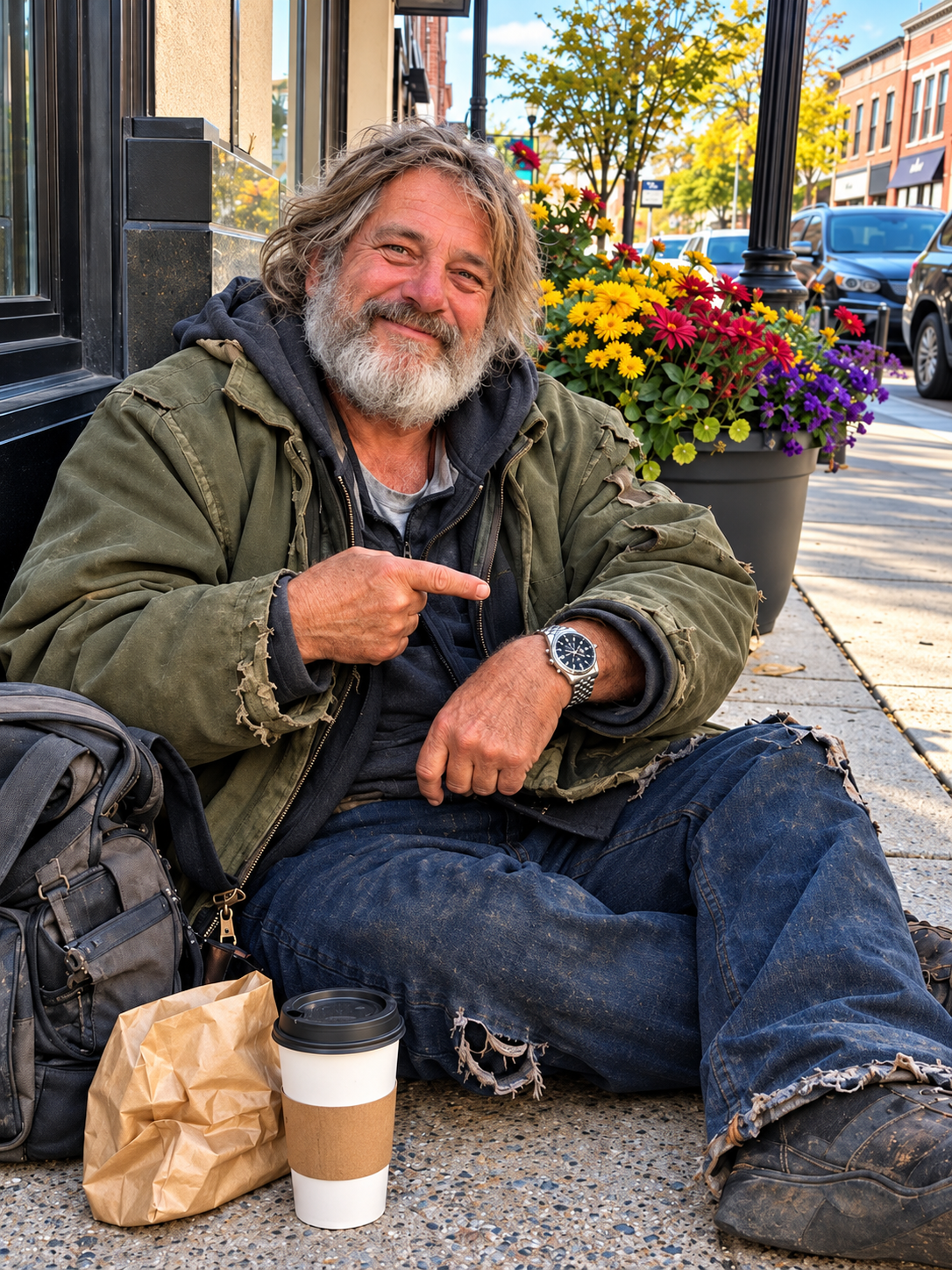
PART 1 TITLE: I Thought I Would Discover Why Customers Were Abandoning My Restaurant, but a Public Humiliation Would Reveal a Far More Disturbing Truth
The sidewalk felt cold beneath my hands when I fell in front of the restaurant I had spent eleven years building. My left knee struck the concrete, and the sleeve of my old jacket tore against the edge of a step. Behind the glass doors, Kyle Brenner, my manager, watched with a contemptuous smile. He had just thrown me out as though I were someone who didn’t belong there. He had no idea that the unshaven man wearing worn-out clothes, with only four dollars in his pocket, was actually his employer. But his behavior wasn’t what made my blood run cold. A few seconds earlier, I had spotted an object concealed beneath the reception counter. And I knew enough about banking transactions to understand that its presence could mean something serious.
My name is Frank Delgado. I’m fifty-two years old, and I own two restaurants named after my mother. For a long time, I believed success meant turning a modest dream into a thriving business. I had worked myself to exhaustion to make it happen, sacrificing evenings with my family, vacations, and sometimes even my health. Yet that day, sitting on the sidewalk outside Rosie’s, I realized that the numbers printed on my financial reports revealed almost nothing about what was happening behind my own doors. I had to temporarily lose the appearance of a respectable businessman to discover how certain employees treated people they considered insignificant. To explain how I reached that point, I have to go back to a time when I owned almost nothing.
Twenty years earlier, my life looked nothing like that of a restaurant owner. I was thirty-two when the factory where I had worked for eleven years closed permanently. Management gathered us together on a Friday morning to announce the news. We received envelopes containing our final paychecks and were then told to empty our lockers. I can still remember the faces of several coworkers, men who had devoted nearly their entire careers to that factory. We walked outside together beneath a light rain, each carrying a small box of personal belongings. At that moment, I had no idea how I would pay the following month’s rent.
My mother, Rosalind Delgado, whom everyone called Rosie, was already sick. She tried to hide her exhaustion, but I noticed how slowly she moved and how often she leaned against the kitchen counter to catch her breath. Medical bills were piling up on her small kitchen table beside the grocery flyers she saved to find discounts. She insisted that I take care of myself first. That was her usual way of speaking: she minimized her own difficulties so others wouldn’t feel responsible for carrying them. But I knew she needed help, and I couldn’t afford to remain unemployed for long.
Eventually, I found work as a dishwasher at Gallagher’s Steakhouse for six dollars an hour. My workdays began before the first customers arrived and ended long after the last servers had gone home. For hours, I stood over industrial sinks, my hands submerged in water so hot that my skin turned red and sore. The stacks of dirty dishes never seemed to shrink. Some coworkers dropped their trays beside me without saying a word. Others spoke only to complain that the utensils weren’t ready quickly enough. I wasn’t particularly sensitive, but being treated as though I were invisible gradually began to wear me down.
It was in that kitchen that I began to understand what my mother had taught me throughout my childhood. She had spent thirty-eight years working at the Blue Plate, a small restaurant on Fulton Street whose blue storefront had faded with the passing seasons. The place had eleven tables, a few stools lined up along a narrow counter, and a little bell above the door. Most customers knew one another. Some came for lunch, while others simply wanted familiar company. My mother remembered everyone’s habits with remarkable accuracy. She knew who preferred their coffee piping hot, who never ate meat on Fridays, and who had recently lost someone close. To her, serving a meal meant much more than placing a plate in front of someone.
When I was twelve, I often waited for her at the Blue Plate after school. I did my homework at one end of the counter, trying not to spill anything on my notebook when the waitresses passed carrying their trays. One November afternoon, an elderly man came inside holding a few coins in his hand. His shoes had holes in them, and the torn lining of his coat was visible. He ordered a coffee and sat near the radiator. My mother brought him a bowl of soup, a sandwich, and some bread. When he explained that he didn’t have enough money, she simply told him to enjoy his meal. Later, I watched her slip several bills from her tips into the cash register.
I asked why she was spending her own money on a stranger when we had to count every dollar ourselves. She put down her dish towel and sat beside me. “Frankie, that man might have a family who has no idea where he’s sleeping tonight. At some point in his life, there was probably someone who worried about whether he had enough to eat.” I looked toward the table where the man was finishing his meal. “And what if nobody worries about him anymore?” I asked. My mother gently touched my cheek. “Then somebody has to start.” I didn’t fully understand the meaning of her answer at the time, but I never forgot it.
Rosie wasn’t wealthy or particularly influential. Her apartment contained mismatched furniture, a bookcase with sagging shelves, and an old radio she switched on while preparing dinner. She spent all day on her feet and sometimes came home with swollen ankles. Yet she still found a way to prepare an extra meal whenever a neighbor was struggling. She never told acquaintances about her good deeds. When someone thanked her too insistently, she changed the subject or offered another cup of coffee. What mattered to her was that people left with full stomachs and their dignity intact.
Eighteen years before the day Kyle threw me out of my own restaurant, my mother died after a battle with pancreatic cancer that had progressed far too quickly. Her final weeks were spent in a hospital room where the curtains were almost always partly open. I spent every free hour there. Some days, she was awake enough to talk about the recipes she loved preparing. Other times, she simply squeezed my fingers. Shortly before her death, she asked me to promise her one thing. She knew I dreamed of opening my own restaurant. If that dream ever came true, I must never forget the people who couldn’t afford to pay for their meals.
I gave her my word without hesitation. Back then, I had neither the savings nor the experience necessary to own a restaurant. I only knew how to prepare a few simple dishes and work without complaining. Yet that promise became something like an internal compass. After she passed away, I continued working at Gallagher’s, but I asked to spend more time around the cooks. I watched them clean vegetables, prepare sauces, and organize orders when the dining room was packed. Gradually, I learned to anticipate what the kitchen needed. When an assistant cook position opened, I applied. The chef asked why I wanted to leave the dishwashing station. I told him I wanted to learn how to feed people, not just wash their plates.
The following years were difficult, but they gave me a genuine education. I worked in several kitchens, some well organized and others run by men who couldn’t speak without raising their voices. I learned how to cut meat properly, recognize poor-quality ingredients before serving them, and prepare a hundred portions of the same dish without neglecting a single one. In the evenings, I attended cooking classes. My wife, Denise, who worked as a nurse, often came home after long shifts to find me still bent over my notes. She reviewed my assignments while I prepared something for her to eat. Without her support, I probably would never have advanced beyond being an ordinary employee.
We spent six years living in an apartment above a laundromat. The noise of the machines followed us late into the night. Our windows overlooked a parking lot illuminated by a red sign that flickered whenever it rained. During those years, we saved nearly every available dollar. Denise carefully organized our bank statements in a cardboard folder and reminded me that dreams needed sensible calculations, too. Some Sundays, we drove around the city looking at vacant commercial properties. I stared through dusty storefront windows, imagining tables, a kitchen, and a place where regular customers could come even when they had nobody to share lunch with.
Eleven years before the day everything changed, we finally found an old brick building on Grand Avenue. It had once housed a pharmacy. The walls were worn, the plumbing needed repairs, and the previous owner had left behind several rusty metal shelves. Yet from the moment I first stepped inside, I imagined the dining room filled with conversation. The space could accommodate forty tables and a wooden counter. My hands trembled slightly as I signed the lease. Denise rested her palm on my arm before I picked up the pen. We both understood that this decision committed a significant portion of our savings.
We named the restaurant Rosie’s. I hung several black-and-white photographs of my mother near the cash register, including one taken outside the Blue Plate when she was in her forties. She wore her usual apron and smiled at someone outside the frame. Above the stove, I had her handwritten recipe for chicken and dumpling soup framed. The paper contained old stains and a few spelling mistakes. A printer offered to reproduce it neatly, but I refused. I wanted people to see her actual handwriting, with its uneven letters and notes added over the years.
The first few months were exhausting. Some weeks, I wondered whether we would manage to pay our suppliers. I was simultaneously the cook, accountant, makeshift repairman, and purchasing manager. Denise came to help whenever her schedule allowed. We returned home exhausted, our clothes saturated with the smells of coffee and food. Yet familiar faces began returning regularly. Retirees settled in for breakfast, families chose Rosie’s to celebrate birthdays, and workers from nearby businesses stopped by for a hot meal during their breaks. A restaurant can survive for a while on advertising. It cannot last without the trust of the people who walk through its door.
Among our first regulars was Walt Henshaw, a man then in his sixties. He ordered two eggs, toasted rye bread, and black coffee almost every morning. He preferred the third stool at the counter, where he could watch the street while chatting with employees. Walt didn’t like too much noise around him. However, he could stay an additional half hour if a conversation interested him. Sometimes he told me about changes in the neighborhood, stores that had closed, and neighbors who had moved away. I listened while cleaning the coffee machine. His regular presence became part of our restaurant’s daily rhythm.
There was also Mrs. Kowalczyk, an eighty-one-year-old widow who came every Sunday after church. She ordered chicken soup and half a tuna sandwich. Whenever I offered her a larger portion, she rolled her eyes and accused me of trying to make her gain weight. She always left a two-dollar tip, never more and never less. Each week, she asked about Denise and commented on the weather with such conviction that nobody dared disagree. Rosie’s wasn’t merely a place where these people came to eat. Over time, the restaurant became an extension of their routines, a familiar room where they knew they belonged.
I had kept my promise to my mother by placing a transparent jar near the register. A handwritten label read ROSIE’S RULE. Customers could leave contributions for people who needed a meal but couldn’t afford one. We never asked for documentation or personal explanations. Whenever someone said they were going through a difficult time, we simply invited them to sit down. The arrangement wasn’t perfect, and occasionally we had to supplement the donations with restaurant revenue, but that had never been an insurmountable problem. Luis Ortega, our longtime cook, shared this belief. He prepared every meal with the same care, regardless of who was ordering it.
For almost nine years, I worked in the restaurant every day. I knew the employees, suppliers, regular customers, and even the quirks of our old walk-in refrigerator. Whenever something went wrong, someone came directly to me. Disagreements were settled around a table after service, mistakes were corrected before becoming habits, and customers knew they could always ask to see me. Profits weren’t extraordinary, but they allowed us to live comfortably and pay wages on time. I believed I had found a lasting balance between my profession and the way I wanted to practice it.
Then, two years before the events that changed everything, a real estate developer offered me a location in a new shopping center in the suburbs. The neighborhood was developing rapidly, and several well-known businesses had already signed leases. The financial projections looked appealing. When I showed Denise the documents, she studied them silently before asking whether I truly wanted to manage two restaurants. She worried that we would lose the personal connection that made the original Rosie’s special. I interpreted her caution as a natural fear of change. I was proud of what we had built and convinced that expanding would allow us to provide more jobs.
So I signed the agreement to open Rosie’s Two. The first months brought one unexpected problem after another. Deliveries arrived late, some equipment broke down before its warranty expired, and employees who couldn’t tolerate the hours had to be replaced regularly. I drove between the two restaurants, answering calls late into the night. Sixteen-hour workdays became almost normal. When I returned home, Denise was sometimes already asleep. I dropped my keys in the entryway, ate something standing up, and opened my computer again to review the next day’s expenses. Without truly noticing, I had stopped spending time at the restaurant on Grand Avenue.
That was when I decided to hire an outside manager to run Rosie’s. Kyle Brenner arrived with an impressive résumé. He was thirty-four, held a business management degree from Rutgers, and had several years of experience working for restaurant chains. His suit was immaculate, his shoes polished, and his manner exceptionally confident. He spoke about revenue per table, cost reductions, and operational efficiency. What impressed me most were the results he claimed to have achieved in his previous positions. During our interview, he assured me that he would respect the restaurant’s identity while modernizing its operations. He offered me his hand with a convincing smile. I saw him as the solution I desperately needed.
At first, Kyle appeared to justify my confidence. Every Monday morning, I received a detailed report showing sales, expenses, customer counts, and profit margins. The charts indicated steady growth. Some expenses had decreased while revenue increased. Whenever I called, he answered quickly and explained that the team was adapting well to the changes. I had no apparent reason to worry. On the contrary, I congratulated myself for hiring a professional capable of making decisions without constantly consulting me. I now devoted almost all my energy to the second restaurant.
The first warning arrived as an email from Walt Henshaw. He was seventy-four and had been coming to Rosie’s for nine years, almost every weekday morning. His message was brief, without accusations or anger. He simply explained that he had stopped visiting and that the atmosphere no longer felt as welcoming. At the end, he added that he hoped everything was going well for me. I read it twice, surprised by the distance in the words of a man who had once spoken to me like a friend. I immediately replied, asking what had happened and inviting him to call. No response came.
That silence should have prompted me to visit the restaurant immediately. Instead, I closed my computer because a supplier for Rosie’s Two needed an urgent decision. I promised myself I would contact Walt the following day, but that promise disappeared among meetings and orders. Two days later, Kyle sent me another financial report. Sales continued to rise. I studied the figures, then thought about Walt and his strange disappearance. For the first time, I sensed that there might be a disturbing difference between Rosie’s apparent success and the reality experienced by the people who had helped it grow. But I had no idea how enormous that difference would turn out to be.
END PART 1
PART 2 TITLE: My Manager’s Reports Were Excellent, but the Confessions of an Old Employee Revealed What the Numbers Were Hiding
The second warning arrived about a month after Walt’s message. A customer wrote to tell me that her family had waited forty minutes for a table, even though several tables remained empty throughout their wait. She had made a reservation to celebrate her father’s birthday and had eventually felt so unwelcome that she took everyone somewhere else. Her letter didn’t demand a refund. She simply wanted to understand why a restaurant once famous for its hospitality now treated families as though they were an inconvenience. As I read her words, I felt the same discomfort I had pushed aside after Walt stopped coming. Two complaints might not constitute proof, but they deserved a serious investigation.
Other comments followed. Some customers described cold or impatient servers. Others reported being offered seats near the restrooms while the dining room was almost empty. One woman explained that her mother, who had difficulty walking, had been forced to wait standing up while the hostess checked her phone. I knew the restaurant business well enough to understand that busy days could lead to mistakes. Even the best employees occasionally lost their patience. But these messages described a repeated attitude, almost as though the restaurant had adopted new rules nobody had told me about. Eventually, I called Kyle and demanded specific explanations.
He listened without interrupting, then calmly explained that modernizing Rosie’s couldn’t please everyone. According to him, some longtime customers considered the restaurant their personal living room and occupied tables for hours while ordering almost nothing. He reminded me that operating expenses had increased and that we needed to protect profitability. When I mentioned Walt, he gave a short laugh. A man who ordered only two eggs and coffee, he said, wasn’t exactly a valuable customer. His comment irritated me. Walt had supported my restaurant since its opening. Yet Kyle immediately redirected my attention to the financial results and asked whether I really wanted to return to less efficient methods.
I ended that conversation without openly disagreeing, but I wasn’t convinced. I understood perfectly well that a business needed to earn enough money to pay its employees. I had never imagined running a charity. However, I hadn’t opened Rosie’s to judge human beings according to the price of their orders. A customer buying a simple cup of coffee had always been just as welcome as a family celebrating an expensive anniversary dinner. I promised myself I would discuss it with Kyle during my next visit. Unfortunately, the second restaurant constantly demanded my attention, and I allowed daily emergencies to determine my priorities. The longer I postponed that conversation, the more time Kyle had to establish his own way of doing things.
It was Mrs. Kowalczyk’s disappearance that finally transformed my suspicions into genuine concern. One Sunday afternoon, while organizing some documents, I came across an old photograph taken during a restaurant anniversary celebration. She appeared behind the counter, with a little cake in front of her and her familiar mischievous smile on her face. I suddenly realized I hadn’t seen her in a long time. I called the restaurant and asked whether she still came after church. The person who answered hesitated before explaining that she couldn’t remember her last visit. I hung up with an unpleasant feeling, as though someone important had disappeared from my surroundings without my noticing.
I found Mrs. Kowalczyk’s telephone number in my old address book. Her granddaughter answered. After exchanging a few pleasantries, I asked whether her grandmother was doing well. She assured me that there hadn’t been any worrying changes in her health, then added that she now preferred eating at home. I asked whether something had happened at the restaurant. The young woman paused briefly. “She doesn’t want to talk about it, Mr. Delgado. I think she’d simply rather avoid that place.” Her tone wasn’t hostile, but it clearly brought the conversation to an end. I thanked her without pressing further. A woman who had eaten lunch with us almost every Sunday for eleven years didn’t suddenly abandon that habit without a reason.
That evening, I opened the restaurant’s old records. I wasn’t searching only for numbers, but for traces of the life we had once shared with our customers. I found reservations from families who celebrated the same birthdays every year, warm messages received after our opening, and photographs from celebrations organized by the staff. Comparing those memories with Kyle’s recent reports, I noticed that his spreadsheets almost never mentioned customer loyalty. He measured average check amounts and how quickly tables became available again. Nothing indicated how many customers had permanently stopped returning. That omission should have caught my attention much earlier.
A few days later, I visited Rosie’s after closing to collect some administrative documents. The street was almost deserted. Streetlights illuminated the brick storefront, and a faint glow still filtered through the kitchen windows. I had always enjoyed visiting at that hour, when the rush of service had disappeared and only the sounds of equipment being cleaned remained. Entering through the back door, I recognized the familiar smell of dish soap and hot grease. Luis Ortega stood beside the grill, holding a cloth. He had worked with me since the very first day and knew the kitchen almost as well as I did. Yet when I greeted him, his expression immediately struck me as unusual.
Luis was over sixty. His gray hair was usually hidden beneath a cook’s cap, and his movements remained precise despite the long hours he spent standing. We had endured Rosie’s difficult early months together. I knew he rarely spoke without good reason. That evening, instead of asking about the second restaurant, he glanced toward the manager’s office. Then he lowered his voice. “Boss, could you come outside for a few minutes? I’d like to speak to you where nobody can hear us.” At first, I assumed it was a family problem or a request concerning his schedule. He had two grandchildren living with him, and I understood how much his wages mattered to their security.
We stepped into the alley behind the building. The air was damp, and an exhaust fan hummed above our heads. Luis leaned against the wall before speaking. He told me that he had been hesitating for months to explain what happened when I wasn’t around. According to him, Kyle couldn’t tolerate customers who appeared to have little money. With the assistance of Madison, the new hostess, he regularly refused tables to certain people while claiming the restaurant was fully booked. Elderly customers were sometimes seated in unpleasant locations and then deliberately served slowly. At first, Luis thought these were isolated bad decisions. Over time, he had realized that management actively encouraged this behavior.
I asked why nobody had warned me. Luis lowered his eyes and rubbed his hands against his pants. He reminded me of a phone call he had made in March. I had told him I was busy and would call him back as soon as possible. The memory returned with painful clarity. I had probably been dealing with a delivery problem at the second restaurant. I had promised to call back and then forgotten. Luis explained that Kyle later discovered he had been trying to contact me. The manager had made it clear that a man his age would have difficulty finding another job if he caused trouble. It was a clear enough threat for someone responsible for supporting his family.
I apologized, but Luis continued as though he had waited too long to stop now. He asked whether I had noticed the disappearance of the jar for free meals. I thought I had misheard him. Since opening day, that transparent container had stood beside the register, beneath my mother’s photograph. It symbolized a promise far older than our business. Luis explained that Kyle had removed it several months earlier. The manager thought the collection gave the restaurant an undesirable image. When the staff asked what would happen to the money, he said the approximately three hundred dollars in the jar would be added to the restaurant’s general revenue. Nobody received any further explanation.
For several seconds, I couldn’t respond. I pictured my mother taking a few crumpled bills from her tips to pay for a stranger’s lunch. I could still hear her voice in the hospital room. And now a man I had personally hired had eliminated the most important gesture of my establishment without even consulting me. I asked Luis whether there was an accounting record of the money. He didn’t know. Kyle now handled most of the administrative documents. As for Madison, she repeated that customers who wanted to help disadvantaged people could donate directly to charities rather than turning Rosie’s into a shelter. Luis believed those words probably came from Kyle.
I placed a hand on my old cook’s shoulder. His eyes were tired, and I noticed a small, recent burn near his wrist. I told him he had been right to try to speak to me. I didn’t want him to bear responsibility for my absence or fear losing his job for telling the truth. Luis didn’t answer immediately. Then he asked what I planned to do. I wished I could tell him I already had a solution. In reality, I didn’t even know how far the problem extended. I had several accounts of what was happening, but Kyle could easily challenge any testimony based on impressions or conversations. I promised to handle the matter personally.
On the drive home, I left the radio off. I thought about Walt, Mrs. Kowalczyk, and the families who had stopped coming. I wondered what they had experienced before deciding never to walk through our doors again. My anger toward Kyle was genuine, but it was accompanied by another emotion that was much harder to accept: shame. I was the one who had entrusted the restaurant to him. I was the one who had valued beautifully presented reports over the words of people I had known for years. I was the one who had allowed a loyal cook to fear for his job. When I arrived home, the living room lights were still on, and Denise was reading on the sofa.
She immediately realized something was wrong. I sat opposite her and told her about my conversation with Luis. She listened without interrupting, her hands folded in her lap. When she learned that Kyle had removed my mother’s donation jar, she closed her book. “You can’t let that man run Rosie’s for another day,” she declared. I told her that I wanted to fire him, but first I needed to understand exactly what had happened. I worried that he would accuse the employees of lying or claim the dissatisfied customers were exaggerating. Denise then asked why I didn’t observe a service myself. A surprise visit, she suggested, might be enough to establish the facts.
I explained that Kyle would recognize me the moment I arrived. Madison knew my face from photographs, and several employees had been working with me for years. In the owner’s presence, everyone would probably be on their best behavior. Denise thought for a few moments. “Then ask someone else to go,” she suggested. It was a reasonable solution, but I felt the need to see things for myself. I wanted to understand what happened when someone entered Rosie’s without offering the slightest commercial advantage. The memory of the old man at the Blue Plate returned to me. I looked at Denise and asked what would happen if nobody recognized me.
She immediately understood my idea and made no attempt to hide her skepticism. Going into my own restaurant in disguise seemed unnecessarily risky to her. She also worried that I would turn a serious problem into a personal experiment whose conclusions would be difficult to interpret. “You need to solve a management problem, Frank, not play a character,” she told me. I knew she was right about one thing: I couldn’t judge the entire conduct of my employees from a single visit. But I needed to witness their spontaneous reaction to someone who didn’t appear able to pay for a normal meal. It would be another piece of evidence, not a final judgment.
We talked for a long time. Eventually, Denise asked what I hoped to discover. I explained that when I was a dishwasher, some coworkers didn’t even see my face. They noticed only my stained apron and damaged hands. I wanted to know whether Rosie’s had become a place where a man could be despised before he had even spoken a word. She remained silent, then sighed. “Be careful. And above all, don’t let your anger make decisions for you.” I promised to remain calm no matter what happened. I sincerely believed I could keep that promise because I couldn’t yet imagine what awaited me.
The following afternoon, I visited a secondhand clothing store on the other side of town. The racks were crowded with mismatched jackets, worn pants, and shoes whose soles had already seen plenty of use. I selected an old brown jacket with a damaged pocket, faded jeans, a gray beanie, and a pair of battered boots. Everything cost eleven dollars. When I looked in the store mirror, I had difficulty recognizing the man staring back at me. My usual clothes were carefully chosen for business meetings. This outfit, by contrast, seemed to tell a story of years of hardship.
I let my beard grow for a few days to make my appearance less recognizable. On the appointed morning, I left my watch, wallet, and wedding ring at home so that no familiar detail would attract attention. I took only my phone, which I concealed in the lining of my jacket, and four dollars in small bills and coins. Standing before the bedroom mirror, I pulled my beanie down to the edge of my eyebrows. Denise entered while I was struggling with the jacket’s damaged zipper. She studied me for a long moment before saying that my mother would probably have praised my intentions while scolding me for my methods. We smiled, but there was worry in her eyes.
Before leaving, I looked at a photograph of Rosie hanging near our entrance. It was an old picture of her laughing behind the Blue Plate counter. I thought about all the people she had fed without ever demanding proof that they deserved her generosity. I wasn’t trying to pretend to be truly homeless to make myself feel virtuous. I knew perfectly well that, by evening, I would return to a heated home, a comfortable bed, and the security of my savings. People genuinely facing poverty didn’t have that option. That difference required me to approach the experience with humility rather than treat it as an adventure.
I parked my car four blocks away and began walking toward Grand Avenue. The midday sun illuminated the storefronts, but the air remained cool. After only a few minutes, I noticed the way people looked at me had changed. A woman pushing a stroller moved slightly aside as she passed. A man in a suit touched his back pocket as though checking whether his wallet was still there. Outside a shop, two people interrupted their conversation when I approached. None of these gestures was particularly dramatic. Individually, they might have gone unnoticed. Together, they made me feel as though I were walking through a neighborhood where I no longer quite belonged.
At the corner of Grand Avenue and Fifth Street, I spotted a man sitting against a wall. His gray beard hung over the collar of a worn coat. A cardboard sign rested beside his shoes, and a cup containing a few coins sat in front of him. I walked past, hesitating to start a conversation. Before I could think of anything to say, he raised his eyes toward me and nodded slightly. I returned his greeting. It was almost nothing, a discreet acknowledgment between two strangers. Yet after all the averted glances since leaving home, that gesture touched me. He was the first passerby to simply acknowledge my presence.
At exactly noon, I arrived outside Rosie’s. The brick façade looked unchanged, and the bell above the entrance was still the one I had installed eleven years earlier in memory of the Blue Plate. Through the windows, I could see several empty tables near the front. The dining room was only half occupied. I paused to look at my mother’s photograph behind the register. Then I pushed open the door. The familiar bell rang, but nobody came to greet me immediately. Behind a black host stand stood a young blonde woman with her hair tied in a ponytail. She was looking at her phone. Her name tag read MADISON.
When she finally looked up, her eyes went straight to my shoes before slowly traveling up to my beanie. She didn’t smile. I politely asked whether I could order a bowl of soup and a glass of water. I opened my hand to show her the four dollars I had. She glanced briefly at the money before answering that every table was reserved. I turned toward the empty seats visible just a few feet away. “Even the ones by the window?” I asked. She confirmed this without checking any reservation list. Then she suggested that I try a fast-food restaurant farther down the street.
I stood motionless, unable to take my eyes off the young woman who had just excluded me from my own restaurant. I knew the dimensions of every table, the cost of the flooring beneath my feet, and the difficulties we had encountered installing the kitchen. Yet beneath my shabby clothes, I had become nothing more than a problem she wanted to get rid of. I was about to turn around when I heard a woman’s voice behind me. “Sir, wait a second.” A young waitress with dark hair had just come out of the kitchen. Her black apron seemed slightly too large for her. She approached, looked me directly in the eyes, and asked a question nobody had bothered to ask me that day: “Are you hungry?”
END PART 2
PART 3 TITLE: A Young Waitress Offered Me a Meal Without Knowing Who I Was, Then My Manager Made a Mistake With Irreversible Consequences
The young woman standing in front of me appeared to be in her twenties. Her brown hair was hastily tied behind her head, with a few loose strands around her temples. Her name tag read AMBER. She didn’t seem particularly concerned about my appearance. Instead, she watched me with the ordinary attentiveness of someone waiting for an answer. I confirmed that I simply wanted something to eat. She asked me to follow her to an available table near the window. Behind her counter, Madison straightened up and sharply reminded her that the tables were reserved. Amber stopped. Rather than argue, she calmly asked Madison which reservation belonged to that particular table.
Madison stared at her screen for several seconds without answering. Amber waited, then invited me to continue. I crossed the dining room with the strange feeling that I was discovering my restaurant for the first time. The tables were clean, the glasses carefully arranged, and the old photographs still decorated the walls. But conversations seemed quieter than they used to be. A couple sitting near the counter briefly looked up at me before returning to their meal. Nobody appeared bothered by my presence. That observation made Madison’s refusal even more difficult to understand. She had presented me as a threat to the establishment when I hadn’t caused the slightest disturbance.
Amber pulled out a chair so I could sit down. She suggested our chicken and dumpling soup, explaining with a certain pride that the recipe had been passed down by the owner’s mother. I lowered my head to hide my emotion. Hearing an employee speak about my mother with respect, without knowing who I was, affected me more deeply than I had expected. I told her the soup sounded wonderful. She asked whether I wanted anything to drink. I said water would be enough, but she noticed my hands were cold and offered me a cup of hot coffee. I thanked her.
While she headed toward the kitchen, I studied the reception counter. Madison had returned to her phone and seemed to avoid looking in my direction. A modern reservation screen had replaced our old paper booking system. The menus had been reprinted in a simpler design, with slightly higher prices. I recognized most of these changes because they had appeared in Kyle’s reports. Yet something about the overall atmosphere bothered me. The restaurant operated without any obvious disorder, but it lacked the spontaneous little conversations I used to hear. Employees moved quickly, barely stopping. I wondered how many small acts of kindness had gradually disappeared in the name of the efficiency Kyle praised so often.
A few minutes later, Amber returned carrying a tray. She placed a steaming bowl of soup, a slice of still-warm bread, a glass of fresh water, and a cup of coffee in front of me. She took the time to arrange the silverware properly and make sure the table didn’t wobble. Her attentiveness struck me. She wasn’t trying to attract attention or show that she was doing a good deed. She simply behaved like a waitress who wanted her customer to enjoy a comfortable meal. Before leaving, she asked me to let her know if I needed anything. That ordinary sentence reminded me of Rosie’s early years, when we wanted everyone to feel welcome.
I leaned toward the bowl. The smell of broth, chicken, and herbs immediately transported me back to my mother’s kitchen. Luis still prepared the recipe with remarkable accuracy. The dumplings had retained their soft texture, and the broth possessed that slightly peppery flavor Rosie achieved without ever measuring her ingredients precisely. I took one spoonful, then another. I hadn’t eaten since morning, but hunger didn’t entirely explain what I was feeling. For weeks, I had sensed that I was gradually losing a place that mattered more than almost anything in my life. This soup proved that part of its identity still survived.
After eating about half my meal, I took out my four dollars and placed them carefully beside my glass. I wanted to see how Amber would react when she discovered that I couldn’t afford the regular price. When she came to refill my coffee, she noticed the money. She looked at it, then gently pushed the bills and coins back toward me. She explained that she would cover the meal herself. I insisted on contributing at least something. She replied that I could keep the money for something I might need later. Her voice contained no pity. She simply seemed to have made a decision and didn’t want to embarrass me.
I asked why she would do that for a stranger. Amber paused, as though the answer seemed obvious to her but she was searching for the right words. She told me that someone had once helped her when she was going through an especially difficult period. She had never forgotten that kindness and now tried to do the same whenever she had the chance. I didn’t press her about her past. I knew that gratitude could turn into discomfort when someone demanded overly personal explanations. She gave me a small smile before moving on to another table. I continued eating, thinking about the way certain actions travel through the years and repeat themselves among people who have never met.
I was watching the daylight reflect off my coffee cup when the kitchen door swung open abruptly. Kyle Brenner appeared in the dining room. He wore a perfectly pressed blue shirt and a gold watch I had noticed during our last meeting. Madison walked directly behind him. She pointed discreetly toward my table, but the gesture was obvious enough for me to understand that she had complained about my presence. Kyle stopped a few steps away. His gaze settled on my damaged jacket, then on the dishes in front of me. He didn’t bother greeting me. Instead, he loudly demanded to know who had authorized this man to sit there.
Amber stepped forward before I could respond. She explained that a table was available and that I simply wanted lunch. Kyle asked whether I had enough money to pay my bill. The young woman stated that she had decided to pay for my meal herself. He gave a short, unpleasant laugh. He reminded her that Rosie’s needed to make a profit and that employees weren’t supposed to attract people who had no money. Amber replied that it was only a bowl of soup. Kyle argued that this kind of tolerance always encouraged more people like me to come inside. He spoke about me without addressing me directly, as though my opinion didn’t matter.
Several customers had stopped eating. I noticed their embarrassed expressions and the way some avoided getting involved. Amber, however, remained beside my table. Her hands were clasped in front of her apron, but her voice stayed steady. She repeated that she would pay the bill with her own money. Kyle shook his head, visibly irritated. According to him, customers willing to spend good money on lunch had no desire to share the dining room with people who looked like me. I felt anger rising, but I remembered Denise’s warning. I had promised to observe and remain calm. So I lowered my eyes and assured him that I wasn’t trying to cause trouble.
That response didn’t calm Kyle. On the contrary, he approached my chair and ordered me to leave immediately. I placed my spoon on the edge of the bowl. I told him I would go after collecting my belongings. Amber protested, pointing out that I hadn’t bothered anyone. Kyle didn’t even turn toward her. He grabbed my arm with surprising force and pulled me upward. My knee struck the table. The coffee cup overturned, spilling coffee across the white tablecloth. A woman exclaimed behind us. I straightened up to keep from falling, but Kyle continued gripping my arm tightly.
I had no intention of fighting him. I could have revealed my identity immediately, ordered him to release me, and ended the humiliation. Yet part of me wanted to understand how far he was willing to go in front of witnesses. I repeated that I would leave voluntarily. He pushed me toward the entrance without answering. Amber followed several steps behind us. Madison stood near her counter, watching with an expression that seemed to contain quiet satisfaction. Her attitude reminded me of Luis and his warnings. He hadn’t exaggerated anything. Kyle and Madison seemed to regard the rejection of certain customers as a normal procedure, almost as a demonstration of their authority.
As we approached the door, my battered boot caught on the edge of a rug. I lost my balance and twisted slightly to avoid falling. At that precise moment, my eyes moved toward the reception counter. An elderly woman wearing a purple coat stood in front of Madison. She leaned on a cane and had just taken out her bank card to pay the bill. I recognized her face without immediately remembering her name. She visited the restaurant occasionally. Madison accepted her card with a professional smile. Nothing about the scene would have seemed unusual if I hadn’t noticed the movement of her right hand.
Instead of inserting the card directly into the usual payment terminal, Madison lowered it below the counter. I glimpsed a small black device positioned near the base of the reservation screen. She passed the card through that object before using the official terminal. The movement was quick, almost imperceptible. When the customer retrieved her card, Madison wished her a good day, addressing her as Mrs. Pratt. For a second, I forgot about Kyle’s hand gripping my arm. I stared at the place where the device had disappeared. I had already seen equipment of that kind during training sessions about payment security, and its use seemed extremely suspicious.
A restaurant owner who accepts electronic payments has to learn to recognize practices that could compromise customers’ banking information. Throughout my career, I had attended several training sessions concerning payment terminals and fraud risks. I knew that a concealed device could be used to copy certain information from a card. Of course, I couldn’t determine the exact purpose of the device Madison was using without a technical examination. But it wasn’t part of our regular equipment, and nothing justified that hidden manipulation. My mind began connecting events that had previously seemed unrelated: the complaints, the customers who had disappeared without explanation, Kyle’s new employees, and this device positioned out of sight.
I turned my head toward Kyle. He was also looking in the direction of the counter. His expression suddenly hardened when he noticed that I was watching Madison. He tightened his grip and pushed me more violently toward the exit. The glass door swung open under my weight. I stumbled on the step, and my hands struck the sidewalk. A sharp pain shot through my right palm. Behind me, Kyle shouted several humiliating remarks before closing the door. Through the glass, I saw him laughing. A woman walking a dog crossed the street, while a man in a hurry continued on his way without looking at me. Nobody stopped.
I remained crouched for a few moments, staring at the tiny traces of blood appearing on my skin. The humiliation alone would have been enough to make me march straight back into the restaurant and reveal who I was. But what I had seen behind the counter had completely changed the situation. This was no longer simply about an arrogant manager or poorly trained employees. Banking information belonging to people who trusted me might be getting collected illegally. I thought about Walt, Mrs. Kowalczyk, and the woman in the purple coat. How many customers had used their cards since Kyle arrived? How many had experienced suspicious transactions without connecting them to Rosie’s?
I slowly got up and checked that my phone hadn’t been damaged in the fall. I wanted to call the police immediately. But I was afraid the device would disappear if Kyle discovered that I understood what was happening. A serious accusation required verifiable evidence. So I decided not to reveal my identity just yet. I walked several yards along the sidewalk and stopped near a side window from which the reception counter remained visible. Pretending to check my phone, I began discreetly recording the hostess’s movements. My position was uncomfortable, but I didn’t want to lose what might become an important piece of evidence.
The following minutes seemed endless. Madison finished a conversation with a server, checked her screen, and moved a few menus. I began wondering whether I had misunderstood the purpose of the black device. Perhaps there was an administrative explanation I didn’t know about. The possibility didn’t completely reassure me, but I knew better than to turn suspicions into certainties. Eventually, another customer approached the counter to pay his bill. Madison accepted his card, glanced briefly toward the dining room, then repeated the same movement beneath the stand before using the normal terminal. This time, my phone recorded the scene. I made sure the video was saved.
I wasn’t certain whether the device’s model could be identified from the footage. I only knew that Madison was deliberately performing an additional operation that no official system appeared to require. I tried to remember the equipment invoices Kyle sent me every quarter. I couldn’t recall any purchase of that kind. If the device really was being used to copy cards, it was essential to prevent its disappearance without provoking a confrontation that might put customers in danger. I remained near the window, hesitating between calling the authorities directly and contacting our payment service provider. That was when the restaurant door opened behind me.
I turned quickly and concealed my phone against my jacket. Amber had come outside carrying a small white paper bag. When she spotted me, her expression relaxed. She seemed relieved to find me still nearby. She immediately noticed my scraped hands and the torn fabric near my shoulder. “Are you hurt?” she asked. I assured her that I could walk and that my injuries were superficial. She insisted on examining my palm anyway. I could tell she was angry about the way Kyle had treated me, but she was trying not to show it too openly. I asked why she had left her position to come looking for me.
She held out the bag. Inside was another serving of soup, bread wrapped in a napkin, and a few folded bills. I stared at her in surprise. She had already paid for my meal and was clearly risking criticism for helping me. Yet she had taken the time to prepare something I could carry away. I told her I didn’t want to get her into trouble. She replied that it was her decision how to spend her money. That simplicity made her gesture even more touching. I accepted the bag, but I couldn’t resist asking why she cared so much about helping someone she had only just met.
Amber looked toward the street before answering. When she was seventeen, she told me, she had found herself without a home. For several months, she had slept in a car, struggling to maintain as normal a life as possible despite fear and uncertainty. Near the bus station, a waitress working in a small restaurant had regularly given her breakfast. The woman had never asked her to justify her circumstances or made her feel indebted. Amber still remembered the relief she experienced each morning when she entered that establishment. It wasn’t just the food that had helped her, but the ability to sit somewhere without feeling ashamed.
I listened without interrupting. Her story awakened memories too close to those of my mother for me to ignore. Rosie had spent her life offering that kind of comfort, often without knowing the names of the people she helped. Amber, who had never met my mother, was acting according to the same principle. I asked whether that experience explained why she was so attentive to people in difficult circumstances. She nodded. She admitted that she sometimes still recognized, in certain customers’ eyes, the same fear she had known when she didn’t know where she would sleep. To her, offering a meal without humiliating someone was a simple way of passing along the kindness she had received.
I lowered my eyes to the warm bag in my hands. I wanted to tell her that my mother would have been proud of her. I also wanted to reveal that she was one of the few people in my restaurant still honoring the promise on which it had been founded. Yet I couldn’t forget what might be happening only a few yards away. Amber’s generosity contrasted so sharply with Kyle and Madison’s behavior that I wondered whether she had noticed other irregularities. Perhaps she unknowingly possessed information that could help an investigation. I made a decision and asked her a specific question: had she ever seen Madison handling an unusual device when customers paid by card?
Amber’s expression changed. She stopped looking at my injuries and stared at me with new attention. Her fingers closed around the edge of her apron. She asked why I was interested in that. I didn’t have time to answer. Behind her, the glass door suddenly opened. Kyle had come out of the restaurant. He looked from one of us to the other before his attention settled on the white bag I held against my chest. He demanded to know what Amber was doing outside with me. His voice was loud enough to attract the attention of passersby. And as he approached us, I realized the situation had just crossed another dangerous line.
END PART 3
PART 4 TITLE: When My Manager Discovered Who I Really Was, It Was Already Too Late to Make the Hidden Evidence Disappear
Kyle stopped in front of Amber with the cold confidence I had once mistaken for professional competence. He demanded to know whether she had abandoned her position to bring food to the man he had just thrown out. Amber replied that she was on her break and had paid for everything she had taken. Kyle showed no interest in that explanation. He told her, in front of me, that she had disobeyed instructions and that he no longer wanted her working at his establishment. When she asked whether he was really firing her for helping someone, he replied that staffing decisions were his responsibility. I watched him for several seconds. This man believed he possessed unlimited authority simply because I had stopped supervising how he used it.
Amber turned pale. She tried to reason with him, not to take back what she had done, but to understand exactly what she was being accused of. She reminded him that she hadn’t taken any unpaid food and that she had served a customer at an available table. Kyle replied that his decision was final. I could see the young woman searching for words. She probably needed this job, and I understood the courage it had taken for her to stand up to her supervisor. I was tempted to intervene immediately. But then Kyle suddenly shifted his attention toward me. His expression had changed. He no longer showed only contempt. A new suspicion appeared on his face.
He asked why I had remained near the window after being thrown out. Then he pointed toward the pocket where I had put my phone. He had seen me filming the restaurant’s interior. His voice became quieter, almost confidential, as though he wanted to avoid having passersby hear our conversation. He wanted to know what I had recorded. I replied that my phone contained footage taken from the street and that I had no obligation to show it to him. He ordered me to hand over the device. This time, I didn’t even pretend to hesitate. I told him no. His face tightened, and he took another step toward me.
Kyle tried to grab my jacket near my chest. I stepped backward to protect my phone. Amber moved between us and told him to stop. He shoved her aside roughly to continue advancing. The young woman lost her balance, and her shoulder struck the wall near the entrance. A sharp sound made me turn my head. She put a hand against her arm and struggled to straighten up. The anger I had been containing since my arrival became increasingly difficult to control. By now, I understood enough about the situation to realize that this was no longer a simple experiment to evaluate my staff. An employee had just physically assaulted two people, including a waitress who had merely tried to protect a customer.
I took out my phone and dialed 911. Kyle gave a nervous laugh, claiming that no police officer would take accusations from a man dressed like me seriously. I waited for the operator to answer. Then I gave my full name, Frank Delgado, and explained that I owned Rosie’s restaurant on Grand Avenue. I reported that a manager had just become violent toward me and one of my employees. I also mentioned the possible presence of an unauthorized device being used to collect bank card information. My voice was calm, but I could feel my heart pounding. I requested that officers come to protect the people present and examine the evidence I had recorded.
The change in Kyle’s face was immediate. His smile vanished. He studied me closely, as though the features of the man he had just pushed onto the sidewalk were suddenly becoming familiar. Amber was also staring at me in astonishment. She quietly repeated my name, looking for confirmation. I removed my gray beanie. I confirmed that I really was Frank Delgado, the founder of Rosie’s, and thanked her for helping me without knowing who I was. For several seconds, nobody spoke. Kyle seemed unable to understand how a day he believed he controlled had slipped away from him so suddenly. Then he turned and rushed back toward the restaurant.
I immediately understood what he might be trying to do. He had seen my phone and knew that I had mentioned a suspicious device to the authorities. If he was involved in the activities I had witnessed, he might now attempt to make the evidence disappear. I asked Amber to remain near the entrance, where she would be safe, then headed toward the glass doors. I had no intention of physically fighting Kyle. My goal was to preserve the situation until the police arrived. As I entered, I noticed several customers looking toward the counter. The unusual commotion had interrupted their conversations, and some employees seemed unable to understand what was happening.
Madison stood behind her reception desk, holding the small black device in her hand. Kyle was speaking rapidly to her while extending his arm, apparently eager to take the object. I stopped a few steps away. I told her to place the device on the counter and not touch it again. She stared at me in confusion, then looked toward Kyle. I explained that the police were coming and that hiding or destroying something potentially relevant to their investigation would only make the situation worse. My voice wasn’t loud, but I made sure to pronounce every word clearly. After an endless hesitation, Madison placed the object beside the reservation tablet.
The device now rested directly beneath a photograph of my mother. That proximity struck me with unexpected force. Rosie smiled in the picture, wearing her old apron, while only a few inches away lay an object that might have been used to betray the trust of hundreds of customers. I didn’t touch it. I asked the employees present to leave the counter exactly as it was and not move anything until the officers arrived. Kyle began insisting that it was all a misunderstanding and that he could explain everything. I replied that he would soon have an opportunity to provide his explanations to the people responsible for the investigation. For the first time since I had known him, he couldn’t find an immediate response.
The first police officers arrived a few minutes later. One began taking my statement while another made sure the situation no longer posed a danger. Amber was sitting near the entrance with a cold pack pressed against her sore shoulder. I asked whether she wanted additional medical attention. She replied that she was mostly in shock. An officer spoke with her separately to obtain her account of the incident. Meanwhile, Kyle was taken aside for questioning. He was still trying to regain his professional demeanor, but his explanations became confused whenever the conversation returned to the object discovered at the counter.
Madison began crying when a police officer asked what she knew about the device. She claimed Kyle had explained how it worked and assured her that the transactions being performed didn’t really harm customers. According to her, he had presented any possible losses as amounts the banks would automatically cover. I listened without interfering. I found it difficult to believe that she had never understood the suspicious nature of a device used discreetly before every payment. But I didn’t want to decide her level of responsibility myself. It was up to the investigators to distinguish lies, possible intimidation, and actions committed deliberately.
The officers examined the equipment and reviewed my video. I explained exactly what I had seen, making it clear that I couldn’t personally confirm the device’s technical function. I showed them the two recordings captured from the side window. The footage showed Madison’s repeated movements whenever she accepted customers’ cards. One officer requested information about our official terminals and the people authorized to manage payments. I explained that Kyle had supervised administrative procedures for eighteen months, but the equipment contracts remained registered under my company’s name. The discrepancy between our documented equipment and the suspicious device clearly justified further investigation.
When Luis emerged from the kitchen, he stopped dead at the sight of the police. He still had a dish towel over his shoulder and seemed to be searching for an explanation for a scene he never could have imagined witnessing in our restaurant. I took him aside for a moment to tell him that his warnings had been important and that I had discovered something far more serious than customers being treated badly. He asked whether anyone had been hurt. I pointed toward Amber, sitting near the window. Luis immediately wanted to bring her something to drink. Even under those circumstances, his first reaction was to take care of someone else. I wondered how I could have allowed employees like him to live under the threat of a manager like Kyle.
The investigators later obtained the necessary authorization to examine Kyle’s office. I supplied documents proving my ownership of the business, along with the administrative information they requested. I waited while they worked, aware that I shouldn’t search the drawers myself or move the computers. Inside the office, the officers discovered additional electronic equipment and documents whose contents raised new questions. Some files appeared to correspond to banking activity that wasn’t included in our usual business records. Several storage devices also attracted their attention. The investigators didn’t immediately share their conclusions with me, but the way they proceeded indicated that the investigation would extend far beyond the incident that afternoon.
A detective specializing in financial crime arrived later. Her name was Sharon Vance. She spoke precisely, without unnecessary dramatics. She asked how long Kyle had managed the restaurant, what responsibilities I had entrusted to him, and how frequently I personally inspected the payment system. I answered without trying to make the situation look better than it was. He had held the position for eighteen months. I received his reports every week, but I rarely checked the procedures he followed in person. I also told her about the customers who had stopped coming and the missing donation jar. She took notes, then explained that several of these details might be connected, although it was still too early to establish the complete picture.
Sharon Vance examined the preliminary records and some of the information discovered in the office. When she returned to speak with me, she asked me to sit down. She showed me a series of dates covering a much longer period than the previous few weeks. According to her preliminary assessment, certain suspicious activities stretched back more than a year. The number of potentially affected transactions could reach several hundred. I thought I had misunderstood. Hundreds of payments might have been compromised while I received charts assuring me that the restaurant was performing wonderfully. I asked whether all those customers had suffered losses. She replied that only a complete investigation could determine which accounts were affected and what the actual consequences had been.
I suddenly felt sick. My mind filled with familiar faces. Walt with his black coffee, Mrs. Kowalczyk searching through her purse for her two-dollar tip, families celebrating birthdays with us, and retirees who came to eat alone just to enjoy a little conversation. All those people had handed their bank cards to my employees because they trusted me. I couldn’t yet measure any financial losses, but I could already imagine the difficulties a fraudulent transaction might cause someone with very little money. A rent payment declined, medication they couldn’t afford to buy, or weeks spent disputing unauthorized charges. The consequences could be far more serious than the numbers appearing in a case file.
Detective Vance reminded me that several steps remained before the crimes could formally be attributed to specific individuals. She didn’t want me announcing premature conclusions to customers or compromising the investigation by revealing confidential details. I asked what I could do immediately. She advised me to preserve every available document, facilitate access to useful information, and coordinate future communications with the appropriate people. I understood that my responsibility didn’t end with discovering the device. I would have to help establish what had happened and take measures to protect customers. The hardest work was only beginning.
As the investigation progressed, other details emerged. Investigators began examining Kyle’s relationships with certain people outside the company. Information collected at the restaurant suggested the possible existence of a network extending beyond Rosie’s. The suspicious transactions might be connected to unauthorized purchases made elsewhere, potentially with the assistance of an accomplice in another state. I realized how an apparently ordinary business could become an entry point for activities on a much larger scale. For eighteen months, I had considered Kyle a competent manager because he presented convincing numbers. I was now discovering just how dangerously misplaced that trust had been.
Another name came up during questioning: Trent, an employee whose face I recognized but whom I barely knew personally. I had met him several times during brief visits, without ever having the opportunity to speak with him at length. According to the information gathered, he had received money from Kyle to remain silent about certain suspicious practices. He had also participated in behavior designed to discourage some customers from returning. This revelation made Luis’s warnings even more serious. The humiliations inflicted on regular customers weren’t necessarily simple abuses of authority. They might also serve the interests of people who wanted certain customers to stop returning and asking questions. I decided that Trent would not continue working at my restaurant.
Once the day’s final procedures allowed the officers to leave, I announced that Rosie’s would close for the rest of the evening. Customers with reservations were contacted and informed that an important problem prevented us from providing service. I didn’t reveal details that might interfere with the investigation, but I didn’t want to invent a kitchen breakdown simply to avoid uncomfortable questions. I asked the employees to go home after completing the necessary formalities. Some appeared shaken. Others were only beginning to understand that their manager was involved in a potentially criminal matter. I assured the team that they would soon receive information about returning to work and the new security procedures.
The dining room fell silent after they left. I walked slowly between the tables. A server had forgotten a pen near the register, and a clean napkin remained folded beside a plate. These ordinary details seemed strangely out of place after the afternoon’s events. I passed the table where Amber had served me soup. The tablecloth had been changed, but I could still see a small coffee stain on the edge of a chair. That was where Kyle had decided that my appearance deprived me of the right to eat. I touched the back of the chair, then looked toward my mother’s photograph. Her smile was still the same. The restaurant around her, however, had changed without my noticing.
I returned to the kitchen, where Luis was finishing putting away a few utensils. I sat on a plastic crate used for fresh produce deliveries. I was still wearing my old brown jacket, whose torn sleeve now hung loosely near my wrist. Luis brought two cups of coffee and sat across from me. For a while, neither of us spoke. Then he apologized for not insisting more strongly when he had tried to warn me. I shook my head. He had tried to talk to me, and I hadn’t listened. He had a family to feed, while I had the authority to supervise the restaurant. If anyone had to take responsibility for that lack of oversight, it was me first.
My eyes settled on the framed handwritten recipe above the stove. I told Luis about the memory that had been returning to me since morning: my mother setting a bowl of soup in front of a man who had only a few coins. I had opened Rosie’s to carry on that spirit of hospitality. Yet I had ended up allowing an employee to remove the donation jar and turn the poorest customers into unwelcome visitors. Luis listened silently. Finally, he replied that the restaurant hadn’t completely lost its identity. There were still employees who remembered why they had chosen this profession. He mentioned Amber and the many times she had discreetly helped customers without expecting the slightest recognition.
Amber appeared at the kitchen entrance shortly afterward. She had returned to collect a personal item she had forgotten in her locker. Her shoulder still hurt, but she seemed more concerned about her job. I invited her to sit with us. She hesitated, then took a third crate near the counter. I thanked her for serving a man she believed couldn’t afford his meal. She replied that if she had known I was the owner, she probably would have been much more nervous. I smiled despite my exhaustion. It was precisely because she hadn’t known my identity that her behavior mattered so much. She had made her decision without expecting a reward, without calculating what that kindness might bring her.
I asked whether Kyle had threatened to fire her before. She lowered her eyes before admitting that it wasn’t the first time. For several months, he had criticized her for spending too much time with elderly customers, offering coffee to certain people, and not following his instructions about seating arrangements closely enough. Eventually, she had begun to think she simply wasn’t good at her job. She also admitted that some time earlier, she had noticed an unusual device behind Madison’s counter. When she asked what it was, she had been told it was backup equipment. She had no particular knowledge of payment devices, but that explanation had never entirely convinced her. I thanked her for being willing to talk about it.
I assured her that treating customers with respect didn’t make her a bad employee. On the contrary, her way of working represented exactly what I had wanted to create with Rosie’s. I explained that Kyle’s decision to fire her would not stand and that we would discuss her future at the restaurant together once the conditions for reopening became clear. Amber brought a hand to her eyes. She seemed to be holding back tears that had been building for several hours. Luis handed her a clean napkin without saying anything. I realized that these two people, to whom I had paid so little attention recently, might represent our best chance of rebuilding the restaurant.
After they left, I switched off the kitchen lights and stood for a few moments beside the back door. I had hoped to discover why some customers no longer liked coming to Rosie’s. I now possessed the beginning of an answer far more serious than anything I had imagined. Police were investigating potentially hundreds of compromised transactions, and employees had described a system built on threats, silence, and exclusion. But knowing the facts wasn’t enough. Customers would have to be informed, some would demand answers, and others might never walk through our doors again. The question facing me was no longer whether Kyle deserved his position. He had lost my trust permanently.
When I finally returned home, Denise was waiting in the kitchen. She stood when she saw my injured hands and damaged jacket. I told her what had happened without leaving out the most difficult details. She listened, then placed a box of bandages on the table. As she gently cleaned my scrapes, I explained that the authorities suspected fraud on a considerable scale. Denise stopped what she was doing and looked at me. She asked what we were going to do for the people affected. I didn’t yet have a precise answer. I only knew that we couldn’t simply replace a manager and reopen the doors as though nothing had happened.
The following morning, I sat at my computer with a cup of coffee that had gone cold. I had prepared a list of regular customers whose contact information I still possessed and gathered the documents necessary to cooperate with the investigation. Sharon Vance had explained what information I could share without interfering with her work. I wanted customers to know that suspicious activity had been discovered so they could take appropriate precautions with their banks. Before beginning the calls, I opened Walt Henshaw’s old message. His few lines now seemed far more significant. He had tried to warn me long before I understood the danger, and I had left him without an answer.
I picked up my phone to dial his number, then stopped. I needed to be prepared to hear his anger without trying to defend myself. I also had to accept that any financial losses represented only part of the damage. Kyle had turned my restaurant into a place where certain people felt they didn’t belong, and I had allowed it to happen. In front of me, the list of potentially affected customers kept growing. I thought about the hundreds of transactions Sharon Vance had mentioned. If the first testimonies confirmed her concerns, I would have to make costly decisions, perhaps even give up some of what I had built elsewhere. Finally, I pressed the call button, determined this time to listen to everything my customers had to say.
END PART 4
PART 5 TITLE: On the Sidewalk Where Kyle Has Just Thrown Me Out, a Tiny Black Device Turns My Anger Toward a Far More Serious Discovery
The concrete had scraped my palms, and my right knee throbbed every time I tried to move. Yet it wasn’t the pain that kept me on the ground. Through the large windows of Rosie’s, I could still see Kyle Brenner standing near the entrance, a satisfied smile on his face. He had just thrown out a man he believed was homeless. That man happened to own the restaurant. But what I had witnessed behind the reception counter made that humiliation seem almost insignificant.
Moments earlier, as Kyle was pushing me toward the exit, an elderly customer had approached the register. She wore a purple coat and leaned on a cane. I recognized her when Madison called her Mrs. Pratt. The young receptionist had accepted her bank card, then discreetly swiped it through a small black device concealed beneath the counter before processing the payment through the regular terminal. The movement had been quick, almost mechanical. I knew enough about payment procedures to understand that the device might have been designed to copy customers’ banking information.
I slowly got to my feet, bracing myself against the building. A passerby stepped around the few coins that had fallen from my pocket without even looking at me. A woman slowed down, noticed my worn clothing, and continued walking. An hour earlier, that indifference might have infuriated me. Now I was thinking about Walt Henshaw, Mrs. Kowalczyk, and all the customers who had stopped coming to Rosie’s without ever fully explaining why. Had some of them lost money after using their cards at my restaurant? How long had this been happening?
My first instinct was to march back inside, take Kyle’s office keys, and announce that he was fired. I could already picture his expression when he discovered who I really was. But another thought stopped me. If he realized I knew about the device, how many seconds would it take him to make it disappear? Madison could claim I was mistaken. Kyle would blame a technical problem or some internal procedure. And I would have nothing except the memory of a movement I had glimpsed during a confrontation.
I pulled my phone from the inside pocket of my jacket. The screen had survived the fall. Keeping close to the building, I made my way toward the small side window overlooking the reception counter. From there, I could see Madison, her reservation tablet, the official payment terminal, and part of the space beneath the countertop. I started recording. My fingers were still trembling, and a drop of blood had left a mark along the edge of the phone case. I held my breath to steady the image.
For several minutes, nothing happened. Madison checked her phone, moved a few menus, and exchanged a few words with a waiter. I began to worry that I had misunderstood what I’d seen. Then a customer approached with his bill. I recognized the man by sight, although I couldn’t remember his name. He handed over his card. Madison repeated the same gesture: her hand disappeared beneath the counter, she made a quick movement, and then she processed the payment normally. This time, my phone captured everything. I kept the camera steady until the customer collected his receipt.
The video alone didn’t prove that fraud had occurred. But it showed a suspicious action, separate from the official payment process, clearly enough to deserve investigation. I checked that the recording had been saved. Memories of several banking security training sessions came back to me. We had been taught to watch for modified terminals, unfamiliar readers, and unnecessary card swipes. I had always made an effort to protect these procedures in my kitchens and at my registers. How had I allowed such a device to appear in my own restaurant?
The door opened behind me. I immediately lowered my phone, convinced Kyle had caught me. A woman’s voice called out cautiously. It was Amber, the young waitress who had insisted on giving me something to eat despite Madison’s objections. She held a white paper bag close to her chest. When she saw my hands, her expression changed. She looked at the scratches, then at the door through which I had been thrown. She didn’t seem to know how to apologize for something she hadn’t done.
“You’re hurt.” She stepped closer without attempting to touch me. “I’m sorry. He had absolutely no right to do that to you.” I told her the scratches would heal. She shook her head, as though my answer wasn’t enough. Then she handed me the bag. Inside, I found another container of soup, some still-warm bread, and a few neatly folded bills. She explained that she had prepared everything during her break. Her expression was serious, without a trace of the awkward pity that some people mistake for compassion.
I stared at the contents of the bag. My own soup, prepared from my mother’s recipe, had just been given to me by an employee who believed she was helping someone in need. I owned two restaurants and a comfortable home. Yet Amber had taken money from her wages to feed a man she thought couldn’t afford lunch. I asked why she was willing to risk her job for a stranger. She hesitated for a few seconds before answering. “Because I know what it’s like to be hungry and have nowhere to sleep.”
She had been seventeen when she lost her home. For several months, her car had been her only shelter. She told me how she searched for well-lit places to spend the night, how she sometimes woke with her fingers numb from the cold, and how she kept her belongings neatly arranged in the trunk so they wouldn’t attract attention. Every morning, she passed a small restaurant near the bus station. Eventually, a waitress noticed her situation. Without asking humiliating questions, the woman began giving her breakfast.
“She never looked at me as though I mattered less than anyone else,” Amber added. “I had nothing to give her in return. So I promised myself I’d do the same thing whenever I had the chance.” She spoke without trying to make her memories sound more dramatic. She wasn’t presenting her story as a lesson. To her, helping a hungry person was simply the reasonable thing to do. I lowered my eyes toward the bag. My mother had behaved that way for thirty-eight years at the Blue Plate. Amber probably knew nothing about her story, yet she was carrying forward everything that mattered most.
Then I asked a question that abruptly changed the mood of our conversation. “Amber, have you ever noticed anything unusual when Madison processes card payments?” Her eyes fixed on mine. I could see her trying to understand why a man who supposedly couldn’t afford four dollars was interested in payment procedures. She didn’t answer immediately. Her fingers tightened around the edge of her apron. “Why are you asking me that?” she whispered. I realized my question had touched on something she had never completely forgotten.
Before I could explain my concern, the glass doors flew open. Kyle stepped outside and stopped in front of us. His face was red, his jaw clenched. He looked at the paper bag, then at Amber. “What are you doing with him again?” he snapped. Amber replied that she was on her break. He demanded to know whether she had taken food from the kitchen. She confirmed that she had, adding that she’d paid for it herself. Kyle didn’t bother checking. He repeated, more loudly, that he refused to have people like me hanging around his restaurant.
Amber stood her ground. “He was hungry. I just gave him something to eat.” Kyle let out a sharp laugh. He told her she could go collect her belongings because she was no longer employed there. For a second, I thought she hadn’t heard him. She asked whether he was serious. “You’ve challenged me enough for one day,” he replied. “I run this establishment. If you can’t respect my decisions, you don’t belong here.” I saw Amber glance toward the restaurant door, as though she were already imagining the locker she’d have to empty.
A surge of anger rose inside me, and I forced myself to contain it. This young woman had just been fired for demonstrating exactly the kind of respect I had wanted Rosie’s to represent. The temptation to reveal my identity immediately became almost unbearable. But Kyle had turned toward me. His attention was no longer on the bag or my torn clothing. He was staring at my hand. “I saw you by the window,” he said. “What were you doing with your phone?” His tone had changed. He no longer sounded like a manager irritated by an unwanted customer. He sounded like someone afraid he’d been caught.
I told him I didn’t owe him an explanation. Kyle moved closer, his expression hardening. “Give me that phone.” I refused. He reached toward my jacket pocket. I stepped back. He tried to grab my arm, exactly as he had inside. This time, I caught his wrist before he could reach my phone. I didn’t want to hit him or give him an excuse to claim that I had attacked him. I only wanted to preserve the footage. “Stay away from me,” I said calmly. “You have no right to take my belongings.”
Amber stepped between us. “Kyle, stop. He hasn’t done anything to you.” He tried to move around her. She remained between us, her hands open, repeating that he needed to calm down. Kyle shoved her aside to reach my jacket. Her shoulder struck the outside wall, and she lost her balance. The paper bag fell to the ground. Some of the bread rolled across the sidewalk. Amber instinctively raised a hand to her shoulder. The dull sound of her body hitting the wall ended my hesitation. I was no longer dealing with a management problem. This had become a dangerous situation.
I called emergency services. Kyle stepped back slightly, then sneered and asked who would believe a homeless man over a restaurant manager. I didn’t respond to his provocation. When the operator answered, I gave my full name, the exact address of Rosie’s on Grand Avenue, and identified myself as the owner. I reported my manager’s violent behavior toward me and an employee. I also explained that I had observed suspicious handling of bank cards, possibly involving an unauthorized device. I requested police assistance so the situation could be investigated and the evidence preserved.
Kyle fell silent immediately. He stared at me as though the words I’d just spoken didn’t belong to the man standing before him. “Frank?” he whispered. I slowly removed the gray hat that concealed part of my face. My chin was poorly shaved and my clothes were filthy, but he recognized me now. His eyes moved from my face to the phone. I instructed him not to touch the payment equipment and to remain there until the officers arrived. He didn’t answer. Then, abruptly, he turned around and hurried back into the restaurant.
Amber was still leaning against the wall. “You’re Mr. Delgado?” she asked. Her voice sounded weaker than before. I nodded. I wanted to explain why I had come in disguise, but she was staring at the thrift-store clothes she had mistaken for those of a homeless man. I understood that the revelation might make her feel as though she’d unknowingly participated in some elaborate performance. “I’m sorry I didn’t introduce myself,” I told her. “I wanted to see how customers were treated when nobody believed I could intervene. What you did for me had nothing to do with who I was. I won’t forget it.”
I was about to check whether her shoulder needed medical attention when movement behind the window caught my eye. Kyle was walking quickly toward the reception counter. Madison had set her tablet aside. She was holding the small black device I had noticed earlier. Kyle was speaking to her urgently. I couldn’t hear the words, but his gestures made it clear that he wanted the object. I told Amber to remain near the entrance and reminded her that the police were on their way. Then I walked through the glass doors without bothering to put my hat back on.
The familiar chime of the entrance bell echoed through the restaurant. Several customers turned around. Kyle had just reached toward Madison when my voice rang out. “Put that device on the counter. Right now.” Madison looked up at me. She noticed my clothing first, then Kyle’s expression. “Who are you?” she asked. “Frank Delgado. I own Rosie’s. The police are coming. Put that object where everyone can see it.” She seemed ready to argue, but Kyle motioned for her to remain silent. That simple gesture confirmed that they both knew the device was a problem.
Madison finally placed the object beside the reservation tablet. It was smaller than I’d imagined, black, discreet, almost ordinary. Now it sat directly beneath my mother’s photograph. The contrast struck me in a way I couldn’t explain. Above it, Rosie smiled in her Blue Plate apron, her hands resting on her hips. Below it sat a device that had probably been used to steal payment information from people who had chosen to trust us. I felt a shame deeper than anything I’d experienced when Kyle humiliated me outside.
Kyle tried to regain his authoritative tone. He claimed I was exaggerating a misunderstanding, that the device was used for technical checks, and that nothing illegal had happened. I asked why Madison swiped cards through it before using the official terminal. He replied that I didn’t understand the new procedures he’d introduced. “Then you can explain them to the police,” I answered. I didn’t touch the object. I also refused to let him move it. My phone, still in my hand, contained the footage I had recorded from the street.
The conversations around us had stopped. A customer asked whether her banking information was at risk. I couldn’t give her a definite answer. I explained that suspicious activity had been observed and that I wasn’t going to minimize the danger. I asked everyone to keep their receipts and follow the instructions that would be provided after the initial checks. I made no attempt to reassure the room with promises I couldn’t keep. Some customers got up to leave. Others remained seated, staring at their cards or phones.
Luis appeared in the kitchen doorway, still wearing his white chef’s jacket. He recognized me despite my appearance and stopped in his tracks. His first glance went to Kyle, then to the counter. I asked him to make sure nobody handled the equipment involved and to help the staff keep things calm. He nodded without asking questions. I knew he would understand later. For now, I needed to prevent the restaurant from becoming the scene of another confrontation. Even injured and covered in dust, I was still responsible for everyone inside that building.
Amber came back inside, holding her arm close to her body. I offered her a chair and asked someone to bring a cold compress for her shoulder. She hesitated before sitting down, apparently still afraid Kyle might give her orders. “You’re not fired,” I told her in front of him. “I’m the owner of this establishment, and you belong here just as much as the other members of the team.” Kyle opened his mouth, but I interrupted him. I no longer wanted to hear him deciding who deserved a place in this restaurant. Amber lowered her head, her eyes filling with tears, unable to find an immediate reply.
I glanced at the clock above the kitchen serving hatch. Less than an hour had passed since I first walked through the door. I had come to investigate complaints about unfriendly service and the disappearance of our pay-it-forward meal jar. I had discovered that certain employees humiliated elderly and poor customers, that a waitress could be threatened for feeding someone, and that a suspicious device was being used by our receptionist. I didn’t yet know how many customers were involved or whether Kyle had acted alone. I only knew that I could no longer treat this as a personnel issue.
Sirens sounded at the far end of Grand Avenue. Kyle looked toward the entrance and went pale. Madison leaned against the counter. I mentally noted the location of the device, the payment terminals, and the files investigators might need to examine. I moved toward the door to welcome the officers. Before stepping outside, I met Luis’s eyes. There was no accusation in them, only an exhaustion I hadn’t wanted to see for months. I realized that his warning in the alley behind the kitchen had required far more courage than I’d acknowledged.
The first officers entered and asked who had called. I raised my hand. One of them examined my torn jacket, scraped palms, and the counter surrounded by silent customers. I identified myself, then showed him the video without interrupting the recording. A second officer approached Madison and instructed her to move away from the device. Kyle attempted to speak, but nobody granted him the priority he had demanded only minutes earlier. I looked one last time at Rosie’s photograph. For the first time in a long while, I was no longer trying to defend my restaurant’s performance. I wanted to know the whole truth.
END PART 5
PART 6 TITLE: When Investigators Open Kyle’s Office, the First Signs of an Organized Fraud Reveal How Many People Have Suffered Under My Roof
The first police officer asked me to recount the events in chronological order, without interpreting what I had witnessed. We settled near the counter, away from the customers. I described my visit in disguise, Madison’s reception, Amber’s intervention, and Kyle’s behavior. I explained exactly when I had noticed the small black reader and how I had recorded a second suspicious transaction from the window. The officer took notes, occasionally interrupting to clarify a detail. He wanted to distinguish what I had actually seen from what I suspected. His careful approach reassured me more than any promise of an immediate arrest could have.
Another officer asked to examine my injuries. My palms had begun to swell, and my pants were torn around the knee. I told him I could walk, but that I had seen Kyle shove Amber against the wall. She was sitting a few yards away, holding a cold pack against her shoulder. When asked to confirm what had happened, she hesitated and looked toward her former manager. I gently encouraged her to describe her experience without worrying about my opinion. She explained the confrontation, the food she’d offered, her dismissal, and Kyle’s attempt to seize my phone.
I recognized in her voice the same fear Luis had shown when he spoke to me in the alley. Both had learned to weigh every word in Kyle’s presence. He had made them understand that their jobs depended on remaining silent. That reality went beyond the insults directed at customers. I had allowed a man to take daily control of an establishment where certain employees no longer dared to report what they saw. The wages I paid them couldn’t compensate for the insecurity they felt whenever they came to work. I should have understood that long before the police arrived in my dining room.
Madison, meanwhile, was beginning to lose her composure. She had removed the hair tie from her ponytail and put it back several times for no apparent reason. An officer questioned her about the device. At first, she claimed it was part of a backup system used when payments were difficult to process. When he asked why she used it while the main terminal was functioning normally, she fell silent. Kyle tried to intervene, explaining that employees weren’t always capable of properly describing technical procedures. The officer instructed him not to answer for Madison.
I knew the payment equipment we had officially purchased. I had signed the contracts, approved the installations, and paid for maintenance. I didn’t recognize that small device. When asked whether management had authorized it, I said not to my knowledge. I added that Kyle had some operational independence, but he had no authority to create separate channels for processing bank cards. One of the officers asked me to preserve invoices and communications related to our equipment. I realized that the administrative emails I had skimmed for months would now be examined with an attention I had never given them.
With the necessary authorizations, investigators began examining Kyle’s office. I remained in the main dining room, unable to bring myself to go home. Some employees had left after receiving instructions. Luis had stopped preparing hot food and made sure the perishable ingredients were properly stored. The restaurant, usually filled with the clatter of dishes and the murmur of conversations, felt strangely empty. The kitchen ventilation fan produced a low hum. Every time the office door opened, I turned my head, even when nobody was coming to speak to me.
I kept remembering the reports Kyle sent me every Monday. Immaculate spreadsheets, growth percentages, expense comparisons. I had often admired their presentation without spending enough time considering how those results were achieved. When Kyle explained that certain regulars occupied tables too long while spending too little, I eventually accepted his reasoning. Yet I didn’t share his values. I had simply stopped checking whether those values were being imposed on my employees. A business doesn’t change only because a manager makes bad decisions. It also changes when its owner chooses to stop paying attention.
A financial crimes investigator arrived a little later. She introduced herself as Sharon Vance. She spoke in a calm, precise manner, without trying to intimidate the people she questioned. She reviewed the evidence collected so far, spoke with the other officers, and asked to see my recording. I showed her the footage on my phone. She watched it several times. On the second viewing, she paused at the moment Madison lowered her hand beneath the counter. “We need to establish exactly what that device does,” she said. “For now, don’t draw any final conclusions.”
I explained that several longtime customers had stopped coming and that some had sent me vague complaints without mentioning banking fraud. She asked how long Kyle had been managing Rosie’s. I told her he’d been hired eighteen months earlier, following the opening of our second establishment in the suburbs. Sharon wrote down the information. “And the complaints began after he arrived?” I confirmed that they had. She didn’t comment immediately. I simply noticed that she was comparing several dates. For the first time, events I had treated as unrelated were beginning to form a disturbing timeline.
The examination of Kyle’s office uncovered additional electronic equipment, documents, and computer data that required closer analysis. I wasn’t permitted to examine those materials freely, and I didn’t ask to. Sharon explained that certain evidence had to be preserved according to strict procedures. What disturbed me most was the apparent age of some of the information. It didn’t seem to concern only the previous week or even the current month. Several references went back more than a year. I looked at the date on the wall calendar and silently calculated how long I had entrusted my customers to Kyle.
Sharon found me near the kitchen. She was carrying a folder containing the preliminary information available. She explained that the materials discovered raised concerns about a significant number of compromised transactions, potentially several hundred. I thought I had misheard. “Several hundred people?” I asked. She carefully corrected me: they were talking about transactions, and the exact number of affected customers had yet to be established. I sat down. The metal chair legs scraped against the tile. I hadn’t merely allowed an employee to mistreat our regulars. I might have exposed their financial security for more than a year.
I thought of Mrs. Kowalczyk searching for her change with fingers that had grown less flexible. Of Walt, who ordered his two eggs and rye toast without ever making extra work for anyone. Of families who came to celebrate birthdays on budgets they’d calculated weeks in advance. Behind every payment was a real person, someone with necessary expenses and, sometimes, very little financial breathing room. Four hundred dollars might be an unpleasant loss for some. For others, it could mean missing the rent or postponing a prescription. Nothing in Kyle’s reports showed that difference.
“We still don’t know who used the information that was collected,” Sharon clarified. “We’ll investigate the possible connections and work with the appropriate organizations.” I asked whether Kyle had necessarily acted alone. She replied that it was too early to say. Her refusal to speculate reminded me that my anger couldn’t replace an investigation. I wanted to understand everything immediately, to know every name, every amount, every date. But discovering possible fraud didn’t give me the right to invent whatever details were still missing. I promised to provide any documents investigators lawfully needed.
Kyle was questioned separately. I caught a glimpse of him through a partly open door, sitting at a table with his hands clasped together. He was still wearing his neatly pressed blue shirt. That detail disturbed me more than I expected. Eighteen months earlier, I had admired his polished appearance and professional manner of speaking. I had mistaken his confidence for competence and his financial results for proof of integrity. Now, nothing about his appearance could tell me what he had actually done. I understood that an expensive, well-kept outfit could be just as misleading as the worn clothing I was still wearing.
Madison was crying when she agreed to answer questions more fully. I didn’t move closer to listen to her statement. I only heard her repeat that Kyle had assured her nobody would suffer any real harm because the banks would cover any problems that arose. Her reasoning struck me as terribly revealing. It erased the administrative work, the fear, temporarily frozen accounts, and the everyday consequences of theft. Perhaps she was trying to minimize her own responsibility. Perhaps she had genuinely accepted that explanation. Either way, the ease with which people’s lives could be reduced to numbers chilled me.
Luis came to find me while the initial interviews were still underway. He asked whether the restaurant would close permanently. I told him I didn’t know, but that the kitchen wouldn’t reopen until the situation had been sufficiently clarified to protect our customers. He lowered his eyes. “The employees are scared, Frank. Some don’t know whether they’ll be paid.” I assured him that workers who had done nothing wrong wouldn’t be abandoned. I asked him to pass along that information without trying to gather statements on my behalf. The investigation needed to proceed without pressure from me.
As the investigation continued, Trent’s name unexpectedly became important. He was among the employees Kyle had hired or placed under his authority. Investigators discovered that he had received money to remain silent about certain suspicious activities and to participate in gradually driving away customers considered undesirable. When he acknowledged his role, I felt another wave of disappointment. I hadn’t recognized his behavior as part of a larger system. Now I knew that the humiliations suffered by our regulars weren’t merely the result of bad moods or poor manners.
Trent had helped create an atmosphere in which certain people eventually stopped coming back. Customers who spent little, elderly people, and those Kyle considered unprofitable seemed to have been particularly targeted. I wondered how many incidents I would have witnessed if I’d visited the restaurant unexpectedly on a regular basis. The empty tables Madison claimed were reserved, the endless waits, the humiliating remarks—all of it had pushed away people who had supported Rosie’s for years. By accepting money to help enforce this policy, Trent had contributed to turning our hospitality into a means of exclusion.
I decided to terminate his employment, following the necessary procedures. Yet when I communicated that decision, I felt no satisfaction. Firing a man responsible for unacceptable behavior didn’t automatically bring justice to those he’d harmed. It didn’t give Mrs. Kowalczyk back the Sundays she’d spent alone at home. It didn’t erase the threats Luis had received or the humiliation Amber had just endured. I was beginning to understand that restoring the restaurant would require much more than replacing a few employees.
Investigators subsequently established that the suspicious activity probably extended beyond the walls of Rosie’s. Certain evidence was connected to unauthorized purchases made elsewhere, and investigators began looking into a suspected accomplice operating in another state. Sharon explained that it would take time to reconstruct the movement of banking information and determine everyone’s exact role. I listened without interrupting. Kyle might have used my restaurant as a collection point within a much larger operation. The possibility left me almost speechless.
I asked Sharon whether discovering the device meant every card recently used at our restaurant was compromised. She explained that it did not: only further checks could establish which transactions were affected. We needed to avoid frightening customers unnecessarily while still treating the risk seriously. Appropriate notifications would have to be coordinated with the relevant parties, including payment organizations. I assured her of my full cooperation. I had made the mistake of trusting reassuring reports when the first warnings appeared. I no longer wanted the comfort of an easy answer to outweigh caution.
Evening approached. The last customer permitted to remain had left long before the officers finished their immediate work. Certain equipment had been taken into their custody for examination. The offices were closed, and the chairs had been pushed beneath the tables. The restaurant would remain closed for the rest of the day. As I crossed the deserted dining room, I noticed a cup left near the window. It was the place where Amber had served me soup only hours earlier. The tablecloth had been replaced after the incident. Yet I could still picture the spilled coffee when Kyle had forced me to stand.
In the kitchen, I sat on an overturned plastic crate. My hands had been cleaned, but my clothes still bore the marks of my fall. Luis joined me with two cups of coffee. He placed mine near my knee and stood for a few seconds before sitting down. “I’m sorry, boss,” he murmured. I asked him why. “I should have insisted more. When I tried to warn you in March, I gave up too easily.” I looked up at him. He had dedicated more than ten years to this restaurant and had tried to speak to me at a time when I was hardly ever there.
“You called me, Luis. It was my responsibility to listen.” He stirred his coffee without drinking it. “Kyle said he could replace me in a single day. At my age, with my grandchildren living at home, I couldn’t afford to take the risk.” I knew he was housing his two grandchildren and covering a significant part of their expenses. Yet I had never understood how effectively Kyle’s threats could silence him. “You should have been able to talk to me without being afraid of losing your job,” I answered. “The fact that you couldn’t is my failure too.”
My eyes settled on the framed recipe above the stove. My mother’s handwriting slanted slightly, and some words contained spelling mistakes she had never bothered to correct. I had known that sheet of paper since childhood. Rosie had worked tirelessly to feed families she sometimes knew nothing about. When I opened the restaurant, I had been convinced her spirit would naturally live within its walls because I displayed her photographs and gave it her name. Now I understood that loyalty to someone isn’t passed on through a building. It depends on the decisions made inside it every day.
Amber appeared in the doorway, carrying her personal bag. She had returned to collect something she’d forgotten in her locker and seemed reluctant to interrupt us. I invited her to sit with us. She first asked whether that would be all right. That simple precaution tightened something in my chest. A young woman who had defended a stranger until she was shoved against a wall was still asking permission to sit in the kitchen where she worked. Luis pulled another crate toward her. Amber sat down slowly, placing her bag beside her shoes. For a few moments, we remained silent, surrounded by the familiar smells of broth and warm bread.
I thanked her for what she’d done at lunchtime. She made an embarrassed gesture. “I didn’t know it was you.” I told her that was precisely what made her actions important. She had seen a hungry man before seeing a paying customer. Nobody had asked her to prove her kindness. She had nothing to gain from me. Then I asked whether she’d ever noticed anything suspicious at the reception counter. Her expression tightened slightly. She explained that she’d once questioned Madison about an unfamiliar device, but Madison had described it as replacement equipment.
“After that, Kyle started watching me,” she continued. “He said I gave away coffee too often. He criticized me for helping customers who needed more time to choose. He kept saying I was slowing down service.” She lowered her eyes toward her hands. “Eventually, I started believing maybe I wasn’t suited to this work.” Luis set down his cup. “You do your job properly, Amber. Customers ask for you by name.” I confirmed his words. I didn’t want to replace Kyle’s threats with easy compliments. I wanted her to understand that her strengths were real and visible.
Amber asked what would happen to the people whose cards might have been compromised. I explained that the investigation first needed to establish the facts, then I would contact the affected customers with whatever information could be shared. “They’re going to be furious,” she said. I nodded. After a moment’s hesitation, she added, “They have every right to be.” Her honesty pleasantly surprised me. She wasn’t trying to protect the restaurant’s image. She was thinking about the people whose trust had been abused. That was exactly what I needed to hear. Customers had no obligation to forgive me simply because I’d finally discovered the truth.
We discussed how Rosie’s might resume business without ignoring what had been uncovered. Luis thought about existing orders, Amber worried about customers concerned for their bank accounts, and I considered the financial and human responsibilities I would have to face. We made no sweeping decisions in that kitchen. It was too early to promise compensation when we didn’t yet know the full extent of the damage. But I told them I wouldn’t hide the affair behind a vague announcement about a change in management. Whenever a customer needed an explanation, there had to be someone willing to listen.
Denise called me a little later. I explained that I was safe, although I had a few injuries, then told her about the police and the preliminary findings. She remained silent for a moment. “You wanted to understand why people no longer felt welcome,” she finally said. “Now you’re going to have to discover what they actually went through.” I looked through the serving hatch toward the darkened dining room. She was right. The investigators’ files would establish the facts. The people involved would tell me what those facts had changed in their everyday lives.
Before leaving, I asked Luis to go home and rest and told Amber to take care of her shoulder. I remained for several more minutes beside the register, where the pay-it-forward meal jar had once stood. All that remained was a lighter circle on the wood, marking the spot where the glass had protected the varnish for years. I ran a finger over it. Then I opened the message Walt Henshaw had sent me, which had remained in my email for months. He had tried to tell me that he no longer recognized Rosie’s. All I’d heard was a business complaint.
The next day, I would begin contacting customers who might have suffered losses, following Sharon Vance’s guidance. I knew some would hang up on me, while others would demand answers I didn’t yet have. I also knew that each conversation might reveal a more painful story than the last. But I could no longer limit myself to reviewing numbers. Before locking the restaurant, I wrote Walt’s name and Mrs. Kowalczyk’s on a sheet of paper. They would be the first faces I tried to find behind the figures.
END PART 6
PART 7 TITLE: The Next Day’s Phone Calls Reveal Losses My Reports Never Mentioned, Then Walt Returns to a Register Without Its Pay-It-Forward Jar
The next morning, I unlocked the door to Rosie’s before the sun had fully risen. Grand Avenue was still almost deserted. A delivery truck moved slowly down the street, and the neighboring storefronts reflected the gray morning light. I had slept only a few hours. My hands hurt whenever I turned a key or lifted a folder. Yet what weighed on me wasn’t so much exhaustion as the prospect of the conversations ahead. I now knew that several customers might have used their bank cards in an establishment where their information hadn’t been adequately protected.
Sharon Vance had explained what information could be shared without compromising the investigation. She had also advised me to coordinate the necessary steps with payment organizations and the appropriate professionals. I followed her instructions. I wasn’t going to turn every telephone call into a personal interrogation. I had no intention of asking customers for confidential details I didn’t need. My responsibility was to acknowledge the risk, direct them toward the appropriate checks, and listen, when they wished to share, to the real difficulties they had experienced.
I placed a stack of paper beside the telephone and opened the old customer records. There were names I’d known since the restaurant opened eleven years earlier. Others belonged to more recent customers. Looking through the list, I was struck by how much I knew about their habits while having made so little effort to understand their absence. I knew one man preferred his soup without pepper and that one family always ordered two portions to share. But I didn’t know why they had stopped visiting. Register records had replaced conversations.
My first call was brief. A woman who used to come with her children listened to my explanation, then asked whether her banking information had been stolen. I told her the checks were ongoing and I couldn’t yet confirm whether her account had been affected. She sighed. “We had already stopped coming. Your new staff made us wait forty minutes while there were empty tables everywhere.” I immediately recognized one of the complaints I’d received several months earlier. She added that she no longer wanted to deal with a restaurant that treated her family like a nuisance. I thanked her for speaking with me without asking her to return.
The second call was more difficult. A customer explained that she had discovered purchases she didn’t recognize on her bank statements. At first, she’d assumed there had been a billing mistake. After several attempts to resolve the problem, her bank had begun the necessary investigations. She didn’t know whether the transactions were connected to Rosie’s, and I didn’t pretend to know either. “You understand that I can’t trust your restaurant anymore?” she asked. I answered that I understood completely. She reminded me that she’d been a customer for years before ending the conversation.
Around ten o’clock, a man called after learning that an investigation involved our payment systems. He wasn’t looking for a free meal or a rehearsed apology. He wanted to know whether we took seriously the consequences of someone’s banking information being used fraudulently. He explained that he’d spent several weeks disputing purchases totaling more than a thousand dollars. During that time, his rent payment had been disrupted. He’d had to explain his situation to his landlord and had feared losing his apartment. I listened, my pen motionless above the paper.
“Do you know what the hardest part is?” he asked. “It’s not just the amount. It’s having to prove everywhere that you didn’t spend that money.” He described making phone calls during working hours, submitting supporting documents, and receiving different answers from different representatives. I didn’t make him relive every detail to satisfy my curiosity. I told him that his experience had shown me consequences I hadn’t properly considered. He replied that he’d spent a long time feeling like just another case number. I assured him I wouldn’t treat his situation that way.
I apologized for the establishment’s failures. I explained that assistance could be considered for documented losses and expenses that hadn’t already been reimbursed, subject to the necessary checks. He remained silent for a moment. “I don’t want you to do me a favor,” he said. “I want people to understand what they’ve caused.” I told him he was right. His account made me realize that the financial consequences of fraud were anything but abstract. An amount written in a report could suddenly become a threat to someone’s home.
The following calls came one after another, with no predictable pattern. Some people were furious. Others needed time to understand what was happening. A few hadn’t noticed any unusual transactions. Several didn’t want to speak with me. I respected their decisions. By noon, my notes covered several pages. The words that kept appearing weren’t just “card,” “refund,” or “bank.” I also saw “humiliation,” “bad experience,” “waiting,” and “never came back.” The suspected fraud might explain some of the customers who had disappeared. It didn’t tell the whole story of what had been destroyed.
I remembered the day Kyle presented his strategy for improving profitability. He talked about increasing average spending per table, reducing the time customers occupied seats, and directing service toward more profitable clientele. I hadn’t explicitly approved the contempt he displayed, but I had allowed him to turn his ideas into instructions. Now I remembered some surprisingly favorable financial figures. The restaurant served fewer regular customers, but the average bill seemed higher. I had considered that a success. At last, I understood what the spreadsheets had failed to show.
Luis poked his head through the office doorway early that afternoon. He had prepared some soup and brought me a bowl with bread. He noticed the papers covered in notes. “Not going well?” he asked. I told him the customers had every reason to be upset. He set down the tray, then looked at the names on the first page. “I miss Walt,” he said simply. I looked up. Luis reminded me that the elderly man liked to sit at the counter before the other customers arrived and ask whether the soup would be ready for lunch. Neither of us knew exactly why he’d stopped coming.
Walt Henshaw’s name had been on my list for some time. He was seventy-four and had been visiting Rosie’s almost every morning for nine years. His breakfast never changed: two fried eggs, toasted rye bread, and black coffee. When I’d received his last message, I’d replied quickly between two supplier problems. Then I’d forgotten about it. I picked up the phone to call him, but it rang before I could dial. Walt’s name appeared on the screen. For a second, I sat motionless, struck by the coincidence.
He had heard what happened through acquaintances. His voice sounded deeper than I remembered. He asked whether the reports about the restaurant were true. I explained what I could confirm and apologized. He told me that fraudulent transactions totaling approximately four hundred dollars had affected his account, but his bank had eventually reimbursed the money. I said I was relieved he’d recovered it. He gently interrupted me. “Frank, that’s not why I stopped coming.” I straightened in my chair.
Walt explained that Kyle had gradually moved him away from the counter where he loved having breakfast. At first, he’d assumed it was a change in how the restaurant was organized. Then the servers began making him wait, even when the dining room wasn’t full. One morning, Kyle had asked whether he planned to order anything beyond coffee and a cheap breakfast. In front of other people, he’d added that the best seats should go to customers who spent more. Walt had felt several people turn to look at him. He’d finished his coffee without responding and had hardly returned since.
“I spent years in that restaurant, Frank,” he said. “I knew your mother through all the stories you told about her. And suddenly, they made me feel like I was taking a seat away from someone more important.” I closed my eyes. Walt wasn’t a difficult customer. He demanded no special treatment. He always paid his bill, left a tip, and greeted the employees. What Kyle had taken from him couldn’t be measured in dollars. He had destroyed the comfort of a place where that man had felt at home for almost a decade.
I wanted to explain that I knew nothing about those humiliations, but the words stuck in my throat. I had received his message and chosen to let Kyle reassure me. Telling Walt I hadn’t known would have been an incomplete truth. So I admitted that I should have come to see what was happening myself. Walt didn’t answer immediately. I could hear a television playing softly in the background. Then he asked, “Are you planning to keep the restaurant open?” I said yes, if we could make it safe and worthy of people’s trust again. “Then start by looking at your customers when they walk in,” he said.
I invited him to return the following morning. “This time, I’ll make your breakfast myself.” Walt gave a small, humorless laugh. “You still remember what I eat?” I described his two eggs, rye toast, and coffee without milk or sugar. He remained silent long enough for me to worry he would refuse. Finally, he replied, “Eight o’clock, just like before. And don’t burn my toast.” Despite my exhaustion, I smiled. It wasn’t forgiveness. It was a chance for us to sit across from each other again.
After our conversation, I returned to the dining room. The counter had been cleaned, and the stools were neatly aligned. I rested my hand on the one Walt used to occupy. I remembered how he slowly unfolded his newspaper, then placed his glasses beside his cup. The longest-serving employees knew he preferred a few peaceful minutes before starting a conversation. I had lost sight of those habits as I delegated more and more daily decisions. I had convinced myself the restaurant could operate without me. But it couldn’t preserve its identity if nobody looked after what defined it.
When Denise joined me that evening, she found me studying the preliminary estimates of what I might have to spend repairing the harm caused to customers. I explained the day’s conversations, the reported losses, and the measures still to be organized. She didn’t ask me to protect our financial comfort at any cost. She simply wanted to know whether I understood the possible extent of my commitments. “We need to do things properly,” she said. “But you can’t promise to reimburse every amount someone mentions without verification.” She was right. Any assistance would need to be serious, documented, and coordinated.
We also discussed Rosie’s Two, the second restaurant we’d opened in the suburbs. Denise reminded me that it continued to demand long working days, even when there were no particular problems. I replied that I couldn’t make such an important decision in the middle of this crisis. She didn’t insist. Still, I knew the question wasn’t going away. I had expanded our business because I wanted to build something lasting. But that expansion had gradually drawn my attention away from the place I’d opened in my mother’s memory. Both establishments made money. Only one represented the promise I’d made to her.
The next morning, I arrived early enough to prepare Walt’s breakfast personally. Luis was already working at the stove. He watched me take out a frying pan and raised his eyebrows. “It’s been a long time since I’ve seen you working at this hour,” he remarked. I told him my habits were going to change. He didn’t comment on that declaration but handed me a clean spatula. I appreciated his restraint. I didn’t need him applauding my decision to return to the kitchen. I simply needed to prove through my continued presence that I was taking seriously the responsibilities I’d neglected.
At exactly eight o’clock, the entrance bell chimed. Walt came inside wearing his usual coat, moving a little more slowly than before. He stopped at the threshold and looked around. Amber, who had returned to work, approached to welcome him. She knew his name because Luis had told her about his visit. Walt studied the young waitress, then glanced toward the counter. I came out of the kitchen carrying a cup of coffee. “Your seat is available,” I told him. He sat on his old stool without commenting. His newspaper was sticking out of his jacket pocket.
I served him his two eggs, the yolks still slightly runny, with toasted rye bread and black coffee. He took a bite, inspected the toast, then looked up at me. “You haven’t completely lost your touch.” Luis, passing behind me, suppressed a laugh. We talked about the weather, the construction work on Grand Avenue, and a sports team Walt followed closely. He didn’t ask me for any grand promises. I didn’t force him to revisit what had happened. For a few minutes, the counter recovered a familiar rhythm.
When he finished, Walt slipped five dollars beneath his cup. I tried to give the money back, but he raised his hand. “Not for my meal. Put it in the jar, Frankie.” I turned toward the register. The lighter circle on the wood was still visible, but the container had been gone for months. Another pang of shame struck me. Walt followed my gaze and immediately understood. “Kyle removed it?” he asked. I nodded. He remained silent, then gently pushed the bills toward me. “Then you know what you have to do.”
I spent the afternoon looking for a new glass container. I didn’t want anything elaborate, just a sturdy jar, visible enough for everyone to understand its purpose. On a label, I wrote Rosie’s rule, the one that had allowed customers since opening day to discreetly pay for a meal for someone in need. I placed the jar beneath my mother’s photograph, in exactly the spot where the old one had stood. Walt’s five dollars became the first contribution. As I closed the lid, I thought about the approximately three hundred dollars that had disappeared with the previous jar. I still needed to find out what had happened to it.
Amber stopped in front of the register at the end of her shift. She looked at the jar, then at the photograph. “Luis told me why you started this system,” she said. I explained that my mother had spent her life feeding people who couldn’t always pay their bills. I told her about Rosie’s years at the Blue Plate and how she’d used her tips to cover portions of other people’s meals. Amber listened carefully. “I think I would have liked to know her,” she murmured. I replied that Rosie would certainly have invited her to sit with her during her break.
Yet restoring the jar wasn’t enough to correct what had happened. I still needed to reconnect with the customers who had been pushed away from the restaurant. Mrs. Kowalczyk was particularly on my mind. Since opening day, she had come almost every Sunday after church. She ordered our chicken soup with little dumplings, half a tuna sandwich, and left exactly two dollars as a tip. I hadn’t seen her in almost two months. When I’d called before, her granddaughter had told me she no longer wanted to go out to eat. I wanted to understand why.
I called her home on Mercer Street again. Her granddaughter answered after several rings. I introduced myself and asked whether I could stop by to see her grandmother. She hesitated. “She’s heard about the problems at Rosie’s,” she said. “I don’t know if she’ll want to see you.” I replied that I completely understood her reluctance. I had no intention of persuading her to return immediately. I wanted to apologize and ask what she’d experienced. After consulting her grandmother, the young woman agreed to a short visit.
The house was pale yellow, with a small porch and several flowerpots lined up near the steps. I’d noticed it before while passing through the neighborhood, but I’d never been inside. Her granddaughter opened the door and studied me for a moment before stepping aside. She led me into a simple living room, where a blanket had been carefully folded over the arm of a chair. Mrs. Kowalczyk appeared a few moments later, moving with her walker. She seemed frailer than I remembered. Yet when she recognized me, her face brightened briefly. “Frankie,” she said. I’d heard that nickname for years, but never had it been so difficult to receive.
I sat across from her and explained why I’d come. She had been following the reports about the investigation and knew that a suspicious device had been discovered in the restaurant. She asked whether that meant her banking problems might have originated with us. I answered that we’d have to wait for the investigation’s findings to establish that with certainty. Her granddaughter then spoke. Unauthorized purchases had disrupted their finances and required several difficult steps to resolve. For a time, her grandmother had struggled to pay for certain medications and other essential expenses. The young woman had helped her through that period.
I felt my face tighten. This woman had eaten my soup almost every Sunday for eleven years. She had talked with my employees, wished our young servers good luck, and accepted without complaint the occasional day when service was slower. Now I was learning that she’d struggled to buy medication after unauthorized transactions had affected her account. I offered to have any unreimbursed losses and expenses reviewed so I could help make things right, subject to the necessary documentation. She thanked me but didn’t seem relieved.
“Money matters, Frankie,” she finally said. “But that’s not the only reason I stopped coming.” Her granddaughter lowered her eyes. I understood that our conversation was about to turn toward something they’d perhaps hesitated to discuss for a long time. Mrs. Kowalczyk placed both hands on the handle of her walker. She looked straight into my eyes and added, “The last time I walked into your restaurant, someone made me feel that I had become too old to belong there.” I couldn’t find anything to say. She took a slow breath, then began describing that final visit.
END PART 7
PART 8 TITLE: Mrs. Kowalczyk’s Words Reveal a Humiliation I Never Imagined, While the Investigation Forces Me to Choose Between My Business and My Values
Mrs. Kowalczyk remained silent for several moments, her hands wrapped tightly around the handle of her walker. In the small living room on Mercer Street, an old clock counted the seconds with an almost painful regularity. Her granddaughter sat near the window, her arms folded across her knees. I could sense that both women had been waiting a long time for this conversation. The elderly woman lowered her eyes toward the handbag resting on the table. “The last time I went to Rosie’s, Frankie, I was so ashamed that I promised myself I’d never go back.”
I asked her to tell me what had happened. She took her time, as though every detail had to be returned to its proper place before she could speak. It had been a Sunday, shortly after church. She’d worn her dark blue coat and comfortable shoes, the ones her granddaughter had bought her for her birthday. She’d taken a taxi to the restaurant, as she’d done ever since walking long distances became difficult. Nothing had suggested that the day would be different from any other. She had simply wanted her usual soup and a few minutes of conversation.
As soon as she arrived, Madison had told her that nearly all the tables were reserved. Mrs. Kowalczyk looked around the dining room and noticed several empty seats, particularly near the window. She asked whether she could sit at one of them. Madison sighed before directing her toward an isolated table near the hallway leading to the restrooms. The elderly woman didn’t protest. She explained that at her age, you learn to choose which frustrations are worth fighting over. She placed her handbag on the neighboring chair, put away her cane, and waited for someone to take her order.
Her meal arrived after an unusually long delay. The soup was lukewarm, but she said nothing, preferring to avoid an argument. When she finished, she asked for the bill. Madison came over to process the payment herself. Mrs. Kowalczyk opened her handbag, but her fingers, stiff with arthritis, struggled to grasp the card tucked inside a narrow compartment. She tried once, then again. Another customer was waiting behind her. Madison began tapping her fingernails against the counter, loudly enough to make her impatience unmistakable.
“I asked her for just a minute,” Mrs. Kowalczyk continued. “I knew my card was there. I simply couldn’t get it out.” She paused, slowly rubbing her thumb against her index finger. Then she continued. Madison had told her she couldn’t hold up the register all day. In front of several customers, she’d suggested that Mrs. Kowalczyk should start bringing someone who was capable of handling payments for her. The remark had been loud enough for people around the counter to hear. Nobody laughed openly, but several turned to look.
I felt anger rising, then mixing with something even harder to bear. Mrs. Kowalczyk continued without dramatizing the incident. She had finally managed to retrieve her card, pay her bill, and collect her handbag. Her hands were trembling even more because she knew people were watching. She’d gone outside rather than wait for her taxi indoors, choosing to stand on the sidewalk despite her exhaustion. “I felt ridiculous,” she whispered. “As if I’d become a problem for people simply because I couldn’t move as quickly as I used to.”
Her granddaughter spoke then. She explained that her grandmother had come home deeply upset but initially refused to discuss it. For several days, she’d pretended she didn’t feel like going out. Then the following Sunday arrived, and she asked for something to eat at home. Whenever anyone mentioned Rosie’s, she changed the subject. Only after several weeks had her granddaughter understood why she refused to return. “She loved that restaurant,” the young woman told me. “It was one of the few places she could go by herself and still feel independent.”
Those final words struck me harder than anything else she’d said. I had always thought we offered meals, service, a warm dining room in winter, and comfortable tables. I’d forgotten that for some regular customers, Rosie’s represented much more. Walt found comfort in a routine that gave structure to his mornings. Mrs. Kowalczyk found a measure of freedom there. She could choose her lunch, exchange a few words, pay for herself, and return home feeling she’d accomplished something without assistance. Madison hadn’t merely made an unpleasant comment. She’d attacked that independence in front of strangers.
Mrs. Kowalczyk looked at me for a long moment. “Your mother would never have spoken to me like that.” I lowered my eyes. “No, Mrs. K. She never would have.” Then she told me a story I barely knew. Years earlier, when she could still walk without difficulty, she’d met Rosie at the Blue Plate. My mother had served her coffee on a rainy afternoon and taken the time to talk with her after her husband’s death. They hadn’t seen each other very often afterward, but Mrs. Kowalczyk had never forgotten how Rosie treated people.
“Your mother knew how to listen,” she added. “She never made elderly people feel as though they were slowing down the world.” I remained silent. I could have told her about the problems at the second restaurant, my sixteen-hour workdays, or Kyle’s lies. None of those explanations would have made her humiliation less real. I simply apologized. I told her that the person responsible for welcoming customers represented my establishment and that, even when I was absent, I remained responsible for ensuring everyone was treated properly. She accepted my words without smiling.
Then I asked whether her banking problems had begun after that visit. Her granddaughter brought over several statements and letters from the bank. I didn’t ask for complete account numbers or any unnecessary personal information. We reviewed the dates together. Some of the disputed transactions had appeared after several visits to Rosie’s, but only the investigation could determine their precise origin. I explained that limitation. It would have been easy, in an effort to sound decisive, to declare Kyle and Madison responsible for all her financial difficulties. I preferred not to promise anything I couldn’t prove.
Her granddaughter explained how the situation had disrupted her grandmother’s everyday expenses. Several payments had been postponed. Some amounts had eventually been restored, but not all the additional costs. At one point, the young woman had needed to advance money for medication. Mrs. Kowalczyk had hated asking for help. “She would have given me everything she owned if I’d needed it,” her granddaughter said. “But she still believes she should be able to manage on her own.” The elderly woman protested gently, then took her granddaughter’s hand. Their exchange reminded me of my mother’s final years, when I’d tried to help her without taking away her dignity.
I explained that, with appropriate professional guidance, I was establishing a process to review documented losses and expenses that hadn’t already been reimbursed. I wanted to contribute to the necessary compensation without interfering with the banks’ investigations or the authorities’ work. Mrs. Kowalczyk asked whether such assistance might complicate the investigation. I replied that we would take the necessary precautions. She seemed reassured, but it was only when I closed the folders that she began to relax. The paperwork clearly reminded her of several weeks of anxiety.
Before leaving, I made her an offer. “Next Sunday, after church, let me come and pick you up. We’ll have lunch together at Rosie’s.” She studied my face, perhaps trying to determine whether the invitation was sincere or merely an attempt to rescue the restaurant’s reputation. I made it clear that she was under no obligation to accept. She could come another day or never return at all. I simply wanted to give her the opportunity to rediscover the place she’d loved, under circumstances where nobody would rush her or make her uncomfortable.
“Will you still have the chicken soup with the little dumplings?” she finally asked. I told her Luis still prepared it according to Rosie’s recipe. “And half a tuna sandwich?” I smiled. “With the bread lightly toasted, just the way you like it.” Her lips formed an almost shy smile. She turned toward her granddaughter, who gave her a subtle nod of encouragement. Then she looked back at me. “All right, Frankie. But I’m warning you, I’ll still leave my two-dollar tip.” I told her I would never dream of stopping her.
As I left the pale yellow house on Mercer Street, I paused beside my car. The wind stirred the dry leaves gathered along the sidewalk. I looked at my palms, still marked by my fall outside the restaurant. The injuries were superficial. Within a few days, they would probably disappear. I thought about Mrs. Kowalczyk, who had endured the memory of a public humiliation for weeks. Her wounds weren’t visible. Yet they’d deprived her of an activity she loved. I understood that restoring her trust would take more than offering her a bowl of soup.
The rest of the week was devoted to less visible but essential work. I met with qualified professionals to examine the security of our payment systems. Equipment connected to the investigation remained preserved according to the instructions we’d received. We carried out the authorized checks, strengthened our procedures, and organized staff training. I wanted every employee to know how to recognize an irregularity and report it without fear of retaliation. The rules had to be clearly written, accessible, and reviewed regularly. The silence that had protected Kyle could never be allowed to return.
I also gathered the employees who were continuing to work at Rosie’s. We sat in the dining room before opening. Some looked exhausted. Others avoided my eyes, probably worried about their futures. I explained what could be shared about the investigation without accusing anyone beyond the established facts. Then I asked them to describe situations in which they’d felt unable to do their jobs properly. The first answers were cautious. I listened to every word, even when their observations directly concerned my own absences.
One waitress explained that Kyle paid particular attention to tables occupied by elderly customers. He criticized her for spending too much time explaining the menu or helping people who were having trouble deciding. Another employee described being instructed to discourage certain requests for pay-it-forward meals. Nobody described a single dramatic incident that would necessarily have woken me up. It had been an accumulation of small decisions, reprimands, and humiliating instructions that gradually changed the atmosphere. In trying to avoid confrontations with their manager, several employees had eventually learned to remain silent.
Amber spoke after a long silence. She explained that she’d often struggled between obeying Kyle’s instructions and doing what she believed was right. She remembered a man who’d come in asking for a hot coffee on an especially cold morning. Kyle had forbidden her from giving him anything, claiming that doing so would attract more people in the same situation. Amber had eventually paid for the coffee herself. She hadn’t mentioned the incident at the time because she feared losing her job. “It wasn’t a complicated decision,” she said. “He was cold, and we had coffee.”
I watched her for a moment before answering. She had neither a management degree nor extensive experience supervising a team. Yet she understood an aspect of the business that Kyle seemed to have deliberately ignored. She knew that the quality of a restaurant depended on more than service speed or the size of the bill. I asked whether she would be willing, over the coming weeks, to participate more actively in discussions about hospitality and training new employees. She seemed surprised, then nodded. I had no intention of suddenly burdening her with responsibilities for which she hadn’t been prepared. But I was beginning to recognize important qualities in her.
Luis, meanwhile, brought me several maintenance problems he’d reported without receiving a response. Some of the kitchen equipment was aging badly. Repairs had been postponed to improve short-term financial results. I studied his notes carefully. Several requests dated back months. The documents were precise, dated, and reasonable. I asked why he’d continued keeping them. He shrugged. “I thought someone would eventually read them.” That sentence made me understand that the employees’ trust had been damaged almost as much as the customers’.
I decided to authorize the necessary repairs and reconsider how decisions were made. Luis knew that kitchen better than any outside manager. He had been part of Rosie’s from the very first day, survived difficult periods, and trained much of the staff. I told him I wanted to give him greater responsibility for organizing the kitchen. He replied that he first needed to think about what it would mean for his family. I accepted immediately. After everything he’d experienced under Kyle, I wasn’t about to present a new obligation as a reward.
Sunday arrived under a clear sky with a light breeze. I was outside Mrs. Kowalczyk’s house at the agreed time. Her granddaughter opened the door and asked me to wait a few minutes. The elderly woman soon appeared wearing her purple coat, the one she reserved for special outings. She’d carefully arranged her hair and carried a small black handbag. I offered my arm to help her down the steps, but she preferred to use the railing. I respected her choice. She accepted my assistance only when it was time to get into the car, then asked whether Luis would be there.
“He’s already preparing your soup,” I replied. She looked out the window during the drive. We talked about her neighborhood, the construction work on Mercer Street, and the rain forecast for the following week. I didn’t mention Kyle or the banking transactions. She knew why I’d come, and I didn’t want to turn lunch into an extension of the investigation. When we arrived outside Rosie’s, she remained motionless for several moments. I recognized her hesitation. Her eyes moved toward the entrance where she’d been humiliated weeks earlier. I gently reminded her that she could still change her mind.
Mrs. Kowalczyk placed her hand on the car door handle. “No, Frankie. I came here for lunch.” I helped her out, and we walked toward the entrance. The bell chimed above us. Amber, who was standing near the counter, approached with a discreet smile. She greeted Mrs. Kowalczyk by name and asked where she would prefer to sit. The elderly woman looked around the dining room, then pointed to the table near the window. Amber simply replied that it was available. No comments about her age, no impatience with her slow movements, no attempt to decide for her.
I noticed that Amber had positioned the chair to leave enough room for the walker. She didn’t make a show of her thoughtfulness. She placed the menus on the table and asked whether we’d like something to drink. Mrs. Kowalczyk chose tea. I ordered coffee. When the young waitress walked away, the elderly woman surveyed the room. Her eyes stopped on Rosie’s photograph, hanging above the register. Just beneath it, the new pay-it-forward meal jar stood in its old place. Several bills were visible through the glass.
“You put it back,” she said. I nodded. She asked what had happened to the money from the previous jar. I replied that its exact use still needed to be clarified and that I had no intention of leaving the question unanswered. I explained that we’d restored the system, with tracking procedures designed to protect the contributions. She studied the jar for a long moment. Then she told me that, for years, she’d regularly dropped a few coins into it while thinking of people less fortunate than herself. “Your mother would have wanted people to keep doing that,” she murmured.
Luis came out of the kitchen carrying a large bowl of steaming soup. He set it in front of Mrs. Kowalczyk with almost ceremonial care, but without making a speech. He simply asked whether the dumplings were to her liking. She tasted one spoonful, then another. “They’re exactly as they used to be,” she declared. Luis smiled and returned to work. I watched the elderly woman briefly close her eyes, as though the familiar flavor had allowed her to recover something she’d thought was lost. Her half sandwich arrived next, accompanied by a folded napkin and a small glass of water.
We ate slowly. Mrs. Kowalczyk told me about her husband, their first Sundays in the neighborhood, and the way local businesses had changed over the years. I shared memories of the Blue Plate, particularly the long evenings when I waited for my mother to finish her shift. She laughed when I told her that Rosie sometimes made me peel potatoes to stop me complaining about the wait. Then the elderly woman glanced toward the counter and recognized Walt, who had just come in for coffee. She waved. He immediately walked over to greet her.
Walt sat with us for a few minutes. He asked Mrs. Kowalczyk whether she planned to resume her Sunday routine. She replied that she hadn’t decided yet. “A good bowl of soup isn’t a bad reason to come back,” he remarked. She smiled, then asked whether his toast was still as burnt as ever. I protested, provoking laughter I hadn’t heard in that part of the dining room for a long time. There was nothing spectacular about their conversation. Yet I felt a satisfaction that even the strongest financial results of recent months had never given me.
At the end of the meal, Mrs. Kowalczyk opened her wallet. It took her fingers several seconds to find the two one-dollar bills she’d set aside. I noticed that Amber waited patiently at a distance, without checking her watch or displaying the slightest impatience. The elderly woman placed her tip on the table, then asked if she could pay for lunch. I explained that I’d invited her. She frowned slightly. “In that case, you’ll let me treat you next time,” she replied. I agreed. I knew that refusing her every opportunity to reciprocate would risk recreating, in another form, the helplessness she’d found so painful.
When I drove her home, she thanked me before getting out of the car. Then she rested a hand on my arm. “Frankie, I don’t know if things will ever be exactly as they were before.” I replied that I would never ask her to pretend they were. She nodded. “But today, I felt like I belonged.” I watched her join her granddaughter on the porch. That sentence didn’t repair everything. It didn’t put an end to the financial losses or the necessary procedures. But it represented something I could never have achieved through a public statement or an advertising campaign.
The following Monday, Sharon Vance contacted me with an update on the investigation. The evidence collected from Kyle’s office was now being examined alongside the other information available. Several suspicious operations had been connected to transactions carried out beyond our state. Investigators were continuing their inquiries into a suspected accomplice. I asked whether she could establish the exact total number of customers affected. She replied that the work was ongoing and that certain information still needed to be cross-checked. I carefully wrote down everything she was authorized to share.
Sharon also explained that statements from several people were helping investigators better understand how the suspicious activities had been organized. Kyle’s role appeared to be more significant than that of a manager who had simply turned a blind eye to an employee’s misconduct. As for Madison, her involvement in the card transactions was being examined in light of the evidence and her cooperation. I knew she’d claimed to believe Kyle’s explanations about bank reimbursements. But that claim didn’t erase the actions she’d repeatedly performed. The investigation would have to determine her exact responsibilities, without allowing my resentment to decide in place of the authorities.
After the call, I sat in front of my computer for a long time. The financial figures for Rosie’s Two filled the screen. The second restaurant continued to operate successfully, and its finances remained healthy. For years, I’d considered that success proof of my hard work. Now I wondered what it had really cost me. My absence had allowed Kyle to make decisions I should have questioned. I’d neglected Luis’s warnings, Walt’s emails, and Mrs. Kowalczyk’s habits. I hadn’t wanted to see that my expansion was drawing me away from the promise I’d made to protect something precious.
That evening, I shared my concerns with Denise. She listened without trying to persuade me immediately. When I’d finished, she asked what I would do if the second restaurant didn’t exist. I replied that I would spend more time at Rosie’s, in the kitchen and with the customers. Then she asked another question. “So what’s stopping you from choosing that now?” I had no satisfactory answer. I talked about the investments, the contracts, and all the work we’d put into it. She nodded. “All of that is real, Frank. But it doesn’t mean you have to keep going forever.”
I realized I had to seriously consider selling Rosie’s Two, even though the idea would have seemed absurd only a few weeks earlier. This wasn’t about running away from the problems at the first restaurant. On the contrary, I wanted enough time and resources to fully confront their consequences. I also needed to calculate how much could be dedicated to customers who had suffered documented losses. Denise reminded me that we had to examine the figures carefully. I promised to consult the appropriate professionals before making any decision, but I already knew that my understanding of success had changed profoundly.
A few days later, I received another communication concerning the upcoming legal proceedings. The investigation had progressed far enough for the criminal consequences of the discovered activities to begin taking shape. Kyle would no longer be able to hide behind explanations about new procedures or profitability. Evidence concerning the electronic devices, suspicious transactions, and people involved would now have to be examined within the judicial process. Sharon informed me that my testimony might be needed. I read the information several times before placing it on my desk.
I returned to the dining room, which was almost empty now. Amber was cleaning a table near the window while Luis finished the last preparations in the kitchen. The new glass jar shone beneath the lights. Above it, Rosie smiled from her photograph, just as she had for eleven years. I knew the coming weeks would bring difficult decisions: legal proceedings, compensation for customers, the future of Rosie’s Two, and deciding which employees should be entrusted with greater responsibility. I could no longer hide behind Kyle’s financial reports.
I sat down at the table where Amber had served me soup while I was still wearing my thrift-store clothes. From that spot, I could see both the entrance and the register. I remembered the four dollars placed in front of me, Madison’s contemptuous stare, and Kyle’s hand closing around my arm. I also remembered Amber setting down a warm bowl without asking what I could offer her in return. That day had begun as a clumsy attempt to assess the quality of our service. It had led to a criminal investigation and forced me to confront my own responsibility.
My phone vibrated. A message about the next stage of the proceedings had arrived. I opened it and read the upcoming steps. This was no longer just a matter of providing documents or confirming what I had witnessed. I might have to explain before a court how a restaurant built to welcome vulnerable people had been used to exploit them. I looked at my mother’s portrait. For a long time, I’d believed I was honoring her memory by expanding the business that carried her name. Now I had to accept that being faithful to her values might require giving up something I’d spent years building.
I replied that I would cooperate fully and make myself available to testify if necessary. Then I turned off the screen and stood for a few moments by the window. Outside on Grand Avenue, pedestrians were heading home, unaware of the decisions taking shape behind our glass doors. I felt no satisfaction at the thought of Kyle being held accountable for his actions. More than anything, I wanted the victims to be heard and for nobody to reduce their suffering to a few lines in a file. When I finally stood up, one thing was certain: I would never again put my business’s reputation ahead of the people who had placed their trust in it.
END PART 8
PART 9 TITLE: THE RETURN OF THOSE WHO HAD LOST TRUST
On Sunday morning, I arrived at Mrs. Kowalczyk’s house a little before eleven. I had promised to pick her up after church, and I certainly didn’t want to give her another reason to doubt my word. Her small yellow house on Mercer Street looked even more modest beneath the gray sky. Dead leaves had gathered against the porch steps. I remained in my car for a few seconds, my hands resting on the steering wheel, thinking about everything it had taken for a woman who had eaten at my restaurant for eleven years to agree simply to return.
Her granddaughter opened the door before I could ring the bell a second time. She looked tired, but her expression was less suspicious than during my first visit.
“She’s been ready for half an hour,” she whispered.
In the living room, Mrs. Kowalczyk was waiting in her armchair, her handbag resting on her knees. She wore a dark blue coat and an old flower-shaped brooch. When she saw me, she looked up at the clock.
“You’re early, Frankie. Now that’s more like the restaurant I used to know.”
I offered her my arm to help her reach the car. She accepted, but insisted on going down the steps almost entirely on her own, taking her time. I now understood how much she hated being treated as though she were helpless. During the drive, we talked about the neighborhood, the roadwork on Grand Avenue, and the changing weather. I didn’t mention Madison, the bank cards, or the financial consequences of the fraud. I wanted to leave her the choice of bringing up those subjects. She had already spent far too much energy on a situation she had never asked to be involved in.
When we stopped outside Rosie’s, she didn’t immediately unfasten her seat belt. Through the window, she watched the customers sitting near the windows and the little bell hanging above the entrance.
“I thought I would never come back,” she admitted.
I told her she had every right to change her mind, even now. She turned toward me.
“I didn’t come back for the restaurant, Frankie. I came because you took the trouble to come and get me. Now don’t make me regret my decision.”
Amber greeted us as soon as we entered. She didn’t rush toward Mrs. Kowalczyk or raise her voice as though her age prevented her from understanding. She simply asked where she would like to sit. The elderly woman pointed to her usual spot near the counter. Amber made sure there was enough room for her walker, then brought her a glass of water. I watched from a few steps away, aware that these quiet gestures mattered far more than any speech about our restaurant’s new values.
Luis came out of the kitchen when he heard her voice. He was still holding a dish towel. For a moment, he stood motionless, then his face broke into a smile.
“Mrs. K! I was starting to think you’d found better soup somewhere else.”
She gave him a stern look that fooled absolutely no one.
“Better soup, perhaps. A more talkative cook? Certainly not.”
Luis laughed, and several customers turned around. For the first time in a long while, the conversations in the dining room seemed to have recovered a warmth that Kyle’s numbers had never been able to measure.
I prepared her lunch myself. Luis took care of the chicken soup with little dumplings, while I carefully cut her half tuna sandwich. I had always found her order amusing: enough soup to warm herself up, just enough sandwich to pretend she had eaten a sensible meal. When I placed the plate in front of her, she examined the pieces of bread, then the cup of coffee.
“You’ve forgotten something.”
I immediately checked the tray. She reached toward the sugar bowl.
“I have to find something to complain about, don’t I?”
She began eating slowly, without trying to fill the silence. I remained seated across from her as she tasted the soup. After the third spoonful, her gaze settled on my mother’s photograph near the cash register.
“Rosalind would have told me not to let you off so easily,” she murmured.
I lowered my eyes.
“She would have been right.”
Mrs. Kowalczyk set down her spoon.
“You know, Frankie, admitting a mistake isn’t always enough. But it’s often the only way to begin making things right.”
We talked about the difficulties she had encountered with her bank. The fraudulent transactions had been reported, but some of the procedures remained complicated for her. Her granddaughter was helping her organize the letters and check the reimbursements. I reminded her that I would cover eligible expenses that were not reimbursed, particularly those related to her medications.
She listened without interrupting.
“Thank you. But there’s something I want you to understand. I wasn’t ashamed of having little money. I was ashamed because your employee made me feel as though I wasn’t capable of paying a simple bill.”
I remembered perfectly what she had told me during my visit to her home. Madison had grown impatient while she searched for her card in her handbag, then suggested in front of other customers that she should come with someone more capable of handling her payments.
I tried to imagine my mother saying something like that to a tired elderly woman. It was impossible. She would have waited until the coins and bills were put away, then asked whether the customer wanted another cup of coffee. That was what we had lost, long before the police discovered the fraudulent devices.
After lunch, Mrs. Kowalczyk insisted on paying her bill. I explained that the meal was on the house, but she protested so firmly that Amber, standing behind the counter, turned away to hide a smile.
We finally agreed that she could leave her usual tip. She took two dollars from her purse and placed them in front of me.
“This is for the service. Not to buy my forgiveness.”
I promised that I understood the difference. She replied that, in that case, perhaps we could start having Sunday lunches together again.
As I drove her home, I realized that her return was not a victory. She had agreed to give us another chance, nothing more. The eleven years during which Rosie’s had been part of her Sunday routine could not erase the humiliation of her last visit.
I had often considered our customers’ loyalty something permanent, almost a natural characteristic of the restaurant. But trust was more like a habit maintained through hundreds of small acts of kindness. Only a few months of neglect had been enough to destroy it.
The next morning, I arrived at the restaurant before the breakfast crew. The street was still dark, and the kitchen tiles felt cold beneath my shoes. I switched on the lights one by one, then opened the register where we now recorded customer complaints.
Each file contained a date, a customer’s name, and a list of the steps taken. Some people needed only a simple explanation. Others were still waiting for answers from their banks. A few had suffered late fees or more serious financial difficulties. None of those names should disappear behind a line of expenses.
Denise joined me shortly afterward with two cups of coffee. Since the beginning of the situation, she had reduced the overtime shifts she accepted at the hospital as much as possible, without neglecting her own work. She found me bent over a stack of documents.
“You’re starting to think you can fix all of this by never sleeping again,” she said.
I replied that there were still customers to contact. She moved the files aside to put my coffee on the desk.
“Then contact them. But don’t confuse taking responsibility with having to punish yourself every single day. They’re two different things.”
I told her about Mrs. Kowalczyk’s return. Denise wanted to know whether she had found her smile again, then asked whether I had taken the time to eat with her.
The question surprised me. Over the past few years, I had begun describing the restaurant’s daily activities almost entirely in terms of sales, staffing, and orders.
Denise, on the other hand, always remembered the people. She knew Walt Henshaw’s habits, Luis’s age, and Amber’s worries from the stories I had shared with her.
“Your mother probably would have started by asking whether the soup was good,” she observed.
Over the following weeks, conversations with our former customers took very different forms. Some hung up as soon as I said my name. Others demanded detailed explanations about how their cards could have been compromised.
I answered with the information the investigation allowed us to disclose, without pretending to know results that were still uncertain. I had stopped hiding behind Kyle’s performance or the absence of obvious warning signs in our accounts.
The restaurant belonged to me. That didn’t mean I had committed the fraud, but I couldn’t excuse the trust I had placed in someone without adequate oversight.
One former customer told me he had lost more than a thousand dollars through unauthorized transactions. His bank was reviewing the charges, but the incident had disrupted his rent payment so severely that his housing had temporarily been put at risk.
His anger was entirely understandable. During our conversation, he asked why nobody had noticed the manipulation at the cash register.
I could have told him about my second location, the difficulties of hiring employees, or my sixteen-hour workdays. Instead, I simply told him that our controls should have been better and that I sincerely regretted failing to protect the people who trusted us.
At his request, I helped him gather documentation for the expenses that had not been reimbursed. With his permission, we kept copies of his records and made sure the process would not create further difficulties for him.
When he left, he didn’t thank me. He simply shook my hand.
That was enough.
I wasn’t seeking his gratitude in exchange for assistance that should never have been necessary. What mattered most was that he could meet his financial obligations without suffering additional consequences from actions committed in my establishment.
Detective Sharon Vance remained our contact for the aspects of the financial investigation that the authorities could share with us. She had the calm voice of someone who had learned not to promise results before the work was finished.
During one conversation, she explained that evidence seized from Kyle’s office allowed investigators to continue examining suspicious transactions. Stolen bank card information had been linked to unauthorized purchases made elsewhere. Investigators were also following the trail of someone who appeared to have worked with Kyle from another state.
I asked whether every affected customer would eventually be identified. She didn’t try to reassure me.
“We’re working from the available evidence, Mr. Delgado. We have to compare the data, verify the dates, and distinguish legitimate transactions from fraudulent ones.”
I understood her explanation, but it was painful to think that people might still be discovering unauthorized charges long after visiting Rosie’s.
She advised me to continue cooperating and allow the appropriate authorities to take the necessary steps. I promised not to interfere with that part of the work out of impatience.
Trent had left his position after admitting that he had accepted money from Kyle to remain silent and help drive certain customers away.
I sometimes thought about him as I walked through the dining room. He hadn’t participated in every manipulation, but he had chosen to protect the system that made them possible.
His silence had consequences.
I took no pleasure in firing him. Nevertheless, it was impossible for me to entrust customers to someone who had preferred their suffering to his own peace of mind. The restaurant needed to operate without the fear that had forced Luis into silence.
Together with Luis, I reviewed how employees could report problems. I never again wanted a cook to have to wait until closing time and then pull me into an alley just to speak freely.
We established simple procedures that everyone could access and clarified responsibilities surrounding payments. I also wanted to ensure that no single person could independently change certain essential practices.
Luis listened to my proposals before asking an uncomfortable question.
“And what happens if someone warns you while you’re busy, Frank?”
I accepted the lesson without arguing.
We also talked about what Kyle had once called table optimization. I had nothing against efficient organization, but there was no question of systematically pushing elderly customers, families with little money, or people eating alone into the least desirable corners.
A table should be assigned according to the real needs of service, not according to someone’s judgment about a customer’s shoes or the likely contents of their wallet.
Amber suggested making reservations verifiable by the entire team. She remembered all too well the first time Madison had claimed that every table was occupied while several remained empty.
Walt Henshaw had returned to his habits faster than I expected. Every morning when I worked the opening shift, he settled at the counter and ordered his two eggs, rye toast, and black coffee.
Sometimes he read his newspaper without saying a word. On other days, he told me stories from his past or commented on roadwork in the neighborhood.
He almost never mentioned Kyle.
One morning, he simply folded his newspaper and asked:
“So, Frankie, are you planning to stay behind your stove this time?”
I replied that I would try to spend more time there.
Walt shook his head.
“Don’t just try. Arrange your life so you can actually do it.”
He was seventy-four and had a way of speaking that made it impossible to mistake advice for a compliment.
He reminded me that people didn’t come to Rosie’s only for reasonably priced food. Some came for conversation. Others appreciated that someone remembered their order.
And for a few, that meal was the only moment of the day when someone asked how they were doing.
He didn’t need to explain further. I had watched my mother offer exactly that for thirty-eight years.
The new donation jar had returned to its place beneath Rosie’s photograph. The five dollars Walt had placed in it were the first contribution, but they didn’t remain alone for long.
From time to time, I caught a customer slipping in a bill without looking around. An elderly woman regularly added a few coins. A father explained to his son that you could help someone without necessarily knowing their name.
We kept accurate records of the money collected and the meals provided. I wanted the principle to remain as transparent as it was simple, far removed from the dishonest practices that had tarnished our counter.
One evening, I caught Amber carefully cleaning the jar before putting it back. She had waited until the dining room was empty.
“When Kyle was here, I thought doing things like this meant I wasn’t professional enough,” she admitted.
She was referring to complimentary coffees, small gestures toward customers going through difficult times, and that way of seeing people as more than just a bill.
I asked her never to confuse competence with indifference.
She replied:
“Then we’re going to have to show the others that you can have high standards and still be human.”
I often thought about the months she had spent sleeping in her car. She had told me about that period only because she believed she was speaking to a man who couldn’t afford lunch.
She hadn’t been trying to gain anything. She had simply wanted to pass along the kindness she had once received from a waitress near the bus station.
Whenever I thought about that unknown woman, I realized how a good deed could carry through the years without the person responsible ever knowing.
My mother had fed strangers throughout her life. Now Amber’s experience was helping us rebuild the spirit of Rosie’s.
The months passed, and the investigation continued moving forward. New information confirmed that the case extended far beyond a few suspicious payments.
Kyle’s activities were connected to a broader bank card fraud operation involving an accomplice outside the state.
Madison was cooperating with investigators. That didn’t erase her responsibility, but it helped establish the facts.
I had no interest in turning these discoveries into a spectacle. The affected customers had already endured enough humiliation.
I wanted the authorities to be able to do their work without our restaurant becoming the center of constant commotion.
One afternoon, Sharon Vance confirmed that the case was moving toward a decisive judicial stage.
The news left me quieter than I expected.
For a long time, I had imagined that once those responsible were identified, I would be able to turn the page. But that day, watching the sunlight pass through the windows of Rosie’s, I understood that the court would settle only part of the story.
It could establish responsibility, impose penalties, and recognize certain harms. It couldn’t give customers back the months during which they had felt despised or abandoned.
That evening, Denise found me sitting at our kitchen table with an official letter in front of me. She read the document, then asked whether I intended to attend the hearing.
“Yes,” I answered. “I think I owe it to the customers.”
She sat across from me.
“You can go for them, Frank. But you’ll also have to face the decisions you made before things reached this point.”
I nodded.
She was right. I couldn’t speak about betrayed trust without acknowledging that my first mistake had been blindly handing the keys to Rosie’s to a man whose financial results were almost all I knew.
That night, I reread some of the customers’ letters, then spent a long time looking at a photograph of my mother that we kept at home.
She stood behind the counter at the Blue Plate, a dish towel over her shoulder, wearing the slightly tired smile I remembered from the end of her working days.
I wondered what she would have thought of Kyle, Madison, and everything that had happened.
I knew she would have been hurt. But I also knew she would have wanted me to take care of the people who had suffered before losing myself in my own shame.
I didn’t try to prepare a dramatic speech.
I simply wrote a few notes about the years when my mother served meals to people who had almost nothing, the opening of Rosie’s, Walt, Mrs. Kowalczyk, and the people whose bank accounts had been compromised.
Some sentences seemed inadequate. Others sounded too general.
Eventually, I put down my pen.
Deep down, I didn’t need to learn how to express my outrage. I simply needed to explain, clearly and precisely, that behind the stolen card numbers were real human beings.
As the day of the hearing finally approached, I felt neither the satisfaction I had imagined nor any desire to see Kyle publicly humiliated.
I wanted the facts acknowledged and responsibility established. Everything else would depend on the justice system.
Before leaving the restaurant, I asked Luis to look after the kitchen and Amber to take care of the dining room while I was away.
She looked at me for a moment before replying:
“Don’t worry about the customers, Frank. We’ll take care of them.”
I closed the door behind me with the conviction, for once, that those words would be followed by actions.
END PART 9.
PART 10 TITLE: THE FACES BEHIND THE NUMBERS
On the morning of the hearing, I put on a white shirt and a dark jacket that I rarely wore. Denise watched me adjust my collar in our bedroom mirror.
She didn’t try to reassure me with empty words. She approached, straightened the lapel of my jacket, and asked whether I wanted her to come with me.
I said yes.
Throughout our marriage, she had supported me through difficult decisions, sometimes without agreeing with them. This time, I needed her there, not to defend me, but to help me keep my eyes open.
We arrived at the courthouse early enough to sit in the lobby for a few minutes.
People walked past us carrying files, checking their phones, or searching the notice boards for their assigned courtroom.
Everything seemed strangely ordinary.
Perhaps I had expected to feel something unusual when I walked through the building’s doors. But I was simply a fifty-two-year-old man sitting on a bench, his hands clasped between his knees, thinking about the customers of his restaurant.
Denise placed her hand over mine without saying anything.
Detective Vance joined us shortly before the hearing began.
She briefly explained the expected proceedings and reminded me that certain information would remain subject to procedural rules.
Kyle had accepted a plea agreement.
The investigation had connected information obtained at Rosie’s to unauthorized purchases made outside the restaurant.
It had also uncovered the involvement of an accomplice operating in another state.
This was no longer merely a suspicion arising from a device hidden beneath a counter. The evidence gathered had allowed investigators to build a much broader case.
I asked Sharon whether she remembered our first conversation.
She looked at me with mild surprise.
“The one where I told you we needed to examine hundreds of possible transactions?”
I nodded.
At the time, that number had seemed almost impossible.
I had spent so many years greeting customers by name that I had forgotten how many people could pass through our doors over the course of several weeks.
Every one of those transactions represented a simple act of trust: someone came to eat at our restaurant and handed over the information needed to pay for their meal.
When Kyle entered, I had difficulty recognizing the man to whom I had entrusted the management of Rosie’s.
He no longer wore the immaculate shirts or expensive accessories that had once impressed me. His face seemed more closed off, his movements less confident.
I remembered his laughter behind the glass door while I was on my knees on the sidewalk.
But it wasn’t that personal humiliation that troubled me most.
I thought about the small black device Madison had used on Mrs. Pratt’s card, the speed of her movement, and how easily everything could have continued if I hadn’t happened to look at the right moment.
Kyle sat down without turning toward me.
I felt a brief, almost physical surge of anger as I thought about Luis and the threats he had endured.
This man had exploited my trust while intimidating anyone who might have warned me.
He had driven away longtime customers, removed the jar intended to provide meals for people in need, and transformed my restaurant into a place where those considered unprofitable were treated like obstacles.
The financial fraud was serious.
But I couldn’t separate it from another kind of destruction, one that was harder to measure and had begun long before the police became involved.
The facts were presented with a precision that left little room for personal impressions.
There was discussion of electronic equipment, information collected without authorization, seized documents, and transactions connected to a larger fraudulent operation.
I listened carefully, trying to remember the details without losing sight of what they meant.
Behind the technical language, I could picture the tables at Rosie’s, customers waiting for their bills, and the cash register beneath my mother’s photograph.
While families peacefully finished their lunches, sensitive financial information could be diverted without their knowledge.
Several times, I met Denise’s eyes.
She knew exactly what I was thinking.
A few years earlier, I had proudly introduced Kyle to her as the ideal manager who would allow me to expand our business.
I had told her about his degree, his experience, and his performance reports.
Denise had asked what the employees thought of him.
I had replied that the profits were encouraging and everything seemed to be running smoothly.
That memory now returned with unpleasant clarity.
She had never claimed that a good manager should be incapable of producing impressive numbers. She had simply wanted to know what kind of man was hiding behind them.
Madison was also involved in the proceedings, but her situation was different.
She had cooperated with investigators and provided useful evidence.
Nevertheless, she had participated in the manipulation, sometimes in front of customers she considered too old or too distracted to notice anything.
I remembered her expression when she told me that every table was reserved.
She had shown no hesitation in turning me away.
I didn’t know the circumstances behind all her decisions, and I refused to invent excuses for her.
I only knew that she had several opportunities to stop before the police intervened.
When it was time for me to speak, I stood up with the notes I had prepared.
At first, I intended to read every line.
Then I looked at the people in the room and felt that the written words weren’t enough.
I began by talking about my mother’s work at the Blue Plate, that small dining room on Fulton Street where she had served customers from every walk of life for thirty-eight years.
She knew their habits, their families, and sometimes their difficulties.
When someone didn’t have enough money to pay, she used part of her tips to provide a meal without embarrassing them.
I explained that Rosie’s carried her name because I wanted to preserve that way of welcoming people.
When I opened the restaurant eleven years earlier, I dreamed of a place prosperous enough to support my staff but welcoming enough that a customer with only a few dollars wouldn’t be afraid to ask for a bowl of soup.
For years, I believed that dream had remained intact.
Then I opened a second location and began devoting more time to meetings and reports than to people.
I made no attempt to hide how distant I had become.
It was part of what had made the situation possible.
I spoke about Walt Henshaw, his place at the counter, and how he had eventually begun to feel unwelcome.
I didn’t share details of his private life.
I simply explained that a man could lose the desire to enter a restaurant where he had eaten for almost a decade, not because the food was bad, but because people had stopped treating him with respect.
Then I spoke about Mrs. Kowalczyk, whose banking problems had temporarily interfered with her ability to purchase medication.
She had also suffered public humiliation simply because she needed a few extra moments to find her bank card in her handbag.
Finally, I spoke about the man who had almost lost his home after more than a thousand dollars disappeared from his account.
His difficulties weren’t limited to the amount involved.
He had been forced to explain his situation, gather documents, and wait for answers while his rent remained at risk.
The fraudulent transactions had turned an ordinary life into a series of exhausting procedures.
I wanted the court to understand what a bank statement couldn’t show: the anxious evenings, the calls to financial institutions, and the embarrassment of having to tell someone you couldn’t pay on time.
I paused for a moment before concluding.
“All that banking information belonged to real people,” I said. “It belonged to parents, grandparents, neighbors, people who trusted us with something because they believed they were safe in our restaurant. What was taken from them cannot be reduced to the amounts withdrawn from their accounts.”
My voice remained relatively calm.
I didn’t need to raise it.
I had spent enough time listening to the victims to know that their experiences deserved better than a display of anger.
I didn’t ask for Kyle to suffer.
Nor did I ask anyone to forget the facts simply because he had once appeared to be a good manager.
I wanted the decision to rest on the investigation’s findings and for the consequences of his actions to be fully recognized.
When I sat down, Denise squeezed my hand.
That small gesture relieved me more than I expected.
For months, I had carried the shame of what had happened in my establishment.
At last, I had been able to speak without defending my pride as an owner or hiding behind the fact that I, too, had been deceived.
The judicial process continued.
Kyle was sentenced to prison under the plea agreement he had accepted.
Madison, who had cooperated with the investigation, received probation along with community service obligations.
I didn’t feel triumphant when I heard the decisions.
Part of me felt genuine relief: the wrongdoing was no longer merely a collection of accusations circulating among employees and customers.
But the prospect of punishment didn’t automatically bring back the people we had hurt.
Nor did it erase the months during which I had ignored the warning signs.
Outside the courtroom, Sharon Vance approached to say goodbye.
I thanked her for her work and that of the investigators.
She replied that the cooperation of the people involved had been important.
Then she asked how the restaurant was doing.
I told her about our new organization, the revised payment procedures, and how we were helping customers document expenses that had not been reimbursed.
She listened without passing judgment.
Before leaving, she simply reminded me that vigilance had to last longer than the emotion stirred up by a case.
I had already begun learning that lesson.
Denise drove on the way home.
I watched the shops pass outside the window, unable to find anything to say.
She asked whether I felt that I had been heard.
I answered yes, but admitted that I felt strangely empty.
“Maybe you expected everything to end today,” she suggested.
I acknowledged that I had imagined the hearing as a final chapter.
Denise kept her eyes on the road.
“Some parts of what happened are over. But there are still things to repair for the customers. And for you, most of all, there are decisions left to make.”
Her final remark stayed with me all the way back to the restaurant.
When I entered the kitchen, I found Luis watching over a large pot of soup.
He lifted the lid and asked how the day had gone.
I explained the court’s decisions without going into every detail.
He lowered his eyes for a few seconds.
“It’s good that what happened has been officially recognized,” he replied.
Then he added:
“But more than anything, I’d like to never be afraid to speak up again when I see something wrong.”
Those words immediately took me back to our first conversation behind the building.
I told him he would never again have to fear losing his job for reporting a problem in good faith.
We had begun making changes, but I understood that trust between an employer and employees also had to be built over time.
Luis had stayed at Rosie’s despite Kyle’s behavior, his threats, and the risk of losing the income he needed to support his grandchildren.
I owed him more than a belated thank-you.
I owed him a workplace where his experience and loyalty would never again be used as reasons to silence him.
Amber joined me near the counter while I checked the final bills.
She already knew the broad outline of the hearing.
“Does this mean the customers can start forgetting?” she asked.
I considered the question before answering.
“It means that part of what happened to them has been officially acknowledged. Whether they forget is their decision.”
She nodded.
Then she told me about a customer who had returned for the first time in several months.
The woman hadn’t commented on the case.
She had simply asked whether Luis still made Rosie’s soup.
I went over to see that customer before she left.
She recognized me but didn’t seem to want a long conversation.
I told her I was happy to see her again and that our team remained available if she needed any information about the past incidents.
She thanked me with a nod.
As I was about to leave her table, she added:
“The coffee is good again.”
I smiled.
I knew that remark wasn’t forgiveness.
It merely meant that someone had dared to return and found something familiar.
After everything that had happened, that already meant a great deal.
Over the following weeks, I continued the reimbursement and assistance procedures.
The situations varied. Some customers had been fully reimbursed by their financial institutions, while others were still left with fees or expenses directly connected to the disruption.
I wanted to examine the documentation carefully, without promising amounts that couldn’t be justified.
I had committed significant resources to these measures, and I knew the total would be substantial.
Yet whenever an expense seemed heavy, I reminded myself what a late payment could cost someone who had far less money than I did.
Walt continued coming in almost every morning.
After the hearing, he asked only one question about Kyle:
“So it’s over, then?”
I replied that the legal proceedings had resulted in a conviction, but that we still had work to do.
He spilled a little coffee onto his saucer after filling his cup too quickly, then wiped the counter with a napkin.
“Good to know, Frankie. Now be careful what you allow to happen again.”
Walt had a remarkable ability to bring major decisions back to ordinary responsibilities.
He wasn’t expecting another speech.
He simply wanted to eat his eggs in peace.
Mrs. Kowalczyk returned the following Sunday.
This time, her granddaughter accompanied her.
I didn’t insist on being present throughout the entire meal.
Amber took care of their table, and Luis sent out the soup as soon as it was ready.
Before leaving, Mrs. Kowalczyk motioned for me to come closer.
She asked whether I was still working as much as before.
When I admitted that I was still spending long days at the restaurant, she frowned.
“Your mother didn’t work herself to exhaustion so that you could learn only how to wear yourself out. She also wanted people to live decent lives. That includes you, Frankie.”
I couldn’t think of anything to say.
In the spring, a handwritten envelope arrived at the restaurant.
There was no business information on it, only my name and the address of Rosie’s.
I opened it in the office between two deliveries.
The signature at the bottom of the first page surprised me.
Madison.
Since the proceedings had ended, I had neither tried to meet her nor sought any further explanation.
I knew she was fulfilling the obligations imposed by the court, but that had nothing to do with the daily operation of the restaurant.
I hesitated before reading her letter, afraid I would find an excuse or a request for forgiveness made too quickly.
Madison described her community service at a food bank.
She explained that she had met people who depended on that assistance to feed their families: workers whose incomes weren’t sufficient, elderly people, and others simply going through difficult periods.
At first, she wrote, she had approached her duties as a punishment to be completed.
Then certain encounters had forced her to see differently the people she had once judged without knowing them.
I had no way of knowing how sincere her words were.
Yet they didn’t sound like a simple argument intended to erase her past.
One passage in particular made me stop.
She described helping an elderly man who had difficulty walking with a cane.
After handing him his groceries, she had accompanied him to the bus stop and carried his bags so he wouldn’t become more tired.
The man had thanked her, apparently surprised that someone would take the time to help him.
Madison wrote that she had then remembered Mrs. Kowalczyk and the contemptuous remark she had made while the elderly woman searched for her bank card.
She now understood that impatience could become humiliation, especially when it happened in front of other people.
I sat for a long time with the letter in my hands.
It would have been easy to tear it up and decide that Madison had no right to my attention.
But that wasn’t what my mother had taught me.
Recognizing the possibility that someone might change didn’t mean denying the harm they had caused.
I could hope that Madison became a better person without ever offering her another position at Rosie’s.
I could keep her letter without granting forgiveness that only the affected customers had the right to decide upon for themselves.
Those distinctions seemed essential to me.
I showed the letter to Denise that same evening.
She read it slowly, then placed it back in front of me.
“What are you going to do?” she asked.
I replied that I didn’t know yet.
She watched me for a moment.
“You don’t have to answer just because she wrote to you.”
I asked whether she thought Madison truly regretted her actions.
Denise shrugged.
“Maybe. But regret isn’t something you prove once in a letter. It’s what you do afterward that eventually gives it meaning.”
I put the letter in a drawer with documents I wanted to keep but didn’t necessarily need to look at every day.
I didn’t write back.
I wasn’t ready, and I refused to turn an act of repentance into a convenient ending.
Madison’s future no longer depended on me.
If her experience at the food bank had genuinely led her to treat others with greater respect, that was already an important consequence.
As for Rosie’s, we needed to continue our own work without waiting for a letter to repair the wounds of those who had been mistreated.
A few days later, I found the financial documents for Rosie’s Two on my desk.
The suburban restaurant continued to produce good results.
It had not been the scene of the fraud committed at our original location.
Yet as I examined the figures, I experienced a familiar sensation, the same one I used to feel when Kyle sent me his reassuring reports.
Sales were increasing, expenses remained under control, and the projections looked encouraging.
From a strictly financial point of view, continuing to expand would have made sense.
But I was beginning to understand that a business could succeed on paper while pulling its owner away from what truly mattered.
When Denise entered the office, I showed her the documents.
She looked through the first few pages, then turned toward me.
“You’re thinking about something,” she said.
I told her that I had spent years believing that growing bigger automatically meant being more successful.
She didn’t smile.
“And now?”
I placed my hand on the files.
“Now I’m wondering what else I’m willing to sacrifice to run two restaurants.”
She remained silent, waiting for me to continue.
For the first time in a long while, I made no attempt to defend our expansion.
I began seriously considering bringing it to an end.
END PART 10.
PART 11 TITLE: WHAT I CHOSE TO KEEP
I spent a good part of the evening examining the financial records of Rosie’s Two.
The numbers were reassuring, perhaps even more so than those of our original location.
The shopping center attracted a steady stream of customers, and the team had managed to overcome the difficulties of the early days.
On paper, selling a profitable restaurant would have seemed absurd.
I already knew the arguments that might convince me to keep it: opportunities for expansion, financial security, and the satisfaction of having built two successful establishments.
Yet none of those things could silence the question I had finally dared to ask in front of Denise.
For years, I had confused the success of my business with its expansion.
When I started washing dishes for six dollars an hour, my first dream was simply to earn enough to pay the bills and help my sick mother.
Later, I wanted to become a cook.
Then I wanted to open a small restaurant, never imagining that one day we would have forty tables and a second location.
Every goal I achieved was almost immediately replaced by another.
I had never stopped to ask myself whether this constant pursuit was still bringing me closer to the life I had once wanted.
Denise found me in the living room with financial documents spread across the coffee table.
She had finished a long shift at the hospital and carried the familiar exhaustion I could recognize in the way she took off her shoes.
She looked at the papers before sitting beside me.
“Have you made a decision?”
I waited a few seconds.
“I think I want to sell Rosie’s Two.”
She didn’t answer immediately.
For nearly twenty years, she had helped me build our future, sometimes at the cost of sacrifices I hadn’t fully appreciated.
Her opinion mattered more than ever.
“The restaurant is doing well,” she observed. “Are you sure?”
I explained that I didn’t want to sell in a rush, or simply as a way of escaping the difficulties at our original location.
Rosie’s Two wasn’t responsible for what had happened with Kyle.
But opening it had exposed the limitations of the way I worked.
I couldn’t personally oversee every detail of two establishments while working endless days.
And I no longer wanted to build a future in which I would eventually know my employees only through their payroll records.
Denise picked up a few pages, then put them down again.
“I never asked you to give up your ambitions, Frank. I only wanted you to still be present to enjoy what we were building.”
I thought about our years in the apartment above the laundromat.
The noise of the machines came through the floor, and sometimes we ate very late because her hospital shifts and my cooking classes left us almost no time together.
We had dreamed of quieter days.
Strangely enough, as our financial situation improved, we had stopped finding the time to enjoy them.
We talked until late into the night.
She asked practical questions about the sale, the restaurant’s obligations, and how we might use the money.
I answered without trying to make the difficulties sound smaller than they were.
We needed to examine the terms of the sale, ensure that the transition would be handled properly, and preserve as much stability as possible for the staff.
I also wanted to have enough resources to continue helping customers affected by the fraud.
At no point did Denise try to make the decision for me.
She simply helped me distinguish what I truly wanted from what I had grown accustomed to chasing.
The next day, I contacted the appropriate professionals to explore the sale.
I requested a serious valuation and clear explanations of the steps involved.
Unlike the hurried agreement that had committed me to the expansion two years earlier, this time I wanted to understand every stage before making any commitment.
The discussions took time.
We had to examine the documents, contracts, expenses, and terms of the transfer.
I didn’t find the work particularly enjoyable, but it had acquired a new value in my eyes: I was finally handling an important decision without allowing myself to be blinded by the prospect of quick results.
At the restaurant on Grand Avenue, I told Luis that I was seriously considering concentrating on our original location.
He placed his knife on the cutting board and looked at me.
“Are you planning to spend more time here?” he asked.
I told him that was exactly my intention.
He nodded, then returned to chopping vegetables.
“Then I’ll have to make room for you in the kitchen again.”
I burst out laughing.
His reaction surprised me with its simplicity.
Where I had imagined a solemn conversation, Luis mainly saw the possibility of having a colleague back beside him at the stove.
I also spoke to Amber about my plans.
She asked what it would mean for Rosie’s.
I explained that I wanted to pay closer attention to the daily operation of the restaurant without returning to a management style in which everything depended on me alone.
“I don’t want to be so absent that I can’t see what’s happening anymore,” I told her. “But I don’t want everyone to wait for my permission before treating a customer properly, either.”
She replied that a good team needed to be able to make reasonable decisions, especially when someone needed help.
I was beginning to understand just how valuable her judgment was.
The sale of Rosie’s Two was organized gradually.
I returned to the location several times to complete the necessary procedures and speak with those involved.
Each visit stirred a different emotion.
I remembered the day we first saw the empty premises, the installation of the kitchens, and the first weeks of service.
I had worked incredibly hard to bring that second restaurant to life.
Leaving it behind didn’t mean those efforts had been wasted.
I could be proud of having opened it while recognizing that owning it was no longer essential to my happiness or to my family’s success.
When the sale was finally completed, I remained in my old car for a few minutes, the paperwork resting on the passenger seat.
Perhaps I had expected to feel overwhelming sadness.
Instead, I experienced a cautious sense of relief mixed with a nostalgia I had no reason to deny.
I had sold a profitable establishment.
I was giving up a source of income and certain future opportunities.
But I was also reclaiming time, peace of mind, and the freedom to take proper care of Rosie’s.
This decision didn’t erase my mistakes.
Rather, it forced me to draw lasting lessons from them.
The money from the sale allowed us to continue providing financial assistance to victims of the fraudulent transactions.
Working with the appropriate professionals, we established a system for tracking documented expenses that had not already been reimbursed.
I wanted every case to be examined carefully.
The total amount I ultimately devoted to this assistance reached approximately forty-one thousand dollars.
When I saw that figure on the summary, I remained silent.
It represented a significant cost.
But I also knew that the difficulties our customers had experienced were real, and sometimes much more burdensome for them than that expense was for me.
Some cases involved bank fees that had accumulated after fraudulent transactions.
Others concerned delayed payments and the consequences that followed.
For Mrs. Kowalczyk, the assistance helped cover expenses related to her medication.
I made sure these matters were handled discreetly.
There was no question of asking affected customers to publicly describe their difficulties in order to receive help.
They had already been exposed to enough uncertainty and humiliating procedures.
I wanted to give them back a little peace of mind, not turn their suffering into an advertising campaign.
I remember the day I closed one of the last complicated cases.
I had spent the morning comparing supporting documents with our records.
Denise called during my break to ask how I was doing.
I told her that one person had finally been able to settle the remaining expenses connected to the incident.
She replied:
“Now there’s something you can really measure.”
I looked at the papers spread across my desk.
For a long time, numbers had been my way of judging success.
That day, they mainly represented real problems to which we had finally been able to provide answers.
With the sale completed, I began reviewing the organization of Rosie’s with the team.
Responsibilities had been temporarily divided since Kyle’s departure, but I knew an establishment of that size needed clear leadership.
I didn’t want to replace an authoritarian manager with an owner who was constantly present to control every little detail.
We needed someone capable of running the restaurant, making thoughtful decisions, and recognizing when a problem required my involvement.
Several names could have been considered.
Yet every time I thought about how our team had weathered the crisis, I returned to the same person.
Amber had worked for us for less time than Luis.
She didn’t have a university degree in management and had never held a general manager’s position.
But she knew the dining room, the needs of our customers, and the daily difficulties faced by the servers.
Above all, she had demonstrated courage at a moment when it would have been easier to look away.
She had served a man whom others wanted to chase out because he wore shabby clothes.
Then she had stood up to Kyle, even though doing so put her job at risk.
None of that guaranteed she would know how to manage budgets and schedules.
But it told me something essential about her character.
I asked her to join me in the office one afternoon after service had ended.
She walked in carrying her notebook, convinced that I wanted to discuss the work schedule.
I asked her to sit down, then explained that I wanted to make her the general manager of Rosie’s.
She stared at me without reacting.
For a moment, I thought she hadn’t understood.
“You mean replacing Kyle?” she finally asked.
I explained that the position would be organized differently, with clearly defined responsibilities and the support she needed to learn the areas she knew less well.
Amber shook her head.
“Frank, I’ve never managed a restaurant. I didn’t even study business management.”
I told her I knew that perfectly well.
She insisted on the challenges of ordering supplies, managing budgets, training employees, and making difficult decisions.
I appreciated that she wasn’t trying to minimize those responsibilities.
“All of that can be learned,” I told her. “I’m not asking you to pretend you know things you don’t. I’m asking you to be able to admit what you don’t know and work hard to learn.”
She looked down at her hands.
“Why me? There are people with a lot more experience.”
I told her about Kyle.
He had possessed a degree, excellent references, and impressive experience with several restaurant chains.
His presentations were polished, and his reports seemed flawless.
Yet he had forgotten that our customers were human beings before they were sources of revenue.
I explained to Amber that I no longer wanted to confuse confidence with competence or impressive speeches with integrity.
“What you showed the day you offered me that soup,” I added, “is something no diploma can guarantee. You saw a person before you saw his clothes.”
Her eyes filled with tears.
She lowered her head, a little embarrassed, then asked for a moment to think.
I didn’t try to rush her.
When she looked up again, she said she would accept if we organized proper training and if she could continue serving customers from time to time.
I smiled.
“I’d actually prefer that you never stop doing that completely.”
We discussed her new responsibilities, the limits of her authority, and how we would work together.
When she left the office, she didn’t have Kyle’s theatrical confidence.
She possessed something far more useful: the determination to do things well.
Next, I asked Luis to officially take charge of the kitchen.
He began by protesting that he had already been doing much of the work since the restaurant opened.
I replied that it was time his position and salary properly reflected that contribution.
We arranged a raise, better equipment, and greater freedom for him to organize the cooks’ work.
He examined the proposals before asking whether he would still be allowed to make my mother’s soup.
“If you stopped, I think I’d have to close the restaurant,” I replied.
He laughed, but I knew he understood what that recipe meant to me.
The changes required adjustments.
Amber became familiar with administrative tasks she knew less well.
Luis organized kitchen preparation and ordering more systematically.
For my part, I learned to be available without interfering unnecessarily in every decision.
Sometimes we discussed matters at length that would once have been settled with a simple order.
It was slower, but more dependable.
I wanted the employees to understand why we made certain decisions.
A team that understands the reasons behind a rule is better able to recognize when that rule no longer fits reality.
One Saturday morning, Luis’s grandchildren came to visit him.
They sat at the counter with their notebooks, pencils, and a few school assignments to finish while he prepared for service.
Seeing them bent over their homework transported me several decades into the past.
At twelve years old, I used to sit exactly like that at the Blue Plate, waiting for my mother to finish her shift.
I could hear the customers talking, the clatter of plates, and the kitchen bell.
I had grown up watching a woman who always found time to care for others, even when she was exhausted.
I approached the children and asked whether they needed help.
One of them showed me a problem he didn’t understand.
I sat beside him for a few minutes, trying to remember a method simple enough to explain it.
Luis watched us from the kitchen doorway.
Later, he told me that his grandchildren liked coming to the restaurant because they felt they belonged there.
Those words touched me deeply.
For too long, Rosie’s had made certain customers feel exactly the opposite.
Seeing two children studying peacefully at the counter reminded me of what I wanted to preserve.
Amber suggested displaying our commitment to people who couldn’t afford a meal more clearly.
The new donation jar was working, but customers in difficult circumstances didn’t always know they could ask for help without having to justify themselves.
I refused to let that possibility depend on an embarrassing conversation in front of the entire dining room.
So we came up with a simple message, visible from the entrance.
A small blackboard was installed near the door.
On it, we wrote a few words in letters large enough for everyone to see:
“HERE, NO ONE LEAVES HUNGRY.”
I stood in front of that board for a long time after it was installed.
There was nothing extraordinary about it: a wooden frame, a black surface, and white chalk letters.
Yet it expressed our reason for existing better than the promotional posters Kyle had once wanted to install.
One customer read it before sitting down, then smiled discreetly.
Another man asked me how our assistance program worked.
I explained that the donation jar helped fund free meals and that nobody was required to describe their difficulties in order to eat.
He nodded and continued his lunch without asking further questions.
Then there was the table by the window.
I often looked at it from the counter.
That was where Amber had served me when I entered in disguise, carrying only four dollars in my pocket.
That place could have remained a painful memory, tied to Kyle’s cruelty and the discovery of the fraud.
But what I remembered most was the steaming bowl Amber had placed before me, the warm bread, and the way she had never asked me to prove that I deserved to be fed.
I suggested to Luis that we give that table a special purpose.
He thought for a few moments, then said he could make a small plaque to identify it.
I explained that we didn’t want to create a dramatic display intended to draw attention to customers who needed a free meal.
The table had to remain as pleasant as all the others and never become a source of embarrassment.
It would simply remain available at all times, without reservations.
We called it “Rosie’s Table.”
Luis made a small brass plaque with a discreet inscription.
When I attached it, I thought about my mother and all the meals she had given away without ever asking for anything in return.
The first time someone used the table for its new purpose, Amber handled the service exactly as she would have for any other customer.
She brought the menu, offered a hot drink, and allowed the person time to choose.
There was no announcement, no lingering stare, and no loud comment.
The other customers continued talking and eating.
That sense of normality was precisely what I wanted.
I didn’t want anyone to feel exposed because they needed help.
Dignity should never be an extra charge added to a restaurant bill.
The jar gradually began filling more regularly.
Some customers left a few coins after their meals.
Others slipped in a five-dollar or twenty-dollar bill while waiting for their change.
From time to time, we discovered a larger contribution.
I didn’t try to find out who had given what.
We kept the necessary financial records, but we didn’t display names.
That discretion seemed to encourage the most spontaneous gestures.
People didn’t need to present themselves as benefactors.
They simply knew that part of their money would allow a stranger to eat until they were satisfied.
One evening, after the restaurant had closed, I walked through the dining room before turning off the lights.
The tables were clean, the chairs had been put up, and the smell of soup still lingered near the kitchen.
Amber had finished her checks, while Luis was putting away his last utensils.
I looked at my mother’s photograph, the donation jar, and the small plaque on the table by the window.
None of it erased what had happened.
The customers who had been betrayed might carry their bad memories for a long time.
But our team’s actions were beginning to give the name Rosie’s a new meaning.
Before leaving, Amber asked whether I regretted selling our second restaurant.
I looked at the lights of Grand Avenue through the windows.
“Sometimes I regret certain possibilities,” I admitted. “But I don’t regret being able to be here.”
She smiled and switched off one last light.
I remained alone for a few moments.
Eleven years earlier, I had opened Rosie’s to honor my mother.
I had almost lost sight of that promise while chasing ever greater success.
Now I knew that our future would depend less on the number of restaurants I owned than on the way people were welcomed into this one.
END PART 11.
PART 12 TITLE: THE PROMISE I HAD NEVER FORGOTTEN
The months that followed did not feel like a miraculous return to the past.
Rosie’s had changed, and I knew it.
Some customers had returned, while others had decided never to walk through our doors again.
The consequences of the Kyle affair could still be felt, even though the most difficult procedures were now behind us.
I had stopped waiting for a day when everything would become exactly as it had been before.
A business is not a photograph you can simply put back into its frame after damaging it.
It lives through the people who visit it, the employees who work there, and the decisions made every day.
I now spent more time at our restaurant on Grand Avenue.
Some mornings, I joined Luis in the kitchen to prepare vegetables before the first customers arrived.
On other days, I stayed behind the counter talking with the regulars.
Amber managed the restaurant with a confidence she had gradually developed through solving problems and taking responsibility.
She had not lost the particular attentiveness that had struck me during our first encounter.
When a customer seemed hesitant at the door, she took the time to welcome them.
When a server encountered a difficulty, she tried to understand the situation before making a decision.
I didn’t pretend that we had created a perfect restaurant.
We still made mistakes.
An order might take too long, a delivery might arrive incomplete, or an employee might misunderstand a request.
The difference lay in the way we responded.
We no longer tried to make problems disappear behind impressive reports.
When someone raised an issue, we listened and examined what we could improve.
I wanted the employees to understand that a mistake acknowledged and corrected was better than an incident concealed out of fear of punishment.
Denise noticed the changes too.
I came home at a reasonable hour more often, and we could have dinner together without my phone constantly interrupting our conversations.
Some evenings, she asked how my day had gone, and I told her about things other than sales figures.
I talked about Mrs. Kowalczyk, one of Walt’s jokes, or a conversation with Luis.
She listened with a quiet smile.
“You’re starting to tell restaurant stories again,” she told me one evening.
I understood that she was finally seeing the man she had known before commercial success became our main concern.
Walt had permanently returned to his seat at the counter.
He often arrived a little earlier than usual, rolled up his newspaper to tuck beneath his arm, and asked whether the eggs were still as good as before.
I told him he could taste them and find out.
He never missed an opportunity to complain about something, usually with enough mischief in his voice that nobody took offense.
His regular return gave me a quiet sense of satisfaction.
I had spent months fearing that I had permanently lost the affection of our longtime customers.
Now I knew that every return had to be welcomed without ever assuming it was owed to us.
Mrs. Kowalczyk continued coming after church whenever her health allowed.
Her granddaughter often accompanied her, and Amber simply made sure her table was easy to reach.
One Sunday, she asked whether the new donation jar was working as well as the old one.
I explained that customers were contributing generously and that we could regularly provide meals for people going through difficult times.
She nodded in approval.
Then she took out her usual two dollars.
“This is still for the service,” she clarified.
I replied that we would never have dared doubt it.
I sometimes thought about Madison and her letter.
I had kept it without attempting to get back in touch.
I hoped she was continuing the changes she had described, but I understood that her future no longer belonged to me.
The court had made its decisions, and our restaurant had to move forward without her.
As for Kyle, his conviction had brought an end to his authority over Rosie’s long before I was able to regain any genuine peace of mind.
I felt no need to revisit the details of his sentence.
I preferred to devote my energy to the people who had been affected and to those who now kept the restaurant running.
The little table by the window held a special place in our daily routine.
Luis had carefully attached its brass plaque, and Amber had requested that it never be available for reservations.
When someone arrived without money, we could seat them there, but we didn’t require them to use that particular table if they preferred another available seat.
The principle was simple: offer a meal without turning that assistance into a spectacle.
By listening to our customers, I had learned that humiliation could leave deeper scars than poverty itself.
The blackboard near the entrance had become a familiar part of the restaurant.
Some customers stopped to read our promise before entering the dining room.
Others barely glanced at it.
I didn’t mind that lack of attention.
The goal wasn’t to provoke admiration, but to make our welcome clear to those who hesitated to come inside.
The words would have meant nothing if our team had continued judging visitors by their appearance.
Every day was therefore an opportunity to prove that our promise was more than just decoration.
Last Thursday, I was standing behind the counter when the small bell above the entrance rang.
It was a little later than lunchtime, that quiet period when the restaurant began to settle down before the preparations for dinner.
Luis was still working in the kitchen.
Amber was checking an order a few feet away.
I looked up almost automatically, as I did dozens of times a day.
A man had just entered.
He remained near the door, his shoulders slightly hunched, as though trying to determine whether he could step forward without disturbing anyone.
He wore a worn-out coat and had a gray beard that seemed familiar, although I couldn’t immediately remember why.
His shoes had clearly covered many miles.
A folded piece of cardboard protruded from one of his pockets.
I stopped arranging the cups.
Then the memory returned with almost unsettling clarity.
I had encountered this man several months earlier, near the intersection of Grand Avenue and Fifth Street.
It was the day I had left my car four blocks away from Rosie’s, wearing my old brown jacket and battered shoes.
I remembered that walk.
I had bought the secondhand clothes for eleven dollars and left my watch, wallet, and wedding ring at home.
In my pocket, I had kept only a phone and four dollars in coins and small bills.
I wanted to understand how the world treated someone who appeared unable to afford a decent meal.
At every street crossing, I had noticed people avoiding my gaze.
One woman had moved away with her stroller.
A man had checked the back pocket of his pants when he saw me approaching.
For just a few hours, I was discovering a kind of invisibility that others endured every day.
Near the intersection, this man had been sitting with a cardboard sign asking for help.
As I passed him, he had looked up and given me a small nod.
I had returned the greeting.
Neither of us had said a word.
Yet among all the strangers I encountered during that walk, he had been the only one to acknowledge my presence without obvious suspicion.
That memory had stayed with me long after I entered the restaurant, even when events began moving so quickly.
Now, months later, the man from Grand and Fifth stood before me, uncertain whether he belonged at Rosie’s.
Amber had noticed him too.
She quickly finished what she was doing, then approached without rushing.
I remained behind the counter, curious to see what would happen, even though I already knew the likely answer.
She smiled and asked whether he would like something to eat.
The man glanced around the dining room, then down at his shoes.
“I only have a few dollars,” he replied quietly.
He seemed ready to offer a further explanation, perhaps even an apology, but Amber didn’t give him the chance.
She simply invited him to follow her to a table.
I watched her guide him toward the window.
She pulled out a chair so he could sit comfortably, then offered him water and something warm.
The man hesitated before sitting down.
His eyes traveled around the room, briefly taking in the clean tablecloths, the lights, and the customers engaged in conversation.
I couldn’t know what he was thinking.
But I recognized that particular caution in people who were accustomed to being asked to leave.
Amber, however, seemed to see only a customer who needed lunch.
When she returned to the counter, I told her I wanted to take care of his meal personally.
She looked surprised.
“Do you know him?”
I replied that we had crossed paths before, without going into details.
“He’d like something warm,” she explained.
I asked her not to bring him a bill.
She nodded as though that decision were the most natural thing in the world, then returned to bring him some water.
As I watched her cross the dining room, I remembered the day Kyle had threatened to fire her because she had dared to serve a stranger wearing worn-out clothes.
I entered the kitchen.
Luis was checking on a dish that was cooking and looked up at me.
I asked whether my mother’s soup was ready.
He pointed toward the pot with an amused expression.
“You already know the answer, Frank.”
I took a clean bowl and served a generous portion of chicken soup with little dumplings.
The familiar aroma immediately surrounded me.
I added some bread that was still warm and prepared a cup of coffee.
There was nothing particularly valuable about the meal itself.
It was a simple lunch, like the ones my mother had served throughout her life.
I arranged everything carefully before returning to the dining room.
The man was still sitting near the window, his hands resting on his knees.
He straightened his back when he saw me approaching.
I placed the soup in front of him, followed by the bread and coffee.
“Enjoy your meal,” I told him.
He looked at the tray, visibly surprised by the amount of food.
“All of this is for me?”
I nodded.
“Yes. Take your time.”
He began searching his pocket, but I asked him not to worry about paying.
His fingers stopped at the edge of his coat.
He lowered his eyes toward the bowl, then thanked me with a seriousness that made me uncomfortable.
I hadn’t done anything extraordinary.
I was offering him a meal in a warm dining room, at a table we had specifically designated for people who needed help.
Yet I now knew how rare such an ordinary welcome could be for someone others preferred to avoid.
I wondered how many doors he had walked through before ours and how many times someone had asked him to leave.
I didn’t ask.
He had no obligation to tell his life story in order to receive a bowl of soup.
Just as I was about to return to the counter, he looked up at me.
“Excuse me, sir… Have we met before?”
I stopped.
His eyes searched my face, perhaps looking for a resemblance, perhaps simply trying to understand the reason for my kindness.
I smiled.
“We crossed paths once, on the street. Near the intersection over there.”
He seemed to think for a moment, then shook his head.
I explained that he had given me a small nod as I walked past him.
The man studied me with genuine confusion.
“I don’t remember,” he admitted.
I told him it didn’t matter.
For him, that greeting had probably been an insignificant gesture, one of countless anonymous encounters during an ordinary day.
For me, it had taken on special meaning because I had just discovered how dramatically people’s looks changed depending on the clothes someone wore.
He had treated me like a person when several passersby had chosen to look away.
I didn’t tell him the entire story of my disguise.
This meal didn’t need to become a demonstration in which he was an unwilling participant.
At last, he picked up his spoon.
The first mouthful was still hot, so he blew gently before continuing.
For a few moments, he said nothing.
Then he closed his eyes, allowing himself to enjoy the flavor of the soup.
When he opened them again, his expression had changed.
“This is really good,” he murmured.
I thanked him, then explained that it was my mother’s recipe.
He looked at the bowl with renewed attention.
“She knew how to cook,” he replied.
I couldn’t help smiling.
“Yes. And more importantly, she knew how to feed people.”
I left him to finish his meal at his own pace.
As I returned to the counter, I spotted Luis through the kitchen doorway.
He had watched part of the interaction and gave me a slight smile before returning to his work.
Amber approached and asked whether everything was all right.
I said yes.
She looked at the man near the window, then at the brass plaque attached to the table.
“I think your mother would have liked this place,” she murmured.
I lowered my eyes toward the counter.
“I hope so,” I replied.
I didn’t want to turn the moment into a grand declaration.
It was important enough just as it was.
While the man ate, I turned toward Rosie’s photograph.
It had been taken long before the opening of our restaurant.
Her apron was slightly wrinkled, her hair neatly tied back, and her eyes seemed to be searching for someone behind the camera.
I had seen her like that hundreds of times at the Blue Plate.
She came home late, her feet aching, and still found the energy to ask whether I had finished my homework.
Our life hadn’t been easy.
But she had never allowed me to believe that being poor gave anyone the right to look down on someone even poorer.
I remembered the question I had asked her when I was twelve.
We had so little money that I couldn’t understand why she used her tips to buy food for strangers.
She explained that she saw each of them as someone’s child, a person whose mother had surely hoped they would never go hungry.
When that mother was no longer there, someone else could step in, even if only for the duration of a meal.
At the time, I had found her explanation generous but impractical.
It had taken me decades to understand everything it meant.
I also thought about the final days of her illness.
Eighteen years had passed since she squeezed my hand in her hospital room and asked me not to forget hungry people when I built something of my own.
For a long time, I had believed I was honoring that promise by hanging her photograph near the cash register and serving her soup recipe.
Those gestures mattered, but they weren’t enough.
A photograph couldn’t welcome a customer.
A recipe couldn’t defend an employee who was being threatened.
The decisions made inside the restaurant had to reflect the principles that her name represented.
The truth was difficult to admit, even after all this time.
I had allowed that promise to fade behind financial reports, expansion plans, and the congratulations I received for my success.
Kyle hadn’t created my absence.
He had taken advantage of it.
He had understood that I preferred reassuring results to uncomfortable questions.
He had used that freedom to impose a way of working that went against everything I had wanted to build.
The investigation had established his responsibility, but it had also forced me to examine my own.
I would not easily forget that distinction.
Still, I didn’t want to spend the rest of my life seeing Rosie’s only as the place where I had made a terrible mistake.
Guilt could help someone recognize an error, but it wasn’t enough to improve the daily lives of those around them.
I had chosen to sell our second location, cover documented losses that had not been reimbursed, and give our team the means to do their jobs properly.
Those decisions had required time, money, and sometimes painful conversations.
They were not heroic acts.
They simply represented what I should have done as soon as the first warning signs caught my attention.
I watched Amber return to the table to refill the man’s coffee.
She asked whether he would like more bread.
He hesitated, then accepted.
She smiled and headed toward the kitchen.
None of the other customers seemed to pay particular attention to the exchange.
A family was talking near the back wall.
Two regulars were finishing their drinks.
Someone was reading quietly at a nearby table.
That normality seemed almost extraordinary to me.
A man with only a few dollars was eating lunch in my restaurant, and nobody was trying to make him feel different.
The small donation jar stood beneath Rosie’s photograph.
I picked it up to make sure it was properly closed, then put it back in its place.
The bills and coins inside would help provide more meals, probably to people we would never see again.
I had no way of knowing what would become of the man near the window.
Perhaps he would return.
Perhaps he would spend the rest of his life without ever thinking about this soup again.
It didn’t matter.
My mother had never expected strangers to remember her name.
She simply wanted them to have enough to eat.
The man finished his bowl, then drank his coffee in small sips.
Before leaving, he carefully folded the napkin Amber had brought him.
He stood up slowly and looked around the dining room one last time.
I approached to wish him a good day.
He thanked me again, this time with less embarrassment.
I sensed that he was standing a little straighter than when he arrived.
I didn’t ask his name or where he planned to go.
I simply told him he could come back if he needed a meal.
He nodded, then headed toward the exit.
The bell rang above him as he walked through the door.
I followed him with my eyes through the window until he disappeared among the pedestrians on Grand Avenue.
Several months earlier, I had walked along that same sidewalk wearing clothes that weren’t mine, determined to discover why my restaurant had stopped being welcoming.
At the time, I thought I might uncover poor management or rude employees.
Instead, I had discovered a far more serious fraud, but also a truth that financial figures could never teach me: the value of an establishment was revealed most clearly in how it treated those who had nothing to offer it.
Amber cleared the table and prepared it for the next person.
Luis called from the kitchen to announce that another pot of soup would soon be ready.
Walt, sitting at the counter, asked whether I had forgotten to refill his coffee.
I turned toward him with a smile.
“You see, Frankie, you look away for two minutes and nobody takes care of me anymore,” he joked.
I filled his cup, then returned to my place behind the counter.
Service continued, with its ordinary requests, small emergencies, and familiar voices filling the dining room.
I no longer owned two restaurants.
I no longer spent my days rushing from one establishment to another, congratulating myself over every increase in revenue.
I still owned Rosie’s, an imperfect place where people worked whom I had learned to listen to more carefully.
Amber managed the dining room responsibly, Luis looked after the kitchen, and Denise and I finally shared evenings that were less dominated by work concerns.
I didn’t pretend to have discovered an infallible formula for success.
I simply knew that certain things deserved more attention than the ambitions to which I had devoted so much energy.
Before the end of the day, I returned to the table by the window.
The small brass plaque shone softly beneath the light.
I thought about the man who had just eaten there, Amber inviting him to sit down, Mrs. Kowalczyk’s two dollars, and Walt’s five dollars that had started our new donation jar.
Each of those gestures seemed tiny when considered separately.
Yet together, they were gradually forming what my mother had always wanted me to understand: kindness was not a declaration.
It revealed itself through the concrete things we chose to do when another person needed us.
I looked up one last time at Rosie’s photograph.
I couldn’t know what she would have thought of all my decisions, or whether she would have approved of every detail of how I had rebuilt our restaurant.
But I knew she would have recognized the scene that had just unfolded near the window.
A person had entered with almost nothing.
He had been welcomed without being asked humiliating questions.
He had eaten until he was full and left with the same respect as any other customer.
It was a very simple thing.
It was also the promise I had made to my mother eighteen years earlier.
I picked up my dish towel and wiped the counter, just as she used to do at the Blue Plate.
Outside, pedestrians continued on their way.
In the kitchen, utensils clattered and the soup continued to simmer.
The entrance bell rang again.
I raised my head to welcome the person who had just arrived, without first trying to determine how much money they might spend.
Rosie’s had once again become a place where anyone could walk through the door without fearing that they weren’t wealthy enough, young enough, or well-dressed enough to belong.
And as long as I could look after this restaurant, I would make sure that no one ever had to leave simply because they couldn’t afford something to eat.
END PART 12.