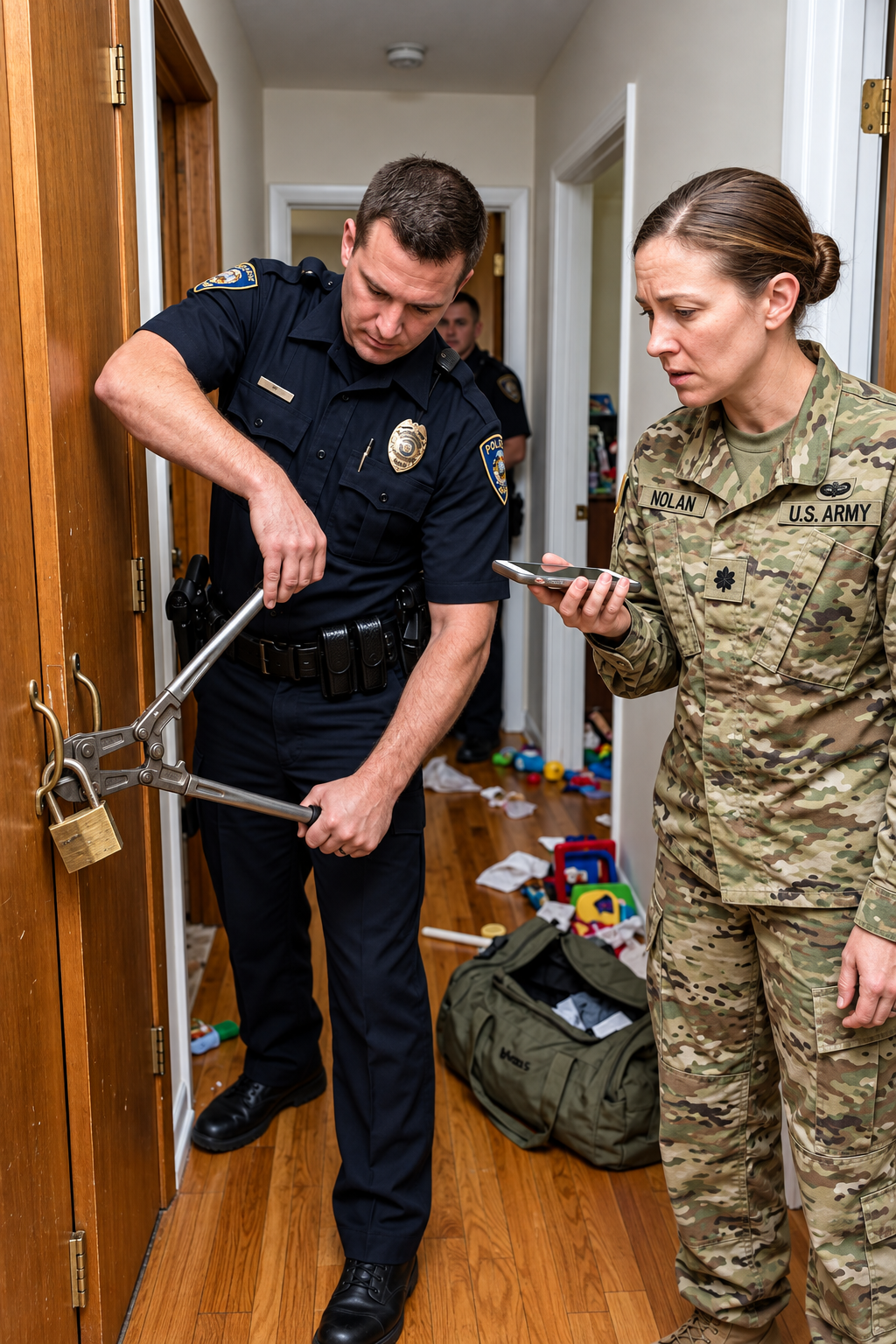
PART 1 TITLE: I Returned Home Six Days Early and Found My Daughter Behind a Locked Door, While My Husband’s Disappearance Hid Something Far Worse
The first sign that something had gone wrong was the front door. Three yellow delivery notices had been pushed beneath the weather stripping, their corners softened by rain. The deadbolt was engaged, the curtains were closed, and the house had the abandoned appearance of a place nobody expected to enter for several days. I stood on the porch with my military duffel against my leg, trying to understand why my husband had left our home looking that way. Six days earlier than scheduled, I had returned from duty. Derek was supposed to be inside with our four-year-old daughter.
My flight from Fort Gregg-Adams had landed at 1:40 that afternoon. The final movement of our logistics convoy had finished ahead of schedule, allowing me to return to Chesapeake almost a week before my official homecoming. I had told nobody. During the drive from the airport, I had imagined Lily hearing my voice from the hallway, running toward me with her gray stuffed rabbit tucked beneath one arm. I could almost feel the force of her small body colliding with my knees. Instead, I found myself standing outside our locked house, listening to a silence that seemed to extend beyond the windows.
“Hannah?” A voice came from the neighboring driveway. Evelyn, who had lived beside us since before Lily was born, approached with a plastic watering can swinging from her hand. She stopped near the hydrangeas and adjusted her reading glasses. Her expression changed when she recognized my uniform. “I thought you weren’t coming home until Monday.” I explained that my assignment had ended early, but the words came out distractedly. I was looking past her toward the empty driveway. Derek’s gray sedan was missing. So was the small bicycle Lily liked to leave beside the garage.
Evelyn followed my gaze. She lowered the watering can to the grass without releasing its handle. “Derek left Tuesday morning,” she said. “He loaded two big suitcases and his golf bag into the trunk. I saw him back down the driveway.” I frowned. On Sunday, Derek had sent me an email explaining that he would be occupied with five days of remote training for his company’s regional sales team. He had complained about the inconvenience of being stuck at the computer. I remembered offering to call less frequently so he could concentrate. Evelyn shook her head when I mentioned the training.
“He didn’t tell me anything about that,” she answered. “He said Patricia had taken care of everything.” My fingers tightened around the house key. Patricia was Derek’s mother. She lived in Richmond, roughly ninety minutes away, and rarely visited without announcing herself. She had always considered our family arrangements her business, but Derek knew how I felt about unexpected changes to Lily’s care. “Are you certain he said Patricia?” I asked. Evelyn nodded. “Her blue Buick was here that same day. She parked near your mailbox around noon.” Then she asked whether Patricia had collected me from the airport, as though the answer might make what she had witnessed less troubling.
I turned the key. The lock resisted briefly before releasing with a metallic click. Warm, stale air pressed against my face as soon as I opened the door. Somewhere inside, milk had spoiled. The thermostat displayed seventy-eight degrees, higher than we usually kept the house, and the familiar scent of our living room had been replaced by something sour and unpleasant. I called Derek’s name. Nothing answered. There was no television playing in the den, no sound from the kitchen, no footsteps overhead. Evelyn remained on the porch behind me, watching as I stepped into the dim hallway.
The curtains had been drawn across the living room windows. A narrow strip of daylight entered between two panels, illuminating dust suspended over the carpet. Lily’s coloring supplies were missing from the coffee table. Her favorite picture books, usually scattered beside the couch, were gone. I noticed these details without consciously deciding to examine them. Months of working with transportation records had taught me that the absence of ordinary things could be as revealing as the presence of unfamiliar ones. Then something shifted on the green sofa against the far wall, and everything else disappeared from my attention.
Lily was lying on her side beneath a small quilt, her knees curled toward her stomach. The gray rabbit was pressed against her chest, its long ears trapped beneath one arm. At first, I thought she was asleep. Then I saw her face. Her cheeks appeared hollow, her skin had an unhealthy gray pallor, and her lips were cracked. Her hair clung damply to her forehead. I crossed the room so quickly that my duffel struck the doorframe behind me. By the time I reached the couch, I was already kneeling on the hardwood floor, calling her name.
“Lily. Sweetheart, it’s Mommy.” Her eyelids moved, but when they opened, she looked past my face rather than directly at me. I brushed her hair aside and touched her cheek. Her skin was hot. I slid two fingers beneath her jaw to check her pulse, and the speed of it frightened me more than the heat. I had learned basic emergency assessment through my military service, but no training could prepare me for finding my own child in that condition. Her breathing was shallow, and when I gently pinched the skin on the back of her hand, it remained raised longer than it should have.
Beside the sofa lay an empty drinking cup, its plastic lid coated with dried milk. A sleeve of saltine crackers had been torn open and left on the carpet. Crumbs were scattered near Lily’s feet. There were no other signs of a recent meal. The room had the disordered stillness of a place where someone had tried to manage alone and finally run out of strength. I picked up the cup and examined it, then set it down carefully. My daughter had apparently been reaching for whatever food and drink she could find. I could not establish how long she had been there, but her condition told me it had been far too long.
“Can you hear me?” I whispered. Lily blinked. Her fingers tightened around the rabbit. “Mommy?” The word was little more than air. I placed my hand against her shoulder. “I’m here. You’re going to get help.” She did not smile. She seemed to need several seconds to understand what I had said. I asked where Daddy was. Her eyes drifted toward the front door. “He said he’d come back.” There was no anger in her voice, no accusation. She sounded as though she were repeating an instruction someone had given her and waiting for the promised result.
I lifted her gently, supporting her head against my shoulder. She weighed less than I remembered. During my deployment, I had received pictures of her in new dresses, wearing the shoes I had mailed for her birthday, holding drawings in front of the camera. In every photograph she seemed taller, more independent. Now her knees pressed against my ribs, and I could feel how little strength remained in her arms. I carried her into the kitchen, placed my phone on the counter, and dialed emergency services. My voice sounded unfamiliar even to me, stripped of the panic gathering beneath it.
The dispatcher answered promptly. I gave our address on Glenwood Drive and described Lily’s condition as precisely as I could. Four-year-old female, severely lethargic, signs of significant dehydration, rapid weak pulse, fever, and impaired responsiveness. I told the dispatcher that the child appeared to have been left without adequate supervision or access to water. She confirmed that an advanced life support ambulance was being sent and instructed me to remain on the line. I switched the phone to speaker. Then I took a small measuring cup from the drying rack and filled it with water.
I brought the rim carefully to Lily’s lips while holding her upright. She managed a small swallow, then coughed against my shirt. I stopped, waited for her breathing to settle, and followed the dispatcher’s guidance. I was afraid of making things worse by trying to correct her condition too quickly. Lily seemed to understand that I wanted her to drink, yet even lifting her head required an effort. She took another small sip. I praised her quietly and lowered the cup. All I wanted was to give her an entire glass of water, but the severity of her condition required more than anything I could provide in our kitchen.
Evelyn appeared in the doorway, her face drained of color. She looked at Lily and covered her mouth. “Dear God,” she said. I asked whether she had seen anyone entering the house since Tuesday. She shook her head. The curtains had stayed closed, she explained, and she had assumed the family was away. Derek had mentioned arrangements being handled. Patricia’s presence had made everything appear settled. Evelyn began apologizing for not checking sooner. I told her to remain nearby in case the paramedics needed someone to move a vehicle or provide information. I could not spare the attention to reassure her.
While we waited, I asked Lily whether Grandma Patricia had come into the house before Daddy left. Her fingers tightened on the rabbit. “She wore her shiny shoes,” she murmured. Patricia had several pairs of expensive patent-leather shoes that clicked against the hardwood whenever she visited. Lily used to imitate the sound, walking around the kitchen in oversized slippers. The memory felt strangely distant now. “Did Grandma stay with you?” I asked. Lily shook her head almost imperceptibly. Then she whispered that Grandma had told her grown-up girls did not make noise after the sun went down.
I felt my jaw tighten. Patricia had always valued obedience more than conversation. When Lily was younger, she sometimes complained that the child cried too much or demanded unnecessary attention. I had challenged her when she said such things, while Derek dismissed the remarks as harmless differences between generations. But what Lily was describing was not a disagreement about discipline. It was the language of a child who had learned to remain quiet while waiting alone. I kept my voice gentle and asked another question. Lily answered that Grandma had said Mommy went away because Mommy preferred being with soldiers.
For a moment, I could not speak. Lily was four. She understood that I wore a uniform, that airplanes sometimes carried me far from home, and that we counted the days until I returned. She did not understand deployment schedules or military obligations. Before leaving, I had explained repeatedly that my work took me away temporarily, never because I wanted to leave her. I had recorded bedtime stories and made Derek promise to play them for her. Hearing my service used as evidence that I loved her less revealed something deliberate in what Patricia had been telling her.
I was still holding Lily when I noticed a white envelope attached to the corkboard beside the refrigerator. At first, it seemed like an ordinary household bill. Then I saw the illustration printed across the top: a cruise ship moving through blue Caribbean water. The document beneath it was an itinerary issued by a Virginia Beach travel agency. I leaned closer without shifting Lily’s weight. The reservation was for a vessel called the Caribbean Crown. Departure was scheduled for Wednesday afternoon from PortMiami, with a later return to Norfolk. Two names appeared on the passenger list.
Derek Miller. Patricia Miller. I read them a second time, certain I must have overlooked someone. Lily’s name was not there. Neither was mine. The charge was four thousand two hundred dollars, marked paid in full by cashier’s check. Derek had told me he would be working remotely. Evelyn had watched him load the sedan. Patricia had apparently helped him leave. And now I was looking at proof of a vacation they had arranged without informing me. I glanced at Lily, still resting weakly against my shoulder. Whatever Derek intended to do during his absence, he had failed to provide a safe place for our daughter.
The reservation explained his suitcases, but it did not explain the condition in which I had found Lily. A parent leaving for a cruise could arrange for a trusted relative to care for a child. He could confirm that an adult had arrived, leave emergency numbers, arrange meals, and call regularly. Even if Derek believed Evelyn would take over, there should have been some contact, some evidence of a handoff. Instead, the house had remained locked and the curtains closed. The empty cup and crushed crackers told a different story from the one Derek had sent me in his email.
A siren rose in the distance. I moved into the hallway with Lily, keeping my phone connected to dispatch. Red light flashed briefly across the curtains before the ambulance stopped outside. Two paramedics hurried through the doorway carrying their equipment, followed by a police officer. The lead paramedic knelt beside us and began assessing Lily immediately. He listened to her breathing, checked her pulse, and examined her mouth. His expression grew more serious as he worked. Lily watched him without protest, still holding the rabbit as though letting go might cause everything around her to disappear.
“She needs intravenous fluids and hospital monitoring,” he said to his colleague. He explained that her pulse was dangerously elevated and her mouth was extremely dry. They would assess her circulation and transport her without delay. I helped move Lily onto the stretcher, making certain the blanket covered her legs. She turned her face toward me when the straps were secured. “Are you coming?” she asked. I bent close enough for her to see my eyes. “I’m following you, sweetheart. You’re not going to be alone.” Her fingers moved beneath the blanket until I placed the stuffed rabbit back in her hands.
The officer introduced himself as Marcus. His nameplate caught the light as he stepped into the hall. He had the composed manner of someone who had spent many years arriving at houses after something had already gone terribly wrong. He asked my rank and identification, then whether I was Lily’s mother. I answered plainly. I was a captain in the United States Army, serving in logistics, and Lily had been in her father’s care during my six-month deployment. I had returned early to discover her alone. Marcus wrote down the time, then asked when I had last spoken to Derek.
I explained the email about remote training and showed him the cruise document. Marcus studied the names and the departure details without immediately commenting. He asked whether Evelyn had agreed to watch Lily. I shook my head. Evelyn stood a few feet away, pale and trembling, and confirmed that Derek had made no such arrangement with her. She told Marcus about the luggage, the gray sedan, and Patricia’s blue Buick. I watched the officer record each statement separately. His attention was no longer directed toward a family misunderstanding. He was establishing who had known what, and when.
The paramedics began wheeling Lily toward the ambulance. One asked whether I could provide her health insurance information and vaccination records for admission. We kept those documents in a blue storage container beneath the stairs. I said I would collect them and follow immediately. The thought of allowing Lily to leave my sight, even for a few minutes, made my stomach tighten, but I knew the ambulance was the safest place for her. I walked beside the stretcher to the porch. Lily’s eyes were half closed. I touched her hand before the paramedics lifted her into the vehicle.
Evelyn remained near the driveway while Marcus asked for the neighbor’s full contact information. The ambulance doors closed with a heavy metallic sound. Through the rear window, I could see a paramedic bending over Lily’s small body. Then the vehicle pulled away. I stood there until it reached the corner, feeling the porch boards beneath my boots and the cool evening air against my face. My return had been meant to surprise my daughter. Instead, I was watching strangers take her to a hospital because the two adults who had been responsible for her care were nowhere to be found.
Marcus came to stand beside me. “Captain Miller,” he said, “I need to understand exactly who had legal responsibility for Lily while you were away.” I told him that Derek, as her father, had full authority to care for her during my deployment. We had not separated. There were no unusual custody restrictions. He had promised me personally that Lily would remain at home with him until I returned. Marcus glanced once more at the cruise itinerary in my hand. “And where is Mr. Miller now?” I looked toward the empty road where the ambulance had disappeared.
“On a cruise ship,” I answered. “With his mother.” Saying it aloud changed something. Until that moment, part of me had still been trying to locate an explanation that would reduce the catastrophe to carelessness, a missed call, a misunderstanding over dates. But Derek had concealed his plans, Patricia had been present, and Lily had been left waiting for someone who never returned. Marcus closed his notebook. He said we needed to examine the arrangements Derek had made before leaving. I turned toward the house, unaware that the evidence waiting inside would be more devastating than the cruise itself.
END PART 1
PART 2 TITLE: Beneath the Stairs, I Found a Locked Document Case Containing a Plan to Take Away the One Person I Had Come Home For
The blue storage tub was not where I expected it to be. For years, we had kept it on the middle shelf of the closet beneath the staircase, tucked behind a cardboard box of winter scarves. It held Lily’s birth certificate, vaccination records, insurance information, and the ordinary papers that become important only when something goes wrong. Now it sat on the floor with its clear lid cracked and several documents scattered around it. I crouched beside the container, already impatient to get to the hospital. Marcus followed me into the narrow hallway and stopped when he saw the disarray.
“Does your husband usually keep things like this?” he asked. I shook my head. Derek was untidy with his shoes, his coffee mugs, and the mail he left unopened on the kitchen counter, but he disliked anyone moving our important documents. He insisted they remain in the closet because he could find them quickly in an emergency. I remembered our last argument about organizing the tax papers. He had been irritated when I moved them into a different binder. Looking at the scattered records now, I realized someone had gone through the container with a particular purpose.
I recovered Lily’s insurance card and vaccination booklet, then noticed something unfamiliar on the upper shelf. A black document case rested where Derek normally kept our tax binders. It was made of reinforced nylon, with metal trim along the edges and two small combination locks. I recognized it immediately. I had bought it three years earlier to protect family paperwork during a move. We rarely used the locks. The case had originally belonged to both of us, and I could not recall the last time anyone had taken it down from the shelf.
A strip of white adhesive paper had been attached to the handle. Derek’s handwriting appeared across it in thick, hurried strokes: Legal and Custody. I read the words twice. We had no active custody dispute. We were married, lived together, and shared responsibility for Lily. My deployment had required temporary practical arrangements, not a transfer of parental rights. I touched one of the brass dials. It had been set to zero, as had the other, but the latches would not release. Someone had deliberately secured the case and placed it among the family records I might need.
Marcus noticed my reaction. “Do you know what’s inside?” I said I did not. He asked whether I knew the combination. I tried the numbers Derek commonly used, including Lily’s birthday, but neither lock opened. Each failed attempt increased my uneasiness. I thought of the cruise reservation and Patricia’s involvement. A man planning an ordinary vacation had no reason to lock custody documents in a case he knew belonged to his wife as well. Marcus asked me not to damage anything until he could record how we found it.
I explained when and where I had purchased the case and showed him the shelf where it had normally rested. Marcus examined the label without disturbing it. He noted that the storage tub had been opened and that the case was secured. Then he asked whether I wanted to proceed. The question irritated me because Lily was already in an ambulance, but I understood why he asked. There could be criminal evidence inside, and careless handling might compromise it. I told him that I intended to open the case and would allow him to document the process.
The combination locks resisted every ordinary attempt. I went to the kitchen and opened the drawer beside the refrigerator, where we kept spare batteries, screwdrivers, and the little objects that never found a proper home. My hand closed around a flathead screwdriver with a yellow handle. Returning to the closet, I told Marcus exactly what I intended to do. He stepped back so he could observe without interfering. I wedged the metal tip beneath the first latch. The lock resisted, then bent with a sharp crack. The second gave way after another firm push.
For a moment, neither of us spoke. The case was open, but I found myself reluctant to lift the lid. I knew how foolish that was. There was no document inside that could undo what had happened to Lily, and refusing to look would not make Derek’s actions less real. Still, the black case seemed to mark a boundary. Until I opened it, I could imagine that my husband had been reckless, dishonest, and selfish without knowing the full extent of his intentions. I drew the case toward me and raised the lid.
Old paper and dust gave off a faint dry smell. Beneath several familiar records lay two heavy manila folders. Our car titles and tax returns were stacked below them, but the folders were on top, positioned where they could be retrieved quickly. I lifted the first by its edges and opened it against the hallway wall. The document inside was twelve pages long, printed neatly on white paper. Its heading concerned the voluntary transfer of physical and legal custody of a minor child. My breath caught before I reached the second paragraph.
My name appeared as the parent surrendering her rights. Lily was identified as the child. The document claimed that my military commitments made it impossible for me to provide a stable home and that I had voluntarily decided to relinquish my parental authority. I read those sentences repeatedly, trying to comprehend them as words on a legal form rather than an accusation directed at everything I had done for my daughter. The language was formal, impersonal, and carefully arranged to create the impression that the decision had been mine.
I had never agreed to such a transfer. I had never discussed surrendering custody, either with Derek or anyone else. Before leaving for deployment, I had completed the necessary military family-care arrangements and provided emergency contact information. Those forms addressed Lily’s care during my temporary absence. They did not diminish my rights as her mother. Whoever prepared the document in my hands had deliberately transformed the facts of my service into an argument that I should no longer be responsible for my daughter.
Marcus watched as I turned the pages. He did not interrupt until I reached the final section, where my supposed consent had been recorded. Beside a notary stamp from a Maryland county was a signature written in blue ink. It resembled my name just enough to appear plausible at a glance. The date was four days earlier. Four days earlier, I had been traveling through military channels after departing Germany. I could account for my movements through official records. I had not been sitting in Maryland before a notary, signing away my child.
“That’s not my signature,” I said. The words came out quietly. Marcus stepped closer but did not touch the paper. I pointed to the first letter. Since middle school, I had written the capital H in my name with a distinctive loop at the top. The person who signed this document used two straight strokes. The rest of the name looked stiff, as though the writer had been thinking about every letter rather than writing naturally. Marcus studied the page for several seconds. Then he asked whether I could produce an older signature for comparison.
I thought of the paperwork in Lily’s bedroom. Before the school year began, I had signed her preschool enrollment forms and left copies in the top drawer of her dresser. Marcus accompanied me down the hallway. Lily’s bed was neatly made, which struck me as peculiar after seeing the condition of the living room. Her pillowcase was smooth, and her little blanket remained folded at the foot of the mattress. I opened the drawer, found the enrollment papers, and brought them back. Seeing her name written in my handwriting made the forged custody document feel even more obscene.
We laid the forms side by side. My original signature flowed naturally, its first letter unmistakable. The one attached to the custody transfer was hesitant and incorrectly shaped. Marcus compared the ink strokes, then looked toward me. “They didn’t reproduce your handwriting very carefully,” he observed. I asked whether the difference would be enough to establish forgery. He explained that proper examination would require authenticated samples and forensic comparison, but the discrepancy was significant. The date and my military travel records would also need to be checked.
I felt relief at having evidence, followed almost immediately by anger that evidence was necessary. My daughter’s future had been placed inside a document designed to make a court or government office believe I had abandoned her willingly. Derek knew I would never sign something like that. He knew how much effort I had made to remain present during deployment, from the recorded bedtime stories to the regular video calls and birthday packages. Yet someone had used those months away to construct a version of me that I barely recognized.
Marcus opened an evidence bag and asked me to identify the papers without touching the signature areas. I followed his instructions carefully. He recorded the document’s location, the condition of the case, the method used to open it, and the comparison with Lily’s preschool form. I watched him seal the pages. The red strip across the top of the bag made the discovery feel official in a way the document itself had not. Whatever Derek intended, the situation had passed beyond a private argument between husband and wife.
Then Marcus pointed to the second folder. It contained a printed timeline, shorter than the custody transfer and less formal in appearance. Dates ran down one side of the page, accompanied by brief instructions. Several entries concerned financial arrangements and the collection of documents. One date stood out: October twentieth. Beside it was an instruction to finalize travel accounts. I checked the cruise itinerary again. The dates were close enough to suggest a connection, but the timeline provided no ordinary explanation for why custody paperwork and travel arrangements had been stored together.
There were handwritten notes on the pages, some in Derek’s familiar slanted script. I recognized the way he formed numbers and shortened certain words when making quick lists. We had lived together long enough for me to know his handwriting on grocery receipts and birthday cards. The entries did not resemble the harmless reminders he usually left around the house. They were steps in a sequence. Documents had been collected, financial matters organized, and travel planned. Even without knowing the complete purpose, I could see that the arrangement had developed over time.
Marcus studied the dates. “Someone put work into this,” he said. I asked whether the custody transfer had already been submitted anywhere. He could not tell me from the papers alone. The appearance of a notary stamp did not establish that the entire document was authentic or legally effective. It could be part of an attempted fraud, or preparation for one. The distinction mattered for the investigation, but it brought me little comfort. Someone had gone far enough to produce a signature purporting to be mine.
The question that troubled me most was why Derek needed such a document. He was Lily’s father. He already had legal parental authority. He could make ordinary decisions about her care while I was away, and he had never needed a signed surrender from me to do so. A custody transfer served a different purpose. It could be used to argue that I no longer had the right to intervene in decisions affecting our daughter. The idea struck me with such force that I had to place one hand against the wall.
I looked toward the front door, remembering Lily’s whisper that Daddy would return. If Derek had intended to keep our daughter permanently, why had he abandoned her in the house? If he planned to take her somewhere, why had the cruise reservation named only two passengers? And why had Patricia told Lily that I preferred the Army to my own child? Each question seemed to belong to a different part of the same design, but I could not yet understand how they fitted together. I asked Marcus to preserve the timeline with the other documents.
His expression remained serious. “We’ll need to establish who prepared these papers and what they were meant to accomplish,” he said. I asked about the notary. He explained that investigators could verify the stamp, the commission information, and whether any record existed of the alleged signing. The travel dates could be examined against passenger information. As he spoke, I realized how easily I might have missed everything if my assignment had ended on its original schedule. Derek had expected me home six days later. The house, the papers, and perhaps Lily herself might have been in an entirely different condition by then.
I remembered a conversation from before my deployment. Derek had said that Patricia could help if caring for Lily became too difficult while I was overseas. I had agreed that occasional visits would be useful, provided he remained responsible for our daughter and kept me informed. He had seemed offended that I needed to state something so obvious. Later, during video calls, he often complained about the burden of managing the household alone. I had listened, suggested practical solutions, and thanked him for taking care of Lily. Looking back, I wondered how long he had been preparing a different arrangement.
But memory was not evidence. I forced myself to stop reconstructing every uncomfortable conversation we had ever had. Marcus needed names, dates, and documents. Lily needed me at the hospital. Those were the two realities I could act upon. I gave the officer copies of the relevant information from the insurance container, verified my contact number, and asked him to secure the papers until investigators could examine them properly. He agreed to document the case and coordinate the next steps. Then he asked whether I could contact Derek directly.
I told him I would, but not before seeing my daughter. My phone showed several missed notifications from work and a message confirming my return arrangements. There was still nothing from Derek asking whether I had arrived or whether Lily was safe. I put the insurance papers into my bag and walked toward the front door. Marcus followed me outside. Evelyn was standing beside her porch, watching with an expression that told me she understood more had happened than a medical emergency. I thanked her for speaking to the officer and asked her to preserve anything she remembered about Tuesday.
On the drive to Chesapeake General Hospital, I kept seeing the signature. It appeared each time I stopped at a traffic light: a stranger’s awkward attempt to write my name beneath words I would never have accepted. I thought of Lily lying against me, too exhausted to do more than whisper. The forged document was about custody, but the practical meaning was something simpler and more frightening. Someone wanted to decide where my daughter belonged without allowing me to speak for myself. Someone believed my absence had made that possible.
The hospital entrance came into view beneath its bright emergency sign. I parked, collected Lily’s medical records, and walked inside. The air smelled of disinfectant and floor wax. Through the reception area I could see nurses moving between doors and families sitting in plastic chairs, waiting for information about people they loved. I approached the pediatric desk and gave Lily’s name. The nurse confirmed that she was receiving treatment and that I could wait nearby until the physician finished assessing her. I sat down with my hands clasped around the insurance folder.
Marcus joined me a short time later. He had completed the initial documentation at the house and was coordinating with investigators. I showed him the phone number from Derek’s contact entry. “We need to ask him where he is and why Lily was left alone,” the officer said. I looked through the glass doors toward the pediatric ward. Somewhere beyond them, my daughter was receiving fluids because the man who had promised to protect her had disappeared on vacation. I agreed to make the call when the medical staff had updated me. This time, Derek would have to answer questions he had spent days avoiding.
END PART 2
PART 3 TITLE: When I Called My Husband From the Hospital, One Question About the Locked Case Made His Entire Story Fall Apart
The pediatric waiting area was full of ordinary sounds that became unbearable when I tried to concentrate on them. A vending machine hummed beside the entrance. Somewhere behind the double doors, a child cried while a nurse spoke reassuringly. The television mounted above the reception desk showed a weather forecast with the sound turned low. I sat in a plastic chair, still wearing my uniform, unable to take my eyes off the corridor through which Lily had been brought. Marcus stood near a large potted fern, reviewing the notes he had taken inside our house.
A nurse came to speak with me after Lily had been settled. She explained that my daughter was receiving intravenous fluids because her dehydration was too significant to manage with drinking alone. The medical team was monitoring her heart rate and checking her blood work for signs that her kidneys had been affected. Lily had responded to treatment, but she remained weak and exhausted. The nurse’s tone was careful rather than reassuring. I understood what she was telling me: my daughter was receiving appropriate care, but there was no reason yet to assume everything would be fine.
I asked whether I could see her. The nurse said the attending physician was completing an examination and that I would be allowed inside as soon as possible. I thanked her. After she returned through the doors, I stood and approached the small observation window. From that angle I could see only a section of hallway and the far edge of a hospital bed. A thin white blanket covered a child-sized figure. The gray ears of a stuffed rabbit were visible near the pillow. I watched the blanket rise and fall with her breathing until Marcus quietly spoke my name.
“We should contact Derek while we’re here,” he said. I understood his reasoning. The circumstances needed to be documented promptly, and Derek’s first explanation could become important later. Waiting until he knew exactly what had been discovered might allow him time to construct a more convincing story. Marcus asked whether I would be willing to place the call on speaker so he could hear the exchange. I looked at my phone. Derek had not sent me a message since the email about his supposed training. The absence of even a routine question about Lily’s day now seemed deliberate.
I opened his contact and pressed the call button. Marcus moved close enough to hear without leaning over my shoulder. The phone rang once, twice, three times. I could feel my pulse in my fingertips. On the fourth ring, I expected voicemail. Instead, Derek answered, and a wall of noise flooded the speaker. Music pounded in the background, accompanied by cheers, laughter, and the sound of people speaking over one another. Someone blew a whistle. It was the unmistakable atmosphere of a party, not a hotel room where a man was completing work training.
“What?” Derek demanded. He sounded irritated before I had said a word. I recognized that tone. During our marriage, he often answered conversations about household expenses or childcare as though the discussion itself were an unfair demand on his time. If I asked when he would be home, he accused me of monitoring him. If I needed help with an appointment, he reminded me how busy he was. I had learned to keep my questions brief because any hint of frustration on my part gave him an excuse to stop listening.
“Where are you?” I asked. He gave a loud sigh. “Seriously, Hannah? You call me out of nowhere and start checking up on me?” The music grew louder for a moment. I heard wind striking the phone microphone and voices shouting in the background. “I’m busy,” he added. I looked at Marcus, who made a small gesture indicating that I should continue. I asked Derek again for his location. He refused to provide it and complained that I treated him like someone under my command.
His words came faster as he continued. I had spent six months away, he said, and now I apparently expected him to account for every hour of his life. He deserved time to himself. He was tired of being criticized. I listened without interrupting, noticing the slight slur in his voice. Derek had been drinking. That realization was not especially surprising, given the noise around him, but it made the difference between his surroundings and Lily’s hospital room almost impossible to bear.
“Derek,” I said, “where is Lily?” For several seconds, he did not answer. Then he said she was fine. I asked who was looking after her. “Evelyn,” he replied. “I left her with Evelyn. She agreed to help.” He delivered the explanation casually, as though the matter had been settled weeks earlier and I was unreasonable for questioning it. Marcus was writing quickly. I asked when Derek had spoken to Evelyn and whether he had confirmed that Lily was physically in her care before leaving town.
“You know how she is,” Derek said. “She’s always happy to look after Lily.” I repeated the question. This time he snapped that I should stop interrogating him. I told him Evelyn had not spoken to him in two weeks and had never agreed to take responsibility for our daughter. The response came instantly. Evelyn must have forgotten, he said. She was elderly, easily confused, and probably trying to avoid blame. I thought of Evelyn standing in our driveway, clutching a watering can with shaking hands. Her account had been specific, consistent, and supported by what I found inside the house.
“Lily was alone,” I said. Derek continued talking, apparently determined to convince me that Evelyn was responsible. I raised my voice just enough to interrupt. “I came home early. I opened our front door. Our daughter was lying on the sofa without food or water, and she could barely respond when I spoke to her.” The party noise remained loud on his end. I could hear a glass breaking somewhere nearby, followed by laughter. Derek said nothing for a moment, then returned to the same accusation. If Evelyn had failed to do what she promised, I should be angry with her.
I told him I was sitting at Chesapeake General Hospital. Lily was being treated for severe dehydration, and the doctors were monitoring her kidneys. Her heart rate had been dangerously elevated when the paramedics arrived. I wanted him to understand the seriousness of what had happened. I wanted some sign that the words had reached him as a father. Instead, Derek demanded to know why I was making everything sound so dramatic. Children became dehydrated, he said. I should let the doctors handle it rather than turning a family problem into a crisis.
I stared at the phone. For years, I had explained Derek’s defensive behavior to myself as stress, insecurity, or frustration with responsibilities he had not expected to shoulder alone. But there was nothing ambiguous about this conversation. He had just learned that his daughter was in the hospital after being left without supervision. His first concern was not how she felt or whether he needed to return. It was finding someone else to blame. Marcus kept his eyes on his notebook, giving me room to continue.
I asked when Derek intended to return home. He said I already knew his schedule. I told him I had found the cruise itinerary. He did not ask how. Instead, he complained that everyone deserved a holiday and that I had spent months traveling while he remained behind. I explained that a military deployment was not a vacation. He laughed dismissively. I recognized the familiar argument taking shape: he would describe my service as a personal indulgence and his leisure as compensation for the sacrifices he believed he had made.
“You went away with Patricia,” I said. “You left Lily behind, and you didn’t tell me where you were going.” Derek insisted he had made arrangements and that I was twisting the situation. I asked whether his mother knew Lily had been left alone. He avoided answering. When I mentioned Patricia’s visit on Tuesday, he accused Evelyn of spreading stories. Marcus raised his eyes briefly from the notebook. Neither of us needed him to say very much more to establish that he was refusing straightforward questions about his daughter’s care.
I could have ended the call then. I had enough information to know that the explanation about Evelyn was unreliable. But the contents of the black document case still waited between us. I wanted to hear what Derek would say before he had an opportunity to discuss it with Patricia or anyone else. I told him that I had searched the hallway closet for Lily’s medical records. The word closet produced no immediate response. I continued carefully, describing the opened storage container and the black case on the shelf above it.
“I found the custody papers,” I said. The music continued for several seconds. Then Derek’s breathing became audible through the phone. He did not ask what papers I meant. He did not express confusion about why custody documents would be in our house. The silence was so complete that I wondered briefly whether the call had disconnected. Marcus stopped writing. He held his pen above the page and waited. I repeated that I had opened the case labeled Legal and Custody.
“You weren’t supposed to find that,” Derek said. His voice had changed. The irritation was gone, replaced by a flatness that made the words more disturbing. The admission was almost involuntary, as though the discovery had caught him before he could decide which explanation to use. I felt Marcus move slightly beside me. I asked Derek why the papers existed and why they contained a signature purporting to be mine. He did not answer directly. Instead, he demanded to know how I had opened the case.
I told him it had been secured inside our shared home and that I had opened it while searching for documents needed by our daughter. He called it his private property. I reminded him that I had purchased the case and that our family records had always been stored there. Derek accused me of breaking into something that did not belong to me. The change of subject was so abrupt that I almost laughed. A forged parental consent document lay in police custody, and my husband’s immediate defense concerned a damaged combination lock.
“Why is my name on a custody transfer I never signed?” I asked. Derek said I was confused and that the papers were only drafts. I pointed out the signature, the notary stamp, and the date. I had been traveling from Germany when the supposed signing occurred. He responded that documents could be prepared in advance, as though that explained how a stranger’s handwriting appeared beneath a statement surrendering my rights. I asked who was meant to receive the transfer and whether Patricia had been involved. He refused to answer either question.
Marcus leaned closer to the phone. Derek must have heard the movement, because he demanded to know whether someone was listening. I said a police officer was present. The reaction was immediate. Derek raised his voice, accused me of humiliating him, and said I was trying to destroy his reputation because I disliked his mother. He complained that I had brought the authorities into a private marital disagreement. I told him that paramedics and police had been called because our daughter was in danger, not because we had disagreed about a holiday.
For the first time, I heard fear beneath his anger. It was not the fear I had expected from a father whose daughter had been hospitalized. It was concern about what might happen to him. He asked what evidence the police had collected and whether the documents had been removed from the house. I refused to discuss the investigation. Marcus made a small gesture of approval. Derek then accused me of deliberately misunderstanding a situation that would make sense if I allowed him to explain it. I waited. No explanation followed.
I asked one final question. “Did you intend to use those papers to prevent me from taking care of Lily when I came home?” Derek told me I was unreasonable. He said he would not discuss anything further without legal advice. Then he ended the call. The sudden electronic tone sounded strangely loud in the waiting area. I remained seated with the phone in my hand. Marcus wrote down the time, then asked me to preserve the call history. I nodded. We had heard enough to establish that Derek knew about the documents and had expected them to remain hidden.
For several minutes, I could not make myself move. The conversation had stripped away the explanation I wanted to believe. Derek had not reacted like a man discovering a terrible accident. He had defended the trip, attacked Evelyn, dismissed Lily’s medical condition, and worried about the papers. I thought about the phrase he had used when I mentioned the case. He had not said he did not understand. He had not asked what I was talking about. He had told me I was never meant to find it.
Marcus sat beside me. He explained that investigators would examine the forged documents and the travel arrangements while the hospital completed its medical assessment. He said the case could involve several different offenses, depending on the evidence: neglect, falsification of documents, and potentially financial or custody-related fraud. He avoided making promises about charges. I appreciated that. I did not want someone to reassure me with conclusions that had not yet been established. What I needed was a careful investigation that Derek could not dismiss as another disagreement between us.
The hours moved unevenly. Nurses passed through the doors carrying medication carts. A family arrived with a child wrapped in a blanket. Someone’s telephone rang repeatedly until a man silenced it with an impatient gesture. Each sound reminded me that ordinary life continued around us while mine had narrowed to the distance between a plastic chair and Lily’s hospital bed. I checked the time, then the doors, then my phone. Derek made no attempt to call back. Patricia did not contact me either.
Shortly before eight that evening, a woman in a navy blazer approached the waiting area. She was shorter than I was, with a purposeful stride and a spiral notebook tucked beneath one arm. She stopped in front of me and asked whether I was Hannah. I stood. She introduced herself as Detective Rebecca Alvarez, assigned to fraud and family-related offenses. Marcus greeted her and summarized the initial evidence. Rebecca listened without interrupting, occasionally tapping the edge of her notebook against her palm.
When Marcus finished, she turned to me. “Your husband and his mother booked their cruise through a travel agency in Norfolk,” she said. “We’ve begun checking the passenger records. The ship is due to dock in a few days.” I asked whether Derek had been contacted. She said the authorities were working through the appropriate channels and that she wanted a complete picture before making assumptions about his intentions. I respected the distinction, though it was difficult to remain patient. Lily’s condition was not an assumption, and neither was the signature I had found.
Rebecca asked whether Derek had mentioned future travel beyond the cruise. I told her about the printed itinerary and the timeline inside the document case. She nodded. Then she explained that officers had begun examining the other materials recovered from the closet. Beneath the custody transfer, they had identified a second set of notes. The dates and handwriting suggested the cruise might have been only one stage of a larger arrangement. I felt the muscles in my shoulders tighten. Until then, I had assumed Derek and Patricia intended to return home when their vacation ended.
Rebecca opened her notebook. “There is something else you need to see,” she said. She explained that the timeline contained instructions written by more than one person and that one entry appeared to anticipate the possibility of my early return. I looked at her, struggling to understand what she meant. My military schedule had changed unexpectedly. Even Derek had not been told I was coming home that day. Rebecca watched my expression carefully. “Someone prepared an alternative,” she said. “We need to work out what they planned to do if you arrived before they were ready.”
I thought of the locked house, the empty suitcase spaces, the forged signature, and Lily lying under her quilt. These were no longer separate incidents connected only by Derek’s dishonesty. They were pieces of a sequence someone had prepared in advance. Rebecca took a folded page from her notebook and placed it between us. I recognized the paper immediately. It came from the black document case. Across the bottom was handwriting I had not yet examined closely. Rebecca pointed to it. “Look at the dates first,” she said. “Then we’ll talk about the person who wrote the last instruction.”
END PART 3
PART 4 TITLE: A Missing Savings Account and Four Airline Seats Revealed the Escape Plan, but My Daughter Had Already Been Taught a Crueler Lie
The first date on the timeline was October fourth. Beneath it, someone had written a short instruction concerning a savings transfer. October eleventh referred to collecting documents. October twentieth marked the departure of a flight. Rebecca watched me read each line, giving me enough time to understand its significance before she offered an explanation. At the bottom of the page, a second handwriting style appeared in darker ink. The instruction was brief: if I returned earlier than expected, an alternative arrangement was to be used. An address in Norfolk had been written beside it.
I looked up from the paper. “Someone knew I might come back early?” Rebecca said they could not yet determine how much the people involved knew about my military schedule. My original return date was available to Derek because I had shared it with him. Unexpected changes were another matter. The note might have been a precaution rather than evidence that someone knew my assignment would end ahead of time. But it showed that the possibility had been considered. Whoever wrote it had understood that my arrival could interfere with the plan.
Rebecca directed my attention to the handwriting. The letters on the final instruction were smaller and more rounded than Derek’s. The lowercase i’s had been dotted with little circles. I stared at them, feeling recognition develop slowly. Patricia wrote that way. She had done it on birthday cards and handwritten notes for years. I remembered a card she had sent Lily for her first birthday. Even the lettering on the envelope had the same decorative marks. I told Rebecca. She did not immediately treat my recognition as proof, but she wrote down the detail and asked whether I could provide examples.
I said Patricia kept a collection of stationery at her house in Richmond and frequently sent cards for family occasions. I could also find several of them in Lily’s belongings. Rebecca explained that any comparison would need to be conducted properly. What interested her was the possibility of a second person taking part in the planning. Derek’s involvement was already suggested by the documents, his handwriting, and his responses during our telephone conversation. Patricia’s participation was less certain, though Evelyn’s observations and the cruise booking gave investigators a reason to examine her role closely.
Then Rebecca told me about a flight from Norfolk to Punta Cana in the Dominican Republic. It was scheduled for October twentieth. The reservation contained four passenger positions. I sat completely still while she explained the details. Two were for adults. One was recorded as a child. The fourth was designated for an infant traveling on an adult’s lap. The classification troubled investigators because Lily was four years old. Rebecca said the discrepancy required verification with the airline and booking agent, particularly in light of the custody paperwork.
“Four seats,” I repeated. “But the cruise only lists Derek and Patricia.” Rebecca nodded. The cruise and the flight had been arranged separately. She did not suggest that the two reservations established a complete escape plan on their own. Still, the timing, the misleading passenger information, and the documents prepared in advance raised obvious questions. I looked back at the date. October twentieth. If that flight was part of the arrangement Derek had been preparing, the custody transfer might have been intended to help him take Lily abroad without my knowledge or consent.
I remembered Lily saying that her grandmother had brought shiny shoes to our house. I remembered the accusation that I preferred the Army to my daughter. Those remarks now carried a different significance. If Patricia wanted Lily to accept leaving with Derek, convincing her that her mother did not want her would make the transition easier. If the forged document could be presented as proof that I had surrendered my rights, the deception would extend beyond the child’s understanding into legal and administrative systems. I told Rebecca that Lily had repeated statements about my supposed preference for military life. She wrote them down carefully.
Rebecca suggested we get coffee while the medical team continued monitoring Lily. The machine on the pediatric floor was broken, so we went downstairs to the cafeteria. It was nearly empty. A cleaner was wiping tables near the windows, and the overhead lighting made everything look pale. Rebecca bought two coffees and placed one in front of me. I wrapped my hands around the paper cup without drinking. The warmth was comforting, but my thoughts remained fixed on the four passenger positions. An infant ticket for a child who could walk and speak was not an ordinary booking detail.
“Do you think they meant to take Lily?” I asked. Rebecca considered the question before answering. She said the possibility was being investigated, particularly because of the custody transfer and the child’s account of Patricia’s visit. But the precise purpose of the flight remained uncertain. Investigators would need records from the travel agency, payment information, and whatever evidence connected the passengers to the reservation. I appreciated her caution. The consequences were too serious to rest on speculation, no matter how strongly the available details pointed in one direction.
We discussed the travel agency. Rebecca said the reservation had been paid for in cash at a counter in Norfolk. The agent remembered that a woman had handled much of the transaction and signed the receipt. I thought of Patricia’s habit of taking charge whenever plans involved Derek. She liked to say that her son was too busy to deal with details. During family holidays, she selected hotels, made restaurant reservations, and corrected everyone’s schedules. Derek rarely objected. Allowing his mother to manage practical arrangements had become an ordinary feature of their relationship.
There was another question I had not wanted to ask. The cruise alone cost four thousand two hundred dollars. The flights, additional travel, and other preparations would have required more money. Derek earned a respectable salary, but he had complained repeatedly about household expenses during my deployment. He had insisted that Lily’s preschool fees were excessive and questioned why we maintained a separate savings fund when we already had a joint checking account. I remembered those conversations now with an unpleasant clarity. The timeline’s first entry concerned savings, not travel.
Rebecca asked whether we had shared accounts. I explained that Derek and I maintained a joint household account and a savings account intended for emergencies and Lily’s future. I contributed regularly, including during my deployment. Derek had access because we were married and had established the account together, though we had agreed not to make large withdrawals without discussing them first. I had not reviewed the latest statements closely while overseas. Derek had been handling ordinary household bills, and I had no reason to believe the savings were being used for anything unusual.
“Have you checked the balance recently?” Rebecca asked. I shook my head. She recommended that I obtain the account history, preserve copies, and report any transactions I did not authorize. If there had been fraudulent signatures or other irregularities, the bank’s records would become important evidence. I told her I knew the branch manager and could visit when the bank opened. Rebecca agreed that it was a sensible next step. We returned upstairs so she could complete several questions about the family finances and the documents kept in our house.
That night, sleep came in fragments. I remained close to the pediatric unit, asking for updates whenever the staff could provide them. Lily was responding to fluids, but she still required monitoring. A physician explained that prolonged dehydration could place stress on a child’s kidneys and circulation. The tests would help establish whether there had been lasting injury. I tried to listen without allowing my fear to overwhelm the practical questions I needed answered. When the physician finished, I asked when Lily might be strong enough to speak with me. He said her recovery would determine that.
The following morning, I went to the Chesapeake bank branch shortly after it opened. The parking lot was nearly empty. Through the windows, I could see Mr. Gable at his usual desk, examining a document beneath the light. He had assisted us with our accounts for six years and knew that I transferred money into savings regularly. When he noticed me approaching, his expression changed. He rose before I reached the counter. Something about the way he looked at me told me that the conversation would not be ordinary.
“I need the current balance and recent transaction history for our joint savings,” I said. Mr. Gable asked for identification and completed the necessary checks. Then he turned his monitor so I could see it. The available balance was zero dollars and zero cents. I stared at the screen. At first, I thought I had misunderstood which account he had opened. I gave him the account details again. He confirmed them. The savings account that was supposed to protect our family had been emptied.
Mr. Gable printed the transaction history. Nineteen thousand four hundred and twelve dollars had been withdrawn through three transactions. The first was dated October fourth. The last was dated October fifteenth. I recognized the first date immediately from Derek’s timeline. The amount was not enough to make us wealthy, but it represented years of deliberate saving. I had made deposits during months when our budget was tight, sometimes postponing purchases for myself so the balance would continue growing. I had believed the money was there for emergencies, education expenses, and the unexpected demands of raising a child.
I asked who had authorized the withdrawals. Mr. Gable retrieved copies of the withdrawal slips. My name appeared at the bottom. The letters were similar to the signature on the custody transfer, but they were not mine. I knew it before he finished arranging the documents on the counter. The writer had tried to imitate the shape of my handwriting, yet the strokes moved awkwardly. The first letter was wrong. Several smaller details differed from the signatures on the bank’s older records. I placed my hand beside the papers, careful not to disturb them.
“I didn’t sign any of these,” I said. Mr. Gable adjusted his glasses. He explained that the transactions had been processed based on the account’s authorization records and the signatures presented. I told him the police were already investigating a separate forged document. His expression became more guarded. He asked for the relevant case information and explained how the bank would handle a formal fraud complaint. I requested complete copies of the transaction records and information about preserving any supporting documents or available surveillance footage. I wanted nothing overlooked.
For a moment, I found myself concentrating on the paper rather than the money. It was easier to examine ink strokes than to acknowledge what Derek’s actions meant. He had not merely spent our savings without telling me. Someone had apparently placed my signature on records authorizing withdrawals I had never approved. The pattern resembled the custody document. Both attempted to create evidence of my consent where none existed. Both involved decisions that would have significant consequences for my life and my daughter’s future.
Mr. Gable handed me the printed records in a bank envelope. I thanked him, completed the necessary steps to report the disputed transactions, and left. Outside, sunlight fell across the nearly empty parking lot. I stopped beside my car and examined the papers again. Nineteen thousand four hundred and twelve dollars. Three transactions. A sequence of dates that aligned with the preparation of travel documents and other arrangements. The financial loss was serious, but the deeper significance was becoming clear. Whoever had prepared the plan expected to use money and paperwork together to accomplish something without my participation.
My telephone vibrated. Jenna’s name appeared on the screen. She was Derek’s sister, a hairdresser whose cheerful, hurried manner usually made even minor family conversations sound urgent. I answered. She immediately asked whether I was all right. She had received conflicting messages from relatives and understood that something had happened involving Derek. According to Jenna, he had told people we had argued and that he needed some space. I asked where he was. She said he was on the cruise, as far as she knew, and seemed surprised that I needed to ask.
“Did you know about the trip?” I asked. Jenna hesitated. Then she said Patricia had been talking about it for weeks. Her mother had called it a special vacation and had been excited enough to invite Jenna to join them. Jenna could not get time off from the salon. I asked who booked the tickets. She said Patricia handled everything: the cabin, the excursions, and the payment arrangements. She had insisted on using cash because she did not want Derek’s credit card appearing in the travel records. Jenna admitted she had found the insistence unusual.
I looked at the bank envelope in my hand. Patricia had apparently taken extraordinary care to prevent the trip from being traced through her son’s credit card. Meanwhile, large amounts were disappearing from the joint savings account under signatures that were not mine. I asked whether Jenna had accompanied her mother to the travel agency. She said she had driven Patricia there on a Tuesday because the salon was closed and Patricia needed transportation. The agent had requested identification and a signature when the cash payment was collected. Jenna remembered the transaction because her mother had been unusually particular about the paperwork.
I turned over the bank receipt and wrote down the date as Jenna recalled it: October fourteenth. It sat within the sequence of transactions and preparations recorded on Derek’s timeline. I asked Jenna whether anyone had mentioned Lily traveling with them. Her answer was immediate. Patricia had purchased a small sun hat for Lily and packed a pink bag decorated with stars. Jenna had seen the bag in her mother’s car. Later, Patricia announced that Lily would not be accompanying them after all. Jenna had assumed the arrangements had changed and had not thought to question it.
“Was the bag still in Patricia’s car?” I asked. Jenna said it had remained there for about a week. She sounded puzzled by my interest. To her, the pink suitcase was a minor detail of a family holiday that had changed at the last minute. To me, it suggested that Lily had been included in at least one stage of the travel preparations. The information did not yet prove what the four airline passenger positions meant, but it supported the need to investigate them. I asked Jenna to remember everything she could about the tickets, the bag, and the dates.
Her voice softened. “Hannah, did something happen to Lily?” I looked at the bank statement, then toward the hospital across town. “She’s in the hospital,” I said. Jenna went silent. She explained that Derek had told her Lily was fine, and I could hear her struggling to reconcile that statement with what I had just said. I told her that Lily had been left alone and that the doctors were treating severe dehydration. Jenna began asking questions, but I was no longer able to continue the conversation. I told her investigators might need to speak with her and ended the call.
I remained beside the car for several minutes. Every new detail strengthened the possibility that Derek and Patricia had been coordinating something more extensive than a vacation. Yet important questions remained. Why had they apparently prepared to travel with Lily, then left her behind? Why was there an alternative address in Norfolk? What had they expected to happen after the cruise? And how did the forged custody document fit into a plan involving a flight to the Dominican Republic? I placed the bank records safely in my bag and decided to give investigators the additional information before anyone could persuade Jenna to change or soften her account.
When I returned to the hospital that afternoon, the pediatric corridor was quieter. The clock above the nurses’ station read 4:38. A nurse directed me to room 314. I opened the door carefully. Gray daylight entered through the blinds, and the low amber light of an intravenous pump glowed beside the bed. Lily lay beneath a thin blanket with her knees drawn toward her stomach. Her stuffed rabbit was tucked beneath her chin. On the bedside table sat a lunch tray with a carton of milk, diced peaches, and a plastic spoon still sealed in its wrapper.
I moved a vinyl chair closer to the bed, taking care not to scrape its metal legs against the floor. “Lily-bug,” I whispered. Her eyes opened slowly. She looked toward my uniform collar and then at my face. I asked whether she was thirsty. She nodded. I helped her take a few careful sips of apple juice through a straw. When she finished, she whispered that it tasted like the drinks she used to have in the red plastic cups at home. I smiled and told her we could use those cups again when she was feeling better.
“Daddy threw the blue ones away,” she said. I asked what she meant. Lily explained that Derek had put her blue cups into a large black trash bag along with her coloring books. He had told her they would not need those things anymore. I felt a cold sensation move through my chest. The statement suggested someone had been preparing to remove belongings from the house, perhaps because they expected Lily’s living arrangements to change. I kept my expression calm and asked whether she remembered when it happened. She shook her head, exhausted by the conversation.
I leaned toward her, wanting to hold her until she understood that the waiting was over. But when I reached across the bed, Lily pushed against my chest. Her elbows locked, and her small palms pressed into the fabric of my uniform. The rejection caught me completely unprepared. I stopped moving. Lily’s eyes filled with tears, but she did not release her rabbit. “You like the Army more than me,” she whispered. The words were almost identical to the accusation she had repeated at home. Someone had told her that my absence was a choice against her.
For a few seconds, I could only look at her. I had spent hours examining forged signatures, calculating financial losses, and discussing travel records. Each discovery had revealed another practical step in a plan Derek and Patricia appeared to have constructed. But none of those documents could show the full injury done to my daughter. She had been hungry, frightened, and alone. During that time, she had also been made to believe that her mother did not want to return. Even now, when I was standing beside her bed, the belief remained strong enough to make her push me away.
I lowered my hands. I did not insist on an embrace or ask her to forgive me for something I had never intended. “I love you, Lily,” I said quietly. “I went away because I had work to do, not because I wanted to leave you. Nothing about my job matters more than you.” She looked down at the rabbit. I stayed beside the bed without trying to touch her again. There would be time to explain more when she was stronger. For now, she needed control over something, even if the only thing she could control was whether I came closer.
The bank envelope rested in my bag beneath the chair. Inside were records of nineteen thousand four hundred and twelve missing dollars. Elsewhere, investigators held a forged custody document and a timeline leading toward an international flight. All of it mattered. I would provide every document, answer every question, and pursue the truth through the proper channels. But sitting beside Lily, I understood that recovering the money or exposing the signatures would not automatically repair what had happened. Someone had attempted to erase me from her life on paper and had begun doing the same thing in her mind.
Lily closed her eyes. I remained in the chair, listening to the soft rhythm of the intravenous pump and the distant activity in the corridor. After a while, her hand moved across the blanket toward the edge of the mattress. She did not reach for me directly, but she left her fingers resting there. I placed my hand nearby without touching hers. The small distance between us felt important. I would not force her to trust me simply because I was her mother. I would stay, answer her questions, and give her reasons to believe what I said.
When the nurse came to check Lily’s fluids, I asked whether Detective Alvarez could be contacted. I needed to provide the bank records and Jenna’s account of Patricia’s travel arrangements. The pink suitcase, the disputed signatures, and the dates now belonged in the investigation alongside the documents found at home. But before I stood, Lily opened her eyes again and watched me move. I sat back down immediately. “I’m not leaving without telling you,” I said. She continued looking at me, uncertain. I understood that promises had been broken often enough for words alone to mean very little.
So I remained where she could see me. Beyond the hospital walls, Derek and Patricia still had questions to answer, and their preparations had left a trail of documents and witnesses. The next steps would require patience, evidence, and decisions I could no longer avoid. Inside room 314, however, the most important task was smaller and more difficult. My daughter had to learn that when I said I was coming back, I meant it. I settled into the chair beside her bed, knowing that the fight for Lily’s safety had only just begun.
END PART 4
PART 5 TITLE: The Money Was Gone, the House Was Nearly Sold, and My Husband’s Mother Had Made One Fatal Mistake
Thomas spread the remaining pages of the property file across his desk, arranging them with the uneasy precision of a man who had only just realized he might have helped someone commit a serious crime. Detective Rebecca Alvarez stood beside him, examining the wire instructions. I remained seated, looking at the second recipient’s name. Patricia Miller. Half the proceeds from selling the house where my daughter had nearly died were supposed to go directly into my mother-in-law’s personal bank account. The other half had been designated for a commercial account in Norfolk. Derek had not merely been trying to leave me. He and Patricia had prepared to sell everything before I returned.
“Three hundred and ten thousand dollars,” Thomas said, tapping the listing agreement. “That was the asking price. We received an all-cash offer, and your husband accepted it four days ago.” He cleared his throat. “The buyer deposited ten thousand dollars in earnest money.” Rebecca asked whether the transaction had reached the title company. Thomas nodded but immediately explained that no final transfer had been recorded. The closing was scheduled for October twenty-first. I looked toward the office window, where cars moved through the shopping center parking lot beneath a pale autumn sky. October twenty-first was only days away. Derek had counted on my being somewhere else when that date arrived.
“Stop the closing,” I said. Thomas glanced at Rebecca, who was already reaching for her notebook. “I need copies of every document you received, including the original submission records, identification, notary information, and payment instructions,” she told him. “Your legal department needs to preserve the complete file. Nothing gets destroyed or altered.” Thomas picked up his office telephone and called his supervisor. He used the word fraud twice. When the conversation ended, he turned back to me. “I’m placing an immediate hold on the transaction.” His voice had lost the practiced confidence of a real estate salesman. “I should have required more verification.”
He showed me the signature on the seller authorization. It resembled mine at first glance, especially if someone compared only the final letters. Derek knew my handwriting because I had signed thousands of routine household forms over our marriage. But he had overlooked the beginning. For as long as I could remember, I had formed the capital H of Hannah with a curved stroke that doubled back before crossing the upright. The signature on the agreement began with two straight strokes. Rebecca placed a copy of my military identification paperwork beside the contract. Thomas stared at both pages, his mouth tightening as he recognized the difference. It was the same mistake we had found in the custody papers.
“Who notarized these?” Rebecca asked. Thomas turned to the final sheet. “Brenda Vance. Mobile notary, Virginia Beach.” Rebecca wrote down the commission information and asked whether Thomas had witnessed either owner sign. He admitted he had not. Derek had brought the papers to the office already completed, explaining that his wife was unavailable because of military service overseas. Thomas had accepted that explanation because the documents carried what appeared to be a legitimate notarization. The detail irritated me more than I expected. My uniform had apparently made me trustworthy enough to be used as an excuse, but not important enough for anyone to telephone before selling my home.
I asked Thomas why Derek had insisted on such a short closing period. “He said he had accepted a position in Florida,” Thomas replied. “He needed to relocate immediately.” I almost laughed. Derek had told me his regional sales responsibilities would keep him in Chesapeake for years. He had used that very argument whenever I suggested that we divide our household responsibilities differently. A move to Florida had never entered our conversations. Rebecca asked whether he had supplied a forwarding address. Thomas found a page near the back of the folder and read out a Norfolk post office box number. Rebecca copied it carefully, then asked him to preserve any emails and messages concerning that address.
There was another document beneath the listing agreement. It was a quitclaim deed, supposedly signed by both of us. I had never seen it. My name appeared along the bottom in the same awkward handwriting. For a moment I could hear the hospital monitor beside Lily’s bed, its small electronic notes measuring a heartbeat that had nearly stopped being strong enough to sustain her. Derek had been preparing to remove me from our property while our daughter lay without proper food or water inside it. I had spent six months overseas believing he was carrying the difficult responsibilities of parenting alone. Instead, he had been arranging an entirely different future.
Rebecca noticed my hands tightening around the edge of the desk. “Hannah,” she said quietly, “we have the records. You do not have to prove everything in this room.” I loosened my fingers. She was right, although that did not make the situation easier to bear. In the Army, when equipment disappeared or a shipment went to the wrong destination, I could follow a trail of signatures, movements, and authorizations. Here, the signatures belonged to me, the missing money was my family’s savings, and the most important person affected was four years old. No system I had learned to manage had prepared me for that.
Thomas provided certified copies of the property records and confirmed that the buyer’s deposit remained in the brokerage’s holding account. Rebecca instructed him to communicate any attempt by Derek or Patricia to change the transaction. Thomas agreed, looking relieved to have a clear procedure to follow. Before we left, he said, “Captain, I want you to know that I believed your husband when he said you supported the move.” I studied him for a moment. “That is precisely the problem,” I answered. “Everyone believed him because I wasn’t present to contradict him.” He had no reply. Rebecca slipped the copied documents into her case, and we walked outside.
In the car, Rebecca spread the photographs and records across the console while the engine remained off. There was the custody transfer bearing my false signature. There were the three bank withdrawals totaling nineteen thousand four hundred and twelve dollars. There were the cruise tickets purchased by Patricia, the additional airline reservations to Punta Cana, and the documents prepared for the sale of our home. Each item had a date. Individually, some might have looked like ordinary family transactions or paperwork errors. Together, they formed a sequence of decisions made well before Derek abandoned Lily. The timing mattered because it showed that nobody had acted in a moment of sudden panic.
“The entire arrangement depended on your returning when they expected,” Rebecca said. I nodded. My early arrival had interrupted it. Derek had known my scheduled return date, but he had not known that the logistics work at Fort Gregg-Adams would end ahead of schedule. The convoy’s early clearance had allowed me to come home six days sooner than planned. Had it not happened, Lily might not have survived long enough for anyone to discover what had been done. I could not stop thinking about that narrow difference between two possible outcomes. Six days. On a calendar, it looked insignificant. In a child’s body, it could mean everything.
Rebecca asked about the note written on the back of Derek’s transition timeline. I remembered the distinctive rounded dots above the letters and the instruction concerning an alternative arrangement in Norfolk if I returned earlier than anticipated. “Patricia wrote it,” I said. “I recognize her handwriting from years of birthday cards.” Rebecca agreed that the resemblance was worth examining but reminded me that an investigator would need independent examples. We discussed the Dominican Republic reservations. Four seats had been purchased: two adult tickets, a child’s place, and an infant designation that did not match Lily’s age. Whoever made those arrangements had intended to travel internationally using information that was not consistent with the child involved.
The thought of Lily being taken through an airport under false documents made my stomach contract. I asked whether the tickets could be canceled immediately. Rebecca explained that the reservation information was already being examined and that the proper authorities would need to determine what restrictions could be placed on any attempted travel. She would not promise an outcome simply because I desperately needed one. “We can establish the document trail,” she said. “We can also make sure the relevant people know there’s an active investigation.” I stared at the October twentieth departure date written in her notebook. It was not a distant possibility. It was approaching.
My phone rang before Rebecca started the engine. Jenna’s name appeared on the screen. She was Derek’s sister, younger than him by several years, and had always been less comfortable with Patricia’s demands than her brother was. I answered. “Hannah, please don’t hang up,” she said. “I didn’t understand what was happening until you told me Lily was in the hospital.” Her voice shook. I moved the phone away from my ear for a second. There were too many people asking me to hear their explanations, and almost nobody had asked what Lily needed. But Jenna had information about the trip. I told her I would listen if she told me precisely what she knew.
Jenna explained that Patricia had asked her to drive to a Norfolk travel agency. She remembered the appointment because her salon was closed that day. Patricia had insisted on paying in cash and had been unusually particular about signing the receipts herself. She had spoken excitedly about the cruise, telling Jenna that Derek needed rest and that the family was beginning a happier chapter. Jenna had seen a small suitcase in Patricia’s car, pink with yellow stars, along with a child’s sun hat. “She said they were for Lily,” Jenna told me. “Then she said there had been a change and Lily wasn’t coming.” The last words came reluctantly.
“Was the suitcase still in Patricia’s car when you dropped her off?” I asked. Jenna thought for several seconds. She believed it had remained there for at least another week. I remembered Evelyn’s description of Patricia arriving at our house before disappearing with luggage. The pink suitcase was no longer a minor detail. It suggested that Lily had originally been included in Patricia’s travel preparations, even though she had eventually been left behind. I asked Jenna whether she would repeat everything to Detective Alvarez. She hesitated. “Will my mother get in trouble?” I answered without softening my voice. “That depends on what she did. Lily almost died, Jenna.”
Rebecca took down Jenna’s number and arranged to speak with her formally. After the call, we returned to the house. Police tape was not stretched across the doorway, but the rooms felt just as inaccessible as if it had been. The curtains remained drawn, and the stale air still carried traces of spoiled food. I stood in Lily’s bedroom and looked at the little bed Derek had left neatly made. Her favorite coloring books were missing from the low shelf beside it. A row of small plastic cups had disappeared from the kitchen cabinet. Someone had cleared away the ordinary objects that made the house hers. It had not been an accidental oversight.
I found a folded grocery receipt on the refrigerator shelf and recognized the date from the week before Derek left. The purchases were mostly drinks, snacks, and expensive prepared foods for adults. There was very little for Lily. I showed Rebecca, who photographed the paper and noted where it had been found. Then I opened the drawer where we kept her preschool notices. Her current enrollment forms were still there, including the page with my authentic signature. I had signed those documents before leaving for deployment, when Lily had sat beside me drawing pictures of rabbits. That evening had been ordinary enough to forget. Now the paper was evidence that I had intended to remain part of my daughter’s life.
Rebecca asked whether I could identify other documents that might have been taken. Lily’s birth certificate was inside the black case, but her passport information was not where I remembered keeping it. We searched the document tub, the bedroom drawers, and the small desk Derek used for household bills. Rebecca recorded what was present without turning the search into speculation. I wanted to tear every cupboard open. Instead, I forced myself to stand still whenever she photographed an area. A missing document could mean something, but it could also simply have been moved. I had to let the evidence establish the difference.
Evelyn appeared at the front door carrying a covered dish. She stopped when she saw the detective and looked toward the sofa where she had last seen me kneeling beside Lily. “How is she?” she asked. I told her the doctors were cautiously encouraged by her response to fluids, although they were continuing to watch her kidney function and overall condition. Evelyn closed her eyes briefly. Then she held out the dish. “I made soup. You probably haven’t eaten.” I thanked her and placed it on the kitchen counter. Her kindness nearly undid the composure I had struggled to maintain since returning home.
Rebecca asked Evelyn once more whether she had agreed to care for Lily. The answer came immediately. No. Evelyn had never accepted money from Patricia, never been given a key, and never been told that Derek was leaving the child with her. She remembered seeing Patricia’s car in the driveway and watching her carry luggage away, but she had not seen Lily. “I thought the little girl was with her father,” Evelyn said. Her voice grew thinner. “There was crying one evening. I thought it was the television.” I saw the guilt settle over her face. “You had no reason to believe they had left her,” I said. “They were responsible for telling the truth.”
Evelyn rubbed her palms against her cardigan. “There’s something else,” she said. “My son installed a camera under the front eaves last spring. It watches the driveway and most of the street.” Rebecca immediately asked how long the recordings were retained. Evelyn said the system stored approximately thirty days of footage. I watched Rebecca straighten, suddenly alert in a way she had not been during our earlier conversation. We had witness statements, forged documents, and bank records. A camera covering the driveway could show exactly when Derek and Patricia had come and gone. It might also establish whether anyone had actually checked on Lily.
We went next door. Evelyn led us into a modest living room where a computer stood against the wall. The room smelled of peppermint tea, and a crocheted blanket lay folded over an armchair. Her son had left written instructions beside the keyboard for accessing the recordings. She opened the security program and found a series of folders arranged by date. Rebecca asked her not to delete anything or alter the original files. Evelyn agreed and began locating the footage from the days Derek and Patricia had left. I stood behind her chair, gripping its wooden back while the computer loaded.
The first recording showed our quiet street in morning light. A delivery van passed. Evelyn carried her watering can across her porch. Then Derek’s gray sedan appeared in the driveway. He loaded two large suitcases and his golf bag into the trunk. Patricia arrived later in her own car. I recognized her from her deliberate movements before I could see her face clearly. She stood beside Derek for several minutes. They appeared to argue about something near the front door. Derek pointed toward the house. Patricia responded with an impatient movement of her arm, and he eventually climbed into his car. Neither person was holding Lily’s hand.
Evelyn moved to the next recording. Patricia returned alone. She opened our front door and disappeared inside. Several minutes later, she emerged carrying the pink suitcase with yellow stars and a dark blue duffel bag. She placed both in her trunk. Then she went back to the entrance and stood in the doorway for a moment, looking toward the interior. My pulse accelerated. Somewhere beyond that open door was my daughter. Perhaps Lily had been calling to her. Perhaps she was still sitting on the sofa, expecting someone to return with food. The camera offered no sound from inside.
Patricia pulled the door closed and turned the key. She walked away without looking back. I waited for the video to show her returning, or another adult arriving, or even a brief movement that would explain what had happened. Nothing followed. Cars passed. Shadows moved across the grass. The porch remained empty. Rebecca asked Evelyn to continue through the next several hours. We watched the street grow darker. A porch light came on. The front door stayed shut. There was no visit from a caregiver, no handoff, no ordinary evidence of anyone taking responsibility for Lily.
Rebecca leaned toward the screen. “Go back to the moment she locked the door,” she said. Evelyn reversed the recording. The three of us watched Patricia step onto the porch again. This time Rebecca stopped the video before Patricia reached her car. She pointed toward the side of the frame. There, just beyond the open front door, a small figure moved briefly into view. A child in pale pajamas. Lily had come close enough to be seen from the street. Patricia turned, spoke toward her, and then pulled the door shut.
I heard myself make a sound I did not recognize. Rebecca placed one hand on the desk, watching the screen with her jaw set. Evelyn covered her mouth. My daughter had been standing at the entrance when Patricia left. It was impossible to pretend that nobody knew she remained inside. Whatever Derek had believed, whatever promises Patricia claimed to have made, the recording showed that she had looked directly toward Lily before locking the door. Rebecca asked Evelyn to preserve the entire sequence, including the minutes before and after. The screen froze on Patricia’s hand resting against the door.
I could no longer regard the case as a terrible mistake concealed beneath forged paperwork. The evidence showed a deliberate departure and a child who had been left behind. Rebecca began making arrangements to secure a forensic copy of the footage. I stayed where I was, looking at Lily’s small figure on the monitor. She had been close enough to see Patricia leave. There was no way to tell how long she had waited afterward, listening for footsteps that never returned. When Rebecca finally turned toward me, she spoke carefully. “Hannah, this recording changes what we can establish about Patricia’s knowledge.”
I looked once more at the front door in the frozen image. For days I had asked myself why nobody had come for Lily. The camera had given me part of the answer. Patricia had seen her, and she had left anyway. I reached for my phone and opened Lily’s photograph, the one taken before my deployment when she was laughing beneath a garden sprinkler. Her face was round and healthy, her hands lifted to shield herself from the water. I put the phone away and turned to Rebecca. “I want every available legal protection in place before those two return,” I said. “And I will not let either of them decide where my daughter goes.”
END PART 5
PART 6 TITLE: My Husband Begged for Forgiveness From the Cruise Ship, but His Own Explanation Exposed How Much He Had Concealed
The first time Derek called after Evelyn’s security footage became evidence, I was standing outside the house beside the empty garbage bins. I had come back to collect Lily’s clean pajamas and the gray cardigan she liked wearing when the mornings turned cold. The sun was just clearing the neighboring rooftops. An unfamiliar local number appeared on my phone, and I answered because I knew the investigation might require me to speak with someone I did not recognize. Instead, I heard my husband’s voice, strained and unusually hesitant, asking me not to hang up.
He began apologizing before I had said a word. His voice cracked, and I could hear a low mechanical vibration in the background, probably the ship’s engines. He claimed Patricia had taken control of the travel arrangements, the bank accounts, and the legal documents. According to him, she had threatened to ruin our family financially unless he cooperated. I listened without responding. This was the same man who had once argued with me for twenty minutes because I bought the wrong coffee, who always knew precisely what he wanted when the decision affected his comfort. Now he was describing himself as helpless.
“My mother told me Evelyn had agreed to stay with Lily,” he said. “She said she paid her five hundred dollars in advance. I thought everything was taken care of.” I looked across the street toward Evelyn’s porch. The elderly woman was inside, probably making tea and replaying the terrible image of Patricia leaving my daughter at the door. “Evelyn never accepted money from either of you,” I answered. “She had no key. Nobody arranged anything with her.” Derek stopped talking. For the first time in our conversation, I could hear him breathing without trying to fill the silence with another excuse.
He insisted that Patricia had lied to him. She had promised to look after Lily herself until the arrangements were settled, then supposedly changed the plan without telling him. I asked when he had last spoken directly to our daughter. He gave me a vague answer about the beginning of the week. I asked whether he had seen Lily before leaving. Another pause followed. “She was asleep,” he eventually said. “I didn’t want to wake her.” I closed my eyes and pictured Lily clutching the rabbit as she watched someone lock the door. I had learned more about her final hours alone from a security camera than from the person responsible for protecting her.
“Did you call her afterward?” I asked. Derek said he had been busy boarding the ship and that Patricia assured him everything was fine. “You could have called me,” I said. “You knew I was away, but you knew how to reach me.” His response came quickly. “You always made everything about your schedule.” The accusation was familiar. Even while asking forgiveness, he could not resist reaching for the grievance he had used throughout our marriage. I said nothing until he tried again, this time in a softer voice. “Hannah, please. I’m trying to explain what happened.”
I asked him about the nineteen thousand four hundred and twelve dollars missing from our savings account. His tone changed immediately. He claimed Patricia had pressured him into allowing the withdrawals. She had needed six thousand dollars to settle old credit-card debts, he said, and the remainder had been used for travel expenses. There was supposedly some cash left in his possession. When I asked how much, he said approximately seven thousand dollars. I thought about the monthly deposits I had made while overseas, the small decisions to save instead of spend, and the emergencies that money was meant to cover. Derek spoke as though the sum were loose change misplaced during a vacation.
“Then bring the money back,” I told him. “All of it. Give the police the records showing where it went.” He promised he would. He said he would return every remaining dollar, sign whatever documents I required, and move into Jenna’s spare bedroom if that would make me comfortable. He even offered to give me complete control of our joint accounts. I had never heard him volunteer so much so quickly. During our marriage, every discussion about household finances had ended with him insisting that my military pay provided stability while his income covered the expenses he considered personal. I had accepted that arrangement because marriage had seemed to require flexibility.
Now his generosity depended on whether I would protect him from consequences. “Just tell the detective I made a mistake,” he said. “Don’t let them arrest me when the ship docks.” There it was. His concern was not whether Lily would recover completely, whether she was frightened of the people who had cared for her, or whether she could bear to return to the house. He wanted to know how badly his own life was going to change. I moved the phone away from my face and looked at the cracked pavement beside the driveway. The apology had been a negotiation from the beginning.
I told him I would not change a statement or conceal evidence. If he wanted the authorities to understand his role, he would have to explain it truthfully. He began crying again, saying Patricia had always controlled him and that he had been afraid to resist her. I did not dismiss the possibility that his mother had manipulated him. I had witnessed enough of her behavior over the years to know how easily she turned family obligations into threats. But Derek was an adult. He had signed documents, handled our money, and boarded a ship while Lily remained behind. Even if Patricia had encouraged every decision, he had still made them.
“Tell me about the custody transfer,” I said. His crying stopped abruptly. He claimed Patricia had described the paperwork as a temporary administrative measure connected to military medical coverage. He said he had not understood that the forms purported to surrender parental rights. I remembered the twelve-page document, its bold heading, and the signature that someone had imitated so carefully. “You didn’t read twelve pages before signing away your daughter’s future?” I asked. He said he had been exhausted. He had trusted his mother. She had told him not to worry. Every explanation returned to the same convenient absence of personal responsibility.
I thought back to the weeks before my deployment when Derek had complained about Patricia’s constant interference. He had told me he wanted to establish boundaries, yet he answered her calls immediately and allowed her to overrule decisions about Lily’s routines. When I suggested counseling, he accused me of making his mother into an enemy. When I asked him not to discuss our finances with her, he said I did not understand family loyalty. I had spent years adjusting myself to arguments that always ended in the same place. Now those old habits were visible against a much more frightening background.
Derek asked whether Lily had spoken about him. I told him she was receiving medical care and that I would not discuss her private conversations without understanding what was best for her. He seemed offended. “She’s my daughter too,” he said. The words sent a rush of anger through me, but I kept my voice level. “Then you should have been there when she needed water.” He began another explanation about Evelyn. I ended it before he could finish. “The police have the recordings, Derek. We know who came and went.” The connection went quiet. When he spoke again, his voice sounded smaller.
He asked if we could start over once he came home. He promised to stop allowing Patricia to interfere and suggested that we could put the entire incident behind us after Lily recovered. I looked at our front window, where I had once stood watching him teach Lily to ride a small bicycle with training wheels. There had been ordinary happiness in this house. We had cooked dinners, argued over laundry, and spent rainy Saturdays watching children’s movies. I could not deny that those memories were real. But their existence did not cancel what he had done. I told him that Lily’s safety, not the future of our marriage, would determine my decisions.
After the call, I sat in the parked car with the engine off. I did not cry. Instead, I noticed that my right hand was trembling against the steering wheel. I had spent months concentrating on transport schedules, fuel allocations, personnel movements, and emergency procedures. The demands of that work were often complicated, but they followed principles I understood. A person could be held responsible for a task even when another person had given poor instructions. Derek was asking for an exception to a rule he would never have offered me. I put the phone down and waited until my hands steadied.
At the hospital, Lily’s physician explained that her condition was improving. Her hydration levels had responded to treatment, and the most concerning test results were moving in the right direction. She still needed observation, regular fluids, and careful nutritional support. I listened to the medical explanation and asked questions until I understood the immediate concerns. When the doctor finished, I asked whether Lily’s emotional withdrawal was unusual after such an experience. He recommended involving the hospital’s child-life and mental-health specialists. He also reminded me that a frightened child might not be ready to describe events in a neat sequence.
I entered Lily’s room carrying her cardigan and a small bag of clean clothes. She was awake, watching a cartoon with the sound turned low. The gray rabbit rested beneath her arm. When she saw me, she looked toward the door behind me as though expecting someone else to follow. “It’s just me,” I said. “I brought your favorite sweater.” She accepted the cardigan but did not ask me to help her put it on. Instead, she pulled it over her rabbit and tucked the sleeves beneath its head. The movement was so familiar that I nearly smiled. She had used that sweater as a blanket for her toys before I left.
I sat beside her without demanding conversation. After several minutes, she asked whether I would have to put on my green clothes again. I looked down at the civilian shirt I had changed into that morning. “Not today,” I said. “And before I have to work again, I will explain where I’m going and who will stay with you.” She considered that carefully. “Daddy said you went away because you wanted a different family.” The words came without accusation. She seemed to be checking whether a lesson she had memorized was correct. I felt the old anger rise, but I kept it out of my voice.
“I went because it was my job,” I told her. “I thought Daddy would keep you safe while I was away. I came home as soon as I could.” She looked down at the rabbit. “Grandma said she would be my new mommy.” I had heard those words before, but they still made my chest tighten. “Nobody gets to tell you that I stopped being your mother,” I said. “And you don’t have to call anyone Mommy unless you want to.” Lily stroked one of the rabbit’s ears. After a long pause, she asked whether Grandma would be angry. I said that grown-ups were responsible for their own feelings.
The child-life specialist arrived that afternoon with paper, washable crayons, and a box of simple toys. She explained that she wanted Lily to have a space where she could play without being questioned about frightening memories. I stayed close enough for Lily to see me but let her choose what to do. She drew a blue house, a yellow sun, and a tiny person standing near a door. Then she turned the page over and began again. I did not ask what the drawing meant. The specialist glanced at me and gave a small nod of approval. There would be time for careful conversations later.
Rebecca visited after lunch. She had secured the original files from Evelyn’s camera system and arranged for the recordings to be preserved with a documented chain of custody. She had also spoken with Officer Marcus about the original condition of the house and the circumstances surrounding Lily’s rescue. The forged custody papers were being examined alongside the banking records and the property documents. “The sequence is becoming clearer,” Rebecca said. “The financial transactions began before the trip, and the property arrangements were underway before you returned.” She did not call it an airtight case. She spoke in the measured language of someone who understood that evidence still had to survive scrutiny.
I told her about Derek’s telephone call, including his claim that Patricia had paid Evelyn five hundred dollars, his explanation for the missing savings, and his offer to return seven thousand dollars. Rebecca wrote each detail down. When I described his fear of being arrested, she asked whether I had promised him anything. I said I had not. “Good,” she replied. “If he contacts you again, preserve whatever you can lawfully preserve and let us know.” She explained that his statements would need to be checked against the bank’s records, the travel agency information, and any other evidence obtained through the investigation. His attempt to blame Patricia did not establish that he had been deceived.
We discussed the role of Patricia’s travel preparations. Jenna had confirmed that the pink suitcase and child’s sun hat existed before Derek left. Evelyn’s footage showed Patricia removing the suitcase from our home while Lily remained inside. The airline reservations to Punta Cana still raised questions. Rebecca explained that the detective handling the travel arrangements was working with the appropriate authorities to determine whether any attempt could be made to use the child’s documents. “We need to understand why someone bought an infant-designated ticket for a four-year-old,” she said. “It may have been an error, or it may have been deliberate. We cannot assume which until we have records.”
I asked whether Patricia might still try to take Lily. Rebecca said there was no evidence that anyone had immediate physical access to her at the hospital, but she supported taking the threat seriously. She encouraged me to work with legal counsel on temporary custody protections and restrictions on contact, while the criminal investigation continued separately. She also advised the hospital about the disputed family circumstances through the appropriate channels. I felt relief at having a practical next step, even though nothing about the situation was simple. Protecting Lily required more than declaring that she belonged with me. I needed enforceable arrangements that could not be altered by another forged signature.
Later that day, I contacted military legal assistance for guidance and obtained a referral for a civilian attorney who handled family matters involving deployed service members. I explained the custody papers, the missing funds, and the pending property transaction. The attorney listened carefully and told me that we would need to act quickly to establish clear orders concerning Lily’s residence and contact with her father and grandmother. She would also examine the property documents and coordinate with the lawyers working on the fraudulent sale. When I finished the call, I wrote down every instruction in a notebook. My handwriting was steady again.
Jenna called that evening to tell me she had spoken with Rebecca. She sounded exhausted. Patricia had been calling her repeatedly, demanding to know why she was cooperating with the police. Jenna had finally stopped answering. “She says I’m destroying the family,” Jenna told me. I looked toward Lily, who was sleeping with one hand curled around the rabbit’s neck. “She can say whatever she wants,” I answered. “You told the truth about what you saw. That’s what matters.” Jenna began crying, but she did not ask me to withdraw anything. It was the first conversation in which she seemed willing to accept what her mother’s actions had caused.
I remained at the hospital long after visiting hours, sitting quietly while Lily slept. Near midnight, her monitor cast a small green glow against the wall. I thought about the years of marriage I had spent trying to keep peace between Derek and Patricia, always believing that patience would eventually make them respect my decisions. I had mistaken the absence of open conflict for trust. Now I understood how much had happened behind that silence. I would not make another decision merely to preserve the appearance of a family. My daughter needed consistency, and I needed the freedom to provide it.
Shortly before dawn, Rebecca sent me a brief message. The investigators had confirmed an additional detail from the bank’s withdrawal records: Derek had personally appeared at a Norfolk branch during one of the transactions. Whatever pressure he claimed Patricia had applied, he had not been absent from the process. His own banking activity had placed him directly inside the scheme. I read the message twice, then looked at Lily sleeping beside me. The question was no longer whether Derek had known our money was disappearing. The question was how far he had been willing to go, and what else he had agreed to surrender.
END PART 6
PART 7 TITLE: The Secret Phone Revealed My Husband’s Real Intentions, and a Hidden Storage Unit Became the Next Piece of Evidence
Rebecca asked me to come to the police station the following morning because investigators had recovered information she wanted me to see in person. She did not explain the details over the telephone. When I arrived, Officer Marcus escorted me into a small interview room with bare walls, two metal chairs, and a table that had been secured to the floor. Rebecca was already there. A sealed evidence bag lay beside her notebook. Inside was an inexpensive black prepaid telephone. At first, I did not understand why an unfamiliar phone mattered. Then she told me Derek had been using a second number to communicate with Patricia.
The number had appeared repeatedly in the records investigators obtained while examining the family transactions and travel arrangements. Rebecca explained that the additional telephone had been connected to Derek’s movements before he left Chesapeake. Its communications were being examined through the proper investigative process. “Your husband told you his mother controlled the situation,” she said. “The messages may help us determine whether that account is true.” She opened a folder and placed several printed pages in front of me. Each entry carried a date, a time, and the numbers involved. I recognized Patricia’s telephone number immediately.
The first exchange concerned Lily’s crying. Derek had complained that the child was becoming difficult to manage and that he wanted the preparations finished. Patricia responded with instructions about keeping her in her bedroom and leaving for the car. They discussed the child as though she were an obstacle interfering with their schedule rather than a little girl who needed attention. I read the messages slowly, hoping some context would change their meaning. None did. Derek had not been asking Patricia to protect Lily. He had been telling his mother how tired he was of listening to her distress.
“Read the next page,” Rebecca said. I turned it over. Derek had asked whether Patricia had moved the pink suitcase to a storage unit in Norfolk. He specifically wanted it kept somewhere I would not find if I returned ahead of schedule. I remembered Jenna describing that suitcase in Patricia’s car, and Evelyn identifying it on the security recording. Patricia had bought the little sun hat and packed Lily’s belongings, then removed them from our house. The storage unit suddenly connected two parts of the story that had seemed separate: the planned international trip and the effort to erase evidence of Lily’s place in our home.
Rebecca pointed out a later message concerning the savings account. Derek had confirmed that the money was ready to be moved and urged Patricia to finish preparations for departure. There was no suggestion that he believed the withdrawals were unauthorized. He was coordinating them. He knew the amount, the timing, and the purpose. His telephone apology returned to me with painful clarity. He had described himself as frightened and powerless, but the messages showed him making practical decisions and checking whether those decisions had been carried out. Whatever influence Patricia exercised, it had not prevented him from participating.
I asked Rebecca whether Derek knew the messages had been recovered. She shook her head. He had been acting as though the second phone were invisible because he had purchased it separately and paid cash. That mistake might prove important. I rested both hands on the table and looked again at his words. We had been married for seven years. I had learned to recognize his temper, his impatience, and the particular silence he used when he wanted to avoid responsibility. But I had never imagined him writing about Lily in such a detached way. He had treated her suffering as a scheduling inconvenience.
For a moment I remembered the day Lily was born. Derek had held her awkwardly at first, afraid he might support her head incorrectly. He had cried when she opened her eyes. I had loved him for that tenderness, and I had carried the memory through our difficult years. It was tempting to search for a version of him who had simply disappeared beneath Patricia’s influence. The printed messages made that explanation harder to maintain. He knew Lily was distressed. He knew she was being left in circumstances that frightened her. He had chosen to leave anyway.
Rebecca did not rush me. She waited while I finished reading, then explained what the investigators were doing next. A storage facility on Industrial Parkway in Norfolk had a unit registered in Patricia’s name. Records connected the unit to the dates on Derek’s messages. The police were seeking authorization to search it. Rebecca also wanted to establish whether the airline reservations, property documents, or forged custody papers had been prepared using materials stored there. “We need evidence that shows what they intended,” she said. “We cannot depend on either of them suddenly becoming truthful.”
I asked whether the messages alone would be enough to protect Lily. Rebecca explained that the criminal investigation and the custody proceedings involved different decisions, even though they relied on overlapping facts. Her team could document what Derek and Patricia had done, but a judge would determine the appropriate orders concerning Lily. My attorney was already preparing those requests. I understood the distinction, yet I hated having to separate the issues. In my mind, everything led back to one undeniable fact: my daughter had been found desperately ill after being abandoned by the adults responsible for her.
Rebecca opened her laptop and showed me a clearer version of Evelyn’s security footage. The original recording had been copied and examined without altering the stored evidence. This time the audio was enabled. We watched Patricia arrive at the house carrying a bag. She approached the front entrance, and Lily appeared near the narrow glass panel beside the door. I recognized her pajamas and the shape of the rabbit pressed against her chest. She was crying. The sound was thin, partly muffled by the house, but unmistakable. I leaned toward the screen before I realized I had moved.
Patricia stood on the porch looking toward Lily. For several seconds she did nothing. Then she spoke through the glass, telling the child that her father would return when she behaved properly. Lily disappeared from view, still crying. Patricia adjusted her earrings, turned away, and walked down the steps toward the car. The recording continued until she drove away. Rebecca paused the video on the empty driveway. I could hear the low hum of the laptop cooling fan. There was no longer any possible confusion about Patricia’s knowledge. She had seen Lily. She had heard her. She had chosen not to help.
Officer Marcus, standing near the door, said that the recording also established the timing of their departure. Derek had left earlier. Patricia arrived afterward, when no other adult was at home, and left again without arranging visible care. Evelyn had not entered the house. Nobody had come to relieve Patricia or collect the child. The evidence did not show every moment inside the building, but it directly contradicted the story about a caregiver waiting next door. I stared at the frozen image and felt the cold certainty of what it meant. Their alibi had depended on blaming a woman who had never agreed to anything.
I asked for a moment alone before returning to the hospital. Rebecca gave me a glass of water and stepped outside. I sat with the evidence photographs spread across the table and tried to think about Lily rather than Derek. I imagined the confusion of standing behind a locked door while an adult promised that behaving differently might bring Daddy home. Lily had repeated those lessons in the hospital because she was four and had no reason to understand why grown-ups sometimes lied. I wanted to tell her the truth without placing the weight of our anger on her shoulders.
When I returned to Lily’s room, she was sitting up with a tray of soft food in front of her. The nurse told me she had eaten more than the previous day and was tolerating her drinks well. I sat beside her and asked whether she wanted to hear a story. She shook her head. Instead, she pointed toward the window and asked if the trees outside were the same trees we had at home. I told her they were different but that the leaves would turn similar colors. She considered that answer and asked whether we could collect red ones when she felt better.
“We can,” I said. She looked at me for a long moment. “Will you be there?” The question was so simple that it almost hurt to answer. “Yes. We’ll make a plan together, and I’ll tell you if anything changes.” Lily returned her attention to the window. She did not smile, but she stopped gripping the rabbit quite so tightly. I understood that rebuilding her trust would happen through small, ordinary promises kept consistently. It would not be accomplished by one dramatic speech about how much I loved her.
My attorney called later that afternoon. She had reviewed the initial evidence and was preparing an emergency request for temporary custody arrangements and protection from unauthorized contact. We discussed the seriousness of Lily’s condition, the pending property dispute, and Derek’s repeated calls. The attorney asked whether I intended to remain in Chesapeake after Lily left the hospital. I told her I would stay wherever I needed to remain until she was safe. She reminded me to coordinate my military leave and duty requirements properly. I agreed. For the first time since returning, I felt that the administrative decisions were moving toward a workable plan.
I contacted my command and explained that a serious family emergency required immediate attention. I provided the necessary information without sharing details that belonged to Lily’s privacy. My chain of command helped me understand the available procedures and documentation. I was grateful for the practical response. During the deployment, I had often felt pressure to prove that I could serve effectively while also being a mother. Now I needed to stop thinking of asking for assistance as evidence of failure. My daughter required sustained care, and I was determined to arrange it responsibly.
Jenna came to the hospital the next evening after asking whether I would allow a brief visit. I met her in the hallway first. She looked pale and tired, and she had no flowers or gifts. “I didn’t know what they were going to do,” she said. “I knew Mom was arranging the trip, but I thought Lily was staying with Derek until everyone came back.” I watched her carefully. “You saw the suitcase,” I reminded her. She nodded. “I did. And I should have asked more questions.” It was a difficult admission, but she did not try to make herself the injured person.
We spoke for several minutes about Patricia’s behavior over the years. Jenna described the pressure her mother placed on both children, demanding money, loyalty, and constant agreement. She believed Derek had become accustomed to surrendering rather than arguing. I listened because the history helped explain their relationship. But I also told Jenna that an explanation was not an excuse. “He could have called someone,” I said. “He could have called me. He could have refused to leave. Lily had nobody else.” Jenna looked toward the closed hospital-room door and whispered that she understood.
I allowed Jenna to greet Lily briefly while I remained beside the bed. Lily recognized her aunt but seemed uncertain about the visit. Jenna did not mention Derek or Patricia. She asked whether the rabbit had a name and listened when Lily explained that he was called Captain Buttons. I had forgotten how the name began: Lily had once noticed the brass buttons on my uniform and decided her rabbit needed a military title too. Jenna smiled gently, then excused herself. After she left, Lily asked whether her grandmother would come next. I told her nobody would enter without my knowing and that she could tell me if she felt uncomfortable.
Rebecca called that evening with news about the Norfolk storage unit. The facility had confirmed its records, and the investigators were moving forward with the necessary search authorization. She could not promise what the unit would contain. It might hold ordinary luggage, travel documents, or nothing relevant at all. But the messages from Derek’s second phone made the location important. She also told me that additional financial records were being reviewed to establish where the nineteen thousand four hundred and twelve dollars had gone. The money was no longer merely missing. Investigators were tracing the decisions that had caused it to disappear.
I asked about the proposed sale of our house. Rebecca said the brokerage had halted the transaction and was cooperating with the investigation. The ten-thousand-dollar deposit remained in the holding account pending proper resolution, and the title documents were being examined. I felt relief, but not triumph. The house had sheltered our family for years, yet it had also become the place where Lily had been abandoned. I did not know whether she would ever feel comfortable sleeping there again. Preserving ownership was important, but keeping the property did not automatically restore the sense of safety she had lost.
That night, I wrote a list of the things Lily would need when she was discharged: clothing that fit, foods recommended by her medical team, her familiar blanket, a quiet place to sleep, and people who would never leave her alone. I also wrote down the appointments and legal obligations already scheduled. The list was practical, almost mundane, and that steadied me. I could not reverse what had happened, but I could make the next morning more predictable. I placed the notebook beside her hospital bed and watched her sleep for a few minutes before turning out the overhead light.
The next day Rebecca contacted me from Norfolk. Her team had received authorization to inspect the storage unit. She said they would proceed carefully and document everything found. “Do you want me to call after the inventory is complete?” she asked. “Yes,” I said. I was standing in the hospital corridor, looking through the glass at Lily drawing with a nurse. Rebecca hesitated before adding that Derek’s messages specifically referred to material he did not want me to discover. The suitcase was not simply another item of luggage. It might explain how the forged documents, financial withdrawals, and travel plans had been connected.
I returned to Lily’s room and helped her choose another crayon. She selected green and began drawing a large tree. I watched her fill in the leaves with slow, determined strokes. My phone remained silent on the bedside table. I knew investigators were opening a door in Norfolk that Derek and Patricia had assumed would remain closed until after I was gone. Whatever was inside would not erase the evidence we already had. But it could establish the final steps of the plan they had prepared while I was overseas, and I was no longer willing to let those steps remain hidden.
END PART 7
PART 8 TITLE: Behind a Locked Storage Door, Investigators Found the Last Instructions for a Plan That Was Supposed to Erase Me
The storage facility manager met the investigators beside a row of gray metal doors shortly after the search authorization was issued. Rebecca called me before the search began to confirm that the unit number matched the reference in Derek’s handwritten timeline. Four-twelve. The number had appeared among his private arrangements, alongside the dates for the flight, property sale, and custody transfer. I sat in my car outside the hospital while she explained what would happen. Officers would document the condition of the unit, open it under the warrant, and inventory relevant materials. I wanted to be there, but Rebecca had advised me to remain with Lily while the search proceeded.
The call came later that evening. Inside the unit, investigators had found the pink suitcase with yellow stars. There were also boxes of household papers, travel materials, and documents bearing names familiar to me. Rebecca described the contents cautiously because everything still required examination. The suitcase held children’s clothing, a small sun hat, and items that appeared to have been prepared for Lily’s trip. Nearby were copies of identity documents and reservation records. The discovery did not establish every detail of Derek and Patricia’s intentions, but it confirmed that the suitcase had not simply been forgotten or discarded. Someone had deliberately stored it where I would be unlikely to look.
Rebecca said the documents were being compared with the records recovered from our home. I asked whether investigators had located Lily’s missing passport information. She confirmed that relevant copies had been recovered and that the original documents would need to be accounted for. The distinction mattered. A photocopy could be used to prepare an application or support a false explanation, but it did not necessarily mean someone had successfully obtained permission to travel. The authorities were examining the airline reservations and the documentation associated with them. I was grateful that Rebecca refused to turn uncertainty into reassurance. After everything that had happened, I needed facts rather than promises.
One folder concerned the proposed transfer of Lily’s care to Patricia. It contained additional copies of the forged paperwork, along with notes about my deployment and a proposed schedule for submitting documents after I returned. The information was arranged as though I were an administrative problem that could be resolved by gathering enough forms. Derek and Patricia had prepared to portray my military service as proof that I could not provide a stable home. Their own abandonment of Lily had nearly caused her death, yet they intended to use my absence against me. I sat holding the phone and wondered how long Patricia had been imagining herself entitled to my place.
There were financial records as well. Investigators had found paperwork concerning the savings withdrawals, the cruise expenses, and arrangements connected to the pending property sale. Rebecca said the records would help establish who controlled the transactions and where the money had gone. Some questions remained unresolved, particularly the proposed Norfolk commercial account intended to receive half the proceeds from the house. But the documents reinforced what the bank statements and brokerage file had already shown: the disappearance of our savings and the attempted sale were connected to a broader plan. These had not been separate household disputes that happened to occur at the same time.
I asked whether they had found anything showing that Derek intended to return for Lily. Rebecca paused before answering. She said the search had produced extensive travel arrangements, but nothing she had reviewed so far established a definite plan to provide safe care for Lily while the adults were away. The answer was careful, and I appreciated that. It would have been easier to hear that Derek had completely abandoned any thought of his daughter. Instead, I was left with the more painful possibility that he had imagined he could make his arrangements first and deal with Lily’s needs whenever doing so became convenient.
That night, Lily fell asleep while I was reading to her. Her breathing had become more regular, and she no longer startled every time footsteps passed the hospital-room door. The doctors were pleased with her progress, although they continued to watch her closely. I placed the book on the bedside table and pulled her blanket over her shoulders. For several minutes I watched the rise and fall of her chest. I thought about the neatly folded clothes in the Norfolk suitcase, purchased and packed for a journey she had never taken. Someone had been willing to prepare her belongings but unwilling to make certain she had enough water.
The next morning my attorney called to discuss the emergency family-court proceedings. She had received updated information about the ongoing criminal investigation and was arranging the evidence required for temporary protective orders. We reviewed what could be presented without exposing Lily to unnecessary questioning. The medical records established the severity of her condition. Officer Marcus could describe the circumstances in which she had been found. Evelyn’s recordings documented the departures from the house. The custody forms, savings withdrawals, and travel arrangements provided important context. My attorney emphasized that the court would consider the child’s immediate welfare rather than simply accepting either parent’s accusations.
I told her I wanted Lily protected from unsupervised contact with Derek and Patricia while the case remained unresolved. She asked whether I would consider professionally supervised contact if a court later determined that it was appropriate. The question was difficult. I wanted to say no to every possibility of contact, forever. But I understood that legal decisions could not be based solely on my anger. I said I would follow arrangements that genuinely protected Lily and respected the recommendations of qualified professionals. I would not consent to informal visits, private promises, or another arrangement controlled by Patricia. Those conditions had already failed my daughter.
Before the hearing, Rebecca met with me at the police station to discuss the cruise ship’s scheduled return to Norfolk. The passenger manifest confirmed that Derek and Patricia were aboard. The ship was expected to dock Sunday morning. Investigators had assembled evidence for the appropriate authorities to consider in connection with suspected forgery, financial wrongdoing, and child endangerment. Rebecca explained that law-enforcement personnel at the port would coordinate any action authorized by warrants. “They won’t simply disappear into the crowd if lawful measures are in place,” she said. I asked whether I could attend. She agreed to discuss a suitable location where I would not interfere with the operation.
We reviewed the remaining documents from the black case. The transition timeline identified my scheduled return date and described the steps Derek and Patricia intended to complete before I reached Chesapeake. October twentieth had been marked prominently. The proposed travel arrangements and custody paperwork were timed around that date. The handwritten reference to an alternative location in Norfolk connected the timeline to the storage unit. I remembered finding those papers in the hallway closet while trying to locate Lily’s health records. At the time, I had been worried about whether she would survive the ambulance ride. Now the same documents were helping investigators understand how deliberately her abandonment had been arranged.
Rebecca asked whether I recognized any of the handwriting beyond my own forged signature. I examined the copies. Patricia’s notes still showed the small rounded marks I remembered from her cards and letters. Derek’s handwriting was more hurried, with compressed letters and a habit of pressing hard on the paper. I identified what I could and explained the basis for each observation. Rebecca did not ask me to make conclusions I could not support. She recorded the information for comparison with authenticated samples. That distinction mattered to me. I wanted the case built on facts that could withstand examination, not on my certainty about the people involved.
Jenna contacted me again before Sunday. She had learned that Patricia was telling relatives I had returned from deployment in an unstable condition and was using the police to punish Derek over a marital disagreement. The accusation did not surprise me. Patricia had spent years controlling the version of events other people heard first. I asked Jenna whether she had responded. “I told them Lily was in the hospital,” she said. “I told them the police were investigating. I wouldn’t repeat Mom’s story.” Her voice was tired but firm. I thanked her. We did not discuss reconciliation or whether the family could ever return to what it had been.
The family-court hearing took place before the ship arrived. I wore civilian clothes and carried a folder containing the documents my attorney had organized. The courtroom was smaller than I expected. There were only a few people seated behind the counsel tables, and the room smelled faintly of polished wood. When the judge addressed the emergency application, my attorney explained the medical circumstances and the evidence concerning Lily’s care. I listened as details that had consumed every waking hour of my life were presented in the restrained language of a legal proceeding. It was difficult, but I understood why the court needed a clear record.
The judge considered the evidence and the immediate concerns concerning Lily’s safety. Temporary arrangements were made to keep her in my care, with restrictions intended to prevent unauthorized removal or contact while the matter continued. Further hearings would address the longer-term questions. I had wanted the court to declare the entire nightmare finished, but that was not how the process worked. The order did something more important in the moment: it established enforceable protections that Derek and Patricia could not privately rewrite. When my attorney handed me a copy, I read every line before placing it carefully in my folder.
Outside the courthouse, I sat on a bench beneath a row of trees and called the hospital to check on Lily. A nurse told me she had eaten breakfast, asked for colored paper, and spent most of the morning drawing. Her medical recovery remained encouraging. The description was ordinary, which made it precious. I wanted to tell Lily immediately that I had taken steps to keep her safe, but I knew she would not understand a custody order. She understood whether I appeared when I said I would. I thanked the nurse and returned to the car.
That evening, I packed a small bag for the trip to the port. Rebecca had arranged for me to remain in an appropriate area away from any initial law-enforcement contact. I did not need to confront Derek or Patricia. The thought of seeing them after everything that had happened made my stomach tighten, but I wanted to know that they had returned and that the investigation would proceed without another disappearance. I placed the court order and my identification in the bag, then checked them twice. The next morning would be important, but it would not be the end of the case.
I visited Lily before leaving. She was sitting upright with Captain Buttons tucked beside her. I told her I had an appointment and would be back afterward. She asked if it involved work. “Not Army work,” I said. “It’s something I need to do so we can make sure things are safe.” She looked at me seriously. “Are you coming back?” I knelt beside the bed until our faces were level. “Yes. I’ll come back after the appointment, and the nurses know where I am.” She considered that, then handed me a yellow crayon. “For your pocket,” she said. I carried it with me.
Sunday morning was cold and gray. A fine mist hung over the port as I arrived, and the water beyond the terminal looked almost black beneath the low clouds. Security personnel directed me to the location Rebecca had arranged. I could see the cruise ship beyond the windows, its white upper decks rising above the loading area. Passengers were preparing to disembark, many carrying colorful shopping bags and wearing clothes that belonged to a warmer climate. The ordinary excitement of their return seemed strangely distant. For most of them, the voyage was ending with photographs, souvenirs, and plans for breakfast.
Rebecca met me briefly and explained that the officers responsible for the warrants were positioned according to the port’s procedures. She did not describe every detail. I asked whether Derek and Patricia were still aboard. She confirmed they had been identified through the manifest and that the officers were prepared to act when the appropriate checks occurred. I stood beside the window and watched passengers move toward the terminal. Somewhere among them was the man who had called me crying, promising to restore our marriage, and the woman who had locked the door while Lily pleaded for her father.
The first passengers passed through the processing area without incident. Families reunited, luggage wheels rattled across the floor, and a child in a bright jacket ran toward an older man who lifted her into his arms. I turned away from that sight. It brought back too much of the afternoon I had found Lily on the sofa. I had imagined returning from deployment to a similar reunion, dropping my duffel bag and letting her run to me. Instead, I had carried her to the ambulance while she struggled to remain conscious. I pressed the yellow crayon between my fingers inside my coat pocket.
A message reached Rebecca from the officers inside. Derek and Patricia had presented their travel documents and were being directed for further processing. Rebecca looked at me before speaking. “They’re being held for the officers handling the warrants,” she said. I nodded, unable to find an answer. For several minutes nothing else happened. Then another message confirmed that both had been taken into custody under the active legal process. There was no public confrontation, no audience gathered to watch them fall apart, and no dramatic confession. The people who had believed they could control every document and every explanation were now required to answer questions within a system they did not control.
I sat down in the nearest chair. My shoulders began to ache as the tension I had carried for days slowly changed shape. I had imagined this moment many times, but I felt neither victory nor relief strong enough to erase what had happened. Lily was alive, and the immediate threat of Derek and Patricia returning to take control of her had been confronted. Our house sale was halted. The custody documents were being challenged. The missing savings were under investigation. Yet my daughter still had nightmares, and I still had to learn how to help her feel safe with the people she once trusted.
Rebecca came back and sat beside me. She explained that the criminal process would continue through interviews, evidence review, prosecutorial decisions, and court proceedings. The recovered records would be important, but they did not eliminate the need to establish each person’s role. Derek had already offered one explanation in his calls to me. Patricia would likely provide another. Their statements would have to be tested against the messages, financial documents, and recordings. I understood. The evidence had brought us this far, and I would not undermine it by demanding a shortcut at the moment it mattered most.
Before leaving the terminal, I asked about the remaining money Derek had claimed to possess. Rebecca said officers would document and handle any property recovered through lawful procedures, and that financial restitution would be a separate matter. She could not promise that the full amount would be returned. I accepted the answer. Nineteen thousand four hundred and twelve dollars had represented years of deliberate saving. I wanted it restored, but I was no longer willing to measure the outcome solely in money. The house had nearly been sold, my name had been forged, and my daughter’s safety had been treated as expendable. Those losses demanded more than a bank transfer.
I drove back to the hospital through streets that were beginning to fill with Sunday traffic. When I entered Lily’s room, she was sitting cross-legged on the bed, drawing a tree with red leaves. She looked up as I approached. “You came back,” she said. “I did.” I put my bag down and sat beside her. She reached into my coat pocket and found the yellow crayon, then held it up with a small expression of satisfaction. “You kept it.” I nodded. We spent the next few minutes drawing without discussing courts, police, or the people who had failed her.
Later, when Lily was asleep, my attorney called to confirm that the temporary protective arrangements remained in place and that we would prepare for the next stage of proceedings. I opened my notebook and wrote down the upcoming dates. There would be further hearings about custody, questions about the fraudulent property documents, and decisions concerning the money that had been taken. Derek and Patricia would have opportunities to respond to the evidence. I would have to speak plainly about what I had found and what Lily had endured. Nothing about that prospect was easy, but I no longer doubted the direction I needed to take.
I looked at my daughter beneath the hospital blanket, her rabbit resting against her shoulder. For the first time since returning from deployment, I could imagine the next morning without expecting another immediate disaster. That did not mean the danger had vanished or that the courts had finished their work. It meant we had reached a point from which Derek and Patricia could no longer simply resume the lives they had planned. I closed the notebook and moved my chair closer to Lily’s bed. The criminal investigation was becoming a court case, and I would be there to tell the truth when it was heard.
END PART 8
PART 9 TITLE: The Evidence Derek Could No Longer Explain Away
The folder Detective Rebecca Alvarez placed in front of me contained twenty-six pages, each numbered in the lower right corner. I recognized my husband’s handwriting on the first page before I understood what I was looking at. My name appeared beneath a paragraph authorizing the permanent transfer of Lily’s care to Patricia Miller. Someone had signed for me, someone had supplied identification I had never presented, and someone had decided that my military service could be used as evidence that I no longer wanted my daughter.
I sat across from Rebecca in a quiet interview room, with a paper cup of coffee growing cold beside my elbow. Through the narrow window, I could see people moving along the corridor, carrying files and speaking into telephones. Ordinary business continued around us. For me, everything had narrowed to that signature. It was close enough to mine to pass a hurried inspection, but the final stroke curved in the wrong direction. Derek had watched me sign documents for years. He had still gotten that small detail wrong.
“The person who witnessed this signature has been identified,” Rebecca said. She moved another sheet toward me, careful not to cover the original. “We have also confirmed that the authentication information was submitted while you were away on military duty.” I examined the date and remembered where I had been that afternoon. My unit had been working through a logistics assessment at Fort Gregg-Adams. I could account for nearly every hour. There were access records, personnel schedules, and people who had spoken to me face-to-face. I had never traveled to the office named on the form.
“Then how did they get it accepted?” I asked. Rebecca explained that an official-looking document was not necessarily a valid one. The stamp, the identification copies, and the signature had created an appearance of authority. Investigators were now separating what each participant had personally verified from what they had merely assumed. The distinction mattered. If someone had been deceived, that person might become a witness. If someone had knowingly assisted Derek, the consequences could be considerably more serious.
I turned to the next page. Attached to the custody paperwork was a statement describing me as an absentee parent whose career commitments prevented consistent involvement in Lily’s life. My deployments had been listed without explanation. The statement omitted the arrangements I had made for Lily, the money I sent home, the calls I scheduled around duty hours, and the leave I used whenever possible. It claimed Derek and Patricia had provided continuous daily care. I thought about the little girl I had found curled on our sofa, dehydrated and frightened, with an empty cup beside her.
“They wrote this while she was alone,” I said. Rebecca did not immediately answer. She checked the dates, then nodded. One revision to the statement had been saved after Derek and Patricia had already departed. That did not establish who had typed every word, but it placed the document’s preparation alongside the period when Lily had no dependable adult caring for her. I pressed my palms against the edge of the table. I wanted to tear the paper apart. Instead, I asked Rebecca to make sure the original was preserved.
The financial documents came next. The confirmed withdrawals totaled $19,412, removed from our savings in three transactions. They were not ordinary household payments, and they had not been authorized by me. Some of the money had traveled through an account associated with Derek. Other payments led toward travel arrangements, outstanding debts, and expenses investigators were still tracing. Rebecca cautioned me that identifying the destination of a payment was not the same as proving who had knowingly participated in the fraud. I understood. In the Army, assumptions could ruin an investigation before the first reliable answer emerged.
One receipt came from a travel agency. Patricia’s name appeared as the purchaser, and the accompanying reservation contained four passenger entries on an itinerary ending in Punta Cana, Dominican Republic. A child had been included. Lily’s identifying information matched the documents investigators had recovered from our home. The reservation did not prove that the journey would have happened, but it demonstrated that someone had made preparations involving my daughter without telling me. Beside the travel paperwork, investigators had found the pink overnight bag and sun hat that Lily had described.
My first instinct was to ask whether Patricia had intended to take Lily away permanently. Rebecca answered with the care I had come to recognize in her voice. “That is one of the questions we’re investigating. The documents suggest a plan that went beyond an ordinary holiday, but we need testimony and records to establish precisely what each person intended.” She did not exaggerate. She had never promised that every suspicion would become a charge. That restraint was one reason I trusted her.
By the time I returned to Evelyn’s house, Lily was awake from her afternoon nap. Her gray stuffed rabbit sat on the kitchen table while she arranged three crackers in a careful line beside her plate. Evelyn had made vegetable soup, and the kitchen smelled of onions, warm bread, and the rosemary she grew outside the back door. Lily looked up when I entered. Her eyes went straight to my hands, as though she expected to see bags. “You came back,” she said. I hung my coat where she could watch me do it.
“Of course I did.” I crossed the room and crouched beside her chair. She touched my sleeve, checking the fabric with her fingertips, then offered me the smallest cracker. I accepted it. Her appetite was gradually returning, and the doctors were encouraged by her improvement, but the habits left by hunger had not disappeared. She still wanted to know where the food would be kept and whether there would be more at breakfast. I answered those questions each time without showing her how painful they were.
That evening, Evelyn waited until Lily was upstairs before asking about the investigation. We sat at the kitchen table with the remains of dinner between us. I told her about the forged statement, the financial transfers, and the travel documents. She listened without interrupting, rubbing one thumb across a faint scratch on her mug. When I finished, she looked toward the ceiling. “I keep thinking about that Tuesday,” she said. “About seeing Patricia’s car and believing she was helping.”
“You didn’t abandon Lily,” I told her. Evelyn shook her head. She knew that. What troubled her was how easily the arrangement had appeared reasonable from outside. Derek had offered explanations. Patricia had been present often enough to suggest she was involved in childcare. Nobody had announced that they were leaving a four-year-old alone. Evelyn had already given investigators everything she remembered, including the unusual movements of the cars and the conversations that had seemed harmless at the time.
A call from Jenna arrived the next morning. I had not spoken directly with Derek’s sister since the investigation began. Her name on my screen brought back family dinners, birthday parties, and the way she used to crouch beside Lily to help her open presents. I answered only after checking that Lily was occupied with Evelyn. Jenna sounded exhausted. “Hannah, I gave Rebecca my travel messages,” she said without greeting me. “I didn’t know about those papers until the police started asking questions.”
I asked whether she had known Lily was staying alone in the house. “No,” she replied, then immediately began describing what Derek had told her about childcare. According to Jenna, he claimed that arrangements had been made and that Lily was spending time with a trusted caregiver. Patricia had repeated the assurance. Jenna had accepted their word, although she acknowledged that she had never spoken to the supposed caregiver. I let her finish. Her account might be true, but I could no longer decide what to believe merely because someone sounded distressed.
“Did you ever ask to speak to Lily?” I said. Jenna admitted that she had. Derek had told her the child was tired, then later that she was with someone else. I thought of my daughter’s cracked lip and the way she had asked me for water. Jenna started crying. I did not comfort her. “Give Detective Alvarez the messages,” I said. “Don’t delete anything. And if you’re trying to help, don’t warn Derek or Patricia about what the police have found.”
She went quiet before telling me about a conversation she remembered from the trip. Patricia had spoken about how difficult it would be for me to challenge decisions once the proper arrangements were completed. Jenna said she had assumed her mother meant the family finances. Now she was unsure. “I should have asked more questions,” she whispered. I agreed, though I did not say it cruelly. Regret was useful only if it led people to tell the truth. When the call ended, I sent Rebecca a brief account and preserved the call details.
Later that afternoon, Rebecca contacted me again. Investigators had located communications relating to the preparation of the disputed custody statement. Derek had exchanged messages with Patricia about the wording, including references to my military obligations and the need to establish that Patricia was Lily’s principal caregiver. There were revisions, attachments, and an instruction to obtain the remaining identification records before I came home. Nothing in those communications resembled the ordinary concern of relatives trying to help an overworked parent.
The most difficult message concerned Lily herself. Patricia had written that the child needed to become accustomed to a different household arrangement. Derek’s response indicated that Lily continued asking for me. Patricia suggested that repeated reassurance about my return would only make the transition harder. I read the summary twice. Lily had told me that Grandma said I preferred soldiers to children. Until that moment, I had treated the statement as one of the cruel things adults sometimes said in anger. The messages made it appear far more deliberate.
My attorney and I reviewed the new evidence before deciding what to submit in the custody proceedings. The criminal investigation would follow its own course. Lily’s immediate safety could not depend on how quickly prosecutors resolved the questions about fraud. My attorney prepared additional material for the court: the medical records, the emergency response, the forged custody document, the travel reservation, and the communications that investigators had authorized us to use. We were careful to separate confirmed facts from allegations that remained under investigation.
Derek’s first formal response arrived through counsel. He acknowledged that the household arrangements had failed and said he regretted Lily’s distress. He disputed having intended to surrender her safety or permanently separate her from me. The statement referred to unusual pressures, misunderstandings between relatives, and financial difficulties that had become difficult to manage. It did not explain why he left without confirming Lily had an adult caregiver. It did not explain my forged signature. It did not explain why a trip involving our daughter had been planned without my knowledge.
I read his statement at the dining table while Lily colored a picture in the next room. There was a time when I would have searched every sentence for the husband I remembered. I would have recognized his familiar expressions and tried to work out what had frightened him enough to lie. This time, I read it as evidence. I made notes in the margin and asked my attorney which claims could be tested against the records. Love had once made me generous with explanations. Lily’s suffering had made precision necessary.
Two days later, Rebecca told me that Patricia had been interviewed with an attorney present. She declined to provide details that might compromise the investigation, but she confirmed that several statements Patricia made were inconsistent with documents already obtained. The discrepancy concerned the childcare arrangements and Patricia’s knowledge of the travel plans. I asked whether she had admitted leaving Lily alone. Rebecca said that question remained part of the investigation. I appreciated the answer even though it gave me no satisfaction.
That night, Lily woke from a dream and began calling for me. I reached her before she climbed out of bed. She sat against her pillow with her rabbit pressed under her chin, breathing quickly. “The door was locked,” she said. “I couldn’t make Daddy hear.” I held her until the shaking stopped. Then I turned on the bedside lamp and showed her the open bedroom door, the hallway beyond it, and the place where I would sleep. We had practiced this before. We practiced it again.
She asked why Grandma wanted her to use a different name. I did not repeat the accusations, and I did not try to explain the investigation to a four-year-old. “You already have a mommy,” I told her. “You don’t have to call anybody else that unless it’s something you want to do when you’re much older and understand it.” Lily considered this, then asked whether she had been bad for saying no. I pulled the blanket over her legs and told her she had not done anything wrong.
The following morning, my attorney called with the date of the next hearing. Derek’s representatives had requested an opportunity to challenge the restrictions on his contact with Lily. We would be allowed to present the records supporting her protection. I looked down at the calendar on Evelyn’s refrigerator. The date sat between Lily’s medical follow-up and a meeting with her child therapist. Three appointments, three different parts of the same problem. I wrote the hearing in blue ink and left the other entries exactly where they were.
Before the call ended, my attorney told me that Derek’s legal team had suggested the family could resolve some issues privately. The proposal included discussing the financial losses and possibly reducing the conflict around custody. I asked whether Derek had offered to acknowledge the forgery or the failure to arrange care. He had not. I said that any settlement discussion would have to begin with accurate facts and enforceable protection for Lily. I would not trade her safety for a quieter divorce.
That evening, I put the documents away and sat beside Lily on Evelyn’s back steps. The sun was dropping behind the neighboring roofs, and the boards still held a little warmth. Lily leaned against my arm, watching an ant carry something across a crack in the wood. “Does it know where its house is?” she asked. I told her I thought it did. She watched it disappear under the edge of the step, then slipped her hand into mine.
For the first time since coming home, I understood that the most important part of the next hearing would not be proving how angry Derek had made me. It would be showing exactly what had happened to Lily, exactly what the adults responsible for her had done, and exactly what protection she needed now. The documents on my attorney’s desk could establish the fraud. The medical reports could establish the danger. But my daughter was the reason I would sit through every question without letting anyone turn the evidence into another argument about my career.
END PART 9
PART 10 TITLE: The Day the Court Heard What Lily Had Survived
On the morning of the hearing, Lily refused the blue sweater I had laid across the bed. She wanted the yellow one instead, the soft cotton sweater Evelyn had bought after she came home from the hospital. I helped her pull it over her head, then fastened the little buttons at her wrists. We had agreed that she would spend the day with Evelyn rather than come to court. Her therapist had advised us to keep adult legal proceedings separate from her daily routine whenever possible.
I had slept badly, waking twice to check the hallway even though Lily’s door remained open and the house was secure. In the bathroom mirror, the skin beneath my eyes looked gray. I tied my hair back, chose a plain dark jacket, and put the documents my attorney had requested into a canvas folder. My military uniform hung untouched in the closet. I was proud of my service, but I would enter that courtroom as Lily’s mother, not as an officer asking her rank to lend weight to her words.
Evelyn was pouring cereal when I came downstairs. Lily stood beside her, carefully measuring milk into a bowl. She had begun enjoying small responsibilities, particularly when someone explained what would happen next. I kissed the top of her head and told her I had a meeting. “A long one?” she asked. “Probably,” I said. “Evelyn will be here with you, and I’ll call when I finish.” She wanted to know whether I would be home for dinner. I told her I intended to be, and that I would let Evelyn know if anything changed.
The courthouse was already busy when my attorney and I arrived. People moved between the security checkpoint and the elevators, their shoes making dull sounds against the polished floor. I saw Derek near a row of chairs outside the hearing room. He wore a navy suit I recognized from our anniversary dinner two years earlier. For a moment, that detail affected me more than I expected. I remembered choosing his tie and laughing because he could never make the knot sit straight.
He looked older than he had in the photographs from the cruise. His face was thinner, and he kept clasping and unclasping his hands. When he noticed me, he stood. My attorney moved slightly closer, though I had already stopped walking. “Hannah,” Derek said. I gave him a brief nod. He started toward me, but his own lawyer touched his elbow and spoke quietly. Derek sat down again. I did not look back as we entered the courtroom.
Patricia arrived shortly afterward. She wore a pale jacket and carried a large handbag with both hands. Her expression was carefully controlled. She did not acknowledge me, although I knew she had seen me. During our marriage, Patricia had often treated disagreement as a challenge to her authority. She had an extraordinary ability to make another person’s reasonable objection appear rude simply by sounding disappointed. I wondered how much of that familiar performance she would attempt before the judge.
The hearing began with the existing protective arrangements. My attorney presented the medical documentation from Lily’s hospitalization, including the dehydration, weakness, and need for monitoring following her rescue. The doctor had been careful to describe the findings without claiming to know every detail of what had occurred before Lily was discovered. That precision mattered. Lily had been left without reliable care. She had become seriously ill. Those facts did not require anyone to imagine circumstances worse than the ones already established.
Derek’s lawyer acknowledged that Lily had suffered but argued that the circumstances resulted from a breakdown in communication among adults who believed childcare had been arranged. He said his client had not intended to endanger his daughter and wanted an opportunity to rebuild their relationship under appropriate supervision. I listened as the attorney described mistakes, misunderstandings, and unfortunate timing. The language was calm. It placed the harm at a distance from the decisions that had produced it.
My attorney responded by directing the court’s attention to the timeline. Derek had left the property. Patricia had been present during the relevant period. No confirmed caregiver had accepted responsibility for Lily. The messages and travel records showed that the adults were communicating about other plans while the child remained unattended. Evelyn had never agreed to supervise Lily. There was no documented handoff, no reliable emergency contact arrangement, and no evidence that Derek made a meaningful effort to verify his daughter’s condition.
When the judge asked about the disputed custody document, Derek’s lawyer objected to treating the forgery investigation as resolved. My attorney agreed that criminal responsibility had not yet been determined. She then explained why the document remained relevant to the child’s immediate welfare. A paper purporting to transfer parental authority had been prepared and circulated without my consent. It contained inaccurate statements about my involvement with Lily. Those circumstances were directly relevant to deciding whether unsupervised contact would expose Lily to further manipulation.
The judge examined the document for several moments. She asked whether Derek had previously disclosed its existence to me. His lawyer acknowledged that no such disclosure could be established. She asked whether I had signed it. My attorney answered that I denied doing so and that investigators had collected evidence supporting the dispute. Derek shifted in his chair. I could see him from the corner of my eye, but I kept my attention on the judge. I had spent too much time trying to read Derek’s expressions instead of his actions.
Patricia’s role became the next subject. Her lawyer maintained that she had been acting in what she believed were Lily’s best interests during a period of family instability. The phrase made my stomach tighten. I remembered Lily asking whether she had been naughty for refusing to call Patricia Mommy. My attorney did not repeat the child’s words dramatically. Instead, she presented the therapist’s recommendations and the available records concerning messages that encouraged Lily to believe her mother would not return.
I was asked to describe my parenting arrangements before my military assignment. I explained who was responsible for Lily, how I maintained contact, and how our household expenses were paid. I described the documents and emergency contacts I had left behind. Then I spoke about the day I returned early. I told the court about the notices at the door, Evelyn’s surprise, the overheated house, and finding Lily lying on the sofa. I did not embellish. The details were terrible enough when stated plainly.
The judge asked what Lily had said when I found her. I paused before answering. My daughter had asked whether I was really there. She had wanted water and had struggled to understand why I had come home. I explained that she was frightened, physically weak, and unable to give a reliable account of time. When I finished, the courtroom was silent except for the faint movement of papers. I looked down at my hands. The skin around one thumbnail was raw where I had worried at it during the night.
Derek’s attorney questioned me about my military service. He asked whether I accepted that extended assignments required other adults to provide daily care. I said yes. He asked whether I had sometimes missed school activities or family occasions. Again, I said yes. Then he suggested that Derek had carried the larger share of everyday parenting responsibilities during my absence. I acknowledged that he had been entrusted with them. “And what did you expect him to do?” the attorney asked.
“Care for our daughter,” I answered. “If he couldn’t, I expected him to arrange suitable care and tell me.” The lawyer asked whether I understood that arrangements could fail unexpectedly. I did. I had worked in logistics long enough to understand that a plan was not a guarantee. But when something went wrong, responsible adults responded. They checked, communicated, and corrected the failure. Lily had been left alone long enough to become dangerously ill. I could not describe that as an inconvenience caused by scheduling.
The attorney asked whether I was angry with Derek. “Yes,” I said. There was no reason to pretend otherwise. He asked whether my anger might affect my willingness to support a relationship between father and daughter. I considered the question carefully. I had never wanted Lily to grow up believing love was conditional on pleasing me. But I also would not teach her to disregard danger in order to preserve an adult’s reputation. “My anger isn’t the standard,” I said. “Her safety is.”
After the questioning, the court reviewed the recommendations from Lily’s medical providers and therapist. The therapist’s statement explained that Lily displayed distress associated with separation, changes in routine, and uncertainty about whether familiar adults would return. The clinician recommended predictable caregiving, trauma-informed support, and caution about contact that could expose Lily to contradictory or frightening messages. The statement did not attempt to decide who belonged in Lily’s life forever. It described what she needed at that stage of recovery.
Jenna’s communications were also addressed. Her account supported the existence of assurances about childcare that had not been verified. It did not establish that she knew Lily was alone, and my attorney made that distinction clear. The judge appeared interested in whether Derek had knowingly misled other family members about Lily’s whereabouts. Derek’s lawyer argued that some conversations had been misunderstood. The court did not attempt to resolve every contradiction. It was enough to recognize that Derek’s explanations remained seriously disputed.
During a short recess, I went into the corridor for water. The machine near the elevators hummed loudly, and someone had left an empty paper cup on the windowsill. I stood with my back against the wall, trying to ease the tension in my shoulders. Derek came out of the hearing room with his attorney. He looked at me but did not approach until the lawyer moved away to take a call. “I never wanted any of this,” he said.
I looked at him. “Lily was alone, Derek.” He glanced toward the floor. “I thought Mom had arranged everything.” I asked him who he had spoken to before leaving, who had confirmed the handoff, and why he had not called to check. He began to answer, stopped, and said there were things I did not understand. “Then explain them to your attorney and the investigators,” I replied. “They’ve been asking you for the records.” His mouth tightened. “You don’t have to treat me like a criminal.” I said nothing.
He took a step toward me, his voice dropping. “Do you really want Lily growing up without a father?” I thought about the little girl who had learned to ration crackers because she had not known when another meal would come. “I want her growing up with adults she can trust,” I said. “You could have been one of them.” He looked as though I had struck him. Before he could answer, my attorney returned and asked me to come inside.
The judge delivered her interim ruling after reviewing the evidence and hearing from both parties. The existing safeguards would remain in effect. Lily would continue living with me, and Derek would not receive unsupervised parenting time while the court considered the unresolved safety concerns. Any future contact would require appropriate professional oversight and would have to account for Lily’s therapeutic needs. Patricia was not granted independent access to Lily. The court also imposed restrictions intended to prevent interference with the child’s care or the ongoing investigation.
I did not feel victorious. The decision meant Lily would be protected under clear rules, but it did not return the days she had spent frightened in our house. It did not erase the mornings when she checked the pantry or the nights when she asked whether I was leaving again. The judge had done what the available evidence justified. The rest would require time, medical care, difficult conversations, and decisions that neither Derek nor I could rush.
Outside the courthouse, my attorney reviewed the written directions with me. She emphasized the importance of following them exactly, documenting any concerning contact, and continuing Lily’s recommended treatment. We also discussed how the criminal and financial matters would proceed separately. I listened, asked questions, and wrote down the next dates. The practical work had become familiar: records, appointments, safeguards, confirmations. There was no single order that could repair everything, but each properly documented decision reduced the room for further deception.
When I returned to Evelyn’s house, Lily was at the dining table making a paper crown. She had glued yellow stars along the top and was trying to convince Evelyn that rabbits needed crowns too. She looked up when I entered, smiled, and asked whether I had brought the special blue glue she liked. I had forgotten it. My heart dropped at the disappointment I expected to see, but Lily simply considered the situation and asked if we could get it tomorrow. “Yes,” I said. “We can.”
After dinner, I helped her into pajamas and sat beside her bed while she arranged her stuffed animals. She asked whether I had seen Daddy. I told her that I had, and that the adults were working with people whose job was to help keep her safe. I explained that she would not be required to visit anyone unexpectedly. Lily pressed her rabbit against her cheek. “Even if they say I have to?” she asked. I told her she could always tell me or another trusted adult if something frightened her.
She thought about that while I tucked the blanket under her feet. Then she asked, “Did you tell them I was hungry?” The question startled me. I said yes, because the people responsible for helping her needed to understand what had happened. Her eyes filled with tears. “I didn’t mean to make Daddy mad,” she whispered. I sat on the edge of the bed and took her hand. “Being hungry is not something you have to apologize for, Lily. It was the adults’ job to feed you.”
She began crying quietly, with the exhausted restraint I had seen in children who were not certain crying would bring comfort. I held her and waited. When she could speak again, she asked whether the grown-ups believed me. “They believe what happened to you matters,” I answered. “And I believe you.” She rested her head against my shoulder. For several minutes, we listened to the air moving through the vent and Evelyn washing dishes downstairs.
Much later, after Lily was sleeping, I opened the court documents at Evelyn’s kitchen table. One page stated the restrictions in formal language, using phrases about supervision, communication, and the child’s best interests. It was a necessary document, and I was grateful for it. But I knew protection also lived in smaller actions: checking the pantry, answering a frightened question, calling home when plans changed, and returning when I said I would.
I signed the acknowledgement of the interim order and placed it in my folder. Across the hall, Lily’s night-light cast a narrow band of yellow onto the floor. I left the bedroom doors open and turned off the kitchen lamp. Derek had asked whether I wanted our daughter to grow up without a father. I still did not know what relationship might eventually be possible between them. What I knew was that fatherhood had to mean more than a title written on a certificate. It required conduct that made a child safe.
END PART 10
PART 11 TITLE: The Price of Every Lie They Had Told
The first bank letter arrived eleven days after the custody hearing. It was addressed to me alone, although the disputed accounts had been connected to our marriage. Inside were copies of transaction records, identification checks, and a notice explaining which unauthorized withdrawals the bank had accepted for further review. The figure at the center of the dispute remained $19,412. Seeing it printed in formal correspondence felt different from finding the missing money on a screen. Someone had finally begun treating the loss as a documented claim rather than a domestic disagreement.
My attorney had warned me that recovering money and establishing criminal responsibility were separate processes. The bank could determine whether transactions met its fraud procedures without waiting for every criminal charge to be resolved. Likewise, investigators could pursue evidence of forgery even if some money was recovered. I had once assumed the truth would move through the system in a straight line: prove a lie, identify the person responsible, repair the damage. Instead, every institution had its own questions, deadlines, and standards of proof.
I spread the records across Evelyn’s dining table while Lily attended a therapy appointment with a professional who had gradually earned her trust. There were three large withdrawals, smaller related transactions, and copies of documents carrying my personal information. I marked the dates in pencil. One payment had occurred while I was away on duty. Another matched the period in which Derek was preparing the family travel arrangements. The third followed shortly before Lily was left alone. The sequence made it difficult to accept Derek’s claim that everything had simply spiraled out of control at the last moment.
The bank’s fraud specialist asked whether Derek had previously been permitted to manage household expenses. I explained the difference between paying established bills and withdrawing savings using a signature I had not supplied. Derek had access to some accounts, but access did not authorize every transaction. The specialist requested copies of my deployment records, the disputed documents, and the information identifying where I had been when the signatures were supposedly made. I provided them through the approved process and kept the originals secure.
When Rebecca called later that week, she confirmed that investigators had obtained additional records from the travel agency. The reservation had not been an informal inquiry. Passenger information had been entered, payment arrangements had been made, and travel documents associated with Lily had been submitted for verification. The proposed journey to the Dominican Republic remained one of the clearest indications that Derek and Patricia were preparing for something beyond the cruise. I asked whether the travel agency had known the custody authorization was disputed. Rebecca said investigators were examining precisely what its employees had been shown.
A separate review of the document’s supposed authentication revealed further inconsistencies. The office named on the paperwork had no reliable record of my appearing there on the stated date. The identification information had come from copies rather than an appearance I personally made. Investigators had also recovered earlier versions of the document. One contained an incomplete signature block. Another included a paragraph later removed, referring to my extended absence as the reason the proposed arrangement should take effect quickly. Each revision brought the intention behind the paperwork into sharper focus.
I thought about how many people had been expected to trust the document without asking questions. A bank employee might see an identification copy. A travel agent might see an authorization. A court clerk might receive a formally arranged packet. None would necessarily know that the mother named in those papers was trying to return home to her daughter. Fraud did not always require a single elaborate deception. Sometimes it depended on a series of ordinary people accepting small pieces of false information as true.
Jenna requested another conversation through my attorney. She had completed an additional interview with investigators and wanted me to know that she was cooperating. I agreed to a short call, not because I owed her reassurance, but because I wanted to understand whether she was prepared to separate herself from Patricia’s version of events. Jenna spoke slowly, stopping several times to collect herself. She said Derek had described the planned trip as an opportunity for the family to begin again after financial difficulties. She had not understood that he was using my identity or arranging authority over Lily.
“Did you know Mom wanted Lily to live with her?” I asked. Jenna hesitated. She admitted Patricia had spoken about providing Lily with a more stable home, particularly when discussing my deployments. Jenna had dismissed the comments as her mother’s usual criticism. She had heard Patricia say that Lily would eventually stop asking for me if everyone remained consistent. At the time, Jenna claimed, she had not understood how serious the plan had become. I asked whether she had challenged the suggestion that a four-year-old should stop asking for her mother. Jenna said she had not.
There was a long silence. Then Jenna said she wanted to apologize directly to Lily. I explained that Lily’s recovery was not an opportunity for adults to relieve their guilt. Any contact would depend on professional advice, appropriate safeguards, and the child’s comfort. Jenna started to protest, then stopped. “I suppose that’s fair,” she said. I told her fairness was not the issue. Lily had already been required to accommodate too many adult decisions. She would not be required to manage their remorse as well.
After the call, I stood at the sink watching rain collect on the window. I had known Jenna for years. She had helped arrange Lily’s first birthday party and had once driven through a storm to bring me medicine when I was sick. Those memories were real. So was her failure to question what was happening around her. I could recognize that she might not have intended to harm Lily without pretending her silence had been harmless. The distinction was painful, but it gave me a way to judge her conduct without rewriting our entire history.
My commanding officer had been kept informed through the appropriate channels. The Army had provided guidance about emergency leave, family-support resources, and the arrangements required while the custody matter proceeded. I was grateful for the practical help, but returning to duty would still require planning. Lily needed predictable routines and continued appointments. I needed to remain close enough to respond if she became distressed. I began discussing temporary adjustments that would allow me to meet my responsibilities without making her recovery dependent on another uncertain promise.
Some evenings, Lily asked questions that had nothing to do with the investigation. She wanted to know why certain birds hopped rather than walked and whether her rabbit would fit into a real rabbit’s burrow. At other times, she became frightened by ordinary changes. A delivery driver knocking unexpectedly could send her behind a chair. Once, when Evelyn left to buy groceries without mentioning it to her, Lily stood by the window and refused to move until the car returned. We learned to announce departures, explain them simply, and follow through.
Her therapist helped us establish routines that restored a sense of control without making Lily responsible for adult decisions. She could choose between two outfits, select a bedtime story, and decide whether to leave the bedroom lamp on. She could not decide whether she had to eat, but she could stop when she was comfortably full and trust there would be another meal. Small choices mattered because so much had been taken from her without explanation. I watched those ordinary decisions gradually become less frightening.
One afternoon, Lily asked to help prepare lunch. She stood on a sturdy step stool beside the counter while I sliced apples. I gave her a butter knife and a piece of soft bread to spread with cream cheese. She worked seriously, pressing the knife too hard at first. After several attempts, she handed me the finished piece and waited for my reaction. “You did that yourself,” I said. She smiled, then asked whether we could save the extra bread for tomorrow. I told her we could, and that we could also make fresh sandwiches.
The next major development came from the prosecutor assigned to the case. Through my attorney and the victim-support process, I learned that charges were being pursued in connection with Lily’s abandonment and the fraudulent documents. The allegations against different people were not identical, and the prosecutor was careful to distinguish what the evidence supported from what remained under review. Derek’s own communications, the disputed signatures, and the travel records were important. Patricia’s knowledge of the childcare situation and her involvement in the documents were also being examined.
I attended a meeting to understand the procedures, the potential need for testimony, and the limits on information that could be shared while the case continued. I wanted simple answers. Would Derek admit what he had done? Would Patricia acknowledge her role? Would Lily ever have to describe her hunger to a roomful of strangers? The prosecutor could not promise how every issue would be resolved. She did explain that the team would consider Lily’s age, her medical history, and the potential harm of unnecessary questioning. My daughter’s welfare would not be treated as an afterthought.
Derek’s attorney later communicated that he was considering a negotiated resolution to some of the charges. Nothing had been finalized, and I was warned not to confuse negotiations with admissions that a court had accepted. Still, the possibility affected me more than I expected. For months, Derek had described the events as misunderstandings. If he formally accepted responsibility, the record might finally reflect the choices he had made. I knew that would not make him the husband I once trusted, but it might prevent Lily from growing up beneath an official story that minimized what happened.
Patricia’s position appeared less flexible. Her attorney continued to argue that she had been trying to support the family during an unusually difficult period. The explanation frustrated me because it used the language of care while avoiding the simplest question: who had been caring for Lily? I thought of Evelyn carrying a watering can along our driveway and discovering that something was wrong. Evelyn had never claimed to be Lily’s substitute mother. She had simply paid attention when another adult’s explanation stopped making sense.
The financial investigation produced its first concrete result when the bank provisionally credited part of the disputed withdrawals while continuing its review. I read the notice twice, careful to distinguish the conditional credit from a final recovery. My attorney advised me not to spend the money until the matter was resolved. I understood. Financial security was now something I approached with documentation rather than assumption. I had created separate accounts, changed compromised credentials, and updated the contacts and authorizations that governed our household arrangements.
I also began keeping a simple household budget. Before the betrayal, Derek had handled many of the practical financial tasks while I focused on military obligations. I knew our income and expenses, but I had trusted his summaries. Now I checked statements myself. The task was neither empowering nor pleasant in any dramatic sense. Most evenings, it meant comparing figures while Evelyn watched television in the next room. But there was quiet relief in knowing that nobody could hide a withdrawal merely because I had been too busy to look.
At the end of the month, my attorney received notice that the contested custody paperwork was no longer being relied upon as a valid basis for transferring Lily’s care. The dispute over its creation remained part of the investigation, but it could not simply be used to displace my parental authority. I held the notice in my hands for a long time. The forged document had attempted to turn my absence into consent. The correction did not erase the deception, but it removed one of the tools Derek and Patricia had prepared against me.
That evening, I called my commanding officer to confirm the next stage of my work arrangements. The conversation was practical, with questions about availability, leave, and future reporting requirements. When we finished, I sat beside the kitchen window and considered how much had changed. I had once believed that being dependable meant carrying every responsibility without hesitation. Now I understood that good judgment also required recognizing when a person needed support and arranging it before a crisis occurred.
Lily interrupted my thoughts by bringing me a drawing. She had made a house with two windows, a crooked chimney, and a large yellow rectangle for the front door. A smaller figure stood beside a taller one under a tree. “That’s us,” she explained. I noticed that she had drawn a path between the figures and the house. “What’s that for?” I asked. “So we know how to get home,” she said. I put the drawing beside the refrigerator calendar.
A few days later, Derek submitted a statement through the proper legal process acknowledging that he had failed to ensure Lily was supervised before departing. He continued to dispute aspects of the broader plan, but his words were no longer limited to vague regret over an unfortunate outcome. The statement identified a failure that belonged to him. I did not celebrate. I thought about how many opportunities he had had to prevent that failure, beginning with the moment he decided to leave without seeing Lily placed safely in another adult’s care.
My attorney asked whether I wanted to prepare a written statement describing the impact on Lily and me. I agreed, but I wrote it over several evenings rather than in one emotional outpouring. I described the hospital, the medical appointments, the nights of interrupted sleep, the financial damage, and the consequences of the false custody document. I included the ways Lily’s recovery had affected ordinary routines. I avoided speculation about Derek’s motives. The facts provided a more powerful account than anything I could invent.
When the statement was finished, I read it aloud once in the empty dining room. The words sounded restrained, almost clinical. I wondered whether they conveyed enough of what had happened. Then I reached the sentence describing Lily asking whether there would be food the next morning. My voice faltered. I put the pages down and waited. I decided not to change the sentence. It stated what she had asked, and that was enough.
On the night before the next legal conference, Lily came into my room carrying her rabbit. She had woken from a dream but did not seem as frightened as before. She climbed beneath the blanket and settled beside me. After a few minutes, she whispered, “Mama, when people say sorry, does that mean they won’t do it again?” I looked at the outline of her face in the dim light. “No,” I answered gently. “Saying sorry is a beginning. They have to show they can do better.”
She considered the answer, then moved a little closer. “You always come back now.” I told her that when I had to go somewhere, I would make sure she knew who was caring for her, where I would be, and when I expected to return. If a plan changed, I would tell her. She nodded sleepily. I wanted to promise a world without disappointment or separation, but I knew such a promise would eventually fail. What I could give her was honesty, preparation, and people whose care had been demonstrated.
I lay awake after she fell asleep, listening to the steady rhythm of her breathing. Derek had begun acknowledging pieces of what he had done. Patricia was still resisting. The money was being traced. The legal proceedings were moving, slowly and imperfectly, toward decisions that could be enforced. I had wanted the truth to arrive all at once and settle everything. Instead, it was emerging in separate documents, witness statements, and small admissions. Each mattered because none required Lily to surrender her own experience.
END PART 11
PART 12 TITLE: The Life Lily and I Chose After the Truth Came Out
The legal conference took place on a rainy Thursday, several months after I found Lily alone in our house. I arrived with my attorney shortly before nine, carrying a folder that had become worn along the corners. Inside were copies of the medical reports, the financial records, the disputed documents, and the statement I had prepared. The receptionist directed us to a small waiting area. A coffee machine stood against one wall, and rain tapped steadily against the windows. I had expected to feel nervous. Instead, I was tired of hearing people describe deliberate decisions as misunderstandings.
Derek entered through another door with his lawyer. He looked toward me before sitting at the opposite end of the room. We had not spoken privately since the custody hearing. That distance had given me time to recognize something I had resisted accepting: I could miss the man I believed I married without wanting to return to the marriage. Memories did not disappear when a person betrayed your trust. I still remembered Derek teaching Lily to ride her tricycle and carrying her through the house when she had a fever. Those memories made his later actions more difficult to understand, not less serious.
The prosecutor explained that Derek was prepared to resolve several allegations through a formal agreement, subject to the court’s acceptance. He would acknowledge his responsibility for leaving Lily without confirmed adult supervision and admit conduct connected to the unauthorized financial and custody documents. The terms included financial obligations and restrictions that would operate alongside the separate family-court orders. Some matters involving Patricia remained subject to their own proceedings. I listened carefully, knowing that an agreement was not the same as recovering everything we had lost.
When Derek spoke, his voice was quieter than I remembered. He acknowledged that he had allowed the preparations for the trip to proceed without telling me and had used paperwork containing statements about my parenting that he knew were inaccurate. He admitted that he had left Lily without verifying the childcare arrangements. He did not say that the harm had been unavoidable. He did not suggest that my military obligations had forced his decisions. Hearing him use words that identified his own conduct felt strange after so many months of evasions.
I had imagined that an admission would bring relief. Instead, I found myself thinking about Lily on the sofa, too weak to lift her head properly. Derek had known that she was four years old. He had known she depended on adults for food, safety, and reassurance. Every detail of the arrangement that failed had been within his responsibility to check before he left. Nothing in the agreement changed that. I was glad the record would no longer depend entirely on his excuses, but I had no desire to thank him for acknowledging what should never have happened.
The prosecutor asked whether I wished to make any additional statement. My attorney had prepared me for the possibility. I opened the folder and read the pages I had brought. I described the medical consequences, the changes in Lily’s behavior, and the work required to help her feel secure. I spoke about the financial losses and the discovery that my signature had been used without permission. I did not describe Derek as a monster. I described what he had done, because the harm did not need an exaggerated portrait of the person responsible.
When I finished, Derek was looking at the table. For a moment, I wondered whether he would turn toward me or try to speak. He did neither. His attorney reviewed the remaining procedural matters, and the meeting continued. There were details concerning restitution, the treatment of disputed transactions, and requirements that Derek provide accurate financial information. My attorney reminded me that any repayment would have to be coordinated with credits from the bank so the same loss was not counted twice. I appreciated her insistence on accuracy. I wanted the figures corrected, not inflated.
Patricia’s accountability developed separately. Investigators had established that she participated in preparing and circulating documents concerning Lily’s care and had made statements about childcare that did not match the verified arrangements. Her lawyer disputed the significance of some communications, but she could no longer plausibly claim that she had been entirely unaware of the plan. Eventually, she accepted responsibility for a narrower set of offenses relating to her documented conduct. The legal consequences did not resemble the sweeping punishment I had sometimes imagined during sleepless nights. They were specific, recorded, and enforceable.
Jenna continued cooperating. Her testimony helped establish the difference between what she had been told and what Derek and Patricia knew. I never received a complete explanation for why she had accepted their assurances so readily. Perhaps she had always trusted her mother to handle difficult situations. Perhaps she had found it easier not to question Derek when his answers became inconsistent. I no longer felt responsible for resolving that question. Jenna had to examine her own choices. My responsibility was to protect Lily from suffering because someone preferred not to know the truth.
The bank completed its review after obtaining the necessary documentation. Unauthorized transactions that qualified under its procedures were credited, and the remaining disputed amounts became part of the financial resolution handled through the legal process. The outcome required careful accounting. It was not a magical return of every dollar on the morning the truth emerged. There were administrative delays, statements to reconcile, and expenses that could not be recovered simply because the original withdrawal had been improper. I kept the correspondence filed beside the other records until the balances were confirmed.
The total of $19,412 remained fixed in my memory long after the financial questions were settled. At first, it had represented money stolen from our family. Later, I understood that its importance was not limited to the amount. Derek had treated money intended for our security as something he could redirect toward his own plans. The forged signature had been a way of claiming authority he did not possess. The attempted change to Lily’s care had carried that same assumption into a far more dangerous part of our lives.
The family-court proceedings continued after the criminal matters advanced. I attended the required hearings and provided updated information about Lily’s medical and emotional recovery. Her therapist submitted recommendations concerning stability, future contact, and the need to avoid pressuring her. Derek requested a structured path toward rebuilding a relationship with her. The court did not treat his request as an entitlement to immediate access. Any contact would remain subject to conditions designed to protect Lily, with professional guidance and further review before changes could be considered.
Eventually, the court established longer-term arrangements giving me primary responsibility for Lily’s residence and decisions concerning her care. Derek’s contact remained restricted and subject to the safeguards ordered by the court. Patricia was not permitted to bypass those protections through relatives or informal arrangements. The decision did not attempt to predict every future circumstance. It addressed the situation supported by the evidence, leaving changes dependent on demonstrated responsibility and Lily’s welfare rather than promises made during an argument.
I explained the arrangements to Lily in language her therapist had helped me choose. She did not need the names of legal procedures or the details of financial crimes. She needed to understand that the adults were responsible for keeping her safe and that she would not be sent somewhere unexpectedly. When she asked whether Daddy loved her, I did not pretend to know everything Derek felt. I told her that a person could have feelings for someone and still make choices that hurt them badly. Loving someone was not permission to neglect them.
For several weeks after that conversation, Lily asked about the same subjects in different ways. Would Daddy remember her birthday? Would Grandma come to school? Would I have to leave on another airplane? I answered what I knew and admitted what I did not. Sometimes she seemed satisfied. Other times she became angry and pushed her rabbit away, only to reach for it again a moment later. Her therapist helped me understand that the repetitions were not evidence that our conversations had failed. Lily was trying to make an unfamiliar reality predictable.
My work arrangements gradually became more stable. With guidance from my command, I was able to plan my duties around the obligations that required my presence during Lily’s recovery. The Army had been part of my life long before the betrayal, and I did not want Derek’s actions to make my career appear responsible for what happened. I had trusted him to provide proper care while I served. That trust had been violated. The appropriate response was to make reliable arrangements going forward, not accept the false claim that loving my daughter and serving my country were incompatible.
Evelyn remained an important part of those arrangements. She never treated helping us as a debt that would one day have to be repaid through obedience. She kept her own routines, tended her garden, and reminded me when I was working too late. Lily loved helping her carry the small watering can along the flowerbeds. On afternoons when I returned from an appointment or a duty assignment, I often found them sitting outside discussing insects or the names of plants. Their companionship gave Lily another dependable adult without confusing the role I held as her mother.
We did not move back into the old house. Even after the investigators finished their work and the immediate legal questions concerning the property were addressed, Lily reacted strongly when we drove near the street. I could have insisted that the building was ours and that Derek had no right to drive us away from it. But the house had become a place where my daughter remembered being hungry, frightened, and unheard. I began looking for a smaller home nearby, one that would preserve her familiar community without requiring her to sleep beside those memories.
The house we eventually chose was modest, with a small fenced yard and a kitchen that caught the afternoon sun. The front door opened directly into a living room, and Lily’s bedroom was close enough to mine that she could call without raising her voice. There was nothing remarkable about the property. Its greatest advantage was how ordinary it felt. The previous occupants had left faint marks where furniture once stood, and one kitchen drawer stuck slightly when pulled. I noticed these things during the viewing and felt no need for perfection.
Lily helped choose the curtains for her room. She selected pale yellow fabric with tiny white flowers, then changed her mind twice before we bought it. At the store, she insisted on carrying a small packet of hooks because it was her contribution to the move. We arranged her bed beside the window and placed her rabbit on the pillow before unpacking anything else. Evelyn brought a casserole for our first evening. We ate at a folding table while moving boxes stood against the wall, and Lily asked whether we could stay there tomorrow.
“Yes,” I told her. “We’ll be here tomorrow.” She looked around the kitchen, considering the cabinets and the half-unpacked dishes. Then she asked whether the food would stay in this house even when the lights were off. I opened the pantry and showed her the shelves. There were crackers, cereal, pasta, and the apples she liked. I explained that we could buy more when things ran low. She touched the edge of a cereal box, then closed the door herself. It was an ordinary gesture, but I noticed that she did not ask the question again that night.
The months that followed were not free of difficulty. Lily continued therapy, and some changes in routine still unsettled her. If I arrived later than expected, she wanted an explanation. If someone raised a voice nearby, she sometimes withdrew into silence. Her appetite improved, but there were days when she saved food in places where it did not belong. We addressed those moments without punishment. Her recovery was not a straight line, and nobody who cared for her expected it to be.
There were good days too, increasingly frequent and sometimes so ordinary that I recognized their importance only afterward. Lily began singing while she brushed her teeth. She made friends at preschool and came home with elaborate accounts of games whose rules changed halfway through the telling. Once, she became furious because the paper crown she had made for her rabbit would not stay on its head. She complained for several minutes, then found a piece of ribbon and solved the problem herself. I watched from the kitchen doorway, smiling at her determination.
I received one letter from Derek after the major legal decisions were made. It came through an approved channel and contained an acknowledgement of his failures, along with a request that I someday tell Lily he was sorry. I read it carefully. Some sentences were more direct than anything he had said during the early investigation. Others still seemed designed to explain why he had made his decisions. I put the letter away without answering. His responsibility to demonstrate change would not be fulfilled by asking me to deliver his remorse.
My attorney confirmed that the records concerning Lily, the financial resolution, and the disputed documents were properly maintained. I updated the necessary identification and emergency-contact information. There were no dramatic scenes at the bank or sudden confrontations in a parking lot. The work consisted of appointments, signatures, confirmations, and files stored where I could find them. I had once regarded this kind of administrative detail as a minor part of family life. Now I understood how much protection could depend on accurate records and authority that had been properly established.
One Saturday, Evelyn joined us for breakfast in the new kitchen. Lily helped set the table, placing the spoons beside the bowls with great concentration. Outside, a light rain had begun, and the windows were fogging near the corners. Evelyn brought homemade strawberry jam, which Lily immediately declared better than anything from the store. We laughed, and Lily insisted on explaining the correct way to spread jam without tearing the bread. For the length of that breakfast, nobody discussed lawyers, investigators, or the people who had hurt us.
After Evelyn left, Lily asked whether we could plant flowers in the yard. We walked to the garden center and chose a few inexpensive plants suited to the season. She wanted yellow blossoms near the front steps and purple ones beside the fence. At home, I loosened the soil while she carried water in a small plastic can. Her shoes became muddy, and she managed to splash water over both of us. She laughed so hard that she had to sit on the grass. I laughed with her.
That evening, I found her standing just inside the front door, looking at the flowers we had planted. She was holding her rabbit by one ear. “Mama,” she said, “if we go somewhere, will the flowers still be here when we come back?” I told her that the flowers would stay in the ground and that we could ask Evelyn to water them if we were away for several days. She nodded, apparently satisfied, then asked whether plants could get lonely. We spent a few minutes discussing that question before I sent her to wash her hands.
At bedtime, I read her a story about a little animal finding its way through a forest. She interrupted often, pointing out places where the animal should have asked for help rather than wandering farther from home. I agreed that asking for help would have been wise. When we finished, she placed the book beside her pillow and asked whether we could read it again the following night. I promised we could. Then I checked her water glass, tucked the blanket around her feet, and turned the lamp down.
As I moved toward the doorway, Lily called me back. “Mama, you know when you came home and found me?” I sat beside her again. She rubbed the rabbit’s worn ear between her fingers. “I thought nobody was coming.” The words were quiet, without the panic that had once accompanied them. I told her I was very sorry she had been left to feel that way. She looked at me for a long moment, then said, “But you did come.” I took her hand and stayed until she was ready to sleep.
I did not tell her that everything was finally perfect. It wasn’t. There would be more questions as she grew older, more decisions concerning Derek, and memories that might return when neither of us expected them. The legal record could establish what had happened, but it could not determine how quickly she would heal. I could not undo the days she had spent alone. I could only give her a life in which the adults responsible for her acted with care, told her the truth, and remained accountable for their promises.
When I stepped into the hallway, I could hear the dishwasher running and rain moving softly through the leaves outside. My uniform was ready for the next morning, and Lily’s schoolbag stood beside the kitchen door. The refrigerator held her drawings, the appointment calendar, and a grocery list written in her uneven letters. Nothing about the house would have impressed the people who once treated my career, my savings, and even my daughter as pieces of a plan they could control. It was simply the place where we lived.
I checked the front door before going to bed, then left the hallway lamp glowing at the level Lily preferred. From her room came the quiet sound of her breathing. The yellow curtains moved slightly above the windowsill. Tomorrow there would be breakfast to prepare, shoes to find, work to do, and another ordinary evening waiting for us afterward. I turned toward my bedroom knowing that Lily no longer had to lie awake wondering whether anyone would return. She knew where I was. And when morning came, she would find me there.
END PART 12