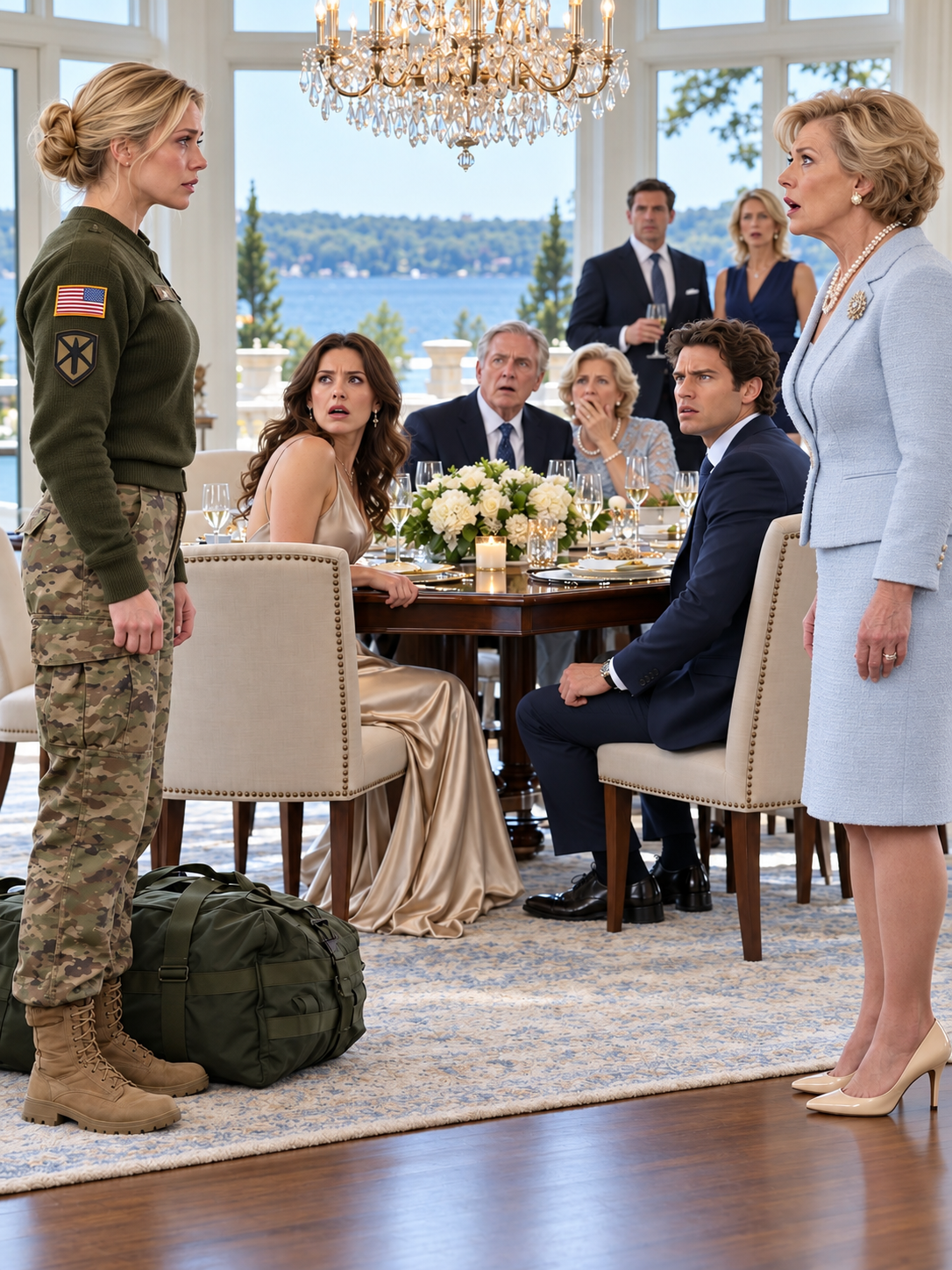
PART 1 TITLE: I Returned From Overseas to Mourn My Father, but the Dinner Waiting at His Estate Revealed a Family Secret I Was Never Supposed to Discover
The first sign that something was wrong came before I reached my father’s front door. At 7:15 that evening, a military transport van left me standing on the gravel driveway with my canvas duffel, my travel documents, and eleven days of grief I had barely begun to understand. White lights glittered beneath the garage roof. Beyond the trees, expensive cars were pulling toward the lower entrance, where attendants in black jackets were preparing to receive guests. I had come home from Germany to bury my father. Someone else had apparently decided that the evening called for a celebration.
Thomas was standing on a ladder beside the garage, fastening another strand of lights to the wooden eaves. He had managed catering at the Sterling estate for twenty years, and I recognized him immediately, although his hair had grown almost entirely gray since my last visit. He stopped working when he heard my boots on the stones. For a moment, he only looked at my uniform. Then his expression changed, and he descended the ladder slowly, holding a plastic fastening strip between his fingers as though he had forgotten what to do with it.
“Thomas,” I said, shifting the weight of my bag. “Are you getting everything ready for Sunday’s memorial?” His eyes moved toward the house, where music drifted through the open windows. He hesitated before answering. Victoria had ordered thirty-six rib-eye steaks and six cases of Napa Valley cabernet for that evening, he explained. The dining room had been prepared for thirty guests. There had been no instructions concerning Sunday’s memorial, at least none given to his catering team. He said this quietly, without the slightest attempt to disguise his discomfort.
I thanked him and looked toward the long stone staircase leading to the entrance. My father, Walter Sterling, had always insisted that the approach to the house remain simple. He disliked elaborate decorations, particularly when the occasion seemed designed to impress strangers. He had built Sterling Construction from two used pickup trucks and a cement mixer, and although success had eventually brought him considerable wealth, he had never entirely lost the habits of the man who checked invoices at his kitchen table. Thomas knew that. I knew it. Apparently, the people inside had decided those habits could be forgotten.
The brass key in my uniform pocket pressed against my hip as I started walking. Walter had given it to me before my second deployment, fastening it to a heavy tag stamped with the number 42. That number identified the principal parcel of the Sterling estate, a sweeping property on Lake Anne valued at approximately seventeen million dollars. At the time, I had assumed he wanted me to have a way into the house whenever I returned. He had held the key between us for a long moment before closing my fingers around it. “There are things you should never have to ask permission to come home to,” he had told me.
I had carried those words through years of overseas assignments, long flights, and temporary quarters where the furniture never felt like mine. When his condition worsened, I had tried repeatedly to arrange leave. By the time the necessary paperwork moved through the appropriate offices, he was gone. His death had reached me through a telephone call that ended before I could think of anything useful to say. Since then, I had been moving through airports and military processing centers with a strangely precise awareness of every small inconvenience and almost no understanding of the enormous thing that had happened.
The house appeared unchanged from the outside. Broad blue flagstones led to a covered porch, and tall windows reflected the last light over the water. Beyond the roofline, the lake lay beneath a band of autumn mist. Smoke from neighboring chimneys drifted across the gardens, mixing with the cold scent of damp leaves. I remembered coming home from school and finding Walter in his study, his sleeves rolled up, explaining some detail about land surveys or construction accounts that had seemed terribly boring when I was young. I would have given anything to hear him explain those things again.
Both front doors stood open. Inside, the foyer smelled of polished wood, expensive perfume, and food being carried from the kitchen. The gilded mirror beside the staircase caught my reflection: travel-creased fatigues, dusty boots, hair pulled back without much care, and the dark exhaustion beneath my eyes. Standing at the glass console beneath the mirror was Chloe, twenty-five years old and dressed in a cream-colored outfit so carefully tailored that not a seam seemed out of place. She was arranging silk scarves into a decorative pile, apparently dissatisfied with the way their colors overlapped.
“You smell like diesel,” she remarked before offering a greeting. I set my duffel beside the oak bench and explained that the transport van had developed an exhaust problem. Chloe glanced at my clothes, then returned to her phone. She did not ask about the journey or whether I was all right. When I mentioned that I had come for Walter’s memorial, she answered that Victoria had specifically told me not to return before Monday. There were real-estate investors coming from northern Virginia, she said, and my unexpected arrival was inconvenient.
I studied her face, waiting for some indication that she understood what she had just said. “Walter died eleven days ago,” I reminded her. Chloe gave a small, impatient movement of her shoulders. The household could not stop functioning simply because everyone was grieving, she replied. Her mother had important responsibilities, and Brandon had been working for months on the development proposal being discussed that evening. The investors expected professionalism. Chloe spoke as though I had appeared without an invitation at an ordinary business reception rather than returned to the place where I had grown up.
Then she suggested that I enter through the pantry if I wanted something to eat. The kitchen staff could find me a plate, she said, but it would be better if I stayed away from the guests. Brandon’s professional future depended on the evening going smoothly, and an exhausted soldier wandering through the dining room might create the wrong impression. Her voice carried the irritated certainty of someone who had never considered that the person listening might have a right to be there. I looked past her toward the hallway instead of answering immediately.
I had known Chloe almost all her life. She was younger than I was, and our relationship had never been easy, but there had once been afternoons when she followed me around the grounds asking questions about whatever Walter and I were repairing. Over the years, her curiosity had given way to a more practiced kind of contempt. She had learned to describe my military career as a collection of unimportant manual tasks, and she had accepted Victoria’s insistence that Brandon understood the family business better than I ever could. I had usually allowed those comments to pass without a fight.
My father had brought me into his family when I was seven years old. That single decision had altered everything about my childhood. He never introduced me as someone he had rescued, and he never permitted me to think that my place at his table was temporary. When I was young, he taught me to read technical drawings before I could understand the financial statements that accompanied them. Later, he showed me how to follow a project from a parcel number to a completed building. Victoria had always been less enthusiastic about those lessons. She preferred a simpler distinction between her biological daughter and the child her husband had chosen to raise.
I picked up my bag again. “I’m going to see what they’re discussing,” I told Chloe. She stepped slightly into my path, her phone held against her chest, and reminded me that Brandon had spent years developing connections in the property market. People like Christopher Pembroke did not travel from northern Virginia to be interrupted by family disagreements. When I asked what development he was considering, she said the plans concerned the ridge above Lake Anne. The answer disturbed me more than her manner. The ridge was not merely picturesque land waiting for someone to discover its potential. It formed part of a carefully documented estate.
The side corridor leading toward the formal dining room was covered with thick, dark carpeting that swallowed the sound of my boots. I passed the framed landscape painting Walter had purchased at a local auction and noticed that the photographs once arranged beneath it were missing. At the far end of the hallway, light spilled beneath a carved cypress arch. Voices rose and fell beyond it, accompanied by the soft strike of cutlery against china. I stopped just outside the dining room, close enough to hear the conversation without being seen by most of the guests.
Thirty people were seated beneath the enormous crystal chandelier. The table had been dressed with white linen, silver candlesticks, and arrangements of pale flowers. Servers moved between the chairs carrying expensive steaks on heated plates. At the head sat Victoria, Walter’s widow, wearing a dark velvet jacket and an expression of composed satisfaction. Her right hand rested beside a water glass, and as she listened to the conversation, she repeatedly twisted an elaborate gold ring. I noticed immediately that the large diamond once mounted in its setting was missing. Bare prongs caught the chandelier’s light whenever she moved.
Victoria had worn that ring for years. Walter had given it to her on an anniversary, and she had seldom removed it even when gardening or traveling. Seeing the empty setting unsettled me. I had no way of knowing whether the stone had been removed for repair, sold, or lost, but Victoria’s fingers kept returning to the vacant place with a nervous insistence I did not recognize. She looked thinner than I remembered, though her makeup and perfectly arranged hair suggested that she had spent considerable time preparing for the evening.
To Victoria’s right sat Brandon, Chloe’s fiancé. He wore an expensive suit that fitted tightly across his shoulders and leaned forward with the eager concentration of a man determined to control the conversation. Beside him sat Christopher Pembroke, a broad-shouldered investor in his late fifties whose charcoal suit was noticeably less ostentatious. Pembroke did not appear impressed by the setting. He listened with his hands resting beside his plate, occasionally looking at the documents arranged near Brandon. I recognized his name from business publications Walter had once left in the study.
Brandon was describing the proposed development with theatrical confidence. The first twelve condominium units along the ridge, he said, would generate a return of approximately thirty percent. The financial arrangements were nearly complete, and the local bank supported the project. He spoke loudly enough for the entire table to hear, pausing after each impressive number as though expecting applause. A few guests nodded politely. Others continued eating. Pembroke merely lifted his wineglass, examined its contents, and asked which bank had committed to the financing.
“Ridgefield National,” Brandon answered, although his first response had come after a conspicuous pause. Pembroke repeated the name and asked whether the bank had issued a binding commitment or only a preliminary expression of interest. Brandon reached for his water. His throat moved as he swallowed. Across the table, Victoria leaned forward and suggested that the detailed financing documents could be discussed after dessert. Tonight, she said, was principally about family, partnerships, and the promising future they were creating together.
I felt the brass tag in my pocket again. Walter had explained to me often enough that serious investors asked questions before they signed anything. He believed people revealed more through their reluctance to answer than through the figures printed in their presentations. Pembroke had asked a straightforward question. Brandon had avoided it, and Victoria had moved the conversation elsewhere. I remained in the doorway, listening to the clink of crystal and the quiet shifting of chairs, trying to decide whether I was witnessing ordinary salesmanship or something considerably more troubling.
Pembroke turned his head before I had made that decision. His gaze traveled beyond the table and settled on the darkened archway. “Who is the young woman standing there in uniform?” he asked. The room grew quiet in a manner that felt almost physical. Several people twisted in their chairs. Brandon stared at me as though he had only just realized I was home. Victoria’s hand stopped on the empty ring setting, but she did not turn around immediately. Instead, she placed her glass on the table and gave a small, dismissive laugh.
She introduced me as Walter’s charitable responsibility, someone he had taken in at seven years old. I lived in military barracks now, she explained, and had no involvement in the family’s business decisions. Her words were casual, even pleasant in tone, which made their purpose unmistakable. She wanted the guests to regard me as an outsider who had arrived unexpectedly, someone to whom they owed neither an explanation nor consideration. I watched the expression on one server’s face change. He lowered his tray slightly, then stepped backward toward the service entrance.
I could have corrected her immediately. Instead, I looked around the room and considered who was present. Pembroke appeared puzzled rather than persuaded. Brandon’s smile had become fixed, and he was glancing between Victoria and the doorway. At the far end of the table sat Arthur Vance, Walter’s longtime estate attorney, with an open leather binder beside his plate. He had been involved with the family business since before I graduated from high school. When our eyes met, his fork stopped halfway to his mouth. Whatever he had expected that evening, it had not included seeing me.
I walked into the dining room and placed my duffel beside the empty chair at the foot of the table. The bag landed heavily enough to make several guests look down. I asked Thomas, who was passing with a tray, whether he could bring me black coffee. He nodded at once and disappeared toward the kitchen. Then I pulled out the chair and sat. Nobody told me to leave. The silence around the mahogany table was so complete that I could hear the faint hum of the ventilation system above the chandelier.
Arthur Vance closed his mouth, put down his fork, and reached for the thick binder. He turned several pages, stopped at a yellow tab, and inspected the document beneath it. When he finally spoke, his voice was quieter than Brandon’s but considerably steadier. He said he had been informed that my flight from Germany would not arrive until the following evening. I explained that the Air Force had managed to get me home ahead of the expected schedule. I did not mention that I had changed my arrangements specifically to attend the memorial.
Vance adjusted his wire-rimmed glasses and looked toward Victoria. Her expression warned him not to continue, but he had already placed his brass pen beside the document. He explained that my physical presence triggered a particular provision of Walter’s master irrevocable trust. Certain information, he said, could no longer be postponed or treated as confidential family correspondence. The relevant terms required an immediate formal reading, particularly because I was designated in the trust as the sole trustee responsible for its primary land holdings.
For the first time since I had entered the house, Victoria looked genuinely frightened. Her hand struck the table beside her folded napkin. Brandon’s chair scraped backward. Pembroke lowered his glass without taking a drink. I sat still, with the weight of Walter’s key resting against my thigh, and waited for Arthur Vance to finish explaining the document my family had apparently hoped I would not see.
END PART 1
PART 2 TITLE: The Lawyer Refused to Close My Father’s File, and One Question About the Lake Estate Exposed the Lie Behind Victoria’s Perfect Dinner
Victoria ordered Arthur to close the binder before he could read another line. Her voice carried across the dining room with enough force to silence the few guests who had begun whispering among themselves. She said the documents were outdated, that Walter had settled the matter years earlier, and that Arthur was behaving disgracefully by introducing private legal affairs at a business dinner. The certainty of her words might have persuaded someone unfamiliar with her. I had heard that same tone whenever she wanted an argument to end without anyone examining the facts.
Arthur did not close the file. He rested his fingertips against the yellow tab and explained that the matter had not been settled at all. His office had sent the necessary documents by certified mail, but Victoria had refused to acknowledge their delivery. He had retained the postal records and copies of every notice. Victoria’s face tightened. For an instant, I saw something beneath her polished composure that had nothing to do with grief. She was not surprised that these documents existed. She was furious that someone had brought them into the room.
Brandon intervened before Arthur could say more. His voice rose sharply as he explained that a four-million-dollar commercial rescue facility depended on the discussions taking place that evening. Investors had traveled considerable distances, he reminded everyone, and there were deadlines that could not be ignored simply because an attorney preferred to revisit an old family arrangement. His insistence struck me as disproportionate. A legitimate transaction involving millions of dollars should have survived a question about ownership. Instead, Brandon seemed afraid that a few pages in Walter’s binder might destroy the entire negotiation.
Pembroke leaned back in his chair. He had stopped trying to be polite. Without raising his voice, he asked whether there was a problem affecting the property’s title. He directed the question to Arthur, not Brandon or Victoria. The distinction mattered. He wanted a legal answer from someone whose professional obligations required accuracy. Victoria replied before Arthur could speak, declaring that no such problem existed. She was Walter Sterling’s widow, she said, and had inherited complete authority over the estate. Everything was being handled through the proper channels.
She then explained my position in the business with the same dismissive confidence she had used when introducing me. Walter had given me a small interest in Sterling Construction, approximately fifteen percent, but that interest did not entitle me to interfere with her management of family property. It was a modest financial accommodation, she said, intended to recognize the years I had spent in the household. I noticed that she avoided describing it as a voting interest. She also avoided mentioning the difference between the operating company and the land held under Walter’s trust.
Thomas returned with my coffee. I wrapped both hands around the thick porcelain mug, grateful for its warmth, and watched the faces around the table. Pembroke’s attention moved from Victoria’s empty diamond setting to Arthur’s documents, then back to me. He appeared to be making his own assessment of the room. Brandon shifted his papers into a neat stack, covering several pages with a printed presentation. Chloe had entered quietly behind the guests and was standing beside the doorway, her phone already raised. She seemed more concerned with recording the embarrassment than understanding its cause.
I asked Victoria where Walter’s blue pocket ledgers had gone. The question was deliberately simple. My father had carried those small books for years, using them to record payments, equipment purchases, project numbers, and private notes about the business. Some were kept in his study, while others stayed locked in the office at the construction yard. He trusted computers when they were useful but disliked relying on a single electronic record for anything important. If those notebooks were missing, I wanted to know why. Victoria’s eyes narrowed when I mentioned them.
She said Walter had been seriously ill during his final years and that his judgment had deteriorated. According to her, he had signed documents without understanding them, allowed Arthur to influence his decisions, and become increasingly confused about the company’s financial position. The accusation made my stomach tighten. Walter had been unwell, and I knew his strength had declined, but we had spoken regularly. Even during difficult conversations, he could describe the status of a construction project with greater precision than most healthy people could manage. I had never heard the confusion Victoria was now using to dismiss his records.
Brandon leaned toward me and adopted the unpleasant familiarity of a man who believed an audience made him powerful. He claimed Sterling Construction had accumulated six months of unpaid bills at the lumberyard and that Walter had left the business in serious difficulty. Then he questioned my military service. While the company struggled, he suggested, I had been comfortable in an air-conditioned supply facility somewhere in Europe, far removed from the responsibilities everyone else had been carrying. His words were calculated to embarrass me in front of people whose respect he wanted.
I took a sip of coffee before answering. I knew that defending the difficulty of military logistics would only draw the conversation away from the documents. My duties had taught me to account for equipment, trace missing supplies, work within strict purchasing rules, and recognize the danger of approving transactions without adequate verification. None of that required a dramatic explanation at the dinner table. More importantly, Brandon had just admitted that Sterling Construction was financially distressed while asking investors to believe a new development would produce extraordinary returns. I wondered whether anyone else had noticed the contradiction.
Arthur allowed the silence to settle. Then he informed Pembroke that sixteen certified copies of the relevant land filings were available at his office in Oakridge. If the proposed investment depended on the Sterling lake property, he strongly recommended reviewing page forty-two of the trust documentation before any money changed hands. The number caught my attention immediately. Forty-two was stamped on the brass tag Walter had given me. I slipped a hand into my pocket and touched the metal. I had carried it across an ocean without knowing that it might identify something more significant than a gate or a parcel.
Victoria told Arthur that his services were no longer required. She said it quietly, almost through her teeth, but everyone heard her. He was to collect his documents and leave her house immediately. Arthur stood just enough to straighten his jacket, then settled back into his chair. He told her that he could not be dismissed by someone who was not his client. His responsibilities arose from Walter’s trust and corporate arrangements, not from Victoria’s personal wishes. The words were plain, but the effect on the room was immediate. For the first time, Victoria had issued an order that another person could refuse.
She rose abruptly, pushing her chair back against the carpet. The movement sent a silver candleholder trembling. Her voice grew louder as she listed everything she believed belonged to her: the residence, the shoreline, the gardens, the land around the ridge, and the buildings Walter had spent decades constructing. She had been his wife, she declared, and no one had the right to challenge what he had left behind. I watched her hands. One remained pressed against the table, while the other twisted that empty diamond setting until the gold band shifted against her skin.
Chloe moved closer, filming openly now. She whispered that Eleanor Gable, our neighbor from farther down the lake, was among the guests and that Victoria should lower her voice. Her concern was revealing. She was not asking whether the documents were genuine or whether Brandon’s project involved property he had no right to offer as security. She wanted the disagreement to remain invisible. The family had become so accustomed to protecting its public appearance that a legal problem seemed less troubling than allowing other people to witness it.
Pembroke asked Arthur one final question. He wanted to know who legally held the deed to the estate at that moment. Nobody interrupted him. Even Brandon remained silent. Arthur looked first at Victoria, then toward me. Rather than improvise an answer in the middle of the confrontation, he left the binder open on the table and moved his chair slightly backward. I understood his caution. The question involved recorded interests, trustee authority, and the exact structure Walter had established. A careless sentence could be twisted later into an admission or a contradiction.
I could have demanded that Arthur continue. Part of me wanted him to read every page aloud and force Victoria to listen while the people she had gathered learned precisely what Walter had signed. But my father had taught me something about handling disputed contracts. The most satisfying moment to speak was rarely the most useful one. I did not yet know why the missing ledgers mattered, how much money Brandon needed, or what Victoria had told the bank. A public argument might reveal those answers, but it might also give them time to destroy evidence.
So I stood, took my coffee, and walked away from the table. I crossed the Persian carpet toward the tall windows overlooking Lake Anne and lowered myself into Walter’s favorite high-backed armchair. Beyond the glass, mist was spreading across the water. The lamps along the shoreline cast pale reflections that trembled whenever the wind moved through the reeds. From there, I could still hear the dining room clearly. Nobody resumed the cheerful conversation that had greeted me when I arrived. The celebration had changed into a gathering of people waiting for someone else to act.
I looked at the black water and remembered Walter teaching me how to recognize the boundaries of the property from the shoreline. He had explained that a survey marker was more important than a beautiful view because ownership depended on something recorded and verifiable. At the time, I had been too young to appreciate the lesson. Now I wondered why he had taken such care to explain those details to me rather than leaving them entirely to accountants and lawyers. The brass key felt heavier in my pocket than it had on the plane.
Outside, the floodlights covering the lawn flickered once. A moment later, the illuminated shoreline disappeared into darkness. I turned toward the window, expecting the power to return, but the house itself remained brightly lit. The chandelier above the table continued shining. The outage affected only the exterior lighting. It might have been a faulty circuit, yet I knew the electrical system had been carefully maintained while Walter was alive. I added the detail to the growing collection of things I could not explain and made no immediate comment.
The dinner eventually dissolved without the conclusion Brandon had promised his guests. Pembroke left without announcing an investment, and the remaining conversations were strained and brief. I heard chairs moving, coats being collected, and Victoria offering elaborate apologies for the inconvenience. Arthur gathered his binder, but before leaving, he caught my eye across the room. His expression was serious. We did not discuss the documents in front of Victoria. I understood that he would not have revealed so much unless the situation was becoming urgent.
That night, I remained in the house rather than looking for accommodation elsewhere. It was not a comfortable decision. Every room carried evidence of the life Walter had left behind, yet the household already seemed to have rearranged itself around his absence. Some of his belongings were missing from the hallway. The familiar photographs had disappeared. I could hear Chloe moving between rooms, speaking into her phone, while Victoria’s footsteps crossed the upper landing. I kept my duffel near me and placed the brass key on the bedside table where I could see it.
Sleep came in fragments. Whenever I closed my eyes, I remembered my father’s voice on our last telephone calls. He had asked more questions about my work than about his own illness. He wanted to know whether my equipment requests were being approved properly, whether I trusted the people handling our records, and whether I still kept copies of important documents. At the time, I had assumed he was trying to avoid discussing his health. After the confrontation at dinner, those ordinary questions began to sound different.
At 6:18 the following morning, I went downstairs barefoot and started a fresh pot of black coffee. The kitchen was cold, and the marble floor drew warmth from my feet. Through the windows, a pale band of light stretched across the lake. Chloe entered wearing silk pajamas, her phone in one hand and a container of vanilla yogurt in the other. She glanced at me with immediate displeasure. I should not be downstairs interfering with family business, she said. There were legal discussions scheduled for that morning, and my presence would only complicate things.
I reminded her that I had lived in the house for eighteen years. She replied that I had been absent for six, and that the family had changed while I was overseas. Brandon now handled the real estate. He understood modern finance, and he would soon be Chloe’s husband. In her mind, those circumstances gave him more authority over Walter’s estate than anything my father had personally arranged. When I pointed out that Brandon was not yet a member of the Sterling family, Chloe shrugged and returned to her yogurt.
She described his qualifications with the same proud impatience I had heard at dinner. Brandon had formal training in finance, she said, while I worked with diesel engines, cargo, and military equipment. She believed those differences settled the question of competence. I watched the coffee drip into the glass pot and thought about Walter’s original business: two trucks, a cement mixer, and years of careful work. I had no objection to Brandon understanding investments. I objected to his treating the company as though its assets existed solely to rescue whatever development he wanted to pursue.
At 6:30, Victoria entered the kitchen dressed for the day in a cream sweater, her makeup already perfect. The diamond was still missing from her ring. Brandon followed close behind her carrying a thick folder fitted with gold-colored tabs. He placed it on the marble island with a hard sound that made the coffee spoons tremble. Victoria greeted me with a pleasant smile that seemed entirely disconnected from the previous evening. She said she was glad I was awake because there was a small administrative matter we needed to finish before nine.
I looked at the folder, then at Brandon’s face. He was no longer pretending that I had no relevance to the estate. Whatever legal arrangement Walter had created, my signature was apparently important enough to require a meeting before breakfast was over. Victoria slid the folder toward me and produced a pen. She called the paperwork routine, the sort of thing responsible family members signed without making difficulties. I left the pen where it lay. Before touching a document, I wanted to know exactly what Brandon was trying to purchase with my father’s property.
END PART 2
PART 3 TITLE: The Morning They Asked for My Signature, I Found a Bank Warning Hidden Beneath Brandon’s Luxury Development Plans and Understood Why Everyone Feared My Return
The folder was heavier than I expected. Brandon had filled it with photographs, development sketches, projected income statements, and carefully arranged financial charts. The front page displayed a glossy rendering of expensive homes overlooking the wooded ridge. From a distance, it looked like the sort of presentation prepared by a successful firm seeking a conventional business partner. Victoria pushed the pen closer to my hand and smiled. Brandon had found an exceptional opportunity, she explained, and his company needed a temporary secondary guarantee to finalize an important commercial loan.
“Guarantee against what?” I asked. Victoria smoothed the front of her sweater and said it would only involve a routine corporate acknowledgment. The bank wanted assurance that all relevant parties approved the arrangement. Brandon leaned against the island and added that large development transactions often required several layers of security. No one was being asked to surrender anything, he insisted. The documents would simply allow the project to move forward. His explanation contained enough financial vocabulary to sound reasonable, but it failed to identify the asset being offered.
I asked whether Sterling Construction had already become a guarantor for Brandon’s residential development. Victoria said the distinction between the two businesses was unnecessarily technical. Both companies operated in related industries, and a temporary arrangement would benefit everyone when Brandon’s project succeeded. I reminded her that Sterling Construction was a commercial builder with its own obligations. Walter had never treated the company as a reserve fund for someone else’s speculative housing ventures. Brandon frowned and said I was applying outdated thinking to a modern financing opportunity.
Chloe, still standing beside the counter with her yogurt, seemed irritated that the conversation was taking so long. She asked why anyone needed my approval when I supposedly controlled only fifteen percent of Sterling Construction. The question was more useful than she intended. I looked at Victoria and explained that Walter’s corporate trust required unanimous consent before certain categories of company real estate could be pledged as security. My ownership percentage did not determine whether that restriction applied. Without the required approval, the transaction could not proceed lawfully under those terms.
Victoria’s expression changed. Her hand stopped on the ring at her finger. She said Walter had given me shares out of affection, not because he expected me to involve myself in complicated financial decisions. I answered that the documents did not describe affection. They described voting rights, restrictions, and specific obligations. The fifteen-percent interest carried a protective role within the trust structure. If Sterling’s land could be borrowed against without my consent, the safeguard Walter had established would have no meaning. I could see Brandon studying me differently now.
He had expected someone he could embarrass with references to military life, perhaps someone who had forgotten the details of a business she had not visited in years. Instead, I remembered the provisions Walter had insisted I read before my first deployment. At the time, I had asked why such a small holding required so many explanations. Walter had told me that a limited interest could still carry significant responsibility. He had also warned me never to confuse a person’s confidence with proof that the person understood what he was signing.
I drew the folder toward me and began turning pages. The first several sections were filled with projected returns, photographs of landscaped properties, and floor plans showing expensive interiors. Every chart presented an encouraging future. The land values rose, the buyers appeared ready, and the projected profits seemed to improve with each successive page. What I did not see were clear statements about the existing debt, the cash already committed, or the source of funds required to complete construction. Those omissions interested me more than the polished illustrations.
On page seventeen, the presentation changed abruptly. The glossy stock was replaced by ordinary white bond paper. At the top, in faded red ink, was a formal notice issued by Ridgefield National Bank. I read the first paragraph, then moved slowly through the attached schedule. It identified twelve residential development lots in the Oakridge Ridge View subdivision. Each lot had fallen behind on its interest obligations. The arrears were not a matter of a delayed invoice or a routine accounting adjustment. Every listed property was already sixty days past due.
At the bottom of the notice, the bank had calculated a total principal shortfall of four million dollars. I checked the figure a second time, then turned back to confirm that the individual lots matched those Brandon had described to Pembroke the previous evening. They did. The supposedly profitable first phase of his development was already in default. Its financial problems had been present while Brandon stood at Walter’s dining table promising a thirty-percent return. The distinction between a promising project and an insolvent one was no longer theoretical.
“These are default notices,” I told him. Brandon cleared his throat and shifted his weight. He said the luxury housing market had experienced a regional slowdown during September, leaving developers with temporary liquidity problems. Projects involving expensive properties often depended on short-term financing, he explained, and the bank’s terminology sounded more alarming than the underlying situation. Once the new commercial facility was approved, the outstanding obligations could be brought current and the development would regain momentum. He spoke as though the appearance of money would somehow resolve the absence of it.
I asked whether any of the twelve lots were performing according to the projections printed in the folder. Brandon did not give me a direct answer. Instead, he argued that high leverage was normal in contemporary property development and that experienced investors understood the need to bridge short-term financing gaps. His voice grew louder as he spoke. I waited until he finished, then pointed to the notice again. Twelve separate lots had defaulted. The bank was seeking repayment. Calling the situation a cash-flow problem did not change the contractual obligations already missed.
Victoria turned toward the window. She said Brandon was ambitious and had undertaken a substantial project because he wanted to create a secure future for Chloe. The opportunity was too important to abandon over a temporary difficulty. Her words revealed how she wanted me to see the situation: a young man building something valuable for her daughter, obstructed by someone unwilling to understand his vision. I looked at the bank’s notice and saw something less romantic. Brandon had borrowed against expected future profits and could no longer meet the obligations he had accepted.
Only then did I fully register the changes around us. Through the kitchen window, I could see the circular driveway where Walter had once parked two silver Mercedes sedans. Both were gone. A dusty station wagon with rust along its lower panels stood in their place. Victoria had always liked expensive jewelry, yet the substantial sapphire necklace Walter had given her on their twenty-fifth anniversary was absent from her throat. She wore a thin chain whose inexpensive finish had left a faint greenish mark against her skin. The empty diamond setting suddenly seemed less like an isolated curiosity.
I did not know whether those missing possessions had been sold, pledged, or simply moved elsewhere. I knew better than to treat an observation as a completed explanation. Still, the combination troubled me. The vanished cars, the bare ring setting, the replacement necklace, and Brandon’s urgent need for my signature suggested that the household’s finances were considerably weaker than the dinner guests had been allowed to believe. I wondered how much of Walter’s money had already gone toward sustaining appearances. I also wondered what had happened to the company’s own accounts.
I asked Victoria directly how much money Brandon needed beyond the four million dollars identified in the notice. She did not answer. She repeated that he was working toward a future that would benefit Chloe and that families should support one another during difficult periods. Her choice of words brought back the dinner at which she had called me a charity case. When she wanted something from me, she invoked family obligations. When I asked to participate in decisions concerning Walter’s estate, she insisted I was not truly part of the family at all.
I closed the binder and stood. Brandon asked whether I was prepared to sign, and I told him I needed to examine the underlying records first. He protested that the bank could not postpone its requirements indefinitely. Victoria reminded me that she had arranged meetings around a fixed schedule. Neither offered to explain why the loan documents had been presented without the default notice being discussed openly. I carried my coffee from the kitchen and went down the hall toward Walter’s private study, leaving the folder on the island.
The study door opened with its familiar wooden creak. The room smelled of cedar, old paper, and the faint tobacco smoke that had settled into the furniture over years. Walter had stopped smoking long before his final illness, but the scent remained in the leather upholstery and dark wood. His large oak desk stood beneath the window overlooking Lake Anne. The photographs that had once crowded the mantel were gone, leaving clean rectangles on the polished surface where their frames had protected the wood from sunlight.
I sat in Walter’s worn leather chair and rested my hands on the desk. It was the first time since returning that I had been alone in a room that still seemed unmistakably his. I remembered him sitting there late at night, studying figures through reading glasses while the rest of the house slept. He had preferred handwritten notes when considering major decisions. He said writing a number made him pay attention to what it represented. I had sometimes teased him about his notebooks, but I understood their purpose now more clearly than ever.
The bottom right drawer held old corporate tax returns, correspondence, and the remnants of an elaborate filing system that only Walter had fully understood. Behind a stack of folders, my fingers touched cold steel. I pulled out a small, heavy lockbox. Its surface was scratched, and the lid resisted slightly before opening. Inside lay a blue leather pocket ledger with Walter’s initials embossed in fading gold. A narrow leather strap crossed its cover, secured by a small brass lock. I recognized the design immediately. It was one of the books I had asked Victoria about at dinner.
I took the ledger from the box and turned it carefully in my hands. The cover had softened where Walter’s thumb would have rested, and the corners were worn from years in his pockets. For a moment, I thought about trying the brass key he had given me, but its shape was clearly intended for a larger lock. I resisted the urge to force the little clasp. Walter had protected these notes for a reason. If the pages contained the original records of important transactions, damaging the ledger would be foolish. I laid it on the desk beside the lockbox.
Footsteps sounded outside the door. Arthur Vance entered carrying his familiar leather binder and closed the door behind him. He looked tired, as though the previous evening had required him to reconsider decisions he had hoped never to confront. Without sitting, he explained that Victoria had contacted his office at 6:15 that morning. She had informed him that I was ready to sign Brandon’s cross-collateral agreement. Arthur wanted to know whether I had put my name on page twenty-two. His emphasis on the page number was unmistakable.
I told him I had signed nothing. His shoulders relaxed slightly. Then he instructed me not to sign any document that day, regardless of how ordinary its title sounded. Loan guarantees, shareholder waivers, administrative acknowledgments, and amendments could all carry consequences that were concealed by casual descriptions. As the trustee responsible for the corporate arrangements Walter had assigned to him, Arthur had an obligation to prevent unauthorized encumbrances. He explained that Brandon was trying to secure four million dollars before the bank’s enforcement division took action.
When I asked about Victoria’s claim that Walter had left her complete authority, Arthur studied the papers in his hands. He said her understanding of the estate did not match the recorded land filings. The distinction between what she expected to inherit and what Walter had legally arranged was fundamental. He would not yet give me an improvised explanation without the certified records in front of us, but he made one instruction especially clear: I should keep my distance from Brandon’s financing documents until the entire trust structure had been examined.
I showed him the blue ledger. His expression became even more guarded. He asked me to keep it locked and explained that Walter had left specific instructions concerning the preservation of his handwritten records. Arthur would not speculate about their contents, and I did not press him for an answer he was unwilling to give without proper preparation. After he left, I returned the ledger to the steel box and secured it. I understood that Walter had not simply forgotten the book. He had placed it somewhere protected, among records he expected someone trustworthy to examine.
At ten o’clock, I visited the Sterling Construction yard. Frank, the site manager who had worked beside Walter for twenty-two years, met me near a battered utility truck. His clothing was marked with grease, and a folded yellow invoice protruded from his shirt pocket. He looked relieved to see me, although his first words carried none of the formality I had encountered at the house. The bulk fuel supplier had suspended our diesel credit that morning. Unless the company paid its outstanding balance, there would be no further deliveries.
I asked how much we owed. Frank unfolded the paper and showed me the figure: eighteen thousand six hundred dollars. The amount was serious but not extraordinary for a functioning construction company. According to the last operating-account balance I had reviewed, Sterling Construction should have had approximately forty-five thousand dollars available. Frank looked toward the equipment shed before answering my next question. Victoria had withdrawn thirty thousand dollars from the account at the beginning of November, he said, leaving the business unable to meet essential obligations. He was about to explain how the withdrawal had been authorized when I realized that the missing money might be connected directly to the folder Brandon had put in front of me.
END PART 3
PART 4 TITLE: A Missing Thirty Thousand Dollars Led Me to the Bank, Where I Discovered Brandon Had Offered My Father’s Seventeen Million Dollar Estate as Collateral
Frank did not immediately meet my eyes when I asked how Victoria had obtained access to the operating account. He rubbed his thumb against the seam of his work trousers and looked toward the equipment shed, where several machines stood idle behind a locked gate. The sounds of an ordinary working morning were strangely absent. No engines were starting, no trucks were moving toward the road, and the men I could see near the storage building were talking instead of preparing their equipment. Walter had spent years making sure his employees had the supplies and wages they needed. Standing in that quiet yard, I understood how far things had deteriorated.
According to Frank, Victoria had arrived at the company office carrying a carved wooden stamp bearing Walter’s signature. She told the bookkeeper that the withdrawal represented corporate consulting expenses and that the transaction had already received the proper authorization. Thirty thousand dollars had then been transferred from the operating account. Frank had questioned the explanation, but Victoria insisted she was acting on Walter’s behalf under the authority she claimed to possess. The bookkeeper had apparently accepted the stamp as sufficient evidence, although no one at the yard could recall Walter ever approving a bank transfer that way.
“Walter never used a signature stamp for wire transfers,” I said. Frank nodded. He had worked for my father long enough to know how particular he was about payment approvals. Walter might have signed dozens of routine invoices in a day, but money leaving the company’s operating accounts received close attention. Even when business was busy, he wanted to understand why a payment was being made and who had requested it. A stamp that imitated his signature was not proof of authorization. Under the circumstances, it raised a much more serious question about who had created the transaction.
Frank opened the yellow fuel invoice again and explained that three members of the gravel crew had received paychecks that bounced the previous Friday. The men were embarrassed and angry, he said, but they had not yet abandoned their jobs. They had worked through difficult seasons before and still believed the company could recover. I looked toward the equipment parked along the fence. Each machine represented years of debt payments, maintenance, and effort. These were not decorative assets on a banker’s presentation. They were the equipment that allowed ordinary people to earn their living.
I asked Frank for copies of the affected payroll records and the most recent operating statements. He said the bookkeeper had left the office earlier that morning after receiving three telephone calls from Victoria at the main house. He did not know whether she intended to return. I considered what her departure meant for the company’s remaining records. The absence of someone with immediate access to the accounts made it even more important that nothing be discarded or altered. I asked Frank to preserve the existing invoices, written instructions, and correspondence until the legal arrangements could be examined.
He reached inside his canvas jacket and produced another folded paper. It was a note Victoria had left directing future vendor invoices to Brandon’s development company downtown. I unfolded it carefully. The instruction troubled me more than the money already missing. Redirecting incoming invoices would allow Brandon’s office to know which suppliers were demanding payment, what equipment remained active, and which contracts might be vulnerable. It could also interfere with the ordinary records Sterling Construction needed to operate. I told Frank not to forward another document without proper authorization.
Frank had one more thing to tell me. A bank auditor had entered the property at approximately 9:30 that morning and photographed the company’s yellow excavators. The man had not approached the office to request permission or explain the purpose of his visit. He had driven directly through the main perimeter gate using a key. When Frank questioned him, he said he was acting under instructions related to a commercial lending review. Victoria, Frank told me, had given him access three days earlier. The information made me reconsider the financing documents Brandon had tried to rush through the kitchen.
A bank examining construction equipment might have a legitimate reason to inspect assets already offered as collateral. But Sterling Construction had not authorized Brandon to pledge its property for his residential development. If a lender was inspecting machinery, it was essential to establish what had been represented to that lender and whether those representations were accurate. I asked Frank who else possessed keys to the yard. He described the ordinary access arrangements and repeated that Victoria had personally authorized the auditor’s entry. I recorded the detail in my notebook, together with the time of the visit.
“Should I lock the heavy equipment shed?” Frank asked. I looked through the fence at the idle excavators and imagined what would happen if someone removed essential machinery before the ownership questions were resolved. A construction firm could survive a delayed payment with careful planning. It could not operate if its equipment disappeared without a lawful transfer or proper accounting. I told Frank to secure the shed and the remaining controlled areas of the yard. No additional keys were to be issued merely because someone claimed to represent Victoria or Brandon.
I did not ask Frank to take any action against the bank or interfere with a lawful inspection. I wanted the documents preserved and the assets protected while ownership and borrowing authority were verified. That distinction mattered. Walter had never approved of confronting uncertainty with gestures that created new legal problems. He preferred to establish what had happened, identify the people responsible, and proceed from records that could withstand examination. I had spent enough time handling sensitive military supplies to understand the value of that discipline.
Before leaving, I walked past the old Ford utility truck Frank used around the yard. Its paint was faded, the lower panels were rusting, and the odometer had passed 184,000 miles. Walter would have recognized it immediately. He had always insisted that useful equipment deserved maintenance, whether it was an expensive excavator or a vehicle that had already survived several owners. I remembered him standing in almost that same location, explaining how a company could appear wealthy while slowly running out of cash. Expensive assets could not pay wages if every account was empty.
I drove to Ridgefield National Bank and arrived at the commercial lending department shortly after 1:30. Greg Miller, a thirty-five-year-old loan officer, received me in an office overlooking the parking lot. He wore a carefully pressed white shirt and spoke with the measured caution of someone accustomed to dealing with substantial financial transactions. I placed my corporate share certificate on his desk and explained that I wanted to review a proposed secondary guarantee involving Sterling Construction. Greg examined the document before saying that a fifteen-percent holding ordinarily carried review rights but did not grant unrestricted authority to suspend lending decisions.
“I haven’t asked you to suspend anything,” I replied. “I need to know what has been submitted under my late father’s company identification number.” Greg looked at me for several seconds, apparently deciding how much information he could lawfully discuss. I explained that the proposed transaction involved corporate assets subject to a trust arrangement and that my authorization was being requested. I also mentioned Arthur Vance, whose office maintained the relevant records. Greg turned toward his computer and began reviewing the entries associated with the Sterling accounts.
He typed briefly, then stopped. His eyes moved across the screen. The change in his expression was slight but noticeable. He asked me to confirm Brandon’s full name, then opened another record. A preliminary collateral pledge had been submitted approximately six weeks earlier. It had not originated with me, and I had received no notice concerning the filing. The timing was important. Walter had been alive when Brandon initiated the process, though already seriously ill. I wondered whether Victoria’s claims about his failing judgment had been intended to explain away whatever documents might surface from that period.
I asked Greg which property had been identified as collateral. He read the asset description from the bank’s records. The principal security was the Lake Anne estate, including the residential parcel valued at seventeen million dollars. For a moment, I could only look at him. That was the property where I had grown up, the land Walter had spent decades protecting, and the estate identified by the number stamped on the brass key in my pocket. Brandon had not merely proposed using a portion of Sterling Construction’s operating assets. He had offered the lake property itself.
“Brandon doesn’t hold the deed to that land,” I said. Greg acknowledged that Brandon had not submitted a deed in his own name. Instead, the application contained a signed affidavit from Victoria. In it, she certified that full legal title would pass to her through probate proceedings within thirty days. The bank’s preliminary review had treated that statement as part of the supporting information for the proposed transaction. I asked whether the court had actually transferred title. Greg checked the file and found no recorded order confirming that Victoria had received the ownership she claimed.
I explained that Walter’s estate included an irrevocable trust and that Arthur Vance had already identified restrictions affecting the land holdings. Greg did not attempt to interpret those documents without reviewing them. He did, however, confirm that Brandon’s submission had identified the lake estate as the principal security for a commercial draw connected to twelve residential lots. I recognized the lot numbers from page seventeen of the gold-tabbed binder. What Brandon had described as a temporary guarantee was an attempt to place the most valuable Sterling property behind the debts of his failing development.
I asked Greg about the condition of those twelve lots. He confirmed that every one was in default. The total principal shortfall was four million dollars, and the bank had already begun the process required before enforcing its rights. Brandon’s project was not waiting for an ordinary injection of working capital while healthy contracts proceeded. It was facing formal action from a lender whose patience had nearly expired. The glossy drawings I had examined that morning seemed suddenly irrelevant. None of the projected swimming pools, landscaped terraces, or expensive interiors could satisfy a debt that had already come due.
“Who approved the preliminary application without recorded ownership documents?” I asked. Greg explained that the bank’s senior lending committee had relied in part on Victoria’s signed personal indemnity and representations concerning the expected probate transfer. He did not suggest that those documents conclusively established title. I asked whether the committee had been informed about the trust provisions requiring specific approvals. Greg could not find evidence that the full recorded trust documentation had been provided with Brandon’s original submission. I thought of Arthur’s binder, page forty-two, and the certified filings waiting in Oakridge.
I requested the official default notices relevant to the proposed guarantee. Greg arranged for us to meet with the bank manager and led me into a corner office with a heavy oak door. A laser printer beside the desk produced four sheets of cream-colored paper. Greg gathered them, applied the appropriate official stamps, and placed them before me. The heading identified the documents as formal notices from Ridgefield National Bank’s default enforcement process. I read them carefully, noting the borrower, the listed properties, and the amounts outstanding.
The deadline was November eighteenth at five o’clock in the afternoon. Greg explained that the bank required four million dollars in cleared funds to cure the specified default. If the obligation remained unsatisfied, its legal department intended to proceed with the next enforcement steps against the assets it believed were available under the lending documents. I asked whether the Lake Anne estate was included. Greg said that would depend on whether the title representations and security documents proved legally enforceable. A serious dispute over ownership could prevent the proposed security from being recognized as Brandon expected.
I looked at the calendar. There were only eighteen days and a few hours before the stated deadline. Victoria had demanded my signature before nine that morning because she understood how little time remained. Brandon had been trying to persuade investors to rescue the project while also preparing to use Walter’s property as security. The two efforts were not separate opportunities. They were different attempts to solve the same urgent financial problem. If neither succeeded, the bank would move forward, and the consequences would reach far beyond Brandon’s personal ambitions.
Greg added another detail. Victoria had contacted the bank’s senior vice president twice the previous morning, pressing for the formal notices to be delayed. She had assured him that I would sign the required corporate guarantee before Friday. Hearing that, I understood why Chloe had been so upset by my early arrival. The family had expected to control the timing of my return, present the documents as a simple administrative task, and obtain my signature before I could examine the underlying records. Victoria had already promised the bank a decision that was mine to make.
I asked what would happen if the supporting affidavit concerning the lake estate proved false. Greg chose his words carefully. A disputed ownership claim was a matter for legal examination, but knowingly false statements used to obtain commercial credit could expose the people responsible to serious consequences, including potential fraud allegations. He did not predict an investigation or suggest that the bank had already reached such a conclusion. Still, his answer confirmed what I had feared: this was no longer just a disagreement over inheritance. The integrity of documents submitted to a financial institution was now in question.
I collected the notices, folded them carefully, and placed them inside my military jacket. I told Greg that I would not sign the proposed guarantee without proper legal review and instructed him not to treat Victoria’s assurances as my consent. He acknowledged the distinction. Before leaving, I confirmed that Arthur Vance’s office maintained the trust records needed to assess the title question. The bank would continue according to its established procedures. I had no reason to expect special treatment, and I did not request any. What I wanted was a decision based on legitimate authority rather than family pressure.
I returned to Lake Anne at approximately five that evening. Cold mist was spreading over the gardens, and the water beyond the boathouse had turned dark gray. Victoria sat on the covered veranda in a tall white wicker chair. Chloe stood nearby, leaning against the carved railing and looking at her phone. Neither appeared surprised when I climbed the steps. Victoria looked up with an expression I had seen many times during childhood: controlled anger beneath a carefully maintained appearance of calm. She told me that Greg Miller had called her private number less than half an hour earlier.
“I know,” I said. Chloe immediately accused me of interfering in Brandon’s business. She said he was furious that I had gone to the bank without consulting him and that I had no authority to examine his confidential financial records. I reminded her that Brandon had requested my signature on a guarantee involving Sterling assets. I had every reason to determine what obligations were being placed before me. She started to reply, but I continued before she could turn the discussion into another argument about my military career.
“All twelve lots are in default,” I said. “The outstanding principal is four million dollars, and the bank’s enforcement deadline is November eighteenth.” Victoria’s fingers tightened around the arm of her chair. I told her that I had also reviewed the preliminary collateral pledge identifying the Lake Anne estate. Her gaze moved away from me toward the water. Chloe looked confused for the first time, as though she had understood the existence of a large loan but not the full consequences of offering Walter’s property to secure it.
Victoria accused me of trying to destroy Brandon’s future. He was building something valuable for Chloe, she insisted, and a temporary financial difficulty should not be allowed to ruin years of effort. I asked why she had signed an affidavit claiming the lake estate would pass to her before the probate court had issued an order. She did not answer the question. Instead, she said Arthur had always complicated matters by treating Walter’s paperwork as more important than the needs of the family. I thought of the unpaid workers and the fuel supplier waiting for eighteen thousand six hundred dollars.
Then Victoria made her demand unmistakable. I was to sign the corporate guarantee by the following morning. If I refused, I could find somewhere else to stay. Her voice was low, but there was no ambiguity in it. She was threatening to remove me from the house Walter had brought me into when I was seven years old, not because I had harmed anyone, but because I would not pledge his property to rescue Brandon’s debts. Chloe said nothing. She watched her mother with the strained attention of someone waiting to see whether the threat would work.
I remained on the bluestone steps and looked past Victoria toward the driveway. The six heavy iron lampposts lining the approach were dark, even though evening had already settled over the grounds. I asked why the security lights were not operating. Victoria rose from her chair and crossed the veranda. Without offering an explanation, she reached the control panel beside the front door and moved the exterior lighting switch downward. The remaining floodlights went out. The covered porch fell into shadow, while the house behind us continued glowing through its windows.
I looked at the dark driveway, then at Victoria. The deliberate movement of her hand told me more than another argument would have. She wanted to decide who belonged inside the estate, who could enter, and what could be seen from the road. She believed the house remained hers to control because she had occupied it for years beside Walter. I stood where I was, with the bank notices folded inside my jacket and the brass key marked 42 pressing against my hip. Whatever Walter had intended that key to mean, I was no longer willing to let anyone else define my right to be there.
END PART 4
PART 5 TITLE: With the Lake House Dark Behind Her, Avery Followed the Financial Trail Her Father Had Left Hidden in Plain Sight
The outdoor lights died one section at a time, leaving the driveway in darkness. I remained on the blue flagstone steps with the bank notices pressed against my chest and my father’s brass key digging into my palm. Through the tall windows, I could see Victoria moving around the dining room, collecting glasses while Chloe spoke into her phone. They behaved as though the evening had merely ended badly. Eleven days earlier, we had buried Walter Sterling. Now his widow expected me to surrender the property he had spent his life protecting.
I considered going inside and demanding another conversation. There was nothing left to gain from it tonight. Victoria had given me until morning to sign documents I hadn’t been allowed to read properly. Her deadline depended on fear rather than legal authority, and she knew I had only recently returned from overseas. For years, she had treated my military service as proof that I belonged elsewhere. She apparently assumed I would accept that judgment now, too. I folded the bank notices, put them in my duffel, and walked toward the service buildings.
Thomas appeared beside the garage carrying a flashlight. He had changed out of his catering jacket, but his white shirt remained neatly tucked into his trousers. When he saw me, he didn’t ask what had happened. He looked toward the house, then opened the passenger door of the small estate vehicle. He said the old guest cottage was empty and that its heating system had been serviced before Walter became ill. I told him Victoria might object. Thomas gave the dark house a long, measured look. “Your father never asked her permission to offer you a bed.”
The cottage stood near the western edge of the property, where a narrow footpath descended toward Lake Anne. Walter had used it as a quiet office during the summers, before his health made the walk difficult. Thomas unlocked the door and switched on a lamp. The room smelled faintly of cedar and old paper. A wool blanket lay folded over the back of the sofa, exactly as Walter had always left it. Thomas set a kettle on the stove while I spread the bank correspondence across the little dining table.
The first notice concerned twelve planned condominium lots on the ridge above the lake. Brandon had presented them to Christopher Pembroke as a nearly completed development, backed by stable financing. The paperwork told a different story. Several advances had already been made against projected sales, contractors remained unpaid, and the financing arrangement relied on collateral belonging to the Sterling estate. By November 18, approximately four million dollars would become due unless the borrowers satisfied the bank’s conditions. It was a burden large enough to destroy more than Brandon’s plans.
Arthur Vance arrived shortly after ten, bringing his leather binder and a portable document scanner. He looked considerably older than he had at dinner. He placed his coat over a chair, accepted coffee from Thomas, and asked me to explain Victoria’s ultimatum without omitting a word. I repeated what she had said, including the demand that I sign away my objections or leave by morning. Arthur listened without interrupting. When I finished, he opened the binder to a page marked with a narrow yellow tab.
“Your father left two protections in place,” he said. “The first is your direct fifteen-percent ownership interest. The second is your position as sole trustee of the irrevocable trust that controls the remaining estate property. Those are separate legal rights.” He pointed to the relevant paragraphs. Victoria had certain rights as Walter’s surviving spouse, but she could not unilaterally convey trust-owned land or replace its trustee. Nor could I simply ignore claims filed against the property. Arthur insisted that we distinguish a valid debt from a debt secured through documents the signer had no authority to execute.
I asked why Brandon had been permitted to borrow against the lake property at all. Arthur turned to an affidavit Victoria had supplied to Ridgefield National. It stated that she had authority to act for the estate’s real property during the administrative transition following Walter’s death. The document was dated after the funeral arrangements began, but before all parties had received formal notice of the trust. Attached to it was a certification bearing what appeared to be Walter’s signature. Arthur studied the page for a long time. “I have never seen this certification before tonight,” he said.
Walter’s signature was distinctive. He formed the first letter of his surname with a broad upward stroke and rarely connected the final two letters. The signature on the certification looked similar at a glance, but the ink line was strangely even. More troubling was its date. By then Walter had been severely ill and receiving medication that made writing difficult. I remembered holding a pen steady for him when he wanted to sign a birthday card for Thomas’s granddaughter. He had needed both hands to finish three words. The certification suggested effortless control.
Arthur wouldn’t call the signature a forgery without proper examination. He photographed the document, noted its source, and asked Greg Miller at Ridgefield National to preserve the original and its supporting records. I appreciated his caution. A rushed accusation could weaken a legitimate challenge, and we needed the bank to cooperate rather than become defensive. Still, the document created a question that none of Victoria’s threats could answer: who had persuaded a lender that Walter approved an arrangement he had spent years refusing?
The blue ledger we had discovered in Walter’s lockbox lay beside the bank notices. Most of its pages contained ordinary construction expenses, supplier names, project dates, and notes about equipment. Near the back, however, Walter had marked several transfers with small red lines. One entry referred to a thirty-thousand-dollar withdrawal made using the company’s signature stamp. Another recorded an overdue fuel invoice totaling eighteen thousand six hundred dollars. Alongside both figures, Walter had written dates and initials, but no explanation. His usual careful handwriting became cramped in the final pages.
I called Frank, the construction-yard manager, despite the hour. He answered on the second ring. When I mentioned the ledger, he stopped me before I could finish the question. “Your dad knew something was wrong with the accounts,” he said. “I told him when the fuel company started calling me directly.” He described a familiar routine being quietly dismantled. Payments once approved through the yard office had begun passing through Victoria. Certain invoices were redirected, and Frank was instructed not to contact Walter about shortages while he recovered.
Frank had worked for Walter for nearly twenty years. He wasn’t given to elaborate suspicions. He told me that the thirty-thousand-dollar withdrawal had appeared just after someone requested the company’s signature stamp from the accounting office. He hadn’t personally seen Victoria remove the funds, but her name appeared on the access authorization. The following week, a payroll transfer failed. Frank covered part of the shortage from a reserve account until he could reach Walter. “Your father told me not to make accusations,” Frank said. “He also told me not to throw anything away.”
That instruction mattered more than Frank realized. He had preserved copies of the unpaid invoices, the authorization forms, and the original payroll schedule. He had also retained messages asking him to move equipment from the ridge construction site before the lenders inspected it. I asked him to make copies and keep the originals secure. Frank hesitated. He had always obeyed Walter without needing a legal explanation, but Walter was dead and Victoria had already claimed authority over the business. I told him I would not ask him to risk his job by concealing records from a lawful investigation. I needed him to preserve them, not manipulate them.
After the call, Arthur compared the ledger entries with the financing schedule. The dates revealed a troubling sequence. Funds had begun moving away from ordinary operations before Walter died. The condominium proposal hadn’t been created as an emergency response to estate expenses, as Brandon suggested at dinner. It had been developing while Walter was alive, apparently without his informed participation. Christopher Pembroke’s involvement came later, when Brandon needed fresh investment to support what he had already promised. The estate had become collateral for a project whose financial condition was far worse than the dinner presentation implied.
Thomas returned from the kitchen with more coffee and listened as Arthur explained the possible consequences. He said little until I mentioned the missing signature stamp. Then he remembered a conversation from several weeks before Walter entered the hospital. Brandon had asked to use Walter’s private office for a meeting with a surveyor and two men Thomas didn’t recognize. Walter had refused, saying the lake property was not available for Brandon’s development. Later that afternoon, Thomas had seen Victoria escort the same men through the side entrance. She told him Walter had changed his mind. Thomas never heard Walter confirm it.
I looked through the cottage window toward the main house, now almost completely dark. Growing up, I had watched Walter refuse attractive offers for that land. Developers wanted the wooded ridge, the shoreline, and the views across Lake Anne. Walter would take them on long walks, listen politely, and then say no. He believed the property should remain intact because its value extended beyond the asking price. The company could survive a disappointing quarter. The lake, once divided into saleable pieces, couldn’t be restored by writing another check.
Arthur reminded me that sentiment would not resolve the legal problem. Even if the bank’s security documents were defective, the underlying loans might remain enforceable against Brandon’s business and any properly pledged assets. Contractors and employees who had performed real work still needed to be paid. The lender had to be given a clear accounting. I asked him whether we could stop the planned transaction before Victoria persuaded someone else to sign. He said we could send formal notices of the trust’s interest and request an immediate suspension of any disposition involving disputed collateral. If necessary, we could seek an emergency court order.
He opened his laptop and began preparing the first notices. I signed a written authorization allowing him to act on the trust’s behalf, carefully limiting it to preservation of property and access to records. The distinction was deliberate. Brandon’s entire scheme seemed to depend on broad authority hidden inside documents described as routine. I read every sentence before signing. Arthur didn’t hurry me. When I finally returned the paper, he nodded once. “That’s exactly how your father wanted this office to work,” he said.
My phone rang just before midnight. Victoria’s name appeared on the screen. I answered because I wanted a record of what she intended to say. Her voice was low and controlled. She told me that security had found my car near the cottage and that I wasn’t authorized to stay there. I explained that I held an ownership interest in the property and that Arthur was reviewing the trust documents. She called him confused and accused him of exploiting my return. Then she asked whether I understood how much humiliation I had caused Chloe in front of her future husband.
I told Victoria that I wasn’t discussing Chloe’s embarrassment while employees were waiting for wages and four million dollars in debt threatened the estate. For the first time, her composure slipped. She demanded to know how I had learned the amount. When I mentioned Ridgefield National, she became quiet. She recovered quickly enough to say the bank had approved everything and that Brandon would make the payments once Christopher invested. I asked whether she had shown Christopher the default notices. Victoria said I had no idea how serious investors conducted business. Then she ended the call.
Brandon contacted me five minutes later. His message was shorter and less careful. He offered to arrange an immediate payment for my fifteen-percent interest if I signed the papers in the morning. He described it as a generous solution that would spare me the burden of managing property while serving overseas. There was no figure, no valuation, and no explanation of where the purchase money would come from. I forwarded the message to Arthur. He read it and asked whether Brandon had previously offered to buy me out. He hadn’t. Before tonight, Brandon rarely acknowledged that I owned anything.
The offer told us something. Brandon needed my signature, despite repeatedly insisting I had no authority. If Victoria could transfer the property on her own, there would be little reason to pay me to disappear. Arthur saved the message with its metadata and added it to the preservation file. He then called Greg Miller, the Ridgefield officer responsible for the development account. At that hour he expected voicemail. Instead, Greg answered from his office. I heard papers rustling before Arthur placed the call on speaker.
Greg sounded exhausted. He confirmed that the bank had been reviewing irregularities in the collateral file and that the development financing had already triggered internal concerns. He wouldn’t disclose protected account information without the necessary authority, but he acknowledged receiving Arthur’s trust notice. He also confirmed that the bank’s underwriting department had relied on a certification of estate authority. Arthur asked whether that certification had been verified against the recorded trust and deed. Greg answered carefully. “That is one of the matters we need to clarify before anything moves.”
I asked Greg a different question. Had anyone at Ridgefield spoken directly with Walter about the loan or the proposed use of Lake Anne as security? There was a pause. Greg said the bank’s records would have to establish exactly which conversations occurred. He didn’t offer reassurance. He did tell us that a senior credit meeting had been scheduled for eight the following morning, well before Victoria’s deadline. The committee would decide whether to continue the lending arrangement, demand additional security, or take measures to protect the bank’s position.
Arthur requested an opportunity to attend with the trust instruments and the original deed records. Greg said he would pass the request to the bank’s legal department. Before ending the call, he warned us that the borrower had already been asked to produce updated financial statements and evidence of clear title. Those documents were due at the meeting. I looked at Brandon’s message again, then at Victoria’s demand that I sign by morning. The timing was no coincidence. They weren’t offering me a graceful departure. They needed a signature before the bank asked questions they couldn’t answer.
Thomas had gone home by then. Arthur packed his papers, left me copies of the trust provisions, and promised to return before seven. I stayed at the table, reading Walter’s notes until the numbers began to blur. I found myself studying small, ordinary details: the way he abbreviated recurring suppliers, the check marks beside completed repairs, the occasional reminder to ask Frank about a mechanic’s family. These weren’t the records of a man who thought money was an abstract measure of success. He knew which workers relied on every payment leaving his office.
At two in the morning, I called Frank once more. I apologized for waking him, but he said he hadn’t slept. I asked whether he could prepare a list of employees, outstanding wages, and suppliers who might be harmed if the operating accounts were frozen. He understood immediately. “Your dad wouldn’t want us saving the house by letting everybody else drown,” he said. I told him he was right. Frank promised to meet Arthur and me in the morning with the records. Before hanging up, he said Walter had asked him to look after the business if anything happened, but had added that Avery would know what to do.
I didn’t feel particularly certain of anything. I had returned expecting to grieve my father and attend his memorial. Instead, I was preparing to challenge a financing arrangement involving millions of dollars, a bank, a prospective investor, and family members determined to keep me uninformed. I had experience making difficult decisions under pressure, but this wasn’t a military operation. The people affected would have to live with what happened long after the confrontation ended. I put the brass key beside the ledger, opened a fresh notebook, and wrote down the questions I intended to ask.
At six forty-five, as the first pale light reached the water, Arthur’s car appeared outside the cottage. Frank arrived immediately afterward in his pickup, carrying a heavy cardboard file box. Arthur stepped inside and put a newly received message on the table. Ridgefield National had acknowledged our notice. Its legal department would admit us to the eight o’clock meeting, but there was a condition: the bank had received a competing written claim from Victoria challenging my authority to act as trustee. Unless the dispute could be resolved, the bank intended to treat the entire collateral position as contested. I closed the notebook. We were no longer trying to prevent a family argument from becoming a legal fight. The fight had already begun.
END PART 5
PART 6 TITLE: The Bank Expected a Routine Settlement Until Avery Asked Who Had Authorized the Loan While Her Father Was Dying
Ridgefield National occupied a modern glass building overlooking a narrow commercial street. By seven fifty, Arthur and I were sitting in a conference room on the fourth floor, with Frank’s file box at our feet. The room contained a long table, a wall-mounted screen, and a tray of untouched pastries. I had changed out of my military uniform and into a dark jacket Arthur had brought from his office. He hadn’t suggested I hide my service. He simply wanted the bank to see an adult exercising a legal responsibility, not a grieving daughter caught in a domestic dispute.
Greg Miller entered with two colleagues from the credit and legal departments. He introduced them, then explained that the meeting would address the lender’s exposure and the conflicting claims to the property. He couldn’t promise to resolve ownership questions himself. A bank was not a probate court, and his committee couldn’t decide whether Victoria had committed fraud. But the bank could examine the basis on which it had extended credit, preserve relevant documents, and prevent further advances while material questions remained unanswered. That, Arthur said, was why we had come.
Victoria arrived just after eight with Brandon and another attorney. Chloe followed them into the room, holding a slim leather handbag against her stomach. She looked tired. Her cream dress from dinner had been replaced by a gray suit, and the skin beneath her eyes was puffy. Brandon walked with practiced confidence, greeting Greg by his first name. Victoria saw me and stopped so abruptly that Chloe nearly collided with her. “I thought this was a meeting for the estate representatives,” she said. Arthur opened his binder. “It is.”
The bank’s attorney, a woman named Elaine Porter, asked everyone to sit and began by explaining the scope of the review. Brandon’s development company had obtained financing for twelve planned condominium units. The lender believed the project possessed adequate collateral and a reasonable path to repayment. Recent reviews suggested that construction spending exceeded the approved budget, anticipated buyer deposits hadn’t materialized as represented, and the lake property might not have been pledged by someone with the necessary legal authority. Elaine placed the disputed documents on the screen without accusing anyone of wrongdoing.
Brandon immediately objected to the characterization of the buyer deposits. He said several purchasers had delayed because of seasonal uncertainty and insisted Christopher Pembroke’s investment would resolve the shortfall. Greg asked him to identify the executed subscription agreement. Brandon supplied a draft term sheet. Greg waited while he searched for a signed version, then asked whether the investor had committed funds. Brandon said the agreement was practically complete. Elaine made a note. “Practically complete isn’t a recognized funding status,” she replied. The exchange was quiet, but it exposed the same exaggeration I had heard at dinner.
Arthur requested the recorded property instruments. The bank produced a deed listing the irrevocable Sterling trust as holder of the controlling interest and a separate recorded interest in my name. That deed was not new. It predated Walter’s final illness and was consistent with the estate documents Arthur had administered. Victoria had provided an affidavit stating that she could act on behalf of the estate during its transition. Brandon’s company had then submitted an additional certification purporting to authorize the property’s use as security. The entire lending decision had depended on those documents working together.
Elaine enlarged the certification on the screen. Walter’s name appeared near the bottom above a notarial acknowledgment. I recognized the broad shape of his signature, but the document contained none of the small hesitations I’d seen in his writing during his last weeks. Arthur asked the bank to produce the original execution record, not merely the scanned copy. Greg explained that the file had been received electronically through the development company’s legal representative. The physical document was supposed to be retained by the submitting party. Brandon leaned forward. “Are we seriously going to argue over handwriting?”
“We’re going to establish whether Walter consented,” Arthur said. He spoke without anger, and the restraint made Brandon look more agitated. Arthur placed Walter’s hospital admission dates beside the certification date, then presented medical documentation the estate was authorized to use. The record did not prove that Walter was incapable of signing, but it contradicted the implication that he had attended a routine business meeting at the stated location. Arthur asked who had witnessed the execution and who had verified Walter’s identity. Brandon answered that his administrative office had coordinated the paperwork. He couldn’t provide the witness’s name without checking.
Victoria reached across the table and closed the folder in front of her. She said Walter had discussed the development with her repeatedly and that everyone knew he wanted the family to prosper. I asked why, if that were true, he had refused to sell the ridge for years. She responded that his illness had changed his priorities. Frank looked down at his hands. He had heard Walter reject the scheme shortly before entering the hospital. I wanted to challenge Victoria directly, but Arthur touched the edge of my notebook and asked the bank to continue examining its records.
Greg displayed the collateral schedule. The lake property had been assigned a supporting value based on an appraisal prepared for the proposed condominium development. The bank’s exposure included construction advances, accrued charges, and obligations that could become payable in full following default. The four-million-dollar figure was an approximate amount expected by November 18 under the existing schedule. More alarming was the assumption that the lender could enforce security against property held by a trust that hadn’t authorized the pledge. Elaine said the bank would need independent counsel to examine that question.
I asked whether the lender had inspected the ridge before approving the most recent draw. Greg said an inspection report had been submitted. Frank raised his hand, looking uncomfortable in his clean work shirt. He asked when the inspection occurred. Greg gave him the date. Frank opened his box and withdrew the yard’s equipment log. On that day, most of the heavy machinery had been moved away from the ridge, leaving a small demonstration area arranged for visitors. The crews had returned to other assignments afterward because the project lacked approved operating funds.
Brandon said equipment frequently moved between construction sites and that Frank was deliberately making routine activity sound suspicious. Frank didn’t respond to the insult. He laid out supplier invoices, time sheets, and delivery schedules showing that several areas described in the inspection as nearly complete had not received necessary materials. He also identified a payment application listing work that the yard crew had never performed. Greg asked the bank’s construction specialist to compare those documents against the inspection report. Brandon stopped arguing. His silence lasted longer than his earlier confidence.
Elaine turned to the operating accounts. The thirty-thousand-dollar withdrawal recorded in Walter’s blue ledger corresponded to an actual transfer. The bank had received an authorization using the business’s signature stamp and credentials associated with Victoria’s administrative access. The transfer had not been made directly to Brandon’s development company, but the destination account was linked to a business services firm involved in the project. Arthur asked that the recipient, account-opening documents, and stated purpose be preserved. Elaine agreed to refer the transaction to the appropriate internal review team.
Victoria appeared genuinely startled by the recipient’s name. She claimed she had approved accounting payments on Walter’s behalf and had trusted Brandon’s descriptions of the expenses. Brandon interrupted to say the transfer covered legitimate project expenses and that the matter had nothing to do with my ownership interest. Elaine corrected him. If estate-related business funds had been used without proper authority, the bank needed to understand the extent of the problem. The review was not limited to my rights. It also involved the lender’s obligations, the company’s financial condition, and people who had relied on the accuracy of its records.
Chloe finally spoke. She asked Brandon why the company needed thirty thousand dollars from Walter’s operating business when investors were supposedly ready to fund the project. Brandon turned toward her with a strained smile. He said temporary transfers were normal while large deals moved toward closing. She didn’t look convinced. “You told me the financing was settled months ago,” she said. Victoria told her this was neither the time nor the place for personal questions. Elaine replied that the source and use of funds were precisely what the bank was examining.
Arthur then presented the trust provisions that named me sole trustee. He explained the separate fifteen-percent ownership interest and showed the dates on which those arrangements became effective. Both existed before Walter died. Victoria’s claim that she could exercise unrestricted control over the estate had no support in those instruments. Her attorney argued that the trust documents required judicial interpretation and that her rights as surviving spouse had not been adequately considered. Arthur acknowledged that those questions could be submitted to the court. He would not, however, accept them as grounds for allowing disputed collateral to be transferred in the meantime.
Greg asked me whether I intended to approve the development if the bank agreed to restructure the debt. It was the first question directed to me about the project’s future rather than my status within the family. I considered my answer. I wasn’t prepared to authorize construction, additional borrowing, or the sale of any part of the lake. I also wasn’t interested in producing a collapse simply to punish Brandon. Employees had earned wages, contractors had delivered materials, and legitimate creditors deserved accurate information. I would cooperate with a proper accounting. Until then, I would approve no new encumbrance.
Greg recorded the answer. He then asked whether I would consider permitting the bank to recover amounts from assets that were actually owned and properly pledged by Brandon’s company. I said I would leave the legal determination to counsel and would not obstruct lawful recovery. My responsibility was to protect the trust, not erase debts somebody else had incurred. Elaine seemed satisfied with that distinction. Brandon, however, looked furious. He accused me of sabotaging a project that could create jobs and increase the property’s value. I asked him to show us an independently verified budget demonstrating that claim. He couldn’t.
The meeting paused while the bank representatives consulted privately. Through the conference-room windows, I watched office workers crossing the street with coffee cups and briefcases. Their ordinary morning felt strangely distant. Chloe sat at the far end of the table with her phone face down. Victoria whispered to her attorney. Brandon paced near the door. Frank leaned over and asked whether he should return to the yard before the crews started asking questions. I told him to stay until we understood what the bank intended. I didn’t want him carrying half an explanation back to employees who were already worried about their wages.
When Greg and Elaine returned, they announced that Ridgefield would suspend further advances under the disputed collateral arrangement pending its review. The bank would preserve the original loan file and request documentation from all parties. It would not authorize a sale or release of the disputed lake security merely on the basis of Victoria’s affidavit. The existing debt remained due according to its terms, subject to any lawful restructuring or enforcement decisions. The bank would also examine whether its appraisal, inspections, and financial disclosures had been materially inaccurate.
Brandon demanded to know whether that meant the November deadline still applied. Greg said it did unless the parties agreed to an authorized modification. The bank had not forgiven the debt or resolved its security position. Victoria asked whether my signature could still be used to settle the matter. Elaine answered that no signature obtained under a disputed claim of authority would substitute for clear legal documentation. I saw Arthur make a small mark in his notebook. We had won time and prevented an immediate transfer. We had not solved the financial crisis.
As the meeting ended, Chloe asked me to speak with her in the hallway. She stood beside a vending machine, gripping her handbag so tightly that its leather handles bent. She said she had never seen the complete financing papers. Brandon had described the development as a joint family opportunity, something Walter had supported before his illness. She admitted she had repeated that explanation without questioning it. When I asked whether she had seen Walter approve anything, her eyes filled with tears. “No,” she said. “I just believed what they told me.”
I remembered her dismissing me in the foyer the previous night and telling me to use the pantry entrance. I wanted to ask whether she had ever believed I belonged in our father’s home. Instead, I asked a more immediate question: had Brandon used her name on any financing applications or guarantees? She hesitated. She had signed several documents related to their future home and a proposed joint investment, but she wasn’t certain what they covered. I told her to obtain copies and consult an independent attorney. She looked toward the conference-room door, where Brandon was waiting. “He’ll be angry,” she whispered.
“Then let him be angry,” I said. Chloe gave a small, unhappy laugh. She had never expected me to speak to her that way. I wasn’t trying to frighten her or recruit her against her fiancé. She was twenty-five and entitled to make her own decisions. But she needed to understand that not reading a document didn’t eliminate its consequences. I suggested she check her credit reports and any accounts connected to Brandon’s businesses. She promised to think about it. As she walked away, I couldn’t tell whether she was more afraid of discovering the truth or confronting him about it.
Arthur and I returned to his office with Frank’s records. He arranged for a title specialist and a forensic accountant to review the bank materials. He also prepared a petition asking the court to preserve the disputed property while the trust dispute proceeded. I spent the afternoon contacting the company’s payroll provider and identifying which payments could lawfully be made from undisputed operating funds. Frank confirmed that the crews had already noticed the stalled project. I authorized no new spending beyond my verified authority, but I asked Arthur to explore emergency arrangements that could keep the legitimate business operating.
Late that afternoon, Christopher Pembroke called. He had learned that Ridgefield had suspended advances and wanted to know whether his investment proposal remained viable. I told him the facts I could substantiate and declined to speculate about criminal conduct. He listened without interrupting. Then he said Brandon had assured him Walter’s estate was fully aligned behind the development. I explained that the trust had never approved it. Pembroke sounded more irritated than surprised. “I asked him at dinner which bank was actually financing the project,” he said. “He spent the evening trying not to answer.”
Christopher said he would suspend negotiations until the property’s title and the project’s finances were independently verified. He also requested copies of the materials Brandon had circulated under the Sterling name. Arthur agreed to handle that request through the appropriate legal channels. After the call, he observed that Brandon had depended on a chain of assumptions: the investor believed the bank had approved the project, the bank believed the estate had approved the collateral, and Victoria expected me to approve everything before either party questioned the arrangement. Each assumption had been used to conceal the weakness of the next.
We were preparing to leave when Arthur received an electronic filing notification from the county court. His expression changed as he read it. Victoria had filed an emergency petition challenging my fitness to serve as trustee. The petition claimed that my extended military absences had prevented me from understanding the estate’s obligations. It also alleged that my return had produced erratic, confrontational behavior that endangered the property’s value. Attached was a request for temporary authority over trust assets while the court examined my suitability. Arthur read the allegations once more, then turned the screen toward me.
One paragraph claimed that Walter had expressed concern about my emotional stability following overseas deployments. I stared at those words longer than the others. Walter had encouraged my service, called me when he could, and never treated my career as a disability. Victoria was using his death to give an invented judgment the authority of his voice. Arthur said the court would require evidence, not merely allegations. Yet he also warned that a temporary order could affect our ability to manage urgent financial decisions. The hearing was scheduled for the next morning. Victoria hadn’t merely tried to take the property. She was now asking a judge to remove me from the role Walter had deliberately given me.
END PART 6
PART 7 TITLE: Victoria Took Avery to Court Expecting Her Service Record to Discredit Her, but Walter Had Already Prepared His Own Answer
Arthur called before sunrise and told me not to enter the courthouse expecting the judge to settle the entire inheritance dispute. The morning hearing concerned temporary authority and the preservation of property, nothing more. Victoria’s allegations were serious because they might interrupt the management of the trust at precisely the moment the bank demanded reliable decisions. They were not proof that I lacked capacity. Arthur wanted my answers brief, accurate, and free of personal attacks. “We can prove what the documents say,” he reminded me. “We don’t have to prove that she’s a terrible person.”
The courtroom was smaller than I expected. Wooden benches faced a raised desk, and the air carried the faint smell of floor polish and damp coats. Victoria sat beside her lawyer, dressed in black as though she were attending another memorial. Chloe occupied a bench behind her. Brandon wasn’t there. I noticed his absence immediately, but Arthur had advised me not to draw conclusions from it. Frank waited near the back with a folder of business records. Thomas had arrived separately and gave me a reassuring nod when I entered.
Victoria’s attorney began by describing a family struggling to manage complicated financial obligations after Walter’s death. He argued that my lengthy absences from the United States, combined with my sudden objection to existing arrangements, had created instability. He referred to the dinner confrontation, the suspension of lending, and Christopher Pembroke’s withdrawal from negotiations as evidence that I was jeopardizing the estate’s future. He suggested that Victoria, having remained at Walter’s side during his illness, was better positioned to understand the property’s needs.
Arthur waited until the attorney finished. Then he established a simple chronology. The irrevocable trust had been created well before Walter’s death. My direct ownership interest was recorded. Walter had named me sole trustee while fully capable of making that decision, and the documents contained no provision allowing his widow to displace me because of military service. The disputed financing had proceeded without my consent. Ridgefield suspended further advances after finding unanswered questions in the collateral file. None of those facts depended on my personality or whether Victoria approved of my return.
The judge asked why Walter would choose a daughter frequently stationed overseas to manage a substantial property. Arthur produced correspondence showing that Walter had anticipated the issue. The trust authorized me to employ qualified professionals, delegate permitted administrative duties, and conduct necessary business remotely. It also imposed clear restrictions on the sale or encumbrance of trust property. Walter had not expected me to personally supervise every repair or contractor. He had designed a structure that would continue functioning even when I was away. The judge read the relevant pages without speaking.
Victoria’s lawyer argued that Walter’s health had deteriorated and that his later wishes differed from the written documents. That claim required evidence. The attorney referred to the disputed certification provided to Ridgefield and to conversations Victoria said she had with Walter during his final weeks. Arthur explained that the certification was under review and that no properly executed amendment replacing me as trustee had been produced. He also noted that the bank’s copy placed Walter at a business location during a period when hospital records suggested he was receiving inpatient care.
The judge asked Victoria whether she personally witnessed Walter sign the certification. She looked toward her attorney before answering. She said she remembered him discussing the financing, but she wasn’t certain which day the papers had been signed. The judge asked again whether she had seen the actual signature placed on the document. Victoria admitted she hadn’t. Her attorney quickly stated that the matter was still being investigated. The judge made a note and said the document’s authenticity would have to be established through appropriate evidence. The exchange lasted less than a minute, but it changed the atmosphere of the hearing.
Arthur then addressed the allegations about my emotional stability. He produced my service records only to the extent necessary to establish my assignments, periods abroad, and capacity to handle professional responsibilities. He did not invite a debate about veterans or suggest that military service made me inherently more trustworthy. The issue was simpler: Victoria had provided no medical or professional evidence that I was unable to act as trustee. My objection to an unauthorized transaction wasn’t proof of incapacity. Nor could disagreement over property be converted into a diagnosis.
When the judge asked me to speak, I stood with my hands at my sides. I said Walter had raised me since I was seven, that he had given me responsibilities long before creating the trust, and that I intended to honor the legal duties he had assigned. I acknowledged that I had been overseas during much of his illness. That absence hurt, but it wasn’t something I could change by signing away the estate. I explained that I wanted the bank’s claims examined, legitimate employees paid, and the property protected until the records were clear. I did not ask the court to punish Victoria for insulting me.
Victoria lowered her gaze during my statement. I had once hoped that returning home might give us an opportunity to speak honestly about Walter. Instead, we were arguing over his intentions in a courtroom while his memorial flowers were still fresh. I wondered whether she felt any shame. The question was irrelevant to the hearing, and I forced myself to put it aside. What mattered was whether the judge would allow the disputed assets to remain under the controls Walter had chosen or temporarily place them in Victoria’s hands.
The court considered the financial records Arthur submitted, including the debt schedule and Frank’s initial declaration. The judge didn’t attempt to decide whether Brandon had committed fraud. She observed that the trust faced a credible risk of damage if property were transferred before title and authority were resolved. She also noted that employees and legitimate creditors could suffer if every decision were blocked indefinitely. Rather than accepting either party’s broad demands, she ordered preservation of the disputed property and required an accelerated accounting of estate-related transactions.
Victoria’s request to remove me immediately as trustee was denied without prejudice to later proceedings. I would remain in place under the existing trust instruments, subject to the court’s preservation requirements and review of significant disputed transactions. No one could sell, pledge, or otherwise dispose of the contested lake property without proper authority and compliance with the court’s order. The judge also directed the parties to exchange relevant records and scheduled a fuller evidentiary hearing. It was a temporary ruling, carefully limited. Nevertheless, it prevented Victoria from replacing me merely by accusing me of being unfit.
Outside the courtroom, Victoria approached me before Arthur could gather his papers. Her face was pale beneath her makeup. “You have no idea what you’ve done,” she said. I asked whether she meant protecting the property or demanding an accounting. She pressed her lips together. For a moment, I saw something more vulnerable than anger. Then she told me I was forcing Chloe to choose between her family and the man she intended to marry. I answered that Chloe’s choices were her own. Victoria walked away without looking back.
Chloe remained near the courthouse entrance after her mother left. She asked whether we could talk privately, and I suggested the small courtyard beside the building. She had taken my advice and begun reviewing the documents Brandon had persuaded her to sign. Several related to a planned residential purchase. Others were business guarantees she didn’t remember discussing. One identified her as a prospective investor in the ridge development, although she hadn’t contributed the money shown beside her name. She had contacted an independent attorney, who advised her not to sign anything further until the accounts were examined.
I asked whether Brandon knew. Chloe nodded. They had argued late into the night, and he accused me of turning her against him. She said she had defended me more than once, but then stopped herself. We both knew how little she had defended me in the past. I didn’t press the point. She opened her handbag and took out a folded sheet of paper. It was a list of files Brandon had asked her to delete from their shared computer before the bank meeting. She hadn’t deleted them. Instead, she had copied the file names and told her lawyer.
Arthur joined us before Chloe showed me anything more. He explained that potentially relevant electronic records needed to be preserved in their original form, with dates and access information intact. Chloe should not alter files, enter accounts without authorization, or attempt to investigate Brandon herself. Her attorney could arrange lawful preservation and disclosure. Chloe appeared relieved to have a procedure to follow. Until then, she had seemed to believe every choice required betraying someone she loved. Arthur’s advice gave her a narrower responsibility: tell the truth about what she knew and preserve what she lawfully possessed.
That afternoon, Frank and I visited the construction yard. The workshop smelled of diesel fuel, cut timber, and damp gravel. Several trucks stood idle behind the maintenance building. Workers who had known me as a child came over to shake my hand, then asked carefully about Walter. Their sympathy was immediate and unpolished. I explained that the company was reviewing its finances and that we were working with the payroll provider to protect authorized payments. I wouldn’t make promises about money I hadn’t verified. Frank seemed grateful for the restraint. Too many people had already been reassured with figures that didn’t exist.
Inside his office, Frank showed me Walter’s final instructions concerning the yard. They were written in the back of an ordinary maintenance notebook, alongside equipment inspections and supplier telephone numbers. Walter had reminded Frank to preserve original invoices, keep wage records separate from development spending, and consult Arthur before allowing any new property guarantees. He had also written my name beside the instruction concerning major assets. These were operational notes, not an amendment to the trust. Their significance lay in their consistency with everything Walter had formally arranged.
Frank told me Walter had become increasingly frustrated during the final month before his hospitalization. Brandon repeatedly spoke about returns, investment schedules, and luxury housing demand. Walter wanted basic figures: how much had been spent, who had approved it, and which assets were exposed. When Brandon couldn’t answer, he called Walter old-fashioned. Frank remembered a meeting that ended with Walter sending everyone out of his office. Afterward, Walter asked Frank to check whether any machinery had been moved to the ridge without proper work orders. The question had seemed unusually specific at the time.
I asked to see those work orders. Frank retrieved a folder showing that several equipment movements had been billed to the main construction business but assigned internally to Brandon’s development project. The amounts weren’t enough by themselves to explain the millions at stake. They did, however, support a pattern of expenses being shifted between entities. Walter had underlined the same entries in his blue ledger. I began to understand why he had continued reviewing records even while his strength was failing. He had been trying to identify where ordinary business operations ended and Brandon’s unauthorized spending began.
We returned to the estate as the afternoon light faded. The main house appeared quiet, though several unfamiliar cars stood near the front entrance. Arthur had arranged for a licensed document examiner to review available signatures once the necessary originals were secured. He also asked the title specialist to obtain certified copies of every recording affecting parcel forty-two. I took the brass key from my pocket while we waited for the specialist’s call. The number stamped into its tag had become so familiar that I barely noticed it anymore. Frank saw it and asked whether Walter had ever explained why he carried that particular key.
I said Walter had given it to me before my second deployment and told me I should never forget which land belonged to the trust. Frank nodded toward the lake. He said the key had once been used for the old boathouse records cabinet. Walter had kept paper surveys there when the main office was being renovated, partly because the building was dry and partly because he liked spreading maps across its workbench. I hadn’t been inside for years. The boathouse was not a secret vault, merely an old storage building with a stubborn lock. But Walter’s habit of keeping duplicate records suddenly seemed important.
Arthur agreed that we could inspect the building, provided we documented what we found and didn’t disturb anything subject to preservation. Thomas accompanied us with a flashlight and a camera. The path was slippery with fallen leaves. At the lower shore, the boathouse stood behind a row of bare trees, its painted doors weathered by years of wind and spray. The brass key turned after some resistance. Inside, the air smelled of rope, varnish, and lake water. Thomas switched on the overhead lights, revealing an ordinary collection of tools, life jackets, spare boards, and metal cabinets.
One cabinet held folded property surveys and copies of older agreements. Most were duplicates of documents already recorded with the county. Arthur photographed their arrangement before examining them. Among the folders, we found a survey showing the boundaries of parcel forty-two before the proposed condominium lots had been marked out. Several proposed access roads crossed portions of land controlled by the trust. A separate sheet contained Walter’s handwritten objections to the development plan. He had marked the roads in red and questioned whether the proposed infrastructure could be built without violating existing restrictions.
The papers didn’t automatically invalidate Brandon’s project, but they undermined his claim that Walter had approved the layout. They also demonstrated why the ridge could not be treated as twelve independent pieces without examining the land’s original boundaries and restrictions. Arthur asked the title specialist to review the maps. As he photographed the final sheet, Thomas noticed a dated folder wedged behind the cabinet. It contained correspondence between Walter and a surveying firm. In one letter, Walter explicitly rejected the proposed subdivision and requested that no revised plan be represented as bearing his approval.
I sat on the workbench and read the letter twice. It was dated several weeks before Walter’s hospitalization. He had signed it in the firm, impatient handwriting I remembered from school permission slips and birthday cards. There was no elaborate message to me, no dramatic accusation, and no prediction of his death. Walter had simply stated his objection and requested written confirmation. Its ordinariness made it powerful. It showed him conducting business as he always had, insisting that important decisions be documented. Arthur arranged to contact the surveying firm for its original records and confirmation of receipt.
As we locked the boathouse, Chloe called. Her voice trembled so badly that I asked whether she was safe. She said she was at her attorney’s office and that Brandon had left their home after she refused to delete the files. Her lawyer had begun examining the documents and discovered something that changed the situation. A digital authorization had been submitted as part of the lake financing package, carrying my name and what purported to be my electronic signature. The timestamp fell during my deployment overseas. Chloe had checked the associated email address. It wasn’t one I had ever used.
Arthur asked her to have her attorney preserve the record and send it through counsel. Chloe said she understood. Before ending the call, she added that Brandon had told her my absence made the authorization harmless because I would never challenge anything Victoria approved. I stood beside the locked boathouse with Walter’s key still in my hand. Until that moment, the case had centered on his disputed signature, Victoria’s authority, and the financing records. Now there was evidence that someone had impersonated me as well. The fraud, if established, had reached across the ocean while I was serving abroad. Whatever happened next, I could no longer treat myself as merely the person trying to protect Walter’s property.
END PART 7
PART 8 TITLE: The Forged Authorization Exposed Brandon’s Plan, but Avery Discovered That Saving the Lake Would Require More Than Winning in Court
By the following morning, I had learned how unsettling it was to see my own name attached to decisions I had never made. Chloe’s attorney had provided Arthur with a preserved copy of the electronic authorization and its accompanying records. The document purported to grant Brandon’s development company permission to include my fifteen-percent interest in its financing arrangements. It listed a business email address bearing my name, an electronic signature, and an approval date during my deployment. The format was professional enough to pass a casual inspection. Every important representation about my participation was false.
Arthur arranged a conference with a digital forensics specialist, who explained what could and couldn’t be established from the initial files. The email address had been created separately from my personal and military accounts. The signature image resembled one on an old estate document, but resemblance alone wouldn’t establish how it had been obtained. The transaction log showed that someone accessed the signing platform using credentials assigned to the newly created address. Additional records would be needed to identify the device and person responsible. I appreciated the specialist’s refusal to leap beyond the evidence. We were trying to establish facts, not assemble a story that merely sounded convincing.
I produced documentation of my overseas assignment, the dates of my travel, and the communication accounts I actually used. Arthur requested confirmation from the signing provider and preservation of its records. The inquiry would have to follow proper procedures, particularly because some information belonged to third parties. The important point was that I disputed the authorization and had evidence supporting that dispute. Whoever created it had relied on the assumption that nobody would ask me directly. For years, my absence had been convenient to Victoria. Now it appeared to have been convenient to Brandon’s paperwork as well.
The document carried an additional significance. Even if the electronic signature had been genuine, my individual ownership rights and my trustee authority weren’t interchangeable. A personal consent form could not automatically authorize the trust to pledge its separate property. Arthur had explained this repeatedly, but Brandon’s paperwork blurred the distinction whenever doing so made the financing appear stronger. The electronic authorization treated my fifteen-percent interest as though it were part of a single package controlled by Victoria. The bank had been given the impression of unanimous family approval without receiving the actual approvals required.
Greg Miller called with preliminary findings from Ridgefield’s internal review. The bank had identified inconsistencies between the collateral documents, the recorded property instruments, and the information supplied during underwriting. Several records had been submitted through Brandon’s representatives without independent confirmation from the purported signers. Greg did not accuse his colleagues of intentional misconduct. He said the bank would examine its own procedures as well as the borrowers’ submissions. Its immediate concern was preventing further reliance on questionable documents while determining the true extent of the obligations.
I asked whether Ridgefield would release the lake property from its disputed security claim. Greg said that decision required legal analysis and couldn’t be made during a telephone call. The bank was preserving its rights while reviewing the validity of the collateral arrangement. I understood his position, though it frustrated me. A lender could not simply erase a loan because the borrowers’ documents had become controversial. Yet the bank also couldn’t assume that the trust should pay for promises it never made. Until the courts and the parties resolved the issue, the property remained caught between competing claims.
The November 18 deadline continued to approach. Brandon’s company still owed substantial money, and the suspended advances had made its immediate cash position worse. Arthur warned me not to confuse protecting the trust with solving every financial problem Brandon had created. Some losses would be unavoidable. Contractors might bring legitimate claims. The bank might recover from collateral it could lawfully enforce. Brandon’s investors might pursue their own remedies. My responsibility was to prevent unauthorized debts from consuming assets Walter had placed under my care. It was a narrower task than saving everyone, but difficult enough.
Frank arrived at Arthur’s office shortly before lunch with an updated payroll report. The ordinary construction business still had equipment, active customer contracts, and receivables from work unrelated to the condominium development. Its troubles came partly from money and equipment being diverted to the ridge. The company wasn’t beyond rescue if we could separate its legitimate operations from the disputed project. Frank suggested completing several smaller contracts already underway rather than chasing another large development. He had prepared a realistic schedule showing which crews and suppliers could be paid from verified, available funds.
I studied his proposal. There was nothing glamorous about it. It required careful collections, delayed equipment replacement, negotiated payment dates, and honest conversations with people who had already grown suspicious of management. But it was supported by signed contracts and work that could actually be completed. I asked Arthur and the accountant to review the plan before any commitments were made. Frank seemed relieved that I hadn’t dismissed it as too modest. “Your father used to say a job wasn’t profitable until the customer paid and everybody who worked on it got their share,” he told me.
That afternoon, Christopher Pembroke requested another meeting. This time he came to Arthur’s office without Brandon or Victoria. He carried a folder containing investment materials Brandon had circulated over several months. The documents described the ridge development as a carefully structured opportunity supported by the Sterling family and its property holdings. Several included Walter’s name in ways that implied his approval. Christopher had never received a signed investment agreement acceptable to his counsel. His interest had remained conditional, although Brandon repeatedly spoke as though the funds were guaranteed.
Christopher said his advisers had now compared the promotional materials with the actual lending disclosures. Revenue projections relied on anticipated sales that lacked binding purchaser commitments. Certain expenses were understated or assigned to related businesses. The investors had been shown a development schedule that didn’t match the construction records. He had suspended discussions and wanted his name removed from any materials suggesting that he had committed money. Arthur explained that the records would be preserved and that any inaccurate statements should be formally corrected. Christopher agreed to provide the documents through his lawyers.
I asked him why he had continued talking with Brandon when the answers at dinner were so evasive. Christopher considered the question. Walter Sterling had a long-standing reputation in the area, he said, and the lake property was undeniably valuable. Those facts had given Brandon a credibility he hadn’t earned. Christopher assumed experienced family members and professional advisers had already examined the proposed transaction. When he finally asked precise questions, the answers grew less precise. He looked embarrassed as he admitted it. “I trusted the name attached to the proposal more than the person making it.”
The conversation troubled me because it revealed how thoroughly Walter’s reputation had been used. Brandon hadn’t simply borrowed against land. He had borrowed credibility from a man who could no longer correct the record. I remembered Walter explaining business decisions at the kitchen table when I was young. He never pretended that experience eliminated uncertainty. He wanted to know where a number came from, who would bear the loss if it proved wrong, and whether people were being told the same facts. Brandon seemed to have mastered the outward language of business while avoiding those questions entirely.
After Christopher left, the forensic accountant brought Arthur and me an initial transaction schedule. It showed several movements between Brandon’s development accounts, service providers, and expenses charged to the main construction business. The thirty-thousand-dollar withdrawal Frank had flagged was among them. Some payments might have been legitimate; others lacked sufficient supporting records. The accountant was especially concerned about funds described as project preparation costs without corresponding contracts or completed work. He would need original invoices, vendor confirmations, and access to the full accounting system before reaching conclusions.
The schedule also revealed why Walter had been so concerned about the fuel debt. The eighteen-thousand-six-hundred-dollar invoice had remained unpaid while funds were being transferred elsewhere. Frank had repeatedly requested approval to settle it because the yard’s vehicles depended on that supplier. Someone had prioritized expenditures connected with Brandon’s development over an ordinary obligation necessary to keep the business running. The choice hadn’t merely created an accounting discrepancy. It had placed workers’ jobs and existing customer commitments at risk. I added the supplier to the list of creditors we needed to contact through the proper channels.
Victoria requested to see me that evening. Arthur advised against meeting privately while litigation was pending, but he agreed to attend a discussion limited to estate administration and the preservation of records. We met in the main house’s smaller sitting room. Walter’s armchair remained beside the fireplace, with an unread gardening magazine on the side table. The sight unsettled me more than the legal documents had. I could almost imagine him entering the room, asking why everyone looked so serious, and reminding us that there was always more coffee in the kitchen.
Victoria sat opposite me wearing a plain navy dress. She looked tired in a way I hadn’t noticed at dinner. The diamond setting on her right hand was still empty. I asked whether the ring was being repaired. She turned it inward before answering. She had sold the stone, she said, during Walter’s illness, when household and business expenses had become difficult to manage. She insisted she intended to replace it once the development financing arrived. The admission explained a small detail that had troubled me from the moment I entered the dining room. It did not explain why someone with access to substantial estate resources had been desperate for cash.
Arthur asked whether the sale proceeds had been deposited into an estate-related account. Victoria said they had initially gone into her personal account, after which she made several payments. She couldn’t remember the precise amounts. Arthur requested the transaction records. Victoria looked offended but eventually agreed to provide them through her attorney. I could see how easily shame might encourage concealment, especially in a household accustomed to projecting success. But embarrassment wasn’t a reason to conceal financial facts from people whose property and livelihoods were affected.
I asked her whether she had known Brandon was using Walter’s business name to secure financing. She said Brandon had assured her the project would benefit the entire family. She described rising expenses, Walter’s declining health, and the fear of losing the comfortable life they had built. I listened without interrupting. There might have been truth in some of her fears. None of it gave her authority to sign for Walter or me. When she began describing the lake property as something Walter had intended everyone to share, I reminded her that his actual instructions were in the trust.
Victoria looked toward his empty chair. “He trusted you with everything,” she said. Her voice had lost its usual sharpness. “And you were never here.” I understood the accusation beneath the words. Walter had chosen an adopted daughter who spent much of her adult life overseas, while Victoria believed her daily presence should give her greater control. I told her I regretted the time I couldn’t spend with him. I would regret it for the rest of my life. But I couldn’t rewrite his choices to compensate for my absence, and she couldn’t rewrite them to compensate for hers.
She asked whether I planned to force her out of the house. I told her that her lawful rights as Walter’s widow would be respected. I wasn’t going to use the trust to punish her for speaking cruelly to me. At the same time, the household could no longer operate as though disputed assets were hers to sell or pledge. Arthur explained that ordinary living arrangements and necessary maintenance could continue subject to the governing documents and preservation order. Any larger transactions required proper authority and accurate records. Victoria said nothing. I couldn’t tell whether she found the distinction reassuring or insulting.
Before we left, I asked one question that mattered more than the ring or the house. Had Walter agreed to the ridge development before he entered the hospital? Victoria’s face tightened. She said he had considered it. I asked whether he had approved the proposed road layout or the use of parcel forty-two as collateral. She looked at Arthur, then at the fireplace. Finally, she admitted that Walter had objected to the subdivision as Brandon originally presented it. She maintained that he might have changed his mind if he had lived longer. Arthur answered gently that a possibility was not an authorization.
Back at his office, Arthur dictated a memorandum recording the discussion while it was fresh in our minds. He would ask Victoria’s attorney to confirm or correct the account. The admission supported Walter’s written objections, though it didn’t by itself determine who had created the false authorizations. We still needed the execution records, the original certification, and evidence linking particular people to particular acts. I was tired of waiting for answers, but the legal process demanded patience. Each unsupported accusation would give Brandon another opportunity to argue that the investigation was driven by family resentment rather than documents.
Chloe called later that night. She had postponed her wedding, moved some personal belongings, and taken steps with her attorney to protect her finances. Brandon had accused her of abandoning him when he needed her most. She sounded ashamed, although she had done nothing wrong by seeking independent advice. I asked whether she had found any documents connected to the electronic authorization. Her lawyer had obtained a lawful preservation copy of records stored in their shared business files. The file history showed several versions of the signature page, including one created before the final financing submission.
One earlier version contained a visible image layer corresponding to my signature from a legitimate estate document. Another contained a draft email address bearing my name. The records did not yet establish who assembled the file, but they showed deliberate preparation rather than an accidental administrative error. Chloe said her lawyer had also discovered internal correspondence discussing how to avoid requesting documents from me while I was abroad. She was frightened by what those records might mean for Brandon. I told her that the safest course was to preserve them and let qualified investigators determine their significance.
The following morning, Arthur received confirmation that the court had accepted our request for an expedited records review. The bank, the parties, and the relevant professionals would be required to address the disputed authorizations through the appropriate legal procedures. The immediate preservation order remained in effect. No sale of parcel forty-two could proceed on the strength of the documents currently under challenge. It was a meaningful protection, but Arthur cautioned me that the dispute was far from over. The bank debt remained, legitimate creditors needed answers, and Victoria’s petition had not been finally dismissed.
Frank called while I was reviewing the notices. He had reached a preliminary arrangement with the payroll provider and several suppliers, subject to verification and proper authorization. The yard could continue operating in a limited capacity while the accountant separated its accounts from the development project. I felt more relief at that news than I had at the court ruling. Protecting the lake would mean little if every person who depended on Walter’s business suffered because the family couldn’t manage its own obligations. I asked Frank to thank the crews for continuing their work and to tell them only what we could substantiate.
That evening, I walked down to the boathouse alone. The wind moved across Lake Anne in low, uneven ripples. I unlocked the door with the brass key Walter had given me before my second deployment and stood among his carefully stored surveys. The documents weren’t a secret fortune or a miraculous solution. They were evidence of a man who understood that land, promises, and ownership required attention. He had written dates in the margins, kept duplicates, and objected when proposals crossed boundaries he had established. He couldn’t have anticipated every deception that followed his illness. He had nevertheless left us a way to test what others claimed he wanted.
I returned to the cottage to find Arthur waiting with a newly received evidence-preservation report. The signing provider had confirmed that the disputed electronic authorization was associated with an account created during my deployment. Its available records identified a domestic connection used for several relevant transactions, including the submission of documents bearing my name. The precise user still needed to be established, and the records required authentication. But the connection information was consistent with access through Brandon’s business office rather than any location where I had been stationed.
Arthur placed the report beside the certified trust documents and Walter’s handwritten objections. For the first time, the separate pieces formed a coherent sequence: Walter refused the subdivision, estate-related money was diverted, disputed approvals appeared, Brandon borrowed against property he didn’t control, and the lender was told that the family had authorized the arrangement. The remaining question was not merely whether signatures had been falsified. It was who had participated knowingly, who had been deceived, and how much of the resulting debt could lawfully be recovered without destroying the estate.
I looked at the calendar on the cottage wall. November 18 was still ahead of us, but the next evidentiary hearing was approaching much sooner. Arthur had already begun preparing the documents that would be needed to challenge the authorizations and establish responsibility. Beyond that hearing lay difficult decisions about creditors, the construction company, Victoria’s continued residence, and the future of land Walter had wanted preserved. I put the brass key in my pocket and told Arthur I would testify to every fact I knew, even if it meant sitting across from my family again. This time, I would not be arguing for a place at their table. I would be defending the responsibilities my father had left in my hands.
END PART 8
PART 9 TITLE: THE EVIDENCE MY FATHER LEFT BEHIND AND THE SIGNATURE THAT COULD DESTROY EVERYTHING
The first thing I noticed about Arthur Vance that morning was that he had stopped wearing his wedding ring. He sat across from me in his office, turning a yellow legal pad sideways while rain tapped against the windows. Between us lay the blue ledger, the photocopied lake deed, and a stack of bank records that had grown considerably thicker overnight. Arthur looked exhausted. When I asked whether he had slept, he merely adjusted his glasses and pointed to the final page of the document in front of him.
“Before we discuss what happens next,” he said, “I need you to understand what your father actually protected.” He moved the deed closer. The description covered the entire Lake Anne property, including the main residence, wooded ridge, waterfront access, and twelve parcels Brandon had been promising to investors. My name appeared in the ownership provisions, exactly where Walter had intended it to appear. Yet beside the most recent transfer authorization was a signature I had never written.
I studied the curved first letter, the exaggerated final stroke, and the date beneath it. Whoever had signed my name had copied the signature from my military paperwork badly enough that I recognized the imitation almost immediately. “This wasn’t done while I was overseas,” I told Arthur. “The form they copied is older than that.” He raised his eyes. “How can you be certain?” I showed him the small change I had made to my signature after my second deployment. It was something my father had noticed and teased me about, but apparently nobody else had remembered.
Arthur wrote several words on his pad. Then he removed a second document from a sealed envelope. This one carried Victoria’s sworn statement, which claimed that I had voluntarily surrendered my interest in the Sterling property in exchange for financial support. The supposed payment was thirty thousand dollars. According to the bank record attached to the affidavit, the money had been withdrawn from an account associated with the estate. It had never entered any account of mine. I read the statement twice, searching for some harmless explanation that simply wasn’t there.
“Victoria submitted this knowing I was on active duty,” I said. Arthur nodded. “And she represented that you had authorized her to handle the transaction.” I looked toward the window. Across the street, a delivery driver struggled to keep a stack of cardboard boxes dry. Everything outside that office seemed strangely ordinary. Inside, I was looking at paperwork designed to erase me from the only permanent home I had known since I was seven years old.
The four-million-dollar loan was the next problem. Greg Miller’s preliminary examination of the financing records showed that the family holding company had pledged property rights it might not legally have possessed. The lender had relied on an ownership certificate that omitted my interest and described Victoria as having unrestricted authority over the estate. Arthur explained that the certificate had helped Brandon secure the first stage of financing. Now that the certificate was disputed, the lender could suspend advances, demand additional security, or declare a default under the loan agreement.
“And November eighteenth?” I asked. Arthur touched the date marked in red near the top of the repayment schedule. “That is still the contractual deadline. Challenging the transaction doesn’t automatically make the debt disappear.” I had spent years working under deadlines that carried immediate consequences. This one felt different because other people had created it, concealed it, and then expected me to accept responsibility for their decisions. I asked Arthur what happened if the lender attempted to enforce its claim against the land before the ownership dispute could be resolved.
“We ask the court to preserve the property while the facts are examined,” he said. “But we need stronger evidence of the false authorization, and we need it quickly.” He tapped the blue ledger. “This is where your father may have given us more help than he realized.” The notebook contained years of handwritten entries, including dates, parcel numbers, distributions, and corrections. Several entries were marked with a small triangle in blue ink. I remembered that symbol from the years when Walter had taught me to read the family accounts.
He used to draw it beside transactions that required a second signature. I had been fifteen when he explained the practice, sitting beside him at the kitchen counter while he balanced a checkbook. He told me that money did not become safer simply because it belonged to family. Trust needed records, he said, especially among people who believed they had nothing to hide. At the time, I had rolled my eyes because he had made me check a column of figures three times. Now those triangles represented something far more important than arithmetic.
Arthur followed the marked entries backward through the ledger. The disputed withdrawals had begun before Walter’s death, but the largest transfers occurred while his health was deteriorating. The payments had gone to construction consultants, promotional companies, and accounts connected to the proposed ridge development. Some invoices were supported by contracts. Others contained vague descriptions and no proof of completed work. One company appeared repeatedly, receiving payments on dates that matched authorizations bearing Walter’s signature even when his medical records showed he had been unable to conduct business.
I asked whether Walter could have approved those transactions before becoming ill. Arthur refused to rule it out. “We prove what happened,” he said, “not what would be convenient for either side.” I appreciated the distinction, even though I wanted certainty. There was a difference between suspecting my family had exploited my father’s illness and proving that someone had done so. I had already learned how destructive assumptions could become when they were treated as evidence. This time, I intended to follow the records wherever they led.
Christopher Pembroke arrived shortly before eleven, carrying a slim briefcase and wearing the same charcoal suit I remembered from Victoria’s dinner. He had requested the meeting after receiving notice that the lake property’s ownership was disputed. Brandon had apparently assured him that everything would be resolved privately. Christopher did not seem reassured. He sat beside Arthur, declined coffee, and asked me one direct question. “Did you authorize the transfer of your interest?” I answered no. He looked down at the documents. “Then I’ve been negotiating with people who may not have had the right to make the offer.”
There was nothing warm about Christopher’s manner, but I found his lack of sentiment refreshing. He explained that his investment interest depended on valid ownership, accurate financial disclosures, and an enforceable development agreement. He had not committed to purchase the twelve parcels. Brandon had spoken as though the project were practically finished, but Christopher described their conversations as preliminary. He also confirmed that he had requested proof of the bank’s participation and had received assurances rather than verified commitments.
“Your future brother-in-law has been extraordinarily confident with other people’s property,” Christopher remarked. I did not defend Brandon. Instead, I asked whether he would preserve his correspondence and meeting records. Christopher gave Arthur permission to arrange formal production through his legal representative. Before leaving, he looked at the blue ledger and asked whether Walter had written it himself. I said he had. Christopher’s expression changed slightly. “Your father was meticulous,” he said. “I did business with him once, many years ago. He never treated an unsigned agreement as a promise.”
After Christopher left, Thomas called. His voice sounded strained, and I could hear dishes being stacked somewhere behind him. He had returned to the estate to collect catering equipment from the dinner, but Victoria had ordered the staff not to discuss anything they had witnessed. Thomas was concerned that people who depended on the Sterling family’s business might lose work merely for telling the truth. I assured him that nobody was being asked to take sides. Then he told me that Frank had found something in the old boathouse.
Frank had been helping maintain the property since before I learned to swim. He was a quiet man whose hands always smelled faintly of engine oil and cedar shavings. According to Thomas, he had discovered an inventory envelope tucked behind the wall-mounted cabinet near the lower dock. The envelope carried Walter’s handwriting and the number forty-two. Frank had not opened it. He had called Thomas because he knew I still carried the brass key with that number, and because Victoria had recently demanded that the cabinet be emptied.
Arthur told me not to touch anything until the discovery could be documented. We drove to the lake with Greg Miller following in another vehicle. Rain had turned the narrow road slick, and fallen leaves lay pressed against the dark asphalt. When we reached the lower gate, Frank stood beside the boathouse holding a set of keys. He seemed relieved to see me. “Your dad told me that if anybody started moving things out of here before the estate was settled, I should call you,” he said.
The cabinet was built into the wall behind a row of fishing equipment. Its brass lock was tarnished and stiff. I removed the key fob from my pocket, found the long key Walter had given me, and slid it into the opening. For one alarming second nothing happened. Then the mechanism turned. Inside were maintenance records, two photographs, a sealed envelope, and a narrow metal case containing older property documents. The envelope had my name written across the front in Walter’s unmistakable handwriting.
Arthur photographed everything before anyone moved it. Frank described the discovery and signed a statement about the cabinet’s location and condition. Greg recorded the serial numbers on the metal case. Only after those precautions did Arthur hand me the envelope. The paper was dry and slightly yellowed. I could feel several folded sheets inside. My father’s handwriting had always been neat, with long upright letters that became smaller toward the bottom of a page. Seeing it again brought a sudden tightness to my throat.
The letter was not a farewell. Walter had written it months before his death, during a period when he was concerned about the proposed development. He explained that he had placed certain original property records in the boathouse because financial decisions were being made without the review he required. He had not accused anyone outright. Instead, he listed several transactions he wanted independently examined and stated that the lake property was not to be divided or pledged without the approvals required under the trust and ownership documents.
Near the bottom, he had written about me. He knew I might not be home when decisions had to be made, and he did not want my absence mistaken for indifference. He said the responsibility he had entrusted to me was meant to protect the property, not to burden me with preserving every choice he had ever made. I stopped reading for a moment. The words were practical, almost stern, but I recognized the affection beneath them. Walter had never been a man who could make a simple statement of love without attaching a set of instructions.
The metal case contained an earlier executed deed, a certified trust amendment, and correspondence with the lender that handled the estate’s longstanding accounts. Greg examined the documents without making an immediate conclusion. Then he showed Arthur a signed limitation on development authority. It required additional consent before the company could pledge or dispose of specific lakefront assets. My name appeared among the parties whose approval was necessary. The provision had not appeared in the ownership certificate Brandon supplied during his negotiations.
“This changes the evidentiary picture,” Arthur said carefully. He was not smiling. Instead, he began organizing the documents into separate folders, one for the court application and another for the bank’s legal department. The distinction mattered. The deed and amendment supported my interest, but we still needed to establish how the inconsistent certificate had been produced and whether anyone had knowingly used false information. Greg said the documents would also help determine which assets actually secured the loan and which remained outside the disputed pledge.
We were carrying the final box toward the vehicles when a black SUV stopped near the lower gate. Chloe got out before the engine had completely shut off. She wore a pale coat and boots unsuited to the wet gravel. Her eyes moved from Arthur to the documents in Frank’s hands. “What are you doing?” she demanded. “Victoria told everyone this building was closed.” I told her the cabinet had been opened in the presence of witnesses and that its contents were being preserved. Her attention fixed on the empty envelope in my hand.
“That doesn’t belong to you,” Chloe said. Arthur stepped forward and explained that the ownership and custody of the records would be determined through proper procedures. Chloe hardly seemed to hear him. She stared at the brass key, then at the open boathouse door. “Brandon said that key was useless,” she whispered. The remark was so quiet I might have missed it if the rain had been heavier. When I asked what Brandon knew about the cabinet, she immediately denied having said anything.
I wanted to press her. Instead, I watched her take out her phone and walk several yards away. She spoke rapidly, turning her back to us. When she returned, her earlier anger had been replaced by a strained composure. She said Victoria wanted an immediate family meeting that evening. I told her the time for private demands had passed. Any discussion involving the estate would take place with legal representatives present. Chloe’s mouth tightened. “You think paperwork makes you part of this family,” she said. I answered that Walter had made me part of the family long before I understood what a deed was.
Her expression faltered, but she did not apologize. She climbed into the SUV and drove away, throwing water across the gravel. Frank watched the vehicle disappear around the bend. Then he turned toward me. “Your father knew people were arguing over this place,” he said. “But he never told me you were the problem.” I looked back at the house above the trees. Its windows were dark, though it was barely afternoon. For eleven days I had been trying to understand what Walter had left behind. Now I had to learn what others had tried to take.
By late afternoon, Arthur had prepared an emergency filing requesting preservation of the disputed property and financial records. Greg had submitted a preliminary report identifying the missing approvals and conflicting documents. Christopher’s attorney confirmed that no binding sale agreement had been completed for the ridge parcels. Those developments did not settle the case, but they gave us a way to prevent irreversible action while the ownership and financing questions were examined. Arthur asked me to review a declaration describing what I knew personally rather than what I suspected.
I read every sentence before signing. I described my overseas service, the date I returned, the circumstances in which I discovered the proposed development, and the fact that I had never approved the transfer or authorized Victoria to sign for me. I identified the signature difference and described Walter’s key, ledger, and boathouse instructions. Where I could not verify a transaction, I said so. Where I had firsthand knowledge, I gave dates. The declaration felt less dramatic than the dinner confrontation, but it was the first thing I had written that might actually protect the property.
Arthur received a call just as I finished. He listened without interrupting, then asked the caller to send the information in writing. When he hung up, his expression had changed. The bank’s fraud-review department had identified another document bearing my supposed signature. Unlike the first authorization, this one was dated only two days after Walter died. It purported to guarantee part of the development obligation personally, using my name and my ownership interest as support.
I looked at the date again. Two days after my father died, I had been thousands of miles from Virginia, following orders that left almost no room for private calls. Someone had placed my name on a guarantee while I was overseas and grieving, knowing I would not be there to question it. I had spent the previous night wondering whether Victoria had merely concealed a reckless transaction. Now the evidence pointed toward something much more deliberate. I asked Arthur to obtain the original document and its submission history.
That evening, Victoria called me directly. She did not ask how I was or mention Walter. “You’ve caused enough damage,” she said. “Brandon says the lender is ready to pull everything.” I stood at the kitchen counter of the small guest apartment where I was staying and watched the rain collect along the windowsill. “Then Brandon should explain why the bank received documents I never signed.” There was a pause. Victoria lowered her voice. “Your father would never have wanted this family torn apart in public.”
I thought of Walter’s letter and the care with which he had recorded every transaction. “He wouldn’t have wanted anyone borrowing money against property they didn’t own, either,” I said. Victoria told me I was ungrateful and accused me of misunderstanding sacrifices I had never witnessed. For years, remarks like that had worked. They reminded me of the frightened child who had arrived with a suitcase and worried that belonging could be taken away. This time, I let her finish without trying to prove I deserved my place.
When the call ended, Arthur sent the court filing confirmation and a copy of the bank’s notice preserving relevant records. I placed Walter’s letter beside the blue ledger and read his final handwritten instruction once more. He had not asked me to defend the Sterling name at any cost. He had asked me to examine the truth, protect what could lawfully be protected, and make my own decisions about the future. Outside, the rain continued over Lake Anne. Inside, I began preparing for the first hearing, knowing that the next person who challenged my right to stand there would have to do it under oath.
END PART 9
PART 10 TITLE: THE HEARING THAT EXPOSED THE FOUR-MILLION-DOLLAR DECEPTION
The courthouse smelled of floor polish, damp wool, and old paper. I arrived before eight with Arthur Vance, carrying a slim folder containing my declaration and the documents he had asked me to review. Outside, the last autumn leaves moved along the pavement in uneven circles. Inside, court employees unlocked doors and carried files toward their offices. I had appeared before military review boards, where every question was precise and every answer mattered. Yet standing outside that courtroom, I felt the unfamiliar discomfort of having to defend something as personal as my own name.
Victoria arrived ten minutes later with Chloe and Brandon. She wore a black tailored coat and the diamond ring whose setting I had seen empty at dinner. The stone had returned to its place, or she had replaced it. Brandon carried a leather portfolio and walked quickly beside their attorney. He looked directly at me, then away. Chloe remained a few steps behind them, gripping her phone so tightly that her knuckles showed white. None of them approached me. I was grateful. The corridor was already narrow enough without forcing another family argument into it.
Arthur had warned me that the hearing would not decide every issue. We were requesting temporary protection while the court considered disputed ownership and financing records. The judge would not be determining criminal guilt or dividing the entire estate that morning. I repeated that distinction to myself as we entered. Winning an order would not erase the debt, restore Walter, or turn Victoria into someone who welcomed me. It would simply prevent certain actions from moving ahead before the court could examine the underlying documents.
The judge began by asking Arthur to identify the specific property interests in dispute. Arthur explained the original deed, Walter’s trust amendment, and the limitations on transferring or pledging estate assets. He referred to the seventeen-million-dollar Lake Anne property without treating that valuation as proof of available cash. The land was valuable, but it was not money sitting in an account. The proposed development, the existing loans, and the estate’s obligations all affected what could safely be done. The judge listened closely, making notes as Arthur described the twelve ridge parcels.
When Arthur reached the disputed signature, Victoria’s attorney objected to any suggestion of deliberate forgery. The judge agreed that intent had not yet been established. Arthur accepted the correction and returned to what we could demonstrate: I had denied signing the document, the signature differed from later verified examples, and the purported authorization had been submitted while I was overseas. He also noted the absence of a valid power of attorney allowing Victoria or Brandon to sign in my place. Those were facts the court could evaluate without assuming an outcome.
The attorney for the family company argued that suspending the development would cause severe financial harm. Brandon had negotiated with contractors, ordered preliminary surveys, and presented the project to prospective investors. Several companies expected payment. The lender could enforce its rights if the November eighteenth deadline passed. I could see the seriousness of the problem. But none of those obligations answered the central question: whether the people making promises had possessed legal authority to make them.
Greg Miller was called to explain his preliminary financial findings. He spoke without theatrical pauses, referring to account numbers and transaction dates rather than family relationships. The four-million-dollar obligation had several components, he explained, including advances, accrued charges, and development expenses. The security documents did not consistently match the original ownership records. He could trace certain transfers from the loan account to authorized project costs, but other payments led to entities whose services required additional verification.
Brandon shifted in his chair when Greg identified one of those entities. The company had received repeated consulting payments despite providing only abbreviated invoices. Greg did not claim the services were fictional. He stated that the records produced so far were insufficient to establish their nature. The judge asked whether the bank had confirmed the company’s legal ownership. Greg answered that further information had been requested. Brandon’s attorney said the records would be supplied. Arthur asked that the existing electronic files be preserved in their original form.
Then came the document bearing my signature two days after Walter’s death. I watched the court clerk display it on a screen. Seeing my name stretched across the bottom was more disturbing than I had expected. It seemed almost intimate, as though someone had reached inside my life, taken an ordinary gesture, and used it to create obligations I had never agreed to. Arthur asked where I had been on that date. I gave the location of my overseas assignment and explained the records available to verify my presence.
“Did you sign this guarantee?” he asked. “No.” “Did you authorize another person to sign it?” “No.” “Did you receive the thirty thousand dollars described in the accompanying affidavit?” “No.” Arthur let the answers stand. He did not ask whether Victoria had betrayed me or whether Brandon had planned to steal the lake property. Those questions would have required conclusions the evidence had not yet established. The narrowness of his examination made my testimony more difficult to dismiss.
The opposing attorney asked whether Walter had financially supported me as a child. I answered yes. He asked whether Walter had paid for school, medical care, and other expenses after taking me in. Again I answered yes. Then he asked whether I believed I was entitled to more than Chloe because Walter had favored me. I looked toward the judge before responding. “I am not asking the court to decide which daughter was loved more,” I said. “I am asking it to determine whether documents were signed with my permission.”
For a moment, nobody spoke. The attorney returned to the thirty-thousand-dollar withdrawal, suggesting it might have been intended for my benefit even if I had not personally received it. I told him I could not testify about someone else’s intentions. I could only say that no such payment had been disclosed or delivered to me, and that I had never agreed to exchange my property rights for it. The judge instructed the attorneys to focus on relevant transactions. I sat down, feeling an unfamiliar exhaustion that had little to do with physical effort.
Arthur next introduced the records found in the boathouse, supported by Frank’s statement and photographs showing where they had been discovered. The judge examined the executed trust amendment and asked why it had not been included in the financing package. Victoria’s attorney said the omission might have resulted from confusion during Walter’s final illness. Arthur explained that the amendment predated the loan application and had been retained with the other original property documents. Its existence did not prove who removed it from the later package, but it contradicted the unrestricted authority described in the lender’s certificate.
Victoria was asked whether she knew about the amendment. She answered that Walter had handled the technical legal documents and that she could not remember every paper he signed. Her voice remained composed, though she kept rubbing her thumb against the ring on her right hand. She said the project had been intended to preserve the family’s financial security after Walter’s death. Brandon, she added, had assured her the development would create enough income to maintain the estate without selling the main residence.
Arthur asked whether Victoria had known that my consent was required under the amendment. She said she believed the necessary permissions had already been arranged. He asked who had told her that. She looked toward Brandon. It lasted less than a second, but I saw it. “We relied on professional advice,” she replied. Arthur requested the identity of the professional involved. Victoria said she would have to consult her records. The judge directed both sides to produce the relevant communications under an agreed procedure.
During a short recess, I stepped into the corridor for water. Chloe stood near a window at the far end, alone. Her face was pale, and she looked younger than she had at dinner. When she saw me, she crossed her arms. “You didn’t have to say all that about Dad,” she murmured. I asked what she meant. “Making it sound as if everyone used him when he was sick.” I told her I had answered questions about the documents, not accused every member of the family of the same conduct. She stared at the floor.
“Brandon said you would never fight it,” Chloe whispered. “He said you’d sign anything if Victoria told you it was what Dad wanted.” I waited. She appeared to regret speaking, and her gaze moved toward the courtroom door. “What else did he say?” I asked. Her eyes filled, but she shook her head. “I can’t do this here.” Before I could answer, Brandon appeared behind her. He touched her elbow and told her their attorney was looking for them. Chloe pulled away from him sharply enough that he noticed I had seen it.
When the hearing resumed, Christopher Pembroke’s written statement was entered into the record by agreement for its limited purpose. He confirmed that no binding purchase agreement for the twelve ridge parcels had been executed and that further documentation was required before any investment decision. His statement undermined Brandon’s repeated descriptions of an imminent completed deal. The judge questioned whether preserving the property for a short period would actually destroy an existing sale. The response from Brandon’s attorney was cautious. There was no completed sale to cancel.
The lender’s representative then explained the bank’s position. The institution had extended funds based on documentation it was now reviewing. It wanted repayment of legitimate obligations and protection against further losses, but it did not seek to enforce disputed property transfers before the underlying authority could be examined. Its fraud-review department had already placed restrictions on additional advances and requested original signature records. That statement did not make the bank our ally. It simply showed that the lender had reasons of its own to demand clarity.
The judge took a recess before delivering the ruling. I sat beside Arthur while he organized his notes. Victoria remained across the room, speaking quietly with her attorney. Brandon paced near the doors, his phone pressed against his ear. Chloe did not speak to him. I wondered whether Walter had ever imagined his family sitting in a courthouse, each person accompanied by someone paid to help them explain what had happened to his property. The thought made me sad rather than angry. He had spent so much of his life keeping those decisions orderly.
When the judge returned, the courtroom became completely still. The order temporarily prohibited transfers or new encumbrances of the disputed Lake Anne property without further court approval. It also required preservation of relevant business and estate records and established a schedule for producing financial documents. The court directed the parties to address the continuing loan obligations through the lender and appointed a process for reviewing disputed records. The judge emphasized that these protective measures did not decide final ownership, fraud allegations, or responsibility for the debt.
I had expected relief. What I felt instead was the sensation of setting down something heavy only to discover another weight beneath it. The property was protected from immediate unauthorized transfer, but the four-million-dollar problem remained. The companies that had performed legitimate work still needed to be paid. The estate needed maintenance, insurance, and taxes. There would be legal costs and further proceedings. We had prevented one kind of damage without escaping the consequences of what had already been done.
Outside, Brandon approached me before Arthur could intervene. “You think you’ve won,” he said. His face was flushed, and his voice carried across the courthouse steps. I told him the judge had preserved the property pending examination. “You don’t understand business,” he snapped. “You spend years away wearing a uniform, and now you come back thinking every decision should belong to you.” I could have answered with everything Walter had taught me about responsibility. Instead, I asked why he had represented my signature as authorized.
He stopped speaking. Victoria came forward and ordered him to leave. For the first time since my return, Brandon obeyed her without argument. Chloe followed several steps behind him, but she paused beside me. “I need to show you something,” she whispered. Then she walked away before I could respond. Arthur had seen the exchange. He advised me not to meet her privately and suggested arranging a conversation through counsel if she wished to provide information. I agreed. Whatever Chloe knew, I wanted it handled carefully.
That afternoon, Greg contacted Arthur with additional bank information. The thirty-thousand-dollar withdrawal cited in Victoria’s affidavit had not been recorded as a direct payment to me. Instead, it had been converted through an estate-controlled account and then divided into several transfers. One payment went toward a personal obligation associated with the development project. Another covered professional fees whose purpose remained unclear. The figures did not prove who had prepared the false statement, but they showed that the affidavit’s description of the payment did not match the money trail.
Greg had also identified a discrepancy in the company’s internal approvals. A document submitted during the loan process referenced a board meeting held while Walter was severely ill. According to its minutes, every necessary participant had approved the financing. Yet there was no corresponding record of my participation, no verified authorization, and no indication that I had received notice. Arthur requested the original meeting records, including drafts and electronic revisions. Greg said he would compare them with the bank’s copies once they became available.
The next morning, Chloe’s attorney contacted Arthur. She was willing to provide information concerning the financing documents, but she wanted independent legal advice before making a formal statement. I understood. Chloe had been cruel to me, and her silence had helped people conceal what was happening, but I did not know everything she had been told. There was a difference between wanting her to answer for her choices and wanting her frightened into statements she might later regret. Arthur arranged for any disclosures to be handled through the attorneys.
Chloe’s first production consisted of emails, calendar invitations, and several scanned documents. Greg reviewed the account references while Arthur examined the messages. The correspondence showed Brandon repeatedly urging Victoria to complete the transfer paperwork before I returned from overseas. He had referred to my deployment schedule, the approaching investment meetings, and the difficulty of obtaining my signature once I was physically present. In one message, he warned that delaying the certificate would cause the bank to question the financing structure.
I read that message several times. Until then, some part of me had imagined that Brandon had simply taken advantage of an opportunity without thinking much about me. The reference to my return proved otherwise. My absence had been part of his plan. He had counted on the distance, the military schedule, and the fact that Walter was no longer there to ask questions. The cruelty was not loud or dramatic. It appeared in ordinary business correspondence, between reminders about signatures and instructions to send revised documents.
But the most troubling attachment was not a bank form. It was a scan of a page from Walter’s blue ledger, accompanied by a message asking whether the original notebook could be found. Brandon had apparently known that Walter kept a separate record of major transactions. The message was dated before the dinner at which Victoria had demanded that I sign. Someone had already been searching for the very records that might expose the inconsistencies in the loan application.
Arthur leaned back in his chair. “Now we know why the cabinet mattered,” he said. I looked at the photograph of the brass tag numbered forty-two, lying beside Walter’s letter on the desk. The key had survived overseas deployments, hurried moves, and years of ordinary neglect in my uniform pocket. Walter had trusted me to keep it because I had never asked what it was worth. The people searching for the ledger had understood its value for entirely different reasons.
That evening, I returned to the lake with Thomas and Frank to check the exterior buildings against the inventory. The court order had made preservation essential, and I wanted every room accounted for. The house stood behind the trees, its windows reflecting a low gray sky. Inside the boathouse, Frank turned on the old workbench lamp while Thomas examined the maintenance files. We found nothing disturbed. Before leaving, I locked the cabinet and rested my fingers briefly against its wooden frame.
Walter used to bring me there when he needed a quiet place to think. He would repair fishing reels, sharpen tools, or sit with a cup of coffee while the lake moved against the pilings. Sometimes we talked about my future. More often we simply worked. I had mistaken those hours for ordinary childhood afternoons. Now I understood that he had been teaching me how to handle things that mattered: examine the damage, find the right tools, and never pretend that a broken part could be repaired by refusing to look at it.
I received Chloe’s second disclosure after returning to the apartment. It contained a short handwritten note addressed to Arthur, not to me. She said she had personally seen Brandon prepare one of the disputed signature pages. She could not swear who had written my name, but she remembered him placing the finished document among the loan papers while Victoria waited nearby. Chloe also identified a computer and an external storage drive that might contain earlier drafts. The equipment was still at the estate.
Arthur contacted the appropriate parties to secure the devices under the court’s preservation order. I sat at the kitchen counter, reading Chloe’s statement while the room grew dark. The next hearing would concern documents, transactions, and people who had once gathered around the same table for birthdays and holidays. I did not know which relationships could survive what was coming. I only knew that silence had already cost my father more than anyone wanted to admit, and I was no longer willing to purchase family peace by surrendering the truth.
END PART 10
PART 11 TITLE: VICTORIA’S CONFESSION, BRANDON’S FINAL LIE, AND THE CHOICE I NEVER EXPECTED TO MAKE
The computer was removed from the estate under a written preservation agreement, with representatives from both sides present. Arthur had insisted that no one search through it casually or copy personal information unrelated to the case. An independent examiner would collect the relevant business files, preserve their metadata, and document each step. I stood near the library windows while the equipment was packed. Victoria watched from the doorway. She said nothing, but the way she held her hands together reminded me of the nights when Walter had been ill and she had waited for news she feared receiving.
Brandon had left the house before we arrived. According to Chloe, he was staying elsewhere while his attorneys reviewed the documents. She did not know whether he intended to return. I had expected her to be angry or defensive, but she looked mostly tired. Her engagement ring was gone. When I noticed, she tucked her left hand into her coat pocket. Neither of us mentioned it. We had spent so much time arguing over whether I belonged in the family that there seemed to be no natural language for discussing the collapse of hers.
The examination of the computer produced a sequence of document drafts that Greg and Arthur began comparing with the bank submissions. Several files contained revised ownership descriptions. In early versions, the trust amendment and my approval rights were acknowledged. Later drafts removed those references and substituted broader language describing Victoria’s authority. The examiner could establish when those changes were made and which user accounts had handled the files, though the identity of the person physically operating the computer would require additional evidence.
One recovered file contained a scanned image of my signature taken from an old military form. It had been cropped, enlarged, and saved in a folder used for financing documents. I stared at the image on Arthur’s screen. There was nothing sophisticated about it. Someone had selected a piece of my handwriting, stripped away the original context, and prepared it for use somewhere else. For years, I had worried that returning home after a long deployment would make me feel like a stranger. I had not expected to discover that the people at home had been using my identity while I was gone.
Arthur prepared a supplemental filing and notified the lender’s investigators. He was careful about the conclusions drawn from the discovery. A file’s presence did not by itself establish who created it or who applied the signature to a particular document. But it supported further examination, particularly alongside Chloe’s account and the inconsistent dates. The court permitted additional discovery and continued the protections on the property. I listened as Arthur explained the process, appreciating that careful proof was more valuable than a dramatic accusation delivered too early.
Brandon responded through his attorney. He claimed the signature image had been used only for preparing an internal reference package, and that he believed the required approvals had already been obtained. He said Victoria had handled the ownership documents and that he had relied on her representations. When I read his statement, I felt a familiar surge of anger. Every significant decision seemed to become somebody else’s responsibility the moment it attracted serious scrutiny. The project had been Brandon’s triumph when investors were listening. Now he described himself as a man who had merely followed instructions.
Victoria’s response was more complicated. She admitted that she had approved the financing proposal and signed documents relating to the family’s interests. She maintained, however, that she had believed the project was necessary to prevent financial decline after Walter’s death. She denied authorizing anyone to forge my signature. In a separate statement, she acknowledged knowing that my actual consent had not been obtained before the bank package was submitted. Arthur read that sentence aloud in his office. It was the first time Victoria had formally admitted that my absence was not simply a misunderstanding.
I asked whether she could still blame Brandon for everything. Arthur shook his head. “The evidence should tell us what each person did. We don’t assign responsibility by family rank.” He explained that some transactions might involve negligence, others misrepresentation, and still others potential intentional misconduct. The distinctions would matter to the lender, the court, and any investigators examining the documents. It would have been easier emotionally to consider them all part of one conspiracy, but easier was not the same as accurate.
The November eighteenth deadline approached while the financial review continued. Greg had been working with the lender to determine which amounts had been used for legitimate estate purposes and which required closer examination. The bank did not agree to erase the obligation, and Arthur never suggested that it would. Instead, the parties arranged a temporary standstill, subject to conditions, so disputed collateral would not be enforced against while the underlying documents were examined. Additional borrowing was prohibited without approval, and the holding company’s available funds were placed under tighter oversight.
I learned more about the estate’s finances during those weeks than I had learned in years of occasional conversations with Walter. The property carried ordinary expenses on an extraordinary scale. Roof repairs, shoreline maintenance, insurance, taxes, utilities, and employee wages continued regardless of the ownership dispute. The house could not be kept running on memories. Nor could the lakefront acreage be maintained simply because somebody insisted it was too important to sell. For the first time, I understood how much practical work Walter had done to preserve a place everyone else assumed would always be there.
Greg prepared several options for the long term. One involved carefully selling nonessential investments. Another required restructuring legitimate estate debts and reducing operating expenses. A third considered a limited sale of property outside the protected lakefront parcels, but only after proper valuation and approval. None would make everybody happy. All required recognizing that the estate’s financial condition was not identical to its appraised value. I asked Greg to include the cost of retaining employees and maintaining the shoreline in every projection. He looked surprised, then nodded.
Thomas had spent twenty years serving meals at the Sterling house, but he knew far more about its people than its furniture. He called when he heard that expenses were being reviewed, not to argue for his own work but to ask about several part-time employees who depended on estate events. I told him the review would distinguish ongoing operational needs from unnecessary entertaining. He laughed softly. “Your father used to say people could survive without another elaborate dinner,” he told me, “but nobody should lose a paycheck because somebody wanted to impress an investor.”
That conversation stayed with me when Victoria requested a private meeting. Arthur advised me to keep the discussion within a formal arrangement, so we met in his conference room with her attorney present. She arrived without Chloe, wearing a gray sweater and carrying a small handbag. For the first time since my return, she looked like a woman who had spent too many nights awake. I had seen Victoria furious, calculating, dismissive, and wounded. I had rarely seen her uncertain about what to say.
She began by describing Walter’s final months. His illness had frightened her, not only because she feared losing him but because she had never managed the family businesses independently. He had handled the accounts, asked questions at meetings, and reviewed contracts she barely understood. Brandon had promised that the ridge development would provide income and protect the estate from mounting expenses. Victoria wanted to believe him. When Walter became too ill to continue working, she allowed Brandon to take increasing control of the discussions.
“Why didn’t you ask Arthur?” I said. Victoria looked toward the window. She admitted that Walter had grown concerned about the project and had begun restricting certain transactions. Brandon told her the restrictions were overly cautious and would make the financing impossible. She did not want another argument with Walter while he was dying. After his death, she believed completing the project would prove that the family could survive without him. The words sounded painfully inadequate beside the documents, but I let her continue.
I asked about the affidavit claiming I had accepted thirty thousand dollars. Victoria pressed her lips together. She said the money had been intended to resolve what Brandon called an outstanding family allocation. She knew it had not been paid directly to me. When I asked why she had signed a sworn statement suggesting otherwise, she did not answer immediately. Then she said, “I thought the accountants would sort it out later.” I looked at her across the table. “You don’t correct a false statement by hoping someone will eventually change the numbers.”
She lowered her head. Her attorney asked for a brief pause, and they spoke quietly before she continued. Victoria said she had signed the affidavit under pressure to meet the lender’s schedule. She acknowledged that she had not verified its description of the transaction. She insisted she had never intended to take my personal property. I told her the effect on me did not disappear because she preferred a different description of her intention. She accepted that without arguing, which surprised me more than any apology would have.
Then I asked why she had told Christopher Pembroke that Walter had taken me in as a charity project. Victoria’s face tightened. “I was angry,” she said. “You were supposed to come home after the dinner.” I reminded her that Walter had died eleven days before my arrival. She stared at the table. “I wanted the investors to see a stable family,” she said. I almost laughed. She had tried to create that appearance by publicly denying the position of someone her husband had loved for most of her life.
“I wasn’t asking to be displayed as a daughter for the investors,” I told her. “I was asking you not to lie about what Dad had done for me.” Victoria closed her eyes briefly. When she opened them, they were wet. She said she had resented the trust Walter placed in me and interpreted it as criticism of her own judgment. I had known about her resentment for years, but hearing it stated aloud gave it a different weight. Her hostility had not begun with the deed, and it would not end simply because a judge issued an order.
Victoria told me that Walter had talked about me often during his illness. Sometimes he asked whether I had called. Other times he wanted to know when my deployment would end. He had insisted that the brass key remain mine even when Brandon asked to examine the records associated with it. Victoria said she had argued that the responsibility should belong to someone physically present. Walter had answered that distance did not determine honesty. I looked away, suddenly unable to keep my face composed.
I wanted to ask why nobody had told me how often Walter spoke about me during those final months. I wanted to know whether he had been frightened, whether he had suffered, whether somebody had held his hand on the last morning. But this was not a conversation in which Victoria could repair everything by describing his love. I had lost time I would never recover, and no amount of legal success could return it. I asked one practical question instead. “Will you provide every record you still have, including the ones that make your own decisions look bad?”
Victoria nodded. Her attorney said the production would need to follow the court’s procedures. I agreed. Before the meeting ended, Victoria took a folded paper from her handbag. It was a handwritten list Walter had made of maintenance projects he wanted completed before winter. At the bottom, beneath repairs to the boathouse steps and drainage near the lower path, he had written my name beside the words ask her what she thinks. Victoria placed the page on the table. I stared at it for a long time.
The following week, Chloe gave a fuller formal account through her attorney. She described meetings at which Brandon had told Victoria that my interest was only a technical complication. He claimed that because Walter had provided for me during childhood, the family could resolve my rights with a modest payment. Chloe admitted she had accepted that explanation without checking it. She had also repeated Brandon’s claims to others, including that I had no meaningful role in the estate. Her account did not excuse the way she had treated me, but it explained the language she had been using.
She also described an argument shortly before Walter died. Brandon had wanted access to the blue ledger, believing it contained figures that could delay financing. Walter refused. Chloe remembered hearing him say that nobody would turn the lake into twelve saleable pieces while he remained responsible for it. She had treated the disagreement as another exhausting dispute about money. Now, reviewing the records, she understood that her father had been trying to enforce protections he had established years earlier.
The financial examination eventually identified payments from the development account that required recovery or legal resolution. Some were supported by genuine invoices for surveys, engineering work, and preliminary planning. Others went to accounts associated with Brandon’s consulting arrangements. Greg could not establish a legitimate business purpose for all of them from the records produced. The lender’s investigators requested additional evidence, and the questionable payments became the subject of separate legal review. The proposed development no longer had the financial support Brandon had claimed.
Brandon offered a settlement through his attorney. He would relinquish any prospective management role in the development if the family agreed to release him broadly from financial claims. Arthur examined the proposal and advised against accepting it without complete accounting and appropriate protections. I agreed. I had no desire to keep Brandon attached to our lives, but allowing him to walk away from unresolved transactions in exchange for ending an argument would repeat the mistake that had brought us here. The money belonged to legally defined interests, not to our impatience.
The next court conference established a path for resolving the civil disputes. The invalid authorization remained contested, relevant claims against Brandon and associated entities would continue, and the estate needed a stable management arrangement. Arthur proposed an independent fiduciary to supervise disputed business matters while the parties negotiated. Victoria eventually agreed to step back from certain financial decisions. It was not a complete surrender of her rights or an admission of every allegation. It was a practical acknowledgment that her continued control would make neutral administration impossible.
When Arthur discussed the proposal with me, he asked whether I wanted to serve as the estate’s primary decision-maker myself. For a moment, I was tempted. After months of being ignored, I wanted the chance to make decisions without someone questioning whether I belonged. But I was still serving in the military, and my responsibilities were not something I could casually abandon. Nor did I want the estate to depend on one person’s unchecked authority again. I supported professional administration, subject to proper oversight and the rights established in Walter’s documents.
The decision disappointed Victoria. She had expected me either to fight for control or to surrender it. She did not seem to understand a choice that involved neither victory nor defeat. I told her my goal was to ensure that the lake property was managed lawfully and responsibly. She asked whether I intended to live there permanently. I said I did not know. My life had included years beyond the estate, friendships and duties she barely understood. Walter had wanted me to have a future, not simply inherit his address.
On November eighteenth, the day that had terrified everyone for weeks, the lender accepted the agreed interim arrangements while the disputed obligations remained under review. The deadline did not pass without consequence, and the debts were not forgiven. But the immediate risk of an unauthorized transfer had been contained. Greg confirmed that accounts were being reconciled, recovery options were being pursued, and no new development spending could proceed without proper approval. We had gained time to resolve matters in a way that did not sacrifice the property merely to silence a problem.
I drove to Lake Anne after receiving the news. The sky had cleared, leaving a narrow band of pale sunlight across the water. Frank was replacing a rotten board near the dock, and Thomas had brought him a thermos of coffee. They waved as I approached. The house stood above us, neither triumphant nor defeated, simply waiting for people to decide how to care for it. I walked down to the place where Walter used to tie his fishing boat and stood there until the wind made my eyes water.
For a long time, I had imagined justice as a single moment: a confession, a ruling, an admission that I had been right. What we had achieved was less satisfying and more substantial. Records were being examined. People were answering questions they had once avoided. The property was protected while legitimate obligations were addressed. There were still consequences to determine, money to recover, and relationships that might never heal. But the choices no longer belonged exclusively to those who had kept me in the dark.
Before leaving, I took Walter’s maintenance list from my coat pocket. I had made a copy after Victoria gave it to me. Near the bottom was the instruction to ask what I thought. I looked toward the ridge, where twelve proposed parcels lay beneath the trees. I knew I did not want another project approved through secrecy and pressure. I also knew I could not preserve the estate by refusing every change. The harder task was deciding which parts of Walter’s legacy deserved protection and which decisions needed to be made differently.
I folded the paper and placed it back in my pocket. For the first time since stepping out of the transport van with my duffel bag, I felt that I could think about the future without first defending my past. The legal work was not finished, but the shape of the problem had finally become visible. We would have to determine the property’s financial needs, preserve the rights Walter established, and decide what kind of place Lake Anne could become. Those choices required patience, not revenge.
As I walked toward my car, my phone rang. It was Chloe. She asked whether we could speak after the next conference, with Arthur’s knowledge, about Walter’s personal belongings. She had found a box of photographs and letters while helping prepare an inventory. I asked whether they had been recorded. She said they had. Then she hesitated. “There’s one photograph I think you should see,” she told me. “It’s of you and Dad, from the first summer you came here. He kept it beside his bed.”
I stood beside the gravel driveway, remembering the little girl who had arrived at Lake Anne believing everything she owned could fit inside one suitcase. I had no memory of Walter placing that photograph beside his bed. I had not even known he kept it. “I’d like to see it,” I said. Chloe was quiet for a moment. Then she answered, “I thought you would.” It was not an apology or a promise of reconciliation. It was one small, ordinary act of acknowledging that my history with Walter existed independently of her resentment.
END PART 11
PART 12 TITLE: THE HOUSE THAT FINALLY BELONGED TO ITS HISTORY, AND THE LIFE I CHOSE AFTER THE TRUTH
By the time spring arrived at Lake Anne, the estate no longer looked like a property waiting to be sold. The temporary development signs had been removed from the ridge, the access road had been closed to construction traffic, and Frank had begun repairing the wooden railing along the lower dock. None of those changes meant the financial or legal disputes were completely resolved. But the frantic activity Brandon had encouraged was gone. For the first time since my return from overseas, the house felt like a place where people lived rather than an asset being presented to prospective buyers.
The independent accounting had taken months. Greg Miller worked through invoices, loan disbursements, estate records, and the electronic files recovered from the office computer. Some transactions that initially looked suspicious turned out to have ordinary explanations, supported by genuine contracts and proof of work. Others did not. The review identified unsupported consulting payments, inconsistent authorizations, and funds transferred through accounts associated with Brandon’s business arrangements. Each finding was documented separately, and Arthur ensured that the appropriate parties received the records through the proper legal channels.
Brandon’s lawyers continued disputing several conclusions. He maintained that he had believed the financing was authorized and that any inaccuracies were mistakes made during a complicated transition after Walter’s illness. The recovered drafts and signature files made that explanation increasingly difficult to sustain, but I understood by then that difficult questions were not the same as final legal findings. The civil claims continued, and information concerning the disputed signatures and fund transfers was referred for further investigation. I no longer needed to predict every outcome before allowing myself to live.
The lender and estate representatives eventually established a restructuring plan for obligations the accounting confirmed were legitimate. Certain nonessential financial assets were sold, discretionary expenses were reduced, and arrangements were made to address verified debts without proceeding with the disputed ridge development. Claims for recovery of improperly transferred funds remained active. The process involved negotiations, legal fees, and compromises I would once have considered unfair. But it replaced the assumption that the lakefront had to be sacrificed immediately with a documented plan that could be examined and adjusted.
I learned to appreciate the people who worked quietly through those details. Greg never promised that every dollar would be recovered. Arthur never guaranteed that everyone responsible would face the consequences I imagined. The independent administrator insisted on receipts, written approvals, and a realistic maintenance budget. They were not particularly comforting people when I wanted comforting answers. They were valuable because they refused to make promises the evidence could not support. Walter would have respected that, even when their caution frustrated him.
The dispute over my ownership rights was resolved through corrected documentation and a court-approved arrangement preserving the interests established in the original deed and trust records. My fifteen-percent Sterling business interest was formally acknowledged, along with the approval rights attached to the protected property. The settlement did not make me the sole owner of Lake Anne, nor did it give me unrestricted authority over the estate. It confirmed something more important: my position could not be erased because I had been away or because another member of the family found my involvement inconvenient.
When Arthur handed me the final certified records, I expected the familiar rush of satisfaction that had accompanied the emergency hearing. Instead, I felt strangely quiet. The documents were heavier than I expected, bound in a plain folder with a court seal on the front. I opened them to the corrected ownership provisions and read my name. It appeared without explanation or apology, exactly where the original legal records had placed it. For a long time, I had wanted Victoria to say that I belonged. Now I understood that her agreement was not required to establish the life Walter and I had shared.
Victoria had moved into a smaller residence while the main property’s future was being reviewed. The decision was partly financial and partly practical. The large house had been built for a different life, one that depended on Walter’s work and the family’s assumption that he would always be there to keep everything organized. Without him, Victoria found its rooms oppressive. She told Arthur that she wanted to retain her lawful interests but no longer wished to supervise the estate’s daily operations. I supported that arrangement.
Our first meeting after the settlement was held at the lake rather than in an office. Victoria arrived without a lawyer, though Arthur had confirmed that we would not be negotiating legal matters privately. She carried a small cardboard box containing photographs, letters, and several objects that had belonged to Walter. We sat at the kitchen table where I had once struggled through my homework while he corrected account figures beside me. The scratches in the wood were still visible beneath the polished surface.
Victoria removed the photograph Chloe had mentioned. It showed me at seven, standing beside Walter near the dock with my hair tied back unevenly. I was wearing a life jacket far too large for me, and one of my hands was wrapped around his wrist. Walter was looking down at me rather than at the camera. I remembered that afternoon only in fragments: the cold water, a sandwich wrapped in paper, and the terrible fear that I might do something wrong and be sent away. I had forgotten the picture was taken.
“He kept this beside his bed,” Victoria said. Her voice was lower than usual. “Even when he changed rooms during his illness, he asked for it.” I touched the edge of the photograph. Walter had never told me that. I remembered him teaching me to swim, waiting outside school concerts, and listening when I explained why I wanted a military career. He had been patient in practical ways, through years when I could not yet trust that his affection would remain. Seeing the photograph reminded me how early he had decided to stay.
Victoria looked toward the window. “I treated his love for you as though it took something away from Chloe,” she said. She stopped, searching for words. “It didn’t. I know that now.” I wanted to believe the acknowledgment meant everything could be repaired. But memory does not work that way. Years of small humiliations had taught me to watch her face before speaking, to minimize my achievements, and to avoid asking for things I needed. One conversation could not undo those habits.
“I appreciate you saying it,” I told her. “But I need time.” Victoria nodded. She did not ask me to forgive her immediately or suggest that the settlement should end our disagreement. She said she understood that her decisions had caused harm. Whether she fully understood remained uncertain to me, but she had stopped demanding that I accept her version of events. We finished sorting the photographs without pretending the afternoon was a family reunion. That honesty made it easier to remain in the room.
Chloe and I spoke several weeks later. She had ended her engagement to Brandon and was rebuilding her finances separately. The relationship had left her embarrassed and angry, particularly because she had defended explanations that later proved inconsistent with the records. She admitted that she had repeated false statements about my rights and had treated me as though I was intruding on property that had never been mine. She did not ask me to excuse her behavior because she had trusted Brandon. She said she should have asked questions.
I appreciated the admission, but I wanted her to understand something beyond the financial damage. “You knew Dad loved me,” I told her. “You saw us together for years. Brandon didn’t teach you to pretend that never happened.” Chloe looked down at her hands. She said she had been jealous of the attention Walter gave me and ashamed of how easily that jealousy had become cruelty. I had suspected it for a long time, but I had never heard her say it aloud. It did not make us close. It gave us a truthful place from which we might eventually begin.
We agreed not to force a relationship merely because Walter had wanted his family to remain together. There would be occasions when we saw one another, estate decisions that required discussion, and perhaps ordinary conversations later. I would not promise more than I could genuinely offer. Chloe accepted that. Before leaving, she gave me a second photograph, this one showing Walter and me repairing a fishing reel at the boathouse workbench. I had grease on my cheek, and he was laughing. It was a moment neither of us had known someone was recording.
In the meantime, the estate’s maintenance plan began producing visible changes. Greg and the administrator arranged a schedule for necessary repairs, and the staff were paid through properly approved accounts. Thomas continued catering smaller gatherings when requested, without the extravagant events that had once seemed essential to Victoria’s standing. Frank supervised the boathouse repairs and helped assess the wooded ridge. The accountant’s monthly reports were less exciting than Brandon’s promises of a thirty-percent return, but they described expenses we could actually meet.
I spent several weekends reviewing proposals for the property’s future. Some involved conservation restrictions, others limited public educational access, and several focused simply on maintaining the land as it was. None could be adopted without the appropriate approvals, financing, and consideration of other owners’ rights. I insisted that each proposal begin with a realistic budget and a clear statement of what the estate would be obligated to provide. I had learned too much about beautiful promises built on incomplete records to accept another one.
My military career remained part of those decisions. When my leave ended, I returned to duty rather than resigning to manage the estate. Before leaving, I arranged with Arthur and the independent administrator to receive scheduled reports and participate in decisions when my approval was legally required. The arrangement was not always convenient, but it was workable. Walter had never wanted me to become a prisoner of the property. He had encouraged me to build a life capable of standing beyond the Sterling house, and I intended to honor that encouragement.
On the anniversary of his death, I returned to Lake Anne for a small memorial gathering. We had chosen not to recreate the elaborate dinner that greeted me after my deployment. There were no investors, presentation folders, or speeches about development profits. Thomas prepared a simple meal. Frank brought flowers from the garden. A few people who had known Walter for decades shared stories at the table. Victoria attended, as did Chloe. The gathering was imperfect, quiet, and more recognizable as an expression of Walter’s life than the expensive evening that had followed his funeral.
Arthur spoke about Walter’s habit of asking one additional question after everybody else believed a matter had been settled. Greg remembered how Walter checked financial statements personally, even when he had hired professionals to do the work. Frank described the time Walter had spent an entire afternoon repairing a damaged dock ladder rather than replacing it, only to admit the next morning that buying a new one would have been easier. People laughed. Their memories restored dimensions of him that had disappeared beneath months of legal conflict.
When it was my turn to speak, I stood near the open doors overlooking the water. I had prepared several sentences, but the paper in my hand suddenly seemed unnecessary. I told them how Walter had taught me to distinguish between what someone promised and what they actually did. I remembered his patience when I was frightened, his determination to teach me practical skills, and the way he listened when I described places he would never visit. Then I spoke about the little brass key he had given me before my second deployment.
“I thought he wanted me to keep it because it opened something valuable,” I said. “It took me a long time to understand that he was also trusting me to decide what mattered.” I did not mention every legal document or explain the disputed financing. Those matters had been examined elsewhere. That afternoon belonged to the man who had made room at his table for a frightened child and never again asked her to explain why she deserved to sit there. My voice shook near the end, but I finished without looking away.
After the gathering, I walked down to the boathouse alone. The repaired steps were firm beneath my boots. Frank had cleaned the workbench and replaced the worn light above it. Walter’s old fishing tools were still arranged inside the narrow drawers, with small handwritten labels identifying the sizes. I opened the cabinet marked forty-two. The original legal documents were now stored securely elsewhere, but I had placed copies of the maintenance inventory there, along with a photograph of Walter and me taken during that first summer.
The blue ledger remained in controlled archival storage, accessible when needed for the estate’s records. I had once considered asking Arthur to return it to me permanently. Eventually, I decided that its purpose was better served by preserving it as a documented record, not treating it as a private souvenir. I had copies of several pages in Walter’s handwriting. One contained the familiar blue triangles beside transactions requiring further approval. Another showed a calculation we had worked through together when I was a teenager. He had written a small check mark beside my corrected answer.
I sat on the workbench stool for a while, listening to water move beneath the building. When I was seven, I had believed that belonging meant never making a mistake. As I grew older, I thought it meant being useful enough that nobody could send me away. Later, during my deployments, I had imagined home as something that remained unchanged while I was gone. Returning after Walter’s death destroyed that illusion. The house had changed, the people had changed, and some relationships could not be restored to what I had once wanted them to be.
Yet the lake was still there, and so were the choices ahead of me. I did not have to remain angry every day to remember what had happened. I did not have to reconcile with everyone to prove I understood forgiveness. Nor did I have to sell my interest to escape the responsibilities attached to it. I could protect the lawful arrangements Walter made, insist on accountability, and still build a life that extended far beyond the property. For the first time, those possibilities no longer felt contradictory.
The final major estate conference of that year confirmed the ongoing management structure. The disputed development remained abandoned, legitimate financial obligations were being administered under the restructuring plan, and recovery proceedings concerning unsupported transfers continued separately. Victoria no longer controlled the disputed business matters, and the corrected ownership records governed future decisions. There were still administrative questions to settle, but the estate had moved beyond the immediate crisis that threatened it when I returned home.
I stopped by Arthur’s office before departing for my next assignment. He gave me copies of the latest statements and the schedule of future reviews. His desk looked much as it had on the morning he first showed me the fraudulent authorization, except that the chaotic piles had been replaced by organized folders. “Your father would have been proud of how carefully you handled this,” he said. I considered the compliment. “He probably would have asked why we didn’t catch the accounting discrepancies sooner,” I replied. Arthur smiled. “That too.”
At the airport, I carried the same canvas duffel that had landed on the gravel driveway months earlier. Its corners were worn, and one strap had begun to fray. I could have replaced it, but it still served its purpose. In the small pocket inside my jacket, I kept the brass key fob stamped with the number forty-two. It no longer represented a mystery I had to solve or a family argument I needed to win. It reminded me of responsibility freely accepted, rather than belonging purchased through obedience.
Before boarding, I received a photograph from Frank. It showed the lake beneath the evening sun, with the restored boathouse steps in the foreground and the wooded ridge beyond. He had added a short message saying that the shoreline repairs were finished and everything was ready for the winter inspections. I studied the image until boarding was announced. The house was not mine alone, and its future would require work from more than one person. But nobody could truthfully say I had no connection to it.
I placed the phone away and joined the other passengers. For years, I had carried the fear that everything Walter gave me could be taken away by somebody who believed I did not deserve it. The court records had answered the legal questions. The ledger had revealed the financial story. Victoria and Chloe had finally acknowledged truths they had once refused to speak. None of those events brought Walter back, and none erased what had happened. They did, however, leave me free to stop arguing with people who wanted to define my place in his life.
As the aircraft moved away from the terminal, I thought of that first summer at Lake Anne, when Walter handed me a fishing rod and waited without impatience while I struggled to untangle the line. He had not taken the rod away or told me the mistake proved I should never have tried. He sat beside me, showed me where the knot began, and let me work until I understood it. Only when the line was clear did he ask whether I wanted to try casting again.
I had come home believing the greatest thing my father left me was a share of a valuable estate. I departed understanding that his more enduring gift was the confidence to examine difficult truths without surrendering my own judgment. Lake Anne would remain part of my future, cared for through honest records, lawful decisions, and the work of people who respected it. But my future would not be confined to its gates. Walter had given me a home when I needed one. Now I could carry that certainty wherever duty and life took me.
END PART 12