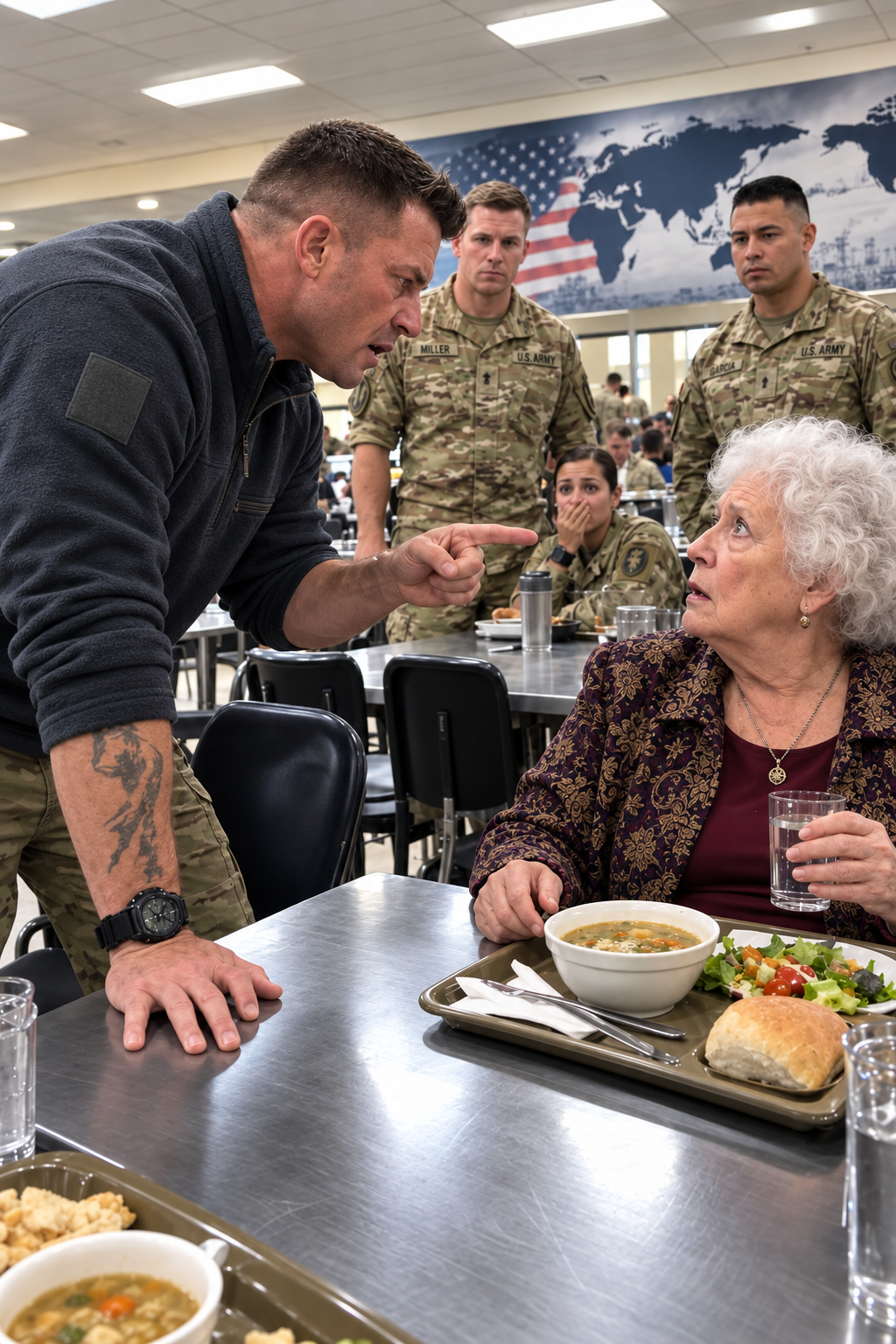
PART 1 TITLE: At Eighty-One, I Came for a Quiet Lunch, but a Young Sergeant Threatened to Tear Away the Pin I Had Worn for Fifty-Six Years
The young sergeant pointed at the small brass pin on my coat and told me to remove it. When I refused, he leaned closer, one hand hovering near my collar as though he intended to take it himself. Around us, the dining hall had gone strangely quiet. I could hear the ventilation humming above the serving counter and the faint scrape of someone moving a chair. I was eighty-one years old, sitting alone with a half-finished bowl of chili, and a man young enough to be my grandson was threatening to put his hands on me.
“I’m not going to tell you again,” he said. His name tape read REESE, and the stripes on his uniform identified him as a staff sergeant. He had a broad face, a closely trimmed haircut, and the impatient manner of someone who expected his voice to settle every disagreement. Two soldiers stood behind him, enjoying the confrontation. “That insignia belongs to this battalion. People earned the right to wear it. You don’t get to pin it on your jacket because you think it looks nice.”
I looked at his outstretched hand, then at the blue-and-white insignia on his uniform. Mine was smaller, its brass edges softened by years of being touched. The little shield carried a white bird, its wings spread as though preparing to rise. I had polished that pin the night before, rubbing its surface with an old cotton cloth while the television murmured in the next room. I hadn’t polished it to impress anyone. I had simply noticed a dark spot near the clasp, and there were some things I could not bear to let deteriorate.
“Sergeant,” I said, “you would be wise to move your hand.”
He gave a short laugh and glanced toward his companions. One of them smiled. The other seemed less comfortable, his eyes moving between Reese and the soldiers watching from nearby tables. I didn’t raise my voice or make a move toward my handbag. My knees were stiff, and I knew I would need the edge of the table to stand. None of that meant I was frightened of him. It only meant I had reached an age when I preferred to spend my strength carefully.
Forty minutes earlier, I had been driving toward Fort Campbell with the heater blowing against my ankles and a paper cup of coffee sitting untouched in the holder beside me. The morning had been cool, and the sky over the Tennessee countryside looked as though it might rain. I had taken that road often enough to know where the pavement dipped and where the trees opened onto a wide stretch of fields. There was no ceremony scheduled, no meeting I needed to attend, and certainly no expectation that anyone would recognize me.
My daughter, Ellen, had telephoned from Nashville the previous evening. She had asked what I had eaten for supper. When I told her toast and a sliced tomato, she sighed in the familiar way that meant she was trying very hard not to sound like my mother. “You need to go somewhere besides the grocery store,” she said. “Have a proper meal. Sit at a table. Talk to somebody.” I told her that I talked to people all the time, which was technically true. The pharmacist and I had discussed the weather for nearly four minutes on Tuesday.
Ellen had laughed, but I heard the concern beneath it. Since my husband died, she had developed the habit of checking on small things: whether I had bought milk, whether I was sleeping, whether I had remembered to take my medication with breakfast. I understood why she worried. An empty house becomes very quiet after the person who filled it is gone. Still, I disliked having my days arranged around other people’s fear of my getting old. So when she suggested I have lunch somewhere, I told her I knew a place that served chili worth driving for.
The dining hall at Fort Campbell had never struck me as a particularly elegant destination, but elegance had never improved the taste of a good bowl of chili. I had a valid visitor’s pass and a legitimate reason to be on the installation. At the gate, the guard examined my identification, checked the pass, and waved me through with a polite greeting. I thanked him, parked near the dining facility, and spent an unnecessary amount of time making sure the car doors were locked. I was in no hurry. Retirement had given me the luxury of arriving somewhere without having to glance at my watch every five minutes.
Inside, the smell of simmering beans, onions, coffee, and freshly cleaned floors met me at the entrance. Young soldiers moved through the serving line with trays balanced against their hips. Some were laughing. Others looked tired enough to fall asleep standing. I recognized that particular fatigue, even though their uniforms and equipment belonged to a different world from the one I remembered. Military buildings change over the decades, but hungry service members still move toward food with the same practical determination. I took a tray, ordered my chili, and found an empty table near the side of the room.
I liked watching the ordinary business of the place. A young private dropped a fork and bent to retrieve it while his friend pretended not to know him. Two women in uniform discussed a training schedule between bites of lunch. Somewhere behind me, a soldier complained about having to clean equipment he had already cleaned twice. Their conversations were familiar in their rhythm, even when the words were new to me. I had not come to revisit my past, but being among soldiers could make a person remember without intending to.
I had eaten perhaps six spoonfuls when Reese approached. His two companions followed, carrying the careless confidence of men who expected entertainment rather than trouble. He stopped beside my table and looked me over. My gray coat hung loosely around my shoulders. My hair was white, my shoes were practical, and my handbag rested against the leg of my chair. Whatever he saw, it apparently convinced him that I was out of place. He opened with a joke about my age, something about military service being different in prehistoric times. His friends laughed louder than the remark deserved.
I continued eating. It wasn’t because I couldn’t hear him. My hearing was perfectly adequate when someone was standing three feet away and trying to impress an audience. I simply saw no reason to participate in his performance. Over the years, I had learned that some people mistook the attention they received for the respect they had earned. Reese appeared to belong to that category. He watched me lift another spoonful, and the amusement slowly left his face. A man accustomed to immediate reactions does not always know what to do with silence.
“This is an active military installation,” he announced. “You need authorization to be here. Who checked you in?” I set down my spoon and looked at him properly for the first time. There was nothing unreasonable about verifying a visitor’s permission when circumstances required it. The problem was his manner. He hadn’t begun by asking whether I needed help or whether I had a pass. He had begun by making me the subject of a joke in front of a crowded room. Now he seemed determined to turn the humiliation into an official duty.
“I entered through the main gate,” I told him. “The guard checked my documents.” Reese asked to see them. I said they were in my purse. He ordered me to produce them immediately, then tapped his fingers against the table while I reached for my water instead. I wasn’t trying to obstruct a security check. I was deciding whether the young man intended to conduct one properly. His irritation increased with every second. His companions shifted behind him, and I noticed that several conversations at neighboring tables had stopped altogether.
One of the soldiers behind Reese asked whether I had wandered in from a retirement facility. There was another burst of laughter, smaller this time. Across the aisle, a young woman looked up sharply. Her uniform bore the name MARTINEZ, and her expression suggested she was considering whether to speak. She glanced at Reese’s rank, then down at her tray. I knew that hesitation. I had seen it in younger soldiers many times, including those who were decent people but still learning when obedience should give way to courage.
Reese placed his tray on an empty table and leaned toward me. His palms came down on either side of my bowl, hard enough to make the spoon tremble against the ceramic. “When a noncommissioned officer speaks to you, you answer,” he said. I studied the skin across his knuckles, the tension running up his forearms, and the certainty in his eyes. He expected me to be intimidated. Perhaps other people had been. I wondered whether anyone had told him that frightening someone into silence was not evidence that he had won an argument.
“I have answered your questions,” I said. “You haven’t given me a reason to accept your behavior.” His jaw tightened. He told me to stand up and accompany him to the gate. I asked why that was necessary when my authorization had already been verified. He repeated the order, this time more loudly. I remained in my chair. My heart was beating a little faster, though not because I believed he would harm me. I was angry, and anger had always made my pulse quicken. I kept my hands on the table until I trusted them not to shake.
Then his attention caught on my coat. The pin was fastened just below the left lapel, where I had worn it for more years than Reese had been alive. He stared at it, frowned, and bent nearer. I saw the precise instant he recognized its design. He straightened, glanced at the corresponding insignia on his uniform, and looked back at me with sudden indignation. Until that moment, he had believed I was merely an elderly visitor who needed to be removed. Now he seemed to think I had committed a personal offense against his unit.
“Where did you get that crest?” he demanded. I touched it with two fingers. The metal was cool. I told him it had been given to me a long time ago. He asked by whom, then interrupted before I could answer. He said the symbol represented the service and sacrifices of soldiers who had belonged to his battalion. It wasn’t a trinket, he insisted, and I had no right to wear it without understanding its significance. Listening to him, I felt a strange mixture of sadness and disbelief. Every word he spoke about its meaning made his conduct more difficult to excuse.
There are certain objects a person keeps not because they are expensive but because they survived when the people associated with them did not. My husband knew that. He never asked me to explain why I sometimes held the pin between my fingers while sitting at the kitchen table. Ellen knew less. As a child, she had occasionally asked whether it was a medal, and I had told her it was a gift from an old friend. That answer was true, although incomplete. Some memories require more than a single conversation, and I had spent decades postponing the longer one.
For a moment, the dining hall vanished beneath an older smell: wet canvas, disinfectant, muddy uniforms, and the sharp, metallic odor that follows a terrible injury. I remembered the weight of a medical bag against my hip and the way boots sounded on plywood flooring when wounded men were brought through a hospital entrance. I remembered young faces turned toward me, asking questions I could not always answer. Most of all, I remembered a man’s hand closing mine around a small piece of brass and telling me not to lose it. The memory passed quickly, but it left my throat tight.
Reese mistook my silence for uncertainty. He said I had probably bought the pin at a flea market or found it among somebody’s discarded belongings. His friends laughed again, though the sound had lost its earlier enthusiasm. “Take it off,” he ordered. “You haven’t earned the privilege of displaying that.” I looked at the insignia on his uniform and wondered whether he had ever studied the history behind it. Perhaps he knew the official dates, the approved descriptions of battles, and the names printed in training manuals. I doubted he knew much about the people.
“No,” I said. The word came out quietly. Reese blinked as though he had misheard. He told me that refusing was not an option, then extended his hand toward my collar. Behind him, Martinez pushed back her chair. The movement was small but distinct, and several people turned toward her. I gave her a slight shake of my head. I did not want a young private jeopardizing her position because an older sergeant had lost control of himself. Whatever happened next, I intended to deal with him directly.
I raised my eyes beyond his shoulder. On the far wall, above the serving counter, a row of framed photographs hung beneath a large inscription. I had noticed them when I entered but had been too interested in finding a seat to examine them closely. Now the letters caught my attention. I read them once, then again, feeling a peculiar sensation settle in my chest. The words concerned those who had served before the present generation. Below them, one photograph showed several young people standing outside a military hospital, their faces made pale and distant by the decades.
There was something about the photograph that troubled me, though I could not clearly see its details from the table. I recognized the shape of the building, the angle of the roof, and the awkward arrangement of people standing shoulder to shoulder in the heat. My eyes were not as reliable as they once had been, and the overhead lights reflected off the glass. Still, an old uneasiness stirred. I had spent fifty-six years learning how to live with memories that could return without warning. A photograph on a cafeteria wall was enough to open a door I usually kept shut.
Reese was still speaking. He warned me that he could have security escort me away and that his position gave him authority to protect the reputation of the unit. I let him finish. Then I asked him how long he had served at Fort Campbell. He frowned, suspicious of the question, but answered that he had been assigned there for several years. I pointed toward the wall. “Then you’ve walked past those words more times than I can count,” I said. “I would like to know whether you’ve ever considered what they mean.”
His expression grew harder. He announced that he did not accept instructions from civilians, especially civilians who refused to cooperate. I nodded. The military had rules about authority, and I understood those rules better than he imagined. But I also understood that orders and judgment were not the same thing. “I’m not asking you to obey me,” I replied. “I’m asking you to look at something belonging to your own battalion.” The corporal standing behind him glanced toward the serving line. His smile disappeared.
I could feel my age in that moment. My back ached from sitting upright, and the chili had cooled into a thick brown layer at the bottom of the bowl. I wanted to go home, telephone Ellen, and tell her that I had made an effort to get out of the house. Instead, I was being forced to defend a memory I had never intended to put into words. I thought of the young man who had given me the pin, of the patients whose names I still remembered, and of all the people who had survived long enough to become invisible.
“Sergeant Reese,” I said, making sure he heard every syllable, “before you touch this coat, turn around and read the words written above that photograph.” He hesitated. A few soldiers were watching him openly now. I saw him weigh the possibility that turning around would make him appear to have taken an order from an old woman. Then he looked at the corporal beside him, perhaps hoping for another laugh. None came. The corporal was already staring toward the wall, his expression unusually serious.
Reese slowly turned his head. I kept my hand over the pin and watched him study the inscription. For the first time since approaching my table, he had stopped talking. I wondered whether he would recognize the faces beneath those words. I wondered whether he would understand what he had accused me of stealing. And as his gaze moved down toward the old photograph, I realized that the afternoon might force me to speak aloud a name I had spent more than half a century trying to leave undisturbed.
END PART 1
PART 2 TITLE: The Photograph Above the Serving Line Held a Face the Sergeant Could Not Recognize Until He Read the Name Beneath It
Reese turned reluctantly toward the serving counter, as though the movement itself cost him something. For several seconds, he examined the lettering without speaking. The inscription honored the generations whose service had made the present battalion possible. It was the sort of sentence people could pass a hundred times without really seeing. Beneath it hung photographs from different periods of the unit’s history. Some showed formations of soldiers standing in neat rows. Others captured ordinary moments: men unloading equipment, medical personnel outside temporary buildings, and young faces looking uncertainly toward the camera.
“Is this supposed to prove something?” Reese asked. His tone was still sharp, but he no longer seemed entirely comfortable. I asked him to look at the photograph directly below the inscription, the one showing six people outside an old military hospital. He moved two steps closer to the wall. His companions followed. Several soldiers leaned sideways in their chairs to watch. From where I sat, I could see him studying the picture, trying to find whatever connection he believed I intended to establish.
The photograph had been taken in Vietnam in 1968. Six young service members stood together in the harsh light outside a medical facility. Their uniforms were dusty, their postures stiff, and their expressions reflected a tiredness that had little to do with sleep. The woman near the center wore a medical uniform with her dark hair secured away from her face. She looked directly toward the camera, neither smiling nor attempting to appear brave. The photograph preserved a moment when everyone had been asked to stand still for a few seconds, although the work waiting behind them was anything but still.
I remembered that day more clearly than I wanted to. The air had been heavy and damp. A vehicle engine had been running somewhere nearby, and someone had complained about the smell coming from a drainage ditch behind the hospital. We had been exhausted after a long shift, and the photographer had insisted that we gather before the light changed. A young man standing beside me had joked that the picture would be dreadful because none of us had found time to wash properly. I remembered turning my head toward him, laughing despite myself, just before the photograph was taken.
Reese leaned toward the frame. I saw his eyes move from one face to another until they stopped on the young woman. He glanced back across the dining hall toward me. I had worn my hair in many styles since that picture was taken. My face had grown rounder, my cheeks had softened, and the skin around my eyes carried decades of lines. Yet certain features remain stubbornly recognizable. He looked back at the image, and a slight crease appeared between his eyebrows.
“It’s an old photograph,” he said, returning to my table. “What does that have to do with your authorization?” I opened my handbag. This time, I removed the visitor’s pass and laid it beside my bowl, where he could inspect it without another argument. He glanced at the photograph printed on the card, then at the name beneath it. QUINN BRADDOCK. Nothing about the document was unusual. It was valid, properly issued, and exactly what I had told him I possessed. He could have checked it minutes earlier, without threatening anyone.
The corporal moved closer to the wall. He had noticed something Reese had missed: a small brass plate beneath the photograph. Age had dulled its surface, but the lettering remained clear. It identified Staff Sergeant Quinn Braddock of the Army Nurse Corps and recorded her Vietnam service from 1968 to 1969. The final line recognized her courage while working under enemy fire. There were no elaborate decorations, no theatrical descriptions of heroism. Only a few official words describing a life that had once belonged to a very young woman.
“Sergeant,” the corporal said. His voice was low enough that I almost didn’t hear it. Reese looked at him with visible annoyance. The corporal pointed to the plate, then toward the pass on my table. “I think you should read the name.” Reese crossed the distance to the wall. He bent forward and read it slowly. I watched his posture change before he even turned around. His shoulders lost some of their rigid confidence, and he stood unusually still, as though he were trying to decide whether the evidence in front of him could possibly be correct.
He returned with a different expression. “You’re Quinn Braddock?” he asked. I told him I was. He glanced toward the photograph again. “The nurse?” I nodded. He looked at me for several seconds, and I could almost see him making the calculation. Fifty-eight years had passed since the photograph was taken. The woman standing outside that hospital had been twenty-three years old. The woman sitting in front of him was eighty-one. Between those two faces lay an entire lifetime he had never considered.
He said that he hadn’t realized who I was. I believed him. I had no reason to think he had approached the table knowing my history. That was precisely what troubled me. His conduct had changed only after he discovered that I had once worn a uniform and possessed a record he considered impressive. Had I been an ordinary visitor with no military background, would he have treated me differently? The question remained between us while he searched for an explanation that might make the previous ten minutes seem less ugly.
His first attempt was to say that he had been protecting the installation. I asked him whether that required mocking my age. He looked toward his companions, but neither offered any assistance. Then I asked whether checking a visitor’s pass required threatening to remove something from her clothing. He admitted that it did not. “You could have asked me directly,” I told him. “You could have listened when I answered. Instead, you decided I was someone who could be embarrassed without consequence.” He lowered his eyes, and I hoped the words would remain with him longer than the humiliation.
I took another sip of water. The glass had warmed in my hand. Around us, the dining hall began to recover its ordinary noise, though the soldiers nearest my table still watched. I disliked being observed. During my years as a nurse, attention had usually meant somebody needed something urgently, and I had never grown comfortable with being the center of a room for any other reason. I wanted Reese to understand his mistake, but I did not want two hundred people treating me as an exhibit suddenly brought to life.
The young woman who had stood earlier approached carefully. Her name tape confirmed what I had noticed from across the aisle: MARTINEZ. She was a private first class, with a serious expression and hands that seemed uncertain what to do when she wasn’t holding a tray. She asked whether she might speak to me. I moved my handbag from the next chair and invited her to sit. Before doing so, she glanced at Reese and apologized for remaining silent when he had started making his remarks.
“You looked as though you wanted to say something,” I told her. She admitted that she had. She had joined the Army recently enough that the distinctions between grades of authority still felt enormous. Reese was several ranks above her, and she had been afraid of challenging him in public. I understood. Fear does not always arrive with shouting or physical danger. Sometimes it comes as the knowledge that the wrong words could complicate your next six months. I told her I appreciated her concern, though I also hoped she would think about what had stopped her.
Martinez looked toward the photograph. She said she recognized it from a class about the history of the unit. Their instructor had discussed the medical teams who supported operations during the Vietnam War, and she remembered the photograph because one of the people in it was a woman. She looked embarrassed as soon as she said this, perhaps realizing how much the observation revealed about the way military history was often presented. I told her there had been more women in difficult places than most photographs managed to show.
“Were you there when the hospital came under attack?” she asked. I looked down at my hands. Even now, the knuckles bore faint marks from old injuries and years of work. I had answered questions about Vietnam occasionally, usually when someone needed material for a school assignment or a local memorial program. There were details I could give without much difficulty. Dates, locations, assignments. There were other details that remained difficult because describing them required returning to the people rather than the facts.
“Yes,” I said. “I was there.” Martinez waited, perhaps expecting me to continue. I told her that field hospitals were never quite as distant from combat as people wished to believe. Wounded men arrived from places we knew only by the names written on evacuation reports. Sometimes they came in groups too large for the available beds. Sometimes the aircraft carrying them had barely landed before the medical staff began working. She listened without interrupting. I appreciated that more than she probably understood.
I told her that we learned to recognize sounds. A helicopter approaching with wounded soldiers made the entire medical staff move differently. Heavy vehicles carried their own warnings. Explosions had a rhythm I could still remember, though I preferred not to. During quieter hours, there were conversations about home, favorite meals, families, and the plans people intended to make after returning to the United States. Those ordinary conversations mattered as much to me as the records of what happened in combat. They were reminders that every patient had possessed a life beyond the war.
Martinez asked how many people were in the photograph. I told her six. Then she asked whether they had all survived the war. I looked toward the wall, where their faces remained permanently young. “Two of us came home,” I said. I didn’t elaborate. There was nothing useful in giving her details she had not asked for, and some losses did not become easier to describe because decades had passed. Martinez lowered her gaze. I could see that she was trying to imagine knowing five other people closely enough to stand shoulder to shoulder with them, then returning home with only one.
The corporal remained near Reese, who had moved a short distance away from my table. He was no longer laughing. Occasionally he glanced toward the wall, as though the photograph had become an accusation. I wondered what the young woman in the picture would have thought of him. At twenty-three, I had been impatient and outspoken, not unlike many of the soldiers around me. I had also been frightened more often than I admitted. Perhaps that was why I had so little patience for people who treated fear as a weakness in others.
Reese approached again. This time, he stopped at a respectful distance and addressed me in a measured voice. He said he owed me an apology. I agreed. He looked briefly surprised by the answer, as though he had expected me to relieve him of the burden by saying the incident no longer mattered. Instead, I waited. He told me that his remarks had been inappropriate and that he should have handled the situation differently. He spoke without looking at his companions, and I could hear that he meant at least part of it.
“I appreciate you saying that,” I replied. “But I would like you to remember something.” He nodded. I gestured toward the dining hall. “There are people here who watched you decide how to treat me before you knew anything about my past. They also watched you change your manner once you discovered who I used to be. What do you suppose they learned from that?” His eyes moved across the room. For the first time, he seemed genuinely troubled by the people who had witnessed the confrontation, rather than merely embarrassed in front of them.
Before he could answer, a chair moved near the rear of the hall. An older soldier stood and walked toward us. He had gray at his temples and the steady, economical stride of someone who had spent years moving through military buildings. His uniform identified him as a first sergeant. I noticed that he did not look immediately at Reese. He looked at the pin on my coat, then at my face, and finally toward the photograph. Something in his expression changed.
“Staff Sergeant Braddock?” he asked. Hearing the old rank spoken aloud startled me more than I expected. My time in the Army had ended so long ago that most people who knew me had never addressed me by a military title. I looked up and told him yes. He introduced himself as First Sergeant Daniel Whitaker. Then he came to attention and offered a formal salute. There was no performance in it, no exaggerated gesture intended for the surrounding tables. It was a straightforward acknowledgment from one soldier to another.
For a moment, I could not move. My body remembered the gesture before my thoughts caught up. I straightened as much as my back allowed and returned the salute. Whitaker lowered his hand, and I saw a quiet understanding in his face. He had not been alive when that photograph was taken, but he knew why it mattered. There was a difference between recognizing a decorated veteran and understanding that the person standing before you had once been part of the ordinary working life of the unit.
Whitaker turned to Reese and asked him to step aside. Their conversation was brief and conducted in tones too low for me to hear. I saw Reese nod several times. When they returned, Whitaker informed me that he intended to notify the command team about what had occurred. He said the sergeant would be expected to explain his behavior through the appropriate channels. I told him that seemed reasonable. I had no desire to demand a spectacle or invent consequences. I wanted the matter addressed honestly, by people responsible for maintaining professional standards.
Then Whitaker did something I had not anticipated. Instead of bringing the conversation to a close, he looked toward the old photograph with an expression I could not quite interpret. He asked whether I had a little time before leaving. I told him that I had planned to finish lunch and go home. He nodded, acknowledging the answer, but his eyes returned to the picture. “There is something connected to that photograph,” he said. “Something we found in the battalion records. I think you should see it.”
I asked him what he meant. Whitaker hesitated, not because he seemed uncertain about the facts, but because he appeared to be choosing his words with unusual care. He asked whether I remembered the person who had operated the camera. The question caught me completely unprepared. For an instant, the bright dining hall seemed to recede. I could see a younger man standing outside a military hospital, adjusting a camera and asking exhausted people to hold still. His sleeves were rolled up. He was smiling at something I had said.
“I remember him,” I answered. My voice sounded different to my own ears. Whitaker nodded slowly. He said that during an earlier review of historical material, an envelope had been discovered among records donated to the battalion. The envelope was connected to the photographer, and there were reasons to believe it had been intended for me. My fingers tightened around the edge of the table. I had spent years convincing myself that certain pieces of the past were lost forever, buried with people who could no longer explain them.
Martinez noticed the change in my expression. She asked whether I felt all right. I assured her I did, although my chest had begun to ache with a familiar pressure. Whitaker waited quietly. I looked at the photograph again and saw its six young faces more clearly now. The photographer himself had stood outside the frame, directing us with the brisk confidence of a man who could make even a terrible day seem briefly manageable. He had been twenty-five when I first knew him. He was the sort of person who volunteered before anyone finished asking for help.
I asked Whitaker whether the envelope carried a name. He told me that it did. I asked if it had been opened. He said that the records team had examined enough of the accompanying documentation to identify its likely significance but had preserved the original material. He seemed reluctant to say more in the middle of the dining hall. I understood the hesitation. The people around us were still curious, and whatever waited inside that envelope belonged to a part of my life I had never shared casually.
I rose slowly, using the table for balance. Martinez reached for my handbag and offered to carry it, and I accepted. Reese stood near the doorway, looking distinctly uneasy. I didn’t know whether he was more concerned about the commander’s response or about the unexpected direction the afternoon had taken. At that moment, it no longer mattered. I had arrived for chili and found myself standing at the edge of a memory I had spent decades refusing to examine too closely.
Whitaker opened the side door and waited for me to pass. Before entering the corridor, I looked once more toward the photograph. I could almost hear the young lieutenant asking us to move closer together so everyone would fit in the frame. His name was Thomas Hale. I had not spoken it aloud that afternoon, but it was already pressing against my thoughts. And when Whitaker mentioned that the envelope appeared to contain Thomas’s own handwriting, I knew I could no longer leave the past where I had kept it.
END PART 2
PART 3 TITLE: An Envelope Forgotten for Decades Carried a Dead Lieutenant’s Handwriting and Forced Me to Remember the Night I Could Never Put Behind Me
The envelope lay on First Sergeant Whitaker’s desk with my name written across its front in faded ink. I recognized the handwriting before I recognized the paper. The capital Q had a distinctive curve, and the final letters of my surname leaned slightly upward, as though the writer had been in a hurry. I had seen that handwriting on notes tucked beneath coffee cups, on medical supply lists, and on the backs of photographs taken in a country where none of us expected to remain young for very long.
Whitaker waited while I studied it. The administrative office was small, furnished with a metal desk, two filing cabinets, and a folding chair beside the door. A framed American flag stood on a shelf above several neatly arranged folders. The room smelled faintly of paper, floor polish, and the coffee someone had recently left in a disposable cup. Reese stood near the wall with his hands clasped behind his back. Martinez remained beside me, still carrying my handbag. Nobody seemed willing to interrupt the silence.
I lowered myself into the chair Whitaker had pulled out. My knees protested, and I was grateful when he moved it a little closer to the desk. He explained that the battalion had been reorganizing historical material several months earlier. A collection donated by a retired Army officer had contained photographs, operational records, personal correspondence, and an old envelope marked for delivery to Quinn Braddock. The envelope had been kept with the other material because nobody had established how to contact its intended recipient.
I asked why it had remained there so long. Whitaker couldn’t give me a complete answer. The donation had passed through several storage locations before being cataloged, and some of the papers were decades older than the collection itself. He did not pretend that the explanation was satisfactory. Military archives, like family attics, sometimes hold things that were meant to reach someone years earlier. I understood that. What I struggled to understand was how something written by Thomas could have traveled through so many hands and still be waiting for me.
“Would you prefer to examine it alone?” Whitaker asked. I looked toward the door. For a moment, the offer was tempting. I had learned to keep certain memories private because other people’s reactions could make them more difficult to manage. Yet I could not quite bring myself to ask everyone to leave. Perhaps I was afraid that solitude would give me too much space to remember. I told him they could stay, but asked that nobody hurry me. Whitaker agreed immediately, then stepped away from the desk.
The envelope was made from heavy brown paper, its edges softened and stained by age. A yellowed label had been attached to one corner. The words on its face requested delivery to me if it was ever recovered. There was no return address. I ran one finger along the handwriting, following the strokes as I had once followed the shape of Thomas’s letters while he wrote beside a hospital bed. The sight of it made the years between us seem suddenly less reliable. I had believed time created distance. Instead, one small object had brought the past into the room.
Thomas Hale had been a lieutenant assigned to help coordinate medical evacuations near our field hospital. When I met him, he was twenty-five and had already developed the habit of appearing wherever an extra pair of hands might be useful. He wasn’t a surgeon or a nurse. His work involved organizing transportation, communicating with other units, and making certain wounded personnel reached the places where they could receive treatment. But when circumstances became difficult, he rarely remained safely behind a desk. He helped carry stretchers, moved supplies, and assisted wherever the medical staff needed him.
I remembered his first visit to our ward. He had entered carrying two boxes of bandages and an expression of exaggerated seriousness, announcing that he had been told we were running a very demanding establishment. I had asked him to put the boxes beside the supply table and keep the walkway clear. He obeyed, then remained to help sort the contents. Later, when I discovered that one box contained the wrong materials, he went back and found the correct order without making excuses. That was my first indication that beneath his jokes was someone who could be depended upon.
He had an unmistakable laugh, quick and a little rough, and a talent for making weary people feel less alone without insisting that they feel cheerful. Sometimes he sat beside patients who were waiting for evacuation and wrote letters at their dictation. He would read the words back carefully, asking whether they wanted anything changed. A man who couldn’t lift his right arm once spent twenty minutes deciding how to describe the weather to his mother. Thomas stayed until the letter was finished. The next morning, he returned with an envelope and made sure it was mailed.
Other days, he said very little. After a difficult night, I once found him sitting behind the medical building with a cup of coffee he had forgotten to drink. His sleeves were rolled up, and there was a dark stain on one cuff. He looked up when I approached but made no effort to smile. We sat together for several minutes, listening to distant vehicle engines. Eventually he asked whether I ever became accustomed to hearing people cry for someone who wasn’t there. I told him I hoped I never would.
The first time he showed me his little brass insignia, he explained the battalion’s history with an earnestness that surprised me. The blue shield represented the unit, and the white bird had become an emblem of the people who served under it. He spoke about the soldiers who had carried the symbol before him, not as if they were distant figures in an official record, but as men and women whose work had made his own possible. I teased him for sounding like an instructor. He laughed and admitted that he had been reading the unit’s history during his spare hours.
One evening, after a particularly difficult evacuation, he found me cleaning instruments near the end of my shift. I had been awake too long, and my hands were sore from work. He stood beside the table, looking unusually thoughtful, then placed the brass pin in my palm. I told him I couldn’t take something that belonged to his uniform. He said he had another authorized insignia for his own use and wanted me to keep this one as a personal reminder of the people we had managed to bring back alive. I tried to return it. He closed my fingers around it.
I asked why he thought I needed a reminder when I already carried more memories than I wanted. He answered that people usually remembered the terrible outcomes more vividly than the lives saved through ordinary effort. He had watched nurses work until their legs trembled, then return when another patient arrived. He wanted somebody to remember that work, too. I remember feeling embarrassed by his sincerity. I slipped the pin into the pocket of my medical uniform and changed the subject, but I did not forget what he had said.
In the office at Fort Campbell, Whitaker asked whether I was ready to open the envelope. I nodded. The old adhesive resisted at first, and I worked carefully along the edge because I did not want to tear the paper. My fingers were less steady than they used to be. Martinez noticed and placed a small letter opener on the desk without speaking. I thanked her, loosened the flap, and drew out the contents. There was a folded sheet of writing paper, a photograph, and what appeared to be a separate official document.
I reached for the photograph first. It showed Thomas outside the military hospital, standing near the building where I had worked. His uniform was dusty, and he wore a bandage around his right hand. I remembered that injury. He had caught his hand on damaged metal while helping move equipment after an evacuation. I had cleaned the cut, wrapped it, and told him to stop treating his own injuries as inconveniences. He had promised to be sensible, then immediately asked whether being sensible required him to abandon his afternoon duties. The photograph captured the exact mischievous expression I remembered.
“Who is that?” Martinez asked. I held the image a little farther from my eyes. Thomas looked so young. At the time, twenty-five had seemed like an age of considerable experience, especially when the work required decisions that affected other people’s lives. Now I could see how little time he had actually been given. “Lieutenant Thomas Hale,” I told her. “He worked with our medical evacuation team.” I traced the edge of the photograph with my thumb, careful not to touch the image itself. “He was one of the kindest people I knew.”
Whitaker asked whether I had known him well. I considered the question. We had never had the ordinary years that allow friendships to settle into familiar routines. There had been no holidays together after the war, no visits between our families, no chance to compare the people we became. But in Vietnam, I had trusted him with frightened patients, exhausted colleagues, and responsibilities that could not wait until morning. I knew when he was angry, when he was worried, and when his jokes were an attempt to keep someone else from losing hope.
I told Whitaker that Thomas had helped take the group photograph hanging in the dining hall. It had been an ordinary afternoon interrupted by a brief request to stand together. Thomas had borrowed the camera, persuaded six tired people to leave their work long enough for a picture, and complained that nobody was cooperating with his artistic ambitions. I remembered him stepping backward to include the whole group, then warning us not to blink. We had laughed, and the photograph had preserved the moment before anyone knew how few of us would survive the following year.
The worst memory came from the spring of 1969. Our medical facility had been receiving wounded personnel for hours, and the staff had barely managed to clear space for new arrivals. The weather had been wet, with patches of muddy water collecting near the entrances. Inside, the air was close and uncomfortable. We had been working beneath harsh lights when the first explosion shook the building. A tray fell somewhere behind me. Another impact followed, and the lights failed. In the darkness, people began calling for assistance.
I remembered reaching for a flashlight and ordering the nearest attendants to move patients away from the exposed side of the ward. We had practiced emergency procedures, but practice could not prepare us for the confusion of that night. The building shuddered beneath another nearby impact. Dust fell from the ceiling, and someone shouted that a section of the corridor had been damaged. Patients who could move attempted to help those who couldn’t. We needed stretchers, clear passages, and enough hands to carry everyone to a protected area.
Thomas had already helped escort several people outside when he returned through the entrance. His face was streaked with dirt, and he was breathing hard. He asked which patients remained inside. I pointed toward the far end of the ward, where two men needed assistance. Without waiting for anyone to accompany him, he took a stretcher and moved down the corridor. A soldier followed, and together they brought one patient toward us. Thomas went back for the other while I helped secure the first man’s dressing and prepare him to be carried out.
The sequence that followed remained with me more clearly than entire years of my later life. Thomas returned with another wounded man. Then he helped carry a third. Each time, he looked around to see who was still inside. I remember warning him that the structure was becoming unsafe. He nodded without arguing, then asked whether everyone had been accounted for. We thought we were close. But from the damaged section of the ward, someone called for help, his voice faint and frightened. Thomas turned toward the sound.
I caught his sleeve. That much I remembered with certainty. My fingers closed around the fabric near his elbow, and for a second he stopped. I told him we needed to wait for more assistance. He looked toward the corridor, then back at me. There was no grand declaration, no speech about duty. He simply said that the man was still inside. He eased his arm free and started down the passage. I watched him disappear beyond the doorway while another nurse called for me to help with a patient who was struggling to breathe.
I did not see Thomas again. The next explosion came while I was working near the protected exit. The noise overwhelmed everything, followed by a rush of dust and shouting. The doorway leading toward the damaged ward became impossible to enter safely. Soldiers and medical personnel attempted to reach those inside, but the structure had been badly damaged. By the time the immediate danger passed, Thomas had not returned. I asked for news repeatedly until someone finally told me that he had been listed among the dead.
For years, I replayed the moment when I had caught his sleeve. I wondered whether I should have held on harder, whether another person might have reached the patient, whether a different decision would have changed anything. Those questions followed me home after my service ended. They came with me when I returned to nursing school, when I began working in public schools, and when I married and raised Ellen. I could care for an injured child, calm a frightened parent, and make sensible decisions in emergencies. Yet there were nights when a sudden noise returned me to that damaged corridor.
My husband had known that some things were difficult for me to discuss. He never demanded an explanation whenever I woke from a bad dream or stood silently beside a window after hearing a helicopter. He understood that I had brought memories home which did not fit neatly into the life we were building. Sometimes he would make tea and sit beside me until I was ready to speak. More often, we sat without talking. His kindness helped me live with the past, but it could not erase the question I had carried since the night Thomas died.
When Whitaker gently asked whether I needed a moment, I realized that I had been holding the photograph for several minutes. The office was quiet. Reese looked uncomfortable, but not impatient. Martinez stood near the filing cabinet, her eyes fixed on the floor, giving me privacy without leaving. I set the photograph down and unfolded the letter. The paper had yellowed along its creases. Thomas’s handwriting ran across the first page in the familiar slant I remembered, and the date at the top placed it in January 1969, three months before his death.
He began by hoping the letter would eventually find me and that someone would have cared enough to preserve it. I stopped after the opening lines. There was something unbearable about hearing his voice through words written when he was still alive, still planning his days, still imagining a future. He had written as though we might laugh together about the letter later. He could not have known that I would first read it as an old woman, in a room surrounded by people who had not yet been born when he died.
I continued, moving slowly through each sentence. Thomas reminded me of a conversation we had shared about memory. I had once said that the dead were often forgotten not because their lives lacked importance, but because the living became overwhelmed by their own responsibilities. He had disagreed, insisting that some names were too deeply connected to others ever to disappear completely. In the letter, he admitted that he had reconsidered. What frightened him was not simply dying, but leaving behind people whose work, sacrifices, and kindness might never be properly remembered.
I could hear him speaking the words. His language was plain, occasionally awkward, and more serious than he usually allowed himself to be. He wrote about the pin he had given me and why he hoped I would continue wearing it. He explained that it was never intended to distinguish me from the people beside whom I worked. It was meant to remind me that the lives carried out of the hospital mattered, as did the people who had helped carry them. He believed true courage was often demonstrated in moments when nobody was present to applaud.
The letter brought back an afternoon when Thomas and I had watched a group of wounded soldiers leave for further treatment. One of them had insisted on thanking every nurse before he was transported. Thomas had stood nearby, smiling as the young man struggled to find words. Later, Thomas told me that ceremonies and medals were easier to remember than the countless small decisions made by people who never expected recognition. I had answered that the important thing was whether the patient survived. He agreed, but said the hands that helped him survive deserved to be remembered as well.
Near the bottom of the page, Thomas had written about the young soldiers who would serve after us. He imagined a future in which the uniforms would change, the buildings would be rebuilt, and people would study our years as history rather than experience. He hoped those future soldiers would understand that the people in old photographs had not been born knowing how to be courageous. We had been young, uncertain, and frightened, often missing our families and wondering whether we would live to see them again.
His final thoughts were not a request for a statue or an elaborate tribute. He wanted the next generation to remember the humanity behind the records. Every young person who served had belonged to someone: a parent, a spouse, a child, a friend. If our names survived, he hoped they would become reasons for people to treat one another with greater care. I read that passage twice. It sounded exactly like Thomas, who could spend an entire afternoon joking and then surprise me with a few sentences that revealed how closely he observed the world.
I placed the letter against my lap and looked at the signature. Thomas Hale. The name was as familiar as my own, yet I had spent decades avoiding it in conversation. I had worn his pin to church, to work, to family gatherings, and even to my husband’s funeral. Ellen had grown up seeing it without knowing the full story. I wondered what Thomas would have thought of that silence. Perhaps he would have understood why I protected the memory. Perhaps he would have been disappointed that I had not shared more of it.
Whitaker waited until I folded the letter. Then he said there was another document I needed to examine. I had almost forgotten the official paper lying beneath the photograph. He lifted it carefully, turned it so I could read the heading, and explained that it came from the battalion’s historical records. Thomas’s name appeared at the top, followed by a description of the evacuation during the attack. Below that was a list of the personnel who had participated. I saw my own name among them, and beneath it, a handwritten note whose significance I did not yet understand.
END PART 3
PART 4 TITLE: The Forgotten Record Revealed Why Thomas Gave Me the Insignia, but What I Asked the Battalion to Remember Surprised Everyone
The handwritten note beneath my name was brief, but I had to read it several times before I understood what it meant. According to the record, Lieutenant Thomas Hale had presented the blue-and-white insignia to Staff Sergeant Quinn Braddock to acknowledge her service during the medical evacuations. It described the pin not as a decoration or personal souvenir, but as a symbol of the people whose lives had been preserved through the work of the medical team. Thomas had arranged for that explanation to be recorded without telling me.
I sat with the document in front of me, trying to reconcile the young man I remembered with the official language on the page. Thomas had never seemed interested in making ordinary acts of service appear impressive. He had carried stretchers, delivered supplies, and helped frightened patients because the work needed doing. Yet somewhere between those exhausting days, he had taken the time to make certain that the meaning of a small gift would survive him. He must have understood that objects could outlive the people who gave them, and that their stories might otherwise disappear.
Whitaker pointed toward the section describing the evacuation. The report recorded repeated efforts to remove wounded personnel while the medical facility was under enemy fire. Several names appeared in connection with those efforts, including mine. I remembered the confusion of the night, the limited visibility, and how difficult it had been to determine who was still inside the building. The official account was careful, factual, and concise. It could describe the sequence of events, but it could not capture the sound of a frightened man calling from a damaged ward.
I noticed that Thomas’s participation had been recorded with particular attention. The document confirmed that he had returned to assist with evacuations after the initial danger became clear. It described his efforts to reach wounded personnel who could not move without help. I followed the words with my finger, reading slowly, not because they were difficult to understand but because I wanted to be certain I had not overlooked something. For fifty-six years, much of what happened had remained a collection of memories that surfaced without warning. Now there was a written record, created while those events were still fresh.
The account did not answer every question. It could not tell me what Thomas had been thinking when he returned to the ward for the last time. It did not explain whether he had heard the warning I shouted after him or whether another route through the building might have been possible. But it established something I had needed to see for decades: the people involved had made repeated efforts to get the wounded out, and Thomas had been among those who continued working after the situation became dangerous.
I touched the edge of the paper. My hands were trembling, and I was embarrassed by it until I remembered that nobody in the office had asked me to be composed. I had spent much of my working life staying calm for other people. In medical emergencies, fear could interfere with judgment, and patients often looked to nurses for reassurance. But this was not an emergency I needed to manage. It was a piece of my own history, placed before me long after I had stopped expecting answers.
“Did he write this note himself?” I asked Whitaker. He examined the notation and explained that the record documented Thomas’s presentation of the insignia, although the handwriting did not establish who had entered every word. The accompanying material identified Thomas as the person who had given me the pin. I was grateful that Whitaker did not claim more certainty than the documents allowed. After so many years, I had no interest in having anyone improve the story for dramatic effect. What had actually happened was enough.
I looked toward Reese. He had been standing against the wall for most of the conversation, his posture carefully controlled. His face was pale, and he seemed uncertain whether he should continue listening or excuse himself. Whitaker asked him to step forward and examine the record. Reese approached the desk. He leaned over the document, reading first the account of the evacuation and then the note concerning the pin. His eyes moved slowly across the page. When he finished, he remained looking at the paper for several seconds.
“Do you recognize the insignia being described?” Whitaker asked. Reese nodded. It was the same blue shield and white bird displayed on his own uniform. The symbol he had accused me of stealing had been given to me by an officer who died while helping wounded soldiers escape a damaged hospital. The battalion history confirmed the connection. Reese looked toward my coat. I had not moved the pin since the confrontation in the dining hall. The brass was slightly crooked where I had pressed my hand against it earlier.
He drew a breath and faced me. “Mrs. Braddock, I’m sorry,” he said. The apology was different from his earlier one. He did not mention security regulations or explain that he had been performing his duty. He did not ask me to understand his intentions. He simply acknowledged that he had treated me badly. I watched him for a moment, remembering the laughter behind him and the way he had reached toward my collar. I wanted to believe he understood what had been wrong. But a man’s embarrassment, however sincere, was not necessarily the same as a change in judgment.
“Thank you,” I said. “Now tell me something. If you had never seen that photograph, would you still think your behavior was acceptable?” Reese opened his mouth, then stopped. I allowed him time to consider the question. He looked toward Whitaker, but the first sergeant offered no answer. Finally, Reese said he hoped he would have realized his mistake. I appreciated the admission, because he could easily have told me what he thought I wanted to hear. Instead, he seemed aware that he could not be certain.
I asked him why he had approached me in the first place. He answered that I had appeared unfamiliar with the facility and that he believed he should verify whether I had permission to be there. I told him that checking a visitor’s authorization was a legitimate responsibility. The young guard at the gate had done exactly that, without an unkind word or an unnecessary remark. What troubled me was the choice Reese had made before he asked a single question. He had seen my age, my clothes, and the fact that I was eating alone, and he had decided those things gave him permission to mock me.
“I wasn’t expecting you to have served,” he admitted. I nodded. That was obvious. He looked uncomfortable again, but I did not intend to rescue him from the discomfort. I told him there were many people whose lives would never appear in official military histories. Some had served. Some had been married to service members, raised their children, or supported families through long absences and loss. Others had never been connected to the military at all. None of them needed an impressive past to deserve a decent conversation.
Martinez shifted beside the filing cabinet. I glanced at her and remembered how she had hesitated when Reese began speaking in the dining hall. She was young, with a long career potentially ahead of her, and I hoped the afternoon would not teach her simply to fear making mistakes in public. I wanted her to learn something more useful: that rank and experience carried responsibilities as well as privileges. The people who followed a leader needed to know they could raise a concern without becoming the next person he embarrassed.
“Sergeant,” I said, “what would you have done if I’d been someone’s grandmother visiting her grandson, with no photograph on the wall and no military history at all?” Reese considered the question. He said he should have asked for identification politely, explained any concerns, and treated me with respect regardless of the answer. It was a straightforward response, but I noticed how carefully he spoke it. He was no longer trying to win an argument. He was trying to understand why the argument should never have happened.
I told him that I had driven forty minutes because Ellen thought I needed to leave the house more often. She was right, though I had no intention of telling her so. After my husband’s death, I had become accustomed to the ease of small meals at home. Some mornings, I stood at the kitchen sink eating toast rather than setting a place at the table. Ellen had suggested that I find something enjoyable to do outside, and I had remembered the chili served at Fort Campbell. That was the entire reason for my visit.
Martinez smiled when I described Ellen’s complaints about my eating habits. Even Whitaker’s expression softened. I told them that I had not come hoping for recognition or looking for someone to ask about Vietnam. I had not planned to discuss decorations, records, or the history of the battalion. The pin was part of my ordinary clothing because I had worn it for decades. I had expected nothing more complicated than lunch and the drive home. Instead, an encounter that should have lasted a few seconds had reopened a part of my life I rarely discussed.
Reese lowered his head. He said he understood, and this time I believed he was beginning to. I did not need him to remain ashamed forever. Shame, when it serves no purpose beyond making someone miserable, accomplishes very little. I wanted him to remember the decision he had made before discovering my history. That was the part of the afternoon he could carry into his future service. The photograph had corrected his assumptions about me, but it was his assumptions about people generally that needed changing.
Whitaker remained silent until Reese had finished speaking. Then he informed me that the incident had been reported and would be handled through the appropriate chain of command. I thanked him for taking the matter seriously. I did not ask what discipline Reese might receive, and Whitaker did not speculate. His responsibility was to address conduct within the battalion, not to provide an audience with a punishment. I respected that distinction. The conversation had been difficult enough without turning it into something designed for public satisfaction.
I thought that would be the end of our meeting. I had seen the letter, understood the note concerning my pin, and received an apology. I was tired, and I wanted to sit quietly in my own kitchen before trying to explain any of it to Ellen. But Whitaker had another matter to discuss. He said the command team wanted to speak with me about the historical material. The battalion had displayed the photograph for years, yet the information accompanying it was incomplete. The records discovered in storage could help correct that omission.
I asked him what was missing. He explained that the existing display identified me and referred to my service, but it did not adequately tell the stories of the other people in the photograph. Visitors could see six young faces without knowing who most of them were. There was also little information about Thomas, his work with the evacuation teams, or the origin of the insignia. The new documents offered a chance to explain why the photograph mattered, rather than presenting it simply as evidence of a distant military assignment.
For a moment, I could not answer. I thought of the photograph hanging above the serving line while hundreds of soldiers passed beneath it each day. The people in it had once lived in a world of particular sounds, smells, worries, and friendships. They had laughed at foolish jokes, written home, complained about bad meals, and worked until they could barely stand. Yet to someone glancing at the wall, they were only six unfamiliar faces in old uniforms. I understood why Whitaker wanted to improve the display, though I wasn’t certain I wanted my life opened to strangers.
He asked whether I would consider allowing an account of the pin’s history to be included. I looked down at the little shield. For years, it had belonged to the quiet part of my life. I had worn it to church services and family celebrations. It had remained fastened to my coat while I stood beside my husband’s grave. On those occasions, I sometimes touched it without thinking, and the contact reminded me of people I had known when I was young. Sharing that meaning with a room full of strangers was not an easy decision.
I asked Whitaker whether the original letter would remain protected. He assured me that the historical staff could preserve it appropriately and that any public display would be discussed with me first. They did not need to reproduce the private correspondence in full. I appreciated that. Thomas had written to me personally, and although his words about remembrance were valuable, some parts belonged to the friendship we had shared. I wanted future soldiers to understand him without turning every private memory into public property.
“What would you want people to know?” Whitaker asked. I looked toward the window. Outside, several soldiers were crossing the parking area, carrying equipment and talking among themselves. They were no different in that moment from the young people I had known in Vietnam. Their circumstances were different, and I hoped their experiences would be kinder, but the ordinary business of being young remained much the same. I thought of the faces in the photograph and tried to imagine what each person would have wanted remembered.
I told Whitaker that the display should identify everyone in the picture, not merely the one person whose name happened to be most familiar. Six people had stood together that day. Their experiences deserved to be recorded individually, even if some records required further research. I asked him to make sure the battalion did not overlook the nurses who had worked alongside the evacuation teams. Their contribution had been constant, physically exhausting, and often performed without much attention. I did not want a historical correction that repeated the same omissions under a different title.
Whitaker listened carefully, writing a few notes as I spoke. He said the battalion’s historical records could be reviewed to establish the names and service details of the people pictured. I told him I would help where my memory was reliable, but that I did not want uncertain recollections presented as facts. After fifty-six years, memory can preserve the sound of someone’s laughter while losing the precise date of an event. If the battalion was going to tell the story, it needed to distinguish what we knew from what we merely believed.
I also asked that Thomas’s part in the story be acknowledged. He had taken the photograph. More importantly, he had helped injured men reach safety and died while trying to assist another. I wanted young soldiers to know that his courage had not been confined to the final moments of his life. It had appeared repeatedly in the smaller decisions he made every day: carrying supplies, helping the medical staff, listening to frightened patients, and writing letters for people who could not write their own. The dramatic ending mattered, but it did not contain the whole man.
Whitaker asked whether I would permit a short passage from Thomas’s letter to accompany the photograph. I considered the question. I remembered the lines about our youth, our fears, and the families waiting for us. Those were words Thomas had written without knowing how directly they would describe his own fate. I told Whitaker that a brief excerpt might be appropriate, provided it preserved his meaning and did not turn him into an untouchable figure. He had been a thoughtful, funny, occasionally infuriating young officer. I wanted people to see his humanity as well as his courage.
Reese had listened without interruption. When I looked toward him, he appeared to be studying the pin again, though he kept a respectful distance. I asked him whether he had ever wondered about the people pictured in the battalion’s historical displays. He admitted that he had not given them much thought beyond what was required for training. I did not scold him. Most people are busy with the demands of the present, and old photographs can become part of the furniture unless someone explains why they matter.
I told him that military history was not simply a collection of victories, decorations, and names carved into stone. Those things were important, but they were incomplete without understanding the lives behind them. The people in the photograph had arrived in Vietnam with different backgrounds and expectations. Some had been eager to serve. Others had been frightened. All of us had been ordinary human beings trying to do our work in extraordinary circumstances. Remembering that would not diminish the battalion’s history. It would make the history more truthful.
Whitaker said the commander would be pleased to discuss the proposal with me. I was less certain about that. I had never enjoyed formal attention, and the idea of sitting with senior officers to discuss an episode from my youth made me uncomfortable. But I thought of the envelope that had waited for decades, and of how easily it might have remained forgotten in a storage cabinet. If I left without helping, the story could return to silence. I had spent enough years preserving it privately. Perhaps it was time to consider what might happen if I allowed others to help carry it.
Before agreeing, I asked Whitaker to make one thing clear to the commander. I was not interested in having the display reorganized around me. My name already appeared beneath the photograph. If the battalion wanted to honor the past more completely, it needed to look beyond the most convenient person to recognize. There were people who never returned to tell their stories and others who came home but found it difficult to speak about what they had experienced. Their absence from public memory did not make their contributions less important.
Whitaker closed his notebook and promised to convey my request. I glanced at Reese one final time. He seemed quieter than the young man who had stood over my lunch, and I hoped the change would survive the afternoon. I told him that if he wanted to honor the people who had worn the battalion’s insignia before him, he could begin by treating the people in front of him with care. He nodded. I had no way of knowing whether he would remember those words when it mattered, but I wanted to give him the opportunity to prove that he had learned.
I gathered the letter and photograph, then placed them carefully back inside the old envelope. Before closing it, I looked at Thomas’s handwriting one more time. I had imagined for decades that nothing new could be learned about his final months. Yet there I was, holding words he had written while still alive, when he had been thinking about the future and hoping the people he knew would not be forgotten. I realized that I had been mistaken about something fundamental. Keeping his memory private had protected me from pain, but it had also prevented my daughter from knowing an important part of my life.
I told Whitaker I would speak with the commander about the historical display. I would help identify the people in the photograph, explain what I remembered of the evacuation teams, and consider which portions of Thomas’s letter could be shared. But I wanted time to speak with Ellen first. She had been asking questions about the pin since childhood, and she deserved to hear the full story from me rather than from a military exhibition. Whitaker agreed without hesitation. He said they could arrange the next conversation after I had spoken with her.
As I stood to leave, Martinez returned my handbag and asked whether I needed someone to accompany me to the car. I thanked her but told her I could manage. I had one more thing to do before going home. I needed to return to the dining hall and look at the photograph without Reese standing between me and the wall. I wanted to study the faces carefully, see whether I could recall every name, and give myself a moment to remember them as the people they had been rather than the figures they had become in a frame.
Whitaker opened the office door. Reese stepped aside to let me pass. I walked slowly into the corridor, feeling the envelope against my palm and the brass pin resting against my coat. Somewhere beyond the doorway, the dining hall carried on with the sounds of an ordinary afternoon. Trays clattered, conversations rose and fell, and hungry soldiers returned to their routines. The world had continued while we were in that small office, just as it had continued after the hospital attack in 1969.
I stopped before reaching the dining hall entrance. For fifty-six years, I had believed the story of Thomas Hale belonged to the past, where it could no longer ask anything of me. Now I knew that wasn’t entirely true. His letter had reached me because somebody had preserved it, and his photograph had survived because somebody had thought the moment worth recording. If I wanted the people in that picture to be remembered properly, I could no longer remain silent. I took a breath, straightened the pin on my collar, and walked back toward the wall.
END PART 4
PART 5 TITLE: The Forgotten Envelope Held a Message from a Young Lieutenant Whose Death Had Followed Me Through Fifty-Six Years of Silence
First Sergeant Daniel Whitaker placed the brown envelope on the desk between us without immediately explaining where it had come from. Sergeant Reese remained near the door, standing so rigidly that his shoulders seemed uncomfortable beneath his uniform. Private Martinez had returned my purse and taken a quiet position beside the filing cabinet. I looked at the envelope, at the faded handwriting across its surface, and felt the familiar tightness in my chest that came whenever the past approached without warning. I had recognized that handwriting before anyone said whose it was.
Whitaker noticed that I had stopped looking at him. He pulled his chair closer but did not sit down. The envelope had been kept flat, apparently protected from moisture, although time had darkened the corners and left the paper brittle. My full name was written across the front in large, deliberate letters. Beneath it was a brief instruction indicating that the contents should be given to me if someone ever located me. I touched the final letter of my surname. Thomas had always made the last stroke longer than necessary.
“Where was this?” I asked. My voice sounded surprisingly steady. Whitaker explained that several months earlier, the battalion had begun organizing historical materials donated by retired officers and their families. A collection of old photographs, service records, correspondence, and personal papers had arrived in boxes that nobody had examined carefully in years. One box contained this envelope. My name was familiar because of the photograph displayed in the dining hall, but the staff had not yet established a reliable way to contact me. I stared at him. I had been coming to that building for lunch.
“I know,” Whitaker said, understanding what I had not spoken aloud. “We should have made the connection earlier.” He did not excuse the oversight. Instead, he explained that the collection had been cataloged only recently and that identifying the correct recipient had become part of an unfinished research project. It was a reasonable explanation, and I appreciated his honesty. Still, the strange coincidence unsettled me. A young sergeant had challenged my right to wear a small military insignia, and within the hour, I was sitting across from a letter written by the man who had given it to me.
My hands had become less reliable with age. Opening jars required a rubber grip now, and I sometimes asked the pharmacist to print larger instructions on my prescriptions. Yet I had never disliked the trembling as much as I did when I lifted that envelope. Martinez offered to find a letter opener. I thanked her but declined. I wanted to open it myself, with whatever patience my fingers could manage. The adhesive resisted at first. Then a narrow strip loosened, and I carefully separated the flap from the paper beneath it.
Inside were a folded letter and a photograph no larger than a postcard. I removed the photograph first because I was afraid of what the writing might say. The young man pictured there stood outside a military hospital with one shoulder angled toward the camera. His uniform was creased and dusty, and a white dressing covered part of his right hand. He was smiling, though not the broad, foolish smile he usually produced when someone aimed a camera at him. This one was smaller. More tired. It was the face I remembered from the last ordinary week before everything changed.
“Lieutenant Thomas Hale,” I said. There was no question in my voice. Whitaker nodded. Reese shifted his weight near the door, and Martinez looked from the photograph to me. She asked whether he had been a nurse, since the hospital appeared behind him. I shook my head. Thomas had been assigned to coordinate medical evacuations and help move wounded personnel to safer treatment areas. His duties were complicated enough without the additional work he constantly found for himself. He seemed incapable of passing someone who needed assistance.
Thomas was twenty-five when I met him. He possessed an irritating talent for appearing just as a task became impossible. If a litter was too heavy, he took one end. If an exhausted corpsman needed someone to record a message for home, Thomas found paper. If the generators failed, he carried lights between treatment stations until a mechanic restored the power. He had no particular medical training, but he learned the names of the instruments he handed us and never confused a request for clean dressings with one for used supplies. I trusted him because he paid attention.
He also understood that frightened people could endure more when someone treated them as individuals rather than problems to be moved from one bed to another. One evening, after a particularly difficult evacuation, I found him sitting beside a soldier who had been asking for his mother. Thomas was writing a letter while the young man dictated. Every few minutes he stopped to confirm a word. The soldier did not survive the following week. I remembered Thomas folding the unfinished letter and asking me whether he should send it. Neither of us knew the proper answer.
There were memories of him that did not involve death. He disliked coffee but drank it because nothing else stayed hot for long. He was forever losing pencils and accusing everyone around him of conspiring to take them. Once, after I had worked nearly twenty hours, he left a clean towel, two biscuits, and a note beside my cot. The note instructed me to sleep before I became dangerous to innocent people. I was furious with him for noticing how exhausted I had become. I ate both biscuits before I lay down.
I had told myself over the decades that these details were safely stored away. They visited occasionally in dreams, and sometimes the smell of wet canvas or hospital disinfectant would bring them close enough to make me stop what I was doing. But there had been no reason to examine them in full for years. Now the photograph lay against my palm, and the man I had buried in memory looked scarcely older than the soldiers standing outside the office. He had never been allowed to become old, difficult, forgetful, or slow.
Whitaker asked whether I wanted privacy. I considered sending everyone away. After the confrontation in the dining hall, it would have been understandable to protect myself from another audience. But there was something in Martinez’s face that made me hesitate. She was young, probably not much older than I had been when I wore my Army nursing uniform. Reese, meanwhile, had been forced to confront the difference between a person’s appearance and the life concealed beneath it. If I shut the door now, perhaps the lesson would end at an apology. Thomas had deserved more than that.
“They can stay,” I said. “But I need a little time.” Whitaker finally took the chair opposite me. Reese lowered his hands to his sides, and Martinez settled into another chair without scraping its legs across the floor. I placed the photograph on the desk, turned the envelope over, and examined the return address. There was no complete address, only Thomas’s name and an indication of the unit. The handwriting had the hurried firmness I remembered from notes tucked beneath medical forms. I unfolded the letter along its original creases.
He had written it in January 1969, months before the attack that killed him. That date mattered. It meant these were not final words composed with death approaching. They belonged to a young man who expected another ordinary tomorrow, another shift, another argument with me about whether I was working too hard. He began by admitting that he hoped the message would eventually find me, even if the military paperwork carrying it took longer than either of us expected. I could almost hear his impatient voice complaining about forms, signatures, and men who misplaced things.
The next passage concerned a conversation we had shared outside the hospital after a difficult day. I remembered the conversation only vaguely until his letter brought it back. We had been sitting on overturned supply crates while rain struck the canvas roof. He had asked what frightened me most about our work. I had told him it was not only the possibility of dying. It was the thought that the men and women passing through our care would eventually become numbers in a report, their names separated from everything that made them human.
Thomas had argued with me then. He believed people would remember courage, that families would pass stories along, and that sacrifice would somehow preserve itself. I had been less certain. At twenty-three, I had already watched personal belongings arrive in small bundles without their owners. I had read letters addressed to men who would never answer. Thomas’s message acknowledged that my doubts had stayed with him. He wrote that remembrance required effort, especially when the people who could testify were no longer present to correct the record.
I stopped reading and pressed my fingertips against my eyes. I had not cried in the dining hall when Reese mocked my age. I had not cried when he questioned the little brass pin on my coat or when the photograph above the serving line revealed my old rank. But these ordinary sentences, written by a man who used to borrow my pencils, reached somewhere I had spent decades protecting. Whitaker quietly pushed a box of tissues toward me. I took one and thanked him without attempting to explain what had happened.
Reese spoke for the first time since I had opened the envelope. “Ma’am, would you rather I leave?” I looked toward him. His voice was no longer sharp or performative. He appeared genuinely uncertain whether his presence made the situation worse. I could have told him to go. Instead, I asked him whether he had ever worked beside someone whose life depended on his next decision. He answered that he had. “Then you know,” I said, “that a person can stay with you long after the danger has ended.”
He nodded but did not pretend to understand every part of it. That restraint pleased me. Too many people, wanting to comfort someone, rush to claim a knowledge they do not possess. There is no need for that. A person’s sorrow does not become easier because someone else announces that it is familiar. I returned to the letter. Thomas had shifted from our conversation about memory to the small blue-and-white insignia that had become the reason for my humiliation that afternoon. I touched the pin through the wool of my coat.
The insignia was shaped like a shield, with a white bird against blue enamel. It was worn at the edges, and the fastener had been repaired twice. Someone looking at it without knowing its history might have mistaken it for a modest souvenir. Thomas had given it to me during our time at the hospital, after a particularly exhausting series of evacuations. He had wanted me to keep something that represented the unit and the people we had worked so hard to protect. I had protested that the men who endured those injuries deserved the recognition.
His letter did not argue about decorations or rank. Instead, it reminded me of a statement I had made when he first offered the pin. I had told him that courage was not something a uniform could produce on demand. It appeared in conduct: in the willingness to help when help was inconvenient, in the decision to remain when leaving would be easier, and in the care taken with people whose names might never be remembered. Thomas wrote that he had tried to live according to that understanding. Reading those words, I thought of his last day.
The attack had begun amid the ordinary confusion of a busy medical ward. We had patients waiting for evacuation, supplies being moved, and exhausted staff attempting to keep ahead of another wave of casualties. When the first explosion struck, lights failed and dust drifted from overhead supports. Someone shouted from the far end of the ward. Thomas had already helped move several people toward a protected area outside. He could have remained there. Instead, he returned to the building, following voices toward patients who could not move themselves.
Three men were carried out during those desperate minutes. Thomas helped with their stretchers and then went back again. I remembered reaching for a patient whose blood pressure was dropping, hearing another blast, and turning toward the entrance as someone shouted Thomas’s name. When I looked again, part of the passage had filled with smoke and broken material. We tried to reach the place where he had last been seen. The danger made it impossible. I had hated that word ever since: impossible. It did not describe what my heart had wanted to do.
The official information came afterward. Lieutenant Hale had been killed during the attack. His belongings were collected, and the incident entered into the records. There was no chance for a final conversation or a proper farewell between two friends who had depended on each other through more frightening nights than either cared to count. I came home carrying memories I could barely describe to people who had never heard a medical tent shake under incoming fire. Thomas remained twenty-five in every photograph I owned and every dream in which he appeared.
The final portion of his letter was shorter than the rest. He asked me not to let our generation become a polished display of distant bravery. He wanted the young soldiers who followed us to know that we had been inexperienced, frightened, stubborn, and attached to ordinary hopes. We had families waiting for us. We made mistakes. We wanted to survive. If anyone remembered us, he hoped they would use those memories to become more careful with the living, rather than simply more impressed by the dead.
I read that passage twice. Then I looked at the photograph of Thomas, the bandage around his hand, and the familiar smile he had given the camera. A few hours earlier, I had come to Fort Campbell because my daughter thought I needed to leave the house more often, and because I had heard the dining hall made good chili. I had expected nothing more consequential than lunch and a pleasant drive home. Now I was holding a message from someone whose absence had shaped more of my life than anyone in that office could know.
Martinez wiped the corner of one eye before she realized I had noticed. She seemed embarrassed, so I looked away and gave her time to recover. Whitaker studied the letter with a careful, respectful attention. Reese stood motionless. The scene would have amused Thomas: a young lieutenant’s private note turning a military office into the quietest room on the installation. Yet the humor did not lessen what the letter meant. Thomas had anticipated a future in which people might forget him, and his message had reached me through precisely that kind of forgetting.
I folded the sheets carefully, aligning the worn edges. The paper felt thinner than anything sold in stationery shops now. I wanted to place it safely back in its envelope and carry it home, where I could read it without witnesses. But Whitaker had not finished explaining why he had brought me into the office. I could see another document lying beneath the envelope, partly concealed by the photograph. It was an official record rather than personal correspondence. Across the top, I recognized Thomas’s name in typewritten capital letters.
“There’s another reason I wanted you to see this,” Whitaker said. He drew the document toward me but did not release it immediately. “The letter tells us what Lieutenant Hale believed. This record tells us what happened, and it includes information about your part in it.” My first instinct was to dismiss whatever acknowledgment might be there. I had spent years refusing invitations to describe myself as a hero. But Whitaker’s expression was too serious for courtesy. I took the document from him and began reading the account of the evacuation.
Near the bottom of the page, after the names of the personnel involved, I found a handwritten notation concerning the blue-and-white insignia. It was not a casual comment. Someone had made a deliberate record of why Thomas had given it to me and what it represented. My fingers tightened around the paper. For fifty-six years, I had believed that small exchange belonged only to Thomas and me. The official record said otherwise. And there, beside my name, was a statement that threatened to change the way I remembered the day he died.
END PART 5
PART 6 TITLE: The Official Record Exposed a Detail About Thomas Hale That Changed What I Believed I Had Failed to Do
I had expected the official report to contain the familiar language of military records: times, locations, units, casualties, and the careful phrasing used to describe chaos after it had ended. Most of it did. The account identified the attack on the medical facility and described the evacuation carried out while the area remained under enemy fire. It mentioned Lieutenant Thomas Hale’s repeated return to the endangered ward and listed the personnel who assisted in moving wounded soldiers. My name appeared among them, preceded by the rank I had worn when I was young enough to believe I could outrun exhaustion.
But the handwritten note beneath the report was different. It explained that the small bird insignia had been presented to me by Thomas in recognition of my work with the unit’s wounded. Whoever wrote the notation had understood that the pin represented more than an ordinary piece of uniform decoration. It was connected to lives that had been saved and to the people who had worked together to save them. My breath caught when I read the final sentence. Thomas had arranged for that meaning to be preserved, yet he had never mentioned the record to me.
I turned the document toward the light. The handwriting was not his. The letters were narrower, with a distinctive slant that reminded me of official annotations from our field hospital, but I could not identify the person who had written them. I checked the date and the signature beside the notation. The ink had faded unevenly. There was enough information to establish that the note belonged with the battalion record, though not enough to tell me when Thomas had first requested it. I looked at Whitaker. “Did he know this would be kept?”
“We can’t establish exactly what Lieutenant Hale was told,” he replied. “What we do know is that the notation was included with the historical documents. It wasn’t added by our staff.” He explained that the records had been examined alongside photographs and correspondence from the same collection. Nothing suggested the account had been altered recently. The note appeared to have remained with the original material through several transfers and years of storage. I appreciated the distinction. Thomas’s name was too important to me for anyone to fill missing facts with comforting guesses.
I read the description of the rescue again. It was accurate in the way official accounts often are, and incomplete in the way they must be. Three men brought out during the attack. A lieutenant who returned under fire. Medical personnel who continued treating casualties. Those words did not describe how heavy a stretcher became when someone’s grip failed or how difficult it was to recognize a friend’s voice through smoke. They did not mention the patient who apologized for bleeding on my uniform or the man who kept asking whether his brother had been found. They recorded the outcome, not the lives surrounding it.
For years, the part of that afternoon that returned to me most often was the final moment I saw Thomas alive. He had reached the threshold with blood on his sleeve, helped lower a stretcher, and turned at the sound of another cry from inside. I had called after him. Whether he heard me was something I never learned. I remembered his hand against the doorframe, the movement of his shoulders as he stepped back into danger, and the terrible knowledge that I could not be in two places. Memory had worn that sequence into a narrow, painful path.
The report did not contradict anything I remembered. Thomas had returned, and he had died. The men he helped carry out had survived the immediate evacuation, though the document did not pretend to account for the rest of their lives. What changed was my understanding of how many people had seen what happened. I had carried my memories as if they were private evidence of something unfinished. Here was another account, recorded by people who had recognized our combined efforts. Thomas’s final actions had not disappeared into confusion, even when the people who remembered them had grown old.
Whitaker let me read without interruption. After a while, I placed my finger beside my name. “This makes it sound rather straightforward,” I said. “We carried people out, and the record was made.” He waited. “What it doesn’t explain is what happened after we realized Thomas was still inside.” I paused, hearing the old sounds more clearly than I wanted. “There was another explosion. We couldn’t get through. Someone ordered us to move the remaining patients away from the damaged section. I obeyed because I had people in front of me who were still alive.”
Reese lowered his gaze. I wondered if he had expected a story in which I made one extraordinary decision and saved everyone. People like tidy accounts of bravery. They offer a beginning, a test, and a satisfying conclusion. War had rarely given us anything so orderly. Most of our decisions were made with incomplete information and almost no time. I had spent more than half a century considering the path I did not take. The report could not prove what would have happened if I had gone after Thomas. It could only remind me that there were others I had been responsible for keeping alive.
“Do you believe you made the wrong decision?” Martinez asked. Her question was so earnest that I could not resent it. I looked at her young face and considered how much to say. “I believe I made a decision I can explain,” I answered. “That doesn’t mean I stopped wishing it had been different.” She absorbed the distinction without pressing me. I liked her for that. It was difficult enough to live with an unanswered question. It became worse when well-meaning people insisted on answering it for you.
There had been nights after I returned to America when I lay awake trying to recall the exact distance between my treatment station and the damaged corridor. Sometimes I imagined reaching Thomas before the second explosion. Other times I remembered the wounded soldier whose breathing had deteriorated while I worked. I could not erase either obligation. My training told me that I had made the necessary choice with the information available. My grief insisted that a friend’s death should somehow have been preventable. Neither feeling had disappeared when I exchanged my uniform for civilian clothes.
I returned to school and continued nursing. Eventually, I worked in public education, spending thirty-one years caring for children who arrived with scraped knees, fevers, headaches, and troubles they did not know how to explain. The quiet work suited me. I learned the names of students whose parents were away, whose families were struggling, and whose stomachaches sometimes meant that they needed a place to sit for twenty minutes. I was never entirely free of the habits I had acquired in the Army. I checked exits. I kept supplies organized. I listened when somebody said they were frightened.
My husband understood more than most people did, though he had not known me during Vietnam. He never demanded stories I was unwilling to tell. When a sound woke me in the night, he would put on the kitchen light and make tea. Sometimes we spoke; more often we simply sat together until I could return to bed. I wore Thomas’s pin at our wedding and later to my husband’s funeral. The two men had occupied very different parts of my life, and I had loved them differently. Neither had asked me to forget the other.
Whitaker’s voice brought me back to the office. He asked permission to make a copy of the historical note for the commander, explaining that the originals needed to remain protected until the battalion completed its documentation. I agreed. The photograph and Thomas’s letter were more personal, and he promised that arrangements could be made for me to receive suitable copies or the original correspondence once the collection’s paperwork was settled. I did not object to careful procedures. After so many years, I wanted the truth safeguarded properly, not hurried into someone’s hands merely because the afternoon had become emotional.
Reese stepped forward when Whitaker returned the document to the desk. “First Sergeant, may I read the note?” Whitaker looked at me rather than granting permission himself. I nodded. Reese took the paper with both hands. He read it slowly, then returned to the beginning and examined the description of the evacuation. I watched his expression change. Recognition was replacing the embarrassed alarm that had followed the discovery of my photograph in the dining hall. He was beginning to understand why my pin had mattered long before he knew my name.
When he finished, Reese handed back the paper and faced me. “I was wrong, ma’am.” The words came quietly, without the defensive explanation he had tried to offer earlier. I waited because I wanted to know whether he understood what he was apologizing for. “I saw the insignia and assumed you had no right to it,” he continued. “I made that assumption because of how you looked. Then I said things I knew would embarrass you in front of everyone.” His voice tightened. “There wasn’t a good reason for any of it.”
I appreciated the admission, but I was not ready to let the conversation end there. “What if there hadn’t been a photograph of me on that wall?” I asked. He looked uncertain. “What if I had been an elderly widow visiting someone, or a woman who had never worn a uniform, or simply a civilian who needed directions?” Reese did not answer immediately. I leaned back and allowed him to consider the question. The problem had not begun when he failed to recognize a decorated veteran. It had begun when he decided that a stranger could be made into a spectacle.
“I still would have been wrong,” he said at last. “Yes,” I replied. “You would.” He looked at the floor, and I could see that the answer embarrassed him more deeply than the revelation of my former rank. I was glad. Not because I wished to shame him further, but because shame caused by being exposed is different from remorse over what one has done. The first can make a person resentful. The second, if handled honestly, can become a reason to change. I wanted Reese to understand that difference before he walked back among his soldiers.
He told me he had been trying to maintain order in the dining facility. I believed that he might have convinced himself of it. A military installation requires procedures, and visitors must follow them. I had carried the appropriate pass in my purse. Reese could have asked for it politely, checked it, and gone about his business. Instead, he had raised his voice and turned the situation into an opportunity to entertain his companions. “A rule is not an excuse for enjoying someone’s embarrassment,” I told him. His face reddened, but he did not argue.
Martinez looked down at her hands. I remembered how she had approached me after the incident and apologized for remaining silent. I asked whether she was still troubled by what had happened. She nodded. “I knew he was being unfair,” she admitted. “But he’s a sergeant, and I didn’t want to make things worse.” Her answer deserved consideration rather than criticism. A junior soldier questioning a superior in public faced pressures I understood. I told her that I had made mistakes when I was young, sometimes because I was afraid of challenging someone whose authority seemed absolute.
“You’re responsible for your conduct,” I said, “but the people above you also have a responsibility to make it possible for you to speak.” Whitaker nodded at that. Reese did not look pleased, though he listened. I explained that when I worked in the hospital, the most dangerous situations were sometimes those in which someone noticed a problem but assumed a superior must already know about it. A nurse who hesitated to report a change in a patient’s condition could lose valuable minutes. Respect for authority mattered, but it could not replace attention, judgment, or moral courage.
Whitaker leaned forward. “That’s something the commander needs to hear,” he said. He explained that he had already informed the command team about the dining hall confrontation. Reese would be required to account for his behavior, and the matter would be handled through the appropriate channels. I was relieved that nobody had asked me to choose a punishment. Accountability belonged to the people responsible for supervising him. My role was to describe what had happened accurately. Forgiveness, if it came, would be a separate decision.
I asked Reese how many people had been in the dining hall when he approached my table. He estimated that there had been well over a hundred. I thought of all those faces watching an old woman defend her right to eat lunch. Some had laughed. Others had stared into their plates. A few had seemed uncomfortable enough to intervene, but only Martinez had approached afterward. “Those soldiers saw you make a choice,” I told him. “They will also see what you do next. You cannot change the first part of that story. You can decide what follows.”
He accepted the observation without promising a dramatic transformation. That was another reason I began to take his apology seriously. He did not ask me to reassure him that he was a good man. He did not present a difficult childhood, a stressful morning, or a misunderstanding as an explanation for cruelty. He stood before the woman he had humiliated and acknowledged the precise conduct that needed correction. It was a modest beginning, but most meaningful changes begin in ways that attract no attention. I hoped he would remember it after the embarrassment faded.
Whitaker returned his attention to the archival document. He explained that the battalion had displayed the old photograph for years, but its accompanying description was incomplete. The plaque identified my service, yet it told visitors very little about the people who stood beside me or the circumstances behind the image. Thomas had taken the photograph, according to the records, and his own contribution had never been explained on the wall. The newly discovered letter and historical note offered an opportunity to correct that omission, though the commander wanted to speak with me before making changes.
I looked toward the office door, imagining the dining hall beyond it. There were six young faces in the old picture. I could still remember the sound of their voices and the way they stood together that day, trying to appear confident in front of a camera. Only two of us had come home. Yet the photograph had survived and found its way into a building where soldiers ate lunch beneath it. The people who passed beneath those faces every day had no reason to know what had happened afterward unless someone told them.
“Why haven’t all their names been written beneath the picture?” I asked. Whitaker admitted that the original display had been assembled from incomplete records, with attention focused on a few recognized individuals. The others had not been deliberately excluded, as far as he knew. Their identities simply had not been fully documented in the material used at the time. I understood how such things happened. A missing photograph, a damaged list, a hurried decision made decades after the event. Gradually, an incomplete account begins to look like the entire truth because nobody remembers what is absent.
I had not come to Fort Campbell seeking another tribute to my service. My name was already there. My rank was already there. What troubled me was that the same wall honored a photograph while leaving much of its meaning unexplained. I thought of Thomas’s letter, his insistence that remembrance should influence how people treated the living. I thought of Reese, who had stood beneath that display while humiliating an elderly woman whose history he had never considered. The irony was so painful that I could scarcely decide whether to laugh or cry.
Whitaker asked what I wanted the commander to know. I considered giving him an immediate answer, but the words deserved care. I looked at the letter, the photograph of Thomas, and the old record now lying together on the desk. Their survival had given us something extraordinary: an opportunity to let the people of the past speak more fully to those who followed them. The responsibility was larger than my own name. I could not accept a correction that made me appear more important by leaving everyone else in the shadows.
“I’ll speak with your commander,” I said. “But I want the whole photograph discussed, not just me.” Whitaker agreed and reached for the telephone. Before he made the call, I placed my palm lightly over the photograph of Thomas. I had spent years believing that silence was the safest place to keep certain memories. The papers on the desk had shown me what that silence could cost. If the battalion intended to correct its history, I would have to do something I had avoided for most of my civilian life: tell the story in my own voice.
END PART 6
PART 7 TITLE: I Refused to Let the Army Honor My Name Again Until It Acknowledged the Five Faces History Had Nearly Erased
Whitaker made the call while I remained seated with Thomas’s photograph between my hands. He gave the commander a concise account of the documents we had examined, then listened for several moments before explaining that I was willing to discuss the historical display. I could hear only fragments of the reply. No one raised a voice. There was none of the excitement I might have expected after such an unusual confrontation. The conversation was practical, concerned with records, accuracy, and the respectful treatment of a visitor. That steadiness reassured me more than any grand declaration would have.
When Whitaker put down the telephone, he explained that the commander wanted to hear my wishes before authorizing changes. The historical staff could provide the material already collected, and I could help clarify details that might otherwise remain uncertain. I looked at the old photograph again. Six young people stood outside the hospital, their uniforms stiff with heat and dust. Someone had encouraged us to move closer together before Thomas took the picture. I remembered the annoyance of being interrupted when there was work waiting inside. None of us had known that an ordinary photograph would outlive so many of the people in it.
The commander arrived without ceremony. He thanked me for remaining after the incident and expressed regret over the way I had been treated in the dining hall. I appreciated that he did not immediately ask me to excuse Reese. He told me that an appropriate review would be conducted and that the behavior I had described was inconsistent with the standards he expected. I answered his questions about the encounter as precisely as I could, including Reese’s remarks about my age and the insignia. I mentioned Martinez’s attempt to help afterward. The commander listened without interrupting.
Then the discussion turned to the photograph. He explained that the battalion wanted its historical displays to serve as something more useful than decoration. Young soldiers passed through the dining hall every day, often without knowing the stories behind the pictures. The newly discovered materials offered a way to improve that understanding. He asked whether I would be comfortable with additional information about my service being displayed beside the photograph. I understood his intention, but the question made me uneasy. The picture had already brought me more attention than I wanted.
“There’s enough about me on the wall,” I said. He glanced at the existing plaque. I explained that I did not object to factual information about my service. My discomfort came from the possibility that the revised display would become another account centered on one recognizable name while the others remained anonymous. “The people beside me had families, too,” I said. “They had lives before they wore those uniforms. Some of those lives ended before their families had the chance to know who they might have become.” The commander grew thoughtful.
I remembered the photograph being taken. Thomas had found a camera and persuaded us to stand outside during a brief lull in the day’s work. We were tired, and one of the men had objected because his uniform was dirty. Thomas had told him that everyone else’s uniform looked just as bad, which ended the argument. I had been standing in the middle because someone had pulled me into position while I was trying to return to the ward. The photograph had taken only a few seconds. I had never imagined that those seconds would become the most durable image of our time together.
The commander asked whether I could identify everyone pictured. I told him I remembered the names, though I wanted them checked against official records before they were placed on a permanent display. Age does not make memory worthless, but it does make certainty something to approach carefully. Some faces remained as clear to me as they had been in Vietnam. Other details had become confused with stories I heard later. I was willing to help the historical staff compare what I remembered with the surviving documents. I would not allow my affection for the dead to substitute for accuracy.
Whitaker brought out a copy of the photograph and placed it before us. Its edges were sharper than those of the picture hanging in the dining hall. I leaned closer and examined each face. The young woman in the middle still startled me. I recognized her as myself, of course, but I could not quite reconcile the certainty in her expression with the person I had actually been. She had been frightened more often than she admitted. She had missed home, hated the heat, and sometimes become so tired that she could not remember whether she had eaten.
The five people beside me had their own private worries. I remembered one who kept a family photograph folded inside his pocket, another who talked about the food he would eat when he returned home, and a young woman who saved every letter her sister sent. They were not symbols while I knew them. They were difficult, funny, impatient people who worked through exhaustion because there were patients waiting. I wanted the soldiers who saw their photograph to understand that. Courage did not erase ordinary human needs, and duty did not make loss less personal.
When the commander asked what wording I would prefer, I answered without hesitation. “Begin with their names. All six of them.” He nodded and asked what else. I told him that any explanation should include the medical personnel whose work was so easily reduced to a line in a report. Nurses and corpsmen had held together treatment stations during circumstances most people could hardly imagine. Their contribution was not incidental to the men who survived. I wanted their service described alongside the actions of the soldiers who carried the wounded to safety.
I also asked that Thomas be identified as the photographer and that his role during the evacuation be explained accurately. The commander indicated that the records supported including him. I watched Whitaker make a note. Thomas would probably have laughed at the thought of his name being added to a dining hall display. He had never enjoyed formal ceremonies. He disliked speeches and the uncomfortable attention of being thanked for doing work he considered necessary. Yet I knew he would have cared about the opportunity to remind young soldiers that every person in a hospital ward depended on the actions of many others.
The commander suggested including the significance of the insignia. I hesitated. The little brass pin had been mine for so long that explaining it felt like opening a drawer in my home and inviting strangers to examine its contents. I had worn it while buying groceries, attending church, working in school hallways, and visiting my husband’s grave. Nobody had needed to understand it for those occasions to matter. But the misunderstanding that afternoon had begun because Reese assumed the pin was something an elderly civilian had taken without permission. Perhaps telling its history could prevent another person from making the same mistake.
“Tell them why it was given,” I said. “But don’t make it sound like I worked alone.” The commander assured me that the display could explain the collective effort behind the evacuation. I asked that any account be based on the records rather than exaggerated descriptions of heroism. We had lost too many people for me to enjoy hearing the day presented as a triumph. Three men had been brought from danger, and that mattered. Thomas and others had not survived, and that mattered equally. A truthful display had to make room for both facts.
Whitaker then mentioned the letter. He wondered whether a portion of it might be appropriate for the display, provided I gave permission. I looked at the folded pages. Thomas had written them for me. There were private recollections in them, jokes and references that belonged to our friendship. I did not want the entire letter reproduced for strangers. Some memories remain more meaningful when they are not exhibited. Yet its final message seemed intended for precisely the audience now being discussed. Thomas had wanted future soldiers to understand the humanity of those who served before them.
“You may use the final passage,” I decided. “Not the whole letter.” Whitaker promised to discuss the exact presentation with the historical staff. The commander thanked me, but I asked him not to mistake permission for enthusiasm about public recognition. I wanted the revised display to teach something. The words on the wall above the serving line had already spoken about respecting those who came before. They were admirable words, but I had watched a young sergeant disregard them while standing only a few yards away. A lesson that existed only in a frame was not yet a lesson learned.
The commander understood my meaning. He said the battalion would also review how its soldiers were taught the history represented by the display. I did not ask for a special program or ceremony. I simply hoped the photograph would become part of a conversation rather than a background decoration. When I had been a school nurse, I learned that children rarely remembered instructions merely because an adult repeated them. They remembered what they saw adults do. Soldiers were older, but I suspected the principle remained much the same.
Reese had remained quiet throughout the meeting. Eventually, the commander turned toward him and asked whether he understood the concern. Reese answered that he did. He looked directly at me, not at his superior, and said he had realized how easily he had used his rank to embarrass someone who presented no threat. The commander told him that acknowledging the mistake was necessary but insufficient. His conduct in the weeks ahead would matter more. I watched Reese accept that judgment. He seemed smaller than when he had approached my table, but not weaker.
I did not want him permanently defined by the worst minutes I had witnessed. I had worked with young people long enough to know that a mistake could become a turning point or a pattern, depending on what followed. Yet I also knew that people sometimes called for forgiveness because they wanted to avoid the discomfort of consequences. Reese had made his decision in public. I would not rescue him from its results simply to appear generous. He needed to learn how to carry responsibility without turning it into another performance.
When the meeting ended, Whitaker arranged for me to receive copies of the letter and the relevant historical material. The question of the original correspondence would be settled through the archival process. He offered to have someone accompany me to the parking area. I thanked him and accepted Martinez’s company. Before leaving, I asked for one more look at Thomas’s photograph. Whitaker handed it to me. I studied the young man’s face, then returned it to the protective envelope. “You were always getting into trouble trying to help somebody,” I murmured. Nobody asked me to explain.
Martinez walked beside me through the corridor leading toward the dining hall. The afternoon crowd had thinned, and only a few soldiers remained at the tables. Someone was wiping down the serving counter. The smell of chili still lingered faintly in the warm air. I stopped beneath the old photograph and looked at the six faces. A few hours earlier, Reese had stood in almost the same place, demanding that I remove my pin. The contrast was difficult to absorb. I had entered expecting lunch and was leaving with Thomas’s words in my purse.
Martinez stood quietly while I examined the wall. “I hope I didn’t make things harder earlier,” she said. I turned toward her. She meant the moment when she had approached me after Reese’s apology, admitting that she should have spoken sooner. I told her that honesty rarely made a difficult situation worse in the long run. Then I added that she should not confuse courage with recklessness. There were ways to question unfair treatment without humiliating someone in return. The important thing was not to become so afraid of authority that she stopped recognizing her own judgment.
She considered that. “I think I understand,” she said. I smiled and told her that understanding would probably take practice, just as it had for me. At her age, I had made plenty of mistakes. I had misunderstood patients, misjudged my own stamina, and occasionally become impatient with people who were simply frightened. Military service had taught me important things, but it had not made me wise overnight. Much of what I knew at eighty-one had come afterward, through years of ordinary work, marriage, parenting, disappointment, and the difficult business of admitting when I was wrong.
At my car, Martinez waited until I had settled behind the wheel. I thanked her for carrying my purse earlier and for staying with me in the office. She looked embarrassed by the praise. “It wasn’t much,” she said. I told her that small courtesies often mattered most when someone had been made to feel unwelcome. Then I started the engine and watched her return toward the building. She walked with her shoulders straighter than when we first met. I hoped that was not simply because she had been speaking to a veteran whose picture hung on the wall.
The drive home took me through familiar roads, past shops, gas stations, and stretches of trees showing the first changes of autumn. I kept the radio off. Thomas’s letter rested safely inside my purse on the passenger seat. At a traffic light, I caught myself reaching toward it, then returned my hand to the steering wheel. I wanted to read it again, but I also wanted to arrive home before my thoughts became too unsettled for driving. The distance seemed longer than usual. By the time I pulled into my driveway, the light was beginning to soften.
My house was quiet when I entered. I set my keys on the kitchen counter, hung my gray coat near the door, and stood looking at the blue-and-white pin still attached to its collar. The familiar rooms had not changed. My reading glasses lay beside a newspaper, and a cup waited in the sink from breakfast. Yet I felt as though I had brought someone home with me. I made tea, sat at the kitchen table, and opened Thomas’s letter again. Without the office around me, I could take my time over every sentence.
I read the private portions slowly. Some of his references returned immediately: the missing pencils, the arguments about sleep, the patients whose names he had learned. Other details remained beyond my reach. I had to accept that even a meaningful friendship could leave gaps after more than half a century. The letter did not restore Thomas to life or answer every question about his last moments. What it gave me was evidence of what he had believed before his death, written in his own hand. That was both a comfort and a fresh source of grief.
My telephone rang while I was looking at the photograph. Ellen’s name appeared on the screen. My daughter lived in Nashville and called frequently, particularly since I had begun spending more evenings alone. I answered, expecting her usual questions about my lunch and whether I had remembered to buy groceries. She heard something different in my voice almost immediately. “Mom, what happened?” she asked. I told her I was safe and at home. Then I looked down at the letter. “Something happened at Fort Campbell,” I said. “I think it’s time I told you about someone I knew before you were born.”
Ellen listened as I described the confrontation, the photograph, and the envelope. She had known that I served in Vietnam and had seen my military decorations, though I rarely discussed them. She knew that the bird-shaped pin was important to me. What she had never heard in full was the story of Thomas Hale. I told her about his work at the hospital, his irritating jokes, the evacuation, and the letter he had left behind. There were pauses when I could not find the words. She did not fill them with questions before I was ready.
When I finished, Ellen was quiet for a long time. Then she asked why I had kept so much to myself. I looked toward the photograph and tried to answer honestly. Part of it was grief, part was habit, and part was the fear that explaining Thomas would require me to revisit the moment I could not save him. Ellen did not reproach me. She simply said that she wished she had known more about the people who had shaped my life before she arrived. Her words unsettled me because I realized how much of my own history I had withheld from the person who knew me best.
I told her about the proposed changes to the dining hall display. Whitaker had said the work could be completed in the coming weeks if the records were verified and the commander approved the final wording. Ellen asked whether I intended to return. I looked at the gray coat hanging by the door. Until that afternoon, it had been just a comfortable coat with an old pin on its collar. Now I could scarcely imagine wearing it without remembering Thomas’s handwriting. “I think I should,” I said. “But I don’t want to go alone.”
“Then I’ll drive you,” Ellen answered. She did not ask me to make a speech or agree to a ceremony. She knew that would have made me reconsider. We arranged to visit when the historical staff confirmed the display was ready. After we ended the call, I returned to Thomas’s final paragraph and read it once more. I had spent decades trying to keep his memory from hurting. Now, for the first time, I was considering whether allowing other people to know him might make that memory easier to carry.
I placed the letter in a clean folder and laid it beside the photograph. Then I took my coat from its hook and checked the fastener behind the little brass shield. The pin was secure. I had expected to leave it there for the rest of my life, a quiet tribute to a young man who never came home. But another possibility had appeared. The battalion could preserve the record, Ellen could learn the story, and strangers could begin asking about the people in the photograph. I would have to decide how much of the past I was willing to share.
END PART 7
PART 8 TITLE: Twenty-Nine Days Later, I Returned with My Daughter and Discovered That the Old Photograph No Longer Told an Incomplete Story
Ellen arrived shortly after nine on the morning we were scheduled to return to Fort Campbell. I heard her car turn into the driveway while I was fastening the little brass insignia to my gray coat. She had offered to drive from Nashville and collect me rather than let me make the journey alone. I had argued that I was perfectly capable of driving forty minutes, but the disagreement had been brief. There were times when accepting help was easier than convincing a determined daughter that I did not need it. Besides, I was grateful for her company.
She entered carrying two coffees and a paper bag containing the kind of pastry she knew I liked but rarely bought for myself. She stopped when she saw me standing beside the kitchen table, the folder containing Thomas’s letter lying open. “You look ready,” she said. I glanced toward the clock. “I’ve been ready since seven.” Ellen smiled, then noticed the photograph beside my purse. She had seen a copy before, but she picked it up again and studied Thomas’s face. “He looks so young,” she said quietly. “He was,” I answered. “We all were.”
Ellen had inherited her father’s patient manner and his habit of noticing the details people thought they had concealed. She looked at the untouched breakfast dishes, the carefully folded coat I had changed my mind about wearing, and the envelope I had checked three times before leaving it on the table. “Are you nervous?” she asked. I considered pretending otherwise. Then I admitted that I was. Returning to the dining hall meant looking directly at something I had avoided for decades. I had agreed to help preserve the story, but I did not yet know what it would feel like to see it made public.
She poured one coffee into a mug and sat beside me. “You don’t have to do anything you aren’t comfortable doing,” she said. I appreciated that she did not turn the morning into an event that required a particular emotional response. We had spoken several times since my first visit, and she had gradually learned more about Vietnam than I had told her during most of her life. Some of her questions had been easy. Others had sent me searching through old photographs and memories I could not always arrange into a clear sequence.
I had told her about the six people in the photograph and the uncertainty surrounding some of the smaller details. I explained that the historical staff had checked the names against the available service records before preparing the revised plaque. Their work mattered to me. I knew how easily a person’s history could be distorted when affectionate recollections were mistaken for complete accounts. The display would never contain everything worth knowing about those young people, but at least the names would be correct. No one would have to stand beneath the photograph wondering who the unnamed faces belonged to.
When we finally left, the air was cool enough to make me glad I had chosen the wool coat. Ellen placed my purse and folder on the back seat, then waited while I fastened my seat belt. As we drove, she asked whether I wanted music. I told her conversation would be better. She began telling me about ordinary matters: a troublesome household repair, a conversation with a neighbor, the latest changes in her work schedule. I listened with relief. I had spent enough time examining the past. It was pleasant to be reminded that the present still needed attention.
About halfway to the installation, Ellen asked whether I had ever spoken to her father about Thomas. I looked through the window at the passing trees. “Yes,” I said. “Not everything, but enough.” My husband had understood that some memories remained unfinished no matter how many years passed. He never treated Thomas as a rival for a place in my life. Instead, he accepted that a person could carry grief for someone from long ago while still building a full and loving life in the present. That generosity had made it possible for me to speak when I needed to.
I told Ellen about the day I had shown her father the pin shortly before our wedding. He asked what it meant, and I explained that a friend had given it to me in Vietnam. He listened, then asked whether I wanted it placed somewhere safe during the ceremony. I had chosen to keep it tucked inside my dress. It was a private decision, a way of carrying part of my history into the life we were beginning together. Ellen smiled when she heard that. She said she could imagine her father accepting the explanation without needing anything more.
By the time we approached Fort Campbell, I had begun to relax. The guards checked our identification and visitor arrangements, then directed us toward the dining facility. Nothing about the installation looked dramatically different from my previous visit. Soldiers crossed the grounds carrying bags and folders. Vehicles moved between buildings. A maintenance crew worked near a curb while two young people in uniform hurried past, absorbed in conversation. It was the same ordinary military environment I had known for years. The extraordinary part existed mostly in my memories and in the building we were about to enter.
Ellen parked close to the entrance and asked whether I wanted her arm. I took it, not because I needed assistance on level pavement, but because I liked walking beside her. My knees had been troublesome that week, and the morning air made them feel particularly stiff. I had no intention of allowing sore joints to interfere with the visit. As we reached the doors, I noticed a group of soldiers entering ahead of us. They held the doors open and stepped aside to let us pass. I thanked them, and they returned to their conversation without making a fuss.
The familiar smell met me as soon as we entered: hot food, coffee, cleaning solution, and the faint savory warmth of the serving line. A few soldiers waited for breakfast, while others were already seated at tables. The dining hall was quieter than it had been during my first visit. I looked automatically toward the place where Reese had approached me. Nobody stood there now. The table was occupied by two soldiers talking over their meals. Their ordinary conversation made me unexpectedly grateful. Not every entrance into a room needed to become an occasion.
Then Ellen touched my arm. “Mom, look.” I followed her gaze toward the wall above the serving line. The photograph remained in its familiar place, but the surrounding arrangement had changed. A new plaque had been installed beneath the frame, and another smaller display stood beside it. I stopped walking. For a moment, the rest of the dining hall seemed to recede. I could see the six faces clearly, the hospital in the background, and the young woman standing in the middle with her hair pulled away from her face. She was looking into the camera without smiling.
The new plaque contained six names. I moved closer and read them from beginning to end, silently at first and then again under my breath. I checked the spelling, the ranks, and the details the historical staff had confirmed. There was my own name, but it did not occupy the display alone. The people who had stood beside me were now acknowledged as individuals rather than anonymous figures accompanying a decorated nurse. I rested one hand against the edge of the display. For years, their faces had been visible while much of their identity remained hidden. Now a young soldier could read who they were.
Ellen stood beside me, allowing me to take my time. She had never met the people in the photograph, but she knew enough from our conversations to understand why seeing their names mattered. I pointed toward the first face on one side of the picture and recalled the young man who had talked endlessly about returning home to his family. Another had possessed a dry sense of humor that helped during difficult shifts. The woman standing near me had often been the first to notice when someone needed a break. These were small recollections, but Ellen listened as though they were precious.
Beneath the names, the revised description explained the work performed at the medical facility and the circumstances surrounding the evacuation. It did not turn the event into a polished victory. The wording acknowledged the rescue effort and the people who had been lost. There was also information about the medical personnel whose contributions had previously received little attention. I was relieved by the restraint. The account gave readers enough to understand why the photograph mattered without pretending that a few sentences could contain the full experience of everyone pictured.
Beside the photograph hung a framed passage from Thomas’s letter. Only the portion I had authorized was displayed. The private references to our conversations and friendship remained where they belonged, with me. The selected words reminded readers that previous generations of soldiers had been young, vulnerable, and attached to families and ordinary hopes. They asked those who followed to treat remembrance as a responsibility rather than a ceremony. I read the passage slowly, tracing the familiar shape of Thomas’s thinking even though the handwriting had been reproduced in clear printed text.
For a moment, I forgot that Ellen was standing beside me. I remembered Thomas outside the hospital, trying to position everyone for the photograph while we complained about being interrupted. He had stepped back to examine the group, raised the camera, and told us to remain still. I had looked directly at him just before the picture was taken. Now I stood in a dining hall more than half a century later, looking back at the result. The distance between those moments felt both immense and strangely narrow. I could almost hear his impatient voice telling us to stop moving.
“Would you like to sit down?” Ellen asked. I shook my head. Not yet. I wanted to see the entire display without rushing. There was a smaller note explaining that the photograph had been taken by Lieutenant Thomas Hale and that he had later died while assisting wounded soldiers during an attack on the hospital. It also explained the significance of the blue-and-white insignia he had given me. I touched the pin on my coat and felt the familiar roughness of its worn edge. The record was no longer confined to my memory.
I had feared that sharing Thomas’s letter might make it less personal, as though its meaning would be diluted by strangers reading it over their meals. Standing there, I discovered something different. The words were still his. My memories had not been taken away or simplified by the plaque. Instead, there was room for other people to encounter him as someone whose choices mattered. I would always remember the young man who lost pencils and brought biscuits to exhausted nurses. The battalion could remember the lieutenant who returned to a damaged ward because people needed help.
A young soldier approached while I was examining the final lines of the display. He slowed when he noticed the insignia on my coat. “Excuse me,” he said politely. “Are you Staff Sergeant Braddock?” I turned toward him. He looked nervous, as though he had interrupted something private. I told him that Quinn would do perfectly well. He smiled, then glanced at the photograph. “I’ve seen your name in the history material,” he said. “I didn’t realize you still came here.” I laughed softly and told him that the food had always been an excellent reason to visit.
He hesitated before explaining why he had approached. His grandfather had served in Vietnam and died the previous year. The family had discovered old photographs among his belongings, but he had rarely spoken about his service while he was alive. The young man had been trying to understand the people and places shown in those pictures. He said that seeing the revised display made him wonder whether his grandfather had also carried stories that never reached his family. There was no rehearsed sentiment in his voice. He sounded like someone discovering that an ordinary absence had become permanent.
I asked what he knew about his grandfather’s experiences. Not much, he admitted. There were photographs, a few dates, and the names of men whose identities he had not yet established. His grandmother was still alive, but he had been reluctant to question her because the subject sometimes made her sad. I understood the hesitation. Families often mistake silence for protection. Sometimes it is protection. Other times it leaves important things unsaid until nobody remains who can explain them. I thought of Ellen and the many years during which I had kept Thomas’s story to myself.
“Ask her what she’s comfortable telling you,” I suggested. “And let her decide how much she wants to share.” The young man nodded. I added that he should not be disappointed if she could not answer every question. Memories can become confused, and some experiences remain difficult to describe even when a person wants to speak. He asked whether I thought his grandmother would appreciate being shown the photographs. I told him she might, particularly if he approached them with patience rather than expecting a complete explanation. The decision belonged to her.
He thanked me and looked toward the photograph again. “I think I understand my grandfather a little better now,” he said. I did not tell him that a wall display could explain his grandfather’s life. It could not. But it had encouraged him to ask questions he might otherwise have left unanswered. That was more than I had dared hope when Whitaker first suggested changing the plaque. The young soldier straightened and offered a respectful salute. I returned it, moved by the simplicity of the exchange. There was no audience urging him to perform it. He had chosen it himself.
Ellen watched him return to his table. “You know,” she said, “I wish I’d asked you more questions when I was younger.” I looked at her. “You asked plenty. I wasn’t always ready to answer.” She slipped her hand into mine. We stood together for a while without speaking. I knew she was thinking about her father as well as Thomas, about all the years that had passed and the stories families discovered too late. I wished I could give her every answer she wanted. Instead, I promised myself that I would stop treating the past as something she had to approach from a distance.
After a while, the practical purpose of our visit returned to me. I was hungry. Ellen suggested we find a table before the lunch crowd grew larger, and I agreed. We collected our meals and chose seats with a view of the photograph. I had ordered chili again, partly because I liked it and partly because refusing to eat it after the previous incident would have felt like allowing Reese’s behavior to alter an ordinary pleasure. The bowl was hot, and the first spoonful tasted exactly as I remembered. Ellen teased me for traveling so far for food I could have made at home.
We were discussing whether the historical staff might be able to help identify some of the people in my own photographs when I noticed a familiar uniform across the room. Sergeant Reese was walking toward the serving line with a tray in his hands. He appeared more subdued than the young man who had confronted me twenty-nine days earlier. His attention was on the people around him, and he stepped aside to let another soldier pass before collecting his meal. I watched without speaking. It was a small observation, insufficient to prove anything, but I remembered how little consideration he had shown the last time we met.
Ellen followed my gaze. I had told her what happened, including Reese’s apology and the subsequent meeting with his commanders. She asked quietly whether I wanted to leave before he noticed us. I shook my head. I had not returned to Fort Campbell to avoid a young man who had made a mistake. Nor had I returned to provide him with the reassurance he might want. I had come to see the revised photograph and to share the experience with my daughter. Whatever Reese chose to do next would be his responsibility, just as my response would be mine.
He looked toward our table while carrying his tray. Recognition crossed his face, followed by a brief hesitation. For an instant, I thought he might turn away. Instead, he approached slowly and stopped at a respectful distance. He greeted me, then acknowledged Ellen after I introduced her. His manner was courteous but not excessively formal. He glanced toward the new display and told me that he had helped the historical staff with part of the research. I thanked him for that. He seemed relieved, though he did not immediately attempt to continue the conversation.
There was something I wanted to ask him, but I decided to let him speak first. Reese looked at the empty chair opposite me and shifted his tray from one hand to the other. “Ma’am,” he said, “would you mind if I sat with you?” I studied his face. There was none of the sharp amusement I remembered from our first encounter, and no expectation that his rank entitled him to a place at my table. He had asked a simple question and was prepared to accept the answer. I glanced at Ellen. She gave me a small, encouraging smile.
I looked at the photograph above the serving line one more time. Thomas had wanted people who came after us to understand that respect was demonstrated through ordinary choices. Perhaps this was one of those moments. Reese had humiliated me in front of strangers, then heard a story that he could never have anticipated. He had apologized, but the apology alone could not establish whether he had changed. That would depend on how he treated people when nobody important was watching. I could not determine all of that over one lunch, but I could allow a conversation to begin.
I moved my water glass to make room for his tray, then drew out the chair opposite mine. “Sit down, Sergeant,” I said. He thanked me and lowered himself into the seat. Ellen watched us with quiet curiosity as the normal sounds of the dining hall continued around us. I took another spoonful of chili and waited. This time, Reese would not begin by telling me who he thought I was or where I belonged. He would have to introduce himself as a man willing to learn from what he had done.
END PART 8
PART 9 TITLE: The Names We Carried
Ellen drove for nearly twenty minutes before she finally reached over and turned down the radio. The afternoon sunlight stretched across the highway in pale gold strips, catching the dust on the windshield and the silver strands in my daughter’s hair. I had been looking out the passenger window without really seeing anything. My purse rested against my knees, and inside it was the old brown envelope containing Thomas Hale’s letter. I had checked twice that it was still there. Ellen glanced at me, then returned her attention to the road. She knew better than to interrupt when I was trying to find words.
“You’ve been awfully quiet, Mom,” she said eventually. I looked at the little blue-and-white pin fastened to my coat. “I suppose I’ve been doing a great deal of remembering.” Ellen nodded. “You never used to talk about Vietnam. Not really.” She was right. During her childhood, I had answered questions about nursing, about where I had traveled, and about the strange photographs tucked into the back of my dresser. But whenever she asked what had happened during the war, I offered the smallest explanation that would satisfy her. I told her the work had been difficult. I told her many people had been brave. I rarely told her anything more.
We stopped at a traffic light near a gas station where a teenager was washing the windows of an old pickup. I watched him laugh at something his friend said. His whole life seemed to be ahead of him, and I found myself thinking about how young Thomas had been when he died. Twenty-five. Only two years older than I had been when we worked together. For most of my life, I had remembered him as a man who knew what to do when everyone else was frightened. Sitting beside my daughter, I realized that he had been a young man who was frightened himself and who went back into the medical ward anyway.
“Did you love him?” Ellen asked. The question came so quietly that I almost pretended not to hear it. Instead, I turned toward her. “I cared about him very much.” She waited. I had married her father years after coming home, and I had loved that man through the long, ordinary work of building a family. Thomas belonged to another part of my life, one that marriage and motherhood had never erased. “There are people who become important to you because of what you survive together,” I said. “You may never have the chance to discover what that closeness would have become. But you remember it.”
Ellen kept both hands on the steering wheel. “Dad knew about him?” I nodded. My husband had known that the pin came from Vietnam and that a lieutenant named Thomas had given it to me. He had never insisted on learning every detail. Sometimes, when a loud noise woke me from a dream, he simply sat beside me until I could recognize our bedroom again. Once, after finding me crying over an old photograph, he had asked whether I wanted to talk. When I shook my head, he put the photograph back in its envelope and made us tea. That had been his way of loving me.
At home, Ellen carried my purse to the kitchen while I took off my shoes. The house smelled faintly of furniture polish and the bread I had toasted that morning. Everything was where I had left it: the folded newspaper beside the chair, the little ceramic dish holding my keys, the reading glasses I had spent ten minutes searching for before discovering them on my head. I stood in the doorway and felt the peculiar distance between the ordinary room and the places my mind had visited that afternoon. Ellen placed the brown envelope carefully on the table. “Would you mind if we read it together?” she asked.
I made coffee before answering. It was something I could do with my hands, and at eighty-one I had learned that keeping one’s hands busy was sometimes the only way to approach a difficult conversation. Ellen waited without pressing me. Finally, I sat down and opened the envelope. Thomas’s handwriting leaned slightly to the right, every letter clear even after all those years. I read the first paragraph aloud. My voice sounded unfamiliar in the quiet kitchen. By the time I reached his words about remembrance, Ellen had taken my hand. Neither of us tried to pretend that the tears on the table were anything other than tears.
“I wish I’d known him,” Ellen said. I looked at the photograph of Thomas standing outside the military hospital, his sleeve rolled up and the bandage visible around his right hand. “You would have found him terribly annoying,” I told her. She looked startled. “Why?” I smiled. “Because he couldn’t resist making jokes when people needed him to behave seriously.” I remembered Thomas presenting a tired orderly with a dented metal cup and declaring it the finest coffee service in Southeast Asia. The orderly had nearly dropped the cup from laughing. Thomas had looked absurdly pleased with himself.
We spent the rest of the evening talking about small things I had never considered worth recording. I told Ellen how the rain had sounded on the hospital roof, how the nurses learned to recognize one another’s footsteps, and how everyone guarded the occasional pieces of mail that arrived from home. I described the smell of wet canvas and disinfectant, the exhaustion that made a warm meal feel like a luxury, and the rare evenings when someone found enough energy to tell a funny story. Ellen did not interrupt to ask for dramatic details. She listened to the life surrounding the terrible events, which was what I needed her to understand.
Near nine o’clock, she asked about the other people in the photograph. I looked down at the six young faces. My own stood among them, almost unrecognizable beneath the weight of fifty-six intervening years. “Only two of us came home,” I said. Ellen reached for a notebook. “Do you remember their names?” I did. Some names arrived immediately. Others required me to close my eyes and picture the person saying them across the medical ward. I was careful to distinguish what I remembered clearly from details that had become uncertain. Those people deserved more than confident guesses dressed up as facts.
Ellen wrote slowly while I spoke. When I could not recall a spelling, she left a space rather than filling it in herself. We made notes about the six people in the picture, about where it had been taken, and about Thomas, who had held the camera that day. I remembered the moment he insisted everyone stand close enough to fit into the frame. Someone had complained about leaving work unfinished. Thomas told us that one minute would not ruin the Army. He took the photograph before anyone could change their mind. It had become the only image I possessed of that exact gathering.
The following morning, First Sergeant Daniel Whitaker telephoned. He asked whether he had reached Quinn Braddock, and I told him that unless someone had stolen my telephone, he certainly had. His laugh was respectful but genuine. He explained that the command team wanted to expand the battalion’s historical records and hoped I might help identify details that had never been properly recorded. I listened while he described the work already underway. Sergeant Reese had volunteered to assist with the project, and Private Martinez had requested permission to help organize the material. Whitaker spoke about both of them without claiming that one difficult afternoon had magically changed everything.
“First Sergeant,” I said, “I want you to understand something before we begin.” He became quiet. “Those people in the photograph were not decorations. They had families, habits, and lives that extended beyond the day they died. I won’t have them reduced to a few heroic phrases.” Whitaker took his time answering. “I understand, ma’am. We want the record to be accurate.” I looked at Thomas’s letter lying beside the telephone. “Then we start with the names,” I said. “And when we don’t know something, we say we don’t know.” He agreed to send me copies of the relevant records.
The documents arrived several days later in a thick envelope. Ellen came over that afternoon, bringing sandwiches and a packet of small adhesive notes. We cleared the kitchen table and arranged the pages into separate piles. Some records were photocopies of old reports. Others were summaries prepared long after the events they described. I recognized the dates and several names, but I also noticed how little space the official accounts gave to the people who had been there. An evacuation that had seemed to last an eternity appeared in one report as a few lines of type. I could not fault the paper for being insufficient. Paper had never been able to carry everything.
One page described the attack on the medical facility. I read the recorded sequence of events, and for a moment the kitchen disappeared beneath another roof, another darkness, another terrible sound. I remembered the lights failing. I remembered someone calling for assistance and the sudden pressure of Thomas’s hand against my shoulder as he moved past me toward the ward. Ellen noticed my fingers tighten around the paper. “We can stop,” she said. I shook my head, but I set the page down. “We can stop for ten minutes,” I answered. She made another pot of coffee while I stood at the window and watched a neighbor rake leaves from his front steps.
When I returned to the table, I told Ellen about the patient whose voice Thomas had heard after the others were brought out. I did not know everything that happened during Thomas’s final return to the damaged ward. I had been occupied with wounded men outside, and the scene had become confused with smoke and shouting. For years, I had filled the gaps with questions about what I might have done differently. I explained this to Ellen, making myself speak carefully. “There are things I witnessed,” I told her. “There are things other people told me. And there are things I have imagined because I couldn’t bear not knowing.” She drew three columns in the notebook.
That simple division changed the afternoon. It gave us somewhere to put the uncertainty without letting it swallow everything else. Under what I knew, we wrote that Thomas had returned to help evacuate patients, that he had assisted in bringing wounded men out, and that he did not survive the attack. Under what had been reported to me, we recorded details from the battalion history. Under what remained unanswered, I placed the questions that had troubled my sleep for decades. Ellen did not try to resolve them. She only asked whether I was satisfied with the wording. I was grateful that she understood the difference between recording a memory and forcing it to become a conclusion.
Two days later, Sergeant Reese called. He sounded as though someone had ordered him to stand at attention beside the telephone. “Staff Sergeant Braddock, this is Sergeant Reese.” I told him that I remembered him perfectly well. He hesitated, then said he had been reviewing the display materials with Private Martinez. They wanted to know whether I would approve a small description of the insignia Thomas had given me. “Not a description of your bravery,” he added quickly. “Of what the pin meant to Lieutenant Hale and the people who served with him.” I was silent long enough for him to become worried. Then I asked him to read what they had written.
His first version was too grand. It described courage as though none of us had ever been afraid and made it sound as though Thomas and I had acted with perfect certainty. I stopped him after the second sentence. “Sergeant, did you ever make a mistake when you were frightened?” He admitted that he had. “So did we,” I said. “Start again. Tell the soldiers what happened without pretending we were made of different material.” He did not argue. I heard a pencil moving across paper. When he read the revised passage, it was simpler, more precise, and much closer to the people I remembered.
We spoke for almost half an hour. Reese asked about Thomas’s responsibilities during the evacuation and whether the pin had been an official award. I explained that Thomas had given it to me personally. The blue shield and white bird were not a license to claim honors that were never mine. The distinction mattered. Reese acknowledged that he had mistaken it for something I had no right to wear, then treated his suspicion as permission to embarrass me. “I didn’t ask what it was,” he said. “I decided I knew.” There was no theatrical remorse in his voice. He sounded tired, which I considered a promising beginning.
Before we ended the call, he mentioned that Private Martinez had suggested adding space beneath the display for visitors to share verified information about the people pictured there. I liked the idea, although I warned him against turning the wall into a collection of anonymous legends. “Ask for names, dates, and sources,” I said. “And remember that families may have memories that don’t fit neatly into a military record.” Reese promised they would establish a process for checking additions. After hanging up, I sat for several minutes with the receiver still beneath my hand. The young sergeant who had demanded my papers was now asking how to avoid getting somebody else’s story wrong.
That evening I found myself looking through a wooden box beneath my bed. It contained photographs, birthday cards, Ellen’s childhood drawings, and several envelopes of papers I had carried from one home to another. In the bottom, beneath an old scarf, was the small packet I had brought home from Vietnam. I had not opened it in years. The paper around it was brittle, and the string had left an indentation across the top. I sat on the edge of the bed before untying the knot. I was not searching for a revelation. I wanted to see whether there was anything that might help someone put the correct name beneath an old face.
Inside were three photographs, a folded list of supplies, and a note written by a nurse who had served beside me. There was nothing that would change the official history of the attack. Yet one photograph showed the ward before its walls were damaged, with a crooked calendar above the entrance and a stool that nobody could ever keep in the same place. Another showed us standing behind the hospital after a rainstorm, our boots muddy and our expressions too tired to be posed. I studied those ordinary details for a long time. They were evidence that we had existed in hours when nothing extraordinary happened.
The final photograph was blurred. Thomas stood near a doorway with a patient whose face had turned away from the camera. I remembered the patient had been worried about a letter he could not finish writing. Thomas had borrowed a pen and helped him put down the words. I could not remember the man’s name, and the picture gave me no way to recover it. For once, the absence did not fill me with shame. I had remembered what I could. I could tell the truth about the photograph without pretending to know more. I slipped it into a protective sleeve and set it beside the other material for the battalion.
Ellen came the following Sunday and found the photographs arranged across the dining-room table. She picked up the blurred picture and studied it. “You look happier in these than I expected,” she said. I understood what she meant. She had grown up with the silences and nightmares, not with the jokes and friendships that had existed between them. I told her about a nurse who could sing beautifully but refused to do so unless the lights were out. I told her about Thomas’s terrible coffee. I told her how, on an especially difficult evening, someone managed to find a birthday candle for a young medic who had forgotten the date himself.
When Ellen left that night, she took copies of the photographs for the history project. I kept the originals in their sleeves beside Thomas’s letter. Later, while fastening the little pin to the coat I planned to wear the next day, I thought about the names written in my daughter’s notebook. They were no longer confined to my memory, where they had lived for so many years without anyone else knowing how to reach them. Nothing about that fact changed what happened in 1969. Thomas was still gone. So were the others who had not returned. But Ellen knew where the photographs were, and she knew why I had kept them.
Before bed, I placed Thomas’s letter on my nightstand and looked once more at his signature. The young lieutenant had written to me before the attack, never imagining how long his words might travel or how many hands might eventually hold them. I had spent much of my life believing that carrying a memory meant carrying it alone. Now a first sergeant, a private, a young sergeant, and my daughter were helping me preserve what had happened. I turned out the lamp and sat in the darkness for a few moments. For the first time, I did not feel that sleep required me to leave those people behind.
END PART 9
PART 10 TITLE: What a Soldier Owes a Stranger
The invitation arrived in early November, printed on ordinary white paper and signed by First Sergeant Whitaker. The battalion wanted me to visit while the historical display team reviewed the material Ellen and I had supplied. There would be no ceremony, no reporters, and no attempt to place me in front of a crowd. Whitaker had taken my objections seriously. I appreciated that more than he probably understood. At eighty-one, I had attended enough formal gatherings to know how easily a person’s experience could be polished until it became unrecognizable. I telephoned him to accept, then asked whether the dining hall would be serving chili that day.
“Let me check, ma’am,” he said. There was a pause, followed by the sound of someone speaking in the background. “Yes, it will.” I smiled into the receiver. “Then you’ve persuaded me.” When I told Ellen, she laughed and reminded me that she had an appointment that morning. I said I was perfectly capable of driving myself, as I had done before. She knew arguing would only make me more determined. Instead, she asked me to call when I arrived and again before leaving. I agreed, although I informed her that I had been operating automobiles since before she was born.
The morning of my visit was cold enough to make my knees complain. I stood beside the car for a moment, adjusting my scarf and making certain the pin was attached securely to my coat. The brass had grown dull in places, and the enamel along the edge of the blue shield bore a faint chip. Thomas had once apologized for giving me something so modest. I had told him I would have been embarrassed if he had given me anything grander. I still remembered the pleased, crooked expression that followed. I touched the pin once, then climbed into the driver’s seat and started the engine.
Fort Campbell looked much as it had during my earlier visits. Soldiers crossed the roads in pairs, maintenance vehicles moved between buildings, and the trees around the parking area had begun to lose their leaves. Yet I found myself looking at the place differently. I had arrived the first time expecting nothing more than lunch. Now I knew there was an old photograph inside that dining hall, a letter waiting in the records office, and a handful of young people learning that the past was not simply something to memorize. It lived in the people they passed without recognizing.
Private Martinez met me near the entrance. Her uniform was immaculate, although a small crease near her sleeve suggested she had been rushing. She greeted me with a smile and asked whether the drive had been comfortable. “It would have been better without the fellow who changed lanes in front of me,” I said. “But I survived his driving.” She laughed and offered to carry my purse. I declined. We walked toward the administrative building while she explained that the historical project had attracted more interest than anyone expected. Several soldiers had begun asking about the veterans in photographs displayed around the installation.
“That’s a good thing,” I told her. She nodded, then seemed to consider whether she should say more. Finally, she said she had been thinking about our first meeting. “I saw what Sergeant Reese was doing,” she admitted. “I knew it wasn’t right. But I sat there.” I remembered her apology in the dining hall, and I remembered the uncertainty in her face when she approached me afterward. “You were young and you were afraid of getting involved,” I said. She lowered her eyes. “That’s true.” I stopped walking. “The important question is what you do when you feel that way again.”
She looked at me carefully. “What did you do?” I understood she was asking about Vietnam. I took a moment before answering. “Sometimes I did the right thing immediately. Sometimes I was too frightened or too tired to recognize what needed doing. Sometimes I wished afterward that I had spoken sooner.” She seemed surprised. Perhaps she expected an older veteran to possess a collection of perfect decisions. “Courage isn’t something you earn once and keep forever,” I told her. “You have to make a decision each time it matters.” We resumed walking, our shoes making small, sharp sounds against the pavement.
Whitaker was waiting in a conference room with Sergeant Reese and two members of the historical records team. Copies of the photographs lay on the table beside several folders. I recognized the picture Thomas had taken and the report describing the evacuation. Reese stood when I entered. His greeting was respectful without being exaggerated. He looked thinner than I remembered, or perhaps he was simply holding himself differently. When he offered me a chair, I noticed he made no attempt to position himself at the center of the room. It was a small change, but I had spent enough time around soldiers to notice such things.
Whitaker began by reviewing the proposed additions. Each of the six people in the photograph would be identified where the records supported it. The display would explain that the image had been taken outside a military medical facility during the Vietnam War and would include the context of the evacuation that later claimed several lives. Thomas would be credited as the photographer, with a separate description of his service and death. The brass insignia would be presented as a personal gift, not an official decoration. I appreciated that distinction. It meant someone had listened when I said accuracy mattered more than impressive wording.
I studied the drafts with my reading glasses perched halfway down my nose. One passage described our work as fearless. I drew a line beneath the word and asked that it be removed. Another called Thomas a man who had never considered his own safety. I questioned that, too. “He considered it,” I said. “He knew what he was risking. He had already seen what those attacks could do.” Reese leaned forward. “Would you say he chose to go back despite being afraid?” I nodded. “That would be closer.” He wrote the change in the margin without looking for anyone’s approval.
A younger member of the records team asked why I objected so strongly to the language of heroism. I explained that I did not object to recognizing courage. What troubled me was the habit of removing ordinary human qualities from people who had done extraordinary things. Thomas had been impatient when equipment failed. He had laughed too loudly at jokes that were barely funny. He had worried about the letters he received from home and had sometimes sat alone after difficult evacuations. If the display erased those things, I feared it would make him easier to admire but harder to understand.
Whitaker turned a page in the folder. “We also want to include part of his letter, with your permission.” He showed me a neatly typed copy of the final paragraph. I had already approved a framed excerpt for the dining hall, but this version would be available for the history classes as well. I read it carefully, although I knew every word. Thomas had written that we had been young and frightened and someone’s children, and that remembering should lead to a promise rather than merely a monument. The thought still made my throat tighten. I told Whitaker that they could use the excerpt, provided the complete letter remained protected and properly attributed.
After an hour, Whitaker called a short break. Martinez brought water, and the records team stepped outside to discuss their next tasks. Reese remained at the table, turning a pen between his fingers. I asked whether something was troubling him. He gave a tired smile. “I’ve been wondering whether you would have listened to me if I’d apologized that first day without knowing who you were.” I considered it. “I would have listened,” I said. “But I would also have wanted you to understand why you behaved that way.” He nodded. “I’ve spent a lot of time thinking about that.”
He told me that during his first years in uniform he had learned to imitate the loudest leaders around him. He mistook certainty for competence and embarrassment for a useful way to enforce discipline. When he found me sitting alone in the dining hall, he said, he saw an easy opportunity to show his friends that he was in charge. The admission cost him something; I could hear it. “I didn’t stop because you told me I was wrong,” he said. “I stopped when I realized who you were.” I watched him carefully. “And now?” I asked. “Now I know that was part of the problem.”
We sat in silence for a moment. Outside the window, a maintenance truck reversed slowly across the parking lot. I thought about the young sergeants I had known in Vietnam, some excellent, some frightened, some too eager to prove themselves. A uniform could place authority on someone’s shoulders long before wisdom arrived to help carry it. “You can’t change what you did in that room,” I told Reese. “You can change the way you use your authority tomorrow.” He nodded. I added that an apology mattered most when it was followed by conduct that no longer required the same apology.
When everyone returned, Reese asked permission to show me something from his unit. It was a short training outline he had prepared about respectful leadership. There was nothing particularly elegant about the language. He had listed common situations in which a leader might mistake impatience for discipline: a new soldier asking a repeated question, someone who moved more slowly than expected, a civilian who did not immediately understand an instruction. I read the examples and recognized the effort behind them. “You might add one,” I suggested. “The moment when you’re tempted to correct someone because other people are watching.”
Reese looked up sharply. “That’s exactly what I was doing to you.” I nodded. “I know.” He wrote the sentence in his notes. Martinez, sitting beside him, asked whether I would be willing to speak briefly to a group of soldiers later that afternoon. I hesitated. I had not come to deliver a lecture, and I had certainly not come to describe the war in a way that would entertain an audience. She explained that the group had been studying the battalion’s history and wanted to ask questions about the photographs. Whitaker assured me that I could decline. I agreed on one condition: nobody would introduce me as a symbol of anything.
The room they brought us to was smaller than I expected. Perhaps thirty soldiers occupied chairs arranged in several rows. Some looked barely old enough to have finished school. Others had the weary faces of people already accustomed to long days. Whitaker introduced me by name, described my service in the Army Nurse Corps, and explained why the battalion was updating its historical records. Then he stepped aside. I stood before those young men and women and looked at their faces. For a moment, I saw the people in Thomas’s photograph—not because they looked alike, but because youth has a way of making tomorrow seem guaranteed.
I did not begin with the attack. Instead, I told them about arriving at the field hospital and discovering that nobody had enough dry socks. I described the nurses who traded favors to find clean sheets, the men who worried more about their friends than their own wounds, and the strange comfort of hearing someone laugh during a difficult night. I told them that Thomas Hale had been a lieutenant who helped coordinate evacuations, carried wounded soldiers, wrote letters for men who could not, and made terrible jokes. Several soldiers smiled. The room grew quiet when I explained that he had died returning to help others.
A soldier near the front raised his hand. “Ma’am, did you know he wasn’t coming back?” I looked toward the window before answering. “No. People sometimes tell a story afterward as though everyone could see the ending approaching. That isn’t how it felt. We were trying to do the next necessary thing.” Another asked whether I had ever been afraid to go back into a dangerous area. I said that fear had accompanied much of our work. They listened with a seriousness that made me choose each word carefully. I wanted them to know that uncertainty did not make their predecessors less worthy of remembrance.
Then a young woman in the second row asked a question that surprised me. “Did anybody ever make you feel as though you didn’t belong because you were a nurse?” I thought about the years when some people treated nursing as secondary to the work of combat soldiers, even when the wounded depended on us. I also remembered the men who respected the nurses deeply and the friendships that crossed those distinctions. “Yes, sometimes,” I answered. “But I learned that another person’s assumptions don’t determine the value of your work.” I pointed toward the photograph displayed on the screen. “Everyone in that picture had a job to do. None of us could have managed alone.”
Reese had been standing near the back of the room. He raised his hand, and the soldiers turned toward him. “There’s something I ought to say,” he began. Whitaker did not interrupt. Reese described the incident in the dining hall without imitating my voice or turning his own behavior into an amusing mistake. He admitted that he had questioned my right to be there, spoken to me disrespectfully, and tried to embarrass me in front of other soldiers. He said that recognizing my photograph afterward did not make his original conduct less wrong. I watched him speak and understood that this public admission required a kind of courage different from the one he had once tried to perform.
One of the soldiers asked what would have happened if I had not been a decorated veteran. Reese answered before I could. “She still would have deserved respect.” The room remained quiet. He added that he was learning to give his soldiers room to question decisions without fearing humiliation. I noticed Martinez watching him, her expression thoughtful. Whatever changes were taking place inside that unit, I knew they would be tested by ordinary frustrations long after I had gone home. Still, it mattered that Reese had spoken plainly. He had not made me responsible for relieving him of his embarrassment.
Afterward, several soldiers approached with questions. One wanted to know how medical evacuations had been organized. Another asked whether I had continued nursing after leaving the Army. I told them about returning to school, working with children, and learning how to reassure frightened parents while keeping my own voice steady. A young man mentioned that his mother was a nurse. “Then you already know that nurses are difficult people to fool,” I told him. He laughed and agreed. For a few minutes, the room felt less like a military class and more like a gathering of people curious about lives different from their own.
Martinez accompanied me back to the dining hall. The lunch crowd was beginning to thin, and the familiar smell of onions, beans, and warm bread reached us before we entered. The historical display stood above the serving line, with the six names beneath the photograph and Thomas’s letter nearby. I paused to read it. The words had not changed since my previous visit, but the afternoon had given them a different weight. Behind me, Martinez waited patiently. I saw a young soldier stop beside the display, read the plaque, and look more closely at the faces. He did not know I was standing only a few feet away.
I collected my bowl of chili and found a table near the window. Reese joined me with his own lunch, and Martinez sat across from us. We spoke about the weather, the difficulty of finding comfortable shoes, and the absurd amount of paperwork required for seemingly simple military projects. Reese admitted that he had started keeping a notebook of leadership mistakes he wanted to avoid repeating. I told him he would eventually need a second notebook. Martinez laughed so hard she nearly spilled her water. It was a good sound, and for a moment I felt the uncomplicated pleasure of sitting with people who were not asking me to be anything except myself.
Before I left, Whitaker came over to thank me for speaking with the soldiers. I told him the afternoon had been worthwhile, but that he should resist the temptation to treat a single discussion as the completion of the work. “The people who served here before them are more than one classroom lesson,” I said. He agreed. Then he asked whether I would consider contributing a recorded account to the battalion archive. I told him I needed to think about it. Some memories were still difficult to speak aloud, and I wanted to be sure that the record would preserve the uncertainty alongside everything I remembered clearly.
The drive home was slow beneath a sky that threatened rain. I reached my street just as the first drops began striking the windshield. Inside, I hung my coat beside the door and removed Thomas’s pin before folding the fabric over the back of a chair. I called Ellen, as promised. She wanted to know whether I had enjoyed myself. “I had a good bowl of chili,” I said. She waited. “And I think a few young people learned something useful.” After we hung up, I placed the pin beside the photographs on my desk. I had once believed its purpose was to remind me of a debt I could never repay. Now I was beginning to see that Thomas had entrusted me with something I could still pass along.
END PART 10
PART 11 TITLE: The Things the Record Could Not Hold
For almost two weeks, the recording invitation remained beside my telephone. I moved it when I dusted, placed it beneath the newspaper when friends visited, and retrieved it each evening without deciding what to do. Whitaker had promised that I could review any account before it entered the battalion archive. Ellen thought that was reasonable. I agreed with her in principle. Still, I knew there was a difference between remembering something in the privacy of my kitchen and speaking into a microphone for people I would never meet. Once a memory became part of an official collection, strangers might repeat it long after I was gone.
One Sunday, Ellen arrived with groceries and found me sitting at the dining table, reading Thomas’s letter again. She put the bags on the counter without asking why I had taken it out. After making tea, she sat opposite me and looked at the recording invitation. “Are you afraid they’ll get something wrong?” she asked. “Partly.” I turned the old envelope over in my hands. “I’m also afraid they’ll believe everything I say is complete.” Ellen considered that. “Then tell them it isn’t.” I looked at her and almost smiled. My daughter had a talent for finding simple answers to questions I had spent years making complicated.
We spent the afternoon preparing notes. Ellen placed a digital recorder on the table, explaining that she wanted to hear whether the sound was clear before we arranged anything with Whitaker. I asked if she intended to interview me like a witness. “Only if you’ll stop correcting the way I ask questions,” she replied. I told her that would be unlikely. We began with my childhood, my decision to enter nursing, and the circumstances that brought me into the Army Nurse Corps. There were several details she had heard before, but many others surprised her. I found myself explaining choices I had never thought to justify.
When we reached Vietnam, I asked for a break. Ellen switched off the recorder immediately. The room had become warm despite the cool weather outside, and I went to open the kitchen window. I could hear a lawn mower somewhere down the street and a dog barking at passing cars. The sounds steadied me. I had spent years remembering the medical ward in fragments, each one separated from the others by long silences. Now I was being asked to arrange them into sentences that another person could follow. The work was tiring in a way I had not expected. It felt less like telling a story than opening doors in a house I had kept closed.
Ellen came to stand beside me. “We don’t have to do this today.” I shook my head. “I know.” She did not ask me to continue. Instead, she told me about a conversation she had once overheard between her father and me. She had been a teenager, passing our bedroom one evening when a thunderstorm rolled through. She remembered hearing my husband ask whether I wanted the light left on. “I thought you were afraid of storms,” she said. I looked at the rainless sky outside the window. “Sometimes I was.” Ellen waited. “Sometimes a storm reminded me of other sounds. Your father understood the difference.”
We returned to the table after the tea had gone cold. This time, Ellen let me begin wherever I wished. I described the first hospital tent I worked in and the way the staff learned to accomplish difficult tasks with very little sleep. I remembered a nurse who carried a packet of letters in her pocket until the corners became soft and a wounded soldier who apologized repeatedly for getting blood on the sheets. Those details had stayed with me for reasons I could not fully explain. They were not the moments likely to appear in an official military history, but they revealed something about the people whose lives those histories were supposed to preserve.
Eventually, Ellen asked when I first met Thomas Hale. I leaned back in my chair and considered the question. I remembered him arriving with a stack of evacuation forms and asking where he could find the person responsible for making sense of the paperwork. I told him no such person existed, but that he could try the nurses’ station if he wanted to complain. He laughed and asked whether the coffee was any good. I told him it was dreadful. That was the beginning of our acquaintance: a tired nurse, a young lieutenant, and a discussion about coffee that neither of us was qualified to improve.
Thomas became a familiar presence because he kept finding reasons to help. He moved supplies when deliveries arrived at inconvenient hours. He carried messages between medical personnel and evacuation crews. If a wounded man needed someone to write to his family, Thomas would sit beside him and listen until the message was complete. He rarely spoke about his own bravery. What I remembered most clearly was how attentive he could become when another person was struggling to find words. His jokes were frequent, but they stopped when someone truly needed to be heard. I had not recognized that quality as unusual until I came home and discovered how many people listened only long enough to answer.
Ellen asked whether he had talked about his family. I remembered fragments: letters that arrived from home, photographs he kept protected from the damp, and the occasional remark about people he missed. I refused to turn those fragments into a detailed account of a family I had never known. “He had a life beyond what I saw,” I said. “That’s part of what troubles me when people tell war stories. They make it sound as though the people in them existed only during the battle.” Ellen wrote the sentence in her notebook. I watched her and realized that she had begun to understand something I had struggled to explain for decades.
We reached the day of the attack late in the afternoon. I described the confusion after the first explosion, the effort to move wounded patients to safety, and the moment Thomas returned toward the damaged ward. I told Ellen what I had seen and what the official records confirmed. I was careful about the portions I could no longer reconstruct. Several details had become blurred by time, and others had come from people who witnessed different parts of the evacuation. Ellen did not ask me to produce a perfect sequence. She allowed the uncertainties to remain where they belonged, even when I paused for a long time before continuing.
Then she asked the question I had avoided since the first day we spoke about the letter. “Do you still think you could have saved him?” I looked at the recorder. Its small light had been blinking throughout the conversation. Ellen switched it off. I sat with my hands folded, studying the familiar lines across my knuckles. For years, I had imagined making a different choice, calling out sooner, taking another route, or reaching the ward before Thomas returned. Sometimes I knew those imagined possibilities made no sense. At other times, especially in the middle of the night, they felt as persuasive as facts.
“I don’t know,” I told her. It was the answer I had spent most of my life refusing to accept. Ellen reached across the table. “The record says he went back to help people,” she said. I nodded. “And the record says he helped bring men out.” I nodded again. “You don’t have to invent the rest to prove that you cared about him.” I wanted to disagree. Some old part of me believed that if I stopped questioning my choices, I would be abandoning Thomas a second time. But Ellen’s words stayed with me. She was not asking me to forget him. She was asking me to stop treating uncertainty as evidence of failure.
That evening, after she left, I listened to the recording by myself. Hearing my younger experiences described in my present voice was strange. I sounded older than the woman in the photographs, of course, but I also sounded steadier than I had felt while speaking. When I reached the portion about Thomas, I stopped the playback. I looked at his photograph on the table and imagined how amused he would have been to know that I was taking such care over a recorded interview. He would have told me to speak plainly, then complained that the Army had probably found a new way to misplace the paperwork.
I telephoned Whitaker the next morning and agreed to participate. I explained that I wanted the recording to include a clear statement distinguishing firsthand memories from later reports and unresolved questions. He accepted immediately. We scheduled the interview for the following week in a quiet administrative room at Fort Campbell. Ellen offered to accompany me, and I accepted without pretending I was doing her a favor. I had learned that allowing someone to help was not the same as losing independence. She was my daughter, and she deserved the chance to know the parts of my life I had hidden behind polite explanations.
When the day arrived, Whitaker greeted us outside the records office. Martinez had arranged the equipment, and a civilian archivist explained how the material would be stored and reviewed. I asked practical questions about access, corrections, and the treatment of personal information. Nobody seemed offended by my caution. The archivist showed me the written consent form and explained that the battalion would preserve a transcript with the audio. I requested the opportunity to read the transcript before final approval. Thomas’s letter had survived because someone took care to keep it. I wanted the same care applied to the words I was about to leave behind.
The interview lasted nearly two hours, with breaks whenever I requested them. We discussed the Army Nurse Corps, the medical facility, and the challenges of providing care during the war. I explained how nurses and other medical personnel depended upon evacuation teams, supply workers, and soldiers who performed exhausting tasks without attracting much attention. When asked about Thomas, I described his work and the circumstances of his death, but I also spoke about his kindness and his dreadful jokes. I wanted anyone listening to understand that he had not been born inside a heroic account. He had been a person whose life mattered before its final act.
Near the end, the archivist asked about the brass pin. I removed it from my coat and placed it on the table between us. The blue shield and white bird looked smaller beneath the overhead light. I explained that Thomas had given it to me as a personal token of appreciation and that the handwritten battalion note confirmed its connection to the service we had shared. I described how I had worn it through the years: to ordinary places, to church, to the grocery store, and to my husband’s funeral. I had not kept it polished as carefully as I might have. I had simply kept it close.
“Why did you continue wearing it?” the archivist asked. I thought about the first day in the dining hall and Sergeant Reese pointing toward my coat. I remembered being irritated, then angry, then unexpectedly wounded by the assumption that I had no right to wear something whose meaning he did not know. “At first, because Thomas asked me to,” I answered. “Later, because I didn’t want to forget him or the people we served with.” I paused. “And perhaps because there were years when remembering felt like the only useful thing I could still do for them.”
After the recorder was switched off, nobody spoke immediately. Martinez handed me a glass of water. Whitaker looked down at the table, while Ellen sat beside me with her hands folded in her lap. I felt exhausted, but the exhaustion was different from the one I remembered after long shifts in the ward. I had not been trying to save someone. I had been trying to tell the truth about people whose stories were unfinished. The archivist thanked me and promised to send the transcript for review. I told her I would read every line. She smiled and said she had expected nothing less.
We were preparing to leave when Reese appeared in the doorway. He had come to ask Whitaker about a scheduling matter and stopped when he saw me. After greeting us, he mentioned that one of his younger soldiers had recently questioned an instruction that seemed unclear. In the past, he admitted, he might have dismissed the concern in front of everyone. This time he had listened, checked the procedure, and discovered that the soldier was correct. “It wasn’t a dramatic situation,” he said. “Just something I should have checked.” I told him that most opportunities to become a better leader were unlikely to announce themselves dramatically.
Ellen and I had lunch in the dining hall before heading home. The revised photograph remained above the serving line, with Thomas’s letter beside it. Several soldiers passed without stopping. One paused to read the names, then continued toward his table. I found that comforting. The display did not need to command everyone’s attention every minute of the day. It only needed to remain available to someone who was ready to look. As we ate, Ellen asked whether the interview had been harder than I expected. I told her it had been, particularly the parts where I had to admit that some memories were incomplete.
On the drive home, she said something that stayed with me. “I think I know you better now, Mom. But I also understand that there are parts of your life I’ll never know.” I watched the road disappear beneath the car. “That may be true,” I answered. “The same is true of me with you.” She smiled. “You know most of my embarrassing stories.” I told her I suspected there were several she had wisely kept to herself. We laughed, then fell into an easy silence. For the first time, the gaps in my own story did not seem to threaten everything I had managed to remember.
The transcript arrived a week later. I read it over several evenings, making small corrections to names, dates, and phrases that might be misunderstood. In two places, I had spoken too confidently about details I could not verify. I revised those passages. Elsewhere, I added a note explaining that certain memories were personal impressions rather than official findings. When I finished, I sent the corrected copy back with my approval. I kept another in the wooden box beneath my bed, alongside the photographs and the original letter. The box was becoming a record rather than a hiding place.
That night, I placed Thomas’s photograph on the dresser and stood looking at his young face. I thought about the words he had written in January 1969, before either of us knew what the following months would bring. He had wanted the people who came after us to remember that we had been young, afraid, and human. He had not asked me to carry the entire weight of the past or to answer questions that no surviving record could settle. He had asked for a promise. I touched the photograph gently, then set it beside the pin. I was beginning to understand that keeping his promise meant remembering the living as well as the dead.
END PART 11
PART 12 TITLE: The Promise Beyond the Photograph
By the time winter settled over Tennessee, the trees outside my house were bare and the mornings had become cold enough to make me reluctant to leave my blankets. I was still eighty-one, although some days my knees made a convincing argument that I had lived considerably longer. My usual routines continued. I watered the plants, paid the bills, misplaced my glasses, and occasionally ate toast standing over the kitchen sink. Ellen still called to remind me that proper meals were important. I still told her that I had raised a perfectly healthy daughter without needing instructions on how to feed myself. Neither of us believed the discussion was finished.
One morning, a large envelope arrived from Fort Campbell. I recognized the return address immediately. Inside was a letter from First Sergeant Whitaker confirming that my corrected oral history had been accepted into the battalion’s historical collection. He enclosed a copy of the final transcript, several photographs of the updated dining hall display, and a brief note explaining that the records team would continue gathering information about the people who had served at the medical facility. The original materials would remain protected, and the historical collection would distinguish documented events from personal recollections. I read the letter twice before placing it beside Thomas’s photograph.
The photographs were clearer than the old copies I had seen during the review. The six people stood outside the military hospital, their faces turned toward the camera Thomas had held. Beneath the frame were their names and the information the battalion had been able to verify. Nearby was the excerpt from Thomas’s letter. Nothing on the wall exaggerated their accomplishments or suggested that anyone had been without fear. The words explained where they had served, what responsibilities they had carried, and why their contributions mattered. For a long time, I sat at my kitchen table with the photographs spread in front of me, studying the faces that had once surrounded mine.
I remembered the argument we had over taking that picture. The workday had been difficult, and at least two of us had wanted to return inside. Thomas insisted that we would appreciate having the photograph someday. Someone told him he was behaving like a sentimental old man, which made him laugh. We stood together for less than a minute. I could not remember what I had been thinking when the shutter clicked. Perhaps I was hungry or wondering when my next shift would end. I certainly had not imagined that strangers would still be looking at the photograph more than half a century later.
Ellen came that afternoon with soup and fresh bread. She found the letter on my table and asked whether the history project was finally complete. “Not entirely,” I said. “There are still things they don’t know.” She sat down beside me. “But they’ve made a good beginning.” I looked at the photograph again. She was right. A beginning was sometimes all anyone could offer. The missing details had not suddenly appeared, and no amount of careful writing could restore the people who had died. But the record was more accurate than before. Someone who studied it in the future would have a better chance of understanding the lives behind the names.
Over lunch, Ellen suggested that we make a family album containing copies of the photographs and my account of the war. She wanted to include stories about my life afterward as well: nursing school, the years I worked with children, her father, and the ordinary events that had filled our household. At first, I objected. It seemed unnecessary to preserve every little thing I remembered. Ellen answered by pointing toward Thomas’s photograph. “You told those soldiers that he was more than the worst day of his life,” she said. “Why should the same thing be any less true of you?”
I had no good reply. After lunch, we found an album with heavy pages and enough space for notes. Ellen arranged the photographs while I searched for old letters and documents. We included my wedding photograph, a picture of Ellen at six years old with two missing front teeth, and one of my husband standing proudly beside a garden he had spent an entire summer trying to improve. We added images from my years as a school nurse, including a classroom photograph taken on a day when several children had decorated my desk with paper flowers. It was a fuller picture of my life than the military records could ever have provided.
When we reached the pages about Vietnam, I asked Ellen to leave several spaces empty. She looked at me, puzzled. “For what?” I considered the question. “For things I might remember later,” I said. “Or things someone else may be able to tell us.” She smiled and left the spaces. There was comfort in not pretending the account had to be finished. My life had never followed a neat sequence of lessons, each one resolved before the next began. Some memories had grown clearer with time. Others had faded. I could preserve what I knew and still allow for what remained uncertain.
A week later, Sergeant Reese telephoned. He wanted to know whether the archive materials had arrived safely. I told him they had and thanked him for helping organize them. He sounded pleased, though careful not to claim more credit than he deserved. He mentioned that Private Martinez had helped coordinate several history discussions with younger soldiers. The work was continuing, but he was learning that recording the past demanded patience. “People remember things differently,” he said. “And sometimes the paperwork doesn’t tell you what you expected.” I laughed softly. “You’ve discovered one of the great frustrations of studying history, Sergeant.”
Then he told me about a recent incident in his unit. A soldier had made a dismissive remark about a civilian employee who moved slowly while delivering supplies. Reese had stopped the conversation and corrected the behavior without humiliating the soldier in return. Later, he spoke privately with the man about why his assumption had been unfair. “I thought about that afternoon in the dining hall,” he admitted. “And I remembered what you said about the moment before you know someone’s story.” I was quiet for a while. Finally, I told him I was glad he had made a different choice. That was all I needed to hear.
He asked whether I believed people could truly change. I looked at the cold sunlight moving across my table. “Sometimes,” I answered. “But change isn’t proved by one apology or one good afternoon. It’s proved by what you keep doing when the excitement has passed and nobody is watching.” Reese accepted that without protest. He told me he was trying to become the kind of leader his soldiers could approach when they were uncertain or afraid. I said that would require him to listen to things he did not enjoy hearing. He laughed and admitted he was discovering precisely that.
After we hung up, I thought about the young sergeant who had approached my table months earlier. He had been loud, confident, and determined to impress his friends. His first apology had come only after he recognized me in the photograph. I had not forgotten that, and I never intended to pretend the humiliation had been harmless. But I was beginning to believe he understood why his behavior was wrong. He had moved beyond feeling embarrassed about the incident and begun questioning the assumptions that caused it. Whether he would continue making better decisions was his responsibility, not mine.
The following Friday, I decided to return to Fort Campbell. I did not announce the visit in advance. Ellen was in Nashville, and I had no desire to turn an ordinary lunch into an event. I put on my warmest coat, checked that my visitor credentials were in my purse, and fastened the little brass pin over my heart. Outside, the air was sharp and the pavement still damp from overnight rain. My car started reluctantly, then settled into its familiar uneven hum. I drove the forty minutes with the heater turned up and the radio playing softly, thinking mostly about whether the chili would be as good as I remembered.
The dining hall was busy when I arrived. Soldiers stood in line carrying trays, and conversations rose and fell above the clatter of dishes. Someone laughed near the entrance. A young private hurried past with a cup of coffee balanced dangerously on his tray. Nobody stopped to inspect my coat or ask why I was there. A few people glanced at me, then returned to their lunches. I found that I was grateful for the ordinary indifference. I had never wanted to become a person whose arrival required special attention. I wanted to move through the world without having to explain why I deserved a place in it.
I collected my chili and sat near the window where I could see the trees outside. The bowl was hot, the bread was fresh, and I had remembered to bring my reading glasses. For several minutes, I ate without distraction. Then I heard someone moving a chair nearby. I looked up and saw Private Martinez standing beside my table. “Good afternoon, Quinn,” she said, smiling. I was pleased she had used my first name. “Good afternoon, sweetheart. Have you eaten?” She nodded and held up her tray. I invited her to sit, and she settled across from me with the relieved expression of someone whose feet had been hurting all morning.
Martinez told me she had been helping organize interviews with former service members and their families. Some people remembered names the Army records had preserved only as initials. Others had photographs that showed the same people in different places and different circumstances. She said the work had taught her to ask better questions and to be careful about assuming that a missing detail meant the person had not mattered. I listened while she spoke about her responsibilities, the difficulties of coordinating schedules, and the surprising things she was learning. She was enthusiastic, but she had also learned to be patient with unanswered questions.
“Have you heard from Sergeant Reese?” she asked. I told her about our telephone conversation. She smiled. “He’s different.” I raised an eyebrow. “In what way?” Martinez considered her answer. “He still expects a lot from people. But he doesn’t seem to think being loud will make them understand faster.” I laughed. She continued, more seriously, that soldiers were becoming more willing to tell him when they needed clarification or had concerns. I hoped that meant he was creating a better environment for them. The real measure of his leadership, I knew, would be found in ordinary working days rather than in anything he said to me.
After lunch, Martinez accompanied me to the historical display. The photograph remained in its familiar place, and I noticed someone had carefully cleaned the glass. The names were legible beneath the image. Thomas’s letter stood nearby, its final paragraph displayed without grand decoration. I read the text slowly. The words asked those who came afterward to remember that the people in the photograph had once been young, frightened, and loved. I had carried their memory for so long that I sometimes forgot how unfamiliar they were to everyone else. To a young soldier passing through the dining hall, the picture was an invitation to learn something.
A small group approached while we were standing there. One of the soldiers stopped to read the plaque and then looked at me. He recognized my name from the display. His face brightened with surprise, but he did not call attention to me or gather an audience. Instead, he asked whether I had known the people in the picture. “Yes,” I told him. “I worked with them.” He studied the photograph again and asked what they had been like. I could have described the attack or the records that followed. Instead, I told him about the rain, the terrible coffee, and the way Thomas had persuaded us to stand together for the photograph.
The young soldier smiled at those details. He asked whether I missed them. I looked at the six faces, so young and serious beneath the glass. “Every one of them,” I said. He nodded without trying to fill the silence. After a moment, he thanked me and returned to his friends. Martinez looked at me with an expression I could not quite read. “That’s what you wanted, isn’t it?” she asked. I turned toward her. “What do you mean?” She gestured toward the photograph. “For people to know they were real.” I looked back at the wall and felt a quiet certainty settle over me. “Yes,” I said. “That’s exactly it.”
Before leaving, I went to find Whitaker. He was in the administrative office, reviewing paperwork with a cup of coffee that had clearly been forgotten. He stood when I entered and looked genuinely pleased to see me. We spoke about the archive, the progress of the history project, and the corrections that still needed to be made. I thanked him for treating the records carefully and for not turning the incident with Reese into a public spectacle. He said that the command team had addressed the behavior appropriately and that the work afterward had become a useful part of the unit’s development. I appreciated his restraint. There was no reason to turn a difficult afternoon into entertainment.
Whitaker asked whether I had any regrets about sharing Thomas’s letter. I thought about the old envelope, which had been hidden in a collection for decades before finding its way back to me. “Only that I didn’t know it existed sooner,” I said. He nodded. I added that the letter belonged to Thomas’s history, even though it had been addressed to me. Preserving it did not mean giving strangers unrestricted access to every private thought he had written. It meant making certain that the part he wanted remembered would not disappear. Whitaker assured me that the archive would continue respecting those boundaries.
As I prepared to leave, Reese appeared at the far end of the hallway. He greeted me, then asked whether I needed help getting to my car. I told him that unless he intended to carry the automobile home, I could manage perfectly well. He laughed, the first easy laugh I had heard from him without hesitation. We walked together toward the entrance. Outside, a sharp wind moved across the pavement, and I tightened my scarf. Reese noticed the pin on my coat but did not mention it until I stopped beside my car. “I’m glad Lieutenant Hale gave that to you,” he said. I looked down at the blue shield and white bird. “So am I.”
He seemed ready to say more, then changed his mind. I appreciated that. We had already spoken enough about apologies, respect, and the responsibilities of leadership. There was nothing left to gain by repeating the same lessons. I opened my car door and placed my purse on the passenger seat. Reese stepped back to give me room. Before climbing in, I told him to take care of the people under his command. “They’re going to remember how you treat them,” I said. “Long after they’ve forgotten most of what you say.” He nodded. I believed he understood, although only time would show how well.
The highway home was quiet. I stopped once to buy a loaf of bread and a carton of milk, then continued through the familiar streets of my neighborhood. By the time I reached my driveway, the afternoon light had begun to fade. I carried the groceries inside and put the kettle on. There were messages on my answering machine, one from Ellen asking whether I had eaten a proper lunch and another from a neighbor inviting me for coffee the following day. I smiled as I listened. Life had continued making its ordinary demands while I spent the afternoon remembering people who had once been part of mine.
That evening, Ellen called again. I told her about my visit, about Martinez’s work, Reese’s progress, and the young soldier who had asked what Thomas was like. She listened without interrupting. When I finished, she asked whether I felt better about the past. I considered the question carefully. “I don’t think the past has changed,” I told her. “I still miss them. And there are things I will probably always wonder about.” Ellen was quiet. “But I don’t feel as though I have to keep every memory locked inside me anymore.” She said she was glad. I could hear in her voice that she meant it.
After our conversation, I opened the family album we had begun assembling. The pages were nearly filled, but several spaces remained. Ellen had placed a copy of Thomas’s photograph beside the account of my Army service. On the next page was a picture of my husband holding her as a baby. Farther along were photographs of schoolchildren, family holidays, and the modest home where I had spent so many years. I turned the pages slowly, thinking about how many kinds of courage a lifetime required. Some involved danger and extraordinary decisions. Others involved patience, tenderness, and the willingness to keep living after terrible loss.
I returned to the first photograph and looked at my younger face. The woman standing outside the military hospital knew very little about the life waiting for her. She did not know she would survive the war, marry, raise a daughter, become a widow, and eventually grow old enough to complain about her knees. She did not know that Thomas’s letter would reach her decades after his death or that an ordinary visit for chili would bring his words back into the light. I wished I could tell her some of those things. I wished I could assure her that happiness and grief would eventually learn to occupy the same life.
But perhaps she would not have believed me. At twenty-three, I had believed that remembering required holding everything as tightly as possible, even the things that hurt. At eighty-one, I understood that some memories become easier to carry when another person is allowed to help. Ellen knew Thomas’s name. Whitaker had protected the records. Martinez was teaching others to ask questions. Reese was learning that his authority carried an obligation to treat people with dignity. Their efforts did not belong to me, and that was precisely what made them valuable. The story had begun to move beyond the person who had kept it silent.
Before going to bed, I removed the brass pin from my coat. Its edges were worn, and the small white bird still showed the faint imperfections that had been there for years. I held it beneath the bedside lamp and remembered Thomas standing in the hospital, smiling as he placed it in my hand. I could almost hear him making some ridiculous remark to prevent the moment from becoming sentimental. I smiled back at the memory. Then I set the pin beside his photograph and switched off the light. The room was quiet. I could hear the refrigerator humming in the kitchen and a car passing along the street.
The next morning, I would get up, make coffee, and probably spend too much time searching for my glasses. I would call Ellen, check the mail, and decide whether my knees were willing to cooperate with a trip to the grocery store. There would be ordinary inconveniences and small pleasures, just as there had been throughout my life. And somewhere at Fort Campbell, young soldiers would continue walking past a photograph of six people who had once stood outside a military hospital. Some would stop to read. Others would pass without noticing. The names would remain there for the next person who wished to learn.
I had spent fifty-six years wearing a small reminder of a young lieutenant who never came home. I could not change what happened to him or to the others we lost. I could not recover every missing detail or answer every question that had followed me through the decades. But I could tell the truth about what I remembered. I could make room for what I did not know. And I could help another generation understand that the people who came before them had lived complicated, imperfect, valuable lives. The little pin had never weighed very much in my hand. The memory it carried was still heavy, but I no longer had to carry it alone.
END PART 12
PART 13 TITLE: The Letter That Arrived in Spring
Spring came slowly to Tennessee that year. The cold lingered in the mornings, even after the first green leaves appeared along the driveway. At eighty-one, I had learned not to trust a sunny window. The weather could look inviting until I stepped outside and discovered that the wind had other plans. I kept my heavy coat hanging beside the front door, with Thomas Hale’s little brass pin fastened above the left pocket. Some mornings I touched it before going out. Other mornings I forgot it was there. I liked that the memory had finally become part of my ordinary life rather than something that demanded my attention every minute.
On a Tuesday in late March, the telephone rang while I was trying to repair a loose button on one of my favorite sweaters. The needle had slipped from my fingers twice, and I was considering whether the button truly needed to be attached. I answered with more irritation than the caller deserved. “Quinn Braddock speaking.” A woman introduced herself as Margaret Collins. Her voice was soft, with the careful hesitation of someone uncertain whether she had reached the right person. She said she had received my telephone number through the battalion’s historical records office, with permission to contact me. Then she mentioned the photograph displayed in the dining hall at Fort Campbell.
I set the sweater aside. Margaret explained that her father had served in Vietnam and that she had recently found his name in material connected to the medical facility where I had worked. He had died several years earlier, leaving behind a collection of letters and photographs that she had never fully examined. After seeing a copy of the battalion display, she wondered whether I might recognize one of the people pictured in a photograph her father had kept. “I understand you may not remember,” she said quickly. “I wouldn’t want to trouble you.” I assured her that she was not troubling me. I asked her to describe what she had found.
“It isn’t a very good photograph,” Margaret said. “There are people standing outside a medical building. The back has a date and a few names, but the handwriting is difficult to read.” She paused. “My father wrote something underneath. He said these were the people who gave him a second chance.” I looked toward Thomas’s photograph on my dining-room table. The phrase was affectionate, but it did not tell us what had happened. I asked Margaret not to guess at the names or the circumstances. Instead, I suggested that she send a copy to the records team so we could examine it together.
After we ended the call, I remained beside the telephone, listening to the quiet house. I had believed the work of preserving our little history was nearly complete. The six faces had names. Thomas’s letter had been placed in the archive. My own testimony had been recorded with its uncertainties clearly acknowledged. Yet here was someone whose father had preserved a different piece of the same time and place. It reminded me that a photograph could mean one thing to the person who took it and something entirely different to the person who carried it home. Neither meaning had to cancel the other.
Ellen came over that evening with a bag of groceries and a loaf of bread from the bakery near her office. I told her about Margaret while we put the food away. She listened carefully, then asked whether I was excited. I considered the question. “Curious,” I answered. “And a little nervous.” Ellen set the bread on the counter. “Why nervous?” I explained that photographs had a way of making people feel certain about things they could no longer remember. A face might look familiar because I had seen it before, or because it resembled someone I knew. I did not want my confidence to become another person’s false family history.
“You’ve been careful about that from the beginning,” Ellen said. “You can keep being careful.” I nodded, although I was not entirely reassured. We made supper together, and she told me about a difficult meeting at work. I was grateful for the change of subject. There had been a time when anything connected to Vietnam could pull me out of the present for the rest of the day. Now I was learning to move between past and present without feeling that I had betrayed either one. I could speak about Thomas, then complain about the price of tomatoes, and both conversations could belong to the same afternoon.
Three days later, Whitaker called to say that Margaret had sent scans of the photograph and several pages from her father’s correspondence. He wanted to know whether I would prefer to receive copies at home or visit Fort Campbell. I asked him to mail them first. My knees had been particularly unreasonable that week, and I did not intend to spend forty minutes in a car merely to satisfy my curiosity. He agreed and added that Martinez had already begun comparing the writing on the photograph with material in the archive. “Tell her not to rush,” I said. “A wrong name can survive longer than the person who wrote it.”
The envelope arrived the following Monday. I waited until after breakfast to open it, partly because my hands were stiff and partly because I wanted the morning to belong to me for a little while. Inside were enlarged copies of a black-and-white photograph, two letters, and a note from Margaret explaining what she knew about her father’s service. Her father, Robert Collins, had been wounded in Vietnam and treated at a medical facility during the period when I was stationed there. He had spoken occasionally about the people who cared for him, though he rarely offered specific names. Margaret had assumed those stories were lost when he died.
The photograph showed four people standing near a doorway. The image was blurred along one edge, and sunlight had washed out part of the wall behind them. One man leaned against a crutch. Beside him stood a nurse whose face was partly turned away. Another person was visible near the entrance, holding what appeared to be a clipboard. The fourth figure was a young officer wearing rolled sleeves. I leaned closer. The shape of his shoulders, the angle of his head, and the familiar careless way he stood with his weight on one leg made my heart move painfully against my ribs.
I knew Thomas’s posture before I could make out his face. I had seen him stand that way beside the nurses’ station, listening to complaints about missing supplies. I had watched him lean against a doorway after long shifts, pretending he was not exhausted. Yet I refused to call Ellen immediately and announce that I had found another photograph of him. I placed the image beneath a brighter lamp and examined the details again. The officer might have been Thomas. The nurse might have been someone I remembered. But recognition, especially after more than half a century, deserved to be handled gently.
The handwriting on the back gave a date and the abbreviation of a medical unit. Two names were partly legible, including Collins. Another had been damaged where the photograph had folded. Beneath them was a sentence written in different ink: “They made sure I got home.” I thought about all the people who had passed through our ward. Some stayed only long enough to be stabilized and evacuated. Others remained for days, allowing us to learn fragments of their lives. We remembered their injuries, their worries, their families, and sometimes the ordinary stories they told to distract themselves from pain.
I read Margaret’s father’s letters next. Robert had written home about the discomfort of recovering from his injuries and the strange embarrassment he felt whenever someone helped him with simple tasks. He mentioned a nurse who refused to allow him to apologize for needing care. Another passage described an officer who found time to help wounded soldiers write letters. I could not prove from those descriptions alone that the officer was Thomas or that the nurse was me. Still, the details resembled habits I knew well. What moved me most was Robert’s concern that his family might worry too much. Even while injured, he had tried to protect the people waiting for him.
Ellen arrived after lunch. We spread the photographs across the table, placed my older pictures beside them, and compared the faces without trying to force a conclusion. She noticed that the officer’s hairline and stance resembled Thomas. I agreed. The nurse’s face remained too indistinct for reliable identification. We studied the medical building and the uniforms, searching for details that might support the recorded date. Ellen made notes in the same careful columns we had used months earlier: what the photograph showed, what the accompanying documents stated, and what remained uncertain. I was pleased that she no longer needed reminding to separate those things.
“Do you think you treated her father?” she asked. I examined the man with the crutch again. His features did not stir a definite memory. “It’s possible,” I said. “But there were many patients, sweetheart. I don’t want to pretend I remember him just because it would make a lovely story.” Ellen nodded. Then she asked whether it disappointed me not to recognize his face. I thought about that for a moment. “Not really,” I answered. “He went home. He had a daughter. He lived long enough for her to grow up. I don’t have to remember his name for that to matter.”
Later that afternoon, I telephoned Margaret. She answered on the second ring, sounding as though she had been hoping to hear from me. I told her that I had examined the photograph and believed the officer might be Thomas Hale, though I wanted the records team to verify as much as possible. I explained that I could not confidently identify the nurse or remember treating her father. Margaret was quiet. I wondered whether she was disappointed. Then she thanked me for being careful. “Dad always said that people sometimes remembered the war better than they remembered one another,” she told me.
I asked what her father had been like after returning home. Her voice changed immediately. He had worked for a telephone company, repaired household appliances for neighbors, and insisted on making pancakes every Sunday morning. He was patient with children and terrible at admitting when he was tired. When Margaret was small, he let her sit beside him while he fixed radios, explaining each part even when she was more interested in the screws than the machine. As he grew older, he became quieter about Vietnam, but he never forgot the medical personnel who had helped him. The photograph had remained in his dresser until his death.
Margaret told me that her father had once described a nurse who made him promise to stop apologizing for his injuries. He said the nurse told him that needing help was not a moral failure. I felt a faint warmth rise through my chest. It sounded like something I might have said, although several nurses in our unit possessed exactly that impatience with unnecessary apologies. “Whoever she was,” I told Margaret, “she was right.” Margaret laughed softly. “Dad said she frightened him more than some of his commanding officers.” I smiled, remembering the young nurses who had learned to give orders in voices nobody dared ignore.
We spoke for nearly an hour. I did not tell Margaret stories I could not support, and she did not ask me to turn her father into a character from my own memories. Instead, we exchanged the small truths we possessed. She told me that Robert had lived to see three grandchildren. I told her about the medical staff, the exhausting shifts, and the care taken to prepare injured soldiers for evacuation. She asked whether the men often remembered their nurses. I said some did, and others remembered only a voice, a hand on a shoulder, or the relief of being somewhere safe. That was enough.
Before we ended the call, Margaret asked whether she could visit Fort Campbell to see the historical display. I told her that Whitaker would be able to explain the visitor arrangements. Then she asked if I would consider meeting her there. I looked toward the photograph of Thomas beside my telephone. I had not expected to become part of another family’s search for its past. Yet I understood why she wanted to meet someone who might have stood in the same room as her father during one of the most difficult periods of his life. I told her I would be glad to come.
Over the following week, the historical records team examined the photograph. Martinez contacted the archive staff responsible for preserving the scanned materials. Reese helped identify the appropriate unit records, and Whitaker reviewed the proposed description to make certain it did not claim more than the documents supported. The team confirmed that Robert Collins had received medical treatment within the relevant period. The date and building were consistent with the facility where I had served. The officer’s identification remained probable rather than certain, because the original image lacked enough detail for an independent confirmation. I found the team’s caution reassuring.
Whitaker telephoned with the findings. He said the photograph could be added to the collection with an explanation of its source and the limits of identification. Robert’s letters would be preserved according to Margaret’s wishes, with private family details protected. “We thought you should hear the decision before anyone updates the display,” he said. I thanked him. He had learned that I cared less about seeing another photograph on the wall than about ensuring the material was handled responsibly. I asked him to tell Martinez that her careful work was appreciated. He laughed and said she would probably insist the recognition belonged to everyone involved.
The meeting was arranged for a Thursday morning in April. Ellen offered to drive, and this time I accepted without making a joke about my age. I knew the visit would involve more than looking at photographs. Margaret was bringing memories of her father, and I was bringing memories that had never belonged entirely to me. I wanted to be rested enough to listen. The night before, I laid out my coat and checked the pin. Its blue enamel caught the bedside light. I thought about Thomas writing letters for men who could not hold a pen and wondered whether Robert had been one of them.
I slept poorly, but not because of the nightmares that had troubled me for years. I kept thinking about the ordinary lives that grew out of a person’s survival. Robert had returned home, built a family, and spent years repairing radios and making pancakes. Thomas had not been given those years. Neither fact canceled the other. The difference between them could make me sad without making Robert’s happiness something to resent. I had spent much of my life struggling to understand that. Now I could look at another man’s long life and feel grateful that he had been allowed to live it.
In the morning, Ellen arrived carrying two cups of coffee and an expression that suggested she had anticipated my reluctance to eat breakfast. She placed a small bag of pastries on the table and told me I was not leaving the house on an empty stomach. I complained for form’s sake, then ate half a pastry while she checked the weather. Outside, a light rain had begun to fall. We left the house together, driving past familiar streets and budding trees. The rain made soft patterns against the windshield, and for once I found the sound pleasant rather than unsettling.
When we reached Fort Campbell, Martinez was waiting near the entrance to the administrative building. She greeted Ellen warmly and offered me her arm as we crossed the wet pavement. Inside, Whitaker stood beside a woman in her late fifties with dark hair beginning to turn gray. The woman held a folder against her chest. She looked toward me with an expression I recognized immediately: the uncertain hope of someone who has traveled a long distance toward an answer without knowing what that answer will be. Whitaker introduced her as Margaret Collins. She stepped forward and took my hand.
For a moment, neither of us spoke. Margaret’s hand was warm and trembling slightly. Then she said, “My father would have wanted to thank you.” I felt the familiar temptation to refuse credit for something I could not remember doing. Instead, I looked at the woman standing before me and answered carefully. “I can’t tell you that I personally cared for him. But I can tell you that the people working in that hospital wanted every man who came through our doors to have the chance he had.” Margaret nodded. Her eyes filled, but she did not look away.
We sat together in a small conference room while Martinez placed the photographs on the table. Margaret opened her folder and showed me the original picture her father had preserved. Its corners were worn, and a pale crease ran across the officer’s face. I studied it through my glasses, then looked at the enlarged copy beside it. There was still no certainty about every person pictured. That no longer seemed to trouble Margaret. She touched the edge of the original photograph and told me how her father had kept it through moves, marriages, and years of ordinary family life. To him, it had always represented the people who helped him come home.
I looked at the photograph one final time before returning it to her. The blurred figures would never tell us everything we wished to know. Their names might remain partly uncertain. The exact conversation that took place when the shutter clicked was lost. Yet Robert had preserved the image because it mattered to him, and Margaret had brought it back because she wanted that gratitude to reach someone. As I watched her place the photograph carefully in its folder, I realized that remembrance was doing what Thomas had hoped it might do. It was bringing people together without requiring the past to become simpler than it had been.
END PART 13
PART 14 TITLE: The Space Beneath a Name
Margaret kept her father’s photograph on the conference table long after our introductions were finished. Every few minutes, her fingers returned to the worn corner as though she needed to reassure herself that it was still there. Whitaker had arranged a quiet room for us, with coffee, water, and enough chairs that nobody felt obliged to stand. Through the window, I could see the rain falling against the pavement. I was grateful for the ordinary setting. Nothing about this meeting needed an audience. We were two women trying to understand a small part of our fathers’ and friends’ lives, and the work deserved more patience than ceremony.
Margaret opened another envelope and removed a page covered in her father’s handwriting. It was a list of names, places, and short descriptions, apparently written many years after his return from Vietnam. Some entries were clear. Others had been crossed out or corrected. Beside one name, he had written that he was uncertain of the spelling. I studied the page with growing affection for a man I had never knowingly met. Robert Collins had not attempted to make his memories perfect. He had left evidence of his doubts on the paper, trusting that uncertainty was better than an attractive mistake.
“He started writing things down after my mother died,” Margaret explained. “He said he was afraid there wouldn’t be anyone left who understood the stories.” I looked at her. “Did he talk more about the war then?” She shook her head. “Not always. Sometimes he’d tell me about a doctor or a nurse, and then we’d end up discussing what they ate for breakfast.” I smiled. That sounded familiar. My own memories often traveled by strange routes. I could spend an hour trying to recall a particular date and suddenly remember the sound of a spoon striking a metal cup.
Whitaker asked whether we wanted to review the archive’s proposed description of the photograph. Margaret agreed, and Martinez passed around a draft. It identified Robert and his confirmed medical treatment, described the building and approximate circumstances, and noted that the officer near the doorway was possibly Thomas Hale. The nurse and the remaining figure were not identified. The language was careful, perhaps even disappointingly plain to someone searching for a dramatic story. I found nothing misleading. Margaret read the page twice, her expression thoughtful. Then she pointed toward the final sentence.
“It says the photograph was preserved by Robert Collins,” she said. “Could it mention why he kept it?” Martinez explained that the archive could include Robert’s written statement if Margaret permitted it. She showed us a proposed addition using the words from the back of the photograph. Margaret considered this. “I’d like that,” she said. “But I’d also like people to know he had a good life afterward.” Whitaker leaned back in his chair. “We can include a short biographical note, if you’re comfortable supplying one.” Margaret’s face softened. She had not expected anyone to ask about the years after her father came home.
She told us that Robert became an electrician before settling into his work with the telephone company. He married a woman named Helen, who taught elementary school and possessed what Margaret called an astonishing ability to organize other people’s lives. Together they raised two children. Robert was patient when appliances failed and hopelessly impatient with instructions printed on boxes. He saved bits of string, cleaned his tools every Saturday, and could never remember which drawer held the good scissors. Margaret spoke without trying to make any of those habits significant. That was what made them precious.
I listened and imagined the years Thomas never experienced. I did not resent Robert for living them. The thought of an injured young soldier returning home and spending decades fixing radios and making breakfast for his children was exactly the sort of outcome we had worked toward. When people discussed military medicine, they often spoke about survival rates and successful evacuations. Those numbers mattered, but behind each one might be a family gathered around a table, an argument about household repairs, or a child learning to ride a bicycle. Robert’s ordinary years gave meaning to the work that had helped preserve them.
During a break, Margaret and I stood beside the window while the others went to retrieve additional documents. She asked whether I had children. I told her about Ellen, who was speaking quietly with Martinez near the door. Margaret smiled. “You must be proud of her.” I looked at my daughter, watching the careful way she listened to the young private. “I am,” I answered. “Though she’ll tell you I’m mostly proud when she remembers to bring groceries.” Margaret laughed. Then her expression changed. She asked whether I had ever found it difficult to talk to Ellen about the war.
“For most of her life,” I admitted. “I thought silence would protect her.” Margaret nodded slowly. She said her father had probably believed the same thing. Sometimes he spoke about Vietnam while driving, when he did not have to look anyone in the eye. Other times he changed the subject so quickly that she learned not to ask again. After he died, she regretted the questions she had never asked. I told her that regret was a poor measure of love. Families rarely know which ordinary conversation will become important years later. We do the best we can with the understanding we have at the time.
Margaret looked at me with wet eyes. “I keep wondering whether I should have pushed him.” I considered how often Ellen must have wondered the same thing about me. “Perhaps he would have told you more,” I said. “Or perhaps he would have become frightened and closed himself off further. You can’t know.” She wiped beneath one eye with a tissue. “I just wish I knew what it felt like for him.” I nodded. “There are things even he might not have been able to explain. What you do know is what he chose to build afterward. That matters.”
When we returned to the table, the records team had located an administrative entry confirming Robert’s transfer from the medical facility to a larger hospital. The date matched the period indicated on his photograph. It was not a dramatic discovery, but it gave the material a firmer place in the historical timeline. Reese, who had joined us during the break, explained how the information could be recorded without attaching unsupported names to the image. Margaret asked whether he was disappointed that the documentation could not answer every question. He shook his head. “I’m learning that a careful answer is better than a complete-sounding one.”
I studied him for a moment. A year earlier, I would have had difficulty imagining Sergeant Reese sitting patiently through a discussion of incomplete records. Now he listened while Margaret asked questions and waited until she finished before responding. He still had a military stiffness about him, and his expression suggested he preferred problems with clear solutions. But he no longer treated uncertainty as something to be conquered by speaking louder. When Whitaker asked for his opinion on the revised wording, Reese offered a practical suggestion about identifying the photograph’s source. He did not attempt to take charge of the conversation.
Before lunch, Margaret asked whether we could visit the dining hall. Whitaker arranged for us to go together. Ellen walked beside me, carrying my purse despite my objections. Margaret held the folder beneath her arm. The rain had stopped, leaving shallow puddles along the walkway. The air smelled of wet earth and newly cut grass. As we approached the entrance, I found myself remembering my first visit, when I had driven forty minutes for a bowl of chili and expected nothing more demanding than lunch. It was strange how an ordinary decision could lead to people and conversations I could never have anticipated.
Inside, the familiar noise of trays and chairs surrounded us. The photograph hung where I remembered it, with Thomas’s letter nearby. Margaret stood before the display for a long time. She read every name, tracing the lines silently with her eyes. I watched her face as she looked at the young people in the picture. Her father was not among them, but he had been treated by people working in the same place. The connection was indirect, yet meaningful. It reminded her that the stories Robert told at home had belonged to a larger world of men and women whose names he often could not remember.
She pointed toward Thomas. “That’s the officer who might be in Dad’s picture?” I nodded. “We believe so, but the image isn’t clear enough to be certain.” Margaret studied his face. “He looks young.” I almost laughed. “He was young.” She turned to me. “You all were.” I glanced at my younger self in the photograph, my expression serious beneath the bright sun. “Yes,” I said. “We were younger than we understood.” She continued looking at the picture. I did not disturb her. Sometimes the most useful thing one person can offer another is enough quiet to form a private thought.
At lunch, Margaret ordered soup and a sandwich. I had chili, as always. Ellen teased me about my loyalty to the dining hall’s recipe, and I informed her that good chili deserved proper appreciation. Margaret watched us with a small smile. She told Ellen that Robert had always insisted on making his own pancakes, even when the family was running late. “He used too much batter and made them enormous,” she said. “Mother complained, but she ate them anyway.” Ellen began telling her about my tendency to cook enough soup for six people when I was expecting only one guest.
The conversation wandered from family meals to gardening, grandchildren, and the peculiar habits people developed as they grew older. For a while, nobody mentioned the war. I was grateful. Margaret had come hoping to learn something about her father, but she did not need every minute of our meeting to be devoted to the circumstances of his injury. We had already discussed the documents carefully. Now we could enjoy the sort of ordinary conversation he might have enjoyed himself. I thought that Robert would probably have liked the dining hall, especially if someone could be persuaded to serve pancakes for breakfast.
After lunch, Margaret asked whether she could have a photograph taken with me and Ellen. I agreed, although I insisted that we stand somewhere with decent light. Martinez brought us near a window and used Margaret’s camera. In the first picture, I was looking toward Ellen instead of the lens. In the second, Margaret had begun laughing at something I said. The third was satisfactory, though I complained that the camera had made my hair look flatter than it really was. Ellen rolled her eyes and reminded me that I had been criticizing photographs since she was a child.
Margaret promised to send us copies. Then she asked whether I would write a short note for her children explaining the connection between Robert’s photograph and the medical facility. I told her I would, provided she understood I could not personally confirm every detail. She said she did. What she wanted was not a certificate of heroism, but a record of what we had learned together. I promised to write about the hospital, the staff, and the work that brought injured men through our doors. I would include the probable connection to Thomas and clearly identify the details that remained uncertain.
As we prepared to leave, Whitaker presented Margaret with a printed copy of the archive description and explained how she could request future corrections. He also thanked her for trusting the battalion with copies of her father’s materials. She looked surprised by the formality of his gratitude. “Dad just kept a photograph,” she said. Whitaker smiled. “Sometimes that’s how important records survive.” I thought of Thomas’s letter tucked away in an envelope for decades. Much of what we knew had survived because ordinary people placed something in a drawer and refused, for reasons they could not always explain, to throw it away.
Outside, the clouds had begun to break. Margaret’s car was parked near ours, and we walked together across the lot. Before saying goodbye, she reached into her folder and removed a small photocopy of her father’s handwritten note. She offered it to me. “I thought you might want this.” I looked at the words beneath the faded image: “They made sure I got home.” I felt the familiar pressure behind my eyes. I accepted the copy and thanked her. It was not proof that I had treated Robert. It was something more general and, in its own way, more moving: evidence of the gratitude one man had carried for people whose names were partly lost.
Margaret hugged me carefully, mindful of my age and the stiffness in my shoulders. I held her for a moment, thinking about the father she missed and the young soldier whose life had continued after leaving our care. When we stepped apart, she said she hoped we would meet again. I told her I would like that. There was no dramatic promise of lifelong friendship. We had simply met through a connection neither of us had expected, and we had treated that connection with care. Sometimes that was enough to make a meeting meaningful.
On the drive home, Ellen asked whether the day had been difficult. I watched the wet highway gleam beneath the afternoon sun. “Some of it,” I said. “But not in the way I expected.” I explained that hearing about Robert’s life had made me think of the many patients whose futures remained unknown to me. Some had undoubtedly built families and careers. Others had struggled with injuries or memories that followed them home. I could not know what became of everyone, and I could not assume that survival meant an easy life. But Robert’s story showed me one possible future that had grown from our work.
Ellen considered this for several miles. Then she asked whether I wished I had kept better records of the patients. I shook my head. We had been nurses in a war zone, not historians with unlimited time. Our responsibility had been to care for people in the moment, protect their privacy, and prepare them for the next stage of treatment. It would have been impossible, and often inappropriate, to preserve every personal story. “I wish I remembered more,” I admitted. “But wishing doesn’t make the missing pieces available.” Ellen nodded. She had heard me say something similar about Thomas, and this time I believed my own words more fully.
At home, I placed Robert’s handwritten note beside the copy of Thomas’s letter. The two pieces of paper looked very different. One had been written by a young lieutenant before the attack. The other came from a man whose long life had included decades beyond the hospital. Thomas had written about what he hoped people would remember. Robert had written about what he was grateful to have received. I studied both messages, aware that neither could tell the entire story. Yet together they represented something I had begun to understand more deeply: the consequences of kindness often traveled farther than the people who offered it could ever see.
That evening, I began writing the note Margaret had requested. I used my favorite fountain pen and several sheets of plain stationery. I described the medical facility without pretending I could recreate every hour. I explained that nurses, medics, officers, transport crews, and many others contributed to caring for wounded soldiers. I mentioned Thomas’s work helping men communicate with their families. I included the limitations of my recollection and the records that supported Robert’s treatment. The writing took longer than I expected. Each sentence required a decision about what I truly knew and what belonged to someone else’s memory.
When I finished, I read the letter aloud. It sounded simple, which pleased me. I had resisted the temptation to fill it with impressive language. Near the end, I wrote that although I could not confirm having cared for Robert personally, I was grateful that he returned home and built the family whose members now preserved his story. I added that every ordinary year he had lived was worth remembering. Then I signed my name, folded the pages, and placed them in an envelope. I would mail it the following morning. For once, I did not feel compelled to read the letter again in search of something missing.
Before bed, I looked at the empty spaces in our family album. They no longer seemed like failures. One would hold the photograph Margaret had taken of us. Another could contain a copy of Robert’s note, with his family’s permission. I left the remaining spaces untouched. There might be more stories. There might not. I could not control which fragments of the past would return or how long I would be here to receive them. What mattered was that I had learned how to welcome what came without demanding that it answer every question.
I switched off the lamp and listened to the house settle around me. The day had brought no shocking revelation, no hidden confession, and no sudden reversal of everything I believed. It had brought a woman who loved her father, a faded photograph, and a few careful answers. At twenty-three, I might have considered that an incomplete ending. At eighty-one, I knew how rare and valuable such ordinary meetings could be. I closed my eyes thinking of Robert Collins making oversized pancakes for his children. Somewhere beyond that memory stood Thomas Hale, still young, still laughing, and still part of a story that had reached farther than either of us ever imagined.
END PART 14
PART 15 TITLE: The Cost of a Simple Story
The photograph Margaret sent arrived in May, tucked inside a stiff envelope with a handwritten card. She had chosen the picture where all three of us were laughing. My hair was windblown, Ellen’s eyes were nearly closed, and Margaret looked as though she had forgotten the camera was there. I liked it immediately. On the back, she wrote that her children had read my letter and wanted me to know how much it meant to their family. She also enclosed a recipe for her father’s oversized pancakes, with a note explaining that following the measurements exactly was unlikely to produce anything resembling the food he actually made.
I placed the photograph in the family album beside a copy of Robert Collins’s note. Ellen came over the next afternoon and laughed when she saw it. “You always complain when people take pictures of you,” she said. “And then you insist on keeping the ones where nobody looks prepared.” I told her that prepared photographs had their uses, but they often missed the moments people eventually wanted to remember. She considered that while turning the page to the picture Thomas had taken outside the hospital. We had been prepared for that photograph, at least in the sense that we knew a camera was pointed toward us. We simply had not known how much it would come to mean.
A few days later, Whitaker telephoned with news of a proposed public history program at Fort Campbell. The battalion had been invited to participate in a regional event about military medical service. The organizers wanted to include photographs, recorded testimony, and materials illustrating the work of nurses and other medical personnel during the Vietnam War. Whitaker believed the archive could make a useful contribution. He was calling before agreeing to the use of my interview because he wanted to know whether I would be comfortable with it. I appreciated the courtesy and asked to review the proposed presentation before making a decision.
He sent the materials to Ellen, who printed them in large type and brought them to my house. We sat at the kitchen table with tea and examined the outline. Most of the information was accurate, but the title on the first page made me put down my cup. It described the photographs and testimony as the untold story of forgotten heroes whose sacrifice had changed history. I read the phrase twice. The words were grand enough to attract attention, but they were not careful enough to explain anything. I asked Ellen to fetch a pencil. She brought me two, knowing that once I began correcting language, one was unlikely to survive the afternoon.
“What’s wrong with it?” she asked. I pointed toward the title. “Several things.” I explained that the people in the photographs had not all been forgotten. Their families had remembered them, as had the people who served beside them. Nor did the available records establish that every person pictured had died or performed the same acts of courage. The title collapsed different lives into one dramatic statement. Ellen nodded. “It’s written to make people want to attend.” I agreed. “Then perhaps we should give them something worth attending without making the truth do tricks.”
The proposed introduction contained a second problem. It described Thomas as a fearless lieutenant who had sacrificed himself without hesitation. I knew why such language appealed to organizers. It was easier to praise someone who had never felt fear than to explain why choosing to act while frightened was meaningful. Yet I remembered Thomas’s tired face after difficult evacuations and the quiet moments when he admitted that certain situations troubled him. He had not been made of stone. The fact that he knew danger and still returned to help wounded men was central to what I remembered about him. Removing his fear did not honor him more.
Ellen helped me draft a response. We thanked the organizers for their interest and explained that I would approve the use of my testimony only if the presentation distinguished verified facts from personal recollections and avoided unsupported claims. We suggested a different title focused on the human experiences of military medical service. I also requested that the display include the lives people built after returning home, not merely the moments when they faced danger. Robert Collins’s story had reminded me how much was lost when war histories ended at the evacuation helicopter or hospital door.
Whitaker called the following morning. He had reviewed my comments and agreed with them. The event organizers, however, were concerned that a more restrained presentation would fail to interest visitors. “They think the emotional language will bring people in,” he said. I understood the problem. Organizations needed audiences, and audiences were often attracted by promises of extraordinary revelations. But I also knew how quickly a personal memory could become a convenient story in the hands of someone who cared more about impact than accuracy. I told Whitaker that there were ways to make people interested without giving them the wrong impression.
“Would you be willing to speak to the planning committee?” he asked. I sighed. “I suppose I’d better.” He sounded relieved. We arranged a meeting by telephone so I would not have to drive to the base. Ellen helped connect the call through her laptop, although I insisted on keeping the telephone beside me in case the technology failed. Four people joined from the event committee, along with Whitaker, Martinez, and the civilian archivist. I introduced myself and explained that I supported the purpose of the program. Then I told them exactly why I was uncomfortable with the language they had chosen.
One organizer asked whether I objected to calling Thomas a hero. I took a moment before answering. “I don’t object to recognizing what he did,” I said. “I object to turning him into someone who could not have existed.” There was silence on the line. I continued, explaining that Thomas had been a capable officer and a compassionate man who sometimes worried, grew tired, and made mistakes. He returned to help others during an attack and did not survive. The documented event deserved recognition without exaggeration. I added that visitors might learn more from understanding his humanity than from hearing adjectives that could be attached to almost anyone.
Another organizer suggested that the program needed a strong emotional opening. I agreed and offered a different possibility. Begin with Robert’s photograph, I said, and the words he had written beneath it. Explain that a wounded young man went home, raised children, repaired radios, and made pancakes. Then describe the medical system and the people whose work gave patients opportunities to recover. That was an emotional story, but it did not depend on inventing a rescue or pretending a photograph could answer questions it could not. I asked them to imagine what would happen if every visitor left thinking about the ordinary years that medical care made possible.
Martinez spoke next. She suggested allowing visitors to read short excerpts from the oral histories alongside explanations of how the records had been verified. The archivist proposed including examples of incomplete documentation to show why historical work required caution. Whitaker described the battalion’s efforts to identify the people in older photographs without guessing. As the discussion continued, the committee members became more interested in the idea of letting visitors explore the records rather than simply telling them what to feel. By the end of the call, they agreed to revise the presentation and send a new draft.
When I hung up, Ellen looked at me with amusement. “You sounded like you were back in charge of a hospital ward.” I told her that committee meetings could be just as exhausting as medical shifts, though they usually involved less blood. She laughed and closed the laptop. I sat for a moment, looking at my notes. The conversation had been civil, and the organizers had listened. Still, I felt unsettled by how close the material had come to being presented as something it was not. I had spent months helping make the archive accurate. I did not want that work undone by an attractive headline.
That evening, Margaret called after receiving a copy of the proposed program. Whitaker had contacted her separately because the organizers wished to include Robert’s photograph and handwritten note. She was uneasy about the original language, especially its suggestion that the people in the images had all shared a tragic fate. Her father had survived. His story was important precisely because he had lived so many years afterward. I told her about the discussion with the committee and the changes they had agreed to consider. She sounded relieved. “Dad hated being treated like a sad story,” she said. “He always said he had enough trouble getting people to listen when he was happy.”
We talked about the difference between gratitude and obligation. Margaret sometimes felt that because her father had survived while others died, his family needed to make his life extraordinary enough to justify that survival. I understood the feeling better than she knew. For years, I had believed I owed Thomas a life without mistakes, as though being happy or making ordinary choices would somehow diminish his death. I told Margaret that her father had not needed to accomplish anything remarkable to deserve the care he received. Neither had any other wounded soldier. He had deserved help because he was a human being in need of it.
She was quiet for a long time. Then she told me about a Sunday morning when Robert burned an entire batch of pancakes and blamed the stove. His wife had laughed so hard that she could barely speak. Margaret remembered her father standing in the kitchen with flour on his shirt, declaring that the equipment was defective. “That’s the man I want my grandchildren to know,” she said. I smiled. “Then make certain they hear that story.” She promised she would. Before we ended the call, she agreed to consider allowing her father’s photograph into the revised exhibit, provided the caption remained accurate.
The new draft arrived two weeks later. Its title was quieter and more specific: The Work of Coming Home: Military Medicine and the Lives Beyond the Ward. The presentation began with the experience of injured service members and followed the work of medical personnel through treatment, evacuation, and recovery. It included Thomas’s service and death, but it did not make him the sole figure around whom every other life revolved. My testimony appeared in selected excerpts, with clear notes explaining which details came from personal memory. Margaret’s photograph was accompanied by Robert’s own words and a brief account of his later life.
I read the revised materials carefully. There were still phrases I would have written differently, but the essential facts were sound. The organizers had also included a section about the limitations of memory and historical documentation. Visitors would be able to see how photographs, letters, oral histories, and official records sometimes supported one another and sometimes left unanswered questions. I liked that. It respected the past as something worth studying rather than merely consuming. I wrote to approve the use of my testimony and thanked the committee for taking the concerns seriously.
Ellen asked whether I intended to attend the opening. I told her I had not decided. The event would involve several hours of standing, conversation, and attention from strangers. I was proud of the work, but I was also tired of being treated as though my age and experiences obliged me to appear whenever someone wanted a living connection to history. Ellen understood. She suggested that we attend quietly for a short time and leave whenever I wished. I said that sounded sensible. Then I reminded her that sensible plans had a habit of becoming complicated once people started asking for speeches.
A few days before the event, Reese called to ask whether I had any concerns about the soldiers assigned to assist visitors. He explained that several young service members would be helping people navigate the exhibits and answer basic questions. I suggested that he give them permission to say they did not know something. He laughed. “I thought you’d say that.” I told him the hardest questions were often the ones that sounded simple. A visitor might ask who had saved Robert or exactly what Thomas had felt before returning to the ward. The honest answer could be incomplete without being unhelpful.
Reese told me he had been trying to teach his soldiers the difference between authority and certainty. “I used to think people expected me to know everything,” he said. I looked toward the photograph beside my telephone. “They expect you to be responsible for what you say,” I answered. “That’s different.” He was silent for a moment, then said he wished someone had explained that earlier in his career. I reminded him that the Army had provided him with plenty of opportunities to learn and that he still had years ahead of him to practice. He laughed and said I sounded like his grandmother.
I considered telling him that his grandmother was probably a sensible woman, but decided to spare him. Instead, I asked how his unit was doing. He mentioned several ordinary challenges: training schedules, equipment issues, and a new soldier who was struggling to adjust. He described his efforts to handle those difficulties without turning every problem into a test of authority. I listened, occasionally asking questions. I had learned not to praise him merely for doing what good leadership required. Still, I could hear the difference between the man who had pointed at my pin and the man who now worried about earning his soldiers’ trust.
The evening before the exhibit opened, Ellen came over to help choose what I would wear. I told her I was perfectly capable of selecting a coat without assistance. She replied that she was there mostly to ensure I did not choose shoes that would leave me miserable after an hour. We settled on a dark blue dress, a light jacket, and comfortable black shoes. I fastened Thomas’s pin above my heart. Ellen looked at it for a moment, then asked whether I had ever considered placing the original in the museum. I shook my head. The archive had photographs and documentation. The pin itself still belonged with me.
“Would you want it preserved after you’re gone?” she asked. I had thought about that question but had never given her a clear answer. “I want you to have it first,” I said. “After that, you can decide whether the family should keep it or offer it to a suitable collection.” Ellen nodded. I added that any transfer should preserve its history accurately and identify it as a personal gift, not an official decoration. She smiled. “I know, Mom.” I believed her. We had spent enough time examining records together that she understood why the distinction mattered.
That night, I sat beside the window with a cup of tea and thought about the upcoming event. I had not expected an ordinary afternoon in a dining hall to lead to photographs, interviews, family meetings, and a public history program. I was glad the material would reach people beyond the battalion. Yet I also knew that every retelling involved choices about what to include, what to omit, and how to describe the people who were no longer present to correct us. The responsibility did not end when a plaque was installed or a recording accepted. Each new audience deserved the same care.
I remembered the first time Thomas had spoken to me about keeping the photograph. He had laughed when I complained that we looked exhausted, then said that someday we might be glad to have proof we had been there together. He could not have known how right he was. The photograph had survived, but so had the need to interpret it honestly. I put down my tea and looked at his letter. In the quiet room, I could almost hear him telling me not to turn the whole business into a grand occasion. He would have preferred a joke, a cup of bad coffee, and people getting on with the work.
Before bed, I called Ellen to confirm what time she would collect me. She said she would arrive at nine, giving us plenty of time without forcing us to rush. I thanked her and reminded her that she was not to drive like someone late for a wedding. She promised to behave. After hanging up, I set my comfortable shoes beside the door and placed the approved exhibit outline in my purse. Tomorrow, strangers would read pieces of our history and decide what they meant. I could not control every thought they carried away. But I had done what I could to ensure that the story offered them truth instead of spectacle.
END PART 15
PART 16 TITLE: The Voices Beyond the Wall
Ellen arrived at nine the following morning, carrying two cups of coffee and a bag containing the breakfast she had decided I would otherwise forget to eat. I was already dressed, with my purse on the table and Thomas’s pin fastened to my jacket. She inspected my shoes before saying good morning. I informed her that if she intended to behave like my commanding officer, she should at least have the courtesy to provide a uniform. She laughed and set the coffee down. We ate toast and fruit together while she reviewed the directions. Outside, the sky was clear, and the first warmth of summer was beginning to settle over the neighborhood.
The drive to Fort Campbell took a little longer than usual because of traffic near the main gate. I watched soldiers moving between buildings, some carrying equipment and others walking in groups with the relaxed conversations of people who had not yet begun their workday. My thoughts returned to the photograph Thomas had taken. We had looked much like those young people once, moving through our duties without imagining that the smallest details might someday be preserved. Ellen asked whether I was nervous. I told her that I was mostly concerned about finding a chair before my knees decided to protest. She knew me well enough not to press for a more dramatic answer.
The exhibit occupied several rooms in a public history center associated with the installation. Whitaker met us at the entrance, dressed in uniform and looking as though he had already answered several dozen questions. He welcomed Ellen warmly and asked whether I wanted to inspect the displays before the visitors arrived. I agreed. The building was quiet except for the voices of staff members making final preparations. We moved slowly through the first room, where photographs illustrated medical care, evacuation, and recovery during the war. Each image had a carefully written caption identifying its source and explaining what could be confirmed.
I stopped before a photograph of a medical helicopter landing near a field facility. The image was not from our ward, but the sight of the aircraft stirred familiar memories. I could almost hear the urgent directions shouted above the engines and feel the weight of the equipment we carried. The caption described the cooperation required among medical teams, pilots, maintenance personnel, and others who rarely appeared in public accounts. I liked that it acknowledged the people whose work made treatment possible. Nobody in such a system acted alone, however much a dramatic story might prefer one central figure.
The next room contained recorded testimony from nurses and medical personnel. Visitors could listen through headphones while reading transcripts on nearby screens. The voices belonged to people who had served in different places and circumstances, and their experiences did not always resemble mine. Some spoke about the physical demands of caring for wounded soldiers. Others described the difficulties of returning home or the ordinary friendships that had sustained them. One woman remembered a fellow nurse who kept a collection of jokes in her pocket and read them aloud during especially difficult shifts. I smiled. Thomas would have appreciated that.
My own recording appeared near the far wall. Beside it was the photograph taken outside the medical facility, with the names and notes we had reviewed so carefully. The excerpt from Thomas’s letter was displayed beneath a short explanation of his service. I stood there longer than I expected. The presentation was restrained, and the material looked almost modest compared with some of the larger photographs nearby. That pleased me. Nothing in the room demanded that visitors admire us. It invited them to listen, read, and consider the lives behind the records. I could not have asked for a more respectful beginning.
Ellen moved closer and read the caption aloud, though I had already seen every word. Her voice trembled slightly when she reached the description of Thomas’s death. She stopped and looked toward me. “It’s different seeing it here,” she said. I understood. At home, the photographs belonged to our kitchen table, surrounded by groceries, teacups, and family conversations. Here they stood among public records, connected to people whose lives we had never known. The change did not make them more important, but it made their significance visible in another way. Ellen reached for my hand, and we stood quietly together.
Margaret arrived shortly afterward with her son and teenage granddaughter. We greeted one another like old acquaintances, though our friendship had begun only a few months earlier. Her granddaughter, Sophie, was a serious-looking girl who carried a small notebook and asked questions with unusual care. She had read the letter I sent her family and wanted to know whether I remembered what the hospital smelled like. I told her about disinfectant, damp clothing, coffee, and the peculiar mixture of odors that accumulated in a busy medical facility. She wrote the details down, then asked whether there had been moments when people laughed. I assured her there had been many.
Sophie looked relieved. “In school, sometimes it sounds as though everyone was sad all the time.” I considered how to answer without minimizing what people had suffered. I told her that fear, exhaustion, and grief were real, but they did not occupy every moment. People complained about meals, borrowed things without returning them, celebrated birthdays, and found reasons to laugh. Sometimes the laughter was a way of coping with terrible circumstances. Sometimes something was simply funny. She listened closely. I hoped she understood that describing ordinary happiness did not make the suffering less serious. It made the people who experienced it more complete.
Margaret showed her family the photograph Robert had preserved. The original remained safely at home, but the enlarged copy was displayed with his handwritten words beneath it. Sophie read the description of her great-grandfather’s life after the war. She smiled when she reached the sentence about his oversized pancakes. Margaret explained that the recipe had become something of a family project, although nobody had yet managed to reproduce the exact results. I told Sophie that recipes passed through families often became more accurate in memory than they had ever been in the kitchen. She laughed and promised to try making the pancakes herself.
As the doors opened to the public, the rooms gradually filled with visitors. Some were veterans, recognizable by their caps or the quiet familiarity with which they examined the photographs. Others were families, students, and people who appeared simply curious. I had worried that the exhibit would be too solemn, but the atmosphere was thoughtful rather than gloomy. Visitors read the captions, listened to recordings, and spoke softly with one another. Occasionally someone asked a staff member about a particular name or date. The young soldiers assigned to assist them answered when they could and admitted uncertainty when the records did not provide an answer.
I noticed Reese standing near an entrance, speaking with a soldier whose expression suggested he had been asked a difficult question. The soldier looked toward a display, then consulted a printed guide. Reese listened without interrupting. After a moment, he suggested that they ask the archivist rather than offer an unsupported explanation. The soldier nodded and went to find the appropriate person. Reese caught sight of me watching and smiled. I returned the smile. There was no need to congratulate him in front of the visitors. He had done what a responsible leader should do, and that was enough.
Later, a middle-aged man approached me near the oral history station. He had heard part of my recording and recognized my name from the caption. He introduced himself as the son of a former Army medic. His father had served in Vietnam but rarely spoke about it before his death. The man asked whether I believed the silence meant his father had been ashamed of something. I could see how much the question mattered to him. I also knew I could not offer a confident explanation for someone I had never met. I told him that people remained silent for many reasons, including exhaustion, grief, privacy, and the difficulty of finding words.
He looked disappointed at first. Then I explained that silence did not necessarily mean a lack of trust or love. Sometimes people wanted to protect their families. Sometimes they were afraid that describing what happened would make the memories harder to manage. Others simply preferred not to discuss certain experiences. “I can’t tell you why your father was quiet,” I said. “But I wouldn’t want you to assume the worst without evidence.” He nodded slowly. He told me his father had been gentle with children and always ready to help neighbors. I encouraged him to preserve those memories alongside whatever he knew about the war.
The conversation left me thoughtful. For years, Ellen might have wondered whether my silence meant I did not trust her. I had believed I was protecting her from experiences she could not change. Neither of us had understood everything the other carried. I found Ellen near a display of medical equipment and told her about the man. She listened, then said she had once worried that I regretted joining the Army and did not want her to know. I was surprised. “I regretted many things that happened,” I answered. “But I never regretted becoming a nurse.” She smiled. “I know that now.”
At midday, the organizers invited several veterans and families to join a small discussion. I had agreed to participate only if the conversation remained informal and the questions were not arranged to produce dramatic answers. The moderator honored that request. We sat in a semicircle of chairs while visitors asked about the realities of medical service, the challenges of recovery, and the process of preserving historical records. I spoke when I had something useful to contribute and remained quiet when another person’s experience was more relevant. I liked that the discussion did not depend on any single veteran speaking for everyone.
One young visitor asked whether we had known at the time that our work was important. I thought about the endless shifts, the paperwork, and the constant effort to make do with insufficient supplies. “We knew the patients needed us,” I said. “Most days, that was enough to keep us working.” I explained that historical significance was rarely visible in the moment. We were not thinking about museum displays or speeches. We were thinking about clean bandages, available beds, transportation, and whether the people in our care could be made more comfortable. The visitor nodded and wrote something in a notebook.
Another asked whether I believed Thomas would have wanted to be remembered as a hero. I smiled. “I suspect he would have been embarrassed by the attention,” I said. A few people laughed. I described his humor, his impatience with unnecessary complications, and the way he helped wounded men write home. I explained that the records supported the account of his final efforts during the attack, but that I could not know what he would think of the exhibit. “What I do know,” I added, “is that he wanted people to remember the humanity of those who served.” The moderator allowed the silence afterward to remain.
Margaret spoke next about her father’s life after returning home. She described his family, work, and the photograph he had preserved. Her voice became unsteady when she read his note, but she continued. She explained that she had once wanted to identify every person in the picture and reconstruct exactly what happened. Now she understood that some questions might remain unanswered. What mattered was that her father had carried gratitude for the people who helped him, and that the records could preserve the known connection without inventing the rest. I watched Sophie listening from the front row, her notebook resting on her knees.
When the discussion ended, several visitors approached Margaret to ask about Robert. Others wanted to know more about medical service or historical research. I was relieved that nobody demanded a dramatic revelation from me. A young woman thanked me for describing how fear and competence could exist together. She was studying nursing and worried that her anxiety during difficult situations meant she might not be suited to the profession. I told her that training, preparation, and good judgment mattered more than pretending to feel nothing. I also reminded her to ask for help when she needed it. She smiled and said she would remember that.
By midafternoon, my knees had begun to ache. Ellen noticed me shifting my weight and insisted that we sit down. I did not argue. We found a quiet bench near the entrance, where I could watch visitors moving between the rooms. Whitaker brought us water and asked whether the event had met my expectations. I told him it had exceeded them in some ways. The visitors seemed willing to engage with complicated history, and the staff had resisted the temptation to simplify every answer. He looked pleased. I added that he should make certain the soldiers assisting with the program received credit for their work.
He said he would. Then he mentioned that the exhibit might travel to another history center later in the year, depending on funding and permissions. I told him that any additional use of the recordings should follow the same agreements we had established. He nodded. We discussed how future visitors might access the material and how corrections could be incorporated if new evidence emerged. It was an ordinary administrative conversation, but I found it reassuring. The preservation of history depended as much on careful procedures as on moving speeches. Whitaker seemed to understand that now, and I trusted him to continue asking the right questions.
Before leaving, I returned once more to the photograph outside the medical facility. The room had grown quieter as the afternoon crowd thinned. I stood before the six faces and considered how differently each visitor might understand them. Some would think of courage. Others would remember a family member’s service or the work of nurses. Someone might recognize a uniform or a building. A child might simply notice how young we looked. None of those responses was necessarily wrong. The photograph could hold many meanings, provided we did not ask it to prove things it could not show.
Ellen came to stand beside me. “Ready to go?” she asked. I nodded, then looked at the picture one final time. “I think Thomas would have enjoyed parts of this,” I said. She smiled. “Which parts?” I considered the question. “The conversations. The people asking good questions. And probably the chance to complain about the coffee.” Ellen laughed. I could almost hear Thomas joining her. The memory did not hurt in quite the same way it once had. I still missed him, but the missing had become part of a larger understanding of his life rather than the only thing I could feel.
We said goodbye to Margaret, Sophie, Whitaker, Martinez, and Reese. Margaret promised to send photographs from the event. Sophie thanked me for answering her questions and showed me the pages she had filled in her notebook. Reese wished us a safe journey and offered to help carry our things. I told him that my daughter already considered herself in charge of that operation. He smiled and stepped aside. As we walked toward the parking lot, I heard Martinez laughing at something Margaret said. The sound followed us into the warm afternoon, and I thought about the friendships that had begun because someone finally looked closely at an old photograph.
The drive home was quiet. Ellen kept the radio low, and I watched the fields and roads pass beneath the late sunlight. I was tired, but I felt the pleasant satisfaction of having completed something worthwhile. The exhibit had not changed the past. Thomas remained dead, Robert’s injuries had still happened, and the people in the photograph had lived through events no presentation could fully explain. But the work had brought together families, soldiers, students, and strangers willing to listen. That seemed a worthy achievement, even if it was quieter than the story the original organizers had hoped to tell.
At home, Ellen helped me inside and made tea while I changed into comfortable clothes. I left the pin on my jacket for the moment. We sat together at the kitchen table, too tired to say much. After a while, Ellen asked whether I was glad I had agreed to the recording. I looked at the photograph in our family album, then toward the copies of Thomas’s letter and Robert’s note. “Yes,” I said. “I’m glad people can hear what I remember. And I’m glad they’ll know where my memory ends.” Ellen nodded. She understood why those two things belonged together.
That night, I put Thomas’s pin beside my bed and opened the family album to the page with the photograph Margaret had sent. In the picture, three women stood laughing outside a military building. None of us looked particularly dignified. I smiled at the thought that someone might discover it years from now and wonder what had made us laugh. Perhaps Ellen would remember. Perhaps Sophie would write it down. Perhaps the answer would be lost, leaving only the evidence that we had been happy for a moment. I closed the album gently. Not every missing detail needed to become a sorrow.
END PART 16
PART 17 TITLE: What Remains in Our Hands
By September, the first leaves had begun falling across my driveway, and the mornings carried that particular coolness that arrives before anyone is ready to admit summer has ended. I spent more time sitting on the back porch than working in the garden. My knees had become increasingly opinionated, and I had finally decided that the weeds could grow without my personal supervision. Ellen came over on Saturdays to help with the heavier chores, although she never called it helping. She said she enjoyed getting out of her own house. I pretended to believe her. We had developed a comfortable arrangement in which neither of us was required to acknowledge how much we depended on the other.
One afternoon, she arrived carrying a cardboard box filled with folders and photographs. She placed it on the dining-room table and announced that she had been organizing the copies of the records we had collected. I told her that sounded suspiciously like a task she had invented to keep me occupied. She smiled and opened the box. Inside were the photographs from Fort Campbell, the transcript of my interview, Margaret Collins’s letters, and the correspondence surrounding the history exhibit. Ellen had arranged everything by date and placed small notes beside documents whose purpose might otherwise become unclear. I recognized the care immediately. She had learned to think like someone responsible for preserving another person’s memories.
“What’s all this for?” I asked. She sat beside me. “For the family,” she answered. “And for whoever might want to understand it later.” I looked through the folders. Some contained stories I had told her only recently. Others held photographs she had discovered in old drawers or boxes. She had included our family album, along with a separate list explaining where the original documents were kept. I felt a little overwhelmed by the amount of attention she had given to things I once considered too ordinary to preserve. Ellen noticed my expression. “You don’t have to approve every page today,” she said. “I just wanted you to see what we’ve made.”
We spent the afternoon examining the collection. I corrected several dates and added notes about people whose names Ellen did not recognize. In one photograph, I had identified a nurse incorrectly, confusing her with another woman who had worked on a different shift. I was glad Ellen had left room for corrections. We changed the caption and marked the earlier identification as mistaken. Such errors troubled me less than they once had. I had come to understand that memory was not a perfectly organized cabinet from which facts could always be retrieved. It required care, comparison, and the willingness to admit when something was uncertain.
Near the bottom of the box, Ellen found a photograph I had forgotten existed. It showed me standing in the hallway of an elementary school, wearing a pale blue uniform and holding a stack of papers. I was younger than Ellen was now, with dark hair pinned back and a determined expression that made me look as though I was preparing to scold someone. Ellen laughed. “That’s the Mom I remember.” I looked at the photograph and smiled. I had worked as a school nurse for years after leaving the Army, and my responsibilities had involved everything from scraped knees to frightened children who needed someone to sit beside them.
Ellen asked whether I remembered the day the picture was taken. I studied the background. A paper banner hung above the hallway, and several children’s drawings had been taped to the wall. I recognized the school, but not the occasion. “No,” I admitted. “Though judging by my face, somebody was probably late with the paperwork.” Ellen laughed again. Then she told me that one of her strongest childhood memories was visiting my office after school and watching me help a little boy who had fallen on the playground. I had cleaned his scraped knee and listened while he explained, in great detail, why the accident had not been his fault.
“You made him laugh,” Ellen said. “He was crying when he came in, but he left smiling.” I looked at her. “I don’t remember that.” She nodded. “I do.” For a moment, neither of us spoke. It was strange to discover that my daughter had preserved memories of me that I no longer possessed. I had spent months trying to identify people in old military photographs, yet here was an ordinary afternoon from my own life, kept safe in someone else’s mind. The realization moved me more than I expected. Perhaps no one ever understands the full reach of the kindness they offer.
Ellen placed the school photograph beside the one from Vietnam. “You were the same person in both places,” she said. I considered that. In some ways, she was right. I had carried the habits I learned during the war into my later work, particularly the importance of remaining calm when someone was frightened. But the years had changed me, too. Marriage, motherhood, grief, and ordinary disappointments had taught me things no military training could have provided. I told Ellen that both photographs belonged in the album, but neither should be allowed to explain the whole of my life. She smiled and said that was why she had collected so many.
A week later, Margaret telephoned with news from the traveling exhibit. The organizers had arranged for the materials to be displayed at another history center, with the same captions and documentation agreements. Her family had attended a small opening, and Sophie had helped explain Robert’s photograph to visitors. Margaret sounded proud. She said Sophie had begun a school project about the ways families preserve memories, using photographs, letters, recipes, and recorded conversations. The project had started with Robert’s oversized pancakes but had grown to include interviews with several older relatives. I laughed when Margaret told me that the recipe had finally produced something close to the pancakes her father used to make.
Sophie had written a short note for me, which Margaret read aloud. She thanked me for explaining that history did not consist only of important dates and dramatic events. She said she had begun asking her grandmother about ordinary things: favorite meals, childhood games, and the people who had helped her when she was young. I listened with a warmth that surprised me. At Sophie’s age, I had not understood how quickly the details of ordinary life could disappear. I was glad she was learning to ask questions while there were still people available to answer them. I told Margaret to thank her granddaughter and encourage her to keep the notebook.
After our conversation, I sat on the porch with Thomas’s letter in my lap. I read it slowly, though I knew the words by heart. He had written about remembrance as something that should lead to responsibility. For years, I had interpreted that responsibility narrowly. I thought it meant carrying his memory without allowing it to fade. Now I saw that it could also mean helping Ellen understand her own family, encouraging Sophie to listen to her grandparents, and reminding young soldiers that leadership began with the way they treated people who could offer them nothing in return.
The following month, Whitaker sent a letter announcing that he would be moving to a different assignment. He thanked me for helping with the battalion’s historical records and assured me that the archive would remain under the care of trained personnel. Martinez would continue assisting with the collection as her duties allowed, and Reese remained involved in developing respectful leadership practices within his unit. The letter was formal in its structure but warm in its language. I read it with affection for the first sergeant who had listened when an elderly woman insisted that names, dates, and uncertainties mattered more than impressive phrases.
I wrote back on my best stationery. I thanked him for making room for the stories of people who might otherwise have remained only names on a wall. I also told him that I appreciated the way he had handled the incident in the dining hall. He had neither dismissed Sergeant Reese’s behavior nor allowed the discovery of my service to turn the entire matter into a performance. He had insisted on accountability while preserving the possibility of improvement. That was not always easy. I knew enough about military leadership to recognize that such work rarely attracted attention when it was done well.
Reese called several days later. He wanted to say goodbye before Whitaker left and had been thinking about the changes that followed our first meeting. His voice sounded steadier than it had during his earlier apologies. He told me that one of his soldiers had recently approached him about a problem he might once have dismissed. Instead of becoming irritated, he had listened, checked the facts, and helped resolve it. “It was a small thing,” he said. I smiled. “Most important habits are built from small things.” He agreed. Then he asked whether I still thought of the afternoon when he confronted me in the dining hall.
“Of course I do,” I answered. There was a pause. “Does it still make you angry?” I considered the question carefully. I remembered the humiliation of being ordered to stand, the silence of the room, and his accusation that I had no right to wear Thomas’s pin. The memory had not become pleasant. “I don’t enjoy remembering how you treated me,” I said. “But I don’t spend my days angry about it.” He was quiet. I added that forgiveness did not require pretending the event had been harmless. It meant allowing the present to be judged by the choices people were making now.
Reese thanked me. Then he admitted that he sometimes worried people would always remember him as the sergeant who embarrassed an elderly veteran. I told him that some people might, and that he could not control every opinion. What he could control was whether the soldiers under his authority felt respected and whether he continued learning from his mistakes. “Don’t make your life into a campaign to prove you’re a better man,” I said. “Just do the work of becoming one.” He laughed softly and said that sounded considerably harder. I agreed. We ended the call with an understanding that neither of us needed to revisit the apology again.
As the weather grew colder, Ellen and I continued sorting the family records. We labeled the photographs, placed fragile documents in protective sleeves, and prepared a written account of how Thomas’s pin came into my possession. I wanted the explanation to remain with it, even if someone unfamiliar with my story eventually inherited the little object. The note stated clearly that the pin had been a personal gift from Lieutenant Thomas Hale, not an official military decoration. It described our service together and identified the documents that supported the account. I signed and dated the page, then placed it in the wooden box beside the original letter.
Ellen watched me close the lid. “You really want me to keep all this?” she asked. I looked at her. “I want you to decide what matters to you,” I answered. “Some things belong in the family. Others may be useful to an archive. I trust you to make those choices carefully.” She nodded. I explained that I did not want the collection to become a burden. She should preserve what was meaningful and accurate, but she did not need to turn our home into a museum. The people in the photographs had lived ordinary lives, and I hoped their memories would remain connected to living people rather than sealed away from them.
One Sunday afternoon, Ellen invited Margaret and Sophie to visit. Margaret had been traveling through the area and welcomed the chance to spend a few hours with us. We made soup, sandwiches, and a small batch of Robert’s pancakes, which Sophie insisted should be served regardless of the hour. The kitchen quickly became crowded with dishes and conversation. Sophie showed me her school project, carefully arranged in a binder with photographs, interview excerpts, and handwritten explanations. She had included a section about uncertainty, explaining that families sometimes remembered events differently and that documents could help clarify details without resolving every disagreement.
I read her work with genuine interest. She had written about Robert’s military service, but she had devoted equal attention to his life afterward. There were photographs of him repairing radios, sitting with his grandchildren, and standing in the kitchen with an enormous pancake balanced on a spatula. One page contained a short account of Margaret’s memories of her mother. Another described how the family had discovered the photograph connected to Fort Campbell. Sophie had resisted making the story into a mystery with a perfect solution. Instead, she explained what the family had learned and what remained uncertain. I told her she had done good work.
She looked pleased, then asked whether I thought her great-grandfather would have liked the project. I considered Robert’s letters and the photograph he had preserved for decades. “I can’t speak for him,” I said. “But I think he would have enjoyed knowing that you were interested in his life.” Sophie smiled. Margaret reached over and squeezed her granddaughter’s shoulder. I watched the gesture and thought about the years between Robert’s injury and that afternoon in my kitchen. He had returned home, raised a family, and become part of memories that extended far beyond the hospital. His story had continued through people he loved.
After our guests left, Ellen helped me wash the dishes. The kitchen smelled of coffee, maple syrup, and the soup we had eaten for lunch. I stood at the sink while she dried the plates. For a while, we spoke about ordinary things: the weather, a neighbor’s new dog, and the price of groceries. Then Ellen said she had been thinking about the way our family album had changed. At first, she had wanted to understand my military service. Now she saw that the archive contained many different kinds of relationships, including people whose lives had touched ours only briefly. I told her that was often how families grew.
She asked whether I regretted remaining silent for so many years. I looked through the window at the darkening garden. “Sometimes,” I admitted. “But I also know I wasn’t ready to speak about everything when you were young.” Ellen nodded. “I used to think you were keeping secrets because you didn’t trust me.” I turned toward her. “I trusted you with my life, sweetheart. I just didn’t know how to give you some of those memories without making them heavier than they needed to be.” She set down the dish towel and embraced me. I held her carefully, feeling the familiar shape of the child I had once carried and the woman she had become.
Later that evening, after Ellen went home, I opened the wooden box again. I examined Thomas’s letter, Robert’s note, and the photographs we had gathered. There was no longer any mystery about why I kept them. They represented people and moments that had shaped my life, but they also reminded me of the limits of what I could know. I had once believed that if I remembered every detail correctly, I might somehow make peace with the losses. Now I understood that peace did not require perfect memory. It required honesty about what happened and compassion for the people who had lived through it.
I placed the photograph Thomas had taken at the front of the collection. Six young people stood outside a military hospital, their uniforms creased and their expressions shaped by exhaustion and the bright light. I looked at my younger self and felt affection for her. She had been capable and frightened, impatient and kind, sometimes certain and often confused. She had not known what would happen to the people beside her. She had not known which memories would remain sharp or which details would disappear. She had simply been trying to do her work as well as she could.
For years, I had looked at that photograph and seen mostly the people who never came home. I still saw them, and I always would. But now I also saw the people whose lives had continued, the patients who recovered, the families they built, and the ordinary kindness that traveled beyond the hospital. I saw Ellen learning to preserve our history, Margaret honoring her father, Sophie asking questions, Martinez examining records, and Reese trying to become a leader worthy of the trust placed in him. None of those connections erased what we had lost. They simply showed me that the story had continued in ways I had never expected.
The next morning, I drove to Fort Campbell for lunch. I had no appointment and no particular reason beyond the fact that I wanted chili. The drive was familiar, and the weather was clear enough that I opened the car window for a few minutes. When I reached the dining hall, the lunch crowd was already gathering. I collected my tray, found a quiet table, and sat down with my bowl. Around me, soldiers talked about training, family plans, and the small frustrations of their work. Their voices blended into the comfortable noise of an ordinary afternoon. Nobody seemed particularly interested in the elderly woman sitting near the window.
Halfway through lunch, a young soldier approached carrying a tray. He looked around the crowded room, then asked whether the empty chair across from me was taken. I shook my head. “Not at all.” He thanked me and sat down. For several minutes, we ate without speaking. Then he noticed the little brass pin on my coat. He studied it briefly but did not demand an explanation. Instead, he asked, “May I ask what that represents, ma’am?” I looked at the blue shield and white bird. The question was simple, respectful, and open enough to leave the answer to me.
I smiled. “It was a gift from a friend,” I told him. He nodded and returned to his lunch. After a moment, he asked whether the friend had served in the Army. I looked toward the photograph on the far wall. “Yes,” I answered. “He was a lieutenant. His name was Thomas Hale.” The young soldier followed my gaze and recognized the display. He seemed surprised, but he did not raise his voice or call anyone over. He simply asked whether I would mind telling him about Thomas. I considered the question, then set down my spoon.
I told him about a young officer who made terrible coffee, wrote letters for wounded soldiers, and insisted on taking a photograph when everyone else wanted to return to work. I told him that Thomas had been kind, stubborn, sometimes frightened, and often funny. I explained that he had died helping others during an attack on the medical facility where we served. The soldier listened without interrupting. When I finished, he looked toward the photograph again. “I’m glad someone remembers him,” he said. I thought about Ellen, Margaret, Sophie, and the people who had worked so carefully to preserve the records. “More people remember him now,” I answered.
We finished our lunches while the dining hall continued around us. I did not tell the young soldier about the afternoon when another sergeant had pointed at my pin and demanded to know whether I had earned the right to wear it. That story was part of my life, but it did not need to enter every conversation. The young man had asked respectfully, and I had answered. There was nothing more to correct or prove. When he stood to leave, he thanked me for the story. I wished him a good afternoon. He smiled and carried his tray away.
I remained at the table a little longer, finishing the last of my chili. Across the room, sunlight fell over the photograph and caught the glass at an angle. For a moment, I could see my own faint reflection beside the young faces. The contrast might once have hurt. Instead, I felt an unexpected tenderness toward both versions of myself: the nurse who had stood outside the hospital in 1969 and the elderly woman sitting alone with an empty bowl. They had lived different parts of the same life, and neither one needed to apologize for what she had become.
Before leaving, I walked toward the photograph and read the names beneath it one more time. I touched the edge of Thomas’s pin through my coat, not as a gesture of mourning but as a quiet acknowledgment of the friend who had given it to me. His words were still there, preserved for people who might never know my name. They asked the living to remember that those who came before them had been human, and to let that understanding shape the way they treated others. I could not imagine a better purpose for the photograph or the letter.
Outside, the air smelled faintly of rain, though the sky remained clear. I reached my car, settled carefully into the driver’s seat, and adjusted the mirror. I had a grocery list in my purse, laundry waiting at home, and a telephone message from Ellen I still needed to answer. Life continued with its small obligations. I was grateful for every one of them. I started the engine and drove away from the dining hall, leaving the photograph on the wall where others could find it. I no longer felt that remembering required me to remain beside it.
At home, I placed the groceries in the kitchen and called Ellen. She asked whether I had enjoyed lunch. I told her the chili was excellent and that I had met a polite young soldier who wanted to hear about Thomas. She listened while I described our conversation. When I finished, she said she was glad I had gone. I looked toward the family album on the table and the wooden box beside it. “So am I,” I answered. After we hung up, I made tea and settled into my favorite chair, listening to the quiet sounds of the house.
I had once thought that growing old meant watching the world gradually forget the people I loved. Some forgetting was inevitable. Details faded, voices became harder to recall, and photographs lost the names that had once been obvious. But I had learned that remembering was not something one person had to accomplish alone. It could be shared through a letter, a story, a carefully labeled photograph, or a respectful question asked across a dining-hall table. Each act was small. Together, they allowed the past to remain part of the living world without demanding that anyone remain trapped inside it.
I set my teacup down and looked at Thomas’s photograph. The young lieutenant smiled from another time, forever unaware of the decades that would follow. I could not bring him home, and I no longer believed I had to spend the rest of my life trying to answer every question surrounding his death. I could remember his kindness, his courage, and his very human imperfections. I could speak his name when someone wished to know it. And I could continue living the life I had been fortunate enough to receive. For the first time in many years, those things felt not like competing obligations, but like parts of the same promise.
END PART 17