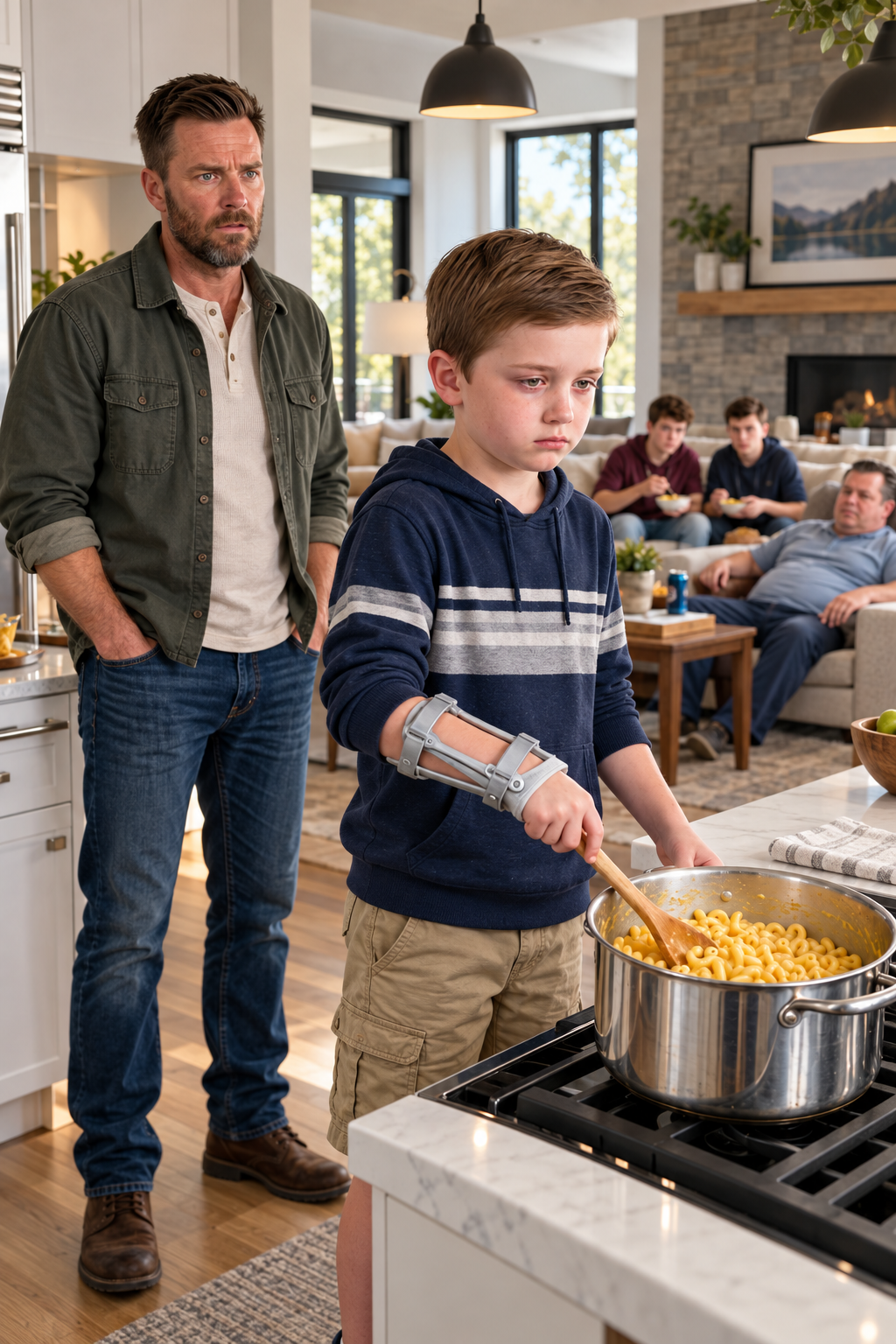
PART 1 TITLE: The Night I Returned Home Unexpectedly and Found My Eight-Year-Old Son Frightened of the Man Sleeping in My Chair
The first thing I noticed was the silver tape wrapped around my son’s arm. The second was the way he looked over his shoulder before speaking to me. Finn was standing on a wooden chair beside our kitchen stove, stirring macaroni in a saucepan that looked too heavy for him to lift. His left sleeve had been pushed above his elbow, exposing a strip of duct tape wound tightly around his forearm. When he recognized me in the doorway, his face brightened for half a second. Then the color drained from it. “Dad,” he whispered, “you weren’t supposed to come back yet.”
I had imagined that moment dozens of times during the helicopter ride from the drilling platform. I would walk through the front door, shout his name, and watch him come running from wherever he was playing. He would probably tackle my knees before I could set down my bag. Instead, he stood motionless, holding a wooden spoon in his right hand while something boiled over onto the burner. Behind me, the television blared from the living room, and an unfamiliar man’s voice rose over the sound of the game. Nothing about the house felt as though I belonged there.
My name is Wade Hollis, and for six years I had worked on an offshore drilling platform in the Gulf of Mexico. The schedule was demanding but predictable: twenty-eight days at sea, followed by twenty-eight days at home. The money was better than anything I could earn locally with my experience. It paid our mortgage outside Lafayette, Louisiana, covered the payments on my wife Brandi’s SUV, and kept Finn enrolled in the speech therapy that had helped him find confidence in conversations. I had convinced myself that the separation was a reasonable price for the security we were building.
When Finn was younger, he used to mark my return dates on a calendar beside the refrigerator. Each evening, Brandi would help him cross off another square. By the time he turned eight, he could count the remaining days without assistance. On my last departure, he had slipped a small plastic dinosaur into my bag. I found it in my work boots after reaching the platform, along with a piece of paper that said, in his uneven handwriting, “So you have somebody with you.” I kept that dinosaur in the pocket of my work jacket.
Finn was a slight boy with brown hair that refused to lie flat and a habit of rubbing his thumb against his first finger whenever he became nervous. Strangers sometimes mistook his quietness for a lack of interest. They never saw him when we were building something together. He could spend an entire afternoon explaining how lizards shed their skin or why his hideout beneath the back porch needed a second entrance. Once he trusted someone, words poured out of him until he ran out of breath. I missed that voice more than anything offshore.
We were supposed to talk over FaceTime every evening at seven. For years, those calls had been the most reliable part of my day. I would find a quiet corner away from the other crew members and listen while Finn described what had happened at school. Sometimes he showed me drawings. Sometimes he held his pet lizard so close to the camera that I could barely see anything else. He always asked the same question before hanging up: “How many sleeps, Dad?” I would give him the number, and he would repeat it to himself.
During the month before my return, our conversations had changed. Brandi began answering the phone instead of Finn. She told me he had already gone to bed, or that he was doing homework, or that he simply wasn’t in the mood to talk. When I asked to see him anyway, she grew impatient. “He’s eight, Wade. He doesn’t have to sit around waiting for a phone call every night.” I tried to explain that it mattered to me, but the discussion usually ended with her accusing me of trying to supervise the household from hundreds of miles away.
There had been smaller things I ignored. Once, Finn appeared briefly in the background wearing a shirt I didn’t recognize. His hair was tangled, and he seemed startled when Brandi pointed the camera toward him. Another evening, I heard a man’s laugh somewhere behind her. She said a neighbor had stopped by to help with a leaking faucet. I wanted to believe her. Our marriage had become strained by my absences, and I was tired of turning every uncomfortable conversation into an argument. I told myself we would sort things out when I returned.
Then the weather changed. A developing hurricane threatened operations in the Gulf, and the company suspended work earlier than planned. Our crew was flown ashore two weeks before the end of the rotation. Men hurried toward their families, calling ahead to arrange rides and explain their unexpected arrivals. I sat in the terminal with my bag beside my feet and considered phoning Brandi. In the end, I decided against it. Finn had been so disappointed by our shortened conversations that I wanted to give him something joyful to remember. I pictured his reaction when I walked through the door.
The drive toward Lafayette took longer than usual because of heavy rain and traffic moving inland from the coast. By the time I turned onto our street, the clouds had thinned and the pavement reflected the orange glow of the streetlights. My watch showed 9:58 p.m. The porch light was on. So were nearly every window downstairs. That surprised me because Brandi complained constantly about the electricity bill. Then I saw the pickup parked in my usual spot. It was an oversized truck, lifted high above its muddy tires, with a dented rear bumper and an unfamiliar license plate.
I parked behind it and carried my bag toward the house. The front door opened without a key. From inside came the sharp smell of stale beer, fried food, and something burnt. There were shoes scattered across the entryway, none of them Finn’s. A baseball cap rested on the small table where Brandi normally kept our mail. I followed the television noise into the living room and found two boys stretched across our couch. They looked about ten and twelve. Empty chip bags lay between them, and one had his sneakers resting against the cushions.
A large man occupied my recliner, the one Brandi had bought me for Father’s Day three years earlier. He was shirtless, with work boots planted on the carpet and a half-finished beer balanced against his stomach. A dark tattoo climbed the side of his neck. He appeared asleep, although his mouth moved occasionally as if he were reacting to the football announcer. Neither boy seemed surprised to see an adult enter the house. The older one glanced at my bag, then returned his attention to the television. I waited for someone to explain who they were. Nobody did.
I heard a metallic scrape from the kitchen. Finn was leaning across the stove, trying to keep the saucepan from slipping as he stirred. His school uniform hung loosely from his shoulders. There was a stain near the collar, and his hair had grown long enough to cover the tops of his ears. He looked thinner than when I had kissed him goodbye four weeks earlier. But it was the tape on his arm that stopped me. It ran from his wrist almost to his elbow, unevenly folded in places, and one edge had lifted to reveal angry-looking skin beneath.
“Finn?” I said, keeping my voice low. He jerked around and nearly stepped off the chair. I reached him before he could fall, steadied his shoulders, and turned off the burner. The saucepan gave one final hiss against the hot metal. I lifted him down and held him against my chest. He was still warm and familiar, smelling faintly of laundry detergent and sweat, but he didn’t wrap his arms around my neck immediately. Instead, he remained stiff, his breathing quick and shallow. “Hey, buddy,” I murmured. “I’m here. What’s going on?”
His fingers finally closed around the back of my shirt. “Are you mad?” he asked. I pulled away just enough to see his face. “Why would I be mad at you?” He stared toward the kitchen doorway. I followed his gaze, but nobody had appeared. “Because supper isn’t done,” he said. “I tried to make it faster. The water took too long.” I looked at the saucepan. There was barely enough macaroni inside for three children, and the sauce had dried into a thick layer around the edges. “Whose supper are you making?” I asked.
He pressed his lips together. I had seen that expression before when he was trying to finish a difficult sentence during speech therapy. Usually, giving him time helped. This time, waiting seemed to make him more frightened. He glanced at his left arm and tried to pull his sleeve down over the tape. I touched the fabric gently. “Does that hurt?” He nodded once, then shook his head. “It did yesterday. It’s better now.” I could see that wasn’t true. He kept his left arm tucked against his body, and even the movement of his sleeve made him wince.
I asked what had happened. Finn swallowed hard, looking toward the living room again. “The pan was hot,” he whispered. “I messed up the noodles.” I crouched so our eyes were level. “Accidents happen. Did someone help you?” He didn’t answer directly. Instead, his fingers tightened around mine. “Please don’t get upset, Dad. Dwight said if supper is late again, I’ll have to sleep outside.” There was no dramatic change in his voice. He spoke as though he were explaining a rule everyone in the house already understood.
“Outside where?” I asked. Finn looked at the floor. “In the shed. He says I should know how to be tough.” The words settled between us. The shed behind our house was a narrow wooden building I had put together to store a mower, gardening tools, and leftover lumber. It had no proper windows and no electricity. During summer, the heat inside was unbearable. At night, insects gathered around the door. I remembered showing Finn how to operate its latch and warning him never to play inside when nobody was home. Now he was telling me somebody had made him sleep there.
Before I could ask another question, the man in the living room stirred. I heard the recliner creak, followed by heavy footsteps crossing the floor. Finn moved behind me so quickly that his shoulder struck the refrigerator. The man appeared in the doorway, rubbing his face. Up close, he was broader than I had first realized, with a thick neck and a beard that looked several days old. His expression changed when he noticed my work bag beside the kitchen counter. “Well,” he said, looking me over. “Guess you’re the husband.”
I stood slowly, keeping myself between him and Finn. “I’m Wade. Who are you?” He gave a careless smile and introduced himself as Dwight Pruitt. Then he explained, without much embarrassment, that he was a friend of Brandi’s. He spoke as if we were meeting at a neighborhood barbecue rather than in my kitchen after ten at night. I asked where my wife was. “Out at the casino in Coushatta,” he replied. “She went with some girlfriends. Needed a little break.” He glanced over my shoulder toward Finn. “Your kid’s supposed to be finishing dinner.”
The casualness of that sentence unsettled me almost as much as the threat about the shed. I asked why an eight-year-old was preparing a meal for two older boys while Dwight slept in a chair. He shrugged. “Everybody needs chores. Mine do theirs. Yours does his.” From the living room, one of the boys shouted that he was hungry. Dwight raised his voice and told him to wait. Then he looked back at me. “You work offshore, right? That explains a lot. Kid needs a man around to toughen him up. He’s too sensitive.”
The older boy wandered into the doorway, followed by his younger brother. They watched us with the alert interest children show when an argument might be starting. The older one made a comment about Finn crying easily, then mentioned that his father had sent Finn to the shed earlier that week. He delivered the information with a grin, apparently expecting Dwight to laugh. Dwight did. He called it a lesson in discipline and said his own father had been stricter. Finn’s hand found the back of my shirt again. I could feel him trembling through the fabric.
For one terrible second, I wanted to grab Dwight by the collar and drag him out of my house. I could almost hear the sound his boots would make against the porch steps. But I had spent years working around heavy equipment and volatile materials, where one uncontrolled reaction could hurt everybody nearby. I knew the difference between feeling anger and allowing it to choose my next movement. My son was standing behind me with an injured arm. Two other children were watching. Whatever happened next had to make Finn safer, not give him another frightening memory.
I told Dwight I would take care of dinner and that Finn was finished working. He studied me for a moment, perhaps expecting a fight. When none came, he gave a small, satisfied nod. “Fair enough. He’s your kid.” I asked him to return to the living room while I spoke privately with my son. He hesitated, then turned away, muttering something about people making too much trouble out of nothing. The boys followed him. I stayed still until their footsteps receded. Only then did Finn release the breath he had been holding.
I found a clean plate and served the macaroni, but Finn said he wasn’t hungry. He wanted to know whether Dwight would still be there when he woke up. I told him I didn’t know yet, but he would stay with me tonight. His shoulders lowered a little. He asked if he could sleep in my bed, something he hadn’t requested since he was five. “Of course,” I said. He looked toward his arm again. “Do I have to take this off?” I examined the tape without pulling at it. The skin near the edges appeared swollen, and I was worried that removing it carelessly could make the injury worse.
I helped him wash his right hand and face, moving slowly whenever he flinched. Upstairs, his bedroom looked different. Several of his favorite books were missing from the shelf, and the little terrarium where he kept his lizard sat empty on the dresser. I asked where the animal was. “They said he got away,” Finn answered. He didn’t sound convinced. The blanket on his bed had been replaced with an older one from the linen closet. When I opened his dresser to find pajamas, I discovered that most of the drawers were nearly empty.
I wanted to ask a hundred questions. Instead, I found a soft T-shirt that wouldn’t rub against his forearm and helped him change. He insisted he could manage on his own, although his face tightened every time he lifted his left hand. In the bathroom, I checked what I could see of the burn without disturbing the tape. I was alarmed by the swelling and decided he needed professional medical attention. Finn watched my expression closely. “Are they going to put me in trouble?” he asked. “No,” I said. “You’re hurt. Getting help isn’t punishment.”
We settled into the main bedroom, where Finn curled against my side while I phoned for medical advice and considered the safest way to manage the situation with Dwight still downstairs. The advice confirmed that the burn needed prompt assessment and that I should not tear off an adhesive covering stuck to damaged skin. Finn listened to my quiet conversation without speaking. When I finished, he asked whether I was going back to the helicopter in the morning. I said no. He searched my face as if trying to decide whether the answer could be trusted.
Around one in the morning, headlights swept across the curtains. A car door slammed outside. Minutes later, Brandi entered the bedroom and stopped when she saw me sitting on the edge of the bed. Finn was asleep beside me, his bandaged arm resting on a folded towel. For a moment, neither of us spoke. Brandi’s hair was loose, and she smelled of cigarette smoke beneath a strong layer of perfume. She looked at my bag, then at our son. “Wade,” she said, her voice suddenly tight. “What are you doing here?”
I told her about the hurricane and the evacuation. Then I asked why Dwight was downstairs with his children. She folded her arms. “He’s been helping me out. You have no idea what it’s like handling everything alone.” I asked whether he was living in our house. She looked toward the hallway before answering. “He’s been around. Don’t start making accusations because you showed up without warning.” I pointed out that Finn had been cooking for the boys while Dwight slept. Brandi gave a weary sigh, as if I had complained about dishes left in the sink.
When I mentioned the shed, her expression shifted. It was slight, but I saw it. She didn’t ask what I meant. She didn’t appear confused. Instead, she told me that Dwight believed children needed firm rules and that Finn could be difficult when he was upset. “He’s not a baby anymore,” she said. I stared at her. “He’s eight.” She glanced toward the sleeping child and lowered her voice. “And you’re away half the time. You don’t get to walk in here after weeks at sea and tell me how to run this house.” Her certainty frightened me more than her anger.
I asked about the burn. Brandi’s answer came too quickly. She said Finn had grabbed a hot handle while making food and that he was always careless in the kitchen. When I asked why nobody had taken him to a doctor, she insisted the injury wasn’t serious. Then she noticed my expression and said, “Don’t look at me like that. You think I wanted this?” I waited for her to ask whether he was in pain. She didn’t. I asked if Dwight had touched Finn. Brandi turned toward the bedroom door and told me we could discuss everything after I’d had some sleep.
I watched her leave and listened to her footsteps disappear down the hallway. Finn stirred beside me, opening his eyes just enough to see whether I was still there. “Did I get Mom in trouble?” he murmured. I told him he hadn’t. He drew the blanket closer and whispered that I should be careful because Dwight didn’t like being questioned. Then he fell asleep again. I sat beside him until dawn began paling the curtains, thinking about the shed, the empty terrarium, and the way Brandi had answered questions I hadn’t finished asking.
There was something Finn was afraid to tell me, and something his mother was determined I wouldn’t discover. I no longer believed the two things could be separated. I had come home expecting to surprise my family. Instead, I found myself listening for footsteps beyond the bedroom door, with one hand resting beside my son’s injured arm and the terrible realization that the danger hadn’t followed me home from the Gulf. It had been waiting inside my house long before I arrived.
END PART 1
PART 2 TITLE: Twenty-Six Messages Hidden Inside an Old Phone Revealed What My Son Had Been Enduring While I Worked Far from Home
I was awake before sunrise, although I couldn’t remember having slept. Rain tapped against the window, and the ceiling fan turned slowly above us. Finn lay on his side, one hand curled beneath his cheek, with his injured arm supported on the towel. Every few minutes, he shifted and made a small sound that told me the burn was still hurting him. I wanted to get him examined as soon as possible. I also needed to understand what had happened in this house before deciding how to protect him from the people responsible.
Downstairs, the television had been left running at a low volume. Empty beer bottles stood on the coffee table, and Dwight was asleep in my recliner again. His two sons had apparently settled into the guest room. Brandi’s purse lay on the kitchen counter beside a stack of unopened mail. I walked past it without touching anything. I had no intention of confronting another adult while Finn was upstairs alone, and I wasn’t prepared to accept Brandi’s explanation without asking for help. First, I needed the medical supplies I remembered storing in my old office closet.
Before Finn was born, I had used the small room at the back of the house to manage our finances and keep the tools I occasionally brought home from work. Brandi later converted most of it into storage, but a narrow shelf beside the closet still held spare batteries, paperwork, and a plastic box containing first-aid materials. I opened the closet and found the box behind a folded camping chair. The bandages inside were old, and several sterile packages had expired. I set them aside rather than use them on Finn’s damaged skin.
While searching the shelf, I noticed a black cellphone wedged between two binders. I recognized the worn case immediately. It was the phone I had used before my company issued a replacement several months earlier. I remembered leaving it for Finn because he liked taking photographs of his lizard and playing a simple building game. The device no longer had a SIM card, but it could still work as a camera or notebook. I picked it up, expecting a dead battery. When I pressed the side button, the screen illuminated.
There was an old photograph of Finn and me on the lock screen. We were standing beside the swing set in the backyard, both wearing baseball caps, his much too large for his head. He had insisted I make a funny face for the picture. I remembered the afternoon clearly: the smell of freshly cut grass, the lemonade Brandi had brought outside, and Finn laughing so hard that he could barely hold the phone steady. I unlocked the device using the familiar code and noticed the Notes application had been moved to the first row of icons.
Inside was a single document with a title that made my throat tighten. It was addressed to me. Beneath the heading were numbered entries, each separated by a date. I began reading out of curiosity, assuming Finn had been making lists or practicing his writing. The first message was short, with several spelling mistakes. He told me it was his first day writing, that everything was all right, and that he hoped I was having a good time on the water. I smiled sadly at the thought of him believing offshore work was some sort of vacation.
The second and third entries described ordinary things. He had finished a worksheet at school. He had found a beetle beneath the porch and wanted to know whether lizards could eat it. One message mentioned a funny noise the refrigerator had made. They were exactly the small details he used to share during our evening calls. I could hear his voice in the sentences, including the places where he repeated himself because he wanted to make sure I understood. Then, several entries later, the subjects began to change.
In one note, Finn wrote that two boys were sleeping in the house and that their father was using my chair. Another said he had been told to stay quiet while the adults watched television. He wondered whether I would be angry if someone moved my tools out of the garage. None of the sentences sounded particularly dramatic. They were observations written by a child who didn’t yet understand which details were important. But the dates showed that Dwight’s presence had not been a recent arrangement. He had been in our home for weeks.
By the ninth entry, Finn was writing about his lizard. He said the boys had taken the animal from its enclosure while he was at school. When he returned, the terrarium was empty. They told him it had escaped. He searched beneath the furniture and around the back steps, then stopped when Dwight became irritated by the noise. Finn didn’t accuse anyone outright. He wrote that he hoped the lizard had found a warm place to hide and that perhaps I could help look for it when I returned. I remembered the empty glass enclosure upstairs.
I sat down on the floor with the phone in both hands. There were twenty-six entries altogether, one for nearly every night I had been away. I scrolled carefully, resisting the urge to jump to the bottom. Part of me wanted to understand everything in the order Finn had lived through it. Another part was frightened of what I might find. The room was quiet except for the air-conditioning vent above the door. Somewhere downstairs, Dwight coughed in his sleep. I listened until the house became still again.
The entry from the fourteenth day described the shed. Finn had been sent outside after crying during an argument about chores. He wrote that it was dark, that insects made scratching noises against the wooden walls, and that he had counted until he reached one thousand because numbers helped him stay calm. He didn’t say how long he had been there. He only wrote that he wished the shed had a window so he could see whether morning was coming. I thought about the latch I had installed and felt suddenly sick.
I had built that shed myself. Finn had helped by sorting screws into plastic cups and holding the level while I secured the doorframe. At the end of the project, I had allowed him to paint a small blue star near the handle. He was proud of that star because it was the only thing in the yard he had painted without my help. The thought of him sitting inside the same building, frightened and alone, while I worked under floodlights hundreds of miles away, was almost impossible to reconcile with the life I believed we had created.
A later message revealed that Finn had begun worrying about our money. He said Brandi warned him that if I learned about the problems at home, I might stop sending my paychecks. Then the bank would take the house, and they would have nowhere to live. He didn’t seem to understand what a mortgage was, but he understood the threat of losing his bedroom. He asked whether I could earn more money if he behaved better. I read that line twice, unable to accept that my son had been made to connect his obedience with our family’s financial survival.
The nineteenth entry was especially difficult because of what it didn’t say. Finn mentioned that his mother had been crying in the kitchen after a telephone call. Dwight had become angry when he heard her talking about money. Finn wanted to ask what was wrong, but his mother told him to go upstairs. He wrote that perhaps she was tired because she had been staying out late. Then he apologized to me for not being able to make her happier. I remembered Brandi’s accusations about my long absences and began to understand how much of that unhappiness had been placed on our child.
On the twenty-second evening, Finn wrote that he had taken one of my old hooded sweatshirts from the laundry basket. It still smelled a little like my shaving soap, he said, so he had folded it beneath his pillow. He wanted to know if keeping it there would be all right. He promised to wash it before I returned. I pictured him lying in bed with that sweatshirt, trying to make an empty house feel familiar. The message was gentle and almost cheerful, which somehow made it harder to read than the others.
Several entries mentioned cooking. At first, Finn described helping prepare snacks. Later, he was boiling noodles, washing dishes, and carrying plates into the living room while the older boys watched television. He recorded that he wasn’t supposed to spill anything or complain about being tired. Once, he burned his finger while lifting a hot lid and wrapped it in tissue because he didn’t want Dwight to see. He seemed proud when an entire meal passed without anyone criticizing him. That pride was the most disturbing part. He had learned to measure a good day by whether nobody punished him.
I reached the twenty-fifth entry and found only a few sentences. Finn wrote that his arm hurt and that he had trouble sleeping. He said his mother had told him to stop crying because he was making everything worse. Then he added that he wished I could come home sooner, although he knew the number of days hadn’t changed. The following entry had been written two nights before my unexpected return. It was longer than the others. I began reading it standing up, then slowly lowered myself against the closet wall.
Finn described burning a pan of noodles while trying to make dinner. Dwight had become angry and forced his arm against the hot metal as punishment. Afterward, someone put tape over the injury. On the same day, a man had delivered an important paper to our front door. Brandi cried when she read it. Dwight told Finn that the bank was going to take our home because I wasn’t earning enough money. His mother warned him not to tell me about the paper, since I might discover what had happened to the money I sent. The entry ended with a plea for me to return because he was frightened and no longer knew what to do.
I read those lines over and over. The details didn’t change, no matter how many times I looked at the screen. My son had been hurt deliberately, and he had tried to tell me in the only way available to him. He had written about the burn while his mother and Dwight were still inside the house. I imagined him typing with one hand, stopping whenever footsteps approached, hiding the phone before somebody saw the screen. I wondered how many times he had opened the application hoping I might somehow read what he was writing.
I had cried at my father’s funeral, standing beside the open grave in the hard afternoon heat. Since then, I had rarely allowed myself to lose control in front of anyone. But on the floor of that closet, I covered my mouth and wept. I thought about every conversation in which Brandi told me Finn was asleep. I remembered the evenings when I accepted her explanation because I was exhausted and didn’t want another argument. The guilt came in waves, but beneath it was a clearer understanding: Finn had never stopped reaching for me. I had simply been unable to hear him.
After several minutes, I forced myself to act. I took screenshots of the entire document, including its title, dates, and individual entries. I photographed the old phone and the shelf where I had found it. I knew enough from workplace incident investigations to understand that details could matter later, even if I wasn’t sure which ones. I didn’t edit the notes or delete anything. I connected the device to a charger and placed it where I could keep track of it. Then I returned to the question Finn’s final message had raised: what had happened to our money?
For years, Brandi had managed the household payments while I was offshore. We had agreed on that arrangement because her schedule was more flexible, and she preferred keeping the family’s accounts organized. Every month, I transferred enough to cover the mortgage, utilities, groceries, and Finn’s expenses. The deposits were automatic, and I checked that they had been completed. I assumed the bills were being paid. Brandi occasionally complained about unexpected costs, but nothing she mentioned seemed beyond what our budget could manage. The possibility that she had been diverting those funds never occurred to me.
I opened my banking application and examined the transfers. Each one had reached the household account on schedule. There were no missed deposits, no reduced payments, and no interruption in my employment. I checked the last four months specifically, then took screenshots showing the dates and amounts. I couldn’t see every transaction Brandi had made afterward, but I knew the money had arrived. I thought about the way she had blamed me for being away. If the bank was threatening to take our house, it wasn’t because I had stopped providing the payments.
The paper Finn mentioned had to be somewhere downstairs. I walked into the kitchen, where Brandi’s purse remained on the counter. I hesitated before opening it. Whatever trust had existed between us had already been badly damaged, but I still understood the seriousness of searching another person’s belongings. Then I thought about the warning delivered to our door and the child upstairs who believed he might lose his home. I needed to identify the immediate danger. Inside the purse, beneath receipts and cosmetics, I found a folded envelope bearing the name of our mortgage lender.
The notice was dated only a few days earlier. Its language was formal and precise, but the meaning was unmistakable. Our mortgage was four months behind, and the lender had begun the process associated with default. I read the past-due amount and compared it with the transfers on my phone. The figures were large enough to make me feel dizzy. Four payments had effectively disappeared from our household budget. We weren’t facing a minor penalty or a misunderstanding about a due date. The house I had worked so hard to maintain was in genuine danger.
Beneath the notice were several documents connected to gambling debts at the casino in Coushatta. Together, they showed obligations totaling approximately thirty-one thousand dollars. I spread the pages across the counter, checking that I wasn’t counting the same amount twice. They included dates when I had been offshore, dates when Brandi told me she was buying groceries or attending school activities with Finn. There was also a cashier’s check for eight thousand dollars made payable to Dwight Pruitt. The memo identified it as a payment connected to his truck.
I looked through the kitchen window toward the oversized pickup parked outside. Dried mud covered its tires, and the rear bumper was still wet from the previous night’s rain. I remembered Brandi telling me that the SUV needed repairs and that household expenses had increased. I had sent extra money without insisting on receipts. She had thanked me briefly, then complained that it still wasn’t enough. Now I was looking at evidence that our mortgage payments had been neglected while gambling debts accumulated and money was directed toward Dwight’s vehicle. I took clear photographs of the documents and kept the originals together.
What troubled me most was the connection between those papers and Finn’s final entry. Brandi hadn’t simply made financial decisions behind my back. According to my son’s account, she had also used the threat of losing our home to keep him silent about what Dwight was doing. An eight-year-old had been told that telling his father the truth might destroy his family. I wondered how often Finn had wanted to speak during our evening calls and how many times Brandi had intercepted them because she knew what he might reveal.
I called Gloria, Brandi’s mother, who lived in Tulsa. We had always gotten along reasonably well, although she tended to defend her daughter whenever our marriage became difficult. I expected her to say that the situation was complicated or that I should hear Brandi’s side. Instead, when I explained the mortgage notice, she became quiet. She told me Brandi had asked her for money twice during the summer. Each time, Brandi claimed I had lost my offshore job and was too embarrassed to admit it. Gloria had sent what she could afford.
I told her I was still employed and that my wages had continued without interruption. For several seconds, I heard nothing except Gloria’s breathing. Then she asked about Finn. I explained that I had found him cooking late at night with a serious burn on his arm. I described what he had written about Dwight and the shed. Gloria began crying before I finished. She said Brandi had told her Finn was doing well in school and had grown more independent. Gloria had believed her, just as I had. I asked her to preserve any messages or records connected to the money she’d sent.
After ending the call, I went upstairs. Finn was awake, sitting on the bed with his knees drawn up. He had been listening for me. When I entered, he immediately asked whether I had found my old phone. I sat beside him and said I had. His eyes widened, and he began rubbing his thumb against his finger. “I didn’t know how to send them,” he whispered. “I kept trying, but it wouldn’t work.” I told him I had read the notes and that he had done nothing wrong by writing them. His face tightened as though he were waiting for the rest.
“Are you angry because I told you about Mom?” he asked. I chose my words carefully. “I’m upset about what happened to you. I’m not upset with you for telling me.” He looked down at his bandaged arm. “She said you worked really hard for the house.” I told him that was true, but houses and money were adult responsibilities. They weren’t things he had to protect by keeping secrets or accepting punishment. He listened, then asked a question that left me struggling for an answer. “If I told you earlier, would you have come home?”
I held his uninjured hand. I couldn’t promise that a phone call would have changed the weather, my employer’s schedule, or the distance between us. But I could tell him what I would have done if I had known. “I would have found a way to get you help,” I said. “And I would have made sure somebody safe was here with you.” Finn leaned against me, silent for a long time. Eventually, he asked whether Dwight was still downstairs. When I said yes, he moved closer until his shoulder pressed into my chest.
I left Finn in the bedroom with the door closed and made the call I knew I should have made the previous night. I explained the situation to the Lafayette Parish Sheriff’s Office, including the injury, the shed, and the written messages on the old phone. I described the adults and children currently inside the house and said I was concerned about confronting Dwight without assistance. The person taking my report asked careful questions, advised me to keep Finn away from the man, and told me deputies would respond. I gave my address and waited.
As I put down the phone, Brandi appeared at the top of the staircase in her robe. She looked first at the documents on the kitchen counter, then at my face. Her expression changed when she saw the old cellphone beside them. “Wade,” she said quietly, “what have you done?” I didn’t answer immediately. Beyond the front window, morning sunlight touched Dwight’s pickup, and a patrol vehicle was turning onto our street. For the first time since I had entered the house, I knew the next decision would no longer belong to Brandi or Dwight.
END PART 2
PART 3 TITLE: When the Deputies Removed My Son’s Makeshift Bandage, the Evidence Changed Everything and My Family Faced an Irreversible Reckoning
The first patrol vehicle stopped at the curb shortly after nine. A second arrived a few minutes later. I had been standing near the front window, watching the street, when Finn called from upstairs to ask whether the men outside were coming for him. I hurried to the bottom of the staircase and told him he wasn’t in trouble. Then I opened the door before the deputies reached it. The older officer introduced himself, while his partner glanced past me into the living room. I explained that Dwight was still inside and that my eight-year-old son was upstairs with an untreated burn.
The deputies entered calmly, without raising their voices. Dwight stirred when the older officer approached his recliner. At first, he appeared confused. Then he recognized me standing near the doorway and gave an irritated laugh. “Seriously, Wade? You called the cops?” He sat forward, reaching for the boots he had kicked off beside the chair. The deputy told him to remain seated while they established what had happened. Dwight looked toward the kitchen, apparently expecting Brandi to appear and settle the misunderstanding. When she didn’t, his expression hardened.
He insisted he was a guest and that I had overreacted to ordinary household discipline. The deputy listened without interrupting, then asked about Finn’s injury. Dwight said he hadn’t noticed anything serious. I explained that Finn had been cooking the previous night with duct tape covering his forearm and had described being forced to sleep in the shed. At the mention of the shed, the older boy sat upright on the couch. He looked at his father, then toward the hallway. Dwight noticed and warned him to keep quiet. The deputy immediately told Dwight not to instruct the children.
I went upstairs with the second deputy and found Finn sitting where I had left him. He had put on a clean shirt and was holding the old cellphone against his chest. When he saw the uniform, he drew back toward the headboard. The deputy stopped several feet from the bed and introduced himself in a gentle voice. He explained that he was there to make sure Finn was safe and to understand how his arm had been hurt. Finn looked at me for permission. I sat beside him and told him he could answer honestly.
The deputy asked whether he could examine the injury. Finn held out his left arm reluctantly, keeping his elbow close to his body. The tape had stiffened overnight, and some of its edges were stuck to his skin. Rather than pull it off immediately, the deputy contacted medical responders, who arrived and helped loosen the covering with care. Finn stared at the ceiling while they worked. I kept my hand beneath his uninjured one. When the last section came away, the room fell quiet. The burn was far worse than the small exposed area had suggested.
A curved section of damaged skin extended along Finn’s forearm. Some areas had blistered, while others looked raw and swollen. The surrounding skin was red, and there were changes near the edges that concerned the medical responders. The shape followed a distinct arc. I thought of the metal rim of the saucepan I had found on the stove the previous night. Finn had described Dwight pressing his arm against hot cookware. Until that moment, I had been trying not to imagine what such an act would look like. Now the evidence was directly in front of me.
Finn didn’t cry when the responders examined the burn. Instead, he began counting quietly. His voice trembled over certain numbers, but he continued even when the deputy asked whether he needed a break. I recognized the habit from his speech therapy exercises. Numbers gave him a pattern he could follow when words became difficult. I wanted to tell him he could stop being brave and let somebody else carry the fear. But he was concentrating so hard that I said nothing. I rubbed his shoulder and stayed beside him.
The deputy crouched near the bed and asked Finn who had caused the injury. My son looked at me, then toward the open doorway. I knew he was listening for Dwight’s voice. “He’s downstairs with the other officer,” I told him. “You can say what happened.” Finn swallowed. His eyes filled, although no tears fell. Then he raised his right hand and pointed toward the staircase. “Dwight,” he said. The deputy asked one brief question about the hot pan, and Finn confirmed that the man had held his arm against it after the noodles burned.
The officer didn’t press him for a detailed account. He thanked Finn for telling the truth and explained that specially trained people could speak with him later if necessary. The medical responders arranged for him to receive treatment. Before they left the room, I asked whether I could photograph the injury. The deputy said the official documentation would be handled properly and that I could also preserve my own record without interfering with care. I took one photograph, then put the phone away. I didn’t want Finn to believe that the most important thing in the room was evidence rather than his pain.
Downstairs, Dwight had stopped joking. The older deputy was speaking to him near the recliner, while the two boys sat close together on the couch. Dwight raised his voice when he saw us approaching. He claimed Finn had burned himself and invented the rest because he disliked following rules. Then he accused me of encouraging the story out of jealousy. I could see Finn tense beside me. I asked the deputy to let me take him away from the argument. The officer nodded, and I moved my son toward the kitchen, where he couldn’t see Dwight’s face.
From the hallway, I heard Dwight insist that he was being treated unfairly. The officer told him the investigation concerned a serious injury to a child, not a disagreement between adults. After the initial questioning and assessment, the deputies took Dwight into custody. His hands were secured behind his back, and he was escorted toward the front door. The older boy began crying. His younger brother reached for him, looking frightened and bewildered. I felt a sudden, painful awareness that they were children too, witnessing their father’s arrest in someone else’s living room.
Dwight turned toward me as he passed. For a moment, I thought he might threaten me. Instead, he shook his head and called the whole situation ridiculous. I didn’t answer. There was nothing useful I could say to him while Finn stood within hearing distance. The front door closed, and the house became quieter than it had been since my arrival. I could hear a kitchen faucet dripping. The television was still playing, although nobody was watching it. One of the deputies turned it off, and the silence afterward felt almost unfamiliar.
Brandi came downstairs wearing the robe I had seen earlier. Her hair was pulled into a loose knot, and she appeared more irritated than frightened until she noticed the patrol cars outside. She asked why Dwight was being taken away. When the deputy explained the reported injury, she immediately repeated that Finn had burned himself accidentally. Then she turned on me. “You had to do this in front of the kids?” she demanded. I looked at her for several seconds before answering. “He hurt our son, Brandi. Our son.”
She said I had no idea what had been happening while I was away, and I agreed that there was clearly a great deal I hadn’t known. I told the deputy about the twenty-six notes, then showed him the screenshots and the original device. I also explained the mortgage notice and the financial documents I had found. He reviewed what I offered, asked questions about where the papers came from, and made arrangements for the appropriate information to be preserved. Brandi watched from the hallway, her eyes moving repeatedly toward the old phone.
When I mentioned the mortgage default, she interrupted me. She said we had fallen behind because the household expenses were higher than I understood. I explained that the monthly transfers had continued and that I had records showing the payments. She then accused me of checking up on her instead of asking how she was coping. The deputy asked her to let him finish gathering the information. She folded her arms and looked away. I could still remember a time when I had trusted her with every dollar we earned. Standing there, I wondered when she had begun believing I would never examine the accounts.
The officer asked about the casino documents and the cashier’s check made out to Dwight. Brandi admitted that she had been struggling with gambling but refused to discuss the details without legal advice. Nobody argued with her decision. The deputies continued documenting the circumstances and explaining what would happen next. The younger boys were kept separate from the adult confrontation while arrangements were made for their care. Finn remained close to me, occasionally looking toward them with an expression I couldn’t interpret. He had been frightened of their father, but he didn’t appear pleased by what was happening to them.
As the morning progressed, I learned how differently a crisis looks when authorities become involved. There were questions about dates, addresses, injuries, and who had been responsible for supervising the children. The facts had to be recorded accurately, even when I wanted to stop talking. I repeated what I had seen upon arriving home, what Finn had told me, and what I had discovered on the old phone. I resisted the temptation to fill gaps with assumptions. Some things I knew. Others would need to be established by people trained to investigate them.
Brandi grew increasingly angry as she understood the seriousness of the situation. She accused me of trying to take Finn away from her. I told her I wanted him safe and that I would not leave him in Dwight’s care again. She began crying, then demanded that I remember how many years she had spent managing our home while I worked offshore. I didn’t dispute those years. I remembered school meetings she had attended without me, fevers she had handled alone, and the strain my job had placed on our marriage. None of those memories changed what had happened to Finn.
By late morning, the house had become the subject of an investigation involving child welfare as well as law enforcement. Dwight was being held in connection with the injury, and questions about Brandi’s responsibility were being examined. I was informed that allegations of child neglect and failure to report abuse could also lead to charges against her. The words were difficult to hear, even after everything I had discovered. I had married Brandi believing we would raise our son together. Now strangers were asking whether she could safely remain responsible for him.
Finn and I left the house for medical care. I carried his small backpack because he insisted on bringing the old phone, a clean T-shirt, and the plastic dinosaur he had once given me. He had found it in my work bag while I was downstairs. In the vehicle, he sat carefully with his injured arm supported on a folded blanket. He asked whether Dwight would come back for his sons. I told him the adults handling the situation would make sure the boys were looked after. He nodded, then stared through the window at the wet streets.
During the drive, Finn asked whether Brandi had been arrested too. I explained that I didn’t yet know everything the authorities would decide. He thought about that for a while. “I don’t want Mom to go away,” he said. Then, after a pause, “But I don’t want to be there when Dwight comes back.” I kept my eyes on the road and told him both feelings made sense. He wasn’t required to choose between missing his mother and wanting to be safe. I wished someone had explained that distinction to him before he began believing every choice could cost him his home.
At the medical facility, a nurse examined Finn’s arm and asked how long the injury had been covered. When I answered, she looked briefly at the chart before continuing. The wound required careful cleaning, a proper dressing, and an assessment for infection. Finn watched the nurse arrange her supplies, then asked whether the treatment would hurt. She didn’t promise that it wouldn’t. Instead, she explained what she planned to do and told him he could ask her to pause. That simple honesty seemed to reassure him more than any cheerful reassurance would have done.
I sat beside him through the examination, answering questions when necessary and letting him speak for himself whenever he could. The clinician explained that the burn needed follow-up care and that its appearance was concerning. We were given instructions for protecting the wound, monitoring for complications, and attending a pediatric burn clinic the following morning. I listened carefully and wrote down everything. Before leaving, I asked Finn if he wanted something to eat. He looked surprised by the question, then asked whether he could choose. We stopped for a sandwich, and he selected one with extra cheese.
That afternoon, with help from an attorney and the relevant authorities, I sought emergency custody arrangements that would allow Finn to remain safely with me while the investigation continued. I had never imagined making such a request. The language of the paperwork felt cold compared with what had happened inside our home. There were questions about supervision, the alleged abuse, and the immediate risks of returning a child to the previous arrangement. I answered carefully, supplied the available records, and explained that I intended to stay home with Finn. The court granted temporary emergency custody that day.
I was relieved, but the order didn’t make everything simple. Finn still had a mother he loved. The house still had a mortgage in default. I still worked for a company that expected me to return to the Gulf when operations resumed. There would be further proceedings, more questions, and decisions I couldn’t make alone. My attorney explained that temporary arrangements could be reviewed and that I needed to preserve records, cooperate with investigators, and keep Finn’s care consistent. I understood the instructions, but I was exhausted enough to forget where I had put my truck keys.
When we returned home that evening, Dwight’s pickup was still visible outside, though arrangements were being made to remove it. The sight made Finn stop at the front steps. He wouldn’t enter until I walked through the rooms with him and showed him that Dwight wasn’t there. Brandi was no longer staying in the house while the immediate arrangements were being addressed. The living room looked ordinary again after I cleared away the bottles and rubbish. Yet Finn remained close to me, following from room to room as though he expected somebody to appear behind a door.
I called Gloria and told her what had happened. She had already begun packing. She said she would drive down from Tulsa the following day and asked whether Finn needed anything. I told her he needed rest, proper care, and adults who would listen. She grew quiet before saying she understood. Then she asked whether she should bring the small terrarium she had kept from her own childhood visits to a pet shop. I remembered Finn’s missing lizard and told her what had happened. Gloria promised to look for a replacement, although I warned her that Finn might not be ready for one.
That night, I changed the sheets on my bed and placed Finn’s favorite blanket beside my pillow. He insisted on sleeping close to me again. Before turning out the lamp, he asked whether we would have to leave the house because of the bank. I said I was working on it and wouldn’t hide the truth from him. He frowned. “That’s what Mom said, but she didn’t tell me anything.” I looked at the folded mortgage notice on my dresser and understood what he meant. He had been given frightening pieces of information without any explanation that helped him feel secure.
I told him that the mortgage was an adult problem and that I was speaking with people who could help us address it. I couldn’t honestly promise we would never move. What I could promise was that he wouldn’t be left alone to handle whatever happened. Finn listened with his cheek against the pillow. “Can I still have my room if we stay?” he asked. “Of course.” He glanced toward the door. “And nobody else gets to decide where I sleep?” I swallowed before answering. “Not like that, buddy. Never like that again.”
The following morning, we arrived at the pediatric burn clinic in Lafayette with the medical paperwork and photographs. A nurse named Ms. Odom greeted Finn and showed him where he could sit while she prepared the dressing supplies. He was polite but withdrawn, watching her hands as she opened each package. When the treatment became uncomfortable, he started counting again. I heard him move steadily through the four hundreds, as if he had practiced the sequence many times before. Ms. Odom paused and asked whether he wanted to take a break. He shook his head.
The physician examined the injury and explained that a scar was likely, but the immediate concern was preventing further damage and controlling the developing infection. The burn’s shape was consistent with the account Finn had given, although the medical team would document its findings without trying to decide the criminal case. The physician emphasized that we had obtained treatment before the infection became more dangerous. Another significant delay, she said, could have changed the outcome considerably. I thanked her, then stepped into the hallway because I couldn’t trust my voice.
I stood beside a vending machine with an unopened bottle of water in my hand. Through the clinic window, I could see cars moving along the street, people going to work, parents carrying ordinary shopping bags. The world hadn’t stopped because my son had been hurt. I understood that logically, but the sight of everyone continuing with their mornings felt strange. After a while, Ms. Odom came into the hallway and told me Finn was asking for me. I returned immediately. He was sitting on the examination table, staring at the fresh dressing.
“Did I do good?” he asked. I told him he’d done very well, although he hadn’t needed to prove anything. He considered that, then looked at my work jacket hanging from the chair. “When the hurricane goes away,” he said, “will you have to go back to the rig?” I didn’t answer at once. For six years, my response to that question would have been automatic. The schedule would restart, the helicopter would come, and I would leave for another twenty-eight days. Standing in that clinic, I understood that the arrangement I had once considered necessary could no longer continue unchanged.
END PART 3
PART 4 TITLE: As My Son Began Telling the Truth, the People Who Had Hurt Him Started Turning Against One Another
Finn’s question followed me all the way home from the burn clinic. I had spent years explaining why my offshore job mattered, why the long separations were temporary sacrifices, and why a dependable paycheck made our family stronger. Those explanations had once seemed sensible. Now I was driving beside an eight-year-old with a freshly dressed burn, knowing he had spent nearly a month frightened inside the house my wages supported. I couldn’t undo the days I had missed. But I could change what happened when the company called to tell me it was time to return.
I didn’t give Finn an answer I couldn’t yet guarantee. Instead, I told him I was looking for work closer to home and that I wouldn’t leave him with someone he was afraid of. He watched the road through the passenger window, thinking about that. “Could you work where the big tanks are?” he asked. I knew he meant the refinery not far from Lafayette, the one we sometimes passed on our way to visit friends. I said that might be possible. For the first time that morning, his expression softened. “Then you could come back before supper.”
When we reached the house, Gloria’s car was parked in the driveway. She had driven from Tulsa with a suitcase, a cooler of sandwiches, and a small cardboard box containing something that moved. She came down the front steps before I had unbuckled Finn’s seat belt. He stood beside the truck looking uncertain, but when she opened her arms, he walked toward her. Gloria held him carefully, keeping away from the injured arm. She didn’t ask him what had happened or why he hadn’t called her. She simply told him she was glad to see him.
Inside, Gloria placed the cardboard box on the kitchen table. There were small air holes along the lid. Finn lifted one corner and discovered a young lizard resting against a piece of folded paper towel. It wasn’t the same species as his missing pet, but its bright eyes and quick movements immediately caught his attention. Gloria explained that she had spoken with someone knowledgeable about reptile care and brought the supplies necessary to keep it safely. Finn examined the animal without touching it. “Is it mine?” he asked. “Only if you’d like it to be,” she answered.
He considered that for a long time. Then he asked whether we could clean his old terrarium before putting the new lizard inside. I helped him arrange the enclosure on the kitchen table, checking the equipment and giving the animal time to settle. Finn watched every movement. When Gloria suggested names, he shook his head. “I want to think about it.” She accepted that without disappointment. Later, while he was quietly watching the lizard explore its new surroundings, Gloria came to stand beside me at the sink. Her eyes were red, and she had stopped trying to hide it.
“I believed everything she told me,” Gloria said. I turned off the faucet. She explained that when Brandi asked for money earlier in the summer, she had claimed I was unemployed and that Finn was having difficulties at school. Gloria offered to visit, but Brandi insisted things were under control. Now she understood that her daughter had been hiding far more than financial trouble. I could hear the shame in her voice. I told her I had also accepted explanations that didn’t make sense because I trusted Brandi and because confronting the truth from offshore had seemed almost impossible.
Gloria asked whether she could help with the court case. I told her the attorneys might need the messages Brandi had sent requesting money, along with records of the transfers. She agreed to preserve everything. Then she asked whether she should speak to Brandi directly. I said that was her decision, but I needed her to understand that Finn’s safety came first. Gloria looked toward the terrarium where her grandson was sitting cross-legged on the floor. “I’ve spent my whole life trying to protect my daughter,” she said. “I should have been asking who was protecting him.”
The financial problems couldn’t wait for the criminal investigation to conclude. My attorney arranged a conversation with the mortgage lender, and I provided records of every deposit I had made into our household account. The lender confirmed the overdue payments and explained what had to happen to stop the default process from progressing. There were fees, deadlines, and documents I had never expected to confront. I had enough savings to cover a substantial portion, but not without changing the plans we had made for the future. I transferred money, gathered signatures, and kept calling until I knew what remained outstanding.
Within nine days, the overdue mortgage was brought current. The relief was real, although it didn’t erase what had been lost. Money we had saved for repairs and Finn’s education had been used to repair the damage caused by Brandi’s gambling and the payments made to Dwight. My attorney explained that further financial adjustments might be possible as more information came to light. For the moment, the house was no longer facing the same immediate danger. I didn’t celebrate. I printed the confirmation and placed it in a folder, grateful that I could finally give Finn a clear answer.
That evening, I sat beside him at the kitchen table and explained that we would be staying in our house. He asked whether the bank knew. I said it did. Then he wanted to know whether somebody would come and put another paper on the door. I told him the overdue payments had been handled and that I would take responsibility for any future letters. Finn turned his attention to a small drawing he had been making. After a few minutes, he pushed it toward me. It showed our house with a large blue roof and two people standing beside the swing set.
The next important appointment was at the Children’s Advocacy Center. Two days after the burn clinic visit, Finn was scheduled to speak with a trained interviewer about what he had experienced. I explained that he would be talking to someone whose job was to listen carefully to children and that he didn’t need to guess or remember anything perfectly. He asked whether I could sit beside him. When I told him the interviewer would speak with him privately, he became quiet. I assured him I would be waiting nearby, but I could see that the arrangement worried him.
The waiting room had pale walls, children’s books arranged on a low shelf, and a painting of a smiling whale hanging above the couch. Finn examined the whale for several minutes before the interviewer, Ms. Vance, came to greet him. She spoke gently but didn’t treat him like a much younger child. She asked about his interests, listened when he mentioned the new lizard, and explained what their conversation would involve. I watched Finn relax enough to answer a question without looking at me first. Then he followed her through the door, and I was left holding his backpack.
For nearly fifty minutes, I sat beneath the painting with a paper cup of coffee cooling between my hands. I tried reading one of the pamphlets on the table but couldn’t concentrate. Every sound from the hallway made me look up. I imagined Finn describing the shed, the burned noodles, the missing lizard, and the evenings when he couldn’t reach me. I wondered whether speaking about those things would make them more frightening or less. The closed door offered no answers. All I could do was wait until he was finished.
When Ms. Vance returned, she asked to speak with me briefly. Finn had gone with another staff member to choose a small activity from a nearby room. She sat beside me rather than across the table. “He worked very hard in there,” she said. I thanked her, unsure what else to say. Then she told me something I hadn’t expected. Finn had repeatedly asked whether I would be angry with him after hearing what he said. He wasn’t primarily worried about Dwight or the consequences of the investigation. He was worried about disappointing me.
I looked toward the whale painting because I couldn’t bear to meet her eyes. I remembered how Finn had asked whether I was mad the moment I arrived home. He had asked again when I discovered the notes, and again when deputies came to the house. I had answered each time, but the fear remained. Ms. Vance explained that children sometimes carry responsibility for events entirely outside their control, especially when adults have repeatedly blamed them for family problems. She encouraged me to keep reassuring Finn without turning every conversation into another examination of what had happened.
“I keep thinking I should have known,” I said. Ms. Vance didn’t immediately contradict me. She allowed the silence to remain until I finished explaining how our evening calls had become shorter and how I had accepted Brandi’s excuses. Then she told me that Finn needed to hear something clearly and consistently: that I believed him, that I wasn’t angry with him, and that he wasn’t responsible for the decisions adults had made. My guilt was real, she said, but it was important not to make my son responsible for comforting me.
On the drive home, Finn asked whether he had done something wrong during the interview. I told him I was proud of his honesty, but that he didn’t need to earn my approval by discussing painful things. He looked at his bandaged arm. “I didn’t remember everything in order,” he said. I explained that he wasn’t being tested on his memory. He sat quietly for a while before asking whether we could stop for a snack. We bought crackers and juice, then ate them in the parked truck with the windows cracked open to let in the afternoon air.
I also contacted Ms. Tran, the speech therapist who had worked with Finn for nearly two years. His sessions had stopped earlier in the spring because Brandi told me he no longer needed regular appointments. At the time, I had been pleased that he was making progress. When I explained what had happened, Ms. Tran became quiet. She remembered a boy who loved dinosaurs, asked careful questions, and needed patience when unfamiliar adults spoke too quickly. She offered to resume his sessions and told me not to worry about immediate payment arrangements.
I told her I could afford the therapy. She said she understood and asked me to bring Finn on Thursday anyway. Her kindness was practical rather than sentimental, and I appreciated that. When Finn returned to her office, he stood near the doorway for several seconds before recognizing the familiar shelves of games and books. Ms. Tran greeted him as though no time had passed. She didn’t ask about his injury in front of other people. Instead, she invited him to choose an activity, and he selected the same animal-matching game they had played months earlier.
Meanwhile, I began making arrangements to leave offshore work. I contacted my supervisor and explained that an urgent family situation required me to remain in Louisiana. He had known me for years and asked whether I needed temporary leave before making a permanent decision. I considered that possibility carefully. A leave would protect my income for a while, but eventually the rotation would resume. I couldn’t imagine telling Finn that I had secured his safety only to disappear for another month. I began contacting local employers and sent my qualifications to the nearby refinery.
The interview went better than I expected. The refinery needed someone with experience managing industrial equipment and following strict safety procedures. My offshore background was relevant, although the position offered considerably less money. I asked about the schedule before discussing salary. The hiring manager explained that the work would be during regular daytime hours, with occasional additional shifts when necessary. The facility was roughly twenty minutes from our house. I pictured Finn stepping off the school bus while I was preparing to come home, rather than counting down weeks until a helicopter returned me to shore.
When the offer arrived, I read it twice and accepted. I submitted my resignation from the offshore position and thanked the people who had worked beside me through difficult weather, equipment failures, and exhausting shifts. I didn’t describe every detail of what had happened to Finn. They knew enough to understand why I was leaving. Giving up the higher salary frightened me, especially with the mortgage problems still unresolved in a broader sense. But I had already seen what our old arrangement could cost when the wrong people took advantage of my absence.
Finn noticed the change before I officially began the refinery job. I stopped checking my offshore schedule and started preparing lunch at the same time each morning. He helped me choose a place beside the kitchen door for our keys and school papers. One afternoon, he asked whether I would still need the helicopter bag. I said I would keep it for ordinary trips. He nodded, then asked whether he could have the small plastic dinosaur that had traveled with me to the platform. I gave it to him, and he placed it beside the new lizard’s terrarium.
The criminal case was progressing, but much more slowly than I had expected. A prosecutor named Ms. Delacroix met with me to explain what the investigation would require. She was careful, precise, and plainly accustomed to dealing with people who wanted immediate answers. She reviewed the medical documentation, the deputies’ reports, and the notes Finn had written. Then she explained that every important piece of evidence could be challenged. A defense attorney might dispute the injury’s cause, question how the notes had been preserved, or suggest that adults had influenced Finn’s statements.
I found the possibility infuriating. I had seen the burn, read the entries, and watched my son tremble when Dwight entered a room. But Ms. Delacroix reminded me that a court had to evaluate reliable evidence rather than rely solely on what any one person believed. She wanted the strongest possible record, not simply the most emotional account. I understood that from my years working around industrial accidents. When something went wrong on a platform, investigators studied measurements, timestamps, equipment records, and witness statements. The same discipline would matter now.
A digital forensic specialist examined the old cellphone. He created a preserved copy of its contents and reviewed the information associated with the twenty-six entries. The device had no functioning cellular service, which explained why Finn had been unable to send messages. But the notes themselves had been stored locally. Their creation and modification records supported the sequence of evenings Finn had described. The specialist also verified that the entries existed before I discovered the phone, a detail that would matter if anyone suggested the messages had been written afterward.
During that examination, the specialist noticed something I had missed. The final entry, the one describing the burn and the mortgage notice, had been revised several times. Finn had apparently started writing, stopped, returned later, and changed portions of the text. Some material had been deleted. I asked whether it could be recovered. The specialist told me the available data didn’t allow him to reconstruct the missing words. He could establish that edits had occurred, but not exactly what Finn had removed. I thanked him and carried the phone back to my truck.
I sat in the parking lot for a long time, looking at the device. I imagined Finn holding it against his knees, deciding what he could safely say. Perhaps he had removed something because he was afraid of Dwight discovering it. Perhaps he had written an accusation against Brandi, then deleted it because he still loved his mother. I couldn’t know, and I didn’t want to turn uncertainty into another story I imposed on him. Yet the edits made one thing painfully clear: even in a private note that couldn’t be sent, my son had been afraid of saying too much.
As the case developed, Dwight’s defense began challenging the central allegations. His attorney suggested the burn might have been accidental and argued that Finn’s account had been affected by family conflict. He also attempted to minimize Dwight’s role in the household, describing him as a temporary guest rather than someone exercising authority over the children. The argument seemed designed to distance Dwight from the responsibility he had claimed so readily when I first encountered him. I remembered his casual remark about teaching Finn discipline and wondered whether he understood how much those words had revealed.
Brandi’s legal position was more complicated. She had acknowledged that Dwight spent considerable time in the house, and the financial records showed that money had moved between them. Her attorney appeared unwilling to accept a defense that portrayed Dwight as a harmless visitor while placing all responsibility on Brandi. I didn’t know precisely what conversations were happening between the lawyers, and my attorney warned me against speculating. What I could see was that the two people who had defended one another in my kitchen were no longer presenting a consistent account.
At home, Finn was slowly becoming more comfortable with ordinary routines. He still disliked unexpected footsteps and sometimes asked whether the doors were locked. But he began spending time beneath the porch again, sorting tools while I repaired a loose section of the railing. He would occasionally talk about his missing lizard, then change the subject. I didn’t insist that he discuss it. One evening, he asked whether his new pet might eventually recognize his voice. We sat together looking up information about reptile behavior until he became sleepy. It was an ordinary evening, and I was grateful for it.
Gloria remained with us long enough to help establish the new routine. She attended meetings when needed, gathered the messages Brandi had sent her, and provided the financial information our attorney requested. She also made a point of speaking to Finn without asking him to choose sides. When he mentioned missing his mother, she told him that missing someone didn’t mean he had to feel safe with them immediately. I watched him consider that answer. He was beginning to understand that love, fear, anger, and sadness could exist together without one canceling out the others.
One afternoon, while Finn was at school, my attorney called and asked whether I could meet him. He had received a communication from Brandi’s lawyer. I expected another disagreement about finances or an attempt to challenge the temporary custody arrangements. Instead, he told me that Dwight’s defense had created a serious conflict between the two legal teams. Brandi’s attorney no longer intended to support the account Dwight was offering. I sat down across from my lawyer, waiting for him to explain what that meant.
“Brandi wants to cooperate with the investigation,” he said. I stared at him, unsure whether I had heard correctly. For weeks, she had minimized Finn’s injury, defended Dwight’s discipline, and blamed my absence for the problems in our home. Now her lawyer was offering information to the same authorities she had accused me of involving unnecessarily. I asked what she intended to admit. My attorney said the details would have to be handled through the proper legal process, but her position had changed significantly.
I looked down at the folder of documents spread across the table. It contained mortgage statements, medical records, and copies of the messages Finn had written when he believed nobody was listening. Brandi had known enough to protect him, yet she had chosen silence until protecting Dwight began threatening her own case. I wanted answers, but I also understood that any truthful account she provided could matter to the outcome. When my attorney asked whether I was prepared for the custody hearing ahead, I thought about Finn waiting at home with Gloria and the quiet question he had asked me after reading his notes: whether telling the truth would make me angry.
I closed the folder and told my lawyer I was ready to hear what Brandi had to say. It wasn’t forgiveness, and it wasn’t an invitation for her to return to our home. It was a decision to keep pursuing the truth, even if the next part was harder to hear than everything I had already discovered. For the first time, the people who had controlled Finn’s life while I was away were being required to answer for their choices. And Brandi was about to face a question she had avoided since the night I returned: how much had she known about what was happening to our son?
END PART 4
PART 5 TITLE: The Doctor Asked Why My Son Counted Through Pain, and I Realized His Silence Had Been Protecting Someone Else
The nurse had barely touched the edge of Finn’s bandage when he began counting. He didn’t cry or pull away. He sat on the examination table at the pediatric burn clinic in Lafayette, his small legs hanging above the floor, and whispered numbers beneath his breath. At first, I thought he was distracting himself from the pain. Then I noticed how carefully he watched the nurse’s hands, as though he expected something terrible to happen if he made a sound.
“Four hundred twelve. Four hundred thirteen. Four hundred fourteen.” His voice was soft but steady. Ms. Odom, the nurse treating him, glanced at me before continuing to remove the remaining adhesive. I stood beside the table with one hand resting against Finn’s back. His skin was warm beneath his shirt. When the last piece came free, he flinched so sharply that my fingers tightened without meaning to. “You can squeeze my hand,” I told him. He shook his head and whispered another number.
The burn looked worse under the examination light than it had in our kitchen. Without the silver tape hiding it, I could see the curved outline across his left forearm, the blistered skin, and the angry redness spreading near the edges. Ms. Odom cleaned the wound with slow, practiced movements, explaining each step before touching him. Finn listened politely. He thanked her when she finished. That small courtesy, offered while he was hurting, unsettled me more than I expected.
“Does counting help you?” she asked. Finn considered the question before nodding. “It makes the minutes shorter,” he said. She stopped moving for a moment. “Who taught you that?” He looked toward the window, where morning traffic moved beyond the parking lot. “Nobody. When it was dark, I counted until morning came.” I understood immediately that he was talking about the storage shed. The one behind our house, built for tools and a lawnmower, where Dwight had made him sleep. I had inspected its padlock the previous night and found scratches around the latch that I couldn’t stop thinking about.
The physician arrived after the wound was cleaned. She examined Finn carefully, asked about his injury, and checked for fever and spreading infection. Her assessment was straightforward. The burn was serious, treatment had been delayed, and the surrounding tissue showed signs of infection. Finn needed medication, protective dressings, and regular follow-up care. There would probably be a permanent scar. Another week without treatment, she explained privately, might have led to a much more dangerous outcome. I asked her to repeat the last sentence because I could not quite absorb it.
She repeated it, this time without softening the warning. I looked through the partly open examination-room door. Finn was studying a cartoon fish on the wall, trying to determine whether its tail had been painted correctly. Eight years old, and he had spent days hiding an injury that should have brought him straight to a hospital. Every month I had transferred money home for groceries, medical appointments, school expenses, and whatever else Brandi said our family needed. I had believed that earning enough meant I was taking care of him. The evidence on the other side of that door made the belief feel terribly incomplete.
When I returned, Finn asked whether he had been good. I told him there was nothing he could have done wrong during the appointment. He frowned. “I stayed still,” he explained. “I didn’t make the nurse mad.” Ms. Odom, still arranging supplies near the counter, turned toward him. “Finn, children are allowed to move when something hurts. They’re allowed to tell us to stop for a minute. That helps us take care of them.” He looked surprised, then asked whether she meant even when the grown-up was busy.
On the drive home, he held his freshly bandaged arm against his chest. Rain had left the streets shining, and the tires hissed over damp pavement. At a red light, he asked whether the shed was still locked. I told him I had opened it and that no one would ever make him sleep there again. He studied my face, searching for something beyond the words. “What if somebody gets mad?” he asked. “Then they can be mad,” I answered. “Being angry doesn’t give anybody permission to hurt you.” He kept looking at me until the light changed.
That afternoon, I moved the things Dwight had left behind into the garage, where the deputies had instructed me to keep them until the necessary arrangements were made. His two sons were no longer at our house. Brandi was staying elsewhere while the investigation continued. I stripped the bedding, cleaned the kitchen, and removed the chair Finn had used to reach the stove. The house smelled of disinfectant and fresh laundry, but none of that made it feel normal. Every room held evidence of how long I had been absent, and how much my son had learned to manage without asking for help.
I found an unfinished school worksheet beneath the couch. Finn had written his name across the top in uneven letters. Beside it was a reminder about a speech therapy appointment from months earlier. I remembered Brandi telling me that the sessions had ended because Finn had made enough progress. I had been relieved. One fewer appointment meant less pressure on her, and I thought our son had achieved something important. Now I wondered whether she’d stopped taking him because of the money, because of Dwight, or simply because his needs had become inconvenient.
I called Ms. Tran, the therapist who had worked with Finn for two years. She recognized my voice immediately, although we had spoken only a handful of times. When I asked why his appointments had stopped, she told me that Brandi had canceled the remaining sessions in the spring. There had been no professional recommendation to discontinue them. Ms. Tran had suggested a follow-up evaluation, but no one had brought Finn back. I explained what had happened at home. She was quiet long enough that I thought the call had disconnected.
“Bring him Thursday,” she finally said. I told her I would arrange payment and provide whatever records she needed. “Wade, bring your son,” she repeated. “We’ll deal with the rest afterward.” Her voice was controlled, but I could hear the strain beneath it. Before ending the call, she asked whether Finn was somewhere safe. I looked through the doorway. He was sitting on the living-room rug, carefully arranging toy cars by size. “He is now,” I said. It was the first time I had said those words without immediately feeling the need to qualify them.
Gloria arrived from Tulsa the following afternoon, exhausted after the drive but refusing to discuss it. She stood on the porch holding a shoebox with small air holes punched through the lid. Finn opened the door before I could. For a moment, he simply stared at his grandmother. Then he moved toward her so quickly that she nearly dropped the box. Gloria held him against her shoulder, one hand spread protectively across his back. She did not ask why he looked thinner. She did not mention his bandage. She let him decide when he was ready to speak.
Inside the box was a small replacement lizard. Dwight’s boys had taken Finn’s original pet weeks earlier, and Brandi had told me it escaped. Finn stared at the animal without touching it. “Is this really mine?” he asked. Gloria told him that it was, provided he wanted it and was willing to help care for it. He nodded solemnly, then looked at me. “Can it stay in my room?” I said yes. “Even if it makes noise?” Again, I said yes. He carried the box to his bedroom as carefully as if it contained something made of glass.
Later that evening, Gloria and I sat at the kitchen table while Finn slept. She told me Brandi had asked her for money twice during the summer, claiming I had lost my job offshore. Gloria had sent what she could and then received another request that made her suspicious. She had wanted to call me, but Brandi insisted I was embarrassed and needed time. “I should have checked,” she said, turning her coffee mug between both palms. I recognized the expression on her face. It was the same one I had been carrying since the night I came home.
I showed her the mortgage records, the casino debt documents, and the cashier’s check payable to Dwight Pruitt. The check was for eight thousand dollars, marked as a truck payment. More than thirty-one thousand dollars in gambling-related obligations appeared among the papers I had found. The mortgage was four months overdue, although my transfers had continued every month. Gloria read the figures twice. “She told me you couldn’t provide for them,” she said. “And while she was saying that, Finn was cooking for those boys.” She covered her mouth and looked toward the hallway.
The following morning, an attorney I had contacted explained what would be required to protect Finn during the custody proceedings. The emergency order granted after Dwight’s arrest was temporary. Medical records, the deputies’ observations, financial evidence, and Finn’s statements would all matter. He warned me that Brandi might challenge my ability to provide daily care because of the offshore schedule. I had expected questions about her decisions. I had not expected the possibility that my own work would become an argument against me. That afternoon, I called my supervisor and began discussing how to leave the platform without abandoning my professional responsibilities.
Two days after the arrest, Finn attended an interview at the Children’s Advocacy Center. Ms. Vance, the interviewer, explained that she would speak with him privately. I could wait nearby but could not sit in the room or supply answers. Finn looked worried when she mentioned that I would remain outside. I crouched beside him and told him exactly where I would be. “What if I forget?” he asked. “Then you can say you don’t remember,” I answered. “You don’t have to make anything up. Just tell what you know.” He glanced at Ms. Vance, who nodded.
The waiting area had a painting of a blue whale above the couch. I studied every detail of it during the next fifty minutes. Someone had left a paper cup of coffee on the table beside me. By the time I realized it was mine, the surface had gone cold. Through the closed door, I couldn’t hear Finn’s answers, only the faint movement of chairs. I remembered the twenty-six notes he had written on my old cellphone. Each evening, he’d opened that application to tell me something he believed I might never hear. Now he was speaking to a stranger about events that adults had told him to conceal.
When Ms. Vance returned, she sat down instead of calling me immediately to the reception desk. “He did well,” she said. “He answered carefully, and he told me when he didn’t remember something.” I thanked her, but she remained seated. “There’s another thing I think you should know. He asked whether you were angry with him. More than once.” I looked at the whale again. “I haven’t raised my voice at him,” I said. She didn’t dispute that. “Children can carry responsibility for things they’ve been told are their fault, even when no one else is saying it anymore.”
I told her about the money. About Brandi’s warnings that we would lose the house if Finn talked. About Dwight blaming him for burned noodles and late dinners. Ms. Vance listened without interrupting. “You can reassure him,” she said, “but he may need to hear it many times before he believes it. And he needs to know your feelings about what happened aren’t his responsibility.” I admitted that I was furious with myself. She gave me a moment before answering. “Then make sure the part he hears is that you’re here to protect him, not that he failed to tell you sooner.”
Finn came out carrying a small drawing he’d made during the interview. It showed a square house, a tree, and two figures standing beside a truck. One figure had unusually long arms. “That’s you,” he explained, pointing. “Your arms are bigger because you can reach the top shelf.” I folded the drawing carefully and placed it inside the folder with his medical records. I had accumulated pages of evidence in just a few days. That drawing was the only one I wanted to look at again. It showed the version of home Finn was still trying to believe could exist.
Ms. Delacroix, the prosecutor assigned to the criminal case, contacted me after reviewing the initial reports. She was direct about what lay ahead. Dwight’s attorney could challenge the cause of the burn, question Finn’s reliability, and argue that the notes had been influenced by an adult. I told her the phone had been lying unused in my office closet. It had no SIM card and no functioning communication service. Finn had typed the entries privately while I was offshore. “I understand,” she said. “But we’ll need to demonstrate that through evidence, not simply through your testimony.”
She arranged for a digital forensic specialist from the Sheriff’s Office to examine the device. I handed over the phone with its cracked screen and worn case, feeling strangely reluctant to let it go. The specialist documented its condition, preserved the contents, and created a forensic copy. He explained that the twenty-six entries could be compared with the device’s stored timestamps and editing history. I asked him not to overlook the earliest messages, the ones in which Finn simply wrote that school was fine or that he missed me. Those ordinary sentences mattered because they showed how his messages had changed.
Several days later, the specialist called me in to discuss his findings. All twenty-six entries had been created in the sequence Finn recorded, with timestamps corresponding to the evenings they described. The notes hadn’t been assembled after my return. They had accumulated throughout those twenty-six nights, inside a phone that couldn’t send them anywhere. The specialist showed me the progression on his computer. Short sentences became longer. Familiar details gave way to apologies and cautious descriptions of what was happening. The evidence confirmed something I already knew, but seeing it laid out that way made the time Finn had spent waiting feel almost unbearable.
The specialist paused at the final entry. “This one is different,” he said. I leaned closer. The note described Dwight pressing Finn’s arm against the hot stove, the notice placed on our door, and Brandi warning him not to tell me where the money had gone. But the editing history showed three separate revisions. Finn had begun writing, stopped, and returned twice. Several lines appeared to have been deleted before the final version was saved. I asked whether those words could be recovered. The specialist checked again, then shook his head. The device no longer contained enough information to reconstruct them.
I sat across from him, thinking about an eight-year-old boy weighing every word in a message to his father. Finn hadn’t been writing for an investigator. He’d been writing because I once told him that putting difficult thoughts into words could make them easier to understand. Yet even in a private note on an unusable phone, he had apparently decided that some things were too dangerous to say. I wanted to know what he had erased. I wanted to ask him immediately. Instead, I remembered Ms. Vance’s warning about making him feel responsible for my reaction.
When I collected Finn from Gloria’s house that evening, he was feeding his new lizard and explaining that its enclosure needed another place to hide. He looked up when I entered, searching my face as he always did now. “Did something happen?” he asked. I sat beside him and told him the people working on the case were taking his notes seriously. He nodded, then returned his attention to the enclosure. I did not mention the deleted lines. For once, I chose not to demand an answer simply because I desperately wanted one.
After Finn went to bed, I called Ms. Delacroix. I told her that I understood the need to preserve the original device and avoid influencing my son’s account. Then I asked what would happen if Dwight tried to claim the injury had been an accident. She was quiet for a moment. “We’ll follow the evidence,” she said. “And we’ll prepare for the possibility that the defense will ask questions no child should have to answer.” When I ended the call, my decision was settled. I would not make Finn prove his suffering to me. I would do everything necessary to ensure that the adults responsible answered for it.
END PART 5
PART 6 TITLE: My Wife Entered Court Prepared to Defend Herself, but One Question Forced Her to Admit What She Had Known
The first document Dwight’s attorney filed described him as a temporary guest who had been unfairly blamed for an accident in someone else’s household. I read the phrase three times at my lawyer’s office. A temporary guest. As if the man had merely borrowed a chair, eaten dinner, and happened to be present when my son was injured. The document questioned whether Finn had touched the hot pan himself and suggested that the child’s account might have changed after I returned home. I placed the papers on the desk and asked my attorney what we needed to do next.
“We answer what we can prove,” he said. He had a quiet manner that I was beginning to appreciate. He did not promise victories or offer speeches about justice. He examined each document and separated what we knew from what could be established in court. Finn’s injury had been documented by deputies and medical professionals. The forensic examination supported the chronology of the notes. The financial records showed serious problems inside our household. None of those facts could be made to disappear by calling Dwight a guest, although I understood that a defense attorney could still challenge how they fit together.
The custody issue was more complicated. Brandi’s lawyer was expected to argue that I had chosen an offshore career requiring twenty-eight days away from home, followed by twenty-eight days back. Before everything happened, that arrangement had helped us afford a comfortable house near Lafayette, Finn’s treatment, and the things I thought made family life easier. Now my absence would be examined from a different angle. Who had taken Finn to school? Who had supervised his homework? Who had made everyday decisions while I was gone? Those were legitimate questions. I hated how difficult they had become to answer.
I called my offshore supervisor and told him that I would not be returning to the platform. He had already heard about the hurricane evacuation, but I had shared very little about my family. When I explained that my son needed me at home, he didn’t ask for details. He offered to discuss alternative assignments, though none would guarantee the schedule I needed. I thanked him and completed the resignation paperwork. I had worked hard to earn that position. There had been months when the paychecks felt like proof that I was finally providing everything my family deserved. Ending that chapter frightened me, but staying would have frightened me more.
A refinery outside Lafayette had an opening for someone with my experience. The pay was lower, and the work was less glamorous than the offshore position had sometimes appeared to outsiders. The schedule, however, was built around daytime shifts. During the interview, the supervisor asked why I wanted to leave a better-paid job. I considered offering a conventional answer about career development. Instead, I told him I had an eight-year-old son who needed a father at home every evening. He studied my application, asked several technical questions, and told me he respected the decision.
While the employment arrangements moved forward, Finn returned to Ms. Tran. His first session was different from the appointments I remembered. He spoke more softly, and his eyes kept moving toward the door. When Ms. Tran asked him to describe a picture, he answered with only a few words. She didn’t push him. She brought out an old game they had used before, one involving small wooden animals and cards. After fifteen minutes, I heard him laugh. It was an ordinary sound, short and surprised. I had almost forgotten how much I missed hearing it.
Afterward, Ms. Tran asked to speak with me while Finn washed his hands. She explained that children who had experienced sustained fear sometimes became unusually cautious about speaking, particularly when adults reacted unpredictably to mistakes. Finn’s earlier speech difficulties were only one part of what she now needed to consider. She recommended resuming regular therapy while coordinating with professionals helping him recover from the abuse. I asked whether he would ever speak as freely as he once had. She looked through the window toward the hallway. “He already knows how to talk to people he trusts,” she said. “We need to give that trust room to grow.”
Nine days after my return, I brought the overdue mortgage payments current. The lender’s representative reviewed the figures with me, explained the remaining obligations, and confirmed that the immediate default had been addressed. The house was not permanently beyond danger, especially with my income about to decrease, but the most urgent threat had been removed. I sat in my truck afterward with the receipt resting on the passenger seat. Four months of missed payments had nearly cost us the place where Finn had taken his first steps. I had sent enough money. It simply hadn’t gone where it belonged.
Gloria helped me organize the household records. She had brought copies of her own transfers to Brandi, made after receiving the story that I had been laid off. We spread the documents across the kitchen table, arranging dates beside bank statements and messages. One of Brandi’s requests had arrived while I was working a twelve-hour shift offshore. She had described herself as frightened about the mortgage and begged Gloria not to embarrass me by calling. Gloria read the message aloud, then stopped. “She knew exactly what would make me keep quiet,” she said.
Finn wandered into the kitchen while we were working. His eyes moved across the papers before settling on the mortgage envelope. I turned it facedown, but he had already recognized the letterhead. “Are they still taking the house?” he asked. I pulled out the chair beside me. “No, buddy. I’ve taken care of the overdue payments.” He looked at the papers again. “Because I told?” The question was so unexpected that I needed a moment to understand it. “You didn’t make us owe anything,” I said. “You helped me find out what was happening. Those are very different things.”
He asked whether Brandi would have somewhere to live. I told him she was staying in a safe place while the court decided what needed to happen. He pressed his lips together. “She said she wouldn’t have anything if I told you.” Gloria lowered her eyes. I told Finn that adults were responsible for arranging their own lives and that he did not have to choose between protecting himself and making sure his mother had somewhere to sleep. He considered that answer for a while before asking if he could take his lizard outside in its travel box. I said yes.
As the hearing approached, Dwight’s defense became increasingly aggressive. His attorney questioned the reliability of the old cellphone and suggested that the burn might have resulted from ordinary kitchen carelessness. He also argued that Brandi had been responsible for supervising Finn and that Dwight, despite staying in our home, had no formal parental role. That argument was evidently less useful to Brandi’s attorney. If she accepted it, she would be left explaining why she had allowed a man she knew to be dangerous to remain in the house while she went out.
My lawyer received a call from Brandi’s attorney several days later. I was sitting across the desk when it came through. I couldn’t hear the entire conversation, but I watched his expression sharpen. He asked two questions, wrote something in his notebook, and requested that any proposal be made formally. After hanging up, he waited before speaking. “Brandi wants to cooperate,” he said. I asked whether that meant she was prepared to admit everything. “It means her lawyer says she is willing to provide information. We don’t know yet what she’s prepared to acknowledge.”
The distinction mattered. Cooperation could mean an effort to reduce her own exposure by shifting blame onto Dwight. It could also mean she was finally prepared to tell the truth about what had happened. I wanted to believe the second possibility, but I could not afford to build Finn’s safety around it. My attorney explained that her statements would be assessed alongside the other evidence. Any agreement concerning the criminal investigation would be separate from the court’s responsibility to determine what arrangement protected our son. I asked him to keep those issues separate in every conversation.
The evening before the hearing, Gloria pressed Finn’s school shirt and placed his therapy materials beside his backpack. He wasn’t required to appear in the courtroom, and I was grateful for that. He knew I was going to meet with people who would decide some important things about our family. He asked whether those people would be angry if he wanted to stay with me. I told him they were supposed to listen to evidence and make decisions about safety, not punish children for having feelings. “But what if Mom cries?” he asked. I put down the dishes I was drying.
“Your mother might be sad,” I said. “She might be frightened or upset. Those feelings belong to her. You aren’t responsible for fixing them.” Finn looked at the floor. “Dwight said she cried because I made trouble.” I knelt beside him, careful not to touch his healing arm. “Dwight was wrong.” He gave a small nod, but I could see how deeply the old explanation had settled inside him. I didn’t try to replace it with a long speech. I stayed there until he was ready to ask whether we could have toast before bed.
At the courthouse, I saw Brandi for the first time since the day deputies had taken Dwight into custody. She wore a gray blazer that was slightly too large through the shoulders. Her hair was pulled back, and she had no makeup on. She looked tired, but I resisted the impulse to interpret every detail of her appearance. We had been married long enough for me to know how easily I could mistake a familiar expression for an honest one. When she noticed me, she straightened in her chair. I sat beside my attorney without approaching her.
The judge reviewed the record methodically. The deputies’ reports established what they had observed when they arrived at our home. The medical records described Finn’s burn, delayed treatment, and signs of infection. The cellphone evidence documented the progression of his private messages. The mortgage notice, gambling-related documents, and cashier’s check helped explain the financial conditions surrounding the neglect. Gloria’s testimony addressed the false claims that I had lost my job and stopped providing money. Nothing happened quickly. Each question was asked, answered, and entered into the record.
When my work schedule came under scrutiny, I acknowledged that offshore employment had kept me away for long periods. I described the regular FaceTime calls, the financial arrangements, and my reliance on Brandi to communicate Finn’s needs. I also acknowledged what I had failed to investigate. I had accepted explanations about canceled therapy appointments and shortened calls without speaking directly to the professionals involved. My lawyer asked what I had done since discovering the situation. I described the medical appointments, counseling arrangements, housing payments, and decision to take local employment. I did not pretend those steps could undo the past.
Brandi remained mostly silent while the judge examined the evidence. Her attorney answered procedural questions and occasionally leaned over to confer with her. I saw her glance toward the photographs of Finn’s injured arm and quickly look away. I wondered whether she remembered him standing at the stove, too small to reach the saucepan without climbing onto a chair. Then I forced myself to stop guessing about what she felt. The judge needed answers to questions that were far more important than whether Brandi looked ashamed.
“Mrs. Hollis,” the judge said, “do you dispute that you left your son in Mr. Pruitt’s care while you were away from the residence?” Brandi’s attorney leaned closer, but she answered first. “No, Your Honor.” The judge made a note. “Do you dispute that Mr. Pruitt had been living in the household for a substantial period?” Brandi hesitated, then acknowledged that he and his sons had been staying there. The judge continued, asking whether Brandi knew Finn had been expected to prepare meals for the older children. Brandi looked down at her hands before admitting that she knew he sometimes cooked.
Then the judge asked about the shed. “Were you aware that your son had been required to sleep in an outbuilding as punishment?” Brandi’s first answer came quickly. “I didn’t know until afterward.” The judge waited. Brandi shifted in her chair and looked toward her attorney. He spoke softly to her, but she shook her head. Several seconds passed before she spoke again. “That’s not accurate,” she said. “I knew about Tuesday. I found out that night.” Her voice had become so quiet that the judge asked her to repeat herself.
Brandi raised her head. “I knew he’d been put out there. Dwight told me Finn needed to learn a lesson. I told myself it had only happened once.” Nobody interrupted her. I stared at the edge of the table, remembering Finn explaining how he counted in the dark. Brandi had known. She had known our son was spending the night in a building without electricity or a proper bed, and she had allowed the situation to continue. I had imagined this possibility many times, but hearing her admit it under oath made the knowledge settle with an entirely different weight.
The judge asked further questions about Finn’s burn and the decision not to seek immediate treatment. Brandi acknowledged seeing the injury and knowing it had been covered with tape. She maintained that Dwight had initially described it as an accident. When asked why she had not taken Finn to a doctor, she said she had convinced herself the wound was minor. The judge did not argue with her. She simply asked whether a child of eight could reasonably be expected to assess and treat such an injury on his own. Brandi’s answer was barely audible. “No.”
I had expected anger to carry me through the hearing. Instead, I felt an exhaustion so complete that I could barely follow the next few minutes. Brandi’s words didn’t restore the evenings I’d spent offshore or erase what Finn had endured. They did, however, remove an uncertainty that had tormented me. My wife had not merely failed to notice everything happening around her. She had seen enough to know our son was being harmed and had chosen not to intervene. Whatever explanations she might offer later, that fact could no longer be avoided.
The judge awarded me full temporary custody, subject to further review, and directed that Brandi undergo an evaluation that included addressing her gambling problems. Any contact with Finn would require supervision unless the court approved another arrangement. The judge emphasized that future decisions would depend on demonstrated changes and Finn’s well-being, not on promises or expressions of regret. I listened carefully to every condition. The order gave us legal protection, but I understood it was not the same thing as emotional recovery. Finn would still need help learning that ordinary mistakes did not place him in danger.
After the hearing, Brandi approached me in the corridor. I was putting the court papers into my folder when she touched my sleeve. I looked at her hand, and she immediately let go. “Wade, I know you don’t want to speak to me,” she said. “I’m not asking you to forgive me.” I told her that was good, because I wasn’t prepared to discuss forgiveness. She accepted the answer without arguing. For a few seconds, we stood in the hallway while attorneys and court employees moved around us, carrying files and speaking about other people’s lives.
“My lawyer gave me copies of Finn’s notes,” she said. “I read all of them.” I waited. She drew a shaky breath. “The one where he said he put your hoodie on his pillow. I didn’t know he was doing that.” I looked at her, struggling to understand why that particular detail had reached her when so many others had not. “He was telling me every night what he couldn’t tell you,” I said. “He thought those messages were the only safe way to talk to his father. And you helped make our house the kind of place where he needed them.”
Brandi began crying, but I had nothing left to say. I walked past her and continued toward the exit. My attorney caught up with me outside and told me that her cooperation with the investigation could become important in the coming weeks. I nodded. I understood that Brandi might provide evidence against Dwight and that accepting responsibility could affect future decisions. But neither possibility changed what had been established that morning. I was no longer waiting for her to explain away my son’s suffering. I was waiting to see whether she would take responsibility for it.
When I got home, Finn was sitting beside Gloria, building a cardboard tunnel for his lizard. He looked up as soon as the door opened. “Did they say I can stay?” he asked. I sat on the rug so that my face was level with his. “Yes. You’re staying here with me.” He glanced at Gloria, then back at me. “Do I have to go to the shed when I do something bad?” My throat tightened. “Never,” I said. “Not for anything.” He moved into my arms without asking another question.
Later that night, after Finn was asleep, Ms. Delacroix called. Brandi’s attorney had formally indicated that she would provide a statement concerning Dwight’s treatment of Finn and the circumstances surrounding the household finances. The information would have to be evaluated, and the defense would almost certainly challenge parts of it. “Her account doesn’t erase her responsibility,” Ms. Delacroix said. “But it may help establish what happened.” I stood at the kitchen window, looking toward the dark outline of the shed. For the first time, the adults who had kept Finn silent were beginning to speak. I intended to make sure their words were tested as carefully as his had been.
END PART 6
PART 7 TITLE: The Man Who Hurt My Son Faced His Sentence, but a Letter from His Own Child Revealed Another Hidden Loss
The first time Finn heard a car door slam outside our house after the custody hearing, he dropped the pencil he was holding and slid beneath the kitchen table. I was standing at the sink, rinsing a plate. By the time I turned around, he had folded himself against one of the chair legs, protecting his injured arm with his other hand. The sound had come from Gloria’s car. She was returning from the grocery store. I crouched beside the table and told him who had arrived, but he remained where he was until he heard his grandmother call hello.
Gloria stopped in the doorway when she saw us. She didn’t rush toward him or ask what was wrong. She placed the grocery bags on the counter and began putting away the milk, speaking casually about the rain that was expected later. After a minute, Finn crawled out and climbed onto his chair. He picked up his pencil without acknowledging what had happened. I wanted to ask whether Dwight had frightened him with car doors before, or whether he had simply learned to expect trouble whenever an adult arrived. I decided that question could wait until he was ready.
The criminal case continued moving through the legal process. Ms. Delacroix warned me that Dwight’s defense team was examining every available weakness in the evidence. They had requested records connected to Finn’s medical treatment and questioned the circumstances surrounding the interview at the Children’s Advocacy Center. Their position remained that the injury could have been accidental and that Brandi’s conduct was primarily responsible for the conditions inside our home. I knew defendants were entitled to a defense. I also knew what it felt like to read documents that described my son’s suffering as a matter of disputed interpretation.
One afternoon, my attorney called to discuss the possibility of Finn having to give additional testimony. Nothing had been decided, but the prosecution wanted to prepare carefully. I stood in the garage while we spoke, looking at the unused chair Finn had once climbed to reach the stove. “How many times does he have to tell people?” I asked. My attorney said the goal was to rely on properly gathered evidence wherever possible, but he couldn’t guarantee that Finn would never face further questioning. I thanked him for explaining the uncertainty rather than promising something he couldn’t control.
I started taking Finn to school each morning. At first, he wanted me to leave him at the far end of the driveway, where the other parents couldn’t see his bandage. A week later, he asked me to walk him to the gate. He held my hand until we reached the entrance, then released it quickly when he spotted a classmate. I watched him disappear into the building and remained there longer than necessary. For years, I had imagined parenting as the big things: medical bills, a safe house, and money for his future. I was beginning to understand the importance of being available for smaller moments.
At the refinery, I learned the schedule and settled into work that required the same attention to safety I had practiced offshore. My new supervisor kept his word about the daytime hours. Most evenings, I was home before five. I learned which days Finn preferred spaghetti and which mornings he needed extra time to get ready. I discovered that he disliked the sound of the garbage disposal and always checked the back door before bed. None of those details appeared in the reports being prepared for court, but learning them mattered to me as much as any document in my lawyer’s file.
The mortgage remained a concern. Bringing the overdue payments current had prevented the immediate loss of our home, but the records showed how much damage had been done. I worked with the lender and my attorney to account for the missing funds and determine what arrangements would keep the payments manageable on my new salary. Brandi’s gambling records were still being examined. I couldn’t know how much of the money could ever be recovered. What I did know was that Finn had been told the house would disappear if he spoke, and I needed to make sure our conversations about money no longer sounded like threats.
I stopped discussing bills within his hearing. When he asked whether we could afford something, I answered plainly without making him responsible for the decision. One evening, he wanted a small plastic cave for his lizard’s enclosure. It cost less than twenty dollars, but he turned it over in his hands for several minutes before returning it to the shelf. “We don’t need it,” he said. I asked whether he wanted it. He nodded. “Then we’ll get it,” I told him. “Buying something for your pet isn’t going to make us lose our house.” He smiled, though he still checked the price twice.
During a therapy appointment, Ms. Tran introduced a game in which each player could choose whether to continue, ask for help, or stop. Finn initially insisted on completing every challenge. When he couldn’t find the correct picture card, he apologized and tried again, even after Ms. Tran told him the round was over. She gently placed the cards down. “You don’t have to get every answer right,” she said. Finn looked toward me. I repeated what she had said. He considered it for a moment, then deliberately chose the card marked STOP. Ms. Tran smiled as if he had accomplished something important.
The following week, Finn brought home a drawing of the shed. He had made it during a class activity about places. The building was drawn in black crayon, with a small door and no windows. Beside it was a much larger drawing of our house, with a yellow light in every room. I asked him why the shed appeared on the page. “It’s part of the yard,” he answered. I told him he was right. Then he pointed to the house. “I put lights in all the windows because when you’re home, you turn them on.” I kept the drawing in a drawer beside his first picture from the advocacy center.
Ms. Delacroix contacted me with news that the forensic evidence had survived the initial challenges. The timestamps and device records would remain part of the prosecution’s case. That did not mean every question had been resolved, but it strengthened the evidence supporting Finn’s account. I asked whether the edits to the final note had become important. She said they had been documented, although the missing words could not be presented as evidence because nobody knew what they contained. “We use what exists,” she told me. “We don’t invent what might have been there.” I appreciated the principle more than she probably realized.
Brandi’s cooperation created a separate set of difficulties. Her account supported several important details, but her lawyer also had to address her own decisions. Ms. Delacroix explained that prosecutors were examining what Brandi knew about the conditions imposed on Finn, her failure to obtain medical treatment, and the extent of her involvement in concealing the financial problems. I asked whether she was attempting to blame everything on Dwight. “She’s trying to explain her conduct,” Ms. Delacroix replied. “That isn’t automatically the same thing as accepting responsibility.” I remembered Brandi’s confession about the shed and understood the distinction.
Finn rarely mentioned his mother directly. When he did, his questions were practical. Did she still have her phone? Was she eating enough? Would she be allowed to keep the clothes she had left in the closet? I answered what I knew and admitted when I didn’t know something. I never told him that his mother had stopped loving him. I couldn’t know what she felt, and I didn’t want him to believe that love was something he could earn back by behaving perfectly. Still, I was careful not to confuse whatever Brandi felt with the choices she had made.
One evening, Finn asked whether it was possible to love someone who had done something bad. We were sitting on the porch, watching a small brown lizard move along the railing. I asked what had made him think about that. He shrugged. “Nothing.” After a while, he said, “I think Mom loves me. But she let Dwight do stuff.” I told him that both things could be true: someone might love him and still make decisions that hurt him. Love did not excuse those decisions, and he wasn’t required to pretend they hadn’t happened. He watched the lizard until it disappeared beneath the steps.
By late autumn, Dwight’s attorney began discussing a possible plea agreement with the prosecutor. I learned about it during a meeting at Ms. Delacroix’s office. She described the proposed resolution carefully, explaining what a guilty plea would establish and what it would mean for further proceedings. Dwight would face a substantial prison sentence for felony child abuse, with the other charges addressed through the agreement. Finn would not have to endure a contested trial on that charge if the plea was accepted. I asked whether Dwight would be required to explain why he had hurt my son. Ms. Delacroix said the legal process did not guarantee the kind of explanation I wanted.
That answer troubled me for several days. I had imagined a moment when Dwight would be forced to say exactly what he’d done, without excuses or dismissive remarks about discipline. I wanted him to acknowledge the nights in the shed, the burned arm, and the way he had turned a little boy into an unpaid caretaker for his children. But wanting a confession wasn’t the same as needing Finn to endure a trial to obtain one. My attorney reminded me that the decision belonged to the legal process and that the evidence had already established serious harm.
When the agreement was finalized, Dwight received a nine-year sentence on the felony child abuse charge, with the remaining charges incorporated into the resolution. There was no dramatic outburst. No one stood up and delivered the speech I had rehearsed in my imagination. The proceedings were formal and brief. Dwight answered the questions required of him, and the judge confirmed the terms. I sat through it with both hands resting on my knees. When it ended, I remained seated until the courtroom had nearly emptied.
Outside, Ms. Delacroix asked whether I was all right. I told her I was relieved, though the word felt inadequate. Dwight would not return to our house. He could not walk into Finn’s room or threaten him with the shed. The legal consequences were real. Yet the sound of a car door could still send Finn beneath a table, and his healing arm still needed attention every morning. I realized that accountability and recovery were not the same event. One could be entered into a court record. The other would happen slowly, in ordinary rooms, long after everyone else stopped discussing the case.
Dwight’s two sons had been placed with their maternal aunt in Opelousas. I had thought about them occasionally, especially the older boy who had laughed when I first returned home and casually told me Finn had slept in the shed. For a long time, I remembered only the laughter. Then I began wondering what those boys had learned about anger and punishment in their own household. I did not know their circumstances beyond what the caseworker had shared. I knew they had watched their father mistreat a child and that their own lives had been disrupted by his actions.
Several weeks after the sentencing, a caseworker contacted me about a letter from Dwight’s older son. He wanted Finn to have it. I asked whether the letter had been reviewed and whether giving it to Finn was considered appropriate. After speaking with the professionals involved, I agreed to receive it, but I did not promise that my son would read it. The envelope arrived with Finn’s first name written carefully across the front. I placed it on the kitchen counter and waited until we had a quiet moment together.
When I told Finn who had written it, he became very still. “Do I have to read it?” he asked. “No,” I answered. “You can read it now, later, or not at all.” He turned the envelope over, examining the flap. “Will he get mad if I don’t?” I told him that the other boy’s feelings were not something Finn had to manage. He asked whether I could keep it somewhere safe. I placed it on the shelf beside his schoolbooks, where he could reach it whenever he wanted. For two days, he left it untouched.
On the third afternoon, I found him sitting beneath the porch roof with the envelope in his lap. He had opened it carefully along one edge. I stayed inside until he called me. When I stepped out, he was holding a single sheet of paper covered in pencil writing. Some words had been erased, leaving faint marks behind. He handed me the page and asked me to read it. The boy had apologized for what happened to Finn’s lizard. The animal had not escaped by accident. Dwight had deliberately let it out through the back door, and his son had known the truth.
Finn looked toward the yard, where his first lizard might once have been searching for shelter. For weeks, he had believed the animal had simply run away. Now he knew it had been taken from him by the same man who had hurt him. I waited for anger. Instead, Finn asked whether the boy who wrote the letter had been frightened of Dwight too. I told him I didn’t know. He nodded slowly. “He said he should have told me,” Finn whispered. “But he’s a kid too, Dad.” I sat beside him and agreed.
After a while, Finn asked whether it was wrong that he wasn’t angry with the boy anymore. I told him he could feel whatever he felt. Anger was allowed. So was forgiveness. Neither was something he owed another person. He read the letter once more, folded it, and slipped it back into the envelope. Then he asked whether we could have pancakes for dinner. I smiled and told him we could. We went inside, and he measured the flour while I warmed the skillet. He no longer had to stand on a chair to cook for someone else’s children.
We ate pancakes at the kitchen table as the sun went down. Finn put extra syrup on his and laughed when Gloria complained that I had made enough batter for a small restaurant. He talked about his lizard, whose new hiding cave had become its favorite place to sleep. For a little while, the evening belonged entirely to us. After dinner, Finn carried the letter to his bedroom and placed it beside the old phone. I watched him arrange the two objects carefully, then turn off the light. One contained the words he’d been afraid to send. The other contained an apology he had been free to accept or refuse.
END PART 7
PART 8 TITLE: Four Months After Refusing Every Letter from His Mother, My Son Asked a Question That Changed What Healing Could Mean
The first letter from Brandi arrived on a Thursday morning, folded inside a plain white envelope with Finn’s name written across the front. There was no return address on the envelope itself, only the mailing information from a residential treatment center in Baton Rouge. I recognized her handwriting immediately. For several minutes, I stood in the kitchen holding the letter, uncertain whether to open it before or after breakfast. Finn was upstairs looking for a missing sock. Gloria was making toast. Ordinary sounds filled the house, but the envelope seemed to belong to a different life.
The court had required Brandi to undergo an evaluation and address her gambling problems before any change in contact arrangements could be considered. She had entered residential treatment and begun participating in the sessions assigned to her. Her attorney had also informed mine that she was willing to provide a detailed accounting of the money missing from our household finances. I had no reason to assume those steps guaranteed lasting change. I did, however, recognize that attending treatment and supplying records were concrete actions. They deserved to be evaluated honestly, without being mistaken for forgiveness.
I read the letter alone after Finn left for school. Brandi wrote about a bird that landed outside her treatment-center window each morning. She described the way it tapped at the glass, apparently attracted by its reflection. She mentioned a book she had started and an old joke Finn used to tell about dinosaurs. Near the end, she wrote that she hoped his arm was healing and that she understood he might not want to hear from her. She did not ask him to call. She did not suggest that the court was keeping them apart unfairly. I found that restraint unexpected.
When Finn came home, I told him his mother had written to him. He stopped taking off his shoes. “Did she say I have to go see her?” he asked. I told him no. He considered the envelope for a moment and asked whether he could leave it on the counter. I said he could. Later, while I was preparing dinner, he moved it into the drawer where we kept spare napkins. I didn’t ask why he had chosen that place. The following morning, the envelope was still there, unopened. We went to school and work as usual.
Another letter arrived the next week, and another after that. I reviewed each one before offering it to Finn, following the guidance we had received about protecting him from pressure or guilt. Brandi wrote about small, ordinary things. A rainy afternoon at the treatment center. A book she thought he might enjoy. A bird that returned to the same windowsill. Occasionally, she included a memory of something they had done together before Dwight entered our lives. She avoided promises about when they would see each other again. The letters accumulated in a folder, and Finn continued to decline them.
At first, I worried that keeping the envelopes might make him anxious. I discussed it with the professionals helping him, and we agreed that he should know the letters existed without being repeatedly reminded of them. I put the folder in a drawer in my bedroom. When he asked about his mother, I answered. When he didn’t, I allowed our days to unfold without bringing her into every conversation. It was harder than I expected. I wanted to know how he felt, but I was learning that asking a child to explain his emotions too often could become another kind of pressure.
Meanwhile, Brandi’s financial disclosures reached my attorney. The records confirmed that substantial amounts intended for our household had been diverted into gambling and expenses associated with Dwight. There were transactions I recognized and others I had never seen before. The eight-thousand-dollar payment toward Dwight’s truck was especially difficult to examine. I remembered Finn’s shoes being worn thin while Brandi told me money was tight. I remembered transferring additional funds for school supplies without questioning why the original budget was insufficient. Each receipt made the contrast harder to ignore.
Brandi sold the SUV that my offshore earnings had helped purchase. Her attorney informed us that the proceeds would be directed toward addressing the financial damage tied to the overdue mortgage and related obligations. The sale didn’t replace everything that had been lost, but it reduced part of the burden. With the assistance of the lender’s attorneys, we worked toward a revised mortgage arrangement that would make the remaining payments manageable on my refinery salary. I reviewed every term before agreeing. I was determined that Finn’s home would no longer depend on assumptions I had failed to verify.
One afternoon, the lender confirmed that the revised agreement could proceed. I drove home with the documents in a folder beside me, passing the familiar roadside businesses I had once seen only during my twenty-eight days onshore. The house appeared at the end of the street, ordinary and slightly weathered, with Finn’s swing set visible beyond the driveway. I had spent weeks trying to prevent its loss. Yet when I parked, I realized the most important change had already happened. The house had become safe because the people inside it were no longer afraid of the person opening the door.
Finn was waiting on the porch with a list of supplies for his lizard. He had decided to name it Rig, after my old workplace. When I asked why, he said the lizard liked climbing things and looked as though it might enjoy wearing a little hard hat. I laughed so unexpectedly that he began laughing too. We spent the afternoon cleaning the enclosure and replacing the water dish. He insisted on checking the temperature himself. I let him take responsibility for those tasks because they were appropriate for his age, unlike the responsibilities Dwight had forced upon him.
His forearm continued to heal, though the skin remained sensitive. At follow-up appointments, Ms. Odom explained how to care for the scar and protect it while the tissue recovered. Finn still counted sometimes when treatment hurt, but the numbers had changed. He no longer whispered them with his eyes fixed on the door. Occasionally, he would stop midway through and ask for a break. Once, he told Ms. Odom that the cleaning solution felt too cold. She adjusted what she was doing and thanked him for saying so. I watched him absorb the fact that speaking up could change what happened next.
School brought its own challenges. Finn had missed some ordinary childhood routines while trying to manage the house during my absence. He sometimes hesitated before joining group activities, especially if he thought he might make a mistake. His teacher began giving him opportunities to choose between tasks, and Ms. Tran continued helping him become more comfortable expressing himself. Progress was uneven. There were mornings when he walked confidently through the school gate and others when he gripped my hand until the bell rang. I stopped measuring his recovery by whether each day was better than the previous one.
In January, he asked whether he would ever have to see Dwight again. We were driving home from a therapy appointment, and he had been quiet for several minutes. I told him Dwight had received a prison sentence and would not be returning to our house. Finn asked whether nine years was a long time. I explained it as simply as I could. He counted the years on his fingers, then looked out the window. “I’ll be seventeen,” he said. I nodded. He thought about that for a while before asking whether he could learn to drive when he was sixteen.
The question made me smile, but it also stayed with me. Finn was beginning to imagine a future that extended beyond the next punishment, the next argument, or the next evening alone. He wanted to know about driving, school trips, and whether Rig might still be alive when he finished elementary school. Those questions were ordinary, sometimes inconvenient, and occasionally impossible to answer. I welcomed every one. They reminded me that my son was not defined by what had happened to him, even though the consequences remained part of his life.
Brandi’s letters continued arriving throughout the winter. Her treatment team reported that she was attending the required sessions and participating in additional work. The court still required supervision for any contact with Finn, and no one suggested that the arrangement should change simply because she was making progress. I appreciated that boundary. I had no interest in punishing her indefinitely for the sake of punishment, but I also refused to make our son responsible for rewarding her efforts. Any renewed relationship had to be built around his safety and readiness.
During one conversation with my attorney, I asked what would happen if Brandi eventually completed treatment and sought greater involvement in Finn’s life. He explained that the court would examine the circumstances at that time, including professional evaluations, demonstrated behavior, and the child’s well-being. I asked whether Finn’s feelings would matter. He assured me that his comfort and needs would be considered through the appropriate process. That was the answer I needed. Brandi’s recovery was her responsibility. Finn’s recovery was not a bargaining chip to be exchanged for it.
I also had to confront my own anger. Some evenings, after Finn went to bed, I would open the folder containing his original twenty-six notes and read them again. I knew the words almost by heart. The entry about counting in the shed. The one about his missing lizard. The message in which he described placing my hoodie on his pillow. And the last entry, written after Dwight burned his arm, when he finally admitted he wasn’t all right. I sometimes wondered whether repeatedly reading them helped me remember what mattered or kept me trapped inside the worst days of his life.
One night, Gloria found me sitting at the kitchen table with the phone beside my coffee. She didn’t ask what I had been reading. She pulled out a chair and sat across from me. We talked about Finn’s schoolwork, his appetite, and the strange places he had begun hiding Rig’s food supplies. Eventually, she said, “You know, Wade, he doesn’t need you to be frightened every time he’s happy.” I looked at her. She continued carefully. “He needs to see that you believe he can have a good day without something terrible happening afterward.” I thought about that long after she went upstairs.
I began paying attention to the ordinary moments I had previously overlooked. Finn singing softly while brushing his teeth. The way he left one sneaker in the hallway and could never remember where he’d put the other. His irritation when Rig refused to eat a perfectly good insect. The evenings when we made dinner together and he insisted on stirring the pancake batter himself. I stopped hovering over every movement, though I continued to supervise anything involving heat. He noticed. One night, he told me I didn’t have to stand so close while he washed a plate.
In February, nearly four months after the letters began arriving, Finn came into the kitchen holding an envelope. I was cutting vegetables for dinner. He stood beside the table with the letter pressed against his chest, watching me for a moment before speaking. “Dad, can you read this one first?” I put down the knife and dried my hands. “Of course.” He looked at the envelope again. “I want to know if it’s mean before I hear it.” The words were spoken calmly, but I understood the fear beneath them.
We sat together at the table. I opened the envelope and unfolded the paper. Brandi had written that she was sorry for allowing Finn to be hurt and frightened. She told him he had done nothing to deserve what happened. She acknowledged that she should have protected him and that her failure was not his responsibility. She did not ask him to forgive her. She said she would continue working on her problems whether or not he chose to answer. Near the end, she mentioned a joke she’d heard about a lizard trying to borrow a bicycle, and I saw Finn’s mouth move toward the smallest possible smile.
When I finished, he remained silent. I asked whether he wanted to say anything. He shook his head. Then he asked me to read one sentence again, the part where Brandi said he had not caused the trouble in our house. I read it slowly. He leaned closer and looked at the handwriting. “She really wrote that?” he asked. I told him she had. He nodded, folded the letter carefully, and took it upstairs. I didn’t follow him. I understood that he might need time to decide what the words meant to him.
The next morning, Finn asked whether his mother was still in treatment. I told him she was. He wanted to know whether she could leave whenever she wanted. I explained that she was following a program and working with professionals, and that there were court requirements she still needed to meet. He listened without interrupting. Then he asked whether she was allowed to keep a pet. I told him I didn’t know. “Maybe she could have a lizard,” he said. “They don’t make much noise.” I smiled and told him that was something she could ask about herself.
Over the following weeks, Finn opened two more letters. He didn’t answer them, and I never suggested that he should. Sometimes he mentioned something Brandi had written. Other times, he put the envelope away and went outside to play. I began to notice that he no longer looked frightened whenever her name came up. That didn’t mean he trusted her. It meant the subject was becoming something he could think about without immediately expecting a demand. The distinction was small but important, and I tried not to rush past it.
In March, the caseworker handling the supervised contact arrangements contacted my attorney. Brandi had continued meeting the requirements of her treatment program, and the professionals involved believed a carefully managed visit could be considered if Finn wanted one. I discussed the proposal with his therapist before mentioning it to him. She encouraged me to present it as an option, with clear information about where it would happen, who would be present, and what Finn could do if he became uncomfortable. No promises about future visits were to be made.
I told Finn about the possibility while we were sitting on the back steps. He listened as I explained that the meeting would take place in a supervised room at the courthouse, with a caseworker present. I would remain nearby, and he would not have to hug or kiss anyone. He could tell the caseworker if he wanted a break or needed the visit to end. When I finished, he asked whether Brandi knew about the plan. I told him she knew a visit might be possible but that no one would arrange it without considering his wishes.
For several days, Finn said nothing more about the meeting. I resisted the urge to ask whether he’d decided. He attended school, worked with Ms. Tran, and spent an entire Saturday rebuilding part of his little fort beneath the porch. I helped him attach a new board across the entrance. He insisted that the opening be wide enough for him to crawl through without scraping his arm. When we finished, he sat inside for a while, looking out at the yard. Then he emerged and asked whether the courthouse room had windows.
I told him I could find out. The caseworker described the room as a supervised family visitation space with a table, chairs, and board games. There would be a glass partition through which I could observe. Finn listened carefully as I repeated the details. “Will she be allowed to come outside with me?” he asked. “No. The visit will happen in that room.” He nodded. “And if I don’t want to talk?” I told him he would not have to force himself. He could take his time, and the caseworker would help him if he needed anything.
In early April, Finn told me he wanted to try. He made the announcement while I was preparing breakfast, as casually as if he’d decided which shirt to wear. I turned off the stove and asked whether he was certain he understood what the visit would involve. He nodded. “I want to see what she’s like now,” he said. I told him that was a reasonable thing to wonder. He looked toward the small enclosure in the living room. “Can Rig come?” I wasn’t sure whether animals were permitted, but I promised to ask. The caseworker eventually agreed to allow the lizard inside a secure travel box.
On the morning of the meeting, Finn chose his clothes carefully. He wore a blue shirt with a small embroidered dinosaur and dark jeans that Gloria had recently bought him. His healing arm was no longer wrapped in a large dressing, although the pale crescent-shaped scar remained visible. He studied it briefly while buttoning his sleeve. I asked whether he wanted the shirt changed. He shook his head. “It’s okay,” he said. “Everybody already knows what happened.” I helped him secure the lid on Rig’s travel box, and we left for the courthouse.
The visitation room was quieter than I expected. Through the glass partition, I could see a table, several chairs, and a box of board games against the wall. Brandi was already inside with the caseworker. She wore a simple sweater and held her hands together in her lap. When Finn entered, she stood, then stopped. My son remained several feet away, clutching the shoebox against his stomach. Neither moved toward the other. I watched Brandi’s face change as she looked at the boy she had not seen in months.
The caseworker said something I couldn’t hear. Finn looked toward the glass, searching for me. I raised my hand. He gave the smallest nod, then turned back to his mother. Brandi lowered herself into a chair, allowing him space. Finn stood where he was for another moment before opening the shoebox just enough to show the small lizard inside. He spoke quietly. Brandi suddenly covered her mouth with both hands, and tears began running down her cheeks. My first instinct was to go through the door, but Finn did not move away.
Later, the caseworker would tell me what he had said. He had explained that he wasn’t ready to hug his mother and didn’t know when he would be. But he had brought Rig because he thought she might like to meet him. That was all. No promise of forgiveness. No agreement to forget. Just an eight-year-old boy, standing inside a room he had chosen to enter, offering one small piece of his life without surrendering the right to decide what happened next. I remained behind the glass and watched Brandi slowly kneel beside him.
END PART 8
PART 9 TITLE: The Letters That Asked for Nothing
By the time Brandi entered the residential treatment program in Baton Rouge, I had learned that the end of a court case did not mean the end of what had happened inside our home. Dwight’s conviction had settled the question of his criminal responsibility, and the custody orders had given Finn a measure of protection. Neither could make my son stop checking the kitchen doorway whenever a grown man raised his voice. Neither could explain to an eight-year-old why the mother who had once tucked him into bed had allowed someone else to make him afraid of sleeping.
The first letter arrived on a Thursday afternoon. I found it between an electricity bill and an advertisement for replacement windows, its pale envelope bearing Brandi’s handwriting. There was no return address I recognized, only the treatment center’s name printed beneath hers. I stood beside the mailbox longer than necessary, running my thumb over the sealed edge. Finn was due home from school in twenty minutes, and I still had groceries sitting in the passenger seat. I put the envelope in my jacket pocket and carried everything inside.
Brandi and I had agreed, through our attorneys, that any correspondence intended for Finn would come to me first. The arrangement wasn’t designed to punish her. Our son had spent too many months being told what to feel, what to hide, and what would happen if he disappointed an adult. I wanted him to have something he hadn’t possessed when I was offshore: the ability to decide whether he was ready to hear what someone wanted to say.
I opened the letter at the kitchen table. Brandi had written only a page and a half. She described a small bird that visited the courtyard outside her room every morning. She said the center’s coffee was terrible and that she had started reading a novel she thought Finn might enjoy someday. Near the bottom, she wrote that she was sorry for making home a place where he had to be careful. She didn’t ask him to visit. She didn’t ask him to answer. That restraint was almost harder to read than an excuse would have been.
When Finn came through the front door, he was carrying a construction-paper dinosaur with one crooked leg. He dropped his backpack beside the refrigerator and announced that his teacher had called it an excellent example of prehistoric imagination. I admired the dinosaur, asked whether he had remembered his lunchbox, and listened while he described a disagreement between two classmates over the correct number of spikes on a stegosaurus. Only after he had finished did I mention the envelope.
“Your mom wrote you a letter,” I told him. “I read it first, like we talked about.”
His fingers stopped moving over the dinosaur’s paper tail.
“Is she coming here?”
“No. She’s still in Baton Rouge.”
“Does she want me to come there?”
“She didn’t ask for that. She just wrote.”
Finn looked toward the hallway where his bedroom door stood open. Then he reached for his backpack, picked it up, and said, “Can you put it somewhere?” I told him I could. He nodded, accepted a glass of milk, and started telling me how his teacher had accidentally called a triceratops a rhinoceros. I followed his lead. The letter went into the top drawer of my desk, still folded inside its envelope.
That evening, after his shower, I found him sitting cross-legged on his bed with Rig’s enclosure open beside him. The little lizard was perched on the sleeve of Finn’s pajamas, entirely unconcerned about the significance my son attached to their conversation. Finn was explaining that dinosaurs had been alive long before people and that this was probably a good thing because some of them could have eaten a school bus. I leaned against the doorframe and listened until he noticed me.
“Do I have to answer Mom?” he asked without looking up.
“No.”
“Even if she says sorry?”
“Even then.”
He studied Rig’s tiny feet. “What if she gets sad?”
“Her feelings are hers to take care of. You can care about her without being responsible for making her feel better.”
For several seconds, he said nothing. Then he lifted Rig carefully back into the enclosure and asked if we could have toast before bed. I made two pieces, cut his diagonally as he preferred, and watched him eat at the kitchen counter. I wondered how many other ordinary questions carried a weight I couldn’t see.
The letters continued. One arrived the following week, then another. Brandi wrote about a thunderstorm that had kept the residents awake, a woman in her reading group who recommended mysteries, and a painting of a blue house hanging in one of the treatment rooms. Sometimes there was an apology, expressed in a few plain sentences. She never suggested that Finn had misunderstood Dwight or that her difficulties with gambling excused what she had permitted. I noticed that change, but I didn’t mistake it for proof that everything had been repaired.
Gloria called every Sunday from Tulsa, usually just after lunch. She had been angry with her daughter in a way that left her voice exhausted rather than loud. During those first conversations, she often stopped mid-sentence and let the telephone line fill with silence. She had believed Brandi when told I had lost my offshore job. She had sent money because she thought she was helping us remain afloat. Learning that the money had disappeared into gambling debts had shaken her trust in her own judgment.
“I keep thinking about the times I should have asked to speak to Finn,” she admitted one afternoon. “She always had some reason he wasn’t available.”
“I accepted those reasons too,” I said.
“That doesn’t make what she did your responsibility.”
I looked through the window at my son, who was inspecting a small hole near the bottom of the backyard fence. “I know what you mean. I’m still trying to understand the difference between what I caused and what I failed to see.”
Gloria didn’t rush to comfort me. She knew the questions were more complicated than a reassuring sentence. After a while, she asked whether Finn still liked the lizard. I told her Rig was thriving and had developed an appetite that seemed entirely unreasonable for an animal small enough to fit across my palm. Gloria laughed, and the sound was a relief.
The new refinery job was beginning to feel familiar. I knew which gate backed up at seven in the morning, where the operators gathered before a shift change, and how the air around the loading area smelled after rain. My pay was lower than it had been offshore. The difference appeared plainly in the monthly budget, especially while my attorney and the lender continued untangling the financial consequences of Brandi’s decisions. But at four-thirty each afternoon, I could wash my hands, collect my keys, and drive toward Finn instead of watching the Louisiana shoreline disappear beneath a helicopter.
Some evenings, I picked him up directly from his speech therapy appointment with Ms. Tran. He had worked with her for two years before the sessions mysteriously stopped. Now she greeted him as though their interrupted routine had merely been a long holiday. She didn’t treat him like a child who needed to be handled gently at every moment. She asked him to finish difficult sentences, encouraged him to disagree, and waited when he needed time to find a word.
One afternoon, she invited me into the room for the last few minutes. Finn was explaining a picture he had drawn of our house. The swing set leaned slightly to one side, the porch occupied most of the page, and Rig appeared as a green creature nearly the size of our truck. Ms. Tran asked why the door was drawn so large. Finn replied that it was easy to open. She accepted the answer without asking another question.
On the drive home, he told me he wanted to repair the little fort beneath the porch. We had built its original walls from leftover boards when he was six. He’d spent entire afternoons there with plastic dinosaurs and old comic books. During my absence, he’d stopped using it. I had assumed he had simply outgrown the space. Now he wanted a proper door and a window. I told him we could make a list of what he needed.
“And a lock?” he asked.
“We can make a latch you can use from inside.”
He considered that. “But not one that somebody can lock from the outside.”
“Nobody will be able to lock you in.”
He looked out through the windshield, apparently satisfied. I kept both hands on the steering wheel and concentrated on the road. I had made that boy a fort to play in. Someone else had turned the shed behind our house into a punishment. His request for a latch was not a small preference about carpentry. It was his way of telling me something important without having to describe the night itself.
The financial work moved more slowly than the construction plans. Brandi’s detailed accounting revealed exactly how much had been withdrawn, transferred, and lost. There were casino transactions, cash advances, and the cashier’s check made payable to Dwight Pruitt for his truck. The figures no longer surprised me, but seeing them arranged by date made the deception harder to dismiss as a series of desperate mistakes. Each month, I had sent money believing Finn was safe and the mortgage was paid. Each month, another payment had failed to reach the lender.
Brandi sold the SUV that had once occupied our driveway. Through her attorney, she directed the available proceeds toward the mortgage obligations tied to her gambling. My lawyer explained the revised payment arrangements and the documents I needed to sign. I read each page carefully. For years, I had treated financial responsibility as sending enough money home and trusting someone else to manage the rest. I no longer considered that sufficient.
The house remained ours. That fact mattered, although not in the triumphant way I had imagined when I first learned about the default notice. There was no moment when I held the lender’s letter over my head and declared that everything had been saved. I placed the confirmation in a folder, updated the household budget, and went outside because Finn was calling me to inspect a beetle on the porch steps.
He was kneeling on one knee, following the insect’s progress along a crack in the concrete. His burned forearm rested against his thigh. The skin had healed enough that he no longer required the same dressings, but a pale crescent remained visible beneath his sleeve. Ms. Odom had explained that its appearance would continue changing as the tissue recovered. Finn had listened more carefully than I expected, especially when she told him he could ask questions about anything she was doing.
“Does it look like a shark bite?” he asked me that afternoon.
“A very small shark.”
“A mean shark.”
“Maybe one with bad manners.”
He smiled, then returned his attention to the beetle. I didn’t tell him that I still sometimes woke at night remembering the duct tape on his arm. The memory belonged to me now. He deserved the freedom to have an afternoon that was only about an insect and a silly joke.
In December, the seventh letter arrived. I placed it with the others in my desk. Finn knew where they were, and he knew I would give them to him whenever he asked. I had considered buying a decorative box, something that might make the envelopes seem less unsettling. Instead, I left them in an ordinary drawer. There was enough symbolism in our lives without turning everything into an object that demanded attention.
Brandi had begun taking additional treatment sessions beyond what the court required. Gloria told me this after speaking with her daughter. I was glad she was making the effort, though I had no intention of allowing it to alter the existing arrangements prematurely. Brandi’s relationship with Finn would have to be rebuilt through consistent conduct over time, with his comfort and safety at the center. No amount of effort could purchase an immediate return to the place she had lost.
One evening, Finn asked whether Dwight was still in prison. We were clearing the table after pancakes, a meal that had become an unofficial household tradition since the letter from Dwight’s older son. I told him that Dwight was serving his sentence and would not be coming to the house. Finn carried his plate to the sink, set it down, and remained there with both hands against the counter.
“His boys didn’t want him to hurt me,” he said.
“I don’t think they wanted that.”
“They laughed sometimes.”
“I know.”
“Maybe they were scared he’d get mad at them too.”
I dried my hands and stood beside him. “That’s possible. But you didn’t deserve what happened, even if they were scared.”
He nodded. The older boy’s apology had stayed with him. He had not mentioned the lost lizard again, and I hadn’t asked him to forgive anyone. Something in that letter had allowed him to see the other children as more than extensions of their father. It was a kind of understanding I admired, though I wished he hadn’t needed to develop it so young.
On Christmas morning, Gloria called before Finn had finished opening his presents. Rig’s enclosure had a new climbing branch, and Finn had received a small set of tools meant for children, including a measuring tape he immediately used on the dining table, the sofa, and my left shoe. When his grandmother asked what he liked most, he held up the tape and announced that our front door was nearly three Finns tall.
Later, while I was putting wrapping paper into a trash bag, I noticed Finn standing outside my office. The drawer containing Brandi’s letters was within reach. He looked toward it, then away. I didn’t move from where I was kneeling.
“You can look at them whenever you want,” I reminded him.
“I know.”
“Or you can leave them there.”
“I know that too.”
He came over and helped me carry the trash bag outside. We spent the rest of the morning fitting Rig’s new branch into the enclosure and making sure it couldn’t fall. Nothing more was said about the letters.
That night, Finn sat beside me in bed with the old cellphone balanced against his knees. He had maintained his habit of typing a short entry before sleeping, even though I no longer needed to read every one. Sometimes he showed me the screen. Sometimes he simply placed the phone on his nightstand and turned out the light. I had learned to let the choice remain his.
He typed for several minutes, stopped, erased something, and began again. When he finished, he handed me the phone. His message said that Christmas had been good, Rig had received a branch, Grandma Gloria had laughed on the telephone, and Dad had burned one piece of toast. He had also written that his mother had sent letters and that he wasn’t ready to read them yet.
At the bottom, he had added one final sentence.
Maybe later.
I read it once, handed the phone back, and tucked the blanket around his feet. The words were not a promise to Brandi. They were not evidence that he had forgiven her or that a reunion should be arranged. They belonged to Finn, who was learning that he could leave a question unanswered without being punished for it.
“Goodnight, buddy,” I said.
“Goodnight, Dad.”
I switched off the lamp and left his door slightly open, the way he liked it. From the hallway, I could hear Rig shifting against the new branch. There were still legal appointments ahead, more difficult conversations, and days when Finn would feel things he didn’t know how to explain. But that evening, nobody was demanding an answer from him. His room was warm, his door was open, and he could take as much time as he needed.
END PART 9
PART 10 TITLE: The First Letter He Chose to Hear
January settled over Lafayette with gray mornings and a cold that seemed to rise through the kitchen tiles. Finn had returned to school after Christmas, and our schedule had become predictable enough that he sometimes corrected me when I forgot something. Breakfast at six-thirty. His backpack checked before seven. My workday at the refinery. Speech therapy on Thursdays. Groceries on Saturday. Pancakes whenever the mood struck him, which was more often than most nutritionists would have recommended. I welcomed every ordinary repetition because, for Finn, predictability had begun to mean safety.
The letters from Baton Rouge continued arriving. Brandi had been in treatment for several months, and her attorney provided periodic updates confirming that she was attending the sessions required by the court. I read each letter before putting it away, usually after Finn had gone to bed. They had become simpler. She wrote less about what she was learning in treatment and more about things an eight-year-old might actually want to know. A stray cat near the courtyard. A puzzle she couldn’t finish. A funny-shaped cloud that reminded her of a dinosaur.
I was careful not to congratulate Brandi merely for writing politely. The responsibility for what had happened remained hers, regardless of how sincerely she regretted it. Yet I could see the difference between the woman who had told me I had no right to question her because I worked away from home and the woman whose letters now acknowledged how thoroughly she had failed our son. That difference didn’t erase the past. It did suggest that she had stopped trying to defend it.
During one appointment, Ms. Tran told me that Finn had become more comfortable correcting adults when they misunderstood him. She described an exercise in which he had been asked to explain the rules of a simple game. When she deliberately moved a piece incorrectly, he stopped her, explained what she had done wrong, and waited for her to fix it. A few months earlier, he would likely have fallen silent rather than risk upsetting her. I hadn’t expected a board game to tell me so much about his recovery.
On the drive home, I asked Finn what he thought of the session. He said Ms. Tran was terrible at following instructions and then grinned when I suggested that perhaps she had made the mistake on purpose. “She does that sometimes,” he admitted. “But now I tell her.” He seemed proud of the discovery, and I let him enjoy it without turning the conversation into a lesson. Sometimes the best thing I could do was allow a small victory to remain small.
At home, he began applying his new confidence to our routines. He told me when I cut his sandwiches differently than he preferred. He corrected my pronunciation of a dinosaur’s name. Once, when I interrupted him while he was explaining something about Rig’s enclosure, he said, “Dad, I wasn’t finished.” I apologized and listened. That simple exchange stayed with me longer than most of the discussions I had with my lawyer.
I had spent years believing that providing for my family meant making decisions, solving problems, and ensuring that nobody had to worry about money. Finn was teaching me that a child also needed room to disagree with the person responsible for him. He needed to know that a mistake would not automatically lead to anger and that expressing an opinion would not cost him affection. These were things I had assumed he already understood before I discovered what had happened during my offshore shifts.
The pediatric burn clinic had scheduled another follow-up appointment. Ms. Odom greeted Finn by name and asked permission before examining his forearm. The infection had resolved, and the scar was gradually flattening, although the crescent shape remained distinct. She showed him how to care for the sensitive skin and reminded him that he could mention discomfort whenever it occurred. Finn asked whether the scar would disappear completely. She answered carefully, explaining that it might fade but probably would not vanish.
On the way back to the truck, Finn pulled up his sleeve and inspected his arm in the sunlight. “Maybe I can say a shark did it,” he suggested. I told him that would be an impressive story for anyone who had never visited Louisiana. He considered telling people it had happened during an expedition at sea. Then he asked whether actual sharks could bite in a crescent shape. By the time we reached the parking lot, we were discussing shark teeth rather than scars.
I remained aware that humor could help him live with the injury without making the injury insignificant. If someone asked about it, he deserved to decide what he wanted to say. Sometimes he answered honestly. Other times he changed the subject. I had stopped interpreting every refusal to discuss the past as avoidance that needed to be corrected. Ms. Vance, the interviewer at the Children’s Advocacy Center, had helped me understand the importance of allowing children control over how and when they described frightening experiences.
One Saturday, Finn found a box of his old drawings in the hall closet. We spread them across the living-room carpet, sorting through spaceships, animals, and pictures of our house. A drawing from the previous spring showed the three of us standing beneath a bright yellow sun. Brandi had enormous red hair, I wore a blue shirt, and Finn had given himself long legs that reached nearly to the bottom of the paper. He stared at it for a while before placing it aside.
“Can we keep that one?” he asked. I told him of course. He explained that he remembered drawing it at school and that his teacher had helped him spell the word family across the top. He didn’t ask whether the picture was wrong now. I was grateful, because I wouldn’t have known how to give him a simple answer. We placed it in a folder with his other drawings, where it could remain part of his childhood without becoming an instruction about what our family had to look like next.
The mortgage paperwork finally reached a point where most of the urgent problems had been resolved. My attorney called to confirm that the revised arrangement was in place and that the lender had acknowledged the payments already made. There would still be financial consequences, and the missing money could not simply be wished back into our accounts. But I no longer had to wonder whether a notice might appear on our door while Finn was at school. For the first time in months, I could plan beyond the next payment deadline.
I used part of my next paycheck to purchase lumber, hinges, and a small window for Finn’s fort. We carried the materials into the backyard together. He insisted on using his measuring tape and carefully wrote the dimensions in a notebook. Every number was important to him. When I measured a board twice and got slightly different results, he demanded that we try again. I laughed, but I did as he asked. The project belonged to both of us.
The shed remained at the far end of the yard. Its door was closed, and the padlock Dwight had used was gone. I had considered tearing the entire building down. At first, I imagined the satisfaction of watching it collapse into a pile of boards and broken roofing. But Finn had never asked me to destroy it. He only wanted to know that he could not be put inside again. I decided the building could wait until I understood what he wanted done with it.
One afternoon, while we worked on the fort’s frame, Finn stopped hammering and looked toward the shed. He asked whether it was still used for the lawnmower. I told him it was. He asked whether the door could be opened from inside. I explained that the old mechanism had been changed and that there was no way for anyone to lock a person in. He studied the building for several seconds, then returned to the fort and asked me to hold a board steady.
I wanted to offer him an enormous promise, the kind a father makes when he has discovered that he cannot undo his child’s suffering. I wanted to tell him that he would never be frightened again, never meet another cruel person, never have to wonder whether someone might hurt him. But those promises would have been dishonest. Instead, I could tell him the truth about the changes I had made, show him how the new latch worked, and remain present whenever he needed me.
By February, Brandi’s letters had accumulated in the desk drawer. None had been opened by Finn. He knew they were there because I told him whenever another arrived, but he rarely asked questions. Sometimes he listened quietly while I mentioned them. Sometimes he changed the subject before I finished speaking. I had learned that a child’s silence was not necessarily a request for persuasion. It could be a boundary, and I intended to respect it.
On a rainy afternoon near the middle of the month, Finn came into the kitchen carrying one of the envelopes. I was making grilled-cheese sandwiches, and the pan was warming on the stove. He held the letter by its corners as though it might contain something delicate. “Dad,” he said, “can you read this one to me?” I turned off the burner and asked whether he wanted to sit at the table. He nodded, then added, “I want to know if it’s mean first.”
The question struck me harder than I expected. Finn had been living with the fear of disappointing adults for so long that even a letter from his mother felt like something that might injure him. I pulled out a chair and sat beside him. “I’ve read it already,” I said. “There’s nothing mean in it. But if you want me to stop at any point, just tell me.” He placed the envelope between us and folded his hands in his lap.
Brandi’s letter began with an apology. She wrote that she had made choices that hurt him and that those choices belonged to her, not to him. She acknowledged that she had failed to protect him when he needed her. She did not mention my offshore work as an excuse or suggest that financial pressure had made her decisions inevitable. She told Finn that being frightened, angry, confused, or unwilling to speak to her was understandable. She finished by saying that he did not owe her a reply.
I read the words slowly, keeping my voice even. Finn watched the table rather than my face. Halfway through, he asked me to repeat a sentence about responsibility. I read it again. He wanted to know what Brandi meant when she said she should have protected him. I explained that adults were supposed to keep children safe and that she was acknowledging she had failed to do that. He considered the answer, then asked me to continue.
When I reached the end, he remained quiet. Rain tapped against the kitchen window, and the refrigerator motor clicked on behind us. I could hear the soft ticking of the wall clock. Finn looked at the signature, traced one finger along the bottom of the page without touching the writing, and finally said, “Okay.” He slid off the chair and walked toward his bedroom. I did not call him back.
For several minutes, I remained at the table with the letter open. I thought about the twenty-six messages Finn had written on my old cellphone, none of which had been delivered to me while I was offshore. He had spent those evenings trying to communicate with someone who wasn’t there. Now his mother had sent a letter that had reached him, and he had chosen to hear it. The difference mattered, but I was careful not to assign it more meaning than Finn had given it.
At dinner, he asked for another grilled-cheese sandwich. I made one, and we talked about school. He didn’t mention Brandi. Later, when I checked on him before bed, he was arranging three small dinosaur figures beside Rig’s enclosure. He asked whether a crocodile could beat a tyrannosaurus in a fight. I said I suspected the dinosaur would have an advantage on land. He disagreed and began explaining his theory with considerable enthusiasm.
The following morning, I discovered that he had placed the letter back in the drawer with the others. He had folded it carefully, matching the original creases. I didn’t ask why he had returned it. At breakfast, he told me that his class would be making presentations about animals and that he wanted to choose a reptile. I suggested Rig might be a suitable subject. Finn considered that unfair because Rig was only one lizard and probably didn’t represent his entire species.
Brandi’s attorney contacted mine later that week to discuss the possibility of supervised visitation in the spring. Her progress in treatment had been documented, and the court would need to determine whether any contact was appropriate. I told my attorney that Finn’s readiness had to guide the process. I was not opposed to a carefully supervised meeting if the professionals involved considered it safe and my son wanted to participate. But I would not permit anyone to transform his decision into proof of my willingness to cooperate.
That evening, I explained the possibility to Finn in simple terms. His mother had been working with people who were helping her understand and change her behavior. The court might allow them to meet in a supervised room, with another adult present. Nothing had been scheduled, and he did not need to decide immediately. Finn listened while lining up pencils on the table, arranging them from shortest to longest.
“Would you be there?” he asked. I explained that I would remain nearby, although the supervising adult might need to be the person inside the room. He wanted to know whether he could leave if he felt uncomfortable. I told him he could tell the supervisor and that the visit could end. Then he asked whether Brandi would be upset if he decided not to go. I said she might feel disappointed, but that handling disappointment was an adult’s responsibility.
He looked relieved by that answer, though he still didn’t tell me what he wanted. We cleared the table together, and he asked whether the fort would be finished before summer. I told him it would, provided he stopped measuring every board seven times. He protested that I had cut one piece too short the previous weekend. He was right, and I admitted it. His laughter filled the kitchen.
A few days later, Ms. Tran reported that Finn had brought up the idea of seeing his mother during their session. She did not repeat the private details of their conversation. Instead, she explained that they had been practicing ways to express uncertainty without feeling obliged to give an immediate answer. Finn had apparently decided that “I don’t know yet” was a useful sentence. I agreed. It was one I wished more adults felt comfortable using.
As March approached, the afternoons grew brighter. Finn’s fort had walls and a roof, though the window still needed fitting. We spent a Saturday sanding the rough edges of the doorway. He wore safety glasses that kept slipping down his nose, and he complained that the sandpaper made his fingers tired. I showed him how to wrap it around a small block of wood. He tried again, this time with better results, and insisted on finishing the last section himself.
While we were putting the tools away, he asked whether a person could love somebody and still be angry with them. I set down the hammer and considered how to answer. “Yes,” I said. “Those feelings can happen together.” He asked whether one feeling eventually replaced the other. I told him that sometimes feelings changed, sometimes they remained complicated, and sometimes people needed a long time to understand them.
“Are you still angry with Mom?” he asked. I told him I was angry about what she had allowed to happen and that I could also hope she was learning to make better choices. He thought about that for a moment. “I think I want to see her,” he said. “But I don’t want to hug her.” I told him he wouldn’t have to. He nodded and picked up the box of screws.
I contacted my attorney the following Monday. There would be evaluations, scheduling discussions, and another court review before the visit could take place. I made no promises about the exact date. Finn needed to know that the adults were doing their work without turning him into the person responsible for making the arrangements succeed.
That night, I found him sitting on his bedroom floor with Rig’s shoebox beside him. Gloria had brought the lizard from Tulsa in that same box, its lid pierced with small air holes. Finn had kept it even after we purchased a proper enclosure. He was inspecting the cardboard carefully, checking whether the holes were still clear. When I asked what he was doing, he looked up with an expression that was both determined and uncertain.
“If I go see Mom,” he said, “can Rig come too?”
I told him we would have to ask the supervisor whether animals were permitted. Finn nodded and began thinking about how to make the box more comfortable for the trip. He wanted to put a clean piece of cloth at the bottom and make sure Rig wouldn’t become too cold. I watched him work for a while before returning to the hallway.
For months, Finn had been afraid of what might happen if he disappointed another person. Now he was preparing to make a choice of his own, with a small lizard in a shoebox and no intention of pretending that everything was fine. I didn’t know whether the visit would help or how he would feel afterward. But I understood why he wanted Rig beside him. The little animal had become part of the life he was building, one in which he was finally allowed to decide when a door opened and how close someone could come.
END PART 10
PART 11 TITLE: Three Feet Between Them
The court approved a supervised visit for April after reviewing Brandi’s treatment progress and the recommendations submitted by the professionals involved. I received the confirmation on a Tuesday morning while standing in the refinery parking lot, my lunch container tucked beneath one arm. The proposed meeting would take place in a courthouse family visitation room, with a caseworker present throughout. I read the message twice before placing my phone in my pocket. For months, the possibility had existed only in conversations. Now it had an address, a date, and a time.
I called my attorney during lunch to make sure I understood the arrangements. Brandi would arrive separately. Finn and I would be escorted to the appropriate waiting area, and the supervising caseworker would explain the process before he entered. If Finn became uncomfortable, he could say so. The visit would not be extended without permission. I asked several questions that probably seemed obvious, but I wanted no uncertainty about what would happen once we arrived.
When I told Finn the date, he was sitting at the dining table drawing a detailed picture of Rig’s enclosure. He listened without putting down his pencil. Then he asked whether the room had windows. I told him I wasn’t sure about the outside windows, but that there would be a glass partition where I could remain nearby. He wanted to know whether the supervisor would stay the entire time. I said yes. He made one more mark on the drawing and told me he wanted to go.
For the next several evenings, he asked practical questions. Could he bring the shoebox? Would there be a bathroom? What if Rig became frightened? Could he have water afterward? I answered what I knew and checked the rest with the caseworker. I didn’t ask him to explain why he was nervous. He had already given me more information than I needed to understand that the meeting mattered to him.
Gloria called two nights before the appointment. She had spoken briefly with Brandi and told me her daughter was anxious about seeing Finn. I said that was understandable but that I didn’t want Brandi’s anxiety communicated to our son. Gloria agreed immediately. She had become careful about the language she used around Finn, particularly anything that might suggest he had an obligation to make someone else happy. I appreciated that she was learning alongside us.
“Do you think she’s really changed?” Gloria asked after Finn had gone to bed. I stood in the kitchen, watching a moth beat its wings against the porch light. “I think she’s working at it,” I answered. “That’s different from knowing what she’ll be able to do over time.” Gloria was silent before saying she hoped Brandi understood. I told her that the important question wasn’t what Brandi hoped to receive, but whether she could accept what Finn was prepared to give.
The morning of the visit, Finn came downstairs wearing a blue shirt and the sneakers he usually reserved for school. He had chosen his clothes the night before and laid them neatly beside his bed. Rig’s shoebox sat on the kitchen counter, its lid secured and its air holes carefully checked. Finn had placed a soft piece of cloth inside and had asked me to verify that the little lizard would be comfortable during the drive. I made breakfast while he inspected the box one final time.
He ate very little, though he insisted he wasn’t nervous. I didn’t challenge him. I remembered the way he used to count when Ms. Odom treated his arm, and I knew that he sometimes used small routines to manage discomfort. Before we left, he asked me to check the shoebox again. I did, then handed it back. He held it against his chest as we walked to the truck.
The drive took longer than usual because of roadwork. Finn watched passing cars and asked why some trucks had two sets of rear wheels. I explained as best I could, though my knowledge of vehicle design was not nearly as impressive as he seemed to believe. He corrected me once, citing something he had read in a library book. I thanked him for the information. His willingness to argue about trucks reassured me more than any declaration that he felt fine.
At the courthouse, a caseworker met us in a quiet waiting area. She introduced herself to Finn and spoke directly to him rather than addressing every question to me. She explained that his mother was already in the visitation room and that he could decide how close he wanted to sit. She also confirmed that Rig could remain inside the secured shoebox during the meeting. Finn listened carefully and asked whether the door would stay unlocked. She assured him that he would be able to leave with her whenever he wished.
I knelt beside him before the supervisor opened the door. “You don’t have to do anything special in there,” I said. “You can talk, or you can be quiet. You don’t have to hug anybody.” He nodded, then asked whether I would still be there when he came out. I told him I would remain in the waiting area for the entire visit. He glanced at the shoebox and adjusted his grip.
The room beyond the glass was simple. A small table stood near the center, surrounded by several chairs. There was a shelf with board games and a few picture books arranged beneath it. Brandi sat in one of the chairs, her hands resting together in her lap. She looked thinner than she had during our marriage, and her hair was pulled back from her face. When Finn entered, she stood carefully but did not approach him.
My son stopped a short distance away from her. I could see the space between them clearly through the glass, perhaps three feet, perhaps slightly more. Brandi’s hands moved as though she wanted to reach toward him, then returned to her sides. Finn looked at her for several seconds before speaking. I couldn’t hear his words from where I stood, but I saw Brandi press both hands over her mouth. Her shoulders shook once before she lowered them again.
The caseworker remained nearby without intruding. Finn lifted the shoebox and opened its lid enough to show Brandi what was inside. She crouched slowly, bringing herself closer to his height while leaving the distance between them unchanged. He appeared to explain something about Rig, pointing through the opening and making a small motion with his fingers. Brandi listened. When she replied, Finn nodded and adjusted the box so she could see better.
For much of the visit, they sat on the floor. Brandi was careful not to touch him without permission. Finn placed Rig’s shoebox between them and began describing the lizard’s habits. At one point, he held up three fingers, apparently explaining how many times Rig had escaped from his enclosure. Brandi laughed softly. Finn smiled, then looked toward the glass partition. I raised one hand, and he gave a small wave before turning back.
Watching them brought up feelings I had not expected. I was angry with Brandi, and I believed that anger was justified. I also remembered the woman who had once sat beside Finn’s crib through an entire night when he had a fever, refusing to sleep until his breathing became easier. Those memories did not excuse her later choices. They simply reminded me that the person who had hurt our son was also someone he had loved for his entire life.
The visit lasted approximately forty minutes. When the caseworker indicated that their time was ending, Brandi moved to stand. Finn picked up Rig’s box and said something else. She nodded, wiped her cheeks, and remained where she was. He walked toward the door without hugging her. I watched him leave the room and felt an enormous relief when he appeared in the hallway, still holding the shoebox securely against his chest.
He came directly to me. “Can we get something to drink?” he asked. I told him we could. He didn’t seem upset, but he was quieter than usual. We thanked the caseworker and walked outside into the bright afternoon. Finn stood beside the truck for a moment, watching the wind move through a row of small trees planted near the parking area. Then he asked whether Rig could stay in the shoebox until we reached home. I said that would be fine.
The caseworker spoke with me briefly before we left. She explained that Finn had told his mother he wasn’t certain about hugging her but had brought Rig so they could meet. Brandi had accepted his boundary and thanked him for coming. They had spent most of their time discussing the lizard and a few ordinary things Finn wanted to share. The caseworker described the meeting as appropriate and said any future contact would depend on continued review and Finn’s comfort.
I didn’t turn the assessment into a celebration. On the drive home, I asked Finn whether he wanted to talk about the visit. He considered the question before saying that his mother had remembered how to pronounce Rig’s name. I told him I was glad. He added that she had looked different but still sounded like herself. Then he asked whether we could stop for something cold to drink. We did.
That evening, Finn played in the living room while I prepared dinner. He moved his dinosaur figures across the carpet, inventing a complicated story involving a flooded valley and an expedition that had lost its food supplies. I listened from the kitchen, occasionally answering questions about whether certain dinosaurs could swim. When dinner was ready, he washed his hands without being reminded. We ate together and discussed the next day’s school schedule.
Afterward, I asked whether he wanted to tell Gloria about the visit. He said he would, but not until the weekend. I agreed. He was beginning to understand that news about his life did not have to be distributed immediately to every adult who cared about him. The decision to share something belonged to him, provided there was no safety concern that required adult attention. That distinction had become important in our household.
Two days later, Gloria called, and Finn told her about Rig’s trip to the courthouse. He described the room, the board games, and how his mother had knelt on the floor to look inside the shoebox. Gloria asked whether he had enjoyed seeing her. Finn thought for a moment before answering, “Some parts were good.” His grandmother accepted that answer. I could hear her breathing change slightly, but she didn’t ask him to say more.
After the call, she spoke to me privately. “I wanted to ask him if he missed her,” she admitted. I told her I understood the impulse. She said she had stopped herself because she remembered our earlier conversations about not making Finn responsible for anyone else’s feelings. I thanked her. She seemed surprised that I was grateful for something she had not said, but I knew how much restraint could matter.
Brandi continued participating in treatment and fulfilling the court’s requirements. Her attorney provided updates through the proper channels, and the arrangements for supervised contact remained in place. I did not discuss the legal details with Finn unless they affected him directly. He knew his mother was working on changing her behavior and that adults would decide when another visit could be considered. He did not need to carry the legal process around in his schoolbag.
As the weather warmed, we returned to the fort beneath the porch. Finn wanted to finish the door before the next rainstorm. I installed the hinges while he held the level against the frame, announcing each time the bubble moved even slightly away from the center. We fitted the small window and tested the latch together. It could be opened easily from inside, and nothing on the exterior could secure it against the person within.
Finn stepped into the fort and closed the door. I waited outside, listening to the faint movement of his shoes against the wooden floor. After a few seconds, I heard the latch slide. The door opened, and he looked up at me with a serious expression. “It works,” he said. I told him it did. Then he closed the door again and repeated the process twice more, testing it from different positions.
I sat on the porch steps while he arranged his belongings inside. He carried in a small cushion, two comic books, a plastic dinosaur, and a flashlight. Rig remained in his proper enclosure inside the house, though Finn briefly considered making him an honorary member of the fort’s expedition team. The space was small, but the window allowed sunlight across the floor, and the new door opened smoothly.
When Finn finished, he invited me inside. I had to crouch awkwardly, and my knees pressed against the wooden floorboards. He explained that the cushion was for visitors and that the flashlight was only for emergencies. I asked what qualified as an emergency in a fort. He said losing a dinosaur under the floorboards would certainly count. I promised to remember that.
Before we left, he pointed to the latch. “Nobody can close this from outside,” he said. I confirmed that he was right. He looked toward the shed at the far end of the yard, then back at the little room we had built. “I like this one better,” he told me. I didn’t ask him to explain. I already understood enough.
Later that evening, Finn asked whether his mother might come to see the fort someday. I told him that would depend on what the court allowed and whether he wanted her to visit. He considered the answer and said he might want to show her the window. I said we could discuss it again when the time came. The possibility remained open without becoming a promise.
That night, while he was typing into the old cellphone, Finn asked whether I thought people could become different after making very bad choices. I told him that people could change their behavior, but that change usually required honesty, effort, and time. He asked whether the people who had been hurt were required to forgive them. I told him they weren’t.
He thought about that for a long moment. “I think Mom is trying,” he said. “But I still remember the shed.” I moved closer and rested a hand on the blanket beside him. I told him that both things could be true. He didn’t have to erase one to acknowledge the other. He nodded and returned to the phone.
When he finished writing, he showed me the screen. His entry mentioned that the fort door now opened properly, Rig had eaten well, and his mother had listened when he talked about lizards. He also wrote that he hadn’t hugged her and that she had not been angry about it. I read the final sentence twice before handing the phone back.
I think she heard me.
I turned off the light after he settled beneath the blanket. In the hallway, I stopped and looked through the window toward the backyard. The shed remained dark and ordinary at the far end of the property. Beneath the porch was a small room with a window and a door that opened from inside. I couldn’t change what those buildings meant to Finn, but I could help him create new experiences around them.
For the first time since returning from the oil rig, I understood that my son’s recovery would not depend on one dramatic moment when everyone apologized and the past disappeared. It would be built through hundreds of smaller moments in which people listened when he spoke, accepted his boundaries, and allowed him to make choices without fear. The courthouse visit had been one of those moments. The fort was another. Tomorrow, there would be others.
END PART 11
PART 12 TITLE: The Message That Finally Reached Home
Summer arrived with thick Louisiana heat, afternoon thunderstorms, and the smell of freshly cut grass drifting through our open windows. Finn finished the school year with a certificate for improvement in reading aloud, which he carried home inside a folder bent at one corner. He was proud of it, though he tried to pretend otherwise when I suggested putting it on the refrigerator. Eventually, he agreed, provided I placed it beside his dinosaur drawing rather than above it. We celebrated with pancakes for dinner.
Our days had developed a rhythm that would have seemed unremarkable to anyone who didn’t know what had happened. I left for the refinery early enough to avoid the worst traffic, and Finn went to school or spent time with the people helping care for him during the summer. I returned before five. We made dinner, checked on Rig, and sometimes sat outside until mosquitoes drove us indoors. There were still difficult evenings, but fewer of them ended with my son asking whether I would be leaving again.
I had stopped counting the number of times he checked the clock each afternoon. During the first weeks after I returned home, he had watched the front window long before my truck appeared. If traffic delayed me, he became quiet and restless, though he rarely complained. Now he sometimes remained so absorbed in a book or a construction project that he barely noticed when I entered. I considered that a greater achievement than being greeted at the door with a shout.
The lower refinery salary required adjustments. We bought fewer things we didn’t need, and I learned to plan meals more carefully than I ever had offshore. I repaired the old lawnmower instead of replacing it and postponed improvements to the kitchen. None of those sacrifices troubled me. There had been a time when I measured my success by the amount of money I could transfer home each month. I understood now that money was only one part of the responsibility I had accepted as a father.
The financial damage from Brandi’s gambling continued to have consequences, although the immediate danger to the house had passed. The revised mortgage arrangement remained in effect, and I maintained records of every payment. My attorney occasionally contacted me about the remaining administrative matters, and Brandi continued complying with the financial and treatment arrangements required of her. We communicated through appropriate channels rather than reopening old arguments. I wanted clarity and accountability, not another battle that would consume the time I had fought to recover.
Brandi and Finn had additional supervised contact as the court permitted. Some meetings went more smoothly than others. Sometimes he returned home eager to describe a conversation. Other times he wanted to eat something and sit quietly beside Rig’s enclosure. I did not interpret either reaction as a measure of how much he loved his mother. He was learning how to have a relationship with someone whose actions had frightened and disappointed him, and I could not make that process simple merely because I wished it were.
Brandi continued writing letters, although Finn no longer needed me to read every one aloud. Some remained in the drawer for days. Others he opened soon after they arrived. He occasionally wrote short replies, usually about school, animals, or something he had built. I helped him address the envelopes when he asked. I never suggested adding affectionate words or changing a sentence to make it sound kinder. His letters were his own, just as the twenty-six messages on the old cellphone had been.
One afternoon, I found him examining the drawing of our family that we had discovered in January. The paper had curled slightly at the edges, and one corner was marked by a small smudge of blue paint. He asked whether he could put it in his bedroom. I told him he could. He pinned it above his desk, beside a newer picture showing the house, the fort, Rig, and me standing under a tree. Brandi was not in the newer drawing, but Finn didn’t remove her from the older one.
I understood something important from those two pictures. My son didn’t need me to choose which memories he was permitted to keep. He could remember happy afternoons with his mother while also acknowledging that she had failed to protect him. The existence of one truth did not make the other false. I had struggled with that contradiction myself, especially when I remembered the early years of our marriage and the ordinary affection that had once filled our home.
Ms. Tran continued working with Finn, gradually shifting more attention toward the communication skills he needed in everyday situations. He practiced explaining complicated ideas, asking for clarification, and speaking when something made him uncomfortable. His confidence grew in uneven increments. Some days he spoke freely with people he barely knew. On other days, he preferred to stand close beside me and let me introduce him. I stopped measuring his progress by whether every interaction looked successful.
At school, his teachers noticed the difference. He volunteered to read aloud more often and became comfortable asking questions when he didn’t understand an assignment. One afternoon, he told me that a classmate had taken a pencil from his desk without asking. He had requested it back, and the other child had returned it. Finn described the incident as if it were an ordinary disagreement. I listened carefully, remembering a time when he might have surrendered the pencil rather than risk upsetting anyone.
The scar on his forearm continued fading, though the curved shape remained visible. Occasionally, he told other children that a shark had bitten him during an adventure at sea. On other occasions, he explained that he had been burned. I allowed him to decide how much he wanted to share. The scar belonged to him. It was not an exhibit I needed to present whenever someone became curious about our family’s history.
His attitude toward the shed changed slowly. At first, he avoided the far end of the yard. Later, he began walking past the building while playing outside. One Saturday, he asked whether I could move the lawnmower because he wanted to retrieve a ball that had rolled behind it. I accompanied him, opened the door, and waited while he picked up the ball. He stepped inside for a moment, looked around, and came back out without speaking.
I considered asking whether the shed still frightened him. Instead, I followed him toward the porch and helped retrieve the ball from beneath a bush. He had entered the building by choice and left whenever he wanted. That was enough for the afternoon. I didn’t need him to announce that he had conquered anything, and I didn’t want to turn the moment into another memory he would feel obligated to discuss.
By late summer, the fort beneath the porch had become his favorite place. The new window allowed him to watch rainwater dripping from the roof, and the latch worked smoothly even after several months of use. He kept comic books, dinosaur figures, and a notebook inside. Sometimes he invited me to sit with him, though there was barely enough room for my shoulders. Other times he wanted privacy. I respected the distinction.
One evening, he told me he had decided the fort needed a name. I suggested several possibilities, all of which he rejected for being either too boring or too complicated. He finally settled on calling it simply his fort. When I asked why we had spent twenty minutes considering alternatives, he explained that he had wanted to make sure there wasn’t a better name. His reasoning was difficult to argue with.
Gloria visited again near the end of summer. She brought Finn a book about reptiles and a package of small decorations for Rig’s enclosure. She also spent time speaking privately with me about Brandi’s progress. Her daughter was continuing treatment and accepting the conditions imposed by the court. Gloria hoped they might eventually develop a healthier relationship, but she had stopped treating reconciliation as something that must happen according to an adult’s schedule.
During the visit, Finn invited his grandmother into the fort. Gloria lowered herself onto the little cushion with considerable difficulty, and I had to help her stand afterward. She emerged laughing, brushing sawdust from her trousers. Finn proudly demonstrated the latch and the window, explaining that he could open the door whenever he wished. Gloria listened without interrupting. When he finished, she told him he had built a very good place.
Later, while he was inside feeding Rig, Gloria stood beside me on the porch. She looked toward the shed and then at the small fort beneath our feet. Her expression changed, and she reached for my arm. “He’s doing better,” she said quietly. I nodded. Neither of us needed to explain what she meant. We watched a patch of sunlight move across the backyard before returning inside to help Finn prepare dinner.
As the first anniversary of my unexpected return approached, I found myself thinking more often about the night I had pulled into the driveway and discovered Dwight’s truck parked in my place. I could still remember the football game playing on the television, the smell of overheated macaroni, and Finn balancing on a chair beside the stove. Those details had remained painfully clear, even as many other memories from that period had become blurred by exhaustion and fear.
I remembered the duct tape covering his arm. I remembered Dwight’s casual explanation that discipline was necessary. Most of all, I remembered Finn asking me not to be angry because he believed a late dinner might send him back to the shed. The words still disturbed me, but they no longer dominated every quiet moment. With time, I had learned to think about what happened without allowing the memory to determine the entire shape of our present lives.
There were still nights when I struggled with the knowledge that Finn had written twenty-six messages while I remained unaware of what was happening. I had believed his mother when she said he was tired or already asleep. I had accepted shortened conversations because offshore work was demanding, because I trusted my wife, and because I thought the income I earned was protecting my family. Those reasons explained my absence, but they did not make it easier to remember how desperately Finn had wanted me to come home.
My son, however, was no longer the frightened child who had stood on that chair. He had grown taller, his voice had become more confident, and he had developed opinions about nearly everything. He still loved reptiles and dinosaurs. He still preferred his toast cut diagonally. He also knew he could disagree with me, ask for help, or tell me when something felt wrong. I had begun to understand that his recovery was not measured by the disappearance of every painful memory, but by the freedom he was gaining to live beyond them.
On the evening marking one full year since the messages had begun, I found Finn sitting on the back steps with the old cellphone resting between his hands. The porch light cast a soft circle across the boards, and Rig’s enclosure was visible through the kitchen window. Finn was concentrating on the screen, typing with both thumbs. I recognized the habit immediately. He had continued writing almost every night, even after the messages stopped being pleas for help.
I sat beside him without speaking. For a while, we listened to the insects in the grass and the distant sound of a car moving along our street. Finn finished a sentence, reread it, and corrected a word. His sleeve had slipped back, exposing the pale crescent on his arm. I noticed that he no longer tried to hide it from me. It was simply part of him now, like the small freckle near his elbow or the faint scratch on his knee.
“Do you ever get tired of writing on that thing?” I asked. He considered the question before saying that he liked it. I reminded him that he didn’t have to continue simply because he had begun during a difficult time. He already knew I was home, and he could talk to me whenever he wanted. Finn nodded, then explained that the messages had changed. At first, he had written them hoping I would somehow find them. Now he wrote because he liked remembering what each day contained.
I asked whether I could read that evening’s entry. He studied the screen for a moment, then turned it toward me. At the top was the number he had been waiting to reach: Day 365. Beneath it, he had written about being picked up early from school, helping me prepare dinner, and noticing that Rig was becoming rather fat. He mentioned that his mother’s latest supervised visit had been pleasant and that he had laughed at something she said.
Further down, he wrote that he had felt strange afterward because he could still remember being afraid of her decisions. Then he explained, in his own words, that he was learning it was possible to have different feelings about the same person. He mentioned the shed, noting that he was now tall enough to reach a part of the doorway he hadn’t been able to touch before. He said he rarely thought about sleeping there anymore.
The final lines made me stop reading.
I’m safe at home. Dad comes back every afternoon, and I don’t have to wonder when I’ll see him again. I can tell him when something bothers me. I can go into my fort and come out whenever I want. Today was a good day. I think tomorrow will be good too.
I read the message again. The words were simple, almost casual, but I knew what each one represented. A year earlier, Finn had been writing into a silent device because he didn’t know how else to reach me. Now he was recording ordinary days, confident that the person sitting beside him would still be there when morning came.
My eyes filled before I could stop them. I lowered the phone and looked toward the yard, hoping the darkness would hide my expression. Finn noticed anyway. He placed one small hand against my back, the way I had often comforted him after a difficult night. “You’re crying,” he said. I admitted that I was. When he asked whether something was wrong, I told him I was thinking about how proud I was of him.
He considered that explanation, then held out the cellphone. “You could write something too,” he suggested. I had never entered my own words beneath his nightly messages. The phone had always been his place, a private record that he occasionally chose to share. I asked whether he was certain he wanted me to use it. He nodded and moved closer so we could both see the screen.
I opened a new entry beneath his. For several seconds, I stared at the blank space. I thought about writing a long apology for the months I had been away or a detailed account of everything I had learned. Neither seemed right. Finn had spent a year discovering that he could speak plainly without fear. I wanted to answer him with the same honesty.
I typed a short message under the heading Dad’s First Day.
I’m here tonight, and I’ll be here when you wake up. I can’t change the days I missed, but I can keep showing up for the ones ahead. I love you, Finn. You never have to earn that love by being quiet, being brave, or pretending everything is fine.
I handed the phone back. Finn read the message slowly, moving his lips over a few of the words. When he finished, he leaned against my shoulder and remained quiet for a moment. Then he looked at the screen and said, “You should send it.”
I smiled and reminded him that the old cellphone still had no SIM card. It couldn’t deliver messages, just as it couldn’t during those twenty-six nights when he had needed me so badly. Finn looked up at me with the familiar, slightly uneven smile I had missed during all those evenings offshore. “I know,” he said. “But I read it. That’s what matters.”
We stayed on the steps until the mosquitoes became unbearable. Then I carried Rig’s enclosure away from the open window, checked that the kitchen door was locked, and followed Finn inside. He brushed his teeth, changed into pajamas, and climbed into bed with the old cellphone on his nightstand. Before turning out the light, I asked whether he wanted his bedroom door open. He said he did, just a little.
I left it that way. The hallway light stretched across the carpet, and I could hear him settling beneath the blankets. Tomorrow would bring work at the refinery, another school morning, dishes in the sink, and whatever new questions Finn had collected about the world. There would still be court reviews, complicated feelings about Brandi, and memories neither of us could erase. But those things no longer defined every hour of our lives.
Before going to bed, I looked once more through the back window. The shed stood at the edge of the yard, and beneath the porch was the little fort with its window and its door that opened from inside. Both buildings belonged to our history, but only one represented the future my son had begun making for himself.
I switched off the kitchen light and walked down the hallway toward his room. From inside, Finn called softly, asking whether we could have pancakes for breakfast.
“Of course,” I answered.
“Even if I want three?”
“Even if you want four.”
He laughed, and I heard him turn over beneath the blanket. I stood there a moment longer, listening to the quiet of a house where nobody was afraid of being sent outside for making a mistake.
The first twenty-six messages had been written to a father who was too far away to read them. The three hundred thirty-nine that followed had become something entirely different: a record of ordinary days, cautious progress, and a little boy discovering that he could trust his own voice.
Now there was one more message, written by me, sitting safely beneath his words.
It didn’t need a signal, a working phone line, or a connection to the offshore platform where I had once spent half my life.
It had reached the person who needed to hear it.
And when morning came, I would be there to make the pancakes.
END PART 12