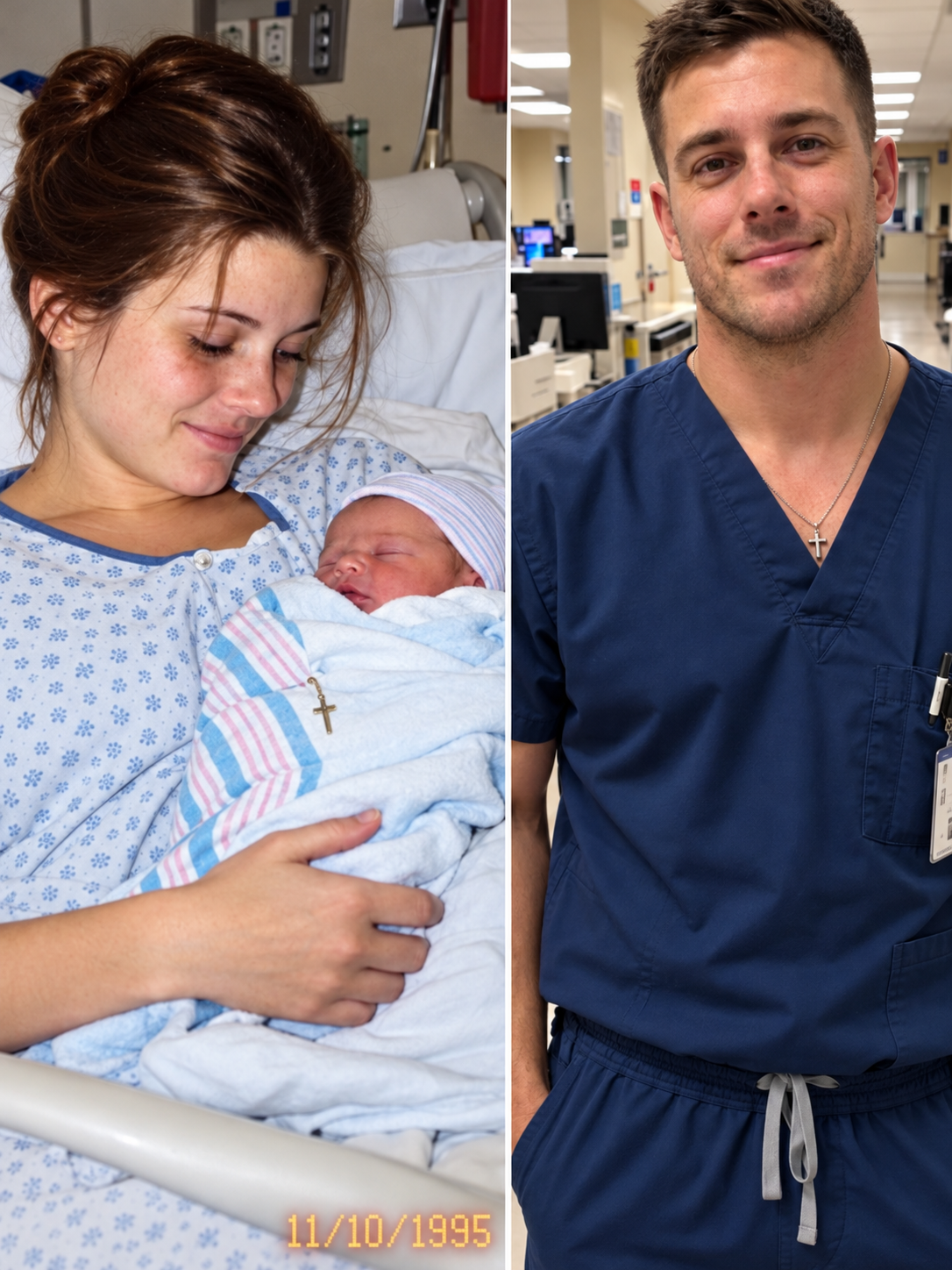
PART 1 TITLE: At Eighteen, I Refused to Name My Baby’s Father, Never Imagining That One Decision Would Separate Us for Thirty-One Years
The first time my father threatened to throw me out of the house, I was eighteen years old, seven weeks pregnant, and standing beside the kitchen table with my hands clasped so tightly that my fingernails left marks in my palms. He had just asked who the baby’s father was. I knew his temper well enough to understand that answering would put someone else in danger of his anger. So I kept my mouth closed. My mother stood at the sink, holding a damp dishcloth, while the clock above the refrigerator ticked through a silence that seemed to stretch far beyond the kitchen. My father leaned forward. “I’ll ask you one more time. Who is he?” I looked at the floor and said, “I’m not telling you.”
He pushed his chair backward with such force that its wooden legs scraped against the tiles. My mother flinched, but she said nothing. My father was the kind of man who considered obedience the foundation of a respectable family. He believed that a daughter should listen, that neighbors should have nothing unpleasant to discuss, and that mistakes became more serious when other people discovered them. Pregnancy outside marriage was not simply an unexpected event to him. It was an offense against everything he believed our family represented. He paced from the table to the window and back, asking how I intended to support a child when I had barely begun earning money. I had answers to some of his questions, but not to the one he kept repeating.
The baby’s father was Daniel. He was nineteen, hardworking, and considerably quieter than the young men my father admired. Daniel had an easy way of smiling when he was uncertain, as though he preferred to give a difficult situation a chance to improve before admitting how frightened he felt. We had known each other long enough for our relationship to feel ordinary and dependable. He remembered how I liked my coffee, listened when I complained about my classes, and never laughed at the small plans I made for a future that had once seemed straightforward. We had not planned to become parents so young. Nevertheless, when I told him about the pregnancy, he had reached for my hands instead of pulling away.
We had been sitting on a bench behind a small neighborhood park when I told him. The grass was wet from an earlier shower, and his jacket lay folded between us. I had spent the entire walk rehearsing the words, yet when the moment came, they emerged awkwardly. “Daniel, I think I’m pregnant.” He looked at me for several seconds, then asked whether I had seen a doctor. I nodded. He lowered his eyes toward our joined hands. His silence frightened me more than I expected. Then he moved closer, wrapped his arms around me, and said that we would find a way. He did not pretend it would be simple. He spoke about working extra shifts, finding a small apartment, and saving whatever money he could.
That mattered to me more than promises of comfort. Daniel understood that raising a baby would require more than affection. He had already begun helping his family financially, and he knew how quickly money disappeared when bills arrived. We spent several afternoons studying newspaper advertisements for inexpensive apartments. Most were beyond our means. One was above a grocery store, with a narrow kitchen and a bedroom barely large enough for a bed and a crib. I remember Daniel pointing to the photograph and saying that perhaps we could paint the walls ourselves. He imagined a yellow nursery. I wanted pale green. We argued about the color with the seriousness of people who had never faced a truly expensive decision.
My father would never have approved of Daniel. That was not because Daniel was dishonest or irresponsible. His family had less money than ours, and his ambitions did not involve the sort of professional position my father considered necessary for a successful life. Daniel believed in working with his hands. My father regarded that as evidence that a person lacked imagination. Years of hearing those opinions had taught me not to bring Daniel’s name into certain conversations. When my pregnancy became impossible to conceal, I feared that my father would confront him, humiliate his family, or try to force decisions that neither Daniel nor I wanted. Keeping his identity secret seemed like the only protection I could offer.
My mother finally set the dishcloth down and asked whether I understood what having a baby meant. Her voice was quieter than my father’s, but there was something troubling about how carefully she watched me. She spoke of sleepless nights, medical expenses, and the impossibility of continuing my education without help. I told her I understood that life would change. She asked whether I imagined love could pay rent. I said I intended to work. My father laughed without amusement. “You can’t even afford to leave this house,” he said. “And you think you’re ready to raise a child?” The question was meant to end the discussion. Instead, it made me realize how completely my independence depended on their permission.
That night I stayed awake listening to the house settle around me. My parents’ bedroom was across the hall, and occasionally their voices traveled through the walls. I could not distinguish every sentence, but I heard my father say that something had to be done before the neighbors found out. My mother answered in a tone I had rarely heard from her, firm enough that I sat upright to listen. Then the conversation dropped below hearing. I placed a hand over my abdomen. There was nothing visible yet, no movement, no familiar shape. Still, the knowledge that another life was developing inside me altered everything about that room. Even the little wooden desk where I had completed school assignments seemed to belong to someone younger.
For the next several days my parents behaved as though I had introduced an illness into the household. Breakfast became a series of short instructions. My father asked whether I had considered what people would say. My mother urged me not to tell anyone outside the family. If a relative called, she lowered her voice and closed the kitchen door. I began spending as much time outdoors as possible. Daniel met me after work whenever he could. Sometimes we walked without speaking much, stopping at shop windows to look at things we could not afford. He had started putting money aside in an envelope, and once, with a shy smile, he showed me the amount. It was modest, but it represented hours of work and a future he was taking seriously.
Then Daniel became difficult to reach. At first I blamed his work schedule. His family had been discussing financial troubles, and he had mentioned that his parents were considering a move if his father’s employment situation did not improve. Nothing had seemed definite. When he missed an afternoon we had arranged to meet, I waited twenty minutes before returning home. The following evening I called his house, but no one answered. The next morning brought the same result. I tried to tell myself that I was being impatient. We had never needed to account for every hour of each other’s lives before. Pregnancy had made me more watchful, and I worried that my fear might create problems where none existed.
On the third day I went to Daniel’s house. I remember the weather because the air carried the heavy smell of approaching rain. His street was unusually quiet. A delivery truck stood near the corner, and the house next door had its windows open. I turned toward the familiar front steps, expecting to see his mother’s potted plants beside the door. Instead, the porch was empty. The curtains had disappeared from the windows. A large sign stood in the front garden announcing that the property was for sale. For several moments I stared at it without understanding. Then I walked to the door and knocked. The sound echoed through the vacant house.
A neighbor eventually came outside and recognized me. She explained that Daniel’s family had moved three days earlier. I asked where they had gone. She knew only that the departure had been sudden and that a moving van had arrived early in the morning. I remember gripping the strap of my bag while she spoke. It seemed impossible that an entire household could vanish without leaving a message for someone who had been there so often. Daniel knew I was pregnant. He knew I was frightened. We had made plans. I thanked the woman, although I could scarcely remember what she had said, and walked away before she could see me cry.
I went to a public telephone and called the number I knew by heart. A recorded message informed me that the line was no longer in service. I called again, convinced I had entered the wrong digits. The same message answered. By the time I put the receiver down, my hands were shaking. I sat on a bench outside a pharmacy and tried to think of another way to reach him. I knew where he worked, but he had recently mentioned that his hours might change. When I contacted the workplace, I learned that he was no longer employed there. No one offered a forwarding address. Each unanswered question made the situation feel less like a misunderstanding and more like a decision from which I had been deliberately excluded.
For several days I imagined explanations that would make Daniel’s disappearance understandable. Perhaps there had been a family emergency. Perhaps his parents had arranged the move so quickly that he had been unable to contact me. Perhaps he had written a letter that had been delayed or lost. I checked the mailbox obsessively. Every time the telephone rang, I turned toward it before anyone else could answer. The calls were always ordinary. My mother’s friends, a relative asking after my father’s health, someone selling a service. There was never a message from Daniel. Eventually I became ashamed of the hope that rose in me whenever I heard the telephone.
My parents noticed the change. My mother asked whether I was feeling ill. My father wanted to know why I had stopped defending the unknown young man who had gotten me pregnant. I told them that Daniel was gone, although I still refused to give his name. My father responded that a man who disappeared when responsibility arrived was not worth protecting. I wanted to argue, but I had no evidence left to offer. Daniel had promised to stay. Now there was an empty house, a disconnected telephone, and no explanation. I began wondering whether I had misunderstood him completely. The possibility felt unbearable because it meant that every conversation about our future had been something I alone believed.
The practical difficulties arrived quickly. I could not remain financially dependent on my parents forever, and their anger showed no sign of fading. I searched for employment that would allow me to save money before the baby arrived. I visited shops, asked about office work, and studied advertisements pinned to the boards outside supermarkets. Some employers seemed interested until they noticed my pregnancy. Others offered wages too low to cover even a rented room. I calculated expenses repeatedly in a small notebook: rent, food, transportation, clothing, medical care. The numbers never balanced. I had imagined motherhood as something difficult but manageable with Daniel beside me. Alone, the same plans began to look fragile.
One afternoon I visited a room advertised at a price I thought I could afford. It was on the second floor of an aging building above a laundromat. The stairs were steep, the window did not close properly, and there was a dark stain spreading across one corner of the ceiling. The landlord told me that utilities were extra. When I asked whether a baby would be permitted, his expression changed. He said the building was not suitable for children and ended the conversation. I walked home past families carrying groceries and pushing strollers. Their ordinary movements made me feel strangely separate from the world. Everyone else appeared to know where they belonged. I had begun to lose that certainty.
As the months passed, my body changed. My clothes grew tight, my appetite became unpredictable, and I began to feel the faint movement of the baby. Those first sensations were startling. They arrived while I was sitting on the edge of my bed one evening, sorting through bills and employment advertisements. Something fluttered beneath my hand. I waited, almost afraid to move, and felt it again. Until then, pregnancy had existed mostly in conversations, medical appointments, and other people’s judgments. Suddenly there was a child responding to a world he had not yet entered. I spoke aloud without thinking. “Hello, little one.” The room remained silent, but I no longer felt entirely alone.
My grandmother had died several years earlier, leaving me a few personal belongings. Among them was a small silver cross on a fine chain. It was not especially valuable, but I treasured it because she had worn it almost every day. One arm of the cross bore a tiny nick, the result of an accident I remembered from childhood. My grandmother had once caught the necklace against the edge of an old wooden drawer, damaging the silver. She refused to replace it. She said that things did not have to remain perfect to be worth keeping. I often held the cross when I felt uncertain. During those months I began imagining that one day I might give it to my child.
My mother found me studying the necklace one evening. She stood in my doorway and asked whether I had eaten. When I nodded, she sat beside me. For the first time since learning about the pregnancy, she did not begin with a warning. She asked how I was sleeping and whether the baby had started moving. I described the little flutter I had felt. She placed her hand near mine, hesitated, then withdrew it. Her eyes moved toward the cross. “Your grandmother loved that,” she said. We spoke for several minutes about ordinary things. The conversation was so unexpected that afterward I sat quietly, trying to understand whether something had changed.
Over the following weeks my parents became noticeably more considerate. My mother began asking about medical appointments and offering to accompany me. My father no longer left the room whenever the pregnancy was mentioned. One evening he asked whether I had thought about a crib. I looked at him suspiciously. He had spent months insisting that I could not manage a child. Now he was discussing furniture. When I asked what had changed, he said that everyone needed time to accept difficult circumstances. My mother added that they had been thinking about the future. I wanted to believe them. The alternative was to continue facing the coming birth with nowhere reliable to go.
One Sunday evening they asked me to sit with them at the kitchen table. My father had cleared away the newspapers, and my mother had prepared tea. The arrangement reminded me of the day I had announced my pregnancy, except that neither of them looked angry. My mother began by acknowledging that the previous months had been painful. She said they had worried about my future and perhaps had spoken too harshly. My father listened without interrupting. Then she told me that they had reached a decision. I could stay in their home after the baby was born. They would help with expenses while I worked toward independence. I would not have to face everything by myself.
For several seconds I could not speak. I had spent so many nights imagining how I would manage a newborn in a rented room that the offer felt almost impossible to accept. I asked whether they truly meant that the baby could live with us. My father nodded. He said there would be rules and that I would have to contribute financially, but the child would have a secure home. My mother reached across the table and touched my hand. I began crying before I could thank them. I mistook the relief on their faces for tenderness. I had no reason, then, to imagine that they might be preparing for an entirely different future.
That night I took out my notebook and crossed through the figures that had frightened me for months. I began a new page headed with the words “Things for the Baby.” A crib, blankets, bottles, a small wardrobe, and a place for clothes. Beneath the list I wrote the name I had quietly chosen. Fabian. I whispered it once, listening to how it sounded in the room. My son had a name, a home waiting for him, and a mother who intended to keep him close. Before going to sleep, I placed my grandmother’s silver cross beside the notebook. I believed the worst part of my struggle had ended. I did not yet understand that the promise which had saved me from homelessness would soon be used to make the most devastating demand of my life.
END PART 1
PART 2 TITLE: My Parents Promised My Baby a Home, but Their Visit to My Hospital Room Turned That Promise Into an Unthinkable Ultimatum
I had been holding Fabian for less than a day when my parents entered the hospital room carrying a folder. At first I thought the papers concerned the hospital bills or arrangements for bringing him home. My father was wearing the dark jacket he usually reserved for formal occasions, and my mother carried her handbag with both hands. They did not ask how I was feeling. They did not look toward the small hospital crib beside my bed. My father placed the folder on the blanket covering my knees and said that there was something important I needed to sign. I opened it expecting routine documents. The heading on the first page made my stomach tighten. They were adoption papers.
The moment was so far removed from everything they had promised that I assumed there had been a mistake. I looked up and asked whose adoption was being discussed. My father answered that they had found a suitable arrangement for the baby and that the paperwork needed to be completed promptly. My mother stood near the foot of the bed, her face carefully composed. I remember touching the edge of the first sheet, as though the paper itself might explain what was happening. Fabian slept nearby, making the small breathing sounds that newborns make. His presence seemed to contradict the documents in my hands. Only hours earlier, the nurses had congratulated me on becoming his mother.
To understand why I was so completely unprepared for that visit, I have to remember the final months of my pregnancy. After my parents offered their support, our house changed in ways that seemed impossible only weeks earlier. My mother began talking openly about feeding schedules and baby clothes. She accompanied me to medical appointments, asked the doctor questions, and kept the appointment cards beside the kitchen telephone. My father measured the corner of my bedroom where the crib would stand. He complained about the cost of baby furniture, but his complaints sounded ordinary, almost affectionate. I began interpreting them as his way of accepting a situation he had once rejected.
I found part-time work at a bakery not far from our house. The mornings began early, and by the time I returned home my legs ached, but I liked having wages of my own. The bakery smelled of yeast, warm butter, and the powdered sugar that settled over the counter. I learned to arrange pastries in neat rows and to remember which customers preferred certain breads. My employer knew I was pregnant and allowed me to sit when the shop was quiet. Every week I set aside a portion of my pay for Fabian. I was not earning much, yet purchasing his first little outfits with money I had made myself gave me a feeling of independence that no reassurance from my parents could match.
I bought clothing gradually, choosing soft cotton garments that could be washed easily. Some were secondhand, and one little jacket had a loose button that I repaired at home. My mother watched me folding everything into a drawer. She commented that babies outgrew clothes quickly and warned me not to waste money. I agreed, but continued collecting what I could. Each small item represented a practical promise. I might not have been able to give my son a spacious house or expensive toys, but he would be warm, clean, and cared for. I wanted him to know, even before he could understand words, that someone had prepared for his arrival.
During the evenings I taught myself to crochet. My first attempts were uneven, and I pulled apart several rows before I could make the stitches look consistent. Eventually I completed a pair of tiny booties in pale yarn. They were not identical. One was slightly wider at the toe, and the other had a loop that refused to sit flat. I placed them side by side on my bed and laughed at my own workmanship. When my mother came in, she picked one up and turned it over between her fingers. “You could buy these for very little money,” she observed. I told her I knew. I had made them because I wanted something that came from my hands.
By then I had settled firmly on the name Fabian. I liked that it sounded gentle without being childish. My father suggested several family names, but none felt right. He eventually stopped arguing. My mother occasionally used the name when asking about my preparations, and hearing it from her made me believe she had accepted her grandson. We discussed how the crib could fit against the wall, leaving enough room for the small chest of drawers. I washed the bedding, ironed the cotton covers, and placed the booties in the top drawer. There were moments when the room looked almost ready. Then I would notice the empty crib and feel an impatient longing to meet the person for whom I had prepared everything.
Daniel remained absent. I tried to find him during those months, though less frequently as the pregnancy advanced. I revisited the street where he had lived and asked whether anyone knew where his family had gone. No one had useful information. Sometimes I considered writing to his former employer, but I had already been told that he had left no forwarding address. I wondered whether he knew the baby was a boy, whether he remembered our conversations, and whether fear had changed his mind. My anger came and went. On certain days I wanted nothing more than to confront him. On others I simply wanted to know that he was safe. The absence of an explanation was a wound that never quite closed.
My parents rarely mentioned him. When I tried to speak about Daniel, my father dismissed the subject by saying that a person who had left did not deserve further consideration. My mother urged me to concentrate on the baby instead. I began to do so, although I sometimes found myself looking through old photographs and remembering Daniel’s expression when he first heard about the pregnancy. He had seemed frightened, certainly, but not unwilling. I held on to that difference longer than anyone around me understood. Eventually, however, preparations for the birth filled most of my days. I had appointments to attend, clothing to wash, and a job that kept me moving.
Labor began earlier in the morning than I had expected. I woke with a dull ache and initially tried to ignore it. By breakfast the contractions had become distinct enough that my mother insisted we contact the hospital. My father drove us there, keeping both hands tightly on the steering wheel. He seemed uncomfortable with the urgency of the situation and asked several times whether we had brought everything necessary. I remember the pale light through the windshield, the sound of tires on wet pavement, and the way my mother held the hospital bag on her lap. I was frightened, but I was also determined. For months I had worried about what would happen when my son arrived. Now there was no longer any postponing the answer.
The hours that followed blurred into physical exhaustion, instructions from nurses, and moments when I doubted my ability to continue. My mother remained nearby for part of the labor. She wiped my forehead, encouraged me to breathe, and occasionally looked toward the door as though expecting someone. I did not ask whom. I was too occupied with the pain and the growing urgency of the delivery. When Fabian finally arrived, his first cry was startlingly strong. Someone announced that he was healthy, and then he was placed against me. His skin was warm, his head covered with fine hair, and his eyes remained tightly closed. I touched his cheek with one finger, afraid that anything more might disturb him.
I had imagined this moment many times, but the reality was quieter than my expectations. I did not suddenly become fearless or wise. I was exhausted, sore, and overwhelmed by the responsibility resting against my chest. Fabian moved his mouth, searching instinctively for comfort, and I adjusted my arm to support him. His fingers opened and closed against my skin. I remember thinking that he was smaller than I had expected and yet somehow more substantial than every plan I had made. Here was the child whose existence had transformed our household, ended certain friendships, and forced me to imagine a future I had never anticipated. He was no longer an uncertain possibility. He was my son.
When we were alone, I spoke to him softly. I told him his name and explained, as though he could understand, that I had waited a long time to see his face. I promised that I would do my best to protect him, even when I did not know what to do. It was not a grand speech. I stopped several times because I was crying. Fabian slept through most of it. I remember resting my cheek lightly against his head and breathing in the faint scent of his skin. Nothing in the room felt especially beautiful: the sheets were plain, the curtains faded, and a machine hummed beside the bed. Yet I wanted to preserve every detail.
Before a routine newborn examination, I took my grandmother’s silver cross from the small bag of belongings I had brought to the hospital. The chain had become tangled, and I spent several minutes loosening it. I held the cross against my palm, running my thumb over the tiny nick on one arm. My grandmother had been the person who comforted me most easily when I was a child. Giving Fabian something that had belonged to her felt like introducing them across a distance neither could cross. I tucked the cross securely inside his blanket, intending it to remain with his belongings rather than around his neck. I wanted him to have it someday, when he was old enough to understand why it mattered.
The nurse took Fabian for his checkup. I watched the hospital crib move through the doorway, then settled against my pillows. My body felt heavy with exhaustion, but I was content. My parents had promised that we would return to the house together. The crib was waiting. His clothing had been washed. The little booties were folded in the drawer. I thought about calling the bakery to tell my employer that everything had gone well. I imagined carrying Fabian through our front door, showing him his room, and learning the complicated routines of feeding and sleeping. I did not understand that the next people to enter my hospital room would be bringing an entirely different plan.
When my father announced that the papers concerned adoption, I shook my head before he had finished speaking. I told him there must be a misunderstanding. He said they had reconsidered their earlier promise. My mother added that raising a child under the circumstances would place too much strain on everyone. I reminded them that they had offered to help. I reminded them that my father had measured the space for the crib and that my mother had attended appointments with me. She looked down at her hands. “We wanted you to get through the pregnancy safely,” she said. “But that doesn’t mean this is the right arrangement for the future.”
I asked who had decided that my son should belong to another family. My father answered that people with more experience had considered what was best. He spoke about stability, education, and opportunities that I supposedly could not provide. I said that Fabian needed his mother. My father replied that babies needed security more than sentiment. His choice of words made me feel as though I were discussing an expensive purchase rather than a child who had been resting against my chest that morning. I reached toward the crib, forgetting for an instant that Fabian was still undergoing his examination. The empty space beside my bed seemed suddenly enormous.
My mother tried to soften the conversation. She assured me that the proposed adoptive family would care for Fabian and that I might eventually recognize the decision as an act of love. I asked for their names. She said those details could not be discussed. I wanted to know where they lived, whether they understood that Fabian already had a name, and whether I would be permitted to see him again. Neither parent answered. Their refusal frightened me more than the documents themselves. They were asking me to accept a future for my child that I would never be allowed to examine. I had been included in preparations for his birth but excluded from decisions about what would follow.
I pushed the folder away. “I’m not signing anything,” I said. My voice shook, but the words were clear. My father studied me with an expression I recognized from childhood. It meant that he believed resistance was an inconvenience to be overcome. He reminded me that I had no savings sufficient to rent a home and no partner to share expenses. He said he and my mother could not be expected to support decisions they considered irresponsible. I answered that I would find work, that I already had a position at the bakery, and that I could make arrangements if they gave me time. He asked where I intended to take a newborn that evening.
I had no answer ready. The question exposed the exact weakness on which his argument depended. I was eighteen, physically exhausted after childbirth, and financially dependent on the people who now wanted my son removed from my care. My father leaned closer and placed a pen on the folder. He said that if I refused to sign, I should not expect to return to their home. My mother remained silent. I looked from one face to the other, searching for some indication that they were speaking out of anger and would withdraw the threat. Neither moved. The promise of shelter had become a condition attached to the surrender of my baby.
I begged them to wait. I said that I needed time to recover and think. I asked whether a social worker could explain the documents, whether there were other arrangements, and whether I could speak privately with someone who was not related to me. My father said that delaying would only make the situation more painful. My mother repeated that the arrangement was already being prepared. Their certainty made me feel trapped inside a decision that had begun before I knew there was a decision to make. Tears blurred the words on the pages. I tried to read them, but I could scarcely concentrate on a sentence.
When Fabian returned, the nurse settled him beside me. My parents stepped away from the bed. I lifted him carefully, supporting his head against my arm, and looked at his face. His mouth moved in sleep. The blanket was tucked snugly around him, and I could feel the faint outline of the silver cross among his belongings. I had imagined holding him like this at home, perhaps beside the window where the afternoon sunlight entered my bedroom. Instead, I was being told that the right to carry him through that doorway depended on surrendering him. I wanted to run, but I had nowhere to go. I wanted to call Daniel, but I did not know where he was.
I signed while crying so hard that I had to stop between pages. I did not understand every legal consequence of the documents in front of me. I understood only the immediate threat and the terrible fear of being unable to keep my newborn safe. My father gathered the papers as soon as I finished. My mother touched my shoulder and told me that one day I would see things differently. I did not answer. I was staring at my son. His tiny fingers had curled around mine, and I could not imagine how anyone expected me to release them. I had just put my signature on papers that seemed to erase every promise I had made to him.
Later, my mother told me that Fabian had been placed with an adoptive family. She would not say where. When I asked whether the family had received his belongings, she assured me that everything had been handled. I asked about the silver cross and received no useful answer. I returned to my parents’ house without my baby. In my bedroom, the crib remained beside the wall. The drawer held the clean clothes I had folded so carefully. On top of them lay the pale crocheted booties, one slightly wider than the other. I picked them up and sat on the floor. I had been told that signing the papers was the only way to keep a roof over my head. Now I understood what that shelter had cost. And before the night ended, I made a promise to Fabian that nobody else could hear: I would not allow the version of events my parents had chosen to become the only story of his life.
END PART 2
PART 3 TITLE: For Thirty-One Years I Searched for the Son I Was Told Strangers Had Adopted, Until a Medical Emergency Changed Everything
For thirty-one years, I carried one of Fabian’s crocheted booties in my handbag. It was a small, faded thing, the yarn softened by handling and the edges no longer as tidy as they had been when I first made it. I kept it inside a little cloth pouch so that keys and coins would not damage it. There were times when I transferred it from one handbag to another without thinking, the same way another person might move a wallet or house keys. But whenever I touched it, I remembered exactly why it was there. Somewhere in the world was a boy whose feet had once been small enough to fit inside it. I knew his birthday, the shape of his newborn face, and the name I had given him. I did not know whether he had ever heard that name.
The first weeks after returning from the hospital passed in a blur of physical recovery and grief. My body continued behaving as though I had a baby to care for. Every reminder was painful. My mother tried to remove certain things from my room, explaining that seeing them would make it harder for me to move forward. I resisted whenever I could. Eventually she emptied the crib and put away the blankets. I found the drawer of clothes disturbed one afternoon and realized that several pieces had disappeared. I asked where they had gone. She said they had been donated to people who could use them. I wanted to know why she had not asked me. She answered that keeping everything would only prolong my suffering.
She did not understand that the objects were not the cause of my suffering. They were evidence that Fabian had existed in my life. Without them, the pregnancy and birth began to feel like experiences everyone around me preferred to forget. My father rarely mentioned the child at all. When I cried at the dinner table, he left the room. If I asked questions about the adoption, my mother told me that the arrangements were private and that further investigation would upset people who were trying to provide Fabian with a stable home. Their responses always returned to the same argument: a responsible mother should place her child’s interests above her own feelings. I began to dread the words “best for him,” because they were used to end every conversation.
I returned to the bakery after I had recovered sufficiently to work. At first I found the routine almost impossible. Customers asked for pastries, coins rattled against the counter, and the ovens released warm air whenever someone opened them. Ordinary life continued with astonishing indifference. A woman might arrive carrying a sleeping baby, and I would have to look away before my face betrayed me. Once, a customer complained that I had wrapped her order too slowly. I apologized, although I barely heard what she was saying. My employer noticed that I had changed. She gave me tasks in the kitchen when she could, where I could work without having to explain why certain sights left me unable to speak.
I saved money with a determination that surprised even me. Every unnecessary purchase began to look like a delay in leaving my parents’ house. I ate simple meals, wore clothing until it needed repair, and worked additional hours whenever they were available. My father interpreted my growing independence as evidence that I was finally behaving sensibly. He did not realize that I was preparing to put distance between us. The house had become a place where I could neither mourn openly nor ask the questions that mattered. My mother sometimes attempted small gestures of reconciliation, but she still refused to tell me anything about Fabian. I could not accept kindness from her without remembering what she was withholding.
When I eventually moved into a rented room, it was not much better than the ones I had rejected during my pregnancy. The wallpaper was worn, the heating unreliable, and the kitchen shared with another tenant. Yet the room belonged to me in a way my bedroom at home no longer did. No one could enter and remove my belongings. No one could decide which memories I was permitted to keep. On my first evening there, I placed Fabian’s remaining bootie in the top drawer of a small chest beside the bed. I sat on the mattress and looked around at the unfamiliar walls. The room was quiet. For the first time since his birth, I could think about my son without worrying that someone would interrupt and tell me to stop.
I began searching almost immediately. At first I knew very little about how adoption records were kept or who had the authority to release them. I wrote letters to agencies, contacted offices, and made appointments whenever someone suggested a possible source of information. I learned that documents could be restricted and that the details of a child’s placement might be unavailable to a birth parent. Some people were sympathetic. Others treated my questions as administrative inconveniences. I filled out forms, supplied dates, and explained the circumstances of Fabian’s birth repeatedly. Each time I wrote his name, I wondered whether it still belonged to him. Someone else might have changed it before he learned to speak.
The earliest replies offered little encouragement. Agencies could not locate a matching case or explained that they could not provide information without proper authorization. Some offices directed me elsewhere. Others suggested that I consider counseling rather than continuing the search. I understood that records were protected for reasons that could matter deeply to adoptive families and children, but I could not reconcile the absence of information with the speed at which my parents had arranged everything. I had been given papers to sign and told that a family was waiting. Surely there had to be a trail somewhere. Surely a child could not simply disappear from one life and enter another without leaving any trace.
Over the years I became familiar with the particular exhaustion of following leads that led nowhere. A receptionist might sound hopeful on the telephone, ask me to send more information, and then disappear behind another unanswered letter. A person who claimed to know about private adoptions would insist that more money was needed before meaningful progress could be made. I learned to ask careful questions and to keep copies of everything. I arranged the documents in folders labeled by year. There were application forms, correspondence, receipts, and handwritten notes from conversations I had held with people whose names I could barely remember later. The folders grew thicker. The answers did not.
I eventually hired investigators when I could afford their fees. Some were thorough and respectful. Others made promises they could not fulfill. One traced an adoption record that initially appeared connected to Fabian’s date of birth, only to discover that the child had been born in another town. Another found a young man whose early circumstances seemed similar, but the details did not match. I learned not to celebrate a possible discovery until I had verified it. Each disappointment carried its own kind of shame. I would tell myself that I had become foolishly hopeful, then find myself beginning another search as soon as the ache subsided. Giving up never felt like a genuine option.
The years altered the way I imagined Fabian. At first he remained the newborn I had held in the hospital. I pictured him opening his eyes, learning to sit, and taking his first steps. As time passed, I had to construct those changes from other people’s children. A boy carrying a schoolbag might make me wonder whether Fabian enjoyed school. A teenager helping his mother load groceries into a car could leave me standing motionless in a parking lot. When I saw young men beginning their working lives, I thought about what he might have chosen for himself. My imagination followed him through birthdays, examinations, illnesses, friendships, and all the ordinary events a mother should have witnessed without having to invent them.
I did not know whether he was happy. That uncertainty troubled me more than the possibility that he had forgotten me. If he had been loved and protected, I wanted to be grateful. If he had been lonely or frightened, I wanted to know. I worried that he might have been told something untrue about the circumstances of his birth. Perhaps he believed I had not wanted him. Perhaps he had never been told that I existed. Sometimes I wrote letters addressed to him, although I had nowhere to send them. I described small things about my life and explained why I had chosen his name. I told him about my grandmother and her silver cross. I rarely read the letters again after writing them.
The cross occupied a special place in my thoughts. I had tucked it into Fabian’s blanket before the newborn examination, intending that it would remain with him as a connection to the family he came from. In the years afterward, I sometimes questioned whether it had actually reached him. The hospital staff might have removed it for safety. My mother might have taken it. Someone preparing his belongings for adoption might have set it aside without knowing its significance. Yet I remembered the little nick on one arm with extraordinary clarity. I had held that necklace throughout my pregnancy, rubbing my thumb against the damaged place until the metal warmed in my hand. Whenever I imagined finding Fabian, I pictured asking whether he still possessed it.
My relationship with my parents never recovered its former ease. I continued seeing them occasionally, especially during holidays and family obligations, but our conversations remained guarded. I learned which subjects would produce silence and which would bring my father’s temper to the surface. My mother sometimes asked whether I was still searching. When I said yes, she sighed and told me that there were things in life one had to accept. I asked whether she would accept losing a child without knowing where he was. She looked away. I took that as proof that she understood the pain and was simply unwilling to acknowledge her responsibility. I did not know what else she might have been keeping from me.
As I grew older, the practical shape of my life changed. I found more stable employment, moved into better housing, and developed routines that gave my days structure. Friends came and went. Some knew about Fabian, while others learned only that I had experienced a loss I preferred not to discuss casually. People occasionally encouraged me to begin a new family, as though another child could replace the one I was searching for. I understood that they wanted to help. Nevertheless, their suggestions missed something essential. My love for Fabian was not a space waiting to be filled. It was a relationship interrupted before it could develop. I did not need another person to erase it. I needed to know what had happened to him.
Eventually I stopped expecting every new lead to change my life. That was different from abandoning hope. Hope became quieter, less dramatic, and more practical. I kept addresses updated, answered correspondence, and maintained the folders of information I had collected. When new methods of searching became available, I investigated whether they might help. I learned to live through ordinary days without making every moment a test of whether I would ever see my son. Still, his birthday remained difficult. Each year I found myself calculating his age and wondering what he was doing. The number grew until it became almost impossible to reconcile with my memory of the tiny baby against my chest.
At forty-nine, I had developed a life that appeared settled from the outside. I worked, maintained my home, paid my bills, and managed the responsibilities expected of an adult woman. People who met me casually had no reason to suspect how much of my private history remained unresolved. I kept the old bootie with me, though its original color had faded and the yarn had begun to thin at the edges. I occasionally touched it when I was nervous or uncertain. It had become something like a physical memory, small enough to conceal but impossible to replace. I did not imagine that a medical emergency would bring me closer to Fabian than decades of searching had managed.
The emergency began with pain that I initially tried to dismiss. I had experienced discomfort before, and at first I assumed that rest would improve it. Instead, the pain intensified. I became nauseated, weak, and increasingly unable to concentrate on anything except the sensation spreading through my abdomen. A person who saw how unwell I had become insisted that I seek medical attention. At the hospital, events began moving more quickly than I expected. Questions were asked, examinations arranged, and medical staff spoke with the controlled urgency of people who understood that waiting could become dangerous. I remember trying to answer clearly while feeling as though the room were shifting around me.
The doctors explained that I required emergency surgery. I heard the words but struggled to absorb them. I had arrived expecting treatment and perhaps an overnight stay. Now I was being told that an operation was necessary and that it could not safely be postponed. A nurse asked whether there was someone I wished to contact. I gave the information I could and answered questions about medications and previous health problems. My thoughts moved strangely between immediate concerns and memories that seemed unrelated. I wondered whether I had paid an outstanding bill. I thought about the letters in my home. Then I remembered that Fabian’s bootie was inside my handbag, among the belongings being placed aside.
As the staff prepared me for surgery, I felt a fear unlike anything I had experienced for years. It was not simply fear of pain or of the procedure itself. I had spent more than three decades believing there might still be a chance to find my son. The possibility that my life could end without knowing what had happened to him suddenly felt unbearable. I wanted to tell someone that there were folders in my home, records that mattered, and letters written to a man who might never receive them. But the preparation continued, and my questions became difficult to form. The last thing I clearly remember was the bright overhead lighting and a voice reassuring me that the surgical team was ready.
When I woke, the world returned gradually. There was a dry taste in my mouth, a dull ache beneath the medication, and the steady sound of equipment nearby. A nurse explained that the operation had been successful and that I would need time to recover. I asked questions, received answers, and drifted in and out of sleep. Relief came slowly. I was alive. I had been given more time, although I could not have said what I intended to do differently with it. Later, when I was moved to a hospital room, I asked for my belongings. The familiar weight of my handbag beside the bed comforted me in a way that seemed unreasonable until I remembered what it contained.
The next afternoon a surgeon came to review my condition. He appeared to be in his early thirties, with a calm expression and the slightly tired manner of someone accustomed to long hours. He introduced himself as the doctor involved in my treatment and asked how I was feeling. I answered that I was sore but grateful. He reviewed my chart, explained aspects of the operation, and spoke about the recovery ahead. I listened carefully because I wanted to understand what had happened. He seemed thoughtful and direct, pausing when I needed clarification. I had no reason to imagine that he was connected to anything beyond my immediate medical care.
Then he leaned forward to examine something beside my bed. The collar of his shirt shifted, and a silver chain slipped into view. Suspended from it was a small cross. I noticed its shape first, then the worn surface of the metal. My attention settled on one arm, where a tiny irregular mark interrupted the smooth edge. I stopped listening to what he was saying. For a moment I could hear nothing but the beating of my own heart. I had seen that mark hundreds of times in memory. It belonged to the silver cross my grandmother had given me, the one I had placed inside Fabian’s blanket on the day he was born.
I asked the doctor where he had gotten the necklace. My voice came out so faintly that he leaned closer to hear. He looked surprised by the question, then touched the chain. “My father gave it to me,” he answered. I stared at the cross, trying to determine whether I was imagining the damaged place. He lifted it slightly, and the little nick became unmistakable. My hands began to shake. I told him that I had once owned a cross exactly like it. Then I described the small mark and said that I had placed it in my newborn son’s blanket thirty-one years earlier. The doctor stopped moving. His expression changed, and he slowly lowered himself into the chair beside my bed.
END PART 3
PART 4 TITLE: The Young Surgeon Recognized the Secret Behind My Silver Cross, Then Revealed a Name That Brought My Lost Past Back to Life
The young surgeon sat beside my hospital bed without immediately speaking. His fingers remained closed around the silver cross, and his gaze moved between my face and the necklace. I had expected him to tell me that the resemblance was a coincidence, that the cross had been purchased in a shop, or that the tiny damage meant nothing. Instead, he looked as though I had mentioned something that unsettled him. The room seemed suddenly too quiet. A trolley rattled somewhere in the corridor, and voices passed outside the door, but neither of us turned toward them. At last he asked when my son had been born. I gave him the date. His grip tightened around the chain.
He lowered his eyes for a moment, then looked directly at me. “My name is Fabian,” he said. The words were spoken gently, almost cautiously, as though he was afraid of what they might do to me. I stared at him. I had spent decades saying that name silently, writing it on forms, and imagining it spoken by people who knew my child. Hearing it from the man sitting beside me felt impossible. I asked him to repeat it. He did. Then he added that he believed he might be the son I had lost. I could not immediately respond. My mind moved through possibilities too quickly to hold. The silver cross, his age, his expression, and the name all seemed to fit together, yet I was afraid to trust what I was hearing.
He told me that his father had given him the necklace when he was young. He had kept it because it was connected to his earliest history. The cross had never been an expensive possession. Its importance came from the story surrounding it and from the fact that it had belonged to him for as long as he could remember. I asked whether he knew how it had been damaged. He admitted that he did not. I explained how my grandmother had caught it against an old drawer and left a small nick in the metal. My voice trembled as I described the incident. Fabian examined the cross with an intensity that made me afraid he might find some detail that contradicted my memory. Instead, he nodded slowly.
I wanted to reach for him, but something held me back. He was an adult man, a surgeon responsible for my care, and someone whose entire understanding of his childhood might be changing in the space of a few minutes. I was not entitled to demand affection from him simply because I believed I had given birth to him. I asked whether he knew anything about his mother. He looked uncomfortable, not because he seemed unwilling to answer, but because the question carried more weight than either of us had anticipated. He said that he had been told his mother had not wanted to raise him and that his father had taken responsibility for bringing him up.
I shook my head. The movement made the pain in my abdomen sharper, but I barely noticed. “No,” I said. “That isn’t what happened.” Fabian leaned forward. I told him that I had been eighteen when he was born and that my parents had promised to help me care for him. I explained how they had appeared in my hospital room with adoption documents and threatened to leave me without a home unless I signed. I told him I had begged for more time, that I had been frightened and exhausted, and that I had believed there was no safe alternative. The memories emerged unevenly. Some details came with painful clarity; others were difficult to put into words after so many years of silence.
Fabian listened without interrupting. His hands rested on his knees, and he occasionally glanced at the silver cross. When I finished describing the documents, he asked what I had been told afterward. I said that my mother informed me he had gone to an adoptive family. I had been refused the family’s name, location, or any further information. Fabian looked down. “I wasn’t adopted by strangers,” he said. I felt my stomach tighten. The sentence was simple, but it overturned one of the few facts on which I had built thirty-one years of searching. I asked who had raised him. He looked at me with an expression I could not yet interpret and answered, “My father.”
I waited for him to explain. There were so many questions gathering in my mind that I did not know which to ask first. I wondered whether his father had been connected to the adoption arrangement, whether someone had later taken custody, and whether the documents I signed had been understood differently from what my parents told me. Fabian seemed to recognize my confusion. He spoke carefully, as though he was trying to avoid causing further harm. “His name is Daniel,” he said. For several seconds I heard nothing else. The name belonged to another life, to a nineteen-year-old young man who had promised we would rent an apartment and raise our baby together.
I stared at the wall beyond Fabian’s shoulder. Daniel. I had spent years believing he had abandoned us before the birth. I remembered his empty house, the disconnected telephone, and the neighbor who told me that his family had moved without warning. I remembered standing beside a public telephone, dialing the same number again and again because I could not accept that he had disappeared. Now I was hearing that he had raised our son. The room seemed to tilt beneath me. If Daniel had been with Fabian all these years, what had happened to the adoption arrangement? Why had nobody told me? And why had he never contacted me after taking responsibility for our child?
Fabian watched my reaction closely. He told me that his father had always spoken about his mother with a sadness he did not entirely understand when he was young. Daniel had not described me as cruel, but he had said that I had chosen a different life. Fabian explained that he had grown up believing I had willingly surrendered him. He knew little about the circumstances, only that there had been difficult decisions before his birth and that Daniel had ultimately raised him. I asked whether he had ever questioned that account. He said he had, especially as he grew older. But whenever he asked why his mother had not wanted him, Daniel seemed to struggle with the answer.
I covered my mouth with one hand. The thought of Fabian growing up believing I had rejected him was almost more painful than discovering that I had been misled. He had lived through birthdays, illnesses, examinations, and ordinary childhood disappointments with a story about his mother that was not true. I wondered how often he had imagined meeting me and what he would have expected to find. Perhaps he had thought of me as someone selfish or indifferent. Perhaps he had decided that knowing me would bring nothing useful into his life. All those possibilities had existed while I was searching adoption records that could never have led me to him.
“I wanted you,” I told him. The words came out with more urgency than I intended. I repeated them because I needed him to understand that this was not a polite reassurance offered after an awkward discovery. I had wanted him when I first learned I was pregnant. I had wanted him when Daniel disappeared. I had wanted him when my father placed the papers before me. And I had wanted him every day afterward. Fabian’s expression shifted. He was no longer simply listening to an account of past events. He was trying to place himself inside two histories that seemed impossible to reconcile.
He asked whether I had searched for him. I reached for my handbag. My hands were clumsy, and the movement pulled uncomfortably against the area of my surgery. Fabian offered to help, but I shook my head. I found the small cloth pouch and opened it. Inside was the crocheted bootie I had carried for more than three decades. I placed it on the blanket between us. The yarn had faded with age, and one uneven stitch near the toe remained visible. I told him that I had made a pair before he was born and had kept this one after the other belongings disappeared. It was not much to show for thirty-one years, but it was the one object I had refused to surrender.
Fabian picked it up carefully. His fingers looked enormous around the little piece of yarn. He examined the stitching and ran his thumb along the edge. Then he looked at me. “You’ve had this all that time?” he asked. I nodded. I explained that I had carried it through changes of jobs, homes, and ordinary daily routines. It had accompanied me to meetings with investigators and appointments with agencies. Sometimes I had held it when I was afraid that I would never know whether he was alive. I did not tell him these things to make him feel obligated to me. I wanted him to understand that my absence had not been a lack of love.
He remained silent for a long moment. I could see that he was trying to absorb what the bootie represented. For him, it was an object from a childhood he could not remember. For me, it was proof of the months before his birth and the years that followed. The contrast between his adult hands and the tiny garment was almost unbearable. I had imagined his first steps, but someone else had watched them. I had wondered about his school years, but someone else had helped him with assignments. I had tried to picture his face as he grew older, while the face itself was changing in a home I could not find.
Fabian asked what had happened to the other records of his birth. I told him about the folders I had kept, the agencies I had contacted, and the investigators who had followed leads that eventually proved useless. I explained that I had never been given reliable information about the supposed adoptive family. He asked whether my parents were still alive and whether I had ever confronted them directly about the arrangement. I told him that I had questioned them repeatedly, but they had refused to discuss details. My father insisted that the decision was final. My mother maintained that I should respect the privacy of the family raising my child. Neither had acknowledged that Daniel might have been involved.
I could see Fabian reconsidering memories of his own childhood. He told me that Daniel had been a devoted father. He had worked hard, attended important school events when he could, and encouraged Fabian’s interest in science. Their life had not been luxurious, but Fabian had never doubted that his father cared about him. He spoke of long evenings when Daniel returned from work tired but still asked about his day. He remembered being helped through difficult lessons and encouraged when he struggled. I felt relief hearing those details. I had imagined so many possible lives for my son, including painful ones, that learning he had been loved gave me something precious to hold beside my grief.
At the same time, every detail raised another question. If Daniel had been capable of caring for Fabian, why had he not come to me? If he knew where our son was, how could he have allowed me to spend decades believing the child was with strangers? I remembered the young man who had promised to work extra shifts and find a small apartment. There had been sincerity in his voice. I had believed in him until the disappearance of his family forced me to question everything. Now Fabian was describing a father whose behavior resembled the Daniel I had known. I could not make those two versions fit together.
“Does he know you’re here?” I asked. Fabian hesitated. He explained that Daniel was still an important part of his life and that they remained close. He had not expected his work at the hospital to produce this encounter. He had come into my room to discuss my recovery, not to search for his mother. I looked again at the cross resting against his shirt. A small movement, an ordinary examination, and a piece of silver had exposed a secret that years of determined searching had failed to uncover. I wondered how many times Fabian and I might have passed through the same town without recognizing one another. The possibility made me feel both grateful and strangely bereaved.
I asked whether he had ever searched for me himself. He told me he had considered it. Growing older had brought questions about his origins, but he had also worried that searching might hurt Daniel or reopen something his father preferred to leave untouched. He had been told that I made my choice. He had tried to respect that choice, even when it left him uncertain. Listening to him, I realized that the false story had shaped not only my life but his. He had been taught to regard my absence as something deliberate. I had been taught to regard his disappearance as something beyond my power to change. We had both adapted to explanations neither of us had been permitted to verify.
The room grew darker as the afternoon advanced. A nurse entered briefly to check on my recovery and seemed surprised to find the surgeon still seated beside me. Fabian resumed his professional manner long enough to answer her questions, but once she left, his attention returned to the bootie in his hands. He asked whether he could keep holding it for a little longer. I said of course. I wanted to ask him hundreds of questions about his childhood, his education, and the path that had brought him into medicine. I wanted to know whether he had a family of his own and what ordinary things made him happy. But I recognized that he was trying to understand a fundamental change in the story of his life. Those questions could wait.
He told me that becoming a surgeon had required years of study and that his father had supported him through them. I listened with a pride I had not expected to feel so immediately. I had spent decades imagining whether Fabian was safe. I had never dared picture him leaning over a hospital bed as the person responsible for saving someone’s life. Now I was alive because of the work he had chosen. The extraordinary coincidence left me unable to find appropriate words. I thanked him for treating me. He shook his head slightly, as though he did not know how to receive that gratitude under the circumstances. For a moment we were simply two people struggling to understand how their lives had intersected.
I asked him whether he believed me. It was a difficult question, and I regretted it as soon as I spoke. I did not want to force him to choose between the mother he had just met and the father who had raised him. Fabian considered his answer. He said that the cross, the date of birth, and the details I had shared could not easily be dismissed. More importantly, he could see that I was telling him something I had carried for a long time. But he also needed to understand how Daniel had come to raise him and why the stories were so different. I agreed. Whatever we discovered would not change the fact that Daniel had been his father throughout childhood.
We spoke about the possibility of examining records and comparing the accounts we had been given. Fabian approached the uncertainty with the care of someone accustomed to relying on evidence. I admired that steadiness, even while I felt desperate for immediate answers. I explained that my parents had shown me papers and that I had signed under the threat of losing my home. He said there might be important differences between what I was told those documents meant and what actually happened afterward. I had considered that possibility during my searches, but hearing it from him gave the suspicion an urgency it had never possessed before.
There was a pause, and Fabian looked toward the door. He seemed to be deciding something. I asked whether Daniel was still living nearby. Fabian nodded, then glanced at the cross again. I could see that he was deeply unsettled. He told me he did not want to make promises about what might happen next. There would be questions for his father, and some answers might be painful. I said that I understood. After thirty-one years, I was not expecting the past to become simple. I only wanted the truth. Fabian placed the bootie carefully on the blanket beside my hand, as though returning something fragile.
Then someone knocked on the hospital room door. Fabian turned. Before either of us could speak, the door opened and an older man stepped inside. His hair had turned gray, his shoulders had broadened with age, and there were lines around his eyes that I did not remember. Yet I recognized him before he had taken a second step. Thirty-one years vanished in the instant our eyes met. He stopped just inside the doorway, one hand still resting against the frame. The man standing before me was Daniel. The young man I had loved, the father of my child, and the person I had believed had abandoned us was suddenly no longer a memory.
For several seconds none of us moved. Fabian looked from his father to me, understanding that whatever had happened decades earlier was about to become impossible to avoid. Daniel’s face changed as he recognized me. I saw surprise, disbelief, and then something like fear. The silence hurt more than I expected. I wanted to ask why he had disappeared, why he had never contacted me, and how he could have raised our son while I searched for strangers who did not exist. Instead, the first words came out broken and quiet. “You had him all this time?” Daniel lowered his eyes. Then I asked the question that had begun forming the moment Fabian spoke his father’s name. “What did my parents tell you?”
END PART 4
PART 5 TITLE: The Papers I Signed in Fear Followed Me for Thirty-One Years, but One Small Keepsake Refused to Let the Truth Disappear
For a long time, I believed the worst thing I had ever done was put my signature on those papers. I could still see the pen resting beside the hospital folder, my father’s hand flat against the table, and my mother’s face turned toward the window. Fabian had been born only hours earlier. I could hear another baby crying down the corridor while I tried to understand how the people who had promised to help me were now demanding that I surrender my own child.
I had been eighteen. I had no savings worth mentioning, no home of my own, and no reliable way of finding Daniel. My parents knew every one of those weaknesses. They had spent months assuring me that Fabian and I could live under their roof, and I had trusted them because I had wanted so desperately to believe them. When my father told me that I could sign the adoption papers or find somewhere else to live, he made the choice sound simple. It was anything but simple.
After they took the folder away, I lay awake listening to the wheels of hospital carts moving along the corridor. I kept turning my head toward the empty bassinet beside my bed. There was an indentation in the little mattress where Fabian had rested. I remembered the weight of him against my chest and the way his fingers had closed around mine. The nurse had told me he was healthy. She had smiled as though that word alone could promise us a future.
Before the paperwork appeared, I had tucked my grandmother’s silver cross into Fabian’s blanket. It was a small thing, scratched along one arm, with a chain that had been repaired years earlier. My grandmother had worn it every Sunday. When she died, she left it to me. I wanted my son to have something that belonged to the women who came before him, something that might tell him he had been loved even when I could not stand beside him.
My mother eventually returned to the hospital room without Fabian. I asked where he was. She said the arrangements had been made and that I should concentrate on recovering. I asked which family had taken him, whether they knew his name, whether someone would tell them about the cross. She folded my clothes into my overnight bag and answered none of those questions. By the time she finished, the room seemed to have grown smaller around us.
At home, I found the little crocheted booties I had made during the final months of my pregnancy. One lay on top of the dresser, its pale yarn twisted near the ankle. The other had fallen behind the drawer. I picked them both up and sat on the floor. My hands remembered making each stitch while I imagined Fabian learning to walk. I had spent entire evenings adjusting the size because I wanted them to fit his feet perfectly.
My father told me the matter was settled. He said I should return to work, finish my education, and build a future that would not be ruined by one youthful mistake. I looked at him across the dinner table and asked whether he believed Fabian was a mistake. He put down his fork. My mother whispered my name in warning, but I repeated the question. My father left the table without answering.
In the weeks that followed, I learned that a house can contain three people and still feel abandoned. My mother went about her routines. My father left for work at the same hour each morning. They spoke about groceries, bills, and neighbors. I moved among them like someone who had returned from a place they refused to acknowledge. Whenever I mentioned Fabian, my mother said I was making recovery harder for myself.
I returned to the bakery because I needed money. The work was exhausting at first. Standing for hours made my body ache, and the smell of warm bread sometimes turned my stomach. One afternoon, a customer entered carrying a baby wrapped in a cream-colored blanket. I had to step into the storage room until my breathing steadied. My supervisor found me beside a stack of flour sacks. She asked whether I was ill. I told her I needed another minute.
I began saving whatever I could. Instead of spending my wages on clothes or evenings out, I put them into an envelope beneath my mattress. My first goal was to leave my parents’ house. My second was to find out where Fabian had gone. Neither seemed easy, but saving money gave my days a purpose. I counted the bills every Friday and wrote the amount on the back of an old bakery receipt.
When I finally rented a room of my own, my mother stood in the doorway watching me pack. She seemed surprised by how little I intended to take. I carried my clothes, a few books, my grandmother’s photographs, and the booties in a small cardboard box. She asked whether I was leaving because I hated them. I told her I was leaving because I could not keep waking up in the room where I had prepared to bring my baby home.
My first inquiries were awkward. I did not understand adoption procedures or the difference between records that were confidential and records that might be available to a birth parent. I visited offices, filled out forms, and explained my situation to strangers who listened with varying degrees of patience. Some offered advice. Others told me that without more information there was very little they could do.
Each time someone asked for the name of the adoption agency, I had to admit that I did not know it. My parents had arranged everything. I had signed the documents while frightened and exhausted, and I had never been given a proper copy. I knew Fabian’s birth date and the hospital where he had been born. I knew the name I had whispered to him. Beyond that, I possessed almost nothing useful.
I returned to my parents’ home one Sunday and asked to see the paperwork. My father said it had been handled by the appropriate people. I told him that was not an answer. He looked at me with the same cold impatience he had shown in the hospital. My mother stood behind him, twisting a dish towel between her hands. Neither produced a document.
I asked whether they had ever met Fabian’s adoptive parents. My mother’s eyes moved toward my father before she said no. The glance lasted only a moment, but I noticed it. It was the first time I wondered whether my parents were withholding something more substantial than an address. I asked again. My father ordered me to leave.
Outside, rain had started falling across the driveway. I sat in my car with both hands resting on the steering wheel. I wanted to go back inside and force them to tell me everything. Instead, I drove to the library and began writing down every detail I could remember about the day Fabian was born: the names on hospital signs, the time the nurse had returned, the folder’s appearance, the conversations I had overheard.
I wrote about Daniel too. Until then, thinking about him had been almost as painful as thinking about Fabian. He had promised we would find a small apartment. He had talked about taking extra shifts and buying secondhand furniture. Then his family disappeared from their house, his telephone stopped working, and I was left to believe that every promise had been made without conviction.
For years, I had treated his disappearance as proof that I had been foolish to trust him. But while writing down the sequence of events, I remembered how abruptly everything had happened. His family had moved before I could speak to him. There had been no farewell, no explanation, not even an argument. It troubled me that I had never heard the decision from Daniel himself.
I tried tracing him through the address I remembered. The house had changed owners, and the neighbors who had once known his family were gone. Old directory listings led nowhere. I could not afford to hire investigators immediately, but I continued gathering information. Some nights, after working a full shift, I sat at my kitchen table sorting notes until the streetlights outside my window went dark.
As the years passed, my life became more stable. I found better employment, moved into a modest apartment, and learned to manage my finances carefully. I made friends who knew about Fabian without treating my loss as the only important thing about me. I attended birthdays, weddings, and family gatherings. I laughed sometimes. Yet every year on Fabian’s birthday, I wondered where he was and whether anyone had baked him a cake.
I kept one crocheted bootie in a small pocket inside my handbag. It became worn along the edge. Once, when the lining tore, I nearly lost it on a bus. I noticed the missing weight only after getting home and ran back to the stop in a panic. The driver had found it beneath a seat. He looked puzzled when I thanked him with tears in my eyes, but he handed it over without asking questions.
I contacted adoption agencies, requested available records, and eventually paid investigators to look for possible connections. The results were always discouraging. I received letters filled with cautious language and explanations about privacy restrictions. More than once, someone suggested that perhaps Fabian did not wish to be found. I could accept that possibility, painful as it was, but I could not accept that he should grow up believing I had never tried.
On my fortieth birthday, I laid all my documents across the kitchen table. There were envelopes from agencies, copies of inquiries, handwritten notes, and receipts from searches that had produced nothing. I counted the years since Fabian’s birth and realized that he would now be twenty-two. He might have finished college. He might be working, living with someone, or planning a family of his own. I could no longer imagine his face accurately because the only face I remembered belonged to a newborn.
I considered writing to my parents again, but by then our relationship had become distant and formal. We spoke occasionally about practical matters. They had never apologized for the hospital or offered anything that could help me find Fabian. My father still believed his decision had prevented a scandal. My mother remained determined to describe what happened as something necessary, unfortunate, and finished.
One evening, I took the bootie out of my handbag and noticed that the yarn had faded unevenly. I held it against the light and thought of the silver cross. I wondered whether the adoptive family had kept it, sold it, or placed it in a box with the other objects that arrive with a child whose past is not fully known. The little nick in its arm was so distinct that I believed I could recognize it among a hundred similar necklaces.
By the time I turned forty-nine, I had spent thirty-one years living with a story I could never verify. My parents said Fabian had been adopted. Daniel had vanished. The agencies had found nothing. Still, there were questions that would not leave me alone, particularly the strange absence of any clear record connecting Fabian to the family my parents claimed had taken him.
Then, on an ordinary morning, a pain began beneath my ribs. At first, I blamed something I had eaten. I went to work and tried to ignore it. Before noon, the pain sharpened so suddenly that I had to grip the counter. A coworker insisted on driving me to the hospital. I remember protesting that I could manage, then realizing I could barely stand upright.
In the emergency department, physicians examined me, ordered tests, and explained that I needed urgent surgery. I was frightened, but there was no time to dwell on it. Someone asked about allergies. Someone else adjusted an intravenous line. I signed a consent form with trembling fingers. As the staff prepared to take me into the operating room, I thought about the last time I had been in a hospital bed, when my parents placed another set of papers before me.
A nurse asked whether there was anyone I wanted notified. I gave her the name of a close friend. Then, without knowing why, I reached toward my handbag, which had already been placed with my belongings. I wanted the little bootie. I wanted to hold it just once before they took me away. The nurse assured me that my things would be safe, but the last thought I remember before the anesthesia took effect was that I had promised Fabian I would always come looking for him.
END PART 5
PART 6 TITLE: After an Emergency Operation, a Familiar Silver Cross Appeared Above My Hospital Bed and Brought a Question No One Had Ever Answered
When I opened my eyes, a pale strip of afternoon sunlight stretched across the hospital wall. My throat felt dry, and every attempt to move reminded me that something serious had happened to my body. A monitor sounded softly beside the bed. For several seconds, I could not remember where I was. Then I noticed the intravenous line taped to my hand and the dressing beneath my hospital gown.
A nurse came to check my blood pressure. She explained that the operation had gone well and that I would need time to recover. I listened carefully, asking the practical questions that always helped me manage fear: when I might eat, whether I could sit up, how long I would remain in the hospital. She answered patiently and adjusted my pillows.
My friend had visited while I was still recovering from the anesthesia. She had left a small bag containing a clean nightgown, lip balm, and the book I had been reading. My own handbag was in the bedside cabinet. I checked for the crocheted bootie before doing anything else. The familiar softness of the yarn against my fingers calmed me more than I expected.
The following afternoon, I was resting when someone knocked lightly on the door. A man in surgical clothes stepped inside carrying a chart. He looked to be in his early thirties, with a composed expression and the slightly tired eyes of someone who had spent many hours looking after other people. He introduced himself as the surgeon who had operated on me and asked how I was feeling.
His manner was reassuring without being overly cheerful. He explained what the surgical team had found, how the procedure had been performed, and what signs of recovery he hoped to see over the next few days. When I asked whether the problem might return, he gave me a thoughtful answer rather than a promise. I appreciated that. After so many years of being told only what other people wanted me to hear, straightforward answers had become important to me.
He leaned closer to examine the dressing, and something slipped from beneath the collar of his scrub top. A silver cross hung on a fine chain against his chest. At first, I noticed only the shape. It was small and plain, not the sort of ornament that would normally attract my attention. Then it turned slightly in the light.
There was a nick along one arm.
My hand tightened around the edge of the blanket. I stared at the cross, trying to persuade myself that the resemblance meant nothing. It had been thirty-one years. Thousands of silver crosses had been made and worn during that time. Surely another piece of jewelry could have the same small imperfection.
Yet I knew that mark. I had run my thumb over it countless times as a girl. My grandmother had once caught the cross against a metal cupboard handle, leaving a tiny irregular cut in the silver. I remembered her annoyance and the way she had later dismissed the damage because it made the necklace easier to recognize.
The surgeon noticed my expression and asked whether I was in pain. I shook my head. My mouth had gone dry again, but not because of the operation. I wanted to ask him about the necklace. I also wanted him to leave before I said something absurd and humiliating.
Instead, I heard myself ask, “May I see your cross?”
He glanced down and lifted it between two fingers.
“This?”
I nodded. “Please.”
He stepped closer, allowing the pendant to rest against his palm. The chain looked newer than I remembered, but the cross itself was unmistakably old. The tiny mark caught the light along the right arm. I could even see the slight unevenness near the loop where the chain passed through.
“Where did you get it?” I asked.
He seemed mildly surprised by the question. “My father gave it to me.”
I looked up at him. My heart was beating so hard that I could feel it in my throat. “Do you know where he got it?”
The surgeon paused. He had been relaxed when he entered the room, but now he was watching me with a different kind of attention. “It’s something I’ve had for as long as I can remember,” he said. “Why do you ask?”
I told him the cross had belonged to my grandmother. I explained how it had been passed down to me and how, on the day my son was born, I had placed it inside his blanket. My voice faltered when I mentioned the hospital. I forced myself to continue, describing the distinctive damage on the silver.
He lowered his eyes to the pendant. His thumb moved over the little nick. For a moment, he appeared to forget the chart in his other hand.
“What was your son’s name?” he asked.
“Fabian.”
His face changed.
He did not move immediately. He simply stood beside the bed, looking at me as though he were trying to understand something that had suddenly become possible.
“What did you say?”
“Fabian,” I repeated. “I named him Fabian.”
The surgeon pulled a chair toward the bed. He sat down slowly and placed his chart on the small table. His hands remained still for several seconds before he spoke.
“My name is Fabian.”
I stared at him. There were sounds outside the room—footsteps, a distant telephone, the rattling wheels of a medication cart—but none seemed connected to the world I was in. The man sitting beside me had said the name I had whispered into my newborn son’s ear. He had a silver cross marked in exactly the same place as the one I had given my baby.
“How old are you?” I asked.
“Thirty-one.”
His answer struck me with such force that I looked away. I needed a moment to breathe, to examine the possibility without being overwhelmed by it. Thirty-one. Fabian would be thirty-one. This man had the right name and the right necklace. Yet I had spent so many years searching that I knew how dangerous it could be to build hope around coincidences.
He seemed to understand. “I need to ask you something,” he said, his voice quieter now. “Did anyone ever tell you what really happened to your baby?”
The question unsettled me even more than the necklace. I had been told my son was adopted. That explanation had shaped every year of my adult life. I looked at the surgeon and realized he was not asking whether I had regretted the adoption. He seemed to be asking whether the account itself had been true.
“My parents told me he went to another family,” I said. “I wasn’t allowed to know where.”
Fabian leaned back in the chair. His expression was difficult to read. He seemed troubled, but he was also trying to remain composed. I recognized the effort from the way I had spent years speaking about my son without letting my voice collapse.
“I wasn’t raised by strangers,” he said.
I waited.
“My father raised me.”
The words were simple, but they opened another question. If Fabian had grown up with his father, then someone had known where he was all along. Someone had possessed information that could have ended my search. I could feel the old fear returning, the fear that every answer would reveal another betrayal.
“Who is your father?” I asked.
Fabian looked directly at me.
“His name is Daniel.”
For a moment, I could not speak. Daniel was a name I had tried not to say for decades. I still remembered the young man standing outside his family’s house, telling me he would find additional work. I remembered him holding my hands when I told him about the pregnancy. I remembered the empty house and the FOR SALE sign that had appeared before I could speak to him again.
The surgeon studied my reaction. “You know him.”
I nodded, but the movement hurt my neck. “Daniel was Fabian’s father,” I whispered. “He was the father of my baby.”
He glanced down at the cross, then back at me. I could see him struggling to fit this conversation around everything he had believed about his childhood.
“My dad told me my mother chose not to raise me,” he said carefully.
I felt as though the hospital bed had shifted beneath me. I had imagined Fabian growing up with adoptive parents who knew little about me. I had never imagined him growing up beside the very man I believed had disappeared when I needed him most.
“Did he tell you that I signed papers?” I asked.
Fabian nodded.
“Did he tell you why?”
“He said you wanted a different life.”
I closed my eyes. My father’s voice returned with painful clarity: Sign these, or find somewhere else to live. My mother’s refusal to identify the family. The missing records. The unanswered letters. I had believed the papers were evidence of a decision forced upon me. Someone else had apparently used them as evidence that I had made that decision willingly.
When I opened my eyes again, Fabian was waiting. I could see that he wanted an explanation, but he did not know how to ask without risking a painful answer.
“I did sign something,” I said. “But I didn’t want to lose you. My parents told me they would help me raise you, then changed their minds after you were born. They threatened to put me out of the house. I was eighteen, and I didn’t know where I could take a newborn.”
Fabian’s jaw tightened. He looked toward the window, where the sunlight had begun to fade. I wondered what he was remembering—perhaps conversations with his father, perhaps years of believing that his mother had chosen to disappear.
“I spent thirty-one years trying to find you,” I continued. “I contacted agencies. I searched records. I hired investigators when I could afford them. I thought you had been adopted by people whose names I would never learn.”
He looked back at me.
“You looked for me?”
“Every year.”
I reached toward the bedside cabinet. My hands were trembling as I opened the small compartment and took out the faded bootie. The yarn was soft from years of being handled, and one edge had been repaired after it began to unravel. I held it out to him.
“I made these before you were born,” I said. “I kept this one with me.”
Fabian accepted it carefully. He turned it over in his hands, examining the tiny stitches. For the first time since he entered the room, he appeared unable to maintain his professional composure.
“You’ve had this all these years?”
I nodded.
He brushed his thumb over the folded edge of the bootie. “Dad never told me you were looking.”
I looked at the cross resting against his chest, then at the little piece of yarn in his hands. One object had stayed with my son. The other had stayed with me. For three decades, they had existed in separate lives, each carrying part of a history neither of us understood completely.
Fabian rose slowly. I thought he might be leaving to give us both time to recover from the conversation. Instead, he moved toward the door and stopped with his hand near the handle.
“There’s someone I need you to speak to,” he said.
I already knew whom he meant.
“Your father?”
He nodded.
I looked down at the bootie in his hand. The thought of seeing Daniel frightened me more than I expected. I wanted to ask why he had taken Fabian, why he had allowed me to search, and why our son had grown up believing he was unwanted. Yet I was also afraid that Daniel would possess an explanation I had never considered.
“Does he know I’m here?” I asked.
Fabian hesitated.
“He’s been waiting outside.”
END PART 6
PART 7 TITLE: My Son Had Grown Up Beside the Man I Thought Had Abandoned Us, and Now Both of Us Needed to Hear the Truth
For thirty-one years, I had imagined what I would say if I ever saw Daniel again. In some versions, I confronted him angrily about leaving while I was pregnant. In others, I asked only whether he had been happy. Occasionally, during lonely evenings when the past seemed less certain, I imagined him explaining that something terrible had happened and that he had tried to return. None of those imagined meetings had prepared me for the possibility that he was standing outside my hospital room while our son held a bootie I had made before his birth.
Fabian remained near the doorway. He had not yet opened it. I could tell he was waiting for my permission, although he looked as unsettled as I felt. His hand rested against the edge of the door, and the silver cross lay against his chest. I stared at it for another moment, trying to understand how such a small object had brought us together when years of searching had failed.
“Before you bring him in,” I said, “I need to know what he told you about me.”
Fabian returned to the chair. He kept the bootie cupped in one hand. I could see that he had already begun reconsidering memories that had once seemed entirely ordinary.
“Dad said you were very young when I was born. He told me your parents helped arrange everything, and that afterward you decided you weren’t ready to be a mother.”
I listened without interrupting. His tone was careful, almost apologetic.
“He never spoke badly about you,” Fabian continued. “He said people make difficult choices, especially when they’re young. When I asked why you didn’t visit, he told me it was better not to disturb the life you had chosen.”
I turned toward the window. Outside, a few people were walking through the hospital grounds. They moved with the casual purpose of people who had appointments to keep and places to go. I wondered how many times Daniel had repeated that story to our son, and whether he had ever questioned its truth.
“Did you believe him?” I asked.
Fabian took his time answering.
“He was the person who raised me. I had no reason not to believe him.”
There was no accusation in his voice. That made the answer harder to bear. Daniel had been there for the birthdays, illnesses, school concerts, and ordinary days I had missed. Fabian knew him not as the young man who vanished but as the father who had cared for him. I could not ask my son to discard those years simply because I had finally arrived.
“Did you ever want to find me?” I asked.
He looked down at the bootie. “Sometimes. When I was younger, I used to wonder what you looked like. I wondered whether I had your eyes or your smile. Later, I decided that if you wanted to find me, you probably would.”
I felt the words settle heavily between us.
“I understand why you thought that.”
Fabian raised his head. “I don’t think I understand anything right now.”
I almost smiled, though my eyes were wet. It was an honest answer. I had spent decades convinced I knew the broad outline of what happened to my son. In less than an hour, every part of that outline had changed.
He asked whether I remembered Daniel’s family leaving town. I told him about the house, the sign, and the neighbor who had said they had moved only days earlier. I explained that the telephone number stopped working and that I had no address where I could reach him. Fabian listened closely, occasionally asking for dates or details.
“Dad always told me he came back,” he said.
“When?”
“He never gave me an exact date. He said it was after I was born.”
I tried to remember the first weeks after the hospital. My parents had controlled the telephone and the mail. I had spent much of my time in my childhood bedroom, crying, recovering physically, and trying to find enough strength to argue with them again. If Daniel had come to the house during that period, they could have spoken to him without my knowledge.
“Then he may have come while I was still living there,” I said.
Fabian looked troubled. “He said he tried to see you.”
“No one told me.”
Neither of us spoke for a while. I could feel my anger shifting. For years, I had directed much of it toward Daniel because I believed he had willingly walked away. Now another possibility was forming: that the same people who forced me to sign the documents had also controlled what he was allowed to learn.
I thought of my mother’s glance toward my father when I had asked about Fabian’s adoptive family. I remembered my father’s refusal to produce the paperwork and the way he had always described the adoption as something settled and proper. I had known they were withholding information. I had not understood how completely the truth might have been altered.
Fabian moved the cross between his fingers. “Dad gave me this when I was little,” he said. “He told me it was something I had with me when I came home.”
I leaned forward despite the pain in my abdomen.
“He kept it?”
“Yes. He told me to take care of it.”
My throat tightened. I had placed the cross inside Fabian’s blanket because I wanted something of mine to remain with him. Daniel must have known it came from somewhere. Whether he recognized its meaning was another question.
“Did he ever tell you who gave it to you?”
Fabian shook his head. “Not specifically. He said it was part of my beginning.”
I thought about the phrase. It seemed like something a father might say to a child when the full explanation was too difficult. Yet Fabian had become an adult, and the explanation had apparently never changed.
“Would you like me to call him in?” Fabian asked.
“Yes.”
He rose, carefully setting the bootie on my bedside table. His fingers lingered against the yarn before he let go. When he opened the door, he spoke quietly to someone outside. I heard a man’s voice answer. It was lower than the voice I remembered, roughened by the years, but something about its rhythm caused my chest to tighten.
A moment later, Daniel stepped into the room.
His hair had turned gray near the temples. There were lines around his eyes, and his shoulders were broader than I remembered. He wore a dark jacket over a pale shirt. For an instant, the years seemed to fold together, and I saw the young man who had stood beside me discussing a nursery we never had the chance to prepare.
He stopped when he saw me.
Neither of us spoke.
Fabian looked from one to the other. I realized how strange the scene must have appeared to him: his father standing before a woman he had never met, both of us carrying the weight of a shared past that he had been taught to understand differently.
Daniel took a small step forward.
“I didn’t know it was you,” he said.
I looked at him, searching for a trace of the boy I had loved. “You knew I existed.”
He lowered his eyes.
“Yes.”
“And you knew we had a son.”
His face tightened. “Of course.”
I gripped the blanket. “Then tell me why I spent thirty-one years believing he had been adopted by strangers.”
Daniel turned toward Fabian as if hoping for help, but our son remained still. The question belonged to both of us now.
“Your parents told me you didn’t want either of us,” Daniel said.
I stared at him.
“They showed me the papers. They said you’d made your decision.”
“My parents forced me to sign those papers.”
He looked back at me sharply.
“What?”
I repeated the words, slowly enough that there could be no misunderstanding. I told him about the hospital room, my father’s threat, and my mother’s refusal to let me know where Fabian had gone.
Daniel put a hand against the back of the chair.
“They told me you wanted a fresh start,” he said. “They said the papers proved it.”
I felt anger rise through my exhaustion.
“Why didn’t you ask me?”
He did not answer immediately.
“I tried to come back,” he said at last.
I shook my head. “You came back to my parents. That’s not the same thing.”
The words seemed to strike him. He pulled the chair away from the wall but did not sit.
“My family moved us after they found out about the pregnancy,” he said. “I fought with them. I tried to reach you, but I couldn’t get through. When I was finally able to return, your father met me at the door.”
I could imagine the scene: Daniel young, frightened, and angry; my father certain that he had the right to decide what everyone else should know.
“He said you had already signed the adoption documents,” Daniel continued. “He told me you wanted nothing to do with me or the baby. I didn’t believe him at first.”
“What changed your mind?”
“He showed me your signature.”
I looked toward Fabian. He was watching his father with an expression I could not fully interpret.
“The papers were real,” I said. “But what your father told you they meant was not.”
Daniel nodded slowly. For the first time, I saw the possibility that he was beginning to understand the difference.
“I know that now,” he said.
“No. You know what I’m telling you now. You don’t know what those thirty-one years were like.”
My voice shook, and I stopped to breathe. The incision beneath my gown ached. Fabian moved toward the bed, clearly concerned, but I raised a hand to show him I was all right.
I told Daniel about the agencies, investigators, and records that led nowhere. I described returning to my parents’ house and begging them for information. I told him about the bootie in my handbag, the birthdays I spent wondering where Fabian was, and the many nights when I questioned whether my son would ever know I had loved him.
Daniel stared at the bootie on the table.
“You kept that?”
“Every day.”
He sat down heavily.
Fabian had been silent through much of the conversation. Now he stepped between us, not as a surgeon addressing a patient or a son defending a parent, but as a man who had discovered that the history of his own life had been shaped by decisions made before he could speak.
“Dad,” he said, “did you ever try to find her after you took me home?”
Daniel looked up.
The silence lasted long enough for me to hear the monitor beside my bed.
“I thought she didn’t want to be found.”
Fabian’s expression hardened.
“That’s not what I asked.”
Daniel lowered his head. His answer, when it came, was barely audible.
“No.”
I looked at the man I had once planned to marry. I understood that he had been deceived, just as I had. But I also understood that he had accepted an explanation without speaking directly to me, and then allowed our son to grow up within it.
Fabian stepped back toward the window. He had spent his entire life trusting Daniel’s account of his mother. Now he knew that account had been incomplete in ways neither of them could ignore.
After a long silence, he turned toward us.
“I want to know exactly what happened,” he said. “Not what anyone assumed. Not what someone else said. I want the truth.”
Then he looked at his father.
“And I want you to tell me everything you’ve never told me about the day you brought me home.”
END PART 7
PART 8 TITLE: The Father Who Raised Our Son Finally Faced the Questions He Had Avoided, While Fabian Made a Decision Neither of Us Expected
Daniel sat across from my hospital bed with his hands clasped so tightly that his knuckles had turned pale. Fabian remained near the window. The silver cross rested against his chest, and every so often he touched it without seeming aware of the movement. I watched both of them, struck by the terrible intimacy of the situation. They had shared an entire life. I had entered it only hours earlier, yet the truth Fabian wanted could not be found without me.
Daniel began by describing the months before Fabian’s birth. His parents had reacted badly when they learned I was pregnant. They were worried about his future, his education, and what people would say. He had argued with them, insisting that he intended to help me raise our child. According to Daniel, the argument had ended with his family arranging an abrupt move out of town.
“I didn’t agree to it,” he said. “But I went.”
I looked at him. “You could have told me.”
“I know.”
He explained that he had tried to telephone after the move, but the number he used no longer connected him to me. He had no independent address where he could write. We had both been young, and our families had controlled more of our lives than we were prepared to admit. Still, hearing him describe those obstacles did not erase the fact that he had left without managing to say goodbye.
Fabian listened carefully. He asked why Daniel had not returned immediately. His father acknowledged that he had been frightened and that his parents had persuaded him he could do nothing useful until he was more independent. He spoke of arguments, delays, and promises that there would be time to fix everything. By the time he returned, Fabian had already been born.
“What happened when you came back?” Fabian asked.
Daniel leaned forward, elbows resting on his knees. “I went to her parents’ house. Her father answered the door. He told me she’d decided to place you for adoption.”
I remembered my father’s ability to sound utterly certain, even when he had no right to be. I had watched him end discussions with a single sentence throughout my childhood. I could imagine Daniel standing on the front step, intimidated and angry, trying to make sense of what he had been told.
“I asked to speak with her,” Daniel continued. “He refused. He said she didn’t want to see me. Then he showed me documents with her signature.”
I stared at him.
“Did he say where I was?”
“He said you were recovering and that I should respect your decision.”
“Did you believe him?”
Daniel rubbed a hand across his face. “I didn’t want to. But I saw the papers.”
I shook my head. The signature had become the center of everything. I had signed because I was afraid of being homeless with a newborn. My father had apparently used that same signature to convince Daniel that I had willingly abandoned them both.
“What happened to Fabian?” I asked.
Daniel looked toward our son.
“Your parents had arranged for me to take him.”
The words were difficult to absorb, even after everything I had learned. My parents had claimed that Fabian was being adopted by strangers. I had spent years imagining a family whose name was hidden from me. Yet Daniel had been allowed to take him home.
“Did they explain why they wanted him with you?” I asked.
Daniel shook his head. “They said it was better for everyone if the situation stayed private.”
I almost laughed at the cruelty of the phrase. Better for everyone. My mother had used something similar when she announced that they had reconsidered their promise to help me raise Fabian. I had heard those words before my son was taken from the hospital, and now Daniel had repeated them three decades later.
Fabian came closer to the bed.
“So her parents told her I was adopted by strangers,” he said, “and told you she didn’t want us.”
Daniel nodded.
“And neither of you ever spoke to each other.”
I looked at Fabian. “I tried to find you. I didn’t know he had you.”
Daniel’s shoulders sagged. “And I thought she had chosen not to be involved.”
Fabian stood very still. His expression reminded me of someone examining a damaged object and discovering that the break ran much deeper than it first appeared. He was not a child who needed comforting with a simple explanation. He was a grown man entitled to ask difficult questions about the people who had shaped his life.
“Did you know she had been searching?” he asked Daniel.
“No.”
“Did you ever think about checking?”
Daniel lowered his eyes. “I told myself that if she wanted contact, she would find a way.”
Fabian looked at the bootie lying on the bedside table.
“She did try.”
No one answered him.
I felt an unexpected sadness for Daniel. Not because I believed he deserved immediate forgiveness, but because I could see how thoroughly he had accepted a story that protected him from the discomfort of asking more questions. He had raised Fabian, loved him, and apparently given him a stable childhood. Yet the one truth that might have changed all our lives had remained unexamined.
Fabian turned toward me.
“Can I ask you something?”
“Anything.”
“Did you ever stop looking?”
The question made my eyes sting. I thought about the years when I had worked too many hours to visit another office, the times when I could not afford an investigator, and the periods when I had put away the records because I could no longer bear reading the same disappointing answers. I wanted to tell him I had searched every single day, but that would not have been true.
“There were times I had to stop searching actively,” I said. “I needed to work. I needed to live. Sometimes I couldn’t face another letter telling me there was nothing new. But I never stopped wanting to find you.”
Fabian nodded slowly.
“That’s different from what I was told.”
“I know.”
He sat beside the bed. I could see exhaustion in his face now, the strain of an ordinary working day transformed into something neither of us could have imagined.
I studied him. There were traces of Daniel in his expression, particularly around the eyes. But I could also see something of myself in the way he pressed his lips together when trying to control his feelings. I wondered whether he had noticed any resemblance, or whether the surprise was too recent for such observations to matter.
“What was he like as a little boy?” I asked Daniel.
Fabian looked up, startled.
Daniel hesitated, then answered. “Curious. He wanted explanations for everything. When he was four, he took apart an old alarm clock because he wanted to know what made the hands move.”
Fabian gave a faint smile. “You were furious.”
“I was frightened you’d cut yourself.”
“You said I wasn’t allowed near tools for a month.”
Daniel almost smiled, and for a moment I saw an ordinary exchange between father and son. It was painful to witness because it belonged to a history that had continued without me. Yet it was also comforting. Fabian had memories of being cared for. I had spent years worrying that he might have grown up lonely or neglected, and here was evidence that he had been loved.
Daniel told me about Fabian learning to ride a bicycle, insisting on practicing until he could turn without falling. He remembered school projects spread across the kitchen table and the day Fabian announced that he wanted to become a surgeon. I listened carefully, storing details I had never been allowed to know.
Fabian interrupted when his father began telling a story about a childhood injury.
“That’s enough for now, Dad.”
Daniel stopped.
“I don’t mean I don’t want her to know,” Fabian explained. “I do. But I want to tell her some of those stories myself.”
I looked at him. He seemed embarrassed by the admission, but there was something deeply generous in it. He was offering me more than information. He was offering the possibility of hearing his memories directly from him, rather than receiving them entirely through someone else’s account.
“I would like that,” I said.
Fabian turned the silver cross between his fingers.
“When I was little, I used to ask where this came from. Dad told me it had been with me since I was a baby. I thought that meant it was a gift from someone who cared about me, though I didn’t know who.”
“It was,” I said. “My grandmother wore it. She was very kind to me. I wanted you to have something from her.”
He looked down at the little scratch.
“Did you know this was damaged?”
I nodded. “She caught it on a cupboard handle. She was upset for a day, then decided the mark made it hers.”
Fabian laughed softly. The sound surprised all three of us. It was brief, but it relieved some of the pressure in the room.
“I always wondered how that happened,” he said.
He took the necklace off and held it carefully. For a moment, I thought he intended to give it back to me. Instead, he placed it beside the bootie. The two objects lay together on the table, the silver catching the light and the faded yarn resting beneath it.
“I’d like to keep wearing it,” Fabian said.
“Of course.”
“And I’d like to know more about your grandmother.”
I felt my throat tighten. “I can tell you about her.”
A nurse knocked and entered to check my observations. She looked briefly at the three of us and seemed to sense that something unusual had happened. Fabian straightened, returning instinctively to his professional manner. He explained that he would arrange for another member of the surgical team to oversee my care while we addressed the unexpected personal connection. I was grateful for his thoughtfulness. We both needed space to be mother and son without the complications of his role as my surgeon.
After the nurse left, Daniel stood near the foot of the bed.
“I owe you an apology,” he said.
I looked at him. “For what, exactly?”
He accepted the challenge without looking away.
“For believing what your parents told me without speaking to you. For not trying harder to find you afterward. For allowing Fabian to believe you had simply chosen not to be part of his life.”
I listened. The apology was necessary, but it could not undo thirty-one years. I no longer wanted grand promises. I wanted truth, and I wanted him to understand that regret was not the same as repair.
“I can’t forgive everything today,” I said.
“I know.”
“And I don’t want Fabian caught between us.”
Daniel glanced at our son. “Neither do I.”
Fabian looked at both of us. “I don’t want to be the reason you pretend this doesn’t hurt. But I don’t want to spend the next thirty-one years living inside what happened either.”
His words settled into the silence. I could see how much he resembled the young man Daniel had once been, yet his determination was entirely his own.
I reached for the bootie. Fabian gently placed it back in my hand. I held it for a moment, then offered it to him.
“I think this should be yours now.”
He examined it, then shook his head.
“You carried it all these years. Maybe you should keep it a little longer.”
I smiled through tears. “I’ve had it long enough.”
He looked at me carefully, then placed it in the pocket of his scrub top.
“All right,” he said. “I’ll take care of it.”
Daniel moved toward the door, sensing that Fabian and I needed some time alone. Before leaving, he turned back to me.
“I still have photographs,” he said. “From when Fabian was little. Albums, school pictures, things you might want to see.”
I nodded. “I would.”
“I can bring them.”
“Not today.”
He accepted that. He looked older standing in the doorway than he had when he entered, though perhaps it was only the weight of finally understanding what we had lost.
When the door closed, Fabian pulled his chair closer to the bed. He seemed uncertain about what to say next. I realized that I was just as uncertain. I had spent a lifetime preparing to find my son, but I had never truly considered how two strangers might begin becoming family after so much time had passed.
“Do you have any questions for me?” I asked.
He thought for a while.
“What did you imagine I’d become?”
I looked at his face, trying to find the child I remembered within the man sitting beside me.
“Everything,” I said. “I imagined you as a teacher, a carpenter, a musician. Sometimes I pictured you married with children. Sometimes I wondered whether you had my stubbornness.”
Fabian smiled.
“Dad says I’m stubborn.”
“I believe him.”
He looked down, rubbing his thumb along the edge of the bootie through the fabric of his pocket.
“I don’t know what happens now,” he admitted.
“Neither do I.”
He raised his head. “But I think I’d like to find out.”
I reached toward him. This time, he took my hand without hesitation. His palm was warm, and his fingers closed around mine in a way that reminded me, painfully and beautifully, of the newborn I had held for so little time.
Then Fabian asked the question I had spent thirty-one years hoping someone would give me the chance to answer.
“Would you like us to stay in touch?”
I held his hand a little tighter.
“More than anything.”
For several minutes, neither of us moved. We had no way to recover his childhood, no simple answer for the wrongs committed by my parents, and no certainty about what relationship Daniel and I could build from what remained. Those questions would require time, conversations, and choices that could not be made in a single hospital room.
But Fabian was sitting beside me. He knew I had searched for him. I knew he had grown into a thoughtful, capable man. The little cross had finally connected the two halves of a story that had been kept apart for thirty-one years.
Before leaving, he asked whether he could visit again the following day, this time simply as Fabian.
“Yes,” I said.
He stood, adjusted the collar of his scrubs, and paused at the door.
“There’s something else I’d like to do,” he said.
“What is it?”
“I want to bring the photographs. But I also want to show you where I grew up, and tell you the things I remember. Not just what Dad remembers.”
I felt a quiet warmth spread through my chest.
“I would love that.”
Fabian nodded. Then his expression grew serious again.
“And one day, when you’re feeling stronger, I’d like us to talk about your parents. I need to understand why they made those decisions.”
I knew the conversation would be painful. I also knew there could be no meaningful future between us if the truth remained buried beneath another generation of silence.
“When you’re ready,” I said, “I’ll tell you everything I know.”
Fabian looked at me for a moment longer. Then he crossed the room again and embraced me carefully, avoiding the surgical dressing. I placed my arms around him and closed my eyes.
I had remembered holding my infant son for thirty-one years. Now I was holding the man he had become. The difference between those two moments contained an entire lost childhood, and nothing could give it back.
When he finally stepped away, he was crying.
“So we’ll talk tomorrow?” he asked.
“Tomorrow.”
He left with the bootie in his pocket and the silver cross resting against his chest. I watched the door close, then looked at the empty chair beside my bed.
For the first time in thirty-one years, I knew where my son was.
And tomorrow, I would begin learning who he had become.
END PART 8
PART 9 TITLE: The Years We Could Never Get Back
The hospital room had fallen quiet, but the silence no longer felt empty. Fabian sat beside my bed, turning the little crocheted bootie between his fingers. The pale yarn had faded, and one of the tiny loops near the ankle had come loose. He studied it with the same concentration I had seen on his face when he examined my medical chart. I watched him, trying to understand how the newborn I had once held against my chest had become the man sitting beside me. Thirty-one years stood between those two moments. For most of my life, I had believed that distance could never be crossed.
Daniel remained near the window. His hair was gray now, his shoulders broader than I remembered, and there were fine lines around his eyes that had not existed when we were young. Yet I could still recognize the way he held himself when he was uncertain. At eighteen, he used to fold his arms and look toward the floor before admitting something difficult. He was doing exactly that now. I wondered how many years he had spent believing I had rejected him, just as I had spent those years believing he had walked away from me.
Fabian placed the bootie carefully on the blanket. “I think we need to talk,” he said. His voice was gentle but deliberate. “All three of us. There are things I’ve heard my entire life that don’t make sense anymore.” Daniel nodded without looking up. I felt a familiar tightening in my chest. For decades, I had imagined finding my son. Sometimes I pictured him smiling at me across a restaurant table. Sometimes I imagined him refusing to speak to me. I had never imagined having to explain my life while recovering from emergency surgery, with his father standing only a few feet away.
“You can ask me anything,” I told him. “I don’t know whether I can answer every question, but I won’t hide anything from you.” Fabian looked at Daniel. “And you?” Daniel moved away from the window. “The same.” My son took a slow breath. “Then I want to begin with the one thing I’ve always believed. Dad told me that my mother signed papers because she wasn’t ready to raise a child. He never said she hated me, but he made it sound as though she’d chosen another life.” His eyes returned to mine. “Was any part of that true?”
I shook my head. “I was frightened. I was poor. I had no apartment and almost no savings. But I wanted you.” My voice trembled as I spoke. “I had already picked your name. I bought your clothes with money I earned at the bakery. I made those booties because I couldn’t afford the beautiful things I saw in shop windows. I used to sit on my bed at night and imagine carrying you into our house.” Fabian glanced at the small piece of yarn in his hand. “And your parents?” he asked. “They knew you wanted me?” “They knew,” I answered. “That is the part I have never been able to forgive.”
The memory returned with an accuracy that made me uncomfortable. The hospital blanket beneath my hands, the smell of disinfectant, my father’s pen lying across the adoption documents. My mother had stood beside him, refusing to meet my eyes. They had promised I could raise my baby under their roof, and I had believed them because I needed somewhere safe for him to sleep. Then they withdrew that promise when I was exhausted from childbirth and frightened of being turned away. I explained as much as I could, stopping occasionally when my throat became too tight. Fabian listened without interrupting. Daniel lowered himself into the chair opposite the bed.
“When I signed,” I continued, “I thought I was losing you forever. They told me a family would take care of you. They wouldn’t tell me which family or where you were going.” Fabian’s expression changed. “But I went home with Dad.” “I know that now,” I said. “I didn’t know it then.” He looked at Daniel. “Did you know how she was pressured?” Daniel shook his head. “No. Her father showed me the papers. He said she’d made her choice. I was young enough to believe a signature meant the whole truth was written on the page.”
Fabian’s mouth tightened. “You never thought to ask her?” Daniel closed his eyes briefly. “I should have.” There was no excuse in his voice. “I’ve asked myself that question more times than I can count.” My son leaned back and stared at the ceiling. I understood that what he was hearing did not merely change his opinion of me. It changed the foundations of his childhood, the explanations he had accepted, and perhaps even his understanding of the father he loved. Daniel had raised him, cared for him, and watched him grow. None of that disappeared because we had discovered the truth. But neither did the years that had been taken from us.
“Your father loved you,” I said to Fabian. Daniel looked toward me in surprise. “Whatever mistakes he made, you need to know that I can see he loved you.” Fabian rubbed a hand across his face. “I know he did.” He gave a small, tired laugh. “He still calls me to remind me to eat when I’m working late.” Daniel’s eyes filled. “Because you forget.” “I don’t forget,” Fabian replied. “I just don’t always have time.” For a moment, the ordinary exchange between father and son brought warmth into the room. I had imagined so many things about their lives. Hearing them speak about something as simple as dinner made those lives real.
A nurse entered to check my blood pressure and ask about my pain. Fabian immediately shifted into a professional posture, discussing my recovery with a colleague before seeming to remember that he was also my son. He stepped back. “I’ll let the team take care of you,” he said. The nurse adjusted my blanket and reminded me not to overexert myself. I watched Fabian listen, his attention fixed on every instruction. There was something quietly astonishing about that. The baby I had feared would grow up without me had become a man whose profession required him to protect the lives of strangers.
After the nurse left, Fabian stood beside my bed. “I need to ask you something else.” I nodded. “Did you really search for me?” The question hurt, not because he asked it, but because I understood why he needed to. Words could be spoken quickly. Thirty-one years of searching were harder to prove. “Yes,” I told him. “I contacted agencies. I requested information whenever I was legally allowed to. I saved money for investigators. Every time I received a letter, I hoped it would contain your name.” He looked at me steadily. “Do you still have any of it?”
“Almost everything.” I pictured the folder in the bottom drawer of my bedroom cabinet, thick with envelopes, copies of requests, and notes written during late-night telephone calls. “I kept the letters, the dates, the names of people I spoke to. Sometimes I thought I should throw them away because they were only reminders of failure. But I couldn’t.” Fabian nodded slowly. “I’d like to see them someday.” “You can see all of them,” I promised. “There is nothing in that folder I need to keep from you.” He looked down at the bootie again. “I think I need to understand what you lived through.”
Daniel sat forward. “There’s something I need to understand, too.” His voice was rough. “When my family moved away, did you know where we’d gone?” “No,” I answered. “I walked to your house. There was a sign outside, and the rooms were empty. A neighbor told me you’d left.” He pressed his fingers against his forehead. “I tried to send word after we moved. I thought your parents would tell you.” “They never did.” “Then I came back.” “And they told you I didn’t want you.” We stared at each other, recognizing the terrible simplicity of what had happened. Two families, two stories, one set of papers, and a lifetime of consequences.
“I was angry with you,” I admitted. “For years, I thought you’d known I was pregnant and decided you didn’t want the responsibility.” Daniel nodded. “I was angry with you, too. I thought you’d signed our son away because you wanted to forget both of us.” He paused. “But I never stopped loving him. When I learned I could raise him, I took him home.” Fabian looked between us. “And nobody ever thought the two of you might be telling different stories?” Neither of us answered immediately. Daniel finally said, “We should have questioned what we were told.”
Fabian rose and walked toward the window. Outside, the afternoon light reflected from the glass of another hospital building. For a long time, he said nothing. I wanted to reach for him, to ask whether he was angry with me or whether he regretted finding me. Instead, I waited. He had spent an entire lifetime believing one version of his beginning. I could not ask him to replace it in a single afternoon simply because I had spent thirty-one years wishing for this moment. When he turned around, his eyes were wet, but his voice remained steady.
“I remember asking about my mother when I was little,” he said. “Dad told me she wasn’t able to be part of my life. He said that didn’t mean I wasn’t loved.” Daniel nodded. “I remember.” “I believed him. But when I got older, I started thinking that maybe there was something wrong with me. That perhaps if I’d been a different kind of child, you would have wanted to stay.” I felt tears running down my face. “Fabian, there was nothing wrong with you. There was never anything you could have done differently.”
He crossed the room and sat again. “I know that now,” he said. “At least, I think I do.” His honesty meant more to me than an easy reassurance would have. I took his hand, careful not to pull against the medical tubing beside my bed. “You don’t have to decide what you feel today. If you’re angry, you can tell me. If you need time, I’ll give you time.” He squeezed my fingers gently. “I’m not angry with you.” He looked toward Daniel. “I’m angry that we were all given pieces of the truth and expected to build our lives around them.”
Daniel’s shoulders dropped. “You have every right.” Fabian shook his head. “I don’t want this to become a question of choosing sides. You’re my father. You raised me. Nothing changes that.” Daniel looked relieved, though he said nothing. Fabian then turned back to me. “And you’re my mother. I don’t know yet what that means for us, but I want to find out.” His words settled inside me slowly. For decades, the word mother had belonged to a private part of my life, a place where love existed without anyone to receive it. Hearing him say it aloud was almost more than I could bear.
I asked him about his childhood. Not every detail, because there was too much to learn, but the small things that had filled the years I missed. He told me he had loved taking objects apart to discover how they worked. He had once dismantled a kitchen clock and been unable to put it back together. Daniel smiled at the memory. “He insisted the clock was poorly designed.” Fabian laughed. “It was.” They told me about school science projects, fishing trips, and the long hours Fabian had spent studying before medical examinations. I listened with the hunger of someone who had been denied ordinary information for half a lifetime.
“Did you always want to become a surgeon?” I asked. Fabian considered the question. “Not always. When I was small, I wanted to build bridges. Then I thought about engineering. But I liked biology, and I liked the idea of understanding how the body worked.” He glanced at my chart. “I didn’t expect to meet you this way.” “Neither did I.” “When I saw your name, it didn’t mean anything to me. I was thinking about your condition, your operation, and whether you would recover.” He touched the silver cross at his collar. “I only started wondering when you recognized this.”
“Your grandmother gave me that cross,” I told him. “She wore it for years. The little mark happened when she dropped it against the edge of a stone step. She was upset until she decided it gave the cross character.” Fabian smiled faintly. “Dad always told me it was old.” “It is.” I looked at Daniel. “You found it in his blanket?” Daniel nodded. “When I brought him home, it was there. I didn’t know where it had come from, but I thought it belonged with him.” He hesitated. “I kept it safe until he was old enough to wear it.”
I remembered holding the tiny silver cross above Fabian’s blanket and worrying that it might be lost. I had wanted him to have something that belonged to our family, something that would travel with him even if I could not. I had never imagined that it would one day become the first evidence connecting us. “I thought it was gone,” I whispered. Fabian lifted the chain and examined the small nick. “It nearly was. I stopped wearing it for a few years when I was younger. Then Dad found it in a box and gave it back to me when I finished medical school.” He let it rest against his shirt. “I’m glad I kept it.”
As the afternoon passed, fatigue began to settle over me. My body reminded me that I had recently undergone major surgery, however unwilling my heart was to end the conversation. Fabian noticed before I said anything. “You need to rest,” he told me. “We can talk tomorrow.” The possibility of tomorrow frightened me in a way I had not expected. I had waited so long for him that allowing him to leave felt dangerous. What if I woke up and discovered that the reunion had been a dream? What if he thought about everything overnight and decided his life was better without me?
He must have seen something in my expression. “I’m not disappearing,” he said quietly. I tried to smile. “I know.” “No, I mean it. You have my number. I’ll come back.” Daniel stood, picking up his coat. “So will I, if you’re willing.” I looked at him for a moment. We had too much unfinished history for me to know what I wanted from him. But I knew that separating Fabian from either of us would only repeat the damage that had already been done. “We still have things to discuss,” I said. Daniel nodded. “I know.”
Fabian placed the crocheted bootie on my bedside table. “I’ll leave this with you for now.” I shook my head. “You can keep it.” He looked surprised. “Are you sure?” “I made it for you. It was always supposed to be yours.” He held it carefully, as though the fragile yarn might break under the weight of its history. Then he leaned toward me and embraced me. I closed my eyes. He no longer smelled of baby soap or hospital blankets. He was a grown man, carrying the faint scent of clean cotton and the air from the corridor. But he was my son, and I knew it with a certainty that required no explanation.
When they left, the room seemed larger. I watched the door for several minutes before reaching for my phone. Fabian had saved his number in it. His name appeared on the screen, plain and ordinary, as though it had always belonged there. I ran my thumb over the letters, remembering how often I had written that name on forms and letters that went unanswered. This time, I could call him. This time, there would be someone on the other end.
That evening, I received a message. It contained only a few words, but I read them until I knew their shape by heart. Fabian had written to say he was home, that he hoped I was resting, and that he would visit the following day. I answered carefully, resisting the urge to pour thirty-one years of love into one reply. I thanked him and wished him a peaceful night. Then I placed the phone beside my pillow, turned off the lamp, and closed my eyes. For the first time in decades, I did not fall asleep wondering whether my son was safe.
END PART 9
PART 10 TITLE: The Truth Daniel Had Carried
Fabian returned the following morning, just after the nurses finished checking my temperature and changing the dressing over my incision. He was wearing ordinary clothes instead of his surgical coat, and for a moment I found it difficult to recognize him without the familiar surroundings of his profession. He carried a paper cup of coffee and a small bag containing a notebook. When he entered, he smiled uncertainly, as though he still needed permission to visit. I greeted him before he could speak. The relief that crossed his face told me he had been just as anxious about our second meeting as I had.
“I thought we could talk without Dad for a little while,” he said, pulling the chair closer to my bed. “He knows I’m here. He’s giving us some time.” I appreciated the thoughtfulness behind that decision. Daniel had been part of Fabian’s life since infancy, while I was almost a stranger. Finding a way to begin our relationship without making Daniel feel excluded would require patience from all of us. “I’d like that,” I answered. Fabian sat down, rested the notebook on his knee, and looked at me with an expression that reminded me of the serious baby I had held for those few precious hours after his birth.
He opened the notebook but did not immediately write anything. “I started making questions last night,” he admitted. “Then I realized I had no idea where to begin.” I smiled. “You don’t need to interview me.” “I know. It’s just how my mind works.” He glanced down at the page. “When something doesn’t make sense, I write down what I know and what I don’t know.” He paused. “There’s a lot I don’t know.” I looked toward the morning light falling across the floor. “There are things I don’t know about myself anymore,” I said. “After so many years, I learned to live around what happened rather than through it.”
His first question was about my life after he was born. I explained that I had stayed with my parents for a short time, although the house no longer felt like home. Every room reminded me of the promises they had broken. The kitchen table was where my father had first demanded Daniel’s name. The spare bedroom was where I had imagined placing Fabian’s crib. My bedroom contained the clothes and handmade baby things I had been unable to give away. Eventually, I saved enough money to leave. I rented a small room, worked long hours, and began searching for my son with the little information I possessed.
“Were you alone all that time?” Fabian asked. I considered my answer. “Not always. I had friends, colleagues, people who cared about me. I worked, paid bills, celebrated birthdays, and did the things people do.” I touched the edge of my blanket. “But there was a part of my life that never moved forward. Whenever I heard someone call a little boy named Fabian, I turned around. When I saw children who looked about your age, I wondered what you might look like. Eventually those children became young men, and I wondered whether you were among them.” Fabian lowered his eyes. “That sounds exhausting.” “It was,” I admitted. “But forgetting you would have hurt more.”
He asked whether I had ever considered having other children. I told him that life had not taken me in that direction. I had never wanted another child to become an answer to losing him, and over time the possibility had faded. “I didn’t spend every day crying,” I explained. “There were happy days, and some very good years. But every happiness had a quiet place beside it where you should have been.” Fabian seemed troubled by that. “I don’t want you to feel as though your life was wasted because of me.” “It wasn’t wasted,” I replied. “I lived it. I simply wish we had been allowed to share more of it.”
He turned to another page. “What was Dad like when you knew him?” The question surprised me. I had spent so much time thinking of Daniel as the person who had disappeared that I had almost forgotten the young man I loved before everything went wrong. I told Fabian about Daniel’s habit of arriving early for every appointment and then pretending he happened to be passing by. I described the way he talked about practical problems, always convinced that a little more work could solve almost anything. He had been affectionate, stubborn, and sometimes too confident in his ability to manage circumstances beyond his control.
Fabian smiled. “He’s still like that.” “I suspected he might be.” “When I applied to medical school, he started calculating tuition costs before I’d even received an offer.” I laughed, then stopped because the movement pulled at my incision. Fabian immediately leaned forward. “Are you all right?” “I’m fine. Laughing simply requires more preparation than it used to.” He smiled again, but this time he relaxed. The easy exchange meant more to me than either of us acknowledged. It was the first time we had spoken about Daniel without pain standing between every sentence.
Later that morning, Daniel arrived carrying a clean sweater Fabian had brought for me from the hospital gift shop. I thanked him, and he stood awkwardly beside the bed until Fabian moved a chair into place. The three of us had not yet learned how to sit together. We were linked by an entire history, but the ordinary manners of family life had been interrupted before they could form. Daniel asked how I felt. I told him I was recovering. Fabian said the medical team was pleased with my progress. We discussed harmless things for several minutes, each of us aware that there were more difficult matters waiting.
Finally, Daniel folded his hands. “I brought something I think you should hear.” He explained that he had spent much of the previous night remembering his return to our hometown after his family moved away. For years, he had accepted his own recollection as complete. Now he understood how little he had actually known. “I remember your father’s face when I came to the door,” he said. “He didn’t seem surprised. That’s what bothers me now. He spoke as if he’d already prepared what he was going to say.” I listened carefully, recognizing the methodical certainty Daniel had once possessed.
“He told me you’d decided adoption was best,” Daniel continued. “He said you didn’t want to see me. When I asked about the baby, he showed me documents with your signature.” Fabian looked at him. “And you believed him.” “Yes.” Daniel swallowed. “I believed the papers more than I believed what I knew about your mother.” The confession was painful because it was true. Daniel had known how excited I was about our child. We had talked about the future in a dozen ordinary places, planning the small apartment we hoped to rent and imagining the things we would need. Yet a signed document had persuaded him that I had abandoned those hopes.
“I was eighteen,” Daniel said. “I was frightened, angry, and ashamed that my family had taken me away. I wanted a simple explanation for why everything had fallen apart.” He looked at me. “Your father gave me one.” I thought of the man who had dominated our household through rules and certainty. My father rarely needed to raise his voice. He had learned that people became quiet when he spoke firmly enough. “He knew how to make his version of events sound final,” I said. “He’d practiced on me for years.”
Fabian leaned forward. “But how did you end up raising me?” Daniel told him what he remembered about being informed that arrangements had been made for him to take responsibility for his son. His parents had helped him prepare a home, and the necessary documents had been handled without the conversation with me that should have happened. “I believed your mother had agreed,” he said. “I never imagined she was searching for you.” He turned toward me. “If I had known, I would have brought him to you.” I looked at him steadily. “I want to believe that.” Daniel nodded. “I understand why you can’t simply take my word for it.”
Fabian was silent for a long time. Then he asked whether Daniel had ever tried to contact me again. Daniel admitted he had not made the effort he should have. He had been hurt, proud, and convinced that contact would reopen something I supposedly wanted closed. Over the years, that belief had hardened into habit. “I told myself I was respecting her decision,” he said. “But I was also protecting myself from hearing that she didn’t want us.” Fabian rubbed his chin. “You built a whole explanation around something you never checked.” Daniel accepted the criticism without argument. “I did.”
I had imagined confronting Daniel countless times. In those imagined conversations, he always possessed the answers that would finally make sense of my suffering. Sometimes I accused him of cruelty. Sometimes he begged my forgiveness. None of those rehearsed exchanges resembled the tired, aging man seated across from me now. His mistakes had been real, and their consequences enormous. Yet he had also been deceived. I could see his love for Fabian in the way he watched his son, listening even when the questions were uncomfortable. Forgiving him would not be simple, but hating him suddenly seemed inadequate to the truth.
“I don’t know what to do with all of this,” I admitted. “For years, I thought you had made a choice to leave. That belief shaped everything I did afterward. Now I’m discovering you were told I made a different choice.” Daniel’s eyes filled. “I know.” “We can’t undo the years.” “No.” “And I don’t want to pretend that being lied to excuses every decision either of us made.” He nodded. “Neither do I.” The room became quiet. Fabian looked from one of us to the other, perhaps recognizing that he was witnessing the first honest conversation his parents had shared since they were teenagers.
At last, Daniel reached into his coat pocket and removed a worn photograph. He laid it on the bedside table. It showed Fabian at perhaps four years old, standing beside a narrow garden bed with dirt on his shoes and a watering can in his hand. His hair was untidy, and he was smiling at something outside the frame. I picked up the picture carefully. “He wanted to grow tomatoes,” Daniel explained. “We planted them too close together, and half the plants died.” Fabian laughed. “You told me they were simply crowded.” Daniel smiled. “I was trying to spare your feelings.”
I studied the photograph until my eyes blurred. There was so much I wanted to ask. What had he said that morning? Had he chosen his clothes? Did he like the garden? Had he fallen asleep easily the night before? I understood then that photographs could show me the childhood I missed, but they could not return me to it. The ordinary details had belonged to Daniel and Fabian. They were theirs, not mine. I could listen and learn, but I could not become part of memories that had already happened. Accepting that would be one of the hardest tasks ahead.
“May I keep this for a little while?” I asked. Daniel nodded immediately. “Of course.” Fabian looked at the image. “I don’t even remember that day.” “I do,” Daniel said. “You emptied half the watering can onto your shoes.” Fabian laughed, and I found myself laughing with them despite the discomfort in my side. The moment did not erase anything. It simply gave the three of us something we could share without requiring anyone to defend the past. For the first time, we were creating a memory together.
When the nurse arrived with my lunch, Daniel offered to leave. I surprised myself by asking him to stay a few more minutes. There was a question I had not yet found the courage to ask. “Did you ever stop thinking about me?” His expression changed. He glanced toward Fabian, then back at me. “No,” he said. “But after a while I stopped believing I had the right to find you.” The answer was not romantic or reassuring. It was simply the truth as he understood it. I looked at the photograph in my hands. “I stopped believing anyone would ever tell me what had happened.”
Fabian put his notebook away. “Then perhaps we can begin with something different,” he said. “No more assumptions. If one of us has a question, we ask it. If someone needs time, we say so. And if something hurts, we don’t pretend it doesn’t.” Daniel agreed. I did too. There was nothing dramatic about the promise. No one made a speech or declared that everything would now be perfect. Yet I understood that we had established something our family had lacked thirty-one years earlier: the right to speak honestly and expect to be heard.
Over the next two days, my recovery continued steadily. Fabian visited when his schedule allowed, sometimes for only a few minutes, sometimes long enough to sit and talk. He told me about his work, his interests, and the ordinary frustrations of hospital life. I told him about the bakery where I had worked as a teenager and the jobs I held afterward. We discovered small similarities. We both disliked overly sweet coffee. We both tended to save letters and papers long after they were useful. We both listened carefully before deciding whether to trust someone. These discoveries were modest, but they gave us a beginning that belonged to the present.
Daniel visited as well. Our conversations remained cautious, yet neither of us avoided them. Sometimes he brought another photograph. Sometimes he told me something Fabian had done as a child. Once, he described the afternoon Fabian learned to ride a bicycle without help. He remembered running behind him until he could no longer keep up. I pictured the little boy riding down a quiet street, his father calling encouragement. The image hurt, but I found that I wanted to hear it anyway. Daniel had been there. If I wanted to know my son, I would need to understand the life they had built together.
On the morning I was told I could soon return home, Fabian came to my room carrying the familiar silver cross beneath his shirt. He sat beside me and said he had been thinking about something. “For a long time, I believed I was the child someone didn’t want. Now I know I was a child two people wanted, but who were kept apart from each other.” He hesitated. “That changes things.” I reached for his hand. “You were loved from the beginning.” He nodded. “I believe that now.”
Before he left, Fabian asked whether he and Daniel could visit me after I had recovered enough to receive guests. “I have photographs at home,” he explained. “Dad has kept boxes of things from when I was small. We could bring some and show you.” My answer came so quickly that he smiled. “Yes,” I said. “Whenever you’re ready.” Fabian leaned forward and kissed my forehead. It was an ordinary gesture, one that countless children give their mothers without thinking. I had imagined such a moment for thirty-one years. When he walked out, I touched the place where his lips had rested, grateful that neither of us had needed to say anything more.
END PART 10
PART 11 TITLE: Learning to Be Mother and Son
Returning home should have felt familiar. I had lived in that house for years, knew which floorboards creaked, which window needed an extra push to close, and where the afternoon sunlight would fall across the kitchen table. Yet on the day I came back from the hospital, everything seemed subtly different. The furniture stood exactly where I had left it. My coat hung beside the door. A half-read book rested on the table near my favorite chair. But I was no longer returning to a house where my son existed only in photographs I had imagined and memories I had guarded. For the first time, I knew where he was.
Fabian had insisted that I follow the medical team’s recovery instructions. He called that evening to check whether I had eaten and taken my prescribed medication. His manner was professional at first, and I teased him about giving orders when he was no longer wearing his surgical coat. He laughed. “It’s a difficult habit to break.” Then his voice softened. “I just want to know you’re all right.” I stood in my kitchen holding the phone, surprised by the simple comfort of being worried about. For years, I had cared about someone who did not know I was thinking of him. Now that concern could travel in both directions.
During the first week, we spoke almost every evening. Sometimes the conversations lasted only a few minutes because Fabian was exhausted after work. Other times, we talked until the light outside my windows disappeared. He told me about the city where he had studied medicine, the demanding examinations, and the patients whose recoveries had stayed with him. I told him stories from my own life, careful not to turn every conversation into an account of suffering. I wanted him to know the woman I had become, not simply the young mother who had lost him.
There were awkward moments. Once, I asked whether he had been happy as a child, and he answered so quickly that I knew the question had made him uncomfortable. “Yes. Dad took good care of me.” I assured him that I believed it. After a pause, he admitted he sometimes felt guilty talking about his childhood with me. “I know you missed it,” he said. “I don’t want to hurt you.” I sat down at the kitchen table. “Fabian, your happiness doesn’t hurt me. What happened to us hurts. Those are different things.” He was silent for a moment, then thanked me.
I meant every word. Listening to him speak about school trips and family holidays could bring a sudden ache, but I would never have wanted those years to be unhappy. Daniel had given him a stable home. He had encouraged his ambitions and stayed beside him through the difficult stages of growing up. I could resent the lies that separated us without resenting the childhood my son had enjoyed. Understanding that distinction helped me listen more openly. When Fabian described a fishing trip with Daniel, I asked questions instead of imagining how the day might have been different if I had been there.
One afternoon, I opened the cabinet in my bedroom and removed the folder I had kept for decades. Its edges were worn, and the paper inside had taken on the faint yellow color of age. I spread the contents across my bed. There were letters to agencies, copies of requests for information, names of people who had promised to call back, and notes from conversations that led nowhere. I had written Fabian’s name so many times that I could recognize my handwriting from different periods of my life. Some pages were neat and organized. Others had been filled out hurriedly, their margins crowded with desperate reminders.
Near the bottom was a letter I had written on one of his birthdays but never sent. I remembered the evening clearly. I had returned from work, bought a small cake, and sat alone at my kitchen table trying to imagine what he might be doing. Instead of throwing the letter away afterward, I placed it with the others. Over the years, the folder became a record of my continuing hope. Holding it now, I understood that Fabian might find it overwhelming. I wanted him to know I had searched, but I did not want him to feel responsible for healing every lonely year.
When he visited the following afternoon, I showed him the folder. We sat at the dining table with cups of tea while he examined the documents. He read slowly, occasionally asking about a name or date. I explained what I remembered. There had been offices that refused to provide information, investigators who reached dead ends, and moments when I believed I was finally close to finding him. Each disappointment had been different, yet the result was always the same. I returned home without an address, a telephone number, or a way to know whether my child was safe.
Fabian paused over a letter written when he was ten. “You were still searching then.” “Yes.” He turned another page. “And when I was sixteen.” I nodded. He continued until he reached the most recent documents. Then he laid them down and looked at me. “You never stopped.” “No.” He swallowed. “Dad told me once that you probably had a family of your own. I imagined you somewhere with other children, not thinking about me anymore.” I reached across the table. “There were days when I thought about little else.”
He took my hand. “I wish I’d known.” The words were so quiet that I almost missed them. “So do I,” I replied. For a while, neither of us spoke. Then he picked up the oldest letter and began reading again. I watched him closely, trying not to interpret every expression. A few times his eyebrows drew together. Once he shook his head. When he finished, he arranged the documents as carefully as he had found them. “Thank you for keeping these,” he said. “I know they must have been painful to look at.”
“They were,” I admitted. “But they also reminded me that you were real.” He seemed puzzled, so I explained. “When you lose someone who is still alive, people don’t always know how to speak about it. After a while, they stop asking. Sometimes they act as though the person has become a story rather than someone who exists. Those letters reminded me I was searching for a real boy who was growing older every day.” Fabian looked down at the papers. “I was growing older,” he said. “And I didn’t know someone was looking for me.”
Before leaving, he asked whether he could take copies of a few documents. I agreed, and we made them together. Watching him handle the papers was strangely moving. Those letters had spent years in a closed drawer, serving no purpose beyond preserving my hope. Now they were being read by the person whose name appeared on every page. I had wanted someone to answer them. I had never imagined that one day Fabian himself would be sitting beside me, helping arrange them in order.
Daniel came to see me several days later. Fabian was working, and for the first time since our reunion, his father and I spoke alone. I had been uncertain whether the visit was wise, but Daniel arrived with no demands. He brought a small envelope containing additional photographs and asked whether I felt strong enough for company. We sat in the living room. The silence between us was uncomfortable at first, filled with recollections neither of us quite knew how to approach. Finally, he looked around the room and said, “You made a good home here.” I glanced toward the shelf where my few framed photographs stood. “I tried.”
He told me Fabian had been quieter than usual since discovering the truth. “He isn’t pulling away,” Daniel said. “He’s thinking.” “I know.” Daniel rubbed his hands together. “He asked me yesterday why I didn’t try harder to find you. I gave him the same answer I gave at the hospital, but it sounded worse the second time.” I studied his face. “Perhaps because he needed to hear it.” Daniel nodded. “Perhaps.” For a moment, I saw the young man I had once loved, uncertain and trying to make the right choice after allowing fear to guide him for too long.
“I don’t want him to feel that loving me means betraying you,” I told Daniel. He looked surprised. “He won’t.” “You can’t promise that. He’s discovering he was told something untrue about his own mother. He may become angry. He may ask questions you cannot answer.” Daniel stared at his hands. “I know.” “Then let him ask. Don’t make him responsible for protecting your feelings.” Daniel considered this before answering. “You’re right.” It was the first time I had given him advice about Fabian as his mother, rather than speaking only as someone who had been deprived of him.
Daniel then admitted that he had been frightened of losing his son’s trust. “I’ve always tried to be honest with him,” he said. “I thought I was telling him the truth about you. Now he knows I was wrong about something important.” I considered what to say. “Being wrong isn’t the same as lying deliberately. But he needs to know you understand the difference between what you were told and what actually happened.” Daniel nodded. “I told him that.” “Then continue telling him the truth.” I looked toward the garden beyond the window. “It may be the only way for all of us to move forward.”
Our conversation gradually turned to memories. Daniel spoke about Fabian’s first day at school, when he had insisted on carrying a bag almost as large as himself. He described the boy’s determination to learn how things worked, the kitchen clock he had dismantled, and the hours spent asking questions about everything from rain to electricity. I smiled because I could already recognize that curiosity in the man who visited me. “He still asks questions,” I said. Daniel laughed softly. “Now they’re much harder to answer.”
When Daniel rose to leave, he paused near the front door. “I don’t expect you to forgive me quickly,” he said. I thought about the letters in my bedroom and the years that lay between our last real conversation and this one. “I don’t know what forgiveness looks like yet,” I answered. “I only know I don’t want Fabian to lose anything else because of what happened.” Daniel nodded. “Neither do I.” We said goodbye without embracing. It was enough that we had spoken honestly and parted without anger.
The following weekend, Fabian called to ask whether I felt well enough for a short walk. My doctor had encouraged gentle activity, so I agreed. We met at a quiet park not far from my home. He arrived carrying two cups of coffee and asked whether I preferred to walk or sit. I chose a bench beneath an old tree where fallen leaves had gathered around the legs. The afternoon was cool, and children were playing farther along the path. For a while, we watched them without speaking. I was grateful that he seemed comfortable with silence.
“Do you ever wonder what would have happened?” he asked eventually. “If your parents hadn’t interfered?” I looked at the children running across the grass. “Of course.” He waited. “I imagine a small apartment, your father working too much, me worrying about money, and you growing up with both of us nearby. But I don’t know whether that life would have been easy. We were very young.” Fabian nodded. “Dad says the same thing.” “We would have made mistakes,” I continued. “Every parent does. But I wish we’d been allowed to make our own choices.”
He stirred his coffee. “Sometimes I imagine coming home from school and finding you there.” The simplicity of the image nearly broke my heart. “I imagine that too.” He glanced at me. “Would you have helped me with homework?” I smiled. “I would have tried, although you probably would have understood science better than I did.” He laughed. “Dad used to complain that I asked questions he couldn’t answer.” “Then perhaps we would have looked them up together.” We sat for a while, allowing ourselves the small, impossible pleasure of imagining ordinary days that had never occurred.
After a long silence, Fabian said, “I don’t think I want to spend the rest of our lives talking only about what we missed.” I turned toward him. “Neither do I.” “I want to know what you like. What you do on weekends. Whether you enjoy traveling. What kind of books you read.” He smiled. “And I want you to know me as I am now, not just as the baby you remember.” I felt tears gathering but kept my voice steady. “I’d like that very much.” He looked relieved. Perhaps he had been afraid that I would always see him through the memory of his birth.
We spent the rest of the afternoon discussing ordinary things. I told him about my fondness for old gardens, quiet mornings, and cooking meals too large for one person. He told me he enjoyed hiking when his schedule permitted and had recently begun trying to improve his photography. We discovered that both of us preferred small gatherings to crowded rooms. We disagreed about certain foods and laughed over how strongly he defended his opinions. As we walked slowly toward the park entrance, I realized that we had spent nearly an hour together without discussing adoption, separation, or the past.
At my front gate, Fabian asked whether he could hug me. The question moved me more than the embrace itself. I nodded, and he stepped carefully around my still-healing incision. His arms settled around my shoulders, warm and reassuring. When we parted, he smiled. “I’ll call you tomorrow.” “I’ll be here.” He started toward his car, then turned back. “Actually, Dad and I were thinking about visiting next weekend. We could bring the photographs I told you about.” I felt a sudden rush of anticipation. “I’d love that.”
After he drove away, I went inside and stood in the living room, imagining where we might sit. I thought about making coffee, putting flowers on the table, and preparing something simple for us to eat. The ordinary details felt extraordinary because they belonged to a future I had never dared to assume was possible. I was no longer waiting for an unknown agency to return my call. I was planning a visit with my son. And although the past remained painful, I had begun to understand that our relationship did not need to be built entirely from sorrow.
That evening, I opened the drawer where I kept the remaining baby bootie. For years, I had carried its companion everywhere I went, afraid that giving it up would mean letting go of my child. Now Fabian had the one I had given him at the hospital. I placed the second bootie beside a recent photograph of us taken during his visit. The two objects seemed to belong to different worlds, yet they had finally found a place together. I turned off the light and went to bed knowing that, somewhere in the same city, my son was living his life with the knowledge that his mother loved him.
END PART 11
PART 12 TITLE: The Family We Were Still Becoming
The morning Fabian and Daniel were due to visit, I woke earlier than usual. The house was quiet, with soft sunlight beginning to spread across the kitchen floor. I made coffee, opened the windows for fresh air, and arranged a small bowl of flowers on the dining table. My recovery had progressed well, though I still needed to be careful about lifting heavy objects and working for too long. Fabian had reminded me of that twice. I smiled while setting out three cups, wondering whether every mother eventually learned to accept instructions from her grown child.
I had planned a simple lunch, nothing elaborate enough to make either of them feel they were attending a special occasion. Yet I found myself checking the table repeatedly. Three plates. Three cups. Three chairs. For thirty-one years, I had imagined sharing an ordinary meal with my son. Now I was worried about whether the bread was fresh and whether Daniel still preferred his coffee without sugar. The absurdity of those concerns made me laugh. Life had finally offered me something I could prepare for, and I was treating it like the most important gathering of my life.
The doorbell rang just before noon. I smoothed my sweater and opened the door. Fabian stood on the step holding a cardboard box, while Daniel carried a smaller bag filled with photograph albums. They looked slightly nervous, which reassured me more than polished confidence would have. “I hope we aren’t early,” Fabian said. “You’re exactly on time.” Daniel smiled. “He made sure of that.” I stepped aside, and they entered my home together. It was such an ordinary moment that I nearly missed its significance. My son was walking through my front door, not because of an emergency, but because he wanted to spend an afternoon with me.
Fabian placed the box on the dining table and looked around. “This is lovely,” he said. I thanked him, noticing how carefully he examined the room. His gaze rested on the framed photographs, the bookshelves, and the plants near the windows. I wondered what he was searching for. Perhaps he was trying to understand the life I had lived without him. Perhaps he was looking for evidence of where he belonged. I wanted to tell him that a place had always existed for him, but I resisted the urge to make the moment heavier than it needed to be.
Daniel accepted a cup of coffee and settled into a chair while Fabian opened the first album. Its cover was dark blue, with worn corners and a small tear near the spine. “Dad put these together over the years,” Fabian explained. “I haven’t looked through some of them since I was in school.” He turned the first page, revealing a photograph of himself as a baby, bundled in a pale blanket. My breath caught. I moved closer, barely aware of pulling out the chair beside him. There he was, only a little older than the child I remembered, looking directly into the camera with wide, solemn eyes.
I touched the edge of the photograph. “He looks exactly the way I remember,” I whispered. Daniel leaned forward. “That was taken a few weeks after he came home.” Fabian studied my face. “Do you recognize the blanket?” I looked more closely. Its color and texture stirred a memory. “I think it’s the one he had at the hospital.” Daniel nodded. “It was among his things.” My eyes moved toward Fabian’s collar, where the silver cross rested beneath his shirt. The blanket, the necklace, and the child in the photograph had all traveled into a life I had been forbidden to enter.
Fabian turned another page. There were photographs of his first birthday, a small cake, and a delighted little boy reaching toward the candles. Daniel explained that Fabian had been more interested in touching the icing than eating it. In another photograph, he was sitting on a blanket in the garden, holding a wooden toy. I smiled through tears. Every image revealed something precious and ordinary. He had been a real child with favorite toys, messy meals, and people who loved him. For years, I had known that logically. Seeing the evidence made it possible to believe it emotionally.
We moved slowly through the albums. Fabian at three, wearing a coat too large for him. Fabian at five, proudly holding a drawing. Fabian on his first day at school, his expression serious beneath a cap. There were birthday parties, school performances, and holidays beside the water. Daniel remembered details Fabian had forgotten. They laughed over photographs that showed unfortunate haircuts and clothes Fabian insisted he would never have chosen for himself. I listened, sometimes asking questions, sometimes simply watching them. Their closeness was unmistakable, and I felt grateful that my son had grown up with affection and stability.
At one point, Fabian stopped at a photograph of himself standing beside Daniel after a school ceremony. He was perhaps twelve years old, holding an award and looking embarrassed by the attention. “That was the first time I won something for science,” he said. Daniel nodded. “He wouldn’t stop explaining his project afterward.” Fabian smiled. “You asked me to explain it.” “Once. You explained it for three days.” I laughed, imagining the determined boy talking excitedly while his father listened. It was a memory I could never share from experience, but I could enjoy it through their words.
After lunch, Fabian brought out a smaller envelope containing photographs from his university years. I studied the young man who had gradually emerged from the little boy in the albums. There were pictures taken outside lecture halls, in crowded student apartments, and at graduation. One showed him wearing his medical school gown, standing beside Daniel with a proud, exhausted smile. I looked at the image for a long time. “I would have been so proud of you,” I said. Fabian touched my arm. “You can be proud now.” I looked up, surprised by the simplicity of his answer.
“I am,” I told him. “Not only because you’re a surgeon. I’m proud of the person you’ve become.” He lowered his gaze, and for a moment he looked much younger. Daniel smiled quietly across the table. I realized then that pride did not require witnessing every achievement. I had missed the years of homework, examinations, and difficult decisions that shaped Fabian’s career. But I could see the compassion in the way he cared for people, the patience with which he listened, and the courage it had taken to ask difficult questions about his past. Those qualities mattered more than any title.
When we finished looking through the photographs, Daniel gathered the albums but left several pictures on the table. “You can keep these,” he said. I hesitated. “Are you certain?” He nodded. “There are copies. And I think they belong here too.” I studied his face, searching for the young man I had once trusted with my future. We were no longer those people. Time had changed us in ways neither of us could undo. Yet the gesture seemed sincere. I thanked him and placed the photographs beside the small bouquet of flowers.
Fabian then asked whether he could see the place where I kept the letters I had written during the years we were apart. I led him to my bedroom and opened the drawer. The folder lay beside a few photographs and the remaining crocheted bootie. He lifted the bootie carefully. “So this is the other one.” I nodded. “I made them together, of course. I used to imagine putting them on your feet.” He smiled faintly. “I suppose they wouldn’t fit now.” I laughed. “Not even close.” He placed it back where he had found it, treating the little object with the same care he had shown the documents.
For several minutes, we stood beside the open drawer. Fabian looked at the letters, then at me. “Can I ask you something?” “Anything.” He hesitated. “Why did you keep searching when everyone told you to stop?” I thought carefully before answering. “Because I knew what happened that day. I knew I had signed papers I didn’t want to sign. I knew your grandparents had promised one thing and done another. And I knew I had loved you before you were born.” My voice softened. “I couldn’t accept that those facts no longer mattered simply because other people wanted me to move on.”
Fabian nodded. “I think I understand.” He paused. “When I was younger, I sometimes imagined meeting you. I thought I would ask why you left. I pictured you giving me an answer I wouldn’t want to hear.” His expression became serious. “I never imagined I’d find out you had been looking for me all along.” I reached for his hand. “I wish you had known sooner.” He squeezed my fingers. “So do I. But I know now.” The words were simple. They did not repair the past, but they gave us something solid to stand on.
We returned to the living room, where Daniel was examining a photograph on the mantel. He turned when we entered. “Everything all right?” Fabian nodded. “Yes.” He sat beside his father, and I took the chair opposite them. For a moment, we were quiet. Then Daniel spoke. “There’s something I want to say to both of you.” Fabian looked toward him. Daniel placed the photograph on the table. “I’ve spent a lot of time thinking about what happened. I know I was deceived, but I also know I made choices afterward. I should have asked more questions. I should have found a way to speak to you directly.”
I listened without interrupting. Daniel’s voice grew unsteady. “I can’t give those years back. I can’t undo what your parents told me or what I believed. But I want you to know that I regret not searching for the truth.” He looked toward Fabian. “And I regret that you grew up believing your mother had chosen to leave.” My son sat very still. Then he said, “Thank you for telling me.” Daniel nodded, visibly relieved that Fabian had heard him, even though neither of us offered immediate forgiveness for everything that had happened.
I considered my own words. “I spent so long believing you had abandoned us that anger became easier than uncertainty,” I told Daniel. “When I learned what my parents had done, I was furious. I still am, in some ways.” I looked toward Fabian. “But I don’t want that anger to decide what our family becomes now.” Daniel’s eyes filled with tears. “Neither do I.” We sat quietly for a while. There was no formal reconciliation, no sudden transformation that erased the past. But we had stopped hiding behind the stories we had once been told.
Fabian broke the silence by asking whether we wanted more coffee. Daniel laughed softly. “You always change the subject when things get uncomfortable.” “Sometimes people need a break,” Fabian replied. I smiled. “Coffee sounds wonderful.” He went into the kitchen, and I watched him move around the unfamiliar room, searching for cups and asking where I kept the spoons. There was something deeply comforting about the small disorder he created. A cupboard left open. A spoon placed in the wrong drawer. The sound of his footsteps on the kitchen floor. These were the traces of family life I had missed.
When he returned, he handed me a cup and sat beside me rather than across the room. We talked about lighter things for the rest of the afternoon. Fabian described a hiking trail he wanted to visit when his schedule allowed. Daniel suggested a place where he had taken Fabian fishing years earlier. I told them about a garden I enjoyed visiting in spring. Before long, we were discussing the possibility of spending a day together somewhere outside the city. No date was chosen, and no elaborate plans were made. The simple willingness to imagine another visit was enough.
As the afternoon faded, Daniel began gathering the albums. Fabian helped him pack the box, leaving the photographs they had given me on the table. I watched them work together, exchanging brief instructions and making small jokes. Their relationship had survived the revelation, though it would continue changing as Fabian processed what he had learned. I understood that my place in his life would grow slowly. He had memories, habits, and loyalties formed long before our reunion. I did not need to replace any of them. I only hoped to become someone he could trust.
At the door, Daniel held out his hand. I looked at it for a moment before taking it. His grip was warm and familiar, though the years had changed the shape of his fingers. “Thank you for today,” he said. “Thank you for bringing the photographs.” He nodded. We did not speak about love or second chances. Whatever relationship might exist between us in the future would have to develop without pretending we were still eighteen. For now, we had something more important to protect: our shared commitment to Fabian.
My son remained on the doorstep after Daniel walked toward the car. He looked at me with an expression I had begun to recognize, a mixture of thoughtfulness and quiet affection. “I had a good time,” he said. “So did I.” He glanced into the house. “It feels strange, knowing I can come here whenever you invite me.” I smiled. “You don’t need a special reason to visit.” He nodded. “I know. I’m still getting used to it.” “So am I.” We laughed softly, acknowledging how much remained unfamiliar.
Then he stepped forward and embraced me. I wrapped my arms around him, mindful of my healing body but unwilling to let the moment pass too quickly. He was taller than I was, and I rested my cheek against his shoulder. Thirty-one years earlier, I had held a tiny child close to my heart and promised him a love I had been prevented from showing. Now that child was grown, and I could finally tell him what those years had meant. But I did not try to say everything. I simply held him, grateful that he was willing to hold me in return.
“Would it be all right if I called you Mom?” he asked when we stepped apart. My breath caught. The question was so gentle that it seemed to belong to a much younger boy, one still learning whether he could trust the people around him. I placed my hand against his cheek. “Fabian, you can call me whatever feels right to you.” His eyes shone. “I think I’d like to call you Mom.” Tears filled my eyes before I could answer. “I’d like that more than you know.”
He smiled, then glanced toward Daniel waiting near the car. “I’ll call you tomorrow, Mom.” I had heard that word spoken by countless children in shops, parks, and crowded streets. For decades, it had been a reminder of something I could not have. Now it belonged to a living voice, to a man standing on my doorstep, looking at me with kindness. “I’ll look forward to it,” I whispered. He kissed my cheek and walked toward the car. I remained outside until they drove away.
Inside, the house was quiet again, but the silence had changed. The photographs remained on the table, showing the child I had lost and the young man he had become. I picked up the picture of Fabian holding his first fish. His face was bright with excitement, and Daniel stood beside him, smiling with pride. I thought about the woman I had been when I signed those papers, frightened and exhausted, believing she had no choice. I wished I could tell her that she would one day see this photograph and know her child had been loved.
I carried the photographs to the living room and arranged them beside the picture Fabian and I had taken together. The images did not form a complete history. There were gaps no photograph could fill and questions that might never receive satisfying answers. But they showed something I had struggled to believe was possible. A childhood I had missed could exist beside a relationship we were beginning to build. Neither canceled the other. My grief did not have to disappear for my happiness to be real.
Over the following weeks, Fabian and I continued finding our way toward each other. We spoke on the telephone, shared photographs, and made plans for small visits whenever his schedule allowed. Sometimes we returned to the difficult questions. Sometimes we disagreed. There were moments when he needed space and moments when I worried that I was asking too much. But each time, we tried to remember the promise we had made in the hospital: to speak honestly rather than allowing silence and assumptions to guide us.
Daniel remained part of that process. We did not attempt to recreate the relationship we had lost as teenagers. Instead, we learned how to speak as two people who loved the same son and wanted his future to be different from his past. Some conversations were uncomfortable. Others were surprisingly easy. Gradually, the anger I had carried toward Daniel became more complicated, tempered by the knowledge of what he had been told and by the years of care he had given Fabian. Forgiveness did not arrive as one dramatic decision. It began with the willingness to keep listening.
One evening, Fabian called after finishing a long day at the hospital. He sounded tired, and I suggested he go home and rest. “I will,” he said. “I just wanted to hear how your day went.” I smiled and told him about the errands I had managed, the book I was reading, and the flowers beginning to bloom in the garden. He listened, asked a few questions, and told me he would visit that weekend if he could. The conversation lasted less than ten minutes. When we said goodbye, I realized I had not once thought about adoption papers, investigators, or the years we had spent apart.
I sat beside the window after the call, watching the evening settle over the garden. My son was thirty-one years old. He was a surgeon, a thoughtful man, and someone who had built a full life long before he knew me. I could never become the mother who took him to his first day of school or comforted him after childhood disappointments. I could never stand beside Daniel in those old photographs. But I could listen when Fabian was tired, welcome him into my home, and learn the person he was becoming.
For so many years, I had wanted one answer: where was my baby? Now I knew. He had grown into a man who wore his grandmother’s silver cross, who had saved my life without knowing who I was, and who had found the courage to ask whether I wanted to remain part of his. The answer had been waiting inside me for thirty-one years.
I looked once more at the photographs on the shelf. There was Fabian as a small boy, Fabian at graduation, and Fabian sitting beside me after our reunion. Then I turned off the lamp and went upstairs. I no longer needed to imagine whether my son was somewhere in the world, wondering why I had disappeared. He knew the truth. He knew I loved him. And when he called again, I would be there to answer.
END PART 12
PART 13 TITLE: The First Birthday We Shared
The first time Fabian called me from the hospital simply because he wanted to talk, I was standing in the kitchen washing a handful of strawberries. His name appeared on my phone, and I answered with wet fingers, leaving little drops of water on the screen. He sounded tired. A difficult operation had lasted longer than expected, and he had spent most of the afternoon discussing a patient’s recovery with worried relatives. He did not offer details that would compromise anyone’s privacy. He only said there were days when the responsibility of his profession seemed heavier than usual. I listened while he described the exhaustion of trying to make careful decisions when everyone around him was frightened. When he finished, I asked whether he had eaten. He laughed softly. “You sound exactly like Dad.” I told him that perhaps his father and I had at least one thing in common after all.
It had been nearly two months since our reunion. My incision had healed well, and I was gradually returning to the routines I had followed before my emergency surgery. I could walk farther without becoming tired and had begun tending the garden again, though Fabian still reminded me not to overdo anything. Our telephone calls had developed a comfortable rhythm. Sometimes he rang during his drive home, using the car’s hands-free system. Sometimes I called on Sunday afternoons. We no longer needed to begin every conversation by acknowledging the extraordinary circumstances that had brought us together. There were still questions, of course, but ordinary life had started making room for us.
During one of those calls, Fabian mentioned that his birthday was approaching. He said it casually, while telling me about plans he had made with Daniel. The words stopped me in the middle of folding laundry. For thirty-one years, I had marked that date alone. I had never forgotten it, and I had never allowed it to pass without thinking about him. There had been years when I bought a small cake and left it untouched. Other years, I lit a candle, sat quietly, and imagined the boy he might have become. Now I could ask him what he wanted to do. The thought seemed so simple, yet I had to sit down before I could answer.
“Would you like to have dinner with me?” I asked. Fabian was quiet for a moment. “On my birthday?” “Only if you haven’t made other plans. I don’t want to interfere with anything you and your father usually do.” He answered almost immediately. “I’d like that. Dad and I normally have lunch together, but we could all have dinner afterward.” I looked at the folded shirts on my lap, unable to speak. Fabian waited, then added, “Mom, you don’t have to make anything complicated. We could order food.” I smiled through the tears beginning to gather. “I can manage dinner.” He laughed. “I suspected you’d say that.”
After we ended the call, I went to the bedroom and opened the drawer where I kept the second crocheted bootie. The first had gone home with Fabian after our conversation in the hospital. I touched the faded yarn, remembering the nights I had spent making the pair while I was pregnant. The stitches were uneven in places because I had been learning from a pattern borrowed from a neighbor. I had wanted to make something with my own hands, something my child could wear even if I could afford little else. I held the bootie for a long time before returning it to the drawer. This birthday would be different. I would not spend it wondering where Fabian was or whether he was happy. I would be preparing a meal for him.
I began thinking about the menu almost immediately. Fabian had mentioned liking roasted chicken, potatoes, and vegetables, though he insisted he was not particular about food. Daniel confirmed that my son had been an enthusiastic eater since childhood, except during a brief period when he refused anything green. “He claimed vegetables were designed to punish children,” Daniel told me over the telephone. I laughed, imagining a serious little boy defending that position. Daniel added that Fabian had eventually changed his mind after learning to cook. We spoke for several minutes about food, and for once our conversation contained no painful references to the past. It felt strange and pleasant to be discussing our son’s birthday as though we had done so every year.
A few days before the dinner, Fabian visited after work. He found me in the garden, cutting back a row of plants near the fence. He immediately asked whether the task was too strenuous. I told him he had become remarkably bossy for someone who had only recently begun calling me Mom. He grinned and offered to finish the work. I handed him the gardening gloves. He examined the plants with obvious uncertainty, and I showed him where to cut. Watching him work, I noticed that he concentrated on unfamiliar tasks with the same care he brought to difficult conversations. He asked questions, listened to the answers, and disliked making mistakes. I wondered how many of those habits had belonged to him since childhood.
We worked together for almost an hour, taking breaks whenever I needed them. Fabian told me about the first garden he and Daniel had attempted when he was small. I remembered the photograph of him holding a watering can. He laughed when I mentioned it. “Dad still says I drowned half the tomatoes.” “He told me the plants were too close together.” “That was also true.” He brushed dirt from his hands and looked at the narrow flower bed. “I think I prefer surgery.” I shook my head. “Plants are more forgiving than you imagine.” He looked at me with a smile that reminded me of the little boy in the photograph. “That’s good, because I may have cut the wrong branch.”
Afterward, we sat on the back steps with glasses of water. The late-afternoon sun warmed the bricks beneath our feet. Fabian stretched his legs and asked whether I had always enjoyed gardening. I explained that I began growing flowers after moving into my house. At first, it was simply a way to make the small garden look less neglected. Later, I found that working outdoors helped me manage difficult days. There was comfort in caring for something that responded to patience and attention. I did not tell him that I sometimes worked in the garden on his birthday because I could not bear to stay indoors. He seemed to understand that the subject carried more meaning than I had expressed.
“Did you ever imagine what I would be like?” he asked. “All the time,” I answered. “Were you usually right?” I smiled. “Not about the details. When you were little, I imagined you might be shy. Then I imagined you might be adventurous. At sixteen, I wondered whether you were stubborn.” Fabian laughed. “That one was accurate.” I looked at his hands, still marked with soil. “Mostly, I hoped you were kind. I hoped you had someone who listened when you were frightened and someone who was proud of you when you worked hard.” He turned toward me. “I did.” “I know,” I said. “I’m grateful.”
On the morning of his birthday, I woke before sunrise. I had dreamed of the hospital where he was born, but the memory had been softened by the knowledge of what had happened since. I lay still for several minutes, remembering the first sound of his crying and the extraordinary weight of his tiny body against mine. The nurse had placed him in my arms, and I had watched him open his eyes, convinced that nothing in the world could be more important. For decades, that brief moment had been followed in my mind by the memory of losing him. This year, I allowed myself to remember his birth without immediately reliving the separation.
I sent him a message shortly after seven. I wished him a happy birthday and told him I was looking forward to seeing him that evening. He replied a few minutes later. “Thank you, Mom. See you tonight.” I read those words several times before putting the phone down. I did not want to make the day about my grief or the years we had lost. It was Fabian’s birthday, and he deserved to enjoy it without being responsible for my emotions. I reminded myself of that while preparing the meal, arranging the table, and placing a small wrapped gift beside his plate.
The gift had taken me longer to choose than I expected. I had considered buying something expensive, then rejected the idea. I did not know enough about his professional equipment or personal preferences to select anything elaborate. Instead, I found a simple leather-bound journal and placed a photograph inside the front cover. It was the picture taken of us after my recovery, both of us smiling somewhat awkwardly at the camera. On the first page, I wrote a short message telling him how grateful I was for the chance to know him. I did not mention the years of searching. He already knew about them. I wanted the gift to belong to the life we were beginning rather than only the past we were trying to understand.
Daniel arrived first, carrying a bottle of sparkling apple juice and a small box of pastries. He asked whether he could help with anything. I gave him the task of setting out the glasses, which he completed with careful seriousness. There had been a time when we might have moved around a kitchen together without thinking. Now every ordinary interaction required a little negotiation. I pointed out where the utensils were kept. He asked before opening cupboards. Yet the awkwardness was no longer sharp. We could speak comfortably about Fabian and occasionally laugh about the habits he had inherited from neither of us.
When Fabian arrived, he was wearing a dark blue sweater and carrying a small bunch of flowers. He held them out to me with an embarrassed smile. “I know it’s my birthday, but I thought you might like these.” I stared at the flowers before accepting them. “They’re beautiful.” “Dad said you like flowers.” Daniel looked pleased. I fetched a vase and placed them on the table. Fabian watched me, then glanced at the dinner preparations. “You made enough food for twelve people.” “Only because I wasn’t certain how hungry you’d be.” Daniel laughed. “You should have seen him at seventeen.” Fabian shook his head. “I regret bringing both of you together.”
Dinner began with easy conversation. Fabian told us about an incident at the hospital involving a misplaced coffee mug and a colleague who had spent half an hour searching for it. Daniel described a repair he had attempted at home, which had taken considerably longer than planned. I told them about a neighbor who had mistaken one of my flowers for a weed and offered to remove it. We laughed, passed plates, and asked for second helpings. I noticed how naturally Fabian moved between us, asking Daniel one question and turning to me with another. He seemed more relaxed than he had during our first meetings.
Halfway through the meal, Fabian looked around the table and became quiet. I asked whether something was wrong. He shook his head. “No. I was just thinking.” Daniel waited. Fabian rested his fork on the plate. “When I was younger, I imagined birthdays with my mother. I never knew what that would look like.” He glanced at me. “This is nicer than I expected.” I felt emotion rise in my throat, but I managed to smile. “I’m glad.” Daniel lifted his glass. “Then here’s to another good year.” We raised our glasses, and the moment passed without becoming uncomfortable.
After dinner, I brought out a small birthday cake. I had decorated it simply, with pale icing and a few fresh berries. Fabian looked genuinely surprised. “You baked it?” “I did.” “Dad always bought mine.” Daniel shrugged. “Bakeries exist for a reason.” Fabian laughed, then leaned forward to examine the candles. I had placed only three on the cake, explaining that thirty-two individual flames might be more than the dining room needed. “A sensible decision,” he said. I lit them, and Daniel began singing. I joined him, my voice trembling slightly. Fabian looked from one of us to the other and smiled.
When the song ended, he closed his eyes for a moment before blowing out the candles. I wondered what he had wished for, but I did not ask. Some thoughts deserved to remain private. I cut the cake and placed a generous slice on his plate. He tasted it, nodded approvingly, and announced that it was better than anything Daniel had ever purchased. Daniel pretended to take offense. I watched them exchange familiar jokes and realized that I no longer felt like an outsider looking through a window. I was sitting at the table with them. The memories were new, but they were ours.
Later, Fabian opened the gift. He turned the journal over in his hands, admiring the plain cover before opening it. When he saw the photograph and read my message, his expression changed. He remained quiet for several seconds. “Thank you,” he said finally. “I wanted something you could use,” I explained. “You mentioned that writing things down helps you think.” He looked at me with surprise. “You remembered.” “Of course.” He smiled and closed the journal carefully. “I think I’ll use it.” Daniel watched us without speaking, his face softened by an expression I could not quite name.
After Daniel stepped into the kitchen to wash a few dishes, Fabian and I remained at the table. The last candle had been removed from the cake, and a few crumbs lay scattered across the plates. Fabian rested one hand on the journal. “I used to wonder whether my mother remembered my birthday,” he said quietly. I felt my breath catch. “Every year.” He nodded. “I know that now.” “I always hoped you were celebrating somewhere.” He looked toward the kitchen. “I was. Dad made sure of it.” I smiled. “I’m glad.” Fabian reached across the table and took my hand. “I’m glad you’re here for this one.”
There were tears in my eyes, but I did not try to hide them. “I wish I could have been here for all the others.” Fabian squeezed my fingers. “I know. But I don’t want us to spend every birthday grieving the ones we missed.” I looked at him, recognizing the wisdom of what he was asking. “Neither do I.” He smiled. “Then next year, we should do something different. Maybe go somewhere for the weekend.” “You can choose.” “Be careful,” he said. “I might pick a place with a difficult hiking trail.” I laughed. “Then you’ll have to be patient with me.”
When Daniel returned, we cleared the table together. Fabian insisted on helping despite my protests, and Daniel dried the dishes while I put them away. We worked in a slightly crowded kitchen, occasionally moving around one another with awkward little apologies. At one point, Fabian opened the wrong cupboard and nearly knocked over a stack of bowls. Daniel caught them before they fell. “Still taking things apart without knowing where they belong,” he said. Fabian grinned. “At least I know how to put people back together.” I shook my head at the familiar teasing between them.
Before leaving, Daniel thanked me for the meal. He looked tired but content. Fabian carried the journal and the remaining cake to his car, then returned to say goodbye. I stood in the doorway beneath the porch light. The night air was cool, and I could hear the faint sound of traffic beyond the garden wall. Fabian hugged me carefully. “That was a good birthday, Mom.” I closed my eyes for a moment. “It was a good birthday for me too.” He stepped back and smiled. “I’ll call tomorrow.” I watched him walk toward the car, carrying the small gift I had chosen.
After they left, I cleared the last cups and folded the tablecloth. The house seemed peaceful rather than empty. I placed the birthday photograph we had taken beside the others on the shelf. In it, Fabian stood between Daniel and me, smiling with one arm around each of us. I studied our faces, noticing the resemblance between Fabian and his father, and the familiar shape of his eyes that I recognized from my own reflection. We were not the family we might have been if circumstances had been different. But the photograph showed something real: three people willing to build a relationship without pretending the past had been easy.
Before going to bed, I opened the drawer containing the baby bootie and the letters I had written over the years. I considered adding another birthday letter to the folder, then changed my mind. Instead, I took a fresh sheet of paper and wrote a few lines about the evening we had shared. I described the flowers, the cake, Fabian’s laughter, and the way he had said the word Mom without hesitation. I placed the page in a new notebook rather than the old folder. For thirty-one years, I had written to a son who could not answer. Now I was beginning a record of days we had actually spent together.
When I turned out the light, my phone was on the bedside table. I knew Fabian would call again, perhaps tired from work or wanting to tell me something ordinary. There would be future birthdays, disagreements, visits, and moments when we would still struggle to understand each other. I welcomed all of them. The evening had taught me that rebuilding a family did not require extraordinary gestures. Sometimes it began with three plates on a table, a homemade cake, and a grown son asking for another slice.
END PART 13
PART 14 TITLE: The Questions We Had Avoided
Several weeks after Fabian’s birthday, I received a letter that brought the past into my house again. It arrived on an ordinary Thursday morning, tucked among advertisements and a bill from the electricity company. The return address belonged to the office where my parents’ remaining records had been stored after my mother’s death. I had written to the office months earlier, long before I knew Fabian was alive and living nearby, asking whether any documents connected to my son’s adoption might still exist. I had received no answer and eventually stopped expecting one. Now the envelope lay on my kitchen table, its pale surface carrying the possibility of information I had spent decades trying to obtain.
I did not open it immediately. Instead, I made tea, washed the cup I had used for breakfast, and stood looking through the kitchen window. I had spent so much of my life waiting for letters that I recognized the old physical reaction. My hands grew cold. My thoughts moved too quickly. Every envelope had once seemed capable of changing everything, yet most had contained nothing useful. The difference now was that I already had Fabian. Whatever the letter revealed, it could not take away the fact that he knew me, visited my home, and called me Mom.
When I finally opened it, I found a brief note explaining that several papers had been located among my parents’ personal records. The office had enclosed copies and offered to arrange access to the originals. I unfolded the documents carefully. Some were ordinary household records. Others concerned arrangements made around the time of Fabian’s birth. Among them were copies of correspondence sent to my parents and notes written in my father’s unmistakable handwriting. I recognized the narrow letters, the firm pressure of his pen, and the habit of underlining words he considered important.
For several minutes, I could only stare at the pages. The documents did not explain every decision that had been made, and I understood that incomplete records could be misleading. But one note was particularly difficult to read. It referred to Daniel’s request to speak with me after his family returned to the area. Beside it, my father had written that contact was unnecessary because arrangements concerning the baby had already been completed. There was no record of anyone asking whether I agreed. I read the sentence again and again, remembering how often I had begged my parents for information.
I had known for years that my father had concealed the truth. Fabian’s return had confirmed the deception. Yet seeing the words in his handwriting affected me differently from hearing Daniel describe what happened. My father had made decisions about my child as though I were absent from my own life. He had treated the future of his daughter and grandson as a problem to be resolved efficiently, then expected silence to preserve his authority. I felt anger rising, familiar and sharp. I placed the pages on the table and stepped away, afraid I might tear them.
I called Fabian that afternoon. He answered between appointments, his voice slightly hurried. When I told him I had received documents concerning the separation, he became quiet. “Are you all right?” he asked. I considered the question. “I’m upset, but I’m safe. I thought you should know.” He asked whether the papers contained anything new. I explained what I had found, careful not to present my father’s notes as proof of every detail we still did not understand. Fabian listened. “I’d like to read them,” he said. “Would that be possible?” I told him he could come whenever he was ready.
He arrived the following evening, carrying the familiar leather-bound journal I had given him for his birthday. He explained that he had begun using it to record questions and memories from our conversations. I felt unexpectedly pleased. We sat at the dining table, where I had arranged the documents in chronological order. Fabian read each page slowly. Occasionally he wrote a note or asked me to clarify a date. His expression remained controlled, but I could see tension gathering around his mouth as he reached the correspondence concerning Daniel.
“Your father knew Dad wanted to speak with you,” he said eventually. “It appears so.” Fabian looked at the document again. “And he decided that wasn’t necessary.” I nodded. He sat back, studying the ceiling. “I keep trying to understand why someone would do that.” I had asked myself the same question for thirty-one years. “My father believed appearances were more important than feelings,” I said. “He thought he could protect the family by controlling what other people knew. He rarely considered the damage his decisions caused.” Fabian looked toward me. “But you were his daughter.” “I know.”
He read the papers a second time before speaking. “I don’t think this changes what we know about Dad.” I shook my head. “Neither do I. It gives us another piece of the story, but he still has to answer for his own decisions.” Fabian nodded. “I want to show him.” I hesitated, then agreed. The documents concerned all three of us, and Daniel deserved the opportunity to respond. I did not want another generation of our family to grow accustomed to keeping difficult information hidden.
Daniel came over two days later. I placed the papers in front of him without explanation and allowed him to read. His expression changed when he reached the note about his attempted contact. He leaned closer to examine the handwriting. “I remember that conversation,” he said quietly. “Your father told me you were unwilling to see me.” He looked at another page. “I asked whether he would give you a letter. He said there was no point.” I felt my stomach tighten. “You wrote a letter?” Daniel nodded. “I did.”
For a long moment, none of us spoke. Daniel looked down at his hands. “I don’t know what happened to it. I never received an answer.” Fabian asked what he had written. Daniel took a slow breath. “I told her I was sorry for leaving without speaking to her. I asked whether she was certain about the adoption. I said I wanted to help with our son.” His voice became rough. “I asked her to call me.” I closed my eyes. For years, I had imagined a letter that might explain his disappearance. Now I learned that such a letter had existed, but I had never been allowed to read it.
“Why didn’t you come back after that?” Fabian asked. Daniel answered carefully. “I believed her father when he said she didn’t want me involved. I was ashamed of how little I had been able to do. I thought that continuing to contact her would make things worse.” He paused. “Then, when arrangements were made for me to raise you, I convinced myself that was all I needed to understand.” Fabian looked at him steadily. “You should have asked her yourself.” Daniel nodded. “Yes. I should have.”
I listened to their exchange, feeling the old urge to defend myself against accusations no one was making. At eighteen, I had been surrounded by adults who treated my wishes as obstacles. My mother cried whenever I challenged their plans. My father threatened to withdraw financial support and refused to discuss alternatives. I had been exhausted, frightened, and convinced that signing the papers was the only way to ensure my baby would receive proper care. Yet the knowledge that Daniel had tried to reach me added another layer to the grief. We had been separated not only by circumstances but by deliberate choices made by people we trusted.
Daniel reached toward the documents, then stopped. “I wonder whether your father kept my letter.” I looked at the remaining papers. “The office said there may be additional records. I could ask.” Fabian shook his head gently. “You don’t have to do that immediately. You’ve already been through enough.” I appreciated his concern, but I knew I wanted to continue. “I spent thirty-one years searching without knowing where to look,” I said. “Now I have the chance to understand what happened. I don’t want to leave questions unanswered simply because the answers may hurt.”
A week later, I visited the office with Fabian. He had rearranged his schedule so he could accompany me, though I assured him I could manage the appointment alone. The building was quiet, with narrow corridors and a waiting area furnished with old wooden chairs. A staff member brought us several folders and explained which documents could be copied. We worked through them carefully. Most contained information unrelated to my son. But among the correspondence, we found a folded letter addressed to me in Daniel’s handwriting.
The envelope had never been opened. My name was written across the front, followed by the address of my parents’ house. There was no postal mark, suggesting Daniel had delivered it personally or left it with someone. I held it carefully, feeling the strange weight of something that had waited more than three decades to be read. Fabian watched me without speaking. “You don’t have to open it here,” he said. I nodded. “I know.” But I wanted to read it while he was beside me.
Inside was a single sheet of paper. Daniel’s handwriting was hurried, the lines slightly uneven. He apologized for the way his family had moved away and explained that he had been unable to reach me afterward. He asked whether I was safe and whether I had truly chosen adoption. Most painfully, he wrote that he still cared about me and wanted to do whatever he could for our child. The letter was young and uncertain, full of practical questions and promises he did not yet know how to fulfill. It was not the answer to everything. But it proved that he had tried to begin a conversation I had never been permitted to have.
I read the letter twice before folding it. Fabian rested a hand on my shoulder. “Are you okay?” I nodded, then shook my head. “I don’t know.” He waited. “I spent so many years believing he never tried to find me. Now I discover he wrote this, and my father kept it.” My voice trembled. “We could have spoken. Maybe we could have changed things.” Fabian pulled a chair closer. “Maybe,” he said gently. “But you couldn’t have known about a letter you never received.” I looked at him, grateful that he did not try to tell me the discovery was less painful than it was.
We left the office with copies of the documents and the original letter, which the staff had released to me. Outside, the air was cool and damp. Fabian suggested stopping for lunch before returning home. We found a quiet café and sat near a window overlooking the street. For a while, we spoke about ordinary things. I was grateful for the distraction. Then Fabian asked whether I wanted Daniel to read the letter. “He already knows what he wrote,” I said. “But I think he should know I finally received it.” Fabian nodded. “I think so too.”
Daniel came to my house that evening. I gave him the envelope without explaining how difficult it had been to find. He recognized his handwriting immediately. His face changed as he opened the letter. He read it slowly, then placed it on the table. “I was eighteen,” he said. “I remember sitting in my room trying to find the right words.” He looked at me. “I thought you’d refused to answer.” I shook my head. “I never saw it.” He covered his face with one hand. For the first time since our reunion, I saw him weep without trying to hide it.
I did not move toward him immediately. Part of me wanted to comfort the young man I remembered, but another part remained angry about the choices he had made afterward. Both feelings were real. Eventually, I sat beside him and placed the letter between us. “We were young,” I said. “We were frightened, and the people we trusted made decisions for us. But we also stopped asking questions when things became difficult.” Daniel nodded. “I know.” “I don’t want to spend the rest of our lives deciding who suffered more.” He looked at me. “Neither do I.”
Fabian sat across from us, listening. After a while, he said, “I think we need to stop treating the truth as something dangerous.” Daniel raised his head. Fabian continued. “The lies hurt us because they kept everyone apart. The truth hurts too, but at least it gives us a chance to make our own choices.” I thought about the sealed letter, the adoption papers, and the thirty-one years of silence. My son’s words were simple, but they captured what I had struggled to understand. We could not control the past. We could only decide whether we would allow its habits to shape the future.
That evening, after Daniel and Fabian left, I sat at my desk with the letter in front of me. I read it one final time, then placed it in the folder with the other documents. I no longer needed to keep every paper as evidence that my son existed. Fabian was part of my daily life now. But the records still mattered. They told the story of how easily people could be separated when others claimed the right to decide what was best for them. I wanted to preserve that lesson without allowing it to become the center of everything we shared.
Before going to bed, I called Fabian. He answered after a few rings. “Everything all right, Mom?” “Yes. I just wanted to thank you for coming with me today.” He sounded surprised. “Of course I came.” I smiled. “I know. But I spent a long time doing these things alone.” He was quiet for a moment. “You don’t have to anymore.” We spoke briefly about his work the following day and agreed to meet for lunch the next weekend. When I ended the call, the old documents lay closed in their folder. The future, at last, was beginning to demand more of my attention than the past.
END PART 14
PART 15 TITLE: A Place at the Table
Spring arrived gradually that year, first in the pale green leaves along the garden fence and then in the warmer afternoons that invited me to leave the windows open. My recovery was complete enough that I could return to most of my usual activities, though Fabian continued to ask about my health whenever we spoke. Our conversations had become a dependable part of my week. Sometimes I called him while preparing dinner and he talked to me on his way home. Sometimes he telephoned late in the evening, exhausted but unwilling to go to bed before telling me about something that had happened during the day. I was learning that being a mother to an adult son involved a curious balance of affection and restraint. I wanted to know everything, but I was beginning to understand the importance of allowing him to choose what he shared.
One Sunday afternoon, Fabian arrived carrying a small camera and a paper bag from a bakery. He explained that he had a free weekend and wanted to spend part of it outdoors. “I thought we could visit that garden you mentioned,” he said. I had spoken to him about the public gardens on the edge of the city, where old trees surrounded narrow paths and flower beds changed with the seasons. I was delighted that he remembered. “Have you eaten?” I asked. He lifted the bakery bag. “I brought something.” Inside were two pastries and a loaf of bread. I laughed. “That’s not lunch.” “It can be if we’re creative.”
We ate at the kitchen table before leaving. Fabian asked about the plants near the window, and I explained which ones were difficult to keep alive. He examined a small pot of herbs with the seriousness of someone considering a complicated medical problem. “How often do you water this?” he asked. I told him. He nodded thoughtfully, then admitted he had once killed a cactus by overwatering it. I laughed so hard that I had to set down my cup. “You can perform surgery, but you can’t keep a cactus alive?” He grinned. “Apparently, my skills don’t transfer.”
At the gardens, we walked slowly along the paths beneath flowering trees. Fabian stopped frequently to photograph plants, patterns of sunlight, and reflections in a small pond. I watched him work, enjoying the careful attention he gave to details. Occasionally he showed me the screen of his camera and asked what I thought. I knew little about photography, but I could tell him which pictures pleased me. He seemed satisfied with that. We were discovering ways to spend time together that did not depend on our shared history. The afternoon belonged to us because we were enjoying it, not because we were trying to recover something we had lost.
Near the center of the gardens, we found a bench overlooking a pond. Fabian sat beside me and adjusted the camera strap around his wrist. Several families were walking nearby. A little girl ran toward the water, stopped when her father called, and returned to take his hand. I watched them for a moment before looking away. Fabian noticed. “Does seeing children with their parents still hurt?” he asked. I considered the question carefully. “Sometimes. Not in the same way it used to. Before I found you, I wondered whether every little boy I saw might resemble you. Now I know what you looked like at different ages. The pain has become more specific.”
Fabian nodded. “I sometimes feel strange looking at old photographs now.” I turned toward him. “Why?” “Because I know you were somewhere else, wondering about me.” He looked across the pond. “When I see myself opening birthday presents or going on holiday with Dad, I think about what you might have been doing that day.” I reached for his hand. “You don’t have to carry my sadness.” He shook his head. “I know. But I want to understand it.” I thought about the difference between those two things. He was not asking to be responsible for my past. He was trying to make room for it within his understanding of his own life.
“I used to imagine that finding you would make everything simple,” I admitted. “I thought I would explain what happened, you would understand, and then we’d know how to be a family.” Fabian smiled faintly. “And now?” “Now I think family is something people learn through practice.” He considered that. “That’s probably true.” I gestured toward his camera. “You didn’t become a good photographer by buying the equipment.” He laughed. “I’m not sure I’m good yet.” “Exactly. We have to keep trying.” His smile widened, and for a moment the conversation felt lighter.
We continued walking until we reached a small café near the entrance. Fabian ordered tea for me and coffee for himself. While we waited, he asked whether I would consider joining him and Daniel for a weekend trip later in the year. He had mentioned the possibility on his birthday, but I had assumed it was only a pleasant idea. “Dad knows a place by the water,” he explained. “We used to go there when I was younger. It’s quiet, and there are walking paths that aren’t too difficult.” I looked at him. “Would you be comfortable having both of us there?” He nodded. “I think so. I want to make new memories with both of you.”
I agreed, though I felt a small flutter of anxiety. Spending an afternoon together was one thing. Traveling as a family would place us in closer company, where old habits and unspoken tensions might become more visible. Fabian seemed to sense my concern. “We don’t have to do it if it feels too soon,” he said. I shook my head. “No. I’d like to go. I just want us to be patient with one another.” He smiled. “That seems reasonable.” We spent the rest of the afternoon discussing possible dates, the weather, and what we might need to bring. It felt almost ordinary to be planning a trip with my son.
Over the following weeks, Fabian and Daniel made the arrangements. They chose a small lakeside guesthouse with three separate rooms and a dining area overlooking the water. I appreciated the thoughtfulness of that choice. No one would be forced into more closeness than they wanted, and we would have space to rest if conversations became difficult. Daniel telephoned to ask whether I had any dietary restrictions and whether I preferred a room on the ground floor. His careful questions made me smile. “I’m not quite as fragile as you both seem to think,” I told him. He laughed. “We’re simply trying to be sensible.”
The trip began on a Friday morning. Fabian drove, Daniel sat beside him, and I took the back seat with a small bag and a book I suspected I would not read. The city gradually gave way to quieter roads, fields, and scattered houses. We listened to music and talked about the scenery. Occasionally Fabian asked Daniel to recall directions from childhood visits to the area. Daniel insisted he knew the route, though the road had changed considerably since they last traveled there together. After one wrong turn, Fabian laughed and switched on the navigation system. “Technology exists for a reason,” he said. Daniel shook his head. “You always did trust machines too much.”
I watched them from the back seat, recognizing the familiar rhythm of their relationship. Daniel offered advice even when it was unnecessary. Fabian responded with affectionate impatience. They teased each other about old stories and disagreed over which route was shortest. I felt no need to interrupt or compete for attention. Their history was part of the man my son had become. I was grateful that they were comfortable enough to behave naturally in front of me. For years, I had imagined family life as something solemn and precious. I was discovering that much of its beauty lay in harmless arguments about directions.
We arrived shortly after noon. The guesthouse stood near a narrow path leading toward the lake. The water was calm, reflecting the pale sky and the trees along the shore. Our rooms were simple but comfortable, with small windows overlooking a garden. Fabian carried my bag despite my protests and made sure I knew where everything was. Daniel went to inquire about lunch. I stood for a moment beside my window, listening to the faint sound of birds outside. I had traveled before, sometimes alone and sometimes with friends, but this trip felt unlike any other. I was sharing it with my son.
After lunch, we walked along the lake. The path was level, and Fabian adjusted his pace to mine without making an issue of it. Daniel pointed out places he remembered from years earlier. At one bend, he stopped and looked toward a group of trees. “We used to come here,” he told Fabian. “You were about nine the first time.” Fabian studied the shoreline. “I remember throwing stones into the water.” Daniel laughed. “You insisted you could skip one farther than I could.” “I probably could.” “You couldn’t.” I smiled, enjoying their argument. Then Fabian turned toward me. “Maybe we should try again.”
We spent the next half hour looking for flat stones along the shore. Daniel demonstrated the technique he had taught Fabian years earlier, though his first attempt sank immediately. Fabian laughed and insisted that his father had lost his touch. I tried as well, managing only a small splash. The three of us became absurdly competitive, counting the number of times each stone touched the water. Eventually, Fabian managed four skips and declared himself the winner. Daniel protested that the conditions were unfair. I told them both they were behaving like children. They agreed without embarrassment.
That evening, we ate dinner at the guesthouse restaurant. The room was warm, and a few other guests sat near the windows. We ordered simple food and shared a dessert. Conversation moved easily from Fabian’s work to Daniel’s plans for his garden and the books I had recently read. At one point, the waiter asked whether we were celebrating a special occasion. I looked at Fabian, uncertain what to say. He smiled and answered, “We’re spending time together as a family.” The words were casual, but I felt them settle inside me with unexpected warmth. No explanation was required. We were simply a family having dinner.
Later, Daniel excused himself to return to his room, leaving Fabian and me beside the window. The lake was dark now, reflecting a few lights from the shore. Fabian asked whether I was enjoying the trip. “Very much,” I answered. “Are you?” He nodded. “More than I expected.” I smiled. “You were worried?” “A little. I wasn’t sure whether you and Dad would feel comfortable together.” I considered my answer. “We still have difficult feelings, but we both love you. That gives us a reason to keep trying.” Fabian looked relieved. “I don’t need you to become close again,” he said. “I just want everyone to be able to sit at the same table.”
I understood the importance of that request. Fabian had grown up with Daniel as his only parent. My sudden arrival had changed the story of his childhood without changing the love that existed between them. He needed permission to maintain both relationships without feeling responsible for our unfinished history. “You don’t have to manage our feelings,” I told him. “Your father and I are adults. We can decide how to speak to each other.” Fabian nodded. “I know. But I appreciate hearing it.” We sat quietly for a while, watching the water beyond the glass.
The next morning, I woke early and walked into the garden behind the guesthouse. The air was cool, and dew clung to the grass. I found a bench beneath a tree and sat with a cup of tea. A few minutes later, Daniel appeared carrying his own cup. He looked surprised to see me. “I thought you’d still be asleep,” he said. “Old habits.” He sat at the other end of the bench, leaving a comfortable space between us. For a while, we watched the morning light move across the garden without speaking.
Eventually, Daniel said, “Fabian seems happy.” I smiled. “He does.” Daniel looked toward the lake. “I was afraid this trip might be awkward.” “So was I.” He laughed softly. “At least we’re being honest.” I studied his profile, remembering the young man who had once promised to build a home with me. The years had changed us both. “I think we’re doing better than we expected,” I said. Daniel nodded. “I hope so.” We drank our tea in silence, and for the first time, that silence did not feel burdened by everything we had failed to say.
When Fabian joined us, he found us discussing the weather and the possibility of rain later in the afternoon. He looked from one of us to the other with an amused expression. “Should I be worried?” he asked. Daniel raised an eyebrow. “About what?” “The two of you sitting together so peacefully.” I laughed. “We’re capable of having a conversation.” Fabian smiled and sat beside me. “Good. Because I was hoping we could do this again sometime.” Daniel looked toward the water. “I think that could be arranged.”
We spent the rest of the day walking, taking photographs, and visiting a small market in the nearby town. Fabian bought a few postcards, while Daniel examined locally made wooden objects. I found a small ceramic bowl that reminded me of the colors in my garden. The activities were unremarkable, but their very ordinariness pleased me. There was no dramatic revelation waiting around every corner. We were simply learning to enjoy one another’s company. I began to understand that this was what Fabian had meant when he said he wanted to make new memories.
On the final morning, we took a photograph beside the lake. A guest offered to hold Fabian’s camera, and the three of us stood together with the water behind us. Daniel placed one hand lightly on my shoulder. Fabian stood between us, smiling into the sunlight. When I looked at the photograph afterward, I noticed that none of us appeared uncertain about where to stand. We had arranged ourselves naturally, without discussion. It was a small thing, but it seemed to capture the progress we had made.
During the drive home, Fabian asked whether I had enjoyed myself. I told him I had. Then I added, “Thank you for including me.” He glanced at me in the rearview mirror. “You don’t have to thank me for that, Mom.” I smiled. “Perhaps not. But I want to.” Daniel turned slightly in his seat. “I’m glad you came.” I looked at both of them, feeling the quiet satisfaction of having shared something real. We could not recover the holidays and weekends we had missed. But there would be other journeys, other meals, and other photographs.
When Fabian dropped me at home, he carried my bag inside and placed it near the stairs. Before leaving, he asked whether I wanted a copy of the photograph taken beside the lake. “I’d love one,” I said. He promised to send it after making a few adjustments. Then he hugged me and walked back to the car. I watched him leave, aware of how different this goodbye felt from the first time he departed my hospital room. I no longer feared that he might disappear. I trusted that he would return.
That evening, I unpacked the ceramic bowl and placed it on the kitchen shelf. It was a small reminder of the weekend, nothing particularly valuable or unusual. Yet each time I looked at it, I remembered the sound of Fabian laughing beside the lake and Daniel’s amused expression when his stone sank. I remembered dinner at the guesthouse and the way Fabian had described us as a family. The memories did not belong to a past I had to reconstruct from someone else’s stories. They belonged to all three of us.
Before going to bed, I received the photograph on my phone. Fabian had sent it with a message: “Our first trip together. We should make this a tradition.” I studied the picture for a long time. Three people stood beside a quiet lake, smiling in the late-morning sunshine. Anyone looking at it would see an ordinary family photograph. Only we knew how much effort, grief, patience, and forgiveness had been required to reach that moment. I saved it, then replied that I would be delighted to travel together again.
END PART 15
PART 16 TITLE: The Life We Chose to Build
The photograph from our lakeside trip arrived in the mail a few days later. Fabian had printed three copies, one for each of us, and enclosed a short note saying he thought the picture deserved a place where we could see it. I placed mine in a simple wooden frame on the shelf beside his childhood photographs. It was the first image in that collection that showed the three of us together, and I found myself looking at it whenever I crossed the room. The photograph did not erase the years we had lost. But it reminded me that our lives had not ended with the decisions made when we were eighteen.
As spring turned toward summer, Fabian and I continued settling into a relationship that felt increasingly natural. We spoke regularly, visited when our schedules allowed, and shared small details of our days. Sometimes he stopped by after work for a cup of tea. Other times, I cooked a meal and sent him home with enough leftovers for another evening. He protested that I was feeding him too much, though he rarely refused the food. I discovered that he preferred simple meals after a demanding day at the hospital and that he became quiet when he was thinking through a difficult problem. These were ordinary observations, the kind mothers often gather while their children are growing up. I was learning them later, but they mattered just as much.
One evening, Fabian arrived looking unusually thoughtful. He sat at the kitchen table while I finished preparing dinner, turning a small envelope between his fingers. I asked whether everything was all right. He nodded, then hesitated. “There’s something I’ve been considering,” he said. I dried my hands and sat opposite him. “You can tell me.” He placed the envelope on the table. “The hospital is organizing a community event next month. They’re inviting families of medical staff, and I wondered whether you’d like to come.”
For a moment, I could only look at him. The invitation itself was simple, but I understood its significance. He was asking me to enter a part of his life that had existed long before our reunion. I had met a few of his colleagues during my recovery, but always as a patient. Now he wanted me to attend as his mother. “I’d be honored,” I said. Fabian smiled with visible relief. “Good. I wasn’t sure whether it would feel strange.” “It probably will,” I admitted. “But I think we’ve become rather good at managing strange situations.” He laughed and slipped the invitation toward me.
In the weeks leading up to the event, I found myself wondering how Fabian would introduce me. I worried that people might ask questions about our family history, forcing him to explain something deeply personal in a public setting. I mentioned the concern during one of our calls. Fabian listened, then said, “I’ll introduce you as my mother. That’s all anyone needs to know unless we choose to tell them more.” His answer was so straightforward that I felt embarrassed by how much I had worried. “You’re right,” I said. “I suppose I’m still getting used to it.” “So am I,” he replied. “But it feels right.”
The event took place on a warm Saturday afternoon in a large hall near the hospital. There were displays describing community health programs, tables with refreshments, and groups of staff members talking with their families. Fabian met me at the entrance, wearing a light shirt and a welcoming smile. He looked pleased when he saw me. “You made it.” “Of course I did.” He took my arm and led me inside. As we walked, I could hear the hum of conversation and the occasional burst of laughter. I felt nervous, but his calm presence helped.
He introduced me to several colleagues, each time using the same simple words. “This is my mother.” No explanation followed. People greeted me warmly, asked about my interests, and told me how much they respected Fabian’s work. I listened with quiet pride, discovering aspects of his professional life that he rarely described at home. One colleague mentioned his patience with younger staff members. Another spoke about his careful attention to patients and their families. I smiled, recognizing qualities that had become familiar to me through our conversations. The man I was getting to know was also someone others trusted.
During a short presentation, Fabian was thanked along with several members of his team for their contributions to the hospital. I stood near the back of the room, applauding with everyone else. The moment was not particularly grand. There was no dramatic speech or special award. Yet I found myself remembering the little boy in the photographs, the teenager studying late into the night, and the young man wearing a graduation gown beside Daniel. I had missed every stage of that journey. Now I was witnessing a small part of the life he had built. My pride was quiet but overwhelming.
After the presentation, Fabian found me near the refreshments table. “How are you doing?” he asked. “Very well.” I looked around the room. “You work with kind people.” He smiled. “Most of the time.” I laughed. “They speak highly of you.” He looked embarrassed. “They were being polite.” “Perhaps. But I think they meant it.” He glanced away, clearly uncomfortable with praise. I recognized the expression from the day he opened the journal I had given him. Despite his confidence in the operating room, he seemed less certain how to receive affection and admiration directed toward himself.
We spent another hour at the event before walking outside. The evening air was cooler, and the sky had begun to turn pale gold above the buildings. Fabian asked whether I wanted him to drive me home. I told him I could manage, but he insisted that he had time. We walked toward his car, passing groups of families leaving together. I noticed a little boy holding his mother’s hand while carrying a paper bag filled with brochures. The sight brought a brief ache, but it no longer overwhelmed me. I had spent an afternoon standing beside my grown son, being introduced as his mother. That was something I could not have imagined a year earlier.
During the drive, Fabian asked what I had enjoyed most about the event. I considered the question. “Seeing you among people who respect you,” I said. “And hearing you introduce me.” He glanced at me. “As my mother?” I nodded. He smiled. “I liked that too.” We drove in silence for a while. Then he added, “It felt natural.” I turned toward him, surprised by the quiet certainty in his voice. “It did.” He kept his eyes on the road, but I could see the smile lingering at the corner of his mouth.
A few days later, Daniel called to ask how the event had gone. Fabian had apparently told him about it, and I described the afternoon. Daniel listened with interest, asking whether I had met certain colleagues whose names he recognized. I told him about the presentation and the people who praised Fabian’s work. He laughed softly. “He’s always been uncomfortable when people compliment him.” “I’ve noticed.” Daniel paused. “I’m glad you got to see that part of his life.” I looked toward the framed photograph on my shelf. “So am I.” Our conversation ended pleasantly, without any need to revisit the past.
By then, Daniel and I had developed a workable friendship. We did not speak every day, and neither of us pretended that the years had left us unchanged. But we could arrange visits, discuss Fabian’s plans, and occasionally meet for coffee without feeling that every conversation required an explanation. I had learned to appreciate the man Daniel had become without forgetting the choices he had made. He had raised our son with care, and I respected him for that. The forgiveness growing between us was not the same as returning to the love we shared at eighteen. It was quieter, more practical, and perhaps more suited to the people we were now.
One afternoon, Daniel came to help repair a loose shelf in my kitchen. He had offered after noticing it during a visit with Fabian. I initially refused, saying I could arrange for someone to fix it, but he insisted it would take only a few minutes. The repair took considerably longer, partly because the wall was uneven and partly because Daniel remained as determined as ever to solve every problem himself. I stood nearby, handing him tools and occasionally suggesting that he read the instructions. He ignored that advice until the shelf tilted noticeably to one side. We both laughed.
When the work was finished, we sat with cups of tea. Daniel looked around the kitchen, then said, “I used to imagine what your life might have been like.” I was surprised. “When?” “After we moved away. Sometimes later, when Fabian was growing up.” He looked down at his cup. “I thought you had a family somewhere. I imagined you were happy and didn’t want to be reminded of us.” I studied his face. “I imagined you had forgotten me completely.” He shook his head. “I never did.” The admission was quiet, without any attempt to change what had happened.
“We were both wrong,” I said. Daniel nodded. “And we allowed those beliefs to become part of our lives.” I looked toward the window, where sunlight fell across the leaves of a small plant. “I don’t think we’ll ever understand every reason our parents made the choices they did.” “No.” “But I don’t want to spend the years we have left trying to punish people who aren’t here to answer.” Daniel looked at me carefully. “Does that mean you’ve forgiven them?” I considered the question. “It means I’m learning that I can stop living inside what they did without deciding it was acceptable.”
Daniel seemed to understand. “I think that’s where I am too.” We sat quietly for a while. The conversation did not resolve everything, but it marked another change. We were no longer speaking only as victims of a deception. We were choosing how to live with its consequences. I had spent decades searching for an answer that would allow me to move forward. Now I understood that moving forward did not require complete understanding. It required the willingness to build something beyond the injury.
Later that summer, Fabian invited us both to his home for dinner. I had visited briefly before, but this was the first time he had prepared an entire meal for us. His house was tidy, with books arranged in uneven stacks and a few photographs on the shelves. I noticed the leather-bound journal I had given him resting beside a lamp in the living room. Nearby was the small silver cross he sometimes removed before changing clothes. Seeing those familiar objects in his home made me feel unexpectedly connected to his everyday life.
Fabian greeted us wearing an apron and looking slightly anxious about the food. He had chosen a simple menu but seemed determined to prepare everything perfectly. Daniel offered to help, and Fabian immediately assigned him the task of cutting vegetables. I was told to sit down and relax, which I protested until he reminded me that I had insisted on doing the same thing when he came to my house. I laughed and obeyed. Watching father and son work together in the kitchen, I felt a warmth that had nothing to do with nostalgia. It came from knowing I was welcome.
Dinner was delicious, though Fabian insisted one dish had been cooked too long. Daniel disagreed, and I told them both that the food was excellent. We ate slowly, discussing the hospital event, the garden, and our plans for the coming months. Fabian mentioned that he hoped to take a short holiday later in the year and asked whether I had any places I wanted to visit. I suggested a small town known for its old streets and gardens. Daniel said he had heard of it. Fabian made a note on his phone, promising to look into it.
After dinner, Fabian showed us photographs from the lakeside trip and several pictures he had taken in the public gardens. He had begun organizing them into albums, selecting the images he liked best. One photograph showed me standing beside a flowering tree, looking toward something outside the frame. I had not known he was taking it. The expression on my face was relaxed, almost peaceful. “I like this one,” he said. I studied the picture. “I look happy.” Fabian nodded. “You were.” I smiled. “I was.”
He offered me a copy, and I accepted. I thought about the photographs I had once imagined receiving from adoption agencies or distant strangers. Now my son was giving me pictures he had taken himself, documenting afternoons we had spent together. The difference was profound. I no longer needed to reconstruct his life entirely from fragments. I could participate in it, even if our shared history had begun late. I placed the photograph carefully in my bag, knowing exactly where I would put it when I returned home.
Before we left, Fabian walked us to the door. Daniel went ahead to his car, leaving us alone for a moment. My son looked at me with a thoughtful smile. “I like having you both here,” he said. “It’s strange, but good.” I nodded. “I feel the same way.” He hesitated. “Sometimes I worry that I’m asking too much from you and Dad. I know things aren’t simple between you.” I touched his arm. “Fabian, we are responsible for our own choices now. You don’t need to protect either of us from the truth.” He looked relieved. “I think I’m finally beginning to believe that.”
He hugged me, then stepped back. “I’ll call you tomorrow, Mom.” The words had become familiar, but they still carried a quiet joy. I smiled. “I’ll look forward to it.” As I walked toward my car, I glanced back and saw him standing in the doorway, watching until I reached the gate. The sight reminded me of something I had imagined when he was a baby: a child waiting at the door for his mother to come home. The roles were different now, but the feeling was no less precious.
That evening, I placed the photograph from Fabian’s garden outing beside the others on my shelf. The collection had grown slowly. There were childhood pictures Daniel had given me, the image from Fabian’s birthday, the lakeside photograph, and now a picture my son had taken himself. Together, they formed an imperfect but meaningful record of our family. I looked at them for a long time, then turned toward the quiet house. I had once believed that happiness would arrive only when every painful question had been answered. Now I knew it could grow alongside uncertainty, as long as we were willing to make room for it.
END PART 16
PART 17 TITLE: The Silver Cross and the Years Ahead
A year after the emergency surgery that brought Fabian into my life, I returned to the hospital for a routine follow-up appointment. The building looked exactly as I remembered it: the pale walls, the polished floors, the reception desk where visitors waited with anxious expressions. Yet walking through the entrance felt entirely different. I was no longer arriving in pain, frightened and uncertain whether I would survive. I was healthy, carrying a small appointment card in my handbag, and thinking about the lunch I had arranged with my son afterward. The hospital had once seemed like the place where my life might end. Now it was inseparable from the beginning of something I had waited thirty-one years to experience.
I arrived early and sat near a window overlooking the courtyard. A young woman beside me was trying to calm a restless child who kept asking when they could go home. I smiled at them, remembering how often I had imagined taking Fabian to appointments when he was small. The mother adjusted the boy’s jacket and handed him a small toy. He settled against her shoulder, still looking suspiciously at the waiting room. I watched for a moment before turning toward the window. The familiar ache was there, but it had become gentler. I no longer felt that every mother and child represented something stolen from me. Their closeness reminded me of the love I now had a chance to share.
The appointment went well. My doctor reviewed my recovery, asked about my activities, and confirmed that everything appeared to be progressing satisfactorily. I answered the questions carefully, remembering how Fabian had urged me to take my health seriously. When the consultation ended, I thanked the doctor and stepped back into the corridor. My phone vibrated almost immediately. Fabian had sent a message asking whether I was finished. I replied that I was on my way downstairs. He answered with the familiar words: “I’ll meet you near the entrance, Mom.”
I found him standing beside the reception area, wearing his hospital identification badge and carrying a paper cup of coffee. He smiled when he saw me. “How did it go?” “Very well.” He looked pleased. “Good.” I raised an eyebrow. “You sound as though you expected anything else.” He laughed. “It’s my job to be cautious.” We walked toward the exit together, passing the corridor where I had first seen him after my operation. I slowed without meaning to. Fabian noticed and followed my gaze.
“Do you remember that day?” he asked. I looked toward the hallway. “Every detail.” He nodded. “So do I.” We stood quietly for a moment, neither of us needing to explain. I remembered waking in a hospital bed, weak and frightened, and seeing a young surgeon enter the room. I remembered the silver cross slipping from beneath his shirt and the way my heart seemed to stop when I recognized it. Most of all, I remembered his question: whether my family had ever told me what really happened to my baby. That question had changed everything. It had opened a door I believed was closed forever.
Fabian touched the chain beneath his collar. “I almost didn’t wear it that day,” he said. I turned toward him. “Really?” He nodded. “I usually take it off before changing into surgical clothes, then put it back on afterward. That morning, I nearly left it at home.” I looked at the small silver cross when he drew it out. The familiar nick near the edge was still visible. I had touched that mark as a teenager, remembering my grandmother’s story about dropping the necklace against a stone step. Decades later, it had become the clue that reunited us.
“I used to think keeping it was just a habit,” Fabian continued. “Dad gave it back to me when I finished medical school, and I started wearing it regularly.” He paused. “Now I know it was the first thing you ever gave me.” I felt tears gather in my eyes. “I wanted you to have something that belonged to our family.” He smiled. “I did.” I looked at the cross resting against his shirt. “And somehow, it found its way back to me.” He nodded. “I suppose it did.”
We left the hospital and walked to a nearby café. Fabian had arranged to take a longer lunch break, and we chose a table beside the window. The room was busy but comfortable, filled with conversation and the smell of fresh coffee. We ordered sandwiches and tea. For a while, we discussed my appointment and his work. He told me about a colleague who was retiring and the difficulties of coordinating schedules. I listened, enjoying the familiar details of his professional life. It no longer seemed extraordinary that he was talking to me about ordinary frustrations. That familiarity was one of the greatest gifts our reunion had given me.
Halfway through lunch, Fabian asked whether I had any plans for the anniversary of our reunion. I looked at him in surprise. “I hadn’t thought about celebrating it.” He smiled. “I have.” I set down my cup. “What did you have in mind?” He explained that he wanted to invite Daniel to dinner and perhaps return to the restaurant where we had celebrated his birthday. He suggested bringing photographs and spending the evening together. “Nothing elaborate,” he said. “I just think the day matters.” I considered the idea, then smiled. “It matters very much.”
We arranged the dinner for the following weekend. Fabian chose a quiet restaurant with a private corner where we could talk comfortably. Daniel agreed immediately when he heard the plan. I spent the days beforehand looking through the photographs we had collected over the past year. There were pictures from the lake, the garden, Fabian’s birthday, and our visits to one another’s homes. The images reminded me how quickly our relationship had changed. At first, we had spoken carefully, afraid of hurting one another. Now we laughed about small misunderstandings and made plans without wondering whether the other person truly wanted to be there.
On the evening of the dinner, I arrived first. The restaurant was softly lit, with pale flowers on the tables and quiet music playing in the background. I chose a seat near the window and placed a small envelope beside my plate. Inside was a photograph of the silver cross, taken years earlier when it had belonged to my grandmother. I had found the picture among old family belongings. It showed the necklace resting against the dark fabric of her dress, the tiny nick barely visible. I wanted Fabian to have it, not because he needed more evidence of our connection, but because it belonged to the history he had finally been able to reclaim.
Daniel arrived carrying a small box of photographs he had recently discovered while organizing his home. He greeted me warmly and sat down. We spoke about Fabian’s work and my garden while waiting. The conversation felt comfortable, almost familiar. I noticed that Daniel no longer seemed anxious about sitting alone with me. We had learned to speak honestly about the past without allowing it to dominate every encounter. There were still memories that hurt, but they no longer required us to retreat into silence.
Fabian arrived a few minutes later, apologizing for being delayed at the hospital. He looked tired but happy. When he sat down, Daniel teased him about his habit of working longer than necessary. Fabian protested that surgery did not always obey a convenient schedule. I laughed, remembering how Daniel had once arrived late for a date because he was repairing something he could not bear to leave unfinished. The resemblance between father and son was sometimes striking, though Fabian possessed a patience that seemed entirely his own.
We ordered dinner and began talking about the past year. Fabian mentioned the day he first visited my house and saw the folder of letters I had kept. Daniel recalled our trip to the lake and the ridiculous competition over skipping stones. I reminded them of the birthday cake and the moment Fabian nearly knocked over the bowls in my kitchen. We laughed, each memory leading naturally to another. I was struck by how many shared experiences we had gathered in only twelve months. Thirty-one years could not be replaced, but one year had been enough to create a foundation.
At one point, Daniel looked across the table and said, “I never imagined we’d be sitting here together.” Fabian smiled. “Neither did I.” I considered the words before answering. “I imagined finding you both, but not like this.” Daniel nodded. “I suppose none of us could have predicted it.” We were quiet for a moment, each remembering the circumstances that had brought us together. Then Fabian raised his glass. “To the truth,” he said. Daniel lifted his own. I did the same. “And to what we do with it,” I added. Our glasses touched gently above the table.
After dinner, I gave Fabian the envelope. He opened it carefully and examined the photograph. His expression changed when he recognized the necklace. “Is this your grandmother?” he asked. I nodded. “She wore that cross for many years. I thought you might like to see it.” He studied the image for a long time, then looked at me. “I didn’t realize you had a picture of her wearing it.” “I found it recently.” He smiled. “Thank you, Mom.” He placed the photograph beside his plate and touched the chain at his collar. The connection between the old image and the necklace he wore seemed to move him.
Daniel leaned forward to look at the photograph. “I remember finding that cross in Fabian’s blanket,” he said. “I didn’t know where it came from, but I thought it belonged with him.” I nodded. “It did.” Fabian looked between us. “And somehow, both of you kept it safe.” Daniel smiled faintly. “We did our best.” I looked at the silver cross and thought about the strange path it had traveled. It had passed from my grandmother to me, from me to my newborn son, and from Daniel back into Fabian’s adult life. It had remained with him through childhood, medical school, and the years before our reunion.
Later, Fabian opened the journal I had given him on his birthday. He explained that he had been using it to record memories from our conversations, including details about his childhood that Daniel remembered and stories about my life before he was born. “I thought I might write something more complete someday,” he said. “Not for anyone else necessarily. Just so I don’t forget.” I felt a quiet warmth. “I’d like that.” Daniel nodded. “There are plenty of stories you haven’t heard yet.” Fabian smiled. “I’m counting on that.”
The conversation turned toward the future. Fabian mentioned a holiday he hoped to take later in the year and asked whether we would consider another family trip. Daniel suggested returning to the lake, but Fabian wanted to explore somewhere new. I proposed visiting a coastal town with old streets and a small harbor. We discussed possible dates, the weather, and how long we might stay. It was an ordinary family conversation, full of practical questions and mild disagreements. I listened with a happiness I could not have explained to the woman I had been a year earlier.
When we left the restaurant, the evening air was cool. Daniel walked toward his car, promising to call about the trip. Fabian remained beside me beneath the lights near the entrance. He looked at me with a thoughtful expression. “Are you happy, Mom?” The question surprised me. I considered it carefully, unwilling to give an answer that ignored the complexity of our lives. “Yes,” I said at last. “I am.” He smiled. “Good.” I touched his arm. “Are you?” He nodded. “I think I’m happier than I expected to be after everything we learned.”
We stood quietly for a moment. Then Fabian said, “I used to think finding my mother would answer every question I had about myself. But it’s done something different.” I looked at him. “What do you mean?” He considered his words. “I still have questions. I still think about what happened. But I don’t feel as though something is missing in the same way anymore.” He paused. “I know where I came from. And I know both my parents wanted me.” My eyes filled with tears. “You were wanted from the beginning.”
He hugged me, and I rested my cheek against his shoulder. I thought about the baby I had held thirty-two years earlier, the little silver cross hidden in his blanket, and the years I spent searching for a child whose face I could only imagine. I thought about Daniel raising him, about our mistakes and misunderstandings, and about the people who had believed they could decide our future without asking us. The past remained part of us, but it no longer stood between us in quite the same way. We had begun to understand that love could survive even when the people who carried it were separated.
As we stepped apart, Fabian smiled. “I’ll call you tomorrow.” I laughed softly. “You always say that.” “Because I usually do.” I touched his cheek. “I know.” He looked toward the street, then back at me. “Goodnight, Mom.” “Goodnight, Fabian.” I watched him walk toward his car, the silver cross resting beneath his shirt. The sight filled me with gratitude rather than fear. I no longer needed to wonder whether he would return. He had become part of my life, and I was part of his.
When I reached home, I placed the restaurant photograph Daniel had given me beside the others on my shelf. The collection now included images from every stage of Fabian’s life: the serious infant, the curious little boy, the determined student, the young doctor, and the grown man who had finally found his mother. I stood before them for a long time, tracing the years through the changing shape of his face. There were still gaps, but I no longer saw only what was missing. I saw a life that had continued, and I was grateful to be included in it now.
I went to my bedroom and opened the drawer where I kept the old letters. The folder was still there, thick with the evidence of thirty-one years of searching. Beside it lay the remaining crocheted bootie, faded and fragile. I lifted it gently and remembered the young woman who had made it while imagining the child she hoped to raise. She had been frightened, but she had loved her baby fiercely. I wished I could tell her that the future would not unfold as she expected, but that her love would not disappear. It would survive in letters, memories, and a small silver cross.
I returned the bootie to the drawer and closed it carefully. Then I took out the newer notebook where I had begun recording the days Fabian and I spent together. I wrote about the dinner, the photograph of my grandmother, and the conversation outside the restaurant. I described Fabian’s smile when he said he no longer felt something missing in the same way. I wrote slowly, choosing words that would help me remember the evening without making it seem more perfect than it had been. The happiness was real precisely because it had room for everything else.
The following morning, my phone rang while I was preparing breakfast. Fabian’s name appeared on the screen, and I answered with a smile. He wanted to know whether I had slept well and whether I had any plans for the afternoon. I told him I was going to work in the garden. He said he might stop by after finishing his errands. I offered to make lunch, and he accepted without protest. Before ending the call, he reminded me not to spend too long working in the sun. I laughed and promised to be sensible.
I set the phone down and looked toward the garden. Sunlight lay across the grass, and the flowers near the fence were beginning to open. I thought about making sandwiches, setting out two plates, and finding a place for Fabian to sit while I finished trimming the plants. The plans were small and entirely ordinary. They were also the kind of plans I had once believed I would never be able to make with my son. I moved through the kitchen with a lightness that had become increasingly familiar.
There would be difficult days ahead. Fabian’s work would demand much of his time. Daniel and I would occasionally disagree. Old memories might still rise unexpectedly, bringing grief or anger that could not be dismissed. We would continue learning how to speak to one another, how to respect the lives we had built separately, and how to make room for the relationship we were creating together. None of us expected perfection. We had learned too much about the damage caused by pretending that difficult truths did not exist.
But I had also learned that a family could begin again without erasing what came before. Daniel remained the father who had raised Fabian, and I was the mother who had searched for him. Those truths no longer had to compete. They could exist together, connected by the man our son had become. He was not a child who needed us to decide his future. He was an adult with his own choices, responsibilities, and dreams. Our task now was not to reclaim him from one another, but to love him well.
That afternoon, Fabian arrived carrying fresh bread and a small plant for my garden. He explained that he had seen it at a market and thought I might like it. I took the pot from his hands, smiling at the fragile green leaves. “Do you know how to care for it?” I asked. He shook his head. “I was hoping you would.” We laughed, and I led him into the garden. He followed me along the path, asking where the new plant should go. I chose a place near the fence where it would receive morning sunlight and protection from the strongest afternoon heat.
We knelt beside the flower bed, and I showed him how to loosen the soil before placing the plant inside. Fabian followed my instructions carefully, pressing the earth around the roots with his fingers. When we finished, he sat back on his heels and examined our work. “Do you think it’ll survive?” he asked. I smiled. “If we look after it.” He nodded, looking pleased. I watched him for a moment, thinking about the small boy in Daniel’s photograph who had once tried to grow tomatoes. The years between those two gardens were immense, but the connection felt unexpectedly simple.
We went inside to wash our hands and prepare lunch. Fabian told me about his week while I sliced bread and arranged the plates. Occasionally he reached into a cupboard without asking, having finally learned where I kept things. I noticed the ease with which he moved around my kitchen and the way he left his jacket over the back of a chair. These small signs of familiarity pleased me more than grand declarations ever could. My son felt comfortable in my home. He knew he belonged there.
As we sat down to eat, sunlight fell across the table and the framed photographs on the nearby shelf. Fabian glanced at them and smiled. “You’ve collected quite a few pictures.” “I’m making up for lost time,” I said. He laughed softly. “I can tell.” I looked at him across the table, seeing the familiar eyes, the thoughtful expression, and the silver cross resting near his collar. I felt the old gratitude rise within me, quiet and steady. “I’m glad you’re here,” I told him. He smiled. “Me too, Mom.”
For thirty-one years, I had searched for my son without knowing where he was. I had carried his memory through ordinary days and difficult nights, believing that hope was the only connection left between us. Then a small silver cross appeared in a hospital room, and the truth finally began to emerge. The years we lost could never be returned. But the years ahead were ours to share, one conversation, one visit, and one ordinary afternoon at a time.
I reached for my cup of tea, listening as Fabian began telling me a story about something that had happened at work. Outside, the new plant stood in the sunlight, its roots settling into the earth. I listened to my son, asked him questions, and laughed when he reached the funny part. There was nothing extraordinary about the moment, except that I had once believed it impossible. And that was enough.
END PART 17