PART 1 TITLE: The Night My Parents Ordered Me to Choose Between My Unborn Child and My Home, I Was Protecting a Dangerous Secret
My father placed a medical clinic’s telephone number on the kitchen table and pushed it toward me with two fingers. He had written the appointment time beneath it in his precise, square handwriting. Friday, 9:30 a.m. I was nineteen years old, seven weeks pregnant, and still wearing the blue sweater I had bought with the first paycheck from my summer job. Across from me, my mother stood beside the sink without moving. My father looked at the paper, then at me. “You’ll go,” he said. “And afterward, we can discuss how you’re going to put your life back together.”
I stared at the number until the ink blurred. Outside, rain tapped against the window above the sink, and the neighbor’s porch light flickered in the darkness. The kitchen smelled of onions and the roast my mother had cooked for dinner, although none of us had eaten. My father, Robert Hale, had always believed difficult situations could be solved by making a decision and refusing to reconsider it. He had spent thirty-two years working at the chemical processing plant outside our small Ohio town. At home, he expected the same obedience he demanded from the men he supervised.
“I’m not having an abortion,” I told him. My voice sounded steadier than I felt. I’d practiced the sentence all afternoon, first in my car, then in the bathroom mirror at the public library. I thought that saying it clearly might make him listen. Instead, he leaned back in his chair and studied me with the exhausted disappointment he usually reserved for mistakes that could have been avoided. “You’re nineteen, Emma,” he replied. “You haven’t finished college. You don’t have a husband, a proper job, or enough money to keep yourself alive. You have no idea what you’re choosing.”
He wasn’t entirely wrong about those things. I had less than six hundred dollars in my bank account, a scholarship that covered only part of my tuition, and an uncertain future. But there was something he didn’t understand, something I couldn’t explain without exposing people who had already been threatened. The father of my child was Ethan Brooks. He had disappeared weeks earlier while investigating suspicious activities at the chemical plant. I had reason to believe someone had stopped him from coming home, and the more I learned about his disappearance, the more frightened I became of the people who controlled our town.
I’d met Ethan the previous spring, beside the river that curved behind the old public library. He was twenty-one, studying environmental science, and carrying a battered canvas bag stuffed with notebooks. I first noticed him because he was kneeling in the mud, collecting water in small plastic containers. When I asked whether he was searching for fish, he looked up, pushed his brown hair away from his forehead, and said, “Actually, I’m trying to find out why there aren’t as many as there used to be.” I laughed. He didn’t. Then he stood up and explained what he was doing with an earnestness that made me stay.
Our conversations grew slowly from that afternoon. Ethan didn’t behave like the boys I’d known in high school. He remembered things I mentioned only once, listened without preparing his next answer, and had a habit of writing questions on whatever paper happened to be nearby. He loved old astronomy books, terrible coffee, and the abandoned railway bridge north of town. Sometimes we sat beside the river until the mosquitoes drove us away. Other times we drove along country roads, talking about the places we wanted to see when we had enough money to leave Ohio.
The river was never far from his thoughts. He had collected samples from several locations and compared them with reports published by the plant. The results troubled him. Chemicals appeared in places where they shouldn’t have been, and some measurements contradicted the company’s public statements. He showed me photographs of discolored sediment near a drainage channel and a map marked with dates and coordinates. At first, I assumed he was preparing a university research paper. Then he told me that people living downstream had reported illnesses, and that someone inside the plant had begun giving him information.
He wouldn’t identify that person. When I asked, Ethan explained that the employee had a family and could lose everything by helping. I understood why he was careful, even though his secrecy made me uneasy. My own father depended on the same company. His salary had paid our mortgage, my school expenses, and the medical bills that appeared after my mother’s kidneys began giving her trouble. In our town, the plant was more than an employer. It sponsored school events, repaired playgrounds, and helped decide which businesses survived. Few people could afford to challenge it openly.
The last evening Ethan and I spent together seemed ordinary until I remembered it afterward. We ate sandwiches in his little apartment while rainwater dripped from his jacket onto the kitchen floor. He kept checking his phone, and twice he stepped outside to answer calls. When he returned, I asked whether something had happened. He sat beside me, took my hand, and said he had found documents that might finally prove the contamination was deliberate. “If they’re real,” he explained, “the company won’t be able to call everything an accident anymore.”
I asked him to take the documents to the authorities. He looked at me for a long moment before answering. “I’m trying to find someone I can trust with them.” Then he stood, retrieved a small flash drive from his desk, and placed it inside a narrow metal case. He asked me to keep it somewhere safe and not to open it unless he stopped contacting me. I remember being irritated. His instructions sounded unnecessarily dramatic, and I told him so. He smiled, but his fingers remained around the case even after I reached for it.
Before leaving, Ethan kissed my forehead and promised to call the following morning. Instead, his phone went straight to voicemail. By evening, his apartment was empty. His laptop was gone, along with his notebooks and several boxes of files. A neighbor remembered hearing a vehicle outside before sunrise but hadn’t looked through the window. I reported him missing, only to be told that adults sometimes left town without telling anyone. One officer suggested he might have become overwhelmed by his research. Another asked whether we had argued. Neither seemed interested in the documents Ethan had been collecting.
Three days later, someone slipped a plain envelope beneath my apartment door. Inside was a photograph showing Ethan standing with several men inside the chemical plant. The image had been taken under bright industrial lights. At the time, I didn’t recognize everyone, although one man looked vaguely familiar. On the back, in handwriting I believed was Ethan’s, were a few words warning me to be careful whom I trusted. There was no return address. I carried the photograph in my handbag for weeks, examining the faces whenever I was alone.
Then I discovered I was pregnant. I took two tests in the restroom of a pharmacy outside town because I was afraid someone might see me buying them near home. Both were positive. I sat in my car afterward, watching shoppers cross the parking lot with groceries and paper bags, trying to understand how something so small could change the direction of an entire life. My first thought was of Ethan. I reached for my phone before remembering there was no one to call. I cried with my forehead against the steering wheel until the afternoon light began to fade.
For several weeks, I tried to conceal everything. I attended classes, worked my scheduled hours, and answered my mother’s questions with as few words as possible. But she had always noticed changes in me. One evening, when I pushed away a plate of chicken because the smell made me nauseated, she followed me upstairs. She sat on the edge of my bed and asked whether I was ill. I told her the truth. Her expression changed slowly, first to confusion, then alarm. She asked who the father was. When I said I couldn’t tell her, she began to cry.
My mother, Margaret, wasn’t a cruel woman. She was gentle in ordinary circumstances, the sort of person who saved birthday cards and carried extra tissues for strangers. But whenever my father became angry, she retreated into silence. She had spent years smoothing over his moods, explaining his harsh words, and persuading me not to challenge him when he was tired. That night, she promised she would speak to him first. She said we could find a way to handle the pregnancy without fighting. By the following evening, my father had already made his decision.
He wanted three things. I was to end the pregnancy, stop seeing anyone connected with Ethan’s disappearance, and return to college as though nothing had happened. He believed I had become involved with a reckless young man whose activities could damage our family’s reputation. When I refused to identify Ethan as the baby’s father, my father interpreted my silence as proof that I was hiding something shameful. I tried to explain that my refusal wasn’t about embarrassment. It was about fear. That made him angrier. He demanded to know what I was afraid of and why I wouldn’t trust him.
I nearly told him everything. I nearly described Ethan’s investigation, the strange photograph, the missing laptop, and the warnings that had followed his disappearance. But I remembered Ethan asking me not to reveal the people helping him. I remembered the way my father’s face had tightened whenever the plant came up in conversation recently, and how often he complained of headaches and forgotten appointments. He had been unusually irritable for months. I couldn’t tell whether he was hiding something or whether he genuinely didn’t understand what was happening around him. I kept silent.
“Then you’re choosing to make this difficult,” he said, tapping the clinic number. “No,” I answered. “I’m choosing to have my baby.” He stood so abruptly that his chair scraped against the kitchen floor. For a moment, he faced the window, his broad shoulders rigid beneath his work shirt. Then he turned around. “If you insist on doing this against our wishes,” he said, “you’ll do it without our support.” I looked toward my mother, waiting for her to protest. She remained beside the sink, twisting the dish towel between her hands.
I asked whether he was really telling me to leave. He answered by walking into the hallway and returning with my old suitcase. He set it near the kitchen door. The sound of its wheels against the tile seemed louder than anything else in the room. “You want to live like an adult,” he said. “Start by supporting yourself.” I waited for him to change his mind. I thought he would see the fear on my face and remember that I was still his daughter. Instead, he picked up the clinic number, tore it in half, and dropped the pieces into the trash.
My mother followed me upstairs while I packed. I couldn’t decide what to take. I folded shirts, unfolded them, then pushed them into the suitcase again. She stood in the doorway, watching. When I asked whether she agreed with him, she said, “Your father is frightened, Emma.” I turned toward her. “So am I.” She looked down at her hands. I wanted her to tell me we could work something out, that she wouldn’t let me leave without a place to sleep. Instead, she asked whether I had enough money for a hotel.
I left shortly before midnight. My father didn’t come to the door. My mother hugged me, but the embrace was brief and uncertain, as though she expected someone to interrupt it. She pressed two folded bills into my palm and whispered that I should call when I had settled somewhere. I asked whether she would answer. She couldn’t look at me. Outside, the rain had stopped, leaving water pooled along the curb. I carried my suitcase down the steps, put it into my car, and drove away without knowing where I was going.
That first night, I ended up at a bus station forty minutes away. I couldn’t afford a hotel for more than a few nights, and I was afraid to use my savings before finding a job. The station smelled of floor cleaner and stale coffee. I sat beneath a humming fluorescent light, holding my handbag against my stomach as passengers came and went. Each time the automatic doors opened, I looked up, half expecting my father to appear and tell me to come home. He never did. By morning, I had begun making a list of what I needed to survive.
A woman from my college helped me find a temporary room, and a former classmate told me about additional shifts at a diner. I worked until my feet ached, then returned to my room and studied whenever I could keep my eyes open. Some nights I ate bread and peanut butter for dinner. Other nights I brought home leftover soup the cook quietly set aside for me. The pregnancy was difficult, but my baby continued growing. At appointments, I listened to his heartbeat and imagined Ethan beside me, leaning forward with the same concentration he’d shown while studying the river samples.
Leo was born on a cold February morning. He weighed just over seven pounds and arrived with an enormous voice. When the nurse placed him against my chest, he opened his eyes for a moment before closing them again. I studied his face, astonished that someone so small could seem entirely complete. His hair was dark, his fingers long, and there was a slight crease beside his mouth that reminded me of Ethan. I whispered his name and promised him something I had no idea how to accomplish: that he would never have to wonder whether he was wanted.
The following years were measured in ordinary struggles rather than dramatic victories. I changed jobs when I needed better hours. I learned which grocery stores reduced their prices before closing. I carried Leo upstairs asleep after late shifts and studied at the kitchen table while he dreamed. Eventually, I completed my degree and found steadier work. We moved into a modest apartment with two bedrooms and a window overlooking a narrow courtyard. Nothing about our life was luxurious, but the rent was paid, our refrigerator was usually full, and Leo had room to leave his toy rockets on the floor.
I kept Ethan’s metal case through every move. It stayed inside a locked box with the photograph, his few remaining letters, and the hospital bracelet from Leo’s birth. For years I couldn’t bring myself to examine the flash drive. Part of me feared discovering that Ethan had been killed. Another part feared finding nothing at all. I had already lost the person I loved. I didn’t know whether I could endure confirmation that his last months had been spent fighting a danger no one would acknowledge. Avoiding the box became easier than opening it.
Leo grew into a curious, thoughtful child who asked questions until he understood the answers. He wanted to know why the moon appeared during daylight, why birds didn’t become tangled in telephone wires, and why some grown-ups spoke differently when children entered a room. By the time he turned eight, he had begun asking about his father. I told him Ethan had been a good man who cared deeply about other people, and that he had disappeared before learning about the pregnancy. Leo accepted what I said, but I could see that he knew there was more.
On his tenth birthday, he asked whether my parents were still alive. We were sitting at the kitchen table, assembling a model airplane, when he raised the question without warning. I told him they were. He studied the wing in his hand before asking why he’d never met them. I explained that we’d become estranged before he was born. He listened, then said, “Maybe they don’t know what they’re missing.” I smiled despite myself. He wasn’t trying to make me feel guilty. He genuinely believed most disagreements could be improved by giving people another chance to understand.
His question stayed with me. Around the same time, I received news that my father’s health had deteriorated. An acquaintance from our hometown mentioned that he had trouble breathing, had retired early, and sometimes forgot things he had said only minutes earlier. My mother’s kidney problems had worsened as well. I should have felt nothing, I told myself. They had chosen to live without me. Yet that night, after Leo went to bed, I took Ethan’s metal case from the closet and placed its contents across my desk. The photograph looked older than I remembered.
I finally opened the flash drive using an old laptop kept disconnected from the internet. Most of the files wouldn’t open, but I could see lists of dates, incomplete laboratory reports, scanned shipping records, and references to locations near the river. One folder contained photographs of industrial equipment. Another held documents with sections blacked out. I spent several evenings examining the material, learning just enough to understand why Ethan had been frightened. His concerns had not been imaginary. Someone had recorded dangerous practices, and those records had been deliberately hidden.
I returned to the photograph. Ethan stood beside four men beneath the factory lights. One of them was the plant director, Charles Voss, whose name I recognized from old newspaper articles. Another looked painfully familiar. I enlarged the image and stared at his face until my hands became cold. The man was younger in the photograph, with thicker hair and a straighter posture, but the strong jaw and deep-set eyes were unmistakable. He was my father. For ten years, I’d believed Robert Hale knew nothing about Ethan beyond the things I had refused to tell him.
I turned the photograph over and noticed a line of handwriting close to the lower edge, partly hidden beneath a crease in the paper. I carefully flattened it against the desk. The message was short, and I read it several times before I understood why it frightened me. Ethan had not simply photographed my father by chance. He had left behind a statement connecting him to the investigation. I looked toward Leo’s bedroom, where a strip of light showed beneath the door, and realized that going home might reveal something far greater than the reasons my parents had abandoned me.
The next morning, I told Leo we were going to Ohio. I didn’t promise a happy reunion. I explained that we might hear things that were difficult, and that he could tell me whenever he wanted to leave. He considered this carefully, then asked whether his grandparents would know anything about Ethan. “I don’t know,” I admitted. “But I think they might.” He put down his cereal spoon and nodded. “Then we should ask them.” For the first time in ten years, I packed a suitcase for the journey back to the house where my father had ordered me out.
Before closing my bag, I placed the photograph inside a protective sleeve. I studied the handwriting one final time, remembering Ethan’s careful instructions and the people he had tried to protect. Beneath the image of my father stood six words that transformed everything I thought I knew about our past: “YOUR FATHER TRIED TO WARN THEM.” I slipped the photograph into my handbag beside the flash drive, took Leo’s hand, and locked our apartment. Whatever awaited us in Ohio, I had decided that my son would no longer inherit a silence I was too frightened to confront.
END PART 1
PART 2 TITLE: Ten Years After My Father Closed His Door Against Me, My Son Walked Inside Carrying Questions No One Was Prepared to Answer
Leo fell asleep before we crossed the state line. His head rested against the passenger window, and one hand remained curled around the little model airplane he’d insisted on bringing. I drove through the morning with the radio turned low, watching familiar road signs appear as the miles passed. The closer we came to my hometown, the more carefully I rehearsed what I would say. I could ask about the photograph. I could demand an explanation for the missing years. I could tell my parents how hard it had been to raise Leo alone. None of those conversations seemed possible once I imagined standing in front of them.
When Leo woke, he asked whether I had lived in Ohio my entire childhood. I told him about the library, the old skating rink, and the diner where my father used to take me for strawberry milkshakes on Saturdays. He wanted to know whether Grandpa had been funny. The question caught me off guard. I remembered my father pretending not to understand card games so I could win, and the way he used to whistle while repairing things around the house. “Sometimes,” I answered. Leo considered this, then asked why someone who could be funny would stop talking to his daughter. I had no answer that would make sense to him.
We passed the river shortly after noon. I slowed at the bridge, recognizing the concrete embankment where Ethan had once collected samples. The water looked dark beneath the afternoon clouds. A faded warning sign stood beside a narrow access road, and a section of the bank had been fenced off. Ten years earlier, families had picnicked nearby. Children had played beneath the trees, throwing stones into the current. Now the grass was overgrown, and no one stood near the water. Leo noticed the fencing and asked whether the river was dangerous. I told him some places had been closed because of pollution.
He asked whether his father had worked near the river. “He spent a lot of time here,” I said. I explained that Ethan had been studying the water and trying to understand why it was changing. Leo pressed his forehead against the window, searching the bank. “Did he find out?” I tightened my grip on the steering wheel. “He found something important.” My son waited for the rest, but I couldn’t give it to him. Not yet. We continued driving, passing the place where Ethan and I had once sat together eating peaches from a paper bag.
My parents’ house stood at the end of a quiet street lined with maple trees. The paint had faded, and the front steps were cracked near the bottom. Someone had replaced the wooden porch railing with a metal one, but the brass house number remained crooked. I parked across the street and left the engine running. Leo looked at the house, then at me. “Is that it?” I nodded. He reached over and squeezed my hand. “We don’t have to go in if you’re scared.” Hearing those words from my ten-year-old son nearly made me turn around.
I switched off the engine and sat for another moment. Through the front window, I could see the outline of the grandfather clock that had stood in our living room since I was little. The curtains were the same pale yellow ones my mother had sewn years earlier. I remembered the night I left, the wet pavement, and the sound of my suitcase wheels hitting the steps. I had imagined returning many times, usually with a speech prepared and proof that I no longer needed anyone’s approval. Now I had neither. I had a photograph, a frightened heart, and my son beside me.
Leo climbed out first. He straightened his shirt and smoothed his hair using the reflection in the car window. I had never seen him prepare so carefully for meeting someone. “Do I call them Grandma and Grandpa?” he asked. I told him he could use whichever names felt comfortable. He thought about that while we crossed the street. By the time we reached the porch, he had decided he would introduce himself politely and see what happened. I raised my hand to knock, then stopped. Leo looked up at me. “Mom,” he said, “you came all this way.”
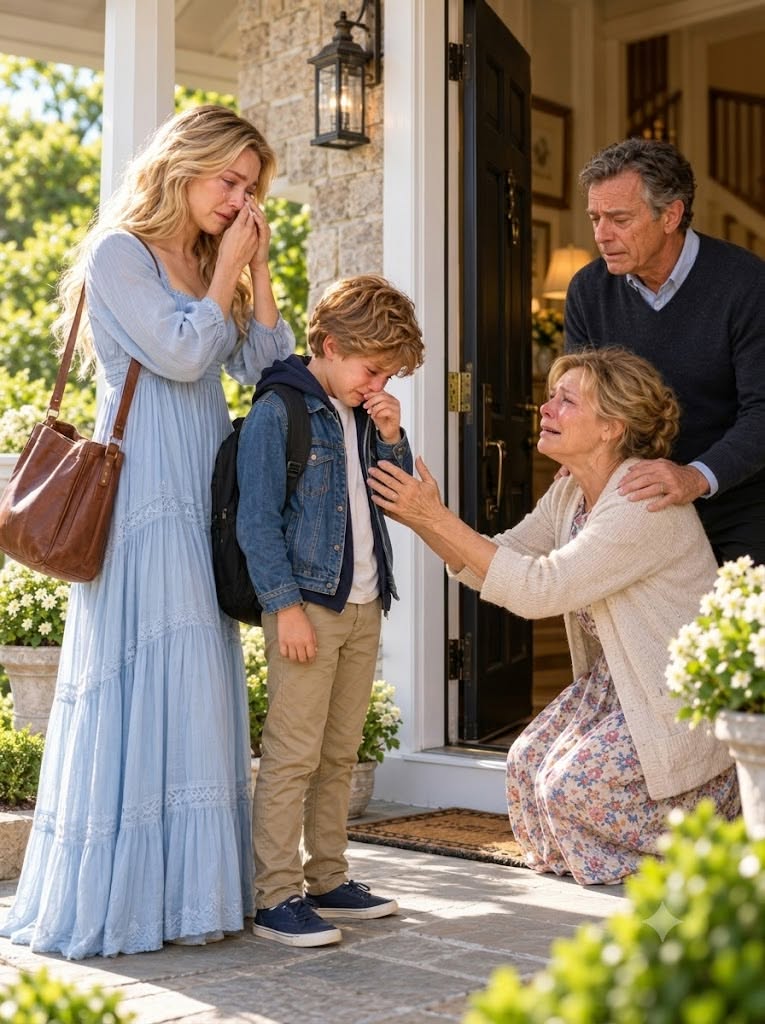
I knocked three times. Footsteps sounded somewhere inside, followed by a pause and the soft scrape of a lock. My mother opened the door. For a moment, she appeared not to recognize me. Her hair, once dark brown, had turned almost completely gray, and the skin around her eyes looked thinner. She wore a cardigan buttoned unevenly over a cotton blouse. Then she lifted one hand to her mouth. “Emma?” she whispered. I nodded. Her gaze moved across my face, lingering as though she were searching for the nineteen-year-old she’d last seen on this porch.
She took a step forward, then stopped. I could see that she wanted to embrace me. I could also see that she wasn’t certain she had the right. Before either of us spoke, Leo moved closer to my side. My mother looked down at him. Her expression changed, and she pressed her fingertips against the doorframe to steady herself. “This is Leo,” I said. “My son.” He held out his hand with the solemn seriousness he sometimes used when meeting adults. “Hello,” he said. “It’s nice to meet you.” My mother took his hand in both of hers.
She asked how old he was, although the answer was obvious enough. “Ten,” he said. She repeated the number quietly, as if it were something she needed to remember. Then she glanced toward the living room. “Robert,” she called. “Can you come here?” Her voice trembled. There was movement inside, followed by a man clearing his throat. My father appeared slowly, using one hand to steady himself against the hallway wall. He was thinner than I remembered, and his shoulders seemed smaller beneath his checked shirt. For the first time in my life, I saw him pause to catch his breath after walking across a room.
He looked at me without speaking. His expression was difficult to read. I had expected anger, perhaps disbelief. Instead, he seemed bewildered, as though he were trying to place a familiar face in the wrong part of his life. “Emma,” he finally said. My name sounded strange in his voice. I waited for him to ask where I’d been, or why I’d come, or what I wanted. He did none of those things. His eyes moved toward Leo, who stood beside me with his hands folded in front of him. My father stared at the boy for several seconds.
“Who is this?” he asked, although my mother had already heard the answer. “Your grandson,” I said. The word seemed to strike him physically. He gripped the edge of the door, and his breathing became uneven. Leo looked uncertain for the first time. He took half a step behind me, not because my father had done anything threatening, but because the silence was becoming uncomfortable. My father swallowed. “He looks…” He stopped, studied Leo again, and shook his head. I waited, wondering what resemblance he had noticed. Then he asked whether we had come alone.
The question made me uneasy. “Of course,” I answered. He glanced past us toward the street. My mother touched his arm, but he barely seemed to notice. “Robert,” she said softly, “they’ve come to see us.” He drew a breath and nodded without taking his eyes off the road. I noticed then how frequently his hands moved, opening and closing beside his legs. His left hand trembled when he reached for the railing. I wondered whether the illness I’d heard about had progressed further than anyone had told me.
My mother asked us to come inside, but I remained on the porch. There was something I needed to understand before I crossed that threshold. “I didn’t come to argue about what happened ten years ago,” I told them. My father looked up sharply. “Then why are you here?” I took the photograph from my bag. Its protective sleeve caught the light. “Because I found something that connects you to a man who disappeared before my son was born.” The change in my father’s expression was immediate. His eyes narrowed, and he stopped moving his hands.
I held out the photograph. At first, he examined the faces without speaking. Then he reached for it, and I noticed that his fingers were already shaking. My mother leaned closer. The picture showed five men standing inside the chemical plant, with Ethan near the center and Charles Voss beside him. My father was two places away, wearing the same work jacket I remembered hanging in our hallway. The fifth man’s face was partly obscured by harsh overhead lighting. My father touched the corner of the photograph and turned it slightly, trying to see the image more clearly.
“Where did you get this?” he asked. His voice had lost its ordinary firmness. “Ethan left it for me,” I answered. My mother inhaled sharply. My father lifted his eyes. “Ethan who?” I stared at him. I had expected denial, but something about his question seemed genuine. He searched my face, waiting. “Ethan Brooks,” I said. “The college student who investigated the plant. He disappeared ten years ago.” My father’s jaw tightened, and he looked back at the photograph. “Brooks,” he repeated. The name appeared to mean something to him, though he couldn’t explain what.
I pointed to Ethan’s face. “This is him.” My father leaned closer, narrowing his eyes. His breathing became shallow. My mother moved toward the hallway chair, as if she might need to sit down. I told them Ethan had been investigating contamination in the river and had obtained documents from someone inside the plant. I explained that he had disappeared after arranging to meet people who might help expose what was happening. My father listened without interrupting, but each detail seemed to make him more unsettled. When I mentioned internal reports, he closed his eyes.
“That can’t be right,” he murmured. “What can’t?” I asked. He opened his eyes and examined the photograph again. “I remember there being questions about the water,” he said. “I remember meetings. But I don’t remember this boy being part of them.” He tapped Ethan’s face with one trembling finger. “I should remember him.” I felt anger rise despite my effort to remain calm. “You worked there for more than thirty years. You’re standing beside him in a photograph. How can you not remember?” My father shook his head, and for once he had no reply.
Leo had been listening quietly. Now he looked at the photograph, then at me. “Mom, is that my dad?” My mother turned toward him. My father lowered the picture slightly. I’d planned to speak with Leo about Ethan when we were alone, in a place where he could ask every question without feeling watched. But he had recognized the face from an old photograph I’d shown him years earlier. I crouched beside him and nodded. “Yes,” I said. “That’s Ethan.” Leo studied the picture again. “He looks younger than you do now.” A small, painful smile escaped me.
“He was younger,” I replied. “He was twenty-one when I knew him.” Leo touched the plastic sleeve, careful not to cover the image. “Did he know I was going to be born?” I felt my throat tighten. “No, sweetheart. I found out after he disappeared.” He thought about that. Then he asked a question I had feared for years. “Would he have wanted me?” I held his face gently between my hands. “Very much,” I said. “He loved children, and he used to talk about having a family someday. If he’d known about you, he would have loved you.”
My father sat down on the porch chair. He looked ill. My mother reached for him, but he brushed her hand away and stared at Leo. “He has Ethan’s eyes,” he whispered. I turned toward him immediately. “You just said you didn’t remember Ethan.” My father looked confused. “I don’t,” he answered. “Not properly. But when I look at the boy, there’s something familiar. Something I should know.” He rubbed his forehead. “I can’t explain it.” His hand was trembling badly enough that the photograph rustled between his fingers.
I asked whether he’d been ill. My mother answered before he could. She said he had been seeing a doctor for headaches, breathing problems, and episodes of forgetfulness. Sometimes he woke during the night believing he had missed an important appointment. On other occasions, he would become upset because he couldn’t recall conversations from earlier in the day. The doctors had attributed much of it to age and his previous exposure to industrial chemicals. “Previous exposure?” I repeated. My father glanced at my mother, and I saw a brief disagreement pass between them without a word being spoken.
My mother insisted that we come inside. This time, I agreed. My father stood slowly and held the door open. It was a simple gesture, the kind people make without thinking, yet I couldn’t help remembering the same doorway ten years earlier. Then, he’d stood with his arms crossed while I carried my suitcase into the rain. Now he stepped aside and waited while Leo entered first. My son paused on the threshold, looked back at me, and offered his hand. I took it. Together, we crossed into the house where I had spent my childhood.
The living room had changed less than the people inside it. The brown sofa remained beneath the front window. A clock hung above the fireplace, and my mother’s collection of porcelain birds stood along the mantel. There were new family photographs on the wall, mostly relatives and neighbors whose children had grown up during my absence. I searched for my own face without meaning to. Nothing from my adulthood appeared there. Leo noticed it too. “Grandma,” he asked, “do you have any pictures of Mom?” My mother looked toward the hallway. “I do,” she answered. “They’re in my bedroom.”
“Why aren’t they out here?” he asked. There was no accusation in his voice, only curiosity. My mother glanced at my father, who was still holding the photograph of Ethan. “Because some memories were difficult,” she said. Leo considered her answer. “But Mom isn’t a bad memory.” My father closed his eyes. My mother pressed one hand against her mouth. I looked away, suddenly finding it hard to breathe. For ten years, I had learned to live without hearing my parents defend me. I hadn’t expected my son to do it so simply, or so completely.
My mother brought water and offered to make lunch. I told her we had eaten on the road. She seemed relieved to have something ordinary to discuss and began asking about our life. I answered carefully, describing my job and Leo’s school without mentioning the nights I’d spent worrying about rent or the birthdays I’d celebrated without family. When she asked whether I had finished college, I told her I had. She smiled, then began to cry. I didn’t know what to do with her tears. They couldn’t change what had happened, and I wasn’t ready to comfort her.
My father barely participated. He remained seated near the window, the photograph resting on his knees. Every few minutes, he turned it over and studied the handwriting. At last, he asked me to explain exactly when Ethan had disappeared. I gave him the approximate date and described the empty apartment. My father frowned. “There was an incident at the plant around that time,” he said. “I remember being told it was a minor chemical release.” My mother turned sharply toward him. “Robert, you never mentioned that.” He looked genuinely surprised. “I thought I did.”
He explained that several workers had become ill after an overnight shift. The company arranged examinations at its own clinic and told employees not to discuss the incident publicly until the safety review was complete. My father remembered headaches, nausea, and a sharp smell that seemed to linger in his clothes even after they were washed. He couldn’t remember how long he’d been away from work afterward. “They said I was exhausted,” he told me. “I had trouble sleeping. Sometimes I’d lose track of whole afternoons.” He paused, looking toward the photograph. “There are things from that period I can’t retrieve.”
I wanted to believe him, but his explanation frightened me as much as it relieved me. Memory loss could be real. It could also be convenient. He had been perfectly capable of remembering that I was pregnant when he ordered me out. He had remembered my refusal to follow his instructions, his concern about our reputation, and his determination to make me responsible for what he called my mistake. I asked him whether he remembered that night. He lowered his eyes. “Yes.” I waited. “Then don’t tell me illness explains everything,” I said. “You knew what you were doing to me.”
My father accepted the words without defending himself. He looked at Leo and then at my mother. “I remember being angry,” he admitted. “I remember thinking you were involved with someone dangerous. There was a feeling I couldn’t explain, as if something terrible would happen if you stayed.” He pressed the heel of his hand against his forehead. “But I don’t remember why I thought that.” I asked whether he’d known that Ethan was investigating the plant. He started to answer, stopped, and examined the picture again. His face tightened with an effort that appeared almost painful.
My mother sat beside him. “Don’t force yourself,” she said. He shook his head. “I’ve spent years not forcing myself. Maybe that’s the problem.” He asked for his glasses, then held the photograph closer to the light. I watched him examine the men one by one. He recognized Voss immediately. He knew another worker by name. But when he reached Ethan, he stopped. His breathing became uneven. “I know this room,” he whispered. “It’s near the old inspection office.” He swallowed. “There was a meeting. Someone wanted us to sign something. I remember an argument.”
“What kind of argument?” I asked. My father shut his eyes. His fingers tightened around the photograph, making the plastic sleeve crackle. “I don’t know,” he said. “There was a report. Someone said the numbers didn’t match. I remember telling them we couldn’t ignore it.” He opened his eyes and looked directly at me. “Emma, I think I was trying to help him.” My mother covered her mouth. I felt a sudden, painful uncertainty. For years, I’d believed my father and Ethan stood on opposite sides of everything that mattered. The photograph suggested they might once have shared the same danger.
I turned the picture over and showed him the handwritten message. He read the words carefully. Then he read them again. His fingers began trembling more violently, and he had to place the photograph on the table. “Your father tried to warn them,” he repeated quietly. He looked toward the hallway, then at the front door, as though he expected someone to enter. “I remember a warning,” he said. “I remember being afraid for somebody.” I leaned toward him. “For Ethan?” His lips parted, but no answer came. Then he looked at Leo with an expression I had never seen before.
My father whispered, “If Ethan trusted me, why can’t I remember what happened to him?” The question silenced the room. I had returned expecting to confront a man who had knowingly rejected me. Instead, I was sitting across from someone who seemed to be searching through the wreckage of his own memory. He reached for the photograph once more, but his hand shook so badly that my mother had to steady it. Then, without looking at either of us, he said something that changed the direction of our visit. “There may be something in this house that can help us find out.”
END PART 2
PART 3 TITLE: A Forgotten Key Led Us Toward Ethan’s Missing Evidence, While My Mother’s Confession Exposed the Price of Ten Years of Silence
My father rose from the sofa and walked toward the hallway, moving with the careful concentration of someone crossing unfamiliar ground. I followed him, carrying Ethan’s photograph. My mother remained beside Leo, but I noticed the way her eyes tracked my father’s movements. There was apprehension in her expression, something deeper than concern for his health. At the end of the hallway, he stopped before a narrow cupboard beneath the stairs. He opened it, pushed aside several folded blankets, and reached for a small wooden box hidden behind them. “I used to keep things here,” he said. “Things from the plant.”
The box was covered with dust. My father carried it to the dining table and placed it beneath the light. Inside were old employee identification cards, payroll statements, a retirement certificate, and a handful of photographs taken at company events. I recognized him in several pictures, standing beside machinery or smiling awkwardly at retirement dinners. Beneath the papers lay a small metal tin. He lifted it, hesitated, then opened the lid. A few coins rolled against the sides, revealing a brass key attached to a red plastic tag.
The key itself was unremarkable. Its teeth were worn, and the brass had darkened with age. But the tag carried a word written in my father’s familiar handwriting: EASTRIDGE. I knew the name immediately. Eastridge Storage stood near the old industrial district, behind a hardware store that had closed years earlier. Ethan had mentioned the place during one of our last conversations. At the time, I’d assumed he was talking about somewhere to store equipment. Now, with that key lying between us, I realized he’d probably been referring to something much more important.
My father turned the key over in his palm. “I don’t remember renting a storage unit,” he said. My mother leaned closer, studying the tag. She looked as surprised as I felt, although her expression carried something else I couldn’t identify. I asked whether he had kept any records from the facility. He searched through the box again, finding an old receipt with a faded address but no clear unit number. Then Leo pointed toward the back of the plastic tag. A tiny label had been attached beneath a layer of transparent tape. On it, in black ink, someone had written C-17.
“That’s probably the unit number,” Leo said. My father examined it, then sat down heavily. “Seventeen,” he murmured. “That number means something.” He closed his eyes and rubbed his forehead. For several moments, no one spoke. Then he described a narrow corridor, a metal door, and a wooden desk where someone had spread out stacks of documents. He couldn’t say whether the memory came from the storage facility or another place entirely. When I asked who had been with him, his expression tightened. “A younger man,” he said. “Brown hair. He kept asking me whether I was certain.”
I showed him Ethan’s photograph again. My father stared at it, and for a moment his face seemed to relax with recognition. Then the feeling vanished. “I can’t hold on to it,” he whispered. I watched the frustration gather in his eyes. Whatever had happened to him had left more than ordinary forgetfulness. He could describe a room, a sound, or a fragment of conversation, but the people and events connecting those memories seemed inaccessible. Yet the physical evidence was unmistakable. A storage key had been hidden in his home, and Ethan had known the same facility.
I asked what he remembered about the chemical release at the plant. He described arriving for an overnight shift and being sent to an area near the inspection office. There had been an unusual smell, sharp enough to make his eyes water. Several workers complained of headaches. Later, alarms sounded, and a supervisor ordered everyone toward the medical station. “They kept us there longer than necessary,” he said. “I remember someone asking whether I’d spoken to a student.” He paused. “I told them I wanted to go home. After that, there are gaps.”
My mother looked alarmed. “Robert, you never told me any of this.” He turned toward her. “I didn’t remember enough to tell you.” She lowered her eyes. I asked whether he had ever requested medical records from the company clinic. He said the physicians assured him nothing serious had happened and that his symptoms would improve with rest. Over time, the headaches became less frequent, but the confusion remained. He’d learned to compensate by writing appointments on calendars and keeping lists. “I thought I was getting old,” he admitted. “That’s what the doctor said.”
I looked at the man sitting across from me, noticing details I had overlooked when I first arrived. A small notebook protruded from his shirt pocket. There were adhesive labels on the drawers in the dining room, each identifying its contents. Near the telephone lay a calendar covered with reminders. I had spent ten years imagining my father living comfortably without us, his life continuing much as it always had. Now I could see that the years had diminished him in ways I hadn’t expected. The realization stirred sympathy, followed immediately by resentment that he had never tried to repair what he’d done.
Leo climbed onto the chair beside him. “Grandpa, can I ask you something?” My father looked up. “Of course.” My son considered his words carefully. “If you forgot my dad, does that mean you forgot other important things too?” My father nodded. Leo looked at the red tag resting on the table. “Then maybe you kept the key because you knew you’d need it, even if you forgot why.” My father’s expression changed. He studied Leo for several seconds, then placed the key beside the photograph. “That’s a very good possibility,” he said.
I remembered something Ethan had told me about keeping records. He believed important evidence should exist in more than one place, with each copy protected differently. Once, while helping him organize photographs, I’d teased him about behaving like a detective in an old movie. He’d answered that people were remarkably good at destroying things they didn’t want others to see. At the time, I’d thought he was being excessively cautious. Now I wondered whether the flash drive he’d entrusted to me had been only one part of a larger archive.
I asked my father whether he remembered Ethan discussing the river. He leaned back, eyes closed, and tried to reconstruct their conversations. Eventually, he recalled someone showing him a report with several columns highlighted in yellow. The measurements were higher than the figures listed in the official safety summaries. “I remember thinking it had to be a mistake,” he said. “Then the young man asked me how many mistakes the same company could make before they stopped being accidents.” His eyes opened suddenly. “That sounds like something Ethan would have said, doesn’t it?”
I nodded. Ethan had often asked questions that made people uncomfortable. He disliked arguments about motives when the evidence was still incomplete, but he refused to accept explanations that contradicted the facts. My father seemed to remember that quality more clearly than Ethan’s face. He spoke of a meeting where someone demanded to see original laboratory reports, and of another conversation in which an employee warned that the river had been contaminated for years. He couldn’t connect the events into a reliable sequence. Still, each fragment suggested that Ethan had found an ally inside the plant.
My mother moved toward the kitchen, saying she needed to put on more water for tea. I watched her leave. There was something strange about her response to the discussion. She had asked few questions about the storage key and hadn’t seemed especially surprised that Ethan and my father might have worked together. Earlier, she’d spoken about being afraid after I left, but she hadn’t explained what frightened her. I followed her into the kitchen and found her standing beside the sink, staring at the garden through the window. She looked exhausted.
“Mom,” I said quietly, “is there something you’re not telling us?” She turned, startled. “I’ve told you everything I know.” I waited. She reached for the kettle, then set it down without filling it. “This has been a difficult day,” she said. “Your father isn’t well. We should let him rest.” I told her that I hadn’t come to make him suffer. I had come because someone I’d loved had disappeared, leaving behind evidence that suggested a serious crime. “If there’s anything you remember,” I said, “I need you to tell me, even if it’s unpleasant.”
She pressed her palms against the kitchen counter. For a moment, I thought she might begin speaking. Instead, she asked whether Leo liked chocolate cake. The question was so unexpected that I almost laughed. I told her he did, but that baking a cake wouldn’t make the conversation disappear. Her shoulders sagged. “You were always determined,” she said. “Even when you were little.” I remembered her telling me that stubbornness was sometimes a virtue, especially when I refused to give up on schoolwork. The memory made her evasion more painful. I didn’t want nostalgia. I wanted the truth.
We returned to the dining room, where my father had spread the remaining documents across the table. He was examining an old medical appointment card. The physician’s name, Daniel Whitcomb, appeared beneath the clinic address. I remembered him vaguely as the doctor who treated many plant employees. My father said Whitcomb had supervised his examinations after the chemical release and continued to manage his respiratory problems. He spoke of the doctor with an almost automatic trust. Something about that made me uneasy, although I had no evidence that Whitcomb had done anything wrong.
While my father searched through the box, Leo picked up Ethan’s photograph. He studied the five men, comparing their faces with the names written on the back. Then he asked why one man was standing partly in shadow. My mother leaned forward to look. Her expression changed so abruptly that I noticed it before she spoke. She reached for the picture, but Leo was already holding it toward me. “That one,” he said. “Do you know him?” The fifth man’s face was partly obscured beneath the industrial lighting. I had barely noticed him before.
My mother made a small sound and sat down. My father looked at her. “Margaret?” She didn’t answer immediately. She was staring at the photograph with an expression I recognized from my childhood, the expression she wore when something had gone badly wrong and she was trying to decide whether speaking would make it worse. I asked again whether she knew the man. Her lips moved before any sound emerged. “He came here,” she whispered. “Years ago.” My father leaned forward. “Who came here?” She looked at me. “After you left, Emma.”
I felt the room become strangely still. My mother explained that a man had appeared at the house a few weeks after my departure. He wore an expensive coat and introduced himself as someone connected with the chemical plant. She couldn’t remember the name he’d given, but she recognized his face in the photograph. He asked whether they’d heard from me and whether they knew where I was staying. When my mother said they didn’t, he advised her to keep it that way. He told her that I had become involved in matters that could damage the family.
“Why didn’t you call me?” I asked. My mother shook her head. “I didn’t know where you were.” I reminded her that she could have contacted my college, friends, or the employer she’d known about before I left. She had already admitted making some attempts to find me. “You could have kept trying,” I said. She looked at the floor. “He said there would be consequences.” My father stared at her. “What consequences?” She swallowed. “He said we could lose the house. That your medical treatment might become complicated. That people who interfered usually regretted it.”
My father’s face darkened. “And you believed him?” My mother looked toward him with sudden anger. “You were sick, Robert. You were forgetting things. The bills were arriving faster than I could pay them. I didn’t know what was happening.” She stopped and pressed her fingers against her eyes. I asked whether the man had returned. She nodded. He had appeared several times, sometimes leaving envelopes and sometimes asking whether she’d received any information about me. After a while, the mortgage difficulties eased. Several medical balances were cleared without explanation.
I stared at her. “You accepted money from the people who were threatening you?” She recoiled at the word accepted. “I didn’t ask for it,” she said. “Payments appeared on our accounts. Sometimes there was a note saying the company had approved additional assistance.” I asked whether she’d ever wondered why a chemical plant would pay her family’s expenses in exchange for avoiding contact with its former employee’s daughter. She began to cry. “Of course I wondered. I was afraid of the answer.” The admission hurt more than any excuse she could have offered.
My father stood so quickly that his chair scraped against the floor. “You should have told me.” My mother turned toward him. “You barely remembered where you were half the time. Every time I tried to talk about the plant, you became upset. I thought I was keeping the family safe.” He looked at the photograph again, then at me. “Safe,” he repeated. I could hear the bitterness in the word. My mother began explaining the overdue bills, the collection notices, and the treatments she feared he would lose. None of it changed the fact that someone had bought her silence.
I thought about the years I’d spent struggling to raise Leo, the nights I couldn’t afford proper heating and the mornings I went to work with a fever because missing a shift meant falling behind on rent. My mother had known someone was watching for news of me. She had suspected that my disappearance from the family wasn’t simply a private disagreement. Yet she hadn’t warned me. “You could have written a letter,” I said. “You could have sent it through someone you trusted. You could have told me to be careful.” She nodded, tears running down her face.
“I know,” she answered. Nothing in her voice suggested she expected forgiveness. She explained that she’d begun telling herself I was safer away from town, that my silence meant I didn’t want to be found, and that contacting me might expose us all to danger. Over time, those explanations became habits. Birthdays passed, then Christmases, then years. She watched other people’s children grow up and imagined me living somewhere far away, perhaps happily enough not to miss home. I listened without interrupting. I could see how fear had become her justification, but I could not pretend it made her choices harmless.
My father returned to his chair. He looked smaller than he had an hour earlier. “When you told me you were pregnant,” he said slowly, “I remember feeling frightened in a way that made no sense. I thought you were connected to someone dangerous. Maybe I had already heard the threats. Maybe I knew something about Ethan and couldn’t remember it.” He paused. “But even if all that is true, I still chose to send you away.” His eyes filled. “You were my daughter. I should have protected you.” I had waited ten years to hear him acknowledge that. I wasn’t prepared for how little relief it brought.
Leo watched us from the end of the table. He had remained quiet through much of the conversation, but now he placed his hand over the storage key. “Maybe we should find out what’s in there,” he said. All three adults turned toward him. “If my dad left things for us, maybe he wanted somebody to understand.” He spoke without the bitterness I felt. To him, the problem was not how much we had failed one another but what we could still do. His certainty made me want to protect him from the disappointment that might follow.
My father nodded slowly. “We’ll go to Eastridge.” My mother immediately protested. She said it was getting late and he should avoid driving when he was tired. He told her that waiting wouldn’t make the evidence safer. I agreed. Someone had already spent years influencing our family, and there was no reason to believe those people had stopped caring about Ethan’s records. My father examined the key again and found a telephone number printed on the back of the tag. The digits were faded, but the facility’s name was still legible. He said he knew how to get there.
I took the photograph from Leo and returned it to the protective sleeve. My mother remained seated, looking toward the window. I asked whether the man who had threatened her had ever said why Ethan’s investigation mattered so much. She shook her head. Then she hesitated. “He asked about a child,” she said. The words made me turn back. “What child?” She looked at Leo. “He wanted to know whether your pregnancy had continued. I told him I didn’t know.” I felt a hard knot forming in my stomach. “And what did he say?” My mother closed her eyes. “He told me it was better that way.”
I wanted to ask more, but a sound from outside interrupted us. A car door closed on the street, followed by the low hum of an engine. My father rose and approached the front window. I followed, keeping Leo behind me. A black sedan had stopped across from the house. Its windows were heavily tinted, and the driver remained inside. The vehicle hadn’t been there when we arrived. Rain was beginning again, and its headlights reflected against the wet pavement. My father stood very still. Then he whispered, “I’ve seen that car before.”
He told us it had been parked near Dr. Whitcomb’s office two weeks earlier. He’d noticed it again outside the pharmacy and had dismissed the coincidence as another sign that his memory was failing. Now he watched the sedan with growing alarm. My mother came to the window and gripped his arm. For several seconds, the driver did nothing. Then the headlights flashed once, and the vehicle pulled away. I looked at my father. His face had gone pale, but his voice was firm when he spoke. “Get your coats. We’re going to that storage unit tonight.”
I turned toward Leo. He was watching me, waiting for reassurance. I wanted to tell him we were safe, but the photograph, the payments, the missing memories, and the car outside made such a promise impossible. Instead, I crouched and explained that we needed to collect something important, and that afterward we would contact someone who could help. He nodded. My mother asked whether I really intended to take him. I looked at her for a long moment. “I’m not leaving him behind with people I don’t trust,” I said.
My father picked up the red-tagged key and slipped it into his coat pocket. My mother gathered her medication and a handbag, insisting that she wouldn’t stay alone in the house. Outside, rain struck the porch roof with increasing force. I looked once more at the empty street where the sedan had been parked. Ten years earlier, I’d left this house because my parents wanted me to erase the life growing inside me. Now I was leaving with that child beside me, determined to uncover why powerful people had been so frightened of his father’s evidence.
We stepped into the rain together. My father locked the front door and turned toward his old pickup truck. Before climbing inside, he looked at me with an expression I couldn’t fully interpret. “Emma,” he said, “if we find what I think we might find, there may be things about me you won’t want to know.” I held his gaze. “Then you’ll have to tell me anyway.” He nodded once. The truck’s engine started, and as we pulled away, I noticed the black sedan reappear at the far end of the street. This time, it turned in behind us.
END PART 3
PART 4 TITLE: Beneath the Storm, We Opened Ethan’s Hidden Archive and Found the Evidence That Could Destroy the Man Who Had Silenced Him
The black sedan followed us through three intersections before my father spoke. “Don’t look back again,” he told me. I was sitting beside him in the pickup, with Leo and my mother in the rear seat. Rain swept across the windshield, forcing the wipers to work at their highest speed. I had already checked the side mirror twice. The same headlights remained behind us, maintaining a careful distance. My father turned onto a narrow road near the old railway crossing, then slowed as we approached the bridge. “There’s another way to Eastridge,” he said. “I used to take it after night shifts.”
He made a sudden left turn onto a poorly lit service road. The pickup jolted over uneven pavement, and my mother caught Leo by the shoulder to keep him from sliding across the seat. In the mirror, I saw the sedan continue toward the bridge before disappearing behind a row of warehouses. My father didn’t celebrate. He drove for several more minutes, taking two additional turns before returning to the main road. “We can’t assume they’ve stopped following us,” he said. I watched the empty intersection behind us and understood that he was thinking more clearly now than he had at any point since our arrival.
Leo leaned forward between the seats. “Are those people looking for us because of my dad?” I turned toward him, searching for an answer that was truthful without frightening him further. “We think someone wants to keep his investigation secret,” I said. “But we don’t know exactly who was in that car.” He considered this. “Then we should show the evidence to somebody important.” My father glanced at him in the rearview mirror. “That’s what Ethan was trying to do,” he replied. “And what I should have kept doing.” Leo settled back against the seat, holding his mother’s old wool blanket across his knees.
The town passed slowly outside the windows. We drove by the diner where I once studied after school, the grocery store where my mother had bought birthday cakes, and the church whose bells I’d heard every Sunday morning. I recognized everything, yet the streets seemed unfamiliar in the rain. Places that had once meant safety now reminded me how easily people could conceal what happened behind closed doors. My father drove with both hands on the wheel, concentrating on the road. Every few minutes, he glanced at the storage key lying in the tray beside the gearshift.
Eastridge Storage appeared behind a shuttered hardware store near the industrial district. A chain-link fence surrounded the property, and a keypad stood beside the entrance gate. The office was dark. No cars were parked nearby. My father stopped the truck and lowered his window, letting cold rain blow across his sleeve. He entered a number, then waited. The keypad flashed red. He tried another combination with the same result. “I don’t remember the code,” he muttered. He studied the red tag, turning it between his fingers. My mother suggested returning in the morning when an employee could help us.
Before my father could answer, Leo leaned forward. “Try March eighteenth.” I turned toward him. “Why that date?” He looked embarrassed. “It’s Ethan’s birthday. You told me when we were making that calendar for school.” I remembered the evening clearly. Leo had been listing family birthdays, and when he asked about his father, I’d told him the date. March 18. It had been one of the few ordinary facts I could give him about Ethan. My father entered 0318. The keypad flashed green, and the gate began to open. For several moments, none of us spoke.
My father drove slowly between rows of storage units, counting the numbers posted above the doors. Some units were painted blue, others gray, their metal surfaces streaked with rust. Rainwater collected in shallow channels along the pavement. At the far end of the property, we found unit C-17. My father parked beside it and turned off the engine. The sudden quiet made the rain sound louder. My mother looked toward the gate, which had closed behind us. “Are you sure we should be here?” she asked. I couldn’t answer with certainty. All I knew was that the key had led us to this place.
I told Leo to remain inside the truck while we checked the unit. He shook his head immediately. “I want to see what’s there.” I explained that the building might contain old equipment or unsafe materials. He listened, then looked toward my father. “If Ethan left something, it belongs to my story too.” My father lowered his eyes. My mother reached across the seat and took Leo’s hand. “We’ll stay together,” she said. I hesitated before agreeing. I didn’t want my son frightened by whatever we discovered, but I also knew he had spent his life living with the consequences of secrets adults had kept from him.
We stepped into the rain. My father used his flashlight to illuminate the lock, then inserted the brass key. It turned without resistance. He pulled the metal door upward, and the rollers groaned loudly enough to echo between the buildings. Inside, the air smelled of paper, dust, and damp concrete. Three filing cabinets stood against the back wall. Two large plastic containers occupied one corner, and a wooden desk rested beneath a narrow shelf. Nothing suggested the unit had been opened recently. Dust coated the furniture, and a spiderweb stretched from the desk lamp to the wall.
My father stood motionless at the entrance. I watched his face as he examined the room. He looked toward the desk, then at the cabinets. “I’ve been here,” he whispered. He took a few steps inside and rested his palm against the wooden surface. His breathing quickened. “I remember bringing something in a box. There was a man with me.” He looked at the empty chair beside the desk. “He sat there while I checked the documents.” I moved closer. “Was it Ethan?” My father nodded slowly. “I think so. I remember him telling me we needed to keep copies somewhere safe.”
An envelope lay on the desk, protected beneath a thin sheet of plastic. My name was written across the front in handwriting I recognized immediately. I picked it up with both hands. The paper had yellowed around the edges, but the ink remained dark. I hadn’t seen Ethan’s handwriting in years except on the photograph and the few letters I kept at home. Seeing my name written by him in that abandoned room made his absence suddenly unbearable. I opened the envelope carefully, aware of my father watching me from the other side of the desk.
The letter began with an apology. Ethan explained that if I had found it, circumstances had prevented him from returning. He acknowledged that his secrecy had hurt me and that he’d made decisions without giving me the chance to understand them. He wrote about the evidence, the people exposed to contaminated water, and the growing danger surrounding the investigation. But the part that made me stop reading was his account of my father’s involvement. Ethan described Robert Hale as one of the few employees who had been willing to provide records despite the risk to his livelihood.
I read that section aloud. Ethan explained that my father had originally been suspicious of him. He thought a college student couldn’t possibly understand the pressures facing workers who depended on the plant. Then Ethan showed him the laboratory measurements and reports of illness among families living downstream. My father began checking internal records and discovered that several official summaries had been altered. He supplied Ethan with copies and warned him about senior management. Ethan believed Robert was taking enormous personal risks to protect people who might never know his name.
My father lowered himself into the chair. He covered his face with both hands, his shoulders moving as he struggled to breathe evenly. For years, I had believed he was either indifferent to Ethan’s disappearance or somehow connected to the people who had silenced him. Now Ethan’s letter described him as an ally. I looked at the old man sitting before me and tried to reconcile these two versions of my father. One had helped expose dangerous wrongdoing. The other had thrown his pregnant daughter into the night. Neither truth cancelled the other.
Ethan’s letter contained another warning. He believed that something had happened to my father after their final meeting, and that if Robert ever turned against me without a clear explanation, I should investigate the circumstances before deciding he had betrayed us. Ethan told me to trust the records and remember a sentence he’d once spoken to me. The words unsettled me because I’d nearly forgotten that conversation. We had been sitting beside the river, discussing what we would teach our children if we ever had them. Ethan had invented a phrase he said was worth remembering: “The river remembers what people bury.”
I repeated the sentence quietly. Leo looked up. “You told me that before,” he said. I stared at him. “When?” He explained that I’d said it years earlier during a walk beside a stream near our apartment. I’d told him his father believed the truth didn’t disappear simply because people tried to hide it. I remembered the outing then, although I hadn’t realized how closely Leo had listened. My son had carried those words without knowing where they came from. Now, standing in the storage unit, he repeated them with the same careful emphasis Ethan once used.
My father opened the first filing cabinet. Inside were rows of hanging folders labeled with dates and department names. He pulled one free and spread its contents across the desk. There were shipping manifests, internal laboratory reports, inspection schedules, and copies of letters sent by residents who complained of unusual illnesses. Several documents carried handwritten corrections that had never appeared in the official versions. I recognized the layout from the incomplete files on Ethan’s flash drive. These were the missing originals, the records that could establish when the company had discovered the contamination and what it had done afterward.
My mother opened one of the plastic containers. Inside were cassette tapes arranged in numbered sleeves, along with notebooks and several small envelopes. Some tapes bore dates from the months before Ethan disappeared. Others were labeled with initials. My father examined one and remembered using a portable recorder during meetings. He said Ethan had worried that digital records could be altered or erased remotely. The tapes offered another kind of evidence. They could preserve conversations in the voices of the people who had participated. I watched my father handle them carefully, as though his fingers remembered their importance before his mind did.
Leo stood beside the desk, examining a drawer that hadn’t been fully closed. He pointed to something inside. I pulled it open and found a small silver voice recorder resting above a sealed legal envelope. The envelope was addressed to Attorney Samuel Price, with instructions that it be delivered if Ethan Brooks died or disappeared. I recognized the name. Samuel Price had been a respected local attorney who frequently represented families challenging large employers. He had died six years earlier, but his daughter Nora had taken over the practice. My mother remembered seeing Nora interviewed about a workplace safety case several months earlier.
My father placed the envelope beside Ethan’s letter. “We need someone who understands what these records mean,” he said. I agreed. The evidence might be enough to reopen an investigation, but we had no way to establish how many people remained involved. I wanted the originals protected before anyone knew what we’d found. My mother suggested copying the files and returning the next morning. My father shook his head. “If somebody followed us here, waiting is the worst thing we can do.” He reached into his coat pocket for his phone, intending to find Nora Price’s number.
A noise outside stopped him. At first, I thought it was rain striking the metal doors. Then I heard footsteps on the gravel, followed by the sound of a vehicle shutting down. My father extinguished the flashlight. The storage unit fell into darkness except for the dim light from the entrance. I moved toward Leo and put my hand against his shoulder. My mother stood beside the filing cabinet, holding one of the tape boxes. No one spoke. The footsteps approached slowly, without hesitation, as though the person outside knew exactly where we were.
A man’s voice came from the darkness beyond the doorway. “Robert Hale.” My father stiffened. The voice was older than I remembered, but I recognized its controlled, almost courteous tone from public meetings and company events years earlier. Charles Voss had been the plant director for much of my childhood. He appeared in newspaper photographs beside mayors and school principals, presenting donations and congratulating employees. I had never spoken with him directly, but I’d heard him address crowds often enough to remember his voice. Now he was standing outside the unit where Ethan’s evidence had been hidden.
My father stepped toward the entrance. “You shouldn’t be here, Charles.” The reply came without anger. “Neither should you.” Voss moved into the light, holding a black umbrella. His hair had turned silver, and the lines around his mouth were deeper, but his expression remained composed. He examined the open filing cabinet, the documents on the desk, and the envelope in my hand. His gaze settled on Leo. For the first time, his calm expression changed. He looked at the boy with a mixture of recognition and disbelief.
“Ethan Brooks,” Voss murmured. I pulled Leo closer. “His name is Leo,” I said. Voss looked at me. “Emma Hale. You’ve made this more complicated than it needed to be.” I asked whether he’d been responsible for the car outside my parents’ house. He didn’t answer. Instead, he looked toward my father. “You were supposed to forget about all this.” My father gripped the edge of the desk. “What happened to me?” Voss sighed, as though the question were tiresome. “You were exposed during an unfortunate incident. The company provided treatment. We did everything we could.”
My father stepped forward. “You knew the river was contaminated.” Voss’s eyes narrowed. “You don’t understand the financial decisions involved in running a facility that supports an entire town.” I looked at the records spread across the desk. “People became sick,” I said. “Families were exposed to dangerous chemicals, and the reports were altered.” Voss glanced toward the filing cabinet. “Those documents are company property.” I felt a surge of anger. “Then explain why Ethan was afraid enough to hide them.” For the first time, Voss stopped speaking.
My father demanded to know what had happened to Ethan. Voss looked at him with an expression that carried unmistakable contempt. “You and that young man made several unfortunate decisions,” he replied. “He believed he could force a public investigation. You believed helping him would make you a hero.” My father shook his head. “I wanted the dumping stopped.” Voss gave a small, dismissive shrug. “And yet here we are, ten years later, with the same families still depending on the facility you wanted to destroy.” He looked toward Leo again. “Some consequences were never supposed to reach another generation.”
“Don’t talk about my son,” I said. Voss ignored me. He asked whether Ethan had left any recordings and whether we had opened the desk drawer. His questions told me he knew more about the archive than he wanted to admit. My father moved between him and the desk. “Whatever happened here is going to be investigated,” he said. Voss smiled faintly. “By whom? The same people who accepted our safety reports for decades?” He stepped closer. “Robert, you were offered a comfortable retirement. Your family received assistance. Everyone could have moved on.”
My mother made a sound behind me. Voss turned toward her, recognition flickering across his face. “Margaret. I trust you’ve been well.” She looked as though she might collapse. I remembered her confession about the man who’d visited after I left home. “It was you,” I said. Voss studied me for a moment before answering. “I had a responsibility to protect the company from further complications.” My mother began shaking. My father looked at Voss with open disgust. “You threatened my wife while I was sick.” Voss’s expression hardened. “I explained the risks of involving yourselves in matters beyond your understanding.”
Leo moved beside me before I could stop him. He looked directly at Voss and repeated Ethan’s sentence about the river remembering what people buried. The words seemed to affect the older man more than any accusation we’d made. Voss stared at my son, then at the envelope in my hand. “Who taught you that?” he asked. Leo answered without hesitation. “My dad did, through my mom.” Voss’s face tightened. My father reached for Leo and drew him gently away from the doorway. I could see that Voss was no longer certain how much evidence we possessed.
Headlights suddenly appeared at the far end of the storage lane. A vehicle approached, its tires sending water across the pavement. Voss turned sharply toward the sound. A woman in a blue raincoat climbed out, holding a phone and a leather document case. She walked toward us with determined steps. “Charles Voss,” she called, “I’d advise you not to say anything else.” He stared at her. “Who are you?” She stopped beneath the light above the storage unit. “Nora Price. My father represented several families whose complaints your company tried to bury.”
I watched Nora approach, confused by her arrival. She explained that an old case-management system had sent an alert to her office shortly after the storage facility gate was accessed. Her father had maintained the account on Ethan’s instructions, with a scheduled notification arrangement connected to the protected evidence. Years earlier, Ethan and my father had prepared a plan to ensure the archive would be discovered if anyone returned for it. Nora had found the instructions among her father’s retained case files and kept the alert active. When it arrived that evening, she contacted the authorities and drove directly to Eastridge.
Voss looked toward the gate. “This is private property,” he said. Nora held up her phone. “I’ve already spoken to the county sheriff’s office. And I’ve been recording this conversation since I arrived.” She explained that the sealed envelope identified Samuel Price as the intended recipient of the records and described the circumstances under which they should be released. My father stared at her. “I helped arrange that?” Nora nodded. “According to my father’s notes, you did. You and Ethan spent several weeks preparing copies of the evidence.” My father looked down at his hands, visibly struggling to absorb the information.
The sound of sirens reached us through the rain. Voss took several steps backward, then turned toward the far end of the storage lane. He didn’t get far. Two patrol vehicles entered through the gate, followed by another car carrying investigators. Officers approached and separated him from the rest of us. Nora explained that the investigation would have to establish the authenticity of the records and the extent of the wrongdoing, but that she had already arranged for the evidence to be secured. Voss protested, demanding to speak with his attorney. No one offered him the easy reassurance he seemed accustomed to receiving.
As the officers led him toward a patrol car, Voss turned his head and looked at Leo one last time. My father moved instinctively closer to the boy. I watched the man who had influenced our family for a decade disappear into the rain, surrounded by people who would finally ask questions he couldn’t simply dismiss. Behind us, the filing cabinets remained open. Ethan’s handwriting lay across the desk, and the old tapes waited to be examined. I knew the arrest would not be the end of the matter. There were still people to identify, records to investigate, and ten years of loss that no court could restore.
My father reached for my hand. I looked at his trembling fingers, remembering the night he’d forced me out and the years I’d spent believing he had never cared enough to search for me. I also remembered Ethan’s letter, the hidden key, and the evidence my father had helped preserve before his memory began to fail. I didn’t know whether I could forgive him. I wasn’t certain I wanted to try yet. But when his hand closed around mine, I didn’t pull away. Across the unit, Leo stood beside my mother, watching us with quiet hope.
Nora approached and explained that the documents would be catalogued, copied, and examined by independent specialists. She asked whether we were willing to give formal statements. My father answered first. “Yes,” he said. “Whatever you need.” I looked at him, then at the letter Ethan had addressed to me. For ten years, I’d protected my son by keeping him away from the town where his father’s life had ended. Now I understood that protecting him also meant refusing to let those responsible escape accountability. I told Nora we would cooperate fully.
Before leaving, I folded Ethan’s letter and placed it carefully inside its envelope. The rain had begun to ease, and the sky beyond the storage buildings was turning a lighter shade of gray. Leo came to stand beside me. He asked whether the evidence meant people would finally know what his father had tried to do. I nodded. “I think they will.” He looked at my father, then at the cabinets. “And they’ll know Grandpa helped him?” I glanced at Robert. His eyes filled, and he turned away. “Yes,” I answered. “They’ll know that too.”
Nora closed the document case and approached us with one final question. She wanted to know whether my father had ever been examined by a doctor unaffiliated with the chemical plant. He shook his head. She glanced toward the papers that had been removed from the filing cabinet. Several included medical reports, but the signatures and dates would need closer examination. “There’s something here we need to investigate separately,” she said. “The company wasn’t only hiding what happened to the river. These records suggest it may also have concealed what happened to its own workers.”
My father looked at her without speaking. Then he touched the side of his head, the same gesture I’d watched him make whenever a memory slipped beyond his reach. I understood that discovering his role in Ethan’s investigation hadn’t answered the most frightening question. We still didn’t know exactly what had happened during the chemical release, why his condition had been dismissed for so long, or how much the company had paid to keep employees silent. Nora gathered the first box of documents and carried it toward the waiting investigators. As she passed me, she said quietly, “Emma, the evidence in this unit may change far more than your family’s understanding of the past.”
I looked toward the pickup, where my mother was helping Leo into the back seat. My father stood beside the open storage door, watching officers carry away the files he’d once hidden with Ethan. The storm was nearly over, but the consequences of what we’d discovered were only beginning. For the first time, we had something stronger than suspicion: documents, recordings, witnesses, and a path toward accountability. I slipped Ethan’s letter into my bag and walked toward my son, knowing our next decision would determine whether the truth finally reached the families who had suffered alongside ours.
END PART 4
PART 5 TITLE: After the Police Took the Plant Director Away, My Father Faced a Courtroom Question That Could Destroy His Last Chance With Me
The police had barely driven Charles Voss away when my father began shaking so badly that he could no longer hold the papers we had found inside the storage unit. Rainwater ran from his jacket onto the concrete floor. He was staring at the hand I had allowed him to take moments earlier, as though he feared that moving even slightly would make me pull away. Ten years ago, Robert Hale had ordered me out of his house because I refused to end my pregnancy. Now he stood beside the grandson he had never known, surrounded by proof that the young man I loved had trusted him with his life.
Nora Price instructed the officers to secure everything before anyone touched another file. Her blue raincoat was soaked through, and her phone kept vibrating with calls from investigators already responding to the recording she had made. She spoke calmly, listing the cabinets, the cassette tapes, Ethan’s letter, and the small silver recorder. Nothing could be misplaced. Nothing could disappear into a department where Voss might still have friends. When one officer suggested taking the evidence directly to the local station, Nora insisted that federal authorities supervise the transfer.
Leo stood beside my mother, Margaret, watching the adults move around us. He had been brave when Voss confronted us, brave enough to repeat the strange sentence his father had once taught me. But now that the immediate danger had passed, he looked like an ordinary frightened ten-year-old. He came to my side and slipped his cold fingers between mine. “Mom, is Grandpa going to be arrested too?” he asked. My father heard him. His expression changed, and I realized that he had been wondering the same thing.
“No,” Nora answered before I could. “Your grandfather helped preserve evidence that powerful people wanted destroyed. The investigators will need to speak with him, but that doesn’t make him the criminal.” She glanced toward Robert. “We still have questions about what happened to his memory.” Dad looked down at his shoes. He had spent years believing he was a coward who had betrayed a young man. Now he knew he had tried to save Ethan. Yet the knowledge seemed to trouble him almost as much as his guilt had.
We returned to my parents’ house shortly before dawn. The kitchen smelled of stale coffee and the lemon cleaner my mother had always used. I remembered sitting at that same table at nineteen, trying to explain that the baby growing inside me was not a mistake I could erase. My father had stood beside the refrigerator, his arms folded, refusing to hear another word. Tonight, he pulled out a chair for Leo, filled a glass with water, and asked whether he wanted something to eat. My son requested toast with strawberry jam.
I watched Robert search the cupboard for the jam, and an unexpected bitterness rose in me. It was such a small gesture, the kind of thing a grandfather should have been doing for years. Leo had already learned to ride a bicycle, read chapter books, tie his shoes, and make pancakes with too much cinnamon. He had survived fevers, schoolyard arguments, and the terror of losing his first tooth. My parents had missed all of it. A plate of toast could not give those years back.
By the following evening, Nora had arranged for us to remain available to investigators while independent specialists examined the records. There were signs that the chemical factory had concealed contamination for years, falsified safety inspections, and paid people to discourage complaints. The investigation had grown larger than the disappearance of Ethan Brooks. Families who had lived near the river, workers who had suffered unexplained illnesses, and people who had trusted the company’s assurances might finally receive answers. Nora warned us that exposing the truth would be a long, difficult process.
That night, I slept in my childhood bedroom for the first time since I was nineteen. My old desk stood beneath the window, one drawer still sticking halfway open. The pale rectangles left by photographs on the wallpaper were visible above the bed. Leo slept on a mattress beside me, curled under a borrowed blanket. I lay awake listening to the familiar ticking of the hallway clock. I had once imagined returning to this room in triumph, certain that success would make my parents regret what they had done. Instead, I felt exhausted.
A soft knock came after midnight. Margaret stood in the doorway holding a framed picture of me in a yellow dress, taken before my senior prom. Her hair had gone almost entirely gray since I last saw her. “I found this when I was changing the sheets,” she said. I knew she was lying about finding it. The frame was clean, and the photograph had not faded. She had kept it somewhere safe. I waited for her to explain why.
“I used to take it out on your birthday,” she admitted. “Sometimes at Christmas too.” She sat carefully on the edge of the bed, leaving enough space between us that I could have asked her to leave without moving. “Your father wouldn’t let me put it in the living room. He said looking backward wouldn’t help anybody.” She traced the edge of the frame with her thumb. “I told myself he was right because challenging him meant admitting I had let you walk away without trying to stop you.”
I studied her face. “You could have called. You knew my number for the first few months.” Margaret nodded. “I could have.” I waited for the excuse, expecting to hear that Robert had forbidden it or that she thought I needed time. Instead, she said, “I was angry with you. I was frightened by everything you refused to explain, and I let that anger become a reason not to help. Your father frightened me, but I made my own decisions.” Her willingness to admit that hurt more than I expected.
“I needed you when Leo was born,” I told her. My voice was steady, which somehow made the words harder to speak. “I was in labor for sixteen hours. A nurse held my hand because there was nobody else. When they put him on my chest, I wanted to call you. I kept looking at my phone.” Margaret pressed her fingers against her mouth. “I didn’t know,” she whispered. “You didn’t ask,” I replied. Neither of us spoke for a while.
My mother began crying, quietly enough not to wake Leo. She did not reach for me. “I can’t ask you to forget any of that,” she said. “And I won’t tell you that I was secretly trying to protect you. I wasn’t. I failed you when you needed a mother.” I looked toward my sleeping son, who had one hand tucked beneath his cheek. For years I had rehearsed what I would say if my mother ever apologized. Now the only answer I could offer was, “I don’t know what happens between us next.”
“Neither do I,” she said. “But perhaps I can begin by being here tomorrow.” She placed the photograph on the desk and left the door slightly open. I did not call her back. Still, after she went downstairs, I got out of bed and turned the frame toward the room instead of facing it against the wall. It was a small choice. I had learned not to confuse small choices with forgiveness, but I had also learned that a life could change because of them.
Nora arrived the next morning carrying a thick folder and news that made Robert set down his coffee untouched. Among Ethan’s documents were medical reports describing an accidental release of a neurotoxic substance at the factory shortly before Ethan disappeared. Several employees had developed severe headaches, disorientation, breathing problems, and gaps in their memories. Robert’s name appeared on a list of exposed workers. The company physician had signed a report claiming the symptoms were temporary and unrelated to workplace conditions.
“Who examined him?” I asked. Nora looked at my father before answering. “Dr. Daniel Whitcomb.” Dad frowned. Whitcomb had treated him for years. He had also cared for Margaret during her kidney problems, prescribed medication for workers at the plant, and reassured Robert that his worsening memory was probably caused by age. Nora explained that the medical records suggested a different possibility. His memory difficulties might be connected to the chemical exposure, although specialists would need to determine what could be established after so much time.
Robert sat motionless while she spoke. “I thought I was losing my mind,” he finally said. “There were mornings when I’d remember working beside someone and couldn’t remember his face. There were conversations your mother swore we’d had that I couldn’t recall.” He looked at me. “And when you told us you were pregnant, I felt afraid before I even understood why. I thought you were hiding something dangerous.” His voice grew rough. “But whatever happened to my memory, I was still responsible for what I said to you.”
That distinction mattered. I could understand how fear and illness had distorted his judgment without pretending that they had taken away every choice. He could have asked questions. He could have offered me somewhere safe to stay. He could have told me that we would face the future together, even if he was frightened. Instead, he had given me an ultimatum. I was not prepared to erase that decision simply because the world had become more complicated than either of us understood.
During the following weeks, investigators examined the factory’s financial records, interviewed former employees, and traced suspicious payments through companies registered under different names. Nora discovered that Ethan had collected far more information than anyone realized. He had compared river samples from several locations, preserved correspondence between managers, and persuaded frightened workers to make statements. Robert had contributed internal reports and helped conceal the storage-unit archive. The system Ethan constructed had survived because its pieces were kept in different hands.
One discovery devastated us. Search teams located human remains near an abandoned service road beyond the factory grounds. Identification confirmed that they belonged to Ethan. I received the news while folding Leo’s clothes. A small blue sock was in my hand when Nora called. For several seconds, I could not understand what she was telling me. I had always known Ethan was unlikely to return, but knowing something in your mind and hearing its final confirmation are different forms of grief.
I sat on the bedroom floor until Leo found me. He looked at my face, then at the phone lying beside me, and understood more than I wanted him to. “They found Dad?” he asked. I nodded. He sat beside me without speaking. Eventually he asked where Ethan had been. I told him only what I knew, refusing to fill the silence with invented details. He leaned against my shoulder and said, “At least now we can bring him somewhere people will remember him.” I held him until the light outside the window changed.
Six months after the night at Eastridge Storage, the case against Charles Voss reached court. By then, the scandal had become national news. Reporters stood outside the courthouse with cameras and microphones, and the streets were crowded with families who had waited years for answers about illness, unexplained deaths, and poisoned property. Nora was working alongside prosecutors and federal investigators, helping organize the evidence Ethan and Robert had preserved. Every file had to be authenticated, every witness prepared, and every accusation supported by more than suspicion.
I brought Leo to the opening proceedings only after discussing it with him and arranging somewhere for him to go whenever the testimony became too difficult. He wore a blue button-down shirt and complained that the collar scratched his neck. Robert arrived with Margaret, leaning heavily on his cane. His health had declined during the investigation, and he had begun using supplemental oxygen after a specialist examined his lungs. Seeing him struggle up the courthouse steps made me instinctively reach for his arm. We both noticed. Neither commented.
Inside the courtroom, Voss sat beside his attorneys looking remarkably composed. He had exchanged his overcoat for an expensive charcoal suit. When he turned toward the spectators, his eyes paused on Leo. I felt my father’s hand tighten around the edge of his chair. The defense had already indicated that it would challenge the evidence by portraying Ethan as an irresponsible young activist and Robert as an unreliable former employee. I knew what that meant. They intended to turn the damage the factory had caused into a reason to dismiss its victims.
Witness after witness described what had happened near the plant. A retired worker spoke about chemical odors drifting through the ventilation system during night shifts. A mother described years of unexplained illness in her household. A laboratory specialist explained discrepancies between the company’s official water-quality reports and the samples Ethan had preserved. Financial investigators identified payments made to people involved in inspections and medical settlements. None of the testimony was theatrical. It was the accumulation of ordinary facts that made the picture increasingly difficult to deny.
Then Robert was called to testify. He moved slowly toward the witness stand, refusing the assistance an officer offered. Nora sat close enough to watch him carefully. When asked whether he had known Ethan Brooks, my father paused. “I knew him,” he answered. “For a long time, I couldn’t remember enough to say that confidently. But I know now that he came to me because he thought I might help him.” His hands trembled on the witness stand. He did not try to hide them.
He explained how Ethan had shown him evidence that waste from the factory was entering the river system. Robert had worked there for thirty-two years and initially resisted believing the accusations. He had a mortgage, a family, and colleagues he trusted. Eventually he had examined the records himself and realized Ethan was right. Together they had gathered documents and arranged a meeting with senior management. The photograph we had found showed them at that meeting. Robert remembered challenging Voss about the discrepancies, followed by the chemical incident that disrupted his memory.
The prosecutor asked why Robert had not continued investigating after his recovery. My father swallowed and looked at the photograph displayed on the courtroom screen. “I didn’t remember the meeting properly. I remembered fear. I remembered being told to stop asking questions. When Ethan disappeared, I was afraid something terrible had happened, but the details were gone.” He turned toward me. “Later, I made my daughter pay for that fear. She came to me needing help, and I treated her like an enemy.”
I had not expected him to speak about me. Robert looked directly at the jury before continuing. He admitted that he had demanded his nineteen-year-old daughter end her pregnancy or leave his home. He did not blame Whitcomb, the factory, or his damaged memory for that decision. “I could have listened,” he said. “I could have asked her why she was frightened. Instead, I wanted obedience. My grandson grew up without knowing us because I was more concerned with being in control than with being a father.” Margaret began crying beside me.
The defense cross-examined him for nearly two hours. They questioned his memory, his medication, his employment history, and his motives. At one point an attorney suggested that Robert had reconstructed his memories from documents provided by investigators. Robert acknowledged that some details remained uncertain. He refused to claim otherwise. “I can’t tell you everything I heard ten years ago,” he answered. “That’s why the documents matter. My memory can be challenged. The original reports, the recordings, and the signatures cannot be explained away so easily.”
The prosecutor then introduced one of Ethan’s preserved recordings. His voice emerged through the courtroom speakers, younger and more familiar than I was prepared for. He described Robert’s assistance, the dangerous reports, and their shared concern for families living near the river. He spoke about wanting the truth preserved even if something happened to him. Leo gripped my sleeve. He had grown up hearing stories about Ethan, studying photographs, and wondering what his father sounded like. Now that voice existed outside my memory.
“Can they play it again?” Leo whispered. I bent toward him. “You can listen to it at home,” I said, trying to keep my composure. But Nora had heard him, and during a recess she arranged for us to receive an approved copy of the recording. Leo accepted the small storage device with both hands, as carefully as if it contained something fragile. “I thought his voice would sound like mine,” he said later. “It doesn’t. But I think I would have known it was him.”
The jury deliberated for eleven days. I spent those days moving between my parents’ kitchen, the courthouse, and the rented room where Leo and I were staying. Robert grew quieter, often sitting alone with the list of things he wanted to do with his grandson. When the verdict finally came, Voss was found guilty on multiple counts connected to the concealed contamination and the criminal efforts to obstruct its exposure. Additional proceedings concerning Ethan’s death were still developing. The verdict was substantial, but it could not answer every question.
As officers escorted Voss from the courtroom, he turned toward the spectators. His gaze passed over me and stopped briefly on Leo. “You haven’t found everyone,” he said before a bailiff urged him forward. I felt the familiar coldness return to my stomach. Nora had warned us that the company’s operations depended on more people than its director. Still, I had hoped this verdict would give Leo a little peace. Instead, Voss had made it clear that other people might still be protecting secrets.
Three days later, Nora called while Margaret was washing dishes after supper. I could hear papers moving across her desk. “We’ve identified a name in the medical payment records,” she told me. “It’s someone Robert trusted. Someone who had access to the workers, their families, and their treatment histories.” I glanced at my father, who was showing Leo how to repair a loose hinge on an old wooden toolbox. “Who?” I asked. Nora hesitated, then answered. “Dr. Daniel Whitcomb. And Emma, the payments didn’t stop when Ethan disappeared.”
Margaret dropped a plate. It broke against the kitchen tiles, scattering white fragments beneath the table. Robert looked up sharply, his face draining of color. I understood why. Whitcomb had been the doctor who treated him after the chemical exposure. He had watched his memory deteriorate, cared for Margaret during years of illness, and continued prescribing medication while investigators examined the factory. Suddenly, the man who had been responsible for protecting their health was connected to the people who had destroyed it. Nora was still speaking when I realized something worse: Whitcomb had known I was pregnant ten years ago.
END PART 5
PART 6 TITLE: The Trusted Doctor Who Treated My Father for Years Had Hidden a File That Revealed Why My Unborn Son Frightened Powerful Men
Dr. Daniel Whitcomb had been part of my family’s life for as long as I could remember. When I was seven, he stitched a cut above my eyebrow after I fell from my bicycle. He treated my mother’s kidney condition, prescribed medication for my father’s breathing difficulties, and attended countless community events wearing the pleasant smile of a man who believed everyone was happy to see him. A framed newspaper photograph in his waiting room celebrated his years of service. Now I was looking at financial records suggesting that some of that service had been purchased by the factory.
Nora spread the documents across my parents’ kitchen table the following morning. There were transfers from a consulting company connected to Voss, invoices for medical evaluations, and records of payments made after the factory’s chemical incident. Whitcomb’s signatures appeared throughout them. Some reports described workers suffering from dizziness, confusion, and respiratory problems. Others, submitted later to company attorneys, dismissed those complaints as unrelated to occupational exposure. “He didn’t simply make mistakes,” Nora said. “He appears to have altered medical findings in ways that protected the people paying him.”
Robert examined a copy of his old medical assessment. His hands shook so badly that I moved his coffee before he knocked it over. “He told me my memory would improve if I stopped worrying,” Dad said. “Every time I complained, he said anxiety was making things worse.” Nora pointed to an earlier report describing a possible neurological injury after the chemical release. It had never been included in the summary my father received. The doctor had possessed information that might have changed Robert’s treatment and the course of his life.
“What about Margaret?” I asked. My mother was sitting beside the kitchen window, watching Leo build a row of tiny towers from wooden blocks on the porch. Nora explained that her medical records would also require independent review. There was evidence of contamination near neighborhoods where families had reported kidney and respiratory illnesses, but the cause of any individual condition could not be established merely because someone had lived nearby. My mother turned from the window. “He knew we were frightened,” she said. “He used to tell us that looking for explanations would only make us sicker.”
Robert had an appointment with Whitcomb the following day. He suggested keeping it, hoping to confront the physician and force him to explain the records. Nora considered whether investigators might obtain useful evidence from the appointment. I refused. “You are not going into that office to let him examine you again,” I told Dad. “Whatever evidence they need can be obtained without putting your health at risk.” Robert started to argue, but I stopped him. “You spent ten years believing that being brave meant facing everything alone. It doesn’t.”
He looked at me with an expression I had not seen since childhood. “You called me your father,” he said quietly. I frowned. “You are my father.” His eyes grew wet. “I know. I wasn’t sure whether you still wanted me to be.” The question stayed with me. We had shared meals, testimony, terrible discoveries, and sleepless nights, yet neither of us had spoken clearly about what our relationship could become. “I want to know who you are now,” I answered. “That doesn’t mean I have forgotten who you were.”
Nora contacted the investigators and arranged for Robert’s appointment to be canceled. Whitcomb’s medical practice was placed under scrutiny, and former patients were encouraged to preserve records before making any accusations. I expected the doctor to issue a confident denial. Instead, he stopped answering calls. His office informed patients that he was taking an unexpected leave. Within two days, staff members reported that several storage cabinets had been emptied during the night. The investigators began looking for records the clinic had not disclosed.
While they worked, I found Robert sitting alone on the porch with a folded page on his lap. He showed it to me without speaking. Across the top he had written, in uneven handwriting, a list of things he wanted to do with Leo. Fishing at the lake. Teaching him to change a tire. Showing him how to replace a broken window latch. Going to one of his school activities. Beneath those ordinary promises he had added another: learning to listen before deciding he already knew the answer.
I read the list twice. “You could start with something easier than changing a tire,” I said. He smiled. “He wants to repair the truck.” “Leo also wants to build a rocket that reaches the moon.” Dad looked toward the garage. “That might be beyond my abilities.” For the first time, we laughed together without the sound being followed immediately by an apology. Then his expression changed. “I can’t promise how many years I’ll have,” he admitted. “The doctors say some damage may be permanent.”
I folded the paper carefully and returned it to him. “Then don’t spend all those years apologizing,” I said. “Do the things you’ve written down.” He watched me for a moment. “And you?” he asked. I understood. He wanted to know whether he could include me in whatever future remained. I looked at the handwriting on the page. “Start by keeping your promises to Leo. We’ll find out what happens between you and me as we go.” He nodded without pressing for more.
The next evening, Nora called with news that changed the investigation. An old corporate inventory listed a storage area beneath Whitcomb’s clinic, accessible through a supply room that employees rarely used. The records suggested that the space had once held archived workplace medical files. No current inventory accounted for its contents. Investigators obtained a warrant to search the property. When Nora invited me to accompany Robert during the search, I hesitated. I was tired of dark rooms and hidden documents. Yet I needed to know what had been concealed about my family.
The clinic looked exactly as it had during my childhood. The same beige walls lined the corridor. The same faded landscape paintings hung above the waiting-room chairs. Someone had placed a fresh bowl of individually wrapped sweets near the reception desk. I remembered sitting there with a scraped knee while Whitcomb told me that brave girls did not cry. Standing in that room as an adult, I wondered how many frightened patients had believed him when he assured them there was nothing seriously wrong.
Whitcomb was absent. A receptionist claimed he had called in sick, though she appeared uncertain about where he was staying. Investigators searched the office and examined computer records while Nora, Robert, and I waited outside the basement. Eventually an officer opened the locked storage room. Behind shelves of cleaning supplies stood rows of cardboard boxes labeled by year. Some contained ordinary billing records. Others held confidential medical information that should have been stored securely, including files connected to workers exposed during the chemical incident.
Robert’s records were among the first recovered. They contained test results, neurological observations, and notes about cognitive difficulties that had never been explained to him. Margaret’s name appeared in another group of documents relating to environmental exposure complaints. Then an investigator found a folder bearing my maiden name. EMMA HALE. It had been created after I left Ohio. I stared at it, struggling to understand why a doctor I had not visited in years would maintain a file about me.
Nora examined the documents with the investigators’ permission and then asked me to sit down. I refused. “Tell me what it says.” She read silently for another moment. “There are requests for information about your whereabouts and your pregnancy,” she said. “The records suggest someone was monitoring whether you carried the pregnancy to term.” My mouth went dry. I had left town without telling my parents where I intended to settle. I had moved apartments twice, worked exhausting jobs, and avoided almost everyone who knew my past. Somehow, the company had continued looking for me.
A memorandum dated shortly after my departure made the reason clear. Whitcomb had written to Voss about the possibility that Ethan Brooks had fathered my child. The memo treated a future child as a legal concern because paternity could connect me directly to Ethan’s investigation. It referred to pressure within my family to end the pregnancy and noted that the effort had failed. I read the language several times. It was clinical, detached, and utterly indifferent to the fact that the subject was a frightened nineteen-year-old woman.
My father leaned against the cabinet for support. “They knew?” he whispered. “They knew about the baby?” Nora confirmed that Whitcomb’s correspondence contained information about my pregnancy, although investigators still had to determine exactly how it had been obtained. Margaret had told the doctor about my condition during the months surrounding my departure, hoping he might help Robert through his confusion. I remembered now that she had mentioned speaking to him. I had assumed she was seeking advice for herself. I had never imagined the information could travel to Voss.
The room seemed to narrow around me. For ten years I had pictured myself as a young woman who escaped a cruel decision and disappeared from the lives of the people who rejected her. But the records suggested that someone had continued following traces of my life, not out of concern, but because of the boy I had refused to give up. Leo’s existence had been considered a problem before he had taken his first breath. I had protected him from poverty, loneliness, and the shame other people tried to impose on us. I had not known there were men afraid of what he represented.
I walked upstairs without telling anyone where I was going. Outside, the afternoon air was cool, and traffic moved normally along the road. A woman pushed a stroller past the clinic. Someone laughed while talking on a phone. The ordinary world continued around me as if nothing significant had happened. I leaned against my car and tried to control my breathing. When Robert followed me outside, he stopped several feet away. “I didn’t know,” he said. I believed him. That did not make the discovery easier.
“I thought you hated my baby,” I told him. “I thought you looked at me and saw someone who had ruined your life.” Dad’s face tightened. “I let you think that because I was too ashamed to admit how frightened I was.” I looked directly at him. “The doctor may have lied to you. Voss may have threatened people. But when I stood in our kitchen and asked for help, it was you who told me to leave.” Robert did not argue. He stayed beside me until I was ready to go back inside.
By evening, investigators had identified additional correspondence connecting Whitcomb to altered medical reports and concealed payments. They found him at a motel two towns away and took him into custody. His arrest prompted former patients to come forward with questions about diagnoses, treatments, and unexplained changes in their medical records. Nora cautioned us that the process of reviewing those cases would take time. Still, the discovery established that the corruption had reached well beyond the factory gates. It had entered examination rooms where sick people went expecting care.
After Whitcomb’s arrest, Margaret found Leo and me sitting at the kitchen table. She sat down across from us and apologized for sharing information about my pregnancy with the doctor. “I believed he was helping your father,” she said. “I had no idea he would pass anything to the company.” I looked at her tired face. “I know you didn’t understand what he was doing,” I said. “But you still need to understand that I had a right to make my own decisions.” She nodded. Leo listened quietly, turning a pencil between his fingers.
“Grandma,” he asked after a while, “did you want me to be born?” Margaret looked startled. The question had been waiting somewhere inside him since he learned why I had left home. She reached across the table, stopping before her hand touched his. “I was afraid of what would happen to your mother,” she answered. “And I let fear make me say and do things that hurt her. I was wrong.” Leo considered this. “Mom says people can change what they do next,” he said. Margaret began crying. “She’s right.”
Three weeks later, Nora returned to the house carrying a sealed evidence bag. Inside was a cassette tape recovered from the archive, accompanied by a note explaining that Ethan had recorded a personal message before his disappearance. It was intended for a child he and I had once imagined having together. Investigators had made a copy so the original could remain preserved. Nora had marked the copy for Leo Brooks Hale. I recognized Ethan’s handwriting on the old label beneath it and felt my knees weaken.
I had almost forgotten the night Ethan first spoke about children. We were walking near the river, and he had been teasing me about how stubborn our imaginary son or daughter might be. He said any child of ours would probably ask questions until the entire town surrendered its secrets. I had laughed because I believed we had years to decide whether to become parents. Ethan vanished before I could tell him I was pregnant. Now a recording existed from that brief time when he had allowed himself to imagine a future with me.
“Can I hear it?” Leo asked. I wanted to tell him we should wait until he was older. I wanted to protect him from the sadness I knew was coming. But he had already stood before the man who threatened his father, listened to courtroom testimony, and learned what powerful people had tried to conceal. He deserved more than another adult deciding that silence was kindness. I asked whether he was certain. He nodded. “I want to know what Dad wanted to tell me.”
We gathered in the living room around Robert’s old cassette player. Margaret sat beside Leo on the sofa, while Nora remained near the window. I pressed the button, and the machine gave a small mechanical click. There was a hiss of static, followed by the sound of Ethan clearing his throat. Then his voice filled the room. He sounded nervous, almost amused by what he was attempting. He introduced himself to the future child who might someday hear the recording and admitted that he had no idea whether such a child would ever exist.
Ethan spoke about his hopes for the family he wanted to build. He said he hoped his child would be curious, kind, willing to question things that did not make sense, and able to enjoy ordinary pleasures without feeling responsible for every problem in the world. He described me as someone who pretended to be tougher than she was, someone who laughed at terrible jokes and worried too much about people she loved. Leo smiled through his tears. “He knew you,” he whispered.
Then Ethan spoke about Robert. He explained that my father had helped him when doing so was dangerous and that he trusted Robert’s conscience, even when the older man doubted himself. If circumstances ever separated them, Ethan hoped the truth would eventually reach the people who needed it. He did not know what would happen to him. He did not know whether the investigation would succeed. But his message was clear: no child of his should grow up believing that anger and fear were the only things worth inheriting.
Robert bent forward, covering his eyes with both hands. His shoulders moved silently. For years he had carried the suspicion that he might have failed Ethan, perhaps even betrayed him. The recording did not return his health or erase the cruelty he had shown me, but it gave him something he had lacked for a decade: evidence that a young man once believed in his courage. I watched him struggle with that knowledge, unable to decide whether relief or grief was more difficult to bear.
When the tape ended, Leo remained still for several moments. Then he crossed the room and stood in front of Robert. “Grandpa,” he said, “Dad wanted us to be happy, didn’t he?” Robert nodded, unable to speak. Leo put his arms around him. My father held the boy carefully, as though afraid of hurting him. I looked at Margaret, who was crying again, and at Nora, who had quietly turned away to give them privacy. Nothing in that room resembled the family I had lost ten years before.
Leo pulled back just enough to look into Robert’s face. “I think Dad would want you to stop being angry at yourself all the time,” he said. My father’s breath caught. “I don’t know how,” he admitted. Leo considered the answer with the seriousness he usually reserved for difficult science problems. “Maybe you could start by teaching me to fix the truck,” he suggested. Robert laughed through his tears. Then my son took his hand and led him toward the garage, choosing an ordinary afternoon over another hour of regret.
END PART 6
PART 7 TITLE: As the Poisoned River Began to Reveal Its Secrets, My Son Asked Whether We Could Build a Home Among the People Who Had Hurt Us
By the beginning of summer, people in town had started coming to my parents’ house carrying things they had kept hidden for years. Some brought old medical bills. Others arrived with photographs, notebooks, employment records, or letters they had never dared send. The arrest of Charles Voss and the investigation into Daniel Whitcomb had changed what people were willing to say aloud. The factory that once provided a living for much of the community was now being examined for the harm it had caused. But learning the truth did not make the town peaceful. It gave people reasons to argue that they had never permitted themselves to acknowledge before.
A retired employee named George Miller visited one afternoon with a faded baseball cap clutched in his hands. He stood on the porch looking at Robert as though he expected to be turned away. Years earlier, George had laughed when my father questioned the strange chemical odor near an eastern drainage channel. Now his wife was seriously ill, and George had begun wondering whether the plant might have contributed to her condition. He had come to apologize for dismissing my father’s concerns. Robert listened without interrupting.
“I thought you were making trouble,” George admitted. “We were all worried about losing our jobs, and I told myself you were exaggerating.” He looked down at his cap. “I didn’t want to believe that the place feeding our families could also be hurting them.” My father held the porch railing for support. “I understand why you were frightened,” he replied. George shook his head. “That’s not why I came. I should have listened when you tried to warn us.” Robert invited him inside, where Nora helped record what he remembered.
Similar conversations followed throughout the summer. A former laboratory assistant produced copies of discarded sample reports. A maintenance worker described unregistered shipments that arrived after dark. A retired security guard remembered seeing Ethan’s car near the factory grounds on the night he vanished. Every statement had to be examined carefully, and not every suspicion proved accurate. Yet the larger pattern became increasingly clear. People had noticed troubling things for years. Some had remained silent because they were afraid. Others had been encouraged to believe that their concerns were unreasonable.
Federal teams tested the water and surrounding soil, while environmental specialists began planning remediation work. The plant’s operations were suspended, and discussions started about compensation for affected families. Nora worked with other attorneys to make certain that workers without money or connections could participate in the claims process. I sometimes helped organize records and contact people who needed assistance. It was demanding, occasionally frustrating work, but I discovered that I preferred doing something useful to sitting at home waiting for another terrible revelation.
Leo followed the investigation with more attention than I expected from a boy his age. He wanted to understand how contaminated water moved through the ground, why different laboratories could produce different results, and how officials determined whether a factory had violated the law. Nora occasionally answered his questions when she visited. More often, she gave him books or suggested reliable resources he could read with me. One afternoon he asked whether lawyers were required to know science. Nora smiled. “The good ones know enough to ask scientists the right questions.”
Despite everything happening around us, Leo also wanted an ordinary summer. He borrowed an old bicycle from a neighbor, spent afternoons drawing spaceships, and persuaded Robert to help him build a model rocket. Their first attempt ended in the hydrangea bush beside the driveway. The rocket lifted from its stand, tilted sharply, and vanished into a tangle of purple flowers. Margaret came outside carrying a dish towel, prepared to complain about the ruined branches. Robert was already laughing so hard that he had to sit down.
“It’s a design problem,” Leo explained as he retrieved the damaged rocket. Margaret examined the broken fins. “The design seems to have attacked my flowers.” Robert began laughing again. I stood by the garage door, watching my son and my parents argue over something wonderfully unimportant. For ten years, I had imagined what it might be like for Leo to know his grandparents. I had never allowed myself to imagine that they might spend an afternoon making mistakes together and laughing about them afterward.
Robert’s health remained uncertain. His new doctors had adjusted his treatment, and some symptoms became easier to manage, but he still experienced fatigue, breathing difficulties, and occasional lapses in memory. I noticed how carefully Leo adapted without being asked. He carried tools when Robert grew tired and suggested breaks when his grandfather started coughing. Once I overheard Dad telling him not to worry so much. Leo answered, “I’m not worrying. I’m helping. There’s a difference.” I recognized my own words coming back to me through my son.
Margaret was changing too, though not always gracefully. She sometimes reached for old habits, offering advice I had not requested or asking questions that felt too personal. When she suggested that Leo needed firmer discipline, I reminded her that his upbringing was my responsibility. She looked hurt, and for a moment I expected the defensive anger I remembered from childhood. Instead, she asked what I wanted her to do differently. That conversation was uncomfortable for both of us. It was also one of the first times she accepted an answer she did not particularly like.
I had been staying near my parents while the legal proceedings continued, but my life outside Ohio still existed. There was my work, Leo’s school, the small apartment we had made our own, and friends who had helped us when nobody else would. The idea of returning permanently frightened me. I knew how easily familiar streets could bring back old feelings. A certain corner still reminded me of walking to the bus stop after my father threw me out. The supermarket where I had bought cheap groceries during my first pregnancy still made my stomach tighten.
One evening, Leo found me sitting on the back steps with a folder of school information beside me. He looked at the pages and asked whether I was considering a move. I told him I hadn’t decided anything. He sat beside me, his knees dusty from playing outside. “Grandpa says the middle school has a science club,” he said. “And Nora told me they have a debate team.” I smiled. “Since when do you want to debate people?” He looked offended. “Since I discovered people can be very confident and very wrong at the same time.”
I asked whether he truly wanted to live in Ohio. He thought for a moment. “I like being here,” he said. “But I like our old place too.” Then he asked a question that made me put down the folder. “Are we staying away because you’re still angry with Grandma and Grandpa?” I could have given him an easy answer. Instead, I told him that part of me remained angry, and that I was also beginning to enjoy being near them. He considered this without appearing confused.
“Can you love somebody and still be mad about what they did?” he asked. I looked toward the kitchen window. Margaret was washing dishes while Robert attempted to dry them, moving so slowly that she kept taking plates from his hands. They looked older than I remembered, and more ordinary. “Yes,” I answered. “Sometimes those feelings exist together for a long time.” Leo leaned his shoulder against mine. “Then maybe we don’t have to decide everything at once,” he said. I kissed the top of his head because I could not improve on his suggestion.
The following week, I began looking at rental houses in town. I did not tell my parents immediately. I wanted to make the decision because it was right for Leo and me, not because Robert was ill or Margaret was lonely. We found a small yellow house several blocks away, with a narrow front porch and a backyard large enough for a vegetable patch. The kitchen needed painting, and one step creaked beneath my weight. Leo loved it immediately. He claimed the corner by the window for a desk where he could design rockets.
When I told Robert and Margaret we were considering the house, my mother covered her mouth with both hands. Dad remained silent for several seconds before asking whether the property needed repairs. I explained that I could manage them. “I know,” he said. “I wasn’t suggesting you couldn’t. I was offering because I’d like to help.” It was a small but important distinction. He no longer spoke as if providing for me gave him authority over my decisions. He was learning how to offer something without expecting control in return.
Around that time, Nora announced that a memorial would be established beside the river to honor Ethan and the people who had fought to expose the contamination. Some residents objected, arguing that the town needed to move forward rather than reopen painful memories. Others insisted that the tragedy should never be forgotten. Nora believed a memorial could become a place for both grief and accountability. When she asked whether I would participate in the dedication, I agreed, although the thought of standing before the community that had once judged me made my hands cold.
Leo wanted to contribute something too. He spent an entire evening considering what should be written beneath Ethan’s name. The official inscription recognized his courage in exposing the truth. My son thought it needed another sentence. He opened the folder where I kept Ethan’s letter and pointed to the words he had spoken at the storage unit. “This belongs there,” he said. I understood immediately. The sentence about the river remembering buried things had frightened Voss because it connected the past to evidence he believed destroyed. Now it belonged to everyone who had been told to remain silent.
The dedication took place on a bright September morning. Work crews had cleared the path near the riverbank, and a young oak tree stood beside the new stone. Families arrived carrying flowers. Former factory employees stood alongside residents who had spent years demanding answers. Some people still disagreed about the company’s responsibility, and many were waiting for medical or financial claims to be resolved. The gathering was not a declaration that everything had been repaired. It was an acknowledgment that the damage could no longer be denied.
Ethan’s name had been carved into the stone, followed by the years of his short life and a description of his work. Beneath it, at Leo’s request, was the sentence that had once sounded like a private promise between two young people. I touched the engraved letters while the crowd assembled. I thought of the evening Ethan first spoke them to me, when we had walked beside the same river and he was still alive. He had seemed so certain that evidence could survive if someone knew where to look.
Ruth Brooks arrived shortly before the ceremony began. Ethan’s mother looked older than when I last saw her, her silver hair pinned neatly at the back of her head. I had spoken to her only briefly after Ethan disappeared. Grief had made those conversations difficult, and when I left Ohio, I never told her that I was carrying her grandchild. I had spent years believing she must hate me. She approached Leo slowly, studying his face with an expression that made me feel as though Ethan were standing somewhere behind us.
“Hello, Leo,” she said. My son answered politely, then looked at me for reassurance. I introduced them properly. Ruth held out her hand, but Leo surprised both of us by embracing her. She bent toward him and held him for a long moment. When she finally stepped back, her eyes were wet. “You have your father’s smile,” she told him. Leo touched his mouth self-consciously. “Mom says I have his eyes too.” Ruth nodded. “You do. I recognize the way you look at things when you’re trying to understand them.”
During the ceremony, Ruth spoke about Ethan as a child. She remembered him rescuing injured birds, asking difficult questions at family dinners, and once bringing home a bucket full of frogs because he was convinced their pond was unsafe. The crowd laughed when she described finding the frogs in her bathtub. Leo laughed harder than anyone. I had spent so much of his childhood explaining Ethan through his absence that hearing these ordinary stories felt almost miraculous. My son was learning that his father had been more than the man who disappeared.
When Ruth finished, Robert unexpectedly approached the microphone. Margaret looked startled, but she did not try to stop him. He gripped the stand and introduced himself as a man who had worked at the factory for more than three decades. He spoke about his fear of losing his livelihood and the years he spent refusing to question what he was told. Then he described Ethan’s determination and the evidence they had preserved together. His voice shook, but he did not retreat from the uncomfortable parts of his own history.
Robert admitted that he had failed to protect his daughter when she needed him most. He said he could not undo that failure or reclaim the years lost to silence. What he could do was spend whatever time remained trying to live differently. He looked toward Leo, who stood beside me. “Your father trusted me when I didn’t deserve the confidence he placed in me,” Robert said. “I intend to spend the rest of my life honoring that trust.” The applause was gentle at first, then grew as people rose from their seats.
Afterward, Leo ran to his grandfather. Robert bent down carefully, and my son whispered something into his ear. They both smiled. I later learned that Leo had asked whether they could build another rocket, one that would fly straight this time. Robert promised they would begin the following weekend. The exchange mattered more to me than the applause. My father was making plans with a boy he once refused to acknowledge. He was no longer speaking only about regret. He was choosing something he could actually do.
Ruth found me near the oak tree after most of the crowd had moved toward the refreshments. For a while, we stood together watching the river. Then she opened her handbag and removed a small rectangular box. “Ethan left this with me before everything happened,” she said. “I couldn’t bring myself to look through his things for years. When I finally opened it, I understood who it was meant for.” She placed the box in my hands and waited while I lifted the lid.
Inside was a simple silver ring. Beneath it lay a folded piece of paper bearing Ethan’s handwriting. He had written my name and a brief instruction that the gift was to reach me when the danger surrounding his investigation had passed. I stared at the ring until the world around me grew indistinct. Ruth touched my arm. “He was going to ask you to marry him,” she said. “He told me he wanted to wait until he could give you a life that wasn’t overshadowed by the factory.”
I sat beneath the oak tree, holding the box in both hands. For ten years I had mourned Ethan as the man I loved and the father Leo would never know. I had not allowed myself to think about the wedding we might have planned, the arguments we might have had, or the ordinary years we were denied. Now I imagined a small kitchen, his shoes by the door, Leo running through the house, and the familiar sound of Ethan laughing at something I had said. The ring made that lost future painfully real.
Leo sat beside me without asking why I was crying. Eventually he noticed the ring and listened while I explained what Ruth had told me. He touched the silver band with one finger. “Would he have asked you before I was born?” he wondered. “Probably,” I said. He smiled. “Then I could have carried the rings.” The simple picture he created brought tears to my eyes again. I pulled him close. “You would have been excellent at it,” I told him. “You’d probably have asked the person conducting the ceremony a hundred questions.”
That evening, we returned to my parents’ house. The porch light glowed above the front steps, and Margaret had prepared dinner. My old prom photograph stood on the living-room mantel beside a picture from the memorial and a new photograph of Leo. I noticed that my mother had made room for Ethan’s cassette as well. Nobody mentioned the arrangement. I took the ring from its box and threaded it onto a chain, then slipped the chain around my neck. I wanted to keep Ethan close without pretending that my life had stopped when his did.
After Leo went to bed, Robert joined me in the living room. He noticed the ring resting against my shirt. “I wish I’d known Ethan better,” he said. I nodded. “I wish he’d had the chance to know you when you were yourself.” Dad considered that. “Maybe he did,” he replied. “Maybe he saw something decent in me before I forgot how to see it.” We stood quietly for a while. Then he asked whether I had decided what to do about the yellow house.
“I’ve signed the lease,” I told him. His face changed, first with surprise and then with an uncertain smile. “You’ll have your own place?” he asked. “Yes. Leo and I need that.” Robert nodded. “Of course you do.” I looked toward the mantel, where my photograph stood beside my son’s. “I want us to have a relationship,” I continued. “But it has to be one we choose now, not one where we pretend the last ten years never happened.” He reached for my hand, stopping just short of touching it. This time, I closed the distance myself.
END PART 7
PART 8 TITLE: One Year After I Returned With My Son, a Gathering Beside the River Forced Me to Decide What Home and Forgiveness Would Mean
The first morning in our little yellow house, Leo woke before sunrise and announced that the front porch was crooked. I was standing in the kitchen surrounded by unpacked boxes, trying to find the coffee filters. He came in carrying a ruler and a notebook filled with calculations. “It’s not dangerous,” he assured me. “But Grandpa says the left step needs adjusting.” I looked through the window and saw Robert standing outside with his toolbox, examining the wood. He had arrived early without entering the house, waiting for us to invite him in.
That was one of the changes I noticed most. My father no longer assumed that being a parent gave him the right to make decisions for me. When he wanted to repair something, he asked first. When he offered advice, he waited to hear whether I wanted it. Sometimes he forgot and began speaking in the old commanding voice, but he stopped himself more often than not. I had spent ten years learning to live without his approval. Now we were learning how to know each other without allowing approval to become a condition of love.
Margaret visited twice during our first week, bringing containers of homemade soup and an enormous bag of kitchen towels. I thanked her for the soup and returned half the towels. She looked momentarily offended, then laughed. “I suppose you already own towels.” I pointed toward the cupboard. “Enough for three households.” She helped Leo plant herbs beneath the kitchen window, showing him how to loosen the soil around the roots. I watched them from the doorway, remembering how desperately I had wanted my mother beside me when he was small.
Our relationship still required patience. Some afternoons, Margaret asked questions that reminded me of the judgments she made when I was nineteen. Once she suggested that I might have avoided years of hardship if I had asked for help sooner. I told her that I had asked for help the night my parents ordered me to leave. She went quiet, then apologized without trying to explain away the comment. Neither of us enjoyed those conversations. Yet something important was happening: we were beginning to disagree without threatening to abandon each other.
Ruth Brooks became a familiar presence in our house. On Sundays she arrived carrying a pie, a loaf of bread, or a box containing something Ethan had loved when he was young. One afternoon she brought photographs of him at eight years old, proudly holding a homemade kite that appeared to have been constructed from newspaper and kitchen string. Leo studied the pictures for almost an hour. “He was bad at building things too,” he said with visible relief. Ruth laughed. “He was excellent at imagining them. Making them work took considerably longer.”
The cassette Ethan recorded remained in a small case beside Leo’s bed. He did not play it every day, and he rarely listened to the entire message. Sometimes, after a difficult day at school, I heard the opening of the recording through his bedroom door. Ethan’s voice would greet the child he had once imagined, followed by the faint sound of him laughing at his own uncertainty. Leo would listen for a moment and switch it off. I learned not to enter immediately. He was finding his own way of knowing a father he could never meet.
By the anniversary of our return to Ohio, the legal and environmental work had reached an important stage. A settlement had received approval that would help fund medical care, environmental restoration, and assistance for affected residents. It also established support for a community health clinic independent of the company that had once employed Whitcomb. The money could not undo years of exposure, replace the people who died, or restore trust overnight. But families who had struggled to pay medical bills would finally have access to help that did not depend entirely on their savings.
Nora asked me to join a small committee advising on the new clinic. I initially refused. I had no medical training, and I already had work, a household, and a child to raise. Nora listened before explaining why she thought I could contribute. “You know what happens when institutions make frightened people feel powerless,” she said. “We need patients and families involved in decisions about how this place operates.” Her suggestion unsettled me. I had spent so much of my life being treated as someone whose opinions could be dismissed. Now I was being asked to help ensure that did not happen to other people.
I agreed to attend the committee’s first meeting without promising anything beyond that. The discussion concerned practical matters: access to records, independent medical assessments, appointment costs, and how patients could raise complaints without fearing retaliation. A former factory worker asked whether he would be allowed to bring his daughter to appointments because his memory was unreliable. Another woman wanted clear explanations about testing for residents who had lived near the river. I listened carefully and realized that I understood more about their fears than I had expected.
The committee’s work changed how I thought about returning home. I had originally come back because Leo wanted to meet his grandparents, and because Ethan’s evidence had left me with questions I could no longer ignore. Now there were people in town whose experiences resembled parts of my own. They had been told to stop worrying, stop asking questions, or accept that their suffering was simply unfortunate. I could not solve everything that had happened to them. But I could help make certain that someone listened when they spoke.
Meanwhile, Leo was settling into his new school. His science teacher quickly discovered that he disliked accepting explanations without understanding them. He joined the science club and came home with diagrams, borrowed books, and a complicated project involving water filtration. I encouraged his interest while reminding him that a school experiment could not determine whether the river was safe. He listened, then asked whether environmental engineers used similar principles on a larger scale. I told him we would find someone qualified to answer. The next day, he asked Nora for an introduction.
Robert was delighted by Leo’s curiosity, although he sometimes struggled to keep up with the questions. They spent Saturday mornings in the garage repairing the old truck or adjusting the rocket that had repeatedly failed to fly straight. Dad taught him to identify tools by their proper names and insisted that understanding why something broke was more important than making a temporary repair. I watched them through the garage window one afternoon and heard Leo ask whether Ethan had liked working with his hands. Robert paused before answering. “He liked finding out how things worked,” he said. “Especially when somebody told him not to look.”
The anniversary celebration was Nora’s idea. The settlement had recently been approved, the riverbank restoration project was progressing, and the first Ethan Brooks Scholarship recipient had been selected. She wanted to hold a public gathering near the memorial, partly to recognize the people who had helped expose the contamination and partly to explain what the settlement would provide. When she asked me to speak, I declined immediately. “I’ve spent enough time explaining my life in front of strangers,” I told her.
Nora did not argue. Instead, she asked me to consider what I would have wanted to hear when I was nineteen and preparing to leave town alone. I thought about that question for several days. At the time, I believed that refusing to end my pregnancy meant I would have to survive without anyone’s support. I mistook isolation for independence because the people I depended on had made their love conditional. Looking back, I wished someone had told me that accepting help did not mean surrendering control of my life.
One evening, I opened the old duffel bag I had carried when I left home. It was faded and worn along the zipper, but I had kept it through every move. At the bottom, beneath an unused notebook, lay a photograph taken shortly after Leo was born. I was sitting on a hospital bed, exhausted and frightened, holding a tiny baby wrapped in a blue blanket. My eyes looked hollow. Yet my hands held him securely, and I was staring down at his face with an expression I barely recognized now.
Leo found me with the photograph in my lap. “Is that me?” he asked. I nodded and showed him how small he had been. He examined the picture for a long moment. “You look tired.” I smiled. “I was very tired.” He sat beside me and asked whether I had been scared when I took him home from the hospital. I told him the truth. I had been terrified of making mistakes, running out of money, and discovering that loving him might not be enough to protect him from everything.
“Did you ever wish you hadn’t had me?” he asked. The question caught me completely unprepared. I turned toward him. “No, Leo. Never.” He looked at the photograph again. “Even when things were hard?” I placed my hand over his. “I wished we had more money. I wished someone would help me when I was exhausted. I wished your father were there. I wished a lot of things were different. But I never wished you weren’t here.” He nodded slowly, accepting the distinction.
After he went to bed, I sat at the kitchen table and began writing what I wanted to say at the river. I did not want a speech about perfect forgiveness or a dramatic account in which everything painful became worthwhile because the ending was better. The years I spent raising Leo alone had changed me. Some of those changes made me stronger. Others left fears I still struggled to overcome. I refused to tell a crowd that my suffering had been necessary. It had not been.
Robert found the pages on my table when he visited the following afternoon. He did not read them until I offered. Afterward, he sat quietly, holding the papers between his hands. “You don’t have to make me sound better than I was,” he said. I looked at him. “I wasn’t planning to.” He smiled faintly. “Good.” Then he added, “If you talk about what happened, tell them the truth. I don’t want Leo growing up believing a father deserves forgiveness simply because he finally asks for it.”
I thought about his words after he left. The man who once demanded obedience was now encouraging me to speak openly about his worst decision. He had testified in court, accepted responsibility, and spent months trying to repair our relationship without demanding that I forgive him on his schedule. None of that made the past disappear. But it gave me a reason to believe that the person he was becoming might be someone I could trust.
The celebration took place on a cool evening beside the river. Warning signs still stood near sections of the bank where the cleanup was incomplete, and barriers marked areas awaiting further work. The water was not yet safe for swimming, and the restoration crews had years of work ahead. Nevertheless, the walking path had reopened, the damaged ground was being stabilized, and new plants had begun taking hold near the young oak tree beside Ethan’s memorial.
Volunteers arranged tables beneath the trees. Families brought homemade food, and children gathered around a display explaining the river restoration project. Nora had insisted that the small lanterns used during the evening contain battery-powered lights and remain on the walking path rather than being released into the water. “We are not celebrating environmental responsibility by creating more litter,” she announced when someone suggested floating them downstream. Leo considered that an excellent rule and volunteered to help distribute the lanterns.
Robert arrived wearing a suit jacket that Leo had chosen for him. The jacket was slightly too formal for an outdoor gathering, and my father looked uncomfortable in it. Leo inspected him critically and said he resembled a retired detective. “Is that supposed to be a compliment?” Robert asked. “Definitely,” Leo replied. “Detectives solve mysteries.” Margaret laughed as she straightened Dad’s collar. For a moment, watching the three of them together, I felt the familiar ache of missing years without the anger that usually followed it.
Ruth spoke first. She told the crowd about Ethan’s childhood, his fascination with nature, and his habit of taking apart household objects to understand how they worked. She described the afternoon he attempted to rescue frogs from a pond that was perfectly healthy and how he brought them home in a bucket before releasing them into her bathtub. The audience laughed warmly. Ruth smiled at Leo and said that Ethan had always believed living things deserved care, even when his attempts to help were spectacularly misguided.
Then Nora introduced me. I walked toward the microphone with my folded pages in one hand. From the small stage, I could see my parents sitting together near the front, Robert’s cane resting against his chair. Leo stood between them, watching me with an expression of serious encouragement. Ruth sat nearby with her hands clasped in her lap. Beyond them, the river moved quietly through the fading light. I thought of Ethan walking beside that water, collecting evidence while people insisted there was nothing wrong.
I began by telling the crowd that I had left Ohio at nineteen with very little money and no certainty about where I would live. I had been pregnant, frightened, and unwilling to make the choice my parents demanded. I explained that my return ten years later had uncovered much more than a family disagreement. It had revealed concealed environmental harm, a young man’s determination to expose it, and a network of people who had tried to prevent the truth from becoming public.
I told them about Ethan, but not only about his death. I described how he noticed things other people overlooked, how seriously he listened when someone described an unexplained illness, and how he believed ordinary workers deserved honest answers about the risks they faced. I spoke about his evidence and the people who preserved it, including Robert and Samuel Price. I explained that the truth had survived because no single person held every part of it. Some people had protected documents. Others had protected memories. Some had simply refused to stop asking questions.
Then I looked toward Leo. “My son came here because he wanted to meet his grandparents,” I said. “He didn’t know he was about to help uncover something that had been hidden for years. He only knew that he had questions about his family.” I felt my voice change. “We sometimes ask children to accept the silence that makes adults comfortable. Leo reminded us that questions are not disrespectful simply because the answers make us uncomfortable.”
I turned toward my parents. “I spent a long time believing that the night I left home had destroyed any possibility of being a family again. What happened that night was wrong. I won’t pretend otherwise, and I won’t tell anyone that pain becomes acceptable simply because the people responsible eventually regret it.” Robert lowered his eyes. Margaret held a tissue in both hands. “But I have also learned that people can take responsibility for what they have done. They can listen. They can change their behavior. And sometimes relationships can grow again, even when the damage cannot be undone.”
I spoke about the clinic, the compensation fund, and the importance of continuing to examine the harm the factory had caused. I thanked the investigators, workers, families, and volunteers who had contributed to the case. Most importantly, I urged people not to confuse the settlement with the end of their responsibility. “The court can decide legal questions,” I told them. “Money can pay for treatment and restoration. But rebuilding trust requires something that cannot be ordered by a judge. It requires people to keep showing up and telling the truth.”
When I finished, the applause rose slowly from the crowd. I stepped away from the microphone, relieved that I had managed to say what mattered without turning my life into a simple lesson. Leo hurried toward me and wrapped his arms around my waist. “You forgot to mention the rocket,” he whispered. I laughed. “I didn’t think the whole town needed to know about your experiments.” He looked offended. “Scientific failures are important evidence, Mom.” Behind him, Robert was smiling.
My father approached with Margaret beside him. He took my hands carefully. “I’m proud of you,” he said. The words were quiet, but I felt them in a place that had remained empty since childhood. I had stopped expecting his approval years ago, and I did not need it to know who I was. Yet hearing him say those words without attaching a demand or condition mattered. Margaret stepped forward and embraced me. For the first time since I returned, I held her without feeling that I was betraying the younger woman who had once needed her so badly.
Nora announced the first recipient of the Ethan Brooks Scholarship. Maya Chen, a seventeen-year-old student who had investigated unsafe housing conditions in her neighborhood, walked onto the stage to accept the award. She looked nervous as the crowd applauded, but her voice was steady when she thanked the committee. Leo leaned toward me. “Dad would have liked her,” he whispered. “She asked questions when people told her not to.” I nodded. He had understood the purpose of the scholarship better than many adults.
As evening settled over the river, volunteers handed out the lanterns. Children carried them along the path, their small lights moving through the darkening trees. Robert walked beside Leo, occasionally stopping to rest against his cane. Margaret and Ruth followed with Nora and me. The path led toward Ethan’s memorial, where several families had already placed flowers. I could see my son’s face illuminated by the lantern he held. He looked older than he had when we arrived in town, but he was still a child who needed permission to enjoy the life unfolding around him.
Leo stopped in front of the memorial and studied his father’s name. He stood silently while Robert waited beside him. Then he looked up at his grandfather. “Can I ask you something?” Robert nodded. “Anything.” Leo shifted the lantern from one hand to the other. “Sometimes I’m happy here. I like school and building rockets, and I like being with all of you. But then I remember Dad died because he was trying to help people. Is it wrong that I’m happy when he never got to be here with us?”
Robert’s face changed. He lowered himself carefully beside my son, wincing as his injured lungs made the movement difficult. I knelt on Leo’s other side and placed my hand against his back. For the first time, I understood that discovering the truth about Ethan had given Leo something he desperately wanted, but it had also introduced a grief he was still learning to carry. We had spent a year uncovering what happened to his father. Now we needed to teach him that his father’s death did not have to become the measure of his own life.
Robert looked at the memorial, then back at Leo. He reached for the boy’s hand. Before he spoke, I made a decision I had been approaching for months. I would not allow fear, guilt, or the weight of another person’s unfinished life to determine my son’s future. I would continue helping the people harmed by the factory, and I would help build the clinic Ethan’s evidence had made possible. But I would also protect the ordinary happiness he had wanted for us. I squeezed Leo’s shoulder and waited for my father to answer.
END PART 8
PART 9 TITLE: The Morning After the Lanterns, When Our Family Learned That Forgiveness Had to Survive Ordinary Days, Not Just Extraordinary Moments
The morning after the celebration beside the river, I woke to the sound of something striking the kitchen floor. It was followed by a muffled complaint, the scrape of a chair, and my son’s unmistakable voice announcing that the situation was under control. I remained beneath the blankets for another moment, listening. For ten years, I had learned to wake quickly, because every unexpected sound might mean Leo needed me. But this morning there was something different in the air. I could hear my father laughing. Not the polite, carefully measured laugh he had used during our first uncomfortable weeks together. This was the loose, surprised laughter of a man who had forgotten to guard himself. I lay still and listened until Leo shouted, “Mom, don’t come downstairs yet!” That, naturally, was the quickest way to get me out of bed.
I found them in the kitchen of our little yellow house, standing amid a disaster of flour, broken eggshells, and a mixing bowl that appeared to have lost an argument with the countertop. Dad was wearing an apron my mother had embroidered years earlier. Leo held a wooden spoon like a judge preparing to deliver a verdict. On the stove sat a frying pan containing something that might once have intended to become a pancake. My father looked at me, then at the pan, and finally at Leo. “We were going to surprise you,” he admitted. Leo protested that the surprise was not ruined because breakfast hadn’t actually been served. I leaned against the doorframe and tried not to laugh. The kitchen smelled of butter and scorched batter. Outside, sunlight reached across the narrow backyard where our latest model rocket lay abandoned beneath the fence.
We had promised Leo pancakes after the lantern ceremony, but the evening had ended with too many embraces, too many conversations, and an exhausted walk home. He had remembered. Children were remarkably skilled at remembering the promises adults made casually, especially promises involving breakfast. My father had arrived before seven, carrying groceries and determined to make good on our agreement. Apparently, neither of them had considered the possibility that cooking required more precision than building a rocket. I rescued the surviving ingredients and began again while Leo washed the dishes. Dad stayed beside me, quietly watching as I measured flour into a clean bowl. “Your grandmother used to make them this way,” he said. I glanced at him. For a second, I was nineteen again, standing in a kitchen where his voice had meant authority rather than companionship. Then he handed me the milk without being asked.
We ate on the back porch because the kitchen needed more cleaning than any of us wanted to contemplate. Leo insisted his grandfather’s first pancake should remain on the plate as scientific evidence. Dad agreed, provided nobody photographed it. The morning was mild, with a faint breeze lifting the edges of the newspaper on the outdoor table. I watched Leo pour syrup over his breakfast and begin explaining a new rocket design. My father listened with an attention I had once spent years wishing he would give me. He asked questions, occasionally misunderstood the answers, and never pretended otherwise. When Leo ran inside for his notebook, Dad turned toward me. The humor slowly faded from his face. “I meant what I said last night,” he told me. “About being proud of you.” I set down my cup. “I know.” He looked relieved, then uncertain. “I should have said it ten years ago.” I didn’t rush to comfort him. “Yes,” I answered. “You should have.”
He nodded and accepted that without argument. It was a small exchange, but I had begun to recognize the importance of such moments. For years, every conversation between us had existed in my imagination as a confrontation. I would demand answers; he would defend himself; I would finally tell him how deeply he had hurt me. Reality had been less orderly. There were mornings when I wanted to embrace him and afternoons when an ordinary remark made me angry enough to leave the room. There were times when his guilt seemed unbearable, and others when I resented being expected to understand it. He was learning not to explain away my feelings. I was learning that allowing him back into my life did not require pretending those feelings had disappeared. Neither lesson came naturally to us.
Later that morning, Nora Price called while I was sweeping flour from beneath the stove. She had been awake since dawn, reviewing paperwork related to the community health clinic. The settlement had finally been approved, but approval was only the beginning. Money had to be transferred, independent medical providers selected, appointments organized, and families informed about services they had spent years being denied. Nora explained that the committee wanted someone who understood the experience of being kept outside important decisions. She had recommended me. I stared at the dustpan in my hand. “I’m not a doctor,” I reminded her. “Nobody expects you to be one,” she replied. “We need somebody who will ask why a form is written in language nobody understands. Someone who knows what happens when frightened people are told to stop asking questions.” I glanced toward the backyard, where Leo was arguing with his grandfather about rocket fins. “I know something about that,” I said.
Nora invited me to attend the next planning meeting, emphasizing that I would have no obligation to accept a permanent position. I told her I would think about it. The words surprised me because, once upon a time, I would have agreed immediately. Whenever somebody had needed help during my years away, I had accepted whatever responsibility landed in front of me. I took extra shifts when coworkers were sick, covered childcare arrangements for friends, and answered calls from people who rarely remembered to ask whether I was exhausted. Being useful had become part of how I justified my place in the world. But after returning to Ohio, I was discovering that I could consider what something might cost me before offering my time. Ethan had believed in confronting wrongdoing. He had also left a message urging us to find joy. I wanted to honor both instructions.
That afternoon, Ruth Brooks came over carrying an apple pie and a cardboard box that had clearly spent many years in a closet. Leo welcomed her with the enthusiasm reserved for people who arrived bearing dessert. Ruth had become a familiar presence in our house. She never demanded that Leo call her anything particular, though he had begun referring to her as Grandma Ruth without hesitation. At first, the name had made her cry. Now she answered naturally, as though she had been hearing it for eleven years. She set the pie on the table and placed the box beside it. “I found some things while cleaning Ethan’s room,” she explained. The room had remained almost untouched since his disappearance. Ruth had told me that opening its drawers still required more courage than attending the hearings. I understood. Objects had a way of preserving ordinary lives more faithfully than memorial speeches.
Inside the box were school notebooks, a chipped blue mug, a small collection of polished stones, and a photograph of Ethan sitting beside a bicycle with one wheel missing. There were handwritten equations on loose sheets of paper and a library card tucked into a book about astronomy. Leo examined everything with solemn fascination. He asked Ruth why his father collected stones and whether he had been good at mathematics. She told him Ethan had loved solving difficult problems but frequently misplaced his shoes. Leo considered this information before declaring that they had inherited the same brain. Ruth laughed, then grew quiet as she watched him turn the pages of a notebook. I noticed that she was studying the shape of his hands, his concentration, the way he frowned when reading. She was seeing someone she had lost, but she was also getting to know someone entirely new.
One photograph stopped me. Ethan was standing outside a grocery store with a paper bag in his arms, grinning at the camera. I remembered that afternoon. We had been dating for less than a year, and he had insisted on buying ingredients for a dinner he claimed to know how to cook. We ended up eating sandwiches after he burned the sauce. I had almost forgotten the incident, buried beneath everything that followed. Now I could remember the smell of rain on his jacket, the way he had held the grocery bag against his chest, the ridiculous confidence with which he had announced that cooking was simply chemistry with better rewards. I smiled before realizing I was crying. Ruth reached across the table and rested her fingers beside mine. She did not tell me to be strong. She simply waited until I could speak.
Leo eventually took the photograph to his room. I followed him a few minutes later and found him sitting on the bed, holding it beside the framed picture of Ethan he kept on his desk. “He looks normal,” Leo said. I wasn’t sure what he meant until he explained. “Everybody talks about how brave Dad was. Or how he helped people. Sometimes it sounds like he never did anything except important things.” I sat beside him. “He was terrible at folding laundry,” I told him. “And he once missed an entire movie because he fell asleep five minutes after it started.” Leo smiled. “Did he snore?” “Like a broken lawn mower.” My son laughed, then studied the photograph again. “I think I want to hear more stories like that.” I promised he would. Ethan deserved to be remembered as a whole person, not only as the young man who had exposed a terrible secret.
School began again two weeks later, and the ordinary difficulties of childhood soon reminded me that surviving a public scandal did not protect a family from smaller hurts. Leo came home one afternoon quieter than usual. He dropped his backpack beside the door, declined his usual snack, and went to his room. I found him sitting on the carpet, pretending to repair a plastic rocket. After several minutes, he admitted that another boy had asked whether his father had really been killed because he had discovered something dangerous. Leo had answered honestly. The boy then wanted to know why his grandfather had not stopped it. “I didn’t know what to say,” Leo told me. I sat on the floor beside him. For so long, I had prepared myself to explain our past to adults. I had forgotten that Leo would eventually need words of his own.
I told him that people sometimes asked questions carelessly because they did not understand how much pain those questions could carry. It did not mean he owed them explanations. He was allowed to say the subject was private, or that he didn’t want to discuss it. Leo frowned. “But if I don’t tell them, won’t people forget what happened?” His question stayed with me. I told him remembering the truth did not mean carrying it every minute. He could be Ethan’s son, Robert’s grandson, and a boy who enjoyed science experiments without being required to explain the past to every classmate. “You don’t have to be brave all the time,” I said. Leo looked toward his rocket. “Even if Dad was?” I shook my head. “Especially because he was.” He leaned against my shoulder, and we sat together until the evening light reached his bedroom door.
A few days later, my mother stopped by with vegetables from her garden. She found me repairing a loose kitchen drawer and insisted she could finish the job. We argued gently over the screwdriver before she finally sat at the table. For years, I had imagined that having her back would feel like recovering an effortless part of myself. Instead, we were discovering how much we no longer knew about each other. She didn’t understand why I preferred handling my own finances, why I disliked unexpected visits, or why certain questions about Leo made me uncomfortable. I was still learning how illness had changed her, how much she worried about Dad’s health, and how lonely the old house had become after I left. Sometimes our conversations felt more like those of acquaintances than mother and daughter. That realization hurt, but it also gave us somewhere honest to begin.
She watched me tighten the final screw before saying, “I found another letter yesterday.” I stopped working. During the months after our reconciliation, she had given me several letters she had written but never sent. Some contained apologies. Others were descriptions of birthdays or ordinary afternoons when she had missed me. None could undo the silence. “Was it addressed to me?” I asked. She nodded. “I wrote it after your twenty-first birthday.” I considered that date. Leo had been nearly two, and I had been working so many hours that I sometimes fell asleep sitting upright. “Why didn’t you mail it?” Her answer was quiet. “Because I didn’t know whether you wanted to hear from me. And because I was afraid you would write back and tell me what I deserved to hear.” She looked directly at me. “I think the second reason mattered more.”
I sat opposite her. Outside, a delivery truck passed slowly along the street, its engine rattling against the late afternoon silence. “I did want to hear from you,” I said. “Not every day. There were times I hated you both. But I kept hoping you would call.” Mom pressed her lips together. I could see her fighting the impulse to explain, and I was grateful when she didn’t. She told me that she wished she had crossed the distance, even if I had turned her away. We discussed the letter, the missed birthdays, and the years when neither of us knew how to begin again. It was not a particularly graceful conversation. I grew angry. She cried. We stopped twice because one of us needed a moment. But when she left, she didn’t ask whether everything was forgiven. She asked whether I wanted her to come back on Thursday. I said yes.
Dad’s health remained our most practical concern. His memory had improved in certain ways after receiving proper medical attention, though some of the missing years were still difficult for him to recall. His new physicians were careful about the limits of treatment. The exposure he had experienced at the plant could not simply be erased, and neither could the damage caused by years of misleading medical advice. One morning, he asked me to accompany him to an appointment. The request startled me because my father had always treated illness as something to conceal until it became impossible to ignore. In the waiting room, he handed me a folder containing his medication list and recent test results. “I want you to know what’s happening,” he said. I took the folder. For once, he was inviting me into the truth before a crisis forced the door open.
The appointment lasted nearly an hour. We asked questions, reviewed his treatment plan, and discussed what symptoms should prompt another evaluation. Dad listened carefully, occasionally writing notes in the margins of his paperwork. Afterward, we sat in my car without starting the engine. He looked tired but relieved. “I spent years believing whatever Whitcomb told me,” he said. “I thought questioning a doctor meant I didn’t trust him.” I reminded him that trusting someone and asking for an explanation were not opposites. Dad gave a rueful smile. “Your son would agree with that.” Then he reached into his pocket and handed me a folded piece of paper. It was an updated emergency contact form. My name appeared beside Mom’s. I looked at the two names for longer than necessary. There had been years when nobody in my family knew where I worked, much less how to reach me in an emergency.
At the next clinic planning meeting, I finally understood why Nora had wanted me there. The professionals around the table were discussing treatment schedules, public education, funding, and the best ways to communicate test results to former plant workers. They were competent, serious people who genuinely wanted to help. But several proposals assumed that every patient owned a computer, could take unpaid leave, and had reliable transportation. I thought of the young mother I had been, choosing between groceries and gasoline, and asked how somebody working two jobs would attend an appointment scheduled at eleven on a weekday morning. The room grew quiet. One physician admitted they had not accounted for evening availability. A nurse suggested childcare arrangements for certain appointments. I made notes while they spoke. For the first time in years, my experience of hardship felt useful without needing to be romanticized.
Nora caught me in the hallway afterward. “You were good in there,” she said. I told her I had simply asked obvious questions. “Obvious to you,” she replied. She handed me a draft of the clinic’s patient information leaflet and asked whether I would review it before publication. I took the pages home. That evening, Leo sat beside me at the kitchen table while I crossed out complicated language and rewrote confusing instructions. He watched for several minutes before announcing that the leaflet needed pictures. “People understand pictures,” he explained. I asked what kind. He drew a simple map showing where the clinic entrance would be, then added a large arrow and the words ASK HERE. The drawing made me laugh, but I kept it. The next morning, Nora agreed that clear signs were worth including.
As autumn deepened, our family settled into routines that would once have seemed impossible. Dad collected Leo from school every Wednesday. Mom came on Thursdays, sometimes to help cook and sometimes simply to sit with me over tea. Ruth arrived most Sundays, carrying stories about Ethan alongside whatever dessert she had decided to bake. None of it happened without difficulty. There were canceled visits when Dad felt unwell, uncomfortable silences when Mom said something she regretted, and evenings when I was too exhausted to be generous. But instead of allowing one bad afternoon to become another decade of separation, we were learning to speak before the distance grew. It was not dramatic. Nobody stood in the rain delivering a speech. We simply answered the phone, apologized when necessary, and returned when we had promised.
One Saturday, Maya Chen visited our house. She was the first recipient of the scholarship named after Ethan, and Nora had suggested that Leo might enjoy meeting her. Maya was seventeen, thoughtful, and initially uncomfortable with the attention her essay had attracted. She had written about unsafe housing conditions because several families she knew were living with mold, broken heating systems, and landlords who refused repairs. Leo wanted to know everything about her investigation. Maya explained how she had interviewed neighbors, studied inspection reports, and learned which questions officials preferred not to answer. I watched them talking at the table where Ruth had left a plate of cookies. The scholarship was no longer an abstract memorial or a carefully worded announcement. It had become an opportunity for a young person whose determination reminded me of Ethan without requiring her to become another version of him.
After Maya left, Leo asked whether his father would have liked her. I said I thought so. He considered that before asking whether Ethan had been afraid during his investigation. I could have offered him a reassuring answer. Instead, I told him that I believed Ethan had been frightened many times. He had understood the danger long before the rest of us. Courage had not prevented that fear; it had shaped what he chose to do with it. Leo listened and then asked whether being careful meant he was less brave. I told him no. He could care about the truth and still ask for help. He could question things without putting himself in danger. He could grow up and choose work that mattered while also making room for his own happiness. “That’s a lot of rules,” he observed. “They aren’t rules,” I said. “They’re things I hope you’ll remember.”
By December, the little yellow house had become unmistakably ours. Leo’s shoes accumulated beside the door, the refrigerator displayed crooked drawings, and my father’s repaired porch steps no longer creaked. Mom had planted rosemary and thyme beneath the kitchen window; the plants survived longer than either of us had expected. On the mantel stood a photograph from the river celebration, showing Dad, Mom, Ruth, Leo, and me beneath the lanterns. Ethan’s silver ring rested in a small wooden box beside it when I wasn’t wearing it on its chain. I still took it out sometimes and turned it between my fingers. The ring reminded me of a future we had never been given, but it no longer made the present feel like a betrayal of that future. I could miss Ethan and remain grateful for the life I was building.
On Christmas Eve, Dad arrived with a poorly wrapped package for Leo. Inside was a sturdy telescope, chosen after several conversations with Ruth about Ethan’s fascination with the stars. Leo nearly knocked over a chair in his excitement. We carried it into the backyard after dinner, wrapped in coats and scarves, and spent half an hour trying to align it properly. My father insisted he could manage the instructions. Leo disagreed. Ruth laughed at both of them. Eventually, a bright point of light appeared in the eyepiece, and Leo announced that they had found Jupiter. Dad bent to look, then stepped aside so his grandson could explain what they were seeing. I stood near the porch with Mom, watching their silhouettes beneath the cold sky. She slipped her hand into mine without saying anything. I held it.
Later, after our guests had gone home and Leo was asleep, I returned to the backyard alone. The telescope stood beside the porch, its lens covered against the cold. The neighborhood was quiet, with only a few porch lights glowing through the darkness. I thought about the girl who had left her parents’ house at nineteen, believing she would never again be welcome there. I wished I could tell her that the next ten years would be difficult, but that difficulty would not be the whole story. I wished I could show her Leo at the kitchen table, Ruth laughing over a burnt pancake, Dad carefully reading his medical records, Mom asking whether she could visit on Thursday. I could not change what that younger version of me had endured. But I had begun to understand that honoring her survival meant allowing myself to live beyond it.
The back door opened behind me. Leo came outside wearing his slippers and an oversized sweater, his hair flattened on one side from sleep. He said he had heard me moving around and wanted to check whether I was all right. I assured him I was. He leaned against the porch railing and looked at the sky. After a moment, he asked, “Do you think Dad would have liked Christmas here?” I thought about the telescope, the uneven pancakes, the arguments over instructions, and the people who now found reasons to gather around our table. “I think he would have loved it,” I answered. Leo nodded, satisfied. Then he reached for my hand and led me toward the warmth of the kitchen. I followed him inside, and for once I did not feel the need to look back.
END PART 9
PART 10 TITLE: When the Clinic Opened Its Doors, We Discovered That Telling the Truth Was Only the Beginning of Making Things Right
The first warm days of spring arrived with muddy sidewalks, stubborn patches of snow beneath the hedges, and a letter from the committee overseeing the new community health clinic. Construction was nearly complete. The building stood on the site of a former insurance office, far enough from the contaminated industrial grounds to satisfy the environmental assessments and close enough to town for patients to reach it without traveling across the county. Nora had enclosed photographs of the finished examination rooms, the waiting area, and the small garden planned for the entrance. I spread them across our kitchen table while Leo ate cereal. He inspected the pictures with the seriousness he usually reserved for science projects. “It doesn’t look like a hospital,” he said. I told him that was partly the idea. People who had spent years being frightened of medical appointments deserved somewhere that didn’t make them afraid to walk through the door.
The clinic was scheduled to open in April, and I had accepted a position on its community advisory board. It was not a glamorous role. Most of my work involved reading documents, meeting with staff, checking that information was understandable, and reminding people with considerable professional experience that patients often lived complicated lives beyond examination rooms. I had negotiated flexible hours so I could continue working and caring for Leo without feeling constantly divided between the two. The arrangement mattered to me. For years, survival had required taking whatever opportunities appeared, regardless of whether they left room for rest. Now I wanted to make deliberate choices. Sometimes that meant accepting responsibility. Sometimes it meant turning down a meeting because my son had a school performance. I was learning that neither decision required a lengthy apology.
One Thursday, Nora invited me to inspect the building before the final safety review. We arrived shortly after eight, while workers were still unpacking equipment and carrying boxes through the entrance. The floors smelled faintly of fresh paint and cleaning solution. Sunlight poured through the front windows, illuminating a row of empty chairs. A receptionist was arranging folders behind the desk. I walked slowly through the waiting area, remembering the medical offices I had visited when Leo was little. Some had been kind and welcoming. Others had made me feel ashamed for being late, for asking questions, or for admitting I could not afford a recommended treatment. I stopped beside a notice explaining financial assistance. The lettering was large enough to read without squinting. The instructions were simple. I had helped rewrite them. It seemed such a small accomplishment, yet I stood there longer than I expected.
Nora found me studying the sign. “You look worried,” she said. I admitted that I was. The clinic represented years of effort by people who had risked jobs, reputations, and sometimes their lives to bring the truth into daylight. I wanted it to succeed, but I knew that good intentions could disappear beneath budgets and deadlines. Nora listened before reminding me that no institution should be trusted simply because its opening ceremony was beautiful. “That’s why the advisory board exists,” she said. “And why complaints will be reviewed independently.” We discussed procedures for patients who believed their concerns were being dismissed, and she showed me the system established to document those complaints. The process wasn’t perfect, but it could be improved. The more I learned, the more I understood that accountability was not a single victory. It was a habit that required attention long after the cameras had gone home.
That evening, I told Dad about the visit. He was sitting at our dining table helping Leo calculate the measurements for another model rocket. My father listened while I described the clinic, then asked whether former plant workers would receive help obtaining copies of their medical records. The question surprised me. He explained that several men he knew had struggled to retrieve documents from old offices, especially records related to the period when Daniel Whitcomb had been treating them. Nora had already arranged assistance for many of those cases, but Dad pointed out that some people were still reluctant to come forward. They had lived for decades under the assumption that their complaints would be ignored. “They don’t trust anybody with a medical chart anymore,” he said. I asked whether he would consider speaking with them. He stared at me, clearly uncomfortable. “I’m not much of a speaker.” Leo looked up from his notebook. “You can talk about rocket fuel for forty minutes.”
Dad laughed, but he did not immediately agree. I understood his hesitation. He had spent years being told that his memory problems and physical symptoms were personal weaknesses rather than possible consequences of the exposure he had suffered. Later, when the evidence emerged, he found himself celebrated by some people and criticized by others. Neither response had been easy. He felt responsible for not exposing the wrongdoing sooner, even though the investigation had established how deliberately the company and its associates had interfered with him. He was afraid that speaking publicly would make the attention begin again. I told him he could decide for himself. There would be no pressure from me, no obligation to turn his suffering into another lesson for the community. He thanked me, folded the rocket plans carefully, and said he would consider it.
The following week, we visited Ruth for Sunday lunch. She had made vegetable soup and biscuits, and the dining room smelled of thyme and fresh bread. A photograph of Ethan sat near the window, surrounded by smaller pictures that had once been stored away. Ruth had slowly begun bringing them out again. The house no longer felt like a room waiting for someone who would never return. It felt like a home occupied by a woman learning to carry her memories differently. While Leo examined a model aircraft Ethan had built as a teenager, Ruth and I washed dishes together. She asked about the clinic and whether I found the work satisfying. I said I did, though sometimes it was exhausting. She dried a plate thoughtfully before telling me that Ethan had always been impatient with slow progress. He wanted every problem solved immediately. “He would have hated committee meetings,” she said. “But he would have been delighted to know you were asking difficult questions.”
After lunch, Ruth gave Leo an old notebook containing Ethan’s sketches for homemade telescopes. He carried it home as carefully as though it were made of glass. That night, he spent an hour comparing the drawings with the telescope he had received at Christmas. I watched him work from the kitchen doorway. There was something moving about seeing him discover interests that resembled his father’s, but I reminded myself not to make every similarity meaningful. Sometimes a child simply liked astronomy. Leo had inherited more than his father’s face, yet he also possessed thoughts and preferences that belonged entirely to him. He liked bright orange socks, terrible jokes, and putting hot sauce on food that absolutely did not need it. Ethan’s legacy mattered. So did Leo’s freedom to become someone neither of us could have imagined.
Two days before the opening, Dad asked whether he could accompany me to the clinic. He said he wanted to see the building without a crowd. Nora arranged for us to visit late in the afternoon, after the final inspections had finished. We walked through the entrance together. Dad paused beside a large display explaining the history of the river cleanup and the medical assistance available to affected families. Ethan’s name appeared among those credited with preserving evidence that had helped uncover the contamination. Dad read every line. When he reached the section describing the cooperation of former plant employees, he removed his glasses and wiped them with a handkerchief. “I still wish I’d remembered sooner,” he admitted. I stood beside him. “I know.” He looked at me. “Does it ever stop hurting?” I considered the question before answering. “I think some things become easier to carry. That isn’t the same as forgetting them.”
We continued into a consultation room where the walls were painted a soft blue. Dad sat in a chair beside the desk and rested his cane across his knees. He told me that he had spent years avoiding appointments because he dreaded being told nothing was wrong when he knew something was. Sometimes he had begun doubting his own memory, and sometimes he had wondered whether the symptoms were punishment for a failure he couldn’t quite remember. His voice remained steady, but I could see the effort required to speak. I sat opposite him and listened. Eventually, he said he wanted to help other workers feel less alone. Not by delivering a grand speech, and not by representing everyone who had suffered. He wanted to sit in the waiting room on certain mornings and talk with people who asked for someone familiar. I told him that sounded like a meaningful beginning.
The opening ceremony brought a crowd larger than the organizers had expected. Former employees arrived with their families. Local nurses stood beside visiting specialists. Reporters gathered near the entrance, though Nora had established clear rules to protect patients from unwanted attention. George Miller attended with his wife, who had been receiving treatment for health problems associated with the contamination. They moved slowly through the crowd, greeting people they had known for decades. I recognized several faces from the hearings. Some had once defended the plant. Others had spoken against it despite the consequences. Now they were standing in the same parking lot, waiting for the doors to open. I found the sight more complicated than inspiring. Shared suffering had not made them agree about everything. But it had brought them to a place where they could begin receiving care without pretending their history had never happened.
Nora spoke briefly about the settlement and the work still ahead. She thanked the medical staff, community volunteers, and families who had contributed to the planning process. Then she introduced Dad, who had agreed to say a few words. He wore the same jacket Leo had chosen for the river celebration, although this time he had remembered to leave the tie at home. His hands shook slightly as he unfolded his notes. He looked at the audience for a long moment before setting the paper aside. “I worked at that plant most of my adult life,” he began. “For a long time, I believed keeping quiet would protect the people I loved.” I stood near the front beside Mom, who was twisting a tissue between her fingers. Dad took a breath. “It didn’t. What helped us was finally telling the truth, even when we were frightened of what it might cost.”
He spoke for less than three minutes. He did not describe himself as a hero or ask anyone to admire him. He acknowledged the people who had suffered, including those who had died before the truth became public. He thanked the independent investigators and medical professionals who had agreed to examine the evidence without allowing corporate interests to shape their conclusions. Then he said something that stayed with me. “You have a right to understand what’s happening to your own body. You have a right to ask questions. And if somebody tells you to stop asking, find someone who will listen.” When he finished, the applause was gentle at first, then grew louder. Dad stepped away from the microphone looking embarrassed. Leo ran toward him and announced that his speech had been shorter than mine. Dad looked delighted by the comparison.
After the ceremony, a woman approached us carrying a worn envelope. She introduced herself as Helen, the widow of a former plant worker. Her husband had died several years earlier, and she had kept copies of medical records he once tried unsuccessfully to have reviewed. She had heard about the clinic but was uncertain whether the new services would include surviving family members. I introduced her to a patient advocate who explained the available programs and arranged an appointment to review her situation. Helen thanked us several times, looking almost apologetic for needing assistance. I recognized that expression. I had worn it for years whenever I asked someone to help me with childcare or emergency expenses. Before she left, I told her that she wasn’t inconveniencing anyone. The clinic existed because people like her husband had deserved better. She nodded, clutching her envelope against her coat.
By evening, my feet ached and my throat was sore from answering questions. I returned home to find Leo at the kitchen table constructing a cardboard model of the clinic. He had included a parking lot, tiny doors, and a sign at the front marked with the words EVERYBODY CAN ASK. The spelling was correct, though the letters were nearly too large for the building. He wanted to know how many people had visited. I told him the number was less important than whether they received useful information and care. Leo disagreed. Numbers mattered, he insisted, because they helped people understand what was changing. I smiled. He was right. We counted the scheduled appointments together and talked about how the clinic would track outcomes over time without turning patients into mere statistics. His questions were becoming more complicated, and I was increasingly grateful when I couldn’t answer them immediately.
That spring, Maya Chen returned from a statewide student conference where she had spoken about her housing investigation. She came to dinner wearing a jacket that looked slightly too formal for her and carrying a folder of notes covered in corrections. Leo wanted to hear every detail. Maya admitted that she had been nervous, especially when adults questioned whether a teenager understood the legal and economic issues involved. She had responded by showing them inspection records and photographs. Nora, who joined us later, listened with evident satisfaction. At one point, Maya asked whether I thought Ethan would have approved of her work. I told her I couldn’t speak for him, but I believed he would have respected the care she had taken to verify her evidence. “He would probably have asked you a hundred more questions,” I added. Maya laughed. “Then we would have gotten along.”
Maya’s visit prompted Leo to begin a school project about the river’s recovery. His teacher agreed that he could compare publicly available environmental test results from different stages of the cleanup. We made it clear that he would not collect samples from restricted areas or enter the water. Instead, Nora helped us locate official reports, and one of the environmental specialists involved in the restoration explained how monitoring worked. Leo spread charts across our living-room floor and spent several evenings studying them. He was disappointed to discover that improvement did not mean every measurement immediately returned to a safe level. Some areas required long-term monitoring, and certain warnings would remain in place. “So the problem isn’t finished,” he concluded. I told him that was correct. He stared at the charts for a moment before adding, “But it’s getting better because people are checking.”
The project became more difficult when Leo discovered that some numbers fluctuated rather than improving steadily. He wanted a neat line showing the water becoming cleaner month after month. The environmental specialist explained that weather, sampling locations, and other factors could affect individual readings. Leo found this deeply unsatisfying. He spent an afternoon rearranging the charts, trying to make them tell a simpler story. When I asked what he was doing, he admitted that he thought people would like the project better if the results were easier to understand. I remembered Ethan’s insistence on preserving evidence, including information that powerful people found inconvenient. I sat beside Leo and asked what he would think if someone had changed the old plant records to make the contamination seem less serious. His face changed immediately. “That would be lying.” I nodded. “Then we have to be careful not to do the same thing, even for a good reason.”
He presented the finished project at school a week later. His display included maps, charts, photographs from the public cleanup reports, and a small model showing how water could carry pollutants through soil. He explained what the measurements could establish and what remained uncertain. He also described why some parts of the river were still closed to swimming. When a classmate asked whether the water would ever be completely safe, Leo answered that specialists were working toward that goal, but he couldn’t promise a date. I watched from the back of the classroom. The answer was not dramatic. It was careful, accurate, and more responsible than the reassurances people had once given our town. When the presentation ended, his teacher congratulated him. Leo immediately asked whether the school could organize a cleanup project along an approved section of the walking trail.
The school arranged a supervised litter collection several weeks later, working with the restoration team to ensure the children remained in safe public areas. Parents volunteered, and Leo persuaded his grandfather to come. Dad spent most of the morning sorting gloves and collection bags while the children gathered discarded paper and plastic from the path. I watched him kneel to help a younger student tie a shoe, then stand slowly with the assistance of his cane. His health still required care, and there were days when the effort of ordinary activity exhausted him. But he had become more willing to participate in the world rather than retreating from it. When the children finished, Leo took a photograph of their collected bags beside the trail sign. He insisted that the picture should include the volunteers, not just the rubbish. “Otherwise nobody knows who did the work,” he explained.
Our relationship with Mom continued to develop in quieter ways. She had begun visiting the clinic for regular assessments of her kidney condition, and she was learning to speak more openly about the treatment she needed. Sometimes she complained that having so many people involved in her health felt intrusive. I reminded her that she could decide which information to share. One afternoon, while we were cutting vegetables together, she admitted that she had spent much of her life believing a good wife and mother should keep the family comfortable by avoiding difficult conversations. Her own mother had taught her that disagreement brought shame. “I passed that lesson on to you,” she said. I thought about my childhood, about the times I had been praised for being obedient rather than thoughtful. “You did,” I answered. She continued chopping carrots. “I hope I can stop teaching it now.”
We began practicing honesty in small matters. If Mom wanted to visit and I needed a quiet evening, I told her so. If she disagreed with how I handled something involving Leo, she asked whether I wanted her opinion rather than offering it automatically. We still irritated each other. She thought I left dishes in the sink too long. I thought she worried excessively about Leo climbing trees. But our disagreements no longer carried the same threat of abandonment. Once, after a particularly frustrating conversation about school arrangements, Mom called to apologize for speaking as though I hadn’t already considered my options. I thanked her and admitted that I had been impatient. We laughed awkwardly, then discussed what she had planned for dinner. Such conversations would not have impressed anyone watching from outside. To me, they represented years of learning condensed into a few ordinary minutes.
As summer approached, Leo turned twelve. We organized a birthday gathering in our backyard, inviting several classmates, Maya, Nora, Ruth, and my parents. Dad supervised a demonstration of small model rockets while I kept the younger children away from the launch area. Mom made a cake decorated with stars, though her icing had begun sliding down one side before the candles were lit. Ruth brought an old photograph of Ethan on his twelfth birthday, standing beneath a homemade cardboard telescope. Leo studied the picture before placing it beside his own cake. There was no sadness in the gesture, at least none that prevented him from enjoying the afternoon. He wanted his father included, but he didn’t want the entire celebration to become a memorial. I understood that distinction better now than I would have a year earlier.
After the guests left, Leo helped me collect paper plates from the garden. He was unusually thoughtful, stopping twice to stare toward the place where the rockets had launched. I asked whether something was bothering him. He shook his head before admitting that he had been thinking about how different his life was from the year before. We had moved to Ohio, met relatives he had never known, and learned an enormous amount about Ethan. He had watched the clinic open, attended the scholarship ceremony, and begun to understand the history of the river. “Sometimes it feels like all of that happened to somebody else,” he said. I told him that change could feel strange even when much of it was welcome. He considered this and asked whether our lives would ever become boring. I smiled. “I certainly hope so.”
We sat on the porch steps while the evening cooled. Leo leaned against my shoulder, his birthday present from Ruth balanced across his knees. It was a book of constellations with handwritten notes Ethan had added years earlier. On the inside cover, Ruth had written a short message explaining where the book came from. Leo traced the letters with one finger. “I like knowing what he liked,” he said. Then he looked at me. “But I think I want to try some things he never did.” I told him that sounded right. He mentioned learning to play the guitar, joining a robotics club, and perhaps becoming a teacher instead of a scientist. His plans changed three times in the space of five minutes. I listened to every version without trying to correct him. There was time for him to decide. There was time for him to change his mind.
At the clinic’s three-month review, the advisory board examined appointment numbers, patient feedback, and the progress of outreach programs. The results were encouraging, though several problems remained. Some patients had difficulty arranging transportation. Others needed assistance locating old records or understanding referrals. We agreed to make adjustments and review their effectiveness. Nora looked tired as she gathered the meeting papers, but there was satisfaction in her expression. The clinic had not solved everything. It had, however, become a place where people could be heard without first proving that their suffering was worth attention. I thought about Ethan’s evidence, Robert’s recovered testimony, Ruth’s years of grief, and the courage of workers who had finally spoken. Their efforts had not produced a perfect outcome. They had produced something practical, something capable of helping people who had never met them.
That evening, I drove past the river on my way home. The walking path was quiet, and the warning signs remained clearly visible near the restricted sections. Beyond them, young trees had begun taking root along the restored bank. I parked for a few minutes and watched the water move through the fading sunlight. I remembered standing in this town ten years earlier, convinced that leaving was the only way I could protect my unborn child. I had been frightened and uncertain, but I had made the choice that allowed Leo to become the person now filling my house with questions, misplaced tools, and plans for impossible inventions. I did not regret protecting him. I regretted the circumstances that had made protection feel so lonely. Those were different truths, and at last I could hold them together.
When I returned home, Leo was sitting at the dining table with my parents. Dad was explaining how to repair a loose hinge on the wooden model of the clinic. Mom had brought strawberries from the market and was cutting them into a bowl. They looked up when I entered, and the conversation continued without ceremony. I washed my hands, joined them at the table, and listened as Leo described a new idea for a school project. Nobody mentioned the hearings or the years we had spent apart. Nobody needed to. We knew what had happened, and we were choosing how to live with it. Later, after my parents left, Leo helped me put away the dishes. He asked whether I thought the clinic would still be there when he was grown. I looked at the small cardboard building on the table and told him that I hoped so, provided people continued caring enough to keep it working.
END PART 10
PART 11 TITLE: The Year My Son Stopped Trying to Become His Father and Taught Us That Love Must Leave Room for a Different Life
The summer after Leo’s twelfth birthday unfolded slowly, in the way summers sometimes do when a child is old enough to entertain himself but still young enough to want his mother nearby. He spent long afternoons building machines from discarded electronics, reading astronomy books on the porch, and riding his bicycle along the neighborhood streets. Dad visited whenever his health allowed, usually arriving with a box of screws or a tool Leo had mentioned needing. Mom brought food, Ruth brought stories, and Nora occasionally appeared with a stack of paperwork and a promise that she would stay only ten minutes. The house was rarely quiet. For a long time, I had imagined peace as the absence of demands. Now I was discovering another kind: the freedom to welcome people without being afraid they would take everything I had left.
One afternoon, Leo came home from a robotics meeting unusually irritated. He placed his equipment box on the kitchen table, took a glass of water, and stood by the sink without drinking it. I asked how the meeting had gone. He shrugged. His team had been assigned a project involving a small vehicle that could navigate obstacles, and he had disagreed with another student about the design. At first, I assumed he was frustrated by the technical problem. Then he told me that the other boy had called him the scientist’s son and joked that he probably knew everything because of his father. “He didn’t mean anything bad,” Leo said quickly. “But everybody keeps doing that.” I waited for him to continue. “Sometimes I think people don’t even know my name. They just know who Dad was.”
The words caught me off guard. I had spent so much energy making sure Leo knew about Ethan that I had not considered the weight of being publicly connected to him. Before we returned to Ohio, Leo had grown up with questions about a father he never met. Now he lived in a town where that father had become a symbol of courage, investigation, and sacrifice. Adults praised Leo for resembling him. Teachers mentioned Ethan when discussing the river. Strangers sometimes approached us after recognizing our family from news coverage. Much of the attention was well intentioned, but I understood why it exhausted my son. He was twelve. He wanted to build machines, make friends, and occasionally be unreasonable about bedtime. He did not want every ordinary achievement treated as evidence that he was continuing a dead man’s mission.
I sat beside him and asked what he wished people would say instead. Leo thought for a moment. “Maybe just ask what I’m doing,” he replied. “Not what Dad would have done.” I told him that was reasonable. He looked at me uncertainly. “Would it hurt Grandma Ruth if I said that?” I understood immediately which grandmother he meant. Ruth had found immense comfort in the similarities between Ethan and Leo. Sometimes she watched him with an expression that held a decade of grief. I didn’t want him to feel responsible for managing her feelings, but I also knew he loved her deeply. I suggested we talk with Ruth together if he wished. He asked whether he could speak to her alone. I agreed, provided he understood that he could change his mind. He nodded, relieved, and finally drank his water.
That Sunday, Leo asked Ruth to walk with him through our backyard. I watched them from the kitchen while preparing lunch. They stopped beside the raised garden bed where Mom had planted vegetables. Leo spoke for several minutes, looking down at the soil and occasionally gesturing with his hands. Ruth listened without interrupting. At one point, she wiped her eyes, and I nearly went outside. But then she took Leo’s hand and said something that made him smile. They returned together, and Ruth announced that she had promised to stop comparing his school projects with Ethan’s whenever he showed her something new. “Unless you build a machine that burns dinner,” she added. “Then I’m absolutely going to mention your father.” Leo laughed. Later, Ruth told me she was proud of him for speaking honestly. She said she had needed the reminder that loving her grandson meant seeing the person standing in front of her.
A few weeks later, Nora asked whether Leo would speak at a small event welcoming applicants for the second Ethan Brooks Scholarship. She explained that nobody expected a formal address; a few sentences about his experience would be enough. I told her I would ask him. That evening, Leo listened to the invitation, considered it carefully, and declined. He said he wasn’t ready to speak publicly about Ethan again. I called Nora the following morning and passed along his decision. She accepted it immediately, saying the invitation would remain open only if he ever wanted it. I was grateful for her response. Sometimes people assumed that a child connected to a public tragedy owed the community access to his grief. Nora understood that protecting the scholarship’s purpose did not require turning Leo into its permanent representative.
The refusal seemed to ease something inside him. He became more enthusiastic about robotics and began spending Saturdays at a workshop organized by the local library. Dad accompanied him once and returned astonished by how much the children already understood about programming. “I spent thirty years fixing machines,” he told me, “and those kids can make a little box do things I wouldn’t have imagined.” Leo corrected him: the box was a programmable controller, not simply a box. Dad accepted the correction with exaggerated dignity. Their conversations became full of words I barely recognized. Sometimes I listened from the next room, smiling at the patience with which they explained things to each other. Their relationship was no longer founded only on the lost years they were trying to recover. They were building memories that belonged entirely to them.
My own life was changing too. The clinic had grown busier, and I was helping organize a patient advisory group that met regularly with medical staff. The work involved listening to experiences that were sometimes difficult to hear. Former workers described chronic symptoms, financial uncertainty, and the frustration of being dismissed by institutions they had trusted. Family members spoke about grief that settlements could not erase. I learned to listen carefully without promising outcomes I could not guarantee. Some days, I came home drained and needed silence before I could be a patient mother. I told Leo this openly rather than pretending I was never tired. He responded by leaving a handwritten note on the kitchen counter one evening: MOM IS OFF DUTY UNTIL DINNER. Beneath it, he had drawn a picture of himself making sandwiches. The bread was cut unevenly, but the sandwiches were excellent.
Dad’s health continued to demand attention. In late September, he experienced several days of unusual fatigue and dizziness. His doctor recommended further evaluation, and he spent a night in the hospital for observation. The news frightened me more than I expected. Although I knew his condition required ongoing care, I had grown accustomed to seeing him on our porch, carrying groceries, and laughing with Leo. The possibility of losing him awakened feelings I had never fully examined. I was angry that we had already lost ten years. I was frightened that the years ahead might be fewer than I wanted. And beneath both emotions lay an uncomfortable question: how could I prepare to grieve a father I was only beginning to know again? I sat beside his hospital bed that evening while he complained about the television remote and asked whether Leo had finished his robotics project.
The doctors adjusted his treatment and explained the follow-up care he would need. There was no immediate emergency, but Dad had to take his symptoms seriously. He disliked the restrictions and was particularly irritated when told to rest for several days. I reminded him that he had spent years ignoring medical advice because the wrong people had encouraged him to doubt himself. Now he had trustworthy specialists who explained their recommendations. He could ask questions, but he also needed to listen to the answers. Dad gave me a long look. “You sound exactly like your mother,” he said. I raised an eyebrow. “Then you should know better than to argue.” He laughed, then reached for my hand. “I’m glad you’re here.” I squeezed his fingers. For years, I had imagined hearing those words under different circumstances. They mattered just as much in an ordinary hospital room.
Mom struggled with the admission more than she wanted to admit. After Dad returned home, she became excessively watchful, checking his medication schedule repeatedly and insisting he avoid even small household tasks. He grew frustrated, and their disagreements began spilling into my visits. One afternoon, I found them arguing over whether he could walk to the mailbox. I understood both sides. Mom was frightened of losing him. Dad was frightened of becoming helpless. I suggested they discuss realistic limits with his medical team rather than turning every decision into a struggle. Neither appreciated my intervention at first. Later, Mom called to apologize for making me feel responsible for settling their arguments. We talked about how fear could make people controlling, even when they believed they were protecting someone. It was a conversation our family should have learned to have long before.
As October approached, I noticed that Leo had become quiet whenever his grandfather’s health was mentioned. He still visited Dad, but sometimes he stood beside the garage without entering, as though uncertain what he might find. One evening, I asked whether he was worried. He admitted that he was. He had only recently gained a grandfather, and now he was afraid of losing him. “Everybody keeps telling me he’s doing okay,” Leo said. “But people told you Dad was okay before he disappeared, didn’t they?” The question made my chest tighten. I explained that adults had once made promises without having all the facts, and that I would not do that to him. We knew Robert was being treated by professionals who understood his history. We also knew that no one could guarantee perfect health. Leo listened, troubled but attentive. I told him that worrying about the future should not take away the time they could enjoy together now.
The next Saturday, Leo went to Dad’s house carrying a small toolbox. Rather than asking his grandfather to help build something, he announced that they would repair the old wooden birdhouse hanging near the back fence. The project required only a chair, a few screws, and enough patience to work slowly. Dad was delighted. Mom watched through the kitchen window while I made tea. The two of them spent nearly an hour examining the weathered wood and arguing over which repairs were necessary. At one point, Dad stopped to rest, and Leo waited without complaint. I realized that my son was learning something beyond engineering. He was discovering how to love someone whose body had limitations without treating those limitations as the whole person. When the birdhouse was finished, they carried it outside together and secured it beneath the maple tree.
Several days later, Ruth asked whether I could help her sort more of Ethan’s belongings. She had decided to donate some books and clothing while preserving objects she wanted Leo to have when he was older. We spent a Saturday afternoon in his childhood bedroom, opening drawers and making careful decisions. There were old concert tickets, notebooks, folded shirts, and a collection of letters he had received from friends. I found myself smiling at the things I remembered and grieving the things I never had the chance to learn. Ethan had been only twenty-one when he disappeared. So much of his life remained unfinished. Yet as Ruth and I worked, I began to understand that keeping every possession did not preserve him more faithfully than remembering the way he had lived. We set aside a few meaningful objects and allowed the rest to serve someone else.
At the bottom of a drawer, Ruth found a notebook filled with sketches of places Ethan hoped to visit. There were mountains, coastal towns, observatories, and a small cabin beside a lake. He had written notes about what he wanted to see in each place. One page contained a list of things to do before turning thirty. The handwriting was hurried and slightly uneven. I recognized several of his ambitions, but others surprised me. He wanted to learn another language, run a marathon, and grow tomatoes without killing the plants. I read the list quietly, imagining the conversations we might have had about those plans. Ruth sat beside me. “He was always looking ahead,” she said. I nodded. “Sometimes too far.” She smiled. “That was one of the things you loved about him.” I thought about it. “Yes,” I answered. “And one of the things that frightened me.”
I took a photograph of the list and showed it to Leo later that evening. He examined the page with great interest, particularly the entries involving astronomy and travel. Then he pointed to the tomato-growing ambition and laughed. “Grandma Margaret could have helped him with that.” I agreed. Leo studied the page again before asking whether I had ever made a list like it. The question surprised me. During the years after he was born, my ambitions had narrowed to practical necessities. Pay the rent. Keep the car running. Make sure Leo had enough food. Find a better job. Sleep when possible. I had stopped imagining distant futures because the present demanded so much attention. I told him I hadn’t made a list in a long time. He considered that before handing me a blank sheet of paper. “You should make one now,” he said.
I sat at the kitchen table after he went to bed and tried to write down things I wanted for myself. The first attempts were practical: continue helping at the clinic, save money, repair the back fence. I crossed them out because they were responsibilities, not dreams. Eventually, I wrote that I wanted to visit the ocean, take a photography class, and spend a weekend somewhere without checking the time every few minutes. I wanted to learn to cook something difficult simply because it interested me. I wanted to read books that had nothing to do with investigations or medical records. Most of all, I wanted to discover who I might have become if survival had not occupied so much of my attention. The list looked strangely modest beside Ethan’s ambitious plans. But it belonged to me, and that was enough.
Several weeks later, I enrolled in an evening photography course at the community college. Mom offered to stay with Leo on class nights, though I told her I could also arrange other childcare if she needed a break. She insisted she enjoyed their evenings together. Leo approved of the course immediately, explaining that photography involved mathematics, light, and expensive equipment, all of which sounded interesting. My first assignments were simple: photograph ordinary objects under different lighting conditions. I spent an entire afternoon studying the shadows across our kitchen table. The exercise made me notice familiar things differently. The worn edge of a chair. The reflection of sunlight in a drinking glass. The shape of Leo’s hands as he concentrated on a drawing. I had spent years taking photographs only to document his growth. Now I was beginning to use a camera to explore my own attention.
The photography class became a quiet pleasure I had not expected. I met people who knew nothing about my family’s history and treated me simply as another student trying to understand the settings on a camera. Some were younger than I was. Others had retired and wanted a new hobby. We discussed composition, exposure, and the difficulty of photographing people without making them uncomfortable. Nobody asked about Ethan or the river. Nobody knew I had once been the young mother described in local news coverage. I found that anonymity refreshing. It reminded me that the past could be an important part of my identity without consuming every part of it. When I brought home a photograph of an empty park bench illuminated by evening sunlight, Leo studied it and asked what it meant. I told him I wasn’t sure. He nodded approvingly. “That’s probably good art, then.”
In November, the clinic organized a small gathering to mark another stage of the river restoration. The event was less elaborate than the lantern celebration. There were no speeches about heroes, only environmental specialists explaining their latest findings, community members discussing remaining concerns, and volunteers sharing updates about the walking trail. I attended with Dad, who was feeling stronger after several weeks of careful treatment. He listened attentively to the presentations and asked a question about long-term monitoring near the former drainage area. The specialist answered in detail and provided information about future testing. Dad thanked her. As we walked back to the car, he told me that years earlier he would never have imagined being able to question someone in authority without fearing consequences. I smiled. “You’re getting good at it.” He shook his head. “I had a good teacher.” I thought he meant me until he added, “Leo.”
Thanksgiving arrived with cold rain and a house full of people. We hosted dinner because our table could accommodate everyone if we borrowed two chairs from Mom. Ruth brought pies. Nora brought a salad nobody seemed interested in eating. Maya, home from her first semester of college, arrived with a stack of stories about her classes and a new determination to study public policy. Leo questioned her throughout dinner, and she answered with more patience than most adults could manage. Dad carved the turkey while Mom supervised from a chair, trying to resist the temptation to correct him. I watched them from the kitchen doorway, holding a serving spoon and feeling an unexpected ache. The scene was beautiful, but not because it was perfect. Someone had spilled cranberry sauce on the tablecloth. The potatoes were cooling too quickly. Leo had forgotten to put out enough glasses. It was simply ours.
After dinner, we took turns sharing something we were grateful for. Nora thanked the people who had helped the clinic become a working institution. Ruth spoke about having Leo in her life. Mom thanked everyone for gathering, then became too emotional to finish her sentence. Dad said he was grateful for the chance to keep learning how to be a better father and grandfather. When my turn came, I looked around the table. I could have spoken about second chances or the difficult path that had brought us together. Instead, I thanked them for coming and for helping with the dishes afterward. Everybody laughed, but I meant it. I was grateful that the responsibility of maintaining our family no longer rested on one person. We were learning to contribute, to ask, and to stay.
Leo spoke last. He stood beside his chair, holding his glass of apple juice with both hands. “I’m grateful for Dad,” he began, and Ruth’s eyes filled immediately. “But I’m also grateful that I get to do things he never did.” He looked around the table, suddenly shy. “Sometimes I feel like everybody expects me to be just like him. I love knowing about him, but I want to figure out what I’m good at too.” A thoughtful silence followed. Then Dad raised his glass. “I think that’s exactly what he would have wanted.” Ruth nodded. “So do I.” Leo smiled, visibly relieved. He sat down and asked for another piece of pie, as though he had not just said something that changed the way several adults understood him.
Later, while I was stacking plates, Leo came to help. He asked whether his speech had upset anyone. I assured him that it had not, though I admitted that some people might need time to adjust the way they spoke about Ethan around him. He considered that and asked whether I had ever felt pressure to become the person others expected. I nearly laughed. For years, I had been the obedient daughter, then the disgraced daughter, the struggling single mother, the woman who returned with a secret, and finally the person people thanked for helping expose the plant’s crimes. Each description contained some truth, but none captured all of me. I told Leo that I was still figuring out who I wanted to be. He looked pleased. “Good,” he said. “Then we can figure it out together.”
That night, after our guests had gone and the kitchen was clean, I found the list I had written at Leo’s suggestion. I added two more ambitions. I wanted to take my son somewhere he could discover something entirely new. And I wanted to make choices without continually asking whether the people I had lost would approve. I thought of Ethan, not as a shadow watching over every decision, but as the young man who had loved me with all my stubbornness and uncertainty. He had left evidence, messages, and instructions because he wanted the truth to survive him. Yet his final recording had also urged us to enjoy living. I could honor that wish without turning every ordinary happiness into a tribute. I folded the paper and placed it inside my notebook, beside the photographs from my evening class.
Before going to bed, I checked on Leo. He was asleep with one arm hanging over the edge of his mattress, a library book open beside him. His latest robotics project occupied the desk, surrounded by wires and handwritten diagrams. On the wall hung photographs of his father, his grandparents, Ruth, and his friends. There were also pictures from school, sketches of machines he hoped to build, and a list of places he wanted to visit. I noticed that he had included the ocean. I smiled and switched off the lamp. At the door, I looked back once more. He was Ethan’s son, certainly. He was my child, too. But the life unfolding in that room belonged to Leo, and my greatest responsibility was no longer to tell him who he came from. It was to give him the freedom to discover where he wanted to go.
END PART 11
PART 12 TITLE: What We Chose to Carry Forward, and How a Family Once Broken by Fear Finally Learned to Build a Future Without It
Winter passed without any grand revelation. There were no unexpected visitors at the door, no threatening telephone calls, and no envelopes containing secrets someone had hidden for another decade. The absence of such things might once have felt strange to me. For years, my life had been shaped by emergencies, whether the immediate concerns of raising Leo alone or the extraordinary discoveries that followed our return to Ohio. Now our days were occupied by school schedules, medical appointments, grocery lists, and the occasional argument over whose turn it was to empty the dishwasher. I had begun to appreciate the quiet repetition of ordinary life. It gave us room to notice one another. When Dad called to tell me he had successfully repaired the birdhouse, I listened to every detail. When Mom invited us for dinner, I checked our plans before answering. When Ruth wanted to share another memory of Ethan, I made time to hear it.
One January morning, I received an email from the photography instructor announcing that our class would organize a small exhibition. Each student could submit three photographs exploring the idea of home. I read the assignment twice. Home had been a difficult word for much of my adult life. At nineteen, it meant a place where I was no longer welcome. Later, it became a succession of apartments where I tried to build stability for Leo despite circumstances that rarely remained predictable. Now I lived in a yellow house with a crooked porch, where my son spread his inventions across the dining table and family members arrived carrying groceries, advice, and stories. I wanted to photograph that change, but I didn’t know how to capture it without turning the exhibition into another account of our past. I decided to begin with objects. The repaired steps. The garden beneath the kitchen window. The old telescope standing near the back door.
Over the following weeks, I photographed our house at different times of day. Morning sunlight moved across Leo’s notebooks. Rain gathered along the porch railing. The kitchen window reflected the lights of neighboring houses after dark. I photographed Mom’s hands working in the herb garden and Dad’s worn toolbox resting on the steps. Ruth allowed me to take a picture of her holding Ethan’s astronomy notebook, though she insisted on brushing her hair first. Leo wanted his robotics project included but requested that I photograph the machine rather than his face. I respected that. As the images accumulated, I realized that home was not contained in any single person or place. It existed in the relationships we maintained and the ordinary responsibilities we had learned to share. I had spent years believing I needed to defend myself from the possibility of being abandoned again. Now I was beginning to trust the steadiness of people who kept returning.
The exhibition opened on a cold Friday evening. Leo arrived wearing a shirt with tiny planets printed across it, and Dad complained that the gallery chairs were designed by somebody who had never experienced back pain. Mom brought flowers despite my insistence that they were unnecessary. Ruth examined every photograph as carefully as though she were attending a museum opening in a major city. My three selected images hung together on a white wall. One showed our kitchen table after breakfast, covered with dishes, pencils, and sunlight. Another captured Dad’s hands repairing the old wooden birdhouse. The third was a photograph of the front door of our yellow house, slightly open, with Leo’s shoes visible just inside. None required an explanation of the scandal, the trials, or the ten years we had spent apart. They showed the life that had followed.
A woman standing beside the third photograph asked whether the open door represented welcoming people into one’s life. I considered the question before answering. “Partly,” I said. “But I think it also means knowing you have somewhere to return.” She nodded thoughtfully and moved on. Dad had overheard us. He stood beside the photograph for several minutes, studying the narrow strip of light visible between the door and its frame. Finally, he turned toward me. “I remember closing a door on you,” he said quietly. I felt the familiar ache rise, but it no longer frightened me. “I remember it too.” He looked at the photograph again. “I’m glad you found a way to open another one.” I reached for his arm. For once, he did not apologize again. He simply stayed beside me until Leo came to announce that somebody had mistaken one of his robot parts for a sculpture.
In February, Nora asked whether I would consider taking on a more substantial role coordinating community outreach for the clinic. The work would involve helping patients navigate services, organizing educational sessions, and maintaining communication between families and medical staff. It would also allow me to use what I had learned from the advisory board while receiving additional training. I took several days to consider the offer. The position was meaningful, but it would require careful planning around Leo’s schedule and Dad’s health. I spoke with the clinic director about flexible arrangements and realistic responsibilities. For the first time in my working life, I approached an opportunity without assuming I had to accept every condition offered. We reached an agreement that respected both the work and my family obligations. When I signed the contract, I felt a quiet pride that belonged to me alone.
The new role introduced me to people whose experiences reminded me why the clinic mattered. Some had spent years doubting their own symptoms because trusted professionals had dismissed them. Others were struggling with the financial consequences of illness, or with the grief of watching relatives suffer before proper investigations began. I could not solve every problem. There were days when waiting lists remained longer than anyone wanted and funding discussions were frustratingly slow. But I could explain procedures, connect families with patient advocates, and ensure that questions reached the people responsible for answering them. I learned to recognize when someone needed practical information and when they simply needed a few minutes to be heard. The work was not about becoming the person who rescued everyone. It was about helping create a system in which people did not have to depend on rescue.
Meanwhile, Leo’s interests continued expanding beyond astronomy and robotics. He joined a school music program and chose the guitar, mostly because he liked the sound of it and partly because one of his friends had joined. The first month was difficult for everyone within hearing distance of our house. His practice sessions consisted of repeated chords, abrupt pauses, and occasional groans of frustration. Dad claimed the music reminded him of machinery in need of repair. Ruth said Ethan had once attempted to learn the guitar and given up after two weeks. Leo listened to that information with interest, then announced he intended to last at least three. He kept practicing. By spring, he could play several short pieces without stopping, and his confidence had grown enough that he occasionally performed for family gatherings. I watched him enjoy something his father had never mastered and felt grateful for the differences between them.
In March, Mom asked whether we could spend an afternoon together without Dad or Leo. We visited a small café outside town, ordered lunch, and sat beside a window overlooking a row of shops. For a while, we talked about ordinary things: her garden plans, my photography course, and a recipe Ruth had promised to share. Then she reached into her handbag and removed a folded sheet of paper. It was the letter she had written after my twenty-first birthday, the one she had mentioned months earlier. She had never given it to me. “I thought you should decide whether you want to read it,” she said. I held the envelope without opening it. There had been a time when I would have searched every word for an explanation of her silence. Now I knew that no letter could fully explain the years that followed. I told her I would read it when I was ready.
Mom nodded and looked down at her cup. “I used to think being a good mother meant making sure nobody in the family caused trouble,” she admitted. “I wanted everything peaceful. I didn’t understand that peace isn’t the same as keeping everyone quiet.” I thought about the night I had told my parents I was pregnant, about the fear in their faces and the certainty with which Dad had ordered me to leave. Mom had remained seated. For years, I had imagined what would have happened if she had stood up. I still wished she had. But I was beginning to understand that recognizing her failure did not require making it the only thing I knew about her. “You can’t change that night,” I said. “I know.” She looked at me. “But I want to keep learning how to be your mother now.” I reached across the table and took her hand.
I read the letter later that evening, after Leo had gone to bed. Mom had written about missing my birthday, about wondering where I was living and whether I had enough money. She had remembered the cake she used to make when I was little and the way I always asked for extra strawberries. Several sentences were awkward attempts to explain why she had remained silent. Others revealed how frightened she had been of confronting Dad and of discovering that I no longer wanted her in my life. The letter did not contain a hidden truth or a confession that changed our history. It contained the ordinary weakness of someone who knew she had failed and did not know how to repair it. I folded the paper carefully and placed it in a drawer. The next morning, I called Mom and told her I had read it. We talked for a while, then made plans to have lunch the following week.
As the second anniversary of our return approached, Nora invited us to a meeting about expanding the Ethan Brooks Scholarship. The first recipients had been selected for their commitment to investigating problems affecting their communities. Maya Chen, now progressing through college, had agreed to mentor future applicants. The committee wanted to establish a small educational program teaching students how to research public information, evaluate evidence, and communicate findings responsibly. Leo listened with interest when I told him about the proposal. He asked whether students would also learn when not to publish something. I was impressed by the question. We discussed privacy, accuracy, and the responsibilities that came with revealing information about other people’s lives. He concluded that asking questions was important, but answering them carefully mattered just as much. I thought about Ethan and the evidence he had preserved. I wished he could have heard that conversation.
The scholarship program held its first student workshop in May. I volunteered to help with registration while Nora and several educators organized the sessions. Maya led a discussion about her housing investigation, explaining how she had verified claims before presenting them publicly. Students worked in small groups, examining fictional case studies designed to teach research skills without exposing anyone to unnecessary risk. Leo attended as a participant rather than as a representative of Ethan’s family. He spent most of the morning working with two classmates on a project about access to public transportation. When an organizer offered to introduce him as Ethan’s son, he politely declined. I watched from across the room as he returned to his group and continued discussing bus schedules. The choice might have appeared insignificant to someone else. To me, it showed how much he had grown.
After the workshop, Leo told me he had enjoyed learning about research methods, though he was still more interested in building things. He had begun imagining a device that could help people with limited mobility reach objects without bending or climbing. The idea had developed after watching Dad struggle with a high cupboard. I asked whether his grandfather knew about the project. Leo said he wanted to surprise him. We discussed how to make the design safe and practical, and he agreed to seek guidance from his robotics instructor. Over the following weeks, he worked patiently, testing different mechanisms and learning from designs that failed. Sometimes he became frustrated enough to abandon the project for several days. I resisted the temptation to push him back toward it. He returned when he was ready, usually with a new idea scribbled in his notebook.
Dad received the finished device shortly before Leo’s thirteenth birthday. It was a simple mechanical reaching tool, carefully assembled and decorated with a small blue star. Leo demonstrated how it worked, then asked his grandfather to test it. Dad lifted a lightweight box from a shelf and examined the mechanism with obvious delight. “You made this for me?” he asked. Leo nodded. “You keep pretending you can reach things you can’t.” Dad laughed. “I’m being exposed by my own grandson.” He tried the tool again, then pulled Leo into an embrace. I watched from the doorway, remembering the first time they had stood together in my parents’ living room. Back then, Leo had been a stranger to his grandfather. Now they knew each other’s habits, jokes, weaknesses, and strengths. Their relationship had become something neither the past nor the future could entirely define.
For his birthday, Leo asked for a trip to the ocean instead of a large party. The request startled me because it matched one of the ambitions I had written on my own list. He had never seen the Atlantic except in photographs, and he wanted to understand what it felt like to stand beside water that stretched beyond the horizon. We planned a short summer trip to the coast, arranging our schedules and finding a modest place to stay. Mom offered to help pay for the journey, but I told her I had been saving for it. She smiled and said she was proud of me. I accepted the compliment without feeling that it diminished the years when I had needed help. Ruth gave Leo a field guide to coastal birds, and Dad insisted on checking the car before we left. Nora reminded us to take plenty of photographs. For once, our plans had nothing to do with investigations, evidence, or difficult family obligations.
We left Ohio before sunrise on a warm July morning. Leo fell asleep almost immediately, his head leaning against the window, while I drove through quiet towns and stretches of highway still empty of traffic. We stopped for breakfast, argued over music, and took turns choosing places to visit along the route. By the time we reached the coast, the sky had begun turning orange. Leo stepped out of the car and stood motionless, staring toward the distant line where water met the sky. The air smelled of salt, damp sand, and something unfamiliar that made me feel as though I had entered another world. We walked toward the beach, carrying our shoes in our hands. The first wave reached Leo’s ankles, and he jumped backward in surprise. Then he laughed and ran toward the water again. I followed him, laughing too.
We spent three days exploring beaches, visiting a small science center, and eating food that tasted better simply because we were far from our usual routines. Leo collected shells, examined tide pools with a guide, and asked enough questions to exhaust several patient staff members. I took photographs of the shoreline, the changing light, and my son standing against the wind with his hair blown across his forehead. One afternoon, we sat beneath an umbrella watching the tide move steadily inward. Leo asked whether I had ever imagined bringing him there when he was little. I told him the truth. During those years, I had rarely imagined vacations at all. Most of my energy went toward making sure he had what he needed. He considered that before thanking me. I told him he didn’t need to thank me for raising him. He looked at the water and said, “I know. But I still want to.”
On our final evening, we walked along the beach after most visitors had returned to their hotels. The sky was pale lavender, and the waves reached the sand with a steady rhythm. Leo stopped beside a cluster of shells and looked toward the horizon. “Do you think Dad ever came here?” he asked. I told him I wasn’t sure. Ethan had dreamed of traveling, but he had been young when he disappeared, and many of his plans remained unfinished. Leo nodded. Then he said, “I’m glad we came.” I looked at him. “Me too.” He slipped his hand into mine, a gesture he used less often now that he was growing older. We stood together for a while, listening to the water. There was no dramatic realization waiting for us. The past remained what it had been. But the present was ours, and for those few minutes, that was enough.
When we returned to Ohio, Dad insisted on seeing every photograph. He sat at our kitchen table with Leo while we scrolled through pictures of beaches, birds, and the small science center. Mom asked whether we had eaten properly, and Ruth wanted to know if Leo had found any interesting stones. We told stories until the evening grew late. I watched them laughing over a photograph of Leo trying to keep his hat from blowing away. There had been years when I believed my son and I would always have to build our lives without the people who should have loved us from the beginning. Now those people sat around our table, not because they had been forgiven automatically, but because they had continued making choices that earned their place. I knew relationships could still be difficult. I knew health and age would bring changes we could not control. But I no longer expected every difficulty to end in abandonment.
The following month, the restoration committee organized another community gathering beside the river. This time, the focus was not on remembering the scandal but on the work still required to protect the environment. Volunteers helped plant native vegetation in approved areas along the walking trail, while specialists explained why certain sections remained restricted and how long-term monitoring would continue. The event was smaller than the first lantern celebration. There were folding tables, donated refreshments, and a modest display explaining recent environmental findings. I liked it better that way. The river did not need another grand speech declaring that everything had been repaired. It needed people willing to continue caring for it when the excitement of victory had faded.
Dad attended with us, walking slowly beside Leo. His health remained a concern, and some days were easier than others, but he had become more comfortable accepting assistance without surrendering his independence. Mom carried a small bag containing his medication and water, though she had learned to ask whether he needed help before offering it. Ruth joined us near Ethan’s memorial, bringing a few flowers from her garden. Nora arrived shortly afterward with Maya, who was helping coordinate the educational activities. I looked around at the familiar faces and realized how much had changed since the night I returned with Leo. We were no longer strangers bound together by a buried secret. We had become a family that knew how to disagree, apologize, laugh, and return to one another. The differences mattered as much as the similarities.
Leo spent part of the afternoon helping younger children identify the native plants selected for the restoration project. He explained why the roots would help stabilize the soil and why volunteers needed to stay within designated areas. His explanations were enthusiastic and occasionally too complicated for his audience. Maya gently reminded him to use simpler language, and he accepted the correction with good humor. Later, he joined Dad near the memorial stone. I watched them standing together, the boy who had grown into a thoughtful teenager and the older man who had nearly lost the chance to know him. Dad said something that made Leo laugh. Then they bent to examine a small plant near the path. The scene seemed ordinary, yet I knew how close our family had come to never experiencing anything like it.
Ruth stood beside me, watching them. “Ethan would have liked this,” she said. I nodded. She looked toward the river, where sunlight moved across the surface between the trees. “For a long time, I thought remembering him meant staying close to everything I had lost.” Her voice was calm, though I could hear the emotion beneath it. “Now I think it means paying attention to what he cared about.” I considered her words. Ethan had cared about the truth, about protecting people, and about asking questions when others preferred silence. But he had also loved terrible jokes, forgotten appointments, and dreamed of ordinary things. We had spent years learning how to honor his courage. Perhaps the next part of remembering him was allowing ourselves to enjoy the lives he had wanted us to have. Ruth smiled when I said that. “He would have told you that himself,” she replied.
As the afternoon ended, Leo came to find me. He was carrying a small notebook, its pages filled with observations from the restoration volunteers. He asked whether he could make a suggestion to the scholarship committee. I told him he could speak with Nora whenever he wished. He explained that he wanted future applicants to have opportunities to work together on practical projects, not only write essays or give presentations. Some students were better at building, measuring, organizing, or teaching than at speaking publicly. He thought the program should recognize those contributions too. I listened with growing interest. His proposal reflected his own experiences and his desire to make room for people with different abilities. I told him it was worth discussing. He grinned, then went looking for Nora before he could lose his nerve.
Several weeks later, Nora invited Leo to help present the idea at a scholarship planning meeting. He agreed, provided that he could speak about the proposal rather than about his father. The committee welcomed his suggestions and began considering how collaborative projects might fit the program’s goals. I attended only as an observer. Leo sat at the table with his notes, answering questions carefully and admitting when he did not know something. He didn’t try to sound older than he was. He didn’t speak as though carrying Ethan’s name gave him authority over the other participants. He simply explained what he had noticed and why he thought the change might help. Watching him, I felt a pride that had nothing to do with comparing him to Ethan. Leo was becoming someone capable of looking at a problem, listening to others, and imagining a useful response. That achievement belonged to him.
Autumn returned, bringing cooler evenings and leaves that gathered across our porch almost as quickly as we swept them away. The clinic continued its work. The scholarship program welcomed new applicants. Dad attended appointments and kept his Wednesday visits with Leo whenever he could. Mom’s garden produced more herbs than any household reasonably needed. Ruth remained a regular Sunday guest, sometimes carrying pie and sometimes arriving empty-handed because she had finally accepted that she didn’t need an excuse to visit. My photography class had ended, but I continued carrying my camera on walks. I had begun assembling a small album of ordinary moments from our lives: birthdays, meals, school projects, repairs, visits, and evenings spent together. The photographs would never capture everything. They didn’t need to. They were reminders of the life we were continuing to make.
One evening, Leo asked me to look through the album with him. We sat on the living-room floor, turning pages while rain tapped against the windows. There were photographs from the river celebration, the clinic opening, his birthday, the ocean trip, and countless afternoons that would otherwise have slipped from memory. He stopped at a picture of Dad holding the reaching tool he had built. Then he found another showing Ruth laughing over a badly decorated cake. Finally, he reached a photograph of the five of us standing beside Ethan’s memorial during the first lantern ceremony. He examined it for a long time. “We look different now,” he observed. I asked what he meant. “Back then, everybody looked like they were trying not to cry,” he explained. “Now we smile without thinking about it.” I looked closely at the picture. He was right.
We closed the album and began preparing dinner. Leo chopped vegetables while I warmed soup on the stove. He told me about school, his friends, and a robotics competition planned for the following month. I asked questions and occasionally reminded him to keep his fingers away from the knife. He rolled his eyes with the exaggerated patience of a teenager who believed his mother worried unnecessarily. I smiled at the familiar expression. He had grown taller, his voice had begun changing, and he no longer needed me in quite the same way he once had. But he still came to the kitchen when he wanted to talk. I hoped that would continue, though I knew our relationship would change as he became more independent. Loving him meant making room for those changes, just as I had learned to make room for my own.
After dinner, Dad called to ask whether Leo could come over on Saturday. He wanted help reorganizing his workshop and claimed there were several machines that needed attention from someone who understood modern technology. Leo accepted immediately, then reminded him that they would have to leave time for a guitar lesson afterward. Dad agreed, pretending to be inconvenienced. I listened to their conversation from the kitchen doorway. When the call ended, Leo turned toward me. “Grandpa says you should come for lunch too.” I checked my plans and said I would. Then he asked whether Ruth and Nora might want to join us. I laughed. Our family gatherings had a way of expanding until someone had to find more chairs. Leo grinned and began sending messages. I watched him, remembering the boy who had once asked why his grandparents never visited. He no longer needed to ask that question. He was making plans with them himself.
That night, after Leo had gone to bed, I stood beside the mantel in our living room. Ethan’s ring lay in its wooden box, and several photographs stood nearby. I picked up the picture of him outside the grocery store, smiling with the paper bag in his arms. The years had changed the way I remembered him. I still grieved the future we never shared, but I no longer imagined that loving him required remaining inside that grief. He had been part of my life, and his courage had helped bring the truth into daylight. Yet the decisions that followed belonged to the people still here. We had chosen to face the past, accept responsibility, and build relationships where silence had once done so much damage. The work was never entirely finished. Perhaps that was what made it real.
I returned the photograph to the mantel and switched off the living-room lamp. From upstairs came the faint sound of Leo moving around in his room, probably rearranging something he should have left until morning. I climbed the stairs and found him sitting beside his open window, looking through the telescope toward a clear patch of sky. He asked whether I wanted to see the moon. I bent beside him and looked through the eyepiece. The surface appeared bright and uneven, marked by shadows that made it seem close enough to touch. Leo explained what we were seeing, pausing whenever I asked a question. His voice was patient and confident. I thought of the first time he had asked about Ethan, when I had struggled to find words that would not break his heart. Now he was teaching me something new, and I was listening.
Before I left his room, Leo reached for my hand. “Mom,” he said, “are you happy we came back?” The question made me stop. I thought about the difficult conversations, the discoveries, the hearings, the grief, and the years of effort required to repair what had been damaged. I thought about the clinic, the scholarship, the river, and the small yellow house where we had finally begun feeling settled. Then I looked at my son, who had become the center of a life far larger than the frightened nineteen-year-old I once was could have imagined. “Yes,” I answered. “I’m happy we came back.” He smiled. “Me too.” Then he turned toward the telescope again, eager to show me another constellation.
I kissed the top of his head and walked downstairs. The house was quiet, but it was no longer the silence I had once feared. It was the comfortable quiet of a place where people could rest because they knew they were welcome. Tomorrow would bring work, school, appointments, and unfinished chores. There would be disagreements and disappointments, and someday we would face losses we could not prevent. But I no longer believed that love was proven by never making mistakes or that courage meant carrying every burden alone. I had learned to ask for help, to speak when something hurt, and to give the people I loved the freedom to become themselves. Outside, the night stretched beyond our porch, and somewhere beyond the sleeping streets, the river continued its slow journey through the land we were trying to heal.
In the morning, Leo would probably ask for pancakes. Dad might arrive early with a new tool, Mom would call to remind us about lunch, and Ruth would want to know whether we had plans for Sunday. I would answer the phone, make breakfast, and complain about the dishes before clearing a place at the table. It was a future without guarantees, but it was one we could enter together. I thought of Ethan and the message he had left behind, of the courage it had taken to preserve the truth, and of everything that had grown from the choice I made at nineteen. I could not bring him back. I could not reclaim the ten years my family had lost. But I could live the years ahead with my eyes open. And when my son called for me from upstairs, I answered without hesitation, then went to join him.
END PART 12