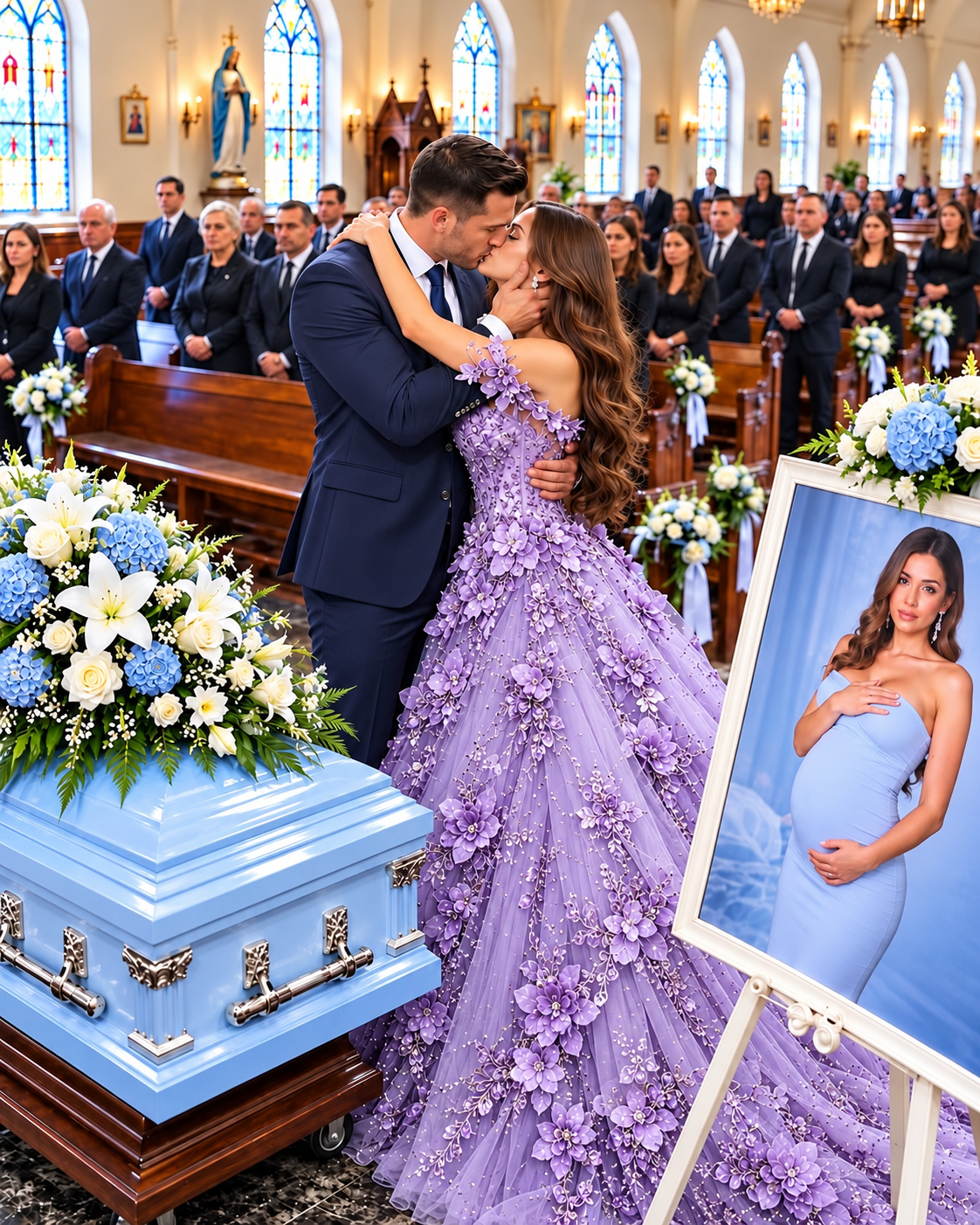
PART 1 TITLE: At My Pregnant Sister’s Funeral, Her Husband Brought Another Woman, Unaware That One Final Statement Would Expose His Carefully Hidden Secrets
The first sign that my sister had anticipated her own death came when her attorney stood beside her coffin and unfolded a letter. Until that moment, I had believed we were gathered to mourn a terrible accident. Lily was gone, her unborn son was supposedly gone with her, and the man responsible for arranging her funeral was standing in the front pew with his mistress. Then Daniel Hayes adjusted the microphone and began reading words my sister had written before she died. The first sentence made Jason Reed rise so abruptly that his chair scraped against the church floor.
I was sitting between my parents, close enough to see the white roses arranged around Lily’s closed casket. Someone had placed a small blue ribbon among the flowers because Lily had chosen blue for her baby’s nursery. The ribbon had come loose at one end, and I had spent most of the service staring at it, trying to concentrate on something ordinary. My mother held a damp handkerchief against her mouth. My father, Thomas Carter, sat with both hands clasped around the wooden handle of his walking stick, although he had never needed one before that week.
Lily was my younger sister, the person who knew which childhood memories I had exaggerated and which ones still hurt. She could tell when I was lying from the way I pressed my lips together. She remembered everyone’s birthdays, kept old receipts because she liked knowing where things came from, and refused to accept an explanation merely because someone delivered it confidently. At thirty-four, she had finally become pregnant after years of disappointment. We had spent an entire Sunday comparing tiny baby clothes and arguing over whether Noah needed more blankets. Three weeks later, I was looking at her coffin.
Jason had arrived fifteen minutes before the ceremony, wearing an expensive charcoal suit and an expression of carefully arranged exhaustion. Rachel Monroe entered just behind him. She wore a black dress with pearl earrings and held his elbow as they walked toward the family pew. He made no effort to explain her presence. Most of the guests already knew about their affair, though nobody had spoken of it openly while Lily was alive. At her funeral, Rachel seemed determined to behave as though the seat beside Jason had always belonged to her.
My father noticed first. He turned toward Jason and asked quietly whether Rachel intended to stay. Jason replied that she had been helping him through an unbearable few days. My father looked at Rachel’s hand resting on Jason’s sleeve, then at the coffin, before turning away. I wanted to ask how either of them could mistake this occasion for an opportunity to announce their relationship. But my mother was trembling beside me, and the last thing she needed was an argument before we had even finished saying goodbye.
During the opening prayers, Rachel passed Jason a folded tissue. He accepted it without looking at her. Later, when the minister spoke about Lily’s kindness, Jason lowered his head and covered his eyes. From where I sat, I could see his other hand resting loosely on Rachel’s knee. I had never imagined grief could coexist so comfortably with such deliberate disrespect. Yet his behavior was only the beginning of what we would learn that afternoon. By the time the service reached its conclusion, the meaning of almost everything I remembered about Lily’s marriage would have changed.
The minister had just stepped away when Daniel Hayes approached the lectern. Daniel was Lily’s attorney, a reserved man whose office had handled several matters concerning our family’s property. I knew him only through brief meetings and telephone calls. He was younger than I had expected when Lily first hired him, perhaps in his late thirties, with dark hair and a habit of listening without interrupting. That afternoon, he carried a leather portfolio and a sealed envelope. He asked the congregation to remain seated because Lily had left specific instructions for a statement to be delivered in the presence of her family.
Jason turned toward him immediately. He had been the one insisting that the funeral remain simple, with no lengthy speeches or unnecessary involvement from lawyers. When Daniel announced that Lily’s wishes included a formal declaration concerning her estate, Jason whispered something that sounded like a complaint. Rachel leaned closer, but he shook his head. Daniel waited until the room was quiet. Then he explained that the document had been prepared while Lily was alive, witnessed according to her instructions, and preserved separately from the ordinary arrangements for her funeral.
The letter began with Lily acknowledging that her family might have been told she had suffered an accidental fall down the staircase at home. She understood, she had written, that such an explanation would be easy to believe. She also understood that her husband might encourage everyone to accept it without further questions. She wanted us to examine what had happened before anyone decided that her death was simply a tragic accident. Daniel read slowly, without theatrical pauses, yet his voice seemed to carry into every corner of the church.
Jason stood. He demanded that Daniel stop, insisting that Lily had been under tremendous stress during her pregnancy and could not have understood the consequences of what she had written. Daniel looked up from the page and explained that Lily had given those instructions independently, in circumstances documented by his office. Jason took another step toward the front. I found myself standing too. I told him that if he had anything to say about my sister’s judgment, he could say it after the man she had trusted had finished speaking.
He turned toward me with an expression I had once mistaken for patience. He called me Emily, reminded me that everyone was grieving, and suggested that we should not allow misunderstandings to damage Lily’s memory. The words sounded reasonable enough to someone who had never met him. I had heard that same measured voice when he persuaded Lily to cancel family gatherings, reconsider purchases, or apologize for questions she had every right to ask. My sister used to defend him afterward. Now, watching his eyes move between Daniel’s portfolio and the church doors, I wondered what she had been defending herself against.
Daniel continued. Lily had learned, three weeks before the incident on the stairs, that a life insurance policy worth two million dollars had been purchased in her name. It was not the modest coverage she and Jason had discussed when they began preparing for a child. It was a separate policy, arranged without her informed involvement, with an effective date uncomfortably close to the final weeks of her pregnancy. Daniel did not speculate about the reason for its existence. He simply identified the policy, its value, and the evidence Lily had obtained.
At first, I thought I had misunderstood. Two million dollars was a figure too large to reconcile with the ordinary conversations Lily and I had shared about diapers, maternity leave, and the cost of replacing the upstairs windows. Jason had always spoken as though financial decisions belonged to him. He worked with investment advisers, understood insurance contracts, and rarely allowed Lily to look through documents without explaining what he wanted her to notice. She had begun keeping copies of household paperwork only recently. I remembered her asking me, a month earlier, whether I owned a scanner.
My father straightened in his seat. He had spent his working life supervising portions of the Carter family’s business interests and knew more about insurance arrangements than most of us. He asked whether Lily had signed the necessary forms. Daniel replied that the policy and associated documentation were among the matters requiring further examination. Nothing had yet been established about criminal liability, he added, but Lily had believed the documents important enough to preserve. My father’s fingers tightened around the stick. My mother lowered the handkerchief and looked directly at Jason for the first time since he arrived.
Daniel then read the name of the policy’s beneficiary. It was not Lily’s husband, not the child she was expecting, and not one of the relatives who had helped her through her difficult pregnancy. The designated beneficiary was Rachel Monroe. For a moment, nobody moved. Then a woman seated behind us drew in a sharp breath. My father slowly turned toward Rachel, while Jason remained standing beside the pew. I watched Rachel’s expression change as she realized that her name, which she had expected to remain safely outside the family’s conversations, was now the center of everyone’s attention.
Rachel withdrew her hand from Jason’s arm. She asked him, barely above a whisper, why the policy had not been amended. He told her to keep her voice down. She repeated the question, this time with enough urgency that several people nearby heard it. Jason reached for her wrist. My father rose from his seat and ordered him to release her. There was nothing dramatic in the way Dad spoke. His voice had become unusually flat, the way it did when he no longer considered politeness necessary. Jason let go, but not before I noticed how firmly his fingers had closed around her skin.
That brief exchange troubled me almost as much as the insurance revelation. Rachel had apparently known about the policy. Jason had promised her something concerning its beneficiary. Neither of them seemed surprised that the document existed. Their only visible disagreement concerned whether he had changed it. I thought of Lily carrying Noah, struggling to sleep comfortably, still excited enough to send photographs of a small wooden crib she wanted to assemble herself. While she was imagining her baby’s first nights at home, her husband and his lover had been discussing money connected to her death.
Daniel waited until Rachel moved several inches away from Jason. He then explained that the insurance policy was only one part of Lily’s concerns. She had also discovered that Jason was studying documents relating to a trust established by our late grandfather. The Carter family had owned property and commercial interests for several generations. Grandpa had divided much of his estate into protected arrangements designed to support descendants without placing substantial sums directly into the hands of whoever married them. I knew the general structure, but Lily had never shown much interest in its finer provisions.
Her pregnancy had changed that. The trust contained provisions concerning the birth of a first child, and Noah’s arrival would have activated additional arrangements. Daniel described the provision carefully, distinguishing between the child’s protected interests and any authority adults might exercise on his behalf. Jason had repeatedly requested explanations about what would happen if Lily died before or soon after giving birth. He had asked about control, guardianship, and the management of inherited assets. Daniel had preserved the dates of those inquiries because Lily herself had asked him to investigate them.
I remembered a dinner at my parents’ house two months earlier. Lily had been seven months pregnant and had spent much of the evening resting her feet on a cushion beneath the table. Jason had barely touched his food. Instead, he kept asking Dad how Grandpa had arranged the inheritance for future grandchildren. Dad explained the broad principles, but Jason wanted figures and conditions. Lily eventually interrupted to ask whether they could discuss something other than money. Jason laughed and said he was simply planning responsibly for their son. Nobody challenged him further.
Another memory surfaced. During one of our last private conversations, Lily had asked whether I still had Michael’s old notebooks. Michael was our brother, who had died eleven years earlier in a car crash outside Austin. She had given no convincing reason for wanting them. When I asked what a box of college papers could possibly have to do with her pregnancy, she said she was trying to understand an old family matter. I had assumed she was becoming sentimental about the brother who would never meet her child. Now I wondered why she had sounded so determined.
Daniel described several questions Jason had submitted concerning the trust. Some were ordinary enough for a future parent. Others concerned what would happen if Lily were declared unable to manage her affairs, how quickly authority could be transferred, and whether the expected child’s interests could be represented before birth. My father interrupted once to say that Jason had never been authorized to speak for the entire family. Daniel acknowledged the distinction. Lily had apparently made the same objection in writing, and her correspondence was among the documents he held.
Jason insisted that researching an inheritance was not evidence of wrongdoing. On that narrow point, Daniel agreed. He was careful not to accuse anyone without supporting facts. But he reminded the congregation that Lily had requested a complete review precisely because individual actions could appear innocent until viewed together. Her concerns had not developed from a single argument. They had emerged over weeks of discovering discrepancies in paperwork, observing unexplained behavior, and finding that her questions were repeatedly dismissed. She had begun to fear that important decisions about her life were being made without her knowledge.
As Daniel spoke, I remembered the last time I had seen Lily. She came to my apartment carrying a canvas shopping bag and a container of lemon biscuits she had baked because she knew I would forget lunch while working. She looked tired but unusually alert. While I made tea, she asked whether I trusted Daniel Hayes. I said he seemed competent. She considered that answer and asked whether competence and honesty were always the same thing. I laughed at the seriousness of her question. She did not. Before leaving, she hugged me longer than usual.
I had tried calling her the following day, then again two days later. Jason answered the second call and said she was resting. His tone discouraged further questions, though I still sent her a message. It remained unanswered. Until that afternoon, I had blamed myself for not insisting on speaking to her. Now every interrupted conversation seemed to contain something I had failed to recognize. I wanted to ask Daniel how long Lily had been afraid and why she had not trusted us with more of the truth. But he had already opened another envelope.
Inside were printed photographs, transaction records, receipts, and copies of private messages. Daniel explained that Lily had assembled them and arranged for duplicate sets to be kept securely. He removed a photograph showing Jason and Rachel outside a medical clinic. Jason had one arm around Rachel’s shoulders, and she was looking up at him with the easy familiarity of someone who had stopped worrying about being seen. The picture was dated four days before the night Lily was said to have fallen down the stairs. I recognized the clinic’s name from Lily’s appointments during her fertility treatment.
Rachel stared at the photograph. She had seemed irritated by the reading of the will, then frightened by the insurance policy. Now her face had drained of color. Daniel turned the photograph over and showed me a handwritten message on the back. I recognized Lily’s neat, slightly slanted writing immediately. It was addressed to me. She wanted me to question Rachel about the events of Tuesday evening. She had underlined the day twice. Beneath the message was a small mark Lily used when she wanted me to understand that something mattered more than she could safely explain.
I took the photograph with hands that would not remain steady. Tuesday was the night Jason claimed Lily had suffered her accident. He had told the police that she was alone on the stairs when she lost her footing, that he found her afterward, and that nothing could have prevented what happened. I looked at Rachel. She had begun shaking her head, although I had not yet asked her anything. Jason stepped between us and warned her not to answer questions without legal advice. For the first time, I understood that Lily’s final instructions had not been written merely to distribute an estate.
I walked around Jason and stood directly in front of Rachel. She looked toward the church doors, then at the photograph in my hand. I asked her what she had seen at my sister’s house that Tuesday. Her lips parted, but Jason ordered her to remain silent. I told him he had already spoken enough for both of them. Around us, people remained seated, watching a conversation that no longer resembled a funeral service. Rachel closed her eyes for a moment. When she opened them, I saw that she had made a decision. She looked past Jason and began to tell me what had happened.
END PART 1
PART 2 TITLE: The Woman Beside My Sister’s Husband Finally Spoke, and Every Detail of That Rainless Tuesday Led Us Toward a Buried Family Secret
Rachel’s first words were so quiet that I had to lean closer to hear them. She said Jason had telephoned her on Tuesday evening and told her Lily had already gone to bed. He wanted Rachel to come to the house. When she arrived, something felt wrong before she crossed the threshold. One of the lights near the staircase was broken, and pieces of glass lay scattered across the floor. Jason met her in the hallway wearing a damp shirt. He seemed irritated by her questions and kept looking toward the stairs, as though he expected someone to appear there.
I asked what time she had arrived. She looked at Jason, apparently hoping he would supply an answer that might protect them both. He remained silent. Rachel finally told me it had been shortly after nine. She remembered because she had checked her phone while waiting for him to open the door. She had expected an ordinary secret visit, shameful but familiar. Instead, the house was strangely quiet. She did not hear Lily moving upstairs, and Jason would not allow her to go beyond the hallway. He said his wife was asleep and that the broken light was nothing to worry about.
Jason interrupted, claiming that a storm had damaged something outside and that his shirt was wet because he had been checking the property. Rachel immediately contradicted him. There had been no rain that evening. The pavement was dry when she parked, and the air was warm enough that she had left her coat in the car. She remembered passing a neighbor who was watering plants near the curb. Jason stared at her with open hostility. I remembered the same clear evening because I had been sitting on my balcony, watching the last light disappear behind the buildings.
My mother made a faint sound beside me. Dad guided her into a chair, but she pushed away his supporting hand. She wanted to know whether Rachel had seen Lily. Rachel shook her head. She said Jason had hurried her toward the living room, then changed his mind and asked her to leave. His explanations were inconsistent. At one moment he seemed anxious for company; the next he appeared desperate to be alone. Rachel said she had assumed the couple had argued. She had not imagined that Lily might already be injured, although she admitted she had noticed enough to feel uneasy.
Daniel Hayes approached slowly. He did not question Rachel as an investigator might. He simply asked whether she was willing to repeat her account formally and preserve any messages she still possessed. Rachel nodded. Jason warned that anything she said could be misunderstood. Daniel answered that the appropriate authorities could determine its significance. I noticed how carefully he avoided drawing conclusions from her story. It was difficult to remain patient with that caution, but I understood why it mattered. Lily had left us evidence, not permission to replace proof with anger.
The attorney explained that his office had already secured several documents and would provide them to investigators. He also possessed recordings Lily had created during the final weeks of her life. Before her death, she had authorized their release under specified circumstances. Daniel removed a small storage device from his portfolio and connected it to equipment prepared near the lectern. Jason immediately demanded to know where he had obtained it. Daniel did not answer the question directly. He said the files had been preserved in accordance with Lily’s instructions and that their authenticity would be examined independently.
The first recording began with a small rustling sound, followed by Lily’s voice. I had not heard her speak since the last message she left on my answering machine. The sound brought an ache so immediate that I gripped the back of the pew. She was asking Jason why he had requested so many details about Grandpa’s trust. Her tone was controlled, but I recognized the effort beneath it. Lily spoke that way when she was trying to keep a conversation from becoming an argument. Jason replied that he needed to understand the arrangements for Noah’s future.
Lily asked him to explain why he was interested in what would happen if she died before the baby was born. Jason hesitated. In the recording, I could hear a faint mechanical hum, perhaps the kitchen refrigerator. Then he answered that her death was exactly the possibility he needed to understand. Lily did not shout or accuse him. She asked whether he had consulted anyone else about that possibility. Jason said she was turning ordinary financial planning into an accusation. She replied that he had not answered her question. The file ended before he offered anything more.
Jason seized upon the recording’s incompleteness. He said we had heard only a fragment of a longer domestic conversation. Pregnant couples discussed risk, he argued, especially when significant property was involved. Some people nearby appeared uncertain. He had always been good at finding the reasonable interpretation of an unreasonable situation. Daniel acknowledged that the recording, standing alone, did not establish a crime. But its context mattered. Lily had saved it alongside the insurance policy, the trust correspondence, and documents concerning the medical clinic. Investigators would have to examine those materials together.
I found myself remembering smaller things about her marriage. Jason was rarely openly cruel in front of other people. He corrected Lily’s recollections with a smile, offered explanations before she had finished asking questions, and described her worries as symptoms of exhaustion. When she hesitated to agree with him, he would wait until she apologized for being difficult. The technique had worked partly because Lily believed marriage required patience. I had sometimes told her she was too willing to compromise. She would shrug and say that Jason had his good days.
There had been happy memories too, which made the betrayal harder to understand. I remembered their wedding reception, when Jason had brought Lily a glass of water because she was too nervous to eat. I remembered him helping her father carry furniture after a family gathering. Perhaps those gestures had been sincere in the moment. Perhaps they had been part of a calculated effort to become indispensable. I could no longer distinguish between the man he had appeared to be and the man standing in the church. The uncertainty made me question years of ordinary experiences.
Daniel returned to Lily’s revised will. She had completed the amendments shortly before the staircase incident, after consulting him privately and reviewing her family’s estate arrangements. Her instructions placed her personal assets under protections intended to prevent unauthorized transfers. She had also appointed representatives to safeguard Noah’s interests, should he survive her. When Daniel reached the provision concerning Jason, he briefly paused to check the document. Lily had left her husband a nominal inheritance of one dollar. It was a deliberate provision rather than an omission, and her reasons were documented separately.
Jason’s face reddened. He demanded to know whether Daniel considered the will valid. Daniel said that Lily had executed the necessary documents while demonstrating a clear understanding of their contents. Jason looked toward my father, apparently expecting him to object. Dad remained silent. I could tell he was struggling to absorb how much Lily had concealed from us, but he did not challenge her decision. My mother covered her eyes. I wondered whether she was remembering all the times Lily had assured her that everything at home was fine, even while preparing legal measures to protect herself.
Jason asked about the Carter trust. He wanted to know whether Lily’s will could affect its provisions and whether the expected child would still be entitled to the inheritance. His questions were immediate, almost reflexive. The church had just heard that Lily feared her death might not be accidental, yet her husband’s attention had returned to the money. My father noticed. He asked Jason whether there was anything about Noah that mattered to him apart from the child’s financial interests. Jason called the question offensive. Dad replied that he had given Jason an opportunity to answer it.
Daniel opened a separate folder. Lily had commissioned an examination of certain medical records because she had discovered discrepancies at the fertility clinic. The attorney explained that the documents included a confidential genetic analysis concerning Noah’s parentage and related family information. I looked toward the coffin. Lily had told me how difficult it had been to conceive, how cautiously she approached each appointment, and how frightened she was to celebrate too early. I had assumed Jason shared those fears. Now I remembered that he had handled most of the clinic’s paperwork himself.
The medical process had required private consultations and extensive consent forms. I knew only the outline because Lily disliked discussing intimate details with anyone beyond her husband and doctors. She once told me the treatment had made her feel as though every hopeful thought depended on a number recorded in a laboratory. When she finally became pregnant, she refused to discuss the technicalities anymore. She wanted to think of Noah as her son, not as the outcome of a medical procedure. I respected that boundary. Hearing those records discussed beside her coffin felt like another violation of her privacy.
Daniel cautioned that some test results required expert explanation and additional verification. Nevertheless, one finding was clear enough to state: Jason Reed was excluded as Noah’s biological father. The room reacted immediately. Jason laughed with an unpleasant sharpness and announced that Lily must have been unfaithful. His accusation came so quickly that I wondered whether he had prepared it long before. Rachel turned away from him. I felt the urge to strike him, not because a genetic result had surprised me, but because he seemed eager to use it to dishonor the woman we had gathered to mourn.
I reminded him that Lily had undergone fertility treatment. Jason claimed he knew nothing about any arrangement that could explain the result. Daniel asked him to refrain from drawing conclusions until the remaining documents had been examined. Jason refused. He spoke of betrayal and deception, presenting himself suddenly as a husband injured by secrets. I could scarcely reconcile that performance with Rachel standing beside him. His confidence grew as he talked. It was as though he believed the medical findings had finally supplied a way to discredit every concern Lily had raised.
Then Daniel continued reading. The genetic material did not simply exclude Jason. Additional testing had identified an unexpected close biological relationship between Jason and my father, Thomas Carter, which had become important to the broader investigation. Daniel explained that the parentage documents and family relationship results had been compiled together because Lily suspected the histories were connected. My father lifted his head. For several seconds, he appeared unable to comprehend what he had heard. He asked whether Daniel was suggesting that Jason had some blood relationship to the Carter family.
Daniel said the evidence pointed toward a previously undisclosed paternal connection. He would not characterize its full meaning without completing the supporting explanation. Instead, he referred to a note Lily had prepared for precisely this point in the proceedings. She had written that we needed to reconsider something we believed about our family’s past. My stomach tightened. I recognized the cautious wording. Lily used it when she was about to tell me something she knew I would resist believing. I thought of the questions she had asked about Michael’s notebooks.
Michael had been twenty-six when he died. He was clever, impatient, and capable of making trouble simply by asking questions nobody wanted to answer. Eleven years earlier, police had informed us that he had been killed in a late-night automobile accident on a road outside Austin. There had been complications with identification, and the remains had been badly damaged. My parents had relied on the information supplied by investigators and the official records. We buried a closed coffin. For years afterward, my mother kept his bedroom nearly unchanged, unable to decide which of his belongings to give away.
The possibility that Michael’s name had some connection to the medical findings struck me as absurd. Yet I remembered Lily asking about him with increasing frequency in the months before her death. She had wanted to know whether Dad still possessed Michael’s university records and whether any financial documents had been returned after his accident. She had also asked me about his childhood nickname. At the time, I thought she was preparing something sentimental for Noah’s nursery. I now realized she might have been tracing a much older mystery.
Daniel read another passage from Lily’s private instructions. She had discovered evidence suggesting that our understanding of Michael’s disappearance was incomplete. Six months before the staircase incident, she had located a man she believed to be our brother. She had spoken with him repeatedly and learned about events surrounding his supposed death. He had also provided information relevant to Jason’s activities. Daniel looked toward the church entrance before finishing the paragraph. I followed his gaze. My father had risen again, while my mother remained very still in her chair.
I told Daniel that Michael had been dead for eleven years. Saying it aloud felt necessary, as though the fact might restore some order to the afternoon. He answered that he understood what we had been told. He also understood that Lily had taken considerable care before accepting what she had discovered. Jason suddenly began moving toward a side exit. He no longer seemed interested in defending the insurance policy or challenging the will. Rachel noticed his movement and stepped away from the aisle. Daniel closed the folder and looked toward the main doors.
The sound came first: a heavy latch turning, followed by the movement of air through the church. A man stood in the entrance, backlit by the pale afternoon sky. He was tall and noticeably thin, with a scar extending across one side of his face. His hair had begun to gray near the temples. He looked older than the brother I remembered, but there was something unmistakable in the way he held his shoulders and studied the room. I stood without realizing it. My mother made a sound that seemed to come from somewhere beyond language.
The stranger stepped into the church. His eyes moved across the front pew, lingering on my parents before settling on Jason. I recognized those eyes. I had seen them over breakfast tables, beside hospital beds, in photographs from childhood summers, and in my dreams after the accident. Eleven years of mourning did not prepare me for the sight of them looking back at me. I said Michael’s name, scarcely trusting my own voice. He turned toward me, and the expression on his face told me that he had heard.
He did not come directly to us. Instead, he raised a small sealed evidence bag. Inside was a mobile phone I recognized as Lily’s, the one Jason claimed had gone missing after her accident. Michael said that he had recovered it and preserved what it contained. Jason stopped walking. The color left his face as he stared at the device. Michael told him that Lily had recorded much more than the conversations Daniel had already played. Among the files was evidence concerning what happened beside the staircase on Tuesday night. Then he stepped farther into the church and asked Jason whether he remembered him.
END PART 2
PART 3 TITLE: Eleven Years After We Buried My Brother, He Returned with Proof That My Sister’s Marriage Had Begun with a Terrible Deception
Michael stood inside the church with Lily’s missing phone in his hand, looking at a room full of people who had believed him dead for eleven years. Nobody seemed capable of deciding what to do. Jason had stopped near the side aisle, one hand resting against the back of a pew. Daniel Hayes remained beside the lectern, his attention divided between the evidence bag and the man who had brought it. My mother was the first to move. She rose unsteadily, stared at Michael’s face, and walked toward him with both hands extended, as though she needed to touch him before she could believe what her eyes were telling her.
Michael put the evidence bag in his coat pocket and caught her before her knees gave way. She held his face between her palms, examining the scar on his cheek and the silver beginning to show in his hair. He leaned down so she could reach him more easily. For a long moment, neither spoke. Then she began asking the questions that had filled eleven years of silence. Where had he been? Was he hurt? Had he known she was looking for him? Her voice broke before she finished. Michael wrapped his arms around her and apologized, though the word seemed painfully inadequate.
Dad approached more slowly. I had seen him weep only twice: when his father died and when we buried Michael. That afternoon, his face seemed to lose its familiar hardness. He stopped several feet from his son and asked him to say something only the two of them would know. Michael reminded him of a fishing trip during which Dad had dropped his wedding ring into the lake and sworn all three children to secrecy until he could replace it. Dad gave a brief, disbelieving laugh. Then he embraced Michael so tightly that my brother had to steady them both.
When Michael turned toward me, he used the shortened version of my name that I had not heard since childhood. It nearly undid me. I crossed the distance between us before I had decided whether I wanted to hold him or demand an explanation. My fist struck his chest, more from frustration than force. I asked how he could have allowed us to bury him, how he could have remained silent through birthdays, illnesses, Christmas dinners, and every ordinary day my mother spent believing her son was gone. Michael accepted each accusation without defending himself.
I finally threw my arms around him. His coat smelled faintly of rain-damp wool and coffee, and beneath it I could feel his shoulders trembling. He was thinner than before, but unmistakably real. I wanted to keep holding him until there was no possibility that he could disappear again. At the same time, I could not stop thinking about Lily. She had found him, spoken to him, and apparently trusted him with secrets she had withheld from the rest of us. We were reuniting with one lost child while standing beside the coffin of another. The cruelty of that contradiction was almost unbearable.
Michael seemed to understand. He eased away from me and looked toward Lily’s coffin. His expression changed, the brief warmth disappearing beneath something older and harder. He said there would be time for apologies, but first he needed to explain why he had stayed away and what Lily had uncovered. Jason demanded that the service end immediately. Michael looked at him without raising his voice and said that Jason was free to speak to the investigators who would soon arrive. The statement silenced him. Daniel asked everyone to remain calm while the circumstances were set out as clearly as possible.
Michael began with our grandfather’s company. Eleven years earlier, he had been reviewing financial records as part of a temporary assignment involving several Carter business interests. He noticed invoices for consulting services that nobody could adequately describe. Small discrepancies appeared across multiple accounts. Individually, they were easy to dismiss as clerical mistakes; together, they suggested a deliberate pattern. When Michael traced the payments, he found several businesses with little evidence of genuine operations. Money had been leaving legitimate Carter accounts and circulating through companies whose ownership was concealed behind layers of paperwork.
At first, Michael suspected an outside accounting firm. He began collecting copies of the questionable invoices, payment authorizations, and correspondence. One financial company appeared repeatedly, sometimes as an adviser and sometimes through businesses connected to its associates. Jason’s name was not prominent in the earliest records, but the firm had connections that eventually led toward him. Michael had not yet met Jason as Lily’s future husband. At the time, Jason was simply one of several names that emerged from a complicated financial trail. Michael wanted to understand who had authorized the transactions before confronting anyone.
The questions attracted attention. Someone accessed files Michael had recently examined, and documents began disappearing from shared systems. He received calls from unidentified numbers, including one in which a man advised him to stop reviewing transactions that did not concern him. Michael told himself the threats were intended to frighten him. He continued collecting evidence, storing copies separately because he no longer trusted the company’s internal controls. Then, one night outside Austin, another vehicle forced his car off the road. The crash left him badly injured, and another man traveling with him was killed.
Michael described the aftermath without embellishment. The vehicle was severely damaged, and the identification process was confused by the condition of the remains and records that had been deliberately manipulated. Investigators working on the financial case became involved. Through a combination of false identification and concealed information, our family was led to believe Michael had died. The man killed in the crash was mistakenly identified as him. Michael survived, but by the time the deception became embedded in official records, federal authorities were considering a protected arrangement to preserve a witness whose testimony could expose the financial operation.
My father interrupted. He wanted to know whether Michael had agreed to let the family attend a funeral under false pretenses. Michael looked down before answering. He said that he had entered protective custody while investigators examined the threats and the people responsible. The situation had become more complicated than he expected, partly because those involved had influence and access to confidential information. He was advised that contacting us could expose his location and place the entire family at risk. He admitted that he had accepted those restrictions, believing they would last months rather than years.
I asked whether he had ever tried to send us a message. He said there had been moments when he came close. He had written letters that he never mailed and followed family news through information provided by trusted contacts. He knew when Dad underwent surgery. He knew that Lily married. He had seen photographs of my mother’s garden and understood that she still planted flowers beside the memorial stone bearing his name. Each detail made my anger sharper. He had not disappeared into ignorance. He had watched our lives from a distance while we believed his had ended.
Michael did not ask us to forgive him. He said the original fraud investigation had spread into a network of related companies, concealed ownership arrangements, and individuals capable of obstructing evidence. Some cases progressed; others remained unresolved. The identification deception itself became another matter that authorities would eventually have to address. He had lived under restrictions, changed residences, and learned to avoid routines that made him easy to locate. Returning openly had seemed dangerous, particularly after he discovered that people linked to the financial operation were still involved with Carter family property.
Six months before Lily’s accident, she found him. The discovery began with financial transfers carrying a reference that resembled his childhood nickname. Lily had been reviewing documents Jason kept at home when she noticed the unusual notation. She remembered that Grandpa sometimes used similar references in private family records. Curious, she asked Daniel for help examining certain financial matters, then followed a separate lead concerning Michael’s old investigation. Eventually, with assistance from contacts involved in the protected case, she established communication with him. Michael admitted that he initially refused to speak because he feared exposing both of them.
Lily persisted. She supplied details about childhood experiences that could not easily be obtained from public records and asked questions that demonstrated she had uncovered part of the old financial scheme. When Michael finally agreed to meet her, she traveled alone and took precautions he insisted upon. He told her the truth about his disappearance and explained why he suspected the financial activity had never fully stopped. Lily then showed him the documents she had gathered from Jason’s accounts. Some matched transactions Michael had studied before the crash. Others suggested that the scheme had continued and developed new methods.
The realization had frightened them both. Michael began tracing the newer accounts while Lily remained in the household where many of the relevant records originated. She understood that leaving abruptly might cause Jason to destroy evidence or move funds beyond reach. She also knew that she was pregnant and increasingly vulnerable. Michael advised caution, but Lily refused to abandon the investigation. She had already begun consulting Daniel about her estate and personal protection. Together, they developed a plan to preserve records, restrict access to certain assets, and ensure that evidence survived even if something happened before she could act.
I asked Michael why he had not brought her away from Jason immediately. He looked toward the coffin. Lily had wanted to leave, he said, but she insisted on securing legal and financial protections first. She feared Jason would use questions about her mental state and pregnancy to interfere with her decisions. She was also worried about Noah. Her husband had become unusually interested in the trust provisions concerning the child, and she believed there was more to his interest than simple greed. She had asked Michael to investigate a medical record discrepancy that neither of them initially understood.
Hearing Noah’s name brought me back to the confidential genetic report. I asked Michael what the findings meant. He exchanged a glance with Daniel, who said the medical documents had been obtained through appropriate channels but contained information affecting several people. Michael agreed that the explanation would be painful. He turned toward Dad and asked whether he remembered a woman named Rebecca. My father’s reaction was immediate. He gripped the back of a pew and stared at Michael as though his son had reached into a part of his life he had never intended to discuss.
Dad said he had known Rebecca before he married our mother. The relationship had ended badly. Rebecca had later told him she was expecting a child, but then reported that the pregnancy had ended. He had accepted her account and believed she eventually moved away. My mother listened without speaking. Dad looked at her, clearly ashamed of discussing this in public, but he continued. He had never told us about the pregnancy because he believed there was no living child to tell us about. He said Rebecca had disappeared from his life decades earlier.
Michael explained that Rebecca had not lost the baby. She had given birth to a son and raised him without revealing his true parentage to the Carter family. Over time, others learned the secret and exploited it. The child grew up believing that his father’s relatives had enjoyed wealth while he and his mother struggled. He had been encouraged to view the Carter inheritance as something stolen from him, even though the truth was more complicated. Michael said he had obtained supporting records and that the genetic evidence helped establish the connection. My father asked who the child was.
Michael looked directly at Jason. He said Rebecca’s son was standing in the church with us. Jason Reed was Thomas Carter’s biological son. The words seemed to empty the room of sound. I stared at Jason, remembering the wedding photographs, the family holidays, the years he had called my father by his first name. If Michael was correct, Jason was not merely Lily’s husband. He was her half-brother. He had married a woman with whom he shared a biological father. The horror of that knowledge was difficult to separate from the equally terrible question of whether he had known all along.
Jason began protesting before anyone accused him directly. He claimed that Rebecca had told him conflicting stories about his father and that he could not be expected to know which was true. Michael responded that records showed Jason had investigated the connection before his marriage to Lily. He had sought information about the Carter estate, received confidential family details, and communicated with people who understood the relationship. The connection had not been discovered accidentally after the wedding. According to Michael, Jason had used it to find a path into a family whose resources he believed he deserved.
My father sank into a chair. He appeared older than he had that morning. He whispered that Lily was his daughter and that he would never knowingly have allowed such a marriage. Michael told him nobody was accusing him of arranging it. The deception depended on our ignorance. I thought about all the family gatherings where Jason sat beside Dad, listening to conversations about Grandpa’s business interests and asking questions under the appearance of affectionate curiosity. I could scarcely bear the idea that he had been measuring us against a grievance he had carried long before we met him.
Jason’s composure finally broke. He shouted that our family had enjoyed advantages his mother never received. He spoke of unpaid bills, uncomfortable apartments, and the humiliation of watching people with the Carter name live without the struggles he remembered. His anger appeared genuine, but it did not explain his choices. I asked whether Lily had known his identity when they married. Michael answered that she had not. She discovered the evidence only after becoming suspicious of financial irregularities and finding records connected to Rebecca. By then, she had already spent years believing Jason loved her.
Michael said the marriage served several purposes for Jason. It allowed him access to information about Carter assets, placed him near the trustees and administrators, and gave him opportunities to influence decisions that would otherwise have remained beyond his reach. Lily’s pregnancy introduced another possibility. If Noah’s birth activated particular trust provisions, the child’s legal guardianship and financial protections would become important. Jason wanted to benefit from those arrangements, but he also wanted to conceal his biological relationship to Lily. Michael suspected that this concern had influenced the treatment arrangements at the fertility clinic.
Daniel opened another file. It contained consent documents, laboratory correspondence, and records showing that donor information had been altered. Lily had believed the treatment followed the arrangements she approved with her doctors. Jason had interfered with records in a way that prevented her from knowing whose genetic material had been used. The implications were both personal and legal. My sister had trusted a medical process at one of the most vulnerable periods of her life. Someone had used her longing for a child to advance a scheme she did not understand.
A recording followed. Lily confronted Jason about the donor information, asking why records had been replaced and whether he had authorized changes without her knowledge. Jason dismissed the discrepancy, then suggested that the details did not matter because the treatment had produced the pregnancy she wanted. Lily answered that a child was not something one person could arrange through deception and then present as a favor. Jason’s voice became hard. He insisted that he had made the pregnancy possible and that she should appreciate what he had done instead of examining paperwork.
Michael explained that Lily initially feared her missing brother’s genetic material might somehow have been used. She had seen references connected to him in the financial records, and the unusual family relationship findings made that possibility seem worth investigating. Subsequent evidence excluded Michael as the donor. The actual identity had been concealed through altered clinic records and information obtained from someone else’s confidential medical history. Michael had learned enough to identify the source, but Lily insisted that the truth be preserved in her own recorded account rather than left to anyone else’s interpretation.
Daniel searched through the files while Michael asked him to select recording number thirty-two. The attorney hesitated, then connected the device again. Lily’s voice emerged, softer than in the earlier argument. She addressed me directly. She wanted me to know that Noah had not been conceived through an affair and that she had never knowingly agreed to the substitution. She explained how Jason had controlled portions of the treatment paperwork and concealed the donor’s identity. Then she named the man whose genetic material had been used. It was Daniel Hayes, the attorney holding the recording.
END PART 3
PART 4 TITLE: A Hidden Recording Exposed the Staircase, but the Child We Had Mourned Brought an Even More Dangerous Secret Into the Open
Daniel Hayes stopped the recording. His hand remained suspended above the device, and for several seconds he looked unable to move it. I had watched him remain calm through accusations, interruptions, and the revelation that my supposedly dead brother was alive. Now his expression had changed completely. He asked Michael to confirm what Lily had said. Michael nodded, then explained that the supporting medical documents and genetic findings were part of the material Lily had secured. Daniel looked toward Jason. Whatever professional distance had protected him during the service was beginning to fail.
Years earlier, Daniel had registered as an anonymous donor while studying law. He had followed the procedures required at the time and believed his identifying information would remain protected under the applicable arrangements. He had never been told that his genetic material was selected for Lily’s treatment, and he had no reason to suspect a connection when she hired him for legal work. The disclosure left him confronting two distinct betrayals: the misuse of private medical information and the possibility that a child he had never known existed had been conceived through a process neither parent had properly understood.
Jason insisted that the accusation was impossible to prove. Daniel asked him how he had obtained the confidential information. Jason refused to answer. Michael explained that Jason’s contacts had extended beyond the Carter financial network into records and relationships connected with the Hayes family. Lily had discovered that the donor selection was not random. Jason wanted to benefit from the trust provisions activated by a child while keeping his own biological relationship to Lily hidden. Daniel’s involvement served a further purpose connected to the longstanding links between the Hayes and Carter families, links Michael was still investigating.
I looked from Daniel to the closed coffin. Lily had apparently trusted him as her attorney without knowing that he was connected to Noah in such an intimate way. The discovery had come late in her investigation. She had recorded an explanation because she feared that someone would twist the genetic evidence into an accusation of infidelity. She knew Jason well enough to anticipate that possibility. Even after finding the donor’s identity, she had been careful to distinguish between Daniel’s possible victimization and any wrongdoing he might have committed. Nothing in the records then before us established that Daniel had knowingly participated in the substitution.
Daniel asked whether the laboratory findings were conclusive. Michael told him the documents supported the identification, though the appropriate specialists would review the full chain of evidence. Daniel pressed his lips together and looked toward the pew where my parents sat. He said he needed time to understand the personal consequences. Then he glanced at Jason and added that he would not allow his own involvement to interfere with the preservation of Lily’s records. It was a measured response, but I could hear the strain beneath it. The man reading her will had just discovered that the child it was intended to protect might be his son.
My mother asked the question none of us seemed willing to say aloud. If the donor’s identity mattered so much, why were we discussing it when both Lily and Noah were supposedly dead? Michael looked toward the back of the church. I noticed that he had been watching the entrance throughout Daniel’s reading, as though waiting for another person to arrive. He checked his watch, then spoke quietly to someone by telephone. A minute later, the doors opened. A woman wearing medical scrubs beneath a dark coat stepped inside, carrying a small bundle wrapped in blue.
At first, I thought she was bringing something symbolic from the hospital, perhaps a blanket or one of Noah’s belongings. Then the bundle moved. The woman adjusted her hold, revealing a small face beneath the edge of the fabric. A tiny hand emerged, its fingers opening and closing against the blanket. My mother rose so quickly that her chair shifted backward. The woman introduced herself as a nurse who had been involved in the baby’s care. She told us that Noah had survived. He was alive, medically stable enough for the carefully supervised arrangements that had brought him there, and waiting to meet his family.
I could not immediately understand the words. For days, Jason had told us that the fall had killed Lily and their unborn child. We had mourned both of them. My mother had placed a second ribbon near the coffin because there would be no separate grave for the baby. I had packed away the clothes Lily bought, unable to face the little socks she insisted were too small to be real. Now a living child was being carried down the aisle. I watched his chest rise beneath the blanket and felt the ordinary certainty of the world shifting beneath me.
The nurse explained only what she was authorized to share. Emergency medical intervention had allowed Noah to be delivered, and he had required specialized care afterward. Information about his survival had been tightly restricted because the circumstances surrounding Lily’s injuries were under investigation. Michael said that Lily had anticipated danger to her child and made arrangements with trusted professionals to protect medical information if something happened to her. The plan had become essential after the staircase incident, though not every detail unfolded as she had expected. Investigators had been coordinating the protection of evidence and the child’s safety.
My mother approached the nurse with both hands trembling. She asked whether she might hold him. The nurse checked his blanket, explained how to support his head, and carefully placed him in her arms. Mom bent over him without speaking. For a moment, she simply watched his face. Then she began to cry, silently at first, before whispering his name. Dad stood beside her and touched one of Noah’s tiny hands with a single finger. The child closed his fist around it. I saw my father bow his head, overwhelmed by a gesture too small to carry the weight we placed upon it.
When the nurse allowed me to hold him, I was afraid my hands would shake too much. Noah was warm and astonishingly light. His eyes opened briefly, then closed as he shifted against my arm. I studied his features, looking for traces of Lily even though I knew newborn faces changed quickly. His skin smelled faintly of clean cotton and the familiar sterile scent of a hospital. I remembered Lily placing my palm against her stomach so I could feel him move. She had laughed when he kicked against my hand. Now he was breathing in my arms.
Daniel approached but stopped a respectful distance away. He looked uncertain about whether he had any right to move closer. I asked what he intended to do. He said he would seek independent legal advice concerning the newly disclosed relationship and the boundaries of his role as Lily’s attorney. More importantly, he wanted Noah protected from the conflict unfolding around him. He did not speak of ownership or entitlement. He asked whether the child was receiving proper medical care and whether the authorities had made arrangements for his immediate safety. Those questions made me trust him more than any declaration of affection would have done.
Jason had remained silent since Noah entered the church. His face betrayed genuine surprise. Michael noticed and asked whether he had expected the child to survive. Jason answered that he had been told otherwise. Michael reminded him that Lily had been suspicious of his financial activities, his knowledge of her family’s trust, and his interference with medical records. She had feared he might attempt to control the circumstances of her pregnancy before she could expose what he had done. She had therefore preserved documents and arranged for important medical information to be handled independently. Her preparations had protected Noah, but they had not prevented the confrontation that led to her injuries.
Daniel placed the recording equipment back on the table. Michael handed him the sealed bag containing Lily’s missing phone. He explained that the device held footage from a camera Lily had concealed in the hallway near the staircase. She had positioned it behind books on a shelf, hoping to document conversations because Jason often denied things he had said when no one else was present. The recording was not perfect. The camera’s angle was limited, and portions of the hallway were obscured. But it had captured the confrontation on Tuesday evening, including events Jason had never described to the police.
Before Daniel played the file, I asked my father to take Noah away from the front of the church. Whatever the recording showed, the baby did not need to remain at the center of the confrontation. Dad agreed and accompanied the nurse and my mother to a quieter room. I stayed. I wanted to see the truth, even though I knew it might leave me with images I could never forget. Rachel sat at the edge of the nearest pew, her hands clasped so tightly that the knuckles had turned pale. Jason objected to the recording being played publicly, but Daniel said the evidence had already been preserved for investigators.
The image appeared on a portable screen. I recognized Lily’s hallway, including the narrow wooden table she had bought at an antiques market and the framed photograph of our three siblings beside the stairs. The camera looked across part of the landing toward the front entrance. Jason stood near the bottom step, facing Lily. She was visibly pregnant and wore a loose cardigan over a pale blouse. I remembered that cardigan. She had borrowed it from me months earlier and refused to return it because, she said, it was the only one that still fit comfortably.
Jason was questioning her about changes to her will, the restrictions placed on certain financial accounts, and her recent communication with Daniel. Lily acknowledged the changes without offering unnecessary explanations. She sounded tired, but she did not retreat. Jason moved closer and demanded to know what else she had discovered. Lily told him that she had enough information to understand his connection to the Carter family, the irregularities in the financial records, and his involvement with the fertility clinic. She also knew that Michael’s supposed death concealed events he had never expected her to investigate.
Jason’s expression changed. He demanded to know who had told her about Michael. Lily did not answer directly. Instead, she said she had already secured copies of the relevant documents and would not allow him to interfere with the investigation. She told him their marriage was over. She intended to pursue a divorce, protect her child’s interests, and cooperate with the authorities. Jason accused her of trying to destroy him. Lily replied that his actions had created the situation, not her decision to expose them. Her voice remained controlled, but I could see her fingers trembling against the edge of her cardigan.
He stepped toward her and reached for her arm. Lily pulled away. For a brief instant, the recording showed their bodies moving near the staircase. Then the hallway lights went out. The image became almost entirely black. We heard footsteps, a sharp sound against wood, and a confusion of movement that the microphone could not clearly distinguish. I gripped the pew in front of me. Somewhere in the darkness of that recording, my sister had been injured. I wanted to stop watching, but I was terrified that looking away would mean missing something important.
The camera continued recording. A faint emergency light eventually revealed part of the hallway. Lily lay at the foot of the staircase, motionless in the frame. Jason stood nearby. He bent forward briefly, then straightened and moved away. The angle did not show every movement, and Daniel cautioned that investigators would need to examine the footage carefully before determining precisely what caused the fall. But one fact was painfully visible: Lily was lying injured while Jason remained in the house. No immediate effort to obtain emergency assistance appeared in the portion of the recording we were shown.
Rachel appeared in the hallway some time later. She looked toward the stairs and demanded to know what had happened. Jason told her Lily had fallen. Rachel’s voice rose as she urged him to summon an ambulance. He instructed her to leave, claiming the situation was under control. She protested, but his tone became increasingly threatening. After several exchanges, she retreated toward the front door. Watching her departure was almost as difficult as seeing Lily on the floor. Rachel had described feeling uneasy that night. Now I understood she had witnessed far more than she initially admitted.
I turned toward her. She was crying openly, her hands pressed against her mouth. She admitted that she had been frightened of Jason and ashamed of her own involvement with him. She said she had allowed herself to believe his assurances because admitting the truth would mean confronting the possibility that Lily needed help while she was leaving the house. I wanted to ask how she could walk away from someone lying injured, but her expression told me she had been asking herself the same question ever since. Her fear did not excuse her decision. It explained only part of it.
Michael said a neighbor, Mrs. Henson, had eventually helped alert emergency responders. Investigators were examining the precise sequence of calls, movements, and delays. Jason began shouting that the footage was incomplete. He said Lily had been conscious after the fall and that everyone was ignoring the circumstances. The words escaped him before he seemed to understand what they revealed. Michael turned slowly. He asked whether Jason was admitting he knew Lily had still been breathing and needed assistance. Jason opened his mouth, then stopped. The silence that followed was more revealing than his earlier explanations.
Daniel ended the playback and secured the device. He said the original files would be handled as evidence and that no one should attempt to alter, distribute, or interpret them outside the proper investigation. Michael agreed. My father had returned from the quieter room without Noah, and he stood near the entrance looking at Jason. I expected him to shout, but he said nothing. The disappointment on his face was worse than anger. He had just learned that the man who married his daughter was also his own son, a son whose choices had brought the family to the edge of unimaginable destruction.
The church doors opened again, this time admitting several police officers. They approached Daniel and Michael first, confirming that the evidence was available for collection. The investigation would extend beyond the staircase to the insurance policy, the trust, the alleged falsification of medical records, and financial activity connected with the Carter companies. Jason attempted to protest, but an officer informed him that he was being taken into custody. Rachel was directed to remain available for questioning. She nodded and wiped her face. I stood beside Lily’s coffin, struggling to reconcile the ceremony we had expected with the investigation now unfolding around us.
As the officers escorted Jason toward the doors, he turned back. He no longer attempted to appear grief-stricken. He looked at Michael with a peculiar mixture of resentment and satisfaction. He asked whether his arrest meant we considered the matter finished. Michael said nothing. Jason then claimed there was a substantial sum of money Lily had never accounted for, money that would remain beyond our reach regardless of what happened to him. He named the amount: thirty million dollars. The figure caused Michael to stiffen. Until that moment, I had believed the financial conspiracy was finally beginning to make sense.
I asked Michael what Jason meant. He did not answer immediately. Jason noticed his hesitation and gave a short laugh before the officers took him outside. The doors closed behind them, leaving the church in an exhausted silence. Daniel began collecting the documents from the lectern. My father returned to my mother and Noah. Rachel remained seated, staring at the empty aisle. I looked at Lily’s coffin and wondered how much more my sister had discovered before the staircase incident. If Jason was telling the truth about the missing money, the financial records we possessed might be only part of a much larger scheme.
Michael removed Lily’s phone from its protective bag to check a reference number associated with one of the preserved files. Before he could finish, the screen lit up with an incoming call. The displayed name was MICAH, his childhood nickname. Lily had used that name when we were children, and it had appeared in some of the unusual financial references that helped her locate him. Michael stared at the screen. He told Daniel that the number should not have been active and that very few people knew the nickname. Then he answered the call and switched on the speaker.
A distorted voice spoke from the other end. It confirmed that Jason’s claim about the thirty million dollars was true. Michael demanded to know who was calling and how the caller had obtained Lily’s number. There was no reply. The connection ended before he could ask another question. I watched him lower the phone, his face suddenly ashen. For eleven years, I had believed Michael was dead. For days, I had believed Lily and Noah were gone. Now my brother was standing beside me, my nephew was alive in the next room, and someone connected to the old financial conspiracy was still watching our family. Michael looked at the darkened screen and told me we had not yet found the person who started it all.
END PART 4
PART 5 TITLE: The Brother We Buried Eleven Years Ago Returned With Lily’s Missing Phone and a Secret That Could Destroy Everything We Believed
For several seconds, no one moved. Michael stood just inside the church entrance, his shoulders slightly hunched beneath a dark jacket, holding a sealed evidence bag in one hand. Eleven years had changed him. His face was thinner, a pale scar ran from his cheek toward his jaw, and gray touched his hair near his temples. But his eyes were unchanged. I knew those eyes better than I knew my own reflection. They belonged to the brother who used to carry me across flooded sidewalks and tell Lily bedtime stories when thunderstorms frightened her.
My mother was the first person to move. She stumbled out of the front pew, caught herself against its wooden end, and hurried down the aisle. Michael barely had time to set the evidence bag on a nearby bench before she reached him. She pressed both hands against his face, searching for something that might explain what she was seeing. Then she pulled him against her so fiercely that he took a step backward. My father followed, his expression bewildered, his mouth moving without producing a word. Their son, whom they had buried more than a decade earlier, was standing between them.
I remained where I was. Part of me wanted to run toward Michael, but another part could not move past the memory of his funeral. I remembered our father’s trembling hands as he carried the folded flag presented to our family. I remembered my mother refusing to leave the cemetery until the workers had finished covering his grave. Most clearly, I remembered Lily sitting beside me afterward, promising that whatever happened, we would never abandon each other. Now Lily lay inside a closed coffin, and the brother we had mourned was breathing twenty feet away.
Michael saw me over Mom’s shoulder. He spoke the nickname he had used when we were children, barely louder than a whisper. That single familiar sound broke whatever had been holding me still. I crossed the aisle and struck his chest with the flat of my hand. The blow was neither hard nor controlled. I hit him again, then grabbed his jacket. I asked where he had been, why he had allowed us to suffer, and how he could stand there while Lily was supposedly dead. He did not defend himself. He only held me as I cried.
Behind us, Jason Reed edged toward the side exit. Rachel Monroe, the woman he had brought to his pregnant wife’s funeral, noticed immediately. Her fingers caught his sleeve, but he shook her off. Michael released me and turned. The warmth disappeared from his face. He told Jason that the doorway was not going to make the evidence disappear. Jason stopped beside the last row of pews. Until that morning, I had known him as a polished, impatient businessman who spoke confidently even when he was lying. For the first time, he seemed uncertain where to put his hands.
Daniel Hayes, Lily’s attorney, asked everyone to remain seated. His usually precise voice had become strained, but he kept his attention on the documents spread across the lectern. He had already disclosed the two-million-dollar insurance policy naming Rachel as beneficiary, the suspicious questions about our grandfather’s trust, and Lily’s revised will leaving Jason only one dollar. The genetic report had also raised an impossible question about our unborn nephew, Noah. Daniel looked toward Michael and asked whether he could explain what had happened eleven years earlier. Michael nodded, although he warned us that parts of the investigation were still protected.
He began with our grandfather’s company. After Grandpa became ill, Michael had helped review several commercial accounts and discovered payments that did not correspond to legitimate contracts. Money had been moving through consulting businesses with little equipment, no permanent staff, and addresses connected to mail-forwarding services. At first, he assumed someone had been careless with bookkeeping. Then he found repeated transfers to a financial firm with ties to Jason. The amounts were too regular, the approval signatures too consistent, and the supporting invoices too similar to be ordinary accounting mistakes.
Michael had intended to speak privately with Grandpa, but someone learned that he was collecting records. He began receiving warnings from unfamiliar numbers. A car followed him home twice. One evening, a stranger approached him outside a grocery store and described our family house in unsettling detail, including the window of Lily’s bedroom. Michael contacted a federal investigator through someone he trusted. Before that meeting could take place, another vehicle forced his car off a road outside Austin. His car struck a barrier, overturned, and caught fire. A passenger died in the wreck.
We had been told that Michael was the person who died. The identification documents were altered, and the confusion surrounding the burned vehicle allowed someone to substitute the dead passenger’s identity for his. Michael survived with serious injuries. Authorities involved in the developing financial investigation eventually placed him under protective arrangements because whoever had engineered the crash remained unidentified. He had been instructed not to contact us. Returning home, he believed, could expose not only himself but everyone in the family to another attack.
My father lowered himself onto a pew. He asked Michael whether there had truly been no way to tell us. Michael stared at the church floor before answering. He admitted that fear had become easier to live with than the possibility of bringing danger to our door. Over time, silence turned into a terrible habit. He knew it had wounded us, and he could not pretend otherwise. Mom asked how many birthdays and holidays he had spent knowing we were grieving. He answered that he remembered every one. Neither of them seemed comforted by that admission.
I listened while studying the scar on his face. Michael’s explanation answered how he had survived, but it did not tell me why he had appeared at Lily’s funeral rather than coming forward years earlier. When I asked, he looked toward the coffin. Lily had discovered traces of the old financial network while examining documents connected to Grandpa’s estate. Among the records were transfers marked with the childhood nickname Michael once used, Micah. She refused to believe the name was accidental. After months of searching, she found him six months before her supposed accident.
Lily had not told any of us. According to Michael, she appeared at the place where he was staying with a folder of bank records and a photograph of the three of us beside Grandpa’s lake. She stood outside his door until he finally answered. Her first words were not a greeting. She asked whether he intended to spend the rest of his life letting strangers decide whether his family could know he was alive. Michael laughed painfully at the memory. He said Lily had always known how to make someone feel ashamed without raising her voice.
The reunion changed the investigation. Lily had access to information Michael could not obtain, including trust correspondence, household records, and documents Jason had carelessly left where she could find them. Together they traced financial transactions linked to Grandpa’s holdings. They also noticed that Jason had become unusually interested in inheritance provisions governing children born into the Carter family. He questioned trustees about what would happen if Lily died during pregnancy, who could act for her child, and whether a surviving spouse could exercise temporary control over the assets. Lily initially thought he was protecting her. Later, she understood he was calculating possibilities.
Rachel shifted beside Jason. When Michael mentioned the trust, she looked toward the papers scattered near Daniel’s briefcase. Jason told her not to listen, but she moved farther away. I remembered the photograph Lily had preserved of the two of them outside a medical clinic, dated four days before the staircase incident. I also remembered her message asking me to question Rachel about Tuesday evening. Rachel had already admitted that she had visited our house while the hallway light was broken and there was glass beside the stairs. Jason had claimed his wet shirt came from rain, although the weather had been dry.
Michael approached the lectern and placed Lily’s missing phone beside Daniel’s documents. He explained that Lily had protected recordings and correspondence in more than one place. Some files were on the device, while others had been transferred to secure storage before her confrontation with Jason. He had recovered the phone through information Lily left with him, but he wanted the authorities to establish its chain of custody before relying on anything extracted from it. Daniel agreed. He asked Michael to continue with the question that had silenced the church: why had the genetic findings associated Noah with our father?
Michael turned toward Dad. For the first time since entering, he seemed genuinely frightened of what he had to say. He asked whether Dad remembered a woman named Rebecca Reed. My father’s face changed before he answered. He sat straighter, glanced toward Mom, and admitted that he had known Rebecca before their marriage. She had become pregnant, or believed she had, and later told him the pregnancy had ended. He had never seen her again. My mother listened without interrupting, her fingers folded so tightly that her knuckles had gone white.
Michael told him Rebecca’s child had survived. Dad shook his head, insisting there must be a mistake. Michael opened a folder containing old correspondence, a birth record, and additional material gathered during the investigation. He explained that Rebecca had raised a son under her own surname. Someone had worked hard to conceal the connection from the Carter family while making certain the boy knew that his father came from considerable wealth. Michael waited until Dad looked up. Then he indicated the man standing near the side aisle. Rebecca’s son, he said, was Jason Reed.
The silence after that disclosure was unlike anything I had experienced. I heard the ventilation system start above the sanctuary. Somewhere behind me, someone dropped a program. I looked at Jason, trying to reconcile the man I had welcomed into our family with the possibility that he was my father’s biological son. If Michael’s evidence was correct, Jason was our half-brother. He had married Lily, who shared that same father. My stomach tightened. I turned toward the coffin, unable to stop myself from imagining what Lily must have felt when she discovered the truth.
Jason laughed, but the sound was harsh and unconvincing. He called Michael a criminal hiding behind a fabricated identity and accused Daniel of participating in a scheme to steal his inheritance. Michael did not answer immediately. Instead, he asked Jason when he had first learned Rebecca’s relationship to Thomas Carter. Jason’s expression hardened. He insisted that his mother had suffered while the Carter family lived comfortably, that he had watched people inherit opportunities denied to him, and that he had spent his childhood hearing promises no one intended to fulfill. He spoke as though deprivation justified every decision he had made afterward.
Dad stood. His voice was low, almost too quiet to hear. He asked Jason why he had never approached him directly. Jason looked at him with unmistakable contempt. He said a man who had ignored his own son had no right to ask how that son chose to survive. Michael answered that resentment did not explain the forged financial documents, the suspicious insurance policy, or Lily’s injuries. Jason’s eyes flashed. For an instant, I thought he might strike Michael. Instead, he adjusted his jacket and declared that none of us could prove he had married Lily knowing they shared a father.
Daniel interrupted before the argument grew worse. Lily had investigated that question, he explained, and found correspondence suggesting Jason knew the connection before their wedding. She had also discovered irregularities in the records from the fertility clinic where she and Jason received treatment after struggling to conceive. Jason had been allowed to handle much of the administrative paperwork. Certain donor identifiers no longer matched the original files, and several consent documents appeared to have been replaced. Daniel reminded everyone that Noah’s parentage could not be established by assumptions or family accusations alone.
Michael asked Daniel to play another recording. Lily’s voice emerged from the small speaker, weary but steady. She questioned Jason about the clinic records, asking why the donor information differed from what they had agreed to. Jason dismissed her concerns, then suggested that she should be grateful she had become pregnant at all. Lily asked whether he had interfered with the selection. He refused to answer directly. When she told him that the pregnancy belonged to her body and her future, his response was coldly possessive. The recording ended with a door closing and Lily asking him not to touch her.
My mother began to cry quietly. I wanted to reach for her, but I could not take my eyes off Daniel. He had lowered the device and was studying a report with an expression I had never seen on him before. Michael explained that the initial genetic information had been interpreted through records containing questionable identifiers. A later investigation of the preserved samples showed that Jason was not Noah’s biological father. Nor had Michael been used as a donor, despite Lily’s early suspicions. Someone else’s genetic material had been selected, and the clinic’s records had been deliberately obscured.
The implications moved through my mind slowly. Jason had wanted Lily to produce a child who could activate inheritance provisions, but he had also wanted to conceal his biological relationship to her. The manipulation was not simply a violation of medical trust. It was another way to maintain control over money while keeping Lily unaware of what he knew. I remembered how excited she had been when she first told me she was pregnant. She had brought tiny yellow socks to our mother’s kitchen and said she had finally begun to believe that something wonderful could happen without a price attached.
Michael reached toward the device again. He said Lily had prepared one recording specifically for me, marked as file thirty-two. He hesitated before opening it, as though he understood that another disclosure might permanently change the way we remembered my sister’s marriage. I told him to play it. Lily began by explaining that her pregnancy had not resulted from an affair. She had trusted the fertility process and the information provided to her. After discovering the altered records, she had sought independent help and learned that the actual donor could be identified.
Lily explained that Jason had accessed an old donor registry and selected someone whose identity mattered to the financial network he was investigating. The man had provided genetic material years earlier, long before Lily became a patient. He apparently had no knowledge that his donation had been chosen for this particular treatment. Jason’s access to the registry, Lily believed, had come through the same hidden relationships that connected the Hayes family to Grandpa’s businesses. She had left the information with investigators because she no longer trusted any document Jason had been permitted to handle.
Then Lily stated the donor’s name. Daniel Hayes. The attorney went completely still. He looked at Michael, then at the report in his hands, as though hoping he had misunderstood. After a long moment, he admitted that he had participated in an anonymous donor program while studying law. He had never been told that his genetic material would be used in Lily’s treatment. He looked toward the coffin, visibly shaken, and asked whether an independent laboratory had verified the identification. Michael said investigators had obtained corroborating records and arranged additional testing.
Daniel placed both palms against the lectern. He had been entrusted with Lily’s will, her evidence, and her instructions for protecting Noah, yet he was now learning that the unborn child could be biologically his. He said he would need independent legal advice regarding the resulting conflicts and responsibilities. I appreciated that he did not reach immediately for grand declarations. His first concern was whether Lily had known the truth and whether she had been able to make decisions for herself after discovering it. Michael answered that she had, and that protecting Noah had become her overriding priority.
Jason seized on Daniel’s shock. He demanded to know why a man with an undisclosed connection to the child had been allowed to manage Lily’s affairs. Daniel replied that he had not known of the connection when Lily retained him. The circumstances required scrutiny, but they did not erase the insurance documents, the recorded conversations, or the evidence of Jason’s manipulation. Rachel, standing several feet away, finally spoke. She asked Jason whether he had known the donor’s identity all along. He refused to look at her. The refusal told me more than another angry denial would have.
I was about to ask Michael how much more Lily had discovered when movement near the entrance drew everyone’s attention. A woman wearing a dark coat over medical scrubs stood in the doorway. Her expression was serious, and she was holding a small bundle against her chest. A pale blue blanket covered most of what she carried. Michael glanced toward her, then toward Daniel, and nodded as though confirming an arrangement. My mother rose slowly. The woman adjusted the blanket, revealing a tiny face, a knitted cap, and one hand moving against the fabric.
For a moment, I was certain grief had made me imagine it. We had been told that Lily’s baby had died with her. We had chosen flowers for two people. I had sat beside Mom while she folded away the clothes Lily had purchased for Noah, unable to decide whether keeping them would hurt more than giving them away. Now a child was breathing in the entrance of that same church. The woman looked directly at our family and asked whether someone could help her bring Noah to his grandparents. My father reached for the pew to steady himself.
END PART 5
PART 6 TITLE: A Child Believed Lost Appeared at the Funeral, While Lily’s Hidden Recording Exposed What Jason Had Done Beside the Staircase
The woman carrying Noah waited while our family struggled to understand her words. The church was so quiet that I could hear the baby’s small, uneven breaths. His eyes remained closed, and one hand had escaped the blanket, fingers opening and curling against the fabric. My mother moved toward him slowly, almost cautiously, as if a sudden gesture might make him vanish. She asked the woman whether he was truly Lily’s child. The woman introduced herself as a nurse involved in his care and confirmed that Noah had survived an emergency delivery. She explained that his medical team had cleared him for this carefully arranged visit.
Mom reached out, then drew her hands back. She was afraid to hold him. I had never seen her hesitate with a baby before. She had spent years lifting children into her arms without thinking, comforting them at church gatherings and family celebrations, but now her fingers trembled so badly that she could barely manage the edge of the blanket. The nurse helped her support Noah’s head. When he settled against her chest, she made a soft sound that I had never heard from her. It was not quite a sob. It was the sound of someone recognizing a loss she had not truly suffered.
Dad approached them with his eyes fixed on Noah. He had just learned that the man married to his daughter was another of his biological sons. He had also discovered that his firstborn, Michael, had survived the accident that destroyed our family eleven years earlier. Now the grandson he had mourned was alive. He reached toward Noah’s cheek, then stopped to ask the nurse whether it was all right. She nodded. Dad touched the baby’s skin with one finger and began crying without attempting to hide it. The contrast with the composed, practical man I knew was almost unbearable.
Daniel remained near the lectern. He looked toward Noah but did not approach until Michael quietly asked whether he wanted to meet him. Daniel removed his glasses and rubbed the bridge of his nose. I could see how hard he was working to remain in control. A few minutes earlier, he had been reading the final wishes of a client whose apparent death he believed was genuine. Now he was standing in a church where almost every fact had changed. He walked toward my mother, asked permission to see Noah, and bent close enough to study the child’s face without touching him.
Rachel began to cry. I watched her wipe her cheeks with the backs of her hands, leaving dark streaks beneath her eyes. Jason turned away from the baby as if the sight of him were an insult. That reaction stayed with me. A man who had presented himself as Noah’s grieving father showed no curiosity about whether the child was healthy or had suffered complications. Instead, Jason watched Michael and Daniel, calculating what their presence might mean. He had wanted control of an inheritance tied to a child. The actual child seemed to matter very little to him.
The nurse explained only what she was authorized to disclose. Noah had been delivered early and required intensive medical support. He had responded to treatment and was now stable, although he would continue receiving specialized follow-up care. Some information had been restricted while investigators assessed threats involving Lily’s husband and the family’s financial affairs. I asked who had authorized the secrecy. The nurse looked toward Michael, who said that Lily had established protective medical arrangements before the incident, and that additional measures had followed the emergency. He promised to explain what he could after the evidence had been presented.
I looked back toward the coffin. Until then, its polished surface had represented a terrible certainty. Now the certainty was gone. I wanted to know why Noah’s survival had been concealed from his grandparents and from me. I wanted to know who had made that decision and whether Lily had understood what might happen. More than anything, I wanted to know what had actually occurred on the night she was injured. Michael seemed to anticipate the question. He retrieved the phone and asked Daniel to show the recording Lily had instructed him to preserve.
Daniel hesitated. The service had already become an extraordinary confrontation, and a recording of a potentially fatal incident was not something to display casually before grieving relatives. He consulted one of the investigators who had been waiting nearby at Michael’s request. After a brief discussion, a verified copy of the footage was prepared. Daniel announced that anyone who wished to leave could do so. A few people quietly moved toward the rear. My parents stayed. I remained beside the pew where Noah was sleeping in Mom’s arms, unable to imagine walking away before hearing my sister’s final confrontation.
The footage began with an ordinary view of Lily’s upstairs hallway. I recognized the narrow table beneath the window, the framed photographs, and the collection of books she insisted on keeping despite Jason’s complaints that they made the house look cluttered. The camera had been positioned behind the books, low enough to capture the staircase and part of the landing. There was nothing dramatic about the setting. A pair of Lily’s shoes rested against the wall. A folded baby blanket lay on the table. Seeing those domestic details made the recording more difficult to watch than any frightening image could have done.
Jason appeared first. His footsteps were fast, and he carried a folder in one hand. Lily entered a moment later, one palm pressed against the underside of her pregnant belly. She looked exhausted but steady. Jason confronted her about the changed will, the restrictions on the accounts, and her contact with Daniel. Lily acknowledged making each decision. She refused to explain where she had placed the records. When Jason accused her of humiliating him, she replied that he was confusing the loss of control with public disgrace. Her voice was calm, though I could hear how carefully she was measuring every word.
Then Lily told him what she had discovered. She knew Rebecca Reed’s connection to our father. She knew Michael had survived. She had traced payments from the Carter holdings into companies linked to Jason, and she had obtained medical evidence concerning the fertility clinic. Jason watched her without interrupting. The longer she spoke, the more rigid his posture became. When she announced that she intended to end their marriage, he moved closer. He demanded the location of her files. Lily told him the people who needed the documents would receive them regardless of what he did.
I could barely breathe as I watched her turn toward the stairs. She seemed to be trying to leave the argument without further provocation. Jason reached for her arm, and Lily twisted away. The lights went out almost immediately afterward. The picture darkened, leaving only faint shapes visible near the landing. We heard movement, the scrape of shoes, and a violent noise against the wooden railing. Then came the sound that would remain in my memory for years: a heavy series of impacts traveling down the staircase. Someone gasped. Afterward, the hallway was terribly still.
Emergency lighting eventually made part of the scene visible again. Lily lay at the bottom of the stairs. Jason stood several steps above her, one hand gripping the railing. He descended slowly and crouched beside her. The camera angle did not reveal everything he could see, but it showed him leaning close enough to assess her condition. He appeared to reach toward her face, then drew his hand back. I waited for him to take out his phone, to shout for help, to do anything that suggested he understood the seriousness of what had happened. He remained where he was.
Rachel arrived shortly afterward. She entered from the lower hallway and stopped abruptly when she saw Lily. Her voice shook as she demanded an explanation. Jason said Lily had fallen. Rachel told him to summon emergency services immediately. He ordered her out of the house instead. She argued, reminding him that Lily was pregnant and might die without treatment. He repeated the order with such force that Rachel stepped backward. She left the frame crying and calling his name. The recording continued for several more moments before the available footage ended.
I turned toward Rachel. She had lowered herself into a pew and was staring at the floor. I asked why she had obeyed him. She said she had been frightened, that Jason had threatened her before, and that she had believed he might hurt her if she stayed. Her answer did not make me feel any less angry. Lily had been injured and helpless. Her baby was in danger. Rachel had walked out of the house knowing both facts. I told her that fear might explain her decision but could not erase it. She accepted that without argument.
Michael asked Rachel to describe what happened after she left. She explained that she had driven several blocks before pulling over. Her hands shook so badly she could not hold the steering wheel. She called Jason twice, and he refused to answer. Eventually she returned to the house. She could hear him arguing on the telephone inside, but he would not open the door. She went next door to Mrs. Henson, who had known Lily for years, and told her there had been an accident. Together they contacted emergency services. Rachel said she later learned that Lily had still been conscious when help arrived.
Jason reacted immediately. He shouted that Lily had been breathing after the fall, as though that fact somehow proved he was not responsible. Michael turned toward him and asked why he had not called an ambulance if he knew she was alive. Jason stared at him. The question had exposed the difference between a frightened man’s confusion and a deliberate decision to delay assistance. Jason tried to explain that Lily had threatened his finances, that she had been hysterical, and that he needed time to understand what she had done. No one interrupted. The longer he spoke, the less believable he sounded.
My father stepped forward. He asked whether Jason had considered that Lily might have been carrying a child while she lay injured on the floor. Jason looked toward Noah, then away. Dad asked again. Jason replied that the situation was complicated and that our family had never understood how much money was at stake. I saw my father’s expression change from grief to something quieter and colder. He told Jason that no financial dispute justified leaving someone without medical help. Jason answered with another accusation about the Carter inheritance, but Dad had stopped listening.
Two investigators entered through the front doors. They had been waiting for the presentation of the evidence and had now received instructions to take Jason into custody for questioning in connection with the staircase incident and the broader allegations. Daniel confirmed that copies of the relevant records had already been preserved. Rachel was asked to remain available for a formal interview. When an officer approached Jason, he demanded to speak with his lawyer, then appeared to remember that the attorney standing in front of him represented Lily. He looked around the church for support. Nobody moved toward him.
As the officers prepared to escort him outside, Jason twisted free just enough to look back at Michael. He said that the family was celebrating too early. Michael asked what he meant. Jason replied that Lily had uncovered only part of the financial operation and that much more money had disappeared than anyone realized. He named an amount that made Daniel lift his head from the documents: thirty million dollars. Jason spoke as though the figure were a weapon he had been saving for the right moment. Then he smiled at Michael and suggested that even Lily had not found its destination.
I watched Michael’s expression change. Throughout the afternoon he had remained unusually composed, even while explaining his own disappearance and Jason’s connection to our father. But the mention of thirty million dollars unsettled him. His gaze moved toward the evidence bag containing Lily’s phone. Daniel asked whether the amount appeared in the financial materials already submitted. Michael said they had identified a network of suspicious transfers, but the full extent was unresolved. He had suspected a larger reserve of hidden assets. Jason’s statement suggested that someone else knew precisely where the missing money had gone.
The officers led Jason toward the doors. Rachel looked up as he passed her. He paused long enough to whisper something that made her recoil. I could not hear his words, but she immediately asked one of the investigators to remain beside her. The officer assured her that her statement would be taken separately. Jason’s jaw tightened. He had spent years using information and fear to keep people isolated, and I could see how much he disliked losing that advantage. When the doors finally closed behind him, the church seemed to settle into a different kind of silence.
Daniel told my family that further proceedings would have to be handled through the proper legal channels. The evidence still needed authentication, investigators would need to establish exactly how the insurance and trust arrangements had been manipulated, and Noah’s medical and legal protections required immediate attention. He was also arranging separate counsel because of the newly discovered donor connection. I appreciated his careful language, even though I was exhausted by uncertainty. Nothing about this day felt resolved. We had exposed Jason’s conduct, but the network surrounding him remained larger than any of us had imagined.
Mom sat beside Dad with Noah resting against her shoulder. She had stopped crying and was studying his face with a concentration that made me think of Lily as a newborn. Michael stood near the window, looking toward the parking lot where police vehicles were departing. I joined him and asked whether Jason’s final statement meant he had another accomplice. Michael did not answer immediately. He said the original fraud involved more than one person and had probably survived because those people believed the Carter family would never understand its own financial records. Lily had begun proving them wrong.
I asked why Michael looked frightened when Jason mentioned the missing money. He admitted that the thirty million might be connected to the accounts Lily had redirected shortly before her apparent death. Certain transactions were visible, but their destinations had been hidden behind layers of identifiers. If Jason knew about the entire amount, Michael reasoned, then someone had continued communicating with him after Lily tried to lock him out. He was concerned that the person might still have access to the family’s accounts, properties, or private communications. He warned me not to assume the arrest had ended the danger.
We were preparing to leave when Lily’s phone began to vibrate on the lectern. Michael stopped speaking and looked down. A name appeared on the screen: MICAH. I recognized it immediately as the childhood nickname Lily had used while searching for him. Michael said the contact had appeared before in the financial records, but he had never confirmed who controlled it. The phone continued ringing. Daniel asked the investigator whether the call could be recorded, and the man quickly arranged for the incoming communication to be preserved. Michael answered without identifying himself.
The voice was distorted, as though someone were speaking through an electronic filter. It offered no greeting. Instead, it confirmed that Jason’s claim about the thirty million was genuine. Michael demanded to know who was speaking and whether Lily had entrusted the money to that person. The caller ignored both questions. There was a faint background noise, perhaps a vehicle or ventilation system, and then the connection ended. Michael tried to return the call, but it did not connect. He stood staring at the dark screen while the investigator recorded the time and number details.
I looked from the phone to Lily’s coffin, then to Noah sleeping peacefully in my mother’s arms. My brother was alive. My nephew was alive. Jason had been arrested. Yet we were still surrounded by evidence of decisions made by people who remained hidden. I asked Michael whether Lily could have anticipated this call. He admitted that she had left certain instructions he did not fully understand and that the name Micah might have been used deliberately to attract his attention. Then he said something that changed the direction of everything we did afterward: the missing money could not be followed by searching ordinary bank accounts alone.
END PART 6
PART 7 TITLE: When Noah Came Home, the Missing Millions Led Us to a Childhood Carving and a Message Lily Had Hidden for Me
The first night Noah stayed in our family home, my mother slept in a chair beside his crib. She insisted that she was comfortable, although the chair had a straight wooden back and a thin cushion that had never persuaded anyone to sit in it for more than half an hour. Every time Noah stirred, she opened her eyes and leaned forward to check him. Dad had assembled the crib himself despite our having purchased one, measuring the mattress twice and testing every screw. He had always tried to repair frightening situations by making something useful. Watching him smooth the crib sheet, I understood how desperately he needed that habit now.
The days following the funeral were filled with conversations none of us had imagined having. Investigators interviewed relatives, reviewed the financial evidence, and reopened questions about the car accident in which Michael had supposedly died. Rachel provided a formal statement and agreed to cooperate. Noah continued receiving medical supervision because of his premature birth, and we worked with the appropriate professionals to establish safe temporary care arrangements. Daniel arranged independent representation for the questions involving his biological connection to the baby. Every decision required paperwork, signatures, and patience. We had become a family that needed legal permission to take the next ordinary step.
Michael stayed close to the house but rarely slept well. I sometimes found him at the kitchen table before sunrise, studying documents beneath the yellow light over the stove. He had aged in ways I had not noticed inside the church. He checked the locks before going to bed, kept his phone nearby, and watched unfamiliar cars until they turned the corner. Once, when a delivery truck stopped outside, he moved instinctively between the front window and Noah’s crib. I asked whether he still believed someone was watching us. He answered that years of secrecy had taught him to distinguish between being safe and merely feeling safe.
Daniel visited whenever his responsibilities allowed. He brought clean blankets, diapers, and a small wooden rattle, then seemed embarrassed that he had not known what else a baby needed. I watched him hold Noah for the first time without an audience. He supported the baby’s head carefully and spoke so softly I could not hear the words. When I asked what he intended to do, he said he did not want to claim a place in Noah’s life simply because a laboratory had established a biological connection. Lily had wanted her son protected. He intended to respect that wish while seeking the right to know him.
My feelings toward Daniel were complicated. He had represented Lily without knowing the fertility clinic had used his donation. Now he had discovered that Jason’s manipulation had placed him inside the very conspiracy he was trying to unravel. Daniel could have retreated from the family and allowed other lawyers to handle everything. Instead, he arranged independent counsel, surrendered materials when required, and continued cooperating with investigators. I did not mistake those efforts for fatherhood, but I recognized that he was taking responsibility for circumstances he had never chosen. Noah seemed content to sleep against his shoulder, indifferent to every adult complication.
Michael’s work on the missing money became more urgent. Financial investigators had identified transfers from Carter business accounts into several layers of companies, some registered in Texas and others elsewhere. The movements covered years rather than months. Many amounts were deliberately broken into smaller transactions, with invoices that appeared to document consulting work, property management, and administrative services. Certain accounts had closed after Grandpa’s death, but their funds had continued moving. Michael believed that the scheme had been designed to survive the disappearance of anyone who questioned it. Jason had inherited access, but he had not necessarily created the system.
One morning Michael brought a large envelope into the kitchen and spread the contents beside my untouched breakfast. He had identified a series of transactions that differed from the others. Instead of continuing outward through shell companies, these transfers moved money back toward accounts connected to Lily. The amounts were substantial, and several transactions occurred shortly before the staircase incident. Michael explained that Lily appeared to have recovered control of part of the missing fortune. The transfers were protected by legal arrangements that Jason had failed to penetrate. What remained unclear was why she had divided the transactions into such unusual amounts.
The supporting records contained initials. One group was marked N.H., another E.C., and several others M.C., T.C., and L.R. I immediately recognized mine: Emily Carter. Thomas Carter was our father, and Michael Carter was sitting across from me. Lily had retained the surname Reed in several legal documents, making L.R. understandable. N.H. seemed to refer to Noah Hayes, perhaps reflecting her discovery about Daniel’s donation. Michael warned that the initials might serve a purpose beyond identifying beneficiaries. Lily knew Jason would eventually see financial records. She would not have left such obvious markers unless they meant something different to someone who understood her.
I found a photograph of Lily inside the envelope. She was standing near Grandpa’s lake house, her hair caught by the wind, one hand shading her eyes. Michael said it had been included with a batch of records received from the investigators. He did not know why Lily had preserved it. I remembered the summer the photograph was taken. We had spent an entire afternoon searching the shoreline for a lost fishing hook while Lily insisted that Grandpa’s old property contained buried treasure. I laughed at the memory, then stopped. The place was connected to almost every private joke among the three of us.
Michael noticed my expression. I explained that Lily frequently used familiar places to hide surprises when we were children. She would place birthday notes beneath loose floorboards, tuck small gifts inside empty biscuit tins, and invent codes using dates only the three of us remembered. Grandpa encouraged the habit. He once told us that people who worked too hard at keeping secrets usually forgot that a simple memory could be a better hiding place than a complicated lock. Michael listened without interrupting. Then he returned his attention to the financial amounts, arranging them in a different order.
The numbers initially looked meaningless. Some were ordinary balances, while others appeared to be rounded values with unusual cents attached. Michael separated the repeated patterns and compared them with the sequence of initials. After several attempts, the figures began to resemble geographic coordinates. He entered the resulting numbers into a mapping program and turned the screen toward me. The marker landed near a familiar stretch of water outside the city. Grandpa’s lake house stood there, abandoned for years except for occasional maintenance visits. I stared at the screen, thinking of Lily’s photograph and the carved initials beneath the kitchen table.
We left the following morning after arranging for Noah to remain safely with Mom. Dad insisted on coming, partly because he knew the property better than anyone and partly because he seemed unwilling to be separated from Michael again. Daniel joined us with copies of the records he was authorized to review. The drive took us past fields divided by low fences and patches of oak woodland where morning mist still hung close to the ground. I had traveled that road dozens of times as a child. Every turn felt familiar, yet I approached the house with an anxiety I had never associated with the place.
The building had deteriorated since Grandpa’s death. Its white paint had yellowed, the screen door sagged slightly, and vines had climbed around the porch posts. Dad unlocked the front entrance and stepped aside. Inside, the air smelled of wood dust, old upholstery, and the faint dampness of a house left unoccupied through several seasons. Michael opened the shutters while I walked into the kitchen. I remembered Lily sitting on the counter, eating strawberries from a bowl while Grandpa pretended not to notice. I had not realized how thoroughly grief could transform a room until I stood there again without her.
We searched carefully, beginning with the places where Grandpa had kept documents. Dad opened a cabinet containing fishing licenses, expired insurance papers, and maintenance receipts. Michael examined drawers and shelves, photographing their contents before moving anything. Daniel checked an old writing desk for envelopes bearing the initials from the financial records. I walked from room to room, trying to think as Lily would have thought. She had not expected us to solve an elaborate financial puzzle by searching every corner of a neglected house. She had expected us to remember something. The distinction became increasingly important as the morning passed.
By lunchtime, we had found little of value. Michael was becoming frustrated, although he concealed it behind increasingly careful questions. He asked whether Grandpa had used a safe, whether Lily knew its combination, and whether any renovations had altered the original rooms. Dad answered as best he could. I returned to the kitchen and sat at the old table, tracing a scratch in the wood with my finger. When I was eight, Michael had shown Lily and me how to hide our initials underneath it using a blunt pocketknife. Grandpa discovered our work and pretended to be furious before adding the date beside it.
I crouched and looked beneath the tabletop. The old carving was still there: the initials of Lily, Emily, and Michael, surrounded by the rough marks we had made as children. Below them, however, was a second line. Its edges were much cleaner. Someone had carved a sequence of numbers long after our original prank. I called Michael and pointed them out. He ran his fingertips over the marks and immediately recognized that they were newer. Dad brought a flashlight while Daniel photographed the underside of the table. None of us spoke for a moment. Lily had returned to this house.
Michael copied the numbers onto a sheet of paper. They did not match an account or telephone number. Daniel compared them with the information stored on Lily’s phone and noticed that the sequence fit the access pattern of an application hidden among the device’s administrative files. He obtained the investigator’s authorization to inspect the relevant material, then entered the code. A small folder opened. Inside were documents, a ledger image, and one encrypted video file. My hands began shaking when I saw its date. The recording had been created shortly before Lily’s staircase incident.
Daniel turned the screen toward us. Lily appeared sitting at a kitchen table I did not recognize. She looked tired, but there was a familiar mischievous brightness in her expression. She began by addressing me in the affectionate way she had used since childhood. She guessed that Michael would be standing nearby, probably convinced he had solved everything without assistance. Michael let out a startled laugh. For several seconds, Lily spoke as though she were simply sending us another family message. I found myself smiling despite the tears gathering in my eyes. Hearing her voice without Jason in the room felt like receiving a small piece of her back.
Her expression changed when she began discussing the money. She confirmed that the thirty-million-dollar figure was real. Jason had helped move it through a network of companies, but the operation had begun long before he gained control of the relevant accounts. Lily had traced enough transactions to recover substantial sums into protected arrangements designed to keep them beyond his reach. She had also retained records that could assist investigators in pursuing the remainder. The unusual initials and numerical balances were deliberate. She had arranged them so Michael would eventually recognize the location without exposing it directly in ordinary correspondence.
Then Lily said that the money was not the only danger. Someone had been providing Jason with information from inside the wider family circle. The person appeared to know about Michael’s disappearance, our grandfather’s business records, and private details of Lily’s marriage. She warned us not to assume that every document bearing a Carter signature had actually been signed by a Carter. Michael leaned closer to the screen. I saw the muscles in his jaw tighten. He had spent eleven years believing outsiders were responsible for the car accident that ended his former life. Now Lily was suggesting the betrayal reached closer to home.
Lily directed us to another hiding place: the room Grandpa had painted blue when we were small. Dad frowned, apparently unable to remember a blue room. Michael knew immediately. The upstairs attic had once been bright blue because Grandpa let us choose its color during a summer renovation. The paint had since been covered with pale wallpaper, and the room was used for storage. We hurried upstairs. Dust rose around our shoes as Michael moved several cardboard boxes away from a narrow bookshelf. Behind the books, a section of paneling appeared slightly loose.
I found a shallow compartment concealed behind the panel. Inside was a thick folder wrapped in protective plastic. Michael placed it on the floor and carefully opened it. The contents included photographs, correspondence, account statements, and copies of payments reaching back many years. Some names were familiar from Grandpa’s company. Others appeared in the records connected to Jason’s financial firm. Daniel recognized several documents as the type normally used to authorize access to property and investment accounts. A number of them carried signatures that seemed to belong to family members, but their dates and formatting raised immediate questions.
One photograph caught my attention before the others. Rachel was standing beside my father outside a commercial building. The image appeared to have been taken many years earlier, when Michael was still officially dead. Dad’s face was partially turned toward the camera, but there was no mistaking him. Rachel appeared younger and was holding a folder against her chest. I looked at Dad. At the funeral, he had seemed genuinely shocked to learn that Rachel was Jason’s mistress. He had spoken to her as though she were a stranger. Yet here was evidence that they had met long before Lily’s marriage began unraveling.
Dad examined the photograph and shook his head. He said he did not recognize the building and could not remember the occasion. Michael asked him whether he had conducted business with Rachel’s family. Dad answered that he had dealt with many contractors over the years, but he had never knowingly hired Rachel. Daniel pointed to the back of the photograph, where a date and reference number had been written. Michael searched the folder and found the same number on a payment authorization. Its description referred to confidential monitoring services, with the authorization attributed to Thomas Carter.
I felt suddenly cold. The payment date fell close to Michael’s disappearance. The amount was large enough to fund months of surveillance, and the description offered no legitimate reason for tracking a family member. Dad protested that he had never ordered anyone to monitor his children. Michael’s face had become unreadable. He asked whether the authorization was genuine. Daniel said it would require forensic examination, but it had been processed through one of the accounts associated with the Carter holdings. Someone had used Dad’s identity to approve the expenditure, and whoever received the money seemed connected to Rachel.
Before we could examine the documents further, a vehicle stopped outside. Michael immediately crossed to the attic window. Several people were walking toward the house, including two men who identified themselves as federal investigators when Dad opened the door downstairs. Rachel accompanied them. She had agreed to assist with the financial inquiry, but her presence at the lake house had not been part of our plan. She looked exhausted and tense. In one hand she carried an envelope. In the other, she held a copy of the photograph I had just discovered.
Rachel said the investigators had recovered records linking her family to the same operation that forced Michael into hiding. She admitted she had known about portions of the scheme long before Jason became her lover. Michael asked who had originally recruited her. Rachel glanced at Dad and then at the photograph. Her voice became almost inaudible as she explained that the instructions had been issued under Thomas Carter’s name. The assignment, according to the documents she had been shown, was to monitor Michael’s movements and prevent him from returning to his family.
Dad stepped backward as if someone had pushed him. He insisted he had never given such an order. Rachel looked at Michael with an expression that seemed equal parts shame and fear. She said the operation began eleven years earlier, shortly after his supposed death, and that she had spent years believing she was carrying out instructions approved by his own father. Michael stood motionless. I looked at the photograph again, at Dad’s recognizable face and the authorization bearing his signature. Then Rachel opened the envelope and placed the original payment record on the table, forcing us to confront the possibility that the betrayal had begun inside our own home.
END PART 7
PART 8 TITLE: The Signature That Condemned Our Father Concealed Another Man’s Scheme, Until a Woman Believed Dead Returned With Lily’s Final Warning
For several moments, Michael did not touch the document Rachel had placed on the table. He stared at our father’s signature, then at the photograph beside it. Eleven years had passed since the accident that separated him from us. During those years, he had believed the danger came from people who wanted to protect a financial operation. Now he was looking at records suggesting our own father had paid someone to keep him away. Dad stood beside the attic window, his face drained of color. He kept repeating that he had never authorized the payment. I wanted to believe him, but the evidence appeared painfully specific.
Daniel asked the investigators for permission to compare the authorization with the surrounding records. One of them explained that specialists were already reviewing the documents and that no conclusion should be drawn from a signature alone. That caution mattered. Lily had warned us that family names were being used to conceal other people’s actions, and the folder contained several instruments that appeared to have been altered. Michael took a photograph of the authorization and examined its reference number against other payment records. The same sequence appeared on three different transactions, each routed through companies associated with Grandpa’s former business advisers.
My father began describing what he remembered from the period following Michael’s accident. He had been devastated, barely sleeping, and increasingly dependent on others to manage business paperwork. A senior adviser had offered to handle complicated financial matters while the family dealt with the funeral. Dad had signed ordinary documents during those months, often without reading every attachment. The adviser was Robert Hayes. At the mention of that name, Daniel slowly lifted his head. Robert was his father, a man he had always regarded as demanding, successful, and extraordinarily careful with money.
Michael asked Dad whether Robert had ever requested permission to use his signature on behalf of the Carter family. Dad admitted that Robert had managed limited administrative matters under written authority. Those arrangements were supposed to cover specific business obligations, not private surveillance or the movement of millions of dollars. Daniel compared the questioned authorization with another document in the folder and noticed that the signature placement was identical. Even the small irregularity at the end of the final letter matched. The documents appeared to have been produced from the same image rather than signed independently on different dates.
One investigator confirmed that the pattern supported the possibility of signature reproduction, although the original records would require formal examination. Michael found additional inconsistencies. A payment supposedly approved by Dad had been processed on a day when he was undergoing treatment at a hospital after collapsing from exhaustion. Another document named a company that had not yet been registered when the authorization was allegedly signed. The defects were not proof of every allegation, but they made the original accusation increasingly difficult to sustain. Someone had wanted the money to appear as though it came directly from Thomas Carter.
Rachel sat on a wooden trunk near the attic stairs and listened while the investigators reviewed the documents. Finally, she explained why she had believed Dad employed her. The instructions had reached her through representatives of Robert Hayes, accompanied by paperwork bearing Thomas Carter’s name. She had been told that Michael posed a financial threat to the family and that his return could compromise ongoing negotiations. At the time, she was young, financially insecure, and frightened of the people making the demands. She accepted the explanation because the documents appeared legitimate. She admitted that she had not tried hard enough to question them.
I asked about the photograph showing her beside Dad. Rachel remembered attending a meeting at a Carter-affiliated office, although she had not been introduced to him as the person controlling her assignment. The photograph had been taken during a larger gathering of contractors and advisers. Robert’s representatives later used it to support their claim that she had been approved to work for the family. Dad looked at the image again. Slowly, he remembered attending a briefing after our grandfather became ill. He recalled Robert introducing several outside consultants, but he had no idea that one of them was being used to monitor his son.
Michael lowered himself onto a chair. I could see him struggling to absorb the difference between what the records seemed to prove and what they actually established. For eleven years, he had stayed away partly because he feared powerful people inside the business world. Now he understood that those people had been using the Carter name as a shield. Dad approached him carefully. He said he could never recover the years they had lost, but he wanted Michael to know that he had never chosen money or reputation over his child. Michael listened, then reached for his father’s hand.
Daniel remained apart from us. He had been quiet ever since Robert’s name appeared in the records. I asked whether his father had ever spoken about the Carter family outside professional matters. Daniel admitted that Robert frequently mentioned Grandpa’s holdings and the importance of controlling complicated inheritances. He also remembered arguments about confidentiality and loyalty. Robert considered information more valuable than cash because it allowed him to influence the people who held the cash. Daniel had once admired that attitude as evidence of professional discipline. He now recognized how easily it could become a method of manipulation.
The investigators opened a second section of the recovered folder. It contained correspondence linking Robert to a chain of shell businesses that had received Carter money over many years. Several companies had no employees or legitimate operating history. Others existed only long enough to accept transfers and send the funds onward. Michael recognized two of them from the records he had uncovered before his accident. The realization visibly affected him. The conspiracy had not merely survived his disappearance. It had expanded while he remained hidden, and the people involved had continued using the same techniques.
Robert had died several years earlier, leaving behind a respectable professional reputation and a complicated estate. According to the newly recovered correspondence, however, he had maintained relationships with people who operated outside his formal businesses. One was Rebecca Reed, Jason’s mother. Another had connections to the medical records system later accessed during Lily’s fertility treatment. Robert appeared to have concealed Jason’s biological relationship to our father while quietly supporting a financial operation that treated him as a potential route into the Carter inheritance. Daniel looked sick as the implications became clearer.
Michael believed Jason had inherited access to parts of that operation after Robert’s death. The evidence suggested that Robert had spent years convincing Rebecca and her son that the Carter family possessed money rightfully belonging to Jason. He had apparently encouraged the belief that secrecy, manipulation, and legal pressure were necessary to recover it. Jason had grown up regarding the family not as strangers he wished to know but as adversaries whose wealth should become his. By the time he met Lily, he had already learned how to present himself as the person she wanted while hiding what he knew.
The records also brought the fertility clinic into sharper focus. Daniel’s old donor information had been confidential, but documents linked to Robert’s network contained references suggesting that someone had obtained access to a registry long before Lily became pregnant. Jason later used that information to interfere with the clinic’s records and select Daniel as the donor. It was a calculated choice. Daniel was biologically unrelated to Lily, and his connection to the Hayes family created a symbolic bridge between the two financial networks. Jason could pursue the inheritance activated by Lily’s child while concealing his own relationship to her.
Daniel walked toward the attic window and stood there with his back to us. His father had helped establish a system that exploited a woman who trusted him as her lawyer and manipulated circumstances surrounding a child who was now biologically his. Daniel had not known about those plans, but the discovery nevertheless left him questioning years of family history. He told us that Robert had always demanded obedience and disliked questions about private finances. Daniel had escaped much of that influence by building an independent legal career. Now he understood that distance had not protected him from being used.
Rachel told us that her own family had become involved in Robert’s operation through business debts and financial pressure. Her relationship with Jason had begun long after she first encountered the suspicious transactions. At first, she believed he was trying to reclaim an inheritance unfairly denied to him. Over time, she realized he was using the same methods that had trapped her relatives. He threatened to expose their participation whenever she questioned him. She admitted that she had accepted gifts, repeated lies, and ignored warning signs because she feared losing everything. I reminded her that Lily had paid a far greater price.
Rachel did not argue. She said she had spent the days since the staircase incident remembering the moment she walked away from Lily. She knew she could never turn that decision into something harmless merely by helping afterward. Her cooperation now included bank statements, communications, and evidence of Jason’s threats. She wanted investigators to understand that he had not acted alone, but she did not ask us to forgive her. Michael told her that the records would be assessed on their own merits. If she was telling the truth, they could help identify everyone involved in the fraud and the earlier attack on him.
We carried the documents downstairs, where the light was better. The investigators photographed the original hiding place and began arranging the materials for secure collection. Outside, the afternoon sun had moved behind the oak trees. The lake looked ordinary, almost indifferent to everything we had discovered. I stood on the porch and thought about Lily returning here alone, pregnant and frightened, hiding evidence beneath the old blue walls. She had used our childhood memories to protect information that powerful adults had spent years concealing. I wished she could have known that we had finally followed her instructions.
Michael joined me outside. I asked whether he believed we had reached the center of the conspiracy. He said the financial picture was becoming clearer, but important questions remained. Robert had arranged the original network, Jason had exploited it, and Rachel’s records could help establish the connections. Yet someone had used Michael’s childhood nickname to contact Lily’s phone after Jason’s arrest. Someone had known about the thirty million before the investigators understood where it had gone. That person might have been helping Lily, or might still be trying to control the money. Michael had not decided which possibility frightened him more.
That evening, after we returned home, the phone rang again. It was Lily’s device, which had been made available for the purpose of monitoring further contact under the investigators’ instructions. The same name appeared on its screen: MICAH. Michael answered while an investigator listened. This time the caller did not use the electronic distortion. A woman’s voice told him that he had finally found the hidden room. Michael demanded to know who she was. The woman replied that there were still documents he needed, and that the most important witness had been hiding longer than he had.
Mom had been standing near the kitchen doorway. When she heard the voice, she covered her mouth. I turned toward her and saw recognition spread across her face. She spoke a name we had not expected to hear: Rebecca. The caller fell silent. Then she said that she had promised Lily she would come forward when the family discovered the truth about Robert. Michael asked for her location, but before she answered, headlights swept across the front windows. A car stopped in the driveway. The call ended as someone approached our door.
Dad opened it to a silver-haired woman wearing a plain dark coat. She was older than the person in the photographs, with deep lines around her mouth and a deliberate, careful way of moving. She introduced herself as Rebecca Reed. I had seen her name in records, heard about her relationship with Dad, and watched Jason use the pain of his childhood as an excuse for harming Lily. Yet nothing prepared me for the woman standing in our entrance. According to the family history we knew, Rebecca had died fifteen years earlier. Instead, she was asking whether she could come inside.
Mom stepped aside without speaking. Rebecca entered carrying a worn leather case. Her gaze moved across the room, lingering on Dad, then Michael, then Daniel. She seemed to recognize how many people had been affected by the choices she had made. She told us she had allowed others to believe she was dead because Robert’s associates had threatened her after she tried to withdraw from their financial arrangements. She had lived under another identity, changing locations whenever she feared discovery. Lily had eventually found her through old correspondence linking her to Robert and Jason.
Rebecca sat at the kitchen table and began explaining what she knew. Robert had persuaded her that Thomas Carter would take Jason away if he discovered the child existed. He had also encouraged her to believe that the Carter fortune should provide compensation for years of hardship. She admitted accepting financial help and keeping information from Dad. At first, she regarded Robert as the only person willing to protect her son. By the time she recognized his manipulation, Jason had absorbed years of resentment. He began treating the family inheritance as something he was entitled to seize, regardless of the consequences.
She had tried to warn Jason away from the scheme, but he refused to listen. Robert had left him access to accounts, contacts, and documents that made financial wrongdoing seem easy and justified. Eventually Jason stopped seeking her advice and began threatening her whenever she challenged him. Rebecca disappeared again, convinced that remaining visible would endanger her. Then Lily found her. Rebecca described a young woman who arrived carrying records and questions but refused to threaten or insult her. Lily wanted the truth about Jason’s childhood, Robert’s financial operation, and the connection to Michael’s accident.
Rebecca said Lily had persuaded her to cooperate by explaining what was happening to Noah. The unborn child had become part of an inheritance calculation before he had taken his first breath. Jason was willing to treat his marriage, his wife’s medical care, and the baby’s existence as instruments of a financial plan. Rebecca recognized the same thinking Robert had encouraged in her for years. She agreed to provide documents that could expose the operation, including records she had kept hidden since Michael’s accident. She had delayed coming forward because she feared Jason would discover her location before the evidence was secured.
Rebecca opened her leather case and removed a thick ledger wrapped in cloth. Its pages contained account references, payments, property identifiers, and names corresponding to the shell businesses we had traced. Some entries dated back before Michael’s accident. Others continued after Robert’s death, when Jason had assumed greater control. The investigators examined the ledger and began comparing it with the records recovered from Grandpa’s lake house. For the first time, the financial network appeared to have a traceable history from its earliest transactions through the recent diversion of funds. Rebecca had also preserved records linking payments to the efforts to silence Michael.
Before leaving, Rebecca handed me an envelope. My name was written across it in Lily’s handwriting. I recognized the slight upward slant of the letters and the way she always pressed too hard when forming the capital E. Inside was a short message. Lily explained that Rebecca had made choices she would need to answer for, but she had also helped preserve evidence when doing so exposed her to danger. Lily asked me to hear her out before deciding what I thought of her. I read the words twice. Even while preparing for the worst, my sister had remained concerned with how we would judge one another.
I took the letter to my bedroom after the investigators left. Noah was sleeping in the next room, and I could hear Mom moving quietly around his crib. Michael was downstairs with Dad, reviewing what Rebecca’s documents meant for the reopened accident investigation. I sat on the edge of my bed and unfolded Lily’s note again. She had anticipated that we would eventually discover the truth about Rebecca. She had arranged clues pointing toward the hidden money. She had even prepared messages for a future in which she could no longer explain herself. The care with which she planned everything made her absence feel more deliberate and painful.
The following morning, I received a message that Jason had requested a meeting with me at the detention center. My first instinct was to refuse. I had heard enough of his accusations, excuses, and threats to last a lifetime. But he had mentioned the thirty million before anyone else disclosed the full amount, and his statement had proved accurate. If he possessed further information, I wanted to know what it was. I consulted the investigator handling the case and agreed to a supervised conversation. I told Michael where I was going, but I did not invite him to accompany me. I needed to face Jason without my brother speaking for me.
Jason looked different without his expensive suit and carefully styled hair. He wore institutional clothing, and the confidence that had once dominated every room seemed diminished. Yet his eyes still carried the same calculating attention. He studied my face before sitting down, perhaps looking for evidence that the previous day’s revelations had weakened me. I kept my hands folded on the table. I told him that I was there only because he had asked to provide information. If he intended to insult Lily or demand sympathy, the meeting would end immediately.
He asked whether Rebecca had appeared. I did not answer. He smiled faintly and said that my silence told him enough. Then he mentioned Michael’s years in hiding and the effort required to make an entire family believe a person had died. I felt anger rise, but I kept my voice steady. I asked what any of that had to do with Lily. Jason leaned back and told me that Michael was not the only person who knew how to disappear behind an official death. He took a folded piece of paper from the materials approved for our meeting and pushed it toward me.
The paper contained an address in the Texas countryside. Beneath it were two words, written in heavy capital letters: SHE LIVED. I looked up, unable to understand why he would place something so cruel in front of me. He watched me for several seconds, then said that I had accepted the funeral because a doctor, a certificate, and a coffin had made it believable. He suggested that I reconsider what I had actually seen. I had never viewed Lily’s body. The coffin had remained closed. Noah’s survival had been concealed. Michael himself had reappeared after eleven years.
I demanded that Jason explain what he meant. He leaned forward and told me that Lily had survived the staircase incident. I refused to believe him. This was a man who had built a marriage on deception, interfered with medical records, and concealed his relationship to the woman he married. He had allowed her to remain without help while she lay injured. I was not going to accept another claim merely because it offered the one thing I wanted most. I stood to leave, but the address remained on the table. An officer permitted me to take the paper after recording it.
Outside the detention center, I sat in my car without starting the engine. I could hear traffic passing beyond the parking lot and someone speaking into a telephone near the entrance. The ordinary sounds made Jason’s words seem even more impossible. Yet I kept returning to the same details. The closed coffin. Noah’s unexpected appearance. The restricted medical information. Michael’s insistence that Lily had arranged protections before the staircase incident. I called him and asked him to meet me immediately. I did not tell him what Jason had said. I wanted to see his expression when he read the address.
Michael arrived at our parents’ house less than an hour later. I found him in the kitchen and handed him the folded paper. He read it once, then again. His face changed so abruptly that I felt the answer before he spoke. I asked whether he recognized the location. He did not respond. Instead, he set the paper on the table and looked toward the living room, where Mom was holding Noah. I stepped between him and the doorway. I asked him directly whether our sister had survived. He closed his eyes, and his silence became more revealing than any explanation.
I thought about the eleven years he had allowed us to mourn him. Then I thought about the days since Lily’s funeral, when he had stood beside me, watched me cry, and helped us follow evidence she had left behind. If he knew she was alive, he had allowed me to endure the same unbearable deception twice. My hands began to shake. I told him I could survive hearing a terrible truth, but I could not survive another carefully managed silence. Michael looked at me for a long moment. Finally, he pulled out a chair, sat down, and admitted that Lily had survived.
The words seemed to remove the strength from my legs. I gripped the edge of the table while Michael explained that Lily had reached the hospital in critical condition and undergone an emergency delivery. Noah had survived, as we already knew. Lily had survived too, although her injuries required prolonged treatment and rehabilitation. Investigators feared that Jason or others connected to the financial operation might interfere with her recovery if they knew she was alive. An extraordinary protective arrangement had been established, and her apparent death had been used to draw the conspirators into exposing themselves.
I asked about the coffin. Michael said it had never contained Lily. The funeral had been arranged as part of the protective operation, with her consent once she was medically capable of making the decision. He acknowledged that the secrecy had caused enormous suffering and that the decision to keep our parents and me uninformed was difficult to defend emotionally, even if those involved considered it necessary for safety. Lily had insisted that Jason was monitoring our communications and might recognize the truth if anyone in the family knew. Michael had promised to protect that secret until investigators decided the danger had passed.
I wanted to embrace him and strike him at the same time. Relief arrived mixed with an anger so intense that I could hardly speak. I thought of Mom crying beside the coffin, Dad standing rigid through the funeral, and myself writing a farewell message to a sister who had been alive somewhere beyond my reach. Michael listened while I told him what those days had done to us. He did not try to make his promise sound noble or excuse the pain it caused. He said he had been terrified that telling us too soon would place Lily back within Jason’s reach.
When I finally asked where she was, Michael looked at the address Jason had provided. It was a protected property roughly two hours away, surrounded by farmland and wooded roads. Lily had been recovering there while receiving medical care. Michael had visited only when authorized and had kept her informed about the investigation. He admitted that she missed Noah desperately, but doctors and investigators had tried to balance her recovery with the risks surrounding the case. Now that Jason was in custody and key parts of the conspiracy had been exposed, arrangements to reunite the family were being considered.
I looked toward the living room. Mom was sitting beneath the window with Noah resting against her shoulder. Dad was beside her, watching the baby sleep. They had lost Michael once and Lily more recently, and they had endured both losses with a courage that did not make the pain any smaller. I turned back to Michael and told him that our parents deserved the truth immediately. He agreed. Before going to them, however, he reached for his phone to contact the investigators responsible for Lily’s protection. I stopped him long enough to ask one final question: whether Lily knew that we were coming.
Michael answered that he had not yet told her. For the first time since the funeral, I allowed myself to imagine seeing my sister alive. I pictured her shorter hair, perhaps a scar, perhaps a body still weak from the injuries we had believed fatal. None of that mattered. I wanted to hear her laugh, argue with her about keeping secrets, and watch her hold the baby she had fought so hard to protect. Michael made the call, and the person on the other end confirmed that the reunion could proceed under supervision. I walked into the living room and asked Mom and Dad to sit together. What I was about to tell them would change our family again.
END PART 8
PART 9 TITLE: The Man Behind the Lies and the Secret Rebecca Had Kept for Fifteen Years
Rachel Monroe stood in the doorway of my grandfather’s abandoned lake house, holding an envelope against her chest as though it contained something dangerous. Two federal agents waited behind her. My father, Thomas Carter, remained beside the old kitchen table, his face drained of color. Michael had stopped moving. Even Daniel Hayes, who had spent weeks examining evidence of financial crimes and forged documents, seemed uncertain what to say. Rachel had just claimed that my father had hired her eleven years earlier to ensure Michael never returned home. I could hear the refrigerator humming in the adjoining kitchen. Nobody spoke.
“Say that again,” Michael demanded. His voice was low, but there was something in it that made Rachel straighten. She looked toward one of the agents before answering. “I was paid to follow you after the accident. I was supposed to report where you went, who contacted you, and whether you were trying to reach your family.” Michael glanced at Dad. I had seen my brother angry before, but never like that. He looked almost ill. “You knew I was alive?” he asked. Dad shook his head so hard that his glasses slipped down his nose. “Michael, I buried you. Your mother and I buried you.”
Rachel placed the envelope on the table. She did not attempt to defend herself or explain why she had stayed silent for so many years. Instead, she opened a folder and removed several copies of payment instructions. Each carried the name Thomas Carter. Beneath the typed authorization were signatures that resembled my father’s handwriting. I recognized the broad capital T and the peculiar way he finished the final letter of his surname. The resemblance made my stomach tighten. Dad picked up one page, studied it, and then reached for another. “This is not mine,” he said. “I know it looks like mine, but I never signed these.”
One of the agents, a woman with a quiet manner and a narrow leather notebook, asked him to examine the dates. Dad read them aloud. The first payment had been authorized eleven years earlier, shortly after Michael’s supposed death. The second came six months later. Several more followed at irregular intervals. All of them were connected to accounts that had once belonged to our grandfather’s business. “Who had access to these records?” she asked. Dad rubbed his forehead. “Our accountants. Our attorneys. The trustees.” He hesitated. “Robert Hayes handled a great deal of it before he died.” Daniel looked up so suddenly that his chair scraped the floor.
Daniel’s father, Robert Hayes, had been a familiar presence in our family long before Daniel became Lily’s attorney. I remembered him at holiday dinners, arriving in expensive suits with carefully chosen gifts and a smile that never quite reached his eyes. He had managed legal and financial matters for our grandfather and, later, for Dad. I remembered the way grown-ups stopped talking when he entered a room. As children, we assumed that meant he was important. Standing in the dusty house, surrounded by records of stolen money and manufactured deaths, I began to understand that importance and trust were not the same thing.
Michael took the pages from Dad and spread them beside the documents we had discovered upstairs in the blue attic. The discrepancies became visible once he placed two authorizations side by side. The signatures appeared nearly identical, but the transaction codes differed. On the older documents, a small administrative stamp appeared beside the approval line. It belonged to a private office Robert had controlled. “This wasn’t Dad’s authorization,” Michael said finally. “Someone copied his signature and used Robert’s access to move the money.” The agent nodded. Rachel lowered herself into a chair. For the first time since her arrival, she looked less like a woman carrying a rehearsed confession and more like someone exhausted by a secret.
Daniel stared at his father’s name. “I worked in that office when I was studying law,” he said. “I filed documents. I answered telephones. He made me believe he was protecting the family.” He touched one of the transfer records with a trembling finger. “I remember these accounts. I remember being told that certain clients preferred confidential arrangements.” Michael pulled another sheet from the folder, one showing money passing through a series of businesses before disappearing into an offshore account. “He wasn’t protecting anyone,” my brother replied. “He was building a system that let him take what he wanted while someone else carried the responsibility.”
Dad sat down heavily. He looked toward the window, where the lake was partly visible through branches. “Robert told me Michael was becoming unstable before the accident,” he said. “He said my son had made accusations against respectable people and might destroy the family business.” He swallowed. “After we thought Michael died, Robert said we needed to stop asking questions. He said the investigators had concluded everything they could.” My mother closed her eyes. I remembered how she’d kept Michael’s bedroom untouched for years, refusing to let anyone remove his books or the battered baseball glove hanging beside his desk. Someone had watched that grief unfold and chosen not to intervene.
Rachel explained that Robert had recruited her through people connected to her family. He had offered money, introduced her to a network of private investigators, and gradually involved her in tasks she did not understand at first. By the time she discovered that Michael was alive and being concealed from his family, she was already implicated in several unlawful arrangements. Robert had warned her that revealing the truth would make her responsible for everything that followed. “I told myself I was only watching,” she said. “I wasn’t the person who drove him off the road.” Michael answered without raising his voice. “You knew we believed somebody had died. You knew my parents were grieving.”
“I did,” Rachel said. She did not look away. “And I should have told someone.” There was no dramatic collapse, no desperate appeal for forgiveness. She simply sat with the words. I disliked her more for how ordinary she seemed in that moment. Rachel had stood beside Jason at Lily’s funeral. She had allowed our family to see her as his partner while my sister’s name was spoken from the pulpit. Yet she had also returned to the house after Lily’s fall and helped bring emergency responders to her. I could not fit those two versions of Rachel together. Perhaps neither canceled the other.
Michael continued arranging the evidence. Over the next hour, the full structure of Robert’s scheme emerged from the transactions and the notes Lily had hidden. Robert had used his professional position to manipulate the Carter family’s investments for decades. He established businesses that existed mostly on paper, redirected payments through false invoices, and concealed withdrawals beneath apparently legitimate administrative fees. He had also learned about Dad’s relationship with Rebecca Reed and the son she had given birth to before Dad married Mom. Instead of allowing that truth to surface, he treated Jason’s identity as something useful. A secret could become leverage. A resentful young man could become an accomplice.
I thought of Jason standing beside the casket, impatient and furious while Daniel read Lily’s will. I thought of his insistence that he deserved our grandfather’s fortune, as though years of humiliation gave him the right to take anything he could reach. Robert had apparently encouraged that belief long before Jason married Lily. The idea sickened me. Jason’s resentment had been cultivated by someone who understood our family well enough to exploit its weakest places. But none of it excused Jason’s decisions. Whatever Robert had told him, Jason had chosen to deceive Lily, interfere with her medical records, and leave her injured when she desperately needed help.
Daniel picked up a photograph discovered in the attic. It showed his father outside a clinic, speaking to someone whose face was partly obscured by a parked vehicle. A date appeared on the reverse. Daniel studied it for a long time. “This was before Lily and Jason began fertility treatment,” he said. “My father knew people at that clinic.” Rachel nodded. She explained that Robert had maintained relationships with several administrators and medical intermediaries through his financial network. Those connections had later allowed Jason to obtain confidential information, including Daniel’s old donor registration. Daniel’s jaw tightened. “He used my medical history without my knowledge,” he said. “And Noah was brought into the middle of it.”
Noah was sleeping at our parents’ house under Mom’s watchful care. I had called her twice that morning to ask whether he had finished his bottle and whether his temperature was normal. She had laughed gently at the second question, telling me I sounded more anxious than the pediatrician. Now I wanted nothing more than to leave the documents behind and hold him. The little boy had already survived circumstances no child should have faced. His mother was gone, his legal family situation was complicated, and his biological father had just discovered the extent of his own father’s deception. I wondered what Lily would have wanted us to do with all this information.
The answer came from the hidden recording we had watched earlier. Lily had traced portions of the missing thirty million dollars and transferred recovered assets into protected arrangements. She had not simply uncovered the theft; she had begun reversing it. The initials on the accounts—N.H., E.C., M.C., T.C., and L.R.—had pointed us toward the lake house and, ultimately, toward the papers in the blue attic. Michael believed she had designed the trail carefully enough that we could follow it without depending on one person’s testimony. I had always known my sister was persistent. I had not understood how much she had accomplished while pretending to live an ordinary life beside a man she had learned to fear.
The federal agents collected the files, photographing each page before placing it in an evidence case. Daniel requested copies of several documents relevant to Noah’s legal protection and Lily’s estate. The senior agent explained that the criminal inquiry would require financial specialists, forensic document examiners, and additional witness interviews. “We can establish that these records warrant investigation,” she said, “but we still need to confirm who authorized each transfer and who knew about it.” Michael accepted that answer. He had spent eleven years watching important people evade questions. He understood that a promising discovery and a proven case were not identical.
As we prepared to leave, Lily’s phone rang on the kitchen table. The display showed the same name that had appeared after Jason’s arrest: MICAH. Michael froze with his hand on the folder. Everyone looked toward the device. The last time that caller had contacted us, a distorted voice had confirmed Jason’s claim about the missing money. This time Michael switched on the speaker before answering. “Who is this?” he asked. There was a faint rustling sound, followed by a woman’s voice. “You found the blue room.” Michael gripped the edge of the table. “How do you know that?” The voice did not answer.
Mom, who had just arrived after leaving Noah with a trusted relative, stood near the doorway listening. At the sound of the woman’s next breath, something changed in her expression. She stepped forward. “Rebecca?” she whispered. The person on the phone went silent. Dad rose from his chair, so quickly that he nearly knocked it over. Rebecca Reed had been part of our family’s history for decades, but we had been told she died fifteen years earlier. Jason had spoken about his mother as a woman who had suffered and then disappeared from the world. I had never considered that her death might be another lie.
A car door closed outside. We heard footsteps on the wooden porch. One of the agents moved toward the entrance, but a woman’s voice stopped her. “I’m expected,” she said. A moment later, a silver-haired woman stepped inside. She was slender, with a weathered face and a dark coat buttoned to her throat. She looked at Dad, then at Michael. Her gaze lingered on the photographs spread across the table. “My name is Rebecca Reed,” she said. “And I believe you have been looking for the person who can explain what Robert Hayes did.” Nobody moved. Even Rachel appeared surprised by her arrival.
Dad recognized her first. He said her name with a mixture of disbelief and shame. Rebecca held his gaze without smiling. “You have every reason to hate what happened,” she told him. “But there are things you were never told.” She explained that Robert had approached her after Jason’s birth, offering financial help in exchange for discretion. He convinced her that the Carter family would take her child away if his parentage became public. Later he told Jason that his father had rejected him and that the Carter fortune represented an inheritance deliberately withheld. Rebecca admitted she had believed Robert for years. She had allowed anger and fear to shape decisions that eventually harmed both her son and the people standing before her.
Michael asked why she had pretended to die. Rebecca looked down at her hands. “Because by then Robert had control of everything,” she answered. “He had my financial records, my correspondence, and documents that could make me appear responsible for crimes I hadn’t committed. He told me disappearing was the only way to protect Jason.” She had been moved between residences arranged by people associated with Robert. Over time, those arrangements became less protective and more restrictive. When she tried to contact Jason, she discovered that he had grown increasingly devoted to the story Robert had taught him. He did not want reconciliation. He wanted revenge.
“Then you could have come to us,” Dad said. Rebecca’s expression hardened. “You say that now, Thomas. But I spent years believing Robert spoke for your family. Every time I asked whether you knew about Jason, he showed me another document with your signature.” Dad lowered his eyes. I could see how carefully Robert had engineered the deception. He had not needed to control every conversation. He only needed to ensure that the people involved never trusted one another enough to compare what they had been told. Our family had lived within that arrangement for decades, accepting silence as proof that difficult questions had already been answered.
Rebecca turned toward Michael. “Lily found me,” she said. His face changed. I knew he and Lily had been working together, but he had never described every person they contacted. Rebecca explained that Lily had traced old correspondence to a private address Robert once used. Instead of confronting her with accusations, Lily had written a short letter asking for a conversation. They met several times. Lily showed Rebecca copies of the financial transfers and explained how Jason had manipulated the fertility clinic. She had also discovered that the Carter family knew almost nothing about Jason’s childhood. “She didn’t ask me to forgive anyone,” Rebecca said. “She asked me to stop helping a lie survive.”
From inside her coat, Rebecca removed a thick ledger wrapped in clear plastic. She laid it beside the evidence case. The book contained account numbers, handwritten payment notes, and references to the companies Robert had created. Several entries concerned Michael’s car accident outside Austin. Others recorded payments made after Robert’s death, when Jason had gained access to the remaining network. Rebecca had kept copies because she feared the originals would disappear. She pointed to a series of entries showing how portions of the missing thirty million dollars had been moved through the false businesses. The ledger did not resolve every unanswered question, but it gave investigators an independent record against which to compare the documents Lily had gathered.
Daniel opened the ledger and found his father’s handwriting on a page dated years earlier. His face became utterly still. “He kept records of people as if they were assets,” he said. Rebecca answered quietly. “To him, they were.” I watched Daniel close the book. He had been trying to protect Lily’s wishes throughout the funeral, even when his own involvement became painfully personal. Now he faced the possibility that his professional life had begun inside an institution his father used to deceive people. I wondered whether he would blame himself. Then I remembered Lily’s insistence that responsibility belonged to the people who made the choices. Daniel had not chosen Robert’s actions any more than Noah had chosen the circumstances of his birth.
Rebecca removed one final envelope. My name was written across it in Lily’s handwriting. The letters slanted slightly to the right, just as they had on the birthday cards and hurried notes she used to leave at my apartment. I took the envelope with both hands. Inside was a short message explaining that Rebecca had agreed to help expose the financial scheme. Lily asked me to hear her out before deciding what to think of her. My eyes filled before I reached the final sentence. Even while confronting a dangerous husband and uncovering crimes that reached back decades, my sister had been worrying about whether I would be fair to a woman I had every reason to distrust.
I read the message twice, then folded it carefully. “She always thought she could manage everybody,” I said. Michael gave a small, broken laugh. “She was usually right.” For a few seconds, the familiar sound of him laughing made the room feel like the kitchen of our childhood rather than a place filled with evidence. Then Rebecca spoke. “Your sister was afraid,” she said. “She never pretended otherwise. But she kept coming back because she believed the truth could still protect the people who hadn’t done anything wrong.” I looked toward the old staircase leading to the attic. Lily had known we might eventually stand there. She had planned for that possibility, but she had not lived to see it.
By late afternoon, the agents had finished recording Rebecca’s initial statement. Rachel agreed to provide additional information about the people Robert had employed and the assignments Jason continued after his death. Michael offered to identify the financial investigators who had helped him remain hidden following the accident. Daniel promised to coordinate with separate legal counsel so that his personal connection to Noah and the actions of his father would not compromise the estate proceedings. Dad sat beside Mom, their hands clasped, absorbing the discovery that much of what they had believed about their family had been constructed for them by someone they trusted.
I left the lake house carrying Lily’s letter in my coat pocket. The sky was beginning to turn gold above the water. When I reached the porch, Michael followed and stood beside me. “Do you think we’ll ever know everything?” I asked. He looked toward the road, where the agents were loading their vehicles. “I think we’ll know enough to stop the people who did this,” he replied. “The rest may take longer.” I wanted to accept that. But after Michael’s return, Noah’s survival, and the discovery of Robert’s role, I had begun to dread the possibility that every answer concealed another secret. Michael touched my shoulder. “Emily, Lily trusted you to finish this. That’s why she left those clues.”
That night, I returned to our parents’ house and found Noah sleeping in his crib. Mom had placed a small knitted blanket beside him, one Lily had chosen before the accident. I stood in the doorway listening to his breathing. Daniel arrived shortly afterward with paperwork concerning Noah’s guardianship and the protected trust. He asked whether he could see the baby before leaving. I watched him rest a hand lightly against the crib rail. There was tenderness in his expression, but also uncertainty. “I never imagined becoming a father like this,” he said. I told him none of us had imagined it. He nodded. “I wish Lily could see him.” I had no answer.
The following morning, a detention-center official called to tell me that Jason had requested a meeting. He would speak only to me. Michael advised against going alone, so I arranged for counsel to be available and confirmed that the conversation could be conducted under appropriate supervision. I had no desire to look into Jason’s face again. Yet something about the timing troubled me. Rebecca had emerged from hiding. Investigators had uncovered Robert’s financial records. The missing money was no longer merely an accusation Jason could use to frighten us. Perhaps he wanted to bargain. Perhaps he had discovered that the carefully constructed story of his life was collapsing.
Jason appeared on the other side of the visiting-room table looking thinner than he had at the funeral. His hair was untidy, and the dark circles beneath his eyes made him seem older. He studied me before speaking. “You found Rebecca,” he said. It wasn’t a question. I kept my hands folded. “She gave the investigators what she knows.” Jason’s mouth tightened. “My mother always did choose the wrong moment to grow a conscience.” I felt a familiar surge of anger. “She tried to stop you. Lily tried to stop you. You had opportunities to tell the truth.” He stared at me, then reached into a folder that had been screened by the staff.
He pushed a folded paper across the table. I hesitated before opening it. Inside was an address written in block letters. Beneath it were two words: SHE LIVED. I looked at him, waiting for the inevitable cruelty. Jason leaned forward. “You think you know what happened at that house?” he asked. “You think Michael told you everything?” I refused to give him the satisfaction of seeing me panic. “What are you trying to buy with this?” He shook his head. “Nothing. I want you to understand that I wasn’t the only person willing to make a death look convincing.” My fingers tightened around the paper.
I stood so quickly that the chair legs scraped the floor. Jason watched me with a strange expression, something between resentment and satisfaction. “Emily,” he said, before I reached the door, “ask your brother why he was so certain about the funeral arrangements.” I turned back. “Don’t use Lily to play another game.” For a moment he said nothing. Then he looked directly into my eyes. “I’m telling you that your sister survived.” I left the room without answering. But outside, under the harsh morning sun, I unfolded the paper again. The address was in Texas, less than three hours away. And for the first time since the funeral, I was afraid to believe something good.
END PART 9.
PART 10 TITLE: The Address That Led Me to the Sister We Had Already Buried
I drove away from the detention center with Jason’s note resting on the passenger seat. At the first red light, I unfolded it again. The address was ordinary: a rural road, a house number, and a town I knew only from highway signs. Nothing about it suggested a secret powerful enough to overturn everything our family had endured. I tried to imagine Lily living there. Then I remembered the closed casket, the flowers, and the sound of our mother’s crying inside the church. My hands began to shake. I pulled into a parking lot and called Michael.
He answered after the second ring. “Emily? What’s wrong?” I told him Jason had given me an address. There was a brief silence before Michael asked me to read it aloud. I did. I heard something move on his end of the call, followed by a long breath. He did not ask where the address came from. He did not demand to know what Jason wanted. Instead, he said, “Where are you right now?” I gripped the steering wheel. “You recognize it.” He said my name, but I interrupted. “Michael, tell me whether Lily is alive.”
He did not answer immediately. That silence was worse than any confession I had prepared myself to hear. I could hear traffic passing my car and someone closing a door nearby. The ordinary sounds seemed unbearably loud. “Michael,” I said again, “I’ve already buried one person who turned out to be alive. Don’t make me go through this twice.” His voice broke when he finally spoke. “Yes, Emily. Lily survived.” I closed my eyes. I expected relief to come rushing through me. Instead, I felt dizzy, as though the ground beneath the car had tilted.
For several minutes, neither of us spoke. I kept staring at the building across the parking lot, unable to remember why I’d stopped there. I wanted to scream at him. I wanted to ask a hundred questions. Most of all, I wanted to hear him repeat the words because I could not trust myself to have understood them. “She’s alive?” I whispered. “She’s recovering,” Michael answered. “She’s been recovering for weeks.” I pressed my hand over my mouth. Somewhere beyond the windshield, people were carrying groceries and speaking into their phones, unaware that my entire world had changed.
“Where is she?” I asked. Michael said the farmhouse was approximately two hours away. He wanted me to return to our parents’ house so we could talk before leaving. I refused. “You have already decided enough things without me.” He accepted that without argument and promised to meet me there. Before ending the call, I asked him the question that hurt most. “Did Lily know you were letting us mourn her?” Michael was quiet again. “She knew what the investigators had arranged,” he said. “And she asked me not to tell you until it was safe.” I ended the call before my anger could overwhelm me.
Michael arrived twenty minutes later. He climbed into the passenger seat and placed a thin folder on his lap. For a while, we sat without looking at each other. I could see how tired he was. He had returned to a family that had mourned him for eleven years, exposed the man responsible for destroying Lily’s marriage, and helped investigators unravel financial crimes that stretched back decades. But none of that made his silence easier to accept. “Start with the staircase,” I said. “Tell me what actually happened to her.” He nodded, keeping his hands folded tightly over the folder.
After Lily fell, Jason did not call for help immediately. The hallway recording had already shown enough for us to suspect that. What we hadn’t understood was that Rachel returned to the house after Jason sent her away. She had been frightened by his behavior and troubled by what she’d seen. When she returned, she discovered Lily was still conscious, though badly injured. Rachel contacted Mrs. Henson, the neighbor whose call ultimately brought emergency responders. Doctors found that Lily had suffered serious injuries, and her pregnancy made the situation more dangerous. At the hospital, an emergency delivery saved Noah.
Lily’s condition remained critical after the delivery. She needed intensive treatment, and the doctors could not promise what her recovery would look like. Michael had been contacted because Lily had previously arranged for him and several trusted professionals to have access to certain emergency information. By then, investigators had reason to believe Jason’s activities extended beyond financial fraud. They were concerned that he might use his connections to discover where Lily was being treated. The situation was complicated by the evidence she possessed and the danger that information presented to Robert Hayes’s former associates.
“That’s when they decided she had died?” I asked. Michael shook his head. “There were several decisions, and Lily participated once she was able.” He explained that a protective operation had been arranged with the involvement of investigators and medical professionals. Information about Lily’s survival was tightly restricted, and the funeral was permitted to proceed as part of that extraordinary arrangement. The casket had been closed because it did not contain my sister. I remembered touching its polished wooden surface, whispering goodbye, and apologizing for the arguments Lily and I would never resolve. My throat closed around the memory.
“You watched me do that,” I said. Michael looked away. “Yes.” I turned toward him. “You stood beside Mom while she begged to see her daughter one more time. You let Dad organize a burial for someone who wasn’t dead.” He rubbed his face. “I know what it cost you. I hated every minute.” My anger flared. “Then why didn’t you stop it?” His eyes filled. “Because Jason was watching all of you. Lily believed he would recognize the truth if anyone in the family knew. She was frightened he might find her before investigators could stop him.”
I understood the explanation. Understanding it did not make the pain disappear. The betrayal felt especially cruel because Michael knew exactly what being presumed dead had done to our parents. He had lived through the consequences of his own disappearance. He had heard Mom describe empty holidays and Dad’s habit of saving Michael’s old birthday cards. Yet he had agreed to another silence. “You should have trusted us,” I said. Michael stared at the dashboard. “Perhaps. But I trusted Lily’s judgment because it was her life.” For the first time, I had no immediate answer. I hated the situation, but I could not deny that Lily had the right to make decisions about her own safety.
We drove to our parents’ house without speaking much. Mom opened the door holding a clean baby bottle. One look at my face told her something was wrong. Dad came from the kitchen, wiping his hands on a towel. I asked them to sit down. Michael stood beside me, visibly struggling to find the words. I would not let him carry this announcement alone. I looked at Mom and said, “Lily survived the accident. She’s alive.” The bottle slipped from her hand and rolled beneath the table. Dad took one step toward me, then stopped. “Emily,” he said, “please don’t say that unless you’re certain.”
Michael confirmed it. He explained that Lily was recovering under protection and that we could visit her. Mom began to cry, but not with the grief I recognized. She covered her face and kept repeating Lily’s name. Dad sat down slowly, his expression unreadable. After a moment, he asked Michael whether he had known all along. My brother nodded. Dad looked toward the window. “I don’t know whether to thank you or be furious with you,” he said. Michael answered, “You can be both.” It was the first thing he had said that seemed to help. Dad reached for Mom’s hand, and they sat together while the truth settled around them.
Daniel arrived after Michael called him. He had been completing paperwork concerning Noah and expected another difficult legal discussion. Instead, he found Mom packing blankets and spare clothes into a bag as though we were preparing for a weeklong journey. When Michael explained, Daniel stood completely still. “Lily is alive?” he asked. He looked down at Noah, who was sleeping against his shoulder. There was something devastating in his expression. For weeks, he had been trying to honor the wishes of a woman he thought was dead, while learning that her child was biologically his. Now she was alive, and nothing about their future could be assumed.
Rebecca joined us before we left. She was cautious when she entered the house, apparently expecting someone to tell her she was unwelcome. Mom surprised me by offering her a place in the car. “Lily asked us to listen to you,” she said. “You should be there when we see her.” Rebecca accepted quietly. Rachel was not invited. Her cooperation with the investigators mattered, but I was not ready to place her in the middle of our reunion. Lily could make her own decision about seeing Rachel when she was ready. For once, I wanted the people who had controlled my sister’s life to have no part in choosing what happened next.
We set off through the Texas countryside in two vehicles. Michael drove ahead with Dad, Mom, and Rebecca. I followed with Daniel and Noah. The highway gradually gave way to narrower roads bordered by fields and long stretches of fencing. I watched the landscape pass without absorbing much of it. Every few minutes, I imagined the farmhouse and then forced myself to stop. I had already survived one impossible reunion when Michael entered the church. I did not know whether I could bear arriving at another address only to discover that someone had misled us again.
Daniel sat beside Noah in the back seat, keeping the baby’s carrier within reach. When Noah woke and began to fuss, we stopped at a small roadside service station. Daniel fed him while I stood beside the car, looking across a field of dry grass. “What are you going to say to her?” he asked. I considered the question. For weeks, I had spoken to Lily in my head, telling her about Noah’s first days at home and the evidence we uncovered. I’d apologized for arguments we had before her supposed death. I’d promised to protect her son. “I don’t know,” I admitted. “I think I might be angry before I’m anything else.” Daniel nodded. “She may understand that.”
The address led us to a modest farmhouse set back from the road beneath several large oak trees. There was a vegetable garden beside the porch and a small wooden ramp near the entrance. Nothing about the house looked mysterious. Someone had left a watering can beside the steps. A pair of shoes rested near the doorway. Michael parked and climbed out. I could see him breathing slowly, trying to compose himself. Mom pressed a hand against the window before Dad opened her door. Rebecca remained seated for a few seconds, watching the house with an expression I could not read.
Then the front door opened. A woman stepped onto the porch, leaning on a cane. Her hair was shorter than I remembered, falling just below her ears. She wore a loose blue sweater and dark trousers. She looked thinner, and a faint scar crossed one temple. For a moment, I was unable to connect the fragile figure before me with the confident woman who used to arrive at family dinners carrying three bags and insisting she needed no help. Then she lifted her head. I recognized her eyes, the slight tilt of her mouth, and the way she searched the yard until she found me.
“Emily,” she said. Her voice was rougher than it had been, but it was unmistakably hers. I started walking, then broke into a run. She tried to move toward me, but I reached the porch before she could take another step. I stopped just short of grabbing her, afraid of hurting her injuries. She opened one arm. I stepped into it and held her as carefully as I could. I could feel her breathing against my shoulder. She was warm. Solid. Alive. I had imagined this embrace so often that the reality seemed almost too much to accept.
“You let me bury you,” I whispered. Lily pressed her face against my hair. “I know.” I pulled back far enough to look at her. Tears were running down her cheeks. “Do you have any idea what that did to us?” She nodded. “I do. I’m sorry, Em.” I wanted to demand explanations, to tell her she had no right to make us suffer like that. Instead, I touched her cheek and felt the slight unevenness of her scar. I began crying so hard that I could no longer form a sentence. Lily held my hand until I could breathe again.
Mom reached the porch next. She approached slowly, as though afraid that one wrong movement would make Lily disappear. She touched Lily’s hair, her shoulders, and finally her face. “My girl,” she whispered. Lily began crying again. Dad came up behind them and wrapped his arms around both. Michael stood a few feet away, wiping his eyes with the sleeve of his jacket. I watched him step forward when Lily beckoned. Whatever anger I felt toward him, I could see the strain he had carried. He had guarded her recovery while pretending to mourn her. Now he could finally embrace his sister without looking over his shoulder.
Daniel approached last, carrying Noah. Lily noticed the baby before she noticed anything else. Her entire expression changed. She let go of Mom’s hand and took a careful step forward. “Noah,” she whispered. Daniel stopped at the foot of the porch. “He’s doing well,” he said. “The doctors are pleased with his progress.” Lily’s eyes filled. “Can I hold him?” Daniel looked toward the medical professional who had stepped into the doorway behind her. After receiving a nod, he climbed the steps and placed the baby carefully into Lily’s waiting arms.
Noah shifted against his mother’s sweater and opened his eyes. Lily lowered her head until her cheek rested against his tiny cap. Her shoulders began to shake. She did not speak for several moments. Then she whispered something so softly that only those nearest her could hear. She was telling her son that she had missed him and that she was there now. Daniel moved a chair behind her so she could sit without letting go. I looked away, suddenly overwhelmed by the knowledge that she had spent weeks recovering from terrible injuries while separated from the child she had fought to protect.
We remained on the porch for a long time. Nobody seemed eager to move indoors, as though entering the house might interrupt the moment. The afternoon sun filtered through the oak leaves, leaving shifting patches of light across the wooden boards. Lily held Noah until he fell asleep. Mom sat beside her, occasionally reaching over to touch his blanket. Dad stood at the railing with Michael. Rebecca remained near the doorway, giving Lily space. I sat on the steps, where I could see my sister’s face. Each time she looked up and smiled, I had to remind myself that this was happening.
Eventually Lily asked us to come inside. The house was small but comfortable, with books stacked near the sofa and a kettle warming on the stove. A walker stood beside the hallway, and several medical instructions were attached to the refrigerator. Lily explained that her recovery remained difficult. Some days she could manage the porch steps with her cane; on others, even getting dressed exhausted her. She had physical therapy appointments, headaches, and moments when the memory of the accident unsettled her. “I’m improving,” she said, noticing Mom’s expression. “But it isn’t a straight line. I don’t want everyone pretending it is.”
After Noah had been settled safely in his carrier, Lily asked to speak with me privately. We sat near a window overlooking the garden. For a while, she watched leaves move in the breeze. “I know you feel betrayed,” she said. I wanted to deny it, but there was no point. “I do.” She nodded. “I had to decide whether telling you would make you safer or put you in danger. I chose what I believed would protect you.” I studied her face. “You didn’t give me a choice.” She looked down at her hands. “No. And I am sorry for that. I won’t pretend it was fair.”
I asked whether she had been afraid she would die after all. Lily answered without hesitation. “Every day at first.” She described waking in the hospital with pain she could barely understand and asking repeatedly whether Noah had survived. When she learned he was alive, she insisted on seeing proof. A nurse showed her photographs and updated her on his condition. During those early days, she could barely move, yet she asked about the trust, the medical records, and whether Jason had been arrested. “I wasn’t trying to be brave,” she told me. “I was trying to make sure my son would have something safe to come home to.”
We talked about the staircase. Lily had already reviewed parts of the recording with investigators, but she wanted me to hear her account directly. Jason had confronted her after discovering the changes to her will and the restrictions on accounts he had expected to control. He demanded to know what she had told Daniel and Michael. When she said she intended to end the marriage, he reached for her arm. She pulled away. The lights went out during the struggle, and she lost her balance near the stairs. “I remember falling,” she said. “Then I remember pain and Jason standing above me.”
Her voice changed when she reached that part. “I asked him to call for help,” she said. “He looked at me, Emily. He knew I was conscious.” I took her hand. Lily continued carefully. Jason had hesitated, then tried to direct Rachel away from the scene when she arrived. After Rachel left, Lily could hear him moving around the house, but he did not come back to help. She had no way of knowing how long she lay there before Rachel returned. “I don’t know whether he expected me to die,” she said. “I know he understood I needed medical attention, and he chose not to get it.”
I asked what she thought about Rachel. Lily considered the question for a long moment. “She helped Jason deceive me,” she answered. “She knew enough to question what he was doing, and she still stayed with him. But she came back when it mattered.” She did not call Rachel a hero. She did not dismiss the harm Rachel had caused. She simply acknowledged the choice that had helped save her and Noah. “I don’t know whether I’ll ever want her in my life,” Lily said. “But I won’t pretend that calling Mrs. Henson meant nothing.” I could hear the distinction she was making, even though I was not ready to feel the same way.
As evening approached, the house grew quiet. Daniel had taken Noah into the next room to change his diaper, and Mom was preparing something simple for dinner. I asked Lily whether she was ready to come home. She looked toward the hallway, where the walker stood beside the wall. “Not quite,” she said. “I want to finish enough of my therapy that I can manage without everyone hovering over me.” I nodded. She squeezed my hand. “But I do want to come home, Em. I want Noah to know our family. I want to watch him grow up somewhere I don’t have to hide.”
Before we left, Lily asked me to walk with her to the porch. The light was fading, and the first evening insects were sounding beneath the trees. She leaned on her cane, moving slowly but refusing my arm until she reached the doorway. “There’s something I need you to understand,” she said. “Being alive doesn’t erase what happened. I still have nightmares. I still get frightened when someone moves too quickly behind me.” I waited. “But I don’t want Jason to decide what the rest of my life looks like.” She turned toward the living room, where Noah was making small, sleepy sounds. “I have a son to raise.”
I embraced her once more, carefully this time. When I stepped back, she smiled with a faint trace of the mischievous expression I remembered from childhood. “You look terrible,” she said. I laughed through my tears. “I thought you were dead.” “Fair point,” she admitted. Then she added, “You still need sleep.” I told her she was in no position to give medical advice. She raised an eyebrow. For one brief moment, the farmhouse, the protective operation, and the terrible events of the past weeks fell away. We were simply two sisters teasing each other on a porch.
On the drive home, Noah slept almost the entire way. Daniel sat beside him, watching the darkness beyond the windows. I thought about everything Lily had told me and everything she had not yet been ready to discuss. The criminal investigation was still unfolding. Jason would have to answer for his actions. Robert Hayes’s financial network had not been completely dismantled, and our family had years of damaged trust to repair. Yet something fundamental had changed. I was no longer driving away from a grave. I was returning from a house where my sister was alive, recovering, and preparing to reclaim her future.
END PART 10.
PART 11 TITLE: The Trial, the Recovered Fortune, and the Life Lily Chose to Rebuild
The first time Lily returned to our parents’ house, she insisted on walking through the front door without anyone carrying her. Michael stood at the bottom of the steps, ready to help, but she waved him back. The journey had tired her, and she paused several times to catch her breath. Still, she made it into the entryway on her own. Mom had prepared the guest bedroom and filled the dresser with Noah’s clothes. Lily looked around, then touched the wooden doorframe. “I thought about this house every day,” she said. “I wasn’t sure I’d ever see it again.”
Her return did not make the investigation disappear. The federal agents continued reviewing the financial records, while local investigators examined the circumstances surrounding her fall. Lily gave several formal statements and identified the recordings she had created before the accident. She also described Jason’s behavior during their marriage. There were details she had not shared with us, including his attempts to monitor her communications and restrict her access to financial information. I attended some meetings at her request. Other times, she chose to speak privately with investigators. After so many decisions had been made around her, she wanted control over her own testimony.
The evidence against Jason came from several directions. Lily’s recordings showed his knowledge of the trust, his efforts to conceal his relationship with Rachel, and his manipulation of the fertility clinic records. Financial specialists traced transactions connected to Robert Hayes’s network. Rebecca’s ledger helped identify payments that otherwise might have remained buried among legitimate business records. Michael supplied information about the attempt on his life and the years he had spent in protection. Rachel described what she witnessed at the house and explained why she had returned to seek help. Each account filled another gap.
Jason’s attorneys challenged parts of the evidence and questioned the reliability of witnesses with complicated histories. Rachel had participated in deception. Rebecca had helped Robert for years. Michael had lived under another identity. Those facts mattered, and investigators had to examine them carefully. But the documents, recordings, and independent financial records supported important portions of their accounts. What Jason had once controlled through secrecy became harder to deny when people who had never trusted one another began telling their stories in the same room.
The process was exhausting for Lily. There were mornings when she woke determined to review another file and afternoons when a headache forced her to lie down in a darkened room. Her physical therapist reminded her that recovery required patience, a word Lily had never particularly liked. Noah needed feeding, comforting, medical appointments, and the ordinary attention of a newborn. Mom helped whenever Lily asked, and I spent evenings folding baby clothes or preparing meals. We gradually learned that supporting her did not mean taking over. Sometimes the most useful thing I could do was leave her alone when she requested rest.
Michael returned to Texas permanently after the major witness arrangements were resolved. He found a small place within driving distance of our parents and began the difficult work of building an ordinary life. Eleven years could not be recovered through a few family dinners. He had missed birthdays, weddings, illnesses, and countless small events that once seemed unimportant. Dad struggled most with the lost time. He would invite Michael to lunch and then spend the meal asking about years my brother did not always want to discuss. Eventually, they learned to sit together without trying to explain everything.
Rebecca remained nearby. She did not expect our family to welcome her immediately, and she seemed uncomfortable whenever someone thanked her for providing the ledger. “I should have spoken much earlier,” she would say. Mom sometimes invited her for coffee. Their conversations were cautious at first, shaped by the knowledge that they had both been deceived about Dad’s past and Jason’s existence. Neither woman pretended that the damage could be undone. Yet they discovered that they could discuss the past without making every conversation a trial. That was enough to begin with.
Rachel’s position was more difficult. She continued cooperating with investigators while confronting the consequences of her involvement with Robert’s network and Jason’s plans. Lily agreed to one supervised conversation with her after discussing it with her legal advisers. I was present at Lily’s request. Rachel apologized for attending the funeral beside Jason and for ignoring warnings about his conduct. Lily listened without interrupting. When Rachel finished, my sister thanked her for returning to the house and helping summon assistance. Then Lily made it clear that gratitude did not restore trust. Rachel accepted that answer and left without asking for anything more.
Daniel approached Noah’s life carefully. He had learned about his biological relationship to the child under circumstances nobody could have anticipated. Rather than demanding a particular role, he asked Lily what would be helpful. At first, that meant arranging medical records, ensuring the trust was protected, and visiting occasionally. He also sought independent legal advice so that his personal interests would not become entangled with his professional responsibilities. Lily appreciated the boundaries. “He’s the first man in a long time who doesn’t assume that helping me gives him the right to make decisions for me,” she told me one evening.
I watched their relationship change through small, unremarkable moments. Daniel learned how Noah liked to be held when he was tired. He discovered that Lily preferred tea without sugar and that she became irritated when people treated her injuries as the most interesting thing about her. She learned that he was hopeless at assembling furniture without instructions and that he read legal journals at breakfast. They disagreed about ordinary matters and sometimes laughed at the absurdity of their shared circumstances. No one encouraged them to become anything beyond two people working together to care for a child.
Months after Lily returned, the criminal proceedings against Jason reached an important stage. Faced with the accumulated evidence, he entered guilty pleas to multiple serious offenses connected to the financial fraud and other unlawful conduct. The court considered the documented harm, the concealment, and his actions surrounding Lily’s injuries. He received a lengthy prison sentence. Other individuals connected to the financial network faced separate investigation. Robert Hayes had died before his scheme was fully exposed, but his death no longer prevented investigators from tracing the money or correcting records that had been used to deceive the Carter family.
Lily attended the final hearing. She wore a dark green jacket and walked into the courthouse with a cane. I sat beside her while Daniel waited nearby with Noah, who had been brought by our mother. Jason looked toward Lily when she entered. For a moment, his expression suggested he might speak, but he turned away. Lily did not stare at him or attempt to provoke a reaction. She answered questions when required and listened while the court reviewed the offenses. When the proceedings ended, she rose slowly. I offered my arm. This time, she accepted it.
Outside, reporters gathered near the courthouse steps. Michael guided our parents toward the car while Lily paused beneath the building’s broad stone columns. A reporter asked whether she felt justice had been done. Lily considered the question before answering. “The legal process has held him accountable for serious harm,” she said. “That matters. But it doesn’t restore the time people lost or erase what happened to my family.” She declined to answer further questions. In the car, she leaned her head against the seat and closed her eyes. She was quiet all the way home.
That evening, I asked whether she felt relieved. She was sitting on the living-room floor beside Noah, arranging soft toys within his reach. “Somewhat,” she said. “Mostly I’m tired.” She watched him stretch his hand toward a cloth rabbit. “For a long time, everything I did was about stopping Jason. I want the rest of my life to be about something else.” I understood what she meant. The trial had provided accountability, but it could not become the center of every conversation or every decision. Lily wanted to be a mother, a sister, and a person with interests beyond the crimes committed against her.
The financial recovery took longer. Specialists traced the diverted thirty million dollars through the network of accounts identified in Lily’s records. Some funds had already been moved into protected arrangements through her efforts; others required legal action before they could be recovered. The process involved careful accounting, court oversight, and verification of legitimate ownership. Dad worked with independent advisers to repair the family’s financial protections. Michael assisted by explaining the patterns he had uncovered years earlier. Lily participated whenever decisions affected assets she controlled, but she refused to let the money dominate her recovery.
One afternoon, she asked us to meet at the lake house. I arrived expecting another discussion about accountants or paperwork. Instead, Lily had spread several handwritten pages across the kitchen table. Noah was resting in a portable crib nearby. Daniel sat beside the window, reviewing a draft prepared by independent counsel. Lily waited until we were seated, then explained that she had decided to establish charitable trusts using a substantial portion of the recovered assets. She did not want the money to become a symbol of victory or another source of conflict within the family.
Her first proposal concerned people harmed by financial fraud. She had met families whose savings disappeared through schemes they never fully understood, leaving them with legal bills and debts. The second addressed women trying to leave controlling or abusive relationships. Lily wanted practical assistance with housing, legal advice, and financial independence. The third would provide educational opportunities for children from disadvantaged backgrounds. Together, these efforts would operate under a name she had chosen with care: the Noah Fund. She glanced toward the crib when she said it.
Dad studied the papers for a long time. “You could use this money to give Noah everything,” he said. Lily smiled gently. “He’ll be provided for. That’s already part of the arrangements. But I don’t want him growing up thinking that having money means collecting as much as possible.” She touched the edge of the folder. “I want him to understand that security is something we can help other people build.” Michael leaned back in his chair. “Grandpa would have liked that.” Lily laughed softly. “He probably would have argued about the budget first.”
The name was more than a tribute to her son. Lily explained that Noah represented the part of her life she had nearly lost and the future she had been determined to protect. When she woke after the emergency delivery, learning that he had survived gave her a reason to begin planning beyond the next medical procedure. The charitable work, she said, would help other people find that same possibility of moving forward. I listened while she described the projects and realized she had found something that mattered to her beyond the investigation. She was making plans because she expected to be alive to see them carried out.
As the months passed, our gatherings at the lake house became more frequent. Dad repaired the porch railing, and Michael helped clear overgrown paths to the water. Mom planted herbs near the kitchen window. Lily brought Noah whenever his schedule allowed, and Daniel often joined us. The old house gradually lost its abandoned feeling. We opened windows that had remained shut for years and replaced damaged furniture. The carved initials beneath the kitchen table remained untouched. Lily insisted they were part of the house’s history, and for once Michael agreed without arguing.
I noticed that Daniel and Lily had begun seeking each other’s company even when Noah was with someone else. They talked on the porch while the rest of us prepared dinner. They went for short walks beside the lake, adjusting their pace to Lily’s recovery. Their conversations were sometimes serious and sometimes filled with easy laughter. I asked Lily whether something was happening between them. She gave me the same guarded smile she used when planning a surprise. “We’re friends, Emily.” I raised an eyebrow. “That wasn’t exactly my question.” She laughed and refused to say more.
Daniel eventually told her that his feelings had changed. He did so without asking for an immediate response, and he made clear that her comfort and her relationship with Noah mattered more than any possibility of romance. Lily took time to think. She had spent years with a man who treated affection as a means of control. She was determined not to enter another relationship simply because someone had been kind to her. When she finally agreed to have dinner with Daniel, it was because she wanted to know him better, not because their circumstances required it.
Their first official date was ordinary by Lily’s standards: a quiet restaurant, an early reservation, and no photographers or elaborate surprises. I watched Noah that evening while Mom tried unsuccessfully to convince me not to check my phone. Lily returned home smiling. She did not announce that she had fallen in love. She only said dinner had been lovely and that Daniel had listened when she told him something difficult. I thought of the countless evenings when Jason had dismissed her concerns. The difference was simple, but it mattered.
Over the following months, their friendship deepened into love. They learned to discuss uncomfortable subjects without treating disagreement as betrayal. Daniel never asked Lily to pretend the past had not happened, and she never made him responsible for Robert Hayes’s crimes. Noah remained the center of their shared responsibilities, but he was no longer the only reason they spent time together. Six months after their first official date, Lily told me they had begun discussing a future as a family. She seemed pleased and a little frightened by the possibility. I told her those feelings could exist together.
One evening, I found her standing beside the lake, holding Noah while the sun disappeared behind the trees. Daniel was helping Michael carry chairs inside. Lily watched them for a moment, then looked at me. “Do you remember what I said about not letting Jason decide the rest of my life?” she asked. I nodded. “I think I’m finally beginning to live that way.” She adjusted Noah against her shoulder. “I don’t wake up every morning waiting for something terrible to happen anymore.” I slipped my arm around her. The lake was quiet, and the house behind us was full of familiar voices.
END PART 11.
PART 12 TITLE: Two Years After the Funeral, a Wedding by the Lake Finally Brought Our Family Home
Two years after the funeral that had nearly destroyed our family, I stood in front of a mirror at the lake house, fastening the clasp of a necklace while my sister complained about the weather. Lily was getting married that afternoon. She wore an ivory dress with delicate sleeves, and her short hair had grown just past her shoulders. The scar at her temple was still visible when the light caught it. She had chosen not to cover it with makeup. “It’s part of my face now,” she’d told the woman helping her prepare. Outside, the oak trees moved in a warm breeze, and white flowers lined the path toward the water.
I turned away from the mirror to look at her. For a moment, I saw the sister who used to borrow my clothes without permission and then insist they suited her better. She was sitting beside the window, examining the hem of her dress with a serious expression. “You’re going to wear a hole in that fabric if you keep touching it,” I said. Lily looked up. “I’m checking whether it’s crooked.” I crossed the room and smoothed the material. “It isn’t.” She studied me suspiciously. “You’re only saying that because you want me to stop complaining.” I smiled. “I’ve spent my whole life wanting that.”
She laughed, and the sound filled the room. It was an ordinary moment, the sort we once took for granted. But I had spent too many nights believing I would never hear her laugh again. I remembered standing in the church while Daniel Hayes opened her will, my grief turning into disbelief as Lily’s prepared statement exposed Jason’s secrets. I remembered the closed casket and the terrible effort of saying goodbye. Now there would be another gathering, another ceremony, and another room filled with people who loved her. This time, however, the flowers surrounded a woman who was alive and ready to begin a marriage she had freely chosen.
Lily noticed my expression. She stood and took my hands. “You’re thinking about the funeral,” she said. I tried to deny it, but she knew me too well. “A little.” She nodded. “Me too, sometimes.” Her voice was gentle, without embarrassment. She had learned not to treat memories of that period as something she needed to conceal. “I used to wonder whether we’d ever have an ordinary family celebration again,” she said. I glanced toward the open window. I could hear Michael laughing outside and Mom giving instructions to someone carrying chairs. “Apparently, we’ve forgotten how to make anything ordinary.”
Downstairs, the house was full of activity. Michael was helping Dad arrange the final chairs beneath the oak trees. He had become a familiar presence in our lives again, though his return had required more patience than any of us expected. Sometimes he still struggled with habits developed during his years in hiding. He disliked unexpected visitors and preferred to sit where he could see the entrance to a room. Dad had stopped asking him to explain every detail. Instead, they spent time fishing, repairing things, and discussing whatever Michael felt ready to share. Their relationship was no longer defined entirely by the eleven years they’d lost.
Mom had taken charge of the food, despite everyone’s repeated assurances that professional caterers could manage it. She insisted on preparing several dishes herself because Lily had requested the recipes she remembered from childhood. I found her in the kitchen checking a tray of pastries while Noah wandered nearby under Rebecca’s watchful eye. At two years old, he was curious about everything and had recently discovered that saying no could produce amusing reactions. Rebecca held his hand as he tried to reach a basket of bread. She looked up and smiled when I entered. “Your mother has already fed him twice,” she said. Mom answered from the stove, “He’s a growing boy.”
Rebecca’s place in our family had developed slowly. No one had forgotten her involvement with Robert Hayes or the years she had remained silent. But she had cooperated with investigators, accepted responsibility where appropriate, and respected Lily’s boundaries. She never claimed that good intentions could erase bad choices. Her relationship with Dad remained complicated, though they could now speak without exchanging accusations about events that happened decades earlier. What mattered most to Lily was that Rebecca treated Noah with affection and respected the decisions his parents made for him. That was the foundation on which their cautious trust had grown.
Rachel had also been invited, though I knew some relatives were uncomfortable about her presence. Lily had made the decision herself. Rachel had continued cooperating with investigators and had made substantial efforts to address the harm she caused. She did not become a close friend, and nobody pretended the past had disappeared. But Lily had decided that Rachel’s return to the house on the night of the accident deserved acknowledgment. When Rachel arrived, she brought a small wrapped gift for Noah and placed it with the others. She greeted Lily quietly, then took a seat without drawing attention to herself.
The ceremony began in the late afternoon. Guests gathered beneath the oak trees overlooking the lake, where the water reflected a pale blue sky. Daniel waited near a simple wooden arch decorated with white flowers and greenery. He looked composed until Noah, wearing a small linen outfit, spotted him and shouted, “Daddy!” Several guests laughed. Daniel crouched to greet his son, straightened the little boy’s collar, and whispered something that made Noah giggle. I watched them together and thought about the day Daniel had learned that a child he had never expected was biologically his. He had approached that discovery carefully, and over time, he had become the father Noah knew and loved.
Michael walked Lily partway down the aisle. I watched him offer his arm and lean toward her to say something private. She laughed and gave his hand a squeeze. Near the front, Dad waited to accompany her the rest of the way. When Michael placed Lily’s hand in his, both men looked briefly overwhelmed. Dad kissed her cheek before guiding her toward Daniel. I stood beside the arch and watched her approach. She moved confidently now, without a cane. Her recovery had taken months of therapy, medical appointments, setbacks, and quiet determination. Even now, she sometimes had difficult days. But she had worked hard to reclaim the freedom of moving through her life on her own terms.
Before the vows began, Lily looked toward me. I leaned closer. “Are you sure?” I whispered. She smiled and glanced at Daniel. “Completely.” I let the question hang for a moment, then added, “And are you sure you should have let me choose the wedding cake?” Her eyes widened. “Emily, what did you do?” I pressed a finger against my lips. She tried not to laugh, but a small sound escaped. Daniel looked between us with amused suspicion. For a few seconds, all the solemnity disappeared. We were simply family members trying to make one another laugh at the worst possible moment.
The vows were simple. Daniel spoke about the importance of being present, listening, and building a life through ordinary acts of care. He did not promise that nothing difficult would ever happen. He promised to face difficulties beside Lily rather than make decisions for her. My sister answered with equal care. She spoke about the person Daniel had shown himself to be, the patience he practiced without demanding gratitude, and the happiness they had found in raising Noah together. When they exchanged rings, I looked toward Mom. She was crying quietly, but her smile never disappeared.
Afterward, the guests moved toward the long tables arranged beside the house. Music played from speakers near the porch, and children ran across the lawn while adults tried to keep them away from the flower arrangements. Michael helped Noah carry a small basket of petals, which the little boy immediately overturned. Dad laughed so hard he had to sit down. Rebecca offered to gather them, but Noah insisted on doing it himself. Watching the scene, I realized how much our family had changed. We still had complicated histories and unresolved feelings. Yet we could now share ordinary moments without allowing the past to control every conversation.
The wedding cake caused exactly the reaction I’d hoped for. It was decorated with tiny sugar versions of the family’s old fishing boat, the lake house, and three children sitting beneath an oak tree. Lily stared at it for several seconds before recognizing the figures as herself, Michael, and me. “You remembered the boat,” she said. I nodded. Grandpa had taken us fishing in it every summer, even though Michael usually spent more time untangling lines than catching anything. Lily touched my arm. “It’s perfect.” I smiled. “You should probably taste it before you say that.” She laughed and cut the first slice with Daniel.
Later that evening, after the meal and speeches, Lily asked me to walk with her along the path beside the lake. The sky had begun to darken, and small lights glowed beneath the porch roof. I assumed she wanted a quiet moment away from the guests. Instead, she guided me toward a section of the property where workers had recently finished clearing an overgrown area. Beyond the trees stood several low buildings, some complete and others still under construction. I had noticed the work during previous visits, but Lily had been evasive whenever I asked about it.
She stopped beside a wooden sign covered with a cloth. “I wanted you to see this before everyone else,” she said. She pulled the fabric aside. Beneath it was a name: Emily Carter House. I stared at the letters, then looked at her. “What is this?” Lily pointed toward the nearest building. “Temporary accommodation for people who need somewhere safe while they’re getting their lives back together.” She explained that the center would provide connections to legal assistance, financial counseling, child care, and other practical support. It was being developed through the charitable arrangements she’d established after the trial.
I walked toward the building, taking in the wide porch, accessible entrance, and small garden beds beside the path. Through the windows, I could see freshly painted rooms and furniture waiting to be arranged. Lily followed slowly. “You spent so much time taking care of everyone when things fell apart,” she said. “I wanted your name somewhere that meant people would have help when they needed it.” I turned toward her. “You didn’t need to do this.” She smiled. “I know. I wanted to.” I tried to answer, but my voice failed. She took my hand and gave it a gentle squeeze.
The other buildings had purposes of their own. One would contain a workshop dedicated to Michael, offering practical training and opportunities for people trying to rebuild their working lives. Mom and Dad would oversee a community kitchen and garden, helping residents develop routines, share meals, and learn useful skills. Another section would support the educational programs funded through the Noah Fund. Lily had worked with experienced organizations and advisers to design the services, determined that the center would provide more than a beautiful name on a sign.
“How long have you been planning this?” I asked. She looked toward the water. “Longer than you think.” I should have expected that answer. Lily had always been better at keeping surprises than the rest of us. She explained that some of the earliest plans began while she was still recovering, when she started thinking about the people whose circumstances left them with fewer choices than she’d had. She had benefited from legal help, medical care, and relatives willing to protect her son. Not everyone had those resources. She wanted the recovered assets to create real opportunities for people who might otherwise remain trapped.
I thought about the thirty million dollars that had once represented Robert Hayes’s manipulation and Jason’s obsession. The money had been used to divide people, conceal crimes, and create the illusion that wealth justified cruelty. Lily had helped recover it, and now she was transforming a substantial portion of those assets into something entirely different. She had not forgotten what happened. She had chosen what it would mean for the future. I looked again at the name on the building and imagined frightened families arriving there, finding a safe bed, a warm meal, and someone willing to listen.
We returned to the wedding as the first stars appeared. Daniel was carrying a plate of leftover cake toward the kitchen, while Noah followed him with determined little steps. Michael stood beside Dad, discussing repairs to an old boat he hoped to restore. Mom was gathering empty glasses with the same efficient movements she used at every family celebration. Rebecca and Rachel sat on the porch, speaking quietly. I watched them for a moment and thought about the different ways people had tried to repair the damage they’d caused. There were no simple answers, and forgiveness had not come equally to everyone. But at least the truth no longer had to be hidden.
Lily joined Daniel near the porch steps. He handed her a forkful of cake, and she laughed when frosting landed on her lip. Noah demanded some, too, and Daniel lifted him into his arms. The three of them stood beneath the warm porch light, smiling at one another. I remembered the first time I’d seen Noah, wrapped in a blue blanket inside the church. We had believed he was dead until a nurse carried him through the doors. Daniel had learned about his biological connection to the baby in front of everyone, before he had time to understand what it meant. Now he held his son with the easy confidence of someone who knew exactly where he belonged.
After the guests began leaving, Lily and I sat together near the water. The lake was nearly black beneath the night sky, except where reflections from the house stretched across its surface. For several minutes, neither of us spoke. It was the kind of silence we had shared as children after a long day outdoors. Eventually I asked her something that had troubled me since the trial. “How did you find the strength to begin again?” She studied the water. “I don’t think it happened all at once,” she said. “There were mornings when getting out of bed was difficult. Sometimes I was frightened without knowing why.”
She folded her hands in her lap and continued. “But when I woke in the hospital and learned that Noah had survived, I knew there was still a life ahead of me. I didn’t know what it would look like. I didn’t know whether I’d walk properly again or whether people would believe what happened. I only knew I wanted to be there for my son.” Her voice softened. “Then I found out I still had all of you.” I leaned against her shoulder. I thought about the anger I’d felt when I discovered she was alive, the relief that followed, and the long conversations we’d needed before we could trust each other completely again.
“I used to think being strong meant never being afraid,” Lily said. “Now I think it means being allowed to ask for help and make your own decisions, even when you’re afraid.” I considered that for a moment. The woman sitting beside me was not the same person who had entered her marriage with Jason. She had been injured, deceived, and nearly destroyed by people who wanted control over her life. Yet she had not become defined solely by what they did. She was still stubborn, still funny, still capable of planning elaborate surprises without warning anyone. Most importantly, she was choosing her future.
I glanced toward the house, where Noah’s laughter drifted across the lawn. “There’s something I’ve never asked you,” I said. Lily turned toward me. “What?” “Why did you choose the name Noah?” She smiled. “Because it carries the meaning of rest and comfort.” She looked back toward the porch. “After everything our family had been through, I wanted him to have a name that reminded me of peace.” I thought of the little boy whose life had become entangled with inheritance provisions, secret medical records, and a family’s buried history before he was even born. Now he was simply a child calling for his mother.
“Mommy!” Noah shouted from the porch. Lily laughed and stood, brushing bits of grass from her dress. Daniel was holding their son, who had both arms stretched toward her. “That’s my invitation to go inside,” she said. I rose with her. Before we started walking, she turned and embraced me. “Thank you for never giving up on the truth,” she whispered. I held her tightly. “You made it impossible to stop looking.” She smiled against my shoulder. “That sounds like me.” We separated, and she took my hand as we followed the path back toward the house.
I lingered for a moment near the old oak tree, looking at the windows glowing against the dark. There had been a time when I believed our family would never recover from the losses we’d endured. I had mourned Michael for eleven years. I had stood beside Lily’s casket and imagined a future without her. I had grieved for Noah before knowing he was alive. Every revelation had changed our understanding of the past, and some had caused pain that no amount of explanation could erase. But the people I loved were no longer absent from my life because of someone else’s lies.
Inside the house, Mom was laughing at something Michael had said. Dad was showing Rebecca an old family photograph. Daniel was helping Noah wash frosting from his hands, while Lily stood nearby giving instructions neither of them appeared to be following. I stepped onto the porch and listened for a moment before entering. It was not a perfect family. We still disagreed. Some relationships would always require careful boundaries. There were memories we could discuss openly and others that remained difficult. But nobody needed to pretend to be dead. Nobody had to hide behind a forged signature or a story designed to protect someone else’s fortune.
Lily looked up and saw me standing in the doorway. “Emily, are you coming in?” she called. Noah turned toward me, holding out one sticky hand. I smiled and walked across the room. My sister was alive. Her son was safe. My brother was home. Outside, the lake lay quiet beneath the stars, and the new buildings waited for the families who would one day find help there. I had once believed our story ended at a funeral. Now I understood that the funeral had never been the end. Lily reached for my hand, and together we joined the people waiting for us.
END PART 12.