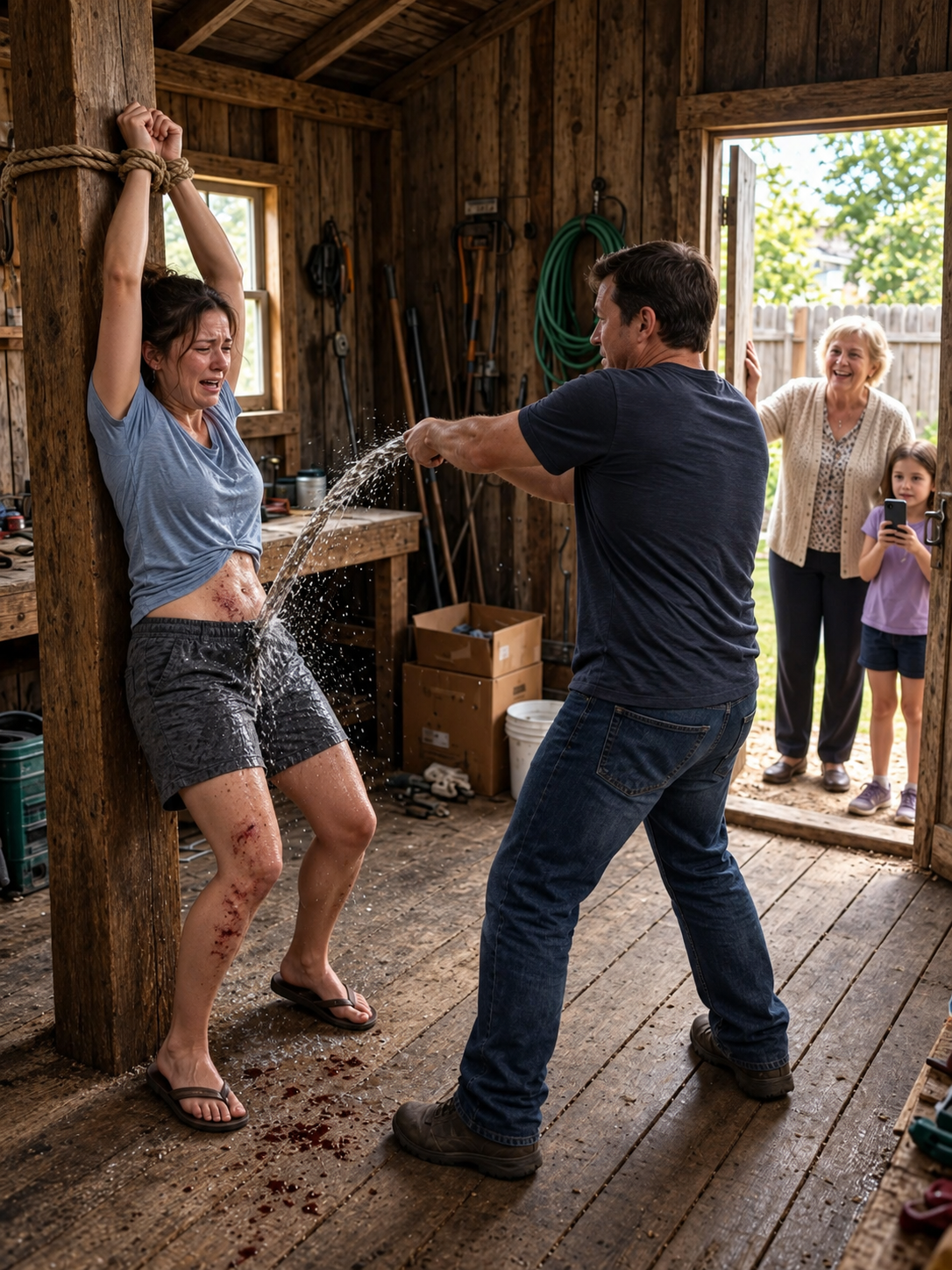
PART 1 TITLE: In That Hospital Room, My Daughter Watched the Door While I Was Still Searching for a Way to Explain What My Husband Had Done to Me
The first thing I noticed when I opened my eyes in that hospital room wasn’t the pain running through my ribs or the bandage pulling against my skin. It was my daughter, sitting near the window, staring fixedly at the door. She had pulled her knees against her chest and hidden her hands inside the sleeves of her oversized sweatshirt. Every time footsteps echoed in the hallway, she lifted her head. She seemed to be waiting for someone while desperately hoping that person would never arrive.
I knew that expression. I had seen it on her face at home without ever allowing myself to understand what it meant. In the past, when she suddenly stopped playing or fell silent whenever her father entered the room, I assumed she was going through a shy phase. When she studied the adults before answering a question, I told myself she was simply cautious. That day, I no longer had the strength to invent comforting explanations. She wasn’t waiting for a visitor. She was watching for a threat.
A hospital staff member had just left the room after examining my injuries. Her tone had been professional, almost ordinary, but her final question continued circling in my mind. She wanted to know whether some of the older marks on my body had the same origin as the ones she had just documented. I had stared at the plastic identification bracelet around my wrist. My name was printed on it in black letters, along with information I could read without thinking. I had focused on those details to avoid answering. My daughter, however, had heard the question.
“Mom, you don’t have to do it again,” she said.
Her voice was so quiet that, at first, I thought I had misunderstood. She wasn’t talking about my hospital stay. She meant the habit of searching for an acceptable story before anyone even asked what had happened. I turned toward her, but she lowered her eyes to her sleeves. Behind her silence, I recognized an exhaustion I had never wanted to see in a child.
For years, I had believed a family could remain together as long as its problems stayed inside the house. That belief hadn’t appeared overnight. It had developed through a succession of arguments, incomplete reconciliations, and conversations my husband declared finished while I still had something to say. Each time, I chose whatever seemed least dangerous: waiting for his anger to subside, postponing my questions, and preserving the appearance of an ordinary life in front of our children.
At first, the explanations were simple. A mark on my arm came, I would say, from bumping into a piece of furniture. If a sleeve was torn, I blamed an overloaded laundry basket or a clumsy movement. Whenever a family visit was canceled, I claimed I was exhausted. I repeated these versions with enough precision that they became easy to remember. The most disturbing part was that, over time, I sometimes began thinking of those stories before I even considered the real cause of my injuries.
My husband understood this pattern long before I did. After an argument, he could suddenly become calm, almost attentive. His face relaxed, his voice returned to a measured softness, and he asked why I always made things so complicated. If I cried, he waited. Then he spoke like someone who sincerely wanted to resolve a disagreement. To anyone who hadn’t witnessed what came before, I might have appeared unreasonable. He seemed sensible. That difference always worked in his favor.
I remember one evening in particular when I spent several minutes standing before the bathroom mirror, trying to arrange my hair to hide a mark near my face. On the other side of the door, I could hear the familiar noises of our home. A chair scraped against the floor, water ran in the kitchen, and one of my daughters was looking for something. That ordinary background noise upset me more than silence would have. I knew I would have to walk out, smile, and behave as though nothing important had happened.
When my husband joined me, he didn’t ask whether I was hurting. He simply studied my reflection before pointing out that the children didn’t need to see their mother looking like that. I said nothing. His remark contained both an accusation and an instruction. In a few words, he had shifted responsibility for the situation. It was no longer his behavior that might frighten our daughters, but my supposed inability to conceal its consequences.
His mother contributed to that confusion. She rarely intervened when an argument began. She preferred to remain nearby, close enough to know what was happening but far enough away to claim afterward that she hadn’t seen anything. If I turned to her for support, she replied that marital difficulties were no one’s business except the couple’s. She often used the word “private,” with the particular confidence of someone who considered discretion a virtue, even when it served to protect cruelty.
I had come to dread that word. Private meant I shouldn’t tell my sister about certain events. Private meant an injury could be mentioned only if I changed its cause. Private meant the children had to learn not to repeat conversations they overheard behind closed doors. After hearing it so often, I had almost forgotten that a family could also protect its privacy by respecting one another instead of forcing the person who was suffering into silence.
My sister was the only person with whom my explanations never entirely worked. She didn’t pressure me or demand details I wasn’t ready to share. But when she looked at me, I felt as though she noticed the words I avoided as carefully as the ones I spoke. If I told her an incident was unimportant, she didn’t necessarily argue. Instead, she asked whether I needed anything. That simple question sometimes brought me close to tears.
My husband disliked that closeness. He didn’t always openly forbid me from speaking to my sister. He had a subtler way of making our conversations uncomfortable. After I spoke with her, he might ask what we had discussed, whether she had interfered in our marriage, or whether I had once again made him look bad. His questions came in an almost casual tone. Nevertheless, I eventually found myself weighing every word before picking up the phone.
I thought my daughters were unaware of these tensions. I worked hard to speak normally to them, prepare meals, and maintain the little routines that structured their days. When an argument became too heated, I asked them to go play somewhere else. I imagined they would forget the sounds coming from the other room as soon as calm returned. I didn’t understand that a child doesn’t need to witness an entire confrontation to recognize danger. A few seconds, a change in someone’s voice, or a slamming door can be enough.
Sometimes I found my daughters sitting together in an unusual silence. I would ask what they were doing. One said they were drawing, while the other shrugged. I kissed them and continued with my day. Now those memories have a painful clarity. I can see the glances they exchanged, their movements stopping when someone entered, and the way they moved closer together without speaking. At the time, I saw it as the closeness of two sisters. I had never imagined they might also be comforting each other.
My daughter, the one now sitting beside my hospital bed, had developed habits I mistook for absentmindedness. She could recognize the sound of her father’s footsteps. Sometimes she stopped talking before he even entered a room. When her grandmother approached a tense conversation, she became attentive in a way I found strange. One day, I asked why she looked toward the hallway so often. She simply replied that she wanted to know who was coming.
I didn’t press her. It was easier to believe children were curious than to admit they were watching for danger. Yet the signs were there. When my husband came home visibly upset, she looked for her sister and led her somewhere else. When his voice grew louder, she stopped whatever she was doing. She didn’t wait for things to escalate before reacting. She seemed to know the sequence of events better than I did, as though she had memorized a lesson no one should ever have taught her.
I convinced myself that everything would eventually improve if I chose my words more carefully. It was an exhausting belief because it required constant vigilance. I thought about when to ask a question, how to mention an expense, and what tone to use when responding to an unfair remark. Even when there was no argument, part of my attention remained focused on preventing the next one. That caution gradually invaded the most ordinary gestures of daily life.
My husband didn’t need to display his anger constantly. Sometimes all he had to do was stop in the middle of a sentence and look at me for me to understand that I should be quiet. At other times, he reopened an old disagreement and insisted I had misunderstood his intentions. I then searched for details, exact phrases, and proof of what I remembered hearing. By the end, I no longer knew whether I was defending my memory or asking permission to keep it.
His mother reinforced that doubt. She repeated that her son had a difficult temperament but that he also worked hard for his family. She presented his outbursts as the price of his responsibilities. If I mentioned my fear, she advised me to avoid subjects that irritated him. In her mind, every conflict had a convenient solution: I needed to be more patient. She never wondered what that patience cost my daughters, or why it always had to come from me.
Once, after canceling plans with my sister, I sat for a long time staring at my phone. I wanted to write something true to her. Not necessarily the entire story, just a few words that would help her understand I wasn’t simply tired. I started several messages, then deleted them. Each time, I imagined the questions I would have to answer afterward, the decisions people might expect me to make, and my husband’s reaction if he discovered I had spoken.
Eventually, I sent an ordinary excuse. My sister replied that she understood and that she was always available. That last word stayed with me for days. Available. She didn’t require me to justify my circumstances before deserving her help. Yet I didn’t seize the opportunity. I kept telling myself I needed to wait for a calmer period, choose the right moment, and avoid disrupting the children’s lives. Every postponement seemed temporary. Added together, they had become years.
At the hospital, that succession of missed opportunities returned with unbearable clarity. I could still make out the fresh marks on my arm that the medical staff had just examined. It hurt to change position, but that pain wasn’t the hardest thing to endure. What frightened me more was the possibility that my daughter had preserved memories I believed had faded. I didn’t know what she had heard or how long she had understood what was really happening.
“Are you afraid he’ll come here?” I asked her.
She hesitated before answering. Her gaze moved toward the door, then toward the phone resting beside her. I didn’t understand why that device seemed to occupy so much of her attention. It was an old model with a damaged screen, something that had been lying around the house for ages and that nobody cared about anymore. I was almost certain my husband had forgotten it even existed.
She rubbed the edge of one sleeve between her fingers before looking at me.
“I’m more afraid he’ll be the first one to talk.”
Her answer unsettled me. I had expected her to say she was afraid of his shouting, his anger, or simply his presence. Instead, she feared something else: the words he would say in front of other adults. I wanted to ask why that worried her so much, but a familiar sensation stopped me. I already knew the power of my husband’s explanations. I had simply never considered what they meant to her.
The room fell silent. I could hear people moving quietly in the hallway, the rustling of the sheet when I shifted my hand, and then the faint sound of my daughter picking up the phone again. I watched her for several seconds. She had neither the confidence nor the ease of a child who felt protected. Yet something about her attitude had changed. She seemed to have completed an important task and was now waiting to discover its consequences.
I remembered the last time I had seen her at home, before everything changed. Her face had been pale. She stood at a distance, as though searching for the best place to watch without being noticed. At the time, I had been too preoccupied with my husband’s anger to understand her expression. I thought she was paralyzed by fear. I didn’t yet know that she had begun thinking about what she might do if things went wrong.
I wished I could return to that moment, take her hand, and lead her away from what she was about to witness. But I couldn’t change that day. All I could do was listen to what she had to tell me. For the first time in a long while, I resisted the urge to offer a reassuring phrase that would end the conversation. I didn’t say everything was fine. I didn’t promise her father would calm down. I simply gave her time to speak.
She finally rested her hand on the old phone. Her thumb followed a crack across the screen. Then she said something I will never forget.
“I knew he was going to tell a different story. So I kept what he really said.”
At that moment, I understood that my daughter hadn’t merely witnessed my suffering. She had learned to anticipate the lies that would follow. And without my knowledge, she had found a way to stop those lies from covering up everything.
END PART 1
PART 2 TITLE: No One Cared About the Old Phone Abandoned in Our House, but My Daughter Had Understood Why That Neglect Could Become Valuable
Long before that day, the old phone had stopped holding any importance in our household. Several cracks ran across its screen, and its battery could barely hold a charge. It had once belonged to the family before being replaced by a newer device. My husband considered it useless. Whenever he came across it, he moved it aside without even trying to turn it on. To him, it was nothing more than clutter, something that belonged at the bottom of a drawer.
My daughter, however, hadn’t forgotten about it. She had taken possession of it without asking anyone to repair it. I assumed she enjoyed looking through old photographs or simply liked having something of her own. I had never wondered why she preferred that damaged device to another one. There was nothing appealing about it. It worked poorly, sometimes switched itself off unexpectedly, and its screen forced her to look past the cracks. But it had one advantage none of us had recognized: nobody paid attention to what she did with it.
In our house, important objects never completely escaped my husband’s attention. He knew where the phones we used every day were kept and paid particular attention to conversations that might involve our family life. I couldn’t always speak freely to my sister without fearing questions afterward. The old device escaped that scrutiny simply because he no longer considered it valuable. His lack of interest had created a small, almost invisible space that my daughter eventually learned to use.
She hadn’t become brave overnight. At first, she had learned to make herself small. When she heard her father’s voice change, she instinctively searched for somewhere out of his way. If her sister was nearby, she tried to move her away. For a long time, I interpreted these gestures as ordinary childhood reactions. I hadn’t understood that they came from careful observation of our family life, built from events I thought I had successfully concealed.
She knew the sound of her father’s footsteps when he was upset. On certain days, he entered without saying a word, dropped his belongings, and walked quickly through the rooms. At other times, he seemed calm at first, until one remark was enough to change his mood. My daughter could distinguish these moments better than I could. She also knew that her grandmother’s presence offered no guarantee of protection. On the contrary, when the older woman slowly approached an argument, she often became a spectator to something she made no effort to stop.
I can picture my mother-in-law standing in doorways. She would fold her arms, tilt her head slightly, and wait for her son to finish speaking. If I tried to explain myself, she might sigh impatiently or look away. Considered separately, those gestures seemed insignificant. Together, however, they conveyed a precise message: I would receive no support from her. My daughter had witnessed these reactions often enough to understand what they meant.
On the rare occasions when I discussed the situation with my husband, he accused me of trying to create unnecessary divisions between him, his mother, and me. According to him, a wife had to learn to accept the customs of the family she had married into. He presented this demand as proof of loyalty. Sometimes I replied that respect had to work both ways. But all it took was a hardening of his tone for my arguments to lose their importance. I would end up searching for a way to stop the conversation without provoking further anger.
I had grown accustomed to watching my mother-in-law’s reactions before responding to certain remarks. If she seemed to disapprove of what I said, I changed my words. If she remained silent, I waited. Monitoring myself in this way had become almost natural through repetition. I didn’t realize my daughters were watching their mother silently ask for permission to speak. They were learning that peace in our home depended less on what was right than on what certain adults were willing to hear.
The contrast with my sister was striking. Whenever I visited her or we spoke on the phone, she didn’t demand that I defend every reaction I had. She could disagree with me, of course, but her questions served a different purpose. She wanted to understand. That difference had become so precious that I sometimes tried to make our conversations perfectly ordinary, as though mentioning my problems might contaminate the only place where I could still breathe freely.
My daughter noticed that difference too. She had observed that I didn’t speak to my sister with the same caution I used at home. When my husband began telling his version of an argument, my mother-in-law usually agreed with him or refrained from contradicting him. My sister, however, didn’t simply accept the first explanation. She looked at me and waited for my opinion. I considered that a natural sign of affection between adults. In my child’s mind, it had taken on much greater importance.
I didn’t yet know that she had begun identifying the people she could trust with the truth. She wasn’t trying to make a final judgment about the entire family. She simply wanted to understand who would listen without looking away. That responsibility should have belonged to adults. Yet over time, she had discovered that when danger appeared, the people present didn’t all react in the same way. Some intervened through their actions, others through their words, while still others chose not to see anything.
As for me, I was still trying to believe that a new balance was possible. I didn’t want my daughters growing up believing their father was someone to fear. So I clung to the peaceful days, those hours when he behaved like any other parent and the tensions seemed far away. Those periods gave me the impression that things could improve. They also made the next outburst harder to understand because, each time, I tried to find my way back to the man from the peaceful days.
My husband used those moments to remind us of everything he believed he did for us. He talked about family responsibilities, the work required to maintain our daily life, and what he expected in return. He never presented these things as requests open to discussion. Instead, he established an unspoken list of obligations we were expected to fulfill. When I resisted, he sometimes accused me of failing to appreciate what we had. Arguments took on a strange form: rather than discussing his behavior, I found myself trying to prove my gratitude.
His mother completely agreed with that way of thinking. In her eyes, disagreements should be resolved through my silence and patience. She was especially harsh whenever I suggested certain boundaries had been crossed. She reminded me that every family experienced difficulties. I had never denied that obvious truth. What I couldn’t make her understand was that ordinary difficulties shouldn’t require a woman to hide her injuries or children to monitor their father’s movements.
Sometimes I noticed my daughter standing motionless in the hallway after a tense conversation. She seemed hesitant to enter, as though assessing what she might find. I asked whether she needed anything. She said no and walked away. Today, I understand that I should have been the one asking questions. I should have asked what she had heard, what worried her, and why she seemed to wait until I was calm again before daring to approach me.
But speaking openly would have required acknowledging the situation. I convinced myself it was enough to make the incidents less visible. When my husband raised his voice, I lowered mine. When he followed me during an argument, I tried to end the discussion before the girls could hear. If he became aggressive, my first thought was to move the children away. Taken individually, these precautions felt protective. Yet they never changed the source of their fear.
My daughter had begun responding differently. She couldn’t force her father to calm down or persuade her grandmother to stand up to him. She knew that confronting him directly could make things worse. So she searched for something she could do within her limited means. The old phone, because it still possessed certain functions despite its condition, offered that possibility. It couldn’t prevent violence. But it could preserve images and sounds that the adults involved wouldn’t be able to change afterward.
I don’t know exactly when she realized this. I wasn’t beside her when she began considering using the device for something other than its ordinary purpose. I only know that she had kept it and knew how to operate it. Its weak battery imposed limitations. Its damaged screen was inconvenient. Yet none of that seemed to discourage her. She wasn’t waiting to own a perfect phone. She wanted something nobody would think to take away from her.
There was a terrible logic to her decision. Other evidence disappeared easily in our house. A bruise could fade. A torn shirt could be put away. An argument could be described in several different ways. Even memory became uncertain when my husband insisted confidently enough that I had misunderstood. A recording, however, wouldn’t depend on his ability to convince everyone around him. It would remain what it was, even if the people involved refused to acknowledge it.
Yet the day everything changed had begun with familiar routines. The house was filled with its usual noises, the children moved from room to room, and I tried to carry on with my daily activities. Nothing about that day’s appearance would have allowed a visitor to guess what was about to happen. That was precisely what I found most exhausting about our situation. Danger never arrived with a clear announcement. It slipped into a routine we had learned to consider normal.
I don’t remember every word that started that final argument. That uncertainty used to trouble me because my husband often exploited missing details to challenge my account. I do know, however, that the tension grew and my attempts to calm the conversation failed. He had that fixed stare I recognized immediately. I could already feel my body preparing for what might follow. I answered cautiously, not because I believed I was wrong, but because I feared the consequences of saying the wrong thing.
His mother was there. I noticed her when she moved close enough to follow our exchange. She didn’t ask what was happening. She didn’t suggest that everyone calm down. She simply watched her son with an attention I knew well. I wished she would intervene, just once, with the authority of a mother capable of telling him to stop. But her silence had long since ceased to surprise me. It almost resembled approval.
I searched for my daughters with my eyes. I didn’t want them nearby. One of them stepped back, and I recognized on the other’s face the concentrated expression that had worried me before. I tried to give her a discreet signal, a way of telling her to leave. She didn’t respond immediately. Her eyes moved from her father to her grandmother, then toward the exit. I thought I was seeing a frightened child. I didn’t know she was also looking for an opportunity to act.
My husband moved closer to me. His voice had changed. It no longer carried only irritation; it had become hard and absolute. He didn’t seem to be expecting an answer anymore. I felt the argument crossing a boundary I knew too well. I wanted to retreat into another room, close a door, and wait for things to settle. But he was already too close for me to end the confrontation that way.
My mother-in-law didn’t move when I looked toward her. I remember that stillness with disturbing precision. All she had to do was say my name, ask her son to stop, or simply acknowledge the fear on my face. Instead, she remained a spectator. Her lack of reaction reminded me of all the times I had hoped the presence of a witness would be enough to stop things from going too far.
That was when I realized my husband intended to force me out of the house. My eyes moved toward the building outside, the one we used as a shed. I knew that place, its smell of wood, and the shadow its door cast across the ground. It had never been anything more than somewhere to store belongings. Suddenly, it seemed isolated from the rest of the house. I was afraid of what might happen there without anyone outside witnessing it.
I begged him not to do this in front of the children. I didn’t shout. I spoke quickly, with an almost automatic desire to find words that might make him hesitate. My request wasn’t a provocation. I simply wanted him to stop. But he was no longer listening. His mother, still present, showed no concern about where he intended to take me. What I saw as an obvious warning seemed to cause her no alarm at all.
Behind us, my daughter disappeared from view. I felt immediate relief, convinced she had understood my silent instruction and had gone somewhere safe. I couldn’t have imagined that she had thought of the old phone. She knew where it was. She knew it still worked. And because nobody paid attention to it, she could pick it up without attracting her father’s notice. That action would change the course of the day.
My husband grabbed me and dragged me outside. I tried to slow him down. I remember struggling to keep my balance, the sensation of being forced forward when every part of me wanted to retreat. Behind us, the house seemed to continue its ordinary existence. The contrast was so jarring that an absurd thought crossed my mind: if someone watched from a distance, perhaps they wouldn’t realize I was being taken against my will. A scene lasting only a few seconds could still be turned into a misunderstanding.
We were approaching the shed when I heard movement behind us. I didn’t turn around. I was concentrating on staying upright and stopping fear from overwhelming me. I had no idea my daughter was somewhere nearby, hidden well enough to escape notice. She had no intention of confronting her father. She knew she couldn’t overpower him. She had chosen another way to act, one I wouldn’t learn about until much later.
The shed door stood before us. My husband didn’t slow down. As I crossed the threshold, I understood that the usual rules had disappeared. This was no longer an argument I could quiet by lowering my voice. He was taking me somewhere I could count neither on his mercy nor on his mother’s intervention. I had no idea what he intended to do. And I didn’t know that, beyond that doorway, someone was about to preserve the evidence he believed he could erase.
END PART 2
PART 3 TITLE: Behind the Shed Door, My Husband Believed He Could Control the Story Without Seeing the Child Who Was Recording Everything
The first thing I remember is the smell. The shed smelled of old wood, dust, and belongings that had remained untouched for a long time. That smell, which I had always associated with ordinary household chores, suddenly seemed suffocating. My husband walked ahead of me with a determination that chilled me. I was still trying to speak to him, but my words were lost among the sounds of our movements. I had no real strategy. I was simply trying to gain a few seconds, hoping that a moment of hesitation might restore his calm.
The light coming through the open doorway illuminated part of the floor. Beyond it, the inside of the shed remained darker. I could make out objects stored against the walls and a wooden beam that formed part of the building’s structure. My eyes settled on it for no particular reason. A few moments later, that beam would become the center of everything I remembered. Until then, it had been nothing more than an ordinary part of the surroundings. I have often thought that this is how the most terrible events transform familiar places.
“Stop, please,” I told my husband.
I was no longer trying to make him acknowledge my point of view. I simply wanted him to stop dragging me and let me return to the children. He didn’t answer immediately. When he turned toward me, his expression made it clear that my pleas would not change his decision. He was convinced that he had the right to punish me for what he considered an offense. That sense of entitlement was even more frightening than his anger.
I reminded him that the girls were at home. It was the argument I always returned to when I had nothing else left. I believed that mentioning the children might awaken some sense of responsibility strong enough to stop him. Once again, it didn’t work. My husband simply continued what he had started. I don’t remember every word he said. But I can still clearly picture the way he moved, as though nothing and no one had the power to impose a limit on him.
When he tied my hands to the wooden beam, I understood that I was no longer facing a threat alone. He had made a decision and was carrying it out. The rope pressed painfully around my wrists. I tried to move, searching for a position that hurt less, but every movement reminded me that I couldn’t walk away freely. I stared at my hands with an almost childish disbelief. Part of me still refused to accept that a man with whom I had built a family could treat me this way.
I wanted him to truly see me. Not as someone to correct, not as someone whose obedience had to be forced, but as the woman he had known for years. I said his name. I told him he was hurting me. He continued speaking in that accusing tone I knew so well. I had heard that tone in the kitchen, in hallways, and behind closed doors. But here, tied to a beam, I could no longer pretend this was an ordinary disagreement.
The strangest part was that my mind continued searching for an explanation that would make the situation seem less serious. I thought about what I would say if someone noticed my wrists. I was already trying to figure out how to explain being in the shed without mentioning what he had done to me. That habit had survived even when it was impossible to deny the violence. I was still preparing the words that would spare my husband from having to answer for his actions.
Then I heard my mother-in-law’s voice.
She was standing near the entrance. I no longer know exactly when she had followed us. I only know that she was there, close enough to understand what was happening. I turned toward her with the immediate, almost instinctive hope that she would put an end to the scene. She was watching her son tie his wife’s hands. There was no possible misunderstanding. She could see what he was doing.
She made no attempt to help me.
She laughed.
It wasn’t a nervous laugh followed by panic or an effort to intervene. It accompanied the words she addressed to me from the doorway. She told me to remember my place. In that shed, the words I had heard so often about respect and obedience took on their true meaning. This wasn’t about preserving family harmony. It was about making me understand that I had no right to oppose them.
I stared at her for several seconds, unable to answer. Her expression was unbearably familiar. I knew her habit of folding her arms, standing at a distance, and letting her son control arguments. But this time, passivity was no longer enough to describe her behavior. She was participating in my humiliation. She was using my fear as an opportunity to reinforce the authority she believed she held over me. I finally understood that I could expect no intervention from her.
Outside, the day continued. Through the opening, I could see part of the area in front of the shed. Nothing indicated to the outside world what was happening only a few yards from the house. That realization deeply disturbed me. I thought of all the times I had passed other families without imagining anything about their private lives. A door and a few steps were enough to keep a terrible scene invisible. In our home, that invisibility had become an essential condition of the power my husband exercised.
I didn’t know my daughter had followed us from a distance. I hadn’t seen her when my husband forced me through the doorway. I had assumed she had gone back inside with her sister. It was only at the hospital that I would learn she had taken the old phone and approached close enough to record what was happening without revealing herself. While I was searching for a way to protect myself, she was trying to prevent the scene from disappearing beneath another version of events.
I don’t want to imagine that she acted without fear. Everything she told me afterward proved otherwise. She knew her father’s anger and understood that he could react violently. She had learned to recognize the moments when attracting his attention was especially dangerous. That knowledge, acquired through repeated arguments, had led her to remain hidden. She wasn’t trying to become the heroine of a dramatic event. She was trying to do something useful with the limited means available to her.
The phone was far from an ideal tool. Its broken screen made it difficult to use, and its weak battery could die at any moment. But it could still record video. My daughter had chosen that particular device because her father paid no attention to it. He hadn’t seen it in her hands. He didn’t know a camera lens was somewhere beyond the doorway. He believed he alone would decide what people heard about this incident. That certainty had made him careless.
Meanwhile, I kept trying to get a reaction from him. I wasn’t thinking about collecting evidence. I wasn’t thinking about legal or family consequences. I simply wanted him to remove the rope, stop threatening me, and let me leave. I told him my hands were hurting. I received no answer that offered any reassurance. My mother-in-law remained nearby, without showing the slightest intention of opposing her son.
At one point, I lowered my head because I could no longer bear looking at their faces. The dust near my feet seemed strangely distinct. I could see marks on the floor and variations in the color of the wood. My mind clung to those details to avoid confronting the full horror of the situation. Yet I knew the facts. I was tied up in a shed by my husband, under the watchful eyes of his mother, and neither of them appeared to consider it unacceptable.
Their voices continued around me. Some sentences reached me clearly. Others blurred into sounds I could no longer follow. I heard my mother-in-law laugh again. I heard my husband’s anger mingling with the confidence he regained whenever he believed he had won an argument. He was no longer trying to convince me. He wanted me to understand that his will prevailed. That domination, more than the exact words he used, occupied my attention completely.
I know now that it was during those minutes that he spoke one essential sentence. It concerned what I would tell people after leaving the shed. But I didn’t truly register it in my memory. I was too consumed by pain, fear, and the effort to remain calm. Yet that sentence would be preserved on my daughter’s phone. When I heard it later in the hospital room, it would give new meaning to a long series of events I thought I had understood.
At that moment, I knew nothing about the evidence being collected. I didn’t realize that someone would later be able to listen to our voices without relying on my incomplete memories. I continued to believe the story would be disputed if I tried to tell it. My husband would probably claim I had exaggerated. His mother would insist it was a private family disagreement. People might ask why I hadn’t reacted differently. I could already hear those imaginary questions while the situation was not even over.
Anticipating those questions filled me with shame. I knew I hadn’t caused this treatment, yet I still feared other people’s judgment. Why had I stayed in the relationship so long? Why had I hidden the previous injuries? Why had I continued protecting our family’s image? Those were complicated questions, and I had no simple answers. I only knew that fear could shrink someone’s world into a succession of decisions made to avoid the next explosion.
My daughter, on the other side of the doorway, wasn’t thinking the way I was. She hadn’t spent years searching for ways to make events seem acceptable to others. She saw what was happening. Her father had taken her mother into the shed. He had tied her hands. Her grandmother was present and laughing. Those facts seemed serious enough that someone else needed to know about them. She wasn’t trying to decide which excuse could preserve our family’s appearance.
She also understood the limits of what she could do. Bursting into the shed would have drawn attention to herself and risked making the situation worse. Shouting wouldn’t necessarily have stopped her father. I could never blame her for choosing to remain hidden. My only regret was that she had been placed in such a difficult position. No child should ever have to choose between intervening to help a parent in danger and preserving evidence that might enable other adults to act.
The camera captured part of what happened. It didn’t turn the scene into a complete account, perfectly framed and easy to understand. That wasn’t its purpose. The sounds mattered as much as the images. Anyone listening could hear the voices, identify the people present, and understand that the situation wasn’t an accidental fall or a simple argument. The phone recorded details neither my husband nor his mother intended to tell anyone truthfully.
When my daughter later explained what she had done, she didn’t try to make her actions sound more impressive. She didn’t tell me that her fear had disappeared or that she had suddenly felt capable of confronting everything. She simply described the need to stay out of sight and preserve enough evidence for someone to believe us. That simplicity broke my heart. At her age, she had already understood that the words of an injured person weren’t always enough against someone determined to contradict them.
Inside the shed, I remained unaware of what was happening outside. My attention kept returning to the rope, the beam, and the door. I listened for the slightest change in my husband’s voice, trying to determine whether his anger was subsiding. I knew this work of observation intimately. I had performed it so many times in our home that I could almost continue doing it despite my exhaustion. Yet this time, the situation had gone further than any explanation I was accustomed to inventing.
I couldn’t reconstruct every second of how the incident ended. Some images remain extremely clear, while others come back as disconnected fragments. I remember the relief of finally having my hands free. I remember the pain that lingered in my wrists. I also remember an immediate, deeply rooted thought: I had to keep my daughters from seeing how frightened I was. Even after what had just happened, part of me was still trying to reassure them by hiding the truth.
That reflex might have allowed my husband to regain control, as he had so many times before. All it would have taken was for me to return to my old habits, minimize the injuries, and allow his mother to describe the incident as a family misunderstanding. But something had already changed without my knowledge. My daughter had preserved what she could record. She hadn’t waited for her father to offer an explanation or for me to decide whether to tell the story. She had decided someone else needed to see what had happened.
Her choice of that person was no accident. My sister was the one who never forced me to immediately accept my husband’s version of events. She knew how to listen to hesitation, notice contradictions, and let me speak without interrupting. My daughter had understood that through many family conversations. She had noticed that, amid all our tensions, her aunt represented a different perspective, one less willing to turn an injury into clumsiness or humiliation into a simple disagreement.
I don’t know exactly what went through my daughter’s mind when she sent the recording. I know only that she made a decision I had never dared make with such clarity. She didn’t ask her father’s permission to reveal the scene. She didn’t warn her grandmother. She didn’t wait to find out whether I would once again prefer to remain silent. She sent the video to my sister, allowing the images and sounds to speak before anyone could rewrite the story.
When the file left the old phone, my husband still knew nothing about it. He probably believed the events would remain confined to our property and that all he would need afterward was a convenient explanation. My daughter had broken that pattern. Someone outside the house now possessed part of the truth. What had happened in the shed no longer depended entirely on my ability to speak. For the first time in a long while, my silence could no longer make the facts disappear.
I didn’t learn about that message until after I arrived at the hospital. But when my sister received it, before I even knew what my daughter had done, the day had already taken an irreversible turn. My husband could still calm down. His mother could still describe the incident as a private matter. I could even be tempted to minimize what I had suffered. None of those actions could recall the images that had been sent. The truth had crossed the boundaries of our home before my husband could stop it.
END PART 3
PART 4 TITLE: At the Hospital, My Daughter Revealed What She Had Known for Years, and My Sister Discovered Words I Had Never Heard
When I arrived at the hospital, I still didn’t know how to explain what had happened. I knew the facts, but the words seemed to disappear whenever I tried to organize them. The pain made every movement difficult, and I didn’t have the strength to face the questions I imagined were coming. Yet part of me continued preparing a softened explanation. I thought about my husband’s reactions, my mother-in-law’s accusations, and the possible consequences for our daughters if the truth came out.
The room where I had been placed was flooded with harsh white light. The hospital sheet felt rough against my skin. A cup of coffee sat nearby, growing cold because I couldn’t bring myself to touch it. Sometimes I stared at that cup for several seconds, as though its ordinary existence could distract me from everything else. My daughter had seated herself beside me. She was still wearing her oversized sweatshirt, and her hands remained almost completely hidden inside the sleeves.
The medical staff examined my injuries with careful attention. They asked where I was hurting and when certain marks had appeared. Every question demanded an answer I had long since stopped giving honestly. I could feel my body tense whenever the cause of the injuries came up. The people examining me didn’t know my husband. They had no reason to believe his explanations instead of mine. Yet I reacted as though I already had to defend myself against him.
I looked at the marks on my wrists and thought about the wooden beam in the shed. It was impossible to convince myself that everything had resulted from a simple disagreement. My husband had tied me up. His mother had stood at the entrance and laughed. Those facts didn’t depend on my mood or my ability to remember every sentence spoken. But acknowledging an event didn’t mean I knew how to describe it. Years of silence had taught me to calculate the consequences of words before speaking them.
When a hospital employee asked whether I had suffered other injuries in the past, my first instinct was to search for some detail that would allow me to change the subject. I could talk about my exhaustion, my current pain, or my difficulty sleeping. I could answer practical questions. But this question opened a door onto years I had carefully concealed. It was no longer simply about describing what had happened in the shed. It meant looking at everything I had agreed to keep hidden before that day.
The employee waited without immediately pressing me. I remember her patience because it contrasted so sharply with the conversations I was accustomed to having at home. My husband interpreted my silence as resistance. His mother sometimes considered it an admission of guilt. Here, no one seemed determined to force me into producing a quick, reassuring answer. Yet I remained motionless. I stared at my identification bracelet and searched my mind for a sentence that wouldn’t create another upheaval.
It was my daughter who broke the silence.
“It wasn’t the first time.”
She had spoken softly, but her words reached everyone in the room. I turned toward her so suddenly that pain shot through my side. She didn’t move away. Her eyes remained lowered, and her fingers continued playing with the fabric of her sleeves. Yet she had just spoken aloud something I had spent years trying to keep locked away.
I asked her what she meant. The question escaped before I considered how absurd it was. I knew perfectly well what she was referring to. What overwhelmed me was discovering that she knew it too. I had constructed so many explanations to prevent her from understanding. I believed I had hidden certain marks well enough and sent the children away often enough during arguments. But here she was, in a hospital room, revealing what I had refused to acknowledge in front of her.
She took a few seconds before continuing. Then she began explaining how she recognized her father’s footsteps when he was angry. She described how his way of entering a room changed and how his voice could become harsher before an argument even began. She had learned to watch for these signs because they warned her of what might follow. I listened without interrupting. Every detail corresponded to a family habit I had believed was subtle enough to escape the children’s notice.
She knew her grandmother’s behavior too. When my husband grew irritated, the older woman sometimes approached, not to prevent the argument, but to watch it unfold. My daughter had noticed that she always remained at a distance that would later allow her to claim she had played no part. That observation struck me with its precision. It had taken me years to clearly describe that behavior. My child had understood it simply by watching how the adults treated one another.
She told me about her sister. Whenever tension rose in the house, she tried to move her away from the room where we were. Sometimes she guided her to a place where they could wait together. Then she listened to the noises, trying to determine whether the argument was ending or becoming more serious. She didn’t try to intervene directly. She had learned that attracting their father’s attention when he was in that state was dangerous.
I wanted to tell her she should never have carried that responsibility. The words came to me, but I stopped myself. She probably already knew. Reminding her that it wasn’t her role wouldn’t erase the moments when she had been forced to act because the adults had failed to protect their home. I simply tried to keep looking at her. It was difficult. Part of me wanted to turn away, not because I blamed her, but because her understanding revealed the extent of my blindness.
I thought back to all the times I had found her unusually quiet without trying to understand why. I could picture her glances toward doors, her quick movements when she heard her father, and the way she stayed close to her sister. I had interpreted those gestures as personality traits. In reality, they were the consequences of repeated fear. She had organized part of her childhood around the need to anticipate an adult’s moods. That discovery was almost harder to bear than the physical pain.
The most devastating thing was realizing that she wasn’t speaking only about what she had witnessed. She had also learned to predict what would happen afterward. Following arguments, she knew her father would often become calmer. She knew he might explain events differently. She knew her grandmother would probably help him present the situation as an unimportant incident. I thought I was the only one caught in that pattern. In reality, my daughters had been observing its stages for a long time.
I asked why she had never spoken so clearly before. She hesitated. I immediately realized that my question might sound like an accusation, and I regretted phrasing it that way. I didn’t want her to feel responsible for my ignorance. For years, I had demonstrated that certain subjects made adults nervous or triggered new arguments. Why would she have believed that simply confiding in me would be enough to change things?
“I knew you wanted everything to go back to normal,” she finally said.
That sentence left me speechless. She had understood my constant efforts to restore the appearance of peace, but she had drawn a different conclusion from mine. To me, restoring calm was a way of protecting the family. To her, it sometimes meant that nobody would talk about what had happened. Silence didn’t erase anything. It merely prepared the way for the next incident.
The hospital employee gently resumed her questions. The visible injuries were documented, and the older marks also received attention. There was something strangely concrete about this process. The facts no longer depended entirely on how I described them. There were now observations made by people outside our household. I didn’t yet know what that would change going forward. But for the first time, I felt the difference between hiding an injury and allowing it to be acknowledged.
My daughter was still watching the door. Her anxiety hadn’t disappeared simply because she had spoken. I gradually understood why. She knew all too well what happened when her father arrived after an argument. He often became more composed, as though he had never lost control of himself. He could describe events with a confidence that made my hesitation seem suspicious. She feared he would enter the room before anyone else understood what had really happened.
That was when she told me about the phone.
I knew she had kept the old device, but I had never imagined it played such an important role in the way she responded to events. She took it out from beside her. The cracks across the screen immediately reminded me of how useless it had seemed. At first, I thought she wanted to show me something personal. Then I noticed how carefully she was holding it, almost solemnly, as though the object might slip from her hands.
She explained that she had picked it up when her father dragged me toward the shed. She had followed from a distance, remaining far enough away not to attract his attention. She had watched from a place where she could hide. Then she had used the camera. I listened, unable to reconcile the image of my daughter with that of a child forced to record violence against her mother. I knew she had been brave, but that courage had been born from a situation she should never have had to face.
I asked whether her father had seen her. She shook her head. Her answer relieved me, even as the thought of what might have happened otherwise frightened me more. My husband had no idea she had been nearby. My mother-in-law didn’t seem to have noticed her either. They had continued speaking and acting as though no one could preserve a record of their actions. Their certainty that they were beyond observation had given my daughter the opportunity to record part of the scene.
She then told me she hadn’t kept the video only on the device. She had sent it to my sister.
It took me several seconds to understand what she was saying. The file was no longer stored only on a fragile phone whose battery might die or whose screen might stop working. Someone else had received it. That person lived outside our house and had no reason to blindly accept my husband’s explanations. Part of the truth had reached her before I even knew it existed.
“Why your aunt?” I asked.
I wasn’t surprised that she trusted her. I wanted to understand how she had made the decision. My daughter finally lifted her eyes.
“Because she believes you before he starts talking.”
I will remember the way she said those words for a long time. She wasn’t trying to reveal some spectacular secret. She was simply describing a difference she had observed between the adults. My sister listened to me before hearing my husband’s justifications.
Her answer affected me deeply. I knew my sister had often sensed my distress despite my explanations. I remembered her careful questions, her respectful silences, and her willingness to help. But I had never understood that my daughter was observing that relationship too. She had identified the person who wouldn’t immediately allow my husband to define reality. She understood that by sending the images to her aunt, she was protecting their contents against the lies that might follow.
I asked whether she had been afraid while using the phone. She nodded. I didn’t try to obtain more details. I looked at her hands, so small inside the sleeves of her sweatshirt, and thought about how still they must have remained while she recorded. She had been forced to resist the urge to run, scream, or come toward me. She had chosen to stay invisible. I didn’t know how to explain to her how unfair it was that a child had been required to make such a decision.
We remained silent for a few moments. I felt that something had shifted between us. For a long time, I had been the one deciding what my daughters should know. I wanted to control their perception of our family, convinced that protecting them meant concealing our difficulties. Now my daughter was showing me a reality she understood better than I did. She wasn’t waiting for me to explain what had happened. She was teaching me what I had refused to see.
Quick footsteps suddenly echoed in the hallway. My daughter immediately straightened. Her shoulders tightened, and her eyes darted toward the door. A wave of fear swept through me. For one second, I thought my husband had arrived. I could already imagine his calm expression, his questions in front of the staff, and the way he would present the events. More than anything, I feared my daughter would be forced to defend what she had said in front of him.
But it wasn’t my husband.
My sister appeared in the doorway. She held her bag in one hand and her phone in the other. Her face changed when she saw me lying in bed. She stopped for a very brief moment, as though trying to control her reaction. Then she approached without immediately asking all the questions I had dreaded. Her restraint brought unexpected relief. I didn’t have to tell the entire story before she could sit down beside me.
She leaned toward my daughter and kissed the top of her head. Then she pulled a chair close to the bed.
“I received the video,” she said quietly.
There was no hesitation in her voice. She wasn’t asking me to confirm that the images were genuine. Nor was she searching for an explanation that would make the situation seem less serious. She had seen enough to understand why we were at the hospital. For the first time, I didn’t have to convince someone to believe me.
My sister looked at my daughter with an expression I had never seen before. She was visibly shaken, but she tried not to burden the child with the full weight of her worry.
“You did what you needed to do so we would know,” she simply told her.
She didn’t turn her actions into some heroic adventure. She didn’t ask why she hadn’t run for help. She gave her something essential: the certainty that her message had been received and taken seriously.
I felt tears fill my eyes. I knew my daughter had been frightened. I also knew my sister had probably seen images that were difficult to watch. Yet neither of them was trying to blame me for my silence. My sister briefly rested her hand near mine and asked how I was feeling. I answered that I was in pain, then found myself unable to continue. She didn’t push me. For the moment, her presence alone was enough to make the room feel less threatening.
After a few minutes, she picked up her phone again. Her expression had become more serious. She seemed unsure how to approach something important. I thought she wanted to discuss my mother-in-law. The laughter I had heard in the shed still echoed in my mind, and I couldn’t forget the words she had spoken to me. I expected my sister to ask why that woman had watched the scene without intervening.
“There’s something in this video you need to listen to again,” she told me.
I replied that I remembered my mother-in-law’s presence perfectly. I even began repeating what she had said from the shed doorway. But my sister slowly shook her head. She wasn’t trying to diminish the seriousness of that woman’s behavior. She wanted to draw my attention to something different, something I clearly hadn’t understood while I was tied up.
“It’s not her,” she clarified.
Then she looked at my daughter.
My daughter went completely still. Their eyes met, and I had the sensation that they both knew something I still didn’t understand. I settled deeper against the pillow. My heart was beating faster. I thought I had already heard the most humiliating words spoken that day. Now I was discovering that my memory was incomplete and that the recording might contain an even more important revelation.
My sister unlocked her phone and found the file my daughter had sent her. She lowered the volume so we could listen without attracting the attention of people passing in the hallway. I immediately recognized the first sounds. There was scraping against wood, irregular movements, and then my husband’s voice. I felt my body tighten. Hearing that scene through a device, while now lying in a hospital bed, produced a strange sensation. I was no longer in the shed, but the sounds brought me straight back there.
My mother-in-law spoke on the recording. Her laughter made me close my eyes. I remembered what followed as I had experienced it: the fear, the rope, and my pleas to be released. But my sister didn’t stop at the laughter. She moved the video forward slightly and focused on a particular passage. My daughter didn’t move. I now understood that she had preserved the images not only to show what her father had done, but also to capture what he intended to tell people afterward.
My sister paused the recording. For several seconds, none of us spoke. I asked what I was supposed to hear. She didn’t answer immediately. She looked at my daughter, then at my face, as though wanting to make sure I could bear what came next.
Finally, she held out her phone.
“Listen to his words,” she whispered. “Not what we think they mean. Not what he’ll claim he intended to say. Listen to exactly what he had already planned.”
I took the device carefully. My fingers were trembling, and the pain in my wrists made the movement uncomfortable. On the screen, I could see part of the shed filmed from outside. The image wasn’t perfect, but the sound was clear enough to distinguish the voices. I brought the phone closer. I believed I was about to hear another humiliation, another accusation, perhaps a threat I had forgotten. I didn’t yet know that this passage would explain years of silence.
My sister rested her finger near the play button. She looked at me one last time, then restarted the recording.
My husband’s deep voice filled the room. He was no longer shouting in the same way. He was speaking to his mother with quiet confidence, like someone who believed everything that would happen next had already been settled. I recognized that tone immediately. It was the one he adopted whenever he regained control of a story after frightening me.
Then he began a sentence I hadn’t truly heard inside the shed.
My sister held her finger above the screen, and my daughter moved closer to the bed. Before I even heard the end, I understood that my husband wasn’t merely talking about what he had just done to me.
He was explaining to his mother what I would tell other people once I got out.
He had already prepared the story that would account for my injuries, and he was so certain of my silence that he hadn’t even bothered to check whether someone might be listening.
END PART 4
PART 5 TITLE: After My Husband Left, a Simple Question From the Nurse Forced Me to Choose Between Silence and the Truth
The hospital room door had just closed behind my husband, but I kept staring at the handle, as though it might turn again at any moment. He hadn’t shouted. He hadn’t even made a direct threat. Yet his visit had left behind a feeling I knew all too well: the sense of danger that never completely disappeared, even after the person responsible had walked away. My daughter sat near the window, clutching the old phone between her fingers. My sister stood beside my bed, waiting for me to become calm enough to speak.
What troubled me most wasn’t what he had said. It was the way he had looked at our daughter. For several seconds, his attention had shifted to the device with its cracked screen, then to the child’s hands. I recognized that expression. He wasn’t trying to understand what she had experienced. He was trying to determine what she knew, what she had kept, and how far that information might have spread beyond his control. Even while I lay injured, I recognized his habit of turning a human situation into a problem he needed to solve.
My sister pulled a chair toward my bed. “You don’t have to answer him if he comes back,” she said. I turned toward her. For years, I had treated my husband’s questions as commands that demanded immediate answers. Where had I gone? Why had I spoken to my sister? Who had noticed my arm? Every question required an explanation. He could repeat the same argument for hours until I finally accepted his version of events. This time, my sister was reminding me of something I had almost forgotten: I could choose not to answer.
The nurse entered a few minutes later with a blood pressure monitor. She briefly glanced at my daughter, then at the purplish marks around my wrists. Her expression remained professional. She asked whether I was experiencing more pain, whether the medication was making me dizzy, and whether anyone had bothered me since her last visit. The final question stopped me. I could have said everything was fine, as I had done for years. I had already opened my mouth when my daughter raised her eyes toward me.
“My husband came here,” I answered. The nurse placed the monitor on her cart. She didn’t appear surprised, but something changed in the way she listened. She asked whether I wanted him to continue having unrestricted access to my room. I felt a familiar resistance rising inside me. Refusing a visit seemed almost harder than describing what had brought me to the hospital. It meant officially acknowledging that the person who was supposed to protect me was also the person I needed protection from.
My sister said nothing. Neither did my daughter. I looked from one to the other, instinctively searching their faces for the answer I should give. Then I realized they were waiting for me to stop seeking permission. “No,” I said. My voice was so quiet that the nurse asked me to confirm. I repeated myself more clearly. “I don’t want him coming back into this room without my permission.” She nodded and explained that she would pass my instructions to the staff. Nothing dramatic happened. Yet I had just taken away an access he had always considered his right.
After the nurse left, my daughter moved closer to the bed. She didn’t smile. She simply placed her hand on the blanket beside mine, carefully avoiding the painful areas. I thought about how many times she had waited for me to look normal again after an argument. She had learned not to ask certain questions. To pick up things that had fallen on the floor. To speak softly whenever her father walked through the house. Now she seemed to be checking whether a sentence spoken in front of a nurse could actually change something.
I asked whether she was afraid to go home. She lowered her eyes. “I don’t want him to find the phone.” Her answer struck me because of its precision. She wasn’t talking about her bedroom, her clothes, or even her father. Her first concern was the object that had made it possible to show what had happened in the shed. To her, safety still depended on a fragile piece of evidence. Her childhood had been reduced to protecting a device whose battery barely held a charge anymore.
My sister suggested putting the phone on the small table. The child hesitated. I watched every movement: her fingers slowly releasing the worn case, her eyes returning to the door, and the way she placed the device beside my cup of cold coffee. “The video is still on it,” she whispered. My sister told her she had received a copy and that they would make sure nothing was lost. I noticed that the existence of a copy didn’t seem to reassure my daughter. She wanted to keep what she had recorded herself.
I asked when she had started using the old phone. She tugged at the sleeve of her sweatshirt before answering. She had found it among some belongings nobody used anymore. At first, she only turned it on occasionally to check whether it still worked. Then she discovered she could record videos without attracting her father’s attention. Eventually, she had started keeping it somewhere she could easily reach. My stomach tightened. This hadn’t been a spontaneous decision outside the shed. She had already considered the possibility that one day she might need proof.
I asked whether she had recorded any other arguments. She didn’t answer immediately. My sister gave her time to think, then told her she didn’t have to explain everything right now. I recognized in those words a gentleness our home had gradually lost. In our house, silence was suspicious. Hesitation led to another question. An incomplete answer became evidence of lying. Watching my sister allow my daughter to think without pressuring her reminded me how abnormal our habits had become.
“I tried once,” my daughter finally said. She explained that she had been too frightened to leave the phone recording because her father was approaching. She had stopped the recording before hiding. I didn’t ask to see that other video. I didn’t even know whether it had been saved. What mattered at that moment was that she had already felt the need to document what happened between her parents. And no lie about falling in the shed could erase that.
I remembered an afternoon the previous winter. An argument had started in the kitchen over something so insignificant that I had forgotten what caused it. My husband had raised his voice. I had dropped a glass while trying to move away. Later, when my sister came over, I told her I had slipped on the wet kitchen floor. My daughter had stood in the doorway throughout that conversation. I had convinced myself she probably didn’t understand. Now I wondered what she had understood that day, and how many times she had heard me protect her father.
My sister noticed my expression. “Are you remembering something?” I nodded. She told me not to try to reconstruct our entire lives in a single afternoon. I knew she was right, but the memories returned without any particular order: a dinner canceled at the last minute, long sleeves worn in the middle of summer, a family visit cut short because my husband thought I had talked too much. In every memory, I recognized the same pattern. He created fear, then waited for me to restore the appearance of normal life.
Another member of the medical team came to discuss older injuries they had noticed. She calmly explained what had already been documented and asked whether I wanted to add any details. Until then, I had treated those marks as separate incidents. Some had disappeared long ago. Others had left lingering tenderness. I had never wanted to place them side by side. Hearing them discussed in the same conversation suddenly made it impossible to keep them separate. They weren’t a series of clumsy accidents. They were part of a story that kept repeating itself.
I described the incident in the shed, beginning with what I knew for certain. My husband had dragged me there. He had restrained my wrists against a wooden beam. His mother had stood near the entrance. I could still hear her laughter and her humiliating remarks. When I began describing the rope, my throat tightened. The person sitting across from me didn’t finish my sentences. She didn’t ask why I hadn’t left sooner. She simply asked whether I wanted a break. I said no and continued.
The hardest part was explaining the statement captured on the recording. Inside the shed, I hadn’t understood that my husband was already preparing the story he intended to force me to tell. I had heard his anger, his mother’s voice, and the noises around me. My attention had been focused on my wrists and the possibility of getting out. Only when I watched the video again did I understand his words. He had told his mother that once I was frightened enough, I would eventually claim I had fallen in the shed. Repeating that aloud made me realize he no longer thought he would even need to convince me. He already believed I was willing to lie.
The person recording my statement wrote down that detail, then asked whether the file was still available. I looked at my daughter. She stiffened, perhaps convinced that someone was about to take her phone away. My sister explained that she also had a copy sent directly from the device. We could show the recording without immediately forcing my daughter to surrender the object she had been holding so tightly. For the first time, I understood that protecting the evidence and protecting the child who had obtained it were two separate responsibilities.
My sister played the video after making sure I truly wanted to hear it again. The sounds of the shed filled the room. I recognized something scraping against the wood, the uneven rhythm of my own breathing, and then my husband’s voice. My daughter stepped away. She had heard those sounds enough times already. Nobody asked her to stay. That freedom to leave when something became too painful felt both ordinary and extraordinary. At home, she had too often been forced to remain silent to avoid attracting attention.
The recording wasn’t perfect. The image shook at times. Some words were drowned out by background noise. But the essential details didn’t require a complicated interpretation. My husband’s actions were visible, as was the place where he had restrained me, his mother’s presence, and their conversation about the accident I was supposedly going to describe. I had never possessed such direct evidence of what I was living through. Yet I felt no satisfaction. I would have given almost anything for my daughter never to have needed to make that recording.
When the video ended, I asked them to record that my daughter had made the video and sent it to my sister while I was still unable to properly ask for help. That sequence of events mattered to me. My husband hadn’t invented his explanation after learning I had been taken to the hospital. He had planned it while I was tied up. For the first time, I could demonstrate the difference between an accident and an incident deliberately staged to be presented as one afterward.
My sister placed her phone on her lap. Her eyes were red, but her voice remained steady. She asked what I wanted to do now. In the past, that question would have felt unbearable. Every possibility seemed to carry consequences for my daughters. But remaining silent had also carried consequences. They lived in fear. One of them had learned to use an old phone to preserve evidence. The other had been taken away from the room during arguments. I could no longer pretend that silence was a way of protecting them.
I looked at my wrists. The marks left by the restraints extended slightly beyond the bandages. I remembered the feeling of the wood against my back and the added humiliation of hearing my mother-in-law laugh. She hadn’t simply witnessed the scene. She had helped make it possible by supporting her son, giving him the confidence that everything would remain within the family. For a long time, I had tried to separate their responsibilities. She was his mother, I told myself. She simply wanted to defend her child. But defending someone and participating in the concealment of their actions were two very different things.
A noise rose from the hallway. My daughter immediately turned her head. I watched her silently count the seconds until the footsteps faded. That tiny gesture hurt me more than my injuries. I wondered how long she had been monitoring the movements around her like that. At home, she could recognize her father’s mood before even seeing his face. She had learned that heavier footsteps, a door slammed too hard, or an unusually calm voice might signal trouble. No child should need that level of vigilance just to move through her own home.
I asked whether someone could explain the steps available to prevent my husband from coming to collect us and taking us home as though nothing had happened. The nurse suggested that a hospital social worker come to speak with me. She explained that we could discuss safety, the children, and the people I wanted to keep informed. I didn’t yet know which decisions would be possible. But I had stopped believing I had to make them alone, under pressure, while my husband waited for an answer.
My sister said she could stay. I asked her not to leave the hospital without telling me. She nodded, then pulled a small notebook from her bag. She wrote down the questions I wanted to ask, the medical documents we needed to request, and the details of the video that had to be preserved. Her handwriting was careful, almost school-like. I understood that the notebook was her way of turning her anxiety into something useful. She wasn’t pretending to know how the story would end. She was simply making sure we wouldn’t lose what we already knew.
My daughter returned to sit beside me. The old phone rested on her lap. In a hesitant voice, she asked, “If he says you’re lying, will they believe him?” I took a few seconds before answering. I wanted to promise her they wouldn’t, that the video would settle everything immediately, that nobody would ever be able to hurt us again. But I had already given her too many reassurances I couldn’t keep. “I don’t know what everyone will say,” I answered. “But this time, I’m going to tell what happened. And you won’t have to do it in my place.”
She breathed a little more deeply without fully relaxing. My sister closed her notebook. In the hallway, a cart rolled slowly across the polished floor. The day continued around us, indifferent to the rupture that had just taken place in our family. I was still frightened. I had no idea what my husband would do when he learned I had spoken. Yet something had changed in the way I considered the coming hours. I was no longer searching for an excuse that would prevent an argument. I was trying to find a way to prevent another scene like the one in the shed.
When the social worker arrived, he asked whether I preferred to speak alone or with my sister present. I chose to keep her beside me. Then he asked a simple question. “Can you tell me, in your own words, why you don’t feel safe in your home?” I felt my daughter turn toward me. This time, I looked neither at my sister, nor at the door, nor at the phone. I answered without softening the facts. “Because my husband tied me up in our shed, his mother encouraged him, and they had already decided to make me take responsibility for my injuries.”
The social worker made a few notes before asking whether I wanted my statement passed along to the people responsible for investigating the incident. My husband had always counted on one thing: that I would back down the moment our private life threatened to become public. I thought of my daughter hiding behind the shed, her fingers clenched around the old phone, and the words she had recorded despite her fear. Then I answered, “Yes. And I want them to see the entire video, not just what my husband is willing to tell them about it.”
END PART 5
PART 6 TITLE: My Mother-in-Law Still Believed She Could Erase What Had Happened, but Her Own Words Revealed Her True Role
The social worker gently closed the door before continuing our conversation. I had asked for the entire video to be examined, and that decision created a strange feeling in my chest. I didn’t feel any braver. My wrists still hurt, and I startled at the slightest noise in the hallway. But I no longer wanted to negotiate the reality of what had happened. For the first time, I wanted the facts documented before my husband and his mother could offer an explanation that sounded acceptable.
I was asked to identify who had been on the property when the assault occurred. I mentioned my husband, my mother-in-law, and my daughters. I explained that one of the girls had managed to keep the old phone out of her father’s sight and record part of the scene from a place where she wouldn’t immediately be discovered. I also explained that my sister had received the recording before our conversation at the hospital. These details sounded administrative, almost cold. Yet each one helped establish a timeline that nobody could later rearrange to suit themselves.
The social worker asked whether my daughters had ever been directly threatened. I hesitated. My husband didn’t treat them exactly the way he treated me. He didn’t need to inflict the same violence on them for them to fear him. Sometimes, ordering them out of a room with unnecessary harshness or criticizing them for asking a question at the wrong moment was enough. They knew the difference between his normal voice and the one he used when he wanted everyone to obey. I realized I was still minimizing certain situations because they didn’t leave visible injuries.
“You don’t need to find the right category for every behavior yourself,” the social worker explained. “Just describe what you saw and heard.” His comment relieved me. For a long time, my husband had used words against me. If I said he was violent, he accused me of being dramatic. If I said he had frightened me, he asked whether he had actually touched me. If I spoke about his threats, he described them as things said in the heat of an argument. He constantly demanded that I prove whatever I felt deserved the name I gave it.
So I limited myself to specific memories. I described slammed doors, arguments that continued until I stopped responding, and the moments when his mother intervened to accuse me of disrespecting her son. I explained that the children had learned to withdraw before situations escalated. I didn’t try to fill the silences with speculation. When I couldn’t remember a date or detail, I said so. This way of speaking felt unfamiliar. I didn’t need a perfect story. I needed an accurate one.
My sister listened without interrupting, except when I asked her to confirm a memory. Several times, she mentioned visits I had canceled or phone conversations that had ended abruptly. She remembered noticing certain injuries and receiving explanations she hadn’t believed. I looked at her in surprise. “You knew?” I whispered. She shook her head. She had suspected something, she told me, but she hadn’t known everything. And whenever she tried to ask more questions, I assured her that things had improved.
I felt the urge to apologize to her. She stopped me before I could finish. “You don’t have to make this conversation easier for me.” Her voice was calm, but I could hear her exhaustion. She had probably spent part of the day imagining what might have happened if my daughter hadn’t sent the video. She had seen my injuries, heard the recording, and confronted my husband when he came to the hospital. Yet she refused to turn her anxiety into accusations. That allowed me to keep talking without having to defend every decision I had made in the past.
My sister’s phone vibrated on the small table. She glanced at the screen, then looked at me. I recognized the expression: someone in the family was trying to enter the conversation. She showed me my mother-in-law’s name. We remained silent for several seconds. I could immediately imagine her voice, her patient-sounding phrases, and the way she presented every crisis as an unfortunate incident that absolutely must not be discussed outside the family. My first reaction was to reach for the phone. I wanted to spare my sister the accusations normally directed at me.
“You don’t have to answer,” she reminded me. I withdrew my hand. The ringing stopped. Almost immediately, a message appeared. My mother-in-law asked whether I was all right, then added that it would be better for us to resolve the situation among ourselves before things became more complicated. I stared at those last words. More complicated for whom? For me, with rope marks on my wrists? For my daughter, who had been forced to secretly record her father? Or for the people who had believed they could pass the assault off as an accidental fall?
The social worker didn’t advise me to respond. He simply asked whether the message reflected the way my mother-in-law usually intervened after an argument. I nodded. She always began by asking whether everything was all right. Then she explained that her son was going through a difficult period, that we needed to avoid creating more tension, and that marital problems were nobody else’s business. When she spoke that way, she gave the impression that she wanted to restore peace. But the peace she proposed almost always consisted of asking me to remain silent.
My sister kept the message without starting a conversation. Then she placed her phone facedown on the table, as though refusing to let my mother-in-law occupy the entire room. I realized how much that tiny gesture reassured me. There was no urgent need to answer. Nobody was in danger simply because a call went unanswered. I had spent so much time anticipating the reactions of my husband and his mother that I could no longer distinguish a genuine emergency from a demand they had trained me to treat as one.
After the social worker left, I asked my sister to talk to me about the video. Not the most violent part. I wanted to understand what she had seen before my husband described his planned lie. She restarted the recording from the beginning without increasing the volume. Together, we watched the way my daughter had held the phone, the slight shaking of the picture when she moved, and then the shed entrance. Until then, I had regarded the recording as evidence of an assault. I was beginning to see it as evidence of the danger my child had exposed herself to in order to help me.
At one point, the image tilted toward the ground. Part of the threshold, some dust, and the edge of an object near the door were visible. My sister paused the video and asked whether I remembered that moment. I closed my eyes. I was already tied up, and my mother-in-law was speaking to her son from the entrance. She hadn’t simply arrived at the end of the incident. She had been there while he restrained me. That detail mattered. In her usual descriptions of our arguments, she presented herself as someone who intervened too late to prevent things from getting out of hand.
I asked to hear her words again. Her laughter made me flinch even though I was expecting it. Then her voice echoed through the room, carrying that familiar tone she used when she wanted to put me in my place. I didn’t need to explain her attitude to my sister. We both heard the same thing. My mother-in-law wasn’t asking my husband to untie me. She wasn’t criticizing what he was doing. She was participating in my humiliation, then listening without objection as he explained how my injuries would be presented as accidental.
For several years, I had believed she secretly disapproved of her son’s outbursts, even when she defended him. I had clung to that idea because it made family gatherings bearable. Sometimes I watched her prepare meals for the children or gently arrange their hair. I assumed she would eventually stand up against what they were experiencing. But the affection she could show at certain moments didn’t erase what she had chosen to do when she saw me tied up. I finally had to accept both realities without allowing one to excuse the other.
My daughter entered the room just as we stopped the recording. She had spent a few minutes with a member of the hospital staff who had offered her a quieter place to wait. Her cheeks were pale, but she seemed less agitated. She looked at our faces and asked whether we had found anything else. I felt my instinct to hide difficult conversations from her returning. But she already knew the worst of it. Lying to her now would only teach her that adults still intended to decide what she was allowed to understand.
“We confirmed that your grandmother was there while your father was holding me,” I answered. My daughter nodded without surprise. “I told you.” Her tone was neither accusing nor proud. She was simply pointing out that something she had known from the beginning had finally been acknowledged. I wondered how many other things she had stopped repeating because nobody seemed ready to hear them. I wanted to ask, but I realized she had already spent enough time explaining what the adults should have noticed.
My sister turned away for a few seconds. I saw her discreetly wipe her eyes. When she turned back, she asked my daughter whether she wanted something to drink. The child accepted a glass of water. That ordinary change of subject was perhaps the best response possible. My daughter had done something difficult. She didn’t need to be repeatedly told how brave she had been. She needed the adults to take back their responsibilities so that, at least for a few minutes, she could think about something other than fear of her father.
A new message appeared on my sister’s phone. This time, my mother-in-law wasn’t simply asking for news. She wanted to know whether my daughter had shown anything at the hospital and insisted that people should avoid drawing conclusions from a scene recorded without context. I read the sentence several times. She already seemed to be preparing her defense. Only hours earlier, she had laughed outside the shed. Now she was concerned about how the scene might be interpreted. She still hadn’t asked what I had suffered or how my daughter was feeling.
My sister asked whether I wanted to preserve that message too. I said yes. We had developed the habit of treating my mother-in-law’s words as unpleasant remarks best forgotten. This time, I didn’t want them to disappear into a phone conversation. We didn’t need to reply to keep a record of what she was asking. She wanted to know what had been seen and shared. Her concern confirmed at least one thing: she understood that the recording could contradict the version of events she was accustomed to supporting.
I remembered an incident several months earlier when my sister had noticed a mark on my forearm. My mother-in-law had immediately answered for me, claiming I had bumped into something while moving furniture. I had nodded, even though no furniture had been moved that day. After my sister left, my husband praised me for avoiding an unnecessary discussion. At the time, I hadn’t understood why his approval made me feel so sad. Now I could see the system more clearly: he frightened me, then rewarded me when I erased the evidence of his violence.
The person responsible for my medical care returned to examine my wrists. She explained that the visible injuries would be described precisely in my medical records, along with the findings from the examination. She asked whether some of the pain had existed before the incident in the shed. I answered as accurately as possible. This attention to detail felt almost foreign. At home, my husband could decide within seconds that I was exaggerating. Here, someone was trying to understand what hurt, distinguish recent injuries from older ones, and document what she observed.
When we were alone again, my sister asked what I wanted to do over the next few hours. I told her I didn’t want the children to go back to their grandmother’s house. The words surprised even me. Until then, I had considered that house a possible family refuge, even when relationships were strained. But after hearing her voice on the recording, I could no longer pretend she was unaware of her son’s actions. I didn’t yet know where we would go. I only knew I didn’t want to entrust my daughters to someone who had participated in concealing what they had experienced.
My sister explained that she could take us in temporarily, if that arrangement was considered appropriate by the people helping us plan for our safety and if my health allowed it. I asked whether that would disrupt her life too much. She answered that she would rather have a slightly disorganized house than know we were living in fear again. I looked at her for a long time. She wasn’t promising to solve our future. She was simply offering us a place where we could close a door without fearing what might happen on the other side.
Still, the idea awakened another concern. My husband obviously knew my sister’s address. He knew how close we were. I asked whether we might simply move the problem rather than escape it. She didn’t dismiss the possibility. We agreed to discuss it before making a decision. This conversation was different from those I had with my husband. We could acknowledge a risk without accusing each other of creating it. We could search for a solution without demanding that one of us submit to the other.
Late in the afternoon, my daughter asked whether she could collect a few personal belongings when the time came to leave the hospital. I asked which ones. She mentioned her clothes, a few books, and an object her younger sister was especially attached to. I didn’t take the list lightly. Behind every request, I could hear her need to recover something familiar. But I didn’t want her to think those possessions justified a rushed return to a house where she had been frightened. I explained that we would find a safe way to collect them.
My sister then received a call from my husband. She looked at the screen without answering. I asked her to let it ring. A few seconds later, a message appeared. He claimed he couldn’t understand why we refused to speak to him when he was only trying to find out how I was doing. Then he specifically asked where the old phone was. That question removed my remaining doubts about his hospital visit. He hadn’t simply wanted news about my condition. He wanted to know whether the evidence was still within our reach.
My daughter saw my expression change. “Does he want to take it back?” she asked. I didn’t answer immediately. My sister moved her phone out of the child’s sight, then I explained that her father was asking where the old device was. I assured her that we wouldn’t ask her to hand it over to him. She lowered her eyes to the damaged case. I wished I could immediately take all that responsibility away from her, but I knew that snatching the phone from her hands, even with good intentions, might remind her of the gestures she feared.
I suggested that we decide together where to keep the device so she wouldn’t have to watch over it constantly. She thought for a moment, then asked whether my sister could keep it in her bag for now. I agreed. She checked that the screen still lit up, then handed it to her aunt. The transfer was slow, almost solemn. I made no comment. I wanted her to understand that the adults could now take over and that she had the right to put down that burden, even if only for an evening.
Night was beginning to fall when I was told that someone responsible for officially recording the facts could come to take my statement. I was informed that I could speak without my husband present and that I didn’t have to answer phone calls during the interview. My sister asked whether I felt capable of continuing that evening. I was exhausted. Every movement awakened a new pain. But I dreaded even more the thought of spending an entire night imagining the explanations my husband and his mother were preparing.
So I asked for the interview to take place as soon as possible. My sister put away her phone with the messages and the copy of the video. I asked her not to delete anything, even the sentences that made me want to look away. She promised to preserve everything. In the room, my daughter was dozing, curled up in her oversized sweatshirt. The old phone was no longer in her hands. For the first time since our arrival, her fingers were open, and her head rested against the back of the chair.
When the person assigned to take my statement arrived, I asked her to begin with one specific question: who had decided that my injuries would be described as the result of a fall? She invited me to explain what I knew without trying to anticipate the conclusion. I described the incident, then explained what could be heard on the video. Finally, I showed her the messages my sister had received. The conversation had barely begun when I realized I was no longer the only person who knew the difference between what had happened to me and the story they wanted me to tell.
The woman asked whether I agreed to have the recording examined as part of my statement. I looked at my sister, then at my sleeping daughter. I thought about the way my mother-in-law had already tried to discredit a video she might not even have watched in full. I understood that we had to stop arguing about our family’s reputation and return to the facts. “Yes,” I answered. “And I want you to examine the part where my husband explains why he believes I’ll lie for him.”
END PART 6
PART 7 TITLE: When I Finally Told the Whole Story of What Happened in the Shed, I Understood Why My Husband Always Insisted on Speaking First
The woman taking my statement began by asking me to describe the day in chronological order, from the last hours I had spent at home until my arrival at the hospital. She didn’t play the video immediately. She wanted to hear my memories first, independently of what had been recorded. I found that difficult. Since my sister had played my husband’s words for me again, I had begun confusing what I had personally heard inside the shed with what the recording had revealed afterward. For the first time, I needed to separate those two sources without trying to fill in the missing pieces.
I focused on the sensations I remembered clearly. The ground beneath my feet when my husband dragged me toward the shed. The sudden change in light once we were inside. The smell of wood and dust. The pressure of the rope against my wrists, followed by the deeper pain when I tried to move. I remembered my husband’s face just inches from mine, his impatience, and his absolute certainty that I would eventually give in. But some of his words remained unclear. I had been so frightened of what might happen next that I could no longer concentrate on complete sentences.
The woman asked what my mother-in-law had been doing during that time. I explained that she had been standing near the doorway. She laughed and made remarks intended to humiliate me. She hadn’t tried to stop her son. As I described it, I felt a quiet anger rising inside me, different from the fear I had experienced until then. It wasn’t merely the cruelty of her words. It was how easily she had accepted that a woman tied to a wooden beam could become the subject of a joke. She spoke as though the scene deserved neither surprise nor intervention.
“Do you remember hearing your husband talk about a fall?” the woman asked. I shook my head. “Not while it was happening. I only understood that when I watched the recording.” She wrote down my answer. That distinction mattered to me. I didn’t want to artificially reconstruct my memories to make them sound more convincing. There was what I had experienced, what my daughter had recorded, and what we could now piece together. The truth didn’t become stronger because I pretended to remember every detail. It became stronger when I was also willing to acknowledge the limits of my memory.
My sister sat near the window. She had agreed to remain during the interview, but she didn’t answer questions on my behalf. When the woman asked when she had received the video, my sister checked the message details on her phone before answering. She also explained the circumstances that had brought her to the hospital. I watched her with a gratitude I couldn’t quite express. She wasn’t trying to create a dramatic story. She was providing verifiable facts, one by one. After so many years of inventing explanations, that simplicity felt almost unfamiliar.
The next question concerned my older injuries. I took a long breath. I had already discussed some of them with the medical team, but giving an official statement made me feel as though I were opening a door I would never be able to close again. I described the incidents I remembered clearly without trying to produce a perfect list. An injury explained away as a collision with furniture. An argument after which I had told a relative that I had simply been clumsy. Several appointments canceled because I didn’t want to go out with visible marks. As I described these incidents, I heard myself repeating the excuses I had used at the time.
The woman asked why I had given those explanations. I could have said I wanted to protect my daughters or preserve our marriage. Those reasons had existed. But they weren’t enough. “I was afraid of how he would react if someone started asking questions,” I finally said. That sentence cost me more than I had imagined. For a long time, I had presented my silence as a reasonable, almost generous decision. Admitting that I had been afraid meant acknowledging that I hadn’t truly controlled the conditions of our family life. My husband knew that, and he had taken advantage of it.
We then watched the recording. My sister offered to take my daughter out during that part of the interview, and I agreed. The child didn’t need to hear the sounds of the shed again to prove that she had already heard them. She cast one last glance toward the phone in her aunt’s bag, then followed her. I remained alone with the woman taking my statement. When she started the video, I fixed my eyes on a spot on the bedsheet, far enough from my wrists that I wouldn’t have to look at the marks that reminded me of the images.
At first, I heard only familiar noises. The phone moving, something scraping, my breathing. Then my husband’s voice became clearer. It had the low tone he adopted when his anger was no longer loud. I understood now that his calmness didn’t mean the danger had passed. My mother-in-law laughed. Finally, my husband mentioned the explanation he intended to make me give: I would become frightened, stop resisting, and claim that I had fallen inside the shed. The woman paused the recording to note that section.
She asked whether this way of predicting my reaction matched what I knew about him. I answered yes without hesitation. Throughout our marriage, my husband hadn’t merely demanded that I minimize our arguments. He had learned the exact kinds of expressions I used to conceal them. Whenever someone noticed an injury, he already knew what sort of explanation I would provide. Sometimes he watched me speak with almost unbelievable composure. I now understood that his confidence didn’t come from innocence. It came from being accustomed to watching me do the work of concealing his violence.
I thought back to the first time my sister had insisted on knowing why I had canceled lunch. I had told her I was tired. She had asked whether something was wrong at home. I had laughed too quickly before changing the subject. Later, my husband asked what she had wanted to know. He hadn’t raised his voice. He had listened carefully to each answer, then advised me not to let my sister interfere in our marriage. For a long time, I remembered that day as an ordinary family disagreement. Now I could see just how revealing it had been.
The woman listening to me asked whether my husband had ever tried to prevent my relatives from speaking to me. I explained that he hadn’t always explicitly forbidden contact. He preferred to make those relationships difficult. He criticized my sister’s questions, became irritated when I spent too long on the phone, and turned family visits into subjects for arguments. Gradually, I had begun avoiding situations that might put him in a bad mood. He hadn’t needed to give me a direct order for me to reduce contact with the people close to me. Perhaps that was what frightened me most about the pattern: I had eventually begun participating in my own isolation.
After that part of the interview, we took a break. A nurse came to check on me and offered me something to eat. I had barely swallowed anything since arriving. She placed a tray beside the bed and asked whether I wanted my sister to return. I said yes. A few minutes later, my daughter came in with her. They were talking about an insignificant detail concerning a drink someone had offered them in the hallway. I felt relieved to hear them discussing something other than the video. For one minute, we resembled three people gathered around a hospital bed rather than a family that had just experienced an act of violence.
My daughter noticed the untouched tray. “You need to eat,” she told me. Her voice sounded strangely like the one I used when she was sick. I picked up the spoon, but first I asked her a question. “Have you eaten anything?” She nodded. My sister confirmed it. That small exchange reminded me that we still had ordinary needs. We needed to drink water, sleep, take prescribed medication, and look after one another. The assault occupied all our attention, but it hadn’t erased the rest of our lives. We couldn’t simply keep recounting what had happened. We also needed to get through the hours ahead.
While I ate, my sister brought up the children’s belongings. She didn’t want us to make a rushed decision, but she thought it would be useful to list the essential things they would need. My daughter immediately offered to write it. I watched her carefully form the words in her aunt’s notebook. She concentrated on shaping the letters, occasionally stopping to think. I wanted to cry as I watched her focus on such a simple task. She had been forced to understand certain things far too young, things I was still struggling to confront. Yet she remained a child who worried about recovering her possessions.
When the official conversation resumed, I asked how we could prevent my daughter from being questioned repeatedly about what she had witnessed. I was told that there were ways of listening to children while taking their age and emotional condition into account, and that the appropriate professionals could guide us. I didn’t yet know the exact procedures. I insisted on only one thing: I didn’t want anyone to make her feel responsible for convincing the entire world. She had recorded the scene because she feared nobody would believe us. From now on, she needed to be able to rely on adults without having to relive the incident endlessly.
The woman taking my statement asked whether my daughter had kept the original file on her device. I answered yes and explained that my sister was looking after the phone for the moment. We discussed the importance of not altering the recording and preserving the available information about when it was made and sent. I asked that my daughter be prepared for any procedure that might require her to hand the device over to someone. The woman nodded. That old phone was important evidence, but to my daughter it also represented the first time she had successfully prevented a story from disappearing. I didn’t want that meaning to be overlooked.
The conversation continued with questions about who already knew what had happened. My sister explained that she hadn’t distributed the video among family members. She had preserved it and shown it only to the people involved in helping us. Her decision relieved me. I didn’t want the images to become the subject of gossip or curiosity. This wasn’t about exposing my humiliation to an audience. We needed the recording to be examined seriously. That distinction was essential to me. After years of fearing other people’s judgment, I had no desire to turn our suffering into a spectacle.
My sister then showed me the messages from my husband and his mother. They continued insisting on information about the recording. Neither of them was truly asking what we needed. My husband wanted to know who had seen the video. His mother was trying to present the scene as an incident that shouldn’t be taken out of context. I wondered whether they were talking to each other at that very moment, working together to decide what to say. I had no way of knowing. But I could see that they were far more interested in where the images had gone than in my injuries.
I asked for those messages to be included in my statement as well. I wasn’t claiming they proved everything on their own. They did, however, demonstrate how my husband and mother-in-law had reacted after my hospitalization. Their first concern seemed to be regaining control of the story. That continuity struck me: in the shed, they had already planned what I would have to say; at the hospital, they wanted to know who had heard something different. I didn’t need to imagine hidden motives to recognize that their questions always revolved around the same thing.
In the middle of the evening, a nurse came to tell me that my husband had tried again to contact me through the hospital staff. She reminded me that he wouldn’t be allowed into my room without my permission. My chest tightened, and then I asked whether the same rule applied to his mother. The nurse confirmed that my wishes regarding visitors would be communicated to the staff according to hospital procedures. I then requested that neither my husband nor my mother-in-law be allowed to speak with me unless I decided otherwise. I had never expressed such a clear refusal in front of someone outside our family.
My daughter had overheard part of the conversation. She asked whether her father would become angry. I answered that I couldn’t predict his reaction. Then I explained that my decision didn’t mean she had to immediately choose between her parents. She wasn’t responsible for our marriage, the assault, or how the adults would handle the situation. She looked at me for a long time before asking, “Even though I’m the one who sent the video?” I felt the importance of that question. Perhaps she had begun to believe that everything happening to us was the result of what she had done.
“Even if you hadn’t recorded anything, your father would still be responsible for what he did,” I answered. “You didn’t cause this situation by showing the truth.” She didn’t seem entirely convinced. I didn’t blame her. For years, she had heard adults explain that arguments were caused by something I said, something I did, or some supposed lack of respect on my part. She would probably need time to understand that none of those excuses justified what had happened in the shed. I wasn’t going to ask her to change every belief she had developed in a single evening.
My sister suggested taking her for a short walk in the hallway. When they left, I looked out the window. Night had erased the details of the parking lot. I could see only a few lights and the reflection of my hospital room in the glass. My face looked more exhausted than I had expected. I placed my hand on the edge of the blanket and wondered how many nights I had spent waiting for my husband to return to a normal mood. Silence had been my only goal for so long. Now I was beginning to understand that a quiet house wasn’t necessarily a safe house.
The woman responsible for my statement returned to verify several details. She wanted to make sure I had clearly separated my personal memories from the information I had discovered in the video. We went over several points again. I corrected one sentence that made it sound as though I had clearly heard my husband’s plan to make me lie while I was tied up. That wasn’t true. I had understood it afterward. At first, the correction worried me. I feared that any hesitation could be used against me. But the woman explained that accuracy mattered more than the appearance of a perfectly seamless account.
I then mentioned a detail I hadn’t paid enough attention to before. Inside the shed, my mother-in-law had continued speaking normally to her son, even while he was restraining me. Nothing in her voice suggested that she considered the scene extraordinary. That didn’t prove she had planned the assault. I couldn’t make that claim. But it explained why I had been so disturbed when I listened to the video again. The calmness of their exchange made the violence even more frightening. They spoke about my fear as an expected reaction, almost as something useful.
At the end of the interview, the essential points of my statement were read back to me. I asked for one passage to be reworded to avoid any ambiguity. Then I confirmed what I had said. I knew this step didn’t bring the situation to an end. My husband might offer his own version. His mother would probably try to defend him. There could be more questions, more procedures, and difficult decisions concerning the children. But I no longer intended to erase contradictions to make things easier for him. I had finally described the facts without adding the excuse he expected.
When my sister returned, she found me sitting against the pillows, exhausted. She placed her notebook on the table and asked whether I wanted to sleep. I told her there was still something I needed to do. I wanted our conversation with the team responsible for the children’s safety to happen before anyone made a decision about returning home. I didn’t want to simply leave the hospital and hope my husband would leave us alone. The video showed what had happened. Our next steps needed to account for what he might try to do.
My sister gently squeezed my hand. Across the room, my daughter was examining a drawing someone had given her to keep her occupied. She finally seemed absorbed in something unrelated to fear. I looked at the old phone inside her aunt’s bag. Its worn case and cracked screen gave no indication of what it contained. My husband had counted on its apparent uselessness. He had ignored the object because it no longer meant anything to him. But more importantly, he had underestimated the person who had kept it.
One final message from my mother-in-law arrived before my sister silenced her phone. She repeated that the situation could deeply upset the children and that we needed to think carefully before going any further. I read those words without replying. For the first time, I didn’t hear a grandmother concerned about her granddaughters’ future. I heard someone worried about the consequences of a truth that had already been recorded. My daughters had been deeply affected long before we reached the hospital. The difference was that their fear would no longer remain locked inside our home.
I asked my sister to preserve that message with the others. Then I called the nurse to confirm that I wanted to proceed with the protective measures we had discussed earlier. I knew that choice wouldn’t immediately solve our future. It might even make the coming days more difficult. But I could no longer allow the possibility of upsetting my husband to determine everything we did. When the nurse asked whether I was sure I wanted to maintain my request, I answered, “Yes. I’d rather face whatever happens next than keep asking my children to live as though nothing happened.”
END PART 7
PART 8 TITLE: The Old Phone Had Revealed the Truth, but the Hardest Decision Now Concerned the Future of My Two Daughters
The next morning, I opened my eyes before the nurse entered my room. For several seconds, I thought I was back home. The faint hum of the ventilation system sounded like our refrigerator, and the gray light filtering through the curtains reminded me of mornings when I got up early to avoid crossing paths with my husband before he left. Then I tried to move my hand. The pain in my wrists brought me back to the hospital. I looked around. My sister was sleeping in an armchair, her chin resting against her shoulder. For the first time in years, I wasn’t afraid of the person sharing the room with me.
My daughter had fallen asleep on the narrow couch beside the window. A blanket covered her legs, and her oversized sweatshirt came up almost to her chin. She had finally agreed to be separated from the old phone for a few hours. The device was tucked inside my sister’s bag, along with the copy of the recording and the notes she had taken the previous day. I watched my daughter for a long time. Her sleeping face seemed to have recovered an expression I barely recognized: that of a child who wasn’t watching a door or monitoring an adult’s movements.
I wanted to believe everything was over. The video existed. My statement had been taken. My injuries had been examined and documented. The hospital staff knew I didn’t want to see my husband. Yet the most difficult questions were still ahead. Where would we go after I was discharged? How would we collect the children’s belongings? What would I do when my husband began demanding explanations? I knew how patient he could be when he wanted something. He could wait for hours, then return with a voice so gentle that I would begin doubting my own experiences. The evidence had changed our situation, but it hadn’t erased that familiar pattern.
A nurse came to check my temperature and ask how I had slept. I answered that I had woken several times during the night. She carefully examined my wrists, then asked whether I was still experiencing pain elsewhere. I described what I could. She took the time to listen without rushing me. Before leaving, she told me that another meeting with the social work department might take place that morning to prepare the next steps. I nodded. The previous day, I had wanted someone to tell me what to do. Now I understood that I would have to participate in making practical decisions, even if I didn’t feel ready.
My sister woke shortly afterward. Her hair was messy, and a red mark from the chair’s fabric crossed her cheek. She immediately asked how I was feeling. Out of habit, I almost answered that everything was fine. Then I looked at my hands. “I’m in pain, and I’m worried about the children,” I said. She nodded and asked whether I wanted some water. Her response surprised me. She wasn’t trying to convince me to feel better. She had heard what I said and started with something she could actually do.
We spoke quietly so we wouldn’t wake my daughter. I asked whether my husband had tried contacting us during the night. My sister said she had turned off notifications after saving the messages we had received. She hadn’t started any new conversation with him. I thanked her, then asked her to show me the latest messages when I felt ready to read them. I didn’t want to be kept in the dark, but I also didn’t want to spend every minute waiting to see what he would say next. I was trying to learn the difference between staying informed and remaining a prisoner of his reactions.
My sister asked whether I wanted her to notify other members of the family. I thought about it for a long time. In the past, news like this would immediately have turned into endless discussions. Some relatives would have asked what had really happened. Others would have tried to understand why we couldn’t resolve our problems privately. I already knew the phrases people might use to pressure me into forgiving him or waiting longer. Eventually, I said I preferred to limit the information to those who needed to know for our safety and the necessary procedures. I didn’t need to organize a family meeting to have my injuries acknowledged.
When my daughter woke up, she asked where her phone was. My sister pointed to the bag beside the chair. The child nodded, then asked whether anyone had erased the video. “No,” I answered. “It’s still there, and your aunt has a copy.” She seemed relieved, but another question followed. “Does Dad know exactly what we recorded?” I couldn’t answer with certainty. I simply told her that he knew we had a recording and that he could no longer decide by himself what other people would believe.
She remained silent for a few moments, then asked whether we were going home. My heart tightened. The question seemed simple, but I knew she was asking for more than an address. She wanted to know whether the coming nights would resemble the previous ones, whether she would still need to listen for her father’s footsteps, and whether the phone would have to remain hidden somewhere he wouldn’t think to search. Despite the pain, I leaned slightly toward her. “We’re going to find somewhere you’ll be safe,” I answered. “And I won’t make that decision alone, without asking for help.”
My daughter looked at my wrists. “Are they going to heal?” I told her that the medical team was monitoring my injuries and would explain the care I needed. She gently placed one finger on the edge of the blanket, a few inches from my hand. “I didn’t know rope could hurt that much,” she whispered. Tears rose in my eyes, but I didn’t look away. “You should never have needed to know that,” I told her. She lowered her head. We stayed together in that silence without trying to interrupt it.
Later that morning, someone from the social work department returned. She asked whether I wanted to discuss the conditions of my eventual discharge from the hospital. I explained that I didn’t want to return immediately to our marital home. I needed somewhere my daughters wouldn’t be exposed to another confrontation. My sister raised the possibility of having us stay with her, but we also discussed the limitations of that solution, since my husband knew her address. I was given information about possible resources and procedures depending on our circumstances. I didn’t pretend to understand everything immediately. I took notes and asked for the most important information to be repeated.
We then discussed the children. I wanted them to receive appropriate support without being forced to recount their experiences to every new adult who became involved. I explained that one of them had spent much of the previous day guarding the old phone and fearing her father would recover it. I also described how our arguments had affected their habits. They knew when to move away, when to lower their voices, and when to avoid asking questions. As I described these behaviors, I gradually understood that safety wasn’t simply about preventing another assault. It was also about allowing them to stop living in constant anticipation of the next one.
The woman sitting across from us asked whether I had considered leaving the house before. I answered yes, but I had rarely followed the idea through. Sometimes, I had mentally packed the belongings I would take with me, only to abandon the plan when my husband became calmer. Occasionally, he offered apologies that seemed sincere. Other times, he emphasized the consequences a separation would have for the children. I eventually convinced myself that waiting a few more days would be more reasonable. Those few days became weeks, then months. By the time things deteriorated again, I had forgotten the decisions I had considered making.
I remembered an evening when my sister had offered to let me sleep at her house after a particularly distressing argument. I had refused, explaining that the children needed their belongings and their routines. At the time, that argument had seemed impossible to dispute. But the routines I had valued so much were also the ones that taught my daughters to recognize anger in the sound of footsteps. I no longer wanted to confuse familiarity with protection. An unfamiliar bedroom might frighten my daughters for a while. But remaining in a house where they had learned to anticipate violence didn’t necessarily provide the stability I had imagined.
We made a list of practical questions. I needed to understand the medical recommendations concerning my discharge. We had to determine where the children could stay safely, how to organize essential communication, and which professionals could help with the next steps. I didn’t want to place an impossible responsibility on my sister. She needed to be able to continue living her own life without becoming the only person responsible for protecting us. That way of thinking felt new to me. Until then, I had often regarded help as something accepted in an emergency and regretted afterward. I was learning to see it as a network of support rather than a personal debt.
My daughter joined us when the conversation ended. She wanted to know whether she would soon be able to see her younger sister under calmer circumstances. I told her we would do everything possible to keep the children surrounded by people who could reassure them. I didn’t want to make a specific promise before the arrangements were confirmed. She accepted that answer with a seriousness that saddened me. Before all this, she probably would have protested or asked how long she would have to wait. Now she seemed accustomed to examining every adult’s words to decide whether she could trust them.
I suggested that she make a drawing for her sister. She hesitated, then accepted the crayons someone at the hospital had given her. I watched her choose the colors. She began drawing a house, then stopped. Instead of adding the usual roof and windows, she drew a large tree beside the door. I didn’t ask why. She spent several minutes filling its branches with little leaves. Her concentration gave me an unexpected moment of relief. We didn’t have to turn every gesture into a discussion about fear. She had the right to draw simply because she wanted to.
Early in the afternoon, my sister and I discussed preserving the video again. She showed me the file she had received on her phone and the information that would allow us to find the original message. We confirmed that she hadn’t altered the contents. The old phone remained available, with the original recording still on it. I wanted anyone called upon to examine the evidence to understand where the images had come from. But I also wanted to make sure no copies circulated unnecessarily. I couldn’t bear the thought of the scene in the shed becoming something people shared for entertainment without knowing my daughters or what they had experienced.
My sister asked whether I wanted to watch the video again. I said no. That refusal surprised me. Until then, I had felt compelled to subject myself to the images repeatedly so I wouldn’t risk forgetting their importance. But I had already seen them. The relevant professionals knew they existed. I didn’t need to relive the scene every time I wanted to convince myself not to go home. The recording could now serve its purpose without occupying every minute of my thoughts. It belonged to the facts of that day, not to every hour of my future life.
We talked about my mother-in-law. My sister wanted to know whether I intended to respond to her someday. I explained that I couldn’t imagine having that conversation yet. I had spent far too long trying to make her acknowledge her son’s behavior. Every discussion ended with a justification, a request for patience, or criticism of how I had reacted. The video had shown her standing near the shed without opposing what was happening. I didn’t know how she would explain her presence. But I was no longer willing to ask her to choose less humiliating words to describe her own actions.
At one point, I asked my sister what she had thought when she received the video. She took her time answering. She explained that she had initially been overwhelmed by fear when she recognized the location and my voice. Then she understood that my daughter had sent the file because she was seeking immediate help, not merely because she wanted to show something shocking. My sister had focused on what she needed to do to reach us and support us. She added that the images had deeply shaken her, but she didn’t want her emotions to make me feel responsible for comforting her.
I asked whether she resented me for hiding so much from her. She shook her head, then thought for a moment. “I’m sad I didn’t understand sooner,” she answered. “But I don’t want you spending all your time apologizing to me.” I felt some of the tension ease in my shoulders. I had long feared disappointing my family by revealing what was happening at home. I worried they would blame me for staying, for lying, for not asking for help. My sister wasn’t pretending any of it was simple. She was simply refusing to turn my past silence into another reason to punish me.
Late in the afternoon, I received additional information about my medical follow-up. I still needed rest and was instructed to report any worsening pain. I asked for precise explanations because I was accustomed to neglecting my injuries once they became less visible. At home, it had always been easier to say everything was fine than to ask for time to recover. This time, I wanted to follow the recommendations I had received. My daughters had seen me return immediately to my daily responsibilities after arguments far too often. I wanted them to understand that an injured person also had the right to receive care and recover.
My daughter looked up from her drawing when the nurse left. She asked whether we were finally going to leave the hospital. I answered that the medical team would work with me to decide when the time was right. She nodded, then wanted to know whether her father would come to collect us. The question made the room fall silent. I looked at her carefully. “No,” I answered. “He won’t be coming to pick us up. We’ll arrange our departure with the people who are helping us.” I didn’t yet know exactly how every detail would be organized. But I could give her that certainty.
She lowered her eyes toward her drawing, then murmured that she didn’t want her father to think she hated him. I felt a pain that had nothing to do with my injuries. “You’re allowed to have complicated feelings,” I told her. “You can love your father and be afraid of what he’s done. It’s not your responsibility to resolve that contradiction.” She asked whether I was angry with her for keeping the phone hidden. I told her no. I only wished she had never needed to find a way to make people listen to us on her own.
She thought for a long time before asking whether I believed her father could still claim that I had fallen. I looked at my sister. That question went to the heart of everything that had happened. My husband had prepared that explanation while I was inside the shed. He had counted on my fear to make me repeat it. “He can still try to say whatever he wants,” I finally answered. “But we’ve told people what happened, and now there’s evidence we don’t need to hide.” She seemed to consider the answer seriously.
We remained silent for several minutes. My sister organized the documents in her bag while my daughter finished her drawing. I could hear the muffled conversations of staff in the hallway and the steady sound of a cart passing our door. I thought about my husband somewhere outside the hospital, perhaps preparing yet another explanation. I didn’t know what he would do when he fully understood that I had no intention of repeating his story. But I knew his reactions could no longer be the only measure of my decisions.
A member of the hospital team came to confirm the next steps in my care and the arrangements being considered for our safety. I was asked whether my instructions concerning visitors were still accurate. I said yes. I also asked how to report any attempt at contact that frightened me. The staff member explained whom I could approach within the hospital. None of this automatically resolved our future. But each piece of information replaced a little of the uncertainty. I finally had something other than guesses about what my husband might allow me to do.
My sister suggested that we review the things we would need during the first few days after I left the hospital. I agreed. We began with essential documents, the children’s clothes, and the items required for my medical care. I was surprised by how short the list was. For years, I had imagined that leaving would mean taking an entire life with me. In reality, some things could wait. The furniture, the memories, and the possessions accumulated throughout our marriage shouldn’t determine whether we remained in a dangerous situation. They mattered, but not at the expense of our safety.
My daughter wanted to add the old phone to the list. I explained that it was already with us and that we would make sure it was preserved. She took a pencil and drew a small mark beside the word she had just written. Then she closed the notebook. “Then we haven’t forgotten everything,” she said. I looked at this child who was still trying to make sure nothing important had been overlooked. I wished she could regain the freedom not to think about such things. I knew, however, that it would take time, repeated acts of reassurance, and adults who could keep their promises.
As daylight began to fade, I asked my sister to sit beside me. I wanted to tell her something I hadn’t managed to put into words since our arrival. “I think I’ve spent years believing that telling the truth would cause more damage than staying silent,” I whispered. She listened without answering immediately. I continued. “I was afraid of what would happen if anyone knew. But the children already knew. They were living with the very things I thought I was hiding from them.” My sister placed her hand gently over mine, avoiding the bandages. We didn’t try to force a conclusion to that thought.
I remembered the moment my husband had entered the hospital room. Before he had even spoken, his eyes had moved across our faces before settling on the phone. He had understood that something was slipping beyond his control. He was no longer the first person to explain what had happened. My daughter had sent the video. My sister had received it. The medical team had documented my injuries. I had described the incident without accepting the explanation he had prepared. This sequence of actions seemed small compared with the years of fear. Yet it had changed the balance on which our daily lives had depended.
I didn’t imagine that my husband would spontaneously admit what he had done. Nor did I know how my mother-in-law would react when confronted with her recorded words. There were still procedures to complete and questions I couldn’t yet answer. But I could stop negotiating with myself about the reality of that day. I hadn’t accidentally fallen inside the shed. My husband had dragged me there and tied me up. His mother had stood near the doorway. My daughter had recorded the scene and sent the video. Those facts no longer needed to disappear so our family could maintain a respectable appearance.
A little later, I was asked to confirm the contact information that would be used to prepare the next stages of my care. I picked up the form and stared at it for several seconds. Our usual address was still listed. It was the address of the house where we had lived, where my daughters had grown up, and where they had also learned to be afraid. I asked how to indicate that I didn’t want that address to be automatically treated as the place I would return to. The person in front of me explained what could be recorded and which information still needed confirmation.
I looked at my sister. She didn’t speak for me. My daughter was still drawing near the window, away from our documents and worries. I picked up the pen and clearly indicated that I did not want to return to the marital home with my husband after leaving the hospital. That sentence wasn’t a judgment about our entire future. It didn’t resolve our marriage, the procedures ahead, or the pain my children were already carrying. But it ended a habit that had held us captive for far too long: returning to the same place and hoping that this time things would be different.
I handed back the form. Then I asked that my decision be preserved with the information necessary for our safety. My sister looked at me in silence. Inside her bag, the old phone was still there, protected by its worn case and cracked screen. It had recorded the words my husband believed he could make disappear behind my silence. Now that those words had been heard, another question stood before us. We couldn’t yet know everything that awaited us, but we needed to prepare a departure that wouldn’t lead us back into the same fear. And for the first time, I was ready to take part in that decision without asking my husband’s permission to make it.
END PART 8
PART 9 TITLE: The Truth Does Not Return to the Shadows
The first time the investigator asked me to describe what had happened in the shed, I couldn’t bring myself to begin with the ropes. I stared at the small recorder on the table in front of her, its red light glowing, searching for a way to speak without using the words my husband had taught me to use. For years, I had replaced violence with arguments, fear with exhaustion, and injuries with accidents. Now this woman was waiting for an exact account. She didn’t rush me. She had placed a box of tissues within my reach, but she hadn’t pushed it toward me as though she already knew I was going to cry.
My sister had accompanied me to the police station. She had offered to wait in the hallway, remain in the room, or come back for me later. I chose to have her wait outside the door. I wanted to tell my story without searching her face for confirmation that my words were acceptable. That choice seemed almost insignificant after everything that had happened. Yet, hearing her footsteps fade toward the waiting area, I felt something unfamiliar: I was making a decision without anyone trying to change its meaning.
The investigator opened the medical file. She already knew the nature of the injuries documented at the hospital and that some of the marks were older than the incident in the shed. She didn’t ask why I hadn’t left sooner. She wanted to know who had been in the yard, who had handled the ropes, what my mother-in-law had said, and what my husband had done when I began struggling to remain standing. After each question, she gave me time to recover the details. I realized that I remembered certain sounds more clearly than the actions themselves: the scrape of a shoe against gravel, the slam of a door, my mother-in-law’s voice coming from outside.
When we reached the moment when my husband told his mother that I would claim I had fallen, my hands began to shake. The investigator stopped writing. She asked whether I wanted to take a break. I said no. It wasn’t courage. I was simply afraid that if I left before telling everything, I would return to my sister’s house with the same unfinished sentences that had followed me for years. So I continued, more slowly. I explained that the supposed fall wasn’t an explanation invented spontaneously for the emergency workers. It was the story my husband intended to force me to repeat.
My daughter’s old phone had become an essential piece of evidence. The police had preserved the recording and were working to verify how it had been made, transferred, and whether it had remained intact. My sister had kept the message she received on the day of the incident, including its arrival time. My daughter had explained how she hid to record the scene and why she sent the video immediately. I asked the investigator whether my daughter would have to watch those images again. She gently closed the folder. “We’ll do everything we can to avoid asking her for more than is necessary,” she replied. I held on to those words longer than she could have imagined.
What frightened me most was no longer just what my husband might say against me. It was the possibility that my daughter would become, in the eyes of the adults, the person responsible for proving that her mother had suffered. She was still a child. She needed someone to remind her to put on socks when the floor was cold, check her schoolbag, and ask what she wanted for dinner. Yet since the recording, everyone seemed to know her role in the case. I wanted her to stop carrying that responsibility. She had already done something no child should ever have been forced to do.
At the end of the interview, the investigator showed me a sheet containing several statements my husband had made after arriving at the hospital. They didn’t all agree. At first, he had described an accidental fall, then an argument during which he supposedly tried to hold me back. In another version, he claimed his mother had seen nothing. I read the statements without recognizing the events they described. He used that reasonable tone that had once convinced me my memories were exaggerated. This time, the contradictions appeared side by side on a simple sheet of paper. There was no shouting or intimidation to make them disappear.
Outside, my sister was waiting near a window. She had bought two bottles of water and a packet of cookies that neither of us had opened. When she saw me, she didn’t ask how it had gone. She simply handed me my coat. We drove for several minutes without speaking. The streets were crowded with people returning from work, parents waiting outside schools, and cars stopping at crosswalks. It seemed strange that the world could continue functioning while my life had fallen apart. Then my sister asked whether I wanted to stop at the pharmacy. That ordinary question almost made me smile.
At her house, my daughters had begun settling into their new surroundings without really unpacking. Their clothes were arranged in two drawers that had been hastily emptied for them. Their shoes remained near the front door, as though they feared we might have to leave suddenly. The daughter who had filmed the incident still wore her oversized hoodie. Her younger sister drew constantly, but most of her pictures were houses. In some drawings, the windows were enormous. In others, there were no windows at all. I didn’t try to interpret every line. I understood that my children needed somewhere they could simply be quiet without being questioned about it.
That evening, my daughter sat beside me while I folded laundry. She picked up a towel, folded it in half, then folded it again until it formed a small, uneven rectangle. “Is Dad going to say I lied?” she asked. I put the clothes down on the table. I wanted to promise that he wouldn’t. I knew my husband too well to make that promise. I told her he could tell his version, but it wouldn’t change what had happened. She lowered her eyes to the towel. “Even if he’s my father?” I answered, “Even if he’s your father.”
My sister helped us organize the following days. She didn’t take control of our decisions. She did something more useful: she created room for us to breathe. She answered calls when I needed to rest, drove the girls when my pain was too severe, and accompanied me to appointments I didn’t want to attend alone. One morning, I caught her removing a grocery list from her refrigerator to add my daughters’ favorite cereal. She hadn’t asked how long we would be staying. That absence of a deadline moved me more than any long speech could have.
My husband, meanwhile, was trying to reestablish contact through every indirect means he could find while the restrictions prevented him from contacting me directly. One of his relatives called to say he regretted what had happened. Another person explained that the children would suffer more if their father was kept away. Then a message arrived from my mother-in-law, passed along by someone close to the family. She claimed she had merely witnessed an argument and that the video didn’t show the entire situation. She asked why I wanted to destroy our family over a moment of anger. I read the message once before forwarding it to my attorney.
My attorney had advised me not to discuss the events with my husband’s relatives anymore. She explained the difference between collecting useful information and allowing myself to be dragged into conversations designed to make me change my story. When we met, she placed a notebook in front of me and suggested that I write down the events in chronological order without trying to make my reactions look better. “You don’t have to have behaved perfectly for what happened to you to be serious,” she said. Those words released a fear I hadn’t dared express: that I would be judged because I had sometimes obeyed, sometimes lied, and sometimes tried to calm my husband down.
We discussed housing, my financial resources, and, above all, the girls. My attorney explained that decisions regarding their residence and any possible contact with their father would be considered separately from the criminal investigation. The temporary measures were intended to ensure their safety while the facts were examined. Nothing would automatically be simple. The legal proceedings would take time, documents, and sometimes additional interviews. I listened while taking notes, but one word remained in my mind: temporary. My entire recent life seemed suspended between decisions I couldn’t yet control. My attorney noticed and suggested that we begin with what could be addressed immediately.
We made a list of the documents I needed: identification papers, school records, medical information, bank statements, and paperwork relating to the house. Some of these items were still in our former home. The thought of returning made me feel sick. I could see the shed door behind the house, the rough wood against my wrists, and my mother-in-law’s shadow in the doorway. My attorney explained that I didn’t have to go back alone and that a supervised collection of my belongings could be arranged. I accepted the possibility without immediately choosing a date. For the first time, I didn’t blame myself for being afraid.
The following week, I took my daughters to their first appointment with a professional specializing in helping children exposed to domestic violence. Before we went inside, my daughter caught my sleeve. “I don’t want to talk about the video again,” she whispered. I crouched in front of her despite the pain shooting through my side. I told her she could say that. The professional welcomed us into a room filled with books, paper, and several games. She didn’t begin by asking questions about the shed. She asked the girls whether they would rather sit near the window or beside me.
While my children stayed with her, I waited in a hallway where a clock made a faint clicking sound every minute. I thought about all the times I had interpreted their silence as peace. I had believed that a clean home, prepared meals, and regular routines were enough to give them a normal childhood. Now I understood that they had learned to adjust their behavior around fear. That realization weighed heavily on me. But it didn’t give me the right to ask them to comfort me. They needed a mother capable of listening to what they had experienced without turning their confessions into evidence of her own failure.
When they came out, my daughter who had made the recording was holding a small folded piece of paper. In the car, she slipped it into her bag without showing it to me. I didn’t insist. Later, while I was preparing pasta, she came and placed the drawing on the counter. It showed three figures standing in front of a house and a fourth beside a tree. I asked who was standing under the tree. She hesitated, then said it was her aunt, because she could always see us from her window. My sister, who had just entered the kitchen, heard the answer. She turned away to put some plates away, but I noticed tears in her eyes.
The results of the first checks on the recording arrived a few days later. The investigator explained that the evidence examined confirmed the existence of a recording made before our arrival at the hospital and sent to my sister. The technical investigation was continuing, but nothing in the initial findings suggested the video could simply be dismissed as a story invented afterward. She also told me that the medical observations were being considered and that other people who might have noticed previous incidents could be interviewed. I remembered canceled visits, clothes worn to conceal bruises, and excuses made to neighbors. The events that had isolated me were becoming a timeline that could be examined.
An old friend, whom I had gradually stopped seeing, called after learning that I was living with my sister. She didn’t ask for details about the investigation. Instead, she reminded me of a lunch we had cut short several months earlier, when my husband had called three times in a row and I had left without finishing my meal. She had suspected something was wrong but hadn’t known how to approach the subject. “I’m not asking you to explain why you disappeared,” she added. We remained silent for a moment. Then she offered to go walking with me when I could do so without pain. I accepted, although I didn’t yet know when that would be.
As the days passed, sleeping remained difficult. A noise on the stairs was enough to wake me. Sometimes I checked the front-door lock twice, even after hearing my sister close it. At night, my dreams took me back to the shed and the sensation of being unable to escape or persuade my husband to stop. My doctor explained that my body could continue reacting to danger even when I was no longer directly exposed to it. He referred me for appropriate support. I began to understand that leaving the house didn’t mean every habit formed there would leave my body with me.
One afternoon, my sister found me standing in front of the washing machine, unable to decide which cycle to use. I had been holding a shirt for several minutes. She asked what was wrong. I burst into tears without being able to answer. I wasn’t upset about the laundry. I had just remembered how my husband sometimes inspected his clothes, searching for a reason to become angry. A forgotten stain, an improperly ironed sleeve, or a loose button could mark the beginning of an unbearable evening. My sister placed the shirt in the basket. “Here, it’s just a shirt,” she said. We left it there until the following day.
The hardest change, however, involved the way I spoke to my daughters. I had become so accustomed to anticipating their father’s reactions that I continued giving them unnecessary instructions. I told them not to make noise in the hallway. I worried when they laughed too loudly at a cartoon. I checked that no toys were left in the living room. One evening, my sister watched me hurriedly pick up a few crayons that had fallen onto the floor. She said nothing in front of the children. Later, she asked whether I had noticed that nobody was criticizing us for the mess. I stared at the crayons on the table. I knew she was right, but fear was still my first instinct.
Then another stage of the legal proceedings arrived. My attorney informed me that a hearing had been scheduled to examine the protective measures and arrangements concerning the children. My husband was disputing several parts of my account. His mother maintained that she had never encouraged violence and that her words had been taken out of context. The recordings would be considered alongside the other available evidence, and the conflicting statements would form part of the examination. I was afraid of seeing them again. Even more, I feared that the people responsible for deciding might be persuaded by their confidence. My attorney reminded me that my role wasn’t to predict their strategy but to remain faithful to the facts.
The night before the hearing, my daughter entered my bedroom with her old phone. The device was switched off and was now being kept according to the instructions we had received to preserve the necessary evidence. She placed it on the blanket. “Will we still need it?” she asked. I explained that the adults responsible for the investigation had the evidence necessary to do their work and that she no longer had to prove anything herself. She ran a fingertip along the crack across the screen. Then she asked a question I hadn’t anticipated. “When all this is over, will I be able to stop thinking about that phone?”
I didn’t answer immediately. I wished I could tell her that certain memories could be erased as easily as files from a device. But I knew that would be another impossible promise. I suggested keeping the phone outside her bedroom and deciding together, when the proceedings allowed it, what we would do with it. She nodded, relieved that she didn’t have to choose immediately. Before leaving, she whispered that sometimes she was afraid she had done something wrong to her father. I held her close. “What he did belongs to him. You are not responsible for it.” She remained still in my arms for a long time.
The following morning, I got dressed in front of the mirror in the guest bedroom. My most visible injuries had begun to change color, but some movements were still painful. I chose a simple outfit without trying to hide every mark or draw attention to them. My sister was waiting by the door with her car keys. On the table, my daughters had left two small notes. One had a heart drawn in pencil. The other contained only these words: “We’re coming back here tonight.” I slipped them into my bag beside the file my attorney had helped me prepare.
During the drive, I didn’t try to rehearse a speech. I knew by then that my husband possessed a particular talent for turning events into explanations that suited him. For a long time, I had believed I needed to sound more convincing than he did to deserve to be heard. But there was a recording, medical findings, preserved messages, and witness statements that could be checked. I didn’t need to make every sentence perfect. I simply needed to describe what I had lived through and allow the facts to be examined. When we arrived outside the building, my sister switched off the engine. She waited until I was ready to open the door.
I stepped out of the car with my bag held tightly against me. In the reflection of the glass doors, I caught sight of a woman walking slowly, still exhausted, but no longer trying to guess what she should say to avoid someone’s anger. Inside, the day would be difficult. There would be questions, objections, and perhaps decisions I wouldn’t like. I had no guarantee that what followed would happen as I hoped. Yet one certainty stayed with me: I would no longer return to silence simply because the truth made those who had benefited from my silence uncomfortable.
END PART 9.
PART 10 TITLE: The House Where We Were No Longer Afraid
In the courthouse hallway, my husband stood a few yards away from us, accompanied by his attorney. I recognized him before I even looked up, by the way he stood straight whenever other people could see him. He wore a carefully ironed shirt and a dark jacket I had often seen him wear on important occasions. Nothing about his appearance revealed the man who had tied me to a wooden beam in the shed. He looked tired, worried, almost vulnerable. In the past, that appearance would have been enough to make me doubt myself. I would have begun wondering whether I had gone too far by speaking about what had happened.
My mother-in-law was sitting a little farther away. She kept looking in our direction without speaking to us. When our eyes met, she shook her head with an expression I knew all too well: a mixture of disappointment and reproach, as though I had failed in some family obligation. For years, I had apologized when she looked at me that way, even when I had done nothing wrong. This time, I turned toward my attorney. She was checking the documents in her folder and showed me where we needed to wait. It was a simple gesture, but it helped me regain my focus that morning.
The hearing was nothing like a dramatic confrontation. The people present spoke in turn, documents were examined, and some questions concerned practical details I would never have imagined were important. Where had the girls been living since my hospitalization? Who took them to school? What financial resources did I have? What attempts at contact had been made since our departure? My attorney presented the relevant documents with a precision that contrasted with the disorder of my memories. I had long believed that the truth was supposed to provoke an immediate reaction. Now I was discovering that it also had to withstand the slowness of legal proceedings.
My husband’s attorney emphasized that his client disputed the way the events had been presented. He described a marital argument that had escalated and maintained that certain images offered only a partial view of the situation. I felt my shoulders tighten. My husband didn’t need to raise his voice to awaken the fear I experienced around him. All it took was hearing someone suggest that the events were less serious than what I had endured. My attorney requested that the medical findings, statements, and recorded evidence be considered together rather than in isolation.
When the recording was brought up, my husband lowered his eyes to his hands. I watched him despite myself. I knew every one of his expressions: his clenched jaw when he restrained his anger, his fixed stare when he was preparing an answer, the way he rubbed his thumb against his index finger when a conversation slipped beyond his control. I caught myself analyzing those movements as I used to, searching for a sign that would help me anticipate what came next. Then I heard my attorney say my name. I turned toward her. I was no longer in our living room, trying to prevent another explosion.
I was asked to clarify the circumstances surrounding my departure from the house. I explained what had happened in the shed, our arrival at the hospital, my daughter’s presence, and my sister’s intervention after receiving the video. I acknowledged that during the first few hours, I had still been unable to understand everything the recording revealed. I also admitted that I had previously offered false explanations for older injuries. That was the hardest part. My husband raised his head when he heard me say that I had lied in the past. I continued before he could turn that admission against me. I had been afraid of what would happen if I told the truth.
The judge asked several questions about the girls. I explained that they were safe at my sister’s home, that they were receiving support, and that one of them had expressed deep concern about being held responsible for the consequences of the video. I avoided repeating every word she had said to me in front of everyone. She had confided her fears in the privacy of a bedroom or kitchen. I didn’t want those private conversations to become dramatic arguments. What mattered was showing how the situation had affected them and why their daily lives needed protection.
The representative responsible for presenting information about the children emphasized their need for stability. She spoke about safety, continuity in their schooling, and the importance of keeping them away from tensions between adults. I felt a little weight lift from my chest when she explained that a child who had witnessed violence should not be treated as a mere observer unaffected by it. I thought of my daughter hiding behind the shed, holding a phone whose battery was nearly dead. I also thought of her sister, who had learned to recognize the silence that came before arguments. They might not have experienced exactly the same things, but both had lived in fear.
The temporary decision maintained the measures necessary for our protection and arranged for the girls to live with me while the proceedings continued. Any possible contact with their father would remain subject to the restrictions and assessments already in place. My husband was not allowed to use relatives to get around the restrictions imposed on him. Financial questions and long-term arrangements still had to be examined. Hearing these conclusions, I didn’t feel the enormous relief I had imagined. I was mostly exhausted. We had secured the possibility of continuing to live away from immediate danger, but a long period of uncertainty still lay ahead.
As we left the courtroom, my husband turned slightly toward me. His attorney said something quietly, and he stopped. I didn’t wait to find out whether he wanted to speak to me. My sister had parked in the same place, near a tree whose leaves were beginning to fall. When I settled into the passenger seat, she asked whether I wanted to go straight home. I replied that I wanted to buy some bread first. She looked surprised, then simply started the car. We stopped at a bakery where nobody knew our story. I chose two baguettes and a small chocolate cake for the girls.
When we returned, my children ran toward me before I could take off my coat. My daughter immediately studied my face. “Do we have to go back there?” she asked. I put the bags on the table and told her no, we didn’t have to return to that house to live. She remained silent, then asked whether she was still allowed to be afraid. I took her into my arms. “Of course,” I replied. I was beginning to understand that reassuring my children didn’t mean telling them everything would be fine the following day. It meant showing them that they could express their worries without provoking anger.
The question of our belongings still in the old house could no longer wait, however. Several documents were essential, and the girls were asking for objects with no monetary value: a worn blanket, a few books, a box of crayons, and a photo album. A supervised visit was arranged so we could retrieve our essential personal belongings. The evening before, I made a list with my sister. Several times, my hand stopped above the paper. Should I take the memories of our wedding? What should I do with photographs of my husband smiling beside the girls? I didn’t try to resolve every question. We already had enough to carry.
When the day came, I walked through the gate accompanied by the people responsible for ensuring that we could collect our belongings safely. My sister remained beside me. The garden looked exactly as it always had. The grass was a little taller, but the flowerpots were still lined up against the wall. The shed stood at the back of the yard. I tried not to look at it. My body, however, seemed to have noticed it already. My heart was pounding so hard that I could feel it in my throat. I had to stop near the steps. My sister placed a hand on my arm and asked whether I wanted to leave. I told her I needed a minute.
Inside, everything seemed frozen at the moment of our departure. A cup was still sitting on a kitchen shelf. A dish towel hung beside the sink. In the living room, the cushions were perfectly aligned, just as my husband had demanded. I had spent so many years keeping this house in impeccable order that I suddenly saw it as the setting of a life I no longer wanted. The objects themselves weren’t threatening. Yet their arrangement reminded me of the constant vigilance with which I had lived. I knew exactly where everything had to be to avoid criticism. Now I could decide not to put anything back in place.
We went upstairs to the bedrooms. I started with the girls’ belongings. Beneath one bed, I found a box containing drawings, little plastic bracelets, and birthday cards. My daughter who had filmed the incident had kept an old charger there, probably the one for the cracked phone. I picked it up and slipped it into the bag. In the other bedroom, I found a blanket my younger daughter had been asking for since we left. It still smelled of our usual laundry detergent. I stood motionless, holding it against me. It was an ordinary object, but my children had the right to take the things that belonged to them, even if those things came from somewhere they no longer felt safe.
In my bedroom, I opened the drawer where I kept important documents. Some folders were still there; others had been moved. I photographed what I found and reported the missing items without attempting to search the entire house. My sister collected some clothes and personal belongings. On the dresser stood a photograph from our wedding. My husband had one arm around my shoulders. I remembered the heat that day, the clinking glasses, and the voices of our relatives. I didn’t remember being afraid. I looked at the photograph for a few seconds before leaving it where it was. I wasn’t obligated to destroy it or take it with me.
As we went back downstairs, we encountered a neighbor in the driveway. He gently asked how I was doing. In the past, I would have answered that everything was fine, wearing the necessary smile to prevent any further questions. This time, I said, “I’m recovering.” He nodded and didn’t insist. Then he added that he had noticed several arguments over the years without understanding what was really happening. I told him that the investigation was ongoing and that he could pass along any information he considered useful to the authorities. I was no longer trying to convince the entire neighborhood. I simply wanted to prevent silence from taking over again.
When we passed through the gate to leave, I turned around one last time. The shed was still there, its door slightly open. I didn’t walk toward it. I had nothing to prove by returning to that place. The events had been documented, and I knew what had happened there. I got into the car without regretting that I hadn’t looked inside. On the drive back, my sister left the radio off. I rested my hand on the bag containing the girls’ belongings. Their blanket was sticking out near the zipper. For the first time, that house felt like somewhere I could leave behind permanently.
The following weeks were devoted to rebuilding routines. I still couldn’t work at the same pace as before my hospitalization, but I began examining my options and putting my financial situation in order. With my attorney’s help, I reviewed the accounts I could access, essential expenses, and the steps that would allow me to have financial resources of my own. Some information was familiar, while much of it wasn’t. My husband had long made the important decisions, presenting it as a way of making my life easier. I was discovering just how far that supposed help had separated me from my own affairs.
The hardest part wasn’t always filling out forms or understanding documents. It was accepting that I could ask for explanations without feeling ashamed. When I didn’t understand a clause or a procedure, I reread the same lines several times before asking a question. I was afraid of appearing incapable. One evening, my sister found me sitting in front of a pile of papers spread across the table. She asked why I didn’t simply call the person handling my file. I replied that I didn’t want to bother anyone. She put down her cup. “You have the right to understand what concerns your own life.” The next day, I made that call.
Meanwhile, the girls were gradually returning to a routine. Mornings were sometimes still difficult. One of them struggled to separate from me at school, while the other regularly checked who would be picking her up. We made a simple calendar and put it on the refrigerator. Every evening, I told them what was planned for the following day. I no longer promised that nothing would ever change. Instead, I explained things early enough for them to ask questions. Predictability didn’t erase their worries, but it gave them points of reference that no longer depended on their father’s mood.
My daughter who had kept the old phone began reading before bed again. For several weeks, she had left her books unopened on her nightstand. One evening, I heard her laughing to herself over a page. I stood outside her door for a moment, unsure whether to go in. She looked up and asked what I wanted. “Nothing,” I replied. “I just wanted to say good night.” She showed me a funny illustration before returning to her reading. I walked away without asking whether she was happy, whether she still thought about her father, or whether she had forgotten the video. Her laughter could simply belong to her.
A letter concerning the legal proceedings arrived a few days later. It confirmed that the investigation was continuing and that several additional statements had been collected. My husband’s and mother-in-law’s versions remained contradicted by the available evidence. My attorney explained that this didn’t mean a final decision had already been made. The remaining stages could be difficult. I placed the letter in a binder, behind the medical copies and documents concerning the children. I didn’t reread it ten times as I might once have done. I decided to devote the afternoon to the girls.
We went for a walk in a small park near my sister’s house. It was cold, but the sky was clear. My daughters ran toward a playground and argued over a swing for a few minutes. I watched them negotiate loudly, become annoyed, and then make up, without immediately intervening. They were allowed to disagree. They were allowed to speak loudly. Nobody was going to turn their argument into a threat. When they returned to me, one had red cheeks and the other had dusty hands. I took some tissues out of my bag. We walked home discussing what we would prepare for dinner.
That evening, my sister asked whether I had started thinking about finding a place of our own. I told her yes, but the idea of leaving her house frightened me. She immediately understood what I meant. Here, I knew someone could help if I woke after a nightmare or if a letter about the proceedings upset me. Finding an apartment would mean becoming responsible for every daily decision again. My sister didn’t push me. She simply reminded me that I could look without moving immediately, and prepare for a move without rushing. We started looking through a few listings together.
At the end of that week, I bought a small notebook to record the steps I had completed. On the first page, I wrote down my medical appointments, the documents we had recovered, and the dates of upcoming meetings with my attorney. On the second, I wrote a few things I wanted to do with my daughters: bake a cake, visit a library, and choose curtains for our future apartment. I didn’t add some grand statement about the beginning of a new life. I didn’t need one. It was enough to see that, for the first time in a long while, some lines on my calendar contained plans that nobody had imposed on me.
END PART 10.
PART 11 TITLE: The Words They Could No Longer Erase
Three months after leaving the house, I received a call from the investigator handling our case. She wanted to meet with me to clarify certain details before the investigation’s conclusions were submitted. Her voice was calm and professional, but I felt my stomach tighten the moment she mentioned my husband’s name. I was sitting at a table covered with documents concerning our future apartment. For several seconds, I stared at the figures written on a rent estimate without being able to understand them. Then I wrote down the appointment date. After hanging up, I remained motionless, my hands resting on the papers.
My sister entered the kitchen while I was still staring at my phone. I explained what the investigator had asked me to do. She waited until I finished, then offered to accompany me. I accepted. It wasn’t exactly the same fear I had felt during the first interview. I now knew the building, the possible questions, and the documents I had submitted. Yet I dreaded discovering something new about the way my husband and his mother had prepared their lies. I already knew they had arranged the explanation for my supposed fall. What I didn’t know was how far they had gone to make that story believable.
During the interview, the investigator placed several documents on the table. Some came from my medical records. Others concerned statements collected after the incident. She explained that the checks had helped establish a more precise sequence of events surrounding our arrival at the hospital. The times of certain phone calls, the transfer of the video, and my husband’s initial explanations could now be compared. I wasn’t surprised to learn that his story had changed. What disturbed me was seeing how closely those changes followed the information he believed other people possessed.
When he believed nobody had witnessed what happened in the shed, he spoke of a fall. When he realized my daughter had a recording, he described an argument and claimed he had tried to stop me from injuring myself. When the medical findings began raising questions about older injuries, he insisted that our marriage had been going through a difficult period and that I might be interpreting certain events emotionally. Every explanation seemed designed to protect the previous one without ever clearly acknowledging what he had done. I knew this way of operating. But seeing the contradictions analyzed in an official file gave them a new reality.
The investigator also questioned me about my mother-in-law’s place in our daily lives. I described her visits, the remarks she made to the girls, and the way she always took her son’s side. I couldn’t claim that she had witnessed every act of violence. I knew only what I had seen or heard. On the day of the shed incident, she had been standing near the doorway. Her voice was on the recording. She had laughed and participated in the humiliation. The investigator asked me to distinguish those facts from my personal impressions. I did so carefully. I wanted my account to hold up precisely because I wasn’t pretending to know more than I did.
Another question concerned the previous years. Had I told anyone about the injuries? Had I seen a doctor? Were there messages or photographs? I had to return to a period of my life I had learned to describe incompletely. I remembered canceled appointments, a friend who had noticed a mark on my arm, and a medical consultation during which I had blamed an injury on a household accident. Some of that information could be verified; other parts couldn’t. The investigator wrote everything down without forcing me to turn uncertain memories into absolute facts. I was beginning to understand that accuracy was more useful than the desire to explain everything.
During that interview, I learned that my mother-in-law had finally acknowledged being near the shed, although she still denied encouraging her son’s actions. She described her laughter as a nervous reaction and her words as comments made during a family argument. The investigator didn’t ask me to speculate about her intentions. She simply confirmed that those statements would be compared with the recording. I remained silent. For years, my mother-in-law had used her position in the family to decide what was acceptable. This time, she had to explain her own words to people who owed her no obedience.
When I left, I found my sister in the waiting area. I told her the essential details during the drive. At a red light, she asked whether I regretted discovering some of those things. I thought before answering. Yes, part of me would have preferred never to know just how much my husband had relied on my silence. But not knowing wouldn’t have changed his actions. It would only have left me more vulnerable to his explanations. My sister nodded. Then she began talking about the apartment we had visited two days earlier. She wanted to know whether I had decided where to put the girls’ beds.
The apartment was in a modest building, within a reasonable distance of the school. It wasn’t large. The living room opened onto a small kitchen, and the bedrooms overlooked an inner courtyard where a tree grew. During our visit, I had immediately noticed the building’s two possible exits. I had then reproached myself for checking those first. But the person showing us around had waited patiently while I examined the windows and locks. The girls had especially loved the light in their future bedroom. They were already imagining where to put their books. I had decided to submit a rental application.
A few days after my second interview, we learned that our application had been accepted. I reread the message several times to make sure I hadn’t misunderstood it. My sister smiled when she saw my expression. The girls asked when we could move in. I explained that there were still documents to sign and a few things to arrange. They immediately began discussing the placement of the furniture. One wanted to sleep near the window. The other preferred the opposite wall, where she could hang her drawings. I listened as they playfully argued over colors. There was something healing about a conversation devoted entirely to such an ordinary problem.
Not all the preparations were easy. My budget was tight, and I had to account for the children’s expenses and the costs still associated with our separation. I couldn’t afford to buy everything I thought we needed. My sister and I made a list: beds, a table, a few chairs, kitchen utensils, and curtains. Everything else could wait. A friend offered me a bookcase she no longer needed. Someone else knew a person selling a small sofa at a low price. I learned to accept these offers without feeling obligated to tell everyone my entire story.
We moved on a Saturday. It had been raining since morning, and the cardboard boxes softened slightly each time we carried them from the car to the building. There weren’t many of us, but there were enough to get the work done. My sister directed everyone’s movements with an efficiency that made us laugh. The girls carried light objects and repeatedly checked that their belongings were arriving in the right bedroom. At noon, we ate sandwiches sitting on the floor because the table hadn’t been assembled yet. The room smelled of wet cardboard and fresh paint. I was exhausted, but nobody complained that I hadn’t prepared a proper meal.
That evening, after our helpers had left, I closed the apartment door. The girls were in their bedroom, surrounded by bags that were still open. I tested the lock once, then stopped. I knew I might be tempted to check it several more times. I took a few breaths and placed the keys in a small dish near the entrance. For years, the keys to our former home had represented the possibility of returning to a place where I had to watch every movement. These keys weren’t magical. They didn’t erase any fear. But they opened a home where my husband no longer controlled the atmosphere.
The first nights were more difficult than I had anticipated. At my sister’s house, I knew another adult was nearby. Here, every sound in the building’s hallway made me listen carefully. I could distinguish the neighbors’ footsteps, doors closing, and vehicles passing in the street. One night, I got up to check that my daughters were asleep. My daughter who had recorded the video was awake. She asked whether something was wrong. I told her I had heard a noise and was still getting used to our new apartment. She held out her hand. I sat beside her until she fell asleep again.
As the weeks passed, we created our own routines. On Sundays, we prepared lunch together. The girls took turns choosing an activity for the afternoon. We hung their drawings in the hallway, even when they were crooked. The table wasn’t always cleared immediately, and the sofa cushions often ended up on the floor. Sometimes I still felt the urge to put everything back in order before a man came home. Then I reminded myself that there was nobody whose approval I had to earn through that vigilance. I could tidy up because I wanted to, not because I feared what might happen if I didn’t.
The proceedings concerning the girls were also moving forward. An additional assessment had been requested to determine what arrangements might be appropriate for their welfare. I knew my husband wanted to regain a place in their lives. That desire didn’t erase the events under investigation or the children’s reactions. During one appointment, I was asked how I would respond if supervised contact were proposed in the future. I answered that I would respect decisions made under conditions that guaranteed their safety, but I didn’t want my daughters to be pressured into reassuring their father. They were not responsible for repairing the relationship he had endangered.
One evening, my daughter asked whether she could keep a photograph of her father in a box under her bed. She seemed afraid that the request would hurt me. I told her she had every right to keep her memories. She insisted, “Even after what he did?” I sat beside her. I explained that she could remember happy moments while still knowing that certain actions were unacceptable. Both things could exist in her mind without contradicting each other. She looked at the photograph, then put it back in the box. I didn’t try to determine whether she was sad or relieved. I let her decide.
That conversation stayed with me for several days. I had long confused protecting children with the obligation to present them with an intact family. Now I understood that their safety didn’t depend on the appearance of our household. They needed adults who could acknowledge facts, respect their emotions, and avoid demanding that they choose sides to prove their affection. I didn’t want them growing up believing that love required silence. Nor did I want to turn their father into a forbidden subject, because that would have imposed another form of fear on them.
A few weeks later, my attorney called to update me on the criminal proceedings. The investigators had completed an important part of their work, and the relevant authorities would have to decide what came next. The medical documents, statements, and video were among the evidence under review. Several stages remained before a final decision could be reached. I asked the questions I had prepared in my notebook. What would happen if my husband continued disputing the recording? How would information concerning the girls be protected? What should I do if someone attempted to contact me indirectly again? My attorney answered each question in turn.
That evening, after putting the children to bed, I took out the box where I kept the documents connected to the investigation. The first folder contained medical information. The second held letters relating to the legal proceedings. In an envelope were my notes about earlier incidents. I reread them slowly. Some sentences seemed to come from a woman I barely recognized. She appeared constantly preoccupied with what her husband might think or do. She even apologized in her private notes. I resisted the urge to correct those pages. They reflected the state in which I had lived. Erasing them would have meant making my past more bearable by removing part of its truth.
I did, however, add a new sheet. On it, I described our apartment, the girls’ progress, and the steps I had taken since leaving. I wrote that I could now make certain decisions without asking permission. I also noted that I was still afraid, that some nights remained difficult, and that I didn’t know exactly how all the legal proceedings would end. It wasn’t a victory story. It was an honest account of where things stood. When I closed the binder, I understood that my future didn’t depend solely on what the authorities decided about my husband.
One afternoon, my sister came over for coffee. She walked through the apartment, noticing the changes: the curtains finally installed, the small shelf near the window, and the plants the girls had chosen. We sat in the living room. She asked whether I sometimes missed our old house. I thought about it. I missed certain memories, especially those involving the girls when they were little. I also mourned the life I had believed I could build. But I didn’t miss the days spent fearing the sound of a car pulling into the driveway. My sister put down her cup. “You can mourn what you hoped for without going back to what was hurting you,” she replied.
Later, as she was preparing to leave, my daughter came to show her a drawing. It depicted our new apartment with its windows, the courtyard tree, and three figures standing near the entrance. This time, her aunt was drawn on the sidewalk beside her car. My sister noticed the detail and asked why she was outside. My daughter smiled. “Because you can come visit us, but now we have our own home.” My sister burst out laughing before kissing her. I kept the drawing on the refrigerator. It didn’t depict a perfect family. It simply showed a place where we could welcome others without fearing they would take control of our lives.
The following day, I received a letter confirming the next legal stage concerning my husband. I opened it alone at the kitchen table. The wording was technical, and I knew I would need to discuss it with my attorney. Yet the general meaning was clear: the case was moving forward, and the evidence collected had been considered important enough to be examined in the next phase of the proceedings. I placed the letter beside my notebook. Through the window, I could see the branches of the tree moving gently. I felt apprehensive, but I didn’t want to hide the letter at the bottom of a drawer.
When my daughters returned from school, we prepared their afternoon snack as usual. They told me about an argument between two classmates, a difficult exercise, and something funny that had happened during recess. I listened without mentioning the letter. They knew that the proceedings were continuing and could ask questions whenever they needed to. But that afternoon belonged to them. At one point, my daughter asked whether we could invite their aunt to dinner the following weekend. I said yes. She smiled, then returned to her homework.
That evening, I called my sister to invite her. After accepting, she asked how I was feeling. I looked around me: notebooks on the table, shoes near the entrance, and a saucepan cooling on the stove. I told her I was tired, still worried sometimes, but that I was beginning to feel at home. It wasn’t something I said merely to reassure her. It was true. For a long time, I had believed a house became safe when you managed to avoid conflict. I was discovering that it became safe when nobody had to hide the truth to live there.
END PART 11.
PART 12 TITLE: The Day I No Longer Lowered My Eyes
Almost a year after the day in the shed, I returned to court for one of the decisive stages of the proceedings concerning my husband. That morning, I woke before my alarm. The light hadn’t yet entered the bedroom, and I spent a few minutes listening to the familiar sounds of our apartment. A vehicle passed along the street. The heating system made a faint clicking noise. Behind the wall, one of my daughters turned over in bed. I realized that I could now recognize the sounds of our home without automatically associating them with danger. That discovery stayed with me as I prepared my coffee.
My sister was coming to pick up the girls before I left. We had agreed that they would spend the day with her, away from the conversations and uncertainty surrounding the hearing. I had explained that the adults responsible for the proceedings still needed to examine what had happened. The girls hadn’t asked to attend. My daughter who had made the recording only wanted to know whether people would still be talking about the phone. I told her that what she had filmed remained part of the case, but that she no longer had to concern herself with it. She seemed relieved.
When my sister arrived, she was carrying a bag containing a few games and books. She kissed the girls, then looked at me. She didn’t repeat that everything would be fine. We both knew a hearing could be difficult, even when a case contained important evidence. She asked whether I had my documents. I showed her my bag. Before leaving, my daughter came to stand in front of me. She hesitated, then wrapped her arms around me. “Are you coming back tonight?” she whispered. I promised I would return to them. It was a simple, specific promise, and I had made every possible arrangement to keep it.
At the courthouse, my attorney was waiting near the entrance. She reminded me of the expected proceedings and the essential points we had prepared. We had reviewed the documents several times. The medical findings, collected statements, and evidence from the recording formed an important part of the case. I knew my husband would probably continue disputing certain conclusions. I also knew that speaking convincingly wouldn’t be enough to settle everything immediately. This time, however, I didn’t feel as though I was entering a room where my future depended on my husband’s talent for telling a story.
I spotted him when we reached the hallway. He seemed to have aged since our last encounter. His face was more hollow, his shoulders less straight. My first reaction was to search within myself for the compassion that had so often driven me to excuse his behavior. I found it, but it no longer felt the same. I could recognize that he was going through a difficult period without believing it was my responsibility to resolve it. He had hurt me. The consequences of his actions didn’t become unjust simply because they were painful for him. I kept walking without slowing down.
My mother-in-law was also in the building for the proceedings concerning her. She was speaking quietly with the person accompanying her. When I passed, she looked away. I remembered the years when a single glance from her was enough to make me change the subject or apologize. She had always insisted that problems within our household should remain behind closed doors. Yet on the day of the shed incident, she had stood in the doorway while her son tied me to a wooden beam. Her own voice was on the video. The memory was painful, but it was no longer my responsibility to conceal it to protect her reputation.
During the hearing, several pieces of evidence were reviewed in chronological order. I listened to descriptions of the injuries, references to medical documents, and explanations of the technical examinations. Some passages made me want to leave the room. When the video was mentioned, I felt the same dull pain in my wrists, even though the marks had disappeared long ago. My attorney noticed and discreetly asked whether I needed a break. I replied that I could continue. I wasn’t trying to prove my resilience. I simply wanted to remain present while the facts were being examined.
My husband’s statement no longer resembled exactly the one he had given at the hospital. He now acknowledged some of his actions but claimed he hadn’t realized how serious they were. He presented his behavior as an exceptional loss of control following a long period of tension. I felt a cold anger rise within me. This wasn’t the first time I had heard that explanation. After every incident, he had explained that he had been overwhelmed, that he hadn’t meant for things to go so far, and that I needed to understand the circumstances. Yet the video showed that he had been clearheaded enough to prepare, with his mother, the lie I was supposed to tell.
When I was invited to answer questions, I stood slowly. I looked straight ahead rather than toward my husband. I didn’t search for a phrase capable of summarizing all the years of our marriage. I spoke about the shed, the fear, the injuries, and the consequences for the children. I acknowledged that I had concealed what was happening in our home for a long time. I explained that this concealment didn’t mean the violence was imaginary. On the contrary, it was part of the way I had learned to survive. My voice trembled several times. I took the time to breathe and continued.
One question stayed with me in particular. I was asked what had changed on the day my daughter sent the video to her aunt. I thought before answering. The violence had already existed. The injuries had been real before that recording. My fear hadn’t begun that day. What had changed was that my husband could no longer impose his version before someone else had access to the facts. My daughter had sent the evidence to someone she trusted. My sister had preserved it. At the hospital, I had begun saying what I knew. For the first time, silence hadn’t closed over the incident again.
I was also asked what I expected from the justice system. I could have answered that I wanted to recover everything my marriage had cost me. But nobody could give me back the years I had spent afraid to return home. Nobody could erase my daughters’ memories. I explained that I wanted the facts to be acknowledged and the necessary measures taken so my children could live safely. I wanted responsibility to be established without being asked, once again, to bear the consequences in place of those who had caused the harm.
After the arguments, there was a period of waiting. We left the courtroom and entered a hallway where several people were speaking quietly. I sat near a window. My attorney stayed with me for a few minutes, then had to speak with others involved in the proceedings. I took a recent photograph of the girls from my bag. It had been taken in our apartment on the day we finished putting up their bookcase. They were sitting on the floor, surrounded by books, with smiles so natural that I had wanted to preserve the image. I looked at it until my phone vibrated. My sister had sent a message saying the girls were baking a cake.
The decision delivered at the end of the proceedings acknowledged the reality of the violence established by the evidence and held my husband responsible for the acts examined. The legal consequences imposed couldn’t erase our past, but they finally provided an answer to what he had tried to present as a simple argument. My mother-in-law’s role had also been examined in light of her words and behavior, within the limits of the facts legally established. Decisions relating to protection and the children continued under their own procedures. I didn’t feel joy when I heard the conclusions. I felt profound exhaustion, accompanied by a relief I barely dared to name.
My husband didn’t try to catch my eye when we left. For a long time, I had imagined there would need to be one final confrontation, a sentence capable of making him understand all the harm he had caused us. That day, I had nothing more to say to him. The evidence had been presented, responsibilities examined, and a decision delivered. He could continue having his own regrets or justifications. I no longer needed to take part in constructing them. I joined my attorney, who explained the administrative steps that were still necessary. I listened carefully, then signed the documents she presented.
Outside, the weather was milder than I had expected. I remained on the building’s steps for a few moments, my bag in my hand. People passed without noticing me. A woman was searching for her keys, a man was speaking on the phone, and two people were examining paperwork near a car. Ordinary life continued around me. I realized that I wasn’t waiting for a spectacular scene to mark the end of this chapter. I wanted to go home, take off my shoes, and see my daughters. I called my sister to tell her I was leaving the courthouse. She replied that they had almost finished their cake.
When I opened the apartment door, the smell of warm chocolate greeted me. My daughters were in the kitchen with their aunt. Flour covered part of the counter, and a spoon had left a brown mark on the floor. My daughter turned around as soon as she heard me. She studied my face, then asked the question she had clearly been holding in all morning. “Did they believe you?” I crouched in front of her. I chose my words carefully. I explained that the adults responsible for the case had examined the evidence and recognized the seriousness of what had happened. She lowered her eyes, then wrapped her arms around me.
We didn’t organize a celebration. We ate the cake while it was still warm, sitting around our little table. My sister told a funny story about the girls, who had spilled part of the mixture while trying to do everything without her help. We laughed. I hadn’t laughed that way in several days. For a moment, nobody spoke about my husband, his mother, or the shed. That silence was different from the one I had known during my marriage. It wasn’t being used to conceal violence. It simply allowed a tired family to enjoy a peaceful moment together.
The following months were devoted to completing the separation arrangements and stabilizing the decisions concerning the children. Their residence with me was maintained, with measures intended to ensure their protection. The possibility of contact with their father remained governed by specific decisions and assessments of their needs. I wasn’t trying to rush that process. My daughters had the right to feel different, sometimes contradictory emotions. They could remember their father affectionately, be angry with him, or not want to talk about him for several weeks. None of those reactions should be treated as something wrong.
For my part, I continued the support I had begun receiving after my hospitalization. Certain memories still surfaced without warning. Sometimes I would tense up when a man’s voice rose in the street or when an object suddenly fell to the floor. But I was getting better at recognizing those reactions. I was learning to distinguish present situations from past dangers. I didn’t pretend everything had been resolved. There were difficult days, letters that upset me, and evenings when exhaustion made every decision more complicated. Yet those difficulties no longer automatically led me back to the belief that I had to tolerate anything to keep my family together.
My sister remained very present in our lives. Sometimes she came for dinner after work, brought books for the girls, and helped when appointments piled up. But our relationship had changed too. At first, I had needed her to intervene often to help me make practical decisions. Now I could call her simply to tell her about my day. We talked about her plans, our childhood, recipes, and unimportant things. One evening, she confided that she had long dreaded receiving a call announcing that something terrible had happened to me. I took her hand. I knew no answer could erase that fear, but I could show her the life we were building now.
The girls were growing up in our new apartment. They had chosen new posters for their bedroom and were gradually filling the shelves. My daughter who had recorded the incident no longer wore her oversized hoodie constantly. She still put it on some evenings when she was cold or wanted to feel sheltered, but the garment had lost some of the significance I had once attached to it. She could laugh, become annoyed, argue with her sister, and ask to be left alone without every action being immediately interpreted through what she had experienced. It was a quiet change, but I noticed it.
One Saturday, while we were organizing a closet, I found the charger for the old phone. It was caught at the bottom of a box with some cables and small objects we had kept during the move. My daughter was standing beside me. She recognized the damaged cord immediately. She took it between her fingers and asked what we should do with it. I told her that the evidence necessary for the proceedings had been preserved according to the instructions we had received and that we could put this charger away separately. She thought for a few seconds before placing it back in the box. Then she asked whether we could go buy notebooks for school.
Her reaction moved me more than I expected. For a long time, that phone had occupied an enormous place in our thoughts. It had contained a recording whose consequences had transformed our lives. My daughter had believed she needed to protect it, then worried about what her father might blame her for. Now she could recognize the object without allowing it to consume her entire day. I didn’t know whether she would ever forget the images she had recorded. I no longer tried to promise her that she would. I only hoped the memory would gradually stop deciding for her what she was allowed to feel.
We went out to buy her notebooks at a small neighborhood store. She chose colorful covers while her sister compared pens. I let them take their time. At the checkout, they began discussing a school project scheduled for the following week. One suggested making a poster, while the other preferred preparing a presentation with pictures. I listened to their conversation while holding our basket. A few months earlier, I would probably have spent that moment checking my phone, fearing an incoming call or an approaching outburst of anger. That day, I was simply thinking about what else we needed to buy for the school term.
That evening, after dinner, we hung a calendar in the kitchen. The girls wrote down their activities, upcoming birthdays, and dates for a few outings. I added my appointments and the days their aunt would come to visit. There were still administrative tasks to complete, but they no longer occupied all our space. Between obligations, we had plans that belonged to us. My daughter drew a little star beside a Saturday when we had planned to go for a walk. I asked why that date was special. She replied, “Because we’ll all be together, and we can take our time.”
Later, after the girls had gone to bed, I remained alone in the living room. A lamp softly illuminated the wall where we had hung their drawings. I thought back to the day at the hospital, to the cup of coffee that had gone cold beside my bed, and to the sound of the door opening when my husband entered. At that moment, I had still been afraid he would manage to explain away my injuries before I found the strength to speak. But my daughter had already sent the video to my sister. The truth had left our house before my husband could turn it into another story about an accident.
I also remembered the feeling of the phone in my hand when my sister made me listen to the sentence I hadn’t understood in the shed. My husband hadn’t merely hurt me. He had planned what I would say afterward. He knew how fear could make a person compliant, how it could push someone to protect their abuser simply to avoid the next confrontation. That day, I had understood that my old explanations weren’t proof that the violence was insignificant. They were part of his control over me. That understanding had changed the way I looked at the previous years.
I switched off the lamp and went to check that the front door was locked. I turned the key only once. Then I passed the girls’ bedroom. They were sleeping, each beneath her blanket, with books resting beside the bed. I stood in the doorway for a few seconds. They didn’t need to know every detail of the legal proceedings to understand that our daily lives had changed. They knew they could ask questions, that they had the right to say no, and that adults had a responsibility to listen to them. They were no longer expected to guess how to prevent the next explosion of anger.
I returned to my bedroom and opened the window for a few moments. The cool air made me shiver. Below, the courtyard was quiet, and the tree’s branches moved gently. I didn’t know what the coming years would bring us. My daughters would grow older, perhaps ask new questions, and understand certain memories differently. There would still be decisions to make and difficult moments to overcome. But they would no longer grow up in a home where silence was the first rule and where the person who inspired fear also decided what was true.
Before going to bed, I picked up the small notebook I had started at my sister’s house. The first pages contained medical appointments, notes for my attorney, and lists of documents to retrieve. The following pages were filled with expenses, apartment arrangements, and plans for the girls. On the last page, I wrote a few lines intended for them. I wanted to tell them that I regretted not understanding sooner what they were witnessing, that I didn’t expect them to be brave all the time, and that they would never have to earn their safety by remaining silent. I closed the notebook without trying to make those words sound more beautiful.
The following morning, my daughters woke me by knocking gently on my door. They were hungry and wanted to prepare breakfast together. I followed them into the kitchen, still half asleep. One took out the plates while the other searched for the jam. A spoon fell, making a sharp noise against the tile floor. For a fraction of a second, I felt my body tense. Then my daughter picked up the spoon and asked whether she should get another one. I said yes, and we continued preparing the meal.
Nobody shouted. Nobody demanded an explanation. Nobody turned an ordinary noise into a threat. My daughters began arguing over the last slice of toast, and I suggested cutting it in half. They protested with laughter. I placed the cups on the table and sat down with them. I couldn’t erase what we had endured or pretend that every wound had disappeared. But I could give them that morning, then the next, and all the mornings we would build together: a home where an accident remained an accident, where the truth could be spoken, and where none of us needed to be afraid in order to be loved.
END PART 12.