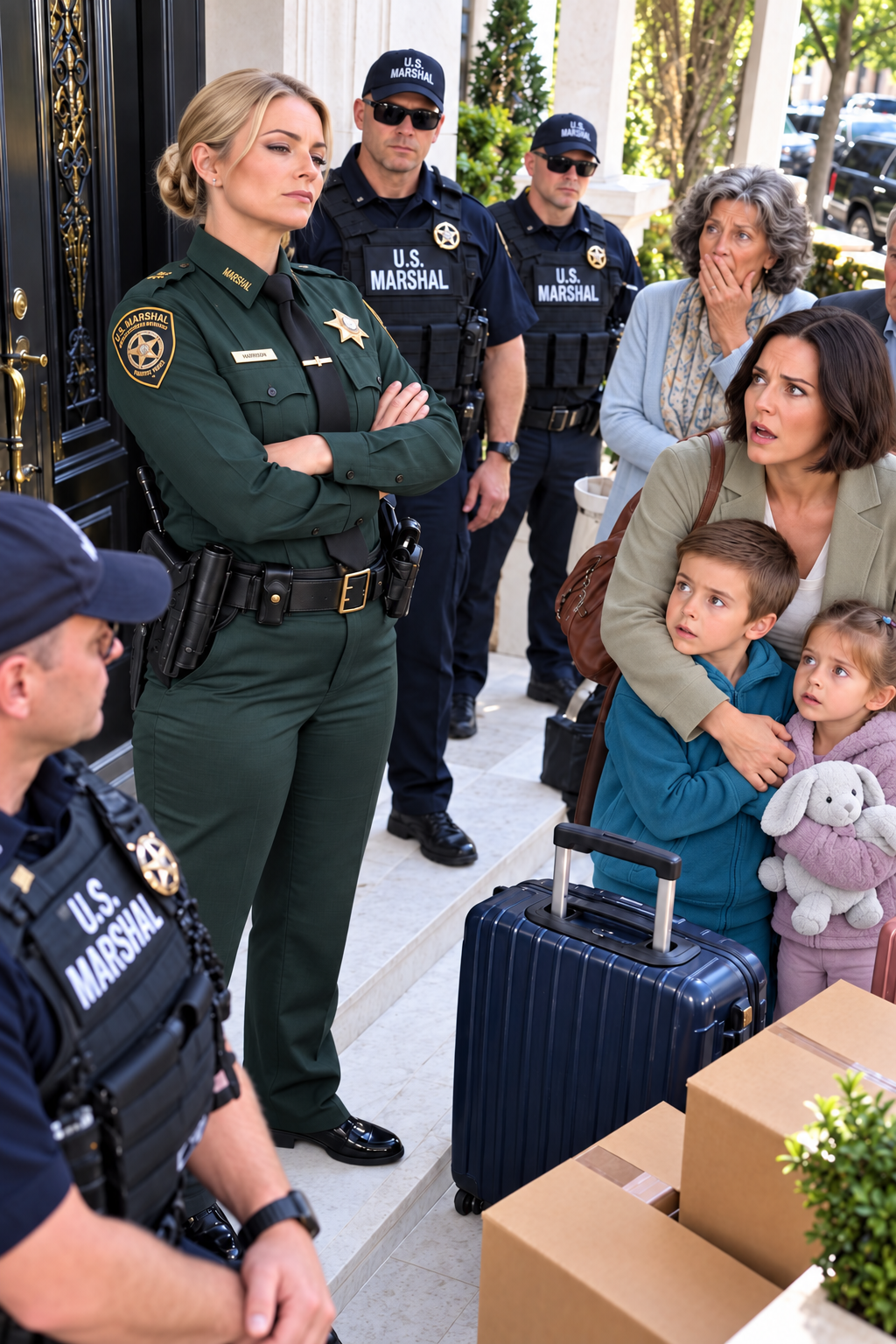
PART 1 TITLE: My Sister Walked Into My Locked Penthouse With Our Parents Behind Her, Never Suspecting I Was Watching Every Move From London
The first thing I saw was my younger sister standing inside my penthouse with a suitcase in one hand and a set of keys I had never given her in the other. Behind her, my mother was directing two children toward the living room while my father inspected the electronic lock. I was sitting in a secure office in London when the security notification reached my phone. For several seconds, I watched the silent image without understanding why my family was inside a home I had expressly forbidden them to enter.
Then Paige turned toward the camera above my kitchen entrance. She smiled with the confidence of someone who believed the argument had already been settled. “We’re moving in, Marissa,” she announced. “You can complain when you come home, but we’re not leaving.” My sister didn’t know that the system had transmitted her words to an encrypted recording account. She didn’t know I could hear the conversation through an authorized remote connection. Most importantly, she didn’t know why I had taken such extraordinary precautions around one particular room.
My name is Marissa Keane. I am a Deputy United States Marshal, and at the time of the break-in I was overseas on a temporary assignment. My home was a penthouse in Arlington, Virginia, with broad windows overlooking the city, pale stone floors, and a private office secured separately from the living areas. I had purchased it after years of demanding work, careful saving, and sacrifices that nobody in my family had ever shown much interest in understanding.
To my parents, the apartment represented something different. It was proof that I possessed more than I needed. My father, Richard, liked to describe my career as a comfortable government position. My mother, Elaine, called the penthouse my extravagant little kingdom. Neither description was accurate, but both served a purpose. Whenever Paige needed financial help, my parents reminded me that someone who could afford such a home could certainly afford to rescue her younger sister.
I watched Paige carry another bag across my living room. Her ten-year-old son, Tyler, followed her with a backpack pressed against his chest. Emma, his younger sister, dragged a pink suitcase that kept tipping onto its side. She stopped beside my coffee table and looked toward the windows with an expression of pure amazement. The children had visited the apartment before, when their mother and I were still speaking regularly. They had never been invited to live there.
My mother opened the refrigerator and frowned at its contents. “She’s hardly ever home. This place is practically wasted on her.” She began moving containers as though she were inspecting a rental property. My father asked Paige where she wanted the children’s belongings. She pointed toward my guest bedroom. Nobody discussed contacting me. They behaved like people carrying out an arrangement whose only remaining detail was unloading the luggage.
Three weeks earlier, Paige had asked whether she and the children could stay with me. Her housing situation was unstable, and she was worried about keeping the children in their school district. I had listened, asked questions, and offered to help her research apartments and temporary assistance. What I would not do was give her unrestricted use of my home while I was away. I had told her that plainly, first over the telephone and then in writing.
The refusal had led to a familiar sequence of accusations. Paige said I cared more about furniture than family. Mom accused me of forgetting where I came from. Dad insisted that successful people had responsibilities to their less fortunate relatives. None of them acknowledged the money I had already contributed toward Paige’s expenses, or the months when I had covered bills without expecting repayment. In their minds, previous help wasn’t evidence of generosity. It was evidence that more could be demanded.
I had finally changed the apartment’s access codes. My parents once possessed a temporary visitor code for emergencies, but they had used it without asking on two occasions. The first time, Mom had entered to leave groceries I didn’t need. The second, Dad had brought a contractor to inspect a cabinet he thought I should replace. Both visits occurred while I was working. When I confronted them, they acted offended that I considered the entry itself a problem.
The security recording showed my father bending beside the entry panel, examining its housing with an expression I recognized from childhood. Richard Keane disliked obstacles, especially those created by his daughters. When Paige was small, he would simply make decisions for her. When I grew older and challenged him, he called my independence disrespect. Standing in my London office, I understood that he had not come to assist his daughter with luggage. He had come to demonstrate that a locked door could not overrule his authority.
My first impulse was to call Paige and demand that she leave. Instead, I saved the security notification, preserved the original video, and contacted the designated personnel responsible for addressing the intrusion. My voice sounded remarkably ordinary as I described what was happening. I gave the address, identified the occupants, explained that I had denied them permission to enter, and stated that a separate secured room contained protected professional materials. That last detail changed the tone of the conversation immediately.
The person on the other end asked whether anyone appeared to have entered the office. I switched camera views. The office door was still closed, but Paige had already placed several boxes beside it. My father was inspecting the handle. I explained that I had separate physical and electronic protections for the room and that nobody in my family possessed authorization to access it. I was instructed to preserve the recordings and continue coordinating with the responding personnel rather than confront anyone remotely in a way that might escalate the situation.
While arrangements were made in Arlington, I called my attorney, Daniel Cross. Daniel was already familiar with certain difficulties involving my parents. He had helped me document earlier disagreements over family loans and property access. More recently, he had been reviewing unusual records connected to my late grandmother’s estate. When I told him that my family was inside the penthouse, he was silent for a moment. Then he asked one question. “Did your father get them through the door?” I told him what the camera showed. His answer was restrained. “Keep every minute of that recording.”
My grandmother Hazel had been the one person in my family who never treated my independence as a personal insult. She believed that helping someone and controlling that person were entirely different things. When I bought my first used car, she celebrated the achievement instead of asking why Paige didn’t have one too. When I began my career, she wanted to hear about the work rather than the salary. After her death, I had tried to follow her advice, although doing so had steadily damaged my relationship with my parents.
I hadn’t expected Grandma’s name to become relevant to what was happening inside my apartment. Yet three weeks before the break-in, an attorney connected to her estate had contacted me about previously undisclosed financial records. The documents were incomplete, and I had been careful not to reach conclusions before they were examined. They raised questions about the way my parents had handled certain assets after Grandma died. I had kept that inquiry private, partly because I wanted facts before accusations and partly because I knew what my parents would do if they learned I was questioning them.
On the monitor, Paige pulled the protective covering from my dining table and tossed it across a chair. Mom was telling her how to rearrange the furniture. The ordinary domestic details unsettled me more than I expected. Someone had opened my kitchen drawers, shifted my belongings, and decided which rooms my family would occupy. They were not stealing jewelry or searching for cash. They were doing something they apparently regarded as more defensible: removing my ability to decide who lived in my own home.
Then Paige approached the office. “What’s in here?” she asked. My father replied that it was where I kept my work files. Paige turned the handle and discovered the door was locked. “Well, that’s inconvenient,” she said. “I was thinking Tyler could use this as a bedroom.” My father examined the frame and suggested that it might be possible to have the lock changed. I leaned toward the screen. The office was not an extra bedroom, and I had explained its restricted status to every adult standing in that apartment.
Tyler appeared beside his mother and asked whether he could help. Paige told him to look for another key among the items near the entrance. I heard him ask why they couldn’t simply telephone me. For a moment, nobody answered. Then my mother said, “Your aunt makes everything complicated, sweetheart.” Tyler looked uncertain, but he went to search anyway. I felt a sharper anger at that than I had felt watching my sister enter. The adults were drawing a child into a deliberate violation and teaching him that my refusal was the real problem.
I sent a message through the established communication channel explaining that the occupants were attempting to access the secured office. The response confirmed that the information had been received. I watched my father disappear briefly from the camera and return holding his phone. He spoke quietly to someone, repeating the building address and describing the entrance hardware. The conversation suggested he was arranging outside assistance. Whatever he believed about my rights as his daughter, he was prepared to commit money and effort to bypass a door I had locked for good reason.
Across the Atlantic, it was late enough in London that the offices around me had begun emptying. My own room remained brightly illuminated. A cup of coffee cooled beside the computer while I watched strangers become involved in what my mother would undoubtedly call a family disagreement. I thought about flying home immediately. But the practical response was already underway, and my physical presence was not required to authorize protection of the apartment. Leaving my assignment without proper arrangements would not make the situation safer.
Daniel joined me through the appropriate secure arrangement, carrying the calm expression of a man who had learned to ask precise questions when others were upset. He wanted to know whether Paige had been given a written denial of permission. I forwarded the message history. He read my last response aloud: I cannot offer you the apartment, and you do not have permission to enter or stay there while I am away. He looked up. “That is not an invitation anybody could reasonably misunderstand.”
I asked him whether my parents could somehow claim that helping Paige gave them a right to occupy my home. Daniel explained that family relationships did not create ownership or permission, but he cautioned against trying to resolve complex property and criminal questions through an argument over the apartment’s speakers. Any decisions about enforcement would follow the applicable procedures and evidence. His job was to protect my legal interests, not provide an audience for a confrontation. I appreciated that distinction. I wanted everyone out, but I wanted it accomplished properly.
Another camera showed my father speaking with the building’s concierge. The audio was faint, but I could hear him asserting that his daughter had agreed to the arrangement. The concierge appeared uncomfortable and repeatedly consulted a screen. My father raised his voice. I recognized the technique. He would state something confidently, repeat it with irritation when challenged, and behave as though the other person’s uncertainty confirmed his authority. It had worked at school offices, hospital reception desks, and countless family gatherings. Now he was trying it in a building where I held the deed.
A few minutes later, my phone received confirmation that responding personnel had reached the building. I saw movement near the elevator on the hallway camera. Before anyone entered, Paige was again standing at the office door. She had a tool in her hand. My father told her to be careful not to damage the surrounding wall. She pressed the tool against the frame and pulled. The sound came through the speakers with an ugly crack. The office door remained closed, but a narrow strip of wood split beside the locking mechanism.
I rose so abruptly that my chair struck the cabinet behind me. Daniel stood as well, then stopped beside the table rather than crowding the screen. There was no reason to pretend I wasn’t angry. My sister had ignored an explicit refusal, my parents had helped her enter, and they were now damaging a secured room. I also knew that the recordings were preserving each decision in the sequence. No later explanation could erase the moment Paige placed the tool against the frame while our father watched.
The doorbell sounded. Paige froze. My mother glanced toward the entrance, irritated at the interruption. My father told everyone to remain calm, as though he were preparing them for an unexpected visit from the neighbors. When authorized personnel entered and explained the nature of their presence, the room changed immediately. Paige moved away from the office. Mom demanded to know who had called them. Dad asked whether they had a warrant, then began explaining that there had been a misunderstanding between relatives.
The senior agent remained composed while establishing who was present and ensuring that the children were safe. Tyler stood close to Emma, who had begun crying quietly into the ear of her stuffed rabbit. Paige insisted that she had come because she needed somewhere to live. My mother interrupted to say that I had always promised to look after my sister. My father claimed the matter could be resolved with one telephone call. Through the video connection, I watched them offer several different versions of the same events, each designed to make their presence seem natural.
When asked about the damaged office door, Paige said she thought it was a storage closet. My father claimed he had been trying to help her move furniture. Neither explanation matched the recording. The agent did not argue with them about what the cameras showed. He documented the condition of the door and directed that nobody touch it further. Then he asked my parents whether they had any written authorization from me permitting the occupation. Mom looked at Dad. Dad looked toward Paige. Nobody produced anything.
I was asked whether I wished to speak. Daniel gave a small nod, reminding me without words to stay with the facts. My voice reached the living room speakers. “You were told not to enter my apartment. I have not given anyone permission to move in, and I want the unauthorized occupants removed.” My mother turned toward the camera, startled by the sound. Paige stared up at it with her mouth slightly open. For the first time that evening, she seemed to understand that my distance from Arlington had not made me absent.
“Marissa, we can discuss this privately,” Dad said. “Not while people are damaging my property,” I answered. Mom called the response humiliating. Paige began explaining that she hadn’t expected matters to become so serious. I listened without interrupting. She had known the access code was changed. She had heard my refusal. She had entered with luggage anyway. Her surprise was not that she had crossed a line. Her surprise was that the line had remained in place.
Then the agent told my father that certain documents would need to be reviewed and formally provided. He placed a sealed white envelope on the marble coffee table. Dad took it with an impatient gesture, apparently expecting paperwork about the damaged door or unauthorized occupation. My mother’s gaze shifted toward the official markings. Across the ocean, Daniel moved closer to the monitor. He knew what additional information the authorities and appropriate counsel had been given permission to examine.
Dad unfolded the first pages, read them, and turned to the next. His irritation gave way to a stillness I had rarely seen in him. Mom leaned over his shoulder. Her expression hardened before she had finished reading. “Where did this come from?” she demanded, looking straight into the camera. I recognized the document at the top of the stack. It concerned the final changes to Grandma Hazel’s trust, a document my parents had never disclosed to either of their daughters. I had spent years believing there was nothing left to investigate. Now my father was holding evidence that suggested otherwise.
END PART 1
PART 2 TITLE: The Sealed Papers Exposed a Secret About Grandma Hazel, and My Father’s Explanation Began to Unravel Before Everyone in the Room
My mother reached for the documents before my father had finished reading them. He moved the pages away from her, which told me more than any argument could have. Richard Keane had always trusted Elaine to manage the emotional side of a family dispute while he controlled the facts. If she wanted to interrupt, he generally let her. This time, he held the papers tightly and stared at a paragraph near the bottom of the first page. My mother kept repeating that the information was private, but she would not explain why a document about my grandmother’s estate had frightened her.
The senior agent reminded everyone that the ongoing intrusion and the separate financial concerns were distinct matters, each requiring appropriate handling. The papers did not authorize anyone to decide an inheritance dispute in my living room. They did, however, explain why certain records had been preserved and why my attorney had requested further review. The agent placed the packet where my parents could examine it without disturbing other evidence. My mother refused at first. When my father finally set it down, she picked it up immediately.
“Grandma Hazel?” Paige said, stepping away from the office. “What does she have to do with us moving here?” She looked between our parents with the baffled expression she used when conversations turned toward subjects she preferred someone else to manage. Paige had always believed that financial paperwork was complicated, unpleasant, and best left to Dad. He encouraged the belief. It allowed him to control discussions about money while telling her that she needed his protection. I had spent much of my adult life challenging that arrangement, usually alone.
Grandma Hazel had died several years earlier, leaving behind a small house full of books, carefully wrapped keepsakes, and a lifetime of documents that my father insisted were unimportant. At the time, he told me the estate had been consumed by medical costs and other necessary expenses. I received a wooden recipe box, an old watch with a cracked leather strap, and a letter written in Grandma’s deliberate handwriting. I cherished those things. I never asked about money because I had trusted his account of what remained.
The recipe box still sat on a shelf in my kitchen. Grandma’s cards were organized by hand, their corners darkened from years beside her stove. She had recorded measurements precisely but often added comments in the margins: use more lemon if the berries are sweet, or don’t rush the onions. She wrote the same way she spoke, offering advice without making it sound like an order. It seemed fitting that the things I valued most from her were objects I could use rather than display.
Three weeks before Paige broke into my home, I had received a telephone call from an attorney connected to the estate. Newly available financial records had raised questions about the trust administration, and I was identified as a beneficiary whose interests might have been affected. The attorney initially asked whether I had received distributions after Grandma’s death. I told him I had received personal keepsakes and no financial payment. There was a pause long enough for me to ask whether he had heard me correctly.
The records he subsequently shared through proper channels included an amendment to Grandma’s trust. It showed that she had changed certain trustee responsibilities shortly before her death, removing my parents from roles she no longer wanted them to hold. The accompanying correspondence suggested she had been concerned about pressure to alter the distribution of her assets. Other financial records indicated that transactions might have been conducted using earlier versions of her estate documents. None of this alone proved every suspicion, but the discrepancies were substantial enough to require investigation.
I remembered reading the amendment for the first time in my Arlington office. A rainstorm had pressed against the windows, turning the distant buildings into gray shapes. I had expected perhaps a minor administrative mistake. Instead, I found evidence that Grandma had taken deliberate action to limit my parents’ authority. Her signature appeared beneath the revised provisions, accompanied by documentation from the attorney who handled the change. The papers contradicted the story Dad had told us about there being nothing meaningful to inherit.
One piece of correspondence bothered me more than the figures. It was an email from Dad to Mom discussing how money should be handled among the family. In it, he argued that my financial success meant Paige had a greater need for available resources. The reasoning was familiar because I had heard versions of it since childhood. What unsettled me was discovering it within documents relating to money that had never belonged to either parent to distribute according to personal preference.
My father had applied the same principle to almost everything. When I earned a scholarship, he suggested that my saved tuition money could help Paige with a car. When I received my first promotion, he expected a substantial contribution toward repairs on their house. When Paige fell behind on bills, the family conversation began with what I could provide rather than what she could change. I sometimes helped because I loved them. Eventually, I helped because refusing seemed to require more energy than paying.
Grandma had noticed that pattern long before I did. During one Christmas visit, she found me washing dishes while everyone else watched a movie. I was home for only two days, but my mother had given me a list of errands and repairs. Grandma dried a plate beside me and asked whether I had enjoyed any part of the visit. When I hesitated, she told me that affection should make room for the person receiving it. I thought about that remark often after she died.
Back in the penthouse, my father finally spoke. He said Grandma had been unwell during her final months, and the changes might not represent her true intentions. The senior agent did not debate the validity of her decisions. That question belonged with the appropriate legal process and supporting evidence. I reminded Dad that the attorney who prepared the amendment had documented the circumstances. Dad answered that attorneys didn’t understand everything happening inside a family. I asked him what he believed the documents failed to explain.
Mom interrupted before he could answer. “You have no business bringing your grandmother into this,” she said. “We’re trying to keep Paige’s children off the street.” Her statement was carefully chosen. She wanted the conversation to return to Tyler and Emma because she knew I cared about them. It also suggested that investigating missing money was an act of cruelty toward children. I looked at the two of them near the sofa. Tyler was quietly helping Emma straighten the strap on her backpack. Neither child should have been placed in the middle of any of this.
Paige seemed increasingly uncomfortable. She asked our father whether Grandma had left a trust. He hesitated, then said there had been complicated arrangements that didn’t concern her. “Why wouldn’t they concern me?” she asked. “I was her granddaughter too.” The question surprised everyone, including Paige. She normally accepted financial explanations with a shrug. But the longer she watched our parents struggle to answer, the more obvious it became that she was beginning to examine their certainty rather than borrow it.
My father told her she was being influenced by me. Paige answered that I had barely spoken to her about Grandma’s affairs. That was true. I had not yet shared the developing investigation with my sister because I didn’t know whether the records would establish a significant problem. I had expected to discuss it after getting legal guidance. Now the information was arriving in front of her during a confrontation about a house she had attempted to occupy. Nothing about the timing was ideal, but the facts were no less important because they were inconvenient.
Dad placed the packet on the table and attempted to recover his authority. “Your grandparents kept information from us as well,” he said. “There were matters your grandmother never understood.” I asked what he meant. He looked at the camera and then away. “There are things in those old records that you don’t want opened.” I had heard threats disguised as warnings from him before. He usually relied on the listener to imagine consequences serious enough to end the conversation. This time, I asked him to identify the records he meant.
Mom seized his wrist. She told him to stop talking, but the urgency in her voice revealed that she was frightened of something more specific than a family argument. Dad’s jaw tightened. He repeated that the matter was complicated and should be settled privately. Daniel, seated beside me, wrote something on his notepad. He did not interrupt. We had already agreed that any additional statements from my parents should be documented, not negotiated through an improvised confrontation.
A notification appeared on the secure workstation. At first, I assumed it concerned the damaged office door. Instead, it related to an attempted use of credentials associated with my identity at an older family storage facility. The alert had been referred for examination through authorized channels. A camera image accompanied the preliminary report. It showed a woman entering a storage area containing sealed boxes and document containers. The angle was poor, and her face was partly obscured, but there was something familiar about her posture.
When the next frame appeared, my stomach tightened. The woman resembled me closely enough that someone watching casually might have mistaken her for my reflection. She had similar dark hair, comparable features, and a way of holding her shoulders that made the resemblance uncomfortable. The footage provided no reliable identification. It certainly did not prove who she was or why the credentials had been used. Nevertheless, I could not ignore the possibility that someone had attempted to associate me with activities I knew nothing about.
The video ended after the woman turned toward the camera. I watched the last frame twice, then looked back at the penthouse feed. My mother’s expression had changed. She was no longer arguing about the apartment. Her eyes were fixed on my father, and she appeared to be waiting for him to say something first. Through the audio, I heard her whisper a name. It was quiet enough that I initially thought I had misunderstood. She said it again, and this time the microphone caught it clearly.
“Celeste.” I had never heard the name spoken within our family. It might have referred to someone connected to Grandma’s estate, or to an entirely separate matter. I had no evidence to decide. I asked Mom whom she meant. She looked toward the camera, then shook her head. Dad told her not to answer questions about people who weren’t involved. That response only made the silence more troubling. Neither parent was willing to explain why a name had emerged when the security image appeared.
Daniel cautioned me against trying to solve the mystery from London. The storage footage required proper authentication, the credential use needed investigation, and the woman had not been identified. I agreed, although I found myself glancing repeatedly at her image. I had enough verifiable information to address without building conclusions around an unknown person. My home was still occupied without permission, the office door was damaged, and two frightened children were waiting for the adults to decide what happened next.
The senior agent confirmed that the storage alert would be handled separately. He returned the conversation to the unauthorized occupation and the security of my office. I appreciated the discipline. My parents had spent years using confusion to avoid accountability, shifting from one grievance to another until nobody could remember the original decision. This time, the central facts were simple. I owned the apartment. I had expressly declined to let Paige move in. My family entered anyway and tried to open a room they knew was restricted.
Mom approached the camera and tried a different argument. She said I had become hardened by my career and that strangers now mattered more to me than my own relatives. I could see the exhaustion in her face, but I also recognized the familiar method. She wanted me to defend my character instead of discussing her conduct. I told her that my work had not changed the meaning of permission. A person didn’t lose the right to a private home because the people ignoring that right happened to share her last name.
My father asked whether I was prepared to see my niece and nephew put outside at night. I told him the children would have a safe place to stay and that I was willing to help arrange it. That did not mean their mother could occupy my apartment. He replied that I was drawing an artificial distinction. I disagreed. Offering shelter to children and surrendering ownership of a home were different choices. The fact that one could be done with compassion did not make the other necessary.
Paige stepped toward the camera. She asked whether I truly intended to remove her after she had brought all their belongings. I told her the number of suitcases did not change what we had discussed. She began crying and said Mom had promised I would understand once I saw the children there. The admission stayed with me. My parents had encouraged Paige to use her children’s presence as a means of defeating a decision I had already made. They had treated the children as an argument rather than people who needed stability.
I looked at Tyler. He was old enough to understand that something was wrong and too young to be responsible for fixing it. Emma had fallen asleep against the sofa with her rabbit beneath her cheek. The room that usually offered me peace now looked like a waiting area after an accident. I muted the microphone briefly and told Daniel that I could pay for a hotel without allowing the family back into my apartment. He agreed. He also suggested that any assistance be documented clearly so it could not later be described as permission to occupy the property.
When I reopened the connection, I told Paige that I would cover a hotel suite for her and the children that night. Longer-term arrangements would need to be handled separately, with appropriate assistance and decisions made by their mother. Paige wiped her face and nodded, though Mom immediately accused me of trying to appear generous in front of law enforcement. I did not answer that accusation. I was watching Emma sleep, and I wanted the evening to end without the children hearing another argument.
The agent then received information about a locksmith who had been scheduled to come to the property. The work order was connected to my father’s name. It described a replacement of the apartment’s existing locks, not a minor repair requested by the lawful owner. I asked for confirmation that the locksmith had not changed anything. The agent told me the attempt was being documented and the property would remain secured. My father looked toward the kitchen, refusing to meet the camera.
I had expected my parents to pressure me into letting Paige stay. I had even anticipated that they might attempt to use an old access code. What I had not expected was evidence that Dad intended to alter the locks so that I could not readily enter my own home when I returned. The plan required more preparation than an impulsive family visit. Somebody had researched the building, arranged assistance, and considered how to keep Paige inside after I objected. The broken office door was only one part of that effort.
When the agent mentioned an additional address connected to the documents under review, my father interrupted him sharply. He asked whether that information was necessary. The agent said the matter would be addressed through proper channels. Then he identified a particular storage location: Unit 14B. Dad’s face lost its color. I recognized the number immediately. It appeared on a receipt that had reached me by mistake weeks earlier, an invoice for document scanning, secure shredding, and access outside normal business hours.
My father had previously dismissed that invoice as ordinary household administration. I had believed him at the time, but the charges had seemed unusual enough for me to send a copy to my attorney. Now Unit 14B had surfaced during the same evening that my family attempted to occupy my apartment and interfere with my secured office. I watched Dad grip the back of a chair to steady himself. For the first time, he seemed less concerned about whether I would let Paige stay than about what someone might discover in the paperwork he had been keeping.
END PART 2
PART 3 TITLE: The Documents Hidden in Unit 14B Revealed How My Father Intended to Take My Home and Control Both His Daughters
Unit 14B was the first thing that had genuinely unsettled my father since the agents entered my apartment. He had argued about the locks, disputed my right to remove Paige, and dismissed the questions surrounding Grandma’s trust. But when that storage number was mentioned, his practiced confidence disappeared. I watched him press his fingertips against the back of a dining chair. My mother noticed immediately. She stepped closer and asked why anyone was discussing family storage records when the supposed issue was simply where Paige and her children would sleep.
My father had accidentally forwarded me the receipt several weeks earlier. It arrived in an email containing other documents he wanted me to review, including a request for financial assistance. Ordinarily, I might have overlooked the attachment. But the invoice listed several services that seemed unrelated to household expenses: after-hours access, high-volume document scanning, and private shredding. When I asked him about it, he said he was organizing old family records. His answer had been casual, almost bored. I had no reason then to believe he was preparing anything connected to my apartment.
Daniel had advised me to preserve the receipt and avoid confronting my parents without additional facts. Through lawful inquiries and the appropriate review of records, further information had emerged suggesting that Unit 14B was being used for more than storing old boxes. Certain documents concerned my property, my previous financial assistance to the family, and an alleged understanding that Paige could occupy my residence. At the time, those connections seemed strange but incomplete. Now, with the security recordings showing my sister inside the penthouse, the pieces were beginning to fit.
The senior agent explained that the relevant materials would be handled according to the procedures governing the investigation. He did not allow anyone to rummage through documents or argue over who could take them. My father’s insistence that everything should remain confidential carried little weight against evidence of unauthorized entry and potential misrepresentation. I listened as the agent asked direct questions about the locksmith arrangements and any documents claiming that Paige had permission to remain in my home. Dad answered slowly, choosing each word as though it might cost him money.
When the available records were described, I recognized the pattern. There were draft statements referring to a family housing agreement I had never signed. Copies of older access information had been retained after I changed the codes. Unsent letters addressed to Paige at my apartment appeared intended to establish an impression that she already lived there. None of these items, considered alone, proved that my father would succeed. Together, however, they suggested a deliberate attempt to manufacture a history of occupancy that did not exist.
A draft statement described my earlier financial contributions as evidence that I had assumed responsibility for Paige’s household. Another proposed that I had orally agreed to let my sister and her children use the penthouse during my overseas assignment. That claim was particularly revealing. It contradicted messages in which I had refused the arrangement, yet it was presented as if my disagreement were merely a technicality. I wondered how much of my father’s confidence came from believing he could make a false statement sound established by repeating it often enough.
One folder identified in the review carried a label that made my hands go cold: MARISSA — LEVERAGE. I had seen my name written on professional files, mortgage agreements, identification documents, and birthday cards. I had never expected to see it attached to a collection of family transactions apparently intended to give my parents bargaining power over me. The materials included records of money I had sent over several years. Some payments were substantial. Others were ordinary transfers made during emergencies or difficult months.
I remembered one winter when Paige’s heating system failed and she could not afford the repair. I covered the bill because Tyler was young and the weather was freezing. Another time, I paid a medical expense she had been unable to manage. I helped my parents replace a damaged roof after a storm. Each payment had felt like a choice I was making for someone I cared about. Now the records suggested my father had been reorganizing those choices into a supposed obligation extending indefinitely into the future.
Daniel studied the information without speaking for several moments. Finally, he said that the documents would need to be evaluated carefully, especially where they contradicted written communications and property records. He cautioned me not to assume that every draft had been used or that every proposed claim had legal effect. I understood. But the emotional significance was already plain. My father had not merely asked too much of me. He had apparently begun planning how to turn my history of helping into a weapon against my right to refuse.
Paige listened with growing bewilderment. She asked Dad whether the papers meant what they appeared to mean. He said he had been trying to secure a home for his grandchildren. She asked why he needed statements suggesting I had agreed when I had plainly said no. Dad’s irritation returned. He told her that adults sometimes had to make difficult arrangements that younger people failed to understand. Paige was not a child, and the condescension finally seemed to reach her. She folded her arms and asked him to answer the question.
Mom intervened, saying Paige should be grateful that her father was looking after her. That was the language our family always used when one person’s decision caused trouble for someone else. If Dad interfered with my affairs, he was protecting us. If Mom shared private information, she was keeping the family together. If Paige demanded money, she was simply asking for support. Any objection was treated as evidence that the person refusing help lacked loyalty. Hearing the familiar language inside my invaded home made its emptiness difficult to ignore.
“You said Marissa agreed to let us stay,” Paige told Mom. “You told me it was settled.” My mother answered that I would have accepted the situation once I understood how badly my sister needed help. Paige shook her head. “That isn’t what you said.” The difference mattered. My parents had not merely encouraged her to ask again. They had apparently persuaded her that my permission existed somewhere beyond the refusal she had actually received. Her willingness to believe them did not erase her responsibility, but it complicated my anger.
The agent returned to the practical matter of removing everyone from the apartment. The children needed to collect their belongings, and the adults were instructed not to disturb the damaged office door or remove items unrelated to what they had brought. My father began complaining that the family was being treated like criminals. The agent calmly explained what was being documented and what further steps might follow. Nobody was being asked to confess on the spot. They were being required to leave property they had no authorization to occupy.
Tyler approached his mother and asked whether they were going to a hotel. Paige crouched beside him and said they were. He wanted to know whether he had done something wrong by looking for the office key. I could hear the question through the monitor. Paige hesitated before answering. Then she told him he had followed instructions and that the adults should have handled the situation differently. It was the first statement I had heard from her that evening that did not attempt to shift responsibility onto me.
Emma woke when Tyler pulled her suitcase across the floor. She looked around the crowded living room, confused by the unfamiliar people and her mother’s tearful face. She asked whether they could stay long enough to see the city lights. The question nearly undid me. She had no idea why those beautiful windows were suddenly associated with arguments, broken wood, and frightened adults. I wanted to tell her she could come back someday for a proper visit. Instead, I kept quiet. Promises made during an emergency often become another source of disappointment.
The conversation took another turn when Paige admitted that her housing situation had not been exactly as our parents described. Mom had repeatedly told me that Paige and the children were living in their car. According to Paige, she had been struggling with rent and facing the loss of her current arrangement, but they had not been sleeping in a vehicle. The story had been exaggerated after our parents began pressing me to open the penthouse. Paige looked embarrassed as she explained that she had gone along with the account because she thought it might persuade me.
I asked why she had not told me the truth. She said I would have refused anyway. I told her that she could not know what assistance I might have offered if she had been honest. I had already suggested helping her find a rental and appropriate services. She had dismissed those options because she wanted the apartment. Paige looked down at the carpet. “Dad said that once we got inside, we could get legal help to stay,” she admitted. My father interrupted immediately, but the words had already been spoken.
That was the moment Paige began understanding that our parents had not simply reassured her. They had encouraged her to enter a property she did not own, rely on arguments about occupancy that were unsupported by my consent, and expect someone else to absorb the consequences. Her need for housing was real. So was her decision to use my absence as an opportunity. But Dad’s preparation showed that the situation had been shaped by people who wanted control of my property without accepting the burden themselves.
Paige turned to Mom and asked a question that none of us had expected. “Why couldn’t we stay with you?” My mother said their house was not suitable for children to live in permanently. Paige reminded her that she and Dad had four bedrooms, including a guest room that was rarely occupied. My father said their household arrangements were nobody else’s concern. Paige looked at the camera, then back at our parents. The answer had finally become obvious to her. They had enough space to help but preferred to decide how mine should be used.
I thought of my parents’ house: the wide driveway, the sitting room nobody was allowed to touch, the dining table reserved for holidays, and the upstairs rooms kept ready for guests who seldom came. When I visited, Mom complained that she had too much space to clean. Yet when Paige needed somewhere to live, they had presented my apartment as the only reasonable solution. The inconvenience was acceptable as long as it belonged to me. That discovery was neither surprising nor easy to accept.
Paige gathered Emma’s rabbit and tucked it under the child’s arm. Her face was swollen from crying, but her voice had become steadier. She told our parents that she was taking the children to the hotel. Mom protested that leaving would reward my cruelty. Paige answered that the apartment was not hers. It was a simple acknowledgment, one that had taken an astonishing amount of damage and humiliation to produce. She did not ask for forgiveness. She did not look toward the camera for approval. She started carrying her bags toward the elevator.
My father remained behind long enough to address me directly. He warned that I was damaging relationships I might someday need. There was a time when such a warning would have frightened me. As a child, I relied on his approval to know whether I had done well. As a young adult, I worried that rejecting his demands would cost me the family entirely. But watching him stand beside the evidence of a broken door, still insisting that I should be afraid of disappointing him, made his threat sound smaller than it once had.
I told him that I had not chosen this confrontation. I had declined an unreasonable request, and everyone else had chosen to ignore the answer. He said I would eventually understand what it meant to be responsible for other people. I thought about Tyler and Emma, about Grandma Hazel, and about years of financial assistance he was now attempting to use against me. Responsibility was not unfamiliar to me. What I was rejecting was the belief that family responsibility gave one person ownership of another person’s life.
The elevator doors closed behind them. The agent remained to complete the necessary documentation, and the apartment was inspected according to the arrangements already made. My office door was damaged but had remained closed. The living areas were disordered, and several items had been moved, but there was no evidence at that stage that protected materials inside the office had been accessed. I was relieved, though I understood that the full assessment would require further review. Daniel arranged for the relevant insurance and property matters to be handled when I returned.
By the time the apartment was secured, the London sky had begun changing color. I had been awake for hours, drinking terrible coffee and watching the people who knew me best behave as though I were an obstacle to be overcome. I expected to feel triumphant when the final camera showed an empty living room. Instead, I felt exhausted. I had protected the apartment, but the documents relating to Grandma’s estate and Unit 14B had opened questions that would not disappear when the locks were checked.
The next morning, Paige called while I was reviewing messages. I considered letting the call go unanswered. She had spent years turning small problems into urgent requests, and I was not ready for another explanation. But I remembered Tyler asking whether he had done something wrong and Emma clutching her rabbit in the elevator. I answered. Paige told me the children had slept well at the hotel. Then she apologized. There was no immediate excuse, no complaint about my reaction, and no demand that I understand her intentions.
I asked whether she had known Dad was preparing paperwork connected to my apartment. Paige said she knew he had spoken to someone about their options, but she had never seen the documents described during the confrontation. She had trusted him to handle things. Then she admitted that she expected me to surrender once the children were inside. “You always changed your mind when things got difficult,” she said. It hurt because she was describing something I had taught them. Every time I gave in to keep the peace, I had helped convince them that resistance was temporary.
We spoke for several minutes about practical arrangements, but Paige kept returning to Grandma Hazel. Eventually, she mentioned something that made me put down my coffee. Mom had told her that I bought the penthouse using money from Grandma’s estate. Dad had apparently said I received my share of the inheritance early, which explained why there was nothing left for me after Grandma died. Paige had believed the story because my financial situation seemed comfortable. She assumed there was no reason for our parents to invent an explanation for something that already appeared obvious.
I told Paige that I had bought the apartment with my own earnings and financing. Grandma had encouraged my independence, but she had not provided the purchase money. I had received no financial inheritance that I knew of. Paige was quiet for so long that I checked whether the call had disconnected. Then she said Dad had also told her that Grandma left money for both of us, but Paige’s portion had been absorbed by family expenses. I asked whether she had ever seen a statement, distribution record, or acknowledgment. She said she had not.
The implications were difficult to ignore. According to our parents, I had received an inheritance I knew nothing about, while Paige had benefited from an inheritance she had never actually seen. Each daughter had been given a different explanation, tailored to what our parents believed she would accept. My supposed wealth justified withholding information from me. Paige’s supposed dependence justified withholding control from her. If the records supported what we were beginning to suspect, our parents had used the same family narrative to conceal financial decisions affecting both of us.
I ended the call and contacted the attorney reviewing Grandma’s estate. By that afternoon, the inquiry had identified several categories of assets that required closer examination: savings bonds, investment accounts, insurance proceeds, and personal property. The available documents also included written instructions indicating that Grandma wanted her granddaughters to benefit equally. Yet neither Paige nor I could identify a corresponding distribution that we had received. Some estate filings attributed the funds to expenses and debts, but the supporting figures did not match consistently.
I called Paige again. This time, I did not soften the concern to protect her from it. I explained that the records suggested our father might have mishandled money intended for both of us. Paige began crying, but she did not ask me to make the problem disappear. She wanted to know whether there was a way to establish what Grandma had actually intended. I told her there was, although the process would require patience and evidence rather than family assurances. After we ended the call, Daniel sent me a preliminary summary of the inconsistencies. One item stood out: the estate documents referenced acknowledgments of distributions neither of us remembered signing.
END PART 3
PART 4 TITLE: When I Returned to Arlington, Forged Signatures and a Difficult Choice Forced My Sister to Decide Whose Version of Our Family She Believed
Four days after the break-in, I returned to Arlington and stood outside the door of my own apartment for longer than necessary. The building was familiar, from the quiet elevator to the faint scent of polished wood in the hallway. Nothing about the entrance suggested what had happened while I was away. The lock had been secured, and the building staff had followed the arrangements made after the incident. Nevertheless, I found myself looking at the doorframe for damage before I stepped inside, a habit I had never needed in that home before.
The penthouse had been cleaned. The luggage was gone, the furniture had been returned to its usual positions, and the kitchen counters were empty. Sunlight lay across the floor in broad rectangles. From a distance, the apartment seemed untouched. But there were small differences. A faint scratch marked one corner of the dining table. The protective cover had been folded incorrectly and stored in a different drawer. A child’s forgotten hair clip rested beneath the sofa. I picked it up, recognizing the tiny yellow flower Emma had worn during an earlier visit.
I carried my travel bag to the bedroom, then went directly to the office. The damaged door had been left in place pending the appropriate inspection and repair arrangements. A splintered section near the frame showed where Paige had tried to force it open. I stood facing the marks, remembering her insistence that the room should become Tyler’s bedroom. The irony was difficult to miss. She had looked at a locked door and assumed the problem was that I had failed to make the room available. My parents had taught her to regard boundaries as obstacles rather than decisions.
I ran my hand along the intact section of the frame. The door had held, and the information inside remained protected. That mattered professionally. Yet the damage also brought back memories I had spent years trying to leave behind. As a teenager, I could never keep my bedroom private. Mom opened drawers while searching for things she claimed to need. Dad entered without knocking whenever he wanted an answer. If I protested, they reminded me that the house belonged to them. I had bought this apartment partly because I wanted to know what it felt like to close a door and have the decision respected.
The first afternoon back, I met with Elise Morgan, the attorney handling the civil and estate matters. Daniel continued assisting with the issues connected to the original incident, but Elise had taken the lead on the financial records. She arrived carrying a leather portfolio and two thick folders. She was an exacting woman who disliked conclusions that got ahead of the evidence. Before discussing anything, she asked whether I had slept since returning. I admitted that I had barely unpacked. She looked at my untouched lunch and suggested we begin with the documents rather than pretend I was ready for a long emotional conversation.
Elise had obtained additional records from the estate review. The central problem was no longer merely that Grandma’s assets had been described inaccurately. Several documents purported to acknowledge distributions made to Paige and me. The signatures on those acknowledgments appeared inconsistent with verified examples of our handwriting. In my case, the differences were visible even before formal examination. The letter shapes were awkward, the spacing was wrong, and the signature included a flourish I had stopped using years earlier. Elise cautioned that appearance alone did not establish forgery, but the discrepancies warranted further investigation.
I stared at a copy bearing my name. It stated that I had received assets from Grandma’s estate and acknowledged satisfaction of a distribution. I knew I had signed no such document. On the listed date, I had been working under circumstances that could be independently verified. The paper made me think of the watch and recipe box Dad had handed me after the funeral. He had presented those items as what remained for me. I wondered whether he had already prepared the acknowledgment when he stood in Grandma’s kitchen explaining that there was no money left.
Elise turned to the next file. She had found records suggesting that my identifying information had been used in connection with an older credit account. I remembered an unexplained problem with my credit several years earlier, a frustrating episode that had required calls, verification, and months of correspondence. At the time, I thought it was an administrative error or an isolated misuse of information. I had never connected it to the family. Now I could not ignore the possibility that someone close to me had possessed the personal details needed to make such an application.
I asked Elise whether she believed Dad was responsible for everything. She declined to give me the certainty I wanted. She said the available evidence established serious concerns about the estate administration and possible misuse of identifying information, but responsibility would need to be determined through document analysis, account records, and the proper legal process. She was not defending my father. She was refusing to replace his unsupported assurances with unsupported accusations of our own. I respected her for that, even though the uncertainty left me restless.
We reviewed the estate assets one category at a time. Savings bonds had been listed, but the supporting records did not fully explain their disposition. Investment statements showed balances that were not clearly reconciled with the final accounting. Insurance records raised additional questions about beneficiaries and payments. Certain personal valuables had disappeared from the inventory without documentation sufficient to explain where they went. Every discrepancy required its own verification. There was no single dramatic statement that would solve the case, only pages of evidence that had been left unexamined for years.
As Elise spoke, I remembered Grandma’s habits. She kept envelopes labeled with dates, saved receipts in accordion folders, and corrected her bank statements using a fine blue pen. She had once told me that careful records were a form of respect for the people who might need to understand your decisions later. It was difficult to imagine her leaving her estate in the confusion Dad had described. The trust amendment suggested the opposite: she had taken specific steps to protect her intentions. Whatever happened afterward deserved a careful examination.
Elise asked what outcome I wanted. I could have answered that I wanted every dollar returned, every false document exposed, and every person responsible publicly embarrassed. Those thoughts had occupied more than one sleepless hour. But sitting in the apartment where my family had tried to establish its own authority, I realized that revenge would not restore the peace I had lost. I wanted the property secured, the records corrected, the missing assets accounted for, and the people responsible held to the consequences of their actions.
I told Elise I did not want private cash arrangements or another family meeting in which Dad offered a vague promise and expected everyone to move forward. She agreed that any settlement, repayment, or correction should be documented and handled through the appropriate legal channels. The intrusion and damaged property were separate from the inheritance dispute, and each required its own treatment. She also recommended maintaining clear restrictions on access to my apartment. I accepted the advice. I had spent too many years believing that a peaceful conversation could substitute for an enforceable boundary.
That evening, Paige called and asked whether I would see her. She sounded subdued, and I initially thought she wanted to collect something left in the apartment. Instead, she said she had money for the repairs. I agreed to meet her in the building lobby. I did not invite her upstairs. That was not a punishment I intended to discuss; it was simply the limit I was comfortable setting. When the elevator doors opened, she was standing beside a low table, holding a plain envelope with both hands. She looked as though she had rehearsed what she wanted to say.
She handed me the envelope and explained that it contained $340. She had put it together from money she could spare after covering the children’s immediate needs. It would not pay for the damage to the door, she said, but she wanted to begin. I had received countless requests for money from Paige over the years. I had almost never received an offer to repair something she had damaged. The amount was modest compared with the cost of the repairs, but I could tell how difficult it had been for her to bring it.
I looked at the envelope without opening it. I told her to arrange the payment through Elise’s office so there would be a proper record and a clear accounting of what remained. Paige nodded immediately. She did not accuse me of being formal or cold. She asked whether the balance could be paid in installments once the cost was confirmed. I said that could be discussed through counsel. The conversation was awkward, more like a meeting between strangers settling a debt than a reunion between sisters. Yet it was the first time in years that neither of us pretended the problem belonged entirely to me.
Paige glanced toward the elevators and asked whether the children might visit again someday. I told her I could not promise that yet. Tyler had been frightened, Emma was confused, and I needed time to trust that a visit would remain a visit. Paige accepted the answer without arguing. Then she surprised me with a question that had nothing to do with the apartment. “Did Grandma really leave something for both of us?” she asked. I said the available records suggested that was her intention, though we were still determining exactly what had happened.
Paige’s eyes filled with tears. She asked whether Grandma had loved her as much as she loved me. I had not expected that uncertainty to be hiding beneath her resentment. Grandma had celebrated Paige’s birthdays, kept drawings from the children, and remembered her favorite food. She had worried about Paige’s dependence on our parents, but she had never regarded my sister as less worthy of affection. I reminded Paige of those things. She listened with her hands folded tightly in front of her, as though any movement might interrupt the answer.
“Mom always said Grandma understood you better,” Paige admitted. “I thought maybe she trusted you because you were the one who did everything right.” I told her Grandma had never expected either of us to be perfect. She wanted us to become people who could make decisions without being frightened into surrendering them. Paige wiped her face. She said she had spent years competing with a version of me that our parents described as successful, selfish, and permanently beyond the need for help. I had spent those same years resenting the privileges they seemed to give her.
We stood near the lobby windows while evening traffic moved along the street outside. I wanted to embrace her, but the broken office door remained fresh in my mind. Affection could not erase what she had done. I told Paige that I believed she was beginning to understand the damage, but understanding would have to be followed by consistent actions. She said she knew. Then she thanked me for keeping the children out of the dispute as much as possible. I nearly corrected her. None of us had managed to protect them completely. Still, I accepted that she was finally thinking about their experience rather than merely her own embarrassment.
In the weeks that followed, the financial review expanded. Elise worked with the appropriate professionals to compare signatures, examine account histories, and identify which estate transactions needed further explanation. Paige provided information about what our parents had told her, including details she had previously considered too ordinary to mention. I shared the records of my own financial assistance and correspondence. Each of us had possessed only part of the story. When the accounts were placed side by side, the contradictions became increasingly difficult to dismiss.
My parents responded through their representatives, but Mom continued attempting to reach me directly. Her messages alternated between outrage and appeals to family loyalty. Dad offered to discuss the inheritance privately, suggesting that lawyers were making an ordinary disagreement unnecessarily expensive. I did not accept. After years of changing explanations, I was no longer willing to settle serious financial questions over dinner or a telephone call. I forwarded the relevant communications to Elise and kept my replies limited to the necessary arrangements.
The first hearing took place on a cool morning when the sky over Arlington was a pale, unbroken gray. I arrived early with Elise and sat in a waiting area outside the courtroom. My parents appeared together, dressed with the care they usually reserved for church services and important family photographs. Mom wore a navy suit with her pearl earrings. Dad carried a dark folder and looked determined to behave as though the proceedings were an inconvenient meeting he could end by asserting authority.
Mom spotted me before I could move toward the courtroom. She approached with a strained smile and said we had all gone far enough. Her voice carried the familiar expectation that I would be embarrassed by the public setting and eager to restore appearances. I told her that the records still needed to be addressed. Dad stepped forward and offered to settle everything between us if I would stop involving outsiders. Elise intervened before the conversation could become an argument, explaining that substantive communication would proceed through counsel. Dad’s expression darkened, but he said nothing further.
I had barely taken my seat when Paige entered the waiting area alone. Tyler and Emma were safely elsewhere, and she carried a small folder rather than the usual overflowing handbag of children’s belongings. She saw our parents and hesitated. Mom held out her hand, summoning her with the same gesture she had used since we were children. Paige looked at the hand, then at me. I did not gesture for her to come over. She needed to make this decision without another person directing her.
Paige walked past Mom and stood beside me. Our mother called her name sharply, clearly expecting her to correct what she regarded as a public insult. Paige turned and told her she would not participate in another conversation designed to make us doubt what the documents showed. She said she wanted Grandma’s estate examined properly, and she intended to answer questions truthfully. Mom’s face tightened. Dad looked toward the courtroom entrance. Neither seemed prepared for the possibility that Paige would stop accepting their explanations simply because they were our parents.
The hearing did not resolve the estate dispute. There were still records to obtain, questions about responsibility, and financial claims that required further review. But the proceedings established the next steps and made clear that the issues would not be settled by a private conversation in which Dad controlled the information. I left with Elise feeling exhausted rather than victorious. Paige walked with us to the exit. We spoke briefly about the children and the documents she would provide. It was the first ordinary conversation we had managed in weeks.
Our mother’s response arrived through relatives several days later. A cousin asked why I had used my position to frighten the family. An aunt accused me of abandoning Paige when she had nowhere to live. Someone else claimed that I was trying to seize money Grandma had wanted our parents to control. The messages differed in tone but shared the same central accusation: I was hurting the family by refusing to keep the dispute private. I recognized Mom’s influence in the language. She had begun managing the story before anyone could examine the records.
I considered replying to each relative with copies of the security footage and estate documents. Elise advised against distributing evidence or turning the dispute into a public argument. Instead, she prepared a brief statement explaining that the matter involved unauthorized occupation, property damage, and disputed financial records subject to legal proceedings. It did not expose private details or declare anyone guilty. Most relatives stopped contacting me after receiving it. A few apologized for speaking before they understood the situation. I did not ask them to choose sides.
Paige had more difficulty because Mom could still reach her through concern for the children. She offered food, clothing, and help with transportation, then used each gesture as an opportunity to suggest that Paige should abandon the estate inquiry. Paige told me she was learning how to decline assistance without turning the refusal into an argument. Some days she succeeded. Other days she answered calls she later regretted. I did not demand that she stop speaking to our parents. I wanted her decisions to be her own, even when they were imperfect.
One afternoon, Paige called from the hotel sounding unusually frightened. Mom had arrived downstairs carrying flowers and an envelope. She claimed to possess another letter from Grandma Hazel, one that would explain the inheritance and prove that the investigation had been a mistake. But Mom refused to leave it at the desk. She insisted that Paige come down alone to receive it. My sister said she was afraid that if she refused, the letter might disappear before anyone else could read it.
I told Paige not to meet her alone and to ask the hotel manager to receive the envelope if Mom was willing to leave it. Any document concerning Grandma’s estate could then be sent to Elise for proper examination. Paige agreed, although I could hear how much she wanted to go downstairs and demand the truth. A few minutes later, she called back. Mom was still arguing with the front desk, insisting that private family correspondence did not belong in lawyers’ hands. Paige had remained in her room.
Eventually, the envelope was accepted through the hotel’s procedures and passed to Elise. My mother left without seeing Paige. The letter was written on old cream-colored stationery and addressed to both of us. Its handwriting resembled Grandma’s, but we agreed not to rely on appearance alone. Elise arranged for the document to be reviewed alongside the known correspondence already in the estate records. I tried to keep my expectations low. I had learned that even genuine documents could be presented selectively to support a misleading story.
When Elise finally contacted me with the preliminary results, her voice was more measured than usual. She explained that the letter appeared consistent with Grandma’s authenticated correspondence and that the surrounding evidence supported its authenticity. It was not the document Mom had claimed would resolve the financial accounting. Instead, it was a personal letter Grandma had written for her two granddaughters. Elise sent me a copy through the agreed secure channel. I opened it at my kitchen table, with Grandma’s recipe box resting on the shelf across from me.
The first lines mentioned a fear Grandma had carried during her final years: that Paige and I would inherit not only the family’s possessions, but also the rivalry our parents had encouraged between us. She wrote about independence, mistakes, and the difference between giving help freely and demanding obedience in return. As I read, I realized why my mother might have wanted to control when and how Paige received the letter. It challenged the assumptions that had kept us divided for most of our lives. I reached for my phone to call my sister, then stopped when I saw there was another page.
END PART 4
PART 5 TITLE: The Morning After My Family Was Removed, My Sister Made a Confession That Changed Everything I Believed About Grandma’s Estate
The apartment had been empty for less than an hour when my father sent his final message. It contained no apology for the damaged office door, no acknowledgment of the locksmith he had hired, and not a word about the frightened children who had watched federal personnel escort their family from my home. Instead, Richard Keane wrote that I had made a mistake I would eventually regret. He said the penthouse was only the beginning of what I stood to lose.
I read the message in the quiet of my London hotel room. Outside, rain had turned the pavement beneath the streetlights into long strips of silver. My work laptop remained closed on the desk, and the secure connection to Arlington had finally been disconnected. The apartment’s ordinary cameras were still operating, but I had stopped watching them. For several hours, I had observed strangers documenting damage to a home I had spent years building. I had watched my mother argue that motherhood gave her a permanent right to enter it. I had watched my younger sister discover that the promises our parents made were not worth the paper they had been printed on. Now the place was silent, and I was too exhausted to feel relieved.
Daniel Cross, the attorney who had been assisting me during the overseas assignment, called shortly after midnight. He had spoken with the people securing the apartment and confirmed that the damaged office remained sealed. The unauthorized locksmith had been stopped before replacing the primary locks, although his work order and instructions had been preserved. My parents had left without another confrontation. Paige and the children had checked into the hotel I had arranged. Daniel’s voice was measured as he explained the next steps, but he paused before ending the call. “Marissa, don’t respond to your father’s message. He’s trying to turn a documented incident into a private argument. Those are two very different things.”
I asked whether Richard might be referring to the inheritance documents. Daniel didn’t answer immediately. He had reviewed the preliminary material from Grandma Hazel’s estate, including the amended trust and the questionable records connected to storage unit 14B. He knew about the strange security footage showing a woman who resembled me. He also knew that my mother had whispered the name Celeste when the image appeared. None of those details had a satisfactory explanation. “Your father knows something you don’t,” Daniel finally said. “What matters now is finding out what he knows without allowing him to control how you learn it.”
I slept for perhaps three hours. When I woke, the hotel curtains had turned pale with the morning light, and my phone showed seven missed calls from family members. Two were from my mother. One came from an aunt I had not spoken to since Christmas. The others were unfamiliar numbers. I ignored them all. Then Paige called. I watched her name move across the screen, remembering how often the same name had appeared before a request for money, a late rent payment, or some emergency that became my responsibility. I nearly declined. Instead, I answered and heard a child’s television program playing faintly behind her.
Paige asked whether I had a minute. Her voice sounded rough, as though she had been crying or awake most of the night. She told me Tyler and Emma were still sleeping. Tyler had asked whether anyone was going to arrest their grandparents. Emma had refused to put down the stuffed rabbit she carried from the apartment. Paige said she had tried to explain that adults sometimes made serious mistakes, but Tyler had reminded her that she had broken the office door herself. I closed my eyes. “He saw what happened,” I told her. “Don’t ask him to pretend otherwise.” Paige didn’t argue. That was unusual enough to make me listen.
She apologized for entering the penthouse, for involving the children, and for believing she could force me to accept an arrangement I had already refused. Then she admitted something I had suspected but never heard her say aloud. She had expected me to surrender because, throughout our lives, I usually had. When Paige needed a car repair, I paid. When she needed money for a deposit, I transferred it. When our parents insisted that she deserved the same comforts I had earned, I found a way to avoid another argument. She had come to regard my resistance as temporary. “I knew you’d be angry,” she said, “but I didn’t think you’d actually make us leave.”
I stood beside the window and watched a delivery van maneuver around a parked taxi. It took several seconds before I trusted myself to answer. “I warned you before you entered. I changed the access codes. I told Mom and Dad that you couldn’t live there.” Paige said she knew. There was no attempt to disguise the deliberate nature of what she had done. Her honesty didn’t repair the damage, but it removed one of the excuses I had spent the previous evening listening to. For the first time, we were discussing her choices rather than the circumstances she claimed had left her no alternative.
Then she asked how much money Grandma Hazel had given me when I purchased the penthouse. I thought I had misunderstood her. Paige repeated the question, sounding embarrassed. Our parents, she explained, had told her that Hazel had helped finance my first home and that my subsequent investments had allowed me to buy the Arlington apartment. They had described my success as something the entire family had contributed to. Whenever Paige complained that I received more support, Elaine assured her that her turn would come. I gripped the edge of the windowsill. “Grandma didn’t give me money for that apartment,” I said. “I bought it with my own savings and a mortgage.”
Paige was silent. Then she said our father had specifically described the money as an advance against my inheritance. According to him, Hazel had arranged for both granddaughters to receive equal financial benefits. My portion had supposedly been distributed early because I was responsible enough to use it. Paige’s portion had been retained to cover family expenses until she became financially stable. When she questioned why I never mentioned the money, Elaine said I was ashamed of having received special treatment. Paige had believed that explanation for years. It had shaped the resentment between us long before she stood in my apartment and announced that it belonged to her.
I pulled a chair away from the desk and sat down. Grandma Hazel had died several years earlier, and my parents had assured us that her remaining estate was modest. Richard, acting as executor, had described a succession of medical expenses, outstanding accounts, and property-related costs. I received a battered recipe box, her old wristwatch, and a handwritten note she had left for me. Paige received a collection of photographs and several pieces of jewelry. There had never been a formal conversation about a substantial inheritance. I had trusted that the financial arrangements were settled because I saw no reason to suspect the man handling them was withholding information from his own daughters.
Three weeks before the break-in, a lawyer who had worked with Hazel contacted me about records recently made available during a separate review. That was when I learned of the trust amendment removing my parents from certain responsibilities. I had already begun asking questions, but I had not told Paige because I didn’t know whether she was involved. Now I realized she had been given a different account of the same inheritance. “Paige,” I said, “I didn’t receive anything like the payment Dad described. Not from Grandma, not through Mom, and not from an account connected to her estate.” She made a small, frightened sound. “Then where did our money go?”
I called Daniel and asked him to arrange an immediate review with Elise Morgan, the attorney in Virginia who was examining the estate records. We spoke by video conference that afternoon, with Elise sitting behind a desk covered in folders and copies of financial statements. She explained that Hazel’s estate had included savings bonds, investment holdings, insurance proceeds, and valuable personal property. The records were incomplete, but several assets appeared in older inventories without satisfactory explanations in the later accounting. Other documents referred to distributions that neither Paige nor I recognized. Elise was careful not to assign responsibility before verifying the evidence. Even so, her expression told me the inconsistencies were substantial.
The most important document was an instruction Hazel had prepared while reviewing her trust. She wanted the two of us to benefit equally from the assets designated for her granddaughters. Her amendment also expressed concern about pressure being placed on her to change those arrangements. I remembered visiting her near the end of her life. She had seemed tired, certainly, but she could still correct me when I used too much cinnamon in her apple cake. She remembered the smallest details about my work and Paige’s children. The suggestion that she had been too confused to understand her finances no longer seemed like a plausible explanation. It sounded like a defense my parents had prepared in advance.
Elise turned to a page showing a transfer from an investment account. The destination had been recorded as an estate expense, but the supporting invoice was missing. Another withdrawal was listed against a debt that appeared to have been paid previously. Several insurance-related entries also lacked clear beneficiary documentation. None of these details alone established theft. Together, they raised questions that could not be answered by my father’s repeated assurances that everything had been handled properly. Elise said she would request certified records from the institutions involved and compare them against the filings Richard had submitted while administering Hazel’s estate.
I thought about the first expensive gift my father had given Elaine after Grandma died. It was a necklace Mom wore to special occasions, accompanied by a story about Richard’s successful investment. There had been a kitchen renovation the following year. Later, they had purchased a newer vehicle, although Dad frequently complained about rising expenses whenever Paige needed assistance. I had never examined those purchases closely. Their finances were their business, or so I had believed. Now I found myself remembering the dates. I hated how quickly suspicion could transform ordinary family memories into something ugly.
Elise asked whether Paige would agree to speak with her independently. I told her I would ask, but I would not guarantee cooperation. My sister might have been deceived about the inheritance, yet she had still participated in the break-in and damaged property. Elise agreed. We needed separate accounts of what each daughter had been told, supported by documents whenever possible. Paige called back that evening and accepted the arrangement without demanding that I withdraw the complaint against her. She wanted to know whether our grandmother had really intended to help her. I said the records suggested she had, but that we needed to determine exactly what had happened before making promises.
The following morning, Elise sent an encrypted file containing a preliminary inventory from storage unit 14B. The unit had already attracted attention because of an accidentally forwarded receipt showing document scanning, shredding services, and after-hours access. Material obtained through authorized procedures suggested that my father had been organizing more than old family records. There were drafts of letters intended to make Paige’s residence at my address appear established. One proposed statement referred to a supposed family agreement permitting her to occupy the penthouse. Another document contained outdated entry information and notes about how quickly occupancy could be demonstrated if I objected. The intrusion had been planned with far more care than Paige originally admitted.
A separate folder concerned the money I had given my parents and sister over the years. Each transfer appeared beside an annotation that transformed my voluntary assistance into an alleged continuing obligation. My father had retained copies of my bank confirmations, emails offering temporary help, and messages about emergency expenses. He had selected particular sentences while ignoring the circumstances surrounding them. I remembered telling Paige I would cover one month’s rent after she lost her job, provided she developed a plan for the following month. Richard’s notes described that transfer as evidence that I had assumed responsibility for her housing. Reading those words made my stomach tighten.
There was something especially disturbing about seeing generosity converted into evidence against me. I had never wanted applause for helping my family. Often, I had paid simply because I knew a refusal would create weeks of arguments. But the annotations showed that my father had been building a record of those payments as though they could eventually support a claim over my property. The same man who accused me of being cold had been cataloging my kindness for use in a dispute he apparently expected to create. I wondered whether he had ever looked at me without calculating what I might provide.
Daniel called after reviewing the documents. He cautioned that draft statements were not the same as completed legal filings and that we should avoid drawing conclusions beyond the evidence. The distinction mattered. If someone intended to claim residency through fabricated documents, we needed the originals, dates, authorship, and communications with anyone enlisted to assist. The records had to survive more than a family argument. They would be examined by professionals who did not know us and had no reason to accept either side’s interpretation. I appreciated his precision, even when it made the process slower than I wanted.
The name Celeste remained unresolved. Security personnel had preserved the footage of the woman entering the storage facility using credentials associated with my identity. Her resemblance to me was striking, but the camera angle and lighting did not establish who she was. My mother’s reaction had been immediate enough to suggest familiarity. Elise requested that the appropriate investigators examine the access logs and ownership records connected to the unit. I resisted the temptation to contact Elaine and demand an explanation. Whatever Celeste’s role, I was not going to let another unanswered question draw me into a private confrontation where my parents controlled the information.
Paige, meanwhile, sent Elise photographs of several documents Richard had given her before the break-in. One was a draft letter addressed to the penthouse’s property management office, identifying Paige and her children as members of my household. It included a line for my signature. Paige admitted Dad had told her the paperwork was only a formality. She claimed she never saw a completed version, and Elise reminded us that the distinction would need to be verified. Another photograph showed a handwritten list of instructions, including the suggestion that Paige should bring the children’s clothes and school supplies so the apartment would look like an established residence.
I looked at the photograph for a long time. It explained why Paige had arrived with so many bags and why she had insisted that the children unpack immediately. It also explained the letters addressed to her at my home before she had ever lived there. My father had not simply hoped that I would change my mind. He had tried to construct circumstances that would make reversing his decision difficult. I thought of Tyler standing beside the damaged office door, watching adults behave as though persistence could turn wrongdoing into entitlement. My anger returned, sharper because I could now see the planning behind the chaos.
When I confronted Paige about the list, she admitted she had followed it almost exactly. She had believed Richard’s assurance that once she was inside, I would be unable to remove her immediately. “I thought you would hate me for a while,” she said. “I didn’t think about what it would mean for Tyler and Emma if it went wrong.” Her words came slowly. She was beginning to understand that children did not become safe merely because their mother claimed to be acting for their benefit. I asked whether she had known about the locked office or the protected nature of the materials inside. She said she knew the room was private but had not understood why.
I told her that her lack of knowledge did not erase the risk. My work as a Deputy U.S. Marshal involved responsibilities she had never been entitled to inspect. The apartment’s private office was not a room the family could search because they suspected it contained money or evidence of secret wealth. She had attempted to force open a door after I expressly denied access, and the matter was being reviewed through appropriate professional channels. Paige said she understood. For once, I didn’t soften the statement by telling her everything would eventually be all right. I had no authority to promise that.
Late that afternoon, Elise sent a second set of records. They were acknowledgments supposedly signed by Paige and me, confirming that we had received and accepted distributions from Grandma Hazel’s estate. My name appeared beneath a statement declaring that I had no further claim to certain trust assets. Paige’s signature appeared on a related document. Both were dated during periods when, according to the records, we had been informed of the distributions. Yet I had been working away from Virginia on the date assigned to mine, and Paige insisted she had never seen the document bearing her name.
I enlarged the signature until its edges blurred. The letters were close to my handwriting, especially the first few strokes. Someone had taken care to make the signature recognizable. But the final part of my surname was wrong. I had changed the way I formed those letters years earlier after developing a wrist injury. Whoever produced this document had apparently copied an older example. I felt a strange chill, not because I doubted what I was seeing, but because the person responsible had access to personal documents from a time when I still trusted my parents completely.
Elise asked me not to confront anyone or distribute copies. She wanted the original records preserved and the signatures reviewed through proper procedures. I agreed, then asked what would happen if the acknowledgments proved fraudulent. She explained that the estate could face renewed examination and that disputed distributions might become the subject of recovery efforts or separate investigations. Nothing was certain. We still had to establish who created the documents, who benefited, and whether the institutions involved had relied upon them. I understood every word. What unsettled me was realizing how many years a false signature might have influenced my financial life without my knowledge.
As I closed the file, I found myself remembering a credit problem from several years earlier. A lender had once questioned an old account I didn’t recognize. It had taken months to clear up the confusion, and I had assumed the difficulty resulted from an administrative mistake. Now I wondered whether the same documents used to imitate my signature had been used elsewhere. I asked Elise to review that possibility through lawful channels. She promised to make inquiries, then reminded me that we could not assume a connection until there was evidence. I knew she was right. I also knew I could no longer dismiss the possibility.
That evening, Paige sent me a photograph of Grandma Hazel standing between us at a summer picnic. I was wearing my college sweatshirt; Paige still had braces. Hazel had one arm around each of us, and all three of us were laughing at something outside the frame. Paige wrote that she had spent years thinking Grandma loved me more because I was the successful daughter. I stared at the picture until the screen dimmed. I wanted to tell her that everything would be different now. Instead, I said that Hazel had loved us both, and that what our parents had done with that love was something we still needed to understand.
Just before midnight, Elise called again. A new comparison had identified an estate transaction associated with an account that had once used my identifying information. The timing overlapped with the old credit dispute. She was arranging for the underlying records to be preserved, but one detail stood out immediately: the document authorizing the transaction contained the same outdated version of my signature as the purported inheritance acknowledgment. It was the first concrete link between two problems I had believed were unrelated.
I opened my father’s last message and looked again at his warning. For years, I had understood his threats as expressions of anger. Now I wondered whether they came from fear. He had not been concerned only about losing access to my penthouse. He had been concerned about what I might find once I refused to let him dictate the terms of our relationship. I forwarded the message to Elise, switched off my phone, and began preparing for my return to Arlington. The apartment could be repaired. The legal questions could be investigated. But before I faced my father again, I wanted to know how many times he had used my name to take something that was never his.
END PART 5
PART 6 TITLE: When I Returned to My Damaged Penthouse, a Forgotten Credit Account Revealed How Far My Father’s Deception Had Reached
Four days after my sister entered the penthouse, I returned to Arlington carrying one suitcase and an envelope of documents I had refused to place in checked baggage. The taxi driver asked whether I was home from vacation. I told him I had been working abroad, and he nodded without another question. As we approached the building, I caught sight of its familiar glass exterior. For years, arriving there had given me a private satisfaction. The apartment had been proof that I could build a life without depending on anyone. That morning, I looked up at the windows and wondered how long it would take before I stopped imagining my family behind them.
The building manager met me in the lobby. He was a careful, courteous man named Graham who usually greeted residents with a few words about the weather. This time, he carried a folder. He explained that the security team had preserved the entry recordings and that staff members who witnessed the incident had provided written accounts. The building would not accept any further instructions about my residence from my parents or sister. Graham hesitated before mentioning that Elaine had already called twice to complain about being treated as an intruder. I thanked him, signed the necessary paperwork, and asked that any further contact be referred to my attorney.
The elevator rose without a sound. I remembered Paige once joking that the ride felt like entering a private kingdom. She had visited for dinner shortly after I moved in, walking from room to room and calculating aloud what everything must have cost. I had laughed then. Her fascination seemed harmless, even affectionate. Now I remembered how often she had asked whether I truly needed all that space. I had assumed she was teasing. Perhaps she had been. Perhaps she had already begun imagining what she could claim if our parents persuaded me that having more meant owing more.
Inside the penthouse, the cleaning service had removed the broken glass and discarded food containers left behind during the confrontation. The furniture had been returned to its usual positions, and the kitchen counters were spotless. Yet the apartment felt unfamiliar. There was a small scratch across the marble island where Paige had placed a metal suitcase. A cushion lay slightly crooked on the sofa. Near the hallway, the heavy office door still showed damage around its frame. The attempted entry had bent part of the hardware, leaving a rough crescent in the wood. I rested my fingers against the mark and felt a sudden, unreasonable urge to cry.
I had designed the office specifically to keep professional responsibilities separate from ordinary life. It contained work equipment and materials that required controlled access, and the security arrangements were not optional conveniences. The damaged doorway had been examined before my return, and appropriate personnel had verified that the protected contents remained secure. Even so, seeing evidence of an attempted forced entry changed the way I viewed the room. I could replace a lock, repair a frame, and update every code. What I could not easily repair was the knowledge that people who knew me had deliberately ignored the boundaries protecting that space.
I changed into comfortable clothes and made coffee. The machine sounded louder than usual in the empty kitchen. By noon, Elise Morgan arrived with a document case and the practical expression she wore whenever a client appeared ready to let anger replace judgment. She declined coffee, spread her records across the dining table, and asked how much I wanted to accomplish before taking a break. “As much as we can do accurately,” I told her. She gave a small approving nod. There were no reassuring speeches. She understood that I needed facts more than sympathy.
We began with the alleged inheritance acknowledgments. Elise had obtained clearer copies and was arranging to inspect the originals. The signatures attributed to Paige and me had several inconsistencies, including the outdated formation of my surname. More troubling were differences in the accompanying dates and transaction references. One acknowledgment referred to a distribution that bank records did not show reaching any account I controlled. Another listed Paige as having accepted proceeds that appeared to have been redirected through estate-related transactions. Elise explained that we needed complete records before concluding who had benefited, but the documents were sufficient to justify further scrutiny.
The old credit account emerged from a separate folder. It had been opened years earlier, during a period when I was changing jobs and moving between apartments. I remembered the inconvenience clearly: a lender had questioned a debt I did not recognize, and I had spent months exchanging letters to correct the report. Eventually, the immediate problem had been resolved, and I put the episode behind me. Elise had now found an application bearing my identifying information and an authorization that closely resembled the estate signature. The address associated with the account was not mine. It was my parents’ house.
I read the address twice. My father had occasionally collected mail for me when I was younger, particularly during assignments that kept me away for extended periods. He had access to old tax documents, employment correspondence, and copies of identification that I had once stored in the family home. I had trusted him to keep those materials safe. The credit application did not establish that Richard personally created it, but it made the possible connection impossible to ignore. “How much was charged?” I asked. Elise pointed to the account history. The amount was substantial enough to require investigation, though the full record of payments and beneficiaries was still being assembled.
She reminded me that my professional position did not give me authority to conduct my own private investigation into relatives. Any potential criminal issues would go through appropriate independent channels, and I needed to remain separate from decisions concerning enforcement. I appreciated the reminder. People often imagined that working in law enforcement meant having unlimited power to resolve personal problems. In reality, those responsibilities made it especially important to avoid conflicts. I had reported the intrusion and protected the office materials. Now I needed to let independent professionals examine the financial evidence rather than attempting to settle it through my own position.
We discussed the storage unit next. Unit 14B had become important because records associated with it appeared to connect the planned occupation of my penthouse with older family financial documents. Elise had obtained confirmation of certain access dates and was coordinating lawful requests for additional information. She could not yet explain every item shown on the inventory. Several documents had been scanned, others prepared for destruction, and some transferred between storage locations. The woman who resembled me remained unidentified. There was still no verified reason why Elaine had reacted to the name Celeste. Elise suggested that we keep that lead separate until investigators could establish its relevance.
Then she opened a folder containing the record of an unsent letter to the building’s management office. It described Paige as an authorized family occupant and claimed she had been permitted to use the apartment while I worked overseas. A signature line bore a reproduction of my name, although the document had not been submitted. Another draft requested replacement access credentials for Paige. I remembered Graham’s uncomfortable expression in the lobby. If the building had accepted those claims without verification, I might have returned to find my family established behind my own locked door, presenting papers I had never signed as proof of consent.
Elise pointed to a handwritten note attached to the drafts. The language suggested that Richard expected my refusal to weaken after a period of public family pressure. He had considered the cost of changing locks, the difficulty of arranging immediate alternative housing for children, and the likelihood that relatives would intervene on Paige’s behalf. There was nothing sophisticated about the underlying assumption. He believed that if the consequences of saying no became unpleasant enough, I would eventually surrender. I found the calculation more disturbing than any angry remark he had made during the confrontation.
Our conversation lasted nearly four hours. At one point, I stood and walked to the windows overlooking the city. Elise remained at the table, patiently sorting documents. I could see the roads I drove to work, the river beyond them, and the neighborhoods where thousands of people were conducting ordinary lives. I thought of the years when I had sacrificed weekends and vacations to afford the apartment. My parents praised my ambition in public and criticized my independence in private. I had mistaken their contradictions for differences in personality. Now I wondered whether they had always regarded my earnings as resources waiting to be claimed.
Elise eventually asked what outcome I wanted. It was a difficult question because I could describe what I did not want far more easily. I did not want my parents entering my property. I did not want fabricated obligations attached to money I had given freely. I did not want Paige’s children drawn into another confrontation. And I did not want to spend the rest of my life examining every family memory for evidence of deception. I told Elise that I wanted lawful accountability, recovery of anything wrongfully taken, and an arrangement that ended the family’s ability to make decisions in my name.
She explained that those goals required separate steps. Property-related claims would address the unauthorized entry and damage. Estate proceedings would examine the missing assets and questionable distributions. Disputed identity documents and credit records could require independent investigation. Communication between the parties would be handled through counsel wherever possible. There might be negotiations, hearings, and considerable delay. Elise would not promise an outcome, and I respected her more for refusing. When she asked whether I was prepared to continue even if the process damaged my relationship with my parents permanently, I told her I no longer knew what relationship remained to protect.
That evening, Paige came to the building. Graham called from the lobby rather than allowing her upstairs. I had told him that she was not to enter without my express permission, and I was grateful he followed that instruction. I took the elevator down, half expecting another argument. Instead, I found Paige standing beside a chair with her hands closed around a small paper envelope. She wore jeans and an old gray sweater. Her hair was pulled back carelessly, and there were shadows beneath her eyes. For once, she had not arrived carrying a list of things she expected me to solve.
She held out the envelope. Inside were three hundred and forty dollars in mixed bills. Paige explained that she had been able to gather the money from her remaining cash and a small withdrawal. She wanted it applied toward the damage she had caused. I looked at the bills, remembering the locksmith invoice, the office repairs, and the professional expenses still accumulating. The amount was small by comparison. Yet she had brought it without demanding anything in exchange. I told her to keep the cash until Elise could establish a documented repayment arrangement. She seemed disappointed, as though she had hoped handing it to me would settle something immediately.
“Paying matters,” I said, “but the record matters too. We need to be clear about what happened and what you’re responsible for.” Paige looked down at the envelope. She admitted that our parents had often told her money should stay within the family and that written agreements were insulting between relatives. I asked whether she had ever noticed that Richard kept meticulous records whenever he believed someone owed him money. She gave a tired little laugh. “He kept every receipt when Uncle Peter borrowed two hundred dollars,” she said. “But when you paid my rent, he said it was what sisters were supposed to do.”
We sat on a bench near the lobby’s windows. Paige told me she had begun speaking with a housing adviser and was looking for employment that would fit around the children’s school schedule. She was still frightened about the possible consequences of the break-in. I told her to cooperate with the appropriate authorities, obtain independent advice, and avoid making assumptions about what anyone could promise. She nodded. It was a difficult conversation, stripped of the familiar pattern in which she described a problem and I offered money to make it disappear. When she started to ask whether I knew anyone with a vacant apartment, she stopped herself and shook her head.
After a while, she asked whether Grandma Hazel had been disappointed in her. The question caught me off guard. Paige stared at the envelope in her lap and explained that our parents had always compared us. I was the disciplined daughter who left home and built a career. Paige was the one who struggled, married badly, and needed assistance. When she began to resent me, our parents encouraged her to believe I had received secret advantages. She wondered now whether Hazel had been making similar judgments. I remembered our grandmother teaching Paige how to knit, waiting patiently through rows of uneven stitches while I complained that the lesson was taking too long.
“Grandma didn’t need us to become the same person,” I told her. “She wanted us to have choices.” Paige rubbed her eyes. She said she had spent years believing that anyone who offered help would eventually use it to remind her of her failures. Our parents had made her feel dependent while assuring her that dependence was proof of love. I considered saying something comforting, but the truth was more complicated. She had still chosen to enter my apartment and try to take control of it. I could recognize how she had been manipulated without pretending she had no responsibility. I told her both things, and she listened.
When Paige left, she did not ask to come upstairs. She put the money back into her bag and promised to contact Elise about repayment. I watched her cross the lobby toward the street, shoulders rounded beneath her sweater. She looked smaller than I remembered, although she was still the same woman who had stood in front of my security camera and declared that she intended to live in my home. I went upstairs feeling neither reconciled nor entirely estranged. For the first time, I understood that the distance between us might be crossed only if she learned to walk part of it herself.
The following morning, Elise contacted me with news about the initial hearing. The court would address immediate property and financial preservation issues without attempting to resolve every allegation. Richard and Elaine had retained counsel. Through that attorney, my father had proposed a private meeting to avoid embarrassing the family. Elise recommended declining any undocumented discussion. I agreed. Then she told me that one of the disputed estate records had been used to support an assertion that Paige and I had already received everything due to us. If accepted without examination, the document could have complicated our ability to recover the missing assets.
The development made the false signatures more consequential than I had initially understood. They had not merely been placed in a folder and forgotten. At least one had entered the chain of documents used to describe how Grandma’s estate was administered. I thought about the years when Paige and I had believed we were competing for our parents’ approval, while records bearing our names may have been used to deprive both of us of money Hazel intended us to receive. The possibility filled me with a cold, controlled anger. It was not enough to show that the signatures looked wrong. We needed to establish what had happened around them.
Elise asked me to prepare a clear account of all financial assistance I had given the family and any communications concerning repayment or housing. I spent the afternoon collecting old bank statements and messages. There were payments I barely remembered: school expenses for Tyler, an emergency medical bill Paige could not cover, car repairs, and months when Richard claimed a temporary household shortage. The total was larger than I expected. Yet the most painful discovery was how frequently my mother had accompanied each request with assurances that I was fortunate and therefore obligated. Those messages sounded less like affection when placed beside the documents from Unit 14B.
An email from Richard appeared among the records. It concerned a payment I made years earlier to help Paige settle overdue rent. My father had thanked me in a private message and promised that the money would not become a recurring obligation. That promise contradicted his later annotations suggesting I had assumed permanent responsibility for her housing. I forwarded both documents to Elise. She replied that contemporaneous correspondence could help clarify the purpose of the payments. I saved the email in a separate folder. It was the first time an ordinary expression of gratitude from my father had become important evidence against his own account.
On the evening before the hearing, Paige called to tell me our mother had visited the children’s hotel. Elaine had brought pastries, toys, and a carefully folded note instructing Paige to speak with Richard before giving any additional statements. Paige had refused to discuss the case in front of the children. Elaine became angry, accusing her of allowing me to turn sister against sister. Then she left, promising that the family would be ruined if Paige continued cooperating with Elise. My sister sounded shaken, but she had saved the note and sent it to her attorney. “I didn’t give it back,” she said. “I thought someone should see it.”
I asked whether she planned to attend the hearing. Paige hesitated. Richard had told her that appearing beside me would be interpreted as betrayal and might make it harder for him to help with her housing. She knew he was trying to frighten her. Still, the threat had found its target. She was worried about Tyler and Emma, about rent, and about what would happen if she lost the only relatives who had regularly offered assistance. I told her that her decision had to be her own. I would not replace our father’s pressure with mine. She said she needed time to think.
I arrived at the courthouse the next morning wearing a dark jacket and carrying a slim folder of documents. Elise met me outside the security area. My parents were already standing near the entrance. Elaine wore the pearl earrings Grandma Hazel had once admired, and Richard looked as composed as he did in old family photographs. My mother noticed me first. She approached with an expression of wounded patience, as though we were arriving at an unpleasant gathering she expected to manage. Richard followed more slowly, his eyes moving from me to Elise and then to the folder in my hand.
Elaine told me I had made my point and that continuing would only damage the people who loved me. I could hear the familiar rhythm of her voice, the slight emphasis she placed on family whenever she wanted obedience. Richard suggested we step into a quiet corner and resolve everything without lawyers. Elise said that any proposals could be communicated through counsel. My father’s jaw tightened. He told me the documents were being misunderstood and that I was risking Grandma’s reputation by exposing private financial matters. I remembered Hazel’s handwritten note, still tucked safely inside the recipe box upstairs, and wondered whether he believed invoking her name would silence me.
Then the courthouse doors opened behind us. Paige entered alone, carrying a plain canvas bag. She had left Tyler and Emma with a trusted caregiver. She saw our parents, slowed for an instant, and then walked toward me. Elaine extended her hand, signaling Paige to join them. My sister stopped between the two sides. For a moment, I feared she would turn toward the people whose approval she had spent her life pursuing. Instead, she reached into her bag and removed a folder containing copies of the documents Richard had given her before the break-in.
“These need to be reviewed,” Paige said, holding the folder toward Elise. Richard’s expression changed before he could conceal it. Elaine demanded to know what Paige thought she was doing. My sister’s hands shook, but she did not lower the papers. She said she would not claim that I had agreed to something I had refused, and she would not sign another statement she had not read. It was a modest declaration compared with the arguments that had filled my penthouse, yet it required something Paige had never demonstrated in front of our parents: a willingness to disappoint them.
We entered the courthouse together. Just before the doors closed, my father called after us. He said that if Paige continued, he would tell everyone what she had done and leave her to face the consequences. Paige turned, her expression suddenly steady. “You can tell them,” she answered. “I’ll tell them too.” Then she walked beside me toward the hearing room, carrying the evidence that might finally reveal whether our parents had taken more than a home they had no right to occupy.
END PART 6
PART 7 TITLE: My Sister Refused Our Mother’s Orders in Court, but the Letter That Arrived Weeks Later Exposed a Deeper Betrayal
The first thing I noticed inside the hearing room was the way Richard kept watching Paige. He hardly looked at me. My father sat beside his attorney with his hands folded, wearing the calm expression he used whenever he believed an argument could be settled by his own authority. Elaine sat close enough to touch his sleeve. Across the aisle, Paige arranged her papers with unnecessary care, aligning their edges against the table. I recognized the movement. She used to straighten her schoolbooks before a difficult examination. Whatever she had decided outside the courthouse, she was frightened of what came next.
The hearing addressed immediate property questions and the preservation of disputed financial records. It was not a trial of my parents’ entire history, and Elise had warned me against expecting a dramatic confession. The judge reviewed submissions concerning the unauthorized entry, the damage to my penthouse, and the need to ensure that relevant estate documents remained available. My parents’ attorney argued that the apartment incident had arisen from a misunderstanding among relatives and that everyone had believed Paige’s housing arrangement would eventually receive my approval. Listening to that explanation, I felt the familiar pressure to become reasonable by agreeing that the situation had somehow been less deliberate than it was.
Elise presented the access records, the locksmith’s work order, and the communications showing that I had refused Paige permission before the intrusion. She did not embellish the facts. The documents established that I was the property owner, that my family knew I objected, and that Richard had nevertheless arranged steps intended to help Paige occupy the apartment. The damaged office door was documented separately, with the professional security concerns referred through appropriate channels. No one needed to exaggerate what had happened. The sequence itself made clear that my relatives had tried to convert access obtained without permission into a living arrangement I would be pressured to accept.
Paige’s statement was shorter than I expected. She acknowledged entering the apartment knowing I had said no. She admitted carrying belongings inside because Richard had advised her that appearing established in the residence might strengthen her position. She also explained that our parents had assured her I would eventually consent and that she had believed she could avoid serious consequences. When asked whether I had personally authorized her to live there, she said she had not. She did not look toward Richard for approval. Her voice trembled, but she finished without changing her account.
I had spent years wishing Paige would stop exaggerating emergencies and demanding solutions. I never imagined that hearing her admit wrongdoing in a formal setting would affect me so deeply. Part of me wanted to protect her from the embarrassment. I remembered her at twelve, crying because she had broken a neighbor’s window and was afraid to confess. I had offered to share the blame even though I had not been there. At the time, I thought I was being a good older sister. Sitting in the hearing room, I understood how often my instinct to rescue her had prevented both of us from learning the difference between support and concealment.
Richard’s attorney suggested that Paige’s statement had been influenced by financial pressure from me. I felt my shoulders stiffen. Paige answered before Elise had to intervene. She said I had not promised her money or housing in exchange for cooperation. The hotel arrangement for her children had been temporary assistance, not a condition attached to her testimony. She described the envelope of cash she had brought to my building and explained that I had asked her to establish a formal repayment record rather than accept money privately. My father’s expression remained controlled, but he stopped writing on the legal pad in front of him.
The estate issues were more complicated. Elise submitted evidence of discrepancies in the accounting and explained why additional financial documents needed examination. Richard’s attorney challenged the significance of the questioned acknowledgments, arguing that the signatures and distributions had not yet been fully evaluated. The judge did not decide the inheritance dispute that day. Appropriate records were to be preserved and produced through the continuing process, and further proceedings would address unresolved claims. I knew the outcome was only an early procedural step. Nevertheless, it meant the disputed documents could not simply disappear into a family filing cabinet.
When the hearing concluded, my mother stood before anyone else. She approached Paige near the hallway and reached for her arm. “You embarrassed your father,” she said. The words were delivered softly, almost tenderly, in the tone Elaine used when she wanted a remark to sound like concern. Paige withdrew her arm. She reminded Mom that she had answered the questions truthfully. Elaine looked at me, her expression hardening. She said I had spent years teaching Paige to resent the people who raised us. I wanted to answer, but Elise touched my elbow and indicated that we should keep moving.
Richard intercepted us near the exit. He addressed Paige rather than me, saying she would understand his decisions when she was older and had more responsibilities. She was already the mother of two children, yet he spoke as if she were still a teenager. Paige asked him one question: whether Grandma Hazel had really left money intended for both granddaughters. He stared at her and said the matter was too complicated to discuss in a courthouse hallway. She asked whether he had given me an inheritance advance. He repeated that the records would explain everything. Paige stepped around him without another word.
Outside, autumn air moved through the trees lining the courthouse entrance. Elise had another appointment and reminded us that communication with our parents should remain documented. Paige and I stood beside the building for a moment while people hurried past carrying briefcases and coffee cups. She said she had expected to feel relieved after telling the truth. Instead, she felt sick. “Mom looked at me like I was a stranger,” she whispered. I told her that disagreeing with someone who expected obedience could feel like betrayal even when it was necessary. She wiped her face with her sleeve and asked whether I had always known that. I admitted I had learned it slowly.
The following weeks brought more paperwork than either of us anticipated. Institutions responded to requests for historical account information. Attorneys examined transactions, estate schedules, and the disputed signatures. Additional documentation supported serious questions about assets recorded as expenses or distributions without clear evidence that Paige or I had received them. The account linked to my identifying information required separate review. I continued working and attending necessary appointments, but every few days another document arrived that forced me to reconsider a period of my family history. I began keeping a notebook so I could distinguish verified facts from memories and suspicions.
The storage-unit investigation also progressed. Records confirmed that documents associated with the estate and the proposed penthouse occupancy had been handled through the same facility. There were still questions about the woman recorded using credentials connected to my name. Investigators were examining the identity information and access history rather than relying on the resemblance captured by a security camera. Elaine’s reference to Celeste remained unexplained. I wanted that answer, but Elise reminded me that the central estate and property issues did not depend on solving every mystery immediately. A resemblance was not proof of identity, and an unfamiliar name did not establish another person’s involvement in financial wrongdoing.
My mother grew impatient with the slower pace of formal proceedings. She began calling relatives, presenting the hearing as evidence that I had used my federal position to punish my own family. She said Paige was homeless because I preferred an empty luxury apartment to helping my sister. She told my aunt that my parents had spent their savings raising me and that I was now trying to take their home. By the time the story reached me, I had supposedly threatened to have Richard arrested because he asked to visit. The distance between those claims and what actually happened was astonishing, but I recognized Elaine’s method. She had always understood that the person who spoke first often shaped the family’s reaction.
Messages began arriving from cousins I had not seen in years. Some were openly angry. Others adopted the disappointed tone my mother preferred, telling me that I could afford to be generous and should not humiliate my aging parents. One relative suggested that because my career involved law enforcement, I should have known how to avoid escalating a domestic disagreement. I started typing a detailed response to that message, describing the broken office door and the false documents. Then I stopped. If I answered every accusation individually, I would spend my days defending myself to people who had not asked what happened before deciding I was wrong.
Elise prepared a brief factual response for legitimate inquiries. It explained that the matter concerned unauthorized property access, documented damage, disputed financial records, and proceedings being handled through established legal channels. It did not accuse my parents of crimes that had not been determined, and it did not expose private information unnecessarily. The statement was less satisfying than the angry letter I had wanted to send. It was also far more effective. Several relatives stopped contacting me. A few apologized for repeating Elaine’s version without checking. Others remained convinced I had betrayed the family. I learned to leave those opinions alone.
Paige was having a harder time. She had accepted temporary work and was attending appointments to improve her financial situation, but she still received calls from relatives who urged her to reconcile with our parents before the situation became permanent. One aunt offered to help with the children if Paige agreed to withdraw her statement. Another said Tyler and Emma deserved grandparents more than they needed an aunt who cared about paperwork. Paige told me she sometimes felt that every step toward independence cost her another relationship. I listened, remembering the loneliness of my first years away from home. I wanted to make the process easier for her, but I knew offering to manage it would repeat the pattern we were trying to end.
The children were adjusting unevenly. Emma had begun sleeping better but still became anxious whenever someone knocked unexpectedly at the hotel-room door. Tyler asked direct questions that Paige found difficult to answer. He wanted to know why his grandfather had called the locksmith and whether adults could simply decide another person’s house belonged to them. Paige told him that they could not. She also told him she had been wrong to enter my apartment. I was grateful she gave him a clear explanation rather than blaming the situation on a misunderstanding. Children did not need every legal detail. They did need adults willing to distinguish what happened from what they wished had happened.
One evening, Paige called while I was preparing dinner. She had received a text from Elaine announcing that she wanted to visit the hotel with a special gift from Grandma Hazel. Our mother claimed she had discovered a letter intended for Paige and me and said she would deliver it only if Paige came downstairs to speak privately. I turned off the stove. “Did she send a photograph?” I asked. Paige said she had seen only a picture of a sealed envelope with Hazel’s handwriting across the front. I remembered the recipe box and the careful way Grandma labeled everything. The handwriting looked familiar enough to make me uneasy.
I told Paige not to meet Elaine alone or accept any private arrangement concerning the letter. If the envelope belonged to Hazel’s estate, it could be delivered through the hotel manager and reviewed by Elise. Paige agreed, though I could hear the disappointment in her voice. Some part of her still wanted our mother to come upstairs, apologize, and explain that everything had been a mistake. I understood. The difficulty with separating from people who had controlled you was that the desire for their approval did not disappear simply because their behavior had become undeniable.
Elaine arrived at the hotel shortly afterward. Paige kept her door closed and spoke through the building’s telephone system. Our mother insisted that personal family correspondence should not be handled by lawyers. She said Hazel would be ashamed to know her granddaughters had become suspicious of each other. Paige replied that she wanted the letter preserved and would not discuss legal matters in the lobby. Elaine raised her voice, accusing me of teaching Paige to fear her own parents. Hotel staff eventually agreed to receive the envelope and document its delivery. The exchange ended without the private meeting Elaine had demanded.
Elise took possession of the letter the following morning. She arranged to examine it, comparing the handwriting and circumstances with other known correspondence from Hazel. The envelope showed signs of age, and the paper inside matched stationery my grandmother often used. There were no obvious indications of alteration. Elise remained cautious until she could establish enough supporting detail to treat it as genuine. I found her patience almost unbearable. The letter was addressed to Paige and me together, and it had been withheld from us for years. I wanted to open it immediately, even if doing so meant discovering something painful.
When Elise finally called, she said the available evidence supported the letter’s authenticity. She asked whether Paige and I wanted to read it together. We arranged a video call that evening. I sat at my dining table with a printed copy in front of me, while Paige joined from the hotel after putting the children to bed. For several minutes, neither of us spoke. We had spent our childhood receiving different accounts of what Grandma thought about us. Now we were about to hear from her without our parents interpreting her intentions.
Hazel began by describing a summer when Paige and I argued over a small wooden jewelry box. I remembered the box instantly. Grandma had found it at an estate sale, and both of us wanted it because it had a carved bird on the lid. We spent an entire afternoon insisting that she loved the other sister more. Hazel eventually placed it on a high shelf and told us that no object was worth allowing resentment to grow between us. I had forgotten that lesson. Reading her account brought back the smell of her kitchen, the sound of a ceiling fan, and Paige sitting at the table with her arms crossed.
The letter explained that Hazel had become worried about the way our parents compared us. She saw how I was praised for providing practical help but criticized whenever I tried to establish independence. She also saw how Paige was repeatedly told she could not manage without assistance. Hazel feared that we would grow up believing affection had to be earned through obedience or dependence. She wanted us to know that she had made financial arrangements for both granddaughters because she hoped we would have opportunities, not because one deserved more than the other. Her concern was not which of us would become more successful. It was whether either of us would feel free to make our own decisions.
Paige began crying before we finished. She asked me to read the final paragraphs aloud because she could no longer see the words clearly. Hazel wrote that sisters could remain close without giving up their separate lives. She warned us against allowing anyone, including our parents, to use money or guilt to turn us against each other. To me, she offered encouragement to build a life that reflected my own choices. To Paige, she urged patience with herself and the courage to accept help without surrendering judgment. The letter did not promise an easy future. It offered something more useful: permission to be different without becoming enemies.
When I reached the end, Paige covered her face. I remembered all the years I had regarded her requests as proof that she did not appreciate me, and all the years she had interpreted my independence as evidence that I believed myself superior. Our parents had supplied each of us with an explanation that encouraged resentment. The inheritance was part of that manipulation, but the damage extended much further. Hazel had understood the problem before either of us could name it. Her letter did not erase Paige’s actions or restore the trust she had broken. It did reveal how carefully our relationship had been shaped by other people’s interests.
We stayed on the call for nearly an hour. Paige told me about conversations Elaine had held with her while I was away for work. Mom would describe my apartment, my salary, or my travel assignments and ask why I never offered to do more. Meanwhile, I had received calls suggesting Paige had refused another opportunity or wasted money I had given her. Neither of us had ever compared those accounts directly. We were too accustomed to speaking through our parents. I began to understand that reconciliation between us would require more than forgiveness. It would require learning to communicate without allowing someone else to decide what we meant.
The next day, Elise informed us that the estate review had reached an important stage. The discrepancies were now sufficiently documented to support formal discussions about recovery and correction of the disputed accounting. My parents’ attorney had proposed negotiations, but the initial terms focused mainly on resolving the financial claims without public acknowledgment of the false representations. Elise advised against agreeing to anything before receiving a complete accounting and determining what obligations would remain. I agreed immediately. I no longer wanted an arrangement designed to make the unpleasantness disappear while preserving the deception that caused it.
Paige surprised me by taking the same position. She said she needed to know what happened to the money intended for her and the children, but she also wanted to know why our parents had told her I received an inheritance I never saw. Richard had offered her financial assistance if she stopped discussing the documents. She declined. The offer frightened her because she still needed stable housing, yet she understood that accepting it would allow him to control the next stage of her life. “I can’t keep teaching Tyler that telling the truth depends on whether someone pays us,” she said.
Two days later, Elise forwarded the first detailed settlement proposal from our parents’ representatives. It acknowledged the possibility of financial restitution, but it contained language that would have prevented Paige and me from correcting false claims already circulated among relatives. It also sought broad assurances concerning future family disputes. I read the proposal carefully, remembering the messages accusing me of abusing my professional position. Richard and Elaine were prepared to discuss money, but they still wanted control over what everyone believed had happened. I rejected those terms.
Elise asked me to prepare a written account of the false public statements that needed correction. I began with the allegation that I had given Paige permission to occupy the apartment. Then I added the claims about my supposed inheritance advance, the accusations concerning misuse of my professional authority, and the suggestion that my parents had financed the penthouse. Each statement had helped create pressure or conceal the actual financial arrangements. I wanted the settlement to address them without turning the proceedings into a campaign of humiliation. The distinction mattered. I wanted an accurate record, not revenge.
Late that evening, Paige called again. She had received a message from Elaine accusing her of choosing money over family. My sister read it aloud, then waited. I asked what she planned to do. She said she would forward the message to her attorney and refrain from answering privately. I heard the quiet certainty in her voice and realized how different she sounded from the woman who had entered my apartment demanding accommodation. She was still frightened. She still made mistakes. But she had begun making decisions without waiting for our parents to approve them.
Before ending the call, Paige said she had found another photograph of Hazel holding Tyler as a baby. Grandma was smiling at him with the same patient expression I remembered from childhood. Paige had placed the photograph beside the letter in a folder she was keeping for the children. She wanted them to know their great-grandmother as someone who valued kindness without demanding submission. I told her they deserved that memory. After we disconnected, I returned to the settlement papers and added one final condition: any agreement had to leave both sisters free to protect their own homes, finances, and families without further interference.
The next morning, Elise confirmed that my parents’ representatives had received our response. Richard objected strongly to the proposed corrections. Elaine was reportedly furious that she might have to contact relatives and acknowledge that her earlier statements were false. Their resistance was not surprising, but it clarified the remaining conflict. The money could be counted. The damaged property could be repaired. Legal rights could be documented. What my parents still struggled to surrender was the authority to decide what everyone else was allowed to believe. I told Elise we would not abandon that issue merely to obtain a faster settlement.
END PART 7
PART 8 TITLE: After My Parents Finally Faced the Financial Evidence, I Made a Decision About My Penthouse That Nobody in My Family Expected
The revised settlement proposal arrived on a Thursday afternoon, nearly three months after Paige had entered my apartment. Elise called while I was standing in the office doorway, watching a contractor measure the damaged frame for its final repairs. The replacement materials had been ordered, and the building’s security team had completed its review. Life was beginning to resemble the routine I remembered before the break-in. Yet the sound of a drill in the hallway still made me glance toward the door. I had become more conscious of every lock, every unfamiliar visitor, and every message from a relative. Elise said the new documents contained significant changes. I asked her to bring them over rather than discuss them while workers were still in the apartment.
She arrived carrying a folder considerably thinner than the collection of papers we had reviewed during our first meeting. I took that as a hopeful sign until she reminded me that the supporting records filled several boxes at her office. Richard and Elaine had agreed in principle to financial restitution and to correcting specific false representations they had made about the inheritance and the penthouse. The agreement did not erase the separate questions about disputed signatures and identity records, which remained subject to appropriate review. Nor did it relieve Paige of responsibility for the damage she caused. But for the first time, my parents were offering terms that addressed the consequences of their actions rather than merely requesting that I stop discussing them.
Elise explained that reaching agreement would require a complete schedule of payments and a reliable accounting of the assets recovered or still under examination. My parents’ attorney had initially proposed a private lump-sum payment accompanied by language minimizing the estate discrepancies. That version had been rejected. The revised proposal recognized that certain representations about previous distributions could not be sustained by the available records. It also established procedures for correcting the accounting and resolving the financial claims. Nothing in the document transformed our parents into honest people overnight. It did, however, place obligations where previously there had been excuses.
I read the section concerning the public statements twice. Richard and Elaine would be required to correct the claim that I had authorized Paige’s move into the penthouse. They would also withdraw their assertion that Grandma Hazel had already given me an inheritance advance used to purchase my home. The proposed wording was restrained, almost painfully so, but it acknowledged matters they had spent months trying to deny. I imagined my mother reading those sentences and struggling to accept that her version of events would no longer be the only one available to relatives. Her reputation had always been carefully tended, like the roses outside her front door. Now she faced the unpleasant task of removing the thorns herself.
The financial portion was more difficult to absorb. Elise had prepared a comparison of the known estate assets, documented expenses, disputed transactions, and amounts subject to restitution. Some records still required clarification, and not every dollar could be assigned a final disposition immediately. There were also issues involving the old credit account and the signatures attributed to Paige and me. I asked whether accepting the settlement would prevent further examination of those matters. Elise pointed to the relevant provisions and explained that the agreement had been drafted to preserve appropriate independent processes. I would not be exchanging the truth for a check.
We discussed the storage-unit records as well. Investigators had continued reviewing the access history and the documents associated with Unit 14B. The footage of the woman resembling me remained part of that inquiry, but no verified conclusion about her identity had been communicated to us. Elaine’s unexplained reference to Celeste was still an open question. I disliked leaving anything unresolved, particularly when someone appeared to have used information associated with my identity. Yet I had learned to distinguish a genuine unanswered question from a reason to delay every other decision. The established financial discrepancies could be addressed while the remaining evidence was examined separately.
Elise asked whether I wanted to proceed with the settlement as revised. I looked toward the windows and remembered how the apartment had appeared on the night of the confrontation. Paige’s bags were scattered across the living room. Tyler stood near the damaged door, frightened by the shouting. Elaine insisted that she had a mother’s right to decide what happened in my home. Richard attempted to direct everyone as though he were the owner. For months, I had carried that scene inside me, returning to it whenever I needed to remember why the legal process mattered. Now I was being asked to decide whether written accountability, financial recovery, and enforceable boundaries were enough to begin moving forward.
“I don’t need them to tell me they love me,” I said. Elise waited. “I need them to stop making decisions for me. I need the money accounted for. And I need the record to show that what happened wasn’t something I agreed to.” She nodded and asked whether I was prepared to accept a settlement that met those goals without requiring a public confrontation or a personal apology. I thought about Grandma Hazel’s letter. She had wanted us to build lives that belonged to us, not spend those lives trying to persuade our parents to become different people. I told Elise to proceed, provided the final documents preserved every essential protection.
The negotiations continued for several weeks. Richard’s attorney requested adjustments to the repayment schedule, explaining that my parents would need to liquidate certain assets to meet their obligations. My father had spent years presenting himself as a man who managed money better than anyone around him. Now he was being required to document what he owned, what he owed, and how disputed estate funds had been handled. I did not attend those discussions. Elise reported the material developments and asked for instructions when decisions were necessary. It was strange to discover that accountability could proceed without me listening to every objection my father raised.
Paige participated through her own counsel. She had obtained steady employment and moved the children into a modest rental after leaving the temporary hotel arrangement. The apartment had two small bedrooms, a narrow kitchen, and windows overlooking a parking lot. When she sent me photographs, I noticed how carefully she had arranged the children’s things. Tyler’s books stood in neat rows beside his bed. Emma’s stuffed rabbit sat on a pillow beneath a window decorated with paper stars. There was little furniture in the living room, but Paige had placed a folding table near the kitchen so the children could eat together. She seemed proud of the space in a way I had never seen before.
Her pride was accompanied by exhaustion. Work, school schedules, financial counseling, and the legal proceedings left little time for rest. She called sometimes to ask practical questions about budgeting or paperwork. I answered what I could without taking control. When she asked whether she should purchase a used car, I suggested she compare the ongoing costs and discuss the numbers with her counselor. She laughed and said I sounded like Grandma Hazel. I took that as a compliment, although I understood how different my advice was from the help I once offered. I was no longer trying to remove every obstacle from Paige’s life. I wanted her to develop confidence in navigating them herself.
Tyler was receiving support to process what happened during the break-in. At first, he resisted discussing the incident, insisting he had only been carrying boxes and had not understood the arguments. Gradually, he began asking Paige more direct questions. He wanted to know whether adults could be trusted when they promised something belonged to them. He asked whether it was wrong to love his grandparents after they had behaved badly. Paige told him that loving someone did not require agreeing with everything they did. She also admitted that she should have protected him and Emma from becoming involved in a dispute over my home. I was relieved she no longer tried to shield herself with explanations that confused responsibility.
Emma recovered more quietly. She stopped asking whether police officers would come whenever someone knocked at the door. She began drawing pictures of the family’s new apartment, often including the stuffed rabbit seated at the dinner table. Paige sent me one drawing that showed three figures standing beside a bright yellow door. The smaller figure had purple hair and was holding an enormous key. I asked who it represented. Paige said Emma had drawn herself because she liked helping her mother unlock their apartment after school. The detail stayed with me. A child who had watched adults force their way into someone else’s home was learning that a key could represent permission rather than control.
The repayment arrangement for the penthouse damage was formalized separately from the estate settlement. Paige made her first documented payment through Elise’s office, including the three hundred and forty dollars she had brought to the lobby. The amount covered only a portion of the repairs, but she followed the agreed schedule without asking me to waive it. When one payment was delayed because of an unexpected expense for the children, she contacted the office before the due date and arranged an adjustment within the permitted terms. I was impressed less by the money than by her willingness to communicate before a problem became a crisis.
My parents were less consistent. Elaine sent a letter claiming that the legal proceedings had caused her health and reputation considerable suffering. She described sleepless nights, relatives who no longer visited, and the embarrassment of having private financial information examined. There was a brief expression of regret near the end, but it was surrounded by explanations of how difficult we had made her life. Richard signed beneath her name without adding anything. I read the letter once and placed it in the folder with the other correspondence. I did not respond. There was nothing in it that required an answer, and I was beginning to understand that silence could be a complete decision.
A few days later, one of my cousins forwarded the correction our parents had sent to relatives. Its language was formal, with none of Elaine’s usual warmth. It confirmed that I had not authorized Paige’s occupancy of the penthouse and that earlier statements about a supposed inheritance advance were inaccurate. It also acknowledged that estate-related financial matters had been subject to review and agreement. Several relatives contacted me afterward. Some apologized. Others asked intrusive questions about the money. I responded only where necessary. The important thing was not that everyone suddenly admired me. It was that my parents could no longer rely on their own account remaining unchallenged.
The first substantial restitution payment arrived after the required documentation had been completed. I was surprised by my reaction. For months, I had imagined that recovering money intended by Grandma Hazel would bring satisfaction. Instead, I felt a quiet sadness. I thought about how much easier everything could have been if Richard had honored her wishes and explained the estate honestly. Paige might have avoided years of believing I had received special treatment. I might have understood the financial help Hazel intended rather than learning about it through disputed documents. Our family would still have had difficulties, but at least those difficulties would not have been built upon concealed transactions.
I placed the financial statements beside Hazel’s letter and sat at the dining table long after sunset. The apartment lights came on automatically as darkness spread across the windows. Beyond the glass, Arlington continued its ordinary evening. Cars moved along the roads below, and apartment windows glowed in distant buildings. I had chosen this place partly because of the view. Living high above the city once made me feel that I had escaped the arguments and obligations of my childhood. Now the same height seemed to emphasize how carefully I had separated myself from everyone around me. The apartment remained beautiful. I was no longer certain it was where I wanted to live.
That thought unsettled me more than the legal proceedings had. I had spent years saving for the penthouse, studying the real estate market, and imagining what it would mean to own a home entirely beyond my parents’ reach. After the purchase, I invested in security systems and reinforced the office because of the responsibilities attached to my work. Each improvement served a practical purpose. Yet I could see that I had also begun treating the apartment as proof that no one could hurt me if I placed enough distance and locked doors between us. The break-in exposed the weakness of that belief. People who wanted control could reach me without possessing a key.
I mentioned the possibility of selling to Elise during a meeting about the remaining estate matters. She looked surprised but did not discourage me. She asked whether I was considering the move because I felt unsafe. I thought about the question before answering. The building’s security had been strengthened, the damaged door was being replaced, and there was no reason to believe I could not remain there comfortably. I was considering leaving because the apartment no longer represented what I wanted from a home. That distinction mattered. I did not want Richard and Elaine to believe they had driven me out. I wanted the decision to be mine.
Elise suggested that I give myself time before committing. I agreed. For several weeks, I visited smaller houses in quiet neighborhoods whenever work allowed. Some had porches facing tree-lined streets. Others had ordinary kitchens with worn cabinets and gardens that needed attention. None offered the sweeping views or polished finishes of my penthouse. Yet I found myself imagining simple activities there: carrying groceries from a car, opening a window when it rained, sitting outside with coffee on a Saturday morning. The images felt unexpectedly comforting. I began to suspect that I wanted less distance from the world rather than more.
Around the same time, I became interested in creating a structured fund that would help women and children facing unstable family situations. The idea had grown gradually from conversations with Paige and from my own experience of financial pressure being used to override personal boundaries. I had no desire to establish a program based on personal favors or informal promises. If I pursued it, the fund would need independent oversight, clear eligibility requirements, proper financial administration, and documented housing arrangements. I discussed the concept with Elise, who advised me to obtain specialist guidance before making commitments. For the first time in months, I found myself looking forward to planning something rather than defending what I already owned.
I thought of naming the project after Grandma Hazel. She had believed that independence mattered most when people had enough practical security to exercise it. She never treated help as a license to control someone’s choices. When I was young, she sometimes paid for school supplies or helped me find work during summer vacations, but she always asked what I wanted to accomplish. She understood that giving a person money and giving that person room to grow were not necessarily the same thing. I wanted the fund, if it became possible, to reflect that understanding without turning her memory into an excuse for another family obligation.
Paige knew nothing about those early discussions. She was focused on work and the children’s routines, and I did not want her to imagine that a future program would automatically provide another solution to her difficulties. One Saturday, she called to ask whether I would attend Tyler’s school presentation. He had chosen to discuss public service and wanted me there because of my work. I checked my schedule and agreed. At the event, Tyler introduced me simply as his aunt. He did not mention the break-in or the family dispute. Watching him speak confidently in front of his classmates, I realized how much I wanted his memories of me to include ordinary occasions rather than only the frightening events at the penthouse.
Afterward, Paige invited me to their rental for dinner. She served pasta in mismatched bowls and apologized because the chairs did not match. I told her I had never cared whether chairs matched. She laughed, then glanced around the small kitchen. “I used to think a place like yours would make everything better,” she admitted. “I kept imagining how different our lives would be if we had more room and better furniture.” I asked whether she still felt that way. She looked toward the living room, where Tyler was helping Emma assemble a puzzle. “I want things to improve,” she said. “But I don’t want to get them by taking something that belongs to someone else.”
The words stayed with me. I had spent years judging Paige’s dependence while overlooking how strongly our parents encouraged her to expect rescue. She had also spent years assuming that my success made my boundaries less important. Neither mistake could be corrected by a single apology. But her actions were changing. She had accepted employment, agreed to financial counseling, maintained the repayment arrangement, and made choices that placed her children’s stability ahead of our parents’ approval. I could acknowledge that progress without pretending the damage had disappeared. Our relationship was becoming less effortless, perhaps, but considerably more truthful.
At our next legal meeting, Elise confirmed that the essential restitution arrangements were progressing and that the remaining financial questions would continue through their appropriate channels. Richard and Elaine were preparing to sell their larger property to satisfy part of their obligations. Their attorney had requested additional time for certain payments, but the revised schedule included documentation and safeguards. I felt no pleasure imagining my parents leaving the house where we grew up. I also felt no responsibility to prevent the consequences of their decisions. They had expected me to finance Paige’s housing while using disputed family assets to preserve their own comfort. Now they had to make choices within the same financial reality everyone else faced.
That evening, I returned to the penthouse and walked through every room. The office door had been replaced. Its new hardware worked smoothly, and the damaged frame was gone. The kitchen counters reflected the city lights. The guest bedroom was empty except for a neatly made bed and a lamp beside the window. I remembered Paige standing there during her first visit, asking whether I really needed a room I seldom used. At the time, her question had irritated me. Now I looked at the room and realized that ownership gave me the right not only to keep what I had earned, but also to decide when it no longer suited my life.
I invited Paige to visit the following afternoon. She arrived alone and waited in the lobby until I came down to meet her. The simple act of waiting made me smile. Once upstairs, she moved cautiously through the apartment, glancing at the restored office door. She apologized again for damaging it. I told her the repairs were complete and that the repayment schedule remained in place. She nodded without protest. We made coffee and sat near the windows, talking about Tyler’s schoolwork, Emma’s drawings, and the ordinary problems of balancing employment with parenting. It was the first visit in a long time that did not revolve entirely around a request or confrontation.
Eventually, Paige noticed several empty moving boxes stacked near the hallway. She asked whether I was reorganizing the office. I told her I was considering a much larger change. She looked at the boxes, then back at me. “You’re not moving because of what happened, are you?” she asked. I considered how to answer without giving her either false comfort or unnecessary guilt. Her actions had certainly changed the way I felt about the apartment. But they had also forced me to examine what I wanted from the life I had built. I told her that I was looking at other places and thinking seriously about selling.
Paige set down her coffee. She said she had imagined I would keep the penthouse forever, partly because it was the one thing our parents could never take credit for providing. I understood what she meant. The apartment had become a symbol of independence, and I had defended it fiercely because that independence mattered. Yet symbols could become burdens when they were expected to carry too much of a person’s identity. I told her that selling would not mean my parents had won or that she had forced me out. It would mean I was choosing how to use what belonged to me. Paige looked around the living room once more and said she hoped I would find somewhere I genuinely liked.
After she left, I opened the folder containing the earliest notes for the proposed Hazel House Trust. I had begun considering how proceeds from a future property sale, combined with recovered estate funds and personal savings, might support carefully administered transitional housing. The idea remained preliminary. It needed professional planning, independent management, and a clear separation between charitable assistance and my personal relationships. But the more I studied it, the more possible it seemed. For years, I had believed financial success meant accumulating enough resources that no one could make me dependent. Now I was beginning to wonder whether some of those resources could help other people gain the same freedom.
The following week, I met with a real estate professional and reviewed the likely value of the penthouse. I asked practical questions about timing, preparation, closing expenses, and what would happen if I decided not to proceed. The conversation was refreshingly ordinary. No one appealed to my duty as a daughter or sister. No one claimed that my earnings belonged to the family. The agent explained the market, answered my questions, and allowed me to decide. I took the documents home and placed them on the dining table beside Hazel’s letter. Two very different kinds of paperwork, each offering a choice about my future.
That night, I stood at the windows while the last light faded over Arlington. I thought about the woman I had been when I purchased the apartment: proud, disciplined, determined never again to depend on people who attached conditions to every kindness. She had needed this place, and I did not regret buying it. But I was no longer that woman in exactly the same way. I had learned that protecting my rights did not require making my life smaller, and that refusing to be controlled did not mean refusing every human connection. I picked up the listing agreement, read it one final time, and signed my name.
I placed the signed agreement in an envelope for the agent, then looked across the quiet rooms. The restored office door was closed. The furniture stood exactly where I had chosen to put it. Nothing had been taken from me that night, and no one had the authority to decide what I would do next. For the first time since the break-in, I was not thinking about how to prevent my family from entering the penthouse. I was thinking about what I might build after leaving it. And beneath Hazel’s letter, waiting for its own careful review, lay the first working proposal for something I hoped would outlast both the apartment and the conflict that had changed our lives.
END PART 8
PART 9 TITLE: The Letter My Mother Tried to Use Against Us
The silence following Paige’s refusal seemed to settle over the courthouse corridor like a physical thing. My mother stood with her hand still extended, waiting for my sister to correct herself. Elaine Keane had spent her entire adult life relying on the certainty that one of her daughters would eventually give in. She could tolerate anger, tears, even a slammed door, because she believed every disagreement ended when she decided it had ended. But Paige did not move. She remained beside me, gripping the strap of her handbag so tightly that the leather creased beneath her fingers.
My father recovered first. Richard adjusted the cuffs of his charcoal jacket and looked toward Elise Morgan, my attorney, as though the entire confrontation were a minor misunderstanding among people who had forgotten their manners. He suggested that everyone meet privately before the next hearing, somewhere comfortable, without lawyers turning ordinary family disagreements into expensive disputes. Elise answered that any proposed settlement could be submitted in writing. Dad’s smile disappeared. He had never appreciated conversations in which another person controlled the terms, and he appreciated this one even less because both his daughters were listening.
Mom tried a different approach. Her eyes filled with tears, though her voice remained remarkably steady. She asked Paige whether Tyler and Emma would really be better off without grandparents who loved them. She reminded her of birthday parties, Christmas mornings, the afternoon Dad had repaired Tyler’s bicycle. The memories were real. That made them more difficult to dismiss. Paige swallowed before answering that the children could remember those afternoons without being taught that love entitled anyone to enter another person’s home without permission. I watched Mom’s face tighten. She could not find an immediate response that would make Paige seem unreasonable.
We left through the side entrance with Elise walking between us and the courthouse doors. Outside, a thin wind pushed fallen leaves along the pavement. Paige stopped near the parking garage and pressed both hands against her cheeks. She looked exhausted, and I recognized the trembling that followed a confrontation she had spent years avoiding. I asked whether she wanted a ride. She shook her head. She had driven herself, she explained, because she needed to prove she could get somewhere difficult without asking anybody to carry her there. Then, after a moment, she admitted she was frightened of what would happen when our parents realized she meant what she had said.
I understood that fear more intimately than she knew. In my work as a Deputy U.S. Marshal, I had learned to stay focused when people shouted, threatened, or tried to redirect attention away from the facts. But my professional training had never entirely protected me from my mother’s ability to make a simple refusal feel like a betrayal. I told Paige that fear did not necessarily mean she had made the wrong decision. She looked at me for several seconds, then gave a faint, uneven smile. It was the first time I could remember offering her reassurance without promising to solve the problem afterward.
That afternoon, Elise and I returned to her office to examine the newest financial disclosures. The conference room smelled faintly of fresh printer paper and coffee that had been left on a warmer too long. Several folders lay across the table, each marked with a different part of Grandma Hazel’s estate. There were statements for savings bonds, investment accounts, insurance proceeds, and transactions reported as necessary expenses after her death. The numbers were complicated, but the central problem was becoming clearer. Money intended for two granddaughters had moved through accounts controlled by our father, while documents supposedly acknowledging those transfers bore signatures neither of us recognized.
Elise pushed a copy of one acknowledgment across the table. My name appeared at the bottom in handwriting close enough to mine that a stranger might not have questioned it. I studied the capital M, the narrow loops, the careless-looking final stroke. Whoever had written it had paid attention. Yet the date placed me on an overseas assignment, and I had records confirming where I had been. I touched the edge of the paper rather than the signature itself. For years, I had wondered why certain financial difficulties seemed to follow me despite my careful habits. Now those old questions had become part of a much larger investigation.
Elise cautioned me against assuming every questionable document would necessarily prove deliberate fraud. Examiners would need originals where available, banks would have to provide their records, and the estate accounting would require a thorough review. I appreciated the distinction. Anger could make an accusation feel certain before the evidence justified it. What I wanted was not a dramatic confrontation that left everyone shouting about who had suffered more. I wanted an accurate accounting, restitution where warranted, and enforceable protections that would prevent my parents from repeating the same conduct. The facts mattered more than whatever satisfaction I might have felt hearing my father admit defeat.
When I returned to my penthouse that evening, I found a message from Aunt Lorraine, one of Mom’s cousins. She had always been pleasant at family gatherings, offering extra dessert and asking politely about my work without pressing for details. This message was different. She accused me of frightening my parents with federal officers, taking legal action against an elderly couple, and refusing to shelter two children who had nowhere else to go. I read it twice before I understood how thoroughly my mother had rearranged the events. The damaged office door, the attempted lock replacement, and the disputed inheritance had disappeared from the version she was circulating.
More messages arrived over the next few days. A former neighbor said my father was devastated. An uncle I had not spoken to in years asked whether becoming successful had made me forget where I came from. Someone suggested that my position in federal law enforcement had given me a dangerous sense of superiority. I began drafting responses, then deleted each one. I could spend months arguing with people who had already accepted a convenient story, or I could let the evidence proceed through the proper channels. Elise prepared a concise statement concerning the property dispute and unresolved estate matters, without revealing sensitive information or turning private records into entertainment.
Paige called on Thursday night. Tyler had overheard part of a conversation between our mother and another relative, and he wanted to know whether I was trying to send his grandparents to prison. My sister sounded miserable as she explained that she had told him adults were sorting out serious mistakes. Then she asked whether that answer was enough. I told her there was no perfect sentence that could make frightening behavior harmless to a child. What mattered was that Tyler receive truthful, age-appropriate answers and understand that none of the consequences belonged to him. Paige repeated that last sentence softly, as though she needed to hear it for herself.
She was still living with the children in temporary accommodation while searching for something she could afford. I had paid for their immediate hotel stay after the intrusion, but any further assistance needed to have clear limits. Paige knew this. She had already contacted a housing counselor, begun reviewing her expenses, and arranged to send the first documented payment toward the damage to my property. It was a small amount compared with the cost of replacing the office door. Yet the fact that she had initiated it without a demand or a bargain changed how I listened to her. Responsibility sounded different when it came without an accompanying request.
Our conversations remained awkward. Sometimes Paige slipped into old habits, asking whether I could speak to a landlord or make a difficult phone call for her. Sometimes I almost agreed before remembering that doing everything for her would not help her become independent. We were learning how to be sisters without repeating the arrangement our parents had taught us. She could ask for advice. I could choose whether to give it. Neither of us had to prove our affection through unlimited financial sacrifice. That sounded simple when spoken aloud, but we both discovered how much practice it required.
The following Tuesday, Elise received a message from Richard’s attorney proposing an informal meeting. According to the message, my father wished to resolve the inheritance questions discreetly because public proceedings would cause unnecessary distress to the entire family. The offer included a financial payment, but it contained no detailed accounting and required Paige and me to acknowledge that the estate had been administered appropriately. Elise showed me the language. I read it slowly, noticing how carefully it avoided identifying the transactions we had challenged. They were offering money in exchange for our agreement to stop asking where Grandma Hazel’s money had gone.
I declined. Elise prepared a written response requesting complete supporting records and reserving our right to pursue the outstanding claims. Richard called me personally less than an hour later. I let the call go to voicemail. His message began with disappointment, moved quickly to anger, and ended with a warning that I would regret allowing outsiders to inspect family matters. He never mentioned the forged acknowledgments. He never asked how Paige or the children were doing. Instead, he spoke about embarrassment, reputation, and everything he had supposedly sacrificed to raise us. I saved the recording and forwarded it to Elise.
Two days later, Mom appeared at Paige’s hotel carrying a bouquet of pale pink carnations and a thick cream-colored envelope. The receptionist called Paige’s room after Elaine insisted she had something important from Grandma Hazel. Paige phoned me before deciding what to do. I heard the children playing quietly in the background and the unfamiliar uncertainty in her voice. Mom was claiming that the envelope contained a final letter from Grandma, one she had been saving until the family could come together peacefully. She would not leave it with the hotel staff, however. Paige had to come downstairs and speak with her first.
I remembered the recipe box Grandma had left me, the old watch wrapped in tissue, and the letter I had been told represented the last of her personal gifts. I remembered, too, how certain my parents had sounded when they explained that medical bills had consumed almost everything else. The possibility of another letter stirred something more complicated than curiosity. I wanted to read anything Grandma had written, but I did not want Mom to discover that withholding her words still gave her power over us. I advised Paige to request that the envelope be delivered through the hotel manager and transferred to Elise for verification.
Mom reacted exactly as I had expected. Paige put the call on speaker for a moment, and I heard Elaine protesting that strangers had no business handling a dead woman’s private correspondence. She accused Paige of treating her own mother like a criminal. The manager calmly explained that the hotel could accept an envelope without requiring a guest to meet the person delivering it. When Mom realized nobody intended to negotiate, she left the flowers on the reception desk, surrendered the letter, and departed. Paige thanked the manager, then returned upstairs to find Emma asking whether Grandma Hazel had somehow sent them a present.
The envelope reached Elise’s office the next morning. She photographed its contents, documented how it had been received, and compared the paper and handwriting with other correspondence from Grandma’s records. The letter appeared genuine. It was addressed to Paige and me together, which in itself felt unusual. Throughout our childhood, our parents had presented us as opposites: the dependable daughter and the difficult one, the successful daughter and the needy one. Grandma had rarely spoken of us that way. She saw different temperaments, certainly, but she had never suggested that one granddaughter’s happiness required the other’s defeat.
Elise asked whether we wanted to read the letter separately. I considered the question for a while. Paige and I had learned nearly everything important about our inheritance through attorneys, bank statements, and conversations in which one of us discovered that our parents had told the other something entirely different. I did not want Grandma’s words to become another possession divided between us. I called Paige and asked whether she would come to my building the next afternoon. We could meet in the lobby lounge, with Elise available by telephone if anything in the letter raised legal questions. Paige agreed after a long silence.
Before the meeting, I stood outside my repaired office and studied the new door. The damaged one had been removed, but I had kept photographs of every split in the wood, every bent fitting, every mark left by the attempt to reach materials I was responsible for protecting. The intrusion had been a serious security matter, and I was grateful that the relevant personnel had responded appropriately. Yet the deeper disturbance remained personal. My family had looked at a door marked private and decided that my privacy was an inconvenience. They had mistaken my willingness to help for permanent permission to take.
I thought of Tyler, who had been encouraged to look for a way through that same locked doorway. I could still picture his anxious face on the security footage. He had been trying to please adults he trusted, not understanding that they were asking him to participate in something wrong. The memory made me more determined that our response not become another lesson in family loyalty bought at the expense of judgment. Paige had begun getting him support after the incident, and I hoped he would eventually understand that loving someone did not mean following every instruction they gave. I hoped Emma would learn that lesson without needing to experience it herself.
Paige arrived a few minutes early. She wore dark jeans and a plain blue sweater, and her hair was pulled back with the same careless elastic she had used as a teenager. She looked around the lobby before choosing a chair that faced the elevators. I realized she still associated the building with the day she had carried her children inside, convinced that a declaration could transform someone else’s apartment into her own. When I approached, she stood too quickly and nearly knocked over her coffee. I steadied the cup. Neither of us mentioned the clumsiness. We were both trying not to turn every encounter into a reminder of her worst decision.
I placed the envelope between us without opening it. Paige stared at Grandma’s handwriting for a long time. Finally, she asked whether I remembered the little glass jar Hazel kept on her kitchen windowsill, the one filled with buttons in different colors. I did. Grandma had allowed us to sort them while she cooked, and Paige always chose the bright ones while I arranged the darker buttons by size. We laughed quietly at the memory. It was such an ordinary thing, and perhaps that was why it mattered. For a few minutes, Grandma existed in our conversation as a woman who loved us, not merely as the center of a disputed estate.
Paige turned the envelope over. She asked whether I thought Grandma had known what our parents would do after she died. I said that the trust amendment suggested she had recognized troubling behavior, but I would not pretend to know everything she had feared. Grandma had taken steps to protect her wishes, and some of those instructions appeared to have been disregarded. That was painful enough without imagining conversations we had never heard. Paige traced the edge of the paper with one finger. She admitted she was afraid the letter would confirm that she had disappointed Grandma. I told her it might be better to let Grandma speak for herself.
We moved our chairs closer together. Through the lobby windows, the afternoon sun caught the edges of passing cars and laid narrow rectangles of light across the floor. Paige gave me a small nod. I opened the envelope carefully, unfolded the pages, and saw that Grandma had written our names at the top in the same firm handwriting I remembered from birthday cards and grocery lists. For a moment, I could almost hear her voice. Then I began reading, and the first lines made Paige reach for my hand.
END PART 9
PART 10 TITLE: Grandma Hazel Had Left Us More Than Money
Grandma’s letter began with an apology for the things she had noticed but had not always known how to confront. Her sentences were careful and direct, without the elaborate language our mother used when she wanted to make a difficult conversation sound like an accusation. Hazel wrote that she had watched Paige and me gradually become strangers to each other, despite growing up beneath the same roof. She had seen how praise could be used to burden one child and how sympathy could be used to keep another dependent. She was afraid that, after she was gone, the distance between us would grow until neither of us remembered when it had begun.
Paige’s hand tightened around mine as I continued. Grandma remembered that I had always wanted to do things myself, even when I was too young to know how. She described me struggling to repair a broken bicycle chain rather than accepting help, and she wrote that my determination had made her proud. But she also worried that I had begun confusing independence with the obligation never to need anyone. She hoped I would build a life I chose for myself, while remembering that accepting kindness did not make a person weak. I lowered the paper for a moment. Nobody in my family had ever expressed concern for me in quite that way.
The next section was addressed to Paige. Grandma remembered her as the child who brought injured birds into the kitchen, who cried when a stray cat disappeared, who could make a lonely visitor feel welcome within minutes. But she had also noticed how often Paige was praised only when someone depended on her, and forgiven only when someone else could be persuaded to manage the consequences. Grandma worried that my sister might grow up believing affection came from being helpless enough to receive constant attention. She wanted Paige to know that she deserved love whether or not someone needed to rescue her.
My sister covered her mouth. Tears slipped between her fingers, and she shook her head when I asked whether she wanted me to stop. I kept reading. Grandma had explained that any financial provisions made for us were intended to give each granddaughter a better beginning, not create a competition over who deserved more. She wanted those wishes honored fairly. More importantly, she wanted us to question any version of family loyalty that required one sister to surrender her future so the other could avoid responsibility. Her final paragraphs asked us to recognize each other as adults, imperfect and separate, rather than accept the roles assigned to us as children.
When I finished, Paige sat motionless for several minutes. People passed through the lobby carrying briefcases and shopping bags. The elevator chimed, and somewhere behind us a receptionist laughed softly into a telephone. Ordinary life continued while my sister and I confronted the possibility that Grandma had understood our family far more clearly than we had. Paige eventually whispered that she had spent years resenting the way Hazel spoke about my achievements. She had assumed Grandma considered me the better granddaughter. Now she could see that Grandma had been trying to encourage two very different girls, neither of whom was receiving what she needed at home.
I admitted something I had never told Paige. Whenever she came home with another problem and our parents immediately rearranged their lives around her, I envied the attention she received. I had believed they loved her more because they allowed her to fail without demanding she become someone different. Paige stared at me in disbelief. She had envied the pride they displayed when discussing my career, my finances, and eventually my penthouse. Neither of us had realized that the apparent favoritism came with conditions. My success was treated as communal property, while Paige’s difficulties were used to keep her close enough to control.
We spoke for nearly two hours. Sometimes one of us apologized; sometimes the other needed a few minutes before answering. Paige did not try to excuse what she had done in my apartment. She admitted that she had looked straight into the camera because she wanted me to see how little choice she believed I had left. She had wanted the declaration to sound final. I told her that I had watched the footage more than once, trying to understand how someone who knew me so well could disregard a boundary I had stated so clearly. She listened without interrupting, even when the truth made her cry.
Eventually, she asked whether I thought we could ever be close again. I did not want to offer a promise merely because she was frightened. I told her that trust would depend on what happened after the apologies, when neither of us was standing in a courthouse or reading a letter from someone we missed. She needed to continue repairing the damage, creating stability for her children, and making decisions without assuming I would intervene. I needed to learn how to speak honestly before resentment accumulated. Paige considered that answer. She said it sounded harder than forgiving each other once and pretending everything was finished. I agreed.
That evening, we arranged a video call so Tyler and Emma could see me. Emma appeared first, holding the stuffed rabbit she had carried through the frightening afternoon at my penthouse. Tyler hovered behind her, uncertain whether he should wave. I asked about school. He described a science assignment involving seeds grown under different amounts of light, then hesitated before asking whether my office door was fixed. I told him it had been repaired and that the building was secure. He wanted to know whether he would get into trouble for what happened. Paige moved closer to him before I answered.
I explained that adults were responsible for deciding what children should and should not be asked to do. He had been placed in a confusing situation, and it was not his job to decide who was right while the grown-ups were arguing. Tyler looked toward his mother. Paige told him that asking him to investigate my locked office had been wrong and that she should have stopped it herself. He nodded, then returned to talking about his seeds. The change seemed abrupt to me until I remembered that children often move between serious thoughts and ordinary pleasures much more quickly than adults. I was grateful he still could.
Over the following weeks, the estate investigation continued. Elise obtained additional documentation relating to Grandpa and Grandma Hazel’s financial accounts, including records of investments that had been liquidated after Hazel died. Several reported expenses required further explanation, and some transfers had no obvious connection to legitimate estate obligations. There were also questions about insurance proceeds and the old credit account associated with my identifying information. The materials from storage unit 14B were examined within the appropriate legal process, and the draft occupancy statements prepared for Paige became part of the separate property dispute. Each document made it more difficult for my father to describe the entire affair as an innocent family misunderstanding.
One afternoon, Elise laid out two copies of a purported receipt for distributions from the estate. The signatures looked similar, but the documents carried different dates and referenced different amounts. Paige sat across from us, holding a pen she had brought to take notes. She studied the signature attributed to her and said that she had never been shown either page. More troubling, she remembered our father telling her that Grandma’s accounts were too complicated for her to understand and that the easiest way to avoid confusion was to leave everything in his hands. She had accepted that explanation because questioning him usually meant being accused of ingratitude.
Elise did not turn Paige’s admission into an excuse for the penthouse intrusion. She distinguished the two matters carefully. My sister had made an unlawful and damaging decision for which she remained responsible. At the same time, our parents might have mishandled assets intended for both of us, and neither wrongdoing erased the other. I appreciated her precision. For years, our parents had treated every disagreement as a contest in which proving one person imperfect automatically made the other innocent. The legal process did not work that way. It required facts to be examined separately, even when the same people appeared in several parts of the story.
My father’s attorney eventually provided a more detailed proposal. It included restitution relating to disputed estate funds, arrangements for correcting certain financial records, and commitments concerning future contact with my property. It also proposed procedures for reviewing outstanding claims without requiring Paige and me to surrender our right to seek clarification. Elise explained what the language would accomplish and what it would not. A civil settlement could address financial obligations and establish enforceable terms, but it would not automatically decide every question raised by identity misuse or possible criminal conduct. Those matters belonged to the relevant authorities, not to our family’s private negotiations.
Paige asked a question that had clearly been troubling her. If our parents agreed to repay money, did that mean we were responsible for helping them afford it? Elise answered before I could. The obligation to satisfy a settlement rested with the parties who accepted it. Paige looked down at her notebook, then asked whether the sale of our parents’ house might become necessary. Elise said their financial circumstances and the final terms would determine that. I watched my sister absorb the answer. She had spent years believing that any hardship experienced by our parents immediately became a problem their daughters were obligated to prevent.
Mom telephoned Paige that evening and told her Dad had barely eaten since the negotiations began. According to Elaine, the stress was affecting his sleep, and the possibility of selling their home had humiliated him. She asked Paige to imagine how it would feel if Tyler and Emma someday behaved this way toward her. Paige listened for several minutes. Then she said she hoped her children would grow up able to tell her when she had done something wrong. Mom became furious. She accused Paige of repeating phrases I had taught her and insisted that I was using my professional authority to turn the family against itself.
Paige ended the call without arguing further. Later, she told me what had happened, sounding both relieved and ashamed. She confessed that part of her still wanted to call Mom back and make her feel better. I recognized the impulse. Whenever our parents were angry or unhappy, they had trained us to believe that peace depended on our willingness to repair their feelings. I asked Paige whether calling back would change any of the facts. She said no. Would it make the estate records accurate? No. Would it undo what happened to my office? Again, no. She grew quiet, then admitted that perhaps Mom would have to remain unhappy while everyone worked through the consequences.
The matter involving the unidentified woman seen near the old storage facility remained with the appropriate investigators. My mother’s startled mention of Celeste had raised questions, but the available information did not establish who the woman was or whether the resemblance meant anything significant. I refused to build conclusions around an incomplete recording and a name uttered in panic. My father had once suggested that Grandma and Grandpa’s records contained secrets I could not understand. Perhaps there were matters still waiting to be clarified. For the present, the documented estate transactions and the intrusion into my home were serious enough to demand our attention.
As the negotiations progressed, Mom began contacting relatives again. This time, her story shifted. She claimed that Paige and I had misunderstood old paperwork, that our father had been generous beyond his means, and that attorneys were exploiting confusion to enrich themselves. A few relatives repeated those claims. Others began asking why Dad would not provide the accounting we requested. One aunt quietly apologized for her earlier message. I thanked her without inviting another discussion. I was learning that I did not have to defend my entire life to every person who approached me with a fragment of information.
Paige was changing in ways that were less dramatic but more important than any confrontation. She found steady work, attended her financial counseling appointments, and began keeping a written budget. At first, she sent me photographs of every completed form, asking whether she had done things correctly. I suggested she review them with her counselor instead. She sounded hurt for a moment, then understood. A few days later, she called to report that she had completed an application without anyone checking it for her. There was pride in her voice, the tentative kind that comes from discovering a skill rather than receiving praise for a favor.
Her payments toward the damage continued through Elise’s office. I could have covered the repairs without difficulty, but the amount was not the point. Paige was paying according to a documented arrangement she had accepted, and she did so even during months when money was tight. Once, when a payment arrived late, she contacted Elise before I even knew about it. She explained the problem, provided a revised date, and followed through. I had spent years trying to protect her from discomfort. Now I could see that facing manageable consequences was helping her develop confidence in her own judgment.
The settlement was finalized after further review and negotiation. Our parents agreed to financial restitution for the established estate discrepancies and accepted specific restrictions concerning access to my property and future communications. They also committed to correcting false statements they had circulated about the dispute. Some financial questions required separate handling, and the broader legal reviews continued where necessary. I signed the relevant documents in Elise’s office, aware that no agreement could return the years Grandma had been gone or erase every moment in which our parents had used money to control us.
My mother resisted the correction of her statements more fiercely than she had resisted several financial provisions. She could tolerate an arrangement described as generous assistance to her daughters. She struggled with any document acknowledging that her public accusations had been misleading. Elise insisted on clear language. I did not ask Mom to describe herself as a terrible parent or demand that she apologize before an audience. I wanted the record corrected so relatives would no longer be encouraged to harass Paige or me. Eventually, Elaine agreed. I suspected she considered it a temporary humiliation rather than a genuine acknowledgment, but the obligation was still meaningful.
When Paige learned that our parents had accepted the terms, she called me from the parking lot outside her workplace. She asked whether I felt happy. I stood by my kitchen window and watched the first rain of the evening strike the glass. Happy was not the word I would have chosen. I felt relieved that some of the money would be returned, grateful that the legal protections were clearer, and deeply sad that our parents had chosen deception and coercion when they could have chosen honesty. Paige said she felt much the same. Then she told me she had an appointment the following morning to view a small rental apartment.
Three months after the first hearing, Paige signed a lease for a modest place she could afford with her own income and carefully planned assistance. Tyler chose the bedroom nearest the living room because he liked hearing his mother in the kitchen. Emma wanted a place for her rabbit beside the bed and a shelf for her drawings. Paige sent me a photograph of the three of them sitting on the bare floor among unopened boxes, eating sandwiches from paper plates. I studied their faces for a long time. Nobody appeared frightened. Nobody was waiting for another adult to declare who owned the rooms around them.
That night, after I congratulated her, Paige asked whether she might visit me sometime. Not to ask for money, not to stay overnight, and certainly not to move in. She wanted to see the repaired apartment and apologize without an argument interrupting her. I looked toward the hallway where the new office door stood closed. For months, that door had represented everything my family believed they were entitled to cross. I thought about Grandma’s letter, Paige’s steady payments, and the children beginning to feel secure again. I told my sister she could come on Saturday afternoon. This time, I would be the one opening the door.
END PART 10
PART 11 TITLE: The Home I Decided to Leave Behind
Paige arrived on Saturday carrying a paper bag from a bakery near her new apartment. She had bought two cinnamon rolls and a small loaf of bread, explaining that she did not want to enter my home empty-handed. The gesture was ordinary, but I could tell how much thought she had given it. When the elevator opened onto my floor, she remained just inside for a moment, looking at the hallway as though expecting to hear angry voices. I stepped aside and invited her in. She crossed the threshold carefully, without making a joke about the last time she had stood there. I was grateful for that restraint.
The apartment looked almost exactly as it had before the intrusion. Sunlight filled the living room through the tall windows, reflected from the polished floor, and reached the pale walls opposite the balcony. The furniture had been returned to its familiar arrangement. The locksmith had replaced the damaged fittings, and my office door had been rebuilt with the security measures required for my work. Yet I found myself seeing the place differently through Paige’s eyes. What had once felt like proof of achievement now seemed almost too carefully arranged, as though every object had been selected to demonstrate that I could maintain control over my surroundings.
Paige noticed the door immediately. She stopped a few feet away and studied the new frame. Then she turned toward me and asked whether it had cost much to repair. I told her the documented amount was being handled through the arrangement Elise had established, and that she should continue following the repayment schedule. She nodded. There was no plea for forgiveness, no complaint that the consequences were unfair. After a moment, she said she was ashamed of having encouraged Tyler to become involved. She could barely stand remembering his frightened expression when the officers arrived. I told her that taking responsibility meant ensuring he never experienced that situation again.
We sat at the kitchen counter with coffee and the cinnamon rolls. Paige spoke about her new apartment, the unfamiliar satisfaction of paying bills from money she had earned, and the way Emma insisted on choosing which pictures to hang in the living room. Tyler had asked for a desk, though it was little more than a secondhand table with a lamp. Paige laughed as she described the complicated arrangement of books and pencils he considered essential to studying. I listened without suggesting upgrades or offering to purchase furniture. She was proud of what she had managed, and I did not want to diminish that pride by treating her achievements as problems awaiting my financial attention.
After a while, she glanced toward a stack of cardboard boxes near the dining area. The boxes were sealed and marked with simple labels: books, kitchenware, photographs. She asked whether I was having work done in the apartment. I shook my head. She looked around again, then asked whether I was moving. I told her that I had decided to sell the penthouse. She set down her cup so abruptly that coffee spilled onto the counter. For several seconds, she stared at me without speaking. Then her face changed, and I could see the conclusion forming before she expressed it. She thought she had driven me out of my own home.
I told her the decision was mine. What happened had forced me to examine things I had avoided for years, but I was not leaving because she had won some contest over the property. Nobody had taken the penthouse from me. The legal ownership had never changed. I could remain there if I wished, and there was considerable comfort in knowing that. But I had begun to recognize how much energy I spent arranging my private life around the possibility of being invaded. My success had allowed me to build a beautiful residence, and somewhere along the way I had mistaken beautiful surroundings and elaborate protection for the same thing as peace.
Paige looked toward the windows. The skyline stretched beyond them, glass buildings catching the afternoon light. She said she had always imagined that standing in this room would make a person feel untouchable. She used to tell friends that her older sister lived above the city, in an apartment where the kitchen counters looked like something from a magazine. I smiled faintly. There had been evenings when I enjoyed the view, especially after a difficult assignment, but the building had never made me untouchable. No structure could remove every disappointment or keep someone I loved from behaving badly. I had simply chosen a place where I could close a door whenever the world became exhausting.
For years, my work required composure, discretion, and attention to circumstances most people would never encounter. I valued those habits. They helped me protect others and perform my duties responsibly. But I had carried some of that vigilance into ordinary relationships, assuming that anticipating trouble was safer than allowing anyone close enough to disappoint me. I did not want to abandon sensible precautions or treat the intrusion as something harmless. I wanted to distinguish between the security necessary for my responsibilities and the emotional isolation I had built around myself. The two had become so closely intertwined that it took a serious breach to make me recognize the difference.
Paige asked what kind of home I wanted instead. The question surprised me because she did not ask how much I expected to make from the sale or whether there would be enough money to help her. She simply wanted to know where I imagined living. I told her I had been looking at smaller houses with ordinary kitchens and places to sit outside. I wanted a neighborhood where people knew one another well enough to exchange greetings but did not feel entitled to every detail of each other’s lives. Paige laughed softly and said that sounded suspiciously like the sort of house Grandma Hazel had once described as perfect.
Her remark stayed with me after she left. I remembered Grandma sitting beside her kitchen window, watching birds gather along the fence while she peeled apples into a chipped ceramic bowl. She had never admired wealth for its own sake. She appreciated a comfortable chair, a dependable roof, and a front door that welcomed visitors who had been invited. She also knew how to turn someone away without humiliating them. I had mistaken her gentleness for an uncomplicated personality when I was younger. Now I understood that her kindness rested on principles she had practiced for decades, including the belief that generosity should never depend upon surrendering one’s judgment.
The decision to sell gradually became connected to another idea I had been considering since the estate review began. Grandma’s financial provisions were meant to give her granddaughters opportunities, yet our parents had apparently transformed those resources into tools for control. Paige’s housing difficulties had exposed how vulnerable a person could become when the only available assistance came with conditions that were never clearly stated. I began wondering whether some of the funds recovered through the settlement, combined with resources of my own, could support people who needed temporary stability without being required to surrender their autonomy in exchange.
I discussed the possibility with Elise. We met in her office on a rainy afternoon, and I brought a notebook filled with questions rather than a finished plan. I did not want a charitable project organized around my personal judgment of who deserved help. I had seen what happened when one family member controlled the resources and decided, without any oversight, how much obedience counted as gratitude. Elise suggested that any assistance program would need independent administration, documented eligibility requirements, financial safeguards, and a process that did not depend on my personal relationships with applicants. I wrote down each point, aware that the structure mattered as much as the intention.
We spent several meetings examining how a trust or similar charitable arrangement might support women and children leaving unstable family circumstances. The emphasis would be transitional housing and practical assistance, not a promise to solve every problem indefinitely. Qualified applicants would understand the terms before accepting help. Their dignity would not depend on displaying personal suffering for the approval of a donor. Decisions would be reviewed by people with appropriate experience, and I would not have sole authority to alter someone’s circumstances because I was pleased or disappointed with them. The more we discussed the safeguards, the more certain I became that they were essential rather than bureaucratic inconveniences.
I insisted that Grandma’s name be included. Elise asked whether I had a particular title in mind, and I told her I wanted to call it the Hazel House Trust. The words felt modest and familiar. I could picture my grandmother standing in her kitchen, telling us to put our shoes by the door and wash our hands before supper. I did not imagine she would have wanted an institution presented as a monument to her goodness. What she cared about was whether people had somewhere safe to go and enough freedom to make their own decisions. I wanted the trust to carry that practical understanding into situations where it could make a measurable difference.
The property sale required patience. I interviewed agents, reviewed the financial implications, and arranged for inspections and documentation. I also considered whether the timing would affect my work, because the protected materials associated with my position had to remain appropriately secured during any transition. Nothing about the sale gave my family a claim over the apartment or its proceeds. My parents had been informed through counsel that the settlement and access restrictions remained in force regardless of where I chose to live. I wanted the transaction handled quietly, without a farewell confrontation or another opportunity for someone to describe an ordinary decision as a family punishment.
During those months, Paige continued building a life that was increasingly separate from my own. She attended work regularly, managed the children’s routines, and kept her financial appointments. Once, she called to ask whether I thought she should accept a better-paying position with a more demanding schedule. I asked what the change would mean for childcare, transportation, and her long-term goals. We talked through the questions, but I did not choose for her. A few days later, she called to say she had decided to remain where she was until the children were more settled. She sounded calm about the decision, even though it meant postponing additional income.
Our parents were less adaptable. They had to address the obligations created by the settlement, and the financial consequences became increasingly difficult to ignore. Through Elise, I learned that they were considering the sale of their large four-bedroom home. I thought of the empty guest rooms they had refused to offer Paige when she faced losing her rental. For years, the house had been presented as a place where family always came first, yet its comfort had depended on making other people responsible for problems the occupants could have managed themselves. I did not celebrate the possibility of its sale. I simply declined to intervene.
Mom sent several letters. The first described the sadness of watching family possessions disappear. Another recalled how much effort she and Dad had put into their home and asked whether I wanted my childhood memories erased. I read them in Elise’s office rather than alone at night. None contained a meaningful acknowledgment of why restitution had become necessary. They described the consequences in great detail while leaving the original conduct vague. I told Elise to preserve the correspondence and respond only when something required a legal answer. I was no longer willing to spend entire evenings trying to persuade my mother that my memories belonged to me regardless of who owned the house.
When spring arrived, I found myself noticing details of Arlington I had previously passed without much attention. I took longer walks after work. I visited residential streets lined with older trees and watched neighbors carrying groceries into houses that looked nothing like the polished space I occupied. Some properties were carefully maintained; others needed repairs. I found the unevenness appealing. These were homes where people left gardening tools near the steps and children’s bicycles against the fence. I was not naïve enough to believe smaller houses contained better families. I simply realized that I could want a different life without having to justify the preference through a crisis.
The penthouse sold the following May. On the morning of closing, I woke earlier than usual and stood by the windows with a cup of coffee. Below me, traffic moved through the city in narrow streams. I remembered the day I had first received the keys and the exhilaration of knowing I had purchased something my parents could neither provide nor control. I had been proud, and I still was. The years I spent there had included quiet dinners, difficult phone calls, and evenings when the view had offered genuine comfort. I did not need to reject those memories in order to leave.
I walked through each room before departing. In the kitchen, I remembered Paige arriving with the children and declaring that the apartment belonged to them now. Outside the office, I recalled the sound of the damaged door being removed and the relief of knowing my work materials had remained protected. In the guest bedroom, I remembered the nights I had slept poorly after hearing another demand from my parents. But I also remembered happier moments: reading beside the windows during thunderstorms, receiving good news from colleagues, and eating breakfast alone without feeling lonely. The apartment had held many versions of me. I was ready to live somewhere else.
After the closing, I met Paige and the children near the building entrance. Tyler held Emma’s hand while she studied the revolving doors. Paige had told them this would be their last visit to the place where so much trouble had begun. I explained that I had sold the apartment and would soon have another home. Tyler asked whether the new owner knew what had happened to the office door. I smiled and told him the door had been repaired, the building had been inspected, and the sale had been handled properly. He considered this for a moment, then asked whether my new house might have a yard. I said I hoped so.
Elise joined us carrying a folder of completed documents. I explained to Paige that the Hazel House Trust had been established using a portion of the recovered estate funds, part of my sale proceeds, and additional personal savings. I described the independent oversight, the eligibility requirements, and the plan to help qualified families obtain stable transitional housing. Paige listened with an expression I could not immediately interpret. Then she asked whether I had given up the penthouse because of what our parents had done. I told her that their actions had forced me to reconsider what mattered, but they had not made the decision for me. That difference was important.
She turned the folder over in her hands and asked whether I expected her to manage the trust. I said no. The organization would be administered independently, with qualified people responsible for decisions and records. Paige’s experience could help her understand why the work mattered, but it did not automatically make her an administrator. She seemed relieved. Then I explained that, once her current lease approached its end, she might be eligible to apply for housing assistance under the same standards as other applicants. The possibility startled her more than the sale itself. She looked from the documents to me, searching for the unspoken obligation she had learned to expect whenever someone offered help.
I made the terms clear. She would continue repaying the damage to my apartment, honoring her financial commitments, and taking responsibility for her children. No part of the assistance would erase those obligations. Likewise, I would not personally control her home or threaten to withdraw support whenever we disagreed. Any application would follow the established process. Paige lowered her eyes, and for a moment I thought she might object to the conditions. Instead, she whispered that she was relieved there were written rules. She wanted help she could understand rather than favors she would spend years trying to repay emotionally.
Emma interrupted us by asking whether Grandma Hazel had once lived in the tall building. Paige crouched beside her and explained that Hazel had lived in a smaller house with a kitchen full of interesting things and a window where birds sometimes gathered. Tyler asked whether the new trust was named after her because she had been rich. I shook my head. Grandma had possessed some assets, but the amount was not what made her important to us. I told him she had been a person who wanted people to have a fair chance to build lives of their own. He looked at the folder, then at the building, and asked whether that was why I was moving.
I glanced toward the windows high above us. From the street, the penthouse was simply another distant space among many, its private history invisible behind the glass. I thought about Grandma’s letter, the accounts our father had concealed, Paige standing beside me in court, and the first payment she had made without being asked. I told Tyler that I had learned there were many ways to make a place safe, and I wanted to spend more of my time helping people find one that belonged to them. Paige reached for Emma’s hand. For the first time since the intrusion, none of us looked toward the building as though we were waiting for something to go wrong.
END PART 11
PART 12 TITLE: The House Where Nobody Had to Surrender Their Freedom
Six months later, Paige stood outside a modest two-bedroom townhouse with a ring of keys resting in her open palm. Her application for housing assistance had been reviewed through the Hazel House Trust’s established process, and she had qualified for a documented arrangement that offered greater stability while she continued working toward financial independence. I had deliberately stayed out of the individual decision. When Elise informed me that the arrangement had been approved, I felt an unexpected mixture of relief and pride. The system we had created had worked without requiring me to decide what my sister deserved. Paige had met the requirements, accepted the terms, and reached the next stage through her own effort.
The townhouse was neither luxurious nor particularly impressive from the street. Its brick exterior had faded slightly in the sun, and a narrow strip of grass separated the front steps from the sidewalk. Inside, the kitchen received morning light through a window above the sink. There was a small patio behind the living room and enough space for Tyler and Emma to have bedrooms of their own. Paige walked from room to room on moving day, checking the light switches and opening cupboards as though she needed to reassure herself that nothing would disappear when she turned away. She had never been handed a home without wondering what someone might demand in return.
Tyler carried in a cardboard box filled with books. He set it down near his bedroom door and asked his mother whether they were really allowed to stay. Paige knelt in front of him, brushed the dust from his sleeve, and explained that they had a lease, their own keys, and a formal agreement describing the terms of their home. They did not need to persuade anyone they belonged there. They did not have to hide their belongings or make a declaration in front of a security camera. Tyler listened carefully. Then he asked whether she would still have to pay the bills. Paige smiled and told him that having a home meant taking care of the responsibilities that came with it.
Emma was less interested in the paperwork. She immediately claimed the bedroom with the window overlooking the patio and placed her stuffed rabbit on the windowsill. She asked whether she could put purple flowers in a pot outside. Paige told her they could look for some at the garden center once the boxes were unpacked. The little girl ran back to the kitchen, delighted by the promise of choosing something that might grow in her own yard. I watched her excitement and remembered the frightened child who had clung to her backpack while officers escorted the family from my apartment. The contrast was almost painful, but I was grateful to see it.
I had offered to help carry some of the lighter boxes, and Paige had accepted without turning the afternoon into a request for additional money. We worked beside two friends she had made through her job. By lunchtime, the kitchen table had been assembled, the children’s beds were in place, and the living room held an untidy collection of bags and half-open cartons. Paige ordered sandwiches for everyone. When I offered to contribute, she told me she had already included lunch in her moving budget. There was a hint of mischief in her expression. I raised my hands and accepted the sandwich she placed in front of me.
Later, while Tyler and Emma explored the patio, Paige and I sat on the living room floor surrounded by packing paper. She said she had spent much of her life assuming that a better home required someone wealthier to provide it. She had measured security by the size of another person’s bank account and love by how quickly that person agreed to help. The townhouse was teaching her something different. Her lease did not depend on being especially charming, sufficiently miserable, or endlessly grateful. There were rules and responsibilities, but they were clear. She could plan for the future because she understood what was expected.
I told her I was proud of the work she had done, but I wanted her to understand that the trust did not make her permanently dependent on me. The arrangement existed to help her strengthen the stability she had begun building. She would continue working, attending counseling when appropriate, and planning for what came after the assistance period. Paige nodded. She had already started setting aside a small amount each month, even when doing so meant postponing things she wanted. She showed me a notebook containing her budget. For once, the numbers were not something she expected me to repair. They were plans she intended to follow.
Our parents had moved into a smaller house by then. The sale of their previous property had helped satisfy part of their financial obligations under the settlement, and the remaining arrangements continued through the appropriate channels. I learned about the move through Elise rather than through a dramatic family announcement. I had expected to feel vindicated when the large house was gone. Instead, I remembered the dining room where Paige and I had completed homework, the narrow stairs we used to race down on Christmas morning, and the backyard where Grandma Hazel sometimes sat with us during summer visits. Those memories remained real, even though the adults responsible for the household had made choices that hurt us.
Mom wrote another letter shortly afterward. It arrived in a plain envelope rather than the expensive stationery she used for formal occasions. She described how difficult the move had been and how strange it felt to leave rooms filled with decades of family history. She wrote at length about the embarrassment of explaining their situation to friends. Near the final page, she acknowledged that she and Dad had handled certain matters badly and that the family had suffered. The apology was there, but it occupied only a few lines. Most of the letter asked me to understand how deeply the consequences had affected them.
I read the letter twice, then placed it in the drawer where I kept correspondence relating to the settlement. I did not answer. That decision did not mean I wished my parents harm or wanted to erase every good moment from my childhood. It meant I was unwilling to resume a relationship in which an apology functioned as a request to forget the conduct that made it necessary. Their financial obligations remained. The restrictions concerning my property and personal information remained. If we were ever to have meaningful contact again, it would require consistent behavior, not merely a carefully worded appeal to my sympathy.
Paige received a similar letter. She told me that she had considered visiting our parents with Tyler and Emma because the children occasionally asked about them. After discussing the situation with her attorney and considering the children’s needs, she sent a brief response through the proper channels. She confirmed that the children were safe and that any future relationship would need to respect clearly established boundaries. She did not invite our parents to her new address, and she did not apologize for withholding that information. When she told me, I could hear how difficult the decision had been. I also heard that she had made it without waiting for my approval.
Meanwhile, I had moved into a rented brick house on a quiet residential street. A maple tree grew near the front steps, and its branches reached over a short walkway leading to the porch. The floors creaked in two places, the kitchen cupboards were older than I was accustomed to, and the upstairs bathroom had a faucet that required an extra turn to stop dripping. None of those details bothered me. After years in a penthouse where almost everything had been chosen for its flawless appearance, I found comfort in a house that displayed ordinary signs of being lived in.
The first evening I spent there, I ate dinner at a small wooden table beside the kitchen window. I had not yet unpacked all the dishes, and most of my books remained stacked against the living room wall. Outside, a neighbor was watering flowers while two children rode bicycles in slow circles near the corner. I heard a dog barking somewhere down the street and the faint sound of someone practicing piano through an open window. There was nothing remarkable about the scene. I sat listening for a long time, surprised by how little I missed the elevated view from my former apartment.
I still took the precautions appropriate to my work and personal safety. I understood too well that a peaceful neighborhood did not make sensible security unnecessary. But I no longer confused protection with complete separation from the people around me. I learned which neighbor collected mail for friends when they traveled and which family left a bowl of water outside for passing dogs during hot weather. People greeted me without demanding explanations about my profession or my finances. I could exchange a few words, accept a friendly invitation, or return home and close my door. Ordinary boundaries felt different when other people respected them without argument.
On weekends, I worked in the little yard. I had no great talent for gardening, but I liked the physical routine of digging, pulling weeds, and watering plants whose progress could not be hurried. Sometimes I thought of Grandma standing beside her kitchen window, tending pots of herbs she insisted tasted better than anything bought at a store. I placed a small photograph of her near my bookshelf, beside the old watch she had left me. The recipe box occupied a shelf in the kitchen. I had once regarded those objects as the insignificant remainder of an inheritance that seemed to have vanished. Now they reminded me of the person who had tried to protect us.
The Hazel House Trust continued developing under independent supervision. Elise occasionally provided me with reports concerning the program’s finances, housing arrangements, and compliance with its established objectives. I followed its progress with interest, but I resisted the temptation to intervene in individual decisions. The whole purpose had been to create assistance that did not depend on whether a recipient could maintain a donor’s approval. I wanted the organization to outlast my personal involvement and to remain accountable to the people it was intended to serve. Paige’s experience had helped me understand the need, but the trust could not become an extension of our family dispute.
One evening, Paige called and asked whether she could bring the children for dinner that weekend. She offered to prepare the main dish. I accepted, and she spent the next two days sending me amusing messages about whether she could make lasagna without ruining the kitchen. I told her I had every confidence in the oven, even if I was less certain about the cook. She replied that the children had already been warned not to expect a restaurant-quality meal. The exchange was lighthearted, but it meant something to me. We were making plans because we wanted to spend time together, not because a crisis required one of us to act.
Paige arrived on Saturday carrying a dish wrapped in towels and a bag of salad. Tyler brought a board game under one arm, while Emma carried a folded sheet of paper she refused to show anyone until after dinner. The lasagna was slightly overcooked around the edges, but it tasted good, and Paige insisted the crispy portions were intentional. We ate around the kitchen table while Tyler described a school project and Emma interrupted repeatedly to explain how her flowers were growing. Nobody argued about money. Nobody asked what I intended to provide next. The evening unfolded with an ease I had once thought impossible between us.
After dinner, Tyler persuaded us to play his board game. He explained the rules with the seriousness of someone conducting an official briefing. Paige accused him of changing one rule halfway through, and he produced the instruction sheet to prove she was mistaken. Emma became bored after several turns and climbed into my lap with her folded paper. She announced that she had made a picture for my refrigerator. When she opened it, I saw my brick house beneath an enormous blue sky, surrounded by purple flowers almost as tall as the windows. Beside the front door, she had drawn a sign bearing three carefully written words: NO POKING DOORS.
I laughed before I could stop myself. Emma looked delighted, though I knew the message came from a memory that had once frightened her. Paige reached across the table and examined the drawing. Her smile faded slightly. She told Emma that the sign was an excellent reminder that people should respect someone else’s doors and belongings. Tyler nodded solemnly and added that asking permission was easier than dealing with police officers. His mother looked embarrassed, but she did not contradict him. We had spoken with the children about what happened, and I was relieved that they could discuss the lesson without treating the experience as their responsibility.
I attached the picture to the refrigerator with a magnet. Emma stepped back to admire it, then asked whether I planned to plant real purple flowers around the house. I told her she could help me choose some. Her face brightened immediately. Within minutes, she had moved on to asking whether the backyard was big enough for a bird feeder. I answered that we could look into it. The conversation continued into small domestic plans, the kind our parents had often turned into promises carrying hidden expectations. Here, helping plant flowers would simply mean spending an afternoon together, with muddy hands and perhaps a few crooked stems.
When the evening cooled, we carried our drinks onto the porch. Fireflies blinked above the grass, and the maple leaves moved gently in the warm air. Tyler and Emma played near the walkway, stopping occasionally to investigate something they had found among the plants. Paige settled into a chair beside mine and watched them for a while. Then she admitted that she used to think my life had been perfect. Whenever she heard about another promotion or saw photographs of the penthouse, she imagined I had escaped our parents’ control and left every difficulty behind. She had envied the freedom without understanding how lonely I sometimes felt defending it.
I told her that my life had required sacrifices she had never seen, just as hers had contained fears I had dismissed because I assumed our parents would always support her. Neither of us had known the other’s private experience. Paige said she used to believe she deserved part of my success because I had been fortunate enough to achieve it. Now she understood that the work, risks, and decisions involved belonged to me. I told her that needing assistance did not make her less worthy of respect, but expecting another person to surrender their choices was not the same thing as asking for help. She nodded and watched the children.
She asked whether I thought we would ever be able to sit comfortably with Mom and Dad again. I considered the question rather than offering reassurance. I said I did not know. Our parents had accepted financial obligations and certain formal restrictions, but meaningful trust would require changes neither of us could produce on their behalf. We could allow the possibility of a different relationship someday without reopening our lives to the same conduct now. Paige said she hoped they would eventually understand. I said I hoped so too. Then we let the subject rest. It was a relief to have a conversation that did not demand an immediate solution.
A few minutes later, she confessed that she worried about making another serious mistake. She had made progress, but every decision still felt unfamiliar when she could not ask our parents or me to make it for her. I told her mistakes were unavoidable. What mattered was whether she recognized them, considered their effect on other people, and did what she could to repair the damage. She laughed and accused me of sounding like Grandma Hazel. I took the comparison as a compliment. Tyler, who had been listening from the steps, asked whether we were establishing another family rule. Paige smiled and said it was a sensible one.
My phone vibrated on the small table beside my chair. The number was unfamiliar, and for an instant I felt the old tightening in my chest. I wondered whether Mom was calling from another phone, whether Dad had found some new complaint, or whether a relative had decided to reopen an argument about the settlement. I picked up the phone, looked at the screen, and turned it facedown without answering. If the call mattered, the person could leave a message. I had no obligation to interrupt a peaceful evening simply because someone wanted access to me. Paige noticed the movement but did not ask who had called.
Emma climbed onto the porch and rested her hands on my knees. She looked through the open doorway at the kitchen, where her drawing hung on the refrigerator. Then she asked whether she and Tyler lived in my new house now. The question brought the old apartment sharply into my memory: Paige standing before the camera, our parents insisting that my refusal did not matter, and two bewildered children waiting to understand where they were supposed to belong. I brushed a strand of hair away from Emma’s face and told her that she was always welcome to visit when we made plans together, but her home was the townhouse where her own bed, toys, and flowers were waiting.
Emma considered this explanation with great seriousness. Then she smiled and said she preferred having two places where people were happy to see her, especially because she did not have to move her rabbit back and forth every time. Tyler agreed that their townhouse was better for his books and school supplies. Paige looked at me, her eyes bright with emotion, and reached across the small table to squeeze my hand. There was no need for a speech. The children understood something the adults in our family had struggled with for years: being welcome in another person’s home did not mean taking possession of it.
Later, after Paige had gathered the children’s belongings and they were ready to leave, I stood in the doorway watching them walk toward her car. Tyler carried the board game, Emma held the last slice of lasagna in a small container, and Paige balanced the empty baking dish against her hip. She unlocked the car, settled the children into their seats, and looked back at me. I waved. She waved in return, then drove away toward the townhouse where she was building a life of her own. I went inside, closed the door, and turned the lock with a simple movement of my hand.
I looked around the quiet kitchen. Grandma’s recipe box sat on its shelf, Emma’s drawing covered part of the refrigerator, and four used glasses waited beside the sink. Nothing in the room was expensive or extraordinary. Yet I felt more at home there than I had on many evenings high above the city. Paige had her own keys and responsibilities. Her children had somewhere secure to sleep. I had a place where I could welcome people without being afraid that accepting them once meant surrendering my privacy forever. We were sisters again, not because we had forgotten what happened, but because we had finally begun respecting the lives each of us had chosen.
I turned off the kitchen light and went out onto the porch for one last look at the street. The maple tree shifted in the breeze, and somewhere nearby a screen door closed. My phone remained inside, unanswered. For the first time in many years, I did not feel compelled to find out who wanted something from me. Tomorrow I would return to work, and Paige would take the children to school before beginning her own day. We would speak again when we had something to share, not merely when one of us needed rescuing. My old penthouse had represented everything I could afford to protect. This little house held something I had been missing much longer: a life in which love could enter through an open door, and respect would remain even after I closed it.
END PART 12