PART 1 TITLE: The Summer My Parents Chose a Vacation Without Me and My Grandfather Handed Me a Secret I Was Too Young to Understand
The first time I understood that my parents could make plans for our family without including me, I was seven years old. I stood in the hallway of our house outside Kansas City, watching my mother push my clothes into a pillowcase decorated with red race cars. She was packing quickly, without the care she usually gave my younger sister’s belongings. There was no suitcase, no travel bag, not even a toothbrush case. Just a pillowcase with a knot tied at the top, as though I were going somewhere that didn’t require much preparation.
“Mom, where’s my suitcase?” I asked. She pulled the knot tighter and glanced at the kitchen clock. “You won’t need one, Cal. You’re staying with Grandpa for a little while.” Her answer confused me. For weeks, I’d listened to conversations about Orlando. My parents had discussed hotels, swimming pools, restaurants, and a place where people could meet cartoon characters. My five-year-old sister, Paige, had been counting the days on a calendar. I’d been counting them too, although nobody had actually told me that I was going.
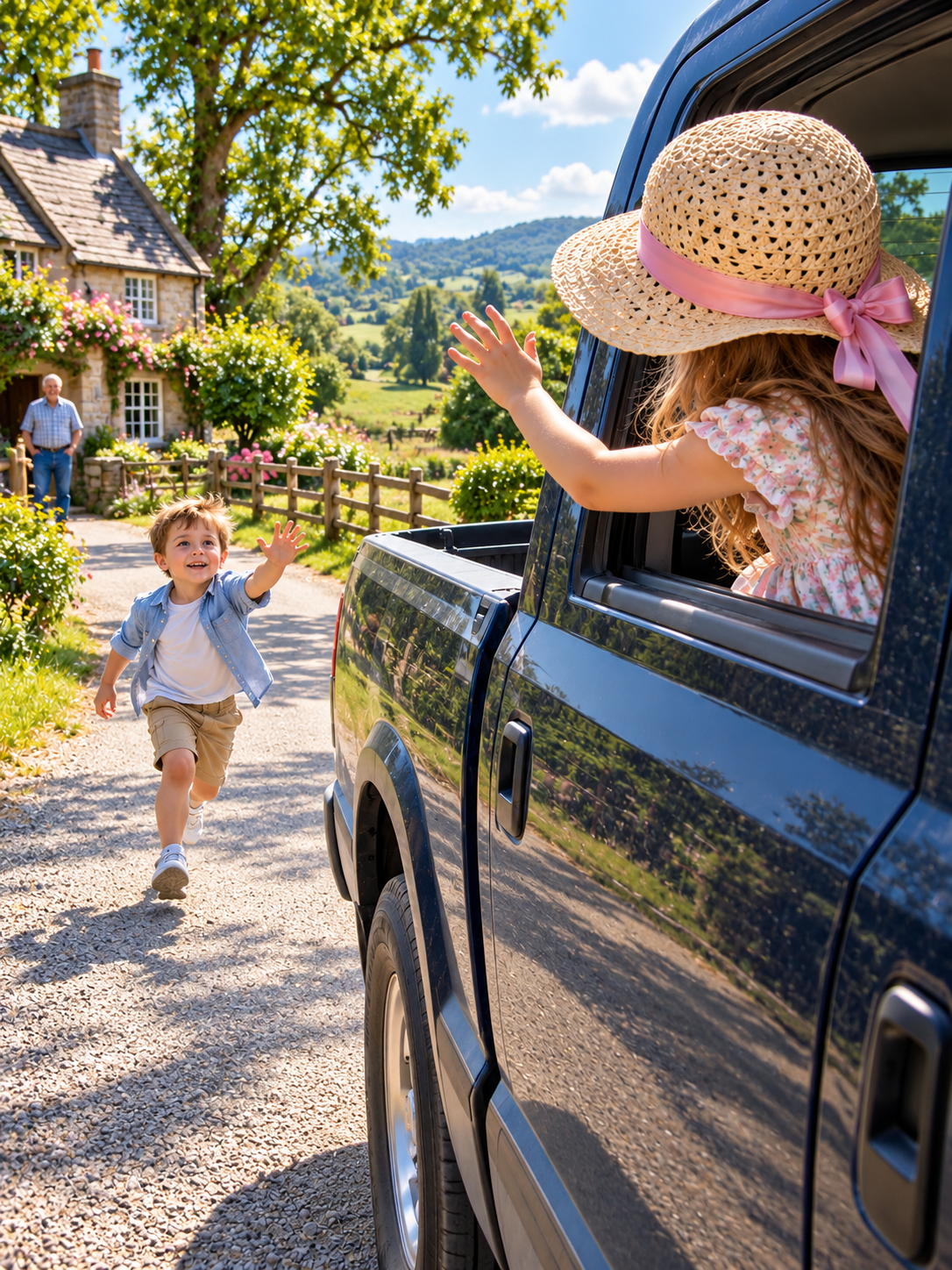
Through the front window, I could see Paige standing beside Dad’s truck. She wore new sandals and a white sun hat with a blue ribbon. Mom had bought it especially for the trip. Paige kept touching the ribbon, pleased with how it moved in the breeze. Beside her sat a small pink suitcase with wheels, a stuffed animal tucked securely under its handle. Everything about her suggested excitement and preparation. Everything about me suggested that somebody had remembered an inconvenience at the last minute.
“Can I have a hat too?” I asked. My mother looked at me, then gave a little laugh. “You won’t be needing that kind of hat where you’re going. Your grandfather probably has something better.” I watched her carry my pillowcase toward the door. “But aren’t we all going to Orlando?” She stopped for a moment, and the expression on her face changed. Not because she’d suddenly realized how hurtful the arrangement might be, but because she seemed irritated that I hadn’t understood it already.
“Your sister is going with us,” she explained. “You’re going to spend some time in the country. It’ll be good for you.” She spoke as if the matter had been settled long ago, which, I later understood, it had. My father had apparently agreed. Grandpa had been contacted. The travel reservations were made. There had been discussions about my summer, but none had included me. I was the only person in the house still learning where I was supposed to be.
My father, Rick, managed a car dealership and approached most situations as though a confident explanation could end any objection. When I followed Mom outside, he was arranging luggage in the truck. “Come on, buddy,” he said. “You’re going to have a great time with Grandpa Walt. Fresh air, animals, plenty to do. Better than sitting around a hotel all day.” I asked why Paige wasn’t going too. Dad shifted a suitcase and told me that we were already running behind schedule.
Mom worked in payroll administration for a large hospital system. She could remember the dates of every bill, calculate expenses in her head, and detect a mistake on a bank statement before anyone else noticed it. She disliked disorder and surprises. I eventually came to understand that she had placed me into a category of expenses and responsibilities that could be managed by sending me elsewhere. At seven, however, I still believed every family decision had some explanation that would make sense once I grew older.
Paige climbed into the truck and waved at me through the window. “We’re going to see dolphins!” she announced. I tried to smile. She was five, and I didn’t want to spoil her excitement. We had shared cereal bowls and bedtime stories, fought over the television remote, and fallen asleep together during thunderstorms. I couldn’t imagine she had anything to do with the decision. Still, I wondered whether she knew why she got to go somewhere wonderful while I was being sent away with my clothes in a pillowcase.
The drive west seemed to last forever. Buildings gave way to smaller towns, then wide stretches of farmland where fences ran beside the highway and grain elevators stood against the sky. Dad played the radio. Mom checked the time and occasionally discussed the airport. Paige fell asleep with her head resting against the window. I watched mile markers pass and tried to calculate how far we were traveling from Orlando. Every mile felt like a mistake that nobody intended to correct.
Grandpa Walter Kessler lived on six hundred forty acres in central Kansas. The farm included wheat fields, milo, cattle pastures, equipment sheds, a weathered farmhouse, and dirt roads whose destinations I couldn’t recognize. My mother had grown up there. She rarely spoke about those years, except to complain about the heat, the dust, or the amount of work her father expected from everyone. Whenever Grandpa visited our house, she became unusually formal, as though she were speaking to an employer rather than her own father.
We reached the farm in the afternoon. The house stood behind a row of trees, with a large barn beyond the gravel driveway. A dog lifted its head from beneath a parked truck, considered barking, then apparently decided we weren’t worth the effort. Grandpa stood on the porch wearing faded work trousers and a shirt with the sleeves rolled above his elbows. His arms were deeply tanned. His hands looked broad enough to cover both of mine at once.
Dad got my pillowcase from the truck and handed it to me. Mom walked toward Grandpa. They spoke near the porch, too quietly for me to hear. Both stood with their arms crossed, and I remember noticing how alike they looked when they were unhappy. Grandpa said something that made Mom turn toward the driveway. She answered sharply, then lowered her voice again. Dad remained beside the truck, looking at his watch.
Before leaving, Mom bent to straighten my shirt collar. “Listen to your grandfather. Don’t give him any trouble. And don’t make me come back because you’ve been acting up.” I wanted her to hug me. I wanted her to say she’d miss me, or that she’d call, or that she’d bring something back from Orlando. Instead, she brushed dust from my shoulder and stood. Dad gave my head a quick pat. Paige waved again, now fully awake.
The truck pulled away, tires crunching over gravel. I watched until the red taillights disappeared behind a bend in the road. Dust hung between the trees for several minutes. I kept holding the pillowcase because I didn’t know what else to do with my hands. Behind me, Grandpa waited without speaking. He didn’t promise that the summer would be exciting. He didn’t tell me my parents would return soon. He simply picked up the pillowcase after I set it down and motioned toward the house.
Inside, everything smelled unfamiliar. There was coffee in the kitchen, furniture polish in the hallway, and the faint scent of cedar upstairs. Grandpa showed me a small bedroom beneath the sloping roof. It had a narrow bed, a wooden dresser, and a window overlooking the yard. The quilt was heavy and clean. A photograph of my grandmother, who had died several years earlier, stood on a shelf. Grandpa placed my pillowcase on the bed.
“Breakfast is early here,” he said. “We’ll start at six.” I stared at him. “Six in the morning?” He gave me a look that suggested there was no other kind of six worth discussing. “That’s when the animals need us.” Then he showed me where the bathroom was and went downstairs. There was no speech about becoming a man. No lecture about responsibility. The arrangement, whatever my parents had intended it to be, was now simply a fact of my life.
That night, I untied the pillowcase and laid my clothes in the dresser. I had three shirts, two pairs of shorts, socks, underwear, and one pair of jeans. I arranged everything carefully because it was the only part of the situation I could control. Outside, insects scraped against the darkness. Somewhere beyond the house, an animal made a low sound that seemed impossibly loud. I climbed into bed and tried to imagine Paige settling into a hotel room, probably asking when they would go swimming.
I woke to a knock before sunlight had fully reached the window. Grandpa stood outside the doorway. “Kitchen in ten minutes.” By the time I came downstairs, he had already eaten half his breakfast. Two eggs, toast, and a glass of milk waited for me. He showed me where to put my plate when I finished. Then he handed me a pair of small work gloves that looked old but had been cleaned and set aside.
The first morning involved carrying water, measuring feed, and learning which gates had to remain latched. I made mistakes almost immediately. I spilled half a bucket, stepped into mud deep enough to swallow my shoe, and left a gate open until Grandpa caught it. He corrected me without shouting, although his voice carried the certainty of someone who didn’t expect the same mistake twice. Whenever I struggled with something heavy, he took part of the weight. He never walked away and left me to prove I could manage alone.
During lunch, I asked how long I would stay. Grandpa set his fork down. “Your mother said a few weeks.” I counted silently, considering how many mornings that meant. “Will they bring me something from Orlando?” He looked at me for several seconds. “Can’t say what somebody else will do.” It wasn’t the answer I wanted, but I would learn that he rarely pretended to know more than he did.
The days gradually developed a pattern. We fed animals before the heat became unbearable, repaired fencing, checked water troughs, and carried small tools between buildings. I wasn’t strong enough for many jobs, but Grandpa found ways for me to participate. Sometimes that meant holding a flashlight or passing him bolts while he worked beneath machinery. Sometimes it meant standing nearby and paying attention. He had little patience for carelessness, but he never made me feel foolish for asking how something worked.
At the end of the first week, he brought a notebook to the kitchen table. Its pages were crowded with numbers and short pencil entries. He studied one page, made another mark, and placed a few dollars in front of me. I looked at the money with disappointment. After days of sore hands, early mornings, and clothes stiff with dust, I had imagined that a summer of work would earn something more impressive. Grandpa noticed my expression.
“That’s spending money,” he explained. “Your actual payment comes later.” I asked when. “August.” He closed the notebook, secured it with a rubber band, and placed it in the drawer beside his chair. I assumed he meant a bicycle, perhaps a fishing rod, or some other reward a boy could understand. I began to look forward to August almost as eagerly as I’d once anticipated Orlando.
The weeks my mother had mentioned came and went. Nobody arrived to collect me. Grandpa made telephone calls, but he didn’t discuss them in my presence. Eventually I stopped waking each morning wondering whether Dad’s truck might appear in the driveway. I still missed home. At night I sometimes cried quietly, pulling the quilt over my face so Grandpa wouldn’t hear. Yet something about the farmhouse had begun to change. I knew where the cereal bowls belonged. I knew the sound of Grandpa’s boots on the stairs. I knew that when he promised to meet me beside the barn, he would be there.
Late in August, Grandpa announced that we were going to town. He wore a clean shirt and told me to wash thoroughly before getting into the pickup. We stopped at a small café where he ordered coffee and I had a slice of pie. Then we visited the county courthouse. Upstairs, a woman named Miss Opal greeted Grandpa as though she’d been expecting us. She offered me a peppermint and took an envelope from him. Documents passed between them. Grandpa pointed to a line on a page and told me to write my name carefully.
I was proud that he trusted me with something important enough to require a signature. I formed each letter slowly, pressing the pencil so firmly against the paper that my fingers hurt. Miss Opal smiled when I finished. Grandpa examined my work, gave a small nod, and took the documents back. I assumed they were records concerning the farm. Everything in Grandpa’s world seemed to involve records: animals, weather, supplies, crops, equipment, and money. I had no reason to imagine that my handwriting mattered beyond making him pleased.
On the evening before Mom was supposed to return, Grandpa took me into his machine shop. Tools hung along the wall, and drawers filled with bolts, nuts, washers, and unfamiliar metal pieces covered one workbench. He opened a drawer and removed a small brass washer. Then he placed it on an anvil and selected a steel punch. I watched him position the punch carefully and strike it with a hammer. When he lifted the metal, a crooked number had appeared on its surface.
He handed the washer to me. It felt warm from his palm and heavier than I expected. Then he placed an empty red coffee can on the bench. “Put it in there,” he instructed. I looked from the washer to the can. “Is this what I earned?” He nodded. I turned the piece over, searching for something special. It was ordinary hardware, the kind of thing that could disappear beneath a workbench without anyone noticing.
“What does the number mean?” I asked. Grandpa cleaned the punch with an oily rag. “It means the work counts.” I considered that answer, then asked whether I could show Mom when she came. His hand stopped moving. He looked directly at me, and his expression became more serious than I’d seen it all summer.
“Keep that washer safe, Cal. Keep every one I give you. And whatever you do, don’t show your mother.”
END PART 1
PART 2 TITLE: Every Summer My Sister Collected Vacation Memories While I Collected Brass Washers and Learned What My Grandfather Would Never Say
Mom arrived the following afternoon, well after the time she’d mentioned on the telephone. I heard the truck before I saw it and hurried outside, carrying the red coffee can beneath my arm. For a moment I forgot the warning Grandpa had given me. I wanted to show somebody the result of my summer, to explain how much I’d learned, and perhaps convince my parents that I’d done something worthy of their attention. Then I remembered his face in the workshop and tucked the can behind my back.
Paige climbed down from the truck looking taller and tanner than when she’d left. A stuffed dolphin hung from one arm, and she wore a bright shirt decorated with tropical flowers. A flower lei swung from the rearview mirror. She began telling me about swimming pools, boats, and an airplane ride across an ocean. I learned in pieces that their vacation hadn’t ended in Orlando. They’d continued traveling, eventually spending time in Hawaii. The trip that had justified leaving me at Grandpa’s farm for a few weeks had become an entire summer.
Mom asked whether I’d behaved. Grandpa said I’d worked hard. Dad commented on how brown my arms looked. Nobody asked what I’d enjoyed most or whether I’d been lonely. Paige showed me a collection of photographs on Mom’s camera, pointing out hotel rooms and restaurants and a place where she had watched dolphins leap from the water. I studied the pictures closely enough to notice that the same three people appeared in nearly every one. The absence of a fourth never seemed to trouble anyone showing them.
We drove home the next morning. I kept the coffee can beneath my seat, protected between my shoes. At a gas station, Dad bought Paige a drink and told me to choose something too. I picked a small bag of pretzels, although I wasn’t hungry. I remember thinking that the money Grandpa had handed me was still in my pocket. It was the first money I’d ever earned, and I wanted to spend it only on something that would last.
Back at school, my friends talked about vacations. One had visited his cousins in Colorado. Another had gone to Florida and complained about standing in long lines. When they asked about my summer, I said I’d worked on my grandfather’s farm. A boy named Ethan wanted to know whether I’d ridden a horse. I hadn’t. He lost interest almost immediately. I learned to describe my summer in short sentences so nobody would ask why I hadn’t gone anywhere with my parents.
The following June, Mom packed my belongings for Grandpa again. This time she used a proper overnight bag, though she still treated the arrangement as settled before I heard about it. Paige was going to the coast with our parents. Dad told me I’d be happier at the farm because I already knew the routine. Mom added that Grandpa needed company. I wondered whether she had told him that, or whether she simply needed a reason that sounded generous.
Grandpa didn’t seem surprised when I arrived. My bedroom had been aired out, and clean sheets covered the mattress. A larger pair of gloves waited beside the dresser. We resumed our mornings before sunrise. He expected me to remember what he’d taught me the previous year, but he explained new tasks carefully. I learned to check the weight of a feed bucket before lifting it and to recognize when an animal was behaving strangely. Grandpa called attention to details rather than praising me for noticing them.
At the end of August, we went back to the courthouse. Miss Opal remembered my name. Grandpa brought another envelope, and once again I signed a page after he indicated the correct place. We ate pie at the café before returning to the farm. That evening, he stamped another washer and handed it to me. The number was different, but the instruction remained the same. I placed it beside the first one in the red can. Two small pieces of brass rattled against the bottom.
The years began arranging themselves around those summer visits. During the school year, I lived near Kansas City with Mom, Dad, and Paige. In June, I moved west to Grandpa’s farmhouse. In August, we visited the courthouse and added another washer to the can. In September, Mom attached another refrigerator magnet to the kitchen door, a souvenir from a place the rest of the family had visited without me. Eventually the refrigerator became a kind of travel map that had no room for my experiences.
Some magnets showed beaches. Others represented cruise ports or famous landmarks. Paige loved rearranging them. She would ask me to hold one while she moved another, never questioning why I wasn’t familiar with the places they represented. I didn’t resent her excitement at first. She was my little sister, and she genuinely wanted me to hear about what she’d seen. But as we grew older, the difference between our summers became increasingly difficult to explain, especially when everyone behaved as though it had resulted from my own preference.
At eleven, I found a folder of vacation photographs on the family laptop. Paige had celebrated her birthday at a resort that summer. There were pictures of decorated tables, a swimming pool, relatives wearing colorful shirts, and children gathering around a cake. I recognized an uncle I hadn’t seen in years and a cousin who had apparently grown much taller. In one photograph, there was an unoccupied chair near the birthday table. I couldn’t stop looking at it.
Grandpa found me in the farmhouse sitting before the laptop. He studied the photograph over my shoulder, but he didn’t ask me to explain why I was upset. Instead, he said dark clouds were approaching and we needed to move equipment beneath cover. We worked quickly as the sky turned gray. Rain began before we finished, heavy enough to sting my face. By the time we reached the house, both of us were soaked.
Grandpa made hot chocolate that evening. It was unusual enough that I remember the saucepan, the chipped mugs, and the careful way he divided the drink between them. He sat across from me while rain struck the kitchen windows. After several minutes, he asked whether there was anything I wanted to discuss. I shook my head. He didn’t press me. At the time, I mistook his silence for indifference. Years later, I understood how often he’d chosen to remain available without forcing me to surrender feelings I couldn’t yet describe.
When I was twelve, heavy rain flooded the creek and turned the lower pasture into a dangerous stretch of mud. One morning, we discovered a young calf trapped between exposed roots near the water. It had apparently slipped while trying to climb the bank. Grandpa’s knees were causing him trouble, and he couldn’t safely descend the slope. He secured a rope around a tree and instructed me carefully before allowing me to approach the animal.
The calf was frightened and exhausted. Its hooves scraped at the mud whenever I moved close. I remember the cold water around my boots, the smell of wet earth, and Grandpa’s voice carrying above the creek. He told me not to rush. I worked the rope around the animal while he held the other end. Getting the calf free took longer than I expected. Twice it struggled hard enough that I thought we’d lose our grip. At last, with Grandpa pulling and me guiding, it scrambled onto solid ground.
I climbed out trembling from effort. Grandpa stood waiting, his trousers muddy to the knees. He checked me for injuries before examining the calf. Then he rested one enormous hand against the back of my neck. “You kept your head,” he said. “That’s worth something.” He rarely gave compliments, and I stored those words somewhere more important than the pocket money he handed me each week.
That evening, he opened his notebook and made an entry. I asked what he was writing. “Extra work,” he replied. I leaned forward, trying to see the numbers, but he closed the cover. He wasn’t hiding it in a playful way. It was simply information he wasn’t prepared to explain. I had learned not to question everything he kept private. Yet the notebook, the courthouse papers, and the brass washers were beginning to occupy the same mysterious corner of my thoughts.
During the following spring, I decided to ask my parents directly about our vacations. I practiced the conversation while walking home from school, trying to sound reasonable rather than angry. At dinner, I waited until everyone had finished eating. Dad was checking messages on his phone. Mom was sorting mail beside her plate. Paige was describing an upcoming dance performance. When I finally spoke, my voice sounded more nervous than I’d intended.
“I’d like to go with you this summer,” I said. Dad looked up and smiled. “What, you don’t want to spend time with Grandpa anymore?” I explained that I liked Grandpa, but I also wanted to travel with my family. Mom put down an envelope and told me that Grandpa counted on my help. I asked whether Paige could spend the summer on the farm instead, just once, so I could have a different experience.
Mom’s expression hardened. “Paige has allergies,” she said. “You know she can’t be around hay and animals the way you can.” I’d never heard that presented as a serious concern before, though Paige did sneeze during springtime. Dad added that other boys would consider themselves lucky to have my opportunity. He spoke as if the matter were obvious. I wanted to ask which boys would volunteer to miss every family vacation, but I could already hear the accusation of ungratefulness forming in Mom’s voice.
That summer, my parents took Paige to Italy. I returned to Grandpa’s farm, where work continued regardless of my disappointment. Grandpa noticed that I was quieter than usual. He didn’t ask for details until one afternoon when we were repairing a fence. I told him about dinner and the conversation I’d tried to have. He listened while tightening a wire, then said that people sometimes preferred a convenient explanation to an uncomfortable truth. I asked whether he thought my parents were being unfair.
He examined the fence for a long moment. “I think you asked a reasonable question,” he said. It was the closest he’d come to criticizing my parents in front of me. I wanted him to say more, but he resumed working. I realized that his reluctance wasn’t necessarily agreement with Mom and Dad. Something about the family arrangement was difficult for him too.
When we visited the courthouse that August, I paid closer attention to the papers. Grandpa placed them where I could sign, but I couldn’t understand the technical language printed above my name. There were legal descriptions, unfamiliar abbreviations, and numbers arranged in columns. I recognized his name and mine. Miss Opal offered her usual peppermint and asked whether school was going well. Grandpa completed the business calmly, and we returned to the café as we always did.
That evening, another brass washer joined the collection. I asked Grandpa whether the numbers represented hours worked. He shook his head. I suggested they might be money. He didn’t answer directly. Instead, he asked whether I’d ever noticed how a fence could look straight from a distance while several posts had shifted out of alignment. I said I had. He told me that some things only made sense when you could see the whole line.
I didn’t understand why he used a fence to explain a handful of brass washers. I was thirteen and increasingly embarrassed by the ritual, but I couldn’t bring myself to throw them away. Each one represented a summer in which I’d worked hard, learned something difficult, and received a kind of attention I rarely found at home. The red can remained beneath the bed upstairs, wrapped in an old shirt so the washers wouldn’t make noise when I moved it.
At fourteen, my parents became distracted by preparations for another vacation and overlooked the arrangements for my driver’s education. I discovered the problem when a school counselor asked about my enrollment. Mom said she’d deal with it after returning. Dad suggested I could learn to drive on the farm. Neither seemed especially concerned. When I mentioned it to Grandpa, he took the keys from the hook beside the kitchen door and told me to meet him outside.
His pickup was old, with a stiff clutch and a steering wheel polished smooth by years of use. We began in an empty field. Grandpa taught me how to start gently, control the vehicle on uneven ground, and judge distance without relying entirely on mirrors. I was impatient. One afternoon, while concentrating on changing gears, I steered too close to a ditch. By the time I understood my mistake, the truck had settled at an angle with one rear wheel spinning uselessly.
I expected Grandpa to explode. Instead, he switched off the engine, climbed out, and examined the situation. He called Hollis Rucker, a longtime neighbor and friend, who arrived with a tractor. The two men discussed the safest way to pull us free. Grandpa didn’t insult me or make me explain something he already understood. Afterward, he handed me the keys again. “You’ll remember that ditch,” he said. “Better to learn here than on the highway.”
Later that week, a man at the feed store asked whether I was Walt’s boy. I stood beside Grandpa, waiting for him to correct the misunderstanding. He looked at me, then answered, “Close enough.” The words were casual, almost careless. Yet they followed me all the way back to the farmhouse. Nobody at home had ever described me with that kind of uncomplicated belonging.
By fifteen, I had stopped expecting invitations, but I made one last attempt. Mom announced that the family had arranged another summer trip. I asked whether there was room for me this time. She said the reservations had already been made and there were only four places available. I stared at her, trying to understand the arithmetic. “There are four of us,” I pointed out. She didn’t look embarrassed. She explained that Paige was bringing a friend whose parents were divorcing.
Mom said the girl needed a pleasant experience during a difficult time and that excluding her would be unnecessarily cruel. I looked at Dad, waiting for him to acknowledge the irony. He said nothing. Paige appeared uncomfortable, but she didn’t challenge the decision either. I stood up, carried my plate to the sink, and went upstairs. I had asked for a place in my own family and discovered that the last available one belonged to somebody else.
When I arrived at Grandpa’s that June, I unpacked without waiting to be shown the room. Later, we sat on the porch while the sun settled behind the fields. I told him what had happened. He listened, rubbing one aching knee. After a while, he spoke about Mom’s childhood. She’d worked the farm alongside him, learning difficult jobs earlier than most children. She’d been exceptionally capable, he said, but he’d rarely praised her.
“She was the strongest worker I had,” he admitted. “I should have told her that.” I looked at him, surprised by the regret in his voice. Then he turned toward me. “You know who came closest?” I shook my head. He gave me a brief, almost shy smile. “You did.”
For the first time, I understood that Grandpa’s silence might contain more than secrecy. It might contain mistakes he couldn’t undo, affection he’d learned too late to express, and decisions he’d made because words alone no longer seemed sufficient. That night, I took the red coffee can from beneath my bed and counted the washers again. Eight pieces of brass lay in my palm, each marked with a different number.
I still couldn’t decipher a single one. But I no longer believed they were merely strange rewards for summer chores. Whatever Grandpa was recording, he had been preparing something for years, and I was beginning to suspect that he intended it to outlast both of us.
END PART 2
PART 3 TITLE: Eleven Summers of Work Led to a Final Brass Washer and a Courthouse Visit That Quietly Changed the Direction of My Life
The summer I turned seventeen, a hailstorm came across the farm with almost no warning. Grandpa and I had been examining equipment near the barn when the western sky took on a greenish-gray color. The wind shifted, suddenly colder, and the cattle began moving toward shelter. Grandpa looked toward the wheat fields and told me to get inside. We had barely reached the porch when hail started striking the roof with a force that drowned out our voices.
We stood by the kitchen window as the storm swept across the property. Ice bounced off the gravel and collected against the steps. I watched stalks of wheat bend beneath the wind. Grandpa kept his hands flat against the table, his face unreadable. He’d spent a lifetime interpreting weather, but there was nothing he could do once the storm arrived. When the worst passed, he waited until it was safe before going outside. The damage extended farther than either of us wanted to admit.
Over the following days, we worked from early morning until dark, trying to save what remained of the crop. Broken stalks lay tangled across sections of the fields. Equipment needed adjustments, plans had to change, and every hour seemed to matter. Grandpa’s knees were worse than they’d been the previous summer, though he refused to discuss them. I took on tasks that once would have been entirely his responsibility. When he grew tired, I could see it before he acknowledged it.
One evening, we ate sandwiches sitting on the back of the pickup. Neither of us had the energy to carry our plates into the house. Dust settled on our boots, and the last light spread across a field we hadn’t finished working. Grandpa said I’d done an excellent job. I looked at him, surprised by the directness of the praise. Then I told him he’d worked hard too. He laughed, a deep, unexpected sound that startled a nearby bird into flight.
It had become clear that my place on the farm was different now. Grandpa no longer merely taught me tasks. He asked for my judgment. When a gate needed relocation or a field required attention, he wanted to know what I thought before explaining his own preference. Sometimes he agreed with me. Sometimes he demonstrated why my idea wouldn’t work. The difference mattered. At home, I had grown accustomed to decisions being made without my involvement. On the farm, my opinion had become useful.
At the end of August, we made the familiar journey into town. Grandpa drove more slowly than usual, careful over rough sections of road. Miss Opal greeted us at the courthouse and offered a peppermint from the bowl on her desk. This time, however, another man was waiting. He introduced himself as Mr. Barlow, Grandpa’s attorney. I had seen him before in town, but never during our private August routine.
Several documents lay on the counter. Grandpa asked me to read the lines carefully before signing. I recognized some of the formal language from earlier years, though much of it remained unfamiliar. There were references to property descriptions and recorded transactions. Barlow pointed out the relevant sections, answering a few questions without expanding on the broader purpose. I signed three pages. Miss Opal checked the signatures and placed the paperwork into separate folders.
Outside, Grandpa paused on the courthouse steps. He looked across the street toward the café where we’d eaten pie after almost every annual visit. “That’s finished,” he said quietly. I asked what he meant. He told me that this had been our last summer of the arrangement and that I’d soon have responsibilities beyond the farm. Something about his tone made me stop questioning him. We crossed the street together and ordered our usual desserts.
That evening, Grandpa took me into the machine shop. He opened the drawer containing the brass washers and removed one from the back. Unlike the others, he examined it for a long time before marking it. When he handed it over, I saw that the inscription was different. Instead of another ordinary number, it carried a word. He didn’t explain it, and I didn’t press him. After eleven summers, I had learned that his answers arrived according to a schedule of his own making.
“This is the last one,” he said. I looked down at the washer. The metal felt cool against my palm. “Does that mean I’m finished?” Grandpa considered the question. “It means you’ve reached a point where the next decisions have to be yours.” I wanted to ask whether he was preparing to retire or whether his health concerned him more than he admitted. Instead, I placed the washer in the red can with the others and put it safely away.
That autumn, I received an acceptance letter from Kansas State University. I’d applied to study agriculture, drawn toward soil science, crop management, and the practical problems I’d spent years observing. A partial scholarship accompanied the offer. I read the letter twice before calling Grandpa. He listened without interrupting, then asked about the program and what work I hoped to pursue afterward. His questions made the acceptance feel more substantial than the printed page in my hand.
I brought the letter downstairs at dinner. Dad was answering messages on his phone. Mom was reviewing a stack of household bills, while Paige discussed plans with her dance company. I waited for a pause before placing the envelope on the table. “I got into Kansas State,” I announced. Dad glanced up and offered a quick congratulations. Mom asked whether the scholarship covered everything. When I said it didn’t, she mentioned that we’d need to discuss costs later.
I tried to explain what the program involved. There were opportunities for research, fieldwork, and practical training. I thought Dad might be interested in the business side of agriculture, or Mom might ask about the scholarship. Instead, the conversation returned to Paige’s schedule. Dad wanted to know which competition she would attend next. Mom began calculating travel costs. I put the acceptance letter back into its envelope and carried it upstairs.
I didn’t expect my parents to understand every ambition I had. Neither worked in agriculture, and the farm had never interested them much. But I’d hoped they’d be curious about something that mattered deeply to me. Over the next several months, the conversation about college expenses never occurred unless I raised it. Whenever I tried, Mom said she was busy or that we would deal with it closer to the deadline. I accepted her reassurances longer than I should have.
By March, the university had sent reminders about housing deposits and other payments. I brought the information to Mom one evening and asked how much had been saved for my education. Grandpa had given her envelopes at Christmas for years, always identifying the money as intended for me. I knew there had been contributions, even if I didn’t know the total. Mom studied the paperwork before setting it aside. Her expression told me something was wrong.
She said the money hadn’t remained separate. Some had been transferred into the household account when unexpected expenses arose. There had been repairs to the roof, various bills, and costs associated with Paige’s dance activities. Mom spoke evenly, as though describing ordinary accounting decisions. I asked how much was left. She avoided giving a direct figure and reminded me that I had earned a scholarship.
I sat across from her, trying to understand why money intended for my education had been used without anyone consulting me. Mom said a family sometimes had to make practical choices. She added that I was independent and capable of finding a way forward. I thought of the years Grandpa had placed those envelopes in her hands. He had trusted her to preserve something for my future, and she had treated it as available whenever another expense seemed more important.
Before I could respond, Paige entered the room carrying a brochure. She was excited about a summer dance opportunity in London and Paris. Mom immediately began discussing travel arrangements. Dad appeared from the living room and asked about flights. Both parents intended to accompany Paige. I watched their expressions brighten as they talked about hotels, sightseeing, and the advantages of international experience.
The contrast was so stark that I felt strangely calm. I no longer needed to ask why my education could wait while Paige’s activities demanded immediate attention. The answer had been visible in our household for years. I stood, gathered my papers, and went upstairs. I didn’t slam a door or shout. Later, Mom told Dad I’d behaved dramatically and stormed away from the discussion. I remember sitting on my bed in complete silence, looking at a payment deadline I had no obvious means of meeting.
When I told Grandpa, he didn’t respond immediately. He asked me to bring every document from the university and explain what was due. We went through the figures together at his kitchen table. He studied the deposit requirements, tuition estimates, scholarship terms, and possible employment opportunities. He didn’t ask me to recount every unfair summer or explain why my parents had disappointed me again. He simply wanted to know what practical decisions lay ahead.
Then he told me he’d make sure the immediate college expenses were covered. I protested because I understood how difficult the recent harvest had been. Grandpa waved away the objection. “You earned your chance,” he said. “Don’t waste it worrying over a deposit.” He arranged the payments directly, making certain the money reached the university rather than passing through my parents’ accounts.
The weeks before graduation were filled with examinations, school activities, and preparation for leaving home. I worked part-time whenever I could and tried to save as much as possible. Grandpa called occasionally to ask how things were progressing. Dad talked about dealership problems. Mom remained occupied with Paige’s summer plans. I began to realize that the next stage of my life might unfold without much involvement from the people who had raised me.
On graduation night, I looked for my parents in the crowded gymnasium. They had attended the beginning of the ceremony, but Dad received a business call and Mom became concerned about collecting Paige from rehearsal. Before the names were announced, they left. I didn’t know they were gone until I glanced toward the section where they’d been sitting and found their seats empty.
Grandpa remained near the top of the bleachers. He wore a clean shirt with pearl-snap buttons and his better boots. I spotted him because he stood when my name was called, applauding with a seriousness that made him conspicuous among the cheering families. I walked across the stage, accepted my diploma, and tried not to look toward the vacant seats where my parents had been.
Afterward, Grandpa found me near the gymnasium entrance. He shook my hand, holding it longer than usual. “Proud of you, Cal,” he said. There was no elaborate speech. He simply looked at me as though he’d seen every difficult step that had brought me there. I wanted to tell him how much that meant, but my throat tightened. We stood together while families moved around us, taking photographs and calling to one another.
A few days later, Mom and Dad left for Europe with Paige. I was supposed to remain at home until university arrangements required me to move. Instead, I packed my clothes and drove to Grandpa’s farm. I left a note on the refrigerator, tucked beneath a magnet from Italy. The note explained where I would be. Weeks passed before Mom contacted me, and even then her message asked where I’d put the garage remote.
Living at the farm that summer felt different from visiting as a child. I wasn’t waiting for my parents to return. I wasn’t counting the days until school began. I was working because I wanted to, discussing plans with Grandpa and preparing for an education that connected directly to the land around us. The upstairs bedroom held my books and clothes, and the red coffee can remained in its usual place.
Before leaving for university, I took out the eleven washers and arranged them across the bedspread. I studied the marks again, especially the final washer. I wondered whether Grandpa would ever explain the numbers or whether they represented something meaningful only to him. Whatever their purpose, I wasn’t ready to discard them. They were the one consistent record of summers when nearly everything else in my life had felt uncertain.
On my last evening before moving into university housing, Grandpa came upstairs and stood in the doorway. He looked around the room, then at the bag waiting beside the bed. “You know you can come back whenever you want,” he said. I nodded. For years, I had arrived at the farm because someone else had decided I belonged there. Now, for the first time, I understood that returning would be my own choice.
END PART 3
PART 4 TITLE: While My Parents Forgot My Milestones, Grandpa Built a Future With Me Until One Hospital Call Exposed Their Real Intentions
By my second year at Kansas State, I had stopped expecting my parents to telephone simply because they wanted to hear from me. Our conversations were occasional and brief, usually prompted by holidays or questions about something I’d left at home. Mom asked whether I was managing expenses. Dad offered general advice about work. Paige sometimes sent photographs of performances or trips. I replied politely, but I no longer measured my days by whether anyone contacted me.
Grandpa and I spoke every Sunday evening at seven. At first, the conversations lasted only a few minutes. He’d ask about classes, and I’d ask about cattle or rainfall. Gradually, our calls grew longer. I told him about soil chemistry, crop diseases, and professors who approached familiar farm problems from perspectives I’d never considered. He listened carefully, occasionally challenging something I’d learned. Sometimes his practical experience confirmed a theory. Other times it exposed a weakness I hadn’t noticed.
During holidays, I returned to the farm rather than my parents’ house. Grandpa never asked why. He had a habit of treating choices as real once a person had made them. I helped with repairs, livestock, and planting preparations. Hollis Rucker often joined us, bringing his dry humor and a lifetime of knowledge about the surrounding farms. The three of us worked comfortably together, each knowing when the others needed assistance.
Grandpa’s knees grew increasingly troublesome. He could still manage most chores, but climbing into machinery and walking long distances across uneven ground became difficult. He disliked accepting help, especially when it involved jobs he’d performed alone for decades. I learned to offer assistance without making it sound like a concession to his age. If I suggested we divide the work to finish faster, he usually accepted. If I told him he shouldn’t be doing something, he became stubborn.
As my university coursework advanced, Grandpa began consulting me about important farm decisions. We discussed crop rotations, soil samples, drainage problems, and equipment expenses. I didn’t always have the answers. Sometimes I had to return to campus and ask questions or examine research before offering an opinion. Grandpa respected that process. He seemed more interested in my willingness to admit uncertainty than in my ability to sound confident.
One weekend, Hollis stopped by to ask whether a particular field needed additional treatment. Grandpa was sitting at the kitchen table examining invoices. Without looking up, he told Hollis to ask me. I remember feeling embarrassed by the trust implied in those words. I was still a student, and both men had spent more years farming than I’d been alive. Yet Grandpa expected me to contribute something worthwhile, and Hollis took the suggestion seriously.
The farm became a place where my education had immediate consequences. If I misunderstood a problem, there might be wasted money or damaged crops. If I noticed something early, the difference could be substantial. Grandpa allowed me to make decisions within reasonable limits, then insisted that I examine the results. He didn’t shield me from mistakes. But he made certain they became lessons rather than evidence that I should stop trying.
During my third year, Grandpa visited the university. He wanted to see the agricultural research facilities and meet some of the people I’d described during our Sunday calls. He arrived in his old pickup, wearing a clean shirt and boots that had clearly been polished for the occasion. I showed him the laboratories, experimental plots, and feedlot where I sometimes worked. He asked specific questions, several of which required the staff to think before answering.
At one feeding area, Grandpa noticed that a piece of equipment wasn’t operating as it should. He pointed out the problem to the manager, who studied it and eventually retrieved tools. I watched the exchange with a mixture of pride and amusement. Grandpa hadn’t been to university, but decades of observation had taught him things that formal education was only beginning to help me recognize. The visit reminded me that expertise could come from very different places.
That evening, I took him to dinner. A waitress asked whether we were celebrating a special occasion. Before I could answer, Grandpa pointed his fork toward me. “This young man,” he said. The waitress smiled and asked what I’d accomplished. Grandpa began describing my studies and the work I was doing. I listened, surprised by how much he’d remembered from our conversations. He had apparently been paying attention to every detail I thought might bore him.
My parents didn’t attend my university graduation. Paige had a sorority event that weekend, and Mom said the schedules were impossible to reconcile. Dad sent a short congratulatory message. I didn’t argue. By then, the pattern was too familiar to require another discussion. Grandpa arrived with his cane and sat through the ceremony despite the discomfort I knew it caused him. When I walked across the stage, I looked for him immediately.
He was standing again. Older, thinner, leaning slightly on the cane, but unmistakably present. Afterward, we took photographs outside the building. He seemed more interested in the degree than I was, asking to see the printed certificate and examining the details. I told him it was just paper. He corrected me. “Paper tells people what you’ve done,” he said. “What matters is whether you can do the work.”
After graduation, I accepted a position as a field agronomist for an agricultural cooperative. The work suited me. I traveled between farms, examined crop conditions, discussed management practices, and helped producers respond to problems before they became more expensive. I rented a small house within driving distance of Grandpa’s property. It wasn’t large, but it had enough room for my books, work clothes, and the few possessions I’d accumulated.
The red coffee can came with me. I placed it on a shelf in a spare room, alongside notebooks from university and photographs of the farm. Occasionally, while searching for something else, I’d take it down and examine the washers. The numbers remained mysterious. I considered asking Grandpa directly now that I was an adult, but the subject never felt urgent. Whatever he’d intended by giving them to me, their emotional value seemed clear enough.
By twenty-three, I’d built a life that felt steady. I enjoyed my work, had colleagues I respected, and spent many weekends helping Grandpa. Our relationship had changed from one of teacher and child to something closer to partnership. He still corrected me when he thought I was wrong, but he also listened when I disagreed. There were days when we worked together for hours without discussing anything personal, yet I never felt the need to prove that I belonged.
I rarely saw my parents. Nearly five years passed without a face-to-face meeting with Mom. Our occasional telephone exchanges remained polite but distant. Dad continued managing the dealership. Mom remained involved in financial administration. Paige’s life included travel, education, social events, and opportunities that required significant family support. I heard about them through messages, photographs, or brief updates. I didn’t resent her achievements, but I avoided conversations that invited comparisons.
Then, early one March morning, my phone rang before sunrise. I recognized Hollis’s number and expected a question about livestock or machinery. Instead, his voice was strained. Grandpa had fallen inside the barn the previous evening. Nobody had discovered him until morning. He’d spent approximately nine hours on the ground, unable to reach help. Hollis had called an ambulance, and Grandpa was being transported to a hospital in Salina.
I was already pulling on my clothes before Hollis finished explaining. I asked about Grandpa’s condition, but the information was incomplete. He was conscious when they found him, though exhausted and confused. The paramedics suspected a broken hip. Hollis had stayed until they left and was returning to check the animals. I promised to call once I reached the hospital. Then I gathered my keys and drove, scarcely remembering the route afterward.
The hospital smelled of disinfectant and coffee. I reached the surgical department and found my parents waiting near a row of chairs. I hadn’t expected to see them. Mom stood beside Dad holding a manila folder against her chest. She looked older than I remembered, but her expression was familiar: alert, controlled, and already irritated by something that wasn’t proceeding according to plan.
“Cal,” she said. “How did you get here so quickly?” I explained that I lived nearby. She appeared surprised, as though my location were information she had never considered important enough to retain. Dad shook my hand awkwardly and mentioned that Grandpa was being prepared for surgery. I asked whether they’d spoken with the medical team. Mom answered, but almost immediately shifted to concerns about his capacity to make decisions.
She said Grandpa had been confused when admitted and that the accident demonstrated he could no longer manage the farm safely. I agreed that he would need help recovering, but I wanted to hear from the surgeons before discussing long-term arrangements. Mom opened the folder. Inside was a durable power-of-attorney document dated 2009, prepared after my grandmother’s death. She explained that Grandpa had given her authority to act when necessary.
I studied the date. I remembered the year because Grandma’s death had changed the farmhouse and left Grandpa living alone. I also remembered years of courthouse visits afterward, including the final August trip with Mr. Barlow. At the time, I hadn’t connected those events to anything my mother might possess. Now, seeing her carefully arranged papers, I began to wonder whether the documents told the complete story.
Mom said Grandpa was eighty-two and couldn’t continue living independently. She suggested that assisted living would provide better supervision and that the farm’s future needed to be addressed before another emergency occurred. Dad nodded, adding that the property was too much for one elderly man. Their arguments were delivered with practiced confidence, as though they’d discussed them before I arrived.
I asked whether Grandpa had ever said he wanted to leave the farm. Mom frowned. “This isn’t about what he wants in the moment. It’s about what’s responsible.” I looked through the glass toward the surgical doors. Grandpa had been injured and alone for nine hours. I had expected everyone to be worried about his pain and recovery. Instead, my parents seemed primarily concerned with the authority his injury might give them.
When I finally entered his room after surgery, Grandpa was pale but awake. His first question was whether the cattle had been fed. I told him Hollis had handled the morning chores and that I would take care of the evening work. He asked about a red heifer in the eastern pen, due to calve soon. I assured him I’d keep watch. Only after we’d discussed the farm did he ask what the doctors had said.
I explained the operation and the recovery plan as carefully as I could. Grandpa listened, occasionally asking questions. He was tired and uncomfortable, but his thinking seemed clear. When I mentioned that Mom had brought legal paperwork, his mouth moved into something that wasn’t quite a smile. “Of course she did,” he murmured. I waited for him to explain, but he closed his eyes and asked for water.
That evening, I returned to the farm. The red heifer delivered her calf without complications, though I remained with her longer than necessary because I couldn’t settle my thoughts. The barn was quiet except for the animals and the sound of my boots against the concrete. I kept imagining Grandpa lying there through the night, unable to move. I felt guilty that I hadn’t been present, although there had been no reason for me to expect an accident.
I slept on the farmhouse couch. Over the next several days, I divided my time between my regular job, hospital visits, and farm responsibilities. Hollis helped whenever he could. I kept records of the chores and expenses so Grandpa could review them. The work was tiring but familiar. What unsettled me was the speed with which my parents began discussing permanent decisions about land and property while Grandpa was still recovering.
On the fourth day after his accident, I drove toward the northern field to check a drainage issue. As I approached the access road, I noticed an unfamiliar vehicle parked near the boundary. Two men wearing reflective vests stood beside measuring equipment. Another was examining a map spread across the hood. None belonged to the cooperative, and Hollis hadn’t mentioned any scheduled survey work.
I stopped the pickup and walked over. One of the men introduced himself as a representative of Prairie Sun Renewables. He explained that they were conducting preliminary field assessments for a proposed solar installation. I asked who had authorized them to enter the property. The representative glanced at his paperwork and said the arrangement had been approved by the person legally acting for Walter Kessler.
He turned the document toward me. At the bottom of the page was my mother’s signature.
For several seconds, I stared at it without speaking. Grandpa was still in the hospital. Nobody had asked him whether he wanted his fields converted into a solar development. Yet strangers were already measuring land that he had spent his lifetime maintaining. I asked for copies of the documents and the representative’s contact information. Then I returned to my truck.
As I drove toward the farmhouse, I remembered the years of courthouse visits, the envelopes Grandpa had passed to Miss Opal, and the eleven brass washers sitting in my home. For the first time, I wondered whether those apparently unrelated details might belong to the same story.
I pulled into the driveway, switched off the engine, and called my mother. When she answered, I asked one question.
“Exactly what have you agreed to sell?”
END PART 4
PART 5 TITLE: The Morning Grandpa’s Attorney Opened Eleven Old Files, I Learned Why My Mother Had Always Feared Those Summer Courthouse Visits
The eleven brass washers were still lying on Grandpa’s kitchen table when Mr. Barlow arrived the following morning. I had scarcely slept. Every time I closed my eyes, I saw the expression on my mother’s face when she discovered that four hundred forty acres of farmland belonged to me. It wasn’t merely anger. For a few seconds, before she began accusing me, I had seen something closer to recognition. She had understood that Grandpa had made a decision years earlier, and that she had somehow failed to notice it. Now the attorney was standing on the porch with a thick accordion folder tucked beneath his arm, looking as though he had been expecting this morning for a very long time.
“Your grandfather called me from the hospital,” he said after I let him inside. “He wants you to understand everything before Monday.” Mr. Barlow had represented Grandpa for as long as I could remember. His hair had turned almost completely white since my first visits to the county courthouse, but he still wore the same narrow glasses and carried documents with the careful posture of a man who understood their value. He declined coffee, set the folder on the kitchen table, and glanced at the washers. “I see Walter finally let you open the can.”
“He didn’t,” I answered. “My mother came here demanding to know why the deeds have my name on them. I recognized the numbers and opened it myself.” Barlow considered that for a moment. “That sounds like Walter. He always believed a person understood something better after discovering it with his own hands.” He removed a rubber band from the folder. Across the front, in Grandpa’s blunt handwriting, was my full name: Calvin W. Haynes. Beneath it he had written a single instruction. FOR CAL, WHEN IT MATTERS.
Inside were eleven recorded property transfers, arranged from oldest to newest. Each deed carried an official recording reference, a legal description, and dates that reached back to the first summer my parents left me on the farm. My stomach tightened when I recognized my childhood signature on the earliest documents. The letters were uneven, the final flourish almost comically large. I remembered Miss Opal sliding those papers toward me with a peppermint and telling me to take my time. I had believed I was practicing my handwriting. I had never imagined that Grandpa and his attorney were arranging something that would shape my adult life.
Barlow walked me through the files without rushing. He explained that the transfers had been professionally prepared, recorded, and supported by acceptance documents. Because I had been a minor when the first transactions occurred, additional legal arrangements had been used to administer the property until I could exercise control myself. Grandpa had insisted on doing everything through formal channels rather than relying on verbal promises. Every summer brought another completed transfer. The acreage varied from year to year, but the reasoning remained the same. Grandpa wanted part of the land permanently protected for the grandson who worked beside him.
I stared at the oldest date and remembered standing outside the farmhouse at seven years old, holding a pillowcase full of clothes while my parents drove away toward a vacation I wasn’t allowed to join. That summer had changed my life, though not in any way I recognized at the time. Grandpa had never told me that he was building an inheritance. He had asked me to feed calves, repair fences, watch the weather, and learn to finish whatever job I started. The small amounts of pocket money he handed me every week had seemed like all the compensation I would receive. The real payment, he had said, would come in August.
“Why keep it from me?” I asked. “I worked that land for eleven summers. I could have understood something about it eventually.” Barlow folded his hands. “Your grandfather believed your mother would try to influence you if she knew. He was particularly concerned when you were young. He wanted those decisions to be made without pressure from anyone who might benefit from changing them.” I remembered being thirteen and embarrassed by the annual stamping ritual. At fourteen, I had nearly thrown one washer away because I couldn’t imagine what purpose it served. Suddenly, the secrecy felt less like Grandpa being difficult and more like him protecting a fragile arrangement from people who had already decided what I deserved.
The attorney took out another document. This one carried a date from six years earlier, during my final summer living between my parents’ house and the farm. It was a formal revocation of the durable power of attorney my mother had received in 2009 after Grandma died. Grandpa had signed the revocation and had it properly witnessed. Barlow laid a certified-mail receipt beside it. My mother’s signature appeared on the delivery confirmation. I knew that handwriting instantly. Donna Haynes. She had written it across school permission slips, birthday cards, and countless household forms. I looked at the date again, trying to understand how she could now be using an authority that Grandpa had withdrawn years earlier.
“She received this?” I asked. “That’s what the record establishes,” Barlow replied. “It doesn’t necessarily establish how carefully she read the enclosure, but she signed for the mailing. Walter also instructed us to retain the supporting records.” My mother supervised payroll for a hospital system. She knew the importance of documents, signatures, and dated notices. She had organized our family life through spreadsheets and labeled folders, and she rarely misplaced anything involving money. I wanted to believe there had been a mistake. But the woman who had explained away my missing college savings had now attempted to arrange a transaction involving land she didn’t own, using paperwork that no longer gave her the authority she claimed.
Barlow produced a separate collection of records concerning my education. Grandpa had saved copies of the Christmas contributions he sent for my future schooling. Each was identified clearly. The entries matched the eleven years Paige and I had grown up in the same house while receiving very different treatment. I knew the total already because Paige had discovered Mom’s spreadsheet: forty-four thousand dollars. But seeing Grandpa’s handwritten instructions on those contributions made the loss feel different. He had not sent vague gifts that my parents could reasonably interpret as household support. He had specified their purpose, and my mother had recorded expenses against them that included Paige’s dance programs and family travel.
I thought about the evening I had asked my parents to help with my college dormitory payment. Mom had told me the money wasn’t available, as though its disappearance were an ordinary inconvenience. Paige had walked into the kitchen carrying a glossy brochure for a dance program overseas, and both my parents immediately began discussing the trip. Until that moment, I had still been trying to make sense of their choices. Sitting across from Barlow now, I finally understood that I had spent years interpreting deliberate decisions as unfortunate coincidences. That realization was more difficult to accept than the lost money.
“You don’t have to settle the school account today,” Barlow told me. “It’s a separate issue, and your grandfather’s records are thorough. Monday is about his ability to manage his affairs and the validity of the property arrangements.” He studied me over his glasses. “The worst thing you could do is turn a hearing about evidence into an argument about childhood. Your feelings matter, Calvin, but the court will be deciding specific legal questions.” I understood his point, though it wasn’t easy to separate the issues. Everything had begun with that pillowcase. The missing vacations, the farm work, the property transfers, and Mom’s attempt to control Grandpa’s future all belonged to the same history.
After Barlow left, I drove to the hospital. Grandpa was sitting upright in bed, a tray of untouched gelatin balanced across his knees. His face looked thinner than it had the previous week. The fall had left bruising along one arm, and his fractured hip made even small movements painful. But the moment I entered, he asked whether Hollis had checked the water line in the eastern pasture. I told him we had repaired the leaking connection that morning. Only then did he put down his spoon and look directly at me. “Barlow bring the papers?”
I nodded and pulled a chair beside the bed. For a while, neither of us spoke. Grandpa watched a maintenance truck passing outside the hospital window, and I studied the deep creases across his hands. Those hands had guided mine when I first learned to swing a hammer. They had held a rope steady while I climbed into a flooded creek bed to rescue a calf. They had stamped eleven small pieces of brass and given each one a meaning I hadn’t been old enough to understand. “Four hundred forty acres,” I said eventually. “You never told me.”
“You were busy learning to work them.” His answer was so predictable that I almost laughed. “Grandpa, that’s more land than I could have imagined owning. Why not say something when I became an adult?” He turned toward me slowly. “Because I wanted you to decide what kind of man you were going to be before you knew what you had. Land can make a person proud for the wrong reasons.” He rested his hand on the blanket. “And I didn’t want your mother trying to take the decision away from either of us.”
I told him about the power-of-attorney revocation and the certified receipt. His expression hardened, though he didn’t appear surprised. “She has a good head for figures,” he said. “Always did.” I asked whether he thought she knew her authority had ended. “I know I told her,” he replied. “What she chose to remember is her business.” I hesitated before asking the question that had troubled me since I saw the land surveyors. “Did she know you had transferred the property to me?” Grandpa shook his head. “Not the details. She knew I had made arrangements. She never asked what they were. She only wanted to know what would happen when I was gone.”
A quiet anger settled over me. I had arrived at the hospital frightened that he might die, while my parents had arrived prepared to discuss what would happen to his property. I knew people sometimes dealt with emergencies through practical decisions. But Mom had made commitments to a solar company before discussing them with Grandpa, and she had spoken of assisted living as though his preferences were irrelevant. Worse, she had connected the proposed transaction to her own plans for a lake house. I told Grandpa what she’d said. He closed his eyes briefly, then opened them again. “She always did like looking at water. Never liked the work it took to keep land around it.”
That afternoon, I met Paige outside the hospital cafeteria. She had driven from Kansas City after another argument with our parents. Her sneakers were unusually dirty, and she carried a paper bag containing two sandwiches that had become squashed during the trip. We sat near a vending machine while she explained that Mom had stopped answering questions about the school fund. Dad insisted that family money had been used for family purposes. Paige had asked why my college expenses weren’t considered a family purpose. He had responded by telling her to stop interfering in adult matters. “I’m twenty-one,” she said, pulling apart her sandwich. “Apparently that’s old enough to be a problem but not old enough to ask questions.”
I had spent most of my childhood imagining Paige knew exactly how differently we were treated. Now I understood how carefully Mom had controlled what each of us believed. Paige thought I’d chosen the farm because I preferred solitude and hated family vacations. I thought she’d been perfectly content to leave me behind. She had grown up surrounded by pictures of places I’d never visited, while I built a life with a grandfather she barely knew. Neither of us had been told the complete truth. “I don’t know what to do with all this,” she admitted. “Neither do I,” I answered. It was the first entirely comfortable conversation we’d had in years.
Before I left, Paige told me Mom was preparing additional papers for Grandpa to sign. According to Dad, they were routine documents related to his hospital care. Paige had seen a notary’s name written beside the appointment in Mom’s planner. She couldn’t tell whether the papers concerned medical decisions, property, or something else. I called Barlow from the parking lot. He listened without interrupting, then asked me to record exactly what Paige had seen and when. “Your grandfather has made his wishes clear,” he said. “I’ll remind the hospital that any proposed legal documents should be reviewed by his attorney.” I didn’t like the idea of treating my mother’s every action as a threat, but she had given me little reason to do otherwise.
The following morning, I arrived at the hospital to find Nurse Bev waiting near Grandpa’s door. She spoke quietly and checked the hallway before explaining what had happened. Mom had come earlier with a notary and several papers. She had asked to speak privately with Grandpa, and when he began reading the documents, she tried to reassure him that everything was simply precautionary. Grandpa had examined the first pages, pressed his call button, and asked Bev to remove the visitors. He refused to sign anything until Barlow reviewed it. Bev had documented the encounter, including the time and the names of those present.
I entered the room and found Grandpa staring at the parking lot. He didn’t look angry. He looked tired in a way I had never seen before. “She cried when she left,” he said without turning. I asked whether Mom had frightened him. “No. She was angry first. Then she cried.” He paused. “When she was little, she used to hide in the grain truck after supper. Thought the engine would cover the sound if she cried.” I remained silent. Grandpa turned his head toward me. “I heard her most nights. Never went out there. Figured she’d come inside when she was finished.”
I had known that Mom hated the farm, but I had never heard Grandpa describe her childhood with such plain regret. He had told me once that she was the best farmhand he’d ever had before I came along. Now I began to see what that praise had cost her. She had worked hard without hearing the words she needed, and when she grew up, she made certain Paige received every comfort she herself had missed. Somehow I had become the child expected to carry the other side of that bargain. I didn’t excuse her choices. But for the first time, I could see the old injury beneath them.
“Why didn’t you tell her she was good at the work?” I asked. Grandpa stared at his hands. “Didn’t know how.” He spoke almost inaudibly. “My father didn’t tell me. I thought if she kept getting better, she’d understand.” I remembered him teaching me to repair a fence by demonstrating the same task three times rather than praising me. Yet when I worked hard, he had eventually begun to acknowledge it. He had changed something about himself while raising me, even if the change hadn’t been obvious. “You should tell her,” I said. He looked toward the window again. “Maybe I should have told her forty years ago.”
I stayed until the nurse reminded us that Grandpa needed rest. Before leaving, I asked whether he was willing to attend the hearing on Monday. The hospital had arranged an evaluation, and Barlow believed his testimony would matter. Grandpa shifted against the pillows. “Find my pearl-snap shirt,” he said. “The blue one. Hollis knows where it is.” I smiled despite everything. “You’re going to court with a broken hip?” He looked offended. “The judge wants to know what I think about my farm. Seems only polite I show up.” He reached for my wrist before I could stand. “Cal, don’t mistake what your mother did for what you’re worth.”
Driving back toward the farm, I passed the northern field where the solar surveyors had been working. Their flags still marked the roadside, bright strips of plastic moving in the wind. I stopped the truck and walked into the wheat stubble. Somewhere beneath the frozen ground lay years of work: the first fence repairs I had helped with, the tracks from Grandpa’s old tractor, and the paths I’d taken before I knew the difference between belonging somewhere and merely being allowed to stay. My phone vibrated. Mom had sent a message demanding that I stop interfering in her father’s affairs. Beneath it was another, from Barlow, confirming that Grandpa’s medical evaluation supported his capacity to make decisions.
I stood in the field until the wind became too cold to ignore. Then I called Barlow and told him I wanted the complete record presented, including the revoked authority, the deed transfers, and Mom’s attempt to secure additional signatures at the hospital. He reminded me that the hearing would be difficult and that accusations needed to rest on evidence rather than assumptions. I agreed. I wasn’t interested in humiliating my mother. I wanted Grandpa’s choices respected, and I wanted the land protected from a transaction neither of us had approved. On Monday, for the first time in my life, I would enter a room where my parents could no longer determine what everyone was allowed to know.
END PART 5
PART 6 TITLE: My Mother Entered Court Certain Grandpa Was Confused, Until the Judge Asked About a Letter She Had Signed Years Earlier
On Monday morning, I reached the courthouse before eight. The building looked much as it had during my childhood summer visits: pale stone steps, heavy glass doors, and a hallway that smelled faintly of floor polish and old paper. I had walked through those doors eleven times beside Grandpa, usually thinking about the pie we would eat afterward. Now I carried the accordion folder Mr. Barlow had given me and an uneasy awareness that the same building could settle the fate of the farm. Outside, the wind pushed dry leaves along the curb. I watched a maintenance worker unlock a side entrance and wondered how my life had come to involve a court hearing over land I’d never known was mine.
Paige arrived a few minutes later. She wore a plain navy dress and a coat she’d borrowed from a friend. Her hair was tied back, and she looked younger than she had on the farm, where she’d spent an afternoon laughing at a calf that kept trying to lick her shoes. She stood beside me without attempting conversation. After a while, she asked whether Grandpa was coming. I told her Hollis had driven to the hospital to bring his clothes and that a nurse would accompany him in a medical transport vehicle. Paige nodded. Then she reached for my hand, squeezed it once, and let go before our parents came through the entrance.
Mom wore a gray jacket and carried her manila folder against her chest. Dad followed with a leather briefcase he often used at the dealership. They stopped when they saw Paige standing next to me. “I thought you were coming with us,” Mom said to her. Paige looked down briefly, then met her eyes. “I’m here to hear what Grandpa wants.” Mom’s mouth tightened. “Everyone wants what’s best for him.” My sister’s reply was quiet but unmistakable. “Then it shouldn’t matter which side of the room I sit on.” Dad glanced toward the courtroom doors and suggested that we stop making a scene. None of us had raised our voices.
Our parents’ attorney approached and led them away. Barlow arrived shortly afterward, carrying a narrow case of documents rather than the large folder I’d expected. He greeted Paige politely and asked whether I had brought the records we’d reviewed. I nodded. “Remember,” he said, “the court isn’t here to decide who was a better parent. Our task is to establish that Walter understands his decisions, that the property transfers were validly completed, and that your mother’s claimed authority had already been revoked.” I wanted to ask whether judges could recognize what was plainly unfair even when the issue was technically unrelated. Instead I told him I understood.
Grandpa arrived in a wheelchair shortly before the hearing began. His blue pearl-snap shirt had been pressed, though I suspected Hollis had done the ironing himself. A blanket covered his legs, and his face showed the strain of being transported with an injured hip. Still, he surveyed the hallway as if he were inspecting the condition of his own barn. When Paige crouched beside him, he looked at her closely. “You’re the one who doesn’t like hay,” he said. She laughed nervously. “I’m beginning to think I’ve been given an exaggerated warning.” Grandpa made a sound that might have been amusement. “We can test that when I get home.”
He shook Barlow’s hand and asked how long the proceeding would take. The attorney explained that Judge Thornberry would hear evidence about the requested conservatorship and the disputed property arrangements. Grandpa listened without interrupting. Then he asked whether the judge would be permitted to ask him questions directly. Barlow said yes. “Good,” Grandpa replied. “A lot of people have been speaking for me lately.” I looked at Mom, who stood several feet away. She had heard him. Her expression didn’t change, but she opened her folder and began checking papers she had already arranged.
Inside the courtroom, the judge took her seat and reviewed the materials before her. The proceedings were quieter than I’d imagined. There was no dramatic announcement or crowd of spectators, only the rustle of documents and the occasional soft instruction from a court clerk. Mom sat beside her attorney, with Dad directly behind them. Paige settled beside me. Grandpa’s wheelchair was positioned where he could hear and respond comfortably. I watched him straighten his shirt before the hearing began. Even now, he cared about presenting himself properly when important work needed to be done.
Mom’s attorney spoke first. He described Grandpa’s fall, the nine hours he’d spent injured in the barn, and the confusion noted when he was initially admitted to the hospital. He argued that the circumstances raised serious concerns about Grandpa’s ability to manage his property and make safe decisions about his care. He presented Mom as a daughter trying to protect an elderly father from financial and physical risk. As he spoke, I recognized parts of the truth. Grandpa had fallen. He had been confused when the ambulance arrived. He was eighty-two and recovering from a serious injury. But none of those facts established that Mom could sell his land without consulting him.
The attorney then turned to the property transfers. He argued that the recent discovery of deeds naming me as owner suggested the possibility of undue influence. He emphasized my close relationship with Grandpa and my years working on the farm. He suggested that a young man who spent so much time alone with an aging relative might have benefited from decisions the rest of the family never understood. I felt my face grow hot. He was describing the same summers my parents had repeatedly arranged, now using my presence on the farm as evidence against me. I kept my hands folded beneath the table and waited for Barlow.
When it was his turn, Barlow approached the question differently. He did not begin with family conflict. He began with dates. He presented the first deed, executed when I was seven, and the accompanying documents showing how the transfer had been properly managed and recorded. Then he produced the remaining deeds in chronological order. Each had been prepared through his office, accompanied by the necessary signatures, and recorded in the county’s property records. The transfers weren’t sudden decisions made after Grandpa’s injury. They stretched across eleven years, ending long before anyone had suggested he was incapable of handling his affairs.
The judge examined several pages and asked Barlow to clarify the ownership map. He explained that Grandpa retained two hundred acres in his own name. The other four hundred forty acres had been legally transferred to me. Those acres included the farmhouse, principal outbuildings, access road, and a section of land of particular interest to Prairie Sun Renewables. Barlow explained that the proposed solar transaction therefore involved property Mom had no authority to convey. The judge made notes while listening. My mother leaned toward her attorney and whispered something. He shook his head slightly before returning his attention to the documents.
Barlow then submitted Grandpa’s medical evaluation. The examining physician had found him alert, oriented, and capable of explaining his wishes. The temporary confusion reported after the fall was consistent with dehydration, pain, and extended exposure while he lay injured in the barn. The physician had not identified a basis for concluding Grandpa was unable to manage his personal or financial decisions. I looked toward Grandpa. He was listening carefully, his hands resting on the wheelchair arms. When Barlow referred to his ability to understand property matters, Grandpa gave a small nod, as though correcting an inaccurate report about the condition of a field.
Next came the document that changed the atmosphere in the room. Barlow introduced the revocation of Mom’s 2009 power of attorney, signed six years earlier. He laid out the supporting record of its delivery by certified mail. The judge asked to examine the receipt more closely. I watched her read the address, date, and signature. Then she turned toward Mom’s attorney. “Your client’s claimed authority was revoked before these recent transactions were attempted?” The attorney hesitated. “Your Honor, my client believed she continued to have authority to act in her father’s interests.” The judge looked at the document again. “This appears to bear her signature acknowledging delivery.”
Mom’s attorney turned toward her. For the first time, he seemed genuinely surprised. They spoke quietly for several seconds. I couldn’t hear the words, but I saw Mom shake her head and touch the edge of the folder. She had entered the courtroom prepared to argue that Grandpa was confused and that I had manipulated him. Now a record she had personally received was contradicting the foundation of her authority. The judge did not accuse her of deliberate misconduct. She simply asked for an explanation of how the revoked document had come to be used in dealings with the solar company. The silence that followed was more revealing than any accusation I could have made.
Mom eventually answered through her attorney that she had understood the old authority to remain effective for emergencies. Barlow explained that the revocation had not contained such an exception. Grandpa had also retained counsel for his property affairs and had not authorized the proposed sale. The judge asked whether any completed conveyance to Prairie Sun existed. Barlow confirmed that preliminary documents and survey activities had begun, but no authorized transfer of the disputed property had occurred. I felt a small measure of relief. Whatever promises my parents had made, the land itself had not yet been taken from us.
The court then heard about the hospital incident. Barlow presented the nurse’s documented account of Mom bringing a notary and papers for Grandpa to sign. He emphasized that Grandpa had read the documents, asked for assistance, and refused to sign without consulting his attorney. Mom’s lawyer argued that seeking precautionary documents during a medical crisis was not inherently improper. The judge agreed that the act of bringing documents wasn’t enough, by itself, to establish wrongdoing. But she also observed that Grandpa’s refusal demonstrated an ability to identify a legal issue, seek advice, and express a decision. I watched Mom lower her eyes to the folder on her lap.
When the judge asked whether any witness wished to clarify the history of the property transfers, Barlow requested that Grandpa be permitted to speak. The court agreed. A staff member adjusted the microphone, and Grandpa leaned forward carefully. The effort caused him obvious discomfort. I had helped him through harvests during which he worked with aching knees and a sore back, but I’d never wanted him to exert himself less than I did that morning. Barlow approached and asked if he needed a break. Grandpa shook his head. “I’ve been sitting long enough,” he said, then looked toward the judge.
Judge Thornberry addressed him directly. She asked whether he understood that several hundred acres of land had been transferred to his grandson. Grandpa answered without hesitation. “I do.” She asked whether he had intended those transfers to occur. “Yes, ma’am.” She asked whether anyone had pressured him, threatened him, or misled him into signing the deeds. Grandpa’s expression became almost impatient. “No. Barlow explained every paper before I signed. I made the decisions myself.” The judge asked whether he understood that the transfers were permanent and that he could no longer dispose of those acres as his own. Grandpa looked toward me. “That’s why I did it.”
The judge let the answer settle before asking him to explain. Grandpa glanced at the front row, where Mom sat motionless. “My grandson started coming to the farm when he was seven,” he said. “His folks had other plans for the summer. I needed help, and the boy needed someplace to stay.” He paused to shift his weight. “He wasn’t much help at first. Couldn’t carry a full bucket, and he’d leave gates open if I didn’t watch him. But he learned.” A faint smile passed across his face. “By the time he was twelve, I’d trust him with things I’d hesitate to hand most grown men.”
He spoke about the flooded creek and the calf we had rescued, about the hailstorm that destroyed much of the wheat when I was seventeen, and about the years I returned while studying at Kansas State. None of it sounded rehearsed. He remembered details I’d forgotten, including the color of the rope we used at the creek and the night we repaired the combine under a work light while mosquitoes gathered against our sleeves. “He complained sometimes,” Grandpa admitted. “Had every right. Work’s work. But he stayed when something needed doing.” He rested his hand against the wheelchair arm. “I wanted him to know that mattered.”
Then he turned toward Mom. “I had a daughter who worked that hard before him,” he said. The room seemed to grow still. Mom lifted her head. Grandpa continued carefully. “Donna could do anything I asked. She was the best worker I ever had on that place for years. I didn’t tell her so. Didn’t pay her properly. Just kept finding more for her to do.” He swallowed and looked down. “I thought a person ought to know when she’d done well. Turns out thinking it doesn’t do much good if you never say it.”
I looked at Mom. She wasn’t crying, but her hands had begun trembling against the folder. Her entire adult life had been shaped by that farm, and she had spent years describing it as a place she escaped. I had heard Grandpa acknowledge her skill once before, years earlier, but I didn’t think she’d ever heard him say it. The admission came in the wrong place and much too late. Still, the words had clearly reached her. Dad leaned forward as though he intended to touch her shoulder, then stopped. She remained fixed on Grandpa.
“When Cal came,” Grandpa continued, “I recognized what I was doing. Same long days, same chores, same habit of expecting a child to understand without being told.” He looked toward me, then back at the judge. “I wasn’t going to let that happen again. I decided he’d be paid in something that would last. The land belonged to my family. I wanted him to have part of it, not just stories about working there.” He took a slow breath. “So I transferred some every August, and I kept the records. Didn’t want anyone turning it into a promise nobody had to honor.”
The judge asked whether he now wanted to sell the remaining farm property or move into assisted living as his daughter had proposed. Grandpa shook his head. “Not unless I decide it’s necessary. I’ve got a broken hip, not a broken mind.” A quiet murmur passed through the room. He continued before anyone could interrupt. “I’ll need help when I go home. I know that. Hollis and Cal are making arrangements, and I’m willing to listen to the doctors. But I haven’t agreed to sell my land. I haven’t agreed to put solar panels on it. And I haven’t agreed to buy anybody a lake house.”
Mom closed her folder. The movement was small, but it seemed final. Judge Thornberry asked Grandpa whether there was anything else he wanted the court to understand. He considered the question for several seconds. “Just this,” he said. “My daughter has plenty of reasons to be angry with me. I can’t change how I raised her. But she doesn’t get to make decisions for me now because I made mistakes then. And she doesn’t get to take what I already gave Cal.” He leaned back, exhausted by the effort. I realized that whatever the court decided, Grandpa had finally spoken the truth to his daughter in a room where she couldn’t simply walk away.
The judge recessed briefly to review the materials. I walked into the hallway with Paige, who stood near the window without speaking. When she finally looked at me, her eyes were wet. “He never told her she was good enough,” she whispered. “And she spent our whole childhood deciding which one of us needed to hear it.” I didn’t answer because I didn’t know how to make that history less painful. At the far end of the hallway, Mom stood alone beside the drinking fountain. She saw us but didn’t approach. For once, nobody seemed certain what role to play.
When we returned, Judge Thornberry began giving her decision. She addressed the medical evidence, the history of the deeds, the revoked authority, and the absence of proof that Grandpa had been improperly influenced. I gripped the edge of my chair as she explained that the court could not substitute speculation for documented evidence. Then she turned toward Mom’s petition and stated that the record did not establish a legal basis for appointing a conservator over Walter Kessler. The petition was denied. Grandpa would retain the right to make his own decisions. The recorded property transfers would stand.
The judge also recognized the revocation of Mom’s earlier authority and rejected its use as a basis for the attempted land transaction. She ordered my parents to cover Grandpa’s legal expenses associated with the proceeding. The disputed school funds were not resolved there, but she urged the parties to address the documented financial questions through counsel rather than allow another conflict to develop. I listened without moving. The law had answered the immediate questions, though it couldn’t restore the childhood we’d lost or erase the years Mom and Grandpa had spent refusing to speak honestly to one another.
As the courtroom emptied, Mom approached me with Dad behind her. Her face was pale. “You think you’ve won everything,” she said quietly. I shook my head. “I think Grandpa gets to decide where he lives. And I think the land he gave me is mine.” She looked toward the folder in my hands. “There are things about this family you don’t understand.” I thought of the grain truck, the missing college money, and the vacations she’d taken without me. “You’re right,” I replied. “But I’m beginning to understand them.” She opened her mouth, then seemed to reconsider. For the first time I could remember, she left without having the final word.
END PART 6
PART 7 TITLE: The Farm Was Safe After the Hearing, but My Mother Still Had to Answer for the Money She Took From My Future
The first call came from Prairie Sun Renewables before we’d even returned to the farm. A representative named Mr. Ellison asked to speak with the property’s authorized owner about the northern section. I was sitting in the passenger seat of Hollis’s pickup while Grandpa’s medical transport followed behind us. I explained that the proposed transaction had relied on authority that was no longer valid and that I had not agreed to sell or lease the acreage. Ellison was careful with his wording. He said the company would suspend activity until its legal department reviewed the situation. When I ended the call, Hollis glanced over. “They won’t like losing that transmission-line access.” I looked through the window at the flat Kansas fields. “They’ll have to find another place.”
Within days, the company confirmed it would withdraw from the project involving our property. The survey flags were removed, and the proposed transaction was abandoned. Grandpa received the news while sitting in his hospital room, eating oatmeal he insisted had been cooked too long. He listened to my explanation, asked whether any equipment had damaged the field, and then returned to his breakfast. I had expected him to celebrate. Instead, he wanted to know whether the red heifer’s calf was feeding properly. To Grandpa, protecting the farm wasn’t a dramatic victory. It was the restoration of something that should never have been placed at risk.
The consequences for my parents arrived more quickly than I anticipated. Their planned lake-house purchase depended on money they expected from the solar arrangement. Without that money, the purchase collapsed. They lost a nonrefundable financial commitment they had made before the land transaction was secure. Dad called me on a Thursday evening, furious about the expense. He said I had no idea how much planning had gone into the purchase or how humiliating it was to explain the situation to the seller. I waited until he finished. Then I asked whether he’d considered telling the seller that he hadn’t actually owned the property he expected to use to finance the deal.
Dad went quiet. He had never liked it when I answered one of his complaints with a practical question. “Your mother thought she had authority,” he said eventually. “She didn’t,” I replied. “And Grandpa told her what he wanted.” Dad sighed hard enough for me to hear it through the phone. He said the family should have handled matters privately instead of allowing them to become public. I looked around Grandpa’s kitchen, at the worn cabinets and the calendar marked with livestock appointments. “You brought a court petition,” I reminded him. “You asked a judge to take Grandpa’s decisions away from him. This didn’t become public because I asked for help.”
After the call, I went into the machine shop and took the red coffee can from its shelf. The washers made a dull sound as I poured them into my hand. I arranged them in order, studying the numbers Grandpa had stamped years earlier. Each represented a summer I once believed my parents had stolen from me. I remembered the heat inside the grain bins, the smell of diesel on Grandpa’s shirts, and the exhaustion of carrying buckets before breakfast. Yet those memories were not only painful. The farm had given me work I could understand, skills nobody could take away, and a grandfather who gradually learned to say he was proud of me. I wanted to preserve that history without pretending it excused what my parents had done.
Mr. Barlow called two days later about the education fund. His office had sent my parents a formal request for an accounting and reimbursement of the forty-four thousand dollars Grandpa had contributed. The records were unusually clear. The gifts had been specifically designated for my schooling, and the household spreadsheet Paige found identified expenses charged against them. Barlow cautioned that resolving the matter might require separate legal action if my parents refused to cooperate. I asked whether Grandpa would have to testify again. “Possibly,” he said. “But the paper trail gives us a strong starting point. Let the documents do their work.”
I didn’t want another courtroom confrontation. I had watched Grandpa exhaust himself explaining decisions he’d made deliberately over eleven years. His fractured hip needed attention, and his return home would require adjustments. I had no desire to make him relive my parents’ choices just so they would acknowledge something already obvious. Still, I remembered the dormitory payment deadline that had nearly derailed my college plans. Grandpa had stepped in without making me feel ashamed, paying immediate expenses directly while encouraging me to keep working. Forty-four thousand dollars wasn’t merely an accounting figure. It represented years of opportunities I had been told weren’t affordable for me.
Paige came to the farm that weekend. She arrived wearing old jeans and carrying a small overnight bag. For once, no expensive luggage stood behind her in the vehicle, and she wasn’t heading to an airport. Hollis had agreed to show her how to feed the animals while Grandpa recovered. She looked doubtful when he handed her work gloves but followed him into the barn without complaint. I watched from the doorway as she struggled to lift a feed sack, then accepted his advice about using the handcart. Her movements were awkward, and she sneezed several times. But she stayed until the work was finished.
That evening, we cooked supper together. Paige chopped vegetables while I prepared chicken and potatoes, and the conversation drifted toward childhood. She asked about the first summer Mom left me at the farm. I told her about the pillowcase, the early mornings, and the strange upstairs bedroom where I had lain awake listening to animals outside the window. She remembered Orlando differently. She had been five, delighted by a stuffed dolphin and convinced that I was enjoying a special summer with Grandpa. Mom had described the arrangement as something I’d requested. “I thought we both got what we wanted,” she said, setting down the knife.
I told her about the refrigerator magnets Mom brought home each September. For years, I had lined them up and imagined the places they represented. Paige looked toward the kitchen window, where the last of the daylight had faded. “I remember asking why you weren’t in the birthday pictures when I turned eleven,” she said. “Mom told me you didn’t like crowds and would rather be with the animals.” I remembered finding those photographs and staring at a chair beside the resort pool. I’d believed everyone knew I had been excluded. Paige had believed I’d chosen not to attend. Our mother’s explanations had kept us separated even when we occupied the same house.
“Do you hate me for it?” she asked. I considered the question carefully. “I hated being left behind,” I answered. “And I resented you because you got everything I didn’t. But I don’t think you were the one making those decisions.” Paige rubbed her hands together. “I could have asked more questions.” I shook my head. “You were a kid. So was I.” She nodded, though she didn’t seem entirely comforted. I understood that feeling. Learning the truth didn’t immediately erase years of resentment. It simply gave us a chance to respond differently now that we knew more.
On Sunday, Paige asked whether she could visit Grandpa before returning to Kansas City. I drove her to the hospital. Grandpa was practicing standing with a walker under the supervision of a physical therapist. His jaw tightened with every movement, and he looked furious at the slow pace of his recovery. Paige waited until the therapist finished, then offered him a bottle of water. Grandpa studied her. “You still here?” he asked. She smiled. “Apparently I like the place more than I thought.” He accepted the bottle. “We’ll see how you feel after cleaning out the eastern pen.”
Before we left, Paige told Grandpa she was sorry she had not visited more often. He glanced at her hands, which were scratched from handling feed sacks and fence wire. “You didn’t know much about me,” he said. “No,” she admitted. “I didn’t.” Grandpa nodded. “Well, you’ve got time to learn.” It was the sort of answer he might once have given me, brief enough to sound indifferent if you didn’t know him. But I saw Paige’s shoulders relax. She stayed beside his bed for nearly an hour, asking questions about his childhood, Grandma, and the different fields. Grandpa answered some questions with stories and others with a sentence. He didn’t seem to mind her curiosity.
Later that week, Barlow received a response from our parents’ attorney. Mom and Dad disputed the characterization of the school contributions but were willing to discuss repayment rather than face another proceeding. I read the letter in Barlow’s office, seated in the same kind of chair I had occupied during childhood courthouse visits. The language was formal and carefully guarded. Nobody admitted wrongdoing. Nobody apologized. The offer was to reconcile the documented amounts through counsel and arrive at a financial settlement. Barlow asked whether I wanted to proceed. I looked at the copies of Grandpa’s checks and told him yes.
The negotiations were less dramatic than the hearing but more exhausting in a different way. My parents’ attorney questioned the timing of certain contributions, the use of shared family accounts, and whether particular expenses had benefited me indirectly. Barlow returned to the records. Each contribution was identified for my education, and the disputed expenses included activities and travel that had nothing to do with my schooling. The repeated correspondence made me understand why Grandpa had kept such careful files. My mother had always been confident that she could explain household decisions through numbers. This time, the original numbers belonged to someone else.
I received a letter from Mom during those negotiations. It was handwritten on stationery she’d used for years. She said she had done what she believed necessary to keep the family functioning and that raising children involved sacrifices I could not understand because I didn’t have children of my own. She mentioned Paige’s ambitions, unexpected household costs, and the pressure of maintaining appearances while Dad’s dealership faced difficult years. She didn’t explain why my education money had been used without telling me. She didn’t mention the vacations I had missed. At the bottom, she wrote that she hoped I would someday appreciate the effort involved in being a parent.
I read the letter twice before putting it away. I wasn’t surprised by the explanations. I’d heard versions of them since childhood, whenever I questioned why Paige received something I was told the family couldn’t afford for me. What hurt was the absence of any recognition that I had also been a child with needs she was responsible for considering. I didn’t expect her to deny the difficulties of parenthood. I simply wanted her to understand that her decisions had consequences beyond the household balance sheet. For years, she had treated my independence as proof that I didn’t require the same care. It had never occurred to her that my independence developed because I couldn’t rely on her.
Paige called that evening. Mom had asked her to persuade me to accept a smaller settlement and end the dispute. My sister sounded uncomfortable. “She says you’re trying to punish her,” she told me. I leaned against the kitchen counter and watched the clock move toward seven. “What do you think?” I asked. Paige didn’t answer immediately. “I think the money was meant for your school,” she said at last. “And I think Mom knew that. I also think she’s frightened because she can’t fix this by telling everyone what to do.” I had never heard Paige speak about our mother with such clarity.
I told Paige I wasn’t demanding repayment because I wanted Mom to suffer. I wanted the accounting corrected. Money Grandpa had designated for my education had been spent elsewhere, and pretending otherwise would make every document meaningless. Paige listened, then said she would no longer act as a messenger between us. “If she has something to say to you, she can say it herself,” she explained. I thanked her. After we hung up, I realized how much our relationship had changed in a matter of weeks. We were no longer competing for the attention of parents who treated us differently. We were learning how to be brother and sister without allowing their explanations to define us.
Grandpa returned home soon afterward, though his doctor insisted on a gradual recovery and regular physical therapy. Hollis and I installed temporary rails near the porch steps, moved a bed downstairs, and rearranged the kitchen so Grandpa wouldn’t have to reach or bend unnecessarily. He complained about every adjustment until I reminded him that he had once made me wear a helmet while riding a small utility vehicle. “Safety rules were good enough for me at seven,” I said. “They ought to be good enough for you at eighty-two.” He looked displeased but allowed us to finish.
The first evening back, Grandpa asked me to bring the red coffee can into the living room. I placed it on the side table beside his chair. He removed the lid and examined the washers without speaking. “You understand them now,” he said. “Mostly,” I answered. He turned one of the older pieces over between his fingers. “I used to think paying someone fairly meant giving them what they earned. Took me a long time to understand that sometimes it also means telling them they matter.” He looked toward the kitchen, where Paige was washing dishes. “I didn’t manage that with your mother. Don’t intend to make the same mistake with you two.”
Two weeks after the hearing, Barlow called with news. Our parents had agreed to return the full forty-four thousand dollars designated for my education. The funds would be transferred through his office, and he would provide documentation showing the matter had been settled. I sat quietly as he explained the details. I had imagined feeling vindicated when the money was returned, but the announcement produced a different sensation. It was relief mixed with an odd sadness. Money could be restored. The years when I had needed it most could not.
When the payment arrived, I found a single notation attached to the transfer. In Mom’s familiar handwriting were the words “Cal School.” No apology accompanied them. There was no acknowledgment of the missed dormitory payment or the evenings Grandpa had spent helping me work out how to afford college. I looked at the two words for a long time. They were the same designation Grandpa had used from the beginning. Mom had always known what the money was for. That realization settled the last uncertainty I’d been carrying. I could no longer explain her decisions as mistakes made without understanding. She had understood enough to label the money correctly.
I went outside and found Grandpa sitting on the porch beneath a wool blanket. The sun was low over the western fields, and Hollis was driving toward the equipment shed. I told him the money had been returned. He nodded, then asked whether Barlow had completed the paperwork. When I said yes, he looked toward the pasture. “Good. That’s one thing straightened out.” I sat beside him and watched the shadows lengthen across the yard. After a while, he rested his hand on my shoulder. “You can’t make people give you the years back,” he said. “But you can decide what happens with the years you’ve still got.”
END PART 7
PART 8 TITLE: When Grandpa Finally Came Home, My Sister Entered the Machine Shop and Found the One Brass Washer He Had Never Stamped
The morning Grandpa insisted on visiting the eastern pen began with a disagreement about his wheelchair. He had been home only a short while, and his physical therapist had specifically warned him not to attempt uneven ground without assistance. Grandpa listened to my explanation with the patient expression he reserved for people who didn’t understand farming. Then he pointed through the kitchen window toward the pasture. “That calf was born while I was in the hospital,” he said. “I’ve been hearing about it for weeks. I intend to see it.” I reminded him that the animal would still be there tomorrow. Grandpa looked at me. “Then tomorrow you can take me again.”
Hollis helped me move the wheelchair across the packed gravel, choosing the smoother route along the equipment shed. Paige followed with a folded blanket and a bottle of water. The October air carried the smell of dry grass and livestock feed, and a pale sun shone over the harvested fields. Grandpa had lived through more seasons on that land than I could count, but his attention still settled on the smallest changes. He asked why the gate hinge had been replaced, whether the trough was draining properly, and who had repaired the broken board beside the feed rack. Hollis answered some questions. I answered the rest. Paige listened as though we were discussing a language she’d only recently begun to learn.
The red heifer stood near the fence with her calf beside her. The youngster had grown sturdy during Grandpa’s absence, its coat glossy and its legs no longer uncertain beneath it. Grandpa leaned forward in his chair, studying the animal. For several minutes, he said nothing. Then he pointed toward one hind leg and told me to watch the calf’s movement over the next few days. I nodded, recognizing the habit. He could appreciate the sight of a healthy animal without forgetting that its condition required attention. Paige crouched near the fence, careful to keep her balance on the packed dirt. The calf approached and sniffed her sleeve.
She laughed softly, then looked back at us. “It remembers me,” she said. Grandpa grunted. “Probably remembers you squealing loud enough to wake the county.” Paige laughed again, and this time Grandpa almost smiled. I stood beside them, feeling the strangeness of having my sister at the farm without a vacation waiting somewhere beyond it. For years, I had thought of her as part of a life that deliberately excluded me. Now she was sitting in the dust beside a calf, wearing work boots she’d bought after Hollis told her ordinary sneakers wouldn’t survive a month of chores. She had chosen to come back.
We remained outside until Grandpa began to tire. On the way toward the house, he directed us to stop at the machine shop. I knew the room so well that I could have crossed it in darkness: the workbench beneath the window, the metal drawers filled with bolts and washers, the pegboard where tools hung in carefully arranged outlines. The air smelled of grease, dust, and old steel. Grandpa asked me to wheel him closer to the bench. He rested his hand on the edge and looked around as if confirming that everything remained in its proper place.
“Open that bottom drawer,” he said, pointing toward the cabinet where he’d kept small hardware for decades. I pulled it out. The compartments contained nails, split pins, washers, and pieces of machinery I couldn’t identify without asking. At the back lay a single brass washer, brighter than the others and untouched by a stamping punch. I lifted it between my fingers. For a moment, I felt as though I were seven again, standing beside Grandpa while he prepared something I wasn’t meant to understand. “What is this one for?” I asked. Grandpa held out his hand.
I placed the washer in his palm. He studied it closely, turning it so the light caught the smooth surface. Paige stood near the doorway, looking between us. She knew about the eleven washers, the deeds, and the way Grandpa had quietly transferred pieces of the farm to me over the years. But she had never witnessed the ritual itself. I remembered the first summer, when Grandpa had handed me a red coffee can and told me to keep a brass washer hidden from Mom. At the time, I had been disappointed. I’d expected something recognizable as a reward for weeks of work. Instead, he’d given me a small piece of metal and a secret.
The washer in Grandpa’s hand was blank. He didn’t reach for the hammer or the stamping punches. He simply looked toward Paige, who had tucked a loose strand of hair behind her ear. “Sun comes up at six,” he said. “You think she’s any good?” I understood what he was asking, though the question carried more history than he could have put into words. Paige had grown up believing the farm belonged to a brother who preferred to disappear every summer. Grandpa had known her mostly through photographs and the occasional visit. Now she was here, learning chores, asking questions, and choosing work she’d never been required to do.
I looked at my sister. She was watching us with a mixture of curiosity and apprehension. I could have reminded Grandpa that she knew almost nothing about farming. I could have mentioned the years she had spent in resorts while I repaired fences and carried feed. Those differences were real, and I wasn’t pretending they hadn’t happened. But they didn’t need to determine what came next. “There’s only one way to find out,” I answered. Grandpa closed his fingers around the washer. For the first time that morning, a broad smile spread across his face.
Paige stared at him. “Are you saying I can help?” she asked. Grandpa’s smile faded into his usual practical expression. “I expect you can learn.” She glanced toward me. “I’m not exactly experienced.” I folded my arms. “Neither was I when I arrived. I couldn’t even carry a full bucket without spilling half of it.” Grandpa nodded. “And you left gates open.” I gave him a wounded look. “That was one time.” He raised his eyebrows. “More than one.” Paige laughed, and I found myself laughing with her. The sound filled the small workshop, echoing against the metal cabinets and old machinery.
Grandpa set the washer on the bench without stamping it. I noticed the distinction immediately. The washers he had given me represented actual property transfers, legally prepared and completed over time. This one carried no number, no recorded deed, and no promise of land. It was simply an invitation to begin. I appreciated that more than I could explain. Grandpa wasn’t trying to erase the past by distributing identical rewards to two children who had lived very different lives. He was offering Paige something she hadn’t previously had: the chance to earn his trust through shared time.
That afternoon, she helped Hollis check water troughs while I completed paperwork for the cooperative. Through the window, I saw her following him across the yard with a notebook tucked into her jacket pocket. He stopped several times to explain the operation of gates and pumps, and she wrote down instructions with a seriousness that reminded me of Mom. The resemblance was unsettling at first. Then Paige looked up, saw a calf nudging at Hollis’s coat, and began laughing again. I had spent years associating my sister with polished hotel photographs and souvenirs. Watching her learn an ordinary task on a cold Kansas afternoon felt like being introduced to someone new.
The following week, Mom called for the first time since the education payment had been returned. I recognized her number and considered letting it ring. Instead, I stepped outside onto the porch. Her voice sounded tired. She asked about Grandpa’s recovery, and I told her he was attending physical therapy, getting stronger, and complaining about the limitations we imposed. She was quiet for a moment. Then she said she’d heard Paige had been spending time at the farm. I confirmed it. “She has school and other responsibilities,” Mom said. “She knows,” I replied. “She’s arranging her visits around them.”
Mom seemed to be searching for a way to approach the subject without criticizing either of us. Eventually, she said she had been thinking about what Grandpa told the judge. I leaned against the porch rail, watching the wind move through the trees. “He meant it,” I said. “I know,” she answered. Her voice changed slightly. “He used to make me work before school. Sometimes I’d be so tired I couldn’t stay awake during class. I used to think he’d be pleased if I finally did everything perfectly.” I didn’t interrupt. She had never spoken to me about her childhood without anger.
She described the grain truck where she’d hidden to cry and the evenings when Grandpa finished supper without asking why she hadn’t come inside. She told me how much she had wanted to leave the farm and how fiercely she’d promised herself that her own daughter would never experience the same childhood. I listened, remembering the photographs of Paige at resorts and dance competitions. “You gave Paige the things you didn’t have,” I said when she finished. “Yes,” Mom admitted. I waited. “But you sent me to the place you hated,” I continued. She didn’t answer. The silence was long enough for a truck to pass on the county road beyond the fields.
“I thought you were different,” she finally said. “You were always good with Grandpa. You didn’t complain the way I did.” I closed my eyes briefly. “I was seven, Mom. I didn’t know I was allowed to complain.” She inhaled sharply, then said she hadn’t meant it that way. “I know you didn’t think of it that way,” I replied. “That’s part of what hurts. You decided I could handle being left behind, and then every summer proved to you that you were right.” The conversation paused. I could hear a clock ticking faintly at her end of the line.
Mom said she had wanted one child to have the childhood she never had. I asked why that had required the other child to repeat hers. She didn’t answer immediately. When she finally spoke, her voice had lost its usual certainty. “I don’t have a good explanation.” It wasn’t an apology, and I wasn’t prepared to pretend it repaired everything. But it was the first time I could remember her acknowledging that a decision might have been wrong without immediately producing a justification. I stood on the porch until my fingers grew cold, then told her Grandpa would be willing to speak with her if she wanted to call.
After hanging up, I went inside and found Grandpa sitting at the kitchen table with a crossword puzzle. I told him Mom had asked about him. He looked up slowly. “She doing all right?” I considered the question. “I don’t know.” He set down his pencil. I explained that she’d been thinking about his testimony and had spoken about her childhood on the farm. Grandpa listened with the quiet attention he usually gave livestock reports. When I finished, he looked toward the window. “I ought to have told her she was good,” he said. I nodded. “You still can.”
He didn’t answer immediately. For a man who had spent his life fixing machinery and making decisions about unpredictable weather, words had always been difficult. He could explain how to repair a hydraulic line with remarkable patience. He could read the condition of a field from the color of the soil. But telling his daughter that she had mattered to him seemed to require more courage than any of those tasks. Eventually, he asked me to bring him the cordless phone. I placed it beside his crossword and returned to the kitchen. I didn’t listen to the call. Whatever he needed to tell Mom belonged to the two of them.
Later that evening, Grandpa asked whether I had plans for the returned education money. I told him I’d been considering putting some aside for future training and saving the rest. My career as a field agronomist had given me a stable living, and I didn’t need to make an immediate decision. Grandpa nodded. “Good land and good money are alike,” he said. “Neither one improves because you’re in a hurry.” I smiled. It was exactly the sort of advice he’d given me since childhood, practical enough to sound plain and important enough to remember. He looked toward the machine shop. “Don’t let what happened make you afraid to use what you earned.”
I spent the next few days reviewing the farm’s long-term operations with Hollis and Barlow. Owning four hundred forty acres wasn’t the same thing as knowing how to preserve them. I had agricultural experience and understood the work, but there were taxes, contracts, insurance, conservation considerations, and decisions about future operations. Grandpa still owned two hundred acres and intended to remain involved as long as his health allowed. We agreed to keep the property working as a functioning farm rather than treat it as something to sell for immediate profit. The arrangement required careful planning, but for the first time, I felt that planning belonged to the people who actually knew the land.
Paige continued visiting whenever her schedule allowed. She learned to operate smaller equipment under supervision, helped repair a section of fencing, and discovered that farm work involved far more planning than she’d imagined. Some mornings she arrived tired and irritable. Other days she made mistakes that frustrated Hollis. Nobody treated her as an expert because she was part of the family, and nobody assumed she was incapable because she was inexperienced. Grandpa watched her progress with a mixture of skepticism and interest. The blank washer remained on the workbench, visible whenever we entered the machine shop.
One evening, Paige asked whether I ever wished our parents had treated us equally from the beginning. We were sitting on the back steps after supper, watching the last light disappear beyond the trees. I thought about Orlando, the years of postcards and refrigerator magnets, and the empty chair in her birthday photograph. Of course I wished things had been different. I wanted memories of traveling with my family, of being congratulated at graduation, of having a mother who understood why those absences mattered. Yet I also remembered Grandpa standing in the gymnasium, applauding while everyone else began moving toward the exits. “Yes,” I told her. “But I wouldn’t trade away the relationship I built here.”
Paige leaned her elbows on her knees. “I used to be jealous of you,” she admitted. I turned toward her in surprise. She explained that Grandpa always seemed to know what to talk about when I visited. We shared jokes she didn’t understand and memories she’d never been part of. She’d grown up believing that I possessed a private world with him because I had chosen it. “I thought you were lucky,” she said. I looked toward the machine shop. “In some ways, I was,” I answered. “Just not in the way you thought.” We remained outside until the porch light came on automatically.
By the end of the month, Grandpa could move short distances with a walker, though he still needed help and continued physical therapy. He had regained enough strength to sit at the kitchen table for breakfast and review the day’s tasks with Hollis. I resumed my regular work schedule, arranging visits and farm responsibilities around his recovery. The household settled into a rhythm that was different from the one I had known growing up, but familiar in its essentials. The same coffee pot stood beside the stove. The same wind rattled the upstairs windows. And every morning, the farm presented work that didn’t care whether our family had recently appeared in court.
On a Saturday morning, Paige arrived before six. I heard her vehicle in the driveway while I was putting on my boots. She came inside carrying a travel mug and a pair of worn gloves. Grandpa looked up from his breakfast. “You know what time it is?” he asked. “Six minutes before six,” she answered. He studied her face, then pointed toward the barn. “Hollis needs help checking the feed. Better get moving.” She smiled, set down her mug, and went out the door. Grandpa watched her leave. His expression remained serious, but I recognized the satisfaction behind it.
After breakfast, I found him in the machine shop examining the blank washer once more. He didn’t stamp it. Instead, he returned it to the drawer where it had waited for years. “Not yet?” I asked. He shook his head. “Something worth giving ought to mean something first.” I thought about the eleven washers in my red coffee can and the boy who had once been disappointed to receive one. Grandpa had never been quick to praise, but he’d learned that recognition mattered. Now he was learning to offer it without turning it into a bargain that someone had to earn through suffering.
I stepped outside and saw Paige helping Hollis beside the eastern pen. The young calf that had once frightened her followed along the fence, curious about every movement. Beyond them, the fields stretched toward the horizon, familiar and unchanged despite everything that had happened. I knew my relationship with Mom would not be repaired by a single phone call, and the court’s ruling had not erased the years my parents chose to leave me behind. But Grandpa was home. The property was secure. The money meant for my education had been returned. And my sister was finally discovering the place where I had grown up without her.
I watched her lift a feed bucket, adjust her grip, and carry it toward the gate. She moved slowly, concentrating on keeping the weight balanced. When she reached the fence, Hollis said something that made her laugh. I remembered standing in that same yard at seven years old with a race-car pillowcase and no understanding of why my family had driven away. Back then, I had believed I was being sent somewhere because I wasn’t wanted. It had taken years to understand that another person had been waiting there, ready to teach me how to work, how to endure disappointment, and eventually how to recognize my own value. Now Paige was beginning a different journey across the same ground, and I intended to let her find her place without making her pay for the choices our parents had made.
END PART 8
PART 9 TITLE: The Man They Tried to Silence
Grandpa adjusted himself in the wheelchair, smoothing the front of his pearl-snap shirt with one hand. His other hand rested on the armrest, fingers swollen from years of working with machinery, livestock, and stubborn Kansas soil. He looked tired, but when Judge Thornberry addressed him, his eyes were steady.
“Mr. Kessler, do you understand why everyone is here today?”
“Yes, ma’am,” he replied. “My daughter wants to make decisions for me. And she wants a judge to tell her she can.”
Mom shifted in her chair. Her attorney leaned forward, perhaps preparing to object, but the judge raised a hand.
“I’d like to hear your father’s answers without interruption.”
Grandpa gave a small nod. He had never been comfortable with an audience, and I knew he would rather have been sitting at his kitchen table, discussing rainfall with Hollis Rucker. Yet he seemed determined to speak clearly, even when doing so required him to stop and catch his breath.
Judge Thornberry asked him about the land transfers. Mr. Barlow had already submitted the recorded deeds, but the court wanted to establish something more important than the existence of signatures. It wanted to know whether Grandpa had understood what he was doing.
“Did you intend to transfer those four hundred forty acres to your grandson, Calvin Haynes?”
“Every acre,” Grandpa answered.
“And was anyone pressuring you to do so?”
“No, ma’am.”
“Did Calvin ask you to give him the property?”
Grandpa turned toward me. For a moment, I could almost see the familiar expression he wore whenever I asked a question whose answer he considered obvious.
“That boy didn’t even know what I was giving him.”
A few people shifted in their seats. I looked down at the table, remembering eleven summers of courthouse visits, peppermints from Miss Opal, and the peculiar brass washers I had guarded without understanding their significance.
Grandpa explained that he had planned each transfer with Mr. Barlow. The documents had been prepared and recorded over many years, with the parcels selected deliberately. He had made the decisions while healthy, working, and fully responsible for his own affairs.
The judge glanced through the files.
“And why did you choose Calvin?”
Grandpa’s gaze traveled across the courtroom until it settled on Mom.
“Because I knew what it was like to get something wrong with a child.”
For the first time that morning, Mom lowered her eyes.
Grandpa told the court about the years when she had worked on the farm. He described a girl who could balance figures faster than he could write them, who remembered which bills were due, who learned machinery simply because nobody else had time to teach her.
“She was good at everything I put in front of her,” he said. “Better than I ever told her.”
I had heard him acknowledge Mom’s abilities before. But the words sounded different in a courtroom, spoken in front of the daughter who had spent most of her adult life avoiding the place where she grew up.
He rubbed his thumb along the edge of the wheelchair armrest.
“I thought giving her responsibility was enough. I thought she understood I was proud of her. Never paid her proper. Never said the things I should’ve said.”
Mom’s mouth tightened. Dad reached toward her hand, but she withdrew it.
Grandpa continued.
“When Donna started bringing Cal to me every summer, I recognized what was happening. He was a little boy getting left behind. I couldn’t change what his parents were doing. But I could decide what happened while he was with me.”
The room went very quiet.
I remembered arriving at seven years old with my belongings knotted inside a race-car pillowcase. I remembered the truck disappearing down the gravel road, leaving a cloud of dust that took several minutes to settle. For years, I had believed Grandpa accepted my presence because he needed help.
Now I understood he had noticed far more than he ever admitted.
“He worked,” Grandpa told the judge. “And I worked beside him. When he was small, I kept him away from anything dangerous. As he got older, he learned the real jobs. He made mistakes. So did I. But he came back every year.”
The judge asked whether he considered the land transfers payment for labor.
“Partly,” he answered. “But not just that. I wanted him to have something that belonged to him. Something nobody could decide he didn’t deserve.”
Mom looked up sharply.
“Daddy—”
“Mrs. Haynes,” Judge Thornberry said, “you’ll have an opportunity to respond.”
Grandpa’s shoulders rose and fell with a slow breath.
“I couldn’t make Donna feel wanted when she was a girl. At least, I didn’t know how. By the time I understood what I’d done, she was grown and gone.”
He looked at her again.
“I wasn’t going to make that same mistake with Cal.”
The words settled over me with an unexpected weight. I had spent years wondering why Mom excluded me, then spent more years teaching myself not to care. Grandpa hadn’t erased any of that. He had simply refused to let it be the only story of my childhood.
The judge turned another page.
“Mr. Kessler, your daughter has suggested that the transfers were made because your grandson influenced you as you became older.”
Grandpa gave a short, humorless laugh.
“First one was when he was seven. Hard to imagine a seven-year-old running a property scheme.”
Even Judge Thornberry’s expression softened briefly.
Mr. Barlow then explained the timeline in greater detail. The earliest conveyance had taken place while Grandpa was still actively managing the farm without assistance. Each subsequent deed was prepared through his office. Each was officially recorded, and the records showed a consistent intention lasting eleven years.
The final transfer included the farmhouse and associated buildings. The unusual washer marked HOME corresponded to that last arrangement. What I had understood as a strange family tradition had been Grandpa’s private way of connecting the land with the summers we shared.
Judge Thornberry asked about the power of attorney from 2009.
Grandpa said he had originally given Donna authority after Grandma died, believing it sensible to have someone available if he became seriously ill.
“Later, I changed my mind,” he said. “I signed the revocation. Barlow handled it.”
The judge examined the certified delivery receipt again.
Mom’s signature appeared beneath the delivery information.
Her attorney argued that receiving a document did not necessarily establish that she understood its implications. Mr. Barlow agreed that the question of her knowledge required careful consideration, but he maintained that the revocation itself had been properly executed.
The judge then asked Grandpa about his accident.
He described entering the barn, falling, and being unable to reach his telephone. He remembered the cold concrete, the animals moving nearby, and the frustration of being unable to stand.
“Nine hours,” he said. “Felt longer.”
A court-appointed physician’s report confirmed that the confusion observed when he first reached the hospital was consistent with dehydration, injury, and prolonged exposure. Subsequent examinations found him alert, oriented, and capable of making decisions.
The judge asked whether he understood the proposed solar development.
“I know what they want to put out there.”
“And do you wish to proceed with it?”
“No.”
“Do you wish to enter assisted living?”
“Not unless I need to.”
“And what do you want to happen now?”
Grandpa looked at me, then at Paige, then toward the windows where the morning light fell across the courtroom floor.
“I want my hip to mend. I want to go home. And I want to know whether that red heifer’s calf is doing all right.”
A quiet laugh came from the back of the room. I didn’t turn around, but I was almost certain it was Hollis.
Judge Thornberry allowed the silence to settle before asking one final question.
“Are you making these statements of your own free will?”
“Yes, ma’am.”
Grandpa leaned forward slightly.
“And if anybody’s wondering whether Cal talked me into coming here, he didn’t. I told him I was coming. These are my decisions. I’d appreciate people remembering that.”
I looked at Mom. She was holding her folder so tightly that the edges had begun to bend.
For years, she had described Grandpa as demanding, impossible to please, and unwilling to listen. Yet the man before us had just admitted his greatest failure in front of strangers, without attempting to excuse it.
I wondered whether she could hear what he was saying, or whether the conflict over the land had become too large for anything else to reach her.
Judge Thornberry closed the final document and placed her hands on the bench.
“I believe I have sufficient information to address the petition.”
Grandpa sat back. Paige reached for my hand beneath the table and held it firmly.
The judge looked first toward our parents, then at the medical assessment and the recorded property transfers.
What followed would determine more than whether Grandpa could return to his farmhouse. It would decide whether the family could continue treating his choices as obstacles to be overcome.
And for the first time in my life, I wasn’t waiting for my parents to tell me where I belonged.
END PART 9
PART 10 TITLE: The Decision That Changed Everything
Judge Thornberry began with the medical evidence.
Grandpa’s injury was serious, she explained, and his recovery would require assistance. But needing help after a broken hip was not the same as being unable to make decisions about one’s life or property.
She referred to the physician’s assessment, the hospital records, and Grandpa’s answers in court. His initial disorientation had occurred under conditions capable of temporarily affecting anyone, particularly an eighty-two-year-old man left injured through the night.
The medical evidence did not establish the continuing incapacity alleged in the petition.
Mom sat motionless.
I had expected to feel relieved immediately. Instead, I found myself studying the small creases along Grandpa’s forehead, aware of how much this hearing had cost him physically.
The judge then addressed the land.
The property records demonstrated that the transfers to me had occurred over eleven years. They were not last-minute changes made after an illness. They had been independently prepared, legally executed, and recorded while Grandpa remained actively involved in operating the farm.
The court found insufficient evidence that I had improperly influenced him.
Dad leaned toward Mom, whispering something I couldn’t hear. She shook her head without looking at him.
Judge Thornberry continued.
The parcels already transferred to Calvin W. Haynes were no longer available for Walter Kessler to convey. Their ownership could not be altered simply because family members disagreed with his decisions.
I heard Paige release a long breath beside me.
Four hundred forty acres.
The number had appeared on the title report, but I still struggled to connect it to the places I knew. The creek crossing. The wheat field where Grandpa had taught me to judge a harvest by rubbing grain between my fingers. The farmhouse where he kept an extra blanket folded at the end of my bed.
Those were not abstract assets to me.
They were the landscape of a childhood in which someone had consistently shown up.
The judge turned to the power-of-attorney documents.
She acknowledged that Mom had originally received authority in 2009. But that authority had subsequently been revoked through a properly documented process.
The certified receipt established delivery of the revocation to Mom’s address. Her signature appeared on the acknowledgment, although her actual understanding of its contents was a separate question.
Regardless, the former document could not provide authority that had already been terminated.
The judge stated that Mom’s attempted reliance on it was invalid.
Mom’s attorney asked whether the court would consider additional time to examine the documents.
Judge Thornberry reminded him that the certified records were already before the court. The immediate issue was Grandpa’s autonomy and the requested conservatorship, not every possible disagreement between the family members.
After explaining the remaining procedural points, she announced her decision.
The emergency conservatorship petition was denied.
Grandpa remained legally capable of directing his affairs.
The court also declined to disturb the recorded transfers to me and found no basis in the evidence presented for the allegations of undue influence.
My parents were directed to cover Grandpa’s legal expenses associated with the proceeding.
For several seconds, no one moved.
Then I felt Paige’s grip tighten around my hand.
I stared at the edge of the table, trying to understand why victory felt so quiet.
I had imagined this moment often during the preceding days. In some versions, I confronted my parents. In others, Dad apologized, or Mom finally admitted that the years of exclusion had been deliberate.
None of those things happened.
Dad looked furious. Mom looked pale. Grandpa asked the nurse whether they could leave soon because the wheelchair was uncomfortable.
Life continued without waiting for the dramatic conclusion I had once wanted.
Before everyone stood, Judge Thornberry addressed the education funds. The hearing had not been convened to determine responsibility for the forty-four thousand dollars Grandpa had contributed toward my schooling, and the court made no final finding about those disputed transactions.
She suggested that counsel examine the records and attempt a resolution before another legal proceeding became necessary.
Mr. Barlow made a note.
Mom’s attorney nodded.
I looked toward her folder, remembering the spreadsheet Paige had discovered. Eleven contributions had been entered over the years, alongside withdrawals for household repairs, dance expenses, costumes, and travel.
I had never been asked whether my college money could be used for those purposes.
When I needed help with a dormitory payment, I had been told to manage on my own.
The memory still irritated me, but I no longer wanted an argument in the hallway. I wanted an accurate accounting and a clear end to the matter.
The hearing concluded.
Hollis helped the nurse guide Grandpa’s wheelchair toward the doors. Mr. Barlow collected the papers, arranging them carefully inside the same accordion folder he had carried into court.
Dad approached me near the corridor.
“You must be satisfied,” he said.
I could hear the bitterness beneath his controlled voice.
“I’m relieved Grandpa gets to make his own decisions.”
Dad glanced toward the wheelchair.
“You think this doesn’t affect the rest of the family?”
“It affects everyone,” I answered. “That doesn’t mean the land belongs to everyone.”
His face reddened.
“You’re twenty-three, Cal. You have no idea what responsibility for that much property means.”
I considered reminding him that I worked professionally in agriculture, had spent most of my summers there, and knew the farm’s water systems, machinery, tenants, and seasonal costs better than he did.
But I had learned something from Grandpa: an argument doesn’t become more useful simply because you repeat a fact louder.
“I know what it takes to run that place,” I said. “And I know what I still need to learn.”
Dad opened his mouth, then closed it.
Mom appeared beside him.
She looked at me for a long moment, searching perhaps for some sign that I would offer a compromise.
“I was trying to arrange care for my father,” she said.
“You could have asked him what he wanted.”
“He’s eighty-two.”
“He’s still your father.”
She looked away.
That response ended our conversation more effectively than anything else I could have said.
Paige came out of the courtroom carrying her bag. She stopped between us, uncertain whether she was entering an argument already in progress.
Mom turned to her.
“Are you coming with us?”
Paige hesitated.
“No. I’m going with Cal.”
Mom stared at her.
“Since when?”
Paige adjusted the strap on her shoulder.
“Since I decided I wanted to.”
I recognized the expression that crossed Mom’s face. I had seen it whenever an unexpected expense appeared or a carefully arranged schedule changed.
She disliked decisions she hadn’t made herself.
Paige didn’t argue. She walked past our parents and joined me.
Outside, the Kansas wind carried a faint smell of rain. Grandpa was already in the hospital transport vehicle, directing Hollis to check the latch on the rear door.
Mr. Barlow joined us near the steps.
“The land records are clear,” he said. “We’ll still need to notify Prairie Sun formally and address any outstanding representations made in connection with the proposed transaction.”
I nodded.
“Can they continue surveying?”
“Not on your property without permission.”
“Then they won’t.”
He studied me briefly.
“You understand that protecting ownership also means accepting responsibility for it?”
“Yes.”
“Good. Your grandfather has always believed you did.”
That afternoon I called the representative who had been surveying the northern field. I explained the court’s findings, provided Mr. Barlow’s contact details, and requested that no further work occur on the parcels under my ownership.
The man listened without interrupting.
He had not known the family circumstances when he came to the farm. His company had relied on representations that were now disputed and legally unsupported.
He assured me the project would be reviewed.
Within days, Prairie Sun Renewables withdrew from the proposed arrangement.
The lake-house purchase my parents had been preparing also fell apart. Their financial commitment had depended on money from a transaction that could not proceed.
I learned later that they lost the nonrefundable amount they had already paid.
I didn’t celebrate.
The money was gone because they had made promises based on land they didn’t control.
That was consequence enough.
Grandpa remained in the hospital while arrangements were made for his return home. His hip was healing, but rehabilitation would take time. He complained about the food, the television, and the fact that everyone kept telling him to rest.
When I visited on Tuesday evening, I found him studying a feed invoice.
“Thought you weren’t supposed to worry about the farm,” I said.
“I’m not worrying. I’m checking.”
He handed it to me.
A delivery charge had been entered twice.
I smiled despite myself.
“Good catch.”
He looked pleased for approximately one second.
“Tell them to fix it.”
I sat beside the bed, reviewing the remaining accounts while he watched the parking lot through the window.
Eventually, he asked whether Donna had spoken to me.
“A little.”
“Say anything useful?”
“Not yet.”
He nodded slowly.
Then he said, “She’s still my daughter.”
“I know.”
“That doesn’t mean she gets to decide everything.”
“I know that too.”
Grandpa folded the invoice and placed it on the bedside table.
For a long time, neither of us spoke.
I thought about the little boy who had once spent entire summers imagining his parents returning to collect him. Back then, I believed being wanted was something I could earn by behaving perfectly.
The court couldn’t undo those years.
Neither could the farm.
But the decision had drawn a boundary that had been missing for most of my life.
Grandpa would decide how he wanted to live.
I would decide how to manage the land he had entrusted to me.
And my parents, for perhaps the first time, would have to accept that their preferences were not the same as authority.
END PART 10
PART 11 TITLE: Forty-Four Thousand Dollars and an Unfinished Apology
The envelope arrived through Mr. Barlow’s office two weeks after the hearing.
It was ordinary white stationery, with my name typed across the front. Inside was documentation for the return of forty-four thousand dollars and a brief accounting prepared by my parents’ attorney.
There was also a smaller sheet of paper.
Two words appeared in Mom’s careful handwriting.
“Cal School.”
I knew those words immediately.
They were the same label Grandpa had written on his Christmas contributions, year after year, when he sent money intended for my education.
For eleven years, those gifts had entered an account my parents controlled.
Now the same amount had found its way back to me.
I laid the paper beside the kitchen window and watched a tractor crossing the distant field.
The money should have been available years earlier, when I was struggling to cover the expenses that my scholarship didn’t pay.
I thought about the extra shifts I had worked at the university research farm, about the textbooks I bought used, and about Grandpa insisting that he pay certain bills directly when my parents wouldn’t.
I was grateful for the reimbursement.
But gratitude was not what I felt toward the people returning it.
Mr. Barlow had explained that the repayment was the result of negotiations between the attorneys. My parents had agreed to settle the disputed education funds without further litigation.
The agreement resolved that financial question. It did not include a statement explaining why they had spent the money or an acknowledgment of what those decisions had cost me.
I read the documents carefully before signing the necessary acknowledgment.
The accounting showed what Grandpa’s records had already established: eleven contributions totaling forty-four thousand dollars.
Mom had been meticulous about recording payments and transfers.
She simply hadn’t treated the purpose of the money as binding.
I wondered whether she had ever told herself that she would replace it before I reached college.
Perhaps she had believed there was plenty of time.
Perhaps she had decided Paige’s opportunities were more urgent because my needs appeared less demanding.
Or perhaps my independence had become a convenient reason not to invest in me.
I couldn’t know which explanation she would give.
And I was beginning to understand that I didn’t need one in order to move forward.
Paige visited the farm that Saturday.
She arrived wearing jeans, an oversized sweatshirt, and boots that looked too new for the gravel driveway. She had purchased them after our last visit, apparently deciding that white sneakers were not a practical long-term choice.
Hollis noticed immediately.
“Planning to stay awhile?” he asked.
Paige looked down at her boots.
“Planning not to ruin another pair of shoes.”
Hollis considered that a satisfactory answer.
We were repairing a gate near the eastern pasture when she found me. She carried two bottles of water and waited until I finished tightening a hinge.
“Mom told me about the repayment,” she said.
I set down the wrench.
“I figured she would.”
Paige watched a calf moving through the grass.
“I asked her why she did it.”
“What did she say?”
“She said families make financial decisions together.”
I laughed once, without amusement.
“Interesting. I don’t remember being invited to that meeting.”
Paige lowered her eyes.
“I told her that.”
I looked at my sister.
There had been a time when her presence alone was enough to make me resentful. She represented every trip I hadn’t taken, every celebration I had missed, every moment our parents had chosen to spend with her instead of me.
But the weeks since Grandpa’s accident had forced me to reconsider what Paige actually knew.
She had been five when they first left me on the farm.
She had believed the story she was given: that I liked country life, disliked traveling, and preferred spending summers with Grandpa.
Our parents had not merely separated us physically. They had given each of us a different explanation for the separation.
“I didn’t know about the college money,” Paige said.
“I believe you.”
She looked surprised.
“You do?”
“Yes.”
Her shoulders relaxed.
“I keep thinking about London,” she continued. “That dance program. The hotels, the classes, everything.”
“You were excited.”
“I was. I thought Mom and Dad had saved for it.”
“You were a kid, Paige.”
She rubbed dirt from her fingertips.
“I know. But I still benefited.”
I leaned against the fence.
“You don’t owe me for something they decided.”
She thought about that for a moment.
“Maybe not. But I wish I’d asked more questions.”
“So do I.”
We stood quietly while the cattle moved toward the water tank.
Then Paige asked whether Grandpa would be able to walk normally again.
“The doctors think he’ll recover a good amount of mobility if he follows the rehabilitation plan.”
“Will he?”
I looked toward the farmhouse.
“He’ll complain about it every day.”
She smiled.
“But will he?”
“He wants to get back to work. That should help.”
Grandpa’s return required more preparation than he would have liked.
The physical therapist recommended removing loose rugs, clearing walkways, and arranging furniture so he could move safely during recovery.
I moved the old hallway table, repaired a loose stair rail, and made space downstairs so he wouldn’t need to climb to his bedroom immediately.
Hollis checked the yard for uneven surfaces.
Paige helped reorganize the kitchen cabinets, putting the dishes Grandpa used most frequently within easy reach.
She discovered that he kept three separate drawers of miscellaneous hardware.
“Why does anyone need this many washers?” she asked.
I looked at her.
She immediately understood the joke.
“Right. Stupid question.”
We laughed until Hollis told us there was still work to do.
The farm was changing around us, though nothing about its appearance was particularly dramatic.
The wheat continued growing.
The fences still needed repairs.
Invoices arrived, equipment broke down, and livestock refused to organize their needs according to human schedules.
Yet I was now responsible for decisions Grandpa had once made entirely on his own.
I began reviewing the farm’s operating records more closely, separating expenses associated with my parcels from those belonging to the acreage Grandpa retained.
Mr. Barlow helped ensure the paperwork reflected our existing ownership arrangements.
Grandpa had given me the land, not permission to disregard the obligations attached to it.
There were property taxes to consider, equipment needs to plan for, and future growing seasons that would depend on decisions made months in advance.
My work as a field agronomist gave me a useful foundation. It did not mean I knew everything about operating this particular farm.
Fortunately, I had learned from someone who considered asking questions a sign of competence rather than weakness.
Each evening I called Grandpa with updates.
He asked about the soil, the cattle, the machinery, and whether Hollis was remembering to eat lunch.
He rarely asked how I felt about owning the property.
One evening, however, he surprised me.
“Got the school money settled?”
“Yes.”
“All of it?”
“All forty-four thousand.”
“Good.”
I waited.
He cleared his throat.
“Wish I’d known sooner.”
“About what?”
“That you weren’t getting it.”
I looked down at the paperwork spread across the table.
“You helped anyway.”
“Shouldn’t have had to guess.”
There was a long silence between us.
Then I said, “You did enough, Grandpa.”
He made a quiet sound that suggested disagreement.
I knew better than to argue.
Later that week, Mom called.
I watched her name appear on my phone for several seconds before answering.
“Calvin?”
“Hi, Mom.”
She asked about Grandpa’s recovery. I told her the doctors were satisfied with his progress and that we were preparing for his discharge.
She listened quietly.
Then she mentioned the education money.
“I assume you’ve received everything.”
“Yes.”
“Good.”
Another pause followed.
I could hear papers moving in the background.
“I hope you understand we weren’t trying to hurt you.”
I rested my elbows on the kitchen table.
“Mom, you knew the money was meant for my education.”
“We had expenses.”
“I know.”
“Your father and I did what we thought was necessary.”
I looked toward the refrigerator. It was different from the one in my parents’ house, where souvenir magnets had once marked places I wasn’t allowed to visit.
“You took money meant for me and used it for things you wanted,” I said. “Those are the decisions you made.”
She breathed out sharply.
“You make it sound so simple.”
“The accounting is simple. The rest isn’t.”
She didn’t answer.
I could have listed every vacation, every graduation they missed, every time they described me as independent when what they meant was that I had learned not to expect help.
Instead, I asked whether she had anything else she wanted to say.
“I don’t know what you expect from me, Cal.”
I thought about that.
At seven, I would have wanted her to turn the truck around.
At seventeen, I would have wanted her to attend my graduation.
At twenty-three, I was no longer certain there was a sentence capable of repairing everything that had happened between us.
“I don’t expect you to fix the past,” I said. “But I need you to stop pretending I chose it.”
She was silent for a long time.
Then she said, very quietly, “I hear you.”
I didn’t know whether she truly did.
We ended the call without making plans.
For once, I didn’t spend the entire evening examining what I could have said differently.
On Thursday morning, Grandpa was cleared to leave the hospital.
I brought his coat, his good boots, and the battered cap he insisted on wearing.
Paige drove behind us in her crossover.
Grandpa looked out the window as we approached the farm, watching the fields with an expression I hadn’t seen since before his accident.
When the house came into view, his hand tightened around the edge of the seat.
“Everything still standing?” he asked.
“Last time I checked.”
He glanced at me.
“That’s reassuring.”
I turned onto the gravel road.
The farmhouse stood beyond the cottonwoods, its windows catching the afternoon sun.
There was work waiting everywhere.
For the first time in weeks, the person I most wanted to share it with was coming home.
END PART 11
PART 12 TITLE: The Last Brass Washer
Grandpa refused to go inside until he had seen the red heifer’s calf.
He had barely been settled into the wheelchair when he began giving directions.
“Eastern pen.”
“You’ve been out of the hospital less than an hour,” I said.
“Then I haven’t got much time to waste.”
Paige stood beside the truck, trying unsuccessfully to hide a smile.
I looked toward Hollis for support.
He shrugged.
“Could’ve told you he’d do that.”
We moved slowly across the yard.
The gravel was uneven, and I had to steer carefully around a rut near the gate. Grandpa noticed every bump, offering advice about which side of the path would be smoother.
His injured hip was supported by a cushion. A blanket lay across his knees despite his insistence that the weather was perfectly warm.
When we reached the eastern pen, the heifer lifted her head.
Her calf stood close beside her, its ears flicking at the sound of our voices.
Grandpa watched for a long moment.
“Growing well,” he said.
“Eating well too.”
“Legs look straight.”
“That’s what I told you yesterday.”
“Wanted to see for myself.”
I rested my hands on the wheelchair handles.
That small exchange told me more about his recovery than the hospital discharge summary.
He was still himself.
He had lost some strength, and the coming months would require patience. But the part of him that noticed a calf’s legs before admiring its color had survived the fall intact.
Paige approached the fence.
The little animal came forward cautiously, sniffed the air, and stretched its neck toward her.
She stepped back.
“Does it bite?”
“Not usually,” I said.
“That’s not an answer.”
Grandpa chuckled.
“Stay where you are. It’ll come to you.”
She waited.
The calf touched its damp nose to the toe of her boot.
Paige looked delighted.
Then it tried to chew the loose fabric near her ankle, and she stumbled backward with a startled laugh.
Hollis shook his head.
“She’s got some learning to do.”
“Seems willing,” Grandpa replied.
We returned toward the house, moving slowly beneath the cottonwoods.
A light wind stirred the branches overhead. The air smelled of warming soil, dry grass, and the faint diesel exhaust from equipment Hollis had parked near the barn.
I remembered the first afternoon I’d arrived here, when every building looked unfamiliar and the distance between the farmhouse and the road seemed impossibly large.
Now I could cross the yard in darkness without needing a flashlight.
I knew which steps creaked, which gates dragged, and which windows rattled when the wind came from the north.
Grandpa had taught me those things without ever calling them lessons.
At the porch, he stopped me.
“Shop first.”
I looked at him.
“You haven’t even been inside.”
“Shop’s close enough.”
Paige crossed her arms.
“Is he always like this?”
“Yes,” Hollis and I answered together.
Grandpa ignored us.
I turned the wheelchair toward the machine shop.
The building stood where it always had, its paint faded by years of Kansas weather. One door hung slightly lower than the other, and the concrete threshold showed dark stains from decades of oil and grease.
Inside, the familiar smells surrounded us.
Old machinery.
Metal filings.
Motor oil.
Dust warming in the afternoon light.
For eleven summers, I had entered that shop expecting a small brass washer and another mysterious number.
I could still picture Grandpa standing beside the anvil, selecting a punch with his thick fingers, then bringing down the hammer with a measured stroke.
Each washer had gone into the red coffee can.
Each number had represented something I had earned without knowing what it was.
I had guarded the can because Grandpa told me to.
Now I knew those pieces of brass connected me to the four hundred forty acres he had transferred into my name.
But I had also come to understand that the washers represented more than legal records.
They marked the summers when someone had watched me grow.
Grandpa pointed toward the hardware cabinet.
“Open that drawer.”
I moved to the wall.
The old drawer stuck halfway, as it always had. I lifted it slightly and pulled again.
Inside were bolts, cotter pins, nails, and a collection of washers in different sizes.
“Back,” Grandpa instructed.
I reached farther into the drawer.
There, lying apart from the other hardware, was a single clean brass washer.
It had no number.
No letters.
No markings at all.
I picked it up.
“What’s this one for?”
Grandpa extended his hand.
I placed the washer in his palm.
His fingers closed around it slowly.
Paige stood in the doorway, wearing her new boots and holding a folded bandana. She had sneezed several times since entering the shop, but she hadn’t complained.
Grandpa looked from the washer to her.
Then he looked at me.
“You think she’s any good?”
I studied my sister.
She was nothing like the girl I remembered from childhood photographs, standing beside hotel swimming pools and smiling beneath elaborate decorations.
Or perhaps she had always been more complicated than those pictures allowed me to see.
She had believed our parents when they said I preferred the farm.
When she discovered the truth, she hadn’t blamed me for keeping my distance.
She had come here, asked questions, listened to answers she didn’t always like, and stayed through a hearing that could have been much easier to avoid.
She had helped prepare Grandpa’s house for his return.
And now she was standing in a dusty machine shop, watching a brass washer as though it were something important.
I smiled.
“There’s one way to find out.”
Grandpa nodded toward the doorway.
“Sun comes up at six.”
Paige blinked.
“In the morning?”
“No,” I said. “In the afternoon. We have a special arrangement with the sun.”
She gave me a look.
“Very funny.”
Grandpa’s mouth twitched.
“Be here before breakfast if you’re staying.”
Paige considered him carefully.
“What am I supposed to do?”
“Whatever needs doing.”
“That sounds suspiciously vague.”
“Most honest job description you’ll ever get,” Hollis remarked.
She looked at the washer in Grandpa’s hand.
“And that?”
Grandpa examined it.
“That comes later.”
Paige didn’t ask for more.
Instead, she looked around the shop, taking in the tools hanging on the walls and the equipment waiting for repair.
“Then I guess I’d better figure out what time breakfast is.”
“Five-thirty,” I told her.
She groaned.
Grandpa laughed.
It wasn’t his usual quiet chuckle. For a moment, his whole face changed, the lines around his eyes deepening as he looked at both of us.
I had seen him proud.
I had seen him stubborn, exhausted, angry, and occasionally amused.
But I couldn’t remember ever seeing him look quite so pleased.
We stayed in the shop a little longer.
Paige asked about the old tools. Grandpa explained what some of them were used for, while Hollis corrected a story about a broken baler that Grandpa insisted he remembered perfectly.
Eventually, I wheeled him toward the house.
Paige followed, carrying his cap and the small bag he’d brought from the hospital.
The afternoon had begun to cool. Long shadows stretched from the barns across the yard, reaching toward the field beyond the fence.
Inside, Grandpa inspected the downstairs bedroom we’d prepared for him.
He looked at the cleared floor, the rearranged furniture, and the supplies placed beside the bed.
“Changed things around,” he observed.
“So you can move safely.”
He considered the room.
“Suppose that’ll do.”
From Grandpa, it was nearly extravagant praise.
Paige went to the kitchen to make coffee.
I stood in the doorway while Grandpa lowered himself carefully into the chair beside the window.
For a moment, neither of us spoke.
Then he reached into his shirt pocket and withdrew the blank washer.
He turned it between his fingers.
“You still got your can?”
“Of course.”
“Good.”
I went upstairs and retrieved it from the dresser in the room that had been mine since I was seven.
The red paint was scratched. The lid didn’t fit as tightly as it once had. Inside, the eleven brass washers clicked together when I lifted the can.
I carried it downstairs.
Grandpa took it from me and removed the lid.
He examined the contents without speaking.
Finally, he returned the can.
“Keep those somewhere safe.”
“I will.”
He looked toward the kitchen, where Paige was opening and closing drawers as she searched for the coffee filters.
“Funny how things turn out.”
I sat beside him.
“Which part?”
He glanced toward the fields.
“When your mother first brought you here, I thought she was leaving me a problem.”
I looked at him.
“You never said that.”
“Didn’t seem useful.”
He rubbed his thumb over the washer.
“Then you started asking questions. Hundreds of them. Couldn’t walk across the yard without you wanting to know why something worked the way it did.”
“You weren’t always pleased.”
“No.”
He smiled slightly.
“But I started looking forward to it.”
I watched his face as he spoke.
Grandpa was not a man who often explained his feelings. I had learned to understand him through what he did: an extra blanket in winter, a repaired bicycle, a hot meal kept warm when work ran late.
Hearing him describe those years felt strange.
“I looked forward to coming here too,” I said.
He nodded.
“I know.”
Through the kitchen doorway, Paige called out to ask whether anybody knew where the sugar was kept.
Grandpa closed his eyes briefly.
“She’s going to need some training.”
I laughed.
“Probably.”
We sat together while the evening settled around the farmhouse.
There would still be difficult days.
Grandpa’s recovery would take time, and the farm would demand work regardless of how tired we were.
My relationship with Mom remained uncertain. Dad had made no effort to contact me after the hearing, and I didn’t intend to force a conversation simply to pretend everything was repaired.
I could understand that Mom’s childhood had left wounds Grandpa had never properly addressed.
I could also recognize that she had passed some of that hurt on to me.
Those two truths could exist together.
Understanding what happened to her did not require me to excuse what she had done.
The money was repaid. The land was secure. Grandpa could make decisions for himself.
None of that would erase the little boy standing beside a pillowcase, wondering why his sister was going on vacation without him.
But I no longer looked at that boy with embarrassment.
He hadn’t been difficult.
He hadn’t been unwanted by everyone.
He had simply been too young to understand that the person who would become most important in his life was waiting at the end of that gravel road.
That evening, Paige stayed for supper.
Hollis joined us, and Grandpa occupied his usual place at the table, where he could see the yard through the window.
We ate slowly, listening to Paige describe how she intended to survive her first morning of farm work.
Grandpa offered almost no encouragement.
I suspected that was deliberate.
Afterward, she helped clear the dishes.
Before leaving the kitchen, she paused beside Grandpa.
“Six o’clock, right?”
He looked at her over his glasses.
“Six means six.”
She nodded.
“I’ll be there.”
He didn’t tell her he was proud.
He didn’t promise her land.
He simply looked down at the blank washer resting beside his plate and covered it with his hand.
I understood what he was doing.
For the first time, Paige was being given the opportunity to discover the farm for herself, without our parents deciding what either of us should want.
The next morning, I found her pickup in the driveway before sunrise.
She was standing near the barn with a travel mug, yawning so widely I could see it from twenty feet away.
“Still think this is a good idea?” I asked.
She pulled her jacket tighter.
“Ask me after breakfast.”
I handed her a pair of work gloves.
She accepted them.
As we walked toward the eastern pen, the first sunlight appeared over the fields.
Behind us, the farmhouse kitchen light came on.
Grandpa was awake.
I could almost hear his familiar footsteps, imagine him reaching for the coffee pot and checking the weather before beginning the day’s work.
For so many years, I had believed that being left on his farm meant I had been excluded from my real family.
Standing beside Paige that morning, I finally understood something different.
My parents had decided where I would spend those summers.
They hadn’t decided what those summers would mean.
Grandpa had made sure of that.
And now, with the red coffee can safe inside the house and a blank washer waiting in his pocket, another summer was beginning.
This time, nobody had been left behind.
END PART 12