PART 1 TITLE: A Chance Encounter in a Small Chicago Bakery Revealed Two Little Boys and a Secret My Former Wife Had Carried for Years
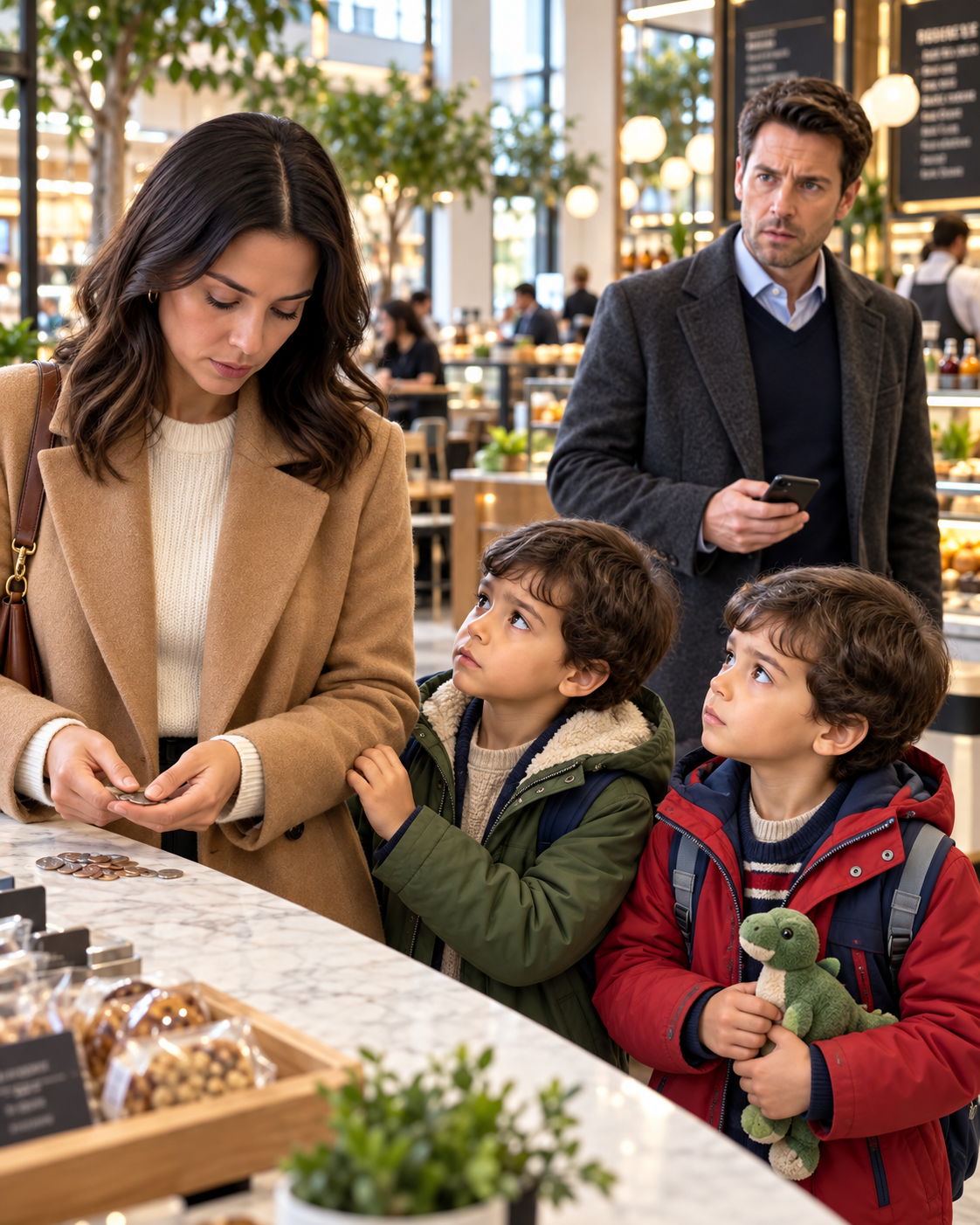
The little boy offered to share his lunch with his brother, and something about the quiet seriousness of his voice made me stop just inside the bakery doorway. I had been reaching for my phone, already preparing to answer another message from my business partner. Instead, I looked toward the counter, where a woman in a worn blue coat was searching through the pockets of her handbag. Two children stood beside her, almost perfectly identical, watching the coins she placed on the counter.
The bakery was small, with narrow aisles, mismatched chairs, and windows clouded by the warmth of the ovens. Outside, traffic moved steadily along the street on Chicago’s South Side. I had come from inspecting a commercial building my development company was considering purchasing. My afternoon was supposed to involve financing estimates, renovation costs, and a conversation with Russell about a transaction worth several million dollars. I had stopped for coffee because I had forgotten lunch. Nothing about the visit was supposed to matter beyond that.
Then the woman at the counter turned her head, and I recognized Naomi. For a moment, I wondered whether my mind had supplied her face from a memory. Almost five years had passed since I had last seen her. Her hair was shorter, and there were fine lines around her eyes that I didn’t remember. She looked tired in a way that had nothing to do with the hour. Yet the small movement she made while brushing her hair behind her ear was so familiar that I knew I couldn’t be mistaken.
Naomi Calloway had once been my wife. She had lived with me in a large house in Lake Forest, attended dinners with people whose names appeared in business journals, and argued with me about whether money could solve problems it had helped create. She had walked out of our marriage after a final argument neither of us had handled well. I had spent years convincing myself that her departure had been inevitable. Now she was standing a few feet away, trying to determine whether she had enough change to buy lunch.
One of the boys tugged gently at her sleeve. He had dark hair, round cheeks, and a small crease between his eyebrows that made him appear unusually thoughtful. He glanced at the sandwich behind the glass, then at his brother. “It’s okay, Mom,” he said. “We can get one. Eli doesn’t eat a whole sandwich anyway.” His brother, who was holding a notebook decorated with colored planets, immediately objected. “I do eat a whole one. Sometimes.” The first boy gave him a patient look. “Not when it’s turkey.”
Naomi crouched to their height without letting go of her purse. She spoke softly enough that I couldn’t hear every word, but I recognized the effort in her expression. She was trying to keep an ordinary inconvenience from becoming something her children would worry about. She examined a few more coins, checked a side compartment, and glanced toward the man behind the counter. He had flour on his apron and the relaxed posture of someone who knew his customers well.
“Don’t bother counting those again,” he told her. “I’ve got an extra sandwich back here.” Naomi shook her head, but he was already wrapping one in paper. “Frank, you’ve done enough,” she said. He waved away the objection. “Then you can help me fix that ridiculous school website when it starts giving me trouble again. I still can’t work out where they hide the announcements.” Their exchange sounded familiar, practiced, and entirely without embarrassment. Still, I noticed that Naomi kept the coins in her hand.
I should have looked away. Instead, my attention shifted to the children. The boy who had offered to share looked toward the entrance and caught me staring. He had Naomi’s dark eyes and something else I couldn’t place. Then he raised his eyebrows in curiosity. His left eyebrow bent upward at an uneven angle, leaving a small crooked line above his eye. I had seen the same feature every morning of my adult life when I shaved.
My father had possessed that crooked eyebrow. So did I. It was not proof of anything, and I knew better than to treat a resemblance as evidence. Children inherited features through complicated combinations, and strangers sometimes looked uncannily alike. But the two boys appeared to be about four years old, and a calculation began forming in my head before I could stop it. Naomi and I had been separated for nearly five years. I remembered the last months of our marriage with uncomfortable precision.
I stood beside a display of pastries while my phone vibrated against my palm. Russell had sent three messages asking whether I approved the revised figures. Normally, I would have answered immediately. I had built an entire career around being available at every hour, insisting that no important decision could wait until morning. That afternoon, however, I couldn’t take my eyes off two little boys who might have entered the world without my ever knowing they existed.
Naomi noticed me when she turned to retrieve the wrapped sandwiches. Her expression changed in stages. First came confusion, then recognition, followed by a guarded stillness I remembered from the worst days of our marriage. She didn’t smile or greet me. She placed one hand against the shoulder of the boy holding the notebook and moved slightly closer to his brother. It was a small protective gesture, but I felt its meaning immediately.
“Naomi,” I said. My voice sounded unfamiliar to me. She acknowledged me with the slightest nod. Frank glanced between us, evidently sensing that something had changed, but he continued arranging pastries behind the counter. The children watched with the open curiosity of people too young to understand why adults sometimes fall silent. I wanted to ask their names, their ages, and whether they belonged to me. Instead, I asked a question that sounded almost absurd. “How have you been?”
She looked at me for several seconds before answering. “We’re fine, Preston.” The word “we” seemed to hang between us. I glanced toward the boys again. One was studying the pattern on the floor tiles. The other was looking at my coat, perhaps wondering why someone dressed for an expensive office meeting was standing motionless near the door. “Could we speak somewhere?” I asked. Naomi’s grip tightened around the folded paper bag. “Not while I’m with the children.”
I nodded because anything else would have been unreasonable. My first instinct was to insist that we talk, to demand an explanation before she left the building. That instinct had served me badly before. I remembered how often I had expected Naomi to rearrange her plans because I decided something required immediate attention. Seeing her with two children made me realize how little authority I had over the moment, even if the questions crowding my mind were urgent.
I took a business card from my wallet, then hesitated. The printed number went through my office, where assistants screened calls and messages. I turned the card over and wrote my personal number instead. “This comes directly to me,” I told her. Naomi accepted it carefully, holding the edge between two fingers. She didn’t thank me or promise to call. “I’ll decide when we can talk,” she said. There was no anger in her voice, which somehow made the distance between us more difficult to ignore.
The boy with the crooked eyebrow looked up at me again. “Are you Mom’s friend?” he asked. Naomi opened her mouth, but I answered before she could. “We knew each other a long time ago.” He considered that reply, then nodded as though it satisfied him. “I’m Theo,” he announced. “That’s Eli. He likes space.” Eli lifted his notebook slightly, revealing a bright yellow Saturn surrounded by uneven rings. “Saturn isn’t the biggest,” he informed me. “Jupiter is.”
I managed a smile. “That’s right.” Eli seemed pleased that I knew the answer. Theo studied me for another moment, then asked whether I lived near the bakery. I told him that I lived farther north. He wanted to know whether that meant I had driven there. Naomi interrupted gently, reminding him that they needed to leave. The boys thanked Frank for the sandwiches, and he leaned over the counter to tell them he expected a report on their latest school project.
I watched the three of them walk toward the door. Naomi guided Eli ahead of her and made sure Theo had zipped his jacket. For a fleeting second, the familiar impulse to follow and continue the conversation rose in me. I remained where I was. Through the glass, I saw Theo take his mother’s hand while Eli pointed toward something across the street. Naomi listened, bent slightly toward him, and then they disappeared among the pedestrians.
Only after they were gone did I notice how tightly I had been holding my phone. The screen had gone dark. Russell’s messages were still waiting, along with a reminder about an evening dinner I had agreed to attend. My life, with all its scheduled obligations and comfortable assumptions, continued as though nothing had happened. But I could no longer make those obligations feel important. I bought coffee I barely tasted and sat at a table near the window, trying to reconstruct a marriage I had spent years refusing to examine.
I first met Naomi at a gathering hosted by a friend of my father’s. She wasn’t impressed by the house, the catering, or the people discussing investments near the fireplace. She was a science teacher who had agreed to attend because one of the guests supported her school’s educational program. We spoke about an exhibition her students were preparing, and I found myself listening longer than I had intended. She explained difficult concepts with an enthusiasm that made everything around her seem less important.
We married in a small church in Galena. I remembered her laughing when the wind disturbed her veil outside the entrance. She had insisted that we keep the ceremony modest and invite people who actually knew us. I had admired that independence when we were dating. Later, I began treating the same quality as an inconvenience. It was easier to appreciate her convictions when they didn’t interfere with the life I expected her to lead.
My company’s success had accelerated during our marriage. New properties, investors, and partnerships demanded more of my attention, or so I told myself. I began expecting Naomi to accompany me to social events where she knew almost nobody. I asked her to rearrange school commitments because a dinner invitation was supposedly essential. If she mentioned her students during a conversation, I sometimes interrupted to redirect the subject toward something I considered more suitable.
My mother, Constance Calloway, had never hidden her disapproval of Naomi’s career. She regarded teaching as respectable enough for an unmarried woman but unnecessary for someone married into our family. She offered opinions about Naomi’s clothes, her schedule, and the amount of time she devoted to children who weren’t her own. At first, I dismissed those remarks as harmless differences between two strong-minded women. Eventually, I began repeating versions of them without noticing how much I had changed.
The final argument happened in our bedroom after another disagreement about work. Naomi had been offered a chance to expand a science program, and I had expected her to turn it down. I told her that continuing to teach made little sense when my income could support both of us. She stood beside the dresser with a folded sweater in her hands and asked whether I understood what her work meant to her. I answered by explaining how inconvenient it was for my schedule.
She tried again. “I don’t need you to pay for my life, Preston. I need you to respect it.” I remember feeling irritated rather than concerned. I had spent the entire day negotiating with men who challenged every number in a contract. Coming home to another disagreement seemed intolerable. I told her that a marriage required support, and that if she couldn’t accept the responsibilities attached to my position, perhaps she should reconsider whether she wanted to remain married to me.
I hadn’t expected her to take the suggestion seriously. That was the ugliest part of the memory. I believed she would argue, perhaps cry, and eventually agree to compromise. Instead, she looked at me for a long time and asked whether I had listened to anything she had said. I offered no useful answer. A few days later, she moved out. When the divorce process began, I told myself she had chosen independence over marriage. The explanation was convenient, and I clung to it.
My mother encouraged that interpretation. She said Naomi had always resented the expectations of our family. Our attorney, Gordon Pierce, advised that communication should pass through his office to prevent unnecessary conflict. I accepted that arrangement without much thought. I was traveling frequently, and there were business matters that required decisions. When I asked about Naomi, my mother usually told me that she wanted distance and that the best thing I could do was respect her wishes.
At the bakery table, those assurances sounded different in my memory. I tried to recall whether I had ever heard Naomi say she wanted no further contact. I couldn’t. I remembered messages relayed by other people, legal updates, and my own determination not to appear desperate. Pride had made silence seem dignified. Now I wondered whether I had mistaken silence for agreement because it had allowed me to avoid difficult questions.
I returned to my office without finishing the coffee. Russell was waiting in the conference room, surrounded by folders and marked-up financial projections. He took one look at me and asked whether something had gone wrong at the property inspection. I told him the building could wait. He started to object, then stopped when I said I needed the afternoon to deal with a personal matter. It was the first time in years I had used that phrase without apologizing for it.
At home that evening, I searched through an old box of photographs. Most of our wedding pictures had been packed away after the divorce, along with cards, invitations, and a few objects Naomi had left behind. I found a photograph of us standing outside the church. My expression was relaxed in a way I rarely saw in recent pictures. Naomi was looking directly at the camera, smiling. I studied her face and tried to imagine her raising two small children while I attended meetings and congratulated myself on moving forward.
I called Martin Hayes, the attorney who now handled most of my personal legal affairs. I told him I needed the complete divorce file, including every letter, email, delivery confirmation, and communication involving Gordon Pierce. Martin asked whether there was a particular dispute. “There may be something I was never told,” I replied. He warned me that retrieving and reviewing older records could take time. I agreed to whatever careful process was necessary. For once, I had no interest in ordering someone to produce an immediate answer.
The house felt unusually quiet after the call. I ate dinner alone, though I barely remember what was on the plate. At eight-thirty, I checked my phone. There was nothing from Naomi. At eight-forty-five, I checked again. I wondered whether she had thrown away my card, whether she thought I had no right to ask questions, and whether she was sitting somewhere explaining to two little boys why a stranger had seemed so interested in them.
Shortly after nine, a message arrived from a number I didn’t recognize. It contained the address of a quiet coffee shop and a proposed meeting time for the following day. I read it twice, relieved that Naomi had decided to contact me. Before I could type a reply, another message appeared. It was longer, and the words changed everything I thought I knew about the years since our divorce. Naomi wanted me to understand one thing before I asked why she had kept the children from me: she had tried to tell me.
END PART 1
PART 2 TITLE: The Letter I Never Received Exposed a Hidden Decision That Had Changed My Marriage and Kept My Children Beyond My Reach
I arrived at the coffee shop twenty minutes early, something I rarely did unless a major business agreement depended on it. The place occupied the ground floor of an older brick building, with narrow windows overlooking a quiet side street. Rain had left dark patches across the sidewalk, and customers were shaking water from their coats as they came inside. I chose a table near the back, ordered coffee, and set my phone face down. I had cleared my morning schedule, though I was beginning to understand that an empty calendar did not prepare a man for the conversation I was about to have.
Naomi entered a few minutes later. She wore a gray sweater beneath her coat and carried a blue folder against her chest. There was no dramatic hesitation when she saw me. She approached the table, placed the folder beside her cup, and removed her coat with the efficient movements of someone accustomed to fitting necessary conversations between other responsibilities. I stood, uncertain whether to offer my hand. She sat before I could decide. The space between us was ordinary, hardly wider than the table, yet it seemed filled with five years of questions.
I had spent most of the night rehearsing what I might say. I wanted to ask whether Theo and Eli were mine, why she hadn’t contacted me, and whether she had deliberately kept them hidden. I had also prepared explanations about our divorce, even though she hadn’t requested any. When Naomi looked at me, those carefully arranged sentences disappeared. Her expression was guarded but not hostile. She seemed to be waiting for me to choose whether I wanted answers or another argument. “How old are the boys?” I finally asked.
“They’re four,” she replied. “They turn five in the spring.” I looked toward the window, trying to reconcile that answer with the dates in my memory. We had separated almost five years earlier. The timing was possible, perhaps even likely. I turned back to her. “Naomi, I need to ask something, and I don’t know how to say it without sounding terrible.” She folded her hands around her cup. “Then say it plainly, Preston. We’ve wasted enough time avoiding difficult things.”
“Are Theo and Eli my sons?” The question sounded harsh in the quiet room, but Naomi didn’t look surprised. She lowered her eyes briefly, then met mine. “You were the only man in my life when I became pregnant.” I felt my face warm. She continued before I could respond. “I know what you’re going to ask next. We can arrange a paternity test. I would prefer that we do, actually. I want the boys to have certainty, and I don’t want this becoming an argument about whose memories are more reliable.”
I told her I hadn’t intended to accuse her of being unfaithful. She gave a small, tired smile that contained no amusement. “You asked whether they’re yours. I understand why. But you should understand what that question sounds like to a woman who has spent years raising them.” I looked down at my untouched coffee. For much of our marriage, I had believed that speaking directly excused the impact of my words. Naomi had once told me that honesty without consideration could become another form of carelessness. I was beginning to remember.
She opened the folder but didn’t immediately remove anything. “Before we discuss meeting the boys or making arrangements, you need to understand what happened after I left.” I nodded. She began with the weeks following our separation, when she moved into a smaller place and returned to a routine built around teaching. She had been exhausted, anxious about the divorce, and determined to keep her work from suffering. Then she missed a period, took a pregnancy test, and discovered that our marriage was ending just as she was becoming a mother.
“Did you know before you moved out?” I asked. “No. I found out afterward.” Her answer came without hesitation. She told me she had spent several days trying to decide how to approach me. She was angry with me, but she knew the pregnancy wasn’t a private grievance that could be settled through silence. There was another person to consider, though neither of us knew then that there would be two. She wanted to speak directly before the lawyers turned another intimate matter into a negotiation.
She finally took a sheet of paper from the folder and pushed it across the table. It was a copy of a letter addressed to me. The date was from the early weeks after our separation. I recognized Naomi’s deliberate handwriting in the signature, though the rest had been typed. She had explained that she was pregnant, that she wanted me to know before hearing it from anyone else, and that she hoped we could speak privately about what came next. The language was restrained, almost painfully careful.
I read the letter once, then again. My name at the top seemed to belong to someone else. I remembered that period vividly: a trip to New York, negotiations over a property portfolio, and several long conversations with Gordon about finalizing the divorce. I remembered being told that Naomi wished to settle matters quickly. I did not remember anyone mentioning a pregnancy. “Where did you send this?” I asked. She answered, “To the house. The same address where you were living.”
“I never received it.” Naomi watched me without changing her expression. “That’s what I thought you might say.” She removed another page and placed it beside the letter. It was a delivery confirmation showing that the envelope had been accepted at the Lake Forest house. I leaned closer, searching the details as though a small mistake might explain everything. The date was clear. The address was correct. The name entered in the recipient field was Constance Calloway, my mother.
For several seconds, neither of us spoke. I remembered that my mother had stayed at the house during one of my longer business trips. She said she wanted to help after the separation, particularly because I had stopped employing some of the household staff Naomi had preferred. Constance had always handled arrangements with confidence, treating access to my home as a natural extension of her role in the family. I had never questioned whether she should receive personal correspondence. Until that moment, the distinction had seemed unimportant.
“She signed for it,” I said. Naomi nodded. “I called a few days later because I hadn’t heard anything. Someone at the house told me you were traveling.” She paused, then added, “I thought you needed time. I wasn’t expecting a happy reunion, Preston. I wasn’t even asking for one. I wanted you to know there was a child involved and that we needed to decide how to handle it.” Her voice stayed steady, but her fingers tightened around the cup.
I remembered telephone conversations with my mother during that trip. She had asked whether I was sleeping and eating properly. She had told me that I needed to stop letting the divorce distract me from work. I searched my memory for anything that might have suggested she was withholding information. Nothing stood out. That frightened me more than I expected. I had trusted her so completely that I couldn’t distinguish genuine concern from the possibility that she had been arranging my life without my knowledge.
“Maybe she misplaced the letter,” I said, though I knew how weak the explanation sounded. Naomi didn’t argue. She simply removed another document. “I considered that. So I sent a second copy to your office.” The envelope had been addressed to me personally, with enough identifying information to make the intended recipient unmistakable. Naomi had retained a copy of the letter and the mailing record. I studied the dates. They were separated by several days, giving my mother ample opportunity to contact me before the second letter was sent.
“Who handled mail at the office then?” Naomi asked. I told her my assistant had managed routine correspondence, while Gordon’s office dealt with the divorce. That had been my instruction. I remembered signing a general authorization for legal correspondence because I didn’t want meetings interrupted by procedural matters. The arrangement had seemed practical. Naomi looked at me carefully. “Did you tell Gordon he could decide whether you should know about a pregnancy?” I started to answer, then stopped. The question was so outrageous that it seemed unnecessary, yet the documents in front of me made it impossible to dismiss.
She turned to the next page. It was a letter from Gordon Pierce’s office, dated after her second attempt to contact me. The formal heading carried the firm’s name and address. The document referred to her effort to resume personal communication and stated that all future contact should be directed through legal representatives. It said that I had no interest in renewing a private relationship and that attempts to communicate outside the established process were unwelcome.
I stared at the page. The language was familiar. Gordon had written hundreds of letters for my businesses, using phrases that could turn anger into something respectable enough for a file. I recognized the careful distance in the wording. What I couldn’t understand was why a lawyer representing me would respond to news about a pregnancy as though Naomi were requesting another argument about the divorce. The matter was not a social invitation. It concerned a child who might be mine.
“Did he mention the pregnancy?” I asked. Naomi pointed toward a paragraph near the middle. The letter referred indirectly to personal assertions made in previous correspondence but offered no acknowledgment that those assertions required a direct answer. It treated her request as another attempt to reopen settled matters. I read the paragraph several times. Its language was precise enough to discourage further contact while avoiding the central fact. Someone had chosen not to address the information she was providing.
“I didn’t tell him to write this,” I said. Naomi remained quiet. “I never authorized him to reject contact about a child. I didn’t even know there was a child.” My voice rose, and a woman at the next table glanced toward us. I lowered it immediately. Naomi had not come to watch me lose my temper. She had brought documents because she wanted me to understand what she had experienced, and anger without action would offer her nothing useful.
“That may be true,” she replied. “But at the time, I had no way of knowing. Gordon represented you. His letter said he was acting on your behalf. When I tried to reach your office, I was directed back to him. When I called the house, your mother told me you didn’t want to speak to me. Eventually, I began to believe that every door was being closed deliberately.” She glanced toward the folder. “I couldn’t keep asking for an answer from someone who seemed determined not to give one.”
I asked why she hadn’t come to my office in person. The question escaped before I had considered it. Naomi looked at me for a moment, then placed both hands flat on the table. “Because you had already made it clear that you didn’t want me interfering with your work. Because your lawyer had warned me to use the proper channels. Because I was going through a divorce and trying to keep my job. And because being pregnant did not suddenly give me the courage to walk past your employees and demand a meeting.”
I wanted to object that nobody would have stopped her. Then I remembered how carefully my staff protected my schedule. Visitors without appointments rarely reached the elevator, much less my office. I had established those procedures because I valued efficiency and control. There had been times when even friends waited several days for me to return a call. Naomi had been instructed to communicate through lawyers. I had created a world in which a person could be kept away from me without anyone needing to ask whether I wanted that distance.
She told me about leaving messages for my former assistant. Some were never returned. Others received polite acknowledgments that carried no answers. She tried my old mobile number and eventually stopped when it became clear that it was no longer reaching me. I remembered changing that number after the divorce began. Gordon had suggested the change, explaining that it would reduce unwanted interruptions. I had agreed because I was angry and wanted to concentrate on work.
“Did you tell my mother exactly what was happening?” I asked. Naomi inhaled slowly. “Yes. More than once.” She explained that Constance initially sounded surprised, then increasingly impatient. My mother had asked whether Naomi was certain about the pregnancy, whether she had seen a doctor, and whether she understood the consequences of making claims involving the Calloway family. The questions had seemed less like concern for an unborn child than preparation for a dispute.
Naomi had tried to explain that she wasn’t asking for reconciliation or money. She wanted me informed. My mother told her that I was finally recovering from the marriage and should not be dragged back into something I had chosen to leave behind. When Naomi insisted that the child deserved a father, Constance suggested that the family had resources to challenge any claim she might make. She spoke about lawyers, financial influence, and the difficulty of opposing people who could sustain a dispute indefinitely.
I felt my stomach tighten. Constance had always defended our family’s reputation with uncompromising determination. I had occasionally found her methods excessive, but I had rarely challenged them when they appeared to benefit me. Naomi now described the same determination directed against her at a moment when she was frightened and alone. I imagined my mother speaking in that composed, authoritative tone she used when dismissing employees, and I could almost hear the conversation.
“She threatened you,” I said. Naomi considered the word. “She made sure I understood what she thought your family could do if I pushed. Whether she meant every possibility she mentioned, I couldn’t know. I was pregnant, Preston. I had legal bills, a classroom full of children depending on me, and no reason to believe you would contradict her.” She looked at me steadily. “You had never contradicted her when we were married. Why would I assume you would start after I left?”
The question struck with more force than any accusation could have. I remembered dinners where Constance questioned Naomi’s work while I studied my phone. I remembered asking Naomi to ignore my mother’s opinions because arguing only made gatherings unpleasant. I had treated the person causing the discomfort and the person receiving it as equally responsible for keeping the peace. Naomi had learned from those moments that my mother’s authority mattered more to me than her dignity.
“I should have stood up for you,” I said. Naomi didn’t respond immediately. She turned the cup slowly between her palms. “Yes,” she answered at last. “You should have.” There was no satisfaction in her voice. She seemed too far removed from the marriage to gain anything from hearing me admit what had been obvious to her years earlier. I realized that an apology could acknowledge the past without changing the consequences. We were not discussing a forgotten anniversary or an unkind remark. We were discussing four years of children’s lives.
I asked whether anyone else knew about the letters. Naomi said she had kept copies and discussed the situation with someone she trusted. She had also consulted legal advice, though she had not been in a position to pursue every possible avenue while managing her pregnancy and divorce. She hadn’t simply accepted my mother’s word after one conversation. She had tried several methods of reaching me. Each attempt ended with the same message: I wanted no direct contact.
The café grew busier around us. Cups clinked against saucers, a machine hissed behind the counter, and someone laughed near the entrance. I felt strangely detached from the ordinary noise. For years, I had believed Naomi left our marriage and chose to build a separate life. The papers in front of me suggested that she had attempted to tell me something fundamental about that life and had been denied the opportunity. Yet even as my anger turned toward my mother and Gordon, I couldn’t ignore how easily their actions had succeeded.
Naomi noticed me staring at the documents. “You keep looking for the place where somebody made a simple mistake,” she said. I looked up. “Wouldn’t you?” She shook her head. “I looked for that explanation for a long time. Maybe someone forgot to pass along one message. Maybe a letter was lost. But when several people keep giving you the same answer, eventually you have to decide whether continuing will help your child or simply keep hurting you.”
She reached for another page, then hesitated. “There’s more. The boys came earlier than expected, and I tried again when I was in the hospital.” I looked at the documents still inside the folder. Until that moment, I had imagined a hidden pregnancy and a difficult separation. I hadn’t considered what childbirth might have been like for Naomi without the help she had expected from a husband, or how many opportunities I had lost before the boys were old enough to recognize faces.
Before she continued, I picked up Gordon’s letter again and read the closing paragraph. My former attorney had formally informed the woman carrying my children that I wanted to be left alone. He had written it in the language of professional certainty, giving Naomi every reason to believe the decision came from me. I could no longer dismiss what had happened as an unfortunate misunderstanding. Someone had spoken in my name, and I had allowed my life to be arranged so thoroughly that I hadn’t noticed my own voice being used against my family.
END PART 2
PART 3 TITLE: The Truth About My Sons’ Difficult Beginning Forced Me to Confront the People Who Had Helped Them When I Was Absent
Naomi removed a hospital document from the folder, and I saw two names printed beside dates that meant nothing to me until she explained them. Theo and Eli had arrived prematurely, roughly seven months after we separated. What should have been an ordinary discussion about birth plans had become an exhausting series of medical decisions. She had entered the hospital expecting to learn more about her pregnancy and had found herself preparing to deliver twins before either of us could have imagined how their first weeks would unfold.
She spoke about the hospital without trying to make the experience sound more dramatic than it had been. There were bright examination rooms, monitors she didn’t initially understand, and doctors explaining possibilities she struggled to remember afterward. She had been frightened for both babies and physically exhausted. When the twins were born, each required careful attention, and Eli needed a longer hospital stay than his brother. Naomi had been recovering from childbirth while learning how to care for one baby at home and worrying about another who wasn’t yet ready to leave.
“Why didn’t you call me from the hospital?” I asked. Naomi’s expression changed, and I realized I had made the same mistake again. “I did,” she answered. “I told you that yesterday.” She took a breath before continuing. “I called Gordon’s office because that was where everyone insisted I should communicate. I explained that the babies had been born and that one was still receiving care. I asked whether you could be contacted directly. The response was the same. Everything had to go through the lawyers.”
I imagined an assistant taking down the details, perhaps placing them in a file that would later be summarized as routine correspondence. I wondered whether Gordon had received the message personally or whether someone else had decided it didn’t require his attention. Naomi didn’t know. She only knew that nobody called her back with an answer from me. While I moved between airports and conference rooms, she waited beside medical equipment, uncertain when she would be able to bring both children home.
“Theo came home first,” she said. “That was good news, obviously. But it meant I had to work out how to be in two places at once.” She described organizing rides to the hospital while caring for a newborn, trying to understand feeding instructions, and keeping track of medical updates despite sleeping only a few hours at a time. She wasn’t describing those weeks to impress me with her endurance. She was explaining the practical reality of decisions made without the other parent.
A woman named Joanne had become one of her most reliable sources of help. She was a friend who understood that offering assistance was more useful than telling an exhausted mother to call if she needed anything. Joanne arrived with groceries, washed bottles, and sometimes stayed long enough for Naomi to sleep. When Naomi needed to visit Eli, Joanne helped her make arrangements for Theo. There had been evenings when the only reason Naomi ate a proper meal was that Joanne placed one in front of her.
Frank, the bakery owner, had helped too. He knew Naomi through the neighborhood and her work with local students. When he learned that the twins had arrived early, he brought food and checked on her without making her explain everything. He sometimes closed his bakery earlier than usual to help with errands. Naomi spoke about him with quiet affection, describing a man who had become an important presence in the boys’ lives through practical kindness rather than promises.
I remembered the way Frank had wrapped an extra sandwich that afternoon. I had seen the gesture as an act of charity. Now I understood that it belonged to a relationship built over years. He knew Naomi’s children, their preferences, and probably the ordinary details of their days. He had been present when I wasn’t. The thought made me jealous for an instant, and I was ashamed of how quickly that feeling arose. Frank had never taken anything from me. He had helped two children whose father wasn’t there.
“Was Eli all right when he finally came home?” I asked. Naomi nodded. “He needed follow-up appointments and extra attention for a while. Things became easier gradually, though some expenses continued.” She explained that the early medical concerns had shaped the family’s routines, particularly during the first years. She had learned to ask questions, keep records, and recognize when something required professional attention. By the time I met the boys at the bakery, much of that early uncertainty had settled into manageable care.
I wanted to ask for every medical record and appointment date. My mind immediately began assembling a list of specialists, private services, and things I could provide. Then I stopped. Naomi hadn’t asked me to take over their care, and I hadn’t yet established that I had any legal or practical right to make decisions for them. Whatever I could afford, I didn’t possess the knowledge she had gained by raising them. I couldn’t purchase four years of experience and pretend I had acquired it overnight.
“Did you have enough money?” I asked. She glanced toward the folder. “Sometimes. Not always as much as I wanted.” The divorce settlement had provided some financial stability at first. But she had needed time away from teaching, and childcare was expensive. The twins’ medical needs had added costs she hadn’t anticipated. Returning to work helped, although managing a classroom while raising two young children required constant planning. Some months were comfortable enough. Others involved postponing purchases or carefully dividing expenses.
I thought again about the bakery counter, the coins spread beside her hand, and Theo offering to share a sandwich. I had already constructed an explanation from that moment: Naomi must have been struggling desperately, perhaps unable to feed her children regularly. The truth was more complicated. She explained that they had food at home, but she had paid for a prescription and realized while they were out that her debit card was missing from its usual place. The boys were hungry, and their afternoon had taken longer than expected.
“I know what it looked like,” she said. “I didn’t enjoy it either. But one awkward moment doesn’t tell you everything about our lives.” Her words made me uncomfortable because they were fair. I had seen her counting coins and imagined myself arriving as the solution to every difficulty. I hadn’t considered that she might have managed thousands of ordinary days competently before I happened to witness one inconvenient afternoon. She was not presenting the children to me as evidence of failure. She was asking me to recognize lives already in progress.
“Have you been teaching the whole time?” I asked. She explained that she returned when she could manage the schedule and had continued working in science education. Her position had changed at different points to accommodate childcare, but she had never wanted to abandon the classroom. Teaching remained central to her identity, even when the practical demands were exhausting. She spoke about students who struggled with basic concepts until an experiment finally made something click, and I recognized the enthusiasm that had first attracted me to her.
I remembered attending one of her early school events when we were dating. She had spent weeks helping students prepare projects, and I had been fascinated by how attentively she listened to their explanations. Later, after our wedding, I stopped attending. At the time, I told myself my absence was unavoidable. Business dinners, investor meetings, and travel always seemed more urgent than an evening in a school gymnasium. I could no longer remember the names of the students she had talked about, but I remembered her disappointment when I canceled.
Naomi paused to drink her coffee. I asked whether the boys knew anything about me. “They know their father hasn’t been part of their lives,” she replied. “I haven’t told them stories to make them hate you. I also haven’t pretended you were simply away on an important trip.” She explained that the questions had become more frequent as the children grew older. Theo asked whether he had a father like other children. Eli wanted to understand why certain family photographs included only Naomi and the boys.
“Did you tell them my name?” I asked. She nodded. “They know it. But knowing a name isn’t the same as knowing a person.” I stared at the table. Four years earlier, I had believed the end of my marriage meant I was free to rebuild my life without further obligation to Naomi. Now I was learning that two children had been trying to understand an absence they hadn’t chosen. I couldn’t imagine what it felt like to ask about a parent and receive an answer that remained incomplete.
I wanted to promise that everything would change immediately. I wanted to tell Naomi that I would buy a house closer to the school, cover every expense, and arrange whatever assistance she needed. But the certainty with which those offers formed worried me. I had once believed that my financial resources gave me the right to decide how our marriage should work. I was beginning to see how easily generosity could become another demand that she organize her life around my intentions.
“I want to contribute,” I said. “Properly. The boys shouldn’t have to go without things they need because I wasn’t here.” Naomi nodded. “We need to work that out through the appropriate process. Support and your relationship with the children are connected responsibilities, but they aren’t the same discussion.” She wanted written arrangements and clear expectations. She wasn’t interested in vague promises, and she didn’t want financial help treated as a reason to accelerate contact before the boys were ready.
“Whatever the legal process requires, I’ll cooperate,” I told her. “I can provide records, cover the costs, and arrange whatever confirmation is necessary.” She agreed that establishing paternity formally would help avoid later uncertainty. We discussed finding a suitable process rather than making decisions based solely on appearances and memories. Naomi said she would seek independent legal advice as well. I understood why. She had already experienced what happened when too much authority passed through people connected to my family.
I asked whether I could meet the boys soon. Her answer was careful. “Eventually, if everything is confirmed and we can introduce you in a way that makes sense to them.” She wanted professional guidance because the children were young and had never known me as their father. She didn’t want them overwhelmed by sudden promises, expensive gifts, or adult emotions they couldn’t understand. I listened, though part of me desperately wanted her to say I could visit that afternoon.
“Could I at least send something?” I asked. Naomi considered the question. “Not yet. We need to decide what we’re telling them first.” I nodded. The conversation felt unfamiliar. In my business, people usually welcomed an immediate commitment backed by resources. Naomi was asking for patience, careful planning, and respect for boundaries I hadn’t created. She seemed more concerned about whether I could remain dependable after the excitement faded than whether I intended to make a grand gesture.
Then I made another mistake. I mentioned my foundation and suggested that it could support the science program at her school. I offered to provide laboratory equipment and perhaps arrange a substantial educational grant. The proposal sounded generous as it left my mouth. Naomi’s expression immediately cooled. “Don’t contact my principal,” she said. I was surprised by the sharpness of her response. “I only meant that I could help. You’ve told me how important the program is.”
“I know what you meant,” she replied. “But you don’t get to step into my workplace and start making arrangements because you’ve discovered something you should have known years ago.” I opened my mouth to defend the offer. She continued before I could speak. “My job isn’t a problem waiting for your foundation to solve it. I have colleagues, responsibilities, and plans. If the school needs support, there are ways to discuss that separately. Right now, we’re talking about our children.”
I leaned back and considered how easily I had returned to an old habit. Naomi had described years of hard work, and I had responded by offering to involve myself in the institution where she taught. I hadn’t asked what she wanted, whether the school had a project in mind, or how such help might affect her professional relationships. I had assumed that the ability to provide something made it appropriate to do so. “You’re right,” I said. “I won’t contact anyone at the school.”
She watched me for a moment, perhaps waiting for the qualification I usually added to an apology. When none came, she began gathering the documents. I asked whether she would allow Martin to review copies through the proper channels. She agreed, provided the originals remained with her and the process was transparent. She had spent years protecting those papers. It was clear that she regarded them as more than records of old correspondence. They were proof that she had attempted to do what she believed was right.
I asked whether she had considered taking legal action earlier. She said she had explored her options but struggled with the realities of raising two premature infants and later managing work and childcare. She had received discouraging messages through the channels available to her and feared that a prolonged dispute could consume resources she needed for the boys. “I don’t pretend every choice I made was perfect,” she told me. “I made decisions with the information and strength I had at the time.”
For the first time that morning, I offered an apology without trying to explain it away. I told her I was sorry for the years she had carried the responsibility alone and for the way I had behaved before our marriage ended. Naomi didn’t respond immediately. She slipped the copies into her folder and closed it. “I appreciate you saying that,” she answered. “But what matters now is what happens next. The boys don’t need another adult who makes promises and disappears.”
I told her I was furious with Constance. Naomi looked toward the window. “You should ask her what happened,” she said. “And you should find out why Gordon sent those letters. But don’t make this entirely about what they did.” I started to object, explaining that neither had told me she was pregnant. Naomi turned back toward me. “I believe that’s possible. I also remember what it was like being married to you. Your mother didn’t have to invent every reason I thought you wanted nothing to do with me.”
I thought of the evening Naomi had asked me to attend her students’ science exhibition. I had promised to come and then accepted a dinner invitation because an investor might be present. I remembered a fundraiser where she began describing a classroom experiment, only for me to interrupt and steer the conversation toward the company’s latest acquisition. Most painfully, I remembered the night I told her she could leave if she couldn’t support the life I wanted. The cruelty of that sentence had been mine, not my mother’s.
Naomi stood and put on her coat. Before leaving, she told me she would contact me after speaking with her legal adviser about the next steps. I promised not to involve her school, approach the children unexpectedly, or make arrangements without discussing them with her. She nodded, then walked toward the door. I remained at the table with my coffee growing cold, realizing that the truth was not as simple as two people conspiring to keep me from my sons. Their interference had succeeded because my own behavior had made abandonment believable.
I had come to the café hoping to discover who was responsible for the missing years. I left knowing that several people might have answers to give, including me. Constance had received a letter I never saw. Gordon had written a response I never authorized. Naomi had been frightened into believing that I would use my resources against her. And I had spent our marriage teaching her that when my ambitions conflicted with her needs, she should not expect me to choose her. I could investigate the hidden letters, but I could not erase the choices that made them convincing.
END PART 3
PART 4 TITLE: A Paternity Test Confirmed What My Heart Already Suspected, but Meeting My Sons Required More Than a Name and a Promise
The paternity results arrived on a Tuesday morning while I was sitting in my office, reviewing documents for an upcoming property transaction. Martin had called earlier to explain that the confirmation process was complete and that the report would be delivered through the agreed channels. I expected the notification, yet when it appeared, I found myself staring at the screen without opening it. For years, I had made decisions involving millions of dollars with barely a moment’s hesitation. Now I was afraid to read a document containing two little boys’ names.
I closed the financial projections and asked my assistant to hold my calls. She sounded surprised. It was unusual for me to interrupt a workday without offering a business explanation, but I didn’t elaborate. Once the office was quiet, I opened the report. The findings established that I was the biological father of Theo and Eli. The language was clinical and precise, the kind of language designed to eliminate uncertainty. I read the conclusion several times, as though understanding it intellectually might make the emotional consequences easier to absorb.
I was a father. I had been one for nearly five years without knowing it. The thought did not arrive with the sudden joy I might have expected. Instead, it brought a strange mixture of relief, sorrow, disbelief, and responsibility. Somewhere in Chicago, two children were spending an ordinary morning at preschool. Perhaps they were painting, arguing about toys, or learning songs. They had no reason to suspect that their father’s life had just changed because of information their mother had known since before they were born.
I called Naomi. She answered after several rings, and I heard the faint sound of children speaking in the background. She told me she had already received the results. “Then you know,” I said. “Yes, Preston. I know.” There was no triumph in her answer. She had never appeared uncertain about who their father was. For her, the report was not a discovery. It was a necessary step toward creating a clearer future for the boys, one where important decisions would no longer depend on unanswered questions.
I asked what we should do next. Naomi said we needed to move carefully, exactly as we had discussed. She had begun speaking with a family professional who could help us decide how to introduce me. The goal was not to make the situation feel dramatic or exciting. It was to give Theo and Eli information they could understand without making them responsible for the emotions of the adults around them. I listened, though every part of me wanted to ask whether I could see them immediately.
“Do they know anything yet?” I asked. Naomi explained that she had started preparing them for the possibility of meeting their father. She had answered their questions in simple language, explaining that some families looked different from others and that adults sometimes made mistakes that affected children. She hadn’t told them the full history of our divorce, nor had she discussed the letters or Constance’s involvement. Those details belonged to an adult conflict. The boys needed to understand only what was relevant to their own lives.
I asked whether they had reacted strongly. “Theo wanted to know whether you liked airplanes,” she told me. “Eli asked if you knew where Jupiter was.” I almost laughed, then felt an unexpected tightness in my chest. Their questions were so ordinary. They weren’t asking about wealth, family history, or the legal reasons for my absence. They wanted to know whether this unfamiliar man might have something in common with them. I realized how much I had complicated the idea of fatherhood before even meeting my children.
That afternoon, I walked through the house in Lake Forest and saw it differently. There were wide hallways, carefully maintained rooms, and furniture selected by designers who had charged more than most people earned in a month. I had always considered the house evidence that I had succeeded. Now I tried to imagine Theo and Eli living there. I pictured shoes by the door, drawings on the refrigerator, and small voices calling from another room. Nothing about the house made those things possible by itself.
I opened a guest bedroom that had remained almost unchanged for years. The bed was perfectly made, the curtains hung in straight folds, and there was not a single personal object on the bedside table. I wondered whether I should prepare rooms for the boys. Then I remembered Naomi’s warning. I didn’t know their routines, what made them comfortable, or whether visiting my house would even be appropriate soon. Buying furniture would be easy. Learning how to earn their trust would require something I couldn’t delegate.
Over the following days, Naomi and I spoke several times about the introduction. We agreed to follow the professional guidance and avoid presenting the meeting as a grand reunion. The boys would be told that I was their father, that I hadn’t been part of their lives, and that we were working out how to know one another. Naomi wanted them reassured that none of the adults’ past decisions had been their fault. I agreed completely, though I was beginning to understand how difficult that promise would be to explain.
I offered to bring toys, books, or something special for each child. Naomi asked me not to arrive with expensive gifts. “They have toys,” she said. “What they don’t have is any experience of you.” I understood her reasoning, but I still felt unprepared. I had spent years using carefully chosen presents to compensate for missed birthdays or canceled dinners. It was a habit that allowed me to offer something tangible without changing the behavior that made an apology necessary.
She suggested bringing plain paper because both boys enjoyed making things. Theo liked airplanes and anything that could be launched across a room. Eli was fascinated by planets, rockets, and the details of how objects moved through space. Naomi said an ordinary activity would make it easier for them to decide how much they wanted to interact. If either child became uncomfortable, we would slow down. I would not expect hugs, declarations of affection, or immediate acceptance.
I purchased a packet of paper from a stationery shop near my office. It was almost comically inexpensive compared with the gifts I had considered. The cashier placed it in a small bag, and I carried it home like something fragile. That evening, I searched my memory for the last time I had folded a paper airplane. I remembered making them as a boy with my father, though I couldn’t remember whether he had been particularly good at it. I tried several designs at my kitchen table.
The first airplane dropped almost vertically. The second turned sharply and struck a cabinet. By the fourth attempt, I had produced something that traveled several feet before diving toward the floor. I laughed despite myself. It occurred to me that Theo might be better at this than I was. For once, the possibility didn’t bother me. I wanted to have something to learn alongside him. I wanted to enter a room without needing to be the most capable person in it.
During those two weeks, Martin continued gathering information about the old divorce correspondence. He had recovered portions of the records and was working through the appropriate steps to obtain additional material. I told him that Naomi had supplied copies of letters and delivery confirmations, but I wanted an independent review rather than conclusions drawn solely from my anger. Martin agreed. He also reminded me that establishing what happened years ago would be separate from determining my present responsibilities as a father.
I resisted the urge to call Constance immediately. I had spoken with her several times since discovering the boys, but I hadn’t yet confronted her with Naomi’s documents. Each conversation felt strained. My mother asked whether I was well and whether something was troubling me at work. I gave short answers. Part of me wanted to demand an explanation before the day ended. Another part understood that a confrontation without complete information could produce more accusations than truth. Most importantly, I didn’t want the first days of knowing my sons to become another conflict controlled by my family.
Russell noticed the changes in my schedule. He asked whether I was taking time away from the company for a personal matter. I told him that I had learned about responsibilities I hadn’t known I possessed and that I would need to reorganize some commitments. He didn’t press for details. We had worked together long enough for him to recognize when a question would be unwelcome. Still, he made one observation that stayed with me. “We’ve built a company with people who can make decisions, Preston. You don’t have to personally attend every conversation.”
I had heard similar advice before and dismissed it. My desire to control details had helped the business grow, but it had also become an excuse for refusing to examine my priorities. I told Russell I would begin identifying responsibilities that could be handled without me. He agreed, though I could hear his skepticism. I didn’t blame him. Promising to change a schedule was easy. Following through when the next urgent transaction appeared would be the real test.
The morning of my first visit, I woke before my alarm. I dressed in a plain sweater and dark trousers, avoiding the expensive suit I would normally wear to an important appointment. I checked the packet of paper, reviewed the address, and left early enough that traffic couldn’t make me late. The drive through Chicago seemed unusually long. I passed school buses, delivery trucks, and parents guiding children across intersections. For the first time, I noticed how much of the city moved according to routines I had never needed to understand.
Naomi lived in a modest apartment building on a residential street. There were bicycles near the entrance and children’s drawings displayed in one of the ground-floor windows. I parked a short distance away and remained in the car for several minutes, watching people come and go. I had negotiated complicated agreements in rooms filled with hostile attorneys, yet the prospect of knocking on this door made my hands unsteady. I wasn’t afraid the boys would reject me. I was afraid they would welcome me before I had earned their trust.
At the agreed time, I went upstairs and knocked. I heard footsteps approaching, followed by a child’s voice asking whether someone could open the door. Naomi answered softly. A moment later, the door swung inward, and Theo appeared. He wore a green shirt with a faded airplane printed across the front. Naomi stood immediately behind him, close enough to offer reassurance without taking over the encounter. Theo looked up at me with an expression of intense curiosity.
“Are you Preston?” he asked. I nodded and introduced myself. He looked at Naomi, then back at me. “Mom says you’re our dad.” I felt the words settle heavily in my chest. No one had ever addressed me in that role before. I wanted to say something meaningful, perhaps apologize for every birthday and ordinary morning I had missed. Instead, I answered simply that I was. Theo accepted the information with the practical seriousness of a child who had been given an explanation and was now deciding what to do with it.
“Can you make airplanes?” he asked. I lifted the packet of paper. “I can try. I’m not very good yet.” His face brightened. He stepped aside, and Naomi invited me inside. The apartment smelled faintly of toast and laundry soap. Books occupied shelves along one wall, and a half-finished puzzle covered part of the dining table. Two small jackets hung on hooks near the entrance. A drawing of the solar system had been attached to the refrigerator with colorful magnets.
Everything about the apartment suggested an active life built around the boys. There were shoes beneath a bench, plastic cups drying beside the sink, and a box of art supplies on a low shelf. Nothing was arranged to impress visitors. Yet I felt more aware of the people living there than I ever did in my enormous house. Naomi had made a home where her children could reach their belongings, display their work, and participate in the ordinary tasks of the day.
Eli stood near the bookshelf, holding the same notebook I had noticed at the bakery. He watched me without approaching. He looked almost exactly like Theo, but his expression was more reserved, and he seemed to study details before deciding how to respond. Naomi introduced us gently. I crouched to bring myself closer to his height and said hello. He glanced at his mother, who gave him a reassuring nod. Then he looked at the paper in my hands.
“Are those for planets?” he asked. I told him we could use them for whatever he wanted. He considered that possibility, then pointed toward the table. Theo had already begun pulling out a chair. I moved toward him, but Eli remained beside the shelf. Naomi caught my eye and made a small gesture that told me not to hurry him. I sat where Theo indicated and began folding the first sheet. For several minutes, Eli simply watched.
Theo was fascinated by whether the airplanes could travel across the room. He wanted sharp wings, pointed noses, and designs that would fly as far as possible. I explained what little I remembered about folding paper, then admitted I wasn’t sure which design worked best. He seemed delighted by the opportunity to test my ideas. When my first airplane veered into the refrigerator, he laughed so hard that Naomi came from the kitchen to see what had happened.
Eli finally moved closer. He inspected one of my airplanes and pointed out that the wings weren’t even. I invited him to show me how to fix them. He took the paper carefully, pressed down a crease with his thumbnail, and returned it. The plane flew farther on the next attempt. He smiled, though he immediately tried to hide it by looking at his notebook. I felt an absurd sense of accomplishment. I hadn’t impressed him with knowledge or authority. I had let him correct me.
We continued working at the table while Naomi moved quietly around the apartment. She didn’t leave us alone, but she allowed the conversation to develop without directing every exchange. Theo asked whether I had ever been on an airplane. I told him I had traveled on many. He wanted to know whether I had seen clouds from above. Eli interrupted to explain that some clouds looked different depending on their height. I listened, grateful that their questions had nothing to do with why I had been absent.
At one point, Eli returned to the bookshelf and reached behind several picture books. He carefully removed a framed photograph and brought it to the table. I recognized it immediately. Naomi and I stood outside the little church in Galena, smiling in the afternoon light. She wore her wedding dress, and I had one arm around her waist. I hadn’t known she still kept the picture where the boys could see it. My throat tightened as Eli held the frame between both hands.
He placed the photograph beside my face and looked back and forth several times. “That’s you,” he said. “Yes, Eli. That’s me.” He studied the picture again, tracing one corner of the frame with his finger. Theo leaned over the table and recognized his mother immediately. He laughed at the sight of her wedding veil. Naomi stood near the kitchen doorway, watching us with an expression I couldn’t read. I wondered how often the boys had examined this photograph before they understood who the other person was.
Eli asked whether the photograph had been taken before he and Theo were born. I told him that it had. He wanted to know whether Naomi had been happy that day. I looked toward her before answering. She nodded slightly. “We were happy when that picture was taken,” I said. The answer was true, and saying it aloud made me realize how much had changed afterward. Our marriage had contained genuine affection, even if we later failed to protect it.
Theo wanted to know whether we had eaten cake at the wedding. Naomi laughed and told him about the small reception, the windy afternoon, and how the flowers had almost blown from the steps. The boys listened with interest. For a few minutes, the photograph became a harmless story about their mother wearing a beautiful dress and their father looking younger. I was grateful for the simplicity of their questions, though I knew it couldn’t last.
Eli looked around the apartment, where family photographs stood on shelves and several drawings were taped to the walls. He examined the wedding picture once more, then looked at the photographs showing Naomi with two babies, two toddlers, and finally two boys who were beginning school. His expression grew thoughtful. I watched him connect the images, following the years through familiar faces and changing heights. It was the kind of observation Naomi had described: he noticed what was present, and he noticed what was missing.
He turned toward me and asked why I wasn’t in any of their newer family pictures. Theo stopped playing with the paper airplanes. Naomi moved closer but didn’t interrupt. I could feel both boys waiting. It would have been easy to say that I had been working far away, that adults sometimes lived in different places, or that the photographs had simply been taken without me. Each answer would have avoided part of the truth. I looked at Naomi, and she gave me room to respond.
I told them that I hadn’t known about them for a long time, and that before they were born I had made mistakes in the way I treated their mother. I explained that adults had failed to communicate properly and that I hadn’t been there when I should have been. I was careful not to blame anyone in front of them. Then I told both boys that nothing they had done had caused my absence. I couldn’t change the missing pictures, but I wanted to begin making better choices.
Theo seemed satisfied enough to return to the airplanes, but Eli continued watching me. He asked whether I would like to see the other photographs someday. I told him I would, if his mother agreed. He nodded solemnly. “You have to ask Mom,” he said. I promised I would. His answer was a small reminder that he understood something important about his world: Naomi was the person who had always been there, and any new place I hoped to occupy would have to respect that.
When our planned time was nearly finished, Theo began asking whether we could make a larger airplane the next time I visited. Eli wanted to know whether I would come back at the same hour. I looked toward Naomi. We had discussed another visit, but I understood now that the exact details mattered. I told the boys that, if everyone agreed, I would return on Saturday at ten in the morning and stay until lunchtime. Naomi confirmed that the plan worked.
Theo immediately began suggesting designs for our next project. Eli repeated the time quietly, as though committing it to memory. He glanced toward the chair beside the table and then back at me. “You’ll come back here?” he asked. I told him yes. As I said it, I understood that the promise was different from anything I had made in a boardroom. There would be no contract penalty if I failed to appear, no financial consequence large enough to explain the damage. There would simply be a little boy waiting for someone who had promised to return.
I left the apartment carrying an imperfect paper airplane Theo had insisted I keep. On the drive home, it rested on the passenger seat beside my phone. I thought about the wedding photograph, the questions the boys had asked, and the way Eli had examined my face before deciding whether to speak. For the first time, I understood that becoming their father in any meaningful sense would require more than proving a biological connection. I would have to show them, repeatedly and without demanding gratitude, that my word could be trusted. Saturday at ten was no longer an appointment I could rearrange. It was the beginning of a responsibility I had already missed too much of.
END PART 4
PART 5 TITLE: The Morning I Discovered That A Broken Promise Could Hurt My Son More Deeply Than Five Years Of Absence
Naomi’s question remained between us while I sat outside her apartment building, watching a man struggle to fold a stroller into the trunk of his car. I had arrived forty minutes late for a visit I had promised my sons, and my first instinct had been to explain the importance of the meeting that delayed me. Somewhere between leaving my office and pulling onto her street, I had convinced myself that forty minutes was a minor inconvenience. Now, hearing the stillness in Naomi’s voice, I understood that she was waiting to see whether I would defend myself again.
“You keep telling me you understand,” she said. “But Eli spent the entire morning asking whether you were coming. When ten o’clock passed, he decided something must have happened. Then he decided you had changed your mind. By the time we left, he was wondering whether he had done something to upset you.” I stared at the dashboard, unable to find a comfortable position in the driver’s seat. Naomi continued without raising her voice. “He asked whether you were angry because he corrected your moon last Saturday.”
I remembered the cardboard space station we had begun building together. Eli had carefully explained that my drawing of the moon was too small compared with Earth, and I had laughed because his seriousness reminded me so much of Naomi. I had told him he was right. To me, that exchange had been an ordinary, pleasant moment. To him, apparently, it had become evidence he examined when the man he was learning to trust failed to appear. I pressed my fingertips against my forehead. “He thinks I stayed away because of that?”
“He doesn’t know why you stayed away, Preston. That’s the problem. Four-year-olds build explanations from whatever they understand. They don’t know about financing agreements or negotiations. They know somebody said ten o’clock, and that person wasn’t there.” Behind Naomi’s words, I heard traffic and the muffled voices of children. She was somewhere outside with Joanne and the boys, continuing an afternoon she had organized before I disrupted it. She had not stopped their lives to wait for me. Once, I might have considered that an insult. Now I recognized it as something she had learned to do out of necessity.
“I can come tomorrow,” I offered. “Or tonight, if that’s easier. I can take them somewhere special. There’s a place downtown with an enormous planetarium, and Eli would love—” I stopped because Naomi had become silent. On my phone, the expensive telescope I had nearly ordered remained visible in the shopping cart. The absurdity of it struck me all at once. I had missed an appointment and immediately begun searching for something costly enough to make the mistake disappear. I was trying to purchase relief from an obligation I had already accepted.
“They don’t need an outing today,” Naomi replied. “They need to know whether the next time you give them your word, it will mean something.” I swallowed and told her I would not make another arrangement until she was comfortable with it. She said she would speak with the boys and call me that evening. Before disconnecting, she added, “You can be disappointed that you missed them. But please don’t make me responsible for helping you feel better about it.” The call ended before I found an answer, and perhaps that was the first honest consequence of the morning.
I remained in the car for several minutes. Outside, people passed carrying shopping bags, pushing bicycles, talking into phones. Someone was arguing about a parking space across the street. The city continued with complete indifference to the crisis taking place inside my head. I opened the telescope listing, removed the item from my cart, and turned off the screen. Eli had asked for blue paper. Theo had asked for tape. Neither had requested a telescope, a grand surprise, or a father who could afford anything except the time they needed.
Five years earlier, Naomi had stood in our bedroom in Lake Forest while I explained that my professional obligations were not negotiable. I remembered the exact angle of the afternoon sunlight across the carpet, the suitcase resting beside our bed, and the way she folded one of her sweaters before speaking. She had asked whether there would ever be a day when my work did not take priority over her. I had told her she was being unreasonable. The memory sickened me now because I finally recognized the answer I had given her. Not in words, but in the way I arranged every hour of my life.
At my office, Russell found me sitting with my jacket still on. He had been my business partner long enough to recognize when I was preparing to discuss something unpleasant. “What happened with the financing?” he asked. I told him the financing was fine. He looked toward the conference room, where our colleagues were celebrating the resolution of the morning’s disagreement. “Then why do you look like somebody walked out of the deal?” I told him I had missed an appointment with my sons because I refused to leave a meeting that should have ended without me.
Russell knew about Theo and Eli. He had been among the first people I told after the confirmation of paternity, and unlike most people in my professional circle, he had never congratulated me on discovering that I was a father. He had simply asked what the boys needed and whether I intended to be there. Now he sat opposite me and considered what I had said. “Was your decision required this morning?” he asked. I began explaining the transaction, but he raised one hand. “Not whether your presence was useful. Was it necessary?” I thought about it before admitting that he could have handled the remaining questions himself.
“Then you know what went wrong,” Russell said. He was not cruel about it. That almost made it worse. He explained that our company had grown large enough to operate without both partners attending every discussion, but I still behaved as though delegating responsibility meant surrendering control. He reminded me of senior employees I had promoted and then routinely prevented from making decisions. “You say you trust people,” he told me, “but you keep insisting on proving you’re indispensable. That’s exhausting for everyone, including you.”
That evening, Naomi called after the boys had finished dinner. She said they were willing to see me the following afternoon, provided I arrived at the agreed time. I asked whether it would be better to postpone until Saturday, when they expected me. “No,” she answered. “They need an explanation before they start inventing more reasons.” She reminded me not to promise anything extraordinary. No toys, no surprise trip, no elaborate speech. I agreed. Then, after a pause, I asked how Eli was behaving. “Quiet,” she said. “He put the space station pieces back in their box.”
I arrived twenty minutes early the next day and waited outside until the exact time we had arranged. The stairwell smelled faintly of fried onions and laundry detergent. A child was singing somewhere behind a closed door. When Naomi opened hers, Theo stood in the hallway holding a plastic airplane with one missing wing. Eli remained near the living-room table. He was wearing a green sweatshirt with a picture of Saturn across the front. The blue paper I had brought was tucked beneath my arm, but for the first time since meeting them, I was uncertain whether I had any right to take another step into their home.
Theo greeted me first. “You missed the building yesterday,” he announced. I crouched so we were at eye level and told him he was right. I explained that I had promised to arrive at ten and had failed to organize my work properly. “Did your car break?” he asked. “No.” “Did you forget our house?” “No. I remembered where I was supposed to be. I just made a bad decision about when to leave.” Theo considered this information and looked toward the kitchen, where Naomi was preparing tea. He appeared satisfied with the practical explanation, though he continued turning the broken airplane in his hands.
Eli approached more slowly. He was carrying the notebook with planets drawn across its cover, the same one he had held at Frank’s bakery when I first saw him. He stopped several feet away and looked at the floor. “Was my moon wrong?” he asked. The question was so softly spoken that I almost missed it. I put the paper down beside me. “No, Eli. Your moon was right. You knew more about it than I did. I liked that you helped me.” His fingers tightened around the notebook. “Then why didn’t you come?” I answered without mentioning the business deal or blaming anyone else. I told him I had stayed at work when I should have left.
He stared at me for several seconds. “Mom says people can make mistakes.” I nodded. “She’s right.” “But you have to fix them.” “Yes. And sometimes fixing them means changing what you do, not just saying you’re sorry.” He glanced toward the table. The unfinished cardboard space station stood beside two small chairs and a box of markers. “We can finish it another day,” he said, then added, “If you come.” I wanted to promise that I would never disappoint him again. Instead, I told him when my next visit was scheduled and that I would arrange my work so I could be there.
We spent the next hour repairing Theo’s airplane and organizing the pieces for the space station. Eli did not sit beside me at first. He worked across the table, carefully measuring strips of blue paper and correcting Theo when he called a satellite a rocket. I let him choose how close he wanted to be. After a while, he slid a ruler toward me without looking up. Later, he asked me to hold a cardboard cylinder while he attached its fins. Neither gesture meant that the damage had vanished. Still, I understood that he was offering me a chance to earn back something I had carelessly endangered.
When I left, Naomi walked me to the door while the boys continued arranging their materials. I thanked her for allowing the visit. She shook her head. “I didn’t do it as a favor to you. They wanted to understand what happened.” I told her I knew. She studied my face, perhaps looking for the familiar impatience that had once followed conversations like this. “Preston, the boys may eventually forgive you for things that would take an adult much longer to accept. That doesn’t make them responsible for making this easy.” I said I understood, and this time I did not expect her to believe me immediately.
Monday morning, I asked my assistant to bring my calendar into my office. We reviewed every recurring appointment for the next three months, including the Saturdays already reserved for visiting Theo and Eli. I added travel time before and after each visit, then marked the entire block unavailable. I instructed her not to accept changes affecting those hours without discussing them with me. She looked surprised, not because I had personal commitments, but because I was treating them as commitments that other people had to respect. For years, I had expected everyone else to rearrange their lives around my schedule.
Russell and I redistributed several responsibilities. A vice president who had repeatedly requested greater authority finally received it. Department heads were told which decisions could be made without my approval. When a meeting ran long, I left after providing the information required rather than remaining to hear myself speak. None of these changes threatened the company. In fact, after two weeks, Russell remarked that our staff seemed relieved. I had spent years insisting that my constant availability was proof of dedication. I was beginning to suspect it had sometimes been an expensive form of vanity.
Meanwhile, Martin continued examining the divorce correspondence that Naomi had shown me in the blue folder. The letters were real. The delivery records showed that my mother, Constance, had received at least one notice concerning Naomi’s pregnancy, and Gordon Pierce’s office had sent responses indicating that I wanted no personal contact. Martin was careful when discussing what those records established. They showed actions and communications, not every private conversation behind them. He recommended preserving the files and obtaining an independent review of disputed instructions rather than making accusations based on assumptions.
I had already confronted Constance, but the investigation reopened questions I had tried to set aside. She maintained that she had protected me from a marriage she considered unsuitable. She had never apologized for treating Naomi’s pregnancy as a threat to my career. In her mind, the twins were evidence of something Naomi had wanted from the Calloway family, rather than two children whose father had been absent during their first years. I instructed Martin that my mother was not to receive information about the boys or contact their mother. The decision was painful, but leaving that door open would have invited her to interfere again.
One evening, Constance called my office instead of my personal phone. She asked my assistant to connect her, saying it concerned an urgent family matter. When I answered, she began by asking whether I had reconsidered my decision about the boys. “You cannot erase your family simply because Naomi has persuaded you to feel guilty,” she said. I looked at the framed photograph of my father on the shelf behind my desk. He had died before my marriage ended, and for an instant I wondered whether he would have supported her. Then I realized I was looking for another person to decide what I should do.
“You had no right to keep those letters from me,” I told Constance. She insisted that Gordon had handled the legal details and that I had been too angry to think clearly. I reminded her that Naomi had been in a hospital with premature babies while people speaking in my name discouraged her from contacting me. “You can be angry with how Naomi and I lived our marriage,” I said. “You cannot make choices about my children because you dislike their mother.” Constance replied that I would regret humiliating her. I ended the call without negotiating the boundary.
For several Saturdays afterward, the visits continued according to plan. Theo developed a habit of greeting me with a question he had prepared during the week. Sometimes he wanted to know whether sharks slept. Sometimes he wanted to know why airplanes did not fall when their engines stopped. Eli preferred to show me something he had built or drawn, explaining its function before asking what I thought. I learned not to fill every silence. I learned that asking a child to explain his work was more valuable than immediately suggesting how it could be improved.
Naomi remained cautious, although our conversations grew less strained. She began telling me about ordinary matters that affected the boys: a change in their preschool schedule, a pair of shoes Theo had outgrown, an upcoming appointment connected to Eli’s earlier medical needs. I listened and wrote things down. When she mentioned a bill, I asked what information the attorneys needed to ensure support arrangements covered it. I stopped offering solutions before she finished explaining the problem. She noticed the difference, although she did not compliment me for it, and I was no longer certain that I needed her to.
One afternoon, Frank called from the bakery. Naomi had given him my number because he wanted to thank me for sending back a notebook Eli had accidentally left in my car. He spoke about the boys with the familiarity of someone who knew exactly which sandwich each preferred and which days they became restless after school. I thanked him for helping Naomi during the years I had missed. He became quiet. “She helped me too,” he said. “There were weeks when she fixed the website after closing, and I’d pack food for her to take home. We looked after each other.”
His words stayed with me long after we disconnected. I had imagined generosity as an exchange in which the person with more money provided assistance to someone with less. Frank described something entirely different: two people offering what they could, neither reduced to being a recipient. Naomi had relationships and responsibilities that existed independently of me. She had built a life through difficult years, not merely survived until I returned. If I wanted to become part of that life, I would have to respect the people who had helped shape it.
By early December, Theo and Eli had begun expecting my visits without asking Naomi to confirm them repeatedly. Eli still checked the clock, but he no longer spent the first twenty minutes watching the door. Sometimes he placed the chair I usually used beside the table before I arrived. Naomi told me this quietly one evening while we were arranging a weekend schedule. I felt an unexpected ache behind my ribs. The chair was not a reward. It was a small sign of trust, made all the more precious because I knew how easily I could destroy it.
Several weeks later, the preschool announced a family science morning. Both boys were preparing projects, and Naomi asked whether I wanted to attend. The invitation was casual, almost deliberately so, but I recognized its significance. Until then, I had entered their home only at times Naomi arranged. A school event would place me in a room with their teachers, classmates, and other families. I would no longer be a visitor whose relationship needed to be explained privately. I would be standing in public as their father.
Eli called that evening to tell me about his model of the solar system. He described the planets in order and explained how he was making Saturn’s rings from a paper plate. Theo interrupted to announce that he was constructing an airplane that would fly farther than any airplane in the classroom, provided nobody touched the wings. I listened to their overlapping voices and asked when the event would begin. “Nine o’clock,” Eli said, with the precise seriousness I had come to recognize. “You have to be there before we start.”
“I’ll be there,” I answered. After the call, I entered the event into my calendar, added an hour for travel, and informed Russell that I would not be available that morning. I believed the arrangements were settled. The following afternoon, however, Russell appeared at my office door carrying a revised agenda for the most important property transaction our company had negotiated that year. The other party had moved the final discussion to nine o’clock on the same morning as the science event, and my presence had been specifically requested.
Russell placed the agenda on my desk and waited. Outside my window, the city was disappearing into an early winter dusk. I looked at the signatures required, the financing deadlines, and the names of the people who expected me to attend. Then I thought of Eli standing beside a cardboard solar system, watching the classroom door. Five years earlier, the decision would have been automatic. A month earlier, I might have searched for a compromise that required a small boy to wait. This time I opened the agenda and began identifying which decisions truly required me.
END PART 5
PART 6 TITLE: When The Most Important Meeting Of My Career Collided With The First School Event My Sons Had Invited Me To Attend
Russell studied me across the desk while I examined the revised meeting agenda. Our company had spent nearly eighteen months negotiating the acquisition of several buildings on Chicago’s South Side, and the transaction was entering its final stage. Hundreds of workers, contractors, and investors were depending on the agreement. I could not pretend the meeting was unimportant. But the invitation from Theo and Eli was important too. For once, I refused to accept that one responsibility automatically canceled the other.
“Which decisions do you need me for?” I asked Russell. He pointed to two sections involving final financing terms and our company’s commitments. We discussed the available options, reviewed the supporting documents, and agreed on the limits within which he could negotiate. I signed written approvals for the decisions already settled and arranged to remain reachable later in the day if something genuinely unexpected arose. Russell listened without objection. When we finished, he leaned back and said, “I could have handled most of this from the beginning.”
I knew he was right. For years, I had treated being needed as proof that I mattered. If a meeting contained my name, I attended. If a decision could be made without me, I often inserted myself anyway. The habit had helped build my reputation, but it had also damaged my marriage and now threatened my relationship with my sons. I told Russell he would lead the meeting. He gave a small nod, gathered the documents, and asked whether I wanted a summary afterward. I said I did.
That evening, I checked the route to the preschool twice. I laid out my clothes, placed my phone charger beside my keys, and set an alarm earlier than necessary. These were ordinary preparations, yet I performed them with the nervous concentration I once reserved for major presentations. I wanted to tell Naomi how carefully I was planning, but I stopped myself. She had heard enough promises from me. Explaining my preparations would only turn another basic responsibility into something I expected her to admire.
At eight-forty the following morning, I parked a short distance from the school. The pavement was wet from overnight rain, and the air smelled of damp leaves and exhaust. Parents hurried through the entrance carrying coffee cups, lunch bags, and children’s projects. A little girl in a yellow coat dragged a cardboard bridge almost as wide as she was. I checked in at the front desk and followed the sound of excited voices toward the classroom. For the first time, I was entering a school event without a financial contribution attached to my presence.
Naomi was kneeling beside Theo when I arrived, trying to reattach a wing to his airplane. She wore a dark green sweater, her hair pulled away from her face with the same practical care I remembered from our marriage. For a moment, seeing her surrounded by children brought back memories of the science exhibitions I had failed to attend. She looked up, noticed me, and gave a small nod. There was no dramatic reunion, no surprised gratitude. She returned to helping Theo, as though my arrival at the agreed time was exactly what should have happened.
Eli stood beside his solar system near the windows. His planets hung from thin threads attached to a painted cardboard frame. Some were slightly crooked, and Saturn’s paper rings leaned at an angle that clearly troubled him. I saw him glance toward the classroom door. When our eyes met, his expression changed. He did not run toward me. Instead, he looked down at his project, adjusted a planet, and then looked up again to confirm that I was still there.
“Good morning,” I said when I reached him. “I made it.” Eli nodded and pointed to a chair beside his display. “You can sit there until we start.” The chair was designed for preschoolers, and my knees rose awkwardly when I lowered myself onto it. Theo noticed and laughed. “Your legs are too long.” Naomi turned, saw my position, and smiled despite herself. I had spent thousands of dollars furnishing my office with expensive chairs. Nothing I owned had ever made me feel as fortunate as that uncomfortable little seat.
The presentations began with a teacher explaining that the children had chosen questions they wanted to explore. Theo demonstrated how the shape of a paper airplane affected its flight. His first attempt landed near the bookshelf, but the second crossed most of the room. He threw both arms into the air and announced that the experiment had worked. I clapped with the other parents. When he asked whether I had seen the longer flight, I repeated exactly where the airplane had landed. He appeared satisfied that I had been paying attention.
Eli took his turn with greater caution. He explained the order of the planets and why Saturn needed rings. When another child asked whether people could live on Jupiter, he paused, considered the question, and gave an answer that included the planet’s gases and enormous storms. His teacher helped him simplify the explanation. I watched his confidence grow as the other children listened. He had inherited Naomi’s love of teaching, or perhaps he had simply been fortunate enough to grow up surrounded by her curiosity.
Afterward, Eli asked whether I had noticed that he had made the moon larger. The question reached backward to the cardboard project we had left unfinished when I missed the Saturday visit. I crouched beside the display. “I noticed,” I told him. “And I noticed you used different sizes for the planets too.” He pointed out several other details, speaking more quickly as he realized I was interested. Then he asked whether I had missed my work meeting. I told him Russell was handling it. “Does Russell know about planets?” he wondered. I laughed and said I would ask.
We stayed until the event ended. I helped stack chairs while Naomi gathered the boys’ projects. One of the teachers asked whether I could hold a box of supplies while she cleared a table, and I found myself carrying glue sticks and scraps of construction paper through the classroom. No one knew or cared about my company’s transaction. I was simply another adult helping put the room back together. As we left, Theo reached for my hand without pausing to consider the gesture. His fingers were warm and slightly sticky from the morning’s activities.
Outside, the boys hurried toward Joanne, who had come to take them home while Naomi returned to work. Eli turned before getting into her car. “You came early,” he said. “I did.” “So you didn’t have to run.” I smiled, though the observation struck deeper than he knew. He had noticed the difference between arriving with enough time to be present and rushing in after everyone had begun waiting. I told him I had wanted to see the entire morning. He nodded, climbed into the car, and immediately started describing Theo’s airplane.
Naomi remained beside me after Joanne drove away. For a moment, neither of us spoke. Then she said, “They were glad you came.” I looked toward the corner where the car had disappeared. “So was I.” She adjusted the strap of her bag and told me that Eli had been unusually quiet the previous evening. He had laid out his clothes twice and checked the location of his project before bed. “He didn’t ask whether you would come,” she said. “I think he wanted to believe the answer without needing to hear it.”
I asked whether she had worried. Naomi considered the question before responding. “Of course. But I wasn’t going to tell you that. I had already explained what happened last time. The next part had to be yours.” I understood what she meant. There were things she could teach me about the boys, appointments she could help me remember, and arrangements we could make together. But she could not become responsible for ensuring that I cared enough to follow through. That work belonged to me.
Later that afternoon, Russell sent his summary. The financing discussion had gone well, the unresolved questions had been addressed, and our company remained on schedule. Nothing had collapsed because I spent a morning in a preschool classroom. I read the report twice, then called to thank him. Russell asked how the boys’ presentations had gone. I told him about the airplane and Saturn’s rings. “Sounds like you had the more interesting meeting,” he replied. For once, I did not think he was joking.
The following weeks brought a different kind of education. Financial support was being handled through the arrangements our attorneys had helped establish, but time with the boys required details no agreement could fully describe. I learned that Theo refused tomatoes when they appeared in sandwiches but happily ate tomato sauce. Eli disliked having his routines changed without warning. Both wanted to choose their pajamas, and neither believed adults understood how important the difference between two nearly identical pairs could be.
Naomi gradually included me in more practical responsibilities. She gave me the preschool calendar and explained which forms required signatures. We discussed medical information, emergency contacts, and the arrangements for visits. She wanted me to know about Eli’s earlier treatment without treating him as fragile. I listened as she described the months after his premature birth, the appointments that had followed, and the way she had learned to distinguish reasonable concern from fear that came from remembering the hospital.
One afternoon, she showed me a photograph taken shortly after Theo came home while Eli was still receiving care. Naomi sat in an armchair holding one baby, her face pale with exhaustion. A second picture showed her beside Eli’s hospital bed, leaning forward to study a monitor. I had seen these photographs before, but that afternoon I noticed the dates written on their backs. On those days, I had been attending conferences, reviewing contracts, and telling myself my divorce was a closed chapter.
“I should have been there,” I said. Naomi did not contradict me. She placed the pictures back in their envelope and answered, “Yes. You should have.” Her words were neither cruel nor forgiving. They simply acknowledged a fact neither of us could change. I wanted to ask what those months had cost her, but I understood that she had already told me as much as she wished. She was not required to relive the most frightening period of her life whenever my regret became difficult to carry.
The boys began inviting me into their routines with increasing confidence. Theo asked me to help repair a wheel on a toy truck. Eli wanted to know whether the moon could be seen during the day. One rainy Saturday, both argued over a red marker despite owning two boxes of nearly identical markers. I spent several minutes trying to persuade them that another color would work just as well. Naomi watched from the kitchen, amused. “You negotiate building acquisitions,” she said. “And you thought this would be easier?”
I discovered that children could be reasonable and unreasonable within the same minute, that hunger could turn a small disagreement into an enormous one, and that explaining something more loudly did not make it more convincing. I also learned that the boys watched how adults handled frustration. When I apologized after speaking too sharply during the marker dispute, Theo accepted the apology immediately. Eli asked whether I was still angry. I told him I had been frustrated but was no longer upset. He seemed relieved by the distinction.
Martin’s review of the old correspondence continued in the background. He told me that Gordon Pierce’s records would need to be evaluated carefully before anyone could determine exactly who had authorized the responses sent to Naomi. My mother had received information she had not shared with me, and Gordon’s office had communicated positions I disputed. Those facts were serious enough without embellishment. I agreed that the review should proceed independently of my relationship with Naomi and the boys.
I mentioned the progress to Naomi only when it concerned information she might need. She listened, then asked whether anyone had contacted her school or attempted to obtain records without permission. I assured her that I had instructed everyone involved to respect her privacy. “I don’t want another fight consuming their childhood,” she said. “Neither do I,” I answered. She looked at me steadily. “Then remember that the truth can be established without turning it into a performance.” I promised to keep her informed of developments that directly affected her.
As winter settled over Chicago, my visits became less formal. I knew where Naomi kept extra paper towels, which cupboard held the children’s cups, and how to remove the stubborn lid from Theo’s favorite water bottle. Joanne no longer watched me with quite the same suspicion, although she still corrected me when I misunderstood something. Frank asked after the boys whenever I stopped at his bakery. Their lives had begun to include me in small, ordinary ways that I valued more than any ceremonial welcome.
One Friday, Naomi called while I was reviewing documents at home. She needed to attend a professional development session the following afternoon and asked whether I could take responsibility for the boys during part of my usual visit. Joanne would be nearby if needed, but Naomi wanted to know whether I felt comfortable handling lunch and their afternoon routine. The question was practical, yet it marked a change. She was no longer simply allowing me to spend time with them while she supervised. She was considering whether she could depend on me.
I told her I could do it and asked her to explain anything I had not yet learned. She listed their lunch preferences, the time they usually became tired, and where the emergency information was kept. I wrote everything down. Before hanging up, she hesitated. “Preston, if something comes up at work, tell me now. I can make another arrangement.” I looked at the open documents on my desk. Once, I would have assured her that I could manage everything and expected her to accept the risk. This time, I closed the folder and answered carefully.
“Nothing at work is scheduled to interfere. Russell knows I’m unavailable, and I have people who can handle decisions in my absence. If an emergency develops, I’ll tell you immediately instead of waiting until the last minute.” Naomi was quiet for a moment. Then she gave me the exact time she needed to leave. After we disconnected, I sat with the calendar open in front of me. The responsibility was small compared with raising two children alone for nearly five years. Yet it would be the first afternoon when Naomi could step away knowing their father was responsible for what happened next.
END PART 6
PART 7 TITLE: The Afternoon Naomi Trusted Me With Our Sons Forced Me To Learn What Money And Apologies Could Never Replace
On Saturday morning, I stood outside Naomi’s apartment carrying a small bag of groceries and a folded sheet of paper on which I had written the boys’ afternoon routine. I had reviewed her instructions so often that I could recite most of them. Theo liked his sandwiches cut into triangles. Eli preferred his cut in half. Both needed something to drink before they became absorbed in playing, and neither reliably admitted when he was tired. I had managed complicated companies for most of my adult life, yet I felt more nervous than I had before presenting a multimillion-dollar proposal.
Naomi opened the door with her coat already on. She checked the time, then glanced at the groceries. “You didn’t need to bring an entire supermarket,” she said. I explained that I had wanted to make sure the boys had everything they liked. She looked inside the bag, found several things they already had, and raised an eyebrow. “There’s plenty of food here, Preston. You’re taking care of two children for an afternoon, not preparing for a winter storm.” I laughed, relieved that she seemed able to joke about my anxiety.
Before leaving, she showed me where she kept the emergency numbers and reminded me that Eli sometimes needed extra time to adjust when one activity ended and another began. Joanne would be in the neighborhood, but Naomi did not intend to call every fifteen minutes. She needed to concentrate on her professional session, something she had postponed often enough while raising the boys. I promised that I would contact her only if there was a genuine reason. As she reached the doorway, Theo shouted that she had forgotten her notebook. Naomi kissed both boys and hurried downstairs.
The apartment felt different after she left. Nothing had physically changed. The same books crowded the shelves, the same unfinished projects covered the table, and the same afternoon light crossed the living-room carpet. Yet I was suddenly aware that the responsibility for everything happening inside those rooms belonged to me. Theo immediately wanted to build a runway for his toy airplanes. Eli wanted to finish a diagram of the moon’s phases. I suggested that we begin with the runway and then work on the diagram. Both protested, and within three minutes my sensible plan had collapsed.
We eventually agreed that Theo could construct the runway on the floor while Eli worked at the table. I moved between them, holding pieces of tape and answering questions. Theo asked whether a runway needed lights. Eli asked why the moon appeared to change shape. I explained that sunlight illuminated different portions of the moon as it moved around Earth, then realized I had lost Theo’s attention entirely. He was now pushing an airplane beneath the sofa and announcing that it had entered a secret tunnel. The afternoon was becoming louder and more complicated than I had anticipated.
Lunch introduced another problem. Theo objected to the arrangement of his sandwich, even though I had followed Naomi’s instructions. Eli inspected his plate and asked whether the bread was the same kind they normally ate. I admitted that I had purchased a different brand. He considered this information gravely, then decided to try it. Theo spilled his water while reaching for a napkin. I wiped the table, changed his damp sleeve, and returned to find that Eli had carefully separated every piece of lettuce from his sandwich.
For a few minutes, I felt the familiar urge to impose order. I wanted them both to sit properly, eat quickly, and finish one activity before beginning another. Then I remembered Naomi describing the months when she had tried to care for two premature babies while recovering from childbirth. I pictured her managing medical appointments, work, shopping, sleepless nights, and ordinary meals without another parent to share the load. My afternoon was not remotely comparable, but it offered a small glimpse of responsibilities I had previously reduced to financial figures.
After lunch, we read a book about the solar system. Theo interrupted frequently to ask questions unrelated to the page. Eli corrected my pronunciation of a moon’s name and insisted that I begin the sentence again. I followed his instructions. Gradually, the room quieted. Theo leaned against one side of me, his hair still damp from washing his hands. Eli settled on the other side and turned the pages. I became aware of their breathing, the weight of their shoulders, and the faint smell of crayons on their fingers.
Neither child spoke for several minutes. I looked down and realized that Theo had fallen asleep. Eli was still awake, studying an illustration of Saturn. He whispered that his brother sometimes became tired before he admitted it. I asked whether he wanted me to finish the chapter. Eli shook his head. “We can read it again when Theo wakes up.” He closed the book carefully. The thoughtfulness of the gesture reminded me of the afternoon in Frank’s bakery when Theo had offered to share a sandwich with his brother.
When Naomi returned, she found Theo asleep on the sofa and Eli arranging small paper planets beside me. She set her bag down quietly and looked around. The kitchen was clean enough, though a strip of blue paper remained attached to one chair. The boys had eaten, played, and rested. Nothing extraordinary had occurred. Naomi asked whether the afternoon had been difficult. I considered giving the reassuring answer I usually offered when something had challenged me. Instead, I told her that it had been more demanding than I expected and that I had enjoyed it.
She listened while I described the failed lunch arrangements and Theo’s sudden exhaustion. When I mentioned how much effort ordinary care required, her expression changed. “Most of it isn’t difficult by itself,” she said. “It’s remembering everything, every day, even when you’re tired or worried about something else.” I nodded. She continued, “There were times I felt I was doing a hundred small things badly because there wasn’t enough time to do any one thing properly.” I wanted to tell her how remarkable she was. Instead, I asked whether there were tasks I could begin handling regularly.
Over the next few months, our arrangements developed cautiously. The attorneys helped formalize responsibilities, while Naomi and I discussed the practical details directly. I began taking the boys to some appointments, preparing meals during visits, and helping with school activities. Whenever I needed to travel, I told Naomi in advance rather than informing her after the arrangements had become inconvenient. She did the same when her teaching commitments changed. We were learning a form of cooperation that our marriage had never managed to establish.
One morning, I accompanied Naomi and Eli to a medical appointment connected to his early health history. The waiting room was filled with parents holding coats, paperwork, and restless children. Naomi knew which questions to ask and which details the doctor needed. I listened carefully, grateful that Eli was doing well and uneasy about how little I knew of the years that had brought him to this point. Afterward, while Eli examined a sticker he had received, Naomi told me that the fear she experienced when he was born had taken a long time to fade.
“I used to wake up because the apartment was too quiet,” she said. “Even after they were both home, I would get out of bed to check that they were breathing.” We were standing beside her car, waiting for Eli to finish fastening his coat. I remembered photographs of tiny hospital beds and the knitted hat that had slipped over Theo’s eye. I asked whether she had anyone with her during those first nights. “Joanne came when she could,” she answered. “Frank brought food. Mostly, I learned what to do because there wasn’t another option.”
I told her I was sorry she had been alone. She looked toward Eli, who was trying to show us his sticker. “I know you are,” she replied. “But I don’t want every conversation about those years to end with you feeling guilty. They happened. We have to live with what happened, not spend the rest of our lives arguing about who suffered more.” Her words relieved and unsettled me. I had begun to understand that remorse could become another way of keeping the attention on myself if I was not careful.
Martin eventually completed a substantial portion of the independent correspondence review. The findings confirmed that important information had been directed through people who had not adequately protected the interests of those involved. My mother’s receipt of Naomi’s letter was documented. The responses from Gordon Pierce’s office remained subject to questions about authorization and communication. Martin explained which issues might warrant professional examination and which claims could not be established from the available records. I instructed him to continue through proper channels and not turn the matter into a public confrontation.
Constance learned that I was maintaining the restrictions on her involvement. She sent a letter to my office expressing her disappointment and insisting that she had acted out of concern for my future. Much of it described Naomi as though she were still the young teacher who had refused to abandon her career after marrying into our family. There was almost nothing about Theo or Eli as individuals. I read the letter twice and asked Martin to preserve it with the other correspondence. I did not pass it to Naomi or demand that she help me decide what it meant.
When my mother called again, I told her that I would not discuss the boys unless she was willing to acknowledge why I had limited contact. She insisted that a grandmother had rights and that Naomi could not keep the children from their family forever. I reminded her that she had known about the pregnancy and had chosen not to tell me. “You cannot begin a relationship with them by pretending those choices had no consequences,” I said. She accused me of being unforgiving. I answered that forgiveness and access were separate matters.
After the call, I sat alone in the study of my Lake Forest house. It had once seemed perfectly suited to a successful life: spacious rooms, polished floors, carefully selected furniture, and a garden maintained by people I rarely saw. Naomi had disliked how quiet it became when I traveled. I used to tell her she was fortunate to have peace whenever she wanted it. Now I understood how easily a beautiful house could become a place where no one felt heard. I wondered whether the boys would ever feel comfortable there, then reminded myself that the decision was not mine alone.
A few weeks later, Theo asked why I lived so far away. We were building a bridge from wooden blocks when he raised the question. I explained that I had owned my house before he and Eli were born. “Does Mom have a room there?” he asked. I hesitated. “No. Your mom has her own home.” Theo considered this while placing another block across the bridge. “Could we come to your house?” I told him that perhaps we could arrange a visit when his mother thought the time was right. He accepted the answer more easily than I expected.
That evening, I mentioned the conversation to Naomi. She listened without visible surprise. “They’ll become curious about where you live,” she said. “That’s natural.” I asked whether she would consider visiting the house with them before any separate arrangements were discussed. She agreed that it might be useful eventually, provided the boys were comfortable and everything remained clear. Then she added, “Please don’t turn the house into something they’re supposed to be impressed by.” I felt the familiar sting of being understood too accurately.
Spring approached, bringing the twins’ fifth birthdays and a new set of routines. Naomi began a professional course that would strengthen her work as a science teacher. She had wanted to take it for years but had repeatedly postponed the expense and the time away from the boys. With dependable support and more shared responsibility, she finally enrolled. I congratulated her without suggesting that my foundation sponsor the program. She smiled and said she appreciated that I had learned to ask before involving myself in her professional life.
On the boys’ birthday, we celebrated with a small gathering that included Joanne, Frank, and several friends from preschool. Theo wanted an airplane cake. Eli preferred planets, so Naomi arranged decorations that made room for both. I helped prepare the room and followed her plans without trying to improve them. Frank arrived carrying a box of pastries and immediately became the center of attention. I watched the boys greet him with unreserved affection. For the first time, I felt no need to compete with the man who had been there when I was not.
Near the end of the party, Theo asked me to help him open a stubborn package. While I worked at the tape, he said, “Dad, you’re doing it wrong.” The word arrived so naturally that I nearly missed it. I looked up. Theo was concentrating entirely on the package, unaware that he had called me something he had previously avoided. I freed the toy and handed it to him without making a fuss. Later, when I mentioned it quietly to Naomi, she said she had noticed. “Let it happen at their pace,” she advised. I promised that I would.
Eli still called me Preston most of the time. Sometimes he tried Dad, particularly when Theo used it first, but I could see him weighing the meaning of the word. I told Naomi that he should never feel pressured. She agreed. “He trusts people carefully,” she said. “Once he decides something matters, he holds on to it.” I thought of the notebook he had carried at the bakery, the cardboard space station, and the chair he placed beside the table. I knew she was right.
As the school year approached its final months, Naomi mentioned that her apartment lease would soon expire. She had been considering a place closer to the school and her work, with a little more room for the boys. She had not yet made a decision, and she was explaining the options because they would affect our arrangements. I listened, then immediately suggested several larger properties I knew in neighborhoods I considered more desirable. One was near my house in Lake Forest. Naomi’s expression cooled before I had finished describing it.
“Preston,” she said, “I was telling you about a decision I’m making, not asking you to make it for me.” I stopped speaking. She folded the rental listings and placed them inside a folder. “I know you want to help. But I need you to understand that having enough support to choose where we live is different from having someone else choose for us.” I apologized. She nodded, though I could tell the old uncertainty had returned. For a moment, I had been the man who once thought her teaching career was an inconvenience he could solve.
That night, I walked through the quiet rooms of my house and considered how easily I had repeated the same mistake. I had learned to arrive on time, help with appointments, and follow the boys’ routines, yet part of me still assumed that my resources entitled me to direct the future. Naomi’s independence was not an obstacle to fatherhood. It was one of the reasons Theo and Eli had grown into secure, curious children. If I wanted to remain in their lives, I would have to support choices that did not center me.
The next morning, I called Naomi and told her I would not recommend another property unless she asked. I offered to help with practical arrangements if she wanted assistance, but the decision would remain hers. She was silent for a moment before saying that she appreciated the clarification. Then she told me she had found an apartment she liked and was planning to visit it that afternoon. When I asked whether the boys would have space for their projects, she laughed softly. “That’s one of the reasons I want to see it.”
END PART 7
PART 8 TITLE: The New Apartment Naomi Chose Without Me Revealed How Much Our Family Had Changed And What Still Needed Repairing
The apartment Naomi chose was on a quiet street within reasonable distance of the boys’ school and her workplace. It had large windows, a small second bedroom where Theo and Eli could spread out their projects, and a kitchen with enough room for the table they had used since they were toddlers. She sent me the information after deciding to apply for it, not because she needed permission, but because we had begun discussing decisions that affected the boys. I studied the photographs and resisted the impulse to compare the place with properties I could easily afford. What mattered was that Naomi liked it.
When she learned her application had been approved, her relief was immediate. I heard it in her voice when she called to explain the moving schedule. She had arranged for help with the larger furniture and planned to handle the remaining boxes over a weekend. I asked whether I could assist. She said she would appreciate help carrying things, provided I understood that she had already made the important decisions. “I can carry boxes without redesigning your life,” I told her. She laughed, and for once the laughter did not sound cautious.
The boys were excited about the move for different reasons. Theo wanted to know whether his airplane collection would have its own shelf. Eli wanted to know which window received the morning sun and whether there would be enough room for his books. During a visit, they showed me drawings of how they intended to arrange their bedroom. Theo’s plan featured a runway stretching from one wall to the other. Eli had included a reading corner and carefully labeled storage boxes for their science materials. Naomi told them the room was not quite as large as their drawings suggested.
Moving day began with rain. I arrived wearing old clothes and carrying coffee for the adults, along with breakfast for anyone who had forgotten to eat. Frank was already there, loading smaller boxes into his delivery van. Joanne was helping Naomi check the cupboards. When Frank saw me, he handed me a roll of tape and pointed toward a stack of cartons. “Those need better bottoms,” he said. “Unless you want a whole collection of planets rolling down the stairs.” I accepted the assignment and worked beside him without attempting to take charge.
I had previously met Frank mostly across the counter of his bakery. Seeing him outside that setting helped me understand the practical role he had played in Naomi’s life. He knew which boxes contained the boys’ favorite books, remembered that one piece of furniture had a loose leg, and understood why Naomi wanted the children’s bedding unpacked before anything else. He moved through the apartment with the easy confidence of someone who had helped before. It was impossible not to notice how much experience he possessed that I lacked.
During a break, Frank and I carried two folding chairs into the hallway and sat while Joanne finished packing the kitchen. I thanked him again for everything he had done during the years I was absent. He looked at his hands before answering. “Naomi would have found a way regardless,” he said. “She’s stubborn when something matters.” I smiled because I knew the trait well. Frank continued, “But people shouldn’t have to do everything alone just because they can.” He did not say it accusingly. He did not need to.
I asked whether he had known Naomi before the twins were born. He explained that she had started visiting the bakery soon after moving into the neighborhood. At first, she came to work on lessons while drinking coffee. Later, when the boys were babies, she sometimes arrived looking exhausted and asked whether she could sit somewhere quiet for a few minutes. Frank had gradually learned her circumstances. She helped him with the bakery’s website and small technical problems. He occasionally sent food home with her, especially during weeks when she was overwhelmed.
“She didn’t like accepting help,” he said. “Not until she found a way to help me back.” I remembered the coins in her palm on the afternoon I first encountered her again. I had assumed those coins represented the entire story of her circumstances. In reality, they were a single moment in a much larger life filled with effort, friendships, and difficult decisions. I told Frank I understood better now. He studied me for a moment. “Understanding is useful,” he replied. “But the boys are going to care more about whether you’re there next Saturday.”
We finished loading the van shortly before noon. At the new apartment, Naomi directed where the furniture should go while the rest of us carried it inside. I followed her instructions, even when I thought another arrangement might look better. The boys’ books went into the bedroom first. Their familiar blankets followed. By midafternoon, the room had begun to resemble a home rather than an empty rental. Theo placed his airplanes on a shelf. Eli arranged several notebooks beneath the window and asked whether he could keep the solar-system model near his bed.
Naomi stood in the doorway watching them. Her shoulders were tired, and a streak of dust marked one sleeve, but she looked pleased. “They’ve already decided where everything belongs,” she said. I told her the place felt right for them. She glanced toward me. “Thank you for not telling me what I should have chosen instead.” I smiled faintly. The remark carried more history than either of us needed to discuss. Five years earlier, I might have taken offense at being thanked for something so ordinary. That afternoon, I understood why it mattered.
As we unpacked the last boxes, I found an envelope of photographs inside a drawer Naomi had asked me to empty. I recognized the small church in Galena before I saw our faces. It was a picture taken on our wedding day, the same photograph Eli had once held beside my face and used to identify me. In it, Naomi was laughing at something outside the frame while I looked toward her. We appeared younger than I remembered. I held the picture carefully by its edges, suddenly aware that we were both looking at people who no longer existed in quite the same way.
Naomi noticed what I was holding and came over. I asked whether she wanted the photograph packed with the others. She nodded and took it gently. “The boys like knowing where they came from,” she said. “Eli especially. He asks about the wedding sometimes.” I wondered whether keeping the picture had been painful for her. Before I could ask, she said, “I didn’t keep it because I wanted everything back the way it was. It belongs to their history too.” She placed it in a folder with their baby photographs.
I looked at the picture again before she closed the folder. During our marriage, I had believed that providing a comfortable home entitled me to decide how our life should be organized. Naomi had wanted to teach science, attend school events, and speak about her work without embarrassment. I had treated those wishes as obstacles to the future I imagined for us. My mother had reinforced those judgments, but I could no longer blame her for beliefs I had willingly adopted. By the time Naomi left, I had made staying more painful for her than leaving.
That evening, after the boxes were arranged and the boys were asleep, Naomi offered me a cup of tea. We sat at the kitchen table surrounded by the faint smell of fresh paint and cardboard. She was exhausted but content. I asked whether she had ever regretted leaving Lake Forest. She considered the question for a long time. “I regretted the way our marriage ended,” she said. “I regretted that we couldn’t talk to each other without turning everything into a competition. But I never regretted choosing a life where I could recognize myself.”
I admitted that I had mistaken her independence for rejection. When she refused to leave teaching, I had assumed she was refusing to support my career. When she wanted more time together, I had heard criticism rather than loneliness. When she stopped arguing, I convinced myself the problem had disappeared. Naomi listened without interrupting. Then she said, “I used to prepare what I wanted to say before you came home. Sometimes I’d practice it while making dinner. But if you looked tired or distracted, I wouldn’t say anything at all.”
The image troubled me more than an accusation might have. I pictured her standing in our enormous kitchen, rehearsing a conversation with her own husband and deciding that silence was safer. She continued, “Eventually, I stopped expecting you to listen. That’s when I knew something had changed.” I wanted to tell her that I would listen now, but the words seemed insufficient. She had heard versions of that promise before. Instead, I asked what she wanted me to understand about her life as it existed today.
“I want to keep teaching,” she said. “I want to finish the course I’ve started. I want the boys to grow up knowing that both their parents care about them, even though we don’t live together. And I want to make decisions without being afraid that you’ll punish me for disagreeing.” She spoke plainly, without anger. I told her those were reasonable things to want. She smiled a little. “They were reasonable things to want when we were married too.” I lowered my eyes and acknowledged that she was right.
We discussed the twins’ schedule for the coming months. Naomi wanted the changes to be gradual, especially with a new home and a new school year approaching. I agreed. We talked about holidays, appointments, and the practical details of shared responsibility. There was no suggestion that our marriage would resume. I had learned to stop searching for hidden meaning whenever she was kind to me. Her trust as the mother of my children was something different from romantic forgiveness, and confusing the two would have placed another burden on her.
Several weeks after the move, Theo and Eli visited my house in Lake Forest for the first time, accompanied by Naomi. We had planned the afternoon carefully, and I had deliberately avoided turning it into a grand introduction to wealth. There were no extravagant gifts waiting in the hall, no staff assembled to greet them, and no elaborate activities organized to impress them. I had prepared lunch and set aside paper, markers, and a few building materials in a sunny room overlooking the garden.
Theo was fascinated by the long hallway and the staircase that curved toward the second floor. He asked whether anyone ever raced down it. Naomi immediately told him not to try. Eli was more interested in the library. He examined the shelves, noticed an old astronomy book, and asked whether we could look at it together. I sat beside him on the carpet and opened it to a page showing the moon. He recognized several formations and began explaining what he knew. I listened, grateful that the house had given him something familiar.
At lunch, Theo asked why I had so many chairs when only one person lived there. His question caught me unprepared. I looked around the dining room, where the table was large enough for twelve. “I used to have people here for work,” I explained. He considered that answer and asked whether all of them came at once. Naomi hid a smile behind her glass. Eli glanced toward the empty chairs and said that there would be enough room if Joanne and Frank visited. I told him there certainly would.
After the meal, the boys went into the garden with Naomi while I cleared the dishes. From the kitchen window, I watched Theo run across the grass with his arms spread like airplane wings. Eli followed more slowly, stopping to inspect the plants along the path. Naomi pointed out something near the edge of the flowerbed, and both boys hurried toward her. The scene might once have encouraged me to imagine that the old house could become the center of our family again. Instead, I understood that they already had a home. This was simply another place where they could feel welcome.
Before leaving, Eli returned to the library and asked whether the astronomy book could stay on the lower shelf so he could reach it during future visits. I assured him it could. Theo wanted to know whether we could finish building an airplane the next time they came. I agreed, provided we discussed the arrangements with Naomi. Neither child asked to stay permanently. They were content to leave with their mother, carrying the confidence that they could return. I realized how much healthier that expectation was than any fantasy I might have constructed.
Our routines continued through the summer. Some days were easy. Others involved tired children, changed plans, misplaced belongings, or disagreements neither Naomi nor I could solve immediately. I learned that being a father did not mean always having the answer. Sometimes it meant admitting uncertainty, asking for help, or allowing a child to be disappointed without trying to erase the feeling. I also learned that reliability was measured over many ordinary days, not by the emotional intensity of a single apology.
The review of the divorce correspondence remained a separate matter. Martin updated me on the questions that could be established through records and those that required further professional examination. I had stopped expecting one document to explain everything that had happened. Constance had chosen not to tell me about Naomi’s pregnancy. Gordon’s office had communicated statements I disputed. But my conduct during the marriage had made those statements believable to Naomi. Accepting my responsibility did not excuse what others had done. It prevented me from using their actions to excuse myself.
By late summer, I could see changes in the boys that would have been impossible to produce through a single dramatic gesture. Theo sometimes called me Dad without hesitation. Eli still alternated between Dad and Preston, depending on the situation. They argued with me more freely, asked for help without elaborate reassurance, and told me when they were unhappy. Their confidence was becoming less dependent on my constant promises. They were learning that I could be part of their ordinary lives without becoming the center of every moment.
One evening, I arrived to find Eli working on a new drawing. He had made a picture of his classroom, with several children standing around a table of projects. Naomi was near the window, Theo beside an airplane, and I was drawn near the doorway. I asked who everyone was, allowing him to explain the figures in his own order. When he reached the person near the door, he pointed to me. “That’s you,” he said. “You came to see our projects.” I recognized the school science morning immediately.
I asked whether he remembered that day. “Yes,” he answered. “You sat in the little chair.” Theo laughed from across the room and announced that my knees had been enormous. Eli smiled, then added that he had been worried I would not come. I told him I remembered. He studied the drawing before saying, “But you did.” There was no accusation in his voice, only a child comparing one experience with another. I understood that both mornings would remain part of his memory. I could not remove the disappointment, but I had begun giving him other things to remember.
Before I left, Naomi handed me a folder containing forms for the boys’ next school year. Their school needed updated contact information, and she had included my details as a parent who could be reached if an emergency occurred. We checked the phone numbers and addresses together. Then she pointed to the section listing adults authorized to collect the boys. My name was there beside hers. I looked at it longer than necessary, aware that the entry represented something neither a legal document nor a financial arrangement could fully create.
“You’ve learned their routines,” Naomi said. “You answer when I call. And they know you’ll come when you say you will.” She paused before continuing. “I think they’re ready for us to share more of the responsibility.” I looked up from the page. She was not offering reconciliation, and she was not pretending the past had been repaired. She was acknowledging that my behavior had become dependable enough for the boys to rely on. The distinction mattered more than I could explain.
I signed the necessary forms and placed them back inside the folder. From the living room came the sound of Theo asking Eli whether rockets could travel faster than light. Eli answered with the patient seriousness he had inherited from his mother. Naomi smiled at their conversation, then looked toward me. “Frank says the boys keep asking when we’ll all come back to the bakery together,” she said. “We should plan a visit before their new school year gets too busy.” I agreed, remembering the afternoon that had changed everything.
After I left, I sat in my car for a moment before starting the engine. Nearly a year had passed since I stood inside Frank’s bakery and saw Naomi counting coins beside two little boys I did not know were mine. At that time, I had been overwhelmed by the resemblance in Theo’s face and by the thought of everything I might have lost. Now I understood that finding the truth had been only the beginning. The harder work had involved learning the names of their friends, remembering their appointments, respecting their mother, and returning after ordinary days that offered no reward beyond being together.
I looked at the school forms lying on the passenger seat. My name was written beside Naomi’s, not as the owner of a company or the representative of the Calloway family, but as someone the school could telephone when our sons needed help. For the first time, the responsibility did not frighten me or tempt me to prove myself through an expensive gesture. I started the car and drove home, knowing that when the new school year began, Theo and Eli would be able to count on two parents who understood their responsibilities differently than they once had.
END PART 8
PART 9 TITLE: THE PROMISES THAT HAD TO BE KEPT
The first time Eli asked whether he could leave a pair of shoes at my house, I almost answered too quickly. We were sitting at Naomi’s kitchen table, surrounded by the remains of a cardboard space station that had taken us three Saturdays to finish. Theo was on the floor, making an astronaut out of modeling clay. Eli had been examining the glue on his fingers when he suddenly looked up. “If I leave my shoes at your house,” he asked, “will they still be there when I come back?”
I understood that the question wasn’t really about shoes. He had spent most of his life believing that fathers belonged in photographs rather than ordinary afternoons. Even after months of visits, he still checked the calendar whenever I promised to return. I had learned not to mistake his quietness for confidence. “Yes,” I told him. “They can stay there as long as you want.” He considered my answer, then asked whether Theo could leave shoes too. Across the table, Naomi continued sorting colored pencils, but I noticed that her hands had stopped moving.
Theo immediately announced that he wanted a drawer of his own, preferably one large enough to hold his entire collection of toy cars. Eli said that would be unfair because cars were not clothing. Their argument lasted several minutes and ended when Naomi suggested that perhaps they should visit the house before deciding how much space they required. I agreed. It sounded simple enough. Yet after they went to wash their hands, Naomi looked at me and said, “Please don’t make promises about your house that you haven’t thought through.”
I wanted to defend myself. The house in Lake Forest had more bedrooms than I used, several closets stood almost empty, and I could have furnished two rooms before the following weekend without noticing the expense. But Naomi wasn’t asking whether I could afford the arrangement. “I’m thinking about it,” I said. She set the pencils inside their box. “Then think about what it means when a child believes there’s a place waiting for him. Not just a place to visit. A place where his things won’t disappear because something else becomes more important.”
The following Monday, I drove home earlier than usual and walked through the upstairs bedrooms. The house had remained much as it was after the divorce: professionally cleaned, carefully maintained, and almost entirely without evidence that anyone actually lived there. There were framed landscapes chosen by a decorator, guest towels folded into identical rectangles, and drawers containing little more than spare batteries and old instruction manuals. I remembered how much effort Naomi had once put into making those rooms feel welcoming. I had called her attention to such details unnecessary.
I chose two adjoining bedrooms, but I didn’t order furniture. Instead, I photographed the rooms and sent the pictures to Naomi, asking whether the boys might enjoy choosing a few things themselves. She answered that evening. They would like that, she said, but we should begin with short visits and build toward anything more. She also suggested that I speak with the family professional we had already consulted. Her caution no longer felt like an accusation. It was part of making sure that the boys wouldn’t have to adjust to another adult’s sudden change of direction.
At our next meeting, we discussed routines rather than property. The professional asked what the boys did when they were tired, which foods Eli avoided when his stomach was unsettled, how Theo responded when he was disappointed, and what usually helped them settle after an argument. I had answers to some questions and not others. Naomi filled the gaps without mocking me. By the end of the session, my notebook contained more practical information than any business briefing I had read that month. I found myself studying it in the evenings.
That Saturday, the boys visited my house for lunch. Theo climbed out of Naomi’s car and stood on the driveway with his mouth slightly open. “You live in a hotel,” he declared. Eli examined the front steps, then asked whether the building had always been this big. I explained that it was a house, not a hotel, and that people had lived there long before I bought it. Theo wanted to know whether there were secret passages. Eli wanted to know whether the heating worked in every room. I answered both questions seriously.
Inside, they moved cautiously at first. Theo ran his fingers along the banister without actually touching it. Eli counted the stairs. When we reached the bedrooms, I told them they could help decide what belonged there. Theo immediately chose the room overlooking the garden because he could see a squirrel climbing a tree. Eli selected the other room after noticing that its window faced east. He wanted to watch the sunrise when he stayed overnight someday. He said it quietly, as though uncertain whether the words were permitted.
We ate sandwiches at the kitchen counter because the dining room table felt absurdly formal for two five-year-olds. Naomi had brought their usual water bottles, and I had prepared the food myself. Theo removed every visible piece of lettuce from his sandwich. Eli inspected the bread, announced that it was acceptable, and asked whether I knew what time the moon would rise. I admitted that I didn’t. He looked pleased rather than disappointed. “We can find out together,” he said. For the rest of lunch, that became our project.
The afternoon went well until Theo discovered a locked cabinet in my study and demanded to know what I kept inside. I told him it contained documents and that children weren’t allowed to open it. He looked disappointed, then announced that he needed a locked cabinet for his treasures too. I nearly offered to buy him one. Instead, I asked what treasures he intended to protect. He described three unusually smooth stones, a broken plastic dinosaur, and a photograph of Eli wearing a paper crown. We found an empty wooden box in a closet, and he carried it downstairs as though it held something priceless.
After the visit, Naomi stayed while the boys put on their coats. She walked into the kitchen, examined the dishes in the sink, and asked whether I had enjoyed the afternoon. “More than I expected,” I admitted. She raised an eyebrow. “You expected not to enjoy them?” “No. I expected to spend the entire time worrying that something would go wrong.” She glanced toward the hallway, where Theo was trying to persuade Eli that the wooden box should have a password. “Something will go wrong eventually,” she said. “They’re children. What matters is what you do afterward.”
For the next several weeks, I began to understand what she meant. Theo became furious when a game ended before he was ready. Eli cried after discovering that a model he had carefully assembled couldn’t stand without support. Once, both boys refused to leave the playground because they had decided that going home was an unreasonable adult invention. I couldn’t purchase my way out of those moments. I had to listen, establish limits, withstand disappointment, and sometimes accept that they would remain angry with me until they were ready to move on.
Meanwhile, Martin continued examining the correspondence connected to our divorce. His independent review had established that Naomi’s letters had reached people acting on my behalf, but the question of who had authorized particular responses remained complicated. Gordon Pierce had retired from active practice. My mother maintained that she had only tried to protect the family. The records told a less comfortable story. A hospital message had been entered into an office log. Another note referred to discussing Naomi’s pregnancy with Constance before deciding whether I should be informed.
I stared at those documents one evening while rain struck the windows of my study. For years, I’d believed that Naomi had abandoned our marriage because she refused to accept the responsibilities attached to my career. I had never asked whether she was frightened or lonely. I hadn’t even wondered how she was paying her bills. Now there were two boys sleeping across the city who had spent their first years without me, partly because other people had withheld the truth and partly because I had made it so easy for them to do so.
Martin advised me not to confuse obtaining an explanation with winning an argument. We would continue the appropriate professional review, preserve the documents, and allow the evidence to determine what steps were justified. He also reminded me that the boys’ legal and financial arrangements shouldn’t depend on that investigation. They deserved stability regardless of whether anyone ever admitted wrongdoing. I appreciated his precision. In the past, I had hired lawyers to make uncertainty disappear. This time, I needed one to keep me from allowing anger to make decisions on my behalf.
My mother called three times during the following week. I didn’t answer until Sunday evening. She began by asking about work, then complained that I had stopped attending family dinners. Eventually, she asked when she could meet her grandsons. “Not now,” I said. “That’s something Naomi and I have to decide together.” She responded with a familiar accusation about Naomi controlling me. I interrupted her. “Constance, their mother has been raising them for five years. You don’t get to insult her and then demand access to them.”
There was a long silence. Then my mother said, “You sound different.” I looked at the notes scattered across my kitchen table: a preschool calendar, a list of clothing sizes, the name of Eli’s pediatric specialist, and a reminder to replace the batteries in a night-light. “I am trying to be,” I answered. She asked whether I expected her to apologize for caring about my future. I told her that caring about someone did not give her permission to decide which truths they were allowed to hear. For once, I did not remain on the telephone while she argued.
The boys’ first overnight visit approached slowly. Naomi and I had discussed it for weeks, and the family professional agreed that we could try it if the boys remained comfortable. I bought two ordinary beds, asked the boys to choose their bedding, and made certain that both rooms had night-lights. Theo chose a blanket covered with bright orange dinosaurs. Eli selected dark blue with tiny white stars. They disagreed about nearly everything else, including where to store their pajamas and whether the bathroom door should remain open at night.
On the morning of the visit, I found myself standing in the grocery store holding two kinds of cereal and wondering whether I had misunderstood everything Naomi had told me. I called her. She listened while I explained my uncertainty, then laughed softly. “Preston, you don’t need to reproduce my apartment. They know your house is different.” “I just want them to feel comfortable.” “Then ask them what they need, and believe them when they answer.” I put one cereal box back and bought bananas instead, remembering that both boys liked them.
Naomi arrived with their overnight bags shortly after four. Theo raced upstairs to inspect his room. Eli remained beside her car, holding the handle of his suitcase. I walked over and crouched near him. “Having second thoughts?” He looked toward the house. “What if I can’t sleep?” “Then we’ll figure out what helps.” “What if Theo gets scared?” “We’ll help him too.” He frowned. “What if you get scared?” I hadn’t prepared for that question. “I might,” I admitted. “But grown-ups can ask for help as well.”
Naomi knelt beside him and adjusted the collar of his jacket. She reminded him that he could call her and that I would bring them home if they needed to return. Nobody would be angry. He nodded, then asked whether the stars on his blanket were arranged correctly. I told him they were decorative rather than scientifically accurate. He appeared relieved to have something ordinary to correct. When Naomi finally drove away, he watched until her car disappeared around the corner, then slipped his hand into mine.
Dinner was spaghetti, which seemed like a safe choice until Theo knocked over his water. It spilled across the table and into Eli’s lap. Theo immediately insisted that the cup had moved by itself. Eli began protesting that his pants were ruined. I fetched towels, helped them change, and explained that accidents were not emergencies. Ten minutes later, they were arguing over who should choose the evening story. By eight-thirty, Theo had fallen asleep halfway through a book about animals, while Eli remained awake, studying the unfamiliar shadows on his ceiling.
I sat beside his bed for nearly twenty minutes. He asked whether I had liked space when I was little. I told him about an inexpensive telescope my father had given me and the winter evening when we’d stood outside trying to see Jupiter. Eli asked what had happened to the telescope. I admitted that I didn’t know. He considered this, then said he hoped I wouldn’t lose his notebook. “I won’t,” I promised. He looked at me carefully. “You promised that before.” “I know. And I’ve kept it.”
He turned onto his side. I thought he was ready to sleep, but after another minute he asked why Grandma Constance hadn’t met them. I chose my words carefully. “Some grown-ups in our family made decisions that hurt people. We’re sorting that out.” He wanted to know whether she disliked children. “I don’t think that’s the issue.” He watched my face. “Does she dislike Mom?” I could have offered an easy denial. Instead, I told him that she had been unfair to Naomi and that adults sometimes needed to take responsibility before relationships could become safe.
Eli was quiet for a moment. Then he asked whether Naomi had done anything wrong. “Your mom has always tried to take care of you,” I said. “She’s made difficult choices, and she deserves to be treated with respect.” He nodded slowly. “She gets tired sometimes.” “I know.” “When we were little, she used to sing when she was tired.” He hummed a few notes of a tune I hadn’t heard in years. It was the same song Naomi used to sing while cooking dinner in our old apartment, back when we were newly married and neither of us imagined how far apart we could become.
After both boys were asleep, I stood in the hallway listening to the faint hum of their night-lights. My phone contained unanswered messages from Russell, a request for approval from the finance team, and another voicemail from my mother. I left them alone. I checked that the windows were locked, washed the dinner dishes, and placed two clean cups beside the sink for breakfast. These tasks would once have seemed too insignificant to occupy my attention. That night, they were the only things that mattered.
At six-thirteen the following morning, Theo appeared beside my bed and informed me that the sun had already started doing its job. Eli arrived shortly afterward with his star blanket wrapped around his shoulders. We made pancakes, some round and some resembling torn maps. Theo declared the smallest one his favorite. Eli asked whether he could take a pancake home for Naomi. I wrapped one carefully, knowing it would be cold by the time she received it. He put it in his bag beside his notebook as though it were an important gift.
When Naomi came to collect them, Theo launched into a detailed report about his wooden treasure box, the spilled water, and my inability to make two pancakes the same shape. Eli waited until his brother finished, then took the wrapped pancake from his bag. “We saved you breakfast,” he said. Naomi looked at the little package. Her expression shifted in a way I couldn’t quite name. She thanked him, then glanced toward me. For a moment we stood together in the doorway, surrounded by two noisy children and the smell of coffee.
After they left, I found a small pair of sneakers beside the downstairs bench. Eli had placed them there deliberately, their toes lined up against the wall. I sent Naomi a photograph. A few minutes later, she replied that he had been talking about leaving them since breakfast. I looked at the shoes for a long time before putting my phone away. They weren’t expensive or particularly clean. One lace was frayed, and the soles carried dried mud from a playground. I left them exactly where he had placed them.
END PART 9
PART 10 TITLE: WHAT FATHERHOOD COSTS
The shoes remained beside the bench for eleven days. During that time, I passed them every morning on my way to work and every evening when I returned. Once, the housekeeper offered to put them upstairs. I thanked her and asked her to leave them where they were. She looked puzzled, but she didn’t question me. Their presence made the large entrance hall feel different. There was a place in my home that no longer existed simply for appearances. Someone had left something behind because he expected to return.
Our arrangements gradually became more predictable. The boys stayed overnight on selected weekends, and I began collecting them from preschool on a weekday when Naomi had her professional course. We kept a shared calendar, including appointments and changes to the routine. At first, I checked it constantly, afraid of overlooking something. Eventually, I learned to recognize when the boys needed reminders and when they could manage a transition without turning it into a ceremony. Naomi noticed the change before I did.
One Wednesday, she called while I was driving toward the school. The traffic had slowed near an intersection, and I had already calculated an alternate route. “Just checking,” she began. I told her that I was ten minutes away and had left enough time to park. There was a pause. “I wasn’t checking whether you remembered,” she said. “Theo left his green sweatshirt in my car. He might ask about it.” I laughed at my own assumption. “I’ll explain where it is.” “Thank you,” she answered. The conversation lasted less than a minute.
I arrived early enough to watch the final few minutes of their classroom activity through the glass panel beside the door. Theo was trying to convince another child that a cardboard bridge could support three wooden blocks. Eli stood nearby, studying the structure with such concentration that he barely noticed when the teacher announced cleanup time. When he finally saw me, he smiled, waved once, and went back to collecting the blocks. Six months earlier, he would have abandoned whatever he was doing to make certain that I hadn’t disappeared.
We stopped at a grocery store on the way home. Theo pushed the small children’s cart while Eli read labels with the seriousness of an inspector examining a building. They chose apples, bread, yogurt, and a bag of pasta shaped like tiny wheels. At the checkout, Theo announced that we were shopping because I didn’t know how to be a father before. The cashier smiled politely. I felt heat rise along my neck, but I didn’t contradict him. “That’s true,” I said. “I’m learning.” He considered that answer satisfactory and asked whether we could buy oranges too.
That evening, Eli complained that his throat hurt. I checked his temperature, gave him water, and followed the guidance Naomi and I had agreed to use when either child became unwell. By bedtime, he had developed a fever. I called Naomi and explained exactly what I had observed. She asked a few questions, and we agreed on the next steps. There was no argument about whose responsibility it was. I made the appropriate arrangements for work, kept her updated, and settled beside Eli while he tried to sleep.
He woke several times, uncomfortable and irritated. At midnight, he asked whether he had to go to school the next morning. I told him he could stay home while he recovered. He worried about missing an activity involving magnets. I offered to ask his teacher whether he could do a similar experiment later. He seemed relieved, but only briefly. A few minutes afterward, he asked for Naomi. I called her without hesitation. She spoke softly to him, then asked whether he wanted to come home. Eli shook his head and told her I was taking care of him.
I slept very little. Theo woke at two because he couldn’t find his blanket, then again before dawn because he wanted to know whether his brother would be better by breakfast. I answered as gently as I could. By seven, I was standing in the kitchen with a cold cup of coffee and a list of things I needed to accomplish before the day began. Russell called about a meeting. I explained the situation. “Take care of your son,” he said. “We’ll handle the work.” The ease of his response embarrassed me more than any criticism could have.
When Naomi arrived later that morning, she didn’t rush inside demanding to know what I had done wrong. She found Eli resting on the sofa, Theo building a road from cushions, and me sitting nearby with an untouched plate of toast. She checked on both boys, reviewed what had happened, and told me I looked exhausted. “I am,” I admitted. She smiled faintly. “It happens.” Then she asked whether I wanted her to take them home. I looked toward Eli, who was watching us carefully. “What would be best for him?” I asked.
We decided that the boys would return to Naomi’s apartment so Eli could rest in familiar surroundings, with me helping until the afternoon. I carried their bags downstairs and drove behind her car. At the apartment, I stayed long enough to prepare lunch and collect the laundry we had brought. Naomi watched me fold one of Theo’s shirts, then said, “You don’t have to prove anything by staying.” I told her I knew. “I’m here because there’s work to do.” She studied me for a moment before returning to the kitchen.
That afternoon, while Eli slept and Theo drew pictures at the table, Naomi and I shared a quiet conversation over coffee. She told me her course was going well and that she was considering additional training connected to science education. I asked what she hoped to do with it. She explained that she wanted to help teachers develop practical experiments for classrooms without expensive equipment. Her voice became animated as she described the possibilities. I remembered how often I had once interrupted that same enthusiasm with questions about whether her work would ever earn enough money to justify the time.
I listened until she finished. Then I asked whether she had considered presenting her ideas to other schools. She had. In fact, she had already been invited to participate in a small workshop the following month. “That’s wonderful,” I said. She seemed surprised by the absence of a qualification. “You used to tell me that teaching wasn’t an ambitious profession,” she said. “I remember.” “Do you still believe that?” I looked at the children, one sleeping and the other carefully coloring a picture of a rocket. “No,” I said. “I was measuring the wrong things.”
Her eyes remained on me for several seconds. Then she lowered her cup. “I’m glad you’ve changed your mind,” she said. There was no invitation to discuss our marriage, no suggestion that a single admission could undo the past. She simply returned to the workshop she was preparing. I helped her sort the materials while Theo explained that his rocket required a window large enough for a dinosaur. It was an ordinary afternoon, and I was beginning to understand how much of family life consisted of afternoons exactly like it.
The legal review moved forward that spring. Martin had obtained additional documentation concerning Gordon’s communications with my mother’s office. The material supported concerns about how correspondence had been handled, although it didn’t answer every question. Gordon’s representative disputed some of the interpretations, and Martin advised me to avoid public accusations while the appropriate process continued. I agreed. I had no desire to turn my sons’ history into a contest of family reputations. The facts mattered, but so did what we chose to do with them.
Constance responded to the developments with a letter. She wrote that she had been frightened when Naomi left, that she believed the pregnancy would create a damaging conflict, and that she had acted according to what she considered my best interests. She admitted receiving Naomi’s first letter but described the later hospital call as something Gordon’s office had handled. The distinction seemed important to her. It was not particularly comforting to me. I read the letter twice, searching for one sentence that acknowledged what Naomi and the boys had endured.
There was no such sentence. Instead, my mother wrote about the humiliation of being excluded from family events and the pain of learning that her grandsons were growing up without knowing her. I sat with the letter for several days. Once, I considered calling her to explain every reason she had forfeited our trust. Then I realized that I had spent most of my life responding to her accusations as though they were instructions. I didn’t need to persuade her to agree with me. I needed to establish what was acceptable, and maintain it.
I answered in writing. I told her that I understood she regretted the distance between us, but regret was not the same as accepting responsibility. I asked her to stop describing Naomi as a threat to our family. I also made clear that any future relationship with Theo and Eli would depend on their well-being, Naomi’s agreement, and evidence that she could respect the boundaries we established. Before sending the letter, I asked Martin to review it for unnecessary legal assertions. I wanted my words to be firm without becoming another weapon.
A week later, my mother telephoned and asked whether I would visit her alone. I agreed to meet at her house on Sunday afternoon. The rooms looked exactly as they always had: pale furniture, polished tables, flowers replaced before they began to wilt. My father was away when I arrived. Constance offered tea, then sat across from me with her hands folded in her lap. For a while, she spoke about the weather and the condition of the garden. I waited until she finally put down her cup and looked at me.
“I never imagined you would have children I didn’t know about,” she said. I told her that neither had I. She looked hurt by the answer. “I thought I was preventing something terrible.” “You were preventing me from hearing the truth.” “Naomi could have taken advantage of you.” “She was trying to tell me I was going to be a father.” Constance looked away. I continued, quietly. “You didn’t have to approve of our marriage. You didn’t have to like Naomi. But you had no right to make decisions that belonged to us.”
She began to cry then, although she tried to hide it. I had seen my mother cry only a handful of times, usually when something threatened the carefully maintained picture she had of our family. I felt the old urge to comfort her, to soften my words and promise that everything would return to normal. Instead, I remained seated. After a while, she asked whether I hated her. “No,” I said. “But I don’t trust you with this yet.” She pressed a tissue to her eyes. “How long will that last?” “I don’t know.”
I left without making a promise about the boys. On the drive home, I thought about the difference between disappointment and cruelty. Constance had always described disagreement as disloyalty. If someone refused one of her requests, she treated it as proof that they no longer loved her. I had learned that habit from her. It had followed me into my marriage, where Naomi’s independence became an insult I felt entitled to punish. Breaking that pattern required more than recognizing it. It required accepting that the people I loved could tell me no.
The twins’ fifth birthday had passed earlier that spring, and as the weather grew warmer they began planning every weekend around outdoor activities. Theo wanted to visit a place where he could see trains. Eli wanted a museum with planets, preferably one that didn’t close before he finished reading every sign. We made room for both. On one Saturday, we spent an entire morning watching trains pass through a station. On another, we stood beneath a model of the solar system while Eli explained facts I was certain I had once learned and forgotten.
Their preferences were becoming easier for me to recognize. Theo loved attention and disliked waiting. Eli noticed small changes, remembered promises almost word for word, and became unsettled when plans changed without explanation. They fought over toys, defended each other at school, and sometimes insisted they were completely different people despite their identical faces. I learned not to refer to them as though they were interchangeable. Each had begun constructing a relationship with me at his own pace, and I tried not to compare the results.
One evening, Theo asked whether my father had ever taken me to a train station. I told him about the model trains my father kept in a cabinet when I was young. Theo wanted to see them. I hesitated. My father had remained largely outside the conflict with Constance, but his silence during my marriage had troubled me more as I reconsidered the past. He had known Naomi. He had seen the way my mother treated her. I wondered whether he had ever questioned what happened after our separation.
I called him the following day. We met for lunch near his office, and for the first time in years, I asked questions that weren’t about business. He admitted that he had believed what Constance told him about Naomi wanting distance. He had known there was correspondence, but claimed he had not seen the pregnancy letter. When I asked why he had never checked directly with me, he looked down at his plate. “Your mother was handling it,” he said. I waited. Eventually, he added, “That’s an explanation, not an excuse.”
He told me he regretted staying out of the matter. I believed him, although I didn’t immediately know what his regret should change. We spoke about the boys, their interests, and the possibility of a carefully arranged meeting in the future. He didn’t demand one. Instead, he asked what Naomi wanted. I told him I would have to find out. For a few minutes, we talked about the model trains he still kept in storage. He said he’d be happy to bring one out if the children ever wished to see it.
When I told Naomi about the conversation, she listened without interruption. I explained that my father had acknowledged his silence and that he hoped to meet the boys someday. She considered the idea, then asked whether I thought he could respect the limits we established. “I believe he would,” I said. “But I want to be certain.” She nodded. “Then don’t rush it.” I didn’t. The subject remained open, and the boys continued with their familiar routines while the adults worked through decisions that should never have been placed on their shoulders.
By early summer, our attorneys had helped us formalize a parenting arrangement that reflected the boys’ needs and the responsibilities we were already sharing. Financial support continued independently of my parenting time. We agreed on procedures for school information, medical decisions, holidays, travel, and changes to the schedule. I signed the documents without arguing for more than the boys were ready to handle. Martin looked almost surprised when I told him that a cooperative arrangement was more important to me than being able to claim a victory.
That evening, I carried the completed paperwork into my study and placed it in the locked cabinet Theo had once found so interesting. Nearby stood a wooden box containing two smooth stones, a plastic dinosaur missing one leg, and a photograph of the twins wearing paper crowns. Theo had eventually decided the box was safer at my house. I opened it briefly, then closed the lid. Those objects had no monetary value. Nevertheless, I handled them with more care than I had once given documents worth millions.
The following weekend, I took the boys into the garden to plant a small patch of flowers. Theo dug enthusiastically, sending soil over the edge of the bed. Eli measured the spaces between seedlings and complained whenever his brother ignored the instructions. We worked until our hands were dirty and our knees ached. When we finished, Eli placed a little wooden marker beside the first plant. He had written three words on it in careful capital letters: OUR GARDEN HERE.
I asked whether he wanted to add Naomi’s name. He shook his head. “Mom has her plants at home,” he explained. “These are our plants here.” I realized that he no longer needed every place to be the same. He understood that the life he shared with Naomi and the time he spent with me could both belong to him. Neither had to erase the other. Later, as we washed the dirt from our hands, Theo announced that the flowers would grow faster if we sang to them. Eli disagreed, but joined him anyway.
END PART 10
PART 11 TITLE: THE FAMILY WE WERE LEARNING TO BECOME
By the middle of summer, the flowers the boys had planted were beginning to bloom. Theo claimed responsibility for the tallest ones, although he had been the least careful when placing them in the ground. Eli kept a small notebook recording how often we watered the soil and whether the plants had changed since his previous visit. Their arguments about gardening were remarkably similar to their arguments about everything else. Theo believed enthusiasm should count as evidence. Eli insisted that evidence should exist before anyone reached a conclusion.
I had begun keeping their drawings on the refrigerator. There were crooked rockets, portraits of animals with impossible numbers of legs, and a picture Theo had made of all four of us standing beside a building with an enormous chimney. When I asked why the chimney was so large, he explained that he hadn’t known what else to put in the empty space. Naomi laughed when she saw it. She pointed out that he had given me bright green hair. Theo said green was his favorite color that week, and that fathers should look interesting.
The picture stayed on the refrigerator. I noticed it one evening when Russell came over to discuss a project and stopped in the kitchen. He studied the drawing, then smiled. “Quite a change from the artwork you used to keep around here.” I looked at the crooked building and the figures holding hands. “I like this better.” Russell nodded. After a moment, he asked how the boys were doing. We spent almost twenty minutes talking about them before either of us remembered the documents he had brought.
Russell had been my business partner long enough to remember the worst years of my marriage. He had attended dinners where I interrupted Naomi, heard me complain about her teaching schedule, and watched me accept my mother’s opinions as though they were objective assessments. One evening, after the boys had gone home, he asked whether Naomi and I were getting closer. I told him that we were learning to work together. “That’s not quite what I asked,” he said. I understood. “I know. But it’s the answer I have.”
He leaned against the kitchen counter. “You still love her?” I looked through the window at the small garden bed. The question deserved more care than an immediate yes or no. “I think I loved the idea of having her beside me,” I said eventually. “I don’t know how much room I made for the person she actually was.” Russell listened without commenting. “I care about her,” I continued. “And I want her to have the life she chooses. That’s different from expecting her to come back.”
The distinction became important when Naomi began preparing for a regional science education workshop. She had been asked to demonstrate inexpensive classroom experiments and speak about practical ways to make science accessible to children whose schools had limited resources. The event required several days of preparation and a Saturday presentation. She asked whether I could take the boys for that weekend. I checked the calendar before answering. There was a company retreat scheduled for the same Saturday, one I had attended every year since becoming a partner.
I called Russell and explained that I couldn’t attend the entire retreat. He asked whether everything was all right. “Naomi has a professional event, and I’m taking care of the boys,” I said. There was a brief silence, then he asked which portions of the retreat I could join remotely. We worked out the schedule in a few minutes. Afterward, I sat looking at my calendar. Years earlier, I had missed Naomi’s student science exhibition because I considered a business dinner more valuable. The memory still embarrassed me, but this time I had a chance to behave differently.
On the morning of her workshop, Naomi arrived with a large cardboard box of demonstration materials and two tired boys who had woken before sunrise. Theo wanted to help her unload everything. Eli was worried that one of her experiments might fail. She explained that failed experiments could teach people something important, provided they examined what had happened. Theo immediately asked whether that meant he was allowed to break things. Naomi told him absolutely not. I watched them from the doorway, struck by how naturally she moved between patience and firm limits.
Before leaving, she handed me a sheet containing emergency contacts and the boys’ weekend schedule. I already had most of the information, but I checked it anyway. She looked at the paper, then at me. “You probably don’t need this anymore.” “It’s useful,” I replied. She smiled. “I suppose old habits are hard to break.” I wanted to tell her that some habits deserved to remain until everyone felt safe without them. Instead, I took the box from her hands and carried it to her car.
The boys and I spent that Saturday at a small railway museum. Theo examined every engine, loudly describing its color and size. Eli wanted to know why certain trains had been retired and how their engines worked. We followed a guide through an old passenger carriage, then ate lunch outside beneath a striped awning. My father had mentioned the museum during one of our recent conversations, and I had considered inviting him. In the end, Naomi and I agreed that the boys should first become familiar with the idea of meeting their grandfather.
I introduced the subject during lunch. “My dad likes trains too,” I told them. Theo asked whether he owned one. “A model train,” I explained. Eli wanted to know whether he was the same person as Grandma Constance’s husband. I said yes. He looked thoughtful. “We haven’t met either of them.” “That’s right.” Theo dipped a piece of bread into his soup. “Are they nice?” I considered the question. “Grandpa has been kind to me in some ways and made mistakes in others. We would make sure you felt comfortable before meeting him.”
Eli asked whether he would have to call the man Grandpa. I assured him that he didn’t have to decide anything before meeting him. Theo said he might call him Train Grandpa if the model railway was impressive enough. Eli objected that people should not be named after objects they owned. I smiled and allowed the discussion to continue. It was the first time the boys had spoken about my side of the family without obvious unease. I didn’t want to turn the moment into something larger than they were ready to handle.
Naomi returned on Sunday afternoon, flushed and tired but visibly pleased. Her workshop had gone well. Several teachers had asked for her materials, and an organizer had invited her to contribute to a future program. I congratulated her and asked whether she wanted to tell me more. She did. We sat at the kitchen table while the boys played nearby, and she described how one experiment had surprised an entire room of experienced educators. Her excitement reminded me of the woman I had first met, years before we married.
Back then, she had been working on a summer science program and had spent an entire dinner explaining how children learned best when they could test their own ideas. I remembered finding her enthusiasm irresistible. Somewhere between our engagement and the years that followed, I had begun treating the same enthusiasm as an inconvenience. I wondered whether she remembered that dinner as clearly as I did. When she finished describing the workshop, I told her I was proud of what she had accomplished. She looked at me for a long moment.
“Thank you,” she said. Then, more quietly, “I would have liked to hear that from you years ago.” I accepted the words without trying to soften them. She had every right to remember what I had been. We sat together until Theo appeared with a drawing of a train that resembled an enormous orange caterpillar. Naomi laughed, and Eli immediately began explaining why the proportions were incorrect. The conversation moved on. I was learning that some truths could remain between us without requiring immediate resolution.
A few weeks later, my father met the boys at a public park. Naomi came with us, and we had agreed to keep the visit short. My father arrived carrying no gifts. He wore an ordinary blue shirt and looked more nervous than I had ever seen him. Theo inspected him for several seconds before asking whether he really owned a model train. My father smiled. “I do.” “Does it work?” “Last time I checked.” Eli asked whether it had realistic tracks. The two of them immediately began discussing railway switches.
The meeting lasted less than an hour. My father listened while Theo told him about the museum, then helped Eli examine a small map of the park. He didn’t ask for photographs or insist that the boys use a particular name. When it was time to leave, he thanked them for spending time with him. Theo waved cheerfully. Eli offered a small nod. As we walked back to the cars, Naomi said the visit had seemed comfortable. I agreed. Neither of us suggested arranging the next one immediately.
My father called later that evening. His voice sounded unusually quiet. “They’re good boys,” he said. I told him they were. He hesitated, then asked whether Naomi had been comfortable. “She was willing to come,” I answered. “That’s something you should appreciate.” He said he did. After another pause, he told me he wished he had asked more questions when our marriage ended. “I should have spoken to you directly,” he said. “And I should have been kinder to her.” It was a simple admission, and perhaps because of that, I believed it.
Constance’s response was more difficult. When she learned that my father had met the twins, she called me and demanded to know why she had been excluded. I reminded her that the situation hadn’t changed. She accused me of allowing Naomi to dictate which members of our family were acceptable. I listened until she finished. Then I told her that the boys were not prizes to be distributed according to adult grievances. “Your husband agreed to the conditions we established,” I said. “He didn’t demand anything. He listened.”
She asked what she was supposed to do. “Begin by acknowledging that what happened wasn’t just a misunderstanding,” I replied. She grew quiet. I told her that Naomi had been frightened and alone when she tried to contact me, that Eli had needed additional medical care after his premature birth, and that I had lost years I could never recover. “I know you wanted to protect the family,” I said. “But you need to understand who you hurt.” She ended the call without answering.
For several days afterward, I wondered whether I had been too harsh. The familiar guilt returned whenever I pictured my mother alone in her sitting room. I discussed it with Martin, who reminded me that establishing boundaries did not require cruelty. I had not threatened her or denied her basic dignity. I had simply refused to place her wishes ahead of my children’s needs. Later, I mentioned the conversation to Naomi. She listened, then said, “You don’t have to punish your mother to prove that you’ve changed. You just have to stop letting her decide for everyone.”
The remark stayed with me. I had been approaching the conflict as though I needed to choose between two opposing sides. Naomi understood something I was still learning. The boys’ well-being wasn’t an argument to be won. It was a responsibility that continued regardless of how the adults felt about one another. My mother could be disappointed. My father could regret his silence. Naomi could remain cautious. I could grieve the past. None of those feelings gave any of us permission to make Theo and Eli responsible for repairing our relationships.
As summer drew toward its end, the boys began preparing for another school year. Naomi invited me to join her when they selected supplies. Theo chose a backpack with bright red stripes, while Eli wanted one with planets arranged in the correct order from the sun. We spent nearly twenty minutes comparing designs before finding something he liked. At the checkout, Theo offered to carry the smaller bag. I thanked him. He looked pleased, then asked whether I would be coming to school events again.
“As long as I know when they are, and we make the arrangements,” I said. Eli narrowed his eyes. “What if you have a meeting?” I looked directly at him. “Then I’ll make a plan before the meeting becomes a problem.” He seemed satisfied. Naomi glanced at me but said nothing. I knew better than to interpret her silence as forgiveness. Trust had become something practical between us. It lived in calendars, returned messages, reliable pickups, and the willingness to admit mistakes without demanding immediate reassurance.
At the beginning of the school year, Naomi asked whether I would attend an evening meeting about the boys’ progress. We sat beside each other in a classroom filled with tiny chairs and brightly colored posters. Their teacher spoke about Theo’s confidence, Eli’s careful attention to detail, and the ways they encouraged one another when an activity became difficult. She also mentioned that both boys had become more comfortable speaking about their family. Theo had told the class that he had two homes with different breakfast rules.
The teacher smiled as she recounted it. Naomi laughed. “That’s accurate.” I asked what the rules were. Apparently, Theo had explained that his mother insisted everyone eat at the table, while I occasionally allowed breakfast on the patio. Eli had immediately corrected him by saying that the patio table still counted as a table. The teacher said the discussion had continued for several minutes. Hearing their lives described so casually made my chest tighten. They were no longer explaining my presence as something unusual. I had become part of their ordinary vocabulary.
After the meeting, Naomi and I walked to the parking lot together. The evening air was cool, and fallen leaves had begun collecting along the curb. She stopped beside her car and asked whether I had noticed how comfortable the boys seemed. I said I had. “They don’t ask about you the same way anymore,” she told me. “At first, every visit was something they had to prepare for. Now they just expect to see you.” I looked down at the keys in my hand. “I hope that doesn’t change.” “Then keep doing what you’re doing,” she answered.
I hesitated before asking whether she was happy with the arrangements. Naomi considered the question. “I’m relieved,” she said. “And I’m glad they have you. But there are still things I remember, Preston.” I told her I understood. She shook her head slightly. “I don’t think you can understand all of it. You weren’t there.” The words hurt because they were true. I had missed the exhaustion of infancy, the frightening nights, the first steps, and the long months when she had no one to share the ordinary burden of being responsible for two children.
“I know I can’t replace those years,” I said. She looked toward the school entrance, where another parent was helping a child into a car. “No,” she replied. “But you can be here for the years ahead.” We stood without speaking for a while. Then she asked whether I could take the boys to their dental appointments the following Thursday. I checked my calendar and told her I could. She smiled faintly. “Good. Theo has decided the dentist is interested in his scientific opinions.”
The following weeks passed in a rhythm I wouldn’t have believed possible when I first saw Naomi in the bakery. There were school projects, forgotten jackets, arguments over bedtime, and mornings when I felt tired before the day began. I made mistakes. Once, I packed the wrong lunches, and Theo complained that Eli’s sandwich contained more cheese. Another time, I misunderstood a school notice and arrived with materials for the wrong activity. Instead of blaming someone else, I apologized, corrected what I could, and moved on.
One Friday, Eli handed me a drawing he’d made at school. It showed two buildings connected by a long road. In one building stood Naomi. In the other stood me. Theo and Eli were in the middle, holding what appeared to be a large blue object. I asked what it represented. “That’s our notebook,” Eli explained. “The one we take everywhere.” I studied the picture. There were no barriers between the buildings, no arrows indicating which place mattered more. Just a road connecting two homes.
I put the drawing on the refrigerator beside Theo’s earlier portrait. When the boys went upstairs, Naomi looked at it for a while. “He used to draw us with an empty space,” she said. “After you started visiting, he kept drawing someone standing far away.” She touched the edge of the paper. “Now you’re just there.” I didn’t know what to say. Naomi smiled, but her eyes were wet. “That’s a good thing,” she told me. I looked at the two buildings again and felt something inside me settle.
Nearly a year had passed since the day I heard Theo offering to share a sandwich with his brother. I had thought that afternoon would divide my life into a before and after, as though everything complicated could be solved once I knew the truth. Instead, it had begun a long series of ordinary choices. I had stopped expecting a dramatic moment of forgiveness or a single gesture that would make the past disappear. What I wanted now was simpler: to keep the road between those two houses open.
END PART 11
PART 12 TITLE: THE PLACE WHERE HE KNEW I WOULD STAY
The first cold morning of October, Eli called while I was getting ready for work. Naomi had helped him dial my number, and I could hear Theo arguing about something in the background. Eli announced that his class was beginning a project about things that changed over time. He wanted to bring photographs showing how their garden had grown. I told him I could print the pictures we’d taken during the summer. He considered that, then asked whether I could include one with all three of us standing beside the flowers.
I searched through my phone after the call. There were dozens of photographs: Theo holding a watering can upside down, Eli examining leaves, both boys kneeling in the soil with serious expressions. I found the one he wanted near the end of the collection. We were standing in front of the garden bed, my shirt marked with dirt and Theo’s hand resting against my knee. Eli held his notebook in front of him. None of us was looking directly at the camera. Naomi had taken the picture while we were talking, and the moment looked more natural than anything I could have arranged.
I printed several photographs and placed them in an envelope. Then I noticed an older picture on my desk. It showed Naomi and me outside the little church in Galena on our wedding day. She was laughing at something I had said, and I was looking at her with an expression I scarcely recognized. For years, I’d kept that photograph because it represented a period when I believed my life had been exactly what it should be. Now I understood that happiness in a photograph didn’t prove I had known how to protect it.
I didn’t put the wedding picture away. I returned it to its place and carried the garden photographs downstairs. There was no reason to erase the marriage simply because it had ended, just as there was no reason to imagine we could return to it because our circumstances had changed. Naomi and I had built something together that neither of us had anticipated during our divorce. It wasn’t the family I had once expected. It was a family whose shape we were still learning to understand.
Later that week, Martin called with an update concerning the review of Gordon Pierce’s handling of Naomi’s correspondence. The professional inquiry had reached a point where the available records and the accounts given by the people involved were documented. Some questions remained disputed, but there was no longer any serious uncertainty that communications intended for me had been intercepted or improperly handled. Martin explained the available avenues for addressing the conduct and the limits of what could be established. I listened carefully, then asked for a written summary.
I had once imagined that discovering exactly who had kept Naomi’s letters from me would bring a sense of satisfaction. Instead, I felt tired. There was no document that could return the boys’ first birthdays or place me beside Naomi during the nights she had spent worrying about Eli in the hospital. The review mattered because people who acted on my behalf needed to be accountable. But it couldn’t become the center of our family’s future. I told Martin to proceed with the appropriate steps and keep me informed without allowing the matter to consume every conversation.
That evening, I drove to Naomi’s apartment after arranging a time to speak. The boys were with Joanne, and Naomi had been preparing materials for a school project. She listened while I explained what Martin had told me. I showed her the written summary and made clear that she could review it with her own attorney. She read several passages, then placed the pages on the table. “So they knew,” she said quietly. “They knew I was trying to reach you.” I nodded. She looked down at her hands.
For a while, neither of us spoke. Then she told me about one evening during her pregnancy when she had sat on the kitchen floor because she couldn’t stop shaking. She had received another message insisting that communication go through the lawyers, and she was afraid any further attempt to contact me would lead to a conflict she couldn’t afford. “I kept thinking there must be something I hadn’t explained properly,” she said. “That if I could just find the right words, you would listen.”
I wanted to reach across the table, but I remained where I was. “You shouldn’t have had to find different words,” I said. “I should have been someone you could speak to.” She wiped her cheek with the back of her hand. “I don’t want the boys to grow up carrying this,” she said. I agreed. We discussed how much they should know as they became older and how to answer their questions without making them responsible for adult grievances. The truth would remain available to them, but it would not become a weapon either of us used.
Before I left, Naomi asked whether I planned to confront Constance again. I told her I had no immediate intention of doing so. “My mother knows what I believe,” I said. “She knows what she needs to acknowledge. I can’t force her to accept it.” Naomi nodded. “Good.” I looked at her. “You don’t want me to fight with her?” “I don’t want the boys’ lives organized around that fight,” she replied. “They have enough to think about without wondering which adults are angry with one another.”
Two days later, Constance sent another letter. This one was shorter. She acknowledged that she had received Naomi’s pregnancy correspondence and that her involvement in the subsequent communication had been wrong. She wrote that she had been influenced by her own fears and prejudices and that she now understood those reasons didn’t excuse what she had done. She apologized for keeping information from me and for speaking to Naomi as though her place in the family depended on wealth or social standing.
I read the letter several times. It was the first time my mother had described her behavior without immediately turning to a justification. Still, I didn’t mistake the apology for proof that everything had changed. I called her and thanked her for writing it. She sounded relieved, then asked whether that meant she could meet the boys. “Not immediately,” I answered. She was quiet. “I thought you’d be pleased.” “I appreciate the apology,” I said. “But trust isn’t restored the moment someone asks for it.”
To my surprise, she didn’t argue. She asked what she could do. I told her to respect the arrangements Naomi and I had established and to stop discussing the boys with relatives as though they were the subject of a family dispute. I also asked her to give us time. “I can do that,” she said. I hoped she meant it. When we ended the conversation, I felt neither victorious nor defeated. I felt as though a door had been opened a little, and that it would be wise not to rush through it.
My father continued seeing the boys occasionally, always according to arrangements Naomi and I had discussed. He brought his old model railway to my house one afternoon and spent nearly two hours helping Theo assemble the track. Eli examined the switches and asked detailed questions about how the electrical connections worked. My father answered when he could and admitted when he didn’t know. Watching them together, I remembered the evening years earlier when he had shown me how to fit the same pieces together.
After the visit, my father stayed for coffee. He told me he had spoken with Constance and encouraged her to respect the boundaries we had established. “She’ll have to show you she’s serious,” he said. I nodded. He looked through the kitchen doorway, where the boys were putting away the railway pieces. “I wish we’d been better at this when you were young.” I asked what he meant. “Listening before deciding what was best for someone.” He sighed. “Your mother and I weren’t always good at that.” I appreciated the admission more than he seemed to realize.
As autumn progressed, Naomi’s professional work continued expanding. She had begun developing materials for several schools and was discussing a collaborative program with teachers who shared her interest in practical science education. Her schedule was fuller, but she seemed less exhausted than when I first found her in the bakery. Dependable financial support and shared parenting had given her more room to pursue work that mattered to her. She still worried about money sometimes, as most parents did, but she no longer had to carry every responsibility alone.
One afternoon, she asked whether I could keep the boys an additional evening so she could attend a meeting. I checked our calendar and agreed. She thanked me, then hesitated. “It’s strange,” she said. “What is?” “Being able to make plans without calculating whether I can afford the childcare or asking Joanne to change her whole day.” I didn’t know how to answer without making the moment about myself. Eventually, I said, “I’m glad it’s easier.” She gave a small nod. “So am I.”
That evening, the boys and I made dinner together. Theo washed vegetables with so much enthusiasm that water covered the counter. Eli arranged the plates according to a system he refused to explain. While we ate, Theo told me about a boy at school who had said that parents were supposed to live in the same house. I asked what he thought about that. Theo shrugged. “Mom lives at our apartment, and you live here.” Eli added that some children lived with grandparents or other family members. I told them families could be organized in different ways.
Theo considered this, then asked whether Naomi would ever live in my house again. I put down my fork. It was a question I had known might come eventually. “Your mom and I aren’t married anymore,” I said. “We care about you both, and we’re working together to take care of you. But we have separate homes.” Eli asked whether that made us unhappy. I thought carefully before answering. “Sometimes adults feel sad about things that happened in the past,” I said. “But that doesn’t mean we can’t have good lives now.”
Theo accepted the explanation with surprising ease. He returned to his dinner and began describing a dream in which a train had traveled through the ocean. Eli wanted to know whether the train had been waterproof. Their conversation wandered into an argument about underwater tunnels. I listened, relieved that they hadn’t been forced to carry the weight of our history. Children asked large questions and then returned to small ones. The adults were responsible for making sure the answers didn’t place unnecessary burdens on them.
Later that night, after they were asleep, I walked through the house and turned off the lights. Their shoes were scattered near the entrance instead of lined up neatly. A half-finished drawing lay on the kitchen counter. Someone had left a toy car beneath the sofa. I found myself smiling as I collected the dishes from the table. The house no longer looked like a place maintained for guests. It looked like somewhere people returned to, made messes in, argued, laughed, and felt secure enough to leave unfinished things.
The following Saturday, Naomi suggested that we take the boys to Frank’s bakery for lunch. Nearly a year had passed since the afternoon when Theo offered to share a sandwich with Eli, and she thought the boys would enjoy seeing Frank together. I agreed immediately, then wondered whether the place would feel uncomfortable for her. She must have noticed my expression. “Preston,” she said, “Frank has been part of their lives for years. It’s a bakery, not a memorial.” I laughed. She was right.
We arrived shortly before noon. The air smelled of toasted bread, cinnamon, and freshly brewed coffee. Frank stood behind the counter arranging pastries in a glass case. When he saw the boys, he raised both hands. “There are my favorite scientists!” Theo rushed forward and began telling him about a volcano experiment they’d made at school. Naomi quickly explained that the experiment had taken place in a tray and that no furniture had been damaged. Frank nodded gravely. “Always an important detail.”
Eli showed him the notebook he had been carrying since the first day I saw him. Some pages were bent, and the cover had a small tear near the corner. Inside were sketches of planets, measurements from our garden, and drawings of things he’d encountered during the year. Frank examined the pages with genuine interest. He remembered helping Naomi find cardboard boxes for the boys’ earliest projects. When Eli showed him the garden photographs, he asked questions about the flowers rather than merely praising the pictures.
We ordered four sandwiches. Theo insisted that he was old enough to eat an entire one by himself. Eli asked whether they could still share something afterward. Naomi suggested a pastry, and the boys began discussing which kind would divide most fairly. When I reached for my wallet, Frank rang up the full order. He looked at me over the counter and said, “No special treatment today.” I smiled. “I wasn’t expecting any.” He nodded, apparently satisfied, and handed me the receipt.
While we waited for our food, Frank asked Naomi about her teaching. She told him about her recent workshop and the materials she was developing. He listened closely, then mentioned a student who had once visited the bakery looking for empty jars for a science project. Naomi remembered the child immediately. They exchanged stories about the neighborhood, the school, and people who had helped one another during difficult years. I stood nearby and listened without trying to become the center of their conversation.
There had been a time when I might have resented how much Frank knew about Naomi’s life. He had been there when the boys were born, had helped her with food and supplies, and had watched the children grow through years I could never recover. But he had earned his place through small, consistent acts of kindness. Nothing about my biological relationship to the boys diminished what he had done. When he turned toward me, I thanked him for looking after them. He shrugged. “They’ve always been good company.”
We took our sandwiches to a table beside the window. Theo sat next to Naomi, while Eli chose the chair beside mine. The boys ate quickly at first, then slowed down when they began arguing about which planet had the most interesting moons. Naomi asked them to finish chewing before continuing. Theo complained that this made scientific discussion unnecessarily difficult. I told him that his mother had a reasonable rule. He looked betrayed, then laughed. For a while, the four of us simply ate and talked.
Halfway through lunch, Theo asked whether Frank could take a photograph of us. Naomi glanced at me, then asked whether he wanted everyone in the picture. “All four,” Theo said. “Because we’re all here.” Frank wiped his hands, accepted Naomi’s phone, and positioned himself near the counter. Theo stood beside his mother. Eli moved closer to my chair, his notebook tucked under one arm. I didn’t tell anyone where to stand. I didn’t pull Naomi toward me or ask the boys to arrange themselves in a way that would make the picture look like something we weren’t.
Frank took two photographs. In the first, Theo crossed his eyes just as the camera captured his face. In the second, Eli was looking down at his notebook, and Naomi had begun laughing at something her son said. Neither image was perfect. Naomi examined them, smiled, and announced that she preferred the first one. Theo looked delighted. Eli wanted to know whether the photograph could be printed without changing its dimensions. I told him we could work that out. He nodded, satisfied.
After lunch, we stepped onto the sidewalk. A cool breeze moved between the buildings, carrying the smell of rain. Theo noticed a model train traveling through the window display of the shop next door. He grabbed Naomi’s hand and hurried toward it. Eli followed for a few steps, then returned to the bench where I had stopped to fasten my coat. He placed his notebook beside me. “Hold this, Dad,” he said. “I want to see the tunnel.” I took it carefully. “Of course.”
He ran to join his brother. The two of them pressed their hands against the glass, watching the tiny train disappear beneath a painted mountain and emerge on the other side. Naomi stood behind them, smiling as Theo pointed excitedly at the moving carriages. Eli leaned closer to examine the tracks. I remained on the bench with his notebook resting beneath my hand. The pages were worn from constant use, filled with the questions and observations of a boy who had spent years learning how the world worked.
I thought about the first afternoon in the bakery, when I had seen two children beside a woman I once claimed to love and realized how little I knew about their lives. I had wanted answers immediately. I had wanted to repair everything with money, apologies, and promises grand enough to erase my absence. The months that followed had taught me something less dramatic and far more difficult. Love wasn’t measured by how much I could provide in a single moment. It depended on whether I remained dependable when no one was watching.
Across the sidewalk, Eli laughed as the train passed through the tunnel again. For months after we met, he had looked over his shoulder whenever he moved away from me. At playgrounds, in classrooms, even across Naomi’s living room, he had checked to make certain I hadn’t disappeared. That afternoon, he didn’t look back. He knew where I was. He knew his notebook would be safe. He knew that when he finished watching the train and turned around, his father would still be sitting on the bench.
And I was.
END PART 12