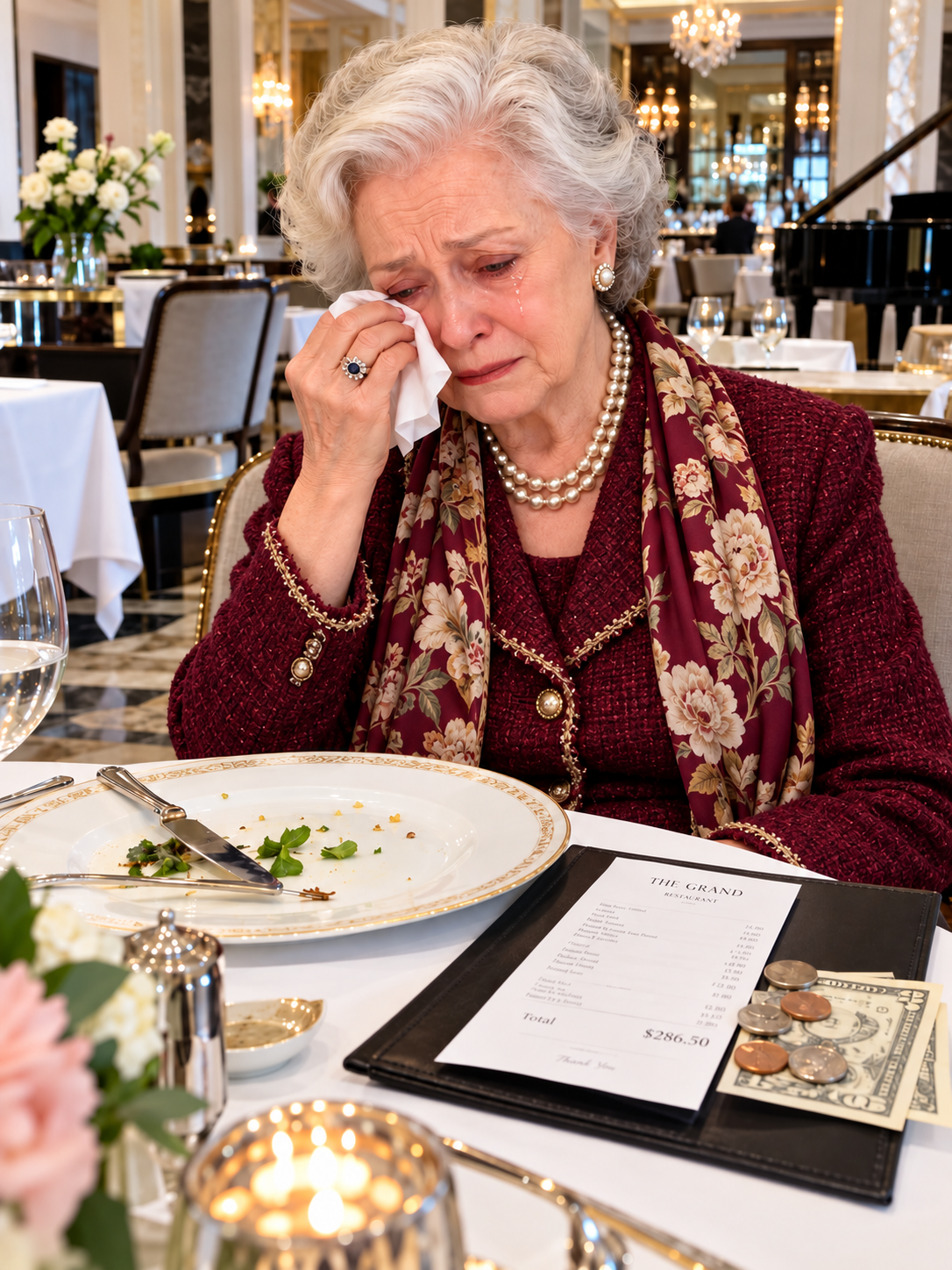
PART 1 TITLE: The Promise of a Beautiful Seaside Dinner Began to Unravel When Grandma Called Me From a Table No One Returned To
The first indication that something was wrong came through my grandmother’s voice. She had called me hundreds of times over the years, sometimes to remind me about a birthday, sometimes to ask whether I had eaten lunch, and occasionally just because she had remembered something funny about my childhood. But that Friday evening, when I answered my phone shortly before six, I heard a hesitation I had never heard before. She spoke my name softly, then stopped, as though she were ashamed of whatever she needed to tell me. Behind her voice came the distant clatter of plates, faint music, and the unmistakable noise of people enjoying themselves in a busy restaurant. My grandmother was eighty-one years old, and she was frightened to ask her own granddaughter for help.
My name is Anna Marshall. I was thirty-six at the time, living and working in Charleston, South Carolina, where I had spent most of my adult life learning how to balance professional responsibilities with the complicated expectations of my family. I was not someone who enjoyed confrontation. I could tolerate awkward holiday meals, unanswered messages, and the occasional careless remark without feeling compelled to turn every disagreement into an argument. That tendency had made me useful to certain relatives. They knew I preferred solving problems to discussing who had created them. Until that Friday, I had never seriously questioned what my willingness to help might be teaching the people around me.
My father, Thomas, married Linda when I was fifteen. By then, Paige and Trevor, Linda’s children, had already established the kind of closeness that comes from sharing an entire childhood. They communicated through expressions I didn’t understand and laughed about experiences I hadn’t witnessed. Nobody directly told me that I was an outsider. It simply became clear through a thousand ordinary moments. When they made plans, I usually heard about them after everything had been arranged. When disagreements arose, their mother assumed they meant well. My father, anxious to keep our newly combined household peaceful, preferred to avoid choosing sides, even when avoiding a decision became a decision of its own.
As a teenager, I tried hard to belong. I attended Paige’s school events, remembered Trevor’s interests, and made an effort to participate whenever the three of us happened to be together. Some days were pleasant. Others ended with me feeling as though I had walked into a conversation that had started years before I arrived. Eventually, I stopped expecting us to become inseparable. We were courteous at family gatherings and exchanged the necessary holiday greetings. I considered that enough. The fact that we shared a family did not mean we had to share every part of our lives.
Grandma Rose Bennett refused to make those distinctions. She was my father’s mother, not related to Paige or Trevor by blood, but she welcomed them without hesitation. If she baked something for me, there was usually something for them as well. She learned that Paige preferred chocolate pie and that Trevor loved peach cobbler. When Trevor broke his wrist, she brought homemade soup and fussed over whether he was keeping warm. At Paige’s college graduation, she applauded with such enthusiasm that several people turned around to look at her. Grandma never considered whether her affection would be returned in equal measure. She simply believed that children brought into her family deserved to feel loved.
That generous nature was both her greatest strength and the quality I worried about most. Grandma had a habit of explaining away other people’s thoughtlessness before anyone could ask her to. If someone forgot to visit, she assumed they were busy. If a promised telephone call never came, she decided there must have been an emergency. She remembered everyone’s difficulties and rarely spoke about her own. Her little house was filled with photographs, handmade gifts, and cards she had saved for decades. She regarded those objects as evidence of lasting relationships, even when the people represented in them had become careless about maintaining those relationships.
She had been widowed for several years, and although she managed well on her own, certain moments still brought my grandfather sharply back into her thoughts. The coastline was one of them. He had loved taking her to the water, not because they could afford expensive holidays but because they enjoyed being together. They used to carry sandwiches, sit where they could watch the boats, and spend entire afternoons talking. Grandma had told me those stories so often that I sometimes imagined I could remember the outings myself. Whenever we drove near the ocean, she grew quieter for a moment, then pointed out something she believed Grandpa would have enjoyed seeing.
Three days before the restaurant incident, Paige called me with an announcement. She and Trevor had decided to take Grandma out for a special dinner at a restaurant overlooking the ocean. Paige sounded unusually pleased with the arrangement. She described the place as beautiful, spoke about the view, and explained that they wanted to do something memorable for a woman who had spent so much time caring for others. I was genuinely surprised. Paige and Trevor weren’t incapable of kindness, but thoughtful gestures toward Grandma usually required encouragement. For once, they seemed to have taken the initiative themselves.
“That sounds lovely,” I told her. “Grandma will be delighted.”
“She deserves something special,” Paige replied. “Trevor and I have been talking about it.”
I remember smiling at that. Despite our differences, I wanted to believe we were all capable of showing Grandma the same consideration she had shown us. I imagined her sitting near a window, enjoying a meal while the sun went down over the water. She would probably tell a story about Grandpa. She might insist everyone try a bite of her dessert. She would certainly send me a message afterward describing what they had eaten, whether I wanted those details or not.
Paige mentioned that I could come along if I wanted. Unfortunately, I already had an important meeting scheduled for Friday afternoon, and I wasn’t certain when it would finish. I suggested moving the dinner to Saturday so all four of us could attend. Her manner changed immediately. The warmth disappeared from her voice, replaced by the impatience I remembered from our teenage years. She told me that not every family event needed to be rearranged around my schedule. I explained that I was only making a suggestion, not demanding anything. But she responded as though my question had challenged her ability to organize a simple evening.
“Trevor and I can take Grandma to dinner without your help,” she said.
“I know you can, Paige. I wasn’t suggesting otherwise.”
“Then why does the reservation need to change?”
“It doesn’t. I thought it might be nice for all of us to go together.”
“Well, we’ve already made the plans.”
I could hear that she wanted the conversation finished. Normally, I would have ended it there. Instead, something made me ask one more question. Grandma was careful with money. She had enough to manage her household expenses, but she didn’t spend hundreds of dollars on restaurant meals. She would never willingly allow younger relatives to spend beyond their means, either. I asked Paige whether she and Trevor were planning to pay for the dinner, since they had presented it as a treat for Grandma.
There was a brief silence. Then Paige answered with an irritated laugh.
“Obviously, Anna. We’re grown adults. We understand how taking somebody to dinner works.”
Her response was sharp enough to make further questions seem insulting. I told her I hoped they had a wonderful evening and ended the call. For a few seconds, I remained beside my kitchen counter, staring at my phone. I disliked how easily conversations with Paige could leave me feeling unreasonable for having asked an ordinary question. Still, I pushed the irritation aside. Grandma would enjoy the outing. That mattered more than my relationship with Paige, and I had no reason yet to believe the evening would become anything other than a pleasant family memory.
On Friday afternoon, Grandma called while she was preparing to leave. Her excitement came through immediately. She had taken her favorite blue dress out of the closet, the one Grandpa had loved, and wanted my opinion about wearing her pearl earrings. They were lovely old pearls, slightly warm in color, and she usually reserved them for occasions she considered important. I told her they would look perfect with the dress. She laughed and said she hoped she wouldn’t look as though she were trying too hard. I reminded her that she was going to dinner with people who loved her, not appearing before a committee of fashion critics.
She sounded delighted by that answer. Then her voice softened.
“I wish you were coming, sweetheart.”
“I wish I could, too. We’ll have our own evening next week.”
“Somewhere with a view?”
“Anywhere you like.”
She considered that proposal seriously, as though choosing a place to eat together required several days of careful thought. Then she announced that she might order lemon cake that evening if the restaurant served it. She knew it was one of my favorites and promised to tell me whether it was worth trying. I told her to enjoy herself and not worry about saving anything for me. She replied that sharing good things was half the pleasure of finding them.
After the call, I returned to work feeling reassured. Grandma had sounded happier than she had in weeks. I pictured her taking one final look in the mirror before leaving home, checking the clasp on her pearls, and smoothing the fabric of her dress. I knew the evening meant something to her beyond dinner. Paige and Trevor had rarely arranged an outing for her without being prompted. Their invitation suggested that they were thinking about her simply because they wanted her company. Grandma would treasure that feeling far longer than she would remember what she ordered.
My afternoon meeting continued into the early evening. Papers covered the conference table, and several people were still discussing unfinished work when my phone began vibrating beside my notebook. I glanced down, saw Grandma’s name, and considered letting it ring until we finished. She might have been calling to tell me about the restaurant or ask whether I wanted to hear about the view. Then I remembered that she rarely called while she was out with other people. I excused myself and stepped into the hallway, carrying my phone away from the noise of the meeting.
“Hi, Grandma. How’s dinner?”
There was no immediate reply. I heard a chair scraping somewhere near her, followed by a murmur of voices. Finally, she spoke.
“Anna, honey, I’m sorry to bother you.”
I stopped walking.
“You aren’t bothering me. What’s wrong?”
“I don’t quite know what to do.”
Those words frightened me more than a direct request for help would have. Grandma had lived through difficult years, raised a family, lost her husband, and learned to manage a household alone. She did not become helpless because something unexpected happened. Yet now she sounded uncertain even about how to explain her situation.
“Tell me where you are,” I said.
“I’m still at the restaurant.”
“Is everything all right? Are you feeling sick?”
“No, sweetheart. I’m not sick.”
She took a breath that trembled.
“Paige and Trevor went outside. They said they needed to get something from the car. The waiter brought the bill, and they haven’t come back.”
I leaned against the hallway wall. At first, I thought I had misunderstood. Perhaps they were moving their vehicle. Maybe someone had forgotten a wallet. There were ordinary explanations for stepping outside a restaurant, and my mind reached for them automatically. I asked how long they had been gone. Grandma hesitated before admitting that she had already waited almost forty minutes. She had tried calling both of them. Neither had answered. The waiter had returned several times, and she didn’t know what to tell him.
“Did they say they were leaving?” I asked.
“No. They said they were going to the car.”
“Did they take their belongings?”
“I wasn’t paying attention, dear. I thought they’d be right back.”
I could hear how carefully she was choosing her words. She didn’t want to accuse them of anything. She was still searching for an explanation that allowed everyone to remain decent in her eyes.
Then she mentioned the bill.
“Anna, it’s four hundred and twelve dollars.”
I repeated the amount, thinking I had heard incorrectly. Grandma said it again, barely above a whisper. She had checked her purse and found about forty dollars. She hadn’t expected to pay for the entire meal, and she was embarrassed that she couldn’t settle the account. She began explaining that she hadn’t ordered anything extravagant. She had only eaten fish and vegetables, and she hadn’t even finished everything on her plate.
The fact that she felt compelled to defend her choice of dinner made my stomach tighten. Someone had invited her out, left her at the table, and placed her in a position where she was calculating the price of her own food as though she had done something irresponsible.
“Grandma, listen to me,” I said. “I’m coming to get you.”
“Oh, Anna, please don’t leave your work.”
“My work can wait.”
“But you have that important meeting.”
“It’s finished for me. Don’t worry about explaining anything to the waiter. Just stay where you are.”
She protested once more, saying she hated to cause trouble. I promised she wasn’t causing any trouble at all. I wanted to tell her that the people responsible for the situation were the ones who had walked away from their dinner, but I knew she didn’t need my anger at that moment. She needed to know somebody was coming.
I returned to the meeting room, collected my belongings, and told my supervisor that a family emergency required me to leave. I offered only the details necessary to explain my sudden departure. Within minutes, I was in my car, pulling into Friday evening traffic. Charleston’s streets were busy with people heading toward restaurants, homes, and weekend plans. The ordinary movement around me seemed strangely offensive. Somewhere near the water, my grandmother was still sitting alone, hoping two people who had invited her out would return.
At the first opportunity, I called Paige. The phone rang until voicemail answered. I tried Trevor and received the same result. I sent each of them a message explaining that Grandma was alone with the restaurant bill and asking them to contact me immediately. When traffic stopped, I looked at the screen and saw that both messages had been read. Neither sibling replied. I called again, keeping my voice steady through the recorded greetings, and left messages asking where they were.
The silence that followed was different from not knowing whether someone had seen a call. Paige and Trevor now knew there was a problem. They knew Grandma was still at the restaurant. They knew I was trying to reach them. Their refusal to respond made it increasingly difficult to believe that they were merely dealing with an unexpected delay.
I kept thinking about Grandma’s blue dress and pearls. Only hours earlier, she had been excited enough to call me for fashion advice. Now she was probably sitting with her hands folded around her purse, worrying that the staff considered her dishonest. I pictured her watching the entrance whenever it opened, imagining each new arrival might be Paige or Trevor. I wondered whether she was beginning to understand what had happened, or whether she would continue giving them the benefit of the doubt until someone told her otherwise.
By the time I reached the seaside restaurant, the sky had begun losing its afternoon brightness. Warm light glowed through the windows, and people moved between parked cars with the leisurely expressions of those anticipating a good meal. I hurried inside and approached the hostess, giving her Grandma’s name. The young woman recognized it immediately. Something in her expression changed before she asked me to follow her.
We passed tables crowded with families and couples, moving toward the windows overlooking the darkening ocean. Then I saw Grandma. She was sitting very straight in her chair, her blue dress carefully smoothed over her knees. Her pearl earrings caught the light when she turned her head toward the entrance. Both hands gripped the purse resting in her lap, and a cup of tea sat untouched beside a folded piece of paper.
She looked smaller than I remembered. Not because she had changed physically in the few hours since our last conversation, but because she seemed to be trying to occupy as little space as possible.
I started toward her. She looked up, recognized me, and rose halfway from her chair. Her expression changed from anxious watchfulness to relief so sudden that I nearly stopped walking.
“Oh, Anna,” she whispered.
I reached her before she could apologize. As I put my arms around her, I saw the restaurant check lying beside her cold tea. The amount printed at the bottom was unmistakable.
$412.00.
Grandma held on to me, and I understood that whatever explanation Paige and Trevor eventually offered, this evening had already cost far more than the number written on that paper.
END PART 1
PART 2 TITLE: The Four Hundred and Twelve Dollar Check Exposed How Little My Step Siblings Had Considered the Woman They Left Behind
Grandma pulled away from our embrace just enough to study my face. Her eyes were damp, and she looked exhausted in a way that had nothing to do with her age. The first thing she said was that she was sorry. Not that she was frightened, not that Paige and Trevor had disappeared, but that she regretted interrupting my work. She explained that she had tried to manage everything herself and hadn’t wanted to make an unnecessary fuss. I held her hands between mine and told her we would settle the bill, leave the restaurant, and talk about the rest when she felt comfortable. She nodded, though I could tell she wasn’t convinced she had done nothing wrong.
The waiter approached while I was helping her sit down again. He was a young man with a tired but patient expression, and he spoke to Grandma with the sort of measured politeness people use when they sense someone has been embarrassed. He asked whether we needed anything before reviewing the check. Grandma immediately reached toward her handbag. I gently placed my hand over hers and asked him to give us a moment. He agreed without hesitation. Before he left, he assured her that there was no need to rush.
That simple kindness seemed to make her more emotional. Grandma had been sitting there long enough to begin imagining that every member of the staff was waiting for her to produce money she didn’t have. She told me she had considered asking whether she could pay for her own dinner and leave a telephone number for the remainder. She had even wondered whether the restaurant might accept a promise that someone would return with payment the following day. Listening to her, I realized how far her thoughts had traveled while Paige and Trevor remained unreachable.
“I thought perhaps I misunderstood the invitation,” she admitted.
“What do you mean?”
“Maybe they only wanted to take me out, not necessarily buy my dinner. I know restaurants are expensive these days.”
“Grandma, they told me they were treating you.”
She looked toward the entrance, as though the siblings might walk through it and explain everything. “I’m sure there must be something I haven’t understood.”
I wanted to tell her that she had understood the situation perfectly. But I also recognized the painful effort she was making to protect two people she loved. If she could identify some innocent misunderstanding, then she wouldn’t have to accept the possibility that they had knowingly left her in an impossible position.
I picked up the itemized check. The total at the bottom was $412, but the individual charges told a more disturbing story. There were expensive seafood platters, a steak entrée, appetizers, cocktails, and desserts. Some dishes had prices I would have hesitated over even for a celebration I had planned and budgeted for. Then I found Grandma’s order. Her fish and vegetables had cost nineteen dollars before the additional charges. She had also ordered tea. Nearly everything else had been selected by the two people who had invited her.
“Did they ask you to order anything else?” I asked.
“Oh, they wanted me to try an appetizer. I only had a little.”
“And the drinks?”
“Those were theirs, sweetheart. I had tea.”
She spoke without criticism, simply answering my questions. The distinction mattered. Grandma wasn’t responsible for choosing the expensive restaurant, ordering lavishly, or inviting three people to a meal with the understanding that someone else would pay. She was responsible for none of the decisions that had created the bill now frightening her.
I asked whether she had enjoyed the food before everything happened. She considered the question, then said the fish had been very nice. Paige had complimented the view, Trevor had talked about how good his steak was, and they had taken photographs while the light was still beautiful. Grandma had believed everyone was enjoying themselves. She hadn’t noticed anything unusual until the check arrived. Trevor looked at it, exchanged a glance with Paige, and said they needed to get something from their vehicle. Paige followed him without explaining further.
“They said they’d be back,” Grandma repeated. “I wouldn’t have stayed there worrying if I’d known they were leaving.”
There was a quiet firmness beneath her embarrassment. For the first time, she seemed to recognize that waiting had been the reasonable response to what they had told her.
I asked whether she had seen them drive away. She shook her head. Her back had been toward the entrance, and the restaurant’s windows faced the water rather than the parking area. At first, she had continued looking at the ocean. Then the waiter brought the bill. She told him her grandchildren were coming back and waited for them to return. After another ten minutes, she checked the time. Eventually, she called Paige, then Trevor. Each call went unanswered.
When I asked why she hadn’t called me sooner, she looked embarrassed.
“I thought I should give them a chance,” she said.
That sentence stayed with me. Grandma had been willing to remain uncomfortable, frightened, and increasingly humiliated rather than risk accusing her grandchildren of something they might not have intended. Even after forty minutes, she was still granting them patience. I wondered whether they had counted on that patience when they walked away.
I excused myself and asked to speak with the restaurant manager. A middle-aged man came over, introduced himself, and listened while I explained that I had arrived to assist my grandmother. He already understood the circumstances. Paige and Trevor had left after receiving the check. Neither had made a payment. Neither had informed a staff member that they would be returning shortly, and neither had contacted the restaurant to explain their absence. The staff had tried to handle the matter discreetly because Grandma appeared distressed.
The manager was careful not to speculate about anyone’s intentions. I appreciated that. He didn’t know my family, and it wasn’t his responsibility to decide whether Paige and Trevor were dishonest, careless, or simply unwilling to pay. What he could confirm was enough. They had consumed an expensive dinner, left the eighty-one-year-old woman they had invited, and made no arrangement for settling the account. Whatever explanation they later offered would have to account for those facts.
I asked for the total again and offered my card. Grandma immediately objected. She reached for her purse, insisting she had forty dollars and could contribute something. I told her she could buy me tea another day if she wished, but I wasn’t going to take her grocery money to reduce a bill she hadn’t agreed to pay.
“Anna, that’s a great deal of money.”
“I know.”
“You shouldn’t have to spend it.”
“Neither should you.”
She studied me for a moment and slowly closed her handbag. I could see she was struggling with the distinction between accepting assistance and becoming a burden. I wished I could make the distinction as clear to her as it was to me.
The waiter returned with the payment terminal. I paid the $412 and added an appropriate tip, remembering that he had spent considerable time looking after Grandma through an uncomfortable situation. Then I requested two printed copies of the itemized receipt. The manager provided them without question. I folded one carefully and placed it inside my wallet. The other went into my bag, separate from the first.
At the time, I wasn’t entirely sure why I wanted both copies. Perhaps it was because I already anticipated a conversation in which Paige and Trevor would insist the charges had been exaggerated. Perhaps I simply wanted a clear record of what I had paid. In my family, uncomfortable incidents had a tendency to become smaller every time someone retold them. A promise became a suggestion. A deliberate choice became confusion. A person left waiting was suddenly accused of being oversensitive. I had no intention of allowing that to happen to Grandma.
The manager apologized for the distress the evening had caused. I thanked him for treating her respectfully and made sure the waiter knew I appreciated his patience. Grandma, despite everything, insisted on thanking them both herself. She stood carefully, adjusted the strap of her handbag, and told the young waiter that she was sorry he had been kept waiting. He assured her that he was simply glad someone had come to help.
As we made our way toward the exit, I noticed people at nearby tables returning to their conversations. Nothing about the dining room had changed. Glasses still clinked. Servers carried fresh plates from the kitchen. Somewhere, a couple laughed at a private joke. For everyone else, it was another Friday evening near the coast. For Grandma, it was becoming a memory that would be difficult to separate from the place itself.
Outside, the air was cooler than it had been earlier in the day. The breeze carried the smell of salt and damp pavement, and the ocean was turning dark beneath the last color in the sky. Grandma stopped near the edge of the walkway and looked toward the water. I was about to ask whether she felt well enough to continue when she began talking about Grandpa.
“He used to bring me down here with sandwiches,” she said. “We’d sit for hours and hardly spend anything.”
I knew the story, but I let her tell it. She remembered how he would insist on finding a place with a clear view, how they sometimes watched fishing boats returning to shore, and how he believed food always tasted better outdoors. They hadn’t needed a fancy restaurant or an expensive menu. The pleasure came from having nowhere else they needed to be.
I stood beside her while she spoke. For a moment, she seemed almost peaceful. Then she fell silent and looked down at her purse.
“I thought they wanted to spend time with me,” she said.
There was no accusation in her voice. She sounded like someone describing a simple expectation that had unexpectedly proved wrong. That made the words harder to hear. I could argue about the money, recover it, and insist upon an apology. I couldn’t give her back the easy happiness with which she had prepared for dinner that afternoon.
“They should have stayed with you,” I said.
She gave a small nod.
“I would have understood if the bill was too much,” she answered. “We could have talked about it together.”
Her willingness to find a solution only made their departure more difficult to defend. Grandma wasn’t a demanding woman. If Paige and Trevor had explained that they had ordered more than they could afford, she would have listened. She might even have offered to help, despite having limited money. But they had not given her that choice. They had left her to face the problem without warning.
I helped her into the passenger seat of my car and checked that she was comfortable. She insisted she was fine, but her movements were slower than usual. I placed her handbag within reach and started the engine. Before pulling away, I looked once more toward the restaurant entrance. Part of me still expected Paige or Trevor to appear, confused about why we were leaving without them. No one came.
During the drive, Grandma asked whether I had heard from either sibling. I told her that I had tried calling several times but hadn’t received a response. She didn’t ask to see the messages. Instead, she folded her hands and watched the passing streetlights.
After several minutes, she spoke again.
“Please don’t let this become a terrible family argument.”
I kept my eyes on the road. I knew what she was asking. She wanted to protect the peace, even if doing so required her to swallow the pain of the evening. She worried about how my father would react, whether Linda would be upset, and whether Paige and Trevor would feel accused.
“I won’t do anything foolish,” I promised.
“That’s not quite the same as saying you won’t argue.”
“No,” I admitted. “It isn’t.”
She was quiet for a moment.
“I don’t want everyone angry with one another because of me.”
I glanced toward her. She was looking down at her hands, the pearls at her ears catching the light from passing cars. I told her that nobody had the right to blame her for what happened. She hadn’t invited herself to dinner, chosen the restaurant, or ordered the expensive meals. She had simply believed what she had been told.
“I know, dear,” she said, though I wasn’t sure she believed it yet.
I wanted to reassure her that everything would be fine, but I couldn’t honestly promise that. The money could be recovered. The embarrassment might fade. The question of why two people she trusted had left her alone would remain until they answered it.
Traffic slowed as we approached her neighborhood. My phone, resting in its holder, lit up with a notification. It was 7:26 p.m. I glanced at the screen and saw Trevor’s name. For a second, relief rose in me. Perhaps something had happened that I didn’t know about. Perhaps he had an explanation that would make the evening less deliberate than it appeared.
His message contained four words.
“What’s the emergency?”
I waited until I could safely respond. Then I told him that Grandma had been abandoned at the restaurant, that the bill had been $412, and that I had paid it before bringing her home. I asked directly why he and Paige had left without telling her they weren’t returning.
A response appeared almost immediately.
“Oh. That.”
I read it twice. Those two words were so casual that I wondered whether Trevor understood what he was acknowledging. I had spent the previous hour comforting our grandmother, settling a substantial bill, and trying to understand why she had been left alone. He responded as though I had reminded him about something trivial he had forgotten to put away.
Then a second message arrived.
“We thought she was going to take care of it.”
I stared at the screen as the car idled at a traffic light. Grandma noticed my silence and turned toward me.
“Was that Trevor?”
“Yes.”
“Is everything all right?”
I couldn’t bring myself to answer immediately. I had been searching for a reasonable explanation since Grandma’s first telephone call. Trevor had just supplied one, but it wasn’t reasonable. It was worse than anything I had wanted to believe.
They hadn’t left because of a sudden emergency. They hadn’t been prevented from returning. They had seen the bill, walked away, and assumed someone else would absorb the consequences.
For the first time that evening, I understood that Paige and Trevor’s disappearance wasn’t the beginning of the problem. It was the result of years in which other people had made their irresponsibility painless.
And the woman sitting beside me had just paid for that lesson with her dignity.
END PART 2
PART 3 TITLE: Back in Her Own Living Room, Grandma Asked a Question That Money Could Never Answer and My Father Finally Listened
By the time we reached Grandma’s house, the evening had grown quiet. The porch light illuminated the familiar path to her front door, and the curtains glowed softly from the lamp she always left burning in the sitting room. I parked beside the walkway and helped her out of the car. She insisted she could manage without assistance, but she accepted my arm as we approached the steps. I had walked into that house countless times feeling welcomed by its warmth. That night, I was painfully aware that Grandma was returning to the very place where she had dressed so happily for an evening that ended in humiliation.
Inside, everything was as she had left it. Her reading glasses rested beside an open book. A cardigan hung neatly over the back of a chair, and the little clock on the mantel ticked steadily beneath a row of framed photographs. Grandma placed her handbag on the table and reached up to remove her pearl earrings. She handled them carefully, as she always did, but her fingers trembled against the tiny clasps. I offered to help. She smiled faintly and said she could do it, then spent several seconds struggling with the first one before allowing me to take over.
I carried the earrings to her bedroom and returned to find her standing beside Grandpa’s old armchair. She had kept that chair in its original place after his death, refusing suggestions that a different arrangement might give the room more space. Its fabric had softened over the years, and one armrest was noticeably more worn than the other. Grandma lowered herself into it and looked toward the fireplace. I asked whether she wanted a cup of tea. She nodded, then apologized for making me stay so late. I ignored the apology and went into the kitchen.
While the kettle heated, I thought about Trevor’s messages. I had read them several times since arriving, hoping that another interpretation might emerge. It didn’t. The careless wording was revealing precisely because it was unguarded. Trevor had not offered an explanation about a forgotten wallet, an emergency, or a misunderstanding with the staff. He had acknowledged the restaurant incident and stated that they believed Grandma would handle it. I wondered whether Paige had been equally unconcerned or whether Trevor was speaking for both of them.
I brought Grandma tea in her favorite floral cup and placed it beside her chair. She thanked me and asked whether I was angry. I told her that I was upset about what had happened, but that she didn’t need to worry about protecting anyone from my feelings. She studied my face, then asked whether Trevor had explained why they left. I hesitated. She was tired, and I didn’t want to wound her further. Yet withholding what he had said would mean deciding, on her behalf, that she was unable to handle the truth.
“He sent a message,” I told her. “I’d rather you hear it from me than have somebody give you a different version later.” I handed her my phone, already open to the conversation. She put on her reading glasses and held the screen at a comfortable distance. She read the first message, paused, and then read the second. Her expression barely changed. Only the slow movement of her thumb along the edge of the phone suggested that she was struggling with what she had seen.
After a moment, she returned the phone. “They thought I would pay?” she asked. I nodded. She looked toward the small table where Grandpa used to leave his newspaper. “But Paige told me it was their treat.” I confirmed that Paige had said the same thing to me. Grandma seemed to turn the contradiction over in her mind, searching for an explanation that would allow both statements to be true. Eventually, she lowered her gaze. “I don’t understand why they didn’t just tell me,” she whispered.
That question was harder to answer than anything she had asked at the restaurant. If the bill had surprised Paige and Trevor, they could have explained that they were uncomfortable paying so much. If they needed help, they could have asked. Grandma might not have been able to cover the entire amount, but she would have tried to find a fair solution. Their decision to leave her without a word had removed the possibility of an honest conversation. It had transformed a financial problem into a betrayal of trust.
I sat beside her, and for several minutes neither of us spoke. Grandma sipped her tea without appearing to taste it. She looked up at the photographs on the mantel, lingering on one of Paige in her graduation gown. Grandma stood near the edge of the picture, smiling proudly. Another photograph showed Trevor with his arm around her shoulders at a family gathering. His grin was broad, and Grandma looked delighted to have him standing beside her. She had kept both pictures in prominent places for years.
“They were so happy those days,” she murmured. I followed her gaze and understood what she was remembering. She had been present for their celebrations, their disappointments, and their ordinary troubles. She hadn’t treated them as guests who happened to share a connection through marriage. She had treated them as grandchildren. The emotional difference was enormous. Those pictures reminded her of years of affection; now she was trying to reconcile that history with the people who had walked away from her at dinner.
Grandma set her cup down and pressed her hands together. “I keep wondering whether I did something to upset them.” I told her there was no evidence of that. She asked whether perhaps she had talked too much about Grandpa or embarrassed them by wearing her old pearls. I felt my throat tighten. Paige and Trevor had left over a restaurant bill, but Grandma was searching through her own behavior for the mistake that might have justified being abandoned. I reminded her that nothing she said or wore could excuse their decision.
She nodded, but the reassurance didn’t immediately reach her. For much of her life, Grandma had responded to conflict by looking first at what she might have done differently. She wasn’t incapable of standing up for herself; she simply believed that patience was usually better than accusation. That habit had helped her endure difficult moments, but it also allowed certain people to escape responsibility. I had watched it happen often enough to recognize the pattern. What I hadn’t understood was how deeply it could hurt her when someone finally went too far.
Her composure broke quietly. She covered her face with one hand, and tears slipped between her fingers. There was no dramatic outburst, no angry declaration about ungrateful grandchildren. She simply began crying, as though the effort of remaining understanding had exhausted her. I moved closer and held her hand. She asked again how they could have left without telling her. This time, I didn’t try to provide an answer. I let her speak about waiting for them, about wondering what the waiter thought, and about the moment she finally decided she had to call me.
“I was so embarrassed, Anna,” she said. “I kept hoping they’d come back before anyone noticed.” I told her the embarrassment belonged to the people who had left her there, but she shook her head. “That doesn’t stop you from feeling it,” she replied. Her observation was painfully accurate. Knowing who was responsible didn’t erase the experience of sitting alone while strangers waited for an explanation. I couldn’t undo those forty minutes, and I stopped pretending that a few comforting sentences would be enough.
My phone rang while I was collecting the cups. Paige’s name appeared on the screen. Grandma saw it and immediately grew tense. I asked whether she wanted to speak with her. She shook her head, explaining that she didn’t think she could manage a conversation without crying again. I told her she didn’t have to answer anyone that evening. Then I stepped into the kitchen and accepted the call, closing the door partway so Grandma wouldn’t have to hear every word.
Paige didn’t begin by asking whether Grandma was all right. Her first question was where Grandma had gone. I told her that I had brought her home after paying the restaurant bill. Paige sounded irritated and asked why nobody had informed them. For a moment, I thought she must be joking. I reminded her that I had called both siblings several times and sent messages explaining exactly what was happening. Both messages had been read. She responded that she had been busy and hadn’t realized the situation was serious.
I asked why she and Trevor had left the restaurant. Paige replied that the place was ridiculously expensive and that they hadn’t expected the total to be so high. I looked toward the kitchen doorway, thinking about Grandma sitting alone on the other side. “You selected that restaurant,” I reminded her. “You ordered the food, and you told Grandma you were treating her.” Paige insisted I was making everything sound deliberate. She described the evening as an unfortunate misunderstanding that had become unnecessarily dramatic because I was upset.
“Paige, you left an eighty-one-year-old woman alone with a four-hundred-and-twelve-dollar bill,” I said. She countered that Grandma was an adult who could speak to the restaurant staff if there was a problem. I asked how Grandma was supposed to know that they weren’t returning when they had explicitly told her they were going to the car. Paige gave an impatient sigh. “Well, she should have figured out that we’d left,” she said. I gripped the edge of the counter and forced myself to speak slowly.
I asked how Grandma was supposed to reach that conclusion. Paige replied that they weren’t going to remain at the restaurant indefinitely, as though Grandma’s failure to recognize their intentions had somehow created the difficulty. When I pointed out that leaving without explanation was precisely what had frightened her, Paige accused me of twisting her words. She said nobody had wanted Grandma to feel bad. I told her that intention didn’t alter the fact that Grandma had spent nearly an hour believing they would return.
Paige changed her explanation several times. First, the restaurant had been overpriced. Then the bill had been a surprise. Then Grandma should have understood they were leaving. Finally, Paige admitted that she and Trevor had assumed someone else would handle the payment. I asked whether that someone was supposed to be Grandma. She avoided answering directly, saying only that there were several adults in the family and that the money shouldn’t become such a large issue. I reminded her that no adult had agreed to pay their bill.
“What do you want us to do about it now?” she demanded. I considered the question. An apology would have been a reasonable beginning, but she hadn’t offered one. Instead, she had spent the conversation suggesting that Grandma should have anticipated being abandoned. “For tonight,” I said, “I want you to stop acting as though this happened to you.” Paige began protesting, but I ended the call. I wasn’t willing to spend another twenty minutes listening to explanations that made an elderly woman’s humiliation seem like an inconvenience to the people who had caused it.
I remained in the kitchen for a moment after hanging up. The house was quiet except for the kettle settling on the stove and the faint ticking of the clock in the next room. I thought about how often my father had resolved problems involving Paige and Trevor by reaching for his wallet. Unexpected expenses, forgotten responsibilities, and awkward obligations tended to disappear once someone older stepped in. Linda defended her children because she couldn’t bear to see them criticized. Dad intervened financially because he wanted the argument to end. Grandma forgave because she loved them. I had joined that pattern by becoming the dependable person everyone called when something went wrong.
At 8:11 p.m., my father called. He had already spoken with Linda, and his opening words suggested he had received a very different account of the evening. He said there had been confusion over the restaurant bill, that Paige and Trevor hadn’t realized what they were getting into, and that Linda believed the situation had been blown out of proportion. He offered to reimburse me immediately. His tone was calm and practical, the voice he used whenever he believed an unpleasant problem could be settled by writing a check.
I told him I didn’t want his money. He sounded surprised and reminded me that four hundred dollars wasn’t worth damaging the family over. I sat down at Grandma’s kitchen table, feeling the same familiar exhaustion that had accompanied so many conversations with him over the years. “Dad, this isn’t about whether you can afford four hundred dollars,” I said. “It’s about what happened to your mother while Paige and Trevor were avoiding a bill they created.”
He asked me to explain, so I did. I described Grandma’s telephone call, the forty minutes she had spent waiting, the unanswered calls, and the restaurant check that included hundreds of dollars of food and drinks she hadn’t ordered. I explained that I had found her clutching her handbag, afraid the waiter believed she was trying to leave without paying. I told him how she had apologized for calling me, then apologized to the restaurant staff despite having done nothing wrong. My father remained quiet, listening without interruption.
Then I told him something that changed the conversation. “She cried when we got home,” I said. He repeated the words as a question, almost as though he hadn’t understood them. I confirmed that Grandma had cried and that she had been asking herself whether she had offended Paige or Trevor. My father fell silent again. When he spoke, the easy certainty had disappeared from his voice. He asked whether his mother was still awake and whether he could speak with her directly.
I carried the phone into the sitting room and explained that Dad wanted to hear how she was feeling. Grandma hesitated. She didn’t want to make matters worse, and I could see her preparing to minimize what had happened for his benefit. I told her she didn’t have to protect anyone from an accurate account of the evening. She took the phone and greeted him warmly, asking how he was doing before he had a chance to ask about her. I stayed nearby while they talked, not wanting her to feel alone but giving her room to speak.
Dad asked whether Paige and Trevor had truly promised to return. Grandma confirmed that they had said they were going to the car. She explained that she had stayed because she trusted them. Then Dad asked whether she wanted everyone to forget the incident and move on. She looked toward the photographs above the fireplace, and something in her expression changed. She seemed to recognize that agreeing would require her to pretend she hadn’t been hurt. “I don’t want the family fighting, Thomas,” she said quietly. “But I don’t want everyone pretending it didn’t happen.”
It was the most direct statement I had heard her make about the evening. She hadn’t demanded punishment or repayment. She had simply asked that the truth not be buried beneath other people’s desire for comfort. Dad listened without trying to correct her feelings. He apologized for what she had experienced and promised they would talk again in the morning. When she handed the phone back to me, she looked drained but also slightly relieved, as though speaking honestly had lifted a weight she had been carrying since dinner.
My father asked whether I still had the itemized receipt. I told him I had requested copies, and that Trevor’s messages were saved on my phone. He wanted me to bring both to his house immediately. Linda was there, and Paige and Trevor were coming over. He said he wanted to understand exactly what had happened while everyone was available to answer questions. I hesitated, remembering Grandma’s request to avoid a family argument. Then I looked at her sitting beneath the photographs and realized that leaving everything unresolved would only invite another attempt to dismiss her experience.
I agreed to go, but I made one condition clear. Grandma would not be required to attend or defend herself. She had already told us what happened. She wasn’t going to be placed in a room full of relatives and expected to justify why she felt hurt. Dad accepted that without argument. His willingness to listen surprised me, though I knew it was too early to assume anything had fundamentally changed. He had often meant well in the past. The difficulty had been maintaining that resolve once Linda and her children began objecting.
Before leaving, I checked that Grandma had everything she needed. She had changed out of her blue dress and put on a comfortable sweater. The pearls were safely in their box. I offered to stay until she fell asleep, but she insisted she would be fine and encouraged me to go speak with my father. I promised to call her afterward if it wasn’t too late. As I reached the front door, she asked me to wait.
“Anna, there’s something you mustn’t let them say,” she told me. I turned back, and she continued with unusual firmness. “Don’t let anyone claim I offered to pay for everybody’s dinner. I didn’t. I said I could pay for my fish if necessary, but nobody asked me to pay for all that food.”
I returned to her chair and took her hand. I told her I would make sure the distinction was understood. She nodded, but she wasn’t finished. “I don’t mind helping people when I can,” she said. “I just want it to be my decision.” I promised her that nobody would be permitted to rewrite what she had agreed to. Then I kissed her forehead, collected the receipts, and stepped outside.
As I drove toward Dad’s house, I understood why Grandma’s final words mattered so much. She wasn’t refusing to be generous. She was insisting that generosity required a choice. Paige and Trevor had denied her that choice when they left her with the bill. My father had nearly denied it again when he suggested everyone should forget the incident. For years, Grandma had been expected to make other people comfortable by excusing their behavior. Tonight, she had made it clear that she no longer wanted her kindness used as permission.
I arrived to find Paige’s white SUV and Trevor’s sedan already parked in the driveway. Every downstairs window was illuminated. Through the kitchen window, I could see figures moving beneath the bright ceiling lights. I sat in my car for a moment, looking at the two receipts on the passenger seat and the unread messages still waiting on my phone. The money was no longer the most important issue. What mattered was whether the people inside that house would acknowledge what they had done when nobody could quietly rescue them from the consequences.
I picked up the receipt, opened the car door, and walked toward the house.
This time, I wasn’t going there to make the problem disappear.
END PART 3
PART 4 TITLE: At My Father’s Kitchen Table, a Receipt and Two Read Messages Forced Everyone to Face What Their Silence Had Cost
Linda opened the front door before I had finished climbing the steps. She was dressed as neatly as always, her hair arranged and her expression controlled, but I could see the tension around her mouth. She greeted me without warmth and stepped aside to let me enter. From the kitchen came the sound of Trevor speaking, followed by Paige’s impatient reply. They sounded irritated rather than worried. For a moment, I wondered whether either of them had asked how Grandma was feeling since returning home. Then Linda said she hoped we could settle the matter quickly, and I understood that the evening was still being treated as an inconvenience to be managed.
My father stood beside the kitchen island with his arms folded. He looked tired, but there was an unfamiliar seriousness in his face. Paige occupied a chair at the table, her phone resting near her elbow, while Trevor leaned against the refrigerator, scrolling through something on his screen. Neither rose when I entered. I placed my bag on an empty chair and waited for someone to speak. Paige looked at the clock, then at me. “Are we really going through all this tonight?” she asked, as though I had called everyone together over a minor scheduling disagreement.
I pulled out a chair and sat down. “Grandma didn’t get to postpone what happened to her,” I replied. “She had to deal with it when you left.” Paige rolled her eyes and looked toward her mother. Linda immediately suggested that everybody was tired and that the situation might seem less serious after a good night’s sleep. She acknowledged that her children hadn’t handled the restaurant bill properly, but insisted there was no reason to make permanent damage out of a misunderstanding. I listened until she finished, then asked whether she knew how long Grandma had sat there waiting for them.
Linda answered that she had heard it was a while. I told her it had been almost forty minutes before Grandma called me, and longer before I arrived. I described the way she had held her purse and apologized to the restaurant staff. Linda shifted uncomfortably but repeated that Grandma had made it home safely. The implication was unmistakable: because the practical emergency had ended, we should all consider the matter resolved. I looked at my father, wondering whether he would accept that explanation as he had so often accepted similar ones.
Instead, he asked me to show everyone the receipt. I removed the two copies from my bag and placed one on the kitchen table. The paper had been folded several times, and I smoothed it flat with my fingertips. Dad picked it up and began reading the charges. His eyes moved slowly down the list of seafood dishes, steak, appetizers, drinks, and desserts. He paused at several items, then studied the total. When he asked what his mother had ordered, I pointed out the nineteen-dollar fish and vegetables, along with her tea.
He looked toward Paige and Trevor. “Did either of you tell her she would be responsible for the check?” Paige replied that nobody had discussed payment in detail. Trevor added that the restaurant had turned out to be more expensive than expected. Dad glanced at the receipt again. “But you chose the restaurant,” he said. Paige explained that the online description had made it sound like a reasonable place for a special dinner. Dad asked whether anyone had pressured them into ordering expensive meals after they arrived. Neither sibling answered directly.
I watched Paige’s expression change as she realized that vague explanations weren’t satisfying him. She began describing the menu, the portions, and how quickly the total had increased. She mentioned that restaurants near the water often charged more than they should. Everything she said might have been true, but none of it answered why Grandma had been left alone. I waited until she paused, then asked the only question that mattered. “When you saw the bill, why didn’t you stay and work out how to pay it?”
Trevor finally looked up from his phone. He said they had been surprised and didn’t want to create a scene. I asked whether leaving an elderly woman with a bill she couldn’t afford was somehow less embarrassing than admitting they had overspent. He frowned, clearly irritated by the comparison. “We weren’t trying to leave her in trouble,” he said. I asked why they had told her they were going to the car instead of explaining that they intended to leave. Trevor shrugged and said they hadn’t thought through every detail.
That response caused something in my father’s expression to harden. He set the receipt on the table and asked Trevor to explain what he believed would happen after they drove away. Trevor seemed confused by the question. He said he assumed the situation would be handled. Dad asked who would handle it. Paige answered that Grandma could have called somebody. When Dad pressed further, Trevor finally said what I had suspected since receiving his messages.
“We figured she’d call Anna,” he admitted. “Anna usually takes care of things like this.”
The room fell silent. Trevor looked around, apparently expecting his explanation to settle the discussion. He had spoken with the casual confidence of someone describing a familiar family arrangement. In his mind, there was nothing extraordinary about leaving a problem for me because I had solved so many before. But this time, my father didn’t immediately accept that arrangement. He stared at Trevor, then looked toward me. I could see him reconsidering years of situations that had ended with somebody else making sure his stepchildren suffered no lasting inconvenience.
I felt the old familiar pressure to smooth things over. It was the instinct that had made me answer late-night calls, rearrange my schedule, and tolerate difficult conversations rather than leave people upset. Part of me wanted to explain Trevor’s thoughtlessness in gentler terms so Dad wouldn’t feel forced to confront it. Then I remembered Grandma sitting beneath the restaurant lights, trying to understand why she had been left. I pushed that instinct aside. This wasn’t an argument about whether I was willing to help. It was about the assumption that my willingness removed everyone else’s responsibility.
“You expected Grandma to call me because you knew she couldn’t pay,” I said. Paige objected that they hadn’t known exactly how much money Grandma was carrying. I reminded her that Grandma lived carefully within a limited income and had never been comfortable spending hundreds of dollars on herself. Paige looked down at her hands. Trevor admitted they had considered the possibility that she wouldn’t have enough money, but said they assumed someone in the family would step in. Dad asked whether either sibling had checked that assumption before leaving. Neither had.
Linda moved closer to the table. She suggested that everyone had made mistakes and that the simplest solution would be to divide the cost among the adults. Her proposal sounded reasonable if the only question was how to settle a shared expense. But Grandma hadn’t agreed to share that expense, and I hadn’t ordered a meal at all. I explained that distributing the bill would erase the most important distinction between the people who had made the decisions and the people who had been forced to deal with them.
Paige said that paying for dinner shouldn’t become a moral judgment about someone’s character. I agreed that overspending was not, by itself, proof of being a terrible person. Restaurants could be more expensive than expected, and people sometimes miscalculated what they could afford. But I asked her to imagine the situation reversed. What if Grandma had invited Paige out, ordered an extravagant meal, then disappeared when the waiter brought the check? Paige said that was a ridiculous comparison. I asked her to explain why. She opened her mouth, then closed it again.
I removed my phone from my pocket and opened the conversation with Trevor. “There’s something else you need to see,” I told Dad. I placed the phone beside the receipt so that he and Linda could read it. Dad adjusted his glasses, looked at the message, and passed the phone to his wife. Trevor had written that he believed Grandma would take care of the situation. He hadn’t described an emergency or even expressed surprise that she remained at the restaurant. His words confirmed that leaving her with the bill had not been an accident.
Linda read the screen twice. For the first time since I arrived, she looked genuinely uncertain. She asked Trevor whether he had sent the message after learning that Grandma was frightened. He confirmed that he had. Linda wanted to know why he hadn’t called her immediately. Trevor rubbed the back of his neck and said he didn’t think there was much left to discuss once I had paid. The assumption beneath that answer was so clear that nobody needed to explain it. To him, payment meant the problem had ended.
I told them about the blue dress and the pearl earrings. Paige looked up sharply when I mentioned them. I explained that Grandma had called me earlier in the afternoon, excited about being taken to dinner, and had asked whether she looked appropriately dressed for the occasion. She had worn the pearls Grandpa gave her because she considered the evening special. It wasn’t an obligation on her calendar. It was a moment of affection she had been anticipating. She believed Paige and Trevor wanted to spend time with her simply because they loved her.
I didn’t raise my voice when I described how I found her. I spoke about the untouched tea, the purse resting on her knees, and her repeated apologies for interrupting my work. I explained that she had wondered whether ordering nineteen dollars’ worth of fish had somehow created the problem. Paige shifted in her chair. Trevor looked toward the floor. My father listened without moving, his hand resting on the receipt. I could tell that the details troubled him more than the total printed at the bottom.
“She didn’t know you’d left,” I said. “She kept expecting you to return. She waited because she believed what you told her.” Trevor suggested that Grandma must have realized eventually that they weren’t coming back. I asked what difference that made. Recognizing that someone had abandoned her didn’t make the abandonment harmless. If anything, it meant she had been forced to spend the evening gradually accepting that people she trusted had deliberately walked away.
Then I brought up the unanswered calls. I opened the call history and showed Dad the attempts Grandma had made to reach Paige and Trevor, followed by my own calls. I also showed him the messages I had sent while driving toward the restaurant. Both had been read before either sibling offered a response. Dad asked Paige whether she had seen my warning that Grandma was still alone and distressed. She admitted she had. He asked Trevor the same question. Trevor nodded reluctantly.
My father’s next question was quiet. “You knew my mother was sitting there waiting for you?” Neither answered immediately. Trevor eventually said he assumed she would find a solution. Dad repeated the question, asking whether Trevor knew she was still at the restaurant. Trevor admitted that he did. Paige added that she had thought Grandma would speak to the manager or telephone me. I looked from one sibling to the other, astonished that they still seemed unable to hear what they were saying.
They had known Grandma was waiting. They had seen messages explaining that she was frightened. They had continued with their evening because they believed someone else would rescue her. That knowledge changed the nature of the incident. It could no longer be described as two people misunderstanding a restaurant bill. They had been given several opportunities to return, call, apologize, or arrange payment. Each time, they chose silence.
For several moments, nobody spoke. The refrigerator hummed behind Trevor, and a car passed slowly along the street outside. Linda’s earlier certainty had disappeared. She looked between her children as though expecting one of them to reveal an explanation she hadn’t yet heard. Paige stared at the receipt. Trevor stood with his arms folded, but he no longer appeared bored. My father remained at the table, considering the evidence in front of him.
I told them I had paid the restaurant because Grandma needed someone to help her leave safely, not because I had agreed to take responsibility for their dinner. I explained that I expected Paige and Trevor to repay the full amount, including the tip I left for the waiter who had spent nearly an hour treating Grandma with patience. Trevor frowned at the mention of the gratuity. He asked whether it was really necessary to include that in the reimbursement. Before I could answer, Dad said that it was.
Paige protested that repayment sounded like a punishment. I told her it was simply the cost of the evening she and Trevor had chosen. An apology was a separate matter. Paying for their meals would correct the financial damage, but it wouldn’t address what Grandma had experienced. They needed to speak to her honestly, acknowledge that they had left her alone, and stop suggesting that she had misunderstood what happened. Most importantly, they needed to accept that she might not be ready to forgive them immediately.
Paige said I was making them sound like monsters. I answered that I wasn’t interested in assigning labels. I was interested in decisions. They had chosen an expensive restaurant, ordered the meals, walked away from the check, ignored their grandmother’s calls, and relied on me to solve the problem. Each of those choices belonged to them. Describing them accurately wasn’t an act of cruelty.
I also remembered the photograph Paige had posted earlier that evening. She had shared a cheerful image from the restaurant, presenting the outing as a lovely family occasion. Relatives had left affectionate comments, delighted to see Grandma being treated to such a special dinner. I mentioned the picture and asked how Paige felt about allowing everyone to believe she had taken wonderful care of Grandma while knowing how the evening had actually ended.
Paige’s face reddened. She said she had posted the picture before the problem with the bill and hadn’t thought about removing it afterward. I told her she could decide whether to keep it online, but that she shouldn’t use Grandma’s kindness to build an image of generosity she hadn’t earned. Dad asked Paige whether anything I had said about the photograph was inaccurate. She shook her head. For the first time that evening, she didn’t try to turn the question into an argument.
Linda lowered herself into a chair. She looked tired and troubled, and when she spoke, her voice was quieter. She said she had believed the situation involved a disagreement over who was supposed to pay. Trevor had told her the restaurant was overpriced, and Paige had described the evening as awkward but harmless. Neither had mentioned that they knew Grandma was still waiting while they ignored her calls. Linda looked directly at her children and asked why they hadn’t told her that part.
Trevor said he hadn’t considered it important once I arrived. Paige admitted that she had been angry about the price of dinner and hadn’t wanted to face another uncomfortable conversation. Their explanations were different, but they revealed the same assumption: that once somebody else accepted responsibility, the unpleasant details no longer mattered. I watched Linda absorb their answers. I didn’t expect her to stop loving or defending her children. I only hoped she could recognize that protecting them from every consequence had helped create the behavior she was now struggling to justify.
Dad stood and moved toward the kitchen window. He looked outside for a few seconds, then turned back to the table. When he spoke, he addressed Paige and Trevor rather than Linda or me. He said he had spent years believing that being a good father meant keeping the family comfortable. Whenever somebody needed money, assistance, or an explanation for poor judgment, he had tried to provide it. He had thought that preventing arguments was the same as maintaining peace.
He stopped speaking and looked at the receipt again. I could see that he was remembering his earlier offer to reimburse me, and I wondered whether he understood why I had refused. He had almost repeated the familiar solution: cover the expense, ask everyone to forget the incident, and allow Paige and Trevor to return to their lives without addressing what they had done. This time, the evidence had made that solution impossible.
My father drew a slow breath. “I owe your grandmother an apology,” he said. The words surprised me enough that I looked up immediately. He wasn’t speaking about the dinner bill. He explained that when I first called, his instinct had been to make the disagreement disappear because he didn’t want anyone upset. He hadn’t considered what that response would communicate to his mother. It would have told her that the family’s comfort mattered more than her humiliation.
Linda looked down at her hands. Paige remained silent. Trevor opened his mouth as though he might object, then seemed to reconsider. Dad returned to his chair and placed the restaurant receipt directly between Paige and Trevor.
“I’m not paying this for you,” he told them. “Anna isn’t responsible for it, and your grandmother certainly isn’t. You invited her. You ordered the food. You walked away. Now you need to put this right yourselves.”
For years, those words would have been unthinkable in our family. Dad had never enjoyed setting limits that might disappoint Linda or her children. But he didn’t look toward his wife for approval, and he didn’t soften the instruction when Paige shifted angrily in her chair. He remained seated with the receipt between his hands, waiting for his stepchildren to respond.
I glanced at the two people who had left Grandma alone by the ocean. They were no longer arguing about whether the restaurant was expensive. They were facing something they had always managed to avoid: responsibility that another person would not quietly carry for them.
Then Dad looked at me and said, “Anna, I need to ask you something. When Mom told you not to let anyone pretend this hadn’t happened, did she say what she wanted from us?”
I remembered her sitting in Grandpa’s chair, the tears drying on her cheeks, as she struggled to explain that she had never offered to pay for everyone. I remembered how firmly she had said that helping someone should remain her decision.
“She wants you to believe her,” I answered. “And she wants you to stop deciding that everything is fine simply because somebody else has paid the bill.”
Dad nodded slowly. Then he turned toward Paige and Trevor.
“Before either of you asks her to forgive you,” he said, “I want to know whether you finally understand what you did.”
Neither answered right away.
For the first time that night, their silence no longer protected them. It left them facing a question that money alone could not settle.
END PART 4
PART 5 TITLE: The Receipt Lay Between Us, but the Silence Around Grandma’s Nineteen-Dollar Dinner Became the Hardest Thing to Explain
The first thing my father did was turn the restaurant receipt over, as though he expected to find an explanation written on the back. There was nothing there, of course. Just the thin paper, slightly curled from where I had folded it inside my purse, and a list of dishes that made the entire evening impossible to misunderstand. Across the kitchen island, Paige watched him with her arms folded tightly against her chest. Trevor had finally put his phone away. Linda stood beside the sink, her expression caught somewhere between irritation and concern. Nobody spoke while Dad read the charges a second time.
“Four hundred and twelve dollars,” he said quietly. He ran his finger down the receipt, pausing at the seafood platters, steak, appetizers, cocktails, and desserts. “What did my mother order?” His voice was even, but I recognized the particular stillness that came over him when he was trying not to become angry. I pointed to the smallest charge near the bottom of the list. Grandma’s fish and vegetables had cost nineteen dollars. She had also ordered tea. Dad looked at that figure for several seconds before lifting his eyes toward Paige and Trevor.
Paige straightened in her chair. “The prices were ridiculous, Thomas. We didn’t realize how expensive everything was going to be.” She spoke with the impatience of someone explaining an inconvenience that ought to have been resolved already. Dad turned the receipt toward her. “You saw the menu before you ordered, didn’t you?” Paige glanced at Trevor, apparently hoping he would help. He studied the kitchen tiles instead. Linda began to say that restaurant prices could be misleading, but Dad raised one hand. It wasn’t a dramatic gesture. He simply wanted a direct answer to an uncomplicated question.
“We knew it wasn’t cheap,” Trevor admitted. “But we didn’t expect the total to be that much.” I looked at him, remembering the message he had sent earlier that evening. He had not been frightened or confused when I told him Grandma was stranded. He had sounded mildly inconvenienced that I was making an issue of it. “You didn’t need to guess the total,” I said. “The waiter brought it to your table. That’s when you decided to leave.” Trevor shifted his weight. For a moment, I thought he might actually acknowledge what he had done. Instead, he shrugged and said they had needed to get something from the car.
Dad put the receipt down carefully. “Did you get whatever you went outside for?” Trevor blinked. “What?” “The thing you supposedly needed from the car.” The refrigerator hummed behind him. He stared at his stepfather without answering. Paige spoke before he could. “We weren’t trying to make Grandma sit there forever. We assumed she would understand what was happening.” My father leaned against the counter, his hands spread flat on its polished surface. “Then explain it to me. What exactly did you expect an eighty-one-year-old woman to understand when the two people who invited her to dinner walked out without paying?”
Linda reached for a glass in the cabinet and filled it with water, although she didn’t take a drink. “Thomas, they’re admitting they handled it badly. We don’t have to turn this into a trial.” I watched Dad consider her words. For most of my life, that would have been enough to end the conversation. He disliked confrontation, particularly when it involved Linda’s children. His usual solution was to pay whatever was owed, ask everyone to be reasonable, and let time cover the damage. I had watched him do it so often that I could practically predict what he would say next. This time, however, he continued looking at Trevor.
“Why didn’t you go back inside?” Dad asked. Trevor gave a short, uncomfortable laugh. “Because the bill was there.” “Yes,” Dad replied. “That’s generally when people pay for their dinner.” Paige made an exasperated sound, but he ignored her. “You had invited Mom. You told her you were treating her. She hadn’t chosen the place or the expensive dishes. So explain why you thought it was acceptable to walk away.” Trevor rubbed the side of his face. “We figured she’d call Anna,” he finally said. “Anna always deals with this kind of thing.”
I had known that was what they were thinking. Hearing him acknowledge it so plainly still unsettled me. There was no shame in his voice, only the assumption that my involvement had been a reasonable part of their evening’s arrangements. I remembered Grandma’s small hands gripping her purse, the apology she had whispered when I arrived, and the way she had asked whether ordering fish had somehow been wrong. Trevor had reduced all that to an ordinary inconvenience that someone else would handle. “You knew she would call me,” I said. “So you left her there until I came.” He opened his mouth, then closed it again.
Dad looked at his stepson for a long moment. “You are telling me that you left my mother alone in a restaurant with a bill she couldn’t afford because you expected my daughter to rescue her.” Trevor’s shoulders tightened. “You’re making it sound worse than it was.” Dad shook his head. “I’m repeating what you just told me.” His voice wasn’t loud. That made the exchange more uncomfortable than shouting would have. Trevor seemed to be searching for an argument, but every possible defense led back to the same simple fact. He had known someone else would have to clean up the consequences of his decision.
Paige pushed back her chair slightly. “We never meant for Grandma to get upset.” I turned toward her. “Did you think she would enjoy the experience?” “That’s not fair, Anna.” “Neither was asking her to sit there wondering where you went.” Paige pressed her lips together. I reminded her that Grandma had spent the afternoon getting ready, choosing her blue dress because Grandpa used to love it, and carefully putting on the pearl earrings she saved for special occasions. Grandma had believed the invitation meant Paige and Trevor wanted to spend time with her. She had never imagined she was being taken somewhere she would later be expected to pay for everyone.
Paige’s expression changed slightly when I mentioned the dress. She knew it. She had complimented Grandma on it during family gatherings and once asked whether she could borrow the pearls for a photograph. I could see the memory arriving, though she quickly looked away. “We did want to take her out,” she insisted. “We just didn’t think things through.” “You thought far enough ahead to leave when the check arrived,” I replied. “You thought far enough ahead to keep driving instead of turning around. What you didn’t think about was whether Grandma would be frightened.” The distinction seemed to trouble her more than the accusation itself.
Linda finally sat at the kitchen table. She took a slow breath and turned toward me. “Anna, I know your grandmother had an unpleasant experience. But she’s home now, and you were able to pay. Perhaps we should just divide the expense among the adults and move forward.” I looked at her, trying to understand how she could describe the evening as unpleasant rather than humiliating. Her suggestion would have been convenient for everyone except the person who had been abandoned. “No,” I said. “I’m not splitting their bill with anyone. I paid because Grandma needed help. That doesn’t make me responsible for what Paige and Trevor ordered.”
“It’s only money,” Paige muttered. I had heard the phrase often enough to know what usually followed it. Someone would offer to reimburse someone else, the conversation would end, and the person who had been hurt would be expected to smile at the next gathering. “Then it should be easy for you to pay back,” I answered. She looked offended. “That’s not what I meant.” “I know exactly what you meant. You want us to treat the money as insignificant because somebody else has already covered it. But when the waiter brought you the bill, suddenly it mattered enough for you to leave Grandma behind.”
My father pulled out a chair and sat down. He looked older than he had when I arrived, though nothing about the room had changed. The same fruit bowl sat at the center of the island. A dish towel hung from the oven handle. Through the window, I could see the reflection of the kitchen lights against the dark backyard. It was an ordinary family kitchen, a place where we had eaten holiday meals and celebrated birthdays. Yet the familiar surroundings made the conversation stranger. We were discussing whether two grown adults had understood that abandoning their grandmother in a restaurant was wrong.
Dad picked up the receipt again. “Mom’s dinner was nineteen dollars,” he said, almost to himself. “She didn’t even have enough cash with her to cover the entire bill.” I explained that Grandma had carried roughly forty dollars and had offered to pay for her own food when she realized something was wrong. The waiter had been kind, but she had become increasingly distressed as the minutes passed. She hadn’t wanted to accuse Paige and Trevor of leaving deliberately. Instead, she kept searching for explanations that would protect them, even at her own expense. I had found her apologizing for causing trouble she hadn’t caused.
Trevor looked toward me. “She could have told the waiter we were coming back.” “She did,” I answered. “For almost forty minutes, she believed you.” The words seemed to irritate him. “Why are you acting like we planned some elaborate scheme?” “Because you had time to correct what happened. You had phones. You had my messages. You knew she was still there.” He shook his head as though the details were becoming tiresome. I took a breath before continuing. I didn’t want the argument to become a contest over who could speak the loudest. Grandma deserved something better than that.
I reached into my purse and removed my phone. The screen still showed the conversation with Trevor from earlier that evening. I placed it beside the receipt so that everyone could see the message he had sent after I told him where Grandma was. His response had been brief and disturbingly casual. He believed she would take care of the bill. I watched Dad read those words, his expression tightening. Linda leaned closer to see them. For the first time since I arrived, she stopped suggesting that the incident had been a simple confusion about who would pay.
“Trevor,” Dad said, “is this what you wrote?” “Yes, but you’re taking it out of context.” “What context would make it acceptable?” He couldn’t answer. Paige leaned forward and asked whether I had really needed to save every message. Her tone made it sound as though collecting evidence was more offensive than the behavior itself. I looked at her. “I didn’t save anything special. They’re the messages you sent me tonight. They’re still on my phone because it happened only a few hours ago.” She looked down, visibly irritated by the impossibility of arguing with that.
The strange thing was that I had never expected to bring photographs or screenshots into a family conversation. I had grown up believing that people who cared about each other should be able to speak honestly without proving every word. But experience had taught me what happened when I trusted everyone to remember difficult events accurately. An apology became a misunderstanding. A broken promise became a forgotten conversation. A debt became a gift that nobody recalled asking for. I had seen Grandma quietly accept those revisions because she hated making people uncomfortable. Tonight, I wasn’t going to allow another version of that pattern.
Dad handed the phone back to me. “Show me the other messages,” he said. I opened the thread where I had explained that Grandma was alone, frightened, and unable to settle the bill. Beside the message was the small notification showing it had been read. I brought up the similar conversation with Paige. Both had received the warning. Both had viewed it. Neither had responded while Grandma remained in the restaurant. Dad examined the timestamps. The silence that followed was almost unbearable. Nobody could pretend that a failed phone call or missing notification had prevented them from understanding the situation.
Paige finally spoke. “I saw it, okay? I was upset, and I didn’t want to get into another argument with you.” Her admission settled one question and raised a worse one. “You knew Grandma was still waiting,” I said. Paige stared at the table. “I knew you were on your way.” “That wasn’t what I asked.” She pulled a loose thread from her sleeve. “Yes. I knew she was there.” My father turned to Trevor. “And you?” He hesitated before answering. “I saw it too.” Dad closed his eyes briefly, then pressed his fingertips against his forehead.
I could see the moment his understanding changed. Until then, he might still have believed that Paige and Trevor had made an impulsive decision, become embarrassed, and failed to handle the situation properly. Their admissions removed that possibility. They had known Grandma was frightened. They had known she was waiting. They had received an opportunity to call her, return to the restaurant, or at least explain what was happening. Instead, they had left the responsibility with someone else. The damage was no longer something they could attribute to a moment’s poor judgment.
Linda covered her mouth with one hand. She was not a cruel woman, and I had seen her be genuinely thoughtful toward Grandma many times. But she had a habit of protecting her children from discomfort even when discomfort was precisely what they needed to experience. I wondered whether she was remembering all the occasions when she had told us to let something go for the sake of family harmony. She lowered her hand and spoke quietly. “Why didn’t either of you answer her?” Neither Paige nor Trevor replied. For once, Linda didn’t attempt to supply an explanation on their behalf.
My father stood and walked to the kitchen window. Beyond the glass, the backyard was dark except for the small light above the patio door. He remained there long enough that I wondered whether he was trying to decide which version of our family he could still believe. Finally, he turned around. “Mom told me tonight that she didn’t want us pretending this hadn’t happened,” he said. “I think I understand why.” His eyes rested on Paige and Trevor. “You weren’t confused about the bill. You weren’t unable to reach anybody. You knew exactly what you had left her to deal with.”
Trevor’s face reddened. “We’re not monsters, Thomas.” Dad nodded slowly. “Then stop asking everyone to judge your intentions instead of your actions.” That stopped Trevor. My father rarely spoke so firmly to either of them. He usually tried to find the kindest interpretation of their behavior, even when doing so meant overlooking what had actually happened. Now he seemed to understand that his habit of smoothing over disagreements had created its own problems. He was not the one who had abandoned Grandma, but he had spent years making it easier for Paige and Trevor to avoid responsibility.
Paige looked toward her mother. “Are you seriously going to let Anna talk to us like this?” Linda folded her hands on the table. “Anna isn’t the person who needs to answer questions tonight.” I could tell how much it cost her to say it. Paige stared at her in disbelief, as though a familiar arrangement had suddenly stopped working. Trevor shifted away from the refrigerator and pulled out a chair without sitting. The kitchen felt smaller now, not because anyone had moved closer, but because the usual routes out of an uncomfortable conversation were disappearing one by one.
I gathered the receipt and slipped my phone into my pocket. “I don’t need either of you to agree with me,” I said. “Grandma is home, and she’s safe. But you need to understand that she didn’t spend that evening worrying about four hundred dollars. She spent it wondering why two people she loved had left her alone.” My voice caught slightly on the last words. I thought of Grandma looking at the family photographs on her mantel and asking how Paige and Trevor could have done such a thing. I had no answer for her then. I still didn’t.
Dad returned to the island and placed both hands on the counter. “I want you each to answer one question,” he told them. “Not together. Not through your mother. I want an honest answer from each of you.” Paige lowered her eyes. Trevor finally sat down. “When you read that Grandma was still at the restaurant, why did neither of you go back?” Neither answered immediately. My father waited, refusing to rescue them from the silence. Then Trevor looked at the receipt, swallowed, and said something that changed the conversation completely.
“We knew Anna would pay,” he admitted. “That’s why we didn’t go back.”
END PART 5
PART 6 TITLE: When My Father Finally Stopped Defending Them, the Truth About Years of Excuses Became Impossible for Our Family to Ignore
Trevor’s admission remained in the room long after he finished speaking. He seemed almost surprised by the expression on my father’s face, as though he had expected everyone to appreciate his honesty and move on. Paige sat absolutely still. Linda stared at her son with a look I couldn’t quite read. I found myself listening to the small noises of the house: the refrigerator motor, the wall clock above the doorway, the faint movement of a car passing outside. Nothing about the world beyond that kitchen had changed, yet something inside our family had finally been said without the protection of an excuse.
Dad pulled out the chair opposite Trevor. “You knew Anna would pay,” he repeated. Trevor nodded reluctantly. “She always helps Grandma. I didn’t think it would turn into such a huge problem.” My father studied him. “And what about Grandma? Did you think she would be happy waiting for Anna to drive across town?” Trevor’s shoulders rose slightly. “I guess I didn’t think about that part.” Dad looked down at the receipt. “That’s the part you should have thought about first.” His disappointment was unmistakable, and for once Trevor couldn’t redirect it toward someone else.
Paige reached for her water glass, took a sip, and set it down with more force than necessary. “We weren’t trying to hurt her. Why does nobody understand that?” I had spent enough time listening to her defend herself to recognize the question. She wanted us to distinguish between intending harm and causing it, then excuse the consequences because she preferred the first description. “Nobody is claiming you sat in the car planning how to make Grandma cry,” I answered. “But when you knew she was upset, you still chose not to help her. At that point, you stopped being merely careless.”
“You can’t know what we were thinking,” Paige replied. I looked at my father before answering. “I know you read my message. I know Grandma called both of you. I know you left without paying for the food you ordered. And I know neither of you checked whether she got home safely until much later.” Paige stared at the table. The distinction mattered to me. I wasn’t interested in inventing terrible intentions for my step-siblings. Their actions were enough. Whatever thoughts had passed through their minds, they had repeatedly chosen their own comfort over Grandma’s safety and dignity.
Linda leaned back in her chair. “I wish you had called me, Trevor,” she said. He turned toward her, startled by the change in her tone. “What would that have done?” “I could have told you to go back.” His mouth tightened. “You would have paid it.” Linda looked away for a moment, then back at him. “Perhaps I would have. And that might be part of the problem.” She spoke so softly that I almost missed the admission. I had not expected her to recognize her own role, particularly while her children were still sitting in front of us.
Trevor tried to turn the conversation toward the restaurant itself. He complained that the seafood had been overpriced and that the service charge hadn’t been obvious. My father asked him whether he had enjoyed his meal. Trevor looked confused. “What does that have to do with anything?” “You ordered it. You ate it. You had drinks and dessert. Was there something wrong with the food?” Trevor shook his head. Dad nodded. “Then we’re not going to blame the restaurant for charging you for what you ordered.” It was such an ordinary principle that hearing someone defend it made me feel exhausted.
I thought about the waiter who had approached Grandma’s table while she sat alone. He couldn’t simply ignore an unpaid bill, but he had done what he could to keep her comfortable. The manager had been patient when I arrived, and neither man had treated Grandma as though she were deliberately avoiding payment. I had thanked them both, embarrassed that my family had put them in that position. Now Trevor was complaining about the very people who had shown Grandma more consideration than her own grandchildren. I told him so. He stopped talking about the service.
Dad returned to the receipt. “Anna paid this bill because my mother needed to leave,” he said. “That was the right thing to do. But it doesn’t mean Anna bought your dinner.” Paige rubbed her forehead. “We can pay her back.” “You will,” Dad replied. “Both of you.” Trevor glanced toward Linda, but she didn’t intervene. I explained that the $412 covered the restaurant charges and that I had also left a separate tip because of the time the waiter had spent looking after Grandma. Trevor frowned immediately. “Why should we have to cover the extra tip?”
For a moment, I genuinely thought I had misheard him. Dad answered before I could. “Because that waiter spent nearly an hour helping Mom while you were gone. Anna shouldn’t be out a single dollar because of your choices.” Trevor sank back into his chair. He was used to discussing expenses as though they were negotiable favors, not obligations. I could see him calculating what each of them would owe. Paige began to protest that splitting the total equally might not be fair because Trevor had ordered more expensive drinks. Dad looked at her. “You can settle that with each other.”
I placed the second copy of the receipt in front of them. “If you want to divide it by what each person ordered, go ahead. The restaurant already did the hard part by listing everything.” Paige picked up the paper, but she didn’t look at the prices immediately. She glanced toward my purse. “You really came here prepared to prove everything, didn’t you?” “I came because Dad asked me to bring the receipt and messages.” “You were ready to make us look terrible.” I met her eyes. “I would have preferred to have absolutely nothing to prove.”
My father sat quietly while we spoke. Then he asked an unexpected question. “Paige, did you take a photograph at the restaurant?” She hesitated. “What photograph?” I knew exactly what he meant. Earlier that evening, before Grandma called me, Paige had shared a picture from the restaurant. Grandma was smiling at the table, framed by the windows and the ocean beyond them. The caption suggested that Paige and Trevor were treating her to a lovely evening. Relatives had commented about how thoughtful they were. Looking at that photograph now, I remembered the blue dress and the smile Grandma had worn before everything went wrong.
“Yes,” Paige admitted. “I posted a picture. There’s nothing wrong with that.” Dad asked whether the photograph was still online. She nodded. “Everyone liked it.” I watched her expression as she realized why he was asking. The picture had given her friends and relatives one version of the evening, one in which she and Trevor were affectionate grandchildren providing Grandma with a special experience. By the time those people were admiring the photograph, Grandma had been left alone with the bill. Paige had accepted praise for generosity that she hadn’t actually shown.
“Did you tell anyone how the dinner ended?” I asked. Paige shook her head. “Of course not. Why would I announce a family disagreement online?” I almost smiled at the way she described it. “You were happy to share the part that made you look kind,” I said. “But the part where Grandma sat alone wasn’t worth mentioning.” Paige’s cheeks reddened. “Do you want me to make some humiliating announcement?” “No. I want you to stop using Grandma’s affection to create an impression you haven’t earned.” The difference appeared to trouble her more than I expected.
Linda reached toward her daughter’s hand but stopped before touching it. “Paige, perhaps you should remove the photograph for now.” Paige stared at her. “You’re serious?” “I think you need to think about what Anna is saying.” Paige looked down at her phone, then set it facedown on the table. I didn’t insist that she delete anything. I wasn’t interested in controlling her social media accounts. But I wanted her to recognize that Grandma was a real person, not a convenient background for a flattering picture. The woman in the blue dress had feelings that continued after the camera was put away.
Trevor shifted in his chair. “All right. Fine. We were selfish. Is that what everybody wants to hear?” His voice was sharp, but I heard uncertainty beneath it. Dad leaned forward. “I don’t want you to say whatever will make us stop talking. I want you to understand what happened.” Trevor looked at his hands. “I do understand.” “Then tell me why Mom cried.” That question caught him off guard. He glanced at Paige, then at Linda. For the first time, nobody supplied an answer. My father waited until Trevor finally admitted that he didn’t know.
I explained what Grandma had said when we reached her house. She had looked at the photographs on her mantel and remembered the happiness of Paige’s graduation and Trevor’s earlier visits. She had asked how two people she loved could leave her alone. She hadn’t demanded repayment or talked about the restaurant’s prices. She had wondered what she had done to deserve being abandoned. I tried to keep my voice steady as I spoke. The memory was too fresh to make it sound distant. I could still feel how tightly Grandma had held my hand when she began to cry.
Paige pressed her fingers against her mouth. Trevor lowered his eyes. “She actually said that?” Paige asked. I nodded. “She thought maybe she’d ordered something she wasn’t supposed to. She thought the fish might have been too expensive.” Paige looked toward the receipt again, at the small charge among the much larger ones. Her expression changed in a way that made me believe the detail had finally reached her. Grandma had not merely been embarrassed. She had believed that her own modest choice might somehow have caused Paige and Trevor to disappear.
“I didn’t know she felt like that,” Paige whispered. “You didn’t ask,” I said. The answer came out more gently than I expected. I could see that she was beginning to understand, but I couldn’t allow her surprise to become another reason Grandma should excuse her. Paige had spent much of her life assuming that people would tell her when she crossed a line, then complaining when they did. With Grandma, that habit was particularly dangerous. Grandma’s instinct was to protect the people she loved from feeling guilty, even when doing so required her to carry the hurt herself.
Dad leaned back and looked toward the ceiling. “Mom has always been like that,” he said. “She apologizes even when somebody else has wronged her.” He smiled faintly, though there was no amusement in it. “When I was a boy, she once apologized because I was angry about getting caught doing something I shouldn’t have done. She thought she’d embarrassed me.” He shook his head. “I was the one who’d behaved badly.” I had heard that story before, but the way he told it now made it sound different. He wasn’t remembering a sweet family habit. He was recognizing a pattern.
Linda looked at him. “Thomas, you shouldn’t blame yourself for what the children did.” He considered her words before answering. “I’m not taking responsibility for their decisions. They’re responsible for those. But I think I’ve made it easier for them to believe someone will always step in.” Paige’s posture stiffened. “That’s not fair.” Dad turned toward her. “Isn’t it?” She began to object, but he continued. “Every time something became uncomfortable, I tried to make it disappear. I told myself I was keeping everyone together.” His voice was low and tired. “Maybe I was just helping everyone avoid telling the truth.”
I remembered the phone call I had received from him earlier that night. He had offered to reimburse me before asking how Grandma felt. He had wanted to settle the practical inconvenience immediately, as if transferring money could erase the experience. I hadn’t thought he was being deliberately dismissive. That was what made the problem harder to confront. Dad loved his mother. He loved Linda and wanted their marriage to be peaceful. He loved me, though we often disagreed about how to handle his stepchildren. His intentions were mostly good, but the result had still harmed someone who trusted him.
Paige wiped beneath one eye, then looked irritated with herself for doing it. “We can apologize to Grandma,” she said. “I never said we couldn’t.” I nodded. “You should. But don’t expect her to comfort you afterward.” Paige looked confused. “Why would she?” “Because that’s what she does. She sees somebody looking upset, and she tries to make them feel better. If you walk into her house crying about how guilty you feel, she’ll probably start reassuring you before you’ve finished telling her what you did wrong.” Paige stared at me. I could tell she knew I was right.
Trevor leaned forward. “So what are we supposed to say?” I studied him before answering. “Tell her the truth. Tell her you chose to leave when the bill came. Tell her you knew she was waiting and didn’t come back. Tell her she didn’t do anything wrong. And then listen to what she wants to say.” He nodded slowly. “What if she doesn’t forgive us?” I thought of Grandma’s face when she asked why they had abandoned her. “Then you’ll have to respect that,” I said. “An apology doesn’t give you the right to decide when somebody stops hurting.”
Linda looked down at her hands. “Perhaps we should all give Rose some space.” I agreed. Grandma had already asked me not to make her part of a confrontation, and I had promised to respect that. I would not turn her living room into another place where she felt responsible for everyone else’s emotions. Dad suggested that Paige and Trevor contact her the next day to ask whether she wanted to see them. I supported the idea with one condition: Grandma would choose the time, and nobody would pressure her into accepting a visit simply because the rest of us wanted the matter settled.
The conversation turned briefly to reimbursement. Trevor took a photograph of the receipt, while Paige made a note of the tip. They began discussing how to divide the expenses, but neither complained when Dad reminded them that the full amount was their responsibility. The practical arrangements were simple. The emotional consequences were not. I could have left as soon as the money was settled, yet I remained at the table because I wanted to be certain that the evening would not end with another convenient agreement everyone could later pretend meant something different. Dad seemed to understand that.
He looked at Linda first, then at Paige and Trevor. “I don’t want Mom hearing that there was confusion about who was paying. There wasn’t. You invited her, ordered the meal, and left. That’s what happened.” Paige nodded reluctantly. Trevor followed. Dad continued, “And I don’t want anyone telling Anna she’s made a family problem out of nothing. She answered Mom’s call when the rest of us weren’t there.” Hearing him say that was strangely difficult. I had spent so many years being the person who handled uncomfortable situations that I hadn’t realized how rarely someone acknowledged the burden.
The clock above the kitchen doorway moved past ten. I was exhausted, and the anger that had carried me through the evening was beginning to fade into something heavier. I wanted to go home, take off my shoes, and stop imagining Grandma alone beneath the restaurant lights. But Dad hadn’t finished. He folded the receipt carefully and pushed it toward Trevor. Then he sat with his hands resting on the table, looking at each of us as though he had finally decided to say something he had avoided for years. “There’s another person who owes Mom an apology,” he said.
Paige looked at me, apparently assuming he meant her brother. Trevor raised his eyes. Linda waited. My father swallowed and continued. “Me. I owe my mother an apology too.” Nobody interrupted. “I didn’t leave her at that restaurant,” he said, “but when Anna called, my first thought was to write a check so nobody would have to discuss what happened. I’ve been doing that for years. I’ve called it keeping peace, but all I’ve really done is teach people that the consequences of their actions belong to somebody else.” He paused, looking at the receipt once more. “I’m not doing that anymore.”
END PART 6
PART 7 TITLE: After the Money Was Returned, Grandma Rose Made a Decision That None of Us Could Make for Her
For several moments, nobody spoke after Dad admitted his own responsibility. It wasn’t the kind of confession that came naturally to him. Thomas Marshall had always believed that a good father should be dependable, calm, and willing to solve problems before they disrupted the family. He had spent years smoothing over the differences between me and his stepchildren, often asking me to be patient because I was older and supposedly better equipped to understand. Now he sat at the kitchen table, acknowledging that keeping everybody comfortable had sometimes meant leaving the consequences with whoever was least willing to complain.
Linda reached across the table and touched his wrist. “You’ve done your best,” she said. Dad nodded, but he didn’t accept the reassurance as an answer. “Maybe I have,” he replied. “But trying to do the right thing doesn’t mean I’ve always done it.” He looked at Paige and Trevor. “When I offered Anna the money earlier tonight, I wasn’t helping Mom. I was trying to end an uncomfortable conversation before I had to acknowledge what happened.” His words seemed to unsettle Linda more than any accusation I had made. She had been beside him through years of family disagreements, and together they had developed an easy habit of treating peace as something that could be purchased.
Trevor stared at the receipt. “So this is all our fault now?” Dad considered the question. “Leaving Mom at the restaurant was your responsibility and Paige’s. What I did afterward was mine. That’s how responsibility works. We don’t have to pretend one person’s mistake excuses someone else’s.” I felt an unexpected sense of relief. For most of the evening, I had been trying to make everyone understand a simple distinction: I had paid the restaurant because Grandma needed rescuing, not because I had agreed to finance an evening I hadn’t arranged. Dad was finally making that distinction without needing me to explain it again.
Paige folded the edge of a paper napkin into a narrow strip. “I don’t know what Grandma is going to say when we see her.” Her voice had lost much of its earlier sharpness. “She might be angry,” I answered. “She might be sad. She might tell you she needs more time.” Paige nodded. “She’s never really been angry with us.” “That doesn’t mean you’ve never hurt her.” She looked at me for a moment, then lowered her eyes. There was no point in adding anything else. She would have to decide whether to carry that realization beyond the kitchen and into the conversation she owed Grandma.
Trevor cleared his throat. “I can send the payment now.” He opened his banking application and began entering numbers. Paige moved her chair closer so they could compare the receipt. The two of them quietly discussed the charges, including the tip I had left for the waiter. It was an ordinary financial calculation, the sort that should have happened before they ever walked away from the restaurant. I watched without offering to divide the amounts for them. They were adults. They could work out how to reimburse the person who had paid for their food.
My phone vibrated a few minutes later. A transfer notification appeared from Trevor. He had sent his share of the restaurant charges and the additional tip. Paige completed her own transfer shortly afterward. I checked both amounts against what I had paid, then put the phone away. The reimbursement was complete, and the practical problem had been resolved. Yet I felt no particular satisfaction. I had never wanted to spend Friday evening collecting money from relatives. I had wanted Grandma to enjoy the dinner she had been promised, return home with a pleasant memory, and telephone me afterward to describe the ocean.
“Is that everything?” Trevor asked. I looked at him. “Financially, yes.” He nodded as though the distinction were obvious, then waited. I wasn’t going to give him a speech about becoming a better person. He had heard enough speeches for one night. Whatever happened next depended on what he did when nobody was standing in front of him demanding an explanation. “You should speak to Grandma when she’s ready,” I said. “And you should remember that she doesn’t owe you a particular response.” Trevor looked at the receipt in his hands. “I understand,” he said, though I wasn’t certain yet that he did.
Paige picked up her phone and studied the screen. After a moment, she removed the restaurant photograph from her social media page. She didn’t announce what she had done, and I didn’t congratulate her. Deleting the picture didn’t undo the evening. Still, it meant she had stopped allowing other people to admire a version of events that concealed Grandma’s humiliation. I suspected Paige was more concerned about embarrassment than anything else, but I also knew that understanding sometimes began awkwardly. I had no way of knowing what she truly regretted until she showed it through her behavior.
Linda walked me toward the front door while Dad remained in the kitchen. The hallway smelled faintly of the flowers she had arranged on the console table earlier that week. We had spent so many family holidays in that house that I could recognize its ordinary sounds without thinking. Tonight, even that familiarity felt strained. “Anna,” Linda said, stopping near the coat rack, “I wish you had spoken to me before things became so upsetting.” I looked at her. “I did speak to Paige and Trevor. I called them repeatedly. I also spoke to Dad. Nobody wanted to deal with what actually happened.”
She pressed her lips together. “I don’t like seeing the children hurt.” “Neither do I,” I replied. “But Grandma was hurt first. She didn’t have the option of walking away from the situation when it became uncomfortable.” Linda looked toward the kitchen. For a moment, I expected another explanation about Paige and Trevor being thoughtless rather than malicious. Instead, she sighed. “I know. I heard what they admitted.” She paused before adding, “Rose has always been extraordinarily good to them.” I nodded. “That’s why leaving her there was so much worse than an argument over an expensive dinner.”
Linda rested one hand against the doorframe. “Do you think she’ll ever forgive them?” I thought carefully before answering. “Probably. She loves them. But forgiving somebody doesn’t mean pretending nothing happened.” Linda looked troubled by the difference. I suspected she had often treated forgiveness as the moment when an uncomfortable subject could finally be closed. Grandma had done that too, though for different reasons. Linda wanted harmony; Grandma wanted people to feel loved. Both habits could become harmful when they required someone to ignore repeated disrespect. “Give her time,” I said. “Please don’t make her responsible for making everybody else feel better.”
Dad came into the hallway before I left. He had put the receipt in an envelope and written Paige and Trevor’s names on the front. “They have their copy,” he said. “I thought I’d keep this one.” He looked embarrassed by the gesture, but I understood. For years, difficult family incidents had vanished into vague recollections. Having a record made it harder to revise the facts later. Dad told me he would call Grandma in the morning, not to explain away the dinner, but to apologize for his first response. “I should have asked how she was feeling,” he said. “Instead, I asked how much it cost.”
I stepped outside into the humid Charleston night. The air carried the smell of damp pavement and distant flowering shrubs. As I walked toward my car, Dad called after me. “Anna.” I turned. “Thank you for going to Mom.” I looked back at the house, at the warm light spilling through the open doorway. “I would always go to her,” I said. “That’s not what worries me.” He stood still for a moment. “I know,” he answered. It was a small exchange, but one I suspected we would both remember. I got into my car and drove home without turning on the radio.
When I finally reached my apartment, I placed my keys beside the door and sat on the edge of the sofa. My shoes were still on. The evening replayed itself in fragments: Grandma’s trembling voice on the telephone, the darkening water beyond the restaurant window, the waiter carefully avoiding her embarrassed gaze, Trevor’s casual messages, and my father’s expression when he realized his stepchildren had deliberately ignored her calls. I had spent hours speaking firmly because the situation required it. Now, alone, I felt the anger draining away and leaving a deep, stubborn sadness.
I checked my phone before going to bed. There were no messages from Grandma. That was a relief. I wanted her to sleep without feeling she had to ask whether the rest of the family was all right. I considered calling her, then remembered the exhaustion in her face when I left her house. She had already spent enough of the evening explaining herself. Instead, I wrote a short message telling her I loved her and would speak to her the next morning. I didn’t mention the confrontation or the payments. Those matters could wait until she wanted to hear about them.
The next morning, my phone rang before nine. Grandma’s name appeared on the screen, and I answered while standing in the kitchen, still deciding what to make for breakfast. “Good morning, sweetheart,” she said. Her voice sounded more like itself. “Did you sleep?” I smiled despite myself. “A little. Did you?” “Eventually. I kept thinking about yesterday.” She paused. “Have you eaten anything?” I looked at the untouched bread on the counter. “Not yet.” “Well, don’t spend the whole morning drinking coffee.” It was such a familiar instruction that I almost laughed.
Grandma asked how I was feeling before mentioning the previous night. She wanted to know whether I had made it home safely and whether work would be difficult after I’d left my meeting. I answered her questions, then gently steered the conversation back toward what mattered. “How are you this morning?” There was a pause. “Better than I was last night,” she said. “Still a little embarrassed, I suppose.” I leaned against the counter. “You have nothing to be embarrassed about.” She gave a soft sigh. “I know that when you say it. It gets harder when I start thinking by myself.”
I told her I understood, and then waited. She had spent much of her life filling silences with reassurance, even when she was the one who needed comforting. I wanted to give her room to speak without worrying about my reaction. After a while, she said Dad had called earlier. He had apologized for offering to write a check instead of immediately asking what had happened to her. He had also promised he wouldn’t dismiss her feelings again simply because an honest conversation might upset someone. “Your father sounded very serious,” Grandma said. “He even let me finish talking without interrupting to tell me everything would be fine.”
I smiled faintly. “That’s something.” “It is,” she agreed. Then her voice became quieter. “He said he was ashamed that he’d tried to make the problem disappear.” I thought of Dad standing at his kitchen window and realizing the cost of his habit of smoothing things over. “He meant it,” I said. “I think he finally understood.” Grandma was silent for a moment. “I’ve never wanted Thomas to feel ashamed of anything,” she answered. “He’s a good son.” “He can be a good son and still need to apologize for something.” She considered that. “Yes,” she said eventually. “I suppose that’s true.”
Then she told me that Paige and Trevor had contacted her. They had asked whether they could come over and talk. She had not agreed to see them immediately. Instead, she suggested Sunday afternoon. I felt relieved that she hadn’t allowed their schedule or urgency to determine her response. “Was that what you wanted?” I asked. “Yes. I want a day to think.” She paused. “They sounded upset.” I waited to see whether she would begin worrying about their feelings. Instead, she added, “I imagine they are. But I was upset too, and I had to sit with that feeling all evening.”
I sat down at the kitchen table. It was one of the clearest things I had ever heard Grandma say about being hurt by someone she loved. She wasn’t angry in the way Paige and Trevor might have expected. Her voice held no desire to punish them or cause embarrassment. She simply seemed unwilling to push aside her own experience so the rest of us could return to normal. “You’re allowed to take as much time as you need,” I said. “If Sunday comes and you aren’t ready, you can tell them.” Grandma thought about that. “I know,” she answered. “But I think I do want to speak to them.”
She asked whether I had seen Paige and Trevor after bringing her home. I told her the truth without describing every uncomfortable minute. Dad had requested a family conversation. I had shown them the receipt and the messages. They had acknowledged knowing she was still in the restaurant, and they had reimbursed me for the charges. Grandma listened quietly. When I mentioned the repayment, she gave a small sigh of relief. “I’m glad you got your money back.” “That was never the part I was worried about,” I reminded her. “I know, sweetheart. But I still didn’t want you paying for their foolishness.”
I told her that Dad had asked difficult questions and that Linda had eventually stopped defending the decision to leave. Grandma was surprised by that. She had always tried to maintain a good relationship with Linda and rarely criticized her, even when their approaches to family disagreements differed. “I hope they don’t start arguing because of me,” she said. I rested my forehead briefly against my free hand. “Grandma, nobody is arguing because of you. They’re having a conversation about choices Paige and Trevor made.” She was quiet. “I suppose I’m still learning how to think of it that way.”
We spoke about Sunday. Grandma said she wanted the meeting at her house, where she would feel comfortable, rather than at Dad’s. She wanted Paige and Trevor to come without anyone else trying to explain their actions. “I don’t want Linda telling me they meant well,” she said. “And I don’t want Thomas telling me they’ve learned their lesson before I’ve had a chance to hear them.” I sat a little straighter. There was an unexpected firmness in her voice. “That sounds reasonable,” I said. “You don’t have to explain your decision to anybody.”
She asked whether I would be willing to come over that afternoon. Not to sit beside her during the entire conversation, but simply to be nearby. “I think I’d like you there,” she said. “I don’t want you speaking for me, though. I need to find my own words.” The request moved me more than I expected. I had been so focused on protecting her that I hadn’t considered how easily protection could become another way of taking control. “I’ll be there,” I promised. “And I’ll stay out of the conversation unless you ask me to join.” She seemed relieved by the arrangement.
After we finished talking, I made breakfast and sat by the window. I kept thinking about the difference between defending someone and deciding everything for them. At the restaurant, Grandma had needed immediate practical help. I had been right to pay the bill and bring her home. At Dad’s house, she had needed someone to make sure the truth wasn’t hidden beneath excuses. But the next conversation belonged to her. Paige and Trevor had injured a relationship that existed independently of me, and Grandma deserved the opportunity to tell them what that meant in her own words.
Later that day, Dad called to ask whether Grandma had spoken with me. I told him she had and that she wanted to handle the Sunday meeting privately. He listened without interrupting. “Should I come over?” he asked. “She hasn’t asked you to.” Dad was quiet for a moment. “Then I’ll stay home.” His willingness to step back surprised me. He had spent so long trying to manage every disagreement that allowing someone else to determine the terms was unfamiliar territory. But this wasn’t a problem he could solve with a check, an explanation, or a carefully organized family discussion.
Paige sent me a message that afternoon asking what Grandma had said about the upcoming visit. I answered that Grandma would speak to her on Sunday and that she shouldn’t arrive expecting immediate forgiveness. Paige replied that she understood, then asked whether I thought Grandma still loved her. I looked at the message for a long moment. “Yes,” I finally wrote. “But she needs you to understand that being loved doesn’t mean you can treat someone carelessly.” Paige read the message almost immediately. This time, unlike the previous evening, she responded. “I know. I’m going to try to listen.”
On Sunday morning, Grandma called again. I could hear dishes moving in the background. She was already preparing for the afternoon. “I was thinking of making cookies,” she said. “Would that be silly?” I smiled. “It’s your house. You can make cookies if you want.” She laughed softly. “I suppose I can.” Then she became serious. “Anna, there’s something I want you to understand before they come.” I stopped what I was doing. Her voice was steady, but there was something new beneath its familiar warmth. She was no longer asking how to prevent a disagreement.
“I still love Paige and Trevor,” she said. “I don’t want that to change. But I need them to understand that I was hurt, and I don’t want them telling me I’m making too much of it.” I promised I wouldn’t allow anyone to pressure her into accepting an apology she wasn’t ready to accept. Grandma thanked me, then added something I hadn’t expected. “And if they ask me to pretend everything is fine, I’m going to tell them no.” For a woman who had spent decades trying to soften every disappointment, it was a remarkable decision.
When I arrived at her house that afternoon, Grandma was standing near the living room window, wearing a comfortable cardigan and holding a dish towel. The smell of freshly baked cookies drifted from the kitchen. She looked nervous, but not uncertain. She asked me to wait on the back porch while she spoke with Paige and Trevor inside. I hugged her, then stepped toward the door. Before I went outside, she caught my hand and gave it a gentle squeeze. “Thank you for standing up for me on Friday,” she said. “But today, sweetheart, I need to stand up for myself.”
END PART 7
PART 8 TITLE: Behind Grandma’s Closed Living Room Door, Two Apologies Were Given, but One Quiet Sentence Changed What Forgiveness Would Mean
I stepped onto Grandma’s back porch and closed the door gently behind me. The afternoon was warm enough that the wooden boards held the sun’s heat beneath my shoes. Beyond the railing, her small garden was alive with ordinary movement. A breeze stirred the leaves of the azalea bushes, and somewhere in the neighboring yard, a dog barked twice before falling silent. I sat in the wicker chair beside the little table where Grandma sometimes brought lemonade on summer evenings. For the first time since Friday, I had nothing immediate to do. My job was simply to remain nearby.
A car pulled into the driveway a few minutes later. I heard two doors close, followed by footsteps on the front path. Grandma answered before either visitor could knock a second time. Their voices reached me only as indistinct sounds through the house. I resisted the temptation to move closer. On Friday, I had wanted to hear every word Paige and Trevor said because they had repeatedly tried to change the meaning of what happened. This afternoon was different. Grandma had asked for privacy. Respecting that request mattered more than satisfying my own need to know whether they were finally being honest.
I looked at the garden while the conversation continued inside. Grandpa had helped Grandma plant the azaleas years before he died. She had once told me that he wanted something beautiful to greet her whenever she opened the back door. The bushes were older now, uneven in places, but she refused to replace them. She preferred tending what remained. I thought about the blue dress she had worn to the restaurant, the pearls he had given her, and the way she had looked toward the ocean when I drove her home. So much of what made that dinner special to her had nothing to do with the food.
Inside, a chair scraped against the floor. I heard Trevor speak, then Grandma answer in a tone too low for me to make out. For a moment, there was silence. I wondered whether she was finding it difficult to explain herself. She had spent years looking for ways to soften disappointment, usually adding some small reassurance whenever she risked making another person uncomfortable. I hoped she wouldn’t apologize for being hurt. Then I remembered the firmness in her voice that morning. Whatever she decided to say, the words would belong to her. I remained in my chair.
After roughly twenty minutes, the back door opened. Trevor stepped onto the porch and stopped when he saw me. He looked uncomfortable, his hands hanging at his sides as though he had forgotten what to do with them. His usual confidence had disappeared. For a few seconds, he studied the porch railing instead of meeting my eyes. “Hey,” he said. “Hi.” He shifted his weight from one foot to the other. I could tell he had come outside with something particular to say, but I wasn’t going to make it easier by guessing what it was.
“Grandma told me how long she waited,” he began. His voice was quieter than I had ever heard it. “She said she kept looking at the door because she thought we’d come back.” I waited. He rubbed his palms against his trousers. “I knew she was still there. I saw your message. I just didn’t want to deal with it.” The admission was different from the explanation he had given at Dad’s house. There was no attempt to make his decision sound reasonable. He looked directly at me for the first time. “I should have gone back.”
“Yes,” I answered. “You should have.” Trevor nodded. He seemed to be expecting a longer response, perhaps another argument, but I had no desire to repeat Friday’s conversation. Grandma had already explained what he needed to understand. He glanced through the window toward the living room. “She said she thought maybe we were angry with her because she’d ordered the fish.” His voice faltered slightly. “I didn’t know she was sitting there blaming herself.” I looked at him. “You would have known if you’d answered when she called.”
He lowered his head. “I know.” The words came without resistance this time. He told me Grandma had asked whether he understood how frightening it was to be left alone without an explanation. She had not exaggerated or accused him of things he hadn’t done. She had simply described the evening from where she sat, watching people come and go while the waiter waited for payment. Trevor admitted that hearing her speak about it had been worse than anything I had said at Dad’s house. “She sounded so disappointed,” he whispered.
He leaned against the railing and looked toward the garden. “Anna, I owe you an apology too.” I turned toward him. “What for?” “For assuming you’d fix everything. I knew you’d come if Grandma called. I treated that like a reason not to go back.” I appreciated that he finally recognized the difference. My willingness to help Grandma had never given him permission to abandon his own responsibilities. “I care about her,” I said. “I would have helped even if you had called me yourself. But I should never have been the plan you were depending on.”
Trevor nodded slowly. “You’re right.” He seemed uncomfortable with the simplicity of the answer. I wondered whether he was discovering how little relief an honest apology sometimes offered. It didn’t erase the mistake or require the injured person to say that everything was fine. He still had to live with what he had done. “I’ve paid you back,” he said. “I know,” I answered. “That takes care of the money.” He understood what I meant without asking. After another moment, he pushed away from the railing. “I should go back inside. Grandma hasn’t finished talking to us.”
I watched him disappear through the door. He had not become a completely different person in the space of a weekend. I didn’t expect that. But for the first time, he had spoken about his own choices without trying to make them somebody else’s responsibility. It was a beginning. Whether it meant anything would depend on the choices he made afterward, especially when nobody was demanding an explanation. I thought of Grandma’s ability to forgive and worried that Trevor might mistake her willingness to speak with him for a promise that the relationship had already returned to normal.
A few minutes later, the door opened again. Paige stepped outside with reddened eyes, holding a tissue in one hand. She stopped beside the empty wicker chair, looking toward the garden. “Can I sit?” she asked. I nodded. She lowered herself into the chair and folded the tissue carefully between her fingers. For a while, neither of us spoke. I had known Paige since our parents married, and we had spent years maintaining a relationship that was polite but rarely close. We could talk about work, holidays, or family plans without much difficulty. More personal conversations usually ended in defensiveness.
“Grandma said she was proud of me when I graduated,” Paige said eventually. I looked toward her. “She was.” Paige nodded. “She remembered the exact day. She remembered what I wore and how nervous I was.” Her voice trembled. “She said she sat there applauding because she was so happy I had accomplished something I’d worked hard for.” I remembered Grandma mentioning that graduation many times. She had treated Paige’s achievements with the same affection she showed mine, never making distinctions based on who was related by blood. For Grandma, loving someone had always been enough reason to celebrate them.
Paige wiped beneath her eyes. “She said she thought Friday was going to be another nice memory.” I remained silent. “She was so excited about going to the coast. She said she kept thinking how thoughtful it was that we’d remembered she liked the ocean.” Paige looked down at the tissue in her hands. “I didn’t even remember that was why she wanted to go. I just thought the restaurant would be nice.” There was no accusation in her voice, only the uncomfortable recognition that she and Grandma had experienced the same invitation in entirely different ways.
“Grandma doesn’t need expensive things,” I said. “She likes being included. She likes knowing people want to spend time with her.” Paige nodded. “She told me that.” Her voice became almost inaudible. “She said the worst part wasn’t the bill. It was watching the door and realizing we might not come back.” I looked toward the living room window. Those words were close to what Grandma had told me Friday night, but hearing them repeated by Paige gave them a different weight. At last, Paige seemed to understand that the price of the dinner had never been the central wound.
“She asked me why I didn’t answer her call,” Paige continued. “I told her I didn’t want to deal with the money.” She swallowed. “Then she asked whether I understood that she was a person waiting for me, not just a bill waiting to be paid.” I felt something tighten in my chest. That sounded exactly like Grandma: gentle enough to avoid humiliation, direct enough that there was nowhere to hide. “What did you tell her?” I asked. Paige looked at me. “I told her I hadn’t thought of it that way. And that I was ashamed I needed her to explain it.”
For the first time since Friday, I believed Paige might be beginning to understand the harm she had caused. But I was careful not to confuse a difficult conversation with lasting change. Paige had apologized before for smaller things, sometimes sincerely, only to repeat the behavior once the discomfort passed. This was different in seriousness, though not necessarily in outcome. I wanted to give her room to make better choices without pretending that one afternoon had proven she would. “I’m glad you listened,” I said. “Grandma deserved that much.” Paige nodded and folded the tissue one more time.
She looked toward the door. “Do you think she’ll ever trust us again?” I considered the question. “I think that’s something you’ll have to earn.” Paige pressed her lips together. “She said almost the same thing.” I was relieved. Grandma had not allowed affection to erase the need for boundaries. Paige leaned forward, resting her elbows on her knees. “She told us we could still visit. She said she loves us. But she doesn’t want anybody arranging things for her without discussing them first.” I nodded. “That sounds fair.” Paige gave a sad little laugh. “It sounds obvious now.”
We sat together a little longer. The conversation did not suddenly turn us into close sisters. Years of distance couldn’t be repaired by discussing a single evening. But for once, Paige wasn’t trying to persuade me that I had overreacted. She wasn’t asking me to make the situation easier or reassure her that everything would soon be forgotten. She seemed willing to let the discomfort remain. When she stood to return inside, she paused beside the door. “I’m sorry I kept saying you were making a big deal out of nothing,” she said. “It wasn’t nothing.”
I nodded. “Thank you for saying that.” She went inside, leaving me alone with the soft afternoon sounds. I looked at the azaleas and thought about how much Grandma had changed since Friday evening. The woman who had sat in a restaurant apologizing for somebody else’s choices was now speaking clearly about what she needed. She hadn’t become harsh or unkind. She was still the person who baked cookies before difficult conversations and worried whether visitors had eaten. The difference was that she no longer seemed willing to sacrifice her own dignity to preserve someone else’s comfort.
When Paige and Trevor finally left, they came through the front door together. I heard their footsteps on the path and the sound of the car starting a moment later. I waited until the engine faded before going inside. Grandma was sitting at the kitchen table beside a plate of cookies. Her teapot stood between two cups. She looked tired, but there was a calmness about her that I hadn’t seen since before the restaurant dinner. She smiled when I entered. “There you are, sweetheart.” I sat across from her. “How are you?” She considered the question before answering. “Relieved, I think.”
She poured tea into my cup and pushed the plate toward me. I took a cookie, more because I knew she had made them with care than because I was hungry. “Was the conversation difficult?” I asked. Grandma nodded. “Very. I don’t enjoy telling people they’ve disappointed me.” She looked toward the window. “But I realized that if I didn’t tell them the truth, they might go on believing it wasn’t important.” I waited as she stirred her tea. “They both apologized. Properly. Not because they got caught, and not because Thomas insisted. At least, that’s how it felt to me.”
I asked whether they had blamed her for any part of the evening. Grandma shook her head. “No. Trevor admitted he knew I was waiting. Paige said she should never have let me sit there worrying.” She paused. “I told them that I had believed they wanted to spend time with me. I wanted them to understand why that mattered.” Her eyes glistened slightly, but she didn’t look away. “And I told them that just because I’m old doesn’t mean my feelings become less important.” I reached across the table and touched her hand.
Grandma smiled faintly. “I also told them I don’t want any more surprises about money.” She explained that if someone invited her somewhere, she would expect the arrangements to be clear beforehand. She wanted to know how she was getting there, how she would get home, and who intended to pay. If she wanted to buy her own dinner, she would say so. If someone offered to treat her, she would expect them to mean it. “I don’t think that makes me demanding,” she said. I shook my head. “It makes you sensible.”
She laughed softly. “At eighty-one, perhaps I’ve finally learned something useful.” I smiled with her, then asked the question that had been on my mind since Trevor stepped onto the porch. “Do you believe their apologies?” Grandma looked down at her tea. She considered the question carefully, taking her time rather than offering the comforting answer I might have expected a week earlier. “I believe they understand more than they did on Friday,” she said. “And I believe they’re sorry.” She raised her eyes to mine. “But being sorry and becoming trustworthy aren’t exactly the same thing.”
I felt an unexpected warmth in my chest. Grandma had spent her life forgiving people before they had even finished apologizing. She had believed that holding on to disappointment was somehow unkind, especially when the person who hurt her was someone she loved. Now she seemed to recognize that forgiveness could exist alongside caution. She could remain affectionate toward Paige and Trevor without pretending the restaurant had never happened. She could welcome them into her house without offering them unlimited opportunities to disappoint her again. None of those choices required her to stop being the generous person she had always been.
“I’m proud of you,” I said. Grandma gave me a puzzled look. “For telling two young people they ought to behave themselves?” I laughed. “For telling them how you really felt.” She looked down at her hands. “I was frightened at first. I thought Paige might get angry, or Trevor might say I was making a fuss.” “What would you have done?” She looked thoughtful. “I think I would have told them to come back another day, when they were ready to listen.” The answer surprised me. There was no threat in it, only a clear understanding that her time and feelings deserved respect.
We drank our tea while the afternoon light shifted across the kitchen table. Grandma asked about my work, then told me a small story about a neighbor’s cat that had been appearing in her garden. Her voice gradually returned to its familiar rhythm. I listened, grateful that we could discuss something ordinary after so much tension. But I also noticed a change in myself. I was no longer listening because I feared she might fall apart if I looked away. I was listening because she was someone whose company I enjoyed, someone with stories and opinions that mattered beyond the family problems I had spent the weekend trying to resolve.
After a while, Grandma glanced toward the framed photograph of Grandpa on the shelf. “You know, I was looking forward to seeing the ocean on Friday,” she said. “I know.” She smiled sadly. “Your grandfather and I used to go down there with sandwiches and lemonade. Sometimes we’d sit for hours watching the boats. It didn’t cost much, but I always came home feeling as though we’d been somewhere wonderful.” I remembered her telling me about those trips when I was younger. She had never measured their value by the restaurant they visited or the money they spent.
“We should do that again sometime,” I said. Grandma looked interested. “Just you and me?” “Of course.” She considered it, then smiled. “I’d like that very much.” I told her we could choose somewhere simple and take our time. There would be no elaborate reservations or expensive meal to worry about. We could sit beside the water and watch the boats, just as she and Grandpa used to do. Her expression softened. “Perhaps next weekend,” she suggested. I agreed, though I sensed that the outing meant something more to her than another afternoon by the coast.
Before I left, she walked me to the front door. The sun was lower now, casting long shadows across the garden path. Grandma held my hand for a moment, then looked at me with the same gentle brown eyes that had watched over our family for so many years. “Anna, I know you were angry on Friday,” she said. “I was angry too, eventually. But I’m glad you didn’t let everyone pretend nothing happened.” I squeezed her hand. “You shouldn’t have had to explain why it hurt.” She nodded. “No. But I’m glad I finally did.”
She released my hand, then caught my sleeve before I stepped outside. “One more thing,” she said. I turned back. Her expression was warm, but serious. “When we go to the ocean, I want to buy something myself. Even if it’s only the lemonade.” I started to protest, but she raised her eyebrows at me. “You see? You’re already doing it.” I laughed. She smiled. “I know you want to take care of me. I love that about you. But I still want to make my own choices.” I nodded. “All right. You can buy the lemonade.”
Grandma seemed pleased. She leaned forward and kissed my cheek, then stepped back into the doorway. I walked toward my car, thinking about how different she looked from the woman I had found at the restaurant two nights earlier. The hurt hadn’t disappeared, and Paige and Trevor still had a long way to go before they could expect her trust again. But Grandma was no longer waiting for somebody else to decide whether her feelings mattered. She had spoken for herself, set her own boundaries, and chosen what she wanted next. As I reached the driveway, I heard her call after me. “And Anna, next weekend, let’s stay by the water until the boats come home.”
END PART 8
PART 9 TITLE: My Father Finally Refused to Excuse Their Betrayal, but Grandma’s Quiet Request Forced Our Family to Face Something Far More Important
For several seconds, nobody moved. My father stood at the kitchen island with Trevor’s messages glowing on my phone, his eyes fixed on the words as though reading them again might somehow change their meaning. Paige sat rigidly beside the table, and Linda had stopped trying to defend her children. Outside, a car passed slowly along the street, its headlights sliding across the curtains. The ordinary sound seemed strangely out of place. We were standing in the same kitchen where we had celebrated birthdays, shared Christmas dinners, and pretended for years that our family disagreements were too small to deserve serious conversations.
Dad lowered the phone beside the restaurant receipt. He had read Trevor’s explanation twice, but the detail that appeared to trouble him most was not the amount of money. It was the admission that both step-siblings had known Grandma was sitting in that restaurant waiting for them. They had seen the calls. They had understood that she needed help. They had simply decided that someone else would deal with the consequences. Dad rested both hands on the counter and looked toward Trevor. His face carried an expression I had rarely seen: disappointment without the familiar impulse to make excuses.
“You’re going to reimburse Anna,” he said. “Every dollar of the restaurant bill, including the tip. And you’re both going to apologize to my mother. Not through me, and not by sending Anna another message.” Trevor opened his mouth, but Dad raised one hand. “I’m not finished. You’re going to explain why you left her there, and you’re going to listen when she tells you how she felt. If she doesn’t want to forgive you immediately, you will respect that.” His voice remained quiet, which somehow made the words harder to dismiss.
Trevor stared at the receipt. “Even the tip?” he asked. For a moment I wondered whether I had misheard him. Grandma had spent nearly an hour in a restaurant believing she might not be able to leave without paying a bill she had never agreed to cover. The waiter had stayed with her, brought fresh tea, and tried to make her comfortable while two empty chairs remained at her table. Yet Trevor was still examining the smallest additional expense. Dad looked at him for a long moment. “Yes, Trevor. The tip too. Somebody stayed and looked after her. Somebody should have.”
Linda pulled out a chair and sat down. She looked tired rather than angry, and the difference caught my attention. During previous disagreements, she had usually moved quickly to soften the accusations against Paige and Trevor. This time she seemed to be searching for an explanation that would not insult everyone who had heard the truth. “They behaved terribly,” she admitted at last. “I can see that.” Paige turned toward her in surprise, as though hearing her own mother agree with us were a greater betrayal than anything she had done at the restaurant. Linda did not meet her daughter’s eyes.
Paige folded her arms. “We didn’t think Grandma would be sitting there that long.” I looked at her, waiting to hear what she believed that explanation accomplished. “Then why didn’t you answer when she called?” I asked. Paige glanced toward Trevor. He offered no help. “We thought Anna would get there,” she said. I felt my jaw tighten. That was the assumption beneath everything: my availability was treated as a guarantee, and Grandma’s affection had become something they could spend without her permission. They had counted on both of us being exactly the people we had always been.
I unlocked my phone and opened the call history. I showed Dad the unanswered calls I had made while driving toward the coast, then the messages marked as read. I explained that I had tried to imagine an innocent reason for their disappearance. A medical emergency, a car problem, some misunderstanding at the restaurant—anything that might explain why they had left an eighty-one-year-old woman alone. But even after I told them directly that Grandma was frightened, neither had contacted her. Paige stared at the screen, and Trevor looked at the floor. There was nothing left to clarify about what they had known.
Dad sat down opposite his stepchildren. “When I was growing up,” he began, “my mother could make a little money go farther than anyone I’ve ever known.” His voice changed as he spoke, growing less formal. He remembered how she had stretched meals when his father worked long hours and how she had always found room for another child at the table. She was not generous because she had never understood the value of money. She understood it exceptionally well. She gave what she could because making someone feel welcome mattered to her, even when it required giving up something she had wanted for herself.
“She wore the blue dress tonight,” I said. Dad looked up. “The one Grandpa always liked.” I had not intended to mention it again, but the picture remained painfully clear: Grandma sitting beneath the restaurant lights with her pearls resting against her collarbone, still believing Paige and Trevor might walk through the door. She had been looking forward to that dinner since Friday morning. She had called me for advice about her earrings and laughed when I told her she would look beautiful. She had prepared for an evening with people she loved. They had treated that excitement as something disposable.
Paige’s expression shifted. I remembered the photograph she had posted before leaving the restaurant, showing Grandma smiling between her grandchildren. The caption had made the outing sound like a thoughtful celebration of everything Rose Bennett meant to the family. Relatives had responded with affectionate comments. None of them knew that, not long after the picture was taken, the two younger people would vanish and leave Grandma staring toward the entrance. “You can decide what to do with the photograph,” I told Paige. “But don’t use her happiness to make yourselves look generous while refusing to acknowledge what you did afterward.”
For the first time that evening, Paige did not argue immediately. She took out her phone, looked briefly at the screen, and placed it face down. Linda watched her without offering advice. I had spent much of my childhood trying to understand the complicated rules of our blended family. After Dad married Linda when I was fifteen, disagreement had often been treated as disloyalty. If I challenged something Paige or Trevor did, I was told that we were still learning to become a family. More than twenty years later, I could see how often that explanation had allowed familiar behavior to continue without examination.
Dad seemed to be thinking about the same years. “Anna,” he said, “I owe you an apology.” I hadn’t expected those words. My first instinct was to tell him that the evening wasn’t about me, but he continued before I could respond. “When you called earlier, I offered to pay you back so this would all go away. I heard the amount, and I thought a check would solve the problem.” He paused and rubbed his forehead. “I didn’t ask what happened to Mom. I didn’t ask whether she was all right. I wanted everything to be peaceful again.”
I studied his face. I had heard Dad apologize for arriving late or forgetting to return a call, but rarely for the larger habits that shaped our family. He was a man who worked hard, paid his bills, and believed that providing for people was proof he had taken care of them. Sometimes it was. Other times, the money became a convenient substitute for listening. “You can’t buy your way around somebody else’s hurt,” I said. He accepted the words without defending himself. “I know,” he answered. “Or at least I think I’m finally beginning to understand.”
Trevor dragged a chair away from the counter. The legs scraped sharply across the floor. “I still think this has gotten bigger than it needed to,” he muttered. Dad turned toward him. “How big should it have been, Trevor? Big enough to frighten my mother, but small enough that you never had to think about it again?” Trevor looked startled. Dad was rarely confrontational with him. “Nobody expected the bill to be that much,” Trevor said. “We got carried away.” Dad pointed toward the receipt. “Then you should have paid attention before ordering. Leaving doesn’t make the bill disappear.”
Paige finally spoke without the sharpness she had used earlier. “We knew Anna would come.” The admission was quiet, almost reluctant. “She always comes when Grandma needs something.” I felt a familiar discomfort spread through my chest. There was affection in what she said, but also an expectation she had never questioned. I had never resented helping Grandma. The problem was how easily my willingness had become permission for other people to create emergencies. “I came because Grandma needed me,” I answered. “That doesn’t mean you were entitled to leave her there.”
Linda looked from Paige to Trevor. “Did either of you even consider asking Rose whether she was comfortable paying?” Neither answered. “She had forty dollars with her,” I said. “Her own dinner cost nineteen, before the other charges. She wasn’t planning to treat anyone.” Paige rubbed her temples. “I know.” I shook my head. “No. You know it now because somebody made you look at the numbers. You didn’t want to know when she was sitting there.” Paige glanced toward the window. Her face had lost its earlier defiance, but I could not yet tell whether she regretted what happened or simply disliked hearing it described.
Dad asked one more question. “If Anna hadn’t answered her phone, what would you have done?” The room became still again. Trevor stared at the receipt, apparently searching for an answer that would not sound as bad aloud as it did inside his head. Finally he said, “I guess the restaurant would have called somebody.” Dad nodded slowly. “So you were comfortable leaving my mother to deal with that possibility?” Trevor’s shoulders sank. He did not say yes, but he did not deny it. I could see him beginning to understand that his decisions had extended beyond an inconvenient restaurant bill.
For a while, none of us spoke. I could hear the refrigerator humming and the faint clink of dishes as Linda moved an abandoned coffee cup away from the edge of the counter. The anger I had carried into the house began to settle into something steadier. I did not need Paige and Trevor to feel humiliated. I needed them to understand that apologizing could not be a performance designed to restore their comfort. Grandma had spent her life making room for everyone, even when they disappointed her. For once, they needed to make room for her feelings without demanding she put those feelings aside.
Dad reached across the table and folded the receipt. “You two will settle this tonight,” he said. “The payment goes to Anna, not to me. And I’m not giving either of you the money to reimburse her.” Trevor pulled out his phone and opened his banking application. Paige hesitated, then did the same. They compared the total with the amount I had paid and included the additional tip. There was no argument about dividing it according to who had ordered what. They agreed to share the responsibility, which was reasonable enough. They had both chosen to leave Grandma behind.
While Trevor entered the transfer, Paige asked whether Grandma had said anything about them after I brought her home. Her question was hesitant, and I could hear the answer she was hoping for. Perhaps she wanted to know Grandma had already forgiven them, that she understood, that she was more upset about the bill than about their absence. “She asked how you could leave her when she’d been so happy to go out with you,” I said. “And then she cried.” Paige pressed her lips together. “She cried?” I nodded. “Yes. She did.”
That seemed to reach Paige more deeply than all the other arguments. Grandma seldom allowed people to see her sadness. She would grow quiet, make tea, and find some practical task to occupy her hands until everyone else had forgotten what upset her. Paige knew that. She had received enough affection from Rose Bennett over the years to recognize that tears meant something significant had been broken. “I didn’t think she’d take it like that,” she whispered. I wanted to ask how else Grandma might have taken being abandoned, but I let the silence remain. Paige needed to consider her own answer.
My phone vibrated. Trevor’s transfer had arrived, followed a few minutes later by Paige’s. I checked the amounts and put the phone away. The money was back in my account, yet I felt no satisfaction looking at it. At the restaurant, paying had been the simplest part of the evening. I had handed over my card, signed the receipt, thanked the waiter, and taken Grandma home. None of those things required courage. The harder part was sitting across from people who considered themselves decent and asking them to acknowledge an act of cruelty they would have preferred to describe as an oversight.
“What about Sunday?” Linda asked. “Could we all have lunch together and apologize properly?” I shook my head. “That depends on Grandma.” Dad agreed before Linda could respond. “Mom gets to decide when she wants to see anybody.” Paige looked uncomfortable. “But what if she doesn’t want us to come?” Dad folded his hands. “Then you wait.” Trevor frowned. “For how long?” I looked at him. “Until she’s ready. She waited for you at the restaurant because you told her you were coming back. You can manage waiting now without making her responsible for your disappointment.”
We discussed the apology carefully because I was determined that Grandma would not walk into another conversation where she felt obliged to protect everyone else. Paige and Trevor could ask for permission to visit. They could explain what they had done and acknowledge her feelings. They could not insist that she reassure them, excuse their choices, or declare the family whole before the visit ended. I also made clear that I would not tell Grandma what to say. She was eighty-one, not incapable of making decisions. Being hurt did not mean she had surrendered the right to speak for herself.
Before I left, Dad followed me into the hallway. He looked older than he had when I arrived, though only a couple of hours had passed. “I should have listened when you first called,” he said. I picked up my bag. “You should have listened to Grandma.” He nodded. “I know.” For a moment we stood in the entryway, with the familiar framed photographs on the wall and the smell of Linda’s coffee lingering behind us. He reached toward me as though to offer a hug, then stopped. I stepped forward instead. I still loved my father, even when I was angry with him.
Outside, Charleston’s evening air had cooled. I stood beside my car and checked my phone again, not because I expected another payment but because I wondered whether Grandma was awake. It was late enough that I hesitated to call. Then a message appeared from her. She wanted to know whether I had reached home safely. I smiled despite everything. After the evening she had endured, she was still thinking about my drive. I called, and she answered on the second ring. Her voice sounded tired but steadier than it had at the restaurant.
“Did you have a difficult conversation?” she asked. I leaned against the car door. “We did.” She was quiet for a moment. “Are you all right?” I told her I was and that Paige and Trevor had repaid the full amount. Grandma seemed relieved, but not especially interested in the money. She asked whether anyone had shouted. I told her we had spoken firmly, and that Dad had finally understood why what happened mattered. She sighed. “Your father has always disliked seeing people unhappy.” There was affection in her observation, but no attempt to excuse him.
I explained that Paige and Trevor wanted to apologize and that they would contact her directly. “You don’t have to see them this weekend,” I added. “Or next weekend. You decide.” Grandma listened without interrupting. Then she said something I carried with me long after the call ended. “Anna, I want to hear what they have to say. But this time, I want them to hear me too.” Her voice was soft, with the slight wavering sound that appeared when she was tired. Yet there was nothing uncertain about her meaning.
On the drive home, I thought about how often Grandma had ended difficult conversations by assuring everyone she was fine. She had done it after forgotten birthdays, cancelled visits, and small promises that never quite materialized. She loved her family, and somewhere along the way she had begun to believe that love required making her disappointment invisible. I had tried to protect her by being the person who appeared whenever something went wrong. But perhaps that was not enough. Perhaps the greater act of care was helping her see that she did not need anyone’s permission to be heard.
When I finally reached my apartment, I placed the folded restaurant receipt inside my desk drawer. I could have thrown it away. The debt had been repaid, and nobody was disputing the facts anymore. Still, I kept it, not because I wanted a reminder of the money, but because I did not want to forget how easily the evening might have been dismissed if Grandma had never called. Before going to bed, I saw that Dad had sent me a final message. He had spoken to Grandma himself, and he had apologized without mentioning the bill.
His message ended with a question: “Do you think she’ll ever trust them again?” I sat on the edge of my bed, considering my answer. I wanted to say yes, because Grandma deserved a family whose presence did not require constant doubt. But trust was not a bill that could be settled in one payment. It could not be demanded, inherited, or restored by a carefully worded apology. I typed back that it would depend on what Paige and Trevor did after Sunday. Then I turned off the light, knowing that the most important conversation was still ahead of us—and that, this time, Grandma intended to lead it.
END PART 9
PART 10 TITLE: When Paige and Trevor Finally Faced Grandma Without Anyone Defending Them, Her Words Changed What Forgiveness Would Mean for Our Family
Grandma called before nine the following morning. I was standing in my kitchen waiting for the coffee to finish brewing, still wearing the old sweatshirt I had slept in, when her name appeared on my screen. I answered quickly, afraid that another argument might already have begun. Instead, she asked whether I had eaten breakfast. There was something almost reassuring about hearing her familiar concern, though I wished she could go an entire morning without feeling responsible for somebody else’s meals. I told her I was making toast, and she informed me that coffee alone did not count as breakfast.
She had news of her own. Dad had called earlier to apologize, and this time, according to Grandma, he had not tried to explain away anyone’s behavior. He had asked her what the restaurant had been like after Paige and Trevor left. She had told him about the empty chairs, the waiter who kept checking on her, and the embarrassment of realizing she could not cover the check. He had listened all the way through without interrupting. “He said he should have protected me better,” she told me. Then she added, “I told him I don’t need protecting from every unpleasant thing. I need him to believe me when something unpleasant happens.”
I leaned against the kitchen counter. Those words sounded exactly like Grandma when she stopped worrying about making other people comfortable. She had never been as fragile as everyone seemed determined to believe. She had raised a family, managed a household, survived the loss of her husband, and continued living independently through changes that would have unsettled people half her age. What had happened at the restaurant frightened her, but it had not erased the strength she carried. I wondered how often our efforts to care for her had quietly crossed the line into speaking for her before she could speak for herself.
“Dad needed to hear that,” I said. Grandma gave a little sigh. “He did. And he apologized properly.” She paused, and I heard the faint sound of a spoon touching a cup. “He also told me Paige and Trevor would like to come by tomorrow.” I asked how she felt about that. She did not answer immediately. Somewhere in the background, her kitchen clock chimed. “I think I want them to come,” she said at last. “But not for a great big family discussion. Just the three of us. I have a few things to say, and I don’t want anybody arranging my words for me.”
We talked about the visit for several minutes. Grandma decided that Sunday afternoon would be best, after she’d had time to rest and consider what she wanted to tell them. She did not want Linda there. She did not want Dad to supervise. She didn’t even want me in the room, although she said I could visit afterward if I felt like coming by. “You don’t have to explain your reasons to me,” I told her. “I know,” she answered, sounding almost amused. “But you’ve been looking after everybody for so long, you might need reminding that sometimes your grandmother can look after herself.”
I spent most of Saturday doing ordinary things. I washed clothes, bought groceries, and finally finished the work I had abandoned when Grandma called from the restaurant. Yet pieces of the evening continued returning unexpectedly. I remembered the hostess recognizing Grandma’s name before I had explained why I was there. I remembered the way Grandma had folded her hands over her purse, as though holding them still might prevent her embarrassment from becoming visible. Most of all, I remembered her first question when I arrived: whether I was angry with her for interrupting my meeting. I wished I could remove that moment from her memory.
Around lunchtime, Dad called again. He wanted to know whether he should speak to Paige and Trevor before their visit. I told him he already had. Anything more might turn their apology into a speech delivered for his approval. “Mom knows what she wants,” I said. “Let her handle it.” Dad was quiet for a moment. Then he admitted how difficult it was to resist stepping in. He had spent years believing he was responsible for keeping everyone happy. When Linda’s children argued, he softened the consequences. When Grandma expressed disappointment, he tried to solve it with practical help. When I challenged either habit, he asked me not to make things worse.
“Sometimes people need to be unhappy with what they’ve done,” I told him. “Otherwise they don’t have much reason to change.” He accepted that without arguing. Before hanging up, he asked whether Grandma seemed frightened about Sunday. I explained that she was nervous but determined, and that those two feelings could exist together. Dad said he understood. For once, he did not offer to come along and make the conversation easier. I considered that a meaningful beginning. He was learning, however slowly, that loving his mother did not mean directing every difficult encounter she might have.
Paige sent me a message that afternoon. It was shorter than I expected. She wanted to know whether Grandma had agreed to the visit because she truly wanted it or because she felt pressured. The question surprised me. I had grown accustomed to Paige interpreting every situation according to what was most convenient for her. I answered that Grandma had made the decision herself and that she had asked for privacy. Paige replied that she understood. A few minutes later, another message arrived. She had removed the photograph from the restaurant and had begun writing an apology, but she was worried anything prepared in advance would sound rehearsed.
I told her she did not need perfect words. She needed to be truthful and prepared to listen. She responded with a simple acknowledgment and did not ask for reassurance. I found that more encouraging than a long message filled with promises. Still, I reminded myself that one thoughtful exchange could not erase an evening of deliberate selfishness. Paige had known Grandma was waiting when she chose not to answer. She would have to remember that when the conversation became uncomfortable. Apologizing would not mean much if she expected Grandma to carry the burden of making the encounter painless.
Sunday afternoon arrived with a pale sky and a breeze drifting in from the harbor. I drove to Grandma’s neighborhood just before the agreed time, carrying a small bag of groceries she had mentioned needing earlier in the week. Her front garden looked as it always did, with a few uneven flowerbeds she tended when the weather allowed. Through the window, I could see the lamp beside Grandpa’s old chair. The sight steadied me. It was a familiar house, filled with familiar things, and I hoped it could remain that way for Grandma regardless of what happened during the visit.
She opened the door wearing a soft green cardigan and comfortable shoes. Her silver hair was pinned neatly back, and she had put on a little lipstick. I wondered whether she had chosen her clothes with the same care she had taken before the seaside dinner. If so, the resemblance troubled me. But she appeared composed, and when I asked how she felt, she answered without hesitation. “Nervous. But ready.” She took the groceries and set them on the counter, then asked whether I would sit on the back porch while the others visited. “If I need you, I’ll call,” she said. I agreed.
Paige and Trevor arrived a few minutes later. I watched them step out of their cars as Grandma opened the front door. Trevor carried no flowers or gifts, which seemed wise under the circumstances. Paige held a small envelope, but I did not ask what it contained. They greeted Grandma quietly and followed her into the living room. Before the door closed, I saw Trevor glance at the old family photographs along the mantel. I wondered whether he remembered the afternoon that one of those pictures had been taken, when Grandma had proudly insisted on standing beside him despite the bright sun making her squint.
I walked through the kitchen to the back porch and settled into a chair. Grandma’s yard was quiet except for the rustling leaves and the occasional sound of a distant car. I could not hear the conversation clearly, and I did not try to. It was harder than I expected to remain outside. Every few minutes I caught myself imagining what Paige might be saying or whether Trevor had already tried to explain that the restaurant was more expensive than expected. I knew that if Grandma called, I would go inside immediately. But she had asked for privacy, and respecting that request was part of taking her seriously.
While I waited, I thought about the years since Dad married Linda. Paige and Trevor had never been openly cruel to Grandma before the restaurant incident. Their thoughtlessness appeared in smaller ways: invitations cancelled at the last minute, promises forgotten, requests for help delivered with the assumption that she would say yes. Grandma had responded with the patience she offered everyone. When Trevor broke his wrist, she brought soup. When Paige graduated, she applauded until her hands hurt. I had always seen those gestures as evidence of her enormous capacity for love. I had spent less time noticing how rarely she expected anything in return.
After roughly twenty minutes, the back door opened. Trevor stepped onto the porch and closed it carefully behind him. He looked uncomfortable, his hands tucked into his pockets, and he stood by the railing instead of sitting. “Anna,” he said, “I owe you an apology.” I waited, giving him room to continue. He looked out across the yard. “I knew you’d go get her. That’s why I wasn’t worried.” I felt a small tightening in my chest. It was not a defense, exactly, but hearing him say it plainly confirmed what I had understood from the beginning.
“You should have been worried about her,” I answered. Trevor nodded. “I know.” His gaze remained on the railing. “Grandma told us what happened after we left. She said she kept thinking we’d come back any minute, even after the waiter asked about the check. I didn’t realize she’d waited that long.” I looked at him. “She called you, Trevor. She called Paige. And I told both of you she was still there.” He swallowed. “I know. I saw the messages. I just figured it would be handled.” The words sounded smaller now, stripped of the confidence with which he’d first spoken them.
I asked him what he would have done if I hadn’t answered Grandma’s call. He took a moment before responding. “I don’t know,” he admitted. “I guess I assumed someone would.” There was no point pretending that answer was anything but disturbing. “That’s exactly what has to change,” I told him. “You can’t keep depending on other people to solve problems you created, especially when doing that hurts someone who trusts you.” Trevor nodded again. He looked as though he wanted to say more, then stopped himself. I was relieved. A longer explanation would not necessarily have made the apology more sincere.
He finally sat on the edge of the porch chair. “Grandma said she wasn’t angry because of the money,” he told me. “She said she’d spent all afternoon looking forward to dinner, and when we left she felt foolish for believing it meant as much to us as it did to her.” He rubbed his face. I watched him struggle with that information. It was easy to dismiss a bill as an unfortunate expense. It was harder to dismiss the realization that someone who loved you had begun questioning whether her affection mattered. I hoped that distinction would stay with him longer than the humiliation of being confronted.
“Did you apologize?” I asked. “Yes. I told her we shouldn’t have left, and that I knew she hadn’t offered to pay.” His voice became quieter. “She said she was glad I could say that.” He glanced toward the kitchen window. “Then she told me she wasn’t ready to say everything was fine.” I felt my shoulders relax. Grandma had said what she needed without turning it into another family argument. “That’s her decision,” I answered. “I know,” Trevor said. He stood and returned inside. For once, he did not ask me to convince her to feel differently.
A few minutes later, Paige stepped onto the porch. Her eyes were red, though I could not tell whether she had been crying or simply fighting against tears. She stood near the doorway, twisting a ring around her finger. “She told us about the restaurant,” she said. I looked up. “I know.” Paige shook her head. “No. She told us how she kept watching the door. Every time someone came in, she thought it might be us.” She stopped speaking and pressed a hand briefly against her mouth. The air between us felt different from the confrontation at Dad’s house.
“That was worse than the money,” Paige continued. “She said she’d been thinking about how nice it was that we wanted to take her somewhere. Then she started wondering whether she’d done something to make us leave.” I had heard Grandma express the same fear, but Paige appeared to be hearing it for the first time. “She hadn’t done anything wrong,” I said. Paige shook her head. “I know. And she kept apologizing for making us spend too much.” She looked genuinely ashamed. I hoped she would remember that shame as a reason to behave differently rather than as something she needed Grandma to remove.
We stood quietly for a while. A bird landed briefly on the porch railing and flew away when Paige shifted her weight. Finally she said, “I never thought Grandma would be disappointed in me like that.” I considered the sentence before answering. “She has probably been disappointed before. She just didn’t always tell you.” Paige looked at me sharply, then lowered her eyes. “You’re right,” she admitted. It was a small acknowledgment, but an important one. Grandma had protected her grandchildren from consequences so often that they had begun to assume consequences did not exist.
Paige told me she had apologized for ignoring the calls, for leaving without saying goodbye, and for allowing Grandma to believe they would return. She said she had also acknowledged that she had promised to treat Grandma and then changed her mind when the bill arrived. “I told her I wanted to make it up to her,” Paige said. “She told me not to plan anything expensive.” Despite myself, I smiled. That sounded like Grandma. “She said if I want to visit, I can come have tea. But I have to come because I want to spend time with her, not because I want everyone to think I’m a good granddaughter.”
I nodded. “That’s reasonable.” Paige gave a short, embarrassed laugh. “It sounds obvious when she says it.” I thought about all the times Grandma had cooked for us, remembered our preferences, and quietly arranged her days around other people’s visits. She had never asked for grand gestures. She wanted conversation, attention, and the assurance that people meant what they said. I told Paige that showing up for an ordinary afternoon would mean more than any elaborate apology she could invent. Paige listened. She did not promise to become a different person overnight. I was glad she didn’t.
When Grandma called us back inside, she was sitting in her usual chair beside the living-room window. Trevor stood near the bookshelf, and a plate of homemade cookies rested on the coffee table. They had barely been touched. Grandma looked a little tired, but there was a calmness about her I hadn’t seen on Friday evening. She asked us all to sit for a moment. “I want to say one thing before everyone goes,” she began. Paige lowered herself onto the sofa, and Trevor sat beside her. I took the chair closest to the door, uncertain whether Grandma wanted me there or simply didn’t want anyone standing awkwardly.
“I love all three of you,” Grandma said. “That hasn’t changed. But sometimes I think I’ve been so concerned about everybody being happy that I haven’t been very honest when something hurts me.” Paige began to shake her head, but Grandma raised a hand gently. “Let me finish, sweetheart.” Paige stopped. Grandma continued in the same quiet voice. “I’m not going to stop loving you because you made a terrible choice. But I am allowed to tell you it was terrible. And I’m allowed to take my time before I feel comfortable trusting you again.”
Nobody interrupted. Grandma looked toward Trevor first, then Paige. “I don’t want you to visit because you feel guilty. I don’t want you to buy me things because you think a gift will make everything better. If you want to see me, call and ask. If you make a plan, keep it. And if you can’t keep it, tell me.” She paused to catch her breath. “That’s all I’ve ever wanted.” Trevor nodded. Paige reached for a tissue. Neither tried to negotiate. Grandma’s requests were so ordinary that hearing them spoken aloud made the restaurant incident seem even more senseless.
She turned toward me. “And Anna, I want you to remember something too.” I straightened in my chair. “You don’t always have to fix everything.” I started to protest, but Grandma smiled. “You did exactly what I needed on Friday. You came when I was frightened, and I’m grateful. But you can’t spend your whole life worrying that I’ll be disappointed. I’m allowed to have my own conversations. Even uncomfortable ones.” Her words touched a place in me I hadn’t realized was still tender. I had been so determined not to let anyone take advantage of her that I had sometimes forgotten she was capable of deciding what protection she wanted.
After Paige and Trevor left, the house felt unusually quiet. Grandma walked into the kitchen and put fresh water in the kettle. I followed, offering to help, but she waved me toward the table. She brought out the cookies, poured tea, and sat opposite me with a look of weary satisfaction. I asked how she thought the visit had gone. She considered the question carefully. “They listened,” she said. “They didn’t try to make it my fault, and they didn’t ask me to pretend I wasn’t hurt.” She stirred her tea. “That’s more than I expected.” I wondered how many earlier disappointments were contained in that last sentence.
“Do you believe their apologies?” I asked. Grandma broke a cookie in half and examined it thoughtfully before answering. “I believe they meant what they said today,” she replied. “But trust is different.” She looked toward the living-room doorway, where the family photographs remained on the mantel. “People can be sorry and still repeat the same mistake. I want to see whether they remember this conversation when nobody is watching them.” I nodded. There was no bitterness in her voice, only the clarity of someone who had finally decided not to measure love by how much hurt she could quietly absorb.
As I prepared to leave, Grandma walked me to the door. The late afternoon sun had slipped behind the neighboring houses, leaving her small garden in soft shadow. I hugged her and felt her familiar hand rest between my shoulders. She asked me to call when I reached home, then laughed at herself. “Some habits are hard to change.” I told her that checking on people she loved wasn’t a habit she needed to lose. She only needed to remember that the people she cared for had responsibilities too. She smiled and agreed.
At my car, I turned back and saw her standing on the doorstep. She looked small against the doorway, but there was nothing helpless about the way she held herself. That afternoon had not repaired every broken piece of trust, and it had not made Paige and Trevor dependable grandchildren overnight. Yet Grandma had done something more important than accepting an apology. She had told the truth without apologizing for having feelings. For the first time since the restaurant incident, I understood that the next chapter of our family would not be determined by what I demanded from everyone. It would be determined by what Grandma chose to accept.
END PART 10
PART 11 TITLE: Grandma’s New Boundaries Changed the Way Everyone Treated Her, and I Began to Understand Why Love Alone Had Never Been Enough
By Monday morning, the ordinary rhythms of our lives had begun returning, although none of us seemed entirely sure what ordinary meant anymore. I went to work, answered messages, and sat through meetings without having to excuse myself for an emergency. Grandma called around lunchtime to tell me she’d finally finished the book she’d been reading. She described the ending in such detail that I barely needed to read it myself. I listened while eating a sandwich at my desk, grateful to hear her talking about something that had nothing to do with Paige, Trevor, or the restaurant. Her voice had regained a lightness I hadn’t heard since Friday afternoon.
Before we hung up, she mentioned that Trevor had sent a message asking whether he could call later in the week. He had not appeared at her door without warning or assumed she would be available. Grandma seemed pleased by the simple courtesy. “I told him Thursday would suit me,” she said. “I’ve got things to do before then.” I smiled. Her schedule was not particularly crowded, but that was beside the point. She had always moved her plans to accommodate other people, often before they asked. Now she was allowing the ordinary details of her own life to matter. I thought about how long it had taken for that small adjustment to feel significant.
That afternoon, Dad called me. He had visited Grandma that morning and brought a few things from the grocery store. Usually, he would have unloaded everything, checked the refrigerator, and offered advice about what she should eat during the week. This time, she had thanked him for the groceries and told him she’d already made her shopping list. “She wanted me to put the extra things back in my car,” he said, sounding faintly amused. “Apparently she doesn’t need three boxes of crackers.” I laughed. “She probably doesn’t.” Dad was quiet for a moment. “I think I used to make decisions for her because it made me feel useful.”
There was no accusation in his voice. He sounded as though he was examining a habit he had carried for years without ever giving it a name. I remembered how easily he had offered to reimburse me after the restaurant incident. Money had been his first solution because it was the kind of help he understood. The harder work involved asking questions, listening to answers, and allowing the person he loved to decide what assistance was welcome. “Grandma likes being independent,” I reminded him. “She also likes knowing you’re there if she needs you. Those things aren’t opposites.” He agreed. Before ending the call, he told me he planned to visit again over the weekend if she wanted company.
The following evening, Linda phoned. I nearly let the call go to voicemail. We had spoken so little since the confrontation that I wasn’t sure whether she wanted to apologize or reopen the argument. When I answered, she sounded cautious. She said she had been thinking about the evening at the restaurant, particularly about the way she’d reacted when Dad first told her what happened. “I said there must have been a misunderstanding,” she admitted. “I didn’t ask Rose whether there had been one.” I waited. “I suppose I wanted to protect Paige and Trevor from being judged. I didn’t think about what that meant for Rose.”
I sat by my apartment window, watching pedestrians pass beneath the streetlights. Linda had never been an openly unkind woman. She remembered family occasions, sent holiday cards, and worked hard to make our blended household function. But her affection for her own children had often made it difficult for her to recognize when protecting them meant allowing somebody else to suffer. “Grandma wasn’t asking anyone to choose sides,” I said. “She just needed the truth to matter.” Linda sighed. “I know that now.” She told me she had called Grandma directly and apologized for dismissing her experience before hearing it. Grandma had accepted the apology, though she had made no promises about forgetting the incident.
Linda asked whether I thought our family could return to the way things had been. I looked toward the folded restaurant receipt, still in my desk drawer. “I hope not,” I answered. She seemed surprised, so I explained. The old arrangement had allowed everyone to appear comfortable as long as Grandma kept swallowing disappointments and I continued handling emergencies. It had looked peaceful from the outside, but that peace depended on two people absorbing the consequences of everyone else’s choices. I wanted a family where people could disagree without being punished for speaking and where an apology meant accepting responsibility rather than demanding that the past be erased.
Linda listened without interrupting. Then she said, “I think I’ve spent too much time confusing a quiet family with a happy one.” The observation was so close to something I had been feeling that I had to sit with it for a moment. She did not promise that she would never defend Paige or Trevor again. I wouldn’t have believed such a promise. She said only that she intended to ask more questions before assuming they were being treated unfairly. Sometimes, after years of repeated conflict, the most useful commitment is not a dramatic declaration. It is a modest change that can be observed the next time something uncomfortable happens.
On Wednesday afternoon, I stopped at Grandma’s house after work. She was sitting at the kitchen table with a small pile of correspondence, sorting bills and birthday cards into separate stacks. A blue ceramic bowl held several wrapped candies, and the kitchen smelled faintly of the lemon soap she had used for as long as I could remember. She asked whether I wanted tea. I said yes and moved toward the kettle, but she gently pointed me back to the chair. “You’re visiting,” she said. “Let me make you something.” I sat down and watched her work, remembering that accepting kindness could be different from depending on it without gratitude.
We talked about ordinary things while the water heated. Grandma asked whether the weather would be warm enough to spend time outside later in the week. I told her the forecast looked promising. She mentioned that she had been thinking about the ocean, which was hardly surprising. She and Grandpa had loved the coast since they were young, and some of my earliest memories involved sitting between them on a blanket while they shared sandwiches wrapped in wax paper. Grandpa would point toward the boats and invent elaborate stories about where they were going. Grandma would correct his most ridiculous details, though she always laughed before he finished.
“Do you remember those picnics?” she asked. I told her I remembered the sandwiches, the gulls, and Grandpa insisting that a simple lunch tasted better with the sea in front of you. Grandma smiled. “He believed that about everything. A cup of coffee was better if you drank it outdoors. A long drive was better if you took the smaller roads.” She looked toward the window. “We didn’t have much money to spend on restaurants when we were younger. But we always enjoyed ourselves.” Her fingers rested briefly on the edge of her teacup. I could see she was thinking of him, and I let the silence remain comfortable.
After a while, Grandma told me she had been reconsidering the way she accepted invitations. “I don’t want to become suspicious of everyone,” she said. “That would be miserable.” I agreed. She continued, “But I think I can ask a few questions before getting dressed and leaving the house.” She had decided that if someone invited her to a restaurant, she would discuss who was paying and how she would get home. If she felt uncertain about an arrangement, she would suggest something simpler. She said it matter-of-factly, as though explaining a practical household improvement rather than describing a major change in her relationships.
I admired how she refused to let the incident make her bitter. She had no intention of withdrawing from family life or treating every invitation as a threat. She wanted to enjoy the people she loved while preserving her dignity. I told her that asking about the bill before accepting an invitation was perfectly reasonable. Grandma laughed. “At my age, Anna, I’d rather have an awkward conversation beforehand than spend another evening sitting beside an expensive plate of fish wondering what’s happened to everybody.” The humor in her voice made me laugh too, although the memory behind it still hurt.
She noticed my expression and reached across the table to pat my hand. “Sweetheart, you don’t have to look sad every time I mention it.” I tried to explain that I still felt angry when I imagined her waiting alone. Grandma nodded. “I know. But I don’t want that evening to be the first thing you think about whenever you see me.” She was right. I had begun measuring every interaction against the restaurant incident, as though remembering the hurt were necessary to prevent it from happening again. Grandma wanted something more ordinary. She wanted to return to being Rose Bennett, a woman who liked gardening, books, tea, and the sound of the ocean.
We talked for another hour. I helped her carry a basket of laundry into the bedroom, then sat with her while she showed me a photograph of Grandpa standing beside an old car at the beach. The photograph had faded at the edges. His shirt was wrinkled, and his hair had been blown into an untidy shape by the wind. Grandma pointed to the picture and told me he had insisted they stop for lunch even though she’d packed enough food for the entire day. “He bought two lemonades,” she said. “And then he complained that they cost too much.” She laughed quietly. “He was full of contradictions, that man.”
When I returned home, I found a message from Trevor. He said he had spoken with Grandma about visiting Thursday and wanted to know whether I thought she meant it when she said he could come. I almost answered for her, then stopped. I told him that if Grandma had invited him, he should take her at her word. He replied that he didn’t want to make her uncomfortable. I suggested he ask whether she would prefer a short visit or a longer one, and then respect the answer. It was an ordinary exchange, yet I noticed how unfamiliar the idea of asking Grandma’s preference seemed to him.
On Thursday evening, Grandma told me Trevor had come by for a little while. They had sat in the kitchen drinking tea and talking about his work. He had offered to help with a small household task, and she had accepted. She seemed pleased that he hadn’t turned the visit into another lengthy apology. “He asked about my book,” she added, sounding mildly astonished. “And he listened when I told him about it.” I smiled. It was such a small thing. But I thought of all the times Grandma had listened patiently to other people’s problems and remembered details they had long forgotten. Having somebody offer her the same attention was not a grand achievement. It was simply overdue.
I asked whether she felt better about him. Grandma considered the question. “I enjoyed his company,” she answered. “That’s enough for today.” I admired the restraint in her response. She didn’t turn one pleasant visit into proof that everything had changed forever. She let the afternoon be what it was. I was trying to learn the same approach. For years, I had judged family relationships in extremes. Either someone was dependable or they weren’t. Either we had resolved a conflict or it remained an open wound. Grandma was showing me that trust could be rebuilt through individual choices without requiring a final verdict after each one.
Paige called Grandma later that week as well. She asked whether Grandma would like company sometime soon, and Grandma suggested tea the following week rather than an expensive outing. Paige agreed without complaint. When Grandma mentioned the arrangement, I resisted the urge to ask whether she believed Paige would actually come. Her expression told me she understood the thought I had not spoken. “We’ll see,” she said, smiling faintly. “If she comes, we’ll have tea. If she doesn’t, I’ll still have a perfectly good afternoon.” There was no threat in her words. She was simply declining to build her day around a promise she could not control.
Dad continued checking in, although his calls had become less concerned with managing everyone else’s behavior. One evening, he told me he had invited Grandma to dinner at his house and had been surprised when she suggested another date. She already had plans. In the past he might have insisted that she rearrange them, assuming a family meal should take priority. This time, he had asked what evening worked best for her. I smiled while listening. Dad laughed at himself. “You’d think I’d have learned to ask my own mother what she wants before I turned sixty.” I told him there was still time to develop the habit.
The restaurant receipt remained in my desk, though I no longer opened the drawer every time someone mentioned Paige or Trevor. I had considered throwing it away after the reimbursement arrived. Then I realized it had become a record of something more complicated than a bad dinner. The itemized charges showed who had ordered the expensive food, but they could not measure Grandma’s disappointment. They could prove that Paige and Trevor left without paying, but they could not prove whether either would behave differently in the future. That would require attention to ordinary actions rather than another review of the past.
As the week continued, I noticed a change in myself that was harder to describe. I no longer felt obliged to answer every family message immediately. If Dad wanted to arrange dinner with Grandma, I trusted him to call her. If Paige wanted to apologize again, I didn’t need to serve as a messenger. If Trevor wondered whether Grandma was upset, he could ask her respectfully. I still cared about what happened between them, but I had begun stepping away from the role everyone had assigned me. There was relief in discovering that a family did not collapse simply because I stopped organizing every difficult conversation.
Friday afternoon, Grandma called with a suggestion. The weather was supposed to be pleasant the following day, and she’d been thinking about taking a drive toward the water. “Would you like to come?” she asked. I told her I would love to. She immediately explained that she didn’t want to visit the restaurant where everything had happened. There was a little sandwich shop near the coast she remembered liking, and she thought we could buy lunch and sit somewhere with a view. “Nothing fancy,” she added. “Just the two of us, some fresh air, and perhaps lemonade.”
I agreed before she had finished describing the plan. She asked whether Saturday morning suited me, and we settled on a time that would allow us to avoid the busiest traffic. Then she insisted we establish one more detail. “I’ll buy the lemonade,” she announced. I laughed. “Grandma, you don’t have to buy anything.” She made a disapproving sound. “That’s not what I said. I said I want to buy the lemonade.” I recognized the determination in her voice and changed my answer. “All right. I’ll buy the sandwiches.” She seemed satisfied. “Good. Now we’ve agreed before either of us leaves the house.”
After hanging up, I sat for a moment thinking about that simple exchange. A week earlier, Grandma had dressed carefully for a dinner she believed was being given in her honor. She had ended the evening alone with a bill, frightened and ashamed. Now she was making another plan involving the coast, but she was choosing the place, discussing the arrangements, and looking forward to an afternoon on her own terms. Nothing about the invitation sounded dramatic. That was why I liked it. She was not waiting for somebody to restore her happiness. She was deciding how she wanted to spend a Saturday.
That evening, I took the old photograph of Grandpa and Grandma at the beach from the envelope she’d allowed me to borrow years earlier. I looked at Grandpa’s windblown hair and the way Grandma leaned toward him, smiling despite the sun in her eyes. Their happiness had never depended on an expensive table, a formal invitation, or proof that somebody had spent enough money. They had enjoyed each other’s company and trusted that the person sitting beside them would still be there when it was time to go home. I placed the photograph beside my keys, intending to show it to Grandma the next morning.
Before bed, another message arrived from Dad. He asked whether I thought the family was improving. I considered telling him about Trevor’s visit and Paige’s plans for tea, but both were Grandma’s experiences to describe if she wished. Instead, I said that people seemed to be making better choices, and that we would have to keep making them. Dad agreed. Then he thanked me for refusing his original offer to reimburse the restaurant bill. “If you’d taken the money,” he wrote, “I might never have listened.” I read the sentence twice, remembering how close I had come to letting him make everything disappear.
When I turned off the lights, I felt something I hadn’t expected to feel so soon after Friday’s disaster: anticipation. I was looking forward to hearing Grandma tell stories, choosing sandwiches, and finding a quiet place near the water. I wasn’t planning another confrontation or wondering how to teach Paige and Trevor a final lesson. Whatever happened with them would have to unfold through their own decisions. Tomorrow belonged to Grandma. And as I drifted toward sleep, I hoped the ocean would give her a new memory strong enough to sit beside the painful one without being overshadowed by it.
END PART 11
PART 12 TITLE: One Quiet Afternoon Beside the Ocean Finally Gave Grandma the Peace She Deserved and Taught Me What It Really Means to Stand Beside Someone
Saturday morning arrived clear and warm, with sunlight spreading across the rooftops when I pulled into Grandma’s driveway. She was waiting by the front window, exactly where she used to stand when I visited as a child. Before I could reach the door, she appeared with her handbag over one arm and a small folded cardigan draped across the other. She had chosen comfortable trousers, sensible shoes, and a pale blouse that made her silver hair look almost white in the morning light. There was no special occasion to dress for, no expensive reservation, and no one she needed to impress. She looked pleased simply to be going somewhere.
“You’re early,” she said as I hugged her. “Only by five minutes.” She glanced toward the driveway. “Your grandfather used to say arriving early was another way of telling people their time mattered.” I smiled. “He also used to say being late gave people a chance to miss you.” Grandma laughed. “He had an explanation for everything.” I helped her into the car, although she reminded me that she was perfectly capable of fastening her own seat belt. I stepped back and let her do it. Her expression softened as she clicked it into place. “See? Still managing quite well.”
We drove through Charleston, past familiar streets and neighborhoods where the trees leaned over the road. Traffic was light, and neither of us felt any hurry to reach the coast. Grandma watched the passing scenery with the attentive expression she always wore when we went somewhere together. She pointed out a house she remembered from decades earlier, then an old business that had changed names so many times she no longer knew what it sold. I listened as she traced the city through her own memories. Charleston had changed around her, but she still carried versions of streets and buildings that existed only in stories now.
As we moved closer to the water, the air seemed to change. Even with the windows closed, I imagined I could smell the salt and damp wood of the waterfront. Grandma noticed the first glimpse of open sky beyond the houses and sat a little straighter. “Your grandfather loved this part of the drive,” she said. “He’d always pretend he didn’t know the way, just so he could take a little longer getting there.” I asked whether she ever complained. “Of course,” she answered. “Especially when I was hungry. But I usually enjoyed the detour once he stopped pretending we’d taken a wrong turn.”
I had brought the old photograph of them at the beach, tucked carefully inside a folder so it wouldn’t become damaged. When I mentioned it, Grandma turned toward me with interest. “The one with his hair sticking up?” she asked. I nodded. She laughed before I could say anything else. “He was so proud of that picture. I told him he looked as though he’d been caught in a storm, and he said the wind made him look adventurous.” She shook her head fondly. “I suppose it did.” I promised to show her the photograph once we found somewhere to sit.
The sandwich shop was quieter than the seaside restaurant where everything had gone wrong. Its windows faced the street, and a handwritten menu hung above the counter. There were no candles, polished glasses, or elaborate dishes arranged to impress customers. A few people waited for takeout orders while an employee wiped the tables near the entrance. Grandma examined the menu with the same seriousness she might have given a formal dinner invitation. She asked what I wanted and listened to my answer before deciding on her own meal. Nobody hurried her, and nobody suggested she should order something more expensive.
I chose a sandwich with roasted turkey and vegetables, while Grandma ordered a simple chicken sandwich with lettuce and a little mustard. She insisted on adding a bag of potato chips for us to share. When the cashier mentioned lemonade, Grandma immediately reached for her purse. I started to say something, then remembered our agreement. She noticed the hesitation and gave me a pointed look. “Anna Marshall, we settled this yesterday.” I raised both hands. “I’m not arguing.” The cashier smiled as Grandma paid for the drinks. I covered the sandwiches and chips. The entire arrangement took less than a minute and left both of us satisfied.
We carried the food outside and drove a short distance to a stretch of waterfront where a row of benches faced the boats. The air smelled of salt, warm pavement, and the faint sweetness of nearby flowering shrubs. Gulls moved overhead, their cries occasionally interrupting the low murmur of people walking along the water. Grandma pointed toward a bench with a clear view and asked whether we could sit there. I agreed. She waited while I set down the food, then settled carefully onto the wooden seat. The sun touched her face as she turned toward the harbor, and she closed her eyes for a moment.
“This is lovely,” she said. I placed her lemonade beside her and began unwrapping the sandwiches. The paper made a soft crackling sound in the breeze. Grandma opened the bag of chips and carefully folded the top so it would not blow shut. I had watched her perform these small, practical tasks all my life. She could turn a simple lunch into something that felt considered and welcoming without spending much money. I handed her a napkin, and she thanked me as though I’d done something remarkable. I wished she could see how much pleasure she gave people merely by allowing them to share an ordinary afternoon with her.
For a while, we ate without discussing the family. Grandma watched a small sailboat move across the water and wondered aloud whether its passengers were enjoying the weather. She asked about my work, and I told her about a project that had occupied much of my week. She listened carefully, asking questions that made it clear she was following the details. When I began describing a difficult conversation with a colleague, she offered a practical suggestion that made me laugh because it was so simple. “Sometimes,” she said, “people just need to know what you actually want from them. Saves a lot of guessing.”
After lunch, I took the photograph from my bag. Grandma accepted it with both hands and held it close enough to examine Grandpa’s face. The years had softened the colors, but his grin was unmistakable. He stood with one hand resting on the roof of their old car while Grandma leaned against the door beside him. The ocean appeared as a narrow strip in the background. “That was before your father was born,” she said. “We came down here on a Sunday. Your grandfather had packed a picnic, except he’d forgotten the bread.” I laughed. “What did you eat?” Grandma smiled. “Cheese, tomatoes, and apples. He said it was a very sophisticated meal.”
She studied the picture a little longer. “We were so young,” she murmured. Her thumb rested near the edge of Grandpa’s jacket. I did not interrupt. She had been without him for years, but moments like this reminded me that grief did not follow the tidy timetable people sometimes expected. It appeared in ordinary places—a photograph, a familiar road, the taste of lemonade on a warm afternoon. Grandma had learned to carry it alongside everything else, neither pretending it had vanished nor allowing it to take away every pleasure she still had.
“He would have been furious about that restaurant,” she said suddenly. I looked toward her. She continued studying the picture. “Not because of the money. He’d have said we could sort out the money. But he never liked the idea of somebody being left alone when they were expecting company.” I nodded. Grandpa had been the sort of man who arrived early to collect relatives from the airport and waited until everyone was safely inside before driving away. “He wouldn’t have shouted at Paige and Trevor,” Grandma added. “Not at first. He’d have asked them to explain themselves. And he’d have kept asking until they gave him a proper answer.”
I wondered whether she missed having Grandpa beside her during difficult family moments. “You handled Sunday well,” I said. Grandma smiled faintly. “I was nervous.” I admitted that I had been nervous too, despite remaining on the porch. She looked out across the water. “I spent so many years making sure everyone else was comfortable. I suppose I forgot that being uncomfortable doesn’t always mean something terrible is happening.” Her words stayed with me. On Sunday, she had allowed Paige and Trevor to feel ashamed without rushing to rescue them. She had been kind without making herself responsible for their relief.
“Are you still angry with them?” I asked. Grandma took a sip of lemonade before answering. “Somewhat,” she said. “Mostly I’m disappointed. That’s harder to get rid of.” I appreciated her willingness to distinguish the feelings. She wasn’t pretending the apologies had erased everything, nor was she turning her hurt into a permanent judgment on the people who had caused it. “I enjoyed Trevor’s visit,” she continued. “And I hope Paige comes for tea next week. But I don’t want to spend every evening wondering whether somebody will let me down again.” She rested the cup beside her. “I have too many other things I’d rather think about.”
I asked whether she intended to forgive them completely. Grandma considered the question while watching two gulls circle above the water. “I think forgiveness happens in pieces,” she answered. “Sometimes you forgive the part you understand, and the rest takes longer.” She turned toward me. “I know they’re young, and I know people make thoughtless choices. But they knew I was there waiting. That’s the part I haven’t worked out yet.” Her voice remained even. “Maybe I’ll understand it better someday. Maybe I won’t. I can still love them while I decide.” I felt relieved that she wasn’t searching for an answer simply to make the family comfortable.
A breeze moved across the bench, lifting the corner of our sandwich wrappers. I gathered the paper and tucked it into the empty bag. Grandma watched me with an amused expression. “You always did like keeping things tidy,” she said. I laughed. “Somebody had to, with Grandpa letting everything blow away.” She smiled. “He would have claimed the wind was helping him clean.” We spent several minutes trading memories of his habits, each one bringing back another. For the first time in days, I could think about our family without immediately returning to the restaurant. The memory of Grandpa filled the space that anger had occupied.
Eventually Grandma rested her hand over mine. “I want you to promise me something,” she said. I turned toward her, suddenly attentive. “Don’t let what happened make you suspicious of everybody. Especially not on my behalf.” I looked down at our hands. She continued, “You came when I needed help, and you made sure everyone knew the truth. But I don’t want you spending years waiting for Paige or Trevor to make another mistake. That’s no way to live.” Her voice carried gentle authority. I knew she was right, though it was difficult to admit how much of my attention I had given to protecting her since Friday.
“I don’t know how to stop worrying,” I told her. Grandma squeezed my fingers. “You don’t have to stop. Just remember that I still get to make my own choices.” I thought about how quickly I had moved from rescuing her to planning what everybody should do afterward. My anger had been justified, but anger could become another way of taking charge if I wasn’t careful. Grandma had never asked me to manage her relationships forever. She had needed help leaving a restaurant and someone willing to believe her account of what happened. Everything beyond that required listening to what she wanted.
“You know,” she said after a moment, “I think part of the problem is that I’ve always been afraid people would stop visiting if I made things difficult.” I looked at her in surprise. She gave a small, embarrassed smile. “It sounds silly when I say it aloud.” I shook my head. “It doesn’t.” Grandma watched the water. “When you get older, people become busy. They have jobs, children, plans. You don’t want to be another obligation. So sometimes you say you’re fine when you’re not, because at least they’re still calling.” The honesty of her admission settled heavily between us.
I had never considered that her endless patience might sometimes conceal fear. Grandma was so reliable, so eager to help, that I had assumed giving brought her uncomplicated pleasure. Usually it did. But perhaps there were moments when she gave more than she wanted because she worried that asking for something in return would drive people away. “You shouldn’t have to earn visits by making everything easy,” I told her. She nodded. “I know that now.” She looked at me with a small smile. “And I think I should have known it a long time ago.”
A boat moved slowly across the harbor, leaving a pale wake behind it. Grandma followed it with her eyes. I thought about Paige and Trevor, about the way they’d come to expect someone else to handle the consequences of their decisions. I could not know whether their remorse would last beyond the discomfort of Sunday’s conversation. They might become more considerate people, or they might eventually slip into old habits. What I could do was refuse to make Grandma responsible for pretending either outcome was acceptable. What she could do was decide how close she wanted them to be, based on how they treated her.
“I think they’ll try,” I said. Grandma nodded. “So do I.” She paused. “But if they forget, I can remind them. And if they still don’t listen, I can say no.” She said it so plainly that I almost laughed. All the complicated arguments at Dad’s house had been moving toward that simple possibility. Grandma could refuse an invitation. She could decline a request for money. She could tell somebody that a promise mattered to her. She could expect an apology without immediately offering forgiveness. None of those choices made her unkind. They simply made her a person whose needs deserved the same consideration she had always shown others.
We finished the chips while the afternoon grew warmer. Grandma offered me the last few, and I accepted them instead of insisting she keep them. She smiled as though I’d passed a small test. Across the water, sunlight flashed on the windows of a passing boat. I wondered what Grandma would remember about this afternoon months later. Perhaps the taste of the lemonade, the photograph of Grandpa, or the pleasure of watching the boats. I hoped those ordinary things would remain clearer than the frightening sight of a restaurant bill beside an empty chair.
After a while, she asked whether I remembered promising her a dinner with a beautiful view. I nodded. “I suppose I did.” Grandma gestured toward the water. “Well, here we are.” I smiled. “It isn’t exactly dinner.” She tilted her head. “I don’t think the ocean minds.” I laughed, and she joined me. The sound carried into the breeze and disappeared among the cries of the gulls. It struck me that happiness often returned without announcing itself. There was no grand reconciliation, no dramatic speech, and no sudden transformation of everyone who had caused hurt. There were simply two people sitting together, enjoying one another’s company.
I glanced at Grandma and found her watching the distant boats with an expression of quiet contentment. She no longer looked like the frightened woman I had found beneath the restaurant lights. The memory was still part of her, but it was no longer the only thing visible in her face. She had spoken for herself, set boundaries, and allowed her family to respond without promising them immediate absolution. I had wanted to teach Paige and Trevor that actions carried consequences. Sitting beside Grandma now, I understood that protecting her dignity had always mattered more than winning an argument.
Grandma turned toward me and rested her hand on my arm. “This is much better than that fancy place,” she said. I asked what made it better. She smiled toward the water before answering. “I can enjoy the view without wondering whether the person I came with is going to leave me behind.” The words were gentle, but they reached me more deeply than anything said during the confrontation. I placed my hand over hers. “You don’t have to worry about that with me.” She looked at me for a moment, then nodded. “I know, sweetheart. That’s why I can relax.”
We stayed until the afternoon light began turning golden and the shadows of the benches stretched across the pavement. Neither of us seemed eager to leave. Grandma told me one last story about Grandpa, involving a rainy afternoon, a forgotten umbrella, and a roadside café where they’d waited out a storm over two cups of coffee. She laughed at the memory, her eyes bright beneath the soft sunlight. I listened without checking my phone or looking at the time. She had spent decades giving people her attention. That afternoon, I wanted her to have all of mine.
The receipt from the restaurant was still folded in my desk drawer at home. The $412 had been repaid, and Paige and Trevor had begun taking responsibility for their choices. Dad had recognized the harm in buying his way around difficult conversations, and Linda had finally listened without automatically defending her children. None of that guaranteed a perfect family. We would still misunderstand each other, disappoint each other, and occasionally need to apologize. But Grandma would no longer be expected to carry those disappointments silently just to preserve the appearance of peace.
As the last boats crossed the bright water, Grandma leaned back against the bench and closed her eyes for a moment. I sat beside her, holding the empty lemonade cups, content to let the silence continue. She had never needed an expensive meal or a remarkable gift to feel loved. She needed people who valued her company, kept their promises, and listened when she said something mattered. I had come to the restaurant ready to rescue her from somebody else’s selfishness. I was leaving this afternoon with a quieter understanding: standing beside someone sometimes means helping when they ask, stepping aside when they choose, and remembering that their kindness never cancels their right to be treated with respect.
END PART 12