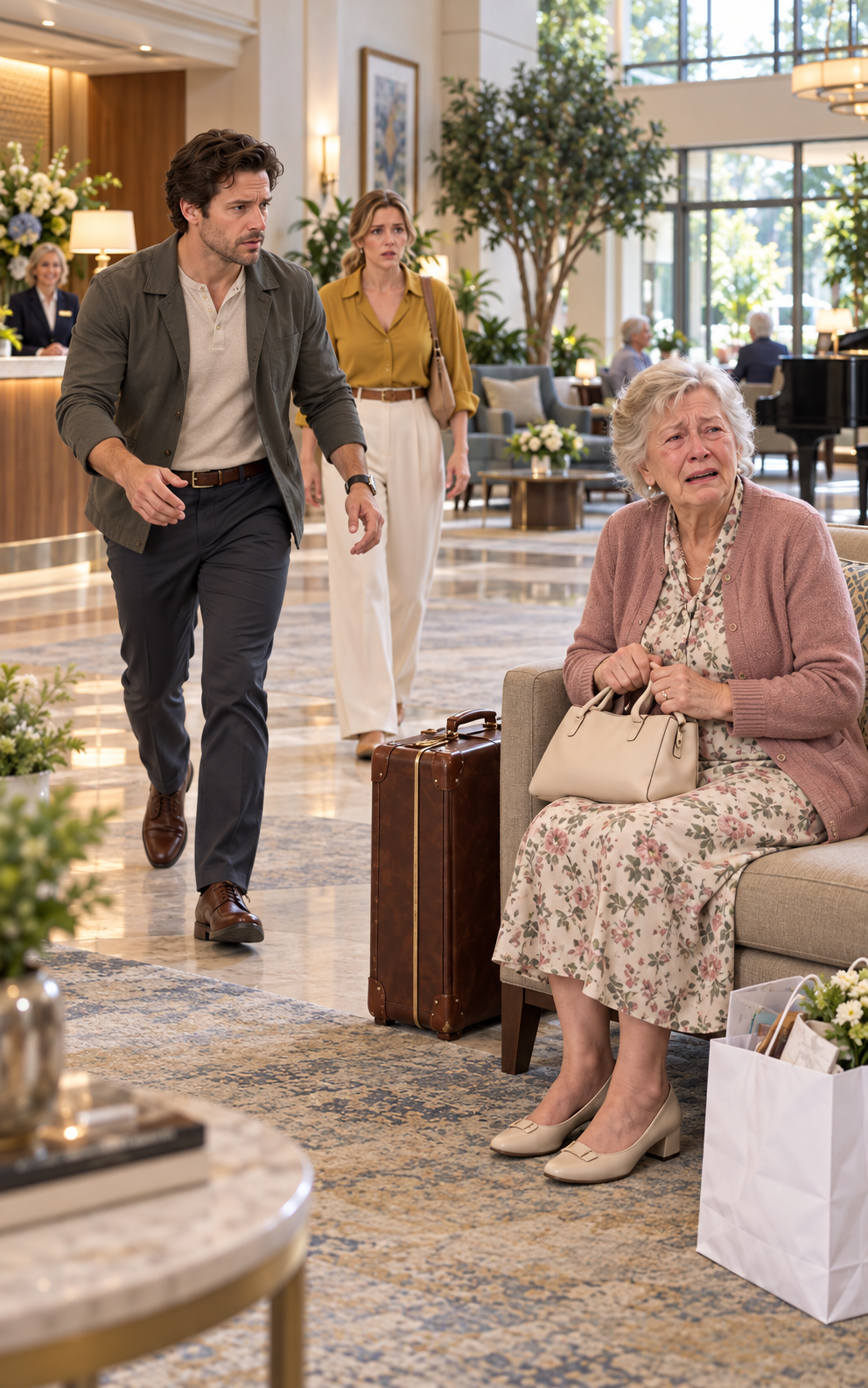
PART 1 TITLE: My Parents Promised Grandma an Ordinary Afternoon, but One Unexpected Phone Call Exposed a Decision That Would Tear Our Family Apart
The woman on the telephone asked whether I was Eleanor Sterling’s grandson. When I confirmed that I was, she lowered her voice and said my grandmother had been sitting in the reception area of a residential care facility for nearly three hours. Her suitcase was beside her chair. Nobody had completed the admission documents, and the relatives who brought her there had already left. For a moment, I assumed she had called the wrong person. Then she mentioned my father’s name, and everything became terribly real.
“My parents brought her there?” I asked. The woman introduced herself as an administrator and confirmed that Arthur and Wendy Sterling had arrived with Grandma shortly after lunch. According to the information they had provided, the family had supposedly discussed a permanent placement. Grandma, however, was insisting that she had agreed to nothing of the kind. The administrator had tried contacting my father without success. Grandma had finally given her my number. “She seems quite capable of explaining what happened,” the woman added carefully. “But she is very upset.”
I was standing in my apartment kitchen, holding a cup of coffee I had forgotten to drink. My grandmother lived almost 190 miles away, in the farmhouse on Willow Creek Road where she and my grandfather had spent most of their married lives. My parents lived considerably closer. Until that afternoon, I had believed they visited regularly to help her with shopping, household repairs, and financial matters. I put the untouched coffee in the sink, found my car keys, and asked the administrator to tell Grandma I was coming.
Before leaving, I called my father. He answered on the fourth ring, sounding irritated rather than surprised. When I mentioned the care facility, he exhaled sharply. “Ivan, this isn’t something you need to involve yourself in. Your grandmother has been struggling, and we’re handling it.” I asked when she had agreed to move. He said we could discuss the details later. When I pressed him about why she had been left without completed paperwork, his tone changed. “You don’t understand the situation. Stay out of it.”
My mother answered her telephone a few minutes later. Wendy had always been more skilled than my father at making unpleasant decisions sound considerate. She told me Grandma needed supervision, that everyone was exhausted, and that the facility was perfectly respectable. When I asked whether Grandma knew she was going there, she hesitated. It was a small silence, barely long enough to notice, but I had grown up listening for those pauses. They usually meant my parents had already decided which version of events they intended to present.
I drove away before my mother finished explaining. The sky was low and gray, and the highway was crowded with trucks throwing dirty water against my windshield. Every few miles, another memory surfaced. Grandma teaching me how to peel apples without breaking the skin. Grandpa Thomas showing me how to sand a piece of wood along the grain. Sunday dinners when my father complained about the cost of maintaining the farmhouse, while Grandma quietly passed another plate around the table. I had mistaken those arguments for ordinary family irritation.
My grandfather had died several years earlier, leaving Grandma to manage a house that seemed far too large whenever I visited and perfectly suited to her whenever I watched her move through it. She knew which window needed a wooden wedge during storms, which floorboards announced visitors, and exactly when the chrysanthemums required cutting back. She had never pretended that growing old was easy. Her knees troubled her, and she occasionally misplaced her reading glasses. Neither seemed a convincing reason to take away her home.
The facility stood behind a row of ornamental trees beside a busy road. Its brick entrance was clean, the glass doors polished, and a receptionist offered me a practiced smile when I introduced myself. Everything smelled faintly of disinfectant and overcooked vegetables. Grandma was sitting near a window with her handbag on her lap. Beside her stood a small blue suitcase I recognized from our family Christmas visits. She wore her good cream cardigan, pearl earrings, and the sensible shoes she reserved for going out.
She saw me before I reached her. Her expression changed, but she did not cry or reach out dramatically. Instead, she stood, smoothed her cardigan, and said, “You came sooner than I expected.” That nearly undid me. She had been waiting all afternoon, surrounded by strangers, and she was concerned that I had driven too quickly. I embraced her carefully. Her shoulders felt smaller beneath my hands than I remembered, but her grip around my back was firm. “Of course I came,” I said.
The administrator invited us into a small office so we could discuss what had happened. She was tactful, choosing her words with the caution of someone who understood that a family dispute could become a legal matter. My parents had indicated that Grandma needed residential care, but several essential questions remained unresolved. There had been no completed consent process establishing that Grandma had agreed to admission. The administrator also confirmed that my parents had departed before the necessary arrangements were finalized. Grandma listened without interrupting.
When the administrator finished, Grandma asked whether anyone had told her son that she was leaving with me. The woman said she had attempted to reach him and would need to follow the facility’s procedures concerning departure. Grandma nodded, thanked her for taking the time, and reached for the suitcase handle. I expected anger once we were alone. Instead, she asked whether I had eaten. I told her I hadn’t. “Neither have I,” she replied. “I suppose that makes two of us who were promised lunch.”
Outside, the afternoon had turned colder. Grandma paused beside my car and looked at the building behind us. “Your parents said we were going to a restaurant,” she told me. “Wendy even asked me to wear something nice. She said Arthur wanted to treat me because I had been spending too much time by myself.” Grandma gave the explanation without embellishment. They had stopped at the facility first, supposedly to meet somebody my father knew. Once inside, he introduced her as a prospective resident.
She had assumed there was a misunderstanding. My father spoke to the staff while my mother helped put her suitcase beside a chair. Grandma asked why they had brought luggage. Wendy told her it was only a precaution, because a short stay might be helpful while arrangements were discussed. Then they were gone. Grandma waited, believing they had stepped outside to retrieve something from the car. Eventually, a staff member explained that her family expected her to remain there. Nobody had asked her whether she wanted to.
I helped her into the passenger seat and placed the suitcase in the trunk. Before starting the engine, I asked a question that had been pressing against my thoughts for the entire drive. “Grandma, did Dad discuss moving you somewhere before today?” She examined the stitching on her handbag. “He discussed selling my house. When I told him I wouldn’t, he began discussing my health instead.” I turned toward her. She continued looking at the bag, working one finger beneath its worn leather handle.
At first, the conversations had sounded almost reasonable. Arthur suggested hiring someone to help with heavy cleaning. He offered to arrange appointments and review her bills. After Thomas died, Grandma had given him limited authority to assist with certain financial matters because she trusted him to handle the things she found tiring. Slowly, assistance became supervision. He began questioning purchases she remembered making and treating disagreements as evidence of forgetfulness. When she resisted, he accused her of being stubborn. Eventually, he started using a word she despised: confused.
“Have you been forgetting important things?” I asked. Grandma gave me a measured look. “I forgot the dentist’s appointment last spring. I also remember that your father promised to replace the broken gate in April and still hasn’t done it. Apparently, one of those failures proves I am incapable, while the other is simply Arthur being busy.” I almost laughed, but she was watching my face too closely. She needed to know whether I believed her, and I hated that she had been reduced to asking.
We drove to a small diner a few miles away. Grandma ordered chicken soup and half a sandwich, then sat quietly while I watched her lift the spoon. Only after she had eaten several mouthfuls did I ask about the house again. She laid the spoon down and studied me. “Your father has been taking money from my accounts,” she said. The statement was so calm that I initially failed to understand it. She waited while the words settled, then opened her handbag.
Inside was a thick envelope containing copies of bank statements. Several transactions had been marked in blue ink. Grandma spread the papers across the table between the salt shaker and the napkin holder. She pointed to a withdrawal of twenty-five thousand dollars. It had been made from an account used for household expenses and retirement income. My father had explained that the money covered an investment connected to property maintenance and future care. Grandma had asked for invoices. Nothing convincing ever arrived.
There was another transaction for eighteen thousand dollars, followed later by one for twelve thousand. Grandma had questioned both. Each time, Arthur provided a different explanation. One withdrawal was supposedly connected to insurance. Another had been needed for temporary banking arrangements. He insisted she had approved everything and occasionally claimed she had forgotten their conversations. “I know what I agreed to,” she said, placing her fingertip firmly beside the last figure. “And I know what I didn’t agree to. I kept asking him to show me the documents.”
I examined the dates and the account numbers. Fifty-five thousand dollars had moved out of her accounts through the three transactions she identified. I could not determine from those statements alone who had ultimately received the money, but the pattern was troubling. My father had been responsible for handling some of the transfers. Grandma showed me the notes she had written after conversations with him, including dates and brief reminders of what he claimed each payment concerned. She had been recording these details for months.
“Why didn’t you tell me sooner?” I asked. She looked through the diner window toward a family crossing the parking lot. A little boy was holding his grandfather’s hand and stepping carefully around a puddle. “Because he’s your father,” she answered. “I thought he had gotten into some difficulty, and I didn’t want you carrying it. Your grandfather spent years trying to help Arthur understand that borrowing money is not the same as having money. I hoped this would end before anyone else needed to know.”
The mention of Grandpa Thomas brought back memories I had not considered in years. He had been a patient man, more comfortable repairing a broken chair than arguing across a dinner table. But there were subjects on which he never compromised. The farmhouse was one. He had built much of it with his own hands, and he believed that neither family loyalty nor financial ambition justified placing someone else’s security at risk. I remembered hearing raised voices from his study during one of my last Christmas visits.
Grandma watched me remembering. “Your grandfather knew Arthur had borrowed more than he could repay,” she said. “He tried to help him straighten things out, but he also took steps to protect the house.” I asked what steps. She was quiet long enough for the waitress to refill our water glasses and collect the empty soup bowl. Then Grandma reached into her handbag again and produced a second envelope. The paper had yellowed around the edges. Two words were written across the front in Grandpa’s unmistakable handwriting: HOUSE DEED.
I examined the envelope without opening it. The handwriting made my throat tighten. Thomas had a distinctive way of forming capital letters, pressing so firmly that his pen sometimes dented the paper. Grandma explained that he had instructed her to keep this envelope somewhere other than the farmhouse. She had obeyed without asking enough questions. During the years following his death, she had considered opening it many times. Whenever Arthur began discussing the property, she thought about it again. Yet she had never been able to bring herself to break the seal.
“Why bring it today?” I asked. She touched the flap with one finger. “Because yesterday your father asked whether I still had the original property papers. This morning Wendy wanted to know where I kept my important records. Then they took me to lunch.” She let the sequence speak for itself. I looked from the envelope to the bank statements, beginning to see why Grandma had insisted I come without consulting my parents. This was no longer merely a disagreement over her living arrangements.
My telephone lit up with another call from my father. I turned the screen so she could see it. She shook her head before I asked. “Not yet, Ivan. If you speak to him now, he’ll tell you there has been a misunderstanding. He’ll insist I’m difficult, and he’ll promise to explain everything tomorrow. By tomorrow, he may have done whatever he was trying to do today.” I had never heard her speak about her son with such suspicion. I declined the call and placed the phone facedown.
I asked where she wanted to spend the night. My apartment was available, although the drive would be difficult for her after such a long day. We could find a nearby hotel or contact someone she trusted. Grandma considered the choices, then slid the HOUSE DEED envelope back into her handbag. “My house,” she said. “I want to go to my own house.” When I suggested that it might be wiser to wait, she asked me whose safety I was protecting by keeping her away.
We paid the bill, and I carried her suitcase back to the car. By then, the sun was sinking behind the bare trees, leaving the pavement damp and copper-colored beneath the streetlights. I entered Willow Creek Road into the navigation system. Grandma watched the route appear, then adjusted the seat belt across her shoulder. She seemed exhausted, but there was purpose in the way she held her handbag. Whatever my father had been planning, she had decided not to surrender another afternoon to uncertainty.
Ten minutes later, my telephone sounded again. This time Arthur had sent a message demanding to know where we were. Before I could put the phone away, a second message arrived, warning that I was interfering in matters beyond my understanding. I read it to Grandma. She looked out at the darkening road and asked whether he had mentioned her health or whether she was comfortable. He hadn’t. She gave a small nod, as though an unpleasant suspicion had finally become clear. “Then drive, Ivan,” she said. “I need to see what he’s done to my home.”
END PART 1
PART 2 TITLE: When We Returned to Grandma’s Farmhouse, My Father’s Car Was Waiting and the Documents He Had Searched for Were Missing
The first thing I noticed at the farmhouse was my father’s black SUV. It stood beside the garage, its dark windows reflecting the last pale light of evening. Grandma saw it at almost the same moment. Her hand tightened around the strap of her handbag, and she leaned forward to look past me. The gravel driveway was empty apart from his vehicle. None of the porch lights were on, but there was a yellow glow behind the kitchen curtains. I slowed the car before reaching the house.
“Perhaps he came to see whether you’d returned,” I suggested. Grandma shook her head. Arthur had been calling my telephone, not hers, and he had no reason to know where I intended to take her. More importantly, his SUV had been there long enough for moisture to settle on its windows. She asked me to park behind it. I was reluctant to bring her into a confrontation, but she was already reaching for the door handle. “If he has something to say about my house,” she said, “he can say it to me.”
The farmhouse stood beneath several old maples, their branches reaching over a porch that Thomas had rebuilt twice during my childhood. The white railings needed painting. The chrysanthemums near the steps were straggling in the cold. Everything appeared familiar until I saw the front door. It was slightly ajar. I stopped Grandma with one hand and listened. No voices came from inside. Somewhere upstairs, a faint mechanical clicking sounded, perhaps the heating system coming on. I told her to remain on the porch while I checked the rooms.
She moved past me before I finished speaking. “Arthur?” she called into the hallway. Her voice carried toward the stairs, then disappeared into the stillness. I followed her inside and closed the door behind us without turning the lock. The air smelled of furniture polish, cinnamon candles, and something dry and dusty beneath those familiar scents. My mother’s candles had been placed in the living room, although Grandma rarely used them. That detail troubled her more than I expected. Wendy had apparently been preparing the house to appear welcoming while its owner was being taken away.
The living room had not changed much since Thomas died. His armchair remained beside the fireplace, its leather cracked across one arm. Photographs filled the mantelpiece, including one of my grandparents standing outside the farmhouse on their fortieth anniversary. Grandma glanced around, making an inventory of things that belonged to her life. The blue wool blanket was folded where she always kept it. The book she had been reading remained on the side table. A pair of slippers stood neatly beside the armchair. Somebody had been careful not to disturb the rooms visitors would notice.
The study told a different story. Grandma reached the doorway first and stopped so suddenly that I nearly collided with her. Drawers hung open from Thomas’s old desk. File folders had been scattered across the carpet, some emptied completely. Paper clips glittered beneath the desk lamp. Several envelopes had been torn down one side, and the cupboard where Grandpa stored household accounts stood open. A brass lockbox, which had occupied the lower shelf for as long as I could remember, was missing. This was not ordinary searching. Someone had worked through the room with a purpose.
Grandma walked to the desk and touched a rectangular mark in the dust where a stack of records usually rested. I asked what had been there. “Copies of the property papers,” she answered. She checked the top drawer, then a small compartment beneath the writing surface. Her expression hardened. The original deed and certain papers from Thomas’s estate were no longer in their usual place. I asked whether she might have moved them. She turned slowly and looked at me, not offended by the question but disappointed that I still needed to ask it.
I photographed the room before touching anything else. The desk, the torn envelopes, the empty shelf, the opened drawers, and the marks left by missing objects all went into my telephone. Grandma remained near the doorway, watching me work. When I suggested calling the sheriff’s office, she hesitated. I understood why. Reporting a possible unauthorized entry meant acknowledging that her own son might be involved. For years she had apparently been protecting him from humiliation. Now even silence carried consequences. “Call,” she said eventually. “Tell them precisely what we found.”
The person who answered the non-emergency line asked whether we believed anyone was still inside. I said we had entered the house but had not searched every room. She advised us to avoid disturbing the study and gave instructions while arranging for a deputy to respond. When I ended the call, Grandma was studying the family photographs on the mantel. She held one showing Arthur as a young man beside his father. The resemblance was striking: the same dark eyebrows, the same broad shoulders, the same habit of standing with one hand in a pocket.
“Your grandfather worried about him long before you were old enough to understand,” she said. She placed the photograph on the desk and straightened its frame. Arthur had begun borrowing money in amounts that grew larger with each attempted solution. Thomas helped him more than once, but eventually he refused to risk the farmhouse. I asked whether their arguments had been about inheritance. Grandma answered carefully. Arthur believed the property should someday belong to him because he was their son. Thomas believed a house was not something a person was entitled to claim merely because of his birth.
Two years before his death, Grandpa had revised his estate arrangements. Grandma would retain the house and the right to live there throughout her lifetime. What happened afterward would depend on the provisions Thomas had established, not on Arthur’s assumptions. Grandma explained that the terms were designed to prevent the property from being casually pledged against debts. I asked why Thomas had never explained this to me. She smiled without amusement. “He thought we had years to discuss it. Your grandfather was very good at planning for everything except the time he wouldn’t have.”
I remembered visiting during the winter when Thomas’s health had begun to decline. Arthur had spent nearly an hour behind the closed study door with him. When he emerged, he was furious, although he claimed they had only disagreed about repairs. That evening, Grandpa had invited me to help sort tools in the shed. I recalled him asking whether I understood the difference between helping somebody and allowing them to make their problems yours. At the time, I thought he was speaking about a friend of mine who constantly borrowed money. Now I wasn’t certain.
Grandma moved toward the hallway and checked the kitchen cupboards. Nothing obvious had been taken. Upstairs, the bedroom she once shared with Thomas remained untouched. His old slippers were still beneath the bed, and a folded quilt rested inside the wardrobe. When she returned downstairs, she was carrying the framed photograph from their bedside table. She set it beside the desk and looked at the empty lockbox shelf. “Whoever came here didn’t want my jewelry,” she said. “They wanted information. Perhaps they thought the papers would tell them how to make the house theirs.”
I was examining the underside of the desk when headlights moved across the kitchen wall. A silver sedan pulled into the driveway and stopped behind my car. My mother stepped out without taking time to button her coat. She walked quickly toward the porch, her heels striking the paving stones. Her expression was tense, almost furious. She must have recognized my car because she barely glanced toward the garage. Grandma watched from the study doorway. “Let her come in,” she said. “I want to hear the explanation she has prepared.”
Wendy entered with a rush of cold air. She stopped when she saw Grandma standing beside the desk. For a second, relief crossed her face. Then she looked at me. “Ivan, your father has been trying to reach you all afternoon. Do you have any idea what you’ve put everyone through?” She approached Grandma and held out her hands, but Grandma didn’t move. My mother lowered them awkwardly. The silence gave me time to notice something unusual. Wendy’s hair was disordered, and a pale dust mark showed on the cuff of her coat.
I asked how she could leave Grandma at a care facility without explaining that she was expected to remain there. Wendy insisted that no one had intended to abandon her. She described a temporary arrangement, an evaluation, a chance for professional staff to determine what assistance Grandma needed. Every sentence sounded familiar. They were variations of the excuses she had offered on the telephone. I pointed out that Grandma had been invited to lunch, not a meeting about residential care. My mother’s mouth tightened. “We knew she would refuse if we made a formal appointment.”
“Then you knew she didn’t agree,” I said. Wendy looked at Grandma, perhaps expecting her to argue, but Eleanor remained still. My mother began describing forgotten appointments, difficult conversations, and her concern that Grandma was no longer safe living alone. I asked for a specific incident in which Grandma had endangered herself. Wendy mentioned a stove burner supposedly left on. Grandma calmly explained that the burner had been turned off when Arthur entered the kitchen, and that he had later described the incident differently. My mother offered no correction.
The conversation changed when Grandma asked about the study. Wendy looked past us toward the scattered files. Her gaze rested briefly on the empty shelf. I saw the moment she understood what we had discovered. “Have you been looking through Thomas’s records?” Grandma asked. Wendy said she had no reason to do such a thing. Then Grandma asked where the original deed was. My mother turned away and busied herself adjusting the strap of her handbag. The gesture was so automatic that it revealed more than any answer.
I told her the sheriff’s office had been contacted. Wendy’s head lifted sharply. She asked why I would involve the police in a disagreement between relatives. Grandma answered before I could. “Someone has entered my study, removed documents, and left everything in disorder. I want to know who did it.” Wendy began pacing near the fireplace, repeating that the family could resolve matters privately. I asked how she proposed to resolve the missing money. Her steps stopped. She turned toward me, and the irritation in her expression gave way to apprehension.
I laid Grandma’s bank statements on the table and pointed to the marked transactions. Wendy stared at the figures, then looked toward the window. At first, she claimed not to understand why Grandma was questioning legitimate expenses. I asked whether twenty-five thousand dollars qualified as an ordinary care expense when no corresponding invoice existed. Her face changed. I could almost see her deciding whether another denial would make things worse. Finally, she admitted that Arthur had been transferring money between accounts. He had told her the arrangement was temporary, and she had chosen to believe him.
“Temporary for whose benefit?” Grandma asked. Wendy rubbed her forehead. She said Arthur was under financial pressure because of business difficulties. Certain payments had come due, and he expected to recover the money once an investment was completed. She couldn’t explain the full details. When Grandma asked why she had not been told, Wendy answered that Arthur didn’t want to worry her. Grandma looked down at the statements. “He was comfortable taking my savings,” she replied, “but he was concerned that hearing about it might upset me?”
Wendy began crying, although she still seemed more frightened than remorseful. She explained that my father had become increasingly anxious about the farmhouse. He believed selling it would solve the financial problems, but Grandma’s refusal had left him searching for another approach. The discussion of residential care had begun soon afterward. I asked whether she understood how those events looked together. She said Arthur had convinced her the arrangement would help everyone. Grandma asked whom she meant by everyone. My mother could not answer without looking at the missing deed.
The room had grown dim. I switched on the lamp beside Grandpa’s chair, and the yellow light settled across the papers between us. Grandma lowered herself into the armchair and asked Wendy to sit. My mother remained standing. “I want to know what your husband intends to do with my home,” Grandma said. Wendy admitted that Arthur had mentioned a deadline before the end of the month. He needed documents signed, apparently connected to the property and his debts. She claimed he had not told her exactly what the agreement contained.
Grandma asked whether Wendy had seen those documents. My mother shook her head, then admitted Arthur had referred to a proposed sale or financial arrangement. He had insisted that Eleanor would eventually cooperate once she understood the consequences of refusing. I asked whether that was why they had taken her to the facility. Wendy turned toward me with tears on her cheeks. “I thought she might be more willing to discuss the house after a few days away,” she said. The sentence made Grandma’s hands tighten on the chair.
There was no immediate shouting. Grandma simply looked at the woman who had shared her family’s birthdays, holidays, and ordinary dinners for decades. “You helped him take me somewhere against my wishes so I might agree to give up my property?” she asked. Wendy tried to distinguish persuasion from coercion, but every explanation exposed the same intention. My parents had considered Grandma’s refusal an inconvenience to be overcome. Her right to make decisions had become negotiable because those decisions interfered with Arthur’s needs.
A firm knock at the front door ended the conversation. The sheriff’s deputy introduced himself and asked who owned the property. Grandma stood and explained that the house was hers, that she had found the study disturbed, and that documents appeared to be missing. The deputy listened while I showed him the photographs. He inspected the room, recorded the visible damage, and asked when the house had last been secured. Wendy remained beside the fireplace, twisting a tissue in her hands. When he asked who might have entered, Grandma mentioned Arthur.
The deputy was careful not to draw conclusions. He explained that he would document the complaint and that questions about ownership, financial authority, and disputed agreements might require additional records and professional review. Grandma agreed. Then she asked me to fetch the HOUSE DEED envelope from my car. I brought it inside and placed it on the table. Grandpa’s handwriting was visible to everyone. The deputy asked whether it contained the deed. Grandma said she had never opened it, only followed Thomas’s instruction to preserve it separately from the household papers.
For several seconds, Grandma examined the envelope without moving. Then she carefully loosened the flap and removed its contents. A folded sheet of paper slipped onto the table beside a smaller handwritten note. There was no deed. She recognized the handwriting immediately and began reading. Her face changed before she reached the bottom of the first page. She handed it to me, unable to speak. The letter was addressed to her, and Grandpa had written it in anticipation of a moment like this one: Arthur might someday try to claim control over the house, and Eleanor needed to know that Thomas had protected more than the deed itself.
END PART 2
PART 3 TITLE: Grandpa’s Hidden Letter Revealed Why My Father Wanted Grandma Gone, but a Message on My Mother’s Phone Exposed Something Worse
My grandfather had written the letter as though he expected his son to read it someday, even though every word was addressed to Grandma. Thomas described his concerns about Arthur’s growing debts and his habit of treating the farmhouse as a financial resource that would eventually become available to him. He mentioned an agreement connected to the land, separate from the ordinary ownership documents, and warned that the original deed alone would not establish everything Arthur believed it established. I read the page twice, conscious of the deputy watching me and my mother standing absolutely still.
The letter was brief, but the implications were considerable. Thomas had apparently made arrangements involving the property that Arthur either did not understand or had chosen to disregard. He had preserved evidence elsewhere, outside the study, where a determined search would not easily uncover it. The note accompanying the letter directed Eleanor to seek proper advice if the documents disappeared. I asked Grandma whether she knew which agreement Thomas meant. She touched the edge of the paper. “We talked about the land years ago,” she said. “I never imagined Arthur would make it necessary to understand every detail.”
My mother moved closer to the table, then stopped when Grandma looked up. She asked whether Thomas had been ill when he wrote the letter, as though that might explain its contents. Grandma reminded her that Grandpa had been meticulous with financial records until his final months. Even when his health deteriorated, he checked every figure and kept copies of the correspondence he considered important. He might have trusted people too readily, but he had never been careless with legal papers. Wendy lowered her eyes, apparently realizing that questioning his judgment would not help her position.
The deputy asked permission to photograph the letter and note for his report. Grandma agreed after confirming she could retain the originals. He documented the circumstances in which the envelope had been opened and advised us to preserve the documents carefully. While he worked, I noticed how Grandma held herself. She was frightened; I could see it in the way her fingers trembled when she refolded the paper. But the uncertainty that had surrounded her at the facility was gone. Someone had finally acknowledged that her concerns were worth examining.
I asked whether Grandpa had ever explained why the original property records should be kept in different locations. Grandma remembered a conversation during the winter before his death. Arthur had visited unexpectedly, asking questions about the land and whether an advance could be obtained against its value. After he left, Thomas had locked himself in the study. Later, he told Eleanor that certain papers needed to remain beyond Arthur’s reach. She had objected to keeping secrets from their son. Thomas had answered that protecting a family sometimes required refusing a request that would destroy it.
The memory clearly troubled her. For years, Grandma had interpreted Thomas’s concern as excessive caution toward a son who made poor financial decisions. She believed Arthur would eventually mature, recover from his setbacks, and learn to distinguish his responsibilities from his parents’ property. Now, standing in a house that had been searched while she was being abandoned at a care facility, she was forced to reconsider that belief. I had never seen her so reluctant to speak about my father. It seemed painful for her to describe his actions without making excuses.
The deputy asked Wendy whether she knew anything about the missing records. She said Arthur had been handling paperwork connected to the estate but that she could not identify what had been removed. When he asked whether she had entered the study recently, she paused, then admitted she sometimes accompanied her husband when he came to help Eleanor with household matters. She was careful not to say she had participated in the search. I remembered the dust on her coat, but I said nothing yet. Accusations would be less useful than determining exactly what she knew.
Wendy’s telephone vibrated on the mantel. She glanced at the screen, and her expression changed. I asked whether Arthur had called. She shook her head too quickly. Another message appeared before she could put the phone away. Grandma held out her hand. “Wendy, I need you to stop protecting him long enough to understand what is happening.” My mother hesitated. The deputy continued writing in his notebook, giving her time to decide. Then she turned the screen toward us. Both messages were from Arthur. He was asking whether she had located a second envelope and ordering her to keep it from me.
I felt a sudden, almost physical sense of recognition. My grandfather had always enjoyed small hiding places. During my childhood, he kept spare change in a tin beneath his workbench and important keys inside an old wooden clock. When I was twelve, he showed me a loose brick near the fireplace in the upstairs guest room. He explained how the house had been built with concealed spaces that were useful for storing valuables. At the time, I had been fascinated by the trick. I had forgotten about it until my father’s message appeared.
I asked Grandma whether Thomas had ever hidden documents upstairs. She looked toward the staircase, her brows drawing together. “In the guest room?” she asked. I nodded. She remembered him repairing the fireplace surround shortly before his final illness, although she had assumed he was fixing damaged mortar. Something in the memory unsettled her. Before we could discuss it further, Wendy stepped between us and the stairs. “Please don’t go up there,” she said. Her voice had lost its practiced composure. She looked genuinely afraid.
The deputy asked her to explain. Wendy glanced toward the study, then at the window. Arthur had warned her that certain papers connected to the farmhouse could cause serious trouble if discovered, she admitted. He had mentioned a compartment behind the upstairs wall and instructed her not to disturb it without him. I asked when they had discussed this. She said it was during the previous week, when Arthur began gathering records for the proposed financial transaction. Grandma took a slow breath. The second envelope was not merely something my father hoped to find. He apparently already knew where to search.
I noticed the pale dust on Wendy’s thumb when she reached for another tissue. It was finer than the ordinary household dust on the study shelves, almost like powdered plaster. A similar substance clung to the old mortar around the guest-room fireplace. I asked whether she had been upstairs that evening. She insisted she had not touched anything important. That was not an answer. When I pointed to the mark on her hand, she covered it with her other fingers. “Arthur asked me to help him look,” she finally admitted. “I didn’t know what he was expecting to find.”
Grandma sank into Thomas’s chair. For a moment, the evidence around us seemed less important than the sight of her sitting where her husband had once sat, trying to understand how their son had turned a lifetime of family trust into a hunt for documents. She asked Wendy whether Arthur had removed anything from the guest room. My mother claimed she had not seen him take anything. Then she added that he had searched the wall several days earlier. The admission explained why the study had been disturbed. My father had been looking through every place where Thomas might have left evidence.
The deputy advised us not to open walls or alter any suspected hiding place while the matter was being documented. He needed to establish what had been disturbed and whether additional official steps were appropriate. Grandma accepted his advice. She asked that the guest-room fireplace be photographed and the existing condition of the study recorded. I could hear the strain in her voice, but she made each request carefully. She was no longer allowing Arthur’s urgency to determine what happened next. Even if the property was at risk, she wanted the facts preserved.
We waited downstairs while the deputy made his observations. Wendy sat on the edge of the sofa, holding her phone with both hands. Grandma kept Grandpa’s letter folded against her lap. I stood near the window, looking at my father’s SUV beside the garage. The house had grown cold, but nobody suggested lighting a fire. Through the glass, I could see the maple branches moving in the wind. I wondered how many evenings my grandparents had spent in that room believing their son would someday appreciate what they had worked to preserve.
Near nine o’clock, a message arrived on my telephone from a number I did not recognize. It claimed Grandma had withheld information about Thomas’s final days. A second message told me to ask what had happened during the week before he died. I stared at the screen, unsure whether the sender knew anything genuine or was simply trying to frighten me. The timing was too precise to ignore. Someone knew we were examining Grandpa’s papers, and someone wanted me to question the woman I had driven across the state to bring home.
I showed the messages to Grandma. Her reaction was immediate. She lowered her eyes to the telephone, then closed them briefly. When she looked at me again, the steadiness she had maintained all evening had given way to visible fear. She asked where the messages had come from. I told her there was no name attached. Wendy leaned forward as though she wanted to see the screen, but Grandma held up a hand to stop her. “You deserve an answer,” she told me. “I should have given it to you years ago.”
She explained that Thomas had grown increasingly worried during his final week. Arthur had visited him more than once, pressing him for information about the estate and the arrangements involving the land. Thomas believed his son might have discovered enough to attempt something dangerous. Grandma had never been certain exactly what Arthur had learned, only that the conversations left Thomas distressed. After one visit, he asked her whether the important documents were still safe. She reassured him without checking. That omission had troubled her ever since.
I asked whether Arthur had threatened Grandpa. Grandma was careful. She had not witnessed a threat, and she would not claim one had occurred. What she knew was that Thomas feared Arthur might use the family property to secure obligations that were not theirs. He had insisted that the arrangements he made remained essential after his death. Grandma could still remember his frustration when she suggested that Arthur would never deliberately endanger her. “He told me that desperation changes the way people justify things,” she said. “I thought he was being unfair.”
The anonymous messages had accomplished something I doubted their sender anticipated. Rather than making me distrust Grandma, they revealed the extent of the burden she had carried alone. She had been protecting her son’s reputation while trying to respect her husband’s warnings. She had also been afraid that telling me would force a choice between my father and the grandparents who raised me through so many summers. I told her I wished she had spoken sooner. She nodded. “So do I, Ivan. But I cannot change yesterday by pretending today is different.”
At that moment, a car approached along the driveway. Headlights passed across the curtains, and an engine stopped near the porch. My father’s SUV was already parked by the garage, so he must have arrived in another vehicle. Heavy footsteps crossed the boards outside. Arthur entered without knocking. He wore a dark coat and carried a leather folder beneath one arm. His eyes moved from the deputy to my mother, then to the papers beside Grandma. He greeted nobody. For several seconds, the only sound was the ticking clock above the fireplace.
“Mother, I need the letter,” he said. Grandma did not rise. She asked why he needed it. He explained that she had misunderstood the estate arrangements and that certain documents could be misinterpreted without professional guidance. The deputy asked whether Arthur possessed authorization to act concerning the property. My father said he held power of attorney and had been managing Eleanor’s affairs for some time. Grandma replied that she had never given him permission to move her into a facility against her wishes or use her home to settle his debts.
Arthur’s expression hardened. He told the deputy that his mother had become increasingly unreliable and was being influenced by relatives who knew nothing about her finances. When he gestured toward me and referred to me as an interfering family member, I reminded him that I was his son. He barely acknowledged the correction. I had spent years trying to avoid arguments with him, believing that cooperation might eventually earn his approval. Watching him describe Grandma as incompetent while she sat clearly explaining her own decisions made that old instinct feel impossible to obey.
I asked him directly whether he had removed the missing deed and lockbox. He replied that he had been organizing records in his capacity as the person responsible for assisting Grandma. When I asked where the documents were, he said they were being handled. He would not identify by whom. Grandma asked whether he had already arranged a transaction involving the house. His silence lasted long enough for Wendy to look away. Then he told us that the property was in financial danger and that we should allow him to resolve the situation before making accusations.
The deputy reminded Arthur that the existence of a power of attorney did not settle the questions being raised. Any document would have to be examined in light of its terms and the applicable legal requirements. My father bristled at the suggestion that his authority might be limited. He opened the folder and removed several folded pages. “You all think I’m trying to steal something,” he said. “But I’ve been doing what is necessary to prevent this family from losing everything.” He placed the pages on the coffee table without releasing them.
Grandma stood and approached him. Her movements were slow, but she did not ask for my help. She looked down at the document and then at the signature visible near the bottom. The anger left her face, replaced by an expression of almost unbearable sadness. “Arthur,” she said, “tell me you haven’t already committed my house to this.” He answered that there was still time to complete the necessary arrangements. Grandma’s eyes fixed on the date beside his name. She stepped back and told him she recognized what he had done. He had signed a financial agreement using the authority she once trusted him to exercise.
END PART 3
PART 4 TITLE: The Financial Agreement My Father Tried to Hide Exposed His Betrayal, and My Mother Finally Revealed the Evidence He Feared Most
My father placed the agreement on the coffee table, but he kept one hand over the final page. Grandma stood opposite him, watching his fingers. The document looked ordinary enough: several sheets of white paper, numbered paragraphs, typed financial terms, and spaces for signatures. Nothing about its appearance suggested that it could destroy decades of trust. Yet my father’s reluctance to let anyone examine it told me how important it was. When Grandma reached for the papers, Arthur pulled them back and insisted that she would misunderstand their meaning.
The deputy remained beside the fireplace. He reminded Arthur that everyone was discussing a disputed transaction and that making unsupported claims about its legal effect would help nobody. Finally, my father released the document. Grandma unfolded the pages carefully, smoothing them with both palms. She read slowly, following each line with her eyes. By the time she reached the signature, the color had drained from her face. She handed the agreement to me without speaking. I had never seen her struggle so visibly to remain composed.
The document concerned a proposed loan through a private lending company. The farmhouse and associated property interests were identified as security for a substantial financial obligation. My father had signed as someone exercising authority on Eleanor’s behalf. The date was from the previous week. I read the relevant passage again, making certain I understood it. The agreement appeared to be preliminary, and nothing on those pages alone established that the property had legally changed hands. Nevertheless, Arthur had committed himself to a transaction involving a home that did not belong to him.
I looked at him. “Did Grandma authorize this?” He answered by pointing to the power-of-attorney reference. I asked the question again. He said the authority allowed him to arrange financial matters. Grandma corrected him immediately. She had permitted him to assist with banking and certain practical decisions. She had not instructed him to pledge her house as security for his business obligations. Arthur insisted the loan would protect the property rather than endanger it. When she asked how borrowing against her home would accomplish that, he began speaking about deadlines and temporary arrangements.
His explanation grew more complicated with each sentence. Creditors were pressing for payment. His business had suffered setbacks. Money expected from an investment had not arrived, and the loan would provide enough time to stabilize his accounts. Once things improved, he intended to repay what he owed and release the property from the arrangement. I asked what would happen if the business did not recover. He stared at me as though I had asked something deliberately offensive. “It will recover,” he said. I pointed out that confidence was not collateral.
Grandma wanted to know precisely when he had begun treating her farmhouse as a solution to his financial problems. Arthur said he had considered several possibilities before settling on this one. She asked how many of those possibilities he had discussed with her. He did not answer. The silence was painful because she had spent years giving him opportunities to speak honestly. She had listened when he described disappointing investments and difficult customers. She had offered meals, reassurance, and occasional financial help. Now he could not explain why he had decided her consent was unnecessary.
My mother had been standing near the mantel throughout the exchange. She finally approached Arthur and touched his arm. “Tell them everything,” she said. He turned toward her with an expression that made her withdraw her hand. He reminded her that they had discussed the arrangement and accused her of making matters worse. Wendy admitted they had discussed the debts, but she insisted he had told her Eleanor agreed to the transaction. She had believed there would be a legitimate sale or refinancing arrangement. She had not understood that he intended to proceed without securing Grandma’s approval.
“Then why did you help take me away?” Grandma asked. My mother covered her mouth, but Eleanor waited. Wendy eventually admitted that Arthur wanted time to complete arrangements without further arguments. He believed a temporary placement would make it easier for the family to settle the property’s future. She had agreed because he assured her the facility would provide appropriate care. Grandma asked whether anyone had considered what she wanted. Wendy began explaining that she had been afraid of losing their home and financial stability. Eleanor interrupted gently. “I am asking about my wishes, Wendy. Not your fears.”
Arthur took another step forward. He claimed the family was facing a crisis none of us understood and that every alternative had been exhausted. Grandma listened until he finished. Then she asked for the names of the creditors and the amount of debt he was trying to secure. He offered approximate figures and complained that the details were too complex to explain in a living room. She reminded him that the living room belonged to the person whose property he intended to use. If he wanted her trust, he could begin with the actual numbers.
My father looked toward the deputy, apparently hoping the conversation would end. The deputy explained that the financial agreement and existing authority needed professional examination. He made no determination about the validity of the proposed loan, but he advised everyone to preserve the documents. Arthur seemed frustrated that no one would accept his description of the arrangement as a harmless administrative matter. He reached for the agreement, and Grandma moved it farther from him. The gesture was small. For her, it represented a boundary she had avoided establishing for many years.
I asked about the fifty-five thousand dollars missing from Grandma’s accounts. Arthur’s expression changed. He admitted making transfers but described them as temporary advances connected to an investment strategy. Grandma asked why the money had been withdrawn from accounts intended for her living expenses. He claimed that everything remained recoverable. When I asked to see the investment records, he said they were unavailable that evening. I reminded him that he had been given weeks to produce them. He looked at me with open irritation. “You’re treating me like a criminal,” he said.
“I am treating you like someone who owes Grandma an explanation,” I answered. The words came out more steadily than I expected. My father had spent much of my childhood teaching me that difficult questions were disrespectful. I had learned to choose silence whenever his mood darkened. Now I watched him use the same pressure against an elderly woman whose only mistake had been trusting him. I thought of Grandma waiting at the care facility, her blue suitcase beside her chair. Whatever financial trouble Arthur faced, leaving her there had been a choice.
Wendy suddenly said she had something to show us. Arthur turned toward her immediately. “Don’t,” he warned. My mother opened her handbag and removed a small cream-colored envelope. It was thinner than the HOUSE DEED envelope and had no obvious label. She explained that Arthur had given it to her three days earlier, instructing her to keep it safe until the property arrangements were completed. He had described its contents as final documents prepared through an attorney associated with the family’s estate matters. Grandma stared at the envelope without reaching for it.
“Which attorney?” she asked. Wendy gave the name of the lawyer who had assisted Thomas with earlier estate planning. Grandma shook her head. That lawyer had died four years before. My mother looked at Arthur, waiting for a correction. He suggested that another professional might have completed work begun earlier, but he offered no name or correspondence. The explanation did not satisfy anyone. The deputy asked Wendy to place the envelope on the table while he recorded how it had been produced. My father folded his arms and stared at the wall.
Grandma asked me to open the envelope in front of everyone. I carefully lifted the flap and removed several photocopied records, a draft property agreement, and handwritten notes attached to the final pages. The paper smelled faintly of printer toner. Some sheets had been folded repeatedly, while others looked newly prepared. I arranged them on the coffee table in the order they appeared. My mother stood behind me, reading over my shoulder. Arthur remained silent, but I could hear his breathing change as I turned the pages.
The first documents concerned the proposed transfer of the farmhouse. The next listed financial liabilities associated with my father’s business. Three figures appeared among the entries: twenty-five thousand dollars, eighteen thousand dollars, and twelve thousand dollars. I recognized them immediately. They matched the amounts Grandma had marked on her bank statements. Arthur had told her the withdrawals were related to investments, insurance, and her future care. Here, the same sums appeared among arrangements intended to address debts connected to him. I could not yet trace every transaction, but the connection was impossible to dismiss.
I asked why he had not explained these figures when Grandma first questioned the withdrawals. Arthur replied that the arrangements were complicated and that the money would eventually be restored. He seemed to believe the promise itself was sufficient. Grandma asked how much of her savings remained available for her own needs. He gave an uncertain answer. She asked whether any of the money had actually been spent on her care. Again, he could not provide a straightforward explanation. Wendy sat down, staring at the documents as though she had never seen them before.
Then I discovered the handwritten note attached to the last page. It referred to Grandma’s placement in residential care and indicated that once she was there, resistance to the proposed property arrangements should be easier to manage. The wording was unmistakably deliberate. I read the note aloud, slowly enough for everyone to understand. My mother began shaking her head. Arthur looked down at the floor. Grandma closed her eyes. Until that moment, my parents had insisted that the facility was meant to protect her. The note suggested that her absence served another purpose.
“Who wrote this?” I asked. Nobody answered. I compared the handwriting with an earlier note my father had written on one of Grandma’s financial records. The shape of certain letters was familiar, although I knew that handwriting alone would not establish authorship. Grandma opened her eyes and asked Arthur directly. He swallowed, glanced toward Wendy, and admitted that the note was his. My mother made a small, wounded sound. She had helped him carry out the plan, but the written evidence appeared to confront her with its intention in a way his explanations had not.
Grandma looked at her son for a long time. She asked whether he had intended to use her absence to secure signatures or establish greater control over her property. Arthur denied wanting to harm her. He said he needed time and believed everyone would eventually understand. Grandma replied that the question was not whether he wanted to hurt her. It was whether he had been willing to take away her choices in order to get what he wanted. Arthur opened his mouth, then stopped. For once, he seemed unable to find an explanation that made his conduct sound reasonable.
I expected Grandma to become angry. Instead, she asked him to sit. Arthur obeyed reluctantly, taking the chair opposite her. She reminded him that he had grown up in the farmhouse, eaten at its table, and watched Thomas work to keep it secure. She asked whether he remembered how many years his father had spent paying for the original property. He nodded. Then she asked why he believed those sacrifices gave him a right to risk everything they had built. He began crying quietly, but his tears did not answer her question.
The deputy allowed the conversation to settle before explaining the next steps. The documents would need to be examined by appropriate legal and financial professionals. The condition of the study had been recorded, and any suspected misuse of authority would require evidence beyond the arguments taking place in the living room. He advised us to keep the original papers secure, avoid altering them, and seek qualified legal assistance promptly. Grandma thanked him. She wanted the investigation handled properly, regardless of where the evidence led.
When the deputy finished speaking, Grandma turned toward the staircase. She asked whether the second envelope had been the only material Arthur hoped to recover from the upstairs hiding place. My father looked up sharply. He said there was nothing useful left to find and urged her not to disturb the house further. Grandma reminded him that the house was hers. Then she looked at the papers on the coffee table and asked a different question. “Arthur, did you ever find the records your father kept about the land itself?” His reaction told me he understood exactly what she meant.
Grandma walked to the fireplace and studied the wooden mantel. There was a small scratch near its right corner, barely noticeable beneath years of polish. Thomas had made it during the winter before his death, she explained, when he was organizing certain records. She moved a decorative clock and reached behind it. Her fingers closed around a small brass key. My father rose so abruptly that his chair scraped against the floor. He demanded to know where she had obtained it. Grandma held it up. “Your father gave this to me,” she answered.
For the first time all evening, I saw genuine alarm on Arthur’s face. He had searched the study, located at least some of the papers, and tried to complete a financial transaction involving the house. Yet he appeared to have no idea what the key opened. Grandma asked the deputy whether we could examine a compartment she knew existed in Thomas’s desk while he was present. After the condition of the furniture had been documented and he had advised us to handle any contents carefully, she led us into the study.
Thomas’s desk was heavy oak, scarred along the edges by decades of use. Grandma knelt beside the lower drawer and felt beneath its frame. I offered to help, but she shook her head. She had watched her husband use the mechanism years earlier and wanted to locate it herself. After a moment, she found a narrow opening concealed near the back. The brass key fitted perfectly. She turned it gently. A small wooden panel shifted, revealing a compartment invisible to anyone searching only the ordinary drawers.
Inside lay a sealed packet, a worn leather notebook, and a photograph of Thomas beside a man I did not recognize. Grandma removed the notebook and opened it on the desk. Its pages contained dates, names, references to the farmhouse, and notes about agreements Thomas had arranged years before his death. Several entries concerned an additional interest connected to a narrow strip of land along the property’s boundary. The details were technical, and I could not determine their legal effect, but the records clearly indicated that the deed Arthur had been searching for did not tell the entire story.
My father leaned forward to examine the papers. Grandma closed the notebook before he could touch it. She turned to the page containing a reference to a local attorney who had witnessed earlier agreements, then asked the deputy to document the discovery. I looked at the photograph and wondered whether the unfamiliar man was connected to the records. Thomas had apparently preserved evidence of his intentions in more than one place. The farmhouse was not merely an asset my father could assume was waiting for him. Its ownership and associated rights depended on arrangements he had never fully understood.
Grandma carefully returned the documents to the desk. Her eyes were wet, but her voice remained steady. She said Thomas had tried to protect the property without destroying the family, and she had continued that effort for years after his death. Now she could see what her silence had allowed. Arthur stood near the doorway, unable to meet her eyes. Wendy was crying softly. I looked at the leather notebook and the name of the attorney written inside it. We finally had more than my father’s promises to examine.
Grandma asked me to arrange a meeting with a lawyer experienced in protecting older people’s financial interests. She wanted the bank statements reviewed, the disputed authority examined, and the property records checked against the official documents. She did not ask us to punish Arthur immediately or promise never to speak to him again. What she asked was more difficult for him to accept. Until those matters were resolved, he would no longer make financial decisions for her, and every proposed transaction involving the farmhouse would face independent scrutiny. My father objected, but Grandma did not retreat.
As we prepared to leave the study, I noticed a final entry near the back of Grandpa’s notebook. It referred to an agreement involving the land and a separate location where supporting records had been preserved. The entry was dated during the period when Thomas had been arguing with Arthur about his debts. I showed it to Grandma. She studied the handwriting, then looked at the packet we had found. She told me that the lawyer would need to examine everything before we drew conclusions. But one fact was already clear: my father had tried to use a property whose legal history he did not fully know, and Grandpa had left the means to challenge him.
END PART 4
PART 5 TITLE: The Document My Father Brought Into Grandma’s House Revealed a Betrayal Far More Deliberate Than Any of Us Had Imagined
My father stood in the middle of Grandma Eleanor’s living room, staring at the document he had placed on the coffee table. The sheriff’s deputy remained near the fireplace, his notebook open. Wendy, my mother, stood beside the window with her arms folded tightly across her chest. Nobody seemed willing to speak. The farmhouse clock continued ticking above the mantel, measuring seconds that felt much longer than they should have. Then Grandma reached for the paper. Arthur moved as though he intended to stop her, but something in her expression made him remain where he was.
“Let me see what you’ve signed,” she said. Her voice carried none of the uncertainty my father had spent months insisting she suffered from. It was steady, almost businesslike. Arthur hesitated, then released the document. Grandma unfolded the pages and examined them without asking anyone to explain the language. I watched her eyes move from the heading to the figures beneath it. At one point, she removed her glasses, cleaned them with the corner of her handkerchief, and read the same paragraph again. When she finally looked up, her face had changed. She seemed less shocked than deeply disappointed.
“Arthur,” she said, “you knew your father arranged matters specifically to prevent this.” My father shifted his weight. “Mother, you don’t understand how the financing works.” Grandma laid the document flat. “Then answer a simple question. Did I authorize you to offer my home as security for your debts?” He glanced toward the deputy. “I have power of attorney.” She waited. “That was not what I asked.” The silence that followed was so complete that I heard the heating system click on somewhere beneath the floorboards. Arthur adjusted his jacket cuffs, the way he always did when he wanted more time to invent a respectable answer.
I stepped closer to the table. The agreement described a proposed transaction with a private lending company. Grandma’s farmhouse and the surrounding property appeared in the section concerning collateral. My father’s signature stood beneath language identifying him as someone acting under another person’s authority. The date was from the previous week. I remembered Grandma telling me that she had signed a limited power of attorney after her knee surgery, believing Arthur would help with ordinary bills while she recovered. Somehow he had transformed that temporary responsibility into a claim that he could make decisions about the property her husband had spent his life protecting.
“Dad, what happened to the money you withdrew from her accounts?” I asked. Arthur’s jaw hardened. “I’ve already explained that.” “You said it paid for her care.” “Some expenses were related to her care.” “Which expenses?” He looked away. Grandma remained seated, watching us. I realized then that she was allowing me to hear the answers for myself. For years, my father had settled disagreements by making other people feel ignorant of the facts. He had done it so often that I had mistaken his confidence for competence. The papers on the table were beginning to show me the difference.
The deputy asked whether Grandma had agreed to the proposed loan or understood that her property might be used in connection with it. She answered without hesitation. She had authorized help with her bills after surgery. She had never authorized the sale or transfer of her home, and nobody had discussed using it as collateral. The deputy recorded her statement, then explained that the exact legal effect of the agreement would require professional review. My father seized on that qualification. “There, you see? Nothing has been established.” Grandma looked at him. “Something has been established, Arthur. You made arrangements concerning my house without telling me.”
Wendy finally moved away from the window. Her shoes made a faint scraping sound against the polished floor. “Arthur, please explain everything,” she said. He turned toward her, irritated. “Not now.” “When, then?” she asked. The question surprised him. My mother had always been the person who softened his temper before it reached other people. She remembered birthdays, smoothed over insults, and supplied explanations whenever he disappeared from family gatherings with another urgent business problem. Seeing her refuse that role frightened him more than the deputy’s presence. “Wendy,” he warned, lowering his voice. “You know what happens if this goes wrong.”
“I know what’s already happened,” she answered. Her hands were trembling, but she continued. “You told me the withdrawals were temporary. You said the business would recover before Eleanor noticed. You told me she had agreed to discuss selling the house.” She looked at Grandma, and her voice faltered. “I believed you because I wanted to believe you.” Arthur took a step toward her. “We discussed this privately.” “We discussed what you wanted me to know,” she replied. “That’s not the same thing.” I had never heard my mother speak to him with such open resistance. Neither, judging by his expression, had he.
Grandma lowered her gaze to the agreement. The farmhouse had belonged to her and Grandpa Thomas through decades of difficult winters, changing businesses, family arguments, and ordinary repairs that never seemed to end. I remembered him replacing a broken porch railing one July afternoon, refusing my father’s suggestion that he hire somebody to do it. Thomas had been a careful man, suspicious of shortcuts and reluctant to surrender control of anything he considered a responsibility. His decisions had sometimes frustrated us. Now, standing beside the document Arthur had signed, I began to understand what he had feared. He had known that his son could mistake a temporary solution for permission to risk everything.
“There’s something else,” Wendy said. Arthur turned sharply. “Don’t.” She stopped speaking, and I saw fear pass over her face. Grandma set the document down. “What else, Wendy?” My mother looked at the staircase, then toward the study where drawers remained open and files lay scattered across the carpet. She swallowed. “The other envelope isn’t upstairs anymore.” My father became completely still. I remembered the message we had seen on her phone, the one asking whether she had found a second envelope and warning her not to let me see it. Until that moment, I had thought Arthur was still searching for it. Wendy’s expression told me he had known its location all along.
“Where is it?” I asked. She hesitated. Arthur spoke before she could answer. “Ivan, stay out of this.” His command had the familiar tone of my childhood, the one that ended conversations without resolving them. I felt the old impulse to obey, then looked at Grandma. She was sitting upright, both hands resting on her knees. Only hours earlier, she had been abandoned in the lobby of a nursing facility with her suitcase beside her. My father had expected that arrangement to make her easier to manage. Instead, she had come home and found him standing over the evidence of what he had done. “I’m already involved,” I told him. “You made sure of that.”
Wendy opened her handbag. For several seconds, she searched among tissues, receipts, and a small leather wallet. Then she withdrew a cream-colored envelope. The edges were bent, as though it had been handled repeatedly. She placed it on the table without moving closer to Arthur. “He gave me this three days ago,” she said. “He told me to keep it safe until the property arrangements were finished.” Grandma leaned forward. “What did he say was inside?” Wendy’s answer came reluctantly. “The final papers your attorney prepared.” Grandma stared at her. “Wendy, the attorney who handled Thomas’s estate died four years ago.”
My mother looked at Arthur. He would not meet her eyes. The deputy asked everyone to leave the envelope where it was while he documented its appearance and the circumstances under which Wendy had produced it. He took another photograph, noted the time, and asked Grandma whether she wanted to examine the contents. She nodded, but when she reached for the envelope, her fingers trembled. I moved closer. “I can do it,” I offered. She looked at my hands, then at the familiar handwriting on the folded note still resting beside her. “All right, Ivan. But don’t rush.” It was such an ordinary instruction that I nearly smiled. Even now, she was reminding me to be careful.
Inside were several groups of photocopied records. The first concerned a proposed property transfer. Another outlined outstanding debts and payments connected to Arthur’s business. A separate section contained figures I recognized from the bank statement Grandma had shown me in the car. Twelve thousand dollars. Eighteen thousand dollars. Twenty-five thousand dollars. They appeared among other business expenses, arranged in columns that made them seem like routine entries. I had spent the drive from the nursing facility imagining explanations for those withdrawals. Perhaps my father had paid contractors, repaired the roof, or arranged medical services Grandma had forgotten to mention. Seeing those exact figures listed beside his business obligations ended that possibility.
I spread the pages across the table so Grandma could read them. Arthur remained silent until I pointed toward the amounts. “You said this money went toward her care.” He rubbed his forehead. “There were temporary cash-flow problems.” “With your company?” “With several things.” “So you used her accounts.” “I intended to replace it.” My voice rose despite my efforts to control it. “Before she noticed?” He looked directly at me. “Before it mattered.” The words struck Grandma harder than any accusation I could have made. Her mouth tightened, and she slowly removed her glasses. “It mattered when you took it, Arthur,” she said. “It mattered because it wasn’t yours.”
Wendy sat down beside the fireplace. She appeared suddenly exhausted, her expensive coat hanging loosely from her shoulders. “He told me the company only needed another few months,” she said. “There were clients who hadn’t paid, creditors calling every day. He said one loan would allow him to settle everything.” My father interrupted. “That’s exactly what would have happened.” She shook her head. “You said that before the first withdrawal. Then you said it before the second.” Her voice thinned. “By the third, you were telling me Eleanor couldn’t be trusted with her own decisions.” Grandma looked at her for a long moment. “And you repeated that to other people.”
My mother nodded. I remembered family dinners when Wendy had described Grandma as stubborn or forgetful, always with a little laugh that suggested harmless concern. She had mentioned misplaced keys, repeated stories, and missed appointments. I had heard those remarks often enough to wonder whether Grandma was becoming less independent. Yet on the drive to the courthouse, she had remembered dates, account balances, and conversations more precisely than either of my parents. I understood now how easily a reputation could be altered. Nobody had made one dramatic announcement about her mental capacity. They had built doubt through small, familiar comments, each one appearing too insignificant to challenge.
At the bottom of the last page, I found a handwritten instruction. It referred to placing Eleanor in care so that the remaining objections to the financial arrangement would be easier to address. I read it once, then again. The handwriting was Arthur’s. I recognized the particular way he formed the capital letters. For a moment, I could not bring myself to read it aloud. Grandma noticed my expression. “What have you found?” I passed her the paper. She examined the note for several seconds. Then she asked my father whether he had written it. He stared at the floor. “Yes,” he said at last.
The room seemed to lose its warmth. I looked toward the stairs, remembering how Grandpa Thomas used to come down them before breakfast, pausing to straighten the family photographs along the wall. Arthur had grown up in this house. Grandma had raised him here, cared for him through childhood illnesses, listened to his disappointments, and celebrated his successes. Yet somewhere along the way, he had begun treating her ability to make decisions as a problem that required solving. “You weren’t trying to find her a comfortable place to live,” I said. “You were trying to make sure she couldn’t interfere.” He opened his mouth, but Grandma raised her hand.
“Let him answer for himself,” she said. Arthur looked at her. His eyes were red now, though I couldn’t tell whether anger or shame had caused it. “Mother, I was going to put everything back.” “From where?” she asked. “From the financing.” “And if that money never arrived?” He did not respond. She waited a little longer. “If I had stayed at that facility, who would have stopped you from proceeding?” He rubbed his palms together, staring toward the old armchair where Thomas had spent so many evenings reading the newspaper. “I wasn’t thinking about it that way.” Grandma nodded. “That is what frightens me most.”
My father finally sat down. His expensive shoes were damp from the driveway, leaving dark marks on the rug. He seemed diminished without his usual certainty, but I refused to mistake that for remorse. He had answered only when documents made denial impossible. He had not volunteered the information while Grandma was sitting alone in a strange building. He had not told the truth when I called him. Even now, he was describing his intentions rather than acknowledging what he had actually done. Wendy watched him from across the room, as though she were waiting to discover whether the man she had defended for years could recognize the damage without being forced to confront another document.
The deputy explained that the papers needed careful examination by the appropriate authorities and legal professionals. He could document what had been produced and the statements made, but the validity of the proposed financial transaction and any possible criminal violations required further investigation. Grandma listened closely. She asked whether her original records could be preserved, whether the house could be secured, and whether her bank should be notified immediately of the dispute. Her questions were precise. Nobody who heard them could honestly describe her as incapable of understanding what was happening. Arthur appeared increasingly uncomfortable each time she spoke, and I realized that her independence was no longer something he could dismiss in private.
When the deputy asked whether Grandma wanted assistance arranging a safer place to spend the night, she looked toward her kitchen. Through the doorway I could see the blue-and-white curtains she had sewn herself and the chipped ceramic bowl that always held apples. “I’ve already been taken somewhere against my wishes today,” she said. “I would prefer to sleep in my own bed.” The deputy accepted her answer. He asked whether anyone she did not want in the house still possessed a key. She looked at Arthur. “That can be addressed tomorrow.” My father lowered his head, and for the first time, I saw him understand that he might not be welcome through the front door anymore.
I went into the kitchen to pour Grandma a glass of water. My hands shook badly enough that I spilled some on the counter. From the other room, I heard Wendy asking Arthur to stop trying to explain. His reply was too quiet to make out. I stood in front of the sink for a moment, looking through the dark window at the yard where I had played as a child. Nothing outside had changed. The gravel driveway, the fence, and the bare branches were exactly as they had been that morning. Yet I could not imagine returning to the version of my family I had believed existed when I woke up.
Grandma accepted the water with a grateful nod. She drank slowly, then set the glass beside Thomas’s old photograph. “There is something I haven’t shown you,” she said. Arthur looked up immediately. “Mother, don’t.” She ignored him. “Your grandfather knew that certain papers could disappear. He told me where to look if there ever came a time when someone tried to claim the property without my consent.” I remembered the strange message on the back of the photograph she had shown me in the car, and the letter warning that the original deed was not the only proof that mattered. At the time, I had assumed Thomas had been unusually cautious. Now I wondered how much he had understood about his son.
Grandma rose carefully. Her knee troubled her after sitting for so long, and I offered an arm. She accepted it without surrendering her direction. We moved toward the fireplace, where the mantel held a wooden clock, two framed photographs, and a small brass candlestick. She examined the wood near its right-hand corner, tracing a shallow scratch with one finger. “Thomas made this mark shortly before he died,” she told me. “I asked him whether he’d damaged the mantel.” A faint, sad smile crossed her face. “He said a man needed to leave himself reminders when there were important things he couldn’t afford to forget.”
Arthur stood so abruptly that his chair struck the wall. “That’s enough,” he said. Grandma did not turn around. “Sit down, Arthur.” Something in her tone made him stop. She reached behind the clock and brought out a tiny brass key attached to a faded piece of red thread. I had never seen it before. My father had. His face drained of color, and he stepped toward us with one hand extended. “Where did you get that?” Grandma closed her fingers around the key. “Your father gave it to me.” Arthur stared at her. “No,” he said. “He couldn’t have. I searched everywhere.”
Grandma finally turned. For several seconds, she looked at the man standing before her, the son who had apparently searched his father’s desk and tried to remove her from the home they had shared. “Then you should have remembered something about Thomas,” she said. “He never trusted the most important things to an obvious hiding place.” I looked from the brass key to the doorway of the study. Arthur followed my gaze, and I saw recognition spread across his face. Whatever he had been searching for among those scattered papers, Grandma was about to show us where it had been all along. “Ivan,” she said, “bring me your grandfather’s desk lamp. There’s a lock underneath the bottom drawer.”
END PART 5
PART 6 TITLE: The Hidden Compartment Beneath My Grandfather’s Desk Contained the Evidence Arthur Had Spent Years Trying to Find and Control
Arthur followed us into the study but stopped at the doorway when Grandma asked him to remain there. The deputy had not yet finished recording his observations, and he reminded us that any newly discovered documents should be handled carefully. Grandma agreed. She wanted everything preserved, not another argument over who possessed what. I brought the old desk lamp closer, and its yellow light fell across the underside of the bottom drawer. Grandpa Thomas had built the desk’s extra compartments himself. As a child, I had admired the smooth joints and hidden brass fittings without imagining that one of them might someday matter more than the furniture itself.
Grandma leaned against the desk while I knelt beside her. Beneath the lowest drawer was a narrow metal fitting almost concealed by the woodgrain. She held out the little key. “Your grandfather showed me this once,” she said. “I always thought he was being overly suspicious.” I slid the key into the opening and turned it gently. There was resistance, followed by a soft mechanical click. A shallow wooden panel moved forward. Behind it lay a leather notebook, a thick envelope wrapped in faded paper, and a photograph whose edges had yellowed with age. Grandma drew in a breath. “Thomas,” she murmured, as though the name itself were both an accusation and a greeting.
The deputy documented the compartment before we disturbed its contents further. He photographed the arrangement and asked Grandma to identify the objects she recognized. She knew the notebook. Thomas had carried it during meetings about their farm and the business. The envelope was less familiar. Its seal had not been broken, and a date written across the front placed it several years before his death. The photograph showed Thomas seated beside another man outside a small brick office. On its reverse, beneath two signatures, was the name of a local attorney. Grandma recognized him immediately. He had helped Thomas review the property arrangements when Arthur first began having financial difficulties.
My father remained in the doorway, watching every movement. He seemed unable to decide whether he should speak or leave. Finally, he said, “Those papers belong to the estate.” Grandma lifted her head. “And whose estate arrangements were you trying to change?” He looked toward the deputy. “I’m not claiming ownership. I’m saying there are legal issues.” She regarded him steadily. “There certainly are. That is why we will allow someone independent to examine them.” Arthur took a breath, then said something about protecting the family business. Nobody answered. For the first time, he was discovering what it felt like to speak in a room where his explanations no longer settled the matter.
I opened the notebook at Grandma’s request. Thomas’s handwriting filled its pages, compact and deliberate, with dates underlined and names written in the margins. Some entries concerned ordinary repairs, property taxes, and the purchase of adjoining land. Others referred to consultations with attorneys, copies of documents stored elsewhere, and disagreements with Arthur about borrowing against the farmhouse. There were no sensational confessions or promises of a hidden fortune. Instead, we found the careful record of a man who had noticed a pattern and wanted to make sure it could be reconstructed by someone who came after him. The ordinary nature of the notes made them more convincing than any dramatic declaration could have been.
Grandma sat in Thomas’s desk chair and held one page close to the lamp. She remembered the date. “We argued that evening,” she said. “Not because I disagreed with him, but because I thought he was worrying himself sick over Arthur.” She passed me the notebook. The entry described a meeting in which Thomas had refused to let their property secure a business obligation. He had written that Arthur was convinced future profits would cover present debts, although he could not explain what would happen if those profits failed to arrive. I thought of my father’s words in the living room. He had been making essentially the same argument all these years later.
“Your grandfather wanted to help him,” Grandma said. “That is important, Ivan. He wasn’t trying to punish his son.” She leaned back, studying a stain on the ceiling that Thomas had promised to repair one spring and apparently forgotten. “He offered advice. He offered to review the business books. He offered to help Arthur make a plan for paying what he owed. But your father wanted money he could use without questions.” She paused. “Thomas believed that handing him the house would only give him a larger mistake to make.” I understood why she needed to tell me that. She did not want me to mistake caution for a lack of love.
The thick envelope contained copies of earlier legal arrangements concerning the house and surrounding acreage. Several pages described Grandma’s right to remain in the farmhouse during her lifetime. Others referred to the eventual distribution of the property under Thomas’s estate plan. Nothing I could see gave Arthur an immediate right to sell the house or pledge it without valid authority. I was tempted to announce that we had solved the entire problem, but the deputy cautioned me against drawing conclusions from documents none of us had yet verified. Grandma agreed with him. “If Thomas went to all this trouble,” she said, “the least we can do is make sure we understand what he actually arranged.”
Another set of papers referred to a narrow strip of land near the far boundary of the property. I knew the area. Beyond the western fence, an old track curved toward Willow Creek, and a portion of the field remained undisturbed even when neighboring land changed hands. As a boy, I had assumed Grandpa simply disliked construction near the water. The agreement described rights and obligations connected to that strip, including access and restrictions that would need to be considered in any larger property transaction. It was written in the dense language of an earlier generation of legal contracts. I could follow parts of it, but not enough to understand every consequence.
Arthur moved closer. “Give me that,” he said. I looked up. The deputy remained nearby, and Grandma’s hand settled firmly over the documents. “No.” My father stopped. “That arrangement was never supposed to matter. Dad told me it was old paperwork.” Grandma watched him carefully. “Did he tell you that, or did you decide it?” Arthur did not answer. She continued, “Thomas believed the land might become important. He wanted the right people to know exactly what had been agreed upon.” My father stared at the packet with a strange expression. Until then, he had behaved as though controlling the visible deed would allow him to control everything. The notebook suggested the property’s legal history was more complicated than that.
I remembered walking along the western fence with Grandpa when I was twelve. He had been carrying a measuring tape and a small wooden stake. I asked why he bothered checking a boundary that had been there longer than I had been alive. He told me that people usually became interested in boundaries when they wanted something on the other side of them. At the time, I laughed, imagining an argument over a neighbor’s cow. Looking at the old agreement, I understood that the conversation might have been connected to his concerns about Arthur. Thomas had taught me to notice details long before I understood how much could depend upon them.
Wendy appeared in the doorway behind my father. She looked at the notebook, then at Grandma. “I didn’t know any of this existed,” she said. Grandma considered her for a moment. “Thomas never wanted these papers used as weapons. He wanted them available if his intentions were questioned.” My mother nodded slowly. “Arthur told me the property arrangements were outdated.” “Did you ever ask to see them?” Grandma replied. Wendy’s face colored. “No.” Grandma closed her eyes briefly. She had asked that question without anger, but the answer had clearly wounded her. Once again, someone had accepted Arthur’s account of her affairs without troubling to hear her own.
I placed the papers back on the desk, keeping their original order. The deputy made additional notes and advised us to preserve the documents and seek legal guidance promptly. He explained that the discovery might help establish the history of the property, but questions concerning the proposed loan, the authority under which Arthur had acted, and the status of any transfer still required formal review. Grandma asked whether the originals should remain in the house. He suggested discussing their safekeeping with her attorney and making sure accurate copies were available. She listened, asked two practical questions, and decided we would do exactly that. Nobody needed to tell her how to take her own affairs seriously.
Arthur had been quiet for several minutes when he finally said, “You’re going to destroy my business over paperwork.” Grandma turned in her chair. “Your business has problems because of decisions you made, Arthur. Those problems did not begin tonight.” “You don’t understand the creditors.” “Then explain the creditors.” He opened his hands, frustrated. “It’s not something you can understand in five minutes.” “I have the rest of the evening,” she replied. He looked toward Wendy, perhaps hoping she would intervene. She stared at the floor. I felt an unexpected surge of sadness. Even now, my father could not bear to admit that his mother might understand his situation and still refuse to sacrifice her home to solve it.
The deputy asked Arthur to provide whatever additional information he had about the proposed financing and the papers he had removed from the study. Arthur answered reluctantly, saying he had taken certain documents for review and intended to return them. The deputy recorded the explanation without endorsing it. Grandma did not argue. She had learned something valuable from the afternoon: a statement could be compared with records later, but an argument could consume hours without establishing anything. I watched her write down the date and the name of the lending company in a small notebook of her own. Her hands were steadier now than they had been when we first opened the compartment.
When the deputy finished his immediate work, he gave us information about following up with the sheriff’s office and appropriate agencies. The documents remained the subject of a developing dispute, not a case that could be settled beside the fireplace. Grandma asked for a record of the report and confirmed how additional evidence could be submitted. Arthur stood with his coat in his hands, looking as though he expected someone to tell him what would happen next. The deputy did not promise an outcome. Neither did Grandma. She simply stated that Arthur would no longer be permitted to act on her behalf while she sought advice about revoking the authority she had previously granted.
“Mother, you can’t just cut me off,” Arthur said. Grandma looked at him with exhausted patience. “I can decide who handles my finances.” “I have obligations.” “So do I.” He gestured toward the house. “You don’t know what this will cost.” She waited until he lowered his hand. “You seem to believe that the cost of your decisions must always be paid by someone else.” He stared at her. For a moment, I saw the boy he might once have been, the one who had probably come to her after breaking a window or losing a schoolbook, expecting her to make matters right. But this was not a broken window. It was a lifetime of trust.
After the deputy left, I helped Grandma gather the documents into separate folders. We kept the notebook intact, placed the newly discovered agreement in a protective sleeve, and made a written inventory of what we had found. Wendy offered to assist, but Grandma asked her to remain in the living room. It was not a dramatic rejection. It was a simple boundary, and my mother accepted it. Arthur had gone outside to make a telephone call. Through the study window, I could see him pacing beside the garage, his breath visible in the cold air. His shoulders were hunched, and he repeatedly stopped to look toward the house. I wondered whether he was calling an attorney, a creditor, or someone who could reassure him that he still had options.
Grandma found a clean sheet of paper and began listing the matters she wanted to discuss with a lawyer the following morning. The bank withdrawals came first. Then the power of attorney, the proposed loan, the condition of the study, and the property arrangements Thomas had preserved. She asked me whether I would accompany her. “Of course,” I said. She tapped her pen against the page. “I don’t want you making these decisions for me, Ivan.” I sat beside her. “I know.” “I want you to help me ask the right questions. If someone tells me I can’t do something, I want to understand why. If someone offers a solution, I want to understand the consequences.” I promised her that was exactly what I intended.
She studied me for a moment. “You’ve spent your life trying not to upset your father.” I looked down at the desk. There was no point denying it. Arthur’s temper had shaped countless family decisions. We chose restaurants he preferred, adjusted plans around his work, and avoided subjects that might embarrass him. I had believed these accommodations were how families remained close. Grandma reached across the desk and touched my hand. “You can love someone without agreeing to everything they demand.” I looked at her, wishing she had said those words years earlier, then wondering whether I would have listened. Perhaps Thomas had tried to teach us all the same lesson, and none of us had understood until the cost became impossible to ignore.
Wendy approached the study after Arthur returned to his car. She stopped at the threshold. “Eleanor, may I say something?” Grandma nodded without inviting her inside. My mother gripped the doorframe. “When we drove you to that facility, I told myself we were helping you. Arthur said you needed supervision while the property matters were settled. I knew you hadn’t agreed to stay there.” Her voice broke. “I saw your face when they took your suitcase, and I still walked away.” Grandma’s expression did not soften. “Yes, Wendy. You did.” My mother wiped her cheeks. “I don’t have an excuse.” “Then don’t make one,” Grandma said. “Tell the truth when somebody asks.”
My mother nodded and left the doorway. I heard the front door close a few moments later. Grandma remained at the desk, staring toward Thomas’s empty chair. I asked whether she was all right. “No,” she answered. The plainness of it startled me. “I am tired, and I am angry, and I keep remembering how it felt when they walked out of that building without me.” She folded her hands. “I could hear people talking behind the reception desk. Someone asked whether my family would return. The woman beside me kept looking at my suitcase as though I were going somewhere, but nobody had told me where.” I sat quietly, allowing her to finish without rushing to reassure her.
“I wasn’t frightened of the building itself,” she continued. “There were kind people there. I was frightened because Arthur and Wendy had made a decision about my life and expected me to accept it without being asked.” She looked down at the notebook. “Thomas always said he wanted me to be able to choose where I lived. I used to think that was an ordinary thing to promise a wife.” Her eyes filled. “Today I understood why he was so particular about it.” I moved my chair beside hers. For a while, neither of us spoke. The clock in the hall struck eleven, and outside the last vehicle disappeared down Willow Creek Road.
I offered to drive her back to my apartment, where there would be no risk of Arthur returning that night. She considered it carefully. “I would rather stay here,” she said. “But I don’t want you to feel you must.” I told her I was staying, at least until we had spoken with a lawyer and arranged better security. We checked the doors together. I made tea while she went upstairs to change out of the church clothes she had worn since morning. When she returned, she was carrying a faded blue cardigan that smelled faintly of lavender. Seeing her dressed for an ordinary evening affected me more than any of the documents. She had nearly lost the right to spend an ordinary evening in her own home.
We sat at the kitchen table with the bank statements spread between us. I asked whether she remembered authorizing each withdrawal. She pointed to the first date. Arthur had told her he needed to move money temporarily because an account was being reorganized. On the second occasion, he had blamed unexpected care expenses. By the third, he had become angry whenever she asked for details. “I should have called the bank sooner,” she said. “He should have answered you honestly,” I replied. She nodded. “Both things can be true, Ivan. I could have asked harder questions, and he was still wrong to deceive me.” I admired her refusal to simplify what had happened merely because a simpler explanation would hurt less.
The next morning, before breakfast, Grandma called the attorney whose name had been recommended to her for matters involving older adults and property disputes. She explained the situation herself. I sat nearby, making notes only when she asked. The attorney arranged to review the documents and warned us that the existence of a power of attorney did not automatically authorize every transaction made under it. Its actual language, the relevant laws, and the purpose of each transaction would matter. Grandma listened intently. When the call ended, she placed the receiver on the table and examined her handwritten list once more. “Good,” she said. “Now we can begin finding out what is true.”
I went outside to clear the driveway before we left. The cold air smelled of wet leaves, and frost glittered along the fence. Grandma followed me onto the porch, wrapped in Thomas’s old wool scarf. She looked toward the western edge of the property, where the narrow strip described in the agreement disappeared behind a line of trees. “Your grandfather once told me that land remembers every decision people make about it,” she said. “I thought he was being poetic.” I asked whether she knew what rights the old agreement protected. She shook her head. “Not completely. That’s why we need someone who can read those papers properly.” She stood beside me until the frost began melting beneath the pale morning sun.
As we prepared to leave, my phone received another message from Arthur. He asked whether Grandma had signed anything, whether the lender had contacted us, and whether we understood how serious the financial consequences could become. There was no question about how she had slept. I showed her the screen. She read it and handed the phone back. “Don’t argue with him,” she said. “Save the message.” I did. Then she took the folder containing Thomas’s notebook and the copies of the property records, placed it carefully on the passenger seat, and fastened her seat belt. When I started the engine, she looked straight ahead. “Ivan, today I intend to make sure nobody can use my name to take away my choices again.”
END PART 6
PART 7 TITLE: When the Bank Finally Traced Grandma’s Missing Money, My Mother’s Silence Became the Last Secret Holding Our Family Together
The attorney’s office occupied the second floor of a brick building near the county courthouse. There was nothing imposing about it. A narrow staircase led to a waiting room furnished with plain chairs, a coat rack, and a table covered in magazines several months old. Grandma Eleanor carried her documents in a canvas bag she had owned for years. She refused my offer to take it, saying that she had carried heavier things than paper. I followed her into the conference room, where a woman with silver-framed glasses introduced herself and asked Grandma to explain what had happened in her own words. She did not begin by asking me, and I liked her immediately for that.
Grandma described the afternoon at the nursing facility, the earlier bank withdrawals, Arthur’s temporary authority over her finances, and the documents we had discovered at the farmhouse. She spoke carefully, sometimes pausing to check a date or consult the notebook she had prepared the night before. The attorney listened without interrupting. When Grandma finished, she asked a series of questions about the power of attorney and the circumstances in which it had been signed. Grandma explained her knee surgery, the difficulty of visiting the bank while recovering, and her belief that Arthur would help with ordinary bills. The attorney wrote down her answer, then asked whether Grandma had ever intended to give him unrestricted control of her property.
“No,” Grandma said. “I wanted someone to make sure the electricity was paid and the accounts were kept in order while I was unable to get around easily. I did not expect him to borrow money using my house.” The attorney nodded. “Then we need to examine the document itself, the transactions made under it, and the state of the property records. Authority given for one purpose cannot simply be assumed to cover every other action.” She spoke plainly, without promising that everything would be resolved quickly. I appreciated that. After the previous evening, I had wanted somebody to declare my father guilty, cancel every suspicious transaction, and restore Grandma’s peace with a single signature. The attorney was offering something less satisfying but far more useful: a process based on evidence.
She examined Thomas’s notebook with particular interest. The handwritten entries established a history of concern, although she warned that they did not automatically determine the legal meaning of the accompanying agreements. The property documents would require verification against official records. The old agreement concerning the narrow strip beside Willow Creek might affect certain rights connected to the land, but its exact significance remained uncertain. The attorney asked permission to contact the relevant offices and arrange a formal review. Grandma gave it. Then she leaned forward. “Before we discuss the land any further, I want to know whether my son can still take money from my bank account.” There was no hesitation in her voice.
The attorney explained the steps available for challenging and revoking the authority Arthur had been exercising, notifying the institutions involved, and documenting Grandma’s wishes. She also described possible complications if transactions had already occurred. Grandma asked for written instructions so she could understand what was being done and why. The attorney agreed. I noticed that Grandma did not simply sign each paper placed in front of her. She read the documents, asked what certain phrases meant, and checked that the arrangements reflected her instructions. When we left the office later that morning, she had begun the formal work of protecting her financial independence. It was not a dramatic victory. It was a collection of carefully chosen decisions.
At the bank, we met with a manager who reviewed Grandma’s identification, listened to her explanation, and arranged for the disputed transactions to receive further attention. The manager was polite but cautious. He could not give us immediate answers about every withdrawal, and some matters required examination by the bank’s appropriate departments. Grandma accepted the limitations but insisted that her concerns be recorded clearly. She brought copies of the statements showing the three withdrawals and provided the dates when Arthur had acted on her behalf. The manager asked whether she wished to establish new protections for her accounts. She answered yes, then spent nearly an hour working through the available arrangements until she understood them.
When we returned to the car, Grandma remained quiet. I assumed she was exhausted, but after a few minutes she said, “I used to come to this bank with Thomas every Friday.” I looked at her. She smiled faintly. “We weren’t wealthy then. Some weeks we deposited so little that the teller must have wondered why we bothered.” She remembered balancing their accounts at the kitchen table while Thomas counted receipts from the business. They had argued about expenses, saved for repairs, and occasionally borrowed money when equipment needed replacing. But they had discussed those decisions together. “We made mistakes,” she said. “Of course we did. The difference is that neither of us believed the other’s money or property was ours to use without asking.”
I drove us toward Willow Creek Road. Near the edge of town, we passed a small grocery store where Arthur used to buy ice cream for me after Saturday baseball games. I remembered sitting beside him in his truck, talking about school while he listened to the radio. The memory came without warning and disturbed me more than I expected. He had not always been the man I had seen standing in Grandma’s study. Or perhaps he had possessed the same weaknesses all along, hidden beneath years when circumstances allowed him to appear generous. I wanted to understand when the change had happened. Yet I knew that understanding would not erase what he had done. Grandma noticed my silence but did not try to fill it.
Over the following days, we worked through the practical consequences of challenging Arthur’s authority. The attorney communicated with the appropriate parties. The relevant financial institutions received notice of the dispute. Copies of the suspicious property documents were preserved, and questions concerning the proposed loan were referred for further examination. We arranged to improve security at the farmhouse and reviewed who should have access to its records. Every step required forms, telephone calls, and explanations. Sometimes I grew impatient with the repetition. Grandma did not. She had spent decades maintaining the house, the accounts, and the family’s ordinary routines. She understood better than I did that protecting something often involved tedious work nobody noticed until it was neglected.
One afternoon, I found her standing in the study, looking at the empty place where Thomas’s brass lockbox had once been. We had not yet accounted for everything removed from the room, and she was troubled by the gaps. She asked whether I thought Arthur had intended to return the missing items after obtaining the loan. I told her I did not know. “Neither do I,” she said. “That’s the hardest part.” I asked what she meant. She ran her hand over the smooth edge of the desk. “For years, whenever Arthur did something that worried me, I supplied the explanation he should have given. I told myself he was tired, embarrassed, or under pressure. Now I have to admit I don’t know what he intended. I only know what he did.”
The bank’s review began producing clearer information about the missing funds. Some records required additional verification, but the account history established that the withdrawals had not been used for the care expenses Arthur described. Payments had been made toward business obligations and personal debts, with other money transferred through accounts connected to his struggling company. The attorney reviewed the available records with us, tracing the transactions one by one. Twelve thousand dollars had moved during the period when Arthur claimed the household accounts were being reorganized. The eighteen-thousand-dollar withdrawal coincided with another pressing obligation. The final twenty-five thousand had gone into the same worsening financial situation. The pattern was difficult to dismiss as an innocent misunderstanding.
Grandma studied the statements for a long time before asking whether the records proved Arthur had intended to repay her. The attorney answered carefully. They showed where the money had gone, but they could not establish his private intentions by themselves. There were additional questions about authority, disclosure, and whether the transactions had served Grandma’s interests. More investigation would be necessary. Grandma nodded. I could see that she wanted a clearer answer, something that would let her decide whether her son had been merely desperate or knowingly dishonest. But she did not press the attorney to say more than the evidence supported. “All right,” she said at last. “Then we will follow the records.”
That evening, Grandma asked me to stay for supper. She made vegetable soup and sliced the remains of a loaf of bread we had bought after leaving the bank. The kitchen smelled of celery and thyme. We ate at the small table overlooking the garden, where the last chrysanthemums bent beneath a cold drizzle. Halfway through the meal, she asked whether Arthur had contacted me. I told her he had sent several messages, mostly asking about the investigation and whether anyone had reached the lender. “Has he asked how I’m doing?” she said. I hesitated. She saw the answer on my face. “Never mind.” She returned to her soup, though she ate little after that.
I wanted to tell her that Arthur’s questions did not necessarily mean he had stopped loving her. But I had used similar explanations too often. Love had become the word our family applied whenever somebody wanted us to overlook harmful behavior. Grandma was entitled to judge Arthur’s concern by what he said and did, not by the affection I hoped he still felt. “He may not know how to speak to you,” I offered. She looked at me with tired amusement. “He knew how to ask for money.” I had no answer. After a moment, she softened. “I know you’re trying to help, Ivan. But you don’t have to defend him so that I can bear what happened. I would rather hear the truth.”
The first significant examination of the property records confirmed that Thomas had taken deliberate steps to protect Grandma’s interest in the farmhouse. The old agreement involving the strip beside Willow Creek required additional legal clarification, and the proposed transaction arranged by Arthur still had to be reviewed in light of the actual documents and his authority. Nothing suggested that simply possessing the missing original deed would automatically make him the rightful owner. When the attorney explained this, Grandma sat back and let out a breath I suspected she had been holding for weeks. “Thomas thought of so many things,” she said. The attorney smiled. “He preserved records that are helping us establish the facts. That was sensible.”
I spent the next weekend helping Grandma put the study back in order. We sorted the scattered folders, identified missing items, and replaced damaged storage boxes. I found the old wooden train set Thomas had given me when I was a boy, its wheels stiff and one painted carriage missing a coupling. Grandma insisted I take it home. “He loved watching you build tracks across the living room,” she said. I remembered how Arthur complained about the pieces being left beneath the furniture. Thomas would kneel beside me and assemble another curve, unconcerned about the interruption. That afternoon, as I cleaned dust from the little engine, I understood why the farmhouse mattered so much to Grandma. It was not merely valuable land. It held the accumulated proof of a life she had helped create.
Three weeks after I brought her home, my mother appeared at my apartment. I was washing dishes when the doorbell rang. Through the peephole, I saw Wendy standing in the hallway with a grocery bag pressed against her coat. She looked thinner than she had at the farmhouse. Her hair was neatly arranged, but there were shadows beneath her eyes. I opened the door and waited. “Hello, Ivan,” she said. Her voice was uncertain. “I brought a few things.” She lifted the bag slightly. I could see a loaf of bread, a container of soup, and a small jar of strawberry jam. It was the sort of offering she had carried to sick relatives and grieving neighbors throughout my childhood.
“What do you want, Mom?” I asked. She lowered the bag. “To apologize.” I did not move aside. She looked down at her shoes. “I know you probably don’t want to hear it.” “That depends on what you’re going to say.” She took a slow breath. “I helped your father take Eleanor to that facility. I knew she hadn’t agreed to move there permanently. I knew she was upset, and I told myself she would understand later.” She looked at me. “When we left, I heard her ask the receptionist whether we were coming back. I kept walking.” Her eyes filled with tears. “I’ve been hearing her voice every night since.”
I stepped aside and let her enter. We sat at the small kitchen table, the grocery bag between us. The apartment felt cramped with so many things neither of us knew how to say. Wendy described the months leading up to Grandma’s removal. Arthur had become increasingly anxious about the business, sleeping poorly and answering calls at odd hours. Bills arrived that he refused to discuss. He began talking about the farmhouse as though it were an asset waiting to be used. Whenever Grandma questioned a withdrawal or refused to consider selling, he said she was becoming difficult. My mother had repeated those claims until they began to sound like facts. She admitted that she had allowed his urgency to replace her own judgment.
“Did you ever believe Grandma was incapable of handling her affairs?” I asked. Wendy rubbed her thumb along the edge of the jam jar. “At first, I wondered. Eleanor had trouble with her knee, and she sometimes forgot where she put things.” “Everybody forgets things.” “I know that now.” “You knew it then, Mom.” She closed her eyes. “Yes. I suppose I did.” The admission hung between us. She had wanted Arthur’s version of events to be true because the alternative required her to oppose him. I asked why she had not told me what was happening. She said Arthur believed I would interfere before the financial arrangements were complete. She had agreed not to contact me.
The words made me feel physically ill. I remembered the three hours between Grandma being taken to the facility and the administrator calling me. During that time, Wendy had known exactly where she was. She had also known that I would answer the telephone if Grandma needed help. “You could have called me,” I said. My mother began crying. “I know.” “You could have driven back.” “I know.” “You could have told Dad that whatever debts he had, this wasn’t how we were going to deal with them.” She pressed a tissue against her eyes. “I should have.” I waited for her to explain why she had not, but she offered no further defense. For once, there was no comforting story about difficult circumstances or good intentions.
When she stopped crying, I asked whether she would cooperate fully with the investigation. Wendy nodded. She had already provided some information, but there were more records she could help identify and conversations she had not described in detail. “I don’t want to hide anything else,” she said. I asked whether Arthur knew she had come to see me. “No.” “Are you frightened of what he’ll say?” She looked toward the window. “I’m frightened of what I’ve allowed myself to become.” I could hear the strain in her voice, but I could also see that she meant what she was saying. For years, my mother had measured her responsibilities by whether Arthur remained calm. Now she was beginning to understand the damage that silence had caused.
I told her about the money traced to the business and the documents Thomas had left behind. She listened without interrupting. When I mentioned the narrow strip beside Willow Creek, she looked surprised. Arthur had spoken about the property’s value, she said, but he had never mentioned a separate agreement. He had treated the farmhouse as something he could eventually dispose of, provided Grandma stopped objecting. Wendy remembered him saying that once financing was secured, they could repair the company’s reputation and everything would return to normal. “He truly believed that,” she said. I looked at her. “Believing you can repair the damage later doesn’t give you permission to cause it now.” She nodded slowly, absorbing the distinction she had spent months avoiding.
Before leaving, Wendy placed the groceries on my counter. “Would you tell Eleanor I’m sorry?” she asked. I thought of Grandma reading the bank statements in the farmhouse kitchen. “You can tell her yourself when she’s ready to hear it.” My mother accepted that without complaint. At the door, she stopped and looked back. “Ivan, I don’t expect you to forgive me because I brought soup.” “Good,” I said. “Because that wouldn’t be enough.” She gave a small, painful smile. “I know.” Then she left, her footsteps fading down the stairwell. I watched her drive away and realized that this might be the first conversation we’d ever had in which she had not asked me to understand my father’s side before acknowledging what he had done.
I called Grandma that evening and told her Wendy had visited. I described the apology, the admissions, and her willingness to cooperate. Grandma listened quietly. At the end, she asked whether I believed my mother was sincere. “I think she wants to be,” I answered. Grandma considered that. “Wanting to change is worth something,” she said. “But she will have to show me what it is worth.” I asked whether she wanted Wendy’s telephone number, though I knew she had it. Grandma gave a soft laugh. “I know how to call your mother, Ivan. I’m not ready today.” After we hung up, I sat at my kitchen table with the little wooden train beside me, thinking about how many years our family had confused silence with peace.
The following morning, Wendy contacted the attorney and offered to provide a fuller account of the discussions she had witnessed concerning Grandma’s finances and the nursing facility. When the attorney informed us, Grandma read the message twice. Her face revealed little, but she asked that everything be documented carefully and assessed alongside the financial records. A statement from Wendy could help clarify the sequence of events; it would not erase her involvement, nor would it establish every disputed fact on its own. Grandma understood that. She placed the message with the other correspondence and returned to the letters she had been organizing. It was a small decision, almost invisible, but I could see that she had allowed one possibility to remain open: the truth might not restore our family, yet it could prevent us from continuing to live inside the lies that had damaged it.
END PART 7
PART 8 TITLE: When My Father Finally Returned to the Farmhouse, Grandma Made One Decision That Changed What Forgiveness Would Mean for Our Family
The investigation continued through the winter, and the first thing I learned was how slowly a family crisis becomes an official record. Every transaction had to be traced, every disputed signature examined, and every account compared with the documents Arthur had provided. The attorney kept Grandma informed, explaining what could be established and what still required verification. Some days brought useful answers. Others produced nothing more than requests for additional paperwork. Grandma handled the delays with a patience I did not possess. She kept a calendar beside the kitchen telephone and wrote each appointment in blue ink. Whenever I asked whether she was discouraged, she answered that she would rather wait for an accurate answer than accept another convenient lie.
The financial examination confirmed serious problems with how Arthur had handled Grandma’s money. The withdrawals had been connected to his business difficulties and personal obligations rather than the expenses he originally claimed. The proposed use of the farmhouse in a lending arrangement remained under formal scrutiny, with questions about his authority and the validity of the documents. Grandma’s attorney took steps to challenge the disputed arrangements and protect her interests while the relevant parties reviewed the evidence. Nothing was solved by a single dramatic confrontation. The progress came through letters, account histories, witness statements, and careful comparisons between what Arthur had said and what the records showed.
The property documents Thomas had preserved became particularly important. They helped establish the history of Grandma’s interest in the farmhouse and clarified why Arthur could not simply treat the estate as something waiting to become his. The agreement involving the narrow strip near Willow Creek required separate attention. Its language was old, and the rights it described had to be checked against official records before anyone could determine their full effect. The attorney explained that the arrangement did not create a mysterious fortune or automatically defeat every claim. It established obligations and restrictions that could not be ignored. Grandpa had understood that the land’s history mattered, even if the people who wanted to use it preferred simpler answers.
Grandma listened to that explanation with an expression of quiet satisfaction. “Thomas wasn’t trying to make things complicated,” she said after the meeting. “He was trying to make sure we couldn’t be pushed into something we didn’t understand.” I asked whether she wished he had told her more while he was alive. She considered the question. “Yes,” she admitted. “There were conversations we should have had. But I know why he hesitated.” Thomas had loved Arthur despite his repeated financial mistakes. He had wanted to protect the family without publicly humiliating his son. In the end, his careful arrangements had provided evidence that outlasted his willingness to confront the problem directly.
I began spending more weekends at the farmhouse. We repaired a loose porch step, cleaned the gutters, and sorted through the things that had accumulated in the garage. Grandma insisted on helping with whatever her knee allowed. She could no longer climb ladders or carry heavy boxes, but she supervised the work with remarkable precision. She knew which tools Thomas kept in the lower cabinet and which garden supplies needed protection from frost. Once, when I put a set of screws in the wrong drawer, she made me move them immediately. “Your grandfather had a system,” she said. “It took me forty years to learn it, and I’m not letting you ruin it in an afternoon.”
Those ordinary tasks became unexpectedly important to me. For weeks, every conversation about Grandma had concerned her accounts, legal rights, or the decisions my parents had made on her behalf. Working beside her reminded me that she was more than the person who had been wronged. She was the woman who could grow tomatoes in soil that looked like gravel, remember every neighbor’s birthday, and identify a bird by its call before I could find it in the trees. She had preferences, habits, and opinions that existed independently of the dispute. The more time I spent with her, the more I understood how much Arthur’s plan would have taken away, even if she had been physically comfortable at the facility.
Wendy continued cooperating with the investigation. She provided information about conversations, financial arrangements, and the circumstances surrounding Grandma’s removal. She also acknowledged that she had helped create doubt about Grandma’s ability to manage her affairs. Some of the questions asked of her were uncomfortable. Others required her to admit that she had accepted statements she should have verified. She did not always answer perfectly, and there were moments when her instinct to protect Arthur still appeared. But when she realized she was withholding something important, she corrected herself rather than allowing the omission to stand. I watched these changes cautiously. I had spent too many years accepting promises of improvement without looking for evidence.
Grandma agreed to speak with Wendy by telephone after several weeks. I was present when the call came, though I remained in the kitchen while Grandma sat beside the living room window. At first, their conversation concerned ordinary things. Wendy asked about the weather, the garden, and Grandma’s knee. I heard Grandma answer politely. Then there was a long silence. Wendy must have apologized again because Grandma said, “I heard what you told Ivan, and I appreciate that you’ve been cooperating. But I need you to understand something. You were there when I asked where we were going. You were there when I realized you intended to leave me. That memory doesn’t disappear because we are speaking kindly now.”
My mother said something I could not hear. Grandma listened, then replied, “I’m not asking you to punish yourself forever, Wendy. I’m asking you not to expect me to pretend it never happened.” After the call, she remained seated for several minutes. I brought her a cup of tea and asked whether it had been difficult. “Very,” she said. “I still care about her. That’s what makes it difficult.” I sat opposite her, waiting. She added that Wendy had sounded genuinely ashamed, but shame alone could not rebuild confidence. There would have to be honesty in future conversations, especially when that honesty was inconvenient. Grandma had finally stopped treating other people’s discomfort as something she was responsible for preventing.
Arthur’s contact was less consistent. Sometimes he sent several messages in one day, asking what the attorney had discovered or whether a financial arrangement could be reconsidered. At other times, he disappeared for weeks. His business problems continued, and the investigation placed additional pressure on decisions he had already made. I learned that he was being required to provide information and answer questions about the disputed transactions. He could no longer resolve everything by speaking privately with people who trusted him. There were records to reconcile and explanations to support. I did not know whether the consequences would ultimately include criminal charges, civil liability, or some other formal outcome. Neither did Grandma, and she refused to speculate.
I saw my father once during that period, outside a building near the courthouse. He was crossing the parking lot with a folder beneath one arm. His coat was unbuttoned despite the cold, and he walked with his head down. When he noticed me, he stopped. For a second, I thought he might turn away. Instead, he approached and asked how Grandma was doing. It was the first time in weeks that he had begun a conversation with a question about her rather than the investigation. I answered that she was well enough to work in the garden, though she still tired more easily than before. He nodded, looking past me toward the traffic.
“She doesn’t want to speak to me,” he said. “She wants time,” I replied. “There’s a difference.” He looked at the folder in his hands. “Do you hate me, Ivan?” The question caught me unprepared. I had imagined having this conversation many times, usually in ways that ended with me delivering the perfect accusation. Standing there, I felt only exhaustion. “I don’t hate you,” I said. “But I don’t trust you. And I’m still angry that you left her there.” My father pressed his lips together. “I thought I could sort everything out before it affected her.” I shook my head. “It affected her the moment you decided her opinion didn’t matter.”
He looked toward his car. “You don’t know what it’s like to have a business falling apart.” “You’re right,” I said. “I don’t.” He seemed encouraged until I continued. “But I know what it was like to walk into that nursing facility and find Grandma sitting alone beside her suitcase.” His expression changed. I described the way she had carefully buckled her seat belt, the way she held the bank statement, and the fact that she did not cry until she understood what my parents had been planning. Arthur stared at me without speaking. “You keep talking about what you meant to do,” I said. “You need to think about what she experienced.”
We stood in silence for a while. Then he said, “I want to make it right.” I asked what that meant. He began talking about repayment arrangements and resolving the property dispute. I told him those matters were important, but they were not the entire problem. He could repay every dollar and still leave Grandma with the memory of being treated as though she were an inconvenience. He lowered his eyes. “I don’t know how to fix that.” I answered that he might not be able to fix it. He would have to accept that possibility and decide how to behave anyway. It was not the reassurance he wanted, but it was the only answer I could give him.
As spring approached, the attorney reported further progress in protecting Grandma’s affairs. The disputed property arrangements had been challenged, and the relevant records were being reviewed and clarified. Grandma’s financial safeguards no longer depended on Arthur’s willingness to act responsibly. The old agreement concerning the land was also receiving the attention necessary to establish the property’s actual legal position. Questions about the missing funds and Arthur’s conduct remained part of the ongoing process. Grandma accepted that not every consequence could be settled immediately. Her priority was that her independence be respected and that no further transaction could be quietly carried out in her name.
We celebrated the first warm weekend by clearing the flowerbeds. Grandma wore gardening gloves that were too large for her hands and a broad straw hat Thomas had bought her years earlier. She knelt beside the porch with a small trowel, loosening the soil around the chrysanthemums. I was carrying a bag of compost toward the gate when a car slowed along Willow Creek Road. At first, I paid little attention. Then it turned into the driveway. I recognized the dark paint and the familiar shape of the vehicle. My father parked near the garage but did not immediately get out. I stopped walking, the bag still in my arms, and waited to see what he would do.
When Arthur finally emerged, he looked older than he had during our last conversation. His hair had thinned, and his shoulders no longer carried their habitual stiffness. He stood beside the car with both hands visible, looking toward Grandma. I walked to the porch. “Dad’s here,” I said. She did not look surprised. She set down the trowel, removed her gloves, and brushed soil from her trousers. “I can ask him to leave,” I offered. Grandma considered that for a moment. “No,” she said. “He can come up.” I watched her straighten her cardigan. She was nervous, though she would never have admitted it. Then she looked at me. “Stay nearby, Ivan. But let me speak for myself.”
Arthur approached the porch slowly. He stopped at the bottom step and said, “Hello, Mother.” Grandma looked at him. “Hello, Arthur.” Neither moved. A light breeze stirred the leaves of the maple tree above us, and somewhere beyond the fence a dog barked twice. My father glanced at the bench where Thomas used to sit in the evenings. Grandma followed his gaze. “You can sit down,” she said. He took the end of the bench, leaving space between them. I walked toward the garden gate, far enough away to give them privacy while remaining close enough to see Grandma’s expression.
For several minutes, they spoke quietly. I could not hear every word. Arthur seemed to be describing his business difficulties and the pressure he had felt as his debts accumulated. At one point, he covered his face with both hands. Grandma listened without reaching toward him. Then I heard him say, “I thought if I could borrow enough money, I could repay everything before anyone discovered what was happening.” Grandma asked what he would have done if the financing failed. He looked down. I did not hear his answer. A few moments later, she asked why he had not simply come to her and explained the situation. He said he had been ashamed. He knew she might refuse, and he could not bear the possibility of being seen as a failure.
Grandma’s voice carried clearly across the porch. “Arthur, I have known you since the day you were born. I have seen you frightened, foolish, angry, and disappointed. None of those things made you less my son.” He began crying. She continued, “You could have told me the business was struggling. You could have asked for advice or help. I might have said no to giving you money, but you would still have been my son.” He wiped his face. “I know.” She shook her head. “I’m not sure you do. You treated me as though my refusal would be an act of betrayal. Then you betrayed me because you were afraid I might refuse.”
Arthur tried to explain that he had never wanted to abandon her. Grandma looked out toward the garden. “But you did,” she answered. Her tone was neither cruel nor dramatic. She described the nursing facility and the moment she realized they were not returning. She told him what it felt like to sit among strangers while her suitcase remained beside her chair. She had wondered whether he intended to call, whether he understood how frightened she was, and whether he had convinced himself that she no longer deserved an explanation. My father bent forward, his elbows resting on his knees. He did not interrupt her. Whatever he might have said in defense of himself, he seemed to understand at last that the moment required him to listen.
After a long silence, Arthur apologized. I saw Grandma close her eyes briefly. She had wanted to hear those words, but receiving them was more painful than she had expected. “I believe you are sorry,” she said. “I also believe you are frightened of the consequences.” He looked at her. “Can you forgive me?” She did not answer immediately. The wind lifted a strand of gray hair from beneath her hat. “I can work toward forgiving you,” she said at last. “But forgiveness will not mean restoring your control over my money, handing you the keys to this house, or pretending I agreed to what you did.” Arthur nodded slowly. For once, he did not argue.
Grandma went on to explain that the legal and financial matters would continue through the proper channels. She would not interfere to spare him embarrassment, and she would not make private arrangements that undermined the work already underway. If money was owed, he would have to address it. If his conduct had consequences, he would have to face them. Those were not punishments she was inventing to hurt him. They were responsibilities that belonged to him. Arthur listened with his hands folded in his lap. I wondered whether he had ever heard his mother speak so clearly about what she would and would not do. For decades, her instinct had been to make difficult things easier for him.
He asked whether there would ever be a place for him in her life again. Grandma looked toward the garden where I stood. “That depends on what you do when nobody is asking you to apologize,” she answered. “If you can tell the truth when it costs you something. If you can accept an answer you don’t like. If you can come to see me without needing something from me.” Arthur nodded. Tears had dried on his cheeks, leaving his face drawn and pale. He asked whether he might visit again. Grandma told him he could telephone the following week. She would decide then whether she was ready. I watched him accept the answer without bargaining for more.
When my father stood to leave, Grandma reached out and briefly touched his hand. It was a small gesture, almost hesitant. He held her fingers for a moment before letting go. They did not embrace. There was no sudden restoration of the easy familiarity I remembered from childhood. Arthur walked down the steps, paused beside the garden, and nodded to me. I returned the gesture. He looked as though he wanted to say something, then thought better of it. A few minutes later, his car disappeared beyond the maple trees. Grandma remained seated until the sound of the engine faded. I carried the bag of compost onto the porch and sat beside her.
“How do you feel?” I asked. She considered the question carefully. “Sad,” she said. “And relieved. And tired.” I waited. “I always thought a good mother could prevent her children from making certain mistakes if she loved them enough.” She looked at the empty driveway. “Thomas tried to tell me that wasn’t true. He said I couldn’t make Arthur responsible by accepting responsibility for him.” She smiled faintly. “I accused him of being hardhearted.” I asked whether she believed Thomas had been right. She looked at me for a long moment. “I think he understood something I was afraid to learn. But I wish we had learned it together while he was still here.”
Over the following weeks, Arthur called occasionally. Sometimes Grandma answered. Sometimes she allowed the telephone to ring and returned his call when she felt ready. He gradually stopped asking for information he could obtain through the proper channels and began asking about her garden, her knee, and the repairs we were making to the porch. I did not mistake those changes for complete redemption, and neither did she. Trust was still fragile. A pleasant conversation could not replace missing money or undo the humiliation of the nursing facility. But the conversations were no longer built entirely around his needs. That difference mattered, even if it remained too small to measure.
Wendy also continued reaching out. Grandma was willing to speak with her and eventually allowed her to visit for tea. Their relationship remained strained, especially whenever the subject of the facility arose. Wendy sometimes began explaining why she had been frightened, then stopped herself and acknowledged what she had chosen to do. Grandma appreciated the correction more than the explanation. I noticed that my mother no longer tried to persuade her to restore the old family arrangements. She asked permission before visiting, respected refusals, and continued cooperating with the legal process. The changes were modest, but they represented choices she made repeatedly rather than promises she expected everyone to accept immediately.
By late summer, the farmhouse had begun to feel like itself again. The repaired porch steps no longer creaked, the garden beds were filled with flowers, and the study had been put back in order. Thomas’s notebook remained carefully preserved with the legal documents, and the questions surrounding the land agreement had been addressed through the appropriate review. Grandma was still managing the consequences of Arthur’s actions, but she no longer feared that somebody could quietly move her out of her home while she was trying to recover from an illness. She had the information and assistance she needed to make her own decisions. I thought that would be enough to bring her peace. In some ways, it was. In others, there were things she had not yet allowed herself to feel.
One rainy afternoon, almost a year after I had driven 190 miles to bring her home, Grandma asked me to help look through a wooden box in her bedroom closet. She was searching for an old photograph of Thomas standing beside the farmhouse on their wedding anniversary. We carried the box downstairs and opened it at the kitchen table. Inside were birthday cards, a tarnished silver pocket watch, photographs tied with ribbon, and a collection of envelopes she had kept through the years. Grandma smiled as she lifted a picture of Thomas holding me when I was a toddler. Then her hand stopped over a different envelope, one sealed so carefully that its edges had scarcely worn. Her name was written across the front in Thomas’s handwriting.
She held it beneath the kitchen light, reading the words slowly. The envelope was addressed to Eleanor, with an instruction to open it when she no longer felt responsible for protecting everyone else. Grandma’s lips parted slightly. “I thought this was gone,” she whispered. I asked when Thomas had given it to her. She turned the envelope over and discovered a date written near the seal. It was from six months before his death. Her fingers tightened around the paper. For several seconds, she remained motionless. Then she looked across the table at me, her eyes filling with tears. “Ivan,” she said, “I think your grandfather knew I would need this letter one day. I just never imagined the day would come like this.”
END PART 8
PART 9 TITLE: THE TRUTH MY FATHER COULD NO LONGER HIDE
The first thing I noticed about my father’s handwriting was how little it had changed. Even on the documents that threatened to destroy everything he had spent his life building, Arthur Sterling wrote his name with the same heavy downward stroke and narrow, impatient letters I remembered from childhood. He had signed my school permission slips that way. He had signed birthday cards and checks for my college tuition. Now that familiar signature appeared beneath financial agreements my grandmother had never approved.
Grandma Eleanor sat beside me in the attorney’s conference room, her brown handbag resting on her knees. Outside, an October rain moved across the parking lot in thin diagonal lines. She wore the dark blue cardigan she usually saved for church, with a small silver brooch shaped like a leaf. Before leaving the farmhouse, she had insisted on fastening the brooch herself, although her fingers were stiff that morning. I understood why when we entered the office. She wanted everyone to see her as she was: a capable woman making decisions about her own life.
The attorney had arranged the evidence across the table in three folders. The first contained the bank statements showing withdrawals of twelve thousand, eighteen thousand, and twenty-five thousand dollars. The second held copies of the disputed property documents, including the deed that appeared to transfer ownership to Arthur and Wendy. The third contained the records Grandpa Thomas had hidden, along with his leather notebook and the papers concerning the land adjoining Willow Creek Road. Each folder represented a different kind of betrayal, but Grandma examined them without turning away.
The lawyer pointed to the earliest withdrawal. It had been made during the period when Grandma had temporarily authorized Arthur to help manage her financial affairs. The authorization had been intended to cover ordinary bills and practical matters during her recovery from a medical procedure. Instead, Arthur had used the arrangement to move money into accounts connected to his struggling business. The bank’s internal records showed transfers continuing long after Grandma had begun asking him for explanations.
Grandma adjusted her glasses and leaned closer to the page. “He told me the first amount was for property taxes,” she said. “I asked why the taxes had suddenly become so expensive, and he told me the county had reassessed everything.” She looked toward the attorney. “Can we find out whether he paid those taxes?” The lawyer turned to another sheet. The answer was already there. The actual property taxes had been paid from a separate account, months before Arthur took the money.
For several seconds Grandma said nothing. Then she removed her glasses and cleaned them with the corner of a handkerchief. It was a small, familiar movement. Grandpa used to tease her about polishing lenses that were already spotless. Watching her now, I realized she was giving herself time before speaking. When she finally looked up, her voice remained steady. “I asked him twice,” she said. “Both times, he looked me in the eye. I want that included in my statement.”
The attorney explained that my father’s debts were considerably more serious than anyone had first understood. His business had accumulated overdue payments, personal guarantees, and obligations to private lenders. He had attempted to conceal those problems by shifting money between accounts, hoping that one profitable contract would cover the earlier losses. When that contract failed, he began looking toward the farmhouse and its surrounding thirty acres as a source of collateral. What had started as financial desperation had become an organized effort to gain control over property he did not own.
I remembered the black SUV parked beside Grandma’s garage, the open drawers in Grandpa’s study, and the missing brass lockbox. Arthur had gone searching through that house while his mother sat alone at a nursing facility nearly 190 miles away. The timing no longer seemed accidental. He had needed her somewhere she could not interrupt him. The attorney did not speculate about his intentions, but the sequence of events was clear enough to make my stomach tighten.
Grandma asked whether the transfer of the farmhouse had become legally effective. The lawyer explained that a deed had been recorded, but the circumstances surrounding the signature and authority were under formal challenge. A recorded document was not beyond dispute, and the lender had been notified that Grandma contested the transaction. Temporary protections were being pursued while the ownership questions were examined. Nothing could be promised that morning, but the house was not simply lost because Arthur had managed to submit paperwork.
The attorney then opened Grandpa’s notebook. Its pages smelled faintly of old leather and paper, and the corners had softened from years of handling. Thomas had recorded meetings with an earlier lawyer, correspondence about the acreage, and agreements connected to a narrow section of land near the creek. He had been careful to document the relationship between the farmhouse property and certain rights retained under a separate arrangement. Those rights could not automatically be transferred or pledged merely because someone claimed control of the house.
Grandma touched the page containing Thomas’s signature. “He told me there would be days when these papers mattered,” she said. “I thought he was being overly cautious.” She paused, considering the neat columns of dates and references. “He was never afraid of losing the land through a bad harvest or a storm. He was afraid somebody would decide it belonged to them before I was finished living on it.” Nobody tried to correct her. There was little to correct.
After the meeting, Grandma asked me to drive to the cemetery before returning home. We took the narrow road past the feed store, then turned beneath a row of maples that had begun losing their leaves. Thomas Sterling’s grave stood near the eastern fence, beside a weathered stone wall. Grandma had brought no flowers. She simply stood looking at his name while the damp wind lifted the hem of her coat. I remained several steps away, wanting to give her the privacy she rarely requested.
She stayed there for nearly twenty minutes. At one point she reached into her handbag and removed the folded copy of a letter Thomas had left for her. She did not open it. Instead, she held it against her chest, her thumb pressed over the crease. When she returned to the car, her shoes were wet and a strand of gray hair had escaped its pin. “He would have been disappointed in Arthur,” she said. “But I think he would have been more disappointed that I kept making excuses.”
I wanted to tell her that none of this was her responsibility. The words formed easily, then stopped. Grandma had spent years protecting Arthur from the embarrassment of his own decisions, and she knew it. Denying that would have reduced a complicated life to a comforting sentence. Instead, I turned on the heater and waited while she fastened her seat belt. She looked through the windshield for a moment before speaking again. “I can regret what I allowed without accepting blame for what he chose.”
That evening, Wendy called. I had ignored several of my mother’s messages since the day at the nursing facility, partly because I was angry and partly because every conversation seemed to give her another opportunity to explain away the obvious. This time her message was different. She said she had located documents Arthur had asked her to destroy. She had not destroyed them, and she wanted to give them directly to Grandma’s attorney.
We met the next morning at my apartment. Wendy arrived carrying a grocery bag with a loaf of bread, a jar of strawberry jam, and a sealed envelope tucked beneath the food. The ordinary contents made the scene strangely painful. My mother had always brought something edible when she wanted to make a difficult visit less uncomfortable. She looked smaller than I remembered, her face pale beneath carefully applied makeup. She stood inside the doorway without removing her coat.
“I know you don’t want me here,” she said. I told her she was there because of the documents, not because things between us had improved. She nodded and placed the bag on the table. The envelope contained copies of emails, handwritten notes, and a proposed financing schedule. Several messages discussed how quickly Grandma might be moved into permanent care. One instructed Wendy to keep the arrangement quiet until the property paperwork had been completed. My mother watched me read them without attempting to interrupt.
The last email was dated the morning Grandma had been abandoned. In it, Arthur had told Wendy that the facility would manage the initial confusion and that Eleanor would eventually accept the placement. He had also instructed her not to contact me until the transaction concerning the farmhouse had progressed. I read that part twice. My father had anticipated that I might interfere. He had counted on my mother preventing me from learning what was happening.
“Did you agree to that?” I asked. Wendy folded her hands together so tightly that her knuckles turned white. “I didn’t object,” she answered. I waited. She looked toward the window before continuing. “I told myself she would be angry for a few days, and then things would settle down. Arthur said the facility was good, that she would have people looking after her. I knew she hadn’t agreed to go. I knew that before we put her suitcase in the car.”
Her admission was more difficult to hear than any elaborate defense would have been. She had watched Grandma prepare for a lunch outing. She had allowed her to choose a restaurant in her mind, perhaps even a dessert. Then she had accompanied her to a building where strangers were expected to take over her life. My mother began crying when she described leaving the suitcase in the lobby. She said Grandma had asked whether they were coming back after the paperwork was finished. Wendy had not answered honestly.
“Why?” I asked. She wiped her cheeks with a tissue and stared at the wet paper in her hand. “Because your father had convinced me that everything would fall apart unless we got control of the house. And because, after a while, I became more frightened of facing him than of hurting her.” She looked up. “That isn’t an excuse, Ivan. I know what I did.” For once, she did not ask me to understand. She asked only whether the attorney would accept her written statement.
I told her the statement needed to come directly from her. She had to speak to the lawyer, answer questions, and preserve every original record she possessed. She agreed without bargaining. Before leaving, she asked whether Grandma was eating properly and sleeping through the night. It was the first question about Eleanor’s actual well-being I had heard from either of my parents since the nursing facility called me. The lateness of that concern made it difficult to accept, even though I believed she meant it.
Grandma listened when I told her about the visit. We were sitting at the kitchen table beneath the yellow light, and the rain had finally stopped. She had been sorting seed packets into a biscuit tin, preparing for the following spring. When I finished, she continued arranging the packets for another moment. “Your mother has a great deal to answer for,” she said. “But I would rather have a truthful statement from her than another year of silence.” She set down the tin. “I will not ask her to protect Arthur anymore.”
Two days later, Wendy met with the attorney. Her records helped establish the order in which the facility placement, property transfer, and financing arrangements had been prepared. She also identified the documents Arthur had carried to the farmhouse and explained why she had known about the second envelope. The attorney treated her account as evidence to be verified, not a confession that automatically settled every question. Wendy understood. She had finally stopped expecting one emotional conversation to repair a practical wrong.
Meanwhile, my father’s messages changed. He no longer ordered me to call him or accused me of interfering. Instead, he wrote about old family holidays, the repairs he had made at my first apartment, and the hours he had worked when I was a child. Every message seemed designed to remind me of a father I had once trusted. None acknowledged the three withdrawals or the nursing facility. I saved the messages in a folder and did not reply.
Late one evening, a message arrived containing only a photograph. It showed the farmhouse during a Christmas snowfall many years earlier. Grandpa Thomas was standing on the porch beside a wooden sled, while Arthur, much younger than I had ever known him, laughed at something outside the frame. A moment later, my father wrote that the place belonged to the Sterling family and should remain with the Sterling family. I stared at those words before sending a single response: it already belonged to a Sterling. Her name was Eleanor.
He did not answer that night. The following afternoon, his attorney contacted Grandma’s lawyer to discuss the disputed deed, the outstanding financial claims, and possible restitution. It was the first communication suggesting Arthur might finally cooperate with a formal process instead of trying to control everything privately. Grandma received the news while trimming dead branches from the rosebush beside the porch. She listened, handed me the shears, and asked whether the attorney had obtained written commitments rather than verbal assurances.
When I told her the discussions were only beginning, she nodded. “Then we’ll see what he actually does.” She went inside and returned with the old wooden train Grandpa had given me for Christmas. One wheel was loose, and the paint had worn away along the roof of the engine. Grandma placed it on the porch table. “Your grandfather believed things could be repaired,” she said. “But he always insisted you had to know which part was broken before you reached for the glue.”
I turned the little train over in my hands. Inside the hollow underside, Grandpa had written my initials and the year he made it. I had forgotten that detail. Across the yard, the maple leaves collected in the corners of the fence, and the house settled with its familiar wooden creaks. Grandma watched me examine the broken wheel. Then she said something I had not expected. “Arthur may have to live with consequences that I cannot soften. If that happens, Ivan, I need you to let him.”
I looked at her across the porch table. She was not asking me to stop loving my father. She was asking me not to mistake loyalty for silence, or affection for permission. I put the little train beside her gardening gloves and promised I would respect her decisions. It was the first promise I had made during the entire ordeal that felt entirely within my power to keep. Before going inside, Grandma reached for the train and carried it carefully into the house.
END PART 9
PART 10 TITLE: THE HOUSE THAT WAS NEVER HIS TO TAKE
The first meeting between the attorneys took place without my grandmother or me present. That was her decision. She had spent too many years being summoned into rooms where Arthur explained what was supposedly best for her, and she refused to repeat the experience under more formal circumstances. Her lawyer called afterward with a careful account of what had been discussed. Arthur acknowledged the withdrawals but disputed how much he could repay immediately. He also agreed that the property transfer would have to be examined independently. It was progress, though not yet the kind Grandma trusted.
By the beginning of November, an independent review of the financial records had begun. Arthur’s business accounts were examined alongside the transfers from Grandma’s savings. The investigators did not find a single dramatic payment that explained everything. Instead, the money had been divided among overdue invoices, loan installments, operating expenses, and transfers between accounts that had little to do with Grandma. The pattern made the original deception more troubling. My father had not borrowed one sum during a moment of panic. He had repeatedly returned to money he knew was not his.
Grandma asked to see a complete accounting. Her attorney offered to prepare a shorter summary, but she declined. We spent an entire afternoon at the kitchen table examining each transaction. Some entries required explanation. Others were painfully straightforward. I watched her underline dates with a ruler, writing questions in the margins in the same tidy handwriting she had used for decades to prepare grocery lists. When she came across a payment connected to an expensive piece of business equipment, she stopped and stared at the amount.
“I remember this one,” she said. Arthur had visited her that week, complaining that he was struggling to keep his employees paid. Grandma had offered to help him prepare a budget. He had become irritated and accused her of treating him like a child. Three days later, money had disappeared from her account. She told me about the conversation without raising her voice. What upset her most was not merely that he had taken the money. It was that he had rejected honest help while quietly accepting a dishonest substitute.
The property investigation was more complicated. The deed recorded in Arthur and Wendy’s names contained a disputed signature and had been prepared during the same period in which Arthur was attempting to arrange private financing. The lender’s attorney claimed the company had relied on documents presented as legitimate. Grandma’s lawyer challenged the transaction, notified the relevant parties, and sought to prevent any further transfer or encumbrance while the facts were established. There were meetings, written submissions, and weeks when nothing seemed to happen. Grandma disliked the waiting but understood why shortcuts would only create more problems.
The hidden records Grandpa Thomas had preserved became increasingly important. The old land agreement concerned a section bordering the creek, but its effect extended to access, ownership rights, and the way the acreage had been described in later documents. A survey commissioned during the dispute showed that the proposed financing papers did not accurately reflect the existing arrangements. Arthur had treated the estate as though every parcel and associated right could simply be offered to a lender. Thomas had spent years making certain that assumption would never go unquestioned.
One afternoon the attorney visited the farmhouse with a surveyor. They walked the western boundary while Grandma and I followed at a slower pace. The ground was damp, and the creek carried yellow leaves around exposed roots. Grandpa had once shown me the same boundary during a summer when I was fourteen. I remembered complaining that the walk was boring. He had pointed toward the trees and told me that knowing where something ended was part of knowing how to care for it. I had not understood him then.
The surveyor placed a marker near a bend in the creek and explained how the older legal description corresponded with the physical boundary. Grandma listened closely. Then she asked whether the arrangement could protect the land from any future misuse, not only the immediate dispute. The attorney said her estate documents could be revised to make her wishes clearer and reduce opportunities for another unauthorized transaction. The details would require planning, but Grandma seemed relieved to learn that the question had an answer more practical than hiding papers behind a wall.
We returned to the house with mud on our shoes. Grandma made tea while the attorney spread several drawings across the kitchen table. For the first time, the discussion turned away from what Arthur had done and toward what Eleanor wanted to happen next. She spoke about keeping the farmhouse, preserving the trees, and preventing the surrounding land from being broken into parcels without careful consideration. She wanted enough money available for maintenance and any care she might need. She also wanted the property managed by people who would understand that it was not merely an asset awaiting sale.
When the attorney asked whether she had considered who should eventually take responsibility, Grandma looked at me. I immediately shook my head. “Don’t make this about me,” I said. “I came because you needed someone to pick you up. I didn’t come for land.” She smiled faintly. “I know that, Ivan.” Then she turned back to the attorney. “That’s why I trust him to help me think it through. But I don’t want him carrying responsibilities he never agreed to.” We left the question open.
A week later, an independent capacity assessment was completed as part of documenting Grandma’s ability to make decisions about her property and finances. She had insisted on attending alone, although I drove her to the appointment. When she emerged, she looked irritated rather than anxious. The examiner had asked about dates, ordinary activities, medical history, her financial arrangements, and what she understood about the dispute. Grandma said she had answered everything, then asked whether I wanted to know what she considered the most insulting question.
I expected a complaint about her memory. Instead, she told me the examiner had asked what she would do if a relative wanted to sell her property against her wishes. Grandma had replied that she would refuse, contact her attorney, and keep copies of every relevant document. The examiner had smiled and moved on. “I suppose it was a reasonable question,” she admitted. “But imagine raising a child for all those years and then having to prove to strangers that you’re allowed to disagree with him.”
The written assessment supported what everyone who had spent meaningful time with her already knew. Grandma understood her circumstances and could express reasoned decisions about her affairs. Her attorney used the findings to address the claims Arthur had made about her confusion. The result did not eliminate every legal dispute, but it removed an excuse that had caused enormous damage. For months, my father had described Grandma’s objections as symptoms of decline. Now those objections were being recognized for what they had always been: informed refusals.
Wendy continued cooperating. She provided additional correspondence and answered questions about the day she and Arthur left Grandma at the nursing facility. She also acknowledged that she had repeated misleading descriptions of Eleanor’s condition to several relatives. Some of those people contacted Grandma after learning what had happened. Their messages were awkward, sometimes defensive, and often full of surprise. Grandma read them without responding immediately. She said she wanted time to decide which conversations were worth having and which would only require her to defend herself again.
My mother called me one evening after speaking with the attorney. She asked whether Grandma might eventually permit a visit. I told her I would not make that decision for Eleanor. Wendy accepted the answer, then asked how the roses beside the porch were doing. I nearly laughed at the absurdity of the question, but I understood what she was attempting. She wanted to approach the life she had damaged through details that still felt familiar. I told her the roses had been cut back for winter. There was a long silence before she thanked me.
December arrived with freezing rain and early darkness. I began spending more nights at the farmhouse because Grandma disliked driving after sunset, and there was always some practical task that made staying convenient. We repaired a loose stair rail, replaced a kitchen light fixture, and cleared leaves from the gutters. One night, while carrying fresh towels upstairs, I stopped outside the guest room where Grandpa had hidden documents behind the fireplace. I looked at the old bricks and thought about how much fear that room had held.
Grandma found me standing there. She asked whether I remembered Grandpa teaching me to find the loose brick. I told her I did. She leaned against the doorframe and looked into the room. “Thomas loved that trick,” she said. “He used to hide birthday money where he knew you would eventually search for it.” She laughed quietly, then grew thoughtful. “I wish he hadn’t needed to hide anything more serious.” We stood together for another moment before going downstairs to finish the dishes.
Shortly before Christmas, Grandma’s attorney called with a significant development. The challenged property transfer was moving toward formal resolution, and the private lender had agreed not to pursue the disputed security interest while the corrective documents and settlement terms were finalized. Arthur’s legal representative had also accepted that the original withdrawals needed to be addressed through a repayment arrangement. No one described the matter as finished. There were still filings, financial disclosures, and possible consequences arising from the investigation.
Grandma asked the attorney to repeat the distinction between the lender’s position and Arthur’s obligations. She wanted to understand exactly which matters were resolved and which remained open. When the call ended, she sat at the kitchen table with both hands wrapped around her tea. “I thought I would feel happier,” she said. I asked whether she felt relieved. “A little. Mostly I’m tired of having to prove that something is mine when I’ve been living in it, maintaining it, and paying for it longer than my son has been alive.”
I had no useful answer. The farmhouse was warm, and the hallway smelled of cinnamon from the cake she had baked that morning. Outside, the first snow gathered on the porch railing. It seemed strange that a house could feel so peaceful while the people who had once gathered inside it were separated by lawyers and unanswered questions. Grandma finished her tea and asked me to help bring the Christmas decorations down from the attic. The request surprised me. She had talked about skipping the holiday entirely.
We found the decorations in cardboard boxes labeled in Grandpa’s handwriting. Most of the ornaments were older than I was. There was a chipped glass bird, a wooden star with one broken point, and a faded ribbon Grandma said had belonged to her mother. She held each object briefly before deciding where it belonged. We set a small tree beside the front window and hung the wooden star near the top, where the missing point was nearly invisible. Grandma stepped back, studied it, and told me it looked perfectly fine.
On Christmas Eve, Wendy left a package at the attorney’s office rather than coming to the farmhouse uninvited. Inside was a handwritten letter, a small photograph of Arthur as a child, and a replacement silver button from a coat Grandma had once loved. The letter contained no demand for forgiveness. Wendy described her decision to cooperate, acknowledged the pain she had caused, and said she understood if Eleanor never wished to see her again. Grandma read it twice before placing it in the drawer beneath the kitchen telephone.
“Are you going to answer?” I asked. She shook her head. “Not tonight.” She looked at the photograph of young Arthur, smiling in a school uniform with one sock falling down his leg. “There was a time when all I wanted was to keep him safe,” she said. “I thought if I worked hard enough, I could spare him most of life’s disappointments.” Her fingers moved across the worn edge of the picture. “It took me far too long to understand that he needed to learn how to survive disappointment without harming somebody else.”
The financial settlement discussions continued after the holidays. Arthur was required to provide a clearer account of his assets and obligations. He could not restore every dollar immediately. Some money remained tied up in his failing business, and some had already gone to creditors. Grandma’s attorney insisted that any repayment arrangement be documented and enforceable, with separate consideration of the remaining legal questions. Grandma accepted that the outcome might involve installments rather than a single payment. She refused, however, to accept an apology in place of accountability.
By late winter, the disputed deed had been corrected through the appropriate legal process, and the records again reflected Grandma’s ownership of the farmhouse and the land interests she was entitled to hold. The lender’s disputed claim against the property was also resolved, subject to the final terms documented by the parties. I accompanied Grandma to the attorney’s office when the completed documents arrived. She examined the signatures, checked the legal description, and asked for certified copies to be kept in more than one secure location.
When we returned to Willow Creek Road, she stood on the porch holding the folder against her chest. The afternoon sun had begun melting the snow along the driveway, exposing patches of gravel and dark soil. I asked whether she wanted to celebrate. She considered the idea and said she would rather have a quiet supper. Then she surprised me by asking to stop at the garden center on the way into town. She wanted to order new rosebushes for spring, and she had decided not to wait another year.
The following week, Grandma revised her estate plans with independent legal advice. Her attorney explained several ways to protect the property after her death, while preserving her complete control during her lifetime. The arrangement they developed would eventually place the farmhouse, the surrounding thirty acres, and the related family interests under independent stewardship through a carefully structured foundation and trust arrangement. Ivan Sterling would be permitted to help administer it, but no single family member would be able to treat the land as a personal bank account.
I asked Grandma whether she was certain she wanted me involved. She looked across the table, studying my face in a way that made me feel twelve years old again. “You can decline, Ivan,” she said. “That is the part I want you to understand. I’m not giving you a burden and calling it a gift.” We discussed the responsibilities, the need for professional oversight, and the difference between caring for something and controlling it. I agreed to serve only with those protections firmly in place.
Grandma signed the new documents on a cold afternoon in March. She did so slowly, reading each page before adding her name. The attorney offered to explain certain provisions again, and she accepted where she wanted clarification. When the last document had been completed, she put down the pen and looked toward the window. She seemed neither triumphant nor sad. I asked what she was thinking. “That your grandfather should have been sitting here,” she said. “He would have argued about the wording for another hour.”
We both laughed. Then Grandma gathered her handbag and asked if we could go home. On the drive, we passed fields beginning to thaw beneath the late winter sun. For once, neither of us discussed Arthur, the withdrawn money, or the nursing facility. Grandma pointed out a farm stand that would open in April and asked me to remind her to buy strawberry plants. It was a simple request, but I recognized something important in it. She was planning for a season she expected to enjoy.
END PART 10
PART 11 TITLE: THE APOLOGY THAT COULD NOT ERASE THE PAST
Spring reached Willow Creek Road gradually that year. The snow withdrew from the fence posts first, then from the shaded corners of the garden. Water ran through the ditches beside the gravel driveway, carrying twigs and last autumn’s leaves toward the creek. Grandma Eleanor watched these changes from the kitchen window each morning while drinking her tea. She had ordered six new rosebushes, three pale yellow and three deep red, and she was determined to plant them herself. I had learned that offering assistance worked better than insisting she needed it.
By April, most of the urgent legal work had been completed, although the financial investigation and repayment arrangements continued. Grandma’s accounts were protected, her property documents had been corrected, and the authority Arthur once held over her finances had been revoked. She now worked with independent professionals for matters requiring specialized advice. None of this meant she had surrendered her independence. She chose what information to share, what decisions to make, and when she wanted help. The difference was visible in small things, especially the way she no longer hesitated before opening her own mail.
I stayed in the upstairs guest room several nights each week. Eventually Grandma suggested that I might as well stop paying for an apartment I hardly used. I told her I did not want her to think I was moving in to watch over her. She laughed and said that after surviving eighty years of family life, she could recognize a visitor who meant well from one who intended to supervise. We agreed I could use the guest suite while contributing to groceries and maintenance, provided we both respected each other’s privacy.
The arrangement suited us better than I expected. Grandma liked quiet mornings, and I often worked at the kitchen table before she came downstairs. She preferred to cook without someone hovering beside her, while I discovered I enjoyed repairing the things she had been putting off for years. We disagreed occasionally about the thermostat and once about whether a broken porch chair deserved another repair. Our arguments were ordinary, and neither of us feared that a disagreement might become an excuse for somebody to take away our choices.
One Saturday, we planted the first rosebush beside the porch. The ground was stubborn and full of roots. Grandma directed the spacing while I worked the shovel into the soil. She wore Grandpa’s old gardening gloves, far too large for her hands, with the fingertips folded inward. When I suggested buying her a properly fitted pair, she told me the oversized gloves were useful because she could tuck seed packets into the cuffs. I suspected she simply liked wearing something that still smelled faintly of her husband’s workshop.
We were finishing the third planting hole when a car turned into the driveway. I knew it was my father before it reached the house. Arthur had replaced his black SUV with an older sedan, dark gray and scratched along the rear door. He parked near the gate rather than pulling up beside the garage. For a moment, he remained behind the wheel. Grandma straightened slowly, resting one hand on the shovel handle. She had not seen him in person since the worst of the dispute.
“Do you want me to tell him to leave?” I asked. She watched him get out of the car. He looked thinner than he had the previous autumn, with deeper lines beside his mouth and a hesitant way of moving that made him seem unfamiliar. “No,” she said. “He can come to the porch.” I waited while she removed her gloves and brushed loose soil from her cardigan. Then she walked toward the steps without hurrying.
Arthur stopped at the bottom of the porch. “Mother,” he said. Grandma stood beside the railing. “Arthur.” For several seconds they looked at each other, neither apparently knowing how to begin. I remained near the garden gate. My father glanced toward me, then back at Eleanor. He asked whether he could speak with her privately. Grandma considered the request before shaking her head. “Ivan can stay within sight,” she answered. “If there is something you need to say, it shouldn’t require him to disappear.”
My father accepted the condition. He sat on the porch bench where Grandpa used to remove his muddy boots, placing his hands flat on his knees. Grandma remained standing until I brought another chair for her. When she sat, Arthur began speaking about the business. He said it had taken months to close certain accounts and negotiate with creditors. He had sold equipment and reduced his expenses. The repayment arrangement with Grandma remained in effect, and his attorney had advised him about the continuing investigation.
Grandma listened without interrupting. When he finished, she asked whether he had come to discuss the payments. He shook his head. “No. I wanted to see you.” She looked toward the garden, where three new rosebushes waited beside the unfilled holes. “You could have asked to see me before you took me to that place,” she answered. Arthur lowered his head. I saw his fingers tighten against his trousers, but he did not argue.
“I thought I could solve everything,” he said after a while. “The business was failing, and I couldn’t tell anyone how bad it had become. Every time I borrowed money, I thought the next contract would give me enough to repay it.” His voice grew uneven. “Then I started thinking about the house. I told myself that because Dad had built so much of it, because I grew up here, I had some right to use it.” Grandma looked directly at him. “Growing up in a house doesn’t make you the owner of your mother’s life.”
Arthur nodded. He rubbed his hands together, searching for words. “I know that now.” Grandma did not respond immediately. She reached down and picked a fragment of dried leaf from the porch boards. “You knew it before,” she said. “You just decided your need mattered more.” He opened his mouth, then closed it. I had never seen him allow one of her corrections to stand without explanation. The silence that followed was uncomfortable, but it belonged to him.
My father began crying when he spoke about the nursing facility. He said he had convinced himself that Grandma would receive good care there and that the arrangement would become permanent before she understood what was happening. He had planned to visit after the property matters were settled. When he described leaving, his voice broke. “I knew you were looking for us,” he admitted. “I saw you through the glass doors. I kept walking because I was afraid I’d turn around if you called my name.”
Grandma’s face changed. She had told me what she remembered about sitting in the lobby, but until that moment, I had not known Arthur had looked back. She gripped the arms of her chair. “I did call your name,” she said. The words came quietly. “I called twice. I thought perhaps you hadn’t heard me.” My father covered his eyes. Grandma waited for him to lower his hands before continuing. “That was the worst part, Arthur. Not knowing whether you had made a mistake or decided I no longer deserved an answer.”
He tried to apologize, but his voice failed. He sat bent forward, staring at the porch boards. Grandma did not comfort him. She had comforted him through business failures, arguments, illnesses, and disappointments all his life. This was the first time I could remember seeing her allow him to experience the full weight of something painful without immediately trying to make it easier. She looked exhausted, yet her expression remained composed. She was giving him the chance to speak honestly, not rescuing him from the consequences.
Eventually Arthur said he was sorry for taking the money, for preparing the documents, for lying about her health, and for leaving her at the facility. He acknowledged that Wendy had helped him, but he did not attempt to transfer responsibility to her. He said he had cooperated with the financial review and intended to continue making the required repayments. Grandma asked whether he understood why she would never again permit him to manage her affairs. He nodded. “I wouldn’t ask you to,” he said.
She leaned back in her chair. “Then we agree about one thing.” A faint breeze moved the loose strands of hair near her temples. “I don’t want you ruined, Arthur. You’re my son. I want you to have a life in which you don’t need to lie every morning just to get through the day.” Her voice softened, but she continued carefully. “I cannot build that life for you. I tried to solve too many of your problems when you were young, and you learned to expect someone else to carry the cost.”
He looked up. For the first time that afternoon, he seemed to be listening without preparing a defense. Grandma told him she would not withdraw her claims merely because he had apologized. The legal process would continue wherever necessary, and the repayment arrangement had to be honored. He would not receive access to her accounts, documents, or property decisions. Future visits would depend on his conduct. She also made clear that her affection for him did not mean she could trust him with those responsibilities again.
Arthur asked whether she could ever forgive him. Grandma considered the question for a long time. “I don’t know what forgiveness will look like,” she said. “Some days I can remember you as the little boy who carried injured birds into this kitchen. Other days I remember that suitcase beside my chair. Both memories are true.” She looked toward the garden. “I can work toward peace without pretending one memory cancels the other. That’s all I can promise you today.”
When my father stood to leave, he noticed the unplanted roses. He asked whether I needed help finishing the holes. I looked toward Grandma, uncertain whether she wanted him involved in anything connected to the property. She studied the shovel resting against the fence. Then she said, “Not today, Arthur. Ivan and I have it managed.” He accepted the refusal without another word. Before leaving, he asked whether he could call the following week. Grandma told him he could, though she might not always be ready to answer.
His car disappeared down the driveway while we stood beneath the porch roof. Grandma remained silent for several minutes, watching the dust settle behind him. Then she picked up her gloves and returned to the garden. I asked whether she wanted to stop for the afternoon. She shook her head. “These roses won’t plant themselves,” she said. We worked until the light turned golden against the fence, and she insisted on watering each bush herself. Afterward, she stood admiring the row with an expression I could not quite read.
That night she admitted the visit had unsettled her. We were drying dishes in the kitchen, and the windows reflected our movements against the dark yard. “I wanted to take his hand,” she said. “When he started crying, every instinct I have told me to make him feel better.” I placed a plate in the cupboard and waited. “But I realized something. He’s spent his life believing his feelings must become somebody else’s responsibility. I don’t think I’ve ever loved him enough to let him manage them himself.”
Wendy’s first visit took place several weeks later. She had called the attorney in advance and agreed to Grandma’s conditions. She arrived without gifts or food, carrying only her handbag and a small notebook. Grandma invited her into the kitchen but did not embrace her. I offered to leave, and both women agreed they preferred privacy. I went outside to replace a damaged section of fence, though the open window occasionally carried fragments of their conversation across the yard.
They spoke for more than an hour. Wendy described the decisions she had made, the excuses she had accepted, and the moment she realized that Arthur’s plan required keeping Eleanor away from her own home. She admitted she had been afraid of losing her marriage, their financial security, and the comfortable image of family life she had worked hard to maintain. Grandma asked questions that demanded specific answers. Wendy provided them, even when they exposed her own choices rather than Arthur’s influence.
When I returned, my mother was standing beside the kitchen sink with red eyes. Grandma remained at the table, her notebook open in front of her. Wendy thanked her for allowing the visit. She asked whether she might come again sometime. Eleanor told her that another visit was possible, but she wanted time to consider it. My mother accepted the answer. As she passed me in the hallway, she touched my forearm briefly and said she understood why I had stopped trusting her.
After Wendy left, Grandma showed me the page on which she had written several dates. They related to conversations my mother had now confirmed about the property, the facility, and Arthur’s finances. Grandma wanted the information preserved in case the attorney needed it. Then she closed the notebook and asked whether I had finished the fence. I said there was still one rail to replace. She smiled. “Good. At least there’s one problem around here that can be settled with a hammer and two nails.”
Summer arrived, and the household settled into a steadier rhythm. Arthur continued making payments under the legal arrangement, and his communications remained limited and respectful. Wendy occasionally visited for tea after receiving Grandma’s permission. There were no dramatic family reunions and no declarations that everything had returned to normal. Some afternoons were almost comfortable; others ended after twenty minutes because Eleanor felt tired or a conversation approached something she was not ready to discuss. The difference was that she could end a visit without being challenged.
I had my own difficulties adjusting. A lifetime of trusting my parents did not disappear simply because I knew what they had done. I sometimes missed calling Arthur for advice about a repair or asking Wendy for a recipe. Then I would remember the documents, the lies, and the nursing facility. I began to understand that relationships could contain affection without being safe in every respect. Grandma never instructed me to cut my parents out of my life. She only asked that I make my decisions with my eyes open.
In August, the attorney completed another review of the foundation and trust arrangements Grandma had chosen. We met at the farmhouse so she could examine the documents without traveling. The plan preserved her ownership and control during her lifetime while establishing independent safeguards for the future. It also set out responsibilities for maintaining the house and the surrounding acreage. I agreed to help administer those responsibilities when the time came, with professional oversight and clear limits on anyone’s authority.
Grandma listened as the attorney explained the final provisions. Then she asked whether a family member could ever force a sale simply by claiming financial hardship. The attorney reviewed the restrictions and the process required for major decisions. Grandma had wanted the protections precisely because she knew how quickly a request for help could become a demand. When she was satisfied, she signed the remaining pages. Her hand was steady. She capped the pen, returned it to the attorney, and asked whether we could all have some lemonade.
That evening, after everyone had left, Grandma brought out Grandpa Thomas’s wooden train. I had repaired the loose wheel during the spring, and she now kept it on a shelf near the kitchen window. She placed it on the table beside his notebook. “Your grandfather used to say that a family isn’t something you own,” she told me. “It’s something you keep choosing to care for.” She touched the little engine. “I think he understood that better than either of us realized.”
We sat together until the light faded from the garden. Grandma spoke about Thomas, about the early years of their marriage, and about how they had managed the farm during seasons when money was scarce. He had taken extra jobs rather than risk the property, but he had also known when to ask for help. She remembered one winter when a neighbor brought firewood without being asked and Thomas repaid the kindness by repairing the man’s tractor the following summer. Neither had treated the favor as a debt that could be claimed forever.
Before going upstairs, Grandma asked me to bring down a wooden box from the closet in her bedroom. It was small and dark with age, its brass clasp tarnished. Inside were photographs, old birthday cards, Thomas’s silver pocket watch, and several folded letters. She searched through them carefully until she found an envelope addressed in Grandpa’s handwriting. She held it for a long moment. Across the front he had written a private message meant for her to read when she was ready to stop protecting everyone else.
Grandma did not open the envelope that night. She returned it to the box and placed the box on her bedside table. “Tomorrow,” she said. I nodded, though I could see that she was frightened of what the letter might contain. She had confronted lawyers, lenders, disputed signatures, and her own son without turning away. Yet a few words written by the man she had loved for more than four decades seemed harder to face. I understood that some truths required courage of a different kind.
END PART 11
PART 12 TITLE: THE PLACE WE CHOSE TO CALL HOME
The next morning, Grandma Eleanor came downstairs carrying the wooden box. I was making coffee when I heard her slippers on the staircase. She had already dressed in a pale green blouse and a gray skirt, and her hair was pinned neatly at the back of her head. She placed the box on the kitchen table and asked me to make another cup. Through the window, sunlight fell across the rosebushes we had planted in spring. She looked at them for a moment before opening the brass clasp.
Grandpa Thomas’s letter lay beneath the silver pocket watch and a stack of old photographs. The envelope had yellowed around the edges, but the handwriting remained clear. Grandma lifted it with both hands. “He wrote this during the last year of his life,” she said. “I remember him sitting at that desk long after supper. When I asked what he was doing, he said he was trying to put his thoughts in order.” She smiled briefly. “I assumed he was talking about his paperwork.”
She opened the envelope carefully along its worn edge. Inside were two handwritten pages, folded together. She read the first page silently while I stood beside the counter, reluctant to intrude. Her expression changed slowly. At one point she pressed her fingers against her mouth. When she reached the second page, she sat down. I poured her tea and placed it nearby, but she did not touch the cup. The only sounds were the ticking clock and the occasional scrape of a branch against the kitchen window.
After several minutes, Grandma asked me to sit beside her. She handed me the letter. Grandpa had written about their life together, the years spent repairing the farmhouse, the financial difficulties they had survived, and the pride he felt in the home they had built. He also wrote about Arthur. He had loved their son, but he worried that Eleanor’s instinct to protect him had become something Arthur no longer recognized as generosity. He had begun treating the sacrifices of others as resources he could always claim.
Thomas had not written with anger. He described his own mistakes as a father, including the times he had paid Arthur’s debts rather than requiring him to confront the consequences. He admitted that providing money had often been easier than enduring his son’s disappointment. But he believed the pattern had to change. He wanted Eleanor to understand that refusing a harmful request would not mean she had failed as a mother. Their son needed to learn that love did not give him unlimited authority over another person’s life.
The final page concerned the farmhouse. Thomas explained why he had worked so carefully to document the boundaries, preserve the older land agreement, and arrange independent legal protection. He had not done it because the property was worth a particular sum. He had done it because the house represented Eleanor’s freedom to live according to her own wishes. He wanted her to remain secure there for as long as she chose, without having to negotiate her independence with anyone who expected to inherit from her.
I finished reading and placed the pages on the table. Grandma had been crying quietly, though she made no attempt to hide it. She looked toward the window, where the maple tree spread its branches above the fence. “I wish he’d spoken to me more plainly when he was alive,” she said. Then she shook her head. “Perhaps he did. Perhaps I heard what I wanted to hear.” She folded her hands in her lap and sat very still.
I told her Thomas had understood how much she loved Arthur. She nodded. “That’s what made it difficult. Every time your father needed something, I remembered him as a little boy. I remembered the nights he was sick, the first time he went away to school, how frightened he was when his business nearly failed the first time.” Her voice grew quiet. “I kept trying to protect that boy, even when the man standing in front of me was old enough to know better.”
We spent the rest of the morning sorting Grandpa’s letters and photographs. Grandma wanted them organized so that important records would be preserved without turning every personal memory into a legal document. We separated family photographs from estate papers, placed the old correspondence in protective sleeves, and labeled the box containing Thomas’s notebook. The work took hours. Occasionally Grandma stopped to tell me a story about a picture, a forgotten birthday, or a summer when the creek had flooded the lower field.
One photograph showed Grandpa standing beside a younger Arthur, both wearing muddy boots and laughing at something outside the frame. Grandma studied it for a long time. “He was a good father in many ways,” she said. “And he made mistakes.” She touched the photograph’s corner. “I suppose the difficult part is accepting both.” I thought about my own memories of Arthur teaching me to drive, helping me move into my first apartment, and taking my grandmother’s money without permission. I understood exactly what she meant.
Over the following weeks, Grandma began making decisions she had postponed for years. She arranged an appointment with a doctor she preferred rather than the one Arthur had recommended. She joined a local gardening group whose meetings she had previously declined because she disliked driving at night. She invited an old friend to lunch and spent an entire afternoon discussing everything except family problems. These changes would have seemed insignificant to someone who had not seen her sitting in that nursing facility lobby.
Arthur continued honoring the repayment arrangement. His financial circumstances remained difficult, and there were still matters being handled through attorneys, but he no longer asked Grandma to rescue his business. He called occasionally, usually to ask whether a visit would be welcome. Sometimes she invited him for coffee. Other times she told him she preferred to be alone. He accepted both answers. There were awkward moments, particularly when he encountered something in the house that reminded him of his childhood, but he no longer treated nostalgia as an argument for ownership.
Wendy also continued visiting, though less frequently than she once would have. She and Grandma developed a cautious pattern of conversation. They discussed ordinary subjects, but Eleanor no longer concealed difficult truths simply to prevent discomfort. When Wendy referred to the nursing facility as a misunderstanding during one visit, Grandma corrected her. My mother listened, apologized for the wording, and did not attempt to defend herself. I could see how much effort that small exchange required from both women.
The most important difference was not that everyone had begun behaving perfectly. They had not. Arthur still sometimes slipped into explanations about how much pressure he had been under. Wendy occasionally tried to soften a painful memory by describing what she had intended rather than what she had done. But Grandma no longer allowed those explanations to replace the facts. She could acknowledge their feelings without surrendering her own understanding of what had happened.
In September, the final administrative arrangements concerning the property were reviewed. The farmhouse remained Grandma’s home, with her ownership and decision-making authority protected. The long-term trust and foundation structure set out how the thirty acres and related family interests would be managed after her death, including oversight of significant transactions and restrictions intended to prevent unilateral misuse. My role was clearly defined, and professional advisers would remain involved. Grandma read the completed materials with the same attention she gave every important document.
When the attorney left, she placed the papers in a secure cabinet rather than returning them to Grandpa’s hiding place. “No more bricks,” she said. “No more secret compartments.” I asked whether that meant the old fireplace could finally be repaired properly. She smiled. “Yes, but don’t let the mason destroy the original stonework.” We stood in the guest room looking at the empty space behind the bricks. For years it had protected evidence Grandpa feared someone might need. Now the evidence had served its purpose.
The first anniversary of the nursing facility incident approached with little discussion. I remembered the date, of course. It was impossible to forget the telephone call, the long drive, and Grandma’s small suitcase waiting beside her chair. I thought about asking whether she wanted to spend the day away from the house, perhaps visiting the town where she and Grandpa had taken their honeymoon. Before I could suggest anything, she informed me that she was planning lunch and expected me at noon.
On the morning of the anniversary, I woke to the smell of roasting chicken. Grandma had been up early, moving around the kitchen with the familiar confidence I remembered from childhood. Potatoes simmered on the stove, and a pie cooled beside the open window. She had set the dining table with the blue-and-white plates she usually reserved for holidays. When I asked whether she was expecting anyone else, she shook her head. “Just you and me,” she said. “I think that’s enough for today.”
We ate slowly, talking about the garden, the coming winter, and a loose hinge on the barn door. Grandma had made my favorite apple pie, though she insisted the apples were not quite as sweet as the ones Grandpa used to grow. I disagreed. She laughed and told me I had always been easy to please where dessert was concerned. For a while, the conversation felt wonderfully ordinary. No attorneys, no bank statements, and no one asking Grandma to explain why she wanted to remain in her own home.
After lunch, she asked me to bring her the brown suitcase from the upstairs closet. It was the same one my parents had left at the nursing facility. I had put it away months earlier, unable to look at it without remembering her sitting alone beneath the harsh lobby lights. Grandma placed it on the table and opened the zipper. Inside were a neatly folded scarf, an old paperback novel, and the small cloth pouch she used for her medications. Nothing had been removed since the day I brought her home.
She lifted the scarf and ran it between her fingers. “I packed this because I thought we were going somewhere nice for lunch,” she said. She smiled faintly at the memory, but her eyes remained sad. “Wendy told me the restaurant might be cold.” I felt anger return with such force that I had to look away. Grandma noticed. She reached across the table and touched my wrist. “Don’t spend today being angry for me,” she said. “I’ve had enough days shaped by what they did.”
Then she opened the suitcase’s small interior pocket and removed a folded paper. I recognized it as the contact information the facility had given her during the attempted placement. On the back, Grandma had written my telephone number in pencil. She told me she had kept the number there even though she knew it by heart. When she realized Arthur and Wendy were leaving, she wanted to be certain she could reach me if anyone allowed her to use a phone.
“I was frightened,” she admitted. “More frightened than I wanted anyone to know.” She looked at the paper in her hand. “I kept thinking that somebody would tell me there had been a mistake. Then an hour passed, and another. I began to wonder whether your father had decided I was more trouble than I was worth.” Her voice faltered. “I never thought I would reach an age where I had to prove that I still deserved to go home.”
I sat beside her, remembering the first moment I saw her in the lobby. Her coat had been buttoned incorrectly, and her suitcase stood upright against her knees. She had looked up when I entered, and I had seen relief pass across her face before she carefully concealed it. She had not wanted to make me feel responsible for her fear. Even then, after everything that had happened, she was trying to spare someone else an uncomfortable emotion.
“Grandma,” I said, “why did you tell me not to call Dad that day?” She closed the suitcase and considered the question. “Because I knew he would have an explanation,” she answered. “He always had one. And I was afraid that if he spoke to you first, you might listen to him instead of coming to see what had happened.” She paused. “I didn’t need you to understand every document or every argument. I needed you to believe me long enough to get me out of that building.”
Her answer brought back the long highway, the gray October sky, and the weight of her suitcase in my trunk. I had driven 190 miles with very little information, wondering whether my parents had made some terrible mistake. When Grandma climbed into the car and told me not to contact them, I had assumed she was angry. Only later did I understand that she was making a decision about whom she could trust. She had chosen me before I had done anything to deserve such confidence.
“I would come again,” I told her. “If you called me tomorrow, I’d make the drive again.” She looked at me with a serious expression. “I know,” she said. “But I hope neither of us ever has to make that journey for the same reason.” Then she rose from the table and carried the suitcase toward the hallway. I offered to take it, but she shook her head. “I can manage this one,” she said. She returned it to the closet herself.
That afternoon, Grandma asked me to walk the property with her. The air was cool, and the maple leaves were beginning to turn copper and gold. We followed the fence toward the creek, passing the old barn and the patch of ground where Grandpa had once grown tomatoes. Grandma walked with her cane but refused my arm until we reached the uneven stones near the water. Then she accepted it without embarrassment, as though needing help over difficult ground had nothing to do with surrendering control of her life.
At the bend in the creek, we stopped beside the boundary marker placed during the survey. Grandma looked across the thirty acres that had caused so much trouble. I asked whether she ever regretted keeping the property. She shook her head. “I regret what people did because they wanted it,” she said. “But the land hasn’t hurt anyone.” She looked toward the farmhouse, its white walls visible between the trees. “Your grandfather and I worked too hard to build a life here for me to let somebody else’s greed determine how I remember it.”
We returned slowly as the afternoon cooled. The rosebushes beside the porch had produced another scattering of blossoms despite the approaching autumn. Grandma stopped to examine one of the yellow flowers, brushing a fallen leaf from its petals. She told me the bushes would need protecting before the first hard frost. I promised to handle it over the weekend. She gave me instructions anyway, explaining exactly how much mulch to use and where not to pile it against the stems.
By December, the farmhouse had settled into its familiar winter quiet. Arthur remained responsible for the outstanding restitution, and our family relationships continued under the boundaries Grandma had established. None of the damage had disappeared, but there was no longer a question about who controlled her home or her decisions. The accounts were protected, the property arrangements were documented, and Grandma could plan for the future without wondering whether somebody was preparing to act behind her back.
One cold evening, the first snow began falling while we were cleaning up after supper. Grandma noticed it through the kitchen window and insisted we go onto the porch. She wrapped herself in her wool shawl, and I brought the blanket she liked to keep beside her chair. Snow gathered along the fence, softening the edges of the garden beds and covering the gravel driveway with a thin white layer. The porch lamps cast warm circles of light across the steps.
Grandma stood beside me with one hand resting on the railing Thomas had repaired many years earlier. We watched the flakes settle on the rosebushes and the bare branches of the maple trees. After a while, she pointed toward the garden and asked whether I thought the flowers would survive another winter. I told her they would, provided we cared for them properly. She smiled and said that was true of most living things, though some required more patience than others.
I looked across the yard toward the road where my father’s SUV had once been parked. The place was empty now. There was no sign of an unfamiliar vehicle, no stack of documents waiting to be discovered, and no suitcase sitting abandoned beside a door. Inside the house, Grandpa’s clock marked the hour. The repaired wooden train rested on its shelf near the kitchen window, and the family photographs remained on the mantel, not as proof that everything had been perfect, but as reminders of a life more complicated than any single memory.
Grandma slipped her arm through mine. She looked tired, but the weariness was ordinary, the kind that came after a full day rather than months of fear. “Ivan,” she said, “do you know what I like best about this evening?” I shook my head. She watched the snow gathering over the garden for another moment. “Nobody has to tell me where I’m supposed to be tomorrow.” She gave my arm a gentle squeeze. “I can wake up in my own bed and decide for myself.”
We remained outside until the cold drove us back toward the door. Before stepping inside, Grandma turned for one final look at the quiet fields, the trees, and the farmhouse she had refused to surrender. I held the door while she brushed snow from her shawl. Then she looked at me and smiled. “Come inside, Ivan. We have a home to keep warm.” I followed her into the kitchen, where the lamps were glowing and the kettle was beginning to sing.
END PART 12