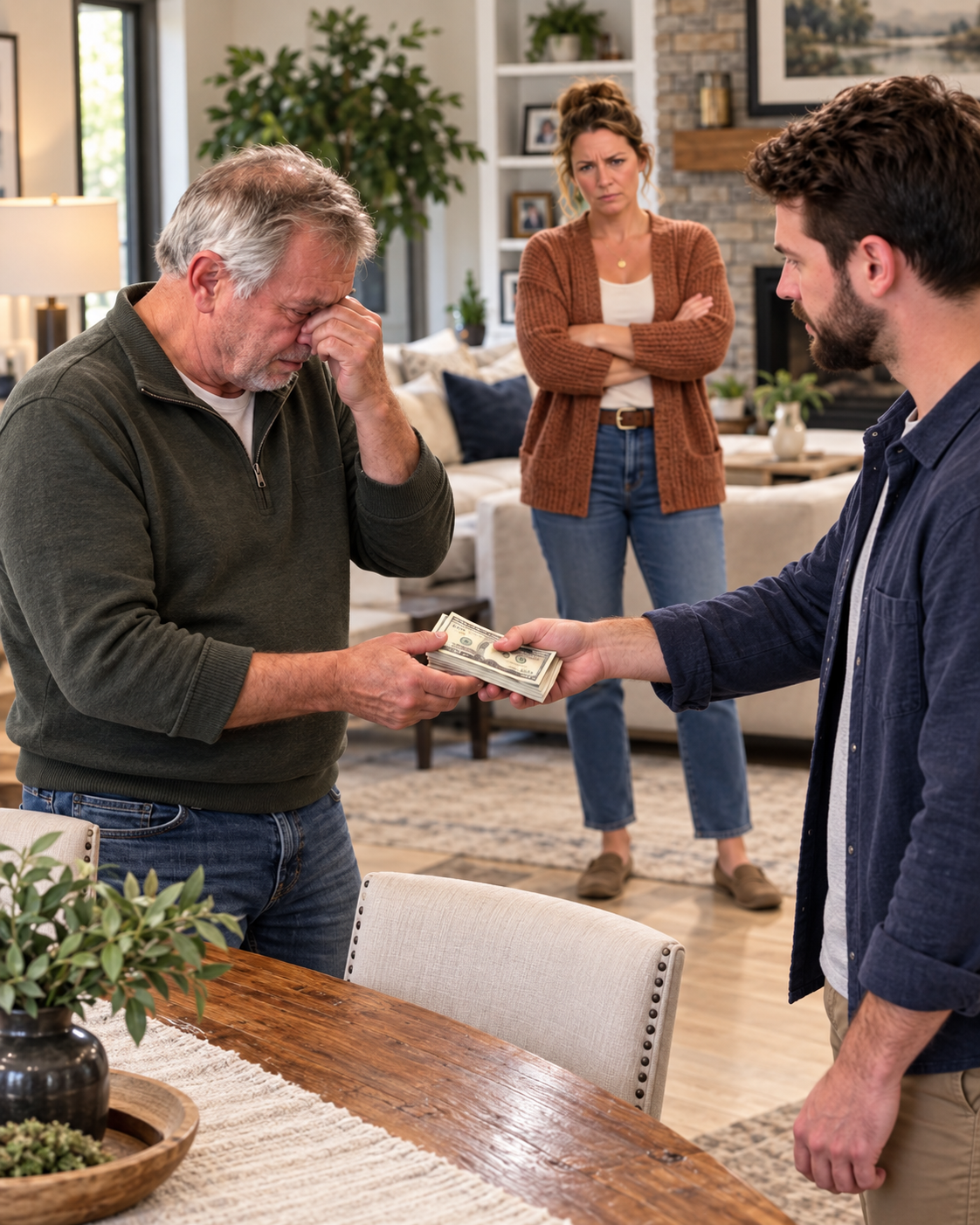
PART 1 TITLE: The Day My Father Asked for a Thousand Dollars, My Wife Made Him Feel Like a Stranger in the Home He Helped Buy
The hospital called three days after my father came to our house asking for a thousand dollars. I was standing beside my desk, reaching for a folder, when an unfamiliar number appeared on my phone. The woman who answered my greeting spoke with the careful precision of someone accustomed to delivering frightening news. She said my father had been admitted with a serious problem involving his aorta. The doctors were preparing him for emergency surgery. I remember gripping the edge of the desk and asking her to repeat his name, as though there might be another seventy-year-old Raymond Mercer somewhere in the hospital. There wasn’t. It was my father, and no one could promise he would survive the afternoon.
What troubled me almost as much as the call was the memory of our last conversation. Dad had come to my kitchen looking exhausted, his shoulders slightly rounded beneath a faded brown jacket. He’d stood near the counter with his hands clasped together, struggling to ask for something he had never asked of me before. My wife, Natalie, had barely let him finish. She treated his request as an inconvenience, and I allowed the conversation to become an argument before finally taking him outside. I gave him the money, but I never learned the complete reason he needed it. Now he was in an operating room, and I was terrified that the explanation would die with him.
My name is Grant Mercer. I was thirty-seven when all this happened, old enough to have a marriage, a career, a mortgage, and a fairly settled idea of where I came from. My childhood had been ordinary in the ways that matter most. There was a father who worked too many hours, a mother who remembered every school event, and a small house where the kitchen always seemed warmer than the rest of the rooms. We weren’t wealthy. We occasionally postponed purchases and repaired things other families replaced. Yet I never remember going without something essential, because my parents had a way of carrying their financial worries where I couldn’t see them.
Dad spent more than thirty years working construction. His hands had thickened around tools, and there were small pale scars across his knuckles from accidents he dismissed whenever anyone asked. Even after retirement, he disliked sitting still. If a cupboard door stuck, he reached for a screwdriver. If a neighbor’s fence sagged, he asked whether they needed help. He wasn’t especially good at expressing affection through words, but he could tell when I was discouraged by the way I shut a car door. He would arrive with coffee, find some ordinary task for us to do together, and allow me to talk when I was ready.
I learned about his sacrifices long after they happened. An aunt once mentioned that he’d sold the only decent suit he owned because I needed shoes for school. Another relative told me about the motorcycle he’d given up when my college tuition became difficult to cover. At the time, Dad had claimed he’d simply lost interest in riding. He’d also sold a piece of inherited land to contribute toward the down payment on my first house. That was the same house where Natalie would eventually accuse him of treating us like a bank. He never held any of these things over my head. When I thanked him, he generally changed the subject.
My mother died when I was nineteen. The years immediately afterward are still difficult to describe without recalling the hollow silence in our kitchen. Dad began leaving the radio on while he cooked because he couldn’t bear how quiet the house had become. I was young enough to believe that grief ought to have an ending, and he was experienced enough to know it didn’t. He made sure I stayed in college, attended my graduation, and helped me find my footing afterward. When I married Natalie, he was proud of me. I remember him adjusting my tie before the ceremony, checking the knot twice, and telling me my mother would have liked seeing me so happy.
Natalie and I didn’t begin our marriage fighting about money. At first, her determination seemed like one of her strongest qualities. She kept careful budgets, compared mortgage rates, and thought several years ahead when making decisions. I admired that discipline because I had grown up watching my parents stretch every paycheck. But somewhere along the way, our conversations about financial security became conversations about what we deserved to own. Natalie could look at a comfortable home and see only the improvements it lacked. I usually tried to keep the peace by reminding myself that her ambition came from wanting a stable future.
Dad never criticized her openly. He asked after her whenever we spoke, remembered her birthday, and offered to help with things around the house. Still, I noticed that his visits became shorter. Natalie disliked unexpected company, especially when she had work to finish or plans for the evening. She didn’t forbid him from coming, but her impatience showed in little ways: a glance toward the clock, a question about how long he intended to stay, a remark about our schedule. I persuaded myself these were normal differences between people who hadn’t grown particularly close. Looking back, I wish I’d paid more attention to how quickly he learned to make himself scarce.
The afternoon he asked for money, Dad arrived without calling first. I was at the kitchen table sorting bills when I heard his familiar knock. He stood on the porch with an envelope tucked beneath one arm and asked whether he could speak to me for a moment. There was something uneasy about his face. He’d shaved, but he’d missed a small patch beneath his chin, and his hair looked as though he’d run his fingers through it repeatedly. I offered him coffee. He declined, which was unusual enough to make me watch him carefully as he followed me inside.
Natalie was preparing something at the counter. She greeted him politely, though without much warmth, and asked whether everything was all right. Dad said he hoped so. He lowered himself into a chair, rested the envelope on his knees, and looked at me for several seconds. I recognized that expression from the rare occasions when he’d needed to deliver difficult news. When I asked what was troubling him, he rubbed his thumb along the worn edge of the envelope. He started one sentence, stopped, and finally explained that he needed to borrow a thousand dollars. He promised he would return it as soon as he could.
Before I could ask why, Natalie turned away from the counter. Her voice carried a sharpness I had heard during arguments about our expenses, but never directed so openly at my father. She demanded to know why a retired man who ought to understand his own finances needed us to cover his bills. Dad tried to explain that the situation was temporary. She interrupted him again. If his income wasn’t enough, she said, he could find some part-time work instead of expecting his son to solve his problems. She finished by making it clear that our household wasn’t available to finance other people’s mistakes.
The room became painfully quiet. Dad glanced down at the envelope, and I saw color rise along his neck. He didn’t argue. He simply adjusted his position in the chair and murmured that he shouldn’t have come without speaking to me first. That apology angered me more than Natalie’s words. My father, who had worked through injuries and surrendered things he loved to keep me comfortable, was apologizing for asking his own son for help. I told Natalie she had no reason to speak to him like that. She replied that someone had to be realistic, because generosity was easy when you weren’t considering the consequences.
I asked her to stop. She looked at me as though I’d betrayed her by challenging her in front of him. Dad rose before our argument could continue. He said there was no need for trouble and that he’d find another solution. I could see him preparing to leave, his usual polite escape whenever tension developed between Natalie and me. This time I wouldn’t allow it. I picked up my keys, told him we could talk outside, and walked him toward the front door. Natalie said something behind us about refusing to be made responsible for his situation. I didn’t answer her.
Outside, the afternoon air felt unexpectedly cool after the kitchen. Dad walked to the edge of the driveway and stopped beside his aging pickup truck. He kept his eyes on the pavement while I apologized for what Natalie had said. He waved it away, insisting that people become defensive when money is involved. I told him that didn’t excuse humiliating someone. He gave a tired little smile and asked me not to turn the incident into a larger problem between my wife and me. Even then, after being treated so badly, he seemed more concerned about the stability of my marriage than his own embarrassment.
I asked what the thousand dollars was for. Dad glanced toward the front windows, checking whether Natalie might be watching us. Then he explained that he needed certified copies of old documents, help from a lawyer, and a particular test connected to a family matter. His answer puzzled me. He’d never mentioned having legal trouble, and I couldn’t imagine why he would need tests for anything involving paperwork. I asked whether he was being sued or whether someone had contacted him about an unpaid debt. He shook his head. Whatever the matter was, it reached much further into the past.
When I pressed him for a little more information, he said the documents concerned an adoption. I thought I had misunderstood. There were no recent adoptions in our family that I knew of, and Dad hadn’t spoken about anyone seeking to adopt a child. I asked him whose records he meant. He looked at me with an expression I couldn’t immediately interpret. It wasn’t the face of a man caught doing something wrong. It was the face of someone approaching a conversation he’d been avoiding for years. He said he needed to establish the facts properly before explaining anything.
I asked why he couldn’t simply tell me what he knew. Dad opened his mouth, hesitated, and then said he was afraid someone might question his memory or suggest that he was interfering in my marriage. I didn’t understand why he mentioned Natalie. Her behavior in the kitchen had been cruel, but it couldn’t possibly explain a secret involving decades-old adoption documents. I asked whether he was feeling unwell. He said he’d had a few concerns lately but that doctors were helping him look into them. Before I could ask another question, he placed his hand on my shoulder and requested a little patience.
There was a moment when I almost insisted. I wanted to know why my father’s fingers were trembling and why he’d driven all the way to my house carrying an envelope that seemed to frighten him. But demanding answers felt like another way of making him defend himself. I asked whether he could afford his usual expenses. He assured me that he could. This was an unusual expense, he said, connected to something he should have dealt with long ago. I believed him. Dad had never approached money carelessly, and nothing about his behavior suggested that he wanted to take advantage of me.
I told him he didn’t have to borrow the amount. I could give it to him. Dad immediately objected. He’d been clear that he intended to repay me, and he wasn’t comfortable accepting a gift. I said we could call it a loan if that made him happier, but I wasn’t going to attach conditions or demand an accounting of every dollar. He studied my face for a moment, perhaps trying to determine whether I was merely being polite. Then he nodded and thanked me so quietly that I barely heard it. I went inside to arrange the money.
Natalie was still in the kitchen. She asked what we’d discussed, and I told her Dad needed help with an important personal matter. She wanted details. I explained that he wasn’t prepared to share them yet. That answer irritated her. She reminded me that we had expenses of our own and asked how I could agree to give away money without knowing exactly where it would go. I told her I trusted my father. She countered that trust had nothing to do with responsible financial decisions. I didn’t want another argument, especially while Dad stood outside waiting, so I ended the conversation.
When I returned to the driveway, I placed the thousand dollars in Dad’s hand. He looked at the envelope of cash before carefully sliding it into his jacket. He thanked me again and promised to explain everything when he’d gathered the documents. I told him I expected the explanation, but not because he owed me a justification. I wanted to know what had frightened him. He attempted to reassure me, saying that some old family business had been left unfinished for far too long. The phrase made me uneasy, although I couldn’t explain why. Before leaving, he asked whether I remembered how deeply my mother had loved me.
The question caught me off guard. Of course I remembered. I began recalling the little things she’d done when I was a child, but Dad interrupted gently. He said he only wanted me to keep that in mind, whatever happened next. His eyes looked unusually bright. I asked whether there was something about Mom I didn’t know. He glanced toward the house and told me we would talk soon. Then he climbed into his truck. I stood beside the driveway until he pulled away, trying to make sense of a conversation that had begun with money and ended with a warning about love.
That evening, Natalie and I argued again. She believed I’d rewarded irresponsibility, while I believed she’d treated the man who helped us buy our home with breathtaking disrespect. She insisted that past generosity didn’t entitle him to an unlimited claim on our future. I reminded her that a single request for a thousand dollars wasn’t an unlimited claim. Eventually we stopped talking, not because we’d reached an understanding, but because neither of us wanted to hear another word. I went to bed replaying Dad’s expression as he looked toward the front windows. It bothered me that he’d seemed afraid of being questioned in his own son’s presence.
Over the next two days, I called him more than once. Our conversations were brief. He said he was making progress with the documents and sounded relieved that someone had agreed to help him. Once, I asked whether he’d arranged the test he’d mentioned. He told me there were a few steps still to complete. His answers were cautious, but not evasive in the way they would have been if he were hiding a debt or an ordinary mistake. He sounded like a man trying to assemble something fragile without breaking it. I promised myself that I’d visit him soon and sit down with him properly.
On the third day, the hospital called. I drove there in a state of fear I hadn’t experienced since my mother’s death. At one traffic light, I realized I couldn’t remember whether I’d locked the front door when I left. At another, I noticed that I was holding the steering wheel so tightly my fingers ached. The nurse had told me the doctors suspected a dangerous aortic aneurysm and needed to operate urgently. I understood enough to know the situation was grave. I also knew that Dad had been receiving medical attention recently, though I had no idea whether those appointments were connected.
A nurse met me when I reached the surgical waiting area. She confirmed that Dad had been taken for the operation and explained that the medical team would update me when they could. Then she handed me a sealed envelope. My full name was written across the front in my father’s handwriting. She said he’d given specific instructions before surgery: the envelope was for me, but I was not to show its contents to Natalie until I’d spoken privately with the attorney who was coming to meet me. I stared at her, certain I’d misunderstood. Dad had mentioned my wife again. Whatever he’d discovered, he was afraid of what would happen if she learned about it too soon.
I sat alone with the envelope resting across my knees. I recognized every uneven letter of my name. Dad had written it the way he wrote addresses on Christmas cards, pressing harder on the first letter than the others. A part of me wanted to tear it open immediately. Another part was afraid that doing so would make the possibility of his death feel more real. I kept remembering the way he’d apologized for asking for money and how embarrassed he’d looked when Natalie raised her voice. If he didn’t survive, that would be one of the last memories I had of him. The thought was nearly unbearable.
After what felt like an endless stretch of time, a woman in a gray blazer approached the waiting area and asked whether I was Grant Mercer. She introduced herself as Priya Desai, the attorney Dad had mentioned to the hospital staff. She specialized in estate and probate matters, and she’d been assisting my father with a complicated family issue for several weeks. We found two chairs in a quieter corner. I asked whether Dad was in legal trouble. She assured me that he wasn’t. But she also explained that he had been trying to establish the truth about something that happened when I was very young.
I asked why it had taken him so long to tell me. Priya considered the question before answering. She said my father had been carrying an old responsibility, and that recent circumstances had made it impossible for him to postpone dealing with it any longer. He’d wanted independent documentation because some of the records were complicated and because he feared I might reject the story if it came from him alone. I thought of the money, the test, and the strange reference to adoption. Pieces of the conversation began lining up, but I still couldn’t see what picture they formed. Priya looked toward the envelope and told me Dad wanted me to read his explanation before we discussed the evidence.
My hands were unsteady as I opened it. Inside lay a folded letter and an old photograph. I lifted the photograph first. Dad stood beside a young woman whose dark hair framed a narrow, gentle face. He looked no older than twenty-six, wearing work clothes and smiling with the awkward pride of a young man unaccustomed to being photographed. I had never seen the woman before. Still, something about her troubled me. I studied her eyes, the shape of her brow, and the faint tilt of her smile. There was a resemblance I couldn’t dismiss. She looked more like me than anyone else in my family photographs.
Priya waited without speaking while I turned the photograph over, hoping to find a name or date. Then I unfolded Dad’s letter. The opening lines explained that he was afraid he might never get another opportunity to tell me the truth himself. He begged me to remember that nothing I learned from the documents could erase the years we’d spent together or the love that had shaped my childhood. I read the beginning twice. My heart was pounding. He wasn’t writing like someone explaining an old financial obligation. He was writing like a father afraid of losing his son.
The next passage told me that the woman I’d called Mom and the man I’d called Dad had brought me home as an infant and raised me with complete devotion. I looked up at Priya, but she said nothing. I returned to the page, forcing myself to read slowly rather than rushing ahead. Then I reached the sentence Dad had apparently spent most of his life struggling to say aloud. The woman in the photograph was his younger sister, Eleanor Mercer. She was the woman who had given birth to me. Raymond Mercer, the man I’d called Dad for thirty-seven years, was my biological uncle.
END PART 1
PART 2 TITLE: An Old Photograph, a Sealed Letter, and the Secret My Father Had Carried Since the Morning I Was Born
For several seconds, the words on the page seemed to have no connection to anything I understood. I knew what they meant individually. I knew what a biological mother was, and I knew what it meant to be someone’s uncle. Yet my mind refused to put those ideas together. I turned the photograph toward the light and examined the young woman’s face again. The resemblance was suddenly unmistakable. Her eyes were mine, or perhaps mine were hers. The narrow bridge of her nose, the slight unevenness of her smile, even the way one eyebrow rested higher than the other seemed painfully familiar.
I asked Priya whether the letter meant I had been adopted. She nodded, although she was careful when describing the arrangement. My father and his wife had raised me through a family placement made when I was an infant. Historical documents supported the account, but the original legal paperwork contained details that still needed review. She didn’t pretend that every question had been resolved. She explained only what the evidence established and what the remaining documents might clarify. I appreciated her precision, though at that moment I would have preferred an ordinary explanation that allowed my life to remain exactly as I’d understood it that morning.
I returned to Dad’s letter. Eleanor had been seventeen when she became pregnant. She was frightened, inexperienced, and facing pressure from relatives who considered her situation a disgrace. Dad was twenty-six and already married. He and my mother wanted children and believed they could give the baby a home that Eleanor, still barely beyond childhood herself, couldn’t provide. The family discussed the matter privately, with the adults making decisions they considered sensible at the time. I could hear Dad’s regret beneath the careful explanations. He had once believed that providing a safe home settled the question of what was best for everyone.
When I was born, Raymond and his wife took me home. They named me Grant, cared for me through the exhausting first months of infancy, and introduced me to the world as their son. Eleanor remained my biological mother, but within the family story presented to everyone else, that connection simply disappeared. My father’s letter didn’t attempt to describe her decision as easy or entirely voluntary. He wrote about fear, shame, and an atmosphere in which a frightened young woman had little confidence that she could disagree with those around her. I pictured Eleanor at seventeen, being asked to accept a future she could barely imagine.
She eventually moved away and settled in Marsh Hollow, a small town I’d never visited. The adults agreed that the placement would remain a private family matter. Dad said they believed this arrangement would spare Eleanor constant reminders of what she’d lost and protect me from questions they didn’t know how to answer. Reading those words, I understood their reasoning without accepting it. The secrecy had allowed me to grow up without ever questioning my place in the family. It had also taken away the possibility of knowing the woman who gave birth to me. I couldn’t decide which feeling was stronger: gratitude for my childhood or anger over what had been withheld.
Dad admitted that he’d considered telling me the truth many times. When I was young, there always seemed to be a reason to wait. I was too little to understand. Later, I was old enough to understand but young enough to be wounded by the revelation. He thought adolescence might be the right time, then watched me struggle through the ordinary uncertainties of those years and lost his nerve. He promised himself that he would tell me when I was older, when our relationship felt secure, when he could explain everything without making me question whether I belonged. Each delay made the next conversation more difficult.
Then my mother died when I was nineteen. Dad wrote that he’d come close to telling me during the months afterward, but he couldn’t bear adding another loss to my grief. I remembered the two of us sitting in the silent house after her funeral, unable to talk about much of anything. I remembered him making breakfast before my early college classes and insisting that I take food with me even when I said I wasn’t hungry. He’d been afraid of losing me emotionally while I was already struggling with losing her. That fear was understandable. Yet I kept thinking of the years that followed, when there had been opportunities to speak and he had remained silent.
I stopped reading and rested the letter across my knees. Priya gave me time. Across the waiting area, a vending machine hummed beside a wall covered with notices about hospital visiting hours. Somewhere beyond the doors, a cart rattled along the corridor. Everything around me continued with its ordinary rhythm. The sheer indifference of the surroundings made the revelation harder to grasp. I was sitting in a hospital waiting room, trying to decide what to call the people who had raised me, while strangers bought coffee and checked their watches. It seemed impossible that a person’s entire understanding of his family could change without the world noticing.
When I resumed reading, I learned why Dad had finally begun searching for the old records. Several weeks earlier, he’d received unexpected correspondence relating to Eleanor’s estate. She had died eight weeks before the day I sat in that hospital. She had never married and had no other children. In her will, she had identified the son she’d given up when she was young and expressed her wish that her estate should pass to him. Until that moment, I had imagined Eleanor as someone I might still meet. A woman who might be living quietly in Marsh Hollow, someone I could approach after I recovered from the shock.
Instead, she was already gone. I asked Priya to confirm it, even though Dad’s letter was perfectly clear. She said Eleanor had died roughly two months earlier and offered her condolences. I looked at the photograph again. The woman in it was younger than I was now, standing beside the brother who would become my father. I wondered what she’d looked like at thirty or fifty, whether her hair had turned gray early, whether she laughed loudly or spoke softly. I wanted to ask her why she had never contacted me. The hardest part was realizing that there would be no opportunity to hear her answer.
Dad’s next pages made the silence more complicated. Eleanor had asked about me over the years whenever circumstances allowed. She wanted to know whether I was healthy, whether I enjoyed school, and whether I’d found happiness as an adult. Dad admitted that he had sometimes shared pieces of my life with her while refusing to bring us together. He’d justified the arrangement by reminding himself that everyone had agreed to it, and that reopening the past might cause pain. Reading that, I felt anger rise through the grief. Someone had been close enough to hear about my achievements yet kept far enough away that I never knew she existed.
I turned to Priya and asked whether Eleanor had tried to challenge the arrangement or reach me independently. Priya said the records she had reviewed didn’t answer every personal question. Much of what she knew came from Eleanor’s estate documents and the information Dad had helped her assemble. She didn’t want to speculate about conversations she hadn’t witnessed. That restraint mattered. I was desperate for certainty, and she refused to offer it merely to make me feel better. She encouraged me to finish the letter, explaining that my father had addressed several of the questions I was asking.
Dad described how Eleanor had remained interested in my life even while accepting the distance between us. He remembered her asking after my education and reacting with quiet pride when she heard I’d graduated. He wrote that she had not forgotten the day I was born or the difficult decision that followed. He believed she’d spent much of her adult life carrying affection she had no place to express openly. Then he acknowledged what hurt most: he should have helped us find each other while we were both alive. The apology was direct. He didn’t blame Eleanor, the family, or the circumstances for his continued silence.
I studied the old photograph more carefully. There was affection in the way Eleanor stood beside her older brother, but also a shyness that made her seem uncertain about the camera. I tried to imagine the two of them as children. Dad had mentioned having a younger sister when I was growing up, but he’d spoken about his extended family only in fragments, particularly after relatives moved away or died. I had never understood that an aunt whose name meant so little to me occupied the central place in the story of my birth. It disturbed me how easily a family could preserve a fact while concealing its meaning.
The next section explained the documents and the thousand dollars. After Eleanor’s death, her estate representatives had needed reliable evidence identifying the beneficiary named in her will. Old family records, certified copies, professional advice, and a test had become part of establishing that connection. Dad had helped Priya gather the necessary information, but some expenses couldn’t be avoided. He had asked me for money because he wanted the process completed properly. He hadn’t been trying to cover unpaid bills or rescue himself from irresponsible spending. He was attempting to connect me with a history he’d denied me for decades.
I remembered Natalie standing in our kitchen, scolding him for not being financially independent. I remembered his expression as he lowered his gaze and prepared to leave. The contrast was almost unbearable. He had been trying to obtain documents that would benefit me, and she had accused him of being a burden. I also thought about his insistence that he would repay the loan. Even while facing a dangerous medical situation and a difficult confession, he’d remained concerned about owing me money. That was the father I knew: a man who would accept discomfort for himself long before allowing anyone to believe he’d taken advantage of his son.
But one detail still puzzled me. Why had Dad been so afraid that someone might question his memory? I asked Priya, and she explained that he had recently experienced a brief episode of forgetfulness serious enough to concern him. He’d sought medical advice and had undergone an assessment, but nothing had established that he had dementia. His worry, however, was genuine. He feared that an account involving old family arrangements and incomplete paperwork could be dismissed as confusion. He wanted the documents gathered independently so that no one could suggest his story was the invention of an aging man losing track of his memories.
I felt a fresh stab of guilt. During our conversation outside the house, I had asked whether he was unwell. He’d answered cautiously, and I’d allowed the matter to rest because I trusted him. Now I wondered whether I should have insisted on knowing more about his health. Priya reminded me that the medical emergency and his earlier concerns were separate matters that his physicians would need to explain. She couldn’t tell me why he hadn’t spoken more openly about either. I appreciated that she didn’t try to interpret every action my father had taken. There were already too many assumptions surrounding this family secret.
The final portion of Dad’s letter returned to Natalie. He wrote that he didn’t know how she would react to Eleanor’s estate, but he had heard enough of her opinions about money to worry that I might be pressured before I understood what Eleanor intended. He wasn’t asking me to hide the inheritance from my wife indefinitely. He wanted me to seek independent legal guidance, establish what belonged to the estate, and make decisions without confusing obligation with pressure. His concern was unmistakable. He had watched Natalie speak to him in ways that unsettled him, and he feared I would mistake her demands for the normal expectations of marriage.
That passage made me uncomfortable for reasons extending beyond the incident in our kitchen. I had spent years defending Natalie when Dad quietly questioned whether I was happy. He rarely asked directly, but sometimes he’d notice my exhaustion after a weekend of arguments and suggest that I should take better care of myself. I would tell him everything was fine. Now I understood that his silence about Eleanor’s estate had been influenced by the same fear that kept him from criticizing my marriage: he didn’t want me to believe he was trying to turn me against someone I loved.
Dad ended the letter by accepting responsibility for keeping the truth from me. He explained that he’d devoted his life to doing whatever he thought would protect my future, but he now understood that some of those decisions had caused harm. He didn’t ask me to forget the deception or pretend it hadn’t mattered. He asked only that I judge him with the knowledge that his love for me had never been false. I folded the pages carefully, aligning their edges before placing them back in the envelope. My father had spent nearly four decades raising me. The truth about my birth changed our history, but it couldn’t erase the ordinary hours in which he’d been my dad.
Priya let the silence settle before asking whether I wanted to discuss Eleanor’s estate. I almost said no. The idea of speaking about property while Dad was undergoing surgery felt indecent. But Eleanor had made deliberate arrangements before her death, and Dad had risked considerable discomfort trying to honor them. I asked Priya to tell me what she knew. She opened a folder containing documents and explained that Eleanor had owned a modest house in Marsh Hollow. The property had no mortgage. There were also savings amounting to approximately sixty-three thousand dollars, along with personal belongings that would be addressed through the estate process.
I repeated the figure aloud, trying to understand it. A house and more than sixty thousand dollars were not small things. For Natalie and me, that amount could affect plans we’d been discussing for years. But the money felt strangely distant. I hadn’t known Eleanor was alive, and now I was discovering that she was dead and had left me nearly everything she possessed. Priya cautioned that the proper legal procedures still had to be completed. Documents had been located supporting the family connection, but the estate couldn’t simply be transferred because I had learned the truth. There were steps to follow, obligations to satisfy, and decisions that required careful attention.
I told her I wasn’t in a hurry to receive anything. I barely knew how to think about the inheritance, much less decide what to do with it. She seemed relieved by my response and moved on to the personal belongings. Among them was a box of letters Eleanor had written to me. She had apparently begun writing them on my eighteenth birthday and continued every year afterward. None had been mailed. I stared at Priya, struggling to imagine what that meant. Somewhere, a woman I’d never met had marked my birthdays with messages she believed I might never read.
I asked whether the letters were still in Eleanor’s house. Priya said they had been found among her possessions and would be handled with the other estate materials. She assured me that arrangements could be made for me to see them when the proper steps had been taken. I wanted to leave the hospital and drive straight to Marsh Hollow, but I couldn’t move from the waiting area while Dad remained in surgery. Instead, I tried to picture Eleanor choosing paper, writing my name, and returning another envelope to a box. I wondered whether she’d celebrated privately when I turned twenty-one, thirty, or thirty-five.
Priya explained that there were also legal matters I should understand concerning inherited property and marriage. Depending on the applicable law and how assets were handled, some inheritances could remain separate from marital property. She emphasized that I needed advice specific to my circumstances rather than relying on general assumptions. Dad had been especially insistent that I receive that guidance before making any commitments. As she spoke, I thought again about the money I’d handed him in the driveway. He hadn’t merely purchased records. He had helped secure evidence of a relationship that had shaped my entire life without my knowledge.
I thanked Priya for coming. She told me that my father had been deeply concerned about how I would react, and that his greatest fear was losing our relationship before he could explain himself. The words broke through the numbness I’d been carrying since opening the envelope. I wanted to tell Dad that I was angry but still loved him, that I needed answers but hadn’t stopped being his son. I wanted to ask him about Eleanor, about my mother, about every ordinary family story that suddenly seemed to have a missing chapter. Most of all, I wanted him to survive long enough for us to have those conversations.
We were still speaking when a doctor entered the waiting area and called my name. I rose so quickly that the envelope slipped from my knees. The doctor said the surgery had been completed and Dad was stable in recovery, although his condition remained serious enough to require close monitoring. I asked whether he would be all right. The doctor explained that recovery would take time and that the team would continue watching for complications. It wasn’t a guarantee, but it was the first hopeful news I’d received all afternoon. I sat down again, overcome by relief, and covered my face with both hands.
I remained at the hospital until the staff assured me there was nothing more I could do that evening. Before leaving, I asked when I might see him. The nurse explained that visits would depend on his condition. I tucked the letter inside my jacket, unwilling to leave it unattended, and walked through the corridor feeling physically exhausted. The man who had raised me was alive. That mattered more than the documents, the estate, or the questions waiting for answers. Yet I knew nothing would return to exactly what it had been. Once a truth like this enters a family, even love must learn how to live beside it.
The following morning, I was permitted to visit Dad. He looked smaller beneath the hospital blankets, his skin pale and his voice weakened by the ordeal. But when he recognized me, he gave the familiar half-smile I’d seen whenever I walked through his front door. I pulled a chair beside his bed and took his hand. He studied me for several moments before asking whether I’d read the letter. I told him I had read everything. His eyes filled with tears. He tried to apologize, but his voice faltered, and for a few seconds neither of us spoke.
I told him that I wished he’d trusted me with the truth sooner. I wasn’t going to pretend the secrecy hadn’t hurt, especially now that Eleanor was gone. He listened without interrupting. Then I explained that knowing he was my biological uncle hadn’t changed what he’d been to me. He had taught me to ride a bicycle, helped me through college, stood beside me when I married, and answered every call when I needed him. He was my father because he had spent his life doing the work of a father. Dad closed his eyes briefly, and I felt his fingers tighten around mine.
We talked about Eleanor as much as his strength allowed. He told me she’d loved drawing, mystery novels, and gardens. When they were children, she followed him around while he repaired bicycles or worked with tools, insisting that she could help. She had been gentle but stubborn, especially when someone told her she couldn’t do something. He said she remembered birthdays with unusual care. I listened with the ache of someone learning about a loved one after the opportunity for acquaintance had already passed. When Dad admitted she had wanted to know me, I asked why he’d never arranged it. He looked away and said he should have.
I didn’t offer him immediate forgiveness for every year of silence. He deserved my honesty, and I needed time to understand what had happened. But I promised that I would come back and that we would keep talking. As I prepared to leave, he caught my wrist with surprising determination. He asked me not to let the estate become the center of everything. Eleanor had wanted me to have what she’d left, but he hoped I would remember her as a person rather than a financial opportunity. I assured him that I understood. Then I kissed his forehead, something I hadn’t done since I was a child.
When I returned home, Natalie was waiting in the kitchen. She asked about Dad’s surgery and listened while I explained that he’d survived but still needed close monitoring. Then she asked about the attorney she’d heard I had met and the envelope Dad had left for me. I told her the information concerned a deeply personal family matter and that I needed time to understand the legal details before explaining everything. Natalie watched me closely. Her concern shifted into suspicion. She asked whether my father was leaving me property or whether some inheritance had appeared. I looked at my wife and realized that the question I’d feared was already being asked.
END PART 2
PART 3 TITLE: While My Father Recovered, the Woman I Married Wanted Answers That Had More to Do With Property Than Family
Natalie stood between the kitchen counter and the dining table, watching me as though my hesitation confirmed some suspicion she’d already formed. I had been awake for most of the previous night, and I could still feel the hospital’s antiseptic smell clinging to my clothes. I told her there were legal questions involving my family, but I wasn’t prepared to discuss them until I understood the situation myself. She asked whether Dad had received an inheritance or intended to give me something. I repeated that I needed time. Her expression tightened, and she wanted to know why my wife should be the last person to hear important news.
I tried explaining what the past twenty-four hours had been like. My father had nearly died on an operating table. I had learned something about my childhood that overturned nearly everything I believed about my parents. A woman connected to my birth had died before I could meet her. None of those things was simple enough to summarize between removing my shoes and making dinner. Natalie listened impatiently. She said she understood that I was upset, but she didn’t believe distress justified withholding information from her. When I told her I needed space, she suggested that Raymond was once again creating problems in our marriage.
I stared at her. Dad was recovering from major surgery, and she was treating his situation as an attempt to interfere with us. I reminded her that he had spent years helping our household whenever he could. Natalie responded that past assistance didn’t give him the right to control our decisions. We were having two entirely different conversations. I was talking about a frightened father who had almost died. She was talking about power, loyalty, and whether I was being sufficiently transparent about money. I ended the discussion before I said something I couldn’t take back.
That night I lay awake beside her, thinking about the word loyalty. I’d always believed marriage meant telling one another the truth, sharing responsibilities, and protecting the home we built together. I still believed those things. But I also believed a person could experience a private loss without having to explain it before taking time to understand it. I hadn’t learned about Eleanor through an ordinary financial transaction. I’d discovered a mother I never knew, then learned she was already dead. The letters waiting in Marsh Hollow belonged to a grief I hadn’t even known I was carrying.
During the following days, my routine narrowed to three places: work, the hospital, and Priya’s office. Dad remained under careful medical supervision, gradually becoming strong enough for longer conversations. He complained about the hospital food and asked when he’d be permitted to go home. The familiar grumbling reassured me. Meanwhile, Priya helped me understand which documents had already been obtained, what remained to be verified, and how Eleanor’s estate would proceed. She was thorough without being cold. Whenever I became distracted by questions about Eleanor herself, she allowed the conversation to move away from legal matters until I could concentrate again.
I asked Priya whether the documents made me legally entitled to everything Eleanor had intended. She explained that there was evidence supporting my identity and connection to the estate, but formal procedures still had to be followed. She didn’t promise an immediate transfer or encourage decisions based on money I hadn’t received. That distinction mattered. I wanted to honor Eleanor’s wishes, but I didn’t want anyone, including myself, to treat her death as a fortunate financial event. Priya also repeated Dad’s advice about obtaining independent guidance before combining inherited assets with ordinary household finances or making commitments to other people.
One afternoon, while visiting Dad, I asked whether he had always worried about Natalie’s attitude toward money. He was sitting upright with pillows supporting his back, looking through a newspaper he’d barely touched. He took a moment before answering. He said he had tried to accept her because I loved her. There were qualities he admired: she worked hard, made plans, and wanted our household to succeed. But he’d noticed how quickly she spoke about what other people ought to provide, and how rarely she considered their circumstances before judging them. He didn’t say it with anger. That made his observations more difficult to dismiss.
I asked whether he thought my marriage was a mistake. Dad set the newspaper aside. He said he couldn’t decide that for me, and he didn’t want the events surrounding Eleanor to become an excuse for him to criticize my wife. What concerned him was the possibility that I might make irreversible decisions while frightened, confused, or desperate to restore peace at home. He told me I should understand the estate, discover what Eleanor wanted me to know, and then speak with Natalie from a position of certainty. I left the hospital recognizing that his caution was not an instruction to abandon my marriage. It was a request to keep my judgment intact.
Natalie interpreted my continued silence differently. Each evening, she asked questions that became increasingly specific. Had Dad changed his will? Was there land involved? Did his attorney handle valuable estates? I told her Raymond was recovering and that the information concerned my family history rather than his own property. She seemed unconvinced. When I asked her to stop treating the subject like a business negotiation, she accused me of being defensive. Eventually we began avoiding the topic altogether, but the silence felt temporary. I knew I couldn’t keep something this important from my wife forever, nor did I intend to.
After several appointments with Priya, I had a clearer understanding of the circumstances. The original family placement documents and related records supported Dad’s account. Eleanor’s will identified me as the person she intended to benefit, and the legal process would determine the final transfer. The house in Marsh Hollow remained part of the estate, as did the savings and personal possessions. Nothing had yet been placed in my hands. I was particularly concerned about the birthday letters. Priya assured me they were safe and explained that I would be able to visit the house when appropriate arrangements were made.
I decided to tell Natalie before making that visit. We sat together in the living room on an evening when neither of us had other plans. I began with the part that mattered most: Dad had been carrying a secret about my birth. Raymond was my biological uncle. His younger sister, Eleanor, had become pregnant at seventeen, and he and his wife had raised me from infancy. I explained that my mother, the woman who cared for me until her death when I was nineteen, had known the truth. Both parents had chosen silence because they believed revealing the arrangement would hurt me.
Natalie looked genuinely astonished. For several minutes, she asked questions that showed she was trying to understand. She wanted to know whether I remembered Eleanor from childhood and whether Dad had provided reliable records. I explained that I had never knowingly met her and that documents had been found to support the account. Then I told Natalie that Eleanor had died eight weeks before Dad’s surgery. My wife grew quiet. I thought, briefly, that she was beginning to grasp why I’d needed time. I described the strange experience of losing someone before even knowing she belonged to my life.
I told her about the photograph and Dad’s letter. I explained how Eleanor had followed pieces of my life from a distance while I grew up unaware of her existence. There had been opportunities for us to meet, but fear and secrecy had prevented them. Natalie asked whether I was angry with Raymond. I said I was hurt by his silence, but he was still my father. She nodded. I hoped we had reached a point where we could talk about the complexity of what had happened rather than treating it as a problem requiring an immediate solution.
Then I mentioned Eleanor’s will. I explained that she’d named me as the intended beneficiary of her estate. Natalie shifted forward. She asked whether there was money involved. I told her that Eleanor had left approximately sixty-three thousand dollars in savings, a house in Marsh Hollow, and personal belongings. Natalie wanted to know whether the house had a mortgage. When I said it didn’t, she asked how much property in that area was worth. The change in her voice was subtle but unmistakable. She sounded the way she did when we’d found a promising listing or discussed a possible investment.
I told her the estate hadn’t been settled. She reached for her phone and suggested that we research comparable houses. If we sold Eleanor’s property, she said, we might finally have enough to move somewhere larger. She began talking about the extra bedroom she’d wanted and the improvements we’d postponed at our current home. I listened in disbelief. Moments earlier, I’d been explaining that my biological mother had died without meeting me. Now we were apparently discussing real estate. I asked Natalie to put her phone down. She looked offended, as though I’d interrupted a reasonable attempt to help.
I told her I wasn’t ready to consider selling. She asked why I would keep a house belonging to a woman I’d never known. The words landed harder than she seemed to realize. I reminded her that Eleanor wasn’t a stranger whose property I’d unexpectedly acquired through some impersonal arrangement. She was my biological mother. The fact that I hadn’t known her was precisely what made the house and her belongings important. Natalie said she understood the emotional connection but questioned whether sentiment justified maintaining an old property. I tried explaining that I couldn’t determine its meaning before I’d even stepped inside.
When I mentioned the birthday letters, Natalie sighed. She said it was understandable that I wanted to read them, but that didn’t mean we needed to hold on to everything Eleanor owned. I asked whether she could imagine how it felt to discover that someone had written to me every year without ever sending a letter. She said she could, but she kept returning to practical considerations. There would be taxes, insurance, upkeep, and perhaps repairs. Those were legitimate concerns. What disturbed me was her insistence on discussing them before acknowledging the human loss behind the property.
I reminded Natalie that Dad had specifically wanted me to receive independent legal advice before deciding anything. She immediately interpreted that as proof he was interfering. She accused him of trying to place a wedge between us by encouraging me to keep information and assets separate. I explained that the attorney was helping me understand my legal position, not instructing me to conceal the truth forever. I had just spent the evening telling her everything. But Natalie insisted that a married couple ought to make financial decisions together, and she couldn’t understand why I was resisting what she considered an obvious opportunity.
I had no answer that satisfied her. I told her I would visit Marsh Hollow, read Eleanor’s letters, and learn about her life before discussing any decision involving the house. Natalie said I was placing emotions above our future. I responded that our future couldn’t depend on ignoring something so important to me. We sat in silence for a long time. The disagreement wasn’t resolved when we went to bed. For the first time, I wondered whether our marriage had survived years of smaller arguments only because I’d usually been willing to surrender the final decision.
A week later, I visited Dad at his home. He was recovering in his favorite chair with a newspaper spread across his lap. The television was playing quietly, though he wasn’t watching it. I told him what had happened after I explained Eleanor’s estate to Natalie. He listened without interrupting. When I described her immediate interest in selling the cottage, he lowered the newspaper and sighed. He said he’d been afraid the money would become more important to her than the circumstances surrounding it. He didn’t seem pleased to have been right.
I asked him whether he’d disliked Natalie from the beginning. He shook his head. He reminded me that she was the person I’d chosen and that he’d sincerely wanted our marriage to succeed. But he’d observed things that worried him, especially her tendency to measure people’s value by what they could contribute financially. He said the incident in our kitchen had confirmed concerns he hadn’t wanted to voice. I looked toward the window, embarrassed by how many times I’d minimized similar remarks. Dad reached for my hand and told me that wanting a marriage to work could make it difficult to recognize how much one person was sacrificing to preserve the peace.
We spoke about Eleanor afterward. Dad seemed relieved whenever I asked about her, though the subject also brought him obvious regret. He described how she loved books and could sit quietly drawing for hours. He remembered her enthusiasm for flowers, especially roses, and the way she insisted on helping with projects despite having little interest in following instructions. I asked whether she had been happy in Marsh Hollow. He said she had built a respectable, quiet life there, although he couldn’t claim to know every private disappointment she’d carried. I began to understand how little either of us truly knew about her adult years.
Before I left, I told Dad that Priya was arranging a visit to Eleanor’s house. He looked down at his hands for a moment and said he was glad. He admitted he hadn’t entered the place in decades. I asked whether he wanted to accompany me, but he said he wasn’t yet strong enough for the journey and that the first visit ought to be mine. He wanted me to see Eleanor’s home without feeling obliged to protect him from my reactions. I promised to tell him what I found. He asked me to pay particular attention to her garden, saying she had always taken more care with flowers than with almost anything else.
Two weeks later, I drove to Marsh Hollow with Priya. The town was smaller than I’d imagined, with quiet residential streets and houses that appeared to have been occupied by the same families for many years. Eleanor’s cottage stood behind a modest front garden. Its white exterior needed attention in places, and green shutters framed the windows. A narrow porch stretched across the entrance. The garden had grown untidy, with stems leaning across the path and fallen leaves collecting beneath the shrubs. Yet several plants still showed the careful arrangement of someone who had spent years tending them.
I stopped at the gate and looked toward the front door. Nothing about the house suggested wealth or grandeur. It was simply a home, small and lived in, belonging to a woman whose existence had been hidden from me. Priya waited while I gathered myself. She explained that the estate representative had authorized our visit and that some belongings had been organized but little had been disturbed. I found myself grateful for that. I didn’t want the place to have been emptied and prepared for sale before I could understand who had lived there. When Priya offered me the key, I hesitated before taking it.
The front door opened into a room filled with the gentle disorder of an ordinary life. Books stood in uneven rows, photographs rested on the mantel, and a folded blanket lay across the arm of a chair. There was a faint, dry scent of paper and wood. I looked around slowly, aware that Eleanor had walked through these rooms, made meals here, read in that chair, and perhaps spent evenings wondering about the son she’d surrendered. Priya let me explore without offering explanations. I moved toward the bedroom, where she said something had been found among Eleanor’s most carefully kept possessions.
On a small table beside the bed sat a box. Its corners were worn, and the lid showed signs of having been lifted many times. Priya told me the contents had been preserved for my visit. I removed the lid and found rows of envelopes arranged by date. Every envelope bore my name. Some were written in a firm, youthful hand; others showed the slight changes that come with passing years. I picked up the earliest one and saw the date of my eighteenth birthday. Until that moment, the inheritance had seemed like property left by a woman I couldn’t remember. Holding that envelope, I finally understood that Eleanor had been remembering me.
END PART 3
PART 4 TITLE: In a Quiet Cottage in Marsh Hollow, I Found the Birthday Letters That Made Our Marriage’s Oldest Fault Lines Impossible to Ignore
I sat on the edge of Eleanor’s bed with the first envelope resting between my fingers. The room was small and plainly furnished. A wooden dresser stood opposite the bed, and a stack of books occupied a low table near the window. Nothing had been arranged for display. It looked as though Eleanor might return at any moment, put down her keys, and resume whatever she’d been reading. Priya remained near the doorway, giving me the privacy to decide whether I was ready. I turned the envelope over. It had been addressed to me on my eighteenth birthday, a day I remembered with remarkable clarity.
My parents had organized a celebration in our backyard that year. Dad had spent the morning hanging decorations while Mom prepared a chocolate cake. Some friends came over, and we stayed outside until the evening grew cool. I remembered how my mother laughed when Dad struggled to light the candles in a sudden breeze. She died the following year, which made that birthday particularly precious to me. Yet while we celebrated, Eleanor had been somewhere in Marsh Hollow, marking the same occasion without the comfort of knowing how I’d spent it. I opened the envelope carefully, reluctant to tear paper she’d held so many years earlier.
The letter began with Eleanor acknowledging that I had reached adulthood. She wondered what kind of young man I’d become, whether I was happy, and whether someone had made a cake for my birthday. She hoped I’d spent the day surrounded by people who loved me. The ordinary nature of her questions unsettled me more than any dramatic declaration could have. She hadn’t written about wealth or what she wanted from me. She had imagined small details of a life she couldn’t witness. I stopped reading and looked toward the window. Somewhere beyond the neglected garden, people were going about their day, unaware that I was meeting my mother through a sheet of aging paper.
I continued slowly. Eleanor described my birth, although her account contained emotions rather than the practical details I’d expected. She remembered being frightened, uncertain, and overwhelmed by decisions that seemed too large for someone her age. She wrote about trusting Raymond and his wife to care for me because they had the stability she lacked. But she also acknowledged that parting with me hadn’t become easier simply because she believed I would be safe. She had lived with the absence. She wanted me to know that remaining away from me wasn’t the same as forgetting that I existed.
Her apology was painful to read. She had been seventeen, a young woman surrounded by expectations and judgments, yet she still carried responsibility for the silence. She hoped I had grown into a kind man, able to recognize when people loved him and willing to offer kindness in return. I thought about how much time I’d spent arguing with Natalie over what practical advantage we might gain from Eleanor’s property. The contrast felt almost unbearable. Eleanor had left me an estate, but her earliest letter contained no request that I do anything with it. She simply hoped I had been loved.
The next envelopes carried me through years I thought I understood completely. Some letters were brief, others several pages long. One mentioned a graduation announcement Eleanor had seen, and I remembered Dad smiling proudly while I accepted my diploma. Another referred to a photograph of my wedding that had appeared in a newspaper. Eleanor had studied the picture and wondered whether the woman beside me would build a happy life with me. I lingered over that letter. Natalie had been radiant on our wedding day, and I had believed the promises we exchanged without reservation. Eleanor’s gentle hopes made the distance between that memory and my present marriage impossible to ignore.
I didn’t read every letter at once. There were too many years contained in the box, and each envelope required more attention than a quick glance could provide. I set several aside to examine later, then studied the dates. Eleanor had returned to the same private ritual year after year. She must have known there was a possibility I’d never see her writing. Still, she continued. I imagined birthdays passing while she sat at a table, perhaps with a cup of tea nearby, recording thoughts she couldn’t say aloud. The image wasn’t something I knew to be true, but it helped me understand the patience behind those unopened envelopes.
Priya checked on me after some time. She asked whether I needed water or a few minutes alone. I told her I was all right, though my voice suggested otherwise. She didn’t press. Instead, she explained that Eleanor had kept the letters together with unusual care. The estate representatives had preserved them as they were found. I thanked her for protecting them. She reminded me that their personal importance was distinct from the legal value of the estate. That was exactly how I felt. The house and savings might eventually become mine, but the letters had already given me something I couldn’t measure.
I began walking through Eleanor’s home again. In the living room, books occupied nearly every available shelf. Many were mysteries, just as Dad had described. Their spines were creased from repeated reading, and several had small pieces of paper tucked between the pages. Framed photographs stood on the mantel. Some showed people I couldn’t identify; others captured gardens, familiar town gatherings, and ordinary moments. In the kitchen, mismatched mugs hung beneath a cabinet. I found myself wondering which one she’d used most often. It was a strange form of mourning, searching for significance in objects because I’d missed the chance to know the person who used them.
The cottage was modest, with the ordinary wear that comes from years of careful use. I noticed a loose section of trim and a porch step that would eventually need attention. Natalie would have seen those things as maintenance costs, and I couldn’t deny that they were. Yet the house didn’t feel like a financial burden. It felt like a record of Eleanor’s life. She had spent years making this place comfortable, filling it with books and photographs and things she considered worth keeping. I didn’t want to surrender that record before I understood it. Selling immediately would have felt like allowing her to disappear a second time.
I walked outside and followed the narrow path into the garden. The roses had spread unevenly along the fence, their branches tangled with weeds. Several flowers still bloomed despite the neglect. Dad had told me Eleanor loved gardens, but standing among the plants made his description tangible. She had put her hands into this soil. She had waited through seasons, trimmed dead stems, and watched things grow. I stood near the fence for a long time, imagining how the garden might have looked when she was alive. It occurred to me that she might have spent quiet afternoons here thinking about the family she had left behind.
I called Dad from the porch. He answered sounding tired but pleased to hear from me. I told him about the house, the books, and the garden. Then I explained that Eleanor had written birthday letters to me every year. His voice changed. He said he knew about them. For a moment, anger returned with such force that I had to steady myself against the porch railing. I asked why he hadn’t told me she loved me. Dad was silent before admitting that acknowledging her love meant facing how much their secrecy had cost us. He had feared that telling the truth would force him to confront the possibility that keeping us apart had been a terrible mistake.
I looked toward the roses while he spoke. I wanted to accuse him of stealing years from us, and part of me still believed that was exactly what had happened. But I also remembered my childhood, the sacrifices he’d made, and the warmth of the home he and my mother provided. I told him that raising me had never been the mistake. Keeping the truth hidden had been. Dad didn’t answer immediately. When he finally spoke, his voice was barely above a whisper. He thanked me for saying it. I knew our conversation hadn’t repaired everything, but it allowed us to acknowledge two truths without pretending one canceled the other.
Before leaving Marsh Hollow, I carefully returned the letters to their box. I wanted to take them with me, but I respected the arrangements governing Eleanor’s belongings while the estate process continued. Priya assured me that we’d make sure they were preserved. I took one last look through the rooms, conscious that I’d entered the house as a stranger and was leaving with the beginnings of a personal history. On the drive home, I found myself thinking less about Eleanor’s bank account than about the woman who had remembered my eighteenth birthday. Her house had become more than the location of an inheritance. It was the only place where I could begin to know her.
Over the following weeks, I returned to Marsh Hollow whenever my schedule allowed. With permission from the estate representative, I helped organize necessary maintenance and paid attention to the small things that might otherwise deteriorate. I learned more about Eleanor through the people who had known her. Neighbors remembered a considerate school librarian who loved books and participated in community reading programs for children. Their descriptions were consistent: she was thoughtful, reserved in some situations, but generous with her time. I listened closely, looking for details that might transform the woman in the photograph into someone I could imagine speaking with.
One elderly neighbor told me Eleanor had kept a picture of a young man inside a favorite novel. From her description, I recognized my graduation photograph. The knowledge affected me more than I expected. Eleanor hadn’t simply received occasional news of my life. She had kept evidence of it close, carrying my image among the books she loved. I wondered how often she’d looked at that photograph and whether she’d ever considered writing to me directly. I couldn’t ask her. Each new discovery answered one question while reminding me of all the conversations we would never have.
Dad and I spoke more frequently during this period. His recovery was progressing, though he still needed rest and medical follow-up. He wanted to hear everything I learned about Eleanor. Sometimes he recalled small details from their childhood, and sometimes a story I brought back from Marsh Hollow reminded him of something he’d forgotten to mention. He began writing things down in a notebook, partly because of his earlier concerns about his memory. The doctors’ assessment hadn’t established dementia, and that reassurance mattered to him. But I suspected the notebook also reflected a new determination not to let important things remain unspoken.
At home, Natalie had little patience for these visits. She asked how much time I intended to spend in Marsh Hollow and whether the property would be worth the effort of maintaining it. I explained that I was learning about Eleanor and helping prevent damage while the estate was being settled. Natalie wanted figures. She asked about potential repair costs, local property values, and how soon a sale might become possible. I acknowledged that we would eventually need to discuss practical arrangements. But every time I tried to describe a letter or something a neighbor had told me, she redirected the conversation toward money.
I didn’t expect Natalie to feel the same attachment I did. Eleanor wasn’t someone she’d known, and the revelation hadn’t altered her understanding of her own childhood. Still, I hoped she could recognize how deeply it affected me. I wanted to come home and tell my wife that my biological mother had worked in a library, that she loved children, and that she had kept my graduation photograph in a book. I wanted someone to listen without immediately asking what those discoveries meant for our finances. Instead, I increasingly found myself keeping the most personal details of my visits to myself.
One evening, after spending part of the afternoon working on Eleanor’s porch steps, I returned home to find Natalie at the dining table. Several real estate listings were spread before her, and her laptop displayed information about houses for sale. She told me she’d been researching the market and believed we should contact an agent. I placed my keys on the table and reminded her that I hadn’t agreed to sell Eleanor’s property. She said she was merely preparing us to make an informed decision. But the arrangement of listings, estimated prices, and notes suggested she’d already decided which outcome made the most sense.
I sat opposite her and asked why she was so determined to sell a house she hadn’t even visited. Natalie said the property was sitting unused while we continued living in a home that didn’t meet all our long-term needs. She saw no reason to preserve something expensive merely because it had belonged to a relative I’d never known. I told her I was still processing the discovery that my biological mother had died without meeting me. I had found decades of letters, learned about her work, and begun to understand the life she’d lived. I needed time before making any permanent decision.
Natalie pushed the listings toward me. She insisted that wanting a better future for us wasn’t selfish. I agreed that improving our lives wasn’t wrong. But I asked whether she could understand why Eleanor’s house wasn’t simply an opportunity to buy something larger. She said she’d listened to me discuss the place for weeks. I replied that listening to descriptions wasn’t the same as understanding their meaning. Her expression hardened. She asked whether I expected her to pretend that money didn’t matter just because I was emotional. I told her I had never claimed money was irrelevant. I was asking her to recognize that it wasn’t the only consideration.
The argument continued, exposing frustrations neither of us had fully acknowledged. Natalie felt excluded from decisions affecting our financial future. I felt pressured to turn an intensely personal loss into a transaction. She believed I was allowing Dad to influence my choices. I believed she was ignoring my right to understand my own past before committing to anything irreversible. Neither of us was entirely comfortable with what the other was saying. At one point, I realized we had stopped discussing Eleanor altogether. We were arguing about the same things that had troubled our marriage for years: who decided what mattered, whose concerns counted, and whether compromise always meant one person giving way.
I asked Natalie whether she remembered what she’d said when Dad requested the thousand dollars. She replied that she’d already acknowledged being too harsh. I told her the apology mattered, but so did understanding why her reaction had hurt him. He’d spent decades sacrificing for me, and she’d treated him as though he were a stranger demanding charity. Now she was eager to benefit from the very documents that money had helped him obtain. Natalie said I was using one bad argument to make her seem cruel. I said I wasn’t trying to condemn her. I wanted her to see a pattern I had spent too long explaining away.
She looked genuinely wounded then. She said she’d worked hard for our marriage and believed that planning for financial security was one way of demonstrating commitment. I didn’t doubt that she cared about our future. But I told her security meant more to me than a larger house or more money in the bank. I wanted a relationship where difficult feelings could be expressed without becoming obstacles to someone else’s plans. Natalie fell quiet. The distance between us seemed larger than the dining table. I understood that neither of us could resolve it merely by winning the argument about Eleanor’s property.
We ended the evening without deciding what to do with the house. I put the real estate listings aside and told Natalie I would not contact an agent. The estate was still being settled, and I would not make a decision about selling until I understood Eleanor’s wishes and my own feelings. Natalie said she thought I was being unreasonable. I told her she was entitled to that opinion, but I needed her to respect the decision for the time being. It was one of the few occasions in our marriage when I refused to continue negotiating simply to avoid tension.
Later that night, I found Natalie sitting alone in the living room. Neither of us wanted to resume the argument, but the silence had become exhausting. I suggested that we try marriage counseling. I said we needed help discussing our differences without turning each conversation into a struggle over who had the right to decide. Natalie was hesitant. She didn’t like the idea that our relationship had reached a point where strangers might need to help us communicate. But eventually she agreed. We both still wanted to believe our marriage could survive what had happened.
I went to bed aware that agreeing to counseling wasn’t the same as resolving our problems. We would have to examine matters that predated Eleanor’s death, including the way we spoke to each other and the compromises we’d made without acknowledging their cost. I still loved Natalie. I remembered the woman I’d married and the future we’d imagined together. Yet I could no longer ignore how lonely I’d felt while grieving someone I’d never had the chance to know. The inheritance hadn’t created that loneliness. It had exposed how little room there was for my feelings when they interfered with the life Natalie wanted.
Before turning out the light, I took the old photograph from my bedside drawer and studied Eleanor’s face once more. I thought of Dad recovering at home, the birthday letters waiting in Marsh Hollow, and the roses that continued blooming in a neglected garden. I had spent weeks discovering the consequences of decisions other people made before I was born. Now I faced a decision that belonged entirely to me: whether I would continue surrendering my own judgment to preserve the appearance of peace. The first counseling appointment was ahead of us, and I intended to enter that room with one resolve. I would listen to Natalie, but I would no longer pretend that my feelings mattered less than our financial plans.
END PART 4
PART 5 TITLE: When I Finally Told Natalie What My Father Had Hidden, Her First Question Exposed the Distance Between Our Marriage and My Grief
The first night my father was home from the hospital, I stood in our kitchen holding the same envelope that had changed everything I believed about my childhood. Natalie was seated at the table with her laptop open, sorting through household expenses. She looked up when I entered, glanced at the envelope, and closed her computer with a deliberate click. I had been avoiding this conversation for days. Now there was nowhere left to hide.
“Are you finally going to tell me what that attorney wanted?” she asked. Her voice was controlled, but I knew that particular calm. It usually appeared when she had already decided I was wrong. I set the envelope on the counter, pulled out a chair, and told her that I would explain everything once I had finished reviewing the documents with Priya Desai. Natalie leaned back. “You’re my husband, Grant. I shouldn’t need an appointment to find out what’s happening in my own family.”
I understood why she wanted answers. If our positions had been reversed, I would have wondered about the secrecy too. But there was a difference between wanting to understand and demanding possession of every detail before the person living through it had found his footing. Three days earlier, I had discovered that Raymond Mercer, the man I had called Dad for thirty-seven years, was biologically my uncle. My birth mother, Eleanor, had died without ever hearing me call her Mom. Those facts still felt like pieces of a stranger’s life that someone had mistakenly placed in my hands.
“Dad didn’t ask me to keep you in the dark forever,” I said. “He asked me to understand the paperwork before I talked about it. There are things I’m still trying to make sense of.” Natalie rubbed her forehead. “This is exactly what bothers me. He decides what you can tell me, and you just agree.” I wanted to explain that Raymond had nearly died trying to put an old wrong right. Instead, I watched Natalie slide the envelope toward herself with two fingers, as if its contents were already shared property.
I put my hand over it before she could open it. She stopped moving. For a moment, the room was silent except for the hum of the refrigerator. “Please,” I said. “That letter was written to me. I’m not ready to hand it over.” She looked at my hand, then at my face. “Fine. Keep it.” She stood and walked toward the bedroom, leaving her laptop and a half-finished cup of tea behind. I stayed at the table long after the hallway light went out.
The following morning, I drove to Dad’s house with coffee and a paper bag containing the cinnamon rolls he liked from the bakery near the highway. His recovery had been slower than he wanted to admit. The operation on his aorta had saved his life, but the doctors had given him instructions that seemed designed to offend every instinct he had developed during three decades of construction work. He was not to lift heavy objects, strain himself, or behave as though seventy years of stubbornness qualified as a medical opinion.
I found him in his favorite armchair with a newspaper balanced on his knees and a small notebook resting on the table beside him. He looked thinner. His complexion had not quite recovered, and he moved carefully when reaching for his coffee. Yet the first thing he said was that somebody had left the garbage bins too far from the curb. “I’ll bring them in,” I told him. He made a dissatisfied noise. “I can still manage a pair of plastic wheels.” I reminded him what his surgeon had said. He surrendered only after securing a promise that I would also check the loose latch on his back gate.
We ate the rolls while morning light moved across the rug. Eventually, Dad noticed I had been turning the same coffee cup in my hands for several minutes. “Trouble at home?” he asked. I told him about Natalie’s questions and how our conversation had ended. He listened without interrupting, though his thumb kept worrying the folded edge of his newspaper. When I finished, he looked toward the window. “I never wanted Eleanor’s situation to turn into a fight between you two,” he said.
“You didn’t make Natalie speak to you the way she did,” I answered. Dad lifted one shoulder. “That’s between you and your wife.” He said it gently, but I recognized the effort behind the words. He had never enjoyed criticizing people I loved. Even when I was younger and made terrible decisions, he had generally preferred to ask questions until I noticed the problem myself. I wondered how many things he had seen during my marriage and chosen not to mention.
Before leaving, I asked about the notebook. He tapped its cover with a crooked finger. “The specialist says that little spell of forgetfulness doesn’t prove I have dementia, but I figured writing things down couldn’t hurt.” He showed me a page listing medication times, appointment dates, and a reminder to call Priya about the remaining family records. Below those practical notes, he had written Eleanor’s name. The handwriting there was noticeably smaller. “I don’t intend to forget her again,” he said.
His words followed me through the day. At work, I tried to concentrate on ordinary tasks, but the photograph from Dad’s letter kept returning to me: Raymond at twenty-six, standing beside his younger sister, Eleanor, whose dark eyes carried a resemblance I could no longer ignore. I had spent my entire childhood hearing that I favored my father’s side of the family. It had been true in a way no one had permitted me to understand. Even the casual remarks of relatives now seemed to contain a second meaning.
Priya called late that afternoon. She had received confirmation about another set of historical documents and wanted to review the next stage of Eleanor’s estate. We arranged a meeting. Before ending the call, I asked whether I was wrong to delay telling Natalie about the inheritance. Priya chose her words carefully. “Marriage creates responsibilities, Grant. It doesn’t erase your right to receive independent advice, especially when the estate hasn’t been settled. You should understand the legal position before making financial commitments.” She recommended that I avoid signing or transferring anything until the records had been reviewed.
At her office, two days later, I examined the documents that Dad had struggled so hard to obtain. The old family-placement records supported the account he had given me, although Priya explained that certain legal details still required verification. She showed me Eleanor’s will, correspondence from the estate representative, and a list of the property and personal belongings that would eventually need attention. There was no sensational hidden fortune, no impossible secret. The papers described a modest life carefully organized by a woman who had evidently thought about her death.
Eleanor had owned a mortgage-free house in Marsh Hollow. Her remaining savings were estimated at approximately sixty-three thousand dollars, subject to the final estate accounting. There were books, photographs, household possessions, and a box of letters written for me over many years. I barely looked at the financial figures. I asked Priya whether she had personally seen the letters. “Only enough to identify them,” she replied. “They’ve been preserved together. Your father wanted you to have the chance to read them without anyone telling you what to feel.”
I sat with that sentence for a while. Raymond had hidden my origins, a decision that had denied Eleanor and me years we could never recover. Yet he had also spent his recovery worrying about how to give those missing years back to me in whatever form remained possible. It was difficult to hold affection and anger toward the same person without trying to make one cancel the other. I was learning that both could be entirely justified.
Priya explained that inherited property might receive separate treatment under the applicable law, depending on jurisdiction and subsequent financial decisions. She made no promises about outcomes or ownership until the estate process and relevant marital-property questions were properly reviewed. Then she advised me to document the source of any inheritance and avoid mixing funds casually. I agreed. I had no interest in turning Eleanor’s last wishes into a financial arrangement I did not understand. The idea that I could accidentally surrender control of her house before ever entering it troubled me more than I expected.
On my way home, I stopped at a traffic light beside the neighborhood where I had grown up. The street was lined with tall trees, their leaves turning brown at the edges. I remembered Mom teaching me to fold laundry at the kitchen table and Dad arriving from work with dust caught in the seams of his hands. Neither had ever made me feel less than their own child. That certainty had survived the discovery. What had changed was the knowledge of someone missing from every family photograph.
Natalie was watching television when I returned. She muted it as soon as she saw the folder under my arm. I sat beside her rather than at the opposite end of the couch. “I spoke with Priya today,” I began. “I can tell you what happened now, though some details are still being reviewed.” Natalie turned fully toward me. Her expression softened enough that I felt a brief, almost foolish hope. Perhaps the difficult part had been the waiting. Perhaps once she understood, we could face it together.
I started with Raymond’s emergency operation and the letter he had left behind. I told her about Eleanor, the seventeen-year-old girl who had become pregnant and agreed that her older brother and his wife would raise her baby. I explained the family arrangement, the years of silence, and the terrible timing of Eleanor’s death. When I described discovering that the woman in the old photograph was my biological mother, my voice faltered. Natalie reached for my hand, and for a moment I was grateful simply to have another person sitting beside me.
“So Raymond is actually your uncle?” she asked. I nodded. “Biologically, yes. But I don’t want anybody treating him as less than my father because of it.” She seemed surprised by how firmly I said that. “I wouldn’t do that, Grant.” I wanted to believe her. I described how Dad and Mom had planned to explain the truth when I became older, how Mom’s death when I was nineteen had led to further postponement, and how the years had carried the secret farther than anyone intended.
Natalie asked whether Eleanor had ever attempted to contact me. I explained what Raymond had told me: she had followed my life from a distance, but the family had maintained an arrangement of silence that everyone eventually came to regret. There were letters she had written and never mailed. Natalie frowned. “That seems cruel.” I could not disagree. I told her I was still angry that no one had trusted me with my own history. “Then you should be furious with Raymond,” she said. “I am, sometimes,” I answered. “But that doesn’t mean I’ve stopped loving him.”
The conversation might have ended there if Natalie had remained with that thought. Instead, after a short silence, she asked why an estate attorney had been involved. I explained that Eleanor had died approximately eight weeks earlier and had named me in her will. Natalie sat forward. “She left you something?” I told her about Marsh Hollow, the small cottage, and the savings. She asked for the exact amount. When I said the estimate was around sixty-three thousand dollars, her eyes widened.
“And the house is completely paid off?” she asked. “That’s what the records indicate.” She was already reaching for her phone. “Grant, do you know what property is worth these days? Depending on the neighborhood, that could be a serious opportunity.” I watched her unlock the screen and open a browser. I had just told my wife that the woman who gave birth to me had spent decades hoping for news of my life and died before we could meet. Natalie was searching for real estate values.
“Natalie,” I said, “I’m not thinking about selling it.” She looked up. “I’m not saying we have to list it tomorrow. We should at least see what it could bring.” I told her I had not yet stepped inside the house, let alone decided its future. She gave a short laugh that held no amusement. “You didn’t know Eleanor existed until last week. You can’t possibly be attached to a building you’ve never seen.” I tried to answer, but the logic of what she had said was so separate from my experience that I struggled to find a place to begin.
“I’m attached to finding out who she was,” I finally said. “That house is where she lived. The letters are there. Her books, her photographs, everything she chose to keep.” Natalie lowered her phone but did not put it away. “You can keep the personal things. Nobody’s saying you should throw away the letters.” She spoke as though the problem were deciding what to take from a property before it went on the market. I wondered whether she genuinely believed this was what I needed to hear.
I reminded her that the estate was not yet settled, and that Priya had warned against making financial decisions prematurely. Natalie’s expression hardened. “Of course she did. Lawyers always want everything to take longer.” I explained that the issue was more complicated, that documentation and ownership mattered. She waved a hand. “I know how these things work, Grant. We don’t have to act like getting advice means putting our lives on hold.” I told her the money was not available for us to spend and that I had made no decision about the property.
She set the phone facedown on the cushion. “We have talked for years about moving somewhere bigger. This could make that possible without another enormous mortgage.” There was truth in what she said. We had looked at larger houses, compared neighborhoods, and imagined what we might do with more space. But none of those plans had included the death of a mother I had never been allowed to know. I was not prepared to turn Eleanor’s entire existence into the answer to a household wish list.
“Could we talk about her first?” I asked. Natalie gave me an uncertain look. “We’ve been talking about her for nearly an hour.” I shook my head. “We’ve been talking about how she became pregnant, how I was raised, and what she left. I mean who she was. What she liked. What kind of life she had.” Natalie glanced at the television, still paused on the screen. “You don’t even know those things yet.” It was an accurate observation delivered with an indifference that made it difficult to answer.
“No,” I said. “That’s exactly why I want to visit her house.” Natalie stood and carried her glass to the kitchen. I followed her, not because I wanted another argument but because I couldn’t bear to leave the conversation where it was. She rinsed the glass while telling me that I was letting emotion overtake reason. She said she had been managing our finances carefully for years, that practical decisions were not evidence of a lack of sympathy, and that she felt excluded from something that could affect our future.
I admitted that I should have communicated better during those first days. I apologized for giving her only fragments when she could see how shaken I was. Yet I also told her that Dad’s medical emergency and the discovery of my adoption had been unlike anything I had experienced. “I needed time before I could explain it without falling apart,” I said. Her expression changed, but only briefly. “And what about what I need?” she asked. “Am I supposed to have no say in anything because you’re upset?”
That question revealed a distance I had been trying not to see. Natalie was not wrong to want a voice in decisions affecting our household. I had never wanted a marriage built on secrecy or unilateral choices. But she was asking for influence over an inheritance I had barely begun to understand while showing little curiosity about the person whose death had made it possible. I could compromise about ordinary finances. I could not promise to surrender a connection to Eleanor just because Natalie found it inconvenient.
“I want us to talk,” I said. “I also need you to respect that this isn’t only about money.” Natalie dried her hands with unnecessary force. “And I need you to stop treating me like a terrible person for being realistic.” We stood on opposite sides of the kitchen island, surrounded by the ordinary objects of a life we had built together. Her shopping list was pinned to the refrigerator. Dad’s old toolbox sat near the utility door, still there from the last time he had repaired a shelf for us.
I noticed the toolbox while Natalie continued speaking. Raymond had helped buy this house years earlier, using money from land he had inherited and sold. He had also spent weekends fixing things we could not afford to hire someone to repair. Natalie had thanked him then, sometimes warmly. Now she was impatient with his role in my life, as though his past sacrifices had expired the moment they stopped producing immediate benefit. I wondered when I had begun accepting that change as normal.
Finally, I told her what I had decided. I would travel to Marsh Hollow as soon as Priya arranged access to Eleanor’s property. I would read the letters, learn about the woman who had left them, and make no decision about the house until I understood both my feelings and the legal responsibilities involved. Natalie listened without interrupting. When I finished, she asked whether I intended to go alone. I explained that Priya would accompany me because the estate representative had not yet completed the transfer.
Natalie looked toward the window, her face unreadable. “You could at least find out what the place is worth while you’re there.” I did not argue. I picked up the folder, gathered the photographs and letter I had brought downstairs, and returned them to the desk in my study. Behind me, I heard her television come back on. For the first time since our wedding, the sound of our life continuing normally felt stranger than silence.
Before going to bed, I called Dad. He answered after several rings, sounding sleepy but alert. I told him Natalie now knew about Eleanor and the estate. He asked only whether I was all right. I said I wasn’t sure. There was a pause, and then he told me that finding the truth had taken him longer than it should have. “Don’t let anybody rush you through what comes next,” he said. I understood why he was saying it. I also understood that the decision would have to be mine.
After we hung up, I opened the calendar on my phone and marked the date of the planned visit to Marsh Hollow. I looked at Eleanor’s photograph once more. She was younger in it than Natalie had been when we married, younger than I could now imagine my mother ever having been. Her face seemed hopeful, uncertain, almost shy. I had no idea what I would find inside her house, but I knew something had changed that evening. Natalie had begun considering what Eleanor’s death could buy. I was preparing to discover what her life had meant.
END PART 5
PART 6 TITLE: The White Cottage in Marsh Hollow Held Years of Unsent Letters and the Life My Mother Had Lived Beyond My Sight
The first thing I noticed about Marsh Hollow was how ordinary it looked. I had imagined something more distinct, a place marked by the weight of what I had come to learn. Instead, there was a two-lane road, a small grocery store with faded lettering, and houses set back behind fences that needed painting. Priya drove ahead of me, leading the way through the quiet streets. When she turned into a narrow driveway beside a white cottage with green shutters, I pulled in behind her and switched off the engine.
I stayed in the car for almost a minute. The house stood beneath two mature trees, with a shallow porch and flowerbeds that had gone untended. A rosebush had reached across part of the front fence. There was a brass number beside the door and a wind chime hanging motionless near the window. Nothing about the place announced that it had belonged to the woman who gave birth to me. Yet my hands tightened around the steering wheel when I thought of how many evenings she must have returned to this driveway.
Priya came to my window but did not hurry me. “The estate representative has authorized today’s visit,” she said. “We can take our time, though we should avoid removing anything until the inventory is completed.” I nodded and followed her up the path. The boards on the porch creaked beneath our shoes. When she unlocked the door, a faint smell of old paper, furniture polish, and closed rooms drifted toward us. I stepped inside and stopped just beyond the threshold.
The living room was small and full without being cluttered. There was an armchair near a window, a low table marked by the rings of countless cups, and shelves holding mysteries, biographies, and gardening books. A knitted blanket rested over the arm of the chair. Framed photographs stood along the mantel, most showing landscapes, school gatherings, and people whose names I did not know. I had expected to feel like an intruder. Instead, I felt the more difficult sensation of arriving somewhere I should have known existed long ago.
Priya placed her folder on the dining table and explained what the estate representative had already catalogued. Eleanor’s savings, the house, and its contents would be handled according to her will and the applicable procedures. Certain items had been secured, while others remained in place because no immediate removal was necessary. I listened, but my attention kept moving toward the bookshelves. Some novels had scraps of paper tucked between their pages. Their spines were bent from use. Eleanor had lived among them, choosing which one to reach for at the end of an ordinary day.
In the kitchen, three mismatched mugs hung from hooks beneath a cabinet. A narrow windowsill held two empty flowerpots and a ceramic bird with a chipped wing. I opened no cupboards. I only stood there looking at the table, trying to imagine Eleanor eating breakfast alone or preparing tea after work. I wondered whether she had enjoyed the quiet or merely learned to live with it. My own kitchen had become a place of strained conversations. Here, the silence held a different kind of sadness.
Priya found me beside the window and asked whether I wanted to see the letters. I turned immediately. She led me down a short hallway to Eleanor’s bedroom, where a cardboard storage box sat on a small desk. It had already been inventoried, and Priya carefully lifted the lid. Inside, dozens of envelopes lay in neat bundles. Some were cream-colored, others pale blue or white. The dates stretched across nearly two decades. On the front of every envelope was my name.
I reached for the earliest one and then stopped. “Am I allowed?” I asked. Priya nodded. “The letters were intended for you. We can document which ones you examine.” She stepped back to give me privacy, moving toward the doorway where she began reviewing another folder. I sat at the desk, picked up the envelope dated on my eighteenth birthday, and traced the handwriting with my thumb. Eleanor had written my name carefully, as though getting those five letters right had mattered.
The paper inside was slightly yellowed but well preserved. Eleanor began by wondering how I had spent my birthday and whether my family had made a celebration of it. She hoped I had friends around me, a cake I liked, and plans that made turning eighteen feel exciting rather than frightening. She did not assume she knew anything about my life. That restraint hurt more than a dramatic declaration would have. She was writing to her son while acknowledging, sentence by sentence, how little she knew about him.
I remembered that birthday clearly. Dad had built a makeshift table in the backyard from leftover timber, and Mom had insisted on hanging decorations despite my embarrassment. My friends came over in the evening. We ate chocolate cake, played music too loudly, and stayed outside until the neighbors complained. Mom had still been alive, laughing whenever Dad pretended not to understand the music. Somewhere else, Eleanor had spent the same day writing a letter she did not believe she could send.
Her words turned toward the day I was born. She described being seventeen, frightened by what the adults around her expected, and uncertain that she could provide the life she wanted for me. She wrote of Raymond and his wife offering to raise me and of her belief, at the time, that allowing them to do so would protect me. The decision had not become easier to live with merely because she had agreed to it. There were no accusations in the letter, only an apology for remaining absent.
I read it twice. Then I folded it and placed it beside the envelope, careful not to disturb the other papers. The room around me had changed in a way I could not explain. A minute earlier, Eleanor had been an unfamiliar face in an old photograph. Now I knew something about how she had spent the day I became an adult. I knew she had wondered whether I was happy. That knowledge was small compared with everything we had lost, but it was real.
The next bundle contained letters from the years when I was in college. Eleanor mentioned seeing a graduation announcement and wondering whether I intended to continue studying. She hoped I had found subjects that interested me and people who encouraged me to keep going when the work became difficult. I smiled despite myself. Dad had spent those years calling every Sunday, asking whether I was eating properly and reminding me to change the oil in my car. Eleanor had been quietly asking different questions about the same young man.
I thought about the motorcycle Raymond had sold to help with my tuition. For years, that sacrifice had seemed like one of the clearest examples of his love. It still was. But now another form of devotion stood beside it: a woman searching public announcements for traces of a son she could not openly claim. I did not want to compare them, as if love could be measured by sacrifices and the larger sum declared the winner. I wanted to understand why they had believed I needed only one.
A later envelope contained a newspaper clipping folded around a brief note. It showed the announcement of my wedding to Natalie. Eleanor had apparently kept the photograph, studying the two of us beneath the printed headline. In her letter, she wondered what kind of person Natalie was and whether our marriage had begun with the simple happiness she had always hoped I would find. She did not know what our home looked like or what arguments we might have. She knew only that her son had married.
I set the paper down and looked toward the doorway. Priya was quietly checking messages on her phone, making a deliberate effort not to intrude. I imagined Eleanor seeing that photograph for the first time. Had she shown it to anybody? Had she kept her excitement to herself? Perhaps she had made tea, sat in the same chair by the window, and studied my face until the newsprint blurred. I would never know. There were hundreds of such questions for which no surviving document could provide an answer.
Priya asked whether I needed a break. I told her I did, and we stepped outside onto the porch. The afternoon had warmed, bringing out the smell of damp soil from the flowerbeds. A car moved slowly along the street, and somewhere nearby a dog barked twice. I sat on the top step with the first letter resting in my lap. Priya leaned against the porch railing. She did not offer advice or attempt to explain my reaction. I appreciated that more than anything she could have said.
After a while, I asked whether Eleanor had left instructions about the letters. Priya said the estate papers identified them as personal possessions intended for me, but did not require me to read them in any particular order. “You can take your time once the inventory is complete,” she explained. I nodded. I was already certain that I would not hurry through them. These letters represented years of a life that had continued alongside mine without touching it. I wanted to give them the attention they had never received.
We returned inside and looked through the rest of the rooms. There was a narrow study with a small desk, a wall calendar left on the month of Eleanor’s final illness, and shelves crowded with books from the town library’s annual sales. A pair of gardening gloves rested in a basket near the back door. Her bedroom contained modest furniture, a reading lamp, and a stack of library newsletters. Nothing suggested wealth or extravagance. It looked like the home of someone who had cared more about using things than replacing them.
Among the photographs was one of Eleanor standing outside a school with several other adults. She was older than in the picture Raymond had given me, her hair touched with gray, her smile more confident. Priya explained that Eleanor had worked as a school librarian. That information had been mentioned in the estate records, but I had scarcely registered it before. Looking at her beside the children and teachers, I suddenly understood that she had been known to hundreds of people in ways I had never been allowed to know her.
I wondered what the children had called her, whether she had recommended mystery novels to reluctant readers, whether she had remembered which books they loved. Dad had told me she enjoyed drawing and tended gardens wherever she lived. These details began forming the outline of a person rather than a collection of biological facts. I was grateful for them, but I was also struck by how much of a person’s life could disappear when the people who remembered her were not part of your own.
Near the back door, Priya showed me a small garden enclosed by a low fence. The beds were overgrown, yet several roses were still blooming among tangled stems. I stepped onto the path and bent to examine one with pale pink petals. It had opened despite weeks without proper care. My mother had once stood in this exact place, perhaps pruning the branches or carrying a watering can from the kitchen. I reached toward a stem, then withdrew my hand. I did not want to damage anything.
For the first time, I found myself thinking seriously about the future of the property. I was not pretending a house could preserve a person. Buildings deteriorated, gardens required work, and memories did not become more reliable simply because someone refused to move a piece of furniture. But I could not imagine asking an agent to photograph these rooms while I was still learning who had occupied them. Natalie had wanted a price. I wanted the chance to understand what would be lost by selling.
Before leaving, Priya and I reviewed the practical next steps. An insurance review, necessary maintenance, and the continuing estate process would determine what could be done with the property in the coming weeks. She reminded me again that legal ownership had not yet transferred and that expenditures or removal of possessions needed proper authorization. I agreed to follow the procedures. None of them felt burdensome. They gave structure to something that had otherwise arrived in my life as a confusing series of revelations.
I called Dad from the porch after Priya returned to her car. He answered with the television playing faintly in the background. “How was it?” he asked. I looked through the front window toward Eleanor’s bookshelves. “She kept writing to me,” I said. “Every birthday, Dad. Starting when I turned eighteen.” He went quiet. I could hear him breathing, and then the television volume dropped. “I know,” he said finally. His voice sounded smaller than it had that morning.
I asked why he had never told me she wanted to know me. There was no anger in the question at first, only exhaustion. Dad took his time answering. He admitted that each year of silence had made the next conversation harder. Telling me about Eleanor would have meant explaining the original decision, then admitting how long he had allowed it to continue. He had convinced himself that the truth would harm the family he had built. “I thought keeping quiet was protecting you,” he said. “I was wrong about that.”
I leaned against the porch railing and watched the afternoon traffic pass at the end of the street. “You and Mom gave me a good childhood,” I told him. “That part was never a mistake.” Dad made a faint sound, perhaps a breath or the beginning of an answer. “But Eleanor deserved better,” I continued. “And I deserved the chance to know her. I can’t pretend the silence didn’t cost us something.” He did not defend himself. He told me I was right, and for once neither of us tried to soften the truth.
When I arrived home that evening, Natalie was at the kitchen counter opening mail. She asked whether the drive had been worthwhile. I told her about the cottage, the books, Eleanor’s work at the school, and the letters. I expected questions, perhaps curiosity about a woman who had spent nearly two decades writing messages to someone who never received them. Natalie listened, but her attention seemed to sharpen only when I mentioned that the house was in reasonable condition.
“That’s good,” she said. “A property that’s been maintained should be easier to sell.” I put my keys on the counter. “I didn’t go there to inspect it for buyers.” She looked surprised. “I know. I’m just saying you might have more options than you thought.” I told her about the photograph of our wedding that Eleanor had saved, and how difficult it had been to imagine her seeing it from a distance. Natalie murmured that it was sad, then asked whether Priya had given me any estimate of the house’s market value.
I went upstairs before the conversation could become another argument. In my study, I took out the copy of Eleanor’s earliest letter that Priya had arranged for me to have. I read it slowly, noticing the way her handwriting leaned slightly to the right and how she had corrected a word without starting the sentence over. The page had survived years of being folded, stored, and handled by the person who wrote it. I had almost lost the chance to read it at all.
Later that night, Natalie came to the doorway and asked whether I intended to spend every weekend driving to Marsh Hollow. I told her I would probably return when the estate representative permitted further visits. She asked how much maintaining the house would cost. I said I would find out. She waited, as though expecting a more decisive answer. When I offered none, she said we could not live indefinitely around memories. Then she left me alone with a letter from a woman who had spent years wishing she could be part of my life.
I stayed at the desk until well after midnight, studying Eleanor’s handwriting. The house in Marsh Hollow was not a grand inheritance. Its shutters needed paint, its garden needed attention, and its rooms were filled with the ordinary possessions of a woman who had lived modestly. Yet it contained something I could not replace once it was gone. When I finally turned out the lamp, I knew I would return. I also knew Natalie was beginning to see those visits as an obstacle to the future she wanted, and that our disagreement was no longer about when to sell a house.
END PART 6
PART 7 TITLE: As Natalie Counted What We Could Gain From the House, I Began to Understand What Our Marriage Had Quietly Lost
The first time Natalie placed a real estate listing on the dining table, I assumed she had misunderstood what I meant when I asked for time. The second time, I understood that she simply did not agree to give it. I had returned from Marsh Hollow that evening with dirt beneath my fingernails, having spent part of the afternoon helping arrange repairs to Eleanor’s neglected porch. Natalie had dinner warming in the oven. Beside my plate lay three printed listings for larger houses, each marked with a yellow highlighter.
I stood looking at the papers before taking off my jacket. Natalie appeared in the doorway with a dish towel over her shoulder. “I found some places in the neighborhoods we liked,” she said. “There are a couple of good opportunities right now.” I asked why she was showing them to me when I had not decided what to do with Eleanor’s property. She looked disappointed, as though I had rejected an act of thoughtfulness. “I’m trying to plan for us, Grant. Somebody has to think beyond next week.”
I sat down and moved the listings away from my plate. The evening could have been pleasant. She had made roasted chicken, the kitchen smelled of thyme, and rain tapped softly against the back window. Instead, we spent most of dinner discussing a house she had never visited and a woman whose name she rarely spoke. I asked whether she had considered accompanying me to Marsh Hollow. Natalie said she would be happy to go once there was something practical to accomplish. I knew what she meant by practical.
Over the following weeks, I made the drive whenever the estate representative permitted access or maintenance work required attention. I checked for leaks, arranged necessary repairs, and helped preserve the garden until the property could be transferred. I learned where the porch boards were soft and which window needed a new latch. These were small tasks, the sort Dad had performed around our homes for as long as I could remember. Working with my hands in Eleanor’s house brought an unexpected kind of calm.
One afternoon, an elderly neighbor stopped at the fence while I was gathering fallen branches. She asked whether I was related to Eleanor. I hesitated before answering, then told her I was Eleanor’s son. The woman studied my face for a moment and pressed a hand against the top of the fence. She said she had known Eleanor for years and remembered her carrying library books home in canvas bags. Her voice changed when she learned I had only recently discovered the family connection.
The neighbor spoke of Eleanor’s work at the school library, her patience with children who struggled to read, and the mystery novels she recommended to almost everyone. Then she mentioned a photograph Eleanor had kept tucked inside one of her favorite books. “It was a young man at his graduation,” she said. “She seemed very proud of him.” I knew before she finished that the photograph must have been mine. Eleanor had shown someone a little of the love she was otherwise forbidden to express.
I thanked the woman and watched her return to her house. Afterward, I went inside and stood before the bookshelves. I did not search through them that day. The estate inventory was still underway, and I had promised Priya that I would respect the process. Instead, I imagined Eleanor opening a novel and seeing my graduation photograph hidden between its pages. It struck me that she might have turned to that picture whenever she wanted to remember why she had endured so many years without contacting me.
I carried the neighbor’s stories back to Dad. He was sitting at his kitchen table when I arrived, writing appointment dates in his notebook. His recovery was progressing, though he had been warned not to become careless simply because he felt stronger. I told him about Eleanor’s library and the photograph. He smiled sadly. “She always liked children,” he said. “Even when we were little, she’d collect the younger kids and make up games to keep them busy.”
I asked whether he had ever visited Eleanor after she moved to Marsh Hollow. Dad looked at the notebook. “Not for a very long time.” He did not elaborate until I asked again. Then he admitted that their contact had become sporadic as the years passed. They had written, exchanged occasional calls, and followed news of one another, but the original family arrangement had made closeness painful. “Every time we talked,” he said, “there was something both of us were afraid to mention.”
I wanted to ask why he had not simply told me at any of the countless moments when we were alone. But we had covered that ground, and I could see how heavily it rested on him. Instead, I asked what Eleanor had been like before I was born. Dad described a younger sister who borrowed his bicycle without permission, hid novels inside schoolbooks, and insisted on helping with repairs even when she made the work harder. As he spoke, I saw something return to his face that had been missing since the surgery.
We spent nearly two hours talking. Sometimes I questioned him; sometimes he volunteered memories. He told me about Eleanor drawing flowers in the margins of notebooks and collecting postcards from places she hoped to visit. I thought of her little garden and the books beside her chair. For the first time, the stories Raymond told and the evidence Eleanor had left behind seemed to belong to the same person. I could imagine her growing older. That mattered more to me than I had expected.
At home, however, the discoveries seemed to make Natalie more impatient. Each trip to Marsh Hollow became an occasion to ask whether the estate was close to being settled. Each repair prompted a question about cost. She argued that keeping another property would complicate our finances and consume weekends we could spend together. Some of her concerns were reasonable. I had never owned a second house, and I understood that taxes, insurance, and maintenance were real responsibilities. What troubled me was her certainty that selling was the only sensible response.
One evening, she opened a spreadsheet on her laptop and showed me calculations she had prepared. She had entered a possible sale price for Eleanor’s cottage, subtracted estimated expenses, and added the amount of the savings I might inherit. Then she showed me how the money could strengthen a down payment on a larger home. I listened as she explained the figures. She had done careful work, though the sale price was speculative and the estate had not yet been finalized.
“Natalie, I appreciate that you spent time on this,” I said. “But I haven’t agreed to sell.” She closed the spreadsheet without saving her latest changes. “Then what is the point of discussing our future?” I told her there were other ways to plan, including keeping our current home and postponing major financial decisions. She gave me a tired look. “We’ve been postponing for years. This is the first real chance we’ve had to move forward, and you’re treating it like an inconvenience.”
I asked what she thought I should do with Eleanor’s letters. Natalie said I could preserve them in a box, perhaps scan them so they would not deteriorate. It was a sensible suggestion in isolation, and I had already considered making copies. But she offered it as evidence that the house itself had no emotional importance. I tried explaining that seeing Eleanor’s belongings in the rooms where she had lived helped me understand the person behind the words. Natalie replied that memories were not attached to real estate.
I knew she had a point in the abstract. My own mother had died when I was nineteen, and we had eventually changed the rooms in the house where she raised me. Nothing about those changes erased her. But I had known that mother every day of my childhood. I could remember her voice, her impatience when we tracked mud indoors, the smell of the hand lotion she kept by the sink. With Eleanor, I had none of those ordinary memories. Her house was not sacred, but it was evidence.
The next argument began when Natalie accused Raymond of encouraging me to keep the property. I told her that Dad had urged me to seek independent advice, not to make any particular decision. She shook her head. “He knows exactly what he’s doing. He’s making you feel guilty about a secret he kept from you.” I had considered that possibility myself during the first days after the revelation. Yet Dad had never asked for money from the estate, never suggested he should control the house, and never tried to replace my judgment with his.
“He’s admitted what he did was wrong,” I said. “That doesn’t mean he’s manipulating me now.” Natalie folded her arms. “You defend him no matter what.” I looked at her for a long moment. There was a difference between forgiveness and pretending someone had made no mistakes. Raymond’s secrecy had hurt me profoundly. I was still working through that hurt. But I could not accept Natalie reducing him to a schemer simply because he had advised caution about an inheritance.
I reminded her of the money Raymond had contributed when we bought our home. He had sold inherited land and offered us most of the down payment, asking for nothing in return. Natalie said she remembered and appreciated it. Then she added that past generosity did not give him the right to influence every decision we made. I agreed with that principle. What I could not understand was why his advice had become so threatening to her. He had asked me to examine documents and think for myself. Nothing more.
That night, after Natalie went to bed, I sat alone at the dining table and looked through the listings she had printed. The homes were attractive. Some had larger kitchens, additional bedrooms, and gardens that required less work than Eleanor’s. I could picture Natalie enjoying them. I had once enjoyed imagining such places too. But the figures on the pages seemed detached from everything I had experienced since the hospital call. I wondered when planning a future together had begun to mean agreeing with whoever had prepared the spreadsheet.
I suggested marriage counseling two days later. Natalie was silent at first, then asked whether I thought our problems were serious enough to involve someone else. I said I did. We were speaking past each other, and the arguments were growing more frequent. I did not want the fate of our marriage decided in a series of angry exchanges over dinner. Natalie eventually agreed. She said she was willing to try if counseling would help us discuss the inheritance without becoming so emotional.
Our first session was awkward. The counselor asked what had brought us there, and Natalie described feeling shut out of major decisions. I explained how discovering my adoption and Eleanor’s death had unsettled me. The counselor listened carefully, then asked each of us what we had needed from the other during those first weeks. I said I had needed patience and curiosity, someone willing to hear about the loss before asking what the inheritance was worth. Natalie said she had needed openness and reassurance that our shared plans still mattered.
For a brief moment, I thought we had found a way forward. The counselor helped us separate the financial question from the emotional one, and Natalie acknowledged that she had spoken harshly when Raymond asked for help. She said she had been worried about our expenses and had assumed he was asking for money because he had failed to manage his own. I appreciated the admission, though I reminded her that he had never been a financial burden to us. He had been the person who helped us when we needed it.
The difficulty became clear when we discussed what should happen next. Natalie said she could support my grief but could not understand why I was unwilling to use the inheritance for our future. I explained again that I had not decided whether to keep the property permanently. I simply refused to make that decision under pressure. The counselor asked Natalie whether she could accept a period during which I explored my feelings without a predetermined outcome. Natalie hesitated.
“I can give him some time,” she answered. “But eventually he has to stop looking backward.” I looked at the carpet. There was nothing inherently wrong with wanting to move forward. I wanted it too. Yet the only direction Natalie seemed to recognize was toward a more expensive home. My idea of progress was different: understanding my family, rebuilding trust with Raymond, and deciding how to preserve Eleanor’s memory without neglecting the life I already had. I needed those goals to be treated as legitimate.
We continued attending sessions. Occasionally, we made progress. Natalie apologized for specific remarks, and I practiced explaining my feelings before they hardened into resentment. We learned to interrupt arguments before they became personal attacks. But when the discussion returned to Eleanor’s estate, our positions remained stubbornly separate. Natalie continued to frame the property as a financial opportunity we were failing to seize. I continued to insist that no opportunity justified rushing a decision about something so deeply connected to my identity.
The counselor once asked what each of us believed security meant. Natalie spoke about savings, financial independence, and the chance to live more comfortably as we grew older. She was earnest, and I could see that she did not regard herself as selfish. She thought careful financial planning was how a marriage protected itself against uncertainty. I told the counselor that I valued those things too. But I also needed to feel safe bringing pain into my own home without having to defend its usefulness.
After that session, Natalie drove home in silence. At a red light, she finally asked whether I thought she was a bad wife. I told her I did not want to reduce our marriage to labels. I had loved her for years, and there were countless moments of companionship I still treasured. But I was hurt by the way she had treated my father and by how quickly she had begun planning to spend Eleanor’s inheritance. Natalie stared ahead, gripping the steering wheel. “I don’t know how to give you what you’re asking for,” she said.
I had no answer. We were both exhausted by the effort of explaining ourselves, and the differences between us seemed larger than the particular dispute. Natalie wanted a commitment that the inheritance would eventually become part of our financial plans. I wanted freedom to decide what it meant to me before discussing its value. Neither of us could offer the reassurance the other sought without surrendering something important. For the first time, I began wondering whether our marriage could survive that difference.
A few days later, Priya called with another update about the estate. There were still procedures to complete, but the documentation was progressing. She asked whether I had given further thought to Eleanor’s house. I told her I had not made a final decision. Then, after a pause, I added that I would not authorize any sale merely because someone else expected one. Priya said she understood and reminded me that the eventual legal decision would need to be made with proper attention to ownership and obligations.
When I hung up, Natalie was standing in the doorway. She had heard enough of the conversation to understand my position. “So that’s it?” she asked. “You’ve decided we’re never selling?” I told her I had decided only that I would not be pushed. She looked away and said she could no longer imagine building the future we had discussed if I continued making choices without her. I wanted to tell her that protecting one decision did not mean rejecting our entire marriage. But the words would have changed nothing.
That evening, I sat at my desk and wrote down what I needed from the months ahead. I wanted Raymond to recover. I wanted to finish reading Eleanor’s letters. I wanted to know whether Natalie and I could still speak to each other with kindness when we disagreed. And I wanted to reach a decision about the house without confusing love with obligation or fear with prudence. By the time I put down my pen, one thing had become unavoidable: I could not repair our marriage by promising to sell Eleanor’s home, and I would not make that promise.
END PART 7
PART 8 TITLE: Four Months After the Hospital Call, I Had to Choose Between Preserving a Marriage and Honoring the Family Truth I Had Found
Four months after my father entered emergency surgery, Natalie and I stopped pretending that another argument would bring us closer to an agreement. We had spent weeks in counseling, repeated the same conversations at home, and tried to find compromises that would make neither of us feel defeated. Some evenings, we managed to eat dinner peacefully. On others, a casual mention of Marsh Hollow was enough to bring back every unresolved grievance. The house had become a symbol of problems that had existed long before Eleanor’s name entered our marriage.
The conversation that finally changed things began on a quiet Sunday morning. Natalie was drinking coffee at the dining table when I came downstairs. She had an open notebook in front of her, but there were no property listings this time. She asked me to sit down. Her voice was tired rather than angry, and I knew before she spoke that this would be different from our previous disagreements. She had been thinking about what we had said during the last counseling session.
“I don’t think we’re making each other happy anymore,” she said. I sat opposite her and waited. She looked down at the notebook, then closed it without reading from it. She told me she felt as though our plans had become meaningless, that every suggestion she made was interpreted as proof she cared more about money than people. I wanted to deny that I had ever said such a thing, but I knew the feeling beneath her words was genuine. She had become as lonely in our marriage as I had.
I told her I understood why she was unhappy. I also explained that I had spent those months feeling judged for grieving someone I had never known. Natalie listened without interrupting. When I finished, she asked whether I could imagine a future in which we made important decisions together again. I said I wanted that, but I could not promise to use Eleanor’s inheritance according to a plan that had been created before I understood what it meant to me.
Natalie gave a small, weary nod. “Then I don’t know where that leaves us.” I looked toward the window, where the morning sun was catching the wet leaves along the fence. We had lived in that house for years. Dad had helped us move in, carrying boxes even after I told him we could manage. Natalie had stood in the empty living room choosing where the furniture should go. I remembered how excited we had been. It was painful to realize that the same rooms now held so many conversations neither of us wanted to remember.
“We may need some time apart,” I said. Natalie did not appear surprised. She asked what that would mean in practical terms, and we began discussing arrangements in the careful voices of people who understood that anger would only make an already difficult situation worse. We agreed to seek appropriate legal advice and work through the household responsibilities rather than making impulsive decisions. Neither of us raised our voice. Somehow, that made the conversation more painful.
I did not feel victorious when Natalie agreed to separate. I felt as though a familiar road had ended without warning, leaving me to decide where to walk next. For years, I had imagined growing older with her. I knew which coffee she preferred, how she folded towels, and the expression she wore when something troubled her but she was not ready to speak. Those ordinary forms of knowledge did not disappear because our marriage was failing. They simply became reminders of what we could no longer sustain.
We continued attending counseling briefly while working through the separation. The counselor helped us speak about the future without turning every practical question into another dispute about the past. Natalie acknowledged that she had been insensitive toward Raymond when he asked for money. I acknowledged that my uncertainty after discovering the adoption had made communication difficult. Neither admission erased the larger problem. We could understand our mistakes without discovering a shared way forward.
At one session, the counselor asked what we would miss most about the marriage. Natalie looked startled by the question. Then she said she would miss the sense that we were building something together. I thought about that for a while before answering. I would miss being able to tell her about an ordinary day and assume she would understand why it mattered. I would miss the comfort of having another person in the house. More than anything, I would miss what we had been before we began measuring every disagreement as a test of loyalty.
The counselor asked whether either of us wanted to continue trying. Natalie said she cared about me but had begun to believe we wanted fundamentally different lives. I told her I still cared about her too. Yet affection alone had not made our home a place where we could disagree safely. I could not imagine returning to the same cycle of pressure and resentment. Neither of us made a dramatic declaration. We simply accepted that our efforts had not brought us back to the marriage we wanted.
When the separation began, the house felt unfamiliar. Natalie’s belongings gradually disappeared from shelves and drawers. A few things remained in places I had forgotten were hers: a spare scarf on the hall hook, a cookbook tucked behind the others, a small ceramic dish beside the front door. We dealt with those details respectfully, making arrangements rather than searching for opportunities to hurt each other. I was grateful for that restraint. It did not make the loss less real.
Dad noticed I was quieter during our visits. I had not told him about the separation immediately because I knew he would blame himself. When I finally explained what had happened, he put down his newspaper and listened. He asked whether Natalie and I had reached the decision together. I told him we had. Then he looked at me for a long moment and asked the question I had expected. “Did all this trouble start because of what I told you?”
“It exposed problems we already had,” I said. He lowered his eyes. I could see him thinking about the day Natalie had humiliated him in our kitchen and about the envelope he had left for me before surgery. “I never wanted you to lose your marriage,” he said. I told him he had not made the decision for me. He had wanted me to understand my family history and protect myself from hasty choices. What Natalie and I had done afterward belonged to us.
Dad reached for his notebook, opened it, then closed it again without writing anything. “I’m sorry you’ve been through so much,” he said. I told him there was nothing he could do to repair the marriage. He nodded, looking relieved that I had not asked him to intervene. We sat together for a while, listening to the clock in his hallway. The silence was not awkward. I had begun to understand how rare it was to sit beside someone without feeling obliged to defend every emotion.
His own recovery had continued steadily. He attended follow-up appointments, followed his doctors’ recommendations, and complained about restrictions he considered unnecessary. The assessment of his memory had also been reassuring. No diagnosis of dementia had been established, though he preferred to keep using the notebook he had started after that frightening episode of forgetfulness. He wrote down appointments, telephone numbers, and small tasks that might otherwise slip his mind.
One afternoon, I found a page headed with Eleanor’s name. Beneath it, Dad had listed the titles of several mystery novels she loved and a few childhood stories he wanted to tell me. He noticed me reading and smiled. “I keep thinking of things I forgot to mention.” I asked whether he was worried his memory might fail again. He said he was less frightened than before, but he did not want the remaining details of Eleanor’s life to vanish simply because nobody thought to preserve them.
I told him that the stories mattered. Then I took out my phone and asked if I could record him talking about Eleanor while he still remembered the details clearly. He agreed after making me promise not to record him chewing his lunch. I laughed and put the phone on the table. He began with a story about Eleanor borrowing a bicycle that was too large for her and refusing to admit she could not reach the pedals. It was a small memory, hardly important in the larger history of our family. I treasured it.
During those months, I continued visiting Marsh Hollow when necessary. The estate representative authorized maintenance, and Priya helped me understand which expenses and responsibilities required formal attention. I checked the roof after heavy rain, arranged repairs to the porch, and consulted someone about the overgrown garden. The work was practical and sometimes frustrating. There were invoices to examine and appointments to schedule. I was learning that preserving a place involved more than feeling attached to it.
Yet each visit brought something I had not known before. A neighbor remembered Eleanor organizing reading activities for local children. Someone who had worked at the school spoke of her patience with students who found books intimidating. Another person recalled how she exchanged cuttings from her rosebushes with friends. None of these accounts transformed her into a perfect woman. They made her human, with habits and relationships that had occupied the years I knew nothing about.
I began keeping my own notebook. On one page, I wrote what Dad had told me about Eleanor’s childhood. On another, I recorded the neighbors’ memories and questions I still wanted to investigate. I listed the locations of photographs, documents, and letters so I could organize them properly once the estate process permitted it. The notebook became a way to hold scattered information together. I was no longer trying to construct an ideal mother from fragments. I was trying to learn about the woman who had actually lived.
One evening, after returning from Marsh Hollow, I found myself thinking about the woman who had raised me. I took an old photograph of her from a drawer and placed it beside Eleanor’s picture on my desk. My adoptive mother had been gone since I was nineteen. She had taught me to tie my shoes, sat beside me when I was sick, and made our house feel safe. Eleanor had carried me before I was born, then spent years wondering about the life I led without her.
For a long time, I had struggled with the thought that acknowledging Eleanor might somehow diminish the woman I had always called Mom. Sitting before those photographs, I realized neither deserved to be reduced to a comparison. One had raised me. The other had given birth to me and grieved the distance between us. They had both shaped my life, though in profoundly different ways. I wished I could speak with them both, not to decide which one mattered more, but to understand what each had felt.
The thought brought me back to Raymond. He had been young when he and his wife agreed to raise Eleanor’s child. He had believed they were giving me stability and protecting his younger sister from a situation she could not manage. The decision to remain silent afterward had been wrong, and he knew it. But recognizing the harm did not erase the years of patience, sacrifice, and everyday affection he had given me. I was learning to hold gratitude and disappointment together without denying either.
Priya called several months after the separation to tell me that Eleanor’s estate was approaching the final stages of administration. The historical records had been reviewed, the necessary procedures followed, and the remaining legal matters were being addressed. She explained the documents I would need to examine before any assets could be formally transferred. I listened carefully, asking about responsibilities, deadlines, and the conditions attached to the process. This time, I did not feel lost among the papers.
At our next meeting, Priya reviewed the estate accounting and the arrangements for transferring Eleanor’s house and remaining savings. The amount available had been determined through the approved process, and she reminded me that ownership carried continuing obligations. I asked whether there was any requirement that the house be sold. She said no such requirement appeared in the arrangements we were reviewing. What I chose to do after the transfer would depend on my circumstances and the relevant legal rules.
I thought about the spreadsheets Natalie had prepared, the larger houses she had shown me, and the evenings we had spent arguing over whether keeping the property made financial sense. I did not dismiss those concerns. There would be insurance, taxes, repairs, and the work of maintaining two places. I would need to plan carefully. But for the first time, the decision was approaching in a form I could actually evaluate. It was no longer a theoretical argument about money I did not yet possess.
When the estate process was completed and the approved transfers took effect, I decided not to list Eleanor’s cottage for sale. I arranged the necessary insurance and maintenance, reviewed the expenses, and began planning how to restore the garden without neglecting my other responsibilities. I made the decision quietly, after considering the practical costs. There was no sense of triumph. I felt relieved that I could preserve the place while continuing to understand what it meant to me.
I told Dad during our usual Saturday breakfast. We were sitting at a diner where he liked the coffee and considered the portions appropriately generous. He had ordered eggs and toast, while I was struggling to open a small packet of jam. “The house is officially in my name now,” I said. Dad paused with his fork halfway to his mouth. He asked whether the paperwork had been handled properly. I assured him Priya had walked me through the documents and that the necessary steps were complete.
“What are you going to do with it?” he asked. I told him I planned to keep it for the foreseeable future. I wanted to repair what needed repairing, restore Eleanor’s roses, and preserve the personal things she had left behind. Dad looked out through the diner window. When he turned back, his eyes were damp. “She would have been glad to know you cared about her place,” he said. I reminded him that I was not trying to make Eleanor into someone I had known all my life. I simply wanted the opportunity to know her as well as I could.
We finished breakfast slowly. Dad asked about the garden, and I described the rosebushes, the crooked gate, and the weeds that had taken over the path. He offered advice about repairing the hinges and warned me not to cut the older stems too aggressively before checking how they should be pruned. For a few minutes, he sounded like the man who had spent my childhood teaching me how to fix things. Then he grew quiet again, staring at the table as though something had occurred to him.
I asked what was wrong. He admitted that he had been thinking about Eleanor’s house ever since I first visited. He had not stepped inside it for decades, and he was uncertain how he would feel returning. The last memories he carried of visiting her there belonged to a time when the family secret still seemed manageable. He knew now how much pain their silence had caused. I told him I could understand why going back would be difficult, but that he did not have to face the place alone.
“Would you come with me next Saturday?” I asked. He looked surprised. I explained that I wanted to check the garden and repair the loose gate, and that he could sit on the porch while I worked. There would be no pressure to discuss anything he was not ready to discuss. Dad rubbed his thumb along the edge of his coffee cup. For several seconds, he said nothing. Then he asked whether Eleanor’s books were still on the shelves.
“Most of them are,” I said. “I’ve kept everything organized, and there are some mysteries I think you might recognize.” He smiled faintly. “She used to take mine before I’d finished reading them.” I remembered him telling me that story after the surgery. Now, however, it seemed to carry more weight. He was not merely recalling his younger sister as a child. He was imagining the adult woman he had kept at a distance, the years between them compressed into the rooms of a little house.
After breakfast, I drove him home and helped carry his groceries inside. He moved carefully but seemed stronger than he had in months. Before I left, he went to the drawer where he kept his notebook and wrote down the date of our planned visit. Then he closed it, picked up his glasses, and looked at me. “I’ll come,” he said. “I think it’s time I saw the place again.” I nodded, trying not to show how much the answer meant.
That evening, I returned to Marsh Hollow alone to check that everything was ready. I opened the windows briefly, swept the porch, and placed two chairs where we could sit overlooking the garden. The rosebushes were beginning to recover from careful pruning, though the gate still hung crookedly from its hinges. Inside, Eleanor’s books remained on the shelves, and the box of birthday letters rested safely where I could reach it. I stood in the living room imagining Dad entering and recognizing the belongings of his sister.
Before locking up, I took out the earliest letter and read its final paragraph again. Eleanor had written about hoping I was happy, not knowing whether I would ever read her words. She had left no instructions about how I should feel, no demand that I choose one parent over another, and no claim upon a future she could not control. The letter was simply an attempt to reach the son she had lost. I folded it carefully and returned it to its envelope.
Outside, I paused beside the garden fence. The air smelled of damp earth, and a few pale roses moved in the evening breeze. A year earlier, I would have passed a house like this without noticing it. Now it held the beginning of my life, the evidence of years I could never reclaim, and the possibility of bringing my father back into a room he had avoided for decades. I knew our visit would not repair every mistake. But Raymond had agreed to come, and for the first time we would enter Eleanor’s home together, with nothing left to hide between us.
END PART 8
PART 9 TITLE: THE HOUSE WHERE THE PAST WAS WAITING
The Saturday Raymond Mercer finally agreed to visit Eleanor’s house, I woke before the alarm and lay staring at the pale light gathering around my bedroom curtains. I had spent weeks imagining this day. The cottage in Marsh Hollow had become familiar to me through its creaking floors, its untidy garden, and the letters my biological mother had written across so many years. For Dad, however, walking through that front door would mean returning to a place connected to decisions he had regretted for most of his life.
I had promised not to rush him. After his emergency aortic surgery, his recovery had been steady but exhausting, and his doctor had been clear about avoiding unnecessary physical strain. Dad disliked being treated as fragile. He still talked about repairing fences, climbing ladders, and carrying heavy bags as though he were the same construction worker who had spent thirty years earning a living with his hands. But this visit was not about work. It was about a brother returning to his sister’s home, and a father finally sharing the truth with his son.
When I pulled into his driveway, he was already waiting on the porch. He wore a blue cotton shirt, an old brown jacket, and the cap he insisted was perfectly good despite its faded brim. Beside him sat a small canvas bag. I noticed the handle of his favorite thermos sticking out of it. He climbed into the passenger seat slowly, fastening his seat belt before looking toward the road. “You still remember how to get there?” he asked. I smiled. “I’ve been going almost every weekend, Dad.” He nodded, then admitted that he had barely slept.
We drove through the outskirts of town, past the hardware store where he used to buy supplies and the diner where we had eaten breakfast together when I was a teenager. For several miles, our conversation stayed ordinary. He asked whether I had checked the tires and whether the cottage needed additional insulation before winter. I told him the plumbing had been inspected and the insurance was arranged. Eventually, the buildings thinned, and the road curved through low hills lined with trees. Dad stopped asking questions. His hands settled on his knees, one thumb moving slowly across the other.
“I haven’t been there in a very long time,” he said at last. His voice was quiet enough that I nearly missed it beneath the sound of the engine. I asked whether he wanted to tell me when he had last visited. He looked through the passenger window before answering. “Before your mother died. Eleanor made coffee, and we talked about things neither of us knew how to fix.” He didn’t explain further. I didn’t press him. I was learning that his silences sometimes contained more honesty than the reassuring answers he had given me throughout my childhood.
The white cottage appeared beyond a line of maple trees, its green shutters catching the morning sunlight. I had cut the overgrown grass and repaired several porch boards, but the house still looked much as it had when Priya Desai first brought me there. The roses beside the fence had begun recovering from years of neglect. I parked near the gate and turned off the engine. Dad remained motionless. He looked at the front windows, then toward the garden, studying the property with the concentration of someone trying to recognize a familiar face that had changed with age.
“You all right?” I asked. He nodded without turning toward me. “Your Aunt Ellie always liked windows,” he murmured. “Even as a girl, she said a room felt sad if you couldn’t see the sky.” He gave a short, embarrassed laugh. “I used to tell her she’d never get any work done if she spent all day looking outside.” For the first time, I could picture them as children rather than as the two adults whose choices had shaped my entire existence. I climbed out and walked around the car, giving him time to follow.
At the porch steps, Dad paused again. His expression changed when he noticed the handrail. I had sanded the rough wood and painted it after finding several loose sections. He ran his fingers along the smooth surface. “You did this?” he asked. I said I had. He tested the rail lightly, then nodded with professional approval. “Not bad. You remembered to seal the ends.” The comment made me smile. Even now, with so much history standing between us, he could not resist inspecting a piece of carpentry. I was grateful for the familiar habit.
Inside, the cottage smelled faintly of lemon oil, old paper, and the dry wood of the furniture. I had opened the curtains earlier in the week, so sunlight crossed the living-room floor in long rectangles. The bookshelves remained full, and Eleanor’s mismatched mugs still hung from hooks in the kitchen. I had resisted changing anything that felt personal. Dad removed his cap and held it against his chest. His gaze traveled slowly across the room until it reached the photograph on the mantel. In it, Eleanor stood beside a flowering hedge, smiling into the camera.
“She looks older than I remember,” he whispered. I told him the photograph had probably been taken only a few years before her death. He stepped closer but did not touch the frame. “She used to have a terrible habit of cutting her own hair,” he said. “Our mother would complain, and Eleanor would say it saved money for books.” His mouth moved as though another memory was forming. Then he pressed his lips together. I placed his cap on the side table and brought him a chair. He sat without protesting, which told me more about his emotions than any confession would have.
For a while, I let him look around without explanation. He studied the worn armchair beside the window, a small watercolor hanging over the bookshelf, and a stack of mysteries arranged in alphabetical order. Finally, he reached for a battered paperback and turned it over. “She stole this from me,” he announced. I laughed, assuming he was joking. Dad opened the cover. Inside was a name written in fading blue ink: Raymond Mercer. Beneath it, Eleanor had added a date and a brief note in her own handwriting. Dad stared at it for a long moment.
“She borrowed everything,” he said, carefully closing the book. “Tools, pencils, books. She was always supposed to bring them back.” He placed the novel on his lap and shook his head. “I guess she kept that one.” I sat across from him. The discovery was small, almost ridiculous compared with the adoption records and the inheritance, yet I could see how much it affected him. For decades, he had remembered Eleanor mainly through guilt. Now he was finding evidence of the ordinary sister he had known before their family became entangled in secrecy.
I brought the box of birthday letters from Eleanor’s bedroom and placed it on the coffee table. Dad watched me remove the lid. The envelopes were arranged by date, beginning with my eighteenth birthday and continuing through the years. I had read many of them several times, but I still handled the paper carefully. Some contained descriptions of Eleanor’s garden or the books she had enjoyed. Others mentioned milestones she had learned about indirectly: my graduation, my wedding, and the beginnings of my career. Every letter carried the same painful knowledge. She had been thinking of me while I lived without knowing her name.
Dad picked up one of the envelopes and studied the writing. “She always wrote that way,” he said. “Very neat. Even when she was angry.” His eyes moved over my name, then the date. I asked whether Eleanor had ever told him about these letters. He nodded. “She mentioned writing to you. I didn’t know she had kept so many.” His hands began trembling slightly. “I should have brought you here when she was alive.” There was no defense in his voice, no attempt to explain the years away. He was simply stating something he could never change.
“I wish you had,” I answered. It was important that he hear the truth without my making it easier than it was. He lowered his head. I watched sunlight slide across the floor between our chairs and thought about how often he had protected me from disappointment when I was young. If I had failed a test or lost a friendship, he had always found a way to help. Yet the largest disappointment of my adult life had come from a choice he had made, and loving him did not erase that fact.
“I thought I was doing the right thing at first,” Dad said. He stared at the envelope in his hands. “Eleanor was seventeen. She was frightened, and the adults around her had already decided what would happen. Your mother and I were married. We had a home. We wanted a child.” He paused to swallow. “I told myself we could give you a stable life, and we did. But somewhere along the way, I started acting as though telling the truth would undo everything good we had done.” His voice grew rough. “That was my mistake, Grant. Not loving you. Hiding her.”
I listened without interrupting. He had told me pieces of this history before, first through the sealed letter Priya handed me at the hospital and later during conversations at his kitchen table. But the words sounded different inside Eleanor’s house. Here, her life was no longer a collection of legal documents. It surrounded us in the books she had chosen and the flowers she had planted. I wondered how often she had sat in the same room, thinking about the brother who was raising her son. Neither of us could answer that question.
“After Mom died, why didn’t you tell me?” I asked. The question had troubled me since the day I learned that the woman who had raised me had died without revealing my origins. I had been nineteen when we buried her. I remembered Dad standing beside the grave, keeping his composure until we returned home. He rubbed his forehead before answering. “You were already hurting. I convinced myself another loss would be too much.” He looked at me. “But I should have trusted you. And as the years passed, it became harder to admit how long I’d waited.”
I thought of Eleanor following my life through graduation announcements and newspaper photographs. I thought of the woman I called Mom, who had loved me completely while carrying a secret of her own. There was no simple way to divide those memories into innocence and guilt. The people who raised me had given me warmth, security, and opportunities they had worked hard to provide. They had also denied me the chance to know someone who mattered. Both truths belonged to my history, whether I was comfortable holding them together or not.
Dad placed the letter back in its envelope. “Are you ever going to forgive me?” he asked. He did not look frightened of the answer. He looked tired of wondering. I leaned forward, resting my elbows on my knees. “I think forgiveness is going to take time,” I said. “Some days I’ll remember everything you did for me. Other days I’ll think about Eleanor being alone here, writing letters she couldn’t send.” He nodded slowly. “I understand.” I added, “But you don’t have to wonder whether you’re still my father. That part has never changed.”
He pressed his fingertips against his eyes. I waited. Eventually, he reached toward me, and I took his hand. It felt familiar: broad palm, rough skin, a small scar near the thumb from a construction accident when I was in elementary school. These were the hands that had tied my shoes, repaired my bicycle, and helped me carry furniture into my first apartment. Knowing our biological connection was different from what I had believed did not alter those experiences. What had changed was my understanding of how much remained unspoken beneath them.
By lunchtime, we were both ready to be outdoors. I made sandwiches in Eleanor’s kitchen, and we ate at the small table beside the back window. Dad inspected the garden between bites, pointing out places where water might collect after heavy rain. When we finished, I carried a folding chair onto the lawn so he could sit in the shade. He protested that he could still manage a little work. I reminded him what his doctor had said. He gave me a look I remembered from childhood, then sat down and began supervising with the seriousness of a building inspector.
I had planned to repair the loose gate near the rosebushes. The original hinge had rusted, leaving the gate dragging against the ground. I removed the screws and set them in a tin so they wouldn’t disappear in the grass. Dad watched while I aligned the replacement hardware. “Other side,” he said. I told him I knew what I was doing. Several minutes later, I realized I had mounted the hinge backward. Dad shook his head. “All those years you watched me work, and you still won’t listen.” His laughter came easily, and I found myself laughing with him.
The task took longer than it should have, partly because he had an opinion about every screw and partly because neither of us wanted the afternoon to end. After the gate swung properly, I cleared dead branches from the fence and loosened the soil around Eleanor’s roses. Dad remembered that she had once planted a flower bed using a measuring tape because she wanted every bush an equal distance apart. “She gave up after the third plant,” he said. “Decided the flowers would grow better if they weren’t forced into straight lines.” I looked at the irregular garden and wondered whether some of those roses had survived from her earliest attempts.
As the sun moved west, we returned to the porch. I brought two glasses of water, and Dad settled into the chair nearest the railing. Beyond the fence, the repaired gate stood straight among the greenery. I had imagined that completing these small repairs would make the house feel less like a reminder of loss. Instead, they made Eleanor seem more real. Every loose board and neglected flower bed belonged to a place where she had lived an ordinary life. She had bought groceries, repaired things, worried about bills, and returned home to rooms that still held traces of her presence.
Dad studied the garden for a long time before asking whether I regretted learning the truth. I considered my answer carefully. I regretted never meeting Eleanor. I regretted the years when Dad might have told me but chose not to. I even regretted the way the discovery had intensified problems in my marriage. But none of those feelings meant I wished to return to ignorance. “No,” I told him. “I would rather know, even when knowing hurts.” He lowered his chin and nodded. I could see the relief in his face, although he did not try to hide his sadness.
“And Natalie?” he asked after a while. I looked toward the roses. Our separation was still recent enough that I sometimes reached for my phone to tell her something before remembering that we no longer shared our days that way. We had tried counseling, but we had been unable to move past the differences that Eleanor’s inheritance had exposed. “I’m sad about us,” I admitted. “There are years of good memories I can’t just dismiss. But I don’t want to spend the rest of my life explaining why kindness matters to me.” Dad listened without offering an opinion. That restraint made his presence easier to bear.
“I never wanted you to lose your marriage because of me,” he said. I shook my head. “You didn’t make Natalie speak to you that way. And Eleanor didn’t make her treat the house like a check waiting to be cashed.” He frowned slightly, but I continued. “The problems existed before the inheritance. We just kept finding ways not to deal with them.” I remembered the kitchen where Natalie had refused Dad’s request for a thousand dollars. I had spent years making excuses for sharp remarks and strained family visits. That afternoon had forced me to recognize a pattern I could no longer ignore.
Dad turned his glass between his hands. “You loved her,” he said. “I know.” There was no satisfaction in his voice about our separation. For that I was grateful. I had not needed him to choose against Natalie or to confirm that I was right. I had needed him to recognize that my marriage was mine to understand, even when he worried about my decisions. I told him I was meeting with an attorney about practical arrangements and that I wanted everything handled respectfully. He nodded. “Then take your time,” he said. “Do it properly.”
When the afternoon light began fading, Dad stood and walked slowly toward the porch steps. Before leaving, he turned for one final look at the house. “Ellie would have liked what you’ve done here,” he said. His voice carried a certainty I had not heard before. I looked at the newly repaired gate and the roses growing unevenly beside it. “I hope so.” Dad rested a hand on my shoulder. “She loved this place. But she always wanted you to know she loved you more.” I swallowed and looked away, afraid that answering immediately would betray how deeply those words affected me.
We locked the door together. At the car, Dad asked whether we could return when the roses were blooming more fully. I told him he could come whenever he wanted, provided he promised not to climb any ladders. He gave a quiet snort and said he couldn’t guarantee anything. On the drive home, he fell asleep for a few minutes with his cap resting in his lap. I kept the radio low and slowed gently for the turns. Watching him breathe beside me, I remembered the hospital corridor where I had feared losing him before hearing his explanation.
That evening, after I had taken him home and returned to my own apartment, I found a small note tucked inside the book of Eleanor’s photographs. Dad must have slipped it there while I was putting away the letters. It contained only a few lines in his uneven handwriting. He thanked me for bringing him to the cottage and admitted that he had been afraid to walk through its door. Beneath that, he had written that spending the afternoon with me had made him feel closer to Eleanor than he had in decades. I folded the note and placed it beside the first letter she had written for my eighteenth birthday.
For the first time, the story of my family did not feel entirely divided between what had been hidden and what had been revealed. Dad and I still had difficult conversations ahead of us. I still had unanswered questions about Eleanor, my childhood, and the marriage that was coming apart. But the afternoon had given us something different from another apology. It had given us a shared memory inside a house that had once represented everything we had lost. And when I thought about returning to Marsh Hollow, I no longer pictured myself arriving alone.
END PART 9.
PART 10 TITLE: WHAT WE CHOOSE TO PRESERVE
In the months after Dad’s visit, Marsh Hollow became part of my weekly routine. Some Saturdays I arrived with a list of repairs and spent the day sanding, painting, or replacing worn boards. Other times I did almost nothing practical. I opened the windows, made coffee in one of Eleanor’s mismatched mugs, and sat near the bookshelf with a letter spread across my knees. The house was not a retreat from my life. It was becoming a place where I could understand that life without having to defend every feeling that came with it.
The roses required more attention than I had expected. Several branches were tangled around the fence, while others had grown so thickly that sunlight barely reached the lower leaves. I bought gardening gloves, pruning shears, and a small notebook for recording which plants needed care. My first attempts were clumsy. I cut a branch too close to the stem and spent an entire afternoon wondering whether I had damaged the bush. Dad laughed when I described my mistake. “Plants are a lot tougher than people think,” he said. “Your Eleanor would have told you that.”
I liked the way he sometimes called her your Eleanor. It was not quite accurate, because she had been his sister long before she became the missing piece of my history. Yet the phrase acknowledged a relationship I had not been allowed to claim during her lifetime. Each time Dad told me another story about her, I added it to a notebook. I recorded the little things that would never appear in birth certificates or estate documents: how she hated the smell of burnt toast, how she drew flowers in the margins of her schoolbooks, and how she once kept a stray kitten hidden from their parents for an entire week.
Dad had begun keeping notes of his own after the medical assessment that reassured him about his memory. His doctor had found no established dementia, but the brief episode of forgetfulness he experienced before surgery had unsettled him deeply. He wrote appointment dates, medication instructions, and shopping reminders in a spiral-bound notebook. At first, he seemed embarrassed when I noticed it. I told him I made lists on my phone because I forgot things constantly. “That’s different,” he muttered. I said it wasn’t different enough to justify feeling ashamed. He considered that before admitting the notebook helped.
One morning, we met for breakfast at the diner near his house. Dad ordered eggs and toast, then informed the waitress that the coffee had been stronger when he was younger. She smiled and promised to pass the complaint along. I asked him whether he had brought his notebook. He pulled it from his jacket pocket and showed me a page filled with memories of Eleanor. Some entries were only a sentence long. Others described entire afternoons from their childhood. He had written about their mother’s kitchen, a bicycle Eleanor had insisted on repairing herself, and a rainstorm that destroyed the flowers she had just planted.
“Why did you start writing all this?” I asked. Dad closed the notebook carefully. “Because I don’t want to lose more than we already have.” I looked at him over my coffee. His answer stayed with me. For most of my life, he had treated difficult memories as things best kept out of sight. Now he was making an effort to preserve them. I asked whether I could make copies of the pages for the cottage. He agreed, though he warned that I would probably struggle to read his handwriting. I told him I had been deciphering it since elementary school.
The legal matters surrounding Eleanor’s estate had become simpler after the approved transfer, but I continued seeking Priya Desai’s advice when necessary. She had helped me understand the inheritance, the historical family placement records, and the importance of keeping the estate documents organized. I was grateful that she had never treated my questions as foolish. During one meeting, I brought a folder containing insurance paperwork, repair invoices, and correspondence relating to the cottage. She reviewed it patiently before reminding me that maintaining the property was a commitment I should evaluate carefully rather than make out of guilt.
“I know,” I said. “I’ve looked at what the repairs will cost. I can manage them without touching the savings right now.” Priya nodded. “Then you’re making an informed decision.” She paused and asked whether I still felt pressured by Natalie. I explained that our separation was moving through its practical stages and that we were receiving appropriate legal advice. There had been difficult conversations, especially about our shared home and financial obligations, but I was making an effort not to turn them into arguments about Eleanor. Priya approved of keeping those questions separate. The inheritance, she reminded me, was not a substitute for resolving the marriage fairly.
Natalie and I met several times to discuss arrangements. We chose neutral places where neither of us felt cornered by the memories attached to our house. Sometimes we managed to speak calmly. Other meetings were painful, filled with long silences and disagreements that seemed to have no easy solution. I discovered that separating from someone could involve grieving the ordinary habits of marriage as much as its larger promises. I missed knowing who would be waiting when I came home. I missed our familiar jokes and the way Natalie used to remember small details about my workdays.
But I did not miss feeling that every conversation about Eleanor needed to end in a financial calculation. During one meeting, Natalie asked whether I still intended to keep the cottage. I told her I did. She watched me for a moment, then said she hoped I understood that maintaining two properties could become expensive. Her concern was not unreasonable. I had considered the same thing. The difference was that I had learned to distinguish practical advice from pressure to surrender something meaningful. “I’ve thought it through,” I answered. “I’m keeping it.” For once, I did not feel compelled to explain further.
Natalie looked down at the papers between us. “I never expected this to happen,” she said. I knew she meant our separation, not the inheritance. I admitted that I hadn’t expected it either. We had made plans together, worked through difficult periods, and believed that growing older would make us more secure in our understanding of each other. Neither of us had imagined that a request for a thousand dollars would expose so much. I told her I was sorry for the pain between us. She nodded, but neither of us suggested returning to the marriage. We had tried, and we knew why the attempts had failed.
After those meetings, I usually drove to Marsh Hollow. I did not go there to rehearse every disagreement or convince myself that Natalie had been entirely wrong about everything. The cottage was simply quiet. I could make a decision about a leaking faucet or a broken window latch without feeling that it carried a hidden argument about my priorities. One afternoon, while repainting the kitchen trim, I noticed a faint mark on the wall where Eleanor had once kept a small framed picture. The paint beneath it was several shades lighter. I left the mark untouched. It belonged to the history of the room.
I began sorting Eleanor’s books with the same care I gave her letters. There were hundreds of them: mysteries with cracked spines, novels marked with folded scraps of paper, biographies, gardening manuals, and children’s books she had collected during her years as a librarian. I found receipts from the Marsh Hollow library tucked into several volumes, along with handwritten lists of books she hoped to recommend to children. Some of those lists dated back more than twenty years. They revealed a person who paid attention to what others enjoyed and made an effort to remember it.
When I contacted the library where she had worked, the staff remembered her warmly. A woman who had known Eleanor for years told me that she could often guess which book would interest a reluctant young reader after speaking to the child for only a few minutes. She had volunteered at reading programs even after reducing her regular working hours. The librarian described Eleanor staying late to arrange displays and spending her own time repairing books that were beginning to fall apart. I listened, realizing that strangers had known parts of her life I would never discover through the letters addressed to me.
The librarian invited me to visit whenever I was ready. I arrived on a rainy Thursday afternoon carrying a small box of books from the cottage. I had selected volumes I thought Eleanor would have wanted other people to enjoy, while keeping those containing personal notes or family photographs. The librarian recognized several immediately. She ran a hand over the cover of a worn children’s novel and smiled. “Eleanor used to recommend this one all the time.” I told her the books were a donation in Eleanor’s memory. She thanked me without making the moment into a ceremony, which suited me.
As we talked, she mentioned how much Eleanor had loved her garden. “Every spring, she brought photographs of the roses,” she said. “She would complain about the weeds, and then she’d show us another picture.” I found myself smiling. I had been struggling with those same weeds for months. The woman asked whether I planned to sell the cottage. I told her no. She seemed pleased but did not ask what it was worth. Instead, she asked whether the old reading chair was still beside the window. When I said it was, she nodded as though I had preserved something far more important than a piece of furniture.
Driving home, I thought about how many people had known Eleanor through simple acts of attention. To the neighbors, she was the woman who tended roses and remembered birthdays. To the library staff, she was a patient colleague who understood children. To Dad, she was a younger sister who had borrowed his books and followed him around with questions. To me, she was still partly a stranger. Yet those different memories were beginning to meet, giving shape to someone whose absence had once seemed impossible to understand.
I placed the letters in archival folders, arranged by year. I copied the photographs and stored the originals safely. I also began writing dates and names on the backs of photographs when Dad could identify them. In one picture, Eleanor stood beside an unfamiliar woman outside a small shop. Dad recognized the place but couldn’t remember the woman’s name. We left a space in the album rather than inventing an answer. That small decision mattered to me. I had lived too long with a version of family history in which uncertain things had been presented as settled truth.
On some evenings, Dad called while I was still working at the cottage. He asked what I had accomplished and offered advice I had not requested. Once, when I told him I had repainted the porch railing, he insisted I send him a photograph so he could inspect the finish. Another time, he reminded me not to neglect the drainage near the foundation. His recovery had restored much of his old energy, though he continued following his doctors’ guidance. I was relieved that our conversations had room for ordinary concerns again. We no longer needed every call to become a discussion of regret.
Still, the difficult subjects did not disappear. One evening, Dad asked whether I was angry with the woman who had raised me for keeping the adoption secret. I was sitting at Eleanor’s kitchen table, looking at an old photograph of my mother holding me as a baby. “Sometimes,” I admitted. “I keep wondering what she would say if she were here.” Dad was silent. Finally, he said, “She loved you from the minute we brought you home.” I told him I knew. “But loving me didn’t mean she had to keep everything hidden.” Dad agreed quietly. He no longer tried to defend the decision simply because they had made it together.
I found it hard to think about my mother without remembering how young I had been when she died. At nineteen, I had believed the worst part of losing her was never hearing her voice again. Years later, I discovered that there had been questions I should have been able to ask, questions she had taken to her grave. The discovery made me angry, then ashamed of my anger, then uncertain of both feelings. Eventually, I understood that I did not have to choose between loving her and wishing she had acted differently. The same was true of Dad.
I visited her grave one quiet Sunday. I had brought flowers, as I often did, but this time I also carried a copy of the photograph showing Raymond and Eleanor when they were young. I did not place it on the grave. I simply held it while I sat on a nearby bench. I thought about the two women who had shaped my life in profoundly different ways. One had raised me and died before I could fully appreciate what she had sacrificed. The other had given birth to me and died without ever hearing me call her mother. I could not change either loss.
I spoke aloud only once. “I wish we’d all had more time.” The words were plain, almost inadequate, but they expressed what I had been struggling to say. More time might have allowed explanations, forgiveness, ordinary visits, and difficult conversations. It might also have revealed disagreements none of us could have resolved. I was beginning to accept that the past could not be repaired as easily as a porch railing. Some things remained broken even after I understood how they had happened. My task was to decide what I would do with what remained.
By the following spring, Eleanor’s garden was beginning to respond to the work. New growth appeared along the fence, and the rosebushes produced healthy leaves. I replaced a narrow section of damaged edging and repaired the garden path without changing its original shape. The work became satisfying in a way I had not anticipated. I could see the results of my patience, even when the progress was slow. Dad visited occasionally, always bringing advice and usually something to eat. He liked sitting on the porch while I worked, watching birds settle on the fence he claimed I had finally learned to repair properly.
On one visit, he brought an old photograph of himself with Eleanor and the woman who had raised me. They were standing outside a small house, smiling into the sunlight. I recognized my mother immediately. She looked younger than in most of the photographs I owned. Eleanor stood slightly apart from the couple, one hand resting against her stomach. Dad said the picture had been taken before I was born. I studied their faces carefully, searching for evidence of what they must have been feeling. But photographs reveal only what happens in the instant a camera opens its shutter.
“Were you happy?” I asked him. He considered the question for a long time. “We were hopeful,” he said. “That’s not quite the same thing.” He pointed to my mother. “She was excited about having a baby in the house. Eleanor was frightened about what would happen to hers.” He took the photograph back gently. “We should have understood that better.” I did not ask him to explain further. His willingness to acknowledge Eleanor’s fear was enough for that afternoon. I placed a copy of the picture in the album beside her earliest birthday letter to me.
During those months, the cottage gradually changed without losing its character. I fixed the loose cupboard door in the kitchen, replaced a damaged section of porch flooring, and arranged for someone to inspect the roof. The living room remained much as Eleanor had left it, though I moved several books to prevent moisture damage. Her favorite armchair still faced the large window. The framed photographs remained on the mantel. And in the bedroom, I kept a small shelf for the letters, albums, and notebooks through which I was piecing together my family’s history.
I did not spend all my time there. Work continued, the practical responsibilities of separation demanded attention, and Dad needed occasional help getting to appointments. I met friends for dinner, went to the grocery store, paid bills, and tried to rebuild the routines that had once belonged to my married life. Some days were easier than others. I still felt the absence of familiar company when I returned to my apartment at night. But I had stopped treating loneliness as evidence that I had made the wrong decision. Being alone could be painful without making an unhealthy relationship necessary.
As the first anniversary of Dad’s surgery approached, he suggested we have dinner together. He said he wanted to mark the date without making a fuss about it. I knew how close he had come to dying, and I remembered the moment the surgeon told me he was stable after the operation. The thought of what might have happened still unsettled me. Had he not survived, I would have learned the truth through his letter but lost the opportunity to question him, challenge him, and eventually find a different understanding of our relationship. I was grateful for every conversation we had been given afterward.
We ate at the same diner where we had shared countless breakfasts. Dad ordered his usual meal and complained about the coffee again. I asked what he thought had changed most in the past year. He looked thoughtful. “I don’t think I knew how frightened I was of telling you,” he said. “I spent so many years imagining the worst that I never gave you the chance to surprise me.” I told him I had been frightened too, though for different reasons. He nodded. “I suppose we both had some learning to do.” It was the closest he came to a celebration.
After dinner, he gave me a small packet containing photocopies of several pages from his notebook. They described Eleanor’s childhood in greater detail, including her habit of collecting postcards and drawing flowers on whatever paper she could find. He had also written down some memories of my early years that involved both women who had cared for me. I thanked him and promised to add the pages to the family albums. He shrugged as though the gift were unimportant. But I recognized the effort behind it. He was replacing a lifetime of silence with words I could keep.
A few days later, I returned to Marsh Hollow to finish organizing the bedroom shelves. The weather was warm, and sunlight reached across the quilt Eleanor had left folded at the foot of her bed. I had gone through most of the books in that room, but several remained stacked on the narrow table beside the window. I moved them carefully, checking for papers before placing them on the shelf. One volume felt heavier than I expected. Its cover was worn, and a faded ribbon marked a page near the middle.
I opened it briefly, thinking I might find another photograph or an old library receipt. Instead, I noticed the corner of a cream-colored envelope tucked between the pages. I did not pull it free immediately. I had learned that Eleanor often kept small personal things inside books, and I wanted to avoid damaging whatever she had left there. I carried the volume to the table, cleared a space beside the window, and opened it under the afternoon light. The envelope was sealed, its paper slightly yellowed with age, and the handwriting on the front was unmistakably hers.
My name was written across the center. Beneath it, Eleanor had added a short instruction indicating that the letter was meant to be opened after I learned the truth about my birth. I sat down slowly, the book still open beside me. I had believed I had already found everything she wanted to tell me. But there, inside a volume I had almost placed on the shelf without examining, was one final message waiting for the son she had never been able to meet.
END PART 10.
PART 11 TITLE: THE LETTER SHE NEVER EXPECTED ME TO READ
For several minutes, I sat in Eleanor’s bedroom without opening the envelope. Afternoon sunlight fell across the wooden table, illuminating the dust that had gathered inside the old book. Through the open window came the sound of leaves moving against the fence. I could see the edge of the garden, where the roses were beginning to form new buds. Everything around me was ordinary and familiar. Yet the small envelope in my hands seemed to contain a part of Eleanor that none of the photographs, legal records, or birthday letters had fully revealed.
I recognized her handwriting immediately. By then, I had studied so many of her letters that I knew the slight rightward slant of her words and the way she formed the capital letter in my name. The envelope had been sealed carefully. There was no date on the front, only my name and the instruction that it should be opened when I knew who she was. I wondered whether she had written it near the end of her life or much earlier, when the possibility of meeting me still seemed distant.
I turned the envelope over. For years, I had imagined that learning the truth about my birth would provide clear answers. Instead, each discovery had revealed another part of a complicated history. I knew Raymond Mercer was my biological uncle, although he had been my father in every practical and emotional sense. I knew his younger sister Eleanor had given birth to me at seventeen and had allowed Raymond and his wife to raise me. I knew that fear, family pressure, and years of silence had kept us apart. What I did not know was how Eleanor had made peace with any of it.
I slipped a finger beneath the flap and worked it open without tearing the paper. Inside were two folded sheets, written on both sides. The ink was dark blue, and the lines had been drawn with a steadiness that made me picture Eleanor sitting at the table beside her bed. I unfolded the pages slowly. At the top she had written my name, followed by a greeting that was simpler than those in her birthday letters. There was no description of the weather, no question about how I might have celebrated, no attempt to make the distance between us seem ordinary.
She began by saying that she did not know whether the letter would ever reach me. She had written it because she could not bear the thought that I might discover the truth after her death and believe she had given me away without caring. She explained that she had been frightened when she was pregnant, not only of raising a child but of the judgment surrounding her. At seventeen, she had believed the older members of her family understood the world better than she did. When they proposed that Raymond and his wife raise me, she had listened because she thought they were offering me a future she could not provide.
I stopped reading and looked at the pale quilt folded on the bed. The story was familiar, but hearing it through Eleanor’s words changed its weight. I had spent months thinking of her as someone who had lost a child. Now I was reminded that she had also been a child herself, frightened and dependent on people who believed they were solving a problem. She had not described Raymond as cruel or indifferent. She had described him as a brother she trusted, someone whose home felt safe. The tragedy was not that he had failed to love me. It was that loving me had become tied to a promise of silence.
Eleanor wrote that she remembered the day I was born with a clarity that never diminished. She remembered the room, the sound of nurses moving in the corridor, and the extraordinary surprise of seeing a face she had imagined for months. She had been told repeatedly to think about what was best for the baby. But when I was placed in her arms, the decision no longer felt like an idea discussed by adults. It felt like losing something that had become part of her. She admitted that she had not known how to express that fear without seeming ungrateful to Raymond and his wife.
There was a short paragraph about the journey home after I was taken into their care. Eleanor wrote that she had looked out of the car window and tried to imagine my first night in their house. She knew Raymond would make sure I was warm and fed. She knew his wife had prepared clothes and a place for me to sleep. She believed they would love me. Still, she had spent that night listening for a baby who was no longer beside her. I read the passage twice, then placed the letter on the table and covered my face with my hands.
I did not know how long I sat there. When I finally looked up, the light had shifted across the floor. I picked up the letter and continued. Eleanor wrote that leaving town had seemed necessary because everyone believed distance would make the arrangement easier. She had eventually settled in Marsh Hollow, found work, and built the quiet life I had been discovering through her belongings. She had friends, colleagues, and neighbors who cared about her. She loved her books and her garden. But she had never stopped wondering about the son growing up somewhere else.
She explained that she had received occasional news through Raymond and other relatives. A school photograph, a mention of an achievement, or a newspaper announcement could brighten her entire week. She knew that such glimpses were not the same as knowing me. Sometimes they comforted her, and sometimes they made the distance more painful. She had wanted to send birthday cards long before I turned eighteen, but she was afraid an unexpected message might confuse or upset a child who had been raised without knowledge of her existence.
I thought of the box of envelopes I had found during my first visit with Priya. Each one had seemed like evidence that Eleanor remembered me. Now I understood more clearly why they had remained unsent. Writing allowed her to speak to me without disturbing the life she believed I had been given. It was a compromise that must have felt safe until the years began accumulating. She could tell the paper anything she wanted, but the words could not reach me. Her love had found a place to exist, though it had never been given the opportunity to become a relationship.
In the next section, Eleanor acknowledged that silence could not be justified simply because it began with good intentions. She wrote that she had often questioned whether she should have insisted on meeting me when I was older. After my eighteenth birthday, she had considered contacting me directly. She had even imagined what she might say if I opened the door. But she feared that I would resent her appearance and that Raymond would feel she was trying to take away the place he had held throughout my life. So she waited for another year, then another.
I felt a familiar ache as I read. She and Dad had been trapped by different versions of the same fear. He believed telling me about Eleanor might make me doubt our relationship. She believed appearing in my life might destroy the stability he had worked to give me. Neither had asked what I wanted. Their intentions were complicated, but their decision had left me without a voice in the matter. I could understand their fears without agreeing that the silence had been necessary. That distinction had become essential to the way I thought about both of them.
Eleanor then wrote about seeing my graduation announcement. She had kept the photograph because I looked happy and because it gave her proof that I was growing into the person Raymond had always said I could become. She described finding my wedding photograph years later and wondering what sort of life I was building with Natalie. Her letter did not claim to know anything about my marriage. She simply hoped the person beside me would be patient when I was struggling and generous when I needed help. I read that section with a painful awareness of how differently those hopes had unfolded.
I had loved Natalie. That fact remained true despite our separation. There had been tenderness between us, shared routines, and years when I believed we were building the future we both wanted. Yet when the truth about Eleanor emerged, I had needed a kind of patience our marriage could not provide. Natalie saw a house that might improve our circumstances. I saw a connection to a mother I had lost before I knew she existed. Our disagreements had revealed differences we could no longer avoid. Eleanor had never met Natalie, and I would not use her words to condemn someone she had known only through a photograph.
Further down the page, Eleanor wrote about forgiveness. She made no demand for it. She said she could not know how I might feel if I learned the circumstances of my birth, and she would accept that I might be angry. She understood that years of absence could not be erased by affectionate letters. She hoped only that I would believe she had wanted me and that the decision to let Raymond raise me had been made when she thought she had no better way to protect my future. Her words did not ask me to excuse the silence. They asked me not to mistake it for indifference.
I read that passage more slowly than the rest. For months, I had been searching for someone to explain why the years had been lost. Dad had apologized. Eleanor had apologized through the letters she left behind. But neither apology could provide the childhood meetings, the birthday visits, or the ordinary conversations that never happened. I would never know how it felt to sit across from Eleanor at her kitchen table and ask about her favorite books. I would never hear her laugh at Dad’s stories. The absence was permanent, even if I eventually forgave everyone involved.
Toward the end of the letter, Eleanor described her garden. She wrote about struggling to establish the first rosebushes and discovering that some plants bloomed only after several years of patient care. She liked the fact that gardens changed according to the weather and the seasons, yet still carried traces of the people who planted them. Whenever she added another rosebush, she imagined the possibility that I might someday visit. She did not know what I would think of her little house. She hoped I would at least find it peaceful.
Her final message was about those roses. She explained that she had planted them while thinking of the life I was living without her. If I ever came to Marsh Hollow, she wanted the garden to offer me a welcome she had not been able to give in person. The flowers were not meant to repay the years of absence. They were simply something living that she could leave behind, something I might touch and care for if I chose. She ended by wishing me a life in which I never had to doubt that I was loved.
I reached the bottom of the second sheet and stayed still. There was no dramatic revelation at the end, no unexpected name or secret account. Eleanor had not left me a new fortune or exposed a hidden wrongdoing. She had left an explanation that belonged to her, expressed in the words she had never found the courage to say aloud. I turned back to the first page and read several sections again. The paper had softened along the folds, as though it had been opened and closed more than once before she sealed it away.
Eventually, I carried the letter into the living room. I placed it beside the box containing her birthday messages and sat in the armchair near the window. Outside, the garden moved in the afternoon breeze. I could see the rosebushes I had pruned, the repaired gate, and the narrow path leading toward the fence. I imagined Eleanor returning home after work, putting down her bag, and checking whether the flowers needed water. Perhaps she had looked out at the same view while wondering if I would ever arrive. The thought was comforting and painful in equal measure.
I called Priya later that afternoon, not because there was a legal problem but because I wanted to tell someone who had been present from the beginning. She listened while I explained where I had found the envelope and what it contained. She asked whether I wanted the letter added to the estate records or stored separately with the other personal documents. We discussed preserving the original and making a copy. Her advice was practical, and I appreciated it. After everything that had happened, I had learned that caring for an important object could be a quiet expression of respect.
Before ending the call, Priya asked how I felt. I looked down at Eleanor’s pages, spread across the table. “I don’t think there’s one answer,” I said. “I’m glad she wrote it. I’m angry she never sent it. And I wish I could tell her that I read every word.” Priya let the silence settle. Then she said something I would remember: I did not have to resolve all those feelings at once. I thanked her. Unlike the early days of the inheritance, I no longer expected paperwork or explanations to make the loss understandable. They could only help me live with it.
I stayed at the cottage until evening. Before leaving, I walked into the garden and knelt beside the rosebush nearest the fence. The soil was cool beneath my fingers, and several new shoots had emerged close to the base. I removed a few weeds and loosened the earth carefully. The work required no special skill, only attention. I thought about Eleanor at seventeen, frightened and uncertain, and about the older woman who had planted flowers for a son she might never see. She had not been perfect. Neither had Dad. Their mistakes had shaped me, but so had their love.
As the light faded, I noticed that one of the rosebushes had produced a small bud. It was still tightly closed, its petals hidden beneath green outer leaves. I stood for several minutes looking at it. There was nothing remarkable about a rose preparing to bloom, and I knew Eleanor had probably seen thousands of them. Still, I felt the significance of the moment. I had spent so long mourning what I could never receive from her that I had sometimes overlooked what she had left. The house, the letters, and the garden were not replacements for a relationship. They were evidence that she had wanted one.
Back inside, I placed the final letter in a protective folder alongside the earlier envelopes. I arranged the papers by date, leaving Eleanor’s last message at the front because it explained so much about the others. Then I took out Dad’s handwritten memories and read the page describing his sister as a girl who planted flowers wherever she lived. I smiled at the thought that Raymond had known that side of her long before she came to Marsh Hollow. The two collections of writing belonged together. One gave me Eleanor’s own account; the other preserved the memories of someone who had loved her throughout her life.
For a moment, I considered calling Dad immediately. He would want to know about the envelope, and I knew how deeply its contents might affect him. Yet I remembered the way he had sat in Eleanor’s living room during his first visit, struggling to hold the weight of everything we had lost. His recovery had been encouraging, and I did not want to rush him through another difficult conversation over the telephone. I decided to ask him to dinner the following evening. I wanted him to hear the letter in a quiet place, where he could interrupt, remember, or simply sit without speaking.
That night, back in my apartment, I looked again at the photograph of Raymond and Eleanor standing together when they were young. I had placed it on a shelf near my books. Until recently, I had thought of it mainly as a picture of the man who raised me and the woman who gave birth to me. Now I saw a brother and sister whose love for a child had led them into a secret neither knew how to undo. Their choices could not be defended merely because they were made with good intentions. But I could recognize their humanity without denying the harm.
Before going to bed, I sent Dad a message asking whether he would like to come to Marsh Hollow the next evening. He replied almost immediately, asking if I needed help with the garden gate again. I laughed aloud at the screen. I told him the gate was fine and that I had found something of Eleanor’s I wanted to share. His next message was short. He said he would be there and asked what time I wanted him to arrive.
I set the phone aside and looked toward the window. For most of my life, the truth about my family had been something other people decided I should not know. Now I was the one deciding how to share it. I could not give Eleanor the conversation she had hoped to have with me, but I could make sure her words reached Raymond. I could preserve her story without hiding the parts that hurt. And perhaps, together, we could begin speaking about her without allowing regret to consume every memory we had.
END PART 11.
PART 12 TITLE: THE INHERITANCE THAT COULD NEVER BE MEASURED
Dad arrived at the cottage the following evening carrying a paper bag from our favorite bakery. When I opened the door, he held it up as though he needed an excuse for visiting. “I brought something for dinner,” he announced. Inside were two sandwiches and a small box of pastries. I took the bag and helped him step over the threshold. He looked stronger than he had during his first visit, though I still noticed how carefully he moved. He removed his cap, glanced around the room, and asked whether the roses had started blooming. I told him they were getting close.
We ate at Eleanor’s kitchen table with the window open to the garden. Dad talked about a neighbor who had asked him for help identifying a problem with a porch railing. He seemed pleased that someone still valued his construction experience. I asked whether he had attempted any repairs himself, and he assured me that he had only offered advice. We both knew I was checking whether he had followed his doctor’s restrictions. He gave me a familiar look of irritation before reaching for another sandwich. The conversation was ordinary, and I let it remain that way until we had finished eating.
After clearing the plates, I brought the folder containing Eleanor’s final letter into the living room. Dad was seated beside the window, watching the branches move outside. When he saw the handwriting on the envelope, his expression changed. He leaned forward, resting both hands on his knees. “Where did you find that?” he asked. I told him it had been tucked inside a book beside Eleanor’s bed, hidden among pages I had not examined closely before. He looked at the envelope again. “That’s Ellie’s writing,” he said. I nodded. “She left it for me to read after I learned the truth.”
For a moment, he said nothing. Then he asked whether I had opened it. I told him I had, and that I wanted to share it with him if he felt ready. He studied my face as though trying to determine whether the contents might hurt him. “Is there something I don’t know?” he asked. “Nothing that changes the facts,” I answered. “But she explained how she felt about them.” Dad lowered his eyes. I waited while he considered what that meant. Finally, he reached for his glasses and said, “Then I’d like to hear it.”
I unfolded the pages carefully. My voice sounded unfamiliar in the quiet room as I began reading. Eleanor’s words described her fear at seventeen, her belief that Raymond and his wife could give me a secure home, and her confusion when the decision to place me with them became real. She had trusted her brother. She had wanted me to be safe. But giving me up had not ended her attachment to the baby she held after birth. I read slowly, allowing Dad time to follow each sentence. He sat without moving, his glasses resting low on his nose.
When I reached the passage describing Eleanor returning home without me, Dad covered his mouth with one hand. I stopped, uncertain whether to continue. He shook his head gently and motioned for me to go on. The next section explained how Eleanor followed my life through photographs and occasional news, how she had wanted to contact me, and how fear had persuaded her to postpone it. Dad stared at the floor. I could almost see the memories passing through him. He had lived those years from the other side of the silence, believing he was protecting the family we had built.
I continued until I reached Eleanor’s explanation that she did not expect forgiveness. Her words affected Dad more visibly than anything else. He removed his glasses and pressed a handkerchief against his eyes. “She had nothing to ask forgiveness for,” he whispered. Then he paused and corrected himself. “No. That’s not right. We both made mistakes. I just wish she hadn’t believed she had to carry all of it alone.” He looked toward the photograph on the mantel. “I was her older brother. I was supposed to help her when she was frightened.”
“You did help her,” I said. “You and Mom gave me a home.” He shook his head. “We did that, yes. But we also decided what you should know and what she was allowed to say.” His voice was steady now. “I thought I could protect everyone by keeping things separate. I didn’t understand that Eleanor would spend her whole life wondering what would happen if she told you.” I sat beside him. There was nothing useful I could say to make the past less painful. He had already admitted what mattered. I did not need him to punish himself further.
When I reached the end of the letter, I read Eleanor’s words about the roses. She had imagined that one day I might come to Marsh Hollow and see the flowers she planted while thinking of me. She hoped they would welcome me even if she could not. Dad turned toward the window. Beyond the glass, several rosebuds were visible along the fence. He looked at them for a long time. “She told me once that she was planting something for the future,” he said. “I thought she meant she wanted the garden to look nice when she got older.”
I folded the pages and rested them on my knee. Dad watched the garden, his expression softened by a sadness I could not fully understand. I asked whether he remembered Eleanor planting the first roses. He nodded. “She was never patient with tools, but she could spend hours arranging flowers. She liked figuring out where things would grow best.” He gave a faint smile. “Sometimes she’d ask me to help dig, then tell me I was doing it wrong.” I laughed quietly. The story sounded like the sister I was beginning to know, stubborn and particular, with an affection for living things.
“Would you like to go outside?” I asked. Dad agreed. We stepped onto the porch as the evening light turned the garden a soft gold. I carried two chairs to the edge of the lawn and placed them near the rosebushes. The air smelled of damp soil and grass. Dad lowered himself into one chair while I sat beside him. For a long time, neither of us spoke. I could hear birds settling among the trees and the occasional sound of a car passing on the road. The cottage seemed peaceful, but I no longer confused peace with the absence of difficult memories.
Eventually, Dad asked whether I had found everything I was looking for in Eleanor’s letters. I considered the question carefully. “Not everything,” I admitted. “There are things I’ll never know. I don’t know what she would have thought of me if we’d met. I don’t know whether we would have become close or whether it would have been awkward.” I watched a branch move in the breeze. “But I know she wanted me. I know she remembered me. And I know the silence wasn’t because I meant nothing to her.” Dad nodded slowly. “You meant everything to her,” he said.
I turned toward him. “I believe that now.” He looked relieved, but I added that believing Eleanor loved me did not erase my anger about the years we had lost. Dad accepted this without argument. I told him I had finally stopped expecting the discovery to become simple. Eleanor had loved me and stayed away. Dad had loved me and concealed the truth. My mother had given me a happy childhood while participating in the same secrecy. There was no neat way to sort them into heroes and villains. They had been people facing choices that mattered far beyond the moment in which those choices were made.
Dad rested his hands on the arms of the chair. “You know,” he said, “when I first got the letter about Eleanor’s estate, I was terrified.” I remembered the thousand dollars he had asked to borrow, the old adoption records, and his fear that no one would believe him if his memory became unreliable. He told me again how difficult it had been to contact Priya, obtain the necessary documents, and confront a history he had avoided for decades. “I kept thinking I should tell you immediately,” he admitted. “Then I’d look at the papers and wonder whether you would believe any of it.”
“You could have told me without proving every detail,” I said. He gave a sad smile. “I know that now. But I had spent so long protecting the secret that I no longer trusted myself to explain it.” He looked at his hands. “When Natalie spoke to me that afternoon, part of me wondered whether I should just leave and deal with everything alone.” I remembered my wife standing in our kitchen, telling him to find another job because we were not his bank. I had never forgotten the humiliation on his face. “I’m glad you didn’t leave without telling me you needed help,” I said.
Dad shook his head. “I hated asking you for that money. I knew you had bills and your own responsibilities.” I reminded him that he had helped me throughout my life, often giving far more than he could comfortably afford. He waved away the comparison. “That’s what parents do.” I looked at him. “And helping you was what I wanted to do.” He was quiet. I could tell the answer embarrassed him, not because he disagreed but because receiving help had always been more difficult for him than offering it.
I thought of the sacrifices I had learned about gradually over the years. Dad had sold his only good suit to buy me school shoes when I was nine. He had parted with his motorcycle to help cover college expenses. Later, he had contributed to the down payment on my first home after selling land he inherited. I had never asked him to make those sacrifices. He had made them because he wanted me to have opportunities he had not enjoyed. He had spent his working life building things for other people while making sure there was always something solid beneath my feet.
“Dad, do you remember what you told me at the hospital?” I asked. He frowned slightly. “You’ll have to remind me.” I told him he had made me promise not to let Eleanor’s inheritance become the most important part of the story. He nodded. “I remember.” I looked toward the cottage. “You were right. The house matters to me. The savings will give me some security. But none of that comes close to what I’ve found out about our family.” Dad shifted in his chair. “I just wanted you to know what was yours,” he said.
“You gave me something else,” I answered. “You gave me the chance to understand where I came from while you were still here to talk about it.” He looked down, uncomfortable with praise. I continued because I had spent too many years leaving important things unsaid. “If you’d died during surgery, I would have read your letter and known the truth, but I wouldn’t have been able to ask all the questions that followed. I wouldn’t have heard you talk about Eleanor as a girl, or brought you here, or watched you laugh when I put a hinge on backward.” His mouth curved into a smile.
“And you did put it on backward,” he reminded me. I laughed. “I know. You’ve mentioned it several times.” Dad looked pleased. The moment eased something between us. I had been afraid that learning the truth would permanently change our relationship into one defined by guilt and obligation. But there, beside Eleanor’s roses, we could still tease each other about a simple repair. We could remember ordinary days without pretending the painful ones had not happened. The man sitting beside me was still the person who had taught me how to hold a hammer and how to admit when I was wrong.
We stayed outside until the air grew cooler. When I helped Dad stand, he paused beside the rosebush nearest the fence. One flower had begun to open, revealing soft petals beneath the green leaves. He leaned closer without touching it. “Ellie would be pleased,” he said. I looked at the flower, then at the cottage behind us. The garden was far from perfect. There were weeds I still needed to remove and repairs waiting on my list. But it was alive and growing. I liked to think Eleanor would have appreciated that I was learning to care for it rather than trying to make it look untouched by time.
Before leaving, Dad asked whether I had decided what to do with all the books. I told him I was keeping the volumes that contained personal memories and donating others to the library where Eleanor had worked. He approved. “She’d want children to read them,” he said. I told him I thought so too. We talked about possibly making another donation once I finished sorting the remaining shelves. The idea felt right because it connected Eleanor’s life in Marsh Hollow to the people who had known her. Her possessions could continue serving the purposes she had valued without losing their connection to her.
At the doorway, Dad turned back toward the living room. His eyes rested on the photograph of Eleanor standing beside the flowering hedge. “I wish I could tell her I’m sorry,” he said. I placed my hand on his shoulder. “I think she knew you loved her.” He nodded, though his expression remained thoughtful. “Love doesn’t always keep people from hurting each other,” he said. I agreed. Then he added, “But it ought to make us willing to admit when we have.” I thought about how much had changed since he first handed me the truth through Priya. This was the kind of lesson he had always tried to teach me, even when he struggled to follow it himself.
We locked the house and walked toward the car. Dad moved carefully down the steps, using the railing I had repaired. Before climbing into the passenger seat, he looked at me and thanked me for reading Eleanor’s letter aloud. I told him there was no reason to thank me. He disagreed. “You could have kept it to yourself,” he said. “You had every right.” I considered that. For decades, my family had been damaged by decisions about which truths could be shared and with whom. I did not want to continue that pattern. “I wanted you to know what she felt,” I answered. “She was your sister.”
The drive home was quiet. Dad watched the road while I thought about Eleanor’s letter, Natalie, and the changes in my life over the previous year. My separation had not become easy simply because I understood why it had happened. I still felt sadness when I thought about the future Natalie and I had once imagined. But I no longer believed that keeping the peace required me to surrender my boundaries. The cottage would remain mine to care for, and my decisions about it would be guided by its meaning as well as by practical responsibilities. I had learned that financial security mattered, but it could not replace respect.
When we reached Dad’s house, he invited me inside for coffee. I reminded him it was getting late and suggested we meet for breakfast later in the week. He accepted, then stood beside the open car door for a moment. “I’m proud of you, son,” he said. The words caught me off guard. He had said them before, at graduations and other important moments, but this time there was no achievement to celebrate. I had simply tried to make sense of a difficult year without abandoning the people or values that mattered to me. I swallowed and told him I loved him. He answered immediately, as he always had.
In the weeks that followed, life settled into a quieter rhythm. Dad continued attending his medical appointments and managing his recovery. We met for breakfast, argued affectionately over small repairs, and shared stories about Eleanor whenever something reminded us of her. I kept working on the cottage garden and organizing the photographs and letters. The practical matters surrounding my separation continued, but I approached them with greater calm. There were still difficult days, yet I no longer felt as though the discovery of my origins had left my life beyond repair. I was building something different from what I had expected.
One afternoon, I sat on Eleanor’s porch with a box of her letters beside me. The roses were blooming along the fence, their branches moving gently in the warm air. I had spent the morning cleaning the windows and arranging books inside. There was still plenty of work to do, but I did not mind. The house had become a place where I could remember Eleanor without being overwhelmed by what we had missed. I took out the final letter and read its last lines once more. Then I looked toward the garden she had planted while imagining a son she might never welcome through her door.
I wished I could tell her that I had found my way there. I wished I could thank her for the birthday letters, for the books she had kept, and for the flowers she had planted with me in mind. I wanted her to know that I had learned about the librarian who cared for children, the woman who remembered small details about her neighbors, and the younger sister who borrowed Raymond’s mysteries and sometimes forgot to return them. She was no longer only the name written on an old document. She had become part of the family story I could finally tell without hiding its difficult chapters.
Later that evening, I called Dad. He answered after two rings and asked whether everything was all right. I told him I had been working at the cottage and that the roses looked beautiful. He sounded pleased and asked if I had checked the drainage near the foundation. I laughed. We talked about his next appointment, the books I planned to take to the library, and whether he wanted to visit Marsh Hollow again the following weekend. It was an ordinary conversation, full of the small details that fill a relationship when there is nothing left to conceal.
After we said goodbye, I remained on the porch for a while, watching the last sunlight disappear behind the trees. I thought about the afternoon almost a year earlier when Dad had come to my kitchen asking for a thousand dollars. I remembered his trembling hands, his embarrassed voice, and Natalie’s sharp refusal. At the time, I believed I was helping an elderly parent through a financial problem. I had no idea that the money would help him obtain records, legal assistance, and evidence of a secret that would change my understanding of my entire life.
I often wondered what might have happened if I had refused him. Perhaps Dad would have found another way to obtain the documents. Perhaps he would have delayed the conversation again. His medical emergency might still have forced the truth into the open, but I could never know. What I did know was that I had been given the opportunity to help the person who had spent so much of his life helping me. The amount itself had become almost insignificant compared with everything that followed. The important decision had been to listen when he needed me.
If I could return to that afternoon, I would still give Dad the money. I would probably ask more gently about the fear I saw in his face. I would tell him that needing help was not something he had to apologize for and that he could speak to me even when the truth was difficult. Most of all, I would hold his hand before he left the kitchen. I would want him to know, before the hospital call and the sealed envelope, that nothing he told me could erase the years he had spent being my father.
The estate Eleanor left me was valuable, and I intended to care for it responsibly. Her house gave me a place to preserve her memory. The savings provided a measure of security. Her letters offered words I had needed without knowing they existed. But the most important things I carried away from that year could not be listed in an estate inventory. I had learned that good intentions did not excuse every mistake, that forgiveness could coexist with grief, and that love was measured not only by sacrifices but by the willingness to face painful truths.
I had two women to remember: the mother who raised me with devotion and the mother who gave birth to me and loved me from a distance. Their stories were different, and neither could replace the other. I had a marriage whose ending still brought sadness, but I also had a clearer understanding of the respect and compassion I needed in my relationships. And I had Raymond, the seventy-year-old man who had risked his remaining strength to make certain I received the truth before time ran out.
Sometimes I still think about the boy I was, watching Dad come home exhausted from construction work, unaware of all the sacrifices he was making. That boy knew only that his father would be there when he needed him. As a grown man, I understood something more complicated. Raymond had been loving and flawed, generous and frightened, capable of extraordinary devotion and of a silence that caused real pain. Knowing all of that did not diminish the years he had given me. It made the love behind them more human, and in some ways more precious.
When the evening finally grew dark, I gathered Eleanor’s letters and carried them inside. I placed them on the shelf beside Dad’s handwritten memories, switched off the kitchen light, and took one last look at the roses through the window. The house was quiet, but it no longer felt empty. There were stories within its walls that I would continue discovering, and memories I would carry for the rest of my life. Outside, the garden Eleanor had planted was still growing. Somewhere beyond Marsh Hollow, Dad was probably preparing for bed, setting out his notebook and making plans for our next breakfast.
Raymond Mercer had spent thirty-seven years raising a child who was biologically his nephew. He had never treated me as anything less than his son. He had given up possessions, worked through exhaustion, and placed my future ahead of his comfort. In the end, he had also found the courage to confess the one truth he feared might cost him my love. I could never repay all of that, and I no longer believed love required keeping accounts. The greatest inheritance he gave me was not Eleanor’s cottage, her savings, or the documents that revealed my birth. It was a lifetime of being loved by the man I would always call Dad.
END PART 12.