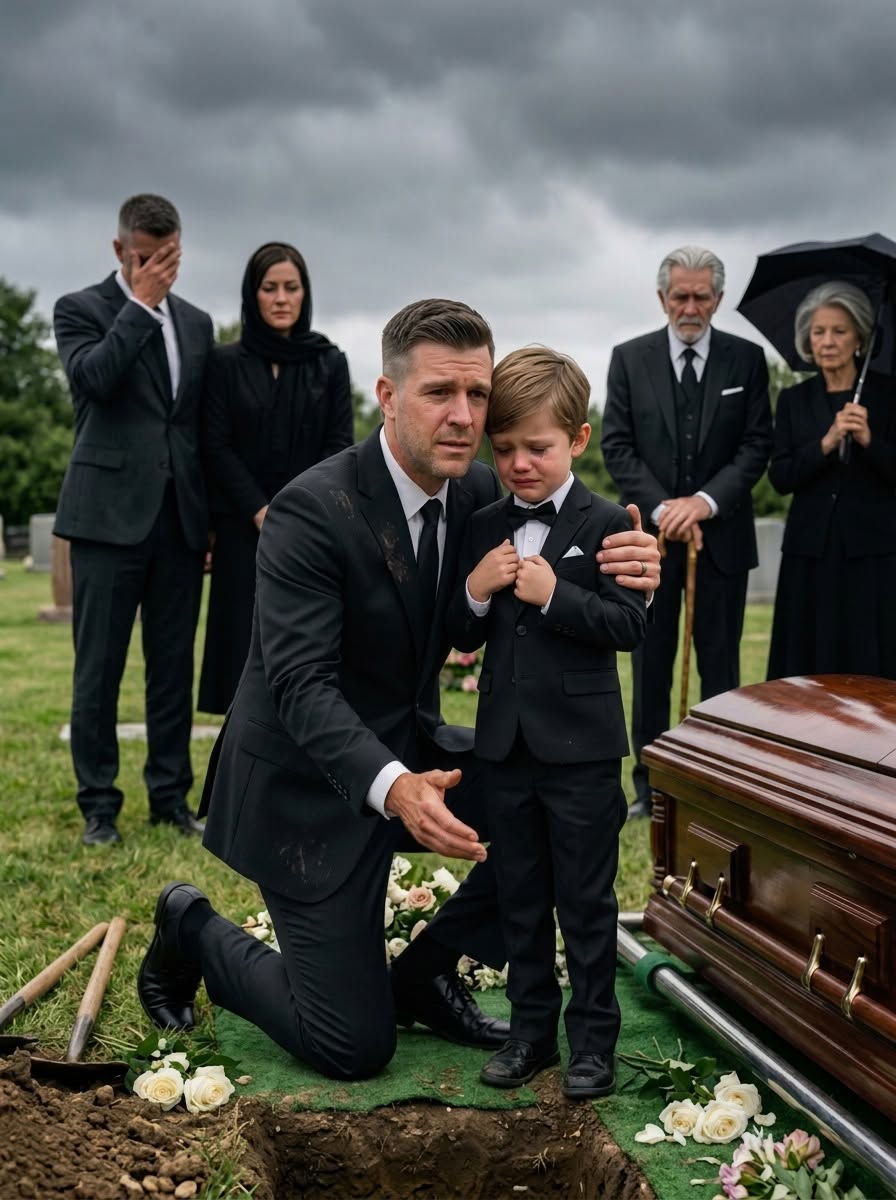
PART 1 TITLE: At the Edge of a Fresh Grave, My Son Heard a Voice No One Else Was Willing to Believe
The cemetery was almost empty when my seven-year-old son took my hand and told me his mother was still alive. I remember the exact pressure of his fingers against mine, the way his small palm felt damp despite the chilly afternoon, and the terrible seriousness in his face. Behind us, the last few mourners were walking toward their cars. Ahead of us stood a mound of freshly turned earth covering the woman I had married eleven years earlier. Ethan looked at the grave, then up at me. “Daddy, please check on Mommy,” he whispered. “I heard her calling my name.”
For several seconds, I couldn’t answer. My wife had been pronounced dead three days earlier. I had watched her coffin disappear into the ground that morning. I had stood beside our family while a minister spoke about peace, love, and the things we carry after someone leaves us. Everything about the day had been arranged to make one fact undeniable: Laura was gone. Yet my son was looking at me with the same stubborn certainty he showed when he insisted he’d heard a thunderstorm approaching before anyone else noticed the clouds.
“Ethan,” I said, crouching until our faces were level, “tell me exactly what you mean.” His lower lip trembled, but his eyes remained fixed on mine. “Mommy called me. She said my name.” I glanced toward the grave. The workers had finished most of their duties, and the dark soil still showed the marks of their equipment. “When did you hear her?” I asked. Ethan swallowed. “When everybody was leaving. I was standing over there, and I heard her. It was quiet, but it was Mommy.”
I wanted to gather him into my arms and tell him he had dreamed it. That would have been the sensible response, the one any reasonable parent might have offered a frightened child after an unbearable loss. But something stopped me. Ethan wasn’t describing a memory of Laura’s voice or asking when she would come home. He was pointing toward the ground with a kind of frightened urgency I had never seen in him. Whatever had happened, he believed it with every part of himself.
A few steps away, Mr. Collins, the funeral director, was speaking quietly with one of his employees. He was a thin man whose black suit seemed slightly too large around the shoulders. When he noticed Ethan crying, he approached with the practiced gentleness of someone accustomed to families on their worst days. “Is there anything I can do for you, Mr. Walker?” he asked. Before I could respond, Ethan turned toward him. “You have to get Mommy out,” he said. “Please. She doesn’t want to be down there.”
Mr. Collins stopped. His eyes moved from Ethan to the grave and then to me. For a moment, I saw his professional composure falter. He recovered quickly, lowering his voice. “Children sometimes experience things very vividly when they’re grieving. It can seem as though someone they love is speaking to them.” Ethan shook his head so vigorously that his neatly combed hair fell across his forehead. “I’m not pretending,” he said. “I know what Mommy sounds like.”
The funeral director opened his mouth, probably searching for another comforting explanation. I didn’t let him give it. “Mr. Collins, I need to ask you something.” He straightened. “Of course.” I looked toward the grave again, remembering a moment from the viewing that I had been trying desperately to dismiss. “Why was everything arranged so quickly?” I asked. “And why haven’t I been allowed to see my wife’s complete medical report?” The man’s expression changed. He looked toward the cemetery entrance before answering.
“Those matters were handled according to the information provided to us,” he said carefully. It was a polite response that explained almost nothing. “Provided by whom?” I asked. He hesitated. “Your brother-in-law assisted extensively with the arrangements.” I knew that already. What unsettled me was the way he seemed reluctant to discuss it. His fingers tightened around the folder he was carrying, bending one corner of the stiff paper beneath his thumb.
“Michael.” The voice came from behind me. Laura’s older brother, Daniel, was approaching from the direction of the parking area. At forty-two, Daniel was six years older than my wife, broad-shouldered, meticulous about his appearance, and ordinarily difficult to unsettle. He worked in private healthcare administration and had spent the previous three days behaving as though the entire family would collapse without his supervision. Now he looked at Ethan, then at me, and stopped several feet away.
“What’s going on?” he asked. I stood. “Ethan says he heard Laura calling him.” Daniel glanced briefly at the fresh grave. “He’s had a terrible few days,” he replied. “We all have.” His voice contained sympathy, but it also carried something firmer, an expectation that the discussion should end there. “I understand he’s upset,” I said. “I’m asking Mr. Collins about the arrangements.” Daniel’s jaw moved slightly. “We’ve already been through all of that.”
Ethan stepped closer to me and gripped my coat. “Uncle Daniel, Mommy called me.” Daniel bent toward him, but the movement looked strangely forced. “Your mother loved you very much, Ethan. You’re going to hear her voice in your memories for a long time.” My son drew backward. “That’s not what happened.” Daniel straightened and turned to me. “Michael, take him home. He needs to rest. So do you.” It was a reasonable suggestion, delivered at precisely the wrong moment.
There had been nothing reasonable about the last seventy-two hours. Laura was only thirty-six. She was a pediatric nurse who spent her working days caring for sick children and her evenings reminding me to eat proper meals. She walked every morning when her schedule allowed, tended sunflowers behind our house, and had never been diagnosed with a serious heart condition. Somehow, she had gone from lying beside me in our bed to being sealed inside a coffin in less time than it took to finish an ordinary working week.
I had accepted what people told me because I was exhausted, because the emergency responders had tried to help her, and because Daniel seemed to understand the procedures I couldn’t even bring myself to read. Now, standing beside her grave, I realized how little I actually knew. I couldn’t explain why no one had walked me through the complete medical findings. I couldn’t explain why Daniel had insisted an autopsy was unnecessary. And I couldn’t explain the small movement I thought I’d felt in Laura’s hand during our final viewing.
That memory had followed me throughout the funeral. Her fingers had been cold when I touched them. I knew that. I could still feel the unpleasant chill against my skin. Yet one finger had seemed to shift beneath mine, so slightly that I might have imagined it. I’d whispered her name. Nothing happened. Daniel had spoken from behind me, telling me other visitors were waiting, and I had stepped away. In the cemetery, with Ethan begging me to listen, the memory no longer felt harmless.
“Daniel,” I said, “who signed off on Laura’s death certificate?” His expression tightened. “The appropriate medical professionals.” “Which professionals?” “Michael, I don’t have every name memorized.” “Then where are the documents?” He looked away. I waited. From somewhere beyond the trees came the sound of a car starting, followed by tires moving slowly along the cemetery driveway. The silence between us lasted long enough for Ethan to press his face against my sleeve.
“I handled what needed to be handled,” Daniel finally said. “You were in no condition to make those decisions.” I knew he meant it as a defense of his actions. Perhaps three days earlier, I would have thanked him. Now I heard something else in the words: he had made choices concerning my wife, and I was expected to accept them without examining the reasons. “She’s my wife,” I said. “I should know what happened to her.” His eyes sharpened. “And I was her brother long before you knew her.”
That hurt more than I expected. Daniel and I had never been close friends, but we had shared birthday dinners, holidays, and countless ordinary family occasions. He had held Ethan when he was a baby and helped us move furniture into our first house. I had trusted him because Laura trusted him. I had believed his insistence on managing the funeral came from the same protective instinct that had made him attentive to his younger sister throughout her life. I had no desire to accuse him of wrongdoing. I wanted an explanation that made sense.
“I’m not trying to start a fight,” I told him. “I want someone to confirm we haven’t made a terrible mistake.” Daniel stared at me. “Listen to what you’re saying. Laura has been declared dead. We buried her today. Do you understand what reopening this would do to Ethan?” I looked down at my son. He wasn’t watching Daniel anymore. He was staring at the grave, his face pale and strained. “I think he’s already frightened,” I said. “And he deserves to know that I took him seriously.”
Mr. Collins shifted his weight. “Mr. Walker, reopening a burial site isn’t something we can do on a family’s immediate request. It involves official authorization and medical oversight.” I turned toward him. His explanation was the first clear procedural answer anyone had given me. “Then tell me who can authorize it.” He held my gaze for a moment. “Emergency services would be the appropriate starting point if you genuinely suspect someone may still be alive.”
Daniel spoke before I could answer. “This is absurd.” His voice was louder now, sharp enough to draw the attention of the remaining cemetery employee. “You’re going to put everyone through another ordeal because a child thinks he heard something?” Ethan flinched. I placed my hand on the back of his head. “Don’t speak about him as though he isn’t standing here,” I said. Daniel exhaled and lowered his voice, but he didn’t apologize.
I glanced toward the patch of soil. Nothing moved. There was no sound from beneath it. The earth looked exactly as it should after a burial, and the practical part of my mind insisted I was about to humiliate myself in front of my family. Perhaps that was the most frightening part: I had no proof. I had a seven-year-old boy’s conviction, one unexplained sensation at the funeral home, and several questions no one appeared eager to answer.
Then Laura’s voice returned to me, not from the ground but from our kitchen on the last evening we had spent together. She had held me with unusual force and asked me to promise something. If anything strange happened, she had said, I must not allow someone else to convince me that my own observations were meaningless. At the time, I had assumed she was exhausted after a difficult shift. Now her words seemed to belong to a conversation we had never finished.
I knelt beside Ethan once more. “Look at me, buddy.” He lifted his face. His cheeks were damp, and there was dirt on one cuff of his white shirt. “Are you sure you heard Mommy?” I asked. He nodded without hesitation. “I heard her say my name. I know you think I’m little, but I know her voice.” I wiped a tear from his cheek. “I know you do.” For the first time that afternoon, his shoulders loosened slightly.
I took my phone from my pocket. Daniel noticed immediately. “Michael, don’t.” The pleading edge in his voice surprised me more than his earlier anger. “Think about what you’re doing.” I looked directly at him. “I am.” He stepped closer. “You can’t undo a funeral because you don’t like what happened.” “I’m not trying to undo a funeral,” I replied. “I’m trying to find out whether my wife was actually dead when we buried her.”
I called 911 before he could argue further. My fingers shook so badly that I nearly dropped the phone while selecting the emergency number. When the dispatcher answered, I gave my full name, the cemetery’s location, and the information I had. I explained that Laura had been buried approximately an hour earlier, that Ethan claimed to have heard her voice, and that I was concerned about the circumstances of her death certification. I did not pretend to possess evidence I lacked. I told the dispatcher exactly what I knew and exactly what frightened me.
The woman on the line asked several questions. I answered as carefully as I could, looking toward the cemetery sign to confirm the location. She told me assistance would be sent and instructed me to remain available. Daniel stood motionless while I spoke. When I lowered the phone, he reached out suddenly and caught my sleeve. His fingers pressed hard against my arm. “You have no idea what you’re setting in motion,” he said.
I pulled free. There was something in his expression I had never noticed before. It wasn’t the impatience of a man dealing with an unreasonable relative, nor the sorrow of an older brother who had lost his sister. His eyes kept moving toward the grave and then toward the entrance, as though he expected something dreadful to arrive from either direction. “Then explain it to me,” I said. “Tell me why you’re so determined that nobody should check.”
He said nothing. The breeze lifted the edge of the funeral program lying beside the flowers. Ethan pressed against my leg. I watched Daniel struggle to answer a question that should have been simple for an innocent man. For three days I had allowed other people to decide what happened next. Standing over Laura’s grave, with emergency responders on their way, I made a promise to myself: whatever the investigation revealed, I would never again mistake another person’s confidence for proof.
END PART 1
PART 2 TITLE: Three Days Earlier, My Wife Made a Strange Request That Returned to Me Only After We Had Buried Her
Three days before I called the police to my wife’s grave, the most troubling thing in our house was a telephone that wouldn’t stop ringing. Laura and I were having dinner with Ethan, and she had just reached across the table to move his glass away from the edge when her phone lit up beside her plate. She glanced at the screen. The color seemed to leave her face for an instant. Then she silenced the call, turned the phone facedown, and asked Ethan whether he wanted another serving of potatoes.
I noticed because Laura was ordinarily incapable of hiding what she felt. When she was pleased, she smiled before she spoke. When she was annoyed, she pressed her lips together and waited until she could say what she meant without being unkind. That evening, she moved through dinner as though she were listening for something beyond our conversation. Twice she looked toward her phone. Once she picked it up, checked the screen, and placed it in her lap without responding.
“Everything okay?” I asked while Ethan was occupied with his food. She gave me a quick smile. “Something from work. I’ll deal with it later.” I knew the clinic could be demanding. Laura cared for children, and occasionally a situation stayed with her long after she left the building. I had learned not to demand an account of every difficult shift. Some things belonged to her patients and their families. Still, there was a difference between professional exhaustion and the alert, watchful expression I saw that night.
Our life was rarely dramatic. I managed construction crews, a job that left me sunburned in summer and cold to the bone in winter. Laura worked shifts at a nearby medical clinic. Between us, we kept the mortgage paid, the cars running, and the refrigerator stocked with food Ethan liked. We had neither the money nor the desire for expensive vacations. Every summer, we tried to spend a few days camping, where Laura would make coffee over a small burner while Ethan searched for interesting stones along the lake.
We had met eleven years earlier at a neighborhood cookout. I was twenty-six and knew more about roofing materials than I did about conversation. Laura, twenty-four at the time, had been helping a little girl who had scraped her knee on the driveway. She cleaned the cut, dried the child’s tears, and somehow persuaded her to laugh before sending her back to play. When I introduced myself, Laura asked whether I had been watching the entire performance. I admitted that I had. She laughed and told me I could help by finding another clean napkin.
There was something practical about her kindness that made me love her. She didn’t make grand speeches about looking after people. She simply noticed what needed doing. When my mother had surgery, Laura prepared meals and left them in labeled containers. When one of our neighbors broke his wrist, she helped him arrange his medication schedule. At home, she tucked small handwritten notes into places where Ethan and I would find them unexpectedly. Some reminded me to drive carefully. Others were little jokes or messages of encouragement.
I kept them all. There was a shoebox in our bedroom closet filled with slips of paper, grocery-list scraps, and the backs of old envelopes bearing Laura’s familiar handwriting. I hadn’t told her that I saved every message. It seemed too sentimental for a man who spent his days telling workers where to position heavy machinery. But I liked the idea that the ordinary things she wrote would still exist after an argument, a tiring week, or any of the little disappointments a marriage collects.
Laura’s favorite place in our yard was a narrow strip of soil beside the back fence. She grew sunflowers there, tall enough by late summer to lean over the boards. She claimed every room needed a plant and treated dying houseplants with the concentration other people reserved for complicated machinery. Sometimes I teased her that she’d eventually turn the house into a greenhouse. She would point to the sad-looking fern near my desk and tell me it was surviving only because she refused to let me be responsible for watering it.
That evening, after Ethan finished dinner, Laura took the plates to the sink while I wiped the table. Her phone lit up again. She looked at the screen and immediately carried it into the hallway. I heard her speak quietly, though I couldn’t distinguish the words. When she returned, she seemed distracted enough to leave the water running after setting a pot beneath the tap. I turned it off and touched her shoulder. “You sure this is just work?” I asked.
She turned too quickly. For a moment, I thought she might tell me something important. Instead, she looked at the dishes and said, “I’m sorry. My mind’s somewhere else.” “Is it something I can help with?” I asked. “Not yet.” The answer came before she could soften it. She looked at me, perhaps realizing how it sounded. “I just need to think a few things through.” I waited, but she didn’t elaborate. We finished cleaning the kitchen mostly in silence.
Later, Ethan went upstairs to brush his teeth. I found Laura standing near the kitchen window, holding her phone against her chest. Outside, the backyard was almost dark. The last of the evening light caught the heads of the sunflowers, turning their edges gold. Laura didn’t seem to notice. She was looking through the glass with the distant expression she sometimes wore after a particularly difficult day at the clinic. I said her name quietly, and she turned toward me.
She crossed the room and put both arms around my waist. Laura was affectionate, but there was a tension in the embrace that made me stand still. She held on longer than usual, her cheek pressed against my shirt. I placed one hand on her back. “What is it?” I asked. “Michael, I want you to promise me something.” Her voice was muffled against my chest. “All right,” I said. “What do you need?”
She pulled back just far enough to look at me. “If something happens that doesn’t make sense, don’t let anyone talk you out of believing what you noticed.” I frowned. “Something like what?” She hesitated. I could see she was choosing her words. “Just promise you’ll trust your own judgment. Even if somebody tells you you’re mistaken.” I tried to understand the seriousness in her eyes. “Laura, has somebody threatened you?” She shook her head, but she didn’t answer the question directly.
“You’re worrying me,” I told her. She lowered her gaze. “I know. I’m sorry.” “Then talk to me.” For a few seconds, she seemed ready to do exactly that. Her mouth opened, and she drew a breath. Then we heard Ethan running along the upstairs hallway. He appeared a moment later wearing dinosaur pajamas, clutching his favorite bedtime book and announcing that we had promised him two chapters. Laura stepped away from me, and the tension in her expression eased as she looked at him.
We read to Ethan together. He sat between us on his bed, correcting me whenever I skipped a line and laughing when Laura gave the story’s villain a ridiculous voice. I remember the weight of his head against my shoulder and the smell of the shampoo Laura used on his hair. I remember thinking that whatever had worried her could wait until morning. We had the weekend approaching. There would be time to sit with coffee and talk without interruptions. It was such an ordinary assumption that I never considered it might be wrong.
After Ethan fell asleep, Laura kissed his forehead and adjusted the blanket around his legs. In the hallway, I touched her arm. “About what you said downstairs…” She shook her head gently. “I’m tired, Michael. Can we talk tomorrow?” I wanted to insist, but she looked worn out, and I knew she had an early shift ahead. “Tomorrow,” I agreed. She kissed my cheek. I wish now that I had asked one more question. I wish I had understood how much she needed to tell me.
I woke a little after five the next morning. The bedroom was dim, and the house was silent except for the low hum of the ventilation system. Laura was lying beside me. Normally she would have been awake before her alarm, moving quietly so she wouldn’t disturb me. This time, she hadn’t moved. I said her name and touched her shoulder. She was unresponsive. I tried again, louder. Her body shifted slightly under my hand, but she didn’t wake.
At first, my mind searched for an ordinary explanation. She was exhausted. She was ill. Perhaps her blood pressure had dropped. I shook her shoulder again and received no response. My fear arrived suddenly, with none of the gradual warning I had imagined such a moment would provide. I reached for my phone and called emergency services. The dispatcher asked questions and gave instructions. I followed them as well as I could, aware only of Laura’s stillness and the sound of my own breathing.
The paramedics arrived within minutes, carrying equipment into our bedroom. One of them asked me to move aside. I stood in the doorway, close enough to see their faces but not close enough to help. Their voices were controlled and efficient. They worked over Laura while I gripped the doorframe hard enough to hurt my fingers. I heard words I understood individually but couldn’t assemble into a sentence that made sense. They were attempting to restore her heartbeat. They were getting no response.
Eventually, one of the responders approached me. His expression told me something terrible before he spoke. He explained that despite their efforts, Laura had not responded to treatment. He said he was sorry. I remember staring at him, waiting for the rest of the explanation, certain that there must be another procedure or another person who could intervene. But he had already said what he came to say. The room behind him was no longer filled with urgent movement.
Ethan was still asleep upstairs. That fact became the only thing I could think about clearly. I asked a responder whether I should wake him, then immediately regretted the question because no stranger could decide how a father should tell his son that his mother had died. I walked to the stairs, stopped halfway, and sat down. I couldn’t make myself take another step. There was no language I knew that could make those words bearable to a child.
Family members began arriving while the morning was still young. People embraced me, asked what had happened, and offered help I couldn’t evaluate. Someone made coffee. Someone else took Ethan into the living room after I finally told him. I remember his expression more clearly than anything else from that morning. At first, he waited for me to explain when Laura would return. Then he understood what I was saying and began to cry with a helplessness that made me feel as though I were failing him simply by being unable to change the truth.
Daniel arrived soon afterward. He looked shaken when he entered the house, and for one brief moment he seemed as lost as the rest of us. He hugged me without speaking. Then his familiar decisiveness returned. He began asking about paperwork, medical contacts, and funeral arrangements. “You need to concentrate on Ethan,” he told me. “I’ll handle what I can.” I thanked him. At the time, I was grateful that someone could still make decisions.
Daniel chose the funeral home and dealt with much of the administrative work. He contacted relatives, spoke with people involved in the paperwork, and explained which documents needed signatures. When I asked whether an autopsy should be performed, he told me the physicians had already determined the cause of death and that further examination would only prolong our suffering. He said Laura would not have wanted unnecessary procedures. I couldn’t recall her ever expressing that preference, but I accepted his judgment.
There were moments when I wanted to ask more questions. How could a healthy woman her age suffer sudden cardiac arrest in her sleep? Had there been warning signs I hadn’t recognized? What exactly had the medical examination established? Each time, Daniel had an answer that sounded plausible enough to end the conversation. He worked in healthcare administration. I worked in construction. I felt out of my depth, and grief made even simple decisions exhausting. Eventually, I stopped asking.
The funeral was arranged with astonishing speed. Daniel insisted that keeping Laura’s body waiting would only deepen the family’s distress. Relatives agreed that a prompt service might help Ethan begin adjusting to the loss. I signed documents I barely remember reading. Flowers were selected. A casket was chosen. The minister called to ask about Laura’s life. I found myself discussing songs and photographs while still expecting to hear her footsteps in the hallway.
On the morning of the funeral, Ethan and I arrived at the funeral home before most of the guests. Laura lay inside an open casket wearing the pale blue outfit she had chosen for our tenth wedding anniversary. Her dark hair had been arranged neatly around her face. Her hands rested one above the other across her abdomen. For a brief, terrible instant, I expected her to open her eyes and ask why everyone was standing around looking so solemn.
I approached alone. The room smelled faintly of flowers and furniture polish. I bent to kiss her forehead. Her skin was cold, and the contact sent a shiver through me. I told her quietly that I loved her, though the words felt inadequate. Then I took her hand between my fingers. I wanted to remember its shape, the small lines across her knuckles, the familiar wedding ring. As I touched her, I felt—or thought I felt—one finger move.
I stopped breathing. It was the slightest sensation, so brief that I couldn’t be sure it had happened. I stared at her hand. “Laura?” I whispered. Her face remained still. I waited, looking for the smallest change in her expression or another movement beneath my fingertips. Nothing came. Behind me, Daniel spoke. Other people were waiting to pay their respects, he said. I turned toward him, still holding Laura’s hand. “I thought…” I began, but couldn’t finish.
Daniel looked at me for a long second. “Come on, Michael,” he said softly. “You’ve been through enough.” I released her hand. I told myself that grief could create sensations that weren’t real, that a man desperate to see his wife alive could mistake the pressure of his own fingers for hers. I stepped aside and let the next mourners approach. Within hours, Laura’s coffin was closed and carried away. By the time Ethan spoke beside the grave, the memory of that movement had become the one thing I could no longer afford to ignore.
END PART 2
PART 3 TITLE: An Officer Asked for Evidence, and a Cemetery Worker Remembered the Sound He Had Explained Away Too Quickly
The first police vehicle entered Maplewood Cemetery while Daniel was still standing beside us. Its tires made a soft crunching sound over the gravel drive, a sound that seemed absurdly ordinary considering why the officers had come. Ethan noticed the vehicle before I did. He straightened beneath my arm and watched it approach with the solemn attention of a child who had begun to understand that adults didn’t always know what to do. Daniel turned toward the entrance, his expression closing again. Whatever he had wanted to tell me remained unsaid.
Two officers stepped out. The older one introduced himself as Sergeant Miller. He had a broad face, graying hair, and the unhurried manner of someone who understood that a frightened person rarely explained things in a sensible order. The younger officer remained near the vehicle for a moment, speaking into his radio. Sergeant Miller approached us and asked who had called emergency services. I raised my hand. He looked at the grave, at the funeral director, and finally at Ethan. “Mr. Walker?” he asked. I nodded. “Tell me what’s happened.”
I began with my son’s account. I explained that Laura had been buried approximately an hour earlier and that Ethan believed he had heard her call his name. Saying it aloud to a police officer made the story sound even less credible than it had in my head. But Sergeant Miller didn’t interrupt. He listened while I described the funeral, the sudden death three days earlier, and the uneasiness I felt about the documentation. Only when I finished did he ask what evidence suggested Laura might still be alive.
“I don’t have proof,” I admitted. “I know how this sounds.” He kept his eyes on me. “Tell me what you’ve observed.” I described touching Laura’s hand during the viewing and feeling what seemed like a small movement beneath my fingers. I told him about her age, her general health, and the speed with which the funeral had been arranged. I explained that although I was her husband, I hadn’t been shown the complete medical findings. The sergeant wrote a few notes, then asked whether anyone else had noticed signs of movement.
Before I could answer, Daniel stepped forward. “Sergeant, I’m Laura’s brother. My sister died three days ago. Michael has barely slept, and this little boy has just buried his mother. They’re both devastated.” His words were carefully chosen, and none of them was entirely false. I hadn’t slept properly since the emergency responders left our house. Ethan was suffering in ways I could scarcely begin to address. But Daniel was using those truths to make the remaining questions seem unworthy of investigation.
Sergeant Miller looked at him. “I’ll speak with you in a moment, sir. I’d like Mr. Walker to finish.” Daniel stepped back, though the tightness around his mouth deepened. The sergeant turned to me again. “You mentioned concerns about the death certificate. What specifically is troubling you?” I explained that Daniel had handled almost everything and had discouraged further medical examination. I wasn’t certain that any procedure had been performed improperly. What concerned me was that I didn’t know enough to be certain it hadn’t.
The sergeant asked who had initially confirmed Laura’s death. I told him about the paramedics and the information I had received afterward. He wanted to know whether I possessed copies of the relevant documentation. I had some papers in a folder at home, but not a complete medical report. Daniel had managed most of the correspondence. Sergeant Miller asked Mr. Collins about the funeral home’s records. The director answered carefully, explaining what his staff had received and which arrangements had been made through the family’s representative.
I watched them talk, aware of how many decisions had taken place without my full involvement. Only a few days earlier, Daniel’s ability to speak confidently about medical paperwork had comforted me. Now every mention of a document I hadn’t seen made my stomach tighten. I knew confidence wasn’t evidence of wrongdoing. I also knew there were too many unanswered questions to dismiss because asking them embarrassed the family. When the sergeant stepped aside to make a phone call, I stayed close enough to hear without interfering.
He spoke with dispatch, confirmed details, and requested assistance in reviewing the circumstances of Laura’s death. The cemetery manager arrived shortly afterward, walking quickly from an office building near the entrance. He was carrying a set of keys and wearing the strained expression of a man whose carefully scheduled afternoon had changed in a way he couldn’t control. Sergeant Miller explained that the situation required verification and that no one was to disturb the grave without appropriate authorization. The manager nodded and began making calls.
Daniel watched the discussions from a few yards away. Every so often, he looked toward his car. The movement was small, but after the exchange beside the grave I found it difficult not to notice. I wanted to ask him directly whether he knew something I didn’t. Yet I was afraid that any accusation would distract from the only question that mattered: whether Laura could still be helped. There would be time to examine Daniel’s behavior later, if the circumstances warranted it. At that moment, I needed the people responsible for the cemetery and the emergency response to act carefully and quickly.
Ethan tugged my sleeve. “Are they getting Mommy?” he asked. I looked down at him and saw how much hope my call had given him. That frightened me almost as much as his original claim. If the officers found nothing, my son would be forced to suffer another loss, this time after I had allowed him to believe something might change. I crouched beside him. “They’re checking what happened, buddy. We have to let them do their jobs.” He stared at my face. “But you believe me, right?”
I could have told him exactly what he wanted to hear. I could have promised that Laura would come home and that everything would be different by evening. Instead, I took both his hands. “I believe you heard something,” I said. “And I believe you when you tell me you recognized Mommy’s voice. I don’t know what it means yet.” He considered that for a moment. “It means she’s scared,” he said. Then he turned his head toward the grave, as though he expected to hear her again.
The cemetery had grown quiet around us. The last mourners were gone, and only a few vehicles remained near the entrance. Sunlight filtered through the branches above the path. Somewhere beyond the cemetery wall, a lawn mower was running. I remember how angry that sound made me, not because anyone was doing anything wrong, but because the rest of the world continued with its ordinary tasks while I waited to learn whether my wife had been buried alive.
Sergeant Miller returned and told me the proper authorities were being contacted. He explained that reopening a grave was a serious action governed by procedures designed to protect everyone involved. There would need to be a clear basis for the emergency request, and the cemetery staff couldn’t simply begin digging because I demanded it. I understood his position, but understanding didn’t make the waiting easier. “If there’s even a chance she’s alive,” I said, “every minute matters.” He looked toward the grave. “That’s why we’re treating the report seriously.”
Mr. Collins stood near the manager, holding his paperwork with both hands. I wondered what he was thinking. He had helped arrange hundreds of services, perhaps thousands. He had watched grieving people struggle to accept deaths they couldn’t prevent. Now a husband was questioning a burial completed barely an hour earlier. If the report proved unfounded, the funeral home would have endured a frightening disruption. If it proved true, the consequences would be almost impossible to comprehend.
I asked the sergeant whether Ethan should repeat what he’d heard directly to him. Miller agreed, and we moved to a wooden bench a short distance from the grave. I draped my coat around my son’s shoulders. His shirt collar was crooked from the day’s embraces, and his small dress shoes were coated with dust. He sat close to me while the sergeant crouched in front of him. “Ethan, your dad told me you heard your mother’s voice,” he said. “I’d like you to tell me about that in your own words.”
Ethan looked at the officer’s badge, then toward the grave. “I heard Mommy say my name,” he answered. “Was it loud?” Miller asked. Ethan shook his head. “No. It sounded far away.” “Did you see anyone speaking?” Another shake of the head. “I knew it was her.” He pressed his hands together between his knees. “I tried to tell Daddy because I thought nobody else could hear.” Miller thanked him and didn’t press further. I was grateful for that. My son had already been asked to explain more than a child should have to explain on the day of his mother’s funeral.
After the sergeant walked away, Ethan leaned against me. “Daddy, why doesn’t Uncle Daniel want them to help?” The question caught me off guard. Children see things adults believe they have concealed. Ethan had noticed Daniel’s impatience, his insistence that we leave, and the way he kept interrupting. “Uncle Daniel is upset too,” I said. It was the most charitable answer I could give without pretending to know his motives. Ethan remained quiet for a while. Then he said, “Mommy always says when someone’s scared, you should find out why.”
I felt a painful tightening in my chest. Laura used to say something like that when one of the children at the clinic refused treatment. She believed fear was information, not merely an obstacle to overcome. When Ethan resisted something, she tried to understand the reason before correcting him. Hearing him repeat her lesson beside her grave made me turn my face away for a moment. I wasn’t certain I could bear the sight of his expression if I began crying again.
An unfamiliar voice interrupted my thoughts. “Sergeant? Could I speak with you?” A young cemetery worker had approached the officers near the service vehicle. He wore a dark green jacket, his work boots were caked with mud, and there was a narrow streak of dirt along one side of his face. He looked uncomfortable, standing with his weight on one foot and twisting his cap between his hands. I later learned his name was Aaron. At that moment, all I knew was that Sergeant Miller listened to him with increasing attention.
Their conversation lasted less than a minute. Aaron gestured toward the machinery positioned near the burial site, then toward the mound of earth itself. Miller asked him a question. The young man answered and rubbed the back of his neck. I couldn’t hear their words, but I saw the sergeant’s expression change. He glanced at Daniel, who was standing near the path, and said something quietly to the younger officer. Then he approached me.
“Mr. Walker,” he began, “one of the cemetery employees has reported something that may be relevant.” I stood so quickly that Ethan’s coat nearly fell from his shoulders. “What is it?” Miller chose his words with care. “He remembers hearing a faint tapping noise near the burial equipment shortly after the coffin was lowered.” I stared at him. For an instant, I couldn’t move. “Where did it come from?” I asked. “He couldn’t identify the source with certainty.”
The sergeant explained that Aaron had initially assumed the sound came from machinery, shifting equipment, or something else associated with the burial. It had been brief, and he hadn’t considered it significant at the time. “But after hearing what your son reported,” Miller continued, “he thought we should know.” I looked across the grass at Aaron. The young man had gone pale. He appeared to be staring at the grave as though replaying the sound in his memory.
“Did it come from the coffin?” I asked. Miller didn’t answer immediately. “We don’t know,” he said. “The employee couldn’t establish that.” I knew he was being careful not to turn an uncertain observation into proof. But I could barely keep my voice steady. “My son heard his mother. I thought her hand moved during the viewing. Now someone else heard tapping near the grave. How many things have to happen before somebody checks?” The last words came out louder than I intended.
Sergeant Miller raised a hand, not to silence me but to slow the exchange. “We’re pursuing the emergency process now, Mr. Walker.” He glanced toward the other officer. “And we’re going to make sure the right people are here.” I wanted to argue, to demand that someone begin immediately. Instead, I looked at Ethan. He was standing beside the bench, watching me with eyes that held more expectation than any child should have placed on his father. I forced myself to remain where I was.
Aaron approached after speaking with the sergeant. He stopped a short distance away, uncertain whether I wanted to hear from him. “I’m sorry,” he said. The words came out awkwardly. “I should have mentioned it sooner.” I looked at the dirt on his boots and the worry in his face. “Tell me exactly what you heard.” He swallowed. “There was a tapping sound. Not very loud. I thought it was something moving on the equipment. We had machinery working, and you get noises like that sometimes.”
“Did it happen more than once?” I asked. Aaron frowned, searching his memory. “I can’t say for sure. I remember stopping because it didn’t sound quite right. Then there was other noise, and I didn’t hear it again.” He looked toward the grave. “When I heard about your boy, I thought maybe I ought to tell somebody.” I wanted to be furious with him for not speaking earlier. Instead, I saw a young employee confronting the possibility that an ordinary decision he’d made might carry terrible consequences.
“You did the right thing by telling them,” I said. He nodded, but his expression didn’t ease. His uncertainty was important. He hadn’t claimed to hear a woman screaming or a coffin being struck. He had reported a sound he couldn’t explain, even though admitting it placed him in an uncomfortable position. That made me trust his account more than I might have trusted a dramatic story told with absolute certainty.
Across the cemetery, Daniel abruptly began walking toward the parking area. He moved quickly, keeping his head down. The younger officer noticed him and called out. “Sir, we still need to speak with you.” Daniel continued for another step before stopping. Then he turned. I had seen my brother-in-law angry, impatient, and distressed over the years. I had never seen him look the way he did then. His face had drained of color, and his eyes moved between the officer and the grave.
“I’m not under arrest,” Daniel said. The officer approached him calmly. “Nobody said you were. We need to clarify information about the arrangements.” Daniel glanced at me. For a moment, I expected him to blame me for bringing the police there. Instead, he pressed his lips together and remained silent. The younger officer spoke to him away from the others. I couldn’t hear the conversation, but Daniel’s shoulders seemed to sag as it continued.
Sergeant Miller received another call. He walked toward the cemetery manager and spoke with him for several minutes. The manager immediately began directing employees toward the equipment storage area. An emergency medical vehicle arrived at the entrance, followed by additional personnel involved in the response. The sudden movement made Ethan stand. “What’s happening?” he asked. I placed a hand on his shoulder. “They’re preparing to check Mommy.”
The sergeant returned to explain that the relevant officials had been notified and that the emergency reopening was being arranged under their supervision. There were still procedures to complete, but the combined concerns were being treated urgently. I felt relief and terror arrive together. Until that moment, the possibility of finding Laura alive had been a desperate idea I could barely say aloud. Now people with equipment, medical training, and legal authority were preparing to examine what lay beneath the soil.
Mr. Collins approached one last time. He looked older than he had when we arrived at the cemetery. “Mr. Walker, I want you to know we’re cooperating fully,” he said. I studied his face. I couldn’t tell whether he was afraid of professional consequences or of what might be discovered. Perhaps both. “I just want my wife checked,” I replied. “Whatever that requires.” He nodded and walked away without offering another explanation.
I took Ethan’s hand and moved behind a temporary safety barrier. The cemetery workers positioned their equipment while Sergeant Miller coordinated with the arriving personnel. Aaron stood nearby, listening to instructions. Daniel remained with the younger officer near the path. Every person seemed to have a task except me. I could only stand and watch the place where Laura had disappeared from sight that morning.
The machinery started with a deep mechanical rumble. Ethan pressed closer, and I wrapped my free arm around him. Beyond the barrier, the first careful movement of earth exposed a darker layer beneath the surface. There was no way to pretend the decision could be taken back. In front of police officers, medical responders, funeral staff, and my frightened son, the grave we had closed only hours earlier was being opened again. I prayed the workers would find nothing that suggested Laura had suffered. And then, despite everything I had been told, I prayed they would find her alive.
END PART 3
PART 4 TITLE: When the Coffin Opened, One Small Change in My Wife’s Hand Undid Every Certainty We Had Been Given
The first layer of soil came away slowly. I stood behind the barrier with Ethan pressed against my side, watching the cemetery workers carry out a task no one present had expected to perform that afternoon. The machinery moved with deliberate precision, removing earth while the crew checked the surrounding area. Sergeant Miller remained close to the cemetery manager, and the medical responders waited beside their equipment. No one was speaking above a necessary volume. The lack of conversation made every mechanical sound seem louder.
I had spent the morning trying not to imagine Laura beneath the ground. Now I could think of nothing else. Her blue outfit, her dark hair arranged around her face, her hands resting together across her abdomen—all of it returned to me with painful clarity. I remembered touching her finger and wondering whether it had moved. If that sensation had been real, why hadn’t I insisted on checking it? Why had I allowed my own uncertainty to outweigh the possibility that something was wrong?
Ethan leaned forward as the workers uncovered the burial vault. “Daddy, is she coming out?” he asked. I put my hand gently against his chest to keep him from stepping toward the barrier. “They’re getting closer,” I said. He nodded, his eyes following the workers. His coat had slipped from one shoulder, but he didn’t seem to feel the cold. I pulled it back into place. There was nothing else I could do for him except make sure he wasn’t standing in the path of the equipment.
The protective covering was removed under the cemetery manager’s supervision. A few workers repositioned themselves while others checked the lifting equipment. I watched the dark outline of the coffin become visible. Its polished surface was streaked with damp earth. I recognized the handles I had seen at the funeral home, and my stomach contracted. We had chosen that coffin for Laura because Daniel said it was appropriate and because, in my condition, I hadn’t been able to imagine what an appropriate coffin might mean.
When the workers began lifting it, I gripped the barrier with my free hand. Ethan stayed close, but I felt his fingers gradually loosen around mine as he watched. The coffin rose clear of the vault and was carefully moved to the prepared examination area. A member of the medical team spoke with Sergeant Miller, who then asked everyone to maintain their distance. The funeral director approached with the equipment needed to open the coffin. He looked at me once and immediately turned away.
I couldn’t tell whether I wanted them to hurry or stop. Part of me was terrified they would open the lid and find Laura exactly as we had left her, confirming that Ethan’s desperate certainty had been born entirely from grief. Another part was afraid of discovering that he had been right, because that would mean my wife had been placed underground while there was still life in her body. I had no way to prepare myself for either possibility.
The coffin was positioned securely. Mr. Collins stepped aside as the authorized personnel prepared to open it. One of the paramedics checked his equipment while another stood close to the lid. Sergeant Miller moved slightly in front of us, ready to prevent anyone from rushing forward. I could hear my own breathing. Ethan whispered something I couldn’t make out. Then the lid began to rise, and the afternoon seemed to narrow to the dark space opening between the wood and its frame.
Laura was inside. For a moment, that was all my mind could accept. Her eyes were closed. Her skin looked pale beneath the daylight. Her dark hair rested against the lining, and the blue fabric of her outfit was still visible. I wanted to call her name, but my throat tightened so completely that I couldn’t speak. I searched her face for movement, for the familiar twitch of her mouth when she tried not to smile, for anything that belonged to the living woman I knew.
Then I noticed her right hand. At the funeral home, both hands had been arranged across her abdomen, one above the other. I remembered the position because I had stood beside the casket staring at her wedding ring. Now her right arm was bent differently. Her hand rested higher, near her shoulder. It was not where I had last seen it. I took a step forward before Sergeant Miller lifted his hand to stop me.
“Her hand,” I said. The words were barely audible. I tried again. “Her hand wasn’t like that.” The sergeant looked toward the medical team. One of the paramedics was already leaning closer to Laura’s body. He examined her carefully while his colleague prepared monitoring equipment. I couldn’t hear everything they said. I saw one of them position his fingers against her neck and remain still for several seconds. Then he asked the other responder to check again.
I felt Ethan straighten beside me. “Daddy?” he whispered. I couldn’t answer. Both medical professionals were focused on Laura. One adjusted his position, checked again, and looked toward his colleague. Their expressions had changed. The younger paramedic reached for another piece of equipment. “Possible pulse,” one of them said. I heard the words clearly, but their meaning reached me slowly, as though my mind refused to accept something so enormous without further evidence.
“Did you say she has a pulse?” I called. No one answered immediately. The paramedic repeated his assessment while another began preparing emergency support. Then the team leader looked toward us. “We have possible signs of circulation,” he said. “Everyone needs to remain back. We have to work.” His voice was firm and controlled, but the urgency in his movements told me that what they had found was not an ordinary postmortem observation.
The quiet cemetery changed in an instant. Medical bags were opened. Equipment was brought closer. Someone requested additional supplies and immediate transport arrangements. The responders assessed Laura’s breathing, connected monitoring devices, and began providing the emergency care she required. I watched them move around her with disciplined speed. Whatever doubts anyone had felt about reopening the grave were no longer the center of attention. The people surrounding my wife were trying to keep her alive.
Then I saw her chest move. It was faint, almost impossible to distinguish beneath the fabric of her blouse. At first, I thought I had imagined it. I stared harder, scarcely daring to blink. Another shallow movement followed. A paramedic leaned closer and spoke to his colleague. I couldn’t understand the medical terms, but I heard the words that mattered. Laura was showing signs of life. She needed urgent hospital treatment.
Ethan cried out before I could move. “Daddy! I told you! I told you Mommy was there!” His voice broke on the last word. He tried to run toward the coffin, and I caught him against my chest. “I know, buddy,” I said, although my own voice was shaking. “I know.” He struggled for a moment, not because he wanted to escape me but because he needed to reach his mother. I held him until he stopped pulling away. Then I knelt beside him, still unable to comprehend what we had witnessed.
My wife was alive. The statement seemed both wonderfully simple and impossibly complicated. Three days earlier, emergency responders had informed me that they could not save her. We had arranged a funeral, accepted condolences, and lowered her into the ground. Now a medical team was treating her as a critically ill patient. I wanted to be happy without reservation, but fear crowded into every thought. How long had she been unresponsive? What had happened to her body? Could she recover from whatever she had endured?
Sergeant Miller approached while the responders prepared Laura for transport. “Mr. Walker, I need you to stay here with your son for a moment.” I looked past him toward the medical team. “Can I go with her?” He glanced at the ambulance. “We’ll arrange for you to follow. The responders need to concentrate on getting her stabilized.” I nodded, though every instinct told me to remain beside Laura. The sergeant lowered his voice. “I know you have a lot of questions. We do too.”
I turned toward Daniel. He stood several yards away, near the younger officer. His face was almost colorless. I waited for him to rush forward, to ask about his sister, to show the relief any brother should feel upon learning she was alive. Instead, he remained still. I couldn’t know what was happening inside his mind, but his reaction disturbed me. He looked less like a man witnessing a miracle than someone who had just seen a carefully guarded certainty collapse.
“Daniel,” I called. He looked at me but didn’t approach. “She’s alive.” He swallowed. His mouth moved, yet no words came out. The younger officer said something to him, and Daniel turned away. I wanted to demand an explanation for his behavior, but the ambulance crew was already moving Laura toward the vehicle. Nothing Daniel said at that moment could be more important than reaching the hospital. I turned back to my wife and followed as far as the officers allowed.
Ethan began crying again when the ambulance doors opened. This time, his tears were different. He had seen his mother taken from the grave, but he couldn’t understand why she wasn’t speaking to him or why strangers were surrounding her with equipment. I held him while the responders secured Laura inside the ambulance. “Is Mommy coming home now?” he asked. I looked at the vehicle and then at his face. “The doctors have to help her first,” I said. “She’s very sick, sweetheart.”
“Because she was down there?” he whispered. I drew him closer. “We don’t know everything yet.” It was the same answer I had been giving him throughout the afternoon, but now it carried a different weight. Earlier, I had been trying not to give him false hope. Now I was trying to protect him from an uncertainty I barely understood myself. Laura had been found alive, but no one could tell us what that meant for the days ahead.
A relative who had remained nearby agreed to care for Ethan while I followed the ambulance. I knelt before leaving and told him where I was going. “I’m going to the hospital to stay close to Mommy. I’ll call you as soon as I know something.” He wrapped his arms around my neck and held on. “Tell her I heard her,” he said. I closed my eyes for a second. “I will.” I kissed the top of his head, then walked toward the police vehicle waiting near the entrance.
Sergeant Miller arranged for me to travel behind the ambulance. As we pulled away from Maplewood Cemetery, I turned to look through the rear window. The open grave, the equipment, and the people standing near the burial site grew smaller until the road curved and the cemetery disappeared. I felt as though I’d left one terrible reality behind without yet understanding the one I was entering. There was no funeral to complete now. There was an emergency medical crisis and a growing number of questions about how it had happened.
During the drive, Sergeant Miller explained that the circumstances of Laura’s original death certification would need to be reviewed thoroughly. Investigators would need to examine the medical documentation, the procedures followed, and the decisions made before her burial. He didn’t accuse anyone or offer theories. He was careful to distinguish what had been observed from what remained unverified. I appreciated that restraint, even though every unanswered question made me increasingly anxious.
“Do you think she’ll survive?” I asked. He kept his eyes on the road for a moment before answering. “I can’t tell you that, Michael. The doctors will need to assess her condition.” I looked at the ambulance ahead of us. Its lights flashed against the vehicles moving aside to let it pass. “She was in that coffin,” I said quietly. The sergeant nodded. Neither of us attempted to describe what that might mean medically. There were limits to what we could understand without the specialists who were treating her.
At the hospital, Laura was taken directly for emergency care. I followed until a nurse stopped me at the entrance to the treatment area. She explained that the team needed room to work and directed me to a nearby waiting room. I sat beneath fluorescent lights that gave everything a tired gray appearance. A vending machine hummed beside the wall. There were several chairs, a small table, and a stack of magazines no one appeared to have touched. I looked around and realized I was alone.
My hands were still trembling. I clasped them together and tried to steady them, but the shaking continued. I had spent three days believing Laura was dead. Now she was somewhere beyond a closed door, receiving treatment while doctors tried to understand how she had survived long enough to be found. The thought should have comforted me. Instead, it brought back every minute I had wasted dismissing my doubts. I remembered her warning in the kitchen and wondered whether she had known she was in danger.
A nurse entered and offered me a glass of water. I thanked her and set it on the table without drinking. She asked whether there was anyone I wanted to contact. I told her my son was being cared for and that relatives knew where I was. She nodded and said someone would update me when more information became available. Before leaving, she paused near the doorway. “Your wife is receiving close attention,” she said. I was grateful that she didn’t offer guarantees she couldn’t make.
At some point, I realized I was still wearing my funeral clothes. There was dirt on one knee of my trousers from when I’d knelt beside Ethan, and my shirt collar was damp with sweat. I loosened my tie and folded it into my jacket pocket. The movement brought my fingers against a piece of paper. I pulled it out and found one of Laura’s old notes, folded twice, which she had slipped into that pocket weeks earlier. It reminded me to eat lunch and promised she’d save me a piece of cake.
I stared at the handwriting until the letters blurred. The note had survived an ordinary day at work, several trips to the closet, and the funeral of the woman who wrote it. Its existence felt suddenly important. Laura was more than a patient whose condition doctors couldn’t yet explain. She was the person who knew which coffee mug I preferred, who reminded Ethan to put his shoes away, who planted flowers even when the weather forecast warned of frost. I wanted the doctors to know all of that, though I understood it wouldn’t change the treatments they could provide.
Eventually, the waiting-room door opened, and a physician entered. He introduced himself as Dr. Patel. He was calm and direct, with the focused expression of a man who had spent the previous hours dealing with a complicated emergency. I stood before he finished saying my name. “How is Laura?” I asked. He gestured toward the chairs. “She’s alive, Mr. Walker, but her condition is extremely serious. Our intensive care team is supporting her breathing and monitoring her closely.”
I lowered myself into a chair because my legs no longer felt steady. Dr. Patel explained that they were assessing Laura’s neurological condition and investigating the reasons for her extended unresponsiveness. They also needed to understand what had happened before she was pronounced dead and how her condition had changed afterward. He spoke carefully, avoiding predictions that couldn’t be supported. I appreciated his precision, but I had been holding one question inside me since the moment the paramedics found her pulse.
“Will she wake up?” I asked. Dr. Patel paused. “It’s too early to know. We need more information about her condition and how her body has been affected.” I looked down at my hands. “She has a little boy,” I said. “He’s seven. He was the one who made us check.” The doctor’s expression softened, but he didn’t change his answer. “I understand,” he said. “We’re doing everything appropriate to care for her. I don’t want to give you a prediction before we have enough evidence.”
I asked him how someone could be declared dead and later found alive. It was the question that had been waiting behind all the others. Dr. Patel explained that the circumstances required a comprehensive investigation. The team would review Laura’s original examination, relevant medical history, medications, and the procedures used to establish her death. Certain exceptional medical conditions could produce profound unresponsiveness, but he was unwilling to speculate about which factors had been involved without reliable findings.
His refusal to guess gave me more confidence than Daniel’s earlier reassurances. Dr. Patel wasn’t trying to make the problem sound simple. He acknowledged that the situation was extraordinary and that the answers would require careful examination. I asked whether he would be able to tell me if Laura had been given medication that contributed to her condition. He said medications and possible exposures were among the issues the team would evaluate. That answer brought Laura’s interrupted telephone calls back into my mind.
After Dr. Patel left, I remained seated for several minutes. My thoughts moved between Ethan, Laura’s condition, and Daniel’s behavior at the cemetery. I kept returning to the evening before she became unresponsive. She had been watching her phone, had told me she needed to think, and had asked me not to dismiss something unusual merely because someone else said it wasn’t real. I had accepted her assurance that we could talk the following morning. Now I wondered what she had intended to reveal.
Sergeant Miller arrived later that evening. He looked tired, though he was still carrying his notebook and speaking with the same measured professionalism he had shown at the cemetery. He asked whether I had received an update from the medical team. I told him what Dr. Patel had explained and that Laura remained in critical condition. The sergeant nodded, then asked permission to review a few additional details about the days leading up to her apparent death.
He wanted to know whether Laura had been taking any medication, whether she had recently experienced illness, and whether I could remember anything unusual about her behavior. I told him she was generally healthy and had no diagnosed serious heart condition. I described the telephone calls on our final evening together and her request that I trust my own observations. Sergeant Miller wrote quietly while I spoke. He didn’t interrupt until I mentioned that Laura had seemed frightened.
“Did she tell you what was troubling her?” he asked. “No,” I answered. “She said it was connected to work, but she wouldn’t explain. We were supposed to talk the next day.” He asked whether I remembered the caller’s identity. I shook my head. Laura had looked at the screen and silenced the call before I could read it. The sergeant noted the detail, then asked me to think carefully about anything else that might have changed in the weeks before the incident.
I was about to tell him there was nothing when another memory surfaced. It was so ordinary that I hadn’t connected it to Laura’s collapse. About two weeks before the funeral, she had mentioned becoming dizzy without warning. I remembered her pausing during a conversation and placing one hand against the kitchen counter until the sensation passed. When I asked whether she was all right, she said the spell had surprised her but that she felt better. I had suggested she get it checked if it happened again.
I sat forward. “There was something,” I said. Sergeant Miller looked up from his notebook. “Go ahead.” I described the dizziness and the way Laura had seemed reluctant to discuss it. As I spoke, I realized I couldn’t remember whether she’d ever told me what caused it. I had assumed it was fatigue from long shifts at the clinic. But now her unusual telephone calls, her warning the night before she became unresponsive, and Daniel’s insistence on controlling the arrangements were beginning to feel impossible to consider separately.
The sergeant asked when the episode had occurred. I gave him my best estimate and explained that, as far as I knew, Laura had continued working afterward. He asked whether there had been any other symptoms or medication changes. I couldn’t answer with certainty. That realization disturbed me. I had believed I knew my wife’s daily life well, yet the last few weeks suddenly contained gaps I couldn’t fill. Laura had been worried about something, and I had mistaken her silence for a problem that would resolve itself.
Sergeant Miller closed his notebook for a moment. “Michael, I don’t want you drawing conclusions before the evidence is reviewed,” he said. “But I do want you to tell the medical team everything you’ve remembered, including the dizziness and those telephone calls.” I nodded. He was right. Suspicion alone couldn’t explain what had happened. The doctors needed accurate information, and the investigators needed facts they could verify. I would give both groups everything I knew.
After he left, I walked to the window at the end of the corridor. It was dark outside. My reflection hovered against the glass, still wearing the same black suit in which I had stood beside Laura’s grave. Somewhere inside the hospital, my wife was fighting for a recovery no one could promise. Ethan was waiting for me to call. Daniel had questions to answer. And for the first time since the ambulance arrived at our house three days earlier, I understood that finding Laura alive was not the end of the mystery. It was the beginning of learning what had truly happened to her.
END PART 4
PART 5 TITLE: The Doctor Asked About My Wife’s Last Two Weeks, and One Small Detail Made Her Sudden Collapse Even Harder to Explain
Sergeant Miller had been standing beside the hospital window for several minutes when he asked whether Laura had complained of dizziness before the morning I found her unresponsive. I was holding a paper cup of coffee that had gone cold. The question brought back an ordinary Tuesday afternoon, barely two weeks earlier, when Laura had stopped halfway through carrying groceries into the kitchen. She had put one hand against the refrigerator, closed her eyes, and waited. When I asked what was wrong, she had told me the room seemed to be moving.
At the time, I had assumed she was exhausted. Laura worked long shifts at the pediatric clinic, sometimes returning home with aching feet and barely enough energy to eat dinner. She had brushed off my suggestion that she see a doctor. Now, sitting in a hospital where physicians were fighting to keep her alive, I understood how much I had accepted without asking another question. I told Miller exactly what I remembered, including the fact that Laura had experienced another brief spell several days later.
“Did she take anything for it?” he asked. I searched my memory. Laura was careful with medication, partly because of her nursing background. She disliked taking even ordinary pain relievers unless she needed them. I remembered a small white container near her bedside, but I couldn’t say whether it belonged to her or held anything unusual. Miller wrote something in his notebook, then asked whether I would consent to investigators examining the medicines and other items in our bedroom. I agreed immediately.
Through the glass partition, I could see nurses moving between the intensive care rooms. Every time someone approached Laura’s door, I stood up, expecting bad news. Dr. Patel had explained that her condition remained unstable and that the team was investigating what might have caused such profound unresponsiveness. No one could yet explain how she had been declared dead, much less how she had survived everything that followed. The medical questions were serious enough. The thought that someone might have interfered with her care was almost impossible to bear.
Miller closed his notebook. “I need to ask something difficult, Mr. Walker. Before your wife collapsed, had there been any disagreement involving her brother?” I looked at him, surprised. Daniel and Laura sometimes argued, but nothing that seemed extraordinary for siblings. He was six years older, accustomed to making decisions, and rarely welcomed being challenged. Laura loved him, though she had occasionally complained that he still treated her like the little girl who needed help crossing the street. I described their relationship as accurately as I could.
Then I remembered a conversation from the previous month. Daniel had come for dinner, arriving late and speaking quietly with Laura near the back door. I had been helping Ethan build a cardboard castle in the living room. Their voices had risen just enough for me to hear Laura say that being family did not give Daniel the right to decide everything for her. When I walked into the kitchen, both fell silent. Daniel had smiled, asked about my construction project, and behaved as though nothing had happened.
Miller wanted to know what the argument concerned. I admitted I had never asked. The answer embarrassed me more than I expected. Laura and I had been married eleven years, yet in the weeks before her supposed death, there were parts of her life I knew almost nothing about. I could describe how she took her coffee, how she tucked blankets around Ethan, and which sunflower seeds she preferred planting. I couldn’t explain why she had grown anxious whenever certain calls appeared on her phone.
After Miller left, I approached the intensive care nurses’ station. A young nurse named Rebecca was reviewing a chart when I asked whether I could see Laura. She explained that the team was still working and that visitors needed permission. Her voice was kind without being falsely reassuring. I appreciated that. For three days, people had tried to comfort me with promises nobody could possibly make. Rebecca simply told me she would ask Dr. Patel when it was safe for me to enter.
While I waited, my phone rang. Daniel’s name appeared on the screen. I watched it until the call ended. A moment later, he sent a message asking where Ethan was and whether the doctors had confirmed anything. I read it twice. Ordinarily, I would have answered without hesitation. Daniel was Laura’s brother. He had helped us when Ethan was born, brought groceries when we were sick, and attended nearly every family birthday. Yet I couldn’t forget his hand gripping my sleeve at the cemetery.
I finally called him back. Daniel answered before the second ring. “Michael, I’ve been trying to reach you. How is she?” His voice sounded strained. I told him Laura was alive but critically ill. He released a breath that might have been relief. Then he began asking which doctors were treating her, whether toxicology testing had been ordered, and what records the hospital had requested. The questions came so quickly that I stopped trying to answer them individually.
“Why do you need to know all that?” I asked. Daniel fell quiet. Then he explained that his experience in healthcare administration might help him navigate the process. It was a reasonable answer, and only a few days earlier I would have accepted it. Instead, I asked why he had discouraged an autopsy and arranged Laura’s burial so quickly. Daniel replied that he had believed the original medical determination. When I asked about the missing records, he said he had already given the funeral home everything required.
“That isn’t what I asked,” I said. “Who examined Laura, Daniel? Who signed the paperwork?” He told me the name was on the certificate and that I needed to stop interrogating him. His voice changed then, losing the careful gentleness he had used since Laura’s collapse. “Your son needs you. Don’t spend another night inventing reasons to blame someone.” I looked toward Laura’s room and told him I wasn’t inventing anything. My wife had been buried alive. The call ended without another word.
I called the relative who was caring for Ethan and asked how he was doing. She told me he had eaten some soup and was sitting on the floor with a box of toy dinosaurs. He had asked whether he could see his mother again. I wanted to go to him immediately, but leaving the hospital felt impossible. I asked her to tell him I loved him and that the doctors were helping Mommy. After hanging up, I sat alone with the strange knowledge that my son had trusted his own senses more than every adult at the cemetery.
Dr. Patel returned shortly after sunset. He brought me into a small consultation room and explained that Laura was receiving respiratory support while the team monitored her heart, circulation, and neurological responses. Some early findings suggested her condition could involve more than an ordinary cardiac event, but he emphasized that the investigation was incomplete. They were examining possible medication exposure, metabolic disturbances, and errors in the earlier medical assessment. He would not speculate about a cause without reliable evidence.
I asked whether I could speak to her. Dr. Patel warned that Laura might not recognize my voice or show any response, but he permitted a brief visit. He led me into a room filled with the muted sounds of monitoring equipment. Laura lay beneath a thin blanket, her hair arranged away from her face. There were marks on her hands where medical staff had placed intravenous lines. The woman I had kissed goodbye at the funeral home was now surrounded by people working to keep her breathing.
I took the chair beside her bed. For several seconds, I couldn’t find anything to say. We had spent eleven years filling quiet moments with ordinary conversation. I had told her about difficult supervisors, late deliveries, broken machinery, and the ridiculous things men said during long construction shifts. She had listened through all of it. Now I couldn’t tell her about our son without my throat tightening. I reached for her hand, careful not to disturb the equipment, and rested my fingers against hers.
“Ethan knew something was wrong,” I said softly. “He kept telling me. I should have listened sooner.” Her face remained still. I told her where Ethan was, that he was safe, and that the sunflowers outside our kitchen window were beginning to lean toward the fence. Those details seemed absurdly unimportant until I remembered how much Laura loved them. She had once told me that a house felt alive when something green was growing inside it. I wanted her to know her home was still waiting.
After several minutes, Rebecca entered and gently reminded me that Laura needed uninterrupted care. As I stood, I noticed the faint indentation around Laura’s ring finger. Her wedding ring had been removed during emergency treatment and secured with her belongings. I remembered choosing it at a small jewelry store after saving for months. Laura had laughed when I apologized for being unable to afford a larger diamond. She told me she’d married the man, not the jewelry. I left the room before Rebecca could see me cry.
The next morning, Miller called to say investigators had documented the medication containers in our home and were obtaining the medical records connected to Laura’s original death certification. He cautioned that the process required careful review and that nothing had yet established deliberate wrongdoing. Then he asked about Laura’s telephone. I told him Daniel had collected some of her belongings after the paramedics left, supposedly to keep Ethan from finding reminders that might upset him. Among those belongings, I suddenly realized, was Laura’s phone.
I went home with a police officer later that morning. The house smelled faintly of coffee grounds and the flowers relatives had delivered after the funeral. Sympathy cards covered the dining table. Ethan’s schoolbag still hung beside the back door. I stood in our bedroom, looking at Laura’s side of the bed, where the pillow remained slightly creased. The officer waited while I opened drawers and checked the bedside table. The little white container I remembered was gone.
There were other things missing. Laura usually kept a notebook beneath a stack of nursing journals, but the space was empty. The folder where we stored household insurance documents had been moved. I couldn’t remember whether Daniel had taken those things or whether Laura had placed them elsewhere. I hated how uncertain every detail had become. Grief had made three days disappear into a blur of telephone calls and people telling me what to sign. I had allowed almost everything because I trusted them.
Inside Laura’s wardrobe, however, I found something Daniel had overlooked. A folded sheet of stationery had slipped between two sweaters. Laura used the same cream-colored paper for the little notes she hid around the house. This one was not addressed to me. It contained several dates, the name of a private medical office, and a short series of reference numbers. Some entries were marked with small circles. Beside the final date, Laura had written a reminder to request the original file rather than accept a summary.
I photographed the page and showed it to the officer. He asked whether I recognized the office. I did. It was connected to a regional healthcare company for which Daniel had handled administrative contracts. I knew the building because Laura and I had once picked him up there after his car broke down. The connection might have meant nothing. Healthcare workers often dealt with overlapping organizations. Still, I remembered the argument by our back door and the worried expression Laura wore when she silenced that telephone call.
Before leaving, I checked the kitchen drawer where Laura stored spare keys and miscellaneous receipts. Under a bundle of grocery coupons was a small pharmacy bag. The printed receipt showed a date from the week before her collapse. I recognized several ordinary items, but one abbreviated product description meant nothing to me. The bag was empty. I gave it to the officer rather than trying to work out its significance myself. Whatever it represented, I wanted it examined properly.
Back at the hospital, Ethan was waiting for me with his aunt. He ran across the corridor and wrapped his arms around my waist so tightly that I had to steady myself against the wall. I crouched, and he studied my face with a seriousness no seven-year-old should have needed. “You saw Mommy?” he asked. I nodded. He wanted to know whether she could talk. When I said not yet, he looked down at his shoes, tracing a line across the floor with one sneaker.
Then he asked whether the people at the cemetery had been angry with him. I told him no. He explained that after the burial he had heard something that sounded like his mother trying to speak from very far away. He couldn’t make out every word. At first he had thought she was calling from somewhere behind the trees, and then he had understood why the sound frightened him. I held him close and told him he had done the right thing by telling me.
Ethan shook his head. “But you didn’t believe me at first.” There was no accusation in his voice. He said it as a simple fact. I answered him with the truth. I had thought he was frightened and missing his mother, and I had not known what to do. Then he asked whether grown-ups were sometimes wrong about important things. I glanced toward the intensive care unit and told him yes. Sometimes terribly wrong. He considered that for a moment before taking my hand again.
That afternoon, Mr. Collins arrived at the hospital accompanied by an attorney representing the funeral home. I had not asked to see him. His face looked drawn, and he held a thin folder against his chest. He said investigators had requested the complete documentation connected with Laura’s preparation and burial. There had been an unusual instruction, he admitted, regarding preservation and the expedited schedule. He showed me a copy of a form bearing what appeared to be Daniel’s signature.
According to Collins, Daniel had represented himself as the family member coordinating arrangements with my agreement. The form indicated that no embalming was to be performed and that refrigeration would be used before the burial. I stared at the signature. Daniel had asked me to sign several documents, but I didn’t remember approving that particular instruction. Collins explained that he could not speak for the staff responsible for the original medical certification. He could only describe what his funeral home had received and what its employees had done.
I asked whether anyone had noticed signs of life during Laura’s preparation. Collins looked at his attorney before answering. He said staff members were being interviewed and that he did not want to give me an inaccurate account. His caution made me furious, though I understood its purpose. He had no right to guess. Neither did I. But someone had handled my wife, dressed her, placed her in a coffin, and lowered her underground. Every person involved would need to explain what they had seen.
After Collins left, Miller called again. He had received preliminary information about the physician named on the death paperwork. A discrepancy in the recorded examination time required investigation. I asked what sort of discrepancy. Miller would only say that records from two different offices did not appear to agree. When I demanded the physician’s name, he confirmed that it was the same doctor identified on the paperwork Daniel had arranged. I recognized the name from Laura’s folded sheet of stationery.
I spread the photograph of her handwritten notes across my phone screen. There it was, beside one of the circled dates: Dr. Adrian Reeves. I had seen that name before, not merely on a form. Laura had mentioned him during an argument with Daniel weeks earlier. At the time, I thought they were discussing an ordinary workplace dispute. Now I remembered Daniel telling her that Reeves had already reviewed the matter and there was nothing more to discuss. Laura had answered that a review was not the same as an examination.
Miller listened without interrupting. Then he told me that investigators had been unable to verify Reeves’s presence at the location listed on Laura’s original medical documents during the relevant period. They were checking scheduling records, authorizations, and the source of the certification. He warned me not to confront Daniel or contact the physician myself. I agreed, although every instinct urged me to demand answers immediately. Before ending the call, Miller added that one document appeared to have been prepared before the examination it supposedly recorded.
For several moments I could only stare at the photograph of Laura’s notes. My wife had warned me not to let anyone persuade me to ignore what I noticed. She had known something was wrong before she collapsed. And now an official document concerning her supposed death appeared to have been prepared before the medical examination listed on it could be confirmed. I sent Miller every photograph from the house and asked him to obtain whatever records Laura had tried to protect. This time, I would not let Daniel decide which questions were allowed.
END PART 5
PART 6 TITLE: A Missing Telephone, a Questionable Medical Record, and the Coworker Who Knew What Laura Had Been Investigating
The first person to call me the following morning was a woman I had met at Laura’s clinic Christmas party. Her name was Sandra Park, and she worked alongside Laura in pediatric nursing. She sounded frightened when she introduced herself, even though I remembered her as someone who laughed easily and spoke with remarkable confidence. She said she had heard about Laura’s discovery at the cemetery from another employee. Then she asked whether it was really true. I told her my wife was alive, though still in intensive care.
Sandra began crying. I waited while she collected herself. When she could speak again, she said she had wanted to telephone me before the funeral but had been uncertain whether she should interfere. Laura had been worried about something at work, and Sandra believed it might matter now. She asked whether we could meet somewhere private. I told her investigators were already examining the circumstances and suggested she speak with Sergeant Miller. Sandra hesitated. Eventually she agreed, provided I accompanied her.
We met at the police station that afternoon. Sandra arrived carrying a canvas handbag and wearing her clinic identification badge, though she had taken the day off. Her eyes were red, and she kept twisting a silver ring around her finger. Miller welcomed her into an interview room and explained that she should describe only what she had personally observed. If she possessed documents containing protected patient information, there were appropriate procedures for handling them. Sandra nodded. She seemed relieved that someone had established rules.
She told us Laura had become concerned about certain administrative records at the clinic approximately three weeks earlier. During a routine review, she had noticed that information recorded in one system did not match an accompanying summary. At first she assumed someone had made a clerical mistake. She asked the records department to investigate. Several days later, she found another discrepancy. According to Sandra, Laura had said the altered entries were being attributed to staff members who had never reviewed them.
“Were the entries connected with patient treatment?” Miller asked. Sandra answered cautiously. Some were, but she could not discuss particular patients without authorization. The problem concerned who had entered or approved information and when. Laura had believed the original audit records could establish what happened. Sandra remembered her saying that the summaries were worthless unless the office could show the underlying entries. That phrase made me think of the sheet I had discovered among Laura’s sweaters: her reminder to request the original file.
Sandra explained that the clinic used an administrative services company for several functions, including record management and scheduling support. Daniel had business connections with the organization. I already knew he worked in private healthcare administration, but I had never understood exactly what his contracts involved. Laura apparently understood enough to worry. Sandra said she had asked why certain records seemed to pass through an office outside the clinic. Not long afterward, Daniel had appeared for a meeting with senior staff.
I remembered that meeting. Laura had returned home late, dropped her handbag on the kitchen counter, and asked whether I ever had trouble when a supervisor changed a work report after the person who wrote it had gone home. I told her it sometimes happened with construction estimates, usually when someone was trying to hide an expensive mistake. She had looked at me for a long moment before asking what I would do if the changes affected someone else’s safety. I answered that I would keep the originals.
At the station, I told Miller and Sandra about that conversation. Sandra lowered her gaze. She said Laura had followed essentially the same advice. Before her collapse, she had requested preservation of certain electronic audit logs. She believed changes had been made under her own staff credentials at times when she was not working. Sandra had seen a preliminary report but did not possess a copy. Laura intended to have it reviewed outside the administrative chain. Then she became ill.
“Did she believe her brother was responsible?” I asked. Sandra looked uncomfortable. She said Laura had never directly accused Daniel in her presence. She had, however, been frustrated that he insisted the matter had already been reviewed. Sandra recalled one conversation in which Laura said she would not sign a statement clearing the administrative office until she received the original records. After that, Laura stopped discussing the investigation at work. Sandra assumed she was handling it privately.
Miller thanked Sandra for coming and asked her to preserve any messages, notes, or communications relating to Laura’s concerns. She agreed. As she stood to leave, she turned toward me. “She loved that job,” she said. “You know that, don’t you?” I told her I did. Sandra’s eyes filled again. Laura had spent years caring for sick children, and she took even minor documentation seriously. The idea that she had been dragged into an argument over altered records made a kind of terrible sense.
Outside the station, Sandra stopped beside my car. She said there was one other thing she remembered. The week before Laura collapsed, Daniel had visited the clinic and spoken with her in a conference room. When Laura came out, she looked pale and asked Sandra whether she could borrow a blood-pressure monitor. Her reading was lower than usual, and she complained that her hands felt unusually heavy. Sandra had suggested she seek medical care, but Laura insisted she only needed to sit down for a while.
I told Sandra about the dizziness at home. Her expression tightened. She said Laura had experienced at least one similar episode at work. It had happened shortly after she returned from a meeting at the administrative office. Sandra had wondered whether stress was affecting her. Laura had laughed off the suggestion, but Sandra remembered that she seemed more irritated than embarrassed. Laura believed stress alone did not explain what was happening. She had planned to discuss the episodes with a physician.
On the drive back to the hospital, I kept returning to the same question. Why hadn’t Laura told me more? It would have been easy to resent her silence. But I knew her well enough to understand another possibility. She had been gathering facts before making accusations, perhaps hoping the problem could be corrected quietly. She had worked with some of those people for years. Daniel was her brother. If she suspected wrongdoing, acknowledging it would have threatened both her career and her family.
When I reached the hospital, I found Daniel speaking to a receptionist near the intensive care entrance. He wore a charcoal coat and held a leather folder under one arm. I stopped before he saw me. He was asking whether anyone had been appointed to manage Laura’s medical decisions. The receptionist explained that the hospital was following its established consent and family-contact procedures. Daniel replied that he had extensive experience handling medical administration and wanted to ensure the correct records had been transferred.
I walked toward them. Daniel’s face changed when he recognized me. “Michael,” he said, “I’ve been trying to help.” I told the receptionist that I was Laura’s husband and that I needed to speak privately with the patient-care coordinator. Daniel immediately asked why I was excluding him. I answered that I was not prepared to share Laura’s confidential information with anyone while investigators were examining the circumstances of her certification. He stared at me as though I had struck him.
We stepped away from the desk. Daniel lowered his voice. “You think I’ve done something to her.” I said I thought he knew more than he had told me. He reminded me that he had handled the funeral because I was unable to function. That much was true. I had spent most of those three days moving through rooms without understanding what was happening around me. But gratitude for his help did not erase the questions. I asked again why Laura’s telephone was missing.
Daniel glanced toward the corridor. He claimed he had collected her phone with her purse and some personal papers because I had asked him to keep the bedroom clear for Ethan. I remembered asking him to put away anything likely to upset our son. I had not specifically authorized him to take her phone. Daniel insisted there was no difference. When I asked where it was, he said it was locked in his office. I told him Sergeant Miller would need to examine it.
For the first time, Daniel seemed genuinely alarmed by something other than Laura’s condition. He asked why the police needed her private conversations. I told him they were investigating an extraordinary failure in which my wife had been placed in a grave while alive. He looked away, rubbing his thumb along the edge of his folder. Then he said he would cooperate through an attorney. I answered that he should do exactly that. I walked past him without waiting for another argument.
Inside the intensive care unit, Dr. Patel had news that was neither reassuring nor entirely discouraging. Laura’s blood pressure had become more stable, and the team was adjusting her treatment as they learned more. Certain laboratory findings required further analysis, including the possibility of exposure to a substance that could depress normal responsiveness. The early results were not sufficiently specific to establish what she had taken, when she had taken it, or whether anyone else was involved.
I asked whether such an exposure could explain her apparent death. Dr. Patel refused to reduce the case to a simple answer. The original resuscitation records, examination procedures, and subsequent care would all need independent review. Surviving the period of prolonged unresponsiveness, followed by her burial, was medically extraordinary and left serious concerns about possible injury. He wanted me to understand that improvement in one measurement did not mean the danger had passed. I appreciated his precision even though it frightened me.
He allowed me another short visit. Laura’s eyelids remained closed, but her skin no longer had the waxen appearance I remembered at the funeral home. I sat beside her and told her Sandra had come forward. I did not mention the suspected record alterations in detail. It seemed cruel to fill that room with conflict when Laura could not answer. Instead, I reminded her that Ethan wanted to bring his favorite dinosaur the next time he visited. She had bought it for his sixth birthday.
When I returned home that evening, Ethan was sitting at the kitchen table making a drawing. He had sketched three people standing beneath enormous yellow flowers. One figure was much taller than the others, another wore a blue dress, and the smallest held both their hands. He pushed the page toward me without speaking. I asked whether I could put it somewhere safe for Mommy. He nodded and watched while I laid it on the shelf above the refrigerator.
I made us scrambled eggs because that was one meal I could prepare without thinking. Ethan picked at his dinner and asked whether Uncle Daniel was coming over again. I told him I didn’t know. He considered the answer, then said Daniel had been angry when he tried to touch the coffin at the funeral home. That surprised me. I remembered Daniel asking everyone to keep a respectful distance, but I hadn’t realized Ethan had noticed anything unusual. I asked him what he meant.
Ethan said that before the service began, he had wanted to place a folded paper beside Laura’s hand. It was a picture he had drawn at school. Daniel had stopped him, saying the funeral staff had already arranged everything and the lid would need to be closed soon. Ethan had cried, and Laura’s brother had eventually let him set the picture near her shoulder. It was the same shoulder beside which Laura’s hand had later been found when the coffin was reopened.
I asked whether Ethan remembered anything else. He told me Daniel had stepped close to the coffin after he left and spoken very quietly. Ethan couldn’t hear the words. I resisted the urge to question him further. He was seven, grieving, and trying to make sense of impossible events. I told him he had helped more than he knew, then changed the subject to the drawing. Whatever investigators eventually discovered, I did not want my child believing he was responsible for solving it.
After Ethan went to bed, I sat at the dining table and examined the items Laura had left behind. The handwritten sheet listed three dates corresponding to her episodes of dizziness and meetings at the administrative office. There were also two initials beside one of the reference numbers. I had no idea what they meant. I placed the paper beside the pharmacy receipt and opened the shared family computer. Laura sometimes used it to print school forms and save photographs from our camping trips.
Most of her personal files were ordinary. There were pictures of Ethan in a canoe, a recipe for lemon cake, and several documents concerning household expenses. Then I found a folder labeled with the name of the clinic. It contained nothing except an old schedule and a short note Laura had typed to herself. The note reminded her to verify that an outside review had been completed. Beneath it was a date, followed by the instruction to check the original medication reconciliation record.
I didn’t understand the phrase, but I knew it concerned something more specific than an ordinary scheduling dispute. I photographed the screen and called Miller rather than opening any further work-related materials. He told me to preserve the computer and avoid changing or deleting files. Investigators would determine what could lawfully be examined. Before we hung up, he mentioned that Daniel’s attorney had contacted the department and offered to arrange delivery of Laura’s phone. It was a small development, but at least the device was no longer being withheld without explanation.
Late that night, Miller telephoned again. The pharmacy receipt I had found had led investigators to records of a transaction that required closer examination. He would not describe the medication or its possible significance. What he could tell me was that the pharmacy’s electronic documentation included the name of the person recorded as collecting the item. Laura’s name was not the one listed. Nor was mine. I stood beside the kitchen window as Miller told me the purchaser’s identity.
“Daniel Walker’s brother-in-law,” I whispered before correcting myself. “Laura’s brother. Daniel.” Miller confirmed that the records named Daniel, although investigators still needed to establish who had physically collected the item and why. A name on a transaction did not establish poisoning or even improper conduct. I understood his caution. But I also remembered Daniel insisting that Laura had died naturally, resisting an autopsy, and controlling the arrangements that nearly kept us from discovering her alive.
I asked whether Laura had signed a document authorizing Daniel to obtain medication on her behalf. Miller said the pharmacy had provided a copy of an authorization form and that its validity was being examined. The signature resembled Laura’s, but the original record was still under review. I remembered the little notes she left in my work coat and the careful curve of her handwriting. If someone had forged her name, I wanted them to know they had chosen a husband who had spent eleven years reading it.
When the call ended, I returned to the kitchen and opened the drawer where I kept Laura’s old letters. I selected three examples written months apart, photographed them, and sent the images to Miller through the method he had instructed me to use. Then I looked at Ethan’s drawing above the refrigerator. Three figures beneath yellow flowers, their hands joined in a world where families could still stand together. I understood that proving what happened to Laura might destroy that picture of our family forever.
The next morning, investigators informed me that the disputed authorization had been dated during a period when Laura was working at the clinic. Sandra had already confirmed that Laura had not left the building for the appointment listed on the form. There could be an administrative explanation, Miller warned, but the inconsistency required attention. I asked whether Daniel had offered one. Miller said Daniel’s attorney had requested additional time before answering detailed questions about the transaction.
An hour later, a message arrived from Daniel himself. It was brief, unusually formal, and entirely unlike the man who had once helped Ethan learn to ride a bicycle. He said there had been misunderstandings involving medical documents and that he hoped I would not make accusations before hearing his explanation. He asked to speak without lawyers or police officers present. I read the message and thought about the grave I had watched being filled. Then I forwarded it to Miller.
Dr. Patel called me back to the hospital before I could respond. He said Laura had begun showing a change in her neurological responses. The team was conducting further assessments, and no one could promise when or whether she would regain reliable consciousness. He asked whether I could come to the ward. I left Ethan with the relative caring for him and drove through the city with both hands gripping the steering wheel. I was afraid to hope for something as simple as seeing my wife open her eyes.
When I entered Laura’s room, Dr. Patel was standing beside her bed. A nurse spoke her name, then asked her to move her right hand. For several seconds, nothing happened. Then one finger shifted against the sheet. I looked at Patel, unable to speak. He explained that the movement was encouraging but needed repeated assessment before anyone could interpret it confidently. I moved closer and said Laura’s name. Her hand remained still. I told myself not to turn one small response into a promise.
Then the nurse repeated the instruction, asking Laura to squeeze her hand. There was a faint movement, weak but visible. Dr. Patel leaned closer, watching carefully. He asked Laura whether she could hear him. Her eyelids fluttered without opening. I stepped aside so the medical team could continue. In the corridor, I pressed my back against the wall and covered my face. My wife had moved. After the cemetery, after the false certainty of her funeral, the simple movement of one hand felt almost impossible to believe.
I called Miller from the hallway and told him about Laura’s response. He sounded pleased but reminded me that her medical recovery and the investigation were separate matters. Before ending the conversation, he gave me one more piece of information. The physician named on Laura’s original death certificate had been located and had agreed to provide a statement. According to his initial account, he had not personally examined Laura at our home. He was reviewing how his name came to appear on the certification.
I stood outside the intensive care unit, watching staff members pass through the glass doors. A physician whose name had been used to certify my wife’s death was now questioning whether he had authorized the document. The pharmacy records pointed toward Daniel. Laura’s missing telephone had been placed in his possession. Sandra had described altered clinic records and a dispute Laura refused to abandon. None of it yet formed a complete explanation, but the pieces were no longer isolated.
I looked down at Daniel’s message asking to speak privately. I did not answer. Instead, I returned to Laura’s bedside and sat quietly while the monitors continued their steady work. For the first time, there was reason to hope she might eventually tell us what had happened. Until then, I would protect what she had left behind and let investigators follow the evidence. Daniel had once controlled every decision surrounding my wife’s death. That control was finally ending.
END PART 6
PART 7 TITLE: As Laura Began Fighting Her Way Back to Consciousness, the Records Revealed How Someone Had Turned a Medical Failure Into a Funeral
I had imagined that waking up would be a single event. Laura would open her eyes, recognize me, and somehow understand that the nightmare had ended. Dr. Patel explained why reality was unlikely to resemble that picture. After prolonged critical illness, consciousness might return gradually and unevenly. There could be confusion, memory gaps, and difficulty communicating. Even if Laura eventually spoke, she might not remember everything that happened. I listened because I needed the truth, not because the truth was easy to hear.
That morning, Laura responded several times when the nurses spoke to her. Her movements were weak, and she could not yet follow every instruction consistently. The medical team continued supporting her breathing while evaluating whether she could tolerate changes in treatment. I sat outside the room whenever they needed space. Through the glass, I watched Rebecca adjust blankets and speak to Laura as though she were simply another patient who deserved careful attention. I found the ordinary professionalism strangely comforting.
Miller arrived shortly before lunch with news about the disputed death certification. Investigators had obtained an initial statement from Dr. Adrian Reeves and were reviewing records connected with his electronic credentials. Reeves maintained that he had not examined Laura during the period recorded on the document. The preliminary audit showed that a certification had been processed through a system used by the administrative organization connected to Daniel. That did not yet establish who had entered it, but the discrepancy was serious enough to require a formal investigation.
“Was the certificate created before she collapsed?” I asked. Miller said the system records were more complicated than the printed dates suggested. Some fields had been entered as preliminary information, while others were finalized later. Investigators needed the complete transaction history to distinguish ordinary preparation from unauthorized changes. He was careful not to tell me that someone had planned Laura’s funeral in advance. Still, the documents raised questions no one had answered. I could see that Miller was asking those questions himself.
I told him I wanted Daniel arrested. Saying it aloud frightened me. Three days earlier, I would have trusted Daniel to collect Ethan from school or repair something at our house without asking for permission. Now I could barely tolerate hearing his name. Miller leaned forward and told me suspicion, even well-founded suspicion, was not enough. Investigators needed to establish what each person had done and whether any criminal conduct had occurred. A flawed document could result from negligence, fraud, or something more deliberate.
His restraint was infuriating because I was living with the consequences. Laura had been placed in the ground. Ethan had begged adults to listen. I had stood beside an open grave while people encouraged me to accept the impossible as normal. Yet I understood that accusing Daniel without proof could damage the investigation. I asked Miller what I should do. He told me to continue cooperating, preserve anything connected with Laura’s concerns, and avoid private meetings with anyone involved.
Then he mentioned that Daniel had agreed to provide Laura’s telephone through his attorney. The device had been received and would be examined under the appropriate legal authority. I asked whether anything had been deleted. Miller said the answer required forensic review. He would not speculate about missing messages or suggest that possession of the telephone alone proved wrongdoing. I remembered how confidently Daniel had taken charge of Laura’s paperwork. Even after everything, I had difficulty separating the help he had offered from the control he had exercised.
When Miller left, I telephoned Sandra. She answered in a whisper because she was at work. I told her investigators were examining the administrative company and asked whether Laura had ever mentioned keeping copies of the disputed records. Sandra said she believed so. Laura had requested a formal audit export, but the records department had repeatedly sent summaries instead. Eventually she said she would collect the original information through an authorized review. Sandra didn’t know whether that review had been completed.
She also remembered that Laura had begun keeping a separate record of conversations about the discrepancies. It wasn’t unusual for nurses to document professional concerns, particularly when patient safety might be affected. Sandra said Laura was methodical and disliked vague explanations. When she believed someone had changed an entry, she wanted to know who made the change, why it was made, and whether the original version still existed. The persistence that sometimes exasperated Daniel was the same quality that made Laura excellent at her work.
After we hung up, I remembered a Saturday when Laura and I had cleaned the garage. She had found a box containing old construction plans and asked why I kept documents from projects completed years earlier. I told her that final reports didn’t always explain what had happened during construction. Sometimes the original measurements mattered more than the finished drawing. She had laughed and said our professions were more alike than I realized. I wondered whether she had been thinking about the clinic even then.
At home that evening, I tried to behave as normally as possible around Ethan. We washed dishes together, and I let him stand on a stool to dry the plastic plates. He asked when Mommy would come home. I told him I didn’t know but that the doctors had seen some encouraging changes. He was quiet for a while. Then he said he had dreamed about the cemetery again. In the dream, he heard Laura calling, but his feet wouldn’t move no matter how hard he tried.
I dried my hands and sat beside him. I told him dreams sometimes replay frightening memories, especially after something terrible has happened. He asked whether he should have shouted sooner. I answered that he had done enough and that what happened to Laura was never his responsibility. He studied the dish towel in his lap. “But I heard her,” he said. I told him I believed that he had heard something, and I was grateful he spoke up. He leaned against me without answering.
Later, while Ethan slept, I searched through the old messages Laura and I had exchanged. Most were ordinary: reminders about groceries, photographs of Ethan, questions about weekend plans. Two weeks before her collapse, she had sent me a picture of a small patch of sunflowers beginning to grow near the backyard fence. Beneath it she had written that something beautiful could survive even when nobody was paying attention. I had replied with a joke about needing to water them.
I read the exchange several times. It was probably nothing more than a gardening comment. Laura loved sunflowers, and she often sent photographs when she was pleased with the yard. Yet the message reminded me of how she had begun using the garden as a place to think. During the weeks before her collapse, I had frequently found her outside after dinner, sitting near the raised beds with her phone beside her. I had assumed she wanted a little peace after work.
The following morning, Dr. Patel telephoned before breakfast. Laura had continued improving, and the team wanted me at the hospital for an assessment. I arranged for Ethan to spend the morning with family and drove there immediately. When I entered her room, Rebecca was checking the equipment beside the bed. Laura’s eyes were partly open. At first I stopped in the doorway, unable to move. I had imagined seeing her awake so many times that the real moment felt quieter than anything I expected.
Her gaze moved slowly across the room. When it reached me, she stared without expression. I approached the bed and said her name. Her lips parted slightly, but no sound came. Rebecca asked me to speak calmly and give Laura time. I told her who I was, where she was, and that Ethan was safe. Her eyes shifted toward my face again. For several seconds, I could not tell whether she understood. Then tears gathered near the corners of her eyes.
I took her hand. “You’re in the hospital,” I said. “The doctors are helping you. You don’t have to try to talk.” Her fingers moved against mine. Rebecca watched carefully, then asked Laura to squeeze once if she understood. The response was faint but present. I tried not to interpret more than the medical team could confirm. Still, I couldn’t stop looking at her eyes. For three days I had believed I would never see them open again.
Dr. Patel came in and continued the assessment. He asked simple questions, using movements and responses that would not exhaust her. Laura could not answer everything. At moments she seemed confused, and her attention wandered. But she reacted when I mentioned Ethan. Her eyes filled again, and she tried to lift her hand. I told her our son was safe. She settled slightly, though the movement left her visibly tired. The physician explained that communication would need to proceed slowly.
I wanted to ask about Daniel. The question was burning inside me, but I couldn’t justify confronting Laura with it while she struggled to understand where she was. Instead, I spoke about the little drawing Ethan had made and promised to bring it when the staff thought it appropriate. Laura looked at me with an expression I recognized from years of marriage. She was trying to tell me something, and she was frustrated that her body would not cooperate.
Rebecca placed a small writing board near the bed, though she warned that Laura might not yet have the strength or coordination to use it. Laura tried to move her right hand. The effort was clumsy, and the marker slipped against the surface. She stopped, visibly upset. I told her there was no hurry. She closed her eyes. After a few minutes, she tried again, producing only a short, crooked line. Rebecca suggested we stop before the effort exhausted her.
When I stepped outside, my knees felt weak. I sat in the corridor until Dr. Patel joined me. He said Laura’s ability to recognize familiar voices and respond to some instructions was encouraging, but her recovery remained uncertain. She might experience physical weakness, neurological difficulties, and emotional distress as she regained awareness. No one could yet predict how much rehabilitation she would require. I asked whether I should tell her about the funeral. He advised me to let the care team guide that conversation.
An hour later, Miller called. The pharmacy transaction was now part of a broader documentary review. Investigators had confirmed that Daniel was connected to the administrative company involved in processing the disputed clinic records. They were examining whether any organization had improperly accessed Laura’s professional credentials or personal medical information. He would not tell me whether Daniel was formally suspected of causing her collapse. The investigation had several possible explanations, and he wanted the evidence to determine which one was true.
He did share one disturbing fact. Investigators had identified inconsistencies in the paperwork used to support the rapid funeral arrangements. Certain instructions had been presented as family preferences even though the corresponding authorizations were incomplete or disputed. Mr. Collins and members of his staff were providing statements about who supplied the documents and what was said when they were received. Daniel’s name appeared repeatedly, not because he was automatically guilty, but because he had handled most of the decisions while I was struggling to function.
I remembered how he had interrupted my final moments beside Laura’s coffin. He had said other mourners needed an opportunity to enter. At the time, it was a practical observation. Now I wondered why he had seemed so eager to move me away. Perhaps he had merely been uncomfortable with grief. Perhaps he had noticed nothing unusual. Or perhaps he had been terrified that I would recognize what he already knew. The uncertainty was almost as painful as the possibility.
That afternoon, I returned to Laura’s bedside. She was more alert than she had been that morning, though speaking remained difficult and exhausting. Rebecca helped position the writing board within reach. Laura stared at it for a long time. Then she looked at me. Her fingers moved toward the marker. I asked whether she wanted to write something, and she gave the smallest nod. I waited while she gathered enough strength to hold it.
The first letters were barely recognizable. Laura rested between attempts, sometimes closing her eyes for several minutes. Eventually she managed to form a short word. I leaned forward and read it aloud. “Blue?” She blinked once. I asked whether she meant the dress she wore at the funeral, but she seemed distressed and shook her head. Rebecca gently reminded me not to overwhelm her. I apologized and let her rest before asking anything else.
When Laura tried again, she wrote another word beneath the first. It took several attempts before I understood it. Folder. Blue folder. I repeated the words, and she nodded with unmistakable urgency. I told her I would look for it, then asked where she had put it. Her hand trembled, and the marker slid across the board. She could not finish. Rebecca intervened and said Laura needed a break. I agreed, though every part of me wanted to keep asking.
I sat beside her quietly while she rested. Then I mentioned the garden, not as a question but as something familiar. I told her the sunflowers were still growing and that Ethan wanted to help water them. Her eyes opened. She looked directly at me and moved her fingers toward the board again. Rebecca watched as Laura struggled to write three uneven letters. The first looked like an S. The second was indistinct. The third was a D.
I studied the marks, unsure what she intended. Laura became agitated and tried to repeat them. This time she managed a longer word before her strength failed. Seed. I looked from the board to her face. She held my gaze. At home, beside the back fence, we kept packets of flower seeds and gardening supplies inside a weatherproof storage cabinet. I asked whether that was where she wanted me to look. She gave one small, deliberate nod.
I promised I would tell Miller before touching anything. Her hand tightened weakly around mine. Then she made another movement toward the board, as though the location was not all she needed to communicate. I moved the marker closer. She wrote one more word, slowly, pressing so hard that the letters were uneven. Daniel. I felt cold all over. I asked whether he knew about the folder. Laura’s eyes widened, and she nodded.
Rebecca asked me to stop questioning her. I obeyed. Laura was exhausted, and I could see that continuing would be unfair. I kissed her forehead, careful of the medical equipment, and told her I would not let anyone take what she had protected. Her eyes closed. I stayed until she fell into a shallow sleep, then walked into the corridor and called Miller. He listened as I described the writing board, the storage cabinet, and Laura’s reaction to Daniel’s name.
Miller arranged for investigators to examine the cabinet and preserve anything connected with Laura’s records. He asked me not to enter the area before they arrived. I drove home and waited near the kitchen window, watching the garden where Laura had spent so many evenings. Ethan’s drawing was still above the refrigerator. Outside, the sunflowers moved gently in the breeze. I could see the dark green storage cabinet beside the fence, exactly where it had stood for years.
When Miller arrived with another investigator, I led them into the backyard. The cabinet contained gloves, small tools, unopened fertilizer, and several tins holding seeds. Beneath a stack of empty pots, they found a plastic storage box with a pale blue folder inside. Miller photographed the arrangement before removing anything. He opened the folder carefully. Inside were dated notes, printed correspondence, and copies of records bearing Laura’s handwriting. Some pages contained names and reference numbers I recognized from the sheet hidden among her sweaters.
Miller turned through the first few pages without commenting. Then he stopped at a document bearing the same physician’s name that appeared on Laura’s disputed death certification. Beneath it was a second page showing a transaction history that appeared to involve administrative access. Miller studied both, then asked the other investigator to record the discovery. I asked whether the documents proved Daniel had done something wrong. Miller said they would need verification, but the records might explain why Laura had been frightened.
As they prepared the folder for evidence collection, a separate envelope slipped from between two pages. It was addressed to me in Laura’s handwriting. Miller photographed it and asked whether I wanted him to examine it before it was released to me. I told him to follow the proper procedure. He opened the envelope while I stood beside the garden cabinet. Inside was a letter dated the evening before Laura collapsed. It began with my name, followed by a sentence that made my breath catch.
Laura had written that if I was reading the letter because something had happened to her, I needed to understand she had not been imagining the danger. She had discovered evidence that someone was using her professional credentials without permission. She was preparing to report it formally. She had kept copies because the original records were being changed or withheld. And she believed Daniel knew more about those changes than he had admitted.
I looked toward the house, remembering her standing at the kitchen window with the telephone in her hand. She had asked me to trust what I noticed. I had believed she was simply tired. Now, surrounded by the garden she loved, I understood that the warning had been deliberate. Laura had left a record because she feared something might prevent her from explaining it herself. The question was no longer whether she had sensed danger. It was how close that danger had already come.
Miller placed the letter with the remaining evidence and told me there was more to examine. One page contained Laura’s handwritten account of a meeting with Daniel. It described a disagreement over disputed medication records and an authorization she said she had never signed. Near the bottom, in darker ink, she had added a note about receiving something supposedly intended to help her dizziness. I stared at the page while Miller read it silently.
The final line gave the date of the pharmacy transaction Daniel was connected to. Laura had circled it and written that she would not take anything else until an independent physician reviewed the contents. I remembered the missing white container beside our bed. If Laura had refused to continue taking whatever she had received, someone might have been angry with her. Or she might already have been suffering an adverse reaction. We did not yet know which possibility was true.
I turned to Miller. “She knew the medicine was connected to this.” He corrected me gently. Laura had suspected a connection; the evidence had not yet established one. He promised the documents would be evaluated alongside the pharmacy records and laboratory results. I understood why he needed to be careful. But the letter confirmed that Laura had been investigating something serious and had tried to protect herself. She had not simply become ill without warning.
As we walked back toward the house, Miller received a telephone call. He listened for several seconds, then moved a short distance away to speak privately. When he returned, his expression had changed. Investigators had received additional access records related to the medical certification. One of the accounts involved in preparing the disputed paperwork was associated with Daniel’s administrative office. The exact user and authorization were still being verified, but the evidence had become substantial enough for formal questioning.
I looked through the kitchen window at Ethan’s drawing. Somewhere in the hospital, Laura was fighting to regain control of her own body. She had managed to direct me toward the very documents she feared would disappear. For the first time since her collapse, I felt that we had a chance to understand what had happened without relying on Daniel’s explanations. Miller asked me to remain available, then left with the folder. I watched his car disappear and knew the investigation had entered a different stage.
END PART 7
PART 8 TITLE: My Wife Finally Spoke About Her Brother, but the Most Disturbing Evidence Came From the Morning She Was Declared Dead
By the time investigators finished examining the blue folder, it was nearly dark. I remained in the kitchen after they left, staring at the empty space above the refrigerator where Ethan’s drawing had been placed. I took it down and set it beside my chair. The little figures stood together beneath yellow flowers, unaware of hospitals, police stations, forged documents, or the possibility that someone trusted by the family had helped create this nightmare. I wanted Ethan to have that innocence back, though I knew I couldn’t simply give it to him.
Ethan had been asking more questions about Daniel. His teachers had noticed that he was unusually quiet, and I arranged for him to speak with the school counselor before returning to regular classes. I explained only what he needed to know. There was an investigation into what had happened to his mother, and adults were working to find answers. He was not responsible for helping them. When I told him this, he asked whether the investigation meant he had done something wrong by hearing Laura’s voice. I assured him it did not.
The following morning, Dr. Patel told me Laura was gradually becoming more aware of her surroundings. She could answer simple questions, though she tired quickly and needed frequent rest. Her breathing and circulation were improving, but physicians continued monitoring her for neurological injury and complications from prolonged critical illness. They had begun discussing rehabilitation. It was the first time anyone had mentioned a stage of treatment beyond immediate survival, and I found myself holding on to that small change more fiercely than I expected.
When I entered her room, Laura was awake. Her eyes followed me as I approached, and she raised her hand slightly. I sat beside her, taking care not to pull on the lines attached to her arm. She studied my face for several seconds. Then she whispered my name. Her voice was rough and faint, but I recognized it immediately. I closed my eyes, breathing through the sudden tightness in my chest. After all the uncertainty, hearing her speak felt more important than anything she might have said.
I told her Ethan was safe and that everyone was helping her recover. She watched me carefully, as though searching for information I wasn’t giving her. Eventually she asked why she couldn’t remember coming to the hospital. I explained that she had been seriously ill and that there were gaps in the medical records investigators were examining. She appeared confused. I wanted to tell her everything, but I remembered Dr. Patel’s advice. Laura needed accurate information delivered at a pace she could understand.
Later, with a member of the care team present, we discussed what had happened after her collapse. Laura listened while I explained that an emergency crew had been called to our house and that she had subsequently been declared dead. Her expression changed slowly. When I mentioned the funeral, she turned toward the window and began crying. I held her hand while the nurse reassured her that she was safe in the hospital. I did not describe the burial in detail. There would be time for those terrible facts later.
When Laura was calm enough to continue, she asked about Ethan. I told her he had been the one who insisted something was wrong. She looked at me, bewildered. I explained that he had heard something at the cemetery and begged me to have someone check. A faint tremor moved through her hand. She whispered that she remembered voices, though she couldn’t say when she had heard them. Everything seemed distant and confused. I resisted the urge to turn her fragments of memory into certainty.
We stopped the conversation when she grew tired. Before I left, however, Laura touched my wrist and asked whether Daniel had visited. I told her he had tried to obtain information but was not being given unrestricted access. She looked relieved. Then she whispered that she did not want him involved in her care. I promised to tell the hospital. Her request hurt in a way I hadn’t expected. Whatever the investigation uncovered, Laura no longer felt safe relying on her own brother.
Miller arranged to speak with her only after the medical team agreed she could manage a short interview. He explained to me that investigators would avoid leading questions and would record what Laura actually remembered rather than suggest answers. I appreciated that. Her memories might be incomplete, and the last thing she needed was another person telling her what had happened. I told him about her request concerning Daniel, then left the room so she could speak without feeling pressured by my presence.
The interview lasted less than twenty minutes. Laura described the problems she had discovered at the clinic and the increasingly hostile conversations with Daniel. According to Miller’s later explanation, she said her brother had urged her to abandon the complaint because a formal investigation could damage professional relationships and contracts. Laura had refused. She believed records were being altered under her credentials and that the changes might conceal errors affecting patients. She had wanted the matter reviewed by someone independent of the administrative company.
Laura also described the medication associated with her dizziness. Daniel had offered to help her obtain a consultation after she complained of repeated spells. At some point, a medication container had been provided through arrangements she did not fully understand. She had become suspicious when the labeling and accompanying paperwork failed to match what she expected. Laura said she stopped taking the contents and intended to have the information independently checked. She could not reliably recall the final hours before she became unresponsive.
I asked Miller whether she believed Daniel had deliberately harmed her. He said Laura had not made that accusation during the interview. She had identified concerns about the records, the medication, and her brother’s conduct. Investigators were testing those concerns against independent evidence. I wanted a definitive answer, but he refused to give me one before the facts supported it. He reminded me that a person’s fear could be justified without every suspected explanation proving correct. I understood, although it offered little comfort.
The laboratory investigation was moving forward as well. Dr. Patel explained that specialists were reviewing the available samples for possible medication-related effects, while recognizing that the elapsed time and intensive treatment complicated interpretation. The findings could help establish whether an unusual substance contributed to Laura’s unresponsiveness, but they could not by themselves identify who supplied it or whether it was administered improperly. I asked him to keep me informed without making promises. That was the most either of us could reasonably offer.
Meanwhile, investigators had obtained more detailed records from the administrative system. The blue folder contained copies Laura had preserved before some of the disputed entries were changed. Comparing those copies with the newer records revealed differences in approval information and timestamps. Several alterations were associated with access credentials assigned to Daniel’s office. Miller emphasized that an assigned account was not proof of who had used it, but the changes supported Laura’s concern that the original information had been manipulated.
Dr. Reeves had also provided documentation concerning his professional credentials. According to the investigation, the certification associated with Laura’s supposed death appeared to have passed through an administrative process he disputed authorizing. He maintained that he had not performed the examination described in the paperwork. Investigators were examining whether his credentials had been misused and how the document had been accepted. I could barely comprehend it. The form that had helped move my wife’s body toward burial was now evidence in an inquiry about improper authorization.
Mr. Collins gave a more detailed statement about the funeral arrangements. He acknowledged that Daniel had communicated repeatedly with the funeral home and had requested an unusually rapid schedule. Collins said he had understood that the family’s medical paperwork was complete and that the appropriate authorities had confirmed the death. He was deeply troubled by what followed, but his distress could not change the decisions already made. Investigators were reviewing whether the funeral home had complied with every required verification procedure.
I asked Miller about Aaron, the cemetery worker who had mentioned tapping noises after the burial. Miller said Aaron had been interviewed again. He now remembered mentioning an unusual sound to a person involved in the funeral arrangements before bringing the matter to the police. He had initially thought the noise came from equipment and had not understood its possible significance. Investigators were checking exactly who had heard his concern and what response he received. I hoped Aaron understood that coming forward had mattered.
Later that day, Miller confirmed that Aaron had identified Daniel as the person he approached. According to Aaron, Daniel had told him that the sound was probably settling equipment and that the burial had already been completed. Aaron had accepted the explanation until Ethan’s insistence and the arrival of police made him reconsider. His account did not establish that Daniel knew Laura was alive. It did establish that another person had raised a concern before Daniel tried to leave the cemetery.
I sat with that information for a long time. I remembered the mud on Aaron’s boots, his anxious expression, and the way Sergeant Miller had looked toward Daniel after speaking with him. At the time, I had wondered why Daniel seemed afraid. Now there was a possible explanation, though not the only one. Perhaps he feared being held responsible for mistakes. Perhaps he knew that the paperwork would not withstand scrutiny. Or perhaps he had been trying to prevent a discovery he understood much better than the rest of us.
Daniel’s attorney issued a statement denying that Daniel had deliberately endangered Laura. According to the statement, he had relied on information supplied by medical and administrative personnel and had acted to assist his grieving relatives. Any irregularities in the records were being examined, and he intended to cooperate with investigators. I read the statement twice. It did not explain the medication authorization, the missing telephone, or why Daniel had resisted reopening Laura’s coffin. I sent it to Miller without responding publicly.
At the hospital, Laura asked whether I had found the blue folder. I told her the police had collected it and were reviewing the contents. She closed her eyes, then asked whether the documents were safe. I assured her they had been preserved. She whispered that she had been afraid the originals would disappear. Her greatest concern, she explained, had been that inaccurate records might remain in use and harm someone who relied on them. Even from a hospital bed, she was thinking about the consequences for people she had never met.
I asked why she hadn’t come to me sooner. Laura looked at our joined hands. She said she had wanted proof before bringing the trouble home. She knew Daniel’s influence and feared that accusing him without reliable evidence would divide the family. She had hoped an independent review would settle the issue without making Ethan’s uncle an enemy. When she said that, I understood how alone she must have felt. I told her she should never have had to carry it by herself.
Laura watched me quietly. Then she asked whether I blamed myself for what happened at the funeral. I tried to answer and couldn’t. She said my name again, more firmly this time. I told her about the movement I thought I had felt beneath my fingertips, the moment I had stepped away from her coffin, and the horrible thought that I should have refused to let anyone close it. Laura squeezed my hand. She reminded me that I had been told she was dead by people who were supposed to know.
I wanted to argue that a husband should have known better. But she was exhausted, and I could see that my guilt was becoming another burden for her to carry. I told her I would stop asking her to reassure me. She managed a faint smile. Then she asked whether Ethan could visit. Dr. Patel agreed to arrange a short, carefully supervised meeting once the team felt she was ready. I went home that evening with something tangible to tell our son.
Ethan chose the blue dinosaur he had been carrying since Laura’s funeral. He also wanted to bring his drawing of our family beneath the sunflowers. At the hospital, he became nervous when he saw the equipment surrounding her bed. I knelt beside him and explained that the machines were helping the doctors care for Mommy. He held my hand until Laura turned her head and spoke his name. Then he crossed the room slowly and rested his small hand against her arm.
Laura began crying before he reached her. Ethan looked frightened for a moment, then told her he hadn’t meant to make everyone upset at the cemetery. She shook her head. Her voice was weak, but her answer was clear. He had done nothing wrong. He showed her the drawing, and she studied it with tears on her cheeks. I stood behind him while they talked about the garden, his dinosaurs, and whether the sunflowers would still be blooming when she came home.
We kept the visit short. Before leaving, Ethan placed his drawing on the bedside table where Laura could see it. He told her he would make another one with more flowers because the garden had grown since she went away. Laura smiled and promised she would like that. Walking out of the hospital, Ethan held my hand the way he had at the cemetery. This time he wasn’t asking me to listen to something frightening. He was talking about what we might plant next spring.
That evening, Miller asked me to come to the station. Investigators had completed another stage of reviewing the electronic records surrounding Laura’s certification. They had identified a transaction that could establish when the process began, not merely when the final document was printed. The information was being verified against records from the original emergency response. Miller warned me that the timing alone could not establish intent, but it might dramatically change the direction of the investigation.
He showed me a preliminary timeline. I recognized the morning Laura collapsed: shortly after five, I had awakened and realized something was wrong. I had called emergency services and followed instructions until the paramedics arrived. Later, I learned they had been unsuccessful in their efforts. Everything after that remained blurred by shock. But the electronic timeline contained an entry that did not fit. A certification-related record appeared to have been initiated before my emergency call was placed.
I asked whether someone might have entered the wrong time. Miller said investigators were examining that possibility. They were comparing system clocks, server logs, account access records, and the corresponding emergency-service documentation. The transaction had been associated with credentials linked to Daniel’s administrative office, although the precise user had not yet been established. I stared at the printed line until the numbers began to blur. Someone had started preparing a medical record about my wife’s death before I knew she was unresponsive.
Miller explained that the evidence was now being reviewed with prosecutors and the appropriate medical oversight authorities. Investigators were also examining whether the pharmacy transaction, the altered clinic records, and the disputed certification formed part of a connected course of conduct. He would not promise charges or tell me what the ultimate findings would be. I didn’t ask him to. I asked only that every record be preserved and that Laura be protected while the investigation continued.
When I returned to the hospital, Laura was sleeping. I placed Ethan’s drawing where she could see it when she awakened and sat beside her. Outside, rain tapped against the windows. I remembered the night she had asked me not to dismiss what I noticed, and I wished I could return to that kitchen and make her tell me everything. But the past would not change. All I could do was listen now, protect our son, and insist that the questions be answered.
My phone vibrated with a message from Miller. The preliminary timeline had been confirmed sufficiently to warrant further formal investigation. An administrative record concerning Laura’s death had been initiated before the emergency call from our home. The investigators were pursuing the identity of the person responsible and the purpose of that entry. I read the message once, then again. The possibility I had feared was no longer merely an argument about paperwork completed too quickly after a tragedy.
I looked at Laura, alive beneath the quiet lights of the hospital room. The question that had first driven me to call 911 was whether she had truly died. Ethan had helped us find the answer to that. Now another question stood before us, one the doctors could not resolve and the funeral staff could not explain: why had someone begun preparing for Laura’s death before anyone in our home had reported that she was dying? Whatever the investigation revealed next would determine whether our family had suffered a catastrophic mistake or something far more deliberate.
END PART 8
PART 9 TITLE: THE TRUTH HIDDEN BEHIND THE MEDICAL RECORDS
The photograph on Sergeant Miller’s desk showed the inside of our bedroom exactly as it had looked on the morning I believed Laura had died. Her blue slippers were beside the bed. A book lay facedown on the nightstand, its pages bent where she had stopped reading. Nothing in that ordinary picture suggested that a family could lose everything before sunrise. Yet the longer I studied it, the more I understood that the smallest details could matter. Laura had spent eleven years teaching me that attention was a form of love. Now attention might be the only way to discover what had happened to her.
I sat across from Miller in a room at the police station, exhausted from another night at the hospital. Laura had begun responding to simple questions, although her strength remained frighteningly limited. Dr. Patel had warned me that consciousness was not the same as recovery. She could recognize familiar voices and sometimes move her fingers on command, but her breathing, neurological function, and memory still required careful assessment. I wanted to celebrate every improvement. At the same time, I feared that celebrating too soon might tempt fate. Ethan was staying with relatives while I divided my days between Laura’s bedside and the investigation.
Miller placed another photograph beside the first. This one showed the small cabinet near our kitchen window. Its upper drawer was slightly open, and a corner of yellow paper could be seen beneath a stack of envelopes. I recognized the paper immediately. Laura used those yellow notepads for grocery lists, medication reminders, and the brief messages she left in my work jacket. Miller noticed my expression. “That drawer means something to you,” he said. I explained her habit, then reached toward the photograph without touching it. At the hospital, Laura had struggled to say something about a note. Until that moment, I had not understood why.
The officers had searched our home with my consent after investigators identified discrepancies in Laura’s medical records. They had documented the kitchen drawer because several papers inside appeared related to her work. Miller explained that the materials were being reviewed carefully, with privacy protections for patients whose names appeared in them. He opened a folder containing a photograph of a folded page. Across the top, in Laura’s handwriting, were three words: “CHECK THE TIMES.” Beneath them she had written several dates, a series of numbers, and Daniel’s first name. My stomach tightened. I had spent days wondering whether my wife had known something was wrong. Here was evidence that she had.
“Does this mean Daniel hurt her?” I asked. Miller closed the folder halfway. “It means she was concerned about something involving him. We’re still determining what.” His refusal to leap to a conclusion frustrated me, but I recognized the importance of his caution. During the funeral, I had accepted too many confident explanations from people who had not earned my trust. I could not replace those mistakes with assumptions of my own. Miller told me that investigators had requested additional records from the private healthcare organization where Daniel worked and from the clinic employing Laura. They were comparing dates, access logs, communications, and documents associated with her reported death.
One discrepancy had already become particularly troubling. The original paperwork contained conflicting information about the time Laura had been examined and the time the death certification process had begun. Daniel had repeatedly assured me that qualified professionals had completed every required step. Yet portions of the record he had shown me did not match the copies obtained directly by investigators. Miller turned a page and pointed to a signature acknowledging family communication. It was supposed to be mine. I stared at the uneven letters, remembering the numbness of those first hours. “I didn’t sign that,” I said. Miller asked me to look again before answering. I did. “I’m certain.”
My own signature had been imitated badly, with a heavy downward stroke on the last letter that I never used. The form stated that the family had been informed of the procedures and had declined to request additional review. I remembered asking about an autopsy. I remembered Daniel telling me it was unnecessary. I had never agreed to waive anything in writing. Miller explained that the document’s origin remained under investigation and that the handwriting would be examined independently. I felt anger rising, hot enough to make my hands tremble. For three days I had believed I was protecting Laura’s dignity by trusting her brother. Someone had used that trust to silence my questions.
After leaving the station, I drove toward the hospital beneath a sky the color of wet concrete. The streets of Maplewood were filled with people going about ordinary errands. A delivery driver carried boxes into a pharmacy. Two teenagers argued cheerfully outside a convenience store. At a traffic signal, I watched a woman reach across her car to straighten her little daughter’s scarf. The tenderness of that gesture caught me so unexpectedly that I had to look away. A week earlier, I would have considered our family unremarkable. Now every ordinary family scene reminded me how easily a life could be divided into before and after.
Dr. Patel met me outside Laura’s room. He was carrying a thin folder and looked as though he had not enjoyed much sleep himself. “She’s made another encouraging step,” he said. “She recognized the date approximately and asked for her son.” I gripped the back of a chair. “Can Ethan see her?” Patel considered the question instead of giving me the immediate yes I wanted. He explained that a short, supervised visit might be possible if Laura remained stable and Ethan was prepared for the equipment surrounding her. He also emphasized that the team was still investigating the medical reasons for her prolonged unresponsiveness and apparent absence of vital signs during earlier examinations.
“There’s something else,” he added. Preliminary findings had raised questions about exposure to a medication Laura had not been known to take. Additional tests and expert interpretation were necessary before the team could determine whether it contributed to her condition. The result did not, by itself, identify who had administered anything, when exposure occurred, or whether anyone had acted deliberately. Patel spoke slowly because he understood how desperately I wanted a simple explanation. “What matters medically is that we understand as much as possible while giving her the best chance to recover.” I nodded, although my thoughts had already returned to the dizziness Laura mentioned two weeks before the funeral.
I remembered the first episode clearly. We had been making breakfast on a Saturday when Laura stopped beside the refrigerator and pressed one hand against the counter. Her face had gone pale. She insisted she was merely tired, but I made her sit while I finished preparing Ethan’s pancakes. Later, she promised to arrange an appointment if the dizziness returned. I had forgotten the incident amid work schedules, school activities, and the noisy details of family life. Standing in the hospital corridor, I felt the familiar urge to punish myself for overlooking it. Then I remembered Laura’s warning: do not let anyone persuade you that what you noticed wasn’t real. Perhaps she had been trying to tell me more than she felt safe saying aloud.
When I entered her room, Laura’s eyes were open. Her dark hair had been brushed away from her face, and someone had positioned a pillow beneath her arm. She looked smaller than the woman who had always filled our kitchen with conversation. I moved my chair close enough for her to see me without turning her head. “Hey,” I whispered. Her eyes found mine. She attempted a smile, but only one corner of her mouth moved. The effort undid me. I wanted to tell her about Miller’s discoveries, the documents, the signature, and every question that had been keeping me awake. Instead, I touched her hand and asked whether she was comfortable.
“Michael,” she managed. The sound was rough, hardly louder than a breath. I leaned forward. She watched my face with an expression I could not immediately read. Fear, perhaps, or the exhausting effort of bringing a thought into focus. “Daniel,” she said. I assured her that her brother was not there. She closed her eyes, then opened them again. Her fingers moved against mine. “Not… safe.” I felt a chill travel through me. I asked whether she meant Daniel had frightened her. She became agitated, and the monitor beside her bed changed its rhythm. A nurse entered, assessed the situation, and gently reminded me that questioning could wait.
I backed away from the bed, ashamed of how quickly I had allowed the investigation to intrude on her recovery. Laura watched me from the pillow. “Sorry,” I told her. “You don’t need to explain anything right now.” Her expression softened. She made a small effort to squeeze my fingers. I stayed until the nurse adjusted her medication and suggested that Laura rest. Outside the room, I wrote down her exact words before memory could alter them. I had begun carrying a notebook for everything concerning the case. For years I had trusted myself to remember important details. I no longer believed memory alone was enough.
That afternoon, Ethan came to the hospital with a relative. Before allowing him inside, a nurse described the room in language a seven-year-old could understand. His mother would look different. She might have trouble speaking. There would be machines, and he must not touch the tubing or climb onto the bed. Ethan listened seriously, holding the small paper sunflower he had made at school. Then he asked the question nobody had prepared for. “If Mommy’s alive, why did everybody say she was dead?” The nurse glanced toward me. I crouched beside him and said that some adults had made terrible mistakes, and that other adults were trying to understand them.
He considered this for a long moment. “But you believed me,” he said. I remembered the cemetery, the rain threatening overhead, and Daniel telling everyone that grief had confused my son. I could not honestly pretend I had believed Ethan from the beginning. “I listened to you when it mattered,” I answered. “I should have listened sooner.” He nodded, apparently satisfied with the distinction. Then he carefully straightened the paper sunflower’s bent stem and asked whether he could give it to his mother. We entered the room together, his small hand tucked inside mine, as it had been beside the grave.
Laura’s eyes filled when she saw him. Ethan approached the bed cautiously, following the nurse’s instructions. For several seconds he could only stare. Then he held up the flower. “I made this because you like the ones in our yard.” Laura looked at the uneven yellow petals and breathed his name. It was barely audible, but Ethan heard it. His face changed so completely that I knew the moment would remain with me for the rest of my life. He smiled, and then he cried, his shoulders shaking as he tried not to disturb her. I put an arm around him while Laura slowly raised her fingers toward his hand.
“Did you call me at the cemetery?” Ethan asked. I had warned him that his mother might not be able to answer difficult questions, but I could not stop him in time. Laura regarded him with an expression of profound concentration. After several seconds, she whispered, “I… tried.” Ethan looked up at me. Neither of us spoke. The nurse later cautioned that Laura’s fragmented memories could not establish exactly what she had perceived while unconscious or how sound might have traveled at the burial site. I understood. The investigation required evidence, not interpretations shaped by fear. Yet I would never dismiss what Ethan had experienced simply because the explanation remained uncertain.
After his brief visit, Ethan left reluctantly. At the doorway, he turned and said, “I’ll come back tomorrow, Mommy. Daddy knows where you are now.” Laura watched him disappear into the corridor. The smile on her face faded, replaced by tears she did not have the strength to wipe away. I used a tissue to dry her cheek and sat quietly until she fell asleep. I thought of the notes she had once tucked beneath his pillow, the bedtime stories, the gentle way she corrected his spelling without embarrassing him. We had not recovered our old life. We had been given a chance to build another one, and I was beginning to understand that the chance would require patience.
That evening, Mr. Collins called. His voice sounded older than I remembered. He said investigators had interviewed the funeral home’s employees and secured the relevant records. He wanted to explain why he had agreed to such an unusually rapid service. I told him to speak with Sergeant Miller, not with me. Collins hesitated, then said Daniel had presented the family’s wishes as settled and had assured him all necessary medical and administrative requirements had been satisfied. Collins acknowledged that he should have verified details independently rather than relying on Daniel’s confidence. “I was responsible for my part,” he said. I did not offer forgiveness. I told him Laura was still fighting to recover.
Before hanging up, Collins mentioned something I had never known. Daniel had contacted the funeral home before speaking to me about arrangements. He had discussed available service times, preparation, and burial options with unusual urgency. I asked how early that conversation had occurred. Collins paused and said he had already given investigators the exact call record. He would not speculate about Daniel’s intentions. I thanked him and ended the conversation. For several minutes, I sat without moving, looking at my phone. Daniel had taken charge when I could barely think. I had welcomed his help. The possibility that he had been planning certain details before I understood what was happening filled me with dread.
Near midnight, Miller called again. Investigators had recovered communication records indicating that Laura had attempted to raise concerns about irregular activity at the medical clinic. They had also identified exchanges between her and Daniel that took place during the weeks before her collapse. The conversations appeared to have become increasingly tense. Some messages were missing, and the reason for their absence was still being examined. Miller would not read me material that had not yet been verified. He did, however, ask whether Laura had ever mentioned a disagreement involving patient records, medication orders, or administrative billing. I remembered her troubled face beside the kitchen window and said she had called it a work matter.
“Would she have kept copies of anything important at home?” he asked. I thought of the drawer, the yellow papers, and the files she sometimes carried in her canvas work bag. “Possibly,” I answered. “But she was careful about patient privacy.” Miller said the investigators were aware of that obligation. They were working with appropriate authorities to review the material lawfully. Before ending the call, he asked me not to contact Daniel or confront anyone connected with the clinic. I agreed. The temptation to demand answers from my brother-in-law was strong, but Laura needed more than an angry husband. She needed the truth established in a way nobody could easily dismiss.
I reached home after one in the morning. The house smelled faintly of the lemon soap Laura used on the kitchen counters. Ethan’s dinosaur pajamas hung from the laundry basket, and his school shoes sat unevenly beneath the coat hooks. I walked past the kitchen window where Laura had stood with her telephone on that last ordinary evening. Outside, the sunflowers had begun to bow under the weight of autumn. I pulled a chair toward the table and opened my notebook. On one page I wrote the medical questions. On another, the documents. On a third, I recorded what Laura had said when she first regained enough strength to speak.
The words about Daniel troubled me most. I had known my brother-in-law for eleven years. At family meals he could be charming, particularly when speaking to Ethan. He remembered birthdays, offered advice about insurance, and once helped Laura negotiate a problem with her employer’s benefits office. But I also remembered his impatience when anyone questioned his decisions. He called it efficiency. Laura sometimes called it controlling. I had accepted their disagreements as ordinary friction between siblings who had grown up together. Now I wondered how much fear had been concealed beneath the familiar arguments. It was possible to know a person’s habits and still fail to understand his character.
I slept badly and woke before dawn. In the half-light, I went to the dresser and opened the wooden box containing Laura’s notes. Some were years old, their corners softened by handling. One reminded me to buy milk. Another contained a drawing Ethan had made when he was four. Near the bottom lay a message Laura had given me after a difficult week at work. She had written that being reliable did not mean carrying every burden alone. I held the paper for a long time. During the funeral, Daniel had persuaded me that the responsible thing was to let him handle everything. Laura had spent our marriage teaching me a different understanding of responsibility.
At the hospital later that morning, Dr. Patel told me Laura’s progress remained uneven but meaningful. She had been able to follow several simple instructions and was beginning to tolerate short periods of conversation. Her treatment team was also reviewing potential longer-term effects of her critical illness. I asked whether she remembered what happened before she became unresponsive. Patel said fragments of memory might return gradually, but he cautioned me not to pressure her into reconstructing events before she was ready. He also advised that investigators use appropriately trained interviewers when her medical condition permitted. The prospect of waiting felt unbearable. Nevertheless, I promised to respect the limits he described.
When I entered Laura’s room, she was awake and watching the light move across the ceiling. She turned her eyes toward me as I sat down. “Ethan?” she whispered. I told her he was eating breakfast and planning another visit. She seemed reassured. Then she glanced toward the notebook in my hand. I explained that I was writing things down because I wanted to be careful. She watched me open it. Her lips moved, but no sound came. I leaned closer and waited. At last, she whispered, “Yellow… paper.” My heart began to pound. “The one from the kitchen?” I asked. She managed a small nod.
I told her Miller had found it and that the police were examining the information. She closed her eyes in apparent relief. I wanted to ask about every number on that sheet, but instead I waited while she gathered her strength. After a minute, she whispered another phrase. “Not… just me.” I repeated the words quietly, making sure I had heard correctly. Her fingers tightened around mine. She seemed to be trying to explain that what had happened involved other people, perhaps patients at the clinic. I asked no further questions. I wrote down the phrase exactly and told her that the authorities were investigating. She looked at me for several seconds before finally relaxing against the pillow.
That afternoon, Miller visited the hospital and spoke privately with members of Laura’s care team about when a formal interview might be appropriate. He then found me in the waiting area. His expression was controlled, but I noticed the tension around his mouth. “We have identified a significant discrepancy involving the records your wife was examining,” he said. He explained that some entries had been altered after Laura attempted to report concerns. The investigators were determining who had the authority and access to make those changes. I asked whether Daniel was among them. “Yes,” Miller answered. “He had access to the administrative system involved.”
The answer alone did not prove Daniel had harmed Laura, and Miller reminded me of that. Yet he also said the investigation was expanding. Authorities were now examining possible misconduct beyond the circumstances of her reported death. Several records had been preserved, and additional witnesses were being interviewed. I listened until Miller reached for his coat. Then I asked one question. “Does Daniel know you found the discrepancies?” The sergeant paused. “He knows we’re asking questions. I can’t discuss the full scope of our investigation with you.” I understood what he was protecting. I also understood that my brother-in-law was no longer simply a grieving family member helping us through a tragedy.
After Miller left, I returned to Laura’s room and watched her sleeping. Her hand rested beside the paper sunflower Ethan had made. I thought of everything she had endured without being able to explain herself: the first dizziness, the frightening night at home, the funeral she should never have had, and the terrible uncertainty of waking inside a hospital after the world had declared her gone. When her eyes opened, I told her something I should have said long before. “Whatever you were trying to protect, you don’t have to protect it alone anymore.” A tear appeared near the corner of her eye. She looked at me steadily and whispered, with surprising clarity, “Promise?”
I took her hand and answered without hesitation. “I promise.” A few moments later, my phone vibrated against the bedside chair. It was a message from Sergeant Miller asking me to come to the station the following morning. Investigators had recovered an additional record connected to the night Laura collapsed. He could not share its contents over the telephone, but he wanted to speak with me before taking the next steps. I looked at Laura, who had already closed her eyes to rest. Outside her window, the afternoon sunlight had begun to fade. I did not yet know what the new evidence would show. I knew only that the questions Laura had tried to raise were finally being heard.
END PART 9.
PART 10 TITLE: THE NIGHT BEFORE EVERYTHING CHANGED
Sergeant Miller was waiting when I arrived at the station the following morning. Two folders lay on the table, along with a tablet displaying a paused security recording. He invited me to sit and asked whether Laura had rested comfortably after his call. I told him her condition was improving slowly and that she had remembered the yellow paper found in our kitchen. He listened without interrupting, then opened the first folder. “We’ve been comparing the information your wife gathered with the records held by her employer,” he said. “There are things you need to understand before we show you what happened that night.”
The investigation had uncovered a pattern of unusual alterations involving medical administration records at the clinic. Certain entries did not agree with the original electronic activity logs, and some changes appeared to have been made after staff members raised concerns. Miller explained that investigators were working with healthcare oversight authorities to establish whether the discrepancies represented deliberate misconduct. The scope was wider than Laura’s case. Several records concerned patients she had cared for personally. Her handwritten dates matched some of the suspicious changes, suggesting that she had been trying to preserve a record of what she had noticed before the information could disappear.
Miller showed me an email Laura had sent from her work account several days before she collapsed. It requested an independent examination of particular records and expressed concern that ordinary internal reporting channels might not be sufficient. The message was careful, professional, and specific. I recognized Laura in every sentence. She had never enjoyed confrontation, but she refused to ignore something that might endanger a child or mislead a family. Her work as a pediatric nurse mattered deeply to her. Once, after a long shift, she told me that parents trusted medical professionals with the people they loved most. That trust, she said, could never be treated as a routine administrative convenience.
A second message had been sent to Daniel. Laura asked him to explain why certain administrative actions had been attributed to staff members who denied making them. Daniel’s reply was brief and dismissive. He told her she was misunderstanding the system and advised her to stop raising concerns without consulting him first. Two further exchanges showed that Laura had continued questioning the records despite his warnings. Their last written conversation ended the afternoon before her reported death. Miller did not read it aloud immediately. Instead, he asked whether Laura had ever suggested that Daniel might be involved in misconduct at work. I answered truthfully. She had been troubled, but she had not told me the details.
The final message from Daniel was direct enough to make me feel sick. He insisted that Laura was creating unnecessary difficulties for people who had always helped her and warned that she could damage her professional reputation if she continued. Laura’s response was equally clear. She would not withdraw her concerns merely because they embarrassed someone. She wanted the records examined properly. That was the woman I had married. I remembered her standing near the kitchen window, phone clenched in one hand, asking me to trust what I noticed. At the time, I thought she was tired or overwhelmed. Now I could see the pressure she had been carrying.
“Was that the telephone call she received during dinner?” I asked. Miller consulted his notes. The records showed contact between Laura and Daniel’s number near the relevant time, although investigators were still examining the surrounding communications. He confirmed that Daniel had repeatedly contacted her during the last week before she collapsed. Some conversations had lasted only seconds; others had continued much longer. Laura had also attempted to reach an independent reporting office. The corresponding documentation suggested she had been preparing to escalate the matter beyond the clinic. I looked at the dates. She had been pursuing answers while I worried about roof inspections, concrete deliveries, and whether our truck needed new tires.
Then Miller turned the tablet toward me. The recording came from a security camera outside a building connected to Daniel’s workplace. It showed a vehicle arriving after normal business hours. The image was grainy, but the driver’s movements were recognizable. Daniel stepped out, approached a side entrance, and entered after using an access credential. The recording was from the night before Laura became unresponsive. Miller explained that investigators had corroborated the vehicle and entry information through other records. Daniel had initially claimed that he was at home throughout that period. His account now conflicted with the evidence. Why he had gone to the building remained a question.
“Could he have been changing the records?” I asked. Miller said computer access logs placed activity under Daniel’s credentials within the same general period. The exact actions and the person responsible were still being verified. Investigators had preserved the relevant material. I stared at the frozen image of my brother-in-law beside the entrance. For years, he had presented himself as the person in our extended family who understood complex systems and knew how to solve problems. I had accepted his authority so completely that, after Laura’s reported death, I barely questioned him. Now the same confidence that once reassured me looked like something he had used to discourage scrutiny.
A separate set of records concerned Laura’s medical care before the morning of her collapse. Investigators had identified an encounter documented under her name at a facility connected to Daniel’s organization. The entry described an assessment for dizziness and fatigue. The problem was that Laura’s account of her recent symptoms, as recorded elsewhere, did not entirely match the documentation. More troubling still, the record included a medication entry that her regular medical history did not support. Miller emphasized that the entry alone did not prove what Laura had been given. It did establish a reason for independent specialists to review the encounter and any available evidence of medication exposure.
I felt my throat tighten. “She told me she was dizzy. She said it was probably nothing.” Miller waited while I tried to gather my thoughts. I remembered offering to drive her to an appointment and how she insisted she could manage. She had always been more comfortable taking care of other people than asking for help herself. It was easy to imagine her accepting a consultation through her brother’s professional connections. What I could not understand was why anyone would interfere with those records, particularly after she had been declared dead. Miller acknowledged my questions but would not turn suspicion into certainty. The investigation needed a reliable account of each event.
Before I left, he showed me a final document. It was a request concerning Laura’s funeral arrangements, submitted shortly after her reported death. Daniel had signed it while representing that the immediate family had agreed to proceed without delay. The funeral home had relied on that representation in arranging the service. Collins had already acknowledged shortcomings in his own verification. Miller explained that the broader review also involved the conduct of medical personnel and officials connected with the original declaration. Multiple failures might have contributed to what happened, and the investigators were not assuming that every error involved criminal intent. That distinction mattered, even if my anger made it difficult to accept.
At the hospital, I found Dr. Patel reviewing Laura’s progress with another member of her care team. Her breathing had become more stable, and she was tolerating periods of activity that would have exhausted her only days earlier. Yet there were setbacks. She struggled with concentration, sometimes lost a word midway through a sentence, and occasionally became frightened when waking from sleep. Patel explained that rehabilitation could be lengthy and that the team could not yet predict her full recovery. He encouraged familiar routines, quiet visits, and careful preparation for distressing conversations. I asked whether she could speak with investigators soon. He said any interview would require her agreement and appropriate medical safeguards.
When I entered the room, Laura was looking at a photograph of Ethan that I had placed on her bedside table. It showed him standing beside our backyard fence, proudly holding a sunflower taller than his head. She pointed at the picture and whispered, “Summer.” I smiled despite everything. “He wants to plant more next year.” Her expression brightened briefly. Then she looked toward the door. “Daniel?” I told her he was not allowed to visit without her permission. She seemed to relax. I sat beside her and explained that investigators were examining the documents she had tried to preserve. She listened closely, her gaze moving between my face and the notebook resting on my knee.
“I should have told you I was worried,” I said. Laura shook her head with surprising determination. “I… tried.” The words hurt because they were true. She had tried to tell me something at our kitchen window. She had asked for a promise, and I had let the conversation end when Ethan needed his bedtime story. I began to apologize, but she stopped me by touching my wrist. “Not… your fault,” she whispered. I did not argue. There would be time later to discuss all the ways fear and ordinary distractions had kept us from understanding each other. For the moment, she needed me to listen rather than defend myself.
Over the next few days, Laura began remembering more of the period before her collapse. Her memories arrived unevenly, sometimes as an image, sometimes as a short phrase that made sense only after several questions. We followed the guidance of her treatment team and did not press her to supply details she could not recall. She remembered being worried about records at work. She remembered a disagreement with Daniel. She also remembered attending an appointment because of her dizziness. What she could not initially remember was how she had returned home afterward or whether she had taken any medication that evening. The gaps frightened her more than she admitted.
One afternoon, she asked me to bring her canvas work bag from the house. Investigators had already examined it and permitted me to return the personal items that were not needed as evidence. Inside was a small notebook containing reminders about her shifts, grocery lists, and dates for Ethan’s school activities. Laura turned the pages slowly while I supported the book. Near the back, she stopped and stared at a particular entry. Her breathing quickened. I asked whether she wanted me to close it. She shook her head, then placed her finger beneath a date corresponding to the week her dizziness had begun.
Beside that date she had written the name of the facility where she had been examined and a reminder to obtain a copy of her complete visit record. She had underlined the reminder twice. Beneath it were the words “Ask Daniel why.” I felt a cold heaviness settle in my stomach. Laura looked at me, struggling to form a sentence. “He said… routine.” I asked whether Daniel had arranged the appointment. She nodded. She remembered telling him about her dizziness during a family conversation. He had suggested a consultation with someone he knew through work and assured her that it would be easier than waiting for an appointment elsewhere.
Laura closed the notebook and rested her head against the pillow. I did not ask her to continue. Later, with her permission, I told Miller about the entry and arranged for investigators to examine it. The information appeared relevant to the disputed medical record they had already identified. Miller said the new detail would be checked against appointment logs, staff statements, and any surviving records of the examination. I began to understand why Laura had grown so uneasy. She had sought medical advice for a symptom she could not explain, only to discover that the documentation of her own care raised questions similar to those she had been investigating for patients.
Two days later, investigators confirmed that several employees had been interviewed about the appointment. Their accounts did not agree in every detail. One staff member remembered Laura questioning information displayed in her electronic record. Another recalled that she had requested a printed copy before leaving. Daniel’s name appeared in communications surrounding the visit, but the exact extent of his involvement remained under examination. The conflicting statements made the case more complicated, not less. I had imagined that one recovered document would explain everything. Instead, each discovery showed how many decisions had been made by different people, some careless, some frightened, and perhaps some deliberately dishonest.
Ethan continued visiting whenever the medical team felt it was appropriate. He brought drawings, spelling assignments, and stories from school. Laura listened even when exhaustion made her eyes close. On one visit, he told her that a classmate had asked whether she was a ghost. I felt anger flash through me, but Laura raised one finger before I could speak. She looked at Ethan and whispered, “I’m… your mom.” He grinned. “I know. I told him.” Then he carefully described the science project he was preparing. I watched them and realized that children could move between extraordinary fear and ordinary life more naturally than adults, provided someone gave them room to do both.
At night, however, Ethan’s fears became harder to manage. He wanted the bedroom door open and frequently checked that I was still nearby. Once, after waking from a nightmare, he asked whether hospitals could make the same mistake again. I told him that Laura had a team watching her carefully and that we would ask questions whenever we did not understand something. I could not promise that adults would never make mistakes. I could promise that I would listen to him, and that he could tell me whenever he felt afraid. We arranged additional support to help him cope with what he had experienced. He accepted it reluctantly at first, then began asking when he could return.
While our family adjusted to the hospital routine, investigators continued following the evidence. Miller occasionally called with updates he was permitted to share. Authorities were examining potential falsification of records, improper administrative actions, and the circumstances surrounding Laura’s original death certification. An independent medical review was underway. Daniel had retained legal representation. I resisted the urge to ask Miller what that meant. Innocent people sometimes needed lawyers, and guilty people sometimes behaved calmly. I had learned that appearances were poor substitutes for proof. Nevertheless, the fact that Daniel had stopped contacting me felt significant after his relentless presence during the funeral arrangements.
The next major development came when Laura was medically cleared for a carefully structured interview. A trained investigator spoke with her in the hospital, with members of her care team available and breaks whenever she needed them. I remained nearby at Laura’s request, but I did not answer on her behalf. She spoke slowly, sometimes closing her eyes to find a word. She described discovering inconsistencies in the clinic’s records and asking Daniel for an explanation. She remembered that he became angry when she refused to abandon her questions. She also described her appointment for dizziness and the uneasy feeling that followed when she could not obtain a complete explanation of what had been entered into her chart.
Then Laura paused and looked toward the window. The investigator waited. After several moments, Laura said Daniel had told her that she was misunderstanding the consequences of what she was doing. He had warned that people could lose their positions and that families might be hurt by an investigation. She remembered asking whether he was worried about patients or himself. He did not answer directly. Instead, he accused her of disloyalty. Listening from my chair, I thought of the countless family dinners during which Daniel had praised Laura’s dedication to her profession. His admiration apparently had limits when her dedication threatened something he wanted protected.
The investigator asked whether Daniel had threatened her physically. Laura said she could not remember any direct threat of that kind. She did remember feeling frightened by his anger and by the possibility that someone had interfered with her medical record. She explained that this was why she had been gathering copies of information and had asked me not to dismiss unusual observations. The investigator carefully avoided suggesting answers to questions Laura could not resolve. Her testimony provided important context, but it did not establish every detail of the events leading to her collapse. When the interview ended, she was visibly exhausted. I stayed beside her until she slept.
That evening, Miller called with information that shifted the investigation again. Specialists reviewing the electronic records had recovered activity associated with Daniel’s administrative credentials that had not appeared in the ordinary printouts. Some actions occurred after Laura raised her concerns, and others were recorded close to the period when her reported death was being processed. Investigators were comparing the activity with access controls and witness statements to determine who was responsible. Miller said authorities were preparing to take further investigative steps. He could not disclose exactly what would happen or when. His voice remained measured, but I sensed that the case was approaching a turning point.
After the call, I walked to the hospital chapel. I had not entered one since Laura’s funeral, and the sight of the empty chairs made me hesitate. I sat near the back, listening to the low hum of the ventilation system. My feelings toward Daniel had become a tangled mixture of anger, betrayal, and grief for the relationship I thought our family had shared. I remembered him teaching Ethan to throw a baseball. I remembered Laura laughing when her brother tried unsuccessfully to repair our kitchen faucet. Those memories were real. Whatever the investigation revealed would not erase them. But neither could fond memories excuse harm or replace accountability.
I returned to Laura’s room near midnight. She was awake, staring toward the doorway. When she saw me, her expression eased. I sat beside her and took her hand. For several minutes we said nothing. Then she whispered, “Did… they find it?” I asked whether she meant the missing record. She nodded. I told her investigators had recovered information and were working to understand it. Her eyes closed, and a tear escaped. “I thought…” She stopped, exhausted. I waited. At last she finished the sentence. “Nobody would believe me.” I pressed her hand gently and told her that people were listening now.
The following morning, Miller called earlier than usual. His voice was serious. Investigators had obtained additional evidence and were speaking with Daniel about discrepancies they had identified. I asked whether my brother-in-law had been arrested. Miller said he could not characterize the situation until the appropriate procedures were completed. He requested that I remain available for further questions and avoid discussing the investigation publicly. After ending the call, I stood beside the kitchen window of our empty house. The place where Laura had once held her phone was illuminated by the early sun. I could almost see her standing there, worried and determined. For the first time, I believed the people responsible for the silence surrounding her condition might finally have to explain themselves.
END PART 10.
PART 11 TITLE: THE CONFESSION THAT BROKE OUR FAMILY APART
The news reached me while I was helping Ethan fasten his coat outside the hospital. Sergeant Miller called to say that Daniel had been taken into custody following a further review of the evidence and consultation with prosecutors. He would not discuss every allegation over the telephone, but he confirmed that investigators had identified suspected falsification of documents and improper actions involving healthcare records. Additional questions remained about Laura’s medical treatment and the circumstances of her reported death. I leaned against the hospital wall and listened until he finished. Ethan watched my face. “Is Uncle Daniel in trouble?” he asked. I put the phone away and told him that adults were investigating some very serious things.
Explaining the situation to Ethan required more care than explaining it to anyone else. He remembered Daniel as the uncle who brought him birthday presents and taught him card tricks. He also remembered Daniel trying to stop us from checking the grave. Both memories belonged to the same person, and Ethan could not understand how that was possible. I crouched beside him and said that people could do kind things and still make harmful choices. What mattered now was that the authorities were examining those choices fairly. Ethan frowned. “But he didn’t want us to help Mommy.” There was no gentle explanation that could make that memory disappear.
I told Ethan that his mother was safe at the hospital and that he did not have to decide what to think about his uncle immediately. He pressed himself against me. “I don’t want to see him,” he said. I promised that nobody would force him to. Then I held him until his breathing settled. Inside the hospital, Laura was beginning another rehabilitation session. I did not want her to receive distressing information from a television or an overheard conversation, so I asked her care team how best to tell her. Dr. Patel advised a quiet discussion at a time when she was rested enough to understand it. I agreed to wait until she was ready.
Later that afternoon, Miller invited me to the station. The investigation had produced several discoveries that made Daniel’s previous explanations difficult to reconcile with the documented evidence. Digital records showed unauthorized changes involving administrative entries Laura had questioned. Financial investigators were examining whether improper billing and other misconduct had benefited individuals connected to the organization. Daniel’s role was under particular scrutiny because he had access to systems and approval processes relevant to the suspicious activity. Miller emphasized that the evidence would ultimately have to be assessed through legal proceedings. I listened carefully, determined not to confuse an arrest with a final finding of guilt.
The most disturbing material concerned the medical appointment Laura had attended after complaining of dizziness. Investigators had located records suggesting that information about her assessment and treatment had been changed after the event. A medication entry had been revised, and the identity of the person authorizing part of the process remained disputed. Specialists were evaluating whether the medication exposure detected during Laura’s hospital treatment could be linked to that encounter or to events closer to her collapse. There were substantial uncertainties. What could already be established was that someone had interfered with records that should have been preserved accurately, particularly once questions arose about her condition.
“Did Daniel arrange for her to be harmed?” I asked. Miller met my eyes. “We are investigating whether anyone deliberately endangered your wife. I’m not going to tell you we have proved something we haven’t.” I wanted to object. I wanted to point to the forged signature, the rushed funeral, the altered files, and Daniel’s reaction at the cemetery. But I knew the sergeant was right. Strong suspicion was not the same as proof of a particular act. He explained that a criminal case could involve several separate questions: who altered records, whether medication was improperly administered, who knew Laura’s condition had been misrepresented, and what actions were taken afterward.
He then showed me a copy of the document carrying my disputed signature. A handwriting examination had supported my account that the signature was not genuine. Investigators had also found information connecting the document to the administrative process Daniel had handled. Miller explained that further evidence would be presented through the appropriate legal channels. I stared at the page for a long time. The imitation was a small thing compared with what Laura had endured, yet it revealed the manner in which my voice had been taken from me. While I struggled to care for our devastated son, somebody had made decisions in my name.
A separate review of the funeral arrangements was progressing. Mr. Collins and other employees had supplied records, including telephone logs and correspondence with Daniel. The cemetery worker Aaron had given a detailed statement about the tapping he heard shortly after the burial. Investigators were also examining the actions of those who had initially assessed and certified Laura’s apparent death. Miller told me the review would consider both individual conduct and procedural weaknesses that might have allowed a catastrophic mistake to go unchallenged. The idea that several separate safeguards had failed was almost as frightening as the possibility that someone had deliberately exploited them.
I left the station carrying a copy of the information Miller had cleared for me to receive. On the drive back to the hospital, I thought about the first morning without Laura. I had been unable to make a cup of coffee without forgetting what I was doing. Daniel had stood in our kitchen issuing instructions, sorting papers, and telling everyone what needed to happen next. At the time, his efficiency had seemed like mercy. Now I understood how easily a grieving family could surrender control to someone who appeared certain. I could not undo the decisions made during those three days. I could insist that nobody hide the circumstances behind them.
Laura listened quietly when I told her Daniel had been arrested. Her face remained still for several moments. Then she turned toward the window and asked for water. I waited while she drank, resisting the urge to fill the silence. At last she said, “I wanted… him to stop.” I told her that the investigators were working to determine exactly what he had done. She shook her head. “I asked… before.” Her words came slowly, but their meaning was unmistakable. She had tried to resolve the problem through ordinary channels. She had given her brother opportunities to explain the records. Instead of answering, he had tried to persuade her to remain quiet.
“I thought he would listen because I’m his sister,” she whispered. I moved closer and rested my hand over hers. Laura’s eyes were wet, but she did not cry immediately. She looked bewildered, as though the relationship she remembered could no longer fit the facts being placed before her. I understood that feeling. Daniel had been present at birthdays, school celebrations, and summer gatherings. He had helped us move furniture when we bought our house. Yet those familiar memories now stood beside evidence that he had interfered with decisions surrounding Laura’s supposed death. Both were real. The contradiction hurt more than simple hatred would have.
Several days later, through his attorney, Daniel offered to provide a statement concerning the healthcare records and funeral arrangements. Investigators advised that the details would become clearer through formal procedures. What eventually emerged was an account of growing misconduct and attempts to prevent exposure. Daniel acknowledged making or authorizing certain changes that had concealed administrative irregularities. He also admitted that he had exercised influence over the funeral arrangements without my informed consent. He claimed that his decisions had been driven by panic and a belief that Laura was already dead. That explanation did not resolve the questions about her medical treatment, but it contradicted his earlier insistence that he had done nothing improper.
Daniel’s account contained something that affected Laura deeply. He said that when she began questioning the records, he believed she might expose problems capable of damaging his position and the organization he helped manage. Rather than cooperate with an independent review, he had attempted to stop her. He described her persistence as unreasonable and argued that she failed to appreciate the consequences for other employees. I remembered Laura’s words about parents trusting professionals with their children. The idea that her refusal to compromise had been treated as the problem seemed cruelly inverted. She had been doing what her conscience required, while Daniel measured the danger in terms of what he might lose.
There were still missing answers. Daniel denied deliberately trying to kill Laura. Investigators continued examining the medication evidence and the circumstances of her collapse. Medical experts reviewing the case warned that the extraordinary sequence of events could not be explained reliably by a single assumption. They assessed the available clinical records, preserved samples, witness statements, and equipment documentation. The review identified serious concerns about the original determination of death and about how later procedures had been allowed to proceed. Some conclusions were clear enough to support immediate action. Others would require additional examination, and a few questions might never receive a complete answer.
I struggled with that uncertainty. Part of me wanted one person to be responsible for every terrible event, because a single explanation would have given my anger somewhere definite to settle. But the evidence described a more complicated failure. Daniel’s conduct had contributed to the secrecy and pressure surrounding Laura’s concerns. Other individuals had made errors or accepted documents without adequate verification. The people involved did not all have the same knowledge or intention. That distinction could not lessen what happened to Laura, but it mattered if accountability was going to mean anything beyond punishment driven by grief.
The investigation also prompted an external examination of the clinic’s administrative practices. Relevant records were preserved, staff were interviewed, and the organization announced changes to its oversight procedures. I followed these developments through official updates rather than rumors. Laura did not want her name used casually in conversations about people she had cared for. She insisted that patients’ privacy be respected and that allegations be checked before anyone repeated them as fact. Even while recovering from her own ordeal, she worried about families who might become frightened by incomplete information. I admired that concern, though I sometimes wished she could set it aside long enough to think only about herself.
Her rehabilitation grew more demanding. Each day required effort that would once have seemed trivial: sitting upright for longer, moving from bed to chair, practicing balance, or concentrating on a paragraph of reading. She became frustrated when her fingers failed to cooperate or when a familiar word escaped her. One morning, she pushed a pencil away after struggling to write Ethan’s name. “I used to do this without thinking,” she said. I retrieved the pencil and placed it beside the paper. “You don’t have to prove anything to me.” She looked at me sharply. “I’m not trying to prove it to you.” Then she laughed weakly, and I recognized her stubbornness again.
We began celebrating small improvements without pretending they guaranteed the future. The first time she walked several steps with assistance, I took a photograph at her request. The first time she read Ethan an entire page from his favorite storybook, he applauded until the nurse came to see what had happened. Some days she managed more. Other days fatigue forced her to stop early. Dr. Patel repeatedly reminded us that recovery was rarely a straight line. I learned to ask how Laura felt rather than how much progress she had made. She was not a project I could complete through sufficient effort. She was my wife, rebuilding strength on terms her body would allow.
Ethan’s questions changed as his mother improved. He no longer asked whether she was alive. Instead, he wanted to know when she could come home, whether she would be able to make pancakes, and whether she would still remember our camping trips. Laura answered what she could and admitted what she could not promise. When he asked whether she would be frightened to sleep at home, she grew quiet. I told him that people sometimes felt scared after something terrible happened and that we could help one another without pretending the fear was gone. Ethan considered this, then suggested that we all sleep with the hallway light on for a while.
One afternoon, Aaron, the cemetery worker who had reported the tapping, sent a letter through the appropriate channels. He wrote that he had struggled with his decision to speak up because he feared being mistaken or blamed. The sound had been faint, and he had initially dismissed it. When he heard Ethan insisting that his mother was alive, however, he could no longer ignore what he remembered. Aaron did not claim that he alone had saved Laura. He simply said he was grateful he had spoken. I read the letter to her. She asked me to write a reply thanking him for choosing to report something uncertain rather than remaining silent.
Mr. Collins also requested an opportunity to apologize. Laura was not ready to speak with him, and I told him so. Through his representative, he acknowledged serious failures in the handling of her funeral arrangements and expressed willingness to cooperate with the ongoing review. I appreciated the acknowledgment without feeling obliged to accept it as sufficient. An apology could be sincere and still leave harm that required formal examination. Laura told me she might someday want to hear what he had to say. For now, she preferred to spend her energy on treatment and on being with Ethan. I respected that choice.
As the legal case developed, Daniel faced allegations connected to the falsification of records and other improper actions. The separate medical and regulatory inquiries continued. I was advised that the process might take months, perhaps longer, and that some allegations could change as evidence was tested. That prospect exhausted me. I had already lived through a funeral, an impossible rescue, and weeks of waiting beside a hospital bed. Now I was being asked to accept another kind of uncertainty, one governed by documents, expert reports, and legal deadlines. Yet I understood that rushing to judgment had helped create our nightmare. I would not demand a shortcut merely because waiting hurt.
Laura eventually asked whether Daniel had sent her a message. I told her that his attorney had communicated a request to apologize directly. She sat quietly for a while, then asked what he had said about the altered records. I repeated only the information I knew had been formally acknowledged. Her expression hardened. “He knew I was worried,” she said. It was one of the longest sentences she had spoken without difficulty. I nodded. She looked at the window for several minutes, then told me she did not want to speak with him. Not yet, and perhaps not ever. I assured her that the decision belonged to her.
The next weekend, Ethan brought his mother a new drawing. It showed our house beneath an enormous yellow sun. Three figures stood in the front yard, holding hands. Beside them he had drawn a fourth shape that looked like a small brown mountain. Laura asked what it represented. “That’s the old grave,” Ethan explained. “I put it far away because we don’t live there.” I felt a sudden tightening in my chest. Laura studied the picture without correcting him. Then she pointed to the three figures. “We’re together,” she whispered. Ethan smiled. “That’s the important part.” She asked him whether she could keep the drawing beside her bed.
Later that evening, after Ethan had left, Laura and I spoke about the funeral for the first time in any detail. I told her about standing beside the coffin, feeling what might have been movement beneath my fingers, and allowing Daniel to persuade me it was only grief. I described Ethan’s certainty and the moment Aaron reported the tapping. Laura listened without interrupting. When I finished, she reached toward my face. “You came back,” she said. I shook my head. “Ethan made me come back.” She considered that, then answered, “You listened.” The simple distinction mattered to her. Perhaps it was the same distinction that would matter to me for the rest of my life.
A few weeks afterward, Laura was transferred to a rehabilitation setting where she could receive more focused therapy. Before leaving the intensive care unit, she asked to speak with Dr. Patel. She thanked him and the staff for their care, but she also asked direct questions about the investigation and the original medical findings. Patel answered as fully as he could. He did not pretend that every uncertainty had been resolved. He explained which records had been reviewed, which conclusions were preliminary, and what follow-up would be required. Laura appreciated that honesty. As we left, she told me that trust was not created by a confident voice. It was created when people were willing to explain what they knew and admit what they did not.
Months would pass before the legal process reached its next important stage. During that time, the investigation continued to separate established misconduct from allegations that required further proof. Daniel’s earlier explanations were tested against preserved records and witness testimony. The medical review documented severe concerns about the procedures that had allowed Laura to be treated as deceased. Recommendations for changes were developed, and responsible organizations faced additional scrutiny. I learned not to judge progress by how often someone called with dramatic news. Sometimes the most important work involved a careful comparison of documents that nobody outside the investigation would ever see.
One evening, Laura and I sat together after another long rehabilitation session. She had managed to walk a short distance with support and was exhausted but pleased. I asked whether she regretted raising the concerns that had brought Daniel’s conduct under investigation. She looked at me as though the question surprised her. “No,” she said. “I regret trusting the wrong explanations. But I don’t regret asking.” She took my hand, and for a while we watched the evening light fade beyond the window. I thought about how close I had come to losing the person whose courage I was only beginning to understand.
Before I left that night, Laura asked me to bring the wooden box of handwritten notes from home. She wanted to read them with Ethan when she felt stronger. I promised I would. At the doorway, she called my name. I turned, expecting another request. Instead, she said, “Michael, I want us to live again.” I knew she did not mean returning to the exact life we had before. Too much had changed. She meant that fear, investigation, and the memory of the cemetery could not be allowed to occupy every remaining day. I walked back to her bed and kissed her forehead. This time, I felt her hand rise deliberately to hold mine.
END PART 11.
PART 12 TITLE: THE SECOND CHANCE WE ALMOST LOST
The morning Laura came home, Ethan woke before sunrise and began arranging the living room as though we were preparing for a holiday. He placed fresh paper flowers on the windowsill, moved his favorite blanket to the sofa, and insisted that the kitchen table be cleared of everything except three plates. I found him standing beside the back door, studying the sunflowers beyond the glass. Their tall stems had long since dried, and autumn had stripped away most of the garden’s color. “Mommy will want to plant new ones,” he said. I told him we could help her when the weather was warm enough. He nodded, apparently satisfied that the future contained something he could recognize.
Laura arrived shortly before noon. I helped her from the car while Ethan waited on the front steps, gripping a handmade welcome-home sign. She paused at the doorway and looked into the house. The coat hooks, the shoes, the framed photographs, and the familiar smell of our kitchen were all exactly where she remembered them. Yet I could see that crossing the threshold required more courage than walking down the hospital corridor. She had last left this home under circumstances she could not fully recall, and for days afterward the world had believed she would never return. I asked whether she wanted to sit. She shook her head and stepped inside.
Ethan approached carefully, remembering that his mother still tired easily. He held up his sign, decorated with crooked letters and yellow stars. Laura smiled and read it aloud, taking her time with each word. “Welcome home, Mommy.” Then she lowered herself into the chair we had placed near the window. Ethan stood beside her, uncertain whether he could hug her. She opened her arms, and he leaned forward gently. I watched them from the doorway, my hand resting against the frame. For weeks I had imagined this moment. I expected relief to arrive like a sudden wave. Instead, it came quietly, mixed with gratitude, exhaustion, and the knowledge that our lives were still fragile.
Coming home was not the end of Laura’s recovery. She continued attending medical appointments and rehabilitation sessions, working on strength, concentration, and coordination. Some mornings she felt capable of managing ordinary tasks. On others, even preparing breakfast required several breaks. Certain memories remained blurred, particularly those surrounding the night she became unresponsive. She sometimes woke frightened, needing reassurance that she was at home and safe. We learned not to measure her progress against who she had been before. The woman sitting beside me was still Laura, even when her body did not cooperate with her intentions. I had to make room for her frustration rather than trying to solve it.
The house itself presented difficulties neither of us had anticipated. Laura avoided our bedroom for the first several nights. She preferred to rest in the smaller room overlooking the backyard, where sunlight reached the bed in the morning. I moved some furniture and brought her favorite quilt downstairs. When she apologized for disrupting our routine, I reminded her that the house belonged to both of us and that comfort mattered more than habit. She looked embarrassed by the attention, then admitted that closing her eyes in our old bedroom brought back sensations she could not explain. We discussed those experiences with her care team and accepted help rather than pretending determination alone would make them disappear.
Ethan also needed time. He was delighted to have his mother home, but his happiness carried a constant fear that she might vanish again. During the first week, he appeared beside her chair whenever she closed her eyes. Once, while she was resting, he touched her sleeve and whispered her name several times. Laura woke and saw his frightened expression. She drew him close, then explained that sleeping was something her body needed to become stronger. I joined them and reminded him that doctors were continuing to care for her. We arranged regular conversations with someone experienced in helping children cope with frightening events. Ethan slowly learned that he did not have to keep watch over his mother to keep her safe.
The investigation continued beyond our return home. Independent reviewers examined the medical and administrative decisions surrounding Laura’s original declaration of death. Their findings identified serious failures in verification, documentation, and communication. Several professionals and organizations faced further examination by the authorities responsible for their work. Corrective measures were recommended, including stronger safeguards for situations involving uncertain clinical findings and better procedures for resolving discrepancies. I read the reports carefully, sometimes more than once. Nothing in them could restore the days Laura had lost or erase what Ethan had experienced. But the possibility that another family might be protected by the lessons from her case mattered to us.
Daniel’s legal proceedings moved more slowly. Prosecutors pursued allegations involving falsified documents, improper administrative activity, and the concealment of healthcare irregularities. Investigators also continued reviewing the medical events leading to Laura’s collapse. The most painful uncertainty remained whether someone had intentionally caused her condition or whether a sequence of improper treatment, altered records, and serious errors had produced the outcome. Experts could establish certain failures but could not support every theory that emerged. I learned to accept that a responsible investigation might end without answering every question. Laura agreed. She wanted accountability grounded in evidence, not a story constructed merely to satisfy our need for certainty.
Eventually, Daniel admitted responsibility for several serious acts involving document falsification and unauthorized interference with administrative records. Through the legal process, he acknowledged that he had concealed irregularities Laura was trying to expose and had misrepresented my involvement in decisions surrounding the funeral arrangements. His explanations shifted as the evidence developed, but the central misconduct could no longer be denied. The court proceedings resulted in penalties and other consequences determined through the applicable process. Separate inquiries into medical conduct continued under their own standards. Laura and I followed the outcome closely, without mistaking those findings for proof of allegations the evidence had not established.
Daniel attempted to communicate with Laura through his attorney. He expressed regret and asked whether she would consider meeting him. She read the message slowly, then placed it on the kitchen table. For several minutes she said nothing. At last, she looked at me and said she was not ready. I told her she owed him neither a meeting nor forgiveness. She nodded, visibly relieved. There had been a time when she felt responsible for keeping peace between family members, even when doing so required her to surrender something important. That obligation had ended. Whatever Daniel felt about his choices, Laura would not be required to comfort him through their consequences.
The first time Laura returned to the clinic building where she had worked, she remained in the car for several minutes. We were there for an arranged meeting concerning her employment and professional records, not to resume her duties. Her hands rested motionless in her lap. “I loved working here,” she said. I remembered the stories she brought home: a frightened child who finally smiled, a parent who needed someone to explain complicated instructions, a colleague who made everyone laugh during difficult shifts. Laura had never wanted attention for doing her job well. She wanted the people she cared for to feel safe. I asked whether she still wanted to go inside. She took a breath and said yes.
The meeting was difficult but necessary. Laura received information about the review of her records and the steps being taken to address the misconduct uncovered during the investigation. She asked detailed questions, insisting that the answers be documented. Some matters remained unresolved, and she requested written follow-up rather than accepting assurances she could not verify. Watching her speak, I recognized the determination that had frightened Daniel. It was not loud or theatrical. It was the simple refusal to treat unanswered questions as settled merely because someone wanted the conversation to end. When we left the building, Laura was exhausted. Yet she said she was glad she had gone.
As the months passed, we began rebuilding ordinary family traditions. We cooked together when Laura felt able. Ethan resumed helping her water the plants, though he frequently gave them more water than they needed. On weekends, we visited the park or sat outside with sandwiches when the weather permitted. I returned to a more regular schedule managing construction teams, supported by arrangements that allowed me to attend important appointments. Some evenings felt almost like those before the funeral. Others were interrupted by fatigue, anxiety, or another document requiring attention. We stopped expecting every good day to announce the end of the difficult ones.
I found myself changing in ways I had not anticipated. Before Laura’s illness, I had believed protecting my family meant working hard, paying our bills, and keeping problems from reaching our front door. I still valued those responsibilities, but I understood them differently. Protection also meant asking questions when something seemed wrong, listening when a child expressed fear, and respecting Laura’s judgment even when the subject was complicated or uncomfortable. Most of all, it meant refusing to confuse authority with reliability. Daniel had sounded certain. Dr. Patel had often admitted uncertainty. I knew which of them had earned my trust.
One rainy afternoon, Ethan asked whether we could visit the cemetery. Laura was sitting beside him at the kitchen table, helping with a school assignment. She stopped writing and looked at me. We had discussed the possibility privately but had not settled on a date. The cemetery remained a place of fear for all three of us, yet it also held the memory of the moment that changed our lives. I asked Ethan why he wanted to return. He shrugged, then admitted that he sometimes dreamed about the grave and wanted to see it in daylight while his mother was beside him. Laura reached for his hand. “I think we can do that,” she said.
We arranged the visit for a quiet Saturday morning. The sky was clear, and the grass still held moisture from the previous night’s rain. I drove slowly through the cemetery entrance, recognizing the road and the row of trees where relatives had gathered on the day of the funeral. Ethan sat between us in the back seat of a relative’s larger vehicle, talking about school until we approached the burial area. Then he fell silent. Laura watched the landscape through the window. I asked if she wanted to turn around. She shook her head. We parked near the path and continued on foot, moving at a pace comfortable for her.
The place looked smaller than I remembered. The machinery was gone, the temporary barriers had been removed, and the ground had settled. There was no crowd, no hurried conversation, and no funeral director waiting beside a coffin. I stood near the spot where Ethan had pulled at my sleeve and begged me to listen. For a moment I could hear his frightened voice as clearly as I had that afternoon. My chest tightened. Laura touched my arm, bringing me back to the present. She was standing beside me, warm and breathing, her fingers wrapped around mine. The contrast was so overwhelming that I had to close my eyes.
Ethan studied the ground for a long time. Then he turned to Laura and asked whether she remembered calling his name. She considered the question carefully. “I remember being frightened,” she said. “I remember wanting to come back to you and Daddy. But I can’t explain everything I heard or felt.” Ethan nodded. He seemed less interested in an exact explanation than in knowing she understood how scared he had been. “I heard you,” he said quietly. Laura knelt as comfortably as she could and held his face between her hands. “I’m glad you told Daddy,” she answered. “And I’m glad he asked for help.”
I had often replayed that afternoon, searching for the precise moment when our fate changed. Was it Ethan’s insistence? My decision to call emergency services? Aaron reporting the tapping? Sergeant Miller taking our concerns seriously? Or the medical responders recognizing signs of life when the coffin was opened? The truth was that each decision mattered. No single person had controlled the outcome. Ethan’s courage had helped begin the process, but he had not been responsible for saving his mother alone. I wanted him to understand that distinction because I did not want a seven-year-old child carrying the belief that everyone he loved depended on his ability to recognize danger.
Before leaving, we stood quietly together. Laura looked over the cemetery and said she wished the circumstances had been different for everyone involved. She did not speak with bitterness. She sounded tired, and perhaps a little sad for the life we might have continued living if her concerns had been handled properly. I told her I sometimes felt angry enough to fill the entire place. She nodded. “I do too,” she said. Then she squeezed my hand. “But I don’t want Daniel’s choices to decide what the rest of our lives become.” We walked back toward the vehicle, and I realized that for the first time, leaving the cemetery did not feel like abandoning someone.
Later that spring, Ethan and I cleared the old sunflower stalks from the backyard. Laura sat nearby, directing the work and laughing when I confused two of her gardening tools. We loosened the soil, added compost, and planted new seeds in a row along the fence. Ethan insisted on measuring the distance between each hole, though his measurements became less precise as he grew impatient. Laura showed him how to cover the seeds gently without packing down the earth too firmly. Watching her hands move through the soil, I remembered the first morning she tried to write his name in the hospital. Her movements were steadier now, though some tasks still required more effort than before.
We had been home nearly a year when the first tall sunflowers opened. By then Laura had regained considerable independence, although she continued to manage lingering effects of her illness with professional support. Her memory of certain events remained incomplete. She had not returned to her former workload, and we had stopped treating that decision as a failure. Ethan was growing taller, asking more complicated questions, and gradually sleeping through the night without checking whether we were nearby. I still kept a notebook, but its pages now contained ordinary reminders alongside important medical and legal information. Our days were no longer organized entirely around what had happened at the cemetery.
One evening, I came home from work and discovered a familiar yellow note tucked inside my lunch bag. The handwriting was uneven in places, but I recognized it immediately. Laura had written that dinner was in the oven and that Ethan wanted to show me his latest drawing. Beneath those practical reminders, she had added a few words about being grateful for another evening together. I stood in the kitchen holding the paper while laughter drifted in through the open back door. For years I had collected her notes without considering that one day I might never receive another. Now the ordinary act of finding one felt like a gift I could not measure.
I went outside and found Laura sitting at the garden table while Ethan demonstrated a complicated game involving pebbles and a cardboard box. The sunflowers moved gently in the breeze. Laura looked up when she heard the screen door close. “You’re home early,” she said. I told her the afternoon meeting had ended ahead of schedule. Ethan immediately demanded that I join his game. I pulled out a chair and sat beside them. Nothing remarkable happened during the next hour. We laughed, disagreed about the rules, ate dinner, and listened while Ethan described a disagreement with his best friend. It was precisely the kind of evening I had once taken for granted.
After Ethan went to bed, Laura and I stayed outside until the garden grew dark. She rested her head against my shoulder and asked whether I still thought about the funeral. I admitted that I did, especially when the house was quiet. She said she did too. We talked about the unanswered medical questions, the legal findings, and the people whose decisions had changed our lives. Neither of us tried to reach a perfect conclusion. The investigation had established serious wrongdoing and failures, but no report could explain every sensation Laura remembered or erase the uncertainty surrounding those lost days. We could acknowledge the limits of what we knew without allowing them to destroy our peace.
Eventually, Laura asked whether I remembered the promise she had requested on the night before her collapse. I told her I remembered every word. She had asked me not to let anyone convince me that something I noticed was unreal. She looked toward the dark windows of our house, then back at me. “I was scared,” she admitted. “I thought if I could just find the right evidence, somebody would listen.” I told her I wished she had never needed to be afraid of speaking. She nodded. “I know. But you listened when Ethan needed you to. That’s what brought me home.” I held her hand for a long time.
The next morning, Ethan came into our bedroom carrying a small envelope. He placed it between us and announced that he had made a surprise. Inside was a drawing of three people standing beneath enormous yellow flowers. Above their heads, in large uneven letters, he had written, “OUR FAMILY IS HERE.” Laura smiled and asked whether we could hang it near the kitchen window. Ethan nodded enthusiastically. I took the drawing downstairs and placed it in a frame beside the collection of handwritten notes we had saved over the years. When I stepped back, I saw our lives represented in simple things: a child’s picture, a few pieces of paper, photographs, and the ordinary objects of a home.
Sometimes people asked how I could describe what happened without becoming overwhelmed by anger. I never had a simple answer. I remained angry about the falsified records, the decisions made without my consent, and the failures that allowed Laura to be buried while signs of life had not been recognized. But anger was only one part of what we carried. There was also the courage of a frightened boy, the integrity of a cemetery worker who spoke up, the care of people who refused to ignore uncertainty, and Laura’s determination to recover as much of her life as possible. Those things deserved space in our memories too.
I still remember the weight of Ethan’s hand inside mine on the afternoon of the funeral. I remember the damp earth, the gathering clouds, and his desperate insistence that his mother needed help. Above all, I remember the moment I stopped accepting reassurance and asked someone to investigate. It did not make me a hero. It made me a father who finally understood that listening could require action, even when everyone around him believed he was wrong. Our second chance began with a question nobody wanted to ask. The life that followed was not perfect, and we never expected it to be. But each morning, when I heard Laura speaking to Ethan in the kitchen, I knew how precious an ordinary day could become.
END PART 12.