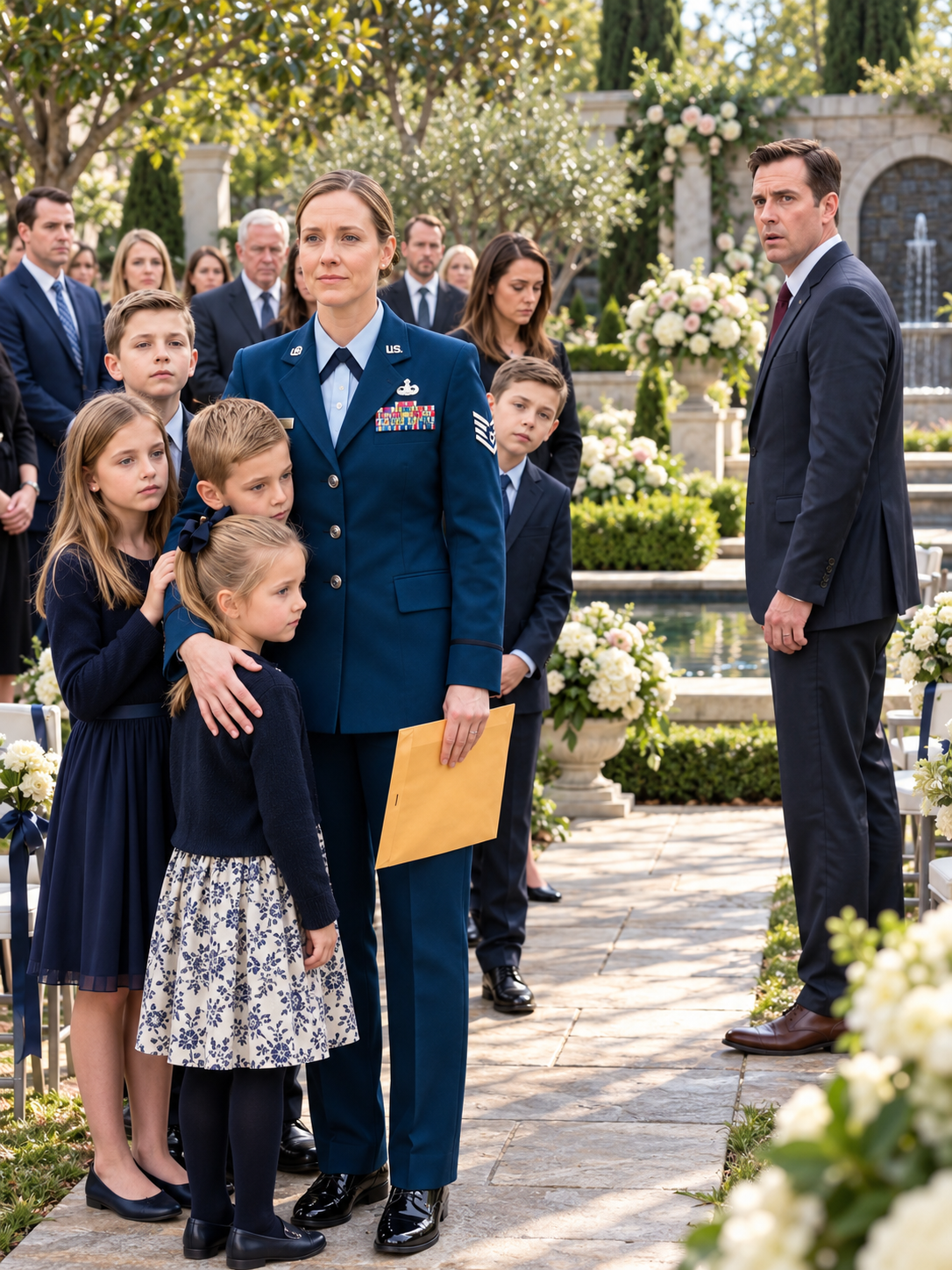
PART 1 TITLE: I Returned to the Whitmore Funeral With Five Children and an Envelope That Could Undo Ten Years of Carefully Protected Lies
The first person to recognize me at William Whitmore’s funeral was Vanessa. She stood beside my former husband near the front of the gathering, dressed in a fitted black coat, her dark hair pinned neatly beneath a small hat. For a moment, her expression remained politely indifferent. Then her attention moved from my face to the five children walking beside me. The color disappeared from her cheeks. She reached for Grant’s sleeve, but he was speaking to a distant relative and failed to notice. I had spent ten years imagining our next encounter. I had never expected the sight of my children to frighten her more than the sight of me.
The cemetery lay beyond the Whitmore family estate, among old oaks whose branches reached over rows of weathered headstones. Rain had fallen earlier that morning, leaving the gravel path dark and the grass wet enough to stain the edges of our shoes. Ethan walked on my right, holding the folded funeral program I had given him. Noah and Luke stayed together, as they usually did in unfamiliar places. Rose carried a small bunch of white flowers. Emma, the youngest and the quietest around strangers, had slipped her fingers into mine. I could feel her watching the people who were watching us.
“Mom,” Ethan murmured, keeping his eyes ahead, “is that the man you told us about?” I knew who he meant without following his gaze. Grant Whitmore stood less than twenty feet away, taller than I remembered, with silver beginning to show at his temples. His face had changed, but not enough to make him a stranger. The way he held his shoulders when he was uncomfortable was exactly the same. So was the small movement of his jaw when he was trying not to reveal what he felt. “Yes,” I answered. Ethan looked down at the program and smoothed its creased corner with his thumb.
I had not come to William’s funeral to punish Grant. I had come because the man being buried had once treated me with a kindness that the rest of his family considered an embarrassment. William had been my father-in-law, but during the final days of my marriage, he had been the only Whitmore who asked me what had actually happened. When everyone else spoke about disgrace, loyalty, and the family name, William had looked directly at me and asked whether I was safe. I never forgot that question. Nor did I forget how little chance I had been given to answer it.
Ten years earlier, I had been Savannah Whitmore, a young woman who still believed a marriage could withstand an ugly accusation if both people cared enough to discover the truth. Grant and I had built a life that was ordinary in ways I appreciated: grocery lists attached to the refrigerator, disagreements about the thermostat, Saturday mornings when he made terrible pancakes and insisted the children we hoped to have would someday prefer them to mine. He could be stubborn, but he was also affectionate and attentive. I knew the sound of his footsteps in our hallway. I knew when work had exhausted him before he said a word. I thought that meant I knew what he would do when our marriage was threatened.
The accusation arrived during a week I remembered mostly for fluorescent hospital lights and the smell of disinfectant. I had been receiving medical attention, and the strain of those days had left me frightened and exhausted. Grant knew I was at the hospital. I had spoken to him from there. Yet when I returned home, he was waiting with several photographs spread across the dining table. Vanessa stood near the window, her arms folded, while Grant asked me to explain why I had supposedly spent the previous evening with another man at a hotel. The photographs showed enough to suggest a scandal and too little to establish what had actually happened.
I examined one of the pictures, then another. Something was wrong with the angles, with the woman’s clothing, with the certainty of the story being offered to me. A hotel receipt lay beside them. I recognized neither the room number nor the signature attached to the accusation. When I asked who had supplied the material, Vanessa answered before Grant could. She said a reliable person had brought it to the family’s attention. I asked for that person’s name. She told me I was distracting everyone from the evidence. Grant remained standing across the table, looking at me with an expression I had never seen directed at me before.
He allowed me perhaps ten minutes. I remember that detail because the clock above the kitchen doorway had a loud second hand, and I kept watching it as though more time might make him listen. I explained where I had been. I offered hospital records. I asked him to call the staff who had seen me. Vanessa interrupted twice, suggesting that medical visits could provide convenient excuses. Grant finally pushed the photographs toward me and said he could no longer tell whether anything I said was true. When I reached for his hand, he pulled it away. That small movement hurt more than his raised voice had.
William called three days before Grant filed for divorce. By then, I was staying elsewhere, trying to organize medical papers and answer letters from attorneys I had never expected to need. My phone rang while I was sitting on the edge of an unfamiliar bed. William’s name appeared on the screen. I watched it until the call went to voicemail. At that moment, I could not bear to hear another Whitmore explain what was best for his family. He left a message, but anger and exhaustion kept me from listening. I would spend years regretting that decision.
Grant did not come to ask for my side of the story again. His lawyers handled the separation, then the divorce. The people who had once invited me to family dinners stopped returning my calls. Vanessa remained close to him, presenting herself as the person who had helped him face an uncomfortable truth. His mother, Margaret, treated my absence as a necessary correction to an unfortunate marriage. There was no public confrontation, no opportunity to clear my name. The Whitmores were practiced at making an exclusion seem like a decision everyone had already agreed upon.
My pregnancy made that period almost impossible to describe afterward. While my marriage was being dismantled, I was trying to understand the future taking shape inside my body. I needed dependable medical care, a place to live, and some certainty that my children would be protected from the accusations surrounding me. Eventually, Ethan, Noah, Luke, Rose, and Emma entered the world. Their arrival brought difficult days, anxious hospital visits, and responsibilities that left little room for grieving a marriage. They also gave me something that no Whitmore lawyer could negotiate away: five living reasons to keep going.
I learned the particular sounds of five different cries, the small habits that distinguished one child from another, and the exhausting mathematics of feeding, washing, comforting, and sleeping. Ethan became watchful, the one who noticed when I was tired. Noah filled quiet rooms with questions. Luke approached unfamiliar things cautiously before deciding whether they deserved his enthusiasm. Rose collected stories and remembered details I had forgotten. Emma reached for my hand whenever a room grew too crowded. Their differences were unmistakable. So, increasingly, were the features they shared with their father.
Sometimes I would catch Ethan turning his head and feel the past arrive without warning. Grant had the same habit of narrowing his eyes when he concentrated. Noah inherited the uneven smile that used to appear whenever Grant knew he had said something foolish. Luke had a small mark above his eyebrow resembling one Grant had carried since childhood. Rose’s pale gray eyes reminded me of William. Emma, especially as she grew older, seemed to have borrowed Grant’s entire expression. I loved those familiar features because they belonged to my children. I resented the pain they sometimes carried for me.
People eventually asked why I had not returned to Grant with the children. There was no answer simple enough to satisfy everyone. The accusation had been supported by documents that appeared convincing, the Whitmore attorneys had made their position clear, and I had been left trying to keep five vulnerable children safe while rebuilding my life. I had attempted to defend myself when it mattered most. Grant had chosen not to hear me. I could not gamble my children’s stability on the hope that he might suddenly become the man I had once trusted.
Nevertheless, I kept everything. Hospital papers, birth records, letters, copies of correspondence, and every document that might someday correct the account of what had happened went into carefully labeled folders. During difficult years, maintaining those records became almost automatic. I was not planning revenge. I wanted my children to have an accurate history when they were old enough to ask for one. Later, I obtained a formal paternity report and added it to the collection. I did not show it to Grant. For a long time, I did not know whether there would ever be a reason to stand in the same room with him again.
William remained a complicated presence at the edges of those years. We did not have the relationship we once had, and his attempts to contact me were irregular. Yet one Christmas, a card arrived with his handwriting on the envelope. The message was brief, speaking of truths that might eventually find their way back to the people who needed them. I read it more than once. It sounded like reassurance, but there was something unfinished about it, as though he had begun a longer explanation and then decided he could not safely put it on paper.
I kept that card in a drawer beside the documents. Occasionally, when the children were asleep and the house was quiet, I took it out and wondered what William had meant. Perhaps he had wanted to apologize for his son’s behavior. Perhaps he knew something about the hotel photographs. Perhaps he simply understood that I had been treated cruelly and wanted me to know I had not been forgotten. I could not ask him without reopening a correspondence I feared would bring the entire Whitmore family back into our lives.
News of William’s death reached me on an ordinary morning. I was sorting school papers when I saw his name and the funeral details. I sat at the kitchen table longer than I intended, remembering his deep voice and the way he used to fold his newspaper before speaking. The children came in one by one. Rose noticed the photograph on my phone and asked whether that was their grandfather. I told them it was. She asked whether we would go to his funeral. I looked at the date, then at the old Christmas card lying in the drawer I had opened.
We talked about it together. I told the children that some members of the Whitmore family had not treated me kindly and that attending the funeral might be uncomfortable. Ethan asked whether their father would be there. I said he probably would. Emma wanted to know whether anyone would be angry with us. I promised that if someone behaved badly, we would leave. I could not promise that nobody would be hurt. The children understood more than I sometimes wished. They also understood that William had been part of their family, even if circumstances had kept them apart.
On the morning of the funeral, I placed the paternity report and the other important records inside a large envelope. I checked its contents twice. I had not decided to display anything publicly. Bringing it meant I would have the truth available if someone once again attempted to speak for me. I dressed carefully, helped Emma with her coat, and made sure each child knew where we would meet if the crowd separated us. When we left the house, the envelope sat beside me on the passenger seat, heavier in my mind than it was in my hands.
Now, standing at the cemetery, I understood that the encounter I had rehearsed was already changing. Grant had noticed Vanessa’s silence. He followed her stare and saw me. At first, he seemed unable to connect the woman before him with the one he remembered. Then recognition settled across his face. He said my name, softly enough that I almost missed it. Several relatives turned. Vanessa moved closer to him and spoke, but he did not answer her. His attention had shifted to the children, and he was looking from one face to the next with growing uncertainty.
I gave the children a small signal to stay beside me. Grant approached slowly, stopping a few feet away as if an invisible boundary separated us. “Savannah,” he said again. “What are you doing here?” I looked toward William’s coffin. “I came to pay my respects.” His eyes returned to Ethan. “And they are?” I could feel the question gathering around us. Vanessa came forward before I could speak and suggested that this was hardly an appropriate place for a personal confrontation. I told her we had not come looking for one.
Grant continued studying the children. Ethan met his gaze without smiling. Noah shifted closer to Luke. Rose tightened her grip on the flowers. Emma remained beside my leg. The resemblance was no longer merely a private memory that belonged to me. I watched Grant recognize something familiar in Ethan’s eyes, then in Emma’s face. He looked at the others more carefully. His expression changed from confusion to suspicion, and finally to a fear he seemed unwilling to name. “How old are they?” he asked. I answered truthfully. Vanessa’s hand closed around his arm.
“Grant,” she said, “please don’t allow her to turn your father’s funeral into another accusation.” That word—another—made me look directly at her. Ten years earlier, she had helped invent the version of me that the Whitmore family preferred. Now she was trying to make that version speak again. I told her calmly that she could let Grant ask his own questions. She stared at me, startled perhaps by the fact that I no longer sounded like the frightened woman who had begged to be believed across a dining table.
Grant turned fully toward me. “Are you saying these children are mine?” His voice carried farther than he intended. Several mourners stopped speaking. A woman near the flowers pressed a hand to her mouth. I looked at the children before answering. They deserved more than being discussed as though they were evidence in somebody else’s argument. “They’re Ethan, Noah, Luke, Rose, and Emma,” I said. “They’re my children. And yes, Grant, they’re yours.” He stepped backward, shaking his head, while Vanessa insisted there must be some mistake.
He asked why I had never given him a chance to know. For one moment, I saw our old dining room, the photographs scattered across the table, and his hand pulling away from mine. “I tried to tell you what was happening,” I replied. “You gave me a few minutes and decided somebody else’s story was better.” He said the evidence had been convincing. I told him that evidence was precisely what had destroyed our marriage. His mouth tightened. “You expect me to accept this after ten years?” I held his gaze. “No. I expect you to look at what I brought.”
I opened the envelope, taking care not to disturb the other papers. The formal report lay near the front, protected by a transparent sleeve. I handed it to Grant without commentary. He examined the identifying information before reaching the conclusion. His fingers moved over the page as though he needed to feel the printed lines to believe they were real. Vanessa leaned forward, then stopped. I watched her face rather than his. When she understood which document he held, she looked toward the cemetery entrance, searching for something beyond the mourners.
Grant finished reading. He lowered the page, looked at the five children, and raised it again. Ethan’s expression remained guarded. Emma, confused by the silence, tugged gently at my coat. Grant’s lips moved before he managed to speak. “This says I’m their father.” I nodded. His voice had lost the authority with which he once dismissed me. He asked whether the report was genuine. I told him he could have it independently verified and that I would cooperate with an appropriate process. The evidence did not depend on his willingness to believe me.
For several seconds, nobody interrupted. Then Grant turned toward Vanessa. “You told me she couldn’t be trusted,” he said. Vanessa responded that she had only shown him what she had been given. I heard the distinction immediately. Ten years earlier, she had spoken as though she possessed certain knowledge. Now, standing beside William’s grave, she was carefully putting distance between herself and the accusation. Grant noticed it too. He asked where those photographs had come from. Vanessa opened her mouth, but I had already reached into the envelope for the next document.
END PART 1
PART 2 TITLE: The Hotel Receipt Carried Vanessa’s Name, but a Witness’s Statement Suggested Someone Else Had Been Directing the Betrayal
Vanessa knew what the second document was before I removed it completely. Her eyes dropped to the printed hotel heading, and she took one quick step toward me. Grant was still holding the paternity report. The mourners nearest us had fallen silent, while others, farther down the path, continued talking in subdued voices, unaware of what was unfolding. I could hear the faint scrape of a folding chair as someone moved to see better. Vanessa’s composure was returning, but it was the kind that required effort. Her shoulders were too straight, her mouth carefully arranged.
“Where did you get that?” she asked. Her voice was lower now, no longer intended for the people behind us. I did not answer immediately. The question itself mattered. A person unfamiliar with a document might ask what it was. Vanessa had gone directly to its origin. I looked at Grant. “Do you remember the night before you accused me?” He frowned and said of course he remembered. I asked him for the date. After a moment, he answered that it had been June eighteenth. I held up the hotel folio. “Then you’ll recognize the date printed here.”
He took it and read the entry for June seventeenth. For ten years, that date had occupied a peculiar place in my memory. It was the night Vanessa claimed I had disappeared from the hospital and checked into a room with another man. The photographs had been offered as confirmation, and a hotel record had supposedly supported them. Yet the folio I now held linked the relevant reservation to Vanessa herself. I had spent years trying to understand how a lie that elaborate had been put together without leaving any trace of its real author.
Grant read the name again. He looked at me, then at the document. “It says Vanessa.” I nodded. He asked whether it referred to the same hotel. I pointed to the address and transaction details. He recognized them. The place had been mentioned repeatedly during our divorce. His attorney had described it as an establishment whose records could be trusted. I remembered sitting opposite that attorney, asking to see the originals rather than reproductions, and being told the matter had already been adequately established. It had never seemed adequately established to me.
Vanessa recovered enough to object. She said the folio did not prove I had never entered the building. That was true in the narrowest possible sense, and I refused to pretend otherwise. “It proves something you’ve spent a decade concealing,” I replied. “You were connected to that hotel on the night you claimed I was there.” Grant asked why she had never told him. She said she might have visited the hotel for unrelated reasons. He wanted to know what those reasons were. Her answer shifted from a business meeting to an errand she could no longer remember clearly.
Rainwater dripped from the oak branches onto the grass. I watched Grant turn the page over, looking for details that might explain what he was reading. He had always been a man who liked straightforward conclusions. During our marriage, that habit made him efficient at work and infuriating during disagreements. Once he settled on an explanation, he found it difficult to reconsider. I could see him struggling now. The fatherhood established by the first document conflicted with everything he had assumed about me, while the second placed Vanessa inside a story she had insisted belonged entirely to someone else.
“You told me Savannah had been seen with another man,” he said. Vanessa nodded quickly. She insisted that the photographs had come from someone reliable and that she had been trying to protect him. I remembered how often she used that language. Protection, in the Whitmore family, could mean withholding a letter, deciding who was invited to dinner, or persuading someone that an inconvenient truth was dangerous. Grant asked for the reliable person’s name. Vanessa looked down. I waited. She finally said the person had asked not to be identified.
I might once have felt satisfaction watching her struggle. Instead, I found myself aware of the children behind me, standing in damp shoes at a funeral they had expected to be sad but not frightening. Noah was speaking quietly to Luke. Ethan had positioned himself near Emma, who watched Grant with an expression I could not read. I asked the children to remain close while I finished an important conversation. Rose wanted to know whether their grandfather’s service would continue. I told her it would. I meant it. Whatever became of these revelations, William still deserved a proper farewell.
I had recovered the hotel information only after years of searching through the scattered remains of my divorce. Some records had been difficult to obtain. Others arrived with names partially obscured or dates that did not align with what I remembered. The folio was different. It contained information the original accusation had conveniently concealed. I had sat at my kitchen table the evening I received it, comparing the entries with the copies of the photographs and the hospital records I had preserved. By midnight, the arrangement began to look less like an unfortunate mistake and more like a deliberate fabrication.
The significance was not merely that Vanessa had been at the hotel. Someone had used the hotel’s existence to lend credibility to an allegation that destroyed my marriage. The woman who had delivered that allegation had concealed her own involvement. If the accusation had been an honest mistake, she could have disclosed her connection and allowed everyone to examine the facts. Instead, she had spent ten years repeating the version that made me appear guilty. When I explained this to Grant, I saw him glance at the paternity report again. The two documents were beginning to tell a story neither could tell alone.
“Is there anything else?” he asked me. I looked toward the coffin before answering. For years, I had wanted him to ask that question, but I had imagined he would do so privately, without a crowd gathered around us. Now, his father’s funeral had become the place where the truth was being forced into the open. I told him there was a statement from someone who had knowledge of the hotel meeting. Vanessa’s head lifted sharply. I saw genuine alarm in her expression. That response made me more certain that the document mattered.
The statement had been notarized. I had kept it separate from the other records because it included details I could not independently explain. It described Vanessa meeting William Whitmore at the hotel and was associated with Daniel Mercer, the attorney who had served William for years. I knew Daniel by reputation, although he had not been part of my daily life. He was one of those quiet professionals who seemed to know every family transaction without ever attracting attention. His name appearing in the statement had troubled me from the moment I saw it.
I took the paper from its sleeve. Before I could hand it to Grant, Vanessa caught my wrist. Her fingers tightened just above my glove. The sudden contact startled both of us. For a heartbeat, we stood looking at each other, close enough for me to see the fine lines that had appeared beside her eyes. “Please,” she said. It was the first time in ten years she had addressed me without the careful superiority I remembered. I told her to remove her hand. She released me, stepping away as though she had acted without intending to.
Grant had seen everything. “What are you afraid of?” he asked. Vanessa shook her head and said he was misunderstanding her. He did not raise his voice. That made his question more difficult for her to avoid. He reminded her that she had assured him the hotel records were decisive, that she had discouraged him from contacting me, and that she had continued defending the accusation whenever anyone questioned it. Vanessa looked toward the Whitmore relatives, perhaps hoping someone would intervene. Nobody did. I handed Grant the notarized statement and let him read.
He recognized Daniel Mercer’s name immediately. He had known the attorney since childhood. Daniel had attended family celebrations, handled private legal matters, and worked closely with William. Grant read the statement slowly, then returned to a passage near the middle. “This says Daniel saw you with my father at the hotel,” he told Vanessa. She did not deny it. Instead, she insisted the meeting had nothing to do with Savannah. Grant asked what his father had wanted. She said it was private. He reminded her that she was standing at that father’s funeral.
I listened carefully. William’s presence complicated everything. He had been the person who seemed willing to hear my account when the rest of the family rejected it. If he had met Vanessa at the hotel before the accusation, what did that mean? Had he discovered the deception and confronted her? Had he already known what was coming? Or had he been involved in something he later regretted? I hated that the questions existed, but the documents did not allow me to ignore them. William had been good to me. That did not guarantee I understood everything he had done.
Grant asked Vanessa to explain the meeting. She looked toward the coffin, and for a moment I thought she might tell him. Her expression became strained, with a kind of resentment beneath the fear. “You think your father was blameless?” she said. Grant went still. The question seemed to disturb him more than the earlier revelations. He told her not to speak in riddles. She answered that William had known things the rest of the family did not and that he had made choices whose consequences were still unfolding. I asked whether he had helped fabricate the photographs. She did not answer.
The accusation against William unsettled me. I remembered the last evening he had visited us before the marriage collapsed. He had brought a small wooden puzzle for the children Grant and I hoped to have someday, saying it would be ready when the time came. The puzzle remained in a box after the divorce. I had eventually given it to my children. They had lost several pieces, found them beneath the sofa, and spent an entire afternoon fitting them together again. William had seemed pleased by the idea of grandchildren, not threatened by it.
“Tell us what happened,” Grant said. Vanessa looked at him with an expression that was almost pleading. She insisted there were reasons she could not explain everything. He asked whether those reasons had mattered more than our marriage. Her answer came quickly: she had wanted to protect him. I watched him absorb the words. He had once accepted that explanation without hesitation. Now it sounded inadequate even to him. “Protect me from Savannah?” he asked. Vanessa closed her eyes and shook her head. When she finally spoke, she named his father instead.
The silence that followed was different from the earlier pauses. Grant’s relatives knew William in many ways: businessman, father, husband, employer, the final authority in family arguments. They had gathered to mourn him, and Vanessa had just suggested that he was connected to a decade-old deception. Grant demanded to know what his father had done. Vanessa said William had discovered things that frightened him. She stopped there. I felt my own anger becoming something less familiar. I had brought evidence expecting to expose Vanessa. I had not anticipated learning that William’s private actions might explain why my marriage had been destroyed.
Then Vanessa said William had known about the children. I must have misunderstood her, because I asked her to repeat the statement. She looked directly at me. “He knew before they were born.” I stared at her. William had never met the five children standing beside me. At least, I had never knowingly brought them into his presence. He had sent a Christmas card, but he had not mentioned their names. I had assumed he was reaching out to me because he believed I had been treated unfairly. Now Vanessa was telling me his knowledge had been far more specific.
Grant asked how his father could have known. Vanessa said she could not explain without revealing more than she had been authorized to say. The phrasing struck me. Authorized by whom? Margaret had died six years earlier. William was being buried that morning. Yet Vanessa still spoke as though somebody could decide what information the family was permitted to hear. I asked whether she was frightened of a living person. Her gaze flicked toward the path leading to the cemetery gate. She said nothing. I remembered the way she had looked in that direction when I first opened the envelope.
I turned the old Christmas card over in my mind. William’s message had seemed deliberately incomplete. There had also been that unanswered telephone call just before Grant filed for divorce. I had finally listened to the voicemail years afterward, when I recovered recordings from an older phone. Most of the message was damaged. William’s voice faded beneath distortion, then returned for a few seconds. At the time, I had been unable to understand why he sounded so anxious. Now, standing beside his grave, the surviving words became difficult to dismiss.
I told Grant about the message. He listened as I explained when William had called and why I had not answered. I admitted that I regretted ignoring it. Grant’s face softened briefly, but I was not looking for comfort from him. I was trying to reconstruct a sequence that had been broken into pieces for ten years. The surviving sentence contained a warning: William had wanted me to identify whoever had supplied the hotel photographs before discussing them further with Grant. He had not named the person. He had clearly believed their source was dangerous.
Grant stared at Vanessa. “My father knew the photographs were questionable?” I answered that the voicemail suggested he had been investigating them, but I would not claim more than the recording established. Vanessa pressed her lips together. Grant asked whether she had known William contacted me. She looked away. That was an answer of its own. He stepped closer, keeping his hands at his sides, and asked who had delivered the photographs to him. Vanessa said she had already explained. He told her she had explained almost nothing.
I could see how badly Grant wanted a single name to account for what had happened. I understood the impulse. I had spent years wishing the divorce could be traced to one cruel decision made by one dishonest person. Yet the hotel folio, the notarized statement, and William’s warning suggested that several people had known more than they admitted. Someone had constructed the evidence. Someone had passed it along. Someone had concealed the information that might have protected me. Vanessa’s silence was not the only silence that mattered anymore.
Ethan approached and asked whether we were nearly finished. His voice steadied me. I told him that the adults were discussing some old documents and that he had done nothing wrong. He looked from me to Grant and asked why everyone seemed angry. Grant began to answer, then stopped, apparently realizing he could not explain the last ten years in a sentence suitable for a child. I asked Ethan to take the others closer to the flowers, where I could still see them. He did, though he looked back twice before reaching Rose.
With the children a little farther away, Grant asked his question again. He wanted to know who had supplied the photographs. Vanessa’s chin lifted. She said telling him would only make matters worse. Grant answered that she was no longer entitled to decide what he could bear to hear. I watched her fingers tighten around the strap of her handbag. She seemed less worried about being accused than about another person hearing the conversation. For the first time, I wondered whether the funeral itself had brought more than one frightened person to the cemetery.
A voice answered from behind the gathered mourners. It was low, elderly, and unmistakably deliberate. The speaker said he had been the one who passed the photographs along. People turned toward the path. An older man stood near the cemetery gate, leaning heavily on a wooden cane, his gray coat hanging loosely from narrow shoulders. I recognized him before Grant spoke. Daniel Mercer, William’s longtime attorney, had returned to a place where nobody seemed to have expected him. Grant stared as though he had seen a ghost. Vanessa stepped backward. Daniel looked past them both and addressed me first.
END PART 2
PART 3 TITLE: William Whitmore Left Behind a Black Notebook Containing His Family’s Names, and the First Pages Changed Everything I Believed About Him
Daniel Mercer looked older than I remembered. His hair had thinned, his back was slightly bent, and he held the wooden cane with the concentration of someone who had learned to distrust his own balance. Yet his eyes remained sharp. He moved through the mourners without greeting them, apparently indifferent to the whispers following him. When he reached us, he stopped beside William’s coffin and removed his hat. For a long moment, he looked at the polished wood. Then he turned to me. “Savannah,” he said, “there are things I should have told you years ago.”
I had spent a decade wishing somebody connected to the Whitmores would say those words. Hearing them now did not bring the relief I expected. Daniel had been part of the family’s inner circle, the attorney trusted with matters too sensitive for ordinary discussion. He knew where documents were kept, who had signed them, and which disagreements had been resolved privately. I asked why he had waited until William was dead. Daniel lowered his eyes. “Because he made me promise to protect information I didn’t fully understand at the time,” he answered. “And because I was frightened of what would happen if I broke that promise.”
Grant stepped closer. “You told my father you were retiring,” he said. Daniel nodded. He explained that his withdrawal from the family’s affairs had been necessary after William began questioning events surrounding our divorce. Certain records had disappeared. Conversations he believed confidential had become known to other people. Eventually, William had stopped trusting nearly everyone around him. Grant looked toward the coffin with a bewilderment I recognized. He had been accustomed to thinking of his father as a man who controlled every situation. Apparently, William’s final years had been marked by uncertainty that his son never suspected.
Daniel said William had never accepted the account that I had betrayed Grant. He had seen inconsistencies in the hotel evidence and had tried to determine who benefited from the accusation. Grant interrupted, insisting his father could have spoken to him directly. Daniel looked at him with visible sadness. “He tried more than once,” he replied. “But you had already decided whose account you trusted. Each time your father raised doubts, someone convinced you he was interfering in your marriage.” Grant glanced toward Vanessa. She held his gaze for an instant before turning away.
I asked Daniel why he had delivered the photographs if William suspected they were fabricated. The attorney’s expression tightened. He explained that the materials had reached him as part of a collection he was instructed to pass along. At the time, he had not recognized the full significance of the discrepancies. His failure, he said, had been accepting the supposed authority of the people who supplied them. “I should have insisted on verifying their origin before anyone saw them,” he admitted. “Instead, I allowed documents to become weapons.” His honesty was uncomfortable because it did not erase the damage.
Grant demanded to know who had authorized the deception. Daniel considered him for a moment. “Vanessa carried out part of it,” he said. “But she did not create the entire arrangement.” Vanessa flinched. Daniel continued, explaining that William had followed the evidence toward someone with access to family records, private schedules, and confidential financial information. The person understood Grant’s habits and knew how to influence his decisions. Daniel would not immediately name them. He reached inside his coat and removed a small notebook with a worn black cover. He held it carefully, as though even after all these years it required protection.
William had entrusted the notebook to Daniel with instructions that seemed peculiar when the attorney first received them. It was to remain sealed until Savannah returned to the Whitmore family. I asked why William had attached that condition. Daniel said he believed I was the only person who could connect certain entries to the truth of what happened outside the family’s sight. Grant reached for the book, but Daniel placed it in my hands instead. The leather was softened along the edges. A narrow strip of paper marked a page near the middle.
I opened it slowly. On the first page, written in William’s familiar hand, was a short instruction to protect me. He had used my married surname from the time before the divorce and added Cole beneath it, apparently correcting himself after remembering the name I had chosen to reclaim. That small detail unsettled me. For years, I had assumed William thought of me as an unfortunate episode in his son’s life. Yet he had written my name at the front of a private record he believed important enough to conceal.
The pages contained dates, telephone numbers, initials, names, and amounts of money. Some entries were carefully written, while others had been added in a hurry. William had crossed out several figures and inserted corrections beside them. There were references to meetings, medical appointments, and transactions that meant nothing to me at first glance. Daniel told me William kept the notebook because he no longer trusted electronic records maintained through the family’s business offices. He wanted an account that could not be changed remotely or quietly deleted by someone with access to the system.
Grant leaned close enough to read over my shoulder. I noticed how carefully he avoided touching the notebook. The man who had once dismissed my explanation after a few minutes was now studying scraps of information as though they could reconstruct an entire life. I felt no desire to make that task easier for him. He needed to understand the work he had refused to do before. For years, I had carried the responsibility of preserving the truth without his help. Whatever the notebook revealed, it would not transform the past into something harmless.
Near the end, I found a name I recognized so immediately that I stopped turning the pages. Margaret Whitmore. Beside it were several dates and payment references. Grant saw the entry and shook his head. His mother had been dead for six years. He asked why William would have recorded her name among the people connected to the hotel photographs. Daniel’s expression became grave. “Because your father discovered she knew more about the deception than anyone realized,” he said. The words seemed to reach Grant slowly. He stared at the notebook, then toward his father’s coffin, as though expecting an explanation from the dead.
Margaret had always been difficult to please. During my marriage, I learned that she rarely gave direct orders when a suggestion delivered in a gentle voice would achieve the same result. She had opinions about our home, my career, the friends I invited to dinner, and the amount of time Grant spent with me instead of attending family events. When I disagreed, she described my resistance as unnecessary conflict. Grant usually urged me to accommodate her. He said she had sacrificed much for the family and deserved consideration. I tried, until consideration became another word for obedience.
There had been moments I dismissed as ordinary tension between a mother and daughter-in-law. Margaret once questioned whether I would be capable of raising children while maintaining a life outside the Whitmore household. Another time, she remarked that the family’s future required careful planning and that personal feelings could interfere with important obligations. I remembered those conversations now because William’s notebook contained dates beside her name that reached into the period before the divorce. What had sounded like social disapproval might have concealed an intention I had never considered.
Grant protested that his mother could not have arranged everything Vanessa had described. Daniel did not argue that every detail had been established. Instead, he pointed to the pattern William had recorded. Contacts had been made, payments authorized, and information gathered during the months when my marriage was beginning to collapse. Several transactions connected indirectly to Margaret. Others appeared to involve intermediaries whose identities were less clear. William had discovered much of this while she was still alive, but only later had he understood how the various records were related.
“Why didn’t he tell me?” Grant asked. Daniel closed his eyes briefly. “He believed you would confront her before he could secure the evidence.” Grant started to object. Then he stopped. I knew what he was remembering. During our marriage, any criticism of Margaret had usually led to a confrontation in which I became the person accused of causing trouble. William must have watched that pattern too. Daniel explained that his former client had feared the records would vanish if Margaret learned exactly how much he knew. His silence, however, had allowed years to pass without correcting what had happened to me.
I was not ready to excuse William. He might have been investigating, but the consequences of that investigation had fallen heavily on my children and me. I told Daniel that a hidden notebook could not compensate for a warning delivered too late. He accepted the criticism. William, he said, had struggled with the same knowledge. He had wanted to expose the scheme without placing me in further danger, yet the more he learned, the less certain he became about whom he could trust. His hesitation had protected some evidence while leaving other people exposed.
Daniel asked me to examine an entry dated October fourteenth. William had recorded that I attended a medical appointment alone and that my pregnancy had been confirmed. I stared at the words. The date corresponded to a visit I remembered clearly. The waiting room had been cold, and I had spent nearly an hour looking at the same page of a magazine without absorbing a sentence. I had gone alone because my marriage was already in crisis. The appointment belonged to a private period of my life when I believed very few people knew what was happening.
I asked how William could have obtained that information. Daniel said he had paid medical expenses associated with the appointment. At first, I thought the attorney must be mistaken. I remembered believing that the assistance came through ordinary administrative arrangements. Daniel explained that William had intervened after discovering irregular inquiries directed toward the medical office. Someone wanted information about my pregnancy, my appointments, and what the doctors believed about its progress. The questions had become intrusive enough that the physician feared the consequences of refusing to cooperate.
Grant demanded to know whether his father had paid the doctor to conceal information. Daniel answered that the payments were intended to secure legitimate care and protect records from interference, not to purchase a false diagnosis. He showed us several corresponding entries in the notebook. William had become concerned that the same people collecting information about me might attempt to influence how that information was used. The distinction mattered. A medical bill and an improper payment could look similar when stripped of context. Daniel insisted there were supporting documents, but I wanted to examine them before accepting his explanation.
My memories of that period returned in fragments. A receptionist who became unusually careful about what she said over the telephone. A medical appointment rescheduled without a satisfactory explanation. Questions about who was authorized to receive information. At the time, I attributed the confusion to the strain surrounding my divorce. Now, I wondered whether someone had deliberately interfered. I had been young, frightened, and determined to protect the children growing inside me. The possibility that strangers had been collecting details about my pregnancy without permission filled me with a cold anger.
Vanessa had remained silent throughout this discussion. When Daniel mentioned threats directed toward the medical office, she lowered her head. I asked whether she knew who had been requesting the information. She said she knew only that certain people wanted to keep track of developments. I asked what developments. She answered vaguely. Daniel watched her without interrupting. I noticed something important in his expression: he was not surprised that she possessed this knowledge. Whatever else William had discovered, the attorney already believed Vanessa’s involvement extended beyond the hotel accusation.
Grant turned toward his father’s relatives, asking whether anyone had known about the pregnancy. Most looked uncomfortable. Some shook their heads. An older cousin said William had seemed worried about a private family matter for years, but had never explained himself. Another remembered Margaret becoming angry whenever the subject of grandchildren arose. Neither recollection proved anything by itself. Together with the notebook, however, they suggested that the secrecy surrounding my children had not begun after their birth. Someone had been watching long before the truth could be safely spoken.
I asked Daniel whether William had ever seen the children. The attorney hesitated. He said William had known of their existence and had received information about their well-being, but he would not describe that as having a relationship with them. I looked toward Ethan, who was helping Emma straighten the flowers in her hands. Their grandfather had lived and died knowing something about them, while they had grown up believing he was little more than a distant figure in an old family photograph. I wondered whether William had imagined meeting them and how many times he had postponed making it possible.
Daniel turned several pages in the notebook. A loose photograph slipped from between them and landed on the damp grass. I bent to retrieve it before the rain could damage the image. The picture had been taken outside a medical clinic. A younger version of me stood near the entrance, visibly pregnant, one hand resting against my stomach. My coat was open, and I was looking down at something in my other hand. I remembered the day immediately. I had been around seven months pregnant and had gone to the appointment without telling anyone outside my small circle of trusted friends.
The photograph had been taken from a distance. The person holding the camera must have stood across the parking area, near the row of trees bordering the clinic property. I remembered waiting for a taxi because my usual ride had fallen through. At the time, I had thought nothing of the vehicles nearby. Now I studied the picture, wondering who had watched me walk in and out of the building. The composition was unmistakably deliberate. It was not an accidental image of a crowded sidewalk. I was the subject, centered and isolated.
Grant took the photograph from me carefully. He looked from the image to the children, then back again. “Somebody followed you?” he asked. I said I could not know how long the surveillance had continued, but the photograph proved someone had been close enough to document that appointment. Daniel explained that William had discovered the picture among materials connected to his investigation. The attorney would not tell us precisely where it had been found. I could see that his reluctance frustrated Grant, but I understood it differently now. Daniel was afraid the evidence itself might reveal more than any of us was prepared to hear.
I turned the photograph over. A date had been written on the back in dark ink. Below it was a short sentence indicating that I remained unaware of something important. I read the words twice. The handwriting was not William’s. I had studied enough of his letters to recognize the difference. The notation suggested that whoever took the picture had not merely been recording my pregnancy. They were reporting on my ignorance. Someone knew a fact about my children, or about the people monitoring them, that had been deliberately kept from me.
Vanessa moved suddenly. Her shoes scraped against the gravel as she stepped away from us. I asked whether she recognized the picture. She said she had never taken it. I told her that was not what I had asked. She looked toward the gate again, her face tense. “I know who arranged for photographs to be taken,” she finally admitted. Grant demanded a name. Vanessa swallowed and said she had never met the person directly. I looked at Daniel, who seemed more troubled by that answer than by anything she had previously said. The photograph rested in my palm, and I realized the surveillance had never been about proving an affair. Someone had been keeping track of my unborn children.
END PART 3
PART 4 TITLE: Vanessa Admitted She Had Been Paid for Ten Years, and William’s Final Evidence Pointed to a Secret Outside Georgia
The photograph felt damp against my glove. I slipped it into the protective sleeve before the writing on the back could be damaged. Vanessa watched every movement. Her earlier attempts to dismiss the hotel records had given way to something close to resignation. Grant stood beside me with the notebook in his hands, apparently unable to decide whether to question her or continue reading. Daniel remained silent. The attorney had brought us evidence that changed the meaning of my divorce, but it was becoming clear that he had not yet disclosed everything William had entrusted to him.
I asked Vanessa to explain what she knew about the photographs taken during my pregnancy. She said instructions had reached her through people whose names she never learned. Sometimes the directions arrived by telephone. Other times they came through messages that could not easily be traced back to a person. She had been told which places to visit, whom to speak with, and what information mattered. I wanted to know why she had followed those instructions. She looked at Grant, then at me. “Because I was being paid,” she answered.
Grant seemed unable to comprehend the confession. He had known Vanessa for years, had trusted her judgment, and had allowed her statements to influence decisions that changed our lives. Now she was telling him that their relationship had begun inside an arrangement someone else controlled. “Paid to do what?” he asked. Vanessa rubbed her forehead with one hand. “To keep Savannah away from your family,” she said. I studied her face, waiting for the familiar qualifications. None came. She looked exhausted, as though concealing the truth had become more difficult than admitting it.
I asked when the arrangement started. Vanessa said it began before the accusation that ended my marriage. She had been given information about Grant’s schedule, his habits, and the places he frequented. Their first meeting, which Grant had always described as an unlikely coincidence, had been arranged deliberately. She was told which restaurant he would visit and how to approach him without appearing forward. Grant turned toward her. “You told me you were there because a friend canceled dinner.” Vanessa nodded faintly. “I know what I told you,” she said.
He asked whether other meetings had been engineered. She admitted that they had. The hotel arrangements, the carefully timed conversations, and the photographs that seemed to confirm my supposed betrayal had all been parts of a plan. She had not created every detail herself, but she had carried out instructions designed to make Grant distrust me. I looked at the man I had once married. His expression was changing again, not from surprise to anger this time, but from anger to an understanding that frightened him. He had been persuaded to destroy his marriage by people who knew exactly how to reach him.
“Why me?” I asked Vanessa. She looked at me for a long moment before answering. She said the people who recruited her believed my presence in the Whitmore family threatened something they wanted to preserve. At first, she had assumed it was a dispute about money, reputation, or inheritance. Rich families, she said, often concealed their disagreements behind polite language. She had expected to help end an inconvenient marriage and then move on. But the instructions continued after the divorce, and the information she was asked to gather became increasingly personal.
I wanted her to name the people responsible. Vanessa insisted she did not know everyone involved. An intermediary managed the arrangements and passed along the instructions. She had never seen the person controlling the money. I asked how she could accept such a situation for years. She gave a bitter little smile. “It was easier not to ask questions,” she said. That was the first thing she had told me that I believed without reservation. People often mistook deliberate ignorance for innocence. Vanessa had been willing to benefit from an arrangement precisely because she did not have to acknowledge its full consequences.
Grant asked how much she had received. She hesitated, then admitted that ten thousand dollars had been transferred into her account each month. The amount startled even those relatives who had heard most of the conversation. Grant repeated it, as though saying the number aloud might expose some mistake. Vanessa confirmed it. The payments had continued for approximately ten years. I looked at her carefully. The woman who had contributed to the destruction of my marriage had lived comfortably while I learned to manage five children with almost no help. The thought left me momentarily unable to speak.
I remembered years when every unexpected expense required careful calculation. Medical appointments, school supplies, replacement shoes, and repairs to a car I needed to keep running had all demanded attention. I did not resent the effort of raising my children. They deserved everything I could provide. What I could not accept was the knowledge that someone had profited from making those years harder. Ten thousand dollars each month was not a casual gift. It was compensation substantial enough to sustain a person’s loyalty. Whoever arranged it had considered keeping me away from the Whitmores worth a fortune.
Daniel asked Vanessa whether the transfers came directly from Margaret. She said she did not know. The account information available to her did not reveal the identity of the person who ultimately controlled the funds. Several intermediaries had handled the arrangements. She insisted that she had never met the person giving the highest-level instructions. Daniel asked when the payments ended. Vanessa looked toward William’s coffin. “Last month,” she replied. He waited for her to continue. She admitted that the transfers had stopped shortly after William died.
Grant’s expression hardened. He asked whether his father had been financing her deception. Vanessa rejected the suggestion immediately. The payments had not stopped because William had been making them, she explained, but because he had discovered enough about their source to interfere with them. Daniel confirmed that William had identified an account linked to the operation. He had taken steps to freeze the funds after securing evidence of irregular transactions. The timing now made sense. Vanessa had lost the income that rewarded her silence at almost the same moment the person investigating the scheme was no longer alive.
I studied Daniel, troubled by the implications. If William had found the account, why had he not gone directly to the authorities? Daniel explained that the evidence reached him in stages. Some transactions were routed through structures that obscured their origins. Others were connected to people who had held legitimate positions within the Whitmore family’s financial affairs. William wanted to establish the full pattern before accusing anyone of serious wrongdoing. He believed a premature confrontation would allow the remaining participants to destroy records or claim that isolated payments had innocent explanations.
Grant shook his head. “My father could have hired an entire team to investigate.” Daniel replied that William had done precisely that, but the involvement of people close to the family created problems. The same relationships that gave investigators access also made it possible for information to reach the people being investigated. Eventually, William had limited his trust to a few individuals and begun keeping personal records. The black notebook was a product of that decision. Its contents were incomplete, but the documents it referenced could be used to establish a much larger history.
I asked Vanessa what the arrangement had required after my children were born. She lowered her eyes. She had been told to monitor any attempt I made to contact Grant and report information suggesting I intended to return to Georgia. I wanted to know whether she had interfered with letters or messages. She would not give a direct answer. Instead, she said several people had access to the family’s communications and that she was not responsible for everything that disappeared. Her refusal to be specific told me enough to understand why certain efforts to defend myself had gone unanswered.
Grant looked at me with an expression I could not bear to interpret as simple regret. He seemed to be remembering the messages he never received and the conversations he never allowed to happen. “I thought you wanted nothing to do with me,” he said quietly. I answered that he had made his own unwillingness unmistakable. Whether others had interfered afterward did not change the choices he made when I stood before him asking to be heard. Vanessa might have built the lie, but Grant had accepted it. I was not going to let one confession erase the difference between manipulation and responsibility.
He tried to apologize. I told him that I had heard the words before, in other forms, when he regretted an argument but not the decision behind it. This time, I needed more than an expression of sorrow. The children had grown without him. They had passed milestones, endured illnesses, and learned how to navigate the world. They had asked questions that I answered as carefully as I could, never wanting to give them an inaccurate picture of their father. An apology made at a cemetery could not restore the ordinary days he had missed.
Grant lowered his head. For a moment, he looked like the young man I had married, uncertain and ashamed but unwilling to walk away from an uncomfortable conversation. He said he understood that nothing could be repaired immediately. I appreciated the absence of demands, though I was not ready to interpret it as change. The children were watching from nearby, and I knew they would remember this day long after the adults stopped discussing its details. Whatever happened next had to protect them from becoming instruments in another struggle over the Whitmore name.
Vanessa interrupted with a statement that returned our attention to the reason she had been hired. Someone, she said, had been determined to prevent me from having children connected to Grant. She did not initially understand why the pregnancies mattered so much. Once she realized I was carrying his children, the instructions became more urgent. Information about medical appointments was requested repeatedly. People wanted to know which doctors I visited, where I lived, and whether the pregnancies were progressing safely. The admission made me think again of the photograph outside the clinic.
I asked whether the arrangement included instructions to harm me or the children. Vanessa’s face tightened. She said she had not been told to carry out anything physically dangerous, but she admitted knowing that others had discussed preventing the births. I looked at Daniel. He did not seem surprised. He explained that William had become deeply alarmed after learning about the inquiries directed toward my medical providers. Some of the evidence suggested a level of interference far beyond an effort to embarrass me or force a divorce. That was why he had continued investigating even after Margaret died.
Grant demanded the names of the people involved. Daniel said there were indications, but not every allegation had yet been established. Vanessa insisted that she had never ordered harm to anyone. I watched her struggle to separate her own actions from the consequences of the system she had served. It was possible that she had not known every detail. It was also possible that she had chosen not to know. Both could be true. Her confession did not absolve her of participating for ten years, particularly after she understood that children were being monitored.
Rose approached quietly and touched my elbow. She asked whether we could move somewhere dry. The rain had become steady, and Emma was shivering beneath her coat. I looked at their damp hair, the flowers losing petals, and the funeral gathering that had become an audience to revelations no child should have to process in public. I asked the children to move beneath the shelter of the nearest oak, where I could still see them. Ethan offered to stay with the younger ones. I thanked him, knowing he had been taking on responsibilities that should not always belong to a child.
Grant watched Ethan guide his siblings away. “He takes care of them,” he said quietly. I answered that Ethan had always been attentive to the others. Grant nodded, but I saw how little he understood of their daily lives. He knew their names and had read a report establishing his biological connection to them. Everything else remained unfamiliar. He did not know that Noah talked rapidly when he was worried or that Luke pretended to be indifferent when he cared deeply. He did not know Rose kept books beneath her pillow or that Emma slept with an old stuffed rabbit. Those facts mattered more to me than any entry in the Whitmore accounts.
Daniel opened the black notebook to a page near the back. William had listed transactions associated with the surveillance, including payments that appeared to pass through more than one account. Several references matched the information Vanessa had admitted. Others pointed toward medical expenses and private investigators. Daniel said the notebook was a guide to additional evidence, not a substitute for it. He had preserved bank statements and other records separately. William had instructed him to release them when the correct people could examine them without giving the conspirators time to conceal their involvement.
I asked what William believed the scheme was intended to achieve. Daniel paused. He said the answer was tied to the family’s estate and to decisions William had been making about its future. I thought of the Whitmore property, the businesses Grant had expected to inherit, and Margaret’s lifelong concern with maintaining control. Daniel would not yet explain the complete connection. He said the records needed to be examined together because one isolated document could easily be misunderstood. I disliked the delay, but the evidence already before us had taught me what happened when people treated an incomplete account as absolute proof.
Grant asked whether Daniel had brought those additional records to the cemetery. The attorney reached into an inner pocket and withdrew a small silver key. It was old-fashioned, with a darkened surface and a numbered tag attached by a thin metal ring. Daniel held it in his palm before offering it to me. He explained that William had maintained a private safe-deposit box containing material he did not trust anyone to keep at the Whitmore estate. It was separate from the family’s ordinary financial archives and had not been disclosed to most of his relatives.
Grant said his father did not have such a box. Daniel replied that William had deliberately kept its existence confidential. I asked where it was located. “Outside Georgia,” he answered. He would not identify the institution in front of the gathered relatives. I understood his caution. Too many people had been listening, and Vanessa’s confession suggested that the people responsible for the scheme were accustomed to learning information before their targets knew it had escaped. Daniel said the key was one part of the access instructions; the remaining documents were secured elsewhere.
I took the key and closed my fingers around it. Its rough edge pressed into my palm. For years, my objective had been limited to establishing that I had not betrayed Grant and that my children deserved an accurate account of their family. Now I was holding evidence that William had prepared for a larger discovery. The deception extended beyond my divorce. It involved financial arrangements, medical surveillance, and people powerful enough to conceal their involvement for a decade. I looked at Daniel and asked whether he believed the people responsible knew I had returned.
He glanced toward the cemetery road. “William expected someone to come looking for his records once he died,” he said. Grant asked why Daniel had chosen to appear at the funeral rather than contact us privately. The attorney explained that he needed to see who gathered, who reacted to my presence, and whether certain individuals attempted to recover the notebook. He had also wanted the Whitmore family to hear enough of the truth that it could not be quietly rewritten afterward. His decision was risky, he admitted, but William had left few alternatives.
I looked at the children beneath the oak and made my own decision. I would not take them blindly into another confrontation, nor would I allow anyone to treat them as evidence to be moved around without consideration. I told Daniel that any examination of the safe-deposit box had to involve proper documentation and legal safeguards. If the material contained evidence of threats or criminal activity, it belonged with the appropriate authorities. Grant offered to help. I told him that help would begin with respecting the boundaries I set. He agreed, though I had not yet decided whether I trusted the agreement.
A vehicle engine sounded beyond the cemetery trees. At first, I assumed another mourner had arrived late. Then Vanessa turned sharply toward the entrance. The reaction was immediate and unmistakable. Her hands went rigid at her sides, and she looked at Daniel with an expression that made me tighten my grip on the key. A black sedan had stopped beside the gate. Its windows were heavily tinted, and the engine continued running. Daniel looked toward the car, then at William’s notebook. His expression changed. “Keep the children behind you,” he told me quietly. “The people your father-in-law was investigating may have arrived.”
END PART 4
PART 5 TITLE: The Silver Key William Left Behind Reveals Why Someone Was Still Afraid of Savannah and Her Five Children After Ten Years
The silver key lay across Daniel Mercer’s palm, darkened with age and worn smooth around its edges. Rainwater gathered in the creases of his hand, but he made no attempt to close his fingers around it. He wanted me to take it. Around us, the mourners who had gathered to bury William Whitmore stood almost motionless, their attention shifting between the elderly attorney, Grant, Vanessa, and my five children. I had returned to Georgia expecting an uncomfortable funeral and perhaps a few questions. Instead, I was being offered another piece of a secret that had already consumed ten years of my life.
“Why would William keep a safe-deposit box outside Georgia?” Grant asked. His voice sounded different now, stripped of the authority I remembered from our marriage. Daniel glanced toward the Whitmore relatives gathered beneath the trees. “Because he stopped believing his own house was a safe place for anything important.” Grant looked toward his father’s coffin. For an instant, I saw the bewildered young husband I had once known, a man who could read a complicated business agreement without hesitation but had never understood what happened inside his own family.
I took the key. It was surprisingly heavy, and the metal felt cold against my damp fingers. “Where is the box?” I asked. Daniel hesitated before answering. “William left instructions about that. The location is recorded separately from the notebook. He wanted the documents protected even if someone found one of them.” I studied his face, searching for another qualification he had not yet mentioned. “Then why bring the key here?” He looked at my children. “Because your return changes who has the right to decide what happens next.”
Ethan stood close enough to hear every word. His expression had become guarded, an expression I recognized from the nights when he had tried to conceal his worry about school or one of his siblings. Noah kept checking Grant’s face, still fascinated and frightened by the resemblance between them. Luke was holding the sleeve of my uniform. Rose and Emma stood together beneath the edge of an umbrella, their shoes sinking slightly into the wet grass. They had come to say goodbye to a man they knew mainly through the cards and small kindnesses he had sent us. They had not come to witness the destruction of everything they understood about their family.
I crouched in front of them. “I need you to listen carefully. Nothing anyone says today changes who we are or how much I love you.” Ethan glanced toward Grant. “But it changes something.” I could not deny that. “Yes,” I told him. “There are things we have to understand. But you don’t have to solve any of them for the grown-ups.” Rose took Emma’s hand more firmly. Luke asked whether we were leaving soon. I told him we would, though I could not yet say when.
When I stood, Grant was waiting a few feet away. The dark fabric of his funeral suit had begun to absorb the rain. “Savannah, we need to talk about the children.” I looked at him without answering. “I didn’t know,” he said. “You have to believe that.” My grip tightened around the key. “I believe you didn’t know what was happening in front of you. That’s different from believing you had no choice.” He flinched. For years, I had imagined what I might say if he ever learned the truth. Standing there, I discovered that the words mattered less than whether he was finally prepared to hear them.
He lowered his voice. “I would have come if I’d known they were mine.” I remembered the last afternoon in our house, when he had placed photographs on the table and given me ten minutes to explain an accusation that should never have been believed. “You had a wife who told you she was innocent,” I said. “You didn’t believe her. Why should I assume you would have believed anything else?” He looked away toward the children. “Because they’re my children.” “They were our children before you knew their names, Grant. They did not suddenly become yours when you recognized their faces.”
Daniel shifted his weight against his cane. “This conversation matters, but William anticipated something more immediate.” He opened the black notebook again, keeping his body between its pages and the mourners behind him. Among the dates and payments was a series of account references, each entered in William’s careful handwriting. Some were marked with initials. Others had short notes beside them. One account had been crossed out with such force that the pen had torn the paper. Daniel touched the entry. “Your father spent years determining where the money went. Shortly before his death, he finally obtained enough documentation to stop the transfers.”
Vanessa made a small sound behind us. I turned. Her face had lost the composed expression she had maintained through most of the funeral. She stared at the notebook, her hands clenched against the sides of her coat. “He shouldn’t have been able to do that,” she said. Daniel looked at her. “William had the authority to challenge transactions made through accounts associated with his family trust.” Her eyes moved toward Grant. “I didn’t know where the money came from.” “You knew what you were being paid to do,” I said. She looked as though she might answer, then thought better of it.
The monthly transfers had continued long after my marriage ended. That detail troubled me more than the amount. I could understand why someone intent on separating Grant and me might pay for forged evidence or employ another woman to influence him. I could not understand why the arrangement needed to continue for nearly a decade. “What were you supposed to do after I left?” I asked Vanessa. She glanced toward the row of parked cars. “Keep you away.” “From whom?” “From the family.” “I was already gone.” She swallowed. “They wanted to make certain you stayed gone.”
“Even after the children were born?” Daniel asked. Vanessa hesitated. “Especially then.” Grant stepped toward her, but I lifted my hand to stop him. It was a small gesture, yet he obeyed. I had spent years making decisions without consulting him; I was not about to surrender that responsibility because the situation had become uncomfortable for him. “Were you following us?” I asked. Vanessa stared at the ground. “Not personally.” “Did someone tell you where we lived?” She nodded. “Sometimes.” The rain struck the leaves above us with a hollow, steady sound.
A memory surfaced so clearly that I could almost smell the disinfectant in the hospital corridor. I had been seven months pregnant when I noticed a dark sedan parked across from the clinic. A man stood beside it, pretending to make a telephone call. When I came out, he lifted his phone toward me. I had assumed he was photographing the building or someone behind me. Later, during another pregnancy, I received an anonymous envelope containing a photograph of my front porch. I had reported it, but without a threat or identifiable sender, little could be done.
I turned to Daniel. “William had that photograph in his notebook. The one taken outside the clinic.” He nodded. “He recovered it during his investigation.” “Recovered it from whom?” “An intermediary. We have not identified everyone involved.” I thought of the notation on its reverse, suggesting that I remained unaware of something important. “You said William tried to protect my doctor.” Daniel’s eyes narrowed slightly. “He did. The doctor had been pressured to disclose confidential information. William intervened when he found out.” “Did he succeed?” Daniel hesitated. “He prevented certain information from being passed on. But I cannot promise that was the full extent of the interference.”
Grant looked at me with an expression I had never seen before. “You went through all of that alone?” There was genuine horror in his voice, but it was no comfort. “I had five children to raise. I worked. I moved when necessary. I learned to distinguish between ordinary worry and the kind that tells you someone is watching.” He pressed his lips together. “Why didn’t you contact my father?” “Because for a long time, I didn’t know which Whitmore I could trust. And because every attempt I made to defend myself during the divorce had been turned against me.”
Daniel removed his glasses and wiped the rain from the lenses. “William eventually understood that the photographs were part of a larger operation. He tried to tell Grant, but the information he had was incomplete. He also believed someone inside the family was intercepting messages.” Grant looked sharply at him. “I never received a warning.” “I know,” Daniel answered. “Your father was afraid that whatever he sent would be used to alert the people responsible.” “So he said nothing?” “He kept investigating.” Grant shook his head. “He was my father.” Daniel’s expression tightened. “And he was a frightened man who realized far too late how badly he had misjudged the people closest to him.”
I remembered William’s Christmas card, preserved for years among my children’s keepsakes. He had written only a few sentences, but one of them had always stayed with me. He suggested that painful truths sometimes required more time than people expected before they could be understood. At the time, I considered it an old man’s apology for a family that had treated me cruelly. Now I wondered how much he had wanted to say and how much he had been afraid to put into writing. “Did he ever see the children?” I asked. Daniel shook his head. “Not directly. He thought approaching them might expose their location to someone he was trying to identify.”
Ethan, who had been listening despite my efforts to shield him, spoke from beside me. “Grandpa knew where we lived?” Daniel’s face softened. “He knew you were safe with your mother.” “But he never visited.” “No.” Ethan considered that answer. “Was he afraid?” Daniel took longer than I expected to respond. “Yes,” he finally said. “I believe he was.” My son looked down at his wet shoes. I could see him struggling to reconcile the grandfather who had sent birthday cards with the frightened stranger Daniel was describing.
Grant moved closer to Ethan, then stopped when he saw me watching. “Your grandfather cared about you,” he said. Ethan looked up. “You don’t know me.” The sentence was quiet, without accusation, and it cut more deeply than anything I could have said. Grant’s mouth opened, then closed. “You’re right,” he answered. “I don’t. Not yet.” Ethan glanced at me, surprised by the admission. I gave him a small nod. He had spent his childhood hearing explanations from adults who thought answers could repair disappointment. I wanted him to recognize the difference between an explanation and a promise someone intended to keep.
Daniel placed the notebook inside his coat. “William arranged for the contents of the deposit box to become available under specific circumstances. Your presence satisfies one of them. But there is another concern.” He looked toward the Whitmore mansion visible beyond the cemetery trees. “The transactions were halted shortly before he died. Whoever depended on those payments knows an investigation was underway. The funeral provides an opportunity to determine whether his records survived.” I followed his gaze. Several mourners had begun drifting toward their vehicles, but a handful remained watching us too closely.
“Are you saying someone came here to recover the notebook?” I asked. “I believe so.” Daniel’s reply was matter-of-fact, which made it more unsettling. “William instructed me not to discuss the evidence with anyone until you returned or his death made further delay impossible. Both conditions have now been met.” Grant studied him. “Why would Savannah’s return matter if the evidence was already sufficient?” Daniel’s gaze shifted to the children. “Because William’s final instructions concern them. He wanted their mother to decide whether to disclose the truth, not a committee of relatives arguing about inheritance.”
The word inheritance made Vanessa lift her head. Her reaction was immediate, almost involuntary. I noticed it, and so did Daniel. “What does William’s will have to do with the photographs?” I asked. Daniel closed his fingers around the head of his cane. “That is part of what the box may establish. He made changes that certain people would have opposed.” Grant looked toward his father’s grave. “He told me the estate documents were settled.” “The documents you saw were not necessarily the last documents he signed,” Daniel replied. Grant stared at him. “Who else knew that?” “More people than William intended.”
I felt the shape of the key pressing into my palm. For the first time, the campaign against me suggested a purpose beyond humiliating me or ending my marriage. My children had been treated as a threat long before they could understand what the Whitmore name meant. Someone had been willing to spend enormous sums ensuring that Grant remained ignorant of their existence. Someone had kept watching even after I built a life without him. The possibility that this had anything to do with money filled me with a revulsion I struggled to contain.
“I don’t want the Whitmore fortune,” I said. My voice was firm enough to turn several heads. “I never asked for any part of it. My children have a home. They’re being educated. They’re loved. Whatever William intended, no one gets to use them as pieces in another family fight.” Daniel nodded. “William knew you would say that.” “Then he should have left them out of it.” “He tried,” Daniel said. “But he also understood that refusing what belongs to them cannot erase the actions taken against them. There is a difference between wanting money and allowing someone to conceal the truth.”
Grant looked toward the road. “If this is about the estate, I can relinquish my interest.” Daniel gave him a tired glance. “You don’t yet know whose interests are involved.” “Then tell me.” “Not here.” The attorney reached into his coat and removed a folded note, shielded beneath the cover of the notebook. “The bank information is written inside. The documents cannot be opened by a stranger simply carrying a key. I will accompany Savannah when the necessary arrangements are made.” He handed the note to me instead of Grant. That deliberate choice did not escape anyone.
Vanessa took a hesitant step forward. “Daniel, you need to stop this.” He regarded her without surprise. “You had opportunities to come forward.” “You don’t understand what they’ll do.” I studied her. “Who are they?” She looked at me with naked fear. For a moment, I thought she might finally give me a name. Instead, her attention shifted toward the cemetery entrance. Her mouth tightened, and the color disappeared from her cheeks. “They’re already here,” she whispered.
An engine idled beyond the stone gate. A black sedan had stopped beside the narrow road leading to the cemetery, its windows dark enough to reflect the surrounding trees. The driver’s door remained closed. Then the rear passenger door opened, and a man stepped out beneath a black umbrella. He was tall and broad-shouldered, perhaps in his late fifties, wearing a gray suit that looked untouched by the rain. He paused to survey the mourners before walking toward us. I had never seen him before. Vanessa clearly had.
“Richard,” she said, almost without moving her lips. Daniel’s grip tightened on his cane, while Grant stepped instinctively between the approaching stranger and the children. The man noticed the gesture and gave a faint, unpleasant smile. His eyes moved from Daniel’s coat to my closed hand, then settled on Ethan, Noah, Luke, Rose, and Emma with unmistakable recognition. He had not come to pay his respects to William Whitmore. He had come because we were there.
I slipped the silver key into the inside pocket of my uniform and placed myself in front of my children. “Stay behind me,” I told them. The stranger stopped several paces away, water dripping from the edge of his umbrella. He looked at Grant, then at me, as though comparing us with people he had known long ago. “Savannah Cole,” he said. “I was beginning to think you would never come back.” My skin prickled. “Who are you?” He studied the five faces gathered behind me. “Someone who has spent ten years waiting for the chance to explain why those children matter so much.”
END PART 5
PART 6 TITLE: A Stranger’s Photograph Places Grant Near the Hospital and Forces Savannah to Question What Really Happened When Her First Child Was Born
Richard did not move when Grant told him to keep his distance. He merely adjusted his umbrella so that the rain would no longer strike the front of his suit. That small act of indifference angered me more than an open threat might have. Behind me, Luke’s fingers closed around my wrist, while Ethan moved closer to his younger siblings. Richard noticed their movements. His attention lingered on Emma before returning to Grant. “You have no idea how much trouble these children caused without ever knowing it,” he said. Grant’s jaw tightened. “You don’t get to speak about them that way.”
“Then perhaps you should have asked more questions ten years ago,” Richard replied. The remark landed with deliberate precision. Grant took a step forward, but Daniel lifted his cane slightly between them. “Enough,” the attorney said. His voice carried an authority I had not expected from a man who appeared so physically tired. “You’re standing at William’s funeral. Whatever you came to say, say it without involving the children any further.” Richard studied him for several seconds. “Still following William’s instructions, Daniel? Even now?” Daniel did not answer. The silence between them suggested a history neither man intended to discuss in front of us.
I looked toward the black sedan. Its driver remained behind the wheel, visible only as a dark outline through the rain-speckled windshield. The engine continued running. Richard had arrived prepared to leave quickly. Whether that was because he feared the police, the family, or something else, I couldn’t tell. “You said you wanted to explain why my children matter,” I told him. “Start with your name and your connection to this family.” He looked faintly amused. “Richard is sufficient for now.” “It isn’t sufficient for me.” His smile faded. “Then perhaps you should ask Daniel why he has avoided mentioning me.”
Daniel’s expression hardened. “Because your role in this matter has never been fully established.” Richard laughed without warmth. “You lawyers are so careful with your language. William wasn’t nearly as cautious once he discovered what had happened.” “William is dead,” Daniel said. “And that doesn’t give you permission to distort what he found.” I watched Richard closely. The tension between them was not the hostility of strangers meeting unexpectedly. Each knew something damaging about the other, and both seemed determined to control how much I learned.
Richard finally closed his umbrella and leaned it against his leg. “I brought something,” he said. My body reacted before my thoughts caught up. When his right hand moved toward the inside of his jacket, I pulled Ethan backward and turned slightly to shield Emma. Grant moved in front of us. Richard stopped, looking down at our defensive movements with a brief expression of annoyance. “It’s a photograph,” he said. Slowly, he withdrew a folded envelope. Daniel watched without speaking as Richard slid a glossy print from inside it.
The photograph showed the entrance to a hospital. I recognized the long windows and pale brickwork immediately. It was the building where I had delivered my first child. My attention went first to the background, where an ambulance stood beside a service entrance. Then I saw the people in the foreground. Grant was there, younger and wearing a dark jacket I remembered from our marriage. Vanessa stood beside him. A few yards away, William Whitmore was speaking to a nurse who held a newborn wrapped in a white blanket.
My first instinct was to reject what I saw. The hospital was familiar, but the arrangement of people made no sense. Grant had already accepted the allegations against me by the time I gave birth. He had refused my calls, ignored my attempts to speak with him, and left his attorneys to handle our divorce. I had no reason to believe he came anywhere near the maternity ward. Yet there he stood, apparently only a short distance from a nurse carrying a baby.
“Where did you get this?” I asked. Richard held the photograph by its corners. “It was taken for someone who wanted proof that the birth had occurred.” Daniel’s eyes narrowed. “You told William the original had been destroyed.” “I told him what I was instructed to tell him.” Grant reached for the picture, and Richard allowed him to take it. “I remember that day,” Grant said slowly. His voice sounded distant. He glanced at me and then back at the print. “Vanessa told me a business associate had suffered a medical emergency. She asked me to drive her to the hospital.”
Vanessa shook her head. “Grant, don’t.” He ignored her. “I waited outside because she said she was going in to visit someone. I didn’t know Savannah was there.” He examined the photograph again. “I don’t remember seeing my father.” Richard gestured toward the figures near the entrance. “That doesn’t mean he didn’t see you.” Grant looked up sharply. “Are you saying he knew why I was there?” “I’m saying your family had more information about that hospital visit than you did.”
I took the photograph from Grant and studied the nurse. The baby was bundled so carefully that only a small part of the face was visible. A blue hospital bracelet circled the nurse’s wrist, and the blanket had a distinctive narrow stripe along its edge. I remembered that stripe because I had folded the same kind of blanket around Ethan before taking him home. The photograph was real enough to shake me, but it raised questions rather than answering them. I could not know from an image whether William was watching Grant, whether the nurse was carrying my child, or whether those people had understood one another’s presence.
“Was that Ethan?” I asked Daniel. He looked reluctant. “William believed so.” “Believed, or knew?” “He eventually obtained records connecting the photograph to the day of Ethan’s birth.” I turned to Richard. “Why were you collecting pictures of my baby?” He rubbed his thumb along the handle of his umbrella. “I wasn’t the person taking them.” “Then who was?” “People working under instructions.” “Whose instructions?” Richard looked toward the gathering of Whitmore relatives. “That question caused your former father-in-law considerable difficulty.”
Ethan had heard his name. He moved out from behind Noah and looked at the photograph in my hand. I hesitated, uncertain whether allowing him to see it would only deepen his confusion. Then I remembered how much he hated being excluded from conversations about his own life. I lowered the picture so he could examine it. “That’s the hospital where you were born,” I explained. He studied Grant’s younger face. “He was there?” “He was outside the building,” I said. “We don’t know what he understood at the time.” Ethan nodded, but his eyes stayed on the image.
Grant crouched beside him. “I didn’t know your mother was inside. If I had known—” He stopped, apparently hearing the inadequacy of the words before I could interrupt. Ethan’s expression remained unreadable. “Did you ever ask where I was born?” Grant swallowed. “No.” My son’s gaze dropped to the wet grass. “Okay.” He stepped away, joining Rose and Emma again. Grant remained crouched for several seconds. Watching him struggle with a question a child had asked without malice, I understood that learning the truth would require more from him than offering an apology.
Richard folded his arms. “The photograph was intended to establish that certain people knew about the birth.” Daniel spoke before I could respond. “It was also used to mislead William about who had access to the child.” Richard gave him a sharp look. “Be careful.” Daniel did not retreat. “You helped maintain a false record. William spent years separating staged evidence from reliable documentation.” “He spent years trying to undo his own mistake,” Richard answered. “There’s a difference.” I looked from one man to the other. “Then tell me what mistake you’re talking about.”
Daniel glanced toward the coffin. “William had accepted the family’s explanation of the divorce at first. He was told that Savannah had been unfaithful and that any child she carried might not be Grant’s. When inconsistencies emerged, he began asking questions. He eventually found evidence that the accusations had been arranged.” My throat tightened. I remembered William’s silence during the worst days of my marriage. He had not joined the insults, but neither had he stopped them. “He could have asked me,” I said. Daniel lowered his eyes. “He came to regret that more deeply than you know.”
Richard tapped the photograph. “By the time William understood the birth was genuine and the child was his grandson, he had another problem.” “What problem?” Grant demanded. Richard watched him. “Someone had been reporting on Savannah’s pregnancy almost from the beginning.” The statement drew my thoughts back to the clinic photograph and the notes in William’s notebook. “Who?” I asked. Richard’s reply was evasive. “The reports passed through more than one person.” “Were you one of them?” “I handled information.” “About a pregnant woman who had done nothing to you?” His jaw tightened. “I didn’t know everything then.”
I felt my patience thinning. “Everyone here seems to have a different reason for not knowing. Vanessa didn’t know who paid her. Grant didn’t know what was happening at the hospital. William didn’t know who had framed me until it was too late. And now you’re telling me you didn’t know what you were doing with information about my pregnancy.” Richard looked directly at me. “I knew you were being watched.” “Then you knew enough.” His gaze shifted away first.
A gust of wind swept across the cemetery, lifting the black ribbons tied to the floral arrangements. Emma shivered, and I drew her beneath my arm. I wanted to take the children to the warmth of the SUV, yet leaving without answers meant allowing these people to resume controlling the story. I had come back because I was tired of living around secrets I had never chosen. But the longer we remained, the clearer it became that the children were paying for every minute of that decision.
I turned to Ethan. “Take everyone to the SUV. Stay together, keep the doors locked, and don’t open them until I come.” He glanced toward the black sedan. “Are we in danger?” I did not want to frighten him with an answer I could not support, but I refused to lie. “There’s a lot we don’t know. I’m making sure you’re somewhere comfortable while I find out.” Noah took Luke’s hand. Rose guided Emma away from the grave, and Ethan led them toward our vehicle. I watched until they reached it, then waited for the lights to flash as the doors locked.
Grant remained beside me, watching the children disappear inside. “You shouldn’t have to handle this alone,” he said. “I’m not alone,” I answered. “I’m their mother. I know what I’m responsible for.” He accepted the correction without argument. Then he looked toward Richard. “Whatever happened ten years ago, my children are not going to be used to threaten Savannah now.” Richard regarded him with a cold expression. “You have only just learned their names. You might want to understand the situation before making declarations.”
Daniel shifted the notebook beneath his coat. “Richard, you told William that your work ended after the first birth. Was that true?” Richard’s eyes flickered. “Not entirely.” “Then what happened afterward?” A long silence followed. “The instructions changed,” Richard finally said. “At first, the objective was to separate Savannah from the Whitmore family and prevent any connection from being established. After the birth, the concern became what might happen if other children followed.” My stomach tightened. “Other children?” “The people financing the operation had assumed the divorce would end the possibility.”
I stared at him. “You’re talking about my children as though someone had been planning their lives on paper.” Richard glanced at the notebook. “That is precisely what happened.” He spoke without apparent pride, but his composure sickened me. “When Savannah remained pregnant and later continued raising her children outside the family’s control, the instructions became more aggressive.” Grant stepped forward. “Aggressive in what way?” Richard’s fingers tightened around the umbrella. “Interference with medical information. Attempts to gain access to appointments. Pressure on people employed by the clinic.”
The world around me became strangely precise. I could hear water running through the cemetery gutter and the low engine noise from Richard’s car. I remembered a canceled appointment for which no satisfactory explanation had been given. I remembered a nurse suggesting that I verify any unexpected calls before providing personal information. I had treated those incidents as ordinary mistakes. Now I was being asked to consider whether someone had deliberately created them. “Were my pregnancies at risk?” I asked. Richard hesitated.
Daniel answered with visible difficulty. “William feared that possibility after he reviewed certain records. He attempted to establish exactly what had been done.” I looked at him, stunned. “You knew I might have been in danger, and nobody told me?” “We did not have enough verified information to accuse anyone. William also feared that contacting you through the wrong channel would expose you to further attention.” “I was already exposed,” I said. “I was the one living with it.” He lowered his head. “I know.”
Grant took the hospital photograph again. He stared at the infant in the nurse’s arms, then at the children waiting inside my SUV. “Tell me what this means,” he demanded. Richard’s expression changed. The condescension disappeared, replaced by something heavier. He looked briefly toward Daniel, as though deciding whether to go on. “William learned that the campaign against Savannah had never been limited to destroying a marriage,” he said. “The people responsible wanted to prevent the family from discovering that Grant had children.”
“That’s what Vanessa was paid to do,” I answered. “Keep us out of the Whitmore household.” Richard shook his head. “That was only part of it.” My hands had begun to tremble, though I kept them folded in front of me. “Then stop speaking around the truth.” He looked toward my SUV again. “There were people who regarded every pregnancy as another chance that the secret might become impossible to contain.” Grant’s voice was rough. “What were they prepared to do?”
Richard drew a breath. “William discovered evidence that someone was trying to interfere with the pregnancies themselves.” I stood completely still. I could understand hatred, greed, and betrayal, although I could never excuse them. This was different. My mind went to hospital corridors, sleepless nights, the complicated relief of hearing five newborn cries. Richard watched my expression change. “I cannot tell you that every instruction was carried out,” he said. “But I can tell you what William found in the records. Someone wanted to make certain those children would never be born.”
END PART 6
PART 7 TITLE: William’s Final Notebook Entry Points Toward Someone at the Funeral and Revives a Terrifying Memory Savannah Had Tried to Forget
For several seconds, nobody spoke. Richard’s admission had changed the meaning of every suspicious incident I remembered from my pregnancies. There was no way to know, standing beside William’s grave, which medical complications had been ordinary and which circumstances deserved further investigation. Yet I could not dismiss what he had said. Someone had considered my unborn children an obstacle worth removing. I looked toward the SUV, where five small figures sat behind the windows, and felt a fierce need to reach them before anyone else learned how frightened I was.
“Give me a name,” I told Richard. My voice sounded remarkably steady. He looked down at the hospital photograph in Grant’s hand. “William couldn’t prove who issued every instruction.” “That’s not what I asked.” “There were intermediaries.” “Then name them.” Richard turned his head toward Daniel. “Your attorney knows why that isn’t simple.” Daniel met his gaze. “What I know is that withholding information did not protect Savannah before, and it will not protect her now.” Richard’s mouth tightened. The confidence with which he had arrived was beginning to disappear.
Grant stepped closer to him. “Were you paid?” Richard did not answer immediately. “I received compensation for managing certain arrangements.” Grant stared at him. “You mean you were paid to help destroy my family.” “I was told there were inheritance concerns and a dispute over paternity.” “You saw the children,” Grant said. “You knew they existed.” Richard glanced toward my vehicle. “I learned more over time.” Grant’s expression hardened. “And you kept taking the money.” There was nothing Richard could say that would make the answer less damning.
Daniel opened William’s notebook and located a page near the back. “The transfer records show payments made through several accounts. Some correspond to the information provided by Vanessa. Others were routed to people connected with the medical arrangements.” He tapped an entry. “William eventually found references to Richard’s involvement. That is how he learned there was more to investigate than a forged accusation.” Richard shook his head. “He didn’t find everything.” “No,” Daniel agreed. “He died before he could complete the work. But he preserved what he had.”
I moved closer so I could read the entries myself. William had written dates in neat columns, adding short observations beside them. Some details concerned Vanessa’s transfers and her repeated contact with the Whitmore family. Others referred to the hotel photographs used to accuse me of infidelity. The sequence made it clear that the allegations had been prepared before Grant confronted me. What I had experienced as a sudden collapse of my marriage had actually been the final step in a process planned by people I had trusted.
The date of the hotel incident brought back a detail I had not considered in years. I had spent that evening at the hospital, where a family medical emergency had kept me far longer than expected. Vanessa later produced photographs that supposedly showed me entering a hotel with another man. I had denied being there, but Grant insisted that the images were conclusive. Now the notebook showed payments around the same date, and Daniel’s sworn statement connected Vanessa to a meeting at the Whitmore hotel. The timing was too deliberate to be coincidence.
“Who arranged the photographs?” I asked Richard. He glanced at Vanessa. She stood several yards away, having retreated toward the edge of the mourning crowd. “I handled the material after it had been prepared,” he answered. “The people who produced it were told what result was required.” “A believable accusation,” I said. “A marriage that could be ended quickly.” Richard nodded once. “Something that would make Grant reject Savannah without asking too many questions.” Grant looked down at his hands. I could see that he remembered exactly how readily he had fulfilled that expectation.
“You weren’t forced to believe it,” I told him. He raised his eyes. “I know.” “They counted on your anger. They counted on your pride.” “I know.” His voice was quiet. “I keep hearing myself tell you that you had ten minutes. I remember how certain I was.” He paused and looked toward the coffin. “I thought my father was the one who didn’t understand what I had to do.” I did not comfort him. He needed to remember that certainty. It had shaped the lives of five children who had never been given a chance to know him.
Richard looked increasingly uncomfortable with the direction of the conversation. “You can blame Grant for his choices, but the family was under enormous pressure then.” I turned on him. “Whose pressure?” He took a slow breath. “People who believed the Whitmore estate needed to remain under established control.” “You mean Margaret,” Daniel said. Richard’s face closed. The response was small but unmistakable. Grant looked up sharply. “My mother?” Richard adjusted his cuff and said nothing.
Margaret Whitmore had died six years earlier. I remembered her as a woman who could enter a room and make everyone check whether their clothes, posture, and words met her approval. She had never openly threatened me during the first years of my marriage. Her disapproval came in carefully measured remarks about family background, suitable acquaintances, and the responsibilities of marrying into a wealthy household. By the time Grant accused me of infidelity, she had stopped bothering to disguise her contempt. The accusation had given her exactly the excuse she needed to remove me.
Yet I had not believed her capable of endangering children. Even after everything, I had imagined she wanted her son returned to the life she had chosen for him. I had not understood why my existence continued to matter once I had left. “Margaret is dead,” I said. “If she was involved, why did Vanessa keep receiving payments?” Daniel looked at Richard. “That’s one of the questions William was pursuing. The accounts continued to operate after Margaret’s death, which means someone else maintained the arrangements.” Richard looked away. It was not a denial.
Grant stared toward the Whitmore mansion. “My mother controlled the estate accounts while my father was ill,” he said slowly. “But after she died, those responsibilities were redistributed.” “To whom?” I asked. He began naming family advisers and relatives, then stopped. “I don’t know who handled every account.” Daniel turned another page. “William knew that the financial structure allowed certain instructions to continue without fresh authorization. He also suspected that someone had been taking advantage of his declining health.” I looked at the coffin. William had apparently spent his final years attempting to understand what had been done in his family’s name.
Vanessa suddenly spoke. “I thought the money would stop after Margaret died.” All of us turned toward her. She stood with her arms folded tightly across her chest, staring at the ground. “I never met the person who continued the transfers. I received messages when something needed to be done.” Daniel studied her. “Such as reporting where Savannah lived?” She nodded. “Sometimes.” “And reporting on her children?” Her shoulders sank. “Yes.” I felt a wave of anger, so strong that I had to keep my hands still at my sides.
“You watched them grow,” I said. Vanessa looked at me with wet eyes. “I didn’t see them often.” “You knew their names.” “Eventually.” “You knew where they went to school.” She did not answer. “You knew I was raising them without Grant. You knew exactly what your lies had done.” Her voice was strained. “I was afraid of what would happen if I stopped.” “And you decided that was more important than what was happening to us.” She lowered her head. I waited, but she offered no defense.
Daniel looked toward the parked vehicles. “Vanessa, if you have records of those instructions, you need to preserve them. Do not contact anyone who sent them until authorities can review the messages.” She nodded slowly. Richard gave a short laugh. “You think they’ll thank her for cooperating?” “That isn’t the purpose,” Daniel answered. “The purpose is to establish what happened.” Richard’s gaze moved toward his sedan. I noticed the movement and understood that he was reconsidering whether he should have come.
“Why did you come here today?” I asked him. He looked back at me. “To see whether William’s records had surfaced.” “And to recover them?” His silence was answer enough. I stepped between him and Daniel. “You aren’t taking the notebook.” Richard looked offended. “I haven’t demanded it.” “You arrived watching Daniel’s coat. You recognized the children before anyone introduced them. You’ve spent the last several minutes deciding which facts you can admit without naming the people who paid you.” His expression changed. For the first time, he seemed to understand that I was no longer the frightened woman he remembered from ten years ago.
Grant took a step beside me. “You need to answer her.” Richard looked at him with something close to contempt. “You always were easier to control than you realized.” Grant did not react. “Maybe,” he said. “But I’m listening now.” Richard seemed disappointed that the insult had failed. He looked toward Daniel instead. “Show them the final page. If William wanted this settled, there’s no point pretending you don’t know where the trail ends.”
Daniel stood motionless. I turned toward him. “There’s another page?” He nodded. “William wrote it after he had reviewed the last group of records. He wanted me to verify the information before making an accusation.” “Did you?” “I confirmed several supporting details. I did not have the opportunity to complete the investigation before he died.” He removed a thin sheet folded into the notebook’s back cover. The paper was creased, as though it had been opened and closed many times.
Before he unfolded it, Daniel looked at me. “Savannah, there’s something you need to understand. William believed the person most responsible for maintaining the secrecy had remained connected to the family long after your divorce.” I thought of Vanessa. Daniel shook his head before I could speak. “Not her. She was being paid to perform tasks. William was looking for the person who continued issuing orders.” Richard’s expression had become strangely blank. He knew what the page contained. I could see it in the care with which he avoided looking at Daniel’s hands.
Daniel unfolded the paper. Near the top were several dates and a short series of notes about estate meetings. One entry referred to Margaret’s influence over the family. Another mentioned the management of the payment accounts after her death. At the bottom, William had written a brief instruction about the person he suspected. Daniel read it, then looked toward the mourning crowd. “William believed that person would return if the investigation threatened to expose what happened.” He turned the page toward me. The final sentence identified the funeral as the place where the person might be found.
I stared at the handwriting. My first instinct was to search the faces closest to us. Several relatives had been listening with expressions ranging from curiosity to alarm. Others appeared determined not to meet my gaze. I recognized old employees, family acquaintances, and people I had not seen since my marriage ended. Behind them, the mourners were beginning to move away from the grave toward the road. The thought that someone involved in the campaign against my children might be walking among them made the cemetery feel smaller.
Then I noticed a woman standing near the back of the gathering. She wore a dark coat and a black veil that obscured much of her face. Unlike the others, she had not moved toward the cars. Her hands were clasped neatly in front of her, and she watched Daniel with an intensity that seemed out of place at a funeral. When my gaze reached her, she shifted her attention to William’s coffin. It was a small movement, but it had the deliberate quality of someone trying to appear uninterested.
There was something familiar about the angle of her shoulders. She stood with her weight slightly more on her right leg, her head tilted as if she were listening to a conversation that no one else could hear. I had seen that posture before, somewhere far from the cemetery. I searched my memory, passing through old Whitmore family dinners and business gatherings, but none of those occasions explained why the sight of her made me uneasy.
Then I remembered a hospital corridor. Emma had been born after a difficult delivery, and I was exhausted enough that the fluorescent lights seemed painfully bright. During a brief period when the nurses were checking on her, I had looked through the window beside my room and seen a woman standing near the entrance to the maternity ward. She had turned away when she realized I was watching. I had assumed she was visiting another patient. Yet I remembered her posture with extraordinary clarity.
I studied the woman beneath the veil. The resemblance was no longer something I could dismiss. Her face remained obscured, but the movement of her hands and the way she held her head brought another person to mind. Margaret Whitmore. I felt the blood drain from my face. Margaret had been dead for six years. I had attended no funeral for her, but I had seen the announcement and later the family photographs. There was no reasonable explanation for her presence in the cemetery.
I took a step toward the woman. She noticed immediately. Her hands stopped moving, and she looked directly at me through the dark fabric. I could not see her expression, but I knew she understood that I recognized something. “Savannah?” Grant asked. I scarcely heard him. “That woman,” I said. “Do you know her?” Grant followed my gaze. His face changed before he answered. “Where?” I pointed, and he stared for several seconds.
The woman reached up and slowly removed the veil. Beneath it was a face so closely resembling Margaret’s that I had to steady myself. The same narrow nose. The same severe mouth. The same pale eyes that had once studied me across the Whitmore dinner table. But this was not Grant’s mother. I recognized her now from photographs that had hung in the family house and from the few occasions when she had visited before disappearing from Georgia after Margaret’s death.
“Evelyn,” Grant whispered. His aunt stood perfectly still, her gray hair pinned beneath a dark hat. She looked from him to Daniel, then to the SUV where my children waited. Her expression contained neither surprise nor sympathy. She seemed irritated that the moment she had attempted to avoid had finally arrived. I remembered her outside the maternity ward, watching the door to my room, and understood that her disappearance from the family had not necessarily meant she had stopped watching us.
Evelyn Whitmore folded her veil with slow, deliberate movements. Then she stepped away from the other mourners and faced me across the wet grass. “You’ve made this much more difficult than it needed to be,” she said. Her voice was exactly as I remembered: composed, clipped, and accustomed to obedience. “You should have stayed away, Savannah.” Grant moved toward her. “Aunt Evelyn, what have you done?” She looked at him without blinking. “Less than your mother asked of me,” she answered. “And considerably more than anyone will ever thank me for.”
END PART 7
PART 8 TITLE: Evelyn’s Return Exposes the Whitmore Inheritance Scheme, but the Truth About Who Targeted Savannah’s Children Is More Disturbing Than Anyone Expected
Evelyn Whitmore had spoken with the confidence of someone who believed an explanation was optional. The rain continued falling around us, and several mourners had stopped walking toward their vehicles. Grant stood between his aunt and me, his shoulders rigid. I had seen him confront difficult people before, but never with this expression. He was looking at a woman who had helped raise him, someone whose approval had mattered throughout his childhood. Now he seemed unable to decide whether he wanted to embrace her or demand that she account for every year she had stolen from his children.
“What did my mother ask you to do?” he said. Evelyn looked toward William’s coffin. “Margaret was concerned about the direction this family was taking.” “That’s not an answer.” “It’s the beginning of one.” She folded her gloves together and glanced toward the other relatives. “I suggest we discuss this privately.” I stepped forward. “You had ten years to tell the truth privately. We’re not going somewhere convenient for you now.” Her eyes settled on my military uniform. “Still determined to make a spectacle of yourself, Savannah.” “No,” I answered. “I’m determined to hear the answer.”
Evelyn gave Daniel a long, hostile look. “You should have destroyed that notebook when William died.” The attorney’s expression did not change. “William entrusted it to me because he understood exactly what you might do if you found it.” “You were supposed to protect this family.” “My responsibility was to preserve his instructions and the evidence he collected.” Evelyn’s mouth tightened. “You betrayed Margaret.” Daniel leaned more heavily on his cane. “Margaret betrayed people who had every reason to trust her. There is a difference.”
Grant looked at his aunt. “Did you know Savannah was being followed?” Evelyn did not answer. “Did you know about the photographs?” She shifted her gaze toward Vanessa. “Some of those arrangements were already in place before I became involved.” “Before you became involved?” Grant repeated. “You knew about them?” Evelyn sighed impatiently. “Grant, your mother believed she was protecting the family’s future.” “By making me believe my wife had betrayed me?” “By preventing decisions that would have consequences for generations.”
I felt an old anger returning, sharpened by how easily Evelyn spoke of my marriage as a financial inconvenience. “What consequences?” I asked. She looked at me as though the answer should be obvious. “William had begun reconsidering the disposition of the Whitmore estate. Margaret believed the changes were reckless.” Daniel opened the notebook again. Evelyn watched his hands, but he continued. “William intended to revise the family trust so that his grandchildren would receive substantial protection and a direct interest in the estate. His decision would have reduced the authority certain relatives exercised over the family’s assets.”
Grant frowned. “My father told me he wanted future generations protected. He never mentioned any dispute.” Evelyn looked at him with something approaching pity. “Of course he didn’t. You never wanted to involve yourself in the unpleasant details.” Daniel turned toward Grant. “Your father had begun reviewing how family trust assets were managed. He believed too much control had become concentrated in a few hands. Margaret objected, particularly once William learned that Savannah might be carrying your child.” I felt a chill despite the warmth trapped beneath my uniform. The timeline was beginning to make sense.
“William knew I was pregnant before the divorce?” I asked. Daniel nodded. “He received information about the pregnancy shortly before the accusations against you became public. He did not initially understand how that information had been obtained.” I thought of the clinic record and the photograph taken without my knowledge. “And Margaret knew as well.” Evelyn’s silence answered before anyone spoke. Grant turned toward her. “You told us the child couldn’t be mine.” She looked away. “Your mother was convinced the marriage needed to end.” “So you let her tell me a lie.”
Evelyn’s composure cracked for an instant. “You were barely capable of making a decision without Savannah. Your mother believed you were losing your sense of duty.” Grant stared at her. “I loved my wife.” “Margaret considered that part of the problem.” The words settled over us. I remembered the small humiliations of family dinners, the corrections Margaret made to my clothes and manners, the way she managed Grant’s schedule until he began treating her preferences as obligations. I had mistaken those intrusions for an overbearing mother’s unwillingness to loosen her hold. They had been warnings I did not understand.
“Did Margaret arrange the hotel photographs?” I asked. Evelyn looked at Vanessa again. “She arranged for certain information to reach Grant.” Vanessa stiffened. “Don’t make it sound as though I acted alone.” Evelyn’s expression became cold. “You accepted payment.” “Because I was told it was a temporary arrangement.” “You knew what you were doing.” Vanessa stepped forward. “I knew I was supposed to make him believe Savannah was involved with another man. I didn’t know everything else you were planning.” Grant looked between them, his expression growing harder with every admission.
“You approached me deliberately?” he asked Vanessa. She swallowed. “Yes.” “The restaurant where we met?” “I was told you would be there.” “The conversations about Savannah?” Vanessa looked at the ground. “I was given information about your marriage.” Grant took a slow breath. “And when you told me you were concerned about her behavior?” “That was part of it.” He turned toward Evelyn. “You let me believe someone had entered my life by chance when she was actually being paid to destroy my marriage.” Evelyn replied without hesitation. “Your mother believed it was necessary.”
I moved away from Grant and faced Vanessa directly. “You watched me defend myself while he accused me of lying.” Her eyes filled with tears. “I know.” “You knew those photographs were part of a scheme.” “Yes.” “You saw me leave the house with almost nothing, and you let everyone believe I had brought it on myself.” Vanessa pressed her lips together. “I thought once you left, the arrangement would end.” I could see that she wanted me to understand her fear, perhaps even pity her. But the damage was not something she could describe as an unfortunate misunderstanding.
“Then why did you continue taking the money?” I asked. She glanced toward Evelyn. “Because they kept paying. Because I was told it was important to know whether Savannah had contact with Grant or William.” “You could have refused.” Vanessa’s voice broke. “I was frightened.” I thought of the years I had spent checking the locks at night, wondering why strangers seemed interested in our home, changing routines to keep my children safe. “So was I,” I said. “The difference is that you knew why.”
Evelyn made an impatient gesture. “This is becoming unnecessarily emotional.” I turned toward her. “Five children grew up without their father because of what you helped arrange. How would you prefer we discuss it?” She looked toward the SUV. For the first time, I noticed uncertainty in her expression. The children were visible behind the windows, their faces turned toward the gathering. She had no difficulty speaking about the Whitmore heirs as a financial issue. Looking at them as actual children seemed to require an effort she did not want to make.
“Margaret believed William was going to place much of the estate beyond her influence,” Evelyn finally said. “She had spent years managing the family’s affairs, and she feared that Savannah’s children would give William a reason to exclude her from future decisions.” Daniel interrupted. “William was not planning to abandon his family. He wanted the assets managed for the benefit of those who would inherit them rather than the convenience of the people already exercising control.” Evelyn’s jaw tightened. “That is your interpretation.” “It is supported by the documents William signed.”
Grant stared toward the coffin. “My father was trying to provide for children he hadn’t even met.” Daniel nodded. “He was. But the first version of his plans became known to Margaret, and she moved quickly to prevent them from taking effect.” I looked at Evelyn. “That was why the marriage had to end.” She said nothing. “You needed Grant to believe I was unfaithful so he would reject any children I had.” Evelyn folded her arms. “Margaret expected the divorce to resolve the situation.” “Instead, I raised them without him.” “Yes,” she said quietly. “And that created further complications.”
The words made me look toward my vehicle again. Noah was leaning forward, trying to see through the rain. Luke had pressed his forehead against the window. Rose was speaking to Emma, probably explaining something that neither of them should have needed to understand. “They aren’t complications,” I said. Evelyn did not answer. “They have names. They have lives. And none of them asked to be connected to your family’s money.” Her expression tightened. “You think this was all about money.” “You’ve spent the last several minutes explaining that money was important enough to destroy my marriage. Tell me what else I should think.”
Richard, who had remained silent throughout much of the confrontation, stepped forward. “Margaret wanted control. She wasn’t the only one who benefited from keeping Savannah away.” Evelyn shot him a warning look. “Choose your words carefully.” He ignored her. “After Margaret died, the arrangements didn’t end. Someone continued authorizing payments and maintaining contact with the people who had been watching Savannah.” Daniel watched him closely. “William knew that. He was tracing the authority behind those transactions when he became ill.”
I turned toward Evelyn. “Was that you?” She looked away. “I helped maintain certain arrangements.” “Including the payments to Vanessa?” “Some of them.” “The surveillance?” “I received reports.” “The photograph taken outside my clinic?” Her silence lasted too long. I felt my hands begin to shake. I clasped them behind my back to keep from giving her the satisfaction of seeing it. “You knew someone was watching me while I was pregnant, and you continued helping them.”
“I never ordered anyone to hurt your children,” Evelyn said sharply. The denial was so immediate that it caught my attention. “I didn’t ask whether you ordered it.” Her face changed. Richard looked down. Daniel straightened. Even Grant seemed to realize that she had revealed more than she intended. I took a step closer. “Why would you say that?” Evelyn pressed her lips together. “Because I know what you’re thinking.” “Then you know something happened that none of us has been told.”
Grant stepped beside me. “Aunt Evelyn, Richard says someone tried to interfere with Savannah’s pregnancies. Did you know about that?” She closed her eyes briefly. “I knew there were discussions about preventing the situation from becoming more complicated.” “That’s not what I asked.” He spoke slowly, forcing her to hear each word. “Did you know someone was trying to prevent my children from being born?” Evelyn looked toward the coffin. When she answered, her voice had lost its certainty. “I knew there had been instructions involving the medical arrangements. I did not believe anyone would carry them as far as they threatened.”
I felt the ground shift beneath me. I remembered lying awake during one difficult pregnancy, listening to the hospital equipment and wondering whether the baby would survive. I remembered holding each child afterward, counting fingers and toes, grateful for every small movement. Those memories had always belonged to me and my children. Now strangers were trying to attach their financial calculations to them. “You knew,” I said. Evelyn shook her head. “Not everything.” “You knew enough to be afraid of what they might do.”
Richard looked toward the sedan. “William eventually obtained records showing that some instructions had been passed directly through people associated with Margaret.” Evelyn turned on him. “You promised not to discuss those details.” “That was before William died.” “You have no right to expose private family business.” Richard gave her a bitter look. “You keep calling it family business. A woman was followed. Her medical information was compromised. Children were treated as an inconvenience. The people who carried out those instructions deserve to know who gave them.”
Daniel opened his notebook and removed several pages of financial records from a folded pocket. “William matched the dates of certain transfers to the clinic incidents and the hotel photographs. He also preserved copies of correspondence associated with the account administrators.” Evelyn stared at the papers. “Those documents were supposed to be inaccessible.” Daniel’s expression hardened. “William spent his final years making certain they would remain available.” He turned toward me. “There’s enough here to support a formal investigation, although the records still need independent verification.”
I looked at the documents in his hands. I had imagined that discovering the truth would feel like relief. Instead, it felt like entering a room in my own house and finding that someone else had been living there for years, changing things while I slept. The photographs, the divorce, the suspicious calls, the hospital incidents—all of them belonged to the same sequence of decisions. And behind those decisions stood people who had eaten at my table and called themselves family. I understood now why William had feared that evidence left in the mansion might disappear.
“Tell me who gave the orders involving my medical care,” I said. Evelyn looked at Richard, and something passed between them. It was not surprise. It was recognition of an agreement that had lasted too long. “You know,” I continued. “Both of you.” Richard rubbed a hand over his face. “Some instructions came through intermediaries. Others were explicit.” “Then tell me who was responsible for the explicit ones.” He looked at the children in the SUV, and I saw hesitation cross his face.
Grant moved in front of Richard. His anger was no longer loud. “You have had ten years to decide whether protecting the people who paid you mattered more than telling the truth. I’m not giving you another ten.” Richard looked toward Evelyn. “You said the arrangements would protect the family.” She stared back at him. “They were supposed to.” “You said the children would never become involved.” “That was the intention.” He shook his head. “Look where we are.”
Evelyn’s composure finally gave way. “Margaret made the decisions. She expected people to obey her because she believed she understood what was best for everyone.” Grant looked at her. “Are you saying my mother knew about the attempts to interfere with Savannah’s pregnancies?” Evelyn lowered her eyes. “She knew more than I did.” “Did she authorize them?” Evelyn did not speak. Her refusal was answer enough to make me feel physically sick, but I needed to hear what Richard knew.
Daniel placed the notebook on the stone ledge beside the grave, keeping one hand firmly across its pages. “Richard, William believed you had direct knowledge of the earliest instructions. He recorded that you told him the truth before Margaret died.” Richard’s expression tightened. “He promised not to expose me if I helped him recover the records.” “He promised to report the facts accurately,” Daniel corrected. “He did not promise to protect anyone from the consequences.” Richard looked at the papers and seemed to understand that the decision he had postponed for years could no longer be avoided.
I stepped forward until only a few feet separated us. “My children are sitting in that vehicle, wondering why their mother brought them to a funeral where strangers keep arguing about whether they should exist. I have spent their entire lives making sure they knew they were wanted. Nothing you tell me changes that. But I need to know who considered them expendable, and I need you to say it where everyone can hear.” Richard could not meet my eyes.
He looked at Grant instead. There was something almost apologetic in his expression, though I had learned not to mistake regret for innocence. “Your father tried to stop it when he discovered what had happened,” Richard said. “He confronted the people involved. He recovered records. He made arrangements to protect the children. But by then, the original instructions had already been given.” Grant swallowed. “By whom?” Richard looked toward the coffin, then toward Evelyn. She stood absolutely still.
Finally, Richard spoke. “Margaret. Your mother ordered it.” The words fell across the cemetery with a terrible simplicity. Grant closed his eyes, and I saw him struggle to remain upright. Evelyn turned away. Vanessa covered her mouth with both hands. I stared at Richard, trying to make sense of the fact that the woman who had once welcomed me into her family had allegedly been willing to endanger my children to preserve her power. Daniel placed a hand on the notebook. “And William,” he said quietly, “left the records that may finally prove it.”
END PART 8
PART 9 TITLE: THE NAMES INSIDE THE BLACK NOTEBOOK
The name at the bottom of William Whitmore’s notebook seemed impossible to accept. I studied the handwriting, recognizing the firm downward strokes William used when recording something he considered important. Grant stood beside me, one hand resting against the edge of his father’s coffin. His expression had changed from confusion to something much more troubling. He recognized the name as clearly as I did. Margaret Whitmore. His mother. The woman who had welcomed me into the family with expensive gifts, careful smiles, and a warning disguised as advice.
For several seconds, none of us spoke. Rain collected along the edges of the notebook, and I moved it beneath my coat before the ink could blur. Daniel Mercer watched me carefully. He had carried William’s secrets for years, perhaps believing he was protecting someone by remaining silent. Now those secrets had followed us into a cemetery, where five children stood within hearing distance of a conversation that could change everything they knew about their family. I turned toward Daniel and asked him to explain the name.
“Margaret began it,” he said. His voice was low enough that the mourners nearest us leaned forward to hear. “But she wasn’t working alone. William spent years trying to understand how the photographs were arranged, why certain medical records disappeared, and why Savannah was being watched after the divorce.” Grant shook his head. He had lost his mother six years earlier, and I could see him struggling to reconcile the woman he remembered with the accusations gathering around her name.
I remembered Margaret’s hands arranging flowers at the Whitmore mansion, her insistence that every family photograph be taken in the proper room, and her habit of correcting Grant whenever he spoke about making decisions without consulting her. At the time, I thought she was simply accustomed to being obeyed. She had never liked the idea of us living far from the estate. When Grant mentioned starting a family, her face would tighten before she found something pleasant to say. Those moments had seemed insignificant until now.
Daniel opened the notebook to an earlier entry and pointed toward a date. October 14. Beside it, William had recorded my visit to a doctor’s office and the confirmation of a pregnancy. My fingers tightened around the cover. I remembered that appointment: the cold paper on the examination table, the clock above the door, the mixture of happiness and worry I had carried into the parking lot. I had not told Margaret about it. I had barely begun deciding how to tell Grant.
“How could William have known?” I asked. Daniel looked toward the coffin before answering. He explained that my doctor had received threatening messages connected to my medical information. William had discovered the situation and arranged payment for consultations and legal assistance, hoping to prevent the doctor from yielding to pressure. That explanation troubled me almost as much as the notebook itself. William had known I needed protection, yet I had spent the following years believing that no one in the Whitmore family cared whether I survived the scandal.
Grant reached for the page, but I moved the notebook away. It was not a deliberate punishment. I simply could not bear to have another Whitmore take possession of something that finally belonged to my understanding of the past. Grant noticed the movement and withdrew his hand. For once, he did not insist. “Please keep reading,” he said. There was no authority in his voice, only the frightened curiosity of a man who had discovered that his memories might have been built upon someone else’s decisions.
Another entry listed a payment, followed by a telephone number and the initials of a medical employee. Daniel explained that William had been tracing the source of the threats, comparing banking records with appointments, messages, and photographs. Some entries were confirmed facts. Others were questions William had marked for further investigation. I appreciated the distinction. I had spent ten years being condemned by people who treated suspicion as proof. I refused to repeat that mistake, even when the evidence appeared to point toward someone I had every reason to resent.
A folded photograph lay between two pages. Daniel carefully removed it and passed it to me. I recognized the building immediately: the clinic where I had received prenatal care after Grant and I separated. In the photograph, I was leaving through the side entrance, visibly pregnant, my coat open because it no longer closed comfortably across my stomach. I remembered the afternoon. The sky had been bright, and I had stopped beneath the awning to adjust the strap of my bag.
On the back, someone had written a date and a short note indicating that I remained unaware of the surveillance. I turned the picture over again, studying the angle. Whoever had taken it had stood close to the parking area, near the place where patients waited for rides. My mouth went dry. I had walked out of that building thinking only about the child growing inside me and the life I was trying to rebuild. Someone else had considered the same moment an opportunity to gather information.
Vanessa was watching the photograph. I saw recognition in her face before she looked away. For years, she had occupied a strange place in my memories. She was the woman whose name appeared on the hotel records, the woman Grant trusted when he refused to believe me, and the woman who had continued speaking about my supposed betrayal long after I disappeared from the Whitmore household. But now she looked less like someone defending a victory than someone measuring the consequences of a bargain.
“Tell me who took this,” I said. Vanessa drew her arms across her chest. Her black dress was wet at the shoulders, and strands of hair clung to her cheeks. She looked toward Grant, perhaps expecting him to intervene. He did not. Daniel waited. Around us, conversations had stopped. Vanessa finally admitted that she knew photographs were being collected, although she claimed not to know the identity of everyone involved. I asked who had instructed her to participate. Her silence answered more than she intended.
“You were paid,” Daniel said. It was not a question. Vanessa stared at the ground. When she eventually nodded, Grant stepped backward. He had defended her for years, repeatedly telling anyone who questioned the divorce that Vanessa had merely helped him through a painful discovery. I watched him realize that the support he remembered might have been another carefully arranged performance. He asked whether their first meeting at the restaurant had been planned. Vanessa admitted that she had been told where he would be.
Grant continued questioning her, his voice growing quieter with each answer. The restaurant had been arranged. The hotel encounter had been prepared. The photographs had been delivered at a carefully chosen moment, when Margaret knew Grant was already upset about problems in our marriage. Vanessa acknowledged her involvement without looking directly at him. I remembered the accusations that followed: how Grant demanded an explanation but interrupted every attempt I made, how he placed the photographs on our kitchen counter and ordered me to leave.
Daniel explained that the arrangement had been designed to isolate me from the Whitmore family before the children could become part of its future. Margaret feared losing influence over Grant, and William’s plans for his grandchildren threatened the structure of authority she had spent years protecting. Vanessa had agreed to help create a convincing account of infidelity. She had been given instructions, money, and access to information that made the deception appear credible. The cruelty of it was not in a single lie. It was in the patience required to maintain one.
“How much did they pay you?” Grant asked. Vanessa swallowed. “Ten thousand dollars a month.” I looked at her, certain I had misunderstood. Daniel repeated the amount, asking whether it had continued throughout the years after the divorce. Vanessa nodded. There had been regular transfers from an account controlled through intermediaries. She claimed she had never been permitted to question the source. The payments had continued until the previous month, when the money stopped arriving without warning.
I thought of the years when I worked late, compared grocery prices, and calculated whether I could afford new shoes for all five children before school began. Ten thousand dollars was more than I could sometimes save in an entire year. Somewhere, month after month, money had been moving to maintain a story that kept my children apart from their father. I looked at Vanessa and saw her discomfort as she understood what I was thinking. She had been paid generously for a silence that cost us far more.
Grant asked why the transfers had stopped. Daniel answered that William had located the account and taken steps to freeze it after establishing connections among the payments and the people involved. William had not been financing the scheme; he had been trying to dismantle it. Vanessa confirmed that she had received no further money. She had attempted to contact the person who usually communicated with her, but the number no longer worked. Whatever protection the arrangement had once offered her had disappeared shortly before William’s death.
Ethan moved closer to my side. He was old enough to understand that the adults were discussing money, photographs, and a deception involving his father. Noah stood just behind him, keeping one arm around Luke, while Rose held Emma’s hand. Their faces reminded me that an explanation could be true and still be too much for children to absorb in one afternoon. I closed the notebook and told them we would discuss everything privately. Ethan searched my face, then nodded without asking another question.
Grant noticed the children, too. He started toward them, but stopped when Emma moved behind Rose. The hesitation hurt him; I could see that clearly. Yet I was relieved he did not attempt to overcome it with a grand declaration. These children had known him for less than an afternoon. His grief, his confusion, and even his biological connection did not entitle him to their immediate affection. I had spent years teaching them that they were allowed to decide whom they trusted.
Daniel reached into the inner pocket of his coat and produced a small silver key. Its edges were worn, and a narrow paper tag had been secured to the ring. He explained that William maintained a safe-deposit box outside Georgia, where he had placed documents too sensitive to leave at the family estate. Grant frowned. He had managed parts of his father’s affairs and believed he knew every account William possessed. Daniel explained that William deliberately kept this one separate after discovering how deeply the scheme extended into the household.
The key rested in Daniel’s palm. I expected him to give it to Grant, but he placed it in mine instead. William had instructed him that the contents should be made available to me when the truth could no longer be hidden. I looked down at the metal, feeling the peculiar weight of something so small. It represented years of work I had never known about and a father-in-law whose affection I had misjudged. William’s Christmas card suddenly seemed less mysterious. He had been trying to reach us.
Grant asked why his father had not confronted Margaret openly. Daniel took his time answering. William had questioned her, demanded explanations, and attempted to recover records. But whenever he approached one part of the scheme, another person withdrew, changed an account, or refused to cooperate. He feared that an incomplete accusation would only drive the remaining evidence further underground. After Margaret’s death, he continued investigating because the payments had not stopped. Someone alive was still carrying out the arrangement she had begun.
I looked toward William’s coffin. For years, I had wondered why he never appeared at my door or demanded to see his grandchildren. Daniel said William had been warned that approaching me directly could provoke retaliation against my family. Whether that danger was real or exaggerated had been difficult for him to determine. The uncertainty did not excuse his absence, but it helped explain his caution. He had tried to protect us from a distance, and the distance had become another form of loss.
“Did he ever see them?” I asked. Daniel studied the children before answering. William had received photographs and occasional updates through people he believed he could trust. He knew their names. He had asked about their health and schooling. He had followed their birthdays from afar, never certain whether revealing himself would cause more harm. I remembered finding an unsigned parcel one Christmas, containing books and a wool scarf. I had assumed it was a mistake and donated the scarf, keeping the books because the children liked them.
Grant listened without interrupting. Then he asked whether William had ever intended to tell him. Daniel said he had, once the evidence was secure enough that Grant could not dismiss it as another accusation in a family already divided by suspicion. That answer was painful. William had apparently understood something about his son that I had learned through experience: Grant could be fiercely loyal, but he often confused loyalty with refusing to reconsider his decisions. Margaret had known how to use that weakness.
“I should have listened to you,” Grant said to me. I looked at him for a long moment. Those were words I had imagined hearing during sleepless nights, when the children were small and I still woke expecting to find him beside me. Now they sounded inadequate, though not meaningless. I told him the photographs had not forced him to silence me. He had chosen to accept them without examining my explanation. His mother’s manipulation was real, but his responsibility had not disappeared with the revelation.
He lowered his eyes. “I know.” I asked whether he truly understood what his refusal had meant. There had been medical appointments without him, nights when a child was sick and I had no one to relieve me, birthdays when I smiled through exhaustion because the children deserved celebration. I had learned to make decisions for six people while he lived with the certainty that he had escaped a dishonest marriage. Grant made no attempt to defend himself. That was the first useful thing he had done since recognizing the children.
Daniel interrupted when a vehicle sounded beyond the cemetery trees. He looked toward the entrance, then checked the road with an expression I had not seen before. A black sedan had stopped near the gate. Its windows were dark, and the engine remained running. Rain slid down the windshield while the mourners turned to watch. Daniel’s hand tightened around his cane. He said William had warned him that certain people might attempt to recover the notebook if they learned Savannah had returned.
The driver’s door remained closed, but a man stepped out from the back seat. He appeared to be in his late fifties, dressed in a gray suit, carrying a black umbrella. He surveyed the cemetery without apparent concern for the people staring at him. Then he began walking toward us. Vanessa recognized him immediately. She moved away from the coffin, nearly stumbling over the wet grass. Grant saw her reaction and demanded to know who the stranger was. She whispered a single name: Richard.
I placed myself between the approaching man and my children. Daniel moved to my side, positioning his cane against the ground. Richard stopped several yards away and looked at the notebook beneath my coat. His gaze traveled to Grant, then to the five children. Something changed in his expression. He did not look surprised to find them there. He looked like someone confirming details from a report. I asked how he knew my family. He smiled faintly and said he had been waiting years to see them together.
Grant stepped forward, telling Richard to stay away from the children. Richard regarded him with cool amusement, as though Grant had misunderstood the situation entirely. Then he reached inside his jacket. I pulled Ethan backward, drawing the others closer. Richard removed a photograph, holding it carefully by the corners beneath the umbrella. The image showed Grant outside a hospital many years earlier, with Vanessa beside him. In the background, William stood near a nurse who was carrying a newborn child.
I stared at the photograph, searching for an explanation. Grant had told me he knew nothing about the children before that afternoon. William’s presence at the hospital was startling enough, but the baby in the nurse’s arms was familiar from the pale blanket and knitted cap. I had kept a photograph of that blanket in my own album. Richard watched my recognition without speaking. Daniel closed his eyes, as though the moment he had feared most had finally arrived. I looked toward him and demanded to know what else William had discovered.
Richard lowered the photograph. “Your pregnancies were not simply being watched,” he said. The softness of his voice made the words more disturbing. “Someone wanted to make sure those children never became part of this family.” I felt Rose press against my arm and heard Emma ask quietly whether we could go home. For a moment, I could think of nothing except the fragile beginnings of their lives and the possibility that strangers had watched those beginnings with intentions I could scarcely comprehend.
Daniel opened the notebook again. Near the back was an entry concerning a hospital employee, followed by a second name that had been underlined. Richard glanced at the page and lost his smile. I understood then that the investigation was larger than the photographs, larger even than Margaret’s determination to separate Grant and me. The children had been the central concern all along. William had preserved the evidence because he believed the threat had never completely vanished.
I looked at Richard, who was still holding the hospital photograph. “Then tell me who ordered it,” I said. He glanced toward the mourners gathered behind us. His confidence faltered for the first time. Someone was watching him from the back of the crowd, a woman standing apart beneath a black veil. When she realized I had noticed her, she stopped moving. I recognized the outline of her face, though I could not yet place it. Richard followed my gaze, and the color drained from his cheeks.
END PART 9
PART 10 TITLE: THE WOMAN BEHIND THE BLACK VEIL
The woman stood motionless near the cemetery gate, surrounded by relatives who seemed unaware of the exchange taking place around her. Rain darkened the shoulders of her coat. Beneath the black veil, I could make out a familiar jawline and the slight tilt of her head. For one impossible moment, I thought Margaret Whitmore had returned from the dead. Then the woman lifted her veil, revealing a face I had not seen in years. Evelyn Whitmore. Margaret’s sister. Grant’s aunt.
Evelyn had always resembled Margaret, although her voice was sharper and her manner less carefully controlled. I remembered her visiting the hospital after Emma’s birth. She had stood outside my room speaking to a nurse, and I had assumed she was merely another relative offering congratulations. Later, I was told she had moved away from Georgia following Margaret’s death. Now she watched me with the expression of someone who had anticipated this meeting but hoped it might never happen. She said I should never have returned.
Grant looked from his aunt to Richard and back again. “You knew about this?” he asked. Evelyn did not immediately answer. She folded the veil against her palm and looked toward William’s coffin. Her silence unsettled me more than an angry denial would have. Margaret had spent years controlling family conversations, deciding what information each person received and when they received it. Evelyn had always assisted her without attracting attention. I wondered how many of the decisions I blamed on Margaret had actually been carried out by her sister.
Daniel stepped toward Evelyn. “We have the records,” he told her. “There is no reason to keep pretending.” Evelyn’s mouth tightened. She accused him of betraying Margaret after her death, and Daniel answered that his responsibility had always been to the truth, not to Margaret’s reputation. They looked at each other with the familiarity of people who had shared secrets for too many years. Richard remained several feet away, turning the hospital photograph between his fingers as the rain gathered along its edge.
“Why?” Grant asked his aunt. He sounded exhausted rather than angry. “Why would my mother arrange any of this?” Evelyn looked toward my children. Her gaze lingered on Ethan, then traveled across Noah, Luke, Rose, and Emma. I watched her reaction closely. She had known about them. Not simply their existence, but enough to recognize them immediately. Evelyn admitted that Margaret considered the Whitmore estate something she had spent her life protecting. Any change to its ownership or future control represented a threat to her influence.
William had wanted his grandchildren to inherit a substantial portion of his estate. According to Evelyn, he began revising his plans after learning that I was pregnant. He believed the family’s wealth should eventually benefit the children who would carry its name, regardless of whether Grant and I remained married. Margaret regarded that decision as a betrayal. She believed I had encouraged William to reduce her influence and redirect money away from the arrangements she had expected to control. I had known nothing about those discussions.
I remembered sitting beside Margaret at a family dinner, listening as she described the Whitmore estate as something that belonged to generations rather than individuals. At the time, I thought she was speaking about responsibility. Now I understood that her idea of responsibility might have involved deciding which relatives deserved a place at the table. She had smiled while discussing family loyalty, yet someone working under her direction had been gathering information about my medical appointments. That contradiction made the memories almost unbearable to revisit.
Grant protested that his mother had always spoken of wanting grandchildren. Evelyn gave a short, humorless laugh. Margaret wanted descendants, she explained, but only under circumstances she could supervise. She feared that I would encourage Grant to become financially independent, raise our children outside the Whitmore mansion, and question the family’s long-established arrangements. William’s decision to protect his grandchildren made those fears urgent. Margaret believed that separating us would leave Grant dependent on her judgment and prevent me from influencing the estate’s future.
I could scarcely believe the simplicity of the motive. My marriage had been destroyed not because I committed some terrible betrayal, but because another woman wanted to maintain control over her household. I thought of the nights I spent replaying my conversations with Grant, searching for the moment our relationship had begun to collapse. I had questioned my appearance, my patience, my ability to make him happy. None of those private accusations had brought me closer to understanding what happened. The scheme had begun long before our final argument.
“Vanessa was hired to make Grant distrust Savannah,” Daniel said. Evelyn did not dispute it. Vanessa looked down at her shoes. Daniel explained that Margaret used intermediaries so the arrangement could continue without obvious connections to her personal accounts. Richard had helped coordinate communications and transfers. Vanessa supplied the appearances, introductions, and statements that created the impression of an affair. I had been placed at the center of a deception designed by people who understood Grant’s pride and knew he would respond to humiliation before asking questions.
Grant turned toward Vanessa. “You watched me destroy my marriage.” Vanessa’s face crumpled, but she did not contradict him. She admitted that she knew the photographs were misleading and that the hotel arrangements had been created to suggest circumstances that never occurred. She had expected the plan to end once I left the family. Instead, the payments continued, accompanied by instructions to remain available and discourage any attempt at reconciliation. I wondered how many conversations between Grant and Vanessa had concerned me without my knowledge.
I asked Evelyn what role she had played. She answered that she had handled the problems Margaret’s original arrangements failed to anticipate. When William began asking questions, Evelyn helped keep records away from him. When people involved became nervous, she reassured them that the Whitmore family could protect their interests. After Margaret died, Evelyn continued communicating with the remaining participants because she feared exposure would damage the family and threaten the estate. She described her conduct as managing a difficult situation. I heard only the language of someone accustomed to treating other people’s suffering as an inconvenience.
Richard tried to interrupt, but Evelyn turned on him. She accused him of taking money for work he now pretended to regret. Daniel opened the notebook and identified payments associated with Richard’s involvement. His expression hardened. For the first time, I saw genuine fear beneath his polished appearance. He had arrived intending to control the disclosure of information. Instead, people who once depended on him were beginning to describe his role in front of witnesses. His umbrella slipped, and rain soaked the sleeve of his expensive jacket.
I thought about the doctor’s office and the photograph taken during my pregnancy. I asked whether Evelyn had arranged the surveillance. She admitted that she knew photographs were being collected, but insisted she had not ordered anyone to harm me or the children. I asked why my doctor had received threats. Evelyn looked toward Richard. Her hesitation was unmistakable. Daniel asked her to explain what she meant when she described problems that required cleaning up. She stopped meeting my eyes.
Richard said Evelyn was exaggerating. He claimed the medical arrangements had been intended only to gather information. I took the clinic photograph from the notebook and held it where he could see it. “Then explain why someone was watching a pregnant woman who had already left your family,” I said. He offered no answer. I asked about the hospital employee listed among William’s records, the threats, and the payments that followed. The silence stretched until Daniel turned another page and showed him a copy of a transfer authorization.
It was Evelyn who finally broke. She said she had never supported the most dangerous part of Margaret’s plan. She insisted that her sister had become increasingly desperate as William investigated the financial arrangements. Margaret feared that if the children were acknowledged, William would change the estate permanently and Grant might discover the truth about the divorce. Evelyn claimed she had tried to persuade her sister to abandon the scheme after learning that medical personnel were being pressured. I listened without interrupting, though I could not tell whether her regret was genuine or merely convenient.
“You knew someone wanted to end my pregnancies,” I said. Evelyn stared at her hands. “I knew Margaret had spoken about making sure there would be no heirs from your marriage.” The distinction sounded meaningless to me. She could describe her own intentions however she wished, but she had known enough to recognize the danger and had remained involved. I glanced toward Emma, who was holding Rose’s hand so tightly that their fingers had turned pale. Whatever those adults intended, they had been willing to gamble with lives that were now standing in front of them.
Grant demanded to know who had given the orders. Richard hesitated, then named Margaret. Evelyn confirmed that her sister had directed the threats and payments connected to the medical surveillance, although she maintained that her own involvement had been limited to concealing records and protecting those already implicated. Daniel said William had discovered evidence supporting Margaret’s responsibility years earlier. The remaining question had been how to establish the participation of people who continued the operation after her death. Evelyn, Richard, and Vanessa were all connected to those later arrangements.
Grant looked toward the coffin with an expression I could not interpret. His father had died while working to expose the woman he had once married. His mother had died leaving behind consequences that continued to shape our lives. I imagined how difficult it would be to remember childhood holidays, family photographs, and affectionate gestures after learning what Margaret was accused of doing. But I also knew that discovering something terrible about a parent did not diminish the suffering inflicted upon others. Grant would have to face both truths.
Daniel removed several bank records from a protective envelope hidden inside the notebook. He showed us transfers to Vanessa, payments connected to Richard, and documents William had collected while investigating the threatened medical witnesses. There were also records linking the arrangement of the hotel photographs to people acting on Margaret’s instructions. Daniel explained which documents he had verified and which still required examination by investigators. I was grateful he did not pretend the notebook alone could settle every legal question. William had preserved evidence, not a finished judgment.
The small silver key remained in my coat pocket. I asked Daniel whether the safe-deposit box contained additional material. He believed it did. William had instructed him to preserve the contents until he could establish a secure means of releasing them. Daniel had already contacted the appropriate authorities before arriving at the funeral, explaining that he possessed evidence relevant to possible fraud, intimidation, and financial misconduct. He had not known whether Evelyn would appear, but he expected that the public disclosure might force someone to reveal information that the documents alone could not explain.
Evelyn heard him and looked sharply toward the cemetery entrance. Two vehicles had arrived beyond Richard’s sedan. Plainclothes investigators approached with uniformed officers following at a distance. The movement drew attention from the remaining mourners, many of whom had stayed out of curiosity rather than concern. Daniel stepped forward to meet them, carrying copies of the records he had prepared. Richard began to move toward his car, but an officer asked him to remain. He stopped, his shoulders suddenly less certain beneath the damp gray jacket.
One of the investigators spoke privately with Daniel before approaching our group. He asked that the notebook, photographs, and other original documents be preserved and explained that each person involved would need to provide a statement. Evelyn protested that she had committed no crime by protecting her sister’s memory. The investigator did not argue with her. He asked whether she would accompany the officers to discuss the records already obtained. When she refused, he explained the legal authority under which they were proceeding. Her confidence faltered.
Vanessa began crying. Grant did not comfort her. I watched the woman who had occupied so much space in the destruction of our marriage struggle to explain herself to an investigator. She eventually agreed to cooperate and disclose her banking records and communications. Richard, confronted with documents bearing his name and the accounts of people he once directed, requested legal counsel and agreed to provide a formal statement. Evelyn was taken into custody under the authority Daniel had described, while further questions remained for the investigation.
The ceremony had already ended, yet William’s coffin was still waiting to be lowered. I found that detail unbearable. We had come to pay our respects to a man who had died, and his final farewell had become a public accounting of decades of deceit. I wanted the investigators to complete their work, but I also wanted my children to remember something other than fear when they thought about their grandfather’s funeral. I asked Daniel whether we could have a few minutes beside the grave.
He spoke with the funeral director, who nodded and quietly moved the remaining workers away. Most of the mourners began drifting toward the parking area. Grant stayed nearby but did not approach me. The children gathered around the flowers arranged at the edge of the grave. Rose studied the white roses, while Luke traced the damp ribbon attached to one of the bouquets. Emma looked at the coffin and asked why everyone had been shouting when they were supposed to be saying goodbye.
I knelt beside her and explained that sometimes grown-ups discovered things they should have told the truth about long ago. That did not make the shouting right, and it did not mean she had done anything wrong. Emma considered my answer, then asked whether Grandpa William had known her name. I told her he had. She looked surprised. “Even though I never met him?” she asked. I nodded. She turned toward the coffin again, trying to understand how a person could know her without ever being part of her life.
Ethan stood a short distance from Grant. I could tell he wanted to ask something, but he was choosing his words carefully. Finally, he looked directly at the man whose face he had inherited. “Did you know about us before today?” Grant answered that he had not understood the truth until he saw the evidence at the funeral. Ethan frowned, remembering Richard’s photograph of Grant outside the hospital. Grant admitted that he still needed to understand why he had been there and what others had known. He would not invent an explanation to make himself appear innocent.
I appreciated that answer, although it did not solve the mystery of the photograph. Daniel said William had been present at the hospital and that records from the safe-deposit box might clarify what Grant had been told about the visit. I asked him to ensure the investigators examined the image carefully. It could reveal something important, or it could have been used to create another misleading impression. After everything we had learned, I was determined not to allow one unexplained photograph to become the foundation of another injustice.
The children were growing tired. Noah had begun rubbing his eyes, and Luke’s shoes were soaked through. I told them we would leave soon. Grant asked whether he could help carry their belongings to the car, then stopped when he saw my hesitation. I told him he could walk with us but that the children would decide how close they wanted him. He accepted the condition. It was a small concession, but after years of having my words disregarded, I recognized the importance of being heard.
Before we reached the path, Ethan looked back toward William’s grave. “Mom,” he asked, “do you think Grandpa knew we would come?” I looked at the notebook beneath my coat and thought about the Christmas card, the preserved records, and the instructions Daniel had followed. William could not have known everything that would happen, but he had apparently hoped that one day his family would face the truth together. I told Ethan that his grandfather had wanted us to find the answers he could not deliver himself.
At the car, Grant remained standing in the rain. He asked if he could speak with me again after the investigators finished their first interviews. I said we would need to discuss practical matters, especially the children’s wishes, but I would not promise anything beyond that. His shoulders lowered, though he did not argue. Daniel approached us with an additional envelope recovered from William’s papers. He said it was intended for me, but that there might be another item at the grave itself.
I looked back toward the cemetery. The funeral workers were waiting quietly beneath the trees, and the white roses had shifted in the rain. William had spent years trying to preserve evidence that would outlive him. Yet the man who had prepared so carefully might also have left something that had nothing to do with money, criminal conduct, or legal responsibility. I asked Daniel to accompany me back to the coffin before we departed. There was still something I needed to say to William, and perhaps something he had left for me to hear.
END PART 10
PART 11 TITLE: THE LETTER WILLIAM LEFT BEHIND
The cemetery was almost empty when Daniel and I walked back toward William’s grave. The rain had weakened to a fine mist, leaving the grass dark and the white flowers heavy with water. The funeral director stood several yards away, giving us privacy. I approached the coffin slowly, thinking of the last conversation I had shared with William before the divorce. He had asked whether I was happy. I remembered answering too quickly, embarrassed by the question. Now I wondered how much he had already suspected.
I placed one hand against the smooth wood and closed my eyes. William had been far from perfect. He had concealed information, delayed telling me what he knew, and allowed fear of the consequences to stand between him and his grandchildren. Yet he had also continued searching for the truth when almost everyone else preferred the comfortable explanation that I had betrayed Grant. I wished he had come forward sooner. I wished my children had known him. Both wishes could be true without diminishing what he had tried to accomplish.
When I moved a cluster of roses aside, I noticed the corner of a pale envelope tucked beneath the floral ribbon. My first instinct was to leave it alone, assuming it belonged to another mourner. Then I saw my name written across the front. Savannah. The handwriting was unmistakable. Daniel leaned closer, and his expression changed. He said he had been searching for that envelope among William’s final papers. William had instructed that it be placed with the funeral flowers if I attended the service.
I picked it up carefully. The paper was damp along one edge but remained sealed. Inside was a letter, several pages folded together with the same precision William brought to everything he considered important. I read the opening lines and felt my throat tighten. He addressed me as family, not as Grant’s former wife. He acknowledged that he had failed to protect me when I most needed someone to speak. He did not attempt to excuse his delay or suggest that his investigation could restore the years we had lost.
William explained that he had learned about the pregnancy and later understood the extent of Margaret’s efforts to prevent me from remaining part of the Whitmore family. He had tried to gather proof without exposing me and the children to further danger. Each time he believed he was close, someone involved disappeared behind another account or withheld information. He had watched Grant become increasingly unwilling to question the photographs, and William feared that an accusation made too early would only strengthen Margaret’s influence over him.
One passage made me stop reading. William wrote that he had followed news of the children through photographs and occasional reports, and that he treasured every detail he received. He knew Ethan was serious and observant. He knew Noah enjoyed making the others laugh. He had heard about Luke’s determination, Rose’s love of stories, and Emma’s affectionate nature. The knowledge came to him through fragments rather than visits, and he admitted how painful that distance had become. I pressed the letter against my chest and waited until I could see clearly again.
Daniel stood beside me without speaking. I continued reading. William’s deepest regret was that I might have mistaken the family’s rejection for a judgment of my worth. He wanted me to know that I had not deserved the humiliation, that the children had never been an embarrassment, and that no amount of money could justify the effort to keep us away. He believed the truth would eventually reach us, even if he was no longer alive to explain it. I finished the last page with tears falling onto my coat.
I thought of the Christmas card he had sent years earlier. At the time, its affectionate message seemed almost cruel, considering how completely Grant’s family had abandoned me. Now I understood it as the small gesture of a man who wanted to say more than circumstances allowed. William had lived long enough to recognize the damage but not long enough to see it repaired. I folded the letter carefully and returned it to the envelope. I wished I could tell him that I had brought the children home.
When I turned, Grant was standing near the path. He had not followed us to the grave, and I appreciated that he had waited. Daniel gave me a quiet nod and stepped away to speak with the funeral director. Grant looked at the envelope in my hand but did not ask to read it. He said he was sorry about his father, then stopped, apparently recognizing how inadequate the words sounded after everything that had happened. I told him William had left a letter for me.
Grant asked whether his father had written about the children. I nodded. His eyes filled, and he looked toward the coffin. “He knew more about them than I do,” he said. There was no self-pity in his voice, only a painful recognition of what his absence had cost. I told him that William had made mistakes, too, but he had at least understood there was a truth worth pursuing. Grant lowered his head. He could not recover the years his father had spent searching, any more than he could recover the years he had refused to listen.
Ethan approached us while the younger children waited with Daniel. He looked from me to Grant, then toward the grave. “So he’s really our father?” he asked. I knelt beside him and answered yes. The paternity evidence confirmed what I had known all along. Ethan studied Grant’s face with an intensity that reminded me of Grant at the same age in an old family photograph. Then he asked a question neither adult could avoid. “If he was our dad, why wasn’t he there?”
Grant crouched so their eyes were level. He did not blame Margaret, Vanessa, or the photographs. He told Ethan that he had believed something false and then refused to listen when I tried to explain. He had allowed anger to replace judgment and had spent years avoiding the possibility that he had made a terrible mistake. Ethan listened without interrupting. When Grant finished, he asked why a grown man would be afraid to find out whether he had children. Grant admitted that fear and pride had kept him from asking the question.
I watched Ethan consider the answer. He had learned early that an apology did not automatically repair damage. When Noah broke something belonging to Luke, I made them discuss what happened and decide how to make it right. They understood, in their own imperfect ways, that trust required more than regret. Ethan finally said he did not know what to call Grant. Grant told him he could use his first name for as long as he wished. Nothing needed to happen that day except an honest beginning.
Rose joined us, carrying a small white flower she had found beside the grave. She asked whether William had been kind. Grant looked toward the coffin before answering. He told her about his father’s love of old books and his habit of remembering small details about the people he cared for. Rose wanted to know whether William knew she enjoyed reading. I showed her the envelope and said that he did. Her face changed, and she looked at the flower in her hand with renewed attention.
“Can I leave this for him?” she asked. I nodded. Together, we walked back to the grave. Rose placed the flower beside William’s coffin, arranging it carefully so the stem pointed toward the others. Noah followed and asked whether Grandpa would have laughed at his jokes. Grant managed a small smile and said William had loved a good joke, particularly when it was told at the wrong time. Noah considered that information and announced that he probably would have liked him. The simplicity of the remark nearly undid me.
Luke stayed close to Ethan, pretending to examine the ribbon on a wreath. Emma held my hand and watched Grant cautiously. I could see that none of the children understood the entire history, nor should they have been expected to. They understood that a man they had never met was their father and that adults they had trusted to tell them the truth had kept important information hidden. Their questions would come later, in unexpected places, perhaps while eating breakfast or preparing for school. I knew I would need to make room for them.
Grant told me he wanted to become part of their lives. I answered that wanting something was not the same as being prepared for it. The children had routines, friendships, responsibilities, and a home that existed before his sudden discovery. I would not uproot them to satisfy his guilt or allow him to make promises he could not maintain. He accepted that I would decide what contact was appropriate while we arranged a more formal plan. I suggested we begin with ordinary meetings rather than dramatic declarations.
He agreed. Then he asked what would happen between us. I looked toward the road, where the last funeral cars were disappearing beneath the trees. For ten years, I had imagined answers to that question. Sometimes I pictured reconciliation; other times I wanted only an apology delivered in front of everyone who had believed the lie. Standing there, I realized that I no longer needed the future to resemble either fantasy. I told Grant that the marriage we once had was over, regardless of what we discovered about its destruction.
He listened without trying to persuade me otherwise. I said rebuilding trust would require patience, accountability, and the ability to hear things he might not want to hear. More importantly, he would have to understand that the children were people, not evidence of an inheritance or symbols of a family restored. Grant nodded. He said he would accept whatever pace allowed them to feel safe. When he offered his hand to Ethan, he waited until Ethan chose to take it.
The younger children approached gradually. Noah asked Grant whether he knew how to repair a bicycle, and Grant admitted he could manage some repairs but might need help with others. Luke asked whether he played baseball. Rose wanted to know if he still had any of William’s books. Emma remained beside me until Grant asked about the small rabbit she carried beneath her coat. She showed it to him without speaking. He thanked her for letting him see it. That was enough for their first conversation.
We left the cemetery together but in separate vehicles. Grant did not ask the children to ride with him. He walked us to the car, helped Luke retrieve a dropped jacket, and stepped aside while I fastened Emma’s seat belt. Before we departed, he asked whether I would telephone after we arrived home. I agreed to send a message confirming that we were safe. It was a modest promise, and I wanted to keep it modest. The children needed stability more than anyone needed a dramatic conclusion to the day’s events.
The following morning, Daniel contacted me about the safe-deposit box. He had arranged to meet the investigators and the institution holding William’s records so the documents could be examined properly. I attended with legal assistance of my own, determined that no one would handle my family’s interests without my knowledge. The box contained copies of transfers, correspondence, medical-related documents, and notes William had collected while tracing the scheme. It also held material concerning his estate plans and the provisions he intended for his grandchildren.
William had been careful to distinguish his wishes from the evidence of wrongdoing. His estate documents could be reviewed through the appropriate legal process, while the investigative material would be handled separately. I appreciated that distinction. For years, the Whitmore family’s money had been used as leverage, with Margaret deciding who deserved access and who should be excluded. I wanted no part of another struggle for control. My children were entitled to whatever lawful protections William had established, but their identities would not become bargaining tools.
As the investigation continued, Vanessa began providing records of the payments she had received. She confirmed the arrangements involving the hotel and acknowledged that she had helped create the false impression that destroyed my marriage. Richard provided information about the accounts and communications used to conceal the participants. Evelyn continued to minimize her responsibility, but the available records and witness statements complicated her explanations. Margaret was beyond the reach of any court, yet the evidence of her involvement helped establish why the scheme began and who had continued it.
The process moved more slowly than the confrontation at the funeral. There were interviews, requests for additional documents, and difficult conversations with attorneys. Investigators examined the medical intimidation allegations and reviewed the circumstances surrounding the photographs. I learned that the image Richard displayed at the cemetery had been taken during a hospital visit arranged without Grant’s understanding of its full purpose. Its existence did not establish that he knew the truth about the children. The distinction mattered to me, because I had seen what happened when photographs were treated as explanations.
Grant cooperated with the inquiries and provided records from his father’s affairs. He also began attending scheduled meetings with the children, always asking first whether the timing worked for them. At our earliest gathering, he arrived carrying nothing extravagant. He had brought a few photographs of William and a worn book Rose had asked to see. Noah questioned him about the family stories, while Luke studied the photographs and Emma stayed close to my chair. Grant answered their questions without pretending they had known one another all along.
There were uncomfortable moments. Ethan sometimes refused to join conversations, and Noah occasionally filled the silence with jokes that made everyone more nervous. Luke became frustrated when Grant could not remember a detail he had mentioned at the previous meeting. Rose asked questions about Margaret that neither of us could answer easily. Emma once asked why Grant had not attended her birthday parties. He told her he regretted missing them and hoped she would allow him to attend future celebrations. She looked at him thoughtfully before returning to her drawing.
I discovered that watching Grant learn about the children required patience from me as well. Sometimes I wanted to interrupt when he misunderstood a question. Sometimes a familiar gesture reminded me of the man I had once loved, and I resented the memory for arriving so easily. We began discussing the children’s needs in practical terms, with an emphasis on consistency rather than emotional promises. Grant listened more carefully than he had during our marriage. I noticed the change without mistaking it for proof that everything had been repaired.
One evening, after a meeting with Daniel, I took William’s letter from its envelope and read it again. The house was quiet, the children asleep in their rooms. I placed the letter beside the old Christmas card I had saved through all the years of separation. For the first time, the two messages seemed to belong together. William had wanted me to know that my children were not a source of shame and that I had never deserved to be cast aside. He had left proof, but he had also left a choice: I could carry the pain forever, or I could decide what kind of future the truth made possible.
I folded the letter and put it away. Outside, the porch light illuminated the narrow path leading toward the road. I no longer expected every unfamiliar sound to bring another accusation from the Whitmore family. The investigation was not finished, and the children still had questions I could not answer. But Grant had begun to show up without demanding that his presence erase the past. That was not forgiveness. It was something quieter and more uncertain, yet perhaps more useful: the possibility of building a relationship that did not depend upon pretending the damage had never occurred.
END PART 11
PART 12 TITLE: THE FAMILY WE CHOSE TO BECOME
By the time the seasons began to change, our lives had settled into a rhythm I would never have imagined on the morning of William Whitmore’s funeral. We were living in a small house in Georgia, far enough from the Whitmore mansion that the children could go about their days without being surrounded by reminders of the past. The house had a narrow front porch, a patch of garden beside the steps, and a backyard where Luke insisted there was enough room for a proper swing. It was not impressive, but it felt like ours.
Grant did not live with us. That had been one of the first boundaries I established when we began rebuilding our relationship. He had his own home, his own responsibilities, and scheduled time with the children. I wanted them to know their father, but I also wanted them to understand that discovering a biological connection did not require us to recreate a marriage that had ended ten years earlier. Grant accepted the arrangement, although I sometimes saw sadness in his face when he left after dinner.
The children gradually developed their own relationships with him. Ethan was the most cautious. He rarely spoke about his feelings directly, preferring to observe whether adults did what they promised. Grant learned that if he told Ethan he would arrive at four, arriving at four fifteen without an explanation mattered. Once, when traffic delayed him, he called ahead rather than waiting until he appeared at the door. Ethan said little when Grant arrived, but later he remarked that at least his father had remembered to telephone.
Noah approached the situation differently. He asked questions constantly, filling quiet moments with stories and observations that sometimes seemed unrelated to anything happening around him. Grant eventually realized that Noah talked more when he was nervous. Instead of interrupting, he began listening until Noah reached the question beneath the conversation. One afternoon, after a lengthy explanation about a classmate’s broken bicycle, Noah finally asked whether Grant would still visit if the children made mistakes. Grant answered that being their father was not something he intended to withdraw whenever life became difficult.
Luke tested him through activity. He wanted to play catch, repair things, and see whether Grant knew how to solve problems without becoming impatient. Their first attempt to fix an old bicycle ended with both of them sitting on the garage floor surrounded by parts they could not identify. Luke looked at Grant and announced that he was not nearly as good at repairs as he claimed. Grant laughed and agreed. They searched for instructions and finished the work together. Luke spoke about that afternoon for days.
Rose preferred books and quieter conversations. Grant began bringing her stories from William’s collection, taking care to explain where each volume had come from. She liked hearing about the grandfather she never met. Sometimes she asked whether William had been happy, and Grant struggled to answer. He told her his father had made mistakes but had cared deeply about the family he hoped to protect. Rose accepted complicated answers more readily than I expected. She seemed to understand that loving someone did not require pretending that person had always behaved perfectly.
Emma remained the most hesitant. She had spent her life with a small, dependable circle of people and was uncomfortable with sudden changes. Grant never forced her to hug him or sit beside him. He learned to recognize the signs that she wanted company and the moments when she preferred to remain close to me. He discovered that she could not sleep without her stuffed rabbit and that she liked stories in which frightened animals eventually found safe places to live. One evening, she asked him to read one of those stories.
I listened from the hallway as Grant sat beside her bed, holding the book carefully beneath the lamp. Emma interrupted him several times to ask why a character had made a foolish decision. Grant answered patiently, sometimes admitting he did not know. When he finished, she asked whether he would return the following week to read the next chapter. He said he would, provided I agreed. She called to me from the bedroom, and I told her we could arrange it. Grant left that night with an expression I had not seen on his face in years.
The investigation into Margaret’s scheme continued alongside these ordinary changes. Vanessa cooperated with authorities and provided further details about the payments and hotel arrangements. Richard’s statements helped investigators understand how information had been collected and transferred among the people involved. Evelyn’s attempts to minimize her participation were examined against the banking records William had preserved. Some matters took longer to resolve than we hoped, and not every accusation produced a simple legal conclusion. But the central deception was no longer something the family could dismiss as a misunderstanding.
Margaret’s death meant she could never be questioned about her motives or confronted with the consequences in court. That troubled Grant deeply. He had loved his mother, and I could see how difficult it was for him to separate his childhood memories from what the evidence revealed. Sometimes he spoke about her kindness, then fell silent as if mentioning anything good about her amounted to betraying me. I told him he was allowed to remember the mother he knew. He was not allowed to use those memories to deny what she had done.
William’s estate was reviewed through the appropriate legal process, and Daniel helped ensure that the provisions concerning the grandchildren received careful attention. I insisted that any decisions involving the children be made with independent advice rather than pressure from Grant or other Whitmore relatives. The money mattered because it could provide security and opportunities, but it would not determine our relationships. I had raised the children without knowing those provisions existed. Their sense of belonging could not depend on what a deceased relative had chosen to leave them.
There were still difficult evenings. Occasionally, Ethan became angry because he thought Grant was being treated too kindly. Other times, Luke asked why I had not told them everything sooner. I answered as carefully as I could. I explained that adults sometimes made decisions while frightened, that I had tried to protect them from a painful history, and that withholding information could have consequences even when the intention was loving. I did not ask them to agree with every choice I made. I wanted them to know they could ask questions without risking my affection.
Grant and I began having longer conversations after the children went to bed. We discussed school schedules, doctor appointments, holiday arrangements, and how to respond when one of the children felt overwhelmed. Sometimes our discussions drifted toward the years we spent apart. Grant would mention something he had done during that time, and I would find myself imagining what our lives might have been if he had known the truth. Those moments were painful. We learned not to rush through them or pretend that a new understanding made the loss insignificant.
One night, Grant asked whether I had ever stopped loving him completely. I looked toward the kitchen window, where the reflection of the room hovered against the darkness. There was no easy answer. I had loved the man I married, and for a long time I grieved that marriage even after the divorce became final. Eventually, I built a life in which the children and I could be happy without him. I told Grant that whatever feelings remained were different from the love we once shared. They would have to be understood slowly.
He accepted that answer. He did not ask me to remarry him or promise that everything could return to the way it had been. Instead, he began doing the less impressive work of learning how to be reliable. He attended school events without making himself the center of attention. He remembered birthdays and brought gifts chosen for the children rather than for the effect they might have on me. He showed up for appointments, helped when someone was sick, and listened when I explained that one of the children needed time alone.
There were mistakes. He occasionally misunderstood a child’s mood or tried to solve a problem before listening to the explanation. Once, he became frustrated when Luke refused to speak after a disagreement. I reminded him that our son needed space before he could discuss difficult feelings. Grant apologized to Luke and waited until the boy was ready. The apology did not impress me as much as the fact that Grant changed his behavior afterward. I had learned to measure trust through what happened after the words were spoken.
During the spring, we returned to William’s grave. It was not an anniversary, and there were no mourners gathered around us. The cemetery was quiet except for birds calling from the trees. Each child carried something small. Rose brought a bookmark she had made, Noah brought a drawing, and Luke placed a smooth stone beside the flowers. Emma carried a picture of her rabbit. Ethan stood quietly before the headstone, then thanked William for trying to find the truth. I had to turn away for a moment before answering.
Grant stood beside the children, telling them about his father without attempting to hide the complicated parts of their history. He spoke about William’s patience, his love of family stories, and the stubbornness that sometimes made him difficult to live with. Then he admitted that William had understood something important before he did: protecting a family required listening to its members, not merely defending its reputation. The children listened, occasionally asking questions. The visit was quiet and ordinary, exactly what the funeral had never been allowed to become.
When we returned home, I placed the flowers Ethan had gathered in a vase on the kitchen table. The house smelled faintly of soil from the garden, and the children scattered to their usual activities. Grant remained outside with Luke, examining a wooden swing that had recently broken. I watched them through the window. Luke gestured enthusiastically while Grant held one end of the damaged board. They were discussing the repair as though it were the most important project in the world. I realized that this was how their relationship was being built: one ordinary afternoon at a time.
Nearly a year after the funeral, the swing was repaired, the garden had begun to flourish, and the children moved through the house with the easy confidence of people who knew where they belonged. On a warm evening, Ethan helped me plant flowers along the path while Noah sat nearby telling a story that made Luke laugh. Rose chased Emma through the yard, holding a book above her head to keep it out of reach. Grant finished tightening a bolt on the swing before coming toward the porch.
He stopped beside me and watched the children for a while. We had become comfortable with silence, something that had rarely existed during the final months of our marriage. Back then, every pause seemed to conceal an accusation. Now we could stand together without searching for something to prove. Grant rested his hands against the porch railing and said he had been thinking about the years he lost. I knew he meant more than birthdays and holidays. He meant the chance to become someone his children could trust while they were growing up.
“I used to believe my life was destroyed by one lie,” he said. I looked at him but waited for him to continue. He admitted that the deception had changed everything, yet he had made choices after believing it. He had allowed anger to become certainty and certainty to become indifference. He could not undo those choices. What he could do was refuse to repeat them. He said he wanted to spend the years ahead being the kind of father the children would never have to chase.
I considered his words. There had been a time when I would have given almost anything to hear Grant acknowledge his responsibility. Now the admission mattered because I had seen him make a genuine effort to live differently. I told him that his children did not need a perfect father. They needed someone who told the truth, returned when he promised, and treated their feelings as important even when those feelings were difficult. Grant looked toward Ethan, who was carefully pressing soil around a young plant, and nodded.
He said he had loved me when we were married but had lacked the courage to defend that love against the people whose approval mattered to him. I listened without interrupting. It was a painful admission, partly because it matched what I had understood for years. He had been so determined to avoid looking foolish that he allowed others to decide what was true. I told him that if he wanted a place in our future, he could not make the same mistake again. He promised he would not.
For several moments, we watched the children together. The light was fading behind the trees, turning the edges of the garden a soft gold. Noah called something to Luke, who responded by chasing him across the grass. Rose laughed, and Emma ran toward the porch with her rabbit tucked beneath one arm. Grant reached for my hand. He did not pull me toward him or turn the gesture into a question I was not ready to answer. He simply offered it. After a moment, I let my fingers rest against his.
Holding his hand did not mean that I had forgotten the divorce, the photographs, or the years of raising our children alone. It did not mean we would marry again. I had no desire to pretend the past could be erased by one tender moment. But I had spent so long protecting myself from the possibility of being hurt that accepting a small gesture felt like another kind of courage. I could acknowledge what Grant had done wrong while allowing him to demonstrate what he might become.
The next morning, I found William’s letter inside my Bible, where I had placed it after reading it again the previous evening. I took it to the bedroom and opened a small wooden box I had kept for important family keepsakes. Inside were photographs from the children’s early years, birthday cards, and little reminders of moments I never wanted to lose. I placed William’s letter beside the Christmas card he had sent long ago. The two pieces of paper represented years of silence, regret, and an affection that had struggled to find its way through fear.
I closed the box and rested my hand on the lid. For much of the previous decade, I had thought of the Whitmore family as something I escaped rather than something I belonged to. Now I understood that belonging did not require surrendering my judgment or accepting whatever treatment relatives chose to offer. I had created a family with five children who knew they were loved. Grant’s growing presence could add to that family, but it would not replace the foundation we had already built.
From outside came Emma’s laughter, followed by Noah calling for someone to bring the ball back. I opened the window and told them breakfast would be ready soon. Ethan looked up from the garden and waved. Rose was sitting on the porch steps reading, while Luke demonstrated a complicated game that seemed to change rules whenever he began losing. Grant stood near the swing, listening to Luke explain why the new rules were perfectly reasonable. I smiled despite myself. The scene was imperfect, noisy, and entirely familiar.
Emma spotted me at the window and ran toward the house. The others followed, abandoning their game as soon as she shouted that breakfast was ready. I reached the doorway just as all five children crowded onto the porch. They began talking at once, each trying to tell me something different. Emma wrapped her arms around my waist, Luke pressed against my side, and Noah nearly collided with Ethan. Rose squeezed between them, still holding her book. I laughed and pulled them close.
Grant remained a few steps away, watching us with an expression I had come to recognize. It was a mixture of happiness and regret, softened now by the knowledge that he was no longer simply an observer. Ethan looked over my shoulder and called for him to come inside. Grant paused, then followed the children through the doorway. He had learned that being invited into their lives was a privilege, not something he could demand. That understanding meant more to me than any expensive gift or promise he could have offered.
I looked once toward the road beyond the garden. For years, that road had represented uncertainty. I had worried about who might arrive with another accusation, another demand, or another attempt to decide what my children deserved. Those fears had not disappeared overnight. They faded through evidence, boundaries, and the steady realization that we no longer needed to run from the truth. William had wanted us to know what happened. I had taken his final gift and used it to build a future in which the children could ask questions without fear.
The children were already arguing cheerfully about who would sit beside whom at breakfast. Grant was helping Emma find a place for her rabbit, while Ethan arranged the plates and Noah insisted that he had been promised the largest pancake. I stood in the doorway for another moment, listening to the ordinary sounds of our home. Ten years earlier, I believed losing my marriage meant losing the future I had imagined. I had been wrong about that. The future had changed shape, but it had not disappeared.
I walked into the kitchen and joined them. There were still conversations ahead, difficult memories to face, and decisions that would require patience from everyone. But the children knew who their father was. Grant knew what it meant to be responsible for them. William’s efforts had finally brought the truth into the open, and the people who tried to conceal it could no longer control our story. We had not recovered the family we once might have been. We were learning to become one that could exist without lies.
As I took my seat, Emma reached for my hand beneath the table. Across from us, Grant listened while Rose explained the ending of a book she had finished the previous night. Ethan was laughing at something Noah said, and Luke was trying to persuade everyone that the repaired swing could support all five children at once. I looked around at their faces and understood that peace did not have to be dramatic. Sometimes it was simply the freedom to sit at a crowded table without wondering what terrible truth remained hidden.
I squeezed Emma’s hand and began serving breakfast. Outside, the morning light spread across the flowers Ethan and I had planted, and the swing moved gently in the breeze. Nothing about our future was guaranteed, but it belonged to us now. The past had followed us for ten years, demanding explanations and shaping our lives through secrets we never chose. At last, those secrets had lost their power. We could remember what happened without allowing it to decide everything that came afterward.
And when I looked at my children, I no longer saw the lives that had nearly been stolen from us. I saw Ethan, Noah, Luke, Rose, and Emma, each with a place at the table, a voice of their own, and people willing to listen. I saw Grant learning what love required after discovering what his silence had cost. I saw the family William had hoped to protect. Most of all, I saw a future we could enter without hiding, without fear, and without asking anyone’s permission to belong.
END PART 12