PART 1 TITLE: The Folding Chair Struck My Arm Before Three Hundred Witnesses, but My Father’s Silence Revealed a Betrayal I Had Spent Years Refusing to See
The first thing I heard was the crack. Not the metallic collision of the folding chair against my uniform, or the startled cries from the people gathered inside the assembly hall. It was a short, dry sound from somewhere inside my left forearm, immediately followed by pain so severe that my knees gave way. I had survived an explosion overseas. I knew what it meant for an ordinary moment to become a medical emergency without warning. Yet nothing had prepared me to be attacked by my own stepmother at a ceremony honoring the wounds I had sustained in military service.
A few seconds earlier, I had been standing beside the stage at Joint Base Lewis-McChord in Washington State, waiting for the next portion of the presentation to begin. My Purple Heart had just been pinned to my dress uniform. I could still feel the small pressure of the medal against the fabric whenever I moved. Nearly three hundred people occupied the hall, including soldiers, wounded veterans, military families, senior officers, and local officials. Somewhere beyond the stage lights, a photographer was adjusting his camera. I remember thinking that I wanted the afternoon to end quietly, before the attention became unbearable.
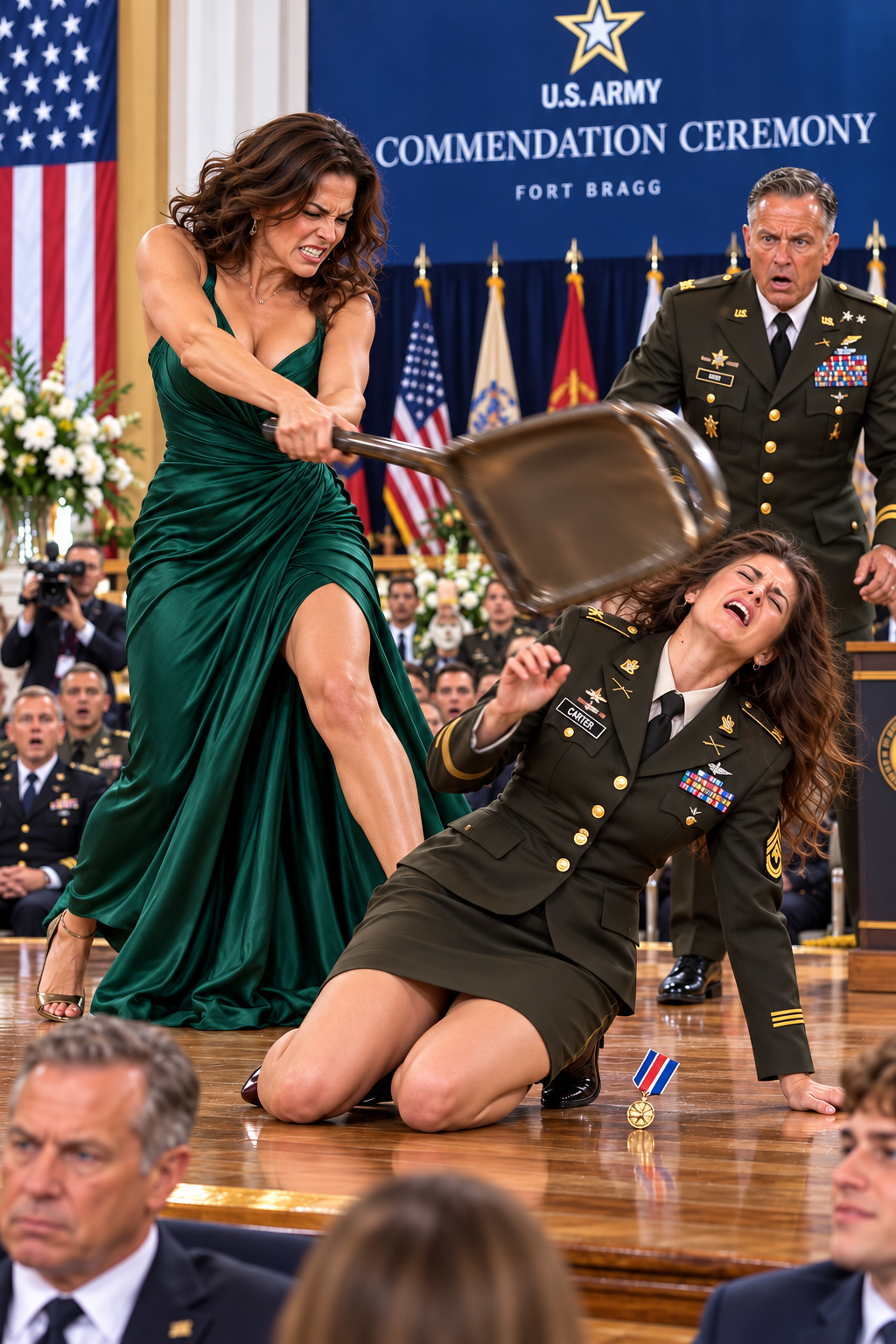
Then Gertrude approached me carrying a metal folding chair. At first, I assumed she intended to move it out of the aisle. I had seen the expression on her face, but I had spent so many years watching her become angry over ordinary things that I no longer reacted immediately. There was a peculiar confidence in the way she crossed the floor. She did not hesitate, glance toward the military police, or consider the witnesses surrounding her. She raised the chair as though the room belonged to her and the consequences would belong to someone else.
I lifted my left arm when I realized where the chair was heading. The movement came from instinct rather than conscious thought. Its metal frame struck my forearm with enough force to send a tremor through my shoulder. The small presentation case slipped from my right hand and landed on the polished wooden floor. My left arm folded against my chest at an angle I knew was wrong. I tried to steady myself with one foot, but my balance disappeared. The stage lights blurred, and I went down hard on one knee before collapsing onto my side.
For several seconds, I could not make sense of what people were shouting. My hearing seemed to retreat behind a dull pressure, leaving only fragments of sound. A woman gasped near the front row. Someone called for medical assistance. Boots scraped against the floor. I wanted to take a full breath, but every small movement traveled through my injured arm and made my stomach tighten. The sleeve of my uniform was already becoming uncomfortable. I stared at my hand and attempted to move my fingers. They responded weakly, accompanied by an unfamiliar tingling sensation.
Gertrude remained standing a few feet away, gripping the folding chair. She was wearing a floral dress she had selected specifically for the occasion, insisting that family photographs required everyone to look respectable. The fabric shifted around her knees as she leaned forward. Her mouth tightened into the expression I remembered from childhood, the one that always appeared shortly before she decided I had done something unforgivable. Instead of looking frightened by what she had caused, she looked offended that I was on the floor attracting attention.
“You are still nothing but trash wearing a costume!” she shouted.
Her words carried across the auditorium, reaching even the people seated near the back doors. I watched a man in the front row turn slowly toward her, his face registering disbelief. A woman covered her mouth. Somewhere behind me, a chair scraped against the floor. Gertrude seemed encouraged by the sudden silence. She pointed toward my uniform with one hand, still clutching the metal chair with the other, and spat the insult she had used against me since I was seventeen.
“Whore!”
I had heard that word from her often enough to recognize the particular way she pronounced it. When I was younger, she usually lowered her voice so that only I could hear. Sometimes she waited until my father was in another room. Other times she said it directly in front of him, trusting him to explain afterward that she had been upset and had not meant what she said. But this time there were hundreds of witnesses, and no kitchen door to close behind her.
I barely looked at the crowd. My attention had settled on the third row, where my father, Charles, sat beside my stepbrother, Brandon. I could see them clearly between two standing officers. My father’s gray suit jacket was buttoned, and the blue tie I had given him for his birthday lay neatly against his shirt. He had polished his shoes before the ceremony. I remembered noticing them when he arrived, because he had made a small joke about dressing properly for once. Now those same shoes were pointing directly toward the stage where his daughter lay injured.
I waited for him to stand. It seemed impossible that he would remain seated after witnessing something so unmistakable. For years, I had told myself there must be a limit to his willingness to defend Gertrude. Perhaps he could ignore an insult or explain away a ruined possession. Perhaps he could convince himself that raised voices were part of living with someone temperamental. But this was different. He had seen his wife raise a steel chair. He had watched it strike me. He could not possibly misunderstand the sound of a breaking bone.
Our eyes met for an instant. I saw recognition in his expression, followed almost immediately by the familiar discomfort that appeared whenever Gertrude caused trouble. His shoulders sank. He glanced toward his wife, then back at me. I wanted him to call my name. Even a frightened instruction to put down the chair would have meant something. Instead, he lowered his head and studied the floor near his polished shoes. He did not rise, speak, or move toward me.
Beside him, Brandon leaned backward and laughed quietly. He was twenty-two, old enough to understand the seriousness of what had happened. I could not tell whether the sound came from amusement, nerves, or the strange disbelief that makes people react badly in a crisis. At that moment, the distinction hardly mattered. His mother had fractured my arm, and my father had chosen to make himself invisible. Brandon’s brief laugh reached me more clearly than the shouting around the stage.
I had spent much of my adult life explaining my father to myself. He had worked long hours when I was growing up. He disliked arguments and became physically uncomfortable when people raised their voices. After my mother was no longer part of our household, I told myself he had married Gertrude because he needed companionship and wanted to rebuild something stable. I clung to the possibility that his failure to intervene was weakness rather than indifference. Looking at him now, I realized how thoroughly I had learned to protect his reputation inside my own mind.
Gertrude entered our lives with a talent for making every disagreement sound like an injury someone had inflicted upon her. She could turn an ordinary question about dinner into a complaint about disrespect. If she misplaced her keys, someone had been careless. If I asked to spend a Saturday with friends, I was abandoning the family. When my father returned home, tired from work, she would present him with a carefully edited account of the afternoon. By the time I was old enough to recognize the pattern, I had already learned that defending myself usually made matters worse.
When I was sixteen, volleyball practice finished late because our coach wanted the team to repeat a drill we had performed poorly. I arrived home twenty minutes after Gertrude expected me. She had put my school backpack outside in a rainstorm. By the time I found it, water had soaked through my notebooks, and an assignment I had worked on for days had become a heavy collection of damp pages. I carried the bag inside and asked why she had done it. She responded by telling my father that I had shouted at her.
He found me sitting at the kitchen table with paper towels spread around my ruined homework. I expected him to be angry about the backpack. Instead, he pulled out a chair, sighed, and said that Gertrude became anxious when she did not know where I was. He told me that an apology would help everyone calm down. I remember looking at him across the table, trying to understand how arriving late from supervised school practice had somehow become more serious than deliberately destroying my belongings.
The following year, Gertrude found a photograph of me trying on a dress for the school prom. It was fitted, dark blue, and ordinary by any reasonable standard. I had saved money from a weekend job to buy it. She examined the photograph and began making accusations about my character that had nothing to do with the dress. Later, when I told my father what she had said, he insisted that she was merely being protective. He advised me not to wear anything that would upset her. I went to the dance, but I never showed him the photographs afterward.
At eighteen, I enlisted in the Army. I did not join solely to escape my family; I wanted to serve, learn a profession, and become responsible for my own future. Still, leaving that house was the first time I understood how much energy I had spent anticipating another person’s anger. On the morning I departed, Gertrude watched me adjust my uniform and remarked that I looked as though I were dressed for Halloween. My father stood nearby with a newspaper folded beneath his arm. He said nothing until I was already walking toward the door.
Basic training demanded more of me physically than I had anticipated, but the rules made sense. Instructions were direct. Mistakes could be corrected. The person shouting at me was not secretly asking me to guess which emotion I had failed to manage. For the first time, I lived among people who expected discipline and gave responsibility in return. I discovered that I was capable of enduring difficult work without constantly feeling ashamed. Every promotion and completed assignment became evidence that the version of me Gertrude described was not the only one that existed.
Even after years of service, I continued calling home. My father usually asked whether I was eating properly, whether the weather was difficult, and when I might visit. He rarely asked what I actually did during deployments, and I did not volunteer much. Gertrude sometimes interrupted those calls to complain that I had forgotten a birthday or failed to send an expensive enough gift. I learned to keep conversations brief. Yet I still hoped that, at some point, my father would look beyond the discomfort of confronting his wife and recognize how much distance had grown between us.
When I received official notice of the Purple Heart presentation, I considered attending without any relatives. The decoration recognized wounds sustained during hostile action, and the circumstances surrounding mine were not something I wanted to revisit in front of an audience. I would have preferred a small gathering with the soldiers who understood what had happened. But my father heard about the ceremony and asked for details. His voice sounded unusually warm. He said he wanted to watch me receive the medal and told me he was proud.
I believed him. Perhaps that was the part I now found hardest to acknowledge. Despite everything, I wanted to believe that the invitation could mark a different beginning. I made sure he had the necessary information to attend the base ceremony. I also understood that Gertrude would accompany him. She objected to arrangements she considered insufficiently personal, complained about seating, and treated the official invitation as though someone had deliberately insulted her. I tried not to let those complaints overshadow the event.
Earlier that afternoon, when I saw them enter the assembly hall, Gertrude was already wearing a strained expression. Brandon walked slightly ahead of her, checking his phone. My father gave me a brief hug and said that the uniform suited me. For a few seconds, I felt foolish for being nervous. I thanked him and returned to my unit, where the ceremony coordinator needed to confirm the final order of presentation. I did not know that the next time I looked directly into my father’s face, I would be lying on the floor, waiting for him to help.
Now the medal rested against my chest, and my injured arm throbbed beneath the fabric of that same uniform. My fingers tingled more strongly. I knew enough from my military medical training to understand that swelling following a serious fracture could interfere with circulation or nerve function. I tried to keep the arm supported and remain still. A faint metallic taste gathered in my mouth. I had been hurt before, but the helplessness of being injured in front of my own family carried a different kind of humiliation.
Someone approached from behind and lowered himself beside me. A firm hand came to rest on my uninjured shoulder. I looked up and recognized Lieutenant General Douglas Campbell. The three stars on his uniform caught the light as he leaned forward to see my face. Only minutes earlier, he had spoken quietly while presenting my medal, thanking me for my service without turning the moment into a performance. Now his expression had changed. The warmth was gone, replaced by a concentrated anger I had never seen from him.
“Sergeant, look at me,” he said.
I tried. My vision blurred, and I had to blink several times before his face came into focus. He asked whether I could move my fingers and whether I had struck my head when I fell. I answered as clearly as possible. He listened without interrupting, then looked toward the people gathering near the stage. His hand remained steady against my shoulder. There was no dramatic speech, only the immediate attention of someone who understood that I needed medical care before anything else.
Gertrude began speaking again, claiming that I had always been disrespectful and had finally embarrassed her in public. She sounded increasingly agitated as she realized nobody was joining her accusations. I watched General Campbell rise. He glanced at the chair, then toward my father, who still had not left his seat. For the first time, I saw something stronger than anger cross the general’s face. It was the recognition that this attack had been committed by someone who believed she would never be held accountable.
He moved between Gertrude and me, placing himself directly in her path. The room became quiet enough that I could hear a ventilation fan operating above the stage. Gertrude stopped talking for a moment. General Campbell examined her carefully, then spoke in a voice that was controlled enough to make every word unmistakable.
“She is not trash.”
I watched Gertrude’s expression change. She had expected another argument, another person she could overwhelm with volume and accusation. Instead, a three-star general stood before her, refusing to accept the description she had used against me for years. He turned slightly toward the audience, then looked back at my father. I could see the question forming before he spoke again, and I knew the afternoon was no longer going to end with my family quietly leaving after another outburst.
END PART 1
PART 2 TITLE: As Military Police Approached the Stage, My Stepmother Discovered That the Excuses Which Protected Her at Home Had No Power Here
General Campbell did not raise his voice. That unsettled Gertrude more than shouting would have. He stood between us with his shoulders squared and his hands at his sides, waiting until she stopped talking. The auditorium had become an uncomfortable collection of people unsure whether they were witnessing an argument, an arrest, or the aftermath of a serious injury. Soldiers near the front remained on their feet. Someone had moved the audience farther from the stage. A woman in uniform was speaking urgently into a radio near the entrance.
“You struck a wounded service member during her own commendation ceremony,” the general said. “And now you are standing here insulting her while she needs medical attention. Do you understand what you have done?”
Gertrude’s expression tightened. She looked around the hall, searching for the sympathy that usually appeared when she presented herself as the injured party. At home, she had become skilled at turning attention away from her behavior. She would begin with an accusation, move quickly into tears, and end by insisting that she was the one who had been mistreated. My father almost always responded by asking everyone to calm down. It was a routine so familiar that we sometimes followed it without realizing what we were doing.
“She has been humiliating me all day,” Gertrude said. “You people have no idea how she treats her family.”
General Campbell waited until she finished. “Whatever disagreement you believe you have with her does not excuse what just happened.”
“She thinks she can put on that uniform and act superior to everybody. She has been doing it for years.”
I closed my eyes briefly. The pain in my arm had settled into a continuous pressure interrupted by sharp pulses whenever I moved. I had no desire to explain my childhood to three hundred strangers. I wanted someone to immobilize the fracture, make sure the numbness in my fingers was not worsening, and get me away from the sound of Gertrude’s voice. But she seemed determined to turn the ceremony into a public examination of my character. She had broken my arm and was now demanding that the audience understand why I deserved it.
The general made a small motion toward the rear of the room. Two military police officers stepped into the central aisle and began approaching the stage. They did not run. One spoke into a radio while the other watched Gertrude and the chair. Their deliberate movements changed the atmosphere more effectively than any shouted command could have. The audience began to understand that this would not be dismissed as an unfortunate family disagreement. The people responsible for security were treating the incident as an assault.
Gertrude noticed them and lowered the chair slightly. Her eyes moved from the officers to the double doors behind them. She seemed to be calculating how quickly she could leave. The metal frame slipped in her grip, striking the floor with a hollow noise that made me flinch. Until then, I had been watching her face. The sound forced my attention back to the object she was holding. Its legs were slightly distorted near one hinge. I wondered, with an odd detachment, how much force it had taken to bend the metal.
“I never meant for anyone to get hurt,” she said abruptly.
General Campbell studied her. “You swung a metal chair toward her head. She raised her arm to protect herself.”
“She provoked me!”
“That does not change what you did.”
Gertrude opened her mouth, but the officer approaching the stage interrupted her. He identified himself and instructed her to put the chair down and step away from me. His voice was firm without being aggressive. She hesitated, apparently astonished that someone would give her a direct order without first asking for her explanation. The second officer positioned himself where he could prevent her from moving toward the wounded soldiers and civilians gathered nearby.
“I am her stepmother,” she announced.
The officer acknowledged that he had heard her. “Put the chair down, ma’am.”
“You cannot treat me like some criminal. I came here with her father.”
“Your relationship to the injured person does not change my instructions.”
She let go of the chair. It struck the floor beside the stage, and one of the officers moved it away. For years, Gertrude had insisted that being a parent entitled her to obedience. In her understanding, the word stepmother was enough to settle disagreements about my clothing, friendships, finances, and eventually my adult decisions. Watching an officer respond to that declaration as an irrelevant detail was disorienting. The ordinary rules of accountability, which had seemed to disappear inside our house, were suddenly operating in front of me.
A medic arrived with a trauma bag and crouched beside my injured arm. Another knelt near my shoulder and asked questions about sensation, dizziness, and the pain. They worked around General Campbell, who stepped aside enough to give them room while remaining nearby. The first medic carefully supported my wrist without attempting to straighten it. He examined my fingertips and asked whether I could feel his touch. I could, though the sensation seemed distant, as though my hand belonged to someone else.
“We need to get this sleeve open,” he told me. “I don’t want to move your arm any more than necessary.”
I looked down at the dark fabric. Dress uniforms are expensive, and this one had been prepared carefully for an occasion I once expected to remember with pride. The thought of cutting it seemed briefly unreasonable. Then another wave of pain passed through my forearm, and the absurdity of my hesitation became apparent.
“Do it,” I said.
The medic used trauma shears to open the sleeve along the seam. The sound of the blades cutting through the fabric was unexpectedly loud to me. He worked slowly, preventing the wool from pulling against the injury. As the material parted, swelling appeared around my forearm. Bruising had begun to spread beneath the skin. The shape of the arm was visibly wrong. I turned my face away, not because I had never seen an injury before, but because this one belonged to me.
“We’ve got a significant fracture,” the medic told his partner. “Let’s stabilize it and keep checking circulation.”
The second medic prepared a splint while asking whether I had any allergies and whether I had lost consciousness. I answered automatically. Years of military training had taught me to give concise information in emergencies. That habit was useful now, though it also made me sound calmer than I felt. My body was trembling beneath my uniform. Sweat collected between my shoulder blades. I tried to slow my breathing, but every effort to settle myself was interrupted by Gertrude raising her voice again.
“She’s exaggerating!” she announced. “She has always been dramatic about everything.”
The medic paused for less than a second before continuing his examination. He did not argue with her, and neither did I. His silence was different from my father’s. It was the silence of someone refusing to be distracted from an urgent responsibility. He secured the temporary splint, checked the color of my fingers, and asked me to report any change in sensation. I concentrated on his instructions. They were the first things I had heard since the assault that concerned what I actually needed.
Gertrude looked toward the third row. “Charles, tell them. Tell them what she’s like.”
My father rose halfway from his seat, gripping the chair in front of him. For a moment, I thought he might finally say something that acknowledged what he had witnessed. I watched him over the medic’s shoulder. His face was pale, and his mouth moved before any words emerged. Brandon had stopped laughing. He sat rigidly beside my father, following the officers with an expression that suggested he had begun to understand the seriousness of the situation.
“Gertrude,” my father said, “please. Let’s just go home.”
I stared at him. He had watched his wife strike me hard enough to break a bone. He had watched medical personnel cut apart my uniform to examine the damage. Still, the solution that came most naturally to him was leaving together, as though the afternoon could be repaired by removing the family from public view. It was the same instinct that had governed our household for years: prevent a scene, avoid difficult questions, and hope the consequences would disappear once the door closed.
One of the officers turned toward him. “Sir, we need the people involved to remain available while we establish what happened.”
“But this is a family matter,” my father replied.
“It is an assault investigation,” the officer said.
The words seemed to land with physical force. My father lowered himself back into the chair. He glanced at Brandon, who looked away. Nobody in the audience offered to support Gertrude’s account. The silence was no longer simply shock. It had become the collective recognition of something that could not be explained away. I wondered whether my father was frightened for his wife, frightened of public embarrassment, or finally frightened by the possibility that someone might ask why he had done nothing.
General Campbell returned to my side while the medics finished their work. He asked whether I needed anything before transport. I wanted to say that I needed him to make the entire room disappear. Instead, I asked whether my medal case had been recovered. It was an irrational concern, considering the condition of my arm, but the case contained something I had struggled to accept and had finally decided to honor. I did not want Gertrude’s violence to be the last thing associated with it.
“An aide has it,” he assured me. “It’s safe.”
I nodded. He lowered his voice and asked whether Gertrude had threatened me before. The question made me hesitate. I understood why he wanted to know. He was assessing whether the attack was isolated or part of an established pattern. Yet I had spent so many years minimizing incidents at home that my first instinct was to make the situation sound less serious. I nearly said that she sometimes became emotional. I nearly used my father’s favorite explanation without even considering whether it was true.
“She’s treated me badly since I was a teenager,” I said instead. “But she has never done this in front of so many people.”
General Campbell did not ask me to describe every incident. He simply nodded and told me that investigators would need a statement when I was medically stable. The distinction mattered. He understood that a person who had just been injured should not have to recount years of mistreatment before receiving help. I had grown up in a household where every request for protection became a debate about whether I had behaved perfectly enough to deserve it. Here, nobody was making medical care conditional on my ability to defend my character.
Gertrude was still talking. She complained about the seating arrangements, the way I had greeted her, and the fact that I had spent more time speaking to soldiers than to my family. She claimed that she had been deliberately embarrassed by the ceremony. Each grievance sounded smaller than the one before it. I remembered the official invitation, the instructions about identification, and the effort I had made to ensure my father could attend. None of those details seemed worth explaining now. Even if every complaint had been accurate, they would not have justified what she had done.
The general listened until she accused me of using the military to pretend I was better than my family. He asked her to clarify what she meant. Gertrude seemed to mistake the question for an opportunity. She straightened her shoulders and began speaking with renewed confidence, as though she had finally reached someone important enough to appreciate her point of view.
“Look at all this,” she said, gesturing around the hall. “The uniforms, the speeches, the medals. She wants everybody to think she’s extraordinary. She has always needed attention.”
General Campbell’s face became very still. “Do you understand why she received the Purple Heart?”
Gertrude shrugged. “Because she got hurt somewhere overseas. That’s what soldiers do. They go away, they get injured, and then everybody acts like they’re saints.”
A murmur moved through the audience. I saw several veterans turn toward one another. A soldier standing near the aisle stared at her with an expression of open disbelief. I wished she would stop. Not because I thought the general might accept her accusations, but because she was reducing an experience that had cost people their lives to another petty family argument. There were men and women in that room whose injuries were visible and others whose suffering could not be recognized from a distance.
General Campbell asked another question. “You believe being wounded during an enemy attack is something a soldier arranges to attract attention?”
Gertrude hesitated. “That’s not what I said.”
“It is what you are suggesting.”
“You’re twisting my words. I just think she enjoys making people feel sorry for her.”
I lowered my head. I had never asked my family for sympathy after my deployment. During recovery, I had avoided describing the worst days, partly because I could not bear to revisit them and partly because I knew how Gertrude would respond. She had once dismissed a difficult medical appointment as another attempt to make herself interesting. After that, I stopped giving her information. I let my father believe my injuries had been relatively straightforward, even when rehabilitation demanded more effort than I wanted anyone to see.
There were reasons I had also kept the official account of my deployment brief. The medal did not represent only my wounds. It was attached in my mind to a particular road, a damaged military vehicle, and the names of soldiers I could still hear in my sleep. At the presentation earlier that afternoon, I had asked that unnecessary details be left out. General Campbell had respected that request. I knew the men from my unit would understand. I had hoped the ceremony could recognize their losses without requiring me to stand before strangers and explain everything that had happened.
Gertrude continued arguing, apparently unaware that she had crossed into something much more serious than my childhood behavior. She demanded that General Campbell acknowledge her right to discipline an ungrateful daughter. An officer told her to lower her voice. Brandon remained motionless, while my father pressed his fingertips against his forehead. The medics prepared to transfer me to a stretcher. I watched the general turn toward the audience, his posture changing as though he had reached a decision he could no longer avoid.
For the first time that afternoon, he addressed the entire room rather than speaking only to the people nearest the stage. He explained that he had heard enough accusations about my character and my service. His voice remained measured, but every person present seemed to understand that he intended to answer Gertrude with facts rather than insults. I felt a tightening in my chest. I knew what information he possessed, and I had spent months trying to prevent it from becoming a public spectacle.
“Sir,” I said quietly, “please don’t.”
He looked back at me. For a moment, his expression softened. He did not dismiss my concern, and he did not pretend that telling the story would be easy for me. But Gertrude had challenged the meaning of the medal in front of the soldiers whose lives were bound to that day. The general seemed to believe that their experience deserved an answer, too.
“The citation presented today was deliberately limited at this sergeant’s request,” he told the audience. “There are important facts about her service that have not been explained here.”
The room fell silent again. I knew the men from my unit were listening. I knew my father was looking toward the stage. And I knew that if General Campbell continued, Gertrude would learn what had happened overseas, including the part I had tried hardest to keep out of the public account. He paused beside the stretcher, then began telling the story of the ambush.
END PART 2
PART 3 TITLE: The General Revealed What Happened During the Ambush, and the Soldiers I Had Saved Stood to Tell My Family What I Never Could
I had spent months trying to separate the memory of the ambush from the ceremony that recognized my injuries. In my mind, the Purple Heart belonged to a day of dust, smoke, and frightened men struggling to remain alive. The medal was small enough to fit inside a velvet case, but the experience behind it had never become something I could put away. Now General Campbell stood before hundreds of people preparing to describe the worst hours of my life, while the woman who had just broken my arm listened with an expression of irritated disbelief.
“The account you heard earlier was intentionally brief,” he explained. “The sergeant requested that the ceremony focus on the members of her unit who were wounded and those who never returned. She did not want her own actions to overshadow theirs.”
I looked toward the ceiling, trying to concentrate on the pattern of the acoustic panels. The stretcher beneath me had been positioned near the stage while the medics completed their checks. One of them remained at my side, monitoring my injured arm. His presence anchored me to the auditorium, but only barely. The general’s words had opened a familiar passage in my mind. I could feel the dry heat again, hear distant engines, and remember the exact sensation of dust sticking to sweat.
It had been an ordinary movement by convoy standards. We had received our assignments, checked our equipment, and prepared the vehicles before departure. Nobody expected the journey to be pleasant, but discomfort had become routine. The road through the Korengal Valley was difficult, surrounded by terrain that offered countless places for danger to remain hidden. We knew the risks. That knowledge did not make us fearless; it made us attentive to things most people would never notice, such as disturbed ground, an unfamiliar shape near a bend, or a sudden absence of movement in a village.
I remember the vibration of the vehicle beneath my boots and the smell of warm equipment inside the confined space. Someone had made a remark that drew tired laughter. I cannot remember the exact words anymore, only that the sound was ordinary and comforting. Samuel Ross was with our group that day. He was younger then, strong enough to carry equipment without complaining, and always willing to help another soldier finish an unpleasant task. We had learned one another’s habits through months of working together.
The explosion erased the ordinary world in an instant. There was no warning I could recognize afterward. A violent impact seemed to lift the vehicle and throw everything around me out of place. Sound collapsed into a deafening pressure. My body struck something hard, and a sharp sensation moved through my head. For a moment, I could not determine which direction was up. When my vision returned, the interior was full of dust and smoke. An alarm sounded somewhere, distorted by the ringing in my ears.
I remember putting my hand against my face and finding blood. Small fragments had struck me, and a severe concussion left my thoughts moving unevenly. Training helped because it gave me a sequence of actions to follow when judgment felt unreliable. I checked for immediate danger, tried to identify the people near me, and searched for a way out. The vehicle had been damaged badly. Through an opening, I could see smoke rising beyond the road. Then I heard the first sustained burst of gunfire.
General Campbell described the attack in clear, restrained language. He told the audience that our convoy had been struck by an improvised explosive device and that enemy fire followed almost immediately. He explained that my initial injuries had been serious enough to justify remaining behind cover until assistance arrived. I listened to him state those facts as though they concerned someone else. What I remembered was much less orderly. It was noise, confusion, and the fear of looking toward a damaged vehicle and seeing people I knew trapped inside.
There was no time to decide whether I felt courageous. I could hear someone calling for help, and I knew the damaged vehicle was becoming more dangerous. I moved toward a position from which I could see the wounded. Smoke obscured part of the road. Loose material shifted beneath my boots. Every movement seemed slower than it should have been. My head hurt badly enough to make me nauseated, and I remember struggling to keep my balance while trying to identify where the next burst of gunfire was coming from.
“She did not remain behind the available protection,” General Campbell told the room. “She moved repeatedly into an exposed area to evacuate injured personnel from the damaged vehicles.”
I could hear the change in the audience. The restless sounds that had followed Gertrude’s accusations disappeared. People stopped shifting their chairs. Several soldiers near the front stood with their hands clasped, listening closely. My father, who had spent years hearing only fragments about my deployment, was staring toward the stage. I had never told him the full story. At the time, I believed withholding the details spared him unnecessary worry. I had not understood that he would eventually use my silence to avoid imagining how much I had endured.
I reached the first injured soldier with my heart beating painfully against my chest. His uniform was dark with blood, and he seemed confused about what had happened. I remember speaking to him while assessing the injuries I could see. My voice sounded strangely distant to me. I told him to remain with me and helped move him toward a safer position. Other soldiers were working under fire, trying to establish security and recover the wounded. Nobody operated alone, even when the memory later made individual moments feel isolated.
The danger did not end after the first rescue. The damaged vehicle still held men who could not move without assistance. I went back. I remember bending beneath smoke, feeling heat against the side of my face, and trying to understand where everyone had been seated before the explosion. The blast had destroyed the neat arrangement of equipment and bodies that our training assumed would exist. I had to make decisions based on what I could reach and who could respond to my voice.
Samuel was among those who could not get clear. His legs had been badly injured. When I found him, he was conscious but unable to stand, and the pain had left him struggling to speak in complete sentences. I remember kneeling beside him and telling him that I was going to move him. He looked toward the exposed road, understood what I intended, and shook his head. Even then, he was trying to calculate the danger to someone else.
“Get yourself out,” he told me.
I remember answering more sharply than I intended. “You’re coming with me.”
There was no time for a discussion. I checked what I could, found a way to support his weight, and began dragging him toward cover. He was much heavier than he seemed during ordinary work, particularly because his damaged legs could not help. My grip slipped several times. The ground was uneven, and the distance appeared impossible. I remember the sensation of his uniform catching against my gloves and the effort required to pull him forward another few feet.
Gunfire struck the ground nearby. Small fragments of dirt and stone scattered around us. I tried to keep my body low without losing my hold on Samuel. My breathing became rough and irregular. At one point, I thought I might collapse beside him. The concussion made my balance unreliable, and blood continued to run down the side of my face. Yet stopping in the exposed area felt more dangerous than moving. I concentrated on the next few feet, then the next, until other soldiers reached us and helped pull him into relative safety.
“One of the men she evacuated was Sergeant Samuel Ross,” General Campbell said.
A chair moved in the front row. I recognized the sound of a wooden cane contacting the floor. Samuel had been seated near the stage throughout the ceremony. He was no longer the man I remembered carrying equipment with effortless confidence. His injuries had changed the way he walked, and he had spent years learning how to manage pain and limited movement. When he stood, he used the cane carefully, shifting his weight until he was balanced. The movement drew attention because everyone around him had become so quiet.
“General, may I say something?” Samuel asked.
General Campbell looked toward him and nodded. Samuel turned away from the stage to face the audience. His eyes moved briefly toward Gertrude, then settled on the third row where my family was sitting. He did not raise his voice. He had never needed to. There was a steadiness in the way he spoke that I remembered from our deployment, especially during difficult moments when somebody had to make a practical decision without wasting time on fear.
“My legs were crushed,” he said. “I couldn’t get out by myself. There was fire around the vehicle, and we were still taking incoming rounds. She came back for me.”
Gertrude stared at him. Her hands had stopped moving. A few minutes earlier, she had spoken confidently about my supposed need for attention. Now an injured veteran stood before her describing an experience she had never considered. She shifted her weight as though preparing another objection, but Samuel continued before she could interrupt. He explained that he had told me to leave him. He recalled the argument with a faint, tired smile that disappeared when he described how close the gunfire had been.
“She dragged me about forty yards,” he said. “I couldn’t use my legs. Every time I tried to help, I made it worse. She kept pulling until the others could reach us.”
I remembered the distance differently. In my mind, the road had stretched endlessly, with each movement requiring more strength than I possessed. Samuel remembered a measurable distance and the sensation of being pulled across the ground. Both accounts were true. That was something I had learned about surviving a dangerous event with other people: each person carried a different portion of the same experience. When those memories were placed together, they formed a picture none of us could bear to examine for very long.
Another veteran stood beside Samuel. His left arm was missing, the empty sleeve of his jacket arranged neatly against his side. I knew him from the unit, and seeing him rise brought back another sequence of images I usually avoided. A third soldier got to his feet. They did not speak immediately. They simply stood beside Samuel, their presence making the general’s account impossible to dismiss as an officer’s attempt to defend a subordinate.
I wanted them to sit down. Not because their support embarrassed me, although it did, but because I knew how much each of them had already endured. They had attended the ceremony as friends and fellow survivors, not as witnesses in a family dispute. I had hoped they could hear the official words, offer a few quiet congratulations, and leave without being asked to return publicly to the worst day of our deployment. Gertrude had taken that possibility away from them as surely as she had taken it away from me.
The general continued, explaining that I had returned to exposed areas more than once. He spoke about the wounded soldiers who had been evacuated, the dangerous conditions under which the unit operated, and the injuries I sustained before medical assistance could remove me from the scene. He did not reveal sensitive operational details. Instead, he described the part that mattered: people had been in immediate danger, and those who could still move had done everything possible to bring their injured comrades to safety.
My memories shifted toward the arrival of evacuation personnel. I remembered resisting when someone tried to move me away from the wounded. My hearing was unreliable, and I had difficulty concentrating on questions. I knew I had been injured, but the urgency of helping the others made my own condition seem secondary. When a medic insisted that I needed evacuation, I tried to direct his attention toward another soldier whose injuries appeared more serious. I was not thinking about medals or recognition. I was frightened that someone would be left behind because I had taken a place that should have belonged to them.
“Even after she was evacuated,” General Campbell told the audience, “she argued with the medical team because she wanted another wounded soldier transported before her.”
I heard several people laugh softly. It was not the laughter of mockery. The soldiers who knew me recognized the behavior, and the general’s expression suggested that he remembered how difficult I had been with the medical personnel. The small moment of familiarity loosened something inside me. I looked toward him, still feeling lightheaded, and managed to speak.
“Sir, you make that sound worse than it was.”
He glanced back at me. “Sergeant, the medical team had a different opinion.”
A few people smiled through their tears. Samuel shook his head. I wanted to laugh, but the movement made my injured arm ache, and I settled for a weak breath. The exchange reminded me that I was not alone with the memory. Others had been there. Others understood the confusion, the stubbornness, and the terrible relief of discovering that someone you feared losing was still alive.
General Campbell’s expression became serious again as he explained that I had resisted public attention because the mission had cost lives. Not everyone had returned from that deployment. I remembered the empty spaces afterward, the personal belongings packed for shipment, and the difficult conversations that followed. Receiving a medal had never changed the fact that other people deserved to be standing beside us. The Purple Heart acknowledged what had happened to my body. It did not provide an answer for why some of us had survived when others had not.
I looked toward my father. He was no longer examining his shoes. He had raised his head and was watching Samuel. There was an unfamiliar expression on his face, somewhere between grief and confusion. I could not tell whether he was seeing me differently or simply realizing how little he knew about the person I had become. He had always been comfortable asking whether I needed anything. He had been much less willing to ask what had happened when I said I was fine.
Gertrude shifted again, the movement drawing my attention. She looked at the standing veterans, then toward General Campbell. For the first time, she seemed uncertain of what to say. Her usual accusations required an audience willing to consider that I was lying or exaggerating. Samuel had no reason to support a story about my childhood. The other injured veterans were not involved in our family. They had stood because they remembered the same day I did, and because they understood what my injuries meant.
Samuel placed both hands on the top of his cane and looked directly at my family. His voice became rougher, though he remained composed.
“She came back for all of us,” he said.
The veterans beside him remained standing. I felt tears move down my cheeks and did not attempt to wipe them away. My injured arm prevented the familiar gesture, and for once I had no interest in hiding what I felt. Three hundred people had witnessed Gertrude’s violence. Now they were witnessing the people who understood why I had received the medal.
Then Gertrude lifted her chin and opened her mouth. The expression on her face was one I knew far too well. She had heard the testimony, seen the injuries, and watched my father absorb the truth, yet she still appeared determined to prove that none of it mattered. Samuel turned toward her, waiting. I could sense the officers beside her becoming more attentive.
Whatever she said next would not change the past. But I knew it would determine whether my father finally confronted the person he had spent years defending.
END PART 3
PART 4 TITLE: When My Father Begged the Officers to Keep Everything Within the Family, I Finally Refused to Carry the Consequences of His Silence
Gertrude looked at Samuel Ross as though he had personally insulted her. The veterans remained standing, and General Campbell waited without speaking. I recognized the tension in her shoulders. It was the same posture she adopted whenever an argument stopped going her way. She would become unnaturally still for a few seconds, searching for a statement sharp enough to shift the attention back to someone else’s supposed wrongdoing. As a teenager, I had learned to recognize that silence as a warning. Now, lying on a stretcher with my injured arm immobilized, I could do nothing but watch.
“So what?” she finally said. “She did what soldiers are supposed to do. That’s the job she signed up for.”
The words hung in the auditorium. Samuel turned fully toward her. His expression did not change immediately, but I saw his hands tighten around the handle of his cane. He had spent years learning to walk again, enduring procedures and rehabilitation that most people would never have the patience to understand. His injuries had altered his work, his routines, and the ordinary activities he once took for granted. He had never asked me to treat him as someone fragile. Yet there were moments when I could see the effort required for him simply to remain standing.
“You’re right about one thing,” he said. “We signed up to serve. We knew there were risks.”
Gertrude folded her arms, apparently relieved that someone had finally agreed with her.
Samuel continued. “What you don’t seem to understand is that knowing the risks doesn’t make it easy to go back into danger. She could have stayed where she was. I wouldn’t have blamed her. Nobody would have.”
He stopped to steady himself. One of the veterans beside him shifted closer, ready to help if necessary, but Samuel raised a hand to indicate that he was all right. Then he looked directly at Gertrude.
“I get to go home to my family because she came back. I get to see my children grow up. That’s what you’re standing here dismissing.”
Nobody applauded. The absence of applause made the moment more powerful. Samuel had not spoken to entertain the audience or produce an emotional response. He had described an ordinary part of his life that would have been lost if our rescue had failed. His children were growing older. He was present for their birthdays, their schooldays, and the evenings when families gathered around a dinner table without thinking about how fortunate they were to be together.
I looked away because I could not bear the gratitude in his voice. During our deployment, Samuel and I had shared difficult conditions, exhausted conversations, and the kind of humor that people develop when circumstances leave little room for comfort. I had never considered that helping him survive created a debt between us. I had done what I believed any member of our unit would have tried to do. Hearing him describe his family made the consequences real in a way military records never could.
Gertrude opened her mouth again, but one of the military police officers stepped forward before she could speak. He had listened throughout the exchange without abandoning his responsibility to maintain control of the situation. The injured service member had received initial medical attention. Witnesses were present, and there was no uncertainty about whether the chair had been used to strike me. Whatever motivated Gertrude, the officers had enough reason to detain her while the incident was investigated.
“Ma’am, put your hands behind your back,” the lead officer instructed.
Gertrude stared at him. “Excuse me?”
“You are being detained in connection with this assault. Turn around and place your hands behind your back.”
For the first time since she entered our lives, I saw Gertrude encounter an instruction she could not negotiate through anger. She stepped backward, looked toward the audience, and began shaking her head. Her voice rose as she insisted that the officers had misunderstood the situation. She said she had only lost her temper. She demanded to speak to someone senior. When the officer repeated his instruction, she turned toward General Campbell as though the general might overrule the men responsible for security.
“You can’t let them do this,” she protested. “She’s my husband’s daughter. This is a family disagreement.”
General Campbell’s answer was brief. “A disagreement does not give anyone permission to injure another person.”
She continued protesting while the officers positioned themselves beside her. One asked her to turn around. The other maintained enough distance to respond if she resisted. I watched her struggle between indignation and fear. She was accustomed to frightening people with the possibility of a public scene. Now she was the person being instructed to control herself, and the audience had no intention of protecting her from the consequences.
My father suddenly stood. The movement startled me because he had remained seated through almost everything that mattered. He stepped into the aisle with one hand raised, his face drawn and pale. I felt an unexpected flicker of hope, although there was no reason to expect anything different from him. Some part of me still wanted to hear him acknowledge that Gertrude had assaulted me. I wanted him to say that I had done nothing to deserve it. I wanted him to become the father I had spent years imagining he might be.
“Officers, please,” he said. “I’m sure we can work this out without making everything worse.”
The lead officer looked toward him. “Sir, remain where you are.”
“I understand that my wife behaved badly, but surely this can be handled privately. We’re family.”
I felt something inside me settle. There was no sudden anger, no urge to shout, and no satisfaction in realizing that I had finally been right about him. His words simply removed the last remaining uncertainty. He had seen the injury. He had heard the witnesses. He understood that Gertrude might face legal consequences. Yet his first concern was still the possibility that strangers would become involved in the private life he had worked so hard to keep undisturbed.
General Campbell turned toward my father. “Your wife struck your daughter with a metal chair in front of this entire room. She is injured and requires hospital treatment. This is not something you can settle by asking everyone to forget it.”
My father looked toward me, then toward Gertrude. “She has been under a great deal of stress.”
There it was again. The explanation I had heard throughout my childhood, presented as though stress could erase a deliberate choice. When Gertrude destroyed my belongings, she had been stressed. When she accused me of shameful behavior for wearing an ordinary dress, she had been worried. When she insulted my military career, she had simply been frustrated. I wondered how many more serious incidents he would have excused if the officers had not been standing there.
“Dad,” I said.
My voice was weaker than I expected, but he heard it. He turned toward the stretcher, and the expression on his face shifted. For a moment, he looked almost relieved that I had addressed him. He took a small step forward. I saw the familiar impulse in his movement, the assumption that I might help him settle the situation. Throughout my childhood, he had often relied on me to become reasonable when Gertrude would not. I had apologized for things I had not done simply because he looked exhausted.
“Sweetheart,” he began, “just let me fix this.”
I looked at the temporary splint supporting my arm. My uniform sleeve had been cut open. The swelling beneath it made my forearm almost unrecognizable. A medic was checking my pulse and asking whether the tingling had changed. Nearby, the damaged folding chair rested against the wall, separated from the people in the room. I could not imagine what my father meant by fixing anything. He had no power to repair my bone, erase the witnesses, or undo the years that had brought us to this moment.
“You’re not going to explain her behavior for her anymore,” I told him.
He opened his mouth, but I continued before he could answer. “I told you what she was doing when I was sixteen. I told you again when I was seventeen. Every time, you found a reason why I should be the one to apologize.”
My father glanced at the soldiers around us. I understood that he did not want this conversation to take place in public. Neither did I. But he had spent years insisting that private disagreements remain private, even when that secrecy allowed Gertrude to behave without consequences. Now the truth had escaped the house where he had kept it contained.
“You always said you were trying to keep the peace,” I continued. “But the peace never included me. It meant she could do whatever she wanted as long as nobody outside the family found out.”
He looked suddenly older. His shoulders bent forward, and he pressed his lips together as though trying to hold back an answer he could not safely give. I had seen him embarrassed before, but this was different. He was being asked to recognize that the arrangement he considered a difficult marriage had also been a childhood in which his daughter learned that asking for help made everything worse.
“I love you,” he whispered.
I wanted to believe him. That was the painful part. I did not think my father had spent twenty years pretending to care about me. I remembered him teaching me to ride a bicycle, checking my schoolwork, and waiting at the kitchen table when I came home late from activities before Gertrude entered our lives. There had been affection between us. I knew that. But affection had become something he expressed only when it required no difficult choice.
“Maybe you do,” I said. “But I needed you to protect me when it mattered. You kept choosing not to.”
He looked down again. This time, I did not wait for him to raise his eyes. Whatever explanation he might offer would not change what I had witnessed. I had survived years of wondering whether I was asking too much from him. Now I understood that I had been asking for something basic, something no child should have to negotiate: the right to be safe in her own home.
Behind him, Gertrude began struggling as the officers secured the handcuffs. She demanded that my father intervene. When he failed to move, she turned her anger toward me. Her voice rose above the quieter sounds of the medical team preparing to transport me. She accused me of arranging the entire incident to humiliate her. Even now, she seemed unable to accept that striking another person with a chair was a choice for which she was responsible.
“You did this!” she shouted. “You wanted to destroy this family!”
I turned my head toward her. The woman who had controlled so much of my childhood was standing between two military police officers, unable to decide what happened next. I did not feel triumphant. I was exhausted, frightened about my injury, and deeply saddened by my father’s silence. But I could finally recognize the distinction between creating harm and refusing to hide it.
“No, Gertrude,” I replied. “You made that choice yourself. The difference is that everyone saw it this time.”
The officers escorted her toward the double doors. She continued shouting, alternating between accusations and demands that Charles find her a lawyer. Brandon had risen from his seat but remained near the third row. His earlier amusement had vanished. He watched his mother pass with his jaw clenched, then turned toward me with an expression I could not interpret. I did not attempt to speak to him. Whatever he believed about the incident, I no longer felt responsible for helping him avoid an uncomfortable truth.
The doors closed behind Gertrude, cutting off her voice. I had imagined that silence many times during my teenage years, usually while sitting in my bedroom waiting for another argument to end. But the quiet that followed her removal was not the relief I expected. It made room for everything I had been struggling not to feel: the pain in my arm, the embarrassment of having my private family history exposed, and the knowledge that my father had watched me suffer without moving to help.
General Campbell came back to the stretcher. He spoke briefly with the medics, then looked down at me. His expression had softened considerably. He assured me that the incident would be documented, that witnesses would provide statements, and that I would not be expected to manage the investigation while receiving medical treatment. I thanked him, though the words sounded inadequate. A few minutes earlier, he had stood between me and someone who had been permitted to intimidate me for years.
Samuel approached as far as his injured leg comfortably allowed. He placed a hand against my uninjured shoulder. We looked at each other for a moment without speaking. I could tell that he wanted to offer reassurance but did not know which words would help. Finally, he asked whether I would allow him to visit once I reached the medical center. I nodded. He squeezed my shoulder gently before stepping aside so the medics could move the stretcher.
As they wheeled me toward the exit, I saw the medal case resting in the hands of an officer near the stage. He caught my eye and lifted it slightly to show me that it had been recovered. I wanted to reach for it, but my right hand was occupied holding the edge of the blanket. General Campbell told him to keep it secure until I could receive it. I watched the small case disappear behind the rows of chairs. For a moment, I feared that I would never be able to look at the Purple Heart without remembering the chair.
Outside the auditorium, the afternoon light seemed painfully bright. The air felt cooler against my face, and I could smell damp pavement beyond the covered entrance. A medical vehicle was waiting nearby. The medics transferred me carefully, checking my injured arm as they worked. I tried to concentrate on their questions, but fragments of the ceremony kept returning: Gertrude raising the chair, Brandon’s brief laugh, my father’s polished shoes, and Samuel standing before the audience with his cane.
The medical center was quiet in the particular way hospitals become quiet when everyone is working. Staff members moved briskly through the corridors. Doors opened and closed. Someone asked for my identification while another person reviewed the report from the medics. I underwent further examination and imaging. The X-rays confirmed serious fractures involving the bones of my left forearm, including damage near the wrist and a more complicated break higher along the arm. The physician explained that the injury would require careful treatment and follow-up to protect the function of my hand and wrist.
I listened closely, asking practical questions about healing, rehabilitation, and how long my duties might need to be restricted. The physician answered without making promises. The swelling needed monitoring, and the treatment plan would depend on how well the bones remained aligned and how my symptoms progressed. I knew enough about recovery to understand that it rarely followed a perfect schedule. The prospect of losing strength or movement frightened me more than I wanted to admit. My hands had always been reliable tools, both in ordinary life and military service.
General Campbell remained nearby until the immediate treatment was complete. Samuel and several members of my unit also stayed, occupying chairs in the waiting area and drinking coffee from a vending machine. Nobody made speeches about loyalty. They simply remained available in case I needed something. One soldier helped arrange my belongings. Another made sure my phone was within reach. Their quiet assistance reminded me of the practical care we had depended upon during deployment, when concern was often expressed by carrying a bag, finding water, or taking over a task without being asked.
By evening, my arm was immobilized, and the medication had reduced the sharpest pain to a heavy ache. Exhaustion settled over me as the hospital grew quieter. I checked my phone and found messages from colleagues, friends, and people who had attended the ceremony. Most expressed concern about my injury. A few asked whether I wanted them to make statements. I answered only the most necessary messages. I could not yet bear to see how many people knew what had happened.
My father’s name appeared nowhere among the first messages. I told myself that he was probably dealing with investigators or trying to understand Gertrude’s situation. Then I recognized the familiar thought and set the phone aside. I did not need to invent reasons for his absence. I had done that too often already. If he wanted to contact me, he knew where I was. For the first time, I allowed myself to leave that responsibility entirely with him.
Near midnight, I was still awake when someone knocked softly on the hospital room door. I expected a nurse. Instead, my father stood in the doorway, wearing the same gray suit he had worn to the ceremony. His tie was loosened, and his hair had lost its careful arrangement. He looked smaller without Gertrude beside him. One hand rested against the doorframe, while the other held a folded sheet of paper. He seemed uncertain whether he had the right to enter.
“May I come in?” he asked.
I considered saying no. I was in pain, tired, and in no condition to manage another conversation that ended with me reassuring him. But something about the way he stood there was different. He was not asking me to calm Gertrude, apologize, or pretend nothing had happened. He looked frightened of my answer. I gave a small nod, and he moved to the chair beside my bed.
For a while, he stared at the immobilized arm resting against the pillows. Then he looked at my face. His eyes were red, and his hands shook slightly as he placed the folded paper on his knees. I waited. The silence stretched long enough that I could hear footsteps passing outside the room.
“I gave my statement to the investigators,” he said at last.
I looked directly at him. “What did you tell them?”
He swallowed, glanced once at my injured arm, and finally held my gaze.
“I told them exactly what I saw.”
He lowered the paper and began to cry. I did not reach out to comfort him. Not because I wanted him to suffer, but because I understood that the next decision had to be his. For years, I had carried the consequences of Gertrude’s anger and my father’s reluctance to confront it. Now he had taken the first step toward acknowledging the truth, and I needed to see whether he could continue without asking me to make the difficult parts easier.
END PART 4
PART 5 TITLE: The Hospital Door Stayed Open for My Father, but the Questions Waiting Inside Could No Longer Be Answered With Excuses
The first time my father tried to enter my hospital room, I heard him speaking to the nurse before I saw his face. His voice was low, almost apologetic, the same careful voice he had used whenever Gertrude was angry and he wanted everyone to behave as though nothing serious had happened. I was lying beneath a thin white blanket at the medical center on Joint Base Lewis-McChord, my left arm immobilized from my knuckles almost to my elbow. Outside, rain tapped against the window. Inside, a man who had watched his daughter suffer without intervening was asking permission to visit her.
The nurse glanced toward my bed. She did not ask whether Charles was really my father. His identification had already established that. What she wanted to know was whether I wished to see him. That distinction mattered more than I expected. For most of my childhood, nobody had considered my wishes when decisions involved my father’s second wife. I was expected to forgive, accommodate, apologize, and make myself smaller. Now a stranger in blue scrubs was standing between us, waiting for my answer as though I possessed the right to refuse.
I studied the doorway for several seconds. Part of me wanted Charles to disappear before I made up my mind. Another part wanted to ask why he had finally come, when the worst moment had already passed and other people had done what he should have done. I eventually nodded. The nurse opened the door, and my father stepped inside carrying nothing. No flowers, no coffee, no awkward gift to occupy his hands. He looked older than he had at the ceremony. His pale shirt was creased, and he had apparently forgotten to shave.
He stopped three feet from the bed. His eyes moved immediately to my injured arm. The surgeon had explained that the chair had caused two fractures, one near my wrist and another along the ulna. Fortunately, the circulation in my fingers remained adequate, though the swelling and nerve irritation required careful observation. My father stared at the cast as if it were the first convincing evidence that Gertrude had truly hurt me. I watched him take in the bruising above its edge, the cut where the doctors had cleaned my skin, and the empty sleeve folded beside me.
“I didn’t know it was that bad,” he said.
The words surprised me less than the way he said them. They sounded almost rehearsed, as though ignorance might soften what had happened. I turned my head toward him. “You watched her swing the chair, Dad. You heard my arm break. You saw the medics carry me out. What part didn’t you understand?” His mouth opened, but nothing followed. I had spent years filling those silences for him, offering explanations that would allow us to continue talking without confronting anything uncomfortable. This time, I let the silence stay.
Charles pulled the visitor’s chair away from the wall but did not sit until I indicated that he could. The legs scraped against the polished floor. I flinched before I could stop myself. He noticed, and his expression tightened. I hated that reaction. The Army had trained me to recognize approaching threats, to assess distance, to make decisions under fire. Yet an ordinary chair moving across a hospital floor had sent my pulse racing. I rested my uninjured hand against the mattress and concentrated on the steady sound of the rain.
“Gertrude says she never intended to injure you,” he began. “She says she was overwhelmed, and things got out of control.”
I almost laughed. There it was, the old language, polished smooth from years of use. Things got out of control. She was overwhelmed. She didn’t mean it. Those explanations had followed me through adolescence like furniture that everyone kept rearranging but nobody considered throwing away. “She lifted a metal chair and hit me with it,” I said. “She didn’t trip. She didn’t accidentally bump into me. And she didn’t stop when I fell. She kept screaming.” Charles looked at his hands. I wondered whether he understood how familiar that movement had become.
He said that he was sorry. I asked whether he meant the incident or the years before it. His answer took longer than it should have. Eventually, he admitted that Gertrude’s behavior had been cruel for much longer than he wanted to acknowledge. He remembered the afternoon she threw my school backpack outside because volleyball practice had finished late. He remembered the evening she went through my telephone and demanded explanations for ordinary messages from classmates. He even remembered standing in the kitchen while she insulted me over the dress I had chosen for prom.
What unsettled me most was discovering how much he remembered. I had once comforted myself with the possibility that he genuinely hadn’t noticed everything. Perhaps he had been distracted by work, exhausted, or unaware of what happened when he left the room. But as he spoke, that explanation collapsed. He had seen the backpack in the rain. He had heard Gertrude’s accusations. He had watched me leave home at eighteen with a duffel bag and an enlistment contract because I could no longer bear living under her roof. His failure had not been a lack of information.
“Why didn’t you do anything?” I asked. I had rehearsed the question for years, but speaking it aloud felt strangely difficult. Charles rubbed the side of his face. He told me he had believed that maintaining the marriage would protect everyone from another broken home. After my mother was gone, he had feared starting over. Gertrude had a son, Brandon, and he had convinced himself that keeping the household together was his most important responsibility. Whenever she became angry, he chose the quickest way to restore quiet. Usually, that meant asking me to surrender.
I thought of the sixteen-year-old girl kneeling in wet grass, gathering soaked notebooks before the rain ruined them. Charles had stood in the doorway that afternoon and told me not to make the situation worse. I remembered how carefully I had stacked the pages under a heater afterward, placing heavy books on top to prevent them from curling. My father could not have known how often I still thought about those books. Perhaps he had forgotten the incident by the next morning. I had carried its lesson into adulthood: saving what you could did not mean anyone would help.
“You didn’t keep the peace,” I told him. “You made me responsible for it.” He nodded, but I wasn’t finished. “Every time she frightened me, you asked me to understand her feelings. Every time she insulted me, you told me not to take it personally. When I asked you to protect me, you acted like I was asking you to choose between two people you loved.” My throat tightened. “I was your child. Protecting me should never have been something you had to negotiate.”
For the first time since entering the room, Charles met my eyes without immediately looking away. Tears had gathered along his lower lashes. “You’re right,” he said. It was a small sentence, painfully late, and I discovered that hearing it did not produce the relief I had imagined. No invisible weight lifted from my shoulders. My arm still hurt. My childhood remained unchanged. Gertrude had still attacked me in front of nearly three hundred people, and the sound of Brandon laughing was still lodged somewhere I could not reach. An admission could identify the damage without undoing it.
A knock interrupted us. Lieutenant General Douglas Campbell entered with a folder under one arm, pausing when he saw Charles beside my bed. He had removed his dress jacket, but nothing about his posture suggested he had relaxed since the ceremony. He asked whether this was a bad time. My father rose immediately, looking almost frightened. Campbell acknowledged him with a brief nod before turning toward me. He wanted to know what the doctors had said, whether my pain medication was helping, and whether I needed someone from the unit to bring clothing or personal belongings.
I answered as professionally as I could. The surgeon expected the fractures to heal, provided there were no complications. I would need follow-up imaging, physical therapy, and time away from normal duties. Campbell listened without interrupting. Then he explained that investigators were collecting statements from witnesses, medical personnel, and everyone directly involved in the ceremony. The metal chair had been retained as evidence. Several recordings had been secured, including footage from the official event cameras. Gertrude’s relationship to me did not change how the assault would be investigated.
Charles shifted beside the visitor’s chair. “General, I was hoping we could avoid turning this into something that destroys the family.”
Campbell looked at him for a long moment. His expression did not become threatening, but his voice changed. “Mr. Charles, your daughter sustained serious injuries at an official military event. The investigation is not something she should be pressured to stop for the sake of anyone’s reputation.” My father swallowed. Campbell continued, more quietly, “You had an opportunity to intervene before this reached the point it did. Right now, the most useful thing you can do is give a complete and truthful account of what you witnessed.”
I expected Charles to defend himself. Instead, he stared at the floor. Campbell did not ask him to make another promise, and he did not remain to supervise our conversation. After confirming that a nurse would contact him if I needed assistance, he set the folder on the bedside cabinet and left. The room seemed smaller afterward. My father sat down again, though the movement lacked the awkward hope with which he had arrived. For the first time, I wondered whether someone else had finally spoken to him in a language he could not reinterpret.
He told me that an investigator had already interviewed him. His initial account, he admitted, had been incomplete. He had described Gertrude as upset and said the incident happened quickly. When the investigator asked whether he had seen the chair being raised, Charles hesitated. Then he remembered the official camera positioned near the stage. He had watched that camera record the ceremony before the attack. Everything he had hoped to soften was probably visible from an angle he could not control. The realization appeared to frighten him more than it should have.
“Did you lie?” I asked. Charles shook his head, then stopped. “I left things out,” he admitted. “I told myself I was trying to keep her from making things worse.” I stared at him. He corrected himself without waiting for me to speak. “No. I was trying to keep myself from dealing with what she’d done.” The difference was important. He had not suddenly become courageous, and I was not prepared to reward a belated confession as though it were an extraordinary sacrifice. Still, he had said something that sounded true.
Charles explained that he had contacted the investigator again after leaving the interview. He had provided a supplemental statement describing the moment Gertrude approached the stage, her grip on the folding chair, and the deliberate swing. He had also disclosed that this was not her first physical or verbal outburst at home. When the investigator asked whether he could identify earlier incidents, Charles had given dates as accurately as his memory allowed. It was more than he had ever acknowledged publicly. I wanted to believe he had acted because he finally understood my suffering, not simply because the evidence made denial impossible.
My pain medication had begun to wear off. A dull pressure spread beneath the cast, and I pressed the call button before it grew worse. The nurse entered, checked my fingers, and asked Charles to move aside while she examined my hand. He obeyed immediately. Watching that uncomplicated exchange, I felt an unexpected sadness. Someone asked him to step aside because my care required it, and he did. Nobody had to plead. Nobody had to justify why my comfort should matter. The possibility of such ordinary consideration had been absent from our home for far too long.
After the nurse left, Charles said that he had spoken with Gertrude through her attorney. She was furious with him for giving another statement. According to him, she believed I had orchestrated the entire ceremony to humiliate her and that Campbell had deliberately used his rank to intimidate the family. I closed my eyes. Even from a hospital bed, I could recognize her familiar strategy: change the subject until the person she had injured was somehow responsible for her anger. Charles said he had refused to repeat that explanation to the investigators.
Then he told me something I had not expected. Gertrude wanted him to help pay for her legal defense, and he had refused. She had demanded that he persuade me to withdraw any complaint I could withdraw. He had told her he would not. Finally, she threatened to leave him permanently unless he supported her. Charles looked almost embarrassed as he described his response. He had said she was free to make her own decision. I studied his face, searching for the old impulse to apologize. There was fear in his expression, but I could also see exhaustion.
“Does Brandon know?” I asked. Charles nodded. His stepson had accused him of abandoning Gertrude and suggested that I was using the Army to punish a family disagreement. Brandon had always benefited from the peculiar rules in our house. His mistakes were temporary lapses; mine were evidence of character flaws. He could raise his voice and be called passionate. I could defend myself quietly and be accused of disrespect. Charles had accepted that imbalance for so long that Brandon apparently assumed it would continue regardless of what his mother did.
My father reached into his coat and placed a folded piece of paper on the bedside table. It contained the investigator’s contact information and the reference number associated with his supplemental statement. He had brought it in case I wanted confirmation that he had cooperated. I did not touch the paper. A part of me resented how badly he wanted credit for telling the truth. Another part understood that he had never learned to act without seeking reassurance that the consequences would be manageable. For once, those consequences were not mine to manage.
“I don’t know whether we can have a relationship after this,” I said. Charles lowered his head, but I continued before he could interrupt. “I’m not going to promise forgiveness because you’re frightened of losing me. And I won’t accept another conversation where you tell me how hard this is for you while asking me to ignore what happened.” He wiped his eyes with his sleeve. I told him that any future contact would require time, honesty, and respect for my decisions. If he chose to return to Gertrude and excuse her behavior again, I would not be part of it.
Charles stood slowly. He wanted to reach for my hand, I could tell, but stopped before doing so. “I understand,” he said. I wasn’t certain that he did. Understanding would be measured in months and years, not in the half hour he had spent apologizing beside a hospital bed. He paused at the door and told me he was going to stay elsewhere for the time being. I asked whether that meant he had decided to separate from Gertrude. He admitted he had not resolved everything, but he could no longer pretend returning home would make the situation disappear.
When the door closed, I picked up the paper he had left and read the investigator’s name. Beneath it, Charles had written the date and time of his second interview. I placed it in the folder Campbell had brought, beside the medical instructions and the preliminary incident paperwork. It felt strange to see my father’s account become part of an official record. For years, our family history had existed only in arguments, excuses, and memories that other people insisted were exaggerated. Now some of it had been written down by the person who had spent the longest time refusing to acknowledge it.
Later that evening, Samuel Ross arrived carrying a paper bag from a café outside the base. He set a sandwich on my tray and immediately complained about the vending-machine coffee downstairs. I told him the doctors had recommended rest, not entertainment. He replied that watching me criticize hospital food counted as an encouraging neurological sign. His wooden cane leaned against the wall while he pulled a chair closer to the bed. I noticed the way he positioned its legs without scraping them, and I wondered whether he had seen me react earlier. He said nothing about it.
Samuel asked whether my father had visited. I told him enough to explain the conversation without repeating every painful detail. He listened while folding the empty paper bag into a narrow rectangle. When I finished, he looked at the cast and said, “You know you don’t have to decide what he deserves tonight.” I asked what he meant. He shrugged. “You spent years being told that every argument had to end with you fixing everybody’s feelings. This one doesn’t.” I looked away because his words reached something the medication could not numb.
Before Samuel left, he mentioned that someone from the unit had retrieved the presentation case I dropped during the attack. The Purple Heart had been removed from my damaged uniform and secured for safekeeping. Campbell wanted me to know it had not been lost. I thanked him, but an uncomfortable pressure settled in my chest. I could remember the medal striking the floor, the metal chair, and my father’s lowered eyes far more clearly than I remembered the applause that preceded them. My service had not changed. Yet the memory of being honored had become entangled with the moment my family humiliated me.
After midnight, I lay awake studying the narrow strip of streetlight beneath the window shade. The investigation would continue, the fractures would slowly mend, and my father would have to decide whether telling the truth was a temporary reaction or a lasting change. None of those questions could be resolved by morning. I reached toward the folder with my good hand and pulled out the contact information. Instead of asking someone else to decide what should happen next, I wrote down the details I remembered from the ceremony, beginning with Gertrude approaching the stage.
By the time I finished, the paper contained more than the attack. It held fragments of the years that led to it, incidents I had once dismissed because nobody believed they mattered. I signed the account and placed it beside my father’s statement number. In the morning, I would ask the investigator to include it in the record. I was no longer willing to let Gertrude define what had happened, and I was no longer willing to let Charles’s silence define what could be said. The next part of this story would belong to the evidence, even if the truth changed my family permanently.
END PART 5
PART 6 TITLE: When the Recording Spread Beyond the Military Base, My Stepmother Tried to Rewrite the Truth and My Father Faced His First Real Choice
By eight the next morning, the investigator had my written account. By noon, someone I had never met had sent me a link to a video of the ceremony. The recording began after the chair struck my arm. Gertrude stood near the stage, her face flushed with anger, while two people hurried toward me from opposite sides of the room. A few seconds later, Lieutenant General Campbell appeared beside me. The camera shook as the person recording moved closer, and my father’s bowed head entered the frame for less than a second. That was enough for strangers to begin asking the question I had been asking for years.
I watched the recording once. The first sound was Gertrude’s voice, loud enough to overpower the confused conversations around her. She was accusing me of humiliating the family, and beneath her words someone repeatedly asked for medical assistance. I remembered the pain in my arm, but seeing myself on the floor unsettled me in a different way. My body looked smaller than I expected. My right hand was pressed against the injured limb, my shoulders curled inward. I did not resemble the soldier whose citation had been read moments earlier. I looked like a frightened woman trying to keep herself from moving.
The video ended before the medics carried me away. I turned off the screen and placed the telephone facedown on the bed. Within minutes, another notification arrived. Then another. Former classmates, distant relatives, people from my hometown, and acquaintances I had not spoken to since enlisting began sending messages. Some offered sympathy. Others wanted to know whether the woman in the recording really was my stepmother. A few asked questions so personal that I could scarcely believe they expected answers. Someone wanted an interview. Another person offered to arrange a public fundraiser, although my medical care was being handled through the military.
The attention made me uncomfortable. I had asked Campbell to keep unnecessary details about my combat injuries out of the ceremony because I wanted the recognition to remain connected to the soldiers who had served beside me. Now strangers were discussing my private family history as if the video had given them ownership of it. Some were compassionate. Others appeared delighted to have discovered another argument to follow. Their opinions changed nothing about my arm or the events that brought me to the hospital. Nevertheless, every new message seemed to pull me back into the assembly hall.
A public affairs officer visited that afternoon. She explained that news organizations had contacted the base seeking confirmation of the incident. Military officials would acknowledge the assault and direct questions about legal proceedings to the appropriate authorities, but there was no obligation for me to speak publicly. I asked whether refusing interviews might make it appear that I was hiding something. She shook her head. “You were injured. You are entitled to recover without explaining yourself to the entire country.” It was another ordinary statement that felt unfamiliar enough to make me pause.
I asked her not to release additional information about the convoy attack or the soldiers whose names had been included in the original military reports. She agreed to communicate that request. Samuel had already received several calls from reporters who found his name through photographs from the ceremony. He had turned them down. When he visited later, I apologized for the attention. Samuel gave me a puzzled look. “Why are you apologizing to me? I chose to stand up in that room.” He set his cane beside the bed. “I’d make the same choice tomorrow.”
He had brought a clean sweatshirt, toiletries, and the paperback novel I had left on my kitchen table. I asked how he knew which book to take. He said the bookmark was halfway through and he assumed I intended to finish it. That modest act nearly undid me. He had entered my apartment with permission, gathered what I needed, and left everything else untouched. My family had spent years convincing me that respect required complicated negotiations. Samuel demonstrated it by bringing the correct book and remembering not to put weight against my injured side when he helped arrange the pillows.
We talked about the recording. Samuel admitted that he had watched enough to confirm it showed the sequence investigators described, but he refused to watch it again. He told me about a conversation he had once had with another wounded veteran who could recall an explosion from several different angles after seeing photographs of the aftermath. The photographs had not changed what happened. They had simply added new images to a memory already difficult to manage. “You don’t owe that video another viewing,” he said. I closed the link and removed it from my recent messages.
The medical team discharged me once they were satisfied that the swelling was improving and there were no signs of worsening nerve damage. Before leaving, I practiced buttoning a shirt and securing the strap of a bag with one hand. Tasks I normally completed without thinking suddenly required concentration. The occupational therapist showed me how to protect the cast during everyday activities and warned against pretending I could manage more than I should. I recognized that weakness in myself. During deployment, I had repeatedly argued that other people needed treatment more urgently than I did. At home, nobody was impressed by that reasoning.
My apartment felt strangely unfamiliar when I returned. Samuel had placed groceries in the refrigerator, and someone from the unit had left a note beside a container of soup. I read it twice before putting it on the counter. The message contained no dramatic reassurance. It said that dinner was taken care of and that I should call if I needed anything else. I spent the evening learning how to open cupboards, wash my face, and settle into bed without striking the cast against the wall. Each awkward movement reminded me that Gertrude’s decision would continue affecting me long after the audience stopped discussing her.
Three days after the ceremony, Charles sent a message. Gertrude had been released on bail, and he was staying in an extended-stay hotel rather than returning to their house. He did not ask me to telephone him. He simply provided the information and said he hoped I was managing the pain. I read the message several times. At the hospital, he had spoken about leaving Gertrude, but I had not known whether he could follow through once she began calling, accusing him, and demanding that he repair what she considered a betrayal.
Ten minutes later, Brandon contacted me. His message accused me of destroying the family and suggested that I had deliberately turned a private disagreement into a public spectacle. He called me unstable, complained about the attention his mother was receiving, and demanded that I admit my part in the incident. I stared at the screen, my good thumb resting above the keyboard. For several seconds, I pictured myself composing a careful response, explaining everything from the beginning. Then I remembered how many years I had spent trying to convince people who had already decided not to believe me.
I took a screenshot and forwarded it to the investigator because the message related directly to the situation they were reviewing. I did not reply to Brandon. Instead, I muted the conversation and put the telephone aside. The decision should have felt simple, but old habits were persistent. Silence had always been interpreted as guilt in our household. If I refused to defend myself, Gertrude would announce that her accusations must be true. If I defended myself, she would accuse me of prolonging the argument. For the first time, I could recognize that arrangement without accepting its rules.
Charles contacted me again before the evening was over. He had seen Brandon’s message and told him to stop communicating with me. He also warned that he would withdraw financial support if Brandon continued harassing me. I had not asked for that intervention, and I wasn’t entirely comfortable being drawn into another dispute involving the household’s money. But I noticed something significant: my father had spoken to Brandon directly instead of asking me to tolerate his behavior. It was a small action, certainly not enough to erase his history, but it was different from everything I remembered.
I wrote back that I appreciated his willingness to address the message, then explained that I would not be involved in further arguments about Gertrude. Charles answered with a brief acknowledgment. There was no request for reassurance. He did not remind me that Brandon had a difficult childhood or suggest that his words came from concern for his mother. I waited almost automatically for the familiar second message, the one asking me to show understanding. It never arrived. Eventually, I put my telephone away and finished the soup that had been waiting in the refrigerator.
The following week, investigators asked me to review portions of my statement. I attended the meeting with my left arm supported in a sling and my medical paperwork arranged in a folder. The investigator was careful to distinguish events I directly witnessed from things I had learned afterward. We discussed where Gertrude had been sitting, when she approached the stage, and whether I remembered seeing the chair before the impact. I described turning toward the movement and raising my arm instinctively. Afterward, the investigator explained that my statement was consistent with the footage available to them.
He asked about earlier incidents involving Gertrude. I described the years of insults, threats, invasions of privacy, and deliberate humiliation without attempting to make them sound more dramatic. I knew that childhood arguments and an assault at a military ceremony would not necessarily be treated as the same legal matter. That was not why I mentioned them. They explained why I had initially doubted my right to object and why my father’s silence had affected me so deeply. The investigator recorded the information and made no promises about how every detail would be used.
When we finished, he asked whether I had concerns about further contact from Gertrude or her relatives. I thought of Brandon’s message, my father’s hotel room, and Gertrude’s determination to cast herself as the injured party. I admitted that I was worried she might appear at my apartment or attempt to confront me during a medical appointment. We discussed protective measures and the available procedures for reporting unwanted contact. I left with clear instructions rather than vague assurances. Knowing what to do did not remove my fear, but it made the uncertainty easier to manage.
That afternoon, I received a voicemail from Charles. He said he was collecting his belongings from the house and had arranged for someone else to be present. He was also looking into counseling. The message sounded awkward, as though he had not yet learned to describe a personal decision without seeking my approval. I waited until the next morning to respond. I told him that counseling might help him understand the choices he had made, but that progress would have to be for his own sake. I would not supervise his recovery from a situation in which I had been the person harmed.
My first follow-up appointment brought better news about the fractures. The swelling was gradually decreasing, the alignment remained acceptable, and the surgeon was cautiously optimistic about recovery. He stressed that healing would take time and that stiffness could persist even after the bone had repaired itself. I listened carefully. The practical instructions suited me: keep the arm protected, attend the appointments, report unusual symptoms, and avoid placing unnecessary stress on the injury. Recovery was difficult, but at least the medical team would not blame me if the bone needed longer than expected.
Outside the clinic, I stopped beside a bench overlooking a row of wet evergreen trees. The base looked almost ordinary. Soldiers crossed the parking lot carrying coffee, vehicles moved through the security checkpoint, and someone laughed near the entrance. Life was continuing without regard to my family’s crisis. I sat there longer than necessary, watching people move from one appointment to another. The realization came slowly: I had been living as though Gertrude’s anger was the central event around which everything else had to be arranged. It no longer needed to occupy that position.
Samuel called while I was still outside. He asked whether the doctor had finally ordered me to stop pretending I could lift heavy things with one arm. I told him the instructions were disappointingly specific. He offered to drive me home, but I explained that I had already arranged transportation through someone from the unit. Instead of insisting, he said he would bring dinner later in the week if I wanted company. It was a small exchange, but I found myself smiling after it ended. The people who cared about me could offer help without treating my acceptance as a debt.
A few days later, the investigator informed me that the evidence had been forwarded for the appropriate charging and legal decisions. Witness statements, medical findings, and video recordings had been gathered. The process might take longer than I wanted, and no particular outcome could be guaranteed. I asked whether Gertrude could avoid responsibility by persuading Charles to withdraw his account. The investigator explained that the case did not depend solely on my father’s testimony. There were numerous independent witnesses, and the official recording provided evidence that could be evaluated separately.
That answer stayed with me. Gertrude had always been skilled at controlling a room when the only witnesses were family members. She knew which accusations would make Charles retreat and which insults would provoke me into defending myself. But she could not negotiate away the people who had watched the assault. She could not make the medics forget the injury they treated or convince the camera that the chair had moved on its own. I did not feel triumphant. I felt something steadier: an unfamiliar confidence that reality would not disappear simply because she refused to acknowledge it.
That evening, Charles sent a photograph of the small hotel room where he was staying. There was a neatly made bed, an open suitcase, and a paper cup beside the lamp. His message said he had scheduled his first counseling appointment. I did not know whether his separation from Gertrude would last. I also knew that my decision about our relationship could not depend entirely on whether he left his marriage. What mattered was whether he accepted responsibility for the harm he had enabled and whether he could respect the boundaries I established without demanding immediate forgiveness.
I replied with a single sentence wishing him well at the appointment. Then I opened the folder containing my medical records and the investigator’s notes. For years, I had kept painful memories in separate compartments, telling myself they were isolated incidents rather than parts of a pattern. Seeing the documents together made that pattern impossible to ignore. I placed Brandon’s screenshot with the other records and wrote down the dates of every unwanted contact. If Gertrude or anyone acting on her behalf approached me again, I would report it rather than attempt to manage the confrontation privately.
Before going to bed, I took the presentation case from the drawer where Samuel had placed it. The empty space inside was shaped for the Purple Heart that Campbell was keeping safe until I wanted it returned. I touched the dark velvet with my uninjured hand. I still had no idea how I would feel when I held the medal again. At the ceremony, Gertrude had tried to turn my service into something shameful. The public recording had made the attack impossible to conceal, but it had also attached her voice to an occasion I had hoped to remember differently.
I closed the case without putting it away. My next medical appointment was scheduled, the investigation was moving forward, and my father had begun making choices he should have made years earlier. Those developments mattered, but none of them answered the question I had been avoiding. Would I ever be able to return to the place where Gertrude attacked me without feeling that I was seventeen again, waiting for Charles to protect me? Six weeks after the ceremony, a message from General Campbell would give me the opportunity to find out.
END PART 6
PART 7 TITLE: Six Weeks After the Attack, I Returned to the Empty Auditorium and Discovered That the Hardest Memory Was Still Waiting for Me
General Campbell’s message arrived on a Thursday afternoon, six weeks after Gertrude struck me with the folding chair. He asked whether I would consider returning to the auditorium for a private visit. There would be no audience, no photographers, and no official speeches. He wanted to give back the Purple Heart that had been removed from my damaged uniform, but he made it clear that the decision belonged to me. I read the message while sitting at my kitchen table, with my left arm resting on a folded towel after another appointment for rehabilitation.
My fractures were healing, although the process had been less straightforward than I anticipated. The heavy cast had been replaced with a removable brace, and my wrist was stiff enough that turning a doorknob could produce an unpleasant pull along the forearm. The therapist had given me gentle exercises to restore movement without stressing the recovering bone. I performed them several times a day, usually while staring at the kitchen clock. Progress could be measured in small degrees of motion, but there was no comparable instrument for determining whether the memory of the attack had begun to loosen its grip.
I had returned to most ordinary activities, with modifications, and could spend limited periods handling administrative work. What I had not managed was walking into a large room without noticing every chair. At medical appointments, I preferred seats against the wall. At a unit gathering, someone dropped a metal tray and I found myself standing before I understood the sound. The reactions embarrassed me, although I knew intellectually that they were not evidence of weakness. The body sometimes responded to danger long after the immediate threat had disappeared. My own was still learning the difference.
I called Campbell rather than replying in writing. He answered immediately, and I could hear papers moving on his desk. I asked why he wanted to meet in the auditorium instead of his office. He was quiet for a moment. Then he explained that the ceremony had been interrupted before I could experience its conclusion as intended. He thought I deserved the chance to stand in that space without Gertrude deciding what it meant. “But I don’t want this to become another obligation,” he added. “If you would rather receive the medal somewhere else, we’ll arrange that.”
I appreciated the offer, but the room was already present in my thoughts every day. Avoiding it had not stopped me from hearing the chair strike my arm or imagining Charles staring at his shoes. I asked whether Samuel could attend. Campbell said he had already spoken with him and that Samuel would come if I wanted him there. We agreed to meet the following morning. After ending the call, I sat motionless at the table for several minutes. The decision felt larger than returning a medal. I was choosing to approach a memory I had spent six weeks trying to keep at a distance.
That evening, I prepared my dress uniform. The jacket still fit, though getting my braced arm through its sleeve required patience. I checked the insignia, straightened the collar, and removed a loose thread from the cuff. The uniform damaged in the attack had been retained long enough for documentation and was no longer suitable for wear. I had resisted replacing it because part of me regarded the task as an admission that Gertrude had permanently altered something belonging to me. But cloth could be repaired or replaced. What I had earned while wearing it could not be measured by the condition of its sleeve.
I found an old photograph in a drawer while searching for a lint brush. It showed me at eighteen, standing outside the recruiting office with a borrowed bag over one shoulder. I looked painfully young. My hair was pulled back too tightly, and my smile had the uncertain quality of someone hoping the camera could capture a future she had not yet experienced. Charles had taken the photograph. Gertrude had refused to come, saying she had no interest in celebrating what she called my latest attempt to escape responsibility. I remembered smiling anyway because, for the first time, I had somewhere to go.
The Army had not solved every problem I carried out of that house. Military training demanded discipline and helped me develop confidence, but there were nights when Gertrude’s voice still followed me into unfamiliar barracks rooms. When an instructor raised his voice, I sometimes felt the old impulse to apologize before discovering what I had done wrong. Over time, I learned to distinguish correction from humiliation. I found people who expected accountability without demanding submission. That distinction became essential during deployment, when mistakes had consequences that could not be negotiated away through anger or intimidation.
Before sleeping, I thought about the convoy. Some memories remained sharper than others: the heat rising from damaged metal, the smell of burning fuel, the weight of another person’s body when exhaustion made lifting difficult. I remembered Samuel in the dirt, injured and struggling to remain conscious, and the urgent calculations that had kept me moving. I had received the Purple Heart because I was wounded during that attack. Campbell had also spoken about what I did for others, but the recognition could never belong entirely to one person in my mind. Too many names were attached to that day.
I woke before the alarm. The morning air was cold, and a thin layer of moisture covered the windshield when I approached the car. I checked my uniform in the reflection of the driver’s window, then reminded myself that nobody would be inspecting its perfection. Driving toward the base, I passed familiar buildings and training areas. Nothing in the landscape suggested that an ordinary auditorium could frighten me more than places where I had faced genuine combat danger. Yet my hands tightened around the steering wheel when the roof of the assembly hall came into view.
Samuel was waiting outside near the entrance, leaning against his cane. He wore a plain jacket rather than formal clothing, and his first comment concerned the weather. I could tell he had deliberately chosen something ordinary to say. I asked whether he planned to complain about the stairs again. He grinned and told me his leg had reserved the right to object to poorly designed architecture. Then he studied my face more carefully. “You can leave whenever you want,” he said. “Even if we only make it through the front door.” I nodded, grateful that he did not mistake determination for certainty.
Inside, the entrance smelled faintly of floor polish. The building was quiet enough that our footsteps seemed unusually loud. Samuel walked slightly ahead, then slowed so we could move side by side. I noticed the position of every folding chair stacked against the far wall before I noticed the flags or the stage. My breathing shortened. The space was unchanged, yet the absence of hundreds of people made it appear larger. Sunlight entered through high windows and settled across the polished floor. I had expected the room to feel threatening. Instead, it seemed indifferent, which unsettled me almost as much.
Campbell stood near the stage holding a small velvet-lined case. He greeted us without ceremony and made no attempt to rush our progress down the aisle. Samuel remained beside me while I looked toward the place where Gertrude had stood. I could still see her expression clearly. I remembered her arms lifting, the chair moving through the air, and the desperate instinct that made me shield my head. My wrist began aching beneath the brace. I knew the sensation was probably a mixture of physical strain and memory, but knowing that did not make it disappear.
“Would you like to sit down?” Campbell asked. I shook my head. I wanted to remain standing, though I could feel my knees becoming unsteady. He accepted my answer and waited. I walked toward the stage slowly, counting the rows without intending to. The third row was where Charles had sat. I stopped beside it, looking at the empty chair nearest the aisle. For nineteen years, I had imagined that one day my father would witness something Gertrude could not explain away. I had believed that seeing the truth would make him protect me. I knew differently now.
Samuel approached without speaking. He stood close enough that I could reach him but far enough away to let me decide whether I needed support. After a while, I told him that the third row frightened me more than the stage. He followed my gaze. “Because that’s where your father was?” he asked. I nodded. The chair had broken my arm. Charles’s decision not to intervene had damaged something less visible and far older. I could accept that he was beginning to understand his failure, but I could not pretend his recent efforts had changed the moment when he lowered his eyes.
I told Samuel about waiting for Charles to stand. As a child, I had watched my father’s face during arguments, searching for signs that he might finally object. Sometimes he would inhale as though preparing to speak, and hope would rise before he looked away. At the ceremony, I had recognized the same hesitation. The stakes were more obvious, but the decision was familiar. Samuel listened without offering a comforting explanation. When I finished, he said, “It makes sense that you remember where he sat. You were looking for help from the person who taught you to expect none.”
We remained by the third row until my breathing slowed. Then I continued toward the stage. There was a faint mark in the polished floor where one section had been recently refinished. I could not tell whether it was connected to the attack. My imagination wanted to assign meaning to every scratch and shadow. Campbell noticed me looking down. He said the maintenance crew had worked on several areas after the event, then added that the building had hosted other ceremonies since. I found the information unexpectedly reassuring. The room had not remained frozen around the worst day of my life.
Campbell opened the case. Inside lay the original Purple Heart, its metal cleaned and its ribbon carefully arranged. I remembered seeing it fall during the attack, but the medal itself bore no visible sign of the incident. It was the same decoration he had pinned to my uniform before Gertrude reached the stage. He held it where I could examine it without reaching forward. “It has been kept securely,” he said. “I thought you might prefer to receive this one rather than a replacement.” I looked at the familiar purple ribbon and felt something shift beneath the anxiety.
I asked whether the medical personnel had recovered it. Campbell explained that it had been collected after the incident and carefully cleaned before being placed in safekeeping. I pictured the polished floor, the blood from my injured arm, and the medics struggling to protect the fracture while moving me. Those images had dominated my memories of the ceremony. But the medal brought another scene into focus: Campbell reading the official citation, Samuel sitting in the front row, and several soldiers standing when their names were acknowledged. Gertrude had interrupted those moments, but she had not erased them.
“Permission to approach, Sergeant?” Campbell asked. His words were formal, but his expression was gentle. I straightened instinctively, bringing my feet together despite the stiffness in my arm. “Permission granted, sir.” He stepped forward and carefully pinned the Purple Heart to my jacket. He checked that the ribbon lay flat before withdrawing his hand. For an instant, the movements carried me back to the beginning of the original ceremony. I braced for the scrape of metal or Gertrude’s voice. Neither came. Campbell stepped backward and offered a crisp salute, which I returned.
There was no applause. No official announcement. No crowd trying to capture a photograph. Only Campbell, Samuel, and the quiet hum of the building’s ventilation system. I looked down at the medal and touched its edge with my good hand. The gesture felt awkward because I had spent six weeks associating it with the attack. Now I could see the familiar design without immediately picturing Gertrude. I thought of the soldiers who had been beside me overseas, of Samuel struggling to stand at the ceremony, and of the families who would never receive their loved ones back.
Campbell lowered his hand. “That recognition was earned long before your stepmother entered this room,” he said. “Nothing she did here can alter the circumstances of your service.” I knew he was right, but I wanted to say something about the limits of medals. Recognition could honor sacrifice, but it could not repair a damaged childhood or teach Charles how to be a father. It could not make me less frightened by sudden noises. Perhaps Campbell understood some of that, because he did not continue speaking. He simply gave me the time to examine what I was holding.
Samuel stepped closer and touched my uninjured shoulder. He said Gertrude had not given me the medal and therefore had never possessed the authority to take its meaning away. I smiled faintly. “She certainly tried.” Samuel nodded. “Yes. But that’s the difference between what somebody tries to do and what they actually have the power to accomplish.” His words made me think about all the years Gertrude had insisted that my achievements were worthless unless she approved of them. I had believed her often enough that even genuine success could leave me feeling as though I were doing something wrong.
Campbell asked whether I wanted a photograph. I considered the possibility. The original ceremony had produced images that strangers now associated with violence and public humiliation. I did not want another dramatic picture that would require explanations. Yet the quiet room felt different from the one Gertrude had tried to control. I asked Samuel to stand beside me and Campbell to remain where he was. A staff member took a single photograph with my telephone. We did not pose with raised fists or exaggerated smiles. We stood together, the medal visible, with no sign of Gertrude anywhere in the frame.
Afterward, I walked back toward the doors without hurrying. When I reached the third row, I stopped once more. The empty chair still made me sad, but I no longer felt compelled to imagine what Charles should have done. That question had occupied enough of my life. I could acknowledge his failure and decide what contact I wanted with him now. I did not need to invent a different version of the ceremony to make our relationship easier to bear. The past could remain painful without dictating every decision I made afterward.
Near the entrance, Samuel asked whether I felt better. I considered the question carefully. My wrist still ached, and returning to the room had stirred memories I would probably continue working through. I had not experienced some miraculous release from the past. But I had stood on the stage again, allowed someone I trusted to approach, and received the medal without Gertrude controlling the moment. “Not exactly better,” I said. “Different.” Samuel nodded as though that answer made perfect sense. Campbell held the door while we stepped outside into the bright morning.
Before leaving, Campbell asked whether there was anything else I needed from him. I looked at the Purple Heart and then toward the auditorium behind us. For weeks, I had wanted someone to tell me precisely how this part of my life would end. Would Gertrude be punished? Would Charles change? Would Brandon ever recognize what his mother had done? None of those answers belonged entirely to me. What I could decide was whether their choices would continue controlling the way I remembered my own service. “I think I needed to come back,” I said. “Thank you for letting me decide when.”
I drove home with the medal fastened securely to my jacket. At a traffic light, I glanced at the photograph on my telephone and saw three people standing in a quiet auditorium. Samuel’s cane was partly visible, Campbell wore a restrained smile, and I looked tired but steady. It was not the photograph I had expected from a Purple Heart ceremony, yet it represented something the first event had failed to provide: a moment in which I could accept recognition without bracing for an attack. I saved it separately from the recordings that had circulated online.
That evening, Charles sent his weekly message. He asked how my rehabilitation was progressing and mentioned that counseling had forced him to confront memories he had spent years avoiding. I answered briefly, telling him that my arm was improving. I did not tell him about the auditorium. Not because the visit was secret, but because I wanted one important memory that did not require his interpretation or apology. For once, an event in my life could remain meaningful without being brought before the family for approval. I placed the photograph beside the old recruiting-office picture and closed the drawer.
As I prepared for bed, I checked my wrist brace and performed the final exercises the therapist had prescribed. My range of motion was improving, though each movement still required patience. The Purple Heart rested in its case on the bedside table. I understood that the legal process was not over and that my relationship with Charles remained uncertain. But I had made a decision I could not imagine reversing. I would no longer let Gertrude decide which achievements I was permitted to remember with pride. Whatever happened next, the medal and the memory of earning it belonged to me.
END PART 7
PART 8 TITLE: A Year After Gertrude Faced the Consequences, Another Veteran’s Ceremony Revealed the Truth I Had Never Been Allowed to Believe
Gertrude did not apologize when the legal proceedings reached their conclusion. Her attorney negotiated an agreement that spared her a public trial, and she accepted a plea that included three years of supervised probation, mandatory anger-management treatment, and a lasting protective order prohibiting her from approaching or contacting me. I learned the details through the appropriate legal channels rather than from my father. The restrictions were practical, measurable, and enforceable. They did not require Gertrude to understand what she had done. They required her to obey rules that could no longer be changed simply because she became angry.
I had expected to feel something unmistakable when the outcome was confirmed. Relief, perhaps, or satisfaction at knowing she had finally faced consequences. Instead, I sat at my kitchen table with the paperwork in front of me and noticed how quiet the apartment was. No one was shouting. No one was demanding that I apologize for involving outsiders. My telephone had not been flooded with accusations. Gertrude’s anger had once determined the atmosphere of an entire household. Now her legal obligations existed separately from my daily life, and I did not have to participate in managing them.
The agreement did not erase the assault or minimize the injuries it caused. My arm had required weeks of immobilization followed by careful rehabilitation, and the medical records documented the consequences. During the proceedings, my account remained consistent with the physical evidence and witness statements. Charles’s supplemental statement was part of the record, but the case had never rested entirely on his willingness to cooperate. That distinction mattered. For the first time, the truth about Gertrude’s behavior had survived without depending on whether my father felt brave enough to acknowledge it.
Brandon stopped contacting me after Charles warned him about the messages. I heard occasional fragments of information through my father, but I made it clear that I did not want updates about Brandon’s opinions. He had watched his mother injure me and reacted as though the real offense was her embarrassment afterward. I had no interest in persuading him that his laughter mattered. He was an adult capable of reflecting on his own behavior. Whether he eventually did so was not something I intended to monitor or manage.
Charles continued attending counseling. At first, his messages contained awkward descriptions of what he was learning. He wrote about avoiding confrontation, confusing silence with compromise, and treating my needs as obstacles to maintaining his marriage. I sometimes recognized phrases that sounded borrowed from a therapist’s vocabulary. I did not challenge them, but neither did I mistake the ability to describe a problem for the ability to change. I had spent too many years listening to promises that dissolved whenever Gertrude raised her voice.
One Sunday morning, he called and asked whether I would be willing to speak for a few minutes. I agreed because he had respected the boundaries we established after the hospital visit. His voice was steadier than I remembered. He asked about my rehabilitation and listened when I described the exercises that still made my wrist ache. When I finished, he did not immediately turn the conversation toward his problems. We spent several minutes discussing ordinary things, including the weather and a repair he had made to his car. The conversation felt tentative, but it did not exhaust me.
Then Charles mentioned that his counselor had asked him to describe the first time he remembered Gertrude humiliating me. He had initially selected an incident from my teenage years. During the following session, he remembered something earlier, an occasion when I was still a child and he had told me not to upset her because she had already had a difficult day. He sounded ashamed as he explained how easily that instruction had become a permanent rule in our home. I listened without interrupting, though the memory made my stomach tighten.
“I thought I was teaching you to be considerate,” he said. “I didn’t understand that I was teaching you to accept being treated badly.” I looked toward the window while he spoke. Outside, rainwater moved slowly along the curb. I wanted to tell him that the lesson had followed me for years, that I had entered the Army already convinced I needed to prove my worth. But I also knew I did not have to describe every wound for him to understand that harm had occurred. “You understand it now,” I said. “What matters is what you do with that understanding.”
Charles did not ask me to forgive him. He said he was learning to tolerate the discomfort of knowing he had failed without expecting me to reassure him. I could hear how difficult the admission was. In our family, his distress had often been treated as an emergency that required my attention. If he became upset, I was supposed to stop expressing anger and help him feel better. That afternoon, I allowed him to remain uncomfortable. When the conversation ended, he thanked me for speaking with him and did not ask when we would meet again.
Our contact settled into a modest pattern. Once a week, Charles sent a message or photograph from his morning routine. Sometimes it showed a coffee cup beside a newspaper. Sometimes he mentioned a counseling appointment or asked about my recovery. I replied when I wanted to. If I was busy, he accepted the delay. He did not invite Gertrude into our conversations, and he did not pressure me to attend family gatherings. The distance between us remained substantial, but it no longer felt as though maintaining it required constant argument.
My own recovery continued more slowly than the legal proceedings. The fractures eventually united, and the specialist cleared me to increase activity gradually. I celebrated by completing an ordinary task that had frustrated me for weeks: fastening every button on my uniform jacket without asking for help. It took longer than it once had. My fingers trembled slightly when I reached the final button. I stood in front of the mirror afterward, studying the straight line of fabric and the scar near my wrist. There was no audience to applaud the accomplishment, and I preferred it that way.
Physical healing, however, did not restore every lost confidence. Certain noises still startled me, particularly the abrupt movement of metal furniture. I sometimes woke after dreaming that I was back in the assembly hall, unable to make my father look up. I continued working through those reactions with appropriate support rather than pretending they would disappear through force of will. The process was uneven. Some days I could walk into a crowded room without thinking about Gertrude. On others, the sound of a chair scraping across a floor was enough to make me pause.
Samuel remained one of the few people with whom I could discuss those experiences without feeling that I needed to produce a reassuring conclusion. He understood the frustration of recovering from an injury that changed how ordinary spaces felt. His damaged leg still caused pain during damp weather, and he sometimes needed to reconsider plans because walking had become difficult. He rarely complained, but he was honest about the limitations. Watching him live with those realities helped me understand that resilience did not require pretending to be unaffected.
We began meeting for coffee when our schedules allowed. Samuel usually chose places with comfortable chairs and easy access because of his leg. I appreciated the thought he put into those decisions, though he insisted they were entirely selfish. He had become involved in advocacy work for disabled veterans, helping people navigate practical challenges after service-related injuries. He spoke about transportation difficulties, inaccessible buildings, confusing paperwork, and the frustration of feeling forgotten once the public ceremonies ended. His concerns were specific, and the work mattered to him more than recognition.
When I asked how the advocacy efforts were progressing, Samuel shrugged and said there was always another form to complete and another person who needed help understanding it. He preferred that kind of work to speeches about heroism. “Somebody needs a ramp installed,” he told me one afternoon. “They don’t need me to tell them they’re brave while they’re sitting at the bottom of the stairs.” I laughed, but the observation stayed with me. Public recognition could be meaningful, yet it was ordinary assistance that determined whether people could move through their lives with dignity.
Nearly fourteen months after Gertrude attacked me, Samuel received an invitation to be honored for his advocacy work. The recognition ceremony would take place in a military auditorium, with veterans, service members, relatives, and community representatives attending. He told me about it over coffee, making the announcement sound like an administrative inconvenience. I congratulated him. He responded that he had already tried unsuccessfully to persuade the organizers to shorten the speeches. Then he asked whether I would attend. The question was casual, but I could see that the answer mattered to him.
“Of course,” I said. Samuel studied me for a moment. “You know it’s in an auditorium.” I understood what he meant. He had been beside me when I returned to the original hall six weeks after the attack, and he knew that memory still occasionally troubled me. I told him that the building was not Gertrude and that I wanted to be there for him. Samuel nodded. He did not praise my courage or turn the decision into a dramatic milestone. He simply said he would be glad to see me in the audience.
On the morning of the ceremony, I dressed carefully and checked my left arm in the mirror. The fractures had healed sufficiently for normal use, though the wrist occasionally ached after strenuous activity. A narrow scar remained where the skin had been injured, and I had learned not to treat it as something that needed to be hidden. I fastened my jacket, adjusted the ribbons, and placed the Purple Heart in its proper position. The medal no longer made me think first of Gertrude. Most days, I remembered the convoy, the people beside me, and the soldiers we had lost.
The auditorium was busy when I arrived. Families moved toward the seating area, and volunteers helped guests find their places. Samuel stood near the stairs leading to the stage, studying them with an expression of exaggerated disapproval. His wooden cane rested against his right leg. I approached from the side and asked whether he was preparing to declare war on the building’s architect. He looked up with a grin. “I’m considering it. These people keep inviting me places with stairs, then acting surprised when I mention that my leg doesn’t particularly enjoy them.”
I offered my arm. Samuel glanced at it, then at my face. “Are you certain? The last ceremony we attended together didn’t end especially well for your bones.” I laughed before he finished speaking. The joke would have hurt a year earlier, but now I could hear the affection beneath it. “Take the arm, Ross,” I said. “And try not to make a speech about it.” He shifted his cane, wrapped his hand around my forearm, and allowed me to help him approach the first step. The movement was familiar, practical, and entirely free of fear.
We climbed slowly, adjusting our pace to accommodate his leg. Samuel’s weight was steady against my arm, and I could feel the strength that remained despite his injuries. At the top, he paused to catch his breath. The audience had begun to applaud, but he waited until he was balanced before turning toward them. I remembered the convoy, when he had been too badly injured to stand, and the original ceremony, when he had risen with his cane to defend me. Now we were beside each other again, helping one another through an ordinary physical task.
The speaker introduced Samuel and described his advocacy efforts. There were references to practical assistance, veterans who had obtained needed services, and improvements he had helped encourage. Samuel listened with the same uncomfortable expression I had worn during my own ceremony. I watched from beside the stage as he accepted the recognition. His remarks were brief. He thanked the people who had worked alongside him, acknowledged the veterans whose experiences had shaped the advocacy, and reminded the audience that recognition mattered most when it led to better treatment for those still struggling.
When Samuel finished speaking, applause rose through the room. I helped him away from the podium, and we waited near the stairs while the next speaker prepared. He looked relieved to be out of the spotlight. I told him he had managed to deliver a respectable speech without insulting the organizers. He said it had required considerable restraint. We were laughing when he glanced toward the Purple Heart on my jacket. His expression changed, becoming thoughtful. “Do you mind if I tell you something about your ceremony?” he asked.
I assumed he meant the incident with Gertrude. “I remember enough of that day already,” I said gently. Samuel shook his head. “That’s not what I mean.” He rested both hands on the top of his cane while the audience settled for the next presentation. “When Campbell defended you, he spoke about what you had done overseas. He told your family how you went back for wounded soldiers and why you deserved that medal.” I nodded. I remembered Campbell’s words, though some of them had reached me through a haze of pain.
“Everything he said was true,” Samuel continued. “But I’ve been thinking about something ever since.” I waited. He glanced toward the stage, making sure we would not interrupt the ceremony, then spoke quietly enough that only I could hear. “He made it sound as though your service was the reason you deserved to be treated with respect. As though Gertrude should have been ashamed because she attacked a decorated soldier.” I looked at him, unsure where he was going. He tightened his grip on the cane and shook his head.
“She should have been ashamed because she attacked you,” he said. “Not because of the uniform. Not because of the Purple Heart. Not because a general happened to be standing nearby. You deserved to be protected when you were sixteen, when you were eighteen, and every year afterward. You didn’t have to survive an ambush or save anyone’s life to earn that.” The applause from the auditorium faded into a distant sound. I felt my throat close as I looked at the man whose life I had helped save and realized he was speaking about a girl he had never met.
For years, I had believed that achievement might finally settle the argument about my worth. If I became disciplined enough, successful enough, brave enough, perhaps Gertrude would stop treating me with contempt and Charles would find a reason to defend me. Even after leaving home, part of me had continued working toward an invisible standard I could never quite reach. Samuel’s words exposed the mistake beneath that effort. I had been trying to earn something I should never have been required to prove.
I looked down at my left forearm, remembering the rain-soaked backpack, the prom dress, the recruiting-office photograph, and the chair striking my arm. Those memories belonged to different years, but they shared a painful assumption: that I had to become someone exceptional before anyone would consider me worthy of protection. The Purple Heart had honored my service. It had not created my value. Samuel had recognized a distinction that neither Gertrude nor Charles had ever taught me to make, and I could no longer pretend it was unimportant.
I wanted to answer him, but the words would not come. Samuel seemed to understand. He touched my shoulder briefly, then turned toward the stage as the next presentation began. I stood beside him, listening to the audience and feeling the quiet weight of the medal against my jacket. For the first time, I understood that healing required more than proving Gertrude wrong or accepting my father’s apologies. I would have to confront the belief that had shaped so many of my choices. The soldier I had become deserved respect, but so had the frightened girl I once was. And I was finally ready to stop asking either of them to earn it.
END PART 8
PART 9 TITLE: The Day I Stopped Protecting the People Who Had Hurt Me and Finally Learned What Accountability Really Meant
The first envelope arrived on a Tuesday, when I was standing in my kitchen trying to open a jar of peanut butter with one hand. My left arm had improved, but the stiffness remained stubborn. The physical therapist had warned me that recovery would involve small frustrations. What she hadn’t mentioned was how often those frustrations would remind me of the person who had caused them.
The envelope was from the prosecutor’s office. Inside were several pages explaining the next steps in the case against Gertrude. I recognized her full name immediately, printed neatly beneath a case number. Seeing it in an official document felt different from hearing it shouted across a room. For years, her name had meant arguments, apologies I never owed, and my father’s insistence that I should understand her. Now it appeared beside words like evidence, witnesses, and criminal proceedings.
I placed the papers on the kitchen table and sat down. The apartment was quiet except for the refrigerator’s occasional hum and the traffic beyond my window. Nobody was demanding an explanation. Nobody was telling me to consider what Gertrude had been through. I could read the documents at my own pace, put them away, or call someone for help. Even that small amount of control felt unfamiliar.
The prosecutor wanted to speak with me about the recordings from the ceremony. Several people had submitted videos, including soldiers who had been seated near the aisle when Gertrude picked up the folding chair. The investigators had also collected statements from the medics, military police officers, General Campbell, and other witnesses. What happened was no longer a question of whose memory could be trusted.
My father had given a statement too. I already knew that much. What I didn’t know was whether he had been able to describe the incident without falling back on the explanations he had used throughout my childhood. Gertrude had been upset. She hadn’t meant it. Things had gotten out of hand. Those phrases had followed me for years, turning every deliberate act of cruelty into an unfortunate misunderstanding.
I called the number printed on the letter. A woman answered and introduced herself as the prosecutor handling my case. Her manner was practical rather than comforting, which suited me. She asked about my recovery, explained the purpose of the meeting, and told me I would have an opportunity to review my earlier account. When I asked whether I would have to sit near Gertrude, she said arrangements could be made to limit contact and keep the proceedings orderly.
I hadn’t realized I was holding my breath until she answered. I had faced enemy fire without knowing whether I would come home, yet the possibility of sitting across from my stepmother in a courthouse made my stomach tighten. I knew the reason. On deployment, fear had belonged to dangers I could name. At home, fear had lived inside ordinary things: a slammed cupboard, a change in Gertrude’s voice, the expression on my father’s face when he knew an argument was coming.
After the call, I went back to the jar. I braced it against the counter with my injured arm, twisted carefully with my right hand, and finally heard the lid loosen. It was a ridiculous moment to feel proud, but I did. I made toast, ate it standing beside the sink, and considered how many years I had spent assuming that independence meant never needing anyone. The people who cared about me had spent the past several weeks proving otherwise.
Samuel Ross had been particularly persistent. He called every few days, sometimes to ask about my physical therapy and sometimes to complain about things that had nothing to do with me. His neighbor’s dog had destroyed another flowerbed. His coffee machine had stopped working. Someone at the veterans’ center had apparently decided that laminated signs were the solution to every organizational problem. I suspected he chose these subjects deliberately.
When I told him about the prosecutor’s letter, he stopped talking about the coffee machine. “Do you want someone to go with you?” he asked. I started to decline automatically. He interrupted before I could finish. “I’m offering you a ride and a chair in a waiting room. I’m not volunteering to fight your battles.” I looked at the papers on the table. “All right,” I said. “I’d appreciate that.” He answered with a simple, “Good,” and moved on to asking whether my arm was strong enough to drive safely.
The meeting took place two days later. Samuel arrived early, leaning on his cane and carrying two coffees in cardboard cups. One had too much sugar because he remembered how I used to drink it during deployment. He apologized when I pointed out that my tastes had changed. I took it anyway. We drove through a gray morning, past wet sidewalks and the familiar roads near Joint Base Lewis-McChord, speaking about ordinary things until the courthouse appeared ahead.
Inside, the prosecutor showed me a timeline assembled from the available evidence. It began before the chair struck my arm. One video captured Gertrude standing suddenly, moving into the aisle, and reaching for the chair. Another showed my father watching her approach the stage. A third recorded the blow itself. The images were clear enough that nobody needed me to describe how the chair had been raised or where it landed.
I watched only what was necessary. My stomach lurched when I saw Gertrude moving toward me with the chair, but the worst moment came afterward. On the recording, my father remained seated while the people around him rose. His gaze dropped. Even knowing what followed, even knowing he had eventually spoken to the investigators, I felt the old ache settle behind my ribs. The prosecutor noticed my expression and quietly stopped the video.
“Would you prefer not to continue?” she asked. I studied the paused image. “I want you to have what you need,” I answered. “But I don’t need to watch it again.” She nodded, closed the window on her computer, and explained that the recording had already been preserved. There was no reason to expose myself to it repeatedly. I wished someone had taught me that distinction when I was younger: telling the truth did not require reliving every injury for an audience.
We spent the next hour discussing the history between Gertrude and me. I described the insults, the years of tension, the occasions when she had destroyed or thrown away my belongings, and the way my father had repeatedly dismissed my concerns. The prosecutor listened without making promises about what would be legally relevant. She separated the earlier conduct from the physical assault and asked precise questions about dates, witnesses, and anything I could document.
I appreciated the care she took. There were things I remembered clearly and things I could no longer place on a calendar. Some of the earliest incidents had happened when I was still a teenager, and I had no photographs or messages to support them. She didn’t ask me to make my memories sound more certain than they were. The distinction mattered. I wanted Gertrude held responsible for what she had done, not condemned through exaggerations that could be challenged later.
Near the end of the meeting, the prosecutor mentioned Brandon. He had been interviewed as a witness, and his account had changed as investigators compared it with the videos. She couldn’t discuss every detail of his statement, but she confirmed that his description of the incident was no longer being treated as reliable without independent support. I pictured him in the third row, laughing while I struggled to move my fingers.
There had been a time when Brandon’s opinion of me occupied more space in my mind than it deserved. He was twenty-two, old enough to understand what cruelty looked like, yet he had spent years treating his mother’s behavior as entertainment. I had tried ignoring him, reasoning with him, and occasionally laughing along to prevent another argument. None of those approaches had changed much. Now I realized I didn’t have to choose a new strategy for dealing with him. I could simply stop dealing with him.
On the drive home, Samuel waited until we were several miles away before speaking. “You were quiet in there,” he said. I watched the rain collect along the edge of the windshield. “I thought I’d be angry.” “And?” “Mostly I was tired.” He considered that. “You don’t have to stay angry to take something seriously.” I turned toward him. He kept his eyes on the road. “I learned that the hard way after I came home.”
Samuel rarely talked about his injuries unless someone asked directly. He had lost part of the strength in one leg and dealt with pain that medication never fully eliminated. I knew enough about his rehabilitation to understand that some days were difficult, but he refused to let every conversation become a report on his suffering. That afternoon, he told me how much energy he’d wasted trying to prove he was no longer hurt. Eventually, he said, he’d discovered that acknowledging a limitation wasn’t the same as surrendering to it.
That evening, Charles called. His name appeared on my phone while I was folding laundry, and I stood looking at it until the fourth ring. We had spoken only a handful of times since the ceremony. He had apologized repeatedly, but the conversations often ended with both of us struggling to find something beyond the past to discuss. I answered because I wanted to, not because I felt obligated to keep him calm.
“I heard you met with the prosecutor,” he said after we exchanged greetings. I straightened a towel on the table. “Yes.” He hesitated. “I gave them everything they asked for.” I could hear a television playing quietly in the background, followed by the sound of him turning it off. “I didn’t tell them she was confused,” he added. “I didn’t tell them you provoked her. I told them she hit you, and I saw it.”
For a moment, I couldn’t speak. It was such a small statement compared with the years behind it. A father saying he had witnessed someone hurt his daughter should not have been remarkable. Yet I understood how difficult those words must have been for Charles, a man who had spent so long trying to make every confrontation disappear. “Thank you for telling the truth,” I said. He inhaled unevenly. “I should have started a long time ago.”
He told me he had begun speaking with a counselor. He didn’t describe the sessions in detail or ask me to praise him for attending. Instead, he said the counselor had asked why he thought keeping peace at home required one person to remain silent. He had been unable to answer. “I’ve spent my whole life thinking I was avoiding arguments,” he said. “I think I was avoiding responsibility.” I sat down slowly, surprised by the clarity of his words.
“I need you to understand something,” I told him. “I can forgive you and still need distance. I can believe you’re trying and still be angry about what happened.” There was a pause. In the past, he would have asked me not to dwell on painful memories. This time he said, “I understand.” I knew that understanding something intellectually wasn’t the same as living differently, but it was the first conversation we’d had in which he hadn’t tried to make my feelings smaller.
Before hanging up, he asked whether he could send a letter. I told him he could, provided he didn’t expect an immediate response. He agreed. Afterward, I stood by the window and watched a woman walking a dog beneath the streetlights. Nothing about the evening looked extraordinary. A car passed. Someone laughed on the sidewalk. A neighbor carried groceries into the building. I was beginning to appreciate how much safety could exist in an evening when nobody demanded anything from me.
Over the following weeks, my arm grew stronger. I could hold a coffee cup without concentrating on the weight. I could button my shirt without asking for help, though certain movements still sent a dull warning through my wrist. Physical therapy became more demanding as the exercises shifted from basic movement to rebuilding strength. Progress came in uneven increments. Some mornings I felt almost normal. On others, my arm stiffened before I reached the bathroom.
My father sent the letter he had promised. It was handwritten, four pages on ordinary stationery, with several words crossed out rather than carefully rewritten. He didn’t ask me to forget Gertrude, defend his intentions, or return to family dinners. He described moments when I had turned to him for help and he’d deliberately looked away. He remembered more of them than I had expected. Near the end, he wrote that he didn’t know whether he could become the father I had needed, but he intended to stop pretending he’d already been one.
I read the letter twice, folded it, and placed it in a drawer beside the photograph from my first deployment. I didn’t send a long reply. I wrote only that I had received it and appreciated his honesty. I wanted to believe change was possible. I also wanted to be careful with the part of myself that had spent years mistaking promises for evidence.
The next update from the prosecutor came when my arm was strong enough for me to begin wearing my dress uniform comfortably again. Gertrude’s attorney had indicated that she might be willing to resolve the criminal case through a negotiated plea. Any agreement would require approval, and the prosecutor emphasized that the process wasn’t finished. I listened, asked about the possible conditions, and made notes with my left hand resting comfortably on the table.
After the call, I opened the closet where my uniform hung. The Purple Heart caught the afternoon light from the bedroom window. For years I had regarded medals as reminders of people whose courage mattered more than mine. At the ceremony, Gertrude had tried to turn that recognition into something shameful. Now the medal hung undisturbed, surrounded by the ordinary clothes I wore to buy groceries and attend therapy. Its meaning no longer changed according to who was looking at it.
I took the uniform from the closet and laid it across the bed. The damaged sleeve had been repaired, though I could still identify the area where the medic had cut through the fabric. I ran two fingers over the seam. Someone else might have replaced the jacket entirely. I had chosen not to. The repair was careful and nearly invisible, but I knew exactly where it was. I could live with that.
That night, Samuel called to tell me his veterans’ advocacy group was planning another event in the coming months. He wanted me to attend, and he didn’t disguise the fact that he hoped I would eventually speak to younger service members about recovery. “I’m not interested in becoming a cautionary tale,” I said. He laughed. “Neither am I. That’s why we need people willing to talk about life after the headlines disappear.” I promised to think about it.
When I hung up, I considered the difference between the soldier I’d been before the ceremony and the woman I was becoming afterward. I had always known how to respond to danger. I understood orders, procedures, and the importance of acting when someone needed help. What I had never learned was how to remain present in my own life when someone else was disappointed with me.
The prosecutor’s papers lay in a folder on my desk. Charles’s letter remained in the drawer. My uniform hung safely in the closet, and my arm ached a little less than it had the week before. Nothing had been erased. The people who hurt me hadn’t suddenly become different, and the legal process might still require difficult conversations. But I no longer confused another person’s discomfort with an emergency I was responsible for fixing.
END PART 9
PART 10 TITLE: When Gertrude Finally Faced Consequences, I Discovered That Justice Did Not Require Me to Become Someone I Was Not
The courthouse smelled of floor polish and wet wool. It had been raining since dawn, and people came through the entrance shaking water from their coats, carrying umbrellas and folders, moving toward their own difficult appointments. I stood just inside the security checkpoint with my left hand wrapped around the strap of my bag. My fingers worked normally now, though the muscles near my wrist still tightened whenever I became anxious.
Samuel had offered to accompany me again. I accepted without making excuses. He stood beside me in a dark jacket, leaning lightly against his cane while studying a notice about prohibited items. The ordinary way he occupied the space helped me remain steady. He didn’t ask whether I was afraid. He didn’t need to. Instead, he pointed toward the hallway and said, “We have time for coffee before they call us.”
I had already met with the prosecutor about the proposed agreement. Gertrude intended to enter a guilty plea, avoiding a trial. The recommendation included supervised probation, required anger-management treatment, and restrictions on contacting or approaching me. The prosecutor explained that the judge would make the final decision and that I could submit a statement describing the impact of the assault. I spent several evenings drafting it.
My first version was twelve pages long. It contained almost everything I had never said aloud: the embarrassment of being corrected in front of relatives, the times Gertrude searched through my belongings, the insults about my appearance, and the arguments my father ended by telling me to apologize. I wrote until my hand cramped. Then I left the pages on the kitchen table and slept badly, troubled by dreams that carried the familiar sounds of slammed doors and raised voices.
The following morning, I read the statement again. Much of it was true, but I recognized that the courtroom couldn’t provide everything I had wanted from my childhood. No judge could make Charles intervene in an argument that had happened when I was seventeen. No sentence could turn Gertrude into a compassionate person. The law could address the assault and impose consequences. My life would have to be rebuilt through quieter decisions.
I started over. This time, I wrote about the physical injuries, the treatment required, the weeks of dependence, and the fear that followed me after the incident. I explained that the attack occurred during a ceremony meant to recognize my military service, in front of people I respected. I described how the humiliation reached beyond that room through the recordings circulated online. Then I added a paragraph about how the incident affected my trust in my family. I didn’t soften it.
The prosecutor reviewed the statement without changing its meaning. She pointed out a few sentences that could be clearer and asked whether I wanted to read it aloud or have it submitted in writing. “I think I should read it,” I answered. She nodded. “That’s your decision. And if you change your mind before the hearing, that’s acceptable too.” I appreciated that she didn’t frame one choice as braver than the other.
Charles arrived shortly before the hearing began. He wore a gray coat I recognized from family holidays, although his face looked different. He had lost weight, and the skin around his eyes seemed permanently tired. He stopped several feet from us instead of approaching immediately. “Would it be all right if I sat behind you?” he asked. I looked at Samuel, who offered no opinion. “Yes,” I told my father. “But I don’t want to discuss Gertrude beforehand.”
Charles accepted the condition. He sat on the bench opposite us and folded his hands between his knees. I watched him for a moment. As a child, I had interpreted his silence as a sign that I was asking too much. Now I saw a man who had trained himself not to act whenever acting might be uncomfortable. It explained some of his behavior, but it didn’t excuse it. Both truths could occupy the same space.
Gertrude entered with her attorney. Her appearance startled me more than I expected. She wore a dark dress and carried a small handbag. Her hair was neatly arranged, and her expression remained rigid as she followed her lawyer into the courtroom. She looked smaller without the authority she had always claimed inside our home. For a brief moment, I remembered her standing over me in the auditorium, demanding that everyone see me through her contempt. I looked away before the memory could take hold.
Brandon came in several minutes later. He stood near the rear wall and avoided meeting my eyes. I hadn’t spoken to him since his last hostile message. Charles had told him to stop contacting me, and he had obeyed. I didn’t know whether he regretted laughing during the assault or simply feared the embarrassment that followed. I realized I no longer needed an answer before I could continue with my life.
When the judge entered, everyone stood. The proceedings began with questions directed toward Gertrude. Her attorney had explained the proposed plea, but the judge required her to acknowledge the essential facts personally. I listened as she confirmed that she understood the charge and the rights she was giving up. Then came the description of the assault. It was delivered in ordinary legal language, without the insults or the shouting that had filled the auditorium.
Gertrude said she had struck me with the folding chair. Her voice was low, almost difficult to hear. The judge asked her to speak clearly. She repeated the acknowledgment, adding that she understood the blow had caused my arm to fracture. For years I had imagined what it would feel like to hear Gertrude admit wrongdoing. I thought I might feel triumphant. Instead, I felt a strange heaviness. The admission changed the official record. It couldn’t restore what had been lost.
The prosecutor presented the evidence supporting the agreement and explained why the recommended conditions addressed both the seriousness of the assault and the need to protect me from further contact. The judge asked several questions. I watched the attorneys answer, grateful for the distance created by the formal process. Nobody was demanding that I mediate the conversation or reassure the person whose behavior had brought us there.
When the judge asked whether I wished to speak, I stood. Samuel shifted his cane so I could move past him. My father remained seated behind us. I walked toward the designated place with my statement in my right hand and my injured arm resting naturally at my side. The paper trembled slightly, so I set it down before looking up.
I began with the physical consequences. I described the treatment, rehabilitation, interrupted work, and movements that had become difficult after the fracture. Then I explained why the location of the assault mattered. “That ceremony wasn’t organized for my family,” I said. “It was held to recognize service and sacrifice. People were present who had endured injuries of their own, and some had lost friends they could never bring home. What happened there affected more people than me.”
I stopped briefly to steady my voice. The courtroom remained quiet. “For years, I was expected to excuse Gertrude’s behavior because she was my stepmother. When I objected, I was told I was creating trouble. When I tried to establish boundaries, I was accused of being ungrateful. This attack made that pattern visible to people outside our family, but the harm did not begin that day.”
I looked toward the judge rather than Gertrude. “I’m not asking the court to repair my family. I understand that isn’t possible. I’m asking that the assault be treated seriously and that the protections in the proposed agreement be enforced. I want to recover without being contacted, threatened, or pressured to pretend this was a misunderstanding. I don’t want revenge. I want the opportunity to live without further interference.”
There were several sentences remaining, but I didn’t need them. I thanked the judge, collected my papers, and returned to my seat. Samuel moved his cane aside. As I sat down, he touched my shoulder once. I turned the statement facedown on my lap. I hadn’t spoken perfectly. My voice had shaken and I had skipped a paragraph. None of that changed what I said.
Gertrude’s attorney spoke next. He described her acknowledgment of the offense and willingness to comply with the recommended conditions. He offered context about family conflict and emotional difficulties, but the judge made clear that such circumstances did not justify a deliberate act of violence. I listened without interrupting. The familiar explanations sounded weaker when they were examined rather than simply accepted.
Gertrude was allowed to speak. She said she regretted what had happened and understood that she had behaved terribly. She also said she had felt excluded from the ceremony and overwhelmed by the attention surrounding it. For one instant, her explanation sounded so much like the arguments I’d heard at home that I almost expected Charles to speak on her behalf. He didn’t.
The judge asked whether she understood that feeling offended did not give her permission to strike another person. Gertrude answered yes. I couldn’t tell whether the word represented genuine understanding or a desire to finish the hearing. Perhaps it was both. I found that I no longer cared to investigate the difference. Her private beliefs were not something I could control. Her actions, however, would now carry consequences.
The court accepted the plea and imposed three years of supervised probation, mandatory anger-management treatment, and an order prohibiting Gertrude from contacting or approaching me. The judge explained the conditions and the consequences of violating them. Gertrude stood still as the sentence was delivered. I listened closely, making sure I understood what protections were in place and what I should do if she disregarded them.
When the hearing ended, I remained seated until the courtroom began to empty. The prosecutor approached and asked how I was feeling. “Relieved,” I said, then reconsidered. “I think.” She gave a small nod. “Sometimes it takes a while for a process like this to settle.” She reminded me whom to contact if Gertrude violated the court’s conditions and confirmed that I would receive the relevant documents. Her practical instructions helped more than any elaborate reassurance could have.
Charles waited near the exit. Brandon stood several feet behind him, looking down at his phone. My father approached me alone. “You spoke well,” he said. I shook my head. “I spoke because I needed to.” He accepted the correction. After a moment, he asked whether he could call me later in the week. “You can,” I replied. “But I don’t want to talk about what Gertrude thinks of the sentence.” His eyes lowered briefly. “All right.”
Brandon finally looked up as I passed. He opened his mouth, apparently preparing to say something, but stopped. I considered asking him why he had laughed. I had imagined the question many times, particularly during the nights when pain kept me awake. Yet in that hallway, I could see no answer that would improve my life. If he wanted to examine his behavior, that work belonged to him.
Outside, the rain had stopped. Samuel and I walked toward the parking area, and I noticed that I wasn’t scanning the crowd as intensely as I had before the hearing. A woman hurried past carrying a stack of files. Two men stood beside a car discussing lunch. Somewhere nearby, a truck reversed with three sharp electronic beeps. The world hadn’t changed because a judge had spoken. It simply continued, and for once I felt permitted to continue with it.
Samuel unlocked the passenger door. “You want to eat somewhere before we head back?” he asked. I realized I was hungry. During the morning I had been too nervous to finish breakfast. “Something with actual food,” I said. “Not whatever you’ve been calling lunch at the veterans’ center.” He placed a hand dramatically over his chest. “You wound me.” I gave him a look. “You once tried to convince me powdered eggs were a delicacy.” He laughed and climbed into the driver’s seat.
We stopped at a small diner where the booths had cracked red upholstery and the waitress called Samuel by his first name. He ordered a sandwich and coffee. I chose soup because my stomach was still unsettled. For a while, we talked about the weather, physical therapy, and a mutual friend who had recently become a father. It felt strange to discuss such ordinary things after the hearing, but I was grateful for the opportunity.
Halfway through the meal, Samuel asked whether I thought the sentence was fair. I considered the question carefully. “I think it’s appropriate,” I said. “And I hope she follows the conditions.” He waited. “But I don’t feel different in the way I expected.” Samuel turned his coffee cup between his hands. “What did you expect?” “That hearing her admit it would settle something.” He looked at me kindly. “Maybe it settled what the court could settle.”
I stirred my soup. “And the rest?” He shrugged. “The rest doesn’t have to be finished today.” I looked out the window at the wet pavement shining beneath the afternoon light. I had spent so much of my life rushing to repair relationships before anyone became angry again. The idea that I could leave something unresolved without being irresponsible was difficult to accept.
That evening, I placed the court documents in a folder with the earlier correspondence. I labeled it clearly and put it away. Then I changed into comfortable clothes, warmed some leftovers, and called a friend from my unit. We talked for nearly an hour about plans for the coming month. I didn’t mention the hearing until she asked. When I told her the outcome, she listened, said she was glad protections were in place, and moved on when I did.
Later, Charles sent a brief message asking whether I had reached home safely. I answered that I had. He thanked me and didn’t continue the conversation. That small restraint mattered. In the past, my father had interpreted every opening as permission to push for reconciliation. Now he seemed to be learning that respecting a boundary sometimes meant ending a conversation before he wanted to.
I slept poorly that night, waking twice after dreams I couldn’t fully remember. The next morning, however, I got out of bed, made breakfast, and completed my rehabilitation exercises. My wrist ached during the final movement, but the discomfort eased when I rested. I understood that the legal case had reached a resolution while my body and mind were still recovering. Those processes didn’t have to follow the same schedule.
Gertrude’s sentence would become part of the record. Her choices had consequences, and the responsibility for complying with the court’s orders belonged to her. Whether she developed genuine remorse was uncertain. Whether Charles became a more dependable father remained to be seen. Whether Brandon ever apologized was no longer something I intended to wait for.
I had spent enough years making other people’s behavior the center of my life. That morning, the kitchen filled with the smell of fresh coffee, and sunlight reached the table where the prosecutor’s letter had once unsettled me so deeply. I sat down with a notebook and began writing plans that had nothing to do with Gertrude. For the first time, the future felt less like a place where I might have to defend myself and more like somewhere I was free to go.
END PART 10
PART 11 TITLE: The Quiet Months After the Verdict Taught Me That Forgiveness, Trust, and Love Were Three Very Different Things
Spring arrived slowly in Washington. The mornings remained cold, and rain gathered in the cracks of the sidewalk outside my apartment, but the trees gradually began to fill with new leaves. I noticed the changes because I was walking more often. My physical therapist had encouraged regular movement, and I had discovered that walking helped when my thoughts became crowded. I didn’t always have a destination. Sometimes I went out simply because I could choose where to go.
The fracture had healed well enough that my appointments were becoming less frequent. My grip strength had improved, although certain movements remained uncomfortable. The therapist warned me not to judge progress by the occasional bad day. “Healing tissue doesn’t read calendars,” she said while recording another measurement. I laughed at that, partly because it sounded like something Samuel would say. I wrote it down later, wanting to remember it when I became impatient.
My military responsibilities had also begun returning to a familiar rhythm. I wasn’t ready for every physical demand, and my medical restrictions were still being reviewed, but I could participate in work that didn’t place unnecessary stress on my arm. Some colleagues treated me exactly as they had before. Others seemed uncertain whether mentioning the ceremony would upset me. I appreciated the first group more than I could easily explain.
One morning, a young soldier stopped me outside an office and asked whether I was the person from the video. He looked embarrassed as soon as the question left his mouth. I confirmed that I was. He apologized and said he hadn’t meant to be intrusive. Then he added that his younger sister was considering enlisting and had become frightened after seeing the recording. I listened while he explained, uncertain what he expected from me.
“I don’t know what to tell her,” he admitted. “She thinks somebody can go through all that training, serve overseas, earn a medal, and still have someone treat them that way.” I considered his words. He wasn’t really asking about military service. He wanted to understand why people who acted courageously could still become targets of cruelty. I told him that a uniform couldn’t control another person’s behavior. Neither could a medal.
He nodded but remained troubled. “Then what’s supposed to make her feel safe?” I thought about General Campbell stepping forward, the medics kneeling beside me, and the people who had refused to let Gertrude continue. “She needs to know that being mistreated isn’t evidence she did something wrong,” I said. “And she needs people who will listen when she tells them something isn’t right.” He thanked me. I hoped the answer would help, even though I knew it couldn’t resolve every fear.
That conversation stayed with me. Before the ceremony, I had believed that military accomplishments might finally convince my family to respect me. I didn’t admit it openly, especially to myself, but the hope had influenced many of my decisions. I wanted Charles to see me as responsible and capable. I wanted Gertrude to run out of insults that could still hurt. I wanted Brandon to stop laughing when my work was mentioned.
The ceremony had shown me the limits of that hope. Gertrude hadn’t been persuaded by my service. She had felt threatened by the recognition because it placed me beyond the role she’d assigned me. Charles hadn’t suddenly become protective because a room full of soldiers considered my work honorable. He’d looked down because that was what he’d trained himself to do whenever Gertrude became dangerous. Their responses had revealed their limitations, not mine.
Several weeks after the hearing, Charles invited me to have lunch. He suggested a restaurant halfway between our homes and immediately added that he would understand if I declined. I thought about the invitation for two days before accepting. I chose a quiet weekday afternoon, when the restaurant would be less crowded, and told him I could stay about an hour. He agreed without trying to negotiate.
He was already seated when I arrived. A glass of water stood untouched in front of him, and he rose awkwardly when he saw me. For a moment, he looked as though he wanted to hug me. I offered my hand instead. His expression tightened, but he shook it. We sat down and studied the menus while a server brought another glass of water. The opening minutes were uncomfortable, although neither of us pretended otherwise.
Charles asked about my arm. I told him the fracture had healed and that I was still working on strength and flexibility. He listened carefully. Then he asked about my work, and I described the assignments I was able to handle. For the first time in years, he didn’t interrupt with Gertrude’s opinions or change the subject to Brandon’s activities. He asked thoughtful questions and seemed genuinely interested in the answers.
Halfway through lunch, he reached into his coat pocket and placed a small notebook on the table. It was filled with his handwriting. “My counselor suggested I make a record of the things I remember,” he said. “Not to give to you. Just so I can’t keep changing the story in my own head.” I looked at the notebook but didn’t touch it. “What kind of things?” He turned it toward himself. “Times when I should have stepped in. Times when I told myself I was keeping the family together.”
I asked whether the exercise was helping. He nodded slowly. “It’s harder than I expected. I remember an incident, and my first instinct is still to explain why I didn’t act.” He paused, pressing a thumb against the notebook’s worn cover. “Then I realize I’m doing it again. I’m making my reasons more important than what happened to you.” I watched him carefully. He wasn’t asking me to comfort him. He was describing something he had begun recognizing in himself.
“That doesn’t mean I know how to trust you again,” I said. Charles looked down. “I know.” I continued before he could retreat into silence. “I want to see what happens when things become uncomfortable. Anyone can say the right words over lunch. The question is what you do when someone is angry with you.” His eyes lifted. “That’s fair.” It was an ordinary answer, but it contained something I had rarely received from him: acceptance without an argument.
We finished the meal talking about my work and his plans to move into a smaller place. He had separated from Gertrude and was working through the practical arrangements without involving me. He didn’t describe her legal problems in detail or ask what I thought he should do. I appreciated the restraint. For most of my childhood, he had treated me as the person responsible for managing her reactions. I had no intention of accepting that role again.
When we left, Charles asked whether he could hug me. I considered the question rather than answering automatically. Then I stepped forward. He held me gently, careful of my arm, and released me before I felt the need to move away. It wasn’t the embrace I’d dreamed about as a frightened teenager. It couldn’t be. But it was an honest moment between two adults who were beginning to understand how much work remained.
I sat in my car afterward with the engine off. The restaurant windows reflected the pale afternoon sky, and I could see Charles walking toward his own vehicle. I felt sadness, relief, and a little affection. I also felt anger. None of those emotions canceled the others. I had spent years believing that loving someone meant accepting the version of events they preferred. Now I was learning to care about my father without surrendering my judgment.
My contact with Brandon remained nonexistent. Charles mentioned once that his stepson had asked about me, but he didn’t relay a message. I told him I wasn’t ready to discuss Brandon, and the subject ended there. Perhaps Brandon would eventually recognize what his laughter had meant. Perhaps he wouldn’t. His silence was not a problem I intended to solve for him.
Gertrude complied with the court’s restrictions. I received no calls or messages from her, and there were no unexpected encounters. The lack of contact brought an unfamiliar quiet. At first I kept expecting some new attempt to reach me through a relative or an acquaintance. Nothing came. Gradually, I stopped checking my phone every time an unfamiliar number appeared. I still kept the legal documents where I could find them, but they no longer dominated my thoughts.
I occasionally encountered the video online. Sometimes someone recognized my face, and a few people asked whether the incident had really happened as recorded. Early on, I felt compelled to explain every detail. Eventually I stopped. The recording existed, the legal process had concluded, and I had already spoken publicly when it mattered. I didn’t owe strangers a continuous account of my pain.
General Campbell contacted me during this period. We spoke by telephone, and he asked first about my physical recovery rather than the court’s decision. I told him my arm was improving and that I had returned to a more regular schedule. He seemed pleased. Then he asked whether I’d given any thought to speaking at a veterans’ event. Samuel, apparently, had been encouraging the idea from both directions.
“I’m not sure I want to become known for what Gertrude did,” I told the general. He was quiet for a moment. “Then don’t speak about her,” he said. I leaned back in my chair. “People will expect it.” “People expect all sorts of things. You can decide what you want to give them.” His answer surprised me. I had imagined he would encourage me to turn the experience into a public example. Instead, he treated my privacy as something worth protecting.
Before ending the call, Campbell mentioned that Samuel’s advocacy work was receiving attention. Samuel had been helping wounded veterans navigate practical challenges after leaving intensive medical care. He had also become increasingly vocal about the need for families to recognize injuries that weren’t immediately visible. “He’s making a difference,” the general said. “Though I suspect he’d rather talk about his terrible coffee than accept credit for it.” I laughed because I knew exactly what he meant.
The veterans’ center invited me to attend one of Samuel’s meetings. I went on a Thursday afternoon and found a small group seated around tables in a room that smelled faintly of coffee and old carpeting. Some wore military clothing. Others looked as though they’d come directly from work. There were no television cameras or official photographers. Samuel introduced me simply by my first name and asked whether I wanted a chair near the window.
The discussion concerned the practical difficulties veterans faced during recovery. People spoke about medical appointments, interrupted employment, transportation, strained marriages, and the frustration of explaining conditions that couldn’t be seen. Nobody competed over who had suffered most. When someone described a difficult experience, the others listened or offered a suggestion. I found myself relaxing in a way I hadn’t expected.
A woman near my age spoke about how uncomfortable she felt asking her husband for help after an injury. She said she’d become so accustomed to being capable that needing assistance made her angry. Several people nodded. I thought about the jar of peanut butter, the laundry I couldn’t fold properly, and the way I’d insisted I was fine when I clearly wasn’t. When the conversation reached me, I admitted that I understood the feeling.
“I thought being strong meant getting through everything alone,” I said. “But that’s not really how any of us survived deployment, is it?” Someone across the table shook his head. “Not even close.” I smiled. “We depended on each other constantly. Then we came home and acted like needing someone meant we’d failed.” The room grew quiet for a moment before another veteran began describing a similar experience.
After the meeting, Samuel walked me to my car. He moved carefully over the uneven pavement, his cane tapping against the concrete. “You did well,” he said. I rolled my eyes. “It wasn’t a performance.” He grinned. “Exactly.” We stood beside the car while a cool breeze moved through the parking lot. I told him I’d enjoyed the meeting and would consider attending again. His satisfaction was obvious, though he tried to hide it by criticizing the coffee.
On the way home, I realized something had shifted. At the Purple Heart ceremony, I had been surrounded by people who respected my service, yet the confrontation with Gertrude had made me feel exposed and helpless. At the veterans’ center, nobody expected me to appear extraordinary. They understood the value of a person who arrived, listened, and spoke honestly. I hadn’t needed to demonstrate courage to earn a place at the table.
As summer approached, my arm continued to improve. I could carry groceries comfortably, open stubborn containers, and complete most ordinary tasks without thinking about the fracture. A few movements still produced stiffness, especially after long periods of inactivity, but the discomfort no longer frightened me. I had learned to distinguish between a warning that required attention and a sensation that would settle with time.
Charles and I maintained occasional contact. We spoke every few weeks, sometimes about practical matters and sometimes about the past. His responses weren’t always perfect. Once, when I described an old incident involving Gertrude, he began to explain what had been happening in their marriage at the time. I interrupted him. He stopped, took a breath, and apologized for making excuses. The conversation continued. That willingness to correct himself mattered more than a carefully rehearsed declaration of regret.
There were moments when I missed the father I’d imagined rather than the one I’d known. I would pass a family laughing together in a restaurant and feel an old longing rise unexpectedly. At other times, I felt protective of the cautious relationship we were building. I didn’t need Charles to become flawless. I needed him to acknowledge harm without defending it and to respect the boundaries that allowed me to remain present without sacrificing myself.
Near the end of summer, Samuel called with news that he had been selected for recognition at a regional veterans’ event. He sounded embarrassed by the attention. “They’ve decided an old man with a bad leg is inspirational,” he complained. “I told them they should recognize the people who actually do the paperwork.” I congratulated him. He grumbled, then admitted he was pleased because the recognition might attract more support for the veterans’ center.
He asked whether I’d attend. “Of course,” I said. There was a pause before he added that the organizers had invited him to bring someone who had supported his rehabilitation and advocacy work. I knew where the conversation was going. “Samuel,” I warned. He chuckled. “I’m asking you to come as my friend. I’m not arranging another ceremony where somebody talks about you for twenty minutes.” I told him I’d consider it. He promised to send the details.
That evening, I took my uniform from the closet and examined it. The repaired sleeve lay smooth beneath my hand. I checked the buttons, straightened the collar, and looked at the Purple Heart resting against the dark fabric. The medal still reminded me of the wounded soldiers whose lives had intersected with mine, including Samuel. It also reminded me of the people who had stepped forward when I was hurt. Those memories belonged together.
I tried on the jacket and stood before the mirror. My left arm moved easily through the sleeve. The fit was comfortable, and the repair was barely noticeable. I raised my hand, adjusted the collar, and lowered it again. There was no audience to impress and no accusation to answer. I was simply a woman in her own home, checking whether an old uniform still fit.
I hung the jacket back in the closet and called Samuel. “Send me the date,” I said. He laughed softly. “I was hoping you’d say that.” I glanced toward the window, where the evening light was fading behind the trees. “I’ll be there,” I told him. “And if you complain about getting recognized, I’m going to remind everyone how much work you put into helping them.”
He protested, of course. I let him. It felt good to laugh about something that wasn’t a defense against cruelty or an attempt to ease somebody else’s temper. After we hung up, I wrote the date on my calendar. The prospect of returning to a military auditorium no longer seemed impossible. I didn’t know whether the familiar setting would stir painful memories, but I trusted myself to respond if it did.
That was perhaps the most meaningful change of all. I no longer believed healing required the complete absence of fear, sadness, or anger. I could carry those feelings without allowing them to decide every action. Gertrude’s behavior remained part of my history. Charles’s failures still mattered. Brandon’s cruelty hadn’t become acceptable simply because time had passed.
But the days ahead were no longer organized around what they had done. There were colleagues to work with, friends to visit, books waiting beside my bed, and small plans that belonged entirely to me. I had once imagined that freedom would arrive through a dramatic confrontation or a final apology. Instead, it was appearing in ordinary moments, each one confirming that my life was continuing beyond the people who had tried to define it.
END PART 11
PART 12 TITLE: Fourteen Months After My Purple Heart Ceremony, I Returned to the Stage and Understood Why My Life No Longer Belonged to Fear
Fourteen months after Gertrude struck me with a folding chair, I stood in front of my bedroom mirror adjusting the collar of my dress uniform. The morning was cool and bright, with sunlight spreading across the floorboards. My left arm moved easily as I fastened the buttons. I checked the position of my ribbons, straightened the jacket, and stepped back. For a moment, I studied the woman reflected in the glass without thinking about what anyone else might see.
The Purple Heart rested where it belonged. I touched its edge lightly, remembering the first time it had been placed on my uniform. That day had begun with discomfort over receiving public recognition and ended in an ambulance, with pain running through my arm and the sound of Gertrude’s voice following me out of the auditorium. I had wondered whether I would ever look at the medal without remembering the attack. Now I understood that the memory might remain without controlling everything connected to it.
Samuel’s event was scheduled for late morning. He was receiving recognition for his work with injured veterans, particularly the practical support he had provided to service members navigating rehabilitation and the transition into civilian routines. He had complained about the attention for weeks while quietly preparing his remarks. I suspected he had rewritten his speech several times and then denied doing any such thing.
Before leaving, I checked my phone. There was a message from Charles wishing me a good day. He knew about the event but hadn’t asked to attend. I appreciated that. Our relationship had changed in ways I wouldn’t have believed possible a year earlier, yet neither of us pretended that the years before the ceremony could be repaired through a handful of pleasant conversations.
Charles still attended counseling. He had moved into his own place and was learning to manage his life without asking me to mediate his relationships. Sometimes he sent photographs of a meal he’d cooked or a book he was reading. Sometimes we met for lunch. We had begun speaking about memories that weren’t entirely painful, though those conversations often carried moments of sadness. I was slowly discovering that a relationship could improve without becoming what I had once hoped it would be.
I answered his message with a simple thank-you and slipped my phone into my bag. There was no need to explain how I felt or reassure him that everything between us was fine. He hadn’t asked for reassurance. That distinction seemed small, but I knew how much work it had required. We were learning to speak as two adults rather than repeating the roles we’d occupied when I was a frightened teenager.
The drive took me past familiar streets and the roads surrounding Joint Base Lewis-McChord. Traffic moved steadily beneath a pale sky. I passed a coffee shop where Samuel and I had stopped after one of my early physical therapy appointments, and I remembered how difficult it had been to lift a paper cup with my injured hand. Now I drove comfortably, my fingers resting lightly on the steering wheel.
The venue was already busy when I arrived. Veterans and their families gathered near the entrance, checking programs and greeting acquaintances. A few people wore uniforms. Others carried canes or walked carefully beside relatives who offered an arm when needed. I recognized several faces from the veterans’ center and stopped to exchange greetings before heading toward the auditorium.
Samuel stood near the stairs leading to the stage, studying them with obvious disapproval. He wore a dark suit and had polished his shoes, although he seemed irritated that anyone had noticed. His cane rested against the railing while he examined the distance between the steps. I approached from behind and asked whether he was planning to conduct an inspection.
He turned, and a grin appeared beneath his neatly trimmed mustache. “I was checking whether the building designers had ever met someone with a bad knee.” I looked at the steps. They were ordinary enough, but I knew that ordinary things could become difficult when your body refused to cooperate. “Would you like a hand?” I asked. He glanced at my left arm. “Are you volunteering the one Gertrude damaged?” “It’s doing better than your sense of humor.”
Samuel laughed and shook his head. “You used to be more respectful.” I offered my arm. “You used to pretend you didn’t need help.” He considered that for a moment before placing his hand against my forearm. We began climbing, slowly enough that he could put weight on his stronger leg. His grip was firm, and I could feel the occasional hesitation as he adjusted his balance.
Halfway up, I glanced toward the audience. Rows of people were settling into their seats beneath the bright ceiling lights. Somewhere, a chair scraped against the floor. My shoulders tightened before I could stop them. The sound was ordinary, but it carried a memory I recognized immediately. I paused for half a second, breathing through the reaction while Samuel waited beside me.
“You all right?” he asked. I looked toward the aisle, where an elderly couple was finding their seats. There was no raised chair, no shouting, no familiar figure moving toward the stage. My body had responded to a sound from the past, but the present was different. “Yes,” I said. “Just remembered something.” Samuel nodded without asking for details. We continued climbing.
At the top, I released his arm. He tested his balance, then gave me an approving look. “Still useful, Sergeant.” I smiled. “I’m putting that on my next evaluation.” He chuckled and moved toward the podium, where an organizer was adjusting the microphone. I stepped aside, feeling the faint warmth in my left forearm where his hand had rested.
The event began shortly afterward. The opening speaker described Samuel’s work, his years of service, and the difficulties he had faced after being wounded. She spoke about the appointments he’d helped veterans arrange, the transportation he’d organized, and the patience he’d shown when someone was too overwhelmed to ask for assistance. I watched Samuel standing near the stage, visibly uncomfortable with the attention.
Then the speaker mentioned the lives he’d influenced through his willingness to remain involved long after his own rehabilitation. I thought of the evenings when he’d called to ask about my arm, the courthouse visits, and the ordinary conversations that had kept me from feeling isolated. He had never described those actions as service. To him, they were simply what friends did when someone needed support.
When Samuel’s name was called, the audience rose. He walked toward the microphone with measured steps, accepted the recognition, and waited for the applause to subside. His opening remarks were characteristically dry. He thanked the organizers and suggested that the veterans’ center might prefer donations to another object requiring regular dusting. The room laughed, and I saw his shoulders relax.
He spoke about the people who had helped him after his injuries. He mentioned medical staff, former colleagues, family members, and veterans who had understood difficulties he couldn’t easily explain to anyone else. His voice remained steady until he described the frustration of returning home with limitations that changed how he performed ordinary tasks. Then he paused, looking down at his notes.
“I spent a long time thinking that accepting help meant I was becoming less of the man I used to be,” he said. “It took people with a lot more patience than I deserved to convince me otherwise.” The room grew quiet. Samuel looked toward the audience. “I eventually realized I wasn’t the only one carrying that idea around. A lot of us believe we have to remain useful every minute to justify the care other people give us.”
I listened carefully. His words echoed conversations we’d had during my rehabilitation, although I hadn’t expected him to speak about them publicly. He described the pressure veterans sometimes placed on themselves to recover quickly, return to familiar work, or appear unaffected by difficult experiences. He reminded the audience that recovery rarely followed a straight line and that accepting assistance did not diminish anyone’s accomplishments.
Then his gaze found me near the side of the stage. “I know someone who once believed she had to accomplish extraordinary things before certain people would treat her with ordinary respect,” he said. I felt my face grow warm. He didn’t identify me or describe the attack. Instead, he continued, “She’s one of the finest soldiers I’ve known, but what I wish she’d understood earlier is that she deserved respect long before she ever put on a uniform.”
The words reached me with unexpected force. I had heard people praise my service, my courage, and my willingness to return for wounded soldiers. Those acknowledgments mattered because they recognized decisions made under terrible circumstances. Samuel was speaking about something different. He was describing the worth I’d possessed before the military, before deployment, and before anyone had given me a medal.
I thought about the seventeen-year-old girl standing in a hallway while Gertrude criticized her clothes. I remembered Charles looking away, Brandon laughing, and the helpless frustration of trying to explain that I hadn’t done anything wrong. That girl hadn’t needed to become exceptional before someone intervened. She had deserved kindness and protection simply because she was a person.
Samuel continued speaking, thanking the people who had supported the veterans’ center and encouraging others to become involved. I heard the rest of his remarks, but part of my attention remained with that earlier realization. I had joined the military for reasons that included a desire to build a life beyond my family. Over time, service became something deeper, giving me purpose, responsibility, and friendships I valued. None of those accomplishments, however, had created my right to be treated with dignity.
When the applause began, I stood with everyone else. Samuel stepped back from the microphone, looking relieved that his speech was finished. His recognition was well deserved, and the people around me seemed genuinely moved by his work. I clapped until my palms grew warm, then moved toward the stairs to help him descend.
He approached with a suspicious expression. “You’re not going to tell me I did well, are you?” I held out my arm. “I was considering it, but apparently you’d prefer criticism.” He laughed. “Much safer.” We began moving down the steps, one at a time. The applause continued behind us, fading gradually as the next speaker approached the microphone.
At the bottom, Samuel paused and looked at my arm. “Does it bother you when people ask about the injury?” he asked. I considered the question. “Sometimes. It depends on why they’re asking.” He nodded. “And when someone mentions the video?” “I wish people would remember I had a life before it and that I’m still living one afterward.” His expression softened. “That’s a good answer.”
We found seats near several friends from the veterans’ center. They congratulated Samuel, teased him about becoming famous, and asked whether he’d be buying lunch. He complained that his award apparently came with financial obligations nobody had mentioned in advance. I laughed with them, enjoying the ease of the conversation. Nobody treated me as fragile, and nobody required me to pretend that the past had vanished.
After the event, General Campbell approached us. He congratulated Samuel and asked about the center’s plans for the coming year. They discussed practical matters for several minutes before the general turned toward me. “How is the arm?” he asked. I moved my wrist, demonstrating the flexibility I’d regained. “Much better, sir. Still a little stiff sometimes, but I’m doing well.” He nodded approvingly. “Good to hear.”
For a moment, I remembered him standing over me in the auditorium, his expression controlled as he instructed the medics and confronted Gertrude. I had felt protected by his intervention, but I also remembered how difficult it had been to accept that I needed protection at all. Now I could look back without feeling embarrassed. The responsibility for that attack had never belonged to me.
“Thank you for what you did that day,” I told him. Campbell’s expression became thoughtful. “I’m glad I was there.” I shook my head. “You understood what was happening before I could even explain it.” He regarded me for a moment. “You were injured. You needed help. There wasn’t much to misunderstand.” His answer was simple, almost matter-of-fact. I found that simplicity reassuring.
We spoke briefly about my work and the veterans’ center before he was called away. Samuel watched him leave, then turned toward me. “You know,” he said, “he’s right. Some things don’t require a complicated explanation.” I glanced at him. “You’re becoming philosophical in your old age.” “It’s the award. Apparently I’ve been promoted to wise elder.” I laughed and reminded him that he still owed me coffee.
Later, we joined several friends for lunch. The restaurant was busy, and the server had to pull another table alongside ours. Conversation moved easily between military memories, family plans, medical appointments, and jokes that became less funny with every repetition. At one point, Samuel’s cane slipped from where he’d placed it beside his chair. I bent to retrieve it before he could struggle with the narrow space.
He thanked me and continued telling his story. Nobody stopped the conversation to praise the gesture. Nobody interpreted his need for assistance as a failure. It was simply something one friend did for another. I remembered the day I’d finally allowed him to drive me to the prosecutor’s office, and I felt grateful for how much those ordinary exchanges had taught me.
By the time I returned home, the afternoon light had softened. I carried my bag inside, removed my jacket, and placed it carefully across the bed. My arm was tired from the day’s activity, but there was no sharp pain. I changed clothes, made tea, and opened the window slightly to let the cool air into the room.
A message from Charles appeared on my phone. He asked whether Samuel’s ceremony had gone well. I sent a short reply and a photograph of Samuel holding his award, looking thoroughly displeased with the attention. Charles answered that Samuel deserved the recognition. Then he wrote that he was glad I’d gone. There were no questions about Gertrude, no demands to discuss our relationship, and no attempt to turn the day toward himself.
I looked at the photograph again. Samuel stood surrounded by people who cared about him, holding an award for work that had helped others rebuild their lives. The image reminded me that recognition could be a celebration rather than a contest. It didn’t have to prove that someone was better than another person. Sometimes it simply acknowledged that a person had done something worthwhile.
Gertrude’s probation remained in effect, and the protective order continued to give me legal distance from her. Brandon hadn’t contacted me again. Charles was still learning how to be present without avoiding responsibility. Those circumstances had not transformed into an uncomplicated happy ending. There were choices each of them would have to continue making, and I couldn’t make those choices for them.
What had changed was my willingness to let their decisions remain theirs. I didn’t monitor Gertrude’s progress or wonder whether she regretted losing influence over my life. I didn’t ask Charles for reports about Brandon. I no longer searched for hidden meanings in every conversation with my father. When something troubled me, I addressed it. When I needed distance, I took it. The boundaries I’d established had become part of my daily life rather than rules I had to defend repeatedly.
That evening, I opened the closet and hung my uniform beside the others. The repaired sleeve looked no different from the rest of the jacket in the fading light. I knew where the fabric had been cut, where the stitching had been replaced, and how long it had taken my arm to recover. Those details mattered because they belonged to my history. They no longer determined what I could expect from the future.
I thought about the Purple Heart ceremony one last time before closing the closet. I remembered the heavy chair, the shock of the impact, my father’s lowered eyes, and Brandon’s laughter. I also remembered the people who stood up, the medics who moved toward me, and the general who refused to excuse what had happened. Both sets of memories were real. I didn’t need to erase one to recognize the importance of the other.
I turned off the bedroom light and walked into the kitchen. A message from Samuel arrived, asking whether I had enjoyed the event despite his speech. I answered that I had. He immediately replied that he’d prefer to avoid microphones for the foreseeable future. I smiled and wrote back that the veterans’ center would probably have other plans for him.
After dinner, I sat by the open window with a book. Outside, a neighbor called to someone across the courtyard. A car door closed. The branches of a nearby tree shifted in the breeze. My home was quiet, and the quiet belonged to me. I didn’t have to listen for someone coming down the hallway or prepare an explanation for why I’d spent the evening as I pleased.
I rested my left arm along the windowsill and watched the last light disappear behind the buildings. I could still feel a faint stiffness near the old fracture. It was part of me now, though it rarely affected what I wanted to do. I moved my fingers, opened my hand, and closed it again. The motion was easy.
A year earlier, I had been waiting for someone to step between me and the person hurting me. I would always be grateful that people had done so. But I had learned that being protected once wasn’t the end of the story. There were decisions to make afterward, relationships to reconsider, difficult conversations to endure, and new habits to practice until safety became ordinary.
The next morning, I would wake up, go to work, speak with people I trusted, and make plans for another day. There would be disagreements, disappointments, and perhaps moments when the past returned unexpectedly. I could face those things without treating them as proof that I had failed to recover.
Before going to bed, I returned to the closet and made sure my uniform was hanging properly. My eyes settled briefly on the Purple Heart. I thought of Samuel walking up the steps beside me and the weight of his hand resting on my arm. That simple moment had meant more than I could have predicted.
I had once believed that becoming strong meant never needing another person to steady me. Now I knew that strength could also mean accepting the offered hand, giving one when it was needed, and knowing when to walk away.
I closed the closet door, turned out the light, and went to sleep with tomorrow’s plans already waiting on the kitchen table.
END PART 12