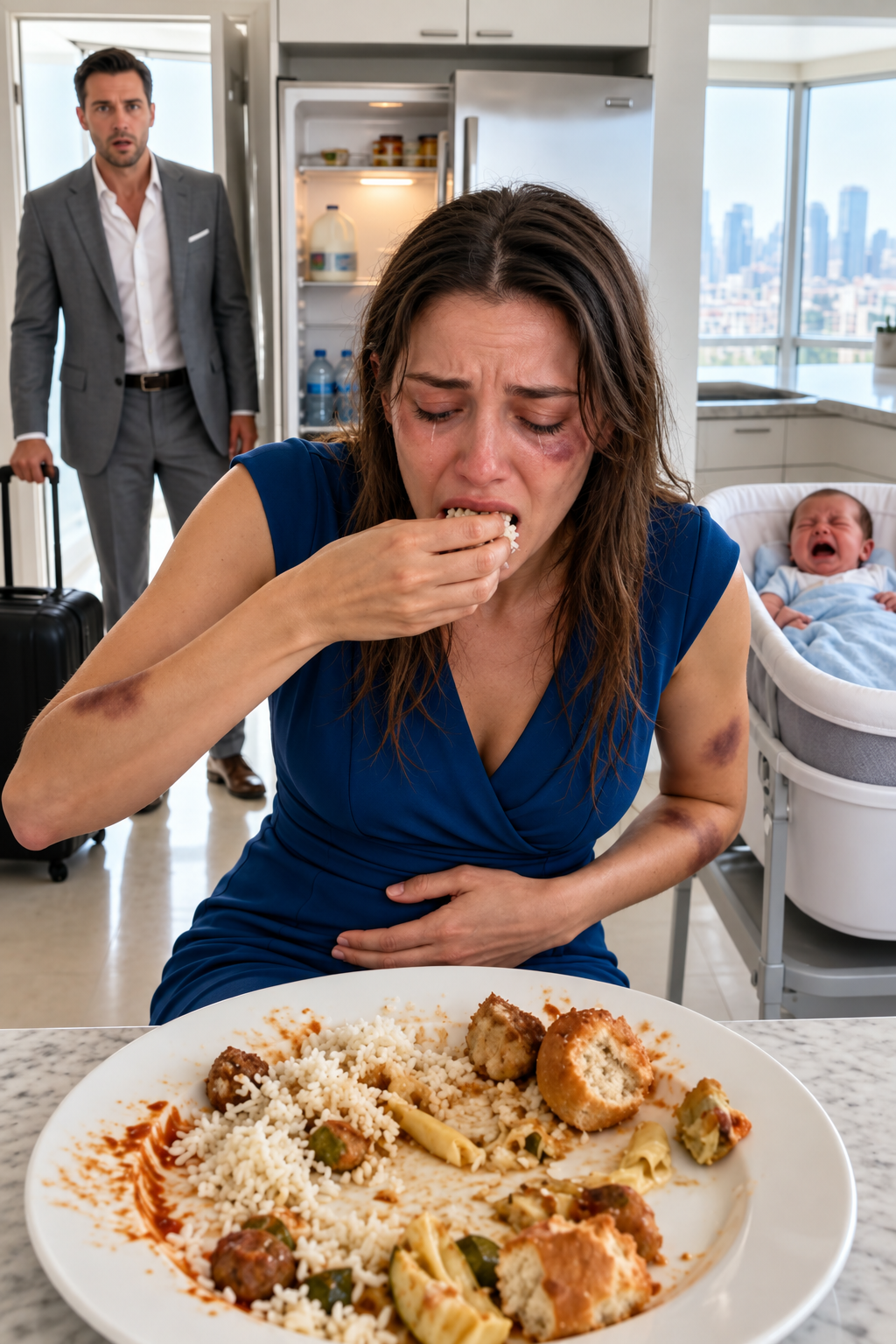
PART 1 TITLE: I Came Home Early to Meet My Newborn Son, but the Freezing Apartment Revealed What My Family Had Hidden From Me
The first thing I noticed was the cold. It slipped through my coat as soon as I opened our apartment door, sharp enough to make me wonder whether a window had been left open. Then I heard a baby crying somewhere down the hallway. Eleven days earlier, my wife had given birth to our son after emergency surgery. I had come home from Germany four days ahead of schedule, carrying a present for a child I had never held. Instead of finding the warm family reunion I had imagined, I found an apartment so quiet between the baby’s cries that I could hear the refrigerator motor struggling in the kitchen.
“Maya?” I called, dropping my suitcase beside the entrance. There was no answer. I reached for the thermostat. Fifty-eight degrees. Outside, snow had gathered along the Brooklyn sidewalks, and the evening forecast predicted another hard freeze. I adjusted the temperature, but the heating system remained silent. My eyes moved toward the living room, where a thin blue blanket lay crumpled across the sofa. A half-empty glass of water stood beside a packet of pain medication. One of Maya’s slippers was underneath the coffee table. The other lay halfway down the hallway.
I had spent most of the return flight rehearsing the surprise. My wife expected me to remain in Stuttgart until January fourth, completing the final inspections of an industrial engineering project. I had negotiated an early departure, rearranged several meetings, and bought Liam a ridiculous little blue knitted hat from a shop near the station. I could already imagine Maya laughing at the size of it. I had even considered recording her reaction when I appeared at the door. That plan vanished when I opened the refrigerator and saw two containers of spoiled leftovers, half a lemon, and a bottle containing barely enough milk for one cup of coffee.
The freezer was almost empty. So were the kitchen cabinets. I opened the pantry, expecting to find groceries stored somewhere I had overlooked. There was a torn packet of crackers, a few tea bags, and a box of instant noodles with one serving remaining. On the counter stood an open container of infant formula. Its measuring scoop was visible against the bottom. I stared at it, unable to understand how our kitchen had reached this state. Before leaving, I had arranged enough money and assistance to make certain Maya would never have to worry about food, medication, cleaning, or anything Liam needed.
A faint voice came from the bedroom. “David?” I was already moving before she finished saying my name. Maya sat against two pillows with Liam pressed against her chest. She wore an old gray sweatshirt, and her hair had been pushed carelessly behind one ear. There was something terribly wrong with her face. Her cheeks looked hollow, her lips dry, and the skin beneath her eyes had turned a bruised shade of purple. When she tried to sit straighter, she caught her breath and put one hand against the surgical incision beneath her clothes.
“You’re supposed to be in Germany,” she whispered. I stopped beside the bed. I had imagined kissing her, scooping up our son, and teasing her about keeping secrets from me. Instead, I touched her forehead and felt the heat beneath her skin. Her fingers were cold despite the fever. Liam stirred against her chest, making a thin, unsettled sound. His tiny hands were hidden inside sleeves that appeared too large for him. “What happened?” I asked. Maya looked toward the doorway before answering, and that movement frightened me more than the condition of the apartment.
“Please don’t be angry,” she said. I sat on the edge of the mattress and moved her damp hair away from her face. “I’m not angry with you. Tell me what’s wrong.” Her gaze settled on Liam. “He wouldn’t stop crying. I tried feeding him, but there wasn’t much left. I’ve been trying to keep him warm.” She seemed embarrassed by the confession, as though struggling to care for our newborn while recovering from major surgery represented some private failure. I asked when she had last eaten a proper meal. She hesitated long enough to tell me the answer would be bad.
“Yesterday morning, I think. I had some noodles.” I looked at her, waiting for an explanation that would make the situation less frightening. None came. She said she had been saving what remained of the food because she wasn’t sure when anyone would return. Every few words, her eyelids lowered, and she seemed to have to concentrate to continue speaking. I took Liam gently while she adjusted her position. He weighed almost nothing against my forearm. I could feel him moving beneath his thin blanket, searching for warmth that neither the blanket nor his exhausted mother could provide.
I called emergency services before asking another question. The dispatcher wanted to know Maya’s symptoms, the baby’s age, whether either had difficulty breathing, and whether there had been complications during delivery. I answered as accurately as I could while trying to keep my voice steady. Maya reached toward my sleeve. “Is that necessary?” she whispered. “Your mother said I was overreacting.” I held the phone against my shoulder and looked at her. “You’re recovering from surgery, you have a fever, and Liam is cold. We’re getting you both examined. Nobody gets to argue with that.”
While we waited, I found clean clothes for Maya and gathered Liam’s discharge papers, identification, and the remaining feeding supplies. Inside a drawer, I discovered several unused baby outfits still folded in their packaging, while the diapers beside the changing table had nearly run out. The contradiction made no sense. My mother had sent photographs of neatly arranged nursery shelves only days earlier. Chloe had written that she was keeping everything stocked. I remembered opening those messages between meetings and feeling grateful that my wife had so many people willing to help her.
My mother, Eleanor, had volunteered almost immediately after Maya’s delivery became complicated. She had raised Chloe and me while helping my father establish the family business, and she liked reminding people that she knew how to manage a household. When she learned that Maya needed a difficult recovery after an emergency cesarean, she insisted on staying nearby. “I won’t have my daughter-in-law recovering alone,” she told me over the telephone. Chloe, my younger sister, promised to arrange additional nursing assistance. Her husband, Mark, offered to collect groceries, prescriptions, and whatever else was needed.
I had accepted those promises because I wanted to believe them. My employer needed me in Germany to complete a project that had already been delayed twice, and I had convinced myself that being temporarily absent was acceptable if I arranged enough practical support. I provided Eleanor with a supplementary card for household purchases, authorized a substantial care budget, and agreed to transfer money for professional assistance once Chloe sent the necessary documentation. Across the arrangements, roughly fourteen thousand dollars was available for Maya and Liam’s needs. I thought the amount would remove every obstacle. I had never considered that access to money could become another way to control someone.
Before leaving, I had promised Maya I would call every evening. I managed it for the first week, though some conversations were brief. Then the factory inspection encountered problems, and I began calling between meetings instead. Maya rarely complained. When I asked how she was feeling, she usually said she was tired. Once, she told me she was having trouble eating and that her incision hurt more than she expected. I had urged her to rest and listen to my mother’s advice. I remembered her silence afterward, but at the time I had mistaken it for reassurance.
The paramedics arrived carrying blankets and medical equipment. One checked Maya’s blood pressure and temperature while another examined Liam. They asked about feeding, hydration, and the temperature inside the apartment. Maya tried to answer everything herself, though she was visibly struggling to concentrate. When the paramedic asked whether anyone had been helping her, she glanced at me and then at the floor. “His grandmother was here,” she said. “And his aunt.” The paramedic looked around the room. “Where are they now?” Maya swallowed. “Miami.” The word hung between us, absurd and unmistakable.
I turned toward her. “Miami?” She nodded without meeting my eyes. “They went away for the holiday.” I couldn’t make sense of it. My mother had agreed to care for Maya until I returned. She had sent cheerful messages about meals, laundry, and the baby’s routine. Chloe had assured me the nurse was taking care of the more difficult tasks. “When did they leave?” I asked. “A few days ago,” Maya answered. She pressed a trembling hand against her abdomen. “They said I had everything I needed. I didn’t want to cause trouble.”
One paramedic wrapped Liam in a warmed blanket while the other recommended immediate hospital assessment for both of them. I carried our son as they helped Maya into a wheelchair. She apologized when they needed to pause because her movement caused pain. The older paramedic, a woman with silver hair visible beneath her winter hat, told her that she had nothing to apologize for. Maya lowered her head. I noticed how quickly she complied with every instruction, even when someone offered her a choice. It was as though she had forgotten she was allowed to have preferences.
The corridor outside our apartment smelled faintly of floor polish and somebody’s evening dinner. Warm air flowed through the building, making the cold inside our home seem even more disturbing. The elevator opened, and our neighbor, Mrs. Alvarez, stepped out with a grocery bag. She recognized me and glanced toward Maya. Her expression changed. “Oh, thank goodness you’ve come back,” she said. “I knocked yesterday, but nobody answered.” Before I could ask what she meant, the paramedics guided Maya toward the lift. Mrs. Alvarez touched my arm. “Please tell her I was worried. I didn’t know what else to do.”
In the ambulance, Maya leaned against the padded seat with her eyes closed. Liam was being monitored beside her. I watched the emergency equipment sway gently as we moved through traffic, and I remembered the day our son was born. I had been in Germany when the hospital called to explain that Maya needed an emergency operation. The connection had been poor. I remembered hearing fragments of unfamiliar medical language, followed by the reassuring news that mother and child had survived the procedure. I booked the earliest flight I could, but work and travel complications kept me away longer than I had promised.
I had imagined those eleven days as a difficult but manageable beginning. Maya would recover. Eleanor would supervise the household. Chloe would organize the nurse. Mark would take care of errands. My responsibility, I told myself, was to finish the project and return with enough financial security to give our son a comfortable childhood. Sitting in the ambulance, watching my wife struggle to remain awake, I finally understood what my arrangements had failed to provide. I had made everyone responsible for something without ensuring that anyone was actually doing it.
At the hospital, the medical staff separated our immediate concerns into two evaluations. Liam needed warming, feeding assessment, and observation. Maya needed an examination of her surgical recovery, hydration, fever, and general condition. A nurse asked whether she had taken her prescribed medication regularly. Maya admitted she had sometimes delayed doses because she was unsure when she could obtain another refill. I remembered Mark telling me that all prescriptions had been collected. When I asked Maya about that, she looked confused. “He said the pharmacy was difficult,” she murmured. “After a while, I stopped asking.”
I wanted to call my mother that instant. I wanted an explanation for every empty shelf, every missing diaper, every hour Maya had spent frightened in that apartment. Instead, I stood beside a hospital counter filling in contact information while a nurse carefully checked the details with me. There was something humiliating about writing my own name beside the word husband when I couldn’t answer basic questions about my wife’s recent meals or medical care. I could list every engineering milestone completed in Stuttgart, but I couldn’t tell the nurse when Maya had last eaten anything substantial.
The staff brought Maya into an observation room. She seemed relieved when someone told her that Liam was receiving care nearby, but she continued apologizing for the attention. A physician explained that her symptoms required assessment and treatment, and that her recovery would need a more reliable support plan. I listened without interrupting. When he left, Maya opened her eyes and studied me. “You’re not going to call your mother and ask her to explain, are you?” Her voice was barely audible. “Not tonight,” I said. “Right now, I only want you and Liam safe.”
Her shoulders loosened slightly. Then she said something I couldn’t forget. “She told me you would be disappointed if you came home and found the apartment like that.” I stared at her. “Who said that?” “Eleanor. She said you worked too hard for me to let everything become a mess.” Maya looked toward the window. “I tried to clean, but standing made me dizzy. Chloe took pictures of the dishes. She said she’d show you how little I was doing.” I reached for her hand, but she pulled the blanket higher before I touched her.
I sat beside the bed for a long time while she rested. Eventually I opened my phone and found the family conversation. There were photographs I hadn’t examined carefully while traveling: Eleanor beside a swimming pool, Chloe smiling over a brightly colored drink, Mark leaning against the railing of a boat. Palm trees stood behind them. A hotel logo appeared on several images. They were in Miami, exactly as Maya had said. The photographs had been sent while my wife was trying to keep our newborn warm in an apartment without adequate heat.
I checked the dates. The first holiday photograph had appeared several days earlier, accompanied by a message from Chloe about taking a well-deserved break. Below it, Eleanor had written that everything at home was settled. I remembered reading those words in Germany and thinking she meant Maya had all the assistance she needed. Now I wondered whether anyone had checked on her at all. I saved the photographs and accompanying messages, preserving their original timestamps. I had no clear idea what I would do with them, but I knew I couldn’t rely on my memory alone.
The financial records were worse than the photographs. Charges from a South Beach hotel appeared on the supplementary account I had authorized for household supplies. There were restaurant bills, resort purchases, entertainment expenses, and travel-related payments. Some transactions were still pending. Others had already cleared. I scrolled through them while sitting beneath the hospital’s fluorescent lights, comparing dates with the messages telling me that Maya was being fed, the apartment was stocked, and professional assistance had been arranged. I checked the card details twice because I wanted to believe I had selected the wrong account.
Another record showed a payment connected to the nursing arrangements Chloe had promised. She had sent me what looked like an invoice when I was in Stuttgart, explaining that the agency’s ordinary payment system was temporarily unavailable. I had authorized the transfer without asking many questions. The document remained in my email, complete with a payment reference and the reassuring message that everything was handled. I forwarded it to myself and saved a copy with the transaction history. It was no longer enough to know that money had left my account. I needed to know where it had gone.
Near midnight, a nurse told me Liam had responded to warming and feeding, although the pediatric team wanted to keep monitoring him. I asked to see him. She led me to a room where he lay wrapped in a clean blanket, one tiny hand resting beside his cheek. I placed my finger against his palm. His fingers closed around it with surprising strength. “I’m David,” I whispered, and immediately felt foolish. “Your dad.” The words were simple, but they carried an obligation I had not understood when I packed that little blue hat.
I returned to the waiting area and opened the building’s security application. Months earlier, I had installed cameras after several packages disappeared from our floor. I rarely checked the recordings unless there was a delivery problem. That night, I searched the dates around Eleanor’s departure. Several files remained available through the building’s cloud archive. I requested their original versions and began examining the timestamps. At first, I saw ordinary movements: residents carrying shopping bags, a maintenance worker entering the service corridor, and delivery drivers leaving parcels near the elevator.
Then I saw Chloe leaving our floor with two large bags that looked remarkably like the packages of diapers and baby supplies I had ordered. Another clip showed Mark rolling insulated coolers toward the elevator. I couldn’t yet identify their contents, but I recognized the coolers from family gatherings. I remembered sending money for groceries only days earlier. My stomach tightened as I continued through the recordings. On another camera, my mother appeared carrying luggage and wearing the cream-colored coat she usually reserved for special occasions.
She wasn’t alone. Maya stood a few feet behind her, one hand resting against the wall and Liam cradled against her chest. Even through the grainy recording, I could see how carefully she was holding herself upright. Eleanor said something, then turned toward the elevator. Chloe followed, looking down at her phone. Mark appeared with another suitcase. Maya seemed to ask a question, but nobody approached her. A moment later, the elevator doors opened, and my family stepped inside, leaving her in the corridor.
I replayed those final seconds with my finger resting above the screen. I had expected to find evidence that someone had misunderstood a schedule or failed to arrange a delivery. Instead, I was looking at three adults who had watched a woman recovering from surgery struggle to hold her newborn, then left her behind. I checked the date again. They had departed before New Year’s Eve, when they knew I was still supposed to be abroad. I saved the file, then opened the remaining camera recordings.
One file had captured sound from the doorway camera. I raised the volume and listened as Maya asked whether anyone could stay until the next morning. Eleanor answered that she had already done more than enough. Chloe told Maya that her brother couldn’t keep paying for everything forever. Then Mark stepped into view with the final suitcase. He warned Maya against disturbing me in Germany and suggested that complaining would only make me question whether she could manage motherhood. I sat motionless as the recording ended.
At that moment, I stopped looking for an innocent explanation. I opened the contact information for Julian, my oldest friend and an attorney whose judgment I trusted more than my own when I was angry. Before calling, I saved the unedited camera files, account statements, photographs, and messages in a secure folder. Then I wrote a brief description of what had happened, including the hospital admission and the condition in which I had found Maya and Liam. I attached what I had collected and pressed send.
A new message appeared while the files were uploading. It was from Eleanor. She wanted to know whether I could increase the card’s spending limit before midnight because the hotel had requested another payment. Beneath her message, Chloe complained that the family vacation had become unnecessarily stressful. Neither asked about Maya. Neither mentioned Liam. I read the messages once, looked through the glass toward my wife’s room, and understood that the people who had abandoned her still expected me to finance their holiday.
I opened the banking application and began revoking the purchasing access I had given them.
END PART 1
PART 2 TITLE: The Hotel Demanded More Money While I Followed the Trail of Missing Groceries, False Promises, and a Nurse Nobody Had Seen
The banking application asked me to confirm that I wanted to disable the supplementary cards. I read the warning carefully. Pending transactions might still be processed, and disputed purchases would require a separate investigation. The cards were attached to my account, but Eleanor, Chloe, and Mark had been allowed to use them for particular household expenses. Canceling that permission would stop new purchases. It wouldn’t explain what had happened to the money already spent. I confirmed the change anyway, then took screenshots of the account information before leaving the page.
Within minutes, my phone began vibrating. The first message came from Chloe. She said her payment had been rejected at the hotel desk and demanded to know whether the bank was having problems. Mark followed with a shorter message telling me to sort it out immediately. My mother called twice. I watched her name appear while a nurse walked past carrying a tray of supplies for the observation rooms. The difference between the two scenes was almost unbearable: here, people were caring for my wife and child; hundreds of miles away, my relatives were worrying about their interrupted vacation.
I opened the family’s message thread and typed an angry response. I wanted to describe the empty refrigerator, the freezing apartment, and the sight of Maya struggling to stay conscious. I wanted to tell them exactly what the doctors were checking and ask how they could possibly justify their behavior. Then I pictured Eleanor reading the message, calling Chloe, and deciding together what explanation to give me. I deleted everything. Their immediate reaction mattered, but I didn’t want my anger to provide them with a chance to coordinate their answers before I understood what the records showed.
The first transaction I examined was a hotel deposit charged four days earlier. Its amount would have covered several weeks of groceries and practical assistance. Two days later, another payment had gone to the same hotel. There were restaurant bills and purchases at stores far removed from anything a recovering mother or newborn would require. A handful of legitimate expenses appeared among them: a pharmacy purchase, several small grocery transactions, and one delivery fee. Those entries unsettled me because they made the account appear ordinary at a glance. Only when I compared the dates did the pattern become clear.
I found the grocery receipts Eleanor had sent while I was in Germany. One showed a substantial order containing meat, vegetables, prepared meals, fruit, and household supplies. Maya had told me almost none of that food remained in the apartment. At first I thought perhaps the groceries had spoiled or been consumed during my absence. Then I remembered Mark carrying the coolers toward the elevator. I couldn’t know what they held without further evidence, but the possibility was obvious. I saved the receipts alongside the corresponding footage and wrote down the questions instead of treating my suspicions as answers.
The most troubling document was Chloe’s nursing arrangement. Before my trip, I had asked her to obtain a quote from a professional home-care agency. Maya had undergone emergency surgery, and I knew my mother would not be able to provide medical care. Chloe had promised to organize qualified assistance for the first weeks. She later forwarded a document with the agency’s name and a payment reference, explaining that their billing system was having trouble processing our card. I had approved the alternate transfer because I was trying to solve the problem quickly from overseas.
I looked at the document again. It included a service description and a payment amount, but no clear appointment schedule. There was no nurse’s name, no signed care agreement, and no confirmation that anyone had visited. At the time, those omissions hadn’t concerned me. Chloe spoke with such confidence about the arrangements that I assumed she was handling the details. Now I searched our messages and found myself asking a question I should have asked weeks earlier: had a nurse actually been hired, or had I simply paid someone who claimed to be arranging one?
I checked the timestamps on Maya’s messages. During one late-night meeting in Germany, she had written that she felt weak and couldn’t understand why recovery was becoming more difficult. I had answered nearly three hours later. My reply was practical and dismissive: she should rest, take her medication, and ask Eleanor to help. There was another message two days afterward asking whether I knew when the nurse would begin visiting. I had forwarded the question to Chloe and received an assurance that everything was organized. I hadn’t returned to Maya to confirm that anyone arrived.
The realization made me put down my phone. It would have been easy to treat myself as the only trustworthy person in the situation, arriving just in time to uncover everybody else’s wrongdoing. The messages wouldn’t allow that version. I had been absent when Maya needed me, and when she tried to describe her difficulties, I had accepted reassuring answers from people who were not experiencing her pain. I didn’t cause my relatives’ decisions, but I had helped create the conditions in which their promises could go unchecked. That distinction mattered, and I intended to remember it.
At one in the morning, a nurse told me Maya’s initial treatment was underway and that the medical team was watching her response. She was still exhausted, but her condition was being monitored. Liam remained under pediatric observation. The nurse explained that his temperature and feeding had improved, though the doctors wanted to make certain he was stable before discussing discharge. I thanked her and asked whether Maya needed anything from home. She suggested clean clothing, familiar personal items, and patience. The final recommendation felt more difficult than the others.
I went to the vending machines and bought a sandwich I couldn’t bring myself to eat. My phone displayed photographs from the Christmas gathering Maya and I had hosted the previous year. Eleanor sat at our table holding a cup of tea, while Chloe leaned across Mark to reach the serving dishes. Maya stood beside the kitchen counter, smiling at something outside the frame. I remembered how Eleanor had criticized the table arrangement after everyone left. Maya had laughed it off. She was often the one who made uncomfortable moments seem harmless so that the rest of us could avoid addressing them.
I thought about the way my mother spoke to her. Eleanor rarely shouted in public. She preferred corrections delivered in a pleasant voice, sometimes disguised as useful advice. Maya cooked a meal, and Eleanor suggested another way to prepare it. Maya bought clothes for the baby, and Eleanor questioned whether they were appropriate. When Maya discussed her illustration work, my mother called it a pleasant pastime and changed the subject to household responsibilities. I had seen those exchanges, occasionally felt uncomfortable, and told myself that families needed time to adjust to one another.
The evidence on my phone suggested that my mother’s behavior had become more severe after Maya’s surgery. I couldn’t yet say exactly how severe. Maya had told me very little about the days before my return, and I refused to wake her for answers merely because I needed them. Still, the camera recordings showed a troubling shift. Eleanor was no longer simply offering unsolicited opinions. She was deciding when Maya could ask for assistance, whether her complaints deserved attention, and who was allowed to know how much she was struggling. I wondered how long Maya had been afraid to contradict her.
I opened the building management portal and requested preservation of all available security recordings from the weeks surrounding Liam’s birth. I explained that the footage might be relevant to a medical emergency and potential misuse of household funds. The overnight security supervisor acknowledged the request but said the proper staff would need to review access permissions before releasing additional material. I understood. The recordings involved other residents, and the building couldn’t simply hand over everything because I was upset. I asked that the existing files be retained and documented the supervisor’s response.
Next I downloaded the account records in their original format. I kept the statements separate from my own notes, making certain I could distinguish actual transactions from my interpretations. It was a habit I had developed in engineering, where a faulty assumption could send an entire project in the wrong direction. That discipline felt almost impossible to maintain while imagining Maya waiting in our cold apartment, but I knew it was necessary. If the money had been misused, I wanted the records to demonstrate it without depending on my ability to persuade anyone.
Another message from Mark appeared. He accused me of deliberately embarrassing Eleanor in front of hotel staff and other guests. Then he warned that cutting off access without explanation would make me look unreasonable. I stared at the word unreasonable. For years, it had been one of my mother’s preferred descriptions of anyone who refused her requests. Chloe had adopted it as well. Maya was unreasonable when she needed rest. I was unreasonable when I questioned a family expense. Apparently, declining to finance a luxury holiday while my wife was hospitalized qualified too.
I forwarded the new messages to Julian. Beneath the attachments, I described the authorization I had given Eleanor and the arrangements made through Chloe. I also explained what I had found in the apartment, separating what I had witnessed from what Maya had told me. Julian had been my closest friend for years, though our professional lives had taken different directions. He became an attorney while I built my engineering career. He knew my family well enough to understand why confronting my mother would be difficult, but he had never mistaken family loyalty for unquestioning obedience.
While I waited for his response, I searched the medication list from Maya’s discharge papers. Several instructions involved monitoring symptoms and contacting the care team if particular problems arose. I realized that neither Eleanor nor Chloe had mentioned these details to me, although they had insisted they were supervising Maya’s recovery. I checked my own messages and found no evidence that I had asked. I had sent money for supplies, but I had never requested confirmation that Maya could obtain the treatment or follow-up care she needed. I placed the discharge papers beside my notebook.
Just before two, my mother left a voicemail. Her voice was controlled, almost conversational. She said Chloe was upset and Mark had been forced to spend part of the evening negotiating with the hotel. She reminded me that the family had sacrificed time and energy while Maya recovered, and she hoped I wasn’t allowing my wife to turn ordinary household difficulties into a dispute. She asked me to call back before breakfast. I listened twice, not because I wanted to hear it again, but because something was missing. She hadn’t asked whether Maya was alive, whether Liam was well, or why I might have canceled the cards.
I saved the recording. Then I opened another message from Eleanor, sent days before my return. In it, she had praised Maya for finally understanding that a new mother must learn to manage without constant attention. I remembered feeling pleased by the report because it sounded like progress. Reading it now, I wondered whether Maya had simply stopped asking for help. The difference between becoming independent and being left unsupported was obvious in hindsight. What disturbed me most was how convenient it had been for everyone except Maya to confuse the two.
A little after three, Chloe sent a photograph of a hotel payment notice. The message beneath it was furious. She wanted my cards restored immediately and insisted that the hotel believed the family was attempting to avoid payment. I could almost hear her voice rising at the reception desk. For a moment, I remembered our childhood and the way she used to come to me whenever she needed something fixed. I had always enjoyed being the dependable older brother. The role felt different when the problem I was expected to solve had been created with money intended for my wife and son.
I answered with one short sentence. I told Chloe that the household spending authorization had been suspended and that I would not approve further personal vacation charges. I didn’t mention the hospital. I wanted Maya to have time to speak for herself before my relatives began contacting her with accusations or demands. Mark replied that I was being vindictive. Eleanor sent another voice message, this one emphasizing everything she had done for me since childhood. I saved both communications without responding. Their objections confirmed that canceling the cards had interrupted something important to them.
At four, the hospital corridor became quieter. A cleaner worked slowly near the elevators, and the lights in several waiting areas were dimmed. I sat close enough to Maya’s room to hear when staff entered and left. Every time someone approached, I looked up. I remembered what she had said about my mother warning her not to complain. I also remembered the way she had hesitated before accepting medical help. Those were not reactions I could explain away as ordinary exhaustion. I wanted to understand what had been said to make her afraid, but the answers belonged to Maya, and she was finally resting.
Julian responded shortly before dawn. His message began by telling me to remain with Maya and preserve all original records. He cautioned me against contacting the family in anger, altering video files, or promising Maya an outcome before we understood the legal options. Then he asked a question I hadn’t expected. What support did Maya want once the immediate medical danger had passed? I read it several times. I had spent hours documenting what my relatives had done, but I hadn’t asked Maya what would help her feel secure when she left the hospital.
He continued with practical questions. Did Eleanor have permission to use the card for personal expenses? Were the nursing arrangements documented? Had the building confirmed the condition of the heating system? Would Maya want to speak with a hospital social worker? Did she have someone she trusted besides me who could help without making decisions for her? I wrote the questions down. Some answers were straightforward. Others would require conversations I had been avoiding for months. Julian said he would come to the hospital at sunrise and bring a secure copy of the records I had sent.
I looked through the observation-room window and saw a nurse adjusting Liam’s blanket. Another checked Maya’s monitors. She slept with one hand curled beside her face, looking smaller than I remembered. I wished I could remove the fear from her expression simply by being present. But presence was not the same as repair. I couldn’t ask her to believe that I understood everything now, because I didn’t. I could only make certain that when she woke, she would have food, medical attention, and the right to decide what happened next.
Before sunrise, I received confirmation that the bank had opened a preliminary record of my concerns about the transactions. The representative made clear that disabling cards did not automatically establish fraud or guarantee reimbursement. The terms of the authorization, the nature of the purchases, and the supporting documentation would all matter. I thanked her. I had no interest in describing myself as a victim of theft until I knew precisely what had happened. What I already knew was enough to justify protecting the account from further misuse.
I returned to the nursing document, comparing its payment reference with the bank transaction. There was an unfamiliar name attached to the receiving account information. It wasn’t the agency name printed at the top of Chloe’s document. I checked the details again, then examined the email in which she had instructed me to send the payment. She had described the account as a temporary processing arrangement. No independent confirmation appeared anywhere in the correspondence. I wrote down the discrepancy and sent it to Julian as an additional question.
At half past six, the doors near the elevators opened, and Julian came into the waiting area wearing a dark coat with melted snow on the shoulders. He carried two paper cups of coffee, a portable charger, and a document folder. He handed me one cup and sat down without asking me to repeat the entire story. His eyes moved over the papers I had arranged across the chair beside me. He studied the nursing payment reference, then the email from Chloe. His expression changed, but he didn’t immediately speak.
“David,” he said at last, “before we discuss what your mother did, I need you to understand something. There may be more than one problem here. We have possible misuse of money, possible failures in care, and a woman who has been frightened into believing she cannot make decisions for herself.” He looked toward Maya’s room. “Those issues won’t all be solved the same way. And if you make this only about getting even with Eleanor, you’ll lose sight of the person who needs you.”
I told him I understood, although I knew part of me still wanted a confrontation. Julian placed the nursing document on top of the folder and pointed to the payment reference. “This needs independent verification,” he said. “A professional agency should be able to tell us whether it received the money and whether any service was booked.” I nodded. Then he turned the page toward me, showing the difference between the printed agency name and the information associated with the transfer. “Until we’ve confirmed it,” he continued, “don’t assume Chloe arranged the care she promised.”
I looked at the document I had approved so casually from Germany. Every reassuring message from my sister seemed different now. The invoice, the vague scheduling details, the absence of a nurse’s name, and the claims that everything was under control formed a pattern I could no longer ignore. Julian gathered the papers and rose from his chair. We were going to speak with the medical team, review the spending permissions, and ask Maya what she wanted. For the first time since I arrived home, I understood that discovering the truth might be easier than rebuilding her trust.
END PART 2
PART 3 TITLE: My Wife Finally Described the Days I Had Missed, and One Security Recording Made Her Silence Impossible to Misunderstand
Julian spread the documents across a small table in the hospital’s family consultation room. He had already organized the account statements by date and placed the messages in a separate section. I began explaining the charges, but he interrupted after the first few minutes. “We’ll come back to the money,” he said. “Tell me what Maya needs before she leaves this hospital.” I started to answer with the arrangements I intended to make. He shook his head. “Not what you’re planning to buy. What will make her feel safe?” I looked at the empty chair beside him and realized I didn’t know.
I could identify her medical needs as the doctors had described them. She required proper meals, help during recovery, and reliable follow-up appointments. Liam needed feeding, warmth, and pediatric care. But Julian had asked a different question. I didn’t know whether Maya would feel comfortable returning to our apartment, whether she wanted visitors, or whether she could bear the thought of another relative managing her daily routine. I had assumed that once I returned, she would naturally want me to take control. The assumption sounded disturbingly similar to the way my mother had treated her.
“Then we ask,” Julian said. He gathered the documents and put them back into the folder. “You don’t have to repair everything before she wakes up. You need to make it possible for her to speak without being punished for what she says.” I nodded. Julian had always been patient with problems that made me impatient. In our younger years, I admired him for his ability to examine an argument without treating every disagreement as a contest. That morning, his restraint was less comfortable. It required me to admit that I could be wrong about what my own wife needed.
A pediatrician joined us a little after eight. Liam was responding to treatment, he explained, but had required careful observation because of difficulty maintaining body temperature and concerns about feeding and hydration. He discussed the immediate care plan and the follow-up that would be needed after discharge. I asked whether the cold apartment could have contributed to his condition. The doctor said exposure and inadequate feeding were important concerns, but he would not speculate beyond the medical findings. I appreciated the precision, even while wishing for someone to give me a simple explanation of everything that had happened.
When I was finally allowed to hold Liam properly, I sat in a chair with a pillow supporting my arm. A nurse showed me how to position him, how to keep his head supported, and how to notice when he needed a break from feeding. I had watched countless videos before his birth. None prepared me for the warmth of his cheek against my wrist or the way he moved his mouth while half asleep. He opened his hand around my thumb, then released it. I kept looking at his face, searching for some sign that he recognized me.
“I’m sorry I wasn’t here,” I whispered. He made a small sound and continued sleeping. I wanted to promise that I would never leave again, but that would have been an easy promise made under extraordinary circumstances. Work would eventually require decisions. Life would become complicated again. What mattered was whether I would make those decisions differently. I rested my hand against his back and remained where I was until the nurse came to check him. For once, nothing on my phone seemed important enough to interrupt the moment.
Maya woke shortly before noon. I was sitting beside her bed when she opened her eyes and noticed my coat hanging over the chair. “Didn’t you have another inspection?” she asked. Her first concern was still my work. I told her that I had contacted my employer and explained our family emergency. My supervisor had agreed to arrange coverage while I remained in New York. Maya studied my face. “You don’t need to ruin your project because of me.” I moved the chair closer. “You and Liam are not an interruption to my life,” I told her. “You’re the reason I’m working in the first place.”
She looked toward the bassinet beside her bed. It was empty because Liam was still with the pediatric team. “Is he all right?” she asked, her voice suddenly tight. I repeated what the doctor had told me, including what was encouraging and what still required observation. I didn’t promise that everything was perfect. She listened closely, then asked whether she could see him when the nurses allowed it. I assured her that I had already asked. She closed her eyes again, breathing unevenly. “I thought something terrible was going to happen,” she said.
I waited until she was ready to continue. She told me the first days after surgery had been painful but manageable while she remained in the hospital. Nurses helped her move, answered questions, and brought medication when she needed it. Once she came home, Eleanor initially behaved much as she had promised. She organized the kitchen and told neighbors that she was staying to support the new parents. For a short time, Maya believed she would be able to rest. Then the criticisms began, and the assistance became conditional.
Eleanor decided what Maya should eat. She objected when Maya requested additional portions, claiming that eating too much would interfere with her recovery. When Maya asked for a particular meal because she felt nauseated, Eleanor said she was becoming spoiled. Chloe took photographs of the kitchen when dishes accumulated, sometimes before anyone had offered to help clear them. Mark joked that he had never known a woman to make such a production out of having a baby. Maya repeated his words without changing her expression, but I noticed her fingers tightening against the blanket.
“They kept saying they were tired of doing everything,” she said. “I tried to get up whenever I could. Sometimes I couldn’t stand long enough to finish the dishes.” She described being told that other women managed children and households without special treatment. When she asked about the nurse Chloe had arranged, Eleanor said the nurse wasn’t necessary and that Maya needed to learn to function independently. Later, Chloe claimed the professional had canceled because Maya was too demanding. Maya had believed her. She was exhausted, in pain, and beginning to question whether her expectations were unreasonable.
I asked about the medical appointments. Maya said Mark had agreed to drive her, but several times he found reasons to postpone. When she asked Eleanor to help arrange transportation, her mother-in-law accused her of making ordinary recovery sound like an emergency. Maya eventually stopped asking because every request led to another argument. “I kept thinking I’d feel better the next morning,” she said. “And then the next morning I felt worse.” Her voice became quiet. “I didn’t want you to think you had married someone who couldn’t take care of our baby.”
I wanted to tell her that I would never think such a thing. Then I remembered my own messages, the ones in which I had praised her for being strong and encouraged her to follow my mother’s advice. She had told me she was struggling, and I had answered with cheerful assurances instead of questions. I asked why she hadn’t called me directly when things became serious. The words escaped before I considered how they would sound. Maya went still. Her eyes moved toward the door, and I saw the old fear return.
“I did call,” she said. “You were in the middle of an inspection. You said your mother had everything under control.” I remembered the conversation. I had been standing outside a conference room in Stuttgart, surrounded by colleagues waiting for the next meeting. Maya had sounded tired. Eleanor’s voice had been audible in the background. I had told her to rest and let my mother handle things, then returned to work. It had taken less than three minutes. For Maya, that call had been an attempt to ask for help. For me, it had been another task I believed I had completed.
“You’re right,” I said. “You told me. I didn’t listen properly.” Maya looked at me, uncertain whether an argument was coming. I continued before she could apologize. “I trusted other people to tell me how you were doing, even when you were telling me yourself. I should have asked questions and stayed on the phone.” She stared at the blanket. “Your mother said you’d blame me for making you leave Germany.” I shook my head. “That wasn’t your responsibility. I made those work decisions. I should have made better arrangements and checked whether they were actually helping.”
Maya began to cry without making much noise. I reached for a tissue and placed the box within her reach rather than immediately trying to stop her tears. After a while, she told me something she had been afraid to mention. Eleanor had warned that if Maya appeared unable to care for Liam, people might question whether she should remain his primary caregiver. She spoke as though the family could make that decision for her. Whenever Maya asked for medical help or challenged how the household money was being spent, Eleanor raised the possibility again. The threat had slowly changed how Maya behaved.
“I know it sounds ridiculous,” Maya said. “But I was so tired. She kept saying she had experience and that I didn’t understand what could happen.” I told her I didn’t think it was ridiculous. Eleanor had always been skilled at speaking as though her opinions were established facts. Maya had just undergone a frightening delivery and was living with someone who controlled access to practical help. I could see how difficult it would have been to challenge her. What I couldn’t understand was how I had allowed that arrangement to continue after Maya began expressing concern.
Julian entered when Maya said she felt ready to speak with him. He greeted her quietly and asked permission before sitting down. Rather than questioning her about every detail, he explained that we had preserved financial records and some camera footage. He told her she could review them if she wanted, but there was no need to watch anything immediately. He also described the possibility of speaking with a hospital social worker who could help assess her discharge needs and explain available reporting options. Maya listened without interrupting. When he finished, she asked whether speaking to someone would automatically mean a police investigation.
“Not necessarily,” Julian answered. “The hospital has its own responsibilities, and the staff can explain those. You should know what information they’re required to report and what choices remain yours. We can help you understand the process before you decide what to do.” Maya nodded. I noticed how carefully Julian avoided making promises about what the law would accomplish. He didn’t tell her that everyone would be arrested or that she would receive an apology. He asked what would make her comfortable enough to speak honestly. She said she wanted someone who would listen without telling her she was overreacting.
While Maya rested again, Julian and I reviewed the remaining security files. Building management had confirmed receipt of my preservation request and provided information about the apartment’s heating records. The system showed that its settings had been reduced before Eleanor’s departure. We couldn’t yet determine why the change had been made, but the timing mattered. The apartment had remained unusually cold while Maya and Liam were inside. Julian wrote down the maintenance questions we would need answered. I watched him resist drawing conclusions, even when the facts seemed to invite them.
We returned to the footage recorded three days before New Year’s Eve. At 3:18 in the afternoon, Chloe moved toward the service elevator carrying several large bags. Their shape and packaging resembled baby supplies delivered to our apartment. At 3:42, Mark appeared with the insulated coolers. He moved quickly and looked back toward our doorway before entering the elevator. At 4:07, an indoor camera showed Eleanor standing in the kitchen while Maya leaned against the counter. Eleanor was holding her phone, and a hotel reservation was visible briefly on the screen.
The recording continued as Eleanor spoke to Maya. I couldn’t hear every word clearly, but the conversation appeared tense. Maya moved toward the hallway when Liam began crying in the bedroom. Eleanor caught her wrist and gestured toward dishes stacked near the sink. Maya pulled her arm away and went toward the baby’s room. Eleanor remained in the kitchen, shaking her head. The camera stopped recording when the motion sensor became inactive. I sat through the clip once more, concentrating on the movements rather than trying to interpret every expression.
Julian copied the original file to a secure drive. He documented the timestamps and reminded me not to trim the recording for relatives or post it online. I had already imagined sending it to everyone who had defended my mother. I wanted them to watch her refuse to let Maya reach our crying son without another demand. But Julian was right. The footage was evidence of a sequence of events, not a weapon to use in a family argument. Its value depended on preserving the complete record and allowing proper examination of what it showed.
Then he found another message in the account export. Chloe had written to Mark that if I asked about the supplies, he should say Maya had ordered everything herself. Julian read it carefully and checked the surrounding messages. The statement suggested they were preparing an explanation, but he wanted to confirm the full context before treating it as proof of intent. I found his caution infuriating. The missing groceries, the vacation charges, the false assurances, and Maya’s account seemed sufficient to me. Yet I knew that a serious allegation deserved more than my certainty, however justified my anger felt.
A member of the hospital’s social work team called to arrange a conversation with Maya. Julian explained that he would remain available but would not speak for her. Before the meeting, I returned to the apartment briefly with a building staff member to collect additional clothes and personal items. I left the security files untouched and made a note of anything I removed. Inside the kitchen, I noticed a handwritten instruction sheet attached beneath Maya’s discharge papers. It contained household rules, reminders about expenses, and a warning not to disturb me at work over matters Eleanor considered unimportant.
I photographed the sheet where it hung. Then I placed it carefully inside a folder. The writing was familiar; Eleanor had used the same neat capital letters on grocery lists and birthday cards throughout my childhood. I remembered Maya’s fear that asking for food or medical care would be considered complaining. The note gave that fear a physical shape. It didn’t tell the whole story, but it showed the expectations she had been living under. I turned off the kitchen light and looked once more at the empty refrigerator before leaving.
When I returned to the hospital, Maya was sitting upright with a cup of broth beside her. She asked whether the apartment was still cold. I told her management was investigating the heating problem and that she wouldn’t have to return there until we had agreed it was safe. She seemed relieved, then hesitant. “Your mother will say I’m keeping you away from your own home,” she said. I pulled my chair closer. “She can say what she likes. You get to decide where you recover.” Maya looked at the cup in her hands for a long time.
“I don’t want you to fight everybody because of me,” she said. “I want Liam to be safe. I want to stop being afraid whenever somebody calls.” I told her that those wishes were not unreasonable, and that she didn’t need to protect my relatives from the consequences of their decisions. Then I asked whether she wanted me present when the social worker arrived. Maya thought about it. I could see her weighing the comfort of having me nearby against the fear that I might answer for her. Finally she reached toward my hand.
“I want you to stay,” she said. “But please let me tell them what happened.” I promised I would. A few minutes later, a soft knock came at the door. The social worker introduced herself as Nina Patel and asked whether Maya felt well enough to talk. Maya looked at me once, then turned toward Nina. Her voice was quiet but steady when she answered. “Yes. I need someone to know what happened in that apartment.” I remained beside her, listening, as she began telling the story in her own words.
END PART 3
PART 4 TITLE: A False Nursing Invoice Led to a Family Meeting Where One Question Exposed What They Had Done With Our Son’s Care Money
Nina Patel listened to Maya without interrupting. She had pulled a chair beside the hospital bed and placed her notebook on her lap, but she didn’t begin writing until Maya agreed. Her first questions concerned immediate safety. Did Maya have food and reliable assistance? Could she contact medical staff when necessary? Did she feel comfortable returning home? Maya answered carefully, sometimes pausing to collect her thoughts. When she described Eleanor’s warnings about losing Liam, Nina asked whether anyone had actually threatened to remove the baby or whether the threat had been presented as a possibility. Maya explained that Eleanor had deliberately left the distinction unclear.
The conversation lasted nearly an hour. Maya described the missing food, the postponed medical appointments, and the criticisms she received whenever she requested help. Nina explained the hospital’s safeguarding procedures and the options for documenting suspected neglect and financial exploitation. She also discussed follow-up support for Maya’s physical recovery and emotional well-being. Nothing in her manner suggested that needing assistance made Maya an inadequate mother. When Maya apologized for becoming upset, Nina quietly told her that she could take as much time as she needed. I watched my wife begin to understand that she was allowed to speak without defending every feeling.
When Nina asked whether Maya wanted information about making a police report, Maya looked toward the bassinet. Liam had been brought back to her room for a supervised visit, and he was sleeping with one hand beside his face. She watched him for several seconds. “I don’t want this to become a family spectacle,” she said. “But I don’t want anyone saying I imagined what happened.” Nina explained how a report could be made and what information might be required. Maya agreed to discuss it with the appropriate staff, provided she could review what she was being asked to share.
Detective Alvarez met with us later that day after Maya consented. He listened to her account, examined the materials Julian had organized, and explained that the medical concerns and disputed financial transactions would require separate consideration. Authorized access to a card did not automatically make every purchase permissible, but proving wrongdoing would depend on the limits of that permission, the representations made, and the relevant records. He made no prediction about charges or arrests. Maya appeared relieved by his restraint. She wanted an investigation grounded in facts, not another person promising to take control of her situation.
Before the conversation ended, Maya handed Alvarez the handwritten instructions Eleanor had left in the kitchen. Julian had placed the original inside a protective folder. Maya explained which parts had frightened her, particularly the warnings about disturbing me or asking for additional assistance. Her hands trembled, but she kept speaking. I didn’t correct her or add details she hadn’t mentioned. When the detective asked a question she couldn’t answer, she simply said she didn’t know. After he left, she leaned back against the pillows. “I thought telling someone would make me feel worse,” she said. “At least now I don’t have to keep everything inside.”
That evening, Liam became more settled during feeding, and the pediatric team gave us encouraging news about his progress. Maya was receiving treatment and continued observation while her doctors assessed her recovery. I learned how to prepare a bottle correctly, how to recognize when Liam needed to pause, and how to support his head without constantly adjusting my grip. The nurse helping me was patient, though she didn’t pretend I was naturally skilled. I made mistakes, listened, and tried again. Each ordinary task reminded me of how much Maya had been expected to manage while she was ill.
On January second, a representative from the bank’s fraud department called to review the disputed charges. Julian joined the conversation with our permission. The representative explained that canceling the cards wouldn’t automatically reverse earlier payments. We would need to distinguish ordinary household purchases from transactions that exceeded the authorization or involved misleading information. She requested relevant records and explained the review process. I had spent the night imagining how quickly the bank could restore the money. Listening to her, I understood that the financial consequences would not disappear simply because we had finally recognized what happened.
We examined the transactions one by one. Several premium airline bookings had been charged to the supplementary account. There were payments for the South Beach hotel, restaurant expenses, spa treatments, entertainment, and luxury shopping. Some charges related to people whose names I barely recognized. Others clearly belonged to my mother, Chloe, or Mark. The legitimate grocery and pharmacy purchases formed a much smaller portion of the total than I had expected. The bank representative made notes about each disputed item, asking who had made the purchase, what permission had been given, and whether any supporting communication existed.
The promised nursing service required a separate inquiry. Julian contacted the agency named on Chloe’s document and asked how we could verify a booking. A representative confirmed that someone using Chloe’s email address had requested information about postpartum assistance. The agency had provided a quote, but there was no completed care agreement, confirmed appointment, or record of payment. No nurse had been assigned to Maya. I read the written response twice. Chloe had assured me that professional support was arranged, and I had relied on that assurance while leaving my wife in the care of relatives.
We checked the grocery delivery service next. Chloe had told me regular deliveries were being organized, particularly while Maya was unable to shop. The records showed that one substantial order had been canceled. No completed deliveries appeared during the final week before my return. I remembered photographs of neatly packed groceries and messages describing meals prepared for Maya. Some purchases had clearly been made, but the records didn’t support the consistent care I had been promised. The discrepancy raised new questions about where the food and supplies had gone, questions the preserved camera footage might help answer.
The nursing payment was more disturbing. The account information associated with the transfer did not match an account belonging to the agency. Julian compared the reference against the documents Chloe had sent and asked me to recall exactly what she had said. I remembered her explaining that the agency’s system was temporarily unavailable and that the alternate transfer would secure the nurse’s schedule. I had accepted the explanation without seeking independent confirmation. The payment was significant, and the purpose had been explicit. It was intended to provide professional assistance to a woman recovering from surgery, not to fund anyone’s holiday.
When Maya learned that no nurse had been hired, she remained silent for a long time. Then she told us Chloe had blamed her for the supposed cancellation. According to Chloe, the nurse had complained that Maya was difficult and unwilling to follow instructions. Maya had been ashamed, believing that her behavior had cost her needed assistance. Now we knew the agency had never scheduled anyone. “So she wasn’t coming,” Maya said. “Not because of me. She was never coming.” I shook my head. Maya looked down at her hands. “I kept trying to remember what I’d said wrong.”
Julian assembled the agency’s confirmation, the payment records, and the messages into a separate evidence file. He advised me not to confront Chloe in an attempt to obtain a recorded confession. We already had documents that could be examined independently, and provoking an argument might make the situation more difficult. I agreed, though part of me wanted my sister to explain herself immediately. Maya asked to see the total amount of disputed spending. I hesitated, then turned the statement toward her. Across the relevant transactions and questionable care payments, approximately fourteen thousand dollars had been involved.
She read the amount without speaking. Then she looked toward Liam, sleeping in the bassinet. “I was asking for soup,” she said quietly. “And they were spending money beside the ocean.” I moved closer but waited before touching her hand. When she reached for mine, I held it. I promised we would pursue the financial questions properly. Maya shook her head. “I don’t want Liam growing up with us talking about revenge every day. If we recover the money, I want it used for a place where he can be safe.” I told her that was exactly what we would do.
Finding that place required more thought than I expected. Maya didn’t want to return immediately to the apartment where she had been frightened to ask for food. She also couldn’t comfortably manage stairs or unnecessary physical exertion, and her recovery would require medical follow-up. I initially suggested an expensive hotel suite with every service available. Maya rejected the idea. “I don’t want another place where strangers decide what happens and I’m supposed to be grateful,” she said. I asked what she preferred. She wanted a quiet, accessible apartment with a working kitchen, natural light, and enough room for Liam’s things.
We visited two furnished apartments near the hospital when her condition permitted a carefully planned outing. The first was modern, immaculate, and expensive. Maya stood inside for less than a minute before telling me it felt like an office. The second had older wooden floors, a comfortable bedroom, and windows overlooking a narrow view of the river. Sunlight reached the kitchen table. Maya walked slowly from one room to another, imagining where Liam’s bassinet might go. When she returned to the living room, she looked at me. “I think I could rest here,” she said.
We rented the apartment for three months, with the possibility of extending our stay. Before discharge, I arranged for the refrigerator to be stocked with food appropriate for Maya’s recovery and placed essential supplies where she could reach them comfortably. I also contacted qualified nursing providers. My first instinct was to hire someone immediately and organize a detailed schedule. Maya stopped me. She wanted to meet the person who would enter our home and participate in deciding what assistance she received. I realized I had almost repeated the mistake of making arrangements for her rather than with her.
We met Angela, a nurse experienced in postpartum home care, and discussed the support she could provide. Angela explained her responsibilities, listened to Maya’s questions, and made clear which decisions would remain with us and the medical team. Maya asked about wound care, medication reminders, feeding support, and what to do if her symptoms changed. She wanted written information she could refer to when tired. Angela answered without impatience. Afterward, Maya told me she felt comfortable proceeding. I asked her to help choose the schedule, and we arranged only the visits she wanted and needed.
The morning we brought Liam to the temporary apartment, I dressed him in the blue knitted hat I had purchased in Germany. Maya looked at him and laughed for the first time without immediately seeming ashamed of it. “He looks like a little professor,” she said. I adjusted the hat so it wouldn’t cover his eyes. “Then I hope he knows more about sleeping than his father does.” She smiled and took his tiny hand. The exchange lasted only a moment, but it felt like the first ordinary conversation we had shared since my return.
We had also taken practical steps to secure our original home. With Julian’s guidance and the building management’s cooperation, we reviewed the access arrangements and changed the locks where permitted. Eleanor had received keys as a visiting family member and temporary caregiver, not as someone entitled to enter whenever she wished. We instructed the building staff to contact us if she or Chloe attempted to access the apartment. The heating system was being inspected, and the relevant records had been preserved. I didn’t know whether Maya would ever want to live there again. I intended to let her decide.
On January fourth, my mother returned to New York and called from the lobby of our building. When the doorman declined to grant her access without authorization, she left an angry voicemail. She accused me of abandoning her after everything she had done for me. Chloe followed with messages calling the bank restrictions humiliating and unnecessary. Mark said I was turning a family disagreement into a legal matter. None of them had offered a meaningful explanation for the missing care. When I told Maya they had returned, she asked whether Eleanor knew where we were staying. I assured her our temporary address had not been shared.
Julian suggested that any conversation with my relatives happen in a neutral setting, with clear boundaries and a record of the discussion. Maya didn’t want to attend. She had already described what happened to the hospital staff and didn’t wish to sit through another argument in which her suffering would be questioned. I agreed. Julian arranged a meeting at his office for January sixth. I prepared a short list of matters I wanted addressed: the abandoned care arrangements, the money, the missing supplies, and the false information about the nurse. I wasn’t expecting an apology, but I wanted to hear what my relatives would say when presented with the facts.
Eleanor arrived first, wearing the same cream-colored coat from the security footage. Chloe followed with Mark. My mother looked around Julian’s conference room as though the setting itself offended her. She sat down without greeting me properly and placed her handbag on the table. “I hope you’re satisfied,” she said. “You’ve embarrassed your entire family over a holiday.” I waited until everyone was seated. Julian opened his folder and explained that the meeting would remain focused on practical matters. Eleanor interrupted him. “This is family business,” she said. “We don’t need an outsider telling us how to speak.”
I looked directly at her. “Maya was recovering from emergency surgery. Liam was eleven days old when I came home. The apartment had almost no food, and the heat was dangerously low. Why did you leave them?” Eleanor folded her hands. She said Maya had been difficult, that she complained constantly, and that the family had earned a break after helping with the delivery. Chloe nodded. Mark remained quiet. I asked why the groceries and baby supplies I had paid for were missing. Eleanor insisted the apartment had been adequately stocked when they departed. Chloe suggested Maya must have used everything herself.
I placed the relevant records on the table. I didn’t play the camera recordings or describe details Maya had asked me to keep private. I simply identified the transaction dates, the hotel expenses, and the nursing payment. Then I asked one question. “Did you actually hire the nurse?” Chloe looked at Mark. He studied the edge of the table. “We were arranging it,” she said. “The agency was difficult.” I reminded her that she had told me the nurse was booked and paid. “There were complications,” she replied. Julian pointed out that the agency had confirmed there was no signed agreement or completed booking.
For the first time, Chloe seemed uncertain of what to say. Eleanor leaned toward me. “You’re making your own sister sound like a criminal.” I kept my voice low. “I’m describing what the documents show. Other people will determine whether any laws were broken.” Mark shifted in his chair. Then he said he had known Chloe received the nursing money and that some of it had been used for travel expenses. He claimed he believed she would arrange care afterward. Chloe turned toward him sharply. Julian raised a hand and suggested we leave disputed transactions to the appropriate investigative and legal processes.
The room became silent. I looked at Chloe, remembering how readily I had trusted her when she offered to help Maya. She stared back without apologizing. Eleanor pushed her chair away from the table and announced that I had chosen my wife over my family. She warned that if I continued treating them this way, I shouldn’t expect them to return. I stood slowly. “Maya and Liam are my family,” I said. “They needed you, and you left them. You used money intended for their care, and you still haven’t asked how they’re recovering. I won’t expose them to that again.”
Eleanor picked up her handbag. For a moment, I thought she might finally ask about Liam, or acknowledge what Maya had experienced. Instead, she told me that I would regret speaking to my mother in such a manner. Chloe followed her toward the door. Mark lingered just long enough to avoid meeting my eyes before leaving. I remained standing beside the conference table while Julian gathered the documents. I had spent years believing that maintaining peace meant preventing my mother from becoming upset. That afternoon, I accepted that her anger was no longer mine to manage.
When I returned to the temporary apartment, Maya was sitting beside the window while Liam slept nearby. She looked up as I entered and waited until I had removed my coat. “Did they apologize?” she asked. I told her they hadn’t. “Did they say I caused everything?” I nodded. She looked down at her hands, then back at me. I sat beside her and explained that the meeting had not changed our plans. The investigation would continue, the financial disputes would be handled through proper channels, and neither Eleanor nor Chloe would have access to our home or our son without our agreement.
Maya listened quietly. Then she asked whether I was disappointed that the confrontation hadn’t brought us any peace. I considered the question. I had imagined that exposing the lies would make everything clear, that some decisive moment would force my family to acknowledge what they had done. Instead, the meeting had shown me how unwilling they were to recognize Maya’s suffering. I told her that I no longer expected their words to make things right. I wanted us to build a home where nobody had to earn the right to food, rest, or medical care.
She looked toward Liam and adjusted the edge of his blanket. “I don’t need them to admit I’m a good mother,” she said. “I need to believe it myself again.” I understood then that our difficulties were not finished simply because we had removed the people who caused so much harm. Maya still carried the fear they had left behind. I still had to rebuild the trust damaged by my absence. And there were questions about the money and the false nursing documents that would take months to resolve. I reached for her hand, and this time she took it without hesitation.
That evening, we ate dinner together at the small kitchen table. Angela had helped Maya settle comfortably after her appointment, and Liam slept in his bassinet beside us. There was warm soup, fresh bread, and more food in the refrigerator than we could possibly need that night. Nobody criticized Maya for resting. Nobody demanded to see how much she had eaten. When she finished, she leaned back and closed her eyes for a moment. I began clearing the dishes. She opened them again and watched me. “You don’t have to do everything,” she said.
“I know,” I answered. “But I’d like to do this.” She smiled faintly, and I carried the plates to the sink. Outside, the river reflected scattered lights from the opposite shore. My phone lay silent on the counter. I had turned off notifications from my mother, Chloe, and Mark, leaving their communications to Julian where appropriate. It was a small boundary, but the apartment felt different because of it. The following morning would bring medical appointments, bank questions, and work I hadn’t yet learned how to manage. For that evening, Maya could rest without waiting for another accusation.
Before going to bed, I checked Liam’s supplies and wrote down the next day’s appointments. Maya watched from the doorway, one hand resting lightly against the frame. “David,” she said, “promise me something.” I turned toward her. “Don’t become so busy fighting them that you forget we’re here.” I put down the notebook. It was the most important request she had made since my return. I walked across the room and answered without trying to sound heroic. “I won’t make that mistake again. And if I start to, I want you to tell me.” She nodded, but her expression remained thoughtful.
Later, after she fell asleep, I sat beside Liam’s bassinet and opened the folder Julian had helped organize. The questions about Chloe’s payment, Mark’s involvement, and Eleanor’s control over the household remained unanswered. The records would continue to be examined, and there was no guarantee that every wrong would have a legal remedy. I closed the folder and placed it in the drawer. Across the room, Maya slept beneath a warm blanket, undisturbed by anyone’s demands. Whatever happened to the investigation, protecting that ordinary peace had become my responsibility.
END PART 4
PART 5 TITLE: When Maya Finally Found the Courage to Speak, the Hospital Social Worker Uncovered a Pattern My Family Had Carefully Hidden
Maya’s hand tightened around the edge of her hospital blanket when Nina Patel asked whether she felt safe returning home. It was a simple question, delivered in a calm voice, but my wife looked at me before she answered. That small movement told me more than I wanted to understand. For eleven days, other people had decided when she could eat, whether she needed medical attention, and what she was allowed to complain about. Even now, lying in a hospital bed with a professional offering help, she seemed uncertain whether she had permission to tell the truth.
Nina noticed. She moved her chair closer but left enough space that Maya would not feel surrounded. A thin folder rested unopened on her lap. “You don’t need to protect anyone’s feelings during this conversation,” she said. “I’m interested in what happened to you and what you need now. You can take your time.” Maya looked toward the window, where January sunlight caught the dirty edges of the snow on the neighboring rooftops. I sat beside her without reaching for her hand. She had asked me to stay, but she had also made it clear that this story belonged to her.
“It started with little things,” Maya said. Her voice was dry, and Nina offered her a glass of water. “His mother would make breakfast for herself and tell me I should wait because my stomach needed to settle after surgery. Sometimes she forgot to bring me anything afterward. When I asked, she said I was eating too much for someone who was supposed to be recovering.” Maya paused, embarrassed by the memory. I watched her fingers move across the blanket. “I know how ridiculous that sounds. I should have made my own food. But walking from the bedroom to the bathroom already hurt.”
Nina wrote something down. “You had undergone an emergency cesarean delivery. You were recovering from major surgery while caring for a newborn. Needing help with meals and movement was not unreasonable.” She said it without dramatic sympathy, as though she were stating an ordinary medical fact. Maya blinked several times. The relief on her face disturbed me because it revealed how thoroughly someone had convinced her that her most basic needs were excessive. I remembered the photographs my mother had sent to relatives: herself smiling beside Liam’s bassinet, flowers arranged on the table, captions about how fortunate Maya was to have such devoted family support.
Maya explained that Eleanor had been attentive whenever someone visited or called. She spoke pleasantly to neighbors, gave cheerful updates, and described the exhaustion of helping a new mother. But once the apartment door closed, her tone changed. She counted diapers aloud, complained about the cost of formula, and reminded Maya how much money David was already spending. Chloe visited with a camera ready, photographing dishes left in the sink or unfolded laundry on the sofa. “She said she was keeping records because I wasn’t managing the house properly,” Maya recalled. “I thought she was trying to help me improve.”
I felt my face grow hot. Those same photographs had appeared in our family group chat while I was in Stuttgart. Chloe had attached joking comments about the chaos of newborn life, and I had replied with laughing emojis between factory meetings. I had interpreted them as affectionate teasing. Now I understood that Maya had experienced them as inspections. She had been struggling to stand upright while my sister documented the dishes she could not wash. I wanted to explain myself, but the impulse was selfish. An explanation would interrupt the account Maya had waited too long to give.
Nina asked about the medical appointments. Maya described the follow-up consultation she had been told to postpone because Mark, Chloe’s husband, was supposedly too busy to drive her. Another time, he laughed when she said her incision was painful and suggested that new mothers tended to exaggerate. Eleanor promised to reschedule the appointment, then scolded Maya for asking repeatedly. “I started writing questions on my phone,” Maya said, “because whenever I tried to ask something aloud, one of them told me I was worrying too much. After a while, I stopped knowing which worries were real.”
The next question concerned my availability. Nina asked whether Maya had tried contacting me directly. My wife stared at the water glass. “Yes,” she said. “I called him when I wasn’t feeling right. I told him I was frightened. But there was an inspection problem, and Eleanor said she would make sure I got whatever I needed.” I remembered that conversation clearly now. The factory inspection had been approaching a critical deadline, and I had been standing in a noisy conference room, irritated by interruptions. I had told Maya to trust my mother. Those words seemed harmless when I said them. In practice, they had handed my wife back to the person controlling her.
“I should have listened,” I said quietly. Nina glanced at me, then returned her attention to Maya. My wife did not immediately forgive me, nor did she accuse me. “I needed you to ask one more question,” she answered. “Not whether your mother was there. Whether I was all right.” I looked down at my hands. For years, I had thought earning enough money would protect the people I loved. Sitting beside that hospital bed, I realized money could travel thousands of miles in seconds while concern somehow failed to cross a telephone line.
When Nina asked about the apartment’s condition on New Year’s Eve, Maya drew a careful breath. The heat had become weaker before the family left. Eleanor had told her the building was having trouble with its system and that complaining would accomplish nothing. Food had disappeared from the refrigerator over several days. The supplies David had arranged were gradually taken away or relocated, and Maya had been instructed not to waste anything. “I thought someone would come back,” she said. “They kept saying I was lucky they were helping. I couldn’t imagine they would actually leave me like that.”
Nina asked whether Maya knew about the trip to Miami. She shook her head. “Not until they were leaving. Eleanor said they had earned a proper holiday after everything they had done for us.” The room was so quiet I heard a cart moving beyond the door. Maya rubbed her thumb along the rim of her glass. “When I asked who would help me overnight, Chloe said I had a husband who earned plenty of money and should stop acting helpless. Mark told me not to call David because it would ruin his business trip. Then they left.”
I had watched enough of the apartment recordings to know the scene had not been exaggerated. Still, hearing Maya describe it changed the meaning of the footage. The camera showed people carrying bags, walking through rooms, and speaking with casual confidence. Maya remembered the effort it took to remain standing while they packed. Their voices were sharp, their movements unconcerned, and their departure had left her with no reliable help. Liam’s cries had continued long after the apartment door closed. I thought about my wife sitting beside his bassinet, calculating whether she could safely lift him again.
Nina explained that the hospital could document Maya’s account, coordinate with her medical team, and discuss options for reporting suspected mistreatment. She was careful not to promise a particular legal outcome. She also mentioned counseling and practical support for postpartum recovery, making it clear that seeking help would not itself call Maya’s parenting into question. When Maya heard that, her shoulders dropped slightly. “Your mother told me people could decide I wasn’t fit to keep Liam,” she whispered. “She said if I made trouble, someone might take him away.”
My first reaction was anger so sudden that I had to grip the arms of my chair. Nina did not look surprised, but she watched Maya closely. “Being exhausted, frightened, or in need of medical support does not mean you have failed as a mother,” she said. “You can ask for help. We’ll discuss any concerns honestly, and you deserve to understand the process.” Maya put a hand over her eyes. I wanted to promise that nothing bad could ever happen again, but I had already made promises from far away. This time, I remained beside her while Nina explained the actual choices available.
After nearly an hour, Maya agreed to let Nina record her account and help coordinate a meeting with the appropriate authorities. She asked for copies of the information in writing because she was worried she would forget details while taking medication. Nina respected that request immediately. She described the next steps, confirmed that Maya could decide whether I attended future conversations, and promised to work with the discharge team before any arrangements were finalized. For the first time since I had returned, I saw Maya make several decisions without apologizing for them.
When Nina left, my wife closed her eyes. I adjusted the water pitcher and asked whether she wanted me to stay or give her a few minutes alone. “Stay,” she murmured. “Just don’t ask me to explain everything again right now.” I pulled my chair closer and watched the monitor beside her bed. There were many things I wanted to say. None would undo the past eleven days. I settled for checking that she could reach the call button and asking a nurse whether she was permitted something warm to eat. The nurse returned with a tray, and Maya managed several spoonfuls of soup before falling asleep.
Julian arrived shortly afterward carrying his phone and a folder of printed messages. He paused when he saw Maya resting and suggested we speak in the family consultation room down the corridor. I followed him past a row of empty chairs and a vending machine humming against the wall. He had heard from the management office at our apartment building. Their security staff had examined the heating records after my emergency call and found an unusual adjustment shortly before Eleanor and the others departed. Julian placed a printed log on the table between us.
The temperature had been lowered significantly during an exceptionally cold period, although an infant and a recovering patient were still inside. The building employee had checked the heating system and found no equipment failure that explained the change. Someone had altered the settings. “Does that mean we can prove Eleanor did it?” I asked. Julian shook his head. “Not from this record alone. It establishes that the setting changed. We still have to determine who made the adjustment, when it happened, and what they understood about the consequences.”
I studied the timestamp until the numbers blurred. I remembered turning up the thermostat after entering the apartment on New Year’s Eve, astonished by how cold the living room felt. Maya had been trying to keep Liam warm with blankets while her own hands trembled. At the time I assumed the heating system had malfunctioned. Now I pictured my mother walking past the thermostat on her way out. It was a possibility, not yet a proven fact, but the distinction did little to ease the memory of Liam’s cold skin against my hand.
Julian next opened the preserved security footage. At 3:18 on the afternoon three days before New Year’s Day, Chloe carried several bags through the hall toward the service elevator. I recognized the colorful packaging visible through one bag: diapers, wipes, and baby supplies I had ordered for our apartment. Twenty-four minutes later, Mark pushed two insulated coolers along the same route. The recordings did not reveal everything inside the containers, but I remembered the nearly empty refrigerator I had found when I arrived home. Julian added the times to his notes without drawing conclusions beyond what the footage showed.
The kitchen recording from 4:07 was harder to watch. Eleanor stood beside the counter holding her phone. On its screen, the camera caught a brief glimpse of what appeared to be a hotel reservation. Maya was nearby, moving slowly as she tried to clear dishes. My mother spoke to her in that clipped, impatient voice I had heard throughout childhood whenever someone failed to meet her expectations. Then Liam began crying in the next room. Maya turned immediately. Eleanor reached for her wrist and directed her attention back toward the dishes.
I leaned toward the screen as though I could somehow intervene. Maya pulled away and disappeared from the frame to attend to our son. My mother’s mouth kept moving, but the recording captured only part of her words. The clip ended when the camera stopped detecting motion. I sat back and covered my mouth. “She was trying to make Maya finish cleaning while Liam cried,” I said. Julian nodded once. “That’s what the visible actions suggest. We’re preserving the original recording, not creating a version that says more than it does.”
He copied the relevant files to an encrypted drive, documenting their original timestamps and where each recording had come from. Then he asked me to stop replaying them. “Watching the same moment twenty times won’t improve the evidence,” he said. “It will only make it harder for you to think clearly. We need to preserve what exists and give investigators a complete account.” He was right. I had begun watching the recordings as if I were searching for a moment when my family might redeem themselves. Every new detail had instead shown how comfortable they were exercising power over someone who could barely defend herself.
The last discovery came from the message export Julian had requested. Chloe had been corresponding with Mark about purchases made before the trip. Buried between complaints about luggage and a discussion of hotel arrangements was a message instructing him to say Maya had ordered the supplies herself if I asked where they had gone. I read it twice. The sentence was short, practical, and written without hesitation. It suggested Chloe had already considered the possibility that I might question the disappearing items and had prepared an explanation placing responsibility on my wife.
“Can we use this?” I asked. Julian folded his hands. “Potentially. But we’ll need the full conversation, the account records, and the surrounding circumstances. We shouldn’t assume that one message proves every part of the case.” I knew he was being careful because it mattered. Still, I found his restraint almost unbearable. Somewhere in Miami, the people who had left my wife and son without proper care were enjoying the holiday I had unknowingly financed. I wanted to call them, play the recording, and demand they admit what they had done.
Julian must have seen the intention forming on my face. He closed the folder. “Your responsibility right now is to protect Maya’s recovery, not win an argument with your mother. If you confront them before the facts are secured, they’ll have time to coordinate explanations or delete records. Let the process work.” I looked through the consultation room window toward the corridor leading back to my wife’s room. She needed a safe discharge plan, dependable medical care, and someone who would listen when she said something was wrong. None of those things required a confrontation in Miami.
We returned to Maya’s bedside just as a nurse arrived to check her temperature. She woke enough to ask whether Liam was doing better. I told her the pediatric team had reported progress and that we could speak with them again in the morning. She nodded and reached toward me. This time I took her hand. I did not mention the footage or the messages. She had already given more of herself to the investigation than anyone should have needed to give while recovering from surgery. She deserved at least a few quiet hours.
Later that evening, Julian sent me copies of the preserved records and a list of matters that would need formal verification. The heating adjustment, the missing supplies, the disputed charges, and Chloe’s message were separate pieces of a larger account. Together they raised questions that my family would eventually have to answer. But before I could close the file, a notification appeared from the banking application. Another attempted transaction had been declined at the resort. Almost immediately, my phone began vibrating with calls from Miami. They had finally discovered that the money they were spending was no longer available.
END PART 5
PART 6 TITLE: While My Family Demanded Their Vacation Money, Maya Made a Decision That Changed Everything and Forced Me to Confront My Own Failures
By the following afternoon, my phone had become a relentless stream of accusations. Eleanor called six times before leaving a message. Chloe sent a succession of texts demanding access to another card. Mark wrote that I was behaving like an irresponsible child and creating an embarrassing scene over a temporary banking problem. None of them asked whether Maya had recovered from her fever or whether Liam was receiving treatment. I stood beside the hospital window watching traffic inch along the wet street and wondered how long it would take for one of them to remember that the vacation was not the emergency.
The first voice message came from my mother. In the background, I could hear people speaking and the faint sound of dishes being moved across a table. “David, I raised you to behave better than this,” she announced. “Your sister’s husband is trying to settle the resort bill, and the hotel staff are treating us like criminals. You can be angry later, but humiliating your family in front of other people is unacceptable.” I listened until the recording ended. Then I played it once more, searching for a reference to the woman she had promised to care for. There was none.
Chloe followed with a photograph of a payment notice from the hotel. Underneath, she had typed a demand that I restore her access immediately. She claimed Ethan’s family had witnessed the argument at reception and that everyone now thought Mark was attempting to avoid payment. I knew Ethan was related to Mark, but I had never agreed to finance a holiday for him or anyone in his household. My relatives had treated my supplementary account as though it were an unlimited gift. Now that access was blocked, their greatest concern seemed to be the inconvenience of paying their own expenses.
I showed the messages to Julian when he arrived. He read them without changing expression and asked whether any payments were still pending. I opened the banking application and showed him the attempted authorizations. “Don’t make another decision while you’re angry,” he advised. “You were entitled to secure your account, but the earlier charges need careful review. Keep the messages, and don’t get drawn into an argument.” I asked whether silence would make me look guilty. He shook his head. “The records won’t become less accurate because you refuse to fight with your mother.”
Eleanor called again while we were speaking. I watched her name fill the screen, remembering how quickly I used to answer whenever she needed something. Throughout my childhood, she had treated obedience as proof of love. If I questioned her judgment, I was ungrateful. If I refused a request, I was abandoning the family. That pattern had followed me into adulthood so naturally that I seldom noticed it. Even after marrying Maya, I had often defended Eleanor’s interference as concern. I understood now that the habit had allowed my mother to dismiss my wife’s objections without fearing any consequence from me.
For several minutes I considered calling her back. I imagined explaining the hospital admission, the missing supplies, the cold apartment, and Liam’s condition until she finally understood. But every version of that conversation ended with me trying to persuade her that Maya deserved compassion. Maya’s suffering was not a matter for negotiation. I typed one short message stating that my wife and son were hospitalized, that my relatives were not to contact them, and that all questions involving money or property should be directed to Julian. I checked the wording with him before sending it.
Eleanor replied almost immediately. She accused Maya of manipulating me and suggested that my wife had been waiting for an opportunity to turn me against my own family. The accusation arrived less than a minute after she learned Maya was in the hospital. I stared at it long enough to feel something settle inside me. For years I had treated my mother’s harshest statements as temporary expressions of frustration. This one was different. She had been given an opportunity to show concern and had chosen blame. I saved the message, turned off notifications, and returned to Maya’s room.
My wife was awake, sitting slightly upright while a nurse adjusted her pillows. She asked why I looked troubled. I told her Eleanor and Chloe were upset about the blocked cards, but I did not repeat their accusations. “Did you tell them where we are?” she asked. I shook my head. She exhaled slowly. “Good. I don’t want them coming here.” There was no anger in her voice, only exhaustion. I promised that I would respect her wishes and speak with hospital staff about keeping our room information private. Then I asked whether she wanted to know anything else about the messages.
She considered the question before answering. “Not today. I know what they’ll say.” She reached toward the small photograph of Liam beside her bed. One of the pediatric nurses had printed it earlier, showing our son asleep beneath a pale hospital blanket. Maya touched the edge of the picture with a fingertip. “I spent so many days trying not to upset them,” she said. “I kept thinking that if I was grateful enough, they would be kinder. I can’t spend Liam’s life worrying about whether your mother approves of me.” I had no defense to offer. I told her she would not have to.
That evening, Detective Alvarez arrived after Maya confirmed that she wanted to make a formal report. He was a middle-aged man with a weathered face and a careful, economical manner of speaking. He introduced himself to Maya first and asked whether she was comfortable with my presence. When she said yes, he pulled a chair near the bed and opened his notebook. He explained that he wanted a chronological account, beginning with the arrangements made before my business trip. He also made it clear that the investigation would depend on verifiable evidence, not the intensity of our anger.
Maya told him about her emergency surgery, the promises of help, and the way those promises had gradually become threats and restrictions. She described meals withheld or delayed, the missed appointments, and the pressure to remain quiet. Alvarez asked clarifying questions without rushing her. He wanted to know which conversations had occurred in person, which were recorded in messages, and whether any witnesses might confirm particular events. When Maya struggled to remember the order of two incidents, he encouraged her to say so rather than guess. I could see that being allowed to acknowledge uncertainty made it easier for her to continue.
When the conversation turned to the holiday expenses, Julian supplied the relevant authorization documents. He explained that Eleanor had access to a supplementary purchasing card for household needs after the delivery became complicated. Chloe had offered to arrange nursing assistance, and Mark had volunteered to manage errands. None of those arrangements gave them ownership of our funds. Alvarez reviewed the documents and said the distinction could matter, but that authority to use an account and criminal misuse of an account were not always simple questions. Investigators would need the actual terms, complete records, and evidence of any deliberate deception.
I asked whether the security footage and heating records would be enough to establish neglect. Alvarez did not offer the answer I wanted. “The circumstances are concerning,” he said. “But we have to separate what can be demonstrated from what we suspect. We’ll review the recordings, interview people, and work with the appropriate agencies. Medical documentation may also be relevant.” He glanced toward Maya before continuing. “I understand you want something done immediately. What I can promise is that we’ll treat the report seriously and follow the evidence.” Maya nodded. I could tell she appreciated the absence of exaggerated promises.
Then she surprised me. “I don’t need you to make a scene at their hotel,” she said. “I need them to stop saying I invented what happened.” Alvarez put down his pen and gave her his full attention. She asked whether her statement would be recorded accurately, including the reasons she had been afraid to seek help. He explained the process and told her how additional information could be submitted. Maya reached into the folder Julian had left beside her bed and took out the copy of the handwritten note from our refrigerator, which I had photographed and preserved after returning home.
The note contained instructions my relatives had left about household supplies and what Maya was expected to manage while they were away. On its own, it could not describe the full condition of the apartment, but it belonged to the same sequence as the camera recordings and the financial charges. Maya held the page for several moments before giving it to the detective. “I kept looking at this,” she said. “I thought maybe I had misunderstood what they expected me to do.” Her hand was shaking. Alvarez accepted the page carefully and asked where the original was stored.
I told him I had kept the note with the other materials recovered from the apartment and could make it available through the proper process. Julian confirmed that copies of the original footage and financial documents had been preserved. Alvarez explained how the records could be submitted and what additional information might be requested. He asked Maya whether there was anything else she wanted documented before the interview ended. She looked toward Liam’s photograph again. “Yes,” she said. “I was frightened, but I never stopped trying to take care of my son. Please put that in your notes.”
After the detective left, Maya leaned back against her pillows with her eyes closed. I brought her water and asked whether she needed a nurse. She shook her head. “I just need quiet.” I dimmed the overhead light and sat beside her. The interview had lasted longer than she expected, and every question had required her to revisit a period she wanted desperately to escape. Yet something about her expression had changed. She had spoken directly to someone who listened and wrote down what she said without treating her account as an inconvenience. Her exhaustion remained, but the shame she had carried seemed less absolute.
I stayed beside her until she slept. At intervals, I heard nurses moving through the corridor and carts rattling over the floor. The hospital had become our temporary world, divided into medication times, observations, and brief conversations with doctors. I had arrived in New York expecting to surprise my wife on New Year’s Eve and finally hold our newborn son. Instead, I was learning how completely a family could be endangered when the people trusted to protect it took advantage of that trust. For the first time, I understood that my own absence belonged in the account too.
Later, the pediatric nurse invited me to assist with Liam’s feeding. I had held him before, but every movement still made me nervous. His body seemed impossibly small, his head heavier than I expected, and his impatient cries rose quickly whenever I adjusted him incorrectly. The nurse showed me how to support his neck and position the bottle. My first attempt was clumsy, and Liam protested with a furious little expression that might have been comical under different circumstances. I apologized to him without thinking. The nurse smiled and gently corrected my hands.
“You’ll get better,” she said. “Most of this comes from being here and doing it.” I looked down at Liam as he finally settled. His eyes were closed, and one tiny hand rested against my wrist. Nothing in that room resembled the work I had built my career around. There were no production targets, inspection reports, or negotiations. My son needed warmth, food, attention, and a parent willing to remain present when things became difficult. I could provide money for every expensive baby product on the market, but none of it would replace learning how to feed him.
The nurse remained nearby until I finished. She explained what signs to watch for and reminded me that both Liam and Maya would need follow-up care after leaving the hospital. I asked questions that would once have embarrassed me: how to recognize feeding difficulties, when to call for help, and what I should do if I became uncertain. She answered without making me feel foolish. I realized I had spent far too much energy pretending competence in areas where I needed instruction. I had been comfortable leading teams of engineers while allowing my mother to persuade me that parenting and recovery were matters my wife should manage without me.
Back in Maya’s room, I told her I had helped feed Liam. She opened her eyes and gave me a tired smile. “Did he approve?” she asked. “Eventually. He made his objections very clear.” She laughed softly, then stopped because laughing pulled at her incision. I adjusted her pillow and waited until the discomfort passed. “He gets that impatience from you,” she whispered. I accepted the accusation. For a few seconds, the hospital room felt almost like the homecoming I had imagined. Then Maya asked whether my employer expected me back in Germany, and the question reminded me that promises would mean little unless I changed something practical.
I explained that I had already informed my supervisor about the emergency, but I had not yet discussed a longer absence. Maya frowned. “You worked so hard on that project.” I sat on the edge of my chair. “I did. And the team can continue without me for a while.” She studied my face. “I don’t want you resenting us later because you gave up something important.” Her concern struck me with painful familiarity. Even after everything she had experienced, she was afraid that her needs would eventually be used against her. I told her my career mattered, but that choosing to care for my family was not something I intended to hold over her.
We talked about what extended leave would actually require. There were tasks to transfer, colleagues to brief, and practical financial decisions to make. I promised not to make grand declarations I could not support. Maya said she wanted me home for the difficult appointments and the nights when Liam refused to sleep, but she also wanted decisions about our future to belong to both of us. I agreed. It was a different kind of conversation from the one we had been having before my return, when I described work obligations and expected her to adapt. This time, her needs were part of the planning from the beginning.
Before midnight, I wrote to my supervisor in Stuttgart. I explained that my wife and newborn son had experienced a serious medical and family emergency and requested extended leave while arranging coverage for the inspection project. I did not disclose Maya’s private medical details or the accusations against my relatives. Those belonged to her and to the appropriate legal process. I offered a structured handover and asked which responsibilities required immediate attention. After reviewing the message twice, I sent it and closed my laptop. It was the first major work decision I had made in years without treating my family’s needs as an obstacle.
The reply arrived sooner than expected. My supervisor had already spoken with two senior colleagues who could cover the remaining inspection duties. He outlined the arrangements, asked me to provide essential files when convenient, and told me to concentrate on my wife and child. I read the message several times. My imagined professional catastrophe had not occurred. The project would continue. People I trusted were capable of doing their jobs. I had built an organization designed to function without constant supervision, yet I had never given my family the same confidence that I would be available when they needed me.
I put the phone away and returned to the nursery. Liam was sleeping beneath the hospital’s soft light, his breathing steady, his tiny fingers curled beside his cheek. I stood there longer than necessary, listening to the faint sounds of equipment and nurses speaking beyond the door. The day had brought no dramatic arrests, no apology from my family, and no final answer about the money. But Maya had given her statement, an investigation had begun, and I had made arrangements to stay. For the first time, I was not preparing to leave the moment work called. I was preparing to be the father and husband they needed.
END PART 6
PART 7 TITLE: The Bank Records Exposed Where Our Money Had Gone, but One Fabricated Nursing Invoice Revealed a Betrayal Far Worse Than Overspending
On January second, a bank fraud specialist called while I was standing near the hospital’s family waiting area. She introduced herself, confirmed my identity, and explained that the disputed transactions could now be reviewed in detail. Julian joined us after Maya agreed to his involvement. I had expected someone to look at the extraordinary spending, recognize the obvious wrongdoing, and reverse everything immediately. Instead, the specialist explained that canceling access to a supplementary card did not automatically invalidate purchases that had already been processed. Every disputed transaction would have to be examined against the account permissions and the circumstances in which it occurred.
She began by asking what I had authorized. I explained that my mother, Eleanor, had been permitted to purchase food, household necessities, medication, and supplies for Maya and Liam. My sister had offered to arrange professional nursing support, while Mark had volunteered to handle transportation and errands. I had agreed to those arrangements because the delivery had been complicated and I was overseas. The specialist asked whether I had approved hotel accommodations, vacation flights, or luxury purchases. “No,” I said. “None of those were part of the agreement.” She asked for any written communications establishing the intended limits, and Julian confirmed that we had preserved them.
The transaction history filled several pages. I had skimmed similar statements during my trip, often late at night after exhausting factory meetings, but I had never compared the charges against the care my wife was actually receiving. Now I read each entry carefully. There were five premium airfare bookings, including tickets purchased for people I had not agreed to sponsor. The South Beach resort had processed substantial charges, followed by spa services, expensive restaurant bills, and an entertainment deposit. A luxury retailer appeared repeatedly. Mixed among those purchases were legitimate grocery and pharmacy transactions, but they represented a surprisingly small portion of the total.
I read the dates aloud while Julian made notes. Some vacation charges had appeared before Eleanor told Maya that caring for her was becoming a financial burden. Chloe had purchased luxury merchandise while telling me there was barely enough money left for the nursing service. Mark had charged meals in Miami during the same period that Maya had been struggling to feed herself. Every line connected a financial decision to something I remembered being told. What I had accepted as ordinary complaints about rising household expenses was beginning to look like a carefully maintained story designed to keep me sending money without asking questions.
The specialist cautioned me against assuming every charge was fraudulent merely because I disliked its purpose. We needed to distinguish between authorized household spending, unauthorized personal purchases, and payments obtained through potentially deceptive representations. She asked whether any family members had contributed their own money toward the trip. I did not know. Julian reminded me that the investigation should establish facts, including those that might contradict our assumptions. I appreciated the principle in theory. In practice, it was difficult to remain patient while looking at restaurant bills larger than the amount my wife had been permitted to spend on groceries.
The first significant discrepancy concerned the nursing service. Chloe had assured me that a qualified nurse would assist Maya during the most difficult part of her recovery. I remembered our telephone conversation vividly. She had described the agency as reputable, said appointments were difficult to obtain during the holidays, and urged me to arrange payment quickly. A nurse would help with basic recovery needs, monitor Maya’s condition, and relieve some of the pressure of caring for Liam. It had sounded like the responsible solution. I had felt relieved enough to thank my sister for taking care of the arrangements.
Julian had contacted the agency identified in Chloe’s messages. Its representative confirmed that an inquiry had been submitted using Chloe’s email address, but the record showed no completed booking. A quotation had been prepared; no contract had been signed, and no deposit had been received. The agency had never assigned a nurse to our apartment. I stared at the written confirmation Julian placed before me. “There must be another agency,” I said, although I knew how desperate the suggestion sounded. “Maybe she changed providers.” Julian turned to another page. He had checked the names and contact details Chloe supplied. None established that a nurse had actually been hired.
I remembered the message Chloe sent from New York several days after Liam’s birth. She said the nursing arrangement had become complicated but that she was resolving it. Later, she claimed the nurse had behaved unprofessionally and would need to be replaced. At the time, I assumed the problem involved scheduling. Maya had been told something different. When I asked her about it that afternoon, she looked genuinely surprised that I was questioning the arrangement. “Chloe said the nurse refused to come back because I was rude,” she answered. “I never even met her, David. I thought she meant I sounded rude on the telephone.”
Maya sat very still while I explained what the agency had confirmed. Her expression changed slowly, from confusion to recognition. “She told me I was impossible to help,” she said. “When I asked whether someone else could come, she said she’d already wasted enough time trying to find care for a woman who didn’t appreciate anything.” I remembered the confidence with which Chloe had told me the nurse was arranged. The fabricated story had served two purposes: it concealed the absence of professional support from me and persuaded Maya that she was responsible for being left without assistance. My sister had not simply failed to complete a task. She had used that failure to humiliate someone who needed help.
The document Chloe sent me as proof of payment was the next problem. It carried the name of the nursing agency and appeared to summarize an initial service charge. I had accepted it because I recognized the agency’s name and because Chloe complained that the normal payment portal was experiencing technical difficulties. She asked me to transfer the funds using the account details attached to the document. I had done so between meetings in Germany, barely checking the recipient information. Now Julian placed the document beside the agency’s genuine quotation, and the differences were immediately apparent.
The agency’s official paperwork contained its correct business details and a standard payment procedure. Chloe’s document used similar formatting but directed payment to a reference associated with her personally. Julian pointed to the account information without making accusations beyond what the records supported. “We need the bank to confirm the recipient and the final destination of the funds,” he said. “But this is not a standard invoice from the agency.” I felt a slow, sickening pressure beneath my ribs. I had personally transferred money intended to help Maya recover. That money had not reached the people I believed I was paying.
I looked at the amount again, remembering what had been happening in our apartment when I authorized the transfer. Maya was in pain. Liam was waking repeatedly. She had called to tell me she felt overwhelmed, and I had assured her everything was under control because I had paid for professional assistance. When she sounded uncertain, I became impatient. I told her the arrangements were expensive and that Chloe was doing her best. I had measured the quality of our plan by the amount of money leaving my account rather than by the care arriving at our door.
Julian asked whether I wanted a break. I shook my head. There were still several records to examine, including the grocery service Chloe claimed was providing regular meals. She had mentioned deliveries more than once, particularly when Eleanor complained about the cost of feeding Maya. The company’s records told a different story. One order had been placed and canceled. No completed grocery deliveries appeared during the final week before my return. I checked the dates against Maya’s recollections and the nearly empty refrigerator I had found. The absence of deliveries matched what she had been telling me, not what my sister had reported.
When I showed Maya the grocery records, she nodded slowly. “I thought they were forgetting,” she said. “Every day I expected someone to bring food. Sometimes Eleanor gave me something, but she said I should stop asking for special treatment.” She told me about a morning when she had waited until late afternoon for a meal because walking to the kitchen was painful and she was afraid of leaving Liam unattended. The refrigerator held little that she could prepare easily. Chloe had promised food was coming, then scolded her for complaining when it did not arrive. I listened without asking why she had not simply ordered something herself.
That question had haunted me since New Year’s Eve. It was an easy question for someone standing upright, well fed, and free to make decisions. Maya had been recovering from surgery, caring for an infant, and living under the authority of relatives who controlled the supplies and repeatedly threatened her confidence as a mother. She had a phone, but every request for help had become another opportunity for criticism. I thought about the difference between having access to a device and believing there was someone safe on the other end. I had not been that person when she first called.
The specialist called back after reviewing additional account information. She explained that the bank could open a formal dispute for transactions where there was sufficient basis to question authorization or the way the payments had been obtained. She would need written statements, copies of communications, and supporting documents. Some transactions might be handled differently depending on who initiated them and what the account terms allowed. The process could take time, and reimbursement was not guaranteed. I thanked her, although I had hoped for something more immediate. Julian reminded me that careful review was exactly what we had requested.
We organized the supporting evidence into a clear sequence. The original authorization messages showed what I intended the supplementary card to cover. The travel charges demonstrated how it had been used. The agency’s written confirmation established that no nurse had been hired through them. Chloe’s purported invoice and payment instructions raised questions about where the money went. The grocery records contradicted her assurances that meals were being delivered. Finally, the apartment footage showed supplies being removed during the period when Maya reported their disappearance. No single document explained everything. Together, they made it increasingly difficult to dismiss the events as a harmless family misunderstanding.
At one point, I picked up my phone and opened Chloe’s contact. My thumb hovered above the call button. I wanted to hear her explain the invoice, the missing nurse, and the money. Part of me imagined she would confess immediately when confronted with the records. Another part expected her to invent a story that blamed Maya. Julian noticed the screen and shook his head. “Don’t try to manufacture a confrontation,” he said. “We have written records and witnesses. Let the appropriate people examine them. You don’t need to trick anyone into making a statement.”
I put the phone down. He was right, although accepting that required more discipline than I expected. Anger offered the illusion of quick progress. A call might let me shout, accuse, and end the conversation feeling temporarily powerful. It would not recover money, establish the facts, or give Maya back the days she had spent frightened and hungry. I signed the remaining documents required by the bank and provided the original files through the agreed process. There was nothing satisfying about paperwork. But as Julian prepared the final submission, I understood why he had insisted on preserving the details from the beginning.
That evening, Maya asked how much money was involved. I had not intended to burden her with the total while she was recovering, but she saw my hesitation. “Please don’t start making decisions about what I can handle,” she said. “I’ve had enough of that.” I apologized and brought the documents to her bedside. We reviewed the categories together, separating confirmed charges from payments still being traced. The identifiable amount connected to the disputed spending and supposed nursing arrangements was approximately fourteen thousand dollars. Maya read the number twice before looking up.
“Fourteen thousand,” she repeated. Her voice remained quiet. “I was asking for soup while they were spending that kind of money.” I moved my hand toward hers but stopped before touching her. She noticed and reached for me herself. We sat without speaking for a while. There was no useful answer to what she had said. I could explain the charges, the account permissions, and the steps Julian was taking, but none of those details would make the contrast less cruel. The money represented more than a financial loss. It showed how differently my family had valued its own comfort and my wife’s basic needs.
When Maya finally spoke again, she asked whether the bank would return the money. I told her there was a formal dispute and that the outcome remained uncertain. She nodded. “Then we shouldn’t plan around getting it back.” I agreed. She looked toward Liam’s photograph on the bedside table. “I don’t want you spending months trying to hurt them because they hurt us. I want us somewhere safe. I want to open a refrigerator and know there will be food. I want to sleep without worrying someone will tell me I’m a terrible mother for asking for help.”
I listened carefully because she was describing a future that did not depend on winning an argument. My first instinct had been to restore every dollar and make my relatives acknowledge what they had done. Maya wanted dependable care, privacy, and the freedom to make ordinary decisions again. Those goals were harder to summarize in a legal document, but they were more important to our immediate lives. I told her we could arrange somewhere to stay without waiting for the bank or police. She asked whether I would choose it alone. “No,” I answered. “We’ll choose together.”
She considered what she needed after discharge. Stairs were still painful. She would require medical follow-up, rest, and practical assistance with Liam. She wanted the option of a nurse, but only if she could meet the person first and understand exactly what the arrangement involved. Above all, she did not want to return immediately to the apartment where Eleanor had made her afraid to ask for food. I suggested a furnished rental close to the hospital, with enough room for us and the possibility of professional care. Maya agreed to look at options, provided the choice remained hers.
Before leaving for the evening, Julian confirmed that the bank had opened the relevant disputes and recorded the supporting material. He reminded us that financial recovery and any criminal investigation would proceed on their own timelines. I looked at the stack of documents on the table, then at my wife sitting with her hands resting over the hospital blanket. The next step no longer depended on discovering one more charge or proving one more lie. We had enough information to stop trusting the relatives who had endangered her. Whatever money eventually returned, Maya had made the decision that mattered first: Liam would not go back to an unsafe home.
END PART 7
PART 8 TITLE: We Found a Place Where Maya Could Finally Breathe, but Building Our New Home Required One Last Difficult Decision About My Family
Finding a safe place for Maya and Liam proved more complicated than booking an expensive hotel room. Before this happened, I would have assumed that money could solve most practical problems. I could hire help, arrange transportation, and pay for comfortable accommodation within a few hours. But Maya needed something more specific. She was recovering from major surgery, our son required careful follow-up, and neither of them could endure another household where decisions were made without their consent. We needed somewhere close to the hospital, accessible, quiet, and suitable for an infant. Most importantly, Maya needed to feel that it was her home too.
The discharge coordinator helped us prepare a list of practical requirements. Maya needed to avoid unnecessary strain while her incision healed. She required appropriate meals, medical follow-up, and assistance during the hours when caring for Liam became physically exhausting. Liam’s pediatric team had also emphasized the importance of consistent feeding, warmth, and monitoring after his recent difficulties. We discussed those recommendations together, separating what the doctors considered essential from the conveniences I wanted to purchase because I was frightened. It was an uncomfortable distinction. I kept reaching for expensive solutions when what Maya needed most was reliability.
The first furnished apartment looked impressive in the photographs. It had polished stone floors, modern furniture, and a kitchen fitted with appliances I had once considered signs of success. The building offered concierge services and a gym. I arranged a viewing, imagining Maya would be relieved by the quality of the place. But when we examined the layout, I noticed several narrow passages and a raised step between the living area and the bedroom. The furniture was attractive but awkwardly arranged, and the bedroom was far from the kitchen. Maya stood quietly near the entrance while I described how easily everything could be adjusted.
“David,” she interrupted, “I don’t like it.” I stopped speaking. She looked almost apologetic, as though she expected me to defend the choice. “It feels like somewhere people stay when they aren’t allowed to touch anything.” I glanced at the spotless white furniture and the cold light falling across the floor. She was right. I had selected a place that looked successful rather than one that felt comfortable. “Then we’re not taking it,” I said. She watched me for a moment, apparently waiting for an argument. When none came, she reached for her coat and suggested we see the second property.
The next apartment was smaller and less fashionable. It occupied a quiet building near the hospital, with an elevator and a layout that would allow Maya to move between rooms without unnecessary effort. The furniture showed ordinary signs of use, but everything was clean and well maintained. Morning light entered through broad windows overlooking a narrow stretch of river. The kitchen was compact, with cupboards she could reach and enough space for someone to help without crowding her. I noticed the practical details because the discharge coordinator had taught me to look for them. Maya noticed something else.
She walked slowly to the living room window and rested one hand against the frame. A delivery truck passed below, followed by a woman pushing a stroller along the pavement. For several moments, Maya said nothing. Then she turned toward me. “I think I could breathe here.” Her words were barely above a whisper. I looked around the room again. There was nothing extraordinary about the apartment. It had modest furniture, pale curtains, and a view of winter trees along the river. Yet for the first time since we began searching, my wife looked as though she was imagining herself living somewhere rather than merely surviving.
I asked whether she wanted to discuss the price. She shook her head and asked about the building’s entrance, the heating system, and whether a nurse could visit without difficulty. The property manager answered each question and showed us how the windows, thermostat, and security arrangements worked. Maya asked whether visitors needed permission before reaching the apartment. The manager explained the building’s procedures. I saw the tension in her shoulders ease. We returned to the living room, and she sat carefully on the sofa. “Three months,” she said. “Could we try it for three months and decide later?”
We arranged a three-month rental with an option to extend. I wanted to offer a longer commitment immediately, but Maya preferred a period that would give us time to recover and reconsider our plans. She did not want another major decision made under pressure. I understood. The original apartment still held our belongings, and the legal questions surrounding my relatives were unresolved. But neither of those circumstances required us to return before we were ready. I signed the necessary documents, then handed Maya the copies so she could review them herself. She read every page and asked questions about the terms.
While the apartment was being prepared, I began arranging the supplies we would need. My first shopping list was absurdly long. It included furniture, equipment, and household accessories advertised as essential for new parents. I had spent years equating preparedness with having the best resources available. This time, I called the pediatric team and asked what was genuinely necessary for Liam’s feeding and daily care. I spoke with Maya about what would make her recovery easier. Together we reduced the list to practical items: a suitable bassinet, feeding supplies, comfortable seating, accessible storage, and ordinary household necessities.
I stocked the refrigerator with food Maya liked and could tolerate while recovering. The medical team had provided guidance, but I also asked her what she actually wanted to eat. She mentioned soup, eggs, fresh fruit, and simple meals that would not require much preparation. I bought enough groceries for several days without filling every cupboard. Then I stood in the kitchen looking at the shelves. It seemed such a small thing, arranging food where she could reach it. Yet I could not stop remembering her voice when she described waiting for someone to feed her while Eleanor insisted she was asking too much.
I moved frequently used supplies to waist height so Maya would not need to bend or stretch unnecessarily. I made sure the bathroom had space for her to move comfortably, checked the water temperature, and placed a chair near the living room window. In the bedroom, I arranged the bassinet according to the pediatric team’s safe-sleep recommendations. I checked the heating system more than once, unable to forget the cold apartment on New Year’s Eve. Eventually I recognized that repeatedly adjusting the thermostat would not make the past different. I needed to create dependable routines rather than let fear turn every ordinary task into an emergency.
The next challenge was arranging professional assistance. I contacted a licensed nursing service recommended through the hospital’s discharge team and requested information about postpartum support. The coordinator explained the agency’s procedures, the qualifications of available staff, and the services that could be provided. My immediate instinct was to hire the most extensive package available. I imagined a full team managing every detail, with me supervising their work and checking reports. After what Chloe had done, I wanted arrangements that no one could possibly neglect. I began discussing schedules before I had even asked Maya what she preferred.
She listened for a few minutes, then interrupted me gently. “David, can we meet whoever comes before we agree to anything?” I looked up from my notes. “Of course.” She hesitated. “And I don’t want people making decisions over my head. I know you’re trying to help, but that’s how everything started with your mother. People kept telling me what had already been arranged, and I was supposed to be grateful.” The words stung because I recognized my own behavior in them. I was not trying to control her, but good intentions did not automatically prevent me from repeating a harmful pattern.
I closed my notebook and asked how she wanted the arrangement handled. Maya said she would like someone experienced, patient, and willing to explain what they were doing. She wanted help with certain recovery tasks and occasional support with Liam, but she did not want to surrender the role of caring for her own son. She also wanted clear information about the nurse’s schedule and payment, with no relatives acting as intermediaries. I agreed to all of it. We would meet the nurse together, ask questions together, and make the decision together. It was a simple change in procedure that carried more emotional weight than I expected.
Angela arrived for the introduction the following morning. She was an experienced nurse with a quiet manner and a practical way of explaining complicated things. Instead of immediately describing everything she could do, she asked Maya what she found most difficult. My wife hesitated, then spoke about the pain of getting out of bed, her worries about feeding Liam, and the fatigue that made ordinary tasks seem overwhelming. Angela listened and asked a few specific questions. She explained what support she could provide, what concerns required medical attention, and which decisions would remain with Maya and the treating clinicians.
Maya asked more questions in that conversation than I had heard her ask throughout the previous week. She wanted to know how appointments could be changed, what would happen if she felt uncomfortable with a particular task, and whether Angela would explain things before touching her incision or assisting with personal care. Angela answered each question without impatience. “You are the person receiving care,” she told Maya. “You should know what’s being done and why. If something doesn’t feel right, say so.” Maya looked toward me after that. I nodded, not because she needed my approval, but because I wanted her to know I had heard it too.
We agreed on a schedule that would support Maya’s recovery without filling the apartment with unnecessary staff. The agency supplied proper documentation and payment instructions, and I verified them directly. I showed Maya the contract and asked whether anything concerned her. She read it carefully before agreeing. When we returned to the apartment, she wrote the visiting hours on a sheet of paper and attached it to the refrigerator with a magnet. I watched her do it. Eleven days earlier, a note on another refrigerator had been used to tell her what she was expected to endure. This schedule represented something different: help she had requested and understood.
There was still the matter of our original apartment. Eleanor had been given keys because she was supposed to assist Maya, and Chloe had been permitted access for similar reasons. Those arrangements had ended, but I did not want to assume I could simply change every lock without checking the legal and property-management requirements. Julian reviewed the lease and the building’s access policies with me. After confirming the appropriate steps, we arranged for the locks to be changed and the access permissions updated. The building staff were instructed to contact us if Eleanor or Chloe attempted to enter.
I expected the process to feel satisfying. In my imagination, changing the locks would symbolize the moment my family lost its power over our home. In reality, I stood in the hallway while a locksmith worked and felt mostly tired. The apartment still contained Maya’s unfinished cup of tea, folded baby clothes, and the suitcase I had dropped when I first arrived home. I could remember exactly where she had been sitting when I found her. Nothing about the rooms had changed enough to erase those memories. The new lock would prevent unwanted access, but it could not make the apartment feel safe to Maya again.
I collected the belongings we needed immediately and left the rest for later. Before leaving, I checked that the heating system was operating correctly and that the security arrangements had been updated. I did not call Eleanor to tell her what we had done. Julian had already advised that any necessary communication concerning the property should occur through appropriate channels. I closed the apartment door and tested the new key once. The sound of the lock turning was ordinary, almost disappointingly quiet. Yet it marked a decision I would not reverse simply because my mother became angry.
When I returned to the hospital, Maya asked whether everything had gone smoothly. I told her the locks were changed and that neither Eleanor nor Chloe would be allowed into the apartment without authorization. She was silent for several moments. “I used to think your mother liked me,” she said. I sat beside her. “Maybe she liked the version of you who never disagreed with her.” Maya looked down at her hands. “I tried so hard to be that person.” I wanted to tell her she should never have tried, but I understood that she had been seeking peace, not approval at any price.
We talked about what would happen if Eleanor eventually wanted contact with Liam. Maya did not say she intended to keep our son from his grandmother forever. She said she could not imagine trusting Eleanor near him now, and she did not want pressure to decide before she had recovered. I agreed. There would be no secret visits, surprise invitations, or promises made on her behalf. If circumstances changed in the future, we would discuss them together, taking Maya’s safety and Liam’s well-being seriously. The immediate boundary was clear. My relatives would not be told where we were staying.
The medical team completed the discharge assessment after reviewing Maya’s condition and Liam’s progress. They explained the follow-up appointments, warning signs, feeding needs, and written care instructions. This time, I did not let the information pass over my head because someone else appeared more knowledgeable. I took notes and repeated the important details to make sure I understood them. Maya asked her own questions, including what to do if the pain increased or she developed a fever again. We left with contact information and a clear plan for obtaining help if either of them needed further assessment.
On the morning of discharge, I arrived carrying the little blue hat I had bought in Germany before Liam was born. I had chosen it during a hurried shopping trip between meetings, imagining how it would look on my son when I finally met him. The hat had remained untouched in my suitcase during the crisis. Now I placed it gently on Liam’s head while Maya watched from the bed. It was slightly oversized, making his face look even smaller. Maya stared at him for a moment, then laughed. “He looks like a tiny professor,” she said.
“A professor who has very strong opinions about feeding schedules,” I replied. Liam made a small protesting noise, as though determined to support the observation. Maya laughed again, more carefully this time, and the sound caught me by surprise. It was the first laughter between us that had not immediately been swallowed by worry. She reached out to adjust the edge of his hat, smoothing the soft fabric away from his forehead. For a moment, I could see the young mother she had expected to become before fear and exhaustion took over. She was still there, although the experience had changed her.
The journey to the temporary apartment was short. I drove slowly, conscious of every uneven patch of road, while Maya sat beside Liam’s properly secured car seat in the back. She had insisted on riding there so she could watch him. I checked the mirror more often than necessary. Outside, New York moved through an ordinary winter morning. People carried coffee, delivery trucks blocked intersections, and pedestrians hurried past shop windows. It seemed strange that life could continue so normally when ours had changed so completely. Maya rested her hand near Liam’s blanket and watched the city pass.
When we reached the building, I helped Maya out of the car and carried our son inside. The property manager had confirmed that the apartment was ready, and Angela’s first visit was scheduled according to the plan Maya had approved. Upstairs, sunlight spread across the living room floor. The refrigerator was stocked, the bassinet was prepared, and the small schedule remained attached to the kitchen door. Maya walked slowly from one room to another, opening cupboards and checking where things had been placed. I followed at a distance, resisting the urge to explain every arrangement before she had a chance to see it.
She stopped in front of the kitchen counter and opened the refrigerator. For several seconds, she simply looked at the food inside. Then she closed the door and rested her palm against it. I asked whether something was wrong. She shook her head, but her eyes were wet. “No,” she said. “I was just making sure.” I understood without asking her to finish the sentence. She was making sure there was food. Making sure she could take it when she needed it. Making sure nobody would stand behind her and tell her she had not earned the right to eat.
I set Liam’s carrier beside the prepared bassinet and helped Maya settle into the chair near the window. She watched the river through the pale curtains while I checked that her medication and water were within reach. Then I brought Liam over and placed him carefully in her arms. She adjusted his blanket and looked down at his face. The apartment was quiet except for the heating system and the distant sounds of traffic. No one was issuing instructions. No one was photographing unfinished chores. No one was demanding gratitude for care that had never been provided.
I stood beside them, holding the keys to our temporary home. We still had an investigation ahead of us, disputed money, and painful decisions about relatives I had once trusted without question. Maya’s recovery would take time, and I knew that leaving the old apartment would not immediately remove the fear she carried. But this place belonged to our decisions. We had chosen it together, arranged genuine support, and protected the privacy of our son. When Maya looked up and asked me to sit beside her, I put the keys on the table and joined them. For the first time since Liam’s birth, we were beginning life together in a home where neither of them had to earn the right to feel safe.
END PART 8
PART 9 TITLE: The Investigators Followed the Missing Money to My Sister, While an Unexpected Visitor Showed Maya What Genuine Family Support Could Mean
The first morning in our temporary apartment, I woke to the sound of Liam crying and the faint smell of bread from the bakery downstairs. For a moment, I forgot where I was. Then I saw the bassinet beside the bed, the folded feeding cloths on the dresser, and Maya sleeping beneath the pale blue blanket she had brought from our old home. I reached for Liam before his cries could wake her. He was warm, hungry, and furious about the delay. I carried him into the living room, where the river was barely visible through the winter mist, and began preparing his bottle.
I was halfway through feeding him when Julian called. I nearly ignored the vibration because Liam had finally settled against my arm, but Julian rarely telephoned so early without a reason. He asked whether Maya was resting and whether I had somewhere private to speak. I told him she was asleep and moved toward the kitchen, keeping my son close. Julian explained that investigators had obtained legal authorization to examine certain financial records connected to the disputed purchases. The inquiry had moved beyond the statements I had supplied. They were now tracing where specific payments had actually gone.
I stood beside the refrigerator, listening as Julian described what the records appeared to establish. Chloe had generated an electronic payment request that carried the name of the nursing agency she supposedly hired. The destination, however, was not an account belonging to that business. It was connected to an account under her control. From there, portions of the money had been transferred through other accounts and applied toward travel expenses, including charges associated with the resort in Miami. The figures matched the payment I remembered authorizing from a conference room in Germany.
For several seconds, I said nothing. I had suspected the document was false after Julian compared it with the agency’s genuine paperwork. Now there was a financial trail supporting that suspicion. It was no longer merely a question of whether Chloe had forgotten to complete an arrangement. Money intended to purchase professional care for Maya had been directed somewhere else, and some of it had apparently helped finance the holiday. I looked down at Liam, who was drinking steadily, unaware that anyone had ever regarded the resources meant for his mother as available spending money.
“Does that mean they’ll charge her?” I asked. Julian answered cautiously. The records were significant, but investigators still needed to establish what Chloe had represented, what she knew at the time, and whether the evidence satisfied the requirements for criminal charges. The existence of a misleading document did not give us permission to predict the outcome of a prosecution. He reminded me that our bank dispute was a separate matter. Whatever investigators eventually decided, Maya’s immediate safety and recovery should remain our priorities. I had heard him say similar things before, but this time I understood why precision mattered.
After the call, I finished feeding Liam and settled him in his bassinet. Maya appeared in the bedroom doorway a few minutes later, wearing her soft gray cardigan and holding one hand near her incision. I helped her into the chair beside the window and asked how she felt. She said the pain was manageable, although she had slept poorly. Then she noticed my expression. “Something happened,” she said. It was not a question. I brought her tea and explained what Julian had learned, being careful to distinguish confirmed financial records from the conclusions investigators were still examining.
Maya listened without interrupting. When I finished, she stared at the surface of her tea. “She told me that nurse stopped coming because I was difficult,” she said. “All those days, I wondered what I’d done wrong. I couldn’t even remember speaking to the woman.” I sat opposite her, wishing there were a way to remove the memory without asking her to revisit it. “You hadn’t done anything wrong,” I replied. She looked at me with an expression I could not immediately read. “I know that now. But knowing afterward doesn’t give those days back.”
She pushed her cup aside and looked toward Liam. “I don’t want every morning to begin with another discovery about them.” The words were quiet, but they carried a firmness I had learned to recognize. I had become so focused on the investigation that I was allowing it to enter every room of our new home. Maya needed to know about developments affecting her, but she also needed periods when her body could recover without being forced to relive the cruelty. We agreed that I would tell her important news, then allow her to decide when she wanted more details.
Later that day, Detective Alvarez called to confirm several points about the payment instructions. He asked me to describe how Chloe had persuaded me to make the transfer, including whether she had explained why the nursing agency could not be paid through its ordinary system. I remembered her impatience. She had insisted that the agency’s payment portal was having technical problems and that the available nurse might accept another assignment if we delayed. I had been in the middle of preparing an inspection report. Believing speed was the responsible choice, I transferred the money using the details she supplied.
Alvarez asked whether I had spoken directly with anyone at the nursing agency before sending the payment. I admitted I had not. Saying it aloud was humiliating. I had approved complex engineering contracts involving substantial sums, demanding careful verification at every stage. Yet when my sister asked me to send money for my wife’s medical support, I accepted a document without contacting the provider. The detective did not comment on the inconsistency. He asked me to forward the original messages, confirm the date of the transfer, and preserve any related correspondence. His restraint made my own carelessness feel more apparent.
Before ending the conversation, Alvarez mentioned another aspect of the investigation. Mark’s cousin Ethan had been interviewed regarding the holiday arrangements. Ethan and his family had traveled to Miami believing Chloe had received a generous work-related bonus and had offered to cover part of the trip. The airfare, however, included charges made through the supplementary account I had provided for household needs. Ethan claimed he had not known where the money originated. Investigators were comparing that account with the booking records and messages between the travelers.
I had met Ethan only a handful of times. He was friendly, somewhat loud, and inclined to believe whatever Mark told him. During our last family gathering, he spent twenty minutes describing a fishing trip while Maya tried to clear the dinner table alone. I had no particular affection for him, but I also had no evidence that he knowingly participated in the misuse of my money. I told Alvarez that plainly. He thanked me and said the purpose of the interviews was to establish precisely those distinctions. Being present on a vacation did not automatically make someone responsible for arranging or financing it dishonestly.
That conversation stayed with me. Anger had initially made me want everyone who boarded the flight to Miami held accountable for what happened to Maya. But Ethan’s account reminded me that cruelty did not justify careless accusations. Some people might have accepted a trip without knowing how it was paid for. Others had organized payments, moved supplies, or lied about medical assistance. The difference mattered. I had spent too long ignoring facts because I trusted my relatives. I did not want to make the opposite mistake by ignoring facts because I hated what they had done.
By late afternoon, the family messages began circulating again. I had muted Eleanor and Chloe, but my aunt Ruth forwarded me a message she had received from my mother. Eleanor claimed that Maya had turned me against the family and was preventing her from seeing Liam. She described our decision to change the locks as a cruel humiliation and suggested that my wife had become unstable after childbirth. There was no mention of the hospital admission, the missing food, or the money. My mother had reduced the entire crisis to a story in which she was being mistreated.
Ruth’s accompanying message was different. She did not demand an explanation or repeat Eleanor’s accusations. She asked whether Maya and Liam were recovering and whether there was anything she could do to help. I sat staring at her words. Ruth was my mother’s younger sister, a quiet woman who had taught elementary school for more than thirty years. She rarely participated in family arguments and had always treated Maya with an unforced kindness. Still, after everything that had happened, I was reluctant to trust another relative with information about my wife and son.
I showed Maya the message and asked whether she wanted me to respond. She read it slowly. “Ruth was always kind to me,” she said. “When I was pregnant, she called to ask how I was doing. She didn’t spend the whole conversation telling me what kind of mother I should become.” She handed the phone back. “You can tell her we’re safe, but I don’t want her knowing all the medical details.” I agreed. We drafted a brief reply together, thanking Ruth for her concern and explaining that Maya and Liam were recovering after a difficult period.
Ruth called an hour later. She sounded troubled but did not press for information. “I don’t know what happened, David,” she said, “and I don’t want to make things harder. I only wanted to know whether the baby and Maya were all right.” I told her they were receiving the care they needed. She paused, then asked whether she might bring a few groceries. I looked toward the living room, where Maya was resting. Rather than answer for her, I said I would ask. Ruth accepted that immediately and told me there was no need to hurry.
Maya considered the offer for several minutes. I could see the conflict in her expression. Before the crisis, a relative bringing food would have seemed entirely ordinary. Now every offer carried the possibility of interference or hidden conditions. She asked whether Ruth would expect to see Liam and whether she might report our address to Eleanor. I said we could establish those boundaries before agreeing. After thinking it over, Maya nodded. “I’d like some company,” she admitted. “But I don’t want another interrogation. Please ask her to come without questions about the family.”
I called Ruth back and explained Maya’s wishes. Ruth answered without hesitation. She would bring something to eat, stay only if Maya wanted her to, and keep our location private. When I told her that we were trying to avoid pressure from Eleanor, Ruth’s voice softened. “I understand,” she said. “Your mother has always had strong opinions about what other people should do. That doesn’t mean everyone else has to live by them.” It was the closest I had ever heard Ruth come to openly criticizing her sister. She said nothing further, and I did not ask her to.
Ruth arrived the following morning carrying a cloth shopping bag and a covered casserole dish. She had made chicken soup with vegetables, packed fresh bread from a bakery near her apartment, and brought a small knitted blanket for Liam. The blanket was pale yellow with a simple stitched border. Nothing about it suggested an expensive gift. Ruth had made it herself. She stood inside our doorway with her coat still buttoned, waiting for Maya to invite her farther in. I realized how accustomed I had become to relatives entering our home as though its occupants were merely temporary inconveniences.
Maya greeted her from the living room. Ruth approached slowly and asked whether she could sit. She admired Liam from a respectful distance without immediately reaching for him. Then she asked Maya whether she wanted the food warmed or stored for later. Maya seemed momentarily uncertain how to answer. Eleanor had never asked questions like that. Her help had always arrived with instructions, criticism, or a reminder of how much she was sacrificing. Ruth simply waited. Eventually Maya asked whether they could have soup together. Ruth smiled, removed her coat, and went into the kitchen.
I watched as they prepared lunch. Ruth did not comment on the apartment’s size or compare it with our former home. She opened cupboards only after asking where things belonged. When Maya said she wanted to sit at the table, Ruth helped arrange a comfortable chair and placed a folded cushion behind her back. The soup was fragrant with parsley and slow-cooked chicken. Ruth served Maya first, then asked whether she wanted bread. I remained by the counter, struck by how little effort it took to make someone feel respected when that was the intention.
Halfway through lunch, Maya’s eyes filled with tears. Ruth set down her spoon. “Is something hurting?” she asked. Maya shook her head and pressed a napkin against her face. “You’re the first person in a long time who came here and asked me what I needed.” Ruth looked genuinely startled. Then her expression changed. She moved her chair slightly closer but did not touch Maya without invitation. “Oh, sweetheart,” she said softly. “You shouldn’t have had to wait for someone to ask.” Maya began crying harder, and Ruth sat with her until she could speak again.
I wanted to explain everything then. I wanted Ruth to know about the stolen supplies, the nursing invoice, the frightening apartment, and the terrible things Eleanor had said. My wife had been harmed by Ruth’s own sister, and some part of me wanted a witness from the family who would acknowledge it. But Maya had requested peace rather than another detailed account. I remained silent. Ruth seemed to understand. She asked whether there was washing to be done or anything useful she could take care of. Maya pointed to a basket of baby clothes beside the sofa.
For nearly an hour, Ruth folded tiny shirts while Maya talked about ordinary things. They discussed the weather, a novel Ruth had recently read, and how quickly Liam was growing. At one point, Ruth told us about a student who had insisted that the moon followed his school bus home every evening. Maya laughed. The sound was still fragile, but it came naturally. Ruth did not use the moment to ask about Eleanor. She did not suggest that family disagreements should be forgotten or that Maya ought to forgive anyone. She treated the afternoon as a visit, not a negotiation.
After Ruth left, Maya stood beside the window holding the little yellow blanket. She ran her fingers along the uneven stitches and smiled. “She made this by hand,” she said. “She must have spent hours on it.” I thought about the fourteen thousand dollars we were trying to recover. My relatives had spent that money on luxury experiences while convincing Maya that basic assistance was too expensive. Ruth had arrived with homemade soup and a blanket, and my wife looked more comforted than she had by anything I could have purchased. The contrast was painful, but it taught me something I needed to understand.
That night, while I prepared Liam’s next feeding, Maya asked whether Ruth could visit again the following week. I told her she could invite anyone she trusted. Maya looked at me carefully. “I want us to be able to decide that without wondering how your mother will react.” I set the clean bottle on the counter and turned toward her. “We can,” I said. “This home isn’t governed by her approval.” Maya nodded, but I knew she would need to experience that truth repeatedly before it became easy to believe.
I sent Ruth a message thanking her for the visit and confirming that our address must remain private. She answered that she understood and would not share it. I also told Julian that Eleanor was contacting relatives with accusations about Maya’s condition. He advised us to preserve anything relevant without responding to every rumor. We had already established the boundaries. We did not need to defend them in a family-wide argument. I put my phone away and returned to the living room, where Maya had settled Liam beneath the knitted blanket while he was awake in her arms.
Before we went to bed, another message arrived from Julian. Investigators were preparing to interview the people most directly connected with the nursing payment and holiday expenses. He reminded me that the process might produce answers we disliked or admissions that fell short of accountability. I read the message once and closed it. Through the bedroom doorway, I could hear Maya singing softly to Liam. My mother’s influence had once extended into every decision I made. Now, for the first time, I understood that protecting my family would require something more enduring than shutting off a bank card. It would require refusing to let Eleanor decide what happened inside our home, no matter how loudly she protested.
END PART 9
PART 10 TITLE: My Mother Came Back Demanding Her Place in Our Lives, but One Question About the Missing Nurse Left Everyone at the Table Silent
Eleanor returned to New York on January fourth. I learned this when the doorman at our original apartment called to report that she was standing in the lobby, demanding access upstairs. According to him, she had arrived with a suitcase and announced that she was my mother, as though that title entitled her to enter whenever she pleased. The building staff had followed our written instructions and declined to let her through. I thanked him for handling the situation calmly. He sounded relieved. Apparently, Eleanor had spent several minutes explaining that her son was confused and that she intended to straighten everything out.
A voicemail appeared shortly afterward. My mother accused me of humiliating her in front of strangers and abandoning the woman who had spent her life raising me. She said the building staff had treated her like an intruder and demanded that I call immediately. I listened while standing beside our temporary apartment’s kitchen window. Across the room, Maya was resting with Liam asleep nearby. The heating system worked, breakfast dishes were drying beside the sink, and Angela was scheduled to arrive that afternoon. Nothing in our lives required Eleanor’s intervention. Yet she spoke as though I had committed an offense by making her ask permission before entering my home.
I forwarded the voicemail to Julian and asked whether we needed to respond. He suggested we continue communicating through established channels, particularly while financial and neglect allegations remained under investigation. Eleanor was free to express her grievances, but we were under no obligation to provide access to Maya or Liam. Julian also recommended that any necessary meeting take place somewhere neutral, with boundaries agreed upon beforehand. He understood that I wanted answers about the money and the missing nurse. What he did not want was an uncontrolled confrontation that might create more confusion or place unnecessary pressure on my wife.
When I mentioned the possibility of a meeting, Maya immediately shook her head. She was sitting near the window, slowly finishing a bowl of oatmeal. “I don’t want to see her,” she said. There was no hesitation. I told her she did not have to. She looked at me as though checking whether I meant it. “Not even if she says she wants to apologize?” she asked. I considered the question carefully. “You can decide whether you ever want to hear an apology. You don’t have to attend a meeting because she requests one.” Maya returned to her breakfast, but her shoulders relaxed.
I spoke with Julian again and agreed to meet Eleanor, Chloe, and Mark at his office two days later, provided everyone understood the purpose and limitations of the conversation. I was not offering to withdraw the bank disputes or interfere with the investigation. I was not negotiating access to Liam. I wanted to establish clear boundaries, address any practical matters that still required communication, and give my relatives an opportunity to respond without involving Maya. Julian agreed to be present and reminded me that disputed financial details should not become the subject of an improvised interrogation.
The next two days passed slowly. I found myself rehearsing things I wanted to say while preparing bottles, folding laundry, and helping Maya move comfortably between rooms. Sometimes I imagined Eleanor breaking down and admitting what she had done. At other moments, I pictured her denying everything and accusing Maya of poisoning my mind. Both possibilities made me restless. I had grown up believing that a family disagreement could be resolved if someone finally found the correct words. Now I wondered whether I was still searching for a perfect explanation that would make my mother become someone she had never been.
Maya noticed my distraction while I was washing dishes after dinner. “You’re thinking about Thursday,” she said. I nodded. She came to the kitchen doorway and watched me for a moment. “You don’t have to make her understand,” she told me. “I spent weeks trying to explain why I was hurting. Every explanation became another reason for her to criticize me.” I turned off the water and dried my hands. Maya continued, “Tell her what you’re going to do. Don’t make your decision depend on whether she agrees.” It was advice I had needed for years, and she offered it without bitterness.
On the morning of January sixth, I helped with Liam’s feeding and made sure Maya had everything she needed before leaving. Angela was due within the hour, and Ruth had offered to bring fresh bread later in the day. Maya kissed Liam’s forehead and told me to drive carefully. She did not ask me to defend her or demand an apology. As I put on my coat, she said only, “Please don’t come home carrying their anger.” I understood the request. Whatever happened at Julian’s office, I would have to leave the confrontation there rather than bring its atmosphere into the apartment where she was learning to feel safe.
Julian’s office occupied the sixth floor of an older building with narrow windows overlooking a busy intersection. I arrived early and found him arranging several folders on the conference table. He offered coffee, which I declined. My stomach had been unsettled since breakfast. He reviewed the meeting’s boundaries: no threats, no discussion of Maya’s private medical information, and no attempts to negotiate matters already being examined by investigators. If the conversation became abusive or legally inappropriate, we would end it. I appreciated the clarity, although I knew Eleanor would regard any limit on her behavior as an insult.
She entered ten minutes late, followed by Chloe and Mark. My mother wore a dark coat and the pearl earrings she reserved for occasions when she wanted to appear particularly dignified. Chloe carried an expensive handbag I recognized from photographs taken during the vacation. Mark walked behind them with his phone in his hand, avoiding my eyes. Nobody asked about Liam. Eleanor looked around the room, chose the chair opposite me, and placed her handbag on the table. She had always been skilled at making a room feel as though it belonged to her.
“Enough of this performance,” she said before anyone else spoke. “You’ve embarrassed the entire family, David. People are calling me, asking what happened, and I don’t intend to keep defending myself against your wife’s imagination.” Julian began to explain the purpose of the meeting, but Eleanor raised her hand toward him. “This is between me and my son.” I watched Julian’s expression remain composed. “David asked me to attend,” he answered. “If you want this conversation to continue, you’ll need to respect that.” Eleanor turned toward me, waiting for me to contradict him. I did not.
She began describing the holiday. Caring for Maya had supposedly been exhausting, she said, and the family had deserved a break after several difficult weeks. Chloe nodded vigorously. Eleanor insisted that Maya was an adult, not a child, and could have managed ordinary household tasks without constant supervision. I listened as my mother transformed a recovering woman with a surgical wound and a newborn into an unreasonable guest who had demanded too much. It was the same story she had told whenever someone needed more help than she wanted to give: the problem was never the suffering, only the inconvenience of acknowledging it.
I waited until she finished. “Maya had undergone emergency surgery,” I said. “She was in pain, she was becoming ill, and she was struggling to care for Liam. You agreed to help her while I was in Germany. Instead, you left the apartment cold, removed supplies, and went on vacation.” Eleanor dismissed the temperature as a building problem and said Maya could have called someone. When I mentioned the missing food, she claimed they had taken only items that would otherwise spoil. Her tone suggested that a practical explanation should settle the matter, regardless of the consequences.
“She had a telephone,” Eleanor repeated. “She wasn’t locked in a room.” I looked at her across the table. “You also told her that asking for help could make people question whether she was fit to care for Liam.” My mother leaned back. “I told her she needed to be responsible. You can’t raise a child if every little problem sends you into a panic.” I remembered Maya asking whether she was allowed to eat something from our own refrigerator. I remembered the fear in her voice when she described being threatened with losing our son. My mother’s distinction between responsibility and intimidation had always been convenient for her.
Chloe interrupted. “You have no idea how difficult Maya was,” she said. “She complained about everything. Food, appointments, cleaning. We couldn’t satisfy her.” I turned toward my sister. She had been the person I trusted to arrange professional assistance precisely because Maya’s recovery was complicated. I asked why the promised nurse had never arrived. Chloe looked annoyed rather than surprised. “We’ve already discussed that,” she answered. “The agency was impossible to deal with.” I asked whether she had completed a booking. She said the arrangements were being finalized when the agency became difficult.
I placed my hands flat on the table. “Did you actually hire anyone?” Chloe glanced toward Mark. He lowered his eyes to his phone. “We were working on it,” she said. I waited. She shifted in her chair and added that I could not understand the pressure she had been under. I remembered the transfer I had made from Germany, the invoice she had sent, and the assurances that professional help was arranged. “You told me the nurse had been hired,” I said. “You told Maya the nurse refused to help because Maya was rude. How could either of those statements be true if you never completed the booking?”
Chloe’s cheeks reddened. She said the situation was complicated, that misunderstandings happened, and that she had intended to resolve everything after the holiday. I asked one final question. “Was the money I transferred ever paid to the nursing agency?” The room became quiet. Eleanor looked from Chloe to Mark, waiting for someone to provide an answer. My sister began speaking about scheduling difficulties again, but Julian interrupted calmly. He reminded everyone that the payment was part of an active inquiry and that nobody was required to discuss potentially disputed conduct in that meeting.
Eleanor responded angrily. “You’re making my daughter sound like a criminal.” I met her eyes. “I’m describing what the records show and what Chloe told me. The authorities will decide what those facts mean.” My mother turned toward Julian as though expecting him to correct me. He did not. Chloe pushed her chair back slightly, then stopped. Mark remained silent. For the first time since they entered, the three of them seemed uncertain who would control the conversation. I felt no triumph. The silence was simply another reminder of how much effort they had spent avoiding a straightforward question.
Mark finally looked up. “I knew Chloe had received money for the nurse,” he said. His voice was lower than before. “She told me she was going to sort everything out later.” Chloe stared at him. “Mark, don’t start.” He ignored her for a moment. “I thought she was arranging another nurse. I didn’t know things had gotten that bad.” I could not tell whether he was telling the entire truth or trying to distance himself from the worst decisions. Julian raised his hand and advised that we end the discussion of the disputed transactions. Continuing could compromise rather than clarify the situation.
Eleanor stood abruptly. She accused me of treating my family like strangers and said Maya had always resented the closeness between us. Chloe gathered her handbag, while Mark remained seated for another moment. My mother leaned over the table. “You are choosing that woman over the people who raised you,” she said. “If you keep doing this, don’t expect us to come running when you need us.” I had heard variations of that warning since childhood. It usually worked because I was frightened of losing her approval. This time, the threat sounded different. It described something that had already happened.
“Maya is my wife,” I said. “Liam is my son. They’re my family too. Loving you doesn’t mean allowing you to hurt them.” Eleanor’s expression hardened. She opened her mouth, but I continued before she could interrupt. “I will not give you access to our home or our child while you deny what happened and refuse to respect our boundaries. We won’t interfere with the investigation, and we won’t argue about the evidence through family messages. If anything needs to be communicated, Julian can handle it.” My voice remained steady, though my hands were trembling beneath the table.
Eleanor looked at me as though I had become unrecognizable. She said that Maya would eventually leave me and I would regret turning my back on my mother. It was an ugly prediction, delivered with the certainty she often used when she wanted to frighten someone into obedience. I looked at the woman who had raised me, remembering birthdays, school mornings, and the countless times I had sought her approval. Those memories were real. So were the recordings, the hospital admission, and my wife’s fear. I no longer needed to choose which version of Eleanor existed. Both belonged to the same person.
Julian rose, signaling that the meeting was finished. Chloe walked toward the door without looking back. Mark followed her, carrying his coat over one arm. Eleanor lingered for a few seconds. I wondered whether she might finally ask about Liam’s health or Maya’s recovery. Instead, she straightened her scarf and said, “You used to be a better son.” Then she left. I sat motionless until the conference room door closed. The absence of an apology hurt more than I had expected, even though I had entered the meeting without believing one was likely.
Julian gave me several minutes before speaking. He said the conversation had established the boundaries clearly, but he reminded me that it would not substitute for formal statements or evidence. Mark’s remark might be relevant, yet its context and reliability would need to be assessed properly. I nodded, barely listening. What occupied me was not the possibility of legal consequences. It was the realization that my mother had walked out of the room without asking a single meaningful question about the people she had promised to care for. Her own humiliation remained the center of every explanation.
I stayed in the conference room after Julian returned to his desk. Through the window, I watched pedestrians crossing the intersection below. A father hurried along the pavement with a child on his shoulders. A delivery worker struggled to maneuver a cart around a parked car. The city continued without acknowledging that something fundamental had changed in my life. I had entered the building hoping to find at least a trace of remorse. I was leaving with a clearer understanding that my family’s willingness to respect me had depended, in part, on my willingness to overlook what they did to Maya.
When I finally returned to the apartment, Maya was changing Liam beside the living room window. Ruth had already left, and Angela had completed her visit. The room smelled faintly of warm milk and laundry detergent. Maya looked up when I entered. “How did it go?” she asked. I hung my coat and washed my hands before answering. Then I finished fastening Liam’s clean clothes while she watched. Our son kicked both feet, impatient with the delay. Only after I had picked him up did Maya ask the question I knew mattered to her.
“Did they apologize?” she said. I shook my head. “No.” She absorbed that quietly. “Did they say it was my fault?” I looked at her, unwilling to soften the truth into another vague reassurance. “Yes. But I told them I didn’t agree, and I made our boundaries clear.” Maya looked down at Liam, who was reaching toward her sleeve. She did not cry. She seemed tired in a way that had little to do with physical recovery. “I thought they would,” she said. “I’m glad I didn’t go.” I told her she had been right to make that decision.
I explained the conversation without repeating every cruel sentence. Maya wanted to know whether Chloe had acknowledged not hiring the nurse, whether Mark had answered questions about the payment, and whether Eleanor understood why we had changed the locks. I told her what had happened, including the limits of Mark’s statement and Julian’s decision to stop discussing the financial evidence. When I finished, Maya remained silent for a while. Then she said, “You know what’s strange? I spent all that time being afraid they would tell you I was a terrible wife. And now they have.”
I sat beside her. “They did,” I answered. “And I don’t believe them.” Maya looked toward me, searching my face. I understood that the words could not erase the times I had accepted their version of events before. “I should have questioned what they told me sooner,” I added. “I should have listened when you said you needed help. I can’t undo that, but I’m not going to ask you to defend yourself against them again.” She reached for Liam, and I placed him carefully in her arms. We sat together as the afternoon light faded.
That evening, Julian sent a brief written summary of the boundaries communicated during the meeting. I reviewed it and confirmed that it reflected what I had said. No more unauthorized access to our home. No direct contact with Maya unless she chose otherwise. No informal arrangements involving our money, our son’s care, or our medical information. Any necessary legal and financial communication would proceed through appropriate channels. I closed the message and set the phone aside. I had spent much of my life confusing loyalty with compliance. Now I had made a decision that would remain in place whether my mother approved or not.
After dinner, Maya asked me to sit beside her for a few minutes before we put Liam to bed. She had something else to tell me, she said, something about the way Eleanor had frightened her during my trip. I turned off the television and moved closer. Maya looked at her hands, then at the bedroom doorway. “There was more than what I told the detective,” she whispered. “Your mother made me believe she could decide whether I was allowed to keep our son.” I felt my stomach tighten. She took a slow breath. “And I need you to understand exactly how she did it.”
END PART 10
PART 11 TITLE: Maya Finally Explained the Threat That Had Kept Her Silent, and I Began Learning Why Being Present Meant More Than Making Promises
Maya remained on the sofa with Liam sleeping against her chest. I waited without asking another question. Outside, wind pushed against the windows, rattling the bare branches of a tree beside the building. The small lamp near the bookshelves cast a soft circle of light across her face. She had begun to trust the quiet of our new apartment, but I could see the old fear returning as she searched for words. Her fingers moved slowly across the back of Liam’s blanket. I wanted to reassure her that Eleanor could no longer reach us, yet I knew that physical distance was only part of what she needed.
“She used to stand in the bedroom doorway when I was feeding him,” Maya began. “Sometimes she’d watch without saying anything. Then she’d tell me I looked exhausted or that I wasn’t holding him correctly.” She swallowed and adjusted Liam in her arms. “At first, I thought she was worried about us. I was worried too. I’d never had a baby before, and the surgery had frightened me.” She looked toward the window. “But after a while, she stopped offering advice and started talking as though somebody was assessing whether I deserved to be his mother.”
I sat very still. Maya explained that Eleanor had repeatedly suggested the family was concerned about her judgment. When she asked for medical attention, Eleanor called her unstable. When she admitted she was frightened or overwhelmed, my mother said such statements could be used to question her fitness as a parent. Chloe reinforced the warnings, reminding Maya that photographs of the untidy apartment would not look favorable if someone decided to examine how she was managing. The threats were vague enough that Maya could not easily challenge them, yet specific enough to make every mistake feel dangerous.
“One afternoon, I cried because Liam wouldn’t stop crying,” she said. “I hadn’t slept, and my incision was hurting. Eleanor came into the room and told me that women who couldn’t control themselves sometimes lost their children.” Maya closed her eyes briefly. “She said people were already discussing whether I was capable of managing him.” I remembered her reluctance to describe her pain over the telephone. I remembered the photographs Chloe sent of dirty dishes and unfolded clothes. Those details now belonged to a pattern I had failed to recognize while it was unfolding.
“Did she ever say who those people were?” I asked. Maya shook her head. “Sometimes she said the family. Sometimes she talked about doctors or social workers. She never gave me a name.” She paused. “I know now that she didn’t have the authority she pretended to have. Nina explained that needing help after surgery doesn’t automatically make someone an unfit parent. But when you’re alone, and someone keeps saying those things with absolute confidence, you start wondering whether they’re right.” Her voice trembled. She looked down at Liam as though reassuring herself he was still there.
I wanted to tell her that my mother had been lying. I wanted to promise that nobody would ever threaten her relationship with our son again. Instead, I asked whether she wanted to continue speaking or take a break. Maya looked surprised by the question. Then she said she wanted to finish explaining one particular afternoon. She had developed a headache and felt weak enough to struggle getting out of bed. When she asked Chloe to help with Liam so she could rest, my sister told her that someone who could not manage a single baby should reconsider whether she was prepared for motherhood.
Maya had apologized. She remembered that clearly. She had apologized for needing rest and promised to do better. Chloe had photographed the room before leaving, including the blankets on the floor and an unfinished bottle beside the bed. Later, when Maya asked whether the photograph could be deleted, Chloe accused her of trying to hide evidence of how she lived. “I believed her,” Maya whispered. “Not because she was right, but because I was so tired I couldn’t think clearly. I started cleaning when I should have been lying down.”
I thought about the many messages I had received from Chloe during my trip. She described Maya as emotional, difficult, and unappreciative. She sent photographs that seemed to confirm her complaints. I had been proud of myself for remaining patient with what I believed were ordinary family tensions. I had told Chloe to be understanding, then privately wondered why Maya could not cooperate with people who were trying to help her. The realization made me ashamed. My sister had supplied a narrative, and I had accepted it because questioning it would have required me to interrupt my comfortable assumptions.
“You were asking for help,” I said. “They turned that into something you were supposed to be ashamed of.” Maya nodded. I wanted to apologize again, but I could see that she needed something different. “You weren’t weak for believing them,” I continued. “They were people we trusted. They knew you were recovering and frightened.” Maya looked at me carefully. “I don’t want you deciding I’m fragile forever because of what happened.” I shook my head. “I don’t think you’re fragile. I think they took advantage of a time when you needed support.”
For the first time that evening, she leaned against the back of the sofa. Liam stirred, making a small sound in his sleep. Maya adjusted his position and waited until he settled again. “I need to tell Alvarez about the threats,” she said. “But I don’t think I can do it tomorrow.” I asked what would help. She said she wanted to speak with the counselor recommended by Nina first, so she could organize the memories and understand how to discuss them without becoming overwhelmed. I agreed immediately. The timing and manner of that disclosure belonged to her.
The next morning, Maya contacted the counseling service using the information Nina had provided. She made the appointment herself, asking questions about confidentiality, the format of the sessions, and whether the counselor had experience supporting people after complicated births and coercive family situations. I sat nearby with Liam but did not participate unless Maya asked me to. When she finished the call, she placed her phone on the table and looked at me. “I did that without anyone telling me what to say,” she observed. I smiled. “You did.” She seemed almost embarrassed by how much the small achievement meant.
Her first counseling appointment took place later that week. I drove her there, then waited nearby with Liam. I did not ask what she discussed afterward. When she returned, she looked tired but less tense. She said the counselor had helped her understand why certain ordinary sounds made her feel frightened. The sound of a door closing, someone walking heavily down a corridor, or a sudden change in another person’s voice could bring back the sensation of being trapped in our old apartment. Those reactions were distressing, and she wanted to work through them rather than pretend they did not exist.
We began making small changes at home. I stopped calling out from another room when I could speak to her quietly nearby. I told her before leaving the apartment, even if I was only going downstairs to collect a delivery. We agreed that neither of us would invite visitors without discussing it first. These arrangements were not permanent rules that would govern our lives forever. They were practical ways to make the apartment feel predictable while Maya recovered. She could change them whenever she wanted. Sometimes she asked for company; other times she needed an afternoon with no visitors at all.
Angela’s visits continued according to the schedule Maya had chosen. She helped monitor the recovery process, offered practical guidance, and encouraged Maya to raise concerns directly with her medical team. When Maya felt uncertain about something, Angela explained the available options without treating the question as a nuisance. I noticed how my wife responded to that respect. She became more confident asking about medication, movement, and feeding. She also began telling me when she was tired rather than waiting until exhaustion made the decision for her. Each request seemed ordinary, but I knew how much courage it sometimes required.
Not every day improved. Some mornings Maya woke cheerful and spent an hour making faces at Liam, laughing when his expression changed in response. On other days, she became quiet after an unexpected telephone ring or grew anxious when someone knocked at the apartment door. Once, a delivery worker spoke sharply because he had trouble finding our entrance. Maya stood motionless in the hallway long after he left. When I asked whether she was all right, she shook her head and began crying. I held Liam while she sat down, and we allowed the feeling to pass without demanding that she explain it immediately.
The following afternoon, she told me she felt embarrassed by those reactions. She said she had once been capable of managing a busy household and making difficult decisions without feeling frightened. I reminded her that she was still capable of those things, even if recovery was taking longer than she expected. She looked unconvinced. “I don’t want to spend the rest of my life being afraid of ordinary people,” she said. I answered that she did not have to solve everything at once. We could work with the professionals she trusted and make practical adjustments while she regained confidence.
I was also learning how much I did not know about caring for an infant. I could prepare bottles and change diapers now, but Liam seemed to invent a new challenge every day. Sometimes he refused to settle after feeding. Sometimes I mistook tiredness for hunger or struggled to understand why he was crying. My instinct was to search for a definitive solution, the way I would approach a technical problem at work. Yet babies did not follow engineering schedules. I began keeping notes about his routines and asking the pediatric team questions rather than pretending I understood everything.
One afternoon, I found a notice about a parenting group for new fathers. Ordinarily, I would have dismissed it as unnecessary. I had spent years leading teams, making complex decisions, and managing responsibilities under pressure. Surely I could learn to care for my own child without attending a group. But then I remembered how frightened I had been the first time the hospital nurse placed Liam in my arms. I remembered how often I had avoided admitting uncertainty. I registered for the group before I could persuade myself that asking for help was a sign of incompetence.
The first meeting took place in a community center several blocks from our apartment. I arrived carrying a diaper bag packed with far more supplies than we needed. Around the room were other fathers holding infants, preparing bottles, or trying to calm babies who seemed determined to interrupt every conversation. One man had milk on his sleeve. Another admitted he had not slept more than three consecutive hours in a week. I listened as they discussed work, exhaustion, feeding difficulties, and the fear of making mistakes. Nobody seemed interested in appearing impressive.
When it was my turn to speak, I said I had been working overseas when my son was born and had returned to find my wife and child in serious difficulty. I did not describe Maya’s private experiences or the investigation. I simply admitted that I was trying to become a more dependable father after failing to recognize how much my family needed me. The room remained quiet for a moment. Then a man holding twin girls said he had once believed providing money was the same as providing care. He had discovered that his daughters needed him most during the hours nobody would ever reward him for.
The discussion stayed with me on the walk home. Another father had spoken about being frightened of the smallest decisions. Someone else admitted he sometimes became impatient when a baby refused to sleep. The group leader reminded us that learning required patience, support, and a willingness to return after difficult days. I wrote several suggestions in my notebook, including ways to share overnight responsibilities and recognize when exhaustion made either parent less able to cope. Beneath those notes, I added a sentence of my own: reliability is not proved by one dramatic rescue, but by the ordinary things repeated afterward.
When I returned, Maya was sitting at the table reviewing the appointment schedule for the following week. Liam slept in his bassinet nearby. She asked whether the group had been useful. I told her about the other fathers and how relieved I felt to discover that uncertainty was common. Maya smiled. “You’ve never liked admitting you don’t know something,” she said. I laughed because she was right. “Apparently, being a father has made that impossible.” She studied me for a moment, then reached across the table and squeezed my hand.
We began sharing more responsibilities without turning every task into a formal agreement. I handled early-morning feedings when possible so Maya could rest. She told me when she wanted to take over, and I tried not to hover. We kept medical instructions where both of us could find them. Before appointments, we wrote questions together. Sometimes we disagreed about small things, such as whether the apartment was too warm or how many visitors we should invite. The difference was that we could discuss those disagreements without anyone threatening to withdraw affection or declare the other person unfit.
Ruth continued visiting occasionally, always checking with Maya first. She brought ordinary things: bread, fruit, a library book, or a small bundle of freshly washed baby clothes. She never asked us to reconcile with Eleanor. I could tell the distance between the sisters troubled her, but she did not make Maya responsible for resolving it. Once, while folding laundry with me, Ruth said quietly that my mother had always struggled when people refused to follow her instructions. I asked whether she had seen that behavior before. Ruth nodded, but she did not turn the conversation into a collection of old grievances.
“People can love someone and still need boundaries,” Ruth said. She folded a little shirt and placed it beside the others. “Your mother doesn’t have to agree with every decision you make. But disagreement doesn’t entitle her to run your home.” I had never heard the idea expressed so plainly by someone who knew Eleanor so well. Ruth did not portray herself as wiser or better. She seemed saddened that the family had reached this point. I thanked her for respecting Maya’s privacy. She answered that respect should not require thanks, though she was glad we had invited her.
As Maya’s counseling continued, she began writing down memories she wanted to discuss with Detective Alvarez. She did not attempt to force every incident into a perfect timeline. Instead, she recorded what she remembered clearly, what remained uncertain, and which statements might be supported by messages or recordings. The counselor had encouraged her to work at a manageable pace and to distinguish remembering from repeatedly reliving an event without support. I did not read the notes unless Maya chose to show me. They were hers, and she needed control over how her account was shared.
One evening, she told me she was ready to arrange another conversation with Alvarez. She wanted the threats concerning Liam documented more fully, including how Eleanor had used the possibility of losing custody to discourage medical appointments and complaints. I asked whether she wanted me present. She thought for a moment, then said she would decide after speaking with the counselor. I agreed. The answer was neither rejection nor permission for me to take charge. It was simply a decision she had not finished making, and I was learning to let uncertainty exist without trying to resolve it for her.
Later that night, we sat on the sofa with Liam sleeping nearby. Maya leaned against my shoulder. I could feel how carefully she adjusted her position to protect her healing incision. “I used to think being a good mother meant never needing anyone,” she said. “Eleanor made that idea seem even more important.” I looked toward our son. “I used to think being a good husband meant making sure the bills were paid,” I answered. Maya turned toward me. “The bills matter,” she said. “But I needed you to believe me when I said something was wrong.” I told her she was right.
She remained quiet for a while, then asked whether I was frightened of making another mistake. I admitted that I was. Every small illness, unexpected cry, or change in Liam’s routine sometimes brought back the night I found them in the freezing apartment. Maya nodded. She understood that fear because she carried her own version of it. We agreed that neither of us could prevent every difficulty. What mattered was how we responded when something happened. We would ask questions, seek help when needed, and refuse to let embarrassment or fear of criticism delay care.
Before going to bed, I checked Liam’s bassinet and turned off the living room lights. Maya had already settled beneath her blanket. As I entered the bedroom, she looked up from her book. “If I tell you something hurts or feels wrong,” she said, “I need you to take it seriously, even if it turns out to be nothing.” I crossed the room and sat beside her. “I will,” I answered. She studied my face for a long moment, then nodded. I knew that one answer would not repair everything. But the next time she needed help, I would have an opportunity to show her whether the promise meant anything.
END PART 11
PART 12 TITLE: When Maya Became Ill Again, the Choice I Made That Evening Proved Whether My Promises Had Finally Become Something She Could Trust
The fever returned on a Tuesday evening while I was preparing dinner. Maya had spent most of the afternoon resting, and I thought she seemed quieter than usual. She was sitting at the kitchen table with Liam in his bassinet nearby, sorting through a small stack of appointment papers. I had begun making soup, and the smell of onions and carrots filled the apartment. Everything appeared ordinary until Maya put down her pen and pressed a hand against her forehead. She looked toward me with an expression I recognized immediately. It was the look she wore when she wanted to say something was wrong but feared the consequences of speaking.
“David,” she said, “I think my temperature is going up.” I turned off the stove and crossed the kitchen. Her cheeks were flushed, and when I touched her forehead, her skin felt warmer than usual. She said the pain near her incision had also increased during the afternoon. I asked whether she wanted to check her temperature, and she nodded. We used the thermometer the medical team had recommended, then reviewed the written instructions they had given us at discharge. The reading, together with her symptoms, was enough for me to understand that we needed professional guidance.
Maya watched while I reached for the telephone. “It might be nothing,” she said quickly. “Maybe I’m just tired.” I looked at her. She was gripping the edge of the table with one hand, her eyes fixed on the papers in front of her. I remembered what she had told me the night before about needing me to take her concerns seriously. “It might be something that can be handled easily,” I answered. “But we don’t have to guess. We’ll call the care team and ask.” She nodded, though I could see that making the call still frightened her.
The clinician who answered listened to the symptoms and asked several questions about Maya’s recovery. I passed the telephone to her so she could describe the pain in her own words. She explained when it had started, how it had changed, and what her temperature showed. The clinician advised us to come in for evaluation rather than wait until morning. I wrote down the instructions and confirmed where we should go. Then I told Maya what I had understood, allowing her to correct anything I might have missed. She had heard the conversation herself, but I wanted us working from the same information.
For a moment, she looked toward the stove. “Dinner’s almost ready,” she said. I turned to the pot, where the vegetables were beginning to soften. “It’ll still be here when we get back,” I replied. She gave a small, uncertain smile. I helped her gather the things she needed while arranging appropriate care for Liam. Angela was available according to the care arrangements we had already established, and we confirmed the details directly. I packed Maya’s medical papers, medication list, and the notes we had been keeping about her recovery.
The apartment remained untidy when we left. A cutting board rested beside the sink, the soup was unfinished, and several clean towels lay in a basket near the bedroom. A few weeks earlier, the sight of those things would have made Maya anxious. Eleanor had convinced her that disorder proved she was failing. Now I turned off the necessary appliances, checked that everything was safe, and helped my wife into her coat. I did not mention the dishes or suggest she should have said something sooner. I simply asked whether she could walk comfortably to the elevator or needed additional assistance.
During the drive, Maya sat quietly beside me. Traffic moved slowly through the evening streets, and the reflections of brake lights stretched across the damp road. After several minutes, she asked whether I was angry. I glanced toward her. “About what?” She looked down at her hands. “We had plans for dinner. You were finally having a normal evening. Now we’re going back to a hospital.” I felt a painful pressure in my chest. The question revealed how deeply Eleanor’s treatment had changed her expectations. She still believed that needing medical attention might make her responsible for disappointing someone.
“I’m concerned because you’re not feeling well,” I told her. “I’m not angry with you.” She remained silent. I continued more carefully. “You don’t have to prove you’re sick enough to deserve help. You told me something was wrong, and we’re getting it checked.” Maya turned toward the window. I saw her wipe one eye with her sleeve. She did not answer immediately. The traffic light changed, and I followed the car ahead through the intersection. I wanted to fill the silence with more reassurance, but I knew she needed time to decide whether she believed me.
At the medical facility, the staff assessed Maya’s condition and reviewed the symptoms she reported. They examined her incision, discussed her recent medical history, and considered whether her recovery plan required adjustment. I remained nearby when she wanted me present and stepped aside when the clinicians needed privacy. This was different from the night I had first brought her to the hospital. I was still frightened, but I was no longer trying to manage the entire situation through instinct and urgency. I asked questions, listened to the answers, and made sure Maya had an opportunity to speak.
The clinician explained the assessment and the next steps without treating Maya’s concerns as excessive. Her care was reassessed, and we received clear written instructions, including what changes would require immediate attention and when she should return for follow-up. The clinician also discussed how recovery could vary and why new or worsening symptoms deserved evaluation. Nobody suggested Maya had wasted their time. Nobody accused her of exaggerating. I watched her read the paperwork carefully, asking for clarification about one instruction before we left. Each answer seemed to make her breathing easier.
Afterward, we sat for a few minutes in a quiet waiting area while I arranged our return home. Maya held the folder in her lap, running one finger along the printed instructions. “I thought they’d tell me I was making too much of it,” she admitted. I looked at her. “They didn’t.” She shook her head. “No. They listened.” Then she gave a small, embarrassed laugh. “I know that’s what they’re supposed to do.” I reached for her hand. “It’s still important that they did.” She squeezed my fingers and looked down at the papers again.
On the drive home, she was more talkative. She asked whether Liam had settled and whether Angela had needed anything. I told her the arrangements were working and that our son had been comfortable when I last checked. Maya watched the traffic lights passing overhead. Then she said something that stayed with me. “I was frightened you would be annoyed because we had to leave dinner.” I kept my eyes on the road. “I’m upset that anyone made you feel you had to worry about that,” I answered. She reached across the space between us and rested her hand against my sleeve.
It was a small gesture, but I understood what it meant. Maya had spent weeks measuring every request against the possibility of criticism. She had become accustomed to silence because silence sometimes seemed safer than being told she was difficult. That evening, she had spoken before the situation became severe, and the person beside her had listened. We had gone for medical evaluation without an argument. Nothing dramatic had happened in the waiting room, yet the experience challenged a fear that had governed her behavior for too long. I wanted her to have many more ordinary experiences like that.
When we returned to the apartment, Angela had prepared Liam’s feeding according to the care plan and left a written note explaining what she had done. The information was clear and practical, with no judgment about why we had needed help. Maya read it and smiled faintly. “She even wrote down when he settled,” she said. I looked at the note, then at the comfortable little room where our son rested. Once again, I saw the difference between genuine support and the performance of support. Angela had followed the agreed arrangements, communicated clearly, and made it easy for us to resume caring for Liam ourselves.
I helped Maya settle into a chair and brought her water. Then I returned to the kitchen. The vegetables were still waiting in the pot, and the cutting board remained where I had left it. I finished preparing a simple meal, checking on Maya periodically without hovering. She ate slowly, telling me which foods appealed to her and which she would rather avoid. After dinner, I cleaned the kitchen while she rested. The work took less than twenty minutes. I thought about how my mother had once used similar chores to convince Maya she was inadequate. Nothing about those dishes justified the pain she had endured.
Later that night, after Liam was settled, Maya asked whether I had received any news from Germany. I had been expecting an updated proposal from my employer concerning my return to work. I opened the message while sitting beside her. My supervisor offered two possibilities: additional leave or a phased return involving remote responsibilities. He also asked whether I would consider allowing another senior engineer to take permanent responsibility for the factory inspection project. It was a significant question. That assignment had occupied a large part of my professional life, and I had once considered completing it personally essential to my future.
I read the message twice before answering. A year earlier, I would have interpreted the suggestion as a loss of confidence in my abilities. I had built my reputation around solving difficult problems and remaining available when other people hesitated. The inspection project represented months of preparation and professional ambition. Handing it over would mean accepting that someone else could complete work I had once regarded as mine alone. But I also knew what refusing would require. International travel, unpredictable hours, and constant availability had already cost my family more than I wanted to admit.
Maya watched me quietly. “You don’t have to give up your career because of what happened,” she said. I told her I knew that. We discussed the options carefully, including the financial implications, the responsibilities that could be handled remotely, and the possibility of adjusting arrangements later. I did not promise that everything would be simple. There would be difficult deadlines and occasional conflicts between work and home. But those conflicts could be addressed openly rather than handled by assuming Maya would absorb whatever burden remained. She listened, then told me what she needed during the coming months.
She wanted me available for important appointments and emergencies. She wanted us to share Liam’s care in a way that recognized both of us needed rest. She also wanted me to keep doing work I valued, provided it did not require her to become invisible again. I understood that she was not asking me to abandon ambition. She was asking me to make room for our family within it. We talked until Liam stirred, interrupting us with an impatient cry. I prepared his bottle while Maya reviewed the work proposal. By the time he settled, we had reached a decision together.
The following morning, I wrote to my supervisor accepting a phased return with remote responsibilities and no international travel for the immediate future. I also agreed that the factory inspection project should be assigned permanently to someone able to remain on site. I offered to support the transition with documentation and scheduled consultations. When I pressed send, I expected to feel regret. Instead, I felt an unfamiliar lightness. I had not stopped caring about my work. I had simply stopped treating my personal involvement in every important project as proof of my worth.
My supervisor replied with appreciation for the clear arrangements. He confirmed that another engineer would lead the inspection and that I could contribute where my experience was useful. The organization would continue without my constant presence. I sat looking at the message for several minutes. I had spent years preparing colleagues to handle complex decisions independently, yet I had resisted giving them the opportunity. It was strange to discover that the professional identity I had guarded so fiercely could change without disappearing. I could remain committed to my work while being more available to the people who needed me at home.
As the days passed, our mornings developed a rhythm. Liam usually woke early, and I took the first feeding when our schedule allowed it. Afterward, I dressed him warmly and took him for walks along the river while Maya rested. The streets were quieter at that hour, with delivery trucks unloading supplies and shopkeepers preparing for the day. I learned which pavements were easiest to navigate with the stroller and where the wind became sharp near the water. Liam often slept through the entire walk, his face peaceful beneath the little blue hat I had brought from Germany.
One morning, I stopped at the bakery near our building. The woman behind the counter had begun recognizing us. She asked Liam’s name and smiled when I told her. As I reached for my wallet, he spat up on the front of my coat. I froze for a moment, looking down at the pale stain spreading across the fabric. The woman laughed gently and handed me several napkins. “He’s keeping you busy,” she observed. I smiled and began cleaning the mess. A few weeks earlier, I might have felt embarrassed by the attention. Now I simply adjusted Liam’s blanket and thanked her.
I bought a loaf of bread and two small pastries before continuing home. The bakery’s windows glowed warmly against the gray morning, and the smell of fresh dough followed me onto the pavement. I thought about my old routine in Stuttgart, where I often hurried through breakfast while checking inspection reports. I could recall the conference rooms, the endless meetings, and the carefully prepared schedules. Yet the small moment in the bakery felt more memorable than many professional achievements I had once considered important. My son had interrupted an ordinary errand, and I had been there to manage it.
On the way back, I passed a flower stand displaying bunches of white daisies in metal buckets. The flowers were simple, their narrow petals opening around yellow centers. I stopped because they reminded me of something Maya had said during one of our early visits to the temporary apartment. She liked the light near the kitchen window, especially in the morning. She had imagined placing flowers there once we were settled. I bought a small bunch, not because I believed a gift could compensate for what had happened, but because I knew she would enjoy seeing them.
Maya was sitting at the kitchen table when I returned, reviewing the next week’s appointments. I placed the bread on the counter and handed her the flowers. She looked surprised. “What’s the occasion?” she asked. “I saw them and thought you’d like them.” She studied the daisies for a moment before smiling. Then she stood carefully and found a glass jar in the cupboard. She trimmed the stems while I held Liam, arranging the flowers beside the sink where the morning light fell across the counter. Several stems leaned toward the window, and Maya adjusted them with patient attention.
“They’re lovely,” she said. I watched her place the jar in exactly the spot she had imagined. The apartment was not our permanent home, and the legal and financial matters involving my relatives remained unresolved. We still had medical appointments, counseling sessions, and days when the memory of New Year’s Eve unsettled us. But we were no longer waiting for every dispute to be settled before allowing ordinary happiness into our lives. Maya had begun making plans for the following week. Liam was growing stronger. I had work that allowed me to remain present.
That afternoon, while Liam slept, Maya asked whether we could invite Ruth for lunch the following weekend. She wanted to make something simple and perhaps show her the new photographs we had taken of Liam. I agreed and asked whether she wanted any help planning it. She smiled. “I’ll tell you when I do.” There was a quiet confidence in her answer. She was not refusing support or pretending she needed nothing. She was deciding what she wanted, knowing she could ask without being punished for it. I returned to the kitchen, where the daisies were leaning toward the sunlight, and began washing the lunch dishes.
END PART 12