PART 1 TITLE: The Christmas Eve Photograph That Exposed My Husband’s Betrayal While Our Sick Babies Waited for a Father Who Was Never Coming Home
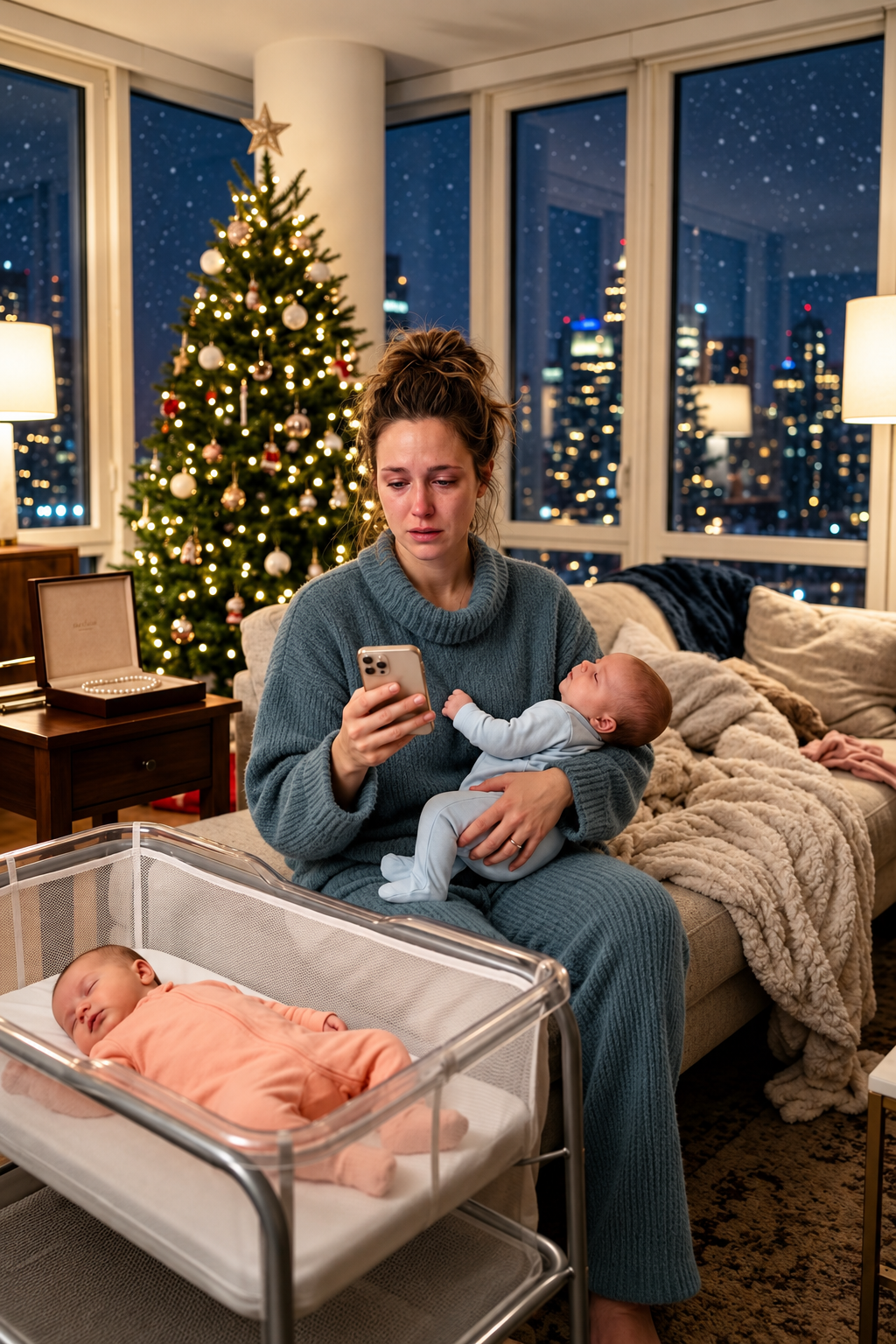
The photograph arrived at 11:47 on Christmas Eve. I remember the exact time because I had just checked how long it had been since giving my son his last bottle. Noah was pressed against my shoulder, his little body unpleasantly hot through his cotton pajamas. Across the hallway, his twin sister, Lily, was crying in the nursery. My husband, Cole Whitmore, was supposed to be entertaining important business clients. Instead, the picture on my phone showed him lying in a hotel bed, his arm resting around the bare shoulders of a woman I recognized. The message beneath it told me not to stay awake waiting for him. For nearly a minute, I stood beneath our enormous Christmas tree, looking at the evidence of a life I had apparently been the last person to understand.
At first, my mind searched for an innocent explanation. Perhaps the photograph was old. Perhaps someone had borrowed his phone. Perhaps the man’s face only resembled Cole’s because I was exhausted. Then I enlarged the image. There was the slight bend in his nose from a college football injury, the expensive watch I had given him for our anniversary, and the platinum wedding band on his left hand. The woman’s hair spilled across the pillow. Her face was turned toward the camera, relaxed and unmistakable. Sierra Vaughn. She worked with Cole as a client relations consultant, a position he had once described as essential to the company’s expansion. I had met her. I had shaken her hand. Three months earlier, she had complimented my earrings while standing beside my husband at a formal dinner.
Noah stirred, making a small, miserable noise against my neck. I lowered the telephone before its light disturbed him. His breathing was slightly congested, and each little exhalation came with a faint whistle that made me listen more carefully. He and Lily had both developed fevers that afternoon. Their pediatrician had given me instructions, which I had written down in a notebook beside the changing table. I had spent the evening alternating between feeding, checking temperatures, changing diapers, and trying to comfort whichever baby was crying hardest. My dinner remained untouched in the kitchen. There was a cup of cold tea near the sink, and several unopened Christmas cards sat where I had left them that morning.
My name is Lauren Bennett Whitmore. I was thirty-two years old that Christmas, married to Cole for several years, and the mother of six-month-old twins. Anyone looking at our life from the outside would have assumed I had very little to complain about. We lived in a spacious Manhattan apartment with windows overlooking the city. Cole owned a successful business, wore tailored suits, and knew exactly how to behave when people were watching. Our wedding photographs had appeared in a society magazine. There were summer weekends away, elaborate anniversary dinners, and Christmas decorations arranged by professionals. I had once believed these things were signs of a stable, happy marriage. By the time that photograph reached me, I had learned how little appearances revealed about what happened behind a closed apartment door.
The day had begun badly. Lily woke before sunrise with a temperature that frightened me, and Noah followed a few hours later. I called the pediatrician, described their symptoms, and followed the advice carefully. Both babies wanted to be held, but neither could settle for long. By late afternoon, my arms ached and the nursery smelled of warm milk, clean cotton, and the unmistakable sharpness of the disinfectant wipes I had been using throughout the day. I had not showered. My hair was twisted into a loose knot, and I was wearing the same sweater I had slept in the previous night. When Cole finally emerged from our bedroom shortly before six, I felt something close to relief.
He was dressed in a dark suit with a white shirt and silver cuff links. I remember the cuff links because he was adjusting one of them while I explained what the pediatrician had said. Cole listened with the distracted expression he usually wore when I interrupted his work. He asked whether the babies needed a hospital. I explained that the doctor had not advised one at that point, but that we were monitoring them closely. Then I asked him to stay home. I did not demand that he cancel every business engagement. I asked whether he could postpone dinner, make a telephone call, or simply remain long enough for me to rest and prepare another feeding without carrying both children in turn.
Cole glanced toward the nursery when Noah began crying. He made no movement to go to him. Instead, he told me the dinner was important, that people were expecting him, and that his absence would create problems. I reminded him that both babies were ill. He suggested that I rest whenever they slept, as though their sleeping schedules could be arranged around mine. When I said plainly that I needed his help, his patience disappeared. He told me that looking after children was the responsibility mothers naturally accepted. There was nothing theatrical about the remark. He said it while reaching for his coat, with the casual certainty of someone explaining a rule he considered too obvious to debate.
I watched him leave. For several seconds after the elevator doors closed, I remained in the hallway with Lily against my chest. What upset me most was not merely that Cole had gone out. It was how easily he had dismissed the fact that I was struggling. He had seen the bottles waiting to be washed, the thermometer beside the nursery door, and the shadows beneath my eyes. He had heard both children crying. None of it had made him reconsider. Eventually, I went back inside, changed Lily’s diaper, and prepared another bottle. There was no time to examine the argument, much less recover from it. Two babies needed me, and I was the only adult in the apartment willing to answer them.
Now, hours later, I stood looking at my husband in a hotel room with Sierra Vaughn. The carefully prepared excuse about demanding clients had been attached to the very photograph that destroyed it. I could almost imagine how the mistake had happened. Perhaps he had intended to send the image to someone else. Perhaps he had selected my name without paying attention. Whatever the reason, I was holding something Cole would have found difficult to explain. I saved the photograph immediately. Then I saved the accompanying message, making sure both remained visible with their timestamps. My fingers were shaking, but the decision to preserve what I had received came with surprising clarity.
I carried Noah into the nursery and placed him safely in his crib while I checked Lily. She had finally stopped crying, although her cheeks remained flushed and her small hands moved restlessly beside her face. I took both children’s temperatures again and compared them with the readings in my notebook. Nothing I saw allowed me to dismiss my concern. I called the pediatrician’s overnight service, explained the symptoms, and answered the nurse’s questions. She asked about feeding, wet diapers, alertness, and breathing. We discussed what to continue monitoring and which changes would require immediate medical attention. I wrote everything down. Her calm, practical manner helped me concentrate on the two people who needed my attention more urgently than Cole did.
When I finished the call, I stood beside the nursery window. Snow had begun settling along the edges of the buildings opposite ours. Somewhere below, a car horn sounded twice, followed by the distant scrape of tires on wet pavement. The city was preparing for Christmas morning. Families were probably arranging presents beneath their trees, setting out cookies, and coaxing excited children into bed. I wondered how many women were standing in kitchens and bedrooms at that very moment, trying to understand something their husbands had done. Then Lily began fussing again. I went back to her, grateful for the interruption because I did not trust myself to think too far ahead.
The Christmas tree in our living room was nearly twelve feet tall. Cole had selected it through the decorating service he used every December. Its branches carried matching silver ornaments, delicate ribbons, and hundreds of tiny white lights. The decorators had been so precise that even the wrapped presents beneath it seemed arranged according to size and color. There was not a crooked ornament anywhere. Earlier that month, my mother had sent a small wooden star to celebrate the twins’ first Christmas. It was handmade, with their names painted along the edges. Cole had looked at it, smiled politely, and suggested keeping it in the nursery because its rustic appearance would interrupt the tree’s carefully chosen design.
At the time, I had put the star away without arguing. I told myself that Cole cared about presentation and that it was a harmless preference. Standing there on Christmas Eve, I remembered how often I had made that same explanation for him. He preferred that I wear certain dresses when we entertained. He disliked unexpected visits from my family. He wanted to approve household purchases, even inexpensive ones. He believed arguments should remain private, which increasingly meant they should remain unspoken. Each compromise had seemed small enough to accept. Together, they had changed the shape of my life until I could hardly remember what making an ordinary decision without consulting him felt like.
Three months earlier, at the company dinner where I met Sierra, Cole had spent much of the evening circulating among investors and prospective clients. I had been seated beside a woman who spoke enthusiastically about her children, asking whether I enjoyed staying home with the twins. Before I could answer properly, Sierra appeared beside our table. She wore a midnight-blue dress and carried a glass of champagne. She told me she admired my earrings, then leaned toward Cole when he returned, touching his sleeve as she reminded him about something amusing from an earlier meeting. He laughed. I remember thinking that he looked younger when he laughed with colleagues than he did when he came home.
That dinner had left me vaguely uncomfortable, though I had struggled to explain why. Sierra seemed perfectly pleasant, and Cole had introduced her openly. On the drive home, I asked whether they worked together frequently. He replied that business relationships required regular contact and seemed irritated that I had asked. When I mentioned how familiar they appeared, he accused me of inventing difficulties because I had spent too much time alone with the babies. I apologized before we reached our building. Later, lying awake while Cole slept beside me, I felt ashamed of having raised the subject. Now I looked at the photograph again and wished I could speak to the woman I had been that evening.
I did not know exactly when their relationship had begun. The photograph told me where Cole was on Christmas Eve and who was beside him. It did not establish how long he had been lying to me, how often they met, or what Sierra believed about his marriage. Those questions were waiting somewhere beyond the immediate shock. But another question had already become unbearable. If Cole could leave his sick infants on Christmas Eve for a hotel room with another woman, what else had I mistaken for an ordinary marriage? I thought about the evenings he arrived home impatient and the mornings he criticized how much money I spent. I remembered the way I had started rehearsing explanations before asking him for anything.
A few days earlier, Cole had questioned an increase of eighty-seven dollars in our grocery expenses. I had purchased additional formula, baby supplies, and several things recommended for the children’s care. He brought up the charge while we were eating dinner. I explained the purchases, but he wanted to examine the receipt. With one hand holding Noah’s bottle, I opened the shopping application on my telephone and read the items aloud. Cole interrupted several times to ask whether particular purchases were necessary. By the time he declared the matter settled, my food had gone cold. I had felt strangely guilty for buying what our children needed, although I knew perfectly well that eighty-seven dollars meant almost nothing to our household finances.
I had stopped working regularly after the twins were born. Before that, I enjoyed freelance projects that allowed me to use the skills I had developed before marriage. Cole initially described my decision to stay home as sensible and generous. Gradually, however, he began talking as though every dollar spent on me or the children came exclusively from his efforts. He managed our joint accounts, arranged investments, and dealt with most financial paperwork. I still received money through a trust my grandmother had established, but I rarely examined how it entered our household finances. Cole handled those details. I had believed that allowing him to do so was a sign of trust between spouses.
After the twins arrived, he introduced what he called a simpler household spending system. Money for ordinary daily purchases went into a separate account with a limited balance. If I needed more, he wanted to know why. He presented the change as responsible management, something successful families did to avoid unnecessary spending. I accepted it because I was tired, because the children consumed nearly every hour, and because challenging Cole over money had become exhausting. Gradually, I found myself checking my available balance before making purchases I once would have considered routine. The fact that I was a beneficiary of my grandmother’s trust did not seem to matter when I stood at a supermarket register wondering whether the household card would work.
I went into the hallway to find clean burp cloths. We kept them in a cabinet beneath a narrow shelf where Cole sometimes placed things he wanted out of sight. I opened the door, moved a folded blanket, and reached behind a stack of linen. My hand touched a small, rigid box. At first, I assumed it contained spare buttons or an accessory from one of Cole’s suits. Then I drew it into the light. The packaging was pale blue, the sort used by a jeweler whose name I knew from the expensive gifts Cole had once given me. I sat on the hallway bench and turned the box over, noticing that its ribbon had been tied with unusual care.
For one brief, humiliating moment, I imagined that Cole had bought me a Christmas present. We had not exchanged meaningful gifts since the twins were born, and I had told myself that we were simply adjusting to parenthood. Perhaps he had planned a surprise. Perhaps that was why he had seemed distracted in recent days. The thought was foolish, but it arrived before I could stop it. I opened the box and found a necklace made of luminous pearls and small diamonds. It was beautiful in a restrained, expensive way, exactly the sort of jewelry Cole knew how to choose when he wanted someone to be impressed. A folded card rested beneath the velvet insert.
The card was addressed to Sierra. Its message referred to the reward of having waited. I read the words twice, then closed my eyes. Unlike the photograph, the necklace had not appeared by accident on my telephone. Cole had deliberately bought it, selected its presentation, and written something personal to another woman. He had brought it into our home and hidden it a few feet from the nursery where our children slept. I thought of him studying a jewelry display while I calculated the cost of formula. The comparison made me feel sick. I photographed the necklace, the card, and the packaging, taking care to record how I had found them. Then I returned everything to its place.
I remained on the bench for several minutes. Through the nursery monitor, I heard Noah moving in his crib. The apartment was otherwise quiet. I realized that I was waiting for an emotion strong enough to tell me what to do. Anger came, certainly, but it was interrupted by practical worries. Where would I take two sick babies on Christmas Eve? Could I manage their care somewhere unfamiliar? What would Cole do when he discovered that I knew? Would he insist that I had misunderstood? Would he take my telephone, demand to see what I had saved, or turn the conversation toward something I had done wrong? I knew the familiar sequence so well that I could almost hear his voice.
My parents lived in Connecticut. We had not visited them for Thanksgiving, and I had canceled several Sunday lunches during the autumn. Cole always had an explanation for why the trips were inconvenient. Sometimes it was the babies’ routine. Sometimes he had work to finish. Sometimes he said my mother interfered too much with our household decisions. Eventually, I began declining invitations before he needed to object. My mother had stopped questioning me directly, though I could hear disappointment beneath her efforts to sound cheerful. I remembered her asking whether everything was all right during our last conversation. I had assured her that we were simply busy.
I looked at her name in my contacts. It seemed absurd that calling my own mother required so much courage. She had spent my childhood showing up whenever I needed her, from school performances to illnesses to the difficult weeks after my grandmother’s death. Yet I had allowed distance to grow between us because keeping Cole comfortable seemed easier than answering my mother’s concerned questions. I wondered whether she would be hurt or angry. I wondered whether I could explain the photograph without crying. Most of all, I wondered whether saying aloud what had happened would make it impossible to continue pretending that my marriage was merely going through a difficult period.
Before making the call, I checked both children again. Noah had settled, and Lily was drinking a little more comfortably. I recorded their temperatures, placed fresh water beside the bottles waiting to be cleaned, and plugged my telephone into its charger for a few minutes. These tasks gave my hands something useful to do. When I finally pressed my mother’s number, I watched the call connect with a nervousness I had not felt since I was a teenager. She answered after several rings. Her voice was heavy with sleep, and I could hear my father’s television playing faintly in the background. She asked whether something had happened to the babies.
I tried to answer, but my throat tightened. There were too many things to explain, and I could not decide where to begin. I wanted to tell her that Noah and Lily were ill, that Cole had left, that I had received a photograph, and that I had found a necklace meant for another woman. Instead, I listened to her saying my name. She did not sound impatient. She sounded frightened because I had called so late and was not speaking. Then Lily began crying through the monitor, and the sound cut through my hesitation. I told my mother that the children were sick and that I could not manage another night alone.
She asked whether I wanted her to come to Manhattan. There was no lecture about the holidays, no question about why I had waited so long, and no demand that I explain Cole’s absence before she agreed to help. I looked toward the front door. I thought of the evening’s argument, the photograph, the necklace, and the countless occasions when I had convinced myself that asking for support would only make matters worse. My mother’s question was simple. I had almost forgotten that some questions were meant to be answered rather than defended. I told her I wanted her there, and I asked if she could come as soon as possible.
While she was answering, Cole’s name appeared on my screen. He was calling. A moment later, another message arrived, followed by another. He had evidently realized what photograph he had sent. I watched the notifications gather without opening them. For the first time that evening, his urgency did not feel more important than my children’s needs. I turned my attention back to my mother and listened as she said she was getting dressed. Somewhere inside that ordinary conversation, something in my life had changed. I was no longer trying to decide whether Cole would permit me to ask for help. I had already asked, and my mother was coming.
END PART 1
PART 2 TITLE: While My Husband Demanded to Know My Location, My Mother Helped Me Prepare an Escape He Had Never Imagined I Would Choose
My mother’s first question after promising to come was whether Cole was in the apartment. When I told her he had gone out, she asked something that made my stomach tighten. Did I want him to return before she arrived? I glanced at the door, then toward the nursery. Normally, I would have answered carefully, perhaps saying that Cole was busy or that we had disagreed about something minor. This time, I told her I wanted to leave before he came home. She did not ask me to justify the decision. I heard her move away from the telephone and tell my father that she needed to go into the city. Then she returned and asked whether I felt safe waiting until she arrived.
I thought about an argument that had taken place two evenings earlier. Sierra’s name had appeared on Cole’s telephone while we were sitting together. I had reached toward the screen, intending to ask whether he needed to answer. He caught my wrist before my fingers touched the device. The movement had been so sudden that I gasped. He held me until I withdrew my hand, staring at me with an expression I had rarely seen in public. When he finally let go, he accused me of invading his privacy. Later, he brought me a cup of tea and explained that I knew how to provoke him. The faint discoloration beneath my sleeve had not entirely faded.
I told my mother about the photograph first. The words came out awkwardly, interrupted by my efforts to keep my voice steady. She listened without interrupting. When I described Sierra, she asked whether I was certain of the woman’s identity. I explained that I had met her and that Cole’s wedding band was visible. Then I told her about the necklace. My mother was silent for several seconds. I could hear her breathing and the rustle of clothing as she gathered her things. She finally said that I did not need to solve the marriage that night. We needed to get the children somewhere comfortable, make certain they received appropriate care, and give me a place to rest.
When I mentioned the incident with my wrist, her voice changed. She remained composed, but I recognized the firmness beneath her words. She asked whether Cole had hurt me on other occasions and whether I thought he might become angry when he learned I intended to leave. I could not offer a simple answer. Cole had never behaved as though he thought of himself as threatening. He could be charming, considerate, and generous when he wished. Yet I had learned to recognize the sound of his key in the door and adjust my behavior accordingly. I told my mother that I did not want to be alone with him when he returned. She said she understood.
My father, Richard Bennett, was awake by then. He had spent much of his professional life as a federal judge, and people often expected him to have an immediate solution to every problem. At home, he was usually less dramatic. He liked old sweaters, strong coffee, and practical arrangements. After hearing that my mother needed transportation, he organized a driver who could bring her into Manhattan despite the worsening weather. The roads were still passable, but snow was beginning to collect beyond the city. He asked her to tell me that they loved me and that I should concentrate on the babies. He would handle whatever arrangements were necessary on their side.
My mother asked whether she could contact Daniel Harris. I knew Daniel, although we had not spoken directly in some time. He was an attorney who worked with the trustee responsible for the trust my grandmother Margaret had created for me. Before my wedding, Grandma had insisted that I meet the people administering those assets and understand the arrangements. I had found those meetings tedious at the time. Cole certainly had. He complained that my family’s insistence on separate financial advice made him feel distrusted. He believed marriage should mean that two people shared decisions without interference from relatives or their advisers. Gradually, I had begun to see the meetings as unnecessary complications.
Grandma Margaret had never agreed. She believed affection and financial independence could exist together. When I first became engaged, she took me aside after a family dinner and asked whether I understood what I was signing. I assured her that Cole was successful and that he would never need my money. She replied that the question was not whether he needed anything. It was whether I understood what belonged to me and how it would be managed. I remembered being embarrassed by the conversation, especially when she asked me to keep copies of important documents. Now, sitting in the hallway with my telephone, I wished I had listened more closely.
Over the years, I had authorized regular trust distributions into our joint household account. At first, it made sense. Cole paid various expenses through that account, and I contributed toward our shared life. We had a home, travel commitments, insurance, and eventually the enormous costs associated with preparing for twins. I trusted him to deal with the paperwork. After the babies arrived, I stopped asking for detailed explanations because every day felt crowded with immediate demands. Cole began describing household finances entirely in terms of what he provided. It had happened gradually enough that I failed to recognize how completely I had accepted his version of events.
The separate spending account came later. Cole said it would prevent confusion between household expenses and personal purchases. He assured me that nothing important would change. But the balance was limited, and requesting additional money became an ordeal. He wanted receipts, explanations, and assurances that I had not been careless. Sometimes he transferred the money immediately. Sometimes he waited until the following day. Once, after an argument about visiting my mother, my household card stopped working. Cole told me afterward that he had removed it temporarily because I was not communicating responsibly. I remembered standing at a pharmacy counter with baby supplies, trying not to show my embarrassment.
My mother listened as I explained these things. I expected her to ask why I had tolerated them, but she did not. Instead, she wanted to know whether I had access to my identification, the children’s documents, and enough supplies to leave for a few days. She asked whether my telephone was charged and whether anyone besides Cole knew where I was. I answered each question slowly. The conversation felt less like confessing the failure of my marriage and more like preparing for an unfamiliar journey. That distinction mattered. I had spent months feeling as though every problem required an explanation. My mother was interested in what would help us get through the night.
Daniel called shortly after midnight. By then, I had moved into the kitchen and was warming a bottle while the nursery monitor rested beside the sink. I told him that I intended to leave the apartment temporarily with my children and stay somewhere nearby with my mother. He asked whether the babies were safe and whether I had spoken to a medical professional about their fevers. I explained that I had. He then outlined the limits of what could be arranged during a holiday. He could contact the trustee, review my instructions, and help coordinate immediate accommodation. Formal financial changes would require the appropriate procedures, and some matters would have to wait until offices reopened.
I was grateful that he did not promise anything miraculous. I had spent years listening to Cole describe how quickly he could resolve difficulties with the right telephone call. Daniel spoke differently. He explained what he knew, identified what required verification, and distinguished my trust arrangements from marital property that might later become part of legal proceedings. He did not suggest seizing Cole’s accounts or punishing him through financial pressure. When I asked whether I could receive trust information directly again, he said that could be arranged through the proper channels. He also offered to connect me with an attorney specializing in family law. I agreed.
While we spoke, Cole called repeatedly. His first written response described the photograph as an error. The next insisted that I had misunderstood what I had seen. Then he demanded that I answer. I read the messages without responding. There was something unsettling about the progression. He had not asked whether the twins were improving, whether Noah had eaten, or whether Lily’s fever had changed. The photograph mattered because I had received it, not because he had chosen to spend Christmas Eve elsewhere. Even when he apologized, the words appeared between demands that I make myself available to him.
I saved the messages in a secure location and began gathering other records already accessible to me. There were texts in which Cole objected to visits with my family. There were discussions about the household card and requests that I explain ordinary purchases. I found the photograph I had taken of my wrist after he grabbed it. At the time, I had hidden the image because I did not want to acknowledge what it represented. Looking at it now, I could remember the precise pressure of his fingers. I did not search his private accounts or attempt to enter his locked study. I kept what I already possessed and made copies for future discussions with counsel.
Packing for the children took longer than I expected. Their needs were so ordinary that I almost laughed at the contrast between the situation and the items going into the bags. Diapers, bottles, formula, clean sleepers, wipes, and the soft blankets each preferred. I collected the medications and written pediatrician instructions, their insurance information, and the notebook containing their temperatures and feeding times. I checked the bag twice because exhaustion had made me forget simple things. When Noah woke hungry, I stopped packing and fed him. Lily needed changing halfway through. The crisis did not interrupt motherhood. It simply happened around the same small routines that had filled every day since their birth.
For myself, I packed two changes of clothes, underwear, a warm sweater, toiletries, my laptop, and identification. I chose comfortable boots instead of the elegant shoes Cole preferred me to wear when we went out together. I put a photograph of the twins taken shortly after their birth into the bag, then reconsidered and returned it to the shelf. I was not trying to empty the apartment. I was trying to leave without creating unnecessary confusion. Still, every decision carried an uncomfortable sense of permanence. Choosing which belongings to take forced me to acknowledge that I did not know when I would return.
While searching for a document on my laptop, I found the household budget Cole had emailed in November. Its subject line instructed me to respect the spending limits he had established. I opened the attachment and scrolled through the categories. There were allocations for restaurant dinners, memberships, travel, domestic services, insurance, and various household expenses. The format was neat, with color-coded columns and carefully aligned figures. Beneath those entries was a category assigned to me and the children’s daily needs. Cole had crossed out the previous amount, replaced it with a lower number, and left a short instruction to reduce it again.
I stared at that entry longer than I had stared at the necklace. Cole had described the budget as an unavoidable response to increasing costs. Yet the categories supporting his social life and professional image remained intact. Our ordinary expenses had been singled out for further restriction. I remembered how he dismissed the nanny shortly after the twins were born, insisting that we had no reason to pay someone when I was at home. I had objected that caring for two infants was exhausting and that a few hours of assistance would help me recover and resume some work. He accused me of wanting to pay someone else to perform responsibilities I had chosen.
I downloaded a copy of the budget and placed it with the other records. Then another message arrived. Cole wanted to know why my telephone was no longer sharing its location. He had encouraged us to enable that feature when I was pregnant, explaining that it would be reassuring if I ever needed help. Over time, he began referring to my movements without my having mentioned them. If I stopped at a store after an appointment, he sometimes asked why. If I visited my parents for longer than expected, he wanted to know what we had discussed. I had disabled the sharing earlier that evening, almost instinctively, after deciding to leave.
His next message ordered me to restore it immediately. The words made my pulse quicken. I recognized the familiar expectation that I would respond quickly, apologize for creating concern, and correct whatever had displeased him. For a moment, I nearly opened the settings. Then I looked toward the nursery. Both babies were finally sleeping. Their tiny chests rose and fell beneath the dim night-light, and for the first time in hours, the room was peaceful. I put my telephone face down on the dresser. Whatever Cole wanted to know about my location, he did not need to know it before I had obtained legal advice and somewhere safe to stay.
The wait for my mother seemed much longer than it was. I kept myself occupied by checking the children’s supplies and clearing bottles from the kitchen counter. I remembered the Christmas mornings of my childhood, when my father would wake early to make coffee and Grandma Margaret would complain that everyone was opening presents too quickly. My mother had always insisted on taking photographs before breakfast. Those memories felt strangely distant. I had spent months persuading myself that my parents’ concern was an intrusion, yet the thought of seeing my mother walk through the door now brought relief so intense that I had difficulty holding it back.
When the apartment bell finally sounded, I checked the entrance before opening. My mother stepped inside carrying a canvas bag. Her hair was damp from the snow, and she had not bothered with makeup. She wore a practical winter coat over clothes that looked hastily chosen. She stopped when she saw me. I was holding Noah, whose warm cheek rested against my shoulder, and I could not manage a greeting. My mother set down her bag and held out her arms. I leaned toward her as carefully as I could with the baby between us. She embraced us both without asking a question.
I began apologizing. I told her that I had insisted everything was fine, that I had canceled visits, and that I should have called sooner. She stroked my hair and told me we could discuss all of that another day. Then she took off her coat, washed her hands, and asked which baby needed attention first. The ordinary competence of her response nearly undid me. She was not interested in making me feel foolish or demanding an explanation for every decision that had brought me here. She wanted to help. Within minutes, she had checked the bags, reviewed the pediatrician’s instructions, and helped me prepare both children for the cold.
Daniel had helped arrange two hotel rooms nearby, with space for portable cribs and access to medical care if the babies needed further assessment. My mother confirmed the arrangements and asked whether I wanted to wait a few minutes before leaving. I looked around the apartment. The tree glowed in the living room, and the presents remained beneath it. There were framed photographs on the shelves, carefully selected furniture, and flowers Cole had ordered for Christmas. Everything appeared exactly as it should have. Yet I could not bear the thought of spending another night there, waiting to hear the elevator stop on our floor.
I went once more to the hallway cabinet. The pale blue jewelry box remained behind the folded linens. I moved it onto the shelf where Cole would see it when he opened the door. Beside it, I placed my wedding ring. The skin beneath the band was paler than the rest of my finger, a narrow mark left by years of wearing it. I had imagined removing that ring would require anger or certainty. Instead, my hand moved almost mechanically. I found a blank card in the drawer and wrote a single sentence telling Cole that he should have been home with his family for Christmas.
I did not mention Sierra by name. I did not describe the photograph or threaten consequences. The ring, the necklace, and the sentence said what I needed them to say. Cole could argue about a hotel photograph, insist that I had misunderstood his business arrangements, or criticize the way I handled household spending. But he could not change the fact that two sick children had been waiting for their father while he occupied himself elsewhere. I left the card beside the ring and closed the cabinet door. For a moment, I rested my hand against its smooth surface. Then I turned away.
My mother carried Lily while I took Noah. The diaper bag hung heavily from my shoulder, and my boots felt unfamiliar after hours spent barefoot on the apartment floor. We crossed the living room without stopping. The decorated tree threw soft light across the furniture, and I noticed the little wooden star from my mother still lying on a shelf near the nursery. I picked it up and slipped it into my coat pocket. It was the only Christmas decoration I took. My mother waited by the entrance, holding Lily securely against her chest. She did not ask whether I had changed my mind.
I checked the door, adjusted Noah’s blanket, and stepped into the hallway. My mother followed, pulling the door shut behind us. A few seconds later, the elevator arrived. As we descended, my telephone vibrated again inside my pocket, but I did not reach for it. I watched my children’s reflections in the polished metal doors and listened to the quiet sound of their breathing. My marriage had not been resolved. I had no idea what would happen to our home, our finances, or the arrangements for the twins. But when the elevator opened onto the lobby, I walked toward the waiting car without looking back.
END PART 2
PART 3 TITLE: Inside a Modest Hotel Room, I Began Discovering How Much of Our Marriage Had Been Built on Money I Was Supposed to Forget
The hotel room was smaller than our bedroom at home, and its curtains were an unfortunate shade of beige. There were two portable cribs, a narrow desk, and a coffee machine that made a rattling noise whenever someone switched it on. Under normal circumstances, Cole would have complained about the furniture before removing his coat. I barely noticed it. My mother helped settle the babies, and I arranged their supplies within reach of the beds. By the time everything was ready, Christmas morning was approaching. I sat on the edge of the mattress, looking at the little plastic thermometer in my hand, and realized that I could not remember the last time I had been somewhere without worrying about Cole’s reaction.
My mother insisted that I rest while she took the next feeding. I protested because Lily was still unsettled and Noah required watching, but she reminded me that she had cared for children before and could wake me if anything changed. I lay down fully dressed, expecting sleep to remain impossible. Instead, I closed my eyes and lost several hours. When I woke, daylight was filtering around the curtains. My mother was sitting beside the window with Lily in her arms, gently rocking her while reading the care instructions I had written. Noah slept in his crib. There was a glass of water on the bedside table and a fresh towel beside it.
I reached for my telephone. Several messages from Cole had arrived while I slept. He wanted to know where I had taken the children. He demanded that I bring them back. In another message, he suggested we could repair whatever had happened if I stopped involving my family. I read the words twice. He seemed more concerned about my mother’s involvement than about the events that had caused me to leave. His apologies appeared between accusations, as though he expected me to accept one and disregard the other. I showed the messages to my mother. She suggested saving them and waiting for legal guidance before responding.
Christmas morning passed without anything resembling the celebration I had imagined for the twins. We did not dress them in the matching holiday outfits I had purchased weeks earlier. We did not arrange them beneath the Christmas tree for photographs. Instead, we followed the feeding schedule, checked their temperatures, and discussed whether their symptoms required another medical assessment. Their pediatrician’s instructions remained beside the telephone. I felt disappointed that their first Christmas had become a series of medical observations and unfamiliar rooms. Then I watched Noah grasp my mother’s finger while Lily slept peacefully nearby. Neither child knew what decorations had been left behind. They knew only whether they were warm, fed, and held.
Through Daniel, I was introduced to Evelyn Shaw, an attorney who handled family-law matters. Our first conversation was conducted by telephone. She did not ask me to make an immediate decision about divorce. Instead, she wanted a careful account of the circumstances surrounding my departure. She asked about the children’s health, Cole’s involvement in their care, the household finances, and the confrontation involving my wrist. She also asked whether I believed there was any immediate danger. I found myself trying to minimize certain incidents, explaining that Cole had been frustrated or that I might have misunderstood his intentions. Evelyn listened, then gently returned to what had actually happened.
She explained that preserving records would be useful, but she did not encourage me to search for additional evidence through questionable means. She wanted copies of communications already in my possession, financial documents I had legitimate access to, and a written account of important events while my memory remained clear. She also explained that decisions involving the children’s residence and contact with Cole would need to be managed carefully. I was not trying to prevent him from being their father. I needed time to understand what arrangements would be safe and practical. Evelyn said those questions could be addressed through an appropriate legal process.
With her guidance, we sent Cole a brief written confirmation that Noah and Lily were safe, receiving proper care, and staying with me temporarily. We indicated that communication about arrangements for the children would be handled through the appropriate channels. I did not provide the hotel room number. Cole responded with several questions that had little to do with their condition. He wanted to know who was advising me and whether my father had become involved. Evelyn asked me to forward the messages rather than engage in a prolonged argument. It felt strange to let someone else help define the limits of a conversation I had spent years trying to manage alone.
That evening, my mother brought takeout food into the room. I ate sitting on the bed while she held Noah. We talked about his improving appetite and the small ways Lily had begun responding to familiar voices. Eventually, she asked whether I wanted to discuss Cole. I told her I did not know what to say. She nodded and passed me a napkin. For a long time, we ate quietly. The absence of pressure was unfamiliar. At home, silence often meant Cole was waiting for me to apologize or explain something. Here, silence meant my mother was allowing me to eat a meal without having to defend myself.
Two days after Christmas, once the babies had been checked again and were improving, we traveled to my parents’ house in Connecticut. The roads were bordered by piles of gray snow, and the trees beyond the highway were bare. I sat between the twins’ car seats, offering toys and checking their expressions whenever they stirred. My mother spoke occasionally with the driver, but she did not attempt to fill every quiet moment. As we approached the house where I had grown up, I became unexpectedly nervous. I had spent so much time presenting my marriage as successful that returning with two infants and several overnight bags felt like admitting something I had failed to accomplish.
My father opened the front door wearing sweatpants and an old Navy sweatshirt. He looked older than I remembered from our last visit, although perhaps I was simply seeing him without the formal clothes he wore at public events. His eyes moved from my face to the diaper bags and then toward the twins. He asked which child needed changing. I told him that, with their timing, probably both. He nodded and reached for the larger bag, declaring that we had better get started. The unexpected humor made me laugh. It was a small, startled sound, but it was the first laugh that had come naturally to me in days.
Inside, the house smelled of coffee, pine, and something baking in the kitchen. The Christmas tree stood near the living-room window, decorated with ornaments collected over decades. Some were chipped. Others had been made by my siblings and me as children. Beneath its branches were packages labeled for Noah and Lily. My parents had bought gifts even after I told them we would not be visiting for Christmas. I stood looking at the names on the tags while my mother removed my coat. She did not point out that she had hoped we would come. She simply said we could open the presents whenever the children were feeling better.
Grandma Margaret arrived later carrying a tin of cookies. She had always been difficult to impress and impossible to intimidate, but she looked genuinely worried when she saw me. Her first question concerned the twins. After examining them with the careful attention of someone who had raised children and grandchildren, she announced that Noah had my father’s eyebrows and Lily had inherited the family talent for making her displeasure known. My mother inspected the cookies and asked whether Grandma had baked them herself. Grandma said she had supervised the work, which was nearly as important. Their familiar teasing eased something in my chest.
Nobody asked me to explain my marriage during dinner. My father spoke about the weather, Grandma complained about a documentary she had watched, and my mother described a neighbor’s enthusiastic attempts to decorate his lawn. Noah slept in a portable crib nearby, and Lily rested against my father’s shoulder. I ate slowly, surprised by how hungry I was. At home, I often interrupted meals to attend to the children while Cole continued eating. Here, someone noticed when my plate was untouched and offered to help without making a performance of generosity. Afterward, my father washed the dishes while my mother settled the babies.
Later that night, I sat with Grandma in the small sitting room where she liked to read. She asked whether Daniel had contacted me. I said he had and thanked her for insisting on the trust arrangements years earlier. Grandma studied me over the rim of her teacup. She told me that the trust had never been intended to create distance between me and my husband. It was supposed to preserve choices I might otherwise lose. I admitted that I had stopped paying attention to the distributions because Cole handled the finances. Grandma did not scold me. She asked whether I was ready to understand them again. I told her I was.
In the days that followed, I began keeping a more complete account of what had happened during our marriage. I wrote down the evenings Cole refused to help with the twins, the arguments about money, and the occasions when he objected to visits with my family. I included the incident involving my wrist without softening the description. It was uncomfortable to see these events arranged together. Separately, I had explained each one as a difficult moment or a misunderstanding. Written on consecutive pages, they revealed a pattern that was harder to dismiss. I made a point of distinguishing what I remembered clearly from what I could not verify.
Cole continued sending messages, some affectionate and others impatient. He told me he missed the babies and wanted our family together again. Then he accused my parents of encouraging me to destroy our marriage. At times, I found myself remembering the man I had loved. He had been attentive when we first met, curious about my work, and capable of extraordinary kindness. He had cried when Noah and Lily were born. He knew the tune that sometimes calmed Lily when nothing else worked. Remembering those things made the present more painful, not less. I wanted my children to have a loving father. I was no longer certain that living with Cole was the only way to give them that possibility.
After the holiday closures, Daniel arranged a meeting to review my financial records. I brought my laptop, the household budget, and the statements I could access. He had obtained an organized history of the trust distributions I had authorized. There were dates, amounts, account destinations, and supporting documents. The paperwork was less dramatic than I had imagined. There was no mysterious account emptied without permission, no hidden fortune transferred overseas, and no evidence that Cole had secretly taken control of the trust itself. I felt almost disappointed by the ordinary appearance of the records, as though the absence of obvious fraud meant the way I had been treated could not really matter.
Daniel seemed to understand my reaction. He explained that financial control within a relationship did not necessarily require secret theft. Sometimes the central issue was who controlled access to money, who possessed the information, and who had the power to question or restrict another person’s spending. He asked me to examine the authorized distributions alongside our household expenses. We began with housing costs, insurance, and domestic help. Then we reviewed travel, professional entertaining, membership fees, and other expenses that Cole had long described as part of the life he provided. The figures covered several years, and I found myself leaning closer to the screen.
My trust had contributed substantial amounts to our shared household. Some payments supported our residence and insurance. Others helped cover services that allowed Cole to maintain his professional schedule. There were also regular contributions toward ordinary living expenses. I had approved those transfers. Nothing in the records suggested they were unauthorized. The problem was that I had stopped connecting those payments with the money available for our daily lives. Cole spoke so confidently about the cost of supporting me that I had gradually accepted the idea that every purchase depended on his generosity.
I remembered a conversation shortly after the twins were born. Cole had come home complaining about an expensive dinner with clients. I was sitting in the nursery, exhausted after a difficult afternoon, and asked whether we could reconsider dismissing the nanny. He told me that the household was already carrying enormous expenses and that I needed to be more realistic. I had apologized, believing I was asking for something extravagant. Now I could see that money from my trust had helped sustain the very standard of living Cole used to justify those restrictions. The discovery did not mean he had contributed nothing. It meant the story he repeatedly told me was incomplete.
Daniel was careful about the distinction. He explained that the authorized transfers should not be described as stolen funds merely because I regretted the arrangements. I agreed. I had signed the instructions, and I remembered doing so. But I also remembered the conversations that followed, when Cole treated requests for additional baby supplies as evidence of carelessness. I asked Daniel whether he understood what it felt like to seek permission to spend money that had partly originated from my own assets. He did not attempt to answer from personal experience. He placed the household budget beside the distribution history and suggested that we examine them together.
The contrast was difficult to ignore. Expenditure categories associated with Cole’s business image remained substantial. Club memberships, restaurants, travel, and social obligations were presented as necessary. The allocation for my daily purchases and the children’s needs had been reduced, with a note instructing further cuts. Daniel did not need to tell me what to think. I could see the difference between the money entering the household and the narrow access I had been given to spend it. I sat quietly for several minutes, remembering each occasion when I had questioned whether I deserved an ordinary convenience.
For years, Cole had emphasized the pressure of being responsible for our family’s lifestyle. I had believed him. I knew his business required long hours, and I did not want to diminish what he accomplished. Yet the financial statements showed that our household had always depended on more than his earnings. My contributions were not imaginary, nor were they insignificant. I had simply allowed them to disappear from the conversations in which Cole decided what I was permitted to buy. The realization changed the meaning of many arguments I had previously accepted as evidence that I was financially irresponsible.
I asked Daniel whether future trust distributions could be directed into an account I controlled independently. He explained that the trustee could review and implement my instructions in accordance with the trust’s terms and the necessary procedures. He also reminded me that existing marital responsibilities would not vanish merely because I changed the handling of future distributions. Those matters needed coordination with Evelyn. I understood. I was not trying to escape legitimate obligations. I wanted to receive information directly, make informed decisions, and stop treating access to my own resources as a privilege Cole could grant or withdraw.
When the meeting ended, Daniel gave me a clear summary of the records and the next steps. I put the documents into my bag and walked outside. The January air was sharp enough to sting my cheeks. People moved past me carrying shopping bags and briefcases, absorbed in their own concerns. Nothing about the street looked different. Yet I felt as though a familiar landscape had been rearranged. The numbers themselves were not a surprise. I had known about the trust since I was young. What stunned me was how thoroughly I had accepted Cole’s version of our finances while the evidence of my contribution sat quietly in documents I had stopped reading.
Back at my parents’ house, I found Noah lying on a blanket beside Lily. My mother was sitting on the floor, making ridiculous faces at them. I took off my coat and joined her. Noah reached toward my sleeve, and Lily responded with a delighted squeal when I touched her hand. I had spent so many months trying to justify the smallest purchases that I had almost forgotten the purpose of money in our household. It should have helped us care for these children and live with reasonable security. Instead, it had become another way to measure whether I had pleased my husband.
That evening, I opened the budget again. I looked at the reduced allocation beside my name and compared it with the trust distributions listed in Daniel’s summary. There was no mystery left about why the arrangement had felt wrong. Cole had not needed to steal my inheritance to make me dependent on him. He had only needed me to forget how much of our shared life I already supported. I closed the laptop and made a decision that would change the balance of our marriage. The next distribution would not pass through the household account he controlled.
END PART 3
PART 4 TITLE: When I Took Back Control of My Own Money, My Husband Finally Offered the Help He Had Refused Me for Months
Changing the destination of my trust distributions required paperwork, verification, and several conversations with Daniel Harris. There was nothing dramatic about the process. No emergency meeting took place behind locked doors, and nobody appeared at Cole’s office carrying an order to seize his assets. I signed the necessary instructions, reviewed the information the trustee provided, and arranged to receive future distributions through an account under my own control. The changes were made through the appropriate procedures. Afterward, Daniel explained how I could review my records directly and whom to contact whenever I needed clarification. The simplicity of it unsettled me. For years, I had behaved as though understanding my own finances required Cole’s approval.
Evelyn Shaw helped me examine how those changes related to our marital obligations. She was careful not to confuse my right to manage the trust with the financial responsibilities that might be resolved during separation or divorce. There were still household expenses, insurance arrangements, and questions about the apartment. Cole’s business and personal investments were separate matters requiring proper review. I listened, asked questions, and took notes. I did not want revenge disguised as financial independence. I wanted agreements that could withstand scrutiny and protect the children from unnecessary instability. The difference became more important each time Cole sent another angry message.
One afternoon, Daniel called to confirm that the trustee had received my revised instructions. I was in my parents’ kitchen washing bottles while Noah slept upstairs. The conversation lasted only a few minutes. When I put down the telephone, I stood with my hands resting on the edge of the sink. The water had grown cold. I had expected to feel triumphant, but the emotion was quieter than that. I felt as though I had recovered something small that had been missing from an ordinary day: the ability to make a decision without preparing an explanation for my husband.
My father noticed the change before I mentioned it. He came into the kitchen carrying a mug and asked whether the paperwork had gone smoothly. I told him it had. He nodded, opened a cupboard, and looked for coffee. Then he said that a person could possess considerable financial resources and still find herself living under unreasonable restrictions. I asked whether he was speaking as a former judge or as my father. He considered the question for a moment. Then he said that, as my father, he wished I had never needed to learn the distinction. He left the subject there, which I appreciated more than another lengthy conversation.
I had worried that my father’s professional background would turn my separation into a public confrontation. Cole knew people respected Richard Bennett, and I suspected he feared that influence. But Dad was clear from the beginning. He would not contact judges on my behalf, interfere with legal proceedings, or use old professional relationships to threaten anyone. He would support me as a parent and grandfather. That meant providing a place to stay, helping with the children, and reminding me to obtain proper advice. When I asked whether he was disappointed in my marriage, he said his main concern was the amount of time I had spent believing I could not ask for help.
My mother had a different way of supporting me. She refused to let every conversation become an examination of Cole’s behavior. If Lily needed a clean sleeper, she handed me one. If Noah was restless, she offered to walk him around the room. When I said I wanted to resume some freelance work eventually, she asked what kind of projects interested me. She also encouraged me to sleep whenever she could take over a feeding. Slowly, my days began to contain subjects other than my marriage. I found myself laughing at something the twins did without immediately wondering whether Cole would consider the noise disruptive.
Still, the habits I had developed did not disappear simply because I had left the apartment. The first time I ordered additional baby clothes, I checked the account balance three times before completing the purchase. I compared prices, removed an unnecessary item from the basket, and nearly sent Cole a message explaining the expense. My finger was already moving toward his name when I stopped. I put the telephone down and examined what I had ordered. The children needed clothes that fit. I had the money to buy them. There was no person waiting for a justification. I completed the purchase and felt oddly unsettled afterward.
Other habits were harder to identify. Whenever my mother asked what I wanted for dinner, I began by asking what everyone else preferred. If my father offered to take me somewhere, I checked whether the timing would inconvenience him. I apologized when one of the babies cried during a conversation. My parents rarely commented on these things, but I occasionally caught my mother watching me with a troubled expression. I knew what she was noticing. Cole had not forbidden me from having preferences. He had simply made the consequences of expressing them unpleasant often enough that I had learned to avoid doing so.
The financial arrangements changed the nature of his messages. At first, Cole continued asking when I intended to bring the twins home. Then he learned that the trust distributions were no longer entering our former household account. He telephoned repeatedly. When I did not answer, he left a voicemail demanding to know who had authorized the change. His tone was controlled at first, then increasingly sharp. He spoke about our marriage, our shared responsibilities, and the embarrassment of discovering that financial decisions had been made without consulting him. What struck me was that he seemed unable to imagine I might have made those decisions myself.
I listened to the voicemail in Evelyn’s office. She asked whether I wanted to respond. I told her I preferred that any necessary financial communication take place in writing through the attorneys. She agreed that documenting arrangements clearly would be useful. Then she asked how I felt about hearing his voice. I hesitated. Part of me still wanted to call Cole and reassure him that I had not intended to humiliate him. I wanted to explain that I was not attacking his business or attempting to take away anything that belonged to him. Evelyn waited while I found the words. Eventually, I said that I was tired of being responsible for making him comfortable with my decisions.
She did not congratulate me or turn the moment into a speech. She made a note, then returned to the practical questions in front of us. I appreciated that. Every meaningful change seemed to involve several ordinary decisions rather than one grand declaration. I needed to manage my finances, arrange medical care for the twins, protect important documents, and consider their relationship with their father. None of those tasks could be completed by winning an argument. They required patience, information, and enough consistency to keep working when I felt frightened or uncertain.
Cole’s contact with the children remained an important subject. Whatever had happened between us, Noah and Lily were too young to understand it, and their needs could not be postponed until their parents reached an agreement. Evelyn helped me consider temporary arrangements for communication and parenting time. I wanted Cole to receive appropriate information about their health and development. I also wanted schedules and exchanges handled in a way that did not expose me to repeated demands or unpredictable confrontations. We discussed how to establish clear expectations while the broader legal questions remained unresolved.
One evening, Cole sent a message asking whether Lily still responded to the song he used to sing. I read it while she slept beside me. It was a genuine question, and it reminded me of the man who had held our daughter during her earliest weeks. I answered briefly that the song still helped her settle. Cole replied with a memory from the hospital, describing how Noah had fallen asleep against his chest. For a moment, I could almost see us together again in that room, exhausted and astonished by the babies we had brought into the world. Then another message appeared asking why I was keeping them away from the apartment.
The tenderness of the first message did not erase the demand in the second. I responded through the agreed channel, keeping the discussion focused on arrangements for the children. It took effort. I had always preferred resolving conflict through conversation, and silence made me anxious. But experience had taught me that the longer I remained in an unstructured exchange with Cole, the more likely the subject was to shift from the children to my behavior. I began learning to answer the relevant question and leave the rest unanswered. It was not an attempt to punish him. It was a way to keep necessary communication from becoming another argument about my independence.
Meanwhile, Daniel continued reviewing the trust records. He found no evidence of the spectacular financial scandal that Cole might later accuse my family of inventing. The payments I had authorized were documented. The trust remained separately administered, and existing obligations required careful handling. Daniel was satisfied that the records could establish what I had contributed and when. He prepared a summary I could understand without searching through years of individual statements. When I looked at it, I recognized how much support my trust had provided for our household. The figures did not diminish Cole’s financial success, but they disproved his repeated suggestion that I contributed almost nothing.
I returned to the November budget. Its categories were familiar now, but the words beside my allocation still troubled me. Cole had treated the children’s expenses as an area where further reductions were appropriate while preserving substantial allowances for activities he considered essential. I remembered the argument about reinstating childcare assistance. He had said that our financial position required discipline. Yet the statements showed that our household could have afforded more help than he allowed me to arrange. The question was no longer whether hiring someone had been financially possible. It was why Cole had insisted that my exhaustion was something I should manage without assistance.
Evelyn encouraged me to make a clear distinction between what I could establish and what I believed Cole intended. I could document the dismissal of the nanny, the reduced spending allowance, the removal of my household card, and the messages about my location. I could describe how those decisions affected daily life. I could not claim to know every private reason behind them. That approach helped me speak more precisely. I no longer needed to prove that Cole was an entirely terrible person. I needed to explain why the marriage had become a place where I could not make basic decisions without anticipating his disapproval.
About three weeks after Christmas, Cole asked for a meeting. The request came through the attorneys rather than as another message demanding that I come home. He said he wanted to discuss the possibility of reconciliation and believed that we should make an effort to preserve the family we had created. The words unsettled me. I had spent years wanting him to take our concerns seriously. Now he was finally asking to talk, and I did not know whether he understood what needed to change. I agreed to attend a meeting with Evelyn present. Cole would bring his attorney, and the conversation would take place in a neutral office.
In the days before the meeting, I found myself remembering our early marriage. Cole had once driven across the city in heavy rain because I had forgotten an important folder before a presentation. He used to remember how I liked my coffee and would bring it to me without being asked. During my pregnancy, he attended appointments and spoke excitedly about becoming a father. Those memories were real. I did not want to pretend otherwise simply because our relationship had deteriorated. But I also remembered the months after the twins were born, when ordinary needs became arguments and I began feeling grateful whenever he showed the smallest consideration.
My mother asked whether I believed Cole wanted to change. I told her I could not know. He had apologized for the photograph, but he continued treating my decision to leave as an act of disloyalty. He had promised to become more involved with the twins while questioning why I needed help in the first place. He said he respected my family, then complained whenever I relied on them. I wanted to believe people could recognize their mistakes. I simply did not know whether Cole could acknowledge the pattern beneath the individual events. My mother listened and reminded me that attending a conversation did not require me to promise an outcome.
I wrote down what I needed to say. The list was not complicated, but completing it took an entire afternoon. I wanted unrestricted access to my own financial information and accounts. I wanted to visit my family without facing punishment or suspicion. I did not want Cole using location tracking to monitor my movements. I wanted reliable help with the children and a fair division of parenting responsibilities. Most importantly, I wanted time away from him to decide whether reconciliation was possible. I read the list several times, trying to remove any language that might distract from the issues themselves.
Then I added something that frightened me. I wanted Cole to acknowledge the incident with my wrist. It was not enough for him to say he had been upset or that I had provoked him. I needed him to understand that grabbing me had been unacceptable, regardless of the argument. I also wanted him to acknowledge that controlling access to money and discouraging contact with my family had affected my independence. I knew those subjects would make him defensive. In the past, I would have removed them to keep the conversation peaceful. This time, I left them on the page.
On the morning of the meeting, I woke before the twins. My mother was already downstairs preparing coffee. I dressed in a navy sweater, dark trousers, and the comfortable boots I had packed on Christmas Eve. I chose them because I could walk easily in them and because they belonged to the version of myself who had finally left the apartment. When I came downstairs, my father was reading the newspaper. He looked up, asked whether I had everything I needed, and offered to drive me. I told him transportation had been arranged. He nodded and returned to his paper, giving me the dignity of handling the appointment myself.
The meeting room was plain and slightly too warm. A long table stood beneath fluorescent lights, with a tray of coffee and several untouched bottles of water at one end. Evelyn arrived with a folder containing the records we had discussed. She asked whether I wanted to review anything before Cole came in. I shook my head. My notes were already familiar. What I feared was not forgetting what I intended to say. It was hearing Cole’s disappointment and instinctively putting his feelings ahead of my own concerns. Evelyn seemed to recognize my nervousness. She told me I could request a break whenever I needed one.
Cole entered a few minutes later with his attorney. He looked much as he had on the evening he left for the hotel: carefully dressed, composed, and accustomed to being listened to. But there were signs of fatigue around his eyes. He stood when he saw me and said I looked healthier. I had slept four uninterrupted hours the previous night, which felt like an extraordinary luxury compared with the months before Christmas. I thanked him without explaining. He asked about the twins, and I told him Noah had started laughing whenever someone sneezed, while Lily was reaching for anything she could grasp.
For a few minutes, we spoke almost normally. Cole smiled when I described Lily attempting to pull my mother’s necklace. He remembered how Noah used to fall asleep against his chest and asked whether that still happened. I said it did. The conversation hurt because it reminded me that our family had not been built entirely on unhappiness. There had been affectionate mornings, ordinary jokes, and genuine excitement when the children were born. I had once imagined Cole and me watching them grow into adults. That imagined future sat between us in the meeting room, harder to dismiss than the anger I had felt on Christmas Eve.
Eventually, Cole said he had made a serious mistake. I asked him which mistake he meant. His expression changed, and he glanced briefly at his attorney before mentioning the photograph and Sierra. He assured me that the relationship had ended. I listened without interrupting. Part of me had wanted to hear those words for weeks, but they did not answer the questions I had brought with me. I asked whether he understood why I had left the apartment instead of waiting for an explanation. He said he understood that I was hurt. I told him that hurt was only part of it.
I opened my notebook and began reading the conditions I had written. Cole listened while I spoke about my family and the children. He occasionally nodded, although I noticed his attention sharpen when I mentioned location tracking. He said the feature had been intended for safety. I replied that I had not felt free to decide when it was appropriate to use it. Then I raised the need for regular childcare assistance and a genuine division of responsibilities. He said we could discuss hiring someone. I reminded him that I had requested the same help months earlier, when the twins were newborns and I was barely sleeping.
When I reached the financial arrangements, Cole leaned back in his chair. He asked whether my grandmother would now be making every decision in our marriage. The accusation was familiar, and for a moment I felt the old urge to defend my family before explaining myself. Instead, I told him that the decisions were mine. He said they sounded as though they had been prepared by other people. Evelyn asked him to allow me to finish. Cole looked at her, then back at me. He seemed genuinely offended by the possibility that I could manage money without consulting him first.
He began describing everything he had provided during our marriage. He mentioned the apartment, the travel, his business responsibilities, and the financial pressure of maintaining our lifestyle. His voice remained controlled, but I recognized the resentment gathering beneath it. He said he felt humiliated that I had involved attorneys and changed arrangements without speaking to him. I waited until he finished. Then I asked whether he had ever considered how humiliating it was for me to explain the cost of formula while caring for two sick babies. Cole frowned and said that responsible couples discussed their budgets.
I looked toward the folder Evelyn had placed beside me. Inside were the distribution records from my trust, a summary of our shared expenses, and the November budget Cole had sent. I had spent years hearing him describe our home as something he alone provided. I had accepted his accounting of my worth because I was too exhausted to examine the numbers myself. Now the documents were arranged in front of me, and I no longer needed his interpretation. I opened the folder, took out the first statement, and placed it on the table between us.
Cole glanced at the figures. For the first time since the meeting began, he stopped speaking. I moved the household budget beside the statement and looked directly at him. The discussion was no longer about whether he had bought another woman a necklace or whether I had overreacted to a photograph. Those matters had already changed our marriage. What remained was the question that would determine whether there was anything left to save: could Cole acknowledge the life we had actually lived, rather than the one he had spent years describing?
I kept my hands flat against the table and prepared to ask him why the money I contributed to our home had never prevented him from treating me like a dependent who needed permission to buy necessities. Evelyn sat quietly beside me. Cole’s attorney studied the documents. Across from me, my husband looked at the numbers and then at my face, as though he were only beginning to understand that I had come to the meeting with something more substantial than an accusation. I had come with a history he could no longer dismiss as a misunderstanding.
END PART 4
PART 5 TITLE: When My Husband Saw the Financial Records, He Finally Understood Why His Apology Could Not Bring Me Home Again
Cole examined the documents spread across the conference table without touching them. For the first time since our meeting began, he seemed uncertain which expression to wear. The financial statements from my grandmother’s trust lay beside the household budget he had prepared in November. Evelyn Shaw sat quietly at my right, her pen resting across a yellow legal pad. Across from us, Cole’s attorney adjusted his glasses and waited. I had just asked my husband whether he could acknowledge the life we had actually been living, rather than the comfortable marriage he continued describing to everyone else. He looked at me, then returned his attention to the figures.
“You’re making this about money,” he said eventually. His voice was controlled, almost gentle, which was how he usually sounded when he wanted other people to believe he was the reasonable person in the room. “I thought we were supposed to be discussing our family.” I felt the familiar temptation to defend myself immediately. Instead, I moved the November spreadsheet closer to him. “We are discussing our family, Cole. This is the amount you decided I was allowed to spend on formula, groceries, and things the babies needed. And this”—I touched the trust statement—“is money I contributed to the household we shared.”
He leaned forward and studied the columns. I watched his eyes move past the insurance payments, housing costs, and substantial deposits made from my trust into our joint account. He knew those contributions existed. He had approved household expenditures against them for years. Yet he had spent months reminding me how fortunate I was that he provided everything. I had begun believing him, even while signing the instructions that helped pay our bills. The contradiction seemed obvious now, although it had taken one photograph, two sick babies, and a night away from home for me to recognize how completely I had accepted his version of our marriage.
“I never said you contributed nothing,” he replied. “You’re twisting what happened.” He picked up one statement and placed it beside his attorney’s folder. “There were expenses you didn’t understand. I was managing a household, investments, and a business. Somebody had to make decisions.” I asked him why those decisions had included canceling my bank card after an argument, questioning the price of infant formula, and dismissing the nanny when I had begged him to keep her. He began explaining each incident separately, as though enough individual explanations might prevent them from forming a pattern.
The nanny had been too expensive, he insisted, even though he had continued paying his country club membership without discussion. The grocery questions had been about responsible spending, although he had never asked the same questions about restaurant bills. He had reduced the balance in my spending account because I supposedly needed better financial habits. When I mentioned the money from my trust, his shoulders stiffened. “That money was for our family,” he said. “Exactly,” I answered. “And I was part of that family. So why did I have to ask permission to use it?”
For several seconds, nobody spoke. Outside the conference room, someone laughed in the corridor. A printer started humming behind the wall. Ordinary office noises continued while the marriage I had spent years protecting seemed to diminish into a handful of uncomfortable sentences. Cole finally turned toward Evelyn. “Did you tell her to say all this?” Evelyn did not appear offended. “Mrs. Whitmore prepared her concerns before this meeting,” she replied. “She is capable of explaining them herself.” Cole gave a short, humorless laugh. “Everyone in her family has always believed they know better than I do.”
There it was again: the claim that any choice I made against his wishes must have come from somebody else’s influence. My grandmother had insisted on protecting the trust she established for me long before my wedding. My father had asked careful questions about our finances before we married. My mother had offered to help when the twins were born. Cole had gradually turned those separate acts of concern into a story about a family determined to interfere with our happiness. I had accepted that story because challenging it usually led to days of tension at home. Now I looked directly at him. “They didn’t make me leave. You did.”
His face changed. For an instant, the composed husband disappeared, and I saw genuine hurt. “I apologized for Sierra,” he said. “I told you it was finished.” I believed he wanted the affair to be over, at least as a problem he had to confront. Whether he truly understood what it had done to our marriage was another question. I asked him why he had left Noah and Lily with me on Christmas Eve after knowing they were ill. He began to answer with something about important clients, then stopped. We both knew where he had spent that evening.
“They were six months old,” I said. “They were frightened and miserable, and I couldn’t hold them both at once. I asked you to stay. You looked at your watch.” The memory was precise. His silver cuff links, the scent of his cologne, Lily’s damp forehead against my neck. I remembered the exhaustion that had made my hands tremble while measuring medication. “I wasn’t asking you to solve everything. I wanted their father in the house.” Cole looked down. “I know I should have stayed.” It was the first answer he had given without attaching a reason that made his decision someone else’s responsibility.
That admission might once have been enough to make me cry with relief. I had spent so many nights waiting for him to acknowledge what happened in our home that hearing him do it now felt strangely delayed. I studied his hands, remembering how tenderly he had held Noah after the birth, how carefully he had placed a tiny hospital cap over Lily’s head. Those moments had been real. So had the evening when he gripped my wrist because I reached toward his phone. So had the messages demanding that I turn my location sharing back on. A marriage could contain tenderness and still become a place where one person was afraid.
Evelyn asked whether I wanted to continue. I nodded. Before coming to the meeting, I had written down several conditions I would need even to consider reconciliation: independent financial access, no monitoring of my movements, uninterrupted contact with my family, reliable help with the twins, a genuinely shared parenting arrangement, and time to decide without pressure. Cole had already heard them once. I repeated them now, slowly, because I wanted no misunderstanding afterward. He listened with his hands clasped together. When I finished, he asked, “And if I agree to everything, you’ll bring the babies home?”
“I haven’t promised that,” I replied. “But those are your conditions,” he said. “They’re the minimum changes I need whether we remain married or not.” His expression tightened. He wanted an agreement that returned his family to the apartment, preferably before anyone else learned how far things had deteriorated. I needed the freedom to make a decision without knowing that refusing him would cost me access to money, transportation, or the people who could help with our children. We were no longer negotiating the same thing. That realization settled over me with a sadness I could not explain away.
Cole leaned back and rubbed his eyes. “I can hire another nanny,” he offered. “You can have a separate card. I’ll even go to counseling.” His attorney remained silent. I asked whether he understood why I had needed those things before discovering Sierra. Cole looked irritated. “You’re asking me to account for every disagreement we’ve ever had.” I shook my head. “I’m asking whether you understand why I stopped feeling comfortable in my own home.” His mouth opened, but no answer came. After several moments, he said the marriage couldn’t survive if I insisted on punishing him forever.
I looked toward the window rather than answering immediately. Snow lay in a narrow gray strip along the pavement outside. Somewhere in the building, a door closed with a soft mechanical click. I could remember our wedding day with uncomfortable clarity, the warmth of Cole’s hand around mine, my grandmother Margaret straightening the veil I had nearly stepped on, my father’s expression when he kissed my forehead. I had not married expecting to become a woman who counted diapers against an allowance. I had not stopped loving Cole in a single night. But affection could not make the apartment safe for me again.
“I am not returning home,” I said. The words were quieter than I expected. Cole stared at me as though I had spoken in a language he didn’t understand. He glanced at his attorney, then back at me. “You’re leaving me because of a mistake.” I felt my throat tighten. “I’m leaving because the way we lived made me afraid to disagree with you. Christmas Eve was the night I finally admitted it.” He shook his head, but I continued. “You didn’t only betray me with Sierra. You made me believe I was unreasonable for needing ordinary things.”
Evelyn intervened before the conversation became another argument about blame. She explained that we needed to address temporary living arrangements, the children’s care, and our immediate financial responsibilities. Cole’s attorney opened a notebook. The meeting shifted from promises to practical questions. Noah and Lily were staying with me at my parents’ Connecticut home. Their pediatrician had examined them after Christmas, and their fevers had resolved without further complications. Cole had received updates and photographs through our attorneys. We now needed a predictable arrangement that allowed him to see them without requiring me to resume living with him.
Cole objected immediately to the idea of scheduled parenting time. “They’re my children,” he said. “I shouldn’t need an appointment to see them.” Evelyn acknowledged that they were his children and explained that predictable arrangements were particularly important while we were living separately. The babies had feeding routines, sleeping schedules, and medical needs. We had to work around those realities, rather than around either parent’s anger. Cole proposed taking them to the apartment for an entire weekend. I reminded him that he had never managed both infants alone overnight. He insisted he could learn, which was true. The question was how responsibly he was willing to do it.
I offered an initial schedule involving regular daytime visits, with longer periods as he became familiar with their routines and we established what worked for them. I did not want my children to lose their father. I wanted their father to recognize that caring for two infants involved more than purchasing expensive clothes and taking pictures during the pleasant hours. Evelyn suggested documenting feeding instructions, emergency contacts, and pediatrician information so both parents had identical records. Cole disliked the formality, but his attorney encouraged him to consider the proposal.
During a short break, I went into the hallway and called my mother. She answered after the second ring. In the background, I heard a baby’s delighted squeal. “Which one is that?” I asked. “Noah,” she said. “He’s discovered that dropping a spoon makes your father pick it up.” My mother sounded tired but amused. I could picture Dad sitting at the kitchen table, his old Navy sweatshirt pushed up at the elbows, solemnly retrieving the same spoon for the fifth time. “How is Lily?” I asked. “Trying to eat the edge of a book. Everyone is fine. How are you?”
I leaned against the wall, suddenly aware that I had been holding my shoulders rigid for nearly two hours. “I told him I’m not coming back.” My mother was quiet. Then she asked, “Are you comfortable with your decision?” I thought about telling her how frightened I was of everything ahead: the divorce, the lawyers, the questions people would ask, the possibility that Cole would become bitter enough to make parenting difficult. Instead, I answered the question she had actually asked. “Yes.” Her response was simple. “Then we’ll help you take the next step.”
When I returned to the conference room, Cole was speaking quietly to his attorney. He stopped when I entered. The papers had been reorganized into two neat piles. For years I had believed that the worst part of leaving would be the dramatic moment when I confronted him. Sitting there, I began to understand that the harder work would happen afterward, through conversations about schedules, bills, vaccinations, holiday arrangements, and all the ordinary details of the children’s lives. There would be no single declaration that solved everything. There would be decisions I had to repeat, even when I was tired or lonely.
We spent another hour discussing temporary arrangements. Cole agreed in principle to scheduled visits and regular updates while our attorneys prepared a written proposal. His lawyer requested that we preserve all relevant household financial records and provide details of current expenses. Evelyn agreed that those issues belonged in the separation process. She also made clear that my independently administered trust would be addressed according to its legal terms, rather than Cole’s assumption that marriage entitled him to manage it. I watched his reaction carefully. He did not appear surprised by the law. He appeared surprised that I intended to rely on it.
Near the end, Cole asked for a private conversation. Evelyn looked at me, allowing me to decide. I said I would speak with him briefly in the conference room, with the attorneys remaining nearby. Cole stood beside the window while I stayed at the table. “I don’t know what you want me to say,” he admitted. “I thought if I apologized and ended things with Sierra, you would at least try.” I believed he meant it. He had imagined that repentance would erase the problem and restore our familiar roles. He had not imagined that I might refuse the arrangement itself.
“I did try,” I told him. “I asked you to stay home when the babies were sick. I asked for help before that, when I was barely sleeping. I asked you to stop checking where I went. I asked why my money wasn’t available to me. You treated every conversation as another complaint.” He looked at the floor. “I didn’t realize it was that bad.” I considered the statement. Perhaps some part of him believed it. But I remembered how quickly he had offered to reverse those decisions once I left. “You knew I was unhappy,” I said. “You just didn’t think I would go.”
Cole did not deny it. He stood with one hand in his pocket, staring toward the traffic below. I had seen him negotiate difficult contracts with less hesitation. In those meetings, he always seemed to know how much he could concede without losing control. Here, he had nothing useful to offer that was not something I should already have possessed. “Do you still love me?” he asked. I did not expect the question, and for a moment I could not answer. “Part of me does,” I said at last. “But I can’t build a home for Noah and Lily around the parts of you I’m afraid of.”
His eyes filled, though he turned his face away before any tears fell. I felt the old instinct to touch his shoulder. Instead, I picked up my folder. He asked whether we could talk again without lawyers. “Not about the separation,” I answered. “We can communicate about the children through the arrangements we make.” He looked offended, then exhausted. “You really mean this.” I nodded. Nothing about the moment felt triumphant. I was walking away from the man I had once expected to grow old beside, and I understood how much grief was still waiting for me.
Before leaving, I placed the documents back into my bag. The budget went into a separate sleeve from the trust statements. I had brought them to prove something to Cole, but I no longer needed him to accept what they demonstrated. My contributions were recorded. The restrictions he had imposed were documented. My memories did not require his approval to be true. At the doorway, he asked one final question. “Was there anything I could have done?” I thought of the hospital, the twins’ first weeks, the unanswered pleas for help, and Christmas Eve. “You could have listened before I left,” I replied.
Outside, the afternoon had darkened. My mother’s driver waited at the curb, and I climbed into the back seat with my coat open and the folder across my knees. A message from Dad appeared almost immediately. Noah had finally stopped dropping the spoon. Lily was asleep. Dinner would be ready whenever I arrived. I read it twice and watched buildings slip past the window. For the first time since Christmas, I had finished a difficult conversation without wondering what punishment would follow when I got home. Yet I knew the next stage would involve more than words. Cole and I had to decide how to raise our children in two households.
That evening, after both babies were asleep, Evelyn called. Cole’s attorney had contacted her following our meeting. He wanted a formal temporary parenting agreement, a clear account of the marital finances, and a proposed process for resolving the separation. She explained that some requests were ordinary, while others needed careful discussion. Then she asked whether I was ready to begin the divorce proceedings rather than continue negotiating reconciliation. I stood beside the nursery window, watching snow gather along the branches outside. In the reflection, I could see the two cribs and the small wooden star hanging above Lily’s dresser. I thought of the night I had carried them out of the apartment and the note I had left beside Sierra’s gift.
“Yes,” I said. “I want to file.” Evelyn confirmed that she would prepare the necessary documents and explain each step before anything was submitted. When the call ended, I did not feel liberated. My hands were cold, and I missed the future I had imagined for my children. But the decision was mine. Cole had spent years making our marriage depend on whether I could persuade him that my needs were reasonable. I would no longer organize our lives around that impossible task. The next morning, I would begin putting our separation into writing, even if doing so meant accepting that the family I once pictured would never exist.
END PART 5
PART 6 TITLE: The First Time Cole Had to Care for Our Twins Alone, I Discovered What Separation Would Really Demand of Us
The divorce petition was prepared during the first week of February, while Noah was learning to clap and Lily was determined to pull herself upright against anything within reach. Those small developments occupied more of my attention than the legal documents on my laptop, which was probably healthy. I reviewed Evelyn’s draft at the kitchen table after the twins went to bed. My father had offered to read it, but I declined. Richard Bennett had spent enough years examining other people’s disputes from a judge’s bench. This time, I wanted to understand every statement I was making without borrowing his authority.
Evelyn had been meticulous about distinguishing what we could document from what I believed. The photograph of Cole with Sierra established what had happened that Christmas Eve. His messages demonstrated how insistently he had tried to contact me afterward. The financial records showed the contributions I had authorized and the limits he had placed on my personal spending. The photograph of my bruised wrist mattered for a different reason. I had avoided looking at it since the night I took it. Now, with Evelyn beside me during our review, I could describe what happened without minimizing his grip or turning it into something more dramatic than it was.
“Will everyone see these things?” I asked. Evelyn explained how relevant evidence might be used during negotiations or proceedings, depending on which issues remained disputed. She would not promise that every painful detail needed to become public. She also would not pretend we could resolve important questions without considering the facts. “Our objective isn’t to embarrass him,” she said. “It’s to establish appropriate arrangements and protect your ability to make decisions.” I understood that distinction. What frightened me was not telling the truth. It was imagining Cole hearing it and deciding that I had betrayed him simply by speaking.
On the morning I approved the filing, I took the babies for a walk around my parents’ neighborhood. The air was sharp enough to make my eyes water. Noah watched the bare branches overhead while Lily twisted around to examine every passing dog. I stopped near a frozen pond and checked that their blankets covered their feet. Nothing about the moment looked remarkable. Yet a few months earlier, even this ordinary outing might have led to a question about where I had gone, how long I intended to stay, or why I hadn’t mentioned my plans. Now I walked until the twins became sleepy and returned when I chose.
Cole received the papers through the formal process Evelyn had explained. That evening, he sent a message through our agreed communication channel. He wrote that he hadn’t expected me to move so quickly and that he still hoped we could avoid destroying the family. I read the message in the quiet of the guest room, with a basket of unfolded baby clothes at my feet. The word destroying bothered me more than I wanted it to. I had already spent enough nights wondering whether leaving was selfish. I did not need to accept his description of separation as an act of violence against our children.
I drafted three answers before settling on one. I told him that our lawyers would handle the divorce and financial questions, and that I wanted us to focus our direct communication on Noah and Lily. I also confirmed the time and location of his next scheduled visit. Then I set the phone facedown and returned to the laundry. It took an unreasonable amount of effort not to check whether he had replied. During our marriage, I had learned to monitor his moods through the speed and wording of his responses. I was discovering that a written boundary was easier to establish than the habit of respecting it.
Our temporary parenting arrangement began with several daytime visits each week. Because the twins were still infants and their routines had been managed almost entirely by me, the plan provided for gradual increases in time as Cole became familiar with their care. We documented their feeding schedules, allergies, pediatrician’s instructions, sleep habits, and the little things that could prevent an exhausting afternoon from becoming miserable. Lily preferred her bottle slightly warm. Noah often needed several minutes of quiet after waking. Both could reject a perfectly good nap if they became overtired. None of this was complicated, but it required attention.
The first exchange took place at a neutral location agreed upon by our attorneys. My mother accompanied me, although she stayed far enough away to let Cole and me speak about the children. He arrived early, wearing a dark coat over a sweater I remembered buying for his birthday. He had brought two new toys, a stuffed rabbit and a bright plastic truck. Noah reached immediately for the truck. Lily stared at Cole for several seconds before offering him a cautious smile. I felt an unexpected ache at the sight. Whatever Cole had done to me, the children had reasons of their own to recognize him.
I handed over the diaper bag and explained where I had placed the formula, clean clothes, and medication information. Cole nodded impatiently at first. “Lauren, I’ve changed diapers before.” I paused, then said, “I know you have. I’m telling you what they need today.” Something in my voice must have reached him, because he stopped defending himself and listened. When I mentioned that Lily had recently begun pulling herself upright, he asked whether she could stand without support. I showed him a short video from the previous evening. For a moment, we were simply two parents surprised by how quickly their babies were growing.
I returned to my parents’ house without the twins and discovered that the quiet felt unbearable. Their toys were scattered across the living room rug, but there were no hands reaching for them. Two small bottles stood beside the sink. I had imagined that an afternoon without childcare responsibilities would feel like a vacation. Instead, I walked from room to room, unable to settle. My mother found me checking the time for the fourth time in ten minutes. “You can miss them without going to get them,” she said. I knew she was right, although knowing it did nothing to ease the strange emptiness.
Dad suggested that I accompany him to the grocery store. I agreed because the alternative was another hour staring at my phone. He took an absurdly long time choosing oranges, examined three brands of coffee, and asked whether the babies needed more oatmeal. We spoke about almost everything except Cole. At the checkout, he placed a packet of ginger biscuits on the belt. “Your grandmother claims these are the only ones worth eating,” he said. “She claims that about whichever brand is on sale.” Dad smiled. By the time we returned, I had stopped calculating every minute remaining until the twins came home.
Cole arrived for the exchange eleven minutes late. My pulse accelerated when I saw his car, but both babies were safe, dry, and sleepy. Noah had a small patch of formula on his sweater, and Lily was clutching the rabbit so tightly that one ear had disappeared beneath her hand. Cole looked exhausted. He told me that Noah had refused his afternoon nap, then laughed unexpectedly. “He kept rubbing his eyes while insisting he didn’t want to sleep.” I almost told him that babies couldn’t insist on anything. Instead, I asked whether they had eaten. He recited their feeding times, and I recognized the effort it had taken.
Afterward, I sat on the rug with Lily leaning against my leg and Noah playing beside us. I had expected Cole’s first visit to prove something. Perhaps he would fail so spectacularly that I would feel justified in leaving, or succeed so completely that I would question everything. Neither happened. He had cared for the children adequately. He had been late, but he had informed me. The twins were content. There was no dramatic lesson, only the uncomfortable recognition that someone could fail as a husband and still be capable of learning to become a more responsible father.
The visits continued. During one exchange, Cole arrived with a list of questions written on his phone. He wanted to know which laundry detergent we used, whether Lily’s new cough required an appointment, and how long Noah usually slept in the afternoon. The old version of our relationship would have made me grateful that he was finally showing interest. Now I answered because the information mattered to the children, not because his attention was a favor to me. When he complained about the cost of infant supplies, I reminded him that we were both responsible for meeting their needs. He went quiet, then asked for the receipt details.
There were difficult days. Cole occasionally suggested changing pickup times at short notice, assuming that I could rearrange everything because I was staying with my parents. When I declined, he accused me of being inflexible. I learned to respond with the agreed schedule and a practical alternative when one was possible. Evelyn reminded me that consistency was not the same as hostility. “You don’t have to make every disagreement painless,” she said during one call. “You do need to keep the children out of it.” I wrote that sentence in my notebook, beside the pediatrician’s office number and the weekly grocery list.
My own financial arrangements were changing at the same time. Daniel Harris coordinated with the trustee to complete the authorized changes to how I received information and distributions from my grandmother’s trust. I opened an account under my sole control for current expenses. The first direct statement arrived on a cold Tuesday afternoon. I recognized the figures and payment descriptions, yet seeing them addressed to me felt unfamiliar. For years, Cole had received most household financial information before I did. Now I could review my own resources, ask questions, and make ordinary decisions without requesting access through him.
Daniel met with me to explain the statements and review existing obligations. He was careful not to portray the trust as an unlimited solution to every problem. My grandmother had established it for long-term security, and its administration came with responsibilities. There were records to review, advisers to consult, and future distributions to plan. I appreciated his caution. I had no desire to replace dependence on Cole with dependence on a fantasy that money could arrange my entire life. What I needed was the ability to make informed decisions. Daniel treated me as someone entitled to understand them, which made a larger difference than any impressive number on the page.
One afternoon, Grandma Margaret joined us for tea after Daniel left. She noticed the folder on the table and asked whether everything was proceeding satisfactorily. I said that it was, although I felt foolish for not having studied the trust more carefully years earlier. She put down her cup with a decisive click. “I insisted you meet the trustee before the wedding for a reason,” she said. I expected a lecture. Instead, she added, “I also expected you to make mistakes, darling. Everybody does. The important thing is not to confuse one mistake with an obligation to repeat it.” Then she asked whether I had any proper biscuits.
I began looking for a place of my own in early spring. My parents had not asked me to leave. In fact, my mother seemed happiest when both cribs occupied the guest room and the kitchen counter disappeared beneath jars of baby food. But I wanted to establish a household that belonged to me and the children, rather than remain indefinitely in the place where I had gone for shelter. The distinction mattered. I was grateful for my parents’ kindness. I also needed to prove to myself that I could manage our daily life without either Cole’s supervision or my family’s constant assistance.
The first rental I visited was beautiful in photographs and completely unsuitable in person. The stairs were narrow, the laundry room was two floors below the apartment, and the front entrance opened directly onto a busy road. The agent spoke enthusiastically about exposed brick while I imagined carrying two squirming toddlers and a stroller up those stairs. At another property, the kitchen had almost no counter space. A third was close to a park but too far from the medical services and transportation we needed. I returned from each visit with a list of practical observations rather than dreams about fashionable neighborhoods.
My mother offered to accompany me to the next viewing. We spent the drive discussing ordinary things: whether Noah’s first tooth had finally broken through, why Lily preferred empty containers to the toys inside them, and whether Grandma Margaret would ever admit that she purchased her cookies. When we reached a modest rental in Westchester, I noticed a small garden visible from the kitchen window. There was enough room for two cribs, a secure entrance, and a laundry area that wouldn’t require navigating flights of stairs with the babies. The walls needed painting. One cupboard door hung slightly crooked. I liked it immediately.
That evening, I told Dad about the place while he prepared dinner. He asked whether I could afford it comfortably, how the lease worked, and whether the location would allow me to maintain the children’s parenting schedule. He did not ask whether it was prestigious enough. He did not suggest that I needed a larger house to prove anything to Cole. After answering his questions, I realized how differently the conversation felt from the ones I used to have about spending. Dad wanted to help me assess a decision. Cole had often expected me to defend why I was entitled to make one.
I discussed the possible move with Evelyn before committing. She explained the implications for temporary parenting arrangements and the importance of keeping travel practical for both households. The rental would not place the children beyond reasonable reach of their father, and we could adjust the exchange location by agreement. Cole was notified through the appropriate channel. He responded that I was moving too quickly and that setting up another home would make reconciliation impossible. I stared at his message for a long time. It was the same argument in a different form: my decisions were acceptable only if they preserved an option he wanted.
I wrote back that the move was intended to provide a stable home for Noah and Lily while the divorce proceeded. I included the proposed exchange arrangements and asked him to raise practical concerns through our attorneys. There was no accusation, no reference to Sierra, and no attempt to explain how badly I had slept during the first weeks after leaving. When I showed the message to Evelyn, she said it addressed the relevant questions. I realized that I had spent much of my marriage trying to find words gentle enough to prevent Cole from being upset. Now I was learning that a clear answer did not require his satisfaction.
In March, we expanded the twins’ time with their father in accordance with the temporary plan. Cole began arranging his work commitments around scheduled visits rather than expecting the schedule to change whenever an appointment appeared. It did not happen perfectly. Once, he asked to postpone a visit because of a business dinner. I replied that he could make a proposal through the agreed process but that the children’s routine should not routinely yield to his social calendar. He kept the original appointment. When he arrived, he wore no cuff links and carried a bag filled with diapers instead of presents.
Later that week, I found myself remembering the moment at six o’clock on Christmas Eve when he had told me that looking after sick babies was simply what mothers did. I no longer needed to argue about whether those words had been cruel. I was watching him learn, slowly and sometimes reluctantly, that feeding, bathing, and comforting children were responsibilities neither parent could delegate entirely to the other. The knowledge didn’t repair our marriage. It did make me cautiously hopeful that Noah and Lily might eventually have a father who understood that love had to appear on difficult afternoons as well as at celebrations.
On the day I signed the lease, I returned to my parents’ house and found Mom sitting on the floor between the twins. Lily had a soft cloth book open upside down, and Noah was trying to climb into the laundry basket. I sat beside them and told my mother that the new place was ours beginning the following month. She smiled, but her eyes grew wet. “I knew you weren’t staying forever,” she said. “I just got used to having you here.” I put my arm around her. For so long, moving away from somebody had meant risking their anger. This time it meant leaving a place where I was loved, knowing I would still be welcome.
That night, after the babies fell asleep, I placed the signed lease beside the divorce papers and the financial records in my desk drawer. Three documents, each representing a decision I had once believed I couldn’t make alone. I was still married. The legal process was unfinished, and the parenting arrangements would continue changing as the children grew. Yet the small rental had an address, a move-in date, and enough room for our lives to take shape. I closed the drawer and turned out the light. The next home my children knew would not be chosen to impress anyone. It would be chosen because we could live there without fear.
END PART 6
PART 7 TITLE: As We Divided the Life We Had Built, Cole Tried to Keep One Last Piece of the Marriage Under His Control
The movers arrived on a rainy Thursday in April, carrying rolls of protective wrapping and a stack of flattened boxes. Noah and Lily were staying with my parents while I supervised the delivery of furniture to our rental home in Westchester. I had purchased two secondhand bookshelves, a kitchen table, and a comfortable chair wide enough to hold both children during bedtime stories. The movers placed everything where I directed them, although I changed my mind twice about the chair. Nobody criticized me for being indecisive. One man simply lifted it again and asked, “How about here?” I stood in the doorway afterward, amused by how much that small courtesy mattered.
The apartment Cole and I had shared remained full of expensive things. Most of them had been chosen to impress visitors rather than suit the people living there. Our dining table could seat twelve, although we rarely ate together. The Christmas tree had been decorated by professionals. Even the nursery, where I spent so many exhausting nights, had originally been arranged to match photographs in a design portfolio. I had loved parts of that home, particularly the morning sunlight in the babies’ room, but I no longer confused beautiful surroundings with a peaceful life. When Evelyn arranged for me to collect additional belongings, I asked for practical things first.
Cole agreed that I could take certain personal possessions, the twins’ clothing, photographs, and several family gifts. Other items remained subject to the division of marital property. I went to the apartment at the agreed time with someone accompanying me, as Evelyn had advised. The elevator smelled of polished metal and fresh flowers. When the doors opened, I almost expected to see the Christmas decorations still hanging in the hallway. Instead, the apartment was painfully ordinary. There were unopened envelopes on the console, two coats thrown over a chair, and a coffee cup beside the sink. The strange perfection I remembered had already begun disappearing.
I entered the nursery last. Two empty cribs stood beneath the pale wallpaper we had selected before the twins were born. I touched the edge of Noah’s old mattress and remembered how terrified I had been the first time both babies cried at once. Cole had been home that afternoon, working behind his study door. When I asked him to hold Lily for ten minutes, he told me his meeting was important. I had apologized for interrupting him. Standing in the quiet nursery now, I wondered how many times I had apologized for needing another adult to act like a parent.
In the hallway cabinet, I found an unopened packet of burp cloths and a small bottle of baby lotion. The space where Sierra’s necklace had rested was empty. My wedding ring and the note I had left beside the gift were gone as well. I did not search for them. I had meant the sentence I wrote that night: he should have come home for Christmas. Whether Cole kept the card, destroyed it, or showed it to someone else no longer changed what happened. I closed the cabinet and added the useful baby supplies to my bag.
The first evening in the rental was chaotic. Lily objected to the unfamiliar bedroom, Noah refused his dinner, and the kitchen light flickered until I found the correct switch. My mother had helped arrange the cribs and stock the refrigerator, but after she left, the silence of the house surprised me. It was not the silence of being abandoned. It was simply the moment after the door closed, when the children and I were alone in a place that belonged to our daily lives. I warmed their bottles, sat on the nursery floor, and sang the same song Cole used to sing when Lily was restless. She fell asleep before I reached the final verse.
Our legal negotiations continued during the move. Cole wanted to retain the apartment, at least initially, and proposed treating certain expenses he had paid as contributions that should favor him in the settlement. Evelyn examined the documentation with me and requested a full accounting of the relevant marital assets and obligations. I was not interested in depriving Cole of things that were properly his. Nor did I intend to accept a settlement based on the assertion that everything valuable had come from him. The records Daniel supplied showed the extent of my authorized contributions. They deserved to be considered accurately.
One afternoon, Evelyn called to discuss a proposal concerning the apartment. Cole had suggested that I return there with the children while he temporarily lived elsewhere, arguing that it would provide continuity. The idea was presented as generous. I knew the space would be familiar to the babies, but familiarity was not the only consideration. Going back would place me inside a home he associated with his authority, surrounded by the arrangements I had spent months trying to change. I asked Evelyn to explain that I did not wish to return. Any decision about selling or retaining the apartment should be made as a financial matter, not as a test of my willingness to reconcile.
Cole telephoned after his attorney received our response. I let the call go unanswered and later read his written message. He said he was trying to be reasonable and couldn’t understand why I rejected a beautiful home for a smaller rental. He reminded me that Noah and Lily had been born into a certain standard of living. I looked around our kitchen, where two high chairs stood beneath a window overlooking wet grass. There was no marble island or dining room large enough for a dinner party. The babies’ bowls were drying beside the sink. I wondered when Cole would understand that the size of a room had very little to do with whether people felt secure inside it.
I responded through the channel we had agreed to use. I told him I was satisfied with the children’s current living arrangements and was prepared to discuss the apartment as part of the property settlement. He wrote back almost immediately, asking whether my father had advised me to refuse. I read the question once, then closed the conversation. My father had never visited the rental before I signed the lease. The decision was mine. I was beginning to understand that I did not have to correct every false assumption Cole made about me, particularly when he used those assumptions to avoid acknowledging my judgment.
Meanwhile, Noah and Lily began adjusting to their new surroundings. Their toys collected beneath the sofa. Fingerprints appeared on the lower kitchen cabinets. Lily discovered a cupboard that contained nothing more interesting than plastic storage containers and insisted on emptying it each morning. Noah learned to pull himself upright against the living room chair and applauded whenever someone noticed. I found a part-time childcare professional whose references and experience I reviewed carefully. Having dependable help allowed me to manage appointments, household responsibilities, and eventually a modest amount of freelance work without trying to complete everything during the twins’ naps.
I had worked on small freelance projects before the pregnancy, and returning to that work felt different from revisiting the marriage. The first assignment was straightforward and not particularly lucrative. I spent two afternoons organizing research notes and preparing revisions for a client. When the payment reached my account, I opened the notification and felt an unexpected surge of satisfaction. The sum was not enough to alter our financial security. My trust provided far more stability than that single assignment could. But the work reminded me that my abilities had not disappeared simply because I had spent a difficult year caring for infants.
In May, Cole requested additional parenting time. By then, he had become more familiar with the twins’ routines, and the visits were generally proceeding without major difficulties. Evelyn encouraged us to consider reasonable changes based on the children’s needs and the experience we had gained. I agreed to an expanded schedule with clear arrangements for exchanges and medical information. Cole’s first overnight with both children required preparation. We checked sleeping arrangements, emergency contacts, and the supplies he had available. I tried not to turn every question into an interrogation. Responsible planning was necessary; attempting to control every minute was not.
The night they stayed with him, I walked through the rental and turned off lights in rooms that were already dark. I had dinner with my mother, read several pages of a book, and went to bed before midnight. Sleep did not come easily. At three in the morning, I reached instinctively toward the baby monitor, then remembered the children were elsewhere. I lay awake listening to the distant sound of a car passing on the road. I did not send Cole a message simply to reassure myself. We had agreed he would contact me if anything required attention. I had to allow the arrangement enough room to function.
The following morning, he sent a brief update. Lily had woken twice, Noah had slept reasonably well, and both had eaten breakfast. There was no complaint about how exhausting the night had been. I stared at that last detail for a while. Perhaps he was learning. Perhaps he was trying to prove something. Either way, he had done what needed doing. When he returned the twins, he looked tired and carried a bag of laundry. Lily reached toward me, then turned back to touch his face. Cole kissed her forehead before handing her over. I saw how much he loved her, and I allowed that truth to exist beside everything else.
As summer approached, the divorce negotiations became more focused. We were no longer arguing about whether I would return to the marriage. That question had been answered. The remaining issues involved the apartment, our respective financial interests, reasonable expenses for the children, and a parenting plan that would remain workable as they grew. Evelyn and Cole’s attorney exchanged proposals and supporting records. Some discussions were tedious. A single clause could require several revisions before both sides understood it in the same way. I was grateful for the lawyers’ attention because vague agreements had never served me well.
Daniel completed a more detailed review of my trust distributions and the authorizations surrounding them. He confirmed that the payments made during our marriage had followed the instructions I had signed. There was no hidden withdrawal that transformed the situation into a financial crime, and I was relieved not to have another crisis waiting beneath the paperwork. The problem was more personal and, in some ways, harder to explain. I had contributed significant resources to our shared life while allowing Cole to decide what I could access for daily needs. He had used the language of generosity to describe an arrangement in which I continually felt indebted.
I asked Daniel whether I had been foolish. He considered the question before answering. “You made financial decisions within a marriage you expected to continue,” he said. “Some of those decisions were reasonable at the time. Others deserve reconsideration now that your circumstances have changed.” He turned the statement toward me. “The important thing is that you understand what you authorize going forward.” His answer lacked the dramatic reassurance I might once have wanted. It was more useful. I did not need to be portrayed as a helpless woman whose signature meant nothing. I needed to recognize how my confidence had been worn down and make different decisions from now on.
For the twins’ first birthday in June, I organized a small celebration at the rental. My parents came, along with Grandma Margaret, who arrived carrying two beautifully wrapped packages and a cake she admitted she had purchased. There were balloons tied to the kitchen chairs and more food than any six adults could reasonably eat. Cole celebrated separately during his scheduled parenting time, and we exchanged photographs of the children enjoying both occasions. It wasn’t the first birthday I had imagined during pregnancy. I had pictured one crowded room, two parents standing together, and the uncomplicated happiness of watching our children grow.
Instead, I stood behind Noah’s chair while he pressed both hands into his slice of cake, and Lily laughed so hard at the sight that she began coughing. Grandma Margaret declared the destruction of the cake an artistic success. My father photographed everything. I felt happy, then unexpectedly sad, then happy again when Noah held out a sticky hand for me to kiss. The emotions didn’t cancel each other. I was beginning to accept that a day could be wonderful without resembling the one I had once planned. Noah and Lily would not remember the arguments that led us here. They would remember, if we were fortunate, that they had been loved.
Cole sent me a photograph from his own birthday celebration with the twins. Both wore small paper crowns. He had frosting on his sleeve, and Lily appeared to be trying to pull the crown from his head. I looked at the picture for a long time. Then I saved it in the children’s photo folder. I no longer needed to remove every evidence of happiness that involved their father. My marriage had ended because of choices he made and a pattern I could not continue living with. The twins’ relationships with him would develop according to experiences of their own. I wanted them to have photographs of the good moments.
During a July mediation session, the discussion returned to the apartment. Cole had continued resisting its sale, but the costs and proposed property division made retaining it less practical than he originally claimed. His attorney presented revised figures, and Evelyn explained the implications of several possible arrangements. I listened, asked questions, and considered the numbers before speaking. Finally, I said that I preferred a sale and a clear settlement rather than an ongoing financial connection attached to the property. Cole looked at me sharply. “You really want to erase everything,” he said. “No,” I answered. “I want us to finish dividing what we own.”
The remark upset him. He accused me of treating our marriage like a business transaction. I nearly laughed at the irony, remembering years of spreadsheets and lectures about responsible spending. Instead, I asked for a short break. Evelyn accompanied me into the corridor. I told her I was afraid my patience would eventually run out and I would say something designed only to hurt him. She handed me a bottle of water. “You can be angry,” she said. “You don’t have to let anger make the settlement less workable.” We returned a few minutes later, and I repeated my position without adding anything personal.
By August, we had reached substantial agreement on the apartment, financial division, and most of the parenting arrangements. The apartment would be marketed, subject to the agreed terms. My trust would remain separately administered, and the remaining marital financial issues would be resolved through the settlement rather than ongoing informal arrangements. The parenting plan included schedules, information-sharing expectations, procedures for changes, and practical provisions concerning medical decisions and holidays. I reviewed every page with Evelyn. For the first time, I understood why people spent so much effort writing down things they hoped would never become disputed.
One provision concerned how we would communicate. Cole initially wanted unrestricted calls about the children. I requested that routine matters remain in writing, with direct calls reserved for emergencies or situations requiring immediate attention. He interpreted that as an attempt to distance him from his children. Evelyn explained that the arrangement did not prevent either parent from communicating with Noah and Lily as appropriate. It established a reliable method for managing decisions between two adults whose conversations had too often become arguments. I could not promise that written communication would prevent every disagreement. I knew it would help keep our children from becoming the audience.
Near the end of the mediation, Cole surprised me by acknowledging one of my concerns. The discussion had turned to care arrangements during his parenting time. He said that, when he first began taking the twins alone, he had underestimated how much planning two infants required. He had since adjusted his schedule and arranged dependable assistance when necessary. “Lauren was doing more than I understood,” he said. He did not look at me while speaking. I felt an immediate urge to thank him, as though he had presented me with a gift. Then I recognized that acknowledging another person’s work was not a favor. Still, the admission mattered.
After the session, I stood outside the building while Evelyn finished speaking with another attorney. Cole approached but kept a respectful distance. “I meant what I said in there,” he told me. I nodded. He asked whether things would have been different if he had understood sooner. I looked at him, remembering the photograph from the hotel and the children crying in separate rooms. “Maybe,” I answered. “But we can’t go back and find out.” He lowered his head. For once, he did not try to convert my answer into a promise. He simply wished me a safe trip home.
The final settlement documents required additional revisions and financial information before they could be signed. Evelyn explained that the divorce would not be complete until the necessary procedures were finished. There were no shortcuts, regardless of how badly I wanted the uncertainty to end. That evening, I put the revised agreement in a folder on my desk and went outside with the twins. The grass was warm beneath my bare feet. Lily toddled between my outstretched hands, while Noah sat on a blanket examining a fallen leaf. I understood that signing the agreement would not heal everything. It would, however, give our separate lives a structure that no longer depended on Cole’s mood.
When I carried the babies inside, my phone displayed a message from Evelyn confirming that the main settlement terms were ready for the next formal steps. I read it while Noah tugged at my sleeve and Lily called impatiently from her high chair. Then I saved the message, washed my hands, and began preparing their dinner. I had once believed the most important day of my life would be the day Cole asked me to stay married. Now I knew the larger decision had already been made, in dozens of quiet moments when I refused to return to the old arrangement. The legal documents would finally give that decision a permanent shape.
END PART 7
PART 8 TITLE: The Divorce Was Finally Behind Me, but an Ordinary Question About Christmas Revealed How Much of My Old Life Still Followed Me
The final settlement agreement arrived on a Tuesday morning in October, almost ten months after the photograph that had changed everything. I was sitting at the kitchen table with a cup of tea when Evelyn’s email appeared. Outside, rain tapped steadily against the window. Noah was asleep, and Lily had finally surrendered to her afternoon nap after an argument with a stuffed elephant. I opened the attachment and read the first page, then the second. For months, the divorce had existed as appointments, proposals, calculations, and conversations I would rather not have had. Now the agreed terms were gathered in one document, awaiting the remaining signatures and legal formalities.
I arranged to review the agreement with Evelyn before signing. She went through the provisions carefully, answering questions about the financial settlement, the apartment sale, ongoing responsibilities for the children, and the arrangements that would govern our communication. I appreciated that she never hurried me simply because we had discussed the same issues before. The language mattered. A clause that seemed insignificant while everyone was cooperative could become important during a disagreement. I asked her to explain several sentences twice. Each time, she did so without making me feel foolish. I had grown accustomed to being told that complicated matters were better left to Cole. I was finished accepting that explanation.
The apartment had been sold, and the agreed financial arrangements were moving toward completion. Cole retained his business interests and the investments that belonged to him. He remained a wealthy man, and nothing about our settlement was intended to change that fact. I received the property and financial interests provided under our agreement, while the trust established by Grandma Margaret continued to be administered separately. Daniel confirmed that my future trust information and distributions would come directly to me according to the instructions we had reviewed. There was no secret account, no stolen fortune, and no dramatic reversal that left Cole destitute. Our marriage had been complicated enough without inventing another betrayal.
What the process finally clarified was how much financial authority I had gradually surrendered. I had signed instructions allowing trust income to support our household because I believed we were building a shared life. Over time, Cole had treated those resources as part of the financial system he managed, while restricting the money available for my everyday decisions. The records did not mean every contribution had been improper. They meant I had allowed an arrangement to develop in which generosity moved in only one direction, even when the financial contributions did not. I could acknowledge my part in those decisions without excusing how he had used the resulting imbalance.
When I signed the settlement, Evelyn asked whether I needed a moment. I shook my head. My hand was steady as I wrote my name, although I felt strangely detached from the pen moving across the paper. I had expected the signature to carry the weight of our wedding vows in reverse. Instead, it felt like completing a difficult administrative task that had taken too long. Afterward, I sat with the closed folder in front of me. The sadness came quietly, not because I wanted Cole back, but because I remembered the woman who had once believed she would never need a document like this.
On the drive home, I passed a jewelry store with Christmas decorations already appearing in its window. Silver ornaments hung above a display of necklaces and bracelets. I thought of the pearl-and-diamond necklace Cole had purchased for Sierra, hidden behind the burp cloths on the night our children were ill. For months, I had remembered its price, its pale blue box, and the card addressed to another woman. Now I found myself thinking instead about the clean clothes I had been searching for when I discovered it. I had opened that cabinet because my babies needed me. The betrayal had been waiting inside an ordinary act of care.
By November, the final legal steps had been completed. Evelyn called to tell me that the divorce was official. I was standing in the laundry room, trying to determine why the washing machine had stopped before finishing its cycle. I thanked her, asked whether there were any remaining documents I needed to retain, and wrote down her instructions. Then I ended the call and stood staring at a basket of damp towels. I was no longer Cole Whitmore’s wife. The fact had been true in practical terms for months. Hearing that it was legally final made my chest feel unexpectedly tight.
I called my mother. She answered with the familiar sound of dishes being put away in the background. “It’s finished,” I said. She knew immediately what I meant. “How do you feel?” I thought about the question. Relief was there, unmistakably. So was grief, although it had changed shape over the months. I no longer imagined that the right apology could restore what we had lost. I missed certain memories, not the life those memories had eventually become. “I feel tired,” I admitted. My mother said she could come over, but I told her there was no need. “I think I want to finish the laundry and have a normal evening.”
Later, after Noah and Lily were asleep, I took our wedding album from the box where I kept important photographs. I had not opened it since leaving the apartment. On the first page, Cole stood beside me beneath an arch of white flowers, smiling with the unguarded happiness I had loved when we were younger. I turned the pages slowly. Grandma Margaret appeared in several photographs, criticizing someone’s choice of shoes with an expression that made me smile. Dad was laughing during his speech. My mother was wiping her eyes. I closed the album without anger. Those people had been happy that day. I had been happy too.
The photographs did not become false because our marriage ended badly. I was learning to let memories remain what they were, without asking them to justify the years that followed. Cole had been affectionate and funny when we first met. He had also become controlling, dismissive, and capable of frightening me. He had held our children with tenderness and left them sick on Christmas Eve to spend the night with Sierra. I did not have to simplify him into a villain or myself into someone who had never loved him. The truth was less convenient, but it was the truth I could live with.
Our parenting arrangements continued after the divorce. The children spent most of their time with me, and their scheduled periods with Cole had become more predictable. We communicated through the written channel we had established, using direct calls when the situation genuinely required an immediate response. Occasionally, he still challenged an arrangement that disappointed him or made a remark about how differently we managed our households. I learned to answer the practical question without following him into the personal argument. Some exchanges went smoothly. Others required patience. The important difference was that a difficult conversation no longer controlled the rest of my evening.
One Saturday, Cole arrived to collect the twins and noticed that Noah had a small bruise on his shin. He asked what happened. I explained that Noah had stumbled while trying to climb onto a low chair and that I had checked him afterward. Cole looked worried, then asked whether he was behaving normally. We talked through the incident without an argument. I told him what I had observed and what would warrant further attention. He thanked me for the information. After he drove away, I realized how unusual it felt for a discussion about the children to remain simply a discussion about the children.
There were other moments when the old patterns returned. Once, Cole criticized my decision to take the twins to a family gathering, suggesting they had already spent enough time with my relatives. I reminded him that the outing did not affect his scheduled parenting time. He wrote a lengthy response about boundaries and interference. I read it, considered whether it contained any practical concern requiring an answer, and replied only to the relevant point. I did not call Dad to help me argue. I did not ask Grandma Margaret to reassure me that Cole was wrong. I was learning to trust my own judgment without needing an audience.
Daniel continued helping me understand the responsibilities attached to my financial independence. With his guidance and appropriate professional advice, I reviewed my longer-term plans and the money available for housing. The rental had served us well, but I wanted a permanent home if I could manage one responsibly. I visited several properties in Westchester, taking notes about travel times, maintenance, safety, and the practical challenges of raising two young children. I was not searching for a house grand enough to replace the apartment. I wanted a home where I could picture Noah and Lily running through the kitchen without worrying that every accidental mark would become a confrontation.
The house I eventually chose was modest compared with the place Cole and I had shared. Its kitchen window looked onto a small yard, and the afternoon light made the pale walls appear warmer than they probably were. There was a crooked shelf in the laundry room and a cupboard that needed repairing. Upstairs, two bedrooms stood across a short hallway from mine. The agent pointed out that the garden required attention and the storage space was limited. I listened carefully. Then I asked whether there was enough room to keep a double stroller near the entrance. It was not the question I would once have asked while choosing a home.
I bought the house after reviewing the financial implications, and the move took place before December. My parents helped with packing, although Dad spent more time labeling boxes than lifting them. Grandma Margaret arrived with instructions about arranging furniture and an unsolicited opinion about the living room curtains. I accepted her advice on the curtains and ignored the rest. By evening, the kitchen contained two high chairs, a collection of mismatched mugs, and several cartons that I had no intention of unpacking until the weekend. Noah and Lily explored the unfamiliar floor with great seriousness, touching every doorway as though conducting an inspection.
The first morning there, I woke to sunlight crossing the bedroom wall. For a few seconds, I did not recognize the room. Then I heard Lily talking to herself down the hallway and Noah thumping a toy against his crib. I went to them in my slippers, opened the curtains, and lifted Lily into my arms. Noah reached for me with both hands, impatient to be included. I carried them downstairs one at a time and prepared breakfast while they watched from their high chairs. There were no household staff arranging the table, no carefully planned breakfast presentation, and no expensive flowers on the counter. The kitchen smelled of toast and warm milk.
I hired reliable help for part of the week and continued accepting freelance assignments that fit around the children’s needs. My work was not glamorous. Some afternoons involved correcting documents while a laundry basket sat beside my desk. Other days, the twins needed more attention than I had expected, and I rearranged appointments accordingly. I began keeping a practical calendar that included childcare, work, medical visits, household maintenance, and parenting exchanges. The schedule was sometimes crowded, but it belonged to a life I had deliberately arranged. I no longer felt required to explain why time spent caring for my children counted as work.
My relationship with my parents gradually found a new balance. During the months I stayed with them, my mother had helped with feedings, laundry, appointments, and the exhausting uncertainty of separation. Now she visited because she wanted to, not because I depended on her presence to get through the day. Dad came over one afternoon to assemble shelves and spent twenty minutes insisting that the instructions were unnecessarily complicated. I offered to help. He looked offended, then admitted he had attached one bracket backward. We laughed, turned the shelf around, and finished the job together.
Grandma Margaret visited the following weekend with a tin of cookies and a wooden ornament wrapped in tissue paper. I recognized the star my mother had bought when Noah and Lily were born. Cole had objected to displaying it on our professionally decorated Christmas tree because it didn’t match the silver ornaments. I had kept it in the nursery rather than challenge him. During the move, Mom had found it among the babies’ belongings and given it to Grandma for safekeeping. Margaret placed the tissue-wrapped star in my hand. “Your mother thought this should finally go on a proper tree,” she said.
I turned the ornament over. It was made of pale wood, with a small ribbon attached at the top. There was nothing expensive or especially sophisticated about it. The edges had been sanded smooth, and the twins’ names were written on the back. I remembered holding Lily beneath the tree on Christmas Eve while Noah cried in his crib. The ornament had seemed unimportant then compared with everything else I was trying to manage. Now I wondered how much of my life had been shaped by accommodating objections that never should have mattered. “It will go near the top,” I told Grandma. “Where they can both see it.”
She watched me put it on the mantel until I bought a tree. Then she asked whether I had heard from Cole recently. I explained that our communication had been limited to the children’s schedules and ordinary updates. “Good,” she said. I expected another opinion, but she only examined the crooked laundry shelf and announced that it needed attention. I laughed and told her Dad had already offered to fix it. “Then I suppose it will remain crooked until Easter,” she replied. Her humor was a relief. Nobody in my family treated the divorce as a reason to speak solemnly every time we were together.
One evening, while the twins were with Cole, I bought them winter coats at a neighborhood store. Noah’s was navy with a small hood. Lily’s was a soft green with wooden-looking buttons. I checked the sizes, compared the linings, and chose the ones I thought would keep them comfortable. At the register, I reached instinctively for my phone. For a split second, I expected to photograph the price tags and send them to Cole. The habit was so old that my hand had moved before I realized what I was doing. I stopped, put the phone away, and paid with my own card.
The cashier asked whether I needed gift receipts. I said no and carried the coats outside. Cold air rushed beneath my collar as I walked toward the car. I stood beside the driver’s door for a moment, looking at the shopping bag. There was nothing extraordinary about buying two winter coats. Parents did it every day. Yet I could remember explaining an increase in the grocery bill while dinner cooled on the table, defending the cost of formula for babies who needed to eat. I had not understood until leaving how much energy I spent preparing explanations for ordinary decisions.
Back home, I hung the coats by the entrance. Noah’s sleeves were slightly longer, allowing room for growth. Lily’s hood had two small rounded ears that I knew would make my mother laugh. I imagined the children wearing them on walks through the neighborhood and felt a quiet satisfaction. It had taken nearly a year to reach a place where a purchase could be nothing more than a purchase. I knew I would still encounter old habits. The body could remember years of tension long after the circumstances changed. But I was no longer required to obey every expectation those memories created.
In early December, I brought home a Christmas tree from a local garden center. It was smaller than the twelve-foot tree that once dominated our apartment and leaned slightly toward one side. I positioned it near the living room window and found a sturdy stand. The twins watched from a safe distance while I arranged the lights. Noah tried to approach the moment he saw them glowing. Lily clapped each time I turned them on. I chose simple decorations and kept anything fragile or easily pulled loose out of their reach. There were no matching ribbons and no carefully calculated color scheme.
When the tree was ready, I took the wooden star from the mantel. I stood on a small step stool and secured it near the top, where Noah and Lily could see it without reaching it. Then I stepped back. The star looked slightly crooked, but I left it alone. Lily pointed toward the lights and made an excited sound. Noah copied her, although he seemed more interested in the shadow the branches cast against the wall. I sat between them on the rug and watched their faces. This Christmas would be the first one they were old enough to respond to with something approaching curiosity.
That evening, after the twins were asleep, I opened our shared parenting calendar. Cole was scheduled to spend time with them around the holiday according to our agreement, including a pickup after Christmas. I reviewed the dates and confirmed that the arrangements were clear. He responded with a short acknowledgment. There was no argument about whose family deserved the children more, no attempt to renegotiate the entire schedule, and no personal accusation hidden beneath the practical details. I put my phone away. The quiet that followed belonged to me.
A few minutes later, my mother called. She wanted to know what I preferred for Christmas. The family could gather at my parents’ home in Connecticut, where there was plenty of room, or everyone could come to my new house. She spoke as though both possibilities were equally acceptable. I began asking which would be easier for Dad, whether Grandma Margaret would prefer to travel, and how much preparation my mother would have to do. She listened, then gently interrupted. “Lauren, I asked what you wanted.” I looked around the living room at the small tree, the wooden star, and the toys scattered beneath the window.
For most of my marriage, the question of what I wanted had been followed by an explanation of why something else made more sense. This time, my mother was simply waiting for an answer. I thought about the coming holiday: Noah and Lily opening presents on the rug, Dad probably spilling his coffee, Grandma Margaret criticizing the cookies she claimed to have baked, and Mom sitting at the kitchen table without having to rescue me from exhaustion. I could picture them here, not because the house was impressive, but because it had room for the people I wanted around us.
“I’d like everyone to come here,” I told her. My mother sounded pleased. She asked what she should bring, and I said we could work out the details together. After the call, I returned to the living room and stood beside the tree. The lights reflected in the dark window, surrounding the wooden star with a soft, uneven glow. Nearly a year earlier, I had spent Christmas Eve in an apartment where I was frightened, exhausted, and alone with two sick babies. This year, I was preparing to welcome my family into a home I had chosen for myself and my children.
I opened my notebook and began writing a shopping list. Coffee, bread, fruit, extra milk, wrapping paper, and ingredients for a simple breakfast. I left space for the things my mother would inevitably insist on bringing. Then I wrote one more line beneath the others: Christmas at our house. I looked at those words for a long moment before closing the notebook. My life was not suddenly free of difficulties. Cole and I would continue making parenting decisions, the children would grow and challenge us in new ways, and some memories would remain painful. But I had made a choice I would once have been afraid to make. This Christmas, the doors of my home would open for the people who loved us, and nobody else would decide what that home was allowed to be.
END PART 8
PART 9 TITLE: On the Eve of Our First Christmas Apart, One Familiar Hour Brought Back Everything I Had Fought to Leave Behind
The first thing that went wrong on Christmas Eve was the kitchen oven. I had spent the morning preparing food for the following day’s gathering, checking the twins’ supplies, and arranging the small collection of presents beneath our slightly crooked tree. At eleven, I noticed that the oven had stopped heating. The display still glowed, but the dish I had placed inside remained stubbornly cold. I pressed the controls twice, waited, and tried again. Nothing happened. Standing there with a kitchen towel in my hand, I felt a familiar tightening in my stomach. A year earlier, one small household problem had been enough to begin an argument that lasted until bedtime.
I caught myself looking toward the hallway, as though Cole might appear and ask why I hadn’t checked the appliance sooner. The house was quiet except for Noah tapping a wooden block against the living room floor and Lily making determined noises at a picture book. Cole had never lived here. He had never stood in this kitchen, inspected its appliances, or questioned how I managed it. Still, my mind supplied his voice with uncomfortable precision. I unplugged the oven, checked the appropriate controls, and called the service number listed in the paperwork from the previous owner. The woman who answered explained that an appointment would not be available until after Christmas.
For several seconds, I stared at the refrigerator covered with notes about tomorrow’s meal. My original plan had included roasted vegetables, a baked dish my mother liked, and a dessert that required careful timing. Without a working oven, most of it would have to change. I could have called my parents and explained that Christmas should take place at their house after all. Nobody would have objected. My mother would have welcomed us, and Grandma Margaret would have announced that she had expected something like this from an unfamiliar house. Instead, I stood still and considered what I actually wanted. I wanted everyone here, even if dinner came from the grocery store.
When I called Mom, she listened to my explanation and asked whether the refrigerator and stove were working. I told her they were. “Then we have everything we need,” she said. She offered to cook the dishes that required an oven and bring them in insulated containers. I could prepare vegetables on the stovetop, make a salad, and put together breakfast. Dad would take care of the coffee, although she added that he should probably not be trusted with anything more complicated. We discussed the arrangements for three minutes. Nobody blamed me for the malfunction. Nobody suggested that hosting had been an irresponsible decision.
After the call, I stood beside the counter with the phone in my hand. The conversation had been so ordinary that I almost overlooked its significance. My mother had helped solve a problem without turning it into evidence that I needed supervision. She had not taken over Christmas. She had asked what assistance would be useful and accepted my answer. During my marriage, even well-intentioned help had often become something I owed Cole for receiving. He reminded me of purchases, favors, and occasions when his work had supposedly made my life easier. A simple act of cooperation still felt unfamiliar enough to deserve my attention.
I spent the next hour preparing whatever could be done in advance. Lily occupied herself by removing plastic containers from a lower cupboard, while Noah carried a stuffed dinosaur between the kitchen and living room. I had moved anything dangerous well beyond their reach, and both children seemed pleased with the arrangement. When Noah stumbled over the dinosaur’s tail, he sat down abruptly and stared at me, deciding whether the experience justified tears. I crouched beside him, checked that he was all right, and waited. He stood again and resumed his journey. Some problems, I was discovering, required less intervention than my worried imagination suggested.
Shortly after lunch, a message from Cole appeared on our parenting application. He confirmed that he would collect Noah and Lily the following afternoon, as our agreement provided. He also asked whether I could send him a picture of the children beside the Christmas tree. I read the request twice. A year earlier, almost every photograph I sent him came with an invisible obligation to prove that I was doing something correctly. Now the request appeared to be exactly what it said. I took a photograph of Lily examining a soft ornament while Noah sat beside his dinosaur. After checking that neither child’s face was obscured, I sent it to Cole.
His reply arrived several minutes later. He thanked me and said the children looked happy. I put the phone away without trying to determine whether he sounded lonely, regretful, or pleased. Those questions no longer belonged to me. Cole had his own plans for the holiday and would see the twins during his scheduled parenting time. I could cooperate with him about the children without offering him access to every part of my life. The distinction had seemed impossible during the first months of separation. Now it was becoming part of how we managed ordinary days.
That afternoon, I unpacked a small box of Christmas decorations I had not needed earlier in December. Beneath several strings of lights lay two tiny stockings my mother had purchased when the twins were born. Their names were stitched across the white cuffs in dark green thread. I remembered seeing them the previous Christmas, when my mother had arrived after midnight to help me leave the apartment. I had placed them in a bag without thinking, along with diapers, medical instructions, and clean sleepers. They had followed us from the city hotel to my parents’ home, then to the rental and finally here.
I hung the stockings on the mantel, carefully securing them where the children could not pull them down. Lily’s was slightly longer than Noah’s. The difference would have annoyed Cole when we were decorating the old apartment, where symmetry mattered more than almost anything else. I adjusted them once, then deliberately left them uneven. Their names faced the room, and that was enough. Noah reached toward them from my arms and said something that sounded like his sister’s name. I laughed and kissed his hair. He did not know what stockings were for, but he recognized that something new had appeared in his home.
While the twins napped, I carried another box from my bedroom closet. It contained photographs, cards, and documents that had remained untouched since the move. I had been intending to organize the contents for weeks. On top lay a picture of Cole holding the twins in the hospital, one baby nestled against each arm. His face looked exhausted and astonished. I remembered the nurse instructing him to support Noah’s head and the ridiculous seriousness with which he obeyed. I placed the photograph beside several others I wanted to preserve for the children, including pictures of both grandmothers and their first days at home.
Beneath the photographs was an old Christmas card addressed to Cole and me. It had been sent by one of his business associates the previous year and featured a glossy image of a snow-covered mansion. Inside, someone had written a polite wish for happiness and prosperity. I could remember Cole displaying cards like that in the formal living room because he believed visitors noticed who sent them. I had spent an entire afternoon arranging them by size while the twins slept. Looking at the card now, I realized I could barely remember the sender’s name, much less anything about the family pictured beneath the printed greeting.
I set that card aside and found another, much smaller one from my mother. She had written it shortly after Noah and Lily were born. The message was simple: she hoped I would remember that I was allowed to ask for help and that becoming a mother did not require disappearing as a person. I had read it once in the hospital and tucked it away. During the months afterward, whenever I felt overwhelmed, I had told myself that every mother was tired and that I needed to become more capable. Cole had repeated similar arguments often enough that they became the language of my own thoughts.
I sat on the bedroom floor with the card resting across my knees. The hospital photograph lay beside it. I could not rewrite the first six months of my children’s lives. I had loved them fiercely, but I had also been frightened, sleep-deprived, and increasingly isolated. Sometimes I remembered the happiness of their earliest days, and sometimes I remembered sitting on the nursery floor while both cried, wondering why I could manage almost nothing without feeling that I had failed. The two memories existed together. I had spent too long pretending that one canceled out the other.
For a moment, I considered calling my mother to apologize again for the distance between us during my marriage. I had already done so several times, and each time she reminded me that we were together now. Another apology would probably make her uncomfortable. Instead, I placed her card among the photographs I intended to keep and decided I would thank her tomorrow for something specific. Not for rescuing me or for being right about Cole. I wanted to thank her for the way she had answered the telephone on Christmas Eve, when I could barely explain what had happened.
The twins woke earlier than expected, ending my attempt to organize the rest of the box. Lily protested when I lifted her from the crib, then settled against my shoulder as soon as we reached the hallway. Noah was already standing, gripping the crib rail with both hands and smiling as though he had been waiting for an audience. I changed them, offered a snack, and carried the unfinished box back to the closet. Their needs were immediate and concrete. Whatever questions remained about my marriage could wait while I cleaned yogurt from Lily’s sleeve.
Near four o’clock, Dad called to ask whether he should bring additional chairs. He had counted the people coming and decided that the kitchen table would be insufficient. I explained that I had a folding table in the garage and enough chairs for everyone. He asked whether I was certain. I said yes. There was a pause. Then he admitted that he had already loaded two chairs into his car. I laughed and told him to bring them anyway. “I’m not interfering,” he said solemnly. “I’m preparing for an unforeseen seating emergency.” In the background, I heard my mother tell him to stop inventing excuses to visit the hardware store.
Grandma Margaret called an hour later with a more difficult question. She wanted to know whether Cole would be attending Christmas breakfast. I explained that he would not, although he would collect the twins the following afternoon. She made a thoughtful sound. “I wanted to ask before I opened my mouth tomorrow and embarrassed somebody,” she said. I appreciated the consideration. Grandma had never been especially discreet, but she had become more careful about the children and their father. She understood that my divorce did not require every family gathering to become a discussion of Cole’s failures.
Before ending the call, Margaret asked whether I still had the wooden star. I told her it was hanging near the top of our tree. She seemed pleased. She reminded me that my mother had chosen it because she wanted Noah and Lily to have something associated with their first Christmas season. I looked across the room at the simple ornament, its pale edges catching the light. It had traveled through two moves and almost a year of upheaval without being lost. “It’s exactly where it belongs,” I said. Grandma answered that she would inspect its position herself tomorrow and hung up before I could object.
By evening, the house smelled of warm bread, cinnamon, and the vegetables I had managed to prepare on the stovetop. I bathed the twins, dressed them in clean pajamas, and settled them into their bedtime routine. Lily wanted the same story twice. Noah tried to take the book away from me halfway through the second reading. I let him turn the pages until he became bored, then finished the story from memory. Their bedroom was dim except for the small lamp beside the chair, and the ordinary sounds of their breathing gradually replaced the day’s excited chatter.
After both children were asleep, I went downstairs and checked tomorrow’s preparations. The table linens were washed, the dishes were ready, and the refrigerator was full. My mother’s food would arrive in the morning. I had written the schedule for the next day’s parenting exchange on the calendar, although the twins would remain with me throughout Christmas Day. The house looked as ready as it could be. I turned off the kitchen light and walked toward the living room, where the Christmas tree glowed beside the dark window.
At eleven forty, I noticed the time on my phone. I had not been watching the clock deliberately, but the numbers immediately brought back the previous Christmas Eve. I stood still. A year earlier, at almost this exact hour, I had been holding Noah against my shoulder while Lily cried from the nursery. Cole’s message had arrived with a photograph he had never intended me to see. I remembered the weight of the phone in my hand, the sickening realization of who was beside him, and the silence after I understood what the image meant.
I remembered the necklace as clearly as the photograph. The pale blue box had looked almost beautiful against the dark interior of the hallway cabinet. Sierra’s name was written on the card, followed by a promise that made the gift unmistakably intimate. I had taken a photograph before putting the necklace away. Then I had removed my wedding ring, placed it beside the gift, and left the sentence that finally expressed what I could not say during all those exhausting months. He should have been home. Our children needed him, and I needed help. Everything else had become secondary to that fact.
The clock moved closer to eleven forty-seven. I could have turned off the lights and gone to bed. I could have called my mother or distracted myself with some household task. Instead, I remained beside the tree. I wanted to know whether I could stand in my own living room at that hour without feeling as though I was waiting for a message that would hurt me. The silence was not completely comfortable. My heart was beating faster than it should have been. But the door was locked, the children were safe, and nobody had the power to demand that I explain why I was awake.
At eleven forty-seven, nothing happened. The refrigerator hummed in the kitchen. A car passed outside, its headlights briefly illuminating the bare branches beyond the window. Upstairs, the baby monitor remained quiet. My phone lay on the coffee table, its screen dark. I waited another minute, then realized that I had been expecting the hour itself to carry some kind of consequence. It didn’t. The betrayal had happened on a particular night, but the clock had not caused it. Cole had made choices. I had made choices afterward. The numbers on a screen could not repeat those decisions for us.
I picked up the phone and opened the photograph I had saved the previous year. I had not looked at it for months. Cole lay against white hotel pillows with Sierra beside him, his wedding ring visible against her shoulder. The picture was exactly as I remembered. I did not search her face for clues about what she knew or how long the affair had lasted. Those questions had occupied enough of my life. I looked instead at the timestamp and remembered that, when the image arrived, my first instinct had been to make sure Noah was safely positioned before doing anything else.
I closed the photograph without deleting it. It remained part of the record I had preserved, and I no longer needed to prove my strength by pretending it had never existed. Evelyn had advised me to retain relevant documents, and I had done so. What I could change was how much room the image occupied in my mind. I placed the phone in the desk drawer and returned to the tree. The wooden star stood above the other decorations, slightly uneven but secure. Beneath it were two small stockings and a few presents wrapped in paper covered with cheerful animals.
I had once imagined that surviving the first anniversary of Christmas Eve would feel like winning something. Instead, it felt like completing an ordinary day while carrying a difficult memory. There had been work, children, a broken oven, telephone calls, and preparations for guests. Nobody had applauded my courage. Nobody had watched me discover that the past did not have to determine every response. I had simply managed the day, asked for help where I needed it, and made decisions that belonged to me. Perhaps that was what recovery looked like when there was no audience.
Before going upstairs, I wrote a short note on the kitchen calendar reminding myself to thank Mom for the food and Dad for the chairs. Then I added a final instruction: let people help. The words made me smile. A year earlier, I had been ashamed of needing assistance with two feverish infants. Now I was hosting Christmas with the understanding that a family gathering was not a performance I had to manage alone. My mother could bring food. My father could carry chairs. Grandma Margaret could criticize the biscuits. None of those things made the celebration less mine.
I slept more soundly than I expected. Shortly after six, Lily began calling from her room, followed by Noah’s impatient contribution. I dressed, washed my face, and went to them. Both children were standing in their cribs, excited by the arrival of another morning. I lifted Lily first, then Noah, and carried them downstairs to begin Christmas. The tree lights came on with a soft glow. Neither child cared that the oven was broken or that I had forgotten to put ribbons on several packages. They wanted breakfast, their toys, and eventually the colorful paper scattered beneath the branches.
My parents arrived later that morning, carrying the promised food and more bags than seemed necessary. Dad had brought the extra chairs after all. Grandma Margaret followed in her red coat with a tin of cookies and a wrapped present she insisted contained something sensible. Within minutes, the house was full of overlapping conversations, coats draped over furniture, and the sound of Noah demanding attention. I stood in the kitchen doorway and watched my family settle into the rooms. The gathering was imperfect, noisy, and exactly what I had wanted when I told my mother we should celebrate here.
Dad volunteered to make coffee while Mom unpacked the food. I turned toward the refrigerator to find milk, and he reached past a chair with a full mug in his hand. The bottom of the cup struck the wooden edge. There was a sharp crack, followed by the unmistakable sound of ceramic hitting the floor. Coffee spread across the kitchen tiles. Before anyone spoke, my shoulders tightened, my breath caught, and I turned toward the noise with a fear that belonged to another house. For one terrible second, I was certain somebody was about to be blamed.
END PART 9
PART 10 TITLE: When a Cup Shattered on Christmas Morning, My Father’s Next Words Showed Me What Home Was Supposed to Feel Like
The sound of the cup breaking lasted less than a second. My reaction lasted longer. I stood beside the refrigerator, one hand gripping the carton of milk, while every muscle in my shoulders waited for the anger that usually followed an accident in Cole’s apartment. I remembered the expression he wore when someone damaged something expensive, the slow inspection of the mistake, the questions designed to establish who should have prevented it. Once, after I spilled juice on a dining chair while holding Lily, he had continued discussing the cost of the fabric long after I finished cleaning. The memory returned before I could stop it.
Dad looked down at the broken cup and the coffee spreading around his shoes. For a moment, he was perfectly still. Then he stepped backward, surveyed the floor, and said, “I was wondering whether these tiles were level. Apparently, the coffee has volunteered to conduct the experiment.” My mother turned from the counter, followed his gaze, and made an exasperated sound. Grandma Margaret, who had just entered the kitchen carrying her cookie tin, informed him that architectural investigations were generally more useful before people began eating breakfast. Dad bent down to retrieve a piece of the cup, and Mom immediately told him to leave the broken ceramic alone until she found a broom.
Noah laughed from the living room. He couldn’t see what had happened, but the sudden conversation had attracted his attention. Lily joined him with a delighted squeal. Dad looked toward the sound and said that at least he had an appreciative audience. Mom handed him a towel and asked him to concentrate on the puddle before entertaining his grandchildren. Grandma Margaret placed her cookies safely on a high shelf, declared that the kitchen was already more interesting than she expected, and went to find the dustpan. Nobody raised a voice in anger. Nobody asked who had moved the chair into an inconvenient position.
I remained near the refrigerator long enough for my mother to notice. She came toward me while Dad knelt beside the spill, carefully collecting coffee with the towel. “Lauren?” she asked. I looked at her. “Are you all right?” There was no alarm in her face, only concern. I became aware that I was still holding the milk carton. My fingers had tightened around it so firmly that the cardboard was slightly dented. I loosened my grip and placed it on the counter. “Yes,” I said, surprised to discover that I meant it. “I think I am.”
Mom studied me for another moment, then gently touched my arm. She did not ask me to explain the expression she had seen. She didn’t have to. During the months after I left Cole, she had watched me react to ordinary sounds with an intensity that embarrassed me. The first time Dad closed a cupboard too loudly, I had stopped speaking midsentence. When a delivery driver rang the doorbell unexpectedly, my heart had raced before I reached the hallway. My family had never treated those reactions as entertainment or weakness. They had simply allowed me to recover at my own pace.
I fetched another towel and helped Dad finish cleaning. He apologized for breaking the mug, but I told him there were others in the cupboard. He offered to replace it. “Only if you happen to find one that makes the coffee taste better,” I replied. Dad straightened and smiled. “In that case, I’ll have to investigate several options.” He made another remark about the quality of the kitchen tiles, and Grandma Margaret told him he was welcome to conduct future experiments outdoors. The conversation moved on. The broken cup was swept away, the floor dried, and breakfast preparations resumed.
For the next few minutes, I kept noticing the absence of something. Dad didn’t withdraw into offended silence because Mom corrected him. Mom didn’t apologize for correcting him. Grandma didn’t worry that her joke might be taken as disrespect. They disagreed, teased one another, and continued working together without keeping a record of who had caused the inconvenience. I had known my family behaved this way before my marriage. Yet over time, the rules in Cole’s home had made their ease seem almost careless. Now I recognized it as a kind of security I had stopped expecting.
The twins were becoming impatient with the adults’ attention. Noah stood beside the sofa, gripping the edge of his new green dinosaur and making a determined sound whenever anyone looked away. Lily was sitting on the rug with a piece of ribbon she had found beneath the tree. I checked that it was safe, then exchanged it for a soft cloth toy before she could decide to taste it. Dad came into the room carrying two small packages. He sat cross-legged on the rug, placed one in front of each child, and announced that he was prepared to assist with the unwrapping.
Noah ignored his present at first. He reached for the torn corner of Lily’s wrapping paper and tried to pull it from her hand. Lily objected loudly, and the two began an argument conducted almost entirely through gestures and indignant noises. Dad separated the packages and suggested that each child examine the one with their own name attached. Neither seemed impressed by the distinction. I sat beside them and helped Lily open her gift while Dad distracted Noah with the sound of crinkling paper. Within moments, both had forgotten the disagreement and were examining the empty boxes with more interest than their contents.
Grandma Margaret watched the scene from an armchair, her red coat folded across the back. “We spend money on toys,” she observed, “and they want the packaging.” Mom pointed out that Grandma had purchased an elaborate wooden puzzle for each twin. “A sound investment,” Margaret replied. “They’ll appreciate it when they stop eating the pieces.” I laughed and handed Lily another section of wrapping paper. The room was full of sounds that would once have made me nervous: children protesting, adults speaking over one another, the rustle of packages, and somebody dropping a toy against the wooden floor.
The morning did not unfold according to any schedule. The twins needed a snack before we finished opening presents. Noah became fascinated with a small ribbon on Grandma’s gift and refused to surrender it until I offered him his dinosaur. Lily spilled water down the front of her sweater, requiring another change of clothes. Dad couldn’t find the batteries he had purchased for a toy that turned out not to need them. My mother discovered that she had forgotten one dish in her refrigerator. Every interruption would have frustrated Cole during one of our carefully arranged holidays. Here, the interruptions became part of the gathering.
When Mom began preparing breakfast, I went into the kitchen to help. She had brought a covered dish that only needed warming on the stovetop and several containers of food ready to serve. I took out plates while she arranged fruit on a large platter. For a few minutes, we worked without speaking. Then I told her that I had found the small Christmas card she wrote after Noah and Lily were born. She looked surprised. “I wondered whether that had disappeared during one of your moves,” she said. I told her I had kept it with the children’s photographs.
“I didn’t understand how much I needed to hear it,” I admitted. Mom set down the knife she was using and turned toward me. I explained that I had read the card during a frightening period, when I was convinced that a capable mother should be able to manage two babies without asking for help. I remembered hearing Cole’s voice whenever I tried to decide whether I was entitled to rest. My mother’s expression softened, but she didn’t interrupt. “You told me I didn’t have to disappear just because I became their mother,” I said. “I wish I’d believed you sooner.”
She took a moment before answering. “I wish you hadn’t been made to doubt it.” The distinction mattered. She wasn’t absolving me of every decision or pretending I had lacked choices. She knew I had canceled visits, defended Cole, and sometimes pulled away when she tried to reach me. But she also understood how difficult it had become for me to admit that things weren’t going well. I told her I was sorry for the times I had refused her help. She shook her head gently. “You came when you were ready. And now you’re making your own home.”
I looked through the kitchen doorway toward the living room. Dad was on the floor, demonstrating how a wooden toy worked while Noah attempted to take it apart. Grandma Margaret had allowed Lily to place a small piece of wrapping paper on her head. The sight made me smile. “I think I’m finally beginning to believe it’s mine,” I said. Mom followed my gaze. She didn’t offer a speech about new beginnings or how everything happened for a reason. She simply handed me another plate and asked whether I wanted to carry the fruit into the other room.
We ate breakfast later than planned. Dad balanced Noah on his knee while attempting to drink coffee from a replacement mug. Lily sat in her high chair, examining a small piece of toast as though it had been designed specifically to challenge her. Grandma Margaret told a story about the first Christmas she hosted after marrying my grandfather. The turkey had been undercooked, the dining table was too small, and a visiting aunt complained that there weren’t enough potatoes. Margaret had solved the problem by serving bread and informing everyone that Christmas was not an examination in poultry management.
My mother laughed and said she had heard the story several times, although the visiting aunt became more unpleasant with each retelling. Grandma insisted that her account was perfectly accurate. Dad asked whether the aunt had ever been invited back. “Of course,” Margaret replied. “She was family. We simply gave her something else to complain about.” The conversation wandered into old memories, family recipes, and arguments about whether my grandfather could actually cook. I listened while helping Lily with her breakfast. Nobody expected me to maintain an appropriate appearance or steer the conversation toward topics that would impress an important guest.
After breakfast, we carried the dishes to the kitchen and returned to the living room. Noah had discovered that his dinosaur could be pushed beneath the sofa but not easily retrieved. He repeated the experiment several times, then became frustrated when the toy disappeared. Dad lay on the rug to reach beneath the furniture, and Grandma announced that someone should photograph him before he regained his dignity. I took a picture, though Dad protested that his grandchildren would eventually use it against him. He retrieved the dinosaur and handed it back to Noah, who immediately pushed it under the sofa again.
During the twins’ nap, the adults sat around the kitchen table with tea and leftover fruit. For the first time that morning, the house became quiet. My father asked whether the heating system was working properly. Mom wanted to know if I had arranged the oven repair. Grandma questioned whether I intended to keep the uneven stockings hanging after Christmas. I answered their questions one by one. They offered suggestions, and I accepted some while declining others. The conversations were practical and occasionally amusing. I did not feel that rejecting a suggestion would be interpreted as rejecting the person who made it.
Dad mentioned that he had been thinking about the way I handled the divorce. I prepared myself for an uncomfortable discussion, but he surprised me. “I was proud of how carefully you considered the children,” he said. “You could have made the entire process about what Cole did to you.” I looked down at my cup. There had been moments when I wanted to. I had imagined exposing the photograph at one of his business dinners or sending copies of his messages to people who believed he was an ideal husband. The fantasies had been satisfying for a few minutes. I had never acted on them.
“I wanted people to know,” I admitted. “Sometimes I still do.” Dad nodded. He did not tell me that anger was beneath me. He knew better than most people how deeply betrayal could affect someone’s judgment. “The important thing is that you made decisions based on what you and the children needed,” he said. “Not on whether strangers would applaud them.” I thought about the settlement, the parenting plan, and the house we were sitting in. None of those things had required public humiliation. They had required patience, records, advice, and a willingness to disappoint someone who once controlled much of my life.
Grandma Margaret stirred her tea and observed that the most difficult part of independence was having to make decisions without the comfort of somebody else being responsible for them. I smiled because it sounded like one of her usual lectures. But she continued more gently than I expected. “You won’t always get everything right, Lauren. You might spend too much on a repair, choose the wrong school, or trust somebody who doesn’t deserve it. That doesn’t mean you should hand the decisions back.” She placed her spoon beside the cup. “It means you’ll have learned something.”
We spent part of the afternoon taking photographs in the living room. Mom held Lily, Dad lifted Noah, and Grandma Margaret insisted that we should all stand near the tree despite her complaint that it leaned toward the window. I set the camera timer and hurried into position. The first photograph caught me with my eyes closed. In the second, Noah tried to remove Dad’s glasses. The third showed Lily reaching toward Grandma’s hair while Mom laughed. We kept all three. I wanted the children to have pictures that showed the people around them as they really were, not only as carefully arranged subjects.
While Mom checked the photographs, my phone displayed a message from Cole. He confirmed the following afternoon’s pickup time and asked whether the twins had enjoyed the morning. I responded that they were having a good Christmas and included one of the pictures showing them with their toys. His answer was brief. He thanked me and wished us a pleasant holiday. I placed the phone on the counter and returned to the others. There was nothing more to interpret. He had asked about his children. I had answered. The conversation did not need to become a discussion of our marriage.
For a moment, I remembered how Christmas messages had once worked between us. Cole usually expected updates about the appearance of the apartment, the timing of guests, and whether his preferred arrangements were proceeding as planned. Even when he was away, I had felt responsible for preventing anything that might disappoint him. This year, he had no authority over my Christmas table or the decorations hanging in the living room. He could ask about Noah and Lily, and I was glad to share appropriate information. Everything else belonged to the household I had built without him.
The afternoon light began fading before anyone was ready to leave. Grandma Margaret fell asleep in the armchair with her hands folded over her lap. Dad and Mom helped me clear the remaining dishes, and the twins played with their new toys beneath the tree. The broken cup had been thrown away hours earlier. I thought about it again while washing plates. In Cole’s home, an accident could remain present long after the evidence disappeared. Someone might mention it during dinner or use it as proof that I was careless. Here, the only lasting consequence was that Dad would probably receive a replacement mug for his birthday.
When Grandma woke, she asked whether we had eaten all the cookies. Mom opened the tin and informed her that there were plenty left. They resumed their argument about who had baked them, with Grandma eventually admitting that she had helped place the cookies on the cooling rack. Dad suggested that her contribution might not qualify as baking. She replied that he should be careful criticizing another person’s cooking after his demonstration with the coffee. Everyone laughed. I looked toward the kitchen, where the floor was dry and the furniture stood exactly where it had before the spill. The moment no longer held any threat.
I brought out the small wooden star’s original packaging, which I had found during the move, and showed it to Mom. She examined the card attached to it and smiled. “I wanted something they could keep when they were older,” she said. I told her that they would. I intended to save the ornament every year and let Noah and Lily decide when they were old enough whether they wanted it on our tree. Mom looked up at the branches. “It doesn’t match anything,” she observed. “I know,” I answered. We shared a smile neither of us needed to explain.
As evening approached, my family began gathering their coats and containers. Dad checked that the spare chairs were folded, although he offered to leave them until another visit. Grandma Margaret collected her cookie tin and insisted that I keep the remaining biscuits. Mom stood in the doorway holding Lily while I found Noah’s dinosaur beneath a cushion. The house was still untidy. There were pieces of wrapping paper under the sofa, crumbs on the rug, and dishes waiting in the kitchen. I felt tired, but the exhaustion was the familiar kind that followed a busy day rather than the hopelessness I remembered from the previous Christmas.
Before leaving, my mother embraced me. She did not ask whether I had been happy every minute. She had seen the way I froze after the cup broke, and she understood that there would be other moments when an old memory surprised me. “Thank you for having us,” she said. I told her that I wanted to do it again the following year. Dad called from the driveway that he was taking responsibility for coffee only if someone supplied unbreakable cups. Grandma Margaret shouted that he should be grateful anyone allowed him near the kitchen. The sound of their laughter followed them down the path.
After the door closed, I stood in the hallway for a moment, listening to the quiet settle. Noah was holding his dinosaur under one arm. Lily reached toward me with both hands. I lifted her and carried her into the living room, where the tree lights reflected in the window. I sat on the rug beside Noah, placed Lily on my lap, and let them explore the remaining pieces of wrapping paper under my supervision. Neither cared that the adults had gone. They were absorbed in the small discoveries of the day, content to be in a familiar room with someone they trusted.
I thought of the apartment we had left a year earlier, the hotel room where my mother helped me feed the twins, and the months of uncertainty that followed. Cole remained part of our children’s lives. The divorce was finished, our finances had been resolved, and the parenting arrangements gave us a practical way to move forward. I had not received everything I once wanted. The marriage I believed in had ended, and no amount of independence could make that loss pleasant. But the house around me was peaceful, not because everyone behaved perfectly, but because nobody had to be afraid of making a mistake.
Noah pushed his dinosaur across the floor, making a loud growling sound that was considerably more threatening than anything the toy itself could produce. Lily answered with an excited shriek. I looked at the crumbs beneath the table, the crooked star, and the photographs on my phone. My children had spent Christmas surrounded by people who could disagree, laugh, spill things, and help one another without turning affection into a reward for obedience. I wanted them to grow up knowing that ordinary happiness didn’t require silence. So I stayed on the floor with them, laughing when Noah roared again, and made no attempt to quiet the joy that filled our home.
END PART 10
PART 11 TITLE: The Morning After Christmas, Cole Returned Something I Had Left Behind and Forced Me to Decide What Our Children Should Remember
The morning after Christmas, Noah woke with the stuffed dinosaur pressed against his cheek and an expression of complete satisfaction. Lily had managed to twist her blanket around her feet and was calling for me from the other crib. I lifted her carefully, untangled the fabric, and carried her toward the window. A thin covering of frost lay across the grass, and the trees beyond the fence were bare. Downstairs, the living room still looked as though a group of small animals had been allowed to investigate the Christmas decorations. Wrapping paper hid beneath the sofa, and several toys remained scattered near the tree.
I had promised myself that I would clean everything before Cole arrived for the afternoon exchange. By breakfast, I had abandoned the idea. The twins needed attention, and the house was not being inspected. I gathered the larger pieces of paper, put away anything unsafe, and left the toys where the children could find them. Then I made oatmeal and sat between their high chairs, offering assistance whenever Lily became impatient with her spoon. Noah had decided that his new dinosaur should join us at the table. Its tail protruded from beneath his arm while he attempted to feed himself.
Cole sent a message shortly after nine confirming his expected arrival. He also asked whether the children had received the gifts he had arranged for them. The packages had arrived earlier in the week, and I had kept them aside according to our agreement so that the twins could open them at his home. I reminded him that they were packed in the bag with the children’s belongings. His response was a simple acknowledgment. I appreciated how ordinary the exchange was. During our marriage, logistical questions often became tests of whether I had anticipated his preferences. Now the written arrangement gave us something practical to rely upon.
I checked the twins’ bag after breakfast. It contained their spare clothes, familiar blankets, feeding information, and the medication details we shared whenever necessary. The children were healthy, but I had learned that maintaining current information prevented unnecessary confusion. I added their winter coats and the small gifts Cole had sent. Then I placed everything beside the entrance, where I would not have to search for it while two excited toddlers tried to escape through the open door. The process was routine, and the routine was comforting. Parenting exchanges had once frightened me because I expected every detail to become a potential argument.
As the morning passed, I noticed that I was watching the clock more frequently than usual. Christmas Day had been wonderful, but handing the twins over afterward still brought mixed emotions. I wanted them to enjoy their father’s home. I also knew the house would feel strangely empty without their voices. Those feelings no longer seemed contradictory. Cole had become more capable of caring for them during the year, and their time together mattered. I did not have to enjoy every hour of separation to believe that their relationship deserved space to develop.
My mother called before lunch to ask whether I had recovered from hosting. I told her that the oven repair was scheduled, the kitchen was clean, and the children had already resumed their usual campaign against the living room cushions. She laughed and asked whether I wanted to come for dinner after Cole collected them. I considered the offer. Part of me wanted the comfort of my parents’ house, particularly after spending Christmas with everyone together. Another part wanted to become more comfortable with the silence that followed the twins’ departures. “I think I’ll stay home tonight,” I said. “I have a few things I’d like to organize.”
Mom accepted the answer without asking whether I was sure. She mentioned that Dad had been searching online for an unbreakable coffee mug and that Grandma Margaret had called to suggest an especially ugly one. I laughed, imagining my father’s reaction. Before ending the call, Mom reminded me that I could change my mind about dinner. I thanked her. The invitation was there, but it didn’t have to become an obligation. I was slowly learning to enjoy having people available without arranging my entire life around their expectations.
Cole arrived at the agreed time. Through the window, I saw him step out of his car and retrieve a bag from the back seat. He wore a dark winter coat and the expression of concentration he usually adopted when he was trying to manage several things at once. I opened the door with Lily in my arms while Noah stood behind the child safety gate, holding his dinosaur. Cole smiled when he saw them. “There’s my girl,” he said, reaching toward Lily. She leaned into him immediately, then looked back at me as though checking whether I had noticed.
We went through the usual exchange information. Noah had been sleeping reasonably well, Lily had no current symptoms, and both children had eaten lunch. I explained that Noah had recently become more determined about doing things himself, particularly at mealtimes. Cole smiled and said he had noticed the same behavior during their previous visit. He asked whether Lily still preferred the cloth elephant at bedtime. I confirmed that she did. Our conversation was efficient, and for several minutes it seemed that the exchange would end without anything unusual.
Then Cole reached into his coat pocket and withdrew a small cream-colored envelope. He looked at it before offering it to me. “I found this while sorting the last boxes from the apartment,” he said. I did not reach for it immediately. The apartment had been sold months earlier, and we had already divided our belongings. “What is it?” I asked. He hesitated. “Something you left that night.” The words made me look more closely at the envelope. It was small enough to hold a ring, and for one startling second I knew what was inside before he said another word.
I had not seen my wedding ring since the night I placed it beside the necklace intended for Sierra. In the months that followed, I thought about it occasionally but never asked Cole to return it. The ring had once seemed inseparable from the marriage itself. After leaving, I couldn’t decide whether I wanted it back. It was not especially valuable compared with other things we owned, and its financial worth had never been the reason I wore it. I remembered Cole sliding it onto my finger during our wedding, his hand trembling slightly as he repeated the vows.
“You don’t have to take it,” Cole said. He seemed to interpret my hesitation as anger. “I just thought it should be yours to decide what to do with.” I accepted the envelope and thanked him. He remained near the doorway while I placed it on the hall table. For several seconds, neither of us spoke. I expected him to mention Sierra, the photograph, or the message I had left with the ring. Instead, he looked down at Lily, who was trying to touch the zipper on his coat. “We should get them settled,” he said. I nodded and reached for Noah’s bag.
The exchange continued without further discussion of the envelope. Cole fastened Lily into her car seat while I helped Noah into his coat. The winter air was cold enough to make him protest when I adjusted his hood. He wanted to hold his dinosaur in one hand and refused to cooperate until I allowed him to keep it. Cole took the bag, checked that the children were safely secured, and told me he would send an update after dinner. I kissed each child and stepped away from the car. There was no argument, no demand that I talk about the past, and no attempt to turn an ordinary exchange into a reconciliation.
I watched the car pull away before returning inside. The house seemed larger without the twins. Their breakfast bowls were drying beside the sink, and Lily’s cloth book lay open on the rug. I took off my coat and stood beside the hall table, looking at the envelope. I had expected that seeing the ring again might make me feel guilty or uncertain. Instead, I felt a quiet curiosity about how an object could change meaning so completely. For years, I had worn it as proof that Cole and I belonged to one another. Now it was something we had once exchanged in a moment of genuine hope.
I carried the envelope into the kitchen and sat at the table. Inside was my wedding ring, wrapped in a small piece of tissue paper. Beside it lay the card I had left in the hallway cabinet on Christmas Eve. The paper had been folded once, and the ink had faded slightly along the crease. I recognized my handwriting immediately. I remembered sitting on the bench beneath the coat hooks, holding the card against my knee while the babies slept briefly in their carriers. My mother had been gathering their belongings, and I had written the sentence because I couldn’t imagine speaking to Cole without breaking down.
I unfolded the card carefully. The message was short, and I knew every word before reading it. It wasn’t a threat or a declaration that I would destroy his life. It was an accusation so simple that there had been nothing for him to argue against. He had been absent when his children needed him. The ring beside the message had made clear that I would no longer pretend the evening was one ordinary disagreement among many. I touched the paper with my fingertips, remembering how cold the apartment felt when we finally stepped into the hallway.
For several minutes, I examined the ring. There was a faint scratch along the inside edge that had appeared during the first year of our marriage. I remembered noticing it while washing dishes and worrying that Cole would be upset. He had laughed when I showed him, kissed my hand, and said the ring was supposed to be worn. It was one of the countless tender memories that had made leaving so difficult. The man who dismissed my exhaustion on Christmas Eve had once treated a tiny scratch as proof that we were building a life together. Both versions of him had existed.
I could have put the ring in a drawer and forgotten about it. I could have sold it or asked Daniel whether it had any significant value. For a moment, I considered returning it to Cole because I did not want another object connecting me to our marriage. But the thought passed. The ring belonged to my history, and my history did not disappear when the legal documents were signed. It had brought me pain, but it had also marked the day I married the father of my children. I was no longer required to wear it to acknowledge that those years had happened.
I went upstairs and retrieved the box of photographs I had begun organizing before Christmas. There were pictures from our wedding, the twins’ birth, family gatherings, and ordinary afternoons in the apartment. I spread them across the bed and began sorting them into smaller groups. Some photographs were blurred or poorly framed. Others captured moments I had almost forgotten: Cole holding Noah while Lily slept beside him, Dad examining a tiny baby sock as though it were a remarkable scientific discovery, my mother standing in the hospital doorway with tears in her eyes.
As I worked, I realized that Noah and Lily would eventually ask questions about the years before they could remember. They would want to know where they were born, what their first home looked like, and why their parents did not live together. I could not control every answer Cole might give them. I could decide how I would speak. I did not want to erase the good moments because I was hurt by what happened later. Nor did I want to invent a cheerful version of our marriage that ignored why it ended. The children deserved honesty appropriate to their ages, delivered without making them responsible for adult choices.
I placed the wedding photograph beside the hospital picture. Cole and I looked different in each. At the wedding, we were standing beneath white flowers, smiling toward the camera. At the hospital, we were exhausted, untidy, and almost overwhelmed by the sight of our two children. I had loved him on both days. I wanted Noah and Lily to know that they had been welcomed with joy, even though their parents later discovered they could not remain married. Their beginnings were not something I needed to apologize for.
A message from Cole arrived while I was sorting the photographs. He had reached home, and both children were settled. Noah had demanded the dinosaur immediately after being removed from his car seat, and Lily was exploring a new set of blocks. He included a photograph of them sitting on a rug in his living room. I studied the picture, then saved it in the folder with their other photographs. There were toys scattered around them and a blanket on the floor. Cole’s home was not arranged the way I would have chosen, but the children looked comfortable. That mattered more than my preferences about furniture.
I replied that I was glad they had arrived safely. Then I returned to the photograph box. The exchange with Cole had not undone the calm I felt after seeing the ring. It had not required a lengthy conversation or reopened a question about reconciliation. The children were enjoying time with their father, and I was spending the afternoon deciding how to preserve their early history. I began to understand that accepting a memory did not mean inviting the circumstances that created it back into my life.
Late in the afternoon, I went to the grocery store for a few things I had forgotten before Christmas. The shelves were crowded with people buying discounted decorations and preparing for the following week’s celebrations. I moved through the aisles slowly, choosing fruit, bread, and a few ingredients for dinner. Near the checkout, I saw a display of small photo albums. They were inexpensive, with plain covers and pages designed to hold ordinary snapshots. I picked up two, one with a green cover and the other with a blue one. I imagined giving them to Noah and Lily when they were old enough to understand.
At home, I placed the albums on my desk and opened the photographs I had sorted earlier. I chose a picture of each child from the hospital and another showing both of them sleeping beside me. I selected photographs of their grandparents, their first birthday celebrations, and the Christmas gathering we had just enjoyed. I also included pictures of them with Cole. I was careful not to make one household appear more important simply because I controlled the albums. Their father was part of their lives, and they deserved to see that reflected in the records I kept.
The wedding ring remained on the table beside the folded card. I decided not to place either object in the children’s albums. Those belonged to a different part of the story, one they would not need to carry during childhood. Instead, I found a small wooden box in my bedroom and lined it with a piece of soft cloth. I placed the ring inside, along with the card, then closed the lid. I was not preserving them because I expected to wear the ring again or because I wanted Cole to see that I still cared. I was preserving them because I no longer needed to destroy something to prove I had survived it.
That evening, I cooked a simple dinner and ate at the kitchen table with a book open beside my plate. The house was quiet, but it no longer felt empty in the way it had during the earliest parenting exchanges. I missed the twins, of course. I checked the calendar to confirm when they would return and thought about what we might do together afterward. But I also appreciated being able to read without interruption and finish a meal while it was still warm. I had spent so long measuring my worth by how much I could accomplish for other people that rest sometimes felt like a task I needed permission to begin.
Before bed, I looked through the photographs once more. The twins’ albums were incomplete, and I knew they would become thicker with every passing year. I wrote their names on the first pages and dated the earliest pictures. Then I added a short note beneath the hospital photograph, describing the morning they were born and how astonished Cole and I had been to finally meet them. I wrote about the tiny hats, their wrinkled fingers, and the way Noah fell asleep against his father’s chest. I did not mention the divorce. It did not belong in the account of their first few hours.
I closed the albums and placed them beside the wooden box. When Noah and Lily were older, I would answer their questions as carefully as I could, without asking them to judge one parent on behalf of the other. There would be moments when the truth was complicated and times when they would want more information than I could comfortably provide. I could not prepare every answer in advance. But I could begin with something I knew was true: they had been loved when they arrived, and the adults responsible for them were still learning how to show that love properly.
For the first time since leaving Cole, I felt able to keep the photographs of our marriage without treating them as evidence for or against the decision to divorce. The images were not promises that had to be fulfilled. They were records of people we had been. I switched off the desk lamp and left the albums where I could continue working on them the following day. The ring remained in its wooden box, no longer on my finger and no longer in Cole’s possession. I had chosen what to preserve, what to release, and how much of the past my children would be asked to carry.
END PART 11
PART 12 TITLE: When One of My Children Became Sick Again, I Finally Saw How Completely Our Lives Had Changed Since That Christmas Eve
The first difficult night of the new year began with a sound I knew immediately. Lily was crying in the room across the hallway, but it wasn’t her usual protest at waking. There was a thin, uncomfortable quality to it that made me put down my book before checking the baby monitor. I went upstairs and found her sitting in her crib with flushed cheeks and damp hair. When I touched her forehead, I could tell she was warmer than usual. I lifted her into my arms, carried her to the changing table, and reached for the thermometer without needing to search for it.
Her temperature was mildly elevated. I checked her breathing, offered fluids, and reviewed the guidance we had received from the pediatrician. Noah was still asleep in the other crib, his dinosaur tucked beneath one arm. I stood beside Lily’s bed for a moment, remembering the previous Christmas Eve when both babies had been feverish and I had struggled to manage them alone. That night, I had begged Cole to stay. He had adjusted his cuff links, looked at his watch, and told me that caring for children was simply part of being their mother. The memory was so vivid that I could almost smell his cologne again.
But this was a different night. I was in the house I had chosen, with medication information organized in the kitchen and a pediatrician available by telephone if Lily’s condition changed. I had enough supplies, a reliable car, and people I could call for help. Most importantly, I no longer had to persuade anyone that a sick child deserved attention. I settled into the nursery chair with Lily against my shoulder and watched her breathing become calmer. She was uncomfortable, but she was responsive, and nothing about her condition suggested that I needed to panic.
I spoke with the pediatrician’s overnight service and followed the nurse’s advice about monitoring her symptoms and when to seek additional care. The conversation was practical. I described Lily’s temperature, what she had eaten, how much she had drunk, and whether her behavior had changed. The nurse asked clear questions and explained what signs required attention. When I ended the call, I wrote the instructions in the notebook I kept beside the children’s medical information. Then I prepared a fresh bottle of water and returned to the nursery, where Lily was waiting for me with an expression of profound dissatisfaction.
She wanted to be held. I sat in the chair and let her rest against my chest while the heater clicked softly beneath the window. Downstairs, the Christmas decorations had been packed away, leaving the living room looking unusually spacious. I had stored the wooden star carefully in its box and placed it on the shelf where I kept the children’s albums. The house was quiet except for Lily’s breathing and an occasional sound from Noah’s crib. I looked at the clock. It was approaching midnight, and I knew I would probably be tired the following morning. The thought did not fill me with dread.
A year earlier, exhaustion had felt dangerous because it made every household responsibility harder and every conversation with Cole more unpredictable. I could be tired, frightened, and desperate for assistance, only to discover that asking for it created another argument. Now tiredness was simply a problem to manage. If Lily needed additional care, I would provide it. If I needed help the next morning, I could ask my mother or arrange assistance through the childcare professional who already knew the twins. None of those choices required an apology.
Lily settled after a while, and I returned her to the crib. I remained nearby long enough to be confident she was comfortable, then went downstairs to prepare supplies for the morning. I cleaned the kitchen counter, set out the thermometer, and placed fresh pajamas beside the stairs. When I checked my phone, there were no demands about my whereabouts or accusations that I was ignoring someone. There was a reminder about a work appointment later in the week and an ordinary message from my mother asking whether the twins had enjoyed their new books. I answered her before going to bed.
The following morning, Lily was still uncomfortable, so I contacted the pediatrician’s office again and arranged the appropriate follow-up. I also informed Cole because the children’s health information was something we had agreed to share. I explained the symptoms, what advice I had received, and what would happen if she needed additional examination. He responded promptly and asked whether Noah was showing any signs of illness. I told him that Noah appeared well. Then he asked whether the next parenting exchange should be adjusted depending on Lily’s condition and the pediatrician’s recommendation.
We discussed the practical options through our usual channel. There was no accusation that I had failed to protect the children, no argument about whether I was exaggerating, and no demand that I explain why I had contacted the doctor. Cole was not suddenly a different person in every respect, but he had become more attentive to certain responsibilities. I recognized the improvement without using it to rewrite the past. The children’s needs were the subject of the conversation, and we were able to make a reasonable decision about them. That was the standard I wanted us to maintain.
Later that morning, Mom arrived carrying soup, bread, and a bag of groceries. I had asked whether she could help for a few hours, and she had said yes without hesitation. She took Noah into the living room while I checked on Lily and prepared her medicine according to the instructions we had received. Through the doorway, I could hear Noah laughing at something his grandmother was doing with the dinosaur. The sound made me smile. A year earlier, I had been ashamed of needing another adult in the house. Now I was grateful that I could ask for help before becoming overwhelmed.
When Lily finally fell asleep, I went downstairs and found Mom sitting on the rug beside Noah. He was carefully stacking blocks while she watched. She looked up and asked whether I wanted to rest. I almost answered that I had too much to do. There were dishes in the sink, laundry waiting upstairs, and several emails I hadn’t opened. Then I remembered the note I had written on the calendar before Christmas: let people help. I told her that half an hour would be wonderful. She smiled and said she would stay with Noah while I rested.
I went upstairs, closed my bedroom door, and lay down without setting an alarm. The house was safe. My mother was with Noah, Lily was sleeping comfortably, and there was nothing that required my immediate attention. For several minutes, I stared at the ceiling, surprised by how difficult it was to accept such a simple opportunity. Then my eyes closed. When I woke forty minutes later, I felt more rested than I had after many longer nights during my marriage. Nobody had criticized me for sleeping. Nobody had treated it as evidence that I wasn’t managing my responsibilities.
By the end of the week, Lily was feeling better, and Noah had remained well. The pediatrician was satisfied with her recovery, and our normal routine resumed. Cole received the appropriate updates, and the parenting schedule continued according to our agreement. The entire episode had been ordinary: a child became unwell, the adults responsible for her obtained advice, adjusted their plans, and cared for her until she recovered. Yet I recognized how important that ordinary outcome was. I no longer needed a crisis to prove that my children’s needs mattered. I could attend to them without defending my right to do so.
That same week, a freelance client contacted me about a larger project. The work would involve several months of research, writing, and revisions, with regular meetings and a more demanding schedule than the assignments I had been accepting. I read the proposal carefully. The project interested me, and the compensation was fair. But accepting it would require dependable childcare and a clearer division between working hours and family time. I was excited by the possibility, then immediately began imagining all the reasons I might not be able to manage it.
The old voice returned with remarkable speed. I remembered Cole questioning the value of my freelance work because it earned less than his business did. He had sometimes described it as a hobby, particularly when I needed him to watch the babies so I could finish something. After the twins were born, I stopped accepting most assignments because arranging childcare became another subject of disagreement. I had gradually begun thinking of my own work as something I was allowed to do only when it caused no inconvenience to anyone else. The new proposal brought those assumptions back before I had even replied.
I printed the project details and placed them on the kitchen table. Then I opened my calendar, reviewed the children’s schedule, and calculated how much additional childcare I would need. I contacted the professional who already helped us part-time and asked whether she could accommodate several more hours each week. She could, with enough notice. I considered the financial implications, including the cost of assistance and the value of my time. The figures were manageable. I realized that the practical question was not whether Cole would approve. It was whether I wanted to take on the work and could provide appropriate care for the children while doing it.
I called the client and discussed the schedule. We agreed on realistic deadlines, meeting times, and a process for handling revisions. I did not promise to be available at every hour. I did not apologize for having children or explain my divorce. I described the work I could deliver and the conditions under which I could deliver it well. The client listened, asked several questions, and agreed. When the conversation ended, I sat quietly for a moment, looking at the notes in front of me. I had accepted a professional responsibility without making myself entirely available to someone else’s demands.
The first project meeting took place the following Monday. I wore a navy blouse, reviewed my notes, and joined the call from the small office I had arranged in the spare room. Downstairs, the twins were playing with their caregiver. I could hear them occasionally through the floor, but I knew they were safe and occupied. The meeting went well. My suggestions were received seriously, and the client asked me to prepare a more detailed outline. Afterward, I closed my laptop and sat for a moment before going downstairs. I had missed the satisfaction of using my mind on something that belonged to me.
That evening, I called Daniel to review several financial questions connected with my work and the trust. He explained the information I needed and suggested that I discuss the relevant tax details with the appropriate adviser. I wrote down his recommendations and asked questions until I understood the next steps. At the end of the call, he mentioned that my accounts were operating according to the arrangements we had established. The statement was reassuring, but it no longer carried the emotional force it once would have. Financial independence was becoming a normal part of my life rather than a victory I needed to celebrate every morning.
I was still careful with money. The trust gave me security, but it did not make every purchase sensible or every plan affordable. I continued reviewing expenses, maintaining records, and considering the long-term needs of the children. The difference was that I now understood the purpose of those decisions. I was making them to support our household, not to satisfy someone who measured my worth by how little I inconvenienced him. I could choose a less expensive option because it made sense. I could also spend more when a purchase genuinely improved our lives, without preparing a defense.
One afternoon, Grandma Margaret came to visit and found me working at the kitchen table while the twins napped. She examined the papers, asked what the project involved, and listened to my explanation with more interest than I expected. Then she asked whether I had considered how the work might develop over the next few years. I told her that I wasn’t sure. I wanted to rebuild my professional confidence before making larger commitments. She nodded approvingly. “That’s sensible,” she said. “You don’t have to turn every decision into a five-year plan.” Coming from Margaret, who planned family dinners weeks in advance, the remark made me laugh.
She noticed the two photo albums on the bookshelf and asked whether I had finished organizing the children’s pictures. I showed her the pages I had completed, including the hospital photographs and the images from Christmas. She spent several minutes examining them, occasionally pointing out someone whose expression amused her. When she reached the photograph of Cole holding both newborns, she paused. I wondered whether she would criticize him. Instead, she said, “He looks terrified.” I smiled. “He was.” Margaret looked at the picture again. “Most new parents are. Two at once would frighten anybody.”
Her response surprised me. Grandma had never hidden her concerns about Cole’s treatment of me, and she had supported my decision to leave. But she did not treat the children as though their father’s mistakes erased every memory of him. I told her I wanted Noah and Lily to have photographs from both households as they grew. She agreed. Then she added that the albums should include pictures of people who had loved them, even when those people hadn’t always behaved wisely. I thought of the wedding ring in its wooden box and felt grateful that I had chosen not to throw it away.
When Margaret left, I returned to the albums and wrote a few more captions. Under a photograph of Noah laughing in his high chair, I noted that he had been fascinated by a spoon he could repeatedly drop onto the floor. Beneath a picture of Lily holding her cloth elephant, I recorded that she insisted on bringing it to bed every night. I added dates where I knew them and left spaces for details I wanted to confirm. The albums were becoming records of ordinary life rather than a collection of carefully selected achievements. I liked that better.
Cole and I continued communicating about the children. Sometimes he sent photographs of their activities, and I added appropriate copies to the albums. Sometimes I shared updates about their development, medical appointments, or new routines. We were not friends in the way we had once hoped to be, and I did not pretend that the past had been resolved by a few cooperative conversations. There were still disagreements, and I sometimes felt the old tension rising when his messages became unnecessarily critical. But I had learned to recognize when a conversation was becoming unproductive and return it to the practical issue.
One evening, Cole asked whether I could send him a copy of the photograph from the twins’ first Christmas with my family. I considered the request. The picture showed Noah and Lily with their grandparents near our tree, the wooden star visible above them. I had taken it because I wanted the children to remember the people who surrounded them that day. There was no reason to withhold it from their father. I sent the photograph and told him that I was collecting pictures for the twins’ albums. He thanked me and said he had several photographs from their first year that he could share.
A few days later, he sent them. There were pictures I remembered and others I had never seen: Noah sleeping against Cole’s chest during an early morning feeding, Lily reaching toward a toy in the apartment’s nursery, and both children lying on a blanket while Cole sat beside them. I looked through the collection slowly. Some images brought back painful memories of the marriage, but others captured moments of happiness I had forgotten. I saved the photographs and selected several for the albums. I did not need to decide whether Cole deserved my forgiveness in order to preserve the children’s history accurately.
The project continued progressing, and the household settled into a rhythm that felt increasingly natural. Mornings involved breakfast, clothing changes, and the twins’ determined efforts to avoid whatever schedule I had prepared. On workdays, their caregiver arrived, and I went upstairs to concentrate. In the afternoons, we walked when the weather allowed, visited my parents occasionally, or stayed home with books and toys. Some days were exhausting. Others passed with surprising ease. I was no longer waiting for life to become perfect before allowing myself to be satisfied with it.
Near the end of January, I took Noah and Lily into the garden after a light snowfall. Both wore the winter coats I had purchased without asking anyone’s permission. Lily’s green hood framed her face, and Noah’s navy coat was already marked with a little mud near the hem. They were fascinated by the snow beneath their boots. Noah tried to pick it up with his bare fingers before I reminded him to keep his gloves on. Lily stared at the white ground, then looked at me with an expression that suggested she expected an explanation for what had happened to the grass.
I crouched beside them and helped Noah gather a small handful of snow. He examined it carefully, then dropped it when the cold surprised him. Lily laughed and reached toward the same patch. For several minutes, we explored the garden at the pace of two toddlers discovering something new. I did not check my phone or think about the work waiting upstairs. There would be time for that later. The children were growing quickly, and I wanted to be present for the moments that would become ordinary memories long before either of them understood their importance.
When we went inside, I removed their damp coats and placed their gloves near the heater to dry. Noah carried his dinosaur into the living room, while Lily settled beside the bookshelf and began examining a familiar picture book. I prepared warm drinks and a snack, then sat on the floor between them. The house was untidy. A cupboard door still needed repairing, and there were several emails I had promised to answer before the end of the week. The oven had finally been fixed, but I had already discovered that owning a home meant something else would eventually need attention. None of it troubled me.
I looked toward the window, where the small garden was covered with a thin layer of snow. I thought about the woman I had been on Christmas Eve, holding Noah while Lily cried in her crib, trying to understand a photograph that destroyed the marriage she believed she had. I remembered the necklace, the ring, the card, and the moment I called my mother. I had not known then whether I would manage the next day, much less an entire life without Cole. I had only known that I could not remain in the apartment and continue pretending that everything was fine.
The year since then had not given me a perfect ending. I had lost a marriage and a future I once imagined. I had gained the responsibility of making decisions I could no longer leave to somebody else. Cole remained the children’s father, and we still had to cooperate in ways that were sometimes uncomfortable. The trust gave me financial security, but I had to learn how to manage that security wisely. My family loved me, but they could not make every difficult choice on my behalf. There were no shortcuts around those realities.
What had changed was the way I understood my own place in the world. I no longer believed that being a good wife or mother meant accepting every restriction without complaint. I could love my children and need help. I could make mistakes without deserving humiliation. I could remember the happy parts of my marriage without returning to the circumstances that made me afraid. I could accept cooperation from Cole about the twins without offering him another opportunity to control my life. These were not dramatic discoveries anymore. They were becoming the ordinary rules by which I lived.
Noah crawled into my lap, holding his dinosaur by its tail. Lily followed, insisting on sitting close enough to touch both of us. I shifted to make room, and the three of us settled together on the rug. Noah began making a ridiculous growling noise, and Lily answered with delighted laughter. I laughed too, then reached for the picture book she had abandoned beside the shelf. She leaned against my arm as I opened it, while Noah tried to turn several pages at once. Their voices filled the room, impatient and cheerful, and I felt no need to quiet them.
I had once left my wedding ring beside another woman’s gift because I wanted Cole to understand what he had abandoned. I no longer needed him to understand every part of what followed. The children were safe, the house was ours, and the life we were building no longer depended on his permission. I turned another page of the book and listened as Lily attempted to name the animal in the picture. Noah interrupted with a loud roar. I smiled, kissed the top of his head, and kept reading.
END PART 12