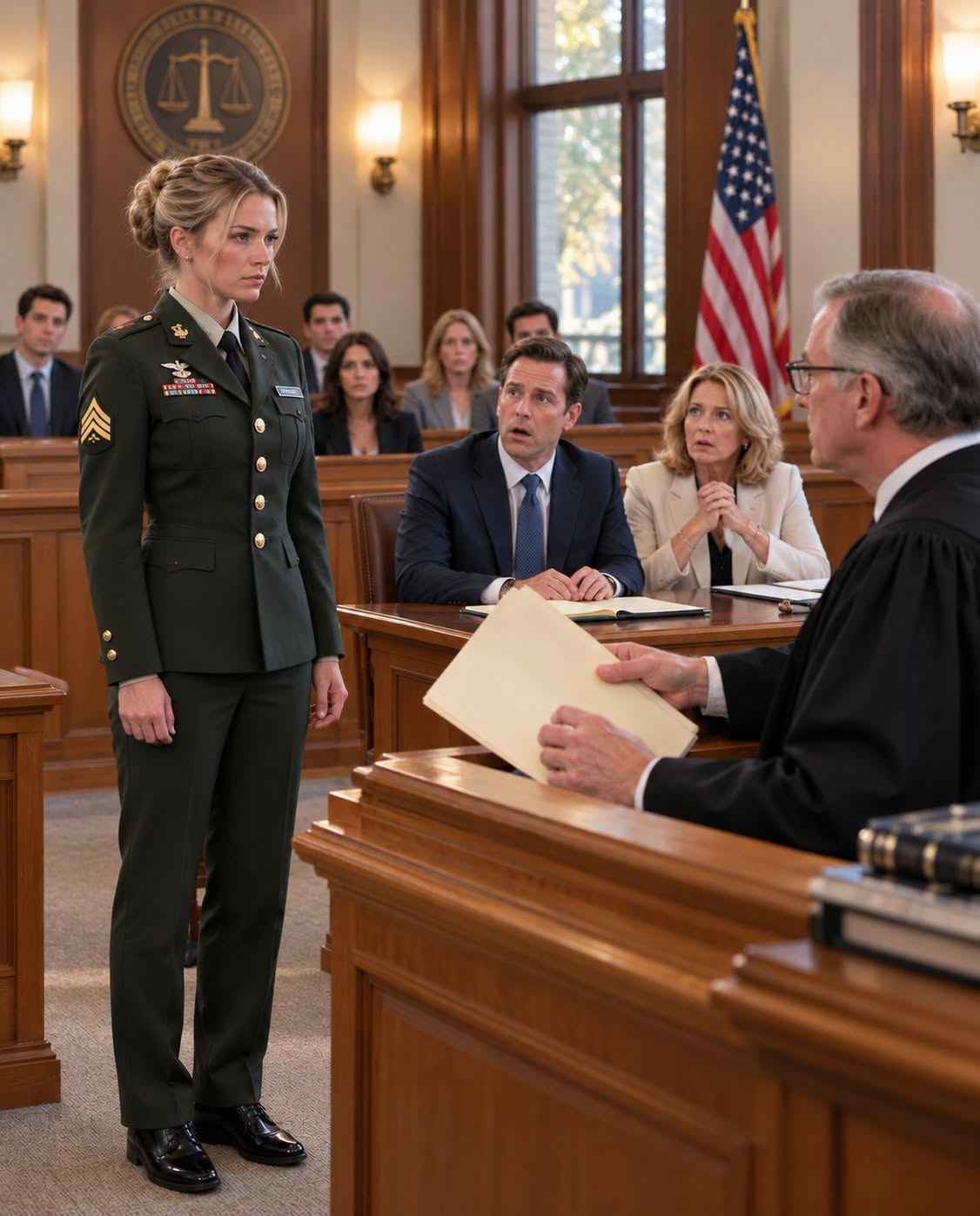
PART 1 TITLE: The Court Summons Waiting at My Grandfather’s Farmhouse Carried Two Familiar Names and an Accusation That Threatened Everything He Had Left Me
The first indication that someone intended to take my grandfather’s farmhouse came on a damp November morning, while I was cutting dead branches from the azaleas beside the front path. Knox, my old black dog, had been sleeping in the grass, his muzzle resting between his paws. He raised his head before I heard the vehicle. A white postal van rolled to a stop beside the cedar fence, and the carrier climbed out with an envelope that required my signature. I recognized the court seal before I recognized the handwriting beneath it. By the time I reached the third paragraph of the enclosed petition, I knew that my parents had finally found a way to threaten the only place where I had ever felt entirely at home.
The envelope contained eight pages, numbered and fastened together at the upper left corner. Across the first page, beneath the official heading of the Portsmouth court, appeared Case 4238B. Robert Carter and Margaret Carter were named as the plaintiffs. I was the defendant: Commander Evelyn Carter, United States Navy. My father and mother were asking the court to award them ownership of the farmhouse and authorize the division of the surrounding land. Their argument rested on a single accusation. During my years of military service overseas, they claimed, I had abandoned the property and surrendered my right to keep it. The wording was dry and formal. Its meaning was unmistakable.
I read the petition twice while standing beside the garden path. Cold moisture had darkened the gravel around my boots, and the pruning shears were still hanging from two fingers of my right hand. According to the document, I had been absent from Cedar Lane for nine consecutive years. My parents maintained that they had preserved the property, managed its obligations, and acted as its rightful caretakers while I pursued a military career that kept me away from Virginia. They had even described my grandfather’s decision to leave the farmhouse to me as an arrangement that no longer reflected the practical circumstances of the family.
Knox approached and pressed his shoulder against my leg. I lowered one hand to his neck without taking my eyes from the paper. My reconstructed right knee had begun its familiar ache, the kind that settled deep beneath the joint whenever cold weather moved in from the river. I had learned to tolerate that discomfort without much thought. What I had not learned was how to read my parents’ names on a legal accusation and feel nothing. Their signatures were waiting at the back of the petition. Neither had contacted me beforehand. Neither had asked whether I was willing to discuss the farm. They had chosen a courtroom before choosing a conversation.
The house stood a short distance behind me, its pale wooden siding weathered by decades of salt air drifting inland from the Elizabeth River. It had been built in the 1920s, long before my father acquired his polished shoes, expensive watches, and conviction that anything old ought to be replaced by something more profitable. Its porch leaned slightly toward the western meadow. Two windows needed fresh putty, and the upstairs hall was always colder than the rest of the building. Yet every uneven floorboard had a history I knew. My grandfather, Thomas Carter, had spent much of his life keeping those walls standing. He had taught me that caring for a place meant more than appearing there when someone was watching.
I carried the petition into the kitchen and spread it across the old oak table. The kettle stood beside the stove, exactly where I had left it after breakfast. I filled it with water and turned on the burner, then sat down to examine the allegations in order. The document presented my years abroad as evidence against me. There were references to long deployments, missed family gatherings, and limited physical presence on the land. Nothing acknowledged the property taxes I had paid from my Navy accounts. Nothing mentioned the repair bills I had covered when storms damaged the roof or the money I had transferred to keep the house insured.
For several minutes, I studied the phrase describing my absence as voluntary abandonment. That word troubled me more than the others. I had left Virginia under military orders, not because I had grown tired of the farmhouse. There had been deployments when I could barely tell anyone where I was stationed, much less return home to inspect a leaking gutter. I had spent years accepting that service would cost me birthdays, holidays, and ordinary afternoons. Now my parents were trying to make those sacrifices look like evidence of negligence. Somewhere inside their legal argument, the difference between leaving and being sent away had been deliberately erased.
My grandfather had understood that difference. When I was younger, he never asked why I wanted a life beyond Portsmouth. He was interested in whether I understood what such a choice would demand. I remembered sitting beside him on the porch after an afternoon repairing the fence near the eastern boundary. He had handed me a glass of water, pointed toward the pasture, and asked what I would do if the work I chose kept me away from everything familiar. I had told him I would come back whenever I could. He had considered that answer before telling me that a person could be absent from a place without ceasing to belong there.
The kettle began to whistle. I poured water over a black tea bag and carried the mug to the corner desk, where an old brass lamp stood beside my grandfather’s writing box. Then I took out my phone and called Daniel Vance. His office was on High Street, not far from the municipal records building. He had handled property matters in Portsmouth for years, and he knew enough about my grandfather’s affairs to understand why I was calling before I finished explaining. Nevertheless, he asked me to read the court number aloud. I told him it was 4238B.
Daniel went quiet. I heard a chair scrape against the floor on his end of the call, followed by the faint sound of papers being moved. When he spoke again, his manner had changed. He told me not to telephone my parents, not to sign anything, and not to leave the original petition unattended. Then he asked me to meet him behind the public library in twenty minutes. I asked whether he believed the lawsuit could succeed. He answered that the danger depended on what my parents had already filed, what remained in the county archives, and what the court had been told about the original deed.
I placed the summons inside a waterproof document pouch, locked the kitchen door, and told Knox to stay. He followed me as far as the hallway, where he stopped and watched while I pulled on my coat. Outside, the sky had lowered over the fields. I drove along Cedar Lane, passing the familiar stretch of pasture where my grandfather used to keep his tractor and the low stone boundary that separated his property from the neighboring lots. Nothing appeared different. Yet I found myself noticing every survey marker and fence corner, as though they had suddenly become objects someone might remove while I was looking elsewhere.
Downtown Portsmouth smelled of wet pavement, diesel exhaust, and river mud. Daniel was waiting beside a dark blue sedan in the municipal parking lot behind the library. He wore a wool coat over his suit, and his round spectacles had gathered a fine mist from the cold air. He did not begin with condolences or an expression of surprise. He held out his hand for the paperwork. That was one reason I had called him. Daniel did not waste time performing outrage when something useful needed to be done. He read the first page, then the second, pausing at the paragraph describing my grandfather’s transfer of the farmhouse.
He asked who had signed the emergency land access authorization issued in 2013. I told him that my grandfather had signed it shortly before his death. Daniel turned several pages, searching for a reference I could not see. When he found it, he frowned and read the heading again. He explained that the petition had been directed into a proceeding where Judge Harold Simmons was expected to preside. I knew the name. Simmons had served in the Navy legal corps before joining the bench, and Daniel described him as a man who paid particular attention to military service records and historical property instruments.
That information ought to have reassured me. Instead, Daniel’s expression suggested we had uncovered a complication rather than an advantage. I asked why the identity of the judge mattered so much. He said Simmons would insist on proper evidence, which was good for us, but that the court might also look closely at documents my family had treated as settled for more than a decade. My parents were not simply asking to remove my name from an ordinary household deed. Their claim reached back to the arrangements my grandfather had made while I was still serving overseas. If the old records were incomplete, someone could attempt to exploit the gap.
Daniel folded the petition and handed it back. We had less than three weeks before the hearing scheduled for December fourteenth. His first concern was the county’s historical tax ledger. If the petition said my parents had maintained the farm, the public payment record would either support that claim or contradict it. He wanted the original entries, not merely a modern computer summary that might omit the source of older transactions. We left the parking lot together and walked toward the Portsmouth Municipal Building, where the basement archives were open until five.
The records room occupied a cold section of the building beneath the main offices. The corridor smelled of damp concrete, aging paper, and floor cleaner. Behind a glass partition sat Clara Potts, a senior records employee whose patience was matched by her unusual attention to detail. Three yellow highlighters lay in a straight row beside her keyboard. She adjusted them before acknowledging us. Daniel greeted her as someone he had known for years and asked for the historical property ledger covering the Cedar Lane farm. Clara considered the request, then reached into a steel cabinet behind her chair.
She returned with a thick blue binder and opened it on the counter. The pages contained columns of dates, parcel descriptions, payment references, and handwritten corrections. Daniel moved closer, using the capped end of his pen to follow a line across the paper. Clara explained that the computer records covered the more recent payments, while older entries had been transferred from physical books. She was willing to show us the public ledger, but some supporting documents were held separately. I asked whether those documents concerned my grandfather’s property. She looked down at the binder before answering.
I gave Clara the case number. Her hand stopped halfway through turning a page. She checked the printed reference on the petition, then looked at Daniel. The court filing, she told us, had arrived from the clerk’s office earlier that morning. Before she could explain further, a heavy door opened near the elevators. A silver-haired man stepped into the lobby carrying a black leather folder. Daniel straightened. He identified the man quietly as Judge Simmons. The judge recognized Daniel and approached the counter with the reserved manner of someone who preferred not to invite unnecessary conversation.
Simmons made a brief remark about Daniel working late, then glanced at the open ledger. His eyes moved toward the petition lying beside it. I saw him read the case number. The change in his face was small but unmistakable. His right hand tightened around a silver pen. For an instant, the pen trembled against the edge of the wooden counter. Then he returned it to his coat pocket, wished Daniel a good evening, and walked toward the side exit. I watched the door close behind him. Whatever had disturbed him, he had chosen not to explain it.
Daniel noticed the same thing. Neither of us spoke until Clara returned her attention to the binder. She turned several pages and pointed to an entry dated October 2013. The handwritten description referred to emergency land access authorized by special decree. According to the ledger, the authorization had been granted when my grandfather’s final property arrangements were being processed. I remembered signing routine military documents that year, but I had no recollection of a special decree connected with the farm. Daniel asked to see the signature page. Clara shook her head and pointed toward the secured section of the archive.
The signed original was not kept with the ordinary ledger. It had been placed in vault locker four, along with other restricted historical property documents. Clara explained that those records could not simply be withdrawn at a lawyer’s request. A written judicial authorization would be required. Daniel asked whether the original sealing authority could also approve access. Clara said that was possible, depending on the document and its restrictions. When I asked who had authorized the seal, she did not answer immediately. Instead, she closed the binder and studied the red-stamped docket number lying on the counter.
The brass clock above the records window struck five. Clara gathered her highlighters, put them away, and announced that the office was closing. Daniel did not argue. We left through the main entrance into a street washed with yellow light from the lamps. At his car, he told me to search my grandfather’s papers for anything dated between 2012 and late 2013. Tax slips, escrow confirmations, trust correspondence, handwritten notes—he wanted all of it. He also intended to file his appearance as my attorney and prepare requests for certified banking records. Before opening his car door, he asked one question I had not expected.
Had my father ever mentioned an arrangement involving the courthouse archives before filing the lawsuit? I thought about the occasions when Robert had dismissed my grandfather’s decisions as outdated or impractical. He had complained about the deed, the farm’s upkeep, and the possibility of development, but he had never mentioned a sealed document. I told Daniel that my father spoke as though the land had always belonged to the family collectively. Daniel considered that answer and said we should be careful about accepting any informal explanation Robert might offer. The petition was already sworn testimony. Everything from that point onward needed to be treated as evidence.
Driving home, I kept remembering Judge Simmons’s reaction. He had looked at the case number for only a moment, yet something about it had unsettled him. I wondered whether he remembered my grandfather or recognized the old emergency decree. Portsmouth had a long memory for property disputes, particularly when families had owned the same acreage for generations. But the records room had shown me something that the lawsuit had not mentioned at all: an authorization whose original signature was locked away, and a judge who appeared to know more about the file than he wished to say.
Knox met me at the porch when I returned. The house was unheated in the hallway, and the floorboards creaked beneath my boots as I crossed toward the kitchen. I set the court papers beside my grandfather’s lamp and opened the lower drawer of his desk. There were faded receipts, old letters, and several notebooks bound in dark blue cardboard. I knew I could spend the entire night searching and still miss what mattered. Instead of turning everything over at once, I carried the notebooks to the kitchen table and began arranging them by year. Outside, wind moved through the cedars along the fence.
The final document I examined that evening was not a tax record. It was a yellowed note in my grandfather’s handwriting, tucked inside the cover of a household account book. It contained an ordinary reminder about an appointment at the municipal office, followed by a reference to land papers placed under special protection. The writing was brief, and there was no explanation of what had been protected or why. I sat with the note beneath the kitchen lamp, listening to the furnace cycle on. My parents were demanding ownership of Cedar Lane, but my grandfather had apparently taken precautions years before either of them filed suit.
I put the note in the document pouch and checked the locks before going to bed. The next morning I intended to find out exactly what the county held in its records. I had no reason yet to suspect how much my father knew about those old arrangements. I only understood that the lawsuit had begun long before the postal carrier appeared at my gate. Someone had been preparing the ground for it, and the first evidence of that preparation was waiting in a locked municipal vault.
END PART 1
PART 2 TITLE: My Father Arrived Carrying a Ladder and a Convenient Explanation, but the Bank Records Beneath My Grandfather’s Desk Told Another Story
The ladder struck the porch railing shortly before nine the following morning. I was standing in the kitchen with an open account book when the metallic noise made Knox rise from his rug. Through the window, I saw my father crossing the yard in a dark coat, an aluminum extension ladder balanced against his shoulder. Robert Carter had always known how to make an entrance seem ordinary, especially when he was doing something calculated. He placed a clipboard on the porch bench, looked up toward the roof, and called a greeting as though he had not just asked a court to take my home.
I stepped outside without inviting him in. The grass was still wet, and water dripped from the gutter above the eastern window. My father wore brown trousers pressed sharply down the front and the gold watch he adjusted whenever a conversation failed to follow his expectations. He examined the shingles while announcing that a few appeared loose after the recent rain. His voice carried the easy authority he used with tradesmen, bank clerks, and church acquaintances. For a moment, he seemed prepared to discuss roof repairs and nothing else. I asked him why he had filed Case 4238B.
He lowered his clipboard without meeting my eyes. He said he and my mother were protecting the family property, which required somebody to take responsibility. I told him the petition sought ownership, not permission to repair a roof. He dismissed the distinction as legal terminology that should not concern me. According to him, the matter was a routine administrative correction made necessary by my prolonged absences. The confidence with which he explained it was almost more disturbing than the lawsuit itself. He spoke as though the court’s intervention were inevitable and my consent a formality.
I reminded him that Grandfather had left Cedar Lane to me. My father glanced toward the road, then back at the roof. He said the land had belonged to the Carter family long before I returned from the military and that I should stop confusing inheritance with responsibility. He was sixty-six, he added, while my mother was sixty-three. They could not spend their remaining years waiting for me to decide whether I wanted to behave like a permanent resident. I looked past him toward the barn and the western pasture. I had already decided. I had simply never asked his permission.
When I told him I was living in the farmhouse, he replied that a few recent months did not erase years of absence. I explained that the Navy had sent me across the Pacific and to other overseas assignments, and that my absence had been dictated by military orders. My father dismissed the explanation with a movement of his hand. A house, he said, required someone present to supervise it. I asked whether he had mistaken himself for that person because he occasionally brought a ladder into the yard. His jaw tightened. For the first time that morning, his voice lost its pleasant, neighborly weight.
He pointed toward the gutters and listed the work that needed doing: loose shingles, deteriorating window frames, a drainage ditch that had not been cleared. Each problem was real. I had already begun making repairs after moving back. What he did not acknowledge was that I had paid contractors during previous deployments, ordered supplies when he refused to communicate with me, and covered the county bills through an automatic banking arrangement. I asked how often he had looked at the property tax account. He did not answer. Instead, he said that older people understood responsibility differently from someone accustomed to living in military housing.
It was the same conversation we had been having in different forms since I was seventeen. My father believed a choice became respectable only after he approved it. When I applied to pursue a military career, he called it a passing obsession. When I completed my training, he told acquaintances that I was employed in government work without explaining what that meant. Later, when my responsibilities increased, he became more interested in why I had not married than in anything I had accomplished. My grandfather had attended to the person standing in front of him. My father preferred the daughter he imagined he ought to have raised.
My mother usually occupied the space between those two versions of me. She rarely contradicted Robert directly. Instead, she translated his anger into concern and asked me to be patient with him. If he dismissed my service, she said he worried about my safety. If he criticized my independence, she explained that he missed the family being together. It had taken me years to recognize how much effort she expected me to make while asking almost nothing of him. Now both their names appeared on a lawsuit, and her absence from the porch did not make her less responsible for it.
My father resumed his inspection, climbing several rungs of the ladder while continuing to talk. He announced that a contractor would assess the roof later in the week because a county land audit might require an updated report. I told him not to arrange work on my property without written authorization. He looked down from the ladder with open irritation. The word my appeared to offend him more than anything else I had said. Then he asked whether I intended to make every practical matter difficult. I replied that I intended to know exactly what people were doing to my house.
He came down one rung and paused. For an instant, his expression changed, not to regret but to calculation. He seemed to be deciding whether another argument would serve him better. Eventually, he said that reasonable families did not need attorneys to settle these matters. I reminded him that he had already hired one. He began to reply, then shut his mouth. The silence lasted only a few seconds, but it told me something useful: he had expected me to react emotionally to the lawsuit. He had not expected me to challenge the details.
I went inside while he was still shifting the ladder along the wall. My knee had stiffened in the cold, and I sat at Grandfather’s desk until the discomfort eased. From the lower drawer, I removed the account books I had found the night before. Several were filled with household expenditures written in Thomas Carter’s firm, slanting handwriting. Others held carbon copies of banking transactions. I had not looked through those pages in years. During my deployments, I trusted the automatic transfers to continue and Grandfather’s arrangement to protect the property. Now I needed the kind of evidence a court would accept.
The earliest statements began in 2013. Every March and September, a transfer of thirty-six hundred dollars had been drawn from my Navy Federal account and directed toward municipal obligations attached to Cedar Lane. The receipts were arranged by year, each with a small confirmation slip clipped to the upper corner. I had authorized those transactions while overseas. Sometimes I remembered the transfers only when a monthly statement arrived electronically. Sometimes I had checked them from military installations thousands of miles from Virginia. I had never imagined that one day I would need to prove that the money had been mine.
I spread the statements across the desk, placing them in chronological order. The dates carried me through assignments I had almost forgotten, periods of recovery, and deployments during which ordinary civilian life seemed impossibly distant. The money had continued moving to Portsmouth whether I was awake or asleep, on American soil or beyond it. Grandfather used to say that maintaining a house depended less on grand declarations than on doing the necessary things repeatedly. Looking at those receipts, I thought of him opening his mail at this very desk, recording each payment so that nobody would need to remember it later.
There was another reason I kept the documents carefully. After the injury to my right leg, I had spent long stretches in rehabilitation facilities where my world narrowed to corridors, treatment rooms, and the measured distance between two handrails. The farm became a destination I could picture when physical progress was slow. I imagined replacing the warped boards on the porch and trimming the trees along the fence. During those months, I was not considering investment value or resale prospects. I wanted a place where the sound of boots on a hallway floor did not mean another appointment, another evaluation, or another difficult conversation.
I placed eleven years of confirmations in a canvas pouch and drove downtown. Knox rode as far as the farm gate before I made him return to the house. The Portsmouth Municipal Building was busier than the previous afternoon. People stood in line for permits and tax inquiries, stamping moisture from their shoes onto the stone floor. Clara Potts sat behind the records counter, arranging her three yellow highlighters with the same meticulous attention I remembered. She looked at my pouch, then at my face. I told her I needed the official payment history for Cedar Lane.
Clara entered the parcel details into her computer. The payments were current, she confirmed, with no outstanding municipal tax balance showing against the property. More importantly, the source information identified transfers from my Navy Federal account. I asked whether the county had recorded Robert Carter as the person making those payments. She checked again. His name did not appear as the source of the transfers I had brought in. I felt the first genuine relief since opening the court envelope. The electronic ledger matched the records I had kept. Whatever my parents claimed, the money had a traceable origin.
Then Clara mentioned a recent manual filing. My father had appeared at the counter on November fourteenth and paid thirty dollars in cash for a duplicate title search certificate. I asked why someone who believed he had clear ownership of a property would need such a document. Clara said she could tell me what had been filed, not why. Robert had explained that he could not locate the old deed papers and wanted to confirm the chain of title. He had also asked whether the county retained trust documents associated with the farm. Clara had directed him toward the records office and explained that restricted files required additional authorization.
The date troubled me. November fourteenth was not an accidental point in the calendar. It was shortly before the court summons arrived, which meant my father had been examining the title while I was still working quietly on the farmhouse. He had not asked me for a copy of the deed. He had not mentioned any uncertainty. At breakfast that morning, he had behaved as though the entire dispute arose from his concern about loose shingles. Yet he had visited the municipal archives, asked about protected trust records, and paid for a new title search before presenting me with his version of events.
I asked Clara for a copy of the public transaction entry. She supplied the reference number and showed me where the request had been recorded. The filing identified Robert Carter as the applicant. I photographed the record with her permission and checked that the date was visible. Clara watched without comment. She had the manner of someone who knew that records could carry more meaning than the people who submitted them intended. When I thanked her, she looked at the canvas pouch on the counter and said that original confirmations were worth keeping, especially when a court was examining an older property arrangement.
That evening I met Daniel at a small coffee shop near his office. Rain had begun again, and the front windows were blurred by condensation. He placed a cardboard folder on the table while I took out the Navy statements. Before I could tell him what Clara had found, he said he had obtained a copy of my father’s sworn affidavit from the court file. It was more specific than the petition. Robert was not merely claiming to have supervised the farm. He had declared under oath that he personally paid its county obligations from his own funds beginning in 2013.
I held the affidavit beside my banking confirmations. The contradiction was plain enough that no complicated interpretation seemed necessary. Daniel read several sections aloud, checking the dates against the statements in my pouch. My father had not limited his account to vague claims of involvement. He had asserted continuous personal financial responsibility, the very thing the bank records appeared to disprove. I asked Daniel whether such a statement could simply be withdrawn once the records were presented. He said that would depend on how my father explained the payments and whether the court believed he had knowingly submitted false information.
Daniel cautioned me not to assume that a contradiction would end the case immediately. An attorney could argue that Robert had reimbursed expenses in cash, contributed to repairs, or acted under an informal family agreement. We needed certified bank information, official county entries, and the original title instruments to establish the full picture. The Navy statements were valuable, but court proceedings required documents that could survive challenges to authenticity. I understood his reasoning. In the service, the difference between what someone believed and what could be verified had sometimes carried consequences far beyond a disagreement.
I told him about the thirty-dollar title search. Daniel’s attention sharpened. He said buyers frequently requested title information before committing money to a property, especially when ownership appeared complicated. My father might have been checking for liens, secondary interests, or restrictions that could delay a sale. I asked why Robert would be searching for potential buyers when the land had not been offered for sale. Daniel did not answer immediately. He turned the counter receipt toward the light and copied its number into his notebook. Then he asked whether my father had recently mentioned developers, commercial zoning, or an assessment of the acreage.
I thought of the ladder, the proposed roof contractor, and the county audit my father had invoked on the porch. He had been unusually interested in the condition of the buildings, but he had never asked whether I intended to sell. Until that conversation, I had assumed his dissatisfaction came from a familiar need to control the family. Now I wondered whether his urgency had a financial explanation. The land had become more valuable as Portsmouth expanded and properties nearer the water attracted private investment. My grandfather had once turned away offers without even discussing their amounts. My father had never understood that decision.
Daniel placed the affidavit and the title search receipt side by side. He said the central problem was no longer simply whether I had lived at the farmhouse continuously. My father had claimed financial responsibility that my records contradicted. He had investigated title restrictions without informing me. And he was moving through the court system with unusual speed. Those facts did not yet prove a planned sale, but they gave us a reason to investigate. Daniel asked me to come to his office early the following morning so we could prepare subpoenas and examine the older trust entries.
I drove home in steady rain. The porch light illuminated the wet gravel where my father had stood with his ladder. Nothing had been repaired. The gutter still dripped near the eastern window. Inside, I laid the affidavit on the table and read its final declaration, where Robert Carter certified that the information was true to the best of his knowledge. I knew he had been aware of my financial contributions. Grandfather had discussed them with him, and the money had been transferred openly through the municipal system. The claim of ignorance would not be easy to reconcile with those facts.
Before going upstairs, I opened my grandfather’s account book to the final page. Beneath a column of ordinary household expenses, he had written a reminder to retain the original title papers separately from duplicate county records. I stared at the line until Knox nudged my hand. Grandfather had never been careless with important documents. If he had deliberately separated the originals, there had been a reason. My father had searched for those same papers only days before suing me. Whatever he hoped to find in the county archives, the sworn affidavit suggested he was willing to make a false claim to get it.
END PART 2
PART 3 TITLE: A Thirty-Dollar Title Search Exposed My Father’s Hidden Plans, While My Mother Brought a Document Designed to End the Fight Without Witnesses
Daniel Vance was already working when I arrived at his office the next morning. The windows overlooking High Street were partly open despite the cold, and a faint smell of river silt drifted into the room. Three stacks of legal pads occupied one side of his oak desk. On the other lay the documents from Case 4238B, their pages marked with narrow strips of colored paper. He was drafting our formal response to my parents’ petition. He had underlined the statements about abandonment and personally funded property maintenance, then drawn a line connecting those assertions to the financial records I had delivered the night before.
He explained that the bank statements in my possession were only the beginning. To establish an official chain of payments, he needed certified wire information from the relevant banking institutions and the state repository in Richmond. Those records would confirm when my money left the Navy Federal account and where it arrived. He also wanted copies of any deposit entries my father might cite as evidence of reimbursement. When I asked what the process would cost, he gave me the figure without hesitation: eighteen hundred dollars for the expedited records and associated evidence requests.
The amount was not insignificant. My retirement income covered the house, the utilities, and ordinary expenses, but I was still paying for repairs and had spent more on the farmhouse than I originally expected. The eighteen hundred dollars would come from savings I had reserved for winter maintenance. I took out my bank card and placed it on Daniel’s desk. He studied it, then pushed it back toward me. He would arrange the requests and bill me later, he said, but he wanted me to understand that the money might be gone before we ever appeared for a hearing. I told him to proceed.
Daniel did not congratulate me for being determined. He simply marked the decision in his notes and explained the next step. We needed to examine the original county tax registers from 2012, before the digital record system became the primary reference for most public inquiries. The difference mattered because my grandfather had established his final property arrangements during that period. If a trust, escrow instruction, or restricted deed had been recorded, it could explain why the later documents were incomplete. Daniel asked me to return to Clara Potts while he completed the banking requests.
The basement archive was colder than I remembered. Clara brought a large brass key ring from a drawer and led me past the public counter into a narrow room lined with shelves. She located a heavy canvas-bound register and carried it to a reading stand. Its pages were thick, with handwritten entries separated by ruled lines. After several minutes, she found the farm’s earlier parcel reference. An old payment had been recorded in December 2012 through an official trust escrow account. I asked whose money had funded the transaction. She said the register showed the source account, but the supporting authorization was held separately.
I leaned over the page, careful not to touch the fragile paper. My grandfather’s name appeared beside the property description. The handwriting was familiar enough to make me remember him sitting at his desk in the evenings, removing his reading glasses to examine each bank statement. He had always insisted that financial records should be understandable to someone who had not participated in the original transaction. If he had set up an escrow arrangement, he would have kept some explanation of it. Yet the public ledger carried only a reference number and a notation directing the reader toward restricted documents.
Clara moved to the far wall, where several steel lockers stood behind a heavy gate. She stopped at locker four. The brass tag identified an archived property instrument connected to the old Carter land accounts. A seal entry had been made around the same time as the 2012 escrow payment. She could show me the existence of the document, but she could not open the sealed original without appropriate authorization. I asked who had requested the restriction. Clara consulted an index sheet before answering. My grandfather’s name appeared as the property owner who initiated it. The witnessing judicial authority was Harold Simmons.
I thought of the judge standing beside the records counter, his hand trembling when he saw our case number. That reaction now seemed less mysterious. Simmons had apparently been involved with my grandfather’s property arrangements years before he was assigned to hear the current dispute. Clara would not speculate about what the document contained, and I did not ask her to. I photographed the public reference entry and wrote down the archive number. If the original was protected, Daniel would have to determine the proper way to obtain it. I left the building with more evidence that something important existed and no direct means of reading it.
My father was waiting when I returned to Cedar Lane. His gray Buick stood near the garden gate, and he had positioned himself beside my truck’s usual parking place. He walked toward me before I finished turning off the engine. Instead of carrying a ladder, he held a long legal envelope. He placed it on the hood and said it contained formal notice of a motion to divide the acreage. His attorney fees were mounting, he complained, because I refused to cooperate. I asked whether he considered filing a lawsuit against his daughter a reasonable way to request cooperation.
He ignored the question and looked toward the meadow behind the farmhouse. A representative from a private investment company, he explained, had approached him about purchasing land near the main road. The company wanted a clear title and had indicated that it could pay cash if the transaction proceeded without complications. He spoke as though he were discussing an opportunity he had generously arranged for everyone. I asked the name of the investor. He described it only as a private group interested in commercial development. When I said Cedar Lane was not for sale, he looked at me with something close to contempt.
My father said the property would become available once the court recognized who had managed the family’s affairs. I reminded him that he was not the owner. He looked toward the house, his expression tightening. He had spent his life dealing with local businesses and believed he knew how land should be used. To him, the farmhouse was a depreciating structure occupying valuable ground. To Grandfather, it had been the place where generations of ordinary work accumulated into a home. I told my father that no buyer could assume I would agree to sell. He answered that Judge Simmons would settle the ownership issue soon enough.
He returned to his Buick without taking back the envelope. I watched him drive away, then carried the papers inside. They confirmed that his legal strategy included a division of the land, not merely a transfer of the house. I sat at the kitchen table and examined the boundaries shown in the proposal. The rear acreage included the old meadow and part of the wooded ground my grandfather had refused to clear. My father had chosen the section most attractive to someone interested in development. The discovery made his interest in the roof and drainage ditch seem even less sincere.
At six that evening, my mother sent a message asking me to meet her at the Portsmouth Diner. She said she wanted to talk privately before the court proceedings damaged the family beyond repair. I considered refusing. Yet I had not heard from Margaret directly since the summons arrived, and I wanted to know whether she understood what Robert was demanding. I drove into town after dark. The diner’s windows glowed against the wet pavement, and the smell of fried onions reached me before I opened the door. My mother was seated in a corner booth beneath a yellow glass lamp.
She wore a dark blue cardigan and the single strand of pearls I remembered from countless Sunday services. A cup of chamomile tea stood between her hands. When I sat down, she studied my face and told me I looked thinner. I said I was well enough. She asked about my knee, then about the cold weather at the farm. I answered each question briefly, waiting for her to approach the reason she had invited me. Finally, she lowered her voice and said my father had been suffering from the strain of the lawsuit. People at church were asking questions, and the uncertainty was becoming embarrassing.
I asked whether she had read the petition before signing it. Her expression changed. She said she trusted my father to handle legal matters because he had always managed the family’s finances. I reminded her that he was accusing me of abandoning property Grandfather had left to me. She asked me not to make the conversation adversarial. According to her, Robert wanted a practical settlement that would protect everyone. She seemed genuinely distressed, but she spoke of his discomfort as though it were the main injury that required attention. I wondered whether she had ever noticed how often our conversations returned to his reputation.
Margaret opened her handbag and removed a folded blue document. She slid it across the table, smoothing the edge with her fingertips. It was a quitclaim deed prepared for my signature. Robert Carter appeared as the proposed recipient of my interest in the farm. My mother explained that signing it would allow them to withdraw the lawsuit and keep the matter out of public court. She called it a simple family arrangement. I read the document without touching my pen. It was not a compromise. It would surrender the rights my grandfather had deliberately left to me.
I asked what would happen to the farmhouse after the transfer. My mother said Robert had options and would make a responsible decision. I asked whether those options included selling the land to the investment group. She looked away. The pause told me enough. Margaret began speaking about my retirement income and the expense of maintaining an old house. She said I could find somewhere comfortable without spending so much effort on repairs. Then she mentioned the possibility that a public hearing would draw attention to the years I had spent away from my parents. Her concern was no longer simply the property.
I looked at the blue document lying beside my unused napkin. My mother had brought it into the diner expecting me to sign because I wanted to avoid conflict. She knew I had often withdrawn from arguments rather than endure another evening of accusations and wounded silence. But those earlier choices had involved family dinners and holiday plans. This was my home. I told her I would not surrender it. She reached across the table, then stopped when she saw that I had already moved my hands away. She asked whether I understood what a public dispute would do to our family’s standing in Portsmouth.
I stood carefully, placing my weight on my left leg before straightening the right. The diner was warm, but a sharp ache ran through my knee. Margaret watched me, her eyes shining with tears she had not yet allowed to fall. I told her the lawsuit would end sooner if she and my father withdrew their false claims. She said that would be difficult now that attorneys were involved. I reminded her that they had hired those attorneys. Then I left the blue deed on the table and walked out into the rain. My tea remained untouched.
The following week, Daniel and I went to the courthouse to file his formal appearance and submit our initial response. He assured me that the administrative visit should be brief. We were standing near the clerk’s window when my father entered the building with my mother following behind him. He wore a navy blazer with polished brass buttons and carried a narrow black binder. He saw us immediately. Instead of approaching quietly, he began telling the clerks that he had supported the farm for years while his daughter lived at government expense overseas. His voice echoed across the marble hallway.
Two deputies near the security station looked in our direction. Several people waiting for records stopped speaking. My father pointed toward me and announced that wearing a military uniform did not establish property ownership in Virginia. I had not worn my uniform that morning, but the remark served his purpose. He wanted an audience. Daniel told him we possessed certified evidence of payments from my accounts. Robert dismissed the statements, saying that electronic transfers did not prove who had ultimately paid the expenses. My mother stood behind him twisting her pearls, refusing to meet my eyes.
We were directed into a narrow conference room for a preliminary legal discussion. My parents’ attorney, a tall man named Henderson, sat opposite Daniel and arranged several documents in a precise line across the table. Daniel presented the payment records and asked Henderson to explain the affidavit claiming Robert had paid everything himself. Henderson said my father had reimbursed Grandfather in cash before his death. He described the payments as a private family practice rather than a conventional banking arrangement. When Daniel asked for evidence of those reimbursements, Henderson said the necessary records would be produced at the main hearing.
I examined my father across the table. His forearms rested on the polished laminate, and his thumb repeatedly touched the clasp of his gold watch. He said the family members who remained in Portsmouth had carried the responsibilities of ownership while I lived elsewhere. Daniel asked how Robert could have reimbursed Grandfather for payments made years after Grandfather died. My father began explaining that some arrangements had continued informally. Henderson interrupted and redirected the discussion toward long-term occupancy and management. The answer was unsatisfactory, but it revealed something important: their financial claim was becoming difficult to maintain without changing its meaning.
The meeting ended without a settlement. Henderson repeated that his clients intended to pursue their motion based on alleged abandonment and longstanding family control. Daniel preserved our objections and gathered the documents. As we walked toward the main hallway, I saw Clara Potts standing near a water cooler. She held a small square of carbon paper. She waited until my parents and Henderson had turned toward the stairwell before approaching us. Her manner was as restrained as ever, but she seemed determined to give us information that had not appeared in the ordinary title summary.
The carbon copy concerned my father’s thirty-dollar filing. Clara explained that it had included more than a request for a duplicate title search. Robert had also signed a formal statement claiming the original property documents had been destroyed in a house fire during 2011. The statement allowed him to seek replacement documentation through the county’s administrative process. Daniel took out his notebook and copied the receipt reference. I read the declaration twice. There had been no house fire at Cedar Lane in 2011. I remembered that year clearly. My grandfather had written to me about painting the kitchen and repairing a broken window.
Clara confirmed that the original deed had not been destroyed. The relevant instruments remained indexed in the municipal archives, with protected materials associated with locker four. My father had therefore represented an existing document as lost while attempting to obtain a replacement. Worse, the false statement had been signed before official witnesses. Daniel thanked Clara and asked what additional records could establish the circumstances of the application. She explained the procedure, then returned to her counter without offering an opinion about my father. She had done what a careful records employee was supposed to do: she had shown us what the documents said.
Outside the courthouse, Daniel stopped beneath the stone entrance and examined his notes. The November title application, the sworn tax affidavit, and the invented house fire now formed a troubling sequence. Robert had searched for documents he did not control, misrepresented the status of the originals, and sought legal ownership while negotiating with a potential buyer. Daniel said we still needed the historical trust instrument to understand the full significance of those actions. If Grandfather had restricted the transfer of the land, the attempted replacement certificate could be more than a procedural irregularity.
I looked back through the courthouse doors. My father had told clerks, lawyers, and anyone willing to listen that he was merely restoring proper family ownership. Yet the records described something else: a man trying to change the legal story of a property before its rightful owner could examine the evidence. The invented fire removed any remaining possibility that he was simply confused about old paperwork. He knew the original documents existed. He had chosen to claim otherwise. Before Daniel drove away, I told him I wanted every archived entry connected with Grandfather’s 2012 transfer, including the document sealed under Judge Simmons’s authority.
END PART 3
PART 4 TITLE: The County Ledger Pointed Toward a Locked Archive, but the Most Dangerous Evidence Had Been Waiting in My Attic All Along
Daniel had two thick volumes of Virginia property law open when I arrived at his office the following morning. His coffee had gone cold, and several pages were marked with pencil. He did not ask whether I had slept. Instead, he indicated a section concerning property interests protected while a beneficiary was serving on active military duty. He believed my grandfather’s 2012 arrangements might have placed Cedar Lane under a form of protective trust administration. If that was true, my father could not simply convert my military absence into proof that I had relinquished ownership. The argument was promising, but Daniel warned that a promising argument still needed an authenticated document.
I reminded him that the original papers were secured in the municipal archive. He said that the public deed, the tax records, and the sealed trust materials had to be considered separately. A payment entry could establish that an account existed. A recorded deed could establish the transfer of a property interest. The trust instrument would explain whether any person had the right to alter that transfer. Without knowing its precise terms, he did not want to promise that Judge Simmons would reject the petition. I asked whether we could obtain the missing pages before December fourteenth. Daniel closed one of the law books and said we should return to the archive immediately.
Clara Potts recognized us as soon as we entered the municipal building. She was arranging her usual three highlighters beneath the glass partition. When Daniel requested the 2012 land trust index, she removed a ring of brass keys from the drawer and led us down to the older storage rooms. The corridor narrowed near a heavy steel door, and the air grew colder as we descended. Inside, gray shelving rose almost to the exposed pipes. Clara selected a dark green volume from a row of canvas-bound books and laid it on a wooden table beneath a bare overhead light.
The register contained handwritten entries from the period immediately preceding my grandfather’s final illness. Clara found the relevant section near the back. Thomas Carter’s name appeared beside the Cedar Lane property description, followed by a trust account reference and a date in late autumn 2012. Daniel read the entry, then checked a number written in the outer margin. It directed the reader to a secondary document describing the owner’s intentions. The notation had been entered before Grandfather suffered the stroke that eventually left him dependent on others. I leaned closer, trying to read the small handwriting without placing my fingers on the page.
Clara explained that the county had retained the index reference but not an unrestricted public copy of the supporting statement. The original authorization was associated with the sealed archive, while any personal copy Grandfather had kept would have remained among his private papers. Daniel asked whether Robert had examined this particular ledger during his earlier visit. Clara checked the request history and said he had purchased a standard title summary. He had not paid for the deeper historical search. I understood why the distinction mattered. My father had looked for obstacles to a sale, but he had apparently stopped short of examining the evidence that could explain those obstacles.
I asked whether the county could tell us what the secondary statement said. Clara shook her head. The index identified the existence of the document and its relationship to the trust, not its full contents. She also explained that the archived authorization had been restricted at the request of the original property owner. The court official who witnessed the arrangement was listed as Harold Simmons. Daniel wrote down the complete reference number. He wanted to obtain a judicial release or locate an authenticated counterpart. I told him that Grandfather’s desk contained receipts and ordinary correspondence, but nothing matching the description of a separate trust statement.
Daniel asked whether I had searched the attic. I said I had not. The suggestion seemed obvious only after he made it. Grandfather had kept papers in the study, but he had also stored family belongings upstairs, especially things he did not expect to need regularly. When his health failed, relatives had moved some of his possessions into boxes. I remembered that process vaguely because I had been overseas and had received only a few brief updates. My father had supervised much of the practical work. Until now, I had not considered that important documents might have been moved without being destroyed.
I drove back to Cedar Lane beneath a sky darkening with approaching rain. Knox was waiting at the kitchen door. I took a flashlight from the drawer, checked the folding attic stairs, and climbed carefully, placing most of my weight on my left leg. The old boards complained beneath my boots. Dust lay thick over boxes of Christmas decorations, unused furniture, and stacks of sheet music that had belonged to my grandmother. The attic smelled of dry timber and cloth that had spent years in darkness. I had avoided it since returning home because every object seemed to belong to a part of my family I was not yet ready to examine.
Near the far wall, beneath a canvas covering, stood an olive-green military storage chest. My old Navy sea bag was folded beside it. I recognized the chest immediately. Grandfather had kept it for me while I moved between assignments, and I had forgotten that it was still upstairs. The combination lock resisted my first attempt before the mechanism turned. I raised the steel lid and caught a familiar smell of wool, metal polish, and old canvas. My dress uniform lay folded beneath a protective sheet. A velvet presentation box containing service medals rested on top of it.
Beside the medals was a triangular folded service flag preserved beneath clear protective wrapping. A small identification tag bore the name Lewis Vance. I sat back on the floorboards and held the flag in both hands. Lewis had died during an operation that ended with an explosion and left consequences none of us who survived could entirely set aside. I did not need to close my eyes to recall fragments of that day. The abrupt violence, the cold spray near the water, and the terrible silence afterward remained distinct. My right knee carried a physical reminder. Lewis’s flag carried something harder to explain.
For years, I had kept the flag among my belongings because placing it anywhere else seemed wrong. It was not mine in the way a personal award was mine. It represented a life interrupted and responsibilities that continued after the official reports were complete. I had sometimes wondered whether returning to the farmhouse would allow those memories to settle into a quieter place. My grandfather had believed work could help a person regain a sense of order. Perhaps that was why I had spent so many mornings repairing fences and clearing branches. Ordinary tasks asked only that I finish what was in front of me.
I returned the flag carefully to the chest and lifted out a stack of deployment records. Beneath them, tucked into the seam of the interior lining, I felt the stiff edge of a folder. It was cream-colored and bound with a faded ribbon. I pulled it free and carried it toward the attic window, where the remaining daylight was stronger. The first page bore my grandfather’s full name, Thomas Carter, and a date: November fourteenth, 2012. Three pages followed, each carrying his distinctive signature. There was also a raised official seal near the bottom of the final sheet.
I read the document slowly. It was a formal statement of trust intent connected to the farmhouse and surrounding acreage. It identified me as the sole irrevocable beneficiary and specified that my right to the property was not contingent on continuous physical residence. My grandfather had expressly contemplated my military service and the possibility that assignments would keep me away from Virginia for long periods. The statement directed that the property remain protected for my benefit despite those absences. Its language was clearer than anything my parents had represented in their petition. They were claiming I had abandoned something Grandfather had deliberately protected against that very accusation.
Then I reached the paragraph concerning Robert Carter. My grandfather had barred his son from acquiring title to the property under the trust. The document gave a reason that made me stop reading. In 2009, Robert had taken thirty thousand dollars from Grandfather’s savings without authorization. The statement treated that conduct as grounds for excluding him from future control over the land. I read the amount again, then examined the date. This was not a vague complaint or a warning inserted during an argument. Grandfather had recorded a specific financial betrayal in a notarized document prepared for the protection of his estate.
For several minutes, I remained seated beneath the attic window with the papers spread across my knees. I had known that my father and grandfather disagreed about money, but I had never understood the extent of their conflict. Robert often accused Thomas of being stubborn about property and savings. He said Grandfather distrusted modern investments and preferred to leave money idle rather than allow someone younger to make sensible decisions. I had assumed the arguments involved differences in temperament. The document suggested something much more serious. My father had once taken money he had no right to use, and Grandfather had decided that the land must never fall under his control.
I remembered a dinner during one of my visits home when my father had complained about the farm’s expense. Grandfather had listened without interrupting, then asked Robert to stop discussing the property as though it were already his. The exchange had been brief, but the room grew uncomfortable. My mother changed the subject and began clearing plates before anyone finished eating. At the time, I thought Grandfather was reminding his son to respect an older man’s independence. Now I wondered whether he had been drawing a boundary after discovering the missing money. His refusal to surrender control had not been ordinary stubbornness. It had been informed by experience.
Another memory followed. Shortly before his final illness, Grandfather wrote to tell me that he had reviewed his papers and settled a few things that had troubled him. He did not explain, saying only that the farm would be waiting whenever my work allowed me to return. I had replied from overseas, promising to visit as soon as my orders permitted. The visit did not happen before his condition deteriorated. I had carried that regret for years. Holding the trust statement, I realized he had been doing more than reassuring me. He had prepared a legal safeguard because he knew I might not be present to defend myself.
I gathered the papers and carried them downstairs. Knox followed me into the study, where I laid the document beneath the brass lamp and examined each signature. The raised seal appeared genuine, and the pages carried consistent dates and references. I photographed them, placed the original in a protective folder, and called Daniel. When I told him what I had found, he asked me to read the title of the document and the date of execution. After hearing the final paragraph, he told me to bring it directly to his office. I did not describe the thirty-thousand-dollar accusation over the telephone. I wanted him to read it himself.
Daniel was working in the legal archive behind the High Street library when I arrived. He moved two law journals aside and examined the document in silence. He read all three pages, turned back to the first, then checked the signatures against the public references we had copied. His expression became increasingly serious. He explained that the statement directly contradicted the central premise of my parents’ case. Grandfather had not merely intended to leave me a house. He had created an arrangement meant to preserve my interest while I served overseas. Robert’s claim that my absence invalidated the transfer was therefore inconsistent with the very purpose of the trust.
I asked whether that meant the lawsuit was finished. Daniel put down the pages and removed his glasses. The answer, he said, was not quite that simple. Although the document was notarized and linked to an official county index, its status as a separately recorded instrument could become an issue. Henderson might object that an intent statement could not alter the terms of the main deed or that the private copy required additional authentication. The legal significance was substantial, but it still had to be established through proper procedure. Daniel would prepare the necessary filings and seek the supporting archive records.
He examined the raised seal on the final page again. The witnessing official’s signature appeared to be connected with Harold Simmons. Daniel said the judge might recognize the old instrument, but we could not assume he would accept it without a proper evidentiary foundation. His previous involvement could also raise questions about whether he should hear the matter. I asked whether Simmons’s reaction at the municipal counter now made sense. Daniel said it might, but he would not build our defense around a judge’s facial expression. He wanted certified documents, verifiable payment histories, and the strongest available proof of Grandfather’s intentions.
Then Daniel did something unexpected. He opened the billing sheet on his desk, found the entry for the eighteen-hundred-dollar evidence expense, and drew a line through the amount he had planned to charge me. He said he would reduce his fee to nine hundred dollars and allow payment after the hearing. I asked why he was willing to do that. He explained that his father had known my grandfather, and the older men had respected each other despite their differences. Daniel believed the papers showed that Thomas had anticipated a conflict and tried to spare me from it. He wanted to help ensure that intention was not defeated by an incomplete archive or a misleading affidavit.
I thanked him, but the reduction did not bring much relief. The discovery had altered the dispute in a way I was still trying to understand. My father was no longer merely a man seeking to take property he believed should belong to him. Grandfather’s document described someone who had already violated financial trust and been excluded for that reason. Robert had then attempted to obtain replacement title paperwork while pursuing a buyer. I could not know exactly what he remembered about the 2012 arrangement, but I suspected he understood more than he had admitted. Daniel told me to keep the original secure and not confront my father with it before the hearing.
I returned home as evening settled over the farm. I placed the document in a locked drawer in the study, then brought Lewis’s folded flag downstairs and set it on the desk beneath the lamp. The house was quiet except for the furnace and Knox moving between the kitchen and hallway. I had just begun preparing tea when someone knocked on the front door. Through the glass, I saw my mother holding a blue casserole dish wrapped in a towel. My father stood behind her with his coat collar raised against the wind. I considered leaving them outside, but I opened the door.
Margaret stepped into the hallway carrying the smell of green beans and baked onions. She said she had made a dish I liked when I was younger and hoped we could eat together. Robert followed, removing his gloves as though he were visiting on an ordinary Sunday. They settled in the living room before I had agreed to any discussion. My mother placed the casserole on a side table and began telling me how exhausting the lawsuit had become. She wanted everyone to stop fighting before December fourteenth. She spoke softly, repeatedly looking toward my father for reassurance that she was saying the right thing.
I told her the case could end whenever they withdrew their petition. Robert sat down at the head of the oak table and said the matter was more complicated than I understood. He insisted that the farm had to support the family’s future, not simply preserve my grandfather’s memories. Margaret offered a compromise: if I transferred half the acreage, they would drop the lawsuit and negotiate a sale of the rear parcel. She said we could keep the farmhouse standing and still benefit financially. The proposal was presented as generosity. Yet it required me to surrender property I already owned in exchange for the promise that my parents would stop trying to take it.
I asked my father whether he had told the proposed buyer that he did not hold title. He looked toward the framed river print above the mantel and said the investor understood that some administrative details remained unresolved. I asked whether the company had seen the deed. He said that was a matter for attorneys. Then he reached into his jacket, removed a blue checkbook, and laid it flat on Grandfather’s table. He offered to transfer fifty thousand dollars to me by Friday if I agreed to release my claim to the disputed acreage. He described the payment as compensation that would allow me to move forward comfortably.
I examined the checkbook without touching it. Fifty thousand dollars was a substantial amount, particularly from a man who had complained about mounting legal fees and the financial burden of maintaining the farm. I asked where the money would come from. Robert said he held private investments and that his personal finances were none of my concern. I reminded him that he had told his attorney he was struggling to cover the expenses associated with Cedar Lane. He replied that Daniel Vance was a provincial lawyer who understood little about serious investment arrangements. My mother reached across the table and urged me not to turn a family opportunity into another argument.
I asked one final question. If he had paid Grandfather back in cash for all those years of property expenses, where were the deposit records? Robert looked down at his hands. He said that older family arrangements had not always been documented and that Grandfather trusted him to settle accounts privately. I thought of the thirty thousand dollars mentioned in the trust statement. Grandfather had trusted his son once, and the result had been serious enough for him to exclude Robert from the property. I kept that knowledge to myself. I wanted the evidence examined in a setting where neither anger nor family pressure could determine what happened to it.
My mother was crying by the time they left. She asked whether I was truly willing to let strangers in a courtroom examine our family’s private affairs. I told her that privacy had been available before she and my father signed their petition. Robert closed his checkbook, put it back in his jacket, and walked toward the door. The casserole remained on the side table, untouched. From the porch, he warned me that the December hearing would be unpleasant if I continued refusing his offer. I watched his car disappear beyond the cedar fence. The house felt colder after they were gone, but I no longer felt uncertain about my decision.
I returned to the study and placed Grandfather’s trust statement beside the court summons. The difference between them was remarkable. One document attempted to turn years of military service into abandonment. The other had been written specifically to prevent that interpretation. One relied on my father’s unsupported declarations of financial responsibility. The other recorded a history he had never disclosed to me. I considered how carefully Grandfather had arranged the papers, protecting them through years when I could not be present. He had not expected me to fight this battle without evidence. He had left me the means to discover what had happened.
Before going to bed, I called Daniel and told him about the fifty-thousand-dollar offer. He asked whether my father had put it in writing. I said he had not, but Margaret had heard the proposal and the checkbook had been displayed during our conversation. Daniel made a note. The offer, he said, reinforced the possibility of a pending commercial transaction, although we would need further documentation to establish its terms. He advised me to preserve my account of the meeting and avoid any private settlement discussions before the hearing. I agreed. There was nothing left for my parents and me to negotiate across a kitchen table.
On the desk, Lewis Vance’s folded flag rested beside Grandfather’s papers. I looked at both for a long time before switching off the lamp. During my years in uniform, I had learned that duty could require a person to act despite the consequences of being misunderstood. I had never expected that lesson to follow me into a dispute with my own parents. Yet the decision before me was clear. The judge needed to see the transfers, the false statements, the hidden trust, and the evidence of why Grandfather had excluded his son. Keeping the farmhouse was no longer the only question. I had to decide whether I was willing to expose the truth about my father in public. I already knew the answer.
END PART 4
PART 5 TITLE: The Evidence My Father Never Expected Me to Find Was Hidden in Eleven Years of Payments and One Dangerous Signature
Daniel Vance looked at the bank confirmations spread across his desk and took off his glasses. He had been quiet for nearly a minute, which worried me more than any legal warning he could have given. Outside his High Street office, tires hissed against wet pavement. The morning rain had settled into the kind of fine coastal mist that seemed to pass through clothing rather than land on it. Finally, he touched the corner of my father’s sworn affidavit. “Evelyn, this is no longer simply a disagreement about who should own the farmhouse.”
I knew what the document said. Robert Carter had declared under oath that he and my mother had personally carried the financial burden of maintaining the Cedar Lane property during my years of military service. He claimed that I had disappeared, neglected the land, and left him responsible for expenses he could no longer reasonably bear. The language was polished and impersonal. It might almost have sounded convincing if I had not spent the previous evening counting eleven years of payments from my own accounts.
“How much will it cost to prove the transfers?” I asked. Daniel turned a yellow pencil between his fingers. “Eighteen hundred dollars for the expedited certified records and the related requests. Possibly more if we need testimony from the banking repository.” I looked at my right knee, which had begun aching during the drive. The money was not impossible to find, but I knew exactly how many repairs were waiting at the farmhouse. The porch needed reinforcing. Two upstairs windows leaked whenever the wind turned east. The heating system was surviving on maintenance that should have been done years earlier.
“Send the requests,” I said. Daniel studied me before reaching for the authorization form. “You understand that we may not recover that expense.” I signed where he indicated. “I understand that my father is counting on me deciding the truth costs too much.” That earned a brief, tired smile. Daniel placed the signed page in a separate folder and wrote the docket number across its tab: 4238B. He had started calling the case by its number instead of its name. I suspected he understood why hearing Carter versus Carter made my stomach tighten.
The first practical problem was that our documents did not agree with one another. My bank statements identified the recipient of my transfers as the Portsmouth Municipal Tax Assessor, with the parcel reference recorded as 14-B. The historical ledger Daniel had examined with Clara Potts referred to parcel nine on Cedar Lane. Daniel believed the references belonged to different systems used to index the same property, but he refused to assume it. “A competent attorney will exploit any unexplained difference,” he told me. “We establish the relationship between those numbers before we stand in front of a judge.”
He arranged the documents in chronological order, leaving narrow spaces wherever a supporting record was missing. It looked painfully similar to the casualty timelines I had studied after difficult operations: an orderly reconstruction of decisions that had produced consequences no one could reverse. There were receipts from Navy Federal, carbon copies preserved in my grandfather’s desk, insurance confirmations, and maintenance bills. Some had traveled with me through deployments. Others had remained inside the farmhouse, waiting beneath the old almanacs where my grandfather had believed no one would think to search.
“Why did you keep copies of everything?” Daniel asked. I considered giving him the obvious answer about military discipline. Instead, I remembered my grandfather sitting at the kitchen table with a magnifying glass, checking the figures on a property statement while I watched him. “Because he taught me that a promise you can’t document is a promise someone else can deny.” Daniel wrote the sentence in the margin of his legal pad, although I doubted he intended to use it in court. Some things mattered without becoming evidence.
My grandfather, Thomas Carter, had never been sentimental about paperwork. He was sentimental about places, though he would have rejected the word. He knew which section of the eastern fence had been repaired after a winter storm, which floorboards needed careful sanding, and where the oldest cedar had once stood before lightning split it. When he transferred responsibility for the property to me, he insisted I understand every payment required to keep it. At the time, I thought he was merely preparing me to be an owner. Now I wondered whether he had anticipated the people who would eventually challenge that ownership.
Daniel interrupted my thoughts by sliding the oldest tax record toward me. “This is the entry I want to understand.” Its date was October 2013. Under the ordinary figures and classifications, someone had entered an emergency land-access authorization. A note referred to a special decree, but the signature sheet had been removed from the public binder and placed in a secured court vault. When we first encountered the entry, it had seemed like an administrative complication. Beside my father’s affidavit, it began to look like the center of the entire dispute.
“Granddad signed an authorization shortly before he died,” I said. “He told me it would keep certain access rights clear while the property records were being settled.” Daniel nodded slowly. “That may be exactly what it was. But your father has been asking about the same file, and Judge Simmons reacted strangely when he saw this docket number.” I remembered the judge in the municipal building, the silver pen against the counter, the brief movement of his hand before he put the pen away. He had recognized something. Whether it was my name, the property, or the case number, I could not say.
“We can’t treat a reaction as proof,” Daniel continued. “And we can’t ask a judge to help us privately because he may know something. We have to request the document through the proper process.” He drew a line beneath the entry. “That means a formal motion seeking access to the archived authorization and its signature page.” I agreed. The instinct to approach a problem directly had served me well in the Navy, but this was a courtroom matter. The strength of our position depended on doing things correctly, even when my parents appeared willing to take shortcuts.
At noon I drove back toward Cedar Lane. The roads were slick, and a school bus crawled through a narrow intersection ahead of me. I stopped at a bakery to buy bread, mostly because I was not ready to return to an empty kitchen and spend another afternoon surrounded by legal papers. When I reached the farmhouse, Knox was waiting behind the door. His claws scraped against the floor as he turned in an excited circle. I scratched beneath his collar and stood for a moment listening to his breathing. He was the only living creature in that house who greeted me without wanting an explanation.
My father’s aluminum ladder still leaned against the side of the porch. He had left it there after his visit, when he had spoken about damaged shingles and a county assessment as though the lawsuit were an inconvenience that could be resolved over a cup of coffee. I had asked him why he wanted my name removed from the deed. He had answered with a lecture about responsibility and age. He was sixty-six; my mother was sixty-three. Apparently those numbers entitled them to decide what I should surrender. I had not touched the ladder since he left.
I carried it into the shed, closed the door, and locked the padlock. The action was small, perhaps even petty, but I could not bear the idea of my father returning whenever he pleased and using repairs as a reason to behave like the owner. He had spent my childhood entering rooms without knocking, reading letters addressed to me, and explaining that privacy was something children earned by being trustworthy. At thirty-four, I still caught myself feeling that I needed permission to shut a door against him. I stood beside the shed until that familiar feeling passed.
Margaret called just after three. Her voice was composed, almost pleasant. “Your father says you’ve hired a lawyer to make this more difficult than necessary.” I looked at the documents on the kitchen table. “He hired one before I knew we had a disagreement.” She ignored that. “We are trying to settle matters properly. Your grandfather’s property has caused enough trouble in this family.” When I asked what trouble she meant, she exhaled sharply. “You know your father has always had complicated feelings about that house.”
Complicated was the word my mother used when she wanted to discuss Robert without holding him responsible for anything. He had complicated feelings about my Navy commission, my deployments, my refusal to marry a man he approved of, and my decision to come home to the farmhouse rather than return to my parents’ house. I asked whether she had read the affidavit he signed. “Robert handles those things,” she said. “And do you believe he paid the taxes?” The silence stretched long enough for Knox to raise his head. “I believe your father has done what he thought was necessary,” she finally answered.
I could have told her about the receipts. I could have read their dates aloud until she acknowledged the lie. Instead, I asked whether she knew about the missing 2013 authorization. This time her silence felt different. Somewhere on her end of the line, a cabinet door closed. “That old paperwork has nothing to do with you,” she said. “It concerns arrangements your grandfather made years ago.” I gripped the phone more tightly. “He made them concerning property he left to me.” Her voice lowered. “Evelyn, don’t make your father angry over something you don’t understand.”
After she hung up, I remained at the table with my phone in my hand. My mother’s warning had not sounded like the casual disapproval I remembered from adolescence. There had been anxiety beneath it. I had heard similar changes in people’s voices before, when a carefully maintained explanation was beginning to fail. She knew the document existed. More importantly, she believed I would find something in it that Robert wanted kept out of sight. I wrote down her exact words while they were fresh, resisting the temptation to turn them into a conclusion.
Daniel called shortly before evening. He had reviewed the request my father made for the duplicate title certificate on November fourteenth. The application was ordinary enough, but its timing bothered him. Robert had obtained the certificate before the summons reached my hands. He had also asked whether the municipal vault contained older trust records. “People don’t normally investigate title restrictions unless they have a reason,” Daniel said. “Your father was searching for something specific.” I walked to the window and watched the last light disappear behind the cedars.
“What reason?” I asked. Daniel hesitated. “I have a theory, but I won’t give you an accusation where I only have circumstances. Let me confirm whether any commercial inquiries have been made about the land.” I understood what he was suggesting. A buyer. The thought landed with an unexpected physical force. I had imagined Robert wanting control, perhaps intending to move into the farmhouse or force me to surrender it as punishment. I had never seriously considered that he might already be trying to convert my grandfather’s home into money.
After we ended the call, I walked through the rooms slowly. The narrow back study smelled of dust and furniture polish. The windows in the front parlor rattled gently in the wind. Upstairs, the bedroom where I had slept during summer visits still had the uneven shelf Thomas had built for my books. I remembered him measuring the wall twice, then laughing when I corrected him for cutting one board too short. He had admitted the mistake without shame. It was one of the first lessons I learned from him: competent people corrected errors instead of denying they existed.
In the back study, I opened the remaining drawers and examined the folders that had not been included in the first stack of tax documents. Most contained household records: appliance warranties, insurance renewal notices, and handwritten measurements for repairs. Near the bottom lay a small envelope addressed to the county surveyor. It contained an old property map, a note from Thomas, and a penciled marking along the western edge of the land. I recognized the creek and the boundary line, but the marking extended beyond the immediate farmhouse acreage.
Thomas had written two words beside it: protected access. There was no explanation, only a date corresponding to the period in which he had signed the emergency authorization. I photographed the map and sent it to Daniel. Within minutes, he called back and asked whether the paper contained any reference numbers. I read the faint notation near the corner. He repeated it softly. “Keep that document flat. Don’t mark it. I’ll compare it with the public survey.” His attention made me look at the map again, this time without assuming it was merely an old drawing.
Later that night, I sat on the porch wrapped in a thick coat, with Knox lying against the threshold. The November air carried the smell of wet pine needles and distant river mud. I thought about the years Robert had spent telling friends that I had chosen the military over my family. He liked that explanation because it made every absence my decision, even when my orders gave me no choice. It also allowed him to forget the letters I sent, the calls he ended early, and the holidays when he told me not to come.
My knee throbbed as the temperature dropped. I shifted carefully, remembering the hospital room after the explosion and my parents’ brief visit. Margaret had been disturbed by the sight of my injuries. Robert had seemed more disturbed by the inconvenience of the drive. I had stopped expecting comfort from them long before that day, but their indifference had finally made the separation undeniable. Thomas would have been angry if he had lived to see it. Yet I suspected he would have been angrier still at the accusation of abandonment. He had understood the difference between leaving a place and ceasing to care for it.
The following morning, Daniel secured a certified copy of the county index connecting the farmhouse to the historical parcel records. It clarified the two-number problem without explaining the missing signature page. He also prepared a request for preservation of the original title documents and any related correspondence. I met him at the courthouse to sign the necessary declarations. We did not discuss my father’s likely reaction. We discussed dates, signatures, and how to establish an uninterrupted chain between my bank account and the county’s payments.
Clara Potts provided a certified extract of the tax ledger through the records office. She appeared at the counter with her three yellow highlighters arranged beside the register, just as they had been on my previous visits. She asked whether I wanted an ordinary copy or a certified record bearing the office seal. Daniel answered before I could. “Certified.” Clara pressed the stamp firmly onto the last page. “Then no one can say the figures came from a loose printout,” she said. Her expression did not change, but I noticed that she kept one finger resting on the document until I took it.
We were halfway across the lobby when Daniel stopped. He had received an email from a county title examiner responding to his inquiry. I watched his face as he opened the attachment. His eyes moved down the screen, then returned to the first paragraph. “There is a recent commercial inquiry,” he said. “It references Cedar Lane and a proposed transfer of development rights. I haven’t seen the underlying agreement yet.” I asked whether my father had signed it. “We don’t know,” Daniel replied. “But someone represented that the land would become available for transfer after the pending case was resolved.”
The rain had started again by the time we reached his car. Daniel held his phone under his coat and read the final line of the examiner’s message aloud. The interested party wanted title assurance before committing to a more extensive survey. I remembered Robert’s ladder, his inspection of the roof, and his insistence that the county needed an assessment. None of those things proved a fraudulent plan. Together, however, they gave his behavior a purpose I could no longer dismiss as ordinary family hostility.
“Do we confront him?” I asked. Daniel shook his head. “We obtain the agreement, if there is one. We establish who signed it, what authority they claimed, and whether money changed hands. Then we decide how to proceed.” I nodded. There was a time when I would have called Robert immediately and demanded an explanation. I could almost hear the conversation: his outrage, my mother’s disappointment, the assertion that I was being unreasonable. This time I wanted the documents before the argument. The evidence could survive a conversation that honesty might not.
We returned to Daniel’s office and filed the requests. The clerk stamped our papers shortly before closing. As Daniel collected his copies, another document arrived through the electronic case system: a supplemental notice filed by my parents’ attorney. It asked the court to expedite the property hearing on the grounds that an interested purchaser might withdraw if title remained unresolved. Daniel read the sentence twice, then turned the screen toward me. The buyer was no longer a theory. My parents’ own attorney had acknowledged that a sale depended on the outcome of the lawsuit.
I walked out into the evening carrying the certified records in a canvas folder. My father had sworn that he needed the farmhouse because I had neglected it. Now his lawyer was telling the court that the family’s opportunity to sell the property might disappear unless the hearing moved faster. I stood beneath the courthouse awning while the rain struck the pavement, feeling the old instinct to call Robert rise and fall. Instead, I dialed Daniel, though I had left him only moments before. “Don’t let them shorten the schedule,” I said. “And request every document connected to that purchaser.” He answered immediately. “Already drafting it.” For the first time, the question was not merely whether my father could take the farmhouse. It was how far he had gone toward selling something he had never owned.
END PART 5
PART 6 TITLE: A Quiet Investigation Uncovered the Deal My Parents Had Been Preparing While They Pretended They Were Saving the Family Farm
The first document arrived at Daniel’s office two mornings after we challenged the expedited hearing. It was not a deed or a signed purchase contract. It was a title examiner’s report, seven pages long, with a narrow column of dates and reference numbers running down the right margin. Daniel called me before breakfast and asked me to come into Portsmouth. His voice was level, but he had already read the report twice. “Bring the property map you found in Thomas’s desk,” he said. “There’s a boundary description here that I want you to compare with his handwriting.”
I left Knox with fresh water and drove through a gray morning that smelled of rain and diesel from the waterfront. When I entered Daniel’s office, he had cleared his desk except for the report, a county map, and my father’s court affidavit. He pointed to a tract described as the western access corridor. It ran near the creek where my grandfather had taught me to recognize animal tracks after rain. According to the report, the prospective purchaser had asked whether the corridor could be included in a larger development parcel. That was the first indication that the buyer’s interest extended beyond the farmhouse itself.
I placed Thomas’s map beside the new one. The same creek curved through both drawings, passing a cluster of trees before narrowing toward the eastern boundary. On my grandfather’s map, the route was marked protected access. On the examiner’s version, it appeared as land subject to further title review. Daniel pressed a ruler against the two boundaries. “Your father can’t convey what he doesn’t own, but someone is trying to establish whether this strip can be treated as part of the transferable estate.” I leaned forward. The pencil marks Thomas had made years earlier suddenly looked less like a private reminder and more like an intentional warning.
“Was it ever sold?” I asked. Daniel shook his head. “No recorded sale. What we have is a request for an opinion about whether the tract could be transferred after the litigation.” He was careful to distinguish what the papers proved from what they suggested. I appreciated that, although patience did not come easily. My father had made his accusations in absolute terms. He had abandoned, he had maintained, he had sacrificed. We were forced to reconstruct the facts one document at a time, because every unanswered question gave his lawyer another opportunity to imply that my absence had left the records uncertain.
The preservation request had done something useful. Rather than allowing the proposed purchaser to remain a vague reference in a supplemental court filing, it required the parties to identify the documents on which their claimed rights depended. Daniel explained that the relevant correspondence would need to be produced under the case’s disclosure procedures. Robert could argue about its significance, but he could not simply ignore a properly issued request. “He may still refuse or delay,” Daniel said. “If that happens, the refusal becomes a separate issue for the court.” I watched him place the report into a labeled folder. His calmness was not indifference. It was discipline of a kind I recognized.
I returned to Cedar Lane shortly before noon and found a white utility truck parked outside the fence. Two men stood near the driveway, one holding a measuring wheel and the other examining a rolled site plan. They introduced themselves as survey technicians. Their supervisor had been asked to check preliminary access measurements for a prospective purchaser. I asked who had authorized them to enter. The older man checked the paper in his hand. “Robert Carter,” he said. “We’re supposed to confirm the road width and drainage approach.” I felt a hard, quiet anger settle beneath my ribs.
“This property belongs to me,” I told them. “You haven’t received permission from its owner.” The younger man immediately lowered the measuring wheel. The other looked uncomfortable rather than confrontational. He had been given a job, not the history behind it. I asked him to write down the company contact information and the date of his work order. He did so without argument, then offered to have his supervisor call. “That would be best,” I said. “Until then, please don’t enter the land.” They collected their equipment and left. Only after the truck disappeared did I realize how tightly I was holding the paper.
Knox followed me along the fence as I checked the gate. There were faint tire impressions in the soft ground, but nothing suggested that anyone had crossed into the main yard. I photographed the tracks and the road, including the old boundary stone near the cedar. Thomas had set that stone himself after a county survey years before I was born. He used to tell me that markers mattered because memory changed with the person telling the story. I had thought him overly cautious. Looking at the work order, I understood his caution differently. Someone had sent strangers to measure the approach to my home without once asking whether I agreed.
Daniel listened without interrupting when I called. He asked for the technicians’ names, the company telephone number, and photographs of the work order if I had permission to take them. I sent everything. He then advised me to communicate in writing with the supervisor, making clear that no entry was authorized without my consent. “Don’t accuse the technicians of anything,” he said. “They may have believed Robert had authority. We need the instructions they received.” That afternoon I sent a short email. By evening, the supervisor confirmed the work request had come through a development consultant acting on Robert’s instructions.
I printed the email and added it to the growing stack. The paperwork had begun taking over my kitchen table, leaving barely enough room for a plate beside the kettle. I considered moving everything into the study, but part of me wanted the records where I could see them. Their presence was exhausting and oddly reassuring. My parents could rewrite the meaning of my military service, dismiss my injuries, and claim that they had preserved the farmhouse. They could not change the date on a bank transfer or make my signature appear on an agreement I had never seen.
Margaret arrived the next afternoon without calling. I heard a car door close and looked through the window to see her standing beside the flowerbed, holding a covered dish. She had dressed for the visit as though she were coming to a church luncheon: dark wool coat, polished shoes, handbag clasped against her waist. I opened the door before she knocked. Knox remained beside me, silent and watchful. “I made chicken casserole,” she said. Her smile was familiar, the careful expression she used when she wanted an unpleasant conversation to begin pleasantly. I accepted the dish but did not invite her to stay.
She stepped inside anyway, pausing in the hall to examine the fresh paint on the trim. “You’ve been busy.” I carried the casserole into the kitchen. “I’ve had quite a lot to do.” She followed me and saw the folders on the table. Her gaze moved over the labels without touching anything. “Your father is upset,” she said. “He’s been trying to help you manage this property, and now lawyers are treating him as though he’s done something terrible.” I set the dish beside the sink. “He sent surveyors here to prepare for a sale. Is that your idea of helping?”
Margaret took a folded tissue from her handbag. She did not appear surprised by the surveyors. “Robert believes the land could provide security for all of us,” she said. “Your grandfather never understood what things cost these days.” I felt the words more sharply than I expected. Thomas had spent his life repairing what he could afford to repair and saving for what he could not. My parents, who had criticized the farm for being old-fashioned, now spoke about its value as though it were a family account waiting to be distributed. “Did you authorize the sale?” I asked. She looked at the folders again. “Nothing has been sold.”
“That wasn’t my question.” My mother held the tissue between her fingers, folding its edges until the paper began to tear. “Robert said the court would straighten out the ownership. He said your name on the deed was temporary because of your grandfather’s arrangements.” I stared at her. “You’ve seen the deed. You’ve known whose name was on it for years.” She lifted her chin. “There are legal matters you don’t understand.” I almost laughed. The same sentence had been used to dismiss me at sixteen, when I asked why Thomas was excluded from family decisions, and again at twenty-one, when I questioned Robert about money he claimed the farm owed him.
I asked whether she had read the actual transfer documents. Margaret admitted that she had not. Robert had explained them to her, and she had signed the petition because he said it was necessary. For an instant I wanted to protect her from the implications of that admission. It was an old instinct, learned during years of managing my father’s anger by managing my mother’s discomfort. Then I remembered her signature beside his on the lawsuit. “You signed a sworn document about matters you never verified,” I told her. “You can ask Daniel or your own lawyer what that means. But you can’t tell me this is harmless.”
Her expression hardened. “Your father has worked all his life for this family.” I moved the casserole farther from the legal papers. “So did Granddad.” She looked away. Outside, a gust of wind moved through the cedars, making the branches brush against the kitchen window. I waited for her to say something about the man who had raised me through summers and school holidays, who had believed in my military career when my parents considered it an embarrassment. Instead, she asked whether we could settle the lawsuit privately before the hearing damaged Robert’s reputation.
I told her I would consider any lawful proposal that recognized my ownership and withdrew the false allegations. She asked whether I could also promise not to pursue the matter of the affidavit. “That’s not a promise I can make,” I said. “And it isn’t yours to ask for.” She began gathering her handbag and coat with hurried, offended movements. At the door she stopped and looked at me for the first time without the practiced smile. “You were always your grandfather’s favorite,” she said. “Your father never got over that.” It was the closest she had ever come to admitting the resentment that had shaped our family.
After she left, I stood in the kitchen looking at the covered dish. The food was probably good. Margaret had always been an excellent cook. She could remember exactly how I liked potatoes browned and which vegetables I disliked, yet somehow remained unable to remember the years I had spent asking for her to believe me. I put the casserole in the refrigerator. Then I called Daniel and repeated her account, making clear where I was quoting her and where I was drawing my own conclusions. He listened carefully before saying that her uncertainty about the documents might become important if she later gave evidence.
The certified banking records arrived early the next week. Daniel brought them to the house himself. The package contained institutional confirmations tracing the payments from my account to the county’s receiving bank. They connected dates, transfer references, and account ownership. He compared the first several entries with the county ledger while I made tea. “The financial trail is sound,” he said. “The land-tax allegation is difficult to maintain against this.” I asked whether that meant we would win. He shook his head. “It means we can establish this fact. Don’t confuse proving a lie with ending a case.”
We spent the next two hours organizing the evidence into separate questions. Who held legal title? Who paid the taxes? Who had maintained the property? What did the 2013 authorization actually permit? And what interest did the proposed purchaser expect to obtain? Daniel placed the last question beneath the others. “The motive matters,” he said, “but we need to keep it separate from ownership. Even if Robert had never spoken to a buyer, he would still have to prove his claim.” That distinction helped me understand our position. My father had made the case intensely personal. The legal answer might be simpler than the emotional damage surrounding it.
I showed Daniel the maintenance receipts from the years before my return. There were payments for roof inspections, insurance renewals, and emergency repairs. When deployment prevented me from traveling home, I had arranged work remotely and spoken with contractors by telephone. Some jobs had been postponed because the house stood empty; others were completed while I was overseas. The records were imperfect, as life usually is. Daniel said that was not a weakness. “Real records have irregularities,” he told me. “What matters is whether they show actual decisions and payments. We don’t need to invent an immaculate history.”
At the bottom of the folder was a photograph of Thomas taken on the front steps shortly before his death. His shoulders had become narrow beneath his old jacket, but he was smiling at something outside the frame. I remembered taking the picture during a visit between assignments. He had asked whether I was eating properly and whether I had finally learned to sleep when sleep was available. He had not asked when I planned to leave the Navy. Instead, he wanted to know whether my work mattered to the people I served with. I placed the photograph aside before Daniel could mistake my silence for hesitation.
The next development came from the title examiner. A revised report identified a preliminary agreement signed by Robert as the purported representative of the Carter family interest. The document was conditional; it did not transfer ownership. But it contemplated a future sale once the court recognized the authority he claimed. Daniel requested a complete copy, including schedules and correspondence. When it arrived, he spread the pages across my dining table. The words were carefully chosen, suggesting an opportunity dependent on resolving a disputed title. Robert had not claimed outright that he owned the property. He had promised that he could secure the ability to transfer it.
That distinction mattered to Daniel. “It’s written to protect the purchaser if the case fails,” he said. “It also gives your father a financial reason to push this litigation.” I examined the signature. It was unmistakably Robert’s: tall initial letters, an impatient downward stroke at the end, and the same flourish he used on birthday checks when I was young. Beneath it was a description of the property that included the western access corridor. My grandfather’s penciled warning returned to me. Whatever legal protection he had intended, Robert was now trying to treat the same land as part of a prospective sale.
I asked whether the agreement had been disclosed when the lawsuit was filed. Daniel could find no reference to it in the original petition. He would raise the issue through proper court filings and seek clarification about the timing of the negotiations. “There’s a reason the buyer wanted that title certificate,” he said. “They needed to understand what stood between them and the land.” I looked at the document again. For weeks, Robert had insisted that our dispute was an unfortunate administrative necessity. Now I could see the proposed financial transaction toward which he had been working.
We still had the problem of the secured 2013 file. Our request for access had been acknowledged, but the clerk had not released the signature page. Daniel contacted the records office, which confirmed that vault locker four contained archived material connected to the property. Its release required judicial authorization because the file had been placed under restricted access. Daniel prepared a formal application describing why the document was relevant to ownership, access rights, and the competing explanations of Thomas’s intentions. He asked me to review the factual statement attached to the motion.
I read every line. The document did not accuse Judge Simmons of hiding evidence. It did not suggest that Robert had forged a signature or that the restricted file contained proof of wrongdoing. It simply established the existence of the 2013 entry, the present dispute, and the necessity of examining the underlying authorization. That restraint was deliberate. We had seen Simmons react to the case number, but Daniel refused to build our argument around an interpretation of his expression. If the judge had a connection to the document that affected his ability to hear the matter, the proper course would be to disclose it, not exploit it.
On the evening before the hearing preparation conference, I found another note tucked into the back of Thomas’s maintenance book. It was not a letter addressed to me. It listed three appointments from the autumn of 2013: the municipal records office, a legal meeting concerning property access, and a final consultation about the farm. Beside the last appointment, Thomas had written that Evelyn’s rights were to remain protected. There were no signatures, no elaborate instructions, and no explanation of the restrictions. I could not tell whether the note would carry any legal weight, but it confirmed that he had considered the question carefully before he died.
I photographed the page and sent it to Daniel. He called a few minutes later and asked me to preserve the book in its original condition. “This may help explain why the authorization exists,” he said. “It may also lead us to whoever witnessed the arrangements.” I asked whether he recognized the other name written beneath the final appointment. He read it aloud slowly, then checked the archived legal directory on his computer. Harold Simmons had served in the Navy legal corps before joining the bench. During the relevant period, his name appeared in connection with local property and trust matters. Daniel did not treat that as proof of personal involvement, but the possibility was now difficult to ignore.
I spent that night awake longer than I intended. Knox settled beside the bed, occasionally shifting his paws across the rug. The house made the ordinary sounds of cold weather: pipes contracting, timber settling, rain touching the upstairs window. I remembered Simmons standing in the records office, the slight tremor of his hand when he saw Case 4238B. I had assumed he recognized my family. Perhaps he recognized an older legal arrangement. Either possibility raised questions I could not answer from the public records. I wanted to know what Thomas had been protecting, but I also wanted to know why he had never explained it plainly to me.
The following morning, Daniel called from the courthouse. The court had accepted our request for review of the archived authorization and scheduled the issue to be addressed during the proceedings. He also had news about the prospective purchaser. The agreement contained a condition requiring Robert to establish clear authority over the property before any transfer could take place. The buyer had not received title and could not lawfully treat the farmhouse as its own. That should have reassured me. Instead, it showed how much depended on my father’s ability to turn his accusation of abandonment into a court order.
Daniel lowered his voice before delivering the final detail. Attached to the purchaser’s correspondence was a representation signed by Robert declaring that no unresolved family trust restriction prevented the proposed transaction. The statement had been made after he requested information about the old secured records. He had assured a prospective buyer that a problem did not exist while seeking a file that might explain exactly that problem. Daniel placed the documents together and said, “We now have enough to ask him about both statements under oath.” I looked toward the desk where Thomas’s photograph stood. My father’s version of the truth was about to meet the records he had spent weeks trying to control.
END PART 6
PART 7 TITLE: My Father Walked Into the Courtroom Certain My Absence Would Condemn Me, Until the Judge Began Asking About His Own Documents
On the morning of December fourteenth, my father’s attorney submitted one more request before the hearing began. He wanted the court to treat the financial records as secondary to what he called the larger question of family stewardship. Daniel read the filing beside me in the courthouse corridor. It argued that years of physical absence mattered more than the name on the deed, the bank transfers, or the repairs I had arranged while deployed. I was wearing my Navy dress uniform, the dark fabric fitted carefully across my shoulders. My right knee hurt beneath the trousers, but I barely noticed it until I tried to stand still.
“They’re going to make your service the argument against you,” Daniel said. He handed me the document without asking whether I wanted to read it. I appreciated that. Too many people had spent the last several years deciding which difficult things I could bear to know. “They’ve been doing that for most of my life,” I answered. Daniel looked toward the courtroom doors. “Today we keep the discussion on evidence. No speeches about patriotism, no arguments about whether Robert was a good father. We show the court what belongs to you and what the petition gets wrong.” I folded the paper and returned it.
The corridor smelled of polished flooring and damp winter coats. A clerk moved past carrying a stack of files tied with cotton tape. Near the windows, people waited with the rigid silence of those trying not to be overheard. I could distinguish my father’s voice before I saw him. Robert had always spoken loudly in public, as though every room were an audience waiting for his arrival. He was telling someone that the matter should have been settled within the family. Margaret stood beside him in a pale coat, holding her handbag tightly. Neither of them looked toward me until their attorney did.
Robert’s expression changed when he saw my uniform. For an instant there was surprise, followed by the familiar tightening around his mouth. He crossed the corridor with the measured stride he used when he intended to be obeyed. His eyes moved over the ribbons on my chest before reaching my face. “Was all that necessary?” he asked. I looked at him without answering. He lowered his voice, though not enough to keep Daniel from hearing. “This isn’t a military ceremony, Evelyn. Dressing like that won’t change whose family this property belongs to.”
“It identifies who I am,” I said. Robert gave a dismissive movement of his hand. “I know perfectly well who you are.” I thought of the hospital after my injuries, the years he had described my work as an irresponsible adventure, and the countless conversations in which he spoke as though my adult life were a temporary mistake. He knew the daughter he preferred to remember. He had made little effort to know the officer standing before him. Daniel stepped forward and reminded him that communication about the lawsuit should go through counsel. Robert looked offended, then returned to his own attorney.
Inside the courtroom, Judge Harold Simmons was reviewing documents when we entered. The room was smaller than I expected. Its pale walls and dark wooden benches gave it the severe appearance of an old schoolroom, although the recording equipment and computer screens were thoroughly modern. I sat beside Daniel and arranged my notebook, keeping the certified financial records within reach. Margaret took her seat behind Robert. She did not look at me. When the clerk called the matter, hearing my name after my parents’ names made me feel briefly as though I had been returned to childhood, summoned to explain a disobedience.
Simmons began with the purpose of the proceeding. He identified the property at Cedar Lane, the contested request for transfer of title, and the competing representations about abandonment and maintenance. He also noted the pending request for access to historical records. His delivery was precise. If he recognized me from the municipal building, he gave no sign of it. He asked whether the parties had exchanged the required documents. Daniel confirmed our submissions. My parents’ attorney said that additional material had complicated matters and that the court should not permit unrelated military records to distract from the property question.
“Then we will examine the property records,” Simmons said. The simplicity of his answer gave me a moment of relief. He asked the plaintiffs’ attorney to identify the legal basis on which two people who were not named as owners could seek the transfer they requested. Their attorney referred to alleged abandonment, claimed financial contributions, and the need to preserve the historical estate. The judge listened, occasionally marking a note on the sheet before him. Then he asked where in the petition those assertions were connected to a legally enforceable interest in the property.
The attorney answered with references to Robert’s relationship to Thomas Carter and the family’s history of caring for the land. Simmons asked whether the deed contained a provision returning ownership to Robert after a period of absence. It did not. He asked whether Thomas had named Robert as a co-owner or trustee with present authority to dispose of the property. No such appointment had been produced. Finally, he asked whether there was evidence that I had executed any document surrendering my interest. My parents’ attorney paused before saying that the circumstances of my absence remained relevant. Simmons wrote something down and moved to the next issue.
Daniel presented the recorded deed and the supporting ownership documents. He did not embellish them. He identified the dates, certification marks, and names, then explained how the recorded parcel references corresponded to the older county classification. The judge compared the documents with the court file. My father shifted in his chair. He had relied on the suggestion that the records were too old and complicated for me to understand. Watching Daniel establish their relationship with ordinary certificates and maps, I realized how much of Robert’s confidence depended on keeping other people uncertain.
The tax evidence came next. Daniel introduced the county ledger extracts and the institutional bank confirmations. Each showed payments originating from my accounts and reaching the proper government recipient. He explained the difference between the historical parcel index and the more recent tax-assessment number, using the certified index we obtained from the records office. There was no dramatic announcement. Instead, he moved through the years in sequence, referring to enough entries to establish the pattern. The papers described an owner who had continued paying bills while stationed elsewhere.
My parents’ attorney questioned whether automatic payments proved meaningful involvement with the property. Daniel acknowledged that financial records alone could not describe every aspect of maintenance. He then presented repair invoices, insurance documents, and correspondence with contractors. Some work had been delayed; some had been completed under difficult circumstances. The record showed no perfect caretaker. It showed that I had continued to make decisions, spend money, and remain responsible for the farmhouse. Simmons examined a storm-repair invoice and asked whether my parents had reimbursed the expense. There was no evidence that they had.
Robert leaned toward his attorney and whispered something sharply. The lawyer stood and asked permission to clarify his client’s financial contribution. Simmons allowed him to proceed, reminding him that statements made in pleadings remained subject to scrutiny. Robert testified that he had inspected the property, arranged occasional work, and acted out of concern for his father’s legacy. His delivery was confident at first. He described a house he believed needed firmer management and a daughter whose military career had made her unavailable. Listening to him, I recognized the version of our family he had rehearsed for years.
When Daniel was permitted to question him, he began with the affidavit. “Mr. Carter, you stated that you personally paid the property’s county taxes during the period described in your petition. Is that correct?” Robert adjusted his cuff. “I said I was responsible for keeping the property in order.” Daniel read the relevant sentence from the signed document and asked again. This time Robert said that he had handled many expenses over the years. Daniel placed the certified payment ledger before him. “Can you identify which of these tax payments came from an account belonging to you?”
Robert studied the sheet longer than necessary. “I don’t keep every old receipt.” Daniel nodded. “Neither does everyone else. But the county does, and so does the bank. Do you dispute that these payments originated from Commander Carter’s account?” My father looked toward Simmons, then back at Daniel. “I assumed the payments were being made as part of the arrangements I established.” Daniel asked what arrangements he meant. Robert’s answer became less direct. He mentioned family understandings, responsibilities his father had intended, and the difficulty of managing property while I was away.
I kept my hands still beneath the table. It would have been easy to interrupt him. I had spent years listening to Robert make inaccurate statements with an assurance that discouraged anyone from questioning them. Here, questions followed each assertion. If he said he had paid, Daniel asked for the payment. If he claimed authority, Daniel asked where it had been granted. If he referred to Thomas’s wishes, Daniel returned to the documents Thomas had actually signed. Slowly, my father’s confident account became a collection of assumptions he could not substantiate.
The judge asked Robert whether he wished to correct any part of his sworn declaration. The room grew quiet. I heard a faint mechanical hum from the recording system. Robert looked at the affidavit again, then said that its wording might have been broader than he intended. Simmons asked whether he had reviewed it before signing. “Of course,” my father replied. The judge made another note. He did not accuse him of deliberately lying, nor did he permit the explanation to erase the contradiction. He directed that the disputed statements and the certified records remain part of the evidentiary record.
Margaret’s testimony was more restrained. She acknowledged that she had relied heavily on Robert’s explanations and had not independently examined all the documents attached to the petition. When asked whether she personally knew that I had failed to pay the taxes, she said she did not. Her eyes moved briefly toward me, then dropped. I felt no satisfaction. Part of me had hoped she would speak plainly once she was no longer in our kitchen, where Robert’s interpretation of events had always been treated as final. Instead, she seemed frightened by how little she could say with certainty.
The proposed purchaser changed the atmosphere in the room. Daniel introduced the conditional agreement, the title examiner’s report, and the correspondence concerning a future transfer. He established that Robert had signed a representation claiming authority to secure the property’s sale after a favorable court decision. My father’s attorney objected to suggestions of fraudulent intent, and the judge agreed that intent had not yet been established. Nevertheless, he allowed examination of the documents for their relevance to the plaintiffs’ stated purpose in seeking the transfer.
Robert admitted that he had spoken to prospective buyers. He said the discussions were preliminary and that the property would benefit from investment. Asked why the negotiations began before any judicial determination of ownership, he answered that he expected the family dispute to be resolved. Daniel asked whether he had informed me of those negotiations. “She hasn’t been interested in family decisions for years,” Robert said. Simmons interrupted. “That does not answer the question.” My father looked genuinely surprised. “No,” he said at last. “I did not inform her.”
I thought of the men standing outside my fence with their measuring wheel. Their discomfort when I told them I was the owner suddenly made more sense. Robert had assured people that authority would eventually belong to him. Perhaps he believed it so completely that he no longer distinguished expectation from fact. Or perhaps the difference had always been clear and simply inconvenient. Either way, he had allowed strangers to plan work around land whose ownership he was challenging in court, without obtaining the consent of the person named on the deed.
During a brief recess, Daniel walked with me into the corridor. I leaned against the wall to ease my knee. He noticed without making a fuss and brought me a chair from the waiting area. “The financial evidence is holding,” he said. I asked whether Simmons could dismiss the case immediately. “Possibly, but the archived authorization remains unresolved, and the plaintiffs have raised it in their submissions. The judge may want that record examined before he determines whether any relevant restriction exists.” He lowered his voice. “Whatever happens, don’t read Robert’s expression as an indication of the outcome.”
My father crossed the corridor on his way to the water fountain. He stopped when he saw me sitting with one leg extended. His eyes fell to my knee. “You should have taken a desk job years ago,” he said. I looked up. “I’ve had desk jobs, Dad. I’ve also done work you never bothered to ask about.” He tightened his jaw. “I never wanted you hurt.” For one moment, the words seemed almost sincere. Then he added, “But you always needed to prove everyone wrong.” I looked at him a little longer before replying. “This case isn’t about proving that I was right to join the Navy. It’s about whether you can take something that belongs to me.”
He walked away without answering. I remained seated until the clerk called us back. There had been countless opportunities for Robert to ask about my injury, to acknowledge the limits it placed on me, or to offer the ordinary concern a parent might show. Instead, he continued treating the consequences of my service as evidence of poor judgment. I realized that even a favorable court ruling would not produce the conversation I had wanted from him when I was younger. A judge could settle property rights. He could not require my father to become someone he had never chosen to be.
After the recess, Daniel asked the court to address the October 2013 authorization. He explained the historical entry, the missing signature sheet, and the relevant notes from Thomas’s records. My parents’ attorney argued that the document supported Robert’s continuing role in managing the farm. Daniel responded that no one should assign it that meaning before the court had examined the original. Simmons listened without moving. When Daniel mentioned the sealed signature page in vault locker four, the judge looked at the date written at the top of the application.
“October 2013,” he repeated. His gaze remained on the paper. He asked the clerk to confirm the archive reference and whether the restricted file had been preserved in its original form. The clerk checked the system and answered that the physical material remained in secured custody. Simmons then asked both attorneys whether they objected to a controlled examination of the file on the record. Daniel said we supported it. My parents’ attorney requested an opportunity to review the material before it was admitted for any particular purpose.
Simmons agreed that the parties should have access under a supervised procedure. He also said he would address any question concerning the file’s origin before considering its legal effect. His attention moved to the ownership documents, then to the old authorization reference. I recognized the same stillness I had seen at the records counter. He was no longer examining the papers as an unfamiliar judge encountering an ordinary dispute. He appeared to be trying to place an event from many years earlier.
Before adjourning, he asked a question that neither attorney had anticipated. “Commander Carter, did your grandfather ever explain why he sought an emergency land-access authorization in 2013?” I rose carefully. “Only that he wanted the property protected while he settled his affairs, Your Honor. He didn’t give me the complete legal details.” Simmons regarded me for a moment. “Did he tell you who helped him prepare those arrangements?” I thought of the appointment book and the name I had shown Daniel. “He left notes, Your Honor, but I don’t want to assume what they establish.”
“That is a sensible distinction,” Simmons said. He instructed the clerk to retrieve the archived material for the continued proceeding and directed the parties to preserve all documents concerning the alleged authority over the land. He also required the plaintiffs to identify any additional agreements entered into in anticipation of a favorable ruling. Robert began speaking to his attorney before the judge had finished. The attorney motioned for silence. For the first time that morning, my father’s confidence seemed to have deserted him.
As we gathered our papers, Simmons addressed the room once more. He explained that the restricted record could not be treated as proof of anyone’s position until its contents and legal status had been established. Then he added that the court would need to clarify the circumstances under which it had been secured. His words were carefully measured, but they changed the direction of the case. We had spent the morning testing whether my parents’ allegations were supported by evidence. The next proceeding would examine the older arrangement they had invoked to justify their claim.
Outside the courtroom, Daniel stopped beside the corridor window and opened his notebook. “The judge knows something about that file,” he said. “Maybe only its procedural history, but he’s being very deliberate.” I looked toward the closed courtroom door. “And Robert knows more than he’s admitted.” Daniel did not disagree. As we walked toward the exit, a message arrived from the clerk confirming that the archive retrieval had been ordered. The restricted October 2013 document would be produced for judicial review. For eleven years, the missing signature page had remained beyond ordinary inspection. Now the court itself had required that it be brought into the light.
END PART 7
PART 8 TITLE: The Sealed Record Opened in Court, and My Father Learned Why Grandfather Had Protected the Farmhouse From His Own Family
The first thing I noticed when the archived file appeared in the courtroom was its age. The folder was made of stiff brown cardboard, softened at the corners by years of storage. A narrow strip of faded tape crossed its lower edge, and someone had written a reference number in dark blue ink across the front. The clerk carried it with both hands and placed it before Judge Simmons. My father watched the folder the entire way. He had barely looked at the tax records, the bank confirmations, or the proposed sale agreement. But he could not take his eyes off that folder.
Daniel sat beside me, his notebook open to a clean page. He had reminded me that the court might need time to authenticate the material before relying on it. The original documents had been secured long before the current lawsuit, and their existence did not automatically establish what they meant. Still, seeing them placed on the bench affected me more than I expected. Thomas had been dead for eleven years. I had believed the decisions he made before his death were settled. Now I was about to learn whether he had anticipated a dispute I had not understood until my parents brought it into court.
Simmons confirmed the archive reference with the clerk and described the controlled process by which the material had been retrieved. The parties would receive authenticated copies, subject to any applicable restrictions, and their attorneys could examine the originals under supervision. My parents’ attorney requested additional time. Daniel said he had no objection to a reasonable opportunity for inspection, provided the records remained preserved and no pending commercial transaction proceeded on the assumption that Robert had authority to transfer the property. The judge recorded both positions before opening the folder.
Inside was a set of documents arranged beneath a pale cover sheet. The earliest related to the property records preceding Thomas’s final arrangements. The next contained the October 2013 emergency land-access authorization. A third consisted of an attached instruction concerning the permitted use of the property and the limits of temporary management authority. The signatures were visible near the bottom of the final pages. From where I sat, I could recognize Thomas’s handwriting even before the clerk brought the copies to our table.
My grandfather signed his name with a deliberate, slightly uneven hand. His capital T had a long horizontal stroke, and he always left more space between his first and last names than most people did. I had seen that signature on birthday cards, tax checks, repair contracts, and the permission slip he signed when he took me on a school trip to the naval museum. I stared at it longer than I should have. For a moment the courtroom disappeared, and I was standing beside his oak desk while he searched for a pen that was almost always behind his ear.
Daniel touched my sleeve lightly and pointed to the language beneath the first signature. The authorization concerned access and temporary protection of the property during the transition following Thomas’s death. It did not purport to transfer ownership to Robert. Instead, it referred to the existing legal documents establishing my interest and required that any temporary arrangements remain consistent with those rights. The distinction was not hidden in obscure terminology. The authorization dealt with practical access, not possession of the title.
My father leaned toward his attorney and began speaking rapidly. I could not hear every word, but I caught a reference to family responsibility and my prolonged military absence. His lawyer raised a hand to stop him. Simmons looked up, waited until the exchange ended, and asked counsel whether Robert relied on the archived document as an independent grant of ownership. The attorney answered that the plaintiffs believed the historical arrangements demonstrated an expectation of continued family management. “Management and ownership are different legal questions,” the judge replied.
Daniel requested permission to examine the instructions attached to the authorization. Once the court permitted it, he reviewed the pages without speaking. His eyes paused over the western access description. He turned the document so I could see the property references and a sketch resembling the map I found in the study. Thomas had protected an access route across the land for limited authorized purposes. The route was not a separate parcel granted to Robert. It was a defined corridor subject to restrictions that remained tied to the property’s title.
The protected access notation on Thomas’s map now had a clear explanation. It referred to the western approach, the creek crossing, and the conditions under which the route could be used. My grandfather had taken care to prevent a temporary access arrangement from being mistaken for a broader power to dispose of the land. I remembered him teaching me how to repair a gate latch when I was twelve. He had insisted that a gate should open when necessary without allowing the fence around it to become meaningless. At the time, I thought he was talking about carpentry.
The judge directed the attorneys to compare the archived material with the documents attached to the original petition. Daniel identified the relevant differences. Robert’s filing relied heavily on the existence of a historical management arrangement. It did not include the accompanying limitations, nor did it acknowledge that the arrangement was subject to my ownership rights. A partial reference had been presented as though it supported authority over the entire estate. Whether that omission was deliberate remained a question, but the missing context was no longer missing.
My parents’ attorney argued that the parties had operated for years under an informal family understanding. Daniel asked whether such an understanding could supersede the recorded deed and the written terms of the authorization. Simmons did not decide the question on the spot. He asked for the specific legal basis of the argument and directed counsel to identify any document in which I personally agreed to surrender ownership or authorize a sale. None had been produced. I could feel my father’s frustration growing as the court continued to distinguish what he believed he deserved from what he could establish.
The next record came from the older physical registers. Clara Potts had helped locate the paper entries predating the computerized system, including an earlier county reference for the property. The certified index connected the old parcel description to the newer assessment records. That relationship mattered because my father had repeatedly suggested the differences in the numbers made my documentation unreliable. In fact, the older register helped explain them. Thomas’s property had been described under successive recording systems, but the land itself had not vanished and reappeared as a different estate.
Daniel traced the entries in chronological order. The original ownership documents, the later records recognizing my interest, and the subsequent tax payments formed a consistent history. My overseas assignments had changed where I lived and worked. They had not altered the deed. My knee began aching again as I sat through the explanation, and I shifted my weight carefully beneath the table. The discomfort was almost welcome. It kept me in the present while the court examined years of decisions that had shaped my life without my knowledge.
When Simmons reached the certification attached to the old authorization, he paused. He examined the date, then looked at a signature near the bottom of the page. After a moment, he addressed both attorneys. He explained that he recognized the origin of the archived material from the period before his judicial service and that the record required clarification about who had prepared and verified it. Because his own past professional involvement might be relevant, he would ensure that any issue affecting judicial impartiality was addressed through the appropriate procedure. Neither side would receive a private explanation or special access.
Robert’s expression changed visibly. Until that point, he had treated the secured document as though its age and restricted status made it too complicated to challenge. Now the court was examining its history openly, with the parties and their lawyers present. Simmons did not claim that his recollection could substitute for authenticated records. He directed that the certification history be made available for proper review and that any question about his continued participation be resolved before a final decision on the merits. Daniel wrote down the instructions and asked for the relevant dates to be included in the court’s order.
The courtroom became unusually quiet when Simmons asked whether anyone disputed that Thomas had signed the underlying ownership arrangements. Robert’s attorney conferred with him before answering. They did not dispute Thomas’s signature on the documents that had been authenticated. Their position concerned the interpretation of the later management authorization. That narrowed the conflict considerably. My father could no longer plausibly suggest that the land belonged to him simply because his own father had intended an undefined family arrangement. He now had to explain how limited permission to assist with property matters had become, in his account, a right to take it from me.
Daniel then turned to the conditional agreement with the prospective purchaser. The property description included the western access corridor, and the representation Robert signed suggested that no unresolved historical restriction prevented the transaction he hoped to complete. The archived documents raised questions about that statement. Daniel did not accuse him of falsification in his argument. He asked the court to require complete disclosure of the communications and documents supplied to the purchaser, including any version of the historical authorization that Robert had relied upon.
My father’s attorney objected to expanding the inquiry beyond the immediate property petition. Simmons considered the objection, then permitted the limited request insofar as it related to the plaintiffs’ asserted authority and the accuracy of their submissions. He emphasized that the court was not making a criminal finding. The existence of inconsistent statements required examination, not speculation. I watched Robert’s hands as the ruling was explained. He had placed them flat on the table at the beginning of the hearing. Now his fingers were curled around the edge of a folder so tightly that the paper was beginning to crease.
During the next recess, Daniel and I remained in the courtroom to review our copies. My father left with his attorney, and Margaret followed a few steps behind. I saw her hesitate at the doorway before continuing into the corridor. Daniel spread the three sets of documents side by side: the original ownership records, the temporary authorization, and the proposed buyer’s agreement. “Your grandfather separated access from ownership,” he said. “That distinction is supported by the documents we have so far. The remaining question is what Robert represented to the buyer and whether he knowingly misstated his authority.”
I looked at Thomas’s signature again. Beneath it was a small handwritten correction, initialed in the margin. He had replaced a word that could have suggested broader control with one referring more narrowly to access. Daniel pointed to the change. “This appears intentional. We should have an examiner confirm the sequence if the other side disputes it.” I remembered Thomas insisting on rewriting a check when he had accidentally entered the wrong date. He had always believed that carelessness in ordinary matters made serious mistakes easier. He would have been pleased that Daniel noticed the correction.
“Why didn’t he tell me everything?” I asked. Daniel considered the question before answering. “Perhaps he thought the documents were sufficient. Perhaps he was ill and concentrating on getting the arrangements completed. We can’t know what he intended beyond what the evidence and people who knew him can establish.” I nodded, though the answer left an ache that had nothing to do with my knee. Thomas had trusted me with the farmhouse, but he could not protect me from every consequence of that trust. I wished I could ask him whether he had expected his own son to challenge it.
When the hearing resumed, Margaret was called to clarify her knowledge of the older arrangements. She moved slowly toward the witness seat, carrying a small tissue that had already been folded several times. She said she remembered Thomas discussing legal papers shortly before his death but had not participated in preparing them. Robert had told her that the family would continue managing the property and that my absence made the situation impractical. Asked whether Thomas had personally told her the land belonged to Robert, she paused. “No,” she said. “Not in those words.”
Daniel asked whether she had seen the complete October 2013 authorization before signing the lawsuit. She shook her head. “Robert said the necessary papers were being handled.” Her voice was thin but understandable. When asked about the buyer, she admitted that she knew discussions were taking place and believed they depended on the court determining who had authority over the property. She did not claim to know the terms of the agreement. It was not a dramatic confession. It was the gradual collapse of a position built on repeated assumptions she had chosen not to examine.
Robert looked at her with undisguised irritation. For an instant, I expected him to interrupt. Instead, he bent toward his attorney and spoke through clenched teeth. Simmons reminded everyone that witnesses should be permitted to answer without interference. My mother continued, saying that she had believed the court filing would settle longstanding questions about the farmhouse. She had not expected the proceedings to examine the old trust and access records in such detail. I could not tell whether her distress came from recognizing her part in the lawsuit or from seeing Robert lose control of the explanation.
The judge ordered the parties to submit further responses concerning the archived documents and the purchaser’s correspondence. He directed that the status of the title be preserved while the disputed issues were resolved and that no party rely on the pending lawsuit as proof of authority to convey the property. The matter was not finished. Questions remained about the representations made to the purchaser, the completeness of the documents provided, and the accuracy of the original sworn statements. But my parents could no longer proceed as though their assertions had gone unchallenged.
Outside, the afternoon light had begun fading behind the courthouse. Daniel accompanied me down the steps, carrying one of the folders because my knee was troubling me. He did not offer the easy assurance that everything would now turn out well. Instead, he described what had been established and what remained uncertain. The ownership documents supported my position. The tax records contradicted my father’s sworn claim. The historical authorization appeared limited in scope. The purchaser’s reliance on Robert’s representations required further examination. Each conclusion rested on something we could show.
I asked whether Robert might still succeed in taking the farm. Daniel stopped near the parking lot and faced me. “A court can always encounter questions that aren’t obvious at the beginning,” he said. “But the evidence we’ve reviewed gives us a strong basis to defend your title. Your father’s expectation of receiving the land is not the same as a legal right to it.” I looked back at the courthouse. I had spent so many years trying to earn Robert’s approval that I had almost forgotten approval had never been a condition of owning what Thomas left me.
My phone vibrated before we reached the car. A message had arrived from the title examiner. The proposed purchaser had been informed of the dispute concerning Robert’s authority and the newly examined historical restrictions. The purchaser was suspending further consideration of the transaction pending clarification of the title. I read the message twice. It did not mean the lawsuit was over. It did mean the commercial arrangement Robert had used to justify his urgency could no longer advance as though the property were already his to sell.
Daniel read the message and asked me to forward it for the file. “This will matter when we address the request for an expedited transfer,” he said. I sent it immediately. My father had spent weeks insisting that delay would harm the family. Now the interested purchaser was unwilling to proceed precisely because the ownership questions he had raised were unresolved. I wondered whether he would blame me for that too. It was the sort of accusation he had always favored: every consequence of his choices became evidence of someone else’s disloyalty.
By the time I reached Cedar Lane, the porch light had switched on automatically. Knox met me at the door and followed me into the kitchen, where the copper kettle waited on the stove. I removed my uniform jacket carefully and hung it over the back of a chair. The farmhouse was cold, and the upstairs window still needed repair. Nothing about it resembled the valuable prize Robert seemed to imagine. It was an old home with troublesome pipes, worn timber, and rooms full of memories. I wanted it because it was mine, because Thomas had trusted me with it, and because I had chosen to return.
I was filling Knox’s water bowl when Margaret called. Her voice sounded different from the controlled tone she had used during her visit. “Evelyn, I need to tell you something,” she said. I turned off the tap. She explained that Robert had shown her an older copy of the land-access authorization before they filed the petition. She had understood it to give him broader powers than the archived original appeared to contain. When she questioned him after the hearing, he told her the complete document would only complicate the case. I set the bowl down slowly.
“Are you saying he had a different version?” I asked. Margaret hesitated. “I don’t know whether it was different. I know there were pages he didn’t show me.” I reached for a pen and opened my notebook. “Where did the copy come from?” She said Robert had kept it in a folder with the proposed sale correspondence. She had seen it when he asked her to sign the court papers. I wanted to press her harder, but the information needed to be preserved accurately, not shaped by my anger. I asked her to write down what she remembered and give it to her lawyer.
For the first time, Margaret did not tell me to stop making trouble. She asked whether correcting her testimony would make matters worse for Robert. I looked across the kitchen at Thomas’s photograph. “I can’t promise what the consequences will be,” I said. “But you should tell the truth about what you saw.” There was a long pause. “He told me the property had to stay in the family,” she whispered. “I thought that meant all of us.” I looked toward the dark window, where the reflection of the kitchen lamp floated over the glass. “It was already in the family, Mom. Granddad left it to me.”
After the call, I contacted Daniel and gave him a careful account of the conversation. He asked whether Margaret had agreed to provide a written statement. I said I had directed her to speak with her own lawyer. “Good,” he replied. “We need to handle it properly. If there were incomplete or altered copies in circulation, the original documents and the purchaser’s records may establish what happened.” I glanced at the folders on my kitchen table. Eleven years of payments had protected me against one accusation. Thomas’s old records had challenged another. Now there was a question about which version of the authorization my father had placed before the people who expected to buy his land.
Daniel said he would request production of every copy used in the negotiations and seek an appropriate comparison with the authenticated original. Before ending the call, he asked me to preserve my notes of Margaret’s statements without revising them. I agreed. Then I went into the study and placed Thomas’s maintenance book beside the other records. On its yellowed page, his penciled instruction about protecting my rights remained plainly visible. I ran one finger along the margin, careful not to touch the writing itself. The next stage of the case would no longer depend only on whether my father had exaggerated his contributions. It would require an answer to a more serious question: what had he knowingly concealed in order to obtain the farmhouse?
END PART 8
PART 9 TITLE: The Copy My Father Sent to the Buyer Was Missing a Page, and My Mother Finally Explained Why She Had Stayed Silent
The following morning, Daniel called before I had finished my first cup of tea. He had already contacted the attorneys handling the purchaser’s side of the proposed transaction, and their response had confirmed something important. They possessed a copy of the October 2013 land-access authorization. It had been supplied during preliminary negotiations, accompanied by Robert’s assurance that he could secure the authority necessary to transfer the farmhouse. What Daniel did not yet know was whether their copy matched the original recovered from the courthouse vault.
I stood beside the kitchen sink, watching rainwater drip from the cedar branches outside. Knox was asleep beneath the table, his muzzle resting on one paw. “If they were given an incomplete document,” I asked, “does that prove Dad deliberately misled them?” Daniel answered carefully. “It establishes what they received. Intent is a separate question. We need to know who prepared the copy, who sent it, and what they understood it to represent.” His refusal to jump ahead frustrated me, but it was also the reason I trusted him.
By ten o’clock, he had arranged for the relevant correspondence to be preserved and produced through the proper procedures. I drove into Portsmouth carrying Thomas’s maintenance book and the notes I had made after Margaret’s telephone call. Daniel was waiting in his office with two folders open. One contained the authenticated authorization. The other contained documents provided by the purchaser’s representatives. He placed the copies side by side and asked me to look at the bottom of the first page.
I saw it immediately. The purchaser’s version contained the beginning of the authorization and the clause permitting temporary assistance with property access. The original continued onto another page, where Thomas had carefully restricted that authority. The purchaser’s copy moved directly from the initial authorization to a separate certification sheet. The missing page contained the language making clear that temporary management did not include ownership or an unrestricted right to convey the property.
“Could it have been copied incorrectly?” I asked. Daniel leaned back in his chair. “Yes. Someone could have omitted a page by mistake. But that explanation becomes harder to maintain if the person transmitting the document represented it as complete.” He brought up an email from Robert’s correspondence with the development consultant. The message referred to an enclosed historical authorization and described it as establishing the family’s ability to resolve the title issue. There was no warning that the copy omitted a material limitation.
I read the email twice. Robert had written it in the brisk, businesslike style he used when dealing with contractors. He sounded confident, reasonable, and entirely certain that the purchaser would benefit from his involvement. There was no trace of the uncertainty he had displayed under questioning in court. He had not written that his daughter owned the property and disputed his authority. He had described the lawsuit as the final step in clarifying an old family arrangement. In that description, I was scarcely a person at all. I was an obstacle delaying the transaction.
Daniel printed the message and placed it beside the affidavit. “The wording matters,” he said. “He’s not merely telling the buyer that he hopes to win. He’s suggesting an underlying authority that the complete document doesn’t appear to provide.” I examined the signature at the bottom of the certification page. It was Robert’s. He had signed a statement identifying the attached papers as a complete copy of the historical authorization in his possession. The word complete had been printed rather than handwritten, but he had signed immediately beneath it.
I felt a pressure behind my eyes and looked away from the desk. When I was young, Robert had punished me for bringing home a school report with one incorrect date. He had made me rewrite the entire assignment because, he said, careless details were the beginning of dishonesty. I remembered sitting at the dining room table while he stood behind my chair, watching me copy each line again. Now his own signature appeared beneath a description that did not agree with the document he had provided. I wondered whether he would call that carelessness or insist that the missing page was unimportant.
Margaret’s attorney contacted Daniel shortly after noon. My mother wished to supplement her testimony and provide a written account of the papers she had seen before signing the lawsuit. Her attorney proposed a formal statement, prepared without Robert present, followed by an opportunity for questioning if necessary. Daniel agreed to review the statement once it had been properly exchanged. He explained that Margaret could not erase her earlier representations simply by changing her account. She could, however, correct them and identify what she knew.
I was surprised by how strongly I wanted to speak to her before she submitted anything. Part of me wanted to ask why she had waited so long. Another part wanted to warn her that Robert would be furious. Daniel advised me not to influence her recollection. “Let her tell her lawyer what she actually remembers,” he said. “The court needs her evidence, not a version shaped by either side.” I nodded, though following that advice was harder than following most orders I had received during my career.
On the drive home, I passed the old library where Daniel and I had first examined the summons beside his car. I remembered standing in the municipal parking lot with the legal envelope still creased from my hand. At the time, I had been frightened by the possibility that the lawsuit might succeed. Now I was frightened by what the evidence suggested about my father’s decisions. A misunderstanding could be corrected. A document omitted deliberately from a transaction required a very different explanation.
The farmhouse was cold when I returned. I lit the stove, fed Knox, and carried the maintenance book into the study. Thomas had written in small, practical sentences, never using three words where two would do. His notes recorded broken hinges, roof inspections, fence repairs, and the condition of the western access road. In October 2013, he had written that every temporary arrangement must remain subordinate to Evelyn’s ownership. I had read that line several times since finding it. That afternoon, I began to understand why he had underlined the final word.
My grandfather had never forbidden Robert from helping with the property. The archived authorization allowed certain practical responsibilities to be handled when Thomas was ill and I was serving overseas. It recognized that roads needed maintenance, contractors required access, and emergencies could arise when the owner was unavailable. But Thomas had drawn a boundary between performing those tasks and acquiring control of the property itself. My father appeared to have treated the permission to assist as the beginning of an entitlement to possess.
Margaret’s written statement arrived two days later. Daniel sent me a copy with a request that I read it slowly and identify any factual errors within my own knowledge. The statement was six pages long. My mother described Robert bringing a folder into their dining room several weeks before the lawsuit was filed. He told her that the farmhouse could become a financial burden unless they obtained legal authority to manage or sell it. He showed her the opening page of the land-access authorization and explained that Thomas had intended the family to retain control.
When Margaret asked about the remaining pages, Robert told her they concerned old administrative restrictions that no longer mattered. She did not examine them. She signed the petition after he assured her that the lawyer had reviewed everything. Her statement did not claim that she had witnessed him removing a page. It did not accuse him of forging Thomas’s signature. Instead, it described the narrower and more troubling fact that he had discouraged her from reading the entire document while asking her to support claims about its meaning.
My mother also admitted that she had known about the purchaser before the lawsuit was filed. Robert told her the sale would provide money for their retirement and prevent the farmhouse from deteriorating. She believed I would receive some compensation after the family settled its differences, although no agreement with me had been discussed. When asked why she had not told me, she wrote that Robert expected me to refuse and believed informing me prematurely would jeopardize the opportunity.
I stopped reading at that sentence. The kitchen clock ticked above the doorway. Knox moved closer and rested his head against my leg. I had imagined my mother as someone carried along by Robert’s certainty, unwilling to ask questions because she feared the answers. Her statement showed that she had also made choices. She knew a sale was being considered. She knew I was not included in the discussions. She accepted the explanation that keeping me uninformed was necessary because I might object to losing my own property.
The final page contained something I had not expected. Margaret acknowledged that she had repeated Robert’s accusation of abandonment despite knowing I had maintained contact with Thomas, contributed to the property, and returned whenever military obligations permitted. She wrote that she had treated my absence as proof of indifference because Robert had always described it that way. Reading those words did not make the past less painful. It made the mechanism of the pain easier to recognize. My father’s interpretation had become the family history because everyone else had allowed him to tell it.
Daniel called that evening. He had reviewed Margaret’s statement and believed it could help establish what representations were made before the petition was filed. He cautioned me against assuming it would resolve every disputed fact. Margaret had not personally witnessed all the financial transactions, and Robert was entitled to respond. But her admission that the purchaser was deliberately kept from my knowledge undermined the claim that the proposed sale was a transparent effort to preserve the family estate.
There was another development. Judge Simmons had formally disclosed his historical involvement with the 2013 records. Before joining the bench, he had participated in verifying the execution and preservation of the relevant legal papers. Because questions about the preparation and authentication of those documents had become contested, he had determined that continuing to preside could create an appearance of partiality. He would not decide the merits of the case. The matter would be reassigned.
I sat down at the kitchen table when Daniel told me. “Does that mean we start over?” I asked. “No,” he said. “The evidence remains in the record. The court’s procedural orders remain subject to review by the new judge, and the parties can address any necessary adjustments. Simmons is handling the issue correctly.” I understood the logic. A judge who might possess relevant firsthand knowledge should not decide disputed facts based on private recollection. Still, the thought of another judicial officer examining the case left me uneasy. We had spent weeks establishing a record. I wanted someone to finish reading it.
The reassignment notice arrived the following afternoon. Judge Marion Bell would handle the next evidentiary conference and determine the remaining motions. Daniel knew her reputation as a careful judge who expected attorneys to distinguish evidence from accusation. He sounded cautiously encouraged. “This may actually simplify matters,” he said. “She has no personal connection to the old authorization. Everything she considers will have to be properly presented.” I asked whether Robert could use the reassignment to demand another delay. Daniel said his lawyer could request one, but the court would decide whether it was justified.
Robert called me that night. His number appeared on the screen while I was cleaning the kitchen. I considered allowing the call to go unanswered. Then I remembered how many conversations I had avoided because I knew they would end badly. I answered, not because I expected him to change, but because I wanted to know what he would say now that the documents had been examined. “Your mother has lost her senses,” he began. There was no greeting. “She’s letting lawyers put words in her mouth.”
“Mom has her own attorney,” I said. “She can decide what she wants to say.” Robert gave a harsh laugh. “She’s frightened. That’s all. You and Daniel have turned ordinary family paperwork into some sort of investigation.” I asked why he had sent the purchaser an incomplete copy of the authorization. He did not answer directly. Instead, he told me that old legal documents often contained irrelevant attachments and that the buyer’s consultant had requested only the necessary portions.
“Then why did you sign a statement calling it complete?” I asked. There was a silence, followed by the sound of something being placed heavily on a table. “You think you understand business because you commanded men in uniform,” he said. “Property is different. You weren’t here when your grandfather became ill. You weren’t here when decisions had to be made.” I looked through the kitchen window at the darkness beyond the porch. “I was paying the bills, Dad. And Granddad made the ownership decision before he died.”
His voice rose. “He should never have left everything to you.” The words came so abruptly that I almost failed to understand them. For years, Robert had described the lawsuit as a practical necessity. He said the farm needed attention, that I had been absent, that his experience made him better suited to manage it. Now the explanation had narrowed to its simplest form. Thomas had given me something Robert believed should have been his.
“Was that why you wanted it sold?” I asked. Robert breathed heavily into the phone. “That land was part of my inheritance long before you were old enough to know what an inheritance meant.” I reminded him that Thomas had signed the deed and the later authorization. My father answered with an old complaint about being overlooked and undervalued. He spoke about repairs he had made decades earlier and arguments Thomas had refused to settle in his favor. I listened without interrupting. The bitterness sounded older than the lawsuit, older than my Navy career, perhaps older than my birth.
When he finally paused, I told him that he could communicate any proposal through Daniel. He accused me of hiding behind lawyers. I said that we had reached the point where written records were necessary. “You would rather see your own father humiliated than give him what belongs to the family,” he said. I held the phone away from my ear for a moment, then brought it back. “I’m not asking you to be humiliated. I’m asking you to stop claiming my property.” He ended the call without saying goodbye.
The next morning, Daniel received additional correspondence from the development consultant. It included a series of messages exchanged during the weeks before the lawsuit was filed. Robert had discussed the proposed sale price, the timetable for obtaining clear title, and the purchaser’s need for access to the western corridor. He had repeatedly described the legal dispute as something he expected to resolve quickly. In one message, he assured the consultant that I had little interest in the property and was unlikely to resist a practical settlement.
Daniel read the messages alongside the dates in the court record. The purchaser’s inquiry had preceded the lawsuit. The incomplete authorization had been supplied before the petition was served on me. Robert had represented the title dispute as manageable while withholding the very restriction that might complicate his proposed transfer. None of those facts alone established every element of intentional deception. Together, they gave the court a coherent sequence to examine.
The final email was dated only three days before I received the summons. Robert had written that the litigation was proceeding and that he expected to obtain the authority needed to complete the transaction. He urged the consultant not to lose the opportunity while legal formalities were resolved. Daniel forwarded the message with one sentence beneath it: This establishes the timing of his plan.
I printed the email and placed it beside Thomas’s map. My father had not first accused me of abandoning the farmhouse and then discovered that someone wanted to buy it. He had been negotiating over the property before I knew he intended to sue. The financial opportunity had existed before the legal accusation. I stood at the kitchen table, looking at the dates until there was nothing left to rearrange. The question was no longer whether Robert had misunderstood an old family arrangement. It was whether he had used that arrangement, stripped of its restrictions, to persuade others that he could take my home.
END PART 9
PART 10 TITLE: When the New Judge Examined the Missing Page, My Father’s Carefully Prepared Explanation Began to Fall Apart Under His Own Testimony
Judge Marion Bell scheduled the next evidentiary hearing for the week before Christmas. Daniel called with the notice while I was replacing a loose hinge on the kitchen cupboard. I put down the screwdriver and listened as he explained the order. The court wanted the parties to address the complete historical authorization, the different versions supplied during the purchaser’s negotiations, and the legal grounds for the proposed transfer. Bell had also requested a clear statement of the relief each side sought. She did not intend to spend another hearing discussing grievances that had no bearing on title.
The days before the hearing were unusually quiet. Robert did not call again. Margaret communicated through her attorney, who confirmed that she remained willing to correct her earlier testimony. The development consultant supplied additional records, including the document transmittal showing which attachments had accompanied Robert’s email. Daniel reviewed each item against the original recovered from the courthouse vault. The omission was now undisputed. What remained contested was whether Robert understood the missing material and whether his account of the property’s ownership had any legal foundation.
I spent one afternoon helping Daniel arrange the exhibits. The work reminded me of preparing an operational briefing, although this time I was trying to explain the history of a farmhouse rather than the movements of people across unfamiliar terrain. We placed the recorded deed first, followed by the authorization, payment records, maintenance documents, and correspondence with the purchaser. Daniel insisted that every exhibit answer a specific question. He removed two photographs I had included simply because they showed how much time Thomas and I had spent together.
“They matter to me,” I said when he put them aside. “I know,” he replied. “But we already have better evidence of what matters legally.” He let me keep one photograph in my notebook. It showed Thomas standing beside the western gate, holding a coil of rope and laughing at something I had said. The gate was still there, although its hinges had begun to rust. I had passed it hundreds of times without imagining that an old access authorization concerning that stretch of land would become central to a lawsuit against my own parents.
On the morning of the hearing, frost lay along the grass beside the driveway. I left early enough to avoid rushing, knowing that my knee would stiffen if I sat too long. Knox watched me from the porch as I climbed into the car. Before leaving, I walked back and checked that the front door was locked. It was an ordinary habit, but the action carried a weight it had not possessed before the lawsuit. The house was still mine. I was beginning to believe the court might finally make that impossible for Robert to dispute.
Judge Bell entered precisely at nine. She was a composed woman with closely cropped gray hair and a manner that discouraged unnecessary explanation. After confirming the procedural history, she acknowledged Judge Simmons’s withdrawal and the preservation of the archived evidence. She then asked the attorneys to identify the unresolved factual and legal questions. Daniel answered from a short prepared outline. My parents’ lawyer took longer, returning several times to the idea that Robert had acted in good faith to protect a deteriorating family property.
Bell listened without interruption. When the attorney finished, she asked whether the plaintiffs claimed ownership under a deed, trust provision, contract, or another recognized legal interest. He referred to the historic management arrangements and alleged abandonment. The judge asked him to identify the provision that converted a temporary authorization into a right to obtain title. The attorney directed her to the opening language of the 2013 document. Bell turned to the following page. “This paragraph appears to limit the authority you are describing,” she observed.
My father moved in his chair. I could see him preparing to speak before his lawyer placed a hand near his arm. The judge did not look toward Robert. She read the relevant language silently, then asked why the original petition had not included the entire authorization. Counsel said he had relied on materials provided by his client. Bell made a note and directed him to clarify whether he had independently reviewed the archived original before filing. He acknowledged that he had not been able to access the restricted file at that stage.
Daniel presented the complete document and the authenticated record of its retrieval. He explained that Thomas had authorized certain temporary actions concerning property access and maintenance, but had expressly preserved the ownership arrangements already in force. The western corridor remained subject to limitations that prevented the permission from being treated as unrestricted authority over the estate. Bell compared the relevant passages with the recorded deed. She asked several questions about the historical parcel numbers, then confirmed that the certified county index accounted for their differences.
The development consultant’s representative had supplied a declaration identifying the records received from Robert. Attached to it was the original email, the incomplete authorization, and the statement describing the copy as complete. Daniel explained the sequence without claiming to know Robert’s thoughts. The email established what had been sent. The certification established what Robert represented about it. The archived original established what had been omitted. The court would have to determine whether the omissions and statements were material to the relief the plaintiffs requested.
Bell asked whether the purchaser had acted on the incomplete authorization. The written declaration stated that preliminary planning proceeded on the understanding that Robert expected to obtain legal authority over the land. The purchaser had not acquired title or entered the property under an ownership right. It had suspended further negotiations when the dispute and historical restrictions became clear. The judge noted that no completed sale was before the court. However, she permitted the correspondence to remain relevant to the accuracy of the plaintiffs’ representations and their reasons for seeking expedited relief.
Robert was called to explain the documents. He walked to the witness seat with his shoulders square and his expression fixed. I had seen that posture many times, usually when he was preparing to deliver a lecture. He confirmed his signature on the petition, the affidavit, and the statement accompanying the purchaser’s records. He acknowledged that the prospective sale had been under discussion before I received the summons. He said the transaction was conditional and that he believed the court would recognize his longstanding family responsibility.
Daniel began by asking who prepared the scanned copy of the authorization. Robert said he had gathered the papers from his personal files. Asked whether he selected which pages to send, he answered that he had provided the portions requested by the consultant. Daniel showed him the transmittal. “Did anyone specifically ask you to omit the page limiting your authority?” Robert looked at the paper. “Not in those words.” Daniel allowed the answer to stand. “Then whose decision was it to exclude that page?” Robert glanced toward his attorney before saying he did not remember.
The judge asked him to answer based on his recollection rather than speculation. Robert said he believed the omitted material concerned administrative details. Daniel placed the page before him. Its central paragraph stated that the temporary authorization did not grant title or independent authority to transfer the property. He asked whether Robert had read that paragraph before sending the copy. My father hesitated. “I’ve seen a great many papers concerning this property,” he said. “That isn’t what I asked,” Daniel replied. Bell instructed him to answer the question.
“Yes,” Robert said at last. “I had read it.” Daniel waited a moment before asking why he had described the shortened version as complete. Robert answered that he meant complete for the purpose of the purchaser’s inquiry. His lawyer attempted to clarify the context, but the judge returned to the actual wording of the certification. It did not say the copy contained selected relevant pages. It said the attached authorization was complete. Robert conceded that the statement was inaccurate if the omitted page was considered part of the authorization.
I looked at my hands. My father had finally acknowledged a simple fact, but the admission did not feel triumphant. I thought about the many years in which he had refused to concede smaller mistakes. If he burned dinner, someone had distracted him. If a repair failed, the instructions were wrong. If he forgot an appointment, the other person had not reminded him properly. Now, under oath, he was being required to distinguish what he intended from what he had actually signed. The difference seemed almost unbearable to him.
Daniel next asked about the property taxes. He did not repeat every item already in evidence. Instead, he selected the years Robert had specifically claimed responsibility for in his affidavit. My father admitted that the certified statements showed payments originating from my accounts. He said he had contributed in other ways, including occasional labor and inspections. Daniel acknowledged those activities but asked whether they entitled Robert to claim that he personally carried the primary financial burden. My father answered that he believed his efforts had been undervalued.
Bell asked whether Robert disputed the recorded deed’s identification of me as owner. He said he believed Thomas had made the transfer without fully appreciating the consequences. The judge asked whether he possessed evidence that Thomas lacked capacity or had been improperly influenced when the documents were signed. Robert admitted he had not brought such a claim. He insisted that Thomas had been stubborn and that family expectations were more complicated than the papers suggested. Bell responded that the court could consider legally supported claims, not simply substitute a disappointed heir’s preferred arrangement for a valid transfer.
Margaret testified after the midday recess. She looked tired, but her voice was steadier than it had been during the earlier proceedings. She confirmed that she had relied on Robert’s explanation of the authorization and had not reviewed the complete document before signing the lawsuit. She admitted that she knew a purchaser was interested in the property and that I had not been told about the negotiations. Her attorney had advised her about the importance of correcting inaccurate statements, and she had submitted the written account voluntarily.
My father’s lawyer asked whether Margaret still believed Robert intended to protect the family. She considered the question. “I believe he wanted what he thought should belong to him,” she answered. There was no anger in her voice. She spoke as though identifying something she had avoided naming for years. Asked whether she had shared his understanding of the legal papers, she said she had accepted it without verifying the details. She did not attempt to make herself innocent. She acknowledged that she should have read what she was signing.
I felt a sudden, unexpected sadness. Margaret was sitting only a few yards away, yet it seemed that we had spent our entire lives separated by the space Robert required between us. When I was young, she had softened his words after he left the room, explaining that he was worried or tired or misunderstood. She had protected him from my anger and me from the full force of his temper. At some point, that arrangement had become a habit she could no longer distinguish from loyalty.
The court then examined the maintenance records. Daniel submitted the invoices for work I had arranged during deployments, the insurance payments, and the correspondence showing that contractors had acted on my instructions. One roofing invoice included an email I had sent from overseas after a storm damaged the eastern slope. I remembered writing it during a difficult week when sleep came in short intervals and reliable communication was scarce. The repair had been completed before I was able to return. The document was ordinary proof of an ordinary responsibility. That was precisely why it mattered.
Robert’s attorney argued that physical presence remained significant. Bell asked him to identify the legal principle by which absence during military service extinguished a recorded property interest. He returned to the language of abandonment and family stewardship. The judge requested authority supporting the specific relief his clients sought. When he could not identify a deed restriction or enforceable provision authorizing forfeiture, she directed that any further argument be submitted in writing, with supporting law, rather than repeated as an unsupported conclusion.
For the first time, I began to understand that the legal foundation of my parents’ case was weaker than its emotional force. Robert had always presented ownership as something determined by who deserved a place, who worked hardest, and who pleased the family patriarch. But Thomas had made a documented decision. The taxes had been paid. The title had remained in my name. Whatever resentment Robert felt, it could not by itself create a property right. I had spent months fighting the power of his certainty when the relevant evidence was sitting in front of us.
Before closing the hearing, Bell asked both attorneys whether any additional documents could materially change the ownership analysis. Daniel said the principal records had been produced, subject to final authentication issues and the court’s evaluation of the disputed statements. My parents’ lawyer requested additional time to investigate the historical family arrangements. Bell asked whether he had identified a specific missing document rather than a general possibility. He could not. She declined to allow an indefinite extension based on speculation.
The judge then addressed the proposed sale. She confirmed that the purchaser had suspended the transaction and that Robert had no court order authorizing him to convey the property. She directed that the existing preservation requirements remain in force pending resolution of the case. She also noted that the inaccuracies in the affidavit and the incomplete authorization might require separate consideration under the applicable rules governing sworn statements and litigation conduct. Those questions would not be resolved through assumption or public embarrassment. The parties would have an opportunity to respond.
Daniel gave a short closing statement. He did not ask the court to punish my father for failing to love me. He asked it to recognize the recorded title, the uninterrupted financial record, and the absence of a valid basis for transferring my property to the plaintiffs. He explained that the missing page had deprived the purchaser of important context and that Robert’s sworn statements conflicted with certified records. His final sentence was quiet. “Commander Carter’s military service required her to live elsewhere. It did not require her to surrender her home.”
My parents’ attorney spoke next. He described a family relationship damaged by distance and misunderstanding. He urged the court not to interpret every inaccurate statement as deliberate misconduct. Bell listened respectfully and asked whether he was seeking a settlement period or a ruling on the existing record. After consulting Robert, the attorney requested a ruling. My father did not look at me. He sat with his arms folded, staring at the bench as though the court owed him an explanation for requiring proof.
Bell reserved her decision and established a short schedule for final written submissions. She made clear that the ownership question would be decided on the recorded documents and the applicable law, while any separate issue concerning misleading representations would receive appropriate procedural consideration. I had wanted a ruling before Christmas. Instead, we left with a completed evidentiary record and a date by which the judge expected to decide the matter.
In the corridor, Daniel handed me the court’s written directions. His expression was serious but no longer guarded. “We have placed the documents before a judge who has no personal involvement with the old arrangements,” he said. “Your father had the opportunity to explain the omissions and the payment claims. Now the court has what it needs.” I asked whether he believed the matter was nearly finished. “The title dispute may be,” he answered. “The consequences of the statements made during it could continue.”
That evening, I received a brief message from Margaret. She had not tried to call. She wrote that she knew her testimony had not repaired the damage she had caused and that she would not ask me to pretend otherwise. She said only that she had finally answered questions she should have answered before signing the petition. I read the message while standing beside the stove, then put my phone face down. I was not ready to forgive her. But for the first time, she had spoken to me without asking me to make Robert’s life easier.
END PART 10
PART 11 TITLE: The Court Finally Decided Who Owned the Farmhouse, but My Father’s Reaction Revealed What He Had Never Been Willing to Accept
Christmas arrived before Judge Bell issued her decision. The farmhouse was quiet that morning, with pale sunlight touching the upper windows and frost gathered along the porch railing. I made tea, fed Knox, and carried a small box of decorations down from the study cupboard. For several years, military obligations had prevented me from spending the holiday at Cedar Lane. Now I was home, but the lawsuit had made even familiar rooms feel unsettled. I placed Thomas’s old brass ornament on the mantel and stood looking at it longer than necessary.
Margaret sent a card. The envelope contained no argument, no explanation about the legal proceedings, and no request that I telephone Robert. She had written that she hoped I was warm and comfortable in the house. At the bottom, in smaller handwriting, she added that Thomas would have been pleased to see me living there again. I read the sentence twice. It was the first time in years that my mother had acknowledged my grandfather’s wishes without qualifying them through my father’s disappointment.
I did not call her. Instead, I walked with Knox along the western fence. The ground was hard beneath my boots, and the creek moved slowly through the reeds. I stopped near the access road where the survey technicians had measured the approach weeks earlier. Their tire marks had disappeared, washed out by rain and winter weather. The old boundary stone remained where Thomas had placed it. I brushed damp leaves from its surface and examined the faint markings. Nothing about the land looked different. Yet everything I understood about its history had changed.
Thomas had been careful about the western corridor because he wanted practical access without creating a claim to ownership. He had trusted written boundaries more than family assurances, and now I knew why that distinction mattered. I wondered whether he had anticipated Robert’s resentment becoming an actual legal threat. Perhaps he had simply understood his son better than I did. I had spent much of my life believing that my father might become fair if I explained myself convincingly enough. Thomas had apparently believed that fairness needed something more durable than persuasion.
Daniel called on December twenty-eighth. Judge Bell had received the final submissions, and the court expected to issue its ruling shortly after the New Year. My parents’ attorney had filed one additional memorandum. It did not identify a new ownership document. Instead, it argued that Robert’s long involvement with the property should be considered an equitable contribution and that the court should not disregard the family’s expectations. Daniel explained that the argument faced serious obstacles because the relief requested would require displacing my recorded title.
“Could Dad still claim reimbursement for work he actually performed?” I asked. Daniel said legitimate documented expenses could raise different questions, depending on the circumstances, but they would not automatically establish ownership. “The problem is that his petition seeks your land, not merely repayment of a proven invoice,” he said. “He has to support the claim he filed.” I looked toward the maintenance book on my desk. If Robert had once repaired a fence without reimbursement, I would not have denied the work. What I rejected was his attempt to turn occasional assistance into a right to possess the entire property.
A few days later, Daniel forwarded a proposed agreement from my parents’ attorney. It offered to dismiss the case if I agreed not to seek reimbursement of my legal expenses and if both sides accepted broad confidentiality and non-disparagement provisions. The proposal also suggested that future disputes about the historical access corridor be resolved through private negotiation. Daniel asked me to read it carefully before deciding. I recognized the appeal immediately. We could avoid more hearings, more expense, and another public examination of my father’s conduct.
But the language troubled me. The agreement did not clearly acknowledge that I held title to the farmhouse without qualification. It did not specify that Robert possessed no independent authority to negotiate a sale. Most importantly, the confidentiality provisions were broad enough to create arguments about whether I could discuss the documents with people who might need to know the truth. I asked Daniel whether the court’s review of potentially inaccurate sworn statements could simply be erased by a private settlement. He said the parties could resolve their civil claims, but they could not necessarily prevent a court from addressing conduct already brought before it.
I sat with the proposal until evening. The last light moved across the kitchen floor as I read the same paragraphs repeatedly. Ten years earlier, I might have accepted an agreement simply to end the conflict. I had grown accustomed to giving Robert whatever small concession would stop an argument. But this dispute had already cost me more than money. It had forced me to defend my grandfather’s intentions, my military service, and the simple fact that I had remained responsible for a home I loved. I would not sign something that left the central falsehood unresolved.
Daniel sent a response declining the proposed terms while leaving open the possibility of a clear dismissal that fully recognized my ownership and protected my rights. I did not ask him to make the reply aggressive. There was no satisfaction in prolonging the fight for its own sake. If Robert withdrew his unsupported claim, I was prepared to let the property dispute end. But I would not purchase peace by agreeing that the truth should remain negotiable.
On January sixth, the notice arrived. Judge Bell had issued her written decision in Case 4238B. Daniel called before emailing the order. “Evelyn,” he said, “the petition has been dismissed. The court has found no legal basis to transfer your title to your parents.” I was standing beside the back door with Knox’s leash in my hand. For a moment, I did not answer. The words were ordinary, almost understated. I had imagined that hearing them would produce some overwhelming feeling. Instead, I experienced a strange, motionless quiet.
Daniel continued. The ruling recognized the recorded documents establishing my ownership and found that my parents had not demonstrated a valid competing title or enforceable right to compel partition. The court rejected the argument that military deployment and physical absence, without more, constituted abandonment of a recorded ownership interest. The evidence showed that I had continued paying taxes and maintaining the property through arrangements made while I served elsewhere. The temporary land-access authorization did not grant Robert authority to take or sell the estate.
I put Knox’s leash on the counter and sat down. Daniel waited while I collected myself. “Does this mean the farmhouse is legally mine without their claim hanging over it?” I asked. “Yes,” he answered. “The ruling preserves your ownership. We’ll make sure the order is properly reflected wherever necessary in the property records, and we will address the remaining procedural issues separately.” I looked around the kitchen at the worn cabinets, the chipped paint near the window, and the floorboards Thomas had repaired with his own hands. I had never stopped knowing the house was mine. But someone with legal authority had finally said so.
The judge’s written findings were careful. They did not attempt to determine whether Robert had been a loving father or whether our family history was fair. They addressed the legal documents, the evidence of continued responsibility, and the limits of the temporary authorization. Where the court discussed Robert’s inaccurate statements, it distinguished inconsistencies established by the record from questions about his intent. Those remaining questions would be considered through a separate process concerning the conduct of the litigation. The ownership judgment did not depend on proving a criminal act.
I read that distinction several times. Part of me had wanted the ruling to describe exactly what Robert had done to me, using words strong enough that even he could not dismiss them. Instead, Bell had written an order that did something more important. It took my father’s emotional claims and asked whether they established legal rights. They did not. His disappointment with Thomas, his resentment of my career, and his conviction that the farmhouse should have been his were not substitutes for ownership.
Daniel suggested that I come to his office the following day to review the order and discuss outstanding costs. I agreed. Then I walked outside with Knox. The air was sharply cold, and the cedar branches moved in a light wind. I followed the path toward the western fence, where the old gate stood partly hidden by vines. I placed my hand against the timber. It was rough and damp beneath my palm. For the first time since the summons arrived, I was standing on that ground without wondering whether a judge might order me to leave it.
The next morning, Daniel had prepared a short list of practical steps. We needed to ensure that the judgment was recorded as appropriate, notify the title examiner of the result, and confirm that no pending transaction continued to rely on Robert’s former representations. He had also received notice that the prospective purchaser no longer intended to pursue the transaction under the disputed arrangement. The development consultant’s preliminary plans would not proceed. There had been no completed conveyance, and there was no longer a plausible basis for the purchaser to expect title through Robert.
I asked whether the purchaser might sue my father. Daniel said any dispute between them would depend on their agreement and actual losses, matters separate from my ownership. He would not speculate about claims that had not been filed. I appreciated his restraint. The lawsuit had taught me how quickly suspicion could turn into a story someone repeated as fact. I wanted Robert held accountable for what the documents showed, not for consequences I imagined might satisfy my anger.
The question of legal expenses remained. Daniel explained that the court had permitted further consideration of certain costs and litigation conduct. There would be an opportunity for both sides to respond before any additional order. He showed me the total amount I had spent preparing the defense. The figure represented more than a few delayed repairs. It represented money I had set aside for restoring the farmhouse, replacing unreliable heating equipment, and addressing the damage that had accumulated during my deployments.
I looked at the invoices and thought about the eighteen hundred dollars I had authorized for the certified banking records. At the time, the cost had seemed enormous. Now I knew it had helped establish a fact Robert had tried to obscure. I asked Daniel to pursue only those fees and remedies he believed were properly supported. I did not want exaggerated claims, punitive demands disguised as reimbursement, or a campaign to make my father’s financial life collapse. I wanted the expenses he had unnecessarily caused to be examined fairly.
Robert’s response came that afternoon. He called twice, leaving no message the first time. On the second call, I answered. His voice was clipped and controlled. “I understand you’ve got what you wanted,” he said. I looked at the court order lying on the table. “The judge recognized the deed, Dad.” He made a dismissive sound. “A judge who never knew your grandfather decided what he meant.” I reminded him that Thomas had signed the documents and that the court had examined them. Robert ignored the point.
“You could have ended this months ago,” he continued. “All you had to do was agree to a reasonable arrangement.” I asked what arrangement he considered reasonable. He spoke about dividing the property’s value and allowing him to negotiate with the purchaser. Even after the ruling, he described my home as an asset that ought to be shared according to his judgment. I listened until he finished, then told him that the legal dispute was over. Any further property-related communication would need to go through Daniel.
Robert lowered his voice. “Do you have any idea what you’ve done to this family?” I felt an old impulse to apologize. It arrived so automatically that I almost spoke before thinking. Instead, I looked toward Thomas’s photograph beside the window. “I defended my home,” I said. My father answered that I had embarrassed him publicly. I told him I had not filed the lawsuit or signed the incomplete authorization. He said nothing for several seconds, then accused me of wanting to punish him for the way he had raised me.
“I wanted you to respect Granddad’s decision,” I replied. “And I wanted you to stop treating my service as proof that I didn’t care about this family.” Robert breathed heavily into the phone. “I was his son,” he said. “He owed me more than he gave me.” The words carried a bitterness I had heard all my life but never understood so clearly. My grandfather had left his son disappointed. Robert had decided that my inheritance was the proper place to collect the difference.
I asked whether he had ever considered that Thomas might have known exactly what he was doing. My father answered immediately. “He always preferred you.” I waited, but he offered no further explanation. There was nothing I could say that would turn that old resentment into acceptance. Thomas had loved me and trusted me. Those facts did not require Robert’s approval. They did not become injustices merely because he had wanted the property for himself.
After ending the call, I walked through the house opening curtains. Sunlight entered the rooms one by one. I opened the study window for a few minutes despite the cold, letting fresh air move through the smell of old books and furniture polish. The house had remained closed too long, and so had I. I did not feel that the judgment had healed my relationship with Robert. It had removed his ability to use the farmhouse as leverage. That was not forgiveness, but it was a kind of freedom I had not possessed before.
Margaret called the following weekend. She asked whether she could visit briefly, without Robert. I hesitated. The lawsuit was over, but her participation in it had not disappeared. She had signed the petition, repeated the allegation of abandonment, and kept the purchaser’s interest from me. Her corrected testimony mattered, yet it could not restore the months during which I feared losing my home. I told her I would meet her at the farmhouse if she came alone and understood that we would not be discussing how to make the judgment easier for Robert.
She agreed. Her voice sounded relieved, then uncertain. “I don’t know what to say to you,” she admitted. I looked around the kitchen, remembering the casserole she had brought during her earlier visit. “You don’t have to prepare a speech,” I said. “But if you come, I need you to speak for yourself.” There was a pause. “I’ll try,” she answered. It was a smaller promise than I might once have demanded, but it was more honest than the assurances she had given me for years.
After the call, I wrote the visit on my calendar and returned to the folder containing the court order. The title dispute had been decided. My father’s proposed sale had failed. The legal record now reflected the ownership Thomas intended me to have. Yet the end of the lawsuit had left a question that no judgment could resolve. I knew how to protect my property from another false claim. I did not yet know whether I could have a relationship with my mother that was not governed by my father’s grievances.
I placed the court order in the study cabinet beside Thomas’s original documents. I did not hide it under the old almanacs. I gave it a labeled folder where it could be found easily if I ever needed it again. Then I took the photograph of Thomas at the western gate and placed it on the mantel. His smile was uneven, his jacket faded, and one hand rested on the timber he had spent years repairing. I looked at him for a long time before turning off the light. The house was safe. What remained was deciding who would be welcome inside it.
END PART 11
PART 12 TITLE: After the Judgment Saved My Grandfather’s Home, I Had to Decide What Forgiveness Meant When My Parents Still Could Not Agree
Margaret arrived at Cedar Lane shortly after eleven on a cold Saturday morning. I watched her car turn through the opening in the cedar fence, its tires moving slowly over the gravel. She parked where she always had, near the old flowerbed, and remained seated for several seconds before opening the door. She wore a dark coat and carried her handbag in both hands. There was no casserole this time, no carefully prepared offering that might allow us to avoid difficult questions. When I opened the front door, she was standing on the porch looking at the brass ornament hanging inside the window.
“Your grandfather used to put that up every Christmas,” she said. I stepped aside to let her enter. Knox approached cautiously, sniffed her shoes, and returned to his place beside the kitchen doorway. Margaret removed her coat and folded it over her arm instead of hanging it on the rack. I offered her tea. She accepted, then sat at the kitchen table where the legal documents had covered every available space for months. The table was clear now except for a small vase and the photograph of Thomas I had brought downstairs that morning.
Margaret noticed the photograph immediately. She touched the edge of the frame with one finger. “He looks happy there.” I poured boiling water into two cups and set one before her. “He was,” I said. “We’d spent the morning fixing the western gate.” She smiled faintly, then looked down. The silence that followed was uncomfortable, but I did not hurry to fill it. For years, I had treated every pause in my mother’s presence as something I was responsible for repairing. I wanted to see what happened when I allowed her to choose her own words.
“I should have read the petition before I signed it,” she said. Her voice was quiet but steady. “I should have asked Robert how he knew you hadn’t paid the taxes. I knew you were sending money. I knew you visited whenever you could.” She wrapped both hands around her cup without drinking. “I let him tell me what those things meant.” I watched her face, searching for the familiar shift toward excuses. It did not come. She remained looking at the table, as though the facts were difficult enough without trying to soften them.
I asked why she had allowed Robert to describe my military service as abandonment. Margaret lifted her eyes. “Your father never forgave you for choosing a life he couldn’t control,” she answered. “When you joined the Navy, he said you were turning your back on everything he had done for you. I told myself he was frightened. Sometimes he was. But being frightened doesn’t excuse what he said.” I felt something tighten in my throat. She had never acknowledged that distinction before. I had spent years being told that Robert’s anger was merely concern expressed badly.
“Why didn’t you say that when I needed to hear it?” I asked. Margaret looked toward the window, where the bare branches moved against a pale sky. “Because if I disagreed with him, the argument came home with us. It lasted for days. Eventually I learned to avoid it.” She paused. “That doesn’t make it right.” I believed her description. I remembered the long meals during which Robert ignored her after a disagreement and the careful way she monitored his expression before answering a question. But understanding her fear did not erase the choices she made because of it.
She told me that the proposed sale had begun with a conversation about retirement expenses. Robert complained that the farmhouse represented money the family could use, especially if I remained unwilling to sell. When the development consultant expressed interest in the western access corridor, Robert began speaking about the property as though the transaction were inevitable. Margaret had not asked how he could promise land recorded in my name. She wanted to believe that he had discovered a legitimate arrangement that would benefit them without causing another family conflict.
“When did you realize he was planning to sue me?” I asked. She hesitated before answering. “Before he sent the papers to the lawyer. Not every detail, but I knew he wanted the court to recognize him as the person entitled to make decisions.” I looked at her. She continued before I could speak. “I knew you would be angry. He said that was why we couldn’t tell you until everything was prepared.” Her hands trembled slightly around the cup. “I should have called you. Even if you had shouted at me, I should have called.”
I sat opposite her, feeling the weight of that admission. For months, I had tried to understand how the summons could arrive without a single warning. I had imagined Robert arranging everything privately while Margaret followed reluctantly. She had followed, but she had known enough to intervene. Her silence had allowed the accusation to reach a courthouse before it reached her daughter. I told her that plainly. She did not argue. “I know,” she said. “I wish I could change it.” I answered that wishing did not restore the trust she had damaged.
We talked for nearly two hours. There were moments when Margaret cried, but I did not allow tears to become a substitute for answering questions. I asked about the incomplete authorization and the documents Robert had shown her. She repeated what she had told her attorney and admitted when she could not remember something clearly. I did not ask her to condemn Robert in language she did not believe. I asked her to distinguish what she had seen from what he had told her. By the end of the conversation, she seemed to understand why that difference had mattered so much in court.
She asked whether I hated my father. I looked toward the study door. “No,” I said after thinking carefully. “But I don’t trust him. And I’m not going to keep pretending that his anger gives him rights over my life.” Margaret lowered her gaze. “He’s been miserable since the judgment.” I felt the familiar pressure of an unspoken request. She did not ask me to comfort him, but I knew she was thinking about it. I told her that Robert’s feelings about the ruling were his responsibility. He had chosen to file the lawsuit. He could not make me responsible for the consequences of losing it.
Before leaving, Margaret asked whether she could visit again. I said she could call first and that I would decide based on how things went. I made clear that Robert was not welcome to arrive without permission or use her visits to reopen the property dispute. She listened without protesting. At the doorway, she looked back into the kitchen. “I don’t expect you to forgive me today,” she said. I nodded. “That’s good, because I don’t know when I will.” She accepted the answer, put on her coat, and walked carefully down the porch steps.
After her car disappeared beyond the cedars, I sat with Knox for a long time. The visit had not repaired our relationship. It had done something less dramatic and perhaps more useful. Margaret had allowed me to speak without immediately defending Robert. She had admitted decisions she could no longer excuse. I had been able to listen without surrendering my own experience. There was no embrace that made the past disappear. There was only the possibility that future conversations might be different if she continued telling the truth.
The remaining court proceedings took place during the following weeks. Judge Bell reviewed the requests concerning litigation expenses and the inaccurate representations that had complicated the case. Both sides submitted written arguments. Robert maintained that he had misunderstood the legal effect of the historical authorization and had acted in what he believed was the family’s interest. Daniel presented the record of the incomplete copy, the sworn tax assertions, and the additional work required to obtain and authenticate documents that should not have been disputed without a reasonable basis.
The court did not treat every inconsistency as proof of criminal conduct. Bell distinguished the established inaccuracies from questions that would require separate proceedings and different standards of proof. She considered which legal expenses had been unnecessarily caused by the unsupported claims and misleading submissions. Her final order required Robert to bear certain specified costs associated with those issues. It did not award everything I had spent, and it did not pretend that money could measure the disruption of the previous months.
Daniel called to explain the order before sending me the paperwork. “The court has addressed the expenses it found properly attributable to the conduct in question,” he said. “The property judgment remains final, subject to the ordinary legal processes. There’s nothing further you need to do to defend your ownership at this stage.” I thanked him. The words felt inadequate after the hours he had spent sorting through records and answering my calls. He told me that the case had been difficult, but not because the documents were impossible to understand. It had been difficult because the people involved refused to accept what the documents showed.
I asked one last question about Judge Simmons. Daniel explained that his earlier role in verifying the 2013 records had been documented, and that his decision to withdraw prevented his personal connection from affecting the final judgment. The archived authorization had been authenticated through appropriate procedures rather than relying on his recollection. There was no hidden judicial arrangement granting Robert ownership. The apparent mystery surrounding the sealed document had come from its restricted storage, incomplete copies, and the assumptions people made about it. Once examined in full, its limits were clear.
I thought of Simmons standing at the municipal counter, his hand trembling slightly when he recognized the case number. I had spent weeks imagining what he might know. The actual explanation was less dramatic than my fears and more important to the integrity of the case. He recognized a document he had helped verify years earlier and understood that his connection needed proper handling. Rather than becoming the person who resolved the dispute from private knowledge, he had stepped aside so another judge could decide it from evidence available to both parties.
The purchaser’s development plans also came to an end. The title examiner confirmed that the transaction contemplated under Robert’s conditional agreement would not proceed. No deed had transferred the farmhouse, and the purchaser no longer relied on his claimed authority. The western corridor remained subject to the protections recorded in the historical documents. I reviewed the updated property materials with Daniel, then filed them in the cabinet beside Thomas’s papers. For the first time, every important document concerning the dispute occupied a place I knew and could reach.
Robert did not contact me again for several weeks. Margaret told me he was angry about the expense order and the failed sale, but I asked her not to relay his complaints. She seemed surprised at first. I explained that I was willing to discuss her life with her, but I would not participate in conversations designed to make me feel responsible for his dissatisfaction. She agreed. The boundary felt awkward when I first stated it. Afterward, I wondered why something so ordinary had taken me so long to say.
By February, I began making repairs that had been postponed during the lawsuit. A local contractor inspected the eastern roof and confirmed that the damaged section could be repaired without replacing the entire structure. I arranged the work, reviewed the estimate, and scheduled the crew for a week when the weather was expected to remain dry. The repairs cost more than I would have liked, especially after the legal fees. But paying to preserve my own home felt entirely different from spending money to prevent someone else from taking it.
On the first morning of the roof work, I stood in the yard while the crew unloaded ladders and equipment. Their truck occupied the same stretch of gravel where the survey technicians had parked months earlier. This time, I had hired the workers myself. I knew what they were doing, how much it would cost, and when they expected to finish. The distinction was simple, but it mattered. The men on the roof were not preparing a property for a transaction arranged behind my back. They were repairing a home whose owner had given them permission.
Knox watched from the kitchen doorway, disturbed by the noise overhead. I sat beside him and worked through the remaining household records while the crew replaced damaged materials. Among the papers was a receipt from Thomas’s final autumn, showing the purchase of hardware for the western gate. In the margin, he had written that the hinge would probably outlast him if someone kept it oiled. I smiled despite myself. It had nearly done so. The metal was badly weathered now, but the gate still opened without scraping the ground.
When the roof repairs were finished, I turned my attention to the western fence. I could have hired someone to replace the old gate, but I wanted to see whether it could be restored. My knee limited how long I could work at a time, so I divided the job into manageable pieces. I removed the rust from the hinges, tightened the bolts, and repaired a section of timber that had split near the latch. Thomas would have inspected my work critically before telling me it was acceptable. I could almost hear him asking whether I had measured twice.
Working slowly gave me time to think about what the lawsuit had changed. I had not become more independent because a judge ruled in my favor. I had been independent for years, making decisions in difficult places and accepting responsibility for people who trusted me. What changed was my willingness to defend that independence at home. Robert had spent so long treating my choices as temporary rebellion that part of me had continued expecting a final argument to settle everything. The court had shown me that some disagreements did not need emotional resolution before practical boundaries could be enforced.
Margaret visited again in March. She called first, arrived alone, and brought a small bag of books Thomas had once lent her. We drank tea in the kitchen, then walked through the garden. She asked about the repairs and listened while I explained the work on the western gate. She did not suggest selling the property or turning it into a shared investment. When she mentioned Robert, it was to answer a question I had asked about his health, not to persuade me to contact him. The difference was modest, but I noticed it.
Near the gate, Margaret stopped and looked toward the creek. “Your grandfather loved this place,” she said. I told her he had taught me how to recognize every boundary and drainage problem long before I understood why that knowledge mattered. She looked at the repaired latch. “He trusted you to take care of it.” I turned toward her. “Yes,” I said. She nodded without adding anything about Robert’s disappointment. We stood there quietly while Knox explored the grass near the fence. For once, my mother’s acknowledgment required no correction.
I did not invite Robert back. He had not apologized for the lawsuit, the sworn accusations, or the attempt to negotiate a sale without my knowledge. I could not control whether he ever would. I also could not build my life around waiting for that apology. If he eventually wanted to speak, he would have to approach me without demands concerning the property and without treating my military service as a betrayal. Until then, distance was not punishment. It was the condition under which I could live peacefully.
The reimbursement ordered by the court arrived through the required legal process. It covered only part of the expenses I had incurred. I deposited the money into the account I used for property maintenance and paid down the remaining repair bills. I did not celebrate receiving it. The payment represented hours of work, unnecessary hearings, and records I had been forced to obtain because my father had made claims he could not support. Still, the practical relief mattered. It allowed me to replace the upstairs windows before another winter.
As spring approached, the farmhouse began to feel like a home again rather than the subject of a court file. The kitchen no longer smelled of damp paper and stale coffee. I moved the legal folders into the study, leaving the table clear for meals. I cleaned the upstairs bedroom, repaired a loose shelf, and opened the windows when the afternoons became warm enough. Knox followed me through the rooms, carrying a worn toy and occasionally dropping it at my feet. His complete indifference to the lawsuit was one of the few constants I had enjoyed throughout it.
One afternoon, I took the original photograph of Thomas to the western gate. The sun had begun to warm the ground, and new growth appeared along the fence line. I stood where he had stood in the picture, looking across the field toward the creek. I remembered him telling me that land was not valuable merely because someone could put a price on it. Its value also came from the work required to preserve it and the care with which one generation passed responsibility to the next. At the time, I had been too young to understand why he spoke so seriously.
I understood better now. Thomas had given me more than an aging farmhouse. He had trusted me with decisions I would have to make after he was gone. The deed, the access authorization, and the careful records were evidence of that trust. They had not prevented Robert from challenging me, but they had made it possible for the truth to be established when his accusations reached a courtroom. My grandfather could not stand beside me during the hearing. His signatures, corrections, and practical instructions had spoken for him.
I returned to the house as the afternoon light began fading. On the porch, I paused to look toward the cedar fence, the gravel driveway, and the old gate I had finally repaired. A postal van passed along the road without stopping. Months earlier, another van had brought the summons that turned my home into a legal battleground. This time there was no envelope requiring a signature and no document demanding that I defend my right to remain. I opened the front door, and Knox hurried past me into the warmth.
Inside, I hung my coat beside the kitchen doorway and placed Thomas’s photograph back on the mantel. The court order remained in the study, properly filed with the deed and the historical authorization. I knew where every record belonged. I knew what had happened to the proposed sale, why the old document mattered, and what the judge had decided. I also knew that my family relationships might never return to what I once hoped they could be. Those facts no longer felt like unfinished questions requiring immediate answers.
That evening, I sat at the oak desk and wrote a short entry in the maintenance book. I recorded the roof repairs, the new windows, and the work on the western gate. Beneath the final line, I added the date on which the ownership judgment had been entered. I did not write about victory or revenge. I wrote that the farmhouse remained in my name and that the outstanding repairs were nearly complete. Then I closed the book and put it back in the drawer where Thomas had kept it.
The house settled around me in the quiet. Outside, the wind moved through the cedars, and Knox slept beside the kitchen door. I had returned from years of military service with injuries, memories, and a determination to live somewhere I belonged. My parents’ lawsuit had threatened that last part, but it had not succeeded. I could not undo their choices or force Robert to accept the person I had become. I could maintain the boundaries my grandfather left, care for the home he entrusted to me, and decide for myself what kind of life would unfold inside its walls.
For the first time since coming home, that was enough.
END PART 12